She Claimed a Stranger as Her Husband — Never Knowing He Was the Duke Her Buyer Feared Most
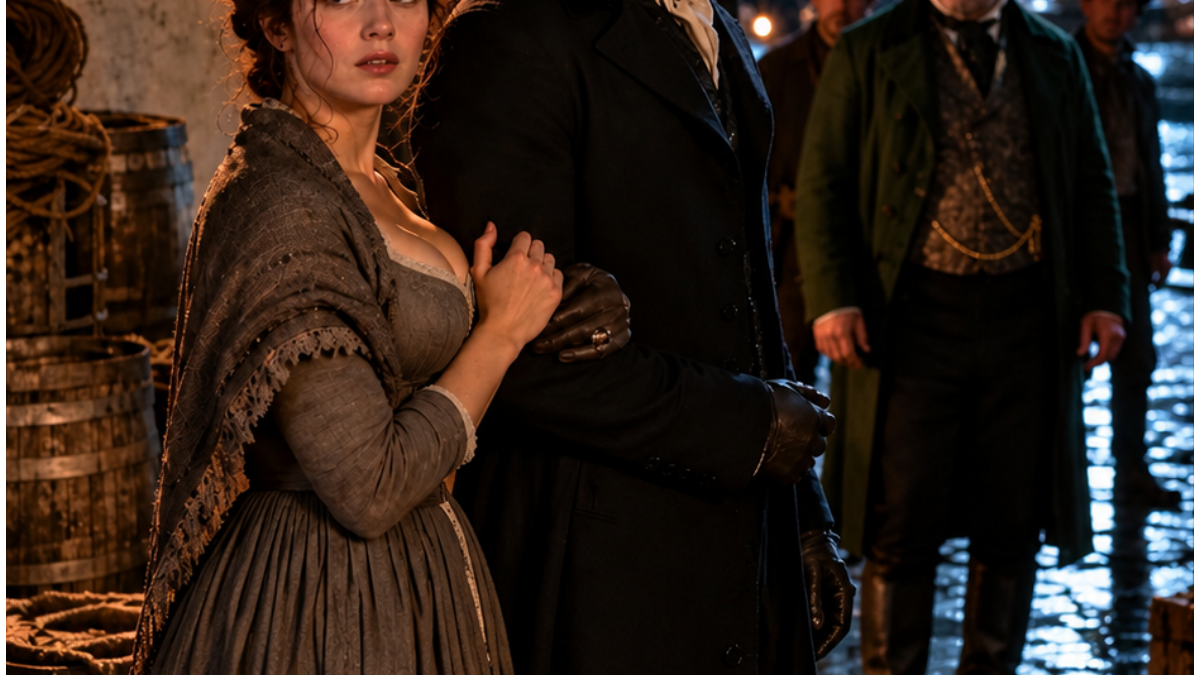

The woman came out of the crowd like a gull off a cliff, seized his sleeve in both hands, and said to the whole yard of the fleece and anchor, “There he is.
There is my husband, and you may all bear witness that he has come for me.” Cashin Ardwin did not know her.
He had been in Saltmir 11 hours.
He had spoken to nobody but a stable lad and a tollkeeper, and he had come north under a plain coat, and a plain name for reasons that required him to be no one at all.
Yet 40 faces had turned, the fiddle in the tap room had stopped, and a woman with salt dark hair and a torn hem was holding his arm as though it were a spar in deep water.
Her hands were shaking, her chin was not.
That was the thing he noticed, and he was a man who had spent 20 years noticing things.
The hands trembled, and the chin stayed level, and her eyes came up to his with a message in them, so naked and so desperate that it took the place of any introduction.
Help me, only for a moment, only until they go.
Behind her, four men had stopped at the yard gate.
Three were the sort a shipping office keeps for the settling of accounts.
The fourth wore a bottle green coat and a heavy gold watch chain, and he had the wide, pleasant, unhurried face of a man who has never once been made to wait.
Her husband, the green coat repeated.
He said it the way a clerk repeats a figure that will not add.
Well, this is a wonder.
Tams and veil is at husbands now.
Cashion felt the crowd lean in.
He had exactly as long as it took a man to draw a breath to decide, and he had been deciding difficult things at that speed, since he was 19 years old, and had buried a father he did not love.
He put his hand over the woman’s hand where it clutched his sleeve, so that the tremor was hidden, and turned to face the yard.
My wife, he said, has a temper and I have a slow horse.
Both are matters between the two of us.
Neither is a matter for you.
The words came out in the voice he generally kept for magistrates and shipbrokers, and they did what that voice always did.
Two of the men shifted their weight.
The green coat did not.
Barnaby Croll, he said, touching his hat with two fingers.
Of Croll and nephew this town and you are Ardwin.
Ardwin. Croll tasted the name and found nothing in it.
There is no Ardwin in Saltmir.
There is now. And where were you wed, Mr. Ardwin? Somewhere you were not.
A snort of laughter from the crowd.
Somebody by the pump repeated it.
Croll’s pleasant face did not alter, but Cashion, who read men for a living, saw the small, still moment behind the eyes in which a ledger was opened and a new entry made.
You will have a license, then, Croll said.
Or a register or a ring or a witness, something on paper.
I’m a man of paper, sir.
I have paper of my own concerning this woman, signed and witnessed, and the parson is expecting her at 8 tomorrow, and the parson also is a man of paper.
He let that sit. Bring me your proof by noon tomorrow at my office on the ropewalk and I shall be reasonable.
Bring me nothing and I shall be reasonable in a different fashion.
You will be lawful, Cashion said.
That is the only fashion available to you.
Insultmir, said Croll almost kindly, those are the same thing.
He touched his hat again to the woman, this time, a courtesy so smooth it turned the yard’s stomach.
Mrs. Ardwin, until noon, they went.
The fiddle started up. The crowd, having been given nothing further, drifted back into its beer, and Cashen Ardwin, sixth Duke of Jedor, stood in an inyard that smelled of tar and fish scale, with a stranger’s hand still fastened to his arm.
She let go all at once, as if she had only then understood what she was holding.
“You may strike me if you like,” she said.
“Or call the constable. I would call the constable in your place.”
“Would you?”
“No,” she pressed her palms together hard, and he saw them steady.
“No, I should not. I should do exactly what I have done and then I should say what I am about to say which is that I am sorry and that I am not sorry and that I have no way to make either of those worth anything to you.”
Your name is Veil. Tamsen Veil.
My father was clerk of this harbor for 19 years.
A beat. He is a fortnight dead.
Cashin looked at her then properly which he had not yet had the leisure to do.
Four and 20 perhaps, a gray gown that had been turned and mendied and turned again, and morning stuff sewn on the cuffs by a hand that had done it in a hurry and in the dark.
Ink under two fingernails. Not a lady, not a servant, the particular in between of a clerk’s daughter, brought up on figures and psalms and the price of coal.
19 years, he said, clerk of the harbor, was his name Edmund.
He should not have asked it.
He knew that as he heard himself do it and it was too late.
Her whole face changed. Edmund Veil.
Yes. Something came into her voice that was worse than fear.
It was hope. You knew him.
No. Then how Miss Vale?
He glanced at the gate.
That man will have a boy watching this yard before the clock strikes.
Is there anywhere in this town you may go tonight that is not your own door?
Why should you care where I go?
Because I have just told 40 witnesses that you are my wife, and a lie of that size must be housed somewhere until it can be dismantled.
He picked up his hat from the mounting block where it had fallen.
Also, because I dislike Mr.
Croll and I have disliked him for some weeks at a distance of 200 m which is a considerable achievement on his part.
She stared at him. You do not know him.
I know his handwriting, said Cashion.
Where do we go? The house was in Fetch Lane, three stories of black and white leaning companionably against the church wall, and it belonged to a widow named Hesper Loin, who let rooms to see captains in the season, and to nobody at all out of it.
Mrs. Loin opened her door in a night cap, looked at Tamsen veil, looked at the tall stranger behind her, and said, “No, Mrs. loin. No, Tamson, my lamb, and you know why not. I have the parish overseers up my stairs on the first Monday of every month, and I’ll not have a word said.”
Her eyes went up and down caching like a tape measure.
Whatever this is. This is Mr. Ardwin Tamson said, “And I have told the whole of the fleece, an anchor that he is my husband, so a word will be said in any case, and I would rather it were said in a house where the doors have locks.”
Mrs. Loin’s mouth opened.
Then it shut. Then to Cashin’s considerable interest, the old woman began to laugh silently with one hand pressed to her stays.
Croll,” she said.
“Croll?”
“Well,” Mrs. Loin stood back off the doorway.
“Then you’ll have the attic, girl, and it locks on the inside, and I keep the key of it on my own chain.
And you, sir, will have the front parlor and the horsehair sofa, and you will find it a penance.
And my son’s dog sleeps in the passage between, and he is a great barker, and no use would ever otherwise.” And in the morning I shall want the truth of it, all of it, with my tea.
That seems a fair rent, Cashion said.
He did not sleep. The sofa was indeed a penance.
That was not the reason.
He lay with his boots off in his coat over him, and listened to Saltmere breathe, the slap and suck of the tide under the key, a chain running out somewhere, the watchman calling the half hour badly.
And he set the day’s facts in a row and looked at them the way he looked at a column of figures that would not tally.
Fact, he had come to Saltmir because of three letters.
They had reached him in April, all three at once, in a bundle his London solicitor had unearthed from a drawer at the Jedmore estate office, and sent on with a note of apology so careful it amounted to a confession.
Three letters written across 14 months in a clerk’s small upright hand addressed to his grace the Duke of Jedm and never once laid before him.
The first was respectful. The second was persistent.
The third had ceased to be either and Cashion had read it four times in a row in the window of his library at Jedmour with the rain coming across the moore and then he had rung for his horse.
Your grace, the third had said, I have now written twice and received the courtesy of a printed acknowledgement.
I do not write for myself.
The coal and tin that leave this harbor under Jedm’s dues are weighed on a beam that has been altered, and the difference has been going for four years into a pocket that is not the crowns and not your graces.
I have the weights. I have the tallies.
I have also the names of nine men out of the Saltmere boats who were taken up in one night in March by a pretender that had no business in this road.
And every one of the nine had witnessed against Mr.
B. Croll at the last sessions.
I am a harbor clerk and I have no protection but the truth of my books and the name of my landlord who is your grace.
I ask for a hearing.
If I am not to have one, I ask your grace to remember that I asked.
There had been no fourth letter.
There had been instead a paragraph in a Bristol paper in June.
An inquest at Saltmir. The harbor clerk found at the foot of the key steps at low water.
A verdict of accidental death.
The deceased known to be a man of settled habits, but the steps notoriously slippery.
14 lines less than they gave the price of hides.
Fact. He had told nobody at Jedmour where he was going.
He had ridden south and west with one saddle bag and the plainest coat he owned, and he had left his signate in a locked drawer, because a Duke of Jed arriving in Saltmir in a crested carriage would learn precisely what Saltmir wished a Duke of Jedm to learn, which was nothing.
In fact, 11 hours into that careful anonymity, a woman had hung a wife around his neck in front of the entire town.
Cashion turned his face to the back of the sofa and considered with the cold thoroughess he brought to everything the possibility that this was arranged that she was crows that the scene in the yard had been a hook baited for a stranger that he would find himself in the morning with a claim upon him and a scandal.
He considered it and set it aside and not out of gallantry.
Nobody who was acting held their hands like that, and nobody in Croll’s pay would have looked at him when he said the name Edmund with a hope that raw, which left the other possibility, and the other possibility kept him awake until the gull started.
She was Edmund Vale’s daughter, and Edmund Vale had died three weeks after writing to him, and a man of paper in a bottle green coat expected her at the church at 8:00 in the morning.
Mrs. Loin’s tea was strong enough to a hull.
Tams and veil came down at 6 with her hair pinned and her hem mendied, and she laid a package on the kitchen table before she sat.
A bundle of oil cloth tied with tarred twine about the size of a family Bible.
You said you knew his handwriting, she said.
Crolls, how Miss Veil, you owe me a story before I owe you one.
I owe you a great deal, which is why I mean to pay in the coin I have.
Her hands went flat on the oil cloth.
But I will not be the only one talking.
Not anymore. I did that for a fortnight to the constable and the coroner and the vestri and every man in this town who patted my arm and told me the steps were slippery and I have finished with it.
Mrs. Loin poured and looked at Cashion over the pot with an expression of frank enjoyment.
Very well, he said your story first and then a true answer to one question of your choosing.
That is my offer and it is better than you will get anywhere else in England.
She thought about it. Then she untied the twine.
My father was clerk of this harbor, she said.
He kept the du’s book, the weighing book, and the tide book, and he kept them in a hand you could read across a room.
He was not a drunkard.
He was not careless. He had a bad knee and he went down the key step sideways, holding the rail every day of his life, and he had done it so long the town laughed at him for it.
She said it steadily. She had said it before many times to men who had not listened.
On the 9th of June, he was found at the foot of those steps at 4 in the morning.
He had no reason on this earth to be at the foot of those steps at 4 in the morning.
The tide was out. There was nothing to see and nothing to weigh and no ship in the road.
The inquest heard that. The inquest heard Sir Willard Prime, who is our magistrate, say that grief made me fanciful.
And Dr. Yo, who is Mr.
Kroll’s brother-in-law, say that the deceased had complained of giddiness, which he never did, and the coroner sat two hours and dined afterwards at the fleece at Mr.
Croll’s expense. Her mouth was flat.
12 days later, Mr. Croll came to my door with a paper.
What paper? She turned back the oil cloth.
Inside were three ledgers worn at the corners and a folded sheet with a seal broken across it.
She pushed the sheet at him.
Cashion read it twice. It was a bond correctly drawn in a clerk’s hand, not veils, acknowledging a debt of £420 owing from Edmund Veil to Barnaby Croll, secured on the cottage in Slipway Row and its contents, and it contained in the crabbed claws at the bottom, a promise so ugly it was almost laughable, that in consideration of forbbearance, the said Edmund Vale undertook to procure the marriage of his daughter Tam, Hamson to the said Barnaby Croll within 12 months of the date hereof, and that failing such marriage the whole should become due at once.
At the foot where a signature should be, was a mark, a cross between the words Edmund and Vale, witnessed by two names.
My father, said Tams and Vale, very quietly wrote 19 years of the cleanest hand on this coaSt. He copied out the whole book of Psalms for my mother when she was dying.
And they have him signing away his daughter with a cross like a man who cannot write his own name.
Cashion set the paper down on Mrs. Loin’s scrubbed table and put one finger on the mark.
And for a moment he did not trust himself to speak because what he felt was not the cold, clean anger he was used to and could use.
It was something with a rope around it.
£420, he said. Did he owe £420?
He owed £11 to the corn merchant when he died, and there were £9 in the tea caddy to pay it, and I paid it.
Her voice cracked once on the tea caddy, and she went on over the crack without stopping.
Mr. Kroll says the bond was given last September.
Last September, my father wrote in his own diary that he had refused Mr.
Kroll’s offer of a loan on any terms whatsoever.
I have the diary. I have shown it to Sir Willard Prime, who told me that a bond is a bond, and a diary is a diary, and that Mr.
Croll is a warm man in this town and that a young woman with no father and no money and a debt of £400 might do very much worse than a warm man’s protection.
And this morning at 8:00 cash said at the church.
They came for me at the fleece last night because they knew I would be there.
I had gone to ask the landlord for work.
That is the whole of my great scheme.
I was going to scrub the fleece and anchors floors for apants and my dinner.
She laughed one bitter syllable.
Mr. Croll does not need me at the church.
You understand? He needs me not to be anywhere else.
My father’s books are in that oil cloth, and Mr.
Croll has been asking after my father’s books for a fortnight very kindly at the door with his hat in his hand.
Once I am his wife, the books are his.
That is the whole of it.
That is what I am worth.
420 pounds of forged paper and three ledgers in tred twine.
The kitchen fire ticked. Mrs. Loin, who had not said a word, got up and put more sticks on it, and blew her nose fiercely into a handkerchief the size of a mansel.
So Tamson said, “You have your story.
Now I will have my question.” Cash emban braced for it.
Who are you? Yesterday, she said, in the yard, before you knew one thing about me, you said you had disliked Mr.
Croll for some weeks at 200 miles.
You said you knew his handwriting.
She leaned forward. Mr. Ardwin, why is a stranger 200 m away reading Barnaby Croll’s handwriting?
He had promised a true answer.
He found somewhat to his own surprise that he intended to give one.
Because a man wrote three letters to my he stopped, corrected the course by a single degree, which was the smallest lie he had ever felt the weight of, to my house, asking for a hearing about an altered weighing beam and nine pressed men, and naming Mr.
B. Croll. The letters were kept from me for 14 months by a person in my employee.
When they were put into my hands in April, the man who wrote them had been dead 10 weeks.
She had gone perfectly white.
“Say his name,” she whispered.
“Edmund Vale,” said Cashion, clerk of Saltmir Harbor, and I am here, Miss Vale, because I did not answer him.
Tamsen Vale did not weep.
Cashion had expected it and had prepared himself for it in the way a man prepares for weather.
And instead she sat with her hands closed on the edge of the table and her eyes on the oil cloth.
And when she spoke it was in the flat careful voice of somebody counting something.
He said he had written to Jedm.
He said it three times and the third time he said it to the window and not to me.
She swallowed. He said, “They will not answer, Tamson, because great men keep a man at the door whose whole trade is the not answering.” And I told him he was bitter and that dukes were not devils.
And he laughed at me and said, “No, my girl, that is exactly the trouble.
They are not devils. They are busy.” He was right, Cashion said.
Then you are Jedor’s man.
He let a breath go.
I am the man responsible for what Jedmore does and does not do.
It was true. It was also, as an answer, a door with a false back, and he heard himself close it, and did not know in that moment quite why he had.
Some part of it was the old habit, a name like his changed every room it entered, and he had spent 11 hours buying the right to be nobody in this town, and he was not ready to spend it.
Some part of it was less respectable.
She had looked at him in the in yard as at a man, and had bargained with him at a kitchen table, as with a man, and had asked her one hard question straight down the middle of the table, as she would have asked it of any man, and he had not been looked at in that manner by anyone in 15 years.
“Then Jedm will pay this,” Tamson said, touching the forged bond.
That is what you have come to do.
Pay the £420 and salve the conscience and go home.
That would be the cheapest thing available to me.
Yes. I will not take it.
Mrs. Loin made a noise over her teapot.
Miss Veil pay it and the bond is discharged and the bond stands.
Her chin came up in the way he was beginning to recognize.
Do you not see? Every hour that paper exists, it says, “My father sold me.
Pay it and you have bought me from him.” And the town will say so for 40 years, and the cross at the bottom of it will still be a cross, and Sir Willard Prime will still say, “A bond is a bond, and my father will still be a drunkard who fell off the steps.” She pushed the paper an inch towards him.
“I do not want it paid.
I want it proved false.” Cashion looked at the bond and then at her and something that had been shut in him for a long while turned over.
That is a great deal harder, he said.
I know what it is.
I have had a fortnite to learn what it is.
She spread her hands. But you did not ride 200 m to buy off Barnaby Croll.
If that were your errand, you would have sent a clerk with a draft and never left your fire.
You came yourself and you came in a coat that has been rained on and you gave a false.
She stopped and her eyes narrowed very slightly.
You gave a short name to a room full of people.
So you came to look at his books.
I came to look at his books.
Then I will show you where they lie, said Tamsen Vale.
And how they are kept and what a saltmeal looks like when it has been trimmed and where every coal hoy and tinbo in this harbor was on every day of the last four years because I copied my father’s fair books for him from the age of 13 and I have them here in tarred twine and in return you will not pay one shilling of that debt you will break it and if it cannot be broken then I shall be no worse off than I was at 8:00 this morning, she said, “Except that I shall have been listened to once, which is more than the coroner managed.” Cashion was aware of Mrs. Loin watching him with the frank interest of a woman at a cockfight.
“There is a difficulty,” he said.
“You told the fleece and anchor that I am your husband.” “Yes, color came up her neck at laSt. I am aware.
It was the only thing I could think of that they could not simply carry me away from.
A woman with no father and no money has nothing at law.
Sir, a wife has a husband, and a husband is at least an obstacle.
I chose you because you were tall, and because your boots were good, and because you were looking at Croll’s men the way a dog looks at a fox.
She lifted her chin again.
I shall unsay it. I shall stand in the yard at noon and say plainly that I lied and take whatever comes of that.
You will do nothing of the kind.
I will not have you.
Miss Vale Cash and set both hands on the table.
Attend, please, because this is the only piece of this in which I am the one with the experience.
Mr. Kroll has been running an arrangement in this town for 4 years without a single hand raised against it.
He has a magistrate who dines with him, a surgeon who is his brother-in-law, a coroner he feeds, and I would guess 3/4ers of the small tradesmen of Saltmir in his debt book.
Against that, a young woman’s word is nothing, and a stranger’s word is nothing.
But a stranger with a wife has a reason to be here.
He has a household and a settlement to look into, and a lawyer’s business, and an interest in his wife’s late father’s affairs that no man in England could think odd.
Take away the wife, and I am a stranger asking questions at the harbor office, and I shall be over the parish boundary in 3 days with a warrant behind me.” Tamson sat very still.
“You mean to keep the lie?
I mean to hold it up for as long as it is useful and then take it down honestly.
A fortnight perhaps 3 weeks.
And what am I in that fortnite?
You are Mrs. Ardwin, who lodges in Fetch Lane with her husband’s landlady while her husband’s business detains him, and who keeps the front parlor, and who is never once alone with him behind a shut door, and whose character Mrs. loin will guard like the Bank of England.
He looked at the widow for a consideration.
For two shillings a week and the pleasure of it, said Mrs. Loin, I buried a husband that Croll’s father ruined.
You’ll get no argument out of this kitchen.
And when the fortnight ends, Tamson said, “When you have your books and I have my proof and you ride away, what am I then?
A woman who was a wife for three weeks in front of the whole town and is not one after.
It was the right question, and it was the one he had not answered to himself at 4 in the morning on Mrs. Loin’s horsehair sofa.
Then you will be a woman with a name that has been cleared, and a document that says so under a magistrate’s hand, Cashen said, and a competence settled on you that no man can touch.
And my word in writing that the whole of it was my contrivance and no fault of yours.
And if there is a soul in Saltmir who still cares to whisper, you will not be in Saltmir to hear it.
That is charity again. That is wages, he said.
You are about to do 3 weeks of a clerk’s work for me, and a clerk is paid.
Would you rather I insulted you by pretending it was a gift?
Tams and Vale looked at him for a long moment across the tea things.
You are a very odd sort of steward.
She said, “So I am told.” At half 11 they walked to the ropewalk together, and Saltmir watched them do it.
He had not in the abstract expected that to be difficult.
It was difficult. The town came out to its doorways as they passed, not rudely, most of it, but with the fixed and thorough attention of a place where nothing would ever happens between Miklmus and the herring.
Women stopped with their arms in their washing.
A rope spinner walked backwards down the whole length of his walk to keep them in view.
At the corner by the sail loft, a knot of men fell silent as they came up and began to talk with great animation about mackerel as they passed.
“They are counting my hem,” Tamson said under her breath.
“And adding your boots, and they will have the sum done before we reach the corner.” “What sum will they make of it?” That I have caught something above me, and it will end badly.
She said it lightly. It cost her something.
Saltmir is not unkind. It only knows what happens to girls who catch things above them.
Croll and nephew occupied a square well-kept building at the head of the ropew walk with a green door and a brass plate, and the clerk who opened it had a stoop and ink to the elbow and the frightened overquick manner of a man who has learned to be everywhere at once.
He showed them into a room with a good fire, a good carpet, and a wall of ledgers in identical calf.
Barnaby Croll rose from behind his desk and was delighted.
That was the word for it.
There was no other. He came round the desk with both hands out.
He set a chair for Tamson with his own hands.
He sent the clerk for Madiraa and would not hear of a refusal.
And he said what a very great pleasure this was, and how the town had talked of nothing else since last evening, and how he hoped Mr.
Ardwin would forgive an old bachelor’s disappointment, since a man may be disappointed and still be a gentleman.
“You will have brought the license,” he said, smiling when the madiraa was poured.
“I have brought nothing,” Cashin said.
Croll’s smile stayed exactly where it was.
Nothing. You are not the register of this dascese, Mr.
Croll, nor its bishop, nor any officer of the church or the law.
There is no man in England to whom I am obliged to produce my private papers on demand, and you are furthest of all from being that man.
Cash set the untouched madiraa aside.
If you doubt my wife’s condition, you have a remedy.
Go to the ecclesiastical court and swear your doubt at your own charge, and let them cite me.
I shall attend with pleasure.
The clerk by the door had stopped breathing.
That is a great deal of law, Croll said, for a private gentleman.
I have had occasion to learn some.
You will have observed, sir, that I hold a bond.
I have read it. Then you will have observed further that it is due that it is secured on the cottage in slipway row and that the personal covenant runs against the estate of the late Mr.
Veil of which this young person is administratrix.
Croll folded his hands. I do not wish to be disagreeable.
I wish to marry her.
She says she is married well.
Then let the husband do a husband’s part.
420 sir and my kindest wishes to you both and the cottage may stand.
No, no, not one penny, Cashion said, for that paper.
If Mr. Vale owed you money, sue for it in the proper court, and I shall see the account taxed by an attorney of my choosing item by item from the first shilling.
And I tell you plainly, Mr.
CL so that you cannot say afterwards you were not told.
The covenant on the second side of that bond concerning the procuring of a marriage is void as against the policy of the law and any court in this kingdom would strike it out and look very hard at the man who drew it.
For the first time something moved behind the pleasant face.
You are advised I see.
I am informed it is cheaper.
Kroll sat back. He looked at Tamson then at some length and Cashion discovered that he did not care for that at all.
It was the look of a man consulting a page he has known by heart for a long time.
Miss Vale Croll said gently Tamson your father and I were not friends but we were near neighbors in this business 20 years and I have watched you carry his dinner down that key since you were so high.
You are a clever girl and you have been badly used by circumstance.
Do not let a stranger in a wet coat spend your one chance for you.
He turned a hand towards cash and without looking at him.
This gentleman will be gone by the herring.
Men of that sort always are.
And then there will be the debt and the cottage and the parish.
And you will remember that I offered you a house with a slate roof and a carriage and a name in this town.
And that I offered it whatever is said honorably.
You offered it, Tamson said, on a paper with my father’s cross at the bottom.
Your father’s hand was not what it was.
His hand was perfect on the 9th of June.
She stood up. Her voice did not rise at all, and it carried into the passage and out to the inkstained clerk on the stairs.
He wrote the day’s tally at 10:00 that night in a hand you could read across a room, Mr.
Croll, and he was dead by 4 in the morning, and you have him making a mark like a plowboy in the September before.
One of those two things is a lie, and I am going to find out which the room was very quiet, the fire spat.
Take her home, sir, Croll said pleasantly.
She is not well. Outside on the rope walk, the wind had got up and the rope spinners were hauling their yarn in and Tams and Vale walked 40 yards without a word and then stopped and put out a hand to the wall.
You did that beautifully, Cashen said, and you should not have done it.
I know. He now knows that you know when the last tally was written.
I know. She pressed her forehead briefly to the cold stone of the sailoft wall.
I have spent a fortnight learning to keep my mouth shut, and I could not keep it shut for 11 minutes.
My father would be ashamed of me.
Your father wrote a third letter to a duke telling him he had been fobbed off with a printed acknowledgement.
Cashion said, “Your father would be delighted with you.
That is a different matter from safe.” She laughed a wet, unwilling, entirely genuine laugh and straightened up and pushed a strand of hair back under her bonnet and said, “Very well.
Then we had better be quick.
Come and see the beam.” The weighing beam stood in an open shed at the head of the old key under the harbor office where every hundred weight of coal that came in and every ingot of tin that went out was struck and entered before the dues were reckoned.
It was a great iron machine like a gallows with a pan the size of a cart and a graduated arm and a row of brass weights on a shelf in a locked cage.
Tamson took the padlock in her hand, looked at it and made a small sound.
That is new, she said.
How long? There has never been a lock on that cage in my life.
The weights are the crowns and the harbor keeps them.
And the clerk holds them, and my father put a candle to them and rubbed them with an oiled rag every lady day, and there has never in 19 years been a lock.
She stared at it. It has been on there perhaps a week.
See the bright of the shackle.
Cash looked not at the padlock, but at the beam.
He knew a little about weighing machines for the same reason he knew a little about drainage and a little about lime and a great deal about sheep.
Because a man who owns 40,000 acres either learns the trades on them or is robbed by all of them.
He crouched and put his eye along the arm of the great balance and squinted down its length as a carpenter squint down a plank.
Miss Vale, he said, when your father wrote of an altered beam, did he say altered?
How? He said it in the letter, did you not?
He said, the beam has been altered, and I have the weights and the tallies.
He did not say in what manner.
She crouched down beside him in the dust, careless of the gray gown, and put her own eye along the arm.
There, she said, “Under the fulcrum.
There is a plate there, and there should not be.
The bed is cast in one piece.” Cashion reached in and ran two fingers along the underside of the iron, and felt what she had seen, a strip of metal lein clothes, and painted over with the same black, no thicker than a shilling, and about as long as a man’s hand.
“There is a boy,” Tamson said suddenly, who could get his arm in under there.
Jory Kembbles. He runs messages on this key and he was fond of my father.
She turned her head and her face 6 in from his in the dark under the beam was suddenly and entirely alive.
Mr. Ardwin, if that plate comes out, every tally struck on this beam for four years is a lie.
And every lie has a signature at the foot of it, and my father is the man who was made to sign them.
Jory Kembbles was 13, wore a man’s waist coat cut down twice, and had the professional discretion of a White Hall messenger.
He listened to the whole proposition with his arms folded, spat over the harbor wall in a considering way, and said that he would want forpants, and that he would not touch the padlock, and that he would do nothing at all until he had been told why.
Because a plate under that beam means the tallies were false.
Tamson said, I know what a plate under the beam means, Miss Vale.
I in soft. The boy scratched his ear.
Everyone on this key knows the beams crooked.
The Colehoy men have known it too.
What none of us know is how to say so to anyone who do ought but laugh.
Cash looked at the boy with new attention.
You knew sir when a hoy comes in with 50 ton by the shipper’s note and goes out with 46 by ours and the master gets docked for the difference and it happens 40 times a man works it out.
Jory shrugged one shoulder. Mr.
Vale worked it out. He asked me to keep my eyes open on the key at nights.
That’s why I never said nothing to nobody after because look what come of it.
Tam went very still. He asked you to watch the key at night.
I Jarry Her voice had gone soft and dangerous.
Were you watching the key on the 9th of June?
The boy’s face shut like a box.
I got to get on, he said.
I’ll do your plate tonight when the tide’s up in the shed’s dark forence.
He was gone along the key before either of them could say another word.
Jumping the muring rings without looking down.
He saw something. Cashion said he saw something and he is 13.
And his mother takes in washing for Croll and nephew.
Tamson watched the small figure vanish behind a stack of barrels.
If we press him and he tells us and it comes out that he told us they will have that family out of their room by Saturday and there is no work in this town that Barnaby Croll cannot close.
She turned away from the wall.
We shall have to make it so that his telling does not matter so that the thing is proved without him.
That is well thought. It is not well thought.
It is only necessary. But she flushed slightly, and Cashion noticed that she did, and disliked how much he had wanted to make her do it.
They spent the afternoon in Mrs. Loin’s kitchen with the shutters half closed and the three ledgers open on the scrubbed table.
And Cash and Ardwin, who had sat on the boards of two canal companies and a bank, and had once spent nine days in a chancery suit over a milstream, learned that he had never in his life seen an account kept, as Edmund Vale kept accounts.
The D’s book was the least of it.
The weighing book was the marrow.
Every entry carried the vessel, the master, the shipper, the commodity, the gross, the tear, the net, the dues, and in a column of his own devising, ruled fine down the right hand edge.
The shippers declared leading as noted on the bill sent up from the counting house.
There, Tamson said, turning the book round.
He began that column four years ago last March.
He never said why. He only said, “Tamsen, an honest book agrees with the world, and if it does not, one of them is wrong, and it is not usually the world.” Cashin ran his finger down the two columns.
Declared 50 ton, weighed 46 ton, 300 weight, declared 80, weighed 734.
Page after page, month after month, the same slow leak in the same direction, never once the other way.
Four percent he said to five consistently nearer four and a half.
Tamson did not have to look it up.
I did the sum in April with a pencil on the back of the door and my father caught me and rubbed it out and told me not to be a fool.
4 and a half percent of everything that crosses that beam and Jedmour’s dues are struck on the weighed figure, not the declared.
So the Duke of Jedor is short paid four and a half percent of the harbor dues on four years of coal and tin.
Yes, which comes to 3,100 and some odd pounds, she said, if you take the dues at the old rate for the first two years and nearer 3,4 if you take the new.
I did that one on paper and I did not let him rub it out.
Cash sat back. £3,000 was nothing.
That was the ugliness of it, and he made himself look at it squarely.
£3,000 spread over four years was less than he spent on the Jedmore stables, less than the sum his aunt had once mislaid in a single winter at Bath, an item his agent would not have troubled to bring to him.
A man had been robbed of his good name and thrown down a flight of steps at 4 in the morning over a figure that would not have altered by a farthing the way Cash and Ardwin lived.
“But that is not all of it,” Tamson said, watching him.
“The dues are only what the Duke loSt. Look who paid.” She pulled the third ledger over, a smaller, fatter book, half full, and opened it at a page ruled in six columns.
The masters, she said, when a hoy is weighed short, the master is docked by his owner for the difference because the owner has been buil for 50 ton and only 50 ton was loaded and the harbor says 46 came off.
So the master is a thief or careless or unlucky and he pays 4 ton of coal out of a master’s wages 40 times a year across a whole coaSt. Her finger moved down the names worn pathic old Mr.
Nankro who lost his boat in the spring.
Every one of them. And when a master cannot pay his owner, he borrows from Croll.
From Croll and nephew on a bond at 5% and a security.
Tamson turned the page and there they were in Edmund Vale’s neat hand a column of them.
Bonds noted dates, amounts, securities.
My father copied everyone he could get sight of at the sessions.
Cottages, mostly two smacks, a share in the lime kiln, widow Sennon’s freehold at Kum Head.
Cashion sat looking at the page for a long time.
He was not merely stealing dues, he said at laSt. “No,” she said it as though she had waited a fortnight for somebody to reach the place she had reached alone.
“The dues were only the tap.
The tap made men poor, and being poor made them borrow, and the borrowing gave him the town.
That is why the beam is worth murdering a clerk for Mr.
Ardwin, not £3,000. Saltmere. The tallow candle guttered.
Mrs. Loin came in and put another one down without a word and went out again.
And the nine men, Cashion said, taken up in March, a year passed by a pretender that had no business in the road.
Every one of them had sworn against Croll at the quarter sessions in the matter of the coal weights.
A complaint got up by four masters that came to nothing because Sir Willard Prime sat on the bench, and the complaint was dismissed as vexacious.
Tamson’s mouth twisted. The nine were the witnesses.
Six weeks later, they were at sea in the king’s ships, and there was nobody left to swear to anything.
Are any of them come home?
One, Peter Jgo, who lost a hand off the texel and was discharged in the winter.
He lives with his sister up at Kum Head, and he will not speak to me or to anybody, and when the croll men pass, he goes indoors.
Cashion wrote three lines in a small book he carried in the private shorthand he had used since he was a young man and put it away.
“Then we want four things,” he said.
“The plate out from under the beam with a witness to its coming out.
The crown weights tested against true weights, which means a set of tried weights fetched from outside this town, and a man of standing to try them.” The bond in slipway row proved a forgery which means somebody who saw it drawn and Peter Jgo’s mouth opened.
That is not four things.
It is four impossibilities. They generally look alike at the start.
He closed the ledger. You have done the hardest part already, Miss Vale, and you did it alone in a house with the shutters shut a fortnight after your father died.
And I should like that said aloud once since nobody in this town has said it.
Tam Vale looked down at the table.
You may say it, she said when there is something to say it about.
Jory Kembbles came to the back gate at 10 that night, wet to the knee, and put into Cash’s hand a strip of soft iron about 8 in long, painted black on one face and bright with new file marks on the other, still warm from being carried against a boy’s ribs.
There’s a second one, he said, under the far end.
I left that one where it were, like you said, sir, in case they look.
That one will still be there Monday.
Who saw you? Nobody sees me, said Jarry Kembbles with enormous scorn, and took his forpants.
Cashion laid the plate on Mrs. Loin’s table beside the candle, and the three of them stood and looked at it.
8 in of iron worth on the beam it had come from.
Something near 4,000 in one man’s life.
So it is true, Tamson said.
Her voice shook on it now that it did not have to be argued for.
It is true and it is not fancy and I am not a grieving girl who has run mad.
It was always true, said Cashion.
Yes, but now it is true on the table.
She put out one finger and touched the file marks, and then without any warning at all, she sat down hard on Mrs. Loin’s kitchen chair and covered her face with both hands.
He did not go to her.
He was aware with a clarity that startled him of exactly how much he wished to, and of the two ft of scrubbed deal between her chair and where he stood, and of Mrs. Loin in the doorway with the dog at her knee.
And he stood where he was, and let her have the 90 seconds she needed.
And when she took her hands down, her eyes were red, and her voice was perfectly level.
Well, she said, now they will kill you too.
That is a considerable overstatement.
Is it? She stood and faced him.
You have been in Saltmere 2 days.
On the first, you took me from Croll in front of the town.
On the second, you refused his money in his own office and told him his covenant was void.
Tonight, you have a piece of his beam on the table.
Mr. Ardwin, whoever you serve at Jedmore, whatever wages they pay you, it is not enough for this.
No, Cashin agreed. It is not.
Then why? He considered the honest answer which had four parts and he gave her three.
Because a man wrote to me and I did not answer.
Because I have discovered in two days that a place I have owned since I was 19 has been run in my name in a manner I would not tolerate in a dog kennel and because I find I am not able to leave.
She waited a moment as though the fourth part had made a sound as it went paSt. Then eat your supper, said Mrs. Loin from the doorway, the pair of you before you save the world.
The invitation came on Friday on hot pressed paper with a footman in a plum coat to carry at 40 yards.
Sir Willard Prinebart presented his compliments to Mr.
And Mrs. Ardwin and hoped they would do him the honor of dining at Prime Court on Tuesday next at 6.
There would be a small party.
Sir Willard understood that Mr.
Ardwin was interested in the harbor and flattered himself that he might be of use.
Cashion read it twice and handed it to Tamson.
He means to look at you, she said.
He means to price me.
There is a difference and it is in our favor.
He turned the card over.
A man who wishes to know what a stranger is worth will show him a great deal in the hope of being shown something back.
You do not understand. Tamson laid the card down as though it had a smell.
Sir Willard Prime sat in his own parlor and told me that grief had made me fanciful.
He drank two glasses of wine while he told me.
I cannot sit at that man’s table and take his fish and say ma’am and sir.
You can cash and you will do it beautifully and it will cost you something and I am sorry for it.
Why must I go at all?
Because Mrs. Ardwin not going will be discussed in this town for a week and Mrs. Ardwin going will not.
He set the card on the mantle.
And because at prime court there will be at a hazard the harbor commissioners the collector of customs Dr. Yo and Mr.
Croll. And because the collector of customs is the one man in Saltmir with an office he did not get from Barnaby Croll.
And because I should like to see across a dinner table which of those men laughs when Croll laughs and which of them looks at his plate.
Tamin was silent. Also, Cashion added, “I have never yet met a magistrate who could resist showing a rich stranger his own commission of the peace, his own seller, and his own opinions in that order.
And men who are showing off do not attend to what they are saying.
You are said Tamson Veil slowly a very great deal more frightening than you look.
I am told that too.
There was a difficulty about the dinner and it declared itself on Saturday morning in Mrs. Loin’s kitchen where the widow stood with her arms folded and her chin out and stated it flatly since neither of the others had the courage.
She has nothing to wear, said Mrs. Loin.
There it said she has the gray which is turned and the black which is her mother’s made over and shall not walk into prime court in either without the whole table knowing what she is inside of a minute.
Then let them know Tamson said they know already my lamb that’s the point of it.
It’s whether you make them say it.
Mrs. Loin turned to Cashion.
There’s Mrs. Trellis in Church Street can cut and make in three days if she’s paid to sit up.
And there’s a length of gray blue silk in Pendul’s window been there since the assembly two winters back because it’s too fine for this town.
Seven and six the yard.
No, said Tamson. Yes, said Cashen.
I will not be dressed.
He turned to her and he was careful because he had understood by then that this was the fence she would not go over for kindness and might go over for sense.
Miss Vale, on Tuesday you are going into a room in which every person present has already decided what you are and one of them is the man who called you fanciful at your father’s inqueSt. You may go in and disprove it with your tongue, which you will do, or with your figures, which you will do, but they will not hear a word of either while they are looking at your cuffs.
A gown is not vanity in that room.
It is armor, and it is a tool of my trade, and I should buy you a crowbar without blinking if the door wanted.
Tamson looked at him for a long moment.
“Greyblue,” she said at last to Mrs. Loin.
Not white and nothing over seven and six.
Nothing over seven and six, Mrs. Loin agreed and went out and was heard at the front door telling the dog that some men were not entirely fools.
Prime Court stood a mile inland where the wind stopped, a square gray house with a new portico stuck on the front of it like a false tooth, and Sir Willard Prime came down his own steps to hand Mrs. Ardwin out of the hired shayes as though she were a bishop’s wife.
Charmed. Charmed. My dear Mrs. Ardwin, you will not remember me, I dare say, in happier circumstances.
I remember you very well, Sir Willard, Tamson said.
Cashion, two steps behind, watched the magistrate’s face perform a small, complicated maneuver and arrive at delight.
The party was 11. There was Prime, wide and pink and pleased with the world.
There was Lady Prine, who spoke of the weather with the doggedness of a woman who has learned that no other subject in her house is safe.
There was Dr. Yo, dry and yellow, who had certified the harbor clerk’s death.
There was Barnaby Croll in a plum waste coat, who bowed over Tamson’s hand and told her she was in great looks.
There were two harbor commissioners named Truhella and Basenko, one of whom laughed before Croll finished speaking and the other of whom studied the tablecloth.
And there was Mr. Halfyard, the collector of customs, a spare gray buttoned up man of 50, who had brought his own opinion of the company with him and kept it in his pocket.
And there was the gown.
Cashion had not seen it until she came down.
On Mrs. Loin’s stairs an hour earlier, and he had discovered then that his arrangements had been more successful than he intended.
Mrs. Trellis had cut it plainly, as Tamson had insisted, with no lace and no flounce, and a fissue of Mrs. Loin’s own that had been her wedding one, and the gray blue silk did the reSt. She had come down the narrow stairs with her hand on the rail and her chin at the angle he was learning to dread, and Cashen Ardwin, who had stood beside the beauties of three London seasons without altering his pulse by a beat, had been obliged to look at the hall clock for a moment and remarked that they would be late.
At Prime’s table they put her opposite Croll.
That he thought was deliberate.
It was also the first mistake.
Mr. Ardwin, said Sir Willard over the soup, you are a man of business, I am told.
Of a kind. Of what kind, sir?
Forgive me. In a small place, a stranger is a public entertainment.
Land chiefly, Cashin said, rents timber, lime, a little coal, and laterally a good deal of law, which is what land turns into if you leave it alone.
Basenko laughed. Truela looked at his plate.
And what brings a landed gentleman to a herring town?
A dead man’s letters, Cashion said pleasantly, and ate his soup.
The table went on talking, most of it, but he had put a stone into the pond, and he could see the ring of it travel.
Croll’s spoon paused for the length of one breath.
Dr. Yo did not pause at all, which was interesting because a man who is not interested does not so carefully continue.
Halfyard the collector, raised his eyes for the first time that evening, and looked at Cashion with frank curiosity.
They came at Tamson with the fish.
It was Lady Prine who was made to do it.
Poor woman, and she did it badly, which was a mercy.
She said with a bright social smile, that she had known Mrs. Ardwin’s dear father a little by sight, such a very worthy man, and that it was so brave of her to be out in company again so soon, and that she supposed the little house in Slipway Row must be sadly changed.
It is not changed at all, ma’am.
Tamson said it is only quieter.
And you were used to help him with his books, they tell me, cried Lady Prime, plunging on.
How singular figures in a young lady.
My father thought a woman who could not check a bill would be cheated all her life, said Tamson.
And he did not care to leave a daughter who could be cheated.
And can you check a bill, ma’am?
Said Croll, smiling down the table.
I can check yours, sir.
The silence had a shine on it.
Tamson, said Croll in the gentle, reproachful, public voice that Cashion was beginning to understand was his true weapon.
You are among friends. Then a friend will not object to a question, and I have had one in my head all week.
She turned to the commissioners.
Mr. Truhella, Mr. Basenko, you are the harbor board.
The coal that comes into this port is weighed on the crown beam under the harbor office, and the dues are struck upon that weight.
Do you know when the beam was last tried?
Truhella opened his mouth. Bisenko got there firSt. Tried ma’am.
Proved against tried weights by an officer, and the trial entered.
The statute requires it I think once in three years.
There is a the clerk keeps a that is the late Mr.
Vale had the care of all that said Benko.
He had the care of it.
He had not the power of it.
The trial is the board’s business and the record is the board’s book.
Tamson laid down her fork.
I asked because for four years my father entered in a column of his own devising.
Both the shippers declared lading and the harbors weighed net.
And in four years, gentlemen, that beam has never once weighed a cargo heavy, not once.
Between four and five in the hundred short on every hoy, every voyage every year.
The whole table was looking at her now.
A beam that is worn, she said, or bent or badly bedded, will er both ways, a little over one week and a little under the next as the weather takes the iron.
That is what an honest fault looks like.
A beam that urs always in one direction, always by the same amount, and always in the same person’s favor is not a fault.
It is an arrangement. Nobody spoke.
Cashion let it lie exactly 3 seconds which was as long as it could be born and then said quietly into it.
The lady is correct as to the statute, Sir Willard.
And I should say as a stranger with no interest in the matter that I have very seldom heard a proposition of that kind put more clearly at a dinner table.
It is a monstrous suggestion, Croll said, and he was still smiling, and his color had gone up two shades.
It is an arithmetical one, said Mr.
Halfyard. Everybody turned. The collector of customs had not until that moment said 11 words together.
Forgive me, Haffyard said. I have sat in this town nine years, and I have signed the coast bonds on every one of those cargos.
Mrs. Ardwin, the column you speak of, the declared lading against the weighed net, is it kept in Mr.
Vale’s own hand? In his own hand, sir, four years of it, ruled fine down the right hand edge.
And the book is where safe, said Cashen.
Halfyard looked at him a moment.
He had a flat, gray, unhurried face, and something in the back of it, cash and thought, had been waiting 9 years for somebody to say a sentence of that kind at Sir Willard Prime’s table.
Then it should not be here, said the collector, and returned to his fish.
Sir Willard rescued the evening with Brandy and his commission of the piece, both of which he showed to Cashion in his bookroom after the ladies withdrew, and both of which took a great deal longer than they needed to.
You must not mind Croll, Prime said in the man-to-man register.
Warm man made himself. There’s a coarseness, but he holds paper on half this coaSt. Mr.
Ardwin and a magistrate must live with the country he is given.
Must he? Ha. Well, well, Prime poured.
And you’ll allow that unfortunate business at the inqueSt. The girl was distracted.
Distracted. I said what was kind.
You said she was fanciful in substance.
Sir Willard. Cashion turned his glass by the stem.
You will not have heard at this distance, but there is a good deal of talk at present in the House about the conduct of harbor boards and county benches in the western ports, committees, returns called for, tiresome for everybody.
He said it in the tone in which one mentions rain.
A magistrate who could show that he had himself on his own motion required the trial of a suspected beam would look uncommonly well in such a return.
A magistrate who had been told about it at his own dinner table and had done nothing would look otherwise.
The pink face across the decanter went carefully blank.
Who did you say you were, sir?
I did not, said Cashion.
Croll took his moment on the steps at the end while the Shaes was coming round and Tamson was in the hall with Lady Prime’s Shaw.
That was a very pretty performance, he said.
Yours, I mean, not hers.
Hers was merely brave. He looked out at the dark.
I have written to Jedmore, Mr.
Ardwin. Cashion did not turn his head.
Have you? To the estate office, a civil letter.
There is an agent there, Mr.
Rook, I think, who has been most obliging to me over the harbor lease these four years.
And I thought it right he should know that a gentleman calling himself Ardwin is in Saltmir asking after the dues of the Duke of Jedore and hinting at dead men’s letters and lodging in Fetch Lane with a wife nobody in this town saw him marry.
Croll turned pleasantly because if you are Jedor’s man sir Mr.
Rook will vouch for you and I shall apologize handsomely.
And if you are not, then you are something else, and I shall know what.
Mr. Rook, Cashion said, “Yes, I should very much like to hear what Mr.
Rook says.” For the first time, the pleasant face showed something like uncertainty.
Croll had expected fear and had got interest and did not know what to do with it.
Then Tamson came out with her shawl on and Croll bowed and the Shaes took them away down the dark avenue between Prime’s new limes.
They did not speak until the lights of the town came up in the window.
I was sick with it, Tamson said.
The whole time my hands were under the cloth so they should not see.
Nobody saw. Mr. Halfyard did.
Mr. Halfyard said Cashion is going to be the most useful man in Saltmir and he saw a great deal more than your hands.
He watched the harbor lights swing into view below them.
Do you know what you did tonight?
I lost my temper at a dinner table.
You put the case. He turned to her in the dark of the shayes.
Miss Vale, I have paid men 800 a year who could not have laid that out as you laid it.
The fault that urs both ways and the arrangement that urs one that is not a clerk’s daughter’s cleverness.
That is the thing itself.
Your father did not teach you that.
He did. He taught you to keep books.
He could not teach you to stand up in a magistrate’s dining room with your father’s death on your shoulders and make 11 hostile people follow a chain of reasoning to the end.
Cash heard his own voice and did not moderate it.
That is yours. Tams and Vale sat very still, and outside the wheels changed their note as they came onto the cobbles.
You should not say such things to me, she said at laSt. Why not?
Because in 19 days you will be gone, and I shall have to go on living inside my own head afterwards.
And it was quieter in there before.
Cashin found he had no answer at all.
Widow Sennon’s cottage sat on the shoulder of Kum Head with its back to the weather and a strip of ground running down to the cliff path, and she would not let them pass the door until Tamson said her father’s name.
Edmund Veil’s girl. The old woman had a face like a walnut and hands ruined by 40 years of gutting.
Come in then and mine the beam, and you, sir, sit where I can see you.
The free hold at Kum Head was 3 acres and a well, and it had been in her husband’s family since before anyone could say.
Croll had it now, or would have it at Miklmiss, on a bond given for 114 shillings after her son had been docked twice in the same winter for short weight, and could not pay his owner.
£114 she said and the interest on the interest and the costs of the notice and now it’s 60 odd and they say the land’s worth 30 and I’m to be grateful there’s a difference forgiven she spat into the fire man’s grandfather is buried in that ground under the thorn not in the churchyard there under the thorn because that’s where they were let Mrs. Sennon Cashen said, “Did you sign that bond?” I made my mark.
I can’t write. Was it read to you?
Mr. Kroll’s clerk read it.
The little stooped one with the ink.
Quillit said Tamson. That’s him.
Seabine Quillit. He read it out and his voice shook.
And when I put my mark, he wouldn’t look at me.
And after at the door, he said, “Mrs. and then he never said nothing more and went off down the lane.
The old woman’s eyes moved between them.
Why? Because a bond of that kind requires two witnesses to a mark, Cashen said.
And because a clerk who cannot look at a woman when she signs is a clerk who knows what he is putting his name to.
Mrs. Sennon, will you tell that to a court who take my word against crolls?
With respect, ma’am, it is not your word against his.
It is your word and Peter Jgo and 11 others and three ledgers and a piece of iron 8 in long and the collector of custoMs. He set his hat on his knee.
That is not a woman against a warm man.
That is a case. Widow Senant looked at him for a while with her head on one side in the manner of someone appraising a heer.
You ain’t a lawyer? She said.
No, you ain’t a merchant neither.
She sucked her teeth. Never mind.
Yes, I’ll tell it. What have I got to lose but three acre I’ve lost already.
Then she turned to Tamson and her voice changed entirely.
Your father come up here in the spring.
My lamb sat where that man sitting.
Wrote it all down in his little book and read it back to me twice to be sure he had it right.
And he said, “Miss, this will take a year and it’ll be ugly and I’ll not promise.” And I said, “Mr.
Veil, ugly is all right.” And he laughed.
Her mouth pulled. Then he was dead and nobody come.
6 months and nobody come till you.
Tamin got up abruptly and stood at the little window with her back to the room.
Cashion let the silence run and then said gently, “Mrs. Sennon Peter Jgo is your neighbor.
Two fields. He will not speak to anyone.
He won’t. Poor soul. She shook her head.
Took at night with eight others out of the merry blig and come home 3 years after with one hand.
His mother died while he was gone and he never knew it till he walked in.
He blames himself for swearing at the session.
C. Says if he’d kept his mouth shut he’d have been home.
Would he speak to her?
Cash said and nodded at the window.
The old woman looked at Tamson’s straight back for a long moment.
He might, she said. Edmund Vale carried his mother’s coffin.
Wasn’t a soul else would being the sun was pressed and there was no money.
Vale and the sexon and two more up that hill in the rain.
She got up and reached for a shawl off the doornail.
Come on then, girl. If you’re going, go now, before I think about it.
Peter Jgo was splitting kindling one-handed in his sister’s yard, holding the billet with the stump wrapped in sacking, and he did not stop when they came through the gate.
I have nothing to say.
I have not asked you anything, Tamson said.
He split three more. The wind came over Kum head and flattened the grass and went on out to sea.
“Your father carried my mother,” he said at last, to the chopping block.
“I know I was there.
I held the umbrella over the sexton, and it blew inside out, and my father laughed at the graveside, and I have been ashamed of it for 11 years.” Tamson sat down on the low wall quite calmly, as though she had all day.
He said afterwards that best JGO would not have minded.
He said she had a great deal of laugh in her.
Jgo stood with the hatchet hanging.
She did, he said. Mr.
Jgo, I am not come for your evidence.
Then what are you come for?
To tell you a thing you have a right to know before anybody else in this town hears it because you paid more for it than anybody?
She folded her hands. The saltmeir beam is false.
There are two plates let in under the bed of it, filed and painted, and one of them is in my kitchen.
The coal has been weighed four and a half in the hundred short for four years.
And every master on this coast has been docked for the difference.
And every man docked has borrowed of croll and nephew.
And that is how Barnaby Croll came by half the freeholds between here and the head.
She let that stand. You swore to the short wait at the sessions and they told you you were a liar and six weeks later you were at sea.
You were not wrong, Mr.
Jgo. You were right and you were taken up because you were right and my father died proving it.
Peter Jgo set the hatchet down very slowly on the block.
Say that again, he said.
The bit about the plates.
She said it again. He turned away and walked to the end of the yard and stood with his back to them, his good hand gripping the top of the wall, and the wind took the noise he made and carried it off, and neither of them moved until he came back.
Three year, he said. His voice was ordinary and terrible.
Three year I’ve laid in the dark reckoning what I done.
My mother in the ground in me the cause.
Because I stood up in that court and said, 50 ton went in and 46 come out.
And Sir Willard Prime laughed at me, laughed, mind out loud, and the whole court after him, and said, “A man that cannot count his own cargo had best keep off the sea.” “And I come home, and there was no one, and I thought, that’s what comes of opening your mouth.” “That is what they wished you to think,” Cashan said.
Jgo looked at him for the first time.
“And who are you when you’re home?” a man who has spent a week finding out that his own name has been used to hold a door shut.
Jgo’s eyes went over him, the coat, the boots, the hands.
You’ll be for the law then.
Quarts, wigs, all that. Yes, they’ll laugh again.
They will not, said Cashen.
Because this time we shall bring the beam.
Peter Jgo stood in his sister’s yard with a stump wrapped in sacking, and something came back into his face that had plainly been gone a long while.
“I want to see the plate,” he said, “with my own eye, and I want it set out in the town, not in a room.
And then, Mrs. To Tamson, you can have my hand on it, such as there is of one and my mouth, and any court you like.” The citation came 4 days later and it came as such things do on a fine morning when nothing was expected.
Two papers. The first from the consistry court of the dascese cited Cashen Ardwin and Tamson his supposed wife to appear and exhibit proof of the pretended marriage at the promotion of Barnaby Croll gentleman who alleged that the said pretended marriage was a mere assertion and a scandal.
The second was worse. It was noticed that Mr.
Croll as principal creditor of Edmund Vale deceased had applied to have the administration of the estate revoked from the daughter and granted to himself.
Mrs. Loin read them both over Tamson’s shoulder and sat down.
The books, she said, “The books.” Tamson’s voice had no color in it.
If he is administrator, my father’s ledgers are assets of the estate, and they go to him, and they will be in his fire by nightfall of the day he gets them.
That is all this is.
He does not want 420.
He wants the right hand column.
How long? Cashin asked. The court sits at Marchborn in 3 weeks and two days, she said.
I know that because I have already been once to swear to the inventory, and I was told to bring a man with me next time, and I said I had no man to bring, and the clerk wrote something down.
Cashion read the citation through again with great care, and then folded it and put it in his breaSt. Miss Vale, walk with me.
They went out past the church and up the old salt road until the town lay below them in its bowl, the masts crossing and recrossing with the swell, the smoke going sideways.
He stopped where the wall was low, and there was nobody within a quarter of a mile.
There is a lawful way through this, he said, and there is only one, and you will not like the shape of it.
Then say it quickly. Marry me.
The wind went on. A gull went over complaining.
That is not funny. Tamson said, “It is not offered as a joke.
Listen to the whole of it before you answer because you are entitled to the whole of it.” Cashion set his hands on the wall and looked down at Saltmir rather than at her.
As matters stand, you have no standing anywhere.
You are a woman of foreign and 20 with no father, no fortune, and a creditor’s application against you.
And every court you enter, you enter alone.
I have money and time and a certain weight.
And I cannot lend you one grain of any of them because at law I am nothing to you.
I cannot be heard for you at Marchborn.
I cannot defend the administration.
I cannot even swear to the ledgers being in my keeping without being asked by what right they are there and answering that a young woman lodges in my house and the church court the church court will ask us to prove a marriage that does not exist and there is exactly one honest answer to that which is to make one he turned to her then if we are married before the citation is answered it is answered suit falls his application falls with it because a husband may take the administration and I shall take it and your father’s books will be under my hand where nobody can burn them and you will not be a woman who was talked of.
You will be a wife.
Tamin had gone white to the lips.
You would marry a stranger to win a case.
I would marry a stranger to keep a stranger out of a debtor’s court and a forger out of a dead man’s papers.
Yes. He heard how it sounded.
He was not able in that moment to say the other thing.
The other thing had no business in a proposal made on those terms, and he knew it, and it saddened him like a stone.
And I will say the rest of it plainly, since you have never in a fortnight thanked me for a soft word, it would be a marriage in law and in name.
You would have your own rooms and your own door and your own key at fetch lane and afterwards and I should not cross it.
Not in a month, not in a year, not ever, unless you should one day open it yourself.
If the day never came, the arrangement would stand exactly as it stands, and you would be provided for and free of me, and nobody in England could touch you.
Free of you, she repeated.
That is what a marriage settlement is for.
It can be made to bind me and not you.
Cashin looked out at the water.
I know what I am asking.
I am asking you to sell 4 and 20 years of your own future to buy your father’s name back and it is not a fair bargain and I have no fairer one to offer and I have looked for three days.
She was quiet so long that he thought he had lost it.
You have thought about my father’s name, she said, more than any person alive except me.
Yes. Why? Because he wrote to me and I did not answer, Cashion said.
And because there is not a court or a bishop or a fund in England that can undo that, and this is the only thing left that I am able to do.
Tamson Vale stood on the salt road with her hands at her sides and looked down at the harbor where her father had gone down the steps sideways holding the rail every day of his life.
Not in a church, she said.
It must be in a church.
The law allows no other.
Then not with Crolls Parson.
Mr. Athony will do it and he is timid and he is honest and I have already spoken to him.
You have already spoken to him.
She rounded on him before you asked me.
I asked him what was possible.
I did not ask him for anything.
Cashion met her eyes. The bands must be called on three Sundays in the parish where we both dwell before the whole congregation.
That is a fortnight and a half of this town looking at us in church, and any person present may forbid it, and Barnaby Croll will be sitting in the third pew on all three of them.
Bans, Tamson said slowly. Not a license.
Not a license. A license would be quicker.
A license would be tomorrow.
She was watching him narrowly now.
A gentleman with money buys a license.
Why do you not buy a license, Mr.
Ardwin? Cashion had known the question would come and had known his answer for two days, and it was the truest thing he had said since the iny yard.
Because a license is sworn to.
He said, “A man goes before the surrogate and swears an allegation, his condition, his abode, his freedom to marry, that there is no impediment, and I will not stand up before God in a surrogate and swear a syllable that could afterwards be picked at.” Everything about this must be able to bear examination, Miss Vale, because I promise you that within a month somebody will examine it.
Bands are public and slow and cost three shillings, and there is nothing in them to swear falsely about.
Your name will be read out as it is.
Mine will be read out as it is.
The whole parish will hear it three times and be given the chance to object, and after that, no man on this earth can say that anything was done in a corner.
She looked at him for a long moment and because she was quick and because he had told her nearly everything, she got very close.
There is something you have not told me, she said.
There is. Will you tell me?
Yes. Cashin’s throat was tight.
But not to buy your consent with.
If you will marry me, marry me on what you have.
And when the case is won, the day it is won, before anything else, I shall tell you the whole of it, and you may do as you please with it, and with me, that is a very strange condition.
It is the only one I have.” Tamin Vale looked down at the town for a long while.
Then she put out her hand, palm up, in the manner of the harbor, where a bargain is a bargain.
“Three Sundays,” she said. He took her hand.
It was cold and it was steady, and he held it 3 seconds longer than the bargain required, and neither of them mentioned it.
Mr. Athl called the bands for the first time on the Sunday following, in a voice that went up at the end like a question.
Cashin sat through it with his eyes on the pulpit, and his whole skin aware of the woman beside him and the 400 people behind.
The names went out into the cold air of St. Ninians, Cashen Ardwin, bachelor of this parish, Tamson Vale, spinster of this parish, and there was a rustle across the whole church like wind in barley, and somewhere at the back a woman said, “Well,” quite a Barnaby Croll in the third pew on the south side did not move a muscle.
Afterwards in the porch, the town came at them.
It was not hostility. That was what undid Cashion entirely.
He had braced for hostility and got instead a slow, awkward, unstoppable tide of Saltmir shaking Tamson’s hand.
Mrs. Trellis the dress maker in tears.
Two of the Cohoy masters, hats off, muttering something about her father.
A woman with three under six who pressed a jar of honey into her hands and fled.
The Sexton, the rope spinner, who had walked backwards down his own walk to look at them, and who now said gruffly that he’d known Edmund Vale 40 years, and there was not a straighter man in the weSt. And that was all he had to say, and went off.
“They are not congratulating me,” Tamson said when they were clear of the churchyard.
Her eyes were bright. “They are apologizing for what?” for the fortnight in which nobody came.
She wiped her face with the heel of her hand angrily, for the inquest, for letting Sir Willard say fanciful and going home to their dinners.
They knew, Mr. Ardwin, that is what I have understood this morning.
Half this town knew the beam was crooked, and every soul in it knew my father did not fall, and not one of them could afford to say so, because Kroll holds their paper.
She stopped in the middle of the street.
He has not bought their silence.
He has bought their rent.
Then we shall have to make it cheaper to speak than to be quiet, said Cashion.
Sabine Quillit came to Fetch Lane on the Tuesday night in the rain without a hat and stood in the passage dripping and would not sit down.
I have not come, he said.
You understand that I am not here.
If it is said that I was here, I shall deny it and I shall be believed because I am a respectable clerk of 19 years and you are.
He looked at Tamson and stopped and his face did something wretched.
Forgive me. I am not myself.
Sit down, Mr. Quilllet, said Cashen.
I cannot stay. I have to say a thing and go.
The clerk’s hands were shaking so badly he had to hold one with the other.
The bond in slipway row, the 420 lbs.
Tamson came off the wall.
Yes, I drew it. Quilllet said on the 19th of September in the back office at 8:00 in the evening at Mr.
Kroll’s dictation. There was no Mr.
Veil in the room. There was never any Mr.
Veil in the room. He looked at the floor and the two witnesses that are on the foot of it are Mr.
Kroll’s nephew who is at Deerraera these three years and a name I never heard in my life.
They did not let Sabine Quillit out of that house until his statement was on paper.
It took 4 hours. Cashion wrote it himself in a plain hand in the short flat sentences of a deposition and read every clause back to the clerk twice and struck out three lines that were opinion and one that was hearsay.
And made him initial each alteration in the margin.
You will swear to this, he said at last, before a commissioner, not insultmir, at Marchborn on Thursday before Mr.
Chewin, who is a commissioner of the consistry court, and also I am told the only attorney in this county who has never dined with Sir Willard Prime.
And then I am ruined, Quilllet said.
Then you are a man who has told the truth.
You may say so, sir, with the boots you have on.
The clerk looked at his own, which had been mendied twice.
I have a mother at Truro who has no one else.
19 years I have kept his books and drawn his bonds and read them out to people who could not read.
And I have said to myself, I only write what I am told.
I do not sign. The sin is his.
And then old Mrs. Sennon made her mark and would not take her hand off the paper for a moment.
She kept it there and she said, “Is it right, sir?
Is it right what I’ve done?” And I said, “Yes, Mrs. He put his face in his hands.” Mr.
Quilllet, Tamson said, “Did you see my father after the 19th of September every week at the harbor office?” Did he know?
He knew by January. He came into our office on a Tuesday and he was white as a sheet and he asked to see the bond and Mr.
Kroll showed it him and he looked at it a long time and then he said in a very quiet voice, “I remember it entire.” He said, “I have never in my life made a mark for my name.
Not once, not as a boy.” And Mr.
Kroll said, “A man’s hand alters when he takes a drop veil.” And your father said, “I have never taken a drop in my life either, and you know it.” And he walked out.
Quillit’s voice cracked. And in June, he was dead.
“Did you say that at the inquest?” “I was not called at the inquest,” said Seabine Quilllet.
“None of us was called.
Dr. Yo was called, and Sir Willard, and the man that found him, and it was over in 2 hours, and Mr.
Croll had ordered the funeral meets before the jury sat.
The bands were called the second time on the Sunday, and Barnaby Croll sat in the third pew and did not move.
That was the thing that ate at Cashion all week.
He had expected the objection, had prepared four answers to it, and a fifth in case Croll was clever than he looked, and instead the man sat with his hat on his knee, and his face composed, and let the names go by him twice.
A man does not surrender a suit in the consistry court and an application for administration without a word.
He changes ground. He is waiting for something, Cashion said on the Tuesday in Mrs. Loin’s kitchen with a plate of iron on the table between them like a paper weight or he has given it up.
Men of that kind do not give things up.
They pause and then a thing arrives from somewhere else.
He turned the plate over.
What arrives here and from where?
Marchornne is 30 miles. Bristol is 80.
Jedore is 210. Tam looked up from the fair copy she was making.
You are afraid of Mr.
Rook. I am not afraid of Mr.
Rook. Mr. Rook is a middle-aged man with a good coat and a bad conscience.
Cashion set the plate down.
I am afraid of what Mr.
Rook will find it convenient to say.
Thursday at Marchborn went better than any day since the inyard.
Mr. Chewin proved to be a small, dusty, ferociously polite attorney with a wig that had gone the color of weak tea, and he took Quillit’s oath and read the deposition through twice with his lips moving, and then looked up over his spectacles.
“Do you know what you have here, sir?
I know what I hope I have.
You have a forged bond sworn to by the man who drew it, with a witness to it who has been out of the kingdom three years.
That is not a civil matter with assault mere flavor, Mr.
Ardwin. That is a felony and a hanging one at that in the strict letter, though they do not hang for it now as they did.
Chewin took his spectacles off.
And you propose to lay it where?
Not before Sir Willard Prime.
I should think not. Sir Willard Prime’s chief distinction, said the attorney, is that in 11 years upon the bench, he has never once committed a man of property for trial.
No, this goes to the asizes at the county town by information with the depositions annexed, and it goes there over the head of the saltre bench entirely, which can be done, sir, but which requires a person of some standing to lay it, and to answer for the costs, and to be personally sworn.
He tapped the paper. Who is that person to be?
Cashin looked at him for a moment.
I shall write you a letter tonight, he said.
And when you have read it, you will not ask that question again.
They rode back over the Moore road with the light going gold on the gorse.
And Tamson on the hired mayor said nothing for four miles and then said you are going to tell me on the day we win.
Yes, I have decided I do not want to know before.
Why not? Because whatever it is, it is large, she said.
And it will come into the middle of everything and stand there and I want the next fortnight without it.
She looked ahead at the road.
I have had 11 days, Mr.
Ardwin, of being believed. That has never happened to me in my life.
I should like to keep the last of it.
The third calling of the bands went by in silence.
On the 29th of the month, at 10 in the morning in the church of St. Ninion at Saltmir, Cashin Ardwin married Tamin Vale.
There were nine people in the church and then there were 60 and then when the bell went there were something over 200 because Saltmir had decided overnight and without consultation that it was coming.
Mrs. Loin wore purple. Widow Sennon came down from Kum head on a borrowed pony with her husband’s grandfather’s ring on a string round her neck for luck.
Peter Jgo stood at the back with his hat under the stump of his arm.
Jory Kembbles had washed Mr.
Athal’s voice shook and steadied.
Cash said the words after him and heard himself say them and found to his considerable disqu.
There was a moment near the end when Tamson’s fingers went cold in his, and he closed his hand round them, and she looked up, and whatever passed between them lasted perhaps a second and a half, and was seen by 200 people, several of whom mentioned it for years afterwards.
Then the register, Mr. Athal turned the great book round on the vestri table and dipped the pen and passed it and Cash and Ardwin stood over the page with the nib in his hand and looked at the line.
He could put it all down.
He could write the whole of it there in the parish book of St. Ninion and the vicor would go gray and the town outside would hear it within four minutes and everything the case the as the beam croll would from that instant be about a duke and about her and about what a duke’s wife had done in an inyard.
He wrote Cash and Ardwin bachelor of this parish.
Every word of it was true, and he knew as he set the pen down that he had done something he would answer for.
Tamson signed beneath him in her father’s hand the same upright, legible, unhurried letters, and it went through cash like a nail, and Mrs. Loin witnessed, and Mr.
Halfyard, collector of customs, who had come without being asked, and stood at the back through the whole service with his hat off, witnessed after her.
Outside the town threw wheat, having no rice, and somebody’s dog got in among the horses, and Saltmir cheered a harbor clerk’s daughter up the street with a noise that went out over the water.
Barnaby Croll watched it from the door of the fleece, anchor with his hands behind his back, and lifted his hat and smiled.
They came back to fetch Lane at dusk, and Mrs. Loin with elaborate unconcern announced that she was going to sit up with her sister at Church Street and might be very late and went and the door shut and the house was extremely quiet.
Cashion built up the fire because it needed doing and because it took 11 minutes.
You have made me a promise, Tamson said behind him.
And I want to say something about it before this evening gets any longer.
He straightened. She was standing by the table in the gray blue silk with her hands folded, and she looked steadily at a point somewhere near his collar.
You said your own rooms and your own door and your own key, and that you would not cross it unless I opened it, not in a month or a year or ever.
Her color was very high.
I have thought about that a great deal more than is decent, and I find that I do not wish to be managed.
Kindly like a difficulty you have solved.
That is not. Let me finish or I shall not get through it.
She took a breath. In the church today, you took my hand at the end and you looked at me and whatever was in your face then was not law and it was not my father’s name.
And I do not know what to do with it because there is a thing you have not told me.
And until you tell me I am married to threearters of a man.
Her chin came up. So I shall keep my key and you shall keep your promise.
And when the case is won, you will tell me the whole of it.
And then, Mr. Ardwin, I shall decide about the door.
Not you, me. Cashion stood with the poker still in his hand, and discovered that his voice was not entirely available.
That is fair, he managed.
It is not in the least fair.
It is only mine to decide.
She sat down abruptly and put her hands over her face for a moment.
And when she took them away, she was laughing unsteadily.
Oh, this is a very odd wedding day.
It is the best one I have had.
You have had others? None.
He put the poker down.
That was intended as a joke and it appears I am out of practice.
Sadly out. She wiped her eyes.
Sit down. Not there. There where I can see you.
And tell me something true that is not about Croll.
Because I have not had a single conversation in 6 weeks that was not about Croll, and I am starving for one.
So he sat and told her about the Moore.
He told her about a house standing high on the shoulder of a hill where the wind never entirely stops, so that people who live there stop hearing it and are made ill by silence when they go away.
About the beaches on the south drive that his grandmother planted the wrong way round out of pure obstinacy.
About the great cold hall with the black and white floor, where he had learned to ride a pony in the winter because there was nowhere else.
About a shepherd named Bligg, who had never in 40 years addressed him as anything but boy, and who had once told him at a funeral that grief was like lamming.
You did not get through it by being clever.
He did not name the house.
She did not ask. She sat with her chin on her hand in the fire light and let him talk for an hour and a half, and twice she laughed out loud.
And once when he told her about Bligg, she reached across the corner of the table and put her hand over his and left it there for the space of four heartbeats.
Then she took it away and said good night and went up.
And he heard the key turn in the attic door.
And Cash and Ardwin sat by the fire until 3 in the morning being for the first time in his adult life, entirely and helplessly happy and entirely aware of what it was going to coSt. The letter from Mr.
Chegwiden came on the Monday and was everything he had asked for.
The information drawn, the depositions annexed, the aise at the county town on the 14th, and a king’s council of Chegitan’s acquaintance willing to be retained.
The other letter came on the Tuesday.
It was in a hand cash and knew as well as his own, and it was addressed to Mr.
C. Ardwin at Fetch Lane, Saltmir, and it began without salutation.
Sir, I am directed by the estate office to inquire by what right you make use in that town of a name so nearly resembling the family name of a nobleman whose interests I have the honor to manage.
Your representations to Mr. Barnaby Croll, a most respectable gentleman and a tenant of this estate these 14 years, have caused great inconvenience.
I am to say that no person is authorized to inquire into the harbor dues of Saltmir on his grace’s behalf, that his grace is at present abroad and cannot be applied to.
And that if these impertinances continue, the estate will have no choice but to lay the matter before the magistrates of the district.
I am sir, your obedient servant, J.
Rook, agent. Cashion read it standing at the window with the light on the paper and felt something go very cold and very quiet in him.
What is it? Tamson said it is Mr.
Rook, he said, telling me that the Duke of Jedm is abroad and cannot be applied to.
And is he? He is standing in your landlady’s parlor, said Cashion with his hat on the chair.
He heard her breath stop.
He had not meant to do it that way.
He had meant to do it on the day of the verdict in some quiet place with everything one and nothing owing.
And instead he had done it standing at a window with a letter in his hand because there had been a half second in which the alternative was to lie to her outright and he had discovered that he could not.
Tams in Vale. Tams and Ardwin stood in the middle of Mrs. Loin’s parlor and did not say anything for a long, long moment.
And then, before she could, the street door went hard three times, and Jory Kembbles fell into the passage with his face gray and no breath in him at all.
Slipway Row. He got out.
Miss Tamsen, your father’s house.
It’s a fire. The cottage in slipway row burned for two hours and took the sail off’s end wall with it before the town got it under.
Nobody was inside. Cashion made certain of that within 90 seconds of arriving, walking the length of the chain of buckets and asking it of four separate men, and only then did he let himself look at what was actually burning.
A two- room cottage with a scrubbed step, empty since the 9th of June, containing one bedstead, one press, one dresser with a woman’s mother’s plates on it, and nothing else in the world.
Tamson stood in the roadway in her working gray with the light on her face, and did not go nearer than the pump.
“There was no fire in that house,” she said.
“There has not been a fire in that great in seven weeks.
I laid it, and I never lit it.
I could not. She was perfectly calm and it was worse than screaming.
There is nothing in there worth burning.
He knows the books are not there.
He has known it a fortnight.
Yes. Then why? Because it is a message, Cashion said, and it is not for us.
He was right, and the town understood the message before he had finished saying it.
Along the hole of slipway row in the red flicker, faces went shut.
Men who had shaken Tamson’s hand in the church porch nine days earlier passed the buckets and looked at the ground.
Somebody at the back said, not quietly, that it was a queer thing how much trouble came to folk that talked, and nobody answered him, and that silence went through Cashion like cold water.
Constable Hod came up at midnight when the beams had fallen in and told them in an embarrassed mumble that Sir Willard would want a word in the morning about the insurance, the cottage being mortgaged to Mr.
Croll and the said Mr.
Croll having an intereSt. The insurance Tamson repeated that’s the way of it, ma’am.
When a mortgaged house burns and the mortgage or in dispute, Hod would not meet her eye.
There will be talk. There’s talk already.
That was the first stone.
The rest came down in 19 hours.
At 8 in the morning, Sabine Quillit’s lodgings in K Street were found empty, the bed not slept in, the rent paid to the quarter in advance in coin.
His landlady said a gentleman had called for him on Tuesday evening in a shay, and that Mr.
Quilllet had gone out to it bare-headed and had come back for his box an hour later and had said when she asked that his mother was ill at Truro.
At 10, Mr. Chegin’s clerk arrived from Marchbornne wet through with a letter written in such agitation that the attorney had crossed out half of it.
Quillit had come to his office at 7 that morning in a hired shay with a second attorney at his elbow and had made a solemn declaration retracting his deposition in every particular that he had been in fear that Mr.
Ardwin had spoken of costs and of a place that he had said what was wanted of him that the bond was regular and drawn in his presence with Mr.
Vale sitting at the end of the table in a green coat.
At noon, Sir Willard Prine issued a warrant.
It was, Cashin was obliged to admit, beautifully done.
It did not touch him at all.
It was directed to the constable of Saltmir, and it recited an information laid by Basenko and Truhella, commissioners of the harbor, that certain books being the property of the harbor board to wit the weighing book, the Du’s book, and the tally book of the port, had been feloniously carried away from the harbor office by Tams and Vale, Spinster, on or about the 11th of June last, and were now unlawfully detained.
They came for the books at 1 and for her at half paSt. Cashin was at Halfyard’s office when it happened, and he heard afterwards from Mrs. Lo, who had stood in her own passage and told Constable Hod what she thought of him at a volume they heard in Church Street, that Tamson had gone upstairs, put on her bonnet, come down, given the widow her key, and walked out of the house between two men with her back like a gun barrel and her eyes straight ahead.
They took her before Prime, and Prime committed her.
Bailable, said Chewin’s clerk, ringing his hat when Cash and reached the courthouse.
Bailable? Your sir, it is bailable.
It is not a capital charge, but he has set the shies at 400 and two housekeepers of the parish.
And sir, there is not a man in Saltmir who will stand shy for her.
I have asked 11. They have wives, sir.
They have crows paper. I will stand.
You are not a housekeeper of this parish, sir.
You lodge. The clerk was crimson.
Sir Willard was very particular about that.
Cashion stood in the passage of the Saltmir courthouse with the smell of the burnt cottage still in his coat and understood with complete clarity that he had been outplayed by a country attorneys clerk turned merchant and that the price of it was being carried at that moment up the stairs of the lockup in a gray gown.
He had one thing left, and it was the thing he had been holding back for a month, and he had promised it to her first in private on the day they won.
He went out into the yard and asked for the magistrate.
Sir Willard Prine received him in the justice room among the parish chests, standing up with the warrant book still open on the table.
Mr. Ardwin, I am sorry for it.
The bench has no discretion when an information is properly laid.
Sit down. I beg your sit down, Sir Willard, and send your clerk out.
Something in the voice did it.
The clerk went the door shut.
You will now attend to me very carefully, Cashion said.
Because I am going to say a number of things once and each of them can be verified by post inside four days and you are going to spend those four days deciding what kind of end you wish your public life to have.
Sir, I do not know who you do not.
That has been convenient for both of us.
Cashion took from his breast the letter with J Rook’s signature at the foot of it and laid it on the warrant book and set beside it a second paper folded small which he had carried from Jedmour and had not until that hour unfolded in Saltmir.
That is a letter from my agent.
That is my banker’s credit drawn at Bristol for such sums as I may require.
Read the name on the foot of the credit.
Prime read it. His face did a slow complete unloly thing.
That is not possible. He said it is tedious rather than impossible.
My name is Cashen Ardwin and I have been styled Duke of Jedmour since I was 19 years old which is a piece of information I have kept out of this town for 6 weeks because I wished for the first time in my life to be told the truth by somebody.
He did not raise his voice at all.
You have this afternoon committed my wife to your lockup on the oath of two men who hold their harbor appointments from my estate upon an information got up by a tenant of mine in a matter in which my own dues have been embezzled for 4 years.
You have done it on a charge of stealing books which she did not steal from an office which her father kept at the instance of the man who forged her father’s name.
There was the information was regular.
It was regular. That is what makes it so ugly.
Cashion folded the papers again.
Now, two things. First, you will admit her to bail this hour on my recgnizance.
And if you tell me again that I do not keep house in this parish, I shall buy a house in this parish before dark, and you may come and look at the smoke of my chimney.
Second, on the 14th of this month, there is an a size at the county town and an information there against Barnaby Croll for forgery and depositions annexed.
Your name occurs in them, Sir Willard.
It occurs 11 times. There is a way in which those 11 mentions may read as the errors of a lazy man who trusted a neighbor, and there is a way in which they may read otherwise, and which it is to be depends entirely upon what you do between this moment and Friday.
There was a very long silence in the justice room.
What is it you want?
Prime said thickly. Two things you should have done anyway.
Order the trial of the harbor beam against tried weights publicly on the key by an officer from outside this county and enter it in the board’s book with the date and send for the coroner’s papers on the inquest of Edmund Vale.
They let her out at 6.
She came down the lockup stairs with her bonnet straight and her hands folded in front of her.
And the constable’s wife had given her tea and she thanked the constable’s wife by name.
And then she saw who was standing in the yard and she stopped on the bottom step.
They called me your grace, she said.
Cashion said nothing. The turnkey’s wife.
She brought the tea and she stood in the door and she said, “Is it true then, ma’am?
What they’re saying up the street and I said,”What are they saying?” And she said, “That you’re a duchess.” Tamson’s voice was perfectly even and there was something behind it that he had never heard there.
And I laughed at her.
I stood in a jail and laughed at a kind woman and told her the town would say anything.
And then I saw her face.
Tamson, you told me at the window and then the boy came and the house was burning and we have not had two minutes since.
She came down the last step.
I am not angry that you did not tell me.
I understood why before you had finished the sentence.
I am not a fool, and if I had been the Duke of Jedm, I should have come in a wet coat, too.
Her hands were shaking now, and she pressed them together.
I am angry. No, I am not angry.
I am frightened, and I do not like it, and I want to go home.
They walked back to Fetch Lane in the dusk through a town that came out to its doorways to watch.
And this time nobody spoke to them at all.
It was not the truth of it that did the damage.
Cashin had expected the truth to be a weapon and it was.
And by Friday the beam was to be tried publicly on the key and Prime had sent for the inquest papers.
And two of the Cohoy masters had come to fetch Lane and asked, cap in hand, whether his grace would hear a thing about the march of two years back.
It was Croll’s answer to it that did the damage, and it came out of a direction Cashion had not guarded.
It began in the fleece and anchor and it was in every kitchen in Saltmir by Thursday and on the Saturday it was in a Bristol newspaper in 11 lines of print under the heading a romance of the WeSt. A nobleman of the first rank, it said, had been discovered reciting incognito in a small port under a fain description where he had contracted a marriage with the daughter of a deceased harbor clerk.
The said marriage having been solemnized upon bands published in a name which concealed his true dignity, style, and title.
And therefore, as the best authorities agreed, being no marriage at all, but wholly void, the publication being undue.
And it was understood that the lady, who had first claimed the gentleman as her husband before witnesses in an iny yard, was at present at liberty upon bail upon a charge of felony.
“It is not law,” said Mr.
Chuan, who had come himself, and had read it twice with his mouth pursed.
“Or rather, it is a question.
It has been argued where parties are married by bands in a name by which the party is not generally known and the concealment is willful and intended to hide the marriage from those who might object.
The court has held the marriage void.
That is the rule. But your name, sir, is Ardwin.
You were born Ardwin. The register is not false.
A periage is a dignity and not a name.
There are cases the other way and better ones.
He tapped the newspaper. In my professional judgment, the marriage is good and would be upheld.
In your professional judgment, sir, there is no such thing as certainty in this.
Any man who tells you otherwise is selling you something.
Tamson was standing at the window with her back to the room, and she had not moved through the whole of it.
How long, she said, would it take to be certain?
To have it declared upon in the consistry court with an appeal to the arches if any person promoted a suit.
Two years three. And in the meantime, what am I Chewin was an honest man.
That was the trouble with him.
In the meantime, ma’am, he said, “You are a lady whose marriage is spoken of in the newspapers, and every step his grace takes in this cause will be read as a great man buying his.” He stopped.
“Say it.” Buying a verdict for his mistress, said Mr.
Chewin wretchedly. “It will be said.
It is being said.” That evening, cashin came in from the key, where the county surveyor’s tried weights had arrived by cart and been locked in halfyard strong room under two seals, and found Mrs. Loin alone in the kitchen with her hands in her lap and no work in them.
She’s above, the widow said.
She’s been above since 4.
Tamson came down at 7 with her bonnet on and her mother’s black shawl over her arm and a small bundle and she stood in the kitchen doorway and said I am going up to Kum Head to Mrs. Sennon.
Cashen got to his feet.
Do not, she said, please do not say anything kind because if you are kind, I shall not manage this at all and I have been 3 hours getting it into an order.
She held the bundle in front of her with both hands like a shield.
The trial of the beam is on Friday, and the asai is on the 14th.
Between now and then, everything depends on what people are willing to say in public about Barnaby Croll.
And every soul in this county is at present talking not about the beam, but about a duke and a clerk’s daughter and an inyard.
That will pass. It will not pass in nine days.
Her voice was steady and her eyes were not.
Peter Jgo will not stand up in that court to be laughed at as your creature.
Mrs. Sennon will not. Those two masters who came here with their caps in their hands.
Do you know what they said to me at the door when you were out?
They said, “We’ll swear to the weights, ma’am, and God bless you.
But is it true what’s in the paper?
Because if it’s true, they’ll say the whole thing was got up for a marriage.” She swallowed.
I have spent six weeks trying to make one thing true in front of witnesses that my father was an honest man who was murdered for his books and I have watched it turn in 4 days into a story about me.
I will not be the reason it fails.
I would rather be nothing at all.
You are my wife. I am a question in a newspaper.
She lifted her chin. So I am going up the hill to a woman who has already lost everything and cannot be made to lose more.
And I shall stay there until the 14th, and I shall come into that court as Edmund Veil’s daughter and nothing else, and the county may look at me all it likes.
Tamson, do not do this.
You have not asked me what I want.
Then I am asking. It is too late to ask.
That is the whole of my trouble.
She was crying now and paying it no attention whatever.
You gave me a key and a door and told me I should decide.
This is me deciding. I am going and I am going in daylight so that the town sees me go.
And if we win, I shall come back down that hill and stand in front of you and you may ask me again.
And if we lose, her voice went and she caught it.
If we lose, you will go home to your Moore, your grace, and you will not come back for me because you will have done everything a man can do, and it will not have been enough, and I will not have you spending the rest of your life at a window.” She went, she walked up the hill in the last of the light with her bundle, past 40 doorways, and Saltmir watched her go.
He did not follow her.
That was the hardest thing he had ever not done.
He stood in Mrs. Loin’s kitchen until the light went entirely, and then he sat down at the table where the plate of iron still lay, and Mrs. Hesper Loin poured him a glass of her late husband’s brandy and said one sentence.
“She’s right, you know, and she’s wrong, and the second one won’t matter unless you make the first one not true.” Meaning meaning stop being clever at people.
Your grace and go and be a duke at them,” said Mrs. Loin.
“You’ve spent six weeks pretending to be small so folk would talk to you.” “Well, they’ve talked.
Now be large.” Cashion sat with that for a long time.
Then he called for candles and wrote between 9 at night and 4:00 in the morning 11 letters.
They went by the mail and by two hired men on the Wednesday to Chewin, to the clerk of a size at the county town, to a king’s council in Lincoln’s inn, who had once been junior in a chancery cause of his, and who owed him nothing and would come for the money, to the board of customs in London respecting their collector at Saltmir, to the editor of a Bristol newspaper, a letter of four sentences and considerable temperature.
To Messers Rook and to the Jedmour estate office, dismissing an agent of 19 years standing by return and requiring every book, letter copy, and voucher in that office to be sealed and carried to Bristol under the eye of two men named in the letter.
And last at 3:00 in the morning with his eyes burning to his father’s sister.
The reply to the last arrived in person on Thursday afternoon in a traveling carriage with four horses and a maid having covered 210 mi in something over two days and Saltmir came out into the street to look at it.
Lady Odelene Ardwin was 71, wore black in the fashion of 1794, and had buried two husbands, and outlived most of her enemies.
She came into Mrs. Loin’s parlor, looked round it, said, “How very clean.” Sat down without being asked, and put out her hand for tea.
Now, she said, “You have married a clerk’s daughter in a fishing town in a name that does not mention you are a duke.
She has been in a lockup.
There is a paragraph in a newspaper.
And you have dismissed Rook, whom I told your father to dismiss in 1806 because he had a mouth like a purse.
Have I the whole of it?
Very nearly. Then answer one question and answer it as if I were your mother, which God knows I have had to be since you were nine.
Do you love her or is this conscience?
Cashin looked at his aunt across Mrs. Loin’s parlor.
I have been in this town six weeks, he said.
And for the first three of them, I could not have told you the color of her eyes, and I could have told you the exact tone of her voice when she is about to be brave.
She is the only person alive who has ever contradicted me twice in one hour and been right both times.
She left this house on Tuesday because she calculated correctly that my name would cost her father’s case more than my money would buy it and she went up a hill in front of the whole town to prove it and I have had to sit here and let her because she was right.
He set down his cup.
I did not know it was possible to admire anyone that much and be that angry with them at the same time.
Yes, said Lady Otene, that is love.
It is very inconvenient and it does not improve.
She put her cup down too.
Where is she? Kum head two miles.
Then send my carriage up for her on the morning of the 14th with my maid in it and my own arms on the door and let the county see me hand her out of it at the Asai’s court.
And in the meantime, cashion, you will take me to church on Sunday, and I shall sit in your pew and be so extremely disagreeable to any woman who looks sideways that they will be talking of me and not of her by Monday.
She smiled thinly. I have not had anything to do since 1817.
This is delightful. The beam was tried on the Friday on the key at 11 in the morning before something like 600 people.
Cashin had insisted on the hour and the place, and Prime, who had spent three days in a state of visible physical distress, had signed the order.
The county surveyor came with his tried weights under seal.
Mr. Halfyard broke the seals and read the certificate aloud.
Two Coopers and a smith took the bed of the great balance apart under the surveyor’s direction, and the whole harbor stood in absolute silence to watch it.
The second plate came out at 20 11.
The surveyor held it up over his head, 8 in of filed iron, black on one face, and the noise the key made was not a cheer.
It was lower than that and longer, and it traveled backward through the crowd in a way that lifted the hair on Cash’s neck.
600 people saying, “Altogether, and to nobody at laSt.” Then they weighed the tried weights on the beam as it stood.
And the beam said four and a half in the hundred short on weight after 100 weight exactly as a dead clerk’s fine ruled column had said it would for 4 years.
And Peter Jgo standing at the front with his hat off in his stump under his arm put his good hand over his eyes and stood like that while the figures were called.
Barnaby Croll was not on the key.
He had gone to Bristol on business.
His office said he was arrested there on the Sunday on a warrant out of the Asai by two officers with Mr.
Chewin’s information in their pocket.
And on the Monday, when his counting house on the ropewalk was searched under a judge’s warrant, they took away 11 ledgers, a locked private book, and the whole of the correspondence in the fireplace, which had been begun but not finished.
The servants having been prevented.
The private book was the end of him.
Cashion saw it once laid open on the table at Marchborn with Chegidan’s finger on the page and read four years of small clean entries in a merchant’s hand.
Sums to two harbor commissioners at Miklmiss and Lady Day.
12 guineies quarterly to a surgeon.
£140 in the March of 2 years passed under the headboat expenses tender which the prosecution would in due course lay beside the taking of nine men out of the merry bl and three times a year for 14 years in a firm round hand the entry J rook Jedore 40 GNS he wrote it down cash said they always write it down said with satisfaction a Man who steals by arithmetic cannot bear not to know his own total.
Jory Kembbles came to fetch Lane on the 11th at 6:00 in the morning and stood in the passage with his cap in both hands and his mother behind him.
Tell him, said Mrs. Kembbles.
My tell him, Jory, and then we shall have it done, and I shall not have you lying awake another night.
He can have us out of our room if he likes.
There’s a duke stood in this passage now and craws in the county jail and I have had enough of being frightened.
Tell him. Jarry Kembbles told him.
He had been under the tarpollen on the stack of nets at the head of the old key on the night of the 9th of June because he slept there in the warm weather when his mother’s room was full, and he had been woken at somewhere near midnight by voices in the harbor office above.
Three of them, sir, Mr.
Croll and Mr. Vale, and one more that come after Nance, that’s Croll’s man, him that keeps the yard.
And Mr. Vale was saying loud that he’d have the beam tried at the Miklmus board if he had to write to London for it, and he’d written to Jedmour three times and got nothing, and he’d write to the board of customs next, and to the papers after that.
The boy’s voice was thin, and then the light went out.
And then, and then they come down the stairs, and Mr.
Veil wasn’t walking, sir. Jory’s face crumpled and reassembled.
They had him between them with his arms over like a man that’s drunk.
And Mr. Croll went off up the ropewalk and Nance took him down the key.
And I heard the steps and then I heard nothing.
And I lay under that tarpolin until it were light.
And I never told a soul.
Not one, not in 6 weeks, because Nance come by at 8 in the morning while they were carrying him up.
And he looked at me.
He looked right at me, sir, and he smiled.
Cashion let a long breath go.
How old are you, Jarry?
13. Come, Martin, miss. Then you have carried that for 6 weeks alone, which is longer than most grown men could have managed.
He put his hand on the boy’s shoulder.
You will say it again to Mr.
Chewed this morning and again on oath at the county town and it will be the worst 2 hours of your life and afterwards you will be able to sleep.
Also, on the day you turn 14, you are coming to Jedm to be trained up in my estate office where they are in urgent want of somebody who notices things and your mother is coming with you and there is a house.” Mrs. Kembell sat down on Mrs. loin stairs and wept into her apron.
The coroner reopened the inquest on the 12th.
The verdict of the second jury, which sat 5 hours, was willful murder against Cela’s Nance and against Barnaby Croll as procuring and abetting the same.
Nance was taken at BID trying for a ship.
Dr. Yo, who had certified the death, went to Cheewin of his own accord on the 13th, and made a statement that he had never examined the body at all beyond a glance in the yard of the fleece, and had written what he was told, and had received 12 guineies quarterly for 14 years, and was very sorry.
It did not save him from being struck off the commission of the pieces list of persons ever again to be relied upon, nor from losing every patient in Saltmir within a month.
But it saved him from worse.
And Cashion, who did not forgive easily, made himself remember that the man had come without being sent for.
The asai opened at the county town on the 14th of the month.
Lady Odelene’s carriage came down from Kum Head at 9 with the Ardwin arms on the door, and Tamson was handed out of it at the steps of the Assai court by a footman in Jedmour livery in her turned gray gown because she had refused every other thing offered her.
And Lady Odelene Ardwin took her arm and walked up those steps beside her at a pace of her own choosing, looking about her with the mild, murderous interest of a very old woman who has decided to enjoy herself, and the county fell back and let them through.
Cashin did not sit with her.
He sat where the prosecutor’s client sits in his own name, with his own counsel at his elbow, and gave his own evidence on the second day.
The three suppressed letters in the dead man’s hand read out in open court to a courtroom so quiet that a man could hear the clerk’s pen.
That was the moment he had been told by four separate lawyers that it would be the beam or the private book or the boy.
It was the letters. The judge, a spare Yorkshireman with a cold in his head, asked him one question at the end.
His grace will forgive me.
These letters were addressed to you at your house and you say you never saw them for 14 months.
That is so, my lord.
Is that usual? Cashion stood in the box and looked at the packed gallery and at the reporter’s bench and at the small figure in gray at the side of the court beside an old woman in black.
My lord, he said, it is usual.
That is the whole of what I have learned this summer, and I would rather say it here than have it said of me.
A man in my position is protected from his own poSt. Between the tenant at his gate and the duke in his library, there stand an agent, a steward, a house steward, and a secretary.
And every one of them is paid to save his master trouble.
And a letter from a harbor clerk saying that a beam has been altered is trouble.
Mr. Vale wrote three times and received a printed acknowledgement.
I did not answer him because I was not permitted to know that he had asked.
I have dismissed the man who made that arrangement.
But I will not stand here and pretend that the fault ends with him because the arrangement was made for my convenience and I had the convenience of it for 14 months and Edmund Vale is dead.
There was no sound in the court at all.
Thank you your grace, said the judge, and blew his nose and turned to the jury.
Barnaby Kroll was convicted upon the information for forgery on the 15th, and upon the coroner’s inquisition at the same as of being accessory before the fact to the murder of Edmund Vale.
Cila’s Nance was convicted of the murder.
The judge in passing sentence said certain things about the state of the port of Saltmir, about a bench which had for 11 years mistaken a neighbor’s convenience for the king’s justice, and about the harbor board which caused Sir Willard Prime to resign the commission of the peace before he left the town and Messers Truhella and Basenko to be removed from the board by the Miklm following.
He said one thing further and Cash and carried it with him for the rest of his life.
It has been given in evidence, said the judge, that the deceased, Edmund Vale, kept for four years, and at his own hazard a column in a public book which nobody required of him, in which he set down what a thing was said to weigh and what it did weigh.
Gentlemen, whole systems of government have been founded on less.
I direct that the books be preserved.
And I observe, since it has been much canvased in the newspapers of this county in a spirit I do not care for, that the person who preserved those books after his death at considerable personal cost, and who first laid this matter before a person able to act upon it, was his daughter.
The bond in Slipway Row was ordered to be delivered up and cancelled.
Chewin had it done in the courthouse yard with a candle, and Tamson watched the 420 lb go up in a curl of smoke and did not say anything at all.
The masters were repaid. That took until the following spring, and it was Halfyard who did the arithmetic and cash who found the money, four and a half in the hundred on four years of coal and tin against the estate of Barnaby Croll so far as it went and against the Duke of Jedor for the remainder.
An old Mr. Nanko, who had lost his boat, got a boat.
Widow Sennon’s three acres, and a well came back to her by deed on the 1st of October.
She kept the deed in the Bible and showed it to visitors for 11 years.
Cashion went up to Kumhead on the last day of the Asai’s week on foot in the afternoon alone.
She was outside in the wind taking and washing off the thorn hedge and she saw him come up the last of the path and stood with a sheet half in her arMs. You said he called that if we won you would come down the hill and stand in front of me and I might ask you again.
I did say that. You have not come down the hill.
I have been coming down it since Tuesday, said Tamson.
It is a slow hill.
He stopped 6 ft from her.
The gorse was still out.
The sea below Kum head was the color of a wet stone.
The wind took the sheet and cracked it like a sail.
“Then I shall come up,” he said, “and I shall say it here where nobody is looking, because everything else in this business has been done in front of 600 people, and this is the one thing that is ours.” He took his hat off.
“Tam, in the yard of the fleece and anchor, you took hold of my sleeve because I was tall and my boots were good, and I have been of no use to myself since.
I did not marry you to win a case.
I told myself I did for about nine days and I have not believed it since the night you sat at Hesper Loin’s table and cried for 90 seconds and then told me the whole thing was true on the table.
Cashen, let me finish. You never let me finish.
His voice was not steady and he did not care.
There is a house on a hill where the wind never stops and I have lived in it alone for 20 years and been perfectly content and I shall never be content in it again unless you are in it.
That is not gratitude and it is not conscience and it is certainly not law.
I am asking you to be my wife because I cannot manage without you which is a great deal less handsome than the other reasons and is the true one.
The sheet cracked in the wind.
Tams and Vale looked at him for a long moment with her eyes very bright.
There is a difficulty, she said.
The newspapers say I am not your wife at all.
Then we shall settle it in the only way that leaves nothing to say.
He put his hand into his breast and brought out a paper folded with a seal on it, a special license under the archbishop’s hand.
It may be used at any hour in any church, and it names me in every style and title I possess.
And it names Tams and Ardwin, otherwise veil, spinster, or wife, as the law may find her.
Mr. Aly says he can be ready on Saturday.
Chegin says that if we marry again upon it, no living creature can raise a question in this world or the next.
Twice married, she said unsteadily, to the same man.
Once quietly for your father, said Cashin.
Once in daylight, in my own name, in front of everybody who has ever whispered about you for you.
Tamson dropped the sheet in the basket.
She crossed the six ft of grass.
She put both hands on his sleeve exactly as she had done in the inyard, and this time they were not shaking at all.
“Then say it in front of them,” she said, “and say it loudly.
They were married on the Saturday in the church of St. Ninian at Saltmir at noon with the doors open.
Mr. Athlony read the license out in full, every word of it, style and title and dignity, in a voice that for once did not go up at the end, and Cashen said his part loudly as instructed, and the register was signed, Cashen Ardwin, Duke of Jedore, and beneath it, in that upright, legible hand, Tamson.
Lady Odelene wept and denied it.
Mrs. Loin wore purple again.
Peter Jgo gave the bride away, having been asked by her in person on the Thursday, and stood through the whole of it as though on parade.
Jory Kembbles rang the third bell.
The town threw weed again, and this time somebody had thought to send for flowers.
They went north at the end of October by easy stages and came up onto the Moore road at 4 in the afternoon with the light going copper across 40 mi of Heather and Cash and stopped the carriage where the beaches began and handed her down.
There he said. Tamson stood in the road and looked at Jedmore for a long time.
The long gray front, the smoke going sideways off 11 chimneys, the lamps already lit in the hall.
The wind never stops, she said.
You will stop hearing it in a fortnight.
Then you will not be able to sleep anywhere else.
Cashion. She did not take her eyes off the house.
I have thought of something and you will not like it and I am going to say it anyway.
You always are the letters.
She turned to him. There are men and women writing to this house today.
There will be some in the bag tonight, and there is no rook now, but there will be somebody in a year or in 10 who thinks it kindness to keep the trouble off your table.
Her chin came up in the way that had never once in 5 months meant anything good for anybody who opposed her.
So I want the post, all of it.
Unopened on my table every morning of my life, and a day book kept of every petition that comes to this door, and what was done about it, and on what date, and it will be shown to you every Friday, whether you like it or not.
Cashin Ardwin looked down at the woman standing in the road in a turned gray gown and thought of a fine ruled column down the right hand edge of a public book kept for four years by a man nobody required it of “Your father’s column,” he said.
“My father’s column rule it in every book in this house.” Her voice went unsteady at laSt. “That is what I want for a wedding present, not pearls.
You shall have both, said the Duke of Jedm.
And the pearls are already in the carriage, and you may argue about them at dinner.
They put the memorial in the wall of St. Ninians the following spring, a plain slate cut by the Sexton’s brother, Edmund Vale, 19 years clerk of this harbor, who kept an honest book, and was not believed.
His daughter placed this below it.
At Tamson’s absolute insistence, and over the vicer’s mild objection, they cut the figures to the declared and the weighed, one line of each, as he had ruled them.
There is a house on a hill where the wind never stops.
On winter evenings, when the lamps are lit in the black and white hall, and the moore has gone the color of a wet stone, a tall greyeyed man may be found at the long table with a leather bag emptied out in front of him, and every letter in it opened, and a woman beside him with a pen, ruling a fine column down the right hand edge.
And when old Bligg comes up from the lamming at midnight and puts his head in without knocking, as he has done for 50 years, he addresses the Duke of Jedmour as boy and the Duchess of Jedmore as ma’am, and has never been corrected by either of them.








