She Bought a Poor Cowboy’s Ranch – Then Found His 5 Hungry Kids Needed a Home
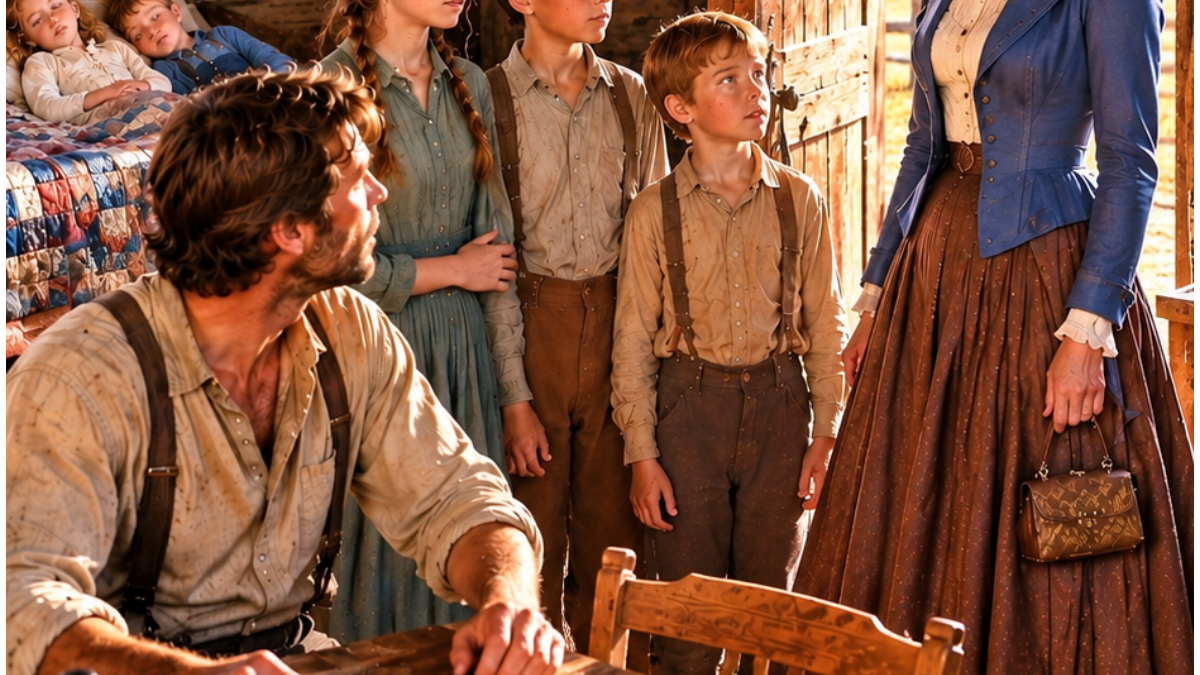
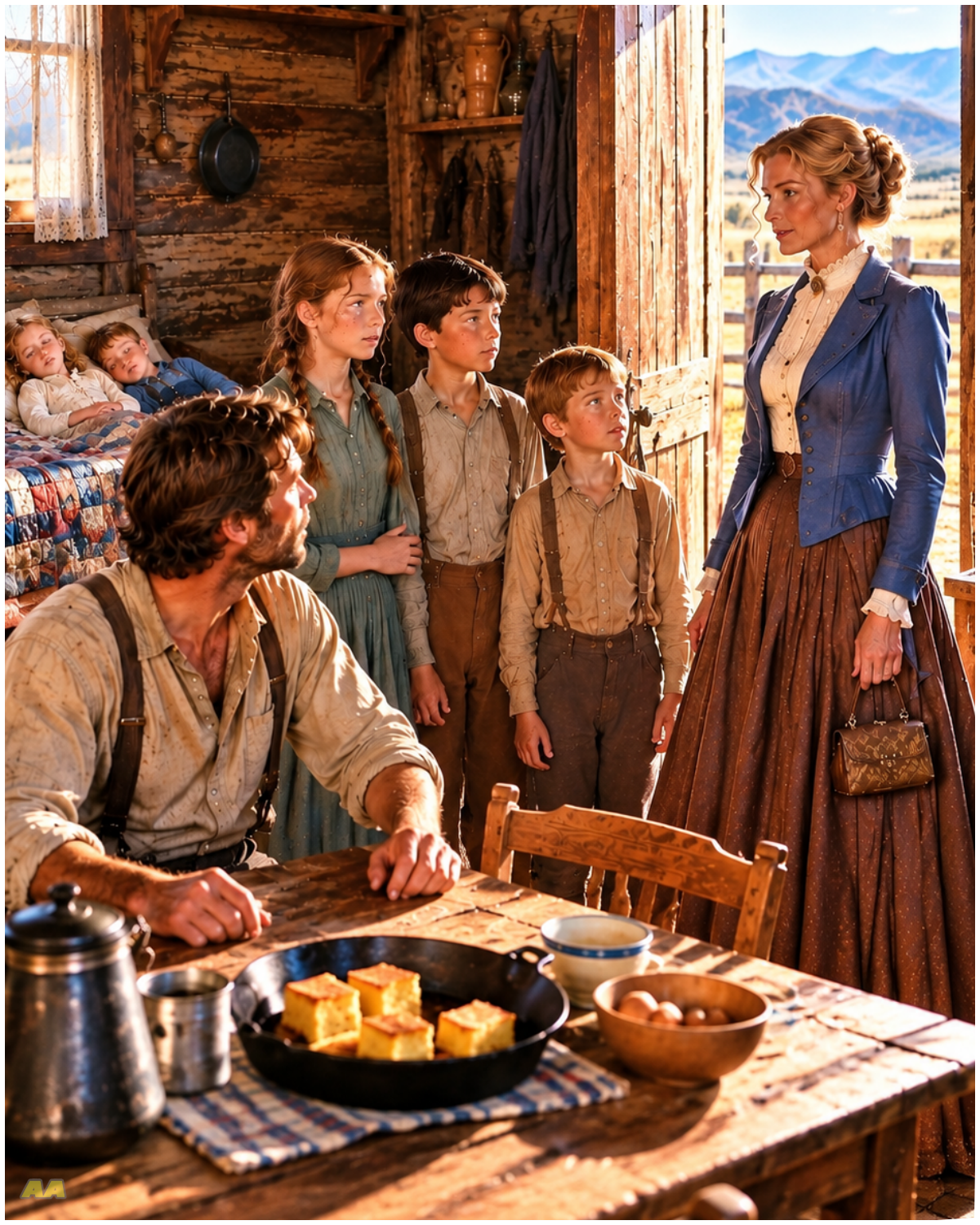
Caleb Voss arrived at the Boone property at 7 in the morning with two of his men and no patience for complications.
He didn’t come to negotiate.
He came because the auction was over.
The widow from Cheyenne had won the deed, and Voss had already calculated how long it would take her to realize she’d bought herself, a problem she couldn’t handle.
He planned to be standing there when it happened.
What he didn’t expect were the children.
The front door was barricaded from the inside.
Small handprints on the frostcovered window, and from behind the locked shutters, a girl’s voice steady, older than it should have been said, “My father owns this land, and you need to leave.” Voss laughed.
Then he said the words that would follow him for years.
“Your father isn’t here, little girl, and neither is anyone who cares.”
He was wrong on both counts.
And so so was everyone else who assumed that abandoned meant empty because the most important things on that property weren’t the fences or the cattle or the deed that had just changed hands at the county courthouse.
They were five children holding their breath in the dark waiting for someone to decide whether they were worth saving.
Clara Whitmore had made exactly one mistake in the 2 years since her husband died.
She hadn’t wept at his funeral, not because she didn’t grieve him.
She did in her particular way in the barn at midnight, where no one could measure it against a standard she hadn’t agreed to.
Most of its windows were dark, but if she had cried in front of 43 neighbors who were all quietly calculating whether she’d hold out or sell, she wasn’t sure she would have been able to stop.
And stopping was not something she could afford to fail at in public.
She told herself she was past it now.
He wasn’t entirely sure that was true.
The Boone property was 6 milesi east of her own ranch, and she had written out on a Tuesday morning in November with the deed folded in her coat pocket and a working list in her head.
What needed repairing? What could be salvaged?
What would have to be torn down and started over?
She had budgeted for the acquisition carefully.
She had run the numbers twice.
Planning was the thing that kept Clara Whitmore upright when everything else in her life was doing its level best to knock her flat.
She was not prepared for the shoes as they were sitting on the front step.
Small shoes, three pairs lined up in a row with the particular precision that children adopt a ton when an adult has told them enough times to put things away properly.
One pair was so small it barely seemed real.
A fourth pair sat off to the side, slightly larger, slightly more worn, as if its owner had left in a hurry, and forgotten to straighten them up.
Clara stopped her horse.
She looked at the shoes.
She looked at the door.
She looked at the window beside the door and watched the curtain shift of very small, very deliberate movement, as though some someone had been watching her approach for a while, and had just decided it was better to pretend they hadn’t.
She dismounted slowly and tied her horse to the post that was still somehow standing.
This property was supposed to be abandoned.
She knocked twice.
Nothing. She knocked harder and said, “This is Clara Whitmore. I purchased this property at the county auction last Thursday. I’m here to do an inspection.”
Silence.
Then a girl’s voice, controlled and careful, in the precise way of someone who has practiced making it not shake.
We’re not leaving. Clara stood very still.
I didn’t say anything about leaving.
I said, “I’m here to do an inspection.”
That’s the same thing.
Clara thought about that for a moment.
She decided the girl was probably right.
“How old are you?” she asked.
A pause. “Old enough.” “Old enough for what?” “Old enough to know what inspections mean.” Clara looked at the shoes again.
She looked at the curtain, which had gone still.
She put her palm flat against the door and felt the cold of the wood through her glove and thought.
This is a child who is working very hard not to sound like one.
“Is your father here?” she asked.
The silence that followed was the loudest thing she’d heard in months.
“He’ll be back,” the girl said.
And the way she said it, not defensive, not frightened, but certain in the way only someone who needs to believe something can sound certain, told Clara most of what she needed to know.
When did he leave? A pause.
Shorter this time, but more careful.
A while back. Clara turned that over.
A while back could mean a week.
It could mean a month. It could mean something that a girl behind a locked door was not about to say to a stranger.
I’m not going to hurt anyone, Clara said.
She hated how that sounded. It was exactly the kind of thing someone who intended harm would also say.
She tried again. I have food.
She didn’t not really. A biscuit in her coat pocket that was already half crushed from the ride and a canteen of water.
But the door opened, not all the way, about 4 in with a face in the gap.
Dark eyes with a bruise of exhaustion beneath them.
Brown hair pulled back in a braid that had been redone so many times it was starting to fray.
She looked at Clara the way a person looks at paperwork they suspect has been falsified, but haven’t yet found the error.
How much food? The girl said.
A biscuit, Clara said. I wasn’t expecting anyone to be here.
The girl Martha, though Clara didn’t know that yet, studied her for a long moment with the particular concentration of someone who has learned that the cost of reading a person wrong is too high to rush.
Then she opened the door the rest of the way and stepped back.
The interior of the ranch house hit Clara like a sentence she hadn’t braced for.
Not because it was dirty. That was the thing that stopped her at the threshold.
It wasn’t dirty at all. It was the cleanest abandoned property she had ever walked into, which meant it was not abandoned.
The floor had been swept within the last day or two.
She could see the marks of the broom.
The ashes in the fireplace were cold, but the great had been cleaned.
The table held a single tin cup and spoon, positioned exactly the way children position things when they’re pretending, for their their own benefit that everything is still ordinary.
Five children. The oldest stood closest to Clara, the girl from the door, 14 maybe, with her chin at a particular angle.
Behind her, a boy of 11 or so, holding his shoulders like he was trying to take up more space than he had.
Two smaller boys near the fireplace, one leaning slightly against the other.
And in the corner, on a folded blanket, a child who could not have been more than four, watching Clara with enormous dark eyes and not making a sound.
Clara counted them twice to make sure she’d counted right.
Your names, she said because she needed something solid.
They told her Martha 14, Samuel 11, Jonah 8, Rose 6, Thomas 4.
And your father, Clara said. Elias Boon.
Yes, ma’am. Martha said with the inflection of someone who has been raised with manners and doesn’t break them even when the manners don’t feel earned yet.
How long has he been gone?
Martha looked at Samuel. Samuel studied the floor.
3 weeks, Martha said. Then she corrected herself quickly in a way that told Clara the first number had been chosen to sound better than the truth.
Four, maybe a little longer, four weeks.
Five children, a ranch with dwindling supplies, and a Wyoming winter already pressing at the edges of everything.
Clara looked at the tin cup.
She looked at the swept floor.
She looked at the child in the corner who was still watching her with eyes that were too serious for 4 years old.
She thought, “Someone has been holding this together.” She looked at Martha, she thought.
And she is 14. “Who’s been feeding you?” Clara asked.
“We have stores,” Martha said. “Can I see them?” Martha’s jaw tightened just slightly.
Then she nodded and led Clara to the back room.
Clara stood in the doorway and looked at what remained.
“It wasn’t nothing, but it was close enough to nothing that the margin was frightening.
A small bag of dried corn, half a jar of preserved fruit, dried meat portioned into strips that had been rationed with a precision that made Clara’s chest feel strange.
Not strips pulled apart randomly, but cut to the same size, counted, arranged.
Someone had done the arithmetic, had worked out how many strips, how many days, how many pieces per child per meal, how much room existed between this and empty.
Had probably done it more than once.
Clara had done that kind of calculation herself the first winter alone after her husband died when she wasn’t certain the ranch would see spring.
She recognized the particular shape of that math.
The thinking that only comes into focus when you’ve put the panic somewhere else and made yourself function.
You’ve been rationing. Clara said we’ve been managing.
Martha said the difference mattered to her.
Clara turned and looked at the girl.
Really looked past the controlled voice and the straight back in the eyes that were watching her.
The way a person watches a door, they might need to close faSt. You’re very capable, Clara said.
She didn’t say it to compliment her.
She said it the way she’d say, “This well is still good, or this beam hasn’t rotted.” A statement of fact.
Something moved in Martha’s face very briefly before she put it back where she’d had it.
“Our father will be back,” Martha said.
“I believe you,” Clara said. She wasn’t certain in that moment whether she did.
Back in the main room, Samuel had positioned himself between Clara and the younger children without appearing to notice he was doing it.
Jonah was holding Rose’s hand. Thomas had gotten up from the blanket and was standing at the corner of the table, one hand resting on the edge, watching Clara with an expression of pure private assessment.
Clara sat down in the chair beside the table.
She had learned years back that the fastest way to stop frightening a frightened animal or a frightened child was to make yourself smaller.
Also, if she was honest with herself, her legs were not entirely steady.
“I’m not here to remove you,” she said.
Samuel’s shoulders shifted. “The man this morning said, I don’t care what the man this morning said,” Clara said.
She kept her voice even her hands folded on the table, pressed a little harder against each other.
“What man? Big man? Two others with him came at first light.
Samuel’s voice was working at being matter of fact.
He wasn’t fully succeeding, said the auction was done.
Property was changing hands and whoever was inside needed to be gone by end of the week or he’d send the sheriff.
Did he say his name? Voss?
Martha said from the doorway. She’d been listening.
Caleb Voss, rancher to the north.
He’s wanted this land since before our mother died.
Before our mother died. Clara set that detail beside four weeks alone.
And the carefully counted strips of dried meat.
He doesn’t own this property, Clara said.
I do, and I did not ask anyone to deliver that message.
So, you’re going to send us away yourself, Samuel said.
Not a question. A preemptive accus particular voice of a boy who has decided that absorbing disappointment early is easier than hoping firSt. I said, I’m not here to remove you.
Clara held his gaze. That’s what I said and that’s what I mean.
Why not? Because the law may say I own this property, but standing in a room with five children and using that law to put them into a Wyoming November is not something I’m capable of doing and still call myself a person.” She paused, “And because I don’t think that’s what the law is for, even when it’s what the law allows.” Thomas walked over and put his hand on her knee.
He didn’t say a word. He just stood there, hand on her knee, and looked up at her with that extremely serious 4-year-old face.
Clara had not prepared for that.
She looked down at him. “Hello,” she said.
“Hello,” Thomas said. He patted her knee once, turned around, and walked back to his blanket, and sat down.
The room was quiet for a moment.
Martha, from the doorway, let out a breath so carefully controlled that Clara almost didn’t catch it.
Samuel sat down on the bench by the fireplace.
Jonah leaned his head against Rose’s shoulder, and Rose put her hand over his without looking at him.
These children had developed their own language, Clara thought.
Months of proximity and shared fear and shared management of something no child should be managing.
They knew each other’s breathing. They knew which sounds meant danger and which ones just meant ordinary grief.
Tell me what you need, Clara said.
Martha went through the liSt. Dry, practical, without complaint.
In the voice of someone who has learned that complaining makes the person listening feel bad without changing what’s in the pantry.
Firewood low corn nearly gone. Thomas needed warmer socks.
The wells was working, but the pump handle stuck and they hadn’t been able to fix it.
Samuel added without looking up that the east fence had a section down and if it wasn’t repaired before the first heavy snow, they’d lose it completely and possibly the livestock with it.
The horses? Clara asked. Two originally, Martha said.
Papa took one, the others in the barn.
We’ve been keeping her fed, one fewer horse than when the man left.
Clara did not point that out.
She rode back to her ranch at midday, left instructions with her hired hand, and returned by late afternoon with what she’d been able to pull together.
Firewood bundled on the horse, a bag of cornmeal, salt pork, three pairs of heavy wool socks she’d been meaning to give away since last spring, and a pump handle she’d kept as a spare and never needed.
The children watched her unload from the porch.
None of them helped. Not because they weren’t grateful.
She could see that clearly enough in their faces, but because accepting help from a stranger required a period of watchfulness firSt. She understood that.
She’d felt it herself after her husband’s death.
Every time a neighbor brought food and she’d stood in her own kitchen, not quite knowing how to receive it without feeling like she was admitting something.
She fixed the pump handle herself.
It took about 20 minutes, involved a great deal of awkward positioning, and at one point the wrench slipped and caught the side of her hand hard enough to raise a mark.
Samuel watched from the fence the entire time, not offering to help, not going away either, just watching in the focused way he had, filing the technique away somewhere.
When she got water on the first pump, he said, “You knew how to do that.
I’ve been running my own property for 6 years,” Clara said, examining her hand.
“The bruise was already showing. I know how to do a lot of things badly enough to get them done.” Samuel almost smiled.
Then he seemed to remember he was still deciding about her and he stopped.
She stayed for supper because when she announced she was leaving, Thomas got up from his blanket and walked to the front door and positioned himself in front of it in a way that was entirely too small to be effective and entirely too earnest to walk paSt. Martha cooked the cornmeal with salt and a portion of the pork.
And Clara sat at the table and ate with five children in a house that legally belonged to her and practically belonged to them.
And the food was plain, and the fire needed more wood, and none of it mattered, particularly because they were eating.
And Thomas had decided that his place for the evening was on the bench directly beside Clara, pressing his arm against her arm, with the patient persistence of a small child who wants closeness, but hasn’t yet asked for permission to want it.
She allowed it. She told herself it was because he was four years old and it would have been unkind not to.
That was partially true. After supper, she helped Martha clean up.
They worked without talking for a while.
The soundness of the younger children in the other room filtered through the thin wall.
Jonah asking Rose, something in a low voice.
Rose answering the small sounds of children arranging themselves for sleep.
Did you know our father? Martha asked, not looking up from the cup she was drying before.
No, I only knew the property was at auction.
He didn’t sell it. She folded the drying cloth into that precise square.
In case you were thinking he gave up on it, the county put it up because he’d fallen behind on the land fees while she stopped while things were difficult.
Clara waited. Martha set the cup down on the shelf.
Our mother died 18 months ago.
Everything fell behind after that. He worked as hard as two men and it still wasn’t enough.
And then last month, Thomas got sick just a chest thing.
It wasn’t serious, but he needed medicine, and P couldn’t find any closer than three towns over.
He said he’d be gone 3 days.
He said we wouldn’t even notice he’d left before he was back.
She picked up another cup and didn’t look at Clara.
That was 4 weeks ago. “You think something happened to him?” Clara said, “I know something happened to him.” Martha looked up.
Her eyes were dry. Not the dry of someone who hasn’t cried, but the dry of someone who has cried a great deal already and has used it up for now.
Because our father did not leave us.
People always assume the worst about a man who disappears.
Our father went to get medicine for Thomas and something stopped him from coming back.
And it wasn’t because he didn’t want to.
He did not abandon us. She said it as a correction, as something she’d already had to say too many times.
I believe you, Clara said. And this time she meant it.
Outside the wind had changed. Clara had noticed the quality of it while fixing the pump the particular edge.
That means the temperature is about to drop faster than comfortable.
The kind of wind that makes livestock nervous before the people feel it.
She looked out the window at the darkening sky and thought about the six-mile ride home.
Thought about the children. Thought about the east fence.
She was still thinking when the horses outside went quiet in the exact way horses go quiet when something is approaching that they haven’t categorized yet.
Martha heard it the same second Clara did.
She stopped moving, not toward the door and not away from it, just still, calculating.
The younger children were asleep or nearly.
Samuel had his eyes open and was watching the window.
The latch on the front door moved, not from inside.
Clara was on her feet before she decided to stand.
Martha grabbed the fireplace poker from beside the hearth and held it in both hands and said very quietly and very seriously, “Get behind me.” Clara did not get behind a 14-year-old girl.
She moved left of the door, put herself at an angle, and waited.
The door opened. The man who came through it was somewhere past 40, carrying an old rifle held low, not raised, but not put away either.
Tall, wearing a coat that had been patched more times than the fabric could comfortably absorb.
Snow on his boots, three days of something worse than exhaustion in his face, the particular hollowed look of a man who has been past the edge of what he thought he could carry and has kept going anyway and is now standing in his own doorway trying to understand what he is looking at.
He saw Martha firSt. The rifle went down all the way down.
It hit the floor and he did not pick it up.
Papa Rose said from the corner.
She had not been asleep at all.
He crossed the room in three steps and went to one knee.
And all four of them, Martha, Samuel, Jonah, Rose came to him with no hesitation, no calculation, just four weeks of held back weight, and they pressed into him, and he caught them and held them and made no sound.
His eyes closed, his hand went to Martha’s hair, and then to Samuel’s shoulder, and he just held on.
The way a man holds on when he has spent a month being unable to, and the body finally allows it.
Thomas slept on. Clara stood beside the door and watched a man hold his children and try to hold himself together at the same time.
And she thought, “This is what Martha meant.
This is what she was protecting.” Then she moved quietly toward the door, thinking she might slip out and leave them to it.
Who are you? His voice was low.
Not aggressive, not yet, but there was something underneath it.
The particular weariness of a man who has come home after the worst month of his life to find a standing in his house beside his children.
Clara stopped, turned. Elias Boon was still on one knee.
Four children pressed around him, but he was looking at Clara over Martha’s head with an expression she recognized easily enough, guarded, exhausted, and quietly prepared to be wronged again.
Ready for it almoSt. Brace the way a person braces who has learned that the next blow is usually the one you didn’t see coming.
My name is Clara Whitmore, she said.
I purchased this property at the county auction 8 days ago.
I rode out to do an inspection and found your children’s instead.
She let that sit for a moment.
I’m the reason they’re still here.
Elias looked at her for a long time.
The kind of look that people develop when trust has become expensive, thorough, unrushed, measuring without yet deciding.
He wasn’t hostile. He also wasn’t grateful.
Not yet. He was trying to understand what kind of situation he had walked into before he chose how to respond to it.
The auction, he said. Yes. He exhaled a breath that had a great deal inside it.
Then slowly he stood. He didn’t pick the rifle up off the floor.
Clara thought that was probably a deliberate choice.
The fees, he said. I couldn’t get back to handle them.
I got as far as Laramie and then I got sick myself and by the time I stopped pressed his mouth together.
The point is I didn’t abandon them.
I want you to understand that.
I do understand it, Clara said.
Martha told me. Something shifted in his face at that something quick and complicated.
Gratitude and surprise moving through at the same time before he put the careful look back.
This is my home, he said.
I know it is, Clara said.
And I own it legally. Those two things are both true at the same moment, which is exactly why we need to talk.
She looked at Thomas, who had woken up sometime in the last few minutes, and was now holding on to the hem of his father’s coat with both hands, face tipped up, just looking at him.
Not tonight, she said. Tonight your children need you, and that’s what matters.
But we do need to talk.
Elias put his hand on top of Thomas’s head, kept it there.
He looked at Clara with that measuring expression and then something in it shifted, not softening exactly, more like recalibrating, like a man who has walked in expecting a particular kind of problem and has found something he doesn’t have a category for yet.
Then I suppose we’re talking, he said.
Outside, the first snow of the hard winter began to fall on the roof of the house quietly without announcement, the way the most significant things usually arrive.
And inside around the fireplace that Martha had kept burning for four weeks, on sheer stubbornness alone, a man who had almost not made it home, sat down with his children, and across the table from him, a woman who had come to inspect a piece of property sat with her hands folded, and neither one of them said a word.
And the snow kept coming down, and what happened next was not what either of them had planned for.
The conversation they needed to have did not happen that night.
It didn’t happen the next morning either as at first light Elias Boon got up before anyone else and spent 4 hours working the east fence alone in a temperature that made the air visible.
Clara found out from Samuel who had been watching from the porch with his coat wrapped twice around him and that particular expression of a boy trying to decide whether to offer help or watch quietly and learn instead.
He’s been out there since before the sun was proper, Samuel said.
How long is that? 4 hours maybe.
Clara looked at the fence line.
She could see Elias from where she stood a figure moving steadily mechanically without stopping to stress or look up.
She had stayed the night in the boon’s front room because the snow had made the six-mile ride back inadvisable, sleeping in the chair beside the fire with her coat across her lap like a blanket and one ear on the sounds of the house.
She had not slept well. She suspected Elias had not slept at all.
“He do this often?” she asked.
“When things are bad,” Samuel said.
“He works. He just works until it’s better or until he can pretend it is.” Clara stood on the porch watching the distant figure and thought, “I know that particular strategy.
I’ve used it myself every day for two years.” She went and got her coat.
Elias heard her coming, but didn’t stop working.
He had a way of registering things.
A slight shift in the set of his shoulders.
A small adjustment in posture that indicated he knew she was there without committing to acknowledging it until he decided how the next 30 seconds were going to go.
She’d noticed it the night before.
She cataloged it now. The post on the north corner needs resetting, she said without preamble.
The ground’s still soft enough below the frost line.
If you do it now before the next freeze, it’ll hold through winter.
If you wait, it’ll shift and you’ll be redoing the whole section in spring.
He turned and looked at her.
His face in the morning light was more tired than the night before, which she hadn’t thought was possible.
I know how to fix a fence, he said.
I know you do. I’m pointing at the poSt. She pointed at it.
He looked He looked at it for a long moment.
Then he walked over to the post and examined the base, and she watched him sees what she’d seen >> and watched him decide whether to acknowledge that she’d been right.
I would have caught it. He said, “I believe you, but you felt you needed to say it firSt. I felt it needed saying before you got to the end of a 4-hour fence repair and went back for a resetting job.
It’s 30 extra minutes now or 2 days work in April.” He held her gaze.
She held his. This she understood the first negotiation of what would become a very long series of negotiations, and how it went now would set the terms for all the subsequent ones.
Elias crouched down beside the post and checked the base with his hands.
“Get the heavy mallet,” he said.
“It’s in the barn, east wall, third hook down.” She went and got it.
They reset the post together without another word.
Working in the clean, functional silence of two people who have both had enough years of physical work to know that conversation during it is usually just noise.
He held. She drove. He checked the level.
She drove again. When it was right, he stood up and looked at the fence line.
The way a person looks at something they fix not satisfied exactly, but less worried than before.
You bought this land without knowing the situation, he said.
I did. You didn’t know about the children?
I did not. He picked up the mallet and held it.
He was thinking. She let him think.
How much did you pay for it?
He asked. She told him. He was quiet for a moment in a way that made the number feel large and the situation smaller.
I can’t match that, he said.
I didn’t ask you to. You own it legally.
I do. But you stayed the night and you brought food and you spent 3 days.
He stopped. What do you want from this?
It was a direct question which she respected.
She’d been asking it of herself since the moment she walked into that house and found five pairs of shoes on the front step.
I want what I paid for, she said.
A working ranch operation and the ability to expand my cattle run east of my current property line.
I didn’t come here to take a family’s home.
Those two things can be true at the same time.
What I’m trying to determine is is whether we can find an arrangement that makes both of them work.
Elias looked at her. He had the specific stillness of a man who wants to refuse something and knows the refusal doesn’t hold up.
I don’t take charity, he said.
I’m not offering charity. I’m offering a work arrangement.
You have five children, a winter coming, and no income.
I have a property that needs repair, a cattle operation that needs hands, and a winter coming.
Those are just facts. I’m not asking you to owe me anything.
I’m asking you to work. He looked away out across the fence line.
The snow from the night before had settled in the low places between grass tufts, thin and white, and preliminary, a preview of what was coming rather than the thing itself.
And my family. He said, “The children stay here.
They stay here on your property.
We’ll work out the specifics.” I’m not interested in working out specifics that leave them in a worse position come spring.
I need to know now what the arrangement is.
Clara looked at him. This was the stubbornness Martha had probably spent 14 years navigating.
The principled unmovable quality of a man who has been reasonable about things before and had that reasonleness turned against him and has since decided that clearly stated terms are a form of protection.
The children stay through winter. She said you work for me fence repair, livestock management, whatever the ranch needs.
At the end of winter, we sit down and discuss the long-term arrangement based on how the work goes.
I will not remove your family in winter.
I will not sell the land to Caleb Voss and I will not do anything with this property until we’ve had that conversation in spring.
That is what I’m offering. Elias was quiet for a long time.
What are you expecting in return?
He said, asked the work. Nothing, Clara said.
I don’t know what you think I’m expecting, but I don’t want anything from you except the work done.
He looked at her in that measuring way again.
People don’t do things without wanting something.
People don’t, Clara said. But sometimes what they want is just for a thing to be handled decently.
I saw five children being managed by a 14-year-old on an empty pantry.
Made a decision. That’s all it is.
Something moved in his jaw. The small muscle tension of a man who would prefer to argue but cannot find the right angle.
He looked at the fence. He looked at the house.
He looked at the barn where a horse was making a soft, persistent sound that meant she knew breakfast was overdue.
The horse needs feeding, he said.
I’ll do it, Clara said. You should go inside.
Your children have been awake for an hour and they’d like to see you.
He started toward the house. Then he stopped without turning.
The arrangement. I want it written.
[clears throat] I’ll draw something up today.
Not something. Something specific. What I owe, what you own, and what the children are guaranteed.
He paused. I’m not good at trusting written documents, but I’m worse at trusting verbal agreements with no witnesses.
I’ll be specific, she said. We can have Henry Marsh witness it if you’d like.
He’s the closest I know to a fair man in this county.
Elias nodded once and went inside.
Clara stood in the cold for a moment and thought, “That is a man who has been failed by a system and is trying to use the tools of that system to protect himself from it again.” She understood that.
She’d spent 2 years doing more or less the same thing.
She fed the horse. Then she sat on the fence post and thought about what she had just committed herself to and whether it was as straightforward as she’d made it sound and decided it probably wasn’t and climbed down and went back to start breakfaSt. The morning inside the ranch house was by any ordinary standard chaos.
Not the kind that means disorder, the sign that means several people occupying a space that was designed for quieter circumstances, all of them with different needs at the same time.
Jonah needed his boot resolved before it separated completely.
Rose had a tangled braid that was becoming a problem.
Thomas had knocked over the cornmeal and was standing in it with a very particular expression that Clara associated with a person who knows they are in trouble and has decided the best policy is absolute stillness.
Elias walked in, saw the cornmeal, looked at Thomas and said, “What happened?” Thomas said nothing.
I don’t think he’s going to tell you,” Clara said from the doorway with the mallet still in her hand.
“He never does. He just waits for someone to figure it out.” Elias crouched down to Thomas’s level.
“What did we say about the meal bag?” Thomas considered, “Put it up high.” “And did you put it up high?” Thomas looked at the floor.
“It was not up high when I found it.” Because Samuel was using it and didn’t put it back, which you knew perfectly well.
You’re telling me the technical truth and leaving the part that makes you responsible.
He stood. Help me sweep it up.
Thomas went and got the small brush he’d apparently been assigned for these purposes and began pushing cornmeal toward the center of the floor with focused concentration.
Elias watched him for a moment with an expression that didn’t have a simple name.
Martha in the back room heard her father’s voice and came through the doorway and stopped.
She and Elias looked at each other.
Martha was holding the piece of tac she’d been mending.
Her hands were completely still. Then she put the tac down on the table and walked to him and put both arms around him, face pressed to his chest, and he put his arm around her and held on, and neither of them made a sound.
Samuel coming in from outside with an armload of firewood, saw them, and stopped in the doorway and looked away at the middle distance, jaw working in that contained way he had.
I’m sorry, Elias said into Martha’s hair.
Just that, not an explanation. Not yet.
We knew you’d come back, Martha said.
Her voice was completely steady. We knew it the whole time.
Clara went and helped Samuel with the firewood.
She drew up the agreement at the kitchen table after breakfast, using paper from her coat pocket and a pencil she kept for property notes.
She wrote it out twice. Once rough, once clean, and was precise about everything, the labor terms, the the the children’s residency, the spring review, the prohibition against sale to Voss.
She made Elias read it. He read it twice slowly without pretending the first reading had been enough.
He didn’t argue with any of it.
He picked up the pencil and added a single line at the bottom in handwriting that was careful and angular and had clearly been practiced.
Boon family retains right to this land under any future sale or transfer.
He pushed it across to her.
She read it. She picked up the pencil and signed underneath it.
They would get Henry Marsh out later.
For now, they had a piece of paper and two signatures on a kitchen table, and that had to be enough.
Caleb Voss arrived on the fourth day.
He didn’t knock. He rode up to the front of the ranch house with two men and called out from horseback, which was the kind of calculated discourtesy that told you exactly where you stood in a person’s estimation before they opened their mouth.
Elias was in the barn. Clara was on the porch.
She walked to the edge of the step and looked up at Caleb Voss and thought, “This is a man who has been told yes for so long he’s forgotten the other word exists.
He was in his 50s, built like someone who had done physical work for a long time and had at some stopped and put money in its place without quite losing the shape of the earlier version.
His coat was expensive. His horse was more expensive.
He looked at Clara the way a man looks at an inconvenience that has acquired a legal standing he hasn’t yet figured out how to work around.
Mrs. Whitmore, he said, didn’t expect to find you still out here.
I purchased this property, Clara said.
I’m here regularly. That so he looked past her at the house at the boots on the stepchildren’s boots and a man’s boots together.
Hurt Boon turned up. He did.
Heard you made some kind of arrangement.
I made a business arrangement with a skilled ranch hand.
That’s my prerogative. Voss smiled. He had the particular smile of a man who finds opposition mildly amusing because he’s confident it won’t laSt. I offered you a fair price for this property before the auction.
You offered me less than the land is worth by a significant margin.
It’s not worth much with a struggling family and a falling down barn on it.
It’s worth considerably more with a working ranch hand and a repaired fence, Clara said, which is what it has now.
Voss looked at her for a moment.
Then he looked at the fence line, the repaired section, the reset poSt. he was good enough at this business to recognize solid work when he saw it and she could see him acknowledging it and not enjoying the acknowledgement.
Mrs. Whitmore, he said, I’ve been running cattle in this county for 23 years.
I know this land better than any deed does.
I know what it takes to hold it through a Wyoming winter, and I know what it takes to rebuild a failing operation from the ground up.
What you’re taking on here is more than you realize.
I’ve been running my own operation for 6 years, Clara said, including the two years after my husband died when everyone assumed I wouldn’t.
I realize exactly what I’m taking on.
Then you realize that you’re carrying tarant properties on on a single income with a family of six depending on you that you’ve known for 4 days going into the worst winter in a decade.
She held his gaze. I realize that, she said.
It doesn’t change my position. Something shifted in his face.
Not the smile this time, something under it.
A businessman’s calculation. He had come here expecting a woman who had bought a problem property and would be glad of the exit.
He had not expected someone who had already looked at the problem clearly and decided to carry it anyway.
That was from his perspective a different situation entirely.
I’ll match what you paid, he said, right now today.
That property is not for sale.
I’ll beat it by 20%. It is not for sale, Mr.
Voss. Not to you, not to anyone.
Voss was quiet for a moment.
He looked at his men. He looked back at Clara.
You’re making this harder than it needs to be, he said.
That’s the second time someone has implied this is a problem of my making.
The first was your message to the Boon children.
Delivered at first light on a morning.
You had no reason to be here and no right to threaten anyone.
She let that settle. I won’t tell you again that the property isn’t for sale.
I’ll just stop telling you and let Tat the arrangements I’ve already made speak for themselves.
She turned and went back inside and closed the door.
Through the window she watched Voss sit on his horse for a long moment, looking at the house.
Then he turned and rode out with his men at his back.
And the last thing she saw before they cleared the gate was his expression, “Not angry, not embarrassed.” Calculating the look of a man who has simply moved from one approach to the next without abandoning the goal.
She let out a slow breath.
She would need to watch him.
Asaias had been watching from the barn door.
He came in about 20 minutes later, shook the cold off his coat, and looked at her without sitting down.
“That was Voss,” he said. Yes, he offered to buy.
He did, I declined. Elias sat down at the table.
He had sawdust on his sleeve from the barn repairs and the look of a man working through something he doesn’t entirely know how to put into words.
He’s been trying to acquire this land since before my wife died.
He said, “There are three parcels between his north pasture and the creek.
Our property is the middle one.
He can’t run the creek water rights through to his east fields without it.
That’s what this is about. He looked at the table.
He offered us a fair price 18 months ago.
I turned him down because because this is the land Ellen’s parents built.
It wasn’t mine to sell Ellen his wife’s name.
The first time he’d said it aloud to Clara.
He’ll come back, Clara said with a different approach.
He always does. What does he usually try?
Elias looked up. There was a tired humor in it.
Pressure. Patience. Finding the weak point and waiting for it to open.
He paused. My weak point was the finances.
He knew that. He probably thought the auction would be the end of it.
That whoever bought it would be easy to move on.
He didn’t expect someone stubborn, Clara said.
He almost smiled. I was going to say someone prepared.
Those aren’t mutually exclusive. He looked at her.
Not the measuring look this time.
Something more direct and more careful because of it.
Why’d you turn him down? He asked.
That’s a clean profit on a property you’ve held less than 2 weeks.
You could have walked away with 20% over what you paid.
No winter, no complications. Because he threatened your children before I’d even processed the deed, Clara said, and because accepting that offer would have told him.
And everyone watching that that strategy was so on me.
She picked up her pencil and turned back to the ledger she’d been working on.
Also, because I made a written agreement, and I don’t break written agreements.
Elias looked at her for another moment.
Then he said, “I’m going to finish the barn repair before dark.” And went back outside.
The days found their shape gradually, the way things do when several people with different ideas about how things should be done are forced into close quarters by circumstance and common necessity.
Clara rode out every morning and rode out back to her own ranch every evening, except when the weather made the ride impractical, which happened more often as November settled in, and the cold acquired the particular committed quality of a Wyoming winter that has decided to arrive early and stay late.
She kept two horses at the Boone Ranch.
She ate breakfast there most mornings and sometimes supper.
She handled the ledger work, the supply management, and the communication with the outside world neighbors, the county office, the feed merchant in Laramie, who needed to be contacted about deliveries before the passes became unreliable.
Elias handled everything physical. He was methodical, thorough, and almost irritatingly capable across a range of tasks that Clara had mentally allocated to multiple different people.
He repaired the barn in 3 days that should have taken a week.
He relayed the east fence line in a section that Clara had expected to be a spring project.
He fixed the stove draft that had been smoking the house.
And Clara only found out about it because the house stopped smelling like smoke and she asked what had changed.
The draft baffle, he said. I thought that needed a specialiSt. He looked at her with an expression that suggested he found the concept of a draft baffle specialist somewhat funny.
“You just need to know which way the air wants to go,” he said.
They disagreed constantly in the small, persistent way of two people who have each spent years being right and have not yet recalibrated for partnership.
Clara wanted to order supplies before they ran out.
Elias wanted to use what they had as long as possible and order only the gap.
Clara kept track of everything in writing.
Elias carried inventory in his head with an accuracy that annoyed her because she couldn’t argue with it, but also couldn’t verify it.
Clara wanted to document the cattle count by age and condition.
Elias could do it by looking at them for 10 minutes.
If you’re incapacitated, Clara said, one afternoon in the third week and I need to manage the herd.
Your system doesn’t transfer. My system, Elias said without looking up from the harness he was mending has kept this herd alive for 6 years.
Your system exists in your head.
That’s a single point of failure.
He looked up at that. He had a way of listening when something was actually right.
A slight pause, a very small adjustment of his expression that was distinct from the way he looked when he was waiting for her to finish.
“What do you want?” he said.
A written inventory, current condition, approximate age, any animals with health concerns, 1 hour, once a month.
That’s all I’m asking. He thought about it.
Fine, he said. But you come to the barn and we do it together.
You write, “I identify. I’m not going to remember to describe things the way you need them written if I’m doing it alone.” “Agreed,” she said.
They did the first inventory that evening by lantern light.
It took two hours instead of one, partly because Clara asked more questions than planned, and partly because one of the cattle had a hoof issue.
Elias had been monitoring and explaining it properly took time.
By the end of it, they had a full written record, and Clara had learned more about cattle physiology than she’d expected, and Elias had, though neither of them remarked on this admitted out loud to three health concerns he’d been carrying silently.
The children watched the progress of this relationship with the particular attention children pay to the weather constantly without appearing to calibrating their expectations as against Weiss observed.
Samuel warmed first, which surprised Clara.
She’d expected him to take the longest given that initial watchful assessment from the fence.
But Samuel was, she discovered, fundamentally interested in how things worked.
And Clara knew how things worked in ways that in intersected differently from his father’s ways.
When she explained the supply ledger to him one afternoon, not teaching, just working out loud, he sat across the table and listened with that concentrated face and then said, “So, you’re basically running a forecaSt.” “Essentially, yes.” My teacher in town called it arithmetic.
I didn’t know it was for anything real.
It’s for everything real, Clara said.
She pushed the ledger across to him.
Show me what you’d order for February.
He worked at it for 20 minutes.
He got most of it right.
The places he got wrong were the places where he’d had no information.
The projected cold. The cost differential at the Laram merchant versus the closer one.
But the structure of of his thinking was sound.
Clara looked at the page. That’s very good, she said.
How good. Better than a lot of adults I’ve dealt with.
Samuel sat with that for a moment.
She could see him deciding how much to receive it.
You’re not just saying that, he said.
Not a question. I don’t just say things, Clara said.
He looked at the ledger. My father doesn’t think I’m old enough to help with the real work.
You’re 11. You’re old enough to start learning everything.
He’s protective, Samuel said in the careful tone of a child, saying something that has been thought about at length.
It’s better than the alternative. But sometimes he protects me from things I could actually do.
Clara thought about that. She thought about what it might look like to talk to Elias about it and decided that was not her conversation to have yet.
“Do you want to keep working on the ledger?” she asked instead.
“Yes,” Samuel said immediately. She taught him double entry bookkeeping over the next three afternoons.
“He was a better student than anyone she could have found in town.” “Martha was harder.
Not cold. Martha was never cold, but careful.
She helped with everything. Clara was involved in cooking, the children’s routines, the household management that had been falling on her shoulders for months.
But helping was not the same as accepting, and Clara could feel the distinction in every interaction.
When Clara suggested a different way to organize the pantry, Martha listened, agreed, and implemented it correctly, and said nothing further.
When Clara made Thomas’s favorite cornmeal cake from a recipe she’d brought from her own kitchen, Martha thanked her with complete politeness and then took longer than usual eating her own piece.
Clara didn’t push it. She understood she understood in the way of someone who has also had the experience of watching someone else occupy a space that was shaped like a person you loved that the thing Martha was protecting was not herself.
It was her mother. The idea that accepting Clara’s ways and Clara’s food and Clara’s presence would mean something about Ellen Boon’s absence, that it would rewrite the house into a place that had always had a different woman in it.
Clara could not fix that. She could only keep being consistent and let Martha reach her own conclusions in her own time.
The moment that changed it, or began to was the kind of moment nobody plans for.
It was a Tuesday in the fourth week of the arrangement.
Clara had been up since for her own ranch needed attention, and she’d been away more than intended, and had ridden back in the early afternoon to find the house unusually quiet.
Martha was in the back room with the door 3/4 closed.
“The younger children were doing the careful quiet of children who know something is wrong and have been told to be good.” “Where’s Martha?” Clara asked Samuel, keeping her voice low.
“Her room,” he said. “She’s been in there since this morning.” “What happened?” Samuel looked at the floor he picked at the edge of the table.
She found some of Ma’s things in the chest at the corner.
P had moved them there when they needed the space.
She didn’t know they were there.
He paused. She’s not crying. She’s just in there.
Clara stood at the door and knocked twice.
Martha, silence. I’m not going to open the door.
I just want you to know I’m here if you want company.
She waited. I also have approximately no talent for comfort and a tendency to say practical things when emotional ones would be better.
So, you might actually prefer to be alone.
A short pause, then from inside that was oddly specific.
I was warned about it early in my marriage.
I took the warning seriously, but apparently not seriously enough.
A longer pause, then the door opened.
Martha was sitting on the edge of the bed with a cloth in her hands, something small and embroidered that Clara didn’t look at directly.
Her face was composed in the careful way of someone who has decided not to fall apart, but is aware of how close the edge is.
“Clara came in and sat on the chair across from her, which was slightly too small for the purpose, and folded her hands.” “She made that?” Clara asked, nodding toward the cloth.
“She made everything?” Martha said. Every piece of fabric in this house.
She said she didn’t trust anything she hadn’t made herself.
A very small sound that might have been a laugh.
She was like that, very particular about quality.
Sounds like someone else I know, Clara said.
Martha looked up. You’ve rehemmed every piece of clothing those children have worn since I met you, Clara said.
Your stitching is exact in the same way, that same measurement of distance between each one.
She paused. That’s not something you learn from a book.
Martha looked at the cloth in her hands.
She taught me, she said. She taught me everything she knew how to do because she said women who could do things for themselves were never entirely at someone else’s mercy.
Her voice was steady then less so.
I’ve been trying so hard to be.
She stopped. Her Clara said softly.
Not a completion of recognition. Martha’s hands went still on the cloth.
She didn’t say anything. You’ve been trying to be her for the children.
Clara said, “I’ve watched you do it for a month, and you’re extraordinary at it.” But Martha Clara stopped, chose the next words deliberately.
“You’re 14 years old, and she was your mother.
You didn’t just lose someone who ran the house.
You lost the person who was supposed to let you still be a child.
The room was very quiet.” Martha pressed her mouth together.
One breath too controlled, then not entirely.
She did not sob. She was too like her father for that.
But her eyes went full and her breath went uneven.
And she put the cloth against her chest and held it there.
And Clara moved to the edge of the bed and sat beside her and didn’t say anything else.
Just sat there present, not moving, not trying to make it better because making it better was not what was required.
What was required was someone to stay while it was hard.
After a long time, Martha wiped her face on the inside of her sleeve in a brisk, nononsense way that reminded Clara of someone.
She would have liked you,” Martha said.
Her voice was still thick, but her face was coming back together.
She said, “Women who got things done were the most interesting kind.
She sounds like she was right about a lot of things,” Clara said.
Martha nodded. “She was.” She looked at the cloth.
“She would have been very irritated about the situation.
She hated being low on provisions.
I’ll grant you she would have had opinions about that.
She had opinions about everything.” a real slightly watery laugh.
Posi said she came into every room with a plan already made.
She glanced sideways at Clara. You do that, too.
I’ve been told, Clara said. Martha folded the cloth carefully with that precise stitching and set it on her knee.
She looked out the small window at the gray November afternoon.
I don’t want to stop remembering her, she said.
You won’t, Clara said. No arrangement I make with this family or this property will take that from you.
I promise you that clearly. Martha was quiet for another moment.
Then she would have wanted someone to take care of them.
She was practical that way. She would have been glad you stayed.
She paused. Even if I haven’t always been.
You’ve been protecting your mother’s home, Clara said.
That’s not a thing I’d fault anyone for.
Martha picked up the cloth and put it inside her coat against her cheSt. Then she stood up and smoothed her skirt in that automatic functional way and said, “The stew’s been on too long.
The potatoes are going to be soft.” “I like soft potatoes,” Clara said.
“Then you have exactly the right taste,” Martha said and went out to check the stew.
And Clara sat in the two small chair for another moment and listened to the ordinary sounds of the house resuming around her and thought, “This is the thing that happens when you stay somewhere long enough.
The edges start making sense.” The first real argument between Clara and Elias happened on a Sunday at the end of November over cattle feed.
Clara had sourced a better price on hay from a merchant two counties over 15% cheaper than their current arrangement significant over a winter.
She’d put it in front of Elias with the numbers clear, expecting a straightforward decision.
That merchant supplies bad cut hay.
Elias said his price is 15% lower.
Bad cut hay loses a third of its nutritional value.
You’re not saving 15%. You’re losing feed efficiency and probably a few animals over a hard winter.
How do you know he supplies bad cut?
I’ve seen it. Jim Hartley used him 3 years ago.
Jim Hartley’s operation had other probleMs. His livestock still took the loss.
The hay was part of it.
Can you document that? Clara said and immediately knew she’d chosen the wrong ground.
Elias looked at her steadily. I can’t document the winter of 3 years ago.
No, I saw it. I know what I saw.
I’m not saying you’re wrong. I’m saying without documentation, I can’t make a financial decision on one observation from a different situation.
Then we’re going to pay 15% more and our cattle will be worth the difference.
Clara pressed her hands flat on the table.
That’s not irrational. Clara, he said her name quietly and with a particular weight.
I have been keeping cattle alive in Wyoming winters since I was 16 years old.
I know what bad hay looks like, and I know what it does.
You have been managing this operation for four weeks.
I am telling you clearly that this decision is wrong and you are arguing with me about documentation.
The room was extremely quiet. Samuel, who had been at the far end of the table, had apparently become invisible.
Clara looked at Elias. She thought about the six years she’d managed her own operation and the two years before that under her husband’s lead and the number of times someone had told her that her information was wrong because she’d gotten it from a book or a ledger rather than direct observation.
She thought about how often she’d been right and how occasionally she’d been wrong.
“Show me what to look for,” she said.
He blinked. He’d expected her to keep arguing in bad cut hay.
Show me what distinguishes it so I can check the merchant stock myself before we make the order.
A B. You want to check it yourself.
I want to be able to make informed decisions.
Right now, I can’t verify this independently, and I need to be able to do that.
Take me to see good hay and bad hay side by sides and explain the difference.
Then I’ll make the call. Elias sat back.
I could just tell you to go with our current supplier.
You could, but I want to understand it.
He was quiet for a moment.
Tomorrow morning, he said. There’s a neighbor 2 mi north who keeps both on hand.
We’ll go look. Thank you, Clara said.
They went the next morning. He explained it carefully, not condescendingly, not as someone teaching a lesson, she but as some someone sharing information that had been useful to them and might be useful to someone else.
She asked questions. He answered them fully.
By the time they rode back, Clara could identify three indicators she hadn’t known to look for.
And Elias had admitted that her point about documentation was worth thinking about, particularly if they ever needed to dispute a delivery.
We could start keeping a quality record, he said.
I was thinking the same thing, Clara said.
They rode for a while without talking.
You gave in fast, he said.
When I pushed back, I was wrong about the documentation argument.
He said, “You had direct experience and I was asking you to match it against a standard that doesn’t apply to every kind of knowledge.
That was a mistake on my part.” He was quiet for a moment.
I don’t have the financial training you have.
The ledger work, the forecasting, the supply contracts.
You’re better at that than I am.
I know it. And I can’t tell bad hay by looking at it yet.
Clara said that makes us complimentary, not competing.
He glanced at her sideways. That’s a neat way to put it.
I like neat descriptions of messy situations.
It’s a character flaw. He made a sound that was very briefly something like a laugh.
They rode the rest of the way in the ordinary quiet of people who have just finished arguing and found unexpectedly that the other side of it is [clears throat] easier ground.
That evening, Clara rode back to her own ranch and stood in her own kitchen for a long time after she’d taken off her coat, looking at the table where she she used to plan alone.
She thought about the agreement. The five children, the east fence repaired, the cattle inventory written, Martha sitting at the kitchen table, now doing her stitching after supper instead of doing it in the back room alone.
Thomas, who had appointed himself her personal shadow during morning chores, and followed her from task to task with the cheerful, entirely unhelpful assistance of a 4-year-old who believes he is very useful.
She she thought about what she had been expecting when she wrote out to the Boon Ranch with the deed in her pocket.
An empty property, a straightforward expansion.
She hadn’t been expecting any of this.
She thought about whether she regretted it.
She stood at her own kitchen table for a long time and found to her mild surprise that she did not.
Outside the window, the Wyoming sky had the particular quality that precedes Sirius snow, a whiteness in the clouds that was not quite gray, a stillness in the air that was not quite calm.
It had been building for 2 days.
Clara stood at the window and looked at it and thought, “This is the beginning of the hard part.” She didn’t know yet how right she was.
The snow that Clara had been watching from her kitchen window arrived the next morning with the particular conviction of a Wyoming blizzard that has been storing itself up for weeks and has finally decided to spend everything at once.
She was at the Boon Ranch before it fully hit.
She’d ridden out at first light with the sky, still that ominous white gray, and the air holding its breath, and she was standing in the barn, helping Elias move the most vulnerable cattle into the inner stalls when the wind changed direction in the sudden, decisive way it does in Wyoming before a serious storm, and then the snow came sideways.
“We have maybe 2 hours before this gets dangerous,” Elias said.
He wasn’t looking at her. He was counting animals in that rapid internal way, moving through the stall checks with a particular efficient speed of a man who has been in this situation enough times to skip the part where he thinks about what needs doing and go straight to doing it.
The calves back stall already in the three that were running weak last week.
I moved them yesterday. He paused.
I had a feeling. Clara looked at the barn door where the snow was now visible as a white noise against the gray.
The wood supply stacked by the east wall of the house.
Enough for 3 days if we’re careful.
Five if we stretch. How long will this run?
Elias looked at the sky through the gap above the barn door.
He’d been reading Wyoming skies his entire life, and he had the look of a man reading one now, not estimating exactly, but receiving information from a source that didn’t have words.
3 days minimum, he said maybe four, maybe longer.
He turned back to the stalls.
The roof on the barn’s south end has a weak section.
I’ve been meaning to get to it for 2 weeks.
That was my mistake. Can it hold?
Under ordinary snow? Yes. Under 3 days of heavy accumulation with wind, he pressed his mouth together.
I don’t know, Clara thought. What do you need to shore it up?
An extra support beam center span.
The timbers in the back of the barn.
I’d need to work from inside, which means one person holding while one secures.
It can be done. He looked at her in the next hour before it’s too bad to work.
Let’s do it. He started to say something.
She watched him decide not to say it and instead pick up the timber.
It took not 1 hour but two, and the last 40 minutes of it were conducted in a wind so strong and cold that the gap of the barn door had to be blocked with Clara’s own coat to keep the temperature workable inside.
She held the center beam while Elias drove the support she had not anticipated how much her arms would shake by the end of it.
And she did not mention this and she held on until he said it was set and she could let go.
When she did, her arms dropped to her sides and stayed there for a moment while her muscles remembered they could reSt. Elias climbed down from the support frame and looked at the ceiling.
He put his weight on the center beam from below, testing it, using himself as the instrument.
It held “Good,” he said. “Yes,” Clara said from where she was sitting on a hay bale because Sligs had made an executive decision without consulting her.
He glanced at her. He didn’t comment on the sitting.
He went and brought her coat back from the door and handed it to her without ceremony, and she took it and put it on, and they went inside.
[clears throat] The house was loud with children who had been told to stay in and had been doing so for 2 hours and had reached their limit.
Thomas was conducting some kind of private experiment with a piece of string.
Jonah was reading the same page of the same book he’d been looking at for an hour.
Rose had reorganized the small shelf of household items three times in the last hour in slightly different configurations, a fact Samuel reported with the authority of someone who had been involuntarily watching.
Martha had made coffee. She handed cups to Clara and Elias without being asked.
And Clara thought 3 weeks ago Martha would not have made coffee for both of them without being asked.
She would have made it for her father and asked Clara separately.
That was a small change and a significant one.
And Clara filed it away quietly.
How long are we in? Samuel asked.
3 days, Elias said. Maybe more.
Samuel absorbed this. I can check the supply numbers.
I already did. Clara said, “We’re all right if we’re careful.
The cornmeal is the tighteSt. Stretch it to smaller portions per meal.
Add it to the stew instead of serving it plain.” “Boring?” Jonah said from behind his book.
“Yes,” Clara said. “Accurate.” “What’s the difference between boring and accurate?” Jonah asked, “With a particular interest of a boy who finds philosophical distinctions genuinely interesting.
Usually about 3 days,” Clara said.
After 3 days, they start feeling like the same thing.
Jonah considered this seriously. Rose put three items back on the shelf in a new configuration.
Thomas looked up from his string experiment and said, “The horse is named Biscuit to no one in particular.” And then looked back down.
“That’s not her name,” Elias said.
“I named her,” Thomas said. “She likes it.” “When did you name the horse?” “Yesterday.” Elias looked at Clara.
Clara looked at the table. She was doing the thing she’d noticed herself doing more lately, the thing where she suppressed a response because expressing it would disrupt the dynamic she was pretending not to be part of.
It didn’t always work. Biscuit seems a reasonable name for a horse, she said.
Don’t encourage him, Elias said. She answered to it, Thomas said calmly.
That’s how you know. The day moved the way days move inside a storm slowly with the muffled quality of being insulated from ordinary time.
Elias went twice to check the barn and came back both times carrying the particular cold longer cold of a man who has been outside longer than was comfortable and is not admitting this.
Clara ran the ledger numbers for the third time and found them holding barely and was grateful for the hay decision they’d made after the bad merchant argument.
The better quality feed meant fewer animals needing supplemental nutrition during the cold stretch.
Most of its windows were dark.
That had been Elias’s instinct and her follow-through, and the two of them together had produced something neither would have alone.
She thought about that while she was working on the numbers.
She had thought about it more than once.
That evening, after the children were asleep, she and Elias sat at the kitchen table by the last of the fire, not doing anything particular, not talking, not avoiding talking, just existing in the same room without the task of the day pushing things forward.
Clara had not had that in a long time.
Not since her husband died, and honestly, not often enough before.
Her husband had been a good man, and she’d loved him in the solid, practical way that she loved most things, not dramatically, but thoroughly.
After he died, she’d missed the consistency of him, the weight his presence put into the house.
This was different from that. She wasn’t sure yet what it was.
“You were married 6 years,” Elias said out of nowhere.
“Seven,” she said. Six on my own.
After he nodded. He was looking at the table, turning his coffee cup between his hands.
You didn’t remarry. No one asked who I found sufficiently sensible, she said.
The corner of his mouth moved.
Is that the full list of requirements?
The full list has about 34 items, but sensibility is the one that eliminates most candidates early.
He was quiet for a moment.
Ellen had a list, he said.
Not for me. She used it for evaluating everything.
Ranch decisions, suppliers, which neighbors to truSt. She had criteria and she applied them.
He paused. She applied them to me, too, apparently.
She just didn’t tell me the criteria until after I’d already been assessed.
Did you pass? She married me, he said, so I assume so.
Though she did point out several areas for improvement in the first year.
Clara looked at him. Hm. He was still looking at the table.
But there was something easier in him than usual.
The way a person relaxes when they realize they can say someone’s name and it won’t break anything.
“What was she like?” Clara asked.
He thought about it. Not in the pained, guarded way people think about the recently dead.
This was 18 months out, which was still close, but was also long enough for some things to settle.
“Practical,” he said, “like you in some ways, very clear about what she thought and not particularly interested in softening it to make you comfortable.
She could be pointed sometimes. A short genuine sound.
Martha has that. I’m still working out whether to be concerned or relieved.
Relieved, Clara said. Women who can be pointed survive things that women who can’t don’t.
He looked at her. Ellen would have said exactly that.
Then she was right. He nodded slowly.
She was right about most things.
Wrong about some things the way people are wrong about some things and not always willing to be corrected.
Which he stopped. Which is also where Martha comes from.
He set down his cup. You’re good with her.
I’m honest with her. She prefers that most people aren’t with children.
Most people underestimate children. Clara said Martha has been running this household.
You don’t run a household under these condition without becoming a person of considerable substance.
She deserves to be treated like one.
He was quiet for a moment.
She’s been doing too much, he said.
I know that. I’ve known it.
Its windows were dark. I’ve known it since her mother died, and I didn’t know how to correct it without without making her feel like she’d done it wrong.
She’d been doing it right. She was just doing it instead of someone older.
You can tell her that, Clara said.
You can tell her she did it right and tell her she can stop.
Those two things aren’t in conflict.
Elias looked at the fire. I’m better at showing things than saying them, he said.
That’s been a consistent problem. It’s not a problem unique to you.
Doesn’t help much to know that.
He looked at her. You say things clearly, even the uncomfortable things.
I was taught that most miscommunication happens because the person who knows the thing assumes the other person has somehow already received it.
Clara said, “My mother was very literal.
It wasn’t comfortable growing up, but it left me with a working habit.” “Your mother sounds like she had opinions about most things.
She had opinions about everything. She also had an 80% accuracy rate, which was enough to make you take the other 20%.” Seriously, even when you disagreed.
Clara looked at the fire. She died the year before my husband.
I was very busy grieving one of them and didn’t always have enough space for the other, and I’ve thought about that more than I expected to.
Elias was looking at her with that direct attention he had the listening that was more like reading, careful and complete.
I did the same thing, he said.
When Ellen died, the children needed everything immediately, and I just ran out of space.
I was managing and I wasn’t grieving and I didn’t find the grief until later when it came back with intereSt. He paused.
Laramie, when I was sick and couldn’t get back, that’s when it arrived.
In a room alone in a town I didn’t know.
Worst timing possible. Grief rarely checks the calendar, Clara said.
No, he said it really doesn’t.
The fire settled out. The storm pressed on in the particular relentless way of Wyoming storms that have made a commitment and intend to honor it.
Inside the house was warm, and the children were asleep, and two people sat at a kitchen table in the easy, slightly alarming silence of people who have, without particularly intending to, started to trust each other.
On the second day of the storm, the south barnwall failed.
Not catastrophically, not a collapse, not a disaster, but a section of the lower planking, weakened from a summer of water damage that Elias had been intending to address and hadn’t gotten to, split under the weight of accumulated snow on the drift that had built against it, and the gap it created was large enough that three cattle got out into the storm before anyone knew what had happened.
Elias found it at his morning check.
He came inside for exactly long enough to say, “Three cattle loose, south wall breached.
I need the heavy lumber,” and went back out.
Clara was behind him before he finished the sentence.
She grabbed her coat, her gloves, the length of heavy rope she’d started keeping by the door out of instinct.
“Stay inside,” she said to Martha, who was already standing at the door.
“Keep Thomas, especially. Don’t let any of them out.” Martha was looking at her father’s back through the doorway.
The temperature I know, Clara said, will be faSt. It was not faSt. It was 40 minutes of work in a wind that made sound and orientation uncertain, searching for cattle that did not want to be found, and did not want to come back once found.
The storm had the quality of something hostile and personal it pushed from changing directions so that you couldn’t keep your back to it, and the pass through the range of cold that is merely unpleasant, and arrived at the range that gets inside the coat.
They found the first two cattle together about a 100 yards from the barn, huddled against a fence section, and moving them was a matter of a rope and stubborn persistence on both ends.
The third was further, had gone further than it had any reason to go, driven by the storm’s disorientation the same way, the storm’s disorientance, everything.
Elias found it. Clara was 10 ft to his left when she heard him call out.
They moved the animal together, one on each side, and Clara’s face was past numb by the time they got back to the barn.
Her fingers were worse. Elias got the wall section blocked with the lumber and got the cattle secured, and then he turned and looked at her hands.
“Get inside,” he said. “I need to help you finish, Clara.” He said it the way he’d said it before with weight, but differently now.
Get inside. I’ll finish the wall.
Go. She was too cold to argue, which was probably the point.
Martha had water hot on the stove by the time Clara got inside.
She had anticipated this, had been watching from the window, had prepared what was needed without being asked.
She wrapped Clara’s hands around the warm cup, and didn’t hover, which was exactly right.
He told you to come in, Martha said.
Not a question. He did, Clara said through she was trying not to let chatter.
He does that, Martha said. Decides when someone else needs taken care of before they decide it themselves.
I noticed Martha pulled the spare blanket off the shelf and put it around Clara’s shoulders.
He doesn’t do it to be bossy, she said matterofactly.
He does it because he’s been the only person available to notice when someone’s about to go past their limit and he developed the habit.
She paused. Mama said the same thing.
She said he was the most observant man she’d ever met.
He just expressed it by removing the danger rather than discussing it.
That is a very specific thing to notice about a person.
Clara said, “Mama was specific,” Martha said.
And there was something in the way she said it now, not the same careful distance of a month ago, but something more direct, more owned, like she’d found a way to keep her mother close without keeping the door closed.
Elias came in 20 minutes later.
He sat down at the table and said nothing for a moment and Clare looked at Tim and said, “Your right hand.” He looked at it.
The knuckles were the color of a bad situation.
“It’s fine,” he said. “It’s frostbitten,” Clara said.
“Martha, warm water, not hot.” “And whatever’s in the medicine box.
I know how to treat frostbite.” Elias said, “Then why haven’t you started?” Clara said already across the room.
He didn’t answer that. He sat and Martha brought the warm water and Clara worked on his hand with the methodical care of someone who has had occasion to learn this and Leah sat very still in the way of a man who has decided that the correct response to being taken care of is endurance.
His jaw was tight. His eyes were on the table.
Does it hurt? Clara asked. Yes, he said one word plain.
Good. That means the circulation’s coming back.
That’s a troubling way to define good.
Most good news is uncomfortable on arrival, Clara said.
She worked on it for another 5 minutes.
He let her without pulling away, without making it more difficult.
This was, she understood, not natural for him, accepting care when he was in the position of needing it.
And the fact that he was doing it anyway said something she didn’t try to put into words.
When she was done, he flexed his fingers experimentally.
They moved. “Thank you,” he said.
“You’re welcome,” she said. They looked at each other for a moment across the table and it was one of those small domestic moments that don’t look significant from outside but have an interior weight that both people feel and neither one comments on because commenting on it would make it a thing and making it a thing would require a conversation that neither of them was quite ready to have.
Thomas came and climbed onto his father’s lap and press pressed his face against Elias’s coat and went to sleep there as if sleeping on a person was the most ordinary furniture arrangement available.
Elias put his undamaged hand on Thomas’s back and looked out the window and said nothing.
Clara looked at the two of them and then looked away.
On the third day of the storm, Caleb Voss sent a man.
He came on horseback at midday, which was the only time the storm had eased enough to make riding possible.
And he arrived at the ranch door with a document case and the particular expression of someone who is delivering a message and is not responsible for the messages content and would prefer that to be clearly understood.
His name was Garrett and he worked for Voss’s operation.
And he handed Clara an envelope at the door with his hat in his hand and genuine apology in his eyes.
Mr. Vas’s regards, ma’am. He said she opened the envelope.
It was not a purchase offer this time.
It was a legal notice. Specifically, it was a notice from the county land office, authenticated, stamped with a reference number that meant someone had paid a clerk to issue it, claiming that the deed transfer on the Boone property had been processed under an error.
The notice claimed that at the time of auction, there had been an outstanding lean against the property that had not been disclosed, which created grounds for the deed transfer to be reviewed and potentially reversed.
Clara read it twice. She looked up at Garrett.
He was watching the middle distance with the expression of a man counting the seconds until this interaction was over.
“Do you know what this says?” she asked.
No, ma’am, he said, which was probably true and was definitely the right answer.
Does Mr. Voss intend to purchase this property at auction if the deed is reversed?
Garrett looked at the horizon. I was only asked to deliver the letter.
Ma’am, of course, Clara said. Thank you, Garrett.
He left visibly relieved to be doing so.
Clara stood in the doorway with the letter for a moment before she went inside.
She needed those seconds to get her face arranged correctly.
She was angry cleanly, specifically angry, the kind that doesn’t make you loud, but does make you very precise.
And she needed that anger working for her rather than in the way.
Elias was at the table with Samuel, looking at the barn repair notes.
He looked at her when she came in.
He saw her face. “What is it?” he said.
She put the letter on the table in front of him and sat down.
He read it. His face did not change the same stillness it had when she’d first walked into his barn and found a man who had been failed by enough things to have stopped reacting visibly to the next one coming, but his jaw tightened.
His hand, the one that had been frostbitten, pressed flat against the table.
The lean, he said when he finished.
Is there one? Clara asked. An actual outstanding lean.
Elias was quiet for a moment.
There was a debt to the county, he said.
From the back fees. I’d arranged a partial payment before I left.
I have the receipt. I thought it was sufficient to pause the auction process.
He looked at the letter. Apparently, it wasn’t.
Or Voss has found a way to argue it wasn’t.
Did you keep the receipt? Yes.
Where? He stood up and went to the shelf in the back room, the same shelf that had held Ellen’s embroidered cloth, and came back with a small tin box.
He opened it and placed a piece of paper on the table.
Clara picked it up and read it.
The receipt was dated. It was signed by a county clerk.
It wasn’t the full amount, but it was a documented partial payment made before the auction date, which created at minimum a complicating factor for any claim that the property had been processed cleanly.
Henry Marsh, Clara said. We need to get to Henry Marsh.
The road I know the roads.
When does this storm break? Elias looked at the window.
The snow was lighter than it had been.
The particular change in quality. That means a storm is spending its last reserves.
By nightfall, he said, morning at the lateSt. Then we go tomorrow morning, Clara said.
Before Voss can do anything else.
What are you going to tell Henry?
Elias asked. The truth, Clara said.
The documented truth with the receipt and our signed agreement and any other records you have in that tin.
Henry knows this county and he knows Voss and he knows what this particular maneuver looks like.
She put the receipt back on the table.
Voss isn’t trying to win on a legal technicality.
He’s trying to create enough uncertainty that I get tired and sell.
That’s the calculation. He’s done it before.
You said so yourself. He waits for the weak point.
He found one. Elias said he found one he thinks he can exploit.
Clara said he’s wrong. Elias looked at her steadily.
Clara, I know what you’re going to say.
I’m going to say that this is your property and this is your fight and I don’t want you making decisions about it based on a month of arrangement and an attachment.
He stopped to what? She said he didn’t finish the sentence.
He looked at the letter instead.
I made a written agreement. Clara said I don’t break written agreements.
I told you that clearly the first week.
The written agreement can be dissolved legally.
If the deed is reversed, the deed won’t be reversed if we move fast enough.
She looked at him and even if the situation were more uncertain than it is, I would not dissolve the arrangement because a man with more money than principles has made a clerical challenge.
That is not who I am.
The room was quiet. Samuel had gone somewhere he had the instinct to absent himself from certain conversations which Clara had noticed and appreciated.
Who are you then? Elias said not sharp genuine asking the real question.
Clara thought about it. I’m a woman who bought a property expecting a business transaction and found a situation that was worth more than the transaction, she said.
And I’ve been running toward a simpler version of my life for 2 years because simple seemed safer after everything fell apart.
And that she gestured, meaning the house, the children, the winter, all of it.
This is not simple, but I find I don’t want to go back to simple.
That’s as honest as I can be about it right now.
Elias was looking at her with an expression that had several things moving through it at once.
He did not say see what he was thinking.
He picked up the receipt and put it carefully back in the tin and said, “I said I’ll get the rest of the together tonight.” “Thank you,” Clara said.
They went to Henry Marsh the next morning.
The two of them on horseback through the posttorm quiet that had a different quality from ordinary quiet.
The muffled clean silence of a world that has just been rearranged and hasn’t decided what noise to make yet.
Henry Marsh was 71, had been a land surveyor for 40 years and had the memory of a man who had spent a career needing to remember exactly what was said and exactly when and exactly by whom.
He read the Voss notice. He read Clara’s deed.
He read the receipt. He looked at the signed agreement between Clara and Elias.
Then he sat back in his chair and made a sound that was not quite a laugh, but was in the same family.
“Vos has been trying this countyle lean angle for 20 years,” he said.
He got it to work once in 79 with a family that didn’t have documentation.
“Everyone who does have documentation, he eventually lets go.” He tapped the receipt.
This is your documentation. This is dated before the auction.
It establishes that the debt was an active resolution at the point of sale.
He looked at Elias over his glasses.
Why didn’t you file this with the county office yourself?
I was in Laram, Elias said ill.
I couldn’t. Henry looked at him for a long moment.
I’ll go file it this afternoon, he said.
Under both your names, the Whitmore deed and the Boone prior payment claim.
I’ll put a note in with the county registar I’ve known for 15 years making clear that this notice was received and formally answered within 48 hours.
He set the papers down. Voss will drop it.
How sure are you? Clara asked.
90%. Henry said the 10% is if he decides to make it expensive for you on principle but it’d be more expensive for him.
And Caleb Voss is many things but stupid about money isn’t one of them.
They rode back in the white morning and at some point the road narrowed and were they closer together on the path than was strict necessary and neither of them adjusted.
He’s going to try something else, Elias said.
I know. Next time it won’t be a legal notice.
It’ll be something harder to answer.
Then we’ll answer it harder, Clara said.
Elias glanced at her. You really are not afraid of him.
I’m afraid of him, Clara said.
I’m just not going to let him know that because the only thing that makes Caleb Voss back off is the belief that the cost of continuing exceeds the reward.
She paused. He’ll do that calculation.
He always does. What if his calculation comes out the other way?
Then we find out what we’re made of, Clara said.
Most of its windows were dark.
They reached the ranch in the early afternoon to find something that neither of them had expected.
Jonah was in the yard. Not playing.
Jonah didn’t play in the usual sense.
He read and thought and occasionally constructed elaborate private systems of understanding that he explained to Rose who explained them to Thomas who got them confused.
But he was in the yard standing in the snow looking at the south pasture fence with his hands in his pockets and that same concentrated expression he used for his book pages.
Jonah Elias said coming down from his horse.
Why are you outside? Martha said I could have 15 minutes said.
He did not stop looking at the fence.
There’s something wrong with the third post from the corner.
Elias looked at the poSt. It’s leaning.
It’s leaning in a specific direction, Jonah said, which suggests the ground shifted under it rather than it just he moved his hand to indicate general structural failure.
The ground shifted under it. That usually means there’s a water source nearby that froze.
Clara came to stand beside them.
She looked at the poSt. She looked at Jonah.
Where’d you learn that? She asked.
I read a lot, Jonah said.
He glanced at her brief and sideways.
Also, I’ve been watching the posts since September when one did the same thing on the north side.
That one turned out to be a frozen underground spring.
There’s a spring on the north side, Clara said, looking at Elias.
Small one, Elias said. It’s why the grass is greener in that section come spring.
Is it on your land survey?
It should be. Clara made a mental note.
An underground spring was an asset that hadn’t been in her original property assessment.
Small things accumulate. She looked at Jonah.
Do you have a theory about where this one runs?
Jonah pointed. He traced a line from the leaning post across the pasture to the north section with the confident specificity of someone working from actual observation rather than guessing.
If I’m right, it connects to the north one, he said.
They’re probably the same source. How confident are you?
Clara asked. Jonah considered this seriously.
60% he said, which is better than I usually am about things I can’t verify directly.
That’s honest, Clara said. I prefer honest to sounding more certain than I am, Jonah said.
He looked at his father. Samuel says you can track water by the ground shift.
Is that true? It’s one method, Elias said.
He was looking at his 8-year-old son with the expression of a man reassessing something.
Where did you find the books about this, Mrs. Whitmore’s saddle bag, Jonah said.
She leaves it on the poSt. There’s always something in it.
I’ve been borrowing them. Elias looked at Clara.
I don’t mind, Clara said before he could speak.
He puts them back exactly where he found them.
She looked at Jonah usually with notes.
I write small, Jonah said with no apparent concern about whether this had been appropriate.
Elias cleared his throat. Ask before you borrow things,” he said in the tone of a father who is not entirely able to commit to the correction because he’s too interested in what the boy has been learning.
I’ve decided she doesn’t mind, Jonah said.
I don’t. Clara confirmed. Clara, Elias said.
He’s eight and he’s identifying underground spring lines by post displacement.
Clara said he can read my books.
Jonah looked satisfied with this outcome and went back inside.
Elias watched him go and Clara watched Elias.
He does that. Elias said eventually takes a thing in and thinks about it until it’s useful.
I know, Clara said. I’ve been watching him do it for 6 weeks.
Elias looked at her. Have you been watching all of them?
I’ve been living alongside all of them, she said.
It’s difficult not to notice people you live alongside.
He was quiet. What do you notice about Samuel?
That he’s frightened of being underestimated in the same way you were when you were his age, she said.
And that he’s already better at the ledger than most adults and that the best thing you could do for him is let him take responsibility for one thing real, one thing that matters and trust him to manage it.
Elias absorbed that. Martha, he said Martha needs you to tell her she did well.
Clara said you’ve shown her. She needs to hear it.
He looked at the fence line.
Rose, he said, Rose is the most observant person in this household.
Clara said, including you and me.
She knows every dynamic in that house.
She modulates her behavior based on the room’s temperature before anyone else.
Registers there’s a temperature to modulate.
She’s going to need someone to tell her that’s a gift, not a responsibility.
She paused. She was the first one to trust me by about 2 weeks.
Elias was quiet for a long time after that, not uncomfortable thinking in his particular way.
You’ve been paying attention, he said.
They’re remarkable children. Clara said they didn’t get there by accident.
He looked at her then, and the measuring quality that had been in his look since the first night, the guarded assessment that had never quite dropped, the readiness to be failed, was not entirely there anymore.
Not gone, but changed in the way a Dorchitz is when someone takes the lock off.
I should have told them more, he said.
The things I noticed, what they were worth.
He wasn’t asking for reassurance. He was stating a thing he’d arrived at and was saying aloud.
“You have time,” Clara said. “They’re still here.” He nodded.
He picked up his horse’s lead and started toward the barn and then stopped.
“Cl,” he said. Yes. He turned slightly, not all the way.
He stopped. He was a man who showed things rather than said them, and he was working at the edge of what that habit could hold.
“I don’t know how to say what this has meant to me.
The arrangement, the winter, what you did.” He pressed his mouth together.
I’m not good at it. I know, she said.
I’m working on it, he said.
I know that, too, she said.
So am I. He nodded once and led the horse inside.
Voss’s next move came 4 days later, and it wasn’t legal, and it wasn’t paperwork.
It was a conversation at the feed merchants in the nearest town where Elias had ridden in for supplies and where two of Voss’s men and a third Clara didn’t recognize made a point of being present and a point of being loud about the Boon property and what it was and what it wasn’t and who was running it and how long they expected that to laSt. Elias came back with the supplies and a bruise on his cheekbone the size and shape of a specific decision.
Clara was on the porch when he rode in.
She looked at his face and said, “Get down and come inside.” “I handled it,” he said.
“I can see that,” she said, looking at the bruise.
“Come inside.” He came inside. He sat at the table and did not look at her and had the particular tightness of a man who knows he did something that made things worse and knows the other person knows it too, and is deciding whether to say so firSt. Clara said, “Three Vos’s men, two of his, one I didn’t know.
Did it start with you or them?” He was quiet for a moment.
They said something about the children.
Clara sat down. What did they say?
His jaw moved. That I’d found a woman to carry the weight I couldn’t and that the children were a convincing prop for the situation.
He looked at his hands. I should have walked away.
You should have walked away. Clara agreed.
I know. You’re going to let me handle the next approach Voss makes.
She said whatever form it takes.
Clara, not because you can’t manage it, she said.
Because a bruise on your face gives Voss exactly the story he wants.
And a woman holding a legitimate deed and a county filed receipt and a written agreement gives him a story he can’t use.
She held his gaze. Let me be the difficult thing he has to deal with.
I’m better at difficult than you might expect.
I don’t doubt that, Elias said with something underneath it.
Do we have an agreement? He looked at her for a long moment.
Yes, he said. She went and got the medical kit.
She cleaned the cut at the edge of the bruise.
It was small, superficial, but it needed to be cleaned.
And she worked carefully, the same way she’d worked on his frostbitten hand two weeks ago.
And he sat still with the same particular endurance.
But this time, when she finished, he didn’t look at the table.
He looked at her. It was the most direct he had been in two months of increasingly direct exchanges, and it had a weight to it that neither of them was prepared to immediately do anything about, which was probably the right choice, because Thomas chose that moment to come through the door with a piece of string in each hand, and a look of profound scientific focus, and the moment broke cleanly and completely.
“Thomas,” Clara said without moving her eyes to him firSt. “What are you doing with the string?” An experiment?
Thomas said, “Is the experiment related to something we own?” Elias asked.
Thomas considered the ethics of this.
“The string is from the storage box,” he said.
“Which is something we own?” “The experiment is important,” Thomas said.
“More important than asking,” Clara said.
Thomas weighed this for an agonizing 3 seconds.
“Probably not,” he said with the honesties of a child who knows the game is up.
He looked at his father. “Your face has a mark, I know,” Elias said.
Does it hurt? Yes. Thomas nodded with the gravity of a person who has decided this is serious medical information and will file it.
I’ll get Rose, he said, and went to find his sister, apparently convinced that Rose was the appropriate response to a bruise.
Clara pressed her mouth together. She looked down at the medical kit to give herself something to look at that wasn’t Elias’s face.
“He’s going to spend his entire life surprising people,” she said.
“He already is,” Elias said. His voice had something in it she hadn’t heard before.
Not the careful controlled register he normally used, but something with less management over it.
Clara, yes. When this is settled, the Voss situation, the winter, the arrangement when we get to spring and sit down to discuss the future of this property.
Yes. I want to talk about more than the property, he said.
Clara looked up. He was watching her with that undisguised steadiness, the look that had no calculation in it anymore.
I thought you might, she said.
But not before spring, he said, “I want to mean it when I say it and not have it come out tangled with owing you something or the circumstance of all this.” He gestured at the house, the winter, the two months of proximity and crisis and small negotiated truses.
“You deserve better than Tangled.” “I agree,” Clara said.
“Spring is a sensible timeline. You’re impossible to unsettle,” he said.
“Not a complaint.” “That’s not entirely true,” she said.
I just don’t let you see the parts that are unsettled.
He absorbed that. Fair enough, he said.
I’m the same. Rose came in with Thomas behind her.
Both of them carrying the serious energy of children who have been dispatched on on a mission.
And Rose went directly to her father and stood on the bench to look at the bruise with six-year-old thorowness.
That’s a bad one, she announced.
I know, Elias said. You should have walked away, she said.
The room went quiet for a beat.
Elias looked at Rose. Rose looked back with the particular calm of a child who has no idea she’s saying that lands something that lands differently than an ordinary observation.
“You sound like Clara,” Elias said.
“She’s usually right,” Rose said and climbed down and went to find her book.
Clara looked at the window. Outside, the Wyoming sky had cleared to the particular bright blue that follows hard weather, the color of a world that has been through something and has come out the other side, still standing, slightly rearranged, testing its own edges to see what held and what didn’t.
A lot had held, she thought, more than she’d expected.
She folded the medical kit and set it aside and went to start supper.
And behind her she heard Elias push back from the table and go find Samuel to ask him something about the supply ledger.
Not asking for information, she understood, but starting something.
And from the other room, Rose was reading aloud to Thomas and the patient.
Slightly theatrical voice Rose used as for reading aloud, and the fire needed another log, and the kitchen smelled like the soup that had been on all day.
Clara stood at the stove and listened to the sounds of this house that was not hers and was increasingly not not hers either and thought about spring and thought about what Elias had said about meaning it when he said it and thought that she understood that completely because she was doing the same thing in reverse waiting until she could say to a it without it sounding like it was born from circumstance rather than choice.
She could wait. She had learned patience the hard way, the way most things worth learning get learned.
Outside, the cold was still committed, and the fence line still had a post that needed watching.
And Caleb Voss had not, she was certain, made his last move.
There was still a great deal of winter left, and a great deal of the particular kind of difficulty that comes from two people and five children trying to build something out of a situation that nobody planned.
But the soup was on and the fire was burning and the house was full of noise.
And Clara Witmore, who had come to this property expecting empty rooms and a business transaction, stood in a kitchen that smelled like something she hadn’t had in a very long time.
She reached for the wooden spoon and got on with it.
Vos’s final move came on a Thursday in late January, and it was not a legal notice, and it was not men at the feed merchant, and it was not a purchase offer.
It was a meeting. He requested it formally a letter delivered by hand to Clara’s own ranch addressed to her directly proposing a conversation at the county courthouse with the land registar present.
Neutral ground he wrote a chance to resolve the situation without further complication for anyone involved.
Clara read the letter twice. She set it on her kitchen table and looked at it for a long moment.
Then she wrote back and told him she would be there.
She did not tell Elias about the meeting until the night before.
She had her reasons, and she knew he would disagree with them, and she was right on both counts.
“You’re going alone,” he said. “It wasn’t a question.” “I’m going with Henry Marsh,” she said as my witness.
“I should be there.” “I know you think that,” Clarissa said.
“But consider what happens to the room when you walk into it.
Consider what happened at the feed merchant.” She held his gaze.
“Vos has already demonstrated that he’s willing to provoke you into a reaction.” A reaction gives him a narrative.
A woman with a deed and a county witness and complete documentation gives him nothing to work with.
You’re not going to tell me you can handle it, he said.
I don’t need to tell you that.
You already know it. He was quiet.
He was sitting at the kitchen table with his hands folded and the particular still quality that meant he was working through something he didn’t want to admit the outcome of.
He’s going to try to pressure you, Elias said.
He’s going to try, Clara agreed.
And if the registar has been gotten to, Henry knows three county registars.
She said he’s already spoken to the one who will be in that room.
The relationship goes back 20 years.
She paused. I’ve been preparing for this meeting since Voss sent his first man.
Elias looked at her. Since the first day.
Since the first day, she said, “Every document we’ve gathered, every receipt we’ve filed, the written agreement between us, the inventory contracts, if all of it has been building toward exactly this situation, because I knew Voss would eventually do something that required answering formally.” She looked at her hands on the table.
I’ve been in this kind of room before, not with Voss, but with men who look like him and think like him, and who believed that a woman without a husband was a woman without leverage.
I know how to be in that room.
Elias was quiet for a long time after that.
When did you learn? He asked.
The year after my husband died, she said, “A neighbor tried to claim encroachment on my east pasture.
He was wrong, and he knew he was wrong, and he thought I’d be too tired from managing the ranch alone to fight it.” She she straightened the papers in front of her.
He was wrong about that too.
What happened? He paid me for 18 months of grass use.
Clara said in writing witnessed Elias looked at her with something that had respect in it and something else underneath the respect that he still wasn’t saying.
All right, he said. Henry goes.
You go. I stay. Thank you.
I’m not going to pretend I like it.
I know. I appreciate the compliance despite the objection.
The corner of his mouth shifted.
You make it sound like a business transaction.
Everything starts as a transaction. Clara said what it becomes later is up to the people in it.
She left the next morning before the children were fully awake.
The ride to the courthouse was 10 miles and the sky was the pale gray of a late January morning that hadn’t decided at whether to offer snow or sun.
Henry was waiting at the building steps when she arrived, which she’d expected, wearing his long coat and an expression of professional equinimity.
He’s already inside, Henry said. Is Rollins there?
Rollins was the registar, Henry knew.
Thomas Rollins, 42 years in county service, Henry said.
He remembers every document he’s ever touched, and he does not like Caleb Voss.
Does he have a reason? The encroachment dispute of 83.
Henry said Voss was on the other side.
Rollins processed the paperwork and found two inconsistencies in Voss’s filing that Voss denied.
Voss was wrong. He didn’t apologize.
Rollins has the memory of a man who keeps score.
He paused. In this case, that works in our favor.
Then let’s go inside, Clara said.
Caleb Voss was at the table with one of his own men, a lawyer from Cheyenne.
Clara noted, which told her exactly how serious he’d been about this final approach.
The lawyer was young, well-dressed, and had the particular confidence of someone accustomed to rooms where the other party came in at a disadvantage.
He looked at Claros were dark.
He looked at Clara when she entered and made a small recalibration that she recognized and had seen before.
The adjustment a certain kind of man makes when the person across the table is not what he had tintifated.
Rollins sat at the head of the table.
Rollins sat at the head in his 60s.
He was a small precise man in Zix with the handwriting who has been filing documents since before most of the people in this room were born.
And he looked at Voss’s lawyer with the polite impersonal attention of a man who has seen a hundred lawyers and found them largely interchangeable.
Mrs. Whitmore Rollins said, “Mr. Marsh, please sit down.” Clara sat.
She put her document case on the table and folded her hands on top of it and looked at Caleb Voss.
He looked back. He had come prepared to find someone who had been worn down by a long winter and a difficult arrangement and an uncertain legal position.
He had not found that he had found a woman who looked like she had slept well and organized her papers carefully and was not particularly concerned about the next 2 hours.
She watched him recalculate. She had expected that too.
I asked for this meeting, Voss said, to resolve the title situation on the Boon property in a way that works for everyone.
We all appreciate that aspiration, Henry said pleasantly.
The lawyer opened his case. The position of my client, he said, is that the original transfer of deed was processed over an outstanding county obligation that was never formally discharged, which creates a legal encumbrance that the receipt, Clara said.
Rollins looked at her. She opened her document case and placed receipt on the table.
Elias’s receipt, dated, signed, stamped, showing the partial payment made before the auction.
Beside it, she placed the county filing Henry had submitted two months ago.
Beside that, the signed agreement between herself and Elias Boon.
The county obligation was an active resolution at the point of auction.
Clara said the partial payment was documented and dated.
Mr. Marsh filed a formal response within 48 hours of receiving your client’s notice.
The deed transfer is not encumbered.
She looked at Rollins. You reviewed the filing.
I reviewed the filing. Rollins said.
He said it in the particular tone of a man confirming something he has already decided.
The partial payment creates a complicating factor for any claim of incumbrance.
The auction was processed under county procedures as they existed at the time.
He looked at the lawyer. Your client’s position would require demonstrating that the auction notice itself was improperly issued, which would require demonstrating that the county clerk who issued it acted outside procedure.
He paused. That clerk was my office.
I processed the notice personally. The lawyer was making small notes on his paper.
His face had not changed, but Clara was watching his pen, and the pen had slowed.
Furthermore, Rollins said, “I have here a note from my records regarding prior correspondence from your client to this office requesting early notification of any county auction of the Boone parcel dated approximately 14 months ago.” He looked at Voss over his glasses.
“A man who requests early notification of an auction has prior knowledge of the auction status.
That suggests the omission of the outstanding obligation in the auction notice was not a procedural surprise to all parties equally.
Voss’s face had gone very still.
I’m not making an allegation, Rollins said.
I’m noting the record. The lawyer leaned toward Voss and said something in a low voice.
Voss’s jaw moved. He did not look pleased, which Clara found to be an entirely appropriate response to the situation.
The meeting lasted another hour. The lawyer pushed three angles, each one more carefully hedged than the laSt. Clara answered each one with documentation, and Rollins answered the procedural questions, and Henry sat beside Clara with the serenity of a man who has been right about these things for 50 years and is not surprised to find himself right again.
At the end of it, the lawyer gathered his papers and told Voss they needed to discuss the next steps privately.
Voss stood, he put on his hat.
He looked at Clara with an expression that had nothing pleasant in it, but also had something that wasn’t there before.
Not respect, not warmth, but the acknowledgment of a man who has run a calculation and found the answer he didn’t want.
Mrs. Whitmore, he said, “Mr. Voss,” she said.
He walked out. The lawyer walked out behind him.
“Rollins, let’s watch them go. Then he looked at Clara and said in the tone of someone making a professional observation, he won’t file formally.” The prior notification note creates exposure for him if this goes to a judge.
He knows it. He started gathering his documents.
You’ll want to keep all of this filed and accessible.
I intend to, Clara said. Good.
He paused, organizing his papers. Elias Boon’s family has been on that land for 11 years.
His wife’s parents before them for 10 years before that.
He looked at his documents rather than at her in the in the way of a man who is saying something sideways because saying it directly would go outside his professional register.
Some land has people in it, not just on it.
Clara looked at him. I understand that, she said.
I suspected you might, Rand said, and closed his case.
She rode back in the early afternoon, and when she came through the Boone Ranch gate, Elias was at the fence, not working standing, which he didn’t do idly, which meant he had been watching for her return.
He came to the gate and looked at her face.
“Done,” she said. He let out a breath.
“Rollins was exactly as Henry described.” Elias looked at the gate poSt. His hand was resting on and Voss, he made his calculation.
Clara said he’s not going to file formally.
He might try something else. Eventually, from some other angle, men like Vas don’t usually make a permanent peace.
But this winter is done, and this property is secure, and whatever he tries next won’t have the legal foundation this one didn’t have.
Eliasnos stood slowly. He was quiet for a moment with the gate between them, and then he opened it, and she rode through.
They didn’t talk about it again that day.
There was work to do, as there always was, and the children needed supper, and the barn needed checking, and Samuel had a question about the spring supply order that turned into a 40-minute conversation about margin forecasting that Clara suspected neither of them had intended.
But the house that evening had a different quality, a lighter weight, something that had been pressing on the corners of things since November, finally lifting and leaving the air in the rooms feeling slightly more like what they actually were.
After supper, Martha washed the dishes, and Rose dried them, and Jonah read to Thomas from the book Thomas had decided was his favorite that week.
And Samuel sat with his ledger pages and the lantern, working at the numbers, with the focused pleasure of a boy who has found the thing he’s good at, and is going deeper into it.
Elias sat at the other end of the table, mending a piece of harness, and Clara sat between them both, doing nothing in particular, which was a thing she had not done, simply sat in a room without a task ra longer than she could exactly remember.
She looked around the table. She thought about the woman who had written out to this property in November with a deed in her pocket and a working list in her head.
That woman had expected to feel this way about a balance sheet, not about a kitchen table with six people around it.
She looked at Elias, who was looking at her.
He raised his chin slightly, a small question.
She shook her head slightly. Nothing, just looking.
He went back to the harness.
His hands were competent and and she had spent four and unhurried and she had spent four months watching those hands and had stopped noticing when it started to feel ordinary and now noticed it specifically again.
Which told her something she was prepared to acknowledge.
Spring was two months away. She had promised herself spring.
She could wait. Thomas climbed off his bench and came around the table and leaned against her arm in the same way he had.
On that very first evening, that same patient, confident lean, no request in it, just the presence of a child who has decided where he wants to be and has gone there.
Clara put her arm around him and went back to not doing anything in particular.
And the lamp burned down and the fire held.
And outside the Wyoming winter continued its long unrushed business.
And inside the house there was the sound of dishes and a story and a pencil on paper and the specific quiet of people who have been through something together and have come out on the other side still standing.
February was the month the children began one by one in their particular ways to stop performing and start living.
Martha was first because Martha was always first and because the things she’d been performing competence, steadiness, maternal management had been the thing she needed to stop performing before she could start actually being herself.
Most of its windows were dark, which turned out to be a 14-year-old girl with opinions about everything, a sharp sense of humor she’d been keeping carefully housed, and a genuine fury at the way the world treated women that had been building since her mother died and finally had someone to express itself to.
The fury first came out on a Tuesday when a neighbor’s son rode by and made a comment about Clara and the ranch.
It wasn’t a severe comment, just the mild off-hand variety of dismissal that was ordinary in 1,887 Wyoming.
The kind where a woman managing property was assumed to be managing it badly or with a man’s invisible hand behind her and either way was managing it temporarily.
The boy was 16 and hadn’t thought much about what he was saying.
Martha heard it from the porch.
She went down the steps and said clearly and without raising her voice that Mrs. Whitmore had run her own operation for 6 years before coming here, had secured the deed, filed the county response against Vos’s challenge, renegotiated the supply contracts for better rates, and had done it all without asking anyone’s opinion of whether she was capable of it, and if he had anything more specific to say was she’d be interested to hear the evidence behind it.
The boy left faster than he’d arrived.
Clara, who had heard this from inside the barn, came out and stood in the yard and looked at Martha.
Martha looked back. “I’m not going to apologize,” she said.
“I wasn’t going to ask you to,” Clara said.
Martha held her position for a moment longer, waiting for the other shoe.
And when there wasn’t one, something in her settled the last held breath quality she’d carried since November finally releasing.
“He’ll tell his father,” she said.
“Probably, Claris. His father is a gossip.
“Good,” Clara said. “Then everyone will know.” Martha looked at her.
Then she did something Clara had not fully anticipated.
She smiled. Not the careful, contained version she’d been using since November, but a real one, quick and complete, and bearing a strong resemblance to Elias.
“My mother would have liked you very much,” she said for the second time, and went back up the steps.
Sam Schul claimed his real responsibility in the first week of February when Clara sat down with him and the supply ledger and told him she wanted him to run the March order independently.
He looked at her independently. You plan it, you calculate it, you draft the order.
I’ll review it before it goes out, but I want your reasoning intact, not corrected.
I’ll only change things if there’s a material error.
What if I make one? Then we’ll talk about where it came from, Clara said.
Not what you did wrong, why it happened, and what to adjuSt. Samuel looked at the ledger.
He was 11 and trying to maintain the composure of someone who was not 11 and not entirely succeeding.
What if I miss something? You’ll miss some things, Clara said.
I still miss things occasionally. The goal isn’t a perfect first order.
The goal is a first order you can defend every line of.
She pushed the ledger across. Take it.
Come back to me when you’re ready to walk me through it.
He took it. He came back 3 days later with a draft that was 90% correct and one calculation that was off by a rounding error that had cascaded and he found the cascade himself during the walkth through before Clara said a word about it there.
He said pointing to the line.
Yes, Clara said. I rounded up on the grain allowance instead of down.
He said because I was being cautious but it compounded across 12 line iteMs. What do you do differently next time?
He thought. Flag the conservative estimates separately, he said.
So I can check if the conservatism is stacking.
That’s exactly right, Clara said. Write that at the top of the next page so you have it for next month.
He wrote it. He looked at the page.
Then he looked at her. And the question in his face was not about the ledger.
Did you always know you wanted to run a ranch?
He asked. No. Clara said. I thought I was going to be a school teacher.
Samuel blinked. What changed? I married a man who had a ranch.
He said. And I found out I was better at running it than teaching.
And then he died, and I had to find out if that was still true without him.
She paused. It was. Samuel absorbed this.
I don’t know what I want yet, he said.
There are things I’m good at.
The numbers, the planning. He looked at the ledger.
But I don’t know if I want a ranch.
You don’t have to know, Clara said.
You’re 11. Knowing comes later. Right now, knowing what you’re good at is enough.
He nodded. He closed the ledger carefully, the way a person some something they intend to keep.
Jonah’s shift was quieter and came without announcement.
One morning in the second week of February, Clara found a piece of paper on the kitchen table with a map drawn on it, a careful hand-drawn map of both ranch properties, her own and the boons, showing the fence lines, the water sources, the cattle ranges, and a proposed new drainage path that if Jonah’s underground spring theory was was correct, would redirect seasonal flooding away from the south pasture.
She picked it up and looked at it for a long time.
The drafting was meticulous. The legend was clear.
The proposed drainage route had a note beside it.
This is a hypothesis and needs checking against actual water movement in spring J.
B. She took the map to Elias that evening.
He read the notation at the bottom.
He looked at the map. He looked at Clara.
He’s 8. He said, “He told me 60% confidence.” Clara said he included the uncertainty in the document.
Elias looked at the map for another moment.
I need to take him out to the south pasture when the ground softens, he said.
With a shovel and a long morning.
He’d consider that the best day of his life so far, Clara said.
Elias folded the map carefully. When did they get to be this age?
He said, “Not quite to her, more to himself.
They’ve been this age for a while,” Clara said.
“You’ve been busy keeping them alive.” He looked at her.
“That’s not a criticism,” she said.
“Keeping them alive was the right priority.
But you don’t have to do only that anymore.
He held the map. He had the look of a man taking a full accounting of something he’d been managing from a distance and now had the space and safety to look at directly.
Martha’s going to need school. He said real school, not just what I can teach her at the table.
There’s a teacher in Casper who does instruction by correspondence.
I looked into it before Ellen died, but we could he stopped.
We couldn’t manage the fee. How much is the fee?
He told her. I’ll cover it.
Clara said. Claraara, it’s not a gift.
She said it’s an investment. If Martha becomes the person she’s clearly going to become, it benefits this operation directly.
She’ll be running her own ledger inside 2 years.
She paused. Also, she’s going to find a way to do it regardless.
Making it easier is just practical.
Elias looked at her for a long moment with that full unguarded attention he’d been directing at her more frequently since January.
You always have a practical reason ready, he said.
Usually, she said, “Sometimes the practical reason is just the version of the real reason that I’m willing to say out loud.” He was quiet.
And the real reason? She should have the education, Clara said.
Full stop. He nodded slowly. “I’ll write the letter this week.” Rose’s change was the hardest to name, which was appropriate for Rose, who had always communicated in the space between words.
What happened was that she stopped watching Clara and started watching alongside her a small but absolute shift in position from observer to participant.
The girl who had been reading the room’s temperature since November began reading it out loud in that matter fact way.
She had as if naming what was happening at a space was simply part of existing in it.
Samuel is upset about the fence poSt. Rose said at breakfast one morning without looking up from her plate.
Samuel looked at her. I’m not upset.
You keep looking at it, Rose said.
You do that when something’s bothering you.
How do you know that? I’ve been watching you for 11 years, Rose said with the serenity of someone stating an obvious fact.
Clara looked at Elias. Elias was addressing his coffee.
What’s wrong with the fence post?
Clara asked. Samuel looked at the window.
It’s the one Jonah identified, he said.
The one with the possible spring under it.
I want to know if he’s right, and I can’t check until the ground softens.
And that’s 6 weeks away. You could dig a test hole now, Jonah said from behind his book.
The ground is frozen. Not everywhere.
The area around the south barn stays warmer because of the animals.
Dig there firSt. Check the gradient and you’ll know if the water movement is what I think it is.
Samuel looked at him. You’ve been thinking about this.
I think about most things most of the time, Jonah said.
It’s how I’m organized. Can we do it today?
Samuel asked, turning to Clara because she was already reaching for her coat.
After breakfast, she said, they spent the morning digging a test hole in the south barn adjacent, which Thomas helped with by moving small amounts of dirt from one location to another in a bucket with the cheerful persistence of a child, who considers participation identical to contribution.
What they found confirmed Jonah’s direction, if not his exact path, the water movement was there, running roughly toward the south pasture, and the gradient matched the theory well enough to make a spring survey viable.
Jonah took notes. Samuel recalculated his drainage proposal from the map.
Rose told Thomas that the hole was very good digging, and Thomas accepted this assessment with the satisfaction of a craftsman whose work has been recognized.
Elias stood at the edge of the test hole, looking at the soil composition with an expression Clara recognized as the one he used when he had been right about something and was deciding not to say so.
The Springson’s been there since before my father-in-law built on this land, he said eventually.
He mentioned it once. I thought he might have imagined it.
He didn’t, Jonah said. No, Elias said he didn’t.
He looked at his son. When we fix the drainage path in spring, you’re going to help me plan it.
Jonah looked up from his notes.
“Yes,” he said. He said it simply, “Without the performance of being pleased, the way he received most things openly, as if the world, offering him something useful, was the natural order of things, and he had every intention of using it.” Elias put his hand briefly on Jonah’s shoulder.
Jonah didn’t look up from his notes, but he leaned into it very slightly and went on writing.
The letter from Voss arrived in the third week of February.
Clara recognized the handwriting on the envelope and opened it at the kitchen table with Elias across from her.
She read it once without speaking.
Then she passed it to him.
It was not a threat. It was not an offer to purchase.
It was in the formal language of a man who does not apologize but does make strategic retreats.
A withdrawal of the county lean challenge and a statement that Mr.
Voss’s legal counsel had reviewed the filing and found the incumbrance claim insufficient for formal action.
There was no apology. There was no acknowledgement of the notices he’d sent, the men he dispatched, the things that had been said at the feed merchant.
There was just a legal withdrawal, polite and cold, and underneath it the unmistakable sound of a man who has decided this particular calculation doesn’t work and is moving on.
Clara read it again. Then she set it down.
He’s done, she said. Elias read the letter.
He set it down. For now, he said.
For now, she agreed. But he’s done with this approach.
He’ll find another property or another angle on a different person.
This one isn’t worth his time anymore.
She smoothed the letter on the table.
He did the math. It came out the wrong way for him.
Elias looked at the letter. My father-in-law spent 30 years worrying about Voss, he said.
Then my wife did, then me.
He looked up. I want the children not to.
They won’t. Clara said this is documented now and Rollins knows the file and the water rights from that spring.
If Jonah is right about the source, make this parcel less useful to Voss’s Eastfield connection than he thought.
He was working from old information.
She paused. Men like Voss often are.
Elias looked at her. You figured that out in the meeting.
Rollins mentioned the request for early auction notification.
She said he made that request 14 months ago, which means his intelligence on this property was at least 14 months old.
He didn’t know about the spring.
He didn’t know about the supply contracts we’d renegotiated.
He was working from a picture of this operation that didn’t match what it had become.
What it had become since you arrived, Elias said.
What it had become since we worked on it together, Clara said.
He held her gaze. I said I wanted to wait until spring, he said.
I know spring is 2 months away.
I’m aware. I’m finding it somewhat.
He paused. He had the careful expression of a man going outside his usual register.
Difficult. Waiting. Me too. Clara said.
He looked at the table. The small half smile that appeared on his face was she had determined over 4 months of careful observation.
The version he used when something had surprised him pleasantly.
You’re going to make me wait anyway, he said.
I think we should, she said.
Not because I’ve changed my mind about anything, but because we’ve been in a crisis since November, and I don’t want, we say to each other, to be born inside a crisis.
When things settle, when the winter’s over and the propertyy’s secure, and we’ve had 2 weeks of normal, then we’ll know if it was the circumstances or if it was us.
Elias looked at her. It’s not the circumstances, he said.
I know, she said. But say it in May, and I’ll believe it the same way I believe it now, and then we’ll both be sure.
He exhaled. “You’re practical,” she said.
“I was going to say deliberate.
Same family of traits.” He picked up his coffee.
“Two months,” he said. “Two months,” she agreed.
Thomas wandered in from the other room, looked at both of them, and said, “Are you having a serious conversation?” “Yes,” both of them said at the same moment.
Thomas considered this. “Okay,” he said, and wandered back out, apparently satisfied.
“Spring in Wyoming doesn’t arrive so much as negotiate.
It comes in by degrees. A day of warmth followed by a week of cold.
The snow retreating from the south-facing slopes first and then the flat ground.
The world going from white to the particular brown gray of land, remembering itself before the green comes.
The creek on the north pasture ran again in the last week of March, which was 6 days earlier than Elias’s average based on 12 years of watching it, which he mentioned and Clara wrote down.
The first real warm day was a Friday in April.
Clara came out to the boon ranch in the morning and found all five children in the yard, not for any particular reason, just outside in the way of people who have been indoors through a long winter and have stepped out into warmth and decided to stay.
Thomas was in the dirt near the fence conducting what appeared to be a geological survey with a stick.
Rose was sitting on the porch step with her chin on her knees.
Jonah was at the corner of the barn with a piece of paper, presumably related to the spring drainage project.
Samuels had climbed the fence and was sitting on top of it, looking at the east pasture with the expression of a person calculating something.
Martha was standing in the middle of the yard with her face tipped up toward the sky.
Clara stopped her horse and looked at them.
She thought about the first morning she’d ridden out here, the shoes on the step, the hand in the window, the girl’s voice behind the locked door, saying, “We’re not leaving.” She thought about the kitchen table with the ownership papers on one side and five children on the other.
She thought about how the table looked now, ledger pages and a geological sketch and Martha’s correspondence coursework and K Thomas’ string experiment and Elias’s harness mending all mixed together.
The particular productive chaos of people who have stopped dividing the space.
Martha heard her coming and lowered her face.
She looked at Clara and something passed between them that didn’t need words because they’d had enough words by now and both of them had learned the others frequency.
Good morning, Martha said. Good morning, Clara said.
It’s warm, Martha said with the gravity of someone stating a theological position.
It is, Clara agreed. Samuel thinks the past charger is ready for the cattle rotation.
Samuel is probably right. He’ll want to hear you say that.
I’ll tell him myself, Clara said and dismounted.
Elias came out of the barn.
He had dirt on his coat and the look of a man who had been working since early and had not stopped to notice that the season had changed outside.
He stopped when he came into the yard.
He looked at Clara, then at the sky, then back at Clara.
It’s April, he said. It is, she said.
He looked at her with the full direct attention he’d been holding for 2 months.
“You said May,” he said. “I said when the winter’s over and the propertyy’s secure and we’ve had two weeks of normal,” Clara said.
“Those conditions are met. It’s April.
The conditions aren’t calendar dependent.” She said, “They’re circumstance dependent.
The winter is over. The property is secure.
We have had considerably more than 2 weeks of normal.” She looked at him steadily.
“That is what I said.” Elias looked at her for a long moment.
You’re using precise language to make April acceptable.
I’m using the precise language I used in February, she said.
I stand behind it, Mama. Thomas said from the dirt near the fence.
The yard went extremely still. Thomas was not looking up from his geological survey.
He said it the same way.
He said everything matterof fact without ceremony, as if he was naming something that had always been true and was only now getting its label.
Clara looked at him. Elias looked at him.
Rose looked up from the porch step.
Jonah looked up from his paper.
Samuel turned on the fence. Martha standing in the yard went very still.
Thomas looked up then. He looked at Clara, then at his father, then back at Clara with the untroubled clarity of a child who has decided something and sees no reason for it to be complicated.
That’s what I’m going to call you, he said.
Is that okay? Clara’s throat did something she didn’t try to manage.
Yes, she said. That’s okay. Thomas nodded and went back to his survey.
He had gotten what he came for.
Martha made a sound small, not quite a laugh, not quite a cry, and turned and went inside.
Not upset, Clara understood, just needing a moment in which she was not being watched.
Samuel was looking at the fence post his hands rested on.
Jonah had gone back to his paper, but he was not writing anything.
Rose said from the porch step, “I already decided that two weeks ago.” She said it with the serenity of a person who had been waiting for the rest of the world to catch up.
Elias was looking at Clara. There were three feet between them and the morning light was doing what April morning light does in Wyoming.
That specific bright quality that makes everything look slightly more real than usual.
Edges sharpened colors truer. I don’t want to replace what they had.
Clara said I want to be clear about that.
I’m not I know. Elias said their mother was their mother.
That doesn’t change and I don’t want it to.
I know. He said they know it, too.
He paused. Thomas knows it in a 4-year-old way, which is the simplest version of knowing it, which is that you’re here and you stay and you feed him and you patch his socks and you patch his socks and that makes you the word he has.
He looked at the yard where Thomas was happily excavating.
He’s not confused. He just named a fact.
Clara looked at Thomas. She thought about all the times in the last four months that a small hand had pressed against her arm in the patient, confident way of a child who had decided where he belonged.
She thought about what it meant that she had never once moved away.
I’m not good at sentiment, she said.
I know, Elias said. I find it works anyway.
She looked at him. I’ve been She stopped, tried again.
I came here for a business transaction, and what I found was she stopped again.
I don’t have a neat description.
You don’t need one, he said.
I’ve been watching you for 4 months.
I know what you found. She looked at him.
Then say it. He looked at her steadily.
You found people worth staying for, he said.
And a place worth building something in.
And a man who’s working on saying things instead of just showing them.
He paused. And I think you found out that the version of your life you were aiming for, the simpler version, the one that didn’t trusting anyone was going to be a good life, but not your best one.
Clara was quiet for a moment.
That’s very accurate, she said. I’ve been practicing, he said.
How long? Since November, he said.
When a woman I’d never met refused to put my children in the snow and made herself at home at my kitchen table and fixed my pump handle and ate supper with my family.
And I started to think I might need to find the words eventually.
Clara looked at the barn, the fence, the yard with its five children in the April morning.
She looked at the east pasture that Samuel was calculating.
She looked at the corner of the barn where Jonah’s drainage sketch was taking shape.
She looked at Thomas in the dirt, completely content with his work, calling her something she had not been called since the day she realized she was not going to have children of her own and had set that grief alongside the others and kept going.
She looked back at Elias. The arrangement needs to be formalized, she said.
Whatever we decide, the children’s security, the property rights, all of it in writing with Rollins’s office before anything else.
I know, he said. I insist on it.
Henry Marsh should witness it. Henry Marsh has been waiting for us to ask him, Elias said.
He told me so in February.
Clara looked at him. He knew in February he said and I am quoting exactly that the only reason two reasonable people invent a waiting period in the middle of an obvious conclusion is that they’ve been failed before and need time to trust what they’re looking at.
He paused. He also said he had paperwork ready.
He had paperwork ready. Clara said he’s been a county witness for 40 years.
Elias said he knows what things look like when they’re going to need witnessing.
Clara was quiet for a moment.
Then she said, “That man has been right about everything this entire winter.” In my experience, Elias said, “He usually is.” They were married on the first genuinely warm day in May, which was a Saturday, with Henry present, with Henry Marsh present, and Rollins making an official appearance, and five children in various states of dressed up, and the kitchen table moved to the yard for the occasion because the house couldn’t hold everyone comfortably, and Martha had decided the yard was better anyway.
The ceremony was brief and the paperwork was thorough, which was exactly what both Clara and Elias had wanted.
And when it was done, Henry shook both their hands and said to no one in particular that this was the most sensibly conducted piece of frontier business he’d witnessed in 20 years, and no one disagreed.
Martha wore the embroidered cloth from her mother’s chest as a sash.
No one commented on it except Rose, who said it was the right choice, and Martha, who said she knew.
Thomas spent the ceremony sitting on Elias’s foot, which Elias allowed, and afterward announced that he needed to show his mother.
He said it with complete ease, the way he said everything the results of his geological survey, which had apparently reached some conclusions.
Clara let him show her. She crouched in the dirt beside him and listened to his explanation, which involved the stick and several carefully placed rocks and a hand-drawn map that bore a strong resemblance to Jonah’s maps, which suggested Thomas had been watching his brother more closely than anyone had noticed.
She looked at the small, serious face, explaining small, serious things about dirt and water.
She thought about the woman who had bought an empty property, expecting nothing and quiet and the known weight of a single life.
She thought about what empty really meant and what full really meant and the difference between safe and alive.
She had learned these last 6 months that the distinction mattered more than she’d understood.
Years later, if you ask Clara Whitmore, Clara Boon by then, but though she kept Whitmore on the deed by deliberate choice, because the name had its Winry worth carrying, she would tell you that the hardest part of the whole year wasn’t the blizzard or Voss’s legal notice or the frost bit in hand or the long December nights doing supply calculations by lamplight.
The hardest part was the moment she’d looked at five pairs of shoes on a front step and made the decision to knock.
Not because it was difficult, because she almost hadn’t.
She had stood at that step with a business deed in her pocket and a practical woman’s calculation running in her head.
And she had been 2 seconds from getting back on her horse and coming back with a lawyer instead.
2 seconds, a hand in a window, a girl’s voice steady behind a locked door.
She had knocked the table. The old kitchen table that had held the ownership papers on one side and the children’s belongings on the other was still there in the same kitchen 12 years on.
It had been repaired twice, once by Elias and once by Samuel, who by then had a working ranch supply business, running out of Cheyenne and came home four times a year and always fixed something while he was there.
Martha’s correspondence books were replaced by her professional correspondence because Martha at 26 was doing what Ellen Boon had predicted women of her kind would do finding out what she was made of and using it deliberately.
Jonah’s drainage system had been right.
The south pasture didn’t flood anymore and the spring that bore his names not officially but in the household ran clean and cold through the warmest summers.
He was studying land survey in Denver and wrote letters home that Clara kept in the tin box that had once to county receipt.
Rose managed the household with the same atmospheric precision she’d brought to it at age six, except now she managed it for her own family as well, having married a quiet school teacher from Laramie, who matched her calm perfectly and treated her intelligence as the obvious asset it was.
Thomas was 20 and studying medicine, which had surprised almost no one who remembered a four-year-old arriving with a bucket for the geology project and announcing his findings with complete seriousness.
He called Clara Mama with the same easy certainty he always had.
He called Elias Pa with the same certainty.
He navigated the world with the particular clarity of a person who had decided early on what the important things were and had not been persuaded since that anything else mattered more.
The kitchen table on a Saturday afternoon late spring had ranch plans on it and Jonah’s latest letter and the spring supply order in Sammy house in Samuel’s handwriting with Clara’s marginal notes and a geological diagram Thomas had sent from his last field class and a piece of embroidery Martha had sent home as a gift because she’d finally at 26 started learning properly.
The afternoon light came through the same window it had always come through and outside the fence line was straight and the cattle were settled and the pasture was the particular green that comes when underground water knows exactly where it wants to go.
Elias came in from the barn and stood in the doorway and looked at the table.
Clara looked up from the supply order.
“What?” she said.
“Nothing,” he said.
“Just looking.” She looked at the table.
She looked at all the pieces of all the people spread across it.
She thought about the word empty and what it had meant to her when she wrote out with a deed in November and what it meant now.
Sit down, she said. I need your opinion on the grain order.
You’ve already decided, he said, coming in.
I want your opinion anyway, she said.
He sat down beside her and looked at the order and said, “You’ve been overestimating the May consumption for 3 years. The spring grass compensates.”
“I know,” she said.
“I like the buffer. It’s a $20 buffer.
$20 for not worrying,” she said.
“I consider that fair.”
He looked at her with the expression he’d been directing at her for 12 years, the full, direct, undisguised look of a man who chose to stay surprised by the person he’d married, and found it worthwhile.
“You are the most deliberately impractical, practical woman I’ve ever known,” he said.
“Thank you,” she said.
Outside the Wyoming afternoon went on doing what Wyoming afternoons do in May long and clear and unhurried.
The kind of day that doesn’t feel like it ends so much as it shifts, carrying everything forward into whatever comes next.
The table between them held the accumulated evidence of a life chosen rather than inherited.
The house held the specific silence of a full place in a quiet moment, and at the window, the same window where a small hand had once pressed against frost.
In November, the light came through and fell across the plans and the letters and the ordinary abundance of people who had found through the unlikely friction of strangers thrown together by circumstance and stubbornness that the strongest walls are not built by people who plan to build them.
They’re built by people who simply refuse to








