She Argued With a Rude Stranger All Night – Then Her Father Revealed He Was the Duke
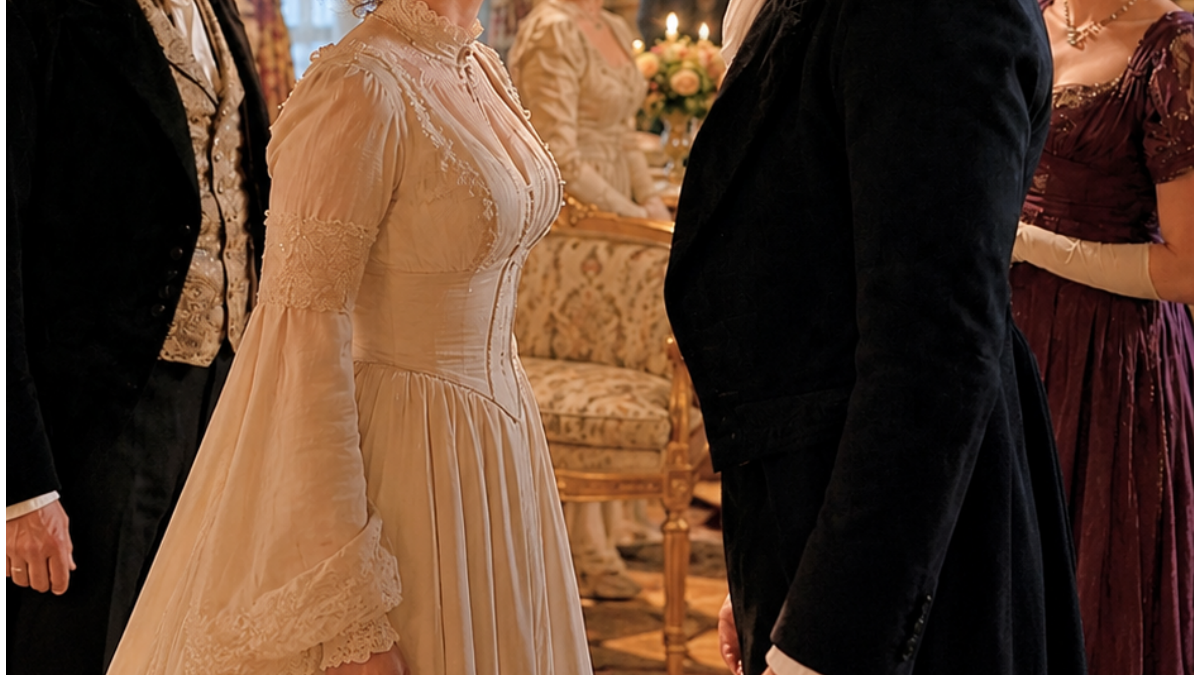
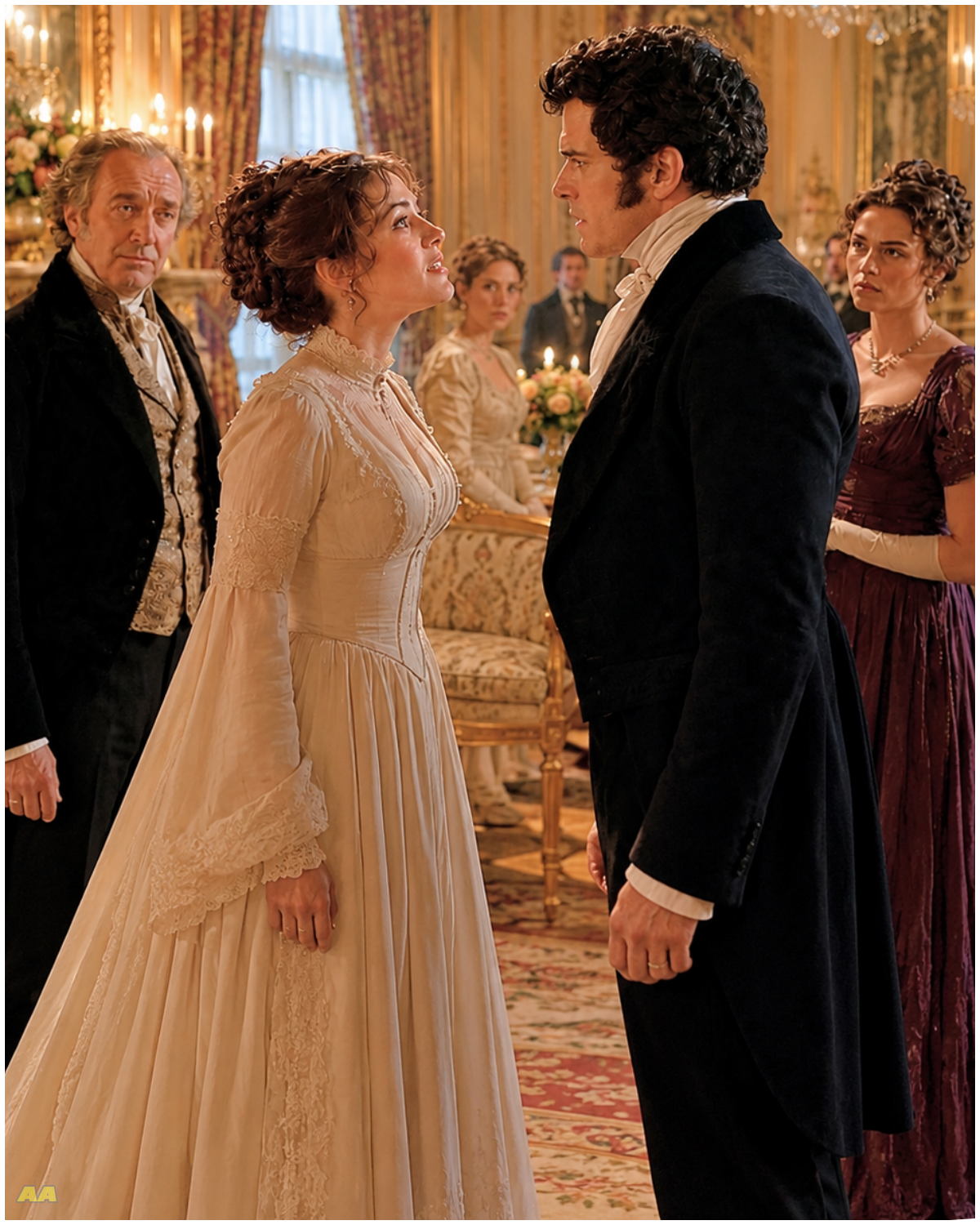
Charlotte Hayes threw the lemonade in a stranger’s face.
She didn’t plan it. One second, she was reaching past him.
This immovable, arrogant wall of a man who hadn’t moved an inch, despite her asking twice in the next, her elbow caught the glass.
The cold liquid flew, and the most expensive looking coat in the room was soaked straight through.
The music stopped, every head turned.
The man looked down at his ruined coat.
Then he looked at her and Charlotte Hayes, who had never backed down from anything in her 26 years on this earth, looked right back.
I did warn you, she said twice.
She hadn’t meant to do it.
That was the honest truth.
The kind of truth Charlotte Hayes kept strictly to herself as she stood in the sudden absolute silence of Willamir Estate’s main gallery with 180 guests staring at her and and empty in her hand.
The man in front of her hadn’t moved.
That was the thing that got her.
That was what she would think about later, lying awake in the dark, running the moment back through her mind with a particular misery of someone who cannot stop picking at a wound.
She had said, “Excuse me.”
She had said it twice.
She had reached past him carefully, politely, with every intention of simply taking her lemonade and walking away, and he had shifted at exactly the wrong moment.
Her elbow had caught the glass, and 3 seconds later, the situation had become significantly worse than it started.
But he hadn’t moved. He had been standing in front of that refreshment table for a full 5 minutes like a man who owned not just the table but the room around it and possibly the county beyond it.
And he hadn’t moved and Charlotte had had a very long week.
And sometimes a very long week will do things to a woman’s patience that she cannot entirely predict.
The silence in the gallery stretched and stretched, and the man, tall, dark-coated, utterly still looked down at the lemonade spreading across the front of his charcoal jacket.
Then looked back up at her with an expression that was not quite anger, not quite disbelief, something in between with something else underneath it that she couldn’t name.
Charlotte lifted her chin.
“I did warn you,” she said.
Twice. Someone in the crowd made a sound that might have been a smothered laugh.
The man’s jaw tightened.
“You warned me,” repeated slowly, as if testing the words for structural integrity.
“To move,” she said.
“I asked you to move. You didn’t. I reached past you. There was a collision.”
She paused.
“I’d call it preventable.” The man stared at her.
“By you?” he said.
It was preventable by you.
By either of us? Charlotte said, “But only one of us was stationary.”
Another sound from the crowd.
This one more clearly. A laugh quickly suppressed, but real.
The man’s eyes moved to the crowd just briefly, just long enough to register the amusement there.
Then they moved back to Charlotte, and something shifted in them, something that moved through anger and came out the other side as something she genuinely could not read.
He reached into his breast pocket and produced a folded white handkerchief.
He handed it to her.
Charlotte looked at it, then at him.
I’m not the one who needs it.
No, he said, “But you’re holding an empty glass, and you look like you’d rather have something to do with your hands.” Charlotte took the handkerchief.
She wasn’t sure why she folded it once precisely and held it at her side, and they stood looking at each other in the middle of a gallery full of silent fascinated people.
And she had the strange disorienting sensation that something had just happened that she hadn’t been warned about.
“I’ll replace the coat,” she said.
“It’ll survive,” he said.
“I wasn’t asking, neither was I.” A beat.
“I don’t need your name,” Charlotte said.
“I need to apologize to you properly, and then I need to go find another glass of lemonade because I still haven’t had one.” He blinked.
It was a small thing, a fractional pause in that controlled, unreadable face.
But she caught it. “Then allow me,” he said.
He turned to the refreshment table, the table he had been guarding with his entire body for the past 5 minutes, picked up a clean glass, and poured the lemonade himself.
He turned back and held it out to her.
Charlotte looked at the glass, then at him.
She took it. “Thank you,” she said.
“You’re welcome,” he said. You still should have moved the first time, she said.
Yes, he said, and this time just barely, just at the corner of his mouth, he almost smiled.
I probably should have. The music started again.
The crowd returned to its conversations with the slightly elevated energy of people who have just witnessed something interesting.
Charlotte turned and walked away with her lemonade.
And she did not look back and she told herself the strange sensation in her chest was simply the relief of a situation successfully navigated.
She was not entirely convinced.
Edward Hayes had not seen the lemonade incident.
He had been on the far side of the gallery, deep in conversation with Judge Hartwell.
When the music stopped, and by the time he looked up, it had already started again, and the moment had passed.
He caught the tail end of something.
A cluster of amused faces near the refreshment table.
A woman walking away. A man standing very still, but he couldn’t piece it together.
And frankly, his mind was elsewhere.
His mind was on the plan.
3 months of planning. Edward was 61 years old, white-haired, broad through the chest, with the kind of face that had been weathered into something more interesting than handsome.
He had built his fortune slowly and kept it carefully and spent the last four years doing the work of two people his own work and the work of grief after his wife Margaret had passed in the winter of 1,883.
Margaret who had always known exactly what to do with Charlotte.
Margaret who had understood their daughter in ways that Edward was still four years later trying to learn.
Charlotte was brilliant. He had always known that she had been reading at 4:00, arguing at 6, managing the Southfields at 19 with a competence that made his foreman look sideways at her, and then stop looking sideways because she was simply right, consistently and quietly right.
And eventually, even the most stubborn men on the property had learned to listen when she spoke.
The problem, and Edward understood this with the clarity of a man who loved his daughter completely and worried about her constantly, was not that Charlotte was too much.
The problem was that the world kept telling her she was good men, some of them, wealthy men, educated men, men who arrived at Hayes Ridge with their best manners and their best prospects and their sincere belief that a woman of Charlotte’s position ought to be grateful for the attention.
They had all left with the slightly dazed expression of people who had expected one thing and encountered something considerably larger.
Charlotte was not trying to be difficult.
She was trying to be real.
And the world in 1,887 Virginia had limited patience for real women, which was why Alexander Whitmore mattered.
Edward swirled his bourbon and watched the entrance to the gallery with the focused attention of a man running calculations.
Alexander was 34. Cold people said, “But Edward had done business with cold men for 40 years, and he knew the difference between cold and careful, between arrogance and armor.” Alexander Whitmore was a man who had learned through a series of lessons Edward could only guess at not to let people in easily.
He had spent his entire adult life surrounded by people who wanted his money, his land, his political connections, his name.
He had become very good at reading intention.
He had become very bad at trusting it.
He needed someone who didn’t want any of those things.
He needed someone who would argue with him over George Elliot and mean every word of it.
He needed Charlotte. Whether Charlotte needed him was a separate question and one that Edward had spent considerable time thinking about.
And his honest answer was she needed someone who wasn’t afraid of her.
That was rarer than it ought to be.
That was in his 61 years of watching men and women navigate each other.
Rarer than gold. He believed Alexander Witmore was that man.
He believed it the way he believed in good soil and honest rain, not with certainty, but with the accumulated evidence of careful observation and the willingness to stake something on the outcome.
He set down his bourbon and went to find his daughter.
Charlotte had found the bookshelves.
Of course she had. She always found the bookshelves at parties.
It was a habit she’d had since childhood the instinct to locate the one place in any social gathering where she could be adjacent to the event without being consumed by it.
The shelves at the east end of the gallery held a genuine collection.
Agricultural journals. Legal texts. A complete set of Virginia state records from the past 30 years.
Real books, not decorative. She had her lemonade in one hand and the spine of an 1,873 farming journal in the other.
When she heard him, “Those are from 1,873,” his voice, she recognized it immediately and told herself the small jolt in her chest was irritation and nothing else.
She turned. He was closer than she expected.
2 ft away, maybe less, with a glass of whiskey held at his side like a man who carries things without thinking about them.
He’d removed his jacket, the lemonade soaked one, and stood in his shirt sleeves and waste coat, which should have made him look less formidable and somehow did not accomplish that at all.
I know, she said. I’ve read them.
He paused. A small recalibration.
She could see it. You’ve read agricultural journals from 1,873.
I manage 300 acres of tobacco and grain, Charlotte said.
It’s not a strange hobby.
It’s a professional requirement. Most women at this party, he said carefully, and she heard the care.
The deliberate gentleness of a man choosing words like he’s crossing uncertain ground are discussing the social season.
I’m aware, Charlotte said. I find crop rotation considerably more interesting.
Something in his expression shifted, not toward condescension.
She had been waiting for condescension.
Had her response to it already prepared, but towards something else.
Genuine attention. The kind that cost something.
Which property? He asked. Hayes Ridge, she said.
Charlotte Hayes. He was quiet for a moment.
I know Hayes Ridge. Most people in the county do, she said.
It’s been in my family for 60 years.
The Southfields were hit hard by the drought last summer, he said.
Not a question specific. Charlotte looked at him.
They were. We lost about a third of the tobacco crop.
We made it back on the grain side.
She paused. You know the property well enough to know about the Southfields.
I pay attention to land, he said.
It tells you things. What does it tell you?
He considered the question as though it deserved genuine consideration.
Who works it? He said, who loves it?
What the people in charge of it are thinking about this season or the next 50 years?
Charlotte was quiet for a moment.
And Hayes rears, he said, “At least she studied it.
He was not flattering her.
She knew flattery she had received enough of it in enough drawing rooms to recognize its particular quality.
The way it curved toward the listener like something shaped to fit.
This was not that. This was a man saying what he observed because he had observed it.
You know about our drought losses, she said slowly.
You know the Southfield specifically.
You’ve been to Hayes Ridge.
I’ve ridden the county. He said all of it.
And you know our output well enough to she stopped.
You’re not just a land owner.
No, he said you’re an investor among other things.
Charlotte looked at him with a particular focus of someone rearranging a picture in their mind.
He was not, she was beginning to understand, simply an arrogant man who stood in front of refreshment tables.
He was an arrogant man who stood in front of refreshment tables and also happened to know the agricultural output of every major property in the county.
That was both more impressive and more irritating than the simpler version.
What other things? She railroaded said in some banking political interests though I keep those quieter.
Why quieter? Because politics makes people stupid, he said.
And I prefer to be useful, Charlotte almost laughed.
She stopped herself. Not because it wasn’t funny.
But because she was not yet ready to give him that.
That’s surprisingly honest, she said.
I find honesty efficient, he said.
Most powerful men find it inconvenient.
Most powerful men, he said, are also considerably more interested in being liked than in being right.
Something moved in his eyes.
I prefer being right. So do I, Charlotte said.
I know, he said. She looked at him sharply.
We’ve spoken for 8 minutes.
7, he said. And the lemonade incident before that.
A pause. You held your ground with a room full of people watching and didn’t apologize for something that was equally both our faults.
That tells me something. What does it tell you?
He met her eyes directly.
That you’re not afraid of being wrong,” he said.
“You’re afraid of being made to feel wrong for things that aren’t.” The gallery continued around the music voice, the clink of glass, and Charlotte stood very still with her 1,873 farming journal and her lemonade, and the sudden alarming sense that a door she had kept locked for a long time had just been touched from the outside by someone who knew somehow exactly where the lock was, she didn’t like it.
She also could not look away.
I don’t know your name, she said.
No, he said. Are you going to tell me?
He was quiet for a moment.
One beat too long. She would think later.
One beat that should have told her something.
Not yet, he said. Why?
He looked at her steadily.
Because the conversation is better without it.
Charlotte stared at him. That makes no sense.
It makes complete sense, he said.
Names carry weight. Yours has been telling people you’re Edward Hayes’s daughter before you’ve had a chance to be anything else.
Mine would do the same thing from the other direction.
He tilted his head slightly.
I’d rather we continued without that weight for a while.
Charlotte was silent. It was, she thought, the strangest argument she’d ever heard.
It was also, she thought, not wrong.
Fine, she said. No names, he said, but I want it on record.
She said that this is an unusual requeSt. I’ll note it, he said.
And this time, the almost smile made it all the way.
Just barely, just enough. Charlotte looked down at her journal and then back at him.
The 1,873 harvest surveys, she said.
Have you read them? I have.
Then you know the section on soil rotation in the Piedmont region is wrong.
He blinked. It’s considered a foundational text.
It’s considered a foundational text by people who haven’t farmed the Piedmont.
Charlotte said the drainage patterns they’re describing don’t account for the clay shelf 3 ft down.
Anyone who’s actually dug there knows it.
He stared at her. You’ve dug there springing?
She said with my foreman.
We lost two weeks rerouting the east section because we followed that text and it was wrong.
She held up the journal.
So yes, I’ve read it.
I’ve tested it and I’m telling you it’s wrong.
He was quiet for a long moment.
Then he reached past her careful, she noticed, deliberately careful.
Nothing like the man at the refreshment table and pulled a second journal from the shelf.
He opened it to a page near the back and held it out to her.
Page 247, he said. The rebuttal published by the Richmond Agrarian Society.
1,875. They found the same thing.
Charlotte looked at the page.
Read it. Look back at him.
You knew, she said. I suspected, he said.
I hadn’t confirmed it from someone who’d actually dug the clay shell.
Paws. Now I have. Charlotte looked at this man, this nameless.
Lemonade soaked, immovable, surprisingly well- read man, and felt something she had not felt in a very long time.
Curiosity. Not the polite performative curiosity of drawing room conversation.
The real kind. The kind that pulls at you from the inside.
Tell me about the railroad, she said.
Tell me about the Southfields.
He said you first, she said.
Ladies first, he said. That’s the second time you’ve used courtesy as a deflection.
Charlotte said, “If you do it a third time, I’m going to stop finding it charming and start finding it cowardly.” He stared at her for one full second.
Then he laughed. Not a polite laugh, not the managed controlled sound she suspected he produced at most social events.
A real one, short and surprised and genuine.
The laugh of a man who has been caught completely offguard by something and has not yet had time to decide how he feels about it.
It changed his entire face.
Charlotte felt the shift in her chest move from curiosity to something warmer and more dangerous.
And she told herself firmly to pay attention to the conversation and nothing else.
The railroad, he said, still with the edges of the laugh in his voice, runs from Richmond to the western counties, and I have interests in three of the six connecting lines.
The original route went through three farming communities and would have destroyed all of them.
I spent two years negotiating the reroute.
It added 4 months to construction and approximately $60,000 to the coSt. Charlotte was quiet.
Why? Because the communities were there first, he said simply.
She looked at him. That’s not a calculation most investors make, she said.
No, he said. They call you cold, she said.
It came out before she’d fully decided to say it.
His jaw tightened just slightly.
I know what they call me.
It doesn’t fit, Charlotte said.
What you just described isn’t cold.
It’s the opposite. He met her eyes.
When he spoke, his voice was lower.
Cold is easier to maintain than the alternative.
Charlotte understood that sentence in the particular bone deep way that you understand things you have lived through yourself.
Yes, she said quietly. It is.
They looked at each other for a moment that went on a beat longer than it should have.
The kind of moment that accumulates, meaning you haven’t agreed to give it.
Charlotte looked back at her journal.
The Southfields, she said, “We lost the tobacco, but the grain held because I’d switched the eastern quarter to winter wheat 2 years ago.” My foreman thought I was wrong.
He said so at considerable length.
Was he right? The man asked.
He was not, Charlotte said.
The winter wheat yielded 40% above average last season and we sold the surplus to three counties that had lost their own crops in the drought.
She turned a page. My foreman no longer questions the eastern quarter.
Good. The man said simply, Charlotte looked up.
Most men, she said carefully, would ask how I convinced my foremen or whether my father approved the decision.
Or you managed the land, he said.
Why would I ask about anyone else?
Charlotte held that for a moment.
She said it beside all the other things he’d said and looked at them together.
The railroad reroute. The clay shelf.
You’re afraid of being made to feel wrong for things that aren’t.
And she felt something shifting in her understanding of this conversation.
This man this evening something she wasn’t entirely sure was safe.
What’s your name? She asked.
I thought we agreed. I changed my mind.
She said. He looked at her steadily.
Changing your mind is a form of vulnerability.
He said, “In my experience, you don’t do that often.
In your experience, Charlotte said, “We’ve spoken for 20 minutes.” 23, he said.
“You’re counting.” Apparently, he said.
She waited. He opened his mouth.
Charlotte, her father’s voice. Warm, satisfied the voice of a man whose plan is coming together exactly as imagined.
She turned. Edward Hayes was crossing the gallery toward them with the beam of a man who has orchestrated something and is very pleased with himself.
And beside him, no, not beside him.
He was alone. He had spotted her already here with this man and assumed everything was going according to design.
My dear, her father said, reaching them, his smile broad and unguarded in a way she rarely saw from him anymore.
I see you’ve already found each other.
I was hoping to introduce you properly.
He looked between them with the satisfaction of a man watching two puzzle pieces click together.
Charlotte, this is Alexander Whitmore, one of the finest men in Virginia, and the gentleman I have most been hoping you’d have a chance to know.
The gallery continued around them.
The music played, the lanterns burned.
Charlotte did not move. Alexander Whitmore.
She turned the name over in her mind and felt with clinical precision every piece of the last 23 minutes rearrange itself into a completely different shape.
Alexander Whitmore the rerouted lines three connecting interests cold people said the wealthiest private land owner in the state.
The man whose name she had heard at every dinner table in the county for 3 years.
The man her father had mentioned casually repeatedly with the particular casualness of a man who is not being casual at all for months.
She looked at him. He was watching her not with triumph.
She had braced for triumph and it wasn’t there.
Not with amusement though she had braced for that too.
His expression was careful watchful.
The expression of a man who knows something important is happening and has not yet determined the outcome.
You knew? She said. Yes, he said.
You knew who you were.
Yes. The entire time. Yes.
His voice was even steady.
Tell me. He was quiet for one beat.
Two. And when he spoke, his voice was lower private.
Somehow in a room full of people, because for the first time in longer than I can remember, he said, “Someone was speaking to me.
Not to my name, not to what I own or what I can do or what I represent.” His eyes held hers only to me.
I didn’t want that to stop.
Charlotte’s throat was tight. She understood that.
She understood it the way you understand things that are true and dangerous with your whole body, not just your mind.
And that was the problem because she did not know standing in the middle of Willowir estate in the summer of 1,887 with her father beaming beside her and 200 guests moving around her.
She could not know whether the man in front of her had let her speak freely.
Because he genuinely wanted to be known as a person and not a name or because he had found it useful to let her reveal herself completely while he held all the cards and watched.
She had been here before, not with this man, but in this position this exact position open offg guard, feeling seen, discovering too late that the seeing was not what she thought it was.
Charlotte, her father said quietly, and she heard the plea in it.
Give him a chance. Give this a chance.
Give something a chance. She looked at Alexander Whitmore.
His jaw was tight. His eyes were on her face.
And they were not the eyes of a man waiting for her to perform a reaction he had predicted.
They were the eyes of a man waiting simply to find out what she was going to do.
As if he genuinely did not know.
As if her answer mattered to him.
Charlotte looked away. Mr. Whitmore, she said.
Cool. Even a door closing with precision, Miss Hazy replied.
And she turned and walked toward the garden doors, and she did not look back.
And she kept her spine straight and her chin up, and she was fine.
She was perfectly fine. This was nothing.
This was a party and a conversation and a name she hadn’t known, and none of it mattered.
She pushed through the garden doors into the warm Virginia night.
The air hit her face heavy with honeysuckle, warm from the day’s heat still rising out of the ground, and she stopped walking and put one hand flat against the garden wall and breathed.
Just breathed. The music from inside was muffled now.
Distant, she could hear sacadas in the faroff sound of horses and somewhere above the ridge, the first real rumble of a summer storm coming in from the weSt. She stood there for a long moment.
Then she heard the door open behind her.
She turned expecting her father.
It was not her father.
Alexander Whitmore stood in the garden doorway, his ruined coat back on.
She hadn’t noticed him put it back on.
But there it was, lemonade stain and all.
And he looked at her with the expression of a man who has made a decision and is committed to it regardless of outcome.
He did not come closer.
He stayed in the doorway, one hand on the frame, and spoke across the distance between them.
I owe you an explanation, he said.
You don’t owe me anything, Charlotte said.
Miss Hastster Whitmore. Her voice was quiet.
Final. He was silent. She looked at him.
This man she had argued with over lemonade and George Elliot and soil drainage and railroad lines.
This man who had laughed for real when she called him cowardly.
This man who had said, “You’re afraid of being made to feel wrong for things that aren’t as though he had known her for years instead of minutes.” “I don’t know,” she said, whether this evening was honest or convenient.
“And I cannot tell the difference right now.
That is the problem.” He looked at her steadily.
“It was honeSt. You had every advantage.” She said, “You knew my name, my land, my father’s intention, and your own.
I knew none of those things.
That is not a level conversation.
Mr. Whitmore, that is a man holding all the cards at a table, he said himself.
Something moved in his jaw.
You’re right, he said. She blinked.
She had not expected that.
I should have told you, he said.
I made a choice that served what I wanted and didn’t consider what it would cost you when you found out a beat.
I’m sorry for that. Charlotte looked at him for a long moment.
The storm was getting closer.
She could feel the pressure change in the air.
The way Virginia nights shift just before rain.
Everything going very still and then not still at all.
Good night, Mr. Whitmore, she said.
She walked to the side gate.
She had her hand on the latch when she heard him.
The handkerchief. She stopped. She looked down.
She was still holding it.
His handkerchief, folded once, precise, pressed flat in her hand since the moment he’d given it to her beside the refreshment table.
She had held it through journals and railroad discussions, and 23 minutes of the most honest conversation she’d had in years, and she had simply never let go of it.
She turned. He was watching her from the doorway with an expression she could not name.
Careful and open at the same time, guarded and somehow not guarded at all.
She looked at the handkerchief.
She looked at him. She put it in her pocket.
And she walked out into the Virginia night without another word.
While behind her, the first real crack of thunder rolled in from the weSt. And somewhere in Willowir estate the music played on.
And Alexander Whitmore stood in the garden doorway and watched her go.
He stood there for a long time.
His expression, “Had anyone been watching, which no one was, would have been unreadable to moSt. But it would not have looked like a man who had been brushed off.
It would have looked like a man who had just found something he had a very long time looking for, and who had quite possibly made the worst mistake of his life by not saying so sooner.” She kept the handkerchief.
He didn’t know it yet, but he would.
Charlotte told herself she was fine.
She was busy. The Southfields needed attention after the rain that had rolled through the night of the Willowir party, the storm she’d heard building as she walked out the garden gate had delivered 2 in by morning, and the drainage on the eastern quarter required hands-on assessment before the ground hardened.
She wrote out at dawn every day, spoke to her foremen, made decisions, recorded numbers, and kept her mind on soil and yield and the kind of concrete manageable problems that had answers.
She did not think about Alexander Whitmore.
She thought about him constantly, not in the way she would have admitted to anyone, not with the soft, dreamy quality of a woman who has met a man and is hoping he calls.
It was sharper than that, more like the feeling of a splinter you can’t quite reach.
He sat at the edge of her thoughts with the same immovable quality he’d had at the refreshment table.
And every time she tried to push him out, he simply did not move.
She replayed the conversation. She replayed it with the forensic precision of someone trying to find the flaw.
Them a moment where his interest had been performance.
The line that had been calculated instead of genuine, the tell that would let her file the whole evening under manipulation and move on.
She looked for it methodically, the way she would examine a damaged crop for the source of blight.
She didn’t find it. That bothered her more than anything else.
On the fourth morning, she came in from the fields to find her father waiting on the porch.
He had his hands wrapped around a coffee cup and the expression of a man who has been patient long enough and has decided this is the day Charlotte pulled off her riding gloves and looked at him.
Whatever you’re about to say, he asked about you, Edward said.
She stopped walking. Alexander Whitmore, her father said.
He came by the county records office yesterday on business.
He asked Judge Hartwell whether you had arrived home safely the night of the party.
Charlotte stared at him. He asked the judge.
Apparently, he didn’t have a more direct means of inquiring, Edward said.
And there was something in his voice that was carefully neutral in the way of a man who is controlling a smile with great effort.
He could have sent a note, Charlotte said.
He could have, her father agreed.
The fact that he did might indicate, her father said mildly.
That he’s not the kind of man who does things the easy way when he’s uncertain of the reception.
He took a sip of coffee, or it might indicate he has no idea what to do with a woman who walked away holding his handkerchief.
Charlotte’s jaw tightened. I kept it because I forgot I was holding it.
Of course, her father said.
That is a factually accurate statement.
I believe you completely, Edward said.
With the serenity of a man who believes nothing of the sort.
He sat down his coffee cup and stood.
He’s invited us to Whitmore Hall on Saturday.
Working dinner, he’s meeting with three other land owners about the county water rights situation.
He thought your perspective on the eastern drainage would be useful.
Charlotte looked at her father for a long moment.
He thought my perspective would be useful.
She repeated his exact words.
Apparently, he wants to discuss water rights and drainage.
Yes, Charlotte turned and walked into the house.
Charlotte, her father called. I’ll think about it, she said.
Without turning around, she was in the kitchen pouring her own coffee when she realized her hand was in her pocket.
Where the handkerchief was. She took her hand out of her pocket with great deliberateness and wrapped it around her coffee cup instead.
She stared at the wall.
Saturday, she thought. A working dinner.
Water rights and drainage. She took a long sip of coffee.
Fine, she said to nobody.
Whitmore Hall was larger than she expected and quieter than its reputation.
She had expected grandeur performed the kind of house that announces wealth at every doorway.
What she found instead was a property that had been built for use.
The main house was substantial, but not showy.
The grounds were immaculate in the way of a place where work is actually done, not simply displayed.
The fencing along the drive was new recent work.
Well done. The barns in the distance were in better repair than most she’d seen in the county.
She noticed all of this from the carriage before the door opened, and she stopped allowing herself to notice things.
They were met at the entrance by a housekeeper, who showed them to a large dining room where three other men were already seated.
Harland Davies from the next county, older and cautious Robert Finch, a younger landowner she’d met twice at public meetings, and a fourth man she didn’t recognize, who turned out to be a surveyor from Richmond named Caldwell, who had been mapping the county water tables for the past year.
Alexander was not in the room yet.
Charlotte took her seat, accepted coffee, and was deep in a question for the surveyor about the relationship between the water table depth and the clay shelf she’d found on her eastern quarter.
A genuinely interesting question, as it turned out, because Caldwell had data she hadn’t seen when she felt the room shift.
Not the air, not anything she could name, just a shift.
The particular quality of attention in a room changing the way it changes when someone enters who commands space without demanding it.
She kept her eyes on Caldwell.
The clay shelf runs at approximately 8 to 12 ft across most of the southern Piedmont.
Caldwell was saying, pulling out a paper diagram, but the depth varies significantly near water sources.
Within a half mile of a creek or river, you can see it as shallow as four feet, which means which means the standard drainage calculations are wrong for those areas.
Charlotte said, “Exactly.” Caldwell said most of the county is farming based on the Richmond Agrarian Society’s 1,873 survey, which didn’t account for the clay variation near water sources, said a voice from the doorway.
Charlotte did not turn around immediately.
She gave it one full second.
Two. Then she turned with the deliberate calm of a woman who has decided to be completely normal about this.
Alexander Whitmore stood in the doorway in a dark gray working coat, not the charcoal dinner jacket of Willowir.
Something more practical. And he was looking directly at her with an expression that was carefully composed and gave almost nothing away.
Almost Miss Hayes, he said.
Mr. Whitmore, she said. He entered the room, shook hands with Harlon Davies and Robert Finch, nodded to Caldwell, and took the seat at the head of the table.
His eyes came back to Charlotte once briefly, a single beat, and then moved to the papers in front of him.
Thank you all for coming, he said.
I’ll keep this useful and short.
The county water rights situation is going to be resolved in the next 6 months, whether we engage with it or not.
I’d rather we engage. Robert Finch leaned forward.
The river access questions been sitting with the district court two years.
It won’t sit there much longer.
Alexander said the railroad expansion through the western counties needs a water source decision before they can route the next line.
That external pressure will force a ruling.
The question is whether we’ve established our positions before that ruling comes or after.
Harlon Davies tapped the table.
You’ve seen the preliminary assessments, all of them, Alexander said.
Which is why I wanted Miss Hayes here.
He looked at Charlotte directly now.
And his voice was even and professional.
Your eastern quarter runs adjacent to Harland Creek.
The drainage issue you solved with the rerouting 2 years ago.
You found the clay shelf yourself.
My foreman and I. Yes, Charlotte said.
6 ft 2 in at the shallowest point.
Charlotte said 4’8 in closest to the creek bend.
Caldwell made a sound of genuine excitement.
That’s the closest data point I have to the creek system.
Every other measurement in that section is theoretical.
It’s not theoretical. Charlotte said, “I have written records.
We measured it in four sections over 3 weeks.” Miss Hayes Caldwell said with the reverence of a man receiving a gift, would you be willing to share those records?
That depends, Charlotte said. On what you’re using them for and whether my contributions credited properly, a short silence.
Robert Finch blinked at her.
Harlon Davies looked at the ceiling briefly.
The way men of his generation looked at ceilings when a woman said something they didn’t know how to respond to.
Alexander said without hesitation and without looking up from his papers credited and documented your name on the formal survey your data sourced properly he looked up that’s not a question Charlotte held his gaze for one moment then yes she said to Caldwell I’ll share the records the meeting ran for 2 hours Charlotte had expected to be peripheral a courtesy inclusion present for the appearance of thoroughess What she found instead was that her drainage data was the most specific ground level information in the room and the conversation kept coming back to it.
Alexander referenced her findings three times, each time attributing them directly and precisely.
When Harlon Davies made an assumption about water access rights for smaller properties that Charlotte knew was legally incorrect, she had spent three months in those county records during the tenant waste dispute.
She said so. Davies looked at her with the mild surprise of a man who had forgotten there was a woman at the table.
Alexander looked at her with the expression she was beginning to recognize.
Attention, the real kind. She’s right, Alexander said to Davies.
The 1,879 amendment changed the access threshold.
Miss Hayes, do you have the specific citation?
Section 14, paragraph 3. Charlotte said, “The original provision assumed land parcels over 500 acres.” Below that threshold, the water access right shifts from exclusive to shared.
She paused. Most of the small farming families in this county don’t know that they’ve been negotiating from a position of weakness that the law doesn’t actually support.
The room was quiet. That Alexander said quietly is the most important thing said in this room today.
Davies shifted in his seat.
Finch wrote something down quickly.
Caldwell looked at Charlotte with frank admiration.
Charlotte looked at Alexander. He was already looking away back to his papers as though the observation had been professional and nothing more.
But she had caught the moment before a fraction of a second where his expression had done something that was not professional at all.
She filed it away carefully.
After the meeting, Davies and Finch left quickly men who had other properties and other meetings and the particular efficiency of people whose time is visibly precious to them.
Caldwell stayed to talk through the drainage data with Charlotte, and she spent another 30 minutes with him, going over her records.
While Alexander spoke with her father at the far end of the room, she could hear their voices, but not their words.
She kept her attention on Caldwell’s maps.
When Caldwell finally packed his papers and followed the others out, Charlotte looked up to find her father shaking Alexander’s hand with the warmth of a man concluding a conversation that had gone well.
“I’ll bring the carriage around,” her father said, and walked out of the room with the casual efficiency of a man removing himself from a situation he has carefully constructed.
“Charlotte stood there. Alexander stood across the table.
He planned that.” Charlotte said.
He did. Alexander agreed. The man has no shame.
He loves you. Alexander said simply.
It makes him creative. Charlotte looked at him for a moment.
You could have told him you didn’t need the pretense.
I could have, Alexander said.
I didn’t, she waited. Because I wanted you here, he said.
And I wasn’t certain you’d come if I asked directly a beat.
I was right to be uncertain.
You don’t know that, Charlotte said.
You walked out of a garden in the middle of a thunderstorm rather than have a longer conversation with me.
He said, “I had some data on the question.” Despite herself.
The corner of her mouth moved.
“It wasn’t thundering yet,” she said.
“It was very close. There’s a meaningful meteorological difference.” “There is,” he said.
“I’ll concede the weather.” She almost smiled.
Caught herself. “Mr. Whitmore Alexander,” he said.
She looked at him steadily.
“We’re not on firstname terMs. We argued about George Elliot for 20 minutes,” he said.
“And you called me cowardly.
I think we passed firstname terms somewhere around page 240 and of the 1,873 Agricultural Journal.” Charlotte pressed her lips together.
The smile was harder to suppress now.
“What do you want?” she asked.
Direct, deliberate. The question she had been not asking since the night at Willamir.
He was quiet for a moment.
She respected that the fact that he didn’t answer immediately.
Didn’t reach for the easy, comfortable response.
Another conversation, he said. A real one without the party around us and without your father engineering the seating arrangements.
This conversation is real, she said.
Yes, he said. He paused.
I’d like more of them.
Charlotte held that for a moment.
Let it sit. Examined it from all sides the way she examined anything that mattered.
I’m not easy, she said.
I know, he said. I won’t pretend to opinions.
I don’t have to make a conversation comfortable.
I know that, too. And if you do something I think is wrong.
I will tell you without softening it.
He met her eyes. Miss Hayes, you threw lemonade on me within 15 minutes of meeting me.
I’m not operating under any illusions about your conversational style.
And that was when Charlotte Hayes laughed.
Not a polite laugh, not the measured, careful sound she produced in drawing rooMs. A real one, genuine and sudden, and completely undefended, and she watched Alexander Whitmore’s expression do something she had not seen it do before.
It opened just for a moment, just long enough.
The controlled, careful, thoroughly armored face of the coldest man in the county simply opened.
And what was underneath was not what she expected.
It wasn’t pride or satisfaction or the look of a man who has won something.
It was relief. The profound, almost painful relief of someone who has been waiting a long time for something and has just stopped waiting.
Charlotte stopped laughing. She looked at him.
He looked at her. Thursday, she said.
There’s a public meeting about the water rights at the county hall.
If you’re attending, we could continue the conversation.
I’ll be there, he said.
Don’t stand in front of the refreshments.
I’ll make no promises, he said.
And the smile that followed was the real one, the full version.
Not the almost, not the barely.
And it was, Charlotte thought with the cool precision she applied to everything.
A very good smile. She picked up her papers.
“Mr. Whitmore,” she said. “Good afternoon, Miss Hayes,” he said.
She walked to the door.
“You still have my handkerchief,” he said.
Behind her, one beat. “I know,” she said.
She walked out. He was at the county hall on Thursday.
He was also at the East County meeting two weeks after that and at the public records review the week after that and at a property dispute hearing where Charlotte had gone to support her tenant farmers and had not expected to see him at all.
He was already there when she arrived.
He was sitting on the opposite side of the room property owners on one side advocates on the other.
The particular geography of these hearings that announced allegiance before anyone spoke.
She took her seat with the farmers.
He was on the property owner side.
She felt his attention on her the moment she sat down.
She did not look at him.
The hearing was brutal. The property manager in question, a man named Hol, thin and precise and thoroughly unpleasant, had been withholding wage adjustments from three farming families despite a county agreement that should have required them.
Charlotte had spent two weeks preparing the case.
She stood and presented it in the careful documented way she’d learned was necessary, not emotional, not personal, just correct dates, agreements, the specific language of the county compact.
The exact amount owed to each family.
Holts representative pushed back. The agreement was voluntary, he said.
My client is not legally obligated.
The agreement was signed. Charlotte said section six of the county farming compact defines a signed voluntary agreement as legally binding for the term specified.
The term specified was 3 years.
We are in year two.
She held up the document.
I have the original. Holts representative tried twice more and was stopped twice more by Charlotte producing specific language he couldn’t argue around.
The arbitrator ruled in favor of the farming families.
Charlotte helped the Marsh family.
She recognized them from what she’d mentioned at Willowmir, the family who’d told her about Whitmore’s rent adjustments during the drought, gather their papers and get the ruling documented properly.
She stayed until every piece of paperwork was complete, until the family had what they needed in their hands, until Mr.
Marsh shook her hand with the fierce, quiet grip of a man who does not have words for gratitude, but intends to communicate it physically.
She was walking out when she nearly walked directly into Alexander Whitmore.
He was in the doorway.
He had been there for a while, she thought.
Long enough to have seen most of it.
She looked at him. Hol is one of your property neighbors, she said.
Not an accusation. He is, Alexander said.
You didn’t support him? No.
Alexander said he’s going to know you were here.
Yes. Alexander said he’ll know.
Charlotte studied him. That’ll cost you something probably.
Alexander said, “Doesn’t that concern you?” He looked at her directly.
“Miss Hayes, he was withholding wages from families who earned them.
What would it say about me if I’d supported him because he was a convenient neighbor?” Charlotte was quiet for a moment.
Most powerful men, she said carefully.
Make that calcation differently. I know, he said.
I’ve watched them do it my entire adult life.
I decided a long time ago not to.
He paused. Your argument was excellent.
By the way, the section six citation was the one he couldn’t answer.
I know. Charlotte said, “That’s why I led with it instead of building to it.
If you build to your strongest point, they have time to prepare.
If you lead with it, they’re already behind,” he said.
“Yes.” He looked at her with an expression.
She was beginning to recognize the one that wasn’t quite amusement and wasn’t quite admiration, but sat in the territory between them.
“Where did you learn to argue like that?” he asked.
“From losing arguments,” she said.
“He was quiet a moment.” “Then unexpectedly, me too.” She looked at him.
“I was wrong a great deal when I was younger.” He said, “I was certain and wrong, which is the worst combination.
It took a long time to learn that certainty without evidence is just noise.” “Who taught you that?” Charlotte asked.
“Experience,” he said. “And a foreman who was not afraid to tell me when I was being an idiot.” “Good foreman,” Charlotte said.
“The best I’ve ever had,” Alexander said.
“He died 2 years ago.
I haven’t found someone to replace him who will be as honeSt.” Charlotte looked at him for a moment.
The loss in that sentence was real.
She could hear it. The particular flatness that enters a person’s voice when they’re talking about someone genuinely gone.
I’m sorry, she said. He nodded once.
Accepted it. They walked out together, not intentionally simply because they were both walking the same direction and neither stopped.
The summer heat hit them at the door.
Virginia in August pressing down with its full weight and they stood for a moment on the steps of the county hall with the town moving around them.
The Marsh family, he said, you mentioned them at Willowre.
You said they told you about the rent adjustments during the drought.
They did, Charlotte said. I didn’t know they’d ended up at your father’s property.
They came looking for work in the spring.
Charlotte said, “My foreman took them on.
They’re good workers. Alexander was quiet for a moment.
Are they all right? The family?
Charlotte looked at him. The question was direct and specific and had no performance in it.
They’re better now than they were, she said.
Today helped. He nodded. Looked at something in the middle distance.
Good, he said. The same word he’d used at the water rights meeting.
In the same simple, complete way, Charlotte had spent years being surrounded by men who spoke in gestures and implications, who expressed care through intermediaries and proxies, who showed concern for people as a calculated social investment.
This man said, “Good and meant it as completely as two letters could carry meaning.” She did not know what to do with that.
Walk,” he said. And she looked up to find him watching her with the careful watchfulness she was coming to know.
“Not far. There’s a decent view of the creek from the north end of the main road.” “And I’d like to talk about the water rights ruling if you have time.” Charlotte looked at him.
“Water rights?” she said, among other things, he said.
She should have said no.
She had things to do.
The South Fields. A letter to write to the county surveyor.
3 weeks of farm records to review.
She had reasons, good ones.
15 minutes, she said. 15 minutes.
He agreed. They walked for 45.
She did not notice the time passing.
That was the thing she thought about later, not the conversation.
Not the specific words, though, too.
What she thought about was the way time had simply ceased to be a thing she was tracking.
She was always tracking time.
She had been tracking time since she was 17 years old and took over management of her first field section and learned that minutes and hours were resources as finite as water or soil.
She tracked time constantly automatically, the way some people breathe.
She forgot to track it.
They talked about the water rights ruling and what it would mean for the small farming families along Harland Creek.
They talked about the railroad expansion and which route was likely now that the water source question was closer to resolution.
She told him about the tenants situation she’d mediated in the spring and the wage structure she’d proposed to her father.
And he listened the way he always listened completely with the quality of someone who is not waiting for their turn to speak, but is actually processing what they’re hearing.
He told her about the property he’d bought at 22.
The first one when he’d had enough money for the land and barely enough for the seed.
She had not expected that.
She had assumed, as she supposed most people did, that his wealth had always been substantial, that he had come into rooms the way he entered them now.
He had not. He had come in from the outside.
He had built what he had carefully and methodically and at significant cost, and there had been years, he said, when the cost wasn’t money.
“What was it?” she asked.
He was quiet a moment.
“Time,” he said. And the things you trade for time when you’re building something.
The people you don’t know how to keep because you’re always in the next county looking at the next piece of land.
A pause. I was not in those years easy to be close to and now Charlotte asked.
He looked at her sideways.
Ask me in 6 months.
She laughed and caught herself and he caught her catching herself and the resulting moment had so many layers of self-consciousness that Charlotte simply decided to stop managing it.
I’ll put it in my calendar, she said.
Please do, he said. They had stopped walking.
She wasn’t certain when somewhere along the creek road with the water audible below them and the late afternoon sun doing what Virginia Sun did in August turning everything amber and slightly unreal.
He was looking at her with the open expression.
The one she’d seen first at Whitmore Hall, the relief under all the control.
I’d like to call on you, he said.
Formally, with your father’s knowledge and your explicit permission and no more convenient meetings arranged by either of us.
Charlotte looked at him for a long moment.
Why formally, she said, because he said, you deserve to be approached with the full weight of someone’s intention.
Not corners and coincidences, a beat.
You’ve had enough men who treated their interest in you as something incidental.
I don’t want to be another one of those.
The creek moved below them.
A horse somewhere on the road behind them.
The sound of the town going about its afternoon.
Charlotte’s heart was doing something she did not intend and was not going to acknowledge.
You may call on me, she said.
On Tuesdays I’m in the house on Tuesday afternoons.
Tuesdays, he said. And you should know, she said that I will continue to have opinions about everything.
That will not change because someone is calling on me.
I’m counting on it, he said.
And I’m not tried again.
I don’t make decisions quickly about anything.
I need time and evidence and the ability to change my mind if the evidence changes.
Charlotte, he said, and it was the first time he’d used her name without being given permission.
And the sound of it in his voice was something she was not prepared for.
Low, direct, like something said without the armor on.
She looked at him. I’m not going anywhere.
He said, “Take all the time you need.” She held that.
She looked down at her hands.
Then back at him. Tuesday, he said.
She walked back toward town.
He didn’t follow immediately. She could feel that he hadn’t moved yet.
Still standing on the creek road behind her.
She was 50 yards away when she stopped and turned.
He was watching her, standing exactly where she’d left him with his hands at his sides and the afternoon light making everything look more significant than it probably was.
She pulled the handkerchief from her pocket, held it up deliberately where he could see it, then put it back.
She turned and walked behind her.
She heard or thought she heard or perhaps imagined a sound that might have been Alexander Whitmore.
The coldest man in the county laughing quietly to himself.
She walked faster. She did not stop smiling for a very long time.
But she did not would not let herself believe it was simple because 3 days later, a woman named Vivien Caldwell arrived in the county with the particular grace of someone who knows exactly what she wants.
And she wanted Alexander Whitmore and she intended to make certain Charlotte Hayes knew it.
Vivien Caldwell arrived on a Monday.
Charlotte found out about it the way she found out about most things in this county through her foreman who had heard it from the feed store owner who had heard it from the livery stable hand who’ taken the woman’s horses.
Three degrees of separation and the information arrived at Hayes Ridge by noon.
Precise and detailed and carrying the particular weight of news that knows it matters.
Vivien Caldwell, widow of George Caldwell, the railroad man from Richmond who had died 18 months ago and left his wife extraordinarily well positioned.
Beautiful in the way that gets described first in any room.
Staying at the Harland County Inn for an indefinite period, had already sent a card to Whitmore Hall.
Charlotte set down the report her foreman had handed her a legitimate farm report.
The Viven information delivered in the last 30 seconds as an afterthought that was not an afterthought and looked at the South Field.
Thank you, Garrett, she said.
Yes, ma’am, he said, and had the decency not to look at her face when he said it.
She spent the rest of the morning on the eastern quarter and did not think about it.
She thought about it continuously.
She pulled fence posts with her own hands because physical work was the only thing that reliably quieted her mind.
And by the time she came in for lunch, her shoulders achd and she had achieved approximately 40 seconds of genuine mental quiet, which she considered a reasonable return.
Her father was at the table.
He looked at her when she came in.
“Said nothing.” “Don’t,” Charlotte said.
“I haven’t said a word,” Edward said.
“You were about to.” “I was going to ask about the eastern fence line,” he said mildly.
Charlotte sat down and pulled the bread toward her.
“It’s fine. Good.” He poured her coffee, said it beside her plate.
“Alexander is expected to call tomorrow.” “I know,” she said.
“It’s Tuesday.” “Yes,” her father said.
“It is.” She looked at him.
He looked back with the serene patience of a man who has decided that silence is the most effective tool available to him.
She sent a card to his house.
Charlotte said, “People send cards.” Her father said she came from Richmond specifically.
People travel father Edward set down his coffee cup.
When he spoke, his voice was gentle and exact.
Charlotte Alexander Whitmore has had women pursue him for his money and his land and his name for 15 years.
He is not an inexperienced man.
He knows the difference between someone who wants what he has and someone who wants who he is.
He paused. He’s been calling on you every Tuesday for 6 weeks.
He rerouted a railroad to protect farming communities.
He walked into a county hearing and sat on the side of the room that cost him a neighbor’s goodwill.
He picked up his coffee again.
He knows the difference. Charlotte was quiet for a long moment.
I know he does,” she said.
And that she thought was precisely the problem.
Not that she doubted him, but that she was beginning to not doubt him.
And not doubting someone was its own kind of terrifying.
She finished her lunch and went back to the fence line.
He arrived Tuesday at 2:00.
He always arrived exactly at 2.
She had noticed this, had cataloged it with the same precision she applied to everything, and had decided it meant something.
Not rigidity, respect. He arrived when he said he would arrive.
Every single time, without fail, and in Charlotte’s experience, that was not a small thing.
It was, in fact, one of the larger things.
She met him on the porch.
He had brought nothing, no flowers, no gifts, none of the performative gestures that other men had used with the mistaken belief that objects could do the work of attention.
He brought himself. He sat in the chair across from her, accepted coffee from her father’s housekeeper, and looked at her the way he always looked at her, like she was the most interesting thing in the room.
Not the most beautiful, not the most impressive, the most interesting.
There was a difference and Charlotte felt it every time.
You heard about Mrs. Caldwell, he said.
She looked at him. News travels quickly in this county.
It does. He said he was watching her with the careful attention she knew now was not performance.
She arrived yesterday. She’ll call at Whitmore Hall on Wednesday.
Charlotte kept her face even.
You’re telling me? Yes, he said.
Why? Because I told you I would be straightforward.
He said. And because I imagine you already knew and I’d rather be the one who says it directly than have you wonder whether I was going to.
Charlotte looked at him for a long moment.
What are your intentions toward her visit?
She said precise. To be polite, he said and brief.
She’s a wealthy widow, Charlotte said.
She’s the kind of woman most men in your position would consider seriously.
Most men in my position, Alexander said carefully, are not sitting on this porch at 2:00 on a Tuesday.
The words landed with quiet precision.
Charlotte felt them settle somewhere in her chest and did not immediately know what to do with them.
She may not take brief well.
Charlotte said, “That’s possible.” Alexander said she came from Richmond, Alexander.
That’s not a casual journey.
It was the first time she’d used his name.
She heard herself do it and did not take it back.
He heard it too. Something in his expression shifted, not dramatically.
Not in a way anyone watching from a distance would have caught.
But she was not watching from a distance.
No, he said. It isn’t a casual journey.
He set his coffee down.
Charlotte, I’m going to say something directly and I want you to let me finish before you argue.
I make no promises. He said, “I know.” He said.
He looked at her steadily.
I am not confused about what I want.
I have not been confused about it since a woman asked me whether I was guarding a drink or mistaking arrogance for importance.
I have been going in one direction since that evening.
And it is this direction.
He gestured a small movement indicating the porch, the chair, the distance between them.
Vivien Caldwell is a capable woman and I wish her well.
She is not a factor in what I want.
She cannot be a factor in it because what I want is already decided.
The only variable that remains, he stopped.
The only question that remains is what you want.
Charlotte’s hands were still around her coffee cup.
The afternoon was very quiet.
Just the sound of the property birds, the distant movement of the farm, and the sound of a man telling her the truth with every piece of armor he owned deliberately set aside that she started.
Straightforward, he said. Yes, I know.
It’s a great deal to say, she said.
It’s been 6 weeks. He said, I have been considerably restrained despite everything.
She almost laughed. You have no idea, she said.
How much is writing on whether I believe that?
He looked at her. Tell me.
And so she did. She told him what she hadn’t told her father.
Hadn’t told anyone. The thing she’d carried since the first proposal at 22.
The charming man who had wanted her intelligence as decoration and her family name as credit.
She told him about the second one who had been kinder but had flinched visibly flinched the first time she contradicted him in public.
And who had asked her afterward very gently whether she might consider being a bit less forceful in her expressions.
She told him about the third who had told her father she was remarkable while telling Charlotte herself that remarkable women made difficult wives.
She was not looking at him while she talked.
She was looking at the far edge of the property where the field started.
When she stopped talking, he was quiet for long enough that she looked at him.
His jaw was tight. His eyes were steady.
The second one, he said.
He asked you to be less forceful.
He did. What did you say?
I Charlotte told him that I would consider it carefully.
And then I went home and spent 3 days deciding whether there was a version of myself that could do that and still be a person I recognized.
She paused. There wasn’t good.
Alexander said one word. Absolute.
No qualification. Charlotte looked at him.
You are not too much, he said quietly.
You have been told that by people who were not enough.
There is a significant difference.
Charlotte’s throat tightened. She was not going to make a sound about that.
She was not. Vivien Caldwell, she said, redirecting with what she hoped was sufficient precision.
Is not a concern, he said.
Let her not be a concern on Wednesday, Charlotte said.
And we’ll see. Fair enough, he said.
He left at 4:00, exactly when he said he would, and Charlotte sat on the porch for a long time after the sound of his horse had faded down the drive, holding her empty coffee cup and doing the thing she had never let herself do with any of the others.
She let herself believe him, just a little, just enough to be afraid.
Vivien Caldwell came to Whitmore Hall on Wednesday at noon and Charlotte was not there and she did not hear what happened for 3 days.
Those three days were instructive in ways Charlotte would later find embarrassing to examine.
She worked. She threw herself into the farm records with a dedication that her foreman clearly found alarming.
She wrote four letters that needed writing and a fifth that did not need writing, but kept her hands occupied.
She rode the eastern quarter twice and had a heated conversation with a county surveyor about the water table data that was entirely legitimate and only slightly fueled by displaced energy.
She did not ask her father what he’d heard.
Her father did not volunteer anything, which she respected and resented in equal measure.
On Friday morning, a note arrived at Hayes Ridge, not delivered through the county system, delivered by hand by a young man from Whitmore Hall who knocked at the door, gave the envelope to the housekeeper and left without waiting for a response.
Charlotte was at the kitchen table with her farm records when the housekeeper brought it in, and she set it beside her coffee cup and looked at it for 30 seconds before opening it.
Alexander’s handwriting was exactly what she’d have predicted.
Precise, clear. The handwriting of it means every word he commits to paper.
Miss Hayes, Mrs. Caldwell’s visit lasted 40 minutes.
I was, as I told you, I would be polite and brief.
She is a determined woman and made her intentions clear.
I made mine equally clear.
She left dissatisfied, which I regret, but not uncertain, which was necessary.
I wanted you to know before you heard it from the feed store.
A Charlotte read it twice.
Then she sat it down and returned to her farm records and completed three full pages of calculations with the particular focused energy of a woman who is feeling something large and is processing it through arithmetic.
When she finished, she picked up the note again before you heard it from the feed store.
He knew how this county worked.
He knew she’d have heard within 2 days regardless.
And he’d wanted her to hear it from him first, not to manage her reaction, not to control the narrative because he’d said he would be straightforward and he was being straightforward even in the specific detail of when he chose to speak.
She folded the note. She put it in her pocket with the handkerchief.
What Charlotte did not know, what nobody told her.
What she would not find out until much later was what had actually happened on Wednesday.
Vivien Caldwell had arrived at Whitmore Hall with the precision of a woman who had planned every element of the encounter.
She was beautiful. Nobody was denying that.
And she was intelligent. And she had spent 18 months as George Caldwell’s wife, learning exactly how men of Alexander’s type thought and moved and what they responded to.
She knew what she was doing.
She arrived at noon in a dark green dress that communicated wealth without ostentation, and she accepted the offer of tea with the ease of someone completely at home in any house she entered.
Alexander had received her in the formal sitting room, which was the first signal she either didn’t catch or chose to ignore.
The formal sitting room was where he received business associates and county officials.
There were rooms in Whitmore Hall that were warmer, the library, the east parlor, and she had not been received in either.
It’s a beautiful property, Vivian said.
Thank you. Alexander said, “I understand you’ve been investing significantly in the county water rights situation.” She said, “My late husband had interests in the Eastern Water Table as well.
We may have overlapping concerns.
It’s possible,” Alexander said. She smiled.
I know you’re a man who values directness, Mr.
Whitmore, so I’ll be direct.
I’ve admired your work for some time.
I believe we have similar values and complimentary interests, and I thought it worthwhile to become acquainted.
Alexander looked at her steadily.
I appreciate the directness, Mrs. Caldwell.
I’ll be equally direct in return, he set down his teacup.
I am currently calling on a woman I intend to ask to marry me.
I don’t believe that leaves room for the kind of acquaintance you’re describing.
Viven’s expression did not change.
She was, as he told Charlotte, a determined woman.
I’ve heard about Miss Hayes, she said carefully.
She’s very capable. Yes, Alexander, she is.
It must be interesting, Vivien said.
With the delicate precision of someone placing a blade to be involved with a woman who is quite so forceful in her views.
Some men find that invigorating over time.
Of course, it canwell. Alexander’s voice was quiet.
Final. I’m going to stop you there.
She stopped. What you’re describing as a liability, he said, is the specific thing I’ve been looking for my entire adult life.
A woman who knows her mind, who tells me when I’m wrong, who walks into a room and speaks without calculating the political cost firSt. He paused.
I spent 34 years surrounded by people who told me what I wanted to hear.
I am done with that permanently.
Viven was quiet for a when she spoke again the precision was gone replaced by something that might in another context have been honeSt. You’re certain she said not a challenge almost entirely.
He said she left 12 minutes later and that all of that was the conversation Charlotte didn’t know had happened.
What she knew was 40 minutes polite, brief, clear.
What she didn’t know was that a man had described her forceful knows her mind speaks without calculating the cost as the thing he’d been looking for his whole life.
She would find out eventually, but not yet.
Vivien Caldwell did not leave the county.
That was the thing. That was what made it complicated.
She stayed at the Harland County Inn and she began appearing at county events with the quiet persistence of a woman who has been told no and has decided that no is a starting position rather than a conclusion.
She attended the water rights public meeting where Charlotte spoke.
She sat three rows back and watched with the focused attention of someone gathering information.
Charlotte noticed her immediately. It would have been impossible not to Vivien Caldwell had the quality of someone who occupied space deliberately, who sat in rooms as though she had already decided she belonged there.
She was, Charlotte thought, with the involuntary fairness of someone trying to be objective, genuinely striking.
After the meeting, Viven approached her, not threateningly, not with any visible hostility.
With the composed grace of a woman completely in control of every variable she decided to control.
Miss Hayes, she said. I’m Vivian Caldwell.
I don’t believe we’ve met.
I know who you are, Charlotte said.
Vivien smiled. Of course you do.
She looked at Charlotte with the direct assessing gaze of someone doing their own version of Charlotte’s forensic review.
You’re very good in a public meeting.
The section 6 argument was excellent.
Charlotte studied her. Thank you.
I mean it. Vivien said, “I’ve attended a great many public meetings in Richmond.
Most women who speak in them spend 30% of their time managing the room’s discomfort with the fact that they’re speaking.
You just argued and let the argument stand.
She paused. I respect that.
Charlotte looked at her for a long moment.
This was not what she’d expected.
What do you want, Mrs. Caldwell?
Charlotte said. Vivien’s smile shifted became something less performed and more real.
Honestly, I wanted to see what he’s so certain about.
She held Charlotte’s gaze. Now I have.
She turned and walked away.
Charlotte stood in the middle of the county hall, feeling the particular disorientation of a confrontation that had not gone anything like she’d prepared for.
She was still thinking about it 2 hours later when she got home and found Alexander’s horse tied outside Hayes Ridge.
He was on the porch, not inside.
He had not presumed, would not presume.
That was one of the things she’d understood about him.
On the porch with his hat in his hands standing when he heard the carriage.
“It’s not Tuesday,” Charlotte said coming up the steps.
“No,” he said. “I heard she attended the meeting.” “She did.” “Did she speak to you?” “She did.
He was watching her carefully.” “Are you all right?” Charlotte looked at him, this man who had written out here on a non-uesday because he’d heard something had happened, and he wanted to know she was all right, and felt the thing in her chest that she had been careful about.
That she had been managing from a careful distance.
Simply refused to be managed anymore.
She said she came to see what you were certain about, Charlotte said.
He was quiet. What are you certain about?
Charlotte asked. Her voice was even.
He looked at her for a long moment.
Then he said one word, “No decoration.” Charlotte held it.
“That’s a large statement,” she said.
“Yes,” he said. You’ve known me for 2 months.
I know. He said, I’ve been counting.
That’s not Charlotte. He said her name with the same directness as every other thing he said like it deserved to be said completely.
I’m not asking you for anything today.
I’m telling you where I stand because you deserve to know it without having to infer it.
That’s all. He placed his hat back on his head.
I’ll see you Tuesday. He went down the steps.
She watched him untie his horse.
She said she respected how I argued, Charlotte said.
He paused. I thought you should know, Charlotte said.
In case it affects how you think about her, Alexander turned.
He looked at Charlotte with an expression she had never seen on him before.
Something halfway between exasperation and deep genuine affection.
The kind of expression the can only produce when someone is simultaneously frustrated and completely certain.
It doesn’t, he said. She’s not Charlotte.
His voice was patient and absolute.
She is not the variable.
She has never been the variable.
You are the only variable in this equation, and you have been since the night you asked me whether I was confusing arrogance for importance.
He held her gaze. Stop handing me reasons to doubt what I already know.
Charlotte stared at him. That she said after a moment was either the most arrogant thing you’ve ever said to me or the most romantic.
I’m aware of the ambiguity, he said.
And I meant every word of it, he said arrogantly and romantically both.
Charlotte pressed her lips together hard.
She did not laugh. She almost did.
Tuesday, she said. Tuesday, he said and wrote away.
She should have known it would not be that simple.
It was never that simple.
The world in 1,887 Virginia had a particular talent for making things that should have been simple into things that required surviving firSt. The letter arrived on Saturday.
It was addressed to her father, but her father was in Richmond for 3 days on business and the housekeeper brought it to Charlotte because it was marked urgent and from the county property office.
Charlotte opened it. She read it once.
She read it again. Then she sat down at the kitchen table with the letter in her hands and very carefully did not make a sound because making a sound would have meant acknowledging what she was feeling.
And what she was feeling was large enough that she did not entirely trust herself with it.
The letter was from Hol, the property manager she had defeated at the wage hearing.
He had filed a counter claim not against the farming families, which would have been straightforward and losable against Hayes Ridge itself.
He was challenging a 40-year-old boundary agreement between the Hayes property and his client’s land, claiming a disputed section of the eastern quarter, the same section where Charlotte had found the clay shelf.
The same section that produced the winter wheat that had carried them through the drought, was not legally haze land at all.
The documents he had filed were extensive.
The legal argument was complex.
It would require county court involvement and probably state level review.
And it would be expensive and it would take time and he had filed it 3 days after losing the wage hearing.
This was not an accident.
This was retaliation. And Charlotte sitting at the kitchen table with the letter in her hands, understood with cold clarity that her willingness to fight for the Marsh family and others like them had just cost her something.
Hol was not going to let the humiliation of losing stand without making someone pay for it.
He had chosen her. She put the letter down.
She picked up her pen.
She was not going to call Alexander.
That was the first firm decision.
Whatever this was, she was going to manage it herself through proper channels with proper documentation.
The same way she’d managed the wage hearing.
She was not going to run to a powerful man because a problem had arrived that frightened her.
She had never done that and she was not going to start.
She pulled her property records out of the desk.
She had been managing this land for 7 years.
She knew every acre of it.
She knew the history of that eastern boundary, had read the original agreement herself when she took over the Southfield management.
And she knew with the confidence of someone who has done the work that Holt’s claim was built on a misreading of an 1,842 document that she could demonstrate was a misreading with three additional records from the same period.
She worked through the night.
By Sunday morning, she had a documented response that was, if she was honest, better than what she’d produced for the wage hearing.
Cleaner, more complete. Three independent historical records that corroborated the boundary placement.
Two surveyor maps from different decades showing consistent property lines and a copy of the original 1,842 agreement with the specific language.
Hol was misreading annotated in the margin with the correct interpretation.
She was reviewing it for the third time when she heard a knock at the door.
She was not expecting anyone.
She opened it. Alexander Whitmore stood on her porch with his hat in his hands in an expression that told her immediately he already knew.
Holt filed against Hayes Ridge.
He said, “I know,” she said.
“I’ve been up since last night.” He looked at her at the papers in her hand at the state of someone who had not slept at whatever her face was doing that she wasn’t controlling because it was 6:00 in the morning and she was exhausted.
“May I come in?” he said.
She stepped back. He came inside and she put the documents on the table and he looked at them not reaching for them.
Not presuming just looking and she said, “I can fight this.
I have the records. The boundary is clear in three separate historical documents.” His reading of the 1,842 agreement is wrong and I can prove it.
I know you can, he said.
I don’t need started Charlotte.
His voice was quiet. Steady.
I didn’t come here to fight this for you.
I came because I heard and I wanted to know you were all right.
He paused. Are you all right?
She looked at him. The question was so simple.
So completely directly simple. She opened her mouth to say yes.
The automatic yes. The yes she gave everyone.
The yes that meant I’m managing and I don’t need help and I’m perfectly fine.
And instead what came out was I’m angry.
She said he filed this because I won.
Because I stood up for those families and I won and he decided I needed to be punished for it.
And I am, she stopped.
Her voice had done something she hadn’t intended.
I’m angry, she said again more quietly.
That’s all. Alexander looked at her for a long moment.
Good. He said, “Stay angry.
It’ll keep you sharp.” She stared at him.
“Your response is solid,” he said, looking at the documents now.
The 1,842 antonotation is exactly right.
There’s one additional source you might not have.
There’s a state surveyor report from 1,858 that maps every major property boundary in Harland County.
I have a copy at Whitmore Hall.
It covers the eastern quarter.
Charlotte was quiet. That would confirm the boundary independently.
Yes, he said. I can have it here within the hour.
She looked at him. You’re not fighting this for me.
No, he said. You’re fighting it.
I’m handing you a document.
That’s a meaningful distinction. It is, he said.
Do you want it? She looked at the table at 7 years of work represented in property records.
At the eastern quarter that she’d saved with winter wheat and clay shelf measurements and two weeks of her own labor rerouting the drainage.
Yes, she said. I want it.
He left and came back in 40 minutes with the 1,858 surveyor report and a second document she hadn’t known exists a county commissioner’s note from 1,863 that referenced the same boundary and placed it definitively on the hay side.
He set them on the table.
He did not sit down.
He did not offer to stay.
He looked at her with the open expression, the one without armor, and said, “You’re going to win this.
I know, she said. Holt picked the wrong property, he said.
He picked the wrong woman, Charlotte said.
Something moved through Alexander’s expression fast and real and warm.
Yes, he said. He picked up his hat.
He was at the door when she said.
Alexander, he stopped. She was looking at the documents.
Not at him. Thank you, she said.
>> For coming. >> Not for the documents, she paused.
For coming. He was quiet for a moment.
Charlotte,” he said. She looked up.
“I’m not going anywhere,” he said.
“I told you that. I meant it.” He walked out.
She heard his horse on the drive.
She turned back to the table and the documents and the work that needed doing.
But something had shifted in her chest quietly, completely with the particular irreversibility of a door that has been not just touched from the outside, but opened.
She picked up her pen.
She began to write, and somewhere in the back of her mind, beneath the anger and the focus and the seven-year history of this land, she loved and would not surrender.
Something she had been careful with for 2 months, simply stopped being careful.
She was not afraid of what it meant.
She was afraid of what it would cost if she lost it.
That she understood with cold precision was the most dangerous thing she had ever felt because she had never had anything to lose before.
Not like this, not like him.
She won the boundary case on a Tuesday.
The arbitrator ruled in favor of Hayes Ridge at 10:00 in the morning, citing three independent historical documents and two surveyor maps.
The most decisive of which was the 1,858 state report that Alexander had brought to her kitchen table on a Sunday morning without being asked.
The ruling was clean and complete and left Holt no viable avenue for appeal.
The Eastern Quarter was hers, had always been hers, would remain hers.
Charlotte shook the arbitrator’s hand, gathered her documents, thanked her legal representative with the precise, genuine gratitude of someone who means it and doesn’t perform it, and walked out of the county hall into the August heat.
Her father was waiting outside.
He was trying very hard not to look triumphant and failing completely.
Don’t, Charlotte said. I’m simply standing here, Edward said.
You’re gloating. I’m expressing quiet paternal satisfaction.
Same thing. Charlotte tucked her documents under her arm and started walking toward the carriage.
He’s going to try something else.
Hol doesn’t lose gracefully. Let him try.
Edward said, falling into step beside her.
You’ve now beaten him twice in two months.
The county knows it. The farming families know it.
Even the people who aren’t paying attention know it.
Because the people who are paying attention won’t stop talking about it.
He paused. Alexander sent word this morning.
He wanted to know the outcome.
Charlotte kept walking. And I told him you’d won.
Edward opened the carriage door for her.
He said, and I’m quoting precisely.
Of course she did. Charlotte stepped into the carriage.
She pressed her lips together.
Of course she did. She repeated to the window.
He said it the way a man says something he already knew.
Edward said in across from her, not surprised, just confirmed, Charlotte looked at the county hall receding through the window at the place where she had just won something that mattered.
With her own work and her own records and the 7-year history of a land she’d built with her hands.
Two, she said quietly. It is Tuesday, her father agreed.
He’ll come at 2. He usually does.
Charlotte looked at her documents, then at her hands, then at something outside the window that wasn’t the view, but was some interior calculation.
She was finally letting herself complete.
I’m going to tell him something today, she said.
Her father was very quiet.
I’ve been, she stopped. Tried again.
I’ve been careful. Very careful.
For 2 months, I’ve been managing the distance, keeping the door open just enough, not letting myself.
She stopped again. Charlotte, her father said gently.
I’m in love with him, she said flatly, like stating a property boundary.
I’ve been in love with him for at least a month, and I’ve been pretending I wasn’t because it was safer to pretend, and I’m tired of things that are safer than they are true.
Edward Hayes looked at his daughter for a long moment.
His eyes were bright. Well, he said with the tremendous restraint of a man containing a very large feeling.
That does seem like something worth telling him.
Charlotte looked at him. If you cry, I’m going to pretend I don’t know you.
I’m not crying, Edward said with dignity.
Your voice did something. It did nothing of the sort.
Charlotte looked back out the window.
I won the boundary case, she said.
I beat Hull twice. I’m calling on my own terms and I’m telling Alexander Whitmore the truth today because I’ve earned the right to do it without being afraid.
Edward was quiet for a moment.
Then your mother would have said something very good right now.
What would she have said?
He smiled. She would have said, “It’s about time, my girl.
It’s about time.” He arrived at 2:00.
Exactly 2:00. Charlotte was on the porch.
She had changed out of her court clothes and was in her working dress deliberately because she wanted him to see her as she actually was, not as the version of herself she put on for public occasions.
She had her coffee and she did not have a prepared speech because she had decided that prepared speeches were a form of armor and she was done with armor today.
He came up the steps and saw her face immediately.
You won? He said 10 this morning, she said.
Clean ruling, no appeal avenue.
Something moved through his expression, the warm fast thing she’d learned to watch for.
Good, he said. Sit down, she said.
He sat. She looked at him for a moment.
At this man who had shown up on a Sunday morning with surveyor reports and hadn’t once offered to fight her battle for her, who had sat at this table every Tuesday for six weeks and argued with her about everything and conceded when she was right with the same directness he used to hold his own position, who had told Vivien Caldwell she had found out eventually through the particular geography of County Gossip that what other women called a liability in Charlotte was the thing he’d been looking for his entire her life who had said I’m not going anywhere and had in fact not gone anywhere.
I have something to tell you.
She said he waited. He was very good at waiting.
I’ve been careful. She said you know that you’ve watched me be careful for 2 months and you haven’t pushed it and I want you to know I noticed that the not pushing.
She held her coffee cup.
I was careful because I’ve been wrong before about men who seem to see me.
And being wrong about that costs something specific that I don’t have a precise word for.
But it costs it from the part of you that is willing to try again.
And I was running low.
He said nothing. His eyes were on her face.
I’m not running low anymore.
Charlotte said, you’ve been you have been exactly what you said you were.
Every single time with a consistency I didn’t think was possible in a person.
She looked at him directly.
I’m in love with you.
I’ve been in love with you for at least 4 weeks and probably longer.
And I’m telling you now because I won a boundary case this morning and I’m feeling uncharacteristically brave.
And because it’s true and I’m done managing the truth to make it safer.
Alexander Whitmore looked at her.
He was very still. At least Charlotte said, “I’ve been in love with you,” he said, “Since you told me the 1,873 Farming Journal was wrong and then proved it.” He paused.
That was 6 weeks ago.
Charlotte stared at him. “You’ve had a twoe advantage.
I have,” he said. “I’ve been waiting for you to catch up.
That is the moSt.” She stopped.
“That is extremely like you.” “Yes,” he said.
She looked at him. He looked at her.
The porch was quiet and the afternoon was warm and somewhere on the property a horse moved and the world continued doing what the world does while people sit inside significant moments.
Well, Charlotte said, “Well,” he said.
And then Alexander Whitmore, the coldest man in the county, the man who had built a railroad reroute over 2 years and $60,000 to protect farming communities.
The man who had stood in a garden doorway in a lemonade soaked coat and watched her walk away with his handkerchief.
That man reached across the table and took her hand.
Not dramatically, not with gesture or performance.
He simply placed his hand over hers on the table the way you put your hand over something you intend to keep and looked at her.
She turned her hand over and held his back.
They sat like that for a while.
It was Charlotte would think later the most honest moment she had ever been in.
What came after should have been simple.
It was not simple. The problem, the specific costly problem that Charlotte could not have predicted arrived 12 days later and came from the direction she had least expected.
It came from inside Witmore Hall.
She had been invited to dinner.
A proper dinner. Her father included three other county families.
The kind of event that in 1,887 Virginia meant something specific about a man’s intentions and his willingness to make them publicly visible.
Charlotte understood what it meant.
She had dressed for it with the quiet seriousness of someone who understands that some evenings carry weight.
They were at the table seven people, good food, the particular warmth of a house that is being used as a home rather than a display.
When a man arrived at the door, she heard it from the dining room, a voice in the entrance hall, not quite loud enough to make out words, but with a particular quality of urgency that crosses through walls.
She saw Alexander’s expression change, a controlled change, the kind where most of the movement was suppressed, but she knew his face now, and she caught what he was suppressing.
He excused himself. He was gone for 4 minutes.
When he came back, he sat down and picked up his fork and said very evenly to the table.
I apologize for the interruption.
A business matter. Charlotte looked at him.
He did not look back.
That was the thing. For the rest of the dinner, another hour conversation, the normal movement of a social evening, he did not look at her directly.
Not once he spoke when spoken to, answered questions, was charming in the controlled way.
He was always charming. But the quality of his attention, which she had come to know, as well as she knew her own property lines, was gone, turned inward, directed at something he was managing alone.
She watched him do it and felt the specific chill of something that has no name but lives in the body as recognition.
Something had happened. He was not going to tell her.
After dinner in the brief movement between the table and the parlor where the evening would conclude.
She positioned herself near him and said very quietly, “What was that about?” “Bus,” he said.
“Alexander Charlotte.” His voice was low.
“Private, but also closed, shut in a way she hadn’t heard from him before.” “Not tonight,” she looked at him.
“Not tonight,” he said again.
And there was something under it that she couldn’t read, which was new, and the newness of it was what frightened her.
She spent the carriage ride home in silence.
Her father, to his credit, did not ask.
When she got home, she sat at the kitchen table where she had spread boundary case documents 3 weeks ago and won.
And she thought with the forensic precision she applied to everything what could arrive at the door of Witmore Hall with if enough urgency to close every window in a man who had spent 2 months deliberately opening them she did not sleep well Tuesday came and he did not 2:00 past 3:00 Charlotte sat with her coffee and her farm records and told herself there were reasonable explanations and cataloged them with the determined calm of someone trying to outrun their own instincts s business emergency, travel delay, something legitimate and explicable that he would arrive and explain.
At 4:30, a note came, not delivered by hand this time through the county postal system, which meant it had been sent early enough to arrive through official channels, which meant he had decided in the morning not to come.
Miss Hayes, I must apologize for this afternoon.
Something has required my urgent attention and I am unable to call today.
I hope you will forgive the inconvenience.
W Charlotte read it three times.
Miss Hayes, not Charlotte. Not the name he’d been using for 6 weeks.
The name he’d said with his armor off.
The name he’d said across a creek road in the afternoon light.
Miss Hayes. She set the note on the table.
She picked up her pen and wrote back immediately.
Four lines. Mr. Whitmore, please tell me what has happened.
I am not fragile and I am not asking for reassurance.
I am asking for the truth which you said you would always provide.
She sent it. He did not respond that day.
He did not respond the next day either.
On the third day she went to Whitmore Hall herself.
She rode there because her father was in Richmond again, and she did not wait for an appropriate escort, and she did not care about the social mathematics of a woman arriving unannounced at a man’s property, because those social mathematics were specifically the kind of thing she had spent her whole life refusing to let manage her.
She knocked. The housekeeper answered, “Is Mr.
Whitmore at home?” Charlotte said.
A pause, fractional, but real.
He asked not to be disturbed.
Ma’am, tell him Charlotte Hayes is at the door, she said.
Another pause. Please, she added, because she did still have manners.
Even when she was frightened, and she was frightened, and she was not going to pretend otherwise.
The housekeeper went. 2 minutes passed.
The door opened and Alexander was there.
And Charlotte looked at him and the thing that hit her first was not what she expected.
She expected closed the closed face from the dinner.
The managed distance. What she found instead was a man who looked like he hadn’t slept.
Not in the dramatic romantic sense, in the real sense.
The actual physical evidence of someone who had been awake and carrying something heavy for 3 days.
She felt the fear in her chest convert immediately into something else.
What happened? She said, not accusatory, just direct.
The way she said everything.
He looked at her for a long moment.
Come in, he said. She came in.
He took her to the library, the warm room.
She noted, the one she’d never been brought to before, and he sat across from her, and he was quiet for long enough that she let him be quiet because she knew now how he managed things, that he needed the moment to get the words in the right order.
The man who came to the door at dinner, he said he was from Richmond.
He works for my legal office there.
He paused. There’s been a challenge filed against three of my railroad interests.
Not a business dispute, a political one.
Someone has been building a case for approximately 6 months that my rerouting of the Western Line was financially motivated rather than protective of the farming communities.
That I moved the route to benefit my own land investments and used the farming families as justification.
Charlotte was very still. That’s not what happened.
It isn’t. But the documents they’ve assembled are selective.
They’ve taken financial records from the reroute period and read them in a way that makes it look like the land I own in the western counties appreciated because of the reroute rather than in spite of it.
He looked at his hands.
If they succeed, I lose the operating licenses on two of the three lines.
Possibly the third. It goes to state review.
Who filed it? Charlotte said he was quiet.
Alexander, he looked at her.
Holt, he said. Hol and two of his financial associates from Richmond.
The room was very quiet.
Charlotte absorbed this. Holt, the man she had beaten twice, who had filed against Hayes Ridge in retaliation, who had lost that too, who had apparently in the weeks since losing the boundary case, reached further and found something larger to use.
He found your railroad, she said.
He found my railroad, Alexander said.
This is because of me, Charlotte said.
The wage hearing, the boundary case.
I made him a public enemy twice and he went looking for something bigger than my eastern quarter.
Charlotte, that’s accurate, she said.
You can tell me it isn’t, but it’s accurate.
What’s accurate? Alexander said, with the specific precision of someone being very careful is that Hol is a man who retaliates against anyone who defeats him.
And you defeated him because you were right.
And if there is any cost to that, it belongs entirely to him.
Not to you. Then why?
She said very quietly. Did you stop calling me Charlotte?
He went absolutely still the note.
She said, Miss Hayes, you haven’t called me that in 6 weeks.
You called me Charlotte when you came to my door with surveyor reports.
You called me Charlotte when I told you I loved you.
And then something frightened you.
And you called me Miss Hayes.
And you stopped answering my letters.
He was not looking at her.
Alexander, she said, walked to the window, stood with his back to her, which she had never seen him do.
And the specific quality of that, a man who had always faced her directly now facing away, told her more than anything he’d said.
“Tell me,” she said. He was quiet for a long moment.
“I have been,” he said, “for my entire life.
The kind of problem that damages the people near me.
Not intentionally, but thoroughly. His voice was even.
But she could hear what was under the evenness the same way she’d learned to hear the current under still water.
My business interests make me a target.
I have known this for 15 years.
I have managed it by keeping my distance from things I don’t want used against me.
He stopped. I did not anticipate that a man I’d never directly harmed would reach through you to get to me.
I can handle Holt, Charlotte said.
I know you can, he said.
You’ve demonstrated that twice. That’s not Charlotte, he said her name.
He’d come back to her name.
She stood. She crossed the room.
She stood behind him, not touching, just close enough that he would know she was there, and said, “Turn around.” He turned.
His face was open in the way she’d seen it before, but more so, more than she’d ever seen.
The relief was gone, replaced by something raw and more difficult.
I have been careful, he said.
My whole life I have been careful about what I let matter about who I let close enough to be used against me.
His voice was steady, but the words were not.
They had weight, real weight, the kind words carry when they’ve been held for a long time before being spoken.
And then a woman asked me whether I was confusing arrogance for importance.
And I stopped being careful and now that woman’s property has been attacked twice and my railroad is under political assault and I cannot he stopped.
Cannot what Charlotte said cannot tell you with certainty that choosing me won’t keep costing you things.
I cannot make that promise and I don’t another stop shorter this time.
I don’t know how to offer you something I cannot guarantee.
Charlotte looked at him for a long moment.
She thought about what to say.
She thought about the carefully assembled arguments she was capable of, the documented cases she could make, the logical dismantling of an irrational fear that she could construct in real time if she chose to.
She chose not to. Instead, she said when the drainage on my eastern core failed, I didn’t know it would work to reroute it.
I’d read the theory. I’d looked at the maps, but I didn’t know.
Not with certainty. Not the way you can know a number in a column.
I dug anyway because the alternative was to let the field die because I was afraid of being wrong.
She held his gaze. I’m not in the habit of letting things die because I’m afraid.
He looked at her. Holt is going to keep coming.
She said for you. For me, for both of us together, if that’s what we become.
That is true. I’m not pretending it isn’t.
She paused. But he filed against my boundary because I fought for those families and I would fight for them again tomorrow and I’d rather stand in the field with you next to me than watch it from a safe distance alone.
She stopped. That is my position.
You can decide what to do with it.
Alexander Whitmore looked at Charlotte Hayes for a long moment and then he said, I need to tell you what I said to Vivien Caldwell.
She blinked. What? When she came to Whitmore Hall, he said, “I told you the meeting was 40 minutes polite, brief.
That was true. But there was a specific part of the conversation I didn’t tell you.
And I want to tell you now because the thing I said then is the thing I should have been saying to you directly all along.” Charlotte waited.
She suggested, he said carefully, that a woman like you forceful, outspoken, certain of her opinions might be invigorating for a time, but difficult over the long term.
He met her eyes. I told her that what she was describing as a liability was the thing I’d been looking for my entire life.
A woman who knows her mind, who tells me when I’m wrong, who walks into rooms and speaks without calculating the political coSt. He paused.
I said I was done with people who told me what I wanted to hear and that I intended to spend the rest of my life with someone who didn’t.
Charlotte was very still. I should have said that to you, he said, not to her.
To you directly and clearly and without waiting for you to find out through county gossip.
He looked at her steadily.
I am still learning how to do this.
How to say things toward the person they’re meant for rather than performing them sideways where it’s safer.
A pause. I apologize for the last 3 days.
Charlotte looked at him. Miss Hayes, she said.
He winced. That cowardly. She said, “We’ve covered this.
We have.” He said, “Don’t do it again.” She said, “I won’t.” He said, “I know.” He said, “I know you mean it.
That’s why I’m standing here telling you things I have never told anyone.” He paused.
Because you mean it when you say things and being around you for three months has made it considerably harder to do otherwise.
Charlotte held that for a moment.
What are you going to do about the railroad?
She said fight it. He said the documentation is on my side.
The actual financial records from the reroute period show net loss for the first two years and recovery beginning in year three.
The land appreciation argument falls apart under any real scrutiny.
I have a legal team in Richmond who can dismantle case Holt has built and I intend to let them do it.
You have the 1,858 surveyor report, Charlotte said.
He looked at her. You gave me a copy, she said.
But the original showed your western land parcels as well as as the haze boundary.
The county commissioner’s note from 1,863 references the property values in that region before the railroad was even proposed.
She paused. Those documents prove the land value question independently.
If the railroad reroute was for financial gain, those records would show the western parcels already trending upward before the decision was made.
They don’t. Your records, she said.
Dismantle his argument before it’s even fully made.
He filed against me with a misread document.
He’s doing the same thing to you with selected financial records.
The antidote is the same.
More documents earlier in the timeline from independent sources.
Alexander was very quiet. You worked that out.
He said last night, she said I couldn’t sleep either.
Something crossed his face. Something she didn’t have a name for yet, but recognized as belonging to the category of things that mattered.
Charlotte, he said, don’t, she said.
Don’t say whatever that tone is about to produce.
Just tell me where your Richmond legal team is and whether they have access to the full property records from the Western County expansion.
He blinked. Because if they don’t, she said, you should send them the 1,858 report and the commissioner’s note today.
Not tomorrow. Today have the records, he said slowly.
They don’t have the commissioner’s note.
Then send it today, she said.
He looked at her for one long moment.
Then he walked to his desk.
Pulled out paper and began writing.
Charlotte sat down in the chair across from the desk, his desk, his library, the warm room, and watched him write and felt the particular quality of a situation returning to something navigable.
Not simple, never simple, but navigable, which was enough.
When he finished the letter, he looked up.
She was watching him. I owe you an apology, he said.
A real one, not for the business problem for going quiet.
For calling you Miss Hayes in a letter when the previous week I had told you I loved you, for letting fear make me smaller than I said I would be.
Charlotte looked at him steadily.
You did it, she said.
You know it was wrong.
Don’t do it again. That’s very direct, he said.
Yes, she said. I’m aware of my conversational style.
He almost smiled. Are you going to forgive me?
I’m sitting in your library helping you fight a railroad case.
Charlotte said, “What does that suggest to you?” The almost smile became a real one.
It suggests, he said, “You are the most extraordinary woman I have ever met.
It suggests, Charlotte corrected, that I am practical and I fight for things that matter to me.
She paused. You matter to me.
That’s not a comfortable thing for me to say.
So, I’d appreciate if you didn’t make it into something decorative.
I won’t, he said. Good Charlotte H.
I love you, he said simply, directly without armor.
I said it when I went quiet for 3 days and called you Miss Hayes in a letter which was inexcusable and I want to say it again in case the previous version has been compromised by the letter.
Charlotte looked at him. It hasn’t been compromised, she said.
Good, he said. But say it again anyway, she said.
He looked at her with the open face, the completely open face.
No armor, no management, nothing between what he felt and the expression on his face.
I love you, he said.
Charlotte pressed her lips together.
I love you too, she said.
Now send that letter. He sent it.
She stayed for another 2 hours going through property records with the focused efficiency of someone who has decided this battle is also hers.
Because it was because Hol had made it hers the moment he’d reached from her land to Alexander’s railroad, and because she was not the kind of woman who stood at a safe distance from the things that mattered.
When she finally stood to leave, he walked her to the door.
The afternoon had gone golden the way Virginia afternoons went in late August, pressing the light into something dense and warm and slightly unreal.
And they stood in the entrance of Witmore Hall with the familiar not quite touching distance of people who have said the true things and are still learning what to do with the space that creates.
Tuesday, he said. Tuesday, she agreed.
She was at the bottom of the steps when he said, “Charlotte.” She turned.
He was standing in the doorway with the afternoon light behind him, and his expression was serious in the specific way she had learned meant he was about to say something he had thought through completely.
“I’m going to ask you something,” he said.
“Not today.” Not until the railroad case is resolved and Holt is dealt with and the ground is clear enough that the answer doesn’t have to carry the weight of everything that’s currently unresolved.
He paused. But I want you to know I’m going to ask so you have time to decide.
Charlotte looked at him. She knew what he meant.
She felt it in the particular way you feel things that are true before you’ve had time to decide how you feel about them with your whole body, not just your mind, he said.
She looked at him for a long moment.
Ask me when the ground is clear, she said.
And we’ll see. She turned and walked to her horse.
She was riding down the Witmore Hall drive when she allowed herself briefly and privately and with full awareness of what she was doing to smile.
She had won a boundary case.
She had told a man she loved him.
She had sat in his library and helped him fight his battles without fighting them for him and without asking anyone’s permission to be there.
She was Charlotte Hayes. She had never needed a title or a name or a powerful man to make her worth something.
But she was beginning to understand with the same certainty she applied to soil data and property records and everything else that mattered that choosing someone who knew that who had known it since page 247 of a farming journal who had known it across a lemonade stained coat in a creek road and a Sunday morning with surveyor reports was not weakness.
It was the bravest thing she’d ever done.
The ground was not yet clear, but it was going to be.
She rode home. She kept the handkerchief in her pocket the whole way.
The railroad case broke open on a Thursday in September.
Charlotte heard about it the same way.
She heard about everything through the feed store, through the livery, through the particular velocity of county news that moved faster than horses and arrived more accurately than most official correspondents.
The Richmond Arbitration Board had reviewed the full property records, including the 1,858 surveyor report and the county commissioner’s note from 1,863, and had ruled within 72 hours.
Holts case had not survived contact with the actual documentation.
The financial records showed what Charlotte had known they would show net loss in the first two years of the reroute recovery in year three and western land values that had been trending at exactly the same rate as comparable properties in the region regardless of the railroads path.
There was no evidence of financial manipulation because there had been no financial manipulation.
The reroute had cost Alexander money.
It had protected the farming communities.
That was the complete and accurate story and the said so without ambiguity.
Alexander’s operating licenses were confirmed.
The political challenge was dismissed.
Holtz Richmond associates had quietly withdrawn from the proceeding 2 days before the ruling which was the particular retreat of men who can read a room and had finally read this one correctly.
Charlotte found out at 10:00 in the morning.
By 10:15, she was in the South Field with her foreman reviewing the winter wheat preparation for the season.
And she stayed there for two full hours because she had work to do and because the thing she was feeling was large enough that she needed physical ground under her feet to process it properly.
Hol was done. Not gone.
Men like Holt were never entirely gone, but done with this.
He had tried four times now through two direct attacks and two proxies.
And he had lost everyone.
The county knew it. The farming families knew it.
The arbitration board in Richmond knew it.
There was no fifth move available to him that wouldn’t be immediately recognizable as the desperate retaliation of a man who had run out of legitimate complaints.
The ground, Charlotte thought, walking the Southfield with her foreman’s report in her hand was clearing.
She thought about what Alexander had said on the steps of Whitmore Hall.
I’m going to ask you something.
Not until the ground is clear.
She put the thought away and focused on the winter wheat.
She managed it for approximately 40 minutes.
He came on Tuesday 2:00.
Exactly. She was on the porch.
He came up the steps and looked at her and she looked at him and neither of them said anything for a moment.
Because some moments have enough weight that words need a second to find their footing.
The ruling came through Thursday, he said.
I heard Thursday morning, she said.
I sent a letter. I received it.
He paused. I should have come in person.
Yes, she said. You should have.
He absorbed that without defense.
You’re right. I’m sorry. Sit down.
He sat. She poured coffee, said it in front of him, sat across from him the way she always sat directly.
Not sideway, not angle, but fully facing because Charlotte Hayes had never in her life conducted an important conversation at an angle.
It’s over, he said. Holtz done, she said.
Whether it’s over depends on what you mean.
He looked at her carefully.
What do I mean? I don’t know, she said.
You told me you were going to ask me something when the ground was clear.
The ground is clear, so I’m waiting to find out what you meant.
He was quiet for a moment.
Then he said, “I had a speech prepared.” Charlotte raised an eyebrow.
“Did you?” “I did.” He said, “I wrote it out Wednesday night before the ruling came.
Actually, I wrote it before I knew because I decided the timing shouldn’t depend on outcomes I couldn’t control.” He paused.
I read it back this morning.
And she said, “It was terrible,” he said.
Charlotte blinked, then pressed her lips together.
It was formal, he said with the expression of a man being honest about something mildly humiliating.
It used the word esteemed twice.
I don’t actually use the word esteemed in conversation.
I don’t know how it got into the speech.
Charlotte could not fully contain what her face was doing.
How did it get into the speech?
I think he said carefully.
That I was nervous. And when I’m nervous, I apparently become considerably more formal than I actually am.
Which is already formal enough.
So the combined result was terrible, Charlotte supplied.
Terrible, he confirmed. She looked at him.
This man this controlled armored railroad building county record memorizing man who had apparently written and discarded a formal speech because it contained the word esteem twice and he had enough self-awareness to know it was wrong.
“Ask me without the speech,” she said.
He looked at her. He sat down his coffee cup.
He said, “Charlotte Hayes, you are the most honest person I have ever known.
You are honest about your opinions and your work and your fears and your love.
And you are honest even when honesty is the harder thing, which in my experience is most of the time,” he paused.
“I spent 34 years building things, land, railroads, interests, capital, things that are real and solid and can be measured.
And in all of that, I never once built anything that mattered to me the way the last three months have mattered to me.
He held her gaze directly.
I would like to spend the rest of my life in your vicinity, arguing about farming journals and water rights and George Elliot and everything else.
I would like to be the man who knows where you keep your surveyor reports and who your foreman calls when there’s a problem with the Eastern Quarter and who drives you to county hearings when you have a case to win.
He stopped. I would like to be your husband if you’ll have me.
The porch was quiet. The property moved around them birds.
The distant sound of the farm.
A horse somewhere. The particular breathing of a working land on a Tuesday in September.
Charlotte looked at Alexander Whitmore.
She thought about the woman she had been 3 months ago.
Pressing her back against the cold wall of Willir Estate and telling herself she was not going to cry.
She thought about the man she had assumed he was arrogant, immovable, the kind of powerful that has forgotten it was once just a person.
She thought about page 247 of an agricultural journal and a creek road in August and a Sunday morning with surveyor reports and a letter that said Miss Hayes in a handwriting she knew completely and three days of silence that had nearly broken something and the library at Witmore Hall where she had sat across from him and helped him fight and felt with the clarity she applied to everything that mattered that this was exactly where she was supposed to be.
She thought about her mother who was not here and what her mother would have said.
It’s about time my girl, you said vicinity, Charlotte said.
He blinked. I did. That’s an interesting word choice for a marriage proposal.
I wanted to be accurate, he said.
You spend a great deal of time outdoors.
I anticipate our physical proximity will vary considerably based on agricultural schedule and county meeting requirements.
Charlotte stared at him. That she said is both the most practical and the most romantic thing anyone has ever said to me.
I’m a practical man, he said.
His eyes were steady and warm and completely without armor.
Yes, she said. Yes. He was very still.
Yes, yes, she said. I’ll marry you with the full understanding that I will continue to have opinions about everything, including but not limited to how you manage your railroad interests, the proper interpretation of county water rights law, and the ongoing errors in the 1,873 agricultural survey.
I’m counting on it, he said.
And I’m not changing my name professionally, she said.
My farming records are documented under Hayes.
The county surveyor has three years of data filed under Hayes.
That’s a continuity issue. He looked at her for a moment.
Charlotte Whitmore Hayes, he said.
Both names. The records stay consistent.
She considered it. That’s reasonable.
I know. He said, don’t look so satisfied with yourself.
I’m not satisfied, he said.
I’m He stopped. I don’t have a word for what I am right now.
Relieved, she suggested considerably paSt. Relieved, he said.
She looked at him at the open fa the completely open face that she had watched learned to open across three months of Tuesdays and King County hearings and creek roads and difficult mornings and one Sunday with surveyor reports.
And now this now a Tuesday in September on a porch at Hayes Ridge where a man had asked her without a speech and she had said yes without hesitation.
And the world had not ended, but had in fact become quietly and completely exactly what she had stopped letting herself hope for.
She reached into her pocket, she put the handkerchief on the table between them.
He looked at it, then at her.
I’ve been holding that for 3 months, she said.
I know, he said. I kept it on purpose, she said.
Not because I forgot. I know that, too.
He said, “I knew it the night you held it up on the creek road.” Something moved through his expression, the warm fast thing.
“That was when I knew you were going to say yes.” Charlotte raised an eyebrow.
“That was 6 weeks ago.
I know.” He said, “You’ve been certain for 6 weeks.
I told you.” He said, “I was waiting for you to catch up.” Charlotte pressed her lips together, held it for exactly two seconds.
Then she laughed the real laugh.
The unguarded one. And Alexander Whitmore picked up the handkerchief from the table and held it and looked at her, laughing with the expression of a man who has found the thing he was looking for and intends to keep it.
What happened next was not simple, because nothing in Charlotte Hayes’s life was ever simple, and she had long since stopped expecting it to be.
Vivien Caldwell came to Hayes Ridge the following Friday, not to Whitmore Hall, to Hayes Ridge directly.
Charlotte’s housekeeper announced her with the careful expression of someone delivering news of uncertain quality.
And Charlotte set down her coffee cup and said, “Send her in.” She did not stand when Viven entered.
Not out of rudeness, out of the particular authority of a woman in her own home who had nothing to prove to the person walking through her door.
Vivien sat across from her.
She looked Charlotte thought different from the county hall, less composed, not distressed.
This was not a woman who permitted distress to show easily, but carrying something that had taken some of the polish off.
I’m not here to fight.
Vivien said, “I didn’t assume you were.” Charlotte said, “I wanted to stop, start it again.
I was wrong about you in the way I came to this county and in what I thought I was doing.
I told myself it was practical, strategic, that I was being sensible about my situation.
She looked at her hands.
I watched you at the county hall and I watched what you did with the boundary case and then I heard about the railroad documents and I >> She stopped again.
>> I realized I’ve spent 18 months since George died calculating what I need, what makes sense, what positions me correctly.
She looked up. I don’t think I’ve asked once what I actually want.
Charlotte looked at her. What do you want?
Charlotte asked. Vivien was quiet for a moment.
I don’t know yet, she said.
That’s the honest answer. I genuinely don’t know.
She paused. I think that might be where I need to start.
Charlotte studied the woman across from her.
The careful composure, the real thing underneath it finally visible.
The particular exhaustion of someone who has been strategic for so long they’ve lost track of what the strategy was protecting.
She recognized it. She had lived in the edges of it herself.
There’s a women’s property rights organization forming in Richmond.
Charlotte said, “I have been corresponding with the founding members.
They need people who understand financial instruments and legal structures.
She paused. George Caldwell’s wife would understand both.
Viven stared at her. You’re recommending me for something, she said.
I’m telling you it exists, Charlotte said.
What you do with the information is your decision.
Viven was quiet for a long moment.
You are, she said slowly.
Not what I expected. No, Charlotte agreed.
I’m told that frequently. Viven stood.
She extended her hand across the table.
Charlotte stood and shook it.
Congratulations, Vivien said quietly. He’s a good man.
Better than most, she paused.
Don’t let him go quiet when he’s frightened.
He’ll do it. He’ll call you Miss Hayes in a letter and go silent for 3 days and you’ll have to go find him.
Charlotte looked at her. You know him well.
I grew up in the same Richmond circles.
Vivien said, “I’ve watched him for years.
I know what he does when he’s scared.” She met Charlotte’s eyes directly.
“Don’t let him do it.
I won’t.” Charlotte said. Vivien nodded once, walked to the door.
“Mrs. Caldwell,” Charlotte said. She turned.
“The Richmond organization,” Charlotte said.
“The founding member’s name is Eleanor Marsh.
You can write to her through the county records office.” She paused.
Tell her Charlotte Hayes sent you.
Something shifted in Vivian Caldwell’s expression.
Something that had been careful and managed for a very long time.
Thank you, she said, and meant it.
She walked out. Charlotte stood in her sitting room for a moment.
Then she sat back down, picked up her coffee, and went back to her farm records.
She had work to do.
They married in October. Not a large wedding.
Charlotte had been clear about that she had sat across from Alexander at the kitchen table at Hayes Ridge and said, “I don’t want an event.
I want a marriage. Those are different things and we’re doing the second one.” He had said, “Tell me what you want.” So she had told him.
What she wanted was the people who actually mattered.
Her father, her foreman, Garrett, and his wife who had worked alongside her through seven years of Southfield decisions and winter wheat gambles and the kind of daily unglamorous loyalty that deserved to be present at important moments.
She wanted the Marsh family because they were the thread that had run through everything.
The family that had told her about Alexander’s drought adjustments and set the first piece in place.
The family whose wages she had fought for and whose presence at this moment was the direct line between that fight and this one.
She wanted Judge Hartwell, who had been at the county hall the night of the lemonade, and Caldwell, the surveyor, who had driven 60 mi for her clay shelf data, and who had looked at her with frank admiration across a dinner table at Witmore Hall.
That was what she wanted.
That was what they had.
The ceremony was at Hayes Ridge on the porch where they had drunk coffee every Tuesday for 3 months because Charlotte had decided that the the place where something real happened was the right place to make it permanent.
Her father stood beside her with the expression of a man whose plan had worked out considerably better than he’d had any right to expect, and he kept it together admirably until the moment she took Alexander’s hand.
At which point he stopped keeping it together entirely and did not pretend otherwise.
Charlotte did not cry. She had never been a crier.
But when Alexander looked at her with the open face, the completely open face, no armor anywhere, and said the words that were simple and permanent and true, she felt something in her chest that was not grief and not relief and not the cautious managed feeling she had been careful with for months.
It was certainty, the same certainty she felt when the winter wheat numbers came in above projection.
When the clay shelf measurement confirmed what the drainage reroute required.
When she stood in a county hall with a document that said exactly what she needed it to say, the certainty of being right, not about a field or a boundary or a water rights argument about a person, about this person.
She looked at Alexander Whitmore standing on her porch in October, light saying words he had not written in advance and did not need to.
And she was certain the way she was certain about things that were true completely without reservation with the full weight of everything she knew brought to bear on the conclusion.
She had chosen correctly. She said her own words simply directly without softening them or decorating them because they were true as they were and true things don’t need decoration.
He put a ring on her finger.
She put one on his.
Her father made a sound she would diplomatically describe as emotional.
Mr. Marsh shook Alexander’s hand with the fierce quiet grip Charlotte recognized from the county hall.
The grip of a man who doesn’t have adequate words and is communicating through pressure.
Mrs. Marsh held Charlotte’s hands in both of hers and said nothing at all, which was better than anything she could have said.
Garrett, her foreman, shook his head slowly with the expression of a man who has worked for Charlotte Hayes for seven years and has arrived at something that feels like justice.
About time, he said. Ma’am, Sir Garrett, Charlotte said the Southfield is ready for winter, he said.
Just thought you’d want to know.
Charlotte looked at him. Thank you, she said.
Yes, ma’am. He said, and walked away with the satisfied efficiency of a man whose professional responsibilities are in order.
Alexand standing beside her said quietly.
The Southfield always, Charlotte said.
He smiled. There was a moment later that afternoon when the guests had moved inside and Charlotte and Alexander were briefly alone on the porch.
Not by arrangement, simply the way moments of quiet arrive in the middle of things accidentally.
Briefly carrying more weight than they were supposed to.
He was standing beside her, their shoulders almost touching.
I have something to tell you, he said.
She looked at him. Now, it’s been bothering me, he said.
And I told you I would always be direct.
What is it? He was quiet for a moment.
The night at Willowir, he said, “When your father introduced us and you walked away, I stood in that gallery for 40 minutes before I went out to the garden.” Charlotte looked at him.
I know. I’d already called the carriage.
What you don’t know, he said, is what I was doing for those 40 minutes.
She waited. I was arguing with myself, he said, about whether to go after you, about whether it was appropriate, whether I had the right, whether you’d want me to, or whether going after you would be exactly the kind of move that proved your worst assumption about me that I found the whole thing entertaining.
He paused. I almost didn’t go.
What made you go? She said he was quiet for a moment.
Your father, he said. He didn’t say anything.
He was standing beside me and he looked at me with the expression of a man who has run out of patience with intelligent people making preventable mistakes.
And he said, almost out smile, he said, “Son, the woman took your handkerchief.
Go find out why.” Charlotte stared at him.
“My father,” she said. Said, “Your father Alexander confirmed.” He said, “Son, he did.” Charlotte looked out at the prop, the Southfield in the distance, the oak trees, Hayes Ridge in October.
Amber and still he knew, she said.
He knew from the beginning, Alexander said.
He told me the night of Willowir that you had never in your life walked away from a fight unless you were reconsidering the terMs. He paused.
He said, “If I was patient enough to let you reconsider, you’d come back on your own terms and those were the only terms worth having.” Charlotte was very quiet.
That man, she said, “Very wise,” Alexander said.
“He’s been planning this for months.” She said, “At least, Alexander said he’s going to be insufferable about this.
He’s already insufferable about it.” Alexander said, “He told me this morning that he was taking full credit.” Charlotte turned to look at her father through the window.
Edward Hayes, 61 years old, was sitting inside with the Marsh family and gesturing with the expansive enthusiasm of a man telling a story he is very proud of.
He caught her eye through the glass.
He winked. Charlotte turned back to the property.
She pressed her lips together, held it for three seconds, and then she laughed the real laugh, the completely unguarded one, and beside her, Alexander Whitmore put his arm around her, and she let him.
And they stood on the porch of Hayes Ridge in October, while her father took credit for everything inside.
And the Southfield sat ready for winter in the distance.
And the thing that had begun at a refreshment table in July with spilled lemonade and two people who refused to back down was now quietly and permanently and without any further ambiguity.
Years later, Edward Hayes would tell the story.
He told it at every dinner where someone new was present.
He told it with the practiced pleasure of a man who has an excellent story and has refined the telling over time.
He told it to the Marsh children who grew up hearing about the night Miss Hayes threw lemonade on the richest man in the county and argued with him for 3 hours without knowing who he was.
He told it to county officials and farming families and the members of the Richmond Women’s Property Organization that Eleanor Marsh ran with Viven Caldwell as its financial director, a position Viven had, as it turned out, been made for.
He told it with variations and embellishments and the occasional dramatic pause.
But the core of it never changed because the core of it was true.
A woman who refused to be small.
A man who had forgotten he was a person.
A glass of lemonade and two people who were both too proud to back down from a fight they didn’t know they needed.
Garrett the foreman, when asked about it by a young farmand who had heard the story thirdand said simply she always knew what she was doing even when she didn’t know she knew.
He went back to the Southfield.
The conversation was over. The Marsh family when asked said that Miss Hayes, Mrs. Whitmore Hayes, though she was always Miss Hayes to them, had walked into a county hearing with a stack of documents and walked out having one.
And that was the day they understood that some people are exactly who they appear to be, which was rarer than it ought to be and worth noting when you found it.
Alexander when asked and he was asked in the direct way that county people ask things said that the turning point was not the lemonade or the garden or the Tuesday calls or the railroad case or the October morning on the porch.
The turning point, he said, was a farming journal from 1,873 that was wrong.
And a woman who had dug the clay shelf herself and knew it was wrong and said so clearly and without apology to a man she did not know was the most powerful person in the room.
That was the moment he said.
Why that moment he was asked?
He thought about it for a moment, not because he didn’t know the answer.
Because the answer deserved to be said correctly.
Because he said she was right and she knew she was right and she said so without calculating whether I could do anything for her or to her.
She just said it. He paused.
I had been in rooms with powerful people my entire life and nobody had ever just said the true thing because it was true.
He looked at the question asker with the direct steady gaze that Charlotte had once called the most honest eyes she’d ever argued with.
She reminded me what that felt like.
I decided I didn’t want to go back to rooms where it didn’t.
Charlotte, when she heard this account told to her by her father, who had been present for the telling, with his particular brand of satisfied embellishment, set down her coffee cup and looked at the far wall for a moment.
That’s accurate, she said. High praise, her father said.
Don’t push it, she said.
She picked up her coffee.
She went back to her farm records.
The south field was going to need attention in the spring.
The drainage pattern had shifted slightly after the winter and she had three new measurements to cross reference against Caldwell’s water table data before she could make a final decision on the eastern quarter planting.
There was a county meeting on Thursday about the new water rights implementation that she intended to attend and intended to speak at.
There was a letter from the Richmond Women’s Organization that required a specific and detailed response about property law in the southeastern counties that she had been working on for a week and intended to finish today.
She had work to do.
She always had work to do.
And in the next room, she could hear Alexander on a call with his Richmond legal office about the Western County Railroad expansion, a second reroute.
This one more complex than the first, affecting four farming communities instead of three.
She could hear his voice, precise and unhurried.
And beneath the precision, she could hear the thing she had heard from the beginning.
The thing that was under all the control, a man who was trying to do something right in a world that made right things difficult.
She went back to her records.
He finished his call. He appeared in the doorway.
The eastern quarter measurements. He said, “Did you factor in the new tributary data from Caldwell’s November report?” I was about to.
She said, “Did you read the November report this morning?” He said, “Page 12.
The tributary shift changes your baseline by approximately 4 in.” “I know,” she said.
“I read page 12. I know you did.
I’m checking. You’re being useful,” she said.
“I’m trying,” he said. He looked at her.
Sit down, she said. I’ll show you where the numbers are off.
He sat. She showed him.
They argued about it for 40 minutes productively.
Specifically with the quality of two people who are both right about different parts of the same problem and are working toward the version that is more right than either individual position.
She won two points outright.
He won one. The fourth point they resolved together arriving at a conclusion that neither had started with and that was when they got there clearly better than both of their original positions.
She wrote it into the record under both their names.
He didn’t comment on that.
He didn’t need to. Outside Hayes Ridge moved through its morning the foreman on the south field.
The horses, the particular sound of a working land that knows what it is and has been cared for well.
In the distance, the oak trees that had been ancient when Charlotte’s grandfather planted his first crop were still standing, which was the kind of continuity that meant something, if you were paying attention.
Charlotte Hayes Whitmore was paying attention.
She always had been. That was the thing about her.
The thing Edward had known from the beginning.
The thing Alexander had seen in the first 10 minutes.
The thing that Garrett expressed in seven years of loyal, quiet work.
The thing that the Marsh family had carried home from a county hearing and told their children and their children’s children.
She paid attention to the land, to the law, to the people who needed someone to stand up and say the true thing in rooms where the true thing was inconvenient.
To the man across the table who was reading page 12 of a surveyor report at 7 in the morning because it mattered to her and therefore it mattered to him.
She paid attention to what was real and what was real on an ordinary morning in the life that Charlotte Hayes had built with her own hands and her own mind.
And the choice, the brave, irreversible, completely correct choice to stop being careful about the things that deserved her full commitment was this.
And who had never needed anyone to make her worth something, had found the one person who had always known she already was.
And that she thought looking at the farm records and the surveyor data and the man sitting across from her who had brought page 12 to the table because she would have wanted to know that was enough.








