Princess Charlotte’s Secret Gift to a Fainting Royal Guard – The Heartwarming Story the Media Missed..
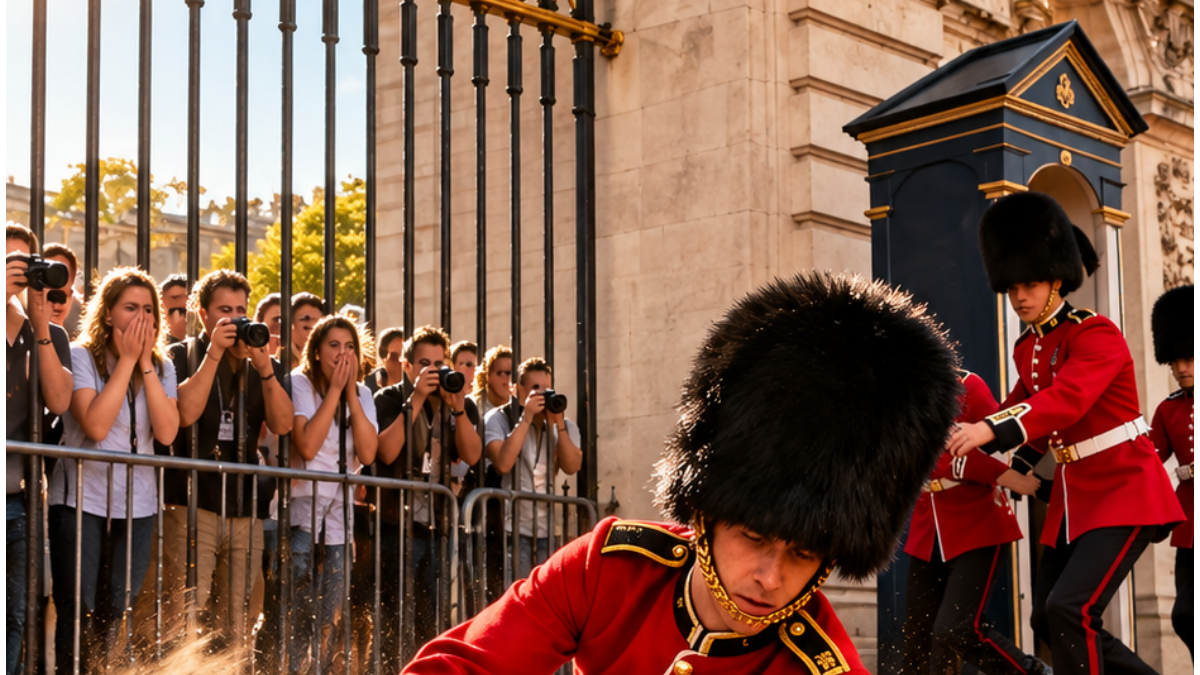
What this royal guard did in front of Princess Charlotte broke every rule in the palace handbook.
For 3 years, he had served with perfect discipline, never making a single mistake.
But on this one summer morning, something happened that changed everything.
The cameras captured it all.
Tourists gasped in shock, and within seconds, palace security rushed to the scene.
What he did next was so unexpected that even the royal family couldn’t believe it.
Princess Charlotte witnessed the entire incident from her window.
And what she decided to do about it left everyone speechless.
The summer sun blazed over London on that particular Tuesday morning, casting golden rays across the cobblestones outside Buckingham Palace.
Tourists from every corner of the world pressed against the iron gates, cameras ready, hoping to catch a glimpse of the royal family.
Among the crowd, a young mother held her daughter’s hand tightly, pointing toward the palace guard standing perfectly still in their iconic red uniforms and tall bearskin hats.
James Mitchell had been a royal guard for 3 years, and he took immense pride in his position.
At 26 years old, he had trained rigorously to earn his place among the elite soldiers who protected the royal family.
Standing guard outside the palace was more than just a job for him.
It represented honor, discipline, and a connection to centuries of British tradition.
His family back in Yorkshire had celebrated 4 weeks when he received his posting to Buckingham Palace.
That morning, James had woken up feeling slightly off.
His head felt heavy, and a wave of dizziness had washed over him as he tied his boots.
He had dismissed it as nothing more than the result of a restless night’s sleep.
The previous evening, he had stayed up late helping his younger brother with university applications over a video call.
Sleep had been short, but duty called.
And James was not one to let his regiment down.
The temperature climbed steadily as the morning progressed.
By 10:00, the thermometer read 32° C.
The heavy wool uniform, designed for practicality and tradition rather than comfort, trapped heat against James’s body.
Sweat trickled down his spine, but he remained motionless, eyes fixed straight ahead.
This was what he had been trained to do.
A royal guard never flinched, never wavered, no matter the circumstances.
Inside the palace, 2-year-old Princess Charlotte was finishing her morning lessons with her tutor.
The young princess had always been a keen student, showing particular interest in history and languages.
Her tutor, Mrs. Patterson, often remarked that Charlotte possessed a remarkable ability to remember details and a genuine curiosity about the world around her.
That morning, they had been studying the history of the royal guards, learning about their role and significance.
Charlotte’s bright blue eyes sparkled with interest as Mrs. Patterson explained how the guards stood watch for hours, protecting the royal family through rain, shine, and even snow.
The princess had seen the guards countless times, but she had never truly thought about what their job demanded.
As her lesson concluded, Charlotte walked to the window and gazed down at the courtyard below.
Several guards stood at their posts, perfectly still, like statues carved from stone.
One guard in particular caught her attention.
She noticed that he seemed to sway ever so slightly, though he quickly corrected his posture.
Charlotte frowned, pressing her small hand against the cool glass.
Something seemed wrong. She watched for another moment, her young heart filling with concern.
The guard swayed again, more noticeably this time.
Outside, James felt the world beginning to tilt.
His vision blurred at the edges and a ringing sound filled his ears.
He tried to focus, mentally repeating the training mantras he had learned.
Stay strong. Stand tall. Never break position.
But his body was betraying him.
The heat, the lack of proper sleep, and perhaps the breakfast he had skipped that morning were all catching up with him at once.
The tourists continued to snap photos, oblivious to the guard’s struggle.
To them, he was simply part of the scenery, a symbol of British tradition to be captured and shared on social media.
None of them noticed the slight tremor in his hands or the way his jaw clenched tighter as he fought to maintain his composure.
Charlotte, however, noticed everything. She had always been observant, a trait her grandmother, Queen Elizabeth, had remarked upon with pride.
The princess turned away from the window and hurried down the corridor.
Her polished shoes clicking against the marble floor.
She needed to find someone who could help, but who?
Her parents were away on official duties, and she did not want to cause unnecessary alarm.
As she rounded a corner, Charlotte nearly collided with one of the palace staff members, Mrs. Davies, who had worked at the palace for over 20 years.
Mrs. Davies had a kind face and always kept sweets in her pocket for the little young royals when they visited.
Charlotte grabbed Mrs. Davies’ hand urgently and said that she thought one of the guards outside might not be feeling well.
She explained what she had observed from the window.
Mrs. Davies smiled gently, patting Charlotte’s hand, and suggested that the guards were very well trained and could handle the heat.
The princess, however, was not convinced.
She insisted that something was truly wrong.
Her voice carrying a note of determination that reminded Mrs. Davies very much of the late Queen Elizabeth.
Before Mrs. Davies could respond further, a commotion erupted from the courtyard below.
Shouts rang out and the sound of running feet echoed through the palace corridors.
Both Charlotte and Mrs. Davies rushed back to the window.
What they saw made Charlotte gasp.
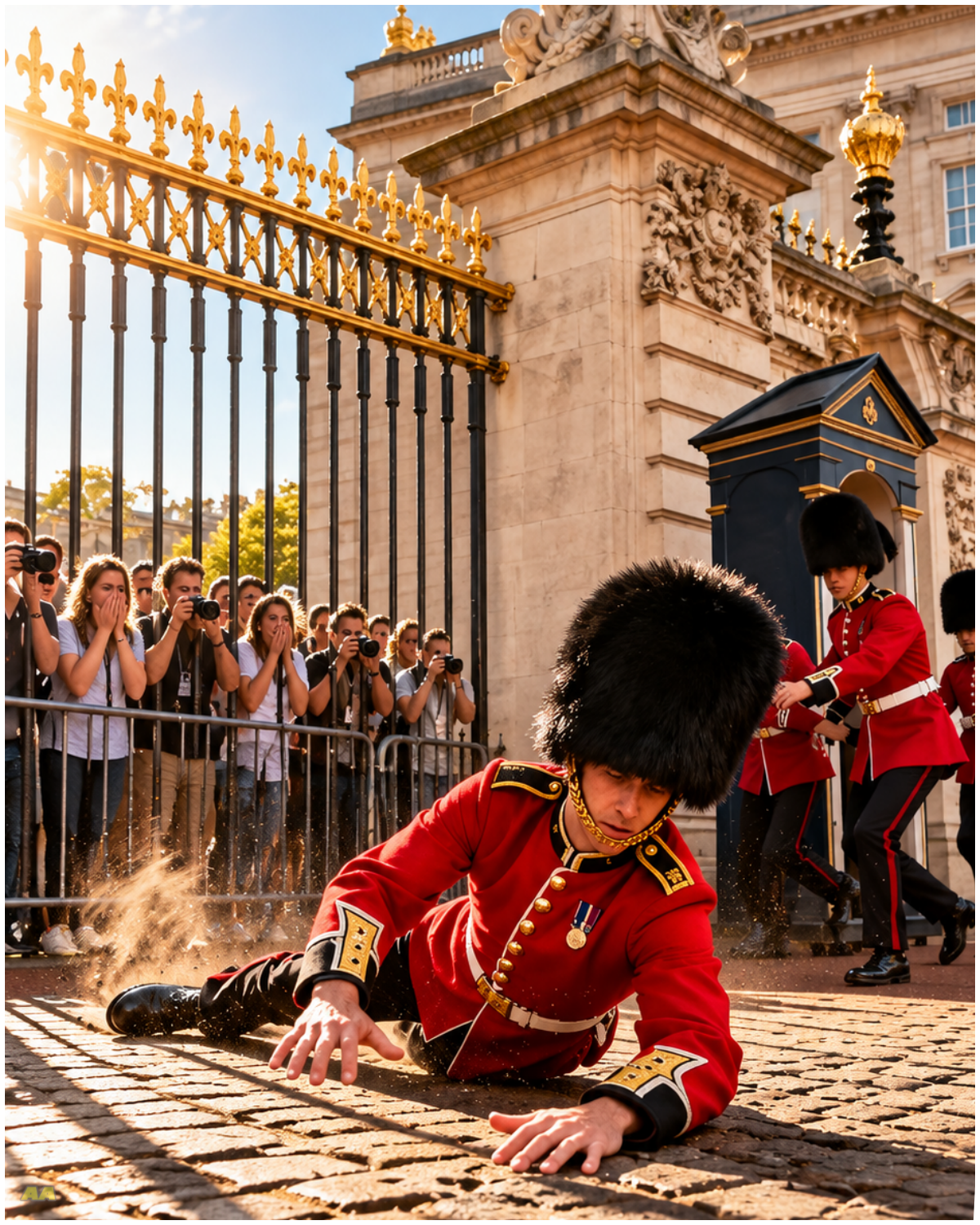
The guard she had been watching had collapsed.
His tall frame crumbling to the ground like a puppet whose strings had been cut.
The crowd outside erupted in a mixture of gasps and concerned murmurs.
Some tourists continued filming, capturing the dramatic moment, while others called out asking if someone had called for help.
Fellow guards immediately broke formation, rushing to James’s aid.
Within seconds, palace medical staff appeared.
Having been alerted by the incident, Charlotte pressed both hands against the window, her young face etched with worry.
She had known something was wrong.
She had seen it. Why had no one listened sooner?
Tears pricked at the corners of her eyes, not from frustration, but from genuine concern for the fallen guard.
Despite being born into royalty, Charlotte’s parents had worked hard to instill in her a sense of empathy and compassion for others.
Regardless of their position or status, Mrs. Davies placed a gentle hand on Charlotte’s shoulder, assuring her that the guard would be fine.
The medical team was excellent and they would take good care of him.
But Charlotte barely heard the words.
She watched as the medical staff checked James’s vital signs and carefully helped him into a sitting position.
Even from this distance, she could see that he looked pale and disoriented.
An idea began to form in Charlotte’s mind.
It was not enough to simply watch from a window.
She wanted to do something, to help in some way.
After all, this man had been standing outside in the scorching heat to protect her family.
The least she could do was show that his service mattered.
That someone had noticed his struggle and cared.
As the medical team helped, James to his feet and began guiding him toward the palace’s medical wing, Charlotte made a decision.
She turned to Mrs. Davies with determination shining in her young eyes and announced that she wanted to visit the guard.
She wanted to make sure he was all right and to thank him for his service.
Mrs. Davies hesitated. It was not standard protocol for members of the royal family, especially the children, to visit guards who had fallen ill.
There were procedures, protocols, and security considerations.
But looking into Charlotte’s earnest face, Mrs. Davies found herself nodding.
Perhaps this was exactly the kind of gesture that could make a difference.
Perhaps this was what true royalty looked like, not just crowns and ceremonies.
But genuine human compassion asterisk Mrs. Davies led Princess Charlotte through the palace corridors.
Their footsteps echoing in the grand hallways adorned with portraits of ancestors dating back centuries.
Charlotte’s mind raced with thoughts about what she would say to the guard.
She had met many people in her young life, diplomats, celebrities, politicians, but this felt different.
This felt personal. The palace medical wing was located in the eastern section of the building, a area that Charlotte rarely visited.
The walls here were painted in calming shades of cream and soft blue, and the atmosphere was quieter, more subdued than the rest of the palace.
Mrs. Davies paused outside the medical room door and gently reminded Charlotte that the guard might be resting and that they should be very quiet.
Charlotte nodded solemnly, straightening her shoulders the way her mother had taught her.
Even at 8 years old, she understood that representing the royal family meant carrying herself with grace and dignity.
No matter the situation, Mrs. Davies knocked softly before opening the door.
Inside, James Mitchell lay on a medical bed, his red uniform jacket removed, leaving him in his white undershirt.
An IV drip had been attached to his arm, slowly rehydrating his body.
The palace physician, Dr. Thompson, was checking his blood pressure when Charlotte and Mrs. Davies entered.
James’ eyes were closed, but he was conscious, his chest rising and falling with steady breaths.
Dr. Thompson looked up in surprise as he recognized the young princess.
He quickly straightened and bowed slightly, clearly uncertain about the protocol for this unexpected visit.
Charlotte offered him a small smile before her attention turned to the guard on the bed.
Her expression softened with concern as she took in his pale complexion and the exhausted lines around his eyes.
James heard the movement in the room and opened his eyes.
For a moment, confusion clouded his features as he tried to understand why the young princess was standing in his medical room.
He attempted to sit up quickly, his military training demanding that he show proper respect to the royal family.
Dr. Thompson immediately placed a gentle but firm hand on his shoulder, instructing him to remain lying down.
Charlotte stepped closer to the bed, her small hands clasped in front of her.
In a soft but clear voice, she told James that she had wanted to come and see how he was doing.
She explained that she had been watching from her window and had seen him standing in the hot sun.
She said she had noticed that he was not feeling well even before he fell.
James felt his throat tighten with emotion.
In his three years as a royal guard, he had stood watch countless times, protected numerous royal events, and performed his duties with unwavering dedication.
But never had a member of the royal family personally come to check on his well-being.
He managed to find his voice and thanked the princess, apologizing for his collapse.
He explained that he should have been stronger, that he had let down his regiment.
Charlotte shook her head earnestly, her blonde hair swaying with the movement.
She told him that he had not let anyone down.
She said that standing in such heat wearing such a heavy uniform was incredibly difficult and that everyone needed help sometimes.
Her words carried a wisdom beyond her years, reflecting the values her parents had worked hard to instill in her.
Dr. Thompson explained that James was suffering from heat exhaustion and mild dehydration, but that he would make a full recovery with rest and fluids.
The doctor noted that the extreme temperatures that day had caught many people off guard and that James was actually the third person that morning to require medical attention due to the heat.
Charlotte listened attentively, asking Dr. Thompson several questions about heat exhaustion and how to prevent it.
She wanted to understand exactly what had happened and what could be done to ensure it did not happen to other guards in the future.
Her questions impressed both Dr. Thompson and Mrs. Davies, who exchanged meaningful glances.
The princess was showing genuine interest and concern, not merely making a polite courtesy visit after a few moments.
Charlotte told James that she would let him rest, but that she wanted to bring him something.
She explained that whenever she was not feeling well, her mother would give her something special to help her feel better.
She wanted to do the same for him.
Before James could respond, Charlotte turned and left the room with Mrs. Davies following close behind.
James lay back against his pillow, his mind reeling from the encounter.
He thought of his parents back in Yorkshire and how they would never believe what had just happened.
The Princess of Cambridge had visited him.
Had shown genuine concern for his well-being.
Had spoken to him not as a distant royal figurehead, but as a real person with empathy and kindness.
Charlotte hurried through the palace corridors with determined purpose.
Mrs. Davies struggled to keep pace with the young princess who seemed to know exactly where she was going.
They arrived at the palace kitchens.
A vast space filled with gleaming copper pots, industrial ovens and the wonderful aromas of food being prepared for the day’s meals.
The head chef a Frenchman named Pierre who had cooked for the royal family for 15 years looked up in surprise as Princess Charlotte entered his domain.
The kitchen staff immediately stopped what they were doing and stood at attention.
Charlotte smiled at them warmly explaining that she needed their help with something very important.
She told Pierre about the guard who had collapsed from the heat and how she wanted to prepare something special for him.
She asked if they could make some fresh lemonade but not just any lemonade.
She wanted it made the special way that her great grandmother used to make with fresh mint leaves and just a touch of honey.
She had remembered hearing stories about how Queen Elizabeth would sometimes prepare refreshments for staff members who had been working particularly hard.
Pierre’s stern chef expression melted into a warm smile.
He told Charlotte that it would be his honor to prepare such a drink.
He immediately set his team to work squeezing fresh lemons, crushing mint leaves and mixing everything with filtered water and the finest honey from the palace gardens.
Charlotte watched intently asking questions about each step of the process.
While the lemonade was being prepared, Charlotte had another idea.
She turned to Mrs. Davies and asked if they could also prepare a small basket of food.
She reasoned that James probably had not eaten properly that morning.
And that good food would help him recover faster.
Mrs. Davies smiled at the princess’s thoughtfulness.
And agreed immediately. Within 20 minutes.
Pierre and his team had prepared a beautiful basket.
It contained fresh sandwiches made with cucumber and cream cheese.
Some delicate pastries, fresh fruit carefully arranged, and a large glass bottle of the special lemonade.
Everything was packed carefully in a wicker basket with a crisp white linen cloth.
Charlotte thanked Pierre and his team profusely.
Her gratitude genuine and heartfelt. As she left the kitchen carrying the basket with Mrs. Davies’s help.
The kitchen staff stood watching. Many of them with tears in their eyes.
In that moment. They had witnessed something rare and beautiful.
A young royal showing that compassion and kindness could transcend the boundaries of privilege and duty.
On their way back to the medical wing.
Charlotte made one more stop. She went to the palace library.
A magnificent room lined with thousands of books collected over generations.
She knew exactly what she was looking for.
On one of the lower shelves accessible to the younger royals.
Was a collection of books about British military.
History and the royal guards. Charlotte selected a particular book that she had read several times before.
It contained beautiful photographs and stories about the guards throughout history.
Their bravery, their traditions, and their unwavering loyalty to the crown.
She thought James might enjoy reading it during his recovery.
She carefully added it to the basket as they approached the medical wing once more.
Charlotte paused. She told Mrs. Davies that she wanted to write a note to go with the gifts.
Mrs. Davies produced a pen and a small card from her pocket.
And Charlotte bent over a hallway table to compose her message.
She wrote slowly and carefully. Her young handwriting neat and deliberate.
The note read simply that she hoped these things would help him feel better, that she was very grateful for his service.
She thanked him for protecting her family and said that she thought he was very brave.
She signed it with just her first name, adding a small hand-drawn flower at the bottom of the card.
Mrs. Davies read the note over Charlotte’s shoulder and felt her eyes well up with tears.
This was not a staged royal gesture or a carefully orchestrated PR moment.
This was pure, authentic kindness from a child who had been raised to understand that every person, regardless of their role, deserved dignity and compassion.
Asterisk When Charlotte and Mrs. Davies returned to the medical wing, they found James sitting up in bed, looking considerably better than before.
The four fluids had worked their magic.
And some color had returned to his cheeks.
Dr. Thompson was pleased with his progress.
And had been explaining that James would need to rest for the remainder of the day before returning to light duties.
James’s eyes widened when he saw Princess Charlotte return carrying the wicker basket.
The young princess approached his bedside with a gentle smile and carefully placed the basket on the table beside him.
She explained that she had brought him some things to help him feel better and that the kitchen had prepared his lemonade specially.
As James looked at the contents of the basket, he found himself momentarily speechless.
The care and thought that had gone into this gesture was overwhelming.
Here was the daughter of the future king of England taking time from her day to personally ensure his comfort and recovery.
It was something he had never imagined would happen in his entire career.
Charlotte pointed out each item in the basket, explaining that the sandwiches were made fresh and that Pierre, the head chef, had chosen the best pastries.
She lifted the bottle of lemonade and told him it was made the way her great-grandmother used to make it, fresh mint and honey.
Then she pulled out the book about the Royal Guards and explained that she thought he might enjoy reading about the history of his regiment while he rested.
James accepted the book with trembling hands.
He opened it carefully, as if it were made of the most delicate glass.
The pages were filled with photographs spanning decades, showing guards in various ceremonies and historical moments.
He told Charlotte that this was incredibly kind of her and that he did not know how to thank her properly.
His voice cracked slightly with emotion and he quickly cleared his throat, trying to maintain his composure.
Charlotte told him that he did not need to thank her.
She said that he and all the guards worked very hard to keep her family safe and that this was just a small way to say how much it mattered.
She added that she had learned in her lessons that morning about how important the guards were and now she understood it even better after seeing what he had gone through.
Dr. Thompson, who had been quietly observing the exchange, suggested that James should try some of the lemonade.
He poured a glass and handed it to James, who took a careful sip.
The cool, refreshing drink was perfect, not too sweet, with just the right amount of mint.
James closed his eyes briefly, savoring both the taste and the moment.
He told Charlotte that it was the best lemonade he had ever tasted.
Charlotte beamed with pride, explaining that she had watched Pierre make it and had learned how to do it herself.
She said that maybe next time she could make it for him herself if he ever needed it again.
The innocent offer made everyone in the room smile.
Touched by the princess’s genuine desire to help and care for others, Mrs. Davies gently reminded Charlotte that they should let James rest and recover.
Charlotte nodded in understanding, but paused before leaving.
She asked James what his name was.
When he told her it was James Mitchell, she repeated it carefully as if committing it to memory.
She told him it was very nice to meet him properly and that she hoped he would feel completely better very soon.
James thanked her again, but I think this time he managed to express his gratitude more fully.
He told her that her kindness meant more to him than she could know and that he would never forget this day.
He promised that when he returned to duty, he would serve with even greater pride knowing that the family he protected truly cared about those who served them.
After Charlotte and Mrs. Davies left, James sat in silence for several minutes, simply processing what had happened.
He poured himself another glass of lemonade and took one of the sandwiches from the basket.
As he ate, he opened the book Charlotte had brought and began reading about the history of the regiment.
Each page turned revealed stories of courage, dedication, and service values he had committed himself to when he first put on the uniform.
Dr. Thompson returned to check on James and found him with tears running down his cheeks, though a smile played on his lips.
The doctor asked if he was feeling all right, if perhaps the heat exhaustion had affected him more than they thought.
James shook his head and explained that he was fine, better than fine actually.
He was simply moved by the unexpected kindness he had received.
The doctor nodded in understanding. He told James that in his 20 years working at the palace, he had witnessed many moments of royal kindness that never made the newspapers or television reports.
He said that the true character of the royal family was not always seen in the grand ceremonies or official photographs, but in these quiet, private moments of genuine human compassion.
Meanwhile, Charlotte returned to her daily schedule.
She had more lessons to attend, and that afternoon, she had a music practice scheduled.
But throughout the rest of her day, her thoughts kept returning to James.
She wondered if he was feeling better, if he’d enjoyed the food, if the book was interesting to him.
She had acted on impulse, following her heart’s desire to help someone in need.
But now she found herself genuinely invested in his recovery.
That evening, when Princess Catherine returned from her official duties, Mrs. Davies mentioned Charlotte’s visit to the medical wing.
Catherine listened carefully to the account, her expression thoughtful.
She asked if she might speak with Charlotte privately, and Mrs. Davies arranged for mother and daughter to meet in Catherine’s private sitting room.
Charlotte entered the room somewhat nervously, unsure if she had done something wrong by visiting the guard without explicit permission.
Catherine gestured for her daughter to sit beside her on the sofa.
She told Charlotte that Mrs. Davies had told her about what happened that day, about how Charlotte had noticed the guard struggling and had gone to help him after he collapsed.
Charlotte nodded, explaining that she had just wanted to make sure he was okay and to thank him for his service.
She worried that perhaps she should have asked permission first, but it had seemed important to act quickly.
Catherine smiled warmly and pulled her daughter close for a hug.
She told Charlotte that she was very proud of her, that showing compassion and kindness to others was one of the most important qualities anyone could have, royal or not.
Catherine explained that Charlotte had done exactly what any good person should do when they see someone in need.
She said that being born into privilege came with responsibilities, and one of those responsibilities was to remember that every person deserves dignity, respect, and compassion.
Charlotte’s actions that day had demonstrated a deep understanding of these values.
Mother and daughter talked for a while longer with Catherine sharing stories of times when her own family had shown kindness to others in unexpected ways.
She told Charlotte about the late Queen Elizabeth’s many private acts of generosity that were never publicized.
And about how Princess Diana had often visited people who were sick or struggling, bringing them comfort through her presence and care.
Charlotte listened intently, absorbing her mother’s words.
She asked if it would be all right for her to check on James again the next day to see how he was recovering.
Catherine considered this and agreed, suggested that rather than visiting in person again, Charlotte might write James a letter wishing him well.
This way he would have something to keep, a lasting reminder of the kindness he had received.
That night before bed, Charlotte sat at her small writing desk and composed a letter to James.
She wrote about how she hoped he was feeling much better and that the lemonade and food had helped.
She told him that she had learned his name and would remember it always.
She said that she thought all the guards were very important and that she was grateful for their service every single day.
She ended the letter by wishing him good health and expressing her hope that the weather would be cooler for his future shifts.
Charlotte placed the letter in an envelope and wrote James’s name on the front in her careful handwriting.
She left it on her desk for Mrs. Davies to deliver the next morning.
As she climbed into bed that night, Charlotte felt a warm sense of satisfaction.
She had helped someone who needed help and in doing so, she had learned an important lesson about what it truly meant to be a leader and a representative of the royal family in the medical wing.
James finished the last of the sandwiches and carefully packed the basket’s contents away.
Wanting to preserve everything as a memory of this extraordinary day, he placed Charlotte’s handwritten note in his wallet.
Deciding that he would keep it with him always as a reminder of why he served and whom he served.
The book lay open on his lap and he continued reading late into the evening.
Fascinated by the stories of guards who had come before him, Dr. Thompson checked on James one final time before leaving for the night.
He found his patient in good spirits, well hydrated, and showing no signs of continuing distress from the heat exhaustion.
The doctor commented that James had received the best medicine possible that day, genuine human kindness and care.
James agreed wholeheartedly, knowing that this day would remain one of the most memorable of his entire life.
Asterisk. The following morning arrived with slightly cooler temperatures and a gentle breeze that offered relief from the previous day’s oppressive heat.
James woke in his quarters within the palace barracks feeling remarkably restored.
The four fluids, rest, and perhaps most importantly, the unexpected kindness he had received had worked wonders on both his body and spirit.
Dr. Thompson had cleared him for light duties, which meant James could return to work but would be stationed indoors for the next few days as a precaution.
As he dressed in his uniform, James caught sight of the wicker basket from the previous day.
Sitting carefully on his dresser, the book Charlotte had given him rested beside it.
A bookmark placed where he had stopped reading the night before.
He smiled, remembering every detail of the princess’s visit.
Mrs. Davies appeared at the medical wing early that morning with Charlotte’s letter.
She had promised the young princess that she would deliver it personally to James.
When she handed him the envelope, James noticed his name written in Charlotte’s neat, careful handwriting.
He opened it slowly, wanting to savor the moment.
As he read Charlotte’s words, he felt the same surge of emotion he had experienced the day before.
He told Mrs. Davies that he would treasure this letter always and asked if it would be possible for him to write a response.
Mrs. Davies smiled warmly and said she thought that would be very appropriate.
James spent the next hour crafting his reply, choosing his words carefully.
He wanted to properly express his gratitude while remaining respectful of protocol and the princess’s position.
Asterisk In his letter, James thanked Charlotte for her extraordinary kindness and explained that her visit had meant more to him than any medal or commendation ever could.
He told her that he was recovering well and felt strong enough to return to his duties.
He wrote that her compassion had reminded him why he was proud to serve the royal family and that he would carry the memory of her kindness with him throughout his career.
He signed the letter formally but warmly and entrusted it to Mrs. Davies for delivery.
Charlotte received James’s response that afternoon.
After her lessons had concluded, she read it eagerly, pleased to know that he was feeling better and would soon return to work.
She showed the letter to her mother, who read it with a knowing smile.
Catherine told her daughter that James had written a very gracious letter and that Charlotte should keep it as a reminder of the positive impact one person’s kindness could have on another.
The story of what had happened might have ended there.
A private moment of compassion between a young princess and a royal guard known only to those directly involved.
However, fate had other her Several weeks after the incident, a journalist named Sarah Bennett was working on a feature story about working conditions for royal guards during extreme weather.
She had been interviewing several guards and palace staff members when she heard whispers about an incident involving Princess Charlotte.
Sarah was a seasoned journalist, known for her respectful and balanced coverage of the royal family.
Unlike some of her colleagues who sought scandal and controversy, Sarah was interested in authentic stories that revealed the true character of the people she covered.
She approached her investigation carefully, not wanting to intrude on what had clearly been a private moment of kindness.
Through careful and respectful inquiry, Sarah pieced together what had happened that hot Tuesday morning.
She spoke with palace staff who had witnessed Charlotte’s concern from the window, learned about the visit to the medical wing, and heard about the special basket of food and lemonade.
Every person she spoke with emphasized the genuine nature of Charlotte’s actions.
This had not been a publicity stunt or staged photo opportunity.
It had been a child seeing someone in need and responding with pure, heartfelt compassion.
Sarah knew she had discovered something special.
In an age where royal coverage often focused on fashion choices, public appearances, and occasional controversies, here was a story that spoke to something deeper and more meaningful.
This was a story about values, about the kind of person Princess Charlotte was being raised to become, and about the quiet acts of kindness that define true character.
However, Sarah also recognized the delicate nature of the situation.
If she published the story incorrectly or sensationalized it, she could potentially damage the very thing that made it special, its authenticity and privacy.
She made a decision that many journalists might not have made.
She reached out to the palace press office to discuss the story before publishing it.
The palace press secretary, thoughtful woman named Amanda Price, was initially hesitant.
The royal family preferred to keep children’s private acts of kindness out of the media spotlight.
They did not want Charlotte or her siblings to feel pressured to perform.
Kindness for cameras, or to grow up thinking that good deeds were only valuable if they were publicized.
Amanda explained these concerns to Sarah frankly.
Sarah understood these concerns completely and shared them.
She proposed a compromise. She would write the story in a way that focused not on Charlotte as an individual, but on the broader theme of compassion and service that the royal family embodied.
She would not include photographs of Charlotte during the visit, since none existed.
She would emphasize that this had been a private moment that came to light only through her.
Reporting on working conditions for palace staff, Amanda agreed to discuss the proposal with Catherine.
Catherine read Sarah’s draft article carefully.
She appreciated that the journalist had handled the story with sensitivity and respect.
The article highlighted an important message about empathy, compassion, and the relationship between the royal family and those who serve them.
After much consideration, Catherine gave her approval for publication with the understanding that Charlotte herself would not be made available for interviews or photographs related to the story when Sarah’s article was published several weeks after the incident.
It created an immediate and powerful response.
Readers around the world were moved by the story of the 8-year-old princess who had noticed a struggling guard, taken action to help him, and followed through with thoughtful gifts and continued concern for his well-being.
Social media filled with messages of admiration, not just for Charlotte, but for the value she represented.
James Mitchell suddenly found himself at the center of unexpected attention.
News outlets wanted to interview him to hear his first-hand account of what had happened.
After consulting with his commanding officers and the palace press office, James agreed to one carefully arranged interview where he could share his experience properly.
During the interview, James spoke with genuine emotion about that day.
He described the heat, his collapse, and his surprise when Princess Charlotte visited him in the medical wing.
He talked about the basket of food, the special lemonade, and the book she had brought him.
Most importantly, he spoke about what her kindness had meant to him personally and how it had reinforced his commitment to his service.
James was careful to emphasize that he did not believe Charlotte had acted seeking recognition or praise.
He said that her concern had been authentic and immediate, the natural response of a kind-hearted child who saw someone in need.
He expressed his hope that the story would inspire others to show similar compassion in their own lives, regardless of their position or circumstances.
The response to James’s interview was overwhelmingly positive.
Veterans organizations praised the story as an example of the mutual respect between the military and the monarchy.
Parents shared the article with their children as a lesson in empathy and kindness.
Mental health advocates noted that the story highlighted the importance of recognizing when others are struggling and taking action to help them.
At Buckingham Palace, life continued much as it had before.
Charlotte returned to her lessons, her music practice, and her various activities.
She was vaguely aware that a story had been published about what had happened, but her parents had shielded her from the full extent of the media attention.
They wanted her to understand that what she had done was important and meaningful, but not to feel burdened by public expectations or pressure to repeat such gestures for publicity.
However, Charlotte’s act of kindness had created ripples that extended far beyond a single news article.
The palace began reviewing protocols for monitoring guard welfare during extreme weather conditions.
New measures were implemented to ensure that guards could request relief more easily if they felt unwell.
And additional hydration stations were installed at various posts around the palace grounds.
James Mitchell continued his service as a royal guard, but his perspective had changed.
He found himself more attuned to the well-being of his fellow guards, more willing to check in on colleagues who might be struggling, and more aware of the human connections that existed within the formal structures of palace protocol.
He shared Charlotte’s note and letter with his family, who framed them and hung them in their Yorkshire home with immense pride.
Several months after the incident, James received an unexpected summons.
He was to receive a commendation from his regiment, not for his guard duties, but for the way he had represented the guards in his interview following the incident.
His honest, humble account had enhanced public understanding and appreciation of the work that guards performed.
At the ceremony, James wore his full-dress uniform with pride, knowing that a small handwritten note from a princess remained safely tucked in his wallet.
Princess Charlotte Now, aware of the full story and its impact, spoke with her mother about what had happened.
Catherine used the opportunity to discuss with her daughter the responsibilities that came with public attention.
She explained that while Charlotte’s actions had been kind and right, it was important to continue doing good things because they were right, not because people might find out about them or praise them for it.
Charlotte understood, though she was still young.
She told her mother that she had not thought about whether anyone would know what she did.
She had just wanted to help James because he looked unwell and because he had been working hard to keep them safe.
Catherine hugged her daughter tightly knowing that Charlotte’s instinctive response revealed more about her character than any staged charitable appearance ever could.
Years would pass and Charlotte would grow into a young woman with many responsibilities and opportunities ahead of her.
But those who knew her well would often point back to that hot Tuesday morning as a defining moment.
It’s not because of the media attention it eventually received, but because it revealed the core values that would guide her throughout her life.
James Mitchell would go on to have a long and distinguished career in the military.
He would eventually retire with honors and would often be invited to speak about his experiences.
In every speech, in every interview, he would mention the day a young princess taught him the true meaning of compassion and service.
He would show the book Charlotte had given him, now well-worn from repeated readings, and he would speak about how that one act of kindness had influenced not just his own life, but had inspired countless others to show similar compassion in their own ways.
The media eventually moved on to other stories as media always does, but the impact of what had happened that day continued to resonate.
Teachers used the story in their classrooms to discuss empathy and kindness.
It became a favorite example in leadership courses about servant leadership and genuine care for others.
Young people facing their own struggles would remember the story and find courage in the fact that even a princess understood what it meant to notice when someone needed help.
In the quiet corridors of Buckingham Palace, life continued with its mixture of ceremony and routine, tradition and change.
But those who worked there, from the highest officials to the newest staff members, carried with them the knowledge that the family they served valued them not just for their duties, but for their humanity.
And sometimes on particularly hot summer days, when the guards stood at their posts under the blazing sun, someone would quietly appear with cold drinks and a kind word.
A legacy of compassion that had started with one young princess’s simple act of noticing and caring.
The wicker basket that had held Charlotte’s gifts to James remained in his possession throughout his life.
It sat on a shelf in his home, a tangible reminder of an extraordinary day.
Inside it, he kept the letters they had exchanged, the book she had given him, and a photograph of Buckingham Palace taken on a summer day very much like the one when he had collapsed.








