On the Church Steps He Offered to Take His Brother’s Place — She Did Not Know Esperfell Was a Duke
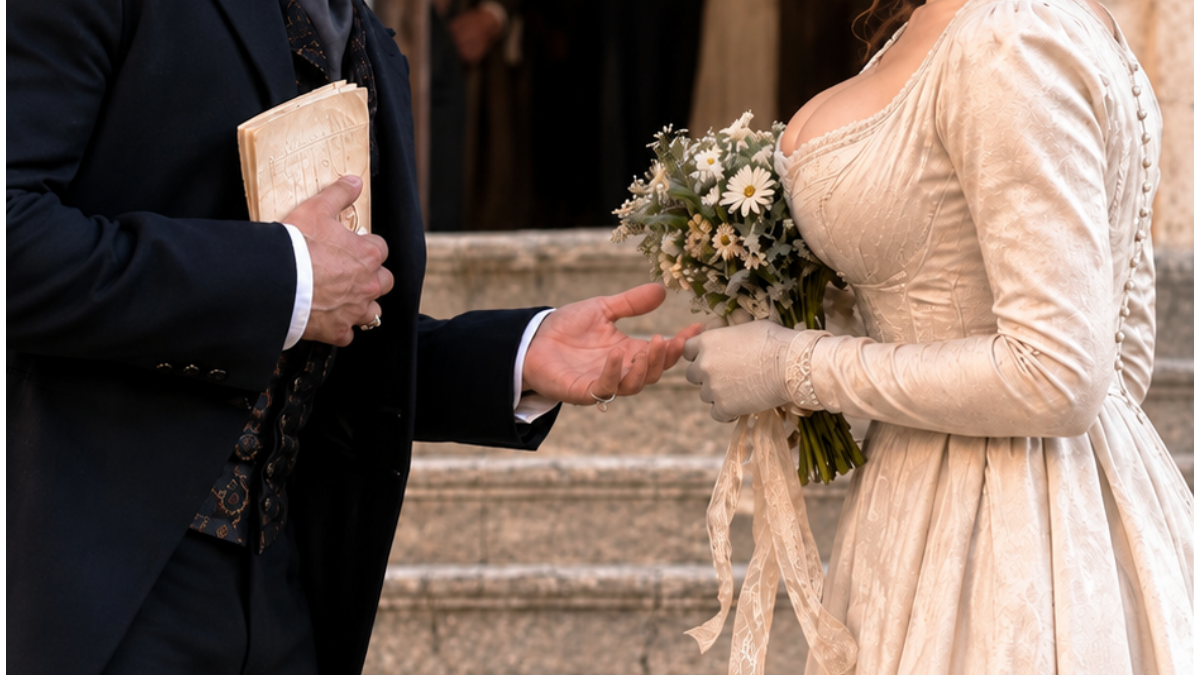
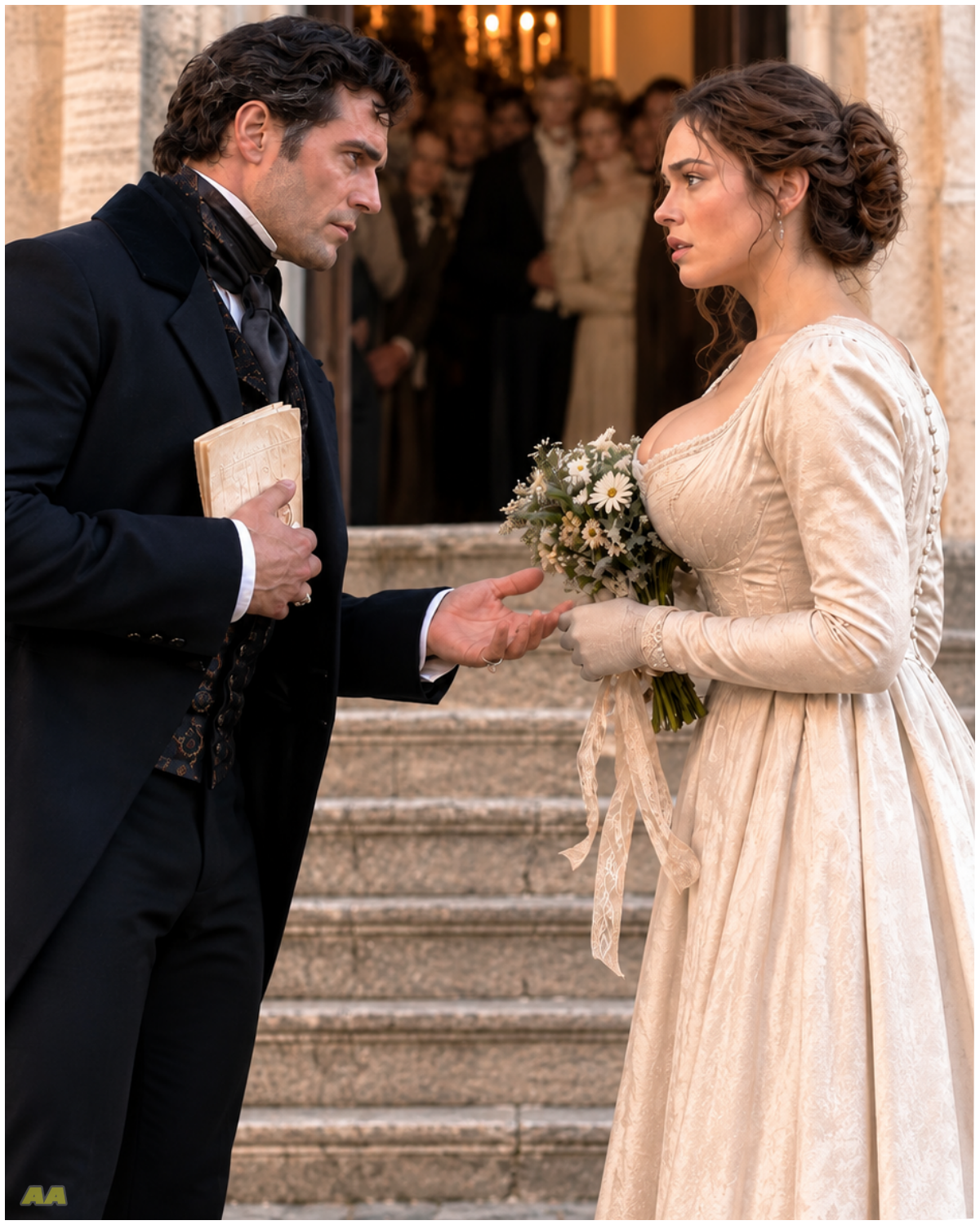
Hammond came through the doors of St. I ides at a/4 to 12 with a license folded into his coat and no clear notion of what he meant to do with it beyond keep a woman from ruin in front of 140 witnesses.
The organ was still going.
Old Silito at the keys had been told to play until told to stop and he had been playing for the better part of an hour.
The same processional turned over and over until it had worn a kind of groove in the air, and nobody inside the church had the courage to ask him to leave off, because leaving off would mean admitting what everyone already knew.
The stable yard, when Hammond had crossed it 20 minutes before, had held one horse fewer than it ought.
Anel’s gray geling was gone from its stall.
The groom swearing he had not seen his lordship take it and taken it anyway.
She was on the steps, not inside with the guests, not weeping in some anti room where a woman was meant to weep, but out on the steps in full daylight in a gown the color of unbleached linen with a hundred small pearl buttons up the back that someone had clearly done up for her that morning in good faith.
Standing with her spine as straight as a lath and her gloved hands folded in front of her as though she were waiting for a coach that was only very slightly delayed.
Hammond had met her twice.
Once at her brother’s house in Cotton over tea he had not wanted, while Bracegirdle discussed a settlement Hammond had not troubled to read closely because that was not his office.
Once at a dinner Anel had dragged him to, where she had said perhaps 11 words the whole evening, and every one of them had been exact.
He remembered thinking at that dinner that she was the only person at the table who was not performing anything.
He stopped two steps below her because it seemed wrong to stand over her, and because he did not in that moment entirely trust his own legs.
Behind him, through the open doors, he could hear the particular murmur of 140 people trying to whisper and failing, fans working too fast in the August heat, someone’s small dog barking twice and being hushed.
He had spent 11 years growing an instinct for the sound, a room made just before it understood it had been made a fool of, and the church behind him had very nearly reached that sound.
He had known riding out before dawn only that he did not trust the particular quality of Anel’s silence the night before no jokes no nerves worn as jokes the way Anel always wore them only a long look out the library window and an early good night 11 years of his brother’s disasters had taught Hammond that a quiet Anel was a more dangerous animal than a loud one he had told himself riding to cotton in the spark to rouse the surrogate, that he was being absurd, that a man was allowed nerves before his own wedding, that he would hand the license back unused and never speak of the ride to anyone.
He had not handed it back.
Miss Quilter, your grace, she said it evenly.
Whatever had happened in the last hour had not disordered her voice.
You know he’s gone. I gathered as much from the horse.
He had come out onto the steps, meaning only to tell her what Brace Girtle had already established at speed indoors, that there would be no proceeding today, that the guests would be sent home with what Grace could be managed, that a note would go to her brother, that the whole grinding machinery of apology would now have to be assembled and run.
He had a paper in his coat that changed all of that and he had not decided coming through the doors whether he meant to use it.
He decided somewhere on the second step.
If it is the marriage you want and not my brother, he said, I will stand up with you now.
He heard himself say it and had the strange floating sensation of a man watching another man do something reckless from a slight distance.
He was 36 years old.
He had spent 11 of those years quietly putting right what Anel broke because that was the office of an elder brother, and he had never once resented the office until this precise moment, standing on wet stone with a woman he had spoken to twice, offering her his name, because he could think of nothing else in his power that would answer what had been done to her.
She looked at him for perhaps 4 seconds.
He would think of that afterward.
4 seconds. No longer. No hand pressed to the throat.
No dramatic pause. And then she said yes.
In the same even voice she had used for his title, as though he had asked whether she preferred her tea with or without sugar, and she had a settled preference.
He had expected, if he had expected anything, some hesitation, some question about what such a bargain would cost either of them.
He got none. It unsettled him more than tears would have done.
You understand what you’re agreeing to, he said, because someone ought to say it, and he could not imagine or am quilter, wherever he was standing at that moment having troubled too.
I understand that I came here to be married and that the alternative is being unmarried in front of 140 people who paid good money for the wine.
She said, “I am not a romantic, your grace. I am aware you are not my brother. I am aware this is not what either of us pictured for this particular Tuesday. I will still say yes.”
He held out his arm.
She took it. Her hand, through two layers of glove and wool, was perfectly steady, and his was not, and he was glad of the coat sleeve between them, so that she could not feel that.
Inside the organ faltered and recovered, as Silito caught sight of them coming up the aisle, and understood, three bars too late, that something had changed.
The recctor, a spare, unhurried man named Kum, who had buried Hammond’s father and christened Anel, and had therefore seen this family at its worst before, came down from the chancel step with his book already open, and his face already asking the question his mouth had not yet caught up to.
Your grace, Kum’s eyes went from Hammond to Serena to the closed doors behind them, doing the same arithmetic the whole church was doing.
This license names your brother.
I hold another. Hammond drew it from his coat.
He had written to Cotton before 6 that morning to fetch old Anstie the surrogate out of his own breakfast and put the fee on the table before Anie had finished reading the request because some old unexamined instinct had told him, watching Anel not come down to dress, watching him send excuses through a footman instead of a face, that the day would end exactly where it was ending now.
He had told no one.
He had told himself it was only prudence.
Kum read it with the particular slowness of a man who intends to be seen reading carefully.
Then he closed it and looked past Hammond directly at Serena.
Miss Quilter, I will not marry you to a man not named on your license without hearing it from your own mouth before these witnesses.
That this is your free wish and no one’s contrivance.
He said it kindly, but it was not a request, is it?
The church had gone very quiet.
140 people who had come to see one wedding leaned forward almost as one body to hear whether they were about to see another.
Serena did not look at Hammond.
She looked at the recctor and then briefly out over the pews at faces Hammon could not read from where he stood and then back.
It is my free wish,” she said clearly enough to carry to the back gallery, and it is no one’s contrivance but my own.
Kum held her gaze a moment longer, satisfied himself of something private in it, and then shut the book on his thumb to mark the place, and began.
Somewhere behind Hammond in the third or fourth pew, a man’s voice said something too low to carry, and another man near him laughed once and stopped himself.
Hammond did not turn to find the source.
He would remember later that he had not turned, and that this small failure to look would cost him nothing that day, and a good deal more before the year was out.
It went quickly after that.
The way a fire goes quickly once it is caught.
Hammond said the words he was meant to say and heard almost none of them.
He was watching her mouth shape her half of the vow and thinking with the small detached part of his mind that never entirely stopped working even now.
That he did not know this woman.
That he had committed the largest act of his life to a stranger on the strength of 11 words at a dinner and 4 seconds on a step.
And that he could not, if Brace girdle himself had put him under oath, have said why.
They went through to the vestri to sign.
The register lay open on its slanted desk, ink still glistening at the top where Kum had entered the date and the parish.
Serena took the pen he offered, dipped it, and wrote her name in a hand steadier than his own had ever managed on that page.
Then her eyes moved up to where his signature waited above hers drying and to the line beside it where Kum had written in his small exact clerk’s hand the full style the license required.
Hammond watched her read it.
He watched the moment it landed.
Not a gasp. Nothing so simple as that.
Only a stillness that came over her whole face like weather crossing water.
And her eyes came up to his with a question in them that had not been there on the steps.
Duke, she said, just the word testing its weight.
Yes, you didn’t think to mention it.
There wasn’t, Hammond said, a great deal of time.
Outside the bells that had been primed for one groom began raggedly, uncertainly to ring for another, and neither of them moved to correct the ringers.
He had to tell them himself.
That was the part nobody warned a man about in whatever unwritten book governed such mornings.
That having stood in for his brother at the altar, he would also have to stand in for him at the door and say the thing aloud to 140 people who had eaten his mother’s breakfast and worn their best gloves and were owed, if nothing else, a plain sentence.
He gave them one. He and Serena came out onto the porch together, her hands still on his arm, and the crowd that had spilled from the pews into the churchyard turned as a single animal turns.
And Hammond said, “My brother did not come.
I have married Miss Quilter in his place with her free consent and the recctor’s blessing, and I would be obliged if you would all come back to a Spurfell and drink the wine that was paid for.” It was not elegant.
He had composed nothing finer on the ride from Cotton, having been occupied with the ride itself, and he found afterward that the plain version served better than anything ornamented could have done.
It left less room for a listener to insert his own meaning into the gaps.
There was a silence of the kind that is wait that presses on the ears and then the sort of noise a churchyard makes when 140 people all decide separately and within the same 3 seconds that they will discuss this at length later and say nothing improper now.
Fans opened. A woman near the lichgate began audibly to cry with what Hammond judged after a moment to be pure delight at having a story to carry home.
Somewhere a glass of something was already being poured because Nance Le, who had run the Esperell household through worse mornings than this one, had apparently decided before the ceremony was half done that wine would be wanted regardless of who drank it with whom.
His mother stood at the foot of the steps with her hand pressed flat against her own collarbone, as though holding something in that wanted very badly to get out.
The daager lady of Spurfel had buried a husband and raised two sons under his shadow and had in Hammond’s whole life shown very little on her face that she had not first decided to show.
She was not deciding now.
Whatever moved across her features, grief for the son who had run, or something nearer to relief, that it was the elder and not the younger who had been made to pay for it, or simple shock at watching her quiet, exhausted air do the single least characteristic thing of his life in front of the whole county.
She let all of it show, and it aged her 10 years in the time it took Hammond to descend the last step and reach her.
Mother, you have married her?
Not a question. She looked past him at Serena with an expression Hammond could not immediately place.
Not unkindness, not welcome either.
Something more like a woman doing rapid suMs. I have.
Does she know what she has married into?
She knows considerably more of it than I did 10 minutes ago.
He said it lightly, meaning it as something near a joke, and saw that it landed nowhere close to one.
He gave his mother his other arm, and they went down through the churchyard together.
The three of them, Serena’s hand light and correct on his sleeve, his mother’s grip on the other rather less so.
And it was in crossing that stretch of trotten grass between the porch and the gate that Hammond first noticed Orm Quilter.
The man was standing a little apart from the general crowd, near the wall where the old graves leaned, in a coat too well cut for an attorney’s clerk’s income, and a waste coat that had clearly been chosen with more thought than the occasion of watching one’s sister be abandoned ought to require.
Every other face Hammond had passed in the last two minutes had worn some variant of shock, curiosity, or the particular avid sympathy of people watching a disaster that was thankfully not their own.
Orm Quilter’s face wore none of those.
He was not distressed. He was not even, Hammond thought, especially surprised.
He looked, more than anything, like a man watching a horse he had backed come in at very good odds.
Hammond filed the observation the way he filed most things that did not immediately require action, in the back of a mind already crowded with wine to be found, guests to be seated, a recctor to be thanked, a mother to be managed, and did not think of it again for some while.
Serena beside him did think of it.
He felt her hand alter on his arm, not tighten exactly, but settle.
The way a hand settles when its owner has decided something and set it aside for later use.
And when he glanced down at her face, it had gone perfectly smooth again, perfectly composed, the same face she had worn on the steps 4 seconds before saying yes.
She was looking at her brother across the churchyard with no expression whatsoever, which struck Hammond, even distracted as he was, as its own kind of expression.
You know him, Hammond said.
It was not a question either.
He is my brother. She did not turn her head.
He arranged the settlement. He will have opinions about today that he will share with me at length and never once with you.
Does he look to you like a man whose sister has just been jilted?
The question was out before Hammond quite meant to ask it.
He had not until that instant fully registered his own observation as anything worth voicing.
And Serena’s eyes came up to his sharp and quick, the first flash of anything sharp he had seen from her all morning.
No, she said he does not.
Neither of them said anything further about it.
Then there was a wedding breakfast to survive.
140 people to feed an explanation thin enough to satisfy and vague enough to protect a mother to seat at the head of a table she had not expected to be arranging twice in one week.
They held it at a spurfill rather than send guests home with nothing but rumor to chew on because Nance Le had sent word ahead by a boy on a fast pony the moment the church doors opened wrong.
And by the time the carriages came up the long drive under the limestone escarment, the long room was already laid, the wine already breathing, as though the house itself had decided the day would end in a wedding breakfast, no matter which brother walked the bride in.
Hammond had never been so grateful for a housekeeper’s nerve in his life.
Bracegirdle found him near the sideboard before the soup had gone round.
His attorney’s face arranged into the particular blandness he wore when he had a great deal to say and no wish to say it where it could be overheard.
A word your grace when you can spare one.
I can spare one now.
The settlement was drawn for a marriage between Miss Quilter and the honorable Ansel Esperfell.
It will want redrawing entirely new terms, new signatures, new everything.
And I will not pretend to you that a duke’s settlement and a second sons are figures of the same order.
Mr. Quilter will need to be consulted.
Then consult him. Hammond watched over Brace Girdle’s shoulder.
Oram Quilter accepting a glass of wine from a footman with the easy unhurried grace of a man entirely at home in a house he had visited perhaps twice.
He appears in no great hurry to leave.
No. Bracegirdle agreed in a tone that told Hammond the attorney had noticed the same thing he had and filed it in the same drawer, unwilling yet to say what he suspected it meant.
He does not. The meal itself passed the way such meals pass when everyone at the table is performing normaly for the benefit of everyone else toasts given with careful general phrasing that named no bridegroom by name.
Laughter pitched a half tone too bright.
His mother presiding at the head of the table with the particular ferocious composure of a woman who would rather die than let 140 guests see her weep into the soup.
Serena sat at Hammond’s right hand and ate almost nothing and spoke when spoken to with a level correctness that gave the curious nothing at all to carry home except the observation that the new Duchess of Esperfell seemed a very cool sort of woman which was Hammond understood even then precisely the impression she intended to leave.
Twice during the meal he caught fragments of the guesses circulating below the general noise, a broken leg somewhere on the cotton road, a sudden fever, cold feet of the ordinary, forgivable kind that a man might later laugh about at his own christening dinner.
Nobody at that table, so far as Hammond could tell, had yet arrived at the truth, which was that Anel had simply ridden away from the one obligation of his life that could not be mendied afterward with an apology and a great deal of charm, and Hammond found he had no wish to correct any of the guesses.
Let them have the broken leg.
The truth, when it came, would be unkind enough without help.
Once reaching for the salt at the same moment she did.
His hand closed briefly over hers before either of them thought to withdraw it.
She did not pull away at once.
Neither did he. It lasted perhaps 2 seconds, no more, and neither of them remarked on it, and Hammond spent an unreasonable portion of the following hour thinking about the warmth of a hand he had held.
By then, twice in one day, for reasons that had nothing to do with romance and everything to do with survival.
But Hammond noticed over the course of that long, strange afternoon, that Serena’s eyes went twice more to her brother across the crowded lawn, and each time came away with that same smooth, unreadable stillness, filed and closed, like a ledger drawer shut on something not yet balanced.
He would not learn for a long while what she had begun that afternoon to keep.
Esperell sat on its limestone edge the way it had sat for 200 years, gray and long and unimpressed by weather, and Hammond brought his wife home to it 3 days after the wedding, once the guests had gone, and the wine had run out, and there was nothing left to do but begin living in the arrangement he had made.
He gave her the tour himself, which was not customary a housekeeper’s office ordinarily or his mother’s.
But Nance Le had looked at him with an expression that suggested she understood exactly why he wanted to do it, and had stepped back and led him.
They went through the long gallery with its ranks of dead esperfells in dark oils, through the library that smelled of leather and the particular cold ash of a fire lit too late in the evening and let die too early.
Through the estate office, where three generations of ledgers stood in ranked spines along one wall like a second, quieter regiment of ancestors.
Nance led met them in the hall on the way.
A broad capable woman who had run the household since before Hammond could properly remember a time she had not, and who looked at Serena with the Frank, assessing gaze of someone deciding within 3 seconds whether a new mistress would make her work harder or easier.
Your grace, she said, dropping a curtsy that managed to be both correct and entirely unhurried.
If you find anything wanting, you’re to tell me and not suffer it.
I’ve had 11 years of practice fixing what wants fixing in this house, and I don’t tire of the work.
I’ll remember that, Serena said, and something in her tone level unflattering, entirely without the false warmth most new brides offered a housekeeper on the first meeting, made N’s mouth twitch toward approval, before she recovered her composure, and withdrew.
This has been a house that manages things,” Hammond said, standing in the doorway of the estate office a few minutes later, and heard the strangeness of the sentence, even as he said it.
“For a long time now, longer than I’d like to account for.” Managing what precisely?
He should have expected the question to be direct.
Everything about her in the three days he had known her as his wife rather than his brothers intended had been direct.
She asked for what she wanted and answered what was asked and did neither more nor less which he was coming to understand was a rarer quality than he had ever had caused to notice before.
My brother, he said, for 11 years debt settled before they became gossip.
A woman in Bath whose family had to be quieted with rather more money than the situation strictly warranted.
A curacle wrecked on the cotton road that killed a farmer’s dog and very nearly the farmer.
He is not cruel, you understand?
He is not even especially foolish most days.
He simply believes at the bottom of himself that someone will always be along shortly to catch him.
And for 11 years he has been correct because I have been the one doing the catching and I have never once told him to stop believing it because it was easier than the argument that would follow.
Serena listened to this with her hands folded and her face giving nothing away which he had already learned was not coldness in her but a kind of discipline.
The same discipline that had kept her spine straight on the church steps.
And now she said, “You have caught me instead.” “Now I have caught you instead.” He turned from the office and led her on down the corridor toward the morning room, because he found he could not say the rest of it standing in front of the ledgers, as though the books themselves might overhehere, and add the sum to some existing column of his failures.
Which brings me to the reason I wanted this conversation private and wanted it now before you had settled into anything you might later find difficult to undo.
He stopped by the window.
Below the drive fell away toward the cotton road in a long gray ribbon, and beyond it the land dropped in terraces toward the market town, church spire small in the distance, the same spire under which he had signed her name into a register 3 days before.
I offered on the steps because it was the only thing in my power that would spare you a public humiliation my brother had already begun.
I do not regret the offer.
I would make it again tomorrow in the same circumstances without hesitation.
But I am aware. I have had three days to become aware that I gave you no real choice in the matter.
4 seconds is not a choice, Miss Quilter.
It is a reflex against drowning.
He made himself continue before the nerve to say it left him.
There are grounds. The marriage was never that is nothing has passed between us that could not be undone.
Bracegirdle believes an anulment could be managed quietly without scandal attaching to either of us if that is what you want.
I would see it done gently and I would see you provided for regardless of the outcome.
You would not be left as you were on those steps.
That much I can promise you.
Whatever else I cannot. He had rehearsed none of this.
It came out of him in the plain unadorned way most things came out of him.
And he watched her face while he said it, braced without quite admitting to himself what he was braced for.
He was 36 years old and had not, in his own accounting, ever asked a single person in his life to release him from an obligation he had chosen.
It cost him more than he expected to offer it now, and he understood, even as the words left him, that some part of him had been hoping since the vestri that she would refuse.
She did not answer at once.
She turned from him and looked out the same window he had been looking out of, at the same gray ribbon of road, for long enough that he began composing privately the shape of Bracele’s next set of papers.
May I ask you something first?
She said before I answer that.
Of course. Why did you offer on the steps?
You said it was the only thing in your power.
That is not a reason your grace.
That is a description of the shape of the gap.
I would like the reason.
It was, he thought, exactly the question he had been asking himself for 3 days and had arrived at no answer he trusted.
He gave her the truest one he had.
Because you were standing very straight, he said, in front of 140 people who expected you to fall down, and you were not going to give them the satisfaction.
I have spent 11 years watching my family give people satisfaction they did not deserve.
My brother’s creditors, my brothers, everyone really who ever wanted something from this house and knew how to ask loudly enough.
I looked at you on those steps and I thought, there is one person in this whole wretched morning who is not asking anyone for anything.
And I found I could not walk past that and do nothing.
Something moved behind her eyes, quick and unguarded.
The first thing he had seen there that was not composure.
It was gone before he could name it.
I don’t want an anulment, she said.
You understand what refusing means.
You would remain Duchess of Esperil in fact as well as in name.
There is no undoing it cleanly later if you change your mind in a year.
I understand it perfectly well.
I read the papers I sign your grace, which is more than can be said of most brides.
A dry note entered her voice, the first thing approaching humor he had heard from her.
I have nowhere better to go.
My brother’s house was never mine in any way that mattered.
I kept his accounts and ran his household and was grateful or told to be grateful.
And I have discovered in the last 3 days that I am tired of being grateful for arrangements that cost me everything and profit someone else entirely.
This arrangement at least was struck honestly on a church step in front of witnesses with my own free words spoken aloud because your recctor insisted on it.
I would rather stay in an honest bargain than return to a comfortable lie.
Then what do you want if not to leave?
She looked past him, back down the corridor toward the estate office, toward the ranked spines of ledgers standing like a second regiment against the wall.
Work, she said, something with a use to it.
I have kept accounts since I was 14 years old because my brother found it convenient and never once thought to pay me for the privilege.
You have 11 years of your brother’s disasters sitting in that room in numbers.
Nobody has had the stomach to add up properly.
Give me the ledgers, your grace.
Give me something to do with my hands and my mind besides sitting in a morning room being pied by a county that thinks I married a duke by accident.
I am not asking for tenderness.
I am asking for occupation.
Hammond looked at her for a long moment at the straight spine, the folded hands, the face that gave away exactly as much as she chose and not one degree more, and felt something shift in his chest that he did not that afternoon have a name for.
“The ledgers are yours,” he said.
“God knows no one else has wanted them.” She almost smiled.
It was the closest thing to warmth he had seen cross her face since the vestry, and it lasted only a moment before she turned, business-like, back toward the office, already reaching for the nearest spine as though she had been waiting 3 days and a wedding to be let loose on it.
Hammond stood a moment in the corridor, watching her lift the first ledger down, and set it open on the slanted desk, with the same unhurried competence she had signed the register with.
And felt the strange, unfamiliar sensation of a burden shifting, not away from him exactly, but sideways into hands that seemed entirely willing to share the carrying of it.
He had spent 11 years believing that a Spurfell’s troubles were his alone to manage, quietly, without witness.
It had not occurred to him until that afternoon how much of the weight had been the solitude of it, and not the trouble itself.
By the second week, she had reorganized the estate office entirely, and Hammond, coming in most evenings after the day’s business to find her still bent over some column of figures by candle light, had stopped pretending to himself that he came in only to check on the work.
She worked the way she did everything else, with a quiet, unhurried thoroughess that missed nothing.
Where his own eye slid over a page of figures, looking only for the total at the bottom, her stopped on every line, and within a fortnight she had found three separate errors that Brace Girdle’s own clerk had let stand for years.
A rent miscarried, a tenant overcharged, a payment to a saddler in cotton entered twice and never caught.
She brought each one to Hammond, not as accusation, but as fact, laid flat on the desk between them.
And he found himself, evening after evening, drawn into the strange comfort of sitting across a desk from a person who wanted nothing from him but the correct figure.
Your brother, she said one night, turning a page with the particular economy of movement she brought to everything, spent £400 on a curical race he did not enter in Brighton in a year when this estate’s timber income fell by a third.
I would like to understand the reasoning, if there was any.
There was no reasoning. There was Anel and a wager and a friend who bet on his behalf and loSt. And you paid it.
I paid it. He rubbed a hand over his face.
Candlelight did unkind things to a man’s exhaustion, and he had stopped some weeks before, troubling to hide his from her.
I have paid a great many things over the years that had no reasoning behind them at all.
It becomes a kind of habit.
You stop asking why, because the why is always the same why, and you simply reach for the money.
She looked at him for a moment with something that was not quite pity.
He would not have tolerated pity, and some instinct in her seemed to know that, but was closer to a plain, cleareyed recognition of a man who had been carrying something heavy for a very long time, and had never once set it down to rest his arMs. “You could have let him fail once,” she said.
“Early, it might have spared you 11 years of this.” I know it.
He said it simply without defense.
I have known it for some time.
I did not do it because he is my brother and because our father died believing I would look after him.
And because the first time I let him fail, truly fail, in a way that could not be mendied, I could not undo it.
And I have never been entirely certain I would be able to live with having chosen it.
So I have gone on choosing the other thing instead year after year and calling it duty rather than what it more honestly is, which is fear.
It was more than he had said to anyone about it in years, and he was faintly surprised at himself for saying it to her across a desk by candle light in the second week of a marriage neither of them had planned.
She did not say anything comforting in return, which he found he was grateful for.
She only nodded once, as though filing the answer alongside the figures, and returned to the ledger.
“For what it’s worth,” she said some minutes later without looking up.
“I don’t think it’s only fear.
A man who felt nothing but fear would have let the estate go to ruin quietly and blamed his brother for it after.
You’ve kept this place solvent for 11 years on the strength of your own labor, and told no one cost you.
That isn’t cowardice, your grace, whatever else it is.
He had no ready answer for that, and was glad the candle was between them, and dim enough to hide whatever his face did in response.
She let the silence stand, and did not press for one, which he was coming to understand was with her its own form of consideration.
Some nights she read the figures aloud to him as she worked, half for his benefit in half, he suspected, because speaking the numbers helped her hold them in order.
A fold of rent here, a repair to a tenant’s roof there, the slow, unglamorous machinery by which an estate the size of a spurfell was kept from falling into the sea overlooked.
He found he could have listened to her recite dry sums for an hour together and not once grown bored of it, which struck him.
On the nights he examined the fact honestly, as rather more alarming than the sums themselves.
They fell into a rhythm after that.
Most evenings found them in the office together, she at the desk and he in the chair opposite, sometimes working, sometimes simply present while she worked.
The silence between them companionable in a way he had not expected silence with another person to be.
He began to notice small things about her that the ledgers did not explain.
The way she hummed almost inaudibly three notes of nothing when a column balanced correctly.
The particular crease that appeared between her brows when a figure refused to reconcile.
The fact that she took her tea black and cold, and never remarked on it when it arrived otherwise, simply drank it as given, as though asking for what she actually wanted, were a habit she had never been permitted to form.
He mentioned the tea to Nance once in passing, and after that it arrived correctly, and Serena said nothing about the change beyond a small private look across the desk that told him she had noticed and chosen not to make a thing of it.
It was in its way the closest either of them had come yet to a tenderness, neither would have named aloud.
Letters came from Anel twice in that first month, both addressed to Hammond, and neither mentioning Serena by name, as though naming her might make the wedding realer than a vague reference to circumstances, he called in the second letter, unfortunate and much regretted.
Hammond read both aloud to no one, alone in the library, and answered neither, because he did not yet trust what he would write if he began.
His mother asked after his brother once a week in the particular careful voice of a woman who had decided not to know more than she was told.
And Hammond told her only that Anel was in London and would return when he had settled his own affairs, which was true in the way that a great many things Hammond said that autumn were true without being complete.
The county, for its part, had accepted the wedding with the speed such places generally accepted anything that could be discussed at length over cards.
Within a fortnight, the story had settled into its accepted shape, a bridegroom’s cold feet, a brother’s honorable rescue, a bride of good sense who had made the best of an awkward morning.
And if anyone still wondered privately why Anel had truly bolted, no one wondered it loudly enough for it to reach Hammond’s ears.
It was on a Thursday, 3 weeks into the marriage, that she reached the volume covering the months just passed, the wedding, and the weeks immediately before it, and Hammond, half dozing in the chair with a brandy he had stopped drinking an hour before, watched her hand go still on the page.
It was not a dramatic stillness.
He would not, if asked, have been able to say precisely what alerted him, only that the small sounds of her working, the scratch of her pencil making its neat marginal notes, the soft turn of pages, all stopped at once, and the quality of the silence in the room changed from companionable to something else entirely.
What is it? Nothing. She said it too quickly for the word to be true and then recovering more evenly.
A payment I don’t recognize to a cotton tradesman most likely.
I’ll trace it properly tomorrow when the lights better.
He leaned forward enough to glance at the page upside down from his angle, and saw, without particularly registering it as anything beyond one more line among a hundred others, an entry in Anel’s own careless hand, a sum, not large, dispersed three days before the wedding, and beside it a name written in the abbreviated way estate books recorded such things, initial and surname only, O Quilter Cotton.
It meant nothing to him.
Anel had scattered small payments across half the tradesmen and creditors of cotton for years, and a name that shared itself with his new wife’s family struck him only as the mildly interesting coincidence of a small market town where everyone’s business eventually touched everyone else’s.
He settled back into the chair.
“Leave it for tomorrow, then,” he said.
You look tired. I am not tired.
She closed the ledger gently with both hands in a manner too deliberate to be careless.
I am only thinking. She did not say what she was thinking, and he did not ask again, and the candle between them burned another quarter in before either of them spoke of anything else that night.
He went up to bed some while later still turning the small strangeness over, not because it troubled him particularly, but because everything about her had, from the first four seconds on the church steps invited a closer attention than he was accustomed to paying anyone.
She was not a woman given to false alarMs. If she said a payment wanted tracing, she would trace it methodically without fuss, the way she did everything, and report the answer to no one until she was satisfied of it herself.
He thought no more of the entry itself.
He thought instead, lying awake with the house settling around him in its old familiar creeks, of the particular stillness that had come over her hands, and found he could not entirely account for why it had lodged itself in his memory the way it had, when a hundred smaller oddities in those ledgers had come and gone, without leaving any mark on him at all.
Whatever Serena had found or not found in the tracing of that payment, she did not raise it again, and Hammond, watching her over the following weeks for some sign that the matter still weighed on her, found none.
If anything, she seemed steadier than before, as though some private question had been settled, even if he could not have said what answer she had settled it with.
Autumn came on properly. The limestone edge above cotton went the color of old gold in the mornings, and the household fell into a shape neither of them had planned, but both of them, Hammond began to suspect, had come privately to prefer to whatever they had imagined a marriage would be.
They breakfasted together most days.
She with her correspondence and he with the estate post, exchanging perhaps a dozen sentences across the table that somehow contained more understanding than the floor speeches he had heard other men make to their wives at dinner parties he had been dragged to over the years.
In the evenings there were the ledgers or sometimes cards with his mother who had to Hammond’s quiet astonishment begun to seek Serena’s company of her own accord rather than merely tolerating it.
“She does not flatter me,” the daager said to him once in the particular tone of a woman offering the highest compliment she knew how to give.
I have had 30 years of people flattering me because of what I am, and I confess I had forgotten how restful it is to be told plainly that a hat does not suit.
She had in that same span of weeks taken over more than the ledgers.
She had gone through the tenant complaints Hammond had let pile unanswered for one of an hour to spare and answered a dozen of them herself with a fairness that earned her within a month a reputation on the estate that no amount of ducal charity could have purchased so cheaply.
She had reorganized the household accounts so that Nance Led, who had run the place for years by memory and instinct alone, stopped losing sleep over which tradesmen had been paid, and which had not.
She did none of it for praise, and seemed faintly uncomfortable when praise came anyway, deflecting it with some dry remark that changed the subject before anyone could dwell on it.
It was not romance precisely.
Whatever was building between Hammond and his wife through that autumn.
He was careful in his own mind not to name it that because naming things had a way of making a man clumsy about them, and clumsiness was the one thing this particular arrangement could least afford.
But there were moments, a morning in the stableard, when she had laughed, actually laughed.
A short surprised sound. She seemed almost embarrassed to have made at some dry remark of his about a groom’s excuse for a lame horse.
And he had spent the rest of that day turning the sound over in his memory like a coin he wanted to keep.
An evening when a sudden autumn storm had driven them both to the same window to watch it, standing close enough that he could feel the warmth of her along his arm without either of them touching.
And neither of them had moved away, though the show had ended long before either of them stopped watching.
He began, without quite deciding to, arranging his days around the hour they would spend in the office together.
He began noticing when she was tired before she said so, and having Nance send up tea unasked.
He began, on the nights she read figures aloud to him, listening rather less to the figures than to her voice making its way through them.
Low and even and entirely without artifice, and finding that this had become somewhere in the space of two months, one of the better hours of any given day.
There was one evening near the end of September, when he had come upon her in the long gallery, studying the ranked portraits of his ancestors, with an attention he had never seen anyone but himself give them.
She had asked him without turning which of them had been the unhappiest, and he had found himself telling her truthfully, for once, rather than reciting the family’s polished version about a great grandmother who had married for a title at 17, and spent 40 years afterward writing letters to a sister in Ireland, that the family still kept locked in a drawer, because no one had the heart to burn them or the courage to read them aloud.
Serena had listened to the whole of it without comment and then said quietly that she hoped whoever eventually hung her own portrait in that gallery would have a happier story to tell of her.
And Hammond had understood with a small jolt somewhere beneath his ribs, that he wanted very much to be the reason that happened to be true.
She, for her part, gave little away.
She was not a woman inclined to declare anything before she was entirely certain of it, and Hammond respected that in her too much to press for more than she offered.
But he noticed that she had stopped taking her meals with the particular careful economy of a woman ready to leave a table quickly if asked, and had begun, instead to linger.
He noticed that she had started keeping a shawl of his in the estate office on the back of her chair for the evenings the fire burned low and that she wore it without remark as though it had always belonged there.
He noticed most of all that she had stopped watching the door.
He had almost said something to her once on the strength of that jolt.
Some clumsy half-formed beginning of a sentence about what this arrangement had become to him that was no longer only survival, and had stopped himself at the last moment, uncertain whether speaking it would frighten a weariness back into her that two months of quiet had only just begun to loosen.
He told himself there would be time.
He was a man who had spent 11 years believing there would always be time enough later to say the true thing once the present crisis had been managed.
And it did not occur to him that October how thoroughly that belief was about to be tested.
It was a Tuesday in late October when the door in question opened without warning midm morning on a man neither of them had seen in 9 weeks.
Anel looked worse than Hammond had ever seen him thinner, unshaven in a way that suggested days rather than a fashionable morning’s neglect.
His good coat creased as though he had slept in it more than once on the road.
He stood in the doorway of the breakfast room with his hat still in his hands, twisting the brim the way he had twisted it as a boy called in to explain a broken window.
And for a long moment, nobody in the room said anything at all.
Hammond. His voice cracked slightly on the single syllable.
I know I have no right to walk in like this.
I wrote three times and had no answer.
And I told myself that meant come and not stay away, though I know that isn’t what silence generally means.
It generally means the second, Hammond said, and did not rise from his chair, though every muscle in him wanted to.
Anel’s eyes went past his brother to Serena, seated at the far end of the table, with her cup halfway to her mouth, gone entirely still in a way Hammond recognized now, having seen it once before over a ledger page.
Whatever composure she had built across two months of quiet, ordinary mornings did not desert her.
Her hand did not shake.
Her cup found the saucer without a sound, but something in her face closed like a door being shut gently on purpose against weather.
Serena Anel said her name the way a man says a word he has been rehearsing on a long road and still cannot quite get to sound natural.
I owe you an accounting I don’t know how to begin giving.
I’ve been turning the words over for nine weeks, and none of them are good enough, and I’ve come anyway, because staying away felt worse than saying them badly.” Hammond set down his own cup with more care than the action strictly required, buying himself the half second it took to master whatever was rising in his cheSt. not quite anger yet, something colder and more watchful, the particular stillness he had learned over 11 years to reach for whenever his brother arrived somewhere trailing consequence behind him like a coat he had forgotten to remove.
You had best sit down, Hammond said, and say the words however badly.
We are all three of us past the point where badly said is worse than not said at all.
Anel sat. He set his hat on the table in front of him with the care of a man setting down something breakable and looked for the first time since he had walked in directly at his brother rather than around him.
I need you both to hear the whole of it, he said before either of you decides what to think of me.
Because I did not run because I was afraid of marrying her.
Hammon. I ran because I believed on the morning of my own wedding that I could not marry her at all, that she was already another man’s wife, and had been for above a year, and that the whole of that church full of people were about to watch me commit a crime against God and the law both, and I had perhaps 4 hours to find out whether it was true before I stood up in front of a recctor, and swore an oath I could not lawfully swear.
The room went very quiet.
Serena’s cup this time did not find the saucer cleanly.
It caught the rim and rang once sharp before she set it down properly.
And Hammond watched his brother’s face for the lie he half expected to find there and did not find it.
Anel looked more than anything like a man confessing something he still nine weeks later only half understood.
“Who told you that?” Hammond said very quietly.
And why in God’s name did you believe it?
I can’t tell you that.
Anel’s hands flat on the table beside his hat begun to tremble slightly.
A fine tremor he seemed to be fighting to still by sheer force of attention.
Not because I’m protecting anyone who deserves protecting.
I promise you that isn’t it.
But because I gave my word, and because I haven’t yet worked out myself whether I was lied to or only made a fool of by my own fear, and until I know which, I won’t put a name to it and risk ruining someone for nothing.
You rode away from your own wedding, Hammond said, on the strength of a rumor you will not name, from a source you will not name, and you expect that to satisfy either of us.
I expect nothing from either of you.
I came because staying silent felt like a second betrayal on top of the first, and I would rather be despised for the truth than comfortable in a lie.
Anel’s eyes went to Serena again, and this time he did not look away from whatever he found in her face.
I believed it, Serena. God help me.
I believed it entirely that you had married in secret quietly some year or more before and that the man who told me had proof he would show me if I rode to see it.
I thought I was saving us both from a crime.
I thought I was doing the honorable thing by 4:00 in the morning, and by noon I understood I had only done the cruel one, and by the time I understood it clearly enough to turn back, the wedding hour had already come and gone, and I did not have the courage left to walk back into that church and face what I’d done to you in front of 140 people.
So, I kept writing instead.
That is the whole shameful truth of it.
And I have had nine weeks on the road to be ashamed of every hour of that day.
Serena set down her cup entirely with a care that Hammond recognized now as the particular control she exercised over her hands when everything else in her wanted to do something else altogether.
You believed I was secretly married, she said.
To whom? He didn’t say only that there was proof, a register entry, a witness, something he claimed he could produce, and that if I married you regardless, I would be committing bigamy against you without either of us knowing it, and the scandal when it came out later would fall hardest on you, not on me.
He made it sound like mercy, Serena.
He made it sound as though riding away that morning was the kindest thing I could do you, sparing you a worse ruin than a jilting.
I have turned that conversation over 10,000 times since, trying to understand how I let it sound like mercy, and I still cannot entirely say.
And when you found no proof at all, Hammond said, “Because there was none to find because it was never true, what then?” Then I was already three counties away and two ashamed to come back.
And I told myself a little longer wouldn’t matter.
And a little longer became 9 weeks.
And every week that passed made the return harder rather than easier until I finally understood that there was no version of coming back that would not be difficult.
And I might as well choose the version where I told the truth rather than the one where I kept running.
Anel’s voice had gone rough by the end of it.
I know what I am, Hammond.
I’ve always known what I am.
A man other men find it easy to lie to because I want so badly to believe the best of people that I forget to ask for proof.
I did it again with this.
I will likely do it again someday with something else.
God help whoever’s near me when I do.
But I did not run because I was afraid of marrying her.
I ran because I loved her enough in whatever thin way I understood love that morning to think I was protecting her from something worse.
The silence that followed had a different quality than any that had passed between the three of them before.
Not the comfortable silence of the office in the evenings, nor the taut silence of the church steps, but something heavier, the silence of a room absorbing a truth too large to respond to at once.
It was Serena who broke it, and Hammond watched her do it with something close to awe at how steadily she managed the words.
I forgive the belief, she said.
A man can be lied to, and a man who loves badly out of fear rather than malice is not the same as a man who does not love at all.
I do not forgive the nine weeks of silence, Anel.
Not yet, and perhaps not soon.
You let 140 people watch me stand alone on a church step because you could not find the courage to face what you’d done.
And that cost me something you cannot buy back with an apology.
However honestly meant. But I believe you did not run out of cowardice about me.
I believe you ran out of a decency that had been pointed cruy in the wrong direction by someone who understood exactly how to use it against you.
Who told you? Hammond said again, and this time his voice had dropped into a register that made even Anel, hardened by nine weeks of rehearsing this scene, go still.
I will ask you once more and then I will stop asking and you may keep your word to whatever coward gave it to you.
But understand what your silence protects Anel.
It protects the man who arranged for my wife to stand alone on a church step in front of the whole county.
It protects the man who very nearly cost her everything for his own purposes, whatever those purposes were.
Is that truly a man you owe your word to?
Anel’s jaw worked. For a long moment, Hammond thought he would answer and watched something close behind his brother’s eyes instead.
A door shutting on information not yet ready to be given.
“I need more time,” Anel said finally, “to be certain.
When I am certain, I will tell you everything.
I swear it on our father’s grave.
But I will not accuse a man on a suspicion I cannot yet prove.
Not after what an unproven accusation has already cost this family once.
Hammond rose from the table.
He had not planned the gesture, but his body carried it out before his mind had fully agreed to it, and when he spoke, his voice was quieter than before, which made it somehow worse.
“Then go and be certain somewhere else,” he said.
“You have told us what you came to tell us, and I am obliged to you for the courage it took.
However late it came. But you will not sit at this table half confessing and half concealing while my wife waits nine more weeks to learn who arranged her ruin.
Come back when you have a name.
Until then, this house is not open to you.
Hammond, go Anel. He did not raise his voice.
He did not need to before I say something in front of your sister that neither of us can take back.
Anel looked for one long moment at Serena, who did not look away from him, and then at his brother, who did, and then he took up his hat and went, and the sound of the front door closing behind him was the quietest thing that had happened in that room all morning, and somehow the loudeSt. Nance lead appeared in the doorway a moment later, having plainly been hovering somewhere within earshot the whole while, her face carefully arranged into the blankness of a woman who has heard everything and intends to repeat none of it.
Shall I have his room made up regardless, your grace, in case he thinks better of it by nightfall?
No, Hammond said, and then more gently, because it was not Nance’s fault that the morning had gone the way it had, not tonight.
Perhaps not for some while yet.
Nance withdrew. Hammond stood by the window a long moment, looking out at the drive down which his brother had just gone on foot, having arrived on foot as well.
Some detail Hammond had noted without remarking on, and now turned over with a fresh, uncomfortable weight.
A man too ashamed even to hire a horse, walking the last miles home to confess and be sent away again.
“You threw him out,” Serena said behind him rather harder than you meant to.
“I threw him out exactly as hard as I meant to.
He turned from the window.
He knows who did this to you and will not say.
I have spent 11 years forgiving my brother everything on the theory that he never truly meant the harm he caused.
I find I cannot extend the same grace to a silence he is choosing on purpose today with full knowledge of what it costs you to wait for a name.
He is protecting himself as much as anyone.
Serena said an accusation once made cannot be unmade if it proves false.
I understand that impulse better than you might think.
She rose from the table and came to stand beside him at the window, close enough that he could feel again that particular warmth along his arm that he had grown so unreasonably fond of these past weeks.
But I confess I would like to know as badly as you would.
Whoever told him that lie knew precisely where I would be standing when it went off and precisely how much it would cost me.
That is not the work of a stranger, your grace.
That is the work of someone who knew my situation exactly.
Hammond looked down at her at the steady, unfrightened set of her jaw, and felt something in his chest tighten with a protectiveness that had stopped some weeks ago, being merely dutiful.
Then we will find out who, he said, together, and it will not take nine more weeks to do it.
By Sunday the whole of Cotton had it, and Hammond understood, standing in his own pew at St. eyides with his wife beside him, and every eye in the church contriving not to look at either of them too directly, that a rumor moved through a small market town, very much the way water moved through limestone, invisibly along a hundred small fissures no one could point to afterward, until it surfaced all at once, everywhere, as though it had always been there.
The shape of it, when Nance finally brought it to him plainly that afternoon, because she judged correctly that he would rather hear it from her than piece it together from servant silences, was this, that the new Duchess of Esperell had been secretly married before, to a man whose name no one seemed quite able to supply, and that her marriage to the Duke was therefore no marriage at all, and that she had known it, and married him regardless for the title.
Who is saying it? Hammond asked, though he already suspected he knew the answer would be everyone and no one.
The particular cowardice of gossip that never troubled to attach itself to a single mouth.
Everyone, your grace, and none of them will own to starting it.
It’s at the bakers and the drapers, and I’d wager a month’s wages.
It was in the churchyard before the second lesson this morning.
Nance’s face, ordinarily so composed, had a grimness to it that told Hammond she understood the danger better than moSt. It has the shape of something put about deliberately, if you’ll forgive my saying so.
It’s too complete. Rumors that grow honest from nothing are always a bit ragged at the edges.
This one arrived whole with a season and a name half supplied as though someone had written it out first and only then let it loose.
Serena, when he found her afterward in the estate office, already had the same thought arranged on her face before he could offer it.
My brother, she said without preamble before Hammond had fully closed the door behind him.
I have no proof, but I have watched Oram construct exactly this kind of thing before, not a lie so much as an atmosphere, a suggestion left in enough ears that it grows on its own afterward, and cannot be traced back to any single planting.
He did it to a rival attorney once, over a dispute that had nothing to do with me.
And I watched the man’s practice wither over 18 months on the strength of nothing anyone could ever point to as false.
Why would he do it to his own sister?
I don’t yet know, but I intend to.
She said it with a flatness that Hammond was coming to recognize as her particular register for fury quieter than another woman’s and considerably more frightening for its quiet.
His mother took the news badly in her own particular fashion, which was to say she took it with an outward composure that fooled no one who had watched her manage worse for 30 years.
She came to Hammond that same evening in the library, closed the door behind her with more care than the gesture required, and asked him without preamble whether there was any truth to it at all.
Not because she believed there might be, she assured him hastily, but because she had learned in a long life among people who lied fluently and often that the only safe question was the direct one.
None, Hammond said, I would stake the duked on it and very possibly am about to.
Then we will need to be seen to believe her utterly, the daager said, and seen doing it publicly before the assembly if it comes to that, because a rumor left to grow in silence convinces itself of its own truth twice as fast as one that is answered.
She paused at the door, her hand on the frame, and added in a voice gone suddenly and uncharacteristically soft.
I am fond of her, Hammond.
I did not expect to be and I am and I will not have some coward’s rumor take her from this family before I have had the chance to tell her so properly.
Bracegirdle arrived the following morning having written out from cotton at an hour that told Hammond before the attorney had said a single word that the matter had reached a gravity requiring more than a note.
He was shown into the library where Hammond and Serena were already waiting, and he did not sit before he began speaking, which Hammond had learned over the years was Bracegirdle’s own particular register for gravity.
I will not waste either of your time pretending this is a small matter.
Bracegirdle said, “A rumor of prior marriage, left unanswered, does three things, and all three are bad.
First, it casts doubt on the legitimacy of the ceremony itself, which whatever its truth gives any party wishing to challenge the settlement a foothold to do so in the ecclesiastical courts.
Second, and this is the part I must ask you both to consider soberly, it casts doubt on the legitimacy of any children this marriage might produce, which is not a matter either of you can afford to leave unresolved, whatever your present circumstances.
He did not look at either of them as he said this, with the particular tact of a man who had delivered such observations to enough embarrassed couples to have developed a fixed point on the middle distance to address instead.
Third, and this is the part that concerns me most as your attorney rather than as a friend of this family, it gives your brother-in-law’s arrangement with Mr.
Quilter a very great deal of leverage it did not previously possess.
What arrangement, Hammond said, with Mr.
Quilter? The original settlement, your grace, drawn for the marriage as it was meant to occur, contained a clause not unusual for such documents.
I assure you, I have drawn a dozen like it, providing for the return of certain monies to the Quilter estate, should the marriage be found invalid on grounds existing at the time of the ceremony.
It was meant to protect Miss Quilter in the original drafting against precisely the situation her intended husband nearly caused by bolting.
It was not meant, I think none of us imagined, when it was drawn, to become a lever a man might use against his own sister’s second marriage.
The room was very quiet.
Hammond watched Serena’s face while Bracegirdle spoke, watched the particular stillness settle over it that he now recognized as the shape her fury wore when it had somewhere specific to go.
If the rumor is believed, Bracegirdle went on, even provisionally, even only long enough for a court to require its investigation, it would very likely force a formal inquiry into the validity of your marriage before this could be resolved.
Such an inquiry would be conducted publicly, your grace, in an ecclesiastical court, and would require the duchess to produce evidence disproving a negative that she was not married to a man whose name no one has yet troubled to supply at a time and place equally unspecified.
It is, forgive me, an almost impossible thing to disprove cleanly, precisely, because it has been constructed to leave nothing concrete to disprove.
Then what would you have us do?
Hammond’s voice had gone flat and hard, the voice he used with tenants who owed rent they had no honest excuse for withholding.
For the moment, nothing rash.
I would counsel patience and discretion, and I would very much like to know the identity of whoever first supplied Mr.
Anel Esperell with this story, because I suspect, though I cannot yet prove it, that the man who told him and the man now spreading its shadow through cotton are one and the same, and that he has been considerably cleverer about the second effort than the firSt. Bracegirdle’s mild attorney’s face, for just a moment, showed something sharper beneath it.
A man who fabricates a lie to stop one wedding and finds it did not achieve quite what he wanted does not generally abandon the lie.
He refineses it and sets it loose again in a shape better suited to whatever he actually wants.
And what does he actually want?
Serena said very quietly. In your estimation bracele looked at her for a long moment, weighing Hammond suspected.
How plainly to say what he plainly already believed.
I could not say with certainty your grace.
But a man clever enough to manufacture a story with no traceable source, timed precisely to collapse one marriage and now threatening to collapse a second.
Such a man is rarely acting out of spite alone.
Spite does not require this much patience or this much care.
In my experience, when a scheme is built with this much precision, it is generally built for money.
Hammond looked at his wife and saw, for the first time since the church steps, something in her face that was not composure at all, but a cold, cleareyed dawning, as though a sum she had been half afraid to complete had just finally, and against her own wishes, balanced.
Your grace, Bracegirdle said, gathering his papers.
I would ask you both in the meantime to conduct yourselves precisely as you have been together visibly without a shadow of doubt between you.
Whoever built this rumor is watching for cracks.
Give him none, and I will do what quiet work the law allows me to trace its source.” He took his leave shortly after, promising to write the moment he learned anything worth the ink, and the house settled into a strange, watchful quiet once his carriage had gone down the drive.
The servants moving through it with a particular hush of people who sensed a storm gathering somewhere just past the horizon, and had not yet been told its name.
Hammond stood a long while at the library window afterward, turning Brace Girdle’s arithmetic over the claws, the leverage, the money a scheme this patient would want, and found himself, for the first time since the wedding, genuinely afraid, not for the estate or the settlement, or anything so easily replaced, but for the woman standing a few feet away, with her jaw set in her hands once again, perfectly still, She raised it 3 days later over breakfast in the same level voice she used for the weather or the state of the eastern hayfields, which was how Hammond knew before she had finished the first sentence that she had spent a great deal of private thought arriving at it.
I think I should go to Cotton for a time, she said.
To my brother’s house or to lodgings if he will not have me, and let it be known that I am reconsidering the marriage while the question of its legitimacy is examined.
If I remove myself from a Spurfell, the rumor has nowhere left to feed.
No court need be troubled, no inquiry need be held.
In six months, when nothing comes of it, because there is nothing to come of, we can quietly resume as we were, and the estate and the settlement will never have been put at risk at all.
The rumor in the days since Brace Girdle’s visit had not weakened.
If anything, it had sharpened, taken on the particular specificity that made a lie harder to dismiss than a vague one.
A name had begun circulating.
A supposed first husband, a sailor lost at sea two years passed, whom no one could quite produce a record of, but whom everyone now claimed to have halfheard mentioned at some point before.
Hammond suspected, and Bracegirdle’s careful inquiries had begun to suggest, that the detail had been planted deliberately, precisely, because a sailor lost at sea, was the hardest kind of man to disprove the existence of.
Two dinner invitations had been quietly withdrawn that week.
His mother had returned from calling on an old friend in cotton with her color unnaturally high, and had said nothing about what had passed there, which told Hammond more than any full account could have.
Hammond set down his fork with a precision that cost him some effort.
You are proposing to remove yourself from your own house, he said.
To protect a settlement on the strength of a rumor we both know to be a lie invented for someone else’s profit.
I am proposing to protect you.
She said it without heat, without any of the drama he might have expected from another woman making the same offer, which somehow made it land harder rather than softer.
Whatever this scheme is, whoever is behind it, its aim is plainly to threaten this marriage until someone pays to make the threat go away or until the marriage collapses under its own weight from public doubt.
I am the instrument of that threat, your grace, whether I wish to be or not.
If I am absent, the instrument is removed and the threat has nothing left to work againSt. And what becomes of you in this arrangement while you sit in cotton being an absent instrument on my behalf?
I manage. I have managed most of my life on considerably less than I would have at Cotton now.
It is not a sacrifice I make lightly, but it is one I am prepared to make because I have watched what 11 years of managing crisis has cost you already.
And I will not be the crisis that finally breaks something in this house that cannot be mendied.
He thought of the ledgers, of the tenant complaints she had quietly answered without being asked, of the shawl left on the back of her chair, as though the room itself had become a place.
She trusted enough to leave a small part of herself in.
None of it had been offered for praise.
All of it he understood now, watching her propose to vanish rather than let it cost him anything further, sprang from the same source.
A woman who had been taught long before she ever met him that her own comfort was the first thing to be sacrificed whenever a household needed balancing.
Hammond rose from the table.
He did not raise his voice.
He rarely raised his voice.
Had learned young that a quiet, level tone did more damage in this family than shouting ever had.
But something in the set of his shoulders as he came around the table toward her made Serena go still in the particular way she went still before anything important.
No, he said Hammond. No.
He said it again, and this time something in his voice did break its usual level restraint, not into shouting, but into something rarer, more exposed than she had heard from him, even in the estate office by candle light.
I did not marry you on those steps to be spared inconvenience.
Serena, I did not spend 11 years managing my brother’s disasters so that I might, at the first true threat this house has ever faced, hand my own wife over to a rumor and call it prudence.
I have watched you take on my family’s burdens as though they were your own from the first week you came here, the tenants, the ledgers, my mother’s grief, my brother’s shame, and given nothing back to you but a title you did not ask for and a scandal you did not deserve.
I will not now let you shoulder this too alone in lodgings in cotton while I sit here safe and untroubled and call it protecting my settlement.
If this marriage falls, it falls with both of us standing in it.
I did not offer for you on those steps to become a man who sends his wife away the moment.
The offer costs him something.
The silence after that lasted long enough that Hammond heard his own breathing and hers and the small ordinary sounds of the house beyond the door.
A footman’s step in the passage, a fire settling in the next room, all continuing on, indifferent, while something between the two of them shifted and did not shift back.
“You are angry,” Serena said finally quietly.
I am not angry with you.
He heard only as he said it how the words had come out sharper than he intended, sharp enough to have landed as something closer to a rebuke than the plea he had meant it as.
And he made himself stop, made himself breathe, made himself do the thing that did not come naturally to him, which was to look at the effect of his own words on another person’s face and correct course before pride could stop him.
Forgive me, that came out harder than I meant it.
I’m not angry with you, Serena.
I am angry at a man I cannot yet name, who has put you in a position where offering to disappear seemed to you the most reasonable course available.
I am angry at 11 years of a family that taught you before you ever came to it, that disappearing quietly was the price of being loved.
I would like very much to be the first person in your life who does not ask that price of you.
I said no more roughly than I meant to say it.
The no itself I do not withdraw.
Something in her face at that came undone in a way he had not seen since the vestri.
Not tears. She was not.
He had learned a woman given easily to tears but a kind of loosening around the eyes.
A softness that had been held rigid for so long it seemed almost painful to release.
She was quiet a moment, studying him with an attention that felt for once entirely undefended.
You said the no itself you do not withdraw.
I believe you. I have never once known you to say a thing you did not mean.
Your grace. In all the months I have watched you say a great many difficult things plainly rather than dress them prettily.
It is, I think, the quality in you I trust moSt. No one has ever refused to let me disappear before, she said.
My brother arranged my whole life around the principle that I should take up as little room as possible and be grateful for whatever space was left over.
I offered to go to cotton because it was the only shape of usefulness I knew how to be.
When a thing threatened the people around me, make myself smaller, absorb the cost, ask for nothing in return.
I did not expect to be told no.
I am not entirely certain what to do with being told no.
You might, Hammond said, coming another step nearer.
Simply accept it and stay.
I might. Something that was almost a smile touched her mouth, fragile and new.
It would be a novel experiment for me.
Your grace, staying somewhere because I was wanted there rather than because I had nowhere better to go.
Then let us conduct the experiment, he said together, and see what comes of it.
He allowed himself for once a small unguarded warmth in his voice that he did not usually permit himself before noon.
You will find I am a patient man when the cause is worth the patience.
He thought, watching her, of the four seconds on the church steps, of how little either of them had known of the other in that moment, beyond a shared instinct that dignity was worth more than comfort.
They knew each other considerably better now, knew the small private rituals of tea taken black, and figures hummed under the breath, and shaws left on the backs of chairs.
And it struck him, standing there in the wreckage of an offer he had just refused, that whatever this marriage had become in the months since that morning, it was no longer merely an honest bargain struck under duress.
It had become, without either of them formally declaring it, the truest attachment of his adult life, and he was not about to let a stranger’s manufactured lie take it from him without a fight he intended to win.
He did not touch her, though every instinct in him wanted to close the remaining distance and take her hand the way he had taken it once over the salt cellar weeks before and never again since.
Something in the moment felt too fragile yet for that, too newly spoken to bear the weight of a gesture neither of them had earned the right to make casually.
But he stood close enough that she could not mistake the sincerity in it, and she did not step back.
And when Nance led knocked at the door a moment later to announce a letter arrived by express from Mr.
Bracegirdle, both of them turned toward it with the particular dread of people who had for one brief unguarded quarter hour forgotten.
There was a storm still gathering just beyond the horizon, waiting to be let back in.
The letter was brief and in Brace Girdle’s own hand rather than his clerks, which told Hammond before he had broken the seal that whatever it contained, the attorney had judged it too urgent to wait for a fair copy.
Your brother came to my office this morning in considerable distress.
It read, “And asked that I arrange for him to see you at the earliest possible hour, saying only that he now had proof of what he could not say outright at your table, and that the proof concerned Mr.
Oram Quilter directly. I have told him nothing of my own suspicions in this matter, judging it better that whatever he brings, he bring to you himself.
He waits at the feathers in cotton and will not, he says, leave the town until you have heard him.
Serena read it over Hammond’s shoulder, close enough that he felt her breath catch slightly at the name written plainly on the page.
The first time either of them had seen the suspicion, they had both privately carried set down in another man’s careful ink.
He waits at the feathers, Hammond said.
We could be there within the hour.
Then let us not waste the hour.
They rode into Cotton together, which was itself a small departure from custom.
A duke and duchess arriving at a coaching in rather than summoning a brother to the house.
But Hammond judged, and Serena agreed without argument, that whatever Ansel had found was better heard away from Es Spurfeld’s walls, away from servants who might carry fragments of it before the whole shape was understood.
The road to Coden ran along the top of the limestone edge before dropping toward the market town, and Hammond spent the whole of that ride in a silence.
He did not trust himself to break, aware of Serena beside him, holding herself with the particular rigid composure she wore, when everything beneath it was anything but composed.
He did not reach for her hand as they rode, though he wanted to.
Some instinct told him she needed for the length of this ride at least to hold herself together by her own strength rather than borrow his, and he respected that too much to interrupt it, however much it cost him to watch her do it alone.
The feathers kept a private parlor for exactly such occasions.
And it was there they found Anel standing rather than seated, his coat still travel creased, a folded paper held so tightly in one hand that Hammond could see even across the room the whiteness of his knuckles around it.
“You found your name,” Hammond said, closing the door behind them.
“I found more than a name.” Anel’s voice had none of the tremor it had carried at the breakfast table weeks before.
Something in him had steadied, hardened, even the way a man steadies once he has finally stopped running from a thing and turned to face it directly.
I have spent nine weeks telling myself I could not accuse a man without proof and telling myself that was principle rather than what it actually was, which was cowardice dressed up as fairness.
Because some part of me did not want to believe it either once I had time enough away from that morning to think clearly.
But I made myself go and look properly.
Serena, I went back to the man who first told me, and I did not leave his office until he had given me something more than his word, because I owed you that much and considerably more besides.
Who? Serena said. Her voice was very quiet, very level, and Hammond, standing close enough to feel the tension running through her, understood that she already knew the answer and was asking only to hear it said aloud.
The way a person sometimes needed to hear a diagnosis spoken plainly before they could begin to carry it.
Your brother, Anel said it without flinching, though Hammond saw what it cost him to hold her gaze while he did.
RM Quilter told me six weeks before your wedding that he had proof you had married secretly some year before, a sailor out of Bristol who had since been lost at sea and could neither confirm nor deny it.
He showed me a register entry he claimed came from a parish near the port.
A bad copy, I understand now, poorly enough forged that any clerk who examined it properly would have caught it in a minute.
But I was not looking to catch it, Serena.
I was looking for a reason to believe what he told me, because he told it to me so convincingly with such apparent reluctance, such apparent grief at having to be the one to say it, that I never once thought to ask why a man would grieve so visibly over ruining his own sister’s happiness.
I rode to Bristol myself 3 weeks ago once I had begun to doubt him properly.
There was no parish register bearing any such entry.
The clerk there had never heard of the man or am named and told me plainly that the hand on the copy I carried did not match any register he had ever kept in 20 years at that desk.
I came back knowing I had been shown a forgery.
And still I could not make myself believe your own brother had done it, Serena.
Until I stood in his office this morning and watched his face while I said so aloud and saw nothing on it but irritation at having been caught out early.
Hammond felt something cold settle into his chest, a fury so controlled it had gone entirely quiet, the way the worst of his anger always did.
You are certain. I am certain because he confirmed it to my face not 3 hours ago when I went to him with what I had already learned and told him I meant to bring it to you regardless of what it cost either of us.
He did not deny it, Hammond.
He laughed. Anel’s jaw tightened at the memory.
He said I was a fool for taking so long to work it out, and a bigger fool for coming to warn him rather than simply act, and that in any case it was done now, and could not be undone.
And he did not see what good my scruples would do anyone at this late hour.
And the letter in your hand, Hammond said, is what?
Anel looked down at the paper he had been holding as though he had forgotten it was there and then held it out not to Hammond but to Serena with a gravity that told her before she had unfolded it that whatever it contained was the whole of what he had come to give her.
Wrote to me Anel said 3 days before the wedding when he judged I might be wavering and wanted to be certain the thing was settled before it could unravel.
I have kept it in my coat since he sent it.
At first because I believed it, and then once I understood how badly I’d been used, because I could not bear to burn the only proof I had of my own foolishness, and then finally because I understood it was not mine to destroy.
It belongs to you, Serena, more than it ever belonged to me.
I am sorry it has taken me 9 weeks and a great deal of shame to bring it to the person it should have gone to firSt. Serena took the letter with hands that for the first time since Hammond had known her were not entirely steady.
She did not open it at once.
She stood holding it looking at the folded paper as though it might on its own tell her something she was not yet prepared to hear.
And Hammond watched her gather herself with the same quiet discipline he had watched her use on the church steps, on the vestri register, on every hard moment since, and understood that whatever was written inside that fold of paper, she intended to meet it standing up.
“Thank you,” she said to Anel, and meant it.
Hammond could hear however complicated the gratitude sat alongside everything else she must have been feeling toward him in that moment.
For finding the courage even this late it matters more than you know.
It does not undo the mourning.
Anel said quietly, I know that I am not asking it to.
I am only asking that whatever comes next, you let me help set it right in whatever small way is left to me.
Hammond put a hand briefly on his brother’s shoulder, the first gesture of anything like warmth, he had offered him since the breakfast table weeks before, and felt Anel’s whole frame ease slightly under it, as though the touch itself were a kind of forgiveness, he had not dared hope for yet.
“I do not ask it lightly,” Hammond added, before Anel could answer.
It will cost you the last of whatever standing you have left in this county.
A man who stands up in public and says he was fool enough to be led by the nose does not walk away from that unscathed.
I will not soften it for you when the time comes.
Anel, whatever else, I am prepared to forgive between brothers.
I would think less of you if you did soften it.
Anel said, I have had enough of being protected from the consequences of my own foolishness.
It is, I begin to think.
Half of what put me in that church doorway with a lie in my ear, I was too comfortable to question properly.
We will need you, Hammond said.
For what comes next? All of it publicly exactly as it happened.
Are you prepared for that?
I have been preparing for nothing else, Anel said.
The moment I understood what I’d done.
Serena beside them had still not opened the letter.
She turned at once in her hands, and then looked up at Hammond with an expression he had not seen on her before, not fear exactly, and not yet grief, but the particular steeled stillness of a woman about to read at last the whole shape of what had been done to her.
“Will you stay,” she said, while I read it?
I would not leave, Hammond said, if you asked me to.
She drew a breath, broke the seal at last with a fingernail rather than a knife, as though the ordinary tools of the desk were too far away or too slow for the moment, and unfolded the single close-ritten sheet.
Hammond watched her eyes move down at once and then a second time more slowly, her face giving away nothing at first, and then gradually settling into an expression he had never seen on her before and would remember for the rest of his life.
Not shock, not even quite grief, but something colder and more final.
The look of a woman finishing a sum she had long suspected would not come out in her favor.
She finished the second reading, and without a word, held the letter out to Hammond, and he understood, taking it from her steady hand, that she wanted him to see it with his own eyes rather than take her account of it second hand, the way she had insisted on the church steps, on saying her own consent aloud, rather than let anyone speak for her.
Hand was or am quilters Hammond had seen it before on settlement papers a neat self-satisfied copper plate that gave nothing away of the man beneath it and it gave nothing away here either in the opening lines it began as a brother’s letter might begin full of practiced reluctance full of phrases like it grieves me more than I can say and I would not burden you with this if honor did not require it laying out the fiction of a secret marriage a lost sailor a register entry enclosed as proof.
Hammond read that part quickly, his jaw tightening, recognizing the same careful architecture of plausible sorrow that Anel had described at the breakfast table weeks before.
The rest of the letter’s body ran on for another page, detailing dates, urging haste, instructing Anel, in the particular tone of a man accustomed to being obeyed rather than questioned.
Go to Bristol yourself if you doubt me, though I would counsel against the delay.
Better the thing be settled quietly before your own family has caused to ask questions neither of us wishes answered in public.
Hammond noted, reading it, the careful absence of any outright command to abandon the wedding entirely.
Orm had never once written the word bolt or run or leave her at the altar.
He had only laid the fear at Anel’s feet and let a frightened honorable young man do the rest of the work himself, which Hammond understood now was its own particular cruelty.
That Orm had not needed to force the outcome he wanted.
He had only needed to understand his instrument well enough to know which lever pressed at which hour would produce it without his own hand ever showing on the mechanism.
It was the final paragraph that stopped him.
You need feel no true guilt in withdrawing.
Or am had written, “Better a broken engagement now than a marriage that binds you to a stained woman for life, and you may trust me when I say no lasting harm will come to her from it.
A family such as the Esperels does not let its name stand exposed to scandal for long.
I have watched the elder brother manage every difficulty that family has produced these 11 years, and I do not think he will manage this one differently.
Whatever comes of tomorrow, Serena will be provided for one way or another, and very possibly, Anel, in a manner considerably beyond what either of us could presently offer her.
Hammond read the sentence twice, the same way Serena had read the whole letter twice, and felt something in his chest go very still and very cold, colder than the anger he had carried into the parlor at the feathers, colder even than what he had felt learning his brother had run from his own wedding.
He did not merely lie to stop the marriage, Hammond said, and heard his own voice come out flat, stripped of everything but the arithmetic of it.
He predicted what would happen after.
He gambled that if Anel bolted, this family would move to protect its name regardless of how, that someone would step in somehow to spare you public ruin.
Because that is what families like mine do.
Because he had watched me do exactly that for 11 years and understood precisely what kind of man he was dealing with.
He looked up from the page at Serena, at Anel standing white-faced by the window, at the sheet of paper in his own hand that had just rearranged the whole of the last three months into a shape he had not previously understood.
He did not need to know it would be me specifically.
On those steps four seconds after my brother’s horse went missing from the yard.
He only needed to know that some remedy would come and that whatever remedy came, it would very likely be worth a great deal more than the settlement he had already negotiated for a second son.
A duke’s settlement, Serena said very quietly, against a second sons.
He would have known the difference to the pound, your grace.
He drew Anel’s own settlement papers himself alongside Bracegirdle.
He would have understood exactly what such a gamble was worth before he ever sat down to write that letter.
Hammond thought unwillingly of every instance in 11 years when he had stepped forward to absorb some disaster of his brother’s making quietly without ceremony because the alternative had always seemed worse than the coSt. He thought of how visible that pattern must have looked to anyone watching closely enough over enough years, from close enough proximity to the family’s affairs, an attorney’s clerk who handled settlements, who sat across tables from Brace Girdle discussing terms, who had every occasion in the world to observe exactly how far a Duke of Espurfell would go to protect his family’s name.
It was, he understood, now a peculiarly bitter form of flattery to have been read so accurately by a man who intended nothing but harm by the reading.
“I do not know whether to be angrier,” he said slowly, “that he lied to my brother, or that he understood me well enough to be right.” “3 days before the wedding,” Hammond said.
He wrote this 3 days before the wedding, knowing precisely where you would be standing when it went off in front of 140 guests on the steps of a church with nowhere to hide the shape of what had happened to you.
He built the humiliation into the design of it.
The scandal was never an accident he risked.
It was the mechanism itself.
Serena did not weep. Hammond watched for it.
Some part of him braced for it, ready to catch whatever came, and instead watched her fold her hands together in her lap with the same steady discipline she had brought to every hard moment since the church steps.
Her face gone pale but composed, the look of a woman doing sums that had at last entirely balanced, however bitter the total.
I have spent my whole life believing my brother thought little of me, she said.
I told myself when he arranged my first settlement with barely a word of consultation that it was simply how he was brisk business-like uninterested in sentiment.
I told myself when he took the credit for every good turn my own work produced in his household and none of the blame for his failures that this too was simply how brothers were in families that could not afford to be otherwise.
I did not understand until this moment that he had never merely thought little of me.
He had all along been calculating precisely how much I was worth in pounds and pence, and waiting only for the moment the sum could be collected.
Anel had gone very still by the window, his face the particular gray of a man, watching the full weight of a mistake settle into a shape larger than he had yet allowed himself to see it.
I brought him the wedding day he wanted, he said, half to himself.
I did exactly what he needed done, and never once questioned why a man would go to such trouble to stop a match he himself had helped arrange only months before, for terms he had seemed at the time entirely satisfied with.
I was so cert whose honor I was actually serving.
Serena Anel started and stopped, having plainly nothing adequate to offer.
You need not apologize again, she said to him gently enough that Hammond saw the tension leave his brother’s shoulders by a fraction.
You were a tool in his hand, Anel, same as I was a figure in his ledger.
We were both of us used by the same man in different currencies.
I am done being angry with you for it.
I have a great deal more anger left over for someone who deserves it considerably more.
Hammond set the letter down on the table between them, face up, and found himself thinking of all things of the payment entry she had found in the estate books weeks before.
O Quilter Cotton, a sum dispersed 3 days before the wedding, a coincidence he had dismissed as the ordinary overlap of a small market town.
It had not been ordinary at all.
It had been Oram’s own fee, paid to himself out of the wreckage he was still in the process of arranging, entered by some careless clerk of Ansils into the very books that would one day inevitably pass beneath his sister’s careful eye.
Hammond said as much aloud, and watched Serena’s face confirm it before she had spoken a word.
I traced it the week I found it, she said.
A payment from the Esperell estate to my own brother, dated 3 days before my wedding, for a sum neither Brace Girdle’s clerk nor Ansel’s own memory could account for.
I told myself that night that it might be nothing a fee for the settlement work, perhaps ordinary and dull.
I did not want it to be anything else.
I have been waiting since that evening for proof one way or the other, and I confess some part of me is almost relieved the waiting is finally over.
However much I would have preferred a different answer.
She rose from the chair, smoothed her skirts with hands that had gone once more entirely steady, and looked at Hammond with an expression he recognized now, having watched it settle over her face on the church steps and over the ledgers and across the breakfast table, the particular quiet that came before she did something decisive.
“I should like to see my brother,” she said, in a room with Mr.
Bracegirdle present. And this letter on the table between us before the week is out.
I have spent 25 years being managed by Oramm Quilters Arithmetic.
I find I have had quite enough of it.
Bracegirdle’s office in Cotton was a narrow booklined room that had settled disputes for three generations of his Spurfells, and it had never, in Hammond’s memory, held quite the silence it held the morning or Quilter was shown in to find his sister, the Duke, and the family attorney already seated, the letter lying open on the desk between them.
Ors composure lasted almost to the threshold.
Hammond watched it go watched the easy practiced confidence with which the man had entered dissolve by degrees as his eyes found the letter then his sister’s face then Anel standing grim by the window until by the time he reached the chair brace girdle indicated he had the look of a man doing rapid unhappy arithmetic of his own.
I don’t know what that man has told you, Oramm began.
But I would remind you all that a letter proves only that words were written, not that.
It proves considerably more than that, Bracegirdle said, mild as ever, laying a second paper beside the firSt. when said alongside the sworn statement of the Bristol Parish clerk, who has confirmed under oath that no such register entry exists, has ever existed, or was ever provided by his office, and when said alongside this, a third paper, your own correspondence with Mr.
Aldis Fen, solicitor, dated 4 days before the wedding, inquiring after the general terms upon which a second more advantageous settlement might be drawn, should circumstances between your sister and the Esperell family change.
Mr. Fen was, I confess, entirely willing to produce it once he understood what use had been made of his professional discretion.
Oram said nothing for a long moment.
Whatever remained of his composure finally left him then, not in an outburst, but in a kind of deflation, the air going out of a man who had built his whole design on never being caught with quite this much evidence arrayed against him at once.
“I did what any brother might do,” he said finally, to secure his sister’s future advantage.
You did what no brother should ever do, Serena said, to secure your own.
I sat across a table from you my whole life, believing you thought little of my happiness.
I did not understand until 3 weeks ago that you had never thought of my happiness at all, only of my value, and how best to realize it.
Bracegirdle laid out with the patient thoroughess of a man who had drafted the whole proceeding in advance and intended to see it through to the letter precisely what would follow.
The original settlement void from the moment of its fraudulent inducement would be undone entirely.
Every clause Oram had drawn to his own eventual benefit struck from the record.
A formal account of his conduct would be entered with the county magistrate, not as a criminal matter, since no statute quite reached what he had done, but as a civil record any future client or solicitor might one day consult, and Bracegirdle made plain in the driest possible language that he intended to see that record read by every attorney in three counties before the year was out.
Oram’s practice, already thin, would not likely survive it.
I would ask, Serena said before Oram could gather himself further, that you not write to me again, except on the ordinary business a brother and sister might still have occasion to share.
I do not say this in cruelty.
I say it because I have spent 25 years hoping you valued me for reasons that had nothing to do with arithmetic and I find I no longer have the strength to keep hoping for it.
Perhaps in time there will be something worth rebuilding between us.
It will not be soon and it will not be on the terms you are accustomed to setting.
You have ruined me or said and there was real astonishment in his voice.
The astonishment of a man who had genuinely believed his own cleverness placed him beyond such consequences.
“You ruined yourself,” Hammond said, speaking for the first time since the meeting began.
“The moment you decided your sister’s wedding day was an instrument to be played rather than a life to be honored.
I have spent 11 years cleaning up disasters my own brother caused through weakness.
I find I have considerably less patience for one caused through calculation.
The county assembly 3 weeks later was where the story finished its public telling.
Hammond had not wanted it done there in front of the same drawing rooms that had traded the sailor rumor all autumn.
But Serena had insisted quietly and immovably that a lie spoken in public required its correction spoken in public too, or it would linger forever in the space between what everyone half remembered and what no one had ever properly heard denied.
Anel gave the account himself, standing before the assembled company with a steadiness that cost him visibly, and that Hammond, watching from beside his wife, did not step in to soften, however much some old instinct urged him to.
His brother owed this room the whole truth, delivered in his own voice, without a protector standing between him and the consequence of it.
Anel told them of the forged letter, of his own gullible flight, of nine weeks spent too ashamed to return, of finally riding to Bristol, and finding nothing where Orm had promised proof.
He did not spare himself in the telling.
When he finished, the room was silent in a different register than it had been at the wedding.
Not scandalized silence now, but something closer to a chasened respect for a man who had chosen the harder honesty over the easier disappearance.
His mother crossed the room afterward in full view of every drawing room in cotton and embraced him without a word, and Hammond watching understood it as its own quiet correction of the record.
A mother refusing to let her son’s worst hour stand as the whole of what he was.
Oramm was not present to hear any of it, having by then already begun the quiet business of closing his practice, and removing himself to a cousin’s house in a county distant enough that his name might, in time, be permitted to grow unfamiliar again.
Winter passed quietly after that.
The household settling into a calm Hammond had not known it capable of since long before his father’s death.
No urgent letters, no county whispers requiring careful management.
Only the ordinary rhythm of an estate wellrun by two people who had, without quite announcing it to each other, become partners in every sense the word could carry.
Serena continued the ledgers out of habit more than necessity by then, and Hammond found he no longer thought of the evening hours in that office as a duty either of them was discharging, but simply as the part of the day he most looked forward to.
Spring came slowly to the limestone edge that year, and with it, at Serena’s own quiet request, a second wedding, not because the first had ever wanted for validity, Kum assured them both with some amusement, the license, and the vows, and her freely spoken consent, having answered every legal question the moment they were given.
But because she wanted, she said, one morning at St. hides that belonged entirely to what they had chosen rather than to what circumstance had forced upon them.
They held it on the anniversary of the first, a year almost to the day, with 11 guests rather than 140 his mother.
Nance led bracegirdle. Anel newly returned from a first difficult season, managing a small property in Ireland that Hammond had settled on him with the plain understanding that this time the mending would be his own to-do.
Serena wore the same gown altered slightly, the hundred small pearl buttons done up this time by her own choosing rather than another’s good faith.
Kum read the service without once needing to stop and ask whether her consent was freely given.
He had. He told them privately beforehand, never doubted it since the first time he’d asked.
Afterward, on the same steps where a tall stranger had once offered her his name in place of his brothers, Serena turned to Hammond in the thin spring sunlight, the 11 guests still filing out behind them, and said the thing she had been carrying unspoken since somewhere in that long strange autumn of ledgers and candle light.
I have loved you, she said, since before I understood what the feeling was called.
I think it began the evening you told me the truth about 11 years of fear and called it duty instead.
And I watched you set the burden down for the first time simply by saying it aloud to someone who would not use it against you.
I have carried the word since, waiting for a moment that felt earned rather than merely convenient.
I did not want to say it in the middle of a scandal or a rescue or gratitude that might have looked to either of us, like something other than what it truly was.
Hammond looked at her at the steady eyes, the composed mouth that had said yes in 4 seconds a year before, and had just said something considerably harder to say, and felt the whole of that long year settle finally into a shape he understood completely.
And now he said, “In front of 11 witnesses and a recctor who has heard us both swear the truth twice, you find the moment earned.” I find, she said, that I could not wait one day longer to say it, earned or not.
He took her hand, then in full daylight in front of witnesses, in a way he had wanted to, on a dozen evenings over the ledgers, and never quite trusted himself to.
I offered for you on those steps a year ago for reasons I could not have defended under oath.
And I have spent every day since trying to earn the right to a better reason than instinct.
I love you, Serena. Not the woman who said yes in 4 seconds out of necessity, though I have never stopped admiring her courage, but the woman who stayed afterward when she had every excuse to go, who read a ledger better than any clerk I ever employed, who refused to disappear when I asked her not to, and refused to let her brother’s arithmetic be the last word on her worth.
I have loved you, I think, since long before I found the nerve to notice I was doing it.
Then we are both of us, she said considerably later to the saying of it than to the feeling.
Better late, he said, than never said at all.
Two years on from that spring wedding, Hammond stood once more on the steps of St. eyes, this time with a small, warm weight riding on his forearm and grumbling faintly about the sun in her eyes, and found himself thinking, not for the first time, that a life could turn entirely on 4 seconds, and a recctor’s insistence on hearing the truth aloud.
Their daughter had been christened at that same font three months before.
Kum presiding with the same unhurrieded gravity he had brought to every occasion this family had asked of him.
And it was Anel crossing from Ireland for the first time in a year to stand as godfather who had carried the child to the font himself at Hammond’s own asking.
He had wept unashamedly, holding his niece, and afterward told Hammond quietly that it was the first time in his life he had been trusted with something he could not afford to break, and that he intended, God willing, to spend the rest of his years proving the trust had not been misplaced.
Serena had insisted over the protests of no one that the small procession leave the church by the front steps rather than the side door the vestry more conveniently offered.
It had become by then an established habit of hers, one the household had stopped remarking on and simply accommodated.
The Duchess of Esperfell left St. hides by the front steps every single time, whatever the occasion, rain or shine, however much easier another way might have been.
You could tell me plainly why, Hammond said, as they came down toward the waiting carriage instead of letting me go on assuming.
You know why perfectly well, your grace.
She glanced up at him with the dry humor that had taken him in the early months, rather longer to learn to expect than it now took to enjoy.
It is where the good part started.
I see no reason to deny myself the reminder, simply because the bad part started somewhere nearby it.
Letters still came from Ireland twice a season.
In Anel’s increasingly confident hand, detailing a small farm he had taken on with more enthusiasm than early skill.
A first season’s crop half ruined by his own inexperienced management of drainage.
He had not thought to ask an older tenant about a flock of sheep purchased at what turned out to be a considerable overpric from a man who had correctly judged him for an easy mark.
But the letters that followed those confessions no longer carried the old shame- soaked apology of the boy who had once twisted his hat in his hands at a breakfast table.
They carried instead the plain, unadorned account of a man learning a hard trade honestly, mistake by mistake, without anyone standing behind him, ready to quietly settle the difference.
The following season’s crop had come in better.
The overpriced sheep had, against most expectation, thrived.
Hammond read each letter twice, and answered everyone himself in his own hand, a habit he had not troubled with in the years before the church steps, when answering Ansel’s letters had felt too much like feeding a debt that would never come due.
Orm wrote twice a year, as regularly as the seasons, brief formal notes that asked after Serena’s health, and offered, in careful, unbending language no apology beyond what the settlements voiding had already extracted from him by force.
Serena answered one letter in every two.
Always briefly, always civily, never with warmth she did not feel, and never either, with the cold finality that would have closed the door entirely.
Hammond had asked her once, watching her seal one such reply, why she troubled to answer at all.
Because he is still my brother, she said.
Whatever else he made of that fact, I do not forgive what he did.
I am not certain I ever fully will, but I find I would rather leave a door slightly open than slam it shut and spend the rest of my life listening for whether he ever tried the handle.
It costs me one letter every two seasons.
That is a price I find I can afford now that it is the only price he has any power left to extract from me.
He had brought a gift for the child too small and plain to have cost him much.
A carved wooden lamb wittleled, he admitted with some embarrassment by his own unpracticed hand through the long dark evenings of his first Irish winter, when there had been little else to do once the sheep were settled and the fire banked low.
Serena had kept it on the nursery mantle ever since in pride of place above gifts considerably finer that other well-wishers had sent and told anyone who asked that it was the only present in the room made by someone who had truly had to learn something in order to give it.
The county, for its part, had long since folded the story into its permanent stock of dinner table history, told now with a particular fondness, a place develops for its own legends once enough time has passed to smooth the sharper edges.
The bridegroom who bolted, the elder brother who stood in his place, the bride who said yes in 4 seconds, and would not, when it came to it, be talked into disappearing quietly for anyone’s convenience.
Young women newly arrived in cotton society were told the tale within their first month, usually by someone who claimed to have been standing in the third pew, though by now considerably more than 140 people claimed that particular vantage point.
Nance Le too had claimed her share of the child, insisting on carrying her into the kitchen most mornings to be admired by the staff before Serena had properly finished her own breakfast, and Brace Girdle had taken to arriving at a spurfell with small, oddly formal gifts.
A silver rattle, a christening spoon engraved with more care than his usual dry manner, would have suggested he possessed, as though the whole household, having spent a year managing crisis after crisis on this family’s behalf, had earned collectively the right to a little uncomplicated joy at the end of it.
The daager doted on her granddaughter with an unguarded delight that had softened over two years.
Into something Hammond found he could watch for an hour together without growing tired of it.
His own formidable, undemonstrative mother, reduced to helpless couping over a small fist closed around her finger, muttering that the child had her mother’s stillness and her father’s stubborn jaw and would God help them all be entirely unmanageable by the age of five.
She takes after her mother in the ways that matter,” Hammond said, watching Serena settle their daughter into the carriage with the same unhurrieded competence she brought to a ledger or a difficult letter.
Which is to say, she will notice everything, forgive selectively, and never once be talked out of a decision she has properly examined.
And after her father,” Serena said, climbing in beside them.
In that she will spend a good deal of her life quietly fixing what other people break and calling it love rather than admitting how much it costs her.
A fair trade on both counts.
He glanced back once at the church as the carriage gathered speed at the steps growing small behind them, gray stone gone warm in the low sun the way it always did at this hour, and felt no need to hold the image longer than that single backward look, certain as he was that they would stand on those steps again before another season had properly turned.
The carriage rolled down the long drive toward Esperfell as the afternoon light went gold across the limestone edge.
The same light that had lain across the church, steps two years before on a morning neither of them had planned, and neither would, given the choice offered plainly today, have altered by a single hour of its unfolding.
Hammond watched his wife’s hand rest easy and unhurried on their daughter’s small back, watched the particular softness that had entered her face in the two years since a recctor had asked her once whether a marriage was her free wish, and thought that he had spent 11 years believing his life’s whole purpose was the quiet management of other people’s disasters.
He understood now that he had been waiting all along for one particular disaster.
A horse gone from a stable yard, an organ playing too long, a woman standing very straight on a set of church steps, because it was the one disaster that had in the end given him back more than it had ever cost him to mend.
Every ledger he had ever balanced, every debt he had ever quietly settled on his brother’s behalf, had taught him to measure a life in what it coSt. It had taken a stranger’s 4-second yes to teach him that some accounts, properly kept, paid back a hundfold what they had ever asked of him.
Their daughter stirred against him, made one small contented sound, and settled again, and Serena reached across the carriage to tuck the edge of a blanket more securely round her, her hand brushing his in passing the way it had once brushed his over a salt cellar, deliberate now rather than accidental, and lingering a moment longer than the task required.
Home,” Serena said to the driver.
“And it was not,” Hammond reflected, watching the gray towers of Esperfell rise ahead of them against the gold evening sky, a word either of them had used easily in the first weeks of that strange bargained marriage.
It came from her now the way it came from anyone who had earned the right to it, plainly, without ceremony, the way she said most things that mattered.
And he found, settling back against the seat with his small daughter’s weight now transferred, sleeping into the crook of his own arm, that he could not remember a single word in the whole of the English language that had ever sounded better to him than that one said in that voice, meant entirely for the life the two of them had built deliberately.
Out of the wreckage of a morning, neither of them had chosen.








