My Future Mother-in-Law Slapped Me at the Altar – Then the King’s Guards Surrounded the Church
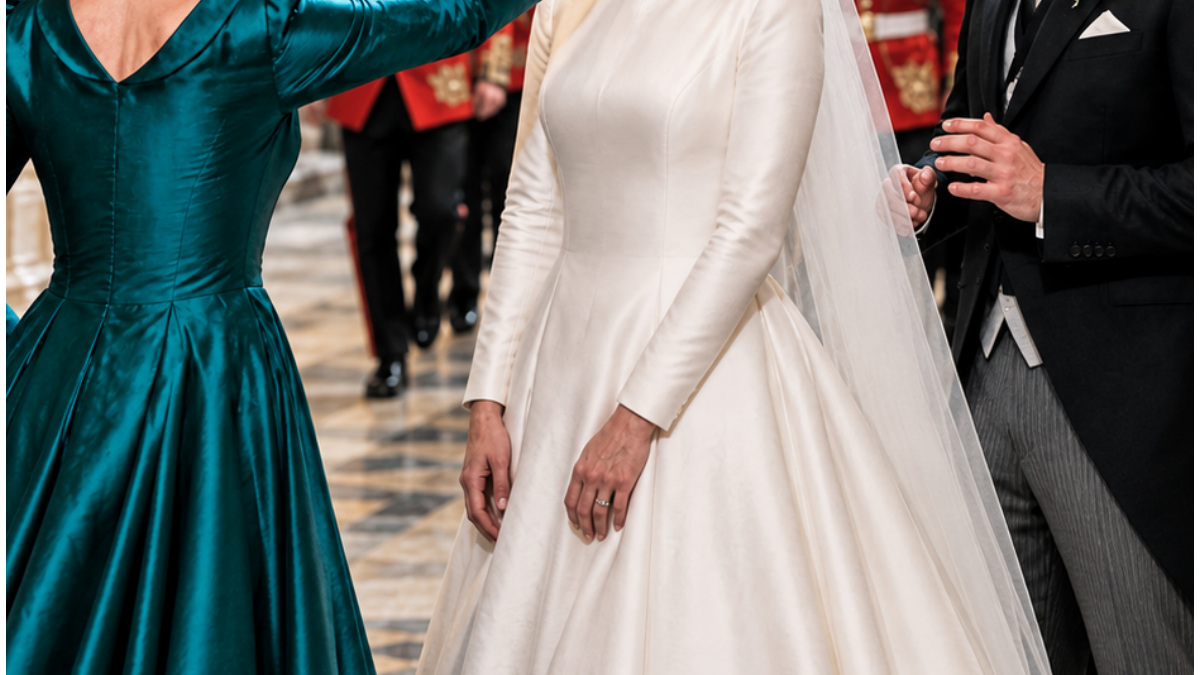
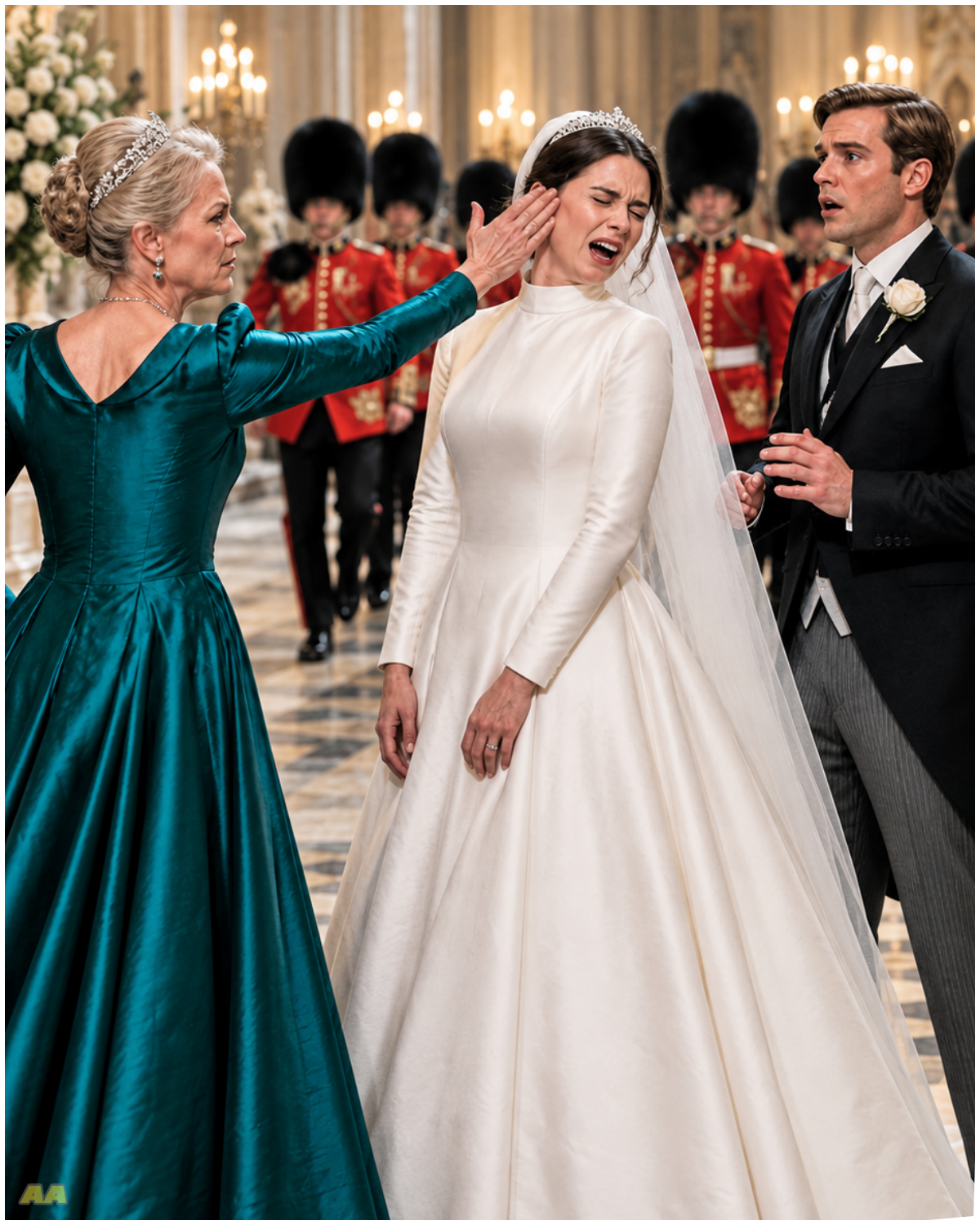
Cameras flashed as my veil caught the stained-glass light, but the sharp crack of flesh hitting flesh silenced 800 aristocrats instantly.
My cheek burned from my future mother-in-law’s hand.
She called me a fraud right at the altar, demanding the ceremony stop.
What she didn’t know was that the deafening slam of the cathedral doors a second later wasn’t her private security detail.
Heavily armed royal guards poured down the aisle, and they weren’t looking at me.
I never intended to marry into the British aristocracy.
I was Clara Harding, a 28-year-old architectural preservationist from Chicago who spent more time covered in plaster dust than designer perfume.
My world was defined by structural integrity, historical blueprints, and the quiet satisfaction of restoring forgotten buildings to their former glory.
But life has a funny way of upending your blueprints.
My firm had been contracted to oversee the restoration of a 17th-century wing at a grand estate in Surrey, England.
That was where I met Lord William Kensington.
William was everything a romance novel promised.
Devastatingly handsome, charmingly self-deprecating, and closely tied to the royal family.
His mother, Hannah Kensington, the Dowager Countess of Richmond, was a first cousin to the reigning king.
William and I bonded over late-night coffees in the drafty estate library.
He seemed so grounded, so entirely uninterested in the suffocating pomp of his lineage.
Within a year, he proposed under a canopy of stars in the Scottish Highlands.
I said yes, believing love could bridge the massive canyon between my middle-class American upbringing and his centuries-old bloodline.
I was dangerously naive. The illusion of a modern fairy tale shattered the moment I formally met his mother, Hannah.
Our first official meeting was a high tea at the Ritz in London.
I wore a tailored conservative navy dress that I thought was elegant.
Hannah, draped in bespoke Chanel, looked at me as if I were a stain on the carpet.
Chicago, Hannah drawled, stirring her Earl Grey with agonizing slowness.
Her voice was pure ice, refined over decades of aristocratic cruelty.
How terribly industrial.
Tell me, Clara, does your father still teach in a public school?
How utterly quaint. I suppose it must be fascinating mingling with the working classes every single day.
I swallowed the lump in my throat, forcing a polite smile.
My father is a very respected history teacher, Lady Richmond.
He’s the one who taught me to appreciate the paSt. Yes, well, Hannah smiled, a thin venomous line.
Appreciating the past is one thing, my dear.
Belonging to it is entirely another.
William sat next to me, silent.
He offered a weak apologetic smile when his mother looked away, but he never defended me.
Over the next 6 months of wedding planning, Hannah launched a masterclass in psychological warfare.
She entirely hijacked the wedding.
My choices for flowers, music, and the guest list were quietly canceled and replaced with her own.
When I tried to include my extended family from Illinois, Hannah cited security protocols dictated by the palace, slashing my side of the aisle to a mere dozen people.
But the red flags didn’t stop at the wedding decor.
William was the managing director of the Kensington Crown Trust, a massive philanthropic organization backed by the royal family.
About 2 months before the wedding, Hannah cornered me in the drawing room of their London townhouse.
It is a Kensington tradition that the wife of the heir takes a leading role in the trust, she announced, sliding a thick stack of legal documents across the mahogany table.
You will be appointed as the sole fiduciary director of our international relief fund.
Just a formality, of course.
Sign the papers, Clara. When I asked to have an independent lawyer review them, Hannah’s eyes narrowed into terrifying slits.
You are marrying into my family, Clara.
You will trust our solicitors, or you will not marry my son at all.
Disturbed by her aggression, I secretly took photographs of the ledgers William had left open on his laptop one evening.
What I found made my blood run cold.
The relief fund was funneling tens of millions of pounds into offshore shell companies in the Cayman Islands.
Worse, the paperwork Hannah wanted me to sign would make me the sole legal signatory, meaning if the missing millions were ever discovered, my name, and my name alone, would be on the fraudulent transfers.
I was being set up as the ultimate fall guy for the Kensington family’s massive embezzlement scheme.
I didn’t confront William. I realized with a sickening drop in my stomach that his grounded persona was a cowardly mask.
He was entirely complicit, perfectly willing to let his American bride take the fall so he and his mother could maintain their lavish lifestyle.
Instead of running, I did something incredibly dangerous.
I reached out to an old college friend who worked in cybersecurity, who quietly passed the digital ledgers to a contact in MI5.
I was told to proceed with the wedding.
The authorities needed Hannah and William in one place, confident and unaware, while they secured the offshore warrants.
Everyday leading up to the ceremony felt like walking a tightrope over a pit of vipers.
I smiled, I nodded, and I played the naive, grateful commoner, all while knowing a storm of historic proportions was about to break.
The morning of the wedding was cold, wrapped in a thick gray London fog that seemed perfectly suited to my mood.
We were to be married at St. Jude’s Cathedral, a towering Gothic masterpiece that held 800 of Britain’s most elite figures, including foreign dignitaries and members of the King’s inner circle.
I sat in the vaulted stone dressing room beneath the cathedral, staring at my reflection in a gilded mirror.
I wore a heavy silk mikado gown that Hannah had essentially forced upon me, a suffocating high-necked creation that felt more like medieval armor than a wedding dress.
My makeup artist Fiona chattered nervously, clearly intimidated by the sheer magnitude of the event.
My father Thomas stood in the corner looking uncomfortable in his rented morning suit.
“You don’t have to do this, Clara.”
My dad said softly, stepping forward and placing a warm hand on my shoulder.
“You’ve been so quiet these past few weeks. If something is wrong, we can walk out right now. We can get in a cab, go to Heathrow, and be back in Chicago by tomorrow. I don’t care about these people.”
Tears pricked my eyes, but I blinked them back.
I couldn’t tell him the truth.
I couldn’t tell him that I was acting as a linchpin in a massive federal investigation, or that the woman I was about to call my mother-in-law was planning to frame me for defrauding the crown.
“I’m okay, Dad.”
I lied, squeezing his hand.
“Just pre-wedding jitters.”
Before he could push the issue, the heavy oak door of the dressing room swung open.
Hannah glided in, flanked by two stone-faced security guards.
She wore a striking emerald green gown that was entirely inappropriate for a mother of the groom, clearly designed to pull focus.
In her hands, she held a sleek leather folio.
“Leave us.” Hannah snapped. Fiona scrambled out of the room instantly.
My father hesitated, his jaw clenching, but I gave him a subtle nod.
“Give Give a minute, Dad.
Please.” Once the door clicked shut, Hannah didn’t waste time on pleasantries.
She opened the folio and pulled out a gold-plated pen.
“The final trust addendums,” she said, her voice echoing off the stone walls.
“You never signed them, Clara.
Our solicitors require your signature before the archbishop begins the ceremony.
Do it now.” I looked at the documents.
It was the trap. The final piece of paper that would legally bind me to their decades of financial crimes.
My heart hammered against my ribs like a trapped bird, but I kept my face utterly blank.
“I thought I could sign them after the honeymoon, Lady Richmond,” I said softly, stalling.
“I don’t even have my reading glasses.” Hannah stepped forward, invading my personal space.
The cloying scent of her expensive jasmine perfume was suffocating.
“Do not play games with me, you insolent little girl,” she hissed, dropping the aristocratic facade.
“You are nothing but a commoner who got lucky.
We are giving you a title, a fortune, and a life you do not deserve.
You will sign this paper or I will walk up to that altar and announce to the world that you are a barren, gold-digging fraud.
I will ruin your reputation so thoroughly that you won’t be able to find work scrubbing floors, let alone restoring buildings.” I stared into her cold, furious eyes.
For the first time, I didn’t feel intimidated.
I felt pity for her delusion.
“I won’t sign it, Hannah,” I said, my voice steady, dropping her formal title for the first time.
Her face contorted in absolute rage.
For a second, I thought she was going to strike me right there in the dressing room, but a loud knock on the door interrupted us.
“Five minutes, my ladies,” a cathedral attendant called out.
Hannah snatched the documents back, her chest heaving.
“You “You made a grave mistake, Clara.” She whispered venomously.
“You think you can defy me?
Let’s see how long you last in my world.” She spun on her heel and swept out of the room.
I took a deep trembling breath, smoothing down the heavy silk of my skirt.
It was time. My father escorted me to the entrance of the cathedral nave.
The massive wooden doors opened and the organ music swelled, shaking the very floorboards beneath my feet.
As I stepped into the blinding light of the cathedral, a sea of aristocratic faces turned to look at me.
The air was thick with the scent of thousands of white lilies.
At the far end of the impossibly long aisle stood William.
He looked pale, sweating profusely despite the cool temperature of the cathedral.
He wouldn’t meet my eyes.
Every step felt like a march to the gallows, but I kept my head held high.
I was walking into a trap, yes, but Hannah didn’t know I was the one holding the detonator.
The silence in St. Jude’s Cathedral was absolute as my father handed me off to William.
William’s hands were clammy, his grip weak.
He briefly glanced at me, his eyes wide with a panicked guilty sheen.
He knew about the ultimatum Hannah had just delivered.
He knew I had refused to sign the documents, and true to his cowardly nature, he was terrified of what his mother would do next.
We stepped up to the high altar, standing before the Archbishop of London.
The magnificent stained glass window behind him bathed the altar in fractured colorful light.
The Archbishop cleared his throat, his voice projecting across the cavernous space.
“Dearly beloved, we are gathered here in the sight of God and in the presence of this congregation to join together this man and this woman in holy matrimony.” I tuned out the familiar words.
Every muscle in my body pulled taut like a bowstring.
I knew Hannah was sitting in the front pew, directly to my left.
I could feel her burning gaze drilling into the side of my head.
Therefore, if any person can show any just cause why they may not lawfully be joined together, let them speak now, or else hereafter forever hold their peace.
It was supposed to be a rhetorical pause.
A traditional formality that it was immediately followed by the vows, but the silence was shattered by the sharp scraping of wood against stone.
I have cause. The collective gasp from 800 guests sounded like the ocean roaring into the cathedral.
The archbishop froze, his ancient face paling.
William flinched so hard he dropped my hands, taking a full step backward away from me.
I turned my head slowly.
Hannah was standing, her posture rigid, her eyes blazing with a fanatical destructive fire.
She stepped out of the pew and began to ascend the marble steps of the altar.
Mother, please, William whimpered, his voice cracking.
Silence, William, Hannah barked. She turned her attention to the archbishop, pointing a manicured finger directly at my face.
This wedding cannot proceed. This woman is an impostor.
She is a criminal, a grifter who has spent the last year using my son to embezzle millions of pounds from the Kensington Crown TruSt. Pandemonium erupted in the pews.
Whispers turned into shocked shouts.
Flashes from the press gallery in the balcony began to go off like strobe lights.
My father jumped up from his seat shouting in my defense, but he was held back by cathedral security.
I stood perfectly still, looking at the woman who was trying to destroy me.
You know that isn’t true, Hannah, I said, my voice remarkably calm over the chaos.
You are the one who tried to force me to sign the fiduciary rights this morning to cover your tracks.
Hannah’s face twisted into an ugly primal sneer.
She closed the distance between us in two strides.
Before I could even register her movement, she raised her hand and struck me across the face with all her might.
Crack. The sound echoed off the vaulted ceilings like a gunshot.
The force of the blow knocked my head to the side, my heavy tiara slipping dangerously.
A sharp sting blossomed across my cheek, hot and agonizing.
The entire cathedral plunged into a stunned, horrified silence.
You could have heard a pin drop.
Assaulting the bride at the high altar of a royal wedding was a scandal of unimaginable proportions.
William stood there, his mouth open, doing absolutely nothing.
I slowly turned my head back to look at Hannah.
I didn’t cry. I didn’t scream.
I just looked at her, tasting the faint metallic tang of blood on the inside of my cheek where my teeth had caught it.
“You shouldn’t have done that.” I whispered.
“I will destroy you.” Hannah shrieked, raising her hand to strike me again, but she never got the chance.
A deafening, thunderous boom echoed from the back of the cathedral.
The massive 20-ft oak doors had been violently thrown open, slamming against the stone walls.
The guests whipped their heads around.
It wasn’t cathedral security. It wasn’t the paparazzi.
It was the king’s guards.
Over 30 officers of the Royal Protection Command and Scotland Yard’s Special Escort Group poured into the nave.
They were flanked by ceremonial guards in full uniform, a surreal and terrifying sight.
They wore tactical vests, their radios crackling, moving with terrifying, synchronized precision.
“Nobody move! Remain in your seats!” a commanding voice roared over a bullhorn.
The heavy boots of the armed officers thudded against the marble floor as they sprinted down the long aisle.
The guests pressed themselves back into the pews, terrified.
Hannah froze, her hand still suspended in the air.
For the first time, a flicker of uncertainty crossed her haughty features.
“What is the meaning of this?” Hannah demanded, her voice shrill as the officers ascended the altar steps, completely surrounding us.
“I am the Dowager Countess of Richmond.
I demand you remove this woman immediately.
She is a thief.” A a tall, broad-shouldered Detective Chief Inspector stepped forward, his face like carved granite.
He didn’t even look at me.
He looked directly at Hannah, and then at William.
“Hannah Kensington,” the inspector said, his voice cold and authoritative.
“Lord William Kensington, you are both under arrest for high treason, conspiracy to defraud the Crown, and international money laundering.” Hannah’s jaw dropped.
The blood drained from William’s face so fast he looked like a ghoSt. He swayed on his feet, his knees buckling.
“Arrest me?” Hannah stammered, the absolute shock finally shattering her aristocratic armor.
“You are mistaken. It’s her.
She is the one.” The inspector stepped closer, pulling out a pair of heavy steel handcuffs.
“We have the Cayman Island ledgers, Lady Richmond.
We have the offshore warrants, and we have the audio recording of you attempting to extort Ms. Harding in the dressing room 20 minutes ago.” My eyes widened slightly.
I hadn’t known about an audio recording.
I glanced to the side and saw Fiona, my nervous makeup artist, standing near the transept.
She reached into her pocket, pulled out a small police badge, and offered me a tiny covert salute.
She had been an undercover operative the entire time.
As the cold steel of the handcuffs clicked around Hannah’s wrists, the reality of her total ruin finally set in.
The sharp metallic click of the handcuffs locking around Hannah Kensington’s wrists was the loudest sound I had ever heard.
It echoed through the cavernous nave of St. Jude’s Cathedral, completely shattering the illusion of her untouchable aristocratic power.
For a fraction of a second, Hannah just stared at the steel bindings.
Her brain entirely unable to process what was happening.
Women like the Dowager Countess of Richmond did not get arrested.
They did not get handcuffed at the high altar in front of foreign dignitaries and members of Parliament.
Then, the reality snapped into place and Hannah lost her mind.
“Take these off me!” she shrieked, the sound tearing through her vocal cords.
She violently yanked her arms, trying to pull away from the towering Detective Chief Inspector Richard Davies.
“Do you have any idea who I am?
I am the cousin of the king.
I will have your badge, your pension, and your miserable life for this.
Unhand me!” “You are under arrest, Lady Richmond.” Detective Davies repeated, his voice an unshakable wall of calm against her hysteria.
He gripped her upper arm with iron force.
“Anything you do or say may be given in evidence.
Constable, secure the son.” William didn’t fight.
In fact, William didn’t do much of anything.
When two heavily armored officers stepped toward him, the blood completely drained from his face, leaving him the color of old parchment.
He let out a pathetic high-pitched gasp, his eyes rolling back into his head, and he collapsed.
He fainted dead away, hitting the marble steps of the altar with a sickening thud.
The cathedral erupted into absolute chaos.
80 rows of Britain’s most elite citizens broke into a collective panic.
Several elderly duchesses in the front pews were screaming.
Diplomats were shouting into their cell phones.
The Archbishop of London had retreated behind his altar, clutching his golden crucifix as if it could ward off the Metropolitan Police.
Above us, the flashbulbs of the press gallery were firing like a strobe light, capturing every humiliating second of the Kensingtons’ downfall.
“Stand back, make way!” the police shouted, forming a human barricade down the center aisle.
Fiona, or rather the undercover agent I now knew as Detective Sarah Miller, stepped up to my side.
She had dropped the jittery makeup artist persona entirely.
Her posture was rigid, her eyes sharp and assessing.
“Are you all right, Clara?” Sarah asked, her voice low and steady.
She gently inspected my cheek, which was now burning and swelling rapidly from Hannah’s slap.
“We didn’t anticipate her striking you.
That’s an added charge of assault we’ll be tacking onto her sheet.” “I’m fine.” I breathed, my voice shaking uncontrollably now that the adrenaline was beginning to ebb.
“Is it really over?” “The raid on their Cayman accounts is happening as we speak.” Sarah confirmed, nodding to Inspector Davies.
Davies and another officer were hauling a semi-conscious weeping William to his feet.
They slapped cuffs on him while he sobbed into his custom-tailored morning coat.
Hannah was still thrashing, her emerald green gown tangling around her legs, spewing a stream of venomous curses that would have made a sailor blush.
They were marched down the aisle.
The same aisle I had walked down mere minutes ago to the triumphant swell of the organ was now the stage for the most public, humiliating perp walk in British high society history.
The wedding guests shrank back into their pews, horrified, watching the mighty Kensingtons being dragged out by the King’s Guards.
As they passed the third row, Hannah managed to twist her head around, fixing me with a look of pure, unadulterated hatred.
“You did this.” She screamed, her voice cracking over the noise of the crowd.
“You filthy American rat, you’re dead.
Do you hear me?” “Dead.” Her threats were cut off as the heavy cathedral doors slammed shut behind them, sealing their fate.
The moment they were gone, my knees buckled.
The suffocating weight of the heavy silk mikado gown, the blinding lights, and the sheer terror of the last 48 hours came crashing down on me all at once.
I would have hit the floor if my father hadn’t broken through the police barricade and caught me.
“Clara.” “Clara, sweetie, I’ve got you.” My dad cried, wrapping his arms tightly around me.
He was shaking just as hard as I was.
“What the hell is going on?
What is happening?” I buried my face in his shoulder, the tears finally breaking through.
“I’m sorry, Dad. I’m so sorry I couldn’t tell you.
They were stealing They were framing me.” Detective Sarah Miller placed a gentle hand on my dad’s shoulder.
“Mr. Harding, your daughter is a hero.
She’s been cooperating with MI5 and the Financial Conduct Authority for weeks.
We need to get you both out of here before the press breaches the side doors.
Come with me.” We were ushered out through the cathedral crypt, bypassing the screaming hordes of paparazzi swarming the main steps.
I was bundled into the back of an unmarked black SUV, my massive wedding dress taking up the entire back seat.
As we sped away from St. Jude’s, I looked out the tinted window.
The rain had started to fall in sheets over London, washing the gray streets clean.
I wasn’t married. I didn’t have a title.
But for the first time in a year, I could finally breathe.
New Scotland Yard was a stark, unforgiving contrast to the opulent, gilded halls of the Kensington estate.
I sat in a sterile, windowless briefing room, wrapped in a fleece police jacket that someone had handed me.
My wedding tiara was sitting on a metal table next to a stack of manila folders, looking utterly ridiculous under the harsh fluorescent lights.
I’d finally been allowed to change into a pair of borrowed sweatpants and a t-shirt, shedding the suffocating armor of Hannah’s chosen gown.
My cheek was pressed against a plastic bag of crushed ice.
Across the table sat Detective Chief Inspector Davies and a sharp-suited man who introduced himself as Robert Hughes, a senior prosecutor for the Crown.
“You did remarkably well today, Miss Harding.” Hughes said, sliding a cup of terrible, sludgy coffee toward me.
“Your refusal to sign the documents in the dressing room pushed Lady Richmond exactly where we needed her.
Her attempt to extort you on tape sealed the final warrant.” “How bad is it?” I asked, taking a sip of the bitter coffee.
“How much did they actually steal?” Hughes exchanged a heavy look with Davies.
The inspector opened the thickest manila folder on the table.
“45 million pounds over the course of 7 years.” Davies said bluntly.
My dad, who was sitting next to me, choked on his coffee.
“45 million? From a charity?” “It wasn’t just any charity, Mr.
Harding.” Hughes explained, his voice grim.
“The Kensington Crown Trust manages several philanthropic avenues, but the primary victim of their embezzlement was the Global Housing Initiative.
It’s a project the King himself personally championed, designed to build affordable, sustainable housing for military veterans and displaced refugees.
Hannah and William were siphoning the construction budgets.
The revelation made me feel physically sick.
As an architectural preservationist, my life was dedicated to building and restoring homes.
The idea that the man I almost married was stealing the literal roofs from over the heads of vulnerable veterans was beyond repugnant.
It was monstrous. “How did they get away with it for so long?” I asked, my voice barely a whisper.
“Because of their bloodline,” Davies replied, his jaw tight.
“The Kensingtons operated under the shadow of the royal family.
Auditors were terrified to push too hard, fearing they would offend the king.
Hannah used her royal connections as a shield.
She created shell construction companies in the Caymans.
The charity would pay millions for concrete, steel, and labor that never existed.
William, as the director, signed off on all the invoices.
And when the auditors finally started asking questions last quarter,” Hughes added, “they realized they needed a scapegoat.
Someone without a title. Someone who didn’t understand the complex financial structures of the British aristocracy.
“Me?” I said, a cold shiver running down my spine.
“You,” Davies confirmed. “They planned to transfer the fiduciary ownership of the shell companies into your name on your wedding day.
If the authorities ever raided the trust, the paper trail would lead directly to the American wife.
Hannah would have claimed you manipulated her son.” I closed my eyes, the magnitude of their betrayal washing over me.
William hadn’t loved me. He had recruited me.
I was nothing but a human shield to them.
“Where are they now?” my dad asked, his fists clenched in anger.
Davies leaned back in his chair.
“Lady Richmond is currently in interrogation room A, screaming at my officers and demanding to speak to the Prime Minister.
She is refusing to answer questions.
And William?” I asked. A dark, cynical smile touched Davies’ lips.
“Lord Kensington is in interrogation room B, and he is singing like a canary.” Davies tapped a remote control on the table, and a flat-screen monitor on the wall flickered to life.
It was a live feed of interrogation room B.
William was slumped in a metal chair, his expensive morning coat discarded, his silk tie loosened.
He looked destroyed, weeping uncontrollably into his hands.
Across from him sat two detectives.
“I didn’t want to do it.” William’s voice crackled through the speaker, high-pitched and frantic.
“It was my mother. It was all her idea.
She set up the Cayman accounts.
She forged the initial invoices.
I just signed where she told me to sign.
Uh please, you have to believe me.
I was terrified of her.” I stared at the screen in absolute disguSt. The dashing, confident aristocrat I thought I knew was completely gone.
In his place was a sniveling coward, desperately throwing his own mother to the wolves to save his own skin.
“What about Clara Harding?” one of the detectives on the screen asked.
“Did she know?” “No. Clara knew nothing,” William sobbed.
“My mother picked her because she was American.
She said Clara was naive.
She said She said the palace would easily believe a greedy foreigner was stealing the money.
It was all my mother’s plan.” Davies muted the TV.
“There is no honor among thieves, Miss Harding.
William has already signed a preliminary confession implicating his mother as the mastermind.
He’s trying to broker a plea deal.” “Will he get one?” my dad demanded.
“We don’t need his plea deal,” Hughes said coldly.
“With the ledgers we seized today, the audio recording from the dressing room, and your testimony, Clara, we have enough to put them both in Belmarsh prison for the next 20 years.” I took a deep breath, the ice pack numbing the physical pain on my face, even as the emotional betrayal burned deep in my cheSt. “When do I testify?” “Soon.” Davies said.
“But be warned, Clara. Hannah Kensington is a cornered animal and she has access to the most ruthless legal minds in Europe.
This fight is far from over.” Davies was right.
I thought the worst was behind me at the altar.
I had no idea that Hannah was about to launch a counterattack that would turn my entire life into a living nightmare.
The first 48 hours after the red wedding, as the British tabloids had gleefully dubbed it, were a blur of police protection and media hysteria.
My father and I were moved to a secure Metropolitan Police safe house in the quiet suburbs of Richmond.
I wasn’t allowed to use my cell phone, check my email, or even look out the front window, but I didn’t need the internet to know what was happening outside.
The storm was inescapable. Despite the overwhelming evidence, Hannah Kensington was granted bail.
Her barrister, Arthur Pendleton, a terrifyingly brilliant legal shark known for defending disgraced billionaires and corrupt politicians, had argued that due to her age and royal ties, she was not a flight risk.
She posted a staggering 10 million-pound bond and retreated to the Kensington estate in Surrey, barricading herself behind wrought-iron gates and private security.
And then, Arthur Pendleton unleashed hell on me.
On the third morning, my dad walked into the kitchen of the safe house holding a stack of morning newspapers that the police liaison had brought in.
His face was thunderous. He tried to hide them behind his back, but I demanded to see them.
The headlines made my stomach drop into my shoes.
“The Chicago con artist, did American bride mastermind royal heist?” screamed the Daily Mail.
“The honey trap at the altar, declared the Sun.
I stared at the articles in horror.
Pendleton was leaking fabricated stories to the press, aggressively spinning the narrative.
According to anonymous sources close to the family, I wasn’t the victim.
I was a highly sophisticated grifter.
The PR campaign alleged that I had seduced William, manipulated my way into the Kensington Crown Trust, and orchestrated the embezzlement myself.
They claimed Hannah had only my crimes on the morning of the wedding, which was why she stopped the ceremony.
The slap at the altar was reframed not as an assault, but as a mother valiantly protecting her son from a predator.
This is insane, I whispered, my hands trembling as I dropped the papers on the counter.
They have William’s confession. They have the audio recording.
Detective Sarah Miller, who had been assigned as my permanent liaison, walked into the kitchen looking exhausted.
The police have the confession, Clara, but the public doesn’t.
Pendleton is trying to taint the jury pool.
If he can convince the British public that you are a manipulative gold digger, he can introduce reasonable doubt in court.
He’s trying to force the Crown Prosecution to drop the charges by making this a media circus.
And the audio recording? My dad asked angrily.
The one where Hannah literally threatens Clara?
Pendleton filed a motion to have it thrown out, Sarah said grimly.
He’s arguing it was obtained illegally without a warrant, claiming Fiona’s undercover presence violated attorney-client privilege because Hannah’s lawyer was supposedly in the hallway.
It’s a stretch, but if the judge agrees, that tape disappears from the evidence liSt. I felt the walls closing in.
Hannah was using her immense wealth and influence to crush me from the outside.
My reputation was being shredded on a a scale.
My architectural firm in Chicago had been flooded with death threats from royal loyalists, forcing them to temporarily shut down operations.
I was sitting at the kitchen table staring blankly at a cold cup of tea feeling utterly defeated.
I had done the right thing.
I had risked my life to expose them, and now I was the one being burned at the stake.
I closed my eyes trying to block out the headlines.
I forced my mind to retreat to the only place where I felt in control.
Architecture, structure, blueprints. I thought back to the months I spent working at the Kensington estate in Surrey.
I had meticulously studied the 17th century blueprints to prepare for the restoration of the East Wing.
I remembered walking the halls, measuring the grand library, tapping on the walls to check for structural rot.
Suddenly, my eyes snapped open.
My heart began to race as a memory surfaced.
A memory I had completely dismissed at the time.
Three months ago, I had been in the estate’s massive oak-paneled library.
I was comparing the original 1640s blueprints to the current dimensions of the room.
I had noticed a discrepancy.
The eastern wall, lined with floor-to-ceiling bookshelves, measured 4 ft shorter on the inside than it did on the exterior blueprints.
I had assumed it was thick insulation or a sealed-off chimney.
But when I had started tapping on the mahogany paneling to check for hollow space, Hannah had walked in.
She had absolutely lost her mind.
She screamed at me, physically grabbed my arm, and banned me from entering the library ever again, claiming the books were too fragile to be exposed to duSt. 4 ft of unaccounted space.
Sarah, I said, my voice suddenly sharp, cutting through the heavy silence of the kitchen.
The detective looked up from her phone.
Yes? When the police raided the Kensington estate, did they search the grand library?
They swept the whole house, Clara.
They seized laptops, hard drives, filing cabinets.
Why? I stood up, the adrenaline surging back into my veins.
Hannah thought she could outsmart me with PR, but she forgot she was dealing with a woman who understood the bones of her very house better than she did.
They missed something, I said, walking over to the counter and grabbing a pen and a napkin.
I quickly sketched the floor plan of the Surrey library.
Look here, between the east wall and the exterior stone, there is a 4-ft void.
It’s not on any modern tax assessment, but it’s clear on the 17th century blueprints.
Hannah banned me from that room when I started investigating the wall.
Sarah’s eyes narrowed as she leaned over the napkin.
You think she has a hidden safe room?
I don’t think it, I know it, I said firmly.
Hannah is old money. She doesn’t trust the cloud.
She doesn’t trust digital ledgers.
That Cayman Island money trail we found on William’s laptop was sloppy.
It was the digital overflow.
Whatever Hannah is truly hiding, the physical contracts, the blackmail, the real paper trail, it’s in that wall.
Get Inspector Davies on the phone.
Tell him to take sledgehammers to the Kensington library.
Sarah didn’t hesitate. She pulled out her phone and dialed.
Hannah wanted to play dirty.
She wanted to destroy my life.
But she was about to learn that when you push an architect into a corner, they know exactly which load-bearing walls to knock down to make the whole house collapse.
The tension inside the Richmond safe house over the next 4 hours was thick enough to choke on.
Detective Sarah Miller had immediately relayed my architectural blueprints to Detective Chief Inspector Richard Davies.
Because the Kensington estate was a Grade 1 listed historical building, securing a destructive search warrant, one that legally authorized the police to smash through 17th century mahogany walls, required the signature of a high court judge.
Judge Gregory Fisk of the King’s Bench Division took one look at the sworn testimony of an architectural preservationist and the overwhelming financial discrepancies and signed the warrant without hesitation.
At 2:00 hours p.m., a massive tactical unit from the Metropolitan Police descended upon the Surrey estate for the second time.
I wasn’t there in person.
It was far too dangerous.
But Davies had set up a secure encrypted live feed from the lead breaching officer’s body camera, streaming directly to a laptop on the safe house kitchen table.
My dad, Sarah, and I huddled around the glowing screen, watching the drama unfold in real time.
On the screen, the heavy oak doors of the Surrey mansion were forced open.
Hannah Kensington was waiting in the grand foyer, flanked by her terrifyingly expensive barrister, Arthur Pendleton, and a wall of private security guards.
Hannah looked at every inch the untouchable aristocrat, dressed in a sharp beige cashmere twin set, her chin tilted at a defiant angle.
“Inspector Davies,” Pendleton’s slick, measured voice echoed through the laptop speakers.
“This harassment must stop immediately.
You’ve already tossed this property.
Lady Richmond is out on bail, and this endless intimidation tactic is a gross violation of her civil liberties.
Have your badge for this.” On the screen, Davies stepped forward, slapping a thick stack of legal papers against Pendleton’s cheSt. “Destructive search warrant, Mr.
Pendleton, signed by Justice Fisk 20 minutes ago.
Move aside, or you will be arrested for obstructing a police investigation.” Hannah’s eyes narrowed into slits of pure venom.
“Destructive? What are you talking about?
You will not damage my home.
This estate has stood for 400 years.
Davies ignored her, turning to his tactical team.
Library, east wall, move. The camera jostled as the heavy-booted officers marched through the vaulted corridors.
I held my breath as they entered the grand library.
It was exactly as I remembered it.
Towering bookshelves, rolling ladders, and the suffocating smell of old paper and lemon oil.
The tactical team bypassed the center of the room and headed straight for the eastern wall, which was lined with rare first editions behind glass.
Clear the books. The breaching commander ordered.
Stop! Hannah shrieked. The body camera swung around to show her running into the library, completely losing her composed facade.
Her face was flushed dark red, and her eyes were wide with genuine, unadulterated panic.
For the first time since I met her, Hannah Kensington looked utterly terrified.
Those books are priceless. You cannot do this.
Arthur, stop them. Pendleton looked at Hannah, his sharp legal mind clearly calculating her sudden panic.
He took a slow step back, putting physical distance between himself and his client.
He knew exactly what that level of desperation meant.
Take down the paneling, Davies ordered.
Two officers stepped forward with heavy steel crowbars and a 12-lb sledgehammer.
Crack. The sound of the sledgehammer obliterating the historic 17th century mahogany made my architectural heart ache for a fraction of a second, but it was immediately replaced by a surge of vindication.
Wood splintered. Plaster exploded into clouds of white duSt. Hannah screamed, dropping to her knees on the Persian rug as if she had been physically struck.
It took them less than 3 minutes to clear a massive gaping hole in the wall.
As the dust settled, the body cam flashlight illuminated the dark void.
It wasn’t a chimney. It wasn’t insulation.
Bolted to the original exterior stone of the estate, perfectly concealed within the 4-ft gap I had identified on my blueprints, was a massive modern biometric steel vault door.
It looked like something out of a Swiss bank, utterly alien against the ancient masonry.
The silence in the library was absolute.
Even Pendleton was staring at the vault, his jaw slightly slack.
“Well, well,” Davies muttered, his voice dripping with dark satisfaction.
He turned to Hannah, who was still on the floor hyperventilating.
“Lady Richmond, care to provide the fingerprint, or shall we call the thermal cutting team?” Hannah didn’t answer.
She just stared at the steel door, rocking back and forth, muttering something unintelligible.
It took the police cutting team 4 agonizing hours to burn through the biometric locks with thermal lances.
When the heavy steel door finally groaned open, revealing the hidden 6-by-8-ft room, the scale of Hannah Kensington’s criminality was finally laid bare.
The vault didn’t contain just digital backups.
It was a literal treasure trove of illicit physical wealth.
There were stacks of unregistered bearer bonds, velvet trays filled with uncut conflict diamonds, and over a hundred solid gold bullion bars stacked neatly in the corner.
But the most devastating piece of evidence wasn’t the gold.
It was a single thick leather-bound black ledger resting on a small metal desk in the center of the room.
Davies put on a pair of latex gloves, picked up the ledger, and opened it.
The body cam zoomed in on the pages.
I leaned closer to the laptop screen, squinting at the neat handwritten columns.
They weren’t financial accounts. They were names, dates, and highly detailed paragraphs.
“Oh my god.” Sarah whispered, standing up from the kitchen table.
Her face had gone completely pale.
“What is it?” my dad asked, looking between us.
“What does that mean?” “It’s not an embezzlement ledger, Dad.” I said, my voice barely above a whisper.
“It’s a blackmail book. Hannah Kensington hadn’t just been stealing money.
She had been running a massive high society extortion ring.
The names written in that book were a who’s who of British power.
Members of Parliament, high court judges, foreign diplomats, and even senior members of the royal household.
She had documented their affairs, their offshore tax evasions, and their darkest secrets.
This was how she operated with absolute impunity.
This was why the auditors always looked the other way.
If anyone challenged the Kensington Crown Trust, Hannah threatened to destroy them.
On the screen, Arthur Pendleton read two lines over Davies’s shoulder.
The ruthless, highly paid barrister instantly turned pale green.
“I am formally withdrawing as Lady Richmond’s legal counsel.” Pendleton announced loudly, his voice shaking.
He didn’t even look at Hannah.
He turned on his heel and practically sprinted out of the library.
Davies looked straight into the body cam, knowing Sarah and I were watching.
“We need a secure transport immediately, and get MI5 on the line.
Now.” The discovery of the black ledger triggered a tectonic shift in the British government.
Within hours, the investigation was no longer just about financial fraud.
It was a matter of national security.
The safe house in Richmond was locked down by heavily armed officers from the counterterrorism command.
For 2 days, I was completely cut off from the outside world, waiting in a state of suffocating anxiety as the political elite of London scrambled to contain the blast radius of Hannah’s blackmail ring.
On the third evening, a sleek armored Bentley pulled up to the safe house.
Detective Miller walked into the living room, her posture rigid.
“Clara,” she said quietly, “you have a visitor.
Someone from the palace.” My heart hammered against my ribs as I stood up.
A tall, impeccably dressed man in his late 50s stepped into the room.
He radiated an aura of absolute terrifying authority.
He carried a silver-handled walking stick and wore a bespoke charcoal suit that probably cost more than my first car.
“Miss Harding,” the man said, his voice smooth and incredibly precise.
“I am Lord Henry Cavendish, private secretary to His Majesty the King.
May I sit down?” “Of course,” I managed to say, gesturing to the armchair opposite the sofa.
Lord Cavendish sat, resting his hands on his walking stick.
He looked at me with a mixture of intense curiosity and profound respect.
“You have caused quite a stir, Miss Harding.
In my 30 years serving the crown, I have rarely seen an individual dismantle an institution as thoroughly as you just dismantled the Kensington family.” “I was just trying to keep myself out of prison, Lord Cavendish,” I replied, finding my footing.
“They were going to frame me.
They planned to ruin my life.” “I am acutely aware,” Cavendish said, his eyes darkening.
“And for that, His Majesty extends his deepest, most sincere apologies.
The King was entirely unaware of the magnitude of Lady Richmond’s depravity.
The Global Housing Initiative is a project incredibly dear to His Majesty’s heart.
To learn that his own cousin was stealing from veterans to fund her personal empire has left him utterly appalled.” Cavendish paused, letting out a heavy sigh.
However, we find ourselves in a delicate situation.
The black ledger you helped the police uncover contains information that could trigger a constitutional crisis.
If those pages are entered into public evidence during a trial, the resulting scandal would collapse the current government.
I stiffened, my defensive instincts flaring.
You want to bury it.
You want to make a deal with her to keep it quiet.
If she walks free after what she did to me No, Ms. Harding.
Cavendish interrupted firmly, raising a hand.
Please, do not misunderstand me.
Lady Hannah Kensington will never see the outside of a prison wall again.
The blackmail ledger has been classified under the official secrets act.
It will never see the light of day, but the financial ledgers, the embezzlement of the 45 million pounds, and her attempt to extort you, that evidence is ironclad.
It is enough to secure a life sentence without parole.
He leaned forward, his gaze piercing.
The crown is stepping in.
We are taking the gloves off.
But before we act, His Majesty wanted me to speak with you personally.
You found the vault. You saved the monarchy from a scandal that could have taken decades to recover from.
We owe you a debt of gratitude.
What do you want, Clara?
I sat back, staring at the king’s right-hand man.
I thought about the brutal headlines Arthur Pendleton had leaked to the press.
I thought about my father, terrified and humiliated at the cathedral.
I thought about my architectural firm back in Chicago, paralyzed by death threats from royal loyalists who believed I was a gold-digging fraud.
“I want my name back,” I said, my voice vibrating with quiet fury.
Hannah’s lawyers have spent the last 4 days dragging my reputation through the mud in every tabloid in the world.
They painted me as a manipulative mastermind.
I want it gone. I want the world to know exactly what she is, and I want it to come directly from the crown.
A faint, dangerous smile touched Lord Cavendish’s lips.
Consider it done. Anything else?
William, I said, a bitter taste flooding my mouth as I remembered the cowardly man I almost married.
He’s trying to cut a plea deal by throwing his mother under the bus.
He signed the checks. He was entirely complicit.
I don’t want him getting a slap on the wrist just because he cried in an interrogation room.
Cavendish nodded slowly. Lord William’s plea negotiations have already been terminated.
The Crown Prosecution Service will pursue maximum sentences for both of them.
He stood up, adjusting his cuffs.
Watch the evening news, Miss Harding.
You will find that the narrative is about to change rather violently.
2 hours later, Buckingham Palace released a statement that hit the British media like a nuclear bomb.
It wasn’t a standard PR-sanctioned no comment.
It was a devastatingly direct, brutal condemnation of Hannah and William Kensington.
The palace confirmed that the king had personally authorized a full forensic audit of the Kensington Crown Trust, exposing decades of systemic fraud.
The statement explicitly praised the extraordinary courage and integrity of Miss Clara Harding, who brought these egregious crimes to light at great personal risk.
The media whiplash was instantaneous.
The tabloids that had branded me the Chicago con artist that morning were suddenly hailing me as the hero bride.
The public narrative violently turned against Hannah.
Her high society friends, terrified of being investigated by association, publicly cut all ties with her.
The Kensington name became instantly toxic.
Hannah was entirely isolated. With Pendleton having abandoned her and the crown openly calling for her head, she was finally forced to face the reality she had avoided her entire life.
Her bloodline could no longer protect her.
The trial of Hannah and William Kensington took place 6 months later in courtroom one of the Old Bailey, London’s Central Criminal Court.
The media circus outside the courthouse was unprecedented.
It wasn’t just local tabloids, international news networks had set up sprawling broadcast tents along the street and thousands of people lined the sidewalks behind heavy steel barricades, braving the bitter November rain just to catch a glimpse of the fallen aristocrats.
I returned to London under heavy police escort to testify as the crown’s star witness.
When I walked into the historic courtroom, the air was thick with centuries of legal gravity.
The room was a masterpiece of intimidating architecture.
Dark, polished oak paneling, green leather benches, and a towering judge’s bench that seemed designed to make everyone beneath it feel incredibly small.
I sat in the witness box, gripping the wooden rail to steady my hands, the scent of floor wax and old paper filling my lungs.
Hannah sat directly across the room in the glass-enclosed secure dock, and she looked completely unrecognizable.
The untouchable, terrifying dowager countess was gone.
In her place was a hollowed-out, deeply aged woman in a drab gray prison-issue tracksuit.
Her hair, once perfectly coiffed and dyed, was completely white, brittle, and tied back in a harsh, severe bun.
Stripped of her bespoke Chanel, her conflict diamonds, and her army of terrified servants, she looked incredibly fragile.
William sat beside her, though he kept a deliberate 3 ft of distance between them.
He refused to make eye contact with his mother.
He had lost a staggering amount of weight.
His suit’s replaced by the same gray uniform.
He kept his eyes glued to his scuffed shoes, his hands shaking incessantly in his lap.
He looked exactly like what he was, a coward who had finally run out of places to hide.
My testimony lasted for three grueling days.
Under the careful guidance of Crown Prosecutor Robert Hughes, I laid out every single detail of their conspiracy.
I walked the jury through the doctored ledgers William had left on his laptop.
I played the covert audio recording of Hannah threatening me in the cathedral dressing room, her venomous voice echoing loudly through the silent Old Bailey.
I described the sickening moment William stepped away from me at the altar, choosing his mother’s stolen wealth over my life.
Finally, I detailed the architectural anomaly in the 17th century blueprints that led to the discovery of the hidden biometric vault.
When Hannah’s new court-appointed barrister, a nervous man who had been handed a completely unwinnable case after Arthur Pendleton fled, tried to cross-examine me, he had absolutely nothing to work with.
He attempted to suggest I had framed them, but how could an American preservationist forge 45 million pounds of Cayman Island wire transfers spanning 7 years?
The evidence was a titanium wall.
I remained completely composed on the stand, never raising my voice, simply letting the facts crush their defense into duSt. The jury hung on my every word, utterly captivated by the staggering arrogance of the Kensington family.
On the final day of the trial, the jury deliberated for less than 4 hours.
When Lord Chief Justice Michael Higgins took his seat to deliver the verdict, the courtroom was so quiet you could hear the rain lashing against the high windows.
The jury foreman, a stern-faced woman in a tweed blazer, stood up.
“On the count of grand larceny, how do you find the defendants?” the clerk asked.
“Guilty.” “On the count of international money laundering?” “Guilty.” “On the count of high treason and conspiracy to defraud the crown?” “Guilty.” The word echoed 42 times.
With every guilty, Hannah seemed to shrink further into herself.
Judge Higgins adjusted his glasses, his face a mask of absolute judicial fury as he addressed the glass dock.
“Hannah Kensington, William Kensington,” Judge Higgins began, his voice booming with centuries of legal authority.
“You have been found guilty by a jury of your peers on all counts.
Your crimes are breathtaking in their audacity and utterly abhorrent in their cruelty.
You stole millions intended to house the most vulnerable members of our society, military veterans who bled for this country.
And when your greed was finally threatened, you attempted to destroy the life of an innocent woman to cover your tracks, believing your bloodline made you untouchable.” Higgins paused, reaching for a formal, heavy parchment document bearing the red wax seal of the king.
“You were wrong. I have been instructed by His Majesty the King that effective immediately, by royal decree, you are hereby permanently stripped of all titles, honors, and patronages.
You are no longer the Dowager Countess of Richmond.
You are no longer Lord Kensington.
You are common criminals, and you will be treated exactly as such.” A collective gasp swept through the gallery.
Stripping a royal title was a nuclear option, an event that hadn’t happened in modern British history.
It was the final, ultimate humiliation.
Hannah squeezed her eyes shut, and for the first time, a single tear escaped down her wrinkled cheek.
It wasn’t a tear of remorse.
It was a tear of pure grieving ego.
“Hannah,” the judge continued, dropping her surname entirely, his voice as cold as ice.
“For your role as the mastermind of this enterprise, I sentence you to 35 years in His Majesty’s Prison Belmarsh without the possibility of early release.
William, for your profound cowardice and complicity, I sentence you to 15 years.” The heavy wooden gavel slammed down like a thunderclap.
The bailiff stepped forward, clicking heavy steel handcuffs onto Hannah and William to lead them down to the subterranean holding cells.
As Hannah was guided toward the heavy wooden door at the back of the dock, she stopped.
She turned her head slowly and looked directly at me across the sprawling courtroom.
There was no hatred left in her eyes.
There was no aristocratic fire.
There was only a hollow, desolate emptiness.
She realized entirely too late that the naive industrial American she had so deeply underestimated had been the architect of her absolute destruction.
I didn’t look away. I didn’t gloat, and I didn’t smile.
I simply held her gaze, my face perfectly calm and resolute until the heavy door closed behind her forever.
The aftermath of the trial felt like waking up from a long, feverish nightmare.
I flew back to Chicago with my father the very next morning, leaving the gray skies and the toxic drama of London behind.
I went back to my firm.
I put my hard hat back on, covered my boots in plaster dust, and found profound peace in the quiet, honest labor of restoring historical buildings in the MidweSt. The British government, meanwhile, moved swiftly.
They seized every single one of the Kensingtons’ assets.
The Surrey estate was sold to a museum trust, the London townhouse, the gold bullion, the conflict diamonds, and the stolen millions from the Cayman accounts were all liquidated.
Every single penny was returned to the Global Housing Initiative.
Three months after I returned home, I received a secure transatlantic phone call.
It was Lord Henry Cavendish, the King’s private secretary.
The Crown Trust had been entirely restructured, purged of its corrupt board members, and placed under strict new parliamentary oversight.
They finally had the funds to execute the massive veteran housing projects that Hannah had stalled and looted for 7 years.
But they had a problem.
They needed a lead architectural director they could actually truSt. They wanted my firm.
I didn’t hesitate, but I set my own terMs. I accepted the massive royal contract on the condition that my entire Chicago-based team handled the logistics, and I would retain total creative and financial oversight.
Over the next 2 years, we designed and built three massive, state-of-the-art housing complexes across the UK, providing sustainable, beautiful, and permanent homes for hundreds of displaced veterans.
I never married into the British aristocracy.
I never got a fancy title, a diamond tiara, or a grand drafty estate in the countryside.
But as I stood in front of the newly opened housing complex in Manchester on a crisp autumn morning, watching real families move into the homes that my firm had built with the recovered funds, I realized I’d gotten something infinitely better.
I had protected my family, I had defended my honor against completely impossible odds, and most importantly, I had used the absolute darkest chapter of my life to build something solid, permanent, and good.
I had secured my own foundation.
And unlike the crumbling, rotten legacy of the Kensington family, mine was built to laSt. Can you believe the sheer arrogance of Hanna thinking she could hide an extortion ring inside a 17th century wall?
Clara didn’t just survive the ultimate mother-in-law nightmare.
She completely dismantled a corrupt royal empire using nothing but her architectural brilliance and raw courage.








