“My Father Said You Needed a Wife,” She Whispered… And the Duke Said, “He Was Right”
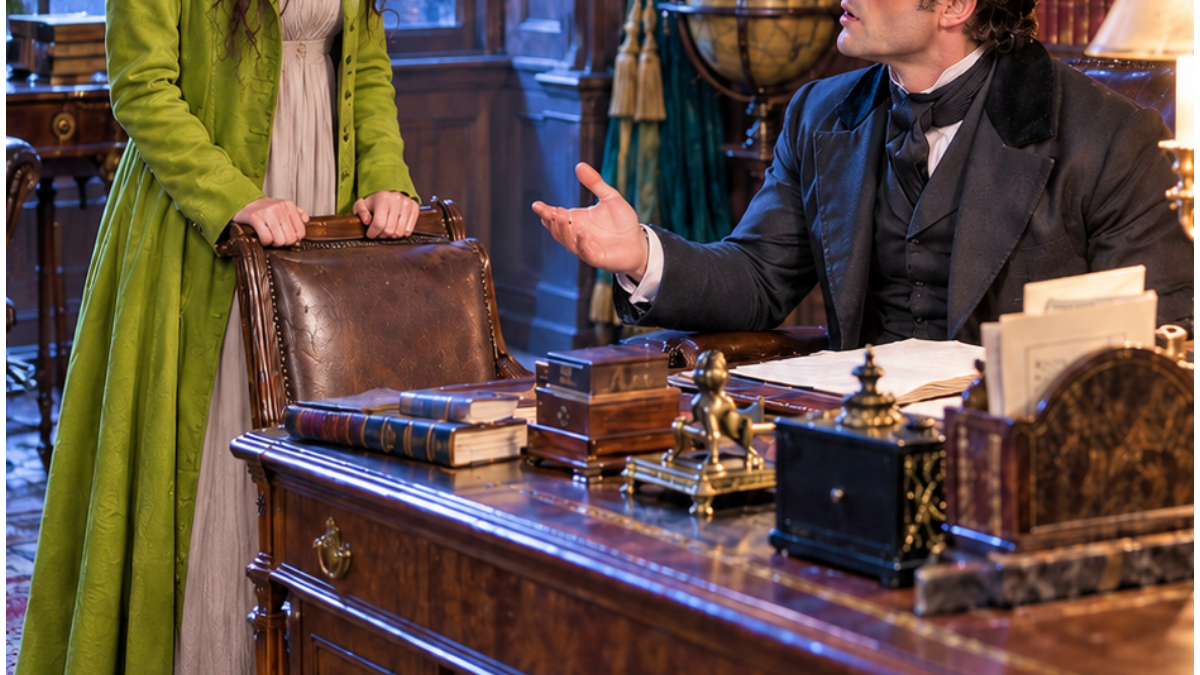
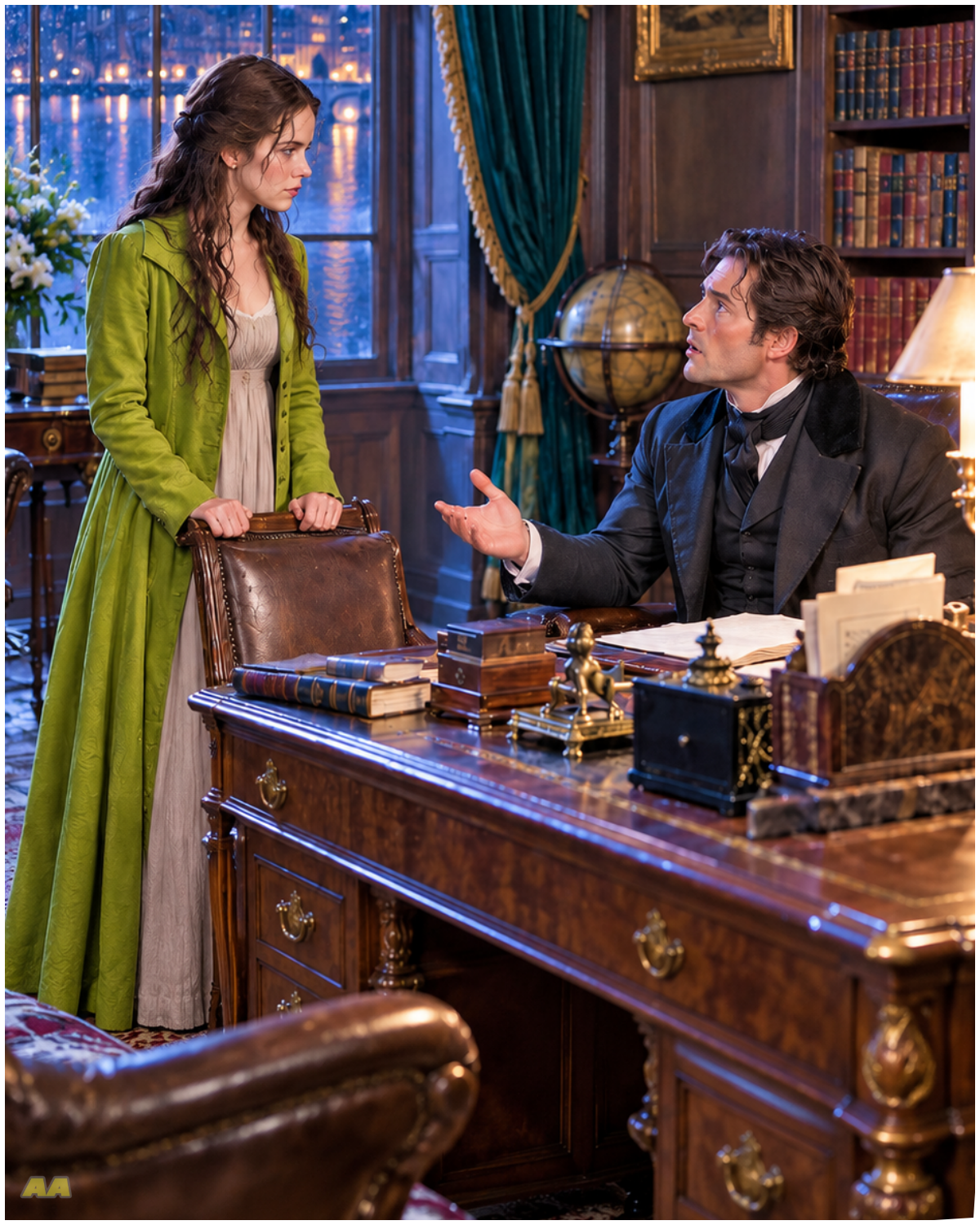
He didn’t want a bride. He wanted to be left alone with his ledgers and his quiet, crumbling estate.
But the Duke of Roth was a realiSt. He needed an heir.
And Lord Hemsley needed a bailout. It was a transaction.
Bloodlines for bank drafts, nothing more. Until she stepped into his dim, smoke-filled study, smelling of rain and damp wool, and spoke the words that shattered his carefully constructed, cynical isolation.
The rain in London didn’t fall, it loitered.
It hung in the air like a damp rag, greasing the cobblestones and weeping down the window panes of Henry Caendish’s townhouse.
Henry, the Duke of Rothford, watched a single drop trace a jagged path across the glass.
He was 32 years old, thoroughly exhausted, and currently calculating the exact cost of a human life, or rather the cost of a lifetime’s companionship.
£40,000, Lord Hemsley said, his voice carrying the slight ready we of a man who drank too much port and took too little exercise.
Hemsley sat on the edge of the leather wing back chair, nursing a glass of brandy he hadn’t been offered.
It clears my debts. It secures the Hemsley estate for my son.
And in return, your grace, you receive Beatatrice.
Henry turned away from the window.
The study was cold, the fire in the great putting out more bitter smoke than heat.
He looked at Hemsley.
The man was desperate, sweating despite the chill.
His crevat tied with an unsteady hand.
Beatatrice, Henry repeated.
The name felt heavy on his tongue.
Utilitarian, solid.
She is 24, Hemsley said quickly, sensing hesitation where there was only profound apathy.
Past her first blush. Yes, but sensible.
She has managed my household since her mother died.
She does not demand poetry or balls or or frieries.
She understands duty. Hemsley leaned forward, the leather chair groaning in protest.
She will not make a fuss, Rothford.
And she will give you your heirs.
Henry stared at the older man. A decade ago this conversation would have disgusted him.
He would have railed against the cold mechanics of the aristocracy, the buying and selling of women like prime horse flesh.
But a decade ago, Henry hadn’t buried a father and a brother in the space of 2 months.
He hadn’t inherited an ancient title bloated with expectation and starved of cash.
He hadn’t spent the last 5 years dragging the Rothford estates back from the brink of ruin.
He was tired. The romantic idealism of his youth had been systematically beaten out of him by bad harvests, tenant disputes, and the crushing weight of duty.
He needed a wife. The board of trustees demanded it.
The bloodline required it, but he didn’t want a weeping debutant who expected a fairy tale.
He wanted a partner who understood the grim reality of survival.
I will assume her dowy is non-existent, Henry said flatly.
I am bankrupt, your grace. The 40,000 is the dowry paid in reverse.
Hemley wiped his forehead with a linen square.
Henry walked over to his massive oak desk.
He looked at the ledger open in the center, the columns of numbers written in his own sharp angular hand.
He could afford it barely, but he could, and it would end the incessant nagging of his solicitors.
“I will have my man draw up the papers,” Henry said.
“Have them signed by tomorrow,” Hemsley exhaled a long, shuddering breath.
A man stepping off the gallows.
“You won’t regret, Rothford. She is a good girl. I don’t require her to be good, Hemsley.”
I require her to be present. He left shortly after, leaving behind the stale smell of fear and cheap brandy.
Henry sat at his desk, rubbing his temples.
It was done. He had bought a wife.
He reached for his quill, intending to draft the letter to his solicitor, when the heavy oak door of the study clicked open.
He looked up, a sharp reprimand on his lips for the servant who had entered without knocking.
The words died in his throat. She stood in the doorway, a shadow against the dim gaslight of the corridor.
She wore a dark gray police that was heavily waterlogged at the hem, dripping silently onto his Persian rug.
She carried no umbrella. Her hair, a muddy, nondescript brown, was plastered to her cheeks by the rain.
She was not beautiful, not by the standards of the tongue.
Her jaw was too square, her brows too dark and straight, but her eyes, even across the gloom of the study, he could see they were a startling, piercing slate gray, and they were fixed directly on him.
“Lord Hemsley has just left,” Henry said, his voice low, cautious.
“I know.” She stepped into the room and closed the door behind her with a quiet, definitive click.
I was waiting in the carriage. She didn’t wait for an invitation to sit.
She walked to the chair her father had just vacated.
She didn’t sit in it, but stood behind it, her gloved hands gripping the leather upholstery.
Her knuckles were white. “He told me not to come in,” she said.
Her voice was surprisingly deep, raspy, lacking the breathless soprano of the society ladies he avoided.
He said, “You had come to terMs.” “We have.” Henry leaned back in his chair.
He studied her. She was shivering, a fine, barely perceptible tremor that ran through her shoulders, but her chin was tilted up.
Defiant. “£40,000?” she said. It wasn’t a question.
Yes. She looked away, down at the empty brandy glass on the side table, a muscle feathered in her jaw.
When she looked back at him, the slate gray of her eyes was terribly, painfully clear.
There were no tears. There was only a devastating [clears throat] bone deep weariness that Henry recognized instantly.
It was the same weariness he saw in the mirror every morning.
My father said you needed a wife,” she whispered.
The quietness of the words echoed in the large, drafty room.
“It wasn’t a plea. It wasn’t a demand.
It was a statement of fact, stripped of all artifice.” Henry looked at the rain soaked hem of her dress.
He looked at her white knuckled grip on the chair.
He looked at a woman who had been sold to settle a gambling debt, who had climbed out of a carriage in the freezing rain to look her buyer in the eye.
“Something tight and rusted cracked open in Henry’s cheSt.” “He was right,” the Duke said, his voice matching her quiet intensity.
Beatatrice nodded once, a sharp, jerky movement.
“I require my own rooMs. I will not be paraded at season balls, and I want control over the household accounts.
My father is a fool with money, but I am not.
Henry felt the ghost of a smile touch the corners of his mouth.
Done. When is the wedding? Friday. A special license.
We leave for Darbisher immediately after. Darbisher, she absorbed the word.
It will be cold. It is always cold, Henry said softly.
She had held his gaze for a second longer and then released her grip on the chair.
Friday, then good day your grace. She turned and walked out, leaving the door a jar.
Henry sat in the silence for a long time, listening to the rain before he realized the bitter smoke from the fire had finally cleared.
The chapel at St. Georgees was cavernous, smelling of beeswax, old dust, and the lingering damp of the London autumn.
It was entirely empty, save for the mumbling vicar, Lord Hemsley, and the two people standing before the altar.
There was no white silk, no orange blossoMs. Beatric wore a tailored walking dress of deep navy blue, austere and practical, buttoned tightly to her throat.
Henry wore charcoal gray. They looked less like a couple embarking on holy matrimony and more like two solicitors finalizing a bleak corporate merger.
Henry barely heard the vicar. His attention was tethered to the woman standing beside him.
She was perfectly still. She didn’t fidget with her gloves or cast nervous glances at him.
When the time came, she repeated her vows in a clear, flat voice that echoed into the vaulted ceiling.
To have and to hold. He slid a heavy gold band onto her finger.
Her hand was ice cold. He held it for a fraction of a second longer than necessary, his thumb brushing against her knuckle.
She didn’t pull away, but she didn’t squeeze his hand in return.
[clears throat] She simply let him hold it until the vicar pronounced them man and wife.
Lord Hemsley practically wept with relief, pumping Henry’s hand and kissing Beatatric’s cheek with a wet, sloppy smack.
Beatatrice endured it with the stoicism of a stone pillar.
Within the hour they were in the heavy traveling carriage, the crest of the Duke of Rothford painted on the doors, rattling over the uneven cobblestones out of London.
The journey to Rothford Abby in Darbisha would take 4 days.
Four days trapped in a padded leather box measuring 6 ft x4.
The silence between them was not uncomfortable, but it was vaSt. Henry sat on the forward- facing bench, a stack of agricultural reports resting on his knee.
He didn’t read them. He covertly watched his new bride.
She sat opposite him, gazing out the window at the passing countryside.
The rain had returned, drumming a relentless rhythm against the roof.
The light inside the carriage was dim, casting sharp shadows under her cheekbones.
She had brought a book, a thick, worn volume that looked suspiciously like an encyclopedic text on crop rotation, but it lay unopened on the seat beside her.
“We will stop at an inn in Northampton tonight,” Henry said, his voice loud over the clatter of the wheels.
Beatrice blinked, turning her head slowly away from the window.
Is the road safe? My driver is armed.
The roads are muddy, but passible. She nodded, her gaze dropping to his boots before returning to the window.
“You are not prone to carriage sickness, I hope,” Henry asked, realizing how little he actually knew about the woman who now bore his name.
No, a pause. I am rarely sick.
It was like pulling teeth from a stubborn hound.
Henry let out a short, quiet breath and opened his reports.
He was not a man who required constant chatter, but the absolute void emanating from her was unnerving.
He felt a sudden sharp spike of irritation.
What did he expect? He had bought her.
She was a hostage to her father’s incompetence.
The first night at the inn set the tone for the journey.
It was a respectable establishment, though drafty.
The inkeeper, bowing and scraping at the presence of a duke, had prepared their best suite, one bed.
Henry stood in the doorway of the bed chamber, looking at the large foroster bed draped in heavy velvet.
Behind him, Beatatrice paused. He could hear the sudden shallow intake of her breath.
“It was the first crack in her armor he had heard all day.” “I will take the floor,” Henry said instantly, turning to face her.
She looked at him, her eyes wide, unguarded for a fraction of a second.
“That is ridiculous. You are a duke, and you are tired.
The floor is carpeted. I have slept on worse.” He walked to a highbacked chair, dragging it toward the hearth to construct a makeshift barricade.
We are married, your grace, she said, her voice dropping a register tight with an emotion he couldn’t quite place.
Fear? Resignation? Henry stopped. He turned around, resting his hands on the back of the wooden chair.
He looked at her, standing in the doorway, clutching her small traveling bag against her chest like a shield.
Beatrice, he said. It was the first time he had used her Christian name.
It felt strange in his mouth. Grounded.
Our arrangement was a transaction of necessity.
I need an heir, yes, but I will not force myself upon a stranger in a roadside inn simply because a vicar muttered some Latin over us this morning.
We have time. [clears throat] She stared at him, her knuckles white against the dark leather of her bag.
The tension in the room was a living, breathing thing.
I am not a stranger, she said quietly.
I am your wife. You are a woman who was sold to me yesterday, Henry countered gently.
Take the bed, Beatatrice. Get some sleep.
Tomorrow is a long drive. He turned back to the fire, taking off his creat.
He heard the rustle of her skirts, the quiet click of the door closing, and eventually the creek of the mattress springs.
He lay on the floor near the hearth wrapped in his great coat, listening to the wind howl against the window panes.
He didn’t sleep. He listened to her breathing, waiting for the rhythm to slow, waiting for the tension in his own jaw to uncoil.
It took three more days of mud, rattling wheels, and terrible infood to reach Darbisha.
By the time the carriage turned off the main road and onto the miles long gravel drive of Rothford Abbey, they were bruised, exhausted, and covered in a fine layer of duSt. Henry watched Beatatric as the abbey came into view.
It was a massive, sprawling stone structure, part a medieval fortress, part Tuda Manor, sitting grimly in a valley surrounded by black wooded hills.
It wasn’t pretty. It was imposing, unforgiving.
Beatrice leaned forward, looking through the rain streaked glass.
She didn’t gasp. She didn’t remark on its size.
The roof on the west wing looks as though it is boowing, she observed, her voice thoroughly pragmatic.
Henry barked a short, surprised laugh. It is.
The lead was stripped 50 years ago and patched poorly.
It leaks in the spring. Then we shall have it fixed before the snows come.
The carriage rolled to a halt before the massive stone steps.
Henry stepped out into the freezing drizzle and offered his hand.
Beatatrice took it. Her grip was firm.
[clears throat] They walked up the steps together, not as lovers, but as two soldiers stepping onto a battlefield.
Rothford Abbey was a moraleum of masculine neglect.
Henry had lived there as a bachelor, deeply entrenched in the macroeconomics of his estate, ignoring the micro environment of his own home.
The servants were old, loyal, and lazy.
Dust moes danced in the sparse sunlight that managed to pierce the heavy velvet drapes.
The food was hearty, but deeply uninspired.
Boiled mutton, root vegetables, and thick gravies.
Henry had expected Beatatrice to retreat. Most women of her class would have taken to their chambers with a headache, demanding a smelling salt and a maid to fan them, overwhelmed by the sheer, dreary weight of the place.
Beatatrice did not retreat. She went to war.
It started on the third morning. Henry was in his study, buried beneath a mountain of tenant complaints regarding a flooded stream when the door opened.
Beatatrice walked in, followed by a thoroughly bewildered looking Mrs. Higgins, the housekeeper.
Beatatrice was wearing a brown day dress with a thick woolen shawl wrapped around her shoulders.
She carried a ledger. “Your grace,” Beatatrice said, not pausing for pleasantries.
I have reviewed viewed the household accounts for the past 3 years.
Henry blinked, putting his quill down. You have?
I have, and I am horrified. She dropped the ledger onto his desk.
It landed with a heavy, dusty thud.
You are paying twice the market rate for coal, and yet half the rooms in this house are freezing.
The butcher in the village is charging you for prime cuts of beef.
But I assure you, what was served at dinner last night was the tough end of an old dairy cow.
Mrs. Higgins made a small, squeaking sound of distress.
Henry looked from the ledger to his wife.
Her slate gray eyes were bright, snapping with a furious, competent energy he hadn’t seen before.
Furthermore, Beatatrice continued, her voice clipping along at a brisk pace.
There are three housemmaids on the payroll who, as far as I can tell, do nothing but polish the silver in the dining room and gossip in the kitchens.
The drawing room smells of damp, and the linens in the guest wing are motheaten.
Henry leaned back in his chair, folding his hands over his stomach.
“And what do you propose to do about it, madam?” “I propose to run your house,” Beatatrice said, her chin lifting.
As is my right as your wife.
Unless you prefer a paying for dairy cow and freezing in your own hallways.
A slow genuine smile spread across Henry’s face.
It felt unfamiliar, stretching muscles he rarely used.
“Mrs. Higgins,” he said, not breaking eye contact with Beatrice.
“Your Yes, your grace.” The housekeeper stammered.
Her grace speaks with my absolute authority.
You will defer to her on all matters regarding the house, the staff, and the accounts.
Is that understood? Perfectly your grace. Mrs. Higgins looked as though she wanted to curtsy and flee simultaneously.
Good. You may go. When the door closed, Henry tapped the ledger.
I did not realize I was marrying a general Beatrice.
A household is an estate in miniature, Henry, she said.
It was the first time she had used his given name.
It hung in the air between them, sudden and sharp.
She seemed to realize it a second later, a faint flush climbing up the pale column of her throat.
If you cannot control the butcher, how can you control your tenant farmers?
A fair point. He gestured to a chair opposite him.
Sit. Show me where I am being robbed.
For the next two hours they sat together at his desk, their shoulders inches apart.
The smell of her, a clean, crisp scent of soap and lavender water cut through the dusty air of his study.
She was meticulous. She pointed out discrepancies with a blunt, inkstained finger, her logic flawless, her arithmetic sharp.
Henry found himself watching her mouth as she spoke, the way her lips pressed together when she concentrated.
He realized with a sudden, alarming jolt that he was enjoying himself.
He wasn’t humoring her. He was genuinely engaged.
He had spent 5 years carrying the weight of Rothford alone.
To have someone sitting beside him, willingly taking up half the load was a sensation so profound it made his chest ache.
Over the next month, the abbey transformed.
It was not an overnight miracle. Beatatrice did not sing to the birds or bring magical spring flowers into the drab halls, but she brought fire.
Literally. She fired the corrupt coal merchant and hired a new one, ensuring roaring fires in the main rooMs. She reorganized the kitchens.
The smell of roasting garlic, fresh herbs, and properly baked bread replaced the eternal stench of boiled cabbage.
She was strict, demanding, and utterly fair.
The servants, initially terrified of this grim-faced new duchess, slowly began to respect her.
Henry watched her from afar. They still maintained separate bed chambers.
They met for breakfast and dinner, their conversations revolving entirely around practicalities, the price of wheat, the repair of the west-wing roof, the hiring of a new undergarder.
But the silence between them had changed.
It was no longer a vast empty gulf.
It was a comfortable quiet, a shared understanding.
One evening in late November, the first heavy snow of the year began to fall.
Henry was in the library. A massive two-story room filled with thousands of books he rarely had time to read.
The fire was blazing, courtesy of Beatatric’s new coal supplier.
He was staring blindly at a treatise on soil drainage, rubbing a knot of tension at the base of his neck.
The heavy oak doors creaked open. Beatrice entered, carrying a silver tray.
Henry frowned, standing up. “Where are the servants?
You shouldn’t be carrying that.” “I sent them to bed,” Beatatrice said, walking toward him.
She wore a simple wool wrapper over her night dress, her hair braided thickly down her back.
It was the most informal he had ever seen her.
It is past midnight, Henry, and I saw the light under your door.
She set the tray on the low table between two leather armchairs.
It held a steaming pot of tea, two cups, and a plate of cold sliced beef and bread.
“You haven’t eaten since noon,” she stated, pouring the tea.
Henry slowly sat down in one of the chairs.
He felt suddenly intensely vulnerable. The dim light of the fire, the howling wind outside, and this woman in her dressing gown bringing him food in the dead of night.
“I lost track of time,” he muttered, taking the cup she offered.
His fingers brushed hers. “They were warm now.” Beatric sat in the opposite chair, pulling her feet up beneath her, abandoning the rigid posture she maintained during the day.
She looked at the book on his desk.
“Soil drainage?” she asked, taking a sip of her tea.
“The lower fields near the river?” Henry sighed, leaning his head back against the leather chair.
“They flood every spring. I lose a quarter of the crop.
Old man Miller refuses to dig trenches.
Says what was good enough for his father is good enough for him.
Miller is a stubborn fool, Beatatrice said flatly.
Henry looked at her surprised. You know Miller?
I know his type. My father had a dozen men just like him on our lands.
Men who would rather drown in mud than admit a new way might be better.
She picked up a piece of bread and tore it in half.
You cannot ask him, Henry. You must must tell him.
Tell him the estate will dig the trenches, but you will deduct the labor cost from his profits at harvest if he doesn’t maintain them.
Hit his purse. It is the only language stubborn men understand.
Henry stared at her. It was ruthless.
It was brilliant. It was exactly what he needed to do.
You are a terrifying woman, Beatatrice, he said softly.
She froze, the bread halfway to her mouth.
The fire light cast flickering shadows across her face, highlighting the sharp angles of her jaw.
She slowly lowered her hand, her slate gray eyes dropping to her lap.
I am practical, she corrected, her voice tight, suddenly defensive.
I know I am not. I know I lack the softer graces, your grace.
I am aware of what I am.
The sudden shift in her demeanor, the retreat back to your grace, felt like a physical blow to Henry.
He realized how his words had sounded.
He realized she had spent her life being told her intelligence and practicality were flaws, unwomanly traits that made her unlovable, made her something to be sold to settle a debt.
He leaned forward, putting his teacup down with a sharp clatter.
“Look at me,” he commanded, his voice low.
Beatatrice kept her eyes on her hands, her shoulders tense.
“Betrice, look at me.” Slowly, reluctantly, she lifted her head.
Her eyes were bright, guarded, anticipating a blow.
“When I said you were terrifying,” Henry said, his voice dropping to a grally whisper, holding her gaze with absolute intensity.
“I did not mean it as an insult.
I meant that I have spent 5 years surrounded by men who defer to me, who lie to me, who nod at my mistakes because of the title I hold.” and then you walk into my house, review my accounts, fix my roof, and tell me how to manage my farmers.” He reached across the small space between them.
He didn’t take her hand. He pressed his palm flat against the arm of her chair, leaning closer.
“I am not a man who needs a fragile ornament to make him feel strong,” Henry breathed, the truth of it echoing in his own cheSt. I need someone who can stand in the mud with me.
I need someone who understands the weight of this.
He gestured vaguely to the room, to the estate beyond the walls.
You are terrifying, Beatrice, because you are exactly what I needed.
And I am entirely unprepared for it.
Beatrice stared at him, [clears throat] the guarded look in her eyes fractured, splintering into something incredibly fragile.
Her breath hitched. A small quiet sound in the massive room.
For a long moment, the only sound was the crackle of the fire and the wind hurling snow against the glass.
Henry looked at her mouth at the pulse beating rapidly at the base of her throat.
The transaction, the contract, the £40,000, all of it felt utterly irrelevant.
Slowly, Beatatrice reached out, her fingers, trembling slightly, brushed against his knuckles, where his hand rested on her chair.
“My father,” she whispered, her voice barely audible over the fire, echoing the words she had spoken in his London study, “is rarely write about anything.” Henry turned his hand over, catching her fingers in his, feeling the steady, grounding warmth of her palm.
“But he was right about this,” he said.
She didn’t pull away. And for the first time in 5 years, as the snow buried the heavy, crumbling world outside, Henry Caendish felt like he was finally home.
The morning after the snowstorm, the world outside Rothford Abbey was blindingly white and deathly still.
Inside, however, a subtle, irrevocable shift had occurred.
Henry sat at the head of the long mahogany dining table, a plate of eggs and ham before him.
Beatatrice sat at the opposite end, separated by 12 ft of polished wood.
It was absurd. He had never noticed how vast the distance was until today.
He watched her read a letter from the village vicar.
She wore a dark green morning gown, her hair scraped back with its usual severe practicality.
Yet the memory of her in the fire light, unarmored, trembling slightly, her fingers tangled with his, superimposed itself over her rigid posture.
Davies tells me the sheep in the lower pasture are showing signs of hoof rot, Henry said, breaking the quiet clink of silverware.
Beatatrice looked up. How many? A dozen.
Perhaps more. The damp from the snow melt will only worsen it.
They need to be moved to the higher ground near the old folly, she said instantly, setting her letter aside.
And the infected ones isolated in the dry barns.
We cannot afford to lose the spring lambs.
I am riding out with Davies in an hour to see it done.
Henry paused, his gaze fixed on her.
You should come. It was not a command.
It was an invitation to the front lines.
Beatric’s gray eyes widened slightly. Women of her station did not wade into freezing mud to inspect diseased livestock.
They stayed by the fire and worked on their embroidery.
But Beatatrice was not a woman of her station.
She was a survivor of her father’s ruin.
[clears throat] “Give me 20 minutes to change my boots,” she said.
The ride to the lower pasture was brutal.
The wind howled off the peaks of the Peak District, biting through thick wool and leather.
Beatrice rode a sturdy gray mare, her posture impeccable despite the uneven snowpacked ground.
She didn’t complain about the cold. She didn’t shrink when they reached the flock, where the smell of wet wool and infection hung heavy in the frigid air.
Mr. Davis, a grizzled man who had managed the Rothford lands for two decades, looked visibly shocked when the duchess dismounted into ankle deep freezing mud.
Your grace, Davies sputtered, tipping his hat.
This is no place for a lady.
Good thing I am a duchess then, Mr.
Davies, Beatatrice replied crisply, tying her horse to a fence poSt. Which ones are showing the rot?
For 3 hours they worked. Henry and Davies wrestled the heavy panic-stricken use, checking hooves and separating the sick from the healthy.
Beatrice did not stand idly by. When a young, terrified lamb bolted away from the herd, she lunged, catching it by the middle and dragging it back to the enclosure.
A dark police instantly coated in filthy freezing slush.
Henry watched her wipe mud from her cheek with a gloved hand, her breath puffing in white clouds, her eyes bright with adrenaline and exertion.
She was magnificent, not beautiful in the soft, powdered way of London society.
She was beautiful in the way a drawn sword was beautiful, sharp, necessary, and entirely alive.
When they finally rode back to the abbey, the sun was sinking, casting long blue shadows across the snow.
They handed their horses to the grooms and walked up the stone steps in silence.
They were exhausted, freezing, and smelled distinctly of sheep.
In the cavernous entrance hall, Beatatrice stopped it.
She looked down at her ruined dress, the mud caked halfway up her calves.
A small, breathless sound escaped her. Henry turned, alarmed.
Beatatrice, are you hurt? She looked up at him, her face was stre with dirt, her nose bright red from the wind.
And then she laughed. It was a startling sound, deep, rich, and slightly rusty, as if she hadn’t used it in years.
It echoed off the vaulted stone ceiling.
“Look at us,” she gasped, gesturing to Henry’s equally filthy coat.
“If the ton could see the Duke and Duchess of Rothford now, they would revoke our titles.” Henry stared at her, mesmerized by the way the laughter transformed her face.
The severe lines softened, the guarded slate of her eyes sparkled like rain on flint.
He stepped closer, the distance between them evaporating.
“Let them,” Henry murmured. He reached out and, with his thumb, gently wiped a smudge of mud from her cheekbone.
The laughter died in her throat, replaced by a sudden, suspended stillness.
Her breath hitched. She didn’t pull away.
She leaned just a fraction of an inch into his touch.
“Go upstairs, Beatrice,” he said, his voice dropping an octave rough with something far heavier than exhaustion.
“Tell Mrs. Higgins to draw a hot bath before you freeze.” “And you,” she whispered.
“I have a ledger to update.” He lied.
He needed distance. He needed a stiff drink because if he stood in this hallway with her for one second longer, he was going to kiss his practical, terrifying wife.
And he knew with sudden clarity that once he started, he would never be able to stop.
The transition from winter to early spring in Darbisha was not a gentle awakening.
It was a violent struggle between ice and mud.
The days grew marginally longer. The ledgers began to show a fragile but undeniable profit, and the tension inside Rothford Abbey stretched tort as a wire.
Since the day in the lower pastures the quiet camaraderie between Henry and Beatrice had sharpened into something electrical, their hands brushed over shared documents, their eyes caught and held across the dining table.
The silence between them was no longer empty.
It was loaded, waiting for a spark.
The reality of their transaction hung over them.
The £40,000, the need for an air.
It was a contractual obligation they had both silently agreed to postpone, wrapped in the guise of giving it time.
By March, the time had run out.
The board of trustees sent a pointed letter inquiring about the health of the Duchess and the prospects of a succession.
Henry burned the letter in the great of his study, his jaw locked.
He refused to treat Beatatrice as a broodmare.
He refused to let duty soil what they were building.
That night, a brutal spring gale rattled the windows of the abbey.
Henry sat in his bed chamber, staring into the fire, a glass of untouched whiskey in his hand.
He wore a loose linen shirt and trousers, his mind churning.
The soft click of the door latch sounded like a gunshot in the quiet room.
Henry turned. Beatrice stood in the doorway.
She wore a heavy velvet dressing gown over a white cotton night dress.
Her hair was down, falling in a thick dark wave over her shoulder.
She held a candle, the flame shaking slightly in her grip.
Henry stood up instantly, setting his glass on the mantelpiece.
Beatatrice, is something wrong? Is the roof leaking again?
No. She closed the door behind her.
She didn’t move toward him, staying anchored near the heavy oak panels.
The roof is fine. She took a slow, deep breath, her chest rising and falling beneath the velvet.
She looked at him with that same piercing, devastating clarity she had possessed the day she walked into his London study.
My father wrote to me,” she said, her voice steady, but lacking its usual brisk authority.
He inquired if I had secured my position here yet.
If I was fulfilling my duties, Henry felt a surge of cold fury toward the man.
Your father is a parasite. You answer to me, not him.
And I have asked nothing of you.
I know. She set the candle down on a side table.
But you bought me, Henry, for a purpose.
Stop. He crossed the room in three long strides, stopping just inches from her.
He looked down into her upturned face.
Do not speak of yourself as a ledger entry.
“Not ever again, but it is the truth,” she insisted, her voice breaking slightly.
She looked away, staring at his cheSt. I am practical, Henry.
I know the terms of our arrangement.
We need an heir to secure this estate.
We need She swallowed hard. I came to your room tonight because it is time to fulfill the contract.
Henry stared at her. [clears throat] She stood rigid, her hands curled into fists at her sides.
She was bracing herself, expecting a cold mechanical duty.
Expecting to be used. “Look at me,” he commanded softly.
She shook her head, a short jerky motion.
“Please, Henry, just get it over with.” “No.” Her head snapped up, her eyes wide with shock, and a sudden sharp panic.
“You are rejecting me? I am rejecting the contract.” He reached up and gently caught her face in his hands.
Her skin was warm, pulsing with a frantic heartbeat.
I am not Lord Hemsley’s savior. I am not the board of trustees.
I am a man standing in a cold room with the only woman who has [clears throat] ever made me feel like I am not fighting a war alone.
Beatrice stared at him, her breath hitching.
The armor she wore so flawlessly was cracking, splintering beneath his palMs. I do not want a transaction, Beatatrice, Henry whispered, his thumbs sweeping across her cheekbones.
I want my wife, but only if she wants me.
Not out of duty, not for an heir.
If you do not want this, if you do not want me, turn around and walk out that door, and I swear to you, I will never speak of it again.” He dropped his hands, taking a half step back, giving her the space to leave, giving her the choice she had been denied her entire life.
Beatrice looked at him. She looked at the shadows beneath his eyes, the hard, uncompromising line of his jaw, and the absolute terrifying vulnerability in his gaze.
She didn’t turn around. She stepped forward, closing the distance he had created.
She reached up, her trembling hands gripping the lapels of his linen shirt.
“I am terrified,” she whispered, the confession tearing out of her.
“So am I,” Henry breathed. Then she pulled him down.
The kiss was not gentle. It was not a polite, tentative exploration.
It was a collision. Decades of repressed emotion, of duty, of survival, ignited in a single second.
Henry’s arms wrapped around her waist, lifting her off the ground, crushing her against him.
He tasted salt. She was crying, though she made no sound, and the clean, sharp taste of peppermint.
He carried her to the massive fore poster bed.
There were no flowery declarations of eternal love, no poetry whispered in the dark.
There was only the frantic discarding of heavy fabrics, the desperate heat of skin against skin, and the grounded raw reality of two solitary survivors finally finding their anchor.
When it was over, the storm outside had broken.
The room was quiet, lit only by the dying embers in the great.
Beatrice lay with her head resting on Henry’s chest, her arm draped across his stomach.
He was tracing lazy circles on her bare shoulder, listening to the steady rhythm of her breathing.
She shifted, pressing a kiss to his collarbone.
Henry H. The contract is void, she murmured against his skin.
He smiled in the dark, pulling her closer entirely.
Spring finally broke the back of the Darbisha winter.
The snow melted, the lower fields drained, thanks to the trenches Beatatrice had ruthlessly enforced, and the abbey grounds exploded into a stark, wild green.
With the passable roads came the inevitable intrusion of the outside world.
It arrived in the form of a lacquered carriage bearing the crest of the Caendish family.
Richard Caendish, Henry’s cousin and a man who lived entirely on allowance and gossip, had come to inspect the new duchess.
Richard was everything Henry despised about the ton.
He was impeccably dressed, relentlessly charming, and entirely useless.
“My dear Henry,” Richard exclaimed, stepping into the entrance hall, dusting invisible lint from his forest green riding coat.
Buried in the country like a badger.
The clubs in St. James are weeping at your absence.
I’m running an estate, Richard, not a social calendar, Henry said dryly, shaking his cousin’s hand.
Yes, yes, the great burden of Rothford.
Richard sighed dramatically. And I hear you’ve taken a bride to share the misery, Hemsley’s daughter, wasn’t it?
A bit of a sudden arrangement. It was well produce her.
Let me see the paragon who dragged you to the altar.
Henry’s jaw tightened. Beatrice is currently in the village overseeing the delivery of the new roof tiles.
She will join us for dinner. Richard raised a perfectly sculpted eyebrow.
Overseeing roof tiles? Good God, Henry. Did you marry a woman or hire a new steward?
I married a woman who ensures you aren’t rained upon while you eat my food.
Henry replied, his voice dangerously soft. Richard laughed, oblivious to the threat.
Touché, dinner that evening was a battlefield disguised as a social engagement.
Beatatrice wore a simple dark blue silk gown devoid of the lace and ruffles currently fashionable in London.
She sat at the foot of the table, composed and entirely unbothered by Richard’s appraising, slightly mocking stairs.
“Tell me your grace,” Richard drawled, swirling his wine glass.
“Do you not miss the season, [clears throat] the balls, the theater?
It must be dreadfully dull out here for a lady, kneedeep in mud and roof tiles.
I find no boredom in purpose, Mr.
Caendish,” Beatatrice replied. Evenly, cutting her meat.
And I prefer the mud of Darbisha to the filth of London gossip.
Henry hid a smile behind his goblet.
Richard smiled tightened. He wasn’t used to women who didn’t simp or deflect.
He leaned forward, adopting a tone of faux intimacy.
Of course, though one does hear whispers.
The tongue is so terribly cruel. They say Lord Hemsley practically gave you away to settle a card debt.
A tragic tale of commerce over romance.
It must be quite trying, playing the role of Duchess when everyone knows the price tag.
The silence in the dining room slammed down like an iron port cullis.
Beatric’s knife stopped moving. Her face went deathly pale.
The armor she had carefully shed over the past months slammed back into place, cold and impenetrable.
Richard had dragged the ugly transactional reality of her existence right into the center of her home.
Henry did not shout. He did not slam his fist on the table.
The anger that seized him was cold, absolute, and deadly.
He placed his wine glass down. The quiet clink sounded like a hammer striking an anvil.
“Richard,” Henry said. His voice was not loud, but it carried a weight that made the footman standing by the door physically recoil.
Richard looked at Henry, his arrogant smile faltering.
“You will pack your bags,” Henry stated, his eyes locked on his cousin.
You will sleep in the carriage and you will be off my lands before the sun rises.
Henry, surely you jest, Richard stammered, the color draining from his face.
It was merely a jest about the tongue.
I meant no offense to her grace.
You are a parasite, Richard. Henry cut him off, the words slicing through the air like a scalpel.
You live off the scraps of this family’s wealth while contributing nothing but venom.
You sit at my table eating food my wife secured in a warm room my wife arranged and you dare to insult her?
Henry stood up slowly. He rested his hands flat on the table leaning toward his cousin.
“Let me be absolutely clear,” Henry said, his voice dropping to a grally, terrifying register.
Beatrice is not a transaction. She is the Duchess of Rothford.
She is my equal in all things.
She holds half my power, and she commands all of my respect.
If you ever speak of her with anything less than total reverence again, I will cut off your allowance, and I will ensure you cannot find a gentleman’s club in London willing to let you through the door.
Do you understand me? Richard swallowed audibly, staring at Henry as if he had never seen him before.
Yes, perfectly. Get out. Richard scrambled up, throwing his napkin on the table and practically fled the room.
The [clears throat] heavy doors clicked shut.
The silence returned, thick and suffocating. Henry remained standing, breathing heavily, the adrenaline burning in his veins.
He looked down the length of the table at Beatatrice.
She was staring at him. [clears throat] Her eyes were wide, shining with unshed tears, her hands trembling where they rested on the white tablecloth.
She had spent 24 years being an inconvenience, a burden, a bargaining chip.
No one had ever defended her. No one had ever claimed her.
Henry walked around the long table. He didn’t stop until he was standing beside her chair.
He reached down and took her trembling hands, pulling her gently to her feet.
“He is a fool,” Henry said softly, the lethal edge gone from his voice.
Beatrice looked up at him, a tear finally escaping and cutting a path down her cheek.
“You didn’t have to do that. The tongue will talk.
He will tell them you are mad.
Let them talk,” Henry said, wrapping his arms around her, pulling her solid.
Real warmth against his cheSt. He buried his face in her hair, breathing in the scent of lavender and clean air.
Let them say I am marred because I am.
I am mad enough to think that £40,000 was the cheapest price ever paid for a miracle.
Beatrice let out a ragged breath, her arms wrapping tightly around his waist, burying her face in his neck.
She wasn’t just a duty anymore. She was his, and he entirely was hers.
August brought a brutal baking heat to Darbisha.
The air above the wheat fields shimmerred, thick with dust and the relentless hum of cicardas.
It was harvest time. The crucible upon which the survival of Rothford Abbey rested.
Henry did not manage the harvest from the cool shade of his study.
He rode out at dawn, his coat discarded, his sleeves rolled up, working the lines alongside Davies and the tenant farmers.
It was a calculated display of solidarity.
Men worked harder for a lord who bled with them.
Beatrice was the supply line. She commanded a fleet of carts, delivering water, ale, and salted pork to the fields, ensuring the momentum never broke.
She moved through the chaotic staging areas with the ruthless efficiency of a quartermaster, her skin dusted with flour from the kitchens, her hair escaping its severe pins.
They were a machine operating at peak capacity.
And then the machine broke. It happened on a Tuesday afternoon.
The air heavy with an impending thunderstorm.
They were loading the massive timber wagons near the riverbend.
The ground was baked hard, slick with dry chaff.
A young, inexperienced draft horse, spooked by the sudden crack of thunder rolling over the peaks, lunged forward before the traces were secured.
The massive ironbanded wagon wheel jerked. A rusted iron tow chain pulled taut as a bow string snapped.
The sound was a sickening metallic crack that echoed over the valley.
Beatrice was 50 yards away, handing a water skin to a sweating farm hand.
She turned at the sound just in time to see the heavy iron link whip through the air.
It struck Henry across the chest and shoulder, the sheer force of it throwing him backward into the dirt.
He did not get up. The silence that fell over the field was absolute, broken only by the nervous stamping of the draft horses.
For a fraction of a second, Beatatrice couldn’t breathe.
The world tilted on its axis, the sky bleeding out to a blinding white.
The transaction, the partnership, the sudden terrifying realization that the man lying in the dirt was the only thing standing between her and utter isolation.
Then the panic receded, slamming away behind a wall of cold, brutal adrenaline.
“Get that horse under control,” Beatatrice roared, her voice tearing through the paralyzed silence.
Davis, fetch the doctor from the village.
Ride the gray mare to death if you muSt. Do it now.
She hiked up her skirts and ran.
She dropped to her knees in the dust beside Henry.
His eyes were closed, his breathing a shallow, wet rasp.
The heavy linen of his shirt was already blooming with a dark spreading stain of crimson across his collarbone.
She pressed her hands over the wound.
The blood was terrifyingly hot, slipping between her fingers.
“Henry,” she said. Her voice was steady, though her hands shook violently.
“Henry, open your eyes.” He didn’t move, the men gathered around, shifting uneasily.
“Your grace,” one of them mumbled. “Should we move him to the shade?” We move him to the abbey,” Beatatrice snapped, pressing harder on the wound.
“Bring the flatbed cart. Pad it with hay gently.
If you drop him, I will see you all hanged.” They brought him back to the stone fortress.
The halls that Beatatrice had spent months warming, suddenly felt like an ice box.
She directed the men to carry him up the grand staircase to his bed chamber.
When the village doctor finally arrived, red-faced and panting, Beatatrice refused to leave the room.
She stood in the corner, her dress ruined with dirt and her husband’s blood, watching the doctor stitch the torn flesh and set a fractured collarbone.
The doctor muttered about infection, about the heat, about the proximity to the lung.
He left a bottle of lordinum and a grim prognosis.
He is strong, your grace, the doctor said, packing his bag.
But the fever will come tonight. If he wakes by morning, he will live.
If he does not, he didn’t finish the sentence.
Beatatrice nodded once. She walked to the wash basin, scrubbed the dried blood from her hands until the skin was raw, and took a chair beside the bed.
She dismissed Mrs. Higgins. She dismissed the maids.
She locked the heavy oak door. “You do not get to leave,” Beatatrice whispered to the silent room, her eyes fixed on Henry’s pale, sweatshened face.
“We have a contract, Caendish. You do not get to break it.” The fever came at midnight.
It seized Henry with a violent, shuddering intensity.
He thrashed against the mattress, muttering disjointed, panicked sentences about the crops, about the rain, about his dead brother.
Beatrice fought him. She pinned his uninjured shoulder down, terrified he would tear the crude stitches.
She bathed his face with cold water laced with vinegar, the harsh smell burning her nostrils.
Her muscles achd, her eyes burned with exhaustion.
But she did not stop moving. By 3:00 in the morning, the violent thrashing subsided into a terrifying, unnatural stillness.
The heat radiating off his skin was unbearable.
His breathing was so shallow she had to lean down and press her ear to his uninjured chest just to hear the faint, struggling rhythm of his heart.
Beatrice pulled away. She slumped back into the wooden chair.
For the first time since the chain snapped, the cold, pragmatic wall inside her mind cracked.
She looked at the man in the bed.
This cynical, exhausted duke, who had bought her for £40,000.
He had given her an estate to run.
He had defended her honor against his own blood.
He had looked at her sharp edges and called her a miracle.
She reached out and took his hand.
It was too hot, the skin dry and papery.
She pressed it against her cheek. “I lied to you,” she whispered into the empty, fire lit room.
A tear finally broke free, cutting a clean line through the dust and flower still clinging to her face.
She didn’t wipe it away. “I told you I was practical.
I told you I understood the arrangement.” Her voice shook, rough and broken.
But I don’t care about the estate.
I don’t care about the ledgers or the roof or the title.
I would burn this entire abbey to the ground if it meant you would open your eyes.
She gripped his hand tighter, bowing her head until her forehead rested against the edge of the mattress.
Don’t leave me here, Henry, she sobbed, the sound muffled by the heavy blankets.
Please, I am not strong enough to do this alone.
She stayed like that for hours, crying until there was nothing left but a dry, hollow ache in her cheSt. Outside, the storm finally broke, the rain hammering against the window panes, washing the dust from the glass.
Dawn bled into the room, a gray, bruised light.
Beatrice felt a faint, sluggish pressure against her fingers.
She gasped, her head snapping up. Henry’s eyes were open.
They were hazy, bloodshot, and heavy with exhaustion.
But the terrifying glassy sheen of the fever had broken.
He looked at her. He saw the ruined dress, the tear streaked face, the absolute wreckage of her composure.
He swallowed, his throat making a dry clicking sound.
You. His voice was barely a rasp.
You look terrible, Beatatrice. A choked, watery laugh tore out of her throat.
She pressed her hands to her mouth, her shoulders shaking violently.
“You are an idiot,” she managed to say.
Henry shifted slightly, wincing as the pain in his shoulder flared.
He slowly turned his hand over, wrapping his weak fingers around her wriSt. I heard you,” he whispered, his slate gray eyes locking onto hers, clear and focused.
Beatatrice froze. The vulnerability of her midnight confession hung between them, raw and exposed.
“You were delirious. I heard you,” he repeated softly.
He pulled her hand down, pressing it against his chest right over his beating heart.
“Do not burn the abbey down, Beatatrice.
It is very expensive. She let out a ragged breath, leaning forward until her forehead rested gently against his uninjured shoulder.
I make no promises. Good, Henry murmured, his eyes slipping shut again, a faint ghost of a smile touching his pale lips.
“I prefer you terrifying.” The winter that followed was the harshest Darbisher had seen in a decade.
The snow drifts piled 8 ft high against the stone walls of Rothford Abbey, sealing them off entirely from the outside world.
But inside it was warm. Henry sat by the roaring fire in his study.
A heavy woolen blanket draped over his lap.
The collarbone had healed perfectly, though a thick angry scar slashed across his chest, a permanent reminder of the harveSt. He was reading a letter from his solicitor, a glass of dark port resting on the table beside him.
The heavy door opened. Beatrice walked in.
She wore a gown of deep crimson wool.
Her hair was still pinned with practical severity, but the harsh defensive lines of her face were entirely gone.
She carried a leatherbound ledger. She walked to the desk, bypassed the visitor’s chair entirely, and sat on the edge of his massive oak desk, her skirts rustling against the wood.
It was a brazen, informal breach of etiquette that would have given her father a heart attack.
Henry loved it. The final accounts from the harvest are tall, Beatrice said, tapping the ledger against her knee.
Even with the delay, we yielded 20% more than last year.
The grain prices in London held steady.
Henry folded his letter, setting it aside.
He looked up at her, admiring the fire light dancing in her slate gray eyes.
You have saved this estate, Beatrice. The board of trustees sent a letter this morning.
They are entirely dissolving their oversight. We are fully solvent.
We are profitable. She corrected smoothly. Solvency is merely surviving.
We are now dictating terMs. Henry chuckled.
A deep rich sound spoken like a true mercenary.
Beatrice smiled. A small private thing. She set the ledger down on the desk.
She didn’t look at it. She looked at him, her expression shifting from business to something profoundly soft.
I have done an audit of the household for the coming year, she said quietly.
We need to reallocate funds. Henry frowned slightly, leaning forward.
Why is the Westwing roof acting up again?
The roof is fine. Beatrice reached out, her fingers lightly tracing the edge of his jaw.
But we are going to need a wet nurse and a nursery made.
The rooms in the east wing will need to be replastered and heated properly to keep the damp out.
Henry froze. The crackle of the fire seemed to echo loudly in the sudden stillness of the room.
He stared at her, his mind racing to process the calm, pragmatic way she had just delivered the news that would permanently alter their lives.
Beatatrice, he whispered, his voice catching in his throat.
“I checked the ledgers,” she continued, her voice trembling just a fraction, a tear brimming in her eye despite her calm tone.
“We can afford it, Henry. We can afford him.”
Henry stood up. The blanket pulled at his feet.
He stepped into the space between her knees where she sat on the desk.
He placed his hands gently on her waist.
The transaction, the bitter, desperate contract signed in a rainy London study a year and a half ago.
Felt like a lifetime away.
“Are you sure?” he asked, his hands moving to cup her face, his thumbs wiping away the single tear that spilled over her lashes.
“I am never wrong about the accounts,” she said, letting out a watery laugh.
He kissed her. It was not the desperate crashing collision of their first night, nor the terrified clinging of the fever vigil.
It was a slow, deep, anchoring kiss, a promise sealed not in ink and silver, but in blood, sweat, and survival.
He pulled back, resting his forehead against hers.
“Lord Hemsley,” Henry murmured into the quiet room.
“What about him?” Beatatrice asked, her hands tangled in the hair at the nape of his neck. I owe that terrible, foolish man a drink,” the Duke said, a smile breaking across his face.
“Because he was absolutely, undeniably right.”
Beatatrice laughed, wrapping her arms around his shoulders, pulling him close against the winter chill.
The wind howled against the glass, tearing at the ancient stones of Rothford Abbey, but inside the fire burned bright, and the balance was finally, perfectly paid in full.








