My Birthday Surprise Was My Fiancé’s Betrayal — I Married Her Powerful Uncle Instead
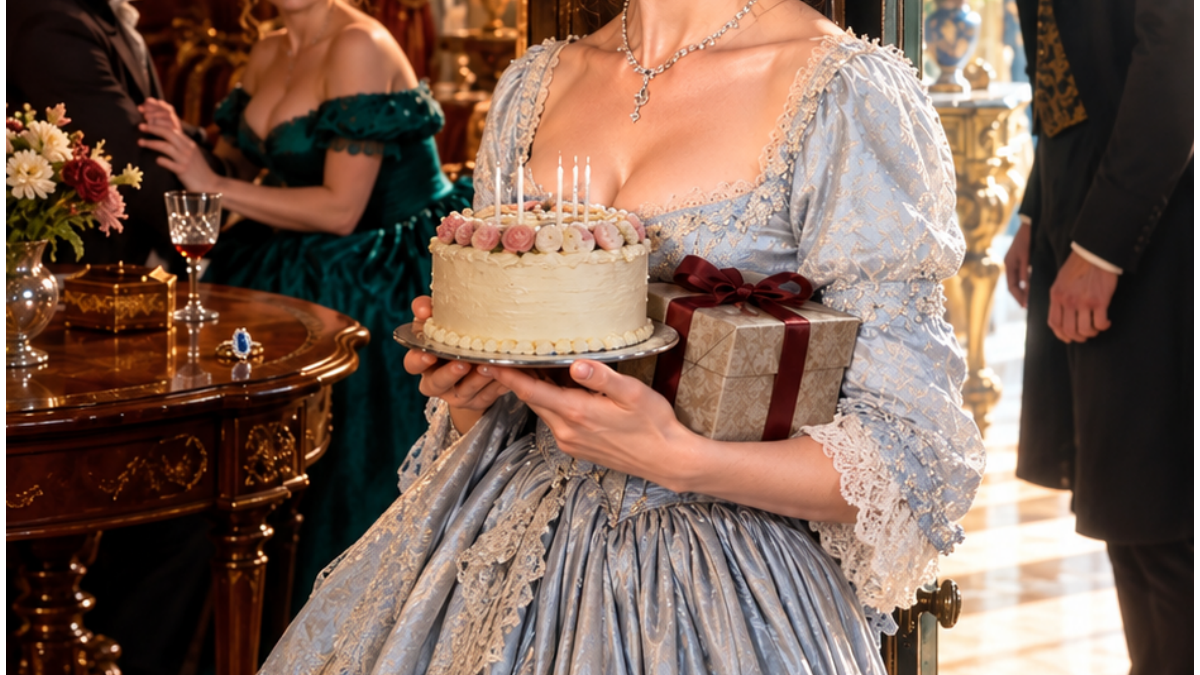
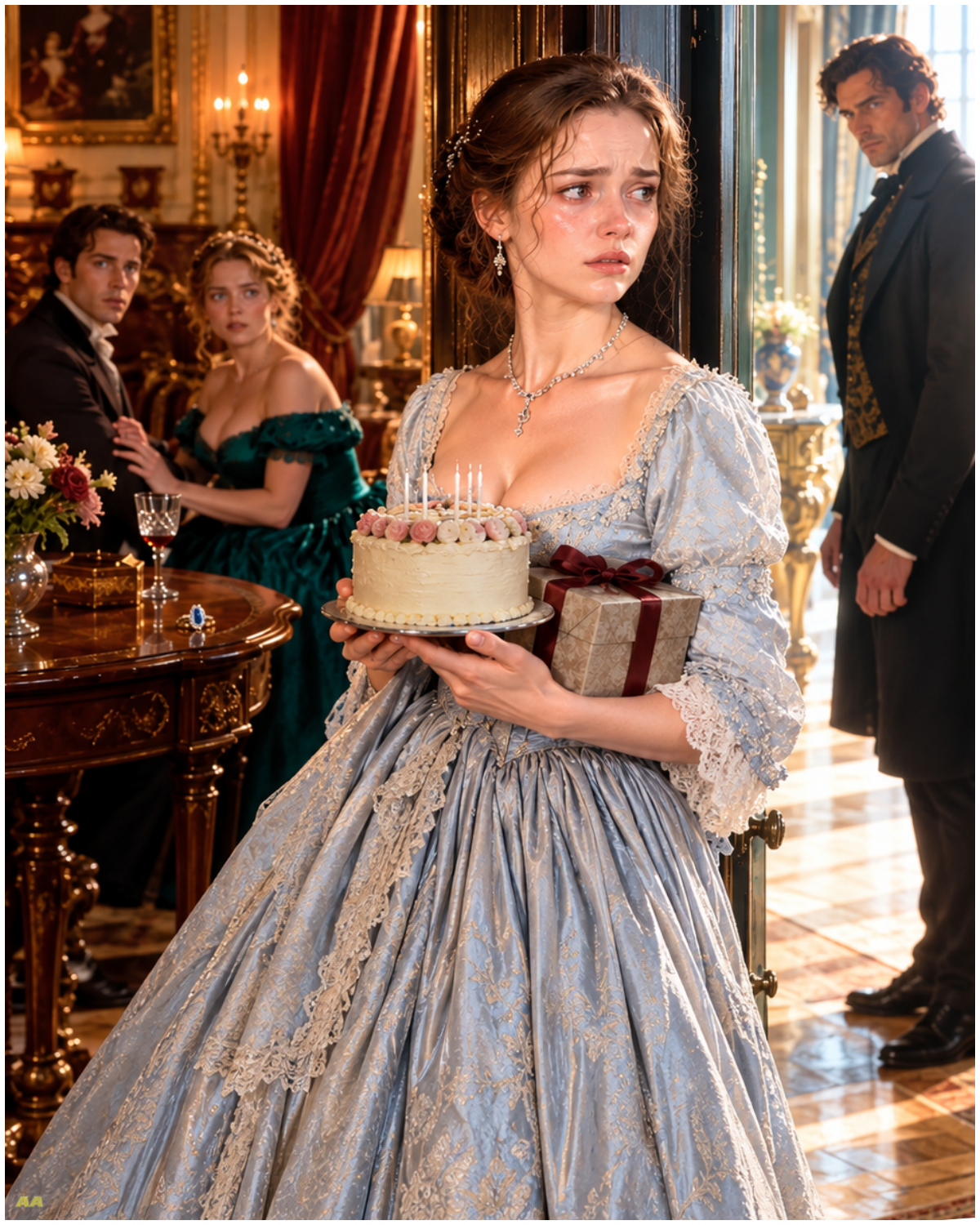
She carried a birthday cake through the London rain with her bare hands.
She had made it herself.
Three layers, white frosting, the kind of thing you make for someone you plan to love for the rest of your life.
She knocked twice.
The door swung open on its own.
And before she could say a word, she saw them.
Her fianceé and her closest friend, his hands on her waist, her ring on Porsche’s finger.
Not Elanor’s ring.
Not just any ring.
The ring. Georgiana’s mother had pressed into her palm the morning she died.
The rain had been falling since noon.
Georgiana Morrow noticed it the way she noticed most inconvenient things with a brief acknowledgement and no complaint.
She had learned early that complaint changed nothing.
Her father had died when she was 14, leaving behind a modest house in Kent, a modest debt, and a mother who turned grief into industry, opening a fabric shop that smelled of wool and lavender and something close to dignity.
Georgiana had grown up folding bolts of cloth and balancing ledgers, and learning that the world did not bend to accommodate feelings.
You bent to accommodate the world, and you did it with your chin up.
So when the rain soaked through her wool coat on the walk from the train station, she kept walking.
She had the cake in both arms, three layers wrapped in paper balanced against her cheSt. She had spent 4 hours on it the night before alone in the kitchen of the small flat she rented in Clappam because she had wanted it to be right.
Vincent loved lemon.
She had used the last of the sugar, the last of the butter, and what remained of her mother’s recipe card, the one with the water stain in the corner, and the handwriting that still made her throat tighten.
It wasn’t much.
She knew it wasn’t much, but Georgiana had always believed that the effort behind a thing meant more than the thing itself, and she had put every bit of herself into that cake.
She turned the corner onto Vincent Grantly Street and told herself she was happy.
She almost believed it. Vincent had proposed eight months ago in the garden behind his mother’s house in Kensington.
It had not been an especially romantic proposal.
He had fumbled with the ring box, dropped it, retrieved it, and delivered the words in a rush, as though he were afraid they would escape him if he waited too long.
But his eyes had been sincere.
That was what Georgiana had held on to.
Not the fumbled ring, not the nervous words, the eyes.
She was not a woman who required grand gestures.
She required honesty.
She required someone who looked at her and saw her not the daughter of a dead merchant, not the girl from the fabric shop in Kent, but the woman who had rebuilt a household at 14 and kept it standing for 11 years without assistance.
Vincent had seemed to see her.
You are the most capable woman I have ever met.
He had told her once early in their courtship, and the way he said it, not as a compliment, but as a simple stated fact, had broken through every wall she had built.
She had said yes before he finished asking.
The door to his townhouse was unlocked.
That should have been the first sign, but Georgiana did not read signs she did not expect to see.
She pushed the door open with her shoulder, both hands still occupied with the cake, and called into the hallway.
Vincent. The train was delayed.
I hope you haven’t. She stopped.
The parlor door was open.
She could see through it from the entryway.
She could see Vincent. She could see Porsche Aninsley.
Porsche’s back was to her.
Vincent’s face was not. He saw Georgiana the moment she stepped into the light.
And the expression that crossed his face was not guilt.
It was something closer to calculation.
A fraction of a second in which he weighed his options.
And then he did nothing.
He did not step back.
He did not release Porsche’s waiSt. He held Georgiana’s gaze across 12 ft of Persian carpet and waited as though it were her responsibility to manage the situation she had walked into.
Georgiana lowered the cake slowly to the hall table.
She was very careful not to drop it.
Her eyes moved to Porsche’s hand, which rested against Vincent’s cheSt. On Porsche’s right hand, on the fourth finger, her mother’s ring.
Not a ring that looked like her mother’s ring.
Her mother’s ring. The small oval garnet, setting the tiny chip on the inner band that had always caught on fabric.
Georgiana had given it to Vincent 3 weeks ago when the clasp on her everyday chain had broken, and she had asked him to keep it safe.
“Keep it safe,” she said very quietly.
“That is my mother’s ring.” Porsche turned.
Porsche Aninsley had been Georgiana’s closest friend for six years.
They had met at a lending library in Kensington when Porsche had reached for the same volume of Mrs. Gascal, and neither of them had been willing to put it back.
They had split the cost of a shared membership.
They had spent 3 years reading the same books and arguing about them over weak tea and cheaper biscuits.
Porsche’s family had money. The Aninssley’s were well-connected, well- reggarded with a house in Mayfair and connections in Parliament, and she had never once made Georgiana feel the distance between them.
She had simply been a friend, the kind of friend who knew about the ledgers and the debt and the grief, and never treated any of it as a deficit.
That was who Georgiana believed Porsche Anley to be.
The woman standing in Vincent’s parlor with Georgiana’s dead mother’s ring on her finger looked at her now with something that was not quite guilt and not quite apology.
It was pity. Measured, prepared, already justified pity.
Georgie, Porsche said. I’m so sorry.
I wanted to tell you.
Where is the rest of my mother’s ring?
Georgiana said. The chain. The clasp I asked him to fix.
The ring fits Porsche’s hand.
Vincent said from across the room.
His voice was steady. It was the steadiness of someone who had rehearsed.
We didn’t see a reason to keep it on the chain.
Georgiana looked at him for a long moment.
How long? She said. Georgie Porsche began.
I am asking him. Vincent straightened his jacket.
4 months. 4 months. She repeated the number as though she were checking a figure in a ledger.
Accurate recorded filed. We became engaged 8 months ago.
Yes. And 4 months ago while I was engaged to you.
It wasn’t planned. Porsche said quickly.
It simply happened. These things.
Please do not tell me.
Georgiana said that this simply happened.
You have my mother’s ring on your finger.
Nothing about that simply happened.
The silence that followed was so complete she could hear the rain against the window.
Vincent sat down his glass.
Eleanor. My name, she said, is Georgiana.
He had called her Eleanor.
Not a slip of the tongue, she saw it in his face the moment he said it.
He had forgotten her name.
Not forgotten. Misplaced the way you misplace something you no longer need to keep track of.
She had spent the cab ride home believing she was going to be sick.
She was not. She sat very straight and stared at the street outside the window and counted the lamps as they passed.
The way she used to count the stitches in the fabric shop when she needed something solid to hold on to.
17 lamps. 18. The rain was heavier now.
At some point, she realized she had left the cake on the hall table.
She did not go back for it.
She did not cry until she was inside her flat behind a locked door.
And then she did it efficiently.
10 minutes no more. Because crying had never rebuilt a ledger in her life, and she had an engagement to dissolve a ring to recover and a life to reconstruct.
She washed her face. She sat at her small writing desk.
She pulled out a piece of paper and wrote in her careful hand, “Vincent Grantly owes me one.
One garnet ring oval setting gold band with chip on the interior.
My mother’s not negotiable.” She folded the paper.
She put it in her pocket.
Then she sat very still and allowed herself to understand what she was actually facing.
It was not simply the end of an engagement.
Georgiana had known somewhere she had refused to look that Vincent was not quite right, not quite present, not quite committed, glancing sideways at something she could not see.
She had explained it to herself.
His family was under financial pressure.
He was proud. Proud men had difficulty being honest about difficulty.
She had given him patience the way she gave most things steadily without waste without complaint.
She had not expected Porsche.
[clears throat] That was the wound beneath the wound.
Not Vincent’s betrayal which she was already even now organizing into manageable parts.
Porsches 6 years of friendship, 6 years of shared books and arguments and small kindnesses.
Porsche had known about Georgiana’s mother.
She had sat with her at the anniversary of her mother’s death the year before and not said a single word about the ring she had presumably already accepted from Vincent’s hands.
Georgiana pressed her fingers against the writing desk.
She would recover from this.
She always recovered. But Porsche Anley had taken something she could not get back and it was not the ring.
It was the certainty that she knew how to read people.
The talk began within the week.
In Georgiana’s experience, London society moved like water.
It found every crack and poured through it, and it did not ask permission.
She heard it first from her landlady, who heard it from her sister, who had heard it at a card party in Chelsea.
The Grantley family is saying, “Mrs. Hooper told her over the railing of the back stairs with the tone of someone who took no pleasure in it, that you pursued the engagement, that you forgive me, dear.
That you worked your way into his company deliberately, that the Anley girl is simply the victim of a scheme that went wrong.
Georgiana stood with her hand on the railing, and who, she said, is repeating this, Lady Grantly herself.
Mrs. Hooper had the grace to look uncomfortable.
She has said it in company that a girl of your background.
A girl of my background, Georgiana said.
I’m sorry, dear. No. She shook her head.
You have nothing to be sorry for.
She went back upstairs. She sat at her writing desk for a long time.
The thing about stories she had learned from years of watching her mother manage other people’s perceptions of the shop was that they were not about truth.
They were about who had the authority to tell them.
Lady Grantley had a house in Mayfair and a name that opened doors.
Georgiana had a small flat in Clappam, a ledger that balanced and a reputation that was dissolving in real time while she sat here alone.
She had to leave London, not permanently, not in retreat.
But she needed to remove herself from the radius of this particular story before it hardened into the only version anyone would remember.
She had a contact in Sussex, her mother’s old business supplier, a draper named Gibbs, who had written twice since her mother’s death to say the standing order remained open if Georgiana ever wanted to continue the arrangement.
She had never taken him up on it.
She was taking him up on it now.
She began to pack. The coach to Sussex left on Thursday morning.
It was not raining. Georgiana took this as a neutral sign, not a good omen, because she no longer believed in good omens, but not a bad one either.
The morning was gray and cold, and then the roads were soft from the week’s rain, and she sat in the coach with a small trunk, a carpet bag, and the folded paper that still said, “Vincent Grantly owes me one one garnet ring.” She had not yet decided what she intended to do with that piece of paper, but she kept it in her pocket.
There was something clarifying about having it there.
The road into Sussex cut through the edge of the Bumont estate around midday.
She knew the name. Everyone in that part of the country knew the name.
Bowont Hall had stood since the reign of Charles II, and the current Duke of Bowmont had held the title for 14 years, inheriting it at 28 after the death of his older brother.
She had heard various things about him at various times, that he was formidable, that he was cold, that he was ruthlessly competent in all matters of business, and ruthlessly indifferent in all matters of feeling.
She was not thinking about the Duke of Bowmont.
She was thinking about Porsche’s face, that particular expression.
Pity dressed up as apology when the left rear wheel of the coach dropped into something it could not come back out of.
The drop was sudden. One moment the coach was moving, the next it was not.
It was tipping the frame, groaning, the driver shouting, and Georgiana throwing her weight against the right side to counterbalance, which worked for approximately 1 second and then stopped working entirely.
She hit the door with her shoulder and the door swung out and she was half out of the coach before she fully understood she was falling.
She caught herself on the wheel arch, held, managed not to hit the ground.
She was standing in soft mud at the edge of the road.
Both hands gripping the coach door.
One shoe entirely lost to the ground when she heard the sound of a horse on the road behind her.
A single rider, moving faSt. She turned.
The man who pulled up his horse not 6 ft from her was not what she would have described as striking if she had been in the habit of describing men at all.
He was somewhere in his early 40s, she guessed.
Dark hair with gray at the temples, a face that looked as though it had been built for purpose rather than appearance, sharp jaw, sharper eyes.
He was dressed plainly for a man on horseback, but the horse was anything but plain, and there was something about the way he sat still, contained entirely unsurprised by the sight of a woman standing in the mud beside an overturned coach, that suggested he had learned long ago not to react to things until he had assessed them.
He looked at her. He looked at the coach.
He looked back at her.
“Are you injured?” he said.
“No,” she said. “Your foot.” She looked down.
Her stocking foot was standing in approximately 2 in of mud.
“I’m missing a shoe. I can see that.” He swung down from the horse in one economical motion.
He did not offer his hand, which she appreciated.
She was not in the mood to be helped.
She was in the mood to retrieve her shoe and continue to Sussex with whatever dignity remained.
But he looked at the coach with the focused attention of someone calculating a problem.
And he said, “Where were you headed?” “The village Havstone.” “You’re on Bowmont land.” Something in his delivery made her look at him more directly.
“Are you the Duke?” she said.
“Leopold Bowmont.” He did not say your grace or perform any of the usual theatrical humility that accompanied the announcement of titles.
He simply said it the way she would say Georgiana Morrow as a piece of information rather than an achievement.
And you are Georgiana Morrow.
She reached into the mud near the wheel, located her shoe, retrieved it.
It from Clappam via Kent.
She weighed whether to explain further, decided there was no reason not to.
I’m on my way to see a draper named Gibbs.
My mother had an arrangement with him.
Leopold Bowmont looked at her for a moment.
Gibbs closed his shop in March, he said.
He retired. His son moved the family to Bristol.
Georgiana stood very still with her muddy shoe in her hand.
Of course, of course he had.
She breathed through it. Then I’m on my way to reassess my plans in a quiet location.
Something moved in Leopold Bowmont’s face.
Not quite amusement, but something adjacent to it.
He looked at the coach.
He looked at the coachman who was currently attempting to assess the wheel with the expression of a man who had no good news to deliver.
The wheel is cracked. Leopold said to no one in particular.
You won’tt be going anywhere tonight.
I gathered that. Georgiana said Bumont Hall is a quarter mile from here.
He looked at her. You’re welcome to wait out the repairs there.
She studied him for a moment.
She was cold. Her coat was soaked through again.
Her shoe was full of mud.
Her destination no longer existed.
She had £40 in her carpet bag and nowhere specific to go.
And the alternative to accepting this offer was standing at the side of a Sussex road until someone else came along.
Thank you, she said. That’s very practical of you.
I am very practical. He said.
It was impossible to tell whether he meant it as a compliment or a warning.
Bumont Hall was not what she expected, and she had expected quite a lot.
She had expected the usual performance of aristocratic grandeur, the swept steps, the hovering footmen, the butler with the cultivated air of polite judgment, and those things were there.
But the hall itself had the quality of a house that was genuinely lived in rather than displayed.
Books on the secondary stairs.
A writing coat hung over a chair in the second hallway.
A ledger left open on the desk of what appeared to be a working study.
A housekeeper named Mrs. Glover showed her to a room and brought her dry clothes, a plain gray dress that clearly belonged to no one currently in residence, but was clean and fit reasonably well.
Georgiana changed, laid her wet things over the chair, and sat on the edge of the bed for a moment with her hands in her lap.
She was 25 years old.
She was in a Duke’s house in Sussex.
She had no job, no engagement, no destination, and a piece of paper in her pocket that said her dead fiance’s replacement owed her a garnet ring.
She almost laughed. She went down to dinner.
There was no other gueSt. It was just Leopold Bowmont at the head of a table designed for 20 and Georgiana seated at his right.
Because Mrs. Glover had apparently decided this was correct, and neither of them had objected.
Leopold Bowmont ate with the focused efficiency of a man who regarded meals as a logistical necessity.
He asked her three questions over the course of the first course where she was from in Kent, what her mother’s shop had traded in, and whether she had managed the accounts herself.
“Yes,” she said to the last question.
“For how long?” “Since I was 14.” He set down his fork.
Not dramatically. He simply sat it down and looked at her with what she was beginning to recognize as his default expression.
Direct assessing without social cushion.
And where were you going with those skills before the wheel gave out?
Somewhere they would be useful, she said.
And before Sussex, she had not intended to tell him.
The story was hers, and she had not decided what to do with it yet.
And this man was a stranger.
But there was something about the way he asked, not curious in the way people were curious when they wanted something to repeat at dinner parties, but in the way a person asks a question because the answer is the information he actually needs that made her say, “I had an engagement broken off in London.
My former fiance chose my closest friend.
She is currently wearing my mother’s ring.” Leopold Bowmont said nothing for a moment.
Have you taken legal steps to recover the ring?
I have a piece of paper in my pocket that says he owes it to me.
A piece of He stopped.
Is this documented formally with a solicitor?
It’s a note I wrote to myself on Wednesday night.
He looked at her for a long moment and she could not read his expression and she did not try.
I see, he said. I was organized about it, she said.
I don’t doubt that. They continued their dinner.
Outside the rain had started again.
He asked her to stay 3 days until the coach was repaired.
She stayed 3 days. On the first day, she walked the grounds because she was not accustomed to sitting still.
And on the walk, she passed the row of estate workers cottages along the south boundary and noticed that the roofs on four of them were in a state she would have described in a ledger as deferred maintenance, reaching critical threshold.
On the second day, she asked Mrs. Glover how long the cottages had been in that condition.
Mrs. Glover said since her grace passed, I’m afraid.
The Duke, he manages the accounts himself.
He’s very thorough. But there are things that need a second eye.
When did her grace pass?
Four years ago. It was it was not an easy marriage if I may say so, and after her the Duke he manages, he is very good at managing.
On the second evening, Leopold Bowmont found her in the study.
She had not gone there deliberately.
She had simply wandered in looking for something to read and found a ledger open to the estate accounts and she had because she was constitutionally unable to look at a ledger without reading it.
Been reading it for 20 minutes and he stood in the doorway and said nothing.
She looked up. Four cottages on the south boundary.
She said the roofing cost if you contract with a local builder would be approximately60 to 80.
The cost of rebuilding if they collapse from weather damage would be considerably more.
You have the money allocated in general maintenance on page 12, but it’s been moved twice since February.
He walked into the study.
He looked at the page she was reading.
You have been in this ledger for 20 minutes, he said.
23. He looked at her.
The directness of it was almost physical.
I did not give you permission to read that, he said.
No, she agreed. You didn’t.
And yet, and yet she met his gaze.
The four cottages need roofs, your grace.
Whatever you feel about me having read the ledger.
He was quiet for a long time.
My steward says the tenants are not complaining, he said.
Your tenants are not going to complain to you about their roofs.
They are going to wait until the roof falls in and then apologize to you for the inconvenience.
She pushed the ledger toward him.
I’ve noted three other iteMs. You don’t have to act on any of them, but they’re there.
He looked at her notes in the margin, looked at them carefully.
“You write clearly,” he said.
“I learned from my mother.” He picked up the ledger.
He did not hand it back.
He sat down in the chair across from her and turned to page 12.
And for a quarter of an hour, they did not speak.
She read. He reviewed the fire cracked in the great and the rain fell outside and it was the most companionable silence Georgiana Morrow had inhabited in years.
On the third morning, Leopold Bowmont sent Mrs. Glover to tell her the coach was repaired and ready.
She came down with her carpet bag and her trunk and her still muddy shoe because no amount of effort had fully removed the Sussex Road from the leather.
He was in the entrance hall.
He had a letter in his hand.
The coach is ready, she said.
Yes. He did not look at the door.
He looked at her. I have a proposition.
She waited. My niece Porsche.
He stopped. Something crossed his face.
A recalibration. Forgive me. My niece’s name is Porsche.
Georgiana went very still. She has the same first name as my former friend, she said.
I am aware of that.
Leopold said. I learned of your situation when I sent to London to confirm your identity.
Standard practice when I extend hospitality to an unknown gueSt. I would have told you sooner, but the timing he said.
Set down the letter. Porsche Ansley is my niece.
Her father is my younger brother.
She was in my care for 2 years when she was a child.
Georgiana stood at the foot of the stairs with her carpet bag in her hand and processed this.
Then Vincent Grantly, she said, chose your niece.
He did. Liupold’s jaw was tight.
And whatever he told her and whatever she told herself, the fact remains that a man who destroys the reputation of a decent woman to protect his own social position is not a man I would have chosen for her.
He paused. But Porsche does not ask my opinion on these matters.
What is your proposition? Georgiana said.
He looked at her directly.
I need a wife, he said.
For reasons that are specific and practical and which I will explain fully if you are willing to hear them.
It would be a marriage of arrangement, a legal contract.
You would have the title, the household authority, and a guaranteed annual income of 600 independent of the marriage and held in your name under the terms of the Married Women’s Property Act.
Georgiana stood very still. And the ring, he said, I will recover your mother’s ring.
She looked at him for a long moment.
“Why me?” she said. “Because you read a ledger you were not invited to read and told me what was wrong with it,” he said.
“And because you are currently holding a carpet bag with nowhere specific to go, and you know it, and you are still standing straight.” The silence stretched.
She did not ask him to explain why he needed a wife.
She did not ask him to dress the proposition in sentiment he did not feel.
She said, “I will not lose myself in your house.
I am not asking you to.
I will manage the household accounts.
I expected you would.” And the ring non-negotiable, he agreed.
She looked at him for one more moment long enough to take his measure, his directness, his control, the way he had not once in 3 days spoken to her as though she were less than she was.
“Then I’ll hear the full terms,” she said.
And she set her carpet bag down at the foot of the stairs and waited for him to begin.
The law offices of Whitfield and Cross were in Brighton and they handled Bowmont estate business exclusively.
Leopold sent for the senior partner the following morning.
Georgiana sat across the desk from him with a sheet of paper and a pen, and she read every line of the draft contract twice before she wrote anything on it.
She struck three clauses. Liupold watched her strike them without comment.
When she looked up, he said, “The third clause.
The third clause says, “My financial decisions are subject to your approval.” She tapped the page.
If I am managing the household, I need independent authority within a defined budget.
I’m willing to set the budget limit.
I’m not willing to ask permission for every expense.
He was quiet for a moment.
You’ve done this before, he said.
I’ve managed accounts before. I’ve never drafted a contract before, she set down the pen.
But the principle is the same.
You either trust the person you’ve hired to do the work or you don’t hire them.
This is not employment. No, she said it’s more binding than employment, which is precisely why I need that clause removed.
The solicitor cleared his throat softly.
Leopold looked at the crossed out text.
He looked at her. Remove it, he said.
They married on a Tuesday.
It was a small service conducted by the local vicor with Mrs. Glover and the senior footman as witnesses.
There was no celebration, no flowers, no guests.
Georgiana wore the gray dress that had been left in the room for her, which was plain and clean and fit her well enough, and Leopold wore his usual jacket and did not feel the need to explain himself to anyone, which she respected.
The vicer said the words.
They said the words back.
Leopold placed a ring on her finger, a simple band gold plane which he had apparently directed someone to procure from Brighton.
It was not her mother’s ring, but it was a promise of sorts.
She signed the register, Georgiana Bowmont Nea Mororrow, and she thought with some private satisfaction that she did not allow to show on her face, the woman who took everything I had just became my husband’s niece.
She was not certain what that meant yet.
She was going to find out.
The drive back to Bowmont Hall was quiet.
Leopold sat across from her in the carriage and looked out at the road and Georgiana looked at her new ring and the Sussex countryside passed outside the window in shades of gray and green.
You should know, he said without turning from the window, that I will not pretend to feelings I do not have.
Good, she said. Neither will I.
This house will require considerable adjustment.
My previous, he paused. My wife and I were not well suited.
The household reflects that things were neglected.
I am aware of that and I will not prevent you from addressing them.
The cottages first, she said.
He turned from the window.
The cottages first, he agreed.
She looked at him. Really looked for the first time since the signing with the specific attention she usually reserved for ledgers and numbers.
He was a man who had learned to live inside a very small radius.
Efficient, controlled, competent in every measurable way and sealed against everything that wasn’t measurable.
She recognized that she had built the same walls.
The carriage moved on. Georgiana Bowmont.
She was still not accustomed to the name, leaned back against the seat and watched the sky and allowed herself for the first time in 10 days to breathe without calculation.
She had lost everything she thought she had.
She had walked through the door and found something else entirely.
She did not know yet whether it would be enough, but she had always been better at building from nothing than from comfort.
And this at least was a beginning.
The first morning, Georgiana woke as Duchess of Bowmont.
She lay still for exactly three minutes and listened to a house she did not yet know.
It was nothing like her flat in Clappam.
No street noise, no landlady moving in the rooms below.
No particular sense of the world pressing in from outside.
Bumont Hall had a different kind of quiet.
Heavy, old, the kind of quiet that had been accumulating for generations and expected to continue accumulating whether or not anyone chose to inhabit it.
She got up. Mrs. Glover found her in the kitchen at 6, which was apparently not where duchesses were expected to be at 6, because the cook, a stout woman named Mrs. Pel, turned from the stove with an expression that was one part surprise and one part profound offense.
Your grace, Mrs. Glover said carefully.
Good morning. Georgiana poured herself tea from the pot on the side table which was already made and hot.
I wanted to walk the house before the day started.
I thought I’d begin here.
Mrs. Pel and Mrs. Glover exchanged a glance that contained an entire conversation.
“Of course your grace,” Mrs. Glover said with the tone of a woman who had decided to wait and see before forming conclusions.
Georgiana drank her tea and looked around the kitchen with the attention she brought to Ledgers.
She noted the dry goods badly organized the larder door with a broken hinge that would let in damp the coal scuttle that was 3/4 empty at the start of the day.
She said nothing about any of it yet.
She filed it. By 8:00, she had walked every floor of the main house.
By 9:00, she was in the study with a fresh piece of paper writing a liSt. Leopold found her there at 9.
He stood in the doorway for a moment.
She heard him stop and then he came in and looked at what she was doing.
“You’ve been up since dawn,” he said.
“6 not quite dawn.” She didn’t look up from the page.
The larger door needs a new hinge.
The east wing corridor has a draft from a window that doesn’t close properly, which means the rooms at the end of that corridor are losing heat you’re paying to generate, and the linen inventory hasn’t been reconciled in at least 2 years, Mrs. Glover confirmed it.
He was quiet. There are 12 items on this list, she said.
Seven of them cost less than £5 each to address.
The other five I’ll need to examine further before I can give you a number.
She looked up. None of them are urgent, but all of them are the kind of thing that becomes urgent if you leave them another 2 years.
Liupold looked at her list for a long moment.
You have been here one morning, he said.
Yes. And you’ve already found 12 deficiencies.
14, actually. I didn’t put the coal scuttle on the list because that one is just a matter of instruction.
He sat down in the chair across from her and looked at her with that direct contained attention.
She was already learning to read or learning to try to read, which was not the same thing.
Leopold Bumont did not give himself away easily.
He was a man of conclusions, not processes.
Tell me the five that need further examination, he said.
She told him. He listened without interruption.
He asked two questions, both specific, both about coSt. She answered both with figures she had estimated from memory and noted they were estimates.
He nodded. Begin with the cottages, he said.
That was my intention. I know.
A pause. I’ll have the steward made available to you this afternoon.
She looked at him. “Thank you,” she said.
“That’s efficient.” “So, you keep telling me.” The steward’s name was Daw, and he was 61 years old, and he had served Bumont Hall for 23 years, and he did not know what to make of her.
She could tell because he addressed everything to a point approximately 6 in above her left shoulder, which was how men of a certain generation addressed women.
They were uncertain of not dismissively exactly but not quite directly either.
She decided not to correct it.
She simply asked her questions.
The south cottages she said the roof.
What contractor was contacted for the estimate?
Mr. Tilson your grace from the village.
And when was that estimate obtained?
Last March. And it was 72 your grace.
The Duke. Dos cleared his throat.
The matter was deferred. On what basis?
Daws moved his gaze fractionally closer to actual eye contact.
The Duke felt the tenants had not raised the issue formally.
Georgiana looked at him steadily.
And in your experience, Mr.
Daws, do Bowmont tenants raise issues formally.
A silence, the smallest, most careful thing in the world, happened in Daw’s expression.
Something that might have been the beginning of a decision.
They do not your grace.
No, she wrote Tilson’s name on her paper.
Please send a message to Mr.
Tilson today and ask him to come Tuesday for a revised estimate and have someone go to the South Cottages this afternoon and ask the tenants in plain language, not an official inquiry, whether there is anything else that needs attention.
Daws looked at her directly for the first time.
I can do that myself, your grace.
Good, she said. That’s exactly right.
She had been at Bowmont Hall 9 days when the first invitation arrived.
It came from Lady Hargrove, a woman whose name Georgiana associated with the sort of parties she had attended on three or four occasions as a companion to Porsche in the years when they were still friends, and Porsche had sometimes included her in social events, as naturally as including weather.
Lady Hargrove’s card was on the finest stock.
Her handwriting was impeccable, and her note read, “My dear Duchess of Bowmont, I write to welcome you to Sussex Society and to extend an invitation to my Thursday lunchon, at which I hope to make your acquaintance properly.
I look forward very much to receiving you.” Georgiana read it twice.
She was aware that the invitation was not at its core an invitation.
It was an assessment. Lady Harg Grove was conducting a social audit and the Thursday lunchon was the venue.
The question was not whether Georgiana wanted to attend.
The question was whether she was prepared for what it would actually be.
She wrote back to accept.
She told Liupold at dinner.
He set down his fork in that way he had not dramatically simply placing it down as though setting aside one matter to focus on another.
Lady Harrove, he said she was quick.
She is always quick. She was the first person in Sussex to know when Victoria married me.
A pause, quiet, almost involuntary.
Then he continued as though the pause had not occurred.
She will ask you things that are designed to sound like conversation but function as examination.
I know she will try to determine whether you are.
He stopped reconsidering his phrasing.
She will try to determine what kind of woman you are.
And if I fail her assessment, then she will say very precise, very carefully worded things about you to every woman in Sussex.
And by the time she is finished, you will find that rooms are not quite as warm as they were before.
Georgiana thought about Lady Grantley in London, saying things about a girl of her background to women at card parties in Chelsea.
She thought about how a story hardened when no one challenged it.
She thought about Porsche’s face calm and prepared already holding the ring that wasn’t hers.
I am not going to fail her assessment, she said.
Leopold looked at her. No, he said after a moment.
I don’t expect you are.
The Thursday lunchon had 11 women.
Georgiana counted them as she came in, not out of anxiety, but out of habit.
She had counted things her whole life.
Bolts of cloth ledger entries, stitches, lamps in the rain.
11 women in Lady Harrove’s best sitting room arranged with the studied informality that took considerable effort to achieve.
Lady Harrove herself was 70 and built like a woman who had never once considered making herself smaller.
Her eyes moved over Georgiana with the focused attention of someone who had spent seven decades learning exactly how to read people quickly.
My dear Duchess,” she extended both hands.
“How very refreshing to finally meet you.
We have heard such interesting things.” “Interesting things.” Georgiana took both her hands and smiled with complete composure.
“I hope nothing too alarming,” she said.
“Oh, you know how talk travels.” Lady Hargrove turned, drawing Georgiana, into the room.
Mrs. Peton, you’ll remember I mentioned the new Duchess, Miss Morrow, as was Georgiana Morrow.
Yes, Georgiana said pleasantly. From Kent.
My mother ran a fabric shop.
I managed the accounts from the time I was 14.
She said it directly. No apology, no social softening.
She had decided on the walk from the carriage that the only way to manage a narrative that had already been started by other people was to tell it herself plainly before anyone else had the chance to tell it worse.
A small silence moved through the room.
Then a woman near the window, younger than the rest, perhaps 40, with a direct gaze that reminded Georgiana slightly of Leopold said, “That’s extraordinary.
My late husband left me three properties and a wool merchants debt, and I couldn’t make head or tail of it.
An accountant sorted it eventually, but the fees were ruinous.
They always are, Georgiana said.
A good ledger is cheaper than a good accountant.
The trouble is, it requires patience and training.
The woman said, “I’m Mrs. Fenton, by the way, Alicia Fenton.
My estate borders the south edge of Bumont land.” “Then we’re neighbors.” “We are.” Mrs. Fenton smiled with something that looked very much like relief.
I’m very glad Leopold finally that is.
I’m very glad to meet you.
Lady Hargrove watched this exchange with an expression that was not warm precisely, but was at least thoughtful.
She said, “The Duke is well.
We have not seen him at county gatherings this past year.
He has been occupied.” Georgiana said, “The estate has several matters requiring attention, but I expect he will be more visible now.
Will he? It was not quite a question.
He will, Georgiana said. And then, because she had learned 11 years ago that the person who stays in the room the longest defines the terms, Lady Harrove, your garden, I noticed from the drive, the formal beds are those Baroness Rothschild roses along the south wall.
My mother grew them. I’ve never seen them managed so well.
Lady Hargrove’s expression shifted, the slightest loosening.
They are. My head gardener has been with me 30 years.
That’s remarkable. I’d love to hear how he keeps them in that condition.
It was a bridge skillfully placed.
And Lady Hargrove, who had built a great many bridges herself, and recognized the technique, stepped onto it with the satisfaction of someone meeting a worthy opponent.
She told Leopold about it that evening at dinner.
Not everything, just the outline.
He listened. Lady Hargroveve. He said she was fair once she decided I wasn’t an impostor.
She takes time to decide.
A pause. Mrs. Fenton introduced herself.
She came over before the soup.
She was very direct. Something in Leopold’s expression, very small, very quick, said that this meant something to him.
He did not explain it.
She was Victoria’s friend, he said.
My late wife. After Victoria died, Mrs. Fenton was.
She was kind, but she kept her distance.
She didn’t want to presume.
Georgiana considered this. She came over before the soup, she said again.
That wasn’t distance. He looked at her.
No, he said. I suppose it wasn’t.
They ate in silence for a while.
Not uncomfortable silence. The kind that had settled between them in the nine days since the wedding.
Functional, honest, shared without performance.
The cottages. He said Tilson came Tuesday as planned.
The estimate is £68. I’ve authorized it from the maintenance allocation.
He’ll begin Monday. You’ve authorized it within the contract terMs. She met his look steadily.
You gave me a defined budget with independent authority.
I used it within that authority.
If you’d like to review the paperwork, I don’t need to review it.
He picked up his fork.
I trust the figure. She noted that she filed it alongside the other things she was learning about Leopold Bowmont that he said what he meant, that he kept his word, and that trust for him was not a sentiment.
It was a decision made once maintained unless violated.
She had not expected that.
She was not sure yet what to do with it.
The letter from London came on a Thursday.
It was addressed to Leopold, which she would not have known except that she happened to be in the entrance hall when the post arrived, and the envelope was face up on the tray when she passed.
She did not read it.
She saw the name in the upper left corner grantly, and she set the tray down on the hall table and walked to the study and sat at her own desk and looked at her own work.
Liupold found her there an hour later.
He came in without preamble.
He put the letter on the desk in front of her and said, “I thought you should see this.” She looked at him.
You’re showing it to me.
I don’t keep things from people who live in my house.
A pause. Read it. She read it.
Vincent Grantly wrote to the Duke of Bowmont in the careful, overworked language of a man who had spent time with a solicitor before picking up a pen.
The letter was, in essence, a social gambit.
It congratulated Liupold on his recent marriage, expressed surprise and concern at the circumstances, and included buried in the third paragraph framed as reluctant duty, a suggestion that Georgiana Morrow’s reputation in London was not what a prudent man might wish for in a duchess.
It stopped short of specific accusation.
It planted questions like seeds in carefully turned earth.
She read it twice, then she set it down.
He sent this, she said to you.
He did. Not to me.
You were not the intended audience.
Liupold’s voice was level, but there was a tightness in it.
She was learning to recognize controlled anger.
He is informing me as though I require informing.
He wants you to doubt me.
Yes. She looked at the letter again.
Three paragraphs. Vincent Grantley’s neat handwriting.
The faint smell of a study in Kensington.
The careful distance between the words and what they were actually saying.
He used the phrase not what a prudent man might wish for.
She said he did. That’s a very specific phrase.
It’s a phrase, Liupold said, that a man uses when he wants to imply something he is not quite willing to say.
Georgiana folded the letter along its original creases and placed it on the corner of the desk.
He is going to try this through other channels as well, she said.
Not just you, other people, people who know Sussex society, who know what matters here.
He’ll be subtle. He was always subtle.
She paused. He convinced me for 8 months that he was sincere.
Liupold looked at her. What do you want to do?
She considered it seriously. Nothing, she said.
For now? Nothing. If I respond, I give it weight.
If you respond, it looks like you’re defending something that requires defending.
The best answer to a letter like this is a long silence and an irreroachable public record.
She looked at the folded letter.
Let him send his seeds.
We’ll make sure there’s no soil for them to grow in.
Leopold was quiet for a long moment.
You, he said, have thought about this before.
I managed a fabric shop in Kent at 14 and kept it solvent for 11 years without anyone’s help.
She stood. Managing narratives is just accounting for people’s perceptions.
You track the debits, you reinforce the credits, you don’t panic when someone tries to cook the books.
He looked at her with something she still could not name.
Not admiration exactly. Closer to recogni the expression of a man who had met the thing he had been theoretically expecting and found it in practice more than he had prepared for.
“Keep the letter,” he said.
“We may need it later.
I already intended to.” 3 weeks later, the talk reached them from a different direction.
“Mrs. Fenton came for tea.” She had begun to come for tea with some regularity, which Georgiana found she welcomed, because Alicia Fenton was direct and observant and did not waste words, and she sat down her cup with a care that said she was about to say something she had decided to say.
“There is a story going around,” she said.
“I want you to hear it from me rather than from someone less friendly.” Georgiana set down her own cup.
“Tell me someone I don’t know who.
I suspect you might have been saying that you married the Duke for position, that you contrived the meeting on the road, that the whole thing was arranged.
Alicia kept her eyes steady.
It’s not believed universally, but it’s being repeated.
Lady Harrove heard it from someone in Brighton.
Brighton, Georgiana said, which means it came from London.
Georgiana sat with this for a moment.
Outside the room, the house moved in its ordinary way.
The sounds of a household at work, the things she had set in motion over the past weeks, the order she had been quietly building.
Mrs. Pel in the kitchen with a fixed hinge and a properly stocked larder.
Four new roofs going up in the south cottages.
Daw’s visiting tenants and reporting back things that had never been reported before.
Alicia, she said they had progressed to first names two visits ago, which had felt natural and was natural.
What would it take to demonstrate conclusively to Sussex society that I am here because I choose to be here and not because I schemed my way into this house?
Alicia considered this evidence of genuine engagement of investment.
Something that can’t be faked.
The school, Georgiana said. What school?
The village school. Dos told me it’s been struggling since the school master left spring.
The children in the estate cottages, the older ones, have no formal instruction.
I want to reopen it.” She paused.
“Not as a charity, as a functioning school.
I’d like to approach the vicar and three or four families and ask what they actually need rather than deciding for them.” Alicia looked at her for a long moment.
“That,” she said slowly, “is not what I expected you to say.
What did you expect? A dinner?
A charitable donation, something visible, something visible without being durable.
Georgiana shook her head. The school is durable.
In 5 years, when those children can read and calculate, no one is going to say that was manufactured.
Alicia picked up her teacup again.
Her expression had settled into something warm and decided.
I’ll help, she said. If you’ll have me.
I was hoping you’d say that.
She told Leupold that evening she had gotten into the habit of telling him things over dinner, not reporting exactly more like two colleagues debriefing after different parts of the same day.
He listened. The school, he said when she finished, the building is yours.
I’d like permission to use it.
You don’t need my permission.
I know. I’m asking anyway.
It’s your estate and your community.
I’d rather have your agreement than your tolerance.
He looked at her. The fire light moved.
The house was quiet around them.
You have my agreement, he said.
She nodded. Then the story is coming from London.
You know that. I suspected.
Grantly or his mother? Possibly both.
She placed her fork down carefully.
I want to recover my mother’s ring.
Liupold looked at her directly.
I said I would see to it.
I know what you said.
I’m telling you the time has come.
She held his gaze. I want it back.
Not because it proves anything, because it is mine and because the woman wearing it has no right to it, and because I would like to close that particular account.
He was quiet for a long moment.
I’ll contact my solicitor in London, he said.
He can make a formal demand.
Vincent Grantly is not going to want a legal dispute with me.
No, Georgiana said. I don’t imagine he is.
There was a kind of satisfaction in that not triumph.
Nothing bright or hot, something lower and more solid.
The satisfaction of a ledger item being moved from the outstanding column to the resolved column.
There is one more thing, Leopold said.
She waited. Porsche, he set down his glass.
My brother wrote to me last week.
He is concerned about the situation, about what she is stepping into with the Grantley family.
What is she stepping into?
The Grantly finances are worse than anyone knows.
Julian’s father has already mortgaged two of three properties.
The family name is intact, but the substance behind it is gone.
He looked at the table, not at her.
Porsha does not know this.
My brother doesn’t believe she knows.
Georgiana sat with that. She thought about Porsche’s face, the prepared pity, the ring on the finger.
She thought about six years of friendship.
She thought about the morning she had walked away from Vincent’s parlor with the taste of rain in her mouth and a note in her pocket.
“That is not my problem to solve,” she said finally.
“No,” Liupold agreed. “It is not.” “But you think I should know?” “I think you should know.” She looked at him.
He was watching her with that careful attention, not expecting anything, not pushing, simply giving her the information and letting her decide what to do with it.
It was, she was realizing his particular form of respect.
If Porsche discovers the truth about the Grantly finances, she said slowly.
She will need someone to go to.
She won’t come to me, but she might come to you.
She might, and if she does, Georgiana paused.
What she did to me was wrong.
That doesn’t change. But I am not going to use her difficulty as a weapon.
I know that, Liupold said.
Do you? I knew it before I proposed.
He picked up his glass.
It was one of the reasons.
She looked at him for a long moment and then she looked back at her plate and something loosened in her cheSt. A knot she had been carrying since the day she had walked into a parlor in the rain and learned that the people she trusted were capable of doing what they did.
It did not dissolve. It did not disappear, but it loosened and that was enough for now.
The letter from the London solicitor went out on Monday.
By Thursday, the ring was returned.
It arrived without comment, no accompanying note, no apology, just a small package from a Brighton courier wrapped in cloth.
Georgiana opened it at her desk in the study.
The oval garnet in the gold setting, the tiny chip on the inner band.
She held it for a moment.
She did not cry. She was not going to cry over a ring that was already hers.
She put it on the chain around her neck beneath her dress close against her collarbone.
She went back to her ledger.
She had a school to open.
The first meeting with the village families happened on a Thursday morning in the church hall.
11 adults came mostly women which did not surprise her since it was the women who organized their children’s education by necessity and the men who were occupied with the fields.
She did not arrive with proposals.
She arrived with paper and a pen and a single opening question.
“What does your child need to know?” she said by the time they’re 12 years old that they don’t know now.
The room was quiet for a moment.
Then a woman in the second row, her name was Mrs. row and she had three children.
And the heir of someone who had been hoping to be asked exactly this for a long time leaned forward and said, “Numbers?
They need to know numbers.
My son is 12 and he can’t count past 100.
And do you know what that means when he grows up and someone cheats him in wages?” The room shifted.
Other voices reading, someone said, “Proper reading, not just letters.
The school master before Mr.
Hicks never taught the girls past 8 years old.
Said there was no point.
Geography, said a quiet man near the back.
My daughter asks me where France is, and I can’t tell her.
Georgiana wrote all of it down.
She wrote for 40 minutes.
She asked follow-up questions. She drew out the quiet voices and let the louder ones run their course and then redirected them with specific questions until everyone in the room had contributed something.
By the end, she had three pages of notes and the beginning of a curriculum.
She also had, she realized as she walked back to Bowmont Hall, the respect of 11 people who had not previously been asked what they needed that she thought was worth considerably more than Lady Harrove’s lunchon.
Leopold was in the entrance hall when she returned.
He had his riding coat on, which meant he had been out and recently come back.
He rode most afternoons. She had noticed as though he needed the movement to function.
How was the meeting? Productive.
She held up her three pages of notes.
Mrs. Rose son cannot count past 100.
I intend to fix that.
He looked at the pages at her at the pages again.
You, he said, are going to teach the class yourself.
Not alone. Mrs. Fenton has a friend who was a governness for 12 years.
She’s retired now and would like something to do.
Georgiana kept walking toward the study.
I need a budget for books and slates.
I’ve calculated approximately £8 for the initial supplies.
She heard him follow her.
8, he said. I can reduce it to six if we source the slates locally.
She sat at the desk and opened the ledger or I can find a donor.
Lady Hargrove mentioned at the Thursday lunchon that she supports educational causes.
You’re going to ask Lady Harrove for money.
I’m going to give Lady Harrove the opportunity to contribute to something meaningful.
She looked up. There is a difference.
Leopold stood in the doorway of his own study with a look on his face that she could not quite categorize.
It was not the calculating assessment.
It was not the controlled distance.
It was something she had not seen before.
Something that had no particular name yet that sat between consideration and something quieter.
8 pounds, he said. Done.
No need for donors. She had not actually expected it to be contested.
But the speed of his answer, the absence of a deliberation sat somewhere in her chest as a small warm note she filed alongside the trust and the kept promises.
Thank you, she said. 8 is nothing, he said.
What you’re building is not nothing.
He paused. I should have done this years ago.
She held his gaze for a moment.
“You didn’t have the right person asking,” she said.
He said nothing, but he did not look away.
The school opened 6 weeks after the first meeting.
It was a Thursday. Georgiana stood at the front of a room with 12 children and two volunteer teachers and a set of brand new slates, and the particular feeling she associated with balance, not happiness, which was too large and too uncertain, but balance.
The sense that things were where they belonged.
She thought briefly of Vincent’s parlor.
She thought of the note in her pocket.
Vincent grantly owes me one one garnet ring.
She touched her collarbone. The ring was there under her dress on its chain.
She had the ring back.
She had the account of it.
She had rebuilt the thing she thought she had loSt. Not the engagement which she no longer wanted, and not the life she’d planned, which had been too small for what she turned out to be.
She had rebuilt something harder and more specific, her own clarity.
The certainty that she knew what she was doing and why she was doing it and who she was doing it for.
That evening, Leopold was waiting for her in the study.
He had two glasses of clarit on the desk.
He said without preamble, “The school opened today.” “It did.” Mrs. Fenton told me it went well.
12 students. Mrs. Rose’s son counted to 300 by the end of the afternoon.
She sat in her chair.
She picked up the glass of clarret.
I think that counts as a success.
He lifted his own glass.
He did not propose a toaSt. He was not a man who made gestures for their own sake.
He simply said quietly, “Well done.” And the way he said it simple without ceremony.
The way you say something to a person, you genuinely mean it to landed somewhere that she had not known was still open.
She looked at her glass.
She thought about what she was beginning to feel very quietly, like a shift in weight.
She did not say anything about it.
Not tonight. Tonight was enough on its own.
She drank the clarit and the fire cracked and outside the hall.
Sussex settled into autumn, and Georgiana Bowmont sat in the study of a house that was beginning in small, specific ways to feel like home.
The school had been open 3 weeks when the county paper ran the story.
Georgiana had not arranged it.
Mrs. Fenton had quietly, efficiently, with the particular skill of a woman who understood that the most effective press was the kind that appeared to have written itself.
The article was half a column tucked between a notice about the autumn horsefair and a letter about the proposed railway extension.
It said simply that the Duchess of Bowmont had reopened the village school at Havstone funded from the estate with 12 enrolled students and two instructors and that the first term would run through December.
Lady Harrove read it at breakfast and sent a note by midday.
The note said, “Well begun, my dear.
Well begun indeed.” Georgiana read the note and set it on the stack of correspondence she was working through and continued to the next letter in the pile which was from a glazier in Lewis responding to her inquiry about the east wing windows.
She had learned to receive approval the way she received everything else noted recorded filed and moved paSt. Leopold saw the paper at dinner.
He read it without comment.
Then he set it down and looked at her across the table.
Mrs. Fenton, he said she offered.
I know, she offered. He picked up his fork.
I’m not objecting. Good. I’m observing.
A pause. You are building something.
I said I would. You said you would not lose yourself in my house.
His eyes moved to hers.
That’s not the same thing as building something.
She held his gaze for a moment.
I meant both. He looked at her long enough that the candle between them flickered slightly in some invisible current of air.
Then he went back to his dinner without answering, which was not the same as not having heard her.
She was learning to read the spaces in his silence.
The invitation to the autumn county gathering arrived the following Monday.
It was the first large social event either of them had been invited to as a married couple, and Georgiana understood without being told that it carried weight she would not have understood 3 months ago.
In Sussex, the county gathering was the event against which everything else was measured.
Who attended? Who was seen together?
Who spoke to whom and for how long and with what warmth?
It was not a party.
It was a declaration. She went to Liupold’s study that evening and stood in the doorway until he looked up from his work.
The county gathering, she said.
I saw the invitation. Are you planning to attend?
He set down his pen.
I haven’t attended in 2 years.
I know. The last time I went alone the evening was.
He stopped, reconsidered. Uncomfortable. You won’t be going alone.
She came into the study and sat down.
But I need to know what I’m walking into, not the social geography.
I can read that myself.
I need to know what happened 2 years ago that made it uncomfortable.
He looked at her for a long moment.
There was something very careful in his expression.
Not reluctance exactly, but the quality of a man deciding how much honesty the situation called for.
Victoria died 18 months before that gathering.
He said the marriage had not been people knew it, not the details, but that we were not close.
When she died, there was a period of appropriate sympathy and then there was a period of speculation.
And by the time of the gathering, there were women in that room who looked at me with a particular expression that I found.
He chose his word precisely.
Unbearable. Pity, Georgiana said. Judgment dressed as pity.
He picked up his pen, not to write, but to have something in his hand.
They decided I was cold, that I had not given her what she needed.
They were not entirely wrong, but they were not entitled to the verdict.
She sat with that for a moment.
I understand that feeling, she said.
I know you do. He met her eyes.
That’s why I’m telling you, she breathed.
We will go together. I’ll stay close enough that no one has room to insert pity.
And if anyone tries, she paused.
Trust me to handle it.
He studied her. You’re not asking if I trust you.
I’m not. Because you know I do.
Because I know you do, she confirmed.
He was quiet for a moment.
Then with the smallest shift in his expression that she had learned to watch for, “What will you wear?” she blinked.
It was so unexpected, practical, direct, almost domestic that she nearly laughed.
“I haven’t decided yet.” “Mrs. Glover will know what’s appropriate.
She’ll have opinions. Mrs. Glover always has opinions.” “Yes,” he said.
“She’s usually right.” Mrs. Glover had opinions and they were primarily about the color green which she felt strongly was the correct choice for a woman who needed to establish presence without appearing to try.
Georgiana disagreed about the specific shade they negotiated to a deep forest that satisfied both of them and a dress maker in Brighton was engaged.
While the dress was being made, something else arrived at Bowmont Hall that Georgiana had not expected.
Porsche’s father, Leupold’s younger brother, Mr.
Gerald Aninsley came in person on a Wednesday afternoon without advanced notice.
Georgiana was in the study when Daws knocked and said with a carefully managed expression that a Mr.
Aninsley had arrived and was asking for the Duke.
She stood up. Put him in the front sitting room, she said.
I’ll go. Daws hesitated. He asked for the Duke your grace.
I heard you. The Duke is in Lewis until this evening.
Mr. Aninsley can speak to me.
Gerald Aninsley was nothing like his brother.
Where Leopold was contained and spare, Gerald was large and warm and carried the particular anxiety of a man who was accustomed to the world accommodating him, and had recently discovered it was no longer doing so.
He stood when she entered, and his face moved through several expressions in rapid succession.
Surprise, calculation, and then something that might have been guilt.
Your grace. He took her hand.
I This is awkward. I’m very aware of that.
Sit down, please. She sat across from him.
What has brought you from London without notice?
He sat. He looked at his hands.
Porsche, he said. She waited.
She came to me last week.
I haven’t I didn’t know everything about the money, about the Grantly finances.
He pressed his mouth together.
It appears the engagement is there are difficulties.
What kind of difficulties? Vincent Grantley’s father has called in a debt from Gerald’s firm, my firm that I wasn’t fully aware of.
We’ve had a business relationship with the Grantley family for 6 years, but the debt is larger than I understood and the terms he stopped.
The terms were apparently set by the elder Grantly 2 years ago before this, before all of this, and now he is calling it in, and the amount is it is significant.
Georgiana looked at him steadily.
How significant? £900. She kept her face composed.
£900 was not a catastrophic sum for an Aninsley.
Gerald was comfortable. She knew that from Leupold, but it was a significant pressure applied suddenly, and it was the kind of pressure that clarified other things very quickly.
And Porsche, she said, she doesn’t know yet about the debt.
Gerald looked up. But she has begun to She’s asking questions about the Grantly finances.
She’s not unintelligent. Your He stopped.
Tried again. She is not unintelligent.
No. Georgiana agreed. She never was.
Gerald Aninsley looked at her for a moment with something raw in his face.
I know what she did to you.
I know she was wrong.
I have told her so.
He pressed forward. But she is my daughter and she is walking into something that I am afraid is going to I need Liupold’s advice on how to handle the debt on how to he stopped on how to extract her from an engagement that is turning out to be exactly what it looked like from the outside.
Georgiana said not unkindly precisely.
His shoulders fell slightly. Yes.
She was quiet for a long moment.
She thought about what she had said to Liupold weeks ago.
I am not going to use her difficulty as a weapon.
She had meant it then.
She meant it now. But meaning it did not make this room less strange.
Gerald Aninsley sitting across from her asking for help on behalf of the woman who had worn her mother’s ring.
Leopold will be back this evening.
She said you’ll stay for dinner.
He’ll hear your situation and give you his honest advice.
She paused. I cannot speak for Porsche, but I can tell you that the debt should be your first focus.
£900 from the Grantley estate suggests the Elder Grantly has been strategic about this, and you should have a solicitor look at the original terms before you do anything else.
Gerald stared at her. You worked that out from what I said just now.
You told me the debt was set 2 years ago before the engagement.
That means it predates any connection between our families.
And if it predates the engagement, it cannot be presented as a response to the marriage.
Which means Vincent’s father had a financial claim against your firm independent of any personal relationship.
That’s leverage he was holding.
The question is why he waited until now to use it.
Gerald was very still. Why would he wait?
He said. Georgiana looked at him.
Because as long as the engagement held, he didn’t need it.
Your family’s connection to the Bowmont name through Porsche’s relationship with Liupold was worth more as social capital than £900 in cash.
She held his gaze. The engagement must be failing.
He wouldn’t be calling in the debt if he still believed the connection was secure.
The silence that followed was long enough for Gerald Aninsley to understand exactly what he had walked into and exactly what kind of woman his brother had married and to revise several prior assumptions simultaneously.
Leopold said, “You were capable,” he said finally.
Leupold is occasionally correct. Leupold came home that evening and found his brother in the front sitting room with two glasses of brandy and a sheath of notes in Georgiana’s handwriting.
He looked at the notes.
He looked at Georgiana. He looked at his brother.
“Tell me,” he said. She left them to it.
She had work to finish.
At 9:00, Leopold knocked on the study door and came in.
He sat in his usual chair and looked at her with an expression that was doing several things at once.
“You analyzed the Ansley debt situation before I arrived,” he said.
“I had time and information.
It would have been inefficient not to.” “Gerald said you were,” he paused.
“He said you were fair with him.
Given the circumstances, she set down her pen.
He came for your advice, not my judgment.
Porsche’s situation is not his fault.
No, it’s not. Leopold was quiet.
She’s coming here next week.
Gerald has arranged it. She wants to speak with me.
I thought you should know before she arrives.
Georgiana absorbed this here. She said she’s coming here.
I won’t have her come if you’d rather not.
No. She said it quickly, which surprised her slightly.
No. If she needs to speak with you, she should come.
This is your house, your family.
She met his eyes. I’m not going to make her feel unwelcome in order to make myself feel powerful.
That’s not who I am.
Leopold looked at her for a long moment.
The fire moved behind him.
I know, he said. I knew that before I told you.
Porsche arrived on a Thursday afternoon.
She looked thinner than Georgiana remembered.
Not dramatically. Porsche was not a woman who allowed anything dramatic in her appearance.
But there was a tightness around her eyes and a precision in the way she moved that said she had been managing herself carefully for weeks and it was costing her.
They met in the entrance hall because Georgiana happened to be there when the carriage arrived and it was too late for either of them to arrange not to be in the same space.
Porsche stopped. Georgiana stood still.
The silence lasted exactly 3 seconds, which was long enough for both of them to understand that there was no version of this that would not be difficult and short enough to make clear that neither of them was going to run from it.
Georgiana, Porsche said, Porsche. A pause.
You look tired. I am.
No performance, no deflection, just the flat truth.
I’ve been Things have been difficult.
I know. She kept her voice level.
Leopold is in the study.
Mrs. Glover will show you up.
Porsche moved to go past her and then stopped.
The ring, she said. I know you got it back.
My father told me. She looked directly at Georgiana.
I should not have accepted it.
I knew it was yours and I accepted it anyway, and I have thought about that every day since you retrieved it.
Her voice was controlled, but the effort of controlling it was visible.
I don’t expect you to forgive me.
I’m not asking for that.
I just needed you to know I understand what I did.
Georgiana looked at her. I know you understand it, she said.
You always understood things. That was never your problem.
Something moved across Porsche’s face sharp and quick.
No, she said quietly. My problem was believing that understanding and choosing correctly were the same thing.
She went upstairs. Georgiana stood in the entrance hall for a moment alone.
She pressed two fingers against her collarbone where the ring sat on its chain.
Then she went back to her work.
Porsche stayed 2 days. She and Leopold spoke for 3 hours on Thursday and again on Friday morning.
And Georgiana did not ask what was said.
She went to the school on Thursday.
She met with Daws on Friday.
She managed the house and the accounts and the three ongoing repair projects and the curriculum review with Mrs. Fenton’s retired governness whose name was Miss Aldis and who had opinions about phonics that Georgiana found both forceful and persuasive.
On Friday evening, Porsche came to the study.
Georgiana was alone. She looked up.
Leupold is in the library.
She said, I know Porsche came in.
She did not sit uninvited.
She stood. I wanted to speak with you, not as your husband’s niece, as I don’t know what we are now.
I’m not sure either. He told me about the school.
Porsche glanced at the desk at the stacked papers.
He said 12 children. That Mrs. Rose son can count to 300.
340 as of Monday. Something moved in Porsche’s face.
That sounds like you. Does it?
Setting a specific measurable goal and achieving it and noting the exact number.
A pause. I always admired that about you.
I should have said so more often.
Georgiana looked at her steadily.
What did Leopold advise you about the engagement?
Porsche was quiet. That the debt is real and is being used deliberately.
That Vincent’s father knew what he was doing when he set those terms 2 years ago.
That if I stay in the engagement, my father’s firm will be compromised to serve the Grantley family’s interests.
She pressed her lips together, that I made a decision on incomplete information.
Did he advise you to end it?
He said, “The decision is mine, but he said she stopped, steadied herself.” He said that a man who destroyed a decent woman’s reputation to protect his own social position was not a man who would treat me well once the usefulness of treating me well had passed.
Her voice was controlled. He used your words.
I think they were your words originally.
Georgiana said nothing. I gave Vincent your ring, Porsche said.
And he accepted it and put it on my finger and never once mentioned that it wasn’t his to give.
A pause. I thought about that when your solicitor’s letter arrived, not the ring itself.
The fact that he never mentioned it.
What does that tell you?
Georgiana asked. That he is a man who redefineses what belongs to him based on what is convenient at the time.
Porsche looked at her directly.
I ended the engagement this morning by letter.
Georgiana was very still. Gerald knows.
Leopold knows. Porsche held her gaze.
I wanted you to know.
What will you do? Go home.
Help my father address the debt.
She straightened. Then I’m going to find something useful to do.
I don’t know what yet.
A very small pause. Your school seems to be doing well.
It is. If you if there’s ever something I could contribute, she stopped.
I’m not asking for that.
I know I’m not in a position to ask for anything.
I’m simply saying if there’s a time later when it might be possible.
I’ll remember that you said so.
Georgiana said it was not forgiveness.
They both knew it was not forgiveness, but it was honest, which was the thing Porsche had never given her the credit for deserving, and it was the right size, not too large, not too small, exactly calibrated to what the moment could actually hold.
Porsche nodded. She left. The county gathering was on a Saturday in November.
Georgiana wore the forest green dress, which was exactly right.
Mrs. Glover was correct about most things, and Leopold arrived at the foot of the stairs when she came down and looked at her with the direct assessing attention that was simply how he looked at things, except that this time it ran a half second longer than assessment required.
She said, “Say something useful or let’s go.” “You look like a duchess,” he said.
I am a duchess. Yes, he offered his arm.
But tonight you look like one that chose it.
She took his arm. They walked out to the carriage.
The county gathering was held at Ashmore Park, which belonged to Lord and Lady Pembridge, and it was exactly what Georgiana had been told.
It would be a large house, a large crowd, and the particular current of attention that moves through a room when someone enters it who has been the subject of speculation.
She felt it the moment they walked in.
Not hostility, something more complex.
Assessment recalibration. The social machinery of Sussex, deciding at speed what to make of the new Duchess of Bumont, who had arrived on the arm of a man who had not attended anything like this in 2 years, and who looked exactly as though she had every right to be exactly where she was.
She had learned the art of controlled entrance from watching her mother managed difficult customers in the shop.
You kept your pace even.
You did not look for approval.
You moved through the space as though you had already decided it was yours.
Liupold kept pace with her exactly which she noted.
The first person to approach them was a man she had not met.
Lord Pembridge himself, their host, a square-faced man of 60 with a firm handshake and the air of someone who had been watching the door.
Bumont. He gripped Leopold’s hand.
Good to see you back.
He turned to her. Your grace.
I’ve been looking forward to meeting you.
My wife has talked of little else since Mrs. Fenton described your school.
Mrs. Fenton is very generous, Georgiana said.
She is accurate, Lord Pembridge said.
There’s a difference. He smiled.
Come, Elanor. Lady Pembridge. She’ll never forgive me if I don’t bring you directly.
The evening moved. Lady Pembridge was warm and practical and genuinely interested in the school.
Lady Hargrove arrived at 9 and said in a voice that carried, “The Duchess of Bowmont, excellent.
I have been waiting to introduce you to Lady Carlile, who has been trying to establish a school in her own village for 3 years and making absolutely no progress.
Liupold found her at 9 near the north windows.” “Lady Carile,” he said, “he’s been going about it from the wrong end.
She’s been trying to get county approval before she has local support.
You need the community before you need the committee.
Georgiana accepted a glass of clarret from a passing footman.
I’ve given her a better sequence.
I heard you from across the room.
So did several other people.
Something in his expression warm and not quite hidden.
You are making this look easy.
It’s not easy. It’s preparation.
She looked at him sideways.
How are you? He considered this with the seriousness he brought to everything.
Better than two years ago.
That’s a low bar. It’s the honest one.
She held his gaze for a moment and then something on the far side of the room caught her attention and she went still.
Vincent Grantly was standing near the card room entrance.
I was not alone. He was with his mother, Lady Grantley, and two men she didn’t recognize, and he had not yet seen her.
He was holding a glass of wine and looking in the direction of the musicians with the practiced ease of a man who had cultivated his social manner since birth.
And he looked at this precise distance exactly like the person she had once believed he was.
She had about 4 seconds before he turned and the distance closed.
She did not retreat. She took a slow breath, placed her hand on Liupold’s arm, and said very quietly, “Don’t do anything unless I ask you to.” Liupold followed her line of sight.
She felt the change in him.
Not tension exactly, but a tightening of focus.
The way a calculation shifts when a new variable appears.
Do you want to leave?
He said, absolutely not. She kept her posture easy.
He sent letters about me.
He told people I contrived the meeting on the road.
He has been working for months to define me in other people’s minds.
She looked at Leopold. I’m going to walk across this room with you and let him see exactly what he lost and exactly what I’ve built and I’m going to do it without saying a single word to him.
A pause. Unless he comes to us first, she added.
And if he does, then I’ll say exactly what is true and nothing else and it will be enough.
Leopold looked at her. The something she had been watching build in his expression over weeks settled into something definite and held.
Lead the way,” he said.
She walked across the room.
Vincent saw her at seven paces.
She watched the sequence in his face.
Recognition, then calculation, then a rapid social assessment of what Liupold’s presence meant, and then, because he was, whatever else he was, not a stupid man, a complete understanding of exactly how thoroughly the landscape had changed.
She held his gaze for two seconds as she passed.
She did not speak. She did not nod.
She simply looked at him with the clear, composed attention of a woman who had already finished accounting for him, and found the balance entirely in her favor.
Then she looked away and continued across the room and began a conversation with Lord Pembridge about the proposed railway extension, as though Vincent Grantly were a piece of furniture she had decided not to rearrange.
Lady Grantley came to her at 10:00.
Georgiana had expected something. She had not expected the elder Grantly woman herself.
She had expected an intermediary.
A carefully positioned comment passed through social channels.
But Lady Grantly was direct in the way of women who were accustomed to never needing strategy.
And she positioned herself at Georgiana’s elbow near the supper table with a smile that was all surface.
Duchess of Bowmont, she said.
What an unexpected pleasure, Lady Grantly.
Georgiana turned to face her fully.
How are you finding the evening?
Very well. Lady Grantley’s eyes were precise.
You look settled. I am settled.
She held the woman’s gaze.
Sussex suits me. It is a particular kind of life, Lady Grantly said with a careful warmth.
That was really a careful excavation.
For a woman of your background, more public than what you were used to, I imagine.
Georgiana let that sit for exactly one second.
My background, she said pleasantly, included managing accounts, running a household, and keeping a family business solvent through very difficult years.
The scale is larger here, but the principles are the same.
She tilted her head slightly.
I find most things that look complicated are actually just arithmetic once you clear away the assumptions.
Lady Grantly went very still.
You have done remarkable things, she said.
I understand the school has been wellreceived.
12 students in the first term, three from tenant families, the others from the village.
She paused. Mrs. Rose’s son counted to 340 on Monday.
He’ll be working on multiplication by Christmas.
How ambitious education usually is.
Georgiana looked at her with the calm, considered attention she reserved for ledger discrepancies.
I’m glad we had a chance to speak, Lady Grantly.
I’ve been wanting to say something to you directly since I understand you’ve been kind enough to speak about me in London.
A pause. Something shifted behind Lady Grantley’s eyes.
I’m sure I don’t know what you I think you do.
Georgiana’s voice stayed even. You said that I pursued the engagement, that I worked my way into your son’s company deliberately, that what happened was a scheme.
She held the woman’s eyes.
I want you to know that I am aware of what was said and who said it and that I did not respond at the time because I had nothing to prove to anyone who mattered.
She paused. I have used the time since then to prove it anyway.
The silence was precise. Around them, the party moved and talked and laughed, and in the middle of it, Lady Grantly stood with the expression of a woman who had just discovered she was playing a game she had already loSt. “Your grace,” she said very carefully.
I assure you, you don’t need to.
Georgiana smiled. It was a real smile.
Not warm, but honeSt. Enjoy your evening, Lady Grantly.
She turned and walked away.
She did not look back.
Leopold was waiting at the edge of the supper room.
He had been close enough to see, not close enough to hear.
She had managed the volume of that conversation very deliberately, but close enough that his presence was apparent to anyone watching.
Lady Grantly, he said, “She came to me.
I noticed. I handled it.
I know you did.” He looked at her with an expression she was now able to name.
It had taken her months to name it because she had not expected to find it directed at her, and so had not been looking for it.
But it was there, specific, steady, not performed.
Something closer to admiration in a man who was not in the habit of admiration.
She said, “Don’t look at me like that in public.” Like what?
Like your She stopped, chose her words.
It draws attention. I was quiet for a moment.
Perhaps I wanted to. She looked at him sharply.
He met her gaze without apology.
They stood there for a moment, the party moving around them, the music from the next room, the particular charged stillness between two people who have been carefully not saying something and have just come simultaneously to the edge of saying it.
Then Leopold said very quietly.
We should get you some supper.
Yes, she agreed. We should.
They moved toward this table.
But when she placed her hand on his arm, he covered it briefly with his own hand, just for a moment.
Just long enough to be deliberate, and then they walked on, and neither of them mentioned it, and both of them knew exactly what it meant.
The drive home was quiet.
The November dark came down hard and fast, and the carriage moved through it smoothly, and Georgiana sat across from Leopold with her hands folded in her lap, and thought about the evening.
Vincent’s face as she walked past him.
Lady Grantley’s expression at the word arithmetic.
Mrs. rose sun counting to 340.
The 12 students and the slates and the 8b that had become something that could not be manufactured and Liupold’s hand briefly covering hers.
Just for a moment, she said into the darkness.
You said tonight that you wanted to draw attention.
I did. Why? He looked at her across the carriage.
The road moved beneath them.
Because you walked into that room tonight, he said, “And every person in it saw exactly who you are, and I wanted them to see that I know it, too.” She held his gaze.
“Leupold,” she said. “We agreed this was a contract.
We agreed on a great many things,” he said.
Some of them were true at the time.
The carriage moved on. She looked out the window at the dark.
She pressed her fingers against the ring beneath her dress.
She thought about what she had told herself months ago on the day she had said yes to him in the entrance hall with her carpet bag at her feet.
This is a beginning. She was only now beginning to understand what that meant.
She had not told Leopold what she was feeling.
This was deliberate, not dishoneSt. Georgiana had no capacity for dishonesty.
It required a kind of sustained performance she found exhausting but careful.
What had passed between them on the drive home from the county gathering had been real, and she had sat with it in the days since, with the precision she brought to every unfamiliar thing, examining it from all sides, establishing what it was, determining what it meant before she acted on it.
What it was she had decided was this.
She had married a man she respected, and she had come over months of shared breakfasts and dinner conversations and ledger reviews and quiet evenings beside the same fire to feel something that was considerably more than respect.
And the man in question had on the drive home from Ashmore Park said several things that suggested he was aware of this and intended to address it.
The question was when and how and whether she was ready.
She was still working that out when the winter arrived and brought new trouble with it.
The first sign was a letter from a London newspaper, not addressed to her, addressed to the Duke of Bowmont from the editor of a small weekly paper called the Social Chronicle, which she had never read and did not think highly of on the basis of the name alone.
The letter requested in fid language.
The Duke’s comment on certain matters pertaining to the circumstances of his recent marriage, which have come to our attention and which we believe are of interest to our readership.
Leopold handed it to her across the breakfast table without preamble.
She read it. She set it down.
She picked up her tea.
Someone has been talking to the press, she said.
Someone with a specific account.
Liupold’s voice was controlled in that way.
That meant the control was doing real work.
The letter mentions a source who was present at the events in London.
Grantly or his mother. She turned the letter over.
The postmark was London Tuesday.
The editor’s name was a Mr.
Fisk or someone they paid.
She looked up. They’ve escalated.
Yes. Why now? She thought through it quickly.
Porsche ended the engagement in November.
The county gathering was November.
They saw us together. They know the Sussex ground is held.
She put the letter down.
They’re trying to shift the battle back to London where they still have influence.
That’s my read as well.
He looked at her steadily.
The question is how we respond.
We don’t respond to the social chronicle.
She said it firmly. That gives it weight.
A duke acknowledging a paper like that is itself a story.
She paused. But we cannot simply wait.
If this story runs, other papers will pick it up, and the version that exists in print becomes the version that hardens.
Leupold leaned back in his chair.
What do you want to do?
She had been thinking about this, she realized since November, since the county gathering, since the moment she had walked across that room and seen Vincent’s face adjust to the reality she had built.
She had known then that they were not finished.
People like the Grantley family did not accept a lost position gracefully.
They doubled down, shifted ground, looked for the angle that still hurt.
She had very quietly been preparing.
I want to put everything in front of the public myself, she said.
Not through the press, through the community, our accounts, what’s been spent, where it’s gone, who has benefited, the school records, the cottage repairs, the tenant reports.
She looked at him. An open account, the kind that cannot be refuted because it is not a story.
It is a ledger. Liupold was quiet.
You want to publish the estate accounts?
He said a summary specifically the portions relating to community investment in the past 6 months with the names of the families who can speak to what they received.
She kept her gaze level and I want Daws to stand behind it and Mrs. Fenton and Lady Hargrove if she’s willing.
Lady Harrove will be willing.
He said it with certainty.
She despises rumor and admires evidence.
It’s why she survived 70 years in Sussex society.
Then we give her something to stand behind that is entirely evidence.
She straightened. Mr. Fisk and the social chronicle can print whatever they like.
When people look for corroboration, they will find a public record that tells a completely different story.
Leopold looked at her for a long moment.
Something in his face. The calculation shifting into something warmer.
You planned this before November, he said.
I started planning it in October.
She picked up her fork.
When you told me the letter from Grantly was the beginning and not the end.
He shook his head, not negation, something closer to wonder, which was an expression she had never expected to see on Leopold Bowmont’s face, and which she was finding extremely difficult not to respond to.
I’ll write to my solicitor today, he said.
And to Whitfield in Brighton, we’ll need the financial documentation organized.
I’ll do that. She stood.
Give me 3 days. She had the documents organized in two.
Daws helped, and Mrs. Glover and the young footman named Robert, who had a neat hand and could copy figures accurately at speed.
Georgiana sat in the study for two full days and built what amounted to a public account of the past six months at Bowmont Hall.
Every pound spent on estate improvements, every family who had received benefit, every student enrolled, every conversation Daws had documented with tenants.
She organized it chronologically, annotated it clearly, and removed every personal detail that was not relevant to the public question of whether the Duchess of Bowmont had managed her husband’s resources honestly.
When she was finished, she read it through once and then handed it to Liupold.
He read it in 20 minutes.
He put it down and said, “This is a complete account.
It’s an honest one. There’s a difference, but in this case, they’re the same.
There are things here that I He paused.
The amount on the school supplies.
I hadn’t realized it had stretched so far.
£8 became 11 when we added the second classroom.
I stayed within my authorized budget on the first expansion.
I’ll need your approval for the second.
She held his gaze. I should have asked before I moved.
I didn’t because I was managing the timing of the term and I was wrong not to ask.
Leopold looked at the document then at her.
You’re telling me this now because it’s in the account.
I’m telling you this now because it should have been a conversation sooner and I’m correcting that.
The account would have told you eventually regardless.
She paused. I don’t manage things behind your back even when I think I’m right.
He said very quietly. I know.
Do you? Yes. A pause.
That’s not the problem. Then what is?
He set the document down and looked at her directly.
The problem is that you are still waiting for me to find something wrong with you.
The room went very still.
11 months ago, she said the person I trusted most took everything I had and called it a misunderstanding.
I know that does not heal in a season.
I know that too. He leaned forward, elbows on the desk and looked at her with the attention she had come to understand was his version of openness.
Complete and focused and without performance.
I’m not asking you to have healed.
I’m telling you what I see.
He paused. I see a woman who tells me when she has made a mistake before the account tells me for her.
In my experience, that is not common.
She held his gaze for a long moment.
Approve the 11, she said.
And the second classroom a beat.
Approved, he said. She picked up the document.
She went back to work, but she carried the warmth of those two minutes through the rest of the day.
Quiet and specific the way she carried the ring on the chain.
Close private hers. The Social Chronicle story ran on a Friday in December.
It was worse than she expected, which was useful information because she had expected quite a lot.
The story ran across two columns under the headline, “A duchess made to order questions surround the Bowmont marriage.” It suggested in the careful language of a man who understood the law of liel, but was willing to approach its edges, that the Duchess of Bowmont had pursued the Duke deliberately, that the meeting on the road had been contrived with the assistance of a disgruntled former associate of the Grantly family, and that the Duke, a man of great wealth and some personal isolation, had been exploited by a woman experienced in managing older men with financial means.
The phrase older men landed.
Georgiana read the article in the study.
She read it twice. She set it down on her desk very carefully, the way she had set down the birthday cake on Vincent’s hall table 11 months ago, with complete composure and the specific intention not to drop anything.
Then she picked up her pen and began to write.
Liupold found her an hour later.
He had the newspaper in his hand.
His face was the stillest she had ever seen it, which in a man who kept himself as controlled as Leopold Bowmont was significant.
“I have read it,” she said before he could speak.
“Geiana, I am not finished.” She held up one finger, not to silence him, to hold him a moment longer while she organized what she needed to say.
“I need to tell you something, and I need to say it before you do anything, because if you act before I’ve said this, it will have the wrong shape.
He stopped. The article mentions older men.
She said, “It implies that you were that I chose you because you were isolated and available and could be managed.
I want you to know that I am aware of how this lands, not for my sake, for yours.” She met his gaze.
You married me knowing full well the arithmetic of our situation, and you made a practical decision with your eyes open.
That is not the action of a man who can be manipulated.
And I will not allow anyone, including a paper I have never read, to suggest otherwise.
Leopold looked at her. Sit down, she said.
Please, he sat. The public account goes out Monday, she said.
I’ve already contacted Daws and Mrs. Fenton and Lady Hargrove.
Mrs. Fenton will present it at the county magistrate’s open assembly, which is the week after next, and which will have a larger audience than anything the Social Chronicle can manufacture.
She looked at the article on her desk.
I’ve also written to the Whitfield firm in Brighton and asked them to prepare a formal statement of the estate’s charitable expenditures for submission to the county record.
A legal document is more durable than a newspaper article.
You did all of this this morning?
He said, I did most of it this morning.
I had been preparing for most of it since October.
He was very still for a moment.
Georgiana, he said, I know.
Do you you are angry?
She said not at me at the article at the person who fed the information to Mr.
Fisk. She held his eyes.
I need you to not write to Grantly directly.
That is what they want.
A visible conflict. A Duke responding with force which becomes its own story.
They have implied he stopped rained it in.
They have implied that I am a fool.
They have implied that you are lonely and isolated and susceptible.
She leaned forward. You are going to let me prove otherwise.
Not through a letter, not through your solicitor, not through anything that has your name and your anger on it.
She paused. Through a county record, a school with 20 children by spring, and the fact that every person in Sussex who has met me in the past 6 months will tell anyone who asks exactly what kind of woman I am.
He looked at her across the desk.
You are asking me to be patient, he said.
I am asking you to trust me.
The silence was very brief.
You know I do, he said.
Then give me until the assembly.
2 weeks. She held his gaze.
If after that you want to write to Grantley, I won’t stop you.
He breathed. In out. 2 weeks.
He said the assembly was a Thursday.
Lady Hargrove arrived with a document she had requested from Whitfield, which was the formal legal account of Bowmont estate expenditures.
Mrs. Fenton presented it alongside a personal statement of what she had witnessed personally over the past 6 months.
Dah gave a plain spoken account of every repair, every tenant consultation, every roof replaced, and every conversation had.
Georgiana did not speak. She sat in the third row and listened to other people describe what she had built.
And she understood this was the right shape, not her defending herself.
Other people stating facts. Lord Pemridge, who chaired the assembly, thanked the presenters formally.
He noted in his capacity as county magistrate that the record was thorough and would be incorporated into the official county register.
He said, “In the particular, dry, deliberate way of a man who is being precise for a reason.
I am satisfied that the estate of Bowmont has been managed with transparency and genuine benefit to the community.
I have no concerns to register in a county assembly.
That statement meant something. In Sussex, which was small enough that everything was connected and large enough that the connection mattered, it meant considerable.
Georgiana sat in the third row and said nothing and felt the weight shift.
Lady Hargrove found her after.
Mr. Fisk, the old woman said with a precision that made her voice a very fine instrument, will find his next issue considerably less interesting than he hoped.
He may still print something, Georgiana said.
He may, but now it will be printed against this.
She gestured at the room at Daws at Mrs. Fenton at Lord Pembridge still talking in the corner.
Stories that run against a county record do not survive the winter.
She looked at Georgiana directly.
You handled this well. I had good support.
You organized the support. That’s the harder part.
Lady Harrove straightened her gloves.
My husband used to say, “The best way to defeat a lie is to build something so clearly true in the same space that the lie has nowhere to stand.” She paused.
He was right. He usually was, which was occasionally irritating.
Georgiana felt herself smile. Lady Hargroveve, would you be willing to serve on an advisory board for the school formal, not ceremonial actual review of the curriculum and the funding?
Lady Hargrove looked at her with something that took a moment to identify delight.
Measured contained thoroughly aristocratic delight.
I was wondering, she said, when you would ask.
Leopold was waiting in the entrance hall when she arrived home.
He had not gone to the assembly she had advised against it, and he had agreed after approximately 90 seconds of argument, which was a personal record.
He had spent the morning in the estate, which she suspected had involved less work and more waiting than he was likely to admit.
“How did it go?” he said.
Lord Pembridge entered a formal commenation in the county record.
She unwound her scarf. Lady Hargrove has agreed to the advisory board, and I believe Daws may have had his finest hour.
Liupold breathed long and even the specific exhale of a man who has been holding tension for two weeks.
The Grantley family, he said, will have nothing to print againSt. She looked at him.
It’s done. He crossed the entrance hall and stood in front of her with an expression she had not seen in quite this configuration.
Relief and something else, something that had been building for months and had just run out of distance to travel.
Georgiana, he said. Liupold, I would like to say something.
You may say it. I married you because I needed someone capable.
He looked at her directly.
I was not wrong. You are the most capable person I have ever put a contract in front of.
But that is not why I want to keep the contract.
A pause. I want to keep it because when I am in a room with you, I am a better version of myself and because you tell me when you are wrong before the ledger does.
And because he stopped because last month at the county gathering when you walked across that room, I was proud.
Not of the duchess, of the woman.
She looked at him for a long moment.
The contract already holds, she said.
You don’t need to revise it.
I know. I want to.
He reached into his jacket and produced a small piece of paper folded twice.
He held it out to her.
I had Whitfield draw something up, not a legal document.
He objected strenuously to the request, but he complied.
She took the paper. She unfolded it.
It was written in Whitfield’s meticulous legal hand, but the language was not legal language.
It was plain and direct and slightly stiff, the way things written by solicitors at the instruction of unscentimental men often were.
The undersigned hereby declares that the marriage of Leopold Arthur Bowmont, Duke of Bowmont, to Georgiana.
Alice Bowmont Ney Mororrow entered into on the 15th of September 1884 is maintained not on the basis of prior contract but on the basis of voluntary choice freely made with full understanding of its terms and its future.
And beneath that in Leopold’s own handwriting, not the solicitors his, I asked for a duchess.
I found something I did not know I was missing.
LB. She stood in the entrance hall of Bowmont Hall and read the paper twice.
She pressed her fingers against her collarbone where the ring sat on its chain.
She thought about this birthday cake left on a hall table in London.
About a note that said, “Vincent Grantly owes me one Garnet ring.” About a woman who had packed a bag with nowhere specific to go and set it down at the foot of these stairs because a man with direct eyes and no social cushion had offered her something she had not expected the chance to be exactly who she was.
“Leupold,” she said. Yes, the paper is unnecessary, I know, but I’m keeping it.
Something in him loosened, not dramatically, but genuinely, the specific loosening of a man who has been holding himself carefully for a very long time.
Good, he said. She folded the paper.
She put it in her pocket beside where she used to carry the note.
Then she looked at him.
I believe I made a decision, she said carefully.
At approximately the county gathering which I have not yet communicated.
I should have communicated it earlier.
She held his gaze. The decision is that I am not in this house because of the contract.
I am in this house because I choose to be because you are.
She paused finding the right word.
Because you are honest and because honesty is the thing I was missing when all of this began.
Leopold looked at her. I have also, she continued, been aware for some time that what I feel is not simply respect or professional partnership.
A pause. I know, he said.
You knew October. He said it with the specificity of a man who had noted the date.
The evening you told me the account was honest rather than simply complete.
You looked at me in a way that he stopped.
I am not a demonstrative man.
No, but I notice things.
I know you do. She looked at him at the face she had been reading for months.
The contained expression that she had learned to read.
The way she learned ledgers systematically carefully until the figures revealed their pattern.
I noticed things too. He reached out and took her hand.
Not the elaborate performed gesture of a man trying to be romantic.
The simple deliberate action of a man who had decided something and was acting on it.
His hand around hers steady and warm and entirely without doubt.
She did not pull away.
Outside December settled into Sussex, and the school on the estate had 12 students who would have 20 by spring, and the south cottages had new roofs, and every tenant on the Bowmont land had been asked plainly and directly what they needed.
And in the middle of all of it, in the entrance hall of a house that had learned slowly to be warm again, two careful, private, honest people stood holding hands and did not feel the need to say anything else about it.
The winter passed. Georgiana moved through it with the efficiency she brought to everything, but there was a new quality in the efficiency lighter, less armored.
Leopold rode in the afternoons and came home and found her in the study and sat down across from her without being invited because at some point in December it had stopped being an intrusion and become simply where he sat in the evenings.
They argued about the East Wing renovation budget in January.
A real argument with raised voices and a ledger slapped on the desk.
And Georgiana saying flatly that his estimate was 30% too low because he had not factored in the window replacement and Leopold saying equally flatly that the window replacement was a separate line item.
The argument lasted 20 minutes and ended with Georgiana correct on both points which she did not mention and Leopold revising the estimate which was how he acknowledged it.
She went to bed that night with the specific satisfaction of being with someone who argued honestly and lost without resentment.
She mentioned to Mrs. Glover the following week that she was comfortable.
Mrs. Glover said with considerable dignity, “I noticed your grace.” “Is it that obvious?” only to those of us who watched you arrive in November last year with a muddy shoe and a very straight spine and the expression of someone who was going to manage whatever happened regardless of what it coSt. Mrs. Glover paused.
You still have the spine.
The expression is different. Different how?
Less coSt. Mrs. Glover said more give.
In February, Vincent Grantley made his final move.
It came through a solicitor, not Whitfield, a different firm.
One based in London whose letter arrived addressed to Liupold and was presented at breakfast by the footman Robert.
Liupold read it. His jaw tightened.
He handed it across the table.
Georgiana read it. Vincent Grantley through his solicitor was alleging that a sum of money had passed between the Bowmont estate and an associate of the Grantley family at the time of the marriage, implying never stating carefully, never stating that the Duke had paid for the endorsement of the match through improper channels.
The associate named was a man Georgiana did not recognize.
The sum cited was £300.
She put the letter down.
Who is Walter Croft? She said, a factor who worked briefly for the Grantley family two years ago.
Liupold’s voice was very controlled.
He left under disputed circumstances.
I have never met him, but someone is paying him to say that you did.
That would be my conclusion.
She looked at the letter, at the name of the solicitor’s firm, at the date, at the careful calibrated phrasing that had been designed to be unprovable and unforgettable.
They are escalating, she said, because nothing else has worked.
Yes, this is not a social attack.
This is a legal one.
She looked up. They want you to respond legally.
They want a dispute that produces discovery depositions correspondence, a record that keeps the story alive regardless of the outcome.
Leopold met her eyes. I know.
Then we do not respond legally.
She set the letter down.
We respond with a single document.
One statement over your signature addressing every claim made in this letter specifically and factually with the county record attached.
She looked at him. Published not in the Social Chronicle, in the Sussex Gazette, which is where people who read nothing else still read about local matters.
A public statement, he said, a public statement from the Duke of Bowmont, who has nothing to hide and no reason to manage information privately.
She held his gaze. Clear factual signed.
The Grantly solicitor filed a letter.
We respond with a document.
There is no discovery if there is no suit.
And there is no suit if we put the facts in the light firSt. Liupold looked at her for a long specific moment.
Write it, he said. She already had the pen in her hand.
She wrote it in 3 hours.
She read it back to him word by word.
He revised four phrases, not for accuracy, for precision, and she incorporated every revision without argument because he was right about all four.
Then she sent it to Whitfield in Brighton with instructions to add a formal attestation of accuracy.
It ran in the Sussex Gazette on Thursday.
Friday morning, three letters arrived from Sussex neighbors.
Two from county magistrates. One from Lady Harrove whose note said simply, “Excellent.
Exactly right.” H by Saturday the Grantly solicitor had not responded.
By Monday, it was clear they would not.
Leopold came to the study that morning and sat down and looked at Georgiana across the desk and said, “It’s over.
The legal threat is over.” She said, “The family will not let it go entirely.
People like the Grantley family never entirely let things go.” She met his eyes.
But we have made the cost of continuing too high and the likelihood of success too low.
And at some point, even people who are committed to grievance perform a calculation.
You have been performing calculations since September.
I’ve been performing calculations since I was 14.
She put down her pen.
It’s what I do. He looked at her with the expression that she had named finally in December and which she was learning to meet without deflecting love specific sober particular to her not sentiment not performance.
The version that Leopold Bowmont was capable of, which was the version that kept its word and stood in the entrance hall and wrote things down in its own handwriting because the solicitor’s language wasn’t sufficient.
Georgiana, he said, “Yes, what you have done for this house, for this community, for he stopped, started again.
I do not say things well.
You say them exactly right,” she said.
“You simply say them less often than other people.
I want you to know.
I know, she said gently.
I know, Leopold. He looked at her and then he did something she did not expect.
He laughed very briefly. Just a short genuine sound surprised out of him, like something he had forgotten he was capable of.
It lasted only a moment and then was gone.
But it sat in the room afterwards like warmth and cold stone long after the source of it had passed.
She looked at him. I haven’t heard you do that before, she said.
No. He settled. I haven’t had reason.
She held that, filed it, put it alongside the rest of what she had been quietly collecting since September.
The trust given once and maintained the hand in the entrance hall.
The paper Whitfield had objected to writing, the eight pounds for slates, the cottages with their new roofs, a man who argued honestly and lost without resentment, and laughed for one brief unguarded moment in a study in February because he had found something he had not known he was missing.
She picked up her pen.
She went back to work.
Outside Sussex was still cold.
But the school was running and the accounts balanced.
And in the ledger of the past 6 months, there was not a single entry she was ashamed of.
That she thought was what justice looked like.
Not a courtroom, not a verdict, a public record clean and complete, that told the truth so thoroughly there was no room left for anything else.
Spring came to Sussex the way it always did, without announcement, without ceremony.
Simply arriving one morning in the quality of the light, in the particular smell of the earth after a week of rain, in the way the hall felt less sealed against the cold and more open to whatever the season was willing to offer.
Georgiana noticed it on a Tuesday when she walked to the school and found Mrs. Rose’s son, whose name was Daniel, and who had been counting since September, waiting at the door with a mathematics problem he had worked out the night before and written on his slate in careful numbers.
He held it up before she even reached the step.
I worked out how much timber Mr.
Tilson used for the cottage roofs, he said with the urgency of someone who has been holding a discovery since dawn.
If each plank is 14 in wide and the four roofs together cover, “Show me inside,” she said.
“Show me the working.” He showed her the working.
It was correct to within 3% which she told him.
And then she showed him where the 3% had slipped and why.
And he looked at it and said, “Oh, because I rounded the width up.” And she said, “Exactly.” And he wrote it correctly and looked at the slate with the expression of someone who had just understood that the world was a more precise place than he had previously believed.
She thought about her mother’s shop, about the first time she had balanced a ledger at 14, and felt that same small, specific click of things being exactly right.
She thought about what she was building here and what it was worth and whether she had ever in her life been more certain that she was where she was supposed to be.
She thought she probably had not.
March arrived with two things Georgiana had not anticipated.
The first was a letter from Gerald Aninsley, who wrote with considerably more warmth than his previous visit had suggested he was capable of, to say that the debt with the Grantley family had been settled, not through payment, as it turned out, but through a counter claim that Whitfield’s firm had identified in the original loan documents a clause that voided the debt if the creditor had misrepresented the terms at signing.
The elder Grantly, it emerged, had done exactly that.
The clause was enforced. The debt was gone.
Gerald wrote that a man named Fisk, the editor of the Social Chronicle, had published a short retraction two weeks previous under the pressure of a legal notice from Whitfield, which had been filed on the grounds that the original article had stated as fact things that were demonstrably false.
The retraction was small and buried and insufficient, but it existed in print, which meant it existed in the record, which was what mattered.
Georgiana read Gerald’s letter twice and then set it on the desk and sat for a moment with her hands folded and let herself feel the full weight of it settling.
The Grantley family had thrown every instrument they had at her over 6 months social reputation press a legal threat a fabricated witness.
They had started with whispers and escalated to solicitors.
And they had at every stage chosen the weapon based on what they believed would hurt most and been wrong each time because they had assessed her incorrectly from the beginning.
They had seen a woman of modest origin with no connections and no power and concluded she could be managed.
They had not accounted for 11 years of balancing a ledger under pressure for a mother who taught her that the best defense against people who define you by your origins is to build something they cannot explain away.
For a husband who trusted her enough to stand aside while she worked.
They had made a fundamental arithmetic error.
They had underestimated the variable.
She put the letter in the file alongside the Whitfield statement, the county record, Lady Hargrove’s note, and the small folded paper in Leopold’s handwriting.
Then she went to find him.
I was with Daws in the east corridor reviewing the window replacement she had authorized in January.
She stood in the doorway for a moment and watched him.
And the focused attention he brought to everything, the absence of performance, the specific quality of a man who was genuinely present in whatever room he occupied.
Daw said something about the framing, and Liupold crouched to look at the lower joint and said something back that was too quiet for her to hear, and then he straightened and looked directly at her as though he had known she was there the entire time.
“Dah excused himself with the practiced invisibility of a man who had learned to read the room.” Gerald’s letter.
Leopold said the debt is settled.
The retraction is in print.
She held up the letter.
It’s over. He crossed to her.
He took the letter, read it, handed it back.
Whitfield filed the legal notice without my instruction.
He said he filed it on my instruction.
She said I told him in January that if Fisk published anything further without retraction, we would have grounds.
He agreed and prepared the notice in advance.
A pause. I should have mentioned I had asked him to do that.
You should have. I know.
She met his eyes. Are you objecting?
He looked at her for a moment.
No, he said. I’m noting it.
There’s a difference. He tucked the letter under her arm with the particular economy of gesture that was she had learned as close to affectionate as Leopold Bowmont got in a corridor with daylight present.
Well done. Thank you. She walked with him toward the study.
The second thing is a request from Lady Carlile.
She’s written asking if I’ll come to her estate in April to advise on the school she is establishing.
She wants a week. A week in April.
I know it’s the spring accounts month.
I’ve arranged with Daws to handle the preliminary figures and I’ll review before I go and when I return.
She looked at him sideways.
I’m not asking permission. I know you’re not.
Something in his voice, rye, warm, entirely his own.
I was going to ask if you’d like me to come.
She stopped walking. He stopped, too.
They were in the hall between the study and the library in the particular light of a March morning that was still deciding whether to commit to warmth.
“You want to come to Lady Carile’s estate?” she said.
Lady Carile’s husband was at school with me.
I haven’t seen him in 8 years.
He held her gaze. And I find I don’t particularly want to be in this house for a week while you are in someone else’s.
The way he said it direct plainly with no performance around it landed somewhere in the middle of her chest that she had given up trying to protect.
Then come, she said, I intended to.
You were asking. I was informing you of my intention and gauging whether it was welcome.
He said, “There is a distinction, a very fine one.
Most important distinctions are.” She looked at him.
The morning light moved outside.
Something in the garden. She could hear it through the closed window.
A bird she couldn’t name was making its particular spring noise.
Confident and unnecessary and entirely right.
“Leupold,” she said. “Geanna, I want to say something I have not said directly.” He waited.
He was very good at waiting.
She had learned that about him, that the stillness was not blankness, but attention.
All of it directed and focused and genuinely present.
I was afraid, she said, for a long time after September.
Not of the Grantly family, not of the public account or the social geography or any of the external things.
She kept her eyes on his.
I was afraid of being wrong again about someone, about the accuracy of my own reading.
She paused. I am a woman who trusts her own judgment.
My judgment told me for 8 months that Vincent was sincere and my judgment was wrong.
That kind of error, it doesn’t just disappear because the outcome turned out differently.
Leopold said nothing. He was listening with his whole self the way he did everything.
I have been careful, she said.
More careful than was probably necessary.
More careful than was perhaps fair to you.
She looked at him. I know what I feel.
I have known for months.
I kept it at a distance because I was verifying it, making sure it was based on evidence and not on on need or gratitude or the particular vulnerability of someone who has had everything taken.
And now he said, quiet level.
Now I have 6 months of evidence.
She said, “6 months of watching you keep every word you said in the solicitor’s office.
6 months of trust given and held.
6 months of dinners and ledgers and arguments.
And she stopped. You laughed last month in the study for one moment.
A pause. I have been thinking about that.
Something moved through Leopold’s face.
Layered complex. Too much happening at once for her to read each piece separately.
That was an accident.” he said.
I know. That’s exactly why I’ve been thinking about it.
She stepped slightly closer, deliberate and calm.
I am not afraid anymore.
I want you to know that.
He looked at her for a long moment.
His hand came up slowly without hesitation and he touched her face, his fingers against her jaw.
The same economy of gesture.
Nothing wasted, nothing performed, just the specific warmth of a man who has decided something and is acting on it.
I have been patient, he said, for months.
I want you to know that too.
I know, she held his gaze.
Thank you. Don’t thank me.
His thumb moved slightly. It was not patience for your sake.
It was patience because I was not going to risk what we had built for something that needed more time.
He paused. You needed the time.
The time was worth it.
She reached up and covered his hand with hers.
And there, in the March hallway, in the particular light of a morning that had decided finally to be warm, they stayed.
April came and they went to Lady Carile’s estate.
The visit lasted 9 days instead of seven.
Because Lady Carile’s situation was more complex than her letter had suggested.
The building she proposed to use needed significant structural assessment.
The local vicer had opinions about the curriculum that were enthusiastic but misaligned, and the three families who had agreed to send children had each sent a representative to a preliminary meeting that went 3 hours longer than anyone planned.
Georgiana managed all of it.
Leupold helped where she directed and stayed out of it where she didn’t, which was precisely the right balance.
He and Lord Carile rode in the mornings and talked about things that Georgiana did not ask about because she did not need to.
She could see in the quality of Leopold’s manner over dinner.
Looser something returned to him that had been absent, that the 8 years of distance from that particular friendship had cost him something he had not named until now.
She mentioned it on the sixth evening when they were alone.
“You seem different here,” she carile and I were close at school.
He considered his glass. I withdrew from most friendships after Victoria died.
It felt simpler. Simpler than what?
Than explaining. He looked at the fire.
People who had known Victoria had expectations about grief, about the marriage, about what I was supposed to feel.
It was easier not to be in rooms where those expectations existed.
She thought about that about the county gathering two years ago that he had described as unbearable.
About the rooms that had been less warm before she arrived.
You have not withdrawn from anything since September, she said.
No. A pause. I haven’t needed to.
She held his gaze. In 9 months, she had seen many versions of his expression, the assessment, the calculation, the controlled anger, the ry warmth.
She had watched the laugh happen once and kept it.
She had seen the face he wore in public and the different quieter face he wore in the study at 9:00 with a glass of clarret and no audience.
This was none of those.
This was the face underneath all of them, simple and unguarded, and she realized with a specific quiet shock, completely at ease.
Leopold Bowmont was at ease.
She did not say anything about it.
She simply absorbed it the way she absorbed all important things carefully, fully without performance.
And she thought this is what he looks like when he is not managing himself.
This is what I have been waiting to see.
Georgiana, he said, “Yes, I would like to say something I have not said directly.
She felt the specific warmth of her own words returned to her.
She folded her hands in her lap and waited.” “I married you because I needed someone capable,” he said.
“I told you that in September.” It was true.
Then he looked at her.
It is not why I would marry you now.
Why would you marry me now?
Because you are honest when honesty costs something.
He said each word as though he had chosen it precisely which he had.
Because you told me when you had spent £11 when I authorized eight before the ledger told me for you.
Because you walked across a room in November and let a man see what he had lost without saying a single word to him.
Because you built something in 6 months that I had the resources to build for 14 years and did not.
He paused because I laughed last month for the first time since before Victoria died and I had not noticed until you mentioned it that I had stopped.
She looked at him. She had prepared in her careful way for many things.
She had not prepared for the precision of this for a man who said exactly what he meant with no decoration and no evasion and expected her to receive it at full weight.
She received it. Leupold, she said.
I would like to revise the contract a beat.
Revise it how? He said the original terms were a legal marriage household authority 600 perom and the recovery of my mother’s ring.
She held his gaze. I want to strike all of that.
He looked at her steadily.
Not because it was wrong, she said.
It was exactly right for September.
I needed those terMs. I needed to know what I was walking into was bounded and defined and could not be taken away by feeling.
She paused. I don’t need that anymore.
What do you need? I need what we already have, she said, which has nothing to do with the contract.
He was quiet for a long moment.
The fire cracked. Outside the April dark had the particular quality of a countryside that was genuinely at reSt. The contract, he said, already holds.
I know you’re not proposing to dissolve it.
I’m proposing to replace its basis.
She held his gaze. Not a contract, a choice made clearly without pressure with full information.
She touched her collarbone where the ring sat on its chain.
I choose this. I choose you.
Not the arrangement, not the title, not the 600 lb or the household authority or any of the original terMs. She looked at him directly.
You. The silence held for exactly long enough.
Then Leopold Bowmont, Duke of Bumont, a man who had spent 14 years proving that feelings were less reliable than systems and less durable than discipline, reached into his jacket pocket and produced a small plain box.
Georgiana looked at it. I had this made in February, he said.
After the Sussex Gazette piece, after the Grantly solicitor did not respond, he opened it.
Inside was a ring, not the plain gold band she wore, not the contracted symbol.
This was something else. A garnet oval set in gold with a smooth band and no chip on the interior.
An echo of her mother’s ring, but new, built forward, not backward.
I did not know how to give it to you without making it seem like something it wasn’t.
I did not want to present it as sentiment when you were still working out whether sentiment was trustworthy.
She looked at the ring.
You had it made in February, she said.
Yes. That was 2 months ago.
I know. You have been carrying it for 2 months.
He looked at her with the particular expression she had no name for except the right one.
You required evidence. I was giving you time to collect it.
She looked at him for a long specific moment.
She thought about the note in the solicitor’s office in his own handwriting.
She thought about £8 for slates and 12 students and a laugh in a study in February.
She thought about a birthday cake on a hall table in London and what had been lost and what had been built in its place and whether the things built were worth the loss and whether she would go back, whether she would choose differently if she could.
She would not. Give me the ring, she said.
He took it from the box.
He held it out. She removed the gold band from her right hand and held out her left and he placed it and it fit exactly which she had the feeling was not an accident.
She looked at it on her hand.
The garnet caught the fire light.
Thank you, she said. Don’t thank me.
He closed the box. I told you in September that I would recover your mother’s ring.
I recovered it. This is a different thing.
What is it? It is mine to give.
He looked at her. Not a recovery, a choice the same as yours.
She looked at his face at the man underneath all the management at ease in a way she had watched him come to slowly and with great effort over 9 months.
The way you come to warmth when you have been cold a very long time and have learned not to trust warmth because it has previously been followed by cold.
She knew that progression. She had made it herself.
Leupold, she said. Yes. I would like you to stop being patient now.
Something shifted in his face.
Then he crossed the small distance between them and she met him halfway which was she thought exactly the right proportion.
Neither of them yielding, neither of them waiting, both of them moving at the same moment because the same decision had been made.
They returned to Bowmont Hall on a Thursday.
Georgiana arrived home to a letter from Lady Harrove, not about the school, not about social matters, but a personal note that said, “I understand you were away.
I hope it was useful.
Sussex missed you.” She read it and set it on the desk and felt the particular warmth of being missed by a place, which was different from being missed by a person and no less significant.
The school had 22 students now.
Miss Aldis had taken on the elder class independently, and Georgiana’s role had shifted from instructor to administrator, which was where her particular capabilities were most useful, and which she had arranged without fanfare over the course of the spring term.
Daniel Row was working on long division, and had begun on his own initiative to help two younger students with basic arithmetic, which Georgiana noted in the school record as the first evidence of the institution sustaining itself.
That was what she had been building toward, not dependency function.
Daws reported the east-wing renovation complete on budget with two weeks to spare.
She reviewed his accounting and found it accurate and told him so, which he received with the dignified pleasure of a man who had spent 23 years doing his job well, without anyone particularly noting the fact.
Leopold handled the spring accounts with Whitfield and brought the summary to the study on a Thursday evening and set it in front of her with a look that said he expected her to review it, which she did completely finding two minor errors that he corrected without argument.
And one question about the June investment that took 40 minutes and two glasses of Clarret to resolve to mutual satisfaction.
He was right about the June investment.
She told him so. He did not make much of it which she valued.
She made much of it privately later because it was the kind of thing she was learning to do to note the moments that might have been small were not and deserved to be held.
In June, Vincent Grantley married a woman from a Lancaster textile family.
The notice appeared in the London papers without comment.
Georgiana saw it on a Tuesday morning and set the paper down and drank her tea and went to the school and taught Daniel Row the principles of compound interest, which he grasped in under 20 minutes and then applied immediately to a hypothetical involving the wages of a Sussex farm hand over 40 years.
That’s not right, he said, looking at his slate.
That can’t be what they’re earning.
It’s not right, she agreed, which is why the numbers matter.
He looked at the figures.
At 13 years old with his mother’s directness and his father’s stubbornness and six months of arithmetic that no one had bothered to teach him before Daniel row looked at a number that showed a working man’s total lifetime wages and understood something about the world that many people never learned u you built the school he said she considered the question seriously which was what he deserved partly she said I built it because I believed you had a right to the tools what you do with them is your own.” He nodded slowly.
He wrote something in the margin of his slate that she couldn’t quite read from where she stood.
She chose not to ask what it said.
In August Porsche, Aninsley came to Havstone, not to Bowmont Hall, to the village.
She was staying with her father at a rented house in the village for the summer.
And she came to the school on a Wednesday afternoon and stood at the back of the room and watched Miss Aldis teach geometry to 11 children, and she stayed until the class was over, and then she stayed a few minutes longer.
Georgiana found her there when she came to review the week’s slates.
They looked at each other.
22 students, Porsche said. 23 as of Monday.
Mrs. Fenton’s housekeeper’s daughter. She’s seven.
You started with 12. Yes.
Porsche looked at the slates stacked in their neat row at Daniel’s handwriting which was the clearest in the stack at the room that had been empty 7 months ago and was now in the specific way of rooms that are genuinely used worn and alive and purposeful.
I ended it. She said the engagement I wrote you that I did.
I don’t know if that I don’t know if it changes anything.
It changed things for you.
Georgiana said, “That’s what matters.
I thought it would feel different.
I thought ending it would be the hard part, and after that, I would know what to do.” She was looking at the slates, not at Georgiana.
It turns out that was just the beginning.
That’s usually how it works.
You knew that. Porsha looked at her then.
When you walked out of Vincent’s parlor, you walked straight into not knowing what to do next, and you just kept going.
I had a note in my pocket, Georgiana said.
That helped. The note about the ring.
The note about the ring.
She paused. There’s always something to hold on to.
You find the smallest thing that is unambiguously true, and you hold on to it until you can find the next one.
Porsche looked at her for a long moment.
I’d like to help with the school, she said.
I know I offered before.
I know you said you’d remember that I said so.
A pause. I’m saying so again, more directly this time.
Georgiana looked at the slates, at the room, at the woman she had known for 6 years, who had hurt her in the way that only people who know exactly where you are vulnerable can hurt you, and who was standing here in August in a village school room, asking for something that was genuinely and specifically hers to give.
Miss Aldis could use a second pair of hands in the elder class, she said.
Friday afternoons. It’s not glamorous.
I don’t need it to be glamorous.
Porsche’s voice was even genuine.
I need it to be useful.
Friday afternoons, Georgiana said. Be here at 1.
Porsche exhaled just slightly, just once.
Thank you, she said. Don’t thank me yet, Georgiana said.
Wait until you’ve survived 23 children arguing about long division.
She picked up Daniel’s slate.
Tell me what you know about fractions.
September came. On the 14th of September 1885, exactly one year after the marriage contract had been signed in the law offices of Whitfield and Cross in Brighton, Georgiana was in the study at 9:00 in the evening with a glass of clarret and a school term report when Leopold came in carrying something wrapped in paper.
She looked up. He set it on the desk in front of her.
She looked at the package at him.
Open it, he said. She opened it.
It was a cake. Three layers, white frosting.
The kind of thing you made for someone you plan to love for the rest of your life.
She looked at it for a long moment.
She looked at Liupold. The cook made it.
He said, “I told her the specifications.
I was there were structural concerns about my attempting it personally.” She pressed her lips together.
Liupold, you brought a cake through the rain to a man who did not deserve it.
His voice was direct, honest, entirely his own.
I thought it was time someone brought a cake to you.
She looked at him across the desk at this private, contained, entirely honest man who had carried a ring in his pocket for 2 months and laughed once in a study in February and put 11 years of warmth back into a house that had forgotten it was supposed to be warm simply by deciding she was worth the effort and telling her so in the plainest possible language.
She thought about the birthday she had turned 25.
The rain, the handmade scarf, the note that said, “Vincent grantly owes me one garnet ring, the woman she had been then and the woman she was now, and whether the distance between them was loss or construction, it was both.
She had built herself out of the loss.
She had done it with a ledger and a piece of paper and a muddy shoe, and £11 for a school and a ring on a chain, and 3 months of patience from a man who had none to spare.” I don’t know, she said if I can eat that entire cake tonight.
Neither can I, he said.
I thought we’d make a poor attempt and leave the rest for the staff.
She looked at the cake.
She looked at him. She stood up from her desk and went around it and stood in front of him close.
And she took his face in both her hands.
His face that she had read like a ledger for a year and still found new entries in.
And she said, “Happy anniversary, Leopold.”
He covered her hands with his.
Happy anniversary, Georgiana. He kissed her.
Not for the first time they had found their way to that over the spring, quietly and without ceremony.
But this one was different.
This one had a year in it.
12 months of accounts balanced and arguments won and lost and evidence collected and trust built in the specific, unspectacular, irreversible way that real things are built.
She thought of nothing for a moment, just the warmth of it.
Then the cake will dry out if we don’t cut it.
It will, she pulled back.
She looked at him with the particular expression she had spent a year learning to stop hiding.
Knife, she said. Study drawer, left side, he said.
I know where the knife is.
I’m telling you to get it.
He went and got the knife.
They ate the cake at the study desk with ledgers stacked to one side and the September dark outside the window and it was three layers and white frosting and entirely imperfect.
And it was, she thought, the finest birthday cake she had ever tasted.
Not because of the cake, because of who had carried it to her, because of the year that had passed between the woman who walked through the London rain believing she knew who loved her and the woman who sat in a Sussex study, knowing with the full documented verified certainty she had always required that she did.
She had not lost a future when Vincent Grantly chose position over her.
She had simply not yet arrived at the one that was hers.
She was here now. She put her fork down.
She looked at Leopold, who was looking at her with the open, unguarded expression she still found new every time she saw it.
“One more piece,” she said.
“Absolutely not,” he said.
“You’ll be ill.”
“I will not. You ate three already.”
“They were small pieces.”
“They were not small pieces.”
She cut a fourth piece.
He shook his head and then very briefly with the spontaneity of a man who had remembered that he was allowed he smiled.
She filed it the whole room, the whole evening, the whole year.
She filed it in the same place.
She kept the ring on its chain and the folded paper from the solicitor and the note that had once said someone owed her something they had never had any right to take.
She kept all of it and she would never once need to look back.








