Millionaire Husband Danced With Mistress, Pregnant Wife Handed Ring to His Mother and Left His Life
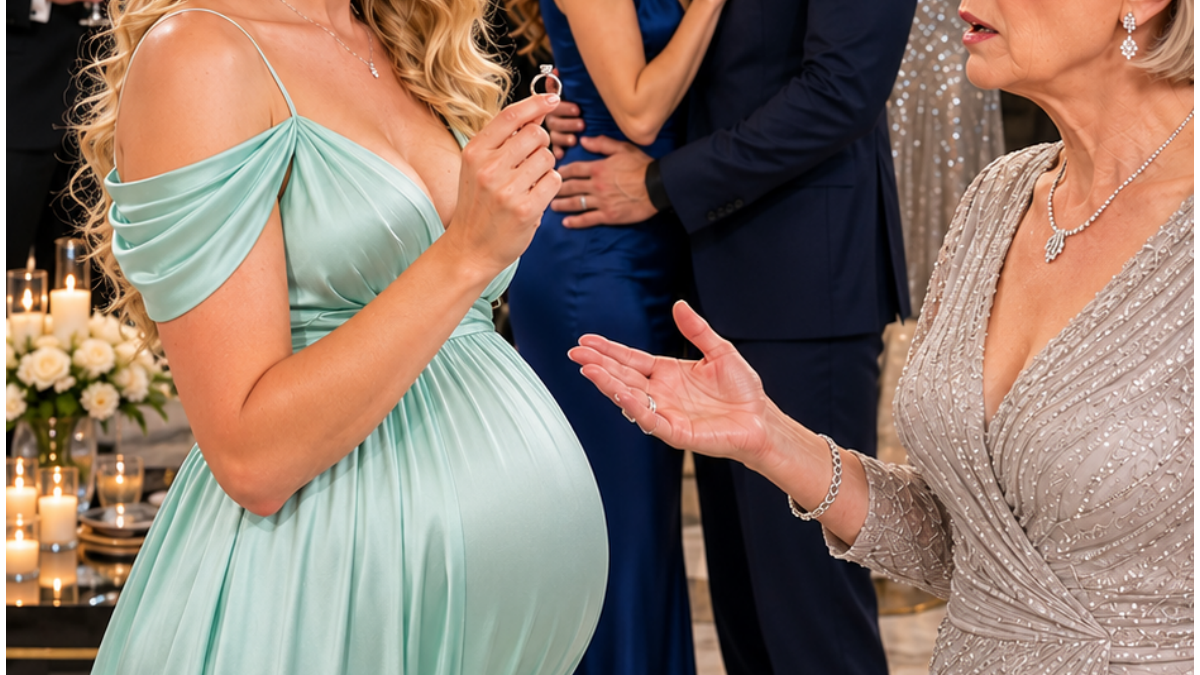

Mason Hartwell thought the cameras at his foundation gala would capture a powerful CEO presenting the future of his company.
Instead, they captured the moment his 35-week pregnant wife stopped protecting his image.
While Mason danced with Camille, the executive with whom he was having an affair, Emily placed her wedding ring in his mother’s hand, walked out, and left him to learn that public relations can shape a headline, but cannot repair a private betrayal.
A polished image can survive almost anything until the person holding it together decides to leave the frame.
The first camera flash exploded across the Hartwell Foundation Ballroom at 9:17 p.m.
Emily Hartwell did not flinch.
35 weeks pregnant, dressed in a pale champagne gown beneath crystal chandeliers, she stood among Manhattan donors, investors, and society reporters with one hand resting beneath the curve of her belly.
28 ft away, her husband was dancing with another woman.
Mason Hartwell looked magnificent.
Black tuxedo, perfect posture, the effortless confidence of a millionaire CEO accustomed to entering rooms that rearrange themselves around him.
His right hand rested on Camille Rhodes’ waist, not politely, possessively.
Camille’s emerald dress moved across the marble as Mason guided her through another turn.
She laughed. Mason leaned closer and the ballroom noticed.
Emily heard the first whisper behind her.
Isn’t his wife right there?
Another voice answered, she’s pregnant.
Flash. A phone rose near the champagne table, then another.
Emily watched Mason smile at Camille.
That smile hurt.
Not because it belonged to another woman, because Emily remembered when it belonged to a different man.
A man with unpaid bills, a rented office, a cheap navy tie.
A man who once held Emily’s hands and promised that if success ever changed him, she should drag him back to himself.
The baby shifted beneath her ribs.
Emily lowered her eyes. “It’s okay, sweetheart.”
She whispered.
She wasn’t sure whether she was speaking to the baby or herself.
Across the dance floor, Camille moved closer.
Mason allowed it.
That was the moment.
No shouting, no shattered champagne glass, no dramatic confrontation.
Something inside Emily’s simply became still.
She looked at her left hand.
The platinum wedding ring Mason had given her after his first million-dollar deal caught the chandelier light.
11 years, one ring, thousands of promises.
Emily touched it with her thumb, then twisted.
Her pregnancy-swollen knuckle resisted.
She pulled again.
The ring slipped free.
A pale indentation remained around her finger.
Emily stared at it for one breath, then she began walking.
Not toward Mason, toward Victoria Hartwell.
Mason’s mother stood beside a marble column.
Silver-blonde hair perfectly arranged. Her expression already changing as she saw Emily approaching.
Emily. Emily took Victoria’s hand, opened her palm, and placed the wedding ring inside.
The tiny metallic click disappeared beneath the orchestra, but Victoria looked down as though every sound in the ballroom had fallen away.
“Emily, what are you doing?” Emily’s blue eyes glistened.
The tears stayed where they were.
“When he asks where I went,” she said quietly, “please don’t answer him.”
Victoria closed her fingers around the ring.
“Wait, let me get Mason.” Emily gently caught her wrist.
“No. Emily, you’re 35 weeks pregnant.”
“I know. You shouldn’t leave like this.”
Emily glanced over her shoulder.
Mason was still dancing, still smiling, still unaware.
For 11 years, Emily had believed love meant staying long enough for someone to remember who they used to be.
Tonight she understood something else.
“Sometimes staying only teaches them that you always will. Don’t interrupt his dance.” Emily whispered.
Then she turned away. Her heels crossed the marble.
Click. Click. Click. A few guests watched her pass.
One lowered his phone. Another stepped aside.
Nobody stopped her. At the enormous ballroom doors, Emily paused with one hand over her unborn child.
Behind her, the orchestra reached its final movement.
Applause rose. Mason Hartwell bowed slightly toward Camille.
Emily did not look back again.
The doors opened. Cool hallway air touched her face.
She stepped through and they closed behind her with a soft, expensive hush.
Mason kept smiling for the cameras.
He had no idea his wife had removed her ring.
No idea she had given it to his mother.
No idea that the woman who had stood beside him before the money had just walked out of his life.
It would take him 27 minutes to notice.
By then, Emily would already be gone.
Four hours earlier, Emily Hartwell had still been looking for a reason to stay.
At 5:11 p.m. She stood before the bedroom mirror in their Manhattan penthouse fastening a diamond earring while the city burned gold beyond the windows.
35 weeks pregnant, her back ached, her ankles were swollen, and Mason had spent most of the afternoon looking at his phone.
“You should sit down.” he said without looking at her.
Emily caught his reflection in the mirror.
That almost sounded concerned. Mason finally glanced up.
He smiled faintly. “I am concerned.” His phone vibrated.
The smile disappeared. Mason turned the screen face down.
Emily noticed. She had become very good at noticing things she was expected to ignore.
Late dinners, locked screens, a new password, Camille Rhodes calling after midnight, perfume on Mason’s jacket after a board meeting.
Each detail was small enough to explain.
Together, they had become a language.
Emily touched her belly as the baby shifted.
“Will you be home tomorrow night?” Mason adjusted his cufflink.
“Why?” “The nursery furniture arrives.” “I’ll try.” Emily looked at him.
“You said that about the ultrasound.” His jaw tightened.
“Emily, not tonight.” There it was.
Not tonight. The sentence Mason used whenever her pain threatened to inconvenience his schedule.
His phone vibrated again. This time, the screen lit before he could turn it away.
Emily saw the message. Camille Rhodes.
Tonight changes everything. Three words.
That was all. Mason grabbed the phone.
Too quickly. Emily’s eyes met his.
“What does that mean?” “Work.” “What changes tonight?” “We’re announcing the expansion.” “Camille usually sends hearts about corporate expansions?” Silence.
Mason looked down. A small red heart sat beneath the message.
He slipped the phone into his jacket.
“You’re reading too much into it.” Emily almost laughed.
For months, every question had received a different version of the same answer.
You’re tired. You’re emotional. You’re pregnant.
You’re imagining things. Tonight, she didn’t argue.
That unsettled Mason more than anger would have.
“You okay?” Emily turned back toward the mirror.
“Perfect.” She opened her champagne-colored clutch.
Inside were lipstick, tissues, her phone, and a cream business card.
Rebecca Shaw Family Law. Emily stared at it.
She had taken the card from a consultation office 2 weeks earlier.
She had not filed anything, had not signed anything, had barely admitted to herself why she went.
The attorney had asked one question, “Are you preparing to leave, Mrs. Hartwell?” Emily had answered honestly, “I’m preparing not to be trapped.” Now she slipped the card beneath her phone.
Mason appeared behind her. For a moment, reflected in the mirror, they still looked like the couple magazine photographers loved.
Successful husband, beautiful pregnant wife, perfect apartment, perfect life.
Photographs were good at hiding distance.
Mason offered his arm. “We should go.” Emily looked at it.
Once she would have taken it without thinking.
Tonight, she hesitated. Then she placed her hand lightly against his sleeve.
The elevator carried them 41 floors downward.
Neither spoke. In the car, Mason answered messages while Emily watched Manhattan pass beyond rain-speckled glass.
Then the Grand Marlowe appeared ahead.
Golden lights, black cars, reporters, camera flashes.
Mason put his phone away.
His public smile returned instantly.
He reached for Emily’s hand.
She let him take it.
For now. They entered the ballroom beneath crystal chandeliers and the warm swell of violins.
Then Emily saw Camille standing beside the stage in an emerald gown.
Camille looked directly at Mason.
Mason looked back. Neither smiled.
They didn’t need to. Emily felt her unborn daughter move beneath her hand.
A moment later, the master of ceremonies stepped toward the microphone.
“Ladies and gentlemen, tonight Mr.
Mason Hartwell has arranged something special.” Applause filled the ballroom.
Emily turned toward her husband, but Mason was already walking toward Camille.
And inside Emily’s clutch, beside the lipstick and tissues, the divorce attorney’s card suddenly felt less like a precaution.
It felt like a door.
The change to the gala program had begun 29 hours earlier in a conference room at Hartwell Capital.
Mason had been reviewing expansion figures when Camille entered with a stack of event materials.
She closed the door with her heel and dropped the revised program on his desk.
“We need a stronger image for tomorrow.” she said.
Mason barely looked up. “Stronger than the foundation announcement.” “Stronger for the press.” Camille tapped the page.
“The opening dance should reinforce the expansion team.” “You and me.
It connects the brand to the people actually driving the next phase.” Mason finally read the line.
Opening dance, Mason Hartwell and Camille Rhodes.
Emily’s name was there. Camille leaned against the desk.
“Emily doesn’t work for the company.” “She’s my wife.” “And everyone already knows that.” Camille softened her voice.
“This is business.” Mason stared at the program.
He knew Emily had reviewed the original schedule.
He knew she had ordered a gown comfortable enough to dance in at 35 weeks.
He also knew that changing the program would hurt her.
That awareness lasted several seconds.
Then his phone rang with a lender on hold.
Inconvenience won. “Fine.” he said.
“Just don’t turn it into gossip.” Camille smiled.
“Leave the optics to me.” That sentence mattered later because it destroyed the version of events Mason would desperately want to believe.
Camille did direct the photographers and push for the new framing.
She encouraged the press team to center the two of them beneath the Hartwell logo.
But Mason had approved the substitution before any camera arrived.
Nobody forged his consent. Nobody pushed him onto the dance floor.
The betrayal had not happened because Camille was unusually clever.
It happened because Mason had grown accustomed to treating Emily’s feelings as a cost someone else could absorb.
That same afternoon, Emily had been at a prenatal appointment alone.
The baby was healthy. The doctor asked whether she had support at home.
The kind of routine question Emily had answered automatically for months.
Yes, she said. Then she heard herself.
The doctor looked up from the chart.
You sure? Emily smiled. I have people.
It was not quite the same answer.
Afterwards, she sat in her car in the parking garage and called Rebecca Shaw, the family law attorney whose card she had carried for 2 weeks.
I’m not ready to file anything, Emily said.
You don’t have to. I just want to know what I should have copies of if I decide separately.
Rebecca gave her a practical list and warned her not to hide assets, destroy records, or make decisions based on online advice.
You are allowed to prepare without turning this into a war, she said.
Emily wrote everything down. She arranged the furnished townhouse through her own savings and income from consulting work she had quietly restarted.
She transferred no joint funds without documentation.
She packed only personal necessities, prenatal records, family six, and clothes she would need immediately.
She did not prepare because she knew Mason would dance with Camille.
She prepared because months of uncertainty had taught her that dependence made every decision feel impossible.
On the morning of the gala, Emily found the original program in her email.
Her name was still on the dance.
She almost took that as evidence she had been wrong about Mason.
That tiny relief made the revised program in the ballroom feel crueler.
When she later learned it had been changed the day before with Mason’s approval, the betrayal would no longer be about one woman in an emerald dress.
It would be about a husband who had been given a moment to choose and chosen what was easier.
Before Mason Hartwell learned how to make millions, he had learned how to make Emily believe in impossible things.
11 years earlier, there had been no Manhattan penthouse, no private driver, no Hartwell Foundation gala, no reporters waiting for Mason outside restaurants.
There was only a cramped office above a dry cleaner in Queens, a second-hand desk, two folding chairs, and a young real estate developer with more debt than clients.
Emily remembered those days differently than Mason did.
He remembered the hunger. She remembered the fear.
Mason would come home after midnight carrying property maps beneath his arm, talking about buildings he did not own and investors who would not return his calls.
Emily listened anyway. She was 22, working in marketing, earning just enough to cover rent when Mason could not.
At night, she helped rewrite his proposals.
She corrected presentations. She turned Mason’s aggressive sales language into something investors could truSt. Once, after his third rejection in a week, Mason sat on their kitchen floor and stared at an overdue electricity bill.
“Maybe everyone is right,” he said.
Emily sat beside him. “About what?” “That I’m pretending to be someone I’m not.” She took the bill from his hand.
“No, you’re becoming someone you haven’t met yet.” Mason looked at her for a long time.
Then he kissed her. Years later, magazines would call Mason Hartwell self-made.
Emily never corrected them. She did not need credit.
She thought love remembered its debts.
Then came the first major development contract, then another.
Hartwell Capital moved from Queens to Midtown.
The folding chairs became a glass conference room.
The cheap suits became custom Italian tailoring.
And after Mason closed his first million-dollar deal, he took Emily to dinner at a small restaurant where they had celebrated their engagement.
He placed a velvet box on the table.
Inside was a platinum ring.
Emily stared at him. “We’re already married.” “I know.” Mason smiled.
“The first one was what I could afford.” He took her hand.
“This one is what you deserve.” Emily’s eyes filled.
Mason slid the ring onto her finger.
“Whatever happens,” he whispered, “this will always remind me who stayed.
Who stayed? For years, Emily treated those words like a vow.
When Mason missed dinners, she stayed.
When business trips became longer, she stayed.
When conversations became shorter, she stayed.
When Camille Rhodes’ name began appearing on his phone at hours no PR director needed to call, Emily stayed.
Not because she was weak, because somewhere beneath the tailored suits and guarded passwords, she kept searching for the man who had once sat beside her on a kitchen floor.
That was the part Mason never understood.
Emily had never fallen in love with the millionaire.
She had fallen in love with the man who was afraid he might fail.
And she had spent years waiting for him to return.
Back at the Heartwell Foundation gala, applause rolled through the ballroom.
Emily stood beneath the chandeliers as Mason approached the stage.
Camille waited nearby in emerald silk.
Mason took the microphone. “11 years ago, Heartwell Capital was little more than an idea.
Emily’s breath caught. For one dangerous second, hope returned.
Maybe he remembered. Maybe tonight changes everything meant something else.
Mason smiled toward the crowd.
Success depends on having someone beside you who understands where you’re going before everyone else does.” Emily’s eyes softened.
Then Mason turned away from her.
His gaze settled on Camille.
“And tonight, I want to recognize the woman who has become indispensable to the future of this company.
Camille smiled. The room erupted in applause.
Emily slowly looked down at the platinum ring on her finger.
“Whatever happens, this will always remind me who stayed.” 11 years later, Mason remembered the success.
He remembered the millions. He remembered the future.
He had simply forgotten the woman who stayed long enough to help him reach it.
Emily Heartwell could have survived a spontaneous betrayal.
What she could not forgive was discovering that hers had been scheduled.
Applause followed Camille Rhodes toward the stage.
Emily remained beside the champagne tables, one hand resting beneath her belly as Camille crossed the marble floor in emerald silk and accepted Mason’s extended hand.
“Come on up,” Mason said.
Camille smiled like she had rehearsed it.
That detail bothered Emily. Then she noticed the program card on the table beside her.
Hartwell Foundation Annual Gala. She had seen an earlier version that morning.
Opening remarks. Foundation announcement. Recognition ceremony.
Opening dance. Mason and Emily Hartwell.
Emily picked up the card.
Her breath stopped. The final line had changed.
Opening dance. Mason Hartwell and Camille Rhodes.
She read it again, slowly.
A waiter passed. Emily caught his attention.
“Excuse me, when were these programs printed?” The young man hesitated.
“Yesterday, ma’am.” “Yesterday? Not 10 minutes ago?
Not because someone improvised? Yesterday.” Emily looked toward the stage.
Mason knew. He had known before asking her which dress photographed better, before offering his arm for the cameras, before holding her hand outside while reporters called them a perfect couple.
The orchestra began, a slow waltz.
Mason stepped down from the stage.
Camille followed. The crowd opened around them.
Emily heard a woman whisper nearby, “I thought his wife was supposed to do this.” Another answered, “So did I.” Mason placed his hand on Camille’s waiSt. Flash.
Camille rested one hand against his shoulder.
Flash. Their bodies moved easily together, too easily.
This was not their first dance.
Emily felt something tighten beneath her ribs.
Her daughter shifted. She inhaled carefully.
Across the room, Victoria Hartwell was no longer watching her son.
She was watching Emily. Their eyes met.
Victoria glanced toward the program in Emily’s hand, then toward Mason.
Understanding reached her face. Emily looked down again.
Opening dance, Mason Hartwell and Camille Rhodes.
A public substitution. That was what hurt.
For months, Mason had insisted Camille was only an employee.
A brilliant strategiSt. A trusted executive.
Nothing more. Emily had been expected to doubt her own instincts privately.
Tonight, Mason had taken the private lie and placed it beneath chandeliers.
Camille leaned toward him. “You’re tense.” she murmured.
Mason’s hand tightened around hers.
“Too many cameras.” Camille smiled.
“That’s the point.” Emily could not hear those words, but she saw the smile.
And she saw something else.
Near the edge of the dance floor, two Hartwell Capital PR employees were quietly directing photographers toward Mason and Camille.
“Closer to the center.” one whispered.
Emily recognized him. Nathan Cole.
Camille’s junior communications manager. He pointed toward the couple.
“Get the turn.” A photographer repositioned.
Flash. Emily’s stomach dropped. This was not merely tolerated.
It was being documented. Curated.
Sold as an image. Her husband and his mistress framed beneath the Hartwell name, while his pregnant wife stood outside the shot.
Emily folded the program once.
Carefully. No shaking hands. No tears.
For months, she had wondered whether she was being unfair.
Whether pregnancy had made her suspicious.
Whether Mason was simply overwhelmed.
That uncertainty disappeared. The truth had finally become generous enough to introduce itself.
Mason turned Camille beneath his arm.
Applause rose. Emily watched the man she had helped build become someone she no longer recognized.
Then Mason looked across the ballroom.
For half a second, his eyes found hers.
Emily waited for embarrassment. Regret.
Anything. Instead, Mason gave her a tiny reassuring nod.
As if asking her to cooperate.
As if saying, “Don’t make this difficult.” Emily almost smiled because Mason still believed the greatest danger in that ballroom was his wife making a scene.
He had misunderstood her completely.
Emily placed the folded program beside her untouched glass.
Then her fingers moved toward the platinum ring on her left hand.
She did not intend to ruin Mason’s evening.
She intended to let him finish it without her.
It took Mason Hartwell 27 minutes to notice that his wife had disappeared.
27 minutes. Long enough for the orchestra to finish the waltz.
Long enough for Camille to accept congratulations from investors.
Long enough for Mason to pose for photographs beneath the Hartwell Foundation logo while the woman carrying his daughter was already crossing Manhattan without him.
The question came from an elderly donor.
“Mason, where’s Emily?” He turned automatically.
She’s right. The words stopped.
The place near the champagne tables was empty.
Mason scanned the ballroom. No champagne-colored gown.
No blond hair. No Emily.
His expression tightened. He checked his phone.
No message. He called. Voicemail.
Again. Voicemail. “Excuse me.” Mason left the donor and moved quickly toward his assistant.
“Daniel, have you seen Emily?” Daniel hesitated.
“I saw Mrs. Hartwell heading toward the lobby.” “When?” “Maybe 25 minutes ago.” Mason stared at him.
“And nobody stopped her?” Daniel looked confused.
“Sir, she didn’t appear to want to be stopped.” Something cold moved through Mason’s cheSt. He turned.
Then he saw his mother.
Victoria stood beside a marble column watching him approach.
Her face told him nothing.
“Mom, where’s Emily?” Victoria remained silent.
“Did she go home?” Nothing.
“Is she sick?” Victoria slowly opened her hand.
The ballroom seemed to disappear.
A platinum wedding ring rested in her palm.
Mason stared at it. For several seconds, he did not understand what he was seeing.
Then he recognized the tiny engraving along the inside edge.
M + E. His throat tightened.
“Why do you have that?” Victoria’s eyes hardened.
“Emily gave it to me when while you were dancing.” Mason looked toward Camille, then back at the ring.
“What did she say?” Victoria closed her fingers.
“Does it matter now?” “Mom.” His voice sharpened.
“What did Emily say?” Victoria stepped closer.
“She said when you finally asked where she went, I wasn’t supposed to tell you.” Mason’s face changed.
Disbelief first, then irritation, then something dangerously close to fear.
“She’s upset.” Victoria stared at him.
“Your 35-week pregnant wife watched you publicly replace her in a dance that had her name on the original program.” “It wasn’t like that.” “Then tell me what it was like.” Mason opened his mouth.
Nothing came. Across the ballroom, Camille was watching.
So were several guests. Mason lowered his voice.
“I need to find my wife.” Victoria placed the ring into his hand.
“You finally looked for her after she stopped looking for you.” The platinum felt cold against his skin.
Mason called Emily again. Voicemail.
He typed quickly. “Where are you?” Then, “Emily, answer me.” Then, “We need to talk.” Three dots never appeared.
Mason pushed through the ballroom.
“Mason.” Camille followed. “Where are you going?” He ignored her.
Outside, Manhattan rain had begun falling against the hotel awning.
Mason approached the valet. “My wife, blonde, pregnant, champagne dress.
Did you see her leave?” The young man nodded.
“Yes, sir. She got into a ride share about 20 minutes ago.” “Was she alone?” “Yes.” Mason looked toward the avenue.
Red tail lights disappeared through the rain.
He climbed into his waiting car.
“Home. Now.” The driver pulled away.
Mason sat in the back seat with Emily’s ring closed inside his fiSt. For years, every crisis in his life had come with numbers, a price, a deadline, a negotiation.
This one had only silence.
He looked at the messages he had sent, unread.
For the first time that night, Mason stopped thinking about the gala, the photographers, the investors, Camille.
He remembered Emily standing beside him before they left home.
Quiet, too quiet. Then he remembered something else.
The hesitation before she took his arm.
Mason looked down at the ring.
A terrible possibility entered his mind.
Emily had not left to make him chase her.
She had left because she no longer cared whether he did.
And as the car raced toward the penthouse, Mason Hartwell finally understood that being 27 minutes late could cost far more than time.
The first thing Mason noticed when he entered the penthouse was not what Emily had taken.
It was what she had left behind.
The lights were off. Manhattan glittered beyond the windows, cold and distant, while Mason stepped inside with Emily’s wedding ring still pressed into his palm.
Emily? Silence. He switched on the hallway lights.
Emily? Nothing. He moved toward the bedroom.
The closet doors were open.
Mason stopped. Emily’s side was not empty.
Her evening dresses remained. Designer handbags lined the shelves.
Jewelry boxes sat untouched. The diamond bracelet he had bought after missing their 10th anniversary was exactly where she had left it.
But the practical things were gone.
Maternity clothes, flat shoes, her laptop, the prenatal bag that had waited beside their bedroom door for weeks.
Mason crossed toward the bathroom.
Her medications were missing. So were the folders containing her medical records.
His breathing changed. This was not a woman storming out after an argument.
Emily had packed for tomorrow, and the day after that, and the day after that.
He called her. Voicemail. Emily, call me.
He hung up, called again, nothing.
Then his phone rang, unknown number.
Mason answered immediately. “Emily?” A woman’s voice responded, “Mr.
Hartwell?” His hope vanished. “Yes.” “My name is Rebecca Shaw.
I represent Emily Hartwell.” Mason went still.
“Represent her for what?” A pause.
“Mrs. Hartwell has authorized me to notify you that she will be residing separately from you effective tonight.” Mason stared into the dark bedroom.
“She hired a lawyer?” “I’m not able to discuss privileged communications.” “Where is she?” “She is safe.” “That wasn’t my question.” “It is the only answer I’m authorized to give.” Mason’s jaw tightened.
“She’s 35 weeks pregnant.” “I’m aware.
I’m her husband.” “And she has requested space.” Mason paced toward the windows.
“This happened an hour ago.” Rebecca was silent.
Something about that silence bothered him.
“When did she hire you?” “I can’t answer that.” Mason stopped.
“Was it before tonight?” Another pause.
That was enough. He ended the call.
His eyes moved around the room differently now.
The missing medical files, the prenatal bag, the clothes selected carefully enough that he had not noticed them disappearing.
Emily had been preparing. Mason opened the drawer beside her bed.
Inside sat a receipt from a storage company dated 12 days earlier.
His stomach tightened. He searched again, nothing.
Then he noticed a spare key envelope from a residential leasing office.
The address had been torn away, but the date remained, two weeks ago.
Mason sat on the edge of the bed.
For months, he had believed Emily’s silence meant she had stopped questioning him.
Now he understood. She had stopped warning him.
His phone buzzed. “Camille, are you okay?” Another message followed.
“Maybe we should talk about what happens next.” Mason stared at the screen.
“What happens next?” Hours earlier, those words might have sounded like possibility.
Now they sounded obscene. He looked toward Emily’s jewelry cabinet.
Thousands of dollars in diamonds remained untouched.
Then he noticed the small wooden box on the dresser was gone.
Mason knew exactly what had been inside.
Old letters, movie tickets, photographs from Queens, the first handwritten business plan he had given Emily when Hartwell Capital was still a fantasy.
She had left the diamonds.
She had taken the memories.
Mason slowly opened his fiSt. The platinum ring rested against his skin.
For the first time, he understood what Emily had actually removed from that penthouse.
Not her possessions, her future.
Somewhere across Manhattan, Emily entered a modest furnished apartment and locked the door behind her.
Her prenatal bag waited beside the sofa.
A bassinet stood near the bedroom wall.
She placed both hands over her daughter and finally allowed one tear to fall.
She had not known for certain that she would leave tonight.
She had only made sure she could.
And back in the penthouse, surrounded by everything money had bought them, Mason Hartwell realized his wife had prepared an entire life he knew nothing about.
The gala had not made her leave.
It had only given her permission to stop waiting.
By 7:00 for the next morning, Camille Rhodes believed Emily’s departure had cleared the path she wanted.
She had mistaken absence for consent.
Camille stood in her apartment wearing a silk robe, coffee untouched beside her, scrolling through the first video from the Hartwell Foundation gala.
36 seconds. That was all it took.
Mason dancing with Camille. Emily watching.
Emily removing her wedding ring.
Emily placing it into Victoria Hartwell’s hand.
Then walking away. The video ended before Mason even noticed.
Camille refreshed the page. 800,000 views.
Refresh. 900,000. The comments multiplied faster than Hartwell Capital’s communications team could respond.
She didn’t make a scene.
She made a decision. He kept dancing.
His mother’s face says everything.
Camille locked her phone. This could still work.
By 8:30, she was inside Mason’s penthouse.
He stood near the windows in yesterday’s shirt looking as though he had not slept.
Emily’s ring rested on the kitchen counter.
Camille saw it. Something close to satisfaction flickered across her face.
She hit it quickly. Mason.
He did not turn. We need to get ahead of this.
Get ahead of what? The narrative.
Mason looked at her. My wife left me last night and now millions of people are deciding why.
His eyes hardened. They watched why.
Camille paused then recovered. We issue a statement.
Say you and Emily had been privately separated for months.
Say the dance was professional.
Mason stared at her. We weren’t separated.
Nobody knows that. I do.
Camille exhaled. This is exactly why you need me.
Mason almost laughed. His phone rang.
Daniel Price, Hartwell Capital’s general counsel.
Mason answered. Daniel skipped the greeting.
We have a problem. I’m aware.
No, you’re aware of the video.
I’m talking about the company.
Mason straightened. Three sponsors have requested calls.
Halpern Financial paused the development announcement.
The foundation board wants an explanation before noon.
It was a dance. Then you should have danced with the woman listed on the original program.
Mason went silent. Daniel continued.
And there’s something else. What?
Our internal events team says the photography positions were changed yesterday.
Mason looked at Camille. She stopped moving.
Changed by whom? We’re reviewing the emails.
The call ended. Silence filled the penthouse.
Camille reached for her coffee.
Her hand was not quite steady.
Mason noticed. What did you change?
Nothing important. Camille. She put the cup down.
I want a good coverage.
For the foundation? For us.
Mason’s face emptied. Camille stepped closer.
Stop pretending last night changed what we are.
What are we? The question caught her off guard.
She softened her voice. We don’t have to hide anymore.
Mason looked around the penthouse.
Emily’s books, Emily’s photographs, the nursery door half open down the hall.
Then he looked at Camille.
For months, secrecy had made their relationship feel separate from consequences.
In daylight, standing inside the home Emily had abandoned, Camille no longer looked like escape.
She looked like evidence. His phone buzzed.
A message from Victoria. Do not ask me where Emily is.
Another followed. And do not let your PR team turn her pain into your excuse.
Camille crossed her arMs. She’s making you feel guilty.
Mason lifted his eyes. Who?
Emily. The silent exit, the ring, all of it.
She knew people would talk.
Mason stared at her. Camille continued.
She wanted sympathy. Something changed in his expression.
My wife walked out carrying our daughter.
Mason, and you’re calling it strategy?
Camille’s mouth closed. Outside, Manhattan woke beneath a gray sky.
Inside Hartwell Capital, phones were already ringing.
Sponsors wanted answers. Board members wanted records.
Reporters wanted statements. And online, Emily’s silent exit was spreading farther than any publicity campaign Camille could have designed.
Emily herself had posted nothing.
No accusation. No interview. No revenge.
She was sitting in a quiet apartment across the city, eating toast beside a packed prenatal bag while her daughter moved beneath her hand.
Camille had spent months believing Emily’s silence meant weakness.
By sunrise, millions of strangers understood what Camille still did not.
Sometimes the woman who says nothing has already said everything.
The board meeting 3 days after the gala was less dramatic than the internet wanted and more serious than Mason expected.
No one shouted. No one demanded his resignation on the spot.
The outside compliance attorney placed a timeline on the screen.
Revised program approved by Mason.
Photographer positions changed at Camille’s requeSt. Two junior communications employees instructed to keep Emily outside the principal frame.
Foundation resources used to support a publicity plan that had never been formally disclosed as personal.
Mason read the final line twice.
The board chair, Helen Park, folded her hands.
Your affair is not something this board intends to litigate.
Mason’s face tightened. What concerns us, Helen continued, is the use of company staff and foundation branding to stage an image connected to that relationship.
I didn’t approve the photography instructions.
No, you approved the dance change.
Mason looked toward Daniel Price, general counsel.
Daniel did not rescue him.
Camille was placed on administrative leave while the review continued.
The company later negotiated her departure after determining that internal communications procedures had been bypassed.
Mason was required to step away temporarily from public foundation events, complete conflict of interest and executive conduct training, and accept a new approval structure for communications involving senior executives.
None of it erased his fortune.
None of it turned Hartwell Capital into Rebel.
That was precisely why the consequences felt real.
Businesses did not always explode because a CEO behaved badly.
Sometimes they tightened controls, documented failures, and reduced the freedom of the person who had assumed his judgment was beyond review.
Mason hated the restrictions for 48 hours.
On the third day, he stopped arguing.
He met Victoria for lunch at her townhouse.
Emily’s ring remained in the velvet box on a shelf behind her.
You look angry, Victoria said.
I’m being treated like I used the company to conduct an affair.
Did company employees reposition photographers for you and Camille?
For the event. Victoria held his gaze.
Mason looked away. Yes. Then perhaps the problem is that the sentence sounds bad because the choice was bad.
He almost smiled despite himself.
You’ve become very unsympathetic. No, Victoria’s voice softened.
I became sympathetic to the person I should have listened to earlier.
She told him then about Emily’s visit two months before the gala.
Emily had asked whether patients had a limit.
Victoria had advised her to wait to avoid accusations without proof, to remember that Mason carried enormous pressure.
I thought I was defending marriage, Victoria said.
I may have been defending your comfort.
Mason stared at the table.
Do you know what I regret most?
She asked. Not that Emily left.
I regret that she had to watch you make her instincts undeniable before I stopped telling her to doubt them.
Mason rubbed his palm remembering the ring.
I want to apologize to her.
You have. I want to do it better.
Victoria shook her head. Then stop measuring the apology by whether she changes her answer.
That became the hardest discipline of Mason’s adult life.
He stopped sending flowers. He stopped forwarding long messages through Rebecca.
He stopped asking Victoria for Emily’s address.
His attorney sent prenatal questions through the channel Emily had approved.
Mason answered every financial disclosure request on time.
When he disagreed with a proposed term, he disagreed through counsel instead of interpreting the disagreement as proof Emily was punishing him.
One night, he drafted a four-page letter explaining everything.
How lonely he had been, how work blurred into admiration, how Camille made him feel understood, how none of it meant he had stopped loving Emily.
He read it twice. Then he deleted it.
Every paragraph explained him. None repaired what Emily had lived through.
The next morning, he wrote four lines instead.
I lied to you. I minimized what you saw.
I approved a public choice that humiliated you.
I am sorry. I will respect the boundaries you set.
Rebecca forwarded it. Emily did not respond.
For the first time, Mason let silence remain silence.
Mason Hartwell expected divorce to arrive as a financial demand.
He had lawyers, valuations, and contingency plans ready because numbers were the one language in which he still felt powerful.
What he was not prepared for was Emily asking for almost nothing beyond what was fair.
Four days after the gala, Mason sat inside a conference room overlooking Midtown while his attorney, Charles Bennett, placed a preliminary separation proposal before him.
Mason barely touched it. How much?
Charles looked up. How much what?
How much does she want?
Read it. Mason opened the document.
Financial disclosure. Equitable division of marital property.
Medical privacy through the remainder of Emily’s pregnancy.
Reasonable child support. A parenting arrangement to be finalized after their daughter’s birth.
All non-emergency communication through counsel for the time being.
Mason turned the page. Then another.
That’s it. That’s what she requested.
What about Hartwell Capital? She isn’t demanding operational control.
The penthouse. She wants her legal share handled through normal settlement discussions.
Spousal support. Nothing extraordinary. Mason leaned back.
His confusion slowly became irritation.
She’s entitled to more. Charles nodded.
Potentially. Then why isn’t she asking for it?
Charles studied him. Maybe this isn’t about money.
Mason looked toward the windows.
For years, money had been the answer he trusted moSt. Missed dinner?
Flowers. Forgotten weekend? Jewelry. Canceled vacation?
Paris the following month. When Emily told him she felt alone during pregnancy, Mason hired a private prenatal nurse.
He had solved emotional absence with invoices.
And because Emily rarely complained twice, he had assumed the solutions worked.
Now she was refusing the language he understood.
Mason returned to the penthouse that afternoon.
The silence had become unbearable.
He entered their bedroom and opened Emily’s jewelry cabinet.
Everything expensive remained. Diamond earrings, a sapphire necklace, two designer watches, the bracelet he had bought after missing their anniversary, nearly $200,000 in gifts.
Untouched. Then Mason noticed an empty space on the bookshelf.
A small wooden box had always sat there.
He knew what Emily kept inside.
He found an old photograph in a drawer and suddenly remembered.
The box contained letters. His letters.
Notes written before Hartwell Capital had an office worth photographing.
Movie stubs from cheap theaters in Queens.
A receipt from the restaurant where he proposed.
A photocopy of his first rejected development proposal with Emily’s handwriting across the margins.
He had once joked that the entire box was worth $20.
Emily had answered, “Then it’s the most valuable $20 we own.” Mason sat on the edge of the bed.
She had left the diamonds, taken the paper.
His phone vibrated. Camille, “Dinner tonight?” He stared at the message.
No answer. Instead, Mason opened an old desk drawer.
At the bottom lay another envelope.
Emily’s handwriting. For Mason. First closing.
He opened it. Inside was a photograph from 11 years earlier.
Mason stood outside a tiny Queens office holding his first signed contract.
Emily was beside him, laughing.
On the back she had written, “I knew you could do it before you did.” Mason’s thumb moved over the faded ink.
Something inside him finally gave way.
Not because Emily wanted his money, because she didn’t.
If she had demanded millions, Mason could have called her angry, greedy, vindictive.
He could have turned the ending into a negotiation.
But Emily had taken away that excuse.
Across the city, she sat at a small kitchen table reviewing the same settlement terms with Rebecca Shaw.
Rebecca looked at her. “You understand you don’t have to make this easy for him.” Emily rested a hand over her daughter.
“I’m not making it easy.” “Then what are you doing?” Emily looked toward the apartment window.
“Making it clean.” Back at the penthouse, Mason closed the jewelry cabinet.
For the first time, he understood that Emily had never stayed because of what he could buy, which meant the most frightening truth was also the simpleSt. Money had not kept her, and money could not bring her back.
Victoria Hartwell had spent most of her life believing that a marriage should be protected from outsiders.
Now she wondered how many women have been hurt by that advice.
Five days after the gala, Mason arrived at his mother’s Upper East Side townhouse without calling.
Victoria opened the door and immediately saw the question on his face.
“Where is Emily?” No greeting, no apology, just desperation.
Victoria stepped aside. “You look terrible.” “I haven’t slept.” “That is not the tragedy you think it is.” Mason followed her into the sitting room.
Afternoon light fell across framed family photographs.
Mason graduating from Columbia, Mason and Emily laughing on a beach, their wedding day.
Victoria stopped beside the fireplace.
On the table sat a small velvet box.
Mason recognized it. His expression tightened.
“You still have the ring.” Victoria opened the box.
Platinum caught the light. “She gave it to me.” “I’m keeping it until she decides what should happen to it.” Mason sat down.
“I need her address.” “No, I’m not asking permission.” Victoria looked at him.
“Then you came to the wrong house.” “She’s carrying my daughter.” “And And has not prevented you from receiving necessary medical information.
I need to see her.
You want to see her.
Mason looked away. The distinction irritated him because it was true.
Victoria sat opposite him. Two months ago, Emily came here.
Mason’s eyes snapped back. Why?
She wanted advice. About what?
Victoria hesitated, then quietly said, “You.” The room became still.
She asked me how long a woman should fight for a marriage when she’s the only person fighting.
Mason stared at her. “What did you say?” Victoria’s face tightened with regret.
I told her marriage goes through seasons.
I told her pregnancy makes everything feel heavier.
I told her you were under pressure.
Each sentence sounded worse aloud.
I told her to be patient.
Mason lowered his eyes. Victoria continued.
She asked whether I thought Camille was more than an employee.
“What did you tell her?” I told her not to accuse her husband without proof.
Mason closed his eyes. And then, Victoria whispered, “You gave her proof under a chandelier.” Silence.
A clock ticked near the window.
Mason rubbed his hands together.
“She should have confronted me.” Victoria’s expression hardened.
“She did.” “No, she didn’t.” “She asked why you came home late.” Mason said nothing.
“She asked why Camille called after midnight.” “Nothing.” “She asked you to attend the ultrasound.” His jaw tightened.
“She asked you to come home for dinner.” Victoria leaned forward.
“You kept waiting for Emily to scream loudly enough for you to call it a warning.” Mason looked toward the wedding photograph.
“She didn’t leave because Camille danced with you.” Victoria said.
His eyes returned to her.
“She left because you let her understand she could be replaced.” The words landed without mercy.
Mason stood and walked toward the window.
“I made mistakes.” “No.” Victoria’s voice remained calm.
“You made choices.” “Calling them mistakes makes them sound accidental.” He turned.
For once, Mason had no answer.
Victoria picked up the velvet box.
“When Emily handed me this ring, do you know what frightened me?” Mason shook his head.
“She wasn’t angry.” Victoria closed the lid.
She was finished. Mason swallowed.
“Does she hate me?” Victoria studied her son.
“I don’t think so.” Something like relief crossed his face.
It vanished when she continued.
“Hate would mean she was still spending energy on you.” Mason looked down.
Victoria’s voice softened. “You keep asking me where Emily is because you think reaching her is the same as repairing what you did.” She placed the velvet box back on the table.
“It isn’t.” At the doorway, Mason stopped.
“What am I supposed to do?” Victoria looked at the man her son had become.
For once, she paused. “Become better without demanding a reward for it.” Mason left without Emily’s address.
The ring stayed behind. And as the townhouse door closed, he finally understood something money, power, and apologies had never taught him.
Sometimes respecting the woman you hurt begins with accepting that she has every right not to come back.
Emily’s rebuilding did not happen in a single triumphant montage.
The first month was exhausting.
Her daughter pressed against her ribs at night.
Her ankles swelled by afternoon.
She missed the familiar shape of the penthouse even while knowing she did not miss what happened inside it.
She also missed Mason in inconvenient, honest flashes.
The way he made coffee too strong, the ridiculous voice he used when reading restaurant menus, the young man who once carried her through a Queens rainstorm because her shoe broke.
Missing those things did not make leaving a mistake.
It made 11 years real.
She resumed consulting from the townhouse dining table.
Her first client was a neighborhood nonprofit planning a fundraising campaign.
The budget was tiny compared with Hartwell Capital’s and Emily loved it.
Nobody introduced her as Mason Hartwell’s wife.
Nobody asked whether she could get a celebrity donor on the phone.
They asked what she thought.
At the second meeting, the executive director, Marisol Vega, studied Emily’s proposal and said, “You make complicated things sound human.” Emily laughed softly.
“I used to tell someone that was my job.
Still is.” That night, Emily opened the wooden memory box she had taken from the penthouse.
She found Mason’s first rejected proposal covered in her handwriting.
For years, it had symbolized everything they built together.
Now she saw something else, evidence that her talent had existed before his company and survived after the marriage.
She did not throw the papers away.
Leaving did not require pretending the past had been worthless.
Months later, after Sophie’s birth and after both sides had exchanged financial information, the divorce moved toward resolution through negotiation rather than a fantasy courtroom ambush.
Emily did not waive rights simply to prove she was independent.
Her lawyer told her that refusing what was fairly hers could be another form of letting Mason’s money control the story.
Emily listened. Property accumulated during the marriage was addressed through counsel.
Support for Sophie was calculated through the proper process.
Parenting time was built gradually around the baby’s routines and the parents’ ability to cooperate.
Neither parent got everything exactly as imagined.
Both got structure. The final agreement contained no clause requiring forgiveness.
On the afternoon Emily signed, she sat alone in Rebecca’s office for a minute after everyone else left.
The city was bright beyond the windows.
“You okay?” Rebecca asked from the doorway.
Emily looked at the signature.
“I thought this would feel like winning.” Rebecca leaned against the frame.
“Does it?” “No.” Emily considered it.
“It feels quiet.” “Quiet can be good.” Emily smiled.
“I’m learning that.” She took Sophie home, warmed a bottle, answered one work email, and fell asleep on the sofa with the baby monitor beside her.
Nothing about the evening would have interested the society reporters who filmed the gala.
That was the point. Mason remained part of Sophie’s life.
He was not part of Emily’s marriage because there was no marriage left to return to.
Left his life forever did not mean she vanished from every room he might enter.
It meant she permanently left the position he had taken for granted, wife, defender, translator, keeper of his history, and person expected to absorb the cost of his ambition.
Co-parenting required contact. Reconciliation did not.
By Sophie’s first birthday, Mason understood the difference.
He could become more reliable.
He could become more humble.
He could become a father his daughter trusted.
None of those achievements created a debt Emily had to repay with another chance.
That truth made his growth less romantic and more genuine.
He changed because the child in his arms deserved better.
And because the man in the mirror finally did, too.
Camille spent months imagining that Emily’s presence was what made her relationship with Mason complicated.
Six days after the gala, she confronted a harsher truth.
Secrecy had hidden flaws that daylight could not.
At 10:08 a.m., Camille entered Mason’s office without knocking.
He stood behind his desk reading a printed report from Hartwell Capital’s internal review.
“You’ve ignored nine calls.” Mason did not look up.
“I counted seven.” “So, you were counting.” He turned another page.
Camille shut the door. “What is going on?” Mason placed the report on the desk.
“You tell me.” Camille’s eyes dropped to the first page.
Her name appeared beneath a list of emails.
Nathan Cole, event photography, media positioning, revised gala program.
Her face changed. “Mason, you changed the photographer positions.
I approved them.” “You used company PR staff to do it.
It was a company event.
Mason looked at her. You told Nathan to make sure you and I were photographed together.
Camille crossed her arMs. Because the foundation needed coverage.
Then why does your email say, “Keep Emily outside the primary frame?” Silence.
Mason pushed the report toward her.
Camille did not touch it.
You knew what this was.
I knew what we were.
What were we? Her eyes hardened.
Don’t do that. Answer me.
Camille stepped closer. You came to my apartment.
You called me after midnight.
You told me your marriage was dead.
Mason looked away. You said Emily stayed because she liked the life you gave her.
His jaw tightened. Camille laughed bitterly.
And now that she walked away from the diamonds, you suddenly remember she loved you?
That doesn’t excuse what you did.
No, Camille’s voice sharpened. But neither does it excuse you.
That landed. Mason slowly looked at her.
Camille pointed toward the report.
I moved photographers. I changed the program.
I accelerated something you were already allowing.
You humiliated my wife. We humiliated your wife.
The room went silent. No excuse survived that sentence.
Mason had wanted Camille to become the villain because villains were convenient.
If she had manipulated everything, then perhaps he could imagine himself manipulated, too.
But Camille had not forced him onto the dance floor.
She had not forced him to lie.
She had not made him miss the ultrasound.
She had not taught Emily to stop trusting him.
His desk phone rang. Daniel Price.
Mason answered. “The board concluded its preliminary review,” Daniel said.
“And?” “Camille is suspended effective immediately pending a formal employment review.
Her access to internal systems will be disabled today.” Camille’s face drained.
“You can’t be serious.” Daniel heard her.
“The board is unanimous.” The line disconnected.
Camille stared at Mason. “Fix this.” Once, he would have.
A quiet call. A favor.
A rewritten explanation. Instead, Mason remained still.
No, her expression cracked. I protected you.
You protected what you wanted.
And you didn’t? Mason said nothing.
Camille grabbed her purse. At the door, she turned.
You want to know the worst part?
He looked at her. I thought getting rid of Emily would make you choose me.
A sad smile crossed her face.
But she left and somehow she’s still the only woman in this room.
The door slammed. Mason stood alone.
No wife, no mistress, no comforting version of himself, only consequences.
His phone vibrated. A message from Rebecca Shaw.
Mr. Hartwell, Emily experienced premature contractions this morning and has been admitted for observation.
She and the baby are currently stable.
She has authorized me to inform you, but requests privacy.
Mason read it twice, then a third time.
His chair scraped backward. For six days, the consequences of the gala had been measured in headlines, sponsors, board meetings, and reputation.
Now his unborn daughter was in a hospital.
Mason reached for his coat and suddenly every scandal that had seemed enormous that morning became very small.
For the first time in Mason Hartwell’s adult life, his name opened no doors.
He reached the hospital 19 minutes after Rebecca Shaw’s message.
The maternity floor smelled of antiseptic, weak coffee, and something painfully ordinary.
No chandeliers, no cameras, no assistants clearing a path, just fluorescent lights and nurses moving quickly between rooMs. Mason approached the desk.
Emily Hartwell. She was admitted with premature contractions.
The nurse checked her screen.
Your relationship to the patient?
I’m her husband. She looked up.
She verified the name on the chart.
One moment. Mason waited. Five minutes.
10. His phone remained silent.
Finally, a physician approached. Mr.
Hartwell? Yes. Emily and the baby are stable.
The contractions have slowed. We’re keeping her for observation.
Mason exhaled. I want to see her.
She has requested privacy. I’m the baby’s father.
The doctor’s expression remained professional.
And Emily is my patient.
Mason stopped. There was nothing to negotiate.
No contract to restructure. No number large enough to change the answer.
So he sat for 3 hours.
Emily never asked for him.
When he finally left, dawn was beginning to soften the sky.
3 weeks later at 1:43 a.m.
Mason’s phone rang. Rebecca. He answered before the second ring.
Is it Emily? She’s in labor.
Mason was already standing. Which hospital?
This time he arrived without demanding anything.
He waited. At 4:26 a.m.
Rebecca appeared in the corridor.
Your daughter was born 12 minutes ago.
Mason forgot how to breathe.
Emily? She’s doing well. The baby?
Healthy. 7 lb 1 oz.
His eyes closed. A tear escaped before he could stop it.
Can I see them? Rebecca studied him.
I’ll ask Emily. Those four words would once have offended him.
Now he nodded. Thank you.
20 minutes later a nurse led him toward the nursery window.
A tiny baby slept beneath a white blanket.
Sophie. His daughter. Mason lifted one hand toward the glass but did not touch it.
Then he heard footsteps. Emily stood behind him.
Pale. Exhausted. Her blonde hair loosely tied back.
No makeup. No diamonds. Mason had never seen her look more untouchable.
He turned. Emily. She looked through the glass.
She has your chin. A broken laugh escaped him.
I’m sorry. Emily said nothing.
For the gala. Camille. The lies.
The appointments I missed. All of it.
His voice lowered. I kept thinking if I could explain enough, what I did would become smaller.
Emily finally looked at him.
It won’t. I know. That answer surprised her.
Mason swallowed. I don’t expect you to come home.
Silence. I just want to be her father.
Emily’s expression softened. You are her father.
Hope moved across his face.
Then Emily continued. But being Sophie’s father doesn’t make you my husband again.
Mason nodded slowly. A nurse approached carrying the baby.
Emily took Sophie firSt. She kissed her forehead.
Then looked at Mason. Wash your hands.
He obeyed immediately. When Emily finally placed Sophie in his arms, Mason trembled.
The man who could negotiate hundred million dollar developments could barely support seven pounds of sleeping life without shaking.
Sophie’s tiny fingers closed around his index finger.
Mason cried. Quietly. “I really am sorry.” he whispered.
Emily watched him. I believe you.
His eyes lifted. “But regret doesn’t rebuild truSt.” she said.
Behavior does. Mason held Sophie closer.
“And if I change?” Emily’s eyes were gentle.
That would be good for her.
He waited. Emily finished quietly.
“But even if you become a better man, I don’t owe that man another marriage.” Mason looked down at his daughter.
For once, he did not argue.
Morning light began appearing beyond the hospital windows.
And Mason finally understood the difference between being forgiven and being invited back.
One could be given freely.
The other had to remain Emily’s choice.
There was one more change Emily insisted on before the parenting plan was signed.
She asked that hand-offs remain private whenever possible.
No foundation entrances. No photographers.
No assistants creating a scene around a stroller.
Mason agreed. The first exchange happened on a cold Saturday morning outside Emily’s townhouse.
Mason arrived alone and early.
Sophie slept in her carrier.
Emily handed him a small bag with bottles, diapers, and written instructions.
“I read them,” he said.
“You’ll read them again.” “I will.” He smiled, but did not make a joke out of her caution.
Emily watched him secure the carrier in the car, checking the straps twice.
He looked back once, as if expecting her to say something about them.
She only said, “Text me when you arrive.” “I will.” Then he left.
Emily stood on the sidewalk after the car disappeared.
The moment was not romantic.
It was better than that.
It was functional. Two people who had failed as spouses were learning, slowly, not to fail their daughter.
One year later, Emily Hartwell no longer measured her mornings by whether Mason came home the night before.
She measured them in smaller things.
Sophie laughing from her crib.
Coffee cooling beside an open laptop.
Sunlight crossing the hardwood floor of a modest Brooklyn townhouse that belonged to no version of Emily except the one she had chosen for herself.
At 7:26 on a Sunday morning, Sophie sat in her high chair crushing blueberries between tiny fingers.
Emily laughed. “Those are supposed to go in your mouth.” Sophie disagreed.
Her blonde mother looked different now.
Not younger. Not untouched. Peace did not erase history.
It simply stopped history from controlling the room.
Six months earlier, Emily had returned to marketing.
She started small. One client.
Then three. Eventually, a boutique firm offered her a senior strategy position after seeing a campaign she had built independently.
No Hartwell name required. No favor from Mason.
Her phone buzzed. Mason, running eight minutes late.
Traffic. I’m sorry. Emily read it.
No anxiety. No suspicion. Just information.
At 7:39, the doorbell rang.
Mason stood outside carrying Sophie’s diaper bag and a stuffed giraffe.
I’m 13 minutes late. You are.
I’m sorry. No excuse followed.
That mattered more than the apology.
Sophie reached for him. Mason smiled and lifted his daughter into his arMs. Over the past year, he had changed in ways no headline could photograph.
He attended pediatric appointments. He respected Emily’s boundaries.
He stopped sending jewelry. He stopped asking when she might reconsider.
Most importantly, he learned to show up when there was no audience.
That afternoon, they gathered at Victoria’s townhouse for Sophie’s first birthday.
No reporters. No foundation banners.
Just family, cake, balloons, and a 1-year-old who preferred tearing wrapping paper to opening presents.
Mason knelt in the garden while Sophie tried to walk between his hands.
Emily watched from the terrace.
Once, that image would have broken her heart.
Now it simply made her grateful Sophie had a father learning how to deserve her truSt. Victoria appeared beside Emily.
I have something for you.
Inside the sitting room, a velvet box waited on the table.
Emily stopped. Victoria opened it.
The platinum ring. For a moment, the ballroom returned.
Violins. Camera flashes. Emerald silk.
Click. Click. Click. Then it disappeared.
Victoria touched the box. I kept it because I thought one day you should decide.
Emily picked up the ring.
11 years of marriage rested between two fingers.
Queens. Late night proposals. The first million.
The penthouse. Camille. Sophie. Leaving.
Healing. Victoria asked softly, “Do you want it back?” Emily looked through the window.
Mason was outside holding Sophie’s hands as she took three uncertain steps.
He looked up. Their eyes met.
Mason smiled. Emily smiled back.
Nothing more. She placed the ring inside the box.
“No.” Victoria’s eyes softened. Emily closed the lid.
“It already brought me home.
She returned to the garden.
Sophie reached for her. Mason handed their daughter over without holding on too long.
That, too, was something he had learned.
Emily kissed Sophie’s forehead and walked toward the sunlight.
Mason remained behind, still wealthy, still successful, but no longer foolish enough to believe success entitled him to everything he wanted.
There was no second wedding, no richer man waiting to rescue Emily, no revenge dramatic enough for strangers to applaud.
Only a woman who had rebuilt a life in which love no longer required abandoning herself.
Mason had once believed Emily would always stay because she loved him.
He learned too late that love and endurance were not the same promise.
Mason once assumed love guaranteed endurance.
Emily taught him otherwise. A person can remember every good year, grieve what was lost, and still choose not to return to the place where respect disappeared.








