Mafia Boss Married Me For Revenge – Until He Saw My Scars On Wedding Night

The man who owned Silence, the city of Veyron Heights, belonged to Dante Marquetti before he ever set foot in it.
His father had built the empire in blood and concrete, and Dante had inherited it the way other men inherit a watch, without ceremony, without choice, simply because the hands had stopped and someone had to keep time.
At 34, Dante ran seven districts, three ports, and a council of men who feared him more than they feared God.
He did not raise his voice.
He did not need to.
When he walked into a room, conversations folded quietly, like paper under a closing hand.
His silence was a weapon sharper than any gun in his collection.
And everyone who worked for him understood one rule above all others.
Dante Marchetti never forgot a debt.
That was the story people told about him in the back rooms of Veyron Heights.
That somewhere beneath the tailored suits and the ice in his eyes, there was a wound so old it had calcified into something worse than anger.
Nobody knew the wound’s name.
Nobody dared ask. On a Tuesday in late October, Dante sat in his office on the 40th floor of the Marqueti Tower, looking down at the wet streets when his consiliary, an aging man named Salvatoreé, entered without knocking, a privilege earned over 20 years of loyalty.
The Ferraro family wants a truce.
Salvator said.
They’re offering the Westport and a marriage.
Dante didn’t turn from the window.
Whose daughter? Not theirs. A niece raised by a distant cousin, an ordinary family.
No power, no money. Ferraro says she’s clean, obedient, no complication.
Then why offer her instead of one of his own daughters?
Salvatore hesitated because he wants to keep his real daughters for stronger alliances.
This one is he searched for the word expendable.
Something in Dante’s jaw tightened so slightly that only a man who had known him since boyhood would have noticed.
He remembered the Ferraro name from 12 years ago from a warehouse fire that had taken his younger sister’s life.
A fire the police called an accident.
But Dante had always suspected was Ferraro’s doing.
A message sent in flame because Dante’s father had refused to pay tribute.
He had never been able to prove it.
And a man like Dante Marqueti did not act without proof.
Not because he lacked cruelty, but because he had learned the hard way that revenge built on assumption, was revenge that could destroy the wrong people.
But marriage to a Ferraro woman, even a distant, expendable one, was an opening, a door into the family, a way to finally learn the truth.
Said the wedding, Dante said quietly.
One month, Salvatoreé studied him.
And after the truth comes out, if it was them, Dante finally turned, and his eyes were the color of a frozen lake, then I’ll bury what’s left of the Ferraro name so deep no one will remember they existed.
He did not know in that moment that the woman he was about to marry for the sake of vengeance would be the one person alive who did not fear him and that her fearlessness would become the single most dangerous thing in his carefully controlled worlds.
The woman nobody noticed, Mera Ferraro, though the name was borrowed, not blood deep, had spent her whole life being useful and invisible in equal measure.
She was 26, raised in the shadow of a family that used her like a spare room, convenient when needed, ignored otherwise.
Her mother had died when she was nine.
Her father had vanished into debt and disappeared not long after.
A distant Ferraro cousin had taken her in, not out of love, but because an unclaimed girl in the family was a liability, and a liability could always eventually be turned into an asset.
She worked in the back kitchen of a restaurant the Ferraros owned, scrubbing pots until her knuckles cracked.
Sending home whatever coins she earned to a household that never once asked how her day had gone.
She wore secondhand clothes without complaint.
She kept her head down.
She had learned early that survival for a woman like her meant becoming small enough not to be worth anyone’s cruelty.
But smallness had not saved her from everything.
There were scars on her arms and along her collarbone, faded now, silver pale against her skin.
Old burns from a night she rarely let herself remember.
A night when a man in her cousin’s household had grown careless with his temper, and a stove had been close at hand.
She had been 17. No one had taken her to a hospital until the next morning, and by then the damage had already written itself permanently into her body.
She never spoke of it.
She had learned that Payne shared with the wrong people, only became ammunition.
On the morning her cousin summoned her to the parlor and told her she would marry Dante Marchetti.
In one month’s time, Meera did not cry, did not protest, did not ask why.
She had long since stopped expecting her life to belong to her.
“He’s a dangerous man,” her cousin said, almost as an afterthought, arranging flowers in a vase instead of looking at her.
“Don’t embarrass this family. I won’t”, Meera said quietly, and meant it not out of loyalty to a family that had never loved her, but because quiet obedience was the only armor she had ever owned.
That night, alone in the narrow room she’d occupied for 9 years.
She looked at the scars on her arms in the mirror, and wondered, without much hope, whether the man she was about to marry would be cruel in the same quiet way her cousin’s household had been cruel, or whether he might somehow be a different kind of storm.
She did not know his name meant fear to half the city.
She only knew she was being given away again, the way she always had been.
And so she folded her few belongings into a single bag, and did not allow herself to wish for anything more than survival.
Vows made of ice. The wedding was small by Marchetti standards, no more than 200 guests, held in a private hall lit with candles instead of chandeliers because Dante had insisted on discretion.
This was not a celebration.
It was a transaction wearing white.
Meera stood at the end of the aisle in a dress that had been chosen for her, not by her, and walked toward a man she had met only once before, 3 days earlier, in a 15-minute meeting arranged by lawyers rather than affection.
He had barely looked at her then.
He barely looked at her now.
Dante Marqueti was exactly as the whispers described, tall, composed, dressed in black, with a kind of stillness that made a room feel smaller.
When their eyes met at the altar, Meera felt not romance, not comfort, but the particular chill of standing near something that could, if it chose, end her life without raising its pulse.
The ceremony was brief. The vows were recited, not felt.
When the officient pronounced them married, Dante did not smile.
He simply extended his arm, and Meera took it, and the crowd of dangerous men in expensive suits applauded as though a business deal had closed successfully, which in every way that mattered to them, it had.
Later that night, in the penthouse suite of the Marchetti Tower, Meera stood by the window in a silk night gown that had been laid out for her by staff she’d never met.
Listening to the sound of Dante’s footsteps as he entered the room behind her, he said nothing for a long moment.
Then, “You don’t have to pretend with me. I know what this marriage is.”
Meera turned.
I never thought it was anything else.
Something flickered behind his eyes.
Surprise, maybe that she hadn’t tried to charm him, hadn’t tried to play the grateful bride.
“Good,” he said. “Then we understand each other.” He stepped closer, business-like, reaching to help with the clasp of her sleeve out of some half-formed instinct toward formality.
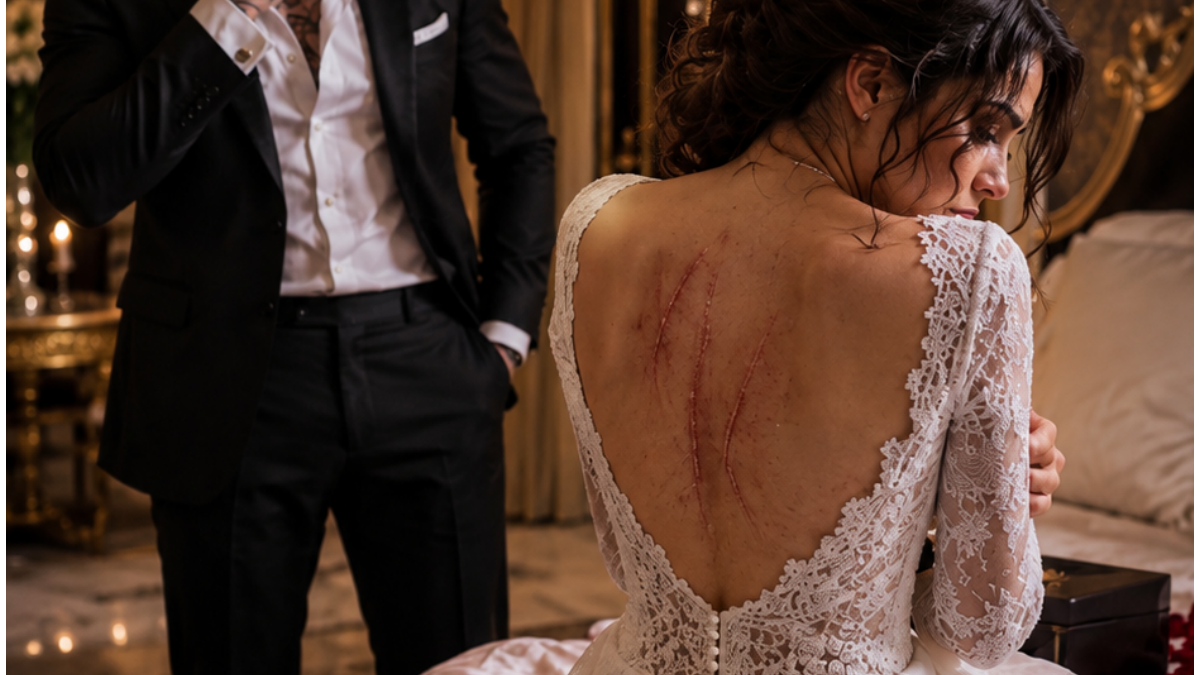
And it was then, as the fabric slipped back that he saw them, the scars pale, old, unmistakable, burn marks tracing up her forearm and disappearing beneath her collarbone.
Dante went very still. He had seen violence in every form a man could inflict on another.
He recognized old wounds the way a soldier recognizes old battlefields.
“Who did this to you?” His voice had changed, quieter, but with an edge underneath it that Myra had not yet heard.
She pulled her sleeve down instinctively, an old reflex.
It doesn’t matter. It matters to me.
Why? The question came out sharper than she intended.
Years of being unseen suddenly surfacing.
You married me to get close to my family.
You don’t need to pretend to care what happened to my aunts.
For the first time since she’d met him, Dante Marqueti, the man who never explained himself to anyone, hesitated.
He looked at her not as a Ferraro, not as a means to an end, but for one unguarded second, as a person who had clearly survived something and told no one.
“I don’t pretend,” he said finally.
“I never have. Get some sleep, Meera.
We’ll talk in the mornings.
He left the room without another word, and Meera stood alone by the window for a long time, touching her own scars, wondering why a stranger’s silence had unsettled her more than any cruelty ever had.
An uneasy piece the days that followed, fell into a strange rhythm neither of them had expected.
Dante was gone most mornings, buried in meetings that Meera knew better than to ask about.
She spent her hours in the enormous echoing penthouse.
Uncertain what her role was supposed to be, wife, hostage, ornament, until, out of habit more than purpose, she began doing what she had always done, making herself useful.
She reorganized the kitchen staff’s chaotic schedule without being asked.
She noticed that the housekeeper, an older woman named Rosa, had been favoring her left knee for weeks, and quietly arranged for a doctor to see her, paying from the small allowance Dante had given her, rather than bothering him with the requeSt. She learned the names of every member of the household staff within the first 10 days.
Something. Rosa later told her in a hushed voice that no machete wife had ever done before.
Word of these small kindnesses reached Dante slowly, the way water finds its way through stone.
He said nothing about them directly, but Meera noticed him watching her sometimes across the dinner table, an unreadable stillness in his expression, as though he were recalculating something.
One evening, nearly 3 weeks into the marriage, she found him in his study long after midnight, a glass of untouched whiskey in front of him, staring at nothing.
“You should be asleep,” he said without looking up.
“So should you,” she stepped inside, uninvited, something no one else in that building would have dared.
“You haven’t eaten today,” Rosa told me.
I don’t need looking after.
Everyone needs looking after. Meera said, even men who own half the city.
He looked at her then.
Something almost like curiosity breaking through the ice.
Why do you care? I’m the man who married you for my own reasons.
You said so yourself. Myra considered the question honestly.
I don’t know yet if I care about you, she said.
But I know what it feels like to sit alone in a room and have no one notice whether you’ve eaten.
I wouldn’t wish that on anyone, not even you.
The words landed somewhere Dante hadn’t expected them to.
He had built his entire life around the principle that vulnerability was a door enemies walked through.
And yet this woman, small, quiet, scarred in ways she never explained, kept walking through his doors uninvited, and instead of anger, he found himself disturbingly grateful.
“Sit,” he said finally, nodding to the chair across from him, “just for a few minutes.” She did.
They didn’t speak much more that night.
A few quiet exchanges about nothing important.
The kind of small talk neither of them had been allowed in years.
But when Meera finally left for bed, Dante sat alone a while longer, turning the whiskey glass in his hand, and thought with something close to alarm, that he had enjoyed the company of his enemy’s daughter more than he had enjoyed anything in a very long time.
The wound beneath the isit was Rosa, the housekeeper who first told Meera about the fire carefully in fragments over tea one afternoon while Dante was away.
He had a sister, Rosa said quietly.
Elina, 8 years younger, bright girl, always laughing.
There was a warehouse fire 12 years ago, the old Marqueti storage facility on the harbor.
Elena was inside doing inventory for her father.
She didn’t get out. Meera felt something cold settle in her chest, and he thinks the Ferraros did it.
He’s never said it aloud, but everyone in this house knows why he married you.
Rose’s eyes were sad, not unkind.
He wanted a way inside your family, a way to finally find proof.
Meera sat with that information for a long time after Rosa left the room.
It explained the ice in Dante’s eyes, the careful, controlled fury that seemed to live just beneath his composure.
It explained why he had looked at her that first night, less like a bride and more like a key.
She should have been angry.
Instead, she found herself aching for him, for a boy who had lost a sister to fire and had spent 12 years turning grief into an empire.
Because grief left unattended eventually calcifies into something that looks like power, but feels underneath exactly like loss.
That night, when Dante returned home, later than usual and heavier in the shoulders than she’d ever seen him, Meera didn’t wait for him to retreat into his study alone.
“I know about Elellanena,” she said simply, standing in the hallways.
Dante went still, the way he always did when something touched the one part of him he’d never learned to armor.
“Who told you?” It doesn’t matter who told me.
What matters is I’m sorry.
I’m sorry for what happened to her.
And I’m sorry that you married me thinking I might be a door to the people who took her from you.
Are you not? His voice was low.
Dangerous in the way grief is dangerous.
Unpredictable. Roar at the edges.
Your family raised you, fed you.
Are you telling me you know nothing?
My family, Meera said, and for the first time, real anger entered her voice, gave me away like a piece of furniture.
I scrubbed their pots for 9 years, and slept in a room with no lock on the doors.
I know less about their business than you do, because they never once thought I was worth trusting with anything real.
She held up her scarred arm, no longer hiding it.
This happened in their house, Dante.
A man’s temper and a stove.
And no one took me to a hospital until morning because no one wanted the questions.
So don’t ask me if I’m loyal to the Ferraros.
I’ve never once in my whole life belonged to them.
The study went silent. Dante stared at her, really looked at her, perhaps for the first time, and something in his controlled.
Careful expression cracked open, just slightly like ice giving way beneath spring water.
I’m sorry, he said finally, quietly.
I shouldn’t have asked you that.
No, Meera agreed. You shouldn’t have, but I understand why you did.
She turned to leave, but his voice stopped her.
Mirror. It was the first time he had said her name without formality, without distance.
Thank you for telling me the truth.
She looked back at him, this powerful wounded man standing alone in a study full of shadows, and for the first time since her wedding day.
She did not feel like a stranger in his house.
“That’s all I have to offer,” she said softly.
“The truth. It’s the only thing nobody ever took from me.
Growing roots in frozen ground winter settled over Veyron Heights, and something quieter, more fragile than either of them expected, settled between Dante and Meera.
He began coming home earlier, not every night, not at first, but often enough that Rosa began setting two places at the dinner table without being asked.
He asked Meera about her day, clumsily at first, like a man relearning a language he’d forgotten he once spoke.
She told him small things, a conversation with Rosa, a flower she’d planted on the balcony, despite the cold, a book she’d found in his enormous, mostly unread library.
He, in turn, began telling her small things, too.
Not about the business, never about the business, but about Elena.
The way she used to steal his cufflinks and hide them around the house as a joke.
The way she’d wanted to become a doctor, not a Marquetti, and how their father had never quite understood the difference.
The way Dante still 12 years later sometimes reached for the phone to call her before remembering.
Meera listened without trying to fix his grief, without offering hollow comfort.
She simply sat with him in it the way no one had ever sat with her in hers.
And slowly, without either of them naming it, something like trust began to grow between two people who had both been taught that trust was a luxury the world didn’t allow them.
One evening, Dante found her in the kitchen, sleeves rolled up, teaching Ros’s granddaughter how to properly knead bread dough, something she’d learned in the restaurant kitchen years ago.
She was laughing, actually laughing, flour on her cheek, and Dante stood in the doorway a long moment before she noticed him.
You’re smiling,” he observed when she finally looked up.
“Is that forbidden in this house?” “No,” his mouth curved, almost a smile of his own, rare enough that Ros’s granddaughter stared.
“I just haven’t seen it before.” Meera wiped her hands on her apron and crossed to him.
“You could try it sometime,” smiling.
“I hear it doesn’t actually damage the reputation.
I have a reputation to protect.
You have a life to live, she said gently, underneath the reputation.
I’d like to meet the man who exists there if he’s willing to come out.
Dante studied her for a long moment.
This woman who had walked into his house as a porn in a war she hadn’t chosen and had somehow become the only person in his world who spoke to him without fear, without agenda, without wanting anything from him except honesty.
He’s trying, Dante admitted quietly.
It’s been a long time since anyone asked him to.
It was the closest thing to tenderness he had ever offered anyone since Elena died.
And Meera understood, standing there with flower on her hands, and her scarred arms bare and unhidden for the first time in years, that something had shifted permanently between them.
Not romance exactly, not yet.
But the foundation upon which romance could eventually carefully be built.
The threat returns the peace did not last because peace never lasts long in a world like Dante Marquettes.
It began with a phone call.
Salvatore, gray-faced, delivering news in the study while Meera waited outside, sensing from the tone through the door that something had shattered.
“We found the man,” Salvator said.
“The one who set the fire 12 years ago.
He’s been hiding in the East District under a false name.
He talked Dante. Ferraro paid him.
It was Ferraro. The proof Dante had married for the truth he had spent 12 years chasing had finally arrived.
And it landed in his chest like a second fire.
12 years delayed, but no less devastating.
“Bring him to me,” Dante said, his voice a low, terrible calm.
But it was not that simple because news like this did not stay contained.
Ferraro, sensing his exposure, moved firSt. Within 2 days, menera didn’t recognize began appearing near the tower, watching.
Rosa mentioned worriedly that deliveries had been delayed, that guards had doubled at every entrance.
The household, once merely quiet and controlled, became tense with the particular electricity of a storm about to break.
Myra found Dante one night in the study.
A folder opened before him containing photographs and documents she wasn’t meant to see.
Evidence of Elena’s death laid bare after 12 years of searching.
“You found him,” she said quietly.
The truth. Dante didn’t look up.
Your family killed my sister to send my father a message.
And they used you, an innocent girl who never hurt anyone, as a porn to buy peace with me, knowing I might discover it eventually, and they’d need the marriage as protection.
I didn’t know, Meera said.
Dante, I swear to you, I didn’t know.
I believe you. His voice was rough, unfamiliar with the shape of the words.
That’s what makes it worse.
You’re the only innocent thing that family has ever produced.
And I married you thinking I was using a weapon.
Instead, I married the only person in this war who never deserved to be caught in it.
Mirror crossed the room and knelt beside his chair, taking the folder gently from his hands and setting it aside.
Then don’t let them use me against you now.
Whatever you’re planning to do, don’t let grief make the decision.
You’ve spent 12 years being patient enough to find the truth.
Don’t throw that away for revenge.
That will only bury you deeper in blood.
They killed my sister. I know, Mera said, her voice breaking slightly.
And nothing I say will bring her back or make that pain smaller.
But you have a chance most people never get.
You have proof. You have power.
And you have a choice about what kind of man you become with it.
Elena wouldn’t want you to become the fire that took her.
Dante looked at her for a long moment.
This woman with old scars and a newer courage, sitting at his feet, not out of submission, but out of love he hadn’t yet let himself name.
And something in his chest, frozen for 12 long years, began painfully to Thor.
I don’t know how to let this go, he admitted.
You don’t have to let it go, Mera said.
You just have to make sure justice doesn’t become another kind of monster.
When the storm broke, Ferraro did not wait to be found.
Three nights later, while Dante was in a meeting downtown with Salvatoreé and his lieutenants, a black car pulled up outside the tower’s private entrance, and two of Ferraro’s men, sent not for Dante, who was too well-guarded, but for the one piece of leverage they believed remained available, moved toward the residential elevator.
Myra was in the penthouse alone reading [clears throat] by the window when Rosa burst in pale and breathless.
Men in the lobby. Security is holding them, but they’re asking for you by name.
Mirror, we need to move you now.
There was no time for fear to properly form before instinct took over.
The same instinct that had kept her alive through years of a household that never protected her.
She grabbed her phone, dialed Dante’s private line with shaking hands, and moved with Rosa toward the reinforced safe room built into the penthouse’s east wing.
A precaution Dante had insisted on months ago, and Meera had thought at the time unnecessary.
“Dante,” she said the moment he answered, “there are men here, Ferraro’s men.
Rosa and I are moving to the safe room.
His voice, when it came, was different than she’d ever heard it.
Not the controlled ice of the boss, but something raw and immediate.
Lock the doors. Don’t open it for anyone but me.
I’m coming. The next 20 minutes stretched like hours.
Meera sat with Rosa in the reinforced room, listening to distant muffled sounds she didn’t want to identify.
Voices, a struggle, something breaking while gripping Rose’s hand and forcing herself to breathe evenly, the way she had taught herself to breathe through every frightening night of her childhood.
When the door finally opened, it was Dante, jacket gone, knuckles bruised, eyes wild with a fear Meera had never seen him wear.
He crossed the room in three strides and pulled her into his arms before either of them had said a word, holding her the way a man holds something he only just realized he could lose.
“They’re gone,” he said into her hair, voice unsteady.
“My men caught them before they reached this floor.” “You’re safe.
You’re safe.” Myra held on to him, feeling his heartbeat hammering beneath the composed exterior he’d worn like armor for 12 years, and understood in that moment, that the wall between them had finally completely come down.
“I was so afraid,” she admitted, her voice small.
“I know,” Dante pulled back just enough to look at her face, cupping it gently in hands that had ordered violence without hesitation.
But now trembled touching her.
I was afraid too, Mera.
I have never in my life been afraid of losing anything the way I was afraid tonight of losing you.
Then don’t lose yourself chasing revenge instead, she said softly.
I don’t want to survive Ferraro’s cruelty only to watch it turn you into someone I don’t recognize.
Dante rested his forehead against hers, breathing unsteadily.
12 years of controlled grief finally breaking loose in the quiet safety of that small room.
“I don’t want revenge anymore,” he whispered.
“And it was true.” And it surprised him as much as it surprised her.
“I want you safe. I want a life that isn’t built entirely on blood.” I didn’t know I still wanted that until I almost lost the chance.
Justice, not vengeance. The confrontation with Ferraro came two days later.
Not with guns, not with fire, but with something Dante had never chosen before, exposure.
Using the confession he’d obtained from the man who set the warehouse fire, combined with financial records, Salvatore had spent years quietly assembling.
Dante didn’t send men to kill Ferraro.
Instead, he handed everything to the one force even the Marqueti Empire had always avoided, a federal task force that had been building its own case against Ferraro’s organization for years.
Only lacking the final piece of evidence to make it stick.
“This isn’t like you,” Salvator said.
Watching Dante seal the documents into a courier envelope instead of ordering the usual retaliation.
The old Dante would have burned his empire to the ground with his own hands.
“The old Dante lost the only family he had left to fire,” Dante said quietly.
I won’t let vengeance take the last piece of family I have too.
He glanced toward the window where Meera stood on the balcony below, tending the small garden she’d planted despite the cold, refusing to let anything in that house stay entirely without warmth.
She was right. If I become the very thing that took Elena from me, then Ferraro wins twice.
Ferraro was arrested within the week.
His empire dismantled not by bullets but by law.
A slower, more permanent kind of justice than Dante had ever believed himself capable of choosing.
It was in its own way the hardest decision he had ever made.
To let go of 12 years of fury and trust something outside his own controlled world to finish what he had started.
Myra stood beside him the night the news broke, watching from the same window where he’d first discovered her scars and reached for his hand, not out of duty, not out of fear, but because she wanted to.
Elena would be proud of you, she said quietly.
Not for what you built, for what you chose not to become.
Dant turned to look at her.
This woman who had arrived in his life as a stranger, a porn, a means to an end, and had become slowly, patiently, without ever raising her voice or demanding anything the reason he had finally found his way out of 12 years of frozen grief.
“I didn’t marry you for revenge,” he said softly.
“Not anymore. I don’t know exactly when that stopped being true.
Maybe it was the first night when I saw your scars and realized you’d survived worse than anything Ferraro could threaten me with.
And you never once asked anyone for pity.
And now, Meera asked, her voice barely above a whisper.
Now, Dante said, reaching up to gently brush a strand of hair from her face.
I want to marry you again for real this time.
Not because of your name or your family or what door you might open, because you walked into the coldest house in this city and made it feel for the first time in 12 years, like somewhere I wanted to come home to.
Quiet mornings after the Warpring came to Veyron Heights slowly, the way healing always does, not in a single sudden Thor, but in small, patient increments that were easy to miss, unless you were paying close attention, the Marchetti Tower changed in ways the old guard barely recognized.
Dante still ran his districts, still commanded the same quiet authority that made rooms fall silent when he entered.
That part of him would never fully disappear, nor did Meera ever ask it to, but the ice that had once seemed permanent had learned slowly to coexist with warmth.
He laughed now sometimes, quiet, unpracticed laughter that Rosa said she hadn’t heard in that house since Elena was alive.
He came home for dinner most nights.
Sat beside Meera on the balcony among the flowers she’d refused to let winter kill, and listened, really listened.
When she spoke, Mirror, for her part, had stopped hiding her scars.
She wore short sleeves in the garden now, unbothered by the pale marks along her arm, because the man beside her had taught her gently and without ever saying so directly, that scars were not something to be ashamed of.
They were proof of survival, and survival in the end was its own quiet kind of strength.
One morning in early May, Dante found her in the garden before the household had woken, kneeling in the dirt, planting something new.
“What is it this time?” he asked, settling beside her, despite the dirt threatening his tailored trousers.
Something the old Dante would never have allowed.
“Elena’s favorite flower,” Meera said softly.
Rosa told me white jasmine.
I thought she should have a place here, too.
Dante went still, watching the small, careful way Meera pressed the soil around the roots, tending to the memory of a sister he had lost long before this woman had entered his life, treating that grief with the same gentle honesty she brought to everything else.
Thank you, he said, voice thick.
You don’t have to thank me for loving the people you love, Meera said simply, looking up at him with dirt on her hands and sunlight in her hair.
That’s what family does.
He reached for her hand, careful of the soil, and pressed a kiss to her scarred knuckles, the same arm he had once looked at with confusion, and later with grief on her behalf, and now looked at with nothing but quiet, unwavering devotion.
“I was supposed to marry you for revenge,” he said softly.
“I don’t think I’ve ever been more grateful that a plan failed.”.
Meera smiled, leaning her head against his shoulder as the morning light spread slowly across the garden they had built together, out of ashes, out of scars.
Out of two broken people who had somehow patiently taught each other how to be whole.
You didn’t fail, she said.
You just finally won something worth having.
Somewhere below them, the city of Veyron Heights carried on the way it always had, loud, restless, unaware that the coldest man it had ever feared, had at last found something warmer than power to hold onto.
And in the quiet of that garden, with jasmine roots settling into new soil and old scars, finally at peace in the sun, Dante Marchetti understood that the greatest victory of his life had never been vengeance.
It had been her.








