“Leave Before My Guests Arrive,” He Said – She Walked Out and Never Came Back
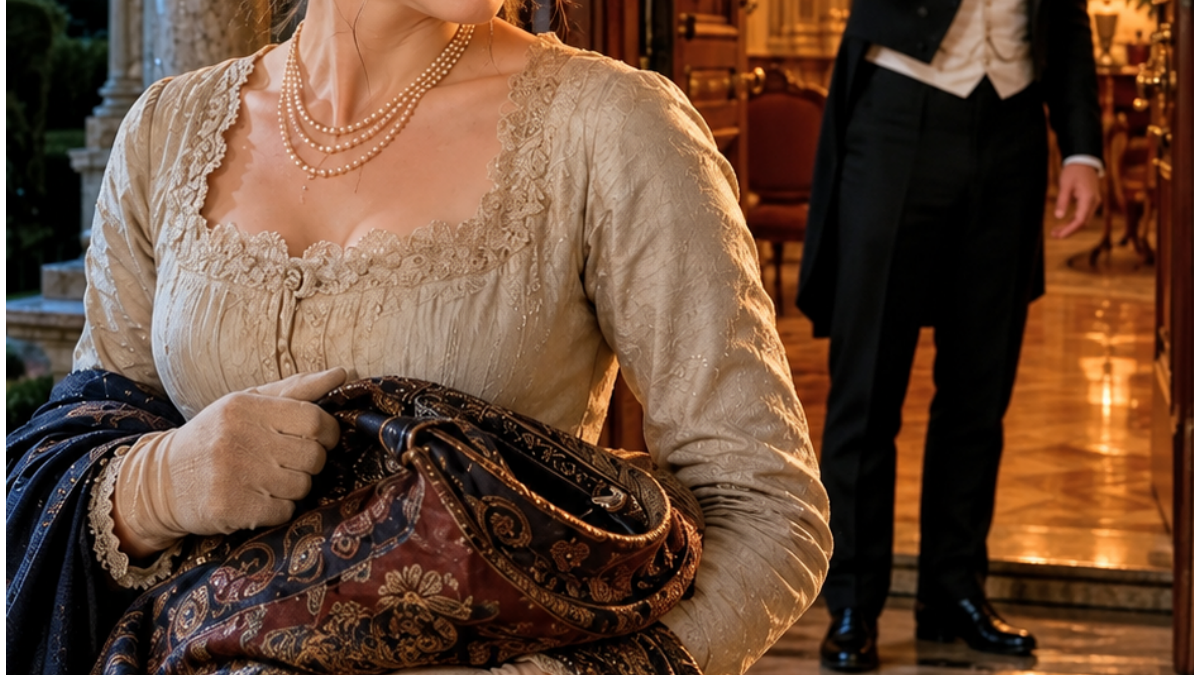

Leave before my guests arrive.
Audrey Whitmore did not cry.
She did not argue.
She reached up, unclasped her wedding necklace, the one Nathaniel had fastened around her throat on their wedding day, with trembling hands and whispered promises, and she set it on the invitation table beside the door.
12 years of marriage, 12 years of disappearing on command.
And tonight, for the first and last time, she walked out through the front door of her own home.
She never came back. If that sentence just stopped your breath, subscribe.
Drop your city in the comments and stay with Audrey until the very end.
The necklace made no sound when it touched the table.
That silence was the loudest thing Audrey Whitmore had heard in 12 years of marriage.
She had expected something, a clink, a rattle, some small physical proof that this moment was real.
But the gold chain simply settled against the linen tablecloth and went still.
Quiet as a confession nobody had asked for.
Quiet as a decision she had been moving toward for years without ever letting herself name it.
She stood there for 3 seconds.
Then she picked up her coat and walked out.
It had begun at 5:00 that morning, not with an argument, not with a raised voice or a slam door.
It began the way most things in her marriage began with Audrey awake before anyone else.
Solving a problem Nathaniel didn’t know existed yet.
The florist was scheduled for six.
The woman had a habit documented, predictable, never corrected despite Audrey’s three previous requests of leaving arrangements on the wrong side of the entrance hall.
The flowers had to face the east windows.
Nathaniel had made this clear after the Caldwell dinner 6 months ago.
When Richard Caldwell’s wife had commented that the lighting felt flat, Nathaniel hadn’t said anything to Audrey afterward, he hadn’t needed to.
She had learned over a decade of marriage to read the weather in his silences, so she set her alarm for five.
She met the florist at the door.
She redirected every arrangement herself. Standing in the entrance hall in her robe, bare feet on cold marble.
Pointing and adjusting until the angle was exactly right.
“These are gorgeous, Mrs. Brooks,” the florist said.
“They need to face that window,” Audrey said.
“The one on the left.”
“Yes, right there. Of course. Mr. Brooks must be so pleased with how everything Thank you.”
Audrey said, “That’ll be all.”
She closed the door and went to the kitchen.
Margaret Ellis was already there. Margaret had worked in the Brooks household for 22 years.
First for Nathaniel’s father, then for Nathaniel, then for what the staff had quietly come to think of as the real operator of the estate, though none of them would have said so within Nathaniel’s hearing.
She was 61 years old, economical with words, and possessed of the particular stillness that comes from watching a great deal, without being asked to comment on any of it.
She looked at Audrey when she came in.
The florist, she said.
Redirected, Audrey said.
East windows.
Margaret nodded and poured a second cup of coffee without being asked.
Audrey sat at the kitchen table and pulled the event file toward her.
47 pages.
She had compiled it over 3 weeks guest list.
Dietary restrictions.
Seating chart. Menu revision.
Timeline for appetizer service.
The note about Senator Harrington, preferring to be seated away from direct overhead lighting.
The pianist, she said mostly to herself, flipping pages.
Mr. Brooks called the agency Wednesday, Margaret said.
He requested contemporary instead of classical.
Audrey stopped flipping. He didn’t mention it to you, Margaret said.
Not a question. He didn’t mention it.
Audrey looked at the page where she had written pianist classical.
Confirmed in her own handwriting. She crossed it out with two neat lines.
That’s fine. The music was always secondary.
Margaret said nothing. She had a talent for saying nothing in a way that communicated everything.
Audrey moved to the next page.
By 8:00 in the morning, she had revised the seating chart twice once because Nathaniel’s assistant forwarded a lastminute addition to the guest liSt. a tech investor named Parish, whom Nathaniel wanted near Senator Harrington, which required moving two other guests and restructuring the entire East Table, and once because Audrey remembered without being reminded that Parish’s wife had mentioned at a charity lunchon the previous spring that she found round tables made her feel crowded.
She requested a rectangular table be brought up from the lower storage.
Margaret looked at her. It needs to be polished first.
Audrey said, “I know, Mrs. Brooks. I’ll do it.”
Margaret, you have enough.
She spent 40 minutes in the storage room with a cloth and polish on her knees making a table shine for a woman she had met once so that woman would feel comfortable at a party.
Audrey had not been told she could attend.
She did not think about that too hard.
She had learned not to. The catering team arrived from the city at 10:00.
Thomas, the head server, Young Thorough, wrote everything in a small notebook, introduced himself and his team at the kitchen door.
Audrey walked them through the layout herself.
The service corridor, the back pantry, the precise positioning of the appetizer staging area, the 60-second rule, 60 seconds, she told him.
Not 90. The moment the first guest crosses the threshold, they should have something in their hand within 60 seconds.
These are people who notice waiting.
Yes, ma’am. Thomas said, writing, no one approaches Mr.
Brooks directly unless he initiates contact.
Any guest need comes to me.
Thomas looked up from his notebook.
And where will you be, ma’am?
Audrey paused. Three years ago, she would have said beside my husband without hesitation.
Two years ago, she might have said it with only a small hesitation.
Now she looked at Thomas’s pen hovering over his notebook, waiting for a location, and she felt the shape of the answer she could not give.
I’ll be available, she said. You’ll always be able to find me.
Thomas wrote something down. Audrey did not look at what.
At noon, she sat with the menu for the third time.
The original had included a burr blanc sauce.
One of the key investors she had learned this through a conversation she’d overheard at the Harrington reception in March.
A conversation she had not been part of at a table she had not been invited to join found creambased sauces too rich.
He’d said so off-handedly the way men said things at tables when they assumed no one important was listening.
Audrey had been standing six feet away arranging place cards.
She swapped the sauce for a reduction, notified the catering team, updated the file.
By 1:00, she had confirmed the floral water levels, verified that the temperature in the ballroom was 2° cooler than the rest of the house, the way Nathaniel preferred for formal gatherings, tested every light in the entrance hall, and reviewed the coat check system with the youngest member of the household staff.
A girl named Priya who was 17 and terrified of getting something wrong.
“You’re going to do beautifully,” Audrey told her.
Priya blinked. “What if someone’s coat tag falls off?
Then you describe it when they come to collect.” Color, length, any notable detail.
“You can do that. You won’t,” Audrey said.
“But if you do, come find me.
Just come find me.” Priya nodded.
Visibly steadier. Audrey moved on to the next item on her liSt. Nathaniel arrived home at 3.
He came through the front door, his door, the door he always used, and stood in the entrance hall and looked around with the slow, satisfied survey of a man reviewing work he considered his own.
“Everything looks perfect,” he said. Audrey came down the stairs.
She had changed into her working clothes a good blouse, practical shoes because the actual dress, the emerald one, was saved for later, for the moment she had been preparing for since she woke up.
The pianist is contemporary, she said.
I called the agency. I thought it would be better for the room.
He moved toward his study. You don’t mind.
It was not a question. The Harrington table, she said.
I moved them east away from overhead lighting and we added a rectangular table for Parish’s party his wife mentioned at the Fenwick lunchon that she finds round tables.
Nathaniel stopped walking. He turned. I didn’t tell you Parish was bringing his wife, he said.
No, Audrey said you didn’t. A beat.
Howdy. Listen, she said simply. Nathaniel looked at her for a moment.
Something moved across his face. Not quite discomfort.
Something halfway between. “Good,” he said.
“Good.” He went into his study.
The door clicked shut. Audrey stood in the hallway.
Through the study door, she could hear him already on the phone.
His voice was warm and easy, the voice he used when he wanted someone to feel welcome.
She had heard that voice directed at a great many people over 12 years.
She turned and went back upstairs to dress.
She had saved the emerald dress specifically because he had once said it made her look unforgettable.
She had been saving it like a letter she was afraid to open holding it for an occasion worthy enough to justify wearing it for a night when he might finally look at her in a crowded room and want her there.
Not as an organizer, not as the invisible hand that made everything run, but as his wife, as a woman he was proud to stand beside.
She put it on. She stood in front of the mirror in the upstairs bedroom and looked at herself for a long moment.
She was 34 years old. She was still beautiful, not in the polished performed way of the women who would be downstairs tonight.
The women who employed people to maintain their beauty, but in a real way, a way that had nothing to do with maintenance.
She had a face that showed things.
It was not always an advantage.
She could hear the first cars on the driveway.
The party was beginning. She touched the emerald fabric at her waiSt. Tonight, she thought, “Maybe tonight.” She still thought that after everything, after all the side entrances and the disappearing acts and the years of being useful from the margins, she still in some small and deeply stubborn corner of herself thought maybe tonight.
That was the thing about hope.
It didn’t know when to quit.
The door opened behind her. Nathaniel cufflinks already in, jacket already on.
He glanced at the window first, checking the driveway before he looked at her.
The Caldwells are here, he said.
Harringtons should be within the hour.
I know the first appetizer round is Audrey.
Something in the way he said her name.
She turned. He wasn’t looking at her.
He was looking toward the window, toward the cars in the driveway with the expression of a man performing a mild inconvenience.
Leave before my guests arrive. The room didn’t change.
The light was exactly the same.
The sounds from downstairs were exactly the same.
Everything was precisely as it had been 5 seconds ago.
But something in Audrey’s chest went very, very quiet.
“I’m sorry,” she said. Richard brought his wife and Genevie he adjusted his left cuff link.
She made comments last time about the household dynamic about he paused searching for the phrase about the presentation.
The presentation Audrey repeated. You know how she is.
Tell me, Audrey said. Tell me how she is.
Nathaniel finally looked at her. He registered the dress, the emerald dress he had once called unforgettable.
His eyes moved across it without stopping.
She’s particular, he said. About social arrangements, about who belongs in which another pause.
It’s easier this way. You understand?
Audrey looked at him. I organized this party, she said.
I know. I’ve been awake since 5:00 this morning, and everything looks perfect.
He said it like it resolved something.
Like her 14 hours of invisible labor were a receipt that had now been stamped and filed.
You can come back after midnight.
Most of the guests will have cleared out by then.
He straightened his jacket. Use the side entrance, will you?
Less complicated. He walked to the door.
Nathaniel, when is the last time, Audrey said that I came through the front door?
He turned. He looked at her with a small careful patience.
The patience of a man who had learned that women sometimes said things that required waiting out.
What? The front door? She said, “When is the last time you watched me use it?” As a guest, as someone who was invited, he said nothing.
“You can’t remember,” she said. Audrey the guests.
“You can’t remember,” she said again.
“Because it hasn’t happened.” She looked at him for one long clear final moment.
I used to think you just didn’t think about it.
But you do think about it.
You think about it every time.
And you make the same choice.
This isn’t the time. She said it never is.
She reached up unclasped the necklace.
The one he had fastened around her throat on their wedding day.
The one she had worn to every party she had not been allowed to fully attend.
The one that had come to feel somewhere in the last year.
Less like jewelry and more like a label.
She held it for a moment.
Then she set it on the vanity table.
“Od go to your guests.” “Nathaniel,” she said.
She picked up her coat from the chair.
She walked past him out the bedroom door.
He said her name again from behind her.
Once with an edge, she recognized the edge of a man who expected to be followed.
She did not follow. She went down the stairs.
The ballroom was already alive. She could see it from the landing, the light, the movement, the sound of the party she had built rising up toward her, the flowers on the east side, catching the last of the October daylight, the servers in their pressed whites, Thomas moving among them with his notebook, the centerpieces she had spent three days selecting, the music she had not chosen, playing softly underneath the conversations of people who did not know she existed.
Senator Harrington was near the east table exactly where she had placed him.
Parish’s wife had found the rectangular table and was already seated.
Looking comfortable, the burbl long was gone from the menu and no one would ever know it had been there.
Everything was exactly right. Everything was exactly as she had made it.
She stood on the landing and looked at all of it.
Then she walked down the last of the stairs through the entrance hall past the invitation table with its neat arrangement of place cards and prograMs. She set her necklace beside them.
She walked to the front door.
She opened it. October air hit her face cold and honest and completely without apology.
She stepped through outside. The driveway was still full of arriving cars.
A valet glanced at her. Startled guests didn’t usually come out this way.
Not at this point in the evening.
She looked at him. He looked away.
She walked to her car, the practical sand chosen herself 3 years ago.
Over Nathaniel’s suggestion of something that would look better in the driveway.
She had chosen it because it was reliable and she drove it herself and it didn’t require anyone’s approval to operate.
She got in. She sat through the windshield.
She could see the lit windows of the mansion.
Her flowers in the east windows glowing, the silhouettes of guests she had made comfortable and fed and seated well.
Nathaniel somewhere among them, beginning his evening.
Filling a room the way he was extraordinarily good at filling rooMs. Her phone lit up on the passenger seat.
Nathaniel, the centerpieces on the east side are slightly off.
Can you come fix before Harrington sees?
She read it. She read it twice.
Then she turned the phone face down.
Started the car and drove. Clara Jennings picked up on the second ring.
Audrey, it’s 9:00. I know. Nothing.
Audrey said. Then everything. The party.
The house. A longer silence. Are you safe?
Yes. Where are you going? I don’t know.
Audrey said honestly. The highway stretched ahead of her, empty and lit and going somewhere she hadn’t planned.
I thought I thought maybe I could come to you, Audrey.
Clara’s voice went firm and warm all at once.
The voice of someone who had been waiting to say this for years.
You get in that car and you drive straight to me.
Don’t stop. Don’t call him back.
Don’t read whatever he’s sending you.
You just drive, Clariv. Audrey exhaled.
It was a long exhale, the kind that carries something with it when it leaves.
Okay, she said. And Audrey, yes, don’t you dare apologize to me for calling.
Despite everything, despite the cold air in the car and the lit up phone on the seat beside her and the 12 years she was driving away from Audrey, felt the edge of something that was not quite in a smile, but was close to one.
“Okay,” she said again. She drove.
Nathaniel Brooks discovered his wife was gone at 9:47.
He had been midway through a conversation with Senator Harrington.
The good kind of conversation. The kind that moved towards something when Richard Caldwell appeared at his shoulder.
Your wife seems to have stepped out, Richard said quietly with a particular smile of a man delivering news he finds privately satisfying.
Nathaniel scanned the room. He had assumed it occurred to him now with a strange cold specificity that he had simply assumed that Audrey had come back in that she had used the side entrance as he’d asked and was somewhere in the margins of the party handling whatever needed handling.
She was always handling something. He excused himself from Harrington and found Margaret in the kitchen.
Where is my wife? Margaret turned from the counter.
She had an expression Nathaniel had seen before.
Careful. Measured the expression of someone who had decided exactly how much to say.
Mrs. Brooks left the property at 8:47.
She said through the front entrance.
Nathaniel stared. She she left her necklace on the invitation table.
Margaret said, “I moved it to the hall cabinet for safekeeping.” Nathaniel stood very still.
He had a sudden vivid image of the necklace.
The one he had fastened around her throat on their wedding day, fumbling with the clasp because his hands were shaking.
He had been nervous. Genuinely nervous in a way he hadn’t been about anything before or since.
The one she had worn to every significant evening of their married life.
The one he hadn’t thought about once in the past 6 years.
She’ll come back, he said. Margaret said nothing.
Shilly stopped. She always comes back.
Margaret looked at him steadily. Something in her face had rearranged itself into something he couldn’t quite read.
Patience. Maybe the patience of someone who had watched a situation develop for a very long time and arrived.
Finally, at its conclusion, Wilshy, Margaret said.
Nathaniel didn’t answer. He walked back toward the ballroom.
His guests were there, his investors, his senator, his business partners, his carefully curated social world.
They were drinking the wine Audrey had selected and eating the food she had designed and sitting at the table she had polished on her knees that morning.
They were perfectly comfortable in a room they had no idea she had built.
He stood at the doorway for the first time all evening.
Something felt off. He couldn’t name it.
The flowers were perfect. The music was appropriate.
Every detail was exactly right. But there was something in absence that pressed against the back of his ribs in a way he didn’t have a word for yet.
He took out his phone and called her.
It rang four times. Voicemail. He four rings.
Voicemail. He typed Audrey. Call me back.
He waited. He watched the three dots appear and disappear and tried to remember the last time he had looked for her in a room.
Not to ask her something, not to direct her toward a problem, but simply to find her, simply because she was his wife, and he wanted to know where she was.
He couldn’t remember. That saddened him uneasily through the rest of the evening.
Clara’s house in Mil Haven was small and warm and smelled like cedar.
Audrey sat on the couch wrapped in a blanket, holding a cup of tea she hadn’t drunk.
Clara sat across from her in the armchair she’d had since college, visibly worn.
Determinedly kept and did the thing that made her invaluable in moments like this.
She did not immediately try to fix it.
He texted Audrey said three times, then called twice.
I know. Clara said, “I heard your phone.
I didn’t answer.” Good. He’ll think I’m making a point.
Clara tilted her head. Aren’t you?
Audrey thought about it with the particular seriousness she applied to questions she wasn’t sure how to answer.
Honestly, I thought I was just leaving, she said.
I thought it was just tonight.
I was I was angry and I left and now I’m sitting here and I keep thinking.
She stopped. Started again. What do I go back to?
What is different tomorrow? Clara waited.
Nothing. Audrey said nothing is different tomorrow.
There will be another party and another reason and he’ll ask me to use the side entrance and I’ll stand in the hallway and tell myself this time I’ll say something and I won’t.
I’ll adjust something and disappear and feel grateful that at least everything ran smoothly.
She looked at her tea. That’s not a marriage.
No, Clara said it’s not. I don’t even know when it became that.
Audrey’s voice went quieter. It didn’t start that way.
There was a time when he when we she stopped.
It happened so slowly. I didn’t notice until it was finished.
That’s how it always happens. Clara said.
I should have said something years ago.
Yes, I should have, Audrey. Clara leaned forward.
You can spend all night cataloging what you should have done, or you can sit here and just let it be what it is for one night without fixing it.
Audrey looked at her. You’re allowed to not have a plan right now, Clara said.
You’ve had a plan for everything for 12 years.
Tonight, you can just not. Audrey’s phone lit up on the cushion beside her.
Nathaniel. She looked at it. Four rings.
She turned it face down. I’m not going back tonight, she said.
I know, Clara said. I don’t know what I’m doing.
I don’t know what any of this leads to.
That’s all right. It doesn’t feel all right.
No. Clara agreed. It feels terrible.
That’s different from not all right.
Audrey stared at the dark screen of her phone.
She thought about the party, about Thomas with his notebook, about Priya at the coat check steadier than she’d been an hour before.
About the east table perfectly lit, about the necklace on the invitation table and then on the cabinet and the way Margaret had said for safekeeping in a voice that held 12 years of watching.
She thought about Nathaniel standing at his party in his perfectly arranged house, calling a number that wasn’t picking up for once, not knowing where she was or whether she was coming back.
That thought did something unexpected in her cheSt. Not satisfaction exactly, not triumph, something quieter than that.
Something that felt cautiously like the first breath after a long time of not breathing.
I wore the emerald dress, she said.
Clara looked at her. He told me once it made me look unforgettable.
Audrey sat down her tea. I wore it tonight because I thought.
She laughed quietly. A short, dry, honest sound.
I thought maybe he’d look at me differently.
In front of everyone, just once.
Clara didn’t say anything for a moment.
Then she said carefully, did he?
He looked at the window. Audrey said to check if the Harringtons were arriving.
Clara pressed her lips together. “I stood there in that dress,” Audrey said for a man who was looking at the driveway.
“And I thought, I actually thought, she stopped.” Her voice had gone quiet in a way that wasn’t grief exactly, but was something next to it.
I thought I have been leaving for years.
I just didn’t know it yet.
The house was very still around them.
Outside, the October wind moved through the trees.
Audrey looked at her hands. I think tonight was the first time I caught up,” she said.
Margaret Ellis finished with the ballroom at midnight.
She moved through it alone, collecting glasses, straightening chairs, turning off the unnecessary lights the catering staff had left blazing.
She did what she always did with the efficiency of long practice and the particular quietness of someone who had learned that observation was more useful than speech.
In the entrance hall, she paused.
The cabinet drawer where she’d put the necklace was closed.
She opened it and looked at it for a moment, small and gold, very still, exactly where she’d placed it.
She thought about Mrs. Brooks at 5:00 that morning, repositioning flowers in her robe with her feet on cold marble.
She thought about Mrs. Brooks on her knees in the storage room, polishing a table for a woman she’d met once.
She thought about Mrs. Brooks at the top of the stairs in the emerald dress, looking down at the party she had built, and then through the front door, not the side entrance, not the service corridor, the front door.
Straight through without hesitating, Margaret closed the cabinet drawer.
She had worked in this house for 22 years.
She had seen a great many things come and go.
Trends, relationships, business arrangements, moods, things that looked permanent and turned out not.
Things that looked fragile and outlasted everything.
She turned off the hall light.
She hoped in the honest and private way she allowed herself to hope for things that Mrs. Brooks would take her time.
She hoped the woman would wake up tomorrow morning in that small house in Mil Haven, in a room nobody had asked her to leave and feel the particular unfamiliar weight of a day that belonged entirely to herself.
She had been preparing for it for 12 years.
She had earned every minute. Audrey woke at 6:17, not because of an alarm.
She hadn’t set one. For the first time in 11 years of marriage, there was nothing scheduled before 7, no florist arriving.
No staff to coordinate, no event file open on the kitchen table waiting for her attention.
She woke because her body didn’t know how to do anything else.
12 years of 5:00 a.m. Mornings had burned themselves into her like a brand.
And even here in Clara’s spare bedroom with its faded quilt and the sound of wind in the trees outside.
Her eyes opened at 6:17 and her mind went immediately to the liSt. Then she remembered there was no liSt. She lay there for a moment, staring at the ceiling, feeling the unfamiliar weight of a morning that belonged to no one but herself.
It felt wrong. That was the honest truth of it.
It felt wrong in the way that anything feels wrong when you’ve spent long enough doing the opposite.
Like the first day you stop holding your breath and realize your lungs don’t know what to do with the air.
Her phone was on the nightstand.
She had turned it face down before she fell asleep.
She turned it over now. 11 missed calls.
Four from Nathaniel. Three from a number she recognized as his assistant.
A woman named Dana who had been fielding Nathaniel’s problems for six years and had never once called Audrey directly.
Two from a number she didn’t recognize.
One from Richard Caldwell, which stopped her cold for a full 5 seconds before she set the phone back down.
Richard Caldwell had never called her, not once in 12 years.
She set the phone face down again and got up.
Clara was already in the kitchen.
Coffee made, eggs on the stove, a newspaper on the table that she was reading with the unhurried attention of a woman who had no particular demands on her morning.
She looked up when Audrey appeared in the doorway.
11 calls, Audrey said. I know.
I heard it vibrating through the wall.
Clara turned back to her eggs.
Sit down. Richard Caldwell called me.
Clara looked up sharply. Richard Caldwell?
Yes. That man has never said your name out loud in his life.
I know. They looked at each other across the small kitchen.
Something moved between them. Not quite alarm, not quite satisfaction.
Something more complicated than either. Don’t call him back, Clara said.
I wasn’t going too good. Clara slid a plate across the table.
Eat something. You look like you haven’t slept.
I slept fine. You look like you slept while thinking very hard.
Audrey sat down. She picked up the fork, set it down again.
Something happened at the party last night, she said.
After I left, something went wrong.
How do you know? Because Richard Caldwell doesn’t call people he doesn’t need.
She looked at the phone on the table beside her.
He called me, which means Nathaniel needed something and couldn’t get it, and someone finally figured out to call the person who actually handles things.
Clara was quiet for a moment.
Does that make you feel better or worse?
She asked. Audrey thought about it honestly.
I don’t know yet, she said.
She found out 3 hours later.
When she finally called Dana back, Dana picked up on the first ring, which told Audrey something.
Dana was a woman who managed her call queue with military precision.
If she picked up on the first ring, she had been waiting.
Mrs. Brooks. Dana’s voice was carefully neutral, the voice of a professional who had decided exactly what she was and wasn’t going to say.
Thank you for calling back. What happened last night?
Audrey said a pause. There were some difficulties, Dana.
Another pause. Longer. The Harrington contract.
Dana said finally the documentation package Mr.
Brooks prepared for the senator. It was missing the amended land use clause, the revision from the September meeting.
Mr. Brooks presented the original version.
Audrey closed her eyes. She knew exactly which revision Dana was talking about.
She had flagged it herself. 6 weeks ago, a change to the land use parameters that had come out of a secondary meeting she hadn’t been invited to, but whose minutes had been forwarded to her by accident.
She had flagged it in the contract documentation and sent a note to Nathaniel’s office.
She had assumed someone had acted on it.
Who prepared the final package? She said Mr.
Brooks handled it directly this time.
Dana said he felt the Harrington account was sensitive enough that he wanted personal oversight.
He didn’t use the revised clause.
No. No. Did Senator Harrington notice?
The pause this time was the longest yet.
His legal counsel noticed. Dana said during the after-dinner review there was Dana chose her word with evident care.
There was a conversation how bad Mr.
Brooks managed it. Dana said but the senator left earlier than expected and his council has requested a follow-up meeting before any documents are signed.
Audrey said nothing. Mrs. Brooks, Dana said, and now her voice had shifted into something unscripted.
Something that sounded like a woman speaking for herself rather than for her employer.
I want you to know that I sent Mr.
Brooks a reminder about the amendment three and again last week.
I know you did, Audrey said.
That’s not on you. I Dana stopped.
I hope you’re all right. Audrey looked out Clara’s kitchen window at the yard at the ordinary October morning at a world that was continuing without any input from her.
I’m fine, she said. Thank you, Dana.
She hung up. Clara was watching her from across the table.
The Harrington contract, Audrey said. He presented the wrong version.
His legal team caught it. Clara said nothing for a moment.
Then, is that going to cost him the deal?
It might cost him the relationship, Audrey said.
Harrington is the kind of man who needs to trust his partners completely.
One mistake in documentation. She stopped.
I flagged that amendment six weeks ago.
I sent a note. He didn’t read it.
He never reads the notes. He reads the summaries I prepare that explain the notes.
She pressed her lips together. I wasn’t there to prepare the summary.
Audrey, I’m not saying it’s my fault, she said sharply.
Then quieter. I’m saying I can see exactly what happened from here.
I can see every step of it.
And that is she stopped again, looked at her hands.
That is a very strange thing to feel.
Strange how strange because part of me is relieved, she said.
And part of me is still calculating how to fix it.
Clara looked at her for a long moment.
Which part of you is bigger right now?
Audrey didn’t answer, but the fact that she had to think about it told her something she wasn’t entirely ready to hear.
Nathaniel called at noon. She almost didn’t pick up.
Her thumb hovered over the decline button for three full rings.
And then something not love, not guilt, something more complicated and harder to name made her answer.
Audrey, his voice was different. She noticed it immediately.
Nathaniel had a professional voice and a social voice and a home voice, and she had learned all three well enough to hear the differences between them, the way a musician hears off-pitch notes.
This was none of them. This was something raar and less controlled.
Where are you? I’m safe, she said.
That’s not what I asked. It’s what I’m answering.
A pause. She could hear him breathing.
She could hear in the quality of the background silence.
That he was alone. Not in his office, not in a public space, but somewhere private.
The study probably. He always went to the study when he needed to think.
The Harrington situation he started. I heard.
She said, “Dana told you. Yes, I need the amended.” Her voice was quiet and very clear.
I’m not calling Dana. I’m not sending you the document.
I am not from wherever I am right now.
Reaching back into that house and fixing this silence.
Audrey, you have a legal team.
She said, “You have an office.
You have six people whose entire job is to manage documentation for exactly this kind of.
None of them know the Harrington relationship the way you do.
That she said is the problem.
The silence that followed was the kind that has weight.
She could feel him on the other end of it, adjusting, recalibrating.
She knew exactly how his mind worked in moments like this.
How he sorted through options and calculated approaches.
She had watched him do it in boardrooms and at dinner tables and across their own kitchen for 12 years.
“Come home,” he said finally. “No, Audrey, not today,” she said.
“Not to fix the Harrington situation.
Not to walk back in through the side entrance and pick up where I left off.” She paused.
“If you have something to say to me, something that isn’t about the contract or the party or anything that needs managing, then say it right now.” Another pause, longer than the one before.
She waited. She was good at waiting.
She’d had a lot of practice.
He said, “I don’t understand what happened last night.” And she felt something in her chest go very still.
Because that was in 12 years across a thousand conversations.
Perhaps the most honest thing he had ever said to her.
“I know you don’t,” she said.
“That’s the problem, Nathaniel. That is the whole problem in one sentence.” She hung up.
She stayed three more days, not out of strategy.
Not to make a point or force his hand or engineer some particular emotional result.
She stayed because Clara’s house was the first place in years where nobody needed anything from her.
And she found that she could not immediately bring herself to leave it.
She helped Clara in the garden.
She cooked dinner on the second night.
A real dinner. Not a catered menu, not a designed culinary experience, just a meal she made herself with ingredients she chose at the local market in Mil Haven where nobody knew her married name.
The woman at the checkout asked if she was visiting, and she said yes.
And the woman said the town was nice this time of year, and Audrey said she was starting to see that.
It was the most ordinary conversation she’d had in years.
She thought about that on the walk back.
On the second afternoon, she sat at Clara’s kitchen table with a cup of coffee and a notepad she’d found in the drawer, and she wrote down not a plan, not a strategy, just an honest list, everything she had done in the past calendar year that had not been asked of her, acknowledged or attributed to her in any way.
She filled four pages. She turned to a fifth.
By the time she stopped, the coffee was cold and the light through the kitchen window had changed and Clara was standing in the doorway watching her with an expression that was careful and serious and very kind.
What is that inventory? Audrey said.
Clara came and looked at the pages.
She didn’t read them line by line, just scanned.
Enough to understand Audrey, she said quietly.
I knew it was a lot, Audrey said.
I just hadn’t. She stopped. You don’t see it when you’re in it.
You’re just doing it one thing after another.
And it doesn’t feel like anything because you love the person and you tell yourself that’s what love looks like.
That’s what partnership looks like. That’s what she pressed the pen against the paper.
But it isn’t. She said it isn’t partnership.
Partnership means both people are visible.
Yes. Clara said it does. He couldn’t even answer me last night.
Audrey said. I asked him when was the last time I came through the front door as a guest, as his wife, and he couldn’t answer.
Not because he didn’t remember, because he’d never thought about it.
It never occurred to him to think about it.
She looked at the four pages.
And I let it not occur to him.
For years, I just kept adjusting.
You were doing what you were taught women do.
Clara said. That’s not weakness. It isn’t strength either.
No. Clara said it isn’t. Audrey folded the pages and put them in her coat pocket.
She didn’t know why. She just knew she needed to keep them.
On the third day, Margaret called.
Audrey almost didn’t recognize the number.
Margaret had never called her personal phone before.
All their communication had always gone through the household system, the internal line, the estate email.
Personal numbers were for personal matters.
Margaret had always kept that boundary.
With the careful precision, she kept everything else.
She answered immediately. Margaret, Mrs. Brooks.
Margaret’s voice was its usual measured self.
But there was something underneath it.
Attention, a careful control, like a person carrying something fragile.
I hope I’m not overstepping. You’re not.
What’s happening? Several things, Margaret said.
With the heir of a woman who had organized a liSt. The Thursday accounts for the household are incomplete.
Mrs. Brooks, those were always your responsibility.
And Mister Brooks’s financial coordinator doesn’t have access to the charity dispersement records.
They’re in the blue folder in the left drawer of the study desk.
Audrey said, labeled November cycle. The coordinator looked there.
The folder is there, but the codes for the charitable trust accounts aren’t in it.
Audrey paused. I keep those in a separate system.
Nathaniel never used them directly. A brief silence.
I see. Margaret said, who has been managing the household correspondents this week.
Brooks has been attempting to Margaret said with a delicacy that told Audrey everything about how that was going.
Three vendors have called. One is threatens it to pull the December contract if they don’t receive confirmation of the renewal terMs. Another delivered the wrong order Wednesday and is waiting for direction on the return.
Which vendor? Whitfield Linens? Audrey closed her eyes briefly.
She had spent 4 months negotiating the Witfield contract.
The renewal terms were specific to the estate’s requirements, and she had documented everything in a system that existed entirely in her head and in a spreadsheet she had built herself.
“What else?” she said. The Harrington correspondents, Margaret said his office sent a letter.
Mr. Brooks received it Thursday morning.
He hasn’t responded. A pause. I thought you should know.
What did the letter say? I don’t know the contents.
But Mr. Brooks Margaret stopped. She chose her next words the way she always chose them precisely with full awareness of what she was communicating.
Mr. Brooks sat with it for two hours Thursday morning.
He sat in the study and didn’t come out and didn’t ask for anything which in 22 years is not something I have seen him do.
Audrey absorbed that. Margaret, she said, “Are you all right?” The question clearly surprised her.
There was a small pause, small but real, a pause that had texture.
“I am quite well, thank you,” Margaret said.
“I own other paws.” “Mrs. Brooks, I want you to know that I am not calling to ask you to come back.
I am calling because I thought you deserve to know what was happening in your own home.
It’s kind of you, Audrey said.
It is not kindness, Margaret said with a firmness that was almost sharp.
It is fairness. It is something that should have been done years ago.
She stopped. Then in a lower register, you should know that the staff have all asked after you.
Every one of them. Thomas called the household line Thursday afternoon to ask if you were well.
Pria, her voice shifted almost imperceptibly.
Priya came to me Wednesday morning and asked if there was something she should have done differently at the coat check.
Audrey’s throat tightened. She thought it was her fault.
Audrey said she did. She’s very young.
Margaret, please tell her. Tell her it had absolutely nothing to do with her.
Tell her she did beautifully. I’ll tell her, Margaret said.
But Mrs. Brooks, you should tell her yourself.
When you’re ready, Audrey sat with that for a moment.
Thank you, she said, for calling and for for the necklace.
It’s in a safe place, Margaret said.
It’ll be there when you want it.
A pause. Or when you don’t.
That afternoon, Audrey walked to the Mil Haven Public Library.
Not for any particular reason she could have named.
She had walked past it twice since arriving and both times she had felt something a pull small and quiet toward the particular kind of silence that libraries held.
She went in. The librarian at the front desk was a woman about her age.
With reading glasses on a chain and the unhurried manner of someone who had chosen her profession with total awareness, she looked up when Audrey came in.
“Anything I can help you find?” she asked.
“No,” Audrey said. Said, “I just wanted to be somewhere quiet.” The librarian smiled.
“Best reason there is,” she said, and went back to her work.
Audrey walked through the stacks. Small town library, modestly stocked, carefully organized.
She moved through the sections without purpose and felt gradually the particular quieting that came from being among books.
The sense of other voices present, but not demanding anything.
Knowledge available but not insisting. She stopped in the local history section.
There was a shelf of books about the region, the county, the town’s founding, the families who had settled there in the early 1900s.
She pulled one out without thinking, sat down at a table, opened it.
The book was about women, not famous women.
Not women anyone had named buildings after.
Women who had built things, schools, community kitchens, lending libraries, small institutions that had outlasted everyone who knew their names.
Women who had worked in the background of the historical record until someone went looking and found them there.
Quiet and substantial and permanent, she read for 2 hours.
When she finally looked up, the light through the library windows had changed, and the librarian was watching her from from across the room.
The a look that was not quite curiosity and not quite recognition, but something between the two.
Find something good? The woman asked.
Yes, Audrey said. I think I did.
She checked the book out, the first library card she’d applied for in years.
Her own name, the Mil Haven address.
She asked Clara for permission to use and she walked back to Clara’s house in the early evening with the book under her arm and something shifting slowly and not without difficulty in the region of her cheSt. Nathaniel called again that evening.
This time she answered on the second ring.
She wasn’t sure why. Maybe because Margaret’s call had softened something.
Maybe because two hours of reading about women who built things had reoriented her internal compass in some way she couldn’t fully articulate.
Maybe because she had been avoiding the conversation and avoidance was its own kind of exhaustion.
I got the Harrington letter, he said without preamble without the professional warmth he usually deployed.
I know, she said. How do you know?
A brief silence. She called you.
She did. I didn’t ask her to.
I know you didn’t, Audrey said.
That’s why she did it. He didn’t respond to that immediately.
She could hear him in the study again.
She recognized the quality of the quiet, the slight echo of the high ceilings.
She could picture him exactly. Jacket off the desk lamp, the only light, one hand on the back of his chair.
The senator’s council wants a renegotiation.
He said the amendment I missed Harrington’s team is treating it as a material misrepresentation.
Is it? No. It was a procedural oversight.
But Harrington, he stopped. He said something to me before he left.
He said another stop. Nathaniel was not a man who stopped mid-sentence.
She had rarely heard him do it.
He said that a man who doesn’t pay attention to the details of his own contracts is a man who doesn’t pay attention.
Period. Audrey said nothing. I pay attention.
Nathaniel said I always He stopped a third time.
And in that third stop, she heard something she hadn’t heard in years.
Not defensiveness, not the performance of a managing an obstacle.
Something quieter and less comfortable than either.
The amendment was in your note, he said.
Yes. From 6 weeks ago. Yes, I didn’t.
His voice went careful. I didn’t prioritize it.
No, she said. You didn’t, Audrey.
And now there was something in her name that wasn’t quite an apology, but was reaching toward one clumsily.
The way a man reaches for something in the dark.
I need to understand. Stopped. Started differently.
What happened the other night? The I was wrong to say what I said.
I know that. Which part? She said.
The part where you asked me to leave or the part where you asked me to use the side entrance?
Silence. Both. He said both were.
He breathed out. I handled it badly.
You handled me like furniture. She said it came out quietly without heat and that was why it landed the way it did.
You handled me like something useful that you move to a different room when company comes.
The silence that followed was different from the others.
It had weight and texture. She let it sit.
Come home, he said finally. Not yet, she said.
Audrey, I’m not saying never. I’m saying not yet.
She kept her voice steady. I need you to understand something.
Nathaniel, I am not angry at you for one night.
I am not going to come home and have a conversation about one party in one sentence and then go back to the way things were.
Then what do you want? The question was direct and she took it seriously.
She had spent three days thinking about exactly this in the spaces between the garden and the library and Clara’s kitchen table.
And she had arrived at something she hadn’t had before she left.
Not a demand, not an ultimatum, but a clarity.
I want you to sit with it, she said.
Not fix it, not manage it.
Sit with it with all of it.
With what the Harrington letter says and what Margaret’s call says and what it means that your head of catering called the household line to ask if I was all right.
She paused. I want you to ask yourself when was the last time you introduced me as your wife in a room full of people.
Not as someone handling the details.
Not as someone circulating at the margins.
As your wife, the person you chose, he said nothing.
You don’t have to answer me right now.
She said, “I’m not asking for an answer right now.” “Then what are you asking for?” “Honesty,” she said.
“With yourself before you bring anything to me,” she heard him exhale.
Long and slow, the way a man exhales when he’s arrived somewhere he didn’t expect to be.
“All right,” he said. “All right,” she said.
She stayed on the line for a moment longer in the particular quiet that had settled between them.
Not comfortable, not resolved, but real, more real than most of the conversations they’d had in the past several years, which had been smooth and functional and almost entirely hollow.
Nathaniel, she said, yes, I flagged 12 amendments this year.
She said 12 separate issues with 12 separate contracts across four different accounts.
I sent notes. I sent summaries.
I sent follow-up reminders through Dana.
She paused. Do you know what response rate was?
Silence. Zero. She said, “You didn’t respond to one.
You didn’t acknowledge one.” And every one of those issues was resolved anyway because I resolved it without waiting for you to respond.
She let him hear that. That is what I’ve been doing.
For years inside your business and your home and your social life, resolving things you never knew existed.
I didn’t know, she said. I know you didn’t know.
That is the point. She said good night.
She ended the call. She was sitting at Clara’s kitchen table when Clara came in from the back garden.
Dirt on her hands and a look on her face that said she had heard at least part of the conversation through the window.
Better or worse than yesterday’s call, Clara said.
Better, Audrey said. Which is either progress or a trap.
Could be both, Clara said agreeably.
Going to the sink. He said he was wrong.
Audrey turned the phone over in her hands.
He didn’t say it well, but he said it.
And and I don’t know what to do with that yet.
She set the phone down. 12 years of something doesn’t reverse in a phone call.
Even a good phone call. No, Clara said.
But I could hear him actually thinking, Audrey said.
Not managing, not calculating the next move.
Actually thinking, she frowned slightly. He hasn’t done that in front of me in a very long time.
Clara dried her hands on the kitchen towel and looked at her friend.
“You still love him?” “Yes,” Audrey said.
“That was never the question.” “What is the question?” Audrey looked at the library book on the table.
“The women who had built things in the background until someone went looking and found them there.” “Whether loving someone,” she said slowly, “is enough reason to accept being invisible to them.” Clara sat down across from her.
No, she said, “Agreed. It isn’t.” The evening had come fully down outside.
Through the kitchen window, the yard was dark, the trees moving, and the last of the October wind.
Inside, the kitchen was warm, and the light was steady, and the coffee maker on the counter was doing what coffee makers in small houses do at the end of ordinary days.
Audrey picked up the library book.
She turned to the page she’d been reading in the stacks, the chapter about a woman named Ruth Millard, who had founded the first lending library in the county in 923 with 47 books, a borrowed room, and no particular permission from anyone.
Nobody had asked Ruth Miller to do it.
Nobody had given her the idea.
She had simply looked at the town and seen what was missing and decided she was the person to provide it.
Audrey read that paragraph twice. Then she turned the page.
The letter from Harrington’s office was four paragraphs long.
Nathaniel had read it 11 times.
He knew that because he had counted somewhere around the seventh reading.
In the particular detached way a man counts things when his mind is trying to stay occupied with something small so it doesn’t have to process something large.
Four paragraphs, 11 readings. Two hours alone in the study with the lamp on and the rest of the house dark and quiet in a way it had never been quiet before Audrey left.
The letter was formal, measured, the language of men who had decided something and were informing you of it rather than asking.
Senator Harrington’s legal council wished to advise Mr.
Brooks that in light of the documentation irregularities identified during the October gathering, the Harrington family office would be pausing all pending agreements pending a full review.
The review would be conducted by an independent party.
Mr. Brooks would be contacted when the review was complete.
It was in its way a masterpiece of saying everything while committing to nothing.
What it meant, what it actually meant, stripped of the formal language, was that Harrington didn’t trust him anymore.
And Harrington was the kind of man whose trust, once broken, did not repair itself through apology or explanation.
It repaired itself through demonstrated reliability over time, or it didn’t repair at all.
Nathaniel set the letter down on the desk.
He picked it up again. He thought about what Audrey had said on the phone.
12 amendments, zero responses. He thought about Dana’s voice when she’d said she had sent two reminders.
He thought about the senator’s council, leaning across the dinner table with a particular stillness of a man who has just found an error and is deciding what to do with it.
He thought about Audrey at the top of the stairs in the emerald dress, looking down at the party she had built.
He hadn’t processed that image when it happened.
He’d been moving too fast, managing too many things.
And she had been, he forced himself to finish the thought.
She had been something he didn’t need to manage.
She had always handled herself. She had always handled everything.
That was what she did. That he understood now.
Sitting alone in the study at 11:00 at night was the problem.
His phone lit up. Richard called well.
He didn’t answer. Richard called again the next morning at 7:45.
Nathaniel was on his third cup of coffee standing at the kitchen counter because sitting at the kitchen table wrong without Audrey there which was a thought he hadn’t expected to have and couldn’t now unhave.
He answered Nathaniel. Richard’s voice was the voice of a man delivering an assessment.
Not a conversation. Richard had never been good at conversations.
He was excellent at assessments. Harrington’s office called Genevieve last night.
Nathaniel sat down his coffee. Why would they call Genevieve?
Because Genevieve sits on the Harrington Foundation board, Richard said.
Did you not know that? He hadn’t.
He had not known that. What did they say?
He said. They asked her very politely.
Whether she could speak to your reliability as a business partner.
A pause. Genevieve told them you were excellent, which is true.
But Nathaniel Richard’s voice shifted. She also told me privately what she actually thinks.
And she thinks the Harrington presentation was sloppy.
Her word, not mine. It was one error.
It was a material error in a primary document on a $50 million relationship.
Richard said with the flat patience of a man explaining something to someone who should already understand it.
Harrington’s council doesn’t see one error.
They see a man who didn’t check his own work, who didn’t stopped.
Genevieve said something else. Say it.
She said, and I’m quoting here that she had always assumed your wife managed the details.
She assumed that was the arrangement, a pause that had a particular shape to it.
She said she’d noticed at the party that Audrey wasn’t there, and she wondered her word whether that was related.
The kitchen was very still. Richard, I’m not asking you anything.
Richard said, “I’m telling you what’s being said because that’s what you need to know right now.” His voice was not unkind.
Exactly. But it was not warm either.
It was the voice of a man delivering a message he had agreed to deliver.
Genevieve also told me that she called Audrey’s number twice this week.
Nathaniel’s hand tightened on the phone.
She called Audrey. She wanted to ask about the November charity gala.
The one your wife has chaired for the past 3 years.
A pause. Audrey apparently has the venue contract, the vendor relationships.
The donor communication history and the committee contact liSt. Another pause.
All of it. Nathaniel. Not in the office system.
Not in your files. In your wife’s personal records.
Nathaniel said nothing. The gala is in 6 weeks.
Richard said. Still nothing. Are you hearing me?
Yes, Nathaniel said. I hear you.
Richard exhaled. Sort it out. Whatever is happening at home.
Sort it out. Because right now your professional reputation is attached to a woman who is not in your house.
And that is a sentence I did not expect to say to you this decade.
He hung up. Nathaniel stood at the kitchen counter for a long time.
Then he went to find Margaret.
He found her in the east sitting room.
Going through the household accounts with methodical attention.
She gave everything. She looked up when he came in but didn’t stand.
Margaret had never performed difference. It was one of the things his father had valued in her and one of the things Nathaniel had over the years simply stopped noticing the charity gala.
He said the November one. Where are the files?
Margaret looked at him steadily. Which files specifically?
All of them. Venue vendors, donors, committees, everything.
Margaret closed the account ledger. Those are Mrs. Brook’s personal files.
She said, “I don’t have access to them.” Audrey’s personal files.
She manages the gala independently. Margaret said she built the committee from the ground up four years ago.
The venue relationship is hers. The contact there is a personal friend.
The donor communication system runs through an account she created.
A pause. None of it runs through the household office.
Mister Brooks. She set it up separately because Margaret stopped.
Something moved across her face. Because she wanted to have something of her own, she said carefully.
I believe that was the reason.
Nathaniel heard that. He wasn’t sure he was supposed to hear all of it, but he did.
Can you reach her? He said, I have reached her, Margaret said.
She calls to check on the staff.
Something about that landed in his chest at an angle he hadn’t expected.
She calls to check on the staff, not on him, not on the house.
On the people who worked there.
She calls Priya, he said. She called Priya Tuesday morning, Margaret said to tell her she did well at the coch.
He stood there. Mr. Brooks, Margaret said, and her voice was not gentle.
Exactly. But honest in a way that few people were honest with him anymore.
Would you like to know what Mrs. Brooks managed in an average week?
Yes, he said. It came out before he’d thought about whether he wanted the answer.
Margaret stood and went to the small cabinet in the corner of the room.
She opened the bottom drawer and removed a folder thick, organized, tabbed with the color-coded system Audrey had used for everything.
She left her working files, Margaret said.
She didn’t take them. I don’t know if that was intentional or if she simply didn’t think she’d need them.
She held the folder out. Start with a weekly summary page.
Nathaniel took it. He sat down in the chair near the window, the good chair, the one Audrey had reupholstered two years ago because the original had started to wear and he opened the folder.
The weekly summary was two pages single spaced.
It covered household operations, vendor management, staff scheduling, financial dispersements, event planning, correspondence, business support tasks, and what Audrey had labeled in her precise handwriting, proactive interventions, issues she had identified and resolved before they became visible probleMs. There were 11 proactive interventions listed for the week of the party alone.
He turned the page. The next section was labeled business support.
It contained in chronological order every note she had sent to his office in the past 12 months.
12 amendments, flagged issues, follow-up reminders, research summaries, all of it dated, all of it documented, all of it marked in a column on the right side with the same notation.
No response received. He turned another page.
Her handwriting changed somewhere around February of that year.
He noticed it the way you notice a change in someone’s voice.
The same words, the same precision, but something different underneath.
The letters were smaller. The notes were shorter.
The proactive intervention section became sparser.
Not because there were fewer problems, but Kihei could feel this even through the pages because she had stopped expecting that flagging them would change anything.
The last note in the file dated 3 weeks before the party was two sentences.
Amendment to Harrington land use clause identified in September meeting minutes forwarded to NB office for contract revision.
This is the third notification. Third notification.
Nathaniel closed the folder. He sat with it in his lap and looked at the wall and did something he had not done in a professional context in 15 years.
He let himself feel the full weight of a mistake without immediately moving to manage it.
It was uncomfortable in a way that had nothing to do with the Harrington contract.
Dana called it 10, the Whitfield Linen’s contract.
She said they need a response by Friday or they’re going to the Mley account instead.
The renewal terms? I don’t have the renewal terMs. Dana said they were negotiated personally by Mrs. Brooks, the Whitfield representative, a woman named Helen Park, says she’ll only discuss terms with Mrs. Brooks directly.
She says, and I’m quoting, that she does not have a relationship with anyone else at this number.
Nathaniel pressed his hand against his eyes.
Dana, he said, how many vendor relationships are like this?
A pause. The kind of pause that told him he wasn’t going to like the number.
I’ve identified seven so far, Dana said.
Vendors who have primary relationships with Mrs. Brooks and no documented secondary contact in the household or office system.
And those are just the ones who’ve called this week.
She paused again. There may be more, he said.
I’ll need access to her correspondent system.
I know I don’t have that access.
Mr. Brooks, only Mrs. Brooks does.
He hung up. He sat back in the study chair.
Through the closed door, he could hear the house.
Margaret’s quiet movements, the distant sound of someone on the staff going about their day, the ordinary mechanics of a household that was, he was now fully aware, running on inertia and Margaret’s backbone while the person who actually operated it sat in a small town 40 m away and read library books.
He picked up his phone. He almost called Audrey.
He stopped himself. Not because he didn’t want to, because he heard her voice in his head from the phone call two nights ago.
Sit with it. Not fix it.
Sit with it. He put the phone down.
He picked up the folder again and turned to the gala section.
Three years of donor correspondence, personal notes to 47 individual donors.
Each one tailored to the donor’s specific philanthropic interests, their family, their past giving history.
She had written personal notes, not form letters, personal notes that referenced specific conversations she had remembered and specific interests she had tracked because she cared about it, not because anyone had asked her to.
One of the notes was to Eleanor Harrington, the senator’s wife.
Three paragraphs handwritten draft dated the previous spring thanking Eleanor for for her committee work and noting in a detail that made Nathaniel stop reading entirely that Eleanor’s granddaughter had mentioned wanting to become a doctor and expressing genuine hope that the foundation scholarship program might support her one day.
Eleanor Harrington’s granddaughter, he had not known Eleanor Harrington had a granddaughter.
Audrey had known, had written it down, had remembered it, and used it to build a relationship that was now apparently one of the primary reasons Eleanor Harrington remained on the foundation committee and had brought two additional donors in the past 18 months.
He closed the folder and stared at the ceiling for a long time.
He went looking for the notebooks that afternoon.
He didn’t know what he was looking for exactly.
Some part of him, the part that had been sitting with things instead of fixing them, as instructed, felt the need to understand rather than solve, to go back before the files and the documentation and the formal correspondence and find the actual person who had written all of it.
He found them in the upstairs study, the small room Audrey had claimed for her own use years ago, the one he had never really entered because it was hers.
And he had he saw this clearly now respected it as her space in the same way he had respected nothing else about her life.
He had stayed out of it because it was convenient to stay out of it because what happened in that room happened invisibly and the results arrived perfectly formed and he had never needed to know how.
There were nine notebooks on the shelf above the desk.
Identical covers dated on the spine in her handwriting.
He pulled the oldest one first dated from the first year of their marriage and sat down in her chair.
The early entries were warm, full of detail and energy, and the particular enthusiasm of someone who loves what they’re doing and believes it matters.
She wrote about the house, the staff, the garden, the charity work she was beginning.
She wrote about his work, his clients, his needs, not resentfully, not with the martyrdom of someone sacrificing, but with the genuine engagement of a partner who considered his world her world, too.
She wrote about him and presented to the Caldwell group today.
I stayed back and finished the Whitfield correspondence, but he called from the car on the way home and told me about it in real time.
I could hear how pleased he was.
That feeling hearing someone you love succeed.
I don’t think I’ll ever get used to it.
He turned pages. The entries from the second year were still warm but differently paced, more practical.
She was managing more, tracking more, handling more.
The ratio of his name to other names in the entries shifted.
His name appeared in context rather than at center.
Third year, fourth, he turned to the fifth notebook.
The handwriting was the same, but the register had changed.
Less warmth in the opening lines, more inventory, more tracking.
She had started writing the amendments list in here, not in the business files, in the personal notebook, because she was working it out privately, trying to understand why things kept falling through, trying to figure out whether the gap was hers to close.
He turned to a page near the middle of the fifth notebook and read a paragraph that made him set the book down.
I tried to sit next to him at the Caldwell dinner tonight.
Not next to him, near him, across the table.
I thought if I was in his sighteline, he might.
I don’t know what I thought.
He moved me to the end table.
He said the seating was better for the conversation flow.
I said all right and moved.
I don’t know when I started just saying all right and moving.
I don’t think I noticed it happening.
He picked up the sixth notebook without setting the fifth one down.
I wore the emerald dress to the Fenwick event.
He didn’t notice or he noticed and didn’t say anything.
I can’t tell anymore which one it is, and I’m not sure knowing would change anything.
Seventh notebook. The entries were shorter.
The warmth was still there, but it was quieter.
The way a fire gets quiet when it’s been burning too long on not enough fuel.
She still wrote about the work, the gala, the vendors, the contracts, the proactive interventions, but she wrote about herself less like she was editing herself out of her own record.
One entry near the end of the seventh notebook was a single sentence.
I think I have been leaving for a very long time and I just haven’t looked down yet.
He turned to the eighth notebook, the most recent one.
He turned to the last entry dated 2 days before the party.
The Harrington Amendment is the third time, I sent the note.
I don’t expect it will be read.
I’m going to handle it the same way I’ve handled the other 11.
Quietly, without acknowledgement, I used to mind that.
I don’t know if I mind it anymore or if I’ve just stopped noticing that I mind it.
Both seem like a problem. Nathaniel sat in his wife’s chair in his wife’s room with her notebooks in his hands and looked at 11 years of a woman slowly, methodically, with total dignity and no complaint.
Disappearing. He had not seen it.
That was the sentence. Simple and complete and without any possible revision.
He had not seen it. Margaret found him there an hour later.
She stood in the doorway and looked at the notebooks and looked at his face and said nothing for a moment.
She’s extraordinary, he said. It came out plainly without the performance of discovery, just the flat recognition of a fact that had always been true.
Yes, Margaret said she is. Why didn’t anyone he stop?
He knew why. Why didn’t you say something?
Margaret was quiet for a moment.
Then would you have heard it?
He didn’t answer. Which was they both knew an answer.
Mr. Brooks, Margaret said, with the careful precision of someone who had decided to say a thing that needed saying.
Mrs. Brooks asked every member of this staff what their children’s names were.
Everyone, she knew Tommy, the groundskeeper’s daughter, was applying to nursing school.
She sent a recommendation letter on your letter head with your signature.
She paused. Did you know she did that?
No, she didn’t tell you because she didn’t want you to feel obligated.
Margaret’s voice stayed even. She did it because it was the right thing and because she could.
That’s why she did most things.
She looked at the notebooks. She didn’t need you to see it.
She just needed she stopped. What?
Nathaniel said she needed to not cost her so much.
Margaret said the invisibility. She could have tolerated the invisibility if it hadn’t become the entire if there had been some place some room some evening where she was seen.
She paused. There wasn’t. He sat with that Margaret.
He said, “Do you think she’s coming back?” Margaret considered this with the seriousness it deserved.
I think she said that the woman who left is not the same woman you’d be asking to return.
The woman who walked out that front door is someone who knows something she didn’t know before.
She met his eyes. The question is whether the man asking her back is someone different, too.
He looked at the notebooks in his hands.
I don’t know how to do this, he said.
It was the most honest thing he’d said in years.
Possibly the most honest thing he’d ever said in this house, in this room to anyone.
No, Margaret said, “I don’t expect you do.” She left him there.
He called Senator Harrington himself that evening, not through Dana, not through a prepared statement.
He called the man’s personal cell, which Harrington had given him 3 years ago for emergencies, and he waited through four rings that each felt like a verdict.
Harrington picked up Nathaniel. The voice was measured.
Not warm, not hostile. Waiting. Senator, I owe you a direct conversation, Nathaniel said.
Not through counsel, not through correspondence.
A pause. All right. The amendment error was mine, Nathaniel said.
Not procedural. Mine. I received three documented notifications and I didn’t act on them.
That’s not an oversight in the office system.
That’s a failure of attention on my part.
He paused. I wanted you to hear me say that directly.
Harrington was quiet for a moment.
I appreciate that. He said carefully.
I also want to tell you something that is relevant to your review.
Nathaniel said the documentation systems for your account were not built by my office staff.
They were built and maintained by my wife.
The amendment that was missed was flagged by my wife.
The relationship with your family with Eleanor specifically was built by my wife.
He stopped. I am in the process of understanding the full extent of what she managed.
And I want you to know that the review your council has requested may in fact vindicate the system rather than indict it.
The system worked. The person who ignored it was me.
Another silent er this time. Your wife, Harrington said slowly.
Audrey. Elellanor speaks very highly of her.
A pause. Very highly. She mentioned a note Audrey sent last spring.
Something about Eleanor’s granddaughter. I know about the note.
Nathaniel said, “Elanor kept it.” Harrington said she keeps almost nothing.
She kept that. Nathaniel closed his eyes briefly.
Senator, he said, “I’d like to request that the review proceed on its own timeline.
I’m not asking you to trust me on my word.
I’m asking for the opportunity to demonstrate with full documentation what was actually happening in that account.
He paused. And I’m asking for patience while I understand my own house.
A long silence. I’ll speak to council, Harrington said finally.
No commitments. But I’ll speak to them.
That’s all I’m asking. He hung up.
He sat in the study. Outside the window, the city had gone dark, and the lights across the street were on, and somewhere in all of that ordinary evening light was a world that had been running on his name, and his wife’s work for 12 years.
He had one more call to make.
He made it. She picked up on the third ring.
He had counted. Nathaniel, I went into your study, he said.
I found the notebook silence. All nine of them, he said.
I read them. He didn’t qualify it.
Didn’t manage it. I read all of them.
Her breathing on the other end of the line was very steady.
The kind of steady that takes practice.
Okay. She said the entry in the fifth notebook.
He said about the Caldwell dinner.
About the seating. She didn’t say anything.
I moved you to the end table.
He said, “Yes, I told you it was better for conversation flow.” Yes.
Was it a pause? No. She said, “You just didn’t think about where I sat.” No.
He said. I didn’t. The silence between them was long and honest and nothing like the managed silences of recent years.
This one had real air in it.
Audrey, he said the entry at the end of the seventh notebook.
One sentence. She was quiet. You wrote that you’d been leaving for a long time and just hadn’t looked down yet.
He stopped. Started again. I need you to know that I read that and I I understood for the first time that I was the person you were leaving from.
Not from the house. Not from the parties.
He paused. From me? Her breathing changed almost imperceptibly.
Yes, she said. That’s right. I called Harrington.
He said she didn’t respond to that immediately.
I told him the amendment failure was mine.
I told him the documentation systems were yours.
I told him the relationship with Eleanor was yours.
He paused. I told him I was working on understanding my own house.
That must have been difficult. She said it was honeSt. He said, “I don’t think they’re always the same thing.
But tonight they were.” She said, “Nothing for a long moment.” “Nathaniel,” she said finally.
“What do you want? I want you to come home.
I know that. I’m asking what you want underneath that.” Her voice was quiet and completely serious.
Not the contract, not the gala, not the vendor relationships.
What do you want? He had prepared for many versions of this conversation.
He had run through them in the study with the folder and in the chair with the notebooks and in the kitchen with the coffee that had gone cold.
He had thought about what to say and how to frame it and what approach would be most effective.
And then he stopped doing that.
You he said it was the simplest answer and the only true one.
I want my wife, not the person who manages the details, not the person who keeps everything running from the margins.
He paused. You in the room through the front door.
The silence after that was different from all the others.
I’m not ready to come home yet, she said.
I know, but I heard you, she said.
That’s enough, he said. Yes, she said.
It is. She said good night.
He sat in the dark study for a long time after surrounded by the perfect quietly devastating details of a house that his wife had built while he wasn’t looking.
Finally, imperfectly inadequately but genuinely looking.
The morning after Nathaniel’s call about the notebooks, Audrey woke up and did something she hadn’t done in 12 years.
She made a decision that had nothing to do with anyone else.
She got dressed, walked to the Mil Haven Community Center, a squat brick building two blocks from Clara’s house that she had passed six times without going in, and she pushed open the door and ask the woman at the front desk who she needed to speak to about starting a community kitchen.
The woman at the desk looked up, her name tag, said Ruth.
She was somewhere in her 70s, had the kind of face that had been interesting for decades and looked at Audrey the way people look at someone who has just said something unexpected but not unwelcome.
“You want to start one?” Ruth said, “Or run the one we already have that nobody’s running,” Audrey stopped.
“You have one?” The woman who ran it moved to Tucson in AuguSt. We have the equipment, the space, the pantry stock, and no coordinator.
Ruth tilted her head. You have experience.
I’ve organized catered events for 150 people, Audrey said.
I’ve managed vendor relationship, supply chains, dietary accommodation systems, volunteer coordination.
Can you make stopped again? Yes.
Ruth stood up. Come see the kitchen.
She started Thursday. Not with a plan, not with a file folder or a color-coded system or a documented strategy.
She started the way Ruth had apparently started everything in her 73 years by showing up and beginning.
The kitchen had six burners, a commercial refrigerator that ran slightly too cold.
A pantry with 40 lb of dry beans and a surprising quantity of canned tomatoes.
And a volunteer roster with 11 names on it, seven of whom Ruth told her without particular distress, had stopped showing up in September.
So, four volunteers, Audrey said, three, Ruth said.
One of them only comes when it’s not raining.
Audrey looked at the volunteer roster.
She looked at the pantry inventory.
She looked at the six burners and the cold refrigerator and the canned tomatoes.
Okay, she said. Thursday at 10.
Ruth looked at her with an expression that was trying not to be surprised and not quite succeeding.
“Just like that. Just like that,” Audrey said.
She spent Wednesday evening at Clara’s kitchen table rebuilding the volunteer roster from memory.
Every person Ruth had mentioned, every name on the original list, every connection she could map.
She called four of the lapsed volunteers herself.
Three answered. Two said they’d come Thursday.
The third said he’d think about it, which she translated mentally as probably not and moved on.
She called the regional food bank and introduced herself and asked about supply partnerships.
The man on the phone said, “Are you with the Mil Haven Community Center?
I’m coordinating their kitchen program.” She said, “We’ve been trying to reach someone there for 2 months.” He said, “You’ve reached someone now.” She said, “What do we need to do?” By 10:00 Wednesday night, she had a supply agreement.
Five confirmed volunteers for Thursday and a menu plan for the first week.
Clara sat across the table from her the whole time, drinking tea and occasionally handing her a pen when she lost track of one.
You know, Clara said around 9:30, you’ve been here less than a week.
I know. Audrey said, writing, “You’ve already reorganized an entire community program.
It wasn’t organized to begin with, Audrey.” Clara waited until she looked up.
“I’m not criticizing. I’m just” She smiled, small and real.
“I’m watching you remember who you are.” Audrey sat down the pen.
She sat with that for a moment.
The kitchen was quiet except for the sound of Clara’s old clock on the wall and the wind in the yard outside.
She looked at the papers in front of her, the roster, the menu, the supply agreement, all of it created in one evening from nothing.
And she felt something she hadn’t felt in a very long time.
Not pride exactly, something quieter. The sensation of occupying herself fully of using the whole of who she was.
I forgot, she said. I know, Clara said.
I forgot I could just She stopped.
I forgot that I’m good at this.
You’re extraordinary at this. Clara said, “You always have been.” Audrey picked up the pen again, but she sat differently after that.
Something in her posture had changed.
Not dramatic. Not performative, just real.
The posture of a woman who had remembered something true about herself and wasn’t letting it go again.
Thursday came and the kitchen opened and 12 people showed up for lunch.
Not because they’d been told about a new coordinator or a revamped program.
Just because they always came on Thursdays and they were hoping someone would be there.
Ruth had told Audrey this the previous morning with a matterof factness that had landed harder than she’d expected.
They come every week. They’ve been coming every week for 2 months and finding it closed.
They just keep coming. Audrey thought about that while she made soup.
She made white bean and kale because that’s what the pantry had and because it was the kind of soup that meant something on a cold October morning.
She made it properly, not catering event properly.
Not designed for a dinner party properly, but really properly.
The way food means something when someone made it because they wanted to feed you.
The volunteers worked. The two who had said yes, showed up on time.
One of them, a retired school teacher named Glennice, who had gray hair and very direct opinions about knife technique, took one look at Audrey’s Mison place and said, “You’ve done this before.” “A different version of it,” Audrey said.
“Same thing,” Glennis said and started chopping.
The 12 people became 18 by 11:30.
Word traveled in small towns the way it always traveled, not through announcements, but through the direct channel of one person telling another that something worth going to was happening.
An older man named Earl came in at 11:45 and sat at the end of the long table and looked at the soup in front of him and said, “It’s been 6 weeks since this place was open.” “I know,” Audrey said.
“It’s open now.” He looked at her.
“You the new coordinator?” “I’m the current one,” she said.
He nodded of his saloon. Tasted good soup, he said.
It was the simplest review she’d ever received for anything she’d prepared.
It was also, she thought, walking back to the kitchen.
The most satisfying. Her phone rang at 2:00.
Nathaniel. She was washing pots. She looked at the phone on the counter beside the sink.
Considered it for one ring, then picked up with a damp hand.
I met with Harrington’s council this morning, he said.
How did it go? Better than it should have.
He paused. I brought the documentation file, the full one.
Your notes, your amendments, your correspondence history.
I showed them exactly what the system looked like and exactly where it broke down.
Another pause. They were they were quiet for a long time after I showed them the third notification.
What did they say? Harrington’s lead council said, and I’m quoting directly because I think you deserve to hear it exactly.
This is a meticulously managed account.
The failure was not in the management.
The failure was in the oversight.
Nathaniel stopped. By which he meant me, Audrey set down the pot.
Did the review move forward? They’re suspending the formal review, he said.
Harrington wants to meet next month.
His council said she said that the documentation quality actually increased their confidence in the account.
They just needed to understand who was responsible for it.
His voice went careful. I told them it was you.
I told them your name, your role, your specific contributions.
I put it on the record.
Audrey stood at the sink. You didn’t have to do that, she said.
Yes, he said. I did. I absolutely did.
She looked at the kitchen around her.
Under the pots, the pantry, the volunteer roster on the wall with five names checked off for today.
This kitchen, this small, unglamorous, entirely real kitchen where nobody had ever asked her to use the side entrance.
I’m glad the review is suspended, she said.
Audrey, his voice shifted. Where are you?
You sound different. I’m in a kitchen, she said.
A community kitchen. I’m the coordin.
Since when? Since Thursday. That’s He stopped.
That’s today. Yes, you’ve been there less than a week.
I know. And you’ve already taken over a community kitchen.
She almost smiled. It wasn’t taken over.
It was empty. I just showed up.
He was quiet for a moment.
She could hear him sitting with that.
Not managing it. Not calculating around it.
Just sitting with it the way she’d asked him to sit with things.
Are you stopped, started again. Are you good?
Not are you coming home? Not when are you coming back?
Are you good? She thought a different kind of question than he usually asked her.
A question about her instead of about what she could do.
Yes, she said. I think I am.
The second week brought 26 people to Thursday lunch.
Glennice brought her neighbor, a woman named Dot, who had been cooking for 60 years and had opinions about everything and was immediately indispensable.
Ruth started coming in twice a week instead of once.
The regional food bank delivered a supply drop that Audrey had arranged through the partnership agreement.
And she spent a Tuesday morning reorganizing the pantry with a volunteer named Marcus who was 19 and had initially shown up looking for community service hours and stayed because as he put it, something real is happening here.
Something real. Audrey repeated. Yeah. Marcus said stacking cans like people actually need this and you’re actually doing it.
It’s not it’s not like a fundraiser where everyone feels good and nothing changes.
This changes something. She looked at him.
You’re 19. She said, “Yeah, you’re going to be very useful.” She said, “Come back next Tuesday.” He came back Tuesday.
He brought two friend. She called the elementary school that week and introduced herself to the principal, a tired-l lookinging woman named Dr. Okafor, who had the specific exhaustion of someone managing too much with too little.
Audrey asked about food insecurity among the student population.
Dr. Okafor was quiet for a moment in the way people are quiet when someone has asked about something real that they’ve been hoping someone would ask about.
It’s significant. Dr. Dr. Okapor said, “Tell me what you need,” Audrey said.
“What I need,” Dr. Okafor said slowly is a weekend meal program.
“For kids who don’t eat between Friday afternoon and Monday morning, when do you need it?” Another pause.
“How fast can you set something up?
Give me 2 weeks,” Audrey said.
She had it running in 10 days.
Clara watched all of this from the comfortable distance of someone who lived in the same house and had known the person long enough to understand what she was seeing.
She didn’t comment on it often.
She handed Audrey coffee and occasionally asked questions that were really observations wearing question mark clothing.
“Did you call Nathaniel back last night?” Clara asked one evening.
“Yes,” Audrey said. “And he’s been attending the gala committee meetings himself,” Audrey said.
He called Eleanor Harrington personally and asked her to stay on.
He told her it was because Audrey had asked him to make sure Eleanor felt valued and he wanted to honor that.
She paused. Eleanor told him she would stay and then she asked for my number.
Clara looked at her. Eleanor Harrington called you?
She called me Tuesday. Audrey sat down her coffee.
She said, “Audrey, dear, I kept your letter.
I want you to know that.” And then she told me her granddaughter got into the premed program.
Her voice went quiet on that last sentence.
She said she’d told her granddaughter about the scholarship foundation.
She said my name. Clara said nothing for a moment.
What’d you say? She asked. I cried a little, Audrey said.
I tried not to. I didn’t entirely succeed.
Good. Clara said simply. The twist came on a Wednesday morning.
3 weeks after Audrey had left.
She was at the community center reviewing the weekend meal program delivery schedule with Marcus when her phone rang with a number she didn’t recognize.
Boston area code. She almost let it go to voicemail.
She answered a woman’s voice. Professional carefully warm.
My name is Sylvia Chen. I’m the executive director of the New England Community Foundation.
I received your name from Eleanor Harrington.
Audrey went still. Mrs. Harrington told me about the work you’ve been doing in Mil Haven.
Sylvia said, “The kitchen program, the school meal initiative.
She also told me with some specificity about the work you’ve done over the past several years in the charitable sector through the Brooks Foundation.” A pause.
I want to ask if you’d be willing to have a conversation about what Audrey said.
About a position. Sylvia said, “We’re building a community development division.
We need someone to lead it.
Someone who understands both the institutional side of philanthropy and the ground level, someone who can build systems and relationships simultaneously.” She paused.
Mrs. Harrington said, “You were the most capable woman she’d encountered in 20 years of foundation work.” Her exact words.
She sat down because her legs had made an executive decision on that front.
I’m not currently, she stopped. I should tell you that my professional situation is in transition.
I know, Sylvia said. Mrs. Harrington told me that too.
She said you’d recently stepped back from your previous work.
A brief pause. She also said, and I thought this was worth repeating, that she believed you had been significantly underutilized.
The community center kitchen was quiet around her.
Marcus had tactfully moved to the other end of the room.
Through the window, the November light was thin and clear, underutilized.
12 years of invisible management, four pages of unlisted accomplishments, nine notebooks of careful documentation, all of it quietly present in that word.
I’d be willing to have a conversation, Audrey said.
Wonderful, Sylvia said. Would next Tuesday work?
Yes, Audrey said. Tuesday works. She hung up and sat very still for a moment.
Then she called Clara. Clara picked up on the second ring.
Eleanor Harrington gave my name to the executive director of the New England Community Foundation.
Audre said they want to interview me for a division leadership position.
Silence. Clara. I’m here. Clara said, “I’m just a small sound that might have been a laugh and might have been something else entirely.
I’m just thinking about the fact that you showed up at that community center 11 days ago and asked about a kitchen.” I know.
And Eleanor Harrington, who has been on every significant philanthropic board in New England for 30 years, called you the most capable woman she’d encountered.
In 20 years, Audrey said, “20 years of foundation work, Audrey.” Clara’s voice was very steady.
What are you feeling right now?
She thought about it. She took it seriously.
The way she was learning to take her own internal state seriously.
Like something is beginning. She said, “And like I almost missed it.
You didn’t miss it.” Clara said, “You just took the long way.” She told Nathaniel that evening.
She called him this time. She had been the one receiving calls for most of 3 weeks.
And she felt she wasn’t sure what she felt, but it was something in the direction of ready ready to be the one reaching.
He answered on the first ring.
Audrey, I got a call today, she said.
From the New England Community Foundation, a pause.
Sylvia Chen, she stopped. You know her?
I know of her, he said carefully.
The foundation is significant. Very well regarded.
Another pause. Did Elanor Eleanor gave her my name?
Audrey said silence. She could feel him processing it, sorting through what it meant.
And for once, she let herself hear it clearly rather than mediating it.
“Audrey,” he said, and his voice had something in it she hadn’t heard in years.
Something that was not strategic or managed.
“They’d be lucky to have you.
It was simple, direct, no qualification.
I have the interview Tuesday,” she said.
I know you’ll be extraordinary, he said.
She sat with that for a moment with the warmth of it and also the complexity of it because this was Nathaniel saying the right thing and Nathaniel had said right things before and the question was always what came after the right thing whether the right thing was a performance or a beginning.
I’m not coming home yet, she said.
I want to be clear about that.
This doesn’t change where I am.
I know. He said, “I’m not.” He stopped.
“I’m not calling it in. I’m just saying what’s true.” “Okay,” she said.
Okay. He said, “A pause.” “Nathaniel,” she said.
“The gala. Eleanor is staying on the committee.” He said, “I’ve been attending the meetings.
Dana has been handling the correspondence.” He paused.
“I found your donor notes, the personal ones.
I’ve been I’ve been reading them as a way of understanding what the relationships actually are.
Are you writing your own? She said a long pause.
I’m trying, he said. They’re not.
He stopped. They’re not like yours.
They don’t need to be like mine, she said.
They just need to be honeSt. That’s what makes them hard, he said.
She almost smiled again. She was doing that more lately, almost smiling at him, which was something she had stopped doing a long time ago without noticing.
Write them anyway, she said. Every day, the interview with Sylvia Chen lasted 2 hours.
Audrey drove herself to Boston, not to the estate she had arranged to meet Sylvia at the foundation offices downtown, which was deliberate on her part, and which Sylvia had accommodated without comment, which told Audrey something useful about Sylvia.
The foundation offices were clean and purposeful, the kind of space that communicated serious work rather than performed importance.
Sylvia Chen was 50 precise and had the direct warmth of someone who had spent a career deciding whether people were genuinely capable or merely well-connected.
She shook Audrey’s hand and looked at her and said, “Elanor told me you’ve been running a community kitchen in Mil Haven for less than 2 weeks.
Tell me about the supply chain you built.” 2 hours.
They talked about supply chains and volunteer coordination and donor psychology and community level impact assessment and the difference between philanthropic systems that looked good in annual reports and philanthropic systems that actually changed things.
They talked about the school meal program and the weekend initiative and Marcus and doctor Okafor and the 18 people who had started coming to Thursday lunch because they had heard something real was happening.
At one point, Sylvia said, “Tell me about the Brooks Foundation work, specifically the Gala Committee.” Audrey told her, honestly, with full attribution of what she had built and what she had managed and what the relationships actually were.
Sylvia listened without interrupting. When Audrey finished, Sylvia was quiet for a moment.
“Can I ask a personal question?” Sylvia said.
“Yes. Why was none of that attributed to you publicly?
Audrey looked at her. Because I didn’t ask for it to be.
Why not? She thought about how to answer.
Not how to manage the answer, just how to answer honestly.
Because I thought love was supposed to look like that, she said.
Like doing things for someone and not needing the credit.
And I confused that with being willing to be invisible.
She paused. They’re not the same thing.
Sylvia looked at her for a long moment.
No, she said they’re not. She offered Audrey the position at the end of the meeting, not contingently, not pending further interviews, directly with a salary and a title and a clear statement of what the division would do and what Audrey’s authority within it would be.
Audrey said she needed a week to consider.
Sylvia said, “Of course, but I want you to know what you’ve built is visible to people who know what to look for.
It has always been visible. You were just in a room where nobody was looking.” Audrey drove back to Mil Haven with the offer letter on the passenger seat.
She didn’t call Nathaniel. Not yet.
She needed to sit with it first to feel the full weight of it and what it meant and what she wanted.
Separate from what anyone else needed.
She drove through the town, past the library where she’d found the book about Ruth Millard, past the community center where 12 people had become 26, past Clara’s street, and she didn’t go home immediately.
She drove a little longer. She thought about the emerald dress on the back of the bedroom chair she hadn’t returned to.
She thought about the necklace in Margaret’s cabinet.
She thought about nine notebooks and 12 amendments and a woman who had been leaving for years without looking down.
She thought about Tuesday and the soup and Earl saying good soup with his spoon in his hand.
She thought about what it had felt like to walk into a room not because she’d been invited but because something needed doing and she was the person who could do it.
She thought about Nathaniel’s voice, saying, “They’d be lucky to have you.” Without qualification, without management, without anything except the plain truth of it.
She pulled up in front of Clara’s house and sat in the car for a moment.
Her phone lit up. “Not Nathaniel.
Priya”? She stared at the screen.
“Priya, who was 17 and had been afraid at the coat check and had thought for days that something was her fault.” She answered, “Priya, Mrs. Brooks.
Priya’s voice was young and careful and trying very hard to sound steady.
I hope it’s okay to call.
Margaret gave me your number. She said she said you’d want to know.
What is it? I got into the community college program.
Priya said the business administration one, the one with the scholarship.
A pause. Margaret told me you wrote a recommendation.
She said you wrote it a year ago that you’ve been She said you wrote one every year for every staff member who was applying for something.
Her voice cracked slightly on that last sentence.
I just I wanted to say thank you.
I wanted to say it directly.
Audrey sat in the car outside Clara’s house and pressed her free hand against her eyes.
Priya, she said, you earned that.
I just told them what was true.
Nobody’s ever Priya stopped. Started again.
Nobody’s ever done that for me before.
Written something down made it official.
Another pause. I didn’t know you did that for all of us.
I know you didn’t, Audrey said.
That’s all right. Is it? Priya said.
Is it all right that none of us knew?
The question landed with a gentleness that hit harder than any accusation.
Because it was a real question asked by a 17-year-old girl who genuinely wanted to understand something about how the world worked.
It’s something I’m thinking about,” Audrey said.
Honestly, what it means to do things for people and not tell them, “Whether that’s generosity or whether it’s she stopped.
It’s something I’m still working out.” Well, Priya said, “With the directness of youth, I’m glad I know now.” Me too, Audrey said.
Congratulations, Priya. You’re going to do beautifully.
She went inside. Clara was in the kitchen.
She looked at Audrey’s face and said nothing.
Just put the kettle on. Audrey sat at the table.
She put the offer letter down in front of her and looked at it.
I’m going to take the job, she said.
Clara brought two cups to the table.
She sat down. She looked at the offer letter and then at Audrey.
Yes, she said you are. It changes things.
Audrey said with Nathaniel. Yes, Clara said.
It does. I don’t know what I want yet.
Audrey said with him. I don’t know if what’s broken can hold weight again.
I don’t know if I trust it enough to.
She stopped. I know he’s trying.
I can hear it. But trying and changing are different things.
Yes. Clara said. They are. I need more time.
Audrey said. You have it. Clara said, “For the first time in 12 years, you have all the time you need.” Audrey wrapped both hands around the cup.
Outside, November had settled fully over Milhaven, the cold, clear, unambiguous kind of November that didn’t soften anything.
She looked at the offer letter with her name on it in a title she had never held, doing work that she had been doing invisibly for years.
She thought about Ruth Millard, 47 books, a borrowed room, no particular permission from anyone.
She thought about Earl and his spoon and good soup.
She thought about Priya’s voice. I didn’t know you did that for all of us.
She picked up her pen and wrote in the margin of the offer letter.
A single word, yes. The yes she wrote in the margin of the offer letter was the first decision she had made in 12 years that belonged entirely to herself.
She sat with that for a long time after Clara went to bed.
Not analyzing it, not building a plan around it, just sitting with the clean, unfamiliar weight of a choice that had no one else’s needs inside it.
No adjustment, no accommodation, no calculation about what someone else would prefer or require or be made comfortable by.
Just yes, her life. She accepted the position Monday morning, called Sylvia Chen directly, and spent an hour on the phone discussing the division structure, the timeline, and what resources she would need to begin.
Sylvia listened to everything she said and agreed to everything that was reasonable and pushed back clearly on two points.
And Audrey found herself midway through the conversation, smiling genuinely at someone she’d met once.
You negotiate well, Sylvia said at the end.
I’ve been doing it informally for years.
Audrey said, “It’s different when you know it’s yours.” Sylvia said it was always yours.
You just didn’t know who to send the invoice to.
She hung up and sat at Clara’s kitchen table and felt the particular sensation of a door opening that had been closed for so long she’d forgotten it existed.
Then she called Nathaniel. He answered before the first ring finished.
She noticed that she had been noticing things about the way he answered her calls for weeks now.
The speed of it, the quality of his voice in the first word, the absence of the managed professional warmth he used to perform even with her.
He answered like a man who had been waiting and wasn’t pretending otherwise.
I took the job, she said, silence, not the heavy kind.
The kind that has something moving through it.
Tell me about it, he said.
So she did. She told him about the division and the scope and what Sylvia had said about the ground level and the institutional level needing to work together.
She told him about the timeline and the office and the fact that the foundation was based in Boston, which meant she would be returning to the city, though not necessarily to the estate.
And she wanted him to understand that distinction clearly.
I understand it, he said. Yes, he said.
You’re coming back to your life, not to mine.
She stopped. That’s She hadn’t expected him to say it that precisely.
Yes, that’s right. Audrey. His voice went careful in the way it did when he was about to say something he’d rehearsed but meant anyway.
I want to ask you something and I want you to answer honestly.
Not kindly. All right. Is there a version of this?
He said where I’m in your life, not where you’re in mine.
Where I am in yours. She heard the difference.
She heard it clearly and she took it seriously.
I don’t know yet, she said.
That’s the honest answer. He said, “It’s not a no.” She said, “I know.” He said, “I’m not treating it as one, Nathaniel.” She paused.
“I need you to understand something.
If there is a version where you’re in my life, it looks different from what we had.
It looks like front doors and introductions and your name and my name in the same sentence in public.
It looks like you reading my notes.
It looks like me attending meetings that matter and not being asked to leave before the guests arrive.” She paused.
It looks like being chosen visibly, consistently.
Not in private, not after the guests leave, not as an afterthought.
Yes, he said without hesitation, without qualification.
You say that now I know what it looks like when I’m performing, he said.
I’ve been watching myself for 6 weeks, learning the difference.
A pause. I’m not performing right now.
She sat with that. I’ll be in Boston next Monday, she said.
For the founderation, I know, he said.
I’d like to have dinner, she said.
Not at the estate. Somewhere neutral, somewhere public.
A pause. She could feel him understanding what she meant that she was not coming home, not slipping back into the old arrangement, not giving him anything private or protected yet.
That dinner in public meant dinner as two people who were figuring out what they were to each other.
Visible equal neither one disappearing. Tell me where, he said.
I’ll choose, she said. Okay. He said she chose a place in Cambridge she had gone to once with Clara years before they were married.
A small Italian restaurant with good light and reasonable noise and no particular significance to Nathaniel’s professional world.
She made the reservation herself under her own name.
Audrey Whitmore, not Rook. Maybe not again.
She hadn’t decided. The November gala came firSt. She had not planned to attend.
The foundation job didn’t start until December, and she was still technically living in Mil Haven, still coordinating the kitchen, still running the school meal program, still meeting with Dr. Okafor on Thursday afternoons to assess how the weekend initiative was landing.
She had a life in Milhaven now a real one with its own rhythm and its own demands and its own people who expected her on Tuesday mornings.
Eleanor Harrington called on a Wednesday.
Audrey Elellanor said with the direct warmth of a woman who had decided they were friends and was proceeding accordingly.
The gala is Saturday. I want you there.
Not for him, Eleanor said. For the foundation, for the committee, for the scholarship recipients who are being announced Saturday night.
Appause. One of them is a girl named Kesha from Dorchester who wants to study public health.
She’s 18. She’s the first in her family to go to university.
Another pause. I told her about you.
I told her the scholarship was built by a woman who understood what it meant to do serious work without getting credit for it.
I told her that woman would be there Saturday night.
Audrey closed her eyes. “That wasn’t fair,” she said.
“No,” Eleanor agreed pleasantly. “It wasn’t,” she went.
She drove herself. She wore a dress she had bought in Mil Haven, not the emerald one, which was still on the chair in the estate bedroom.
Something new. Deep blue, clean lines, hers in a way the emerald dress had stopped being a long time ago.
She arrived through the front entrance of the venue.
Of course, she did. There was no other option she would have considered.
Nathaniel was near the door. She saw him before he saw her.
And she had one unguarded moment to look at him clearly.
The way you look at someone when they don’t know you’re looking when all the performance and the management has nowhere to go.
He was standing with a small group, but he wasn’t fully in the conversation.
He was watching the door. He was watching for her.
He saw her. He crossed the room.
Not quickly, not rushing. Not performing the gesture, just directly with the specific purposefulness of a man who has decided something and is acting on it.
Audrey, he said, Nathaniel, she said.
They looked at each other for a moment.
You came, he said. Eleanor called in a debt, she said.
The edge of his mouth moved almost a smile.
She recognized it. The real one, the one he didn’t perform, the one she hadn’t seen directed at her in years.
You look, he stopped, looked at the blue dress, looked at her face.
You look like yourself, he said.
It was the right thing to say.
Not beautiful, not stunning, not the compliments of a managing a woman’s mood.
Like herself, like he had looked at her and seen her.
Thank you, she said. I want to introduce you to someone, he said.
When you’re ready. She looked at him.
Who? Richard Caldwell is here. He said with Genevieve.
He met her eyes steadily. I’d like to introduce you as my wife.
As the woman who built the foundation’s community relationships and the scholarship program, a pause in those words, in that order, in front of Richard, she understood what he was offering.
Richard Caldwell, the man whose wife had caused Audrey to be exiled from her own party.
Richard, who had never said her name, Richard, in whose presence Nathaniel had for years accepted a version of their marriage that kept Audrey invisible.
All right, she said. Oh, yes, she said.
I’ll meet Richard. He offered his arm.
She took it not because she needed it, not as a gesture of reconciliation or surrender, but as a simple physical fact.
They walked across the room together.
Richard saw them coming. Something moved across his face.
A recalibration, a reassessment, the particular expression of a man who has understood that the landscape has changed.
Richard, Nathaniel said, Genevieve. He looked at them with an ease that Audrey recognized as real rather than performed.
I’d like to properly introduce my wife, Audrey Whitmore Brooks.
She built the foundation’s community scholarship program, managed our primary donor relationships for 6 years, and has just been appointed to lead the community development division at the New England Community Foundation.
He paused. She’s also the reason the Harrington relationship is intact.
Genevie Caldwell looked at Audrey with an expression that was doing several things at once.
Assessment. Reconsideration. The slight discomfort of a person who has behaved badly and is now being required to stand in front of the evidence.
Audrey, Genevieve said, I’ve heard a great deal about you this month.
I imagine so, Audrey said pleasantly.
Richard extended his hand, Richard Caldwell.
It’s a pleasure to formally meet you, she shook it.
It is, she said, and meant it as a complete sentence.
She found Kesha 20 minutes later.
The girl was 18 and small and had the particular alertness of someone who has spent their life paying close attention to rooms because rooms have not always been safe.
She was standing with her mother near the scholarship at display and she looked at the names on the board with an expression.
Audrey recognized the expression of someone seeing their own name in a place they never entirely believed they’d reach.
Audrey walked up beside her. She said.
The girl turned. “Yes, I’m Audrey Whitmore.
I help build this program.” Kesha looked at her.
Something shifted in her face recognition, though they’d never met.
The recognition of one person identifying another who understands something true about the world.
“Mrs. Harrington told me about you,” Kesha said.
“She told me about you, too.” Audrey said.
“Public health?” “Yes, ma’am. Why public health?” Kesha looked at her directly.
Because the people in my neighborhood are sick from things that don’t have to make them sick, she said, “Bad food, bed, no act, no information, things that are fixed in other neighborhood because those neighborhoods have money and people who advocate for them.” She paused.
I want to be one of the people who advocates.
Audrey looked at her for a long moment.
You will be, she said. It wasn’t encouragement.
It was a statement of fact.
Kesha’s mother reached over and touched Audrey’s arm.
She was a woman about Audrey’s age with tired eyes and very steady hands.
“Thank you,” she said. “For this, for making this real.” Audrey looked at her hand on her arm.
She thought about Priya’s voice on the phone.
“I didn’t know you did that.” “For all of us.
Keep going,” Audrey told Kesha. “And when you get to a room where someone asks you to leave before the guests arrive, don’t.” Kesha frowned slightly.
Ma’am, you’ll understand it someday, Audrey said.
And when you do stay anyway, you walk in through the front door and you stay.
Nathaniel found her by the window an hour later.
The gala was winding toward its end, the particular slowing of a successful evening.
Conversations deepening, the room growing quieter and warmer.
He came and stood beside her, not in front of her.
Beside her. He said, “Elanor told me you found her.
She found me,” Audrey said. Eleanor set it up.
“I think she’s going to change things,” Audrey said.
“Real things in real places.” He was quiet beside her for a moment.
“I owe you an accounting,” he said.
She looked at him. “What kind of accounting?” “The gala raised $412,000 tonight,” he said.
“The highest single event total in the foundation’s history.” He paused.
I told the board formally before the event began.
That the infrastructure for tonight’s fundraising was built over 6 years by you.
That the donor relationships, the committee structure, the scholarship program design, all of it originated with you.
He paused again. I put it in the board minutes.
Your name, what you built. On the record, she said nothing for a moment.
You didn’t have to do that, she said.
I know, he said. I wanted it to exist somewhere permanent.
Something you could point to. He turned to look at her.
Something that couldn’t be made invisible after the fact.
She looked at him. This was not the man who had stood behind her at the mirror and asked her to use the side entrance.
This was not the man of the managed silences and the careful distances and the 12 unanswered notes.
This was someone in the process of becoming something imperfectly and with full awareness of the imperfection which was the only honest way to become anything.
She didn’t tell him that yet.
But she held it. Dinner is still Monday, she said.
I know, he said. I’m still choosing the restaurant.
I know that too, he said.
She almost smiled. She let herself.
The twist came Sunday morning. The day before dinner, she was at the community center doing the final Tuesday prep a day early because she had a foundation onboarding call Monday afternoon and wanted the kitchen squared away before she went back to the city.
She was working through the supply inventory with Marcus when Ruth appeared in the kitchen doorway with an expression that said something had happened.
There’s a woman here, Ruth said.
She’s been sitting in the front room for 20 minutes.
She asked for you by name.
Who is she? She says her name is Janet Parish.
Ruth said she says her husband is Douglas Parish.
Audrey said he was at the October party.
She says she needs to talk to you.
Ruth said she says it’s about the Brooks Foundation.
Ruth’s voice went careful. She says she has information she thinks you should have.
Audrey sat down the clipboard. She looked at Marcus.
Can you finish the inventory? S ma’am Marcus said she went to the front room.
Janet Parish was in her mid-40s dressed carefully in the way of a woman who has come from money long enough that the clothing is unremarkable and she was sitting with her hands folded in her lap with the particular stillness of someone who has made a decision they’re nervous about.
She looked up when Audrey came in.
“Mrs. Brooks,” she said. “Thank you for seeing me, Mrs. Parish.” Audrey said.
She sat across from her. “What can I do for you?” Janet Parish looked at her hands for a moment.
Then she looked up. “My husband has been moving foundation funds,” she said.
“Through the Brooks Charitable Trust accounts.
He’s been doing it for 18 months.” She paused.
“He got access through your husband’s office.
A co-signatory arrangement on the secondary accounts.” She stopped.
The ones you managed. The front room was very quiet.
How much? Audrey said $240,000. Janet said, routed through three separate accounts.
I found it because she stopped again.
Her hands tightened in her lap because I do our household accounting myself and I found transactions I didn’t recognize and I traced them.
She looked at Audrey with something in her face that was difficult and determined and real.
I’m coming to you because the accounts were yours.
Because whatever my husband did, you built those systems and you deserve to know firSt. Audrey looked at her steadily.
Does Nathaniel know? Not yet, Janet.
I came to you firSt. Why?
Janet Parish was quiet for a moment.
Then, because I read the board minutes from last night.
My husband sent them to me.
He was gloating honestly that Nathaniel had publicly attributed the foundation work to you.
He thought it was foolish. She paused.
I thought it was the first honest thing I’d heard from that family in 18 months.
She met Audrey’s eyes. I thought the person who built those accounts deserved to be the one who decided what happened next.
Audrey sat very still. $240,000 18 months.
The accounts she had built and managed and documented and protected through nine notebooks and 12 amendments and years of invisible work.
She thought about the third notification on the Harrington amendment.
This is the third notification. She thought about the folder in the estate study, the proactive interventions, the problems she’d identified and resolved quietly without acknowledgement for years.
She had not cut this one because she had trusted the co-signatory arrangement that Nathaniel’s office had established without telling her because she had been invisible.
And the consequence of invisibility was not just that your contributions went unrecognized.
It was that your systems went unprotected.
She breathed through that. I need the documentation.
She said, “Everything you found, I have it.” Janet said.
She reached into her bag and produced a folder.
Audrey took it. Mrs. Parish, she said, I need to ask you something directly.
Yes. Are you willing to provide this to the foundation’s legal council formally?
On the looked at her. Yes, she said.
That’s why I came. Your husband not my concern right now.
Janet said the people that money was supposed to help are my concern.
She paused. Girls like the one they announced last night.
Kesha, my daughter told me about her.
Her voice went quiet. My daughter is 17.
She’s going to university in the fall.
She never had to worry about whether there would be a scholarship for her.
She looked at Audrey. That’s not nothing, and it shouldn’t be funded with stolen money.
Audrey opened the folder. She looked at the first page.
The numbers were clear. The routing was traceable.
Janet Parish had done thorough work.
“You did this yourself,” Audrey said.
“I told you.” Janet said, “I do our household accounting.” Audrey looked at her.
Have you always for 20 years?
Janet said. Douglas has never opened a bank statement in his life.
Something passed between them. Recognition complicated and clear.
Two women who had been managing things in the background of their own lives for decades, meeting each other across a small table in a community center in Mil Haven.
“Thank you,” Audrey said, for coming to me, for doing this.
“Thank you,” Janet said quietly. “For the scholarship program.
My daughter’s friend received one 3 years ago.
She’s a nurse now,” she stood.
“I hope you take them to the cleaners.” Audrey almost laughed.
It came out as a sound that was close enough.
She called Nathaniel immediately. He picked up on the first ring.
Audrey Parish has been stealing from the foundation accounts.
She said $240,000 18 months. Janet Parish just handed me the documentation.
Silence. Total complete ringing silence. Say that again.
He said. She said it again.
She heard him stand up. She could identify the specific sound of him moving from seated to standing.
The shift in ambient sound. She heard him cross his study.
She heard him open the cabinet where the household files were kept.
The secondary accounts, he said, “The co-signatory arrangement your office set up.” She said, “The one I wasn’t informed about.
A pause that had an edge in it.
I didn’t stopped. Dana set it up at my direction.
I should have told you. Yes, she said.
You should have, Audrey. I’m not.
She breathed. I’m not saying this to argue.
I’m saying it so you understand that the reason this was possible is that I wasn’t in the room.
When decisions were made about accounts I built, I wasn’t consulted.
That’s the same pattern. She paused.
We can talk about that later.
Right now, I need you to call the foundation’s legal council.
I’m calling right now, he said.
Where are you? No, she said.
Get the process started. Then we talk.
She paused. This is my foundation work.
I’ll be part of the legal process.
My name is on those accounts and I’m going to be in the room for every conversation about what happens next.
A pause then. Yes, of course, Nathaniel.
Yes. This time I’m not calling it from the margins.
She said I’m calling it directly to council to the board.
To whoever needs to hear it.
I want you to good,” she said.
She hung up and called the foundation legal line directly.
She introduced herself as Audrey Whitmore, incoming division director, and stated that she had documentation of potential financial fraud in a connected charitable trust and needed to speak with counsel as soon as possible.
The parallegal who answered said, “One moment, Miss Whitmore.
She was on hold for 45 seconds.
The attorney who picked up said Miss Whitmore.
I understand this is urgent it is.
She said, “Here’s what I have.” The legal process moved faster than she expected and slower than she wanted.
Which was how legal processes always moved.
By Monday evening, she had given a formal statement.
By Wednesday, the foundation’s independent auditors had been engaged.
By the following Monday, Douglas Parish had been formally notified of the investigation.
Throughout all of it, Audrey was in the room every meeting, every call, every document review, Nathaniel’s legal team and the foundation’s legal team, and she sat at the same table as all of them and asked questions and gave answers and reviewed documents and said clearly when something was wrong that it was wrong.
Nathaniel watched her do it. She caught him watching once across a conference table during a particularly dense accounting review in a moment when she had just corrected a legal team members’s misrepation of which account she had personally administered.
She looked up and found his eyes on her and there was something in his face she hadn’t seen since the early years of their marriage.
Not pride exactly, something quieter and more permanent than pride.
Respect, the unconditional, fully formed kind, the kind that doesn’t require anything from the person receiving it.” She held his gaze for a moment, then she went back to the documents.
Dinner on Monday was 3 weeks late because of the legal process, but it happened.
She chose the Cambridge restaurant. She drove herself.
She arrived first and sat at the table and looked at the menu and felt with some surprise completely calm.
He arrived 4 minutes after her.
He saw her at the table and crossed to it directly and sat across from her without ceremony.
“You look calm,” she said. “I’m not,” he said.
She looked at him. “I’ve been thinking about what to say for 3 weeks,” he said.
“I’ve written it down and crossed it out and started over more times than I can count.” He put his hands on the table.
And I’ve decided that the most honest thing I can do is not say anything prepared.
All right, she said I lost you.
He said that’s the simple version.
I didn’t see you and then I didn’t have you and spending 6 weeks understanding the difference between those two things has been.
He stopped. I don’t have a word for it.
Uncomfortable, she said. Yes, he said and necessary and and I don’t want to be the man who needs to lose something to understand its value.
He said. I know that’s what happened.
I’m not pretending it wasn’t, but I don’t want it to be what defines us.
He looked at her. If there isn’t us, that’s not an assumption.
That’s a question. She looked at him across the table.
This man she had known for 14 years, loved for 12, nearly lost herself inside of this man who had read nine notebooks and called a senator and credited her tone to a board and watched her sit at a legal table and hadn’t tried to manage a single moment of it.
There isn’t us, she said, but it’s a new one.
I understand that. I’m going to keep the job, she said.
And the kitchen. I’m going to go back to Mil Haven on Tuesdays.
I’m going to have my own accounts and my own professional relationships and my own name on my own work.
She paused and I’m going to come through the front door every time without asking.
He said, and when there are guests, she said, “I sit beside you.
And when you introduce me, you use my name, Audrey Whitmore Brooks,” he said.
Every room, she looked at him.
Nathaniel, she said, “If you say those things and then don’t do them, I know.” He said, “I know what that means.
I won’t leave quietly the second time.” She said, “I’ve already used my quiet exit.” Something moved across his face.
“I know,” he said. “I’m counting on it.” She picked up the menu.
He picked up his. They sat across from each other in the Cambridge restaurant under good light and the ordinary sounds of other people’s evenings.
And it was not romantic in the sweep of it.
It was real, which was harder and more durable.
The soup, he said, looking at the menu at the community kitchen.
What kind do you make? She looked at him over the top of the menu.
Right now, white bean and kale, she said.
It changes with the season. Can I come sometime?
He said, to see it, she considered him his face.
The question in it. The absence of performance.
On a Tuesday, she said, “And you wash dishes.” 3 months later, Nathaniel hosted a gathering, not a party.
A gathering, which was the word Audrey used, and which he had adopted because it was more accurate, smaller, 30 people instead of a hundred.
The guest list was built together at their own kitchen table over two evenings with coffee and the kind of conversation that went back and forth.
Honestly, the night of the gathering, Audrey got ready in the upstairs bedroom, she put on a new dress, not emerald, not blue, something she had found in Boston, a color she liked for no reason except that she liked it.
She fastened her own necklace, a simple one she had bought herself.
No history attached, she heard Nathaniel on the stairs.
He appeared in the doorway. He was dressed ready, the same man he had always been in that way, competent in a room, well presented, steady, under the particular pressure of social expectation.
But he stood in the doorway and he looked at her and he waited.
She turned. Ready, she said. Whenever you are, he said.
She walked past him through the doorway and went down the stairs firSt. The entrance hall was full guests arriving.
The warm noise of a real gathering rather than a performance.
She could see Margaret moving through the room, steady as ever, and Priya at the coat station, confident in a way she hadn’t been at the October party.
Priya looked up and saw Audrey and her face broke into a full uncomplicated smile.
Audrey smiled back. Nathaniel came down the stairs behind her and stood at her side, not in front of her, not directing her toward a side entrance or a margin.
Beside her, where a person stands when they intend to be seen together.
Richard Caldwell was near the door, he saw them beside him.
Genevieve looked at Audrey with an expression that had recalibrated permanently since the gala.
Not warm, they would never be warm, but respectful.
The respect of a woman who understands that the landscape has changed and has decided to be on the right side of it.
Senator Harrington was across the room.
His wife Eleanor caught Audrey’s eye immediately and raised her glass.
Audrey raised hers.
Nathaniel’s hand found the small of her back not possessive, not directing, just present.
She let it be there.
He spoke clearly across the room into the gathering noise so that the people nearby heard everyone he said my wife is here just that simple no performance no speech no formal announcement just a statement of fact from a man who had finally fully understood what a fact it was.
Audrey looked at the room full of people at the gathering she had not organized this time because that had not been her role because her role was now simply to be present to be seen to be the full invisible person she had always been in every room she’d ever been asked to leave.
She thought about October. She thought about the necklace on the invitation table and the side entrance and the sound of the latch clicking behind her as she walked out through the front door for the first test time.
She thought about Ruth Millard and 47 books and no particular permission from anyone.
She thought about Kesha with her name on the scholarship board and the expression of someone seeing themselves in a place they’d never been sure they’d reach.
She thought about the yes she had written in the margin of the offer letter.
Her word, her life, and then she stopped thinking about any of it because she didn’t need to anymore.
The past had done what the past does.
It had delivered her here to this room, to this version of herself, to a life that was fully and undeniably hers.
She stepped forward into the gathering, not because she had been invited, not because someone had decided she belonged, not because she had organized it or managed it or made it possible from the invisible margins.
She stepped forward because she was Audrey Whitmore Brooks and she had always belonged in every room she had ever entered.
And she was never, not once, not ever again, going to let anyone make her forget it.
The front door was behind her.
She had no intention of using it quietly ever








