Jilted At The Altar By The Younger Brother, She Married The Cold Duke – And He Cherished Her In Secret
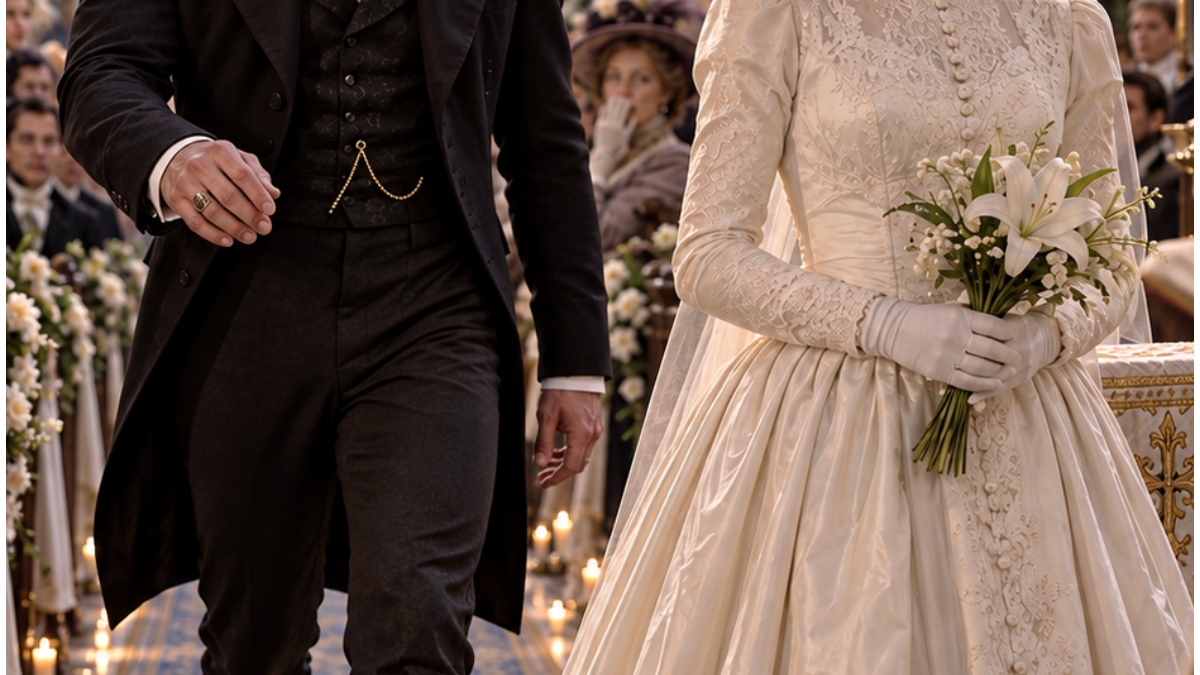
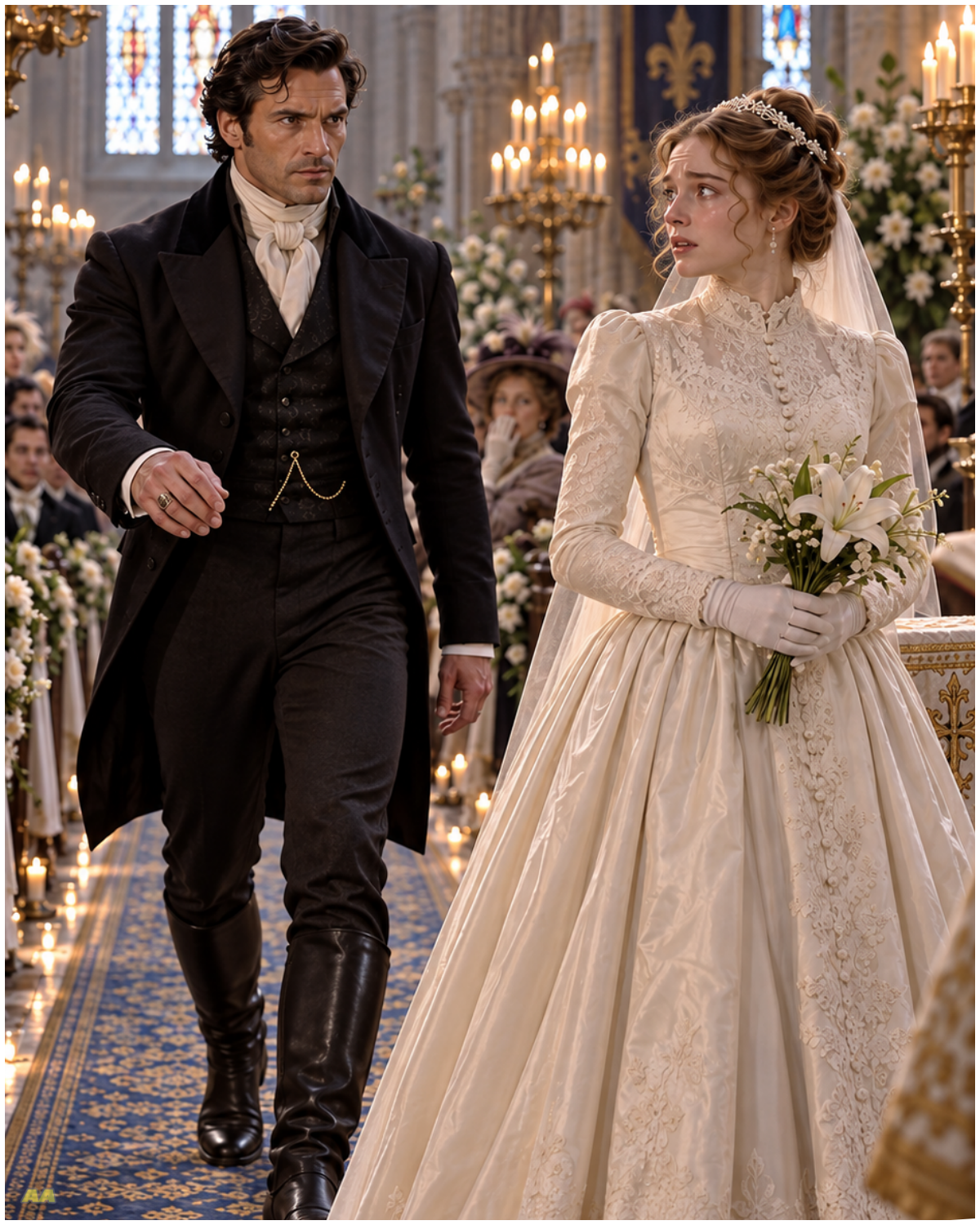
The bride was already dressed for a wedding that would not happen, and only one man in the church yet knew it.
Lucian Ashdon sat in the front pew of St. Albins, with his hands folded and his spine perfectly straight, the way he had been taught to sit through every ordeal of his life, and he watched the vicer’s gaze drift for the third time to the side door through which the groom had not come.
11 minutes. He had counted them the way he counted everything.
The interest on a mortgage, the seconds before a horse refused a fence, the beats of silence in a room that was about to become a scandal.
11 minutes since the organ had finished its second repetition of the processional and begun out of sheer desperation.
A third 11 minutes in which 200 of the most avidly curious people in England had stopped pretending not to notice.
At the altar, Miss Emiline Carr stood very still in white silk and old lace, a spray of hot house liies trembling almost imperceptibly in her gloved hands.
She did not turn around. That was the thing Lucian would remember afterward when he had caused to remember everything about that morning in agonizing replayed detail.
That she did not turn around to search the church for rescue, only stood facing the altar rail as if by refusing to look at the emptiness behind her she might will it to fill.
He knew before the vicer knew, before his mother’s fan had gone still in her lap, before the first ripple of whispers reached the back pews like wind moving through a wheat field.
He knew because he knew his brother.
Henry did not arrive late to things he intended to do.
Henry arrived late to things he had already decided somewhere in the small hours that he could not bear to do, and then he simply did not arrive at all.
My lord. The vicer had come down two steps from the altar, his prayer book still open to the page he would not now read, and he bent toward Lucian with the particular desperation of a man who has just realized he is presiding over a catastrophe and has no earthly authority to stop it.
My lord is there. Has there been word from Lord Henry?
None, Lucian said. His voice did not change.
It never changed. That was one of the things society said of him, that the Duke of Ashdon could announce the end of the world in the same flat, level tone he used to order his tea.
And perhaps that was true. Perhaps he had trained himself so thoroughly in stillness that stillness was all that was left of him.
But beneath his folded hands, his heart was going like a fist against a locked door.
Behind him. He heard his mother’s sharp intake of breath, the beginning of a word that would have been Henry’s name spoken as an accusation, and he did not turn to silence her, because he did not need to.
200 people were rising slightly in their seats, now straining, and the organist had faltered into an uncertain, repeating phrase that made the whole church sound like a clock running down.
Emiline still had not turned around.
That was what undid him. Not the scandal scandal he could weather had weathered would weather again.
The Ashton name was old enough and cold enough to survive a great deal of talk.
It was the sight of her narrow shoulders held so rigidly beneath the white silk, the small movement of her gloved hand smoothing the same fold of her skirt over and over as though the repetition could hold back what was coming.
She had waited at that rail longer than any woman should be made to wait for anything.
And she had done it with her chin lifted, and Lucian understood, with the sudden, clean violence of a blow landing, that in another minute the whole church would see her turn around to an altar with no bridegroom at it, and that image would follow her for the rest of her life.
They would tell it at every dinner table in London, left standing, jilted before God and 200 witnesses.
A woman ruined not by any sin of her own, but by a man’s cowardice.
And no one, not one soul in that gilded, whispering church, would ever again see Emiline car and not think first of this morning.
He was on his feet before he had finished deciding to stand.
He heard his mother’s hand close on his sleeve heard rather than felt it because he had already stepped past the pew rail into the aisle, and the fabric slid out of her grasp with a small sound like a held breath released.
He did not look at her.
He did not look at the 200 faces turning toward him in a slow wave of astonishment, a Greek chorus of raised eyebrows and gloved hands lifting to mouths.
He looked only at the narrow back in white silk at the altar rail, and he walked toward it the way he had once walked toward a rearing horse as a boy of 12, with his heart hammering and his face perfectly composed, because someone had always to be the one who did not flinch.
The vicer’s prayer book made a small, helpless sound as it closed.
“Miss Carr,” she turned then.
He had braced himself for tears and found none or rather found them held so far back in her eyes that only the brightness of them betrayed how close she stood to breaking.
And something in his chest turned over painfully at the site because he had known this face across a hundred dinners at his mother’s table and a dozen summers at Ashdon Park had watched it laugh at Henry’s jokes and soften at Henry’s compliments and glow unbearably whenever Henry entered a room and he had never once in three years of silent and scrupulously hidden devotion seen it look at him the way it looked at him now white stunned searching his face for some sign of what he meant to do your grace.
Her voice was barely a thread.
He is not coming. No, Lucian said, he is not.
Then I, she stopped. Her throat moved.
Behind her, the liies trembled harder.
Then I must go.
I cannot stand here another moment while they all.
You will not go, Lucian said, and something in the low certainty of it made her still.
You came here today to be married, Miss Carr, and married you shall be, if you will permit it.
For one terrible, suspended second, he thought she had not understood him, because her eyes only widened, searching his face as though the words might rearrange themselves into some sense she could recognize.
Behind them, the church had gone utterly silent.
200 people leaning forward as one, the vicer frozen with his prayer book half- raised, his mother somewhere behind him making a sound of pure outrage that he did not turn to acknowledge.
I do not understand, Emiline whispered.
I am asking you to marry me.
He said it quietly for her alone, though he was aware distantly that the front pews would hear every word, and that by nightfall all of London would have heard it, too, reshaped and embroidered a dozen different ways.
He found to his own faint surprise that he did not care.
Now, this morning, in this church before these same witnesses, so that you need never stand at an empty altar again.
I will marry you if you will have me, Miss Carr, and I will spend the whole of my life making certain you never again have caused to doubt that you are wanted.
The words cost him more than anyone in that church could have guessed.
He had rehearsed nothing of this.
There was no version of this morning he had imagined in which he stood where his brother should have stood, offering in five sentences what he had denied himself for three silent years.
But watching her face, watching hope war with disbelief, war with the raw wound of Henry’s absence, he understood that whatever this cost him, whatever it exposed of a heart he had kept locked so carefully that even he sometimes forgot it beat it all, he would pay it.
He had always known somewhere beneath the discipline that he would pay any price at all rather than watch this particular woman be broken in public and do nothing.
Lucian. It was the first time she had ever used his given name, and it struck him like a physical thing low in his cheSt. Her eyes had gone bright and wet now, tears finally slipping free, though her voice held steady.
You do not have to do this.
You owe me nothing. This is not your disgrace to mend.
It is not disgrace I am thinking of, he said.
It never was. He watched her understand slowly that he meant it watched the realization move across her face like light crossing water, and behind it unmistakably something that might have been the first note of a feeling she had not expected to feel that morning at all.
Whatever calculation had been going on behind her eyes stilled.
She looked for one unguarded moment simply at him.
Not at the Duke, not at Henry’s cold elder brother, not at the solution to a scandal, but at Lucian.
And something passed between them that neither of them named aloud.
Not then, not for a long while yet.
Yes, she said, “Yes, your grace, I will marry you.” behind them.
His mother’s voice rose in a strangled protest that the organist, God bless the man’s instincts, drowned beneath a sudden, triumphant swell of the wedding march.
And the vicer, visibly deciding that a duke’s proposal accepted before 200 witnesses, was rather more than sufficient grounds to salvage a service, cleared his throat, opened his prayer book with hands that shook only slightly, and began.
Lucian did not remember much of the ceremony itself afterward.
He remembered the astonished murmur that ran through the church like wind through wheat as the guests realized what they were witnessing.
A scandal transmuting itself in real time into a legend they would tell for years.
He remembered Lady Blanch Fairfax three pews back going white and then a hard furious red, her fan snapping shut in her lap like a small gunshot.
He remembered his mother’s face carved from ice, refusing to so much as look at the altar for the whole of the service.
He remembered the vicer’s voice, unsteady with the strangeness of the morning, asking whether he, Lucian Edmund Ashdown, seventh Duke of Ashdown, would take this woman.
He remembered saying, “I will,” and meaning it more completely than he had ever meant anything spoken aloud in his life.
He remembered Emmaine’s hand in his as he placed the ring, his grandmother’s ring, which he had carried in his coat for reasons he had told no one, not even himself, until this precise moment, and how her fingers had trembled and then very deliberately stilled as though she had chosen there at the altar rail with the whole of society watching to trust him.
He did not know yet what that trust would cost either of them.
He knew only that when he finally turned with her on his arm to face the assembled might of the ton, his mother rigid with fury in the front pew, Lady Blanch staring at him with an expression he would have caused to remember.
200 faces arranged in every possible attitude of shock and delight and scandalized glee.
He felt for the first time in longer than he could name, something loosen in his chest that had been clenched there since boyhood.
He had done the right thing.
Whether it would also in time become the thing that saved him, he did not yet dare to hope.
The carriage ride from St. Albins’s to Ashton House took 11 minutes.
The same 11 minutes, he thought grimly, that Henry had cost them at the altar.
And Emiline spent every one of them in absolute silence, her gloved hands folded in her lap, her eyes fixed on the passing streets as though she might read some explanation for the morning’s events in the ordinary traffic of Hackne cabs and flower sellers.
Lucian did not press her to speak.
He had learned long ago that some silences wanted filling and some wanted only company, and hers, he judged, was the latter.
It was only as the carriage turned in through the great iron gates of Ashton House that she finally looked at him.
They will say, she said carefully, that you married me out of pity.
They may say what they like.
He kept his eyes on her steady.
I have never in my life done anything out of pity, miss.
He stopped himself. Your grace, forgive me.
The habit of a dress will take some adjusting.
Something flickered across her face. Not quite a smile, but its shy, uncertain cousin.
Your grace, she repeated softly, testing the shape of it, and looked away again, out at the pale stone front of the house that was now by law and by vow as much hers as it had ever been his.
He did not tell her that first day everything he might have told her.
He did not tell her that he had loved her since the autumn evening 3 years passed when Henry had brought her to dinner at Ashdon Park, and she had laughed, really laughed, unguarded, at some small absurdity, Lucian himself had said almost by accident, and he had felt something in his carefully governed chest crack open for the first time since he was a boy.
He did not tell her that he had spent three years watching his brother squander what Lucian would have given the whole of his fortune to deserve.
He did not tell her any of it because it was too soon because she was raw with grief and shock and the particular indignity of having been abandoned before God by one brother and rescued bewilderingly by another.
And because a man who has waited three years can surely wait a little longer to be believed.
He only handed her down from the carriage, offered his arm as though this were any ordinary homecoming, and said as the great doors of Ashton House opened before them, “Welcome home, your grace.” She looked up at him with an expression he could not yet read, “Wonder, perhaps, or the beginning of something more fragile than wonder,” and placed her hand upon his arm.
He had expected in the days that followed that she would brace herself against him.
He had, if he was honest, half expected to deserve it.
A woman married in the ruins of her own wedding mourning to the brother of the man who had abandoned her might reasonably assume that whatever waited for her behind the doors of Ashdon House would be some version of the same carelessness.
A marriage of convenience conducted with the same indifference Henry had shown, only better dressed.
Lucian had seen that expectation in her eyes the first evening, when the housekeeper, Mrs. Peruit had led her up the wide staircase toward the family wing, and Emmaine’s spine had gone taut with the particular bracing of a woman walking toward a verdict.
He had been waiting for her at the top of the stairs.
“Your rooms,” he said, and opened the door himself rather than let a footman do it, are the ones that face the east gardens.
I am told the morning light is better there than anywhere else in the house, and you struck me some years ago, as a woman who likes to rise with the sun rather than be dragged into the day by it.
She stopped in the doorway. The room beyond was not grand in the way she might have feared grand, not cold marble and guilt meant to remind a bride of her own smallness, but warm, cream papered, with a low fire already lit against the evening chill, and a vase of white roses on the writing desk that had clearly been cut that very afternoon.
You remember that, she said slowly, about the mornings.
I remember a great many things, your grace.
He kept his tone light, deliberately so, because he had learned that the wrong weight on a true thing could frighten a person as surely as a lie.
It is rather a curse of mine.
Ask my valet. I remember precisely how he prefers his boot polish, and have made his life a misery over it for 11 years.
That one hymn at least, the ghost of a smile, quick, startled, gone almost before it arrived, but real.
And these rooms are mine entirely.
Entirely. You will find the door to the connecting sitting room locks from your side only.” He said it plainly without inflection, because he wanted her to hear it exactly as it was meant, not as coldness, but as a promise.
I have no wish to crowd a life you did not choose to share with me under happier circumstances.
Your grace, this house has room enough for two people to live in it without ever once feeling cornered by the other.
You will have your own apartments, your own carriage, your own allowance, and my word that neither I nor anyone under this roof will make demands of you that you have not first agreed to.” She looked at him for a long moment in the fire light, and he could not tell from her face whether she found the arrangement a mercy or a fresh kind of loneliness.
He did not ask. He bowed precisely correct and left her to the quiet of her new rooms and told himself, walking back down the long gallery to his own wing at the opposite end of the house, that this was exactly as it should be, that a woman given no choice in her own wedding deserved every choice thereafter, even the choice to keep her new husband at the furthest possible remove.
It did not stop the walk back to his rooms from feeling like the longest distance he had ever crossed.
The small kindnesses continued because he could not seem to stop himself from performing them, even as he told himself each one was merely good management, merely what any decent man owed his wife, regardless of the manner of their marrying.
Her mother’s letters, he discovered, were forever arriving a day later than they ought because the post from Hampshire was rooted first through the estate office.
He had it redirected within a week, so that Mrs. Carr’s letters reached Emmaine’s breakfast tray before anything else did, and said nothing of having arranged it.
He noticed at their first dinner alone together that she moved the candied violets to the edge of her plate without eating them.
And by the second week, the pastry chef had been quietly instructed never to garnish her puddings with violets again, and instead to see that there was always somewhere on the table a small dish of the burnt sugar comforts she had once mentioned in Henry’s hearing three years before as her particular weakness.
He noticed she liked the gardens better than the drawing rooms, and had a bench installed beneath the old cedar, where the afternoon light fell longest, without ever telling her it was there for her, until she found it herself, and stood staring at it as though it were a message written in a language.
She was only beginning to learn to read.
Your grace. She found him one evening in the library, 3 weeks into their strange new marriage, a book unread in his lap, and the fire burned low.
She had taken to seeking him out in these last hours before retiring, not for long conversation generally, but for a kind of companionable quiet that he had come, with a helplessness that alarmed him, to treasure more than he treasured almost anything else in his day.
I must ask you something, and I hope you will forgive its bluntness.
I have found bluntness to be one of your chief virtues, he said.
Ask. Why are you so kind to me?
Her eyes in the low fire light were very steady.
You did not have to be.
You have given me every comfort a wife could ask and ask nothing in return.
Not my company, not my confidence, not even the ordinary courtesy of an evening’s conversation unless I offer it firSt. Henry was never so careful of me.
He loved me loudly and carelessly, and I mistook the noise for depth.
You are quiet in a way I do not yet understand and I find I would like to.
He set the book aside. For one dangerous moment the truth rose in his throat 3 years since the autumn you laughed at something I said and I have not been the same man since.
And he pressed it back down because it was too soon because grief for Henry still moved behind her eyes even now.
Banked but not gone. And a man did not build a house on ground still settling from another man’s collapse.
Because you are my wife, he said instead, which was true, if not the whole truth, and because I have never yet seen the good in treating a person as though kindness were a coin to be spent sparingly.
You have had enough of being made to feel you must earn small mercies your grace.
In this house, at least you need not.
She studied him for a long moment, as though weighing whether to press further, and then to his quiet relief and quieter disappointment both, she let it go, and asked him instead about the book in his lap, and they talked, really talked, for the better part of an hour about nothing of consequence at all, until the fire burned down to embers, and she rose at last to say good night.
Sleep well, Lucian,” she said at the door.
And it was the second time she had used his given name, and he sat a long while after she had gone, turning the sound of it over in the quiet like a coin he meant to keep.
He did not yet know that his mother had already begun, three floors above them in her own apartments, to write the first of the letters that would nearly undo everything he had so carefully built.
Lady Ashdon received her daughter-in-law when she dained to receive her at all with the particular civility of a woman conducting a war she had not yet declared allowed.
She was Lucian knew better than anyone alive, a formidable strategiSt. She had spent 30 years managing a dukedom through the long illness and early death of his father, and she did not surrender ground.
She considered hers merely because a vicer had said words over it.
Henry had always been hers. Henry, golden and careless and easy to love, had been the son who curled at her knee as a boy, while Lucian, three years older and already being shaped into the next Duke, stood at attention beside his father, learning the weight of a title he had not asked for.
She had never troubled to hide which son she preferred, and she did not trouble to hide now which son’s bride she considered an intruder.
You will forgive me, Emmaine,” she said one afternoon in the drawing room in the particular tone she used when she intended forgiveness to be entirely beside the point.
If I find the whole arrangement rather difficult to credit, a bride married within the hour to her bridegroom’s own brother.
It has the shape, does it not, of something rather less than respectable, however the vicer chose to dress it in prayer book language.
Lucian, standing at the window with his back half turned, felt his jaw tighten.
But he had learned decades ago that to intervene too quickly in his mother’s campaigns only sharpened her resolve.
And so he waited, watching Emiline’s reflection in the glass to see how she would answer for herself.
I imagine it does, Lady Ashdon, Emiline said with a composure that made something fierce and proud rise unexpectedly in Lucian’s cheSt. I imagine a great many things look less than respectable from the outside of a church when one was not present to see a man stand up before 200 witnesses rather than let a woman be humiliated.
I was there. I saw exactly what happened.
I find I credit it perfectly well.
Lady Ashdon’s fans stilled. How very loyal you have become in three short weeks to a marriage struck up on the spot like a bargain at a horse fair.
I have found Emiline said that loyalty is rather easier to come by when it is returned in kind, my lady.
Perhaps that has simply not been your experience of this family.
It was, Lucian thought afterward, turning from the window at last to see his mother’s face gone rigid with a fury she dared not fully voice in front of him.
The precise moment he understood that his wife was not merely enduring her circumstances, but beginning cautiously, fiercely to defend them, to defend him.
And something in his chest turned over with a feeling he did not yet have a name for because he had spent so long expecting to be tolerated that he had forgotten what it might feel like to be championed.
His mother did not of course abandon her campaign for so small a defeat.
She wrote to Henry. Lucian found the draft of the letter unscent, blotted with crossings out when he went looking through her writing desk for an old estate map, and found instead the raw evidence of her scheming.
Three separate attempts at a letter urging Henry to return at once, to make his claim known, to remind the world and Emiline, both that he had only fled from fear and not from indifference, that an anulment might yet be sought on grounds of the marriage’s unseammly haste, that a son of hers ought not to lose what was rightfully his to a brother who had always, in her private accounting, taken more than his share.
Lucian burned the letters in the estate office great and said nothing to his mother of having found them, because there was, he judged, no version of that conversation that would not simply drive her scheming further underground, where he could no longer see it coming.
He said something instead to Lady Blanch Fairfax when she called at Ashdon House 3 days later with an expression of such carefully arranged sympathy that he knew before she opened her mouth precisely what manner of cruelty she had come to deliver your grace.
She had cornered Emiline in the small drawing room, ostensibly over tea, and Lucian arrived in the doorway in time to hear the particular silk and venom of her voice, honed over a season of disappointed expectation.
For it had been widely known before the wedding that was not a wedding, that Lady Blanch had set her cap and her mother’s fortune both at the Duke of Ashdon, and had watched that prize walk itself to the altar for another woman entirely.
How brave you are to smile so prettily through it all.
I do think it speaks so well of your character that you do not let yourself dwell on how the whole of London understands this marriage.
A man does not fall in love in the space of 11 minutes, my dear.
He performs a rescue out of duty, out of the family’s honor and duty, I fear, has rather a short season before it grows tired of itself.
I should not be at all surprised if his grace finds within the year that obligation makes a cold sort of husband.
Lady Blanch Lucian’s voice from the doorway was quiet, but it cut through the room like a blade drawn from its sheath, and he had the satisfaction of watching her go pale as she turned to find him there, unmistakably having heard every word.
I find myself curious. In the whole of the season you spent cultivating my acquaintance, did you ever trouble to learn a single thing I actually preferred, a book, a season, a color, a dish, or did you find my title sufficient information on its own?
Lady Blanch’s mouth opened and closed without producing a sound.
My wife, Lucian continued, crossing the room to stand quite deliberately at Emiline’s shoulder, could tell you this instant that I take my tea without sugar, that I cannot abide the smell of lilies, though I will endure them for her sake, and that I have read the same three chapters of Marcus Orurelius perhaps 40 times, because they are the only philosophy that has ever made grief bearable to me.
She knows these things not because I have cataloged myself for her inspection, but because she troubles herself to notice the people around her, which is a rarer virtue than birth or fortune, Lady Blanch, and one I have come in a very short time to value rather more than either.
The silence that followed was absolute.
Emiline had gone very still in her chair, her teacup arrested halfway to her lips, staring up at him with an expression he could not read, and did not in that moment have the courage to examine too closely, because to examine it would have meant admitting how much he wanted it to mean what he hoped it meant.
Lady Blanch recovered herself enough to make a stiff, wounded exit within the quarter hour, promising in tones of injured dignity that she would not trouble Ashton House again.
And Lucian, watching her go, felt no triumph in it at all, only a kind of tired relief, the relief of a man who has defended something precious, and is only now realizing how much the defending has cost him to hold back for so long.
You knew all that,” Emiline said quietly once the door had closed.
About the tea, the liies, the book.
I did. I never told you any of it directly.
No, Lucian admitted. You told Henry I was in the room.
She was quiet for a long moment, turning her teacup slowly in its saucer, and when she looked up at him again, there was something new in her face.
Not quite understanding, not yet. But the first uneasy edge of a question she had not thought to ask before about how long a man might listen unnoticed before anyone thought to wonder why he did not answer the question she had not yet asked aloud he only excused himself with more haste than dignity before his composure could betray him further and left her sitting alone with her tea and her thoughts while three floors above them his mother sat at her writing desk once more pen in hand composing a fourth letter to a son who had not yet answered the first three a letter that would within a fortnight finally reach him and bring him home.
But before Henry came home, there was a fortnight that Lucian would carry with him for the rest of his life.
However it ended, a fortnight in which the ledger he had kept so carefully hidden was finally opened page by page in front of the one person he had ever kept it for.
It began, as these things so often do, with something small.
Emiline had taken to spending her mornings in the estate library, cataloging a set of old household accounts at her own request, insisting she would rather be useful than ornamental in a house she meant to make a genuine home.
And it was there, on a wet Tuesday, with rain streaking the tall windows, that she came upon the ledger.
It was not, in truth, a ledger at all, merely a slim commonplace book bound in worn green leather that Lucian had kept for years tucked among the estate accounts precisely, because no one but himself ever had caused to open the estate accounts.
He had forgotten in the business of the last weeks that it was there at all, and so he did not think to warn her.
And so it was that she found it entirely by accident, reaching for a ledger of tenant rents and drawing out instead 3 years of his own careful secret handwriting.
He came upon her an hour later, standing very still by the library window with the book open in her hands, and he knew before she looked up what she had found, because he recognized, even at that distance, upside down in his own hand, the entry that read.
E prefers her tea with honey.
Never sugar noticed it tonight at dinner.
Said nothing, of course. Lucian, she did not look up immediately.
Her voice when it came was strange, not accusing, not yet, but hollowed out with something like disbelief.
What is this? He crossed the room slowly, giving himself time.
He did not truly have to decide how much of the truth he was prepared to survive telling.
It is nothing that need alarm you.
It is 3 years of notes about me.
She turned a page and another, her eyes moving rapidly now, and he watched her face as she read watched comprehension dawn in increments.
The way morning light comes up slow and then all at once.
Her favorite color is the blue of a wood pigeon’s wing, not sky blue.
She was quite particular about the distinction.
She laughs loudest at jokes made at her own expense, never at anyone else’s.
She reads the end of a novel first if she suspects it will end unhappily, so she may brace herself before living through the rest of it.
Her voice cracked very slightly on the last line.
Lucian, this is dated four years ago.
Before Henry ever, before any of this, before I was even out of mourning for my father, before Henry had so much as called on me twice.
Yes, Lucian said, because there was finally nowhere left to hide from it.
Four years. She closed the book very carefully as though it might shatter and looked up at him at last, and her eyes were bright and fierce and frightened all at once.
You have been what exactly? Watching me, cataloging me like a man collecting specimens while I stood in this very house believing myself in love with your brother.
And you said nothing, nothing at all for four entire years.
Yes, he said again because the truth once begun seemed determined to be told in its entirety or not at all.
I watched you fall in love with him.
I watched him fail again and again to notice a fraction of what I noticed without trying.
I watched you defend him to your mother and forgive him his lateness and excuse his carelessness as high spirits.
And I told myself every single time that it was not my place to want what he had because he had it first and because you loved him and because I have spent the whole of my life being the son who does not reach for things that belong to someone else.
You loved me, she said it slowly, testing each word as though it might dissolve under examination.
For 4 years while I married while I nearly married your own brother and you never said a word.
What would you have had me say?
For the first time since the altar, something in his careful control frayed audibly at the edges.
That I had watched my brother’s intended bride across a hundred dinners and found I could not stop.
That I envied the only person in this family who had ever truly loved me without condition and envied him precisely because the thing he loved was you.
There was no version of that confession that would not have destroyed something.
Your happiness, his trust, whatever tattered peace this family still possessed.
I chose silence because silence was the only gift I had left to give you that would not cost you something.
And instead, Emiline said, her voice rising now, not with anger alone, but with something rower beneath it.
You gave me a husband who married me out of some four-year-old devotion I knew nothing about in the wreckage of a wedding to his own brother, and let me believe every single day since, that your kindness was simply decency, duty, the ordinary courtesy of a good man toward a woman’s circumstance had thrust upon him.
Do you understand what that does, Lucian, to discover that every small mercy I thought I was receiving as charity was in fact?
She stopped, pressing the back of her hand.
Briefly to her mouth and when she spoke again her voice had dropped almost to a whisper was in fact love all this time and I did not know to be grateful for the right thing.
You owe me no gratitude at all.
He crossed the last of the distance between them.
Close enough now to see the tears standing unshed in her eyes.
Close enough that every disciplined year of his life screamed at him to step back to give her the room she had every right to demand.
And he stayed exactly where he was because some instinct older than discipline told him that this finally was not a moment for retreat.
I did not tell you to be thanked, Emmaine.
I did not marry you to collect on some old debt of the heart.
I stood up in that church because Henry left an empty place at that altar and I could not bear to watch you stand in it alone.
And if some part of me was glad, God forgive me, glad beneath all the grief of that mourning, to finally be permitted to stand beside you as something more than his brother, then that is a selfishness I have carried in silence and will go on carrying in silence for as long as you need me to.
If silence is what will let you stay, why did you never simply tell me?
Her voice broke properly now, the tears finally spilling.
Before the wedding, before any of it, if you had told me three years ago that that what?
His own voice had gone rough, unfamiliar even to his own ears.
That you should have chosen the quiet brother over the charming one on the strength of a ledger he never intended you to see.
Emmaine, you loved him. I watched you love him entirely with the whole of your bright and generous heart.
And a man does not interrupt a woman’s happiness merely because his own has been inconvenienced by it.
I would have carried this to my grave rather than cost you a single day’s joy with Henry, had Henry ever once deserved the joy you gave him.” She was silent for a long moment.
The commonplace book still held against her chest like something she could not yet bring herself to set down.
And when she finally spoke, her voice had steadied into something quieter, more dangerous for its calm.
Do you love me still? Now, not the memory of some dinner four years passed now today, knowing everything you know about how I came to you, jilted and grieving and entirely unprepared to be anyone’s wife.
Yes, Lucian said without a single second’s hesitation, because it was the one true thing in his whole guarded life he had never had to think twice about.
More today than the day I began keeping that wretched book.
I loved a girl who laughed at dinner four years ago.
I have come in these last weeks to love a woman who defended me to my own mother, who found her way alone into a house full of strangers and made it in a matter of weeks, kinder than it has been in a decade, who reads sad endings first so she may bear them better, and yet somehow still finds the courage to hope.
That is not old devotion warmed over, Emmaine.
That is a man falling in love, entirely a new with who you have actually turned out to be.
She looked at him for a long, unbearable moment, the rain still streaking the windows behind her, the green book clutched to her chest, and he could not read in that silence whether he had finally catastrophically cost himself the fragile piece they had built, until she crossed the last small distance between them herself, and pressed her forehead very briefly against his shoulder, a gesture that asked for nothing and offered everything, and said in a voice muffled and thick with tears, “I do not know yet what I Feel Lucian.
It is too much too fast on top of too much grief already.
But I know I do not want you to stop.
Whatever this is, I do not want the ledger to close.
He did not embrace her fully some instinct told him she was not yet ready for that.
That this fragile offering deserved to be received with the same restraint with which it had been made.
But he lifted one hand slowly and rested it against her hair and stood with her in the rain gay light of the library and thought that whatever came next, whatever Henry’s return or his mother’s schemes or society’s cruel appetite for scandal might yet bring, he had this now, a woman who knew the whole truth of him and had not run.
It was, he thought, more than he had ever let himself hope to have.
He did not yet know that Henry’s carriage was already rattling up the London road, three days out and closing, carrying home a man who believed, with the particular blind conviction of the truly desperate, that everything Lucian had built in these past weeks still belonged by some prior and unbreakable right to him.
It was into this fragile new forged tenderness that the invitation to the Fenwick ball arrived, and Lucian understood at once, turning the guiltedged card over in his hands, that it represented a test neither of them could avoid without conceding something they could not afford to concede.
Society had talked of nothing else for six weeks, but the scandal of the Ashdon wedding and the Fenwick’s ball, the first grand entertainment of the autumn, certain to draw every family of consequence in London, would be the first occasion on which the new Duke and Duchess of Ashdon were expected to appear together before the full assembled weight of the ton.
We need not go,” he told her, watching her face carefully across the breakfast table as she read her own copy of the invitation.
“I have weathered worse than a room full of whispers, Emmaine, and I would rather spare you the ordeal of it than prove some point to people whose good opinion I have never particularly valued.” “And what will they say?” Emiline asked quietly, “If the Duchess of Ashdon is too frightened to show her face at a ball six weeks after her wedding, that the marriage is already troubled, that I am ashamed or unhappy, or hiding some private grief they might then feel entitled to speculate about at every dinner table in Mayfair for the rest of the season.” She set down the card with a small decisive motion.
No, we will go, Lucian, and I will wear the finest gown I own, and I will dance with my husband in front of every person who ever doubted the manner of our marrying, and I will not give them the satisfaction of seeing me flinch.
He had married, he thought, watching her, a woman of considerably more courage than he had first understood, and it was with a fierce and quiet pride that he handed her down from the carriage three evenings later at the foot of the Fenwick’s great marble steps, the whole facade of the house ablaze with candle light, footmen in powder and livery lining the entrance like a gauntlet of watching eyes.
The ballroom, when they entered it, went very nearly silent, the particular hush of 200 conversations arrested mid-sentence, followed by the swift, rustling murmur of a crowd rearranging itself to watch.
Lucian felt Emline’s hand tighten almost imperceptibly on his arm, and he covered it with his own briefly, a silent and steadying pressure that said without a single word spoken aloud, “I am here, and I am not ashamed of you, and I never will be.” They made their way through the receiving line, through the first stiff round of bows and curtsies and carefully neutral pleasantries, and Lucian thought for one hopeful moment that the evening might pass without incident, until he saw across the crowded floor Lady Blanch Fairfax bearing down upon them with a small cluster of her particular friends in tow, her expression arranged into the bright, poisonous sympathy she had perfected over a lifetime of seasons spent cultivating exactly this sort of moment.
Your grace, Lady Blanch’s curtsy to Emiline, was a masterpiece of correct and utterly hollow civility.
How very brave of you to come tonight.
I confess we none of us expected it, given the circumstances.
But then, I suppose, when a marriage begins in such very public disorder, one might as well continue as one began, quite without regard for what anyone thinks.
A ripple of interest moved through the small crowd that had gathered near enough to listen, and Lucian felt the old familiar coldness rise in him.
Not the coldness society mistook for his natural temperament, but the deliberate controlled chill he had learned over a lifetime of guarding a family’s dignity to deploy exactly when it was needed.
I find, Emiline said before Lucian could speak, her voice light and perfectly pleasant and utterly without apology, that I have never much minded what anyone thinks of a decision I know to be right, Lady Blanch.
I imagine that is a freedom you might enjoy as well, once you have found a marriage worth defending rather than merely one worth securing.
A small startled titter went through the onlookers, quickly smothered, and Lady Blanch’s smile thinned to something considerably less friendly.
How fortunate for you to have found such conviction so quickly.
I only hope it survives the winter, your grace, once the novelty of rescue has worn off, and ordinary life sets back in.
Marriages built on a single dramatic gesture so rarely outlast the drama that made them.
Then it is fortunate, Lucian said, stepping forward at last, his voice pitched to carry just far enough that the small ring of listeners could not mistake his meaning, that this marriage was never built upon a gesture at all, Lady Blanch, however dramatic the morning that revealed it.
I have loved my wife for 4 years, since long before that wedding, since long before you or anyone else in this room troubled to notice her at all beyond her connection to my brother.
What you witnessed at that altar was not the beginning of anything.
It was simply the first moment I was finally permitted to say aloud what had already been true for a very long while.
I do not expect you to understand a devotion of that kind, Lady Blanch, since I have yet to see you extend genuine interest to anyone whose title could not first be verified.
But I would ask you in future to save your sympathy for occasions that actually require it.
My wife needs none tonight, and neither I find do I.
The silence that followed was profound.
Lady Blanch’s face had gone through several shades of color, settling finally on a modeled, furious red, and without another word she withdrew, her small cluster of friends trailing after her in a flurry of whispered commentary that would, Lucian had no doubt, circulate through every drawing room in London by the following afternoon, though not.
He suspected, in the shape she had hoped to give it.
“That was rather more than I expected you to say,” Emiline murmured once the immediate crowd had begun with visible reluctance to disperse back into its ordinary currents of dancing and gossip.
“I find I have grown tired of being careful with the truth,” Lucian said, now that I have finally been given leave to speak it.
Would you dance with me, your grace?
I believe the orchestra is beginning something rather less combative than the conversation we have just concluded.
She laughed then, a real laugh, bright and unguarded, the sound of it loosening something in his chest that had been wound tight since the moment they entered the ballroom and let him lead her out onto the floor.
And if every eye in the room followed them as they moved through the steps of the dance, Lucian found for the first time in his life that he did not mind being watched at all, so long as it was Emiline’s hand in his while the whole of society looked on.
They danced twice more before the evening ended and dined once briefly at a small table with an elderly aunt of the Fenwicks, who proved unexpectedly one of Emiline’s staunchest new champions, declaring loudly enough for several nearby tables to hear that she had never in 40 seasons seen the Duke of Ashton smile so much in a single evening as he had smiled tonight, and that whatever the manner of the wedding, any fool could see the marriage itself was a rare and genuine thing.
It was well past midnight when their carriage finally pulled away from the Fenwick’s blazing facade, and Emiline, leaning tiredly but contentedly against his shoulder in the swaying dark, said quietly, “I was afraid going in.
I do not mind admitting it now that it is over.
I thought perhaps I would stand there and feel all over again, exactly as I felt at that altar, exposed and pied, and alone in a room full of people who had already decided what to think of me.
And did you? Lucian asked his arm settling careful and certain around her shoulders.
No, she said, and he felt her smile against his coat.
I felt chosen loudly and in front of everyone exactly the way I imagine you have been choosing me quietly for 4 years without a single soul the wiser.
I think I begin to understand now what that must have cost you to carry a thing so large in such complete silence.
It cost me nothing, Lucian said, compared to what it would have cost me to lose you to my own cowardice.
I learned that lesson from Henry’s example, if nothing else, a debt of gratitude I do not imagine I will ever manage to properly repay him.” She laughed softly again, and the carriage rolled on through the sleeping streets of London, carrying them home to a house that had, in these last strange and eventful months, finally begun to feel entirely like their own, though neither of them yet knew how soon that fragile peace would be tested again, nor how much more Henry’s own reckoning still had left to demand of all three of them before the whole of the family’s future could finally be settled beyond any further doubt.
Henry arrived at Ashdown House on a gray Thursday afternoon unannounced in a hired shay so shabby that the footman at first mistook him for a tradesman come to the wrong entrance.
Lucian was in the estate office when word reached him.
His brother returned and asking with what the footman described as considerable agitation to see Miss Carr at once and he felt the whole careful architecture of the last month brace itself in a single instant for collapse.
He found Henry in the front hall, still in his traveling coat, hat in hand, thinner than Lucian remembered him, his golden good looks gone somehow threadbear, like a coat worn one season too many.
There was no sign of the actress who had, by all report, accompanied his flight to the continent.
There was no sign either of any of the easy charm that had once made Henry the favorite of every drawing room in London.
What remained looked, to Lucian’s critical eye, very much like a man who had gambled everything on his own charm and lost, and had come home now only because he had nowhere else left to spend it.
Lucian. Henry’s voice cracked on the name.
Where is she? Your bride, do you mean?
Lucian kept his own voice level, though something cold and unfamiliar was moving through him now, a feeling he did not immediately recognize as fury because he had so rarely permitted himself to feel it in full.
She is not here for the collecting, Henry, if that is what you have traveled three days to attempt.
She is my wife. Your wife?
Henry laughed a raw disbelieving sound.
God above Lucian, you married her.
You actually married her. I leave for a fortnight, half out of my mind with terror at the whole business of marrying, meaning only to clear my head and come back before anyone noticed, and I returned to find you have married my own bride in a church full of witnesses.
What kind of brother does that?
The kind, Lucian said very quietly, who does not leave a woman standing alone at an altar in front of 200 people.
Henry, you did not merely delay your own wedding.
You destroyed a mourning that woman will otherwise have had to carry as a wound for the rest of her life.
And you did it not out of some noble hesitation, but because you fled the country with an actress the very night before your vows, and were only persuaded home again.
I have no doubt when her interest in your company outlasted your money, and not one day longer.
Henry’s face went through several colors in rapid succession.
Shame, fury, and finally a kind of desperate, cornered defiance that Lucian recognized from every scrape of their shared boyhood.
The look of a younger brother who has always, always been rescued from the consequences of his own recklessness, and cannot quite believe that this time the rescue is not forthcoming.
You stole her. Henry’s voice rose, echoing up the great stone stairwell, and Lucian was distantly aware of movement on the landing above.
A flash of pale silk, emoline skirts, arrested at the top of the stairs, where she had clearly come at the sound of raised voices, and now stood frozen, listening.
You have always wanted what was mine, Lucian, since we were boys, my toys, my ponies, my father’s smallest scrap of approval.
And now you have taken the one thing that was ever entirely completely mine.
The one person who ever loved me for myself and not for the title I would someday hold.
And you did it the very morning I was weak enough to falter.
You did not rescue her. You seized your chance.
I gave her a wedding day that did not end in ruin.
Lucian’s voice had gone very quiet now, dangerously quiet, the particular stillness that those who knew him best had learned to fear far more than shouting.
I gave her a home and a name that could not be taken from her, and the truth eventually of a devotion that predates your courtship of her by a full year, Henry, which you would know already if you had ever once troubled to notice anyone besides yourself.
You did not lose Emmaine Carr to my ambition.
You lost her the moment you climbed into a carriage bound for do rather than face your own wedding day, and no amount of tears in my front hall will rewrite that morning into something more flattering to your memory of it.
Lucian. Emiline’s voice from the top of the stairs cut through the hall like a struck bell, and both brothers turned to find her descending, her chin lifted, her composure Lucian noted with a fierce, aching pride, utterly unbroken, despite the por in her face.
Henry, Emmaine. Henry’s whole demeanor transformed at the sight of her, the fury dissolving instantly into something more calculated, more practiced a performance of heartbreak that Lucian, watching closely, recognized as exactly that, a performance, because he had watched Henry stage this precise expression of wounded devotion a hundred times before over gambling debts and broken promises and every other small catastrophe of his charmed and careless life.
My darling girl, I have come back for you.
I know I have wronged you terribly.
I was a coward. I admit it freely.
The very worst kind of coward.
But it was only fear, Emiline.
Only the terror of a young man not ready for so great a step.
And I have punished myself every single day since for it.
Come away with me. We will go somewhere quiet, somewhere no one need know the whole shameful business, and I will spend the rest of my life proving to you that the man who fled that church was not the true measure of my heart.
Lucian said nothing. He had promised himself, walking down from the estate office at the first word of Henry’s return, that whatever came, he would not fight this battle for her, that Emiline had earned through every indignity of that terrible wedding morning and every quiet week since the absolute right to answer for herself, unpressured by his own desperate hope of what her answer might be.
It was, he thought, the hardest stillness he had ever held, harder even than the 11 minutes at the altar, because this time the outcome was entirely out of his hands, and rested instead in the steady, searching gaze his wife now turned upon the brother who had once been the whole of her heart.
“You are a coward,” Henry, Emiline said, and her voice did not shake at all.
You have just said as much yourself, as though the confession alone might absolve you of the actual harm.
I do not doubt that some part of you loved me once in whatever careless fashion you are capable of loving anything.
But you left me standing at that altar in front of everyone I have ever known.
And you did not think of me at all in that moment.
You thought only of your own fear, your own comfort, your own desperate need to escape a commitment that frightened you.
And now you have come home penalous, I imagine, and abandoned by whatever companion made the fleeing worthwhile.
And you find suddenly that the woman you left behind has become a duchess with a household and a fortune and a husband who has never once in six weeks of marriage made me feel as small as you made me feel in 11 minutes at that alter rail.
Emiline, I am not finished. Her voice cracked slightly now, not with weakness, but with the sheer force of finally saying what she had clearly been holding back for weeks.
You call it stealing what your brother did.
Let me tell you what I remember of that morning, Henry, since you were not there to witness it yourself.
I remember standing at an altar with my back to 200 whispering strangers, waiting for a bridegroom who was never coming, feeling the whole of my future collapse around me in real time.
And I remember your brother, the brother you have spent your whole life dismissing as cold, as dull, as the beautiful shadow beside your bright and careless sunshine, rising from his pew and walking the length of that church to stand where you should have stood and offering me in front of everyone.
The one thing you could not be troubled to give me, his name, his protection, and his word that I would never again be made to feel unwanted.
That is not theft, Henry. That is everything you were too much of a coward to be.
The silence that followed was absolute.
Henry’s face had gone white, then a dull, ashamed red, and for a moment Lucian almost pied him almost, until he remembered the 11 minutes, the whispering church, the narrow, rigid set of Emmaine’s shoulders as she had waited alone for a man who was already crossing the channel with another woman on his arm.
Mother will not stand for this, Henry said finally, his voice thick.
She has always. Your mother, came a new voice from the drawing room doorway, and Lucian turned to find Lady Ashton standing there, having clearly listened to some considerable portion of the exchange already, her face composed into its familiar mask of aristocratic disapproval.
Has indeed written to you three times these past weeks, Henry, and I do not regret a word of it.
This marriage was conducted in unseammly haste in the wreckage of a scandal, and I see no reason why it should not be quietly dissolved now that you have returned to claim what is rightfully yours.
Mother Lucian’s voice when it came was low and absolutely final the voice of a man who has reached the very last edge of his patience and found beneath it not fury but a cold and settled resolve.
Emiline is my wife. She is the Duchess of Ashdon, and she will remain so for the whole of our lives, regardless of what letters you have written or what claims Henry now sees fit to make.
I have indulged your grief over Henrys exile for 6 weeks because I understand better than you credit me what it is to love a son who does not return that love in equal measure.
I will not indulge it a moment longer if it means one more hour of my wife being made to defend in her own home.
A choice that was never in question to begin with.
Lady Ashton’s composure flickered just slightly at the word never, as though she had heard for the first time the full and unbending weight of his conviction, and understood that whatever ground she had hoped to reclaim for Henry had already irretrievably been loSt. “You would choose her,” she said slowly, “veroose what is right,” Lucian said.
It has simply taken me a great deal longer than it should have to understand that in this particular matter, the right thing and the thing I most wanted have always entirely been the same.
He crossed to Emiline’s side and offered her his arm, and she took it not shakily, not with the fragile uncertainty of a woman merely enduring a difficult scene, but with a steadiness that told him more clearly than any words could have exactly where she now stood and with whom.
Henry may stay the night if he has nowhere else, Lucian said to no one in particular, already turning toward the stairs.
He is still my brother, whatever else he has forfeited, and I will not turn him into the street penalous.
But he will not raise this matter again under this roof, and neither, mother, will you.
The choice has been made. It was made, if we are being entirely honeSt. The morning I stood up in that church, everything since has simply been the world catching up to what was already true.
He did not look back to see how Henry took the pronouncement, or how his mother’s face settled finally into something that might have been grief, or might have been the first grudging edge of acceptance.
He climbed the stairs with Emmaine’s hand steady on his arm.
And it was only once they had reached the privacy of the gallery above that she stopped and turned to him and said very quietly, “Thank you for letting me answer him myself.
You never needed my permission,” Lucian said.
You have never needed anyone’s permission to be exactly as formidable as you are, Emmaine.
I only wish I had told you so sooner.
She studied his face for a long moment in the fading afternoon light.
And then, for the first time since the morning of the wedding, she reached up and touched his cheek, a small gesture, brief and unpracticed, but one that struck him with more force than any declaration could have, because it asked nothing of him, and offered instead the first unguarded proof that whatever she had said to Henry downstairs, she had meant every word of it not merely as a rebuke to the past, but as a promise to the future.
But the household’s peace, however hard one, was not yet settled for downstairs.
In the drawing room, Lady Ashton had already begun, in a low and urgent voice, to press Henry toward one final gambit, a public reckoning at the next family dinner, where the whole of the family together might be made to witness, and perhaps even to force the choice Lucian had just declared already made.
The invitation arrived 3 days later, addressed in his mother’s precise hand to a family dinner at Ashton House.
Nothing so unusual in itself, save that lady Ashdon had troubled to invite alongside the immediate family, a small but pointedly chose an assembly of relations and old family friends.
The sort of gathering that existed, Lucian understood the instant he read the guest list for exactly one purpose, to provide an audience.
She means to force the matter in company, he told Emiline that evening, watching her face carefully across the width of the library for any flicker of the old fragility.
She believes that whatever you might say to Henry in the privacy of a front hall, you will find it a good deal harder to hold your ground with a dozen witnesses at the table, and Henry playing the wounded lover before an audience inclined by long habit to sympathize with him.
She may be right that it will be harder.
Emiline said, setting down her needle work with a composure that did not in fact look remotely fragile.
But she is wrong if she believes it will change my answer.
If anything, Lucian, I find I would rather say it once plainly in front of everyone who has whispered about this marriage since the day it began, then go on having the same battle fought in corners and drawing rooms for the rest of our lives.
Let her have her audience. I have nothing left to hide from it.” He looked at her for a long moment.
This woman who had arrived at Ashton House 6 weeks ago as a grieving, jilted stranger, and had somehow, in that short span, become the steadiest presence in a house that had not known steadiness in a generation, and felt something in his chest that he could only have called wonder.
“You are entirely certain,” he said, that you wish to face this in front of them all.
I am entirely certain, Emiline said, that I am tired of my own happiness being treated as a question still open for debate.
The dinner when it came was every bit the performance Lucian had feared it might become.
The long table gleamed with the ashed on silver and a forest of candles that his mother had ordered lit in a deliberate excess.
The sort of display meant to remind everyone present without a word being spoken of exactly what was at stake and exactly how much grandeur a wrong decision might cost the family’s dignity.
Aunts and cousins and old family friends filled the chairs on either side, chattering with the particular bright, brittle energy of people who suspect they are about to witness something they will describe at length for years afterward.
And at the foot of the table sat Henry, dressed with more care than Lucian had seen him take in weeks.
His golden hair combed, his expression arranged into a study of quiet, dignified suffering that Lucian recognized, with weary contempt, as entirely rehearsed.
The soup was cleared, and the fish, and conversation moved along its ordinary channels of weather and politics, and the doings of mutual acquaintances, until Lady Ashdom, over the second remove, set down her fork with the deliberate precision of a woman about to deploy a weapon she had been sharpening for a fortnight.
I confess, she said to the table at large, though her eyes were fixed on Emiline, that I have long thought it a great pity, and indeed something of an injustice, that this family’s fortunes should have been decided in the space of a single confused morning, when cooler heads might have arranged matters rather more justly.
Henry has returned to us contrite and much changed, and it seems to me only fair, only Christian, indeed, that Emiline should be given the opportunity, now that the heat of that terrible mourning has passed, to consider where her true happiness might actually lie.
No one here would think the less of her for admitting that a hasty decision made under duress might bear reconsidering.
A ripple moved down the table, a dozen pairs of eyes swiveing toward Emiline with undisguised avid curiosity, the particular hunger of people about to witness a woman’s heart dissected over the fish course.
Lucian felt his hand tighten around the stem of his wine glass and made himself with tremendous effort set it down without shattering it because he had promised himself again that this was not his battle to fight.
That whatever came next belonged entirely to the woman seated beside him and that his role, the only role he had any right to was to trust her.
Mother, his voice was quiet, a warning, but Lady Ashdon did not so much as glance his way.
Let her speak for herself, Lucian, she said.
Surely, if the marriage is as settled as you claim, it can withstand a single honest question asked before family.
Henry leaned forward slightly, his eyes fixed on Emline with an expression of such careful practiced tenderness that Lucian felt his jaw ache from the effort of not speaking.
“Emalign,” Henry said softly into the charged silence, “you need not perform contentment for their benefit.
We have known each other since we were children ourselves.
Practically, you may say before this table, whatever is truly in your heart, and I promise you, whatever you choose, I will honor it without another word of complaint.” The whole table waited.
Candle light guttered faintly in the drafts moving through the long room.
And Lucian, watching his wife’s face in that flickering light, saw something settle there.
Not fear, not the hesitation his mother had so plainly hoped for, but a kind of calm gathering resolve, the look of a woman who has done all the private reckoning she needs to do, and has only now finally been handed the stage to say so aloud.
Since you ask me to speak plainly, Emiline said, and her voice, though not loud, carried the length of the table with a clarity that silenced even the faint clink of cutlery, I will.
Henry, you left me at the altar of St. Albin’s church before 200 witnesses on what was meant to be the happiest morning of my life.
I stood there for 11 minutes.
I have counted them since, more times than I care to admit, waiting for a man who had already decided.
Somewhere in the small hours of that same morning that he could not be troubled to face me and who chose instead of a single word of honest warning to simply vanish and let me discover my own abandonment in front of the whole of society.
She paused and no one at the table so much as breath.
Your brother, she went on, turning now to look not at Henry, but briefly, achingly at Lucian himself, rose from his pew that morning, and walked the length of that church to stand where you should have stood, not because it was convenient, not because he had calculated some advantage in it, but because he could not bear to watch me be humiliated and do nothing.
And in the six weeks since, Henry, your brother, has given me a home, a name, and every single day, in a hundred small and unspoken ways, the plain proof that I am wanted, not tolerated, not managed, not endured as an unfortunate consequence of a scandal, but wanted entirely for exactly who I am.
You ask me to say plainly where my happiness lies.
Very well. One brother left me at the altar.
The other has not left my side, not once, for a single day since, and I find, Henry, that I no longer have any difficulty at all telling the two of you apart.” The silence that followed was so complete that Lucian could hear the candles burning.
“You would humiliate me,” Henry said finally, his voice rising, the careful tenderness cracking at last into something rower and uglier.
In front of the whole family to make your brave little speech.
I would tell the truth, Emiline said without flinching, in front of the same family that was 6 weeks ago, quite prepared to watch me humiliated in front of 200 strangers and say nothing at all in my defense until your brother stood up to do it for you.
I am sorry, Henry, for whatever fear drove you to that carriage.
I do not doubt it was real in its way.
But you do not have the right to ask me now to weigh a fortnight’s contrition against six weeks of proof and expect the scales to tip in your favor merely because you have finally troubled to ask.
Lady Ashton’s face had gone very white.
Her earlier composure entirely stripped away, and when she spoke again, her voice shook with a fury that had at its core something almost like grief.
You would choose the cold one, the beautiful one, the son who has never once given this family a moment’s warmth.
I would choose, Emiline said, turning at last to look directly at Lucian.
And something in her voice softened even as it did not waver.
The man who has given me nothing but warmth since the very hour I needed it moSt. Lady Ashdon, whatever cold reputation you have spent his whole life pinning to him.
I think if you looked at your elder son honestly even once, you might find there is a great deal more warmth in him than you have ever permitted yourself to notice.
Lucian reached beneath the table and found her hand and held it and did not trust himself to speak because whatever composure he had maintained through the altar, through his mother’s schemes, through Henry’s accusations in the front hall, threatened now finally to break entirely at the sound of his wife defending him with the whole of her fierce and steady heart in front of the very family that had spent a lifetime finding him wanting.
Henry pushed back from the table so abruptly his chair scraped loud against the floor.
And for a moment Lucian thought he meant to storm from the room entirely, but instead he stood there breathing hard, looking around at the assembled faces at his mother’s stricken expression at Emiline’s steady, unyielding gaze, and something in his own face finally visibly crumbled.
I loved you, Henry said quietly now, all the performance gone out of his voice at last, leaving only something smaller and more honest beneath it.
I did in whatever poor fashion I am capable of it.
I am only now understanding, watching the two of you, that it was never enough that I never once did for you what he has apparently been doing for years without either of us noticing.
No, Emiline said gently now. The fierceness of a moment before softened into something almost like compassion.
It was not enough, Henry. I am sorry for it.
I hope in time you find someone whose love asks less of you than steadiness does, because I do not think steadiness has ever been your gift, and there is no shame in a man knowing his own limits, only in refusing to.
Henry looked at her a moment longer, and then, with what remained of his dignity, gathered carefully about him, bowed first to her, then more stiffly to Lucian, and left the table without another word, his footsteps receding down the long gallery until the house swallowed the sound of them entirely.
The dinner did not recover its earlier gy.
The aunts and cousins murmured among themselves in the particular hushed, thrilled tones of people who have just witnessed something they will dine out on for a decade.
And Lady Ashdon sat rigid and silent at the head of the table, her earlier weapon turned entirely to ash in her hands, while Lucian sat beside his wife, her hands still folded in his beneath the table’s edge, and felt for the first time since the morning of the wedding that the battle for his own marriage had finally truly been won.
Not by anything he himself had said or done, but by the woman who had chosen in front of everyone who had ever doubted either of them, to say so herself.
Henry left Ashdown House the following morning, before the household had properly woken, and for one hollow moment Lucian feared he had simply fled again, as was his habit, rather than face the wreckage of the night before.
He found him instead in the estate office, standing at the window with his old restless energy entirely gone out of him, looking for the first time in Lucian’s memory, less like the golden favorite of every drawing room in London, and more like a man finally reckoning honestly with the whole of his own life.
I’m not fit for very much, it seems, Henry said without turning around.
I could not hold a bride.
I could not hold my nerve.
I gambled away a fair portion of what father left me before I was five and 20, and I have spent the better part of a decade being charming instead of being useful, and I find this morning that I am rather tired of being neither.” Lucian said nothing for a moment, weighing the strange, unfamiliar shape of feeling something like sympathy for the brother who had only the night before accused him of theft in front of the entire family.
But he had watched Emiline choose truth over comfort at that dinner table, and something in her courage had loosened in him, too.
Whatever old habit of guarded silence still remained.
“There is a commission going,” Lucian said finally, “with the thot under Colonel Alderott, an old friend of fathers.
“It is not a fashionable posting.
It will ask more of you than a season of dancing ever has, and it will not forgive charm, where discipline is required.
But it is honest work, Henry.
And I think whatever else you lack, you have never once lacked courage when the moment finally demanded it of you.
You proved as much in your own broken way simply by standing in that dining room last night and admitting what you had done instead of running from it as you have run from everything else.
Henry turned from the window at last, and for a long moment the two brothers regarded each other across the estate office, the room where their father had once taught them both, in his different, distant fashion, what it meant to inherit a name, and something passed between them that was not quite forgiveness, not yet, but the first fragile beginning of a road that might in time lead there.
You would do that for me, Henry said slowly.
After everything. You are still my brother, Lucian said.
I have spent a great many years measuring myself against your ease and your charm, and finding myself wanting by comparison, Henry, and I find now that I would rather spend the years remaining to us both simply being brothers again without the measuring.
Go and make something honest of yourself.
Write to me when you have.
I will want to hear of it.
Henry’s composure broke just slightly at that a brief unguarded flicker of the boy he had once been before ease and charm had calcified into carelessness and he crossed the room and embraced his brother briefly roughly in the manner of men who do not have the words for what they mean and must simply let the gesture stand in for it.
I am sorry he said muffled against Lucian’s shoulder for all of it for the wedding for the front hall.
For calling you a thief when you were only ever the better man.
“We are neither of us finished yet,” Lucian said, releasing him.
“There is time still to become whoever we mean to be.
Go and prove it.” Henry left within the week, his commission secured, his farewells to Emiline, stiff but sincere.
And if his departure did not entirely mend the old wound of that wedding morning, it at least closed it in a manner that let the whole household at last begin to heal.
Lady Ashdon’s departure, when it came, was a quieter affair, though no less final.
She summoned Lucian to her private sitting room 3 days after Henry’s commission was secured, and he found her there surrounded by the particular controlled chaos of a woman already, in her mind, half-packed for a journey she had not yet announced.
I have decided, she said without preamble, to remove to bath for the autumn.
My sister has long invited me, and the waters are said to be beneficial for a woman of my years, and I confess I find myself rather tired, Lucian, of a house in which I have so thoroughly misjudged the shape of my own family’s happiness.
Mother, he sat unbidden in the chair opposite her, and something in the weariness of her face, stripped now of its usual armor, moved him more than he had expected.
You need not leave on my account.
Whatever has passed between us these last weeks, this is still your home.
It has not felt like my home in some time, she said, and there was for the first time in his memory no accusation in it, only a plain and tired honesty.
I loved Henry too easily and too much, and I confused that ease for the truer sort of love, the kind you have apparently been practicing in silence for four years, while I never once troubled to notice you needed noticing at all.
That is not a mother’s proudest reckoning to discover so late that she spent her whole life admiring the wrong sun’s brightness and overlooking the steadier flame beside it.
She paused, her hands very still in her lap.
I do not ask your forgiveness, Lucian.
I have not yet earned it.
I ask only that you let me go to bath and think honestly for the first time in a great many years about the sort of mother I actually wish to have been so that whatever time remains to me might be spent trying in some small way to become her.
Lucian was quiet for a long moment, turning over a lifetime of small slights and larger absences, of a mother’s attention always angled a few degrees away from where he stood, and found, to his own surprise, that he had no wish to hold any of it against her any longer.
Not now, not with everything else in his life finally settled and sure.
“Write to me from bath,” he said at laSt. Not letters of scheming mother, letters of an ordinary sort, how the waters suit you, what you are reading, whether Aunt Cecilia’s cook has improved at all since I last dined there.
I find I would rather have that sort of mother, however late in coming, than none at all.
Something in Lady Ashdon’s face for just a moment softened entirely, and she reached across the space between them and pressed his hand briefly, in a gesture so unfamiliar between them that Lucian felt it land somewhere deep and long, undefended in his cheSt. “You are a better man than I ever gave you credit for being,” she said.
“I am sorry it took me so long to see it.” She left for bath within the fortnight, and the house, in her absence, seemed to exhale the old tension that had lived in its walls since Lucian’s boyhood finally easing room by room into something that felt, for the first time in his memory, genuinely peaceful.
It was on a quiet evening some weeks after his mother’s departure, the two of them alone at last in the library, where so much of their strange courtship had already been conducted, that Emmaine sat down the book she had been reading, and looked at him with an expression he had learned by now to recognize as the particular one she wore when she had decided something important and meant to say it plainly.
“I have been thinking,” she said, about the arrangement of our rooMs. Lucian felt his whole careful composure go very still.
The rooms are entirely yours to arrange as you like your grace.
You have only ever to say the word.
And Lucian, she said it gently, but there was a firmness beneath the gentleness that told him to stop talking and simply listen.
You have spent this entire marriage giving me every comfort, every freedom, every possible reassurance that I need never be crowded by a husband I did not choose under happier circumstances.
I understood why at firSt. I even needed it in the earliest weeks when I was still raw from Henry and uncertain of my own heart.
But I find now that the very care you have taken to keep the distance between us has become its own kind of loneliness.
That I lie awake some nights in my own wing, in my own perfectly comfortable rooMs. and I miss you, Lucian, in a way that has nothing at all to do with comfort or freedom and everything to do with simply wanting my husband near.” He crossed the room to her before he had fully decided to, and knelt beside her chair, taking both her hands in his, his composure, that famous, unbreakable Ashdone composure that society had spent years mistaking for coldness, finally entirely undone.
I did not want to presume, he said, his voice rougher than he intended.
I have loved you for four years in silence, Emiline.
And I did not know how to stop being careful of you once I was finally permitted to love you aloud.
I was so afraid of asking for more than you were ready to give that I forgot, I think, to ever simply ask you what you wanted at all.
Then I am asking you now, she said, and her eyes in the fire light were bright and sure and entirely unafraid.
Stop sleeping in the far wing, Lucian.
Come and be my husband in every sense of the word, not merely the kind and careful one you have practiced so faithfully these past months.
I do not want separate apartments and courteous distance any longer.
I want the man who stood up in that church for me and kept a ledger of my heart for four silent years and gave up his own brother’s love for the sake of doing right by a woman he had never dared to claim.
I want him in my bed and at my table and beside me for the whole of whatever years we are given, not at the far end of a gallery I must walk the length of simply to find him.
He could not speak for a long moment, his throat too tight with the sheer overwhelming force of a wish four years old, finally completely granted, and when he finally found his voice, it came out low and unsteady with an emotion he no longer troubled to hide from her.
Then I will come, he said, tonight and every night after, for as long as you will have me.
Good, she said. And there was laughter in it now, bright and warm and entirely without the old grief that had once shadowed every smile she gave him.
Because I have already had your things moved, Lucian, this afternoon, while you were closeted with the steward, your valet was most amused.
He laughed, then a real laugh, unguarded, the sort he had not permitted himself in longer than he could remember, and drew her up out of her chair and into his arMs. And she came willingly, folding against him as though she had been waiting the whole of this long, strange, wonderful marriage for exactly this moment of finally, completely being chosen, and choosing in return.
The autumn deepened into a winter unlike any ashedon house had known in a generation.
A house no longer haunted by a mother’s cold calculations or a brother’s careless shadow, but filled room by quiet room with the particular warmth of two people who had found each other by the strangest and most public of accidents and had chosen every single day since to make something lasting of it.
Emiline’s laughter rang through the long gallery where once only silence and duty had lived.
The bench beneath the old cedar saw two figures now instead of one, hand in hand through the fading autumn light.
And in the estate office, tucked once more among the household accounts, the little green commonplace book had gained new entries in a second unfamiliar hand Emiline’s own, recording in turn every small thing she had come to love about the quiet, careful man she had once mistaken, for far too long as merely beautiful.
The first letter from Henry arrived just before Christmas, travelworn and salt stained, written from a garrison town whose name Lucian had to look up in an atlas to place.
It was shorter than any letter Henry had ever troubled to write in his life, and planer, and it said in its entirety that the work was harder than he had imagined, and that he had, for the first time begun to sleep without dreaming of the wedding he had ruined, and that he hoped, when he had made something more of himself than a cautionary tale, he might be permitted to visit and see for himself that his brother’s happiness was as real as the letters home from the household staff kept insisting it was.
Lucian read it twice at the breakfast table and then passed it without a word across to Emiline, who read it with her tea going cold in her hand, and afterward said only, “Write back to him tonight.
Tell him yes.” They kept Christmas that year with a modest quiet the great house had not known in a generation.
No vast gathering of ants and cousins arranged for effect.
No candles lit in deliberate excess to remind anyone of what was owed them.
Only the two of them and a handful of the older servants who had known Lucian since boyhood gathered in the small parlor with its fire built high against the cold, exchanging gifts chosen not for their grandeur but for the particular.
Careful attention each one revealed. Emiline gave him a new commonplace book, green like the old one, its first page already inscribed in her own hand, for the next four years, and every year after, so that neither of us need wonder again what the other has been carrying in silence.
He could not speak for a long moment after reading it, and she did not ask him to, only took his hand and sat with him by the fire while the snow began softly to gather on the dark windows of a house that had finally, after so many cold years, learned how to be warm.
Spring found them walking the grounds together most mornings, her hand tucked through his arm exactly as it had been that first strange evening in the carriage from St. Albins, though nothing about the ease between them now resembled the careful, grieving stranger she had been then.
She had taken over the running of the tenant alms house from a steward who had long neglected it, and spoke of the families there with a warmth and particularity that told Lucian, watching her, that whatever ledger of small kindnesses he had once kept in secret for her sake, she had long since begun keeping one of her own, for everyone whose life touched hers.
His mother’s letters came steadily from Bath, shorter and plainer than her old correspondence had ever been, full of small, ordinary observations about the waters and her sister’s cook, and increasingly warm and genuine inquiries after Emiline’s health and happiness that Lucian read now without the old defensive bracing he had once brought to anything bearing her hand.
Lucian would think in the years that followed of that morning at St. Albins more often than he let anyone know of the 11 minutes that had nearly broken a woman he loved and of the single decision made in the space of a heartbeat that had instead given him everything.
He had spent the whole of his careful guarded life believing that love was a thing one earned through patience and restraint, a debt paid slowly and in silence.
He knew now, holding his wife’s hand before the library fire on the countless quiet evenings that followed, that it was instead the simplest thing in the world, once a man finally found the courage to stop waiting his turn and claim it.
Not a ledger balanced, but a gift given freely, and returned at last in full.
He had been the wrong brother chosen firSt. Once the quiet one, the beautiful one, the shadow standing always a step behind his father’s favorite son.
He found now that he did not mind the ordering of it at all, so long as it had led him in the end, exactly here to this fire, this house, this woman who had looked at an empty altar and chosen, instead of despair, to trust the steadier man standing beside it.
Society in time forgot the scandal of that wedding morning almost entirely, remembering only the legend that grew up around it.
The cold Duke of Ashdom, they said, who had stood up before 200 witnesses and never once in all the years that followed, stopped proving that the wrong brother had never truly been chosen first at all.








