“It’s Swelling Fast“ – The Rancher Pulled Up Her Dress And Did The Unthinkable
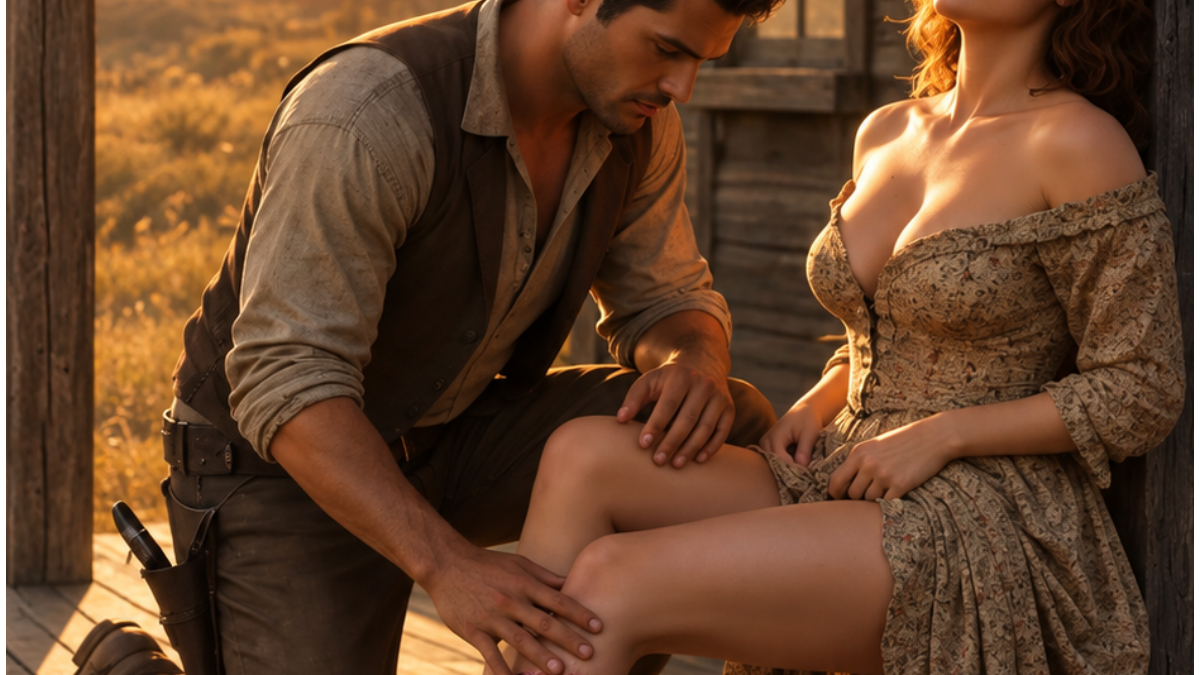
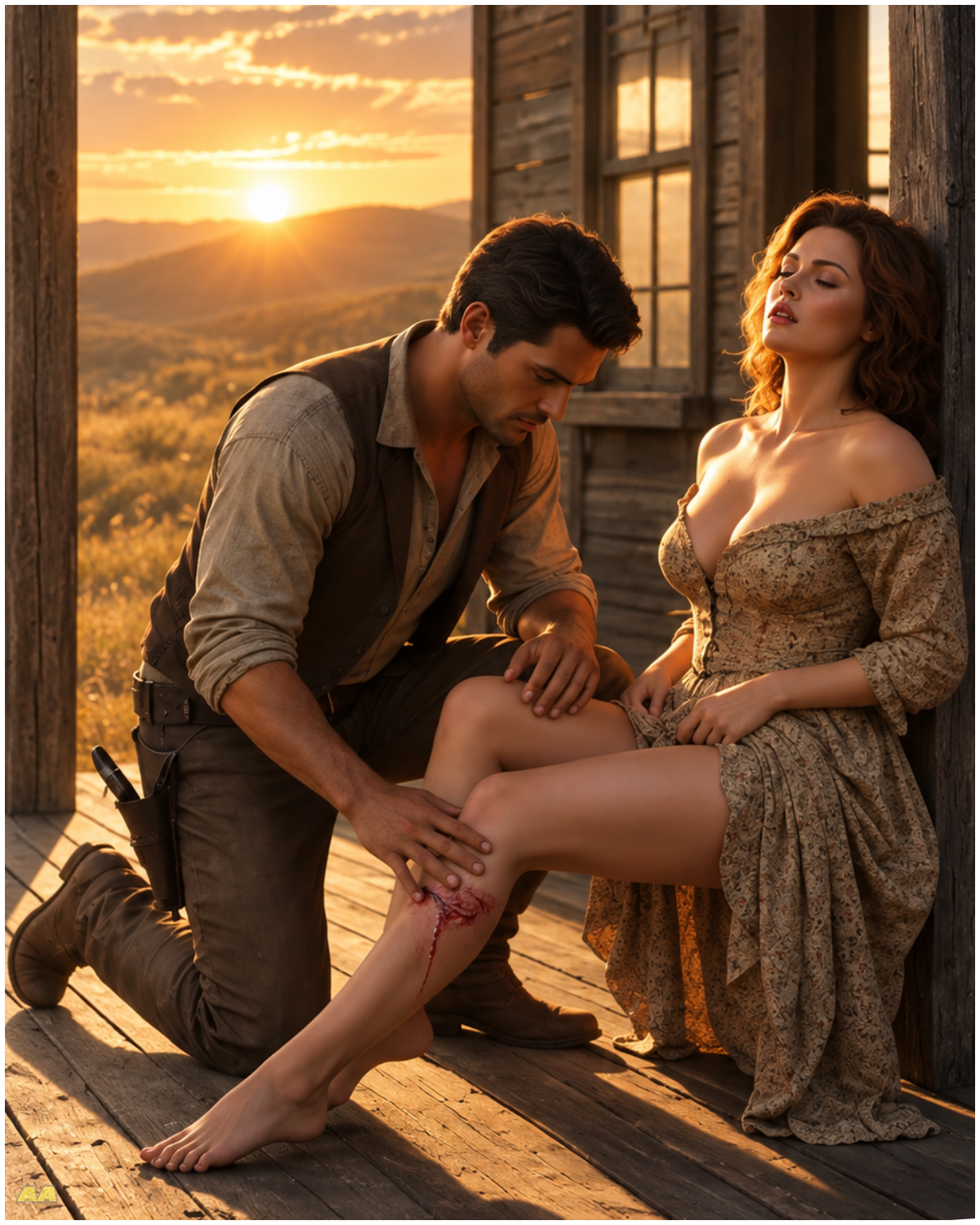
The wind didn’t just howl, it screamed.
It was a miserable high plains sound, a noise that scraped away at a man’s sanity, promising an ice white death.
For 2 days, the blizzard had tried to tear the cabin from its foundations.
Eli Tate, a man built as square and solid as the log walls around him, barely noticed.
He had seen worse.
He had buried his life in worse.
He sat at his rough huneed table, cleaning a rifle breach with an oily rag.
The fire crackled, fighting a losing battle against the cold that seeped through the chinks in the dobbing.
It was well past sundown, maybe 8 or 9:00, but in the white chaos outside, time was just a smear.
His dog, a thick furred hound mix named Blue, lay dead, buried under 2 ft of snow since last winter.
His wife Sarah was buried not far from the dog.
The silence in the cabin was thick, broken only by the wind and the metallic scrape of the cleaning rod.
Then he heard it. It was not the wind.
It was not the scrape of a branch.
It was a sound that did not belong.
A muffled, desperate thump against the heavy oak door.
Eli froze. His hand went still on the rifle.
Nobody came to this ranch.
Not since Sarah’s passing, not in good weather, and certainly not in a blizzard that had already claimed three of his sheep.
He stood slowly, the chair scraping against the plank floor.
He picked up the rifle, levering a shell into the chamber.
He moved to the door, listening. The wind shrieked, mocking him.
Had he imagined it? He was a man alone for too long.
Loneliness played tricks on the mind. He’d taken to talking to the fire, to the empty chair where Sarah used to sit.
Another sound, a sliding, scratching noise, like a body dragging itself against the wood, followed by a low, broken moan.
It was real. Eli slid the bolt back.
The wind tore the door from his grip, slamming it open against the cabin wall.
A wall of white fury blasted in, extinguishing the nearest lantern and filling the room with snow.
He squinted into the churning darkness, his rifle raised.
At first, he saw nothing but the storm.
Then, a patch of darkness in the snow drift piled against his porch.
It was a heap of rags.
No, it was a person.
He lowered the rifle, stepping out into the lethal cold.
The wind cut through his wool shirt like a razor.
The figure was small, face down, unmoving.
A drift was already forming over its legs.
He grabbed a fistful of the soden, torn fabric, and pulled.
The body turned, and he saw a face, blue white with cold, framed by hair frozen, stiff with ice and blood.
It was a woman.
Her eyes were closed, her lips cracked and gray.
A grunt of disbelief escaped him. He looked left and right into the blinding sheet of white.
There were no tracks, no horse, just the storm, and this broken thing it had dropped on his doorstep.
He wasted no more time, cursing the wind.
He shoved the rifle back into the cabin, then bent low.
He slid one arm under her knees and the other under her back.
She weighed almost nothing, a bundle of wet cloth and brittle bones.
He hauled her up and fought his way back inside, kicking the door shut against the storm’s throat.
He carried her to the hearth, laying her down on the bare skin rug near the fire.
The light from the remaining lantern flickered over her.
She was young, maybe 20, maybe less.
Her dress, a cheap calico thing, was ripped nearly in two.
Her feet were bare, swollen and purple, the skin broken, bruises, dark and ugly, stained the side of her face.
And then he saw the blood.
It was a dark, frozen crust that started high on her left side near her hip, soaking the flimsy dress and freezing it to her skin.
For a moment, Eli just stood there dripping snow onto the floor.
This was trouble. This was the kind of trouble that followed a man, the kind that brought other men with guns.
His first instinct, the one that had kept him alive in this isolation, was to put her back outside.
Let the storm finish what it started.
It was cleaner that way. He looked at her face.
It was a plain face, made sharp by starvation, but it was young.
He remembered Sarah pulling a half-rozen calf from a snowdrift, her hands raw, weeping as she rubbed it dry by the fire.
“Everything deserves a chance, Eli,” she used to say.
“Damn it, Sarah,” he muttered under his breath.
He turned to the dry sink, pouring water from the bucket into his kettle and swinging it over the fire.
He fetched his hunting knife and a box of bandages, the same ones he used for shearing cuts on his sheep.
He knelt beside her. Her breathing was a shallow, rattling whisperer.
She was dying. “All right,” he said to her or to himself.
He did not know. “Let’s see the damage.” He had to get the frozen dress off her.
He took his knife and carefully slit the fabric, the sound of the blade tearing the iced cloth sharp in the quiet room.
He worked gently, peeling the frozen rags away from her skin.
Her body was a map of old miseries, pale scars and fresh, violent bruises.
As he pulled the fabric away from her hip, she gasped.
Her eyes flew open. They were wild, a pale, terrified blue.
She did not see a cabin or a fire.
She saw a man, a knife, and the darkness.
“No!” she choked. The word a dry rattle.
She tried to scramble back, crab walking away from him, but her body betrayed her.
She had no strength. “Hold still,” Eli said, his voice a low rumble.
He kept it flat, emptied of emotion.
“You’re bleeding.” “Don’t,” she whispered, her hands coming up to shield herself, a pitiful defense.
“Please don’t,” he grabbed her wriSt. It was thin as a bird’s leg.
I’m not going to hurt you. You’re hurt.
You’ve been shot. He let go of her wrist and gestured to her side.
He pulled the last of the torn dress away.
It was not a deep bullet wound.
Thank God it was a graze, a long tearing furrow across the flesh just above her hipbone, but the skin around it was puckered, swollen, and an angry inflamed red.
The bullet had torn through, taking cloth and dirt with it.
It was swelling fast, and the poison was already in her.
“It’s swelling,” he said, more to himself than to her.
He reached for the bucket of warm water.
As he pulled the rest of the ruined dress up, freeing her torso to get at the wound, she let out a strangled cry.
It was not a cry of pain.
It was a cry of pure, undiluted shame.
Please, she begged, tears freezing on her blue white cheeks.
She tried to cover herself with her hands, a gesture of impossible modesty.
Just just get it over with, “Please.” Eli stopped.
The rag in his hand dripped warm water onto the floor.
He looked at her, really looked at her at the raw terror in her eyes, the way she cringed, expecting a blow or worse.
She was not afraid of the wound.
She was afraid of him. She was waiting for the payment she assumed he would demand for saving her.
She expected to be used, to be discarded.
His gut tightened. He had seen women like this in Cheyenne years ago.
Women with dead eyes and false smiles, but never one so broken, so young.
He went back to his work, his movement suddenly rougher, more businesslike.
He would not give her the pity she might mistake for something else.
I am trying to stop the poison, he said, his voice hard.
If I don’t clean this, you’ll lose the leg or your life.
So, you lay still and let me work or you get up and walk back out into that storm.
The harshness of his words seemed to cut through her panic.
She flinched, but she stopped struggling. She turned her head away, her eyes squeezing shut, her jaw clenched so hard he could see the muscles trembling in her cheek.
She was bracing herself. He dipped the rag in the hot water and pressed it to the wound.
She hissed, her whole body going rigid, but she did not scream.
He worked quickly, clinically, washing away the frozen blood and grime.
The skin was hot to the touch.
The fever was already taking hold. As he cleaned her side, the ragged edge of her dress shifted.
His eyes caught it. On her shoulder, just below the collarbone was a mark.
It was not a scar from a whip or a knife.
It was a brand, stark and dark against her pale skin, an intricate, ugly design, a letter M twisted inside a circle.
Eli had seen that mark once before on a dead girl pulled from the river outside Laram.
The brand of the magpie’s nest, a high dollar brothel run by a man who believed his property should be marked as such.
A cold, hard knot formed in Eli’s stomach.
This was not just trouble. This was the kind of trouble that brought sheriffs and bounty men.
This girl was property, stolen property. He said nothing.
He finished cleaning the wound, laid a thick smear of pine tar sav over it, and bound it tightly with a clean linen bandage.
The girl Kora, though he did not know her name, had not moved.
She lay with her face turned to the wall, shivering violently.
Whether from cold or fear, he couldn’t tell.
He pulled a heavy wool blanket from his own cut and draped it over her, covering the brand, covering the bruises.
He stood up, his knees cracking. The silence in the cabin was heavier now.
He turned and walked to the far side of the room, adding more wood to the stove.
He pulled a tin pot from a hook, scooped in some dried broth mix and jerky, and added water.
He hung it over the fire to heat.
He did not look at her. He could feel her watching him, though he could feel the weight of her terror.
He left the ladle in the pot and went back to the door.
He picked up his rifle, his heavy coat, and his hat.
Eat the broth when it’s hot, he said to the floor.
The bed is yours. Don’t touch the rifle.
He opened the door. The wind howled.
A hungry animal. Where? Where are you going?
Her voice was a cracked whisper. To the barn, Eli lied.
Check the stock. He had no stock in the barn but an old mule.
He just needed air. He needed to be away from the brand on her shoulder and the dead look in her eyes.
I’ll be back. He stepped out and pulled the door shut, leaving her alone in the warmth.
He did not go to the barn.
He walked three steps to the wood pile, sat on a snow-covered log, and let the blizzard try to freeze the sickness out of him.
He was a fool. He had just invited a death sentence into his home.
Inside, the girl, Kora, listened to the sound of the wind swallowing his footsteps.
She did not move for a long time.
The cabin was warm. The fire crackled.
The smell of the broth made her stomach cramp with a pain that was almost worse than the bullet grays.
She was alive. She was warm. She was alone with a sleeping cot in a pot of soup.
It was a trick. It had to be.
But the cold had taken everything from her.
She had no fight left. Her mind slid back away from the warm cabin, back to the cold, back to the running.
It had been 3 days, or maybe four.
Time was just a blur of white snow and black terror.
She had been running since the auction.
She saw it clear as day, even with her eyes closed.
The back room of the saloon in Casper, the one the sheriff used for his business.
The girls from the magpie’s nest, shivering in their thin sheme’s lined up on a low stage.
Kora was one of them. They were being auctioned, their debts sold to the highest bidder.
It was a lie. They were being sold body and soul to miners, to ranchers, to anyone with $50.
Justice, the sheriff called it, clearing the county of vice.
Kora had seen the girl before her.
Lily, just 15, sold to a freight hauler with black teeth and dead eyes.
When Lily cried, the sheriff had backhanded her.
Something in Kora, something that should have been dead and buried had snapped.
When her turn came, when the sheriff had grabbed her arm and shoved her forward, she’d pulled the boot knife she’d stolen from a drunkard’s bed poSt. She’d aimed for his heart.
She missed, slicing his arm. All hell broke loose.
Men shouting, guns drawn. She didn’t wait.
She bolted, crashing through the back door and into the alley, into the first flakes of the storm.
She ran. She ran as they fired after her.
One bullet felt like a hot poker against her side.
But she didn’t stop. She ran out of town, into the plains, into the teeth of the rising blizzard.
She ran until her boots fell apart.
She ran until her feet were raw, bloody stumps.
She ran until the world was nothing but white pain and the sound of her own screaming breath.
She ran barefoot, hunted, knowing they would not stop looking.
She was marked goods. She had wounded the sheriff.
They would hang her or worse, they would drag her back.
She had finally collapsed, unable to feel her legs, her hands, anything.
She had prayed for the end, for the cold to take her, to swallow her up so they could never find her.
She had crawled, dragging her wounded side through the snow until she saw a flicker of light, a cabin.
She had used the last atom of her strength to pull herself to the door and knock.
Now she was here. She pushed herself up on one elbow.
The movement sent a white hot spike of agony from her hip to her ribs.
She gasped, breathing through her teeth. The cabin was small, just one room, a man’s room.
It smelled of wood smoke, old leather, and coffee.
There was his cod, a table, two chairs, and the stove.
It was clean, orderly. The man, he was big, quiet.
He had not smiled. He had not threatened her.
He had simply fixed her and left.
She looked at the soup. Her body screamed for it.
Slowly, painfully, she dragged herself across the floor.
She grabbed the edge of the cot and hauled herself up.
Sitting on the straw stuffed mattress, she reached for the ladle, her hands shaking so violently she could barely hold it.
She dipped it into the pot and brought it to her lips.
The broth was scalding hot, salty, and rich with meat.
It was the best thing she had ever tasted.
She drank it straight from the ladle, crying silently as the warmth spread through her cheSt. She ate until the pot was half empty until her stomach achd with fullness.
Her strength gone. She fell back onto the cot.
The wool blanket was rough, but it was warm.
She pulled it up to her chin, her eyes fixed on the door.
He said he would be back. She waited.
She listened to the storm, a sound that was now a comfort, a wall between her and the men who were hunting her.
The heat of the fire and the food in her belly worked against her.
Her eyelids grew heavy. The pain in her hip was a dull, hot throb.
The fever was starting to creep in, making the edges of the room blur.
She must have slept. She woke to the sound of the door opening.
A blast of cold air hit her.
She sat bolt upright, her heart hammering, her hand reaching for a knife that wasn’t there.
Eli Tate stood in the doorway covered in snow.
He looked like a mountain creature, solid and immovable.
He kicked the snow from his boots and shut the door, bolting it.
Cora watched him, her breath held tight in her cheSt. He didn’t look at her.
He walked to the fire, removed his coat, and hung it on a peg.
He added more wood to the fire, the flames leaping up to light his face.
It was a hard face, stubbled with a gray blonde beard.
His eyes were the color of a winter sky.
He looked tired. He dragged one of the heavy wooden chairs near the hearth, but far from her cod.
He sat down, picked up his rifle, and began cleaning it again.
The storm trapped them. The blizzard raged for another day, and then another.
The world shrank to the four walls of the cabin.
Kora’s fever rose. The wound, despite the cleaning, was poisoned.
The red streak spread. She fell into a burning gray world, tossed between waking nightmares and fevered dreaMs. She was back at the auction, the sheriff’s face looming over her.
She was running in the snow, her feet bleeding.
She cried out for Lily, for a woman named Martha, for a child she could barely remember.
Through it all, a presence. She would wake, choking, and a large rough hand would be pressing a wet rag to her forehead.
A metal cup would be at her lips, forcing cool water past her cracked lips.
“Drink,” a low voice commanded. She would see Eli Tate’s face floating in the firelight, stern, exhausted.
He never slept in the bed. He never laid down.
He stayed in the chair, the rifle resting against his knee.
Sometimes she would wake in the dead of night, the fire burning low and see him just sitting there watching the flames.
His shoulders slumped. He kept the fire going.
He kept the storm out. He spooned broth into her mouth when she was too weak to lift her head.
He cleaned and rebandaged the wound. His touch impersonal, rough, but never cruel.
He never spoke of the brand. He never asked her name.
He never asked where she came from.
He just sat in the chair, a silent guardian, keeping the fever at bay, keeping the fire alive as the blizzard tried to bury them both.
The fever broke like a dam. One moment, Kora was burning, trapped in a red, screaming fog.
The next she was shivering, drenched in a cold sweat, her mind sharp and brittle as ice.
The world rushed back in. The smell of wood smoke, the rough wool of the blanket under her chin, the steady, low rasp of the wind outside, and the nightmares came.
They came in the deep of the night when the fire burned low and the cabin was filled with moving shadows.
She was not in Wyoming. She was back in Casper in the velvet choked room above the saloon.
The air was thick with cigar smoke and cheap perfume.
She heard the heavy rhythmic stomp of men’s boots on the stairs.
She saw the heavy red velvet curtains, the ones that muffled the sounds of girls crying.
The sheriff was laughing, his voice a wet, ugly sound.
He was holding up a piece of paper.
Sold. He boomed to the man in the back.
Kora sat bolt upright, a scream tearing from her raw throat.
No, get off her. She was thrashing, kicking the blankets, her eyes wide and blind with terror.
A heavy hand clamped down on her shoulder.
Easy. You’re safe. Eli was there, kneeling by the cut.
He looked massive in the darkness, a shadow against the fire’s dim glow.
He had moved from his chair so fast she hadn’t even heard him.
You’re here,” he said, his voice a low rumble, devoid of comfort, but full of fact in my cabin.
You’re safe. It was a dream. Kora stared at him, her breath coming in ragged, painful sobs.
She looked past him at the log walls, the rifle leaning in the corner, the snowcaked window.
Not velvet, not boots, just wood and wind.
He was, she choked, the words catching in her throat.
They were. It was a dream, Eli repeated, his voice harder this time.
He pressed a tin cup of water into her shaking hands.
Drink. The fevers broke. You’re just spooked.
He did not ask what she dreamed.
He did not ask who he was.
He showed no curiosity, no pity. He watched her drink, her teeth clattering against the metal rim.
When she was done, he took the cup, added another log to the fire, and went back to his chair.
He picked up a piece of leather harness and a knife, and began to work.
As if a woman screaming bloody murder in the middle of the night was a common occurrence.
Cora lay back down, pulling the blanket to her chin.
She watched him. He did not look at her.
He just sat, his shoulders set, his hands busy.
She was safe. He said so, but the shaking in her bones would not stop.
The recovery was slow. The wound on her hip no longer burned with fever, but it itched and pulled.
The blizzard, after five long days, had finally choked itself out, leaving behind a world of impossible, silent white.
The sun came out, a pale, cold disc that offered no warmth.
But the light in the cabin was brighter.
It exposed the dirt in the corners, the exhaustion in Eli’s face, and the weakness in her own limbs.
On the sixth day, Eli looked at the bandage.
It was clean. “It needs proper stitching,” he announced.
“The fever made you toss. You pulled the flesh apart.
It’ll heal badly. Leave a hole.” Kora’s stomach tightened.
“Stitching? I’ve stitched more sheep than I can count and myself a time or two.
He went to the stove, dropping a needle and a length of black thread into a small pan of boiling water.
It’s needful unless you want it to rot from the inside.
He laid out fresh bandages, the pot of pine sav, and the boiled needle.
He turned to her. She was sitting on the edge of the cot wearing one of his old oversized flannel shirts.
It was the only thing he’d had to offer after cutting her dress off her.
It hung to her knees, but it was not enough.
“You’ll have to pull the shirt up,” he said, not looking at her face.
Her hands trembled. She did as he asked, pulling the thick flannel up to her waist, exposing the puckered, angry red gash on her hip.
The cold air hit her skin. She wrapped her arms around her chest, staring hard at the opposite wall.
Eli knelt. He was too close. She could smell the soap on his skin, the faint metallic scent of the rifle oil on his hands.
He was a mountain of a man.
And she was half naked, sitting on his bed.
He threaded the needle. “This will hurt,” he said.
He bent to the task. Kora watched his hands.
They were huge, calloused, the knuckles scarred.
They were the hands of a man who worked, who fought the land and won, and they were trembling, just slightly, a fine, taut tremor.
He was focused intently on the wound.
His brow furrowed. He did not look at her, not at her legs, not at her face.
His entire being was focused on the small ruined patch of her skin.
He was trying not to react to her closeness, to the intimacy of the task.
He was trying to be a doctor.
A rancher mending hide. He pushed the needle through.
Cora sucked in a sharp breath, her entire body going rigid.
A low moan escaped her. “Hold still,” he commanded.
His voice strained. He worked quickly, his big hand surprisingly gentle as he pulled the thread, lacing the skin together.
Each pull was a sharp, biting pain.
Ka dug her nails into her own arMs. Her eyes squeezed shut.
She could feel his breath on her side.
The air in the cabin was thick, charged with things unsaid.
She was acutely aware of his knee planted on the floor, almost touching her thigh.
He was just as aware of it.
He tied off the last knot and cut the thread.
It’s done. His voice was rough. He quickly smeared the salve over the new stitches and laid a clean bandage over it.
He stood up fast, moving away from her back to the stove.
“You can you can cover yourself,” he said, his back to her.
Kora pulled the shirt down, her hands shaking so hard she could barely grip the fabric.
Her side throbbed, but it was a clean pain now.
What unnerved her was the tremor in his hands.
He was not the block of granite she had imagined.
They fell into a strange, strained routine.
The snow outside was piled 10 ft deep against the cabin, a prison wall of white.
They were trapped. They ate their meals in silence.
Eli would cook a skillet of corn mush or stew some jerky.
And they would sit at the small table.
The only sound the scrape of spoons against tin plates.
Kora was terrified of the silence. It felt loud, expectant.
One morning, the quiet was too much.
He was staring into his coffee cup, his face a mask of old grief.
“Why are you here?” she asked, her voice barely a whisper.
“All alone. This place, it’s so empty.” Eli’s head snapped up.
His eyes, the color of the ice on the creek, fixed on her.
She thought he would yell at her, tell her to mind her own.
He just stared. He looked at her, then passed her at the empty chair in the corner.
The one where Sarah used to sit.
“Wife’s dead,” he said. The words were flat, brutal.
Kora flinched. “I’m sorry. I shouldn’t have.” “Sarah,” he said the name like it hurt his mouth.
“She died two winters ago. Went through the ice on the creek down by the cottonwoods.
He spoke to the table, not to her.
Chasing that damn dog of mine. Blue, the dog got out.
She went after him. I told her the ice was thin.
He stopped. He traced a circle on the wooden table with his thumb.
I wasn’t fast enough. He said the words were so quiet.
She barely heard them. I was in the barn.
I heard her by the time I got there.
I got the dog, but I couldn’t get her.
The current took her under. He looked up and his eyes were not empty.
They were burning. I should have checked the ice myself.
I should have fixed the damn latch on the door so the dog couldn’t get out.
I blame myself. He stood so abruptly his chair screeched and fell over.
He didn’t pick it up. He just walked to the small frosted window and stared out at the endless, unforgiving white.
The conversation was over. Ka sat, her food forgotten.
She understood him now. The silence in the cabin was not just emptiness.
It was full of a ghoSt. He was not just a recluse.
He was a man punishing himself, serving a life sentence in a prison of his own making.
As her strength returned, Kora began to move.
She could not bear to be useless.
She started with small chores. She swept the hearth.
She tidied the small stack of tin plates.
She folded the blankets he used in his chair.
Blankets that smelled of him, of smoke and cold air.
He watched her, his expression guarded. He didn’t thank her, but he didn’t stop her.
The small space of the cabin forced them together.
They would brush past each other as she went to the water bucket and he went to the door.
Each accidental touch was like a spark making her jump.
She was aware every second that she was trapped with a man, a man who had shown her kindness, but a man nonetheless.
He had not touched her. He had not looked at her.
He had not asked for a single thing.
This decency was more confusing than the brutality she was used to.
She kept waiting. She kept waiting for the bill to come due.
In her world, nothing was free. Kindness was just a slower way of setting a trap.
She was trapped and this man hadn’t touched her yet.
The word hung in the air between them, a dangerous, unspoken thing.
The dizziness hit her as she was stacking the small pile of firewood he kept inside.
She had been on her feet for too long.
The room tilted, the log walls seeming to bend inward.
She put a hand out to steady herself, but there was nothing there.
Eli, she breathed, but no sound came out.
She pitched forward, her legs giving way, a small cry escaping her.
He was across the room before she hit the floor.
He moved with a speed that belied his size, catching her in one powerful arm, hooking her around the waist and lifting her as if she weighed nothing.
He hauled her up against his cheSt. The motion, the sudden lift caused the long flannel shirt to ride high up her thighs, exposing her legs, the top of the bandage on her hip.
She was in his arms, his face was close to hers, his eyes wide with concern.
This was it, the moment, the strength of his arms around her, the sudden intimate contact, the way she was held.
This was how it always started. She stopped fighting.
Her body went limp with a sudden bone deep resignation.
She closed her eyes. Just get it over with, she whispered.
The words were dead. A flat, broken offering.
Please. Eli froze. His arms were locked around her.
Her body pressed against his. He had heard her.
He looked down at her face, at the closed eyes, the pale, trembling mouth.
He saw the way she braced herself, the way she had surrendered to what she believed was inevitable.
His face changed. The concern vanished, replaced by a look of raw, stunned disbelief.
It was as if she had slapped him.
A deep, sickened shock twisted his mouth.
He set her on her feet. He didn’t just let go.
He actively pushed her away, just enough for her to find her balance against the cabin wall.
He stepped back as if he had been holding something venomous.
Ka opened her eyes. He was staring at her, his face pale, his eyes filled with a storm of emotions she couldn’t read.
Disgust, pity, and a profound wounding sadness.
He didn’t speak. He couldn’t. He shook his head.
A small, sharp gesture of negation. He turned, grabbed his heavy coat from the peg by the door, and wrenched the door open.
He walked out into the biting cold, slamming it shut behind him.
The heavy thud of the bolt being dropped from the outside echoed in the small room.
He had locked her in or locked himself out.
Cora was left leaning against the wall, her legs trembling.
The rejection was a physical blow, sharper than any hand.
He was disgusted by her. The shame was so total, so complete, it burned worse than any brand.
She slid down the wall until she was sitting on the cold floor, her face in her hands.
She did not weep. She was past weeping.
She didn’t know how long she sat there.
An hour, two. The cabin grew cold without him there to feed the fire.
The silence was absolute. Finally, she stood.
She couldn’t stay in here. She felt filthy.
She went to the door. The bolt was heavy, but she managed to slide it back.
She pulled the door open. The air was sharp and clean, so cold it burned her lungs.
She stumbled out, wearing just the shirt and his old boots, which she had taken to wearing inside.
The snow was deep, but a path was beaten to the barn.
She followed it, slipping and falling, driven by a desperate need to hide.
She found the barn, a small, dark structure.
It was cold, smelling of old hay and his mule, which snorted at her from its stall.
She crawled into an empty stall, burrowing deep into a pile of dry hay.
Here, in the cold, musty dark, she finally wept.
They were not the loud sobs of her nightmares, but the silent, racking tears of a soul that had just been told it was worthless.
The barn door creaked open, letting in a shaft of pale afternoon light.
Eli stood there, a dark silhouette against the snow.
He was holding a heavy buffalo hide.
Cora cringed back into the hay, pulling her knees to her cheSt. He didn’t speak.
He walked into the stall, his heavy boots crunching on the straw.
He unfolded the hide, a massive, heavy thing, and draped it over her.
He tucked it around her shoulders, his movement slow, deliberate.
He did not leave. He sat on a hay bale across from her, just outside the stall.
Not too close, he rested his forearms on his knees and stared at the dirt floor.
The mule stamped its feet, the wind whistled through a crack in the wall.
He sat that way for a long time, the silence stretching until Cora thought she would break.
Finally, he spoke, his voice low and rough, as if it pained him.
You think that’s what I am? It was not a question.
It was a statement of fact. You think I pulled you from that storm just to to He couldn’t say the word.
He looked at his own callous hands.
To rut on you like some animal.
Cora said nothing, her face hidden in her knees.
My wife Sarah,” he said, his voice quiet.
“She was a good woman. She was clean in here.” He tapped his chest, a hard thumping sound.
She was the only woman I ever touched, the only one I ever wanted.
He looked at her, then, his winter sky eyes sharp and full of a pain that matched her own.
“I ain’t been with a woman since she passed, not in 2 years.
And I ain’t the kind of man who will take what ain’t freely given.
He leaned forward, his gaze intense. And even if it was, I ain’t that man.
Not with you. Not with that. He gestured toward her.
At her huddled form, at the branch she hid, at the shame that clung to her.
He stood up. You’ll die of cold out here.
The fever will come back. Get inside.
Get by the fire. He turned and left the barn, leaving the door open, leaving the heavy, warm buffalo hide with her.
It took her another hour to move.
His words echoed in the freezing air.
I ain’t the kind of man who will take what ain’t freely given.
She had never met such a man.
She didn’t know if she believed him, but he had left her.
He had left her alone in the cabin.
He had left her alone in the barn.
He had wrapped her in a hide and walked away.
She was cold, her side achd with a deep, chilling throb.
She pushed herself up, clutching the heavy hide around her, and stumbled back to the cabin.
When she entered, he was back in his chair by the fire.
His back was to her. The rifle was not on his lap.
It was leaning against the wall, just within his reach.
He was mending the harness again. He didn’t turn around.
He didn’t acknowledge her. Cora limped to the cot and climbed under her own wool blanket, pulling the buffalo hide on top of her.
The warmth was immense. She lay there watching as broad, silent back.
Night fell. The cabin grew dark, lit only by the red glow of the embers in the stove.
The wind had picked up again, a low moan around the eaves.
Eli did not move from his chair.
She could hear his steady breathing. He was asleep, but Ka could not sleep.
The darkness was thick. The nightmares were waiting for her just behind her closed eyelids.
She could hear the boots on the stairs, see the red curtains.
She was terrified. She was terrified of the dream.
She was terrified of being alone in the dark.
She slipped out of the cot, taking her blanket with her.
The floor was ice cold on her bare feet.
He was asleep in the chair. His head slumped to his cheSt. He looked exhausted.
Lines of grief and loneliness carved into his face.
She hesitated. She looked at the cot, then at the empty floor space near the hearth.
It was close to the fire. It was close to him.
She did not go to him. She did not touch him.
She laid her blanket on the hard planks of the floor near his chair and lay down, curling into a tight ball.
It was warmer here and he was here.
The slight sound of her movement, the rustle of the blanket woke him.
He jerked upright, his hand instantly finding the rifle stock.
“What is it?” he grunted, his voice thick with sleep.
He blinked, peering into the shadows. He saw her, a small dark heap on the floor by his feet.
“What are you doing?” “The cot is cold,” she whispered.
It was a lie, but it was the only reason she could find.
The floor is warmer by the fire.
Eli stared at her. He saw her shivering.
He saw the way she was huddled as far from him as she could be while still being near the fire.
He understood. She wasn’t trying to seduce him.
She was just a child, scared of the dark.
He let out a long, heavy sigh.
It was the sound of a man who had accepted a burden he did not want.
He stood, his joints popping in the cold.
He walked to the cot, grabbed the strawsted mattress, and dragged it across the floor.
He laid it on the hearth, close to the fire, but not so close it would catch.
It filled the small space between his chair and the stove.
“Get on this,” he said, his voice rough.
“The floor will steal all your heat.
You’ll be sick again.” Cora looked at the mattress, then at him.
She scrambled onto it, pulling her blanket in the buffalo hide with her.
It was softer. It was warm. She lay down, facing the fire.
Eli went back to his chair. He sat, not picking up the rifle, but letting it rest against the wall.
He did not go back to sleep.
He just sat, staring into the dying embers.
Cora lay on the mattress. The fire was warm on her face.
The man in the chair was 3 ft away.
He was awake. He was armed and he was not touching her.
She closed her eyes. The nightmares did not come.
She slept. The silence was the first warning.
For nearly a week, the world had been a screaming white howl.
Now Ka woke to a cabin filled with piercing bright light and a quiet so deep it felt loud.
The wind was gone. Eli was already at the door, pulling on his heavy coat.
He had not slept in his chair.
He had dozed, upright and alert. A man waiting for a battle.
He looked at her, his face grim.
It stopped, she whispered. “I He picked up his rifle.
Stay inside. Bolt the door behind me.
Don’t open it until you hear me knock three times.” “Three?” She nodded, her heart starting a low, heavy drum beat.
He stepped outside and she slid the heavy wooden bolt into place.
The sound was dreadfully final. She watched him through the single icecrusted window.
He waited through the massive drift, plunging almost to his waist and fought his way to the small rise behind the cabin.
He was a dark solid shape against a world that had been scrubbed clean and white.
The sun was blinding. Glaring off the endless fields of snow.
He stood on the rise for a long time, a full 5 minutes, staring south.
When he returned, he did not knock three times.
He slammed his shoulder into the door, shouting, “Kora, open it now.” Her hands fumbled with the bolt, her terror making her clumsy.
She yanked it back, and he fell inside, pushing the door shut and ramming the bolt home himself.
He was breathing hard, not from the effort, but from something else.
“What is it?” she cried. “What did you see?” “Smoke.” He leaned against the door, his eyes scanning the cabin as if it were a trap.
“To the south, maybe five, six miles.
A thin column, not a chimney, a campfire.
It could be travelers,” she offered, her voice thin.
“Trappers?” No. He shook his head, his gaze settling on her, sharp and cold.
It’s riders fanned out, combing the ridges.
The storm kept them back. Hold them up now.
It’s clear they’re on the move. They’re looking.
They’re looking for you. The old blind panic seized her.
She backed away from him, her hands coming up to her mouth.
They found me. Oh, God. They found me.
She looked wildly at the door, at the window.
I have to run. I have to go.
And go where? His voice was a flat, hard slap.
You’ll die before you make a mile.
You’ll leave a track a blind man could follow in this snow.
You’re not running. But they’ll come here.
They’ll find me. They’ll Who are they?
He demanded, his voice low, cutting through her panic.
You’ve been here 6 days, and I’ve asked you nothing.
The time for secrets is done. Who is hunting you?
And why do they want you so bad that they’ll ride into a blizzard to find you?
She sank onto the cot, the strength gone from her legs.
She looked at the brand on her shoulder, visible even through the thick flannel of his shirt.
You saw the brand? I’m I was from the magpie’s nest in Casper.
I know the brand, he said, his voice impatient.
That’s not enough. Men don’t risk freezing to death for one runaway girl.
Not unless she’s special. Kora took a deep, shuddering breath.
The story was a stone in her gut, one she had held for so long she didn’t know how to let it go.
But his words were true. The time was done.
There was a girl, she began, her voice a dead monotone.
Lily, she was new, just 15. She didn’t know the rules.
She didn’t know how to survive. She stared at her hands, twisting them in her lap.
A man came. He wasn’t a cowboy, not a minor.
He was important. A judge from Laram.
Judge Hemllock. He was drunk. He He wanted her.
Eli said nothing. He just watched her, his face carved from granite.
She fought him. Cora whispered, “I heard her.
He He was hurting her. He tore her face open.
He She squeezed her eyes shut, the memory vivid and red.
I couldn’t I couldn’t just listen. I took a knife, one I’d hidden.
I went in. She looked up at him, her eyes burning.
He was on top of her. She was bleeding.
I I stabbed him. I tried to kill him.
Eli’s expression did not change, but a muscle in his jaw tightened.
Did you? No, I missed. I got him in the shoulder.
He screamed. The sheriff, Sheriff Grady, he and his men were downstairs.
They burst in. They saw the judge, the blood.
They saw me with a knife. They beat me.
They dragged me downstairs. The sheriff, he’s a cruel man.
He said I was an affront to the town.
That I’d attacked an officer of the court.
He said he’d make an example of me.
So no other girl would ever get the same idea.
He held her voice broke. A punishment auction in [snorts] the saloon to sell me to sell my debt.
He said, but he was selling me to the lowest, meanest man he could find.
He paraded me on the stage in my shift.
That’s when I ran. I just I ran.
I broke the window and I ran.
They shot at me. One of them hit me.
She pointed to her hip and I just I ran into the snow.
The cabin was silent. Eli had not moved.
He stood by the door, absorbing her words.
“A judge,” he said, the words heavy as lead.
“You stabbed a judge.” He turned his back to her, pacing the small space.
“Three steps one way, three steps back.
He was a caged bear. This isn’t just a matter of property.
Then this is the law. They’ll call it attempted murder.
He stopped, looking around the cabin, at the rifle, at the cut, at the stacked cords of wood.
Harboring a fugitive, aiding a criminal, assault on an officer of the court.
They could take everything. This land, the cabin, they could hang me.
His words hung in the air. Ka felt a new kind of shame.
One that burned hotter than the brand.
She was not just ruined. She was a plague.
She was bringing ruin to this man.
The only man who had shown her a moment’s decency.
She stood up, her legs shaking, but firm.
I will leave. I will not bring this to your door.
Eli, you saved my life. I won’t be the cause of you losing yours.
She walked to the hook where her old frozen boots still sat.
They were ruined. Useless. It didn’t matter.
>> [snorts] >> She would walk barefoot again if she had to.
You’ve given me food. You’ve given me warmth.
I thank you for it. I’ll go now.
She reached for the door. His hand shot out, covering hers, pinning it to the wood.
It was not a violent movement, but it was absolute.
His hand was huge, warm, and it dwarfed hers.
“No,” he said, his voice quiet, but with a new dangerous edge.
You heard me, she pleaded, not turning.
They will hang you. Let them try.
He turned her around, his hands on her shoulders.
He was not angry. He was something else.
Something she had never seen. You walk out that door.
You’re walking into their arMs. You’re walking to a rope.
I pulled you from the snow. I stitched your side.
I will not let you walk to your own death.
I won’t have that. But your land, she whispered, her eyes searching his.
Your life? My land? He laughed. A short bitter sound.
This place? It’s just acres of snow and memory.
My life. His gaze softened and a profound aching sadness filled his eyes.
I told you about Sarah. I’ve been sitting in this cabin for 2 years, just waiting, waiting for the snow to bury me.
Too. It wasn’t a life, Kora. It was a grave.
I was just too stubborn to lay down in it.
He looked at her at the bruises on her face, at the fear in her eyes.
You You fought. You stabbed a judge for another girl.
You ran into a blizzard with a bullet in your side.
You are fighting for your life with every breath.
His hand moved from her shoulder up to her face.
His thumb rough and calloused brushed a tear from her cheek.
“I haven’t felt alive in two years,” he murmured.
“Not until you. Not until this.” She did not flinch from his touch.
She leaned into it. It was the first touch of kindness she had known in so long.
It felt like fire. He was looking at her, not at the brand, not at the dirt, but at her.
He hesitated. He was crossing a line.
A line he had drawn in his own grief.
He was breaking faith with a ghoSt. Then he leaned down slowly, giving her every chance to pull away.
She did not. She rose on her toes, her hands coming up to rest on his cheSt. His lips met hers.
It was not a hungry kiss. It was hesitant, chapped, and tasted of salt and wood smoke.
It was a question. It was a promise.
It lasted only a moment, but it changed the air in the cabin.
It changed everything. He pulled back, his forehead resting against hers.
He was breathing hard. “They’re out there,” he said, his voice thick.
“And they’ll come, but we’ll face them together,” he looked into her eyes.
“I want you to stay. Not just to hide, not because you’re trapped here by the snow.
I want you to stay, to heal.
He glanced at her side at the stitches beneath the flannel.
I want you to stay if you’ll have me.
The dynamic shifted. The cabin once a prison became a fortress.
The shared fear of him was gone, replaced by a shared fear of the world outside.
And underneath that fear, something else began to build.
A fragile, trembling heat. Days passed. The smoke on the horizon was a daily terror.
Eli would go out at dawn and dusk, scouting, checking.
The riders were still there, moving in a slow, methodical grid, but the snow was deep, their progress slow.
Inside the cabin, a new, awkward tenderness grew.
They talked. She told him about the magpie’s nest, the other girls, the small, cruel details of her life.
He told her about his ranch, about Sarah, about the plans they’d had to build two more rooms, to raise sheep, to have children.
They were two ghosts sharing their pasts, and in the sharing, they slowly started to come back to life.
He would catch her watching him, and a small, almost smile would touch his lips.
She would hand him a hot cup of coffee, and their fingers would brush, sending a jolt through them both.
The air was thick with their awareness of each other.
Her wound was healing. The stitches itched.
She felt strong, but she felt dirty after more than a week.
She could not stand the grime of her own skin.
Eli, she said one afternoon, her face coloring.
I I need to wash properly. He understood immediately.
He nodded, his own face flushing. Of course, I’ll I’ll check the snares.
He grabbed the largest kettle, filled it with snow, and put it on the stove to heat.
He fetched the tin basin and a clean rag, setting them by the hearth.
He did not look at her as he did it.
I’ll be gone an hour, maybe two, he said, pulling on his coat.
Bolt the door. He left. Cora secured the door, her heart thumping with a strange mix of relief and nervousness.
She was alone. She was safe. She poured the steaming water into the basin, adding a little cold snow to cool it.
The cabin was warm, the fire crackling.
She was near the hearth, the place where she had slept on the floor.
She untied the flannel shirt. It was his.
It smelled of him. She slipped it off her shoulders, letting it fall to the floor.
She stood in the firelight, pale and thin.
The brand on her shoulder was a dark, ugly blotch.
The scar on her hip was a puckered, angry red line.
She dipped the cloth in the warm water and began to wash.
The soap he’d left her stinging her skin, but it was a clean, good pain.
The door opened. She spun around, her hands flying up to cover herself, a small scream in her throat.
Eli stood there, frozen. He had his rifle in one hand, a dead rabbit in the other.
My apologies, he said, his voice strained.
I I forgot the skinning knife, he did not look at her.
He averted his eyes instantly, staring hard at the floor, his face a dark, embarrassed red.
He looked ashamed as if he were the one who had been caught.
Kora’s hands, which had been covering her breasts, slowly lowered.
She stood there, her heart hammering. He was not looking at her.
He was not learing. He was not like them.
He was ashamed for walking in on her.
She did not flinch. She did not scream again.
She did not grab for the shirt.
She just stood there breathing, letting him not look at her.
It was a strange powerful moment. She was naked, exposed, but she was not ashamed.
Not in front of him. “It’s all right, Eli,” she said, her voice quiet but steady.
He nodded, still looking at the floor.
“I’ll be in the barn.” He backed out of the door, pulling it shut with a soft click.
Cora let out a breath she hadn’t known she was holding.
She turned back to the fire and finished washing, but her hands were trembling.
That night, the tension was a living thing in the cabin.
They ate their meal of roasted rabbit in near total silence, but it was not the old empty silence.
It was a silence filled with unspoken need.
With the memory of her skin in the fire light and his averted gaze, when it was time for sleep, he went to his chair, as he always did.
She went to her mattress on the hearth.
The arrangement felt wrong now. It felt like a lie.
She lay in the dark, staring at the red embers in the stove.
She could hear him breathing. He was not asleep.
She knew it. She sat up, pulling the blanket around her.
“Eli,” his shape shifted in the darkness.
“I’m here. I am cold,” she whispered.
It was the same thing she had said that first night she had slept by the fire.
But this time it was not a lie and it was not a plea for safety.
It was an offer. He was silent for a long moment.
She heard the creek of the wooden chair as he stood.
He did not come to her. He walked to his own cot, the one that had been empty for so long.
She heard the sound of him pulling back the heavy wool blankets.
He said nothing. He just waited in the dark.
It was an invitation. It was a choice.
Her choice. She stood, her legs trembling.
She clutched her blanket and walked a few feet across the cabin, from her safe place on the hearth to his bed.
She slipped under the covers. He got in beside her.
The cot was narrow, their bodies pressed together from shoulder to knee.
The heat from him was staggering. They were both trembling.
It was a shared terrible fear not of him, not of her, but of this this raw unknown thing.
He turned to her in the dark.
She could just make out the shape of his face.
He touched her cheek, his fingers tracing the line of her jaw.
She did not pull away. She covered his hand with her own.
“Kora,” he whispered, his voice thick with a need he had buried for two years.
It was slow. It was hesitant. There was no lust, not as she had ever known it.
There was just a trembling, desperate need.
He kissed her, and this time it was not just a promise.
It was a finding. His hands were shaking as he touched her shoulder, his fingers finding the raised, scarred flesh of the brand.
He did not recoil. He traced it as if learning it, and then he kissed it.
It was a raw connection born of shared pain and a desperate shared fear of the world outside.
When he finally moved over her, he was gentle, hesitant, watching her face in the dark.
He was asking, and for the first time in her life, she answered.
She pulled him down. It was not a taking.
It was a giving. It was two broken lonely people trying to make something whole in the dark.
Afterward, as they lay tangled in the blankets, the warmth of their bodies fighting the cabin’s deep cold, the tears finally came, she did not sob from her nightmares.
She wept for the release, a deep, shuddering cry that came from the very bottom of her soul.
Eli did not shush her. He did not pull away.
He just held her, his arms wrapped tight around her, his face buried in her hair.
He held her as she shook, letting the poison flow out.
When the sobs finally quieted, he kissed her forehead, his lips warm against her cold, damp skin.
“You don’t have to be scared here,” he whispered, his voice a low, rough promise in the dark.
“Not anymore.” They woke in the gray pre-dawn light.
The cabin was colder than it had been.
The fire in the stove burned down to dull red embers.
For the first time in two winters, Eli Tate had not woken in the night to feed it.
He had been asleep, truly asleep, with Kora’s small, warm body pressed against his back.
He woke with her scent in his beard, a mix of pine soap and woman.
It was a strange, unsettling thing. For two years he had woken only to the smell of cold ash in his own stale grief.
Now there was this life. He moved slowly trying not to wake her.
He slid his legs out of the cot.
The cold of the plank floor shocking his bare feet.
He pulled on his trousers and fed the stove.
The crackle of the new kindling loud in the quiet.
He set the coffee pot on the iron top.
Kora was awake. She was watching him.
Her pale eyes dark in the shadows.
The night before had changed her. The hunted, broken look was still there, but it was buried under a new fragile layer of stillness.
“Good morning,” she whispered. Eli just grunted, his back to her as he reached for the tin cups.
“He was not a man for words in the morning.
He was a man of action, and the action required now was grim.” He poured the coffee, black and bitter, and handed a cup to her.
She sat up, pulling the heavy wool blanket around her shoulders.
The flannel shirt he had given her was rumpled, gaping at the neck, revealing the dark, ugly mark on her shoulder.
Yesterday, the sight of it had filled him with a cold pity.
Today, it filled him with a low, simmering rage.
He went to the window, scraping the frost from the glass with his thumbnail.
He stared out at the bright clean snow and he saw it.
It was still there. The thin black thread of smoke rising from the south.
The riders had not given up. They had not been turned back by the cold.
They were methodical. They were hunters. They’re still there, he said.
He did not turn around. He heard the scrape of the cot as she got up.
The sound of her bare feet on the floor.
She came to stand beside him, clutching her cup.
“How long?” she asked. “The snow is deep.
They’re slow, but they ain’t stopping. They’re combing the land.
Ridge by ridge. They’ll be here. Maybe tomorrow, maybe the day after.” He took a long drink of the scalding coffee.
“You can’t be here when they come.” He turned to face her.
His mind was made up. The night had been a mistake, a moment of weakness.
It had changed nothing, and it had changed everything.
It had made her his responsibility in a way that went beyond mere shelter.
“I got a plan,” he said, his voice flat.
“I know someone up north by the Sweetwater, an old woman, Abigail Finch.
She’s a Quaker. She She helps people.” Kora watched him, her eyes searching his helps what people in trouble.
Women in trouble. She runs a way station, part of a network.
They can get you east, give you a new name, a new life, get you clear of this.” He waved a hand at the window at the entire hostile territory.
He laid it out for her, his voice devoid of emotion.
He would give her the mule.
Bess. She was slow, but she was sure-footed, and she would not quit.
He would pack her with enough jerky, coffee, and bacon to last two weeks.
He would give her his own heavy coat, his spare rifle, and all the money he had, a little over $40, hidden in a loose brick in the hearth.
He would guide her north himself for the first day, set her on the hidden game trail, and then he would double back.
He would be here at the cabin.
When the riders came, he would tell them she died in the storm.
He would show them a fresh dug grave if he had to.
He laid it all out. It was a good plan.
It was the only plan. When he was finished, he looked at her, expecting relief or fear or thanks.
He did not expect the look she gave him.
It was not gratitude. It was a cold, hard disappointment.
No, she said. Eli blinked. What do you mean?
No. This ain’t a request, Kora. This is the only way you live.
No, she said again, her voice stronger.
She set her cup on the table.
I’ve been running all my life. I ran from the home where I was sold.
I ran from the men in the brothel.
I ran from the sheriff. I ran into the snow.
And I ran to you. I am tired of running.
This ain’t running, he argued, his voice rising.
This is surviving. This is smart. You go up against Grady and that judge, you think you can win that?
They are the law. They’ll hang you from the nearest Cottonwood and call it justice, and the whole town will watch and applaud.
Then let them, she said, her voice trembling but fierce.
Let them. But I won’t go skulking off into the snow again, hiding who I am, living under a fake name, always looking over my shoulder.
What kind of life is that? She stepped closer to him, her eyes flashing.
You told me about your wife. You told me how you’ve been hiding in this cabin in this this grave.
You’ve been running too, Eli. Hiding from a ghoSt. Hiding from living.
I’m done hiding. I want to fight.
Fight? He laughed. A bitter harsh sound.
Fight who? Sheriff Grady, Judge Hemlock, the whole damn county with what?
A rusty mule and $40. With the truth,” she said, her voice ringing in the small cabin.
I want to walk into that town, your town.
I want to find the law here, and I want to tell them what happened.
I want to tell them what Judge Hemlock did to Lily.
I want to tell them how Sheriff Grady sells girls in a back room.
They win because people like me are branded and shamed and run away.
What if I don’t run? What if I stand right there and I speak?
He stared at her. It was the most foolish, suicidal, and brave thing he had ever heard.
She was going to walk into a lion’s den and accuse the lions of being meat eaters.
“They will kill you,” he said, his voice low.
“They won’t just kill you. They will tear you apart firSt. They will make an example of you.” “They’ll kill me anyway,” she countered, her voice dropping to a whisper.
“If I run, they’ll hunt me. If I stay, they’ll find me.
At least this way. I die clean.
I die telling the truth. He saw the iron in her.
It was the same iron that had made her stab a judge.
The same iron that had kept her crawling through a blizzard, barefoot and bleeding.
He had seen that iron, and he had laid down with it.
He had wanted it to make him warm.
Now it was burning him. He was furious.
He had just found something. He had just opened a door in his own frozen heart.
And now she was asking him to walk with her straight into a firing squad.
He wanted to shake her. He wanted to tie her to the mule and send her north for her own good.
But he looked at her face at the resolve in her jaw.
And he knew she was not the same woman he had pulled from the snow.
He had not just healed her body, his kindness, his respect, his touch.
They had forged her will into something new, something that would not be broken.
And he knew with a sinking terrible certainty that he could not let her go alone.
If she was mad enough to do this, he was mad enough to stand with her.
Hiding her was just another form of his own cowardice.
He had been hiding from his wife’s ghost for 2 years.
Maybe the only way to lay that ghost to rest was to stand up for a living woman.
It’s madness, he said, his voice rough.
It’s a fool’s errand. They will not listen.
They will just take you. You don’t know that.
She said, “I do,” he said. “I know this town.
I know these men.” But he let out a long, ragged breath.
The breath of a man who had just made a decision that would likely kill him.
But I will stand with you. If you’re going to tell your truth, you’ll not do it alone.
He turned from her, his mind already working.
We ride in, not to the law, not to the courthouse.
That’s just a building. We go to the man, Judge Miller.
He’s the law in Three Forks. A small trembling smile touched her lips.
“Thank you, Eli.” “Don’t thank me,” he growled.
“We’re likely riding to our deaths. Get your boots.
Not those ruined things. My spare pair.
They’ll be too big, but they’re better than nothing.
He moved with grim purpose. He was no longer a recluse.
He was a soldier preparing for a war he knew he would lose.
He pulled his two best horses from the barn, a stocky gray mare and his own tall ran.
He saddled them both. He checked his Winchester, levering a shell into the chamber and filling the magazine.
He gave her the other rifle. A smaller30.
Do you know how to use this?
I know enough, she said, her voice quiet.
He watched her check the action. She did know.
He also strapped a holstered pistol to his own belt, a heavy cult army, and he pushed another, a smaller 32 caliber revolver, into the pocket of the heavy coat he gave her.
That one is for close work. Don’t use it unless they’re touching you.
They mounted. The air was bitingly cold.
The sun a pale blinding disc in the blue sky.
The world was beautiful and silent and deadly.
They rode for 2 hours. The horses crunching through the deep crusted snow.
They did not talk. There was nothing left to say.
They rode side by side, two small figures against an endless white landscape.
As the small snowbound collection of log buildings that was three forks came into view, Eli reigned in his ran.
He looked at her. Her face was pale.
Her lips blew with cold, but her eyes were clear.
He reached across the space between their horses.
He took her gloved hand in his.
His grip was hard, a solid grounding force.
“Together,” he said. Together,” she replied. They rode down the main street, hand in hand.
The town was just waking from its snowbound prison.
Men were on roofs shoveling snow. The clang of the blacksmith’s hammer echoed in the cold air.
And then they stopped. Everyone stopped. They saw Eli Tate, the widowerower, the recluse.
He hadn’t been seen in town since the first snows.
And he was with a woman. >> >> The whispers started like a dry wind in the grass.
Men stopped shoveling. Faces appeared in the frosted windows of the general store.
They saw Tate, hard and grim as a winter bear, his rifle in the scabbard on his horse.
And they saw the woman beside him.
She was pale, bruised, and wearing his coat.
But some of them, the ones who had been to Casper, the ones who had heard the rumors, they recognized her.
That’s him, Tate. Who’s that with him?
My god, Jed, look at her. That’s the one.
The magpie girl. The one who stabbed Judge Hemlock.
It is. I saw her at the auction.
That’s her. The whispers followed them. A wave of malice and suspicion as they dismounted in front of the silver dollar saloon.
It was the only place in town with more than two men in it at 10:00 in the morning.
Why here? Kora asked, her voice tight.
Judge Miller holds court here at 10:00.
Drinks his whiskey at 10:05. Eli said grimly.
Best place to find him. He tied the horses to the hitching rail.
He looked at her one last time.
You are sure? She nodded. She pulled the 32 from her pocket and slid it into the waistband of her trousers, covered by the long coat.
Eli pulled his Winchester from its scabbard.
He held it low in the crook of his arm.
He pushed open the batwing doors. The saloon went silent.
The tiny piano played by a oneeyed man in the corner stopped mid-tune.
A dozen men, trappers, ranchers, and the town’s less reputable citizens froze.
Their drinks halfway to their mouths. It was hot inside, thick with a smell of stale beer, wood smoke, and unwashed men.
In the back, at a table littered with poker chips and empty glasses, sat Judge Miller.
He was a thick pot-bellied man with a stained velvet waist coat and a face the color of raw liver.
Beside him sat Sheriff Bryce, the local law, a thin, weas-faced man with a drooping mustache.
Eli and Kora walked toward them. The sound of their boots on the plank floor was the only sound.
“Judge Miller,” Eli said. His voice was a low rumble, cutting through the silence.
The judge looked up, his eyes blurry and annoyed.
“Tate, what in the hell do you want?
And what are you doing with that?” His eyes slid to Ka, his gaze lingering on her body with a wet, practiced assessment.
We’re here on official business. Judge, Eli said, his voice hard as iron.
This woman, Kora, wishes to make a formal statement.
She needs to file charges against Judge Hemlock of Laram and Sheriff Grady of Casper.
The room sucked in a collective breath.
Judge Miller’s annoyance turned to disbelief, then to a dark, rising anger.
He looked from Eli to Kora, his lip curling in a snear.
Charges. You You storm into my saloon with this this And you accuse my colleagues.
Judge Hemllock, a respected man. He raped a 15-year-old girl, Kora said, her voice clear and shaking.
He beat her. And Sheriff Grady sold us like cattle in your saloon.
Judge Miller’s face went purple. He slammed his fist on the table.
Lies. Slander. I will not sit here and listen to the filthridden accusations of a He leaned forward.
A A runaway piece of property. You girl have no rights here.
You are not a person. You are an object.
And you? He spat at Eli are a fool.
I will not hear a plea. Now get out of my saloon.
Both of you. Sheriff Bryce and his two deputies who had been sitting at the bar stood up, their hands on their pistol grips.
“You heard the judge, Tate,” Bryce said, his voice a reedy whine.
“Get gone.” Eli’s hand tightened on his rifle.
“She has a right to speak. She will be heard.” “She has no rights,” Miller repeated, standing up.
“She’s damaged goods. She’s not fit to sweep this floor.
She’s just a Kora moved. She moved so fast no one saw it coming.
She stepped past Eli’s protective arm. Her face a mask of white hot rage.
And she slapped Judge Miller across the face.
Crack. The sound was like a gunshot.
It was a clean, sharp, ringing sound that echoed in the stunned silence.
The judge staggered back, his hand flying to his bright red cheek, his eyes wide with shocked indignation.
She She struck me, he sputtered. Bryce, arrest her.
Arrest this this Arrest them both. They’re insane.
That broke the spell. The deputies drew their weapons.
All right, Tate, Sheriff Bryce yelled, fumbling for his own gun.
That’s it. You’re done. Hands up.
She’s not going anywhere. Eli said he didn’t raise the rifle.
He just held it. A solid piece of wood and steel between them and the law.
A deputy, a young, eager man, lunged for him.
I’ll take the rifle. Eli didn’t shoot.
He moved like a bear, swinging the heavy stock of the Winchester in a short, brutal arc.
It connected with the deputy’s jaw with a sickening wet crunch.
The man went down, spitting teeth and blood.
The second deputy grabbed Cora from behind, wrapping an arm around her throat.
Got the little I got her. Sheriff.
He yanked her back, throwing her off balance.
Cora twisted, biting his arm. The man howled and threw her to the ground.
She landed hard on the filthy sawdust floor.
The breath knocked out of her. Eli turned to help her, but Sheriff Bryce had his pistol out.
He was aiming it not at Cora, but at Eli.
End of the line. Tate, you’re a dead man.
From the floor, Kora saw it.
She saw the sheriff’s knuckle whiten on the trigger.
She fumbled in her waistband, her fingers closing around the cold steel of the 32 revolver.
She ripped it out, aimed, and pulled the trigger.
Boom. The sound was deafening in the enclosed space.
It was louder than the slap, louder than the crunch of bone.
Sheriff Bryce screamed, a high, thin sound.
He dropped his pistol, grabbing his left arm.
A dark red stain was already blooming on his sleeve just above the elbow.
Everyone froze. The judge was hiding under the table.
The conscious deputy was staring, his gun half-drawn.
The man on the floor was groaning.
The woman, the She had shot the sheriff.
Eli did not waste the moment. The shock would only last a second.
He grabbed Kora’s arm, yanking her to her feet.
Now run. He shoved her toward the batwing doors.
He turned, leveling the Winchester at the room at large.
Stay back, he roared. He fired around into the ceiling.
Plaster and dust rain down. The men at the bar dived for cover.
Eli and Kora burst out onto the street.
People were shouting, drawn by the gunshot.
“Get on the horse!” Eli yelled. He didn’t wait.
He cuppuffed his hands, boosted her bodily into the saddle of the grey mare, and then swung onto his own ran.
A shot rang out from the saloon, splintering the wood of the general store.
The deputy was firing wildly through the window.
“Go, go!” Eli spurred his ran, grabbing the reinss of Kora’s mayor.
Pulling her along, they galloped down the main street, scattering a few startled chickens and a man carrying a sack of flour.
They did not look back. They rode hard, the horses hooves throwing up huge chunks of snow.
They did not slow until three forks was just a smudge of smoke behind them.
They rode until the horses were lthered and blowing, until the sun was high overhead, until the adrenaline had bled out, leaving them shaking and cold.
“They reached the ranch.” It was silent, still ominously peaceful.
“We can’t stay in the cabin,” Eli said, his voice grim, scanning the ridge lines.
“They’ll come. They’ll come in force and they’ll burn it with us inside.
He slid off his horse, his legs trembling.
He helped Kora down. She was shaking so hard she almost fell.
“We stirred a hornet’s nest,” he said, stating the obvious.
“A whole damn neSt.” “What do we do?” she whispered, her face ashen.
“We don’t hide, but we don’t be stupid.” He looked up at the rocks, the high ridge that overlooked his small valley.
We wait for them on our terMs. He worked quickly, grabbing bed rolls from the cabin, the last of the coffee and the rest of the jerky.
He took both rifles and all the ammunition he had.
He led her up the steep snow-covered incline, into a small clif in the rocks.
It was a natural fortress, defensible, with a clear view of the cabin in the valley below.
They were bruised. Kora’s knee was scraped raw and bleeding from her fall in the saloon.
Eli’s knuckles were split and caked with dried blood.
His jaw achd where the deputy had grazed him.
They sat hidden in the rocks as the sun began to set, painting the snow in shades of pink and purple.
It was beautiful and it felt like the end of the world.
Eli built a tiny smokeless fire just big in his hat using dry twigs.
He boiled a small pan of snow.
He handed her a tin cup of coffee.
Their hands touched. They were both alive, battered, terrified, and hunted, but alive.
They sat under the vast emerging blanket of stars, the cold settling deep into their bones.
They were wrapped in the same bed roll, his rifle across his lap, her head resting on his shoulder.
You were right, he whispered, his voice rough in the immense quiet.
About hiding, about being in a grave.
He looked down at her, his face shadowed.
I ain’t been alive in 2 years, Kora.
Not really. Not until today. She said nothing.
She just leaned against him, closing her eyes.
Listening to the sound of his breathing.
The only sound in the world besides the wind.
They were bruised. They were fugitives. But they were alive.
And they were together. The cold woke them before the sun.
It was a deep, biting cold, a cold that promised death.
They were huddled together in the narrow clft of rock wrapped in a single bed roll.
The warmth of their bodies a small failing defense.
Eli was the first to move, his muscles stiff, his joints aching.
He unwrapped himself from Kora, his hand immediately finding the cold steel of his rifle.
He crept to the edge of their stony nest and peered down into the valley.
The sky was a pale, bruised purple in the eaSt. The snow was blue in the pre-dawn light, and from the center of the valley, from the place he called home, a thick, ugly column of black smoke rose into the still air.
It was not chimney smoke. It was the smoke of ruin.
No, he whispered. The word was a puff of white vapor stolen by the wind.
Kora was beside him, her face ashen, her eyes wide with a terror that went beyond the cold.
What is it, Eli? He did not answer.
He just started down the slick, snowcovered incline, half sliding, half climbing, his rifle in his hand.
Eli, wait,” she cried, scrambling after him, her borrowed boots slipping on the icy rocks.
By the time they reached the valley floor, the sun was just beginning to touch the highest peaks, bathing the smoke in a sickly pink light.
The cabin was still standing, a dark shape against the snow.
But the barn, the barn was gone.
It was a smoking black skeleton of charred timbers, collapsing in on itself.
The smell of burned hay and something else, something sickeningly sweet and fowl, hung in the freezing air.
Eli walked toward it, his steps slow, his face a mask of stone.
The roof was gone, the walls were gone, just the blackened foundation stones and a heap of smoldering ruin.
He saw a shape near what was once the door.
He stopped. It was his mule, Bess.
She had not been inside. They had dragged her out, shot her, and left her lying in the snow.
Cora let out a small, strangled cry, her hand flying to her mouth.
Eli’s jaw worked. He had owned that mule for 10 years.
She had helped him build this ranch.
He turned from the barn and walked to the cabin.
The front door was scarred with axe marks, but it had held.
Nailed to the center of the door.
Just below the latch was a piece of crude torn paper.
A single nail driven deep into the wood held it faSt. Four words were scrolled on it in charcoal.
Hand over the Eli stared at it.
He did not move for a long time.
Then very slowly he reached out and tore the paper from the nail.
He crumpled it in his fiSt. the well,” he said, his voice a dead flat rasp.
He walked to the wellhead, his boots crunching in the silent violated snow.
He grabbed the rope and began to haul up the bucket.
It was heavy. When the bucket breached the top, he stopped.
Floating in the icy water was a dead rabbit, its fur matted, its belly swollen.
The water underneath was cloudy with a whitish, oily film.
Poisoned. They had burned his barn, killed his mule, poisoned his water, and left their calling card.
They had declared war. Eli let the bucket drop, the splash echoing in the silent morning.
He turned, not to Kora, but to the south, to the endless snow-covered ridges where they were hiding.
“Kora,” he said, his voice quiet. “Get your things from the rocks.
Bring them to the cabin. We’ll have to boil snow to drink, but we can’t stay out there.
We’ll freeze before they even come back.
Eli, this is, she began, her voice trembling.
This is my fault. This is all.
Do as I say, he commanded, his voice cutting her off.
He did not look at her. He was already walking toward the wood pile, axe in hand, his movement stiff, mechanical.
He began to chop wood with a slow, terrible rhythm.
Each thud of the ax a hammer blow against the silence.
He had to try. He had to know where he stood.
He left Kora in the cabin, the door bolted, his spare rifle in her hands.
He saddled his ran, the last living thing on this ranch besides himself, and rode eaSt. His nearest neighbor, Samuel Anderson, lived 5 miles over the ridge.
They were not friends, but they were neighbors.
They had helped each other raise barns, had shared coffee when their paths crossed.
Anderson was a hard man, but fair.
Eli rode up to the Anderson ranch.
It was untouched. The barn was standing.
Smoke rose cleanly from the chimney. He dismounted, walking to the porch.
The door opened before he could knock.
Samuel Anderson stood there, his own rifle in his hand, his face grim.
His wife. Martha peered from behind him, her face pale with fear.
Sam, Eli said, nodding. Eli, Anderson’s voice was cold.
You shouldn’t be here. They burned my barn.
Sam killed my mule, poisoned my well.
I heard, Anderson said. He did not sound surprised.
Heard you rode into Three Forks. Heard you brought trouble.
Heard you shot Sheriff Bryce. She shot him to save my life after Judge Miller refused to even hear her.
That’s not what we heard, Anderson said, his grip tightening on his rifle.
We heard you brought a from Casper to town, a fugitive who stabbed a judge.
We heard you drew on the law.
We heard there’s a posi out led by Sheriff Grady himself.
And they got a warrant for your arrest, Tate.
For harboring a criminal for attempted murder.
She’s not a criminal, Sam. She’s a victim.
They’re hunting her for telling the truth.
Anderson shook his head, a slow, sad gesture.
That ain’t my concern. My concern is my wife, my land.
The law is the law, Eli. And that brand she wears, that’s the mark of sin.
I won’t have it on my property.
I won’t have Grady’s posy coming here looking for you.
You ride on. We can’t help you, Sam.
Eli pleaded, his voice cracking for the first time.
I just need water, a side of bacon.
They’re trying to starve us out. You brought this on yourself.
Martha Anderson cried from behind her husband.
Bringing that filth here. You dishonor your wife’s memory.
Eli Tate, you dishonor this valley. Get gone.
Get gone before you bring them down on us, too.
Eli looked at their two faces, closed and hard with fear and judgment.
He saw no help there. He saw no neighbor.
He saw the town, the world, the law.
He was alone. He turned without another word.
He mounted his horse and rode away.
When he returned to the cabin, it was dusk.
He was empty-handed. Cora was waiting. The rifle pointed at the door until she heard his voice.
She let him in, and he bolted the door behind him.
The cabin was cold. The small fire in the stove barely enough to keep them from freezing.
They said no, she stated. It was not a question.
She saw the answer in his face, in the slump of his shoulders.
They said no, he confirmed. He sat at the table, his head in his hands.
The silence stretched. The weight of what he had done, what they had done, settled on him.
He was an outcaSt. He had lost everything.
Eli. Her voice was quiet. But it was not the voice of the broken girl he had found in the snow.
It was steady. You have to take me in.
He raised his head, his eyes dull.
What? Take me to them, to Grady.
Hand me over. Tell them you were forced.
Tell them I I threatened you. They’ll they’ll let you go.
They’ll give you your life back. This is This is your home.
You can rebuild the barn. You can clean the well, but not if you’re dead.
This is This is my fight, not yours.
She was offering him an escape. She was offering him his life in exchange for hers.
He stood up. He walked to her, not in anger, but with a slow, gathering intensity.
He was a man who had been hollowed out by grief.
A man who had been walking dead for 2 years.
And in her words, in her sacrifice, he saw the spark he had been missing.
It was not a spark of hope.
It was a spark of pure unadulterated rage.
He grabbed her by the shoulders. His grip was hard, almost painful.
“Listen to me,” he said, his voice a low, shaking growl.
“They took my wife. This valley, this land, it took her from me, and I let it.
I hid. I let the grief eat me alive.
I let them. I let this world win.” He pulled her closer, his eyes burning into hers.
They burned my barn. They killed my last animal.
They poisoned my water. And now they think they can just take you.
They think I’m so broken that I’ll hand you over just to save my own hide.
He shook his head, a small violent motion.
No, I am done hiding. I am done running.
I buried my wife in this valley.
I’ll bury every last one of them before I give you up.
He meant it. Kora saw it in his eyes.
This was not a promise of protection.
It was a vow of war. He was not just saving her.
He was saving himself. He was choosing to fight, to live, even if it killed him.
His words broke the last dam inside her.
The secret she had held back. The one that was too painful.
The one that defined her more than any brand spilled out.
They took my daughter. The words were so quiet.
He barely heard them. What? She was weeping now.
The silent terrible tears she had cried in the barn.
That’s That’s why I’m like this. Why I Why I have the brand?
She pulled away from him, sinking onto the cot.
I wasn’t always this. I was 16.
I had a I had a baby, a little girl.
Her father, he was just a boy from a ranch.
He left. I I had nothing. I stole bread from a baker just to eat.
She was rocking back and forth, holding herself.
They caught me the law.
They They said I was an unfit mother, a thief, as punishment.
They took her from me. They sold her like a like a calf to a family going eaSt. I don’t even know where.
I don’t I don’t even know her name.
She looked up at him, her face a ruin of grief.
And they sold me to the magpie’s neSt. That was my punishment.
They said I had a debt to pay to society.
They they branded me. I was 16.
I have been there ever since until I ran.
She took a shuddtering breath. When I saw that judge with Lily, Lily was so young.
She was just she was just like I was.
And I I couldn’t I couldn’t let it happen again.
I couldn’t let them take another one.
Eli stood paxed. He had seen her as a victim, as a survivor.
He had not seen her as a mother.
He had not understood the depth of her rage, the righteousness of it.
She was not just fighting for her life.
She was fighting for a stolen child, for a lost innocence, for every girl that man had ever ruined.
He crossed the room. He did not speak.
There were no words for this. He sat on the cot beside her.
He pulled her head onto his shoulder and just held her.
He held her as she wept for the daughter she would never know.
And he held her for the wife he had already loSt. They were two broken halves of a hole, clinging to each other in a cold, dark cabin with an army outside waiting to kill them.
That night they did not stay on opposite sides of the room.
They lay in his narrow cot under every blanket they owned.
The cold was a physical presence, a monster trying to get in.
But in the cot there was a small fierce heat.
He kissed her. It was not the kiss of passion, not the hesitant, trembling kiss of their first night.
It was a kiss of profound aching sadness.
It was a kiss of farewell. It was a kiss that said, “I see you.
I know you. You are not alone.
They made love. It was not to forget the pain.
It was to defy it. It was a desperate, silent promise to each other.
A promise that they were alive, that they were real, that they mattered in a world that had branded her as property and him as a ghoSt. They made love to prove they were human.
It was not a release. It was a promise.
A promise that no matter what happened in the morning, they had this they had this one true lasting thing.
In the morning, the resolve had set.
The grief was still there, but it was now a foundation, not a flood.
“We can’t win a gunfight,” Eli said, his voice flat as he boiled snow for coffee.
“There’s too many of them.” “I know,” Kora said.
She had an idea. It was a cold, terrible sliver of a plan.
But you said, you said there was that Quaker woman, Abigail Finch, the one who helps women.
She can’t help us now, Eli said.
We’re past that. Maybe not, Kora said.
But she’s north. They are south. If we could get word to her.
Not for passage, for for help, for a witness, for someone who isn’t from this valley.
It was a slim chance, a desperate one.
Eli thought of Jed, the old trapper who lived in the high rocks, a man who owed him.
It took him a full day. He slipped out on the at first light, riding north, staying high in the timber.
He found Jed’s lean, too. He gave the old man his last $5 in the letter, a single page, telling Abigail Finch everything about Kora, about Judge Hemlock, about Sheriff Grady.
He begged for a witness, for someone.
He waited two days. They holed up in the cabin, rationing the last of their jerky, listening.
The posi was out there. They could feel them, but they were not rushing in.
They were sweeping the area, cold, methodical, certain of their prey.
On the third day, Jed returned. He came in the dark, a shadow at the door.
He brought a side of bacon, a bag of coffee, and a small folded note from Abigail Finch.
Eli opened it by the firelight. Mr.
Tate, your story has reached me. The evil you speak of is known to me.
I cannot send a witness. They would hang him with you.
I can offer one thing. Safe passage for the woman.
I have a wagon moving east in 2 days from the sweet water.
I can get her on it. But only her.
The man is marked. The law is looking for him.
He must stay behind or he will risk all the others.
Tell her to come. Tell her to live.
Eli read it. And a cold, bitter sickness filled him.
It was the same choice as before.
Her life for his. He handed it to Kora.
She read it. Her face did not change.
She folded the note very carefully and held it to the flame of the stove.
They watched it curl, blacken, and turned to ash.
I am not going, she said. Kora, Eli began, his voice desperate.
You have to. This is your chance.
Your only chance. You can get away.
You can find your You can start new and leave you here, she said, her voice soft.
Leave you to be hanged for me.
I won’t. I told you I am done running.
Then we’ll die, he said, the words flat.
They’ll come and they’ll kill us. Maybe, she said, but not like this.
Not hiding. We tried the truth. The law won’t listen.
You know why? Because you’re because of the brand, he said, his voice laced with bitterness.
No, because we have no proof. It’s my word, a word, against a judge.
But what if we had proof? What if we had his word?
Eli looked at her confused. What are you talking about?
Kora looked around the cabin, her eyes falling on the old dustcovered trunk in the corner.
The trunk that held Sarah’s dresses. That trader, she said, her voice electric.
The one you told me about. The one who left that that machine.
The one that talks. Eli followed her gaze.
The phongraph. He had not opened that trunk in 2 years.
It’s a toy, Kora. A parlor trick.
It records a man’s voice, doesn’t it?
She said, moving to the trunk, her hands fumbling with the latch.
That’s what you said. It can record and it can play back.
She threw the lid open. There it was under a layer of faded linen, a brass horn, a small machine, and a box of five blank wax cylinders.
A plan cold and terrible and brilliant formed in her eyes.
We can’t bring the law to him, she said, looking up at Eli.
So, we’ll bring him to us. Sheriff Grady, the one who started it all.
He’s out there with 20 men, Eli said.
But he’s a man, Kora said, her voice hardening.
He’s an arrogant, cruel man. He thinks I’m a terrified girl.
He thinks I’m property. We’ll send him a message.
Not from you. From me. I’m broken.
I’m starving. I’ll I’ll surrender, but not to the posi.
Not to the men from Three Forks.
Only to him. I’ll trade. I’ll trade myself for my life.
I’ll tell him I’m alone. That you’re gone.
That you abandoned me. He’ll come. He won’t be able to resiSt. He’ll kill you, Eli said, his voice raw.
Not if he thinks he can have me, she said, the words tasting like ash.
He’ll come. He’ll come in here and [snorts] he’ll gloat.
He’s a gloater. He’ll want to tell me how he won.
And we She touched the cold wax cylinder.
We’ll be listening. It was insane. It was a trap made of wire and wax, but it was all they had.
They said it. Eli found Jet again, sent the message.
They waited one more day. Then they saw the lone rider coming from the south.
He came at dusk as the light was failing.
Just one man riding bold and steady right up to the cabin.
Sheriff Grady. Get in the cellar, Kora whispered, her face pale, but her eyes like burning coals.
Don’t come out, no matter what you hear.
Not until I’ve got it. Not until he’s said it.
Kora. Eli grabbed her arm. If he touches you.
He won’t touch me, she said, her hand on the small 32 revolver, hidden in her dress.
He’ll be too busy talking now. Go.
Eli slipped beneath the floorboards into the cramped, dark root cellar.
He left one board loose, just a crack so he could see.
He aimed his rifle at the door.
Cora set the machine in the shadows on the table.
She engaged the needle, the cylinder spinning with a faint wh.
She unbolted the door and she waited.
The door kicked open. Sheriff Grady filled the doorway.
A big broad-shouldered man in a heavy buffalo coat.
He was smiling, a cruel, satisfied twist of his lips.
He was drunk. The smell of whiskey filled the small room.
Well, well, he boomed, stepping inside, his spurs ringing on the floor.
Look at the little lost bird. Cold.
Are we hungry? Kora cringed, pulling her shawl around her, making herself small.
Sheriff Grady. Thank God I I’m so scared.
That man, Tate, he left me. He ran.
He took his horse and he ran.
Did he now? Grady laughed. A short barking sound.
He walked to the stove, warming his hands.
He did not seem to notice the machine in the shadows.
Can’t say I blame him. Harboring you, a man be a fool.
“So, you’re ready to come back? Are you ready to be a good girl again?” Kora nodded, her eyes downcaSt. “Please,” she whispered.
“Please don’t let them hang me. I I’ll do anything.
Just just take me back to Casper, not to the jail.
I’ll I’ll make it right. I’ll work for you for free.
Grady’s smile widened. He was enjoying this.
He unbuttoned his coat. Oh, you’ll work, girl.
Don’t you worry about that. You thought you could get away after what you did, stabbing a respected judge.
He advanced on her, and Kora backed away until her back hit the cabin wall.
He He hurt Lily,” she whimpered. “He paid for Lily,” Grady roared.
“He paid good money, and you you cost me a fortune.
You embarrassed me.” “You sold them,” Kora whispered, the tears streaming down her face.
“You sold Lily. You sold us.” He laughed.
He was close now, his whiskey breath hot on her face.
“Sold him? Of course I sold him.
It’s a fine business selling I’ve sold girls to officials across three counties.
They pay good money to keep their vices quiet.
And you, you are the best of the lot till you got all righteous.
He had said it. He had said it all.
Beneath the floor, Eli’s hand was shaking.
His finger was tight on the trigger.
He watched Grady reach out, his hand grasping Kora’s hair, yanking her head back.
But you ain’t going back to Casper.
Grady sneered, his face inches from hers.
You’re done. I’m taking you to Three Forks, and we’re going to have a trial.
And then we’re going to have a hanging.
No, Kora cried. Yes, he said. But first, his eyes roamed her body.
Maybe a little reward for all the trouble you’ve caused me.
He lunged, grabbing her. The sheriff’s hand, thick and rough, tangled in her hair, yanking her head back.
His whiskey soured breath washed over her face.
“But first!” he sneered, his eyes drunk and cruel, roaming her body.
“Maybe a little reward for all the trouble you’ve caused me.” He lunged, his other arm wrapping around her waist, pulling her from the wall, intending to drag her to the cot.
Kora twisted, slamming her free hand back against the wall, but her fingers hit the photograph.
She heard a sharp scraping sound as the needle jumped, gouging the wax.
“No!” she screamed, a sound of pure, undiluted rage.
Before he could react, the floor exploded.
“It was not a man climbing stairs.
It was an eruption. The heavy wooden trap door of the cellar flew open, striking the table, sending the photograph crashing to the floor.
Eli Tate rose from the darkness, a primal force covered in dirt and cobwebs, his face a mask of black fury.
The Winchester rifle was already at his shoulder, the barrel not 3 ft from Sheriff Grady’s cheSt. Get your hands off her.
The voice was not a human voice.
It was a low, guttural growl, a sound from the earth.
The sound of a bear protecting its den.
Sheriff Grady froze. His body, coiled for an assault, went rigid.
His hand was still locked in Kora’s hair.
His other arm was still around her waiSt. He could not process what was happening.
His mind, slow with whiskey and arrogance, tried to catch up.
“Tate!” He choked out, his face, which had been flushed with power, draining to a sickly modeled gray.
“You You were gone. She said.” “I was here,” Eli said, his voice shaking with the effort of not pulling the trigger.
“I heard it. I heard it all.” “Heard what?” Grady blustered, his eyes darting wildly from Eli’s face to the rifle, to the open cellar.
“I’m I’m arresting a fugitive. This is This is law.
The part about the fine business. Kora spat, her voice trembling but full of venom.
She ripped her head from his grip, tearing her own hair but freeing herself.
The part about selling girls, about officials in three counties.
We heard it all. Grady’s wild eyes finally landed on the floor on the overturned photograph.
The brass horn a skew. The wax cylinder lying beside it, miraculously unbroken.
He understood the trap, the recording, the ruin.
He was a cornered animal. The arrogance, the whiskey, the power, it all vanished, replaced by a raw, desperate animal cunning.
He knew he was a dead man.
The recording meant a federal noose. He made his move.
It was the only one he had.
To hell with you both,” he screamed.
He shoved Kora. He didn’t just push her.
He threw her bodily, using her as a shield, slamming her into Eli.
The move was meant to unbalance Eli, to tangle him, to spoil his shot.
And in that same fluid motion, Sheriff Grady’s hand clawed for the heavy pistol at his hip.
He was a lawman, and he was faSt. His gun was clearing the holster as Kora stumbled.
Eli tried to catch her, his rifle shifting, his aim broken.
Sheriff Grady drew first, but he had forgotten Kora.
She was not a victim. Not anymore.
As he threw her, she did not stumble away.
She twisted, her feet finding the floor.
The small 32 caliber revolver was already in her hand.
She had held it clutch tight in her skirt since the moment he had walked in.
He was bringing his pistol up, aiming at Eli.
Cora raised her arm, her hand steady, and pulled the trigger.
The sound was flat, final, and deafeningly loud in the small cabin.
Sheriff Grady stopped, his body jerked. A single violent spasm.
He looked down. A small dark hole had appeared on his vest just over his heart.
He looked up at Kora, his mouth open.
A look of profound stupid surprise on his face.
He did not speak. He just fell.
He crashed backward. A heavy boneless weight, his head striking the leg of the cut with a dull, wet thud.
He did not move again. The silence that rushed in was absolute.
It was heavier than the gunshot. The air was thick with a sharp metallic smell of gunpowder and the sudden overwhelming stench of death.
Kora stood, her arm still outstretched, the smoking pistol in her hand.
Her entire body was shaking, a violent, uncontrollable tremor that threatened to tear her apart.
Eli moved. He gently took the revolver from her limp fingers.
His other hand gripping her arm, holding her up.
It’s done. He breathed. “Kora, it’s done.” He kicked the body.
Nothing. He knelt, his fingers searching for a pulse in the sheriff’s neck.
He looked up at her, his face grim.
“He’s dead.” Kora stared at the man on her floor, the man who had branded her, the man who had sold her, the man who had hunted her.
He looked small now, just a crumpled pile of clothes.
Eli went to the floor. He knelt, his big, rough hands moving with surprising delicacy.
He picked up the wax cylinder. He ran his thumb over it.
It was not cracked. It was whole.
“You did it,” he said, his voice rough with an emotion she could not name.
“Aw, you got him. You got the proof.” Kora finally looked away from the body at the small gray tube of wax in his hand.
The key to her life. Now we ride, Eli said, standing.
He was allpurpose now. We leave him.
We leave all of it. We don’t go to Three Forks.
We ride to Cheyenne. We find a man bigger than this.
We find a federal marshall. They did not pack.
They did not wait. They left the dead man on the floor and the cabin open to the wind.
Eli wrapped the photograph and the precious cylinder in Sarah’s blankets, securing it in his saddle bag as if it were a newborn babe.
He boosted Kora onto the Grey Mare, swung onto his ran, and they rode.
They rode southeast into the wind away from the valley of death.
They rode for 4 days, pushing the horses, pushing themselves.
They skirted towns, slept in the cold, and ate the last of Jed’s bacon.
They were fugitives, running from a murder.
But for the first time in Kora’s life, she did not feel hunted.
She felt like the hunter. Cheyenne was not a town.
It was a city. It roared with the sound of locomotives, hammers, and a thousand voices.
Brick buildings rose three stories high. Men in clean suits hurried along wooden sidewalks.
Eli and Kora, gaunt, windburned, and covered in the trail dust of their escape.
Looked like phantoms from another harder world.
They found the office of the United States Marshall, a solid brick building near the Union Pacific Depot.
The sign on the door read, “Elias Thorne, US Marshall.” They walked in.
“A young clerk in a starched collar looked up, his nose wrinkling at their appearance.” “State your business.” “We’re here to see Marshall Thorne,” Eli said, his voice a low rumble.
The marshall is a busy man. The clerk sniffed.
You’ll need to We have evidence, Eli said, cutting him off.
He was done with small men in small offices.
He unslung his saddle bag and placed it on the counter.
We have the recorded confession of Sheriff Grady of Casper.
We have him admitting to the abduction and sale of women to officials across three counties.
And we have his body which we left in my cabin dead of a gunshot wound.
The clerk’s mouth fell open. He went very quickly into the back office.
Marshall Elas Thorne was a surprise. He was not a big swaggering man.
He was older in his late 50s with a neatly trimmed gray beard and the quiet tired eyes of a man who had seen too much.
He did not look at Kora with pity or disguSt. He just looked at her.
“Sit,” he said, gesturing to two chairs.
He listened. He did not interrupt. They told him everything from the magpiey’s nest to the auction to the stabbing of Judge Hemlock.
They told him about the chase, the burned barn, the poisoned well.
They told him about the saloon in Three Forks, the fight, the posi, and they told him about the photograph, the confession, and the shooting.
When they were finished, the marshall’s office was silent.
“A phonograph,” Thorne said, his voice skeptical.
“Yes, sir,” Eli said. He unpacked the machine and the cylinder.
He set it on the marshall’s wide oak desk.
“You shot him,” Thorne said, his gaze settling on Kora.
“He drew on Mr. Tate,” Kora said, her voice clear and steady.
“He grabbed me. I shot him to save my own life and his thorn nodded.
Set it up. Eli cranked the handle.
He placed the needle. The room filled with the sound of static, the hiss of wax.
And then, of course, I sold them.
It’s a fine business selling I’ve sold girls to officials across three counties.
They pay good money to keep their vices quiet.
Marshall Thorne leaned forward, his eyes locked on the spinning cylinder.
He listened to the entire thing. The gloating, the threats, the sound of Kora’s whimper, the arrogance in Grady’s voice.
When it finished, he sat back, steepling his fingers.
“Judge Hemlock,” he said, almost to himself.
“Sheriff Grady, I’ve had whispers out of that county for years.
Rumors of girls vanishing, rumors of auctions.
Never had anything solid, just whispers. He tapped the wax cylinder.
This This is a dead man’s voice.
And it is very, very solid. He looked at Kora, then at Eli.
This will not be a simple thing.
Men like Hemllock have powerful friends, but a federal investigation is a different beaSt. He stood.
Mr. Tate, you will be detained on a charge of harboring a fugitive.
Miss Kora, you will be detained as a material witness and on a charge of murder, pending an investigation into your claim of self-defense.
They spent 3 weeks in the Cheyenne jail.
It was not a dungeon. They were kept in clean, separate cells.
They were fed. They were safe. Marshall Thornne’s men moved with quiet efficiency.
They rode to Three Forks. They spoke to Sheriff Bryce, who faced with a U s Marshall, admitted he had seen Eli Tate acting in defense of the girl.
They rode to Casper. They found Lily, the girl Kora had defended.
Her face was scarred, and she was terrified.
But when she was told that Sheriff Grady was dead, she broke down and told the truth about Judge Hemlock.
The trial was short. It was held in a federal courtroom.
The photograph was played for a judge in a black robe.
Lily testified. Marshall Thorne testified. The judge ruled the shooting of Sheriff Grady was justifiable homicide.
Kora was free. Eli was fined $100 for harboring a fugitive.
Marshall Thorne paid the fine himself. Calling it a finder’s fee.
A warrant was issued for the arrest of Judge Hemlock.
The magpie’s nest was raided and shuttered.
The long, slow, grinding wheels of justice had begun to turn.
They rode back to the valley in the first days of spring.
The snow was in full retreat. The earth a muddy, promising brown.
The air smelled of wet pine and new life.
The cabin was just as they had left it, cold and silent.
The dark stain was still on the floor.
Eli took a bucket and a brush and scrubbed the floorboards until his knuckles were raw.
Kora threw open the window, letting the clean, cold air sweep the last trace of death out of their home.
The ranch was a wreck. The barn was a pile of charred timbers.
The well was still foul, but they were not broken.
One evening, just as the sun was bleeding purple into the peaks.
Cora went to the trunk that held Sarah’s things, she pulled out the one thing that was hers, the torn, filthy calico dress she had arrived in.
She took it to the ruin of the barn.
Eli followed, carrying a can of kerosene.
She built a small pile of the rags.
She stood before him, and with a steady hand, she unbuttoned the flannel shirt she wore.
She pushed it off her left shoulder, bearing the ugly, twisted brand that had been her entire identity.
“It’s the last part,” she said. Eli struck a match and lit a dry branch, holding it out.
She took the burning branch. She did not set fire to the clothes.
Not yet. She pressed the flaming end of the wood against her own skin, against the brand.
She let out a long hissing breath, the smell of searing flesh sharp in the twilight.
Tears of pure cleansing pain streamed down her face, but she did not cry out.
She held the flame there, her jaw clenched until the M was gone, replaced by a raw, red, clean burn.
A scar of her own choosing. Only then did she drop the branch onto the pile of clothes.
Eli poured the kerosene. The flames leapt up with a whoosh, a bright, hungry orange against the darkening sky.
She watched until the last scrap of calico was ash.
They don’t own me now,” she whispered.
Eli put his arm around her shoulders and held her.
They rebuilt. It was slow. They had no money for a new barn.
But Eli hauled the poisoned water from the well, bucket by bucket until it ran clear and cold.
He bought a new mule in three forks, a town that now looked at him with a mix of fear and respect.
He bought two sheep, and they planted.
It was late, but he had a small bag of winter wheat.
They walked the south field together. Kora, with her apron full of seed, would drop the grain, and Eli would walk behind her, covering it with earth.
It was hard work. It was the work of the living.
The snows would come again. They always did.
But the cabin was warm. It smelled of baking bread and fresh scrubbed pine.
It was full. Months passed. The thin crop of wheat was harvested.
The first snows of the next winter had already kissed the high peaks.
It was late October, the air sharp and cold.
Kora was in the cabin kneading dough for the evening’s bread.
Eli was outside finally setting the foundation for a new, smaller barn.
He heard at first the creek of wheels.
He grabbed his ax, his heart lurching.
Strangers were still a threat. He walked to the end of the valley road.
It was not a posi. It was a large canvas covered wagon pulled by four tired horses.
The side was painted with faded letters.
Children’s Aid Society EaSt. A woman in a severe black bonnet was driving.
She pulled the horses to a halt when she saw Eli.
“Sir,” she said, her voice clipped and tired.
“I am Mrs. Fry. We are transporting orphans eaSt. Our wagon has a cracked axle.
I saw your smoke. I must beg shelter for the night just for the children.
We have our own food. We will be no burden.
Of course, Eli said instantly, his relief palpable.
The cabin is warm. Bring them in.
Cora came to the door, wiping flour from her hands.
Mrs. Fry went to the back of the wagon.
All right, children. How’d you come? And mind your manners.” Six of them, they were small, pale, and shivering, dressed in identical gray wool.
They filed out of the wagon, their eyes huge, staring at Eli in the cabin as if it were a palace.
“Oh, you poor things,” Kora murmured, her heartbreaking.
“Get them inside. Get them by the fire,” she and Eli ushered them in, sitting them on the hearth, wrapping them in blankets.
Kora heated water and mixed it with molasses, handing it out in tin cups.
The children drank, silent and watchful. Kora was tending to the last one, the smallest, a little girl who sat apart from the others.
She couldn’t be more than four, maybe five.
She had pale straw-colored hair and wide, serious blue eyes.
She was humming, a tiny absent-minded tune.
Kora froze. The cup in her hand trembled.
She knew that tune. It was nothing.
A little six note melody. Her mother used to hum it.
She had hummed it. She had hummed it to her daughter.
The babe in her arms all those years ago.
It was the only thing she had to give her.
What? What is that? Kora whispered. The little girl looked up, her humming stopping.
What, ma’am? The song? Kora said, her voice cracking.
The tune you were humming. Where did you learn it?
The girl shrugged, her small shoulders lifting.
I don’t know. I just I just always knew it.
It’s just mine. Mrs. Fry watching from the door.
Sighed. That one is Anna. We got her from an orphanage in Laramie.
No name, no family. They said she was a a foundling taken from a mother deemed unfit years ago, been passed from pillar to post ever since.
Kora’s world stopped. The cabin, the fire, the other children.
It all fell away. She saw a tiny face wrapped in a gray blanket.
She saw her own hands, 16 years old, being pulled away, sold as punishment.
Her legs gave out. She sank to her knees on the hearth, the tin cup clattering to the floor.
The little girl Anna flinched, her eyes wide with fear at the sudden movement.
Kora was trembling, a violent bone deep shake.
She couldn’t breathe. She just stared at the child, the pale hair, the blue eyes, the song.
I, she whispered, the word a raw, broken thing.
I found you. The little girl just stared, frightened by the woman who was weeping on the floor.
Eli, who had been standing by the door, who had heard the song and seen his wife’s face, understood.
He walked over, his heavy boots silent on the floor.
He stood behind Kora, his large, warm hands coming to rest on her shoulders.
He did not speak. He just stood there, a solid, immovable anchor.
Kora reached out a shaking hand, not to touch, but just toward the girl.
I I’m Kora, she choked out, the tears streaming down her face.
And I I know that song, too.
The little girl watched her, her fear slowly giving way to a deep, profound curiosity.
She looked at the woman on the floor and then at the big, quiet man standing behind her.
Very, very slowly, she reached out her own small, chapped hand, and her fingers grazed Cora’s tear wet cheek.
The fire crackled in the hearth. Outside, the wind howled, the first true blizzard of the season.
The storm had come again, but inside the small cabin, the family sat together in the warmth.
The long, dark winter of their lives was finally, truly passing.








