“I’ll Take the Girl You Hid in the Attic” — the Duke Refused Twelve Heiresses for the Family Burden
The gallery at Chromier house had never held so many faces at once, and Julian Ashkcom, ninth Duke of Chromier, stood at the far end of it, counting them the way he might have counted casualties on a dispatch sheet, which was, he reflected, grimly, very nearly the spirit in which his aunt had assembled them.
12 portraits, 12 guilt frames, 12 young women in oils and pastels smiling out from between the sconces with identical patient brilliance, as though someone had instructed a dozen different painters to render the same expression of hopeful, well-bred expectation.
Lady Augusta Vain had commissioned or borrowed every one of them over the course of a fortnight, and she stood now at his elbow with the satisfied heir of a general who has drawn up her army in good order and expects the enemy.
By which she meant matrimony, and by which Julian understood she meant himself to surrender before the first shot was fired.
You didn’t scowl at Lady Pam’s girl as though she’d wronged you, his aunt said, following his gaze to the third portrait.
A fair young woman with a rope of pearls and an expression of serene good breeding.
15,000 a year, Julian, and a temperament, I am assured, as sweet as her dowy.
You could do a great deal worse.
I could also do nothing at all, Julian said, which has the singular advantage of costing no 115,000 a year in disappointment.
You are seven and 30. You have no brother, no cousin closer than the wheelchair ashkums whom God preserve us from, and an estate that will fall to strangers if you persist in this this soldierly economy of feeling.
I did not raise these girls from London for my own entertainment.
He said nothing to that, because it was true, and because the word soldierly, tossed off so lightly, always cost him something to hear without flinching.
Three years since Sevastaple and the guns still went off behind his eyes on quiet evenings.
Three years since a hillside outside a burning town had taught him more about the value of a promise kept than any drawing room in England ever would.
He moved along the gallery obediently enough because he loved his aunt and because he was whatever else might be said of him, a man who honored his obligations, and pausing before each canvas in turn, he made the small courtesies required.
A nod for Miss Grantley’s celebrated eyes, a murmur of appreciation for Lady Charlotte VI’s accomplishment at the piano 40, which his aunt recited like a market price until he had walked the length of the room and arrived somewhat to his own surprise.
At the last frame, with nothing more than a mild ache behind his temples to show for the exercise, below in the drawing room the guests themselves waited.
12 families of them arranged upon his aunt’s best furniture with the studied casualness of people who have rehearsed their casualness at length.
And Julian understood that the portraits above were merely the overture.
The true performance would take place downstairs over and small talk while mothers watched him watch their daughters and daughters watched him watch nothing at all.
Because a man raised to command men in the field had also been raised before that to give away nothing of his mind in a room full of people who wish to read it.
He went down. He made the rounds his aunt required of him a compliment here a question about a family seat there.
The small false coin of society that he had spent his whole life learning to mint convincingly, and found, as he always did, that his attention kept sliding off the polished surfaces before him like water off glass.
Miss Grantley’s eyes were indeed celebrated.
They were also entirely without curiosity, fixed on him with the flattering, faintly terrifying steadiness of a woman calculating a settlement.
Lady Charlotte played beautifully and looked at him precisely once to gauge whether he was pleased and then returned her gaze to the keys.
A Miss Deacort from North Thumberland, whose father owned coal beneath half his sheep pasture, told him three separate anecdotes about her aunt’s presentation to the old king without once pausing to draw breath or invite a reply.
And Julian, murmuring his appreciation at what he hoped were the correct intervals, found his gaze drifting instead to the tall windows and the gray afternoon beyond them, where a hackne cab was making slow work of the crowded square.
12 Aeryses, and not one of them, he thought with the particular weariness of a man performing a ritual he does not believe in, had asked him a single question he could not have answered before she opened her mouth.
It was not, he told himself, that he despised any of them.
They had been raised, as he had, to a particular kind of performance, taught from the schoolroom, that a marriage was an alliance of estates first, and a meeting of hearts only if fortune happened to smile upon the arrangement afterward, and he could not fault a girl of 19 for having learned her lesson well.
He had simply hoped, somewhere in the quiet, unexamined part of himself that still woke sometimes at 3:00 in the morning, with a hillside in Sevastapable, vivid behind his eyes, that marriage might one day feel like something other than a further campaign to be planned and executed with due attention to logistics.
A footman circulated with a tray of Rataphia and small iced cakes.
Somewhere near the piano 40, his aunt was laughing at something Lady Pam had said.
A bright social laugh pitched for the benefit of the room, and Julian, standing a little apart from the general current of the party, with a full glass he had no intention of finishing, felt the old familiar ache of being surrounded by more company than he had known in months, and lonelier somehow for all of it.
It was Lady Fenurch, who gave him, without meaning, too, the first genuine surprise of the afternoon.
She had brought only two of her daughters, the eldest, Arabella, a handsome, self-possessed young woman in blue, who managed the room with the ease of long practice, and a second girl whose name Julian did not immediately catch, quieter, pretty in an unremarked way, clearly not the prize on offer, but brought along, he supposed to fill out the family’s numbers.
He was making his courtesies to Arabella, whose conversation ran fluent and pleasant and left no more impression on him than water running over stone, when he found himself asking more from a soldier’s old habit of counting his company than from any design.
Lady Fenturch, I understood you had four daughters.
Something in Lady Fenture’s face performed a small practiced adjustment, the kind he had seen on the faces of officers asked to account for missing supplies.
Five. In point of fact, your grace, though only four living to speak of, my second was taken as an infant.
God rest her, but you’ll mean our Winifred.
She is the youngeSt. I understood she is not in London this season.
She is in London, Lady Fenurch said, with the bright overquick laugh of a woman closing a subject.
But I fear she is not that is.
She is not equal to a season your grace.
A childhood illness left her with a lameness in one foot, and she has never had the constitution for crowds.
She keeps to her books upstairs, and is perfectly content there, I assure you.
Is she? Julian said it was not quite a question.
Arabella, beside her mother, had gone very still.
The practiced fluency drained suddenly from her face.
And it was that stillness, more than anything Lady Fenture had said, that caught and held his attention, the stillness of a family closing ranks around something.
He had commanded men long enough to recognize the particular silence that falls when a company does not wish an officer to inspect its stores.
She sounds, he said, an interesting young woman fond of books.
Oh, fond enough, Lady Fuch said, recovering herself.
Nothing you would find diverting your grace.
Sermons mostly, and some very dull history.
He did not believe her, though he could not have said precisely why, only that there was a particular texture to a lie told about a person absent from the room, a smoothness worn into it by repetition, and he had heard enough men lie about the dead and the missing to know the sound of it.
He thought of the hillside again, unbidden, as he so often did when something in a room did not add up thought of a letter folded soft as cloth from handling, carried inside a coat pocket through a winter that had killed the man who carried it, and of a promise made to a dying friend that Julian Ashkcom intended, God and Lady Fenurch, and the whole assembled periage of England notwithstanding to keep.
I find, he said, that I have a great curiosity to meet your youngest daughter, Lady Fenurch.
I will call at 10 tomorrow, if that is convenient, and I hope very much to find her well enough to receive me.” The words landed in the small circle around him with an almost audible wait.
Arabella’s mouth opened and closed. Lady Fentch’s smile did not waver, but something behind it did.
A swift calculation visible for half a second before the social mask reasserted itself.
Of course, your grace, we shall be delighted.
10:00, Julian said again mildly, in the tone he had once used to confirm an order he expected to see carried out, and turned to make his farewells to the room, aware, as he did so of his aunt’s eyes upon him from across the carpet, sharp with a curiosity she was too well bred to voice aloud in company, but which he knew he would answer for in full before the evening was out.
He did answer for it over a late supper he barely tasted, while Lady Augusta interrogated him with the relentless tenderness of a woman who had raised him from the age of 12, and considered his happiness a project not yet satisfactorily concluded.
He told her what little he knew, a name in a dying man’s last letter, a promise given on a hillside with the gun still sounding somewhere below, and watched his aunt’s brisk skepticism soften by degrees into something more careful.
You mean to go courting a debt of honor, she said at last, dressed as a young lady with a lame foot.
I mean to keep a promise, Julian said, and I have not yet decided what shape that promise will take, I should like to meet her before I decide anything at all.
And if she is nothing like the girl in the letters, he had no answer for that and said so honestly.
And his aunt, who had buried a husband and two sons of her own, and understood better than most the particular ache of promises made to the dead, let the subject rest, though not without a long, considering look that followed him out of the room.
He slept badly, as he generally did before anything that mattered, and was dressed and in his carriage a full quarter hour before 10, so that his coachman was obliged to walk the horses twice round the square before the clock at St. Georgees struck the hour, and Julian permitted himself to be set down before the Fenurch townhouse.
A narrower, less fashionable address than his aunts, with paint beginning to peel discreetly at the window frames.
The visible economies of a family determined to appear grander than its means allowed.
The house, when the carriage drew up before it, told him more than Lady Fenurch had told him at Chromier House the day before.
A window box on the first floor held geraniums past their best, unreplaced.
The brass knocker had been polished, he suspected, only that morning, in anticipation of his call, while the railings beside it had gone unattended long enough to show the first bloom of rust beneath fresh paint hastily applied.
It was the house, he thought, of a family working very hard to appear as though it were not working hard at all.
And he understood with the particular sympathy of a man who had spent his own boyhood watching an uncle manage a failing estate behind a determinedly cheerful face exactly what such effort cost a household to maintain.
He was received by a footman who seemed uncertain what to do with a duke arrived precisely on time and shown into a drawing room where Lady Fenurch waited with an expression of bright brittle welcome and where after an interval just long enough to suggest some hurried arrangement had taken place above stairs a young woman was brought in on Arabella’s arm moving with the careful uneven gate of someone accustomed to hiding a limp and finding it on this particular morning impossible to hide eyed completely.
She had been dressed, Julian understood, at a glance, in something not her own, a gown of pale green that did not sit quite right at the shoulders, cut for a taller, fuller figure than the one now wearing it, and her hair had been arranged in the same hurried fashion, curls pinned a little too tightly, a little too high.
A shawl had been folded and draped with obvious deliberate care across her lap the moment she was seated.
And Julian, who had spent three years learning to read a battlefield for what was hidden as much as for what was shown, understood at once that the Shaw was there to cover her foot, and that its placement had cost someone in that house a great deal of anxious arranging.
Her face, though, once she raised it to him, was not hidden at all.
It was a clever face, quick, watchful, faintly guarded, with the particular alertness of someone who has learned to read a room for danger before she has learned anything else about it.
And her eyes, meeting his for the first time, held neither the practiced blankness of the 12 portraits in his aunt’s gallery, nor any of the eager calculation he had grown so tired of the day before.
What he saw there instead, and what stayed with him long after he had left the house, was suspicion, a weary, intelligent suspicion, the look of a person waiting to discover what cruelty had been dressed up this time as kindness.
Your grace, she said, and her voice surprised him too, low and even, without the breathless performance he had heard from a dozen young women in as many days.
I understand I am to thank you for the honor of your call.
You needn’t thank me for anything.
He said, I asked to meet you because your family’s account of you did not much resemble what I had reasoned to believe of you.
And I have found in my experience that the truth of a person is rarely where their family keeps it.
Something flickered across her face, surprise, quickly suppressed.
And beside her, he was aware of Arabella going rigid again, of Lady Fenurch’s smile fixed a half degree too wide.
Wifred said nothing for a moment, studying him with an intensity that would have unsettled a lesser man, and then unexpectedly glanced down at the book that lay closed beneath her folded hands on the sofa, as though she had forgotten it was there, and was only now remembering to be embarrassed by it.
You are reading something you would rather I did not see.
Julian said, I am reading Mr.
Gibbon, your grace, which I am given to understand is not thought a proper occupation for young ladies and which my mother would prefer I set aside in favor of something more improving.
Gibbon, Julian said, is one of the few authors I have ever met who improves upon rereading rather than diminishing with it.
What volume? The fourth, Wifred said, and for the first time something like genuine animation crossed her face, quickly checked, as though she had caught herself enjoying a conversation she had been braced to endure.
I confess I find the account of Julian the Apostate more interesting than is perhaps seemly.
An emperor who tried very hard to hold together an empire that had already decided in its bones to fall apart.
Julian said, “I have some sympathy for him.” You think England is falling apart your grace.
I think he said that a great many things are held together by people who have simply decided not to let them fall, whatever the omens suggest, and I find I admire that in an emperor or anyone else.
He was aware, as he said it, of speaking more plainly to her than he had spoken to anyone in that room in months, and aware, too, of Lady Fentch’s rising unease at a conversation she could not follow, and therefore could not control, inserting herself now with a bright remark about the weather that neither he nor Wifred answered directly.
“You have read a great deal of history yourself, then your grace, to speak of Julian the Apostate so readily,” Wifred said.
And there was beneath the careful politeness a testing note, as though she meant to discover how far the conversation might be trusted before it collapsed into the usual condescension.
Most gentlemen I have met content themselves with the peninsula and consider the classical world a subject for school masters.
I had a great deal of time to read in the Crimea between one engagement and the next, Julian said more honestly than he had intended, and saw her eyes sharpen with a different kind of attention.
A man learns to be grateful for any book that will fit in a coat pocket.
Gibbon did not fit particularly well, but Horus did, and I confess I wore out two copies before I came home.
You were at Sevastapable. It was not quite a question either.
She said it the way one might touch a bruise gently to test whether it still pained.
I was, Julian said, and did not elaborate, and she, watching his face with the same close attention she had given the bindings of her own books, did not press him, though something in her expression softened very slightly, as though she had revised some private estimate of him, and found the new figure more to her liking than the old.
They spoke on a little longer of lighter things, of a garden she tended in the small square of ground behind the house, of a spananiel belonging to a neighbor that persisted in digging up her mother’s borders, of nothing that mattered and everything that told him she was beneath the careful stillness her family had trained into her.
A woman of quick and generous humor when she believed herself safe enough to show it.
And Julian found with some surprise that 20 minutes had become nearer 40, and that he had not once glanced at the clock on the mantle the way he generally did in drawing rooms not his own.
They spoke of Gibbon, and of a book of sermons Winifred confessed she found duller than her mother supposed her to find it.
Of nothing that touched, even distantly on the letter folded in the small locked box in Julian’s study, on Captain Thomas Reed, on the promise he had come there half hoping and half fearing to teSt. He asked her nothing about her foot, and she offered nothing, and the shawl remained folded across her lap the whole time, like a small, silent lie the room had agreed to tell together.
When at last he rose to take his leave, she looked up at him with that same wary, assessing look with which she had received him, and he understood with a clarity that troubled him all the way home, that she believed plainly, completely that he had come to mock her, that a duke’s curiosity about the family’s hidden daughter could have no kinder explanation, and that she was already composing behind her clever, guarded eyes, the story she would tell herself about why he would not come again.
He came only to look at the oddity, he heard her say to Arabella as he crossed the hall, not troubling to lower her voice, or perhaps not caring whether he heard.
Dukes collect curiosities the way other men collect snuff boxes.
I dare say he’ll dine out on the story of my foot for a fortnight.
You refuse to smile at him properly, Arabella hissed back.
If he took any notice of you at all, Winnie, for heaven’s sake, do not spoil it by being strange.” Julian led himself out into the pale morning without correcting either of them, though the injustice of it sat with him uncomfortably the whole drive home.
The unfairness of a girl so certain of her own unworthiness that she could not imagine a kindness meant plainly, and the deeper unfairness, which he was only beginning to understand, of a family that had taught her to expect nothing better.
He thought of the letter in its locked box, of a dying man’s hand closing over his wrist on a hillside outside Sevastaple, of the words that man had made him promise to carry home.
And he understood that he had come to that drawing room already half in love with a stranger’s handwriting and had left it wholly unable to stop thinking of the weary unhappy intelligence in a living woman’s eyes.
He did not call again the following week deliberately wishing to give himself time to be certain of his own mind before he disturbed hers further.
And in that silence which he intended as consideration and which the Fenturch household read inevitably as confirmation of Arabella’s dismissive prophecy, the machinery of the season ground on without him.
Invitations arrived and were answered. His aunt watched him with an unspoken question she was too wise to ask aloud.
And in the townhouse off Wimple Street, Winifred Fenture returned to her narrow room above the nursery floor, to her books and her needle work and the small private ache of having allowed herself for 20 minutes on a Tuesday morning to hope that a clever conversation about a Roman emperor had meant something more than idle curiosity before common sense, her family’s common sense, worn so deep into her that it had become indistinguishable from her own, informed her gently and finally that it had not.
It was at Lady Marchmont’s ball, a fortnight later, that the whole of London learned how wrong she had been, though not before the truth had cost her more than she had ever imagined a single evening could coSt. The Marchmont Ballroom on the night of the 10th of June was got up, as it always was, to resemble something out of a fairy story that had been furnished by a very wealthy and very literal-minded confectioner.
Great banks of hot house, roses along the walls, wax candles by the thousand in the chandeliers overhead throwing down a light like poured honey.
The floor a sea of moving silk and superfine as 300 of fashionable London turned and bowed and gossiped its way through the figures of a quadril.
Julian arrived late, as was his habit, and found himself almost at once surrounded, not by his aunts 12 aeryses precisely, but by their mothers, their aunts, their well-wishing friends, all of them circling with the particular determined cheerfulness of people who had heard, by whatever underground channel carries such intelligence through a ballroom faster than any newspaper, that the Duke of Cromier had called upon the Fenurch family’s hidden daughter, and had not, as yet been seen to call upon anyone since.
He had walked the receiving line, making the usual courtesies, had bowed over the usual gloved hands, had exchanged with Lord Marchmont the usual weary jokes about the season’s demands, and had noted with the ry, half amused detachment of a man long resigned to being watched, that the whole room seemed subtly rearranged around his arrival chairs angled a fraction more toward the doorway.
Conversations that broke off a halfbeat too quickly when he passed.
The particular attentive hush that follows a duke through a crowded room the way awake follows a ship.
He had not meant the evening to become a spectacle.
He had come, if he was honest with himself, hoping only to see Wifred Fenture again, to test in company the impression that private conversation had left with him, and perhaps, though he had not fully admitted this, even to himself to correct, in some small way he had not yet worked out, the injustice of her parting words in the hall.
He found her at last near the edge of the room, seated where the dowaggers sat, in a gown that fit her rather better than the one he had seen before, though it was still, he noted with a small private anger, plainly a handme-down remade in haste, and her eyes, when they found his across the room, held that same weary readiness for disappointment that had followed him home a fortnight ago.
It was Lady Marchmont herself, a woman who collected drama the way other hostesses collected orchids, who forced the matter into the open.
She had been circling Julian for the better part of an hour with increasingly unsuttle questions about his intentions this season, and when at last she had gathered a sufficient audience for Lady Marchmont, never asked a delicate question without first assembling witnesses.
She asked it plainly, her voice pitched to Carrie, in the small lull between one dance and the next.
Come your grace, all London is dying to know it, and I vow I shall not survive the suspense a moment longer.
Of all the young ladies presented to you this season, and there have been so very many delightful candidates, which do you find yourself most drawn to?
You must tell us. We are all your friends here.” The room, which had been a low, continuous murmur of 200 private conversations, quieted with the swiftness of water finding its level.
Julian felt the weight of every eye in it settle on him at once, and felt, too, the particular clarifying calm that used to come over him before an engagement, when there was no longer any use in wishing the moment away, and only the question remained of how a man chose to meet it.
He looked past Lady Marchmont’s expectant glittering smile, past the ring of mothers and aeryses arranged like a second gallery of portraits waiting for his verdict, to where Winifred Fenture sat very still at the room’s edge, her hands folded tight in her lap already.
He could see it in the set of her shoulders, braced for whatever humiliation the evening intended for her, because a girl raised as she had been raised, had learned to expect that any public attention would arrive sooner or later.
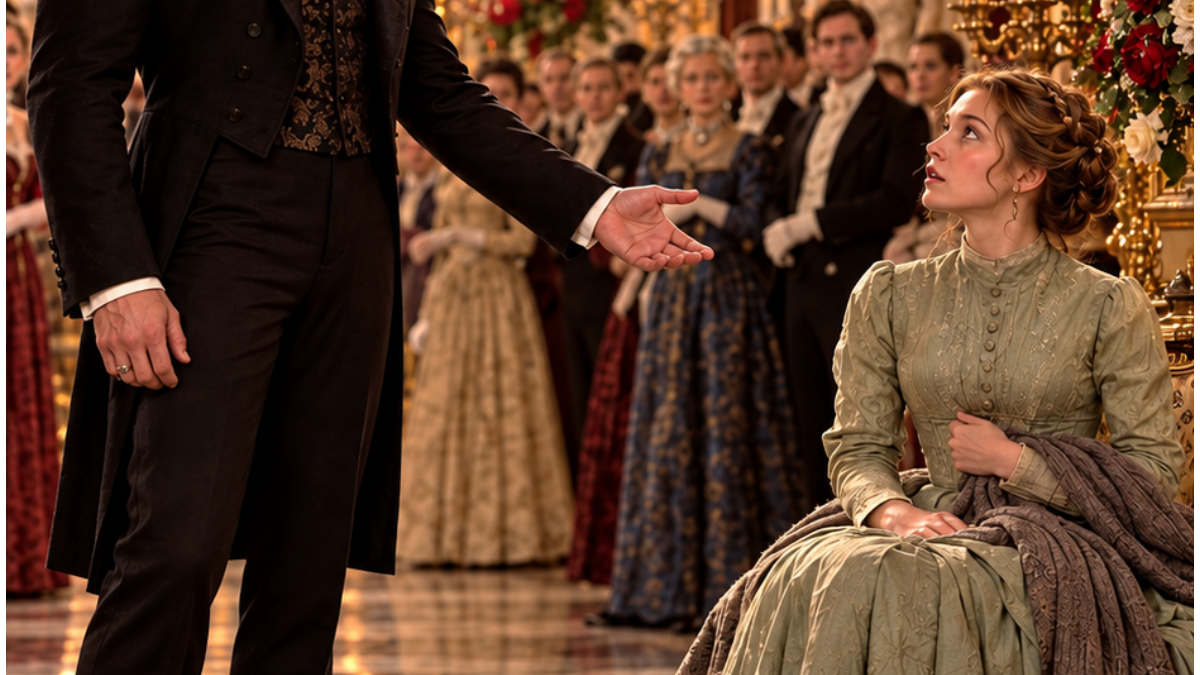
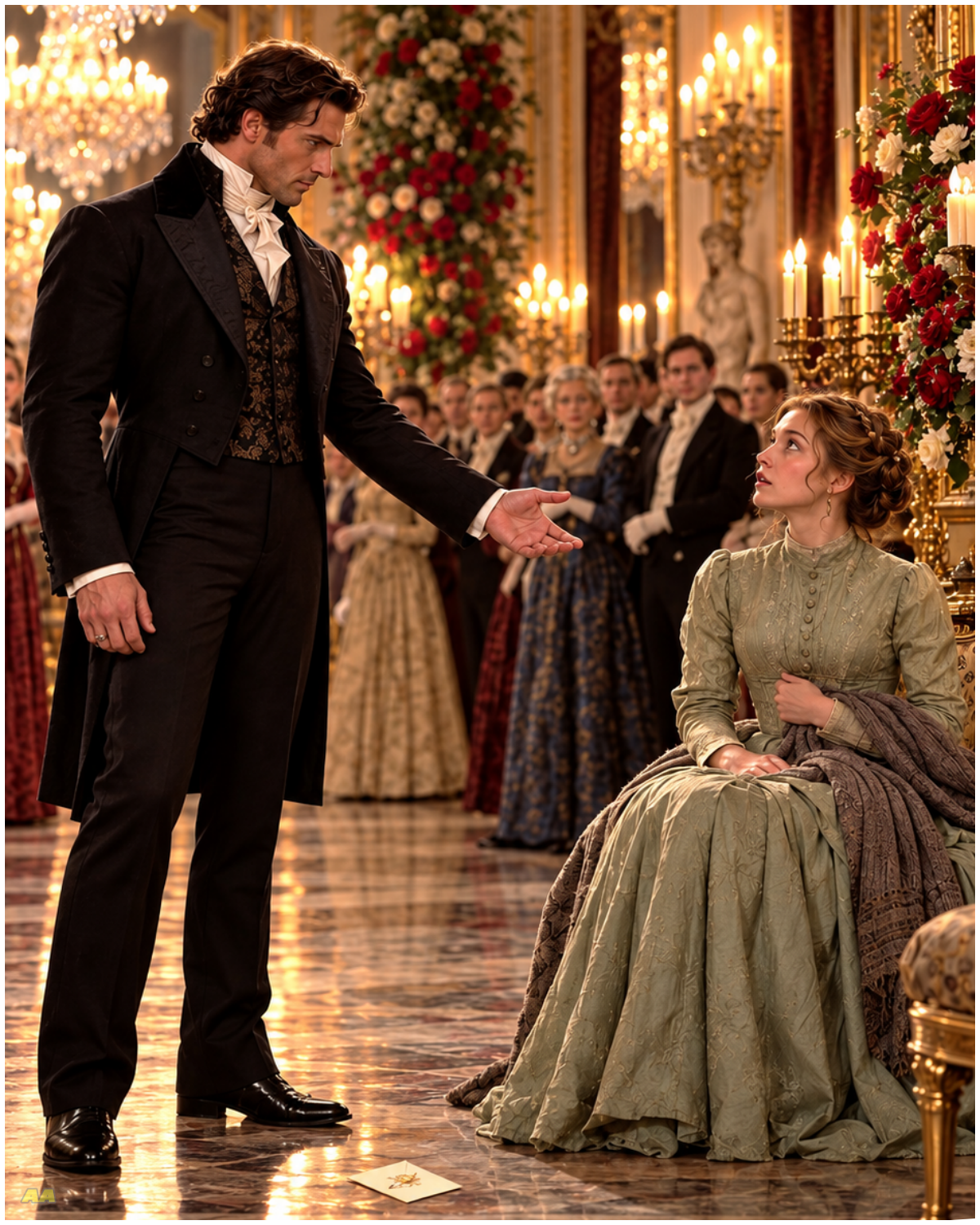
Dressed as cruelty. Miss Wifred Fenurch, Julian said, and his voice, though he did not raise it, carried perfectly well in the sudden stillness.
I find myself, of all the ladies I have met this season, most drawn to Miss Wifred Fenurch.
The silence that followed had a texture he would remember for the rest of his life.
A held breath multiplied 300 times, the particular electric hush of a room recalibrating itself around a fact it had not been prepared for.
He did not wait for the murmur to break.
He crossed the floor directly, the crowd parting before him with the instinctive difference 300 people extend to a duke who has just done something entirely unexpected, and came to stand before her, aware of Lady Fenture’s face on the color of old paper somewhere behind him, aware of Arabella’s frozen astonishment, aware of nothing in truth, but the wide stricken eyes lifted to his.
Miss Fenurch, he said, and held out his hand, will you do me the honor of this dance?
The murmur that finally broke the room’s silence was not unkind exactly, but it was loud, and it carried in its confused, rising babble every possible reading of the moment at once astonishment.
Scandal, a few scattered notes of genuine delight from the kinder quarters of the ballroom, and beneath all of it, the particular avid hunger of 300 people who understood they were watching something they would be retelling for weeks.
He had thought in the half second before he asked it that he was offering her the thing London had just denied her by omission for two seasons running.
A public claiming, a correction, proof before every gossiping tongue in the room that she was not the family’s shameful secret, but a woman a duke would choose above 12 aeryses without a second thought.
He understood the instant he saw her face that he had misjudged it badly.
What crossed her features was not gratitude, but a kind of horror, swift and total.
The horror of a woman who believes she is being made a public jest of her own infirmity in the crulest possible arena before the crulest possible audience by a man she had already half convinced herself only wanted a curiosity to display.
“No,” she said, and her voice, though barely above a whisper, seemed to Julian to fill the entire ballroom.
No, I thank you your grace, but I will not.
She rose unsteady, refusing the hand he still held out, and the movement, the visible public effort of her rising, the lameness she had spent her whole life hiding suddenly on display before 300 witnesses, because pride would not let her sit and be stared at a moment longer seemed to her.
He understood later infinitely worse than any insult he might have intended because it confirmed the very thing she had always feared.
That she could be made a spectacle, that her body could be turned into a public entertainment regardless of her own wishes, and that a duke’s apparent kindness was only cruelty with better manners.
She did not run. She could not run, and the fact that she could not was its own small, unbearable theater before a room that had gone utterly silent, but she walked from him as quickly as her foot allowed, out through the nearest door and into the corridor beyond, leaving Julian standing alone in the middle of the Marchmont ballroom, with his hands still half extended, and 300 faces turned toward him in various attitudes of astonishment, pity, and from a few quarters.
He did not fail to notice outright amusement at a duke so thoroughly publicly refused.
Lady Fenurch reached him a moment later, her face arranged in a rich of social recovery that fooled no one.
Your grace, I must apologize. My daughter is not herself this evening.
The heat, I think, has quite overcome her.
Your daughter is entirely herself, Julian said, more sharply than he intended.
And I would ask you not to trouble her further on my account tonight.” He bowed to her and to the room at large, and left the ball within the quarter hour, aware, as he went of the whispers already beginning to close over the evening like water over a stone, of a story that would be all over London by the following afternoon, embroidered and re-mbbroidered, until no one recalled it accurately.
But everyone recalled that the Duke of Chromier had been refused in public by the Fenurch family’s crippled daughter.
His aunt found him in his study near midnight, still in his evening clothes, a fire burned down to embers, and no candle lit beyond the single one at his elbow.
She had heard the story already, three versions of it, she told him, each contradicting the last in some essential particular, one of which had him proposing marriage outright before the assembled company and being refused for a rival duke already secretly engaged, which struck Julian when he heard it as almost comic in its distance from anything that had actually occurred.
You look,” Lady Augustus said, settling herself into the chair opposite him without waiting to be asked.
Like a man who has lost a battle he did not know he was fighting.
“I asked her to dance,” Julian said.
“I thought I was giving her back something London has never once offered her, a plain public preference without qualification.
She heard it as mockery, Aunt Augusta, and I cannot entirely fault her for it, since mockery is very nearly all that family has taught her to expect from attention of any kind.
Then you will have to teach her differently, his aunt said.
And I do not think you will manage it with grand gestures in ballrooms, whatever your soldiers instincts tell you about taking a position by main force.
Some walls are not stormed, Julian.
They are worn down a stone at a time by patience and by proof repeated until it can no longer reasonably be doubted.
She rose to go, pausing at the door to look back at him with an expression gentler than her brisk words had suggested.
You loved her before you ever saw her face.
Do not let one misjudged dance convince you that the loving was a mistake.
It was only the dancing. He sat a long while after she had gone, turning that distinction over in his mind, the loving and the dancing, the debt and the delivery of it, and understood by the time the fire had gone entirely to ash, that his aunt had named precisely the error he had made, and that he would need to find some other road entirely, if he meant to reach Wifred Fenurch before her family’s version of the world closed over her completely.
He did not learn until 3 days later from Hobbes, who had it from a chamber made with a sweetheart in the Fenurch household’s kitchen, what the ball had cost Wifred beyond her own mortification.
Lady Fenurch, incandescent with a fury that had less to do with wounded feeling than with a dowy apparently thrown away through what she termed her daughter’s willful, ungrateful strangeness, had confined Wifred to her room for a full week.
No callers, no books beyond the single volume of sermons her mother selected.
Meals sent up on a tray the door on at least one occasion Hobbes’s informant swore to locked from the outside.
Ruining the family, Lady Fenurch had called it loudly enough to be heard through two floors, as though a girl’s refusal of a dance she believed to be mockery were the crime, and not the two years of silence and shame that had taught her to expect nothing better from anyone who claimed to want her company.
Julian sat with that intelligence a long while in his study that evening the small locked box on the desk before him and understood at last with the particular cold clarity that had once told him a position could not be held and must instead be taken by an entirely different road that he had gone about this whole business wrongly from the start.
He had wanted to give Winifred Fenture back her dignity in the one currency society respected public preference.
A duke’s open hand without first giving her any reason to trust that his hand, when extended, was not simply another cruelty in finer dress.
He had a debt to pay that predated the ball, the gallery, even his aunts 12 portraits, a debt two years old and written in a dead man’s failing hand.
And he understood now that it was that debt and not a dance that he ought to have laid before her firSt. He unlocked the box.
Inside, wrapped in a square of oiled silk gone soft and dark with handling, lay a packet of letters tied with a length of ordinary string.
The paper foxed and travelworn, creased along the same fold so many times that some of the words had begun to blur where the ink had cracked the paper’s grain.
He had read them more times than he could count in the three years since a friend’s death had put them into his keeping, and he did not need to open them now to remember their contents.
A stranger’s clear, unaffected hand, unsigned, save for a single initial, writing week after week to a wounded soldier she had never met, about nothing of consequence and everything that mattered.
A garden coming into bloom, a favorite book, small unremarkable kindnesses offered to a man dying by degrees in a hospital tent with no family near enough to sit with him.
They had shared a tent for the better part of two winters, he and Reed, in a country so cold that ink froze in its bottle, and a man learned to write his letters home in the brief warm hour after the fires were built.
And read three years his junior, quicker to laugh than any man had a right to be in that place.
Forever sketching absurd, affectionate caricaturures of their fellow officers on the backs of dispatches he was meant to be filing had been, Julian sometimes thought afterward.
The last unbroken piece of his own boyhood that the war had left him.
Captain Thomas Reed had shown Julian the first of them on a night when the guns had gone quiet for once, and there had seemed nothing else in the world to talk about but the things that might have been, had the world been kinder, and Julian, who had known Reed since they were boys of 12 together, who had held him in the end on a hillside with the smoke still hanging low and Reed’s hand closing weak and urgent around his wrist, had promised because there was nothing else left to give a dying man that he would find her that he would tell her what her letters had meant.
That whatever it cost him, the woman who had written to a lonely, frightened soldier under a false name, asking nothing and expecting nothing in return, would know that her kindness had not gone unanswered, had not gone unremembered, had in fact been the last comfort a good man carried with him out of the world.
He had carried Reed the last quarter mile himself, overground still smoking from the guns, and had sat with him afterward in the surgeon’s tent through the whole of a night that seemed to Julian, even three years distant, to have lasted a great deal longer than any other night of his life, listening to a dying man speak by turns of his mother in Shroptshire, of a horse left behind in his father’s stables, and of a stranger’s handwriting that he recited near the end from memory.
Having read the letters so many times the words no longer needed the paper to summon them, Julian had buried him two days later on a hillside with a wooden marker unlikely to survive a single winter’s weather, and had carried the letters home inside his own coat for the remainder of the campaign, unwilling to entrust so fragile, and final a piece of his friend to any post that might lose them.
It had taken Julian the better part of two years after his own return to England to trace the correspondence to its source, a charitable society that arranged letters between soldiers and sympathetic strangers.
A ledger half destroyed in a fire, a single surviving clerk’s memory of a name, Wifred Fenurch.
He had known her name for the better part of a year before he ever stood in her family’s drawing room.
Had carried it the way a man carries a compass bearing through unfamiliar country, and he understood now, turning the fragile packet over in his hands, that he had let his own caution.
His wish to know her first as a woman before he approached her as a debt to be discharged, cost her a week locked in her room, and a public humiliation she had believed, not unreasonably, was aimed at the very infirmity that had taught her family to hide her away.
He sent for Hobbes before the candle in his study had burned another inch.
“I want these delivered,” he said, “into Miss Fentuch’s own hands and no one else’s.
Not her mothers, not her sisters.
Hers and hers alone, however, you must contrive it.” Hobbes, who had served him through three campaigns and one long convolescence, and had earned in that time the right to speak plainly, looked at the packet a long moment before he answered.
And if the household won’t permit it, your grace, then you will find a way that does not require their permission.
Julian said, I have been careful with this family’s feelings for 2 years, hobbs and careful, I begin to think, in entirely the wrong direction.
It is time Miss Fenurch knew the truth, whatever it costs the rest of us to tell it.
Hobbs managed it in the end through the same chambermaid whose sweetheart had first carried news of Winifred’s confinement.
A note passed with the breakfast tray, a promise that the packet beneath it came from a friend and asked nothing beyond an honest reading and a quiet half hour, while Lady Fenurch took her chocolate three floors below in blissful ignorance, in which Wifred Fenure sat alone in her narrow room and unfolded with hands that had gone perfectly still.
Two years of her own forgotten handwriting.
She had written those letters. She remembered as she read them in the loneliest winter of her life, in the months after her father’s death had left the family’s finances in the ruin her mother never spoke of, and her own place in the household had shrunk by slow degrees to the narrow attic room, and the Shawl always ready to hide her foot from callers.
A lady from the lady’s benevolent society for the relief of the wounded had come soliciting correspondence for soldiers with no family to write to them.
And Winifred, who had nothing else in the world she was permitted to give, no fortune, no beauty her mother thought worth displaying, nothing but time and a clear hand and a heart with no one else to spend its kindness on, had offered herself under a false name, thinking no one would ever know or care, thinking only that somewhere a lonely man might be glad of a letter, she had written to him to Captain Reed, though she had known him only as TR for the better part of a year, about her guard.
Garden about Gibbon about nothing of consequence and had grieved quietly and privately when the letters stopped coming and she understood without ever being told outright that he must have died.
She had not known his letters had gone into another man’s keeping.
She had not known until she unfolded the last page in the packet Hobbes had smuggled to her, that the man who had held Captain Reed as he died had been all along, the Duke of Chromier, and that the promise made on that hillside had walked into her mother’s drawing room a fortnight ago, disguised as idle curiosity about a book of Gibbon.
The last letter in the packet was not one of her own.
It was Julian’s written that same night in his study, and it said in a plain, unpracticed hand, entirely unlike the careful diplomacy of a duke’s usual correspondence, that he had fallen in love with her with the writer of those letters, with the cleareyed, uncomplaining kindness in them, a full year before he ever learned her face or her name, and that everything he had done since, the call, the gallery, the terrible, misjudged dance at Lady Marchmont, had been the clumsy efforts of a man trying to find his way toward a woman he already loved without knowing how to say so without frightening her away.
He did not ask her forgiveness for the ball because he did not yet fully understand what the ball had cost her.
He asked only that she believed the letters were true, that Thomas Reed had died with her words folded next to his heart, and that whatever she chose to do with that knowledge, she should know she had been, for one dying man in a foreign country, the last good thing in the world.
She remembered reading it the particular winter evening she had written her very first letter under the name she had borrowed from a favorite aunt long dead.
Remembered the cold of the attic room seeping up through the floorboards.
The single tallow candle she had been permitted.
The strange fierce comfort of addressing herself to a man she would never meet and telling him because she could tell no one in her own house anything that mattered.
About the crocuses just beginning to show along the squar’s railings and a passage in a novel that had made her laugh aloud alone for the first time in a month.
She had not known writing it whether it would ever be read still less whether it would be treasured.
She had written it the way a person prays in the dark without any certainty of an answer simply because the alternative was silence and silence in that house had already claimed more of her than she cared to measure.
Wifred read it three times before she could see the page clearly again.
And when at last she set the letters down, she found that some hard defended thing in her chest, some years worth of careful bracing against disappointment, had come loose all at once, and left her weeping in a way she had not permitted herself since her father’s funeral, not from grief now, but from the sheer disorienting shock of discovering that the two most painful things London had ever done to her.
Her family’s shame and a duke’s inexplicable attention were in fact the same story seen from two directions and that she had spent a fortnight believing herself mocked by the one person in England who had loved her longest and known her leaSt. She did not answer the letter that week, confined as she was and uncertain even now how to trust so complete and improbable a reversal of everything she had been taught to expect.
But she kept it folded small inside the binding of her volume of Gibbon, where her mother would never think to look, and read it again every night before she slept, and began, for the first time in longer than she could remember, to imagine a version of her own future that did not require her to disappear.
In the weeks after Wifred’s release from her locked room, Julian called at Wimple Street with a regularity that surprised even himself.
Not the single formal visit his aunt’s schedule of courtship generally allowed a gentleman, but two, sometimes three afternoons a week, arriving with a new volume for her to read, or a cutting from a rose in the chromier succession houses, or simply his own company offered without agenda for an hour at a time.
Lady Fenurch permitted these calls with an eagerness that struck Julian, even at the time, as a touch too avid to be entirely comfortable, hovering at the edge of the room in a manner that made honest conversation difficult, until Wifred herself, with a boldness that visibly startled her mother, began asking whether they might not walk instead in the small square garden across the street, where a duke and a duke’s intended might reasonably be permitted a quarter hours private.
Y under the eye of a maid, stationed discreetly at the gate.
It was in that square, among gravel paths worn thin by nursemaids in their charges and a single struggling plain tree that provided the garden’s only real shade that Julian came to know her properly.
Not the wary, defended girl of the first drawing room interview, nor the humiliated figure fleeing the Marchmont ballroom, but a woman of considerable private wit who could describe her mother’s dinner table diplomacy with a dryness that left him laughing aloud on more than one occasion, and who asked him in turn questions no one else in London had thought to ask, not about his ren troll or his politics, but whether he had ever wanted, before the title fell to him, to be anything other than a duke, and what he had missed most in the Crimea of ordinary English life, and whether he thought a man could ever entirely set down a burden of guilt for a friend’s death, or only learn to carry it differently.
He found himself answering her honestly.
In a way he answered almost no one, and understood, walking home one such afternoon with the particular loose-limmed lightness of a man who has spent an hour in excellent company, that whatever debt had first brought him to her door, he now wanted nothing in the world so much as to spend the rest of his life in that small, unfashionable square, listening to her talk.
It was Lady Fenurch in the end who forced the next turn of the story, though not in any direction she intended.
Word of Julian’s public preference, however catastrophically the evening itself had ended, had not gone unnoticed by a woman who read every drawing room’s currents for profit the way a merchant reads a tied table, and within a fortnight of Winifred’s release from her room, Lady Fenurch had arrived at a calculation of her own.
A duke’s interest, however oddly expressed, was not a thing to be thrown away merely because her youngest daughter lacked the sense to recognize an opportunity when it curtsied to her.
It was, rather, a resource to be managed, and Lady Fenurch set about managing it with the single-minded practicality she had once applied to stretching a diminishing income across five daughters, and a townhouse she could not quite afford to maintain.
She called upon Julian herself, without Wifred’s knowledge, arriving at Chromier House on a wet Thursday afternoon with Arabella in tow, and a proposal she delivered with the bright business-like cheer of a woman discussing the terms of a lease.
If his grace’s interest in Winfred was, as it appeared, sincere and likely to proceed to an offer, then surely his grace would agree that a family connection of such consequence ought to be of benefit to the whole family, and not merely to one undeserving daughter, who had, after all, very nearly thrown the opportunity away through her own strange conduct.
Arabella, Lady Fenture, pointed out, was the elder, the more conventionally marriageable, the daughter who had, in fact, been raised and educated with precisely this season’s triumph in mind.
Surely it would cost his grace very little, given the size of his fortune, to settle a dowy upon Arabella as well, so that both girls might be credibly established, and the family’s long years of careful economy might at last bear fruit.
Julian listened to the whole of it with a stillness that Hobbes, standing by the door, recognized from three campaigns as the particular quiet that preceded in his master something considerably less polite than stillness.
You are asking me, he said at last, to purchase your daughter’s dowy as the price of my regard for her sister.
I am asking nothing so crude as that your grace, Lady Fenurch said with a small laugh that did not reach her eyes.
I am only observing that families who marry well generally marry together, and that it would reflect very ill on Winfred’s own establishment where her sister left unprovided for beside her.
And of course, here her voice dropped, taking on an edge Julian had not yet heard from her, something nearer threat than negotiation.
There is the matter of the letters.
Wifred’s correspondence. Your grace with soldiers she had never met under an assumed name such a history were it known would not reflect well upon a young lady already thought strange by half of London.
I should be very sorry to see it become common knowledge.
I am certain your grace would be sorry too on her account.
Arabella seated beside her mother through the whole exchange had said nothing.
Her eyes fixed on the pattern of the carpet with an intensity that suggested considerable discomfort at the direction the conversation had taken, though not, Julian noted, sufficient discomfort to prompt her to speak against it.
The threat delivered in a drawing room over untouched tea, landed with the same cold clarity as any ambush Julian had ever walked into blind, and he understood.
In the moment it took him to master his own anger sufficiently to answer exactly what kind of woman he was dealing with and exactly how little her own daughter’s happiness had ever weighed against her convenience.
“You would call it scandalous,” he said slowly, “that your daughter wrote letters of comfort to a dying man with no one else in the world to write to him.
I call it the finest thing I have ever heard of a gently bred English woman doing, Lady Fenurch.
And I promise you that if you attempt to use it against her, you will find that I am considerably better placed than you to decide what London believes about it.
You mistake me entirely, your grace, if you think I intend any threat,” Lady Fenurch said, though her color had risen and her hands, Julian noted, had gone tight around the handle of her teacup.
I am only a mother concerned for all her daughters welfare, and it seems to me no great unreasonleness to observe that a family’s fortunes ought to rise together when providence offers the opportunity.
Providence, Julian said, had very little to do with any of this, Lady Fenchurch.
I did not come into your daughter’s life by providence.
I came because a dying man asked me to, and I have found in the course of keeping that promise a woman I intend to marry for her own sake and no other.
I will not purchase Arabella’s dowy as the price of that intention.
And I would ask you to consider very carefully before you raise the subject again what it will do to your own standing in London if it becomes known that you attempted to extort a settlement from a duke by threatening to publish his intended private charity as scandal.
I do not make threats lightly, Lady Fenurch, but I promise you I am considerably more practiced at them than you are.
Lady Fenturch’s composure did not survive that answer intact, and the visit ended shortly after in a flurry of half apologies, and hastily reasserted good wishes.
But the damage, Julian understood too late, had already been done in a different quarter entirely.
Wifred herself, passing the drawing room door on her way to the stairs, had heard enough of her mother’s proposal, the dowy, the leverage, the threat of exposure delivered like a merchant closing a sail to understand, with a clarity that felt like ice water down the spine, precisely how her mother intended to use both her and the memory of a dead soldier’s last comfort as bargaining pieces in a transaction that had nothing ever to do with her own wishes or her own heart.
She did not wait to hear how the conversation ended.
By the time Julian’s carriage had pulled away from the house, Wifred Fenurch was already in her room with a small bag half-packed, moving with the quiet, deliberate speed of a woman who has decided in the space of a quarter hour that she would rather disappear entirely than be sold.
She left before dawn the next morning, taking nothing that was not entirely her own.
A little money saved from small economies over several years.
The packet of letters sewn now into the lining of her cloak Gibbon left behind for one of room in her bag and made her way on foot and then by a hired chair to a boarding house in Cheapside recommended, though she never learned how, by a woman she had once done a kindness for at a charity bazaar.
She gave her name there as Miss Winnie Ford, took a room the size of her family’s linen closet, and by the end of the week had found work through the same landlady’s connections, copying legal documents for a firm of solicitors two streets away, a task that suited a clear hand and a patient temperament, and paid, if not generously, then honestly, in coin that was entirely her own.
The room itself, when she first saw it, was smaller and planer than anything she had known, even in the attic on Wimple Street.
A narrow iron bedstead, a wash stand with a cracked pitcher, a single window looking out over a yard, where someone’s washing hung perpetually gray between two brick walls, and Wifred setting down her small bag upon it that first night, found to her own surprise that she was not afraid.
She was, for the first time in longer than she could remember, entirely unobserved.
No one in that house cared whether her foot dragged when she crossed the floor.
No one arranged a shawl across her lap before callers arrived, because no callers came, and no one in Cheapsite had the smallest interest in whether the Fenurch family’s youngest daughter made a suitable ornament for a drawing room.
Her landlady, a brisk, kindly widow named Mrs. Puraphoy, who asked no questions, she was not answered, and offered none of her own history in return, taught her within the first fortnight which market stalls sold bred cheapest at the day’s end, and which streets were safe to walk alone after dark.
And Wifred discovered, somewhat to her own astonishment, a plain and sturdy competence in herself that no one in her own family had ever troubled to notice, let alone praise.
A capacity for patient, careful work, for stretching a small wage across a week’s needs, for rising each morning to a purpose entirely her own rather than one assigned to her by someone else’s convenience.
She missed her books, and she missed more than she had expected to, the particular quality of morning light through the nursery window at Wimple Street, but she did not, in all the weeks that followed, once regret having gone.
The household on Wimple Street woke that morning to a note left on Wifred’s pillow brief, an addressed to no one in particular, saying only that she would not be found and did not wish to be, and that her family should feel free to tell whatever story of her disappearance suited them best, and to a silence in the attic room that Lady Fenurch, after the first shock had passed, found more inconvenient than alarming, given how little use she had lately found for a daughter, who would not do as she was told, old.
Julian learned of it two days later from a stiffly worded, carefully evasive note from Lady Fenurch that spoke of Wifred’s departure to visit relations in the country, and asked with transparent anxiety that his grace not trouble himself to call again until the family’s circumstances were better settled.
A note whose very evasiveness told him everything its careful phrasing tried to hide.
He understood at once with a soldier’s instinct for the shape of a disaster beneath a euphemism that Wifred had run and that she had almost certainly run because of the very conversation he had witnessed in his own drawing room 3 days before.
He tore London apart looking for her.
He set Hobbes to work the coaching ins and the hiring stables, questioning oslers and porters with the patient thoroughess of a man conducting a proper reconnaissance.
He called in every favor his rank could command magistrates a bow street runner engaged at his own expense the charitable society through which letters had once been arranged on the chance she had sought them out again.
He wrote to every distant relation the Fenurch family possessed and rode himself in the small hours when sleep would not come through streets he had no real hope of searching usefully simply because the alternative was to sit still in his own house doing nothing while the woman he loved was somewhere in a city of half a million strangers with no one so far as he knew watching over her at all.
He went to church twice that month, which was twice more than his usual habit, and sat through both sermons without hearing a word of either, his mind running instead over every conversation he could remember having with her, searching them for some overlooked clue to where a resourceful, frightened woman with a small store of savings, and a talent for disappearing quietly might have gone to ground.
He thought of the copying work Hobbes’s information suggested she might seek, given her clear hand and her evident wish for honest, unremarkable employment, and had Hobbes make inquiry without result at first among the more respectable firms of the city.
He thought of the charitable society and called there himself, only to be told gently by a kind-faced matron, who plainly recognized the particular desperation in his manner, that no new correspondent calling herself by any name Julian could offer had registered with them in recent months.
Each dead end cost him something he did not entirely recover between one search and the next, and it was only his aunt’s steady, unspoken presence in the house each evening.
Her insistence that he eat something, however little appetite he had for it, her refusal to fill the silence with false comfort he would not have believed anyway that kept him.
He later admitted to her from some darker despair he did not care to examine too closely even in memory.
Weeks passed with no word. His aunt, watching him grow gaunt and short-tempered and increasingly unlike himself, ventured once to suggest that perhaps the girl did not wish to be found, and received in reply a look so bleak that she never raised the subject again, only sat with him some evenings in silence, which was in its way its own kind of comfort.
It was Hobbes in the end who found the thread that led them to her.
And he found it by the most unglamorous route imaginable by asking at every firm of solicitors and copying house within walking distance of every cheap lodging house in the city whether any of their clerks might know a woman with a particular clear distinctive hand learned.
He suspected from years of careful practice at letters that mattered.
It took him the better part of a month and a great deal of shoe leather, but he found it at last at a modest firm off Cheapside, where a senior clerk, shown a sample of Winifred’s writing that Julian had kept among Captain Reed’s letters, recognized it at once as belonging to Miss Ford, who came in three mornings a week to copy conveyances, and had, the clerk mentioned, with some pride in the young woman’s diligence, never once been late or made an error worth the mentioning.
Julian went himself the following morning, arriving before the firm’s doors had properly opened and waiting in the street in the thin early light, until he saw her thinner than he remembered, in a plain gray dress that was entirely her own and suited her, he thought, better than any borrowed gown had ever done, walking with her old, careful gate toward the solicitor’s door, with a covered basket over one arm and an expression of quiet.
Hard one’s self-possession that he had not seen on her face in any of their previous meetings.
She saw him before he had crossed half the street and stopped dead, the basket nearly slipping from her arm, and for a long moment neither of them moved, the whole noisy morning traffic of Cheapside going on obliviously around them, while four months of longing and misunderstanding, and a dead man’s letter stood suspended in the narrow space between a duke and a copying clerk who called herself Miss Ford.
“You found me,” she said at laSt. Not quite a question, not quite an accusation.
Something caught uncertainly between the two.
I have been looking for a month, Julian said.
I would have looked for a year, Winnifid, and not thought it too long.
My mother sent you. Your mother, Julian said, does not know I am here and would very much rather I were not, since she has spent the last month telling anyone who asks that you are visiting relations in Derby and growing daily more embarrassed by how thin that story is wearing.
I came because I could not bear another day of not knowing whether you were safe, and because there are things I should have said to you before you ever had caused to run from your own home, and I find I am not willing to wait any longer to say them.” She did not answer at once.
And he saw in the careful, guarded way she looked at him, that a month of independence, of earning her own bread, of being valued for her hand and her patience, and nothing else, of belonging to no one’s household but her own, had changed something fundamental in how she held herself, had given her, for the first time perhaps in her whole life, a footing from which to meet a duke’s declarations as an equal rather than a supplicant grateful for whatever attention came her way.
I am not going back to be sold your grace, she said.
Not to you and not to my mother’s arrangements.
If you have come to fetch me home as though I were a parcel gone astray in the post, I would rather stay here with my ledgers, thin dress and all, then return to a house where my worth is measured against my sister’s dowy.
I have not come to fetch you anywhere, Julian said.
I have come because I love you.
Not the girl in a gallery, not the writer of letters I read a hundred times before I ever knew your face.
But you, precisely as you stand before me now in a gray dress with ink on your fingers, more yourself in this street than I have ever seen you in any drawing room in London.
If you tell me to leave you to your ledgers, I will go and I will grieve it, but I will not trouble you again.
But I do not think that is what you want to tell me, and I would rather hear it from your own mouth than guess at it from a note left on a pillow.” She stood very still a long moment, the basket forgotten on her arm, the morning traffic parting around them the way it parts around any obstacle London has not the leisure to remark upon.
And when at last she spoke, her voice was not quite steady, though her eyes, meeting his, were clearer and more certain than he had ever seen them.
I do not know how to trust it, she said.
I have spent my whole life believing myself a burden that kind words were only ever a prelude to disappointment.
I do not know how to simply believe you without waiting for the moment it turns out to be something cruer in disguise.
Then do not believe me yet, Julian said.
Come and let me prove it instead.
Not by fetching you home to your mother’s house, which I have no intention of doing until certain matters there are very differently settled, but by standing beside you while we settle them, so that whatever comes next, you face it as a woman with a champion at her side, rather than alone in an attic, waiting to be told what she is worth.
It was, she told him much later, the word champion, not husband, not duchess, not any of the grander words a lesser man might have reached for in that street that undid the last of her resistance, because it asked nothing of her beyond permission to stand beside her, and offered everything.
They found on returning to Wimple Street that same afternoon that events had moved without them in the month of Wifred’s absence, and not kindly.
Lady Fenurch, having concluded some weeks before that her youngest daughter was, whatever the true circumstances of her disappearance, unlikely to reappear conveniently in time to secure the family’s fortunes, had turned her considerable energies instead to securing Arabella’s, and had done so with a thoroughess that left Julian, reading the notice in that morning’s morning post, as Hobbes handed it to him in the carriage, briefly unable to speak from sheer astonishment.
The paper announced in the flat ceremonial language of such notices the betroal of Miss Arabella Fenurch to his grace the Duke of Chromier to be solemnized at St. George’s handover square before the month was out.
She has announced it, Julian said, reading it a second time to be certain his eyes had not deceived him.
Without my knowledge, without my consent, and without, so far as I am aware my ever having proposed anything of the kind to anyone in her household, when reading over his shoulder in the swaying carriage, went very white, and then unexpectedly gave a short, disbelieving laugh that had very little humor in it.
She has grown desperate, she said.
A month with no word of me, no dowy secured, and society beginning to whisper that the Fenurch girls are somehow cursed in matrimony, she would announce anything sooner than admit the whole scheme has failed.
I am only astonished she thought you would not notice your own betroal in the papers before she troubled to inform you of it.
They arrived at the Fenurch townhouse within the hour, and Julian, handing Wifred down from the carriage himself before the astonished eyes of a footman, who plainly had not expected to see the family’s missing daughter delivered to the door on a duke’s arm, walked into that house without waiting to be announced, with the particular controlled fury of a man who has decided, after weeks of careful restraint, that restraint has served its purpose and outlived its use.
He found the drawing room already assembled for what was evidently meant to be a celebratory family gathering.
Ants, a cousin or two, an elderly gray tunle dozing gently by the fire with a glass of madiraa balanced on his knee.
Lady Fenture presiding over the tea things with the flushed triumphant color of a woman who believes her gamble has paid off.
And Arabella seated near the window in a new gown her face when she saw Julian and behind him her missing sister.
Draining of color so completely that for a moment Julian thought she might faint outright.
A cousin’s small daughter sent to play quietly in the corner with a set of spilicans while the adults conducted their business looked up at the sudden hush that fell over the room with the frank unguarded curiosity of a child sensing that something of consequence was happening that the grown-ups would not trouble to explain to her.
Your grace, Lady Fenurch, began rising, her voice pitched for the benefit of the assembled relatives.
How delightful we had not looked for you until.
You had not looked for me at all, Lady Fenurch, Julian said, since you took considerable pains to inform the entire readership of the morning post of an engagement I never made.
To a young woman I have never once asked to marry me while the daughter you had actually driven from her own home was earning her bread copying legal documents in cheapside because she would rather starve honestly than be sold to settle your debts.
The room went silent in the particular total way a room goes silent when a scandal too large to whisper about has just been spoken aloud within its own walls.
Lady Fentitch’s mouth opened and closed without producing sound.
Arabella had gone rigid in her chair, her eyes fixed not on Julian but on her sister, standing quiet and composed in the doorway in her plain gray dress, more dignified in that moment, Julian thought, than any of the 12 Aeryses had managed to appear in their finest silk.
“I have something to read to this family,” Julian said, drawing from his coat the letter he had carried with him now for weeks.
And I think it only just that you should all hear it, since you have all had a great deal to say about the daughter who wrote it, and rather less to say about the man who received it.” He unfolded the last of Captain Reed’s letters, the one written in a failing hand in a hospital tent, addressed to no one and everyone, the letter Reed had asked Julian to carry home and deliver whole, and unedited to whoever needed most to hear it, and read it aloud into the stunned silence of the Fenurch drawing room.
His voice steady though the words themselves had cost him every time he read them something he had never quite learned to spend without feeling the loss of it.
I do not know your true name and I find dying as I am that it scarcely matters.
You wrote to me of gardens and of books and asked nothing in return.
And I want it known whoever reads this after I am gone that a stranger’s kindness carried more men through this war than any general strategy.
And that the woman who wrote these letters to me under whatever name she chose to give is the bravest soul I have known in England, braver than any officer I have served beside.
For she gave her comfort to a stranger with nothing to gain from it and everything in a hard world to lose.
Tell her, if ever you find her, that she was loved by a dying man who never learned her face, and that I died the better for having known her heart.
Julian lowered the letter into a silence so complete he could hear the clock on the mantle marking off the seconds.
“This is the woman,” he said, turning to face Lady Fenurch directly.
“You called an embarrassment. This is the correspondence you threatened to expose as scandal in this very room in order to extract a second dowy from me.
You have kept your own daughter shut in an attic for the crime of a lame foot and a kind heart, dressed her in castoffs when callers came, and when she showed more courage than the rest of this family combined by refusing to be traded like livestock.
You announced her sister’s engagement to a man who had never proposed it.
In the newspapers before the ink on her disappearance was even dry.
I do not know what word society uses for a mother who does such things to her own child, Lady Fenurch, but I have spent three years at war, and I have met few enemies I thought less of than what I am looking at now.
You are no mother to her.
You are her jailer, and I mean to see that she is never locked in that particular prison again.” It was Arabella in the ringing silence that followed, who broke first, not Lady Fenurch, whose composure, however battered, held a moment longer out of sheer social reflex.
But Arabella, rising from her chair with her hands pressed hard against her skirts, her voice, when it came, cracked and low, and entirely without its usual fluent polish.
“I burned them,” she said. Winnie’s replies after she left.
There were letters, three of them, that came for her from the charitable society in the weeks after she disappeared, asking after her welfare, wondering why her correspondence had stopped.
And I burned them rather than let mother find them and use them against her further, because I could not I could not undo what I had already done, but I could at least stop making it worse.” She turned to her sister, then, her composure entirely gone, tears standing openly in her eyes.
I burned your replies for years, Winnie.
Every letter that came back to you from anyone who might have thought well of you, any praise, anything that might have made you less easy for mother to keep small, I told myself I did it to protect the family’s consequence.
But I think in truth, I did it because it was easier to watch you shrink than to watch myself grow ashamed of what we were doing to you.
I am sorry. I do not expect you to forgive it.
I only wanted it said before mother could say something else instead.
When Ephred, standing very still in the doorway through the whole of this, said nothing for a long moment, and Julian, watching her, saw something pass across her face that was not quite forgiveness and not quite anger, but some difficult human country between the two.
The recognition perhaps that her sister’s cruelty had grown from the same soil of fear and scarcity that had shaped all of them, without that recognition making the cruelty any less real, or its cost any less her own to grieve.
I do not forgive it today, Wifred said at last quietly.
But I believe you have told the truth, Bella, for the first time in a long while, and that is worth something.
It does not undo the years, but it is a beginning if you wish to make one.
One of the ants, a stout, sharpeyed woman Julian recalled being introduced to at some point, as a Mrs. Hartwell rose from her chair with the air of someone determined to salvage what remained of the afternoon’s propriety and addressed herself to the room at large in a tone of brittle cheer entirely unsuited to what had just passed in it.
Well, she said, I am sure none of us wish to dwell on unpleasantness that is, after all, a family matter best settled among ourselves, and I think we had much better.
She got no further, for the elderly grey tungle by the fire, who had woken at some point during Julian’s speech, and had been following the proceedings since, with an attention no one had credited him with, set down his glass of madiraa with a decisive click against its saucer.
“Nonsense, Harriet,” the old man said in the carrying, unhurried voice of a man long past carrying whom he offended.
I have sat in this family’s drawing room for 30 years watching that child.
He gestured not unkindly toward Wifred made to stand at the edge of every gathering like a piece of furniture no one wished to be reminded owned.
And I say it is high time someone in this family said aloud what the rest of us have only ever murmured in carriages afterward.
The Duke has done Wifred more honor in an afternoon than this house has managed in 20 years, and I, for one, am glad to see it, whatever it costs our consequence to admit.” He nodded once at Julian, as though closing a piece of old business long overdue, and reached again for his madiraa, apparently considering the matter settled.
Lady Fenurch, watching her careful architecture of dowies and advantageous notices collapse in real time before an audience of her own assembled relatives, made one last effort at recovery, her voice climbing toward the particular brittle pitch of a woman who senses the ground going out from under her and has not yet accepted it.
This is a great deal of unpleasantness over family matters best discussed in private, your grace, and I must say I think it very ill bred of you two.
I have said what I came to say, Julian said, and I will say only one thing more.
Miss Wifred Fenture will not be returning to this house tonight, nor any night hereafter, except as a guest, should she ever wish to extend her family that courtesy which I would not blame her in the slightest for declining.
She will remove with my aunt’s chaperonage and at my expense to chrome your house until such time as she and I have settled matters between ourselves in whatever manner suits her and not a moment before.
Good evening, Lady Fenturch. I do not expect we shall meet again under circumstances requiring quite so much plain speaking, and I confess I shall not mourn the loss of the occasion.” He offered Winifred his arm as he said it, and she took it.
Not. He understood from the small steadying press of her fingers against his sleeve because she needed the support to walk, but because she had decided in that room in that moment to be seen leaving it on the arm of the man who had defended her before the same assembled relatives who had spent years watching her hide.
The weeks that followed moved with a speed that left Julian’s aunt, who had waited seven years for her nephew to take any interest whatever in matrimony, in a state of pleased and faintly breathless bewilderment.
Winifred settled into Chrome your house under Lady Augustus Chaperonage with a quiet steady grace that won the older woman over within the first week.
Not through any effort to charm which Winifred had never learned and did not now attempt but through the plain unaffected honesty of her conversation, her genuine delight in the house’s library, and a dry, unexpected wit that emerged once she felt safe enough to show it.
In small, devastating remarks that left Lady Augusta laughing aloud at her own dinner table for the first time in longer than she could readily recall.
Julian proposed to her properly a fortnight later in the Chromier Gardens at dusk with none of the public spectacle of the Marchmont Ballroom and none of the misjudged grandeur of his first disastrous attempt.
Only the two of them and the letters which he brought with him one final time and laid together with a ring that had belonged to his mother in her open hands.
I loved you before I knew your face, he said.
And I have gone on loving you through every clumsy mistake I have made since.
And I find I have run entirely out of clever ways to ask you what I mean.
So I will simply ask it plainly as a soldier learns to ask for anything that matters.
Will you marry me, Winifred? Not because a promise to a dying man first led me to your door, though I will always be grateful it did, but because the woman who opened that door has become the whole of what I want from the rest of my life.” She said yes with far less hesitation than either of them had expected, though with tears standing bright in her eyes, and told him afterward that she had, in truth, decided the answer somewhere in the street outside the solicitor’s office in Cheapside, and had only been waiting in the weeks since, to be asked in a manner that asked for her, and not merely for the story attached to her.
The bands were read three Sundays running at St. Georgees and Julian standing beside his aunt in the family pew to hear his own name coupled publicly at last with Winifreds found the ordinary parish ritual moved him more than any of the grander ceremonies of his rank ever had.
There was something in the plainness of it.
The vicer’s unhurried recitation, the small congregation of ordinary parishioners going about the business of their own Sunday worship all around him.
That felt truer to what he wanted the marriage to be than anything the Marchmont Ballroom could have offered.
Wifred herself spent the intervening weeks dividing her time between Chromier House and quiet careful visits to Cheapside, where she called on Mrs. Puraphoy with baskets of provisions.
The widow protested she did not need and accept it anyway, and where she gave notice with genuine regret to the firm of solicitors who had employed her as Miss Ford, and who sent her off on her last afternoon among them.
With a small leatherbound dictionary, the senior clerk had chosen himself as a parting gift, inscribed simply to the most careful hand this office has known.
They were married at St. George’s Handover Square on a bright morning in September, and society, which had spent the better part of a season alternately mocking and marveling at the Fenurch family’s strange youngest daughter, turned out in force to see the conclusion of a story it had followed.
By then, with as much genuine investment as scandal, Julian stood at the altar rail in the pale autumn light, watching the doors at the far end of the nave, aware of his own heart beating harder than it ever had before any engagement.
And when at last those doors opened, and Winifred appeared at the far end of the long aisle, he understood in the same instant as every other soul in that church precisely what they were watching.
She walked toward him without a cane, without a shawl to hide anything, without the careful defended posture of a woman braced for cruelty, her chin level and her eyes fixed on his the whole length of the aisle.
Moving with a lameness she no longer troubled to disguise, because she had at last nothing left to be ashamed of, and everyone in that church to witness it.
Beyond the church doors, drawn up along the street in a neat, unintentional row of carriages, sat several of the very aeryses whose portraits had once lined his aunt’s gallery, come to see for themselves the woman a duke had chosen over all of them.
And Julian, catching sight of them through the open church doors, as he and his bride emerged man and wife into the bright September morning, found that he felt nothing toward them but a distant, well-wishing indifference.
The last faint echo of a season’s worth of expectation that had simply ceased somewhere in the last few months to have any purchase on him at all.
Miss Grantley, he noted with a private, undignified satisfaction that he did not trouble to examine too closely, was smiling from her carriage window with what looked very like genuine goodwill, and he found himself glad in that small unguarded moment that the gallery’s 12 faces had none of them come to any real harm from his own failure to choose among them.
Only as far as he could tell from the seasons later gossip to marriages of their own made in their own time to men who had wanted them for themselves rather than for an obligation owed elsewhere.
The wedding breakfast that followed ran long into the afternoon.
The chromier house dining room thrown open at both ends to accommodate a guest list considerably larger than either Julian or Wifred had privately anticipated.
And it was there, amid the toasts and the crowded good wishes of half-fashionable London, that Julian found a quiet half hour to draw his bride aside onto the terrace, away from the noise, where the last of the roses were still blooming stubbornly against the autumn chill.
She had changed for the breakfast into a gown of soft gray blue that suited her, he thought, better than any finery London could have devised, and she stood beside him at the terrace rail with the particular contentment of a woman who has at long last nowhere left to hide and no further reason to wish to.
You are very quiet, your grace, she said, for a man who has just been married before half of London.
I am counting my good fortune, Julian said, and finding I have not nearly enough arithmetic to do it justice.
I keep thinking of the girl in the green gown who would not look at me properly, certain I had come only to mock her, and I find I cannot quite reconcile her with the woman standing beside me now, entirely unafraid.
She is the same woman, Wifred said, slipping her hand into his.
She only needed someone patient enough to prove a great many times over that kindness could be trusted to mean exactly what it said.
I do not think I shall ever stop being grateful you were willing to be that patient, Julian, however clumsily you began.
Then we are agreed, he said, that the beginning was clumsy and the ending, I hope considerably less so.
And she laughed at that, a full unguarded laugh entirely unlike the careful contained sound she had once permitted herself in her mother’s drawing room.
And the sound of it carrying out over the last of the autumn roses was, Julian thought, very nearly the finest thing he had heard in the whole of his life.
Fenurch was not among the wedding guests.
She had been settled at Julian’s arrangement and very much against her own wishes in a small but perfectly comfortable cottage on the edge of the chromier estate in Hampshire provided for adequately and permanently and visited by explicit and mutual agreement.
No more often than once or twice a year provision enough.
Julian had told her plainly for a mother, but no longer any license at all to govern a daughter she had never troubled to know.
No invitation to the wedding had been sent, and none had been expected.
It was, Wifred said, the kindest thing that could be done for either of them, to end the story cleanly rather than pretend before an altar at a forgiveness neither of them yet felt.
Arabella came alone in a gown a good deal planer than the one she had worn to the ball where the whole story had first turned, and wept openly through the ceremony in a manner that surprised everyone who remembered her old fluent composure, and afterward in the crush of the wedding breakfast, took her sister’s hands in both her own, and said only, “I am glad, Winnie.
Whatever I was to you before, I am glad of this truly.” and Wifred, who had not yet found it in herself to call the account settled, found that she could at least believe that much of it, and let that be enough for a beginning.
It was some months later, once the new Duchess of Chromier had settled fully into the rhythms of her married life, that Winfred came to Julian one evening in his study with an idea she had been turning over.
She confessed since the very night she had first read Reed’s letter in her narrow attic room and understood what a stranger’s kindness freely given and asking nothing in return could mean to a man with no one else in the world to comfort him.
She proposed with the same quiet, steady conviction with which she had once refused a duke’s hand before 300 witnesses, to found a proper letterw writing service under the chromier name, gentle women of good hand and better heart, matched with soldiers who had no family to write to them, their correspondence overseen, and their identities protected, so that no other lonely man dying far from home need go without the particular comfort of a stranger’s unlooked for kindness.
And no other woman need write in secret.
Ashamed of a generosity that ought never to have been anything but honored.
Julian agreed before she had finished explaining it, not because he doubted a single word of her reasoning, but because he had learned in the short months of knowing her properly that Winfred Fenurch’s instincts about where kindness was needed and how best to give it had never once, in his experience, been wrong.
The Chromier Society for Soldiers Correspondence, as it came to be called, occupied by the following spring two rooms at the rear of Chromier House that had stood empty and unregarded for a generation, and Wifred herself oversaw its first small band of volunteer correspondents.
Gentle women of every station from Duchess’s to Vicer’s daughters matched with care to soldiers whose families had died or scattered or simply never learned to write with the same patient.
Exacting attention she had once given to a solicitor’s conveyances, insisting that every letter be answered promptly, that no correspondent’s true name be disclosed without her wish, and that no soldier, however humble his rank, be made to feel his loneliness, was any less deserving of comfort than an officers.
Arabella, in the slow, halting way of a woman rebuilding something she had once helped to break, became in time one of the society’s most faithful correspondents, writing weekly to a young private recovering from a lost arm in a Portsmith hospital.
And it was, Winifred said once to Julian with a private, complicated tenderness, one of the few things in those early years that let her believe her sister’s confession in the drawing room had been the beginning it claimed to be.
Rather than merely its own kind of performance.
The first letter she had ever written under a false name recovered, creased and faded from the packet Julian had carried across a continent and half of London to find her, was framed at last, and hung above the library fireplace at Chromier, in the room where the new duchess spent most of her happiest hours among the books she had once been told, were unbecoming to a young lady of her station, so that anyone who sat there of an evening warmed by the same fire that had once seemed to a girl hidden away in an attic, the whole of what the world would ever allow her, might look up and be reminded that the smallest, quietest kindness, offered honestly and without hope of reward, could travel farther and matter more than any fortune London had ever thought worth putting on display in a gallery of 12 hopeful, well-painted faces.
Julian took to sitting in that room most evenings of his life thereafter in the chair nearest the fire with Wifred’s chair drawn close enough beside his own that her hand when she reached for it without looking up from whatever letter or ledger occupied her attention always found his waiting he would watch her sometimes for whole minutes together without her noticing the small furrow of concentration between her brows as she read a soldier’s difficult halting hand and considered how best to answer The quick private smile that crossed her face when some line of correspondence pleased her.
The easy unguarded way she now crossed a room without a shawl to hide beneath or a family’s judgment to brace against, and would think each time of the wary, defended young woman, who had once told her sister that a duke could have no kinder reason than mockery for calling on the family’s hidden burden.
He had spent three years learning in a foreign country how easily a life could be lost for want of a single kindness offered in time.
He spent the rest of his own life glad, every ordinary evening by that fire, that he had not learned it too late to offer his.








