“I’ll Stay With You.” Rejected Mail-Order Bride Nursed a Broke Cowboy – Then Learned His Secret
The letter arrived on a Tuesday.
It did not come from Silus Mercer.
It came from a stranger in Red Willow who felt sorry enough to warn her, “Do not come, miss. He’s gone.”
Left 3 weeks prior without a word to anyone.
Clara Whitfield read that letter twice, folded it, and bought her train ticket anyway because she had nothing left to go back to.
What kind of man invites a woman across a thousand miles of empty country, and then disappears before she even steps off the platform?
What kind of coward lets a stranger mail the bad news he was too small to deliver himself?
The platform at Red Willow was not much of a platform.
It was three warped boards nailed to together over packed dirt sitting at the edge of a town that looked like it had been set down in the middle of nowhere by someone who gave up deciding where to put it.
One main road, a general store with a cracked front window.
A livery stable that smelled like it housed more trouble than horses.
And a boarding house at the far end of the street with smoke coming from the chimney that at least suggested somebody inside was still alive and cooking.
Clara Whitfield stepped off the train carrying a trunk that was heavier than it looked and a face that gave away nothing.
She was 26 years old. She had dark hair she kept pinned tight because loose hair in the wind annoyed her.
She was not particularly tall, not particularly beautiful in the way that made strangers stop walking.
But she had a quality that people noticed after about 30 seconds in her presence of stillness.
Not the stillness of someone who had nothing to say.
The stillness of someone deciding exactly how much of what she was thinking she was going to let you see.
Right now she was not letting anyone see much.
She set the trunk down on the platform and looked up the length of Red Willow’s single road, and she did not cry, which was something she had promised herself on the train.
She had cried enough in the two days since the letter reached her in Abalene.
She had cried on the station bench in the dark when she thought no one was watching, and she had cried quietly in her seat with her face turned to the window somewhere in the middle of the Kansas night.
She had used up her crying.
What was left now was something harder and less comfortable, something that sat in her chest like a stone she hadn’t decided what to do with yet.
Silas Mercer was gone.
She had spent 8 months exchanging letters with that man.
Eight months of careful handwriting and deliberate words of describing herself, honestly, not the prettiest version of herself, the real one, and asking questions that she actually wanted answered.
She had asked him what he valued.
She had asked him what kind of man his father had been.
She had asked him once directly whether he was asking for a wife because he genuinely wanted a partner or because the ranch needed someone to keep house and she told him she would not come if it was the second reason.
He had written back four pages.
Four pages. She had read them so many times the paper went soft at the folds.
And now he was gone. Three weeks gone apparently without a single word left behind for her.
A man she’d never met. A man whose handwriting she knew better than his face.
A man who had somewhere between his fourth letter and his disappearance made her believe that the life waiting at the end of that train ride was worth the risk of boarding it.
Clara picked up the trunk and started walking toward the boarding house.
She did not know a single person in Red Willow.
She had 14 cents in her coat pocket.
She had a return ticket that would get her as far as Dodge City and no further and nothing waiting for her in Dodge City or anywhere east of it.
Her mother had passed 2 years prior.
Her father had remarried someone who made it clear in small and consistent ways that the house was no longer Clara’s house.
She had a cousin in Indiana she hadn’t spoken to in 4 years.
She was not going back to Indiana.
So she walked toward the smoke coming from the boarding house chimney and she did not look back at the train.
The woman who answered the door was not what Clara expected.
She had expected someone soft, maybe someone sympathetic, someone who would look at a young woman alone on her doorstep and immediately offer tea and understanding.
Martha Bell was none of those things.
She was somewhere past 50, broad in the shoulders with gray hair she hadn’t bothered to arrange into anything polite.
She looked at Clara the way a person looks at something they’re trying to decide the weight of.
You the male order girl? Martha said.
Clara had not thought of herself that way before.
The phrase landed like a small slap.
I am Clara Whitfield. She said I came to marry Silus Mercer.
He’s gone. Martha said it the way you’d say it’s raining.
Plain fact, no apology attached. I know.
Martha studied her another moment. You got family nearby?
No. Money? Clara hesitated just long enough to answer the question without answering it.
Martha looked at the trunk. Then she looked at Clara’s face.
Something shifted in her expression, not sympathy.
Exactly. More like recognition. Like she had seen something in Clara that she had seen before in a mirror a long time ago.
You cook? Martha asked. Yes. You complain much?
Only when it’s worth the effort.
Martha almost smiled. It was a very small almost smile and it disappeared quickly.
But Clara caught it. Room and meals in exchange for kitchen work.
Martha said, “You’ll earn a small wage once you’ve proven you’re not useless. I don’t carry dead weight. I don’t intend to be carried.”
Clara said.
Martha stepped back from the door.
Then get that trunk inside before the wind picks up.
That was how it started. Not with kindness.
Exactly. With something tougher and more reliable than kindness.
With a woman who respected another woman’s decision not to fall apart.
The work was hard. Clara had known it would be.
She was up before anyone else in the house.
Starting the stove, cutting biscuits, hauling water.
Her hands cracked in the dry cold.
She burned the back of her wrist on the stove twice in the first week and wore the marks like something she didn’t have the luxury of complaining about.
The boarding house held six regular tenants, men mostly, ranch hands, and a traveling goods merchant who smelled like tobacco, and spoke to her like she was slightly less interesting than a piece of furniture.
She ignored him. She was good at ignoring things that weren’t worth her attention.
What she was less good at ignoring was the question that woke her up at 3:00 in the morning more than once in those first weeks.
What did I do wrong? Not wrong in the sense of a mistake in judgment, though she turned that over, too.
Wrong in the sense of what was it about her specifically that had made Silas Mercer decide a woman he’d spent 8 months corresponding with wasn’t worth a single goodbye?
Was it something in her letters?
Had she been too direct, too honest about her expectations?
Had she asked for too much by asking for a real partner instead of a domestic arrangement with a title?
She never answered the question satisfactorily.
She learned eventually to set it down before dawn and pick up the coffee pot instead.
6 weeks into her time at the boarding house, something happened that changed the shape of her days so completely that she would later mark it as the actual beginning of whatever her life in Red Willow was going to become.
Two cow hands came through the door at quarter 9 in the evening carrying a man between them.
He was not small, even unconscious and bleeding from somewhere underneath his coat.
He had the look of someone who took up more space than most broad through the chest, long-limmed with a jaw that suggested he had opinions and was not always gentle in expressing them.
His head was hanging. His boots were still on, which Clara noticed because it struck her as the kind of detail that meant nobody had taken care of him yet.
Martha, the taller cowhand shouted. Martha came from the back.
She took one look at the situation and pointed at Clara without looking at her.
Get the medical kit from the cabinet.
Clara got the kit. They put him in the room at the end of the hall, the room that was usually empty because it had a window that didn’t latch properly and let in a draft.
Someone had apparently decided a draft was less important than the distance from the other tenants.
Clara didn’t ask questions. She brought the kit, brought hot water, and stood in the doorway while Martha assessed the situation.
The wound was in his side.
Something had gone into it and been removed or had passed through and the result was a gash that was deep enough to be serious and had bled enough to be alarming.
The man was alive, breathing in a way that sounded more like argument than reSt. His eyes were closed.
Hold that lamp steady, Martha said.
Clara held the lamp. She watched Martha work with the practiced efficiency of someone who had done this before cleaned the wound, packed it, wrapped it tight.
The whole time the man on the bed did not wake up, but he also did not stay quiet.
He said things under his breath, fragments, a name maybe, or something that sounded like one, a short word that might have been no and might have been something else.
When it was done, Martha straightened up and looked at him for a moment with an expression Clara couldn’t read.
“Who is he?” Clara asked. “Don’t know,” Martha said.
The boy said they found him about 3 mi out off his horse.
She picked up the basin. Day in here tonight.
If his fever climbs fast, wake me.
Then she walked out. Clara pulled the chair from the corner and sat down.
She sat with him through the night.
She was not sure why she didn’t simply check on him once an hour and sleep in between the way she might have done the practical thing.
She told herself if it was because his breathing was uneven and she wanted to be present if it changed.
That was true. It was not the whole truth.
The whole truth was that there was something about his face in the lamplight that she found herself studying without meaning to.
He was not handsome in any way that was trying to be handsome.
His face had been lived in.
There was a scar along the left side of his jaw that was old enough to have gone silver.
His hands resting at his sides were the hands of a man who worked scarred knuckles, a broken nail on the right thumb that had grown back wrong.
His dark hair had grown past the point where anyone had bothered to cut it.
Somewhere around 2:00 in the morning, his eyes opened.
He didn’t panic. That was the first thing she noticed.
Most men, she thought, coming awake in a strange room with an unfamiliar face watching them in the dark, would have reacted with some alarm.
He simply looked at her, took in the ceiling, the lamp, the wrapped wound at his side, and then returned his gaze to her face.
His eyes were gray, which she had not expected.
“You’re at Martha Bell’s boarding house,” Clara said in red willow.
“Your side’s been cleaned and wrapped.” “You lost blood, but not enough to be fatal if you stop moving.” He looked at her for a long moment.
“Who are you?” he said. His voice was rough from disuse or pain or both.
Clara Whitfield. I work here. He seemed to consider this.
How long was I out? Several hours.
He moved a small testing movement and his face made a change that was not quite a wse but was the version of a winsome man makes when he’s decided wincing is beneath him.
Don’t Clara said whatever you’re thinking about doing next give it at least until morning.
He looked at her again with those gray eyes.
She could not tell what he was thinking.
She would later come to understand that this was almost always true with him and that she found it maddening and against her better judgment compelling.
Rhett Callaway, he said. Excuse me, my name.
Oh, she hadn’t asked. Clara Whitfield, she said again, which was unnecessary since she’d already told him, and she immediately felt mildly ridiculous for repeating it.
You said that? Yes, he agreed.
He closed his eyes. She thought he’d gone back to sleep.
She was adjusting the lamp wick when he spoke again without opening his eyes.
Thank you, he said, for staying.
Clara set the lamp down. Go to sleep, Mr.
Callaway. He did. She sat with him until the gray of early morning came through the gap in the curtain.
And by the time Martha arrived to check on him at 6:00, Clara had already started the stove, already had the biscuits going, and had said nothing to anyone about the fact that she had spent the entire night in a chair beside a stranger’s bed feeling for reasons she could not have explained and would not have tried to.
Slightly less like a woman who had been left behind by the wrong man, and slightly more like a woman who was exactly where she was supposed to be.
That feeling frightened her. She filed it away in the same cabinet where she kept the 3:00 in the morning questions, and she kept her hands busy, and she told herself it was simply the relief of having something useful to do.
She would believe that for approximately two more weeks.
Rhett Callaway did not leave. This was, in Martha’s estimation, unusual.
Men who came through the boarding house in the condition he’d arrived in usually wanted to be back on their feet and out the door as fast as their bodies allowed, driven by whatever had put them in that condition in the first place.
Rhett’s situation was, Martha told Clara with characteristic bluntness, not exactly one that suggested leisure, but he stayed.
He stayed. And after the first week, he stopped simply lying in the back room and started appearing in the early morning hours, doing things that needed doing.
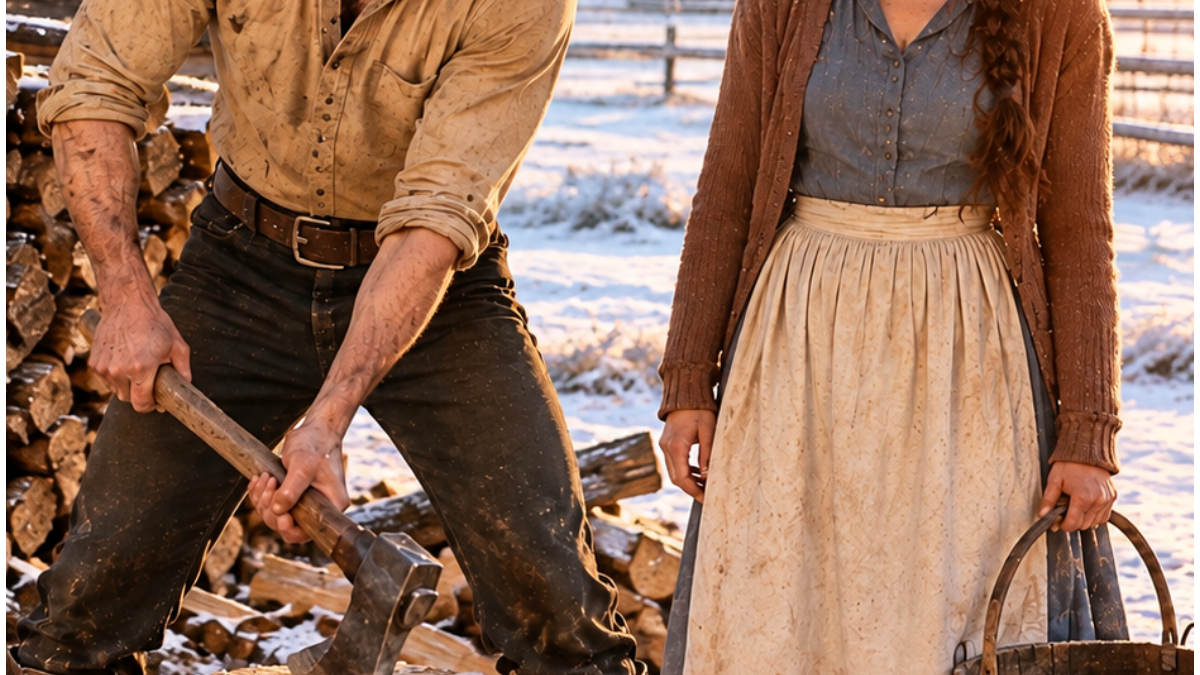
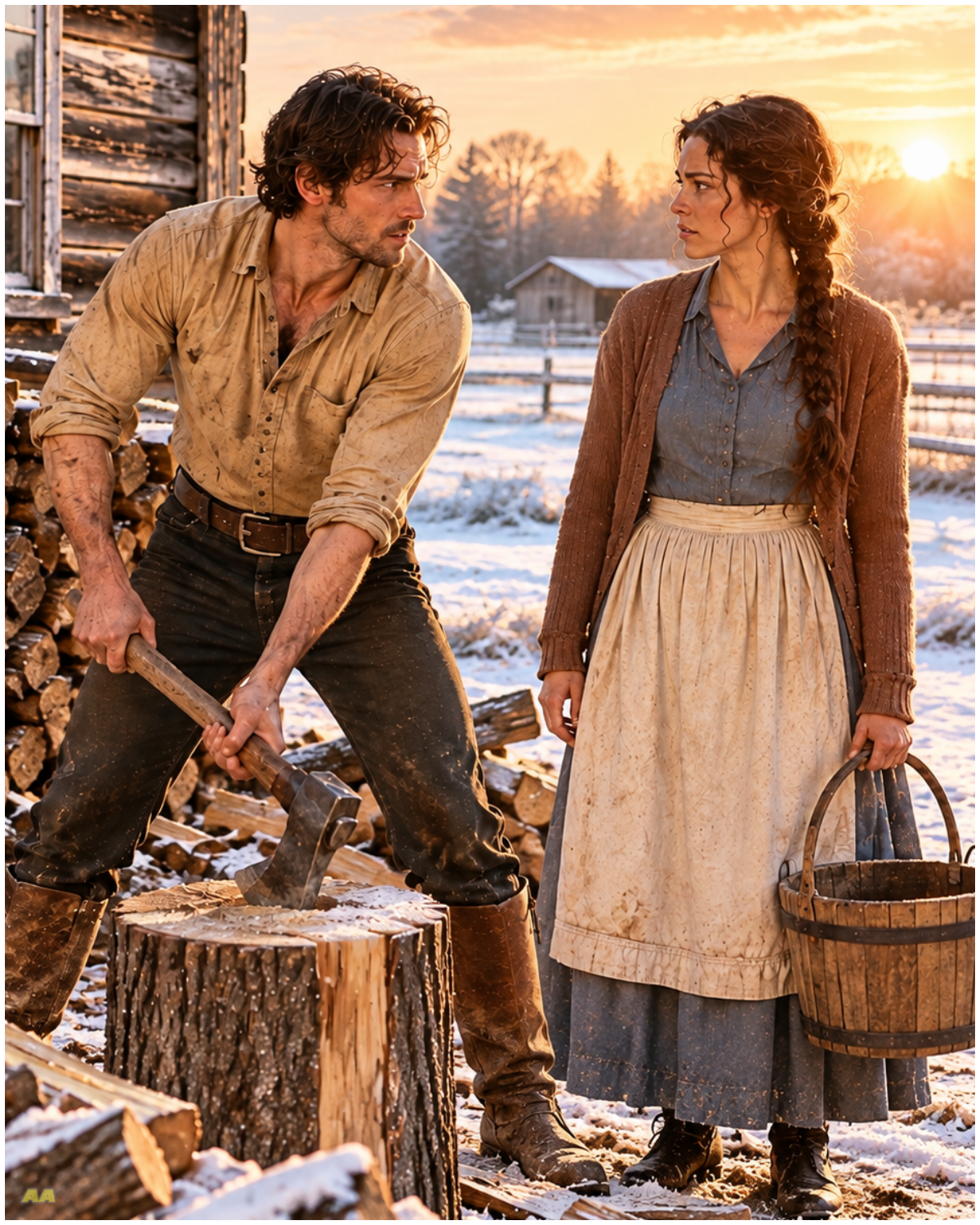
The wood pile was low. One morning, Clara came outside to find it no longer low, and Rhett standing at the chopping block in the cold with his coat open and his side, which had no business being swung at anything, yet apparently unimpressed by medical advice.
You’re going to tear that open, she told him.
Hasn’t yet. Is that your standard?
Hasn’t yet. He looked at her over his shoulder, not smiling exactly, but something in his expression shifted in a way that felt close to it.
It’s gotten me this far. She wanted to argue.
She was aware that arguing with a man about his own wound in a backyard at 6:00 in the morning was probably not how she had imagined her life going.
She picked up the additional logs he’d stacked neatly against the wall and carried them inside without saying anything else, which she suspected he recognized as a kind of surrender, and which she refused to examine too closely.
He started helping her before sunrise, not in a way anyone asked him to.
He just appeared in the kitchen doorway in the yard at the pump when the handle was stiff and needed a man’s weight to run properly.
He said little. He didn’t explain his presence or make conversation for the sake of making it.
When he did speak, it was either because something needed saying or because she’d asked him a direct question and he decided to answer it honestly, which was she discovered.
Not always as simple as it sounded.
She asked him once where he was from.
West, he said that covers a significant amount of territory.
Yes. He handed her the bucket without elaborating.
She asked him once if there was someone who might be worried about him.
He was quiet for long enough that she thought he wasn’t going to answer.
Then no. The word came out flat and clean and final.
The way a door closes when somebody means it to stay shut.
She didn’t push. She understood that kind of door.
She had a few of her own.
What she noticed though what she filed away without meaning to was that his no had a quality to it that didn’t sound like the truth.
It sounded like a version of the truth that was easier to live with than the whole of it.
She had been speaking her own versions of that sentence for 6 weeks.
I’m fine. I’m managing. I have everything I need.
She recognized a person saying the easier thing.
And she found to her discomfort that recognizing it in him made her feel less alone in a way she hadn’t expected and wasn’t sure she was ready for.
The cold deepened in the second week of his recovery, and with it came longer evenings, and the particular intimacy of a boarding house kitchen, where the only light worth sitting near was the stove.
The regular tenants played cards in the front room.
Martha went to bed early. Clara stayed in the kitchen because she had mending to do and because the front room smelled like pipe smoke.
Rhett stayed in the kitchen because she was never entirely sure why.
He said once when she asked Queter in here.
I’m in here, she said. Yes, he said as if that settled something.
She let it reSt. They talked in those evenings the way two people talk when neither of them is trying to perform anything.
Carefully at first, then less carefully.
He told her he’d grown up on a cattle operation.
He didn’t say where. He told her he’d worked the range since he could sit a horse, which he said was approximately age four.
And she told him that sounded like something that should concern a child welfare authority.
And he looked at her blankly for a moment before something shifted behind his eyes that might have been the recognition of a joke which arrived about 3 seconds after it should have.
She found that delay oddly endearing which alarmed her.
She told him about Abalene, about the school where she’d worked as a teacher’s assistant, about her father and his second wife, and the particular loneliness of living in a house where you are technically welcome and practically invisible.
She told him about the letters.
Not everything, not Silas Mercer’s name, but the shape of the situation.
I came out here to marry someone, she said.
He left before I arrived. Rhett was quiet for a moment.
Then he said his loss. It was such a plain, undecorated thing to say.
Not I’m sorry, and not what a shame, and not the slightly pitying look that Martha occasionally aimed in her direction when she thought Clara wasn’t watching, just his loss.
Said like a simple fact the way he’d say water runs downhill.
No performance attached to it. Clara looked at her mending for a moment without seeing it.
Thank you, she said. I’m not saying it to be kind, he said.
I’m saying it because it’s accurate.
She looked up at him then.
He was watching the stove, not her.
His face was doing that closed thing it did, sometimes every expression, locked behind a quality of stillness that made it difficult to know what was happening underneath.
But his jaw was slightly tight, and she had spent enough weeks reading the small grammar of his expressions to know that jaw tightness in his case was not annoyance.
It was something he was not saying.
She didn’t ask what. She went back to the mending.
The stove clicked and settled. Outside, the wind had picked up and was doing something to the shutters that someone was eventually going to have to address.
She thought, “This is the strangest situation I have ever been in.
She thought, “I am not as unhappy as I should probably be.” And then the front door of the boarding house opened, and a man she had never seen before walked in, tracking cold air and mud, and asked in a voice that carried clearly through two walls whether anyone in the establishment could point him toward a man named Rhett Callaway.
Clara felt the change in the room before she looked at Rhett.
When she did look, his face had gone completely still.
Not the ordinary stillness, a different kind, the kind she associated with an animal that has heard something in the brush and is deciding with great precision how much danger it represents.
He did not move. He did not speak.
He looked for just a moment, a single unguarded moment before the mask came back down, like a man who had been running from something and had just heard it catch up.
Clara did not move from the kitchen doorway.
She could hear the man in the front room, his boots on the floorboards.
The particular way he moved, like someone accustomed to taking up space without apology.
He was talking to one of the tenants now, asking again, louder this time, whether anyone knew the whereabouts of Rhett Callaway.
She turned to look at Rhett.
He had not moved from his chair, but everything about him had changed.
His shoulders had dropped slightly, not in relaxation, but in the deliberate way a person drops their shoulders when they are deciding to appear relaxed.
His hands, which had been resting loose on the table, were now very still.
“The kind of still that is the opposite of calm.” “Someone, you know,” Clara said quietly.
He said it without looking at her.
“That’s not an answer.” “No,” he agreed.
“It isn’t,” she looked at him for a moment.
She had known this man for 2 weeks and 4 days.
She had sat with him through a fever.
She had argued with him about firewood.
She had told him things about her life in Abalene that she hadn’t told Martha, who was arguably more entitled to the information.
And right now, he was sitting in her kitchen looking like a man who had just discovered the ground beneath his chair was not as solid as he’d believed, and he was giving her maybe.
Stay here, she said. She went into the front room before he could object.
The man standing near the door was trailworn in a way that suggested he’d been riding hard for at least 2 days.
He was younger than she’d expected from his voice, maybe 30, with a sunburned face and the kind of restless energy that made him seem like he was moving even when he was standing still.
He had dust on his coat and a look about him that Clara assessed in approximately 4 seconds as anxious rather than dangerous.
This was a man worried about something, not threatening it.
“I’m Clara Whitfield,” she said. “I work here.
Is there something I can help you with?” He turned and looked at her with the mild surprise men sometimes showed when a woman spoke to them directly and without preamble.
Ma’am, I’m looking for a man named Rhett Callaway.
Got word he might have come through Red Willow.
What’s your business with him? He hesitated, not the hesitation of someone deciding whether to lie more.
The hesitation of someone who had rehearsed this conversation differently and was now adjusting.
I ride for the Callaway spread, he said.
West of here. My name’s Wade Harlland.
I was sent to find him.
Sent by whom? His brother. Wade said, “Mr.
Daniel Callaway.” He looked at her carefully.
“It’s urgent, ma’am.” I don’t say that to make it sound dramatic.
The bank deadline’s been moved up.
Mr. Daniel needs his brother’s signature on some documents before the end of the month, or they stand to lose a significant portion of the property.
He stopped, recalibrated. A very significant portion.
Clara kept her face even. I see, she said.
And if I happen to know where Mr.
Rhett Callaway was, why would I tell you?
Wade blinked. Because it’s his family land.
That’s his reason, Clara said. I’m asking for yours.
He stared at her for a moment.
Then something in his expression shifted a flicker of something that looked almost like respect, which she didn’t particularly need, but noted anyway.
Because if I don’t bring him back, Wade said, I’ve got nothing to go back to either.
Daniels offered me a permanent foreman position if I locate Rhett and get him home in time.
It’s my reason, ma’am. It’s not noble, but it’s honeSt. Clara looked at him for three full seconds.
Sit down, she said. I’ll see what I can find out.
She went back to the kitchen.
Rhett was standing now. He’d moved from the chair to the window, and he was looking out at the dark yard with his back to the door.
He had heard enough. She could tell by the set of his shoulders something that had been coiled was now pulled even tighter, and he was doing the thing she’d seen him do twice before when a subject came up that he didn’t want to navigate.
Going very still and very quiet as if stillness could function as a decision.
Wade Harlland, she said he didn’t turn around.
I know who he is. He says it’s your family’s land.
He says there’s a deadline. I know what the deadline is.
Clara crossed her arMs. She was not going to shout at him.
She was not going to make this easier than it needed to be either.
You have a brother, she said.
It wasn’t a question. A long pause.
Daniel Rhett said, still not turning.
He’s 7 years older than me.
He runs the North Range. Another pause.
Ran it. I don’t know what he’s running now.
How long since you’ve spoken to him?
Rhett finally turned. His face was doing the closed thing, but underneath it, underneath the careful arrangement of his expression, she could see something that looked like a man standing at the edge of a thing he’d been avoiding for a long time.
2 years, he said, give or take.
2 years. We didn’t part well.
Clara looked at him. She thought about the 14 cents in her coat pocket and the stack of letters she’d burned in the stove 2 weeks ago because she couldn’t stand looking at them anymore.
And she thought about the school in Abalene and her father’s second wife and every single decision she had made in the past year that had led her to this boarding house kitchen in a town she hadn’t known existed 6 months ago and she said very evenly mister Callaway I am the last person in the world who is going to tell you that family is always worth going back to I don’t believe that not automatically not without conditions she stopped but I do think you should go talk to that man in the front room because whatever you’re afraid of is already out there waiting and making it wait longer doesn’t change what it is.
Rhett looked at her for a long moment.
Something moved across his face that she couldn’t name.
Not anger, not relief, not gratitude.
Exactly. Something in the region of all three.
I’m not afraid, he said. I didn’t say you were afraid of Wade Harland, she said.
He was quiet. Then he walked past her toward the front room and Clara leaned against the kitchen doorframe and listened to the sound of his boots on the floor and she told herself she had simply done the practical thing which was true and had nothing to do with the fact that thought the thought of him riding out of Red willow without this getting resolved made her feel something she had no language for and was not going to examine in a boarding house kitchen at 10:00 in the evening.
She put the kettle on instead.
She did not go into the front room.
She could hear the conversation from where she was not every word, but enough of the shape of it.
Wade Harlland’s voice was urgent and slightly relieved.
Rhetts was low and measured and gave almost nothing.
There was a silence in the middle of it that lasted long enough that she almost went to the doorway.
Then Rhett’s voice again, shorter now, with a quality that she had come to associate with a decision being made rather than a conversation being continued.
WDE left 20 minutes later. She heard the door, heard the sound of him mounting and riding out, then silence, then Rhett’s footsteps coming back down the hall.
He came to the kitchen doorway and stood there.
He looked tired in a way that had nothing to do with the wound in his side.
He’s gone, she said. I told him I needed a few days, a few days to think.
Clara poured two cups of coffee and set one on the table.
She did not sit down. She stood with her own cup and looked at him and waited because she had discovered that with Rhett Callaway waiting was more productive than asking.
Came to the table and sat.
He wrapped both hands around the cup.
He looked at the surface of the coffee for a while.
My father died 18 months ago, he said eventually.
Left the ranch to both of us, north range to Daniel, south range to me.
Equal split. That was the intention.
He stopped. Daniel didn’t agree with the split.
He believed he’d worked the land for 20 years while I was gone and that I had forfeited my share by leaving.
Had you left? Yes. For how long?
5 years mostly. Came back twice.
Neither time went well. He turned the cup slightly in his hands.
Daniel and I have we don’t think the same way.
We never did. When my father was alive, he kept the space between us manageable.
When he died, there wasn’t anything left to keep it manageable.
He paused. Daniel contested the will.
The legal costs ran both shares close to the edge.
Then the bank. Clara sat down.
And your share the south range.
What’s on it? Something changed in Rhett’s expression.
Water rights. He said the south range controls water access for the entire property.
Without it, Daniel’s north range can’t sustain a herd through summer.
He said it quietly without any satisfaction in it, which she noticed.
A smaller man would have used that information differently.
If I don’t sign the refinancing agreement, the bank takes 40% of the total acreage, including the water, then neither of us has anything worth keeping.
Clara was quiet for a moment, and if you do sign, then I’m agreeing to terms that Daniel set without me.
Terms that favor the North Range.
He looked up at her. I’m not saying Daniel did it dishonestly.
I’m saying I haven’t seen the documents.
I haven’t been in a room with my brother in 2 years.
And I don’t He stopped, started again.
I don’t trust myself to walk into that situation and think clearly.
There it was. Not the legal complexity.
Not the money. The thing he actually couldn’t navigate.
Because of your father, she said, because of everything we said at the funeral, he said, and everything we didn’t.
Clara wrapped her hands around her cup.
Outside, the wind had gotten serious about the shutters, and somewhere down the hall, someone had started snoring with the dedication of a man who had no idea there was a conversation happening that might matter.
She thought about what it would mean to walk back into a room with someone who knew every version of you that you wished you’d handled better.
She thought about her father’s house and the particular silence that had lived in it after her mother died.
The silence that nobody named and everybody breathed.
You can think clearly, she said.
You just don’t want to feel what comes with it.
Rhett looked at her. That’s not an insult, she said.
I’m the same way. He was quiet for a long moment.
Then, unexpectedly, something in his face shifted.
Not quite a smile. Not quite its opposite.
Something in between that she had no category for, and that made her look back at her coffee.
You’re fairly direct, he said. I find it saves time.
Doesn’t it offend people? Often, she said.
I’ve made my peace with that.
He looked at her with an expression she couldn’t read, which was usual, but this time it felt different.
Like he was reading something in her that he hadn’t expected to find.
Like whatever he decided she was when he first opened his eyes in that back room 3 weeks ago had been quietly revised, and he was still in the process of adjusting to the new version.
She was aware of this. She was aware of being looked at that way, and she was aware that she did not dislike it, which made her push back from the table and pick up both coffee cups and carry them to the basin with more purpose than was strictly necessary.
“You should sleep,” she said. “Whatever you decide about Wade Harlland and your brother and the South Range, it’s not going to get decided tonight, and your side needs the rest, even if you don’t think so.” Clara, she stopped.
He didn’t use her name often.
When he did, it had a quality that made whatever came next feel like he’d thought about it.
She turned. “What would you do?” he said.
She stood with the cups in her hands and looked at him.
The lamp was low. The stove had gone to embers.
He was sitting at the kitchen table of a boarding house in a town he hadn’t planned to stop in with a wound in his side and two years of unfinished business 40 mi west and an expression on his face that was the most unguarded thing she had seen from him since the night he woke up and thanked her for staying.
I’d go, she said, not because the land matters and not because your brother deserves it and not because the bank gives you any choice.
I’d go because the thing you’re actually afraid of already happened.
Your father died. The funeral already went wrong.
Those words are already out there and they’re going to be out there whether you go back or not.
She stopped. What you’re doing right now is letting fear make the decision for you and then pretending it was a choice.
I know what that feels like.
I did it for a year before I bought a train ticket to a stranger’s town.
The kitchen was very quiet. Rhett looked at her for a long moment.
Then he looked at the table.
Then he looked at his hands.
Good night, Mr. Callaway, Clara said, and she went to her room, and she lay in the dark for a long time, listening to the wind, and telling herself that she had simply said what needed saying, and that whatever he decided had nothing to do with her, and that she was sleeping perfectly fine.
She was not sleeping at all.
The next morning, he was at the wood pile before she was.
She came outside with her coat halfbuttoned, and her hair still loose something.
She had not permitted herself in weeks and found him already at work, moving with the careful economy of a man who had made some kind of decision in the night and was burning off the edge of it with his hands.
She didn’t say anything. She went to the pump.
She filled the bucket. She carried it inside.
She came back out for a second and he had stacked a week’s worth of firewood against the side of the house.
“You’re going to open the wound,” she said.
“It’s healing. You’re going to tear the healing.” He said, “Set the axe down.” And looked at her.
“I’m going,” he said. She looked back at him.
“When?” “I want 3 days firSt.” She almost asked why.
Then she understood. He wanted to go to his brother on his own terms, not Wade Harlland’s timeline.
He wanted to walk into that situation standing straight, not limping and bleeding and arriving as the lesser party because he’d had no time to prepare.
She understood that. She respected it more than she was comfortable admitting.
3 days is reasonable, she said.
He nodded. He picked up the axe again.
She picked up the bucket and went inside.
And she did not permit herself to examine the specific quality of the relief she felt at knowing he was not leaving until Thursday.
She had 3 days to figure out what she was going to do with the fact that she was going to miss him.
She had not expected that. She had not, if she was honest, expected any of this.
Not the boarding house, not Martha, not this particular strange life she was building out of other people’s leftover spaces.
She had arrived in Red Willow to marry a man who turned out to be the kind of person who runs.
What she had found instead was something she didn’t have a name for yet.
Work routine. A woman who trusted her to carry her own weight, and a stranger who showed up bleeding and turned out over the course of three weeks to be more honest than most people she had known for years.
That was not the same thing as safe.
She knew that Rhett Callaway was not a straightforward man, and he was not a simple situation.
He had a family conflict the size of a cattle operation and two years of unresolved grief driving him away from everything he’d come from.
And he was going to go back to it now.
And she had no idea what came out of that.
But she knew, and this was the thing she kept circling back to in the quiet hours that he was the first person in as long as she could remember who had looked at her and listened.
Not listened in the way people listen when they’re waiting for their turn to speak.
Listened in the way that meant he was actually tracking what she said, turning it over, taking it seriously.
He had heard her talk about her father and her mother and the school in Abalene and the letters.
And he had not once looked at her with pity or advice or the particular expression that meant you’ll be fine.
Women always are. He had just listened.
And then sometimes he said the thing that was true instead of the thing that was easy.
And she had spent enough of her life around people who said the easy thing to know the difference.
She went to sleep that night with her window cracked despite the cold.
And she did not dream about Sicilus Nurser, which she had done at least twice a week since arriving in Red Willow.
She dreamed about the ridge outside of town, the one she’d seen from the train window, coming in the one that sat above the flat land, and looked from a distance like the edge of something larger.
The three days passed in the way that ordinary time passes around something significant, slightly distorted, with too much detail in the wrong places.
She noticed what they ate for breakfaSt. She noticed which board in the hallway he stepped over without looking, already knowing it would creek.
She noticed that he was up before her twice, which had never happened before.
She noticed that he said considerably less than usual, and that the silence between them had changed texture.
It had become the kind of silence that is full rather than empty, the kind that accumulates meaning without requiring language.
On the second evening, he told her more about the South Range.
Not everything. He told her about the water rights first, how the creek ran through the property and fed both ranges, and how whoever held the water held the leverage.
He told her about the house that stood on the south range, a large structure that his father had built, with the intention of giving it to whichever son chose to settle there.
He said large with a flatness that suggested he meant something more specific and was choosing not to say it.
He told her that the southern range had been neglected for 2 years.
The hands laid off, the fences left, the grazing mismanaged.
What does it look like now?
She asked. I don’t know, he said.
I haven’t been back since the week after the funeral.
But you can imagine he was quiet.
Yeah, he said. I can imagine.
She looked at her mending. It could be fixed, she said.
He looked at her. The land, any of it, she said.
Land, fences, a house that’s been sitting empty.
Things that have been left alone aren’t automatically ruined.
Sometimes they just need someone to come back and decide what they’re worth.
She kept her eyes on the cloth in her hands.
She was aware with a peripheral clarity that she was not talking only about fences.
Rhett was quiet for long enough that she looked up.
He was watching her with an expression that was more open than she had seen from him.
Yet not the closed stillness, not the careful arrangement, something underneath all of that, something that had gotten through the controls he usually kept over his own face.
And it looked like a man who had just heard something he needed and hadn’t known he was waiting for it.
He looked away before she could be sure of what she’d seen.
Maybe, he said, quiet, not dismissive.
The word had wait. On the morning of the third day, he packed his saddle bag.
He did it efficiently without ceremony.
She watched from the kitchen and did not offer to help because he didn’t need help, and offering it would have been its own kind of statement that she wasn’t ready to make.
She made coffee and biscuits and put them on the table, and he ate without being invited, because by now they had moved past the stage of invitations, and they sat across from each other in the early morning dark with the stove going and the sound of a horse somewhere outside, and neither of them said anything for a long time.
“I’ll be back,” he said. He said it to the table first, then looked up at her, gray eyes, direct the way they were when he decided to say the thing instead of the near thing.
I’m not I don’t know how long it’ll take.
Could be a week. Could be longer depending on what condition things are in.
I know, she said. I’m not saying it as a promise, he said.
I’m saying it because it’s true.
I don’t make promises I’m not sure I can keep.
She looked at him. She thought about Silas Mercer and his four handwritten pages and the 14 cents and the platform.
She thought about the distinction between a man who promises because it sounds good and a man who is careful with his word because he understands what it costs to break one.
I know, she said again, and then because she was Clara Whitfield, and she had decided months ago that she was done saying the easier version of things.
I’ll be here. He looked at her for a moment.
Then he nodded once, short, certain, and he stood up and took his coat from the hook and his hat from the table, and he paused at the kitchen doorway.
Clara. Yes. You said you came out here to marry a man who turned out to be the kind of man who runs.
He stopped. She waited. I’m not that kind, he said.
I want you to know that.
I’ve been the kind who runs.
I know what it looks like from the inside.
I’m not going to do it again.
She looked at him for a long moment.
He was standing in her kitchen doorway in the early morning dark with his coat open and his hat in his hand, and he looked like a man who had cost himself a great deal to say what he’d just said, and was not entirely sure what came next, which was one of the most human things she had seen from him.
“Go fix your ranch, Mr. Callaway,” she said.
The corner of his mouth moved, not quite a smile.
Close enough. He put his hat on and walked out.
And she heard his boots on the boards in the door and then the yard and she sat with her coffee until she heard the horse go.
And then she sat a little longer after that.
Martha appeared in the doorway 10 minutes later, looked at the table, looked at Clara, and said nothing about any of it, poured herself coffee, and sat down.
“He’s got decent bones,” Martha said.
Finally. Clara looked up. “The man, Martha said, decent bones.
You can usually tell. Clara looked back at her coffee.
He’s gone to sort out a family situation.
She said, “He’s coming back.” Martha made a sound that was not agreement and not skepticism.
Something in between. Well, she said, “Breakfast won’t start itself.” Clara stood up.
She tied on her apron. She went to the stove and she started the biscuits.
And she did not allow herself to stand at the window and watch the empty road because that was not who she was and it was not what this situation required.
She allowed herself to do it once quickly on the way paSt. The road was empty.
The morning was gray and very cold.
A crow was doing something disapproving on the fence post across the street.
She went back to the biscuits.
The days that followed had a particular quality that she would not have known how to describe to anyone who hadn’t lived something similar the quality of a room where someone has recently been where the absence is more present than most presences are.
She worked, she cooked, she mended.
She helped Martha with the accounts which were not as complicated as Martha pretended they were.
And she reorganized the kitchen shelving in a way that made more sense which Martha objected to for 2 days.
And then quietly stopped objecting to.
Thought about what he’d told her about the South Range, the water rights, the house, the fences, the land that had been left alone for 2 years.
She thought about it the way she thought about problems she could solve, not with longing, but with the particular forwardleaning quality of her mind when it found something worth working on.
She thought about what a functioning home looked like on a cattle operation.
She had never lived on one, but she had spent enough of her life making neglected things functional her father’s house after her mother died.
The school supplies that arrived damaged and had to be repaired.
Kitchen at the boarding house that had needed completely rethinking that she had a general working theory about what it took.
It took someone who could look at the current state of a thing without being defeated by it.
Someone who could hold the broken version and the fixed version in their mind at the same time and find the distance between them manageable.
She did not know what she was doing with this line of thinking.
She filed it in the same cabinet as everything else she wasn’t ready to examine directly.
On the eighth day, Martha handed her a cup of tea with unusual deliberateness and said, “There’s a position open at the schoolhouse in Hart, 40 mi eaSt. Better money than I can offer you.” Clara looked at her.
Are you trying to get rid of me?
I’m telling you about an opportunity.
Martha. Martha looked at her with the level, assessing gaze that Clara had come to understand was how she showed concern.
You’re too capable for a boarding house kitchen.
Martha said, “You know that. I know that.
I didn’t say anything the first week because you needed time to find your feet.
And I didn’t say anything the second week because you’d already found them and were doing me good work besides.” She set her own cup down.
I’m saying it now because a woman with your sense shouldn’t be making decisions around someone else’s return schedule.
Clara was quiet for a moment.
He said he’d be back. She said, “I heard him say it, and I believe him.” Martha looked at her for a long time.
“All right,” she said, not as surrender, as acceptance.
As one woman saying to another, “I’ve said what I needed to say, and I trust you to hold it.” “Thank you,” Clara said, for telling me.
It’s still open if you change your mind,” Martha said and picked up her cup and went back to her accounts.
Clara washed the teacups and put them away and stood at the basin for a moment, looking at nothing in particular.
She thought, “I know the difference between a man who runs and a man who is trying to stop running.” She thought, “I should know.
I’ve been doing both.” And then she dried her hands and went back to work.
And she did not look out the window again until the 11th day when she heard a horse in the yard at quart 4 in the afternoon and looked up from the bread she was kneading with both hands white with flour and saw Rhett Callaway ride through the gate.
He looked tired. He looked like a man who had done something difficult and had come out the other side of it in one piece, if not entirely undamaged.
His coat was mud splattered and his face had more lines in it than she remembered.
Or maybe she was reading them differently now.
He dismounted and tied the horse and stood in the yard for a moment and looked at the boarding house door.
Then he looked directly at the kitchen window and she realized he had already known she was there had known before he looked the way you know where someone is in a room you’ve learned.
She stepped back from the window with flower on her hands and on her cheek and her hair falling loose again.
And she thought very briefly and very clearly, “Well, this is the version of me he’s going to see right now, and I refused to be embarrassed about it.” She went to the back door and opened it.
He was crossing the yard. “You’re back,” she said.
I said I would be. She looked at him.
He looked at her. The cold came in around them both.
“Come inside,” she said. “Tell me what happened.” He took his hat off when he crossed the threshold, and she saw that his hands were steadier than when he’d left not the controlled stillness, but something more like actual steadiness, something that had been worked for rather than enforced.
He sat at the kitchen table.
She put the bread aside and washed the flour from her hands and poured the coffee that had been sitting on the back of the stove.
She set the cup in front of him and sat down across from him, and she looked at his face and she waited.
He looked at the coffee. He looked at his hands.
He looked up at her. “I signed the agreement,” he said.
She nodded and and I talked to Daniel.
He stopped. Let the weight of that sit for a moment.
It wasn’t It wasn’t a good conversation.
It was a necessary one. He looked at the cup.
He said things. I said things.
Some of it was old, and some of it was true, and some of it was both, and none of it was.
He shook his head slightly. It’s not fixed.
Whatever that word means for us, it’s not fixed.
But the ranch is secure and the water rights are mine and Daniel knows where I stand, which is something that hasn’t been true in a very long time.
Clara looked at him. You accepted the South Range.
I accepted the South Range with the house.
He looked at her then directly.
Something in his eyes that was not quite a question and not quite an answer, but lived in the space between them, the same space that had been filling up quietly for weeks in this kitchen without either of them naming it.
With the house,” he said. The stove settled outside.
The wind had gone quiet for once.
Down the hall, someone’s chair scraped.
Ordinary sounds. The sounds of a place that kept going regardless of what happened at the kitchen table.
“It needs work,” he said. “The house, the south range.
It’s in worse shape than I expected.
The fences, the stock. I’ve got to rebuild most of it from the ground up.” “I know,” she said.
He looked at her. “How do you know?” because you told me,” she said, “3 days ago, and because I’ve been thinking about it since you left, which I realize is perhaps more than the situation currently calls for, but I am who I am.” He was quiet for a moment.
Then that thing happened on his face again, the near smile, the almost the thing that was closer than usual this time.
“Cla Whitfield,” he said slowly, like he was reading something.
“What have you been thinking?” She looked back at him steadily.
I’ve been thinking, she said, that a house that’s been empty isn’t the same as a house that’s been loSt. And I’ve been thinking that someone with practical sense and the ability to look at a broken thing without losing their nerve might be more useful to that south range than another hired hand.
He looked at her for a long time.
Are you offering me your services?
He said, I’m telling you what I’ve been thinking, she said.
There’s a difference? Yes, she said.
There’s a difference. She held his gaze.
The difference is that you haven’t asked yet.
The kitchen was very still. Rhett Callaway looked at Clara Whitfield across the table in Martha Bell’s boarding house kitchen with cold coffee between them and bread dough sitting uncovered on the counter and flowers she’d missed on the underside of her left wriSt. And he looked at her the way a man looks at something he has been circling at a careful distance for weeks and has finally run out of reasons not to approach.
He opened his mouth. Then Martha walked through the door, looked at both of them, looked at the coffee, looked at the bread dough, and said, “That bread is going to die if someone doesn’t cover it.” Clara stood up and covered the bread.
Rhett stood up and took his saddle bag to the back room.
Martha stood in the kitchen and did not smile quite, but her eyes had a quality that Clara had learned to read as something close to satisfaction, and she went about her evening business without saying another word about any of it.
That night, after the tenants had gone to bed, and Martha had said good night, and the house had gone to its particular late evening silence, Clara sat at the kitchen table in the lamplight, and did not think about Silus Mercer once.
She thought about water rights and broken fences and a house that had been empty for 2 years.
She thought about a man who had told her he was not the kind who runs and had proved it.
And she thought about the she thought about the the question that was still sitting between them, unanswered, waiting with the patience of something that knew it was going to get answered eventually.
She was not afraid of that question.
She found when she sat with it quietly in the lamplight that she was something she hadn’t been in a very long time.
She was looking forward to what came next.
He asked her 3 days later, not in the kitchen, not at the table where they’d had most of their real conversations.
He asked her in the yard in the early morning where the cold was sharp enough to make breath visible and the light had that particular quality it gets in late autumn on the frontier thin and clear and without any softness to it.
She had come outside to bring him coffee.
He had been at the fence rail looking at something down the road that wasn’t there, doing the kind of thinking that requires a fixed point to stare at.
She handed him the cup. He took it without looking at her first, which was how she knew he was deep in something.
Then he looked at her. I want to ask you something, he said.
All right, and I want you to answer it honestly, not kindly.
When have I answered you kindly?
She said that almost smile. Then it went away because whatever was coming was not the kind of thing that allowed for almost smiles.
“I want you to come to the South Range,” he said, not as hired help.
Not as he stopped, recalibrated. His jaw was doing the tight thing.
“I’m asking you to come as my wife, if that’s something you’d consider.” Clara looked at him.
She had known this was coming.
She had known it was coming since the night he rode back through the gate with mud on his coat.
And she had felt standing at the kitchen window with flour on her hands, the specific relief of a woman who has been waiting for something she told herself she was not waiting for.
She had turned it over every night since.
She had examined it from the angles that mattered, not the romantic ones, the practical ones, the ones that asked, “What kind of man is this?” Actually, when the situation is difficult, and she had come to conclusions that surprised her with how settled they felt, but she had not expected him to ask in the yard, she had not expected the directness of it, the absence of ceremony.
Another man might have managed flowers, or a formal sitting room, or at least a moment with better lighting.
Rhett Callaway had apparently decided that the yard at 7 in the morning was exactly the right place.
And looking at his face right now, the careful steadiness of it, she thought he might have been right.
You’ve known me for about 6 weeks, she said.
Seven. It’s not a long time.
No, he agreed. It isn’t. I came to Red Willow to marry a man I’d never met, she said.
Based on letters. That could be argued to demonstrate poor judgment on my part.
Could. I am not a position where I need to marry anyone, she said carefully.
I want to be clear about that.
I have work here. I have Martha.
I am not, she stopped. I am not making this decision from desperation.
I know that, he said. If I thought you were, I wouldn’t have asked.
She looked at him for a long moment.
He looked back at her. He was not performing confidence.
She could see that. He was not pretending this was easy or certain.
He was a man standing in a cold yard making an honest offer and holding still for the answer, whatever it was, because he had decided she was worth the risk of it.
Yes, she said, his face changed.
Not dramatically. Not the way faces change in stories about this kind of moment.
A small change. Something in the region of his eyes.
Something released. All right, he said.
All right, she said. They stood there for a moment with the cold and the thin light and two cups of coffee going cold between them.
“I should tell you something,” he said.
“Now, before we go any further,” he looked at his coffee, then at her the South Range.
“I told you it needed work.
I told you it was in poor shape.” “That’s true,” he stopped.
What I didn’t tell you, what I haven’t told anyone in Red Willow, because I came here wanting to be nobody for a while, is that the Callaway name carries significant weight in this territory.
The South Range isn’t just a working ranch.
It’s one of the larger cattle operations in three counties.
The house my father built. When I said large, I meant he stopped again.
Clara, it’s a large house. There’s a full staff or there was before I left.
The finances before the legal dispute were your wealthy, she said.
He looked at her directly. Yes.
She was quiet for a moment.
She thought about the man who had shown up at Martha’s door bleeding.
The man who had chopped firewood without being asked.
The man who had listened to her talk about Abelene and her father and the letters and had said his loss the way you’d say water runs downhill.
The man who had eaten breakfast at her table for 7 weeks without once making her feel like she was less than anyone.
Why didn’t you tell anyone? She said, “Because when people know,” he said, “they stop seeing you.
They start seeing the land,” he held her gaze.
“I was tired of being the land.” Clara looked at him for a long time.
She thought about what it might do to a person to spend a life being assessed by what they owned instead of what they were.
She thought about her own version of invisibility, the school in Abalene, her father’s house, the specific loneliness of being present and unnoticed.
Different circumstances, the same shape of a thing.
I don’t care about the land, she said.
I know, he said. That’s part of why, I asked.
She looked down at her coffee, which was now cold enough to be pointless.
She looked back up at him.
I want to be useful, she said.
Not decorative. If I’m coming to the South Range, I’m coming to work.
I want that understood. I wouldn’t have asked if I wanted decorative, he said.
Good. She turned toward the house.
I’ll speak to Martha today. Clara, she stopped.
Thank you, he said. It was the same way he’d said it the first night in the dark when he’d thanked her for staying.
Quiet, not performing gratitude, meaning it.
Stop thanking me for things, she said, and went inside.
She could feel him almost smiling at her back.
Martha’s reaction was not what Clara expected.
She had prepared for resistance, not hostility, but the particular kind of protective skepticism that Martha applied to everything she cared about.
What she got instead was a long look, a longer silence, and then Martha pouring them both a glass of something from the bottle she kept in the back of the pantry that wasn’t for cooking.
“You’re sure, Martha said.” Not a question, a teSt. I’m sure, Clara said.
He’s a good deal more complicated than he looks, Martha said.
Most worthwhile things are. Martha looked at her for another moment.
Then she set her glass down and said, “You’ll need warm clothes for that south range.
The wind comes down from the north without anything to stop it.” She stood up.
I’ve got a coat that’ll fit you better than that thing you came in with.
That was Martha’s blessing. Clara took it exactly as it was offered.
They married on a Thursday in November in the small building at the end of Red Willow’s main road that served depending on the week as a meeting hall, a court, and occasionally a place for musical performances of varying quality.
The ceremony was conducted by the county judge, a thin man with excellent posture, who read the necessary words in the brisk tone of someone with other appointments.
Martha stood on Clara’s side. Wade Harlland, who had ridden back from the Callaway spread specifically, and seemed genuinely moved by the occasion in a way that made Clara like him considerably more, stood on rats.
There were no flowers. There was no music.
There was a brief cold wind that came through the badly sealed window at the back, and the judge lost his place in the papers and had to find it again.
And Clara’s hair came loose on one side from the pin she’d used, and she couldn’t fix it with her hands occupied.
And Rhett noticed and said nothing, which was the right call.
When the judge asked whether they were both prepared to enter into this agreement freely, Rhett looked at her and she looked at him, and she thought unexpectedly in the middle of all of it about the letter she’d received in Abalene and the train ticket and the 14 cents and the platform at Red Willow.
She thought about all the decisions that had added up to this particular moment, this particular man, this particular badly sealed window with the cold coming through it.
She had come to Red Willow to start a life.
She had arrived to find it already gone before she got there.
What had happened in the months since was not the life she had planned.
It was considerably stranger and more demanding and less predictable than the life she’d planned.
She found she preferred it. Yes, she said when it was her turn.
They rode out of Red Willow the following morning before the snow came in.
The journey to the South Range took most of the day 40 mi on roads that became increasingly less roadlike as the land opened up around them.
The sky was the color of pewtor and the wind was exactly what Martha had warned her about, and Clara sat her horse with her borrowed coat buttoned to the throat and thought about what she was riding toward.
She had tried to picture the South Range from what Rhett had told her.
She had formed, in the way she formed practical pictures of things, a working image a house that needed work, land that had been neglected, fences in poor repair.
She had organized her thinking around the concept of restoration.
She had felt prepared. She was not fully prepared.
They came over a long rise in the late afternoon, and the south range opened below them a vast bowl of grassland running toward a treeine in the distance, with the creek cutting through the middle of it in a line that looked, even from here, like the spine of the whole property.
The land itself was beautiful in the austere, uncompromising way of places that don’t care whether you find them beautiful.
It was the house that stopped her breath.
It was large in the way that certain things are large when you understand what it means for someone to have built them.
Two stories, broad-fonted with a covered porch that ran the length of the front and a chimney at each end.
Built in stone and timber, the stone was good.
She could see that even from the distance.
What she could also see as they came closer was the state of everything surrounding it.
The yard was overgrown. One section of the porch railing had come away and been left propped against the house rather than fixed.
The barn doors were standing open because she would discover one of the hinges had rusted through and no one had been there to address it.
Kitchen garden was entirely gone, not dormant gone.
2 years of absence had turned it into a patch of dead weeds and hard earth.
Inside was worse, not structurally. The bones of the house were sound Rhett’s father had built it to last, and it had.
But two years of no fire in the hearths had done something to the inside air that was more than cold.
The furniture was draped in canvas.
A family of something small had established residence in the kitchen wall and made their views known.
The floors needed work. The windows needed she stood in the front room and looked at them and made a list in her head that that she was not going to speak out loud because speaking it out loud would have been the same as giving into scale of it and she was not going to do that.
Rhett stood beside her, looking at the front room with an expression she couldn’t fully read.
Some part of it was what she’d expected the look of a man confronting something he’d left too long.
But some part of it was something else, something older.
She thought about what he’d said at the boarding house kitchen table after my father died.
And she thought about what a house looks like when you’ve been avoiding coming back to it.
And she understood without needing him to say it.
That this room held things that had nothing to do with dust covers and rusted hinges.
It needs work, she said. I told you that you understated, she said.
But that’s all right. I’m good at this.
He looked at her. At what?
At looking at the current state of a thing without being defeated by it.
She turned from the window. We need to start with the kitchen and one bedroom and the fireplace in here.
Everything else can wait until we’ve got the house livable.
In the morning, I want to walk the south fence line and the creek.
He was looking at her with that expression, the open one.
The one that had started appearing more often since he came back from Daniels.
What? She said nothing, he said.
Just you meant it. I generally mean what I say.
I know, he said. I keep being surprised by it anyway.
She went to the kitchen and took stock of what was there and what was not and she made her list and she did not think about the fact that she was standing in the kitchen of a house that was now in some legal and practical sense hers a house she had not known existed 3 months ago belonging to a man she had not known 3 months ago on land that would take years to bring back to what it had been.
She did not think about any of the things she could have been doing.
Instead, she focused on the liSt. That night they ate from supplies they’d brought, and the fire in the main hearth took two attempts because the flu needed clearing, and Rhett eventually fixed it with a long stick and a considerable amount of soot on his coat.
And they sat in front of the fire when it finally went properly, and the cold in the room began to retreat, and Clara thought, “This is where things start.
Not where they end up, where they start.” The weeks that followed were the hardest working weeks of Clara’s life, which was a sentence she could not have written in Abalene, and which she found, to her considerable surprise, entirely acceptable.
She was up at 5 every morning.
She worked until the light failed.
The kitchen was the first thing scrubbed, stocked, organized in the way that made sense to her rather than to some system that had stopped functioning when the household dissolved.
Then the bedrooms one by one.
Than the front room. The ruined kitchen garden was not something she could address in November, but she cleared the dead growth and turned the soil.
And Markn got it out for what she’d plant in spring.
Rhett worked alongside her. He was outside more than she was the fences.
The barn, the stock he’d arranged to bring in before the worst of winter.
But he was there in the mornings before first light, and in the evenings after the work stopped, and they developed over the course of those weeks, the particular rhythms of two people learning how to share a space without losing themselves in it.
They argued. She had expected they would.
He had strong opinions about how certain things should be managed, and so did she, and their opinions did not always coincide.
The first significant one was about the creek management.
He wanted to maintain the existing diversion system his father had built, and she had walked the creek line twice and had a different view about where the water was being lost and why.
They stood in the cold by the creek bank and disagreed with each other at length, and neither of them resolved it that day, and he turned out to be right about part of it.
And she turned out to be right about the other part which was an outcome neither of them would ever fully admit to the other but which they both privately acknowledged.
The second argument was about money specifically about a new cook stove the existing one in the kitchen was functional but limited and Clara had identified in the supply catalog Wade had brought from town a significantly better model that would serve the kitchen properly.
Rhett said they needed to keep expenditures controlled until the spring cattle sale restored the ranch’s operating budget.
Clara said that the spring cattle sale would require her to cook for the hired hands they were about to bring on, and that doing it on the current stove was going to make that considerably more difficult.
They had this argument across the kitchen table at 10:00 at night after a very long day, and it got sharp in the middle before it resolved.
And the resolution was a compromise that was not entirely satisfying to either of them, which they both seemed to feel was the right outcome.
The arguments Clara discovered made things better rather than worse.
Not the arguments themselves. They were frustrating and occasionally involved one or both of them leaving the room, but the fact that they could have them, that she could disagree with him directly, say the difficult thing, hold her position when she was right, concede when she was wrong, and have him do the same without anything breaking.
She had not had many relationships in her life that worked that way.
She had not known before this that it was the specific thing she’d been looking for.
He told her things in the evenings that he had not told anyone.
She understood this without him saying so.
They had the quality of things being said for the first time carefully tested against the air.
He told her about his father’s way of running the ranch, which had been effective but rigid, and about the long argument they’d had in the last year of his father’s life, about how to handle the debt that had been accumulating quietly for years.
He told her that he had been right in that argument, and that he had spent 2 years being furious about being right about something that had not prevented anything.
He told her that being right and being helpless were a particularly bad combination and that he had not known how to carry both of them and had eventually chosen to set down the one he could, the ranch, the family, the land rather than the fury which wouldn’t let him go.
Clara listened. She did not offer reassurance in the easy way.
She said once you you sat down the wrong one and he was quiet for a long time and then said, “Yeah, I know that now.” And then they sat with it.
The way you sit with something true that costs something to say.
She told him things, too. She told him about the letters, the actual letters, Silus Mercer’s four pages that she’d read until the paper went soft.
She told him what she’d wanted from them and what they’d given her and what they’d ultimately failed to be.
She told him about reading them one last time in the boarding house and putting them in the stove and watching them go, and how she’d felt afterward.
Not relief, she said, and not grief.
Exactly. Something more like the end of a thing she’d been holding past the point where holding it made sense.
Rhett listened. When she finished, he said, “What did you want that he didn’t give you?” She thought about it.
“A real person,” she said finally.
“Not a set of promises, just someone who was actually there.” He looked at her.
“I’m here,” he said. It was not a romantic thing to say.
Exactly. It was not a performance of emotion or a grand gesture.
It was Rhett Callaway saying the true thing in the direct way he said true things, and it landed in her chest with the weight of something that had been aimed carefully.
“I know,” she said. She looked at the fire.
He looked at the fire. The house was quiet around them, and outside the South Range winter was settling in for serious business.
But in the front room, the fire was going properly now, and the floors had been cleaned, and the canvas covers were gone from the furniture, and it looked not finished.
It was nowhere near finished, but it looked like a house where people lived, where someone had decided it was worth lighting a fire.
In the third week of December, a writer came from the North Range.
He was not Wade Harlland this time.
He was an older man, weathered in the face, with the manner of someone delivering a message he’d been told to deliver and not editorializing about.
He brought a letter from Daniel Callaway, and he handed it to Rhett in the yard and waited while Rhett read it.
Clara watched from the porch. She could not see Rhett’s face from where she stood, but she could see his posture, and she could see the moment it changed.
Rhett came up to the porch.
He handed her the letter without speaking.
She read it. Daniel Callaway’s handwriting was not like rs.
Cramped and fast, the handwriting of a man who wrote to get done with writing.
The letter said three things. First, the winter had damaged the southern fence of the north range in two places, allowing a significant portion of his herd to drift, and some had crossed onto the south range land.
He would arrange recovery but wanted it noted that the south range boundary fencing was also in need of repair and that this had contributed to the situation.
Second, the bank satisfied with the signed refinancing agreement had confirmed the terms and both brothers were now obligated to a payment schedule beginning in March.
Third, in here, Clara read more slowly because the handwriting changed slightly, became less cramped, as if the writer had paused before starting the sentence he wished to convey, that he had considered what had been since said at their meeting, and that he believed it was possible for them to conduct the business of the of the adjacent properties in a manner that did not require them to communicate through lawyers.
That was all. No apology, no warmth, just the door held open slightly by a man who had apparently spent 3 weeks deciding whether to open it.
Clara handed the letter back. “What do you think?” Rhett said.
“I think he’s trying,” she said.
“In the way people try when they don’t know how to try.” Rhett looked at the letter.
He folded it with the careful controlled movements he used when something had gotten under the controls.
“He was terrible to my mother,” he said after she passed.
When I was 17, he was he stopped.
Daniel was never easy. But after she died, he became someone I didn’t recognize, and I have never been certain whether I was angry at him for that, or or angry at myself for leaving before I had to find out whether he’d become himself again.
He looked at the horizon. I never stayed long enough to know.
Clara leaned against the porch poSt. Are you going to write back?
Yes. What are you going to say?
I don’t know yet. He folded the letter again.
Something honeSt. It’s all I’ve got.
She nodded. That’s usually enough. He looked at her sideways.
You make things sound simpler than they are.
No, she said. I make them sound as simple as they actually are.
That’s different. She pushed off the poSt. Come inside.
There’s food. He followed her in.
And the door closed against the cold.
And that evening he sat at the kitchen table for a long time with paper and a pen and wrote something that he did not show her.
She respected entirely. He sealed it and gave it to the next writer who came through 2 days later.
And then he went back to the fence work and did not talk about it further.
And Clara understood that some things needed to be done without being discussed afterward.
And she said nothing. She was getting better at knowing the difference between the silences that needed to be filled and the ones that needed to be left alone.
January came in hard. The temperatures dropped past the point that was comfortable even for people accustomed to frontier winters and the work shifted from outdoor projects to indoor maintenance.
Planning and the particular discipline of two people occupying a large house during months when going outside was a commitment.
Clara organized the supply inventory. She worked on the household accounts.
She had asked Rhett to let her take them over, and he had agreed with a promptness that suggested he was relieved since the accounts had been maintained in a system that made sense only to whoever had invented it and not fully to Rhett.
She found two errors that had been propagating for 6 months and corrected them.
She drew a plan for the kitchen garden room by room, variety by variety.
She wrote letters to a seedsman in Kansas City.
She also, in the long quiet evenings, started talking to Rhett about the spring, not in vague terms, in specific ones, what they needed to bring in, how many hands, what the first cattle drive would look like if the range recovered as she believed it could.
She had been watching the South Range since they arrived, the way the land lay, the way the water moved, the condition of the grazing, and she had developed views about its potential that surprised even her with their optimism.
Not false optimism. She was not built for false optimism.
But she had looked at this land without the weight of 2 years of guilt and grief that Rhett had been carrying when he looked at it, and what she saw was workable, better than workable, if they were smart.
She spread her plans on the kitchen table one evening and showed him.
He looked at them for a long time.
He asked questions, real questions, not the kind designed to be polite.
He pushed back on two of her assessments, and she defended both of them with the specifics she’d been gathering for weeks, and he conceded one and held his position on the other, and they recalculated around his objection, and arrived at something better than either of them had started with.
“Where did you learn to think this way?” he asked.
Watching things that didn’t work and trying to figure out why, she said.
I was a teacher’s assistant. You spend enough time watching children try to learn something wrong and you develop opinions about systeMs. He looked at her.
Clara, yes, I need you to know something.
She waited. When I came back from Daniels, he said, “And I sat at that table in Martha’s kitchen and told you what I’d agreed to the South Range.
The house, all of it. I wasn’t certain about any of it.
The ranch, the commitment, he stopped about whether I could actually do what I said I was going to do or whether I was just making another decision that was going to go wrong because I wasn’t ready for it.
He looked at his hands on the table, then back at her.
I’m telling you this because I was not the version of myself I would have chosen to present to someone I was asking to build a life with.
And I think you deserve to know that I was aware of that.
Clara looked at him for a long moment.
I know, she said. He blinked.
You know, I know you weren’t certain, she said.
I wasn’t certain either. That’s not She stopped.
Rhett, certainty isn’t the thing. Anyone who was completely certain about a decision this large either wasn’t thinking carefully or was lying.
She held his gaze. What I was certain about was that you were honeSt. That when you didn’t know something, you said so.
That when you’d done something wrong, you didn’t build a structure of excuses around it.” She paused.
“That’s rarer than you think.” He looked at her.
He looked at her the way he had looked at her that night in Martha’s kitchen when she said his loss, and he said, “I’m not saying it to be kind.” Like he was still adjusting to the fact of her.
“You’re going to be formidable,” he said.
It was not a complaint. “I already am,” she said, and pulled the plans back toward her to make a note she’d missed.
He laughed. It was a short sound, unused, like something that didn’t get taken out often, but it was real, and it stayed in the kitchen for a moment after it was done, and Clara kept her eyes on her notes and did not make anything of it, which was its own kind of gift.
February brought the first real teSt. Three weeks into the month, a letter arrived from the bank, not routine correspondence, something else.
Complication in the refinancing terms, a clause that had been overlooked in the original agreement, or had been overlooked by one party and not the other, and the precise nature of which was, as these things always were, somewhat ambiguous.
The practical consequence was that the March payment was going to be larger than projected and the current state of the South Rangers’s finances could not cover it without selling some of the stock they’d brought in.
Rhett read the letter at the kitchen table and set it down with a deliberate care that she recognized as controlled anger.
She read it. She set it down.
How much of the stock? She said enough to matter, he said.
Not enough to be catastrophic, but it sets the spring plan back.
He looked at the table. And I’ll need to go to town and deal with the bank directly.
It can’t be handled by letter.
When? This week? She nodded. She picked up the letter again and read the relevant clause a second time.
She was quiet for a moment.
This clause wasn’t in the draft they sent before signing, she said.
He looked up. Are you sure?
I read the draft. She said, “You left a copy on the table when Wade brought it, and I read it.
This language wasn’t there. He was still for a moment.
You’re certain? I said I was certain.
He looked at the letter, then at her Clara.
If that’s accurate, it’s accurate, she said.
I don’t make claims I’m not certain of.
She looked at him steadily. You’re not just going to town to make a payment.
You’re going to town to have a different kind of conversation.
He sat back in his chair.
Something shifted in his face, not quite anger anymore.
Something more purposeful. I’ll need to see the original documents.
They’re in the trunk, she said, in the study.
I reorganized them in January. The bank correspondence is in the right side folder.
He looked at her for a moment.
When did you do all of this?
When you were fixing the South Barn, she said the accounting system was inadequate.
The filing system was non-existent. I fixed both.
She paused. You’re welcome. He pressed his mouth together in a way that was not quite a smile and not quite exasperation and was she had come to understand the expression he made when she did something that he could not find a single reasonable objection to but which had slightly outpaced his expectations.
Thank you, he said. He said it simply the way he said things that he meant.
Go get the documents, she said.
He went. They spent that evening going through the paperwork together, him reading, her asking questions, both of them building the case that the bank had inserted language that had not been in the agreed upon terMs. It was painstaking and slow and occasionally required one of them to go back to the beginning of a document to recheck something, and it was close to midnight before they had what they needed.
He rode to town 2 days later with the documentation and came back in the late afternoon with a result that was not a complete victory and was not a defeat.
The bank had acknowledged the discrepancy.
The additional amount had been removed.
The original payment schedule stood. The banker had also apparently been somewhat tight in the face about the whole encounter, which Rhett described with a flatness that told her it had not been a comfortable meeting for anyone involved.
You were right, he said about the claws.
I know I was. He looked at her.
It would have cost us significantly.
I know that, too. He was quiet for a moment.
Clara, I need you to. He stopped.
Started again. I’m not good at this, he said.
At what? At saying that I’m glad you’re here.
He said, not in the way that sounds like a compliment.
In the way that means I built this wrong the first time.
I built everything wrong the first time because I was doing it alone and I couldn’t see what I was missing because I’d never had it.
He looked at the table. I see it now.
She looked at him for a long moment.
She thought about the letter in every Abene and the 14 cents and the platform.
She thought about the man who was supposed to be at the other end of that train ride.
She thought about how different that man’s letters had sounded from this man’s voice.
“Go eat something,” she said. You look like you haven’t had a proper meal since you left.
He looked up at her. You’re going to say thank you again, she said.
Yeah, he said. Don’t, she said.
All right, he said. But there was something in his face when he said it.
That open thing, that unguarded quality that said everything the word didn’t need to.
She put food on the table.
They ate. Outside the South Range lay in the dark of late February, cold and recovering, not finished and not ruined.
Somewhere between what it had been and what it was going to become.
The creek ran through the middle of it as it always had, regardless of who was fighting over the land it fed.
The south fence needed two more sections repaired before spring.
The barn was sound. The house was warm.
Inside the kitchen, two people who had come to this life from directions they had not chosen sat across from each other and passed the bread and talked about what needed doing in March.
And neither of them said anything about how unlikely any of this had been because there was too much work ahead to spend time on what was already settled.
What was settled was settled. What came next was going to require everything they had.
March came in like something that had been waiting.
The first week brought weather that couldn’t decide what it wanted to be.
Snow one morning, mud the next.
A brief cruel stretch of warmth that made the South Range look almost forgiving before the temperature dropped again and froze the mud solid overnight.
Clara woke every morning to a different version of the same land and found to her own surprise that she did not find this discouraging.
She found it accurate. The land was telling her what it was.
She appreciated things that told her what they were.
The hired hands started arriving in the second week of March.
Rhett had sent word through Wade Harlland to men he’d worked with before not many four to start with the understanding that spring would determine whether they could afford more.
They came in ones and twos sized up the South Range with the practiced eyes of men who had seen ranches in varying states of repair and said nothing editorial about what they found which Clara respected.
The eldest was a man named Calhoun, no first name offered, none apparently necessary, who was somewhere past 60, and moved like someone whose joints had developed opinions about cold weather, but who worked with a steadiness that made the younger hands look hurried by comparison.
He looked at Clara on the first morning with an assessing expression that she met directly, and after about 4 seconds he nodded once and went to work, which she took as the introduction it was.
She fed them. This was not a small thing.
Four men doing hard physical work in cold weather required significant quantities of food at regular intervals, and the kitchen, now properly equipped after the stove argument, which had resolved in a compromise that turned out to favor Clara’s original position.
Not that she said so, became the center of the house’s daily rhythm in a way that felt right.
She was up at 4:30. Breakfast was on the table at 5:15.
The noon meal was brought to the barn or the field, depending on where the work was.
Supper was at the table, all of them together, which Rhett had established as a practice, and which Clara maintained because it was practical.
You learned things about how the work was going from the way men talked over a meal that you didn’t learn any other way.
She learned over those first suppers that Calhoun had worked the Callaway spread 15 years earlier in Rhett’s father’s time.
That the youngest hand, a kid named Percy, who couldn’t have been more than 19, and who had a habit of agreeing with everything before he’d finished processing it was the nephew of one of the men who’d ridden for Daniel on the North Range.
There had been apparently considerable talk across the territory about the Callaway situation, the dispute, the departure, the two years of the South Range sitting empty, and that Rhett’s return and the marriage had generated the kind of quiet attention that ranching communities gave to things that affected the larger balance of land and water rights.
This last piece of information came from Calhoun indirectly on the fourth evening when he mentioned that he’d heard from a rider out of the Brennan spread 15 mi northeast that the Brennan family had been keeping a particular eye on the South Range water situation.
Rhett set down his fork. What kind of eye?
Calhoun’s expression didn’t change. The kind that watches to see whether the water rights were going to be contested again, he said.
Before you came back when it looked like the South Range might go to the bank.
The bank can’t sell water rights separately from the land under territorial law.
Rhett said the Brennan know that.
Calhoun said doesn’t stop a man from watching.
Clara looked at Rhett. He was doing the still thing, not the controlled version, the genuinely quiet version.
The version that meant he was putting pieces together that he hadn’t previously thought to connect.
She waited. Tom Brennan, Rhett said after a moment.
He approached Daniel while I was gone.
I couldn’t say specifically, Calhoun said with the tone of a man who could say, but was choosing the careful path.
What I know is that Tom Brennan had a conversation with the county land office in September about the South Range Boundary Survey.
Before you came back, the table was quiet.
Thank you, Calhoun, Rhett said. Calhoun picked up his fork.
The meal continued. Later, after the hands had gone to the bunk house and the kitchen was cleared, Clara sat at the table with Rhett and said, “How serious is the Brennan situation?” “Could be nothing,” he said.
Tom Brennan is the kind of man who keeps options open as a habit.
Doesn’t mean he was planning anything specific, but he looked at her.
But the South Range Water Rights in the right hands would give the Brennan operation access to grazing they can’t currently maintain through the dry months.
Tom knows that. His father knew that.
It’s been a point of interest for 30 years.
And while you were gone and the range was unoccupied, it looked like an opportunity that might become available.
Rhett said. Yes. Clara thought about this.
Has he made any direct approach since you came back?
No. Then for now it’s information, she said.
Not a problem. Information has a way of becoming a problem.
So does borrowing trouble before it arrives.
She said. She looked at him evenly.
You’re back. The range is occupied.
The water rights are in the agreement and the agreement is filed.
Tom Brennan can watch all he likes.
Rhett looked at her for a moment.
You’re not worried. I didn’t say I wasn’t worried, she said.
I said borrowing trouble before it arrives is a waste of energy we don’t have right now.
She pulled the supply list toward her.
We have fence sections to finish before the first cattle move.
And Percy is going to need someone to check his work on the east section because he rushes the post setting.
And the seedsman in Kansas City hasn’t confirmed the kitchen garden order.
She looked at Rhett. One problem at a time.
He looked at her with that expression, the adjusted one, the one that had been updating its assessment of her since October.
One problem at a time, he said, in order of urgency, she said.
He almost smiled. Brennan’s not urgent.
No, she said. He’s not yet.
She paused. Put Calhoun on the boundary fence.
Rhett was quiet for a second.
Then that’s a reasonable idea. I have them occasionally, she said.
He made a sound that was approximately a laugh and went to bank the fire for the night.
And Clara added east fence check Percy’s posts to her list and the evening closed around the house the way evenings did in March not gently but with a certain reliability which was its own kind of comfort.
The kitchen garden went in the last week of March when the ground had softened enough to work properly.
Clara did most of it herself.
She had her plan drawn out over the winter months with the seedsman’s catalog and her own practical knowledge of what a working household needed, and she executed it with the focused efficiency that Rhett had come to recognize as her mode of operation when she was doing something she’d been thinking about for a long time.
Calhoun helped her with the heavier turning work without being asked, which she noted and appreciated.
Percy helped also with the particular eagerness of someone trying to compensate for the east fenced situation, which Clara had not mentioned to him directly, but which he seemed to be aware of.
Anyway, Rhett came to stand at the edge of the garden plot on the second afternoon, watching her work.
He didn’t say anything for a while.
“It’s bigger than I expected,” he said finally.
“I’m feeding six people through summer and preserving for winter,” she said.
And if we bring on additional hands for the drive, more than six.
Fair point. He looked at the layout.
You’ve got more planned here than a kitchen garden.
I’ve got what we need, she said, which is more than what was here before, but that’s not saying much given that what was here before was dead weeds.
He crouched down and looked at one of the seedling sections she’d started inside and was preparing to transplant.
My mother had a garden, he said.
He said it without looking up.
The way he mentioned his mother rarely, carefully, always at an angle, never straight on told her everything about where that particular grief lived.
“What did she grow?” Clara asked.
“Tomatoes, mostly.” “She was particular about tomatoes.” He stood up.
She said the ones she grew were the only ones worth eating, and she was not wrong.
“What variety?” He looked at her.
I don’t know. Does it matter?
If they were a specific variety your family grew from saved seed, it might be worth trying to find out, she said.
Some families have kept the same tomato for three generations.
He was quiet for a moment.
Something moved across his face that she didn’t try to name.
I could ask Daniel, he said.
It cost him something to say it.
She could hear the coSt. Only if you want to, she said.
She went back to her work.
It’s just tomatoes. It was not just tomatoes.
And they both knew it. But she had learned that sometimes the only way to give a person permission to do a difficult thing was to make the difficult thing sound small enough to approach.
3 days later, when the weekly writer came through from the North Range with a routine land coordination message from Daniel, there was a second note folded inside it separate addressed to Rhett in his brother’s cramped handwriting.
She did not read it. She put it on the kitchen table and went outside.
When she came back in an hour later, the note was gone and Rhett was at the desk in the study writing something.
She made coffee and left a cup near the doorway and asked no questions.
That evening, he came to the kitchen table and sat down and said, “He’s going to send seed from the north range garden.
Says he kept my mother’s tomato seeds going since she died.” Clara looked at her coffee.
“That’s good,” she said. “Yeah,” he said.
He was quiet for a moment.
He said he wasn’t sure I knew.
Now you do, she said. He nodded.
He picked up his coffee. She would have liked you, he said.
He said it without looking at her, which was the way he said things that were true and also cost him something.
Clara looked at the table for a moment.
I hope so, she said. They sat with that for a while, and neither of them said anything else about it, and the coffee went lukewarm.
And outside the south range was doing its March things wind and new growth and the smell of earth that had decided to come back to life.
And inside the kitchen, two people sat with a small, complicated piece of peace between them that neither of them had expected to find in a conversation about tomatoes.
April arrived and brought the work that March had been preparing them for.
The cattle came first the main stock, 40 head of good breeding age that Rhett had sourced over the winter through correspondence and a purchasing trip in late February that Clara had not gone on but had planned in its logistics down to which road was passable and which buyer was reliable.
Watching them come onto the South Range was different from anything she had felt since arriving at the ranch.
The land had been empty and recovering.
Now it was being used, which was what it was for.
And there was something about seeing that, about seeing the purpose of a place match its function that settled something in her chest she hadn’t realized was unsettled.
Calhoun watched the cattle come in with the expression of a man who has been waiting for something to go right and is being cautious about believing it.
Good animals, he said to no one in particular.
They’ll do, Rhett said. This, Clara had learned, was Rhett’s version of their excellent.
The work shifted into a different gear with the cattle.
The hands were out earlier and back later.
The ranch began operating with the particular structured urgency of a place that has animals depending on it, which imposed a discipline on the days that Clara found to her slight surprise, completely compatible with her own.
She had always been a person who did better with a clear structure.
The ranch provided one. The ranch did not care about her feelings about the structure.
It simply had requirements and she met them.
She also in this period began to understand something about Rhett that she had been observing but not quite naming.
He was on the ranch a different version of himself than the man she had met in Martha’s kitchen.
Not fundamentally different, the quietness was still there, the directness, the careful relationship with his own word.
But on the land he had a quality she could only describe as settled.
Like a man who made sense in a particular context the way certain words only make sense in certain sentences.
He knew what he was doing.
He knew the land, the animals, the work in a way that was too deep to be just learned.
It was in his hands in the way he moved when something needed doing.
He did not explain this to her or make anything of it.
It simply was. She told him this one evening.
She said, “You’re different out here.” He looked at her from across the supper table.
The hands had gone. It was just the two of them.
Different how? Like you fit, she said.
Like the other version, the one who showed up at Martha’s door bleeding and said he was nobody from nowhere.
That was the version of you.
That made no sense. This is the version that does.
He was quiet for a moment.
I forgot what it felt like, he said, being on the land.
After my father died and everything went wrong, I he stopped.
I couldn’t come back and have it feel good, so I told myself it didn’t feel like anything.
Did that work? No, he said, but I was committed to it.
She nodded. People do that, she said.
Decide something doesn’t matter because losing it is easier if it didn’t matter.
He looked at her. Is that what you did with Silus Mercer?
She considered it honestly. I told myself I was being practical, she said.
Going west to marry a man I’d never met.
I told myself it was a reasonable arrangement and I wasn’t being sentimental about it.
She paused. I was lying. I wanted it to work the way the letters worked.
I wanted the person those letters described to be real.
She looked at the table. He wasn’t.
The letters were real. He was a man who wrote better than he lived.
Rhett was quiet for a moment.
His loss, he said. She looked up.
He said it the same way he’d said it at Martha’s kitchen table months ago, flat, plain, not performing sympathy.
Like a simple fact. And then something happened on his face that was not usual, a directness that was different from his ordinary directness, warmer and more deliberate, like he had decided to say the thing in a way that could not be misread.
His permanent significant loss, Rhett said.
I want to be clear about that.
Clara looked at him for a moment.
Thank you, she said. I told you I’m not saying it to be kind.
I know, she said. That’s why I’m thanking you.
He held her gaze for a moment longer.
Then he looked at his plate and the meal continued and the evening continued.
And somewhere in the middle of the ordinary business of the night, Clara realized that she was happy in a way that had no performance in it.
Not happy the way you are when things are going well and you’re aware of them going well and slightly braced for them to stop.
Happy the way you are when you’ve stopped bracing.
When you’ve decided without deciding it consciously that the ground is going to hold.
It was a new feeling. She treated it carefully.
The first real trouble came in the third week of April.
Tom Brennan came himself. He rode into the South Rangeyard on a Tuesday afternoon on a horse that announced money, which she suspected was the point.
He was a large man, broad through the shoulders, with the particular confidence of someone who had spent his whole life having his size function as a form of persuasion.
He had a pleasant face, which Clara distrusted immediately, not because pleasant faces were inherently suspicious, but because his pleasantness had a quality of deployment to it.
He was using it the way someone uses a tool.
She was in the yard when he rode in.
Rhett was out with Calhoun on the north section of the range and would not be back for an hour at leaSt. Mrs. Callaway, Brennan said from horseback.
He had done his research. She noted that Tom Brennan from the spread northeast of here.
I was hoping to speak to your husband.
He’s working, she said. I’m available.
Brennan looked at her with an expression that was just barely not patronizing.
The kind of look that says I’m sure you’ll do without quite saying it.
I appreciate that, ma’am. This is something of a business matter.
I wouldn’t want to trouble you with it.
I handle business matters, she said.
What is it? A slight pause.
The pleasantness in his face recalculated.
I’ve been thinking about the South Range Water situation, he said.
The creek access. I wanted to speak with Rhett about the possibility of a shared use arrangement, a formal one, compensated appropriately.
Clara looked at him. The water rights aren’t shared, she said.
They’re ours. Of course, he said smoothly.
I’m not suggesting otherwise. I’m suggesting a negotiated access agreement compensated.
It would benefit both operations. In what way would it benefit ours?
She said another slight reccalibration. Cash consideration, he said.
Upfront, the South Range is still in early recovery.
An infusion of operating capital at this stage of the season could.
We’re adequately capitalized, she said. He looked at her with an expression that was still pleasant and was now also something else, something that had decided she was more complicated than anticipated and was reassessing accordingly.
I’m sure you are, he said.
I’m simply suggesting that a conversation.
Mr. Brennan Clara said she kept her voice even and her face neutral, which cost her nothing because she had been keeping her voice even about difficult things her entire adult life.
The South Range water rights were established in the refinancing agreement filed with the county in November.
They are not subject to shared access arrangements without the agreement of both parties, which in this case means my husband.
My husband is not here. If he wants to have this conversation with you, he will initiate it.
She paused. Is there anything else?
Brennan looked at her for a long moment.
The pleasantness was still there. Underneath it was something that had decided she was an obstacle rather than a formality, which she suspected was a more accurate red of the situation than he’d arrived with.
“I’ll come back when red is available,” he said.
“That would be appropriate,” she said.
He wrote out. Clara stood in the yard and watched him go and did not allow herself to feel the particular cold that had settled in her stomach since the moment he’d ridden in because there was no value in feeling it right now and there would be time later.
She went inside. She put the kettle on.
She sat at the kitchen table and thought through the conversation with the precision she applied to things that mattered.
And by the time Rhett came back an hour later, covered in the particular combination of dust and determination that meant the north fence work had gone well, she had a clear account ready, told him everything.
Not her editorialized version, the factual account, the words, the sequence, the expression on Brennan’s face when she told him they were adequately capitalized.
Rhett listened without interrupting. When she finished, he was quiet for a moment.
He’ll come back, he said. Yes, she said.
He’s not going to deal with you if he can avoid it.
Rhett said not as a criticism, as an assessment.
He’ll want me directly. I know, she said.
That’s why I’m telling you exactly what I said and how he responded.
So, your starting position is fully informed.
She looked at him. The water rights are not negotiable.
I know that. I want to be sure you know that before you’re in a room with him, she said.
Tom Brennan is a man who makes things sound reasonable while they’re being proposed.
And then binds you to the reasonable sounding version while the actual consequence is something else.
She paused. I’ve met that kind before.
My father’s business partner was that kind.
Rhett looked at her. What happened with your father’s business partner?
He ended up with my father’s majority stake in a mill that my father had built and operated for 12 years.
She said through a series of agreements that each sounded perfectly fair in isolation.
She looked at Rhett steadily. Don’t let Tom Brennan in the door without knowing exactly what he wants and exactly what you’re willing to offer, which is nothing.
Rhett was quiet for a moment.
Nothing, he confirmed. Not yet, she said.
Maybe not ever, but certainly not now.
Not while the range is still in recovery and not under pressure.
He nodded. She could see him absorbing this, not just the information, but the way she’d framed it.
The look on his face was not the adjusted assessing one.
It was something more straightforward, something that looked like a man who was genuinely glad he was not handling this alone.
He’ll come back Thursday or Friday, she said.
They always come back before the end of the week.
Gives them the weekend to let the offer sit.
Rhett looked at her. How do you know that?
My father’s partner, she said. Same timing.
He looked at her for another moment.
Then he said, “Tell me everything you remember about your father’s partner.” She did.
Brennan came back on Friday. Rhett was in the yard this time.
Clara was visible at the kitchen window, which she had made no effort to conceal because she wanted Tom Brennan to know that whatever was said in this yard was going to be reported accurately to the person at the kitchen window, and that there was no version of this conversation that happened without her knowing it.
She watched. She could not hear the words, but she had learned to read Rhett’s posture well enough to follow the shape of it.
The early part of the conversation was Brennan talking, pleasant, expansive, doing the thing where the offer sounds generous and reasonable, and obviously in the interest of both parties.
Rhett listened without moving much. His hands were in his pockets.
She had come to understand that this was his position when he had decided in advance and was waiting for the conversation to catch up.
Then Rhett spoke brief, direct. Brennan responded.
The pleasantness shifted, recalibrated, came back in a different configuration.
Rhett spoke again. Same brevity. Clara could see even from the kitchen window that Brennan had not gotten what he came for and was now deciding whether to escalate or retreat.
He retreated pleasantly. The way men like that always retreated, leaving the door open, making it sound like a postponement rather than a refusal, preserving the fiction that this was an ongoing conversation rather than a closed one.
He wrote out. Rhett came inside.
He offered cash and a 5-year access agreement with right of first refusal on any future sale of the water rights.
Rhett said. He poured coffee. I told him the water rights weren’t available and wouldn’t be.
How did he take it? He smiled the whole time.
Rhett said. That’s how I knew he wasn’t done.
Clara looked at him. No, no, he agreed.
He’ll try Daniel next. See if he can get at the water rights through the Northrange lease arrangement.
He sat down. I need to write to Daniel tonight.
I know, she said. She pushed paper toward him from the side of the table where she kept the household correspondence materials.
Write it now. I’ll have the writer hold until morning so you can reread it with fresh eyes.
He looked at the paper, then at her.
You thought of that already. I thought of it when Brennan wrote out on Tuesday, she said.
He picked up the pen. He looked at her for one more moment with an expression that had moved past the adjusted one and past the open one into something she didn’t have a prior category for something that was simply entirely present like a man who has arrived somewhere and knows it.
Clara, he said, write the letter R.
She said he wrote the letter.
She read it in the morning as he’d allowed and suggested two changes, one of tone in the opening paragraph, which was angrier than necessary, and one of specificity in the third paragraph, which needed to be clearer about the exact nature of the water rights arrangement to prevent Daniel from inadvertently entering in into something that undermined it.
Rhett made both changes without argument, which she noted, not because she needed him to agree with her, but because it told her something about how they were operating.
He took her seriously, not as a concession, as a fact.
The writer took the letter north.
They waited. Daniel’s response came 4 days later.
He had apparently also been approached by Brennan, not directly, but through an intermediary who had suggested that the North Rang’s lease arrangement with the South Range water might be revisited if Daniel was interested.
Daniel had declined, which he conveyed in his cramped, fast handwriting with a brevity that matched his brothers.
He also noted at the end that Tom Brennan had tried this before years ago, before Rhett left, and that their father had shut it down the same way.
Rhett read the letter at the kitchen table and set it down.
He knew Rhett said. Daniel knew Brennan had tried this before and he didn’t.
He stopped. Clara waited. He didn’t warn me.
Rhett said when I was dealing with the bank and the agreement and all of it.
He knew Brennan was watching and he didn’t say so.
Would you have heard it? Clara said at the time.
Rhett was quiet. When you and Daniel were in the worst of it, she said carefully.
Would a warning from him have landed as a warning or as interference?
He looked at the table. He looked at the letter.
He looked at the window at the south range beyond it.
At whatever was out there that gave him a fixed point when he needed one.
Probably interference, he said. It cost him something to say it.
The cost was visible. She didn’t look away from it.
He handled it the way he knew how.
She said not well, maybe. But he protected the water rights.
They’re still ours. She paused. And he told Brennan no again this week without being asked.
Rhett was quiet for a long time.
Then he kept my mother’s tomatoes.
Yes, she said. She left the letter on the table and went to check the afternoon’s bread.
And she heard him behind her fold the letter in the specific quiet way he folded things when he was deciding to put them down rather than carry them further.
And she thought that this this small undramatic moment in a working kitchen was probably one of the more significant things that had happened between the two brothers in a very long time, even though neither of them was in the same room.
May settled the land into something recognizable.
The kitchen garden came up. Not all of it.
Three sections had been slower than she had planned, and she had lost the first round of beans to a late frost that arrived without courtesy in the second week, and damaged 2 days of work.
She replanted the tomatoes from the seeds Daniel had sent, went in along the south wall, where they’d get the most warmth, and she watched them with a specific attention that she would not have described as sentimental, and which was entirely sentimental.
The cattle moved on to the recovered south passage in miday and watching them spread across land that had been empty and recovering for 2 years was a thing she made no comment about and which moved her more than she would have admitted.
Rhett stood beside her at the fence rail and watched also and neither of them said anything and she was glad for that.
The hands extended their stay. Percy, who had been a liability on the post setting and had improved steadily since, turned out to have a natural ability with sick animals that was worth more than his fence work.
Calhoun stayed because Clara suspected he had nowhere else he preferred to be, and because the South Range was becoming a place with a quality that people like Calhoun, who had seen plenty of both kinds, could distinguish from its opposite.
Quality was things were being done right, not perfectly.
The east water diversion still argued with Rhett’s father’s original plan in a way that hadn’t been fully resolved.
The south barn roof needed work before winter that they couldn’t fully fund until after the summer drive.
Percy set two more fence posts slightly wrong before anyone caught it.
These were not fatal probleMs. They were the ordinary problems of a working ranch, which were different from the problems of a ranch that wasn’t working.
And that difference mattered. Martha came in late May.
She rode out with a supply rider and showed up at the south range door with the particular heir of a woman making an inspection she would not describe as an inspection.
Clara met her in the yard and they looked at each other for a moment and then Clara said, “Come see the kitchen because that was where everything actually was.” And Martha nodded and came inside.
She looked at the kitchen for a long time.
She looked at the garden through the window.
She looked at the account ledger that was sitting on the corner of the table open to May’s columns which were in Clara’s handwriting and were objectively in good order.
She looked at the house with the eyes of a woman who had seen what absence did to places and could measure what presence had done to reverse it.
Then she sat down and said, “Put the kettle on.” Clara put the kettle on.
“He’s different,” Martha said about Rhett.
She had been watching him in the yard since arriving.
“He’s home,” Clara said. Martha made the sound that was not quite agreement and not quite skepticism.
She looked at Clara with the level, assessing gaze.
“And you?” Clara thought about it honestly, the way she thought about things that deserved an honest answer.
She thought about October and the platform in 14 cents.
She thought about the boarding house kitchen at 3:00 in the morning with a stranger’s fever to watch.
She thought about being asked to account for herself to a woman who smelled like tobacco and treated her like furniture.
She thought about a man in a yard on a cold morning asking her a question without ceremony.
I’m where I’m supposed to be, she said.
Martha looked at her for a long time.
That took a while to find, she said.
Yes, Clara said. Worth it. Clara poured the tea.
She looked out the kitchen window at the south range the cattle on the pasture.
The garden coming up along the south wall, the fence line Calhoun had repaired straight and true, the barn doors hanging properly on their hinges.
Now she looked at the ridge in the distance, the one she’d seen from the train window the very first day, the one that sat above the flat land like the edge of something larger.
She thought about Rhett at the fence rail that morning, watching the cattle move onto the pasture, not saying anything.
She thought about his face in those moments when the thing underneath all his controls came through, not the performed version of him, the actual one.
The man who kept a chair by a window and listened when she talked and said true things without decorating them.
“Yes,” she said. “Worth it,” Martha drank her tea.
She stayed for 2 hours, spoke to Rhett for 20 minutes on the porch about fence posts and water management in a conversation that Clara was fairly certain was Martha’s version of approving of him.
And then she rode back toward Red Willow without fanfare.
The door she stopped and looked at Clara one last time.
Coat, she said. Keep it. Then she was gone.
Clara went back inside and stood in her kitchen for a moment.
Her kitchen in her house on land she had not expected to be standing on when she left Abalene a year ago, and she took a breath that was longer and quieter than her usual breath.
And she let it out, and she went back to work.
There was always work. That she had come to understand was not a burden.
It was the shape of a life that was actually being lived.
The summer drive happened in June.
Rhett had been planning it since March.
The route, the timeline, the number of head, which markets were paying what and why, which roads were reliable and which ones turned into something else after rain.
He had done this before enough times that the planning had a quality of muscle memory to it.
But this time was different from the previous times in a way that he did not say out loud and that Clara observed without commenting on.
He was not planning it alone.
She was at the table with him most evenings, asking questions that occasionally annoyed him and more frequently improved the plan, and the version they arrived at by late May was better than the version he’d started with, which he acknowledged by implementing her suggestions without making a formal occasion of it.
The drive itself took 11 days.
Rhett went with Calhoun and two of the hands.
Percy stayed at the ranch with Clara, which was the right call.
Percy was better with sick animals than with cattle drives.
And there were two cows in uncertain health that needed monitoring.
And Clara needed someone who could lift heavy things and follow instructions without adding opinions she hadn’t asked for.
Percy was excellent at all three of these, which she had not fully anticipated when Rhett assigned him, and which she was honest enough to admit.
Those 11 days were the longest stretch she had been alone, or near enough to alone, since arriving at the South Range in November.
She worked. The garden needed constant attention in June.
Things came up fast in the heat, and required harvesting before they went paSt. She had the household accounts to maintain and the supply inventory and two letters to write to the seedsmen in Kansas City about a discrepancy in the spring order that had resulted in a shortage of a specific bean.
Variety she’d planned the summer preserving around.
She wrote both letters and resolved the discrepancy.
Also in the evenings did something she had not done in months.
She sat still, not idle, she always had mending, always had something her hands could do while her mind ran.
But she sat in the front room in the long summer evenings with the window open and the south range visible beyond it.
And she let herself think without directing the thinking anywhere specific.
She thought about the year that had passed, about the platform in Red Willow and the 14 cents and the look on Martha’s face when she showed up at the boarding house door.
About the night she’d sat in a chair beside a stranger’s bed and watched him breathe.
About the morning in the yard when he’d asked her a question without ceremony, and she’d said yes, and then told him to stop thanking her.
She thought about who she had been a year ago, a woman with a plan that had failed before she arrived.
Standing in a strange town with nothing to go back to, choosing to stay, not because she was brave, but because the alternative was returning to a life that had been quietly telling her for years that she didn’t quite fit.
She had not been brave. She had been out of options.
And sometimes out of options looks like courage from the outside and feels like desperation from the inside.
And the important thing, the thing she had come to believe over the course of this year was that the distinction mattered less than what you did with it.
She had stayed. She had worked.
She had told the truth when it would have been easier not to.
She had said yes in a cold yard to a man who didn’t know how to promise things lightly, and she had meant it.
And it had been not easy.
It had not been easy but right the way some things are right not because they feel good but because they fit the actual shape of who you are.
She thought about that on the seventh evening sitting with the mending and the open window.
And she thought I would not trade any of it.
Not the 14 cents, not the cold platform, not even the letter in Abalene because without the letter there is no train ticket and without the train ticket there is no boarding house.
And without the boarding house, there is no chair inside a stranger’s bed on a November night.
She did not believe in the kind of fate that arranges things for people.
She believed in decisions and their consequences and the accumulated weight of small choices.
But she believed sitting in the front room of the South Range House on a June evening with the cattle on the pasture and the tomatoes coming up along the south wall that sometimes the consequences of a decision surprise you in ways that the decision itself could never have predicted, and that this was not magic.
It was just life being larger than the plans you made for it.
She heard the writers before she saw them on the 11th day.
She was in the garden when the sound came.
And she stood up from the row she was working and shaded her eyes and looked down the road.
And there they were, Rhett and Calhoun, and the two hands, coming back up the South Range Road with the dust of 11 days on them, and the particular posture of men who have done hard work and are returning to a place they consider home.
Rhett saw her at the garden fence and lifted a hand.
She lifted a hand back. He dismounted at the barn and handed his horse to one of the hands and came across the yard toward her.
He looked tired and he looked relieved and he looked like a man who had accomplished something that needed accomplishing which was exactly what he was.
Well, she said better than projected, he said.
The market was strong. We sold everything we brought and had two buyers asking about the next drive.
She looked at him. How much better than projected?
He told her. She was quiet for a moment.
She did the calculation. She looked at the south range.
She looked at him. That covers the barn roof and the east water diversion correction and leaves operating budget through November.
Yes, he said without touching the reserve.
Yes. She looked at him steadily.
She was aware that what she was feeling was something large and relatively uncomplicated, which was rare enough that she wanted to acknowledge it without making it into a performance.
That’s good, she said. That’s very good.
He looked at her with the open expression, the unguarded one.
Yeah, he said. It is. She handed him the basket she was carrying.
There’s food in the kitchen. Go eat.
Tell me everything tonight. He took the basket.
He looked at her for one more moment.
The kind of look that was doing more than looking.
That was checking, measuring, reassuring itself, and then he went inside, and Clara turned back to the garden, and she was smiling in a way she didn’t particularly try to manage.
The summer drive success changed the quality of the work at the south range in a way that was not dramatic but was consistent.
They could fix the barn roof which they did in July with Calhoun directing and Percy demonstrating an unexpected aptitude for the physical mechanics of the work that saved them two days.
The eastwater diversion correction was more complicated than anticipated.
It always was in Clara’s experience.
Complicated things always revealing a second layer of complication underneath the first and it required a week of work and one afternoon where Rhett and Calhoun disagreed with enough heat that Percy found reasons to be elsewhere but the result was a diversion system that actually functioned the way it was supposed to which the old one had not done consistently for years.
Tom Brennan did not come back.
This surprised Clara more than she let on.
She had expected him to try again.
Different approach, different framing, same objective.
She had prepared for it. When the summer passed without a second visit, she mentioned it to Rhett in early August, and he said, “Heard he’s having his own probleMs. Dry summer hit the north section of his spread hard.
He’s got other priorities right now.
He’ll remember the water rights when his priorities change,” she said.
“Yes,” Rhett said. He will. He looked at the South Range.
By then we’ll be harder to move.
She looked at him. We already are, she said.
He considered this getting there, he said, which was his honest version of agreement.
They were getting there. That was the accurate description of the South Range in the summer of its first full year of recovery not arrived, not finished, not the thing it was going to become, but moving toward it with the specific momentum of a place where decisions were being made correctly and consistently and by people who intended to stay.
The cattle were healthy. The pasture was recovering faster than the most optimistic reading of the spring assessment had suggested.
Clara’s kitchen garden was producing enough that she had begun quietly to think about what the following year’s expansion might look like.
The household accounts were in order.
The March payment to the bank had been made on time.
The second payment, due in September, was already set aside.
The South Range was not out of the woods.
It would not be out of the woods for several more years.
The financial recovery of a cattle operation that had been neglected for two years did not happen in one strong drive season.
But it was moving. It had direction.
It had two people who understood its problems with enough specificity to address them rather than manage around them.
And that combination, specific understanding, plus willingness to do the actual work was, Clara had come to believe.
Most of what separated a ranch that made it from one that didn’t.
She was in the kitchen on a morning in late August when she first understood that something had changed in her body.
She did not say anything immediately.
This was characteristic of her. She processed significant things internally first, brought them out when she had enough information to say something accurate about them.
She went about the morning’s work, and she thought about it with the same careful attention she gave to the garden assessment or the household accounts.
And by the time Rhett came in from the early morning check of the south pasture, she had arrived at a degree of certainty that she considered sufficient.
He poured coffee. He looked at her.
She had a quality that morning that he apparently detected without being able to name because he looked at her for a moment longer than usual and said, “You all right?” “Yes,” she said.
She looked at him directly. “I think I’m going to have a baby.” The kitchen was very quiet.
Rhett set his coffee cup down on the counter with a care that suggested his hands needed something to do.
He looked at her. The expression on his face not was not one she had seen from him before.
Not the controlled version, not the open version, not the adjusted one.
Something entirely new. Something that looked like a man who had just been handed something he had not let himself think about wanting.
You think? He said, “I’m reasonably certain,” she said.
“I want to speak to a doctor to be sure, but I’m Yes.
I’m reasonably certain.” He was quiet for another moment.
She watched his face. She watched him move through something, not a single emotion, but a sequence of them fast, each one making way for the next.
She thought she recognized fear in there and wonder, and something that was trying to be practical and was not quite managing it.
“Okay,” he said. “Okay,” she said.
He looked at her for another moment.
Then he crossed the kitchen and he put his arms around her, not dramatically, just held on.
His face was in her hair.
She could feel him breathing. He was not a man who touched easily or without meaning, and she understood that this was the full weight of what he was feeling, distilled into the only form he had for it.
She put her hand on his back, and they stood in the kitchen for a moment in the early morning, with the coffee going cold, and the south range outside the window, and the particular quality of a moment that both of them knew was going to be one they remembered.
“I’m scared,” he said into her hair.
“Quiet! I want you to know that.” I know, she said.
So am I. Good, he said.
It’s the right thing to be scared of.
She pulled back enough to look at him.
It is, she said. It means we understand what it is.
He looked at her face for a moment.
Then he nodded once. The short certain nod he used when something was settled.
Picked up his coffee cup. I’ll ride to Red Willow today, he said.
See if Dr. Parsons can come out next week.
That’s practical, she said. I have my moments, he said.
She turned back to the stove and he went out to saddle up and she stood with the morning around her and thought, “This is how things change.” Not in the large moments that announced themselves.
In the kitchen, in the ordinary morning, in a sentence said plainly to a man who put his arms around you and admitted he was scared.
She thought, “That’s what I came for.
Not this specifically, but this quality of thing.
Someone who tells the truth even when the truth is that they’re frightened.” Dr. Parsons confirmed what she already knew in the second week of September.
He was a matter-of-fact man who had been the only doctor within 40 mi of Red Willow for 20 years and had developed in consequence an efficient relationship with the full range of human experience.
He told her what she needed to know, gave her what instructions applied to her specific situation, shook Rhett’s hand, and rode back to town.
Spring, she said after he’d gone.
He said late March or early April.
Rhett nodded. He was doing the calculation she could see him doing where the ranch would be financially operationally in late March.
Whether they had what they needed, whether there were preparations to make that hadn’t been made.
This was his way of caring.
She had come to understand. He solved for it.
He assessed the requirements and addressed them.
It was not the same as being unaffected.
It was the form his being affected took.
The house is warm enough. She said, “The bedroom is properly insulated.
The supplies are adequate, and we can add to them before winter closes the roads.” She looked at him.
“We’re all right, Rhett.” He looked at her.
“I know,” he said. “I just want to make sure.
That’s why we’re all right,” she said.
He almost smiled. He went to write the supply list that he was going to add to in three installments over the next week, which she found both slightly excessive and entirely endearing, and she went back to the kitchen.
The news traveled the way. News traveled in that territory through riders and supply routes and the particular efficiency of communities that don’t have much other entertainment.
Martha heard it in Red Willow within 10 days, which was fast even by local standards.
She sent a letter that was three sentences long.
Good news. Don’t let him fuss too much.
The coat still fits if you need it.
Clara read it twice and put it in the drawer where she kept the things worth keeping.
Daniel heard it through the riders that moved between the ranges.
His response arrived in a letter that was by his standards lengthy.
Four sentences. He said he was glad to hear it.
He said the ranch needed it.
He said, “And this was the sentence Clara read three times because it was the sentence that cost the most that he hoped.
If it was a boy, they might consider their father’s name.” His handwriting was less cramped than usual in that last sentence.
Like he’d slowed down for it.
Rhett read the letter at the kitchen table.
He set it down. He was quiet for a long time.
What do you think? He said finally.
About the name. I think it’s something to consider, she said carefully.
I also think it’s your decision as much as mine.
And I’m not going to have a position on it until we know what we’re working with.
He looked at the letter. His name was Edmund, he said.
My father Edmund Callaway, she said, testing the sound of it.
Eddie, Rhett said. He went by Eddie.
She looked at him. “That’s a good name,” she said.
He picked up the letter and folded it carefully in the way he folded things he was keeping rather than setting down.
He put it in his coat pocket.
He went back to work. Clara cleared the table and thought about a man she had never met, who had built a house on the South Range, and planted a garden that included specific tomatoes, and left everything to both his sons equally because he understood.
In the way some men do, that fairness is not the same as sameness.
She thought about what kind of man builds something with the intention that it outlast him and then dies before he can see whether it does.
She thought about the weight of that the particular loneliness of building toward a future you won’t be present for.
She put her hand on the kitchen table briefly on the surface that had been in this house since Edmund Callaway had the house built and had been cleaned and scarred and worked on by however many people had stood in this kitchen since.
The wood was warm from the afternoon sun coming through the window.
She went back to work. October arrived and the preparations for winter had a different quality than the previous years, which had been survival oriented and largely reactive.
This year was planned. The barn was properly sealed.
The firewood was stacked with a margin.
The supply inventory had been reviewed and supplemented in September while the roads were still reliable.
Clara had preserved more in the summer than she’d estimated they needed, and she’d been right to.
The additional hands had stayed through October at Rhett’s request, and the South Range was going into its second winter in better condition than it had entered its firSt. The Brennan question resolved itself in October, though not in the way she had expected.
Tom Brennan’s drought problem had been worse than the rumors suggested.
He had sold the northeast section of his spread to cover operational debt, which removed the grazing pressure that had made the south range water rights so attractive to him in the first place.
The land he sold went to a family named Okafor who were new to the territory and who Clara heard from the supply rider intended to put in crops rather than cattle, which meant the water dynamics of the area were shifting in a way that made Brennan’s interest in the creek access less urgent than it had been.
It was not a permanent resolution.
Situations like that one never fully resolved.
They receded and returned in new configurations.
But for now, for the foreseeable operational future, Tom Brennan had other problems, and the South Rangewater was not among them.
Don’t celebrate it, Rhett said when she told him what she’d heard.
His situation changes. He’ll be back.
I’m not celebrating, she said. I’m noting that the immediate pressure has reduced and adjusting my assessment accordingly.
He looked at her. You’re a little bit celebrating.
I’m acknowledging a positive development, she said.
Clara, fine, she said marginally celebrating briefly.
It’s done now. He pressed his mouth together.
The almost smile. She had come to know its specific geography.
The slight tightening at the left corner, the way it stopped just short of being readable to anyone who hadn’t been watching his face for a year.
She had been watching his face for a year.
Calhoun says the south pasture is going to support 12 more head in spring.
She said moving on. The winter grazing holds.
I know, he said. I was there when he said it.
And and he’s probably right, Rhett said.
Which means the spring purchase needs to be planned before December.
I have preliminary numbers, she said.
He looked at her. Of course you do, he said.
It was not a complaint. She found the numbers.
November came, and with it the particular stillness that the South Range acquired in cold weather, not the dead stillness of the abandoned ranch they’d arrived at a year ago, but a working stillness, the quiet of a place that had banked its fires, and settled in to wait out the season without panic.
The cattle were on the winter pasture.
The hands were reduced to Calhoun and Percy, who had both been asked to stay, and had agreed without making a negotiation of it, which told her something about what the ranch had become in their estimation.
She was 7 months along now, and the physical reality of it had become the central fact of her daily experience in a way that she was still adjusting to.
She was not a woman who had spent her life imagining motherhood.
It had not been the shape of her ambitions exactly.
Or perhaps more accurately, it had been something she’d thought about in the abstract and then set aside in favor of the practical business of surviving her actual circumstances.
Now, it was not abstract. It was weight in motion and the specific changes that a body makes when it is doing something significant.
And she was discovering that significant was an accurate word for it.
And that she was, despite not having planned for this particular feeling, moved by it in ways she had not anticipated.
She told Rhett this one evening.
Not all of it. She kept some of it in the category of internal processing as she always did, but the part that was speakable.
I didn’t think I’d feel this way about it, she said.
I thought I’d be practical about it.
You are practical about it, he said.
You’ve planned everything to the week.
That’s not what I mean, she said.
She looked at him. I mean, I didn’t think it would feel like she stopped, found the word significant.
I knew it was significant. I didn’t know I’d feel it the way I feel it.
He was quiet for a moment.
He was looking at her with the open expression, the one that had no controls over it.
I know what you mean, he said.
He paused. I think about my father, he said.
About what it cost him to build this place and then not see it come right.
Having a child here feels like, he stopped, took a different road toward the same place.
It feels like something he would have wanted, he said finally.
And I know that’s not a thing to build a decision around having children because someone who’s gone would have wanted you to.
That’s not what I mean. I mean it feels like the right next thing.
Separate from him but connected. Clara looked at him for a long time.
Yes, she said. That’s exactly it.
They sat with that. The two of them in the front room with the fire going properly.
It had always gone properly now.
They had figured out the flu and the south range dark and quiet outside the window.
And neither of them said anything else for a while because nothing else needed saying.
The last week of March arrived the way last weeks of winter always do on the frontier reluctantly.
Still cold, the land not quite committed to the season change, the weather making contradictory promises.
Clara had been uncomfortable for the previous 3 weeks in a way that had nothing to do with the pregnancy itself and everything to do with her own impatience with being limited in what she could do.
She was not built for limitation.
She understood the necessity of it.
She did not enjoy it. The midwife was a woman named Ruth Alderman who lived 12 mi northeast and who had been recommended by doctor.
Parsons is the most reliable practitioner in the area.
She had arrived at the South Range 10 days prior and was staying in the spare bedroom which Clara had prepared with the same methodical attention she brought to every practical problem.
Ruth was a quiet woman with large, capable hands, and the unflapable quality of someone who had attended births in conditions ranging from difficult to genuinely dangerous, and had stopped being surprised by any of them.
She and Clara had assessed each other in approximately the same amount of time it had taken Clara and Martha to assess each other 4 seconds.
Mutual respect, no further ceremony required.
The labor began on a Tuesday morning in the first days of April.
It was not quick and it was not clean and it was not the version of the experience that people describe in soft terms afterward.
It was long and hard and there were hours in the middle of it when Clara was operating at the far edge of what she had available, drawing on something that was not quite will and not quite endurance, but was some older and less nameable thing underneath both.
Rhett was in the house. She knew this without seeing him could hear him in the hall at intervals in the particular way that a man who cannot help paces when there is something happening that he cannot address through work or planning or directness.
Ruth had established calmly and without negotiation that he was not needed in the room, and he had accepted this with the look of a man who understood the ruling was correct and found it genuinely difficult.
At some point in the long middle of it, between one thing and the next, Clara thought not as a comfort exactly, more as a reference point about the platform in Red Willow, the 14 cents, the trunk.
She thought about how certain she had been, standing on that platform with nothing, that the worst had already happened.
She had been wrong about that which was fortunate.
The worst had not happened, the hardest had not happened.
She had been at the beginning of something and had not known it.
And now she was in the middle of something else entirely.
And she knew exactly what it was.
She was building a life, not having one built for her.
Building it actively with her own hands and her own specific kind of intelligence.
And a man who told the truth even when it cost him.
And now this this hard necessary entirely unching process that was the physical reality of a future that had not existed a year ago.
She thought, “I did not imagine this.
I could not have imagined this good.” The child arrived in the late afternoon with the kind of announcement that required no ceremony to make itself clear.
And Ruth placed him a boy, as it turned out.
A boy with the particular newborn look of someone who has opinions about his circumstances and is forming them in real time in Clara’s arMs. And Clara held him and looked at him and felt something move through her that was entirely outside the vocabulary she had available for it.
She heard Ruth go to the door.
She heard Rhett’s voice in the hall.
She heard Ruth say in a tone that managed to be both informative and human, a son.
Both of them are well. Give her a few minutes.
The few minutes were shorter than a few minutes.
Rhett came to the door. He stopped at the threshold the way he had stopped at doorways when something mattered.
Collecting himself, making sure he had the right version of himself ready.
Then he came in. He stood beside the bed and looked at the child.
He looked at Clara. The expression on his face was the most unguarded thing she had seen from him in a year of unguarded moments.
It made everything else look like the controlled version.
It was, she thought, later, trying to find the right word for it, raw.
Painfully so. Raw the way new things are raw, unfinished and real, and still becoming.
Edmund, she said. He looked at her.
His face did something complicated and then resolved into something simple.
Yeah, he said. His voice was not entirely steady.
Eddie, she said, he looked at the child.
He put out one hand the careful deliberate gesture of a man making sure he’s doing something right and touched the baby’s hand.
And the baby’s hand did what newborn’s hands do, which is to grip whatever touches them with a reflex that is far stronger than it looks.
And Rhett’s face in that moment was the face of a man who had just understood something he had known intellectually but had not yet felt.
He sat down heavily on the edge of the chair beside the bed.
“K,” he said very quietly. Yes, she said.
He looked at his son. He looked at his wife.
He looked at the room which she had made into a room worth being in over the course of the winter.
Clean, warm, the window facing east to catch the morning light.
He looked like a man taking an inventory of everything he had that was real.
I want to tell you something, he said.
You can tell me later, she said.
When you’re not know, he said now.
He looked at her directly. I know what this cost, he said.
Not just today. The year, everything that came before it.
He stopped. I know you came out here in a situation that was that had nothing to go right for you, and you stayed anyway.
And you made this. He moved his hand slightly, indicating the room, the house, the south range beyond the window out of what was here, which was not much.
And I know I didn’t give you enough of what you deserve when you were making it because I was still, he stopped, still dealing with my own things.
Still figuring out how to be someone who stayed.
Clara looked at him. She was tired in the bone deep way that this day produced, and she was holding a person who weighed approximately nothing, and was the most significant thing she had ever been in proximity to.
And her husband was sitting in the chair beside her bed saying the thing instead of the near thing as he always did when it mattered moSt. You stayed, she said.
That’s what you said you’d do.
I know, he said. I’m saying I understand what it cost you to believe I would.
She looked at him for a long moment.
The baby made a sound, not distress, something else.
The small involuntary sounds of someone new to breathing.
Didn’t cost me, she said. Not the way you mean.
Believing you was. She thought about the right word.
Easy. Easier than it should have been, maybe.
You’re a man who means what he says.
That’s not common. It’s not something I take for granted.
He was quiet. Rhett, she said.
We’re all right. He looked at her, the unguarded expression, the open one, the one that had been updating itself for a year and had now arrived somewhere past all the previous versions of itself.
Yeah, he said. We are. Outside, the South Range was doing what it did in April, recovering, coming back, the grass that had been frostbitten all winter, pushing up again with the particular insistence of things that know what they’re for.
The creek ran through the middle of the property the way it always had, regardless of who argued about it.
The cattle were on the spring pasture.
The kitchen garden was ready for its second planting.
The south fence was straight, and the barn roof was tight, and the accounts were in order.
Inside the house, a man and a woman sat with their son in the late afternoon light and did not say much, because the things that needed saying had been said, and the things that still needed doing would be done in the morning.
And right now there was only this, the specific gravity of a moment that would not come again.
The wait of a child who was new to the world, the sound of the South Range and Spring doing its slow, stubborn work of becoming what it was supposed to be.
Clara had come to Red Willow to marry a stranger.
She had arrived to find him gone and herself stranded, and she had chosen not gracefully, not without fear, not with any particular confidence that it would come to anything to stay, to work, to tell the truth, to say yes in a cold yard to a man who couldn’t make promises lightly and meant everyone he made.
She had not been looking for a great love when she bought that train ticket.
She had been looking for a life that fit for something that asked as much of her as she had to give.
That took her seriously, that left room for who she actually was instead of who was more convenient.
She had wanted a partner, someone to build with, not be kept by.
She had gotten considerably more than she’d planned for, which was, she thought, generally what happened when you stopped letting fear decide things and started letting your own best judgment do it instead.
She had made mistakes in this year.
She had been too proud to ask for help twice when she should have asked.
She had been too certain on the Eastwater diversion issue and had cost them a day of work before conceding the point.
She had written a letter to her father in February that said less than she’d meant to say, and she had not written another one since, which was unfinished business she was going to have to address.
She was not a perfect wife and she was not a perfect ranch manager and she was not going to be a perfect mother.
And she had made her peace with all of it which was she had come to understand the most important work a person does not becoming perfect but making peace with being specifically entirely accurately themselves.
Red had his own liSt. He knew it.
He was still sometimes too quiet when speaking would serve better.
He still occasionally decided things without enough consultation and then had to revisit them when the unconsidered angle emerged.
She had watched him do this twice in the past year and each time he had corrected course without defending the original call which was the right move and which she noted he was still working on Daniel.
That was going to take years and might never fully resolve.
And he was learning to hold that without either forcing a resolution that wasn’t ready or abandoning the effort because it was slow.
He was learning. So was she.
That was the version of things that was actually true.
Not two people who had arrived at each other fully formed and capable, but two people who had come from difficult directions and were figuring it out with honesty and work and the willingness to say I was wrong about that without making it into a catastrophe.
That she thought was what a marriage actually was.
Not the ceremony, not the yard in the cold, not the feeling in October when she first understood what had happened to her life.
All of those things mattered. But the marriage was this, the daily decision to be honest, to do the work, to stay in the hard conversation instead of walking away from it, to build something together instead of building separately in the same space.
She looked at Eddie. He had gone quiet, which she understood was temporary, and which she had been told by Ruth would continue to be temporary for approximately the next several months.
A piece of information she had received with complete acceptance.
She looked at Rhett. He was looking at his son with an expression that was simple and permanent.
The kind that gets made once and stays.
He has your jaw, she said.
Rhett looked up. Unfortunate for him.
It’s a good jaw, she said.
It indicates character. It indicates stubbornness, he said.
Same thing in my experience, she said.
He looked at her with something that was past the almost smile, past all the previous versions of his almost smile, all the way to the actual thing, not large, not performed, just real.
Just him, a man who had learned to smile by deciding things were worth smiling at.
It was the best thing she had seen his face do in a year of watching his face do things.
Outside the South Range went about its April business.
Creek moved, the cattle moved. The tomatoes from Edmund Callaway’s seeds were planted along the south wall where the light came in strongest, and they were going to come up, because things that have survived this long generally do, and because someone had decided they were worth planting, which is more than half the work.
On the porch of the south range house in the spring evening, the Callaway land sat under the particular sky that belongs to places that are far enough from everything else to see the full weight of it wide and clear and going in all directions at once.
The new porch boards that Rhett had cut and set in March faced east, facing the morning, facing the direction the light came from.
There was a cradle in the bedroom.
Rhett had built it in February.
In the evenings, from boards he’d cut from the timber, Calhoun helped him select.
It was not a beautiful cradle.
The joints were good, but one of the rockers sat slightly off level, and he had not been able to fix it without pulling it apart and starting again, which he’d done once, and the result was the same, and Clara had told him it was fine.
The rocking would even out in use, which was approximately true, and which he had accepted without entirely believing.
It was a functional cradle, solidly built, made by a man who had done the work himself, because some things you needed to do yourself.
Clara would put her son in it tonight, and he would sleep the way new things sleep, without history, without the weight of what came before, entirely given over to the present moment.
She would lie awake for a while in the way new mothers lie awake, listening to the sounds of the house, the south range, the spring night, doing what spring nights do.
And she would think not with the anxious 3 in the morning quality of old thoughts, but with the steady forward-f facing quality of a person who has found solid ground and knows what it feels like she would think about what came next.
There was always what came next.
There was always work to do and things to fix and problems that arrived without an invitation and required addressing.
There was always the gap between what things were and what you were trying to make them close.
Not fully, not permanently. You worked it down, and it came back in a different place, and you worked it down again.
But here was what she had learned.
In a year that had asked more of her than any year before it, the gap was not the problem.
The gap was the work, and the work was the life.
And the life on a South Range cattle operation in the spring of its second recovery year with a man who meant what he said and a son who had a jaw that indicated character in tomatoes coming up along the south wall from seeds that had survived 2 years of waiting and someone’s careful keeping.
The life was more than enough.
It was in fact considerably more than she had planned for.
She had learned to prefer it that way.








