“I Was Married Before, I’m Not Innocent,” She Said, The Cowboy Kissed Her “Neither Am I, Darling”
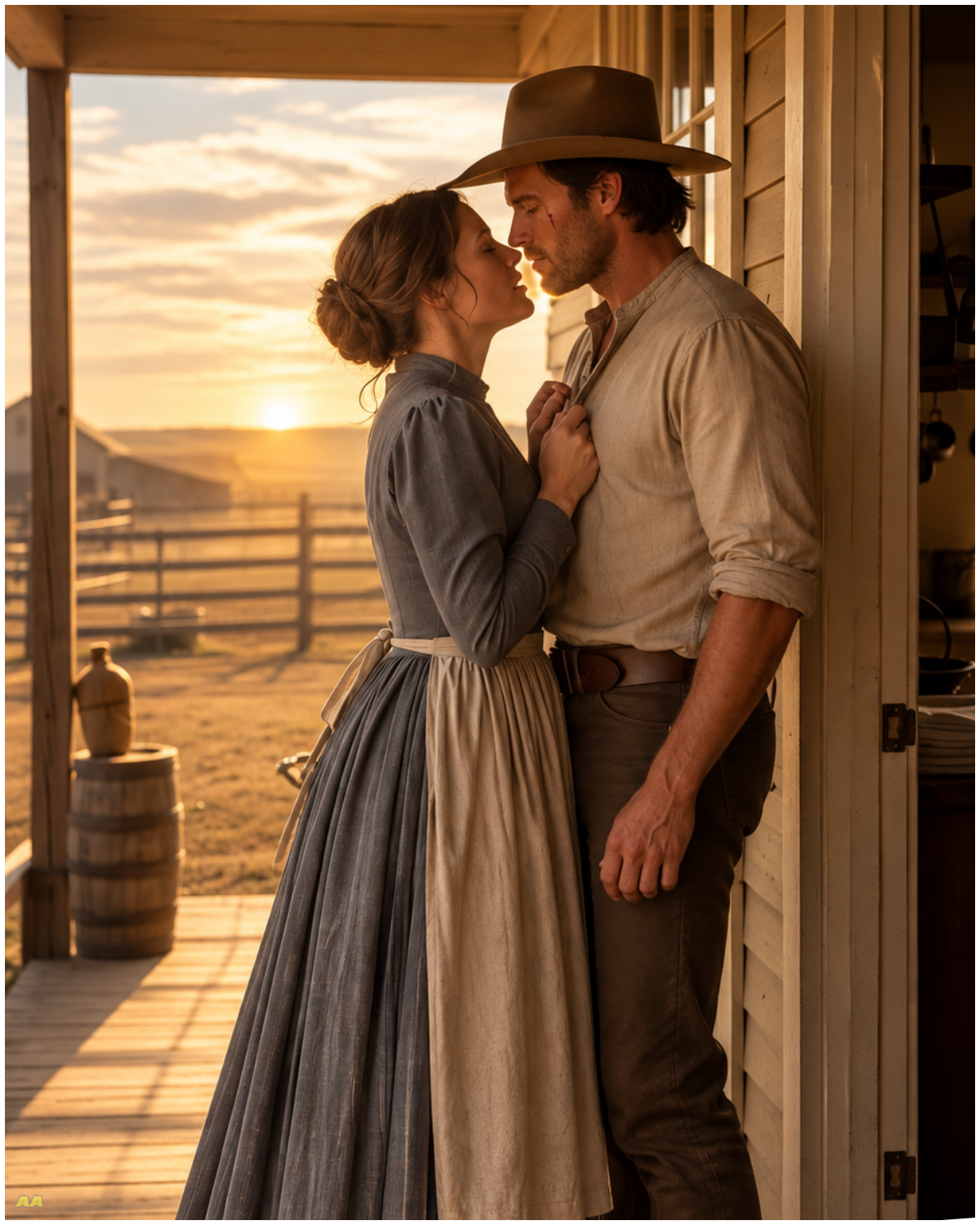
The stage a coach rolled into Abilene, Kansas on a scorching afternoon in June 1878, and Alaner Hartwell stepped down into the dusty street with nothing but a carpet bag, a widow’s black dress that had faded to gray, and a determination to disappear into a place where nobody knew her name or her shame.
She had been watching the cattle town grow larger through the coach window for the last hour, the false fronted buildings rising from the prairie like broken teeth, and she had felt her heart hammering against her ribs with each passing mile.
This was as far as her money would take her.
This would have to be far enough from St. Louis, far enough from the whispers and the pointing fingers, far enough from the grave she had stopped visiting 6 months after they buried him.
The heat hit her like a physical thing as she stood on the wooden sidewalk, squinting against the brightness.
Abilene was loud and raw and smelled of cattle and sweat and something wild that made her throat tight.
Cowboys moved through the streets with an easy swagger that men back east had never possessed, their spurs jingling, their faces burned dark by the sun.
She clutched her bag tighter and tried to look like she belonged here, like she had not just run away from everything she had ever known.
Help you, ma’am. The voice came from behind her, deep and rough as gravel, and when she turned, she had to tilt her head back to meet the eyes of the man who had spoken.
He was tall and lean, with dark hair that needed cutting, and eyes the color of whiskey in sunlight.
His jaw was shadowed with stubble, and there was a scar that cut through his left eyebrow, giving him a dangerous look that should have frightened her.
Instead, she found herself staring at the way his shirt stretched across his shoulders, at the way he held himself like a man who had never apologized for anything in his life.
“I am looking for work,” Elina said, lifting her chin.
“I was told there might be opportunities in a town like this.”
His mouth quirked at one corner, not quite a smile.
“What kind of work would that be?”
“Respectable work,” she said sharply, because she had heard the stories about cattle towns, about what happened to women who came here alone.
“I can cook, clean, keep accounts. I can read and write and cipher. I am not afraid of hard work.”
He studied her for a long moment, and she felt her cheeks warming under his gaze.
Finally, he touched the brim of his hat.
Name is Cole Brennan. I run a ranch about 10 mi north of here.
Lost my cook last week when he decided he would rather try his luck in the gold fields.
Pay is $30 a month plus room and board.
You would have your own cabin.
Work is hard, hours are long, and the men can be rough, but they know how to behave around a lady or they answer to me.
Elena felt something loosen in her cheSt. $30 a month was more than she had hoped for.
And a cabin of her own meant safety, meant privacy, meant a place to breathe.
When would you need me to start?
Got a wagon heading back in an hour.
You could ride out with us today if you are ready.
He paused, then added, “Might want to change out of that dress, though. Black Wool is going to kill you in this heat.”
She glanced down at her morning clothes, at the dress she had worn for appearances long after she had stopped mourning.
I have other clothes, she said quietly.
I will be ready.
The ride out to the Brennan ranch gave her time to study the man who had hired her.
Cole Brennan sat easy on the wagon seat beside her, handling the rains with casual competence as the horses pulled them across the rolling grassland.
He did not talk much, but when he did, his voice had a warmth to it that surprised her.
He pointed out landmarks, told her about the ranch, explained what her duties would be.
He did not ask her questions about where she had come from or why she was alone, and she was grateful for that mercy.
The ranch itself was larger than she had expected, a sprawling collection of buildings clustered around a main house that had been built solid and strong to withstand the prairie weather.
There were corrals full of horses, a barn that smelled of hay and leather, and beyond it all the wide open grasslands stretching to the horizon.
It was beautiful in a stark, unforgiving way that made her chest ache.
Cole showed her to a small cabin set apart from the bunk house where the ranch hands slept.
It was simple but clean with a bed and a table and a stove.
And when he left her there to settle in, she sat on the edge of the bed and let herself cry for the first time since leaving St. Louis.
She started work the next morning before dawn, building up the fire in the cook stove in the main house, and beginning the biscuits that would feed 15 hungry men.
The kitchen was well stocked and organized, and she fell into the rhythm of the work with a relief that surprised her.
This was something she knew how to do.
This was something she could control.
The ranch hands filed in as the sun was rising, stomping the dust from their boots and eyeing her with curiosity.
They were younger than she had expected, most of them barely out of boyhood, and they treated her with a shy politeness that made her smile despite herself.
They ate like they were starving, piling their plates high with biscuits and bacon and fried potatoes, and the compliments they gave her were awkward and sincere.
Cole came in last, hanging his hat on a peg by the door.
His hair was damp like he had dunked his head in the water trough, and when he met her eyes across the kitchen, there was something in his expression that made her look away, made her hands fumble with the coffee pot.
The days developed a pattern.
She rose before dawn and worked until after dark, cooking three meals a day for the crew, keeping the house clean, mending clothes, and patching torn gear.
The work was exhausting, but it was also satisfying in a way her life in St. Louis had never been.
Here, what she did mattered.
Here, she could see the results of her labor in the empty plates and the grateful smiles.
Cole was always nearby, not hovering, but present, and she found herself aware of him in a way that made her nervous.
She noticed things about him that she should not have noticed.
The way he gentled a spooked horse with his voice, the way he listened when the younger hands came to him with problems, the way his eyes followed her when he thought she was not looking.
3 weeks after she arrived, she was in the garden behind the kitchen when she heard shouting from the barn.
She dropped her basket of beans and ran toward the sound, her heart pounding, and found coal on the ground with blood streaming from a gash on his forehead.
“A young sorrel horse was rearing and plunging in the corral, eyes rolling white with fear.”
“Someone get that animal under control,” she snapped, dropping to her knees beside Cole.
The other hand scrambled to obey while she pressed her apron to the wound, trying to stop the bleeding.
“What happened? Horse spooked,” Cole said, his voice tight with pain.
“Caught me with a hoof. You need stitches.”
Her hands were steady even though her heart was racing.
“Can you walk to the house?”
He made it to the kitchen with her help.
One arm slung over her shoulders, and she could feel the heat of him through his shirt, could smell the leather and sage scent of his skin.
She sat him in a chair and cleaned the wound with whiskey, her fingers gentle on his face.
He watched her the whole time, his eyes never leaving hers, and the air between them felt thick and charged.
“You have done this before,” he said as she threaded the needle.
“My husband was a doctor.” The words came out before she could stop them, and she saw his expression change, saw the questions forming.
“He died 2 years ago.
Typhoid. I am sorry.” He winced as she made the first stitch, but he did not look away from her.
That must have been hard.
It was. She focused on her work on making each stitch neat and even, but not in the way you might think.
She had not meant to say that, had not meant to reveal even that much.
But something about the way he looked at her made the words spill out.
When she finished the stitches and tied off the thread, she stepped back, putting distance between them.
“Thank you,” Cole said quietly.
“You have got steady hands.
You should reSt. That was a hard blow, Elanor.” The way he said her name made her stop halfway to the sink.
Whatever you are running from, you do not have to run anymore.
You are safe here. She turned to look at him.
This man who barely knew her and felt something crack open in her cheSt. How do you know I am running?
Because I recognize the look.
He stood up slowly, crossing the kitchen until he was close enough that she could see the flexcks of green in his brown eyes.
I have worn it myself.
Over the following weeks, she found herself drawn to him in ways she had not expected, had not wanted.
They would talk in the evenings after the dinner dishes were washed, sitting on the porch of the main house and watching the stars come out over the prairie.
He told her about growing up in Texas, about fighting in the war when he was barely 16, about the things he had seen and done that still woke him in the night.
She told him about scent Louie, about her marriage to a man 20 years older who had wanted a housekeeper and a nurse more than a wife.
About the loneliness of being trapped in a life that was suffocating her.
“He was not cruel,” she said one night, her voice quiet in the darkness.
“That would have been easier somehow.
He was just absent like I was a piece of furniture he had purchased and then forgotten about.” Cole was silent for a long moment.
Did you love him? I thought I did at first, or I thought I could learn to, but he did not want love from me.
He wanted obedience and silence, and for me to be grateful that he had married me at all.
She wrapped her arms around herself, staring out at the dark prairie.
When he died, I felt terrible for being relieved.
What kind of person does that make me?
An honest one. Cole shifted in his chair, and she felt his hand cover hers where it rested on the porch rail.
His palm was warm and calloused, and she did not pull away.
We cannot help what we feel.
We can only help what we do about it.
She turned her hand over, lacing her fingers through his, and felt her heart begin to race.
Cole, I need you to know something.
I was married before. I am not innocent.
She had meant it as a warning, as a way to tell him that she was not the kind of woman a respectable man should want.
She had meant to push him away before this thing between them could grow into something that would hurt them both.
Instead, he tugged her closer, his other hand coming up to cup her face, tilting it toward his.
“Neither am I, darling,” he said, and then he kissed her.
His mouth was warm and sure against hers, tasting of coffee and something sweet, and she made a small sound in her throat as her hands came up to grip his shoulders.
It had been so long since anyone had touched her like this, like she was precious, like she was wanted, and she felt herself melting into him, felt all the walls she had built crumbling.
When they finally broke apart, both breathing hard, he rested his forehead against hers.
“I have wanted to do that since the day you stepped off that stage,” a coach, he admitted.
“You looked so fierce and scared and beautiful, and I knew right then I was in trouble, Cole.” Her voice shook.
I do not know if I can be what you need.
I do not know if I know how.
Then we will figure it out together.
He kissed her again, softer this time, and she felt tears sting her eyes.
I am not asking you to be anything other than what you are, Elena.
That is enough. You are enough.
They took it slow after that, learning each other in stolen moments between the work of the ranch.
He would find excuses to be near her, helping her carry water from the well, sitting at the kitchen table while she made bread and telling her stories that made her laugh until her sides achd.
She would bring him coffee when he was working late in the barn, and they would stand close together in the golden light of the lantern, talking about everything and nothing.
The ranch hands noticed, of course.
She saw the knowing looks they exchanged, the way they made themselves scarce when Cole came looking for her.
But they did not gossip or make crude jokes, and she realized it was because they respected Cole, because he had made it clear that she was under his protection.
One evening in late August, a rider came thundering into the ranchard just as Alener was ringing the dinner bell.
He was young and wild died.
His horse lthered with sweat and he nearly fell out of the saddle in his haste to dismount.
“Fire!” he shouted. “Prairie fire about 5 mi east and heading this way faSt. We need every hand we can get to dig a fire break.” The ranch erupted into controlled chaos.
Cole was barking orders, sending men to gather tools and wet down the buildings, organizing crews to ride out and start digging.
Elener caught his arm as he stroed paSt. “What can I do?
Stay here. Keep the water barrels filled in the house ready in case we have to evacuate.” He grabbed her shoulders, his eyes intense.
“Promise me you will stay safe.
If the wind changes and the fire heads this way, you get on a horse and ride north.
Do not wait for us.” Cole I He kissed her hard and faSt. Promise me.
I promise. She watched him ride out with the others, watched until they disappeared into the smoke that was already darkening the eastern sky, and then she turned and got to work.
She filled every barrel and bucket she could find, soaked blankets, and hung them over the windows, moved anything flammable away from the buildings.
The air grew thick and acrid, and she could see the orange glow on the horizon growing brighter as the sun went down.
They came back near midnight, exhausted and black with soot, smelling of smoke and sweat.
The firebreak had held. The wind had shifted at the last moment, pushing the fire south toward the river where it had burned itself out.
They had saved the ranch, but it had been close.
Elener had food waiting for them, hot coffee and cold water, and plates of beef and beans that they fell on like starving men.
Cole was the last one in, his face gray with exhaustion, and she took one look at him and led him to the pump behind the house.
“Shirt off,” she ordered, working the pump handle.
“You are covered in ash.” He obeyed without argument, too tired to protest, and she washed the soot from his back and arms with gentle hands.
In the moonlight, she could see the scars that marked his skin, could see the toll the years had taken.
He was only 32, he had told her.
But he looked older tonight, looked worn and battered.
“I was so scared,” she whispered, running her wet hands over his shoulders.
“When I saw that fire, all I could think was that you were out there and I might never get to tell you how much you mean to me.” He turned to face her, water dripping from his hair, his eyes searching hers.
“Ellener, I love you.” The words came out in a rush, desperate and true.
“I know it has only been a few months.
I know I said I did not know if I could do this, but I love you, Cole Brennan, and I cannot pretend I do not anymore.
He pulled her against him, heededless of the water soaking into her dress and buried his face in her hair.
God, Elena, I love you, too.
I have been trying not to say it because I did not want to scare you off, but I love you so much it hurts.
They stood there in the moonlight holding each other, and she felt the last of her defenses crumble away.
This was real. This was worth risking her heart for.
“Marry me,” Cole said against her hair.
“I know it is faSt. I know you have reasons to be wary, but I do not want to waste any more time pretending I do not want to spend the rest of my life with you.” She pulled back far enough to look at him to see the vulnerability in his eyes, the hope and fear waring on his face.
“Yes,” she said simply. “Yes, I will marry you.” They were married 3 weeks later in the small church in Abilene with the ranch hands serving as witnesses and the preacher’s wife playing the piano.
Elina wore a dress of blue calico that she had sewn herself and Cole wore his best suit with a string tie and boots that he had polished until they shone.
When he slipped the ring onto her finger, a simple gold band that he had ridden all the way to Topeka to buy, she felt tears streaming down her face.
I promise to love you and protect you and never make you feel like you do not matter,” he said, his voice rough with emotion.
“I promise to listen when you talk and laugh at your jokes even when they are not funny and let you win arguments at least half the time.” She laughed through her tears.
“I promise to love you and stand by you and feed you even when you are being impossible.
I promise to be honest with you and fight with you when you are wrong and make you coffee every morning for the rest of our lives.
The preacher cleared his throat.
That is not exactly traditional, but I suppose it will do.
I now pronounce you man and wife.
Son, you may kiss your bride.
Cole cuped her face in his hands and kissed her like she was the only woman in the world.
And she kissed him back with all the love and hope and joy that filled her heart to bursting.
They held the wedding breakfast at the ranch with tables set up in the yard and enough food to feed half the county.
The ranch hands had pulled their money to buy them a set of dishes, and the neighbors they had invited brought gifts of preserves and quilts and good wishes.
It was simple and rough and perfect, and Alina felt happier than she had ever been in her life.
That night, in the room they now shared in the main house, Cole undressed her slowly in the lamplight, his hands reverent on her skin.
“You are so beautiful,” he murmured, tracing the curve of her shoulder.
“I cannot believe you are really mine.
I cannot believe you are mine,” she whispered back, helping him out of his shirt.
“I thought I was done with this.
I thought I would spend the rest of my life alone, not alone.” He lowered her to the bed, covering her body with his.
Never alone again. They made love with a tenderness that brought tears to her eyes, learning each other’s bodies with patience and care.
He was gentle with her, attentive to her needs in a way her first husband had never been.
And when she cried out his name in pleasure, he held her close and whispered words of love against her skin.
Afterwards, lying tangled together in the darkness, she traced the scar on his ribs and asked the question she had been wondering about since the day they met.
How did you get this knife fight in a saloon in San Antonio about 6 years ago?
I was young and stupid and thought I had something to prove.
He caught her hand and brought it to his lips.
I have done things I am not proud of, Elener.
I have killed men. I have stolen and cheated and lied.
I am not a good man.
You are a good man,” she said fiercely.
“You are kind and patient, and you treat everyone on this ranch with respect.
You work hard and keep your word, and you loved me when I thought I was unlovable.
That makes you a good man in my eyes.” He pulled her closer, tucking her head under his chin.
“I am going to spend every day trying to deserve you.
You already do.” The autumn passed in a blur of work and happiness.
They worked side by side building a life together and Alaner felt herself blooming under the warmth of Cole’s love.
He taught her to ride, putting her on a gentle mare and leading her around the corral until she felt confident enough to venture out onto the prairie.
She taught him to make pie crust, laughing at the flower that dusted his hair and the serious concentration on his face as he crimped the edges.
In November, she realized she had missed her monthly courses.
She waited another month to be sure, and then she told him one morning as they were drinking coffee and watching the sun rise over the grassland.
“I am with child,” she said quietly and watched his face transform.
“Truly,” he sat down his cup with shaking hands.
“Ellener, are you certain?” “As certain as I can be.
I think the baby will come in late June or early July.” He let out a whoop that made her laugh and swept her into his arms, spinning her around the kitchen.
We are going to have a baby.
I am going to be a father.
Cole put me down. I am going to be sick.
He set her down immediately, his face stricken.
Are you all right? Do you need to sit?
Should I get the doctor?
I am fine. It is just morning sickness.
It will pass. She smiled at his worried expression.
You are going to be insufferable about this, aren’t you?
Absolutely. He dropped to his knees and pressed his ear to her still flat belly.
Hello in there, little one.
This is your father. I promise to teach you everything I know and keep you safe and love you with every breath in my body.
Elena ran her fingers through his hair.
Her heart so full she thought it might burSt. You are going to be a wonderful father.
The winter was mild that year with only a few serious snowstorms and Alener spent it preparing for the baby.
She sewed tiny clothes and knitted blankets, her hands busy while Cole read aloud to her in the evenings.
He had discovered she loved Shakespeare and had ordered a complete works from a bookshop in Kansas City.
And now he stumbled through the plays with endearing determination, acting out all the parts and making her laugh until she had to wipe tears from her eyes.
In March, a letter came from Saint Louie.
Elina stared at it for a long time before opening it, recognizing her former sister-in-law’s handwriting.
Inside was a single sheet of paper with a brief message.
Her late husband’s family had discovered that she had left the city, and they wanted her to know that they did not blame her for leaving, that they understood she had been unhappy.
They wished her well in her new life.
She cried when she raided it.
Great heaving sobs that brought Cole running from the barn.
He held her while she wept, not asking questions, just offering comfort.
When she finally calmed enough to speak, she showed him the letter.
“I felt so guilty,” she whispered.
“For being glad he was gone.” “For running away, for not being sorry enough.
You do not owe anyone your grief,” Cole said firmly.
“Not even him. You have the right to be happy, Elen.
You have always had that right.” She folded the letter carefully and put it in the drawer of her dresser and then she let it go.
That part of her life was over.
This was her life now.
Here on this ranch with this man who loved her, with their child growing inside her, the baby came on a hot July afternoon in 1879, arriving in a rush after only 6 hours of labor.
Elena had been terrified, remembering stories of women who had died in childbed.
But Cole had stayed by her side the entire time, holding her hand and wiping her face with a cool cloth and telling her she was doing wonderfully even when she cursed him for getting her into this situation.
When the midwife finally laid the baby in her arms, Elena looked down at the tiny red face and felt her heart expand in a way she had not known was possible.
“It is a boy,” she said wonderingly.
“Cole, we have a son.” He is perfect, Cole said horsely, his finger stroking the baby’s cheek with infinite gentleness.
Look at him. He is so small.
What should we name him?
They had discussed names for months but never decided on one.
Now looking at their son, Cole said, “What about James?” “After your father.” Elina felt tears sting her eyes.
Her father had died when she was 12, but she remembered his kindness, his gentle humor.
“James Cole Brennan,” she said.
It is perfect. Little James was a good baby, healthy and strong, lunged, and he wrapped both his parents around his tiny finger from the first moment.
Cole was besided, spending every free moment holding his son, talking to him in a low murmur, showing him the horses and the cattle as if the infant could understand.
Elina would watch them together and feel overwhelmed by the depth of her love for both of them.
The next few years passed in a happy blur of hard work and small joys.
The ranch prospered, and they were able to expand their herd and hire more hands.
James grew into a sturdy toddler with his father’s dark hair and his mother’s blue eyes, fearless and full of mischief.
In the spring of 1881, Eliner gave birth to twins, a girl they named Rose and a boy they named William.
And the house was suddenly full of noise and chaos and laughter.
“I cannot believe we have three children,” Elina said one night, collapsing into bed after finally getting all the babies to sleep.
“Three? How did that happen?” Cole grinned at her from where he was pulling off his boots.
“I seem to recall you were there for the important parts.
She threw a pillow at him.
You are terrible. You love me anyway.
He climbed into bed beside her and pulled her into his arMs. Are you happy, Elener?
She thought about the question seriously, looking back over the four years since she had stepped off that stage a coach in Abilene.
She thought about the woman she had been then, so lost and scared and certain she would never belong anywhere.
She thought about all the small moments that had brought her here.
The first time Cole had kissed her.
Their wedding day, the births of their children, a thousand ordinary evenings sitting on the porch and watching the sun set.
“I am happier than I ever thought I could be,” she said honestly.
“There are days when I am so tired I can barely stand, and days when the children drive me to distraction, and days when I want to throttle you for leaving your boots in the middle of the floor.
But yes, I am happy.
I am home.” Good. He kissed the top of her head.
Because you are stuck with me now.
I suppose there are worse fates.
They both laughed and then they were kissing and then they were making love with the practiced ease of people who knew each other’s bodies as well as their own.
Afterwards, Elina lay in the darkness and listened to the sounds of her home.
Coals breathing beside her, the children stirring in their rooms down the hall, the wind sighing through the grass outside.
She had thought she knew what love was when she married her first husband.
She had thought love was duty and obligation and making the best of things.
But this, this wild, fierce joy that filled her chest when she looked at Cole and their children, this was love.
This was what she had been searching for without knowing it.
What she had run halfway across the country to find.
In the years that followed, the Brennan Ranch became known throughout the county as one of the bestrun operations in Kansas.
Cole had a reputation for fairness and honesty, and men came from all over looking for work.
Elina became known for her cooking and her hospitality, always ready to feed a hungry cowboy or offer shelter to travelers passing through.
Their children grew up wild and free on the prairie, learning to ride before they could walk, helping with the ranch work as soon as they were old enough.
James grew into a serious, responsible boy who followed his father everywhere, learning the business of ranching with an intensity that made both his parents smile.
The twins were inseparable. Rose fierce and adventurous, William quiet and thoughtful.
In 1884, Elener gave birth to another daughter, Grace.
And in 1887, a final son they named Daniel.
The house was always full of noise and laughter and the organized chaos of a large family.
There were hard times, too.
A drought in 1885 that killed off a quarter of their herd and left them scrambling to survive.
A winter blizzard in 1886 that trapped them in the house for 3 weeks and cost them 50 head of cattle.
A moment of terror when James, age nine, fell from a horse and broke his arm and Alener had to set the bone herself because the doctor was too far away.
But they weathered every storm together, Cole and Elener, supporting each other through the difficulties and celebrating the triumphs.
Their love deepened and matured over the years.
Growing from that first fierce passion into something steadier and more enduring, a partnership built on respect and trust and genuine friendship.
On a warm June evening in 1889, 10 years after James was born, Alener stood on the porch of the ranch house and watched the sun set over the prairie.
She was 38 years old now, with silver threads in her hair and laugh lines at the corners of her eyes.
Behind her, she could hear the sounds of her family.
Cole helping the older children with their evening chores.
The younger ones playing some elaborate game that involved a lot of shrieking.
The dog barking excitedly. Cole came out to join her, slipping an arm around her waist and pulling her close.
“What are you thinking about?” “Just remembering,” she said, leaning into him.
“I was trying to picture the woman I was when I arrived here, and I can barely recognize her anymore.
Do you miss her? No.
She turned in his arms to face him, reaching up to touch his face.
He had aged too, his hair shot through with gray now, his face weathered by sun and wind.
But he was still the most handsome man she had ever seen, still the one who made her heart race when he smiled at her.
She was so afraid of everything, so convinced that she did not deserve to be happy.
I am glad I am not her anymore.
I am glad too. He kissed her softly.
Because I love the woman you are now.
The woman who yells at me when I am being stubborn.
Who burns breakfast sometimes because she is distracted by a book.
Who loves our children so fiercely it scares me sometimes.
I love you, Elina Brennan.
I love you, too. She kissed him back, tasting the coffee he had been drinking, feeling the familiar warmth of his mouth on hers.
Thank you for giving me this life, for showing me what love is supposed to be.
Thank you for taking a chance on a broken down cowboy with too many regrets.
He rested his forehead against hers.
You saved me, you know.
I was just going through the motions before you came.
Now I have a reason to get up every morning.
We saved each other. She corrected.
That is what love does.
They stood there as the sky turned gold and orange and purple, holding each other while the prairie wind whispered through the grass and their children’s laughter rang out across the yard.
This was everything Alaner had never let herself dream of.
A home, a family, a man who loved her, not despite her past, but because of everything she was.
She thought about the woman who had stepped off the stage a coach in abilene 11 years ago, clutching a carpet bag and wearing a faded morning dress.
Convinced that her life was over at 27, she wished she could go back and tell that woman that the best was yet to come, that love would find her in the most unexpected place, that she would build a life more beautiful than anything she had imagined.
But maybe that woman would not have believed her.
Maybe she had needed to take that leap of faith herself, to risk everything on a stranger’s offer of work and a new beginning.
Maybe some things you could only understand by living through them.
James came running up onto the porch, breathless and excited.
Papa, one of the mayors, is foing.
Can I stay up and watch?
Cole looked at a leaner and she nodded.
Their oldest son was 12 now, old enough to take on more responsibility.
Old enough to witness the miracle of birth.
All right, Cole said, but you do what I tell you when I tell you.
Understood. Yes, sir. James practically vibrated with excitement.
I will come too, Elener said.
The rest of you, she called to the other children.
Bedtime in 1 hour. Rose, you are in charge.
Why is Rose always in charge?
William protested. Because I am older and smarter and better at everything, Rose said smugly.
Elener and Cole exchanged amused glances as they followed James to the barn.
Their children were growing up so fast, becoming their own people with their own personalities and dreaMs. It was bittersweet watching them change, but also deeply satisfying.
They were raising good kids, kind and hardworking, and confident in themselves.
The foing took several hours and Alina sat with Cole and James in the lantern lit barn, watching as the mayor labored and finally delivered a perfect Philly with a white star on her forehead.
James was transfixed, his eyes huge as he watched the newborn struggle to her feet on wobbly legs.
It is amazing, he whispered.
I mean, I have seen calves born, but this is different somehow.
Every birth is a miracle, Elina said softly, remembering her own children’s births, the overwhelming rush of love she had felt each time.
Every new life is a gift.
Cole put his arm around her shoulders, and she leaned into him, content.
This was their life. Late nights in the barn helping animals be born, early mornings cooking breakfast for hungry ranch hands, days filled with hard work and small joys.
It was not glamorous or exciting or easy, but it was real and it was theirs, and she would not trade it for anything in the world.
As they walked back to the house in the early hours of the morning, James running ahead to tell his siblings about the new fo, Cole took a leaner’s hand.
“Do you ever regret it?” he asked quietly.
Leaving scint Louie coming out here taking a chance on me.
She stopped walking and turned to face him, putting her hands on his chest so she could feel his heartbeat.
Never, she said firmly. Not for a single second.
You are the best thing that ever happened to me, Cole Brennan.
You and our children and this life we have built together.
I would do it all again in a heartbeat.
He kissed her there in the starlight, long and slow and sweet, and she felt the same flutter in her chest that she had felt the first time he kissed her on the porch 11 years ago.
Some things never changed. Some loves burned steady and true no matter how many years passed.
They walked the rest of the way hand in hand.
And when they climbed into bed as the sun was beginning to lighten the eastern sky, Elina curled against Cole’s side and felt profoundly grateful for every choice that had brought her to this moment.
She had been so certain her life was over when her first husband died.
So convinced that she had used up her chance at happiness.
But life had surprised her.
Love had surprised her. And now, lying here in the arms of the man she adored in the house they had filled with children and laughter, she understood that it was never too late to start over, never too late to choose happiness, never too late to find home.
The years continued to pass, bringing changes and challenges and countless moments of joy.
The children grew and thrived, each finding their own path.
James eventually took over much of the day-to-day running of the ranch, proving himself a capable and innovative manager.
Rose shocked everyone by announcing she wanted to be a teacher and went off to normal school in Topeka.
Returning with a degree and a position at the Abilene Schoolhouse, William discovered a talent for working with horses and built a reputation as one of the best horse trainers in the state.
The younger children were still finding their way, but Alener had no doubt they would succeed at whatever they chose to do.
Cole and Alener grew older together, their hair turning gray, their bodies moving more slowly, but their love never diminishing.
They celebrated their 20th wedding anniversary in 1899, surrounded by their children and grandchildren, the ranch hands past and present, neighbors who had become friends.
It was a grand party with fiddle music and dancing and a feast that took a leaner and rose three days to prepare.
When Cole stood up to make a toast, his voice was thick with emotion.
20 years ago, I hired a woman off the street in Abilene because she looked like she needed a chance and I needed a cook.
Best decision I ever made.
Elener, you have given me everything worth having.
Love, family, purpose, joy. You took a broken man and made him whole.
I promise to spend whatever time I have left making sure you know how much you are loved.
Elena was crying openly now, as were most of the women present and several of the men.
She stood up and crossed to where Cole was standing, taking his hands and hers.
“You did not fix me,” she said clearly, so everyone could hear.
“You loved me enough that I could fix myself.
You gave me space to grow and freedom to be myself and support when I needed it.
You showed me what partnership looks like, what real love is.
I am not the woman I was when we met and I am grateful for that everyday.
She kissed him then in front of everyone and the crowd erupted in cheers and applause.
Their children were groaning dramatically about their parents being embarrassing but she could see the pride and love in their eyes.
This was their legacy. Not just the ranch or the land or the money they had accumulated, but this family they had built.
This love they had nurtured.
This community they had created.
As the party wound down and the guests began to leave, Elina found herself standing on the porch again in almost the same spot where Cole had proposed to her 20 years earlier.
He came to stand beside her and they watched the stars come out over the prairie in comfortable silence.
“No regrets,” he asked, echoing the question he had asked her so many times over the years.
“No regrets,” she confirmed. Just gratitude.
So much gratitude for what?
She thought about how to answer that.
How to put into words the overwhelming sense of blessing that filled her when she looked at her life.
For that stage a coach arriving in Abilene on that particular day.
For you needing a cook.
For having the courage to step off into the unknown.
For every moment that brought us here.
I am grateful too, Cole said quietly.
For every scar and mistake and hard year that led me to that day when I saw you standing on that sidewalk looking fierce and frightened.
For the chance to love you and be loved by you, for this life we made together.
They stood there together as they had so many times before, watching the night deepen around them, listening to the familiar sounds of the ranch settling down for sleep.
Inside the house, their children and grandchildren were cleaning up from the party, their voices a warm murmur that drifted out through the open windows.
Elener leaned against Cole, feeling the solid strength of him, the steady beat of his heart.
They had weathered so much together, droughts and blizzards, illness and injury, the everyday challenges of building a life on the frontier.
They had raised five children and were now watching them raise children of their own.
They had built something lasting here, something that would continue long after they were gone.
“I love you,” she said softly, the words as true now as they had been the first time she said them.
“I love you, too, darling,” Cole replied, kissing the top of her head.
“Always have, always will.”
And standing there under the vast Kansas sky, surrounded by the land they had worked and the family they had created, Elina Brennan felt a peace so profound it took her breath away.
She had found her home, her purpose, her heart.
She had found love in the last place she expected it, with a cowboy who saw past her grief and her scars to the woman she could become.
This was her happily ever after, hard one and deeply cherished, and it was more beautiful than any fairy tale.








