“I Need a Husband by Tomorrow,” She Said, and Paid a Stranger to Wed Her — Unaware He Was the Duke
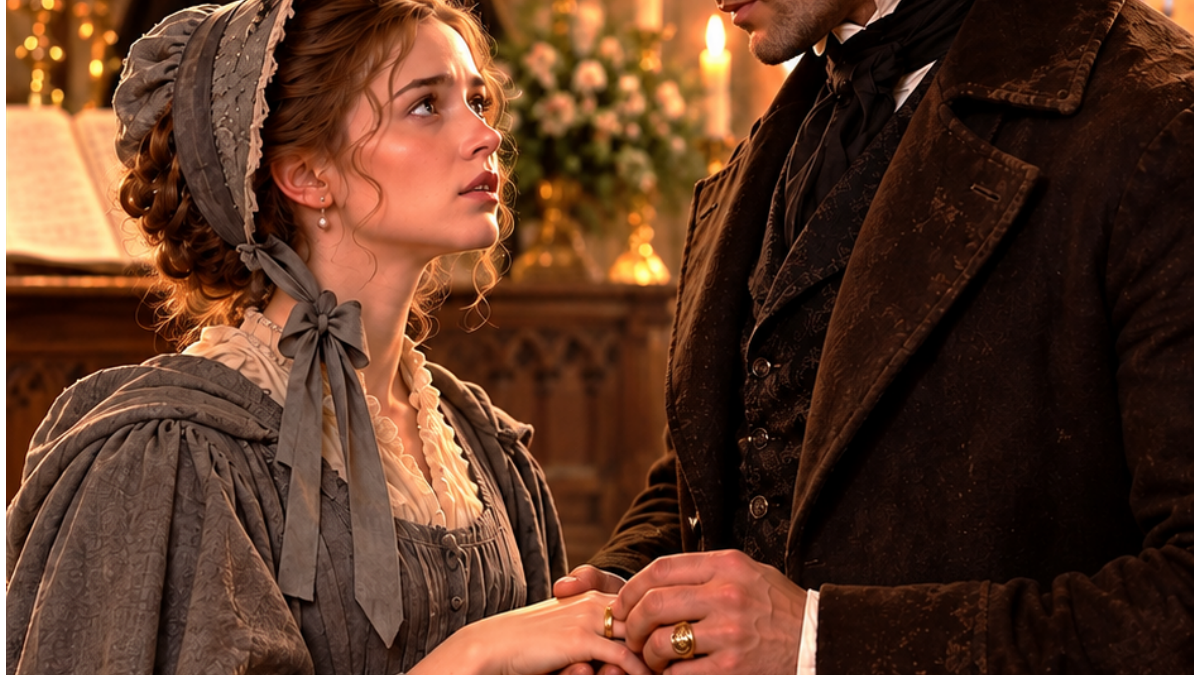
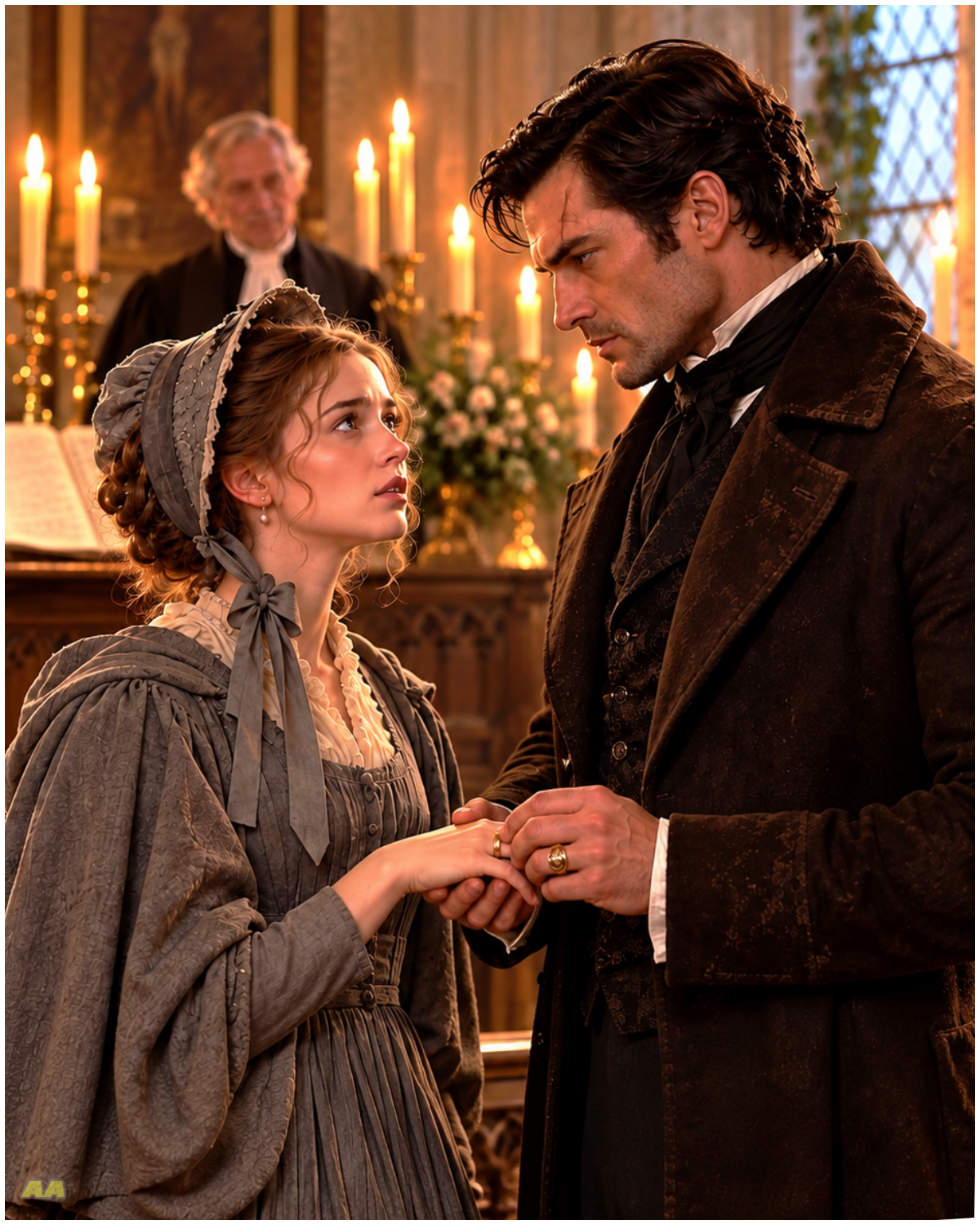
“I need a husband by tomorrow,” the young woman said, before he had even set down his tankard, and I am prepared to pay.
The Duke of Ferns looked up slowly from the corner table of the speckled hen, where he had been nursing a cup of poor ale, and in an even poorer mood, and found himself regarding a woman who had clearly rehearsed the sentence, and then delivered it exactly as badly as a person delivers a thing they have rehearsed too many times.
Her bonnet was slightly crooked.
Her gloves did not match.
Her eyes, however, were perfectly steady, fixed on him with the particular desperation of someone who had already asked three other men in the tap room and been laughed at for her trouble.
I beg your pardon, he said, because it seemed the only thing to say.
A husband by tomorrow noon.
I have £20, which is not nothing, and I will not ask a single thing of you beyond the ceremony and your signature in the parish register.
She said this the way a woman recites a shopping list when she is trying very hard not to cry in public.
You need not love me.
You need not even like me.
You need only stand beside me before the reverend oldest tomorrow and say the words and then you may go wherever it is men like you go and never see me again.
He was traveling as Everwini, a name he had invented three days out of Ferns.
On the theory that a duke who wished to know whether anyone in England would still offer him a kind word without knowing what he was worth had better stop being a duke for a while and become instead a tired man a plain brown coat with dust on his boots and no expectations attached to his name.
It had been until this exact moment a quiet and rather melancholy experiment.
He had eaten at three ins and been overcharged all three.
He had been ignored by an inkeeper’s wife who found him unremarkable.
He had, in short, learned that a duke without his title was simply another traveler, and the knowledge had settled into him like a stone he could not quite name.
He had not expected on the fourth night to be proposed to by a stranger in a public tap room.
“You are in earnest,” he said.
“I am entirely in earnest, sir, and I am aware of how it sounds, and I have no leisure remaining to be embarrassed about it.”
She sat down across from him without waiting to be asked, which he found he did not mind nearly so much as he ought to have.
Clothes she was younger than he’d first thought, perhaps four and 20, with a face that would have been called plain by the sort of women who measured such things, and lovely by anyone who was not in a hurry to judge it.
All steadiness and clear gray eyes, and a mouth pressed thin with the effort of holding herself together.
My father died in the spring.
His will, through no fault of anyone living, merely his own carelessness in the drafting of it, states that Fenwick House and the whole of the estate passes to my cousin Joselyn Rashmir, unless I am a married woman by the anniversary of his death, which anniversary falls at noon tomorrow.
If I am not married by then, my cousin inherits everything, the house, the land, the income, and my two younger sisters, and my brother, who is 11 and delicate in his chest, will be entirely at his mercy.
And my cousin, she added, with the flat, careful voice of someone reporting a fact rather than an opinion, is not a merciful man.
And so, you mean to marry a stranger you met in a coaching inn?
I mean to marry any man willing to stand up with me tomorrow and then leave me be?
I had hoped for someone harmless.
You looked harmless. She considered him a moment longer, the gray eyes moving over his face with an assessment that was somehow both apologetic and thorough.
You still do mostly, though you have the hands of a man who has never done a day’s honest labor, and that is not entirely reassuring, but I have run out of both time and choices, sir, and you are the last decent-l lookinging man in this room who has not already tried to put his hand somewhere it does not belong.
He looked down at his own hands, pale, unmarked at Duke’s hands, and felt something between amusement and shame move through him.
“That is not a very high bar to clear.”
“No,” she agreed.
“It is not, and yet here we are.”
He should have told her then.
He should have said, “I am not who I appear to be, madam, and marrying me would complicate your difficulty rather than solve it, for I am the Duke of Ferns, and a hasty parish wedding to a woman I met over bad ale would set the whole of England talking within the fortnight.”
He opened his mouth with the very intention of saying some version of this.
What came out instead was, “What is your name is Minia Dobini?”
She said it like a woman handing over the last coin in her purse.
And before you ask, no, I have no dowy left worth mentioning, no connections that would benefit you, and no earthly reason to expect a stranger to do this for me beyond the £20, which I confess is most of what remains to my name after paying the pass and his fee and the inkeeper for tonight’s room.
I am not a good bargain, sir.
I am only an honest one.
I will not deceive you about what you are getting, which is a woman in trouble and very little else.
It was, he thought, the most honest sentence anyone had spoken to him in a decade.
Every proposal he had ever fielded, and there had been dozens delivered by mothers and aunts, and simpering young women across a 100 ballroom floors, had been dressed up in flattery and calculation, women and their families weighing his title like merchants weighing silver.
This woman had just told him without a flicker of artifice that she had nothing to offer him but the truth of her circumstance and had somehow made that sound like more than every dolly he had ever been offered.
“Why me?” he said again, “and not some other man in this room.”
Because you have been sitting alone in that corner for the better part of an hour looking as though the world has disappointed you in some particular and recent way and a man who is already disappointed in the world she said is less likely to expect anything further from it.
You will forgive me.
I have had a very long day and I am not at my most diplomatic.
He laughed, a short, surprised sound that seemed to startle them both, because he could not remember the last time laughter had come out of him without his first deciding to permit it.
“No,” he said.
“I don’t imagine you are,” she misread the laugh.
He could see it cross her face, a flinch quickly mastered.
The look of a woman bracing for mockery she had decided in advance to endure without complaint.
If you mean to laugh at me and refuse, I would ask you to do it quickly.
I have two other ins to try before the light goes.
I am not laughing at you, Miss Dorbiny.
He set down the tanker. Something in him, some old careful ducal instinct that had governed every decision he had made since the day his father’s coffin went into the Ferns vault, told him to end this conversation, pay for her supper as a kindness, and be on his way to whatever destination this melancholy little journey of his was meant to end at.
But another part of him, newer and less governed, was watching her hands twist together in her lap, watching her chin stay lifted despite everything, and finding that he did not want to be the fourth man tonight who sent her back out into the dark to ask a fifth.
Then what? She said, “Are you doing considering?” He said, “Whether I am fool enough to say yes.” Her breath caught.
He watched it happen, watched Hope break across that carefully guarded face before she could stop it, and felt something in his chest turn over entirely.
You would do it? I did not say that.
You said you were considering it, which is more than the other three managed before they laughed.
She leaned forward. I would ask nothing of you past tomorrow, sir.
You would sign the register. You would stand beside me for perhaps a quarter of an hour, and then you would be free to go on to wherever you are going, and never think of me again.
I would not trouble you for a wife’s portion of your time, or your name in any lasting sense, or anything a real husband might expect.
It would be a kindness done and finished, he thought of Ferns rig, the vast cold rooms of it.
The portraits of ancestors who had all married for land or alliance or the shoring up of some old grievance.
None of them, so far as the family records showed, for anything so simple as the wish to keep a stranger’s brother safe from a cruel cousin.
He thought of his own mother, dead these 12 years, who had told him once, when he was a boy too young to understand it, that the loneliest room in England was the one at the head of the fans table.
He thought absurdly that he had come out into the world disguised as a poor man specifically to discover whether anyone would ever want him for something other than what he could give them.
And here at last was a woman who wanted nothing from him at all beyond his signature and his willingness to stand in one particular spot for a quarter of an hour.
It was not love. It was not even really a bargain.
Not in any sense that made proper commercial sense.
It was, he understood, even as he made the decision, something closer to a door he had been looking for without knowing it, standing open in a tap room that smelled of spilled ale and toll smoke.
“I will do it,” he said.
“Keep your £20.” She stared at him as though he had spoken in a foreign tongue.
“You will do it for nothing?
I did not say for nothing.
I said I would not take your money.
There is a difference, though I grant you it is a fine one.” He held out his hand, and after a moment’s hesitation, as though she could not quite believe the gesture was meant sincerely, she took it.
Her grip was firm, her palm rough in places a lady’s palm ought not to be.
The hands, he thought, of a woman who had been doing more of her own household’s work than any Dobbyini of Fenwick House should have had to do.
“Ever win,” he said. Ever win ash is mania dobbyini.
She said again as though the introduction mattered more the second time now that it was being made in earneSt. I am I do not know how to thank a stranger for this sir.
I have been turned away from every door in this village since Tuesday.
My aunt will not have me in the house another night for fear of my cousin’s temper.
I had begun to believe there was no one left in the world willing to do a decent thing without wanting something dreadful in return.
Then we are agreed, he said, that neither of us expected to find a decent thing in a tap room tonight.
I would call that reason enough to trust the arrangement.
She almost smiled, the first full unguarded expression he had seen cross her face since she’d sat down, quickly hidden again beneath the practical mask she seemed to wear the way other women wore Rouge.
The Reverend Aldus keeps early hours.
If we mean to do this, sir, we ought to call on him tonight so that all is arranged before he takes his breakfast and forgets his own name, which he is prone to do.
Then let us call on him tonight.
He rose and found, standing, that some of the day’s weariness had lifted from him without his quite noticing when it went, though I would ask one thing of you in return for my silence about your gratitude, Miss Dobby.
Woriness returned instantly to her face.
He watched the shutters come down, watched her brace again for whatever demand was coming.
What thing? Only that you let me pay for your supper firSt. A woman cannot be married on an empty stomach.
It is, I believe, very bad luck.
He said it lightly and watched the woriness dissolve into something like relief and understood with a small private ache he did not examine too closely that had likely been some time since anyone had thought to feed his meania Dalbini before asking anything of her at all.
They walked together to the inkeeper’s counter, and if anyone in the speckled hen thought it strange that the quiet gentleman in the corner had suddenly acquired a dinner companion, and within the hour a wedding to attend, no one said so aloud.
Ever when Ashie ordered bread and a hot pie, and watched his Minia Dobini eat with the careful, unhurried dignity of a woman determined not to appear as hungry as she plainly was, and thought not for the first time that evening, that he had come looking for one kind of truth in the world, and stumbled instead into another kind entirely, the truth of a person who had nothing left to bargain with but honesty, and had offered it up to him anyway, as though it might be worth something after all.
He did not tell her that night who he truly was.
He told himself it was because there was no need.
The marriage would be a formality, a kindness rendered, and then set aside, and by the time anyone in London learned the Duke of Ferns had gone missing from his usual circuits for a fortnight, he would be home again with a curious story, and no lasting complication.
He told himself this quite firmly three separate times as they walked together through the cooling evening toward the vicorage, her hand tucked with careful formality into the crook of his arm, and each time the reassurance rang a little less true than the laSt. The Reverend Aldis, when they roused him, proved to be exactly as forgetful and as amiable as Ismia had promised, a round, spectacled man who blinked at them both by candle light, and asked no questions beyond the necessary ones.
Being far more interested in returning to his supper than in in the particulars of a hasty match between two travelers, he fetched his register.
He found his spectacles, misplaced them again, found them a second time perched upon his own head, an Everwin ashy Duke of Ferns rig, stood in a small stone vicorage that smelled of beeswax candles and old paper, and watched his mania Dobby’s hand tremble very slightly as she signed her name beside his invented one, and felt, for reasons he could not yet name, and would spend the coming weeks trying to understand, that he had just done something far larger than the small, quiet kindness he had intended.
There, said the Reverend Aldos, setting down his pen with the satisfaction of a man who has successfully located both his spectacles and his supper in the same quarter hour.
Man and wife by the grace of God and the laws of this parish.
You may kiss your bride, sir, if the custom does not embarrass you.
Everwin looked at his mania Darbini, at the candlelight catching golden hair that had come loose from its crooked bonnet, at the wide gray eyes that held equal parts relief and terror, and something else he could not yet identify, and understood that whatever he did in the next moment would matter a great deal more than either of them was prepared to admit.
He bent and brushed the lightest, most careful kiss against her cheek instead of her mouth, a gesture of courtesy rather than claim, and felt her breath release all at once, as though she had been holding it since the tap room.
“Thank you,” she whispered so quietly he almost missed it.
“Whatever else comes of this, sir, thank you.” He did not yet know how much would come of it, but he knew, walking back out into the cool, dark, with a stranger’s hand once more tucked formally into his arm, that he was no longer entirely certain he wished this to be the quiet, contained kindness he had promised himself it would be.
He woke before dawn in the narrow room he had taken at the speckled hen, and lay for a long moment, staring at the water stained ceiling, turning the previous night over in his mind like a man checking a coin for a counterfeitter’s mark.
He had married a woman he everwin 7th Duke of Fernsig master of 11,000 acres and a seat in the house of lords his father had occupied for 30 years before him had stood in a country vicorage and married a stranger under a false name and signed a parish register that would should anyone ever think to look bind him in the eyes of God and English law to a woman named Ismeia Dobini until one of them died.
It ought to have alarmed him more than it did.
What alarmed him, in fact, was how little alarm he felt, and how much of the feeling in his chest this morning resembled something closer to anticipation.
He found her in the in small common room, already dressed, already composed, drinking tea with the brisk efficiency of a woman who did not waste time on things that could not be hurried along.
She looked up when he entered, and something crossed her face.
Not quite a smile, but its careful cousin before the practical mask reasserted itself.
I had wondered, she said, whether you might have reconsidered in the night.
Men [clears throat] do. I gave you my word.
Men give a great many things they do not mean to keep, sir.
I do not say it to warn you.
I say it because I have found it useful to expect the worst and be pleasantly surprised, rather than the reverse.
She poured him tea without being asked, which struck him as a small thing, and yet was not, given that no one had poured his tea for him without a servant’s careful deference in longer than he could easily recall.
We must be at Fenwick House before noon, with the register and the witness lines signed, or my cousin will claim the anniversary has passed unmet, and contest the whole of it, regardless of what the law says.
Joseline Rashmir is not a man who waits patiently for the law to catch up to what he wants.
Tell me about him. She was quiet a moment, turning her cup in its saucer.
My father’s cousin. He has spent the better part of a decade waiting for Fenwick House to become his.
And my father’s death was, I think, the happiest day of Joselyn’s adult life, though he was careful to wear black and look appropriately grieved at the funeral.
He has already moved half his belongings into the east wing on the theory that he would shortly own the whole of it and saw no reason to wait for the formalities.
My aunt says he has told the tenants their rents will double under his management.
My brother Diggby is afraid of him which is no small thing because Digby is afraid of very little else being 11 and convinced of his own invincibility despite a chest that troubles him whenever the weather turns.
And your sisters. Alfredo is 16 and quite certain Joseline means to marry her off to the first man who will take her without a portion the moment he has the legal power to arrange it.
Edith is 14 and old enough to understand exactly what that would mean for her in turn two years hence.
Is Mania’s jaw tightened, the only outward sign of what he suspected was a much larger and more carefully governed fury beneath the surface.
I have watched my cousin circle femic house like a man circling a carcass for a fortnight now sir waiting for the moment he may finally feed.
I would have married the devil himself last night had the devil offered better terms than a lear and a demand for something I was not prepared to give.
I am glad then that I offered better terms than the devil.
That earned him the faintest true smile yet.
Quick, startled out of her, gone again almost before he could be certain he had seen it.
You did modestly better. I shall have to revise my opinion of strangers in tap rooMs. They set out within the hour in the hired gig she had arranged, her small trunk and his single traveling bag stowed together with an intimin far more significant than the actual kiss he had given her the night before.
The countryside rolled past in the pale gold of early autumn, hedge rose heavy with late blackberries, stubbled fields where the harvest had already been brought in, a sky the color of a robin’s egg scrubbed clean by a night of rain, he found himself watching his mania rather than the scenery.
Cataloging her the way he might once have cataloged a horse he was considering purchasing except that the comparison embarrassed him the moment it occurred to him because there was nothing about the way he was watching her that had anything to do with commerce.
She held the re herself competently refusing his offer to drive with a brisk shake of her head.
I have driven this road since I was 12.
You would only get us into the ditch admiring the view, sir, and I have no time today for ditches.
You assume I would admire the view rather than the road.
I assume, she said, not looking at him, though a faint color had crept into her cheeks, that you have spent the better part of this journey looking at me rather than the hedgeros, and I would ask you to stop, as it is unsettling, and I have a great deal to concentrate on.” He laughed and did not entirely stop, though he made a more diligent show of studying the hedgeros for the remainder of the drive.
Fenwick house when it came into view was smaller than anything Everwin owned or had ever lived in a handsome weathered manner of Greystone with ivy climbing one wing and a kitchen garden gone slightly wild for want of enough hands to tend it but had a settled lived in warmth to it that none of Ferns echoing state rooms had ever quite managed for all their marble and guilt.
A boy came pelting out of the front door before the gig had fully stopped.
Thin and dark-haired and coughing slightly from the effort of his own enthusiasm.
Is mania. You’ve been gone the whole night.
Aunt Pru said you’d gone mad wandering the roads looking for.
The boy caught sight of Everwin and stopped dead.
Suspicion flooding his young face with a speed that spoke of hard lessons recently learned about strangers arriving at Fenwick house.
Who’s this? Digbay. This is Mr.
Ash. Is Mania climbed down without waiting for assistance.
Though Everwin offered his hand anyway, and after a beat of visible surprise, she took it.
Mr. Ash is my husband. The word landed in the September air like a dropped plate.
Diggby’s mouth fell open. From an upstairs window, a girl’s face appeared and then vanished again with a small shriek that brought a second older girl’s face to a different window within seconds.
Y. Digby looked from his sister to Everwin and back again, working through several possible reactions before settling with the particular gravity of an 11-year-old determined to be taken seriously on suspicion.
Since when do you have a husband?
Since last night at the vicorage in Thorny Cross, with the Reverend Aldus presiding, and a great deal less ceremony than most weddings enjoy.
Isminia’s voice was steady, but Everwin, who had spent a lifetime reading the careful faces of courtiers and petitioners, caught the tremor beneath it, the fear that her own family might look at this hurried, strange arrangement, and see through it to the desperation underneath.
Fenwick House will not be going to cousin Joseline Digby.
That is the whole of what you need to understand today.
Diggby’s suspicious scowl wavered cracked and gave way entirely to something closer to disbelieving joy.
Truly, he can’t have it. Any of it?
Not even the stables. Not even the stables, Everwin said, and found himself unexpectedly moved by the fierce.
Uncomplicated relief that broke across the boy’s thin face.
The relief of a child who had spent weeks bracing for a loss he was too young to have any power over.
Suddenly told the blow would not fall after all.
The two girls came down together in a rush.
Alfreda first 16 sharpeyed, already sizing Everwin up with an assessment nearly as thorough as her sisters had been in the tap room, followed by Editha, younger and shy, who hung back near the door and studied him from beneath her lashes as though he might, if approached too quickly, dissolve back into whatever unlikely dream had produced him.
He doesn’t look like a husband you’d find on a Tuesday, Alfredo observed, not unkindly, circling him with the frank curiosity of a girl who had clearly had very little chance in recent months to be curious about anything pleasant.
Where did you find him? In a tap room, Isminia said, eating bad pie and looking, I am reliably informed, like a man the world had recently disappointed.
That is a strange way to fall in love.
We did not fall in love, Alfreda.
We made an arrangement. But Isia’s eyes flicked just briefly to Everwin’s face as she said it, and something in her voice suggested the sentence cost her more to say plainly than it ought to have, for a simple fact stated aloud.
Mr. Ashie has done our family a great kindness, and I will not have any of you treating him as anything less than a guest deserving of gratitude and good manners under this roof.
A woman appeared in the doorway, then stout gay-haired, ringing a dish towel between anxious hands, who could only be the aunt Pru that Diggby had mentioned.
She tooken the scene with the swift practiced eye of a woman who had spent the last several weeks bracing for every manner of bad news.
And when is mania repeated the essential facts of the marriage in a low rapid voice meant for her ears alone, the older woman’s face went through disbelief, alarm, and finally a cautious tearful relief so total that she had to sit down abruptly on the front step.
Married, she said, pressing the dish towel to her mouth.
Married and to a stranger and I was asleep in my bed the whole while thinking you’d gone off to weep somewhere private the way you do when you don’t want us to see it oh Ismenia oh child there was no time to send word Aunt Pru I am sorry for the fright never mind the fright Joselyn Rashmir is due at noon with his solicitor and a face like a cat that’s already caught the bird and I would have forgiven you a hundred frights sooner than watch that man walk through our door with the law on his replied.
Aunt Pru looked up at Everwin properly for the first time, wiping at her eyes.
“And you, sir, I don’t know what manner of man marries a stranger to save her family from ruin, but I’ll not ask too many questions about it, seeing as the answer seems to be a good one.
I hope to prove myself worth the lack of questions,” Madam, Everwin said, and meant it more sincerely than he had meant almost anything in recent memory.
They had scarcely finished settling Everwin’s single traveling bag in the small guest chamber.
Aunt Prew insisted on preparing a room with a lumpy but clean mattress and a window that looked out over the kitchen garden, utterly unlike anything in the whole of Fern’s rig, when the sound of carriage wheels on gravel announced that noon, and Joselyn Rushmir had both arrived precisely on schedule.
Everwin watched from the window as a tall, narrow man in an expensively cut coat stepped down from a hired carriage, followed by a second man carrying a leather document case with the self-important heir of solicitors the world over.
Joselyn Rashmir had the kind of face that might have been called handsome by anyone who had not yet seen it settle into its natural expression, which was a thin assessing sneer that reminded Everwin unpleasantly of certain cousins of his own.
Men who had spent their whole lives waiting for someone else’s misfortune to to become their opportunity.
“That is your cousin,” he said.
“That is my cousin,” is Mania confirmed, coming to stand beside him at the window.
Close enough that he could smell the faint lavender of the soap she must have used that morning.
Close enough that some part of him, the part that had spent the drive from Thorny Cross, very deliberately not admiring the view, noted the warmth of her shoulder near his own with an attention he had not authorized.
He will not believe it, sir.
Whatever we tell him, he will assume it a trick God up in the last hour to cheat him of what he has already begun measuring the curtains for.
“You must be prepared for that.” I have dealt with men like your cousin before,” Everwin said, and something in his voice must have carried more certainty than a poor traveler named Everwin Ashi had any right to possess, because his mania glanced at him sideways with a flicker of curiosity quickly suppressed.
“Have you?” she said. “You said very little last night about who you are or where you come from, Mr.
Ash. I did not press cuz I had no right to given the favor I was asking.
But I find myself wondering now that my cousin is walking up my front steps with a solicitor and every intention of dismantling whatever we tell him, whether there is anything about you I ought to know before this conversation begins.
He looked down at her at the steady gray eyes that had asked him for nothing but honesty since the moment they’d met and had been given so far, considerably less than that in return, and felt the weight of the choice settle onto him fully for the first time since the tap room.
There is a great deal you do not know about me is Menia, he said quietly, using her given name for the first time and watching the small flicker it produced in her expression.
I promise you I will tell you all of it.
But not, he added, as the knock sounded at the front door, sharp and confident and entirely unwelcome in the next 5 minutes with your cousin waiting on the step.
Will you trust me a little longer?
She studied his face for a long moment, long enough that he wondered whether the honesty she had asked of every man in that tap room last night would finally be the thing that undid the fragile new structure they had built between them in less than a day.
“I trusted you enough to marry you,” she said at laSt. “I suppose a little longer costs nothing further.” And then, before he could answer, she turned and went to open the door to her cousin, leaving Everwin standing at the window with the uncomfortable, entirely unfamiliar sensation of a man who had just discovered he did not want to be found out, not because the truth would ruin his plans, but because he had, quite without meaning to, begun to care a great deal about how it would be received.
Joseline Rashmir had the sort of smile that arrived at a room before the rest of him did, thin and confident, the smile of a man who had already spent the inheritance in his head, and saw no reason the actual paperwork should trouble him further.
It faltered only slightly when Ismeia opened the door herself rather than a servant, and did not falter at all, merely sharpened into something colder, when he saw Everwind standing behind her in the front hall.
Cousin. Joselyn’s eyes moved over Everwin with the swift, dismissive assessment of a man cataloging furniture.
And who is this? My husband is said with a steadiness everyone admired more with each passing second.
Mr. Everwin Ashi, we were married last evening at Thorny Cross before the Reverend Alders, with the register properly signed and witnessed.
Fenwick House will pass to me as my father intended, since I am, as of this morning, a married woman.” The solicitor, a narrow, inkstained man named Peutton, cleared his throat and produced a small notebook with the air of a man determined to look useful.
Joselyn’s smile had not so much vanished as reorganized itself into something more calculating.
“Married,” he repeated, last evening. “How remarkably convenient.
Convenient is not the word I would choose for a wedding conducted at 9:00 at night after a very long and frightening day, cousin, but I understand why it might strike you that way,” is meania’s chin lifted a fraction.
“The register is at the vicarage, should Mr.
Peton wish to send someone to confirm it, I would not ask you to take my word alone, given how little goodwill exists between us.” “How very generous of you to anticipate my doubts.” Joselyn turned his attention fully onto Everwin now, and Everwin felt the full practiced weight of a man used to intimidating people smaller and less certain than himself.
And you, sir, Mr. Ash, forgive me if I find the timing suspicious.
A stranger appearing in the very week my cousin stood to lose her inheritance, willing to marry her within hours of meeting her, for reasons I confess I cannot puzzle out, unless money has changed hands somewhere in the arrangement.
None has, Everwin said. I would not have taken it if she’d offered.
A gallant answer. Also, I suspect a false one, since no man marries a penalous stranger for nothing, Joselyn’s gaze sharpened.
What is your business, Mr. Ash?
Your family. I find I know nothing of you at all, which strikes me as precisely the sort of gap a clever fortune hunter would prefer to leave unfilled.
Everwin felt the old familiar coldness settle over him, the same composure he had worn in a 100 negotiations at Westminster, in a hundred rooms full of men who thought they could outmaneuver him because they did not yet know who he was.
It would have been the simplest thing in the world to answer this narrow grasping little man with four words.
I am the Duke of Ferns and watch every ounce of his confidence collapse into graveling apology on the spot.
He did not say it. Something in him, pride perhaps, or the stubborn remains of the experiment he had set out on 3 days before Ismeia Dolbini found him in a tap room, refused to let this be the moment the truth finally surfaced.
Purchased cheaply as a weapon against a man like Joselyn Rashmir rather than offered honestly to the woman who deserved to hear it firSt. “My business is my own, Mr.
Rashmir, he said instead, and it has no bearing on the legality of a marriage properly conducted before a clergyman and witnessed in the parish register.
I would advise your solicitor to consult the register at Thorny Cross before wasting further breath on speculation.
The law does not require a bridegroom to satisfy his bride’s cousin’s curiosity.
Something flickered behind Joselyn’s eyes, not quite doubt, but its distant cousin, the first faint recognition that this quiet man in the plain brown coat was not going to be so easily rattled as a poor stranger ought to be.
“You speak,” he said slowly, “like a man accustomed to being oide.” “I speak like a man who has had a very long two days, and would prefer to spend the remainder of it with my wife, rather than justifying myself to a solicitor’s clerk in her front hole.” Pembbertton, who had clearly hoped for a swifter and more dramatic confrontation, cleared his throat again.
The register can indeed be verified within the day, sir.
If it proves in order, and marriages conducted by license or buns, before a clergyman generally are, then I regret to inform you, Mr.
Rashmir, that the terms of the late Mr.
Dobin’s will would be satisfied, and the estate would pass to Miss, that is to Mrs. Ash, as intended.
Joseline’s jaw tightened. For a long moment he said nothing at all, merely looked between his mania and everwind with the calculating stillness of a man recounting his losses and searching without success for a column he had failed to add correctly.
Very well, he said at laSt. I shall have the register confirmed, but I will tell you both plainly.
I do not believe in convenient weddings arranged in the 11th hour by desperate women and mysterious strangers.
And if I find so much as a hair’s breath of irregularity in this arrangement, I will contest it before every magistrate in the county, and I will win.
You are welcome to try, cousin, isia said.
Though I would think a man so certain of his own righteousness might spend his energies more usefully than in hunting for irregularities in a marriage that has already been properly made.
Joselyn’s eyes narrowed on her with something that might in a less controlled man have become open fury.
But he mastered it, inclined his head with icy formality, and turned on his heel, Peton scurrying after him with his notebook still open and mostly unused.
The carriage wheels crunched away down the gravel drive, and only once the sound had entirely faded his mania’s shoulders drop, the rigid composure she had held throughout the whole encounter dissolving into something closer to exhausted relief.
“He will send someone to Thorny Cross within the hour,” she said.
“I know him. He will not rest until he has seen that register with his own eyes or sent someone to see it for him.
Then let him see it. It exists.
It is real. Everwin found watching her that he wanted very badly to close the distance between them and offer some more physical comfort than words and found himself uncertain for the first time in longer than he could remember of what he was permitted to do with his own hands.
You did well. You did not flinch.
I have had a great deal of practice not flinching in front of Joselyn Rashmir.
It is, I think, the one skill this whole miserable business has taught me.
She looked up at him, and something in her expression had softened since the confrontation.
Some weariness worn away by watching him stand his ground against her cousin without once looking to her for rescue.
You did not flinch either. I confess I expected you might.
Most men soften when Joseline turns that particular voice on them.
He has practiced it for years on tradesmen and tenants and anyone smaller than himself.
I have known men like your cousin all my life, Everwin said, which was, if not the whole truth, at least an honest fragment of it.
They relay entirely on the assumption that everyone else is frightened of them.
It is a fragile sort of power once you understand that.
You speak as though you have made a study of it.
Perhaps I have. He offered nothing further, and she did not press, though he saw the question linger in her eyes a moment longer before she set it carefully aside.
The way a woman sets aside a letter she means to read later, when there is more time and fewer solicitors carriages, crunching away down the drive.
The days that followed took on a rhythm Everin had not expected to find comfortable, and found, to his continued surprise that he did.
He rose early, earlier than he ever rose at Fernsig, where an army of servants managed the business of the day before he was even out of bed, and found himself drawn, almost without deciding to be, into the small daily labors of Fenwick House, he mended a fence in the kitchen garden under Digby’s enthusiastic and largely unhelpful supervision, ruining a perfectly good pair of gloves in the process, and discovering he did not mind in the least, he listened to Editha read aloud from a battered volume of poetry in the evenings, offering gentle corrections to her pronunciation that made her flush with pleasure rather than shame, because he took care always to praise more than he corrected.
He endured Alfred as sharp, testing questions about his origins and his intentions with a patience that seemed gradually to win a grudging respect from a girl who had learned to distrust charm and had decided cautiously that whatever win Ash possessed, it was not merely charm, and he watched his mania not merely with the admiring attention he had tried, and largely failed to disguise on the drive from thorny cross, but with a deepening, quieter attention that noticed the particular exhaustion in her shoulders each evening.
The way she portioned out the household’s dwindling funds with a careful arithmetic that clearly cost her more worry than she let her siblings see the fierce unthinking love with which she smoothed Digby’s hair back from his forehead when his cough grew troublesome in the night air.
“You work too hard,” he told her one evening, finding her at the kitchen table with a ledger and a stub of candle, well after the rest of the house had gone to bed.
“Someone must Mr. Ash. The estate does not manage itself, and I have had precious little practice at managing it.
My father, having always assured me such matters were beyond a woman’s proper concern, right up until the week he died, and left me no choice but to learn them regardless.
He sat down across from her uninvited, the way she had once sat down across from him in a tap room.
Show me, show you what the ledger.
I have some small head for figures.
It was, he reflected, as he said it, one of the more absurd understatements he had ever offered anyone, given that he had personally overseen the finances of 11,000 acres and a dozen tenant farms for the better part of a decade.
But she slid the book across to him without argument, too tired to question the offer, and he spent the next hour quietly reorganizing her accounts into something clearer and more sustainable than the anxious, ad hoc arithmetic she had been managing alone.
While she watched him with an expression that moved slowly from surprise to something warmer and far more dangerous to the careful arrangement they had agreed upon.
“You are not,” she said at last, when he had finished, “merely a poor traveler who happened into a taproom.
Are you Mr. Ash?” He looked up from the ledger and found her watching him with the same clear, unflinching honesty she had offered him from the very first moment, asking now gently for the truth she had promised herself she would not press him for.
No, he admitted quietly. I am not.
Will you tell me who you are?
He wanted to. God help him.
He wanted nothing more in that moment than to lay the whole of it before her the title the estate, the reasons for his strange and solitary journey, and let her decide with full knowledge whether the man she had married was one she could bear to keep.
But even as the words gathered themselves, a soft knock sounded at the kitchen door, and Aunt Pru appeared, wrapped in a shawl, holding a letter that had arrived by a rider too late in the evening to have waited properly for morning.
For you, sir,” she said, handing it to Everwin with the faint bewilderment of a woman who could not account for how a letter addressed to a stranger had found its way to Fenwick house at all.
The messenger said it could not wait.
Odd sort of seal on it, too.
Never seen one quite like that hereabouts.
Everwin took the letter and felt his stomach drop the moment his eyes found the crest pressed into the wax.
The Fernsrig Falcon, unmistakable to anyone who had ever seen it, though is meania, watching his face carefully across the candleit table, plainly had not the faintest notion of what it meant, only that something in her husband’s expression had gone suddenly, unmistakably still.
Mr. Ash, she said slowly. Whose seal is that an everwin?
Holding in his hand a letter that could only have come from his own steward at Fernsrig, searching for the master, who had vanished from his own life a week ago without explanation, understood that the quiet contained kindness he had promised himself this marriage would remain, had just run entirely out of road.
He broke the seal because there was no honest way to avoid it, and read the brief contents by candlelight, while Ismia and Ampru watched him with two very different qualities of curiosity.
The letter was from Marchman, his steward at Fernsrig, careful formal, worried beneath its careful formality.
The words of a man who had been covering for his master’s unexplained absence for a week, and had begun to run out of plausible excuses.
Your grace, it began, and Everwin heard Ismeia’s sharp intake of breath from across the table, because even a woman who did not yet understand what she was looking at could read those two words plainly enough to know they meant something significant.
He set the letter down. There was no further use in delaying it.
Aunt Pru, he said gently. Would you give us a moment?
The older woman looked between them, understood a great deal more than she let on, and withdrew with the tact of a woman who had raised children and buried a husband, and learned across both experiences, exactly when a room needed clearing, the door clicked shut.
Ismenia had not moved, had not touched the letter, was simply looking at him with an expression he could not entirely read, not yet fear, not yet fury, but the weary stillness of a woman bracing herself for a blow she suspected was coming and could not yet name.
Your grace, she repeated softly. That is how a Stillwood addresses a duke, Mr.
Ash. I have read enough novels to know that much, whatever else my education lacked.
Yes, he said, it is. The silence that followed felt to him longer than the whole of the previous week combined.
He watched understanding move across her face and stages disbelief first, then a rapid visible retracing of every conversation, every evasion, every moment he had let her assume he was nothing more than a poor traveler with a small head for figures, and finally arriving last and hardeSt. Something that looked very much like humiliation.
“You are a duke,” she said very quietly.
I am the Duke of Ferns rig.
My given name is Everwin. That much at least was true.
The rest of it was a name I invented 3 days before I met you.
Because I had grown weary of being valued for a title rather than for anything true about myself, and I wished for a little while to travel as an ordinary man and discover whether the world had anything honest left to offer someone who owned nothing but his own character.
And so you let a desperate woman propose marriage to you in a tap room.
Her voice had gone flat, controlled dangerously.
Even you let me believe I was marrying a stranger of no particular consequence, doing me a kindness that cost him nothing beyond a quarter hour of his time.
You let my family thank you and welcome you and call you Mr.
Ashy at every meal, while the whole time you were She stopped, pressed her lips together, started again.
How long were you going to let this continue your grace?
Until my cousin’s solicitor confirmed the register and discovered the groom’s name did not match any ash family in England.
Until I had made an even greater fool of myself than I already have.
I meant to tell you the truth from the beginning.
He heard how weak it sounded even as he said it and pressed on regardless because the only path through this was straight through the center of it.
Each day I told myself there would be a better moment.
After the wedding, after your cousin’s visit, after you had slept and were not so exhausted with fear for your family, that one more shock might break something in you that I had no right to break.
And then each better moment came and went, and I found I did not want to be the man who had deceived you.
And so I said nothing at all, which I understand now was its own kind of deception, and a worse one for having no honest excuse behind it.
You are the Duke of Ferns rig.
She said it again as though repetition might make the fact settle into some shape she could manage.
I married a duke in a country vicarage, believing him a penalous traveler.
And I have spent this past week teaching him to mend a fence and correcting his account of my ledger and never once suspecting.
She rose abruptly from the table, pacing to the window and back, arms wrapped around herself as though against a cold that had nothing to do with the September night.
Do you have any notions, sir?
What people will say? A duke marrying in secret under a false name to a woman with no fortune and no connections.
They will say I trapped you.
They will say I am a fortune hunter of the very worst kind.
That I contrived the whole encounter to snare a title I had no right to.
My cousin will have a field day with it.
He will say the marriage was fraudulent from the first moment, conducted under false pretenses, and he may well be right to say so, given that one of us was lying about his very name.
No one will say that who knows the truth of how it happened.
The truth of how it happened is that I proposed marriage to a stranger in a tap room because I was desperate and the stranger let me believe he was as poor and as ordinary as I was when in fact he was one of the most powerful men in England.
Her voice cracked just slightly on the last word.
And Everwin felt the crack land somewhere beneath his own ribs with far more force than her anger had managed.
I do not know which is worse, your grace, that you deceived me, or that I liked the man I thought I had married rather better than I suspect.
I will like the Duke standing in front of me now.
I am the same man, he said, and crossed the small kitchen to stand nearer her, though he stopped short of touching her, uncertain now of what right he had to it.
Everything I have done in this house this week, the fence, the ledger, the evenings with your sisters, the patience with Diggby’s endless questions about my boots, none of that was a performance is mania.
That was simply me, unburdened for the first time in years of the weight of what my name is worth to other people.
I did not become a different man the moment you learned my title.
I became, if anything, less myself the moment I put the title back on, because it is a heavier thing to carry than you can yet imagine, and I have spent a decade learning to carry it in a way that leaves very little room for a man to simply be liked for himself.
That is a very fine speech for a man who has had a week to prepare it.
I did not prepare it. I am making it up as I go, same as I’ve been doing since the moment you sat down across from me and told me you needed a husband by tomorrow.
He held her gaze, willing her to see the truth of it in his face, since his words had apparently lost whatever authority they might once have carried.
I did not marry you for a quiet kindness that would cost me nothing, is whatever I told myself in that tap room.
I married you because for one evening, one single evening in 10 years, a person looked at me and saw a man rather than a title, and I could not bear to walk away from that, and go back to being merely valuable to everyone I meet.
She was silent for a long moment, and he watched the fury in her eyes bank slowly into something more complicated.
Not forgiveness, not yet, but the first uncertain steps toward it.
You should have told me, she said, finally, quieter now.
Not for my sake alone, for your own.
A man who spends his whole life being valued only for his title and then finds someone who does not know it.
That man owes it to himself and to her to tell her the truth quickly before the not knowing becomes its own kind of wound.
You let the wound grow a week deep, your grace, when a single sentence in that tap room would have cost you nothing but a moment’s discomfort.
You are right, he said simply.
I have no defense beyond the truth of why I did it.
And the truth does not excuse the wrong of it.
I am sorry is Menia. More sorry than I know how to say plainly, though I have never been much good at saying difficult things plainly.
It is, I begin to suspect, one of the costs of a lifetime spent choosing every word for its effect on other people rather than its truth.
She studied him for a long moment in the candle light, and something in her face, the fierce, guarded dignity that had first drawn him to her across a taproom table, reasserted itself, though gentler now, tempered by whatever war was still being fought behind her eyes.
“I need time,” she said. I do not know yet what I feel beyond confusion and a fair measure of anger.
And I would rather sit with both honestly than pretend to a forgiveness I do not yet possess merely because you have made a pretty speech about wounds and honesty.
You will forgive me if the word of a duke carries somewhat less automatic weight with me tonight than it might with other women.
I would think less of you if it did.
That at least drew the ghost of something that was not quite a smile but stood adjacent to one.
I am going to bed. Your grace.
Alone, as I have been every night since our wedding, which I note you have not once complained of, and which I begin to suspect was one true thing you managed not to lie to me about.” She moved toward the door, then paused, her hand on the frame, and looked back at him with an expression he would spend the rest of night turning over in his mind.
“For what it is worth, I did like him, the man in the tap room.
I liked him rather better than I expected to like anyone, given the circumstances under which I met him.
I am only trying to determine tonight whether he and the Duke of Ferns are truly the same man you claim them to be, or whether I have been made a fool of by a very good performance.
Ask your sisters, he said quietly.
Ask Digby. Ask whether the man who mended their fence and listened to their poetry seemed to them like a performance.
She did not answer, only held his gaze a moment longer, and then was gone, leaving him alone in the small kitchen with a guttering candle and a letter from his own steward still lying unread beyond its first two words, and the growing uncomfortable certainty that he had, in the space of a single evening, very possibly lost the one honest thing he had found in a decade of being valued for everything except himself.
He sat a long while before he finally picked up Marchman’s letter and read it through to the end.
It contained beneath its careful formality an urgent warning.
Word had reached Ferns rig that the Duke had been seen traveling incognito in the western counties and rumors the sort that traveled faster than any honest news had already begun to circulate that his grace had either lost his fortune, lost his senses, or lost his heart to some unknown woman in the countryside.
Marchment begged him to return before the speculation curdled into something that might harm the family name, or worse, before some enterprising newspaper found a way to print it.
Everwin folded the letter and pressed his palms against his tired eyes.
Whatever quiet contained experiment he had set out on 10 days ago had well and truly ended.
The world was coming to find him, whether he was ready to be found or not.
And somewhere upstairs, a woman he had married in a moment of impulsive honesty, was lying awake, trying to decide whether she had married a man worth keeping, or merely a very convincing lie wearing a kind man’s face.
He did not sleep that night.
He sat instead at the kitchen table until the candle burned itself down to nothing, thinking of gray eyes across a tap room table, and a hand that had trembled, signing a parish register, and the particular unre repeatable sweetness of one week spent being loved, or nearly loved, or on the very threshold of being loved, for nothing more valuable than himself.
Morning came gray and reluctant, and Everwin found Digby waiting for him at the kitchen table before anyone else had risen, swinging his legs against the chair rung with the barely contained energy of a boy who has been something enormous and has spent the night failing to fully absorb it.
Ismenia told us, Digby said without preamble, you’re a duke.
I am a real one with land and everything, not just a name someone gave you for being clever.
A real one. Ferns rig 11,000 acres more or less, though I confess I have never walked the whole of it myself.
Diggby considered this with the profound seriousness of a boy weighing a matter of genuine importance.
Alfreda says you’ll leave now that Dukes don’t stay married to girls like Ismenia once the pretending’s over.
That it was only ever a trick to get out of some scrape you were in.
Alfreda is wrong, everyone said. And you may tell her so, though I suspect she will not believe either of us until she sees it proven with her own eyes, which is a fair enough thing for a girl who has been let down before to require.
He studied the boy’s thin, anxious face.
Did the fence hold, by the way?
The one we mended together? It held.
I checked it twice yesterday. Diggby’s mouth twitched, fighting a smile it did not entirely want to give up.
You didn’t act like a duke mending it.
You got mud on your good coat and swore when you hit your thumb with the mallet, though you tried to make it sound like a different word than it was.
A duke is still a man underneath the title Digby.
I would rather you remembered that than the 11,000 acres.
Is Minia’s not talking to anyone this morning?
She’s up in her room with the door shut.
And Aunt Pru says to let her be, but I don’t like it when she shuts the door.
She only does that when something’s properly wrong.
Diggby’s bravado cracked just slightly into something younger and more uncertain.
Are you going to fix it?
Whatever’s wrong between you, I am going to try, Everwin said.
Though I cannot promise you it will mend as easily as a fence.
He spent the morning in careful, deliberate labor, not because the tasks themselves were urgent, because his hands needed occupation while his mind worked through what came next.
Because he had discovered across this strange week that useful labor cleared a path to clearer thinking in a way that brooding alone and in a drawing room never had.
He repaired a hinge on the garden gate.
He helped Aunt Prew whole water for the wash, ignoring her scandalized protests that a duke ought to be seen carrying buckets.
He sat with Edith for an hour while she practiced her letters, praising her careful hand and correcting gently the two words she had gotten wrong.
It was past noon before Ismenia finally came down, pale and composed, dressed with the particular precision of a woman who has spent the morning deciding exactly how much of herself she is willing to show the world.
She found him in the kitchen garden kneeling in the dirt beside the mended fence and stood watching him for a long moment before she spoke.
Digby tells me you swore at a mallet yesterday.
I did. It was a very uncooperative mallet.
He rose, brushing dirt from his knees, and faced her properly.
“How are you this morning, Ismia?” Tired, angry, still in patches, though less than I was last night.
Confused about a great many things I thought I understood, she folded her hands in front of her, a gesture he had come to recognize as the one she used when steadying herself for something difficult.
I spoke to my sisters this morning and to Digby and to Aunt Pru all separately and asked each of them the same question whether the man who has spent this week in our house seemed different in any particular from the man who married me at thorny cross.
They all gave me the same answer more or less that you were the same man on your coat and all.
And did that answer satisfy you?
It went some way toward it.
She looked at him directly, the gray eyes as steady as they had been across that tap room table, though something in them had shifted, not the weariness gone, but reshaped, tempered by a knight’s hard thinking into something more like cautious openness.
I am not certain I can forgive the deception outright, your grace.
But I find when I examine my own anger honestly, that a good portion of it was never truly about the lie itself.
It was about the fear beneath it, that I had let myself begin to care for a man who did not exist, and that whatever I felt for Mr.
Ash would prove worthless the moment I learned he was, in fact, someone else entirely.
And having spoken to my family this morning, I am no longer certain that fear was justified.
You mended a fence and swore at a mallet and rid poetry with my sister, and taught my brother that dukes get mud on their coats, same as anyone.
That does not sound to me like a man who does not exiSt. It sounds like a man who was for one week finally permitted to be only himself.
That is precisely what it was, Everwin said quietly.
I have not felt so entirely myself in 10 years as I have this past week, mending fences and losing at cards to your brother and being told by your aunt in no uncertain terms that I was holding the wash bucket wrong.
The faintest true smile touched her mouth, quickly restrained, but not quickly enough to hide it from him.
You were holding it wrong. I am given to understand this is a common failing among dukes.
I imagine it is, given how few of you are ever asked to hold one.
She stepped closer, close enough now that he could see the fine lines of exhaustion beneath her eyes, the evidence of a night spent in hard thought rather than sleep.
I will not pretend the road ahead is simple, ever win.
You are a duke and I am a country gentle woman with a mortgaged reputation and three younger siblings depending on me and the whole of England’s high society will have opinions about what has happened here that neither of us can control.
My cousin already suspects fraud in the marriage.
Once he learns the truth of your identity, he will not merely suspect it.
He will pursue it with everything his solicitor can invent on the theory that a duke married under a false name might be a duke whose marriage can be unmade by a sufficiently clever argument before the right magistrate.
Then we will make certain there is no argument left for him to make.
Everwin felt something settle in him as he said it.
A resolve that had been gathering all through the long sleepless night taking its final shape now in the September light of her kitchen garden.
I will send for my solicitor from London today, a man far more skilled than your cousins, Mr.
Peetton, and we will have the marriage properly and publicly confirmed under my true name with full legal weight beyond any possibility of Joselyn Rushmir’s meddling.
And I will not do it quietly is mania.
I will do it in a manner that leaves no one in this county or in London in any doubt whatsoever that the Duke of Ferns chose you freely gladly and means to keep you as his duchess for the whole of both our lives.
She went very still. You mean to make it public all of it?
The tap room, the hasty wedding, the false name before all of society.
I mean to make plain that whatever the circumstances of our meeting, the marriage itself is no scandal to be hidden.
The truest thing I have done in a decade.
Society may say what it likes about a duke who married in a tap room.
I find, having spent a week discovering what it feels like to be valued for something other than my title, that I care rather less than I once did what society says about anything.
He reached out slowly, giving her every opportunity to step away, and when she did not, let his hand come to rest against her cheek.
The first deliberate touch he had permitted himself since the chasteed.
Careful kiss at the vicorage, but I will not do it without your consent is this is your name and your family’s future as much as mine.
If you tell me you would rather I disappear quietly and leave Fenwick house in peace, free of a duke scandal and a duke’s enemies.
I will find some way to protect you from a distance and trouble your life no further.” She leaned very slightly into his hand, and he felt the small motion land in his chest with far more force than any speech he had made the night before.
“And if I tell you I do not want you to disappear at all, then I will spend whatever remains of my life proving to you that the man in the tap room and the Duke of Ferns are the same man, and that both of them, given the choice, would choose you again in every single circumstance either of us might imagine.” That is, she said, her voice unsteady now in a way that had nothing to do with anger.
A very fine speech for a man who claims he is not good at saying difficult things plainly.
I am learning, he said. You are, I begin to suspect, rather a good teacher.
She was quiet for a long moment, studying his face in the pale autumn light, and then, before he could say anything further, she rose onto her toes and kissed him, not the careful, formal gesture he had offered at the vicorage, but something warmer, more uncertain, entirely her own, and he felt in it every ounce of the fear and hope she had carried since the moment she’d sat down across from a stranger in a tap room, and asked him to save her family.
I do not forgive the lie yet,” she murmured against his mouth when they finally drew a part.
“But I find I have already forgiven the man, which I suppose is the more important half of the matter.
Then let the rest of it,” Everwin said, “be a debt I spend the remainder of our marriage repaying.” They were interrupted.
As such moments so often are in a house full of curious younger siblings, by Alfred’s delighted shriek from an upstairs window, followed swiftly by Edith, and by the time they turned to look, all three children were crowded at the glass.
Digby, grinning so widely it seemed likely to crack his face in two.
Does this mean he’s staying? Digby bellowed down at them, entirely unconcerned with dignity or discretion.
It means Ismen meania called back laughing despite herself that you had better start to sing your bow Digby Dorbini because it seems your brother-in-law is a duke and dukes expect proper manners at the dinner table.
I don’t have to bow to someone who swears at mullets.
Digby shouted and vanished from the window in a fit of giggles, leaving Everwin and Ismeia standing together in the garden hand in hand, with the whole difficult, glorious weight of the truth finally settled between them, and no further lies left standing in its wave, she thought, watching a carriage crest the distant hill toward the house, whatever fresh trouble Joselyn Rushmere was even now driving toward them, having no doubt already begun making his own inquiries into the mysterious Mr.
Ash. The carriage that crested the hill was not, as everyone had half expected, Joselyn Rushmir’s hired gig, but a smarter equipage entirely, drawn by a matched pair and driven by a coachman in unfamiliar livery.
It drew to a stop before Fenwick House with considerably more ceremony than Joselyn’s previous visits had managed, and the man who stepped down from it was not Joselyn at all, but a tall silver-haired gentleman in a well-cut coat whom Everwin recognized instantly, with a jolt of something between relief and alarm.
Marchment, he said, you have come a very long way to deliver a letter in person.
Your grace. The steward’s relief at finding his employer alive, whole, and apparently unharmed was evident in the deep breath he allowed himself before continuing.
Forgive the intrusion, when my letter went unanswered these two days, and rumors continued to multiply in your absence.
I thought it prudent to come myself rather than trust further correspondence to the poSt.” His gaze moved with careful and immediate courtesy to his mania, standing beside Everwin, with her hand still loosely clasped in his.
“And this, I collect, is the lady the rumors have been so busily inventing stories about.” “This is my wife,” Everwin said, and felt a fierce, uncomplicated pleasure in saying it plainly without qualification or invented name.
“Ismania, Duchess of Ferns.” is mania.
This is Marchmont, who has managed Fernsrig’s affairs with more patience than I likely deserve for the better part of 15 years.” Marchmont bowed with old-fashioned formality, though his eyes carried a warmth that suggested he was already cautiously forming his own opinion of the woman his master had apparently married in secret.
Your grace, he said to his mania, and she startled visibly at the title, glancing at Everwin as though for confirmation that it was truly meant for her.
I am not yet accustomed to being addressed so she admitted, and I suspect it will take some considerable practice before I stop looking over my shoulder for the actual duchess whenever someone says it.
You will grow accustomed, madam, or the title will grow accustomed to you.
I have generally found it worse by ways given time.
Marchment’s gaze shifted to Everwin, and his expression sobered.
Your grace, I must tell you plainly, the rumors in London have grown considerably in your absence.
There is talk of a secret marriage, talk of madness, talk of a fortune squandered on some country adventurous.
I would not have troubled you with such gossip under ordinary circumstances.
But a gentleman calling himself Rashmir has been making inquiries in the village.
These two days passed and has I’m given to understand already sent word to at least one London newspaper claiming to possess proof that the Duke of Ferns recent marriage was fraudulently contracted under a false name and ought to be anulled before it can be legally consummated is Mia’s hand tightened in everwinds he moves quickly my cousin he moves like a man who senses his last chance slipping away and means to do whatever damage he can before it is entirely gone Everwin turned to marchment.
You said my solicitor traveled with you.
Mr. Folks is following in a second carriage.
Your grace along with the necessary documents I took the liberty of preparing before I left London on the theory that whatever situation I found you in a properly drawn confirmation of marriage would likely prove useful.
Marchment permitted himself the faintest dry smile.
I have served your family long enough, sir, to know that when a duke vanishes for a fortnight and reappears married to a woman no one in London has ever heard of, the first order of business is rarely apology and always paperwork.
Remind me to double your salary when we return to Ferns rig.
I shall hold you to that, your grace, in writing, before any further scandal has the chance to distract you from the promise.
They had scarcely finished settling Marchmont, and the second solicitor’s carriage into the modest hospitality Fenwick House could offer when Joselyn Rushmir’s own gig came rattling up the drive with considerably less dignity than his previous visits.
His narrow face flushed with an excitement he was making very little effort to disguise.
“I have been to the village,” he announced without preamble, striding into the front hall as though he owned it already.
Peton trailing behind him once again with his everpresent document case.
I have learned some very interesting things, cousin.
Very interesting indeed, have you? Is Minia said I confess I am on tent hooks.
Your husband, this Mr. Ashy of yours, is no such person.
There is no Ash family recorded anywhere in this county.
No gentleman of that name known to any solicitor, banker, or clergman within 30 mi.
Joselyn’s smile had regained its former confidence, sharpened now by the certainty of a man who believes he holds a winning hand.
I put inquiries to a correspondent in London, and the answer that came back was rather more remarkable than I anticipated.
It seems the Duke of Ferns himself has gone missing from society these two weeks passed.
The subject of considerable speculation, and a description of the missing Duke, dark-haired, gray-eyed, of a certain bearing, bears a striking resemblance to the gentleman standing in this hall, who has been passing himself off under a false name to marry my cousin under false pretenses.” He turned to Ismeia with a look of theatrical concern that fooled no one in the room.
“You have been deceived, cousin. Married under a lie to a man who is not who he claimed to be.
Such a marriage, I am advised by Mr.
Peetton may well be void from its very inception fraudulently contracted, the groom’s true identity concealed, no legal weight to it whatsoever, which would mean, of course, that the terms of your fathers will remain unsatisfied, and Fenwick House would pass to you, Everwin said, stepping forward at last, provided, of course, that you could establish fraud where none in fact exists.
Joselyn’s triumphant expression faltered just slightly at the change in the stranger’s voice.
A change everyone allowed himself deliberately now.
The careful diffidence of the past week’s disguise falling away entirely, replaced by the flat, unhurried authority of a man who had spent a decade commending rooms far grander than this one.
And who precisely are you to speak on the legality of the matter?
I am Everwin Everard Ashwell Marlo, seventh Duke of Fernsig, Everwin said.
And Everwin is whatever else your inquiries may have failed to establish my true and only given name, a fact your Mr.
Pembbertton will find confirmed in the parish register at Thorny Cross, where the Reverend Odis recorded precisely the name I gave him and precisely the name I have carried since my christristening.
There has been no fraud in this marriage, Mr.
Rashmir. There has been a duke traveling privately under an abbreviated version of his own name for reasons that concern no one but himself.
A common enough practice among men of my rank who wish occasionally to move through the world without the encumbrance of their titles.
My solicitor, Mr. Folks, has traveled from London this very morning with documents sufficient to confirm and reaffirm the marriage beyond any possibility of legal challenge.
Should your Mr. Peton wished to examine them.
The color drained from Joselyn’s face in slow visible stages, each one a small, satisfying collapse of the confidence he had walked in with.
The Duke of Ferns rig he managed at laSt. You are You have been living in this house mending fences for a for a week.
Yes. It was, I will tell you honestly, the most restful week I have spent in a decade until your cousin’s solicitor arrived to accuse me of fraud.
Everwin allowed the faintest edge of cold amusement into his voice.
You have spent a fortnight, Mr.
Rashmir, attempting to strip a home and an inheritance from four orphaned children and their sister on the strength of a carelessly worded will and your own eager assumptions about their helplessness.
I would advise you to consider very carefully before you send any further letters to any further London newspapers whether you wish the full weight of the Duke of Ferns attention turned upon your own affairs your own debts for I am given to understand from Marchmont who is thorough in all things that you owe rather more to rather more people than you have led anyone in this county to believe a man in your position Mr.
Rashmir ought to think very carefully before making an enemy of someone with both the means and the inclination to make his difficulties considerably worse.
Joseline’s mouth opened and closed twice without producing any sound at all.
Peon, sensing the tide, had turned decisively and permanently against his client, had already begun quietly gathering his documents back into their case.
I, Joseline, managed at laSt. I meant no offense, your grace.
I acted only out of concern for the proper execution of my cousin’s father’s will, and you acted out of greed, Mr.
Rashmir, and we are both aware of it, and I would ask you to spare the remainder of us the indignity of pretending otherwise.
Everwin’s voice remained perfectly level, but something in it now carried the unmistakable finality of a man closing a matter permanently.
The marriage stands properly and legally under my true name, confirmed today before witnesses and my own solicitor.
Fenwick House belongs to my wife and through her to her siblings, and it will remain theirs for as long as any of them wish to call it home.
I would advise you to trouble this family no further, not because I forbid it out of mere possessiveness, because I promise you quite sincerely that any further attempt on your part to threaten their security will be met with consequences considerably beyond your capacity to withstand.
Do we understand one another? Joselyn looked for the first time since met him, genuinely and entirely diminished.
A man who had built his whole strategy on the assumption that the people in this house had no one powerful enough to defend them.
Discovering all at once, and far too late how catastrophically he had misjudged the situation.
We understand one another, your grace, he said very quietly, and gathered what remained of his dignity to bow stiffly to his menia.
Cousin, I I wish you joy of your marriage.
I am sure you do, cousin, is Minia said without malice, though there was a bright, unmistakable satisfaction in her eyes that she made no effort to hide.
Give my regards to whatever creditors Marchment was kind enough to mention.
I understand they can be very persistent men once a debt has gone unpaid too long.
Joselyn fled with remained of his composure, Pembbertton scurrying after him, and the sound of their carriage wheels retreating down the drive carried this time.
None of the confident crunch of gravel it had announced itself with on its arrival, but something considerably more hurried and considerably less certain.
Is Minia let out a long, shaking breath the moment the door had closed behind them, and turned to find everyone watching her with an expression of quiet, careful concern.
“Are you well?” he asked. “I am,” she said, and then unexpectedly began to laugh, a real laugh, unguarded and slightly disbelieving.
The laugh of a woman who has spent weeks braced for catastrophin discovered all at once that the catastrophe has simply evaporated.
I have spent a month dreading that man’s voice in this hall, Everwin, and I have just watched him flee it like a scolded dog.
I do not think I have ever in my life felt so thoroughly and completely relieved.
He will trouble you no further.
Marchment will see to it that Folks drafts something sufficiently ironclad to discourage any further creativity on Mr.
Peton’s part. Everwin drew her gently against him and felt her lean into the embrace with none of the careful reserve.
She had held even her most trusting moments before.
“You are safe, Isminia. Fenwick House is safe.
Your family is safe. That is the whole of what matters this evening.” And you, she said, tilting her face up to look at him properly, are a duke who mends fences and swears at mallets, and just delivered the coldest, most magnificent set down I have ever witnessed in my life.
I confess I do not entirely know what to do with all these different versions of you arriving one after another in the same week.
You need not sort them all at once, he said, brushing a strand of hair back from her face with a tenderness that had nothing left of hesitation in it.
You have I am given to understand the rest of both our lives to do it in.
That she said softly is the first thing you have promised me your grace that I find myself entirely and immediately willing to believe.
They stayed a further fortnite at Fenwick House before Everwin judged it wise to travel on to Fernsrig, partly because Mr.
Folks required that time to draw up the confirming documents with sufficient thoroughess to withstand any last desperate challenge Joselyn Rashmir might yet attempt.
And partly Everwin admitted privately to himself because he was not entirely ready to surrender the quiet ordinary happiness of mended fences and evening poetry for the vast cold correctness of his own house.
It was Ismenia who first raised the necessity of leaving, finding him one gray morning in the kitchen garden, turning over the last of the autumn cabbages with a spade he had by now learned to hold correctly.
“You cannot mend fences forever, your grace,” she said, leaning against the gapost with her arms folded, though there was no real reproach in it.
Fernsrig has been managed by Marchman’s excellent hand for a fortnight beyond what any duke ought reasonably to leave it, and I have watched you read his letters three times over each morning, however much you pretend otherwise.
There is a whole county waiting to meet its duchess, and I think we both know the waiting has gone on long enough.
I confess I have grown rather fond of this particular corner of England, he said, straightening.
It has taught me a great deal I did not know I needed learning.
It has taught you to hold a wash bucket properly.
I do not think Ferns rig will require quite so specialized a skill.
She crossed to him, brushing a smear of dirt from his sleeve with a familiarity that still each time she used it, sent a small warm shock through him, the ease of a woman no longer measuring her every gesture against the fear of overststepping.
But you are right that I am not eager to leave this house or these people or the particular version of you I met here before the rest of the world came looking for its duke.
Then we shall bring as much of it with us as the roads will allow.
He said Digby will visit whenever his lessons permit.
Edith’s tutor may be engaged from Fernfrig’s own funds so that her education need not suffer for the distance.
Alfreda, I understand from Marchment’s last letter, has already begun a correspondence about household accounts so precise and so relentlessly practical that he confesses himself slightly afraid of her, which I consider an excellent sign in a girl of 16.
Isia laughed, the sound catching the last of the season’s warmth in it.
You have thought of everything. I have thought of very little else since the morning you told me you needed time, he admitted.
It seemed the least I owed you after a week of secrets.
To spend the following fortnight proving I meant every word I said in this garden.
The leaving when it finally came was harder than either of them had properly prepared for.
Diggby wept without shame at the carriage door.
Clinging to Everwin’s coat with a fierceness that undid something in the Duke’s chest more thoroughly than any courtroom or council chamber ever had and made him promise three separate times that the fence would remain properly mended and that no one no one was to touch the mallet in his absence.
It is only offense, Diggby. It is not only a fence, the boy said, with the wounded dignity of a child who understands better than most adults credit them for exactly what a thing has come to mean beyond its plain use.
It’s the fence you mended when you were still just Mr.
Ash. I don’t want it fixed by anybody else ever, in case it stops being that, then it shall stand exactly as we left it.
Everwind said, until you are grown enough to mend the next one yourself, and I shall come back to watch you do it.
Edith pressed a small, carefully drawn picture into Ismania’s hands at the last, a sketch of Fenwick House with its ivy and its kitchen garden, rendered in a careful, patient hand that spoke of hours spent at the effort.
And Alfreda, who had spent the whole fortnight affecting a worldly indifference to the entire romantic business of dukes and duchesses, surprised everyone, including herself, by throwing her arms around her sister at the very last moment, and holding on rather longer than her dignity generally permitted.
“Write to me,” Alfreda said fiercely into Ismeia’s shoulder every week.
Twice. If there is anything at all interesting to report, which I expect there will be given that you are apparently a duchess now, which is the single most interesting thing to happen to this family since great aunt Millisent’s parrot learned to swear in French.
I will write every week, Ismenia promised.
And you will write back and tell me everything aunt Pru will not think to mention, which tenants roof needs mending, which of the neighbors has said something unkind, and whether Diggby’s cough has grown better or worse with the colder weather.
Aunt Pru, for her part, said very little at all, only held his Mia’s face in both her worn hands for a long moment, studying her the way a woman studies a child she has helped raise and is now at last releasing into a life she cannot fully imagine.
Your mother would be proud of you,” she said finally, her voice thick.
Prouder of the woman who married for honesty in a tap room than she would ever have been of one who married for a title in a ballroom.
Remember that whatever grand company you find yourself keeping from now on.
I will remember it, Aunt Pru.
I promise you. The carriage rolled away at last down the long familiar drive, and his mania watched Fenwick House recede through the small rear window, until a bend in the road took it finally from view, and only then did she allow herself the small private grief of leaving a home behind, even for a grander one, even for love.
Everwin said nothing, only took her hand and held it through the worst of the silence, understanding from his own long buried memory of leaving his boyhood home for the cold formality of his father’s London house at an age not much older than Diggby’s, exactly what she was carrying in that quiet.
“It does not stop being home,” he said eventually, merely because you have found another one besides it.
I have never found that grief eases entirely.
I have only found it grows easier to carry once you understand you are not required to choose between the two.
How did you learn that? Rather more slowly than I would have liked, and largely because no one thought to tell me so plainly as I have just told you.
My own mother died when I was 17, and I spent a good decade afterward believing that loving Ferns rig meant I had somehow betrayed the memory of the house I grew up dreaming of leaving.
It took me the better part of 10 years to understand that a heart is not a single room with only one door.
It has a great many doors is Mia, and most of them can be held open at once, if a person is only brave enough to try it.
She leaned her head against his shoulder, and they traveled in a comfortable, thoughtful, quiet for some time.
The countryside changing gradually beneath the carriage wheels from the familiar hedgeros of her own county into grander unfamiliar territory, broader fields, taller trees.
The occasional glimpse of a great house set back from the road that made her stomach tighten with fresh apprehension each time, wondering whether it might be Fernrig itself, though assured her each time gently that they had a further day’s travel yet before them.
They broke their journey for the night at a coaching inn in a market town as Minia had never visited, and it was there, over a supper considerably finer than the bad pie of the speckled hen that Everwin produced from an inner pocket of his coat.
A small velvet box he had clearly been carrying some days in anticipation of the right moment.
“I had Marchmont’s jeweler prepare this before we left Fenwick house,” he said, sliding it across the table to her.
Though I confess I have been uncertain these past days of the correct moment to give it to you.
She opened it slowly and found inside a ring not the heavy ornate thing she had half feared some vast glittering stone meant to announce her new rank to every drawing room in England but a slender band of gold set with a single modest pearl delicate and quiet in its beauty.
The kind of thing a woman might wear everyday without ever feeling burdened by its worth.
It is not the plain band from the vicorage,” Everwin said, watching her face carefully.
“I would never ask you to surrender that one.
I know now what it means to you, and it means precisely the same to me.” “This is meant to sit beside it, not replace it.
A second truth, if you will permit the sentiment, rather than a correction of the firSt.” It is beautiful, she said, and found her voice unsteady in a way that had nothing at all to do with the ring’s evident value and everything to do with the care he had so plainly taken over its choosing.
You did not have to give me anything more, ever win.
I have already been given a great deal more than I ever thought to ask for.
I know I did not have to.
I wished to. He took the ring from its box and slid it onto her finger himself beside the plain vicorage band, the pearl catching the candle light with a soft, unassuming glow entirely unlike the hard brilliance of a diamond.
I have spent this whole journey thinking of how to say properly what I could not manage to say clearly enough in that chapel or that garden or any of the halfozen moments since our wedding when I have tried and fallen short of it.
I love you, Isminia Dobini. No, forgive me.
Is Mia Marlo. Now, though I confess the old name will always carry a particular fondness for me, being the name I first learned to love.
I love the courage that sat down across from a stranger and asked for the one thing she needed most without artifice or apology.
I love the honesty that told me plainly the very morning after our wedding that men give a great many things they do not mean to keep.
I love the woman who forgave a duke’s deception, not because his title demanded it, but because she looked past the title entirely and judged the man beneath it on his own merits.
I do not think I have ever in the whole of my life been looked at so clearly or found, having been so looked at, that I still wish to be seen.
You will make me weep before the inkeeper’s wife,” is Minia said, though her eyes were already bright with exactly that.
And I have no handkerchief prepared for so grand a speech.
Then permit me to offer mine along with everything else I appear determined to give you this evening.
He passed her his handkerchief, and she laughed even as she used it, the sound catching somewhere between tears and delight.
And across the small in table in a market town neither of them would likely ever visit again, the Duke of Ferns and the woman who would soon be his duchess before the whole of England sat with their hands joined together over a modest supper.
Entirely unwatched by anyone who understood the significance of the moment and entirely content that it should be so.
There is one more thing, Everwin said when the worst of her happy tears had passed.
I have been giving thought these past days to how we might properly mark the marriage before Fernfrig’s own household and the wider county, not to replace what we made together at Thorny Cross, which I would not undo for any consideration in the world, but to give you the chance, if you wish it, to stand before God and our whole household and speak your vows again, this time in full knowledge of exactly who you are marrying and exactly what it would all mean.
I would not press you to it if you would rather simply arrive quietly and let the matter rest as it stands.
But I thought you ought to have the choosing of it since the first time you’d rather less choice in the matter than any bride deserves.
Is mania considered this for a long moment turning the new ring on her finger beside the old.
I do not need to speak the vows again to know I meant them the first time ever.
I meant every word of it, standing in that little vicorage, frightened half out of my senses, and certain of almost nothing except that I had, by some strange grace, found a decent man in a room full of indecent ones.” She looked up at him, something bright and certain settling in her face.
But I think I should like to stand up before your household anyway, and before whatever portion of the county cares to attend, and let them see exactly what kind of woman you chose, unashamed and unafraid of their judgment, not because the first vows were incomplete, because I find I am rather proud now that the fear has passed of the whole strange, honest story of how we came to make them, and I should like the chance to tell it properly before people who might otherwise only ever hear my cousin’s version.
Then we shall have a second wedding, Everwin said, as grand or as modest as you wish it, and I shall stand up beside you exactly as I did the first time, though I promise you a rather better coat than the dusty brown one I was wearing when the Reverend Aldis mistook me for an ordinary traveler.
I liked the brown coat, Isminia said.
I should like to see it again at least once, so that Fernrigg’s grand company understands precisely how far beneath their notice the man they are bowing to first appeared to me.
Then the brown coat shall make one final appearance, he said, laughing.
If only to remind us both on whatever future occasion pride or grandeur threatens to make either of us forget it exactly where and how this all began.
They finished their supper slowly, in no particular hurry to return to the road.
And it was only much later, lying awake in the unfamiliar in chamber long after Everwin had fallen into an easy, contented sleep beside her, that Ismia allowed herself to fully feel the strange, sweeping shape of everything that had happened since the night she walked into the speckled hen with 20 and a desperate proposal.
She had asked a stranger for a husband by tomorrow, expecting nothing more than a signature and a swift business-like parting.
She had been given instead a whole unimagined life, a title she had never sought, a love she had never dared to hope for, and a man who had chosen again and again in a hundred small unremarked ways to be exactly as honest and as kind as circumstance would permit him, even when the easier path lay elsewhere.
She turned the two rings on her finger one final time before sleep finally claimed her.
The plain vicorage band that remembered where they began, and the pearl that promised where they were going, and thought, with a contentment so complete it felt almost unfamiliar, after so many months of fear, that whatever Ferns rig held in store for her, whatever grand rooms or curious strangers or watchful doers awaited at the end of tomorrow’s journey, she would face all of it exactly as she had faced everything else since her father’s death, honestly, steadily, and no longer entirely alone.
Own. Ferns rig, when Ismania first saw it rising above its own lake in the pale gold light of a late autumn afternoon, was nothing at all like she had imagined and everything she had feared.
The house itself was vast beyond anything she had ever set foot inside.
300 years of gray stone and mllyed glass, a 100 windows catching the sun, a drive so long the carriage took the better part of 10 minutes to travel its length.
And she felt, watching it approach, the same cold apprehension she had felt on Joselyn Rushmere’s front step, the sense of a world about to judge her and find her wanting.
“You are frightened,” Everwin said, watching her face rather than the house.
I have never in my life set foot in anything grander than a country assembly room, and I am about to become mistress of a house with, I am told, 42 bed chambers, none of which I have the faintest notion how to manage.
Marchment manages the bed chambers. He has managed them for 15 years, and will continue to do so with or without your interference, and will likely be grateful if you let him.” Everwin took her hand, lacing his fingers through hers, with the easy familiarity of a man who had spent the past fortnight learning that this particular gesture calmed her faster than any words.
“You are not required to become mistress of 42 bed chambers in an afternoon,” is meania.
“You are required only to be my wife, which you have already proven yourself remarkably capable of being, under considerably worse conditions than a large house and an overattentive staff.
Your staff will judge me. My staff will adore you within a fortnight or answer to me for it,” he said with such flat certainty that she found herself laughing despite her nerves.
“I have already had word from Marchman that half the household has heard the story of how we met and finds it a great deal more romantic than scandalous, whatever London’s drawing rooms decide to make of it.” They had settled over the weeks since Joselyn’s humiliating retreat into an arrangement that satisfied everyone’s practical concerns and most of their hearts.
Besides, Fenwick House would remain in the family.
Aunt Prew installed as its permanent mistress, with a generous allowance from the Ferns estate to see the roof properly mended, and the kitchen garden restored to something better than wild neglect.
Diggby and Edithther would divide their time between the two houses, close enough now that neither felt entirely lost to the other, and Alfreda, who had proven to possess a startlingly sharp head for figures once someone finally thought to test it, had already begun a slow cautious correspondence with Marchmont about the management of household accounts, much to that dignified gentleman’s visible and growing delight, the carriage drew at last into the wide gravel forcourt, where the whole of the Fernsig staff had assembled.
Humbled. By whose instruction is Minia could not imagine, though she suspected Marchman’s careful hand in it, to receive their new duchess with a formality that made her stomach twist with fresh nerves.
Smile, Everwin murmured, as the footman opened the carriage door.
They are more afraid of disappointing you than you are of disappointing them.
Servants always are, in my experience, though it took me years longer than it should have to understand it.
She stepped down into the golden light with her chin lifted the way it had been lifted in a tap room weeks before, when she had nothing to offer a stranger but her honesty, and found, moving down the assembled line of housemaids and footmen and grooms, that Everwin had been entirely correct, that beneath the starched formality of their bows and curtsies, there was genuine unguarded curiosity, and here and there an openly delighted smile from the younger staff, who had clearly already heard some considerable portion of the story and found it thoroughly to their taste.
“Your grace,” Marchment said, bowing with proper ceremony before allowing himself the smallest private smile.
“Welcome to Ferns rig. I have taken the liberty of having the rose drawing room prepared for your particular use, as I understand from his grace that you have some fondness for a good ledger, and it has the best light in the house for that particular pursuit.
You are entirely too thorough for your own good, Mr.
Marchment. I have been told so your grace.
By every duke I have served, I have chosen not to reform.
The following weeks brought exactly the challenges mania had feared and none of the ones she had truly dreaded.
London society. When word finally spread in full of the Duke of Ferns’s astonishing marriage, a tap room proposal, a hasty vicorage wedding, a fortnight’s disguise as a common traveler, produced precisely the mixture of scandal and fascination Everwin had predicted, though rather more of the latter than the former, since a duke choosing love and honesty over calculation proved in the end a far better story than any tale of fraud Joselyn Rashmir might have hoped to spread.
The first dinner they hosted at Fernsig was attended by a dozen of the county’s most curious families.
All of them ostensibly come to pay their respects, and all of them quite transparently come to examine the new duchess for themselves.
Ismenia met their scrutiny the way she had met every difficulty since the day her father died, with steady eyes, careful honesty, and not one ounce of the false humility that might have invited further condescension.
When the Deja Lady Eisgarth, a formidable old woman with a reputation for demolishing unsuitable brides at first acquaintance, asked pointedly across the dinner table how a woman of no particular family had managed to secure a duke’s affections, Ismeia answered simply, “By needing him honestly, my lady,” rather than wanting him calculatedly, which I am given to understand is a rarer commodity in your circles than either of us might wish.
The old woman had stared at her for a long assessing moment, and then, to the visible astonishment of half the table, laughed, a genuine delighted cackle that seemed to settle the whole evening’s verdict before dessert had even been served.
“Well,” she said to no one in particular.
“At least this one has a spine.” The last three duchesses I met were made of little more more than lace and apology.
Everwin, watching from across the table, caught Ismeia’s eye and offered the smallest, proudest smile she had yet seen cross his face, and she understood in that moment that whatever else the coming years might hold, she would never again need to fear a room simply for being unfamiliar with the shape of it.
It was on a cold, clear evening some 6 weeks after their arrival at Fernsig, the fires lit early against the first true chill of winter.
The household settling into its evening quiet, that Everwin found her in the small chapel attached to the west wing, a chamber she had discovered only days before, and had taken since then, to visiting whenever the vastness of the house grew briefly too much for her to carry alone.
She was sitting the front pew, turning something small between her fingers, and looked up when his footsteps sounded against the stone floor.
“I did not mean to intrude,” he said.
“You are not intruding. This is your chapel as much as is mine.
Whatever I have privately begun to think of it.
She held out a hand, and he saw resting in her palm the plain unadorned band the Reverend Aldis had produced from some dusty vicorage drawer on the night of their marriage, a ring meant for no one in particular.
Sold cheaply to travelers in a hurry, entirely unremarkable beside the heavy duke or sinet Everwin wore on his own hand, engraved with three centuries of ferns falcons.
I have been thinking about this ring rather a great deal since we arrived here.
It seems such a small plain thing to sit alongside everything else that surrounds us now, the silver, the portraits, 300 years of family history pressed into every room of this house.
I wondered some nights whether I ought to have it replaced with something finer, something that would not look quite so out of place on a duchess’s hand.
And what did you decide? I decided, sliding the ring back onto her finger, that I would rather keep it exactly as it is, plain and unremarkable, and slightly too large for my finger, because it is the only object in this entire house that remembers the truth of how we began.
Two strangers in a tap room, one of them desperate and one of them lonelier than either of us understood at the time.
Choosing each other for no reason grander than the fact that we had for one evening been honest with one another when it would have been so much easier to lie.
She looked up at him and the fire light caught something bright and unguarded in her eyes that had not been there in the weary careful woman who first sat down across from him weeks before.
I do not need it replaced with something finer, Everwin.
I need it to stay exactly what it is, so that whenever I look at my own hand, I remember that the Duke of Ferns chose me before he ever knew I was worth choosing.
And I chose him back, not knowing what I was choosing at all, and somehow, against every reasonable expectation either of us might have held, it turned out to be the truest thing either of us had ever done.
He crossed the small chapel and knelt before her, taking her ringed hand in both of his own, the plain band and the careful workworn fingers he had come to know as well as anything in the world.
I have signed a hundred documents in this life with my true name, he said.
And none of them ever felt as real to me as the moment I signed a false one beside yours in a vicorage register because that was the first time in a decade that I signed anything as merely a man wanted for nothing more than himself.
He lifted her hand and pressed a kiss to the plain ring and then slowly to the palm beneath it.
I love you is Mia. Not the duchess you have become, though I confess she suits you a great deal better than either of us expected.
And not the desperate stranger who proposed to me across a tap room table, though I will be forever grateful to to her for her courage.
I love the woman underneath both of those, steady and honest, and unafraid to tell a duke he was holding a wash bucket wrong, and I intend to spend whatever years remain to either of us, proving that this is not a debt I am repaying, or a kindness I am honoring, but simply the truest choice I have ever made.
I love you too,” she said, and her voice, for the first time since he had known her, carried no trace at all of the careful guardedness she had worn like armor since the day her father died.
I loved the traveler in the tap room before I ever knew what he was worth.
And I love the Duke of Ferns now, having seen exactly what he is capable of when he chooses to use his power for something other than his own comfort.
I do not think ever when that I ever truly loved two different men.
I think I have only ever loved the one, the one who was honest enough, in the end to let me see all of him at once.
Outside the chapel windows, the first snow of the season had begun to fall, soft and silent over the wide ferns lawns, and somewhere in the great house beyond, Diggby’s distant, delighted shout announced that he had won some argument with Alfreda over whether it would settle by morning.
Everwin rose, drawing Ismin up with him, and together they stood a moment at the chapel window, watching the snow gather on the dark branches of the ancient oaks his family had planted three centuries before either of them had been born into a world that had never once in all that long history produced a duke who found his whole heart across a taproom table from a stranger with nothing left to offer but the truth.
Whatever the county says of us, he murmured against her hair.
Whatever London decides to make of a duke who married for love in a country vicorage under a false name, I find standing here that none of it signifies Huff so much as this.
“You and this snow and the whole of a life neither of us expected to be given.” Then let them say what they like,” is Minia said, leaning into him with the easy, unguarded trust of a woman who had finally, after so long a fight to keep her family standing, allowed herself to simply reSt. I have everything I asked for that night in the speckled hen.
Everwin, a husband and safety for the people I love, and I never once imagined I would be given.
Besides all of that, a man who would love me exactly as I am, in exchange for nothing more than the honesty I had no choice but to offer him.
She turned in his arms to face him fully, the plain ring catching the last of the fading daylight beside the heavy duke sonnet on his own hand.
Two entirely different rings resting together as easily as the two entirely different lives they had somehow against every reasonable expectation managed to weave into one.
I asked for a husband by tomorrow your grace.
I never dared to ask for a whole life’s devotion besides.
I am only glad you saw fit to give me both.
He kissed her then slow and certain and entirely unhurried with none of the careful formality of that first chasted vow at the vicorage.
And outside the tall chapel windows the snow kept falling over Fern’s rig, soft and steady and endless, settling at last over a house that stood cold and quiet for 300 years and had finally, in the space of a single extraordinary autumn, been given something worth calling warm.








