“I Know You Wouldn’t Choose a Woman Like Me,” She Whispered – But the Billionaire Locked the Door
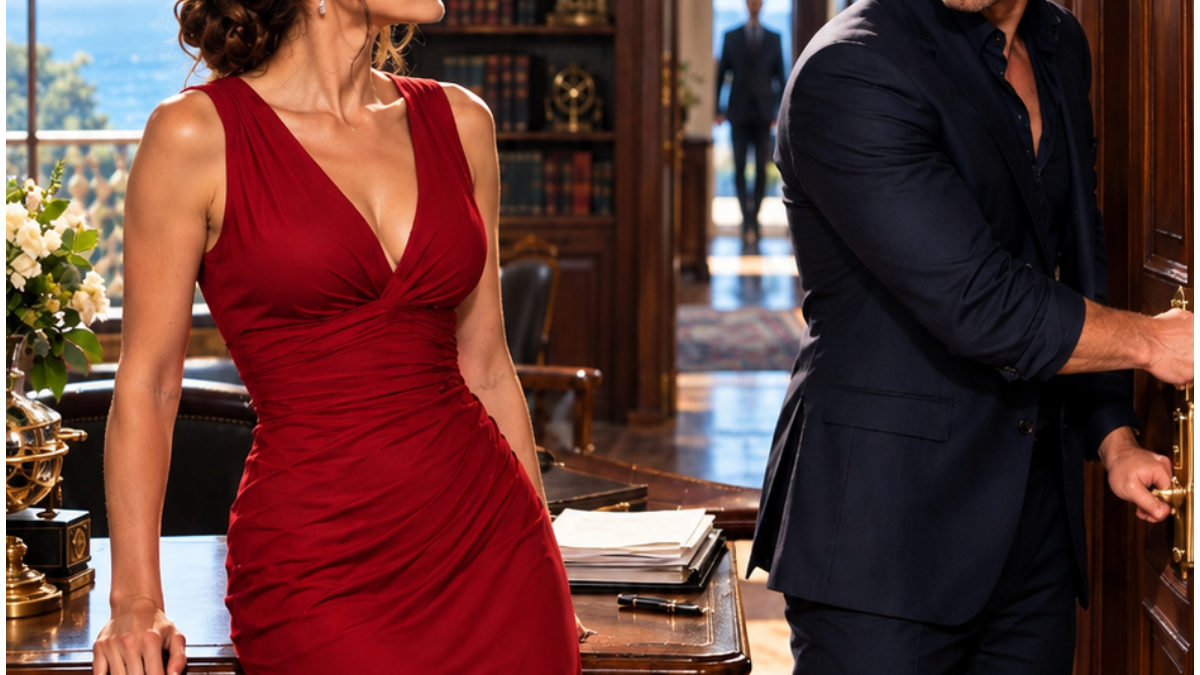

“You wouldn’t have chosen someone like me if you’d had more time,” Brioni said.
And the sentence came out steadier than it had any right to, shaped by 9 years of delivering bad news across conference tables without letting the flinch show.
Across the study, Lor and Steel did not answer.
He rose from the chair, crossed to the door in four unhurried strides, and turned the key in the lock until it gave a single definitive click.
The sound moved through the old stone floors and into Brieny Nazmouth’s shoes, and she knew before he turned around that whatever was coming could not be walked back.
“Finish the sentence,” Luran said.
She met his eyes.
“Which part do you want finished?”
“The part where you told yourself what I think.”
8 days earlier, Brioni had been three floors underground in the basement archive of Lelaw Mercer and Associates.
Working through a box of title instruments that smelled of cedar and photocopier toner and decades of other people’s property disputes.
It was a Thursday evening in late August, the kind that pressed itself against Vancouver’s glass towers and refused to cool, and everyone above the rank of junior associate had left by 6.
Brioni stayed because the steel estate file was scheduled for first review Monday morning and because she had found something wrong in a 1987 conveyance that two senior examiners had already signed off on without noticing.
She noticed. She always did.
Still here?
Plet from the mail room leaned in the doorway, fanning herself with a folded transit map.
It’s 30° in this basement and I’m counting the seconds until I’m on the sky train.
There’s a discrepancy in the steel chain of title going back to the original grant.
Brioni did not look up.
The 1987 transfer references a right of way that was extinguished in 1972.
It’s not fatal, but if anyone tries to encumber the coastal parcel, “And that’s your problem because because if I don’t flag it now, it becomes a 93year-old woman’s grandchildren’s problem.”
She looked up briefly.
She’s already had enough of those.
Plette sighed the particular sigh of a woman watching another woman work past her worth.
Go home, drink something cold, find a rich man who needs someone to read his paperwork.
Brani laughed once, short and dry, and went back to the conveyance.
She had been a title examiner for 9 years, long enough to know exactly what shape invisible competence takes.
She could trace a property’s ownership backward through a 100red years of registrations, divorces, and probate transfers the way other people read a novel.
Following the thread by feel.
What she could not do was make anyone notice the difference between a file she had examined and one that had simply been signed.
Her name lived in the audit trail of documents that went out under other people’s authority.
She had made peace with it mostly.
The steel file was different.
She couldn’t have said why yet.
Margaret Steel had been a client of Laidelor Mercer for 35 years and she had left behind the kind of estate that had its own gravitational field, a conservation trust protecting 1100 acres on the Gulf Islands, a heritage foundation, and a house on Galliano that had a name instead of a civic address.
She had also left tucked into a handwritten codil that Brioni was not technically supposed to have read, a condition that had made two senior partners go very quiet in a way she had never seen them go quiet before.
The coticils had simply been in the box.
Briani read everything in the box.
That was the job. She was still thinking about that single sentence, its strange aching logic, when the desk phone rang at 10:40 p.m.
Ms. Nazmouth. It was Mr.
Ladlaw himself, the name on the door.
A man who had spoken directly to Bioni perhaps three times in 9 years.
Are you still in the building?
Yes. Don’t leave. There’s a car coming.
A pause dry as tinder.
Mr. Steel would like to speak to whoever found the 1987 discrepancy before it goes into the summary.
He was very specific that it be the person who actually found it, not whoever signs the report.
The line went quiet before she could ask which Mr.
Steel. There was only one who mattered.
The car was black and carried the faint cedar smell of the islands even here in the city.
It took her south along the waterfront and then onto the ferry, and Brioni sat in the vehicle deck with her field notebook in her lap, and watched the lights of the mainland shrink and the dark water widen, and felt the uncanny sensation of a file she had been reading, beginning very quietly to read her back.
The house appeared out of the August dark without announcing itself.
Stone, pale and heavy, set back from the bluff, with a garden that ran down to the salish sea, where the last of the evening tide moved against the rocks in a slow, patient rhythm.
A woman waited at the door, 60some, straightbacked in a linen dress the color of creek stone, with reading glasses on a chain and an expression that had decided things long before Brioni arrived.
You’ll be the one who reads the whole file.
It wasn’t a question. I’m Mrs. Bretchen.
I keep this house running, and Mr. Steel from running it into the ground in that order.
Come in before the midgetes find you.
Brian Nasmouth. I know, he said the title examiner.
I said that woman has a name, Loran.
He looked at me the way he looks at every piece of information that doesn’t immediately serve a purpose.
Mrs. Bretchen held the door open.
He’ll come around. Mind the threshold.
The stone’s uneven, and he keeps forgetting to have it fixed because he keeps forgetting anyone else walks on it.
The house was cool inside.
The thick stone walls doing what no air conditioning could.
Somewhere a clock ticked. Somewhere a gramophone needle found the end of a record and lifted itself off in silence as though someone had sat down to listen and then thought better of staying.
Brion followed Mrs. Bretchen down a hall lined with framed survey maps.
Every one of them showing the coastline of Galliano, from the oldest handdrawn rendering she had ever seen to a satellite image printed recent enough to still look clinical, and stopped before a pair of heavy doors.
“He’s in a mood,” Mrs. Bretchen murmured.
“But his moods are honest, which is more than I can say for most men who own property on water.”
She opened the door and did not follow Brioni in.
The study was all books and lamplight, and the smell of salt coming through an open window.
A man stood with his back to her, looking out at the place where the garden dropped away to the sea.
Jacket off, sleeves turned up, the posture of someone who had been standing in that spot long enough that the room had arranged itself around him.
“You found the 1987 discrepancy,” he said without turning.
His voice was low and occupied all the space without effort.
“The right-of-way extinguishment wasn’t cross-referenced in the 1987 transfer.
It only becomes a problem if someone tries to encumber the coastal parcel.
But given what the trust is meant to protect, that’s exactly the scenario worth preventing.
Two examiners reviewed that file.
I know the error is easy to miss if you’re reading the documents individually.
You have to hold two registrations in your head at the same time, 11 years apart.
She kept her hands folded in front of her.
It’s the kind of thing that surfaces later as a very expensive surprise.
He turned. She had seen the photograph they ran with his name in business coverage.
Something flat and controlled, a man performing patience for a camera.
The person who faced her now was younger than that photograph by the length of a year that hadn’t been kind, with dark hair not recently attended to, and eyes the gray of overcast water at low tide.
He looked at her the way a man looks at an unexpected variable in a calculation he believed was finished.
Sit, he said. I’ll stand if it’s the same.
It isn’t, but suit yourself.
He came away from the window.
Mrs. Nasmouth, do you know what my grandmother left me?
A great deal by any standard.
A trap dressed as a great deal.
He picked up a cream envelope from the desk.
There’s a codicil. I’ve read it, she said before she could weigh the admission.
It was in the box.
Something moved behind his expression.
Gone before she could name it.
Then you’ll save me the indignity of explaining it.
Say it out loud. I want to hear how it sounds from outside the family.
She looked at the envelope, then at him.
She left you control of the Conservation Trust and the Heritage Foundation.
Conditional on your being a married man before your 40th birthday.
Otherwise, your interest passes to the board.
She paused. Chaired by your cousin Peragrin.
He said the name the way you say the name of a slow leak who has spent 18 months telling every conservation partner and government contact this family has that I am incapable of sustained commitment to anything requiring someone else’s cooperation.
My grandmother agreed with him.
She loved me and she agreed with him and she wrote it into a legal instrument so I would have to prove them both wrong or hand him the trust she spent her life building.
He set the envelope down.
My birthday is 3 weeks from Friday.
The clock in the hall ticked.
Outside below the garden, a wave broke against the rocks and was absorbed by the dark.
“I’m very sorry,” Bioni said, because it was true and because she didn’t know what else was safe.
But I’m a title examiner.
I trace chains of ownership.
I don’t see why I’m here.
Because Lorin said, “Everyone I have paid to solve a problem has tried to solve this one by finding me a wife who would present well and settle quietly.
And you are the only person who has touched my grandmother’s documents and corrected something instead of signing past it.
He studied her. Laid law tells me you declined a bonus last spring because it was contingent on your silence about a billing irregularity.
Is that true? The heat climbed the back of Brioni’s neck.
That’s not a matter of public.
I ask questions before I let the ferry bring anyone here.
Is it true? She looked at him.
Yes. Then here is what I’m going to say, and I am going to say it plainly because you strike me as a woman who finds decoration insulting.
He put both palms flat on the desk.
I need a partner whose word I can rely on and whose reasons I can understand, one year on paper.
A marriage in form and in law.
You leave with enough to stop worrying about billing irregularities for the rest of your career.
I keep my grandmother’s trust out of Peragrin’s hands.
He would dissolve the conservation covenants by spring.
He held her eyes. I need the form of a marriage.
I’m not asking for anything it doesn’t say.
The room was very still.
You’re asking me to marry you, Brioni said.
I’m asking you to sign something real.
The marriage is the form that makes it legal.
She should have refused and been on the last ferry, but something in the directness of it.
The absence of every performing gesture, the way he had said the covenants as though they were the truest cost, not the money, had caught in her like a wrong date in a century of registrations.
“No,” she said. He blinked.
It was the first entirely unguarded thing he had done.
“I know what I am in a room like this,” Brioni said, and she kept her voice level because the alternative was worse.
I’m the practical option. The one whose name won’t generate coverage.
The one who won’t cause a difficulty because no one will look long enough to make one.
I’ve spent 9 years being the name in the audit trail of documents other people put their signatures on.
And I’m not going to sign the most consequential document of my life just to disappear into the background of someone else’s story again.
She stopped. That’s not what you intended, but it’s what it would be.
For a long moment, he said nothing.
The salt air moved through the room.
Then, to her genuine surprise, he came around the desk and stood not close, but present, and looked at her with something that was not quite warmth, but was at least the memory of where warmth had been.
That, he said quietly, is the most honest thing anyone has said to me about this in 6 weeks.
Then you understand why I’m leaving.
I understand why you should stay.
He pulled out the second chair from against the wall, the one with the air of never being used.
You’ve already said no. You have nothing left to lose by hearing the reSt. She should not have sat.
She sat. Mrs. Bretchen brought tea without being asked, and a plate of late season strawberries gone almost translucent at the edges, and set everything between them with the quiet efficiency of a woman who had seen worse, and fed her way through it.
She looked at Brion’s face, then at Loran’s, said, “Well, this is more interesting than supper usually is.” And let herself out.
Loran waited until the door clicked.
You said, “You know what you are in a room like this.
Tell me the reSt.” Brioni sat down the tea.
I’m 36. I have a one-bedroom apartment in East Van with a radiator that bangs every winter and a landlord who calls the noise character.
I split a car with my younger sister.
I own one good coat.
I have never been to Europe.
The last time a man in a house like this one addressed me directly.
It was to ask me to locate a parking variance from 1994.
She looked at him evenly.
So yes, I know what useful looks like from the other side of the desk, and I’ve made my peace with it.
Something in him went careful.
Careful the way stone goes quiet before the water takes it.
You’ve decided an enormous amount about my opinion, he said.
For someone who has been in this room for 20 minutes, 9 years of practice, and you’re wrong, he said it without emphasis, which made it land harder.
I don’t want a wife who presents well.
I’ve had a career full of people who present well.
I want someone who reads the whole file.
He paused. You keep saying what I want as though the codisil addresses that, too.
It doesn’t. I’m not certain I know what I want.
I’m not sure I’ve known in a long time.
It was the nearest thing to vulnerability she’d heard from him, and it unsettled her more than the money had.
Money, she understood. This she didn’t.
He slid a folded sheet across the desk.
She unfolded it. Read it.
Read it again. Because the first time, her eyes had clearly made an error.
This is a year of your legal problem resolved, she said slowly.
Not a year of my silence.
I told you I don’t buy silence.
The marriage will be true.
Your name on a real document for a real year.
He held her gaze. That’s the only kind of arrangement I could tolerate.
I suspect it’s the only kind you could either.
The gramophone in the other room found its needle on a new record.
Something with strings, a single phrase repeated until it became familiar.
She thought of the codisil.
She thought of 9 years of her own handwriting on documents that went out under other names.
I’ll give you an answer tomorrow, Bioni said.
In writing, so neither of us can claim we heard wrong.
Lorcan looked at her then, not at the problem, but at her, and said, that’s a title examiner’s answer.
It’s the only kind I have.
He walked her to the door himself, which Mrs. Bretchen noted from the end of the hall with an expression Brieny couldn’t decode.
The August night had finally started to breathe.
The garden releasing its warmth in a long slow exhale, the straight showing nothing but darkness and the far lights of the mainland.
Mrs. Nazmouth. He stood in the doorway, sleeves still turned up, framed by a house that could have held 20 of him without noticing.
The number is the same whether you say yes or no.
I want you to know that before you decide.
Why tell me? So that when you say yes, he said, you’ll know it wasn’t because you had no choice.
And neither will I. The ferry back was near empty.
Brioni sat on the outside deck despite the dark and the salt spray and held the folded paper in both hands and understood the way she understood a discrepancy by the feeling of something not adding up and then adding up differently once she found the right column that she had already decided.
She had decided somewhere back in that study when a man who had learned to be alone in a room with the lights on listened to her describe her own life and looked at her like it was the most unexpected balance sheet he had ever read.
She was back at the house the next morning with her answer in an envelope.
That was the part she would think about later when everything had complicated itself.
Not the number, not the codisol, not even the locked door, the part where she chose to return.
Because a woman who reads the whole file already knows that the most dangerous instrument in any estate is never the one you’re handed.
It’s the one you sign yourself.
5 days passed. The papers were real.
Mr. Delayed law had drawn them personally in a silence that told Brioni he understood more than he was saying and had decided not to say it.
Peragan had already heard something.
Of course, he had and sent a text to Loran that Loran read aloud in the car with the flat neutrality of a man doing arithmetic.
Marrying the file clerk, how very sentimental.
I do hope she reads the prenuptual as carefully as she reads everything else.
He knows what I do, Brioni said.
He knows everything about you by now.
It took him a day.
Loren folded the phone away.
Does that frighten you? Being known doesn’t.
She watched the ferry terminal approach.
Being seen is the part I haven’t practiced.
Now she stood in that same study with the signing copies laid out between them, and the words had come out before she could stop them.
You wouldn’t have chosen someone like me if you’d had more time.
The old safe position, the place she had always arrived first, so no one could arrive there ahead of her.
And Lor and Steel had crossed the room and turned the key in the lock.
Finish it, he said. The sentence you decided before you walked in here.
I was going to say that I understand what I’m for in this arrangement and that I don’t hold it against you.
And Brioni looked at the key in the door at the signed copies waiting on the desk at the man standing 3 ft from her with the window light in the gray of his eyes.
And I was going to say it flat and early, the way I always say the hard things, so there’s no room for anyone else to say it worse.
Why did you lock it?
She asked. Because in about 3 minutes, Peragan’s solicitor is going to knock on that door, Luran said.
And I wanted you to make this decision in a room with no one in it but the people it belongs to.
He came to stand across the desk from her, close now, the cedar and salt of the islands on him even here.
So say it again, this time without the armor.
Down the hall, unhurried footsteps, a knock at the front of the house.
Mrs. Bretchen’s voice cool as the stone floors.
Receiving it. Brioni looked at the papers.
She looked at him. I think she said that neither of us has any idea what we’re actually doing, which makes two of us, so we might as well find out.
She signed her full name, Bioni Nasmouth.
No audit trail, no other signature above hers.
The knock came again closer.
Now, what followed over the next 10 days was not a romance, though it became one.
It was first an investigation.
Peragan Steel’s solicitor, a man named Mr.
Hardy, who had the careful face of someone paid to complicate things, arrived with a folio of interrogatories, and the pleasant manner of a man delivering a verdict he was already confident of.
He was tall and still damp from the ferry crossing, and he looked at Brioni the way men in those rooms had always looked at her, priced her, found her unlikely, and adjusted his expression to something he imagined was encouraging.
The questions were a spear, not a fishing line.
State when Ms. Nazmouth was first retained in relation to the steel estate.
State all consideration exchanged prior to the marriage license date.
State the circumstances under which Ms. Nazmouth attended Galliano property on August 14th.
They knew the sequence, not guessed it, knew it.
Someone gave him the timeline, Brioni said, alone with Lorcan after Hardy had left.
The August 14th visit, that’s specific.
Only four people knew I was here that night.
Myself, Loran said. Mrs. Bretchen, he stopped.
And the ferry manifest, Brien said carefully.
Which is a public record, but the reason for the visit isn’t on any manifeSt. She looked at him.
How long has Peragan been using Hardy?
Since the trust’s last board audit 18 months ago, he met her eyes.
The same audit where two conservation fund line items came back reclassified.
I queried it with the board chair.
The answer I got was that it was an administrative correction.
I accepted it. Something moved across his face.
I should not have accepted it.
The morning after their wedding, small in the garden, 12 chairs, and Mrs. Bretchen in the front row wearing the iron expression of a woman determined not to cry.
Brioni found a second envelope in the steel estate box she had not been shown.
She had asked to review the full file.
Loran had said yes. There’s a second document.
She told him that evening.
Mrs. Bretchen had taken herself off to the kitchen with the pointed discretion of someone who understood that some conversations needed the room to themselves.
Your grandmother’s codisil. The page I read in the firm’s box was the first page.
Loran went very still. Loran, she kept her voice level.
Peragan knew the reason for my August visit before the interrogatories were filed.
He’s been inside this case for months.
She watched his face. Is there a safe?
There was old set into the stone behind a bookshelf that swung on a hinge she would never have found without him.
Margaret Steel’s combination. A year and a day worn into the brass of the dial.
Inside the trust’s founding charter, a packet of letters tied with kitchen string.
A child’s drawing of a heron carefully folded, and on top of everything, a cream envelope in Margaret’s slanting hand, slit once and pressed flat again.
“I read it the day the box came,” Lorcan said, not touching it, and I put it back.
I have not been able to make myself take it out again.
“Briani” crouched beside the safe.
She looked at the envelope, then at the dial, then she rose and looked at him.
“The combination,” she said carefully.
“Have you ever written it down?” never, but it’s in her letter.” He nodded once, and Perigrin knew I was here on August 14th for a reason he couldn’t have gotten from the ferry manifeSt. She turned the shape of it over the way she turned a discrepancy, slowly looking for the line that didn’t add.
“He’s been inside the firm’s files, Lan, and if he found a reference to the second page, he already knows the combination lives inside the letter.
He’s been working out how to get to the safe before you open it.” She looked at him steadily.
How long has he had access to laid laws vault?
Lorcan was quiet for a moment, then since he joined the trust board.
Standard client privilege access for co-beneficiaries.
18 months. The same 18 months as the reclassified line iteMs. The safe had not been touched by morning.
She knew because she looked, and the heron drawing lay exactly in its fold, and the letters exactly in their stack, and the cream envelope had not moved.
But on Tuesday afternoon, Mrs. Bretchen found the bookshelf standing open.
The envelope was gone. Loran stood in the study doorway and looked at the open safe in the way a person looks at a loss they cannot immediately afford to feel.
Mrs. Bretchen stood at the threshold with the house phone in her hand and her voice stripped of its usual dry weight.
I’ve touched nothing. I noticed because I always notice when that shelf isn’t flush.
Brioni crossed to the safe and crouched at the dial.
The brass bore a smear at the seven and the one.
The ghost of a careful finger, no gloves, a person who felt they belonged here.
Say the letter to me, she said.
You read it once. You know every word.
Say it. A long silence.
Then without drama, Loran said, Loran, if you are reading this, it is because you have finally gone into the safe I made you keep, and I am no longer at the table to say it to your face.
He stopped. Mrs. Bretchen, without a word, set the phone down on the hall table and drew the study door to, leaving them the room.
Loran went on, his voice in the flat register that cost him.
I know what has been happening with the conservation fund.
I have watched the transfers for 2 years, and I know it is Peragrin who has been moving the money, and I know that you know, and that you have reclassified the losses under your own authorization, so the board would call you careless rather than call him a thief.
You have done this because he is the person who taught you to sail and who sat with you the week your parents left this island for the last time and because you still believe he is reachable.
His jaw worked. You are wrong.
I am writing this so you will have the proof in my hand which no one can challenge.
The combination to this safe is the year I bought this land and the day you were born.
He will never know those numbers.
This document is also lodged in full with the land title office, the original registered, because I am the sort of woman who does not keep the only copy of anything important in a room a man can walk into.
The crickets outside had started.
The tide was turning below the garden.
Bronni rose from the floor, and her knees were loud in the quiet, and her voice was steadier than she felt.
He didn’t take your evidence.
Lan looked at her. He took the copy she kept for sentiment.
The lodged original is at the land title office in Victoria.
It’s a registered instrument. It has been there since she filed it.
She turned the shape of it over once more, making sure it held.
He steamed the sealed deed at the firm.
That’s how he confirmed the safe combination and that the document existed.
But he went looking for the safe copy without understanding how your grandmother thought.
For people in my field, the dangerous document is never the one you lock away.
It’s the one on the public record.
She knew that she lodged both pages as a single registered instrument, and the original has been sitting in a government vault since the month she executed it.
“Perig broke into your house to steal a copy of a document that proves what he did,” she said, “and theft itself is now part of the record.” “He spent 18 months building my case for me, and he thinks he’s winning.” The silence had a different quality now.
Lorcan looked at her for a long moment.
Then he laughed. A short startled sound entirely unprepared.
The kind that can’t be performed.
My grandmother, he said, would have found you unbearable.
Most people do. She’d have loved you inside a week.
The trust board met on a Thursday in the foundation’s meeting room overlooking the water, with the last of the summer light coming low and gold through the tall windows.
Peragrin Steel presented his case with warmth and apparent reluctance.
The sequence of Brioni’s involvement with the estate, the number he had somehow learned, a timeline his contacts at the firm had quietly assembled.
He was good. She gave him that.
He was warm and sorrowful and entirely convincing to anyone who didn’t know what a spear looked like when it was dressed as a fishing line.
He was still speaking when Brioni stood up.
40 faces turned. She let them look.
Her hands did not shake.
9 years of holding steady over other people’s most consequential paperwork had trained her for exactly this, and she was done making herself small enough to be overlooked in rooms where the wrong person had the floor.
“My name is Brioni Nazmouth,” she said.
“I’m a title examiner. I read the whole file.” She set the certified copy of Margaret Steel’s Codisil, both pages, the land title registration stamp pressed clear into the corner on the table before the board chair.
She set the vault access log beside it.
She set a photograph of the steamed envelope seam taken at the angle that caught the light exactly right next to both.
She read the second page aloud.
Margaret Steel’s words flat and clear in a room that had gone the way rooms go.
When the thing that was true all along is finally said out loud.
Peragan did not speak for a long time after.
When he did, his voice had come down from its register, and what was underneath was something she hadn’t expected.
Grief, the kind that only lives in families.
You covered for me for 2 years, he said to Loran.
Not a question. You taught me to sail, Loran said.
He had not risen from his chair.
He watched his cousin the way he had probably watched him their whole lives as the one who notices the moment before someone falls.
I kept waiting for you to stop.
I should have stopped. Peragrin looked at the table at the registered copy of his aunt’s letter at the board chair who was already reaching for his phone.
I should have stopped a long time before she had to write a letter about it.
He did not contest the vote.
He resigned the chairmanship that afternoon and left on the 4:00 ferry.
Hardy followed with the folio closed.
The board passed a resolution restoring the conservation funds records, and Dr. Mo, who had loved Margaret Steel since they had served on the trust together in 1991, pressed both of Brioni’s hands in hers and said Margaret would have run a timer just to get herself into the photograph.
The audit trail at Laid Law Mercer led where Brioni had known it would lead, and the file examiner, who had been quietly passing information, found his name on a document he could not sign his way out of.
In the study afterward, with the light going copper over the straight, and Mrs. Bretchen moving in the kitchen below in a deliberate way that said she had decided to be occupied, Loran stood at the window where he had always stood.
“You let them look at you,” he said.
They looked firSt. She came to stand beside him.
I let them. It didn’t undo you.
I thought it would. I’ve spent a long time making sure no one had enough of a view to form an opinion.
And then 40 people formed one, and the world stayed standing.
She watched the water. I think I’ve been preparing for the wrong thing.
He turned from the window.
The summer light was on his face, and the tiredness was still there, but something under it had shifted.
The way water settles after a storm, finding its new level.
The year is yours whenever you want it.
Loren said that was always the terms and I don’t revise the terms in my own favor after the fact.
I know you don’t. But I’m going to say something I haven’t said.
Because you told me I’d get better with practice and I might as well start.
He looked at her straight the only way he knew.
I don’t want a wife on paper.
I want the one who read the whole file and handed me half of it.
I want the radiator that bangs and the car shared with the sister and the one good coat.
I want every question you ask in a room full of people who have stopped asking.
He drew a breath. I want you in this house in a way that has nothing to do with the codisil for as long as you’ll stay.
That’s the declaration. I told you I’d do it badly.
Bronnie’s eyes stung in a way she would have trained out of herself a year ago.
She did not look away.
You said something the first night, she said.
You said you needed a partner, in fact, not in feeling.
I was wrong about that.
I know. I’ve known for a while.
She looked at the straight at the last light going out of it.
You’re already in the audit trail, Loran, permanently.
No one can pull that file.
I read the whole codisil, he said.
I know exactly what I agreed to.
She kissed him in the window light in the old stone house where a woman had lodged her most important documents where no safe could reach them, and the tide came in below the garden in its long unhurried way.
And somewhere above the kitchen, Mrs. Bretchen, who had been very busy with supper, allowed herself to be unusy for the space of one quiet, satisfied smile.
They did not end the marriage at the year.
They stopped thinking about ending it by November, and by the following August they had a second wedding in the same garden, smaller and easier, with Brioni’s sister, Meg, in the front row, holding a baby, who spent the whole ceremony reaching for the light through the leaves, and was passed from lap to happy lap through the long, warm afternoon.
The trust’s conservation work expanded north that winter.
The coastal parcel that Bioni had flagged in the 1987 title search was properly recorded and protected, and she drafted the corrective instrument herself, which went out under both their names, and she did not find it strange.
Mrs. Bretchen pronounced the whole arrangement livelier than any household she had kept, and hired a second groundskeeper, and stopped apologizing for it.
The gramophone record with the strings played regularly in the evenings, and it no longer lifted its needle at the end of a phrase, and left the room quiet.
Someone had learned to start the next one.
Bioni would think sometimes of the ferry crossing in the August dark, the mainland lights shrinking behind her, the folded paper in her hands, the sensation she had had of a file beginning to read her.
She had been right about that, though not in the way she had meant it.
It had not read her in order to use her.
It had read her in order to finally actually see her, and she had let it.
That was the whole of the story.
A woman who read every document in the box, had allowed herself to be documented, name first in full on the permanent record, and found that being seen once she stopped spending energy to prevent it, was not the loss she had spent 9 years preparing for.
It was the thing she had been without for a long time and had not known she was missing until a man who kept his own grief in a safe he couldn’t open looked at her directly and asked her to say the hard thing twice.
She was in the end the name they saw on the document.
Both of them were right there on the public record in a grandmother’s slanting hand and a lonely man’s careful one and a title examiner’s steady one where no codisil condition and no cousin and no locked room could reach it again.
A family that had learned the long way to stand still in the same place and mean








