I Called My Husband from the Hospital, but His Assistant Answered: He Was in the Shower
Chapter 1. Clare Westbrook’s husband came home furious at midnight and accused her of not caring whether he lived or died.
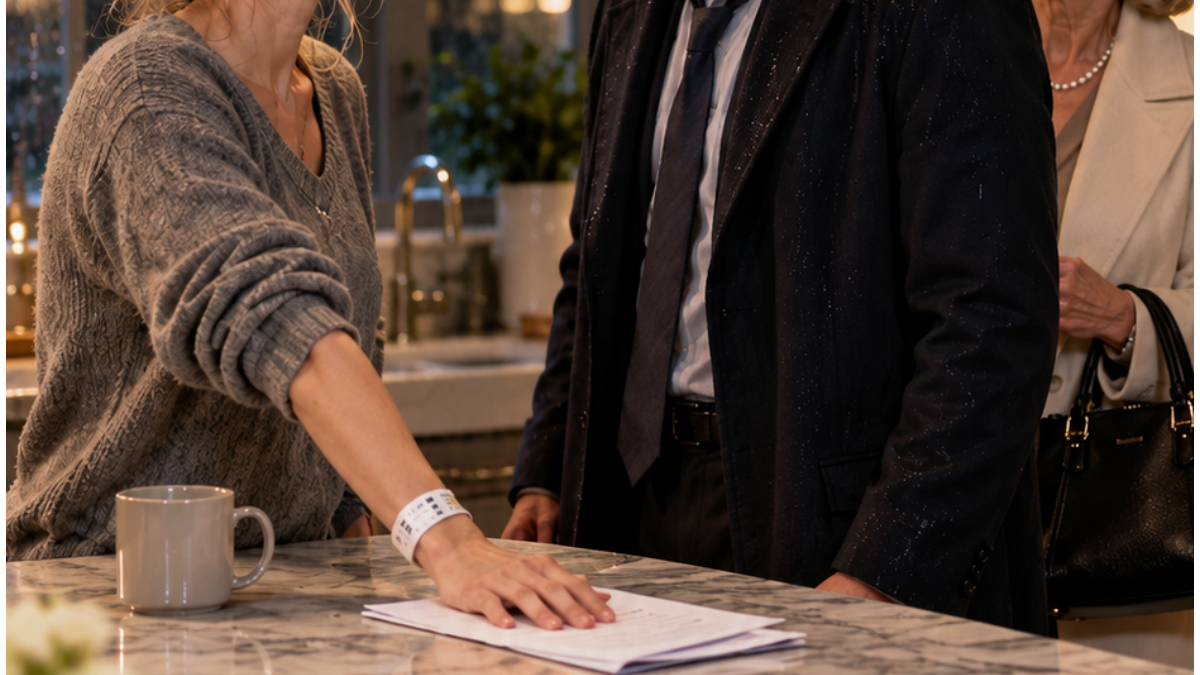
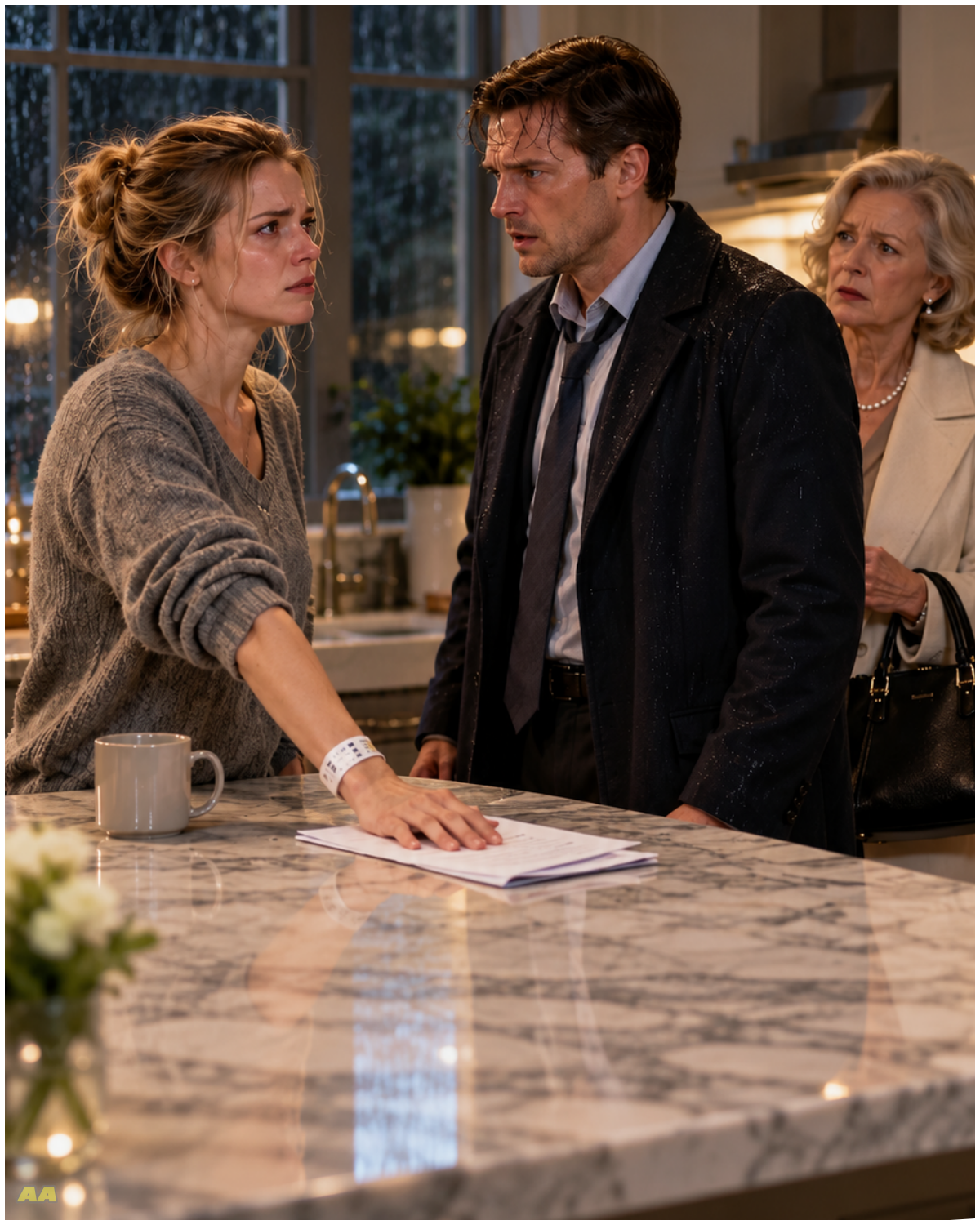
She was standing in the kitchen in a gray sweater, one hand wrapped around a mug of cold tea, the other resting on the hospital discharge papers still folded beside the sink.
Rain ticked against the townhouse windows.
The overhead light made the marble counter look colder than it was.
Daniel Westbrook slammed the front door hard enough to make the glass cabinet tremble.
“You did not call once,” he said.
Clare looked at him. His dark hair was wet from rain, his navy coat open, his tie loosened with theatrical exhaustion.
He looked handsome in the way men looked handsome when they expected anger to make them important.
His face was pale, his mouth tight, his eyes bright with accusation.
Behind him, his mother walked in carrying a leather handbag and a judgment she had clearly been polishing all evening.
Margaret Westbrook was 62, silver-haired, elegant, and incapable of entering any room without making it feel inspected.
She glanced at Clare’s sweater, the untouched tea, the hospital bracelet still circling Clare’s wrist, then lifted her chin as if even illness could be done improperly.
Daniel was in an emergency board session all night, Margaret said.
His wife did not call him, not once.
Clare’s fingers tightened around the mug.
She had called. At 6:14 p.m.
After the doctor told her the bleeding had stopped but the pregnancy was gone.
At 6:27 p.m. After the nurse asked if someone could come pick her up.
At 6:39 p.m. From the hallway outside the hospital chapel where a woman was praying in Spanish and Clare stood holding a paper bag with the sweater they had cut off her body.
At 7:02 p.m. After the taxi app crashed and she realized she would have to ride home alone while still smelling faintly of antiseptic and blood.
Daniel’s phone had been answered on the fourth call.
Not by Daniel, by a woman.
A soft, breathless voice Clare knew from company holiday parties, charity photos, and the way Daniel’s assistant always touched his sleeve when handing him documents.
Maya Lennox. Maya had answered Daniel’s phone and said, “He cannot come to the phone right now. He is in the shower. Not in a board session. Not with investors.”
In the shower.
Clare had stood in the hospital corridor with discharge papers trembling in her hand and listened to the woman breathe on the other end of her husband’s phone.
Then Maya added almost sweetly.
Can I take a message?
Clare had ended the call.
Now Daniel stood in her kitchen, furious that she had not performed concern for him loudly enough.
I was told you had cramps.
He said cramps. Clare? You vanish into a hospital and then do not call your husband while I am dealing with a crisis that could cost the company $300 million.
Margaret stepped closer. Your priorities have always been strange.
Clare set the mug down carefully.
The sound was small, ceramic against stone.
Somehow it quieted the room.
Daniel stared at her. Do you have anything to say?
Clare looked at the man she had loved for 7 years.
The man who had kissed her stomach two months ago and whispered that this baby would change everything.
The man who had become distant 3 weeks later, then busy, then unreachable.
The man whose phone had been answered by another woman while Clare lost their child alone.
Her voice came out soft.
I did call. Daniel blinked.
Margaret’s eyes narrowed. Clare continued, but the woman who answered said, “You were in the shower.” The rain against the windows seemed suddenly louder.
Daniel’s face changed. Not completely.
He was too practiced for that, but the color drained under his cheekbones and his mouth opened slightly before he forced it closed.
Margaret looked at him. For one brief second, mother and son were both silent.
That silence told Clare more than any confession.
Then Daniel recovered. What woman?
Clare almost smiled. It was a terrible question.
A guilty man’s question. An innocent man would have said, “No woman answered my phone.” Daniel had asked which one.
Clare picked up the discharge papers from the counter and placed them between them.
My Lennox. Margaret inhaled sharply.
Daniel’s eyes dropped to the papers.
Only then did he notice the words at the top.
Emergency obstetric unit. Pregnancy loss management.
Follow-up required. His face went slack.
Clare, he said. The fury left his voice.
Too late. Much too late.
Chapter 2. Daniel reached for the papers.
Clare moved them away. It was not dramatic.
She simply slid them out of his reach with two fingers, then folded them once and placed them inside the drawer where she kept grocery lists, spare batteries, and all the small practical things a household needed to continue pretending life was ordinary.
Daniel stared at the closed drawer as if it had insulted him.
“Why did you not tell me?” he asked.
Clare looked at him for a long moment.
I tried. His throat moved.
I did not know. No, Clare.
You did not know because your phone was with a woman in a place where you were taking a shower.
Margaret stepped in quickly, her voice cool and controlled.
This is not the time for insinuations.
Clare turned to her. What time would be better?
Margaret’s mouth tightened. You are upset.
Yes. And in pain also.
Yes. Then perhaps you should not make accusations you may regret.
Clare studied her mother-in-law. Margaret had never liked her.
Not truly. She had liked Clare’s manners, her education, the quiet Westbrook name she came from before marriage, the fact that Clare could sit through charity lunchons without embarrassing anyone.
But she had always believed Clare lacked warmth, lacked softness, lacked whatever old money mothers called obedience when they wanted it to sound feminine.
“Margaret,” Clare said, “your son came home angry that I did not call while I was miscarrying alone.
The word entered the kitchen like a door slamming.” “Miscaring?” Daniel flinched.
Margaret’s face shifted. Not grief.
Calculation arriving too quickly. How far along?
She asked. Daniel turned. Mother Clare answered anyway.
11 weeks. Margaret’s eyes moved to Clare’s stomach, then away.
Was it confirmed viable? For a second, even Daniel looked shocked.
Clare felt something inside her grow very still.
Get out, she said. Margaret blinked.
Excuse me. Get out of my house.
Margaret’s spine straightened. This is Daniel’s house.
There it was, the old belief spoken at laSt. Clare looked around the kitchen, the restored townhouse in Beacon Hill, the antique brass lights she had chosen, the breakfast nook.
Daniel loved to tell guests he had designed, though Clare’s trust had purchased the property before the marriage and paid for every renovation.
The pantry shelves where her grandmother’s china sat behind glass.
The garden beyond the rain blurred windows, planted by her father the spring before he died.
No, Clare said. It is not.
Daniel closed his eyes briefly.
He knew. Margaret apparently did not.
Clare walked past them to the front door and opened it.
Cold air entered the hall.
Margaret stared at her. Daniel whispered, “Clare, please.” She did not look at him.
“Your mother leaves now. You can leave with her or sleep in the guest room until my attorney contacts yours.” Margaret’s face pad under the hall light.
“Attorney?” Daniel said. Clare looked at him.
The man who had accused her of neglect while her body was still aching from loss.
The man whose assistant answered his phone from a shower room.
The man whose first instinct after seeing the discharge papers was not to kneel, not to weep, not to say I should have been there, but to ask why she had not told him better.
Yes, she said. Attorney.
Chapter 3. Daniel slept in the guest room that night.
Clare knew because she heard him open the door three times and stop in the hallway as if waiting for grief to make her call him in.
She did not. She sat in the primary bedroom with the door locked and the curtains open, watching rain slide down the glass.
The room smelled faintly of lavender detergent and hospital antiseptic.
She had showered twice and still felt the hospital on her skin.
At 2:08 a.m., Daniel texted from across the hall.
I am sorry. At 2:11 a.m.
I did not know. At 21:19 a.m.
Please talk to me. At 2:34 a.m.
Maya was a mistake. Clare stared at that last message until the phone dimmed.
A mistake. Mistakes were missed exits.
Burned toaSt. A forgotten meeting.
A wrong number. Maya answering his phone while he showered was not a mistake.
It was access. Clare opened her laptop.
Pain made the body heavy, but clarity gave the hands work.
She logged into the family phone plan.
Daniel had insisted years earlier that combining accounts made life simpler.
He had forgotten that simplicity left records in one place.
Calls to my Lennux, late nights, early mornings, weekends when he claimed to be with investors, then messages, not content, but timestamps.
Hundreds. She downloaded the logs.
Next, she opened the cloud photo backup connected to the household tablet.
Daniel used it for work sometimes.
He had complained about autosync and then never turned it off.
There were screenshots of restaurant reservations, hotel spa confirmations, an invoice for a private suite at the Bellamy Hotel built under Westbrook Strategic Holdings, and one photo taken by accident perhaps or arrogance.
Maya and Daniel’s white shirt standing before a bathroom mirror with hair falling over one shoulder.
Behind her, reflected in the glass.
Daniel sat on the edge of a hotel bed with a towel around his waiSt. Clare saved everything.
Then she opened the last folder she had avoided for weeks.
Baby, the ultrasound image from 9 weeks.
A tiny white curve in a field of black.
Daniel had been there for that appointment.
He had squeezed her hand and cried.
He had cried so beautifully that the nurse brought him tissues.
Clare had believed those tears.
Now she wondered whether he had gone from that appointment to Maya.
The thought was too much.
She shut the laptop and walked to the bathroom.
For the first time that night, she was sick.
Chapter 4. By morning, Daniel had changed tactics.
He made coffee. The smell drifted into the bedroom at 7, warm and familiar, cruel in its ordinariness.
Clare came downstairs in black trousers and a cream sweater, hair tied back, face pale but steady.
Daniel stood at the stove making eggs badly.
He had never cooked unless he wanted forgiveness.
You should eat, he said.
Clare looked at the pan.
You burned them. He glanced down, startled.
I can make more. Do not, he turned off the burner.
For a few seconds, neither spoke.
Then he said, Maya meant nothing.
Clare leaned against the counter again.
Not your strongest argument. His face twisted.
I was lost, he said.
After the pregnancy started, I panicked.
Then the company was under pressure.
Maya was there. It was stupid.
How long, Clare? How long?
He looked away. That was answer enough.
But she waited. For months, he said.
For months. Clare had been pregnant for 11 weeks.
For months meant the affair had begun before the baby.
Before the positive teSt. Before Daniel cried at the ultrasound and kissed her knuckles in the parking lot.
Something inside her folded in on itself.
“Get your own attorney,” she said.
He stepped toward her. “No, please.
We cannot make decisions today.
You are grieving. There it was.
The word used as a leash.
Clare looked at him. Do not confuse my grief with your opportunity.
He stopped. That is not what I meant.
It is what you need.
His eyes reened. I lost the baby too.
The sentence should have been true.
Perhaps it was true somewhere.
But spoken by him in this kitchen after Maya.
It arrived wearing stolen clothes.
You lost a child. Clare said.
I lost a child alone while your mistress answered your phone.
He closed his eyes. The doorbell rang.
Daniel looked toward the hall, startled.
Clare did not move. The house manager, Owen, had already been instructed not to allow anyone through without asking.
His voice came through the intercom.
Mrs. Westbrook, Miss Lennox, is at the door.
Daniel’s eyes flew open. Clare looked at him.
He whispered, “I did not call her.” Clare believed him.
That made Mia either foolish or desperate.
Let her into the front sitting room,” Clare said.
Daniel took a step forward.
Clare, “No, you wanted to talk. Now everyone can use words.”
Chapter 5. Maya Lennox entered the sitting room as if walking into a house she had already imagined living in.
She was 28, blonde, delicate, and dressed in a camel coat over a black dress.
Her eyes were red, but her makeup was still careful.
That detail irritated Clare more than it should have.
Even grief had been styled.
Mia stopped when she saw Clare.
Then Daniel behind her. “I did not know he was here,” Mia said.
Clare sat in the green velvet chair near the fireplace.
“He lives here temporarily.” Daniel flinched.
Mia’s fingers tightened around her handbag.
“I came to explain,” she said.
Clare gestured to the chair opposite her.
“Sit.” Mia looked at Daniel.
Clare smiled faintly. If you need his permission to sit, this conversation may disappoint you.
Mia sat. Daniel remained standing near the door, pale and furious in equal measure.
I am sorry about the baby, Maya said.
The room went still. Clare’s eyes lifted slowly.
How did you know? Maya’s mouth parted.
Daniel said, Maya. Too late.
Clare turned to him. You told her.
He swallowed. I was upset.
When? No one answered. Clare’s voice stayed calm.
When Daniel Maya looked at her hands last night.
Last night after he saw the discharge papers after he texted apologies from the guest room after telling Clare Ma was a mistake.
He had called Maya. Clare felt no surprise only confirmation settling into place like a final brick.
Mia rushed on. He was devastated.
He did not know how to process it.
He needed someone. Clare stared at her.
He needed someone. She repeated.
Mia flushed. I did not mean it that way.
How did you mean it?
Daniel and I. Maya stopped, glanced at him, then forced herself to continue.
It was not supposed to be like this.
It rarely is. Mia’s eyes filled.
He told me you and he were separated emotionally.
He said the marriage had become a business arrangement.
Clare almost laughed. There was again emotional separation.
The phrase cheating men discovered after the bed and before the lawyer.
Did he tell you I was pregnant?
Maya’s face changed. Not enough, but enough.
No, she whispered. Clare looked at Daniel.
His silence answered. Maya looked sick.
I did not know. Clare believed that too.
It did not absolve her.
It simply clarified which lies belonged to whom.
Why are you here? Clare asked.
Maya wiped under one eye.
Margaret called me. Daniels head snapped toward her.
My mother. Maya nodded. She said Clare would try to destroy you.
She said I needed to be brave and tell the truth before she twisted everything.
Clare leaned back. Of course, Margaret had left the house, gone home, and started building the story before dawn.
Maya opened her bag with shaking hands and removed a folded packet.
She asked me to sign this.
Daniel stepped forward. What is that?
Mia looked at him and for the first time, anger cut through her tears.
You do not know. He stopped.
She handed the packet to Clare.
Confidential relationship statement prepared by Westbrook Family Office.
Clare read the first page.
The document described Daniel and Ma’s relationship as a mutual emotional bond arising after the functional end of Daniel’s marriage.
It stated Clare had been emotionally volatile, withdrawn, and unwilling to support Daniel during corporate crisis.
It included a line suggesting Clare’s pregnancy, had been medically uncertain, and that Daniel had been excluded from relevant information.
Clare’s hand went very still.
Daniel read over her shoulder and turned white.
Maya whispered. “Your mother said if I signed it, she would protect me.” Clare looked at her.
“From what?” Maya’s voice broke.
“From you.”
Chapter 6. Clare called her attorney at 9:15.
By 10:00, the attorney was in her sitting room.
Her name was Evelyn Grant, and she had represented women in divorces so brutal that she no longer wasted outrage on anything smaller than strategy.
She wore a navy suit, silver glasses, and the calm expression of a surgeon who had seen every organ of betrayal.
She read Margaret’s packet once, then twice.
“This is amateur cruelty with professional letterhead,” Evelyn said.
Daniel sat across the room, elbows on knees, hands clasped.
“He had asked to stay.” Clare had allowed it because watching him learn the shape of his mother’s plan was useful.
Mia sat beside Pria’s son, the independent attorney Evelyn had called for her.
Maya had been crying on and off for an hour.
Clare did not comfort her.
Priya did. Evelyn tapped the packet.
This statement is designed to pre-frame Clare as unstable, non-communicative, and medically unreliable.
It also attempts to insulate Daniel and Maya by presenting the affair as post-marital emotional transition.
It was not, Clare said.
No, it was not. Daniel looked up.
I did not ask my mother to do this.
Evelyn turned to him. Did you tell her Clare was unstable?
He opened his mouth then closed it.
Clare looked at him. There it was.
Not the whole crime. The seed.
I said she had been distant.
Daniel whispered. I said grief changed her.
Evelyn’s gaze did not soften.
And your mother turned it into a weapon.
Daniel lowered his head. Clare felt the sentence enter her without surprise.
That was what powerful families did.
They did not invent cruelty from nothing.
They took careless words from sons, polished them into narratives, and handed them to lawyers.
Priya asked Maya, “Did Margaret offer anything in exchange for signing?” Maya nodded.
“A severance package, an apartment for 6 months.
A reference?” She said, “If I refused, Daniel would abandon me and Clare would sue me into bankruptcy.” Daniel looked at Maya.
“I never said that.” Mia’s face hardened.
“You did not have to.
Your mother speaks like she owns the consequences.” Clare looked from one to the other.
The triangle was not romantic anymore.
It was procedural. That helped.
Evelyn closed the packet. We preserve this.
We preserve the call logs, hospital records, text messages, and any proof of the affair.
Claire, we file for legal separation, emergency financial restraints, and exclusive occupancy.
We also notify Westbrook Strategics board.
Daniel’s head snapped up. The board?
Clare finally spoke to him directly.
Your mother used the family office to draft a false statement about my medical condition and our marriage.
Your assistant was asked to sign it.
You use company time, company travel, and possibly company accounts to hide an affair.
The board will care. Claire, that could destroy the company.
She looked at him sadly.
No, it could stop the company from being used as your alibi.
Chapter 7 Westbrook Strategic was not Daniel’s alone.
That was the fact Daniel had spent years forgetting.
He founded it with charisma, ambition, and a pitch deck that made elderly investors believe he could see around corners.
Clare made the numbers work.
Her family office, Alder House, provided early capital through a private vehicle called Northbridge Lane.
Daniel thought Northridge was an outside investor with unusually patient terMs. He did not know Clare controlled it.
At first, she hid that fact for his pride, then for the marriage, then because every month made disclosure harder.
Her father had warned her before the wedding.
A man who resents your ladder will call it a cage once he reaches the balcony.
Clared thought him cynical. Now she wondered if he had simply been experienced.
By noon, Evelyn had contacted Northbridge Council.
By 2, Westbrook Strategics Board received a preservation notice.
By 4:00, Daniel’s chief financial officer called him in a panic.
Clare heard his phone vibrate from across the sitting room.
He looked at the screen and went still.
“It is Martin,” he said.
You should answer. He took the call in the hall, but his voice carried.
What do you mean? Northbridge froze.
Release. Silence. No, this is a personal matter.
Another silence. Martin, do not call an emergency meeting without me.
Clare looked out the window at the wet street.
For years, Daniel had called her calm his greatest comfort.
Then, when calm stopped serving him, he called it coldness.
That was the oldest trick in the book.
Praise a woman’s restraint when it protects you.
Question her humanity when it protects her.
Daniel returned to the sitting room.
His face had changed. North Bridge froze the capital release.
Clare nodded. Did you know?
Yes. How? She looked at him.
He understood slowly. North Bridge is yours.
Controlled by my family office.
He stared at her as if she had become a stranger in the space of one sentence.
You hid that from me.
You hid an affair from me.
That is different. Yes, Clare said.
Mine kept your company alive.
The room went silent. Maya looked down.
Daniels mouth tightened. You let me think I built this alone.
No, you insisted on thinking that.
I stopped correcting you. His face flushed.
There were few humiliations more painful to a proud man than discovering the invisible hand he dismissed had been holding the floor.
Chapter 8. Margaret Westbrook arrived at 5:30 with two attorneys and no apology.
Owen stopped her in the vestibule until Clare approved entry.
That alone made Margaret’s face harden into something close to hatred.
She entered the sitting room and saw Daniel, Clare, Maya, Evelyn Grant, Pria’s son, and the packet on the table.
Her gaze moved to Maya firSt. You brought this to her.
Maya’s shoulders stiffened. You asked me to lie.
Margaret’s mouth curved faintly. I asked you to clarify.
Clare stood. You asked her to sign a statement saying my pregnancy was medically uncertain and that I withheld information from my husband.
Margaret looked at her. Did you not?
Daniel said. Mother. Margaret ignored him.
You went to the hospital alone.
Clare felt the room go cold because Maya answered Daniel’s phone and said he was in the shower.
Margaret looked at Maya then at Daniel.
For the first time, uncertainty flickered.
She had known about the affair.
She had not known about the call.
That mattered, only a little.
Margaret recovered quickly. Even if mistakes were made, you are turning private grief into a corporate assault.
Clare looked at her. You used the family office to draft a false medical narrative about me.
To protect my son from truth.
Margaret stepped closer from a wife who has always believed quiet judgment makes her morally superior.
Clare almost smiled. There it was.
The real dislike finally given language.
I did not judge you, Margaret.
I learned you. Margaret’s eyes sharpened.
Clare continued. You do not protect family.
You protect image. Family is only the word you use when someone else’s silence is required.
Daniel looked at his mother.
Mia looked at the floor.
Evelyn Grant looked mildly entertained.
Margaret’s voice dropped. Be careful.
You are grieving. You do not want to make choices today that destroy your future.
Clare looked at the woman who had asked about viability before offering sorrow.
My future stopped depending on your approval the moment you walked into my kitchen and treated my miscarriage like a legal inconvenience.
Margaret went pale. Evelyn placed one document on the table.
Mrs. Westbrook, you and your council should review this.
It is a preservation notice concerning family office communications, medical statements, employment records, and any attempt to influence Miss Lennox’s testimony.
Margaret did not pick it up.
Clare did. She held it out for one second.
Margaret stared at the paper as if accepting it meant accepting defeat.
Then she took it.
Chapter 9. The board meeting happened the next morning.
Daniel tried to postpone it.
Northbridge refused. At 9 sharp, Clare entered the conference room on the 42nd floor of Westbrook Strategic’s headquarters.
She wore a black suit, her hair pinned low, no jewelry except her grandmother’s watch.
Her face was pale, but her posture was exact.
Daniel was already there with two attorneys.
Margaret sat beside him despite holding no official role.
Martin Hail, the CFO, looked like he had not slept.
Three independent directors sat along the table with tablets open and expressions carefully neutral.
Maya attended by video with Priya.
That detail alone made Daniel flinch.
The board chair, Helena Frost, opened the meeting.
We are here to review North Bridge Lane’s capital freeze.
Potential executive misconduct and allegations of family office interference.
Daniel leaned forward. This is a marital dispute being inflated beyond proportion.
Clare looked at him. He did not look back.
Northbridge Council responded. The freeze was triggered by potential misuse of company resources, reputational risk, and false statements connected to executive conduct.
Daniel’s attorney objected. Helena allowed the objection to be recorded and asked for the evidence.
Clare had expected the documents to hurt.
They did, but not in the way she feared.
Seeing the facts arranged in order made the pain less foggy.
Hotel suite build as executive crisis lodging.
Late night car services to Mia’s apartment charged to client retention.
Family office packet designed to influence Mia’s statement.
Call log showing Clare’s attempts to reach Daniel from the hospital.
Hospital discharge record timestamped minutes before Mia answered Daniel’s phone.
Text from Daniel to Maya at 2:22 a.m.
She knows. I need you.
The room stopped on that one.
Daniel stared at the screen.
Clare did not. She had already read it.
Helena turned to Daniel. Did you send this after your wife informed you of the pregnancy loss?
Daniel’s face tightened. I was in shock.
Clare’s voice was quiet. So was I.
No one spoke. Then Maya appeared on the screen, pale but composed.
Margaret Westbrook asked me to sign a false statement.
She said. She offered severance, housing, and protection if I described the affair as beginning after Daniel and Clare’s marriage had effectively ended.
That was not true. Margaret stood.
This is outrageous. Helena looked at her.
Sit down. The room changed.
Margaret was not used to being addressed as someone without authority.
She sat. Mia continued, voice shaking.
I did not know Clare was pregnant.
I did answer Daniel’s phone.
I did say he was in the shower.
I am sorry. Clare looked at her.
Not forgiveness. Acknowledgement. Sometimes truth entered the room through a person who had helped create the wound.
It still counted.
Chapter 10. The board suspended Daniel from executive authority.
Pending investigation. Not terminated. Not yet.
Suspended. That was enough to make Margaret look as if someone had struck her.
Northbridge maintained the capital freeze, but offered a path to release funds under independent oversight.
Martin would become interim operating lead.
Helena would chair a governance committee.
Company resources tied to Daniel and Maya would be audited.
The family office would be barred from contact with witnesses or employees involved in the review.
Daniel listened in silence. When the decision was read, he turned to Clare.
You are destroying what we built.
Clare was tired. So tired that the sentence almost passed through her without impact.
No, she said. I am separating it from what you did.
Margaret said, “Your father would be ashamed.” Clare turned slowly.
Her father had died for years earlier.
He had taught her to read contracts, plant roses, and never sign anything offered during a person’s panic.
He had also warned her about Daniel’s pride.
“My father,” Clare said, would ask why your son needed my hidden capital to build a company he now claims I am destroying.
Margaret’s face flushed. Helena Frost looked from Clare to Daniel.
Hidden capital? Northbridge Council answered.
Northbridge Lane is controlled by Alder House, Mrs. Westbrook’s family office.
The directors went still. Daniel closed his eyes.
Margaret stared at Clare. There it was.
The reversal of the room had not expected.
The abandoned wife was not merely a grieving spouse.
She was the capital structure.
Helena recovered firSt. That should have been disclosed.
Clare nodded. It was disclosed to independent council during initial financing.
Daniel’s personal understanding is not the same as corporate disclosure.
Martin, the CFO, looked at Daniel.
You knew. Daniel’s silence became its own answer.
He had known enough to suspect, not enough because he did not want to ask.
Asking would have required acknowledging that his wife’s money and judgment had helped build the floor beneath him.
Margaret’s voice was thin. “You let us believe you were merely Daniels wife.”
Clare looked at her.
“No,” she said. You insisted on believing merely was possible.
Chapter 11. Maya resigned from Westbrook Strategic 2 days later.
Her resignation letter was brief, reviewed by Priya, and notably free of the emotional language Margaret had tried to script for her.
She accepted responsibility for her relationship with Daniel, denied knowledge of Clare’s pregnancy, confirmed the false statement attempt, and agreed to cooperate with the company review.
Publicly, people still blamed her.
Some of that blame was earned.
Some of it was convenient.
It was always easier to make the mistress the whole scandal and leave the powerful man looking tragically tempted.
Clare refused that simplification. When reporters began circling, Evelyn prepared a short statement.
Mrs. Clare Westbrook will not discuss private medical details.
The ongoing legal and corporate reviews concern documented conduct, misuse of resources, and attempted false statements.
All parties, including any unborn or lost children referenced in this matter, deserve privacy from public speculation.
The last line was Clare’s.
Evelyn had asked if she was sure.
“Yes,” Clare said. She would not let the baby become a headline.
Daniel tried to come home that night.
Owen stopped him at the door.
Clare watched through the camera feed.
Daniel stood on the front step in a dark coat, rain shining on his hair.
He looked up at the camera as if it were her face.
“Clare,” he said. Please, just 5 minutes.
She almost answered. Then she remembered the hospital corridor, Maya’s voice.
Daniel’s text at 2:22 a.m.
She pressed the intercom. Send any request through counsel.
He closed his eyes. I loved you, he said.
Clare’s thumb hovered over the button.
She wanted to say she knew.
She wanted to say it mattered.
She wanted to say that love, if it had been real, had become impossible to distinguish from hunger.
Instead, she released the button.
The gate remained locked.
Chapter 12. The separation filing was clean.
The emotions were not. Clare moved through the townhouse like someone learning the weight of air.
Some mornings she woke with rage already sitting at the foot of the bed.
Some afternoons, grief arrived without warning, folding her over in the laundry room because she found one tiny pair of socks she had bought too early and hidden behind towels.
She did not throw them away.
She placed them in a small box with the ultrasound image and the hospital bracelet, not evidence, memory.
That distinction mattered. Evelyn handled the divorce.
Northbridge Council handled the company.
Dr. Marin Cole, a therapist recommended by the hospital, handled what the law could not.
In the first session, Dr. Cole asked, “What are you most angry about?” Clare answered too quickly.
“The affair.” Dr. Cole waited.
Clare looked down. “No,” she said.
The call. Maya answering. Daniel coming home angry that I did not call.
Her voice broke for the first time in days.
I was in a hospital losing our baby.
He came home furious that I had failed him.
Dr. Cole did not rush to comfort her.
That helped. Comfort sometimes tried to cover the wound before the wound had testified.
Clare cried then, not prettily, not quietly.
She cried until her face hurt and her breath came in pieces.
When she finally stopped, Dr. Cole handed her water and said, “You were abandoned, then accused.” Clare held the cup with both hands.
There it was, the shape of it, “Abandoned, then accused.” She wrote the phrase down when she got home.
Chapter 13. Margaret’s counterattack arrived through a society columnist.
The article did not name Clare, but it did not need to.
It described a prominent Boston executive whose marriage had been strained by tragedy.
It praised his devotion during a difficult pregnancy.
It suggested a powerful wife had leveraged family capital to punish a husband after discovering an emotional relationship that began during a period of separation.
Emotional relationship. Period of separation.
Clare read the article at her kitchen table while Evelyn sat across from her with coffee and a legal pad.
She is still trying to write the first paragraph, Evelyn said.
Clare set down the tablet.
Then we write the record.
Evelyn’s eyes sharpened. Clare authorized a response through counsel.
Not emotional. Not long. The statement corrected three facts.
The Westbrook marriage had no legal separation before the affair.
Company and hotel records contradicted any claim that the relationship began after marital separation.
Mrs. Westbrook attempted to contact her husband multiple times from the hospital on the evening of her pregnancy loss before his phone was answered by another woman.
The final sentence ended the columns usefulness.
Mrs. Westbrook will not allow grief to be used as an alibi for documented misconduct.
By evening, the article had been updated twice.
By morning, the columnist posted a vague apology for incomplete context.
Margaret called Daniel furious. Daniel called Evelyn furious.
Evelyn put him on speaker.
Clare is humiliating my family, he said.
Clare sat beside Evelyn and answered herself.
No, your family is experiencing citation.
For once, Daniel had no immediate reply.
Chapter 14. The divorce hearing took place three months later.
Daniel arrived in a charcoal suit and a face designed for regret.
Margaret sat behind him in cream wool, lips pressed thin.
Mia did not attend, but her sworn statement did.
Daniel’s attorney tried to keep the focus narrow.
He argued that Clare’s grief made immediate divorce decisions unreliable.
He described Daniel’s conduct as morally regrettable but legally irrelevant to the division of property.
He implied that Clare’s control of North Bridge gave her unfair leverage.
Evelyn let him speak for 18 minutes.
Then she began hospital call logs, phone records, hotel invoices, Maya’s statement, the family office packet, the society article timeline, the capital representations showing Daniel had used Clare’s family vehicle while allowing his mother to characterize Clare as vindictive and unstable.
Then Evelyn displayed the call record from 6:39 p.m.
Outgoing call from Clare to Daniel.
Duration 1 minute 12 seconds.
Immediately after a text from Daniel to Maya.
Was that her? Maya’s reply.
Yes. I told her you were in the shower.
Daniel, damn. The courtroom went still.
Clare had not seen that exchange before.
Evelyn had warned her there were newly recovered messages, but not the exact words.
Damn. Not where is she?
Not is she okay? Damn.
Daniel stared at the screen as if he could erase it by looking ashamed enough.
Clare felt something final settle into place.
The judge ordered exclusive use of the townhouse declare temporary support protections, preservation of accounts, and a conduct restriction preventing either party or family members from contacting medical providers, employees, or witnesses outside council.
Margaret left the courtroom firSt. Daniel remained seated.
When Clare passed him, he whispered, “I did not know how bad it was.” She stopped.
For a moment, the hall outside the courtroom disappeared.
She saw him as he had been years ago, standing barefoot in the townhouse kitchen, flower on his cheek, proposing with a ring he could barely afford because her family money had not entered his life yet.
Then she saw the message.
Damn. That is because you only measured what happened to you, she said.
Chapter 15. Daniel’s suspension became removal.
The company review found misuse of hotel accounts, inaccurate expense coding, and repeated failures to disclose conflicts involving Maya.
It also found that Margaret’s family office had contacted employees to shape statements before council intervened.
Helena Frost recommended Daniel step down permanently as CEO.
Northbridge agreed to release capital only under new leadership.
Martin Hail became interim CEO.
He was unglamorous, competent, and allergic to drama.
Investors loved him by the second week.
Daniel called Clare after the vote.
She did not answer. He sent one message.
I lost everything. Clare looked at it for a long time.
Then she replied, “No, you lost what you used.
It was harsher than she usually allowed herself to be.
It was also true.” Maya, meanwhile, disappeared from Boston society.
She wrote once through Priya, enclosing a formal apology.
Clare read it without shaking.
Maya admitted she had entered a relationship with a married man, accepted his story without demanding proof, answered his phone, and nearly signed Margaret’s false statement because she was afraid of losing access to Daniel’s protection.
She wrote that she had not known Clare was pregnant, but understood ignorance did not erase harm.
At the end, she wrote, “I am sorry I answered the phone like I had a right to your life.” Clare sat with that sentence.
Then she placed the letter in a file.
She did not reply. Some apologies deserve to exist without becoming a bridge.
Chapter 16. The hardest conversation came from someone unexpected.
Margaret. She requested a meeting through council 6 months after the first hearing.
Evelyn advised refusing. Clare almost did.
Then she saw the attached note.
I will come without Daniel.
I will not bring counsel unless you require it.
I owe you words I cannot make useful through lawyers.
Clare allowed 10 minutes in the front sitting room.
Margaret arrived in a black coat, no pearls, no handbag large enough to hide documents.
She looked older, not weaker.
Margaret Westbrook would probably remain formidable in a hospital gown, but the certainty had thinned.
Clare sat across from her.
Owen remained within earshot. Margaret noticed and did not object.
“Thank you for seeing me,” she said.
Clare said nothing. Margaret folded her gloves in her lap.
I asked about viability. The sentence entered the room without cover.
Clare’s hand tightened once on the arm of the chair.
Margaret continued, voice low. That was the first thing I asked after learning you had lost the pregnancy.
Not whether you were in pain, not whether you had been alone.
I asked whether it had been viable.
Clare looked at her. Why?
Margaret closed her eyes briefly.
Because I was already building a defense for my son.
The honesty landed hard. I have spent my life protecting Westbrook men from consequences and calling it family.
Margaret said, “My husband, Daniel’s grandfather.” Daniel, I thought if the story could be managed, the damage would become manageable.
For whom? For us. Not for me.
No, Margaret said. Not for you.
Silence. Rain moved softly against the windows.
Margaret looked down at her gloves.
I am sorry. Clare had imagined those words many times.
In most fantasies, they gave her satisfaction.
In reality, they arrived small, insufficient, and human.
Thank you for saying it, Clare said.
Margaret looked up, almost hopeful.
Clare continued. It does not restore access.
The hope disappeared. Margaret nodded.
I understand. At the door, she paused.
I hope you build a life no one in my family can enter without permission.
Clare studied her. I already have.
Chapter 17. The divorce finalized 11 months after the hospital call.
Clare kept the townhouse, alder, north bridge control, her investments, her father’s garden, and the little box with the ultrasound image.
Daniel kept personal assets, reduced equity under review, and a public reputation that would recover only in rooms with short memories.
Maya moved to Portland. Margaret resigned from the family office and became, according to society gossip, unexpectedly private.
Clare learned to sleep alone.
At first, alone felt like punishment, then like medicine, then like space.
She repainted the guest room that had once been the planned nursery.
Not pink, not blue, not gray, sage green.
She turned it into a reading room with two deep chairs, shelves, a small desk, and a framed print of the harbor in fog.
The hospital papers remained in the drawer for a year before she moved them into a file labeled medical.
She did not throw them away.
She also did not let them live in the kitchen anymore.
Dr. Cole called that progress.
Clare called it moving the ghost to a room with a door.
Chapter 18. One year after the miscarriage, Clare returned to the hospital, not as a patient, as a donor.
The emergency obstetric unit needed private discharge transportation funds for women leaving after pregnancy loss or complications.
Clare learned this from a nurse who had quietly admitted that too many women waited alone because no one could come or because the person who should come did not.
Clare funded the program through Alder House.
No gala, no speech, no photograph of her holding a giant check, just transport vouchers, overnight support, counseling referrals, and a policy that no patient would be asked whether someone could pick her up more than once after she said no.
The nurse cried when the paperwork was signed.
Clare did not. She cried later in the parking garage.
Healing, she learned, often waited until the useful work was done.
The program was named the first ride home.
It became the beginning of something larger.
Chapter 19. The first ride home grew into a foundation.
Not quickly. Clare disliked rushed compassion.
Rushed compassion often became branding.
She built it carefully. Emergency transportation, legal privacy support, medical record protection, counseling, stipens, training for hospitals on what not to ask women who had just lost pregnancies.
The most popular training slide said, “Do not assume the person who should come is safe to call.” Clare wrote that line herself.
At the first staff meeting, a young social worker asked why the foundation also offered legal referrals.
Clare answered, “Because abandonment rarely travels alone.
Sometimes it brings financial control, reputation management, and someone else’s story about your grief.
No one asked to follow up.
They understood. Two years later, the first ride home operated in five hospitals across Massachusetts.
Clare visited each one quietly.
She read anonymized reports. A woman whose husband refused to leave a work dinner.
A teenager whose boyfriend took her phone.
A mother of three whose in-laws called her dramatic after a still birth.
A corporate attorney whose partner sent flowers but not himself.
Different details, same wound, abandoned then accused.
Clare made sure the foundation’s intake forms never asked a woman to prove she was deserving of care.
Loss was proof enough.
Chapter 20. Daniel sent a letter on the second anniversary.
It arrived through council, though Evelyn had retired from active representation by then.
Clare opened it in the reading room sitting beneath the harbor print.
Claire, I am not writing to ask for forgiveness.
I am writing because I have spent two years trying to understand the difference between regret and responsibility.
Regret is what I felt when consequences arrived.
Responsibility is what I avoided when you needed me.
I have replayed that night more times than I can count.
I came home angry because anger let me remain the injured person.
If I had paused for one second and asked what happened to you, I would have had to see myself clearly.
I am sorry for Maya.
I am sorry for the shower.
I am sorry for calling her after I saw the papers.
I am sorry for letting my mother turn your grief into strategy.
Most of all, I am sorry that you had to call me from a hospital and hear another woman answer like she belonged where I should have been.
Daniel Clare read the letter twice.
Then she sat it down and looked out the window.
It was a good apology.
Specific late. Those two facts stood beside each other without canceling out.
She placed the letter in a file labeled received, not forgiven, not forgotten, received.
Chapter 21. 3 years after the night Daniel came home, furious, Clare spoke publicly for the first time.
The event was small, hosted by a medical ethics center.
Doctors, nurses, social workers, patient advocates, and a handful of donors sat in a lecture hall that smelled faintly of coffee and old carpet.
Clare stood at the podium wearing a navy dress and her grandmother’s watch.
She did not begin with statistics.
She began with the sentence.
My husband came home furious that I never called.
The room went still. I had called from the hospital more than once.
The woman who answered his phone told me he was in the shower.
No one moved. Clare continued.
That night taught me that medical trauma does not happen in isolation.
A patient may be bleeding, grieving, afraid, and also navigating betrayal, financial danger, immigration fear, custody threats, workplace pressure, or family control.
She looked at the clinicians.
When you ask who can we call, understand that the answer may be nobody.
And that answer deserves support, not suspicion.
Afterward, a nurse approached her in tears.
I think I asked the wrong question for 20 years, the nurse said.
Clare took her hand. Then ask a better one tomorrow.
That became the foundation’s motto.
Ask a better question tomorrow.
Chapter 22. Daniel appeared at one foundation event years later.
Not as a guest of honor, not as a donor, as a volunteer.
After months of training, and after Clare approved his presence for one specific role, logistics, backroom, no public contact with patients.
Evelyn thought Clare was either saintly or reckless.
Clare said, “Neither.” Boundaried. Daniel unloaded boxes of winter coats for patients leaving the hospital.
He wore jeans, a plain sweater, and no trace of the CEO he used to perform.
He did not approach Clare until the event ended.
“Thank you for allowing me to help,” he said.
Clare looked at the empty boxes stacked by the door.
“It is not about you.” “I know.” The old Daniel would have been hurt by that.
This one nodded. Progress was strange.
It did not always make people lovable again.
Sometimes it only made them less dangerous.
He looked toward the hospital entrance.
The woman in the red coat.
Her sister came. Good. She said she almost called her husband, then remembered she did not have to.
Clare absorbed that. That is the work, she said.
Daniels eyes shown, but he did not ask her to comfort him.
That was the work, too.
Chapter 23. Clare never had another child.
People asked less as she grew older, which was one mercy time offered without being asked.
For years, the question had followed her through dinners, charity events, business meetings, even medical fundraisers where people should have known better.
Do you have children? Not yet.
Still time. She learned to answer according to the room.
Sometimes no. Sometimes I had a pregnancy loss.
Sometimes when someone was especially persistent.
What a strange question to keep asking.
That last one became Lydia’s favorite.
Though Lydia was not part of this story except in spirit.
Every woman needed at least one friend who liked direct sentences.
Clare did build a life with children in it.
Not her own, but real.
The foundation’s family rooms were full of them.
Nieces, nephews, patient siblings, volunteers, babies sleeping in carriers while forms were signed.
Clare learned that maternal feeling did not always follow biology, and that loss did not cancel the human instinct to protect the vulnerable.
On the fifth anniversary of the first ride home, a little girl named Mia handed Clare a drawing.
It showed a car with wings.
My mommy said, “Your cars help sad ladies go home,” Mia said.
Clare knelt to accept it.
Your mommy explained it beautifully.
Mia nodded solemnly. I made wings because cars should be gentle.
Clare framed the drawing in the foundation office.
Cars should be gentle. That was better than most mission statements.
Chapter 24. Margaret died 8 years after the divorce.
Clare had not seen her in 3 years.
Daniel called to tell her.
His voice was quiet. She left something for you.
Clare almost refused. Then he said, “It is a letter, nothing else.
It arrived 2 weeks later, forwarded by Margaret’s attorney.” Clare opened it in the reading room.
Clare, I spent most of my life believing family was something women protected by absorbing pain quietly.
I taught my son the same lesson without knowing I was teaching him to create pain and expect women to manage it.
I am sorry for the question I asked in your kitchen.
I am sorry I treated your loss as a variable.
I have donated to the first ride home anonymously for 3 years.
I did not tell you because apology should not require an audience.
You were right. Family is not image.
It is who is safe to call.
Margaret Clare sat with the letter for a long time.
Then she checked the donor records.
It was true. Margaret had funded three transport vans, two counselor contracts, and one hospital privacy training program.
Clare cried then, not because all was forgiven, because people were complicated, and sometimes the people who harmed you did one useful thing before leaving the world.
She placed Margaret’s letter in the foundation archive under a restricted file, lessons from harm.
Chapter 25. 10 years after the night in the kitchen, Clare returned to the Bellamy Hotel, not to punish herself.
The foundation was hosting a medical privacy summit there because the conference rooms were accessible, the staff well-trained, and Clare refused to let one hotel suite own an entire building in her memory.
Before the opening session, she stood in the lobby beneath a chandelier and watched guests arrive.
Doctors, lawyers, social workers, patient advocates, hospital administrators, and women who had once gone home alone and now worked so others would not.
Mia was there, too. Clare had approved her attendance.
Maya now worked for a nonprofit focused on workplace power abuse.
She looked older, less polished, more present in her own body.
She approached Clare before the session with visible care.
“Thank you for allowing me to come,” Maya said.
“You registered like everyone else.” “Still.” Clare studied her.
The anger was not gone, but it had changed texture.
It no longer needed to stand between them with a weapon.
“Are you well?” Clare asked.
Maya seemed surprised. I am trying to be good.
Maya’s eyes filled. I use your line in trainings.
Which one? Access is not belonging.
Clare remembered saying it in an interview years earlier.
She nodded. It is a useful line.
It was a painful one to learn.
Most useful ones are they did not hug.
They did not become friends.
They stood for a moment in the lobby of a hotel that once held a betrayal and now held a summit.
Then Maya went inside. Clare followed a few minutes later, changing the meaning of a room she had learned was not the same as erasing what happened there.
It was refusing to leave the room to the worst thing it had witnessed.
Chapter 26.
Clare’s keynote was titled, “Who answers the phone?” The hall was full.
She stood at the podium and looked at the audience.
For years, she had told pieces of the story.
“Tonight,” she told the simplest version.
“I called my husband from a hospital,” she said.
Another woman answered. Later that night, he came home furious that I had not called.
Silence. That is the shape of many harMs. First abandonment, then accusation.
Pens moved. The question for institutions is not only who should a patient call.
It is who is safe to call, who controls the phone, who answers, who filters access, who later rewrites the attempt as silence.
She paused. A missed call can be evidence.
A hospital note can be evidence.
A taxi receipt can be evidence.
A woman’s memory can be evidence, too.
Even before the paperwork catches up in the third row, Maya looked down.
Daniel was not there. He had asked whether he should attend.
Clare said no. Not because she hated him, but because not every room built from harm required the person who caused it to witness the repair.
At the end, Clare said, “We cannot undo every night a woman went home alone.
But we can make sure she is not asked to carry the loneliness as proof that she did something wrong.
The room stood. Clare accepted the applause without letting it become the point.
The point was the woman in the back row crying quietly while a colleague put an arm around her.
The point was the hospital administrator already writing notes.
The point was the phone on the podium, silent and powerless.
Chapter 27. After the summit, Clare walked home instead of taking a car.
Boston was cold but not cruel.
Street lights shown on wet pavement.
Couples passed under umbrellas. A young man ran across the street with takeout held under his coat.
Life continued in the ordinary, stubborn way that had once offended her and now comforted her.
At the townhouse, she paused on the front steps.
For years, that door had represented survival, then ownership, then solitude.
Now it felt simpler. Home.
Inside, the reading room lamp was on a timer.
The sage walls glowed softly.
On the shelf sat the little box with the ultrasound image, not hidden, not displayed.
The memory had a place.
It did not own the house.
Clare made tea and open the drawer where the old discharge papers had once lived.
It held spare batteries now, grocery lists, tape, ordinary things.
She smiled, not because the pain was gone, because the drawer had become ordinary again.
That was a kind of miracle no one applauded.
Chapter 28. Before bed, Clare wrote one note in the foundation journal she kept for herself.
Not public, not polished, just hers.
She wrote, I called. For years, that sentence mattered because someone tried to erase it.
I called. I reached out.
I asked for help. The wrong person answered.
That does not mean I was silent.
That does not mean I was unloved by myself.
That does not mean the story belongs to the people who missed the call.
She paused, then added, “If no one’s safe answers become the safe answer for someone else.” She closed the journal.
Outside, rain began again, soft against the glass.
Once rain had been the sound of Daniel coming home, furious.
Now it was only weather.
Clare turned off the light and walked upstairs, leaving the kitchen warm, the drawer ordinary, and the phone on the counter silent at laSt.
Chapter 29.
The final divorce hearing was not dramatic at firSt. That was how the expensive ones usually began.
Everyone sat in polished silence beneath fluorescent courthouse lights while lawyers arranged binders and assistants whispered over tablets.
Daniel wore a dark gray suit.
He looked thinner than he had a year earlier, less like the founder photographed for business magazines and more like a man who had learned that reputation could lose weight.
Margaret sat behind him. Clare had not expected her to come.
Yet there she was in a black coat, hands folded around a cane she did not medically need, but seemed to enjoy as an instrument of punctuation.
She did not look at Clare when Clare entered.
Evelyn Grant placed one hand briefly on Clare’s elbow.
Ready? Clare looked at the courtroom.
“No,” she said, but prepared.
“Better.” Daniels attorney tried one final argument.
He no longer denied the affair.
That door had burned down.
Instead, he framed Daniel as a flawed husband, a grieving father, a pressured executive, and a man whose private collapse had been turned into corporate punishment by a wife with disproportionate financial power.
Disproportionate. Clare almost admired the word.
It made her sound like a natural disaster instead of the person who owned the capital he had used.
Evelyn waited until he finished.
Then she stood. This case is not about punishing grief, she said.
It is about the defendant’s repeated effort to convert his wife’s medical emergency, pregnancy loss, and private assets into tools for his own protection.
She displayed the timeline. Claire’s emergency admission for outgoing calls to Daniel.
Maya answering from the hotel suite.
Daniel’s text to Maya. Damn.
Daniel’s return home. His accusation that Clare had never called.
Margaret’s false statement packet. The society article.
The board suspension. The financial representations tied to Clare’s capital vehicle.
By the end, the room felt airless.
Daniel kept his eyes on the table.
Then Evelyn called Maya’s deposition excerpt.
Maya’s recorded voice filled the courtroom.
Mrs. Westbrook did call. I answered.
I told her Daniel was in the shower.
I understood later that she was calling from the hospital.
I regret my role, but I will not say she failed to reach him.
She did not fail. We failed her.
Clare closed her eyes. We failed her.
Not legal language. Human language.
It did not repair the night.
It did tell the truth in a room where truth had once been treated like an inconvenience.
The judge ruled on property, conduct, and financial matters in a steady voice.
The townhouse remained Clare’s separate property.
Daniel’s claim to enhanced marital value failed.
His equity in Westbrook Strategic was reduced under the misconduct and Clawback provisions.
Clare’s family office retained clean separation from his personal obligations.
Margaret and the family office were barred from contacting foundation staff, medical providers, or witnesses connected to Clare’s case.
Daniel exhaled as if something inside him had finally stopped fighting.
Outside the courtroom, Margaret waited by the marble wall.
For once, she did not speak firSt. Clare stopped in front of her.
Margaret looked at her and said, “The judge was fair.” Evelyn’s eyebrows lifted slightly.
Clare said, “Yes.” Margaret’s mouth tightened as if fairness tasted bitter but necessary.
Daniel asked me not to come, she said.
Why did you? Because I helped build the lie.
I needed to hear it dismantled.
Clare studied her. There were apologies that asked for comfort.
This was not one. Margaret looked too proud to want comfort and too tired to perform power.
And Clare asked. Margaret’s eyes moved toward the courtroom door where Daniel still stood inside speaking to his attorney.
It sounded worse in order.
Clare nodded. It usually does.
Chapter 30. Daniel resigned from Westbrook strategic two months after the divorce finalized.
The official statement was elegant.
Daniel Westbrook will step away from all operational and advisory responsibilities to allow the firm to complete its governance renewal under independent leadership.
The private reason was less elegant.
Investors no longer trusted him with clean lines.
Employees no longer laughed at his jokes.
Martin Hail had studied the firm without Daniel’s charisma, which proved charisma had been less essential than Daniel believed.
Clare attended the vote as Northbridge representative.
Daniel did not argue this time.
He sat at the far end of the table, hands folded, listening while Helena Frost outlined the transition.
When asked whether he accepted the terms, he said yes.
Just yes. No speech about legacy, no accusation, no wounded husband performance.
After the meeting, he found Clare near the elevator.
“You were right,” he said.
She looked at him. “About what?” He gave a faint pain smile.
“That is a long liSt.” The elevator doors opened.
Neither moved. Daniel continued, “I thought the company was mine because people let me stand in front of it.
I thought the marriage was mine because you kept making space for me inside it.
I thought forgiveness was something I could earn after damage, not something I was spending every time I chose myself firSt. It was a good sentence.
Clare hated that some part of her still responded to good sentences from him.
Are you in therapy? She asked.
Twice a week. Good. It is terrible.
Also good. For a moment, something old and almost gentle passed between them.
Not romantic, not forgiving. Recognition perhaps of two people who had once built a life and now stood in the rubble with better vocabulary.
Daniel said, “I would like to volunteer for the first ride home someday.
Not soon. Not if it harms you, but someday.” Clare looked at him for a long moment.
“Someday is not a promise,” she said.
“I know. It is a door that may remain closed.”
“I know that, too.” The elevator began to close.
Clare stepped inside. Daniel stayed where he was.
That was how she knew he was learning.
Chapter 31. Ma’s testimony cost her more than Clare expected.
Not legally. Priya had negotiated protection well, but socially, professionally, personally, Maya became the woman who confirmed the powerful man’s ugliest timeline.
People who had once called her vulnerable began calling her opportunistic.
People who had encouraged the affair because it made Daniel look exciting suddenly acted as if Mia had invented adultery alone.
Clare disliked the hypocrisy. She did not rescue Mia from it.
Those two truths coexisted. 6 months after the divorce, Maya requested one meeting through Priya.
Clare refused. Then Priya sent a second note.
Miss Lennox does not seek forgiveness.
She wants to donate the severance funds Margaret offered her to the first ride home anonymously if preferred.
Clare sat with that for a day.
Then she replied through Evelyn.
The foundation can accept the funds if they are unrestricted, disclosed to council, and not attached to any public statement.
Mia agreed. The money funded a pilot program for women who needed private phones after medical emergencies because their partners controlled devices or accounts.
Clare named it the Safe Line Fund.
No one outside the legal team knew where the first donation came from.
Years later, Maya wrote, “I answered the wrong phone once.
I hope this helped someone reach the right person.” Clare read the note and placed it in the archive.
Some reparations were not redemption, but they were still useful.
Chapter 32. Through the Safe Line Fund changed the foundation’s direction.
Transportation was only the first need.
Once women reached home, many still had to call attorneys, doctors, shelters, employers, sisters, friends, someone who would believe them.
But phones were complicated, shared plans, tracked locations, partners who checked call logs, families who demanded access in the name of concern.
Clare remembered the family plan that gave her Daniel’s records.
Useful, yes. Dangerous in another marriage.
The foundation began providing temporary secure phones with preloaded contacts, legal aid, counseling, emergency transportation, medical follow-up, financial abuse resources.
The program’s first month served 12 women.
By the end of the year, it served 200.
At a staff meeting, a young advocate named Lena said, “It is strange how much of safety is just being able to speak without someone listening.” Clare wrote that down.
Later, she used it in a speech.
Privacy is not secrecy, she told a room of hospital administrators.
For many women, privacy is the first condition of truth.
Afterward, one administrator asked whether that was too political.
Clare looked at him for a long moment.
Only if listening to women is political.
He did not ask another question.
Chapter 33. Clare’s mother came to stay the winter after the divorce.
Adelaide Hart was a retired art historian with white hair, direct eyes, and an ability to make soup taste like a moral argument.
She had never liked Daniel, but she had loved Clare enough not to say it too often.
On her second night, Adelaide found Clare in the reading room holding the little box, the ultrasound image, the hospital bracelet, the tiny socks.
Clare looked up embarrassed. Adelaide sat beside her without asking to hold anything.
I thought I was done crying, Clare said.
That is not how crying works.
It should be. Many things should be.
They sat quietly. Then Adelaide said, “Do you know what your father told me after the first time he met Daniel?” Clare closed the box slowly.
“No.” He said Daniel had the hunger of a man who would either build something beautiful or eat the table.
Despite herself, Clare laughed. Then she cried again.
Adelaide put an arm around her.
“Your father also said you had a terrible habit of mistaking being needed for being loved.” Clare covered her face.
That sounds like him. It was annoying then, too.
In the weeks Adelaide stayed, the house softened.
Soup simmerred. Old family photographs came out of boxes.
The garden was planned for spring.
Clare began sleeping without waking at 3:00 a.m.
To check whether her phone had missed a call.
One evening, Adelaide said, “This house has heard too many accusations.
We should give it music.” They bought a small piano for the reading room.
Clare played badly. Adelaide claimed all beginners sounded like furniture learning to speak.
The house listened anyway.
Chapter 30.
For the first time, Clare laughed in court was not at Daniel.
It was at Evelyn. They were closing a minor post-deorce enforcement issue involving a forgotten investment account.
Daniel’s new attorney had described the account as accidental marital commingling, a phrase Evelyn found offensive on both legal and aesthetic grounds.
Your honor, Evelyn said, “Accidental commingling is what happens when socks enter the wrong laundry basket.
This was a documented transfer requiring three signatures.” Clare laughed once before she could stop herself.
The judge looked at her.
Daniel looked at her. Evelyn did not because Evelyn was merciful.
Afterward, in the hallway, Daniel said, “It was good to hear you laugh.” Clare almost snapped back.
Then she saw his face.
He was not asking for credit.
He was simply noticing a sound he had not earned.
It was good to hear it too, she said.
He nodded and walked away.
That was the difference now.
A sentence could exist without becoming a bridge.
Chapter 35. 5 years after the divorce, Clare bought a small building near the hospital.
It had once been a dental office, then a failed design studio, then nothing.
The roof leaked. The floors sloped.
The front windows were cracked.
Owen called it a money pit with charming bones.
Clare loved it immediately. She turned it into the first ride home center.
The first floor held intake offices, a warm waiting room, lockers for emergency clothing, and a kitchen that always smelled faintly of cinnamon.
The second floor held legal consultation rooms and counseling spaces.
The third floor had temporary rest suites for women who could not safely go home immediately after discharge, but did not need shelter placement.
Every suite had two exits.
Every door locked from the inside.
Every phone was independent. No one was asked to explain the whole story before receiving a ride.
At the opening, Clare avoided a ribbon cutting.
She disliked giant scissors. Instead, the first patient advocate unlocked the front door and held it open.
That was the ceremony. Margaret’s anonymous donations had helped fund the rest suites.
Mia’s donation had seated the phones.
Clare’s capital paid for the building.
Daniel, by then a volunteer in logistics, assembled shelves in the storage room and did not attend the opening program.
When reporters asked why there was no donor wall, Clare said, “Because this is not a room for gratitude performances.”
The quote went mildly viral.
Lena printed it and taped it in the staff kitchen.
Chapter 36. The first woman to sleep in the new rest suite was named Hannah.
She was 32, a school administrator, and had lost a pregnancy at 13 weeks.
Her husband was unreachable. Her mother-in-law answered his phone and said he was too upset to talk.
That detail made Clare leave her office and come downstairs.
Hannah sat in the waiting room with a paper cup of tea, eyes swollen, hair still tangled from the hospital pillow.
I am Clare, she said.
Hannah looked up. Are you the founder?
Yes, I am sorry. I do not know what I am supposed to do.
Clare sat across from her.
Right now, drink tea. After that, sleep if you can.
Tomorrow, someone can help you make calls.
Hannah’s face crumpled. He will say, “I did not try hard enough to reach him.” The sentence entered Clare like an old echo.
She kept her voice steady.
Then, we will preserve the call log.
Hannah stared at her. You believe me?
Yes. You do not even know me.
Clare looked at the young woman holding tea like it was the only warm thing left.
I do not need to know everything to know that you should not be alone tonight.
Hannah cried. In. Clare did not touch her without asking.
When Hannah nodded, Clare held her hand.
Later, after Hannah slept upstairs, Clare stood in the dark waiting room and let herself feel the old night and the new one side by side.
The foundation could not undo what happened in her kitchen.
It could answer the next call better.
Chapter 37. Daniel remained a volunteer for years.
Some people found that strange.
Clare found it structured. He did not work with patients directly.
He handled inventory, transport scheduling software, and late night supply runs.
He never used the foundation to discuss his own story.
He never gave speeches. Once a new volunteer asked why a former CEO was stacking phone chargers in a closet.
Daniel answered, “Because they need stacking.” That story reached Clare and made her smile despite herself.
One evening after a snowstorm, Daniel arrived with three boxes of winter boots donated by a retailer.
Clare was in the storage room checking phone kits.
Roads are bad, he said.
I noticed. I can drive the van route if needed.
Lena has it covered. He nodded.
They worked in silence for a while.
Then Daniel said, I used to think apology meant saying the right thing.
Clare counted chargers. And now now I think it means becoming less likely to repeat the harm even when no one is watching.
She looked at him. He kept sorting boots.
It was a good answer.
She did not say so.
He did not ask. That was why he was still allowed in the building.
Chapter 38. Clare eventually fell in love again.
Not with Daniel. That surprised some people and annoyed others who preferred circular stories.
Forgiveness, reconciliation, family restored. The old comforting shape.
Clare’s life chose a different architecture.
His name was Marcus Bell, though no relation to Maya or any other past wound.
He was an architect who volunteered to redesign the cent’s third floor after a pipe burSt. He listened more than he spoke, asked where patients might feel trapped, and designed hallways with natural light because he said grief already had enough corners.
Clare liked him before she wanted to.
On their third dinner, she told him the whole story in plain terms, not as a test, as a door.
He listened without interrupting. When she finished, he said, “I am sorry no one safe answered.” That was the sentence that made her cry.
He did not touch her until she reached for his hand.
They moved slowly, months, then years.
Marcus never called her healing inspirational.
He knew better. Healing was not a personality trait.
It was maintenance, like roofs, like foundations, like making sure doors opened from the inside.
When he eventually moved into the townhouse, he signed an occupancy agreement without ego.
Romantic, Clare said. Structurally sound,” he replied.
She laughed for a long time.
Chapter 39.
At the 10th anniversary of the first ride home, Clare stood in the center’s courtyard while staff, volunteers, doctors, lawyers, former clients, and donors gathered under string lights.
There was no gala. There was soup, bread, music, and a wall of handwritten notes from women who had used the service.
I got home safely. I called my sister.
I kept my records. I slept.
I believed myself. Clare read every note before the event began.
Daniel arrived with boxes of supplies and left them in the kitchen before joining the back of the crowd.
Maya sent a donation but did not attend.
Margaret was gone, but one of the rest suites carried a small plaque that read, “For every woman who was asked the wrong question, no name.” Clare preferred it that way.
Marcus stood near the garden gate, smiling at her when she looked over.
Lena introduced Clare, but Clare kept her remarks short.
10 years ago, she said.
I called someone who should have come.
Someone else answered. For a long time, I thought the worst part was that he missed the call.
Later, I understood the worst part was being blamed for the silence that followed.
The courtyard went quiet. This center exists because no one should be abandoned and then accused.
It exists because a call log can matter.
A ride can matter. A locked door can matter.
A woman saying, “I did call can matter.” She looked at the wall of notes.
Thank you for helping us answer.
That was all. The applause was warm and brief, exactly as she wanted.
Chapter 40. After the event, Clare walked through the center alone.
The waiting room was quiet.
The kitchen smelled of bread.
The phone kits were stacked neatly in the cabinet.
Upstairs, the rest suites were clean, beds turned down, small lamps glowing beside each one.
In suite three, a woman had left a note on the bedside table.
I thought going home alone meant no one wanted me.
Thank you for teaching me alone can also mean safe.
Clare sat on the edge of the bed for a moment.
She was back in the taxi after the hospital.
Discharge papers in her lap.
Driver silent. City lights smeared by tears she refused to let fall in front of a stranger.
Then the room returned. Soft lamp.
Clean sheets. A phone on the table.
A door that locked from the inside.
She placed the note in her pocket to copy for the archive.
Downstairs, Marcus waited by the door with her coat.
Ready? He asked. Clare looked back once at the center.
Yes. Outside, the night was cold and clear.
No rain, no accusation, no one waiting in her kitchen to tell her she had failed.
She slipped her hand into Marcus’.
Not because she needed proof of being chosen.
Because this time, holding a hand did not feel like surrendering her own.
Chapter 41 years later, Clare still kept the old phone record, not on her desk, not framed.
In the archive under seal, part of the foundation’s training history for outgoing calls.
One answered the wrong voice.
Whenever new advocates trained at the center, Lena showed an anonymized version of the timeline.
She never used Clare’s name in that room.
New staff did not need the founder as a myth.
They needed the pattern attempt, interception, accusation, record, response.
One trainee once asked, “What if there is no record?” Clare who happened to be observing that day answered from the back.
Then we start with belief and build the record from there.
The room turned. The trainee nodded slowly.
Clare added, “Evidence is powerful, but it should not be the price of compassion.” That line went into the manual the next year.
Chapter 42. On the night before Clare’s 50th birthday, she opened the old box.
The ultrasound image had faded slightly.
The hospital bracelet had yellowed.
The tiny socks remained impossibly small.
Marcus sat beside her on the floor of the reading room, not speaking.
Daniel had sent a card earlier that week through the foundation office.
It said simply, “Wishing you peace.
Nothing more. That restraint was its own strange gift.” Clare held the socks in her palm.
“I used to think healing meant this would stop hurting,” she said.
Marcus looked at her. “And now, now I think it means I can hold it without disappearing.” He nodded.
Outside, spring rain tapped against the windows.
Clare listened. Rain had been many things in her life.
Daniel’s fury at the door, the taxi from the hospital, the Bellamy lobby, the center’s first night.
Marcus arriving with blueprints under his coat.
Weather changed meaning when life continued long enough.
She returned the socks to the box and placed it back on the shelf.
Not hidden, not displayed, kept.
Chapter 43. Clare spent her 50th birthday at the center.
Not working officially. There was cake in the kitchen and a banner Lena hung despite Clare’s objections.
Marcus brought flowers from the townhouse garden.
Owen, now older and still more dignified than most elected officials, delivered tea and pretended not to be sentimental.
At noon, a call came in from a hospital social worker.
A woman had been discharged after pregnancy complications.
Her partner was unreachable. His sister answered his phone and said he was busy.
The patient had no safe ride.
The room shifted into motion.
Lena took the details. A driver was dispatched.
A phone kit prepared. A rest suite opened.
Clare stood near the doorway watching the system she had built do exactly what it was meant to do.
No panic, no performance, no woman begging a silent phone to become mercy.
Just people answering. Marcus touched her shoulder.
You okay? Clare smiled. Yes.
Real yes. Real. Yes. That evening, after cake and flowers and too many affectionate speeches, Clare walked home through light rain.
The townhouse glowed when she reached it.
In the kitchen, the old drawer held batteries, tape, and grocery lists.
Ordinary things, sacred in their own way.
She opened the drawer, laughed softly, and closed it again.
Chapter 44. Before bed, Clare wrote the last page of that year’s foundation journal.
She wrote, “There are nights that divide a life.”
Before the hospital, after the hospital, before the call, after the call, before the accusation, after the answer.
For years, I thought the sentence that changed me was, “He is in the shower.”
Then I thought it was, “I did call.” Now I know the sentence was quieter.
It was the one I said to myself after everyone else stopped talking.
I believe me. She put down the pen.
The house was quiet. Marcus was upstairs.
The phone on the counter was charging, silent, and ordinary.
Rain moved gently over the roof.
Clare turned off the kitchen light.
She no longer hated the night Daniel came home furious.
She hated what he did.
She hated what Maya accepted.
She hated what Margaret tried to turn into strategy.
But the night itself had become part of the road that led to every woman who now had a ride, a room, a phone, a better question.
Pain did not become good because something useful grew from it.
Pain remained pain. But Clare had learned that what grew afterward could still be beautiful.
She walked upstairs, leaving the quiet kitchen behind her, and the phone stayed dark.
No missed calls, no accusations, no wrong voice answering, only the steady sound of rain and a life that finally belonged to her.
Chapter 45. The National Expansion began with one bad hospital policy.
A medical center in Ohio had refused a woman’s request for private discharge transport because her husband was listed as the emergency contact.
And according to the nurse manager, “Family should be involved whenever possible.”
The husband had arrived drunk, shouted in the lobby, and taken the woman’s phone before a security guard finally intervened.
The woman later found the first ride home through an online article.
She wrote to Clare. I kept saying I did not want him called.
They kept saying he was my husband.
I did not know how to explain that both things were true.
Clare read the letter three times.
Then she called Lena. We’re going national.
Lena said, “Good morning to you, too.” Within 6 months, the first ride home launched a national training program for hospitals, not a glossy awareness campaign, a practical, legally reviewed protocol, patient controlled contact lists, safe discharge questions, secure phone access, private transport partnerships, and documentation standards when a patient declined to call the person listed on file.
The training opened with one question.
Who is safe to call?
Not who is next of kin, not who is legally married, not who pays the insurance, who is safe to call.
Clare fought for that wording through three advisory committees and one hospital lawyer who kept trying to replace safe with preferred.
Preferred is what we ask about salad dressing, Clare said.
Safe is what we ask about people.
The wording stayed. Daniel read about the national expansion in a medical policy journal and sent one message.
This should have existed before you needed it.
Clare replied, “Yes, nothing more.
That was enough.”
Chapter 46.
Daniel eventually spoke publicly, but not about Clare.
That was the only reason she did not object.
He gave a closed training session for executives at a governance conference.
The topic was personal misconduct and corporate risk.
Clare did not attend, but Helena Frost sent her the transcript with a note.
You may want to know he finally said it correctly.
Daniel’s remarks were plain. I use company resources to hide private misconduct.
I allowed my family to interfere with witness statements.
I treated my wife’s medical emergency as an inconvenience to my own crisis.
Then I called her grief instability because that made me less guilty in my own mind.
Clare stopped reading for a moment.
Then she continued, “I was not destroyed by my wife.
I was stopped by records.
There is a difference. If records can destroy your leadership, your leadership was already unsafe.
That line traveled. Some people praised him too much for it.
Clare disliked that men were often applauded for naming harm after women survived it.
Still, the sentence was useful.
She allowed useful things to exist without confusing them for justice.
At the next foundation board meeting, Lena asked whether they should quote it in a corporate donor packet.
Clare thought for a moment.
Use the line, she said.
Not his name. Lena smiled.
Elegant, practical. The donor packet raised enough money to fund safe phone kits in 18 new hospitals.
That was how Clare preferred apologies to travel, not as monuments, as supplies.
Chapter 47. Maya visited the center once more 15 years after the call.
She was leading a workshop for young professionals about workplace intimacy and power imbalance.
Clare approved the session because the curriculum was strong and because Mia had spent years doing the work without asking Clare to witness it.
Afterward, Mia found Clare in the courtyard.
They were both older now.
Mia’s blonde hair was cut short, threaded faintly with silver.
Clare’s face had fine lines around the eyes that Marcus called evidence of well-placed laughter.
Mia held a folder against her cheSt. I wanted to tell you something before I leave.
Clare waited. Every time I train someone to keep professional boundaries, I think about your call.
The courtyard was quiet except for traffic beyond the brick wall.
Maya continued, “For years, I centered myself in that story.
My shame, my consequences, my attempt to make amends.
It took me too long to understand that the central fact was simpler.
You needed your husband, and I answered the phone.” Clare looked at her.
That was the cleanest Maya had ever said it.
“Yes,” Clare said. Mia’s eyes filled, but she did not cry.
“I am sorry. I know.
I do not expect more than that.” “Good.” For a moment, they stood in the mature silence of people who would never be close and no longer needed the past to scream.
Mia looked toward the center windows.
You built something extraordinary. Clare followed her gaze through the glass.
Lena was laughing with a volunteer over a stack of forMs. A woman in a blue coat sat in the waiting room holding a safe phone with both hands.
The room looked ordinary, which was exactly the point.
“I built something necessary,” Clare said.
Maya nodded. Necessary is better.
Then she left. Clare watched her go without anger rising.
That was not forgiveness exactly.
It was weather passing.
Chapter 48.
On the 20th anniversary of the night Daniel came home furious.
Clare did not mark the date on purpose.
She forgot. Not entirely perhaps.
The body kept old calendars in ways the mind did not approve.
She woke with a strange heaviness and could not place it until Marcus came into the kitchen carrying two mugs of coffee and said, “You are very far away this morning.” Clare checked the date.
Then she laughed softly at firSt. Then with enough surprise that Marcus smiled, “What?
I forgot to dread today.” He set down the mugs and kissed her temple.
“Congratulations. It feels rude to the trauma.
Trauma can file a complaint.” She laughed again.
They spent the day doing ordinary things.
Grocery shopping, a foundation call, lunch with Adelaide, now 90 and still insulting soup she did not make herself.
A walk through the public garden, dinner at home.
That night, Clare opened the foundation dashboard before bed.
20 years, more than 80,000 rides, 42,000 safe phones, hundreds of hospital partners, thousands of women who did not have to explain twice why they could not call the person everyone expected.
She looked at the numbers and thought about the first call.
One call answered by the wrong woman.
One husband who came home furious.
One sentence spoken quietly in a kitchen.
I did, but the woman who answered said, “You were in the shower.” The sentence had once been a blade, then evidence, then origin, now it was history.
Clare closed the dashboard. She went upstairs where Marcus was already reading in bed and left her phone charging on the kitchen counter.
It rang once after midnight.
A wrong number. No one answered.
In the morning, Clare saw the missed call, deleted it, and made coffee.
That was all. That was freedom, too.
Chapter 49. The final lesson Clare taught new advocates was not about phones.
It was about tone. Women in crisis are often asked to sound perfect, she told them.
Calm enough to be believed, but not so calm they seem cold.
Emotional enough to seem human, but not so emotional they seem unstable.
Detailed enough to prove harm, but not so detailed they seem obsessed.
The trainee always grew quiet there.
That standard is impossible, Clare said.
So do not enforce it.
A woman may whisper. She may rage.
She may forget dates. She may remember the color of the floor, but not the doctor’s name.
She may sound numb when describing the worst night of her life.
None of that decides whether she deserves help.
Years earlier, Clarid stood in her kitchen and spoken softly because soft was all she had left.
I did, but the woman who answered said, “You were in the shower.” People later called that sentence powerful.
They were wrong partly. It had not felt powerful.
It had felt like the only piece of truth she could lift without breaking.
That was what she wanted advocates to understand.
Sometimes a survivor’s first truth did not arrive like thunder.
Sometimes it arrived barely above a whisper.
Their job was to hear it anyway.
And if the first sentence was messy, shaking, incomplete, or surrounded by silence, they were taught to stay.
Not to rush the woman toward a cleaner story, not to polish her pain for paperwork, just to stay long enough for the next true sentence to arrive safely and fully heard.








