His Bride Chose the Paralyzed Duke Before a Room of Empty Seats – And Her Smile Never Faltered
Do not sign my name, Wilerina said, pinning two fingers to the blue silk ribbon before Ursula’s nib touched the schedule.
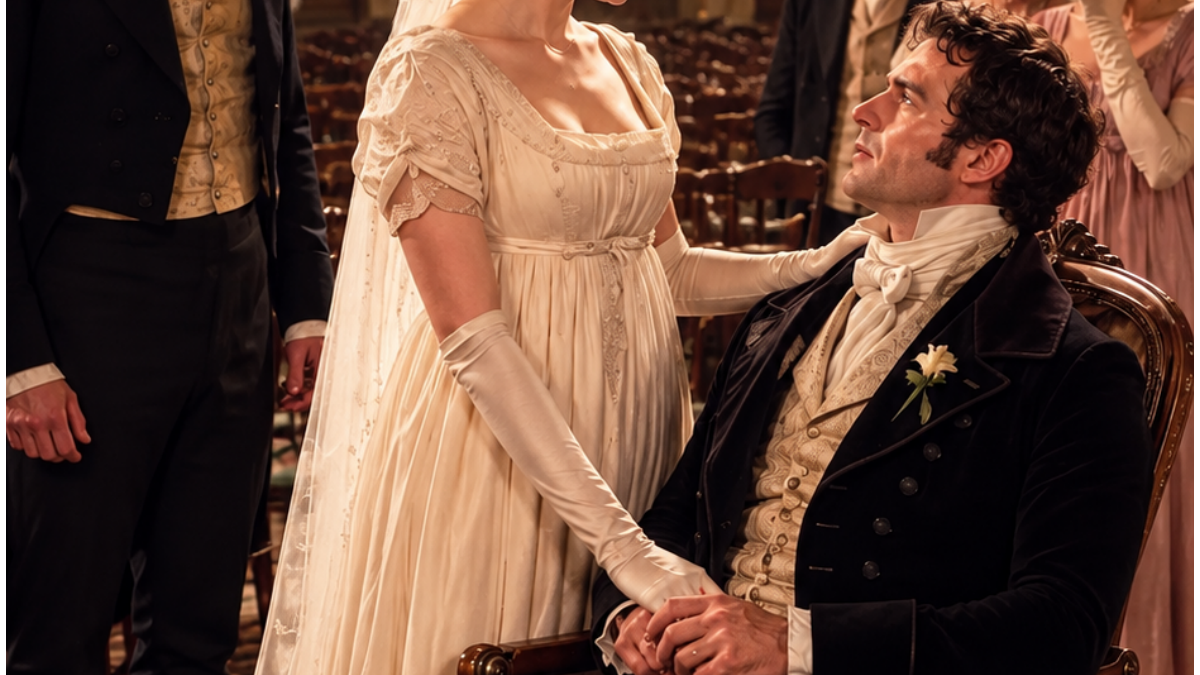
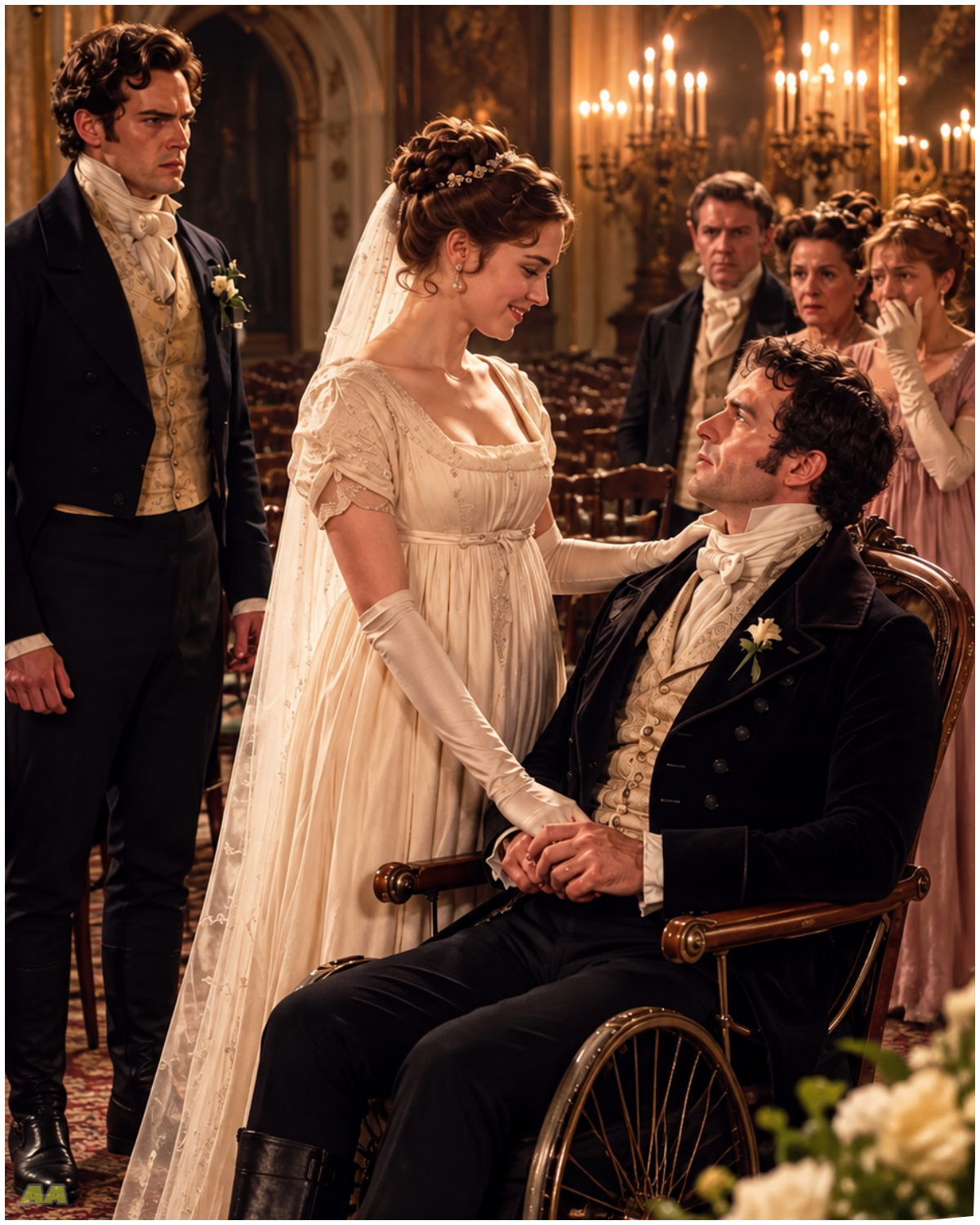
Through the halfopen door, Aubry Duke of Bramblewood sat in a dark coat in his wheeled chair before nearly 30 wedding chairs, most of them empty.
Wilhelmina met his gaze and smiled as if those vacant rows had no vote.
If his grace’s condition has daunted you, you may still withdraw.
Ursula whispered. Wilhelmina drew the marriage articles toward her.
Which pen is mine when I sign for myself?
Ursula’s mouth tightened. The bride first chosen for this match had gone to the country 5 days earlier, and most expected guests had answered by staying away.
The solicitor only needs the schedule completed.
Must we prolong the spectacle?
I will not be entered as an amendment to another woman’s bargain.
Wilhelmina untied the ribbon. Her future lay in those pages a separate use trust her jointer and a roof for her young half-brother.
The wording still followed her sister’s terms.
A wheel rim sounded on the parquet.
There will be no music, Aubry said from the corridor.
There will be no ceremony until she has read the articles.
No one signs for her.
Ursula stiffened. Your grace. We are trying to spare her humiliation.
You are trying to hurry her.
Stop. The order did not ask Wilhelmina to marry him.
It gave her room to refuse him.
She looked through the doorway.
Aubry ignored the empty chairs.
He waited.
“Bring the solicitor,” she said.
When he arrived, Wilhelmina pointed to three places.
My name replaces my sisters throughout.
The separate used trust and jointure remain.
After one London season, I may choose a separate residence without surrendering my jointure.
Ursula inhaled. An exit before the vows, a choice after them.
The solicitor amended the schedule.
Wilhelmina read it, took the fresh pen, and signed her own name.
Minutes later she entered the candle lit saloon in ivory, her veil pushed back.
A dark coated gentleman stood to Aubry’s left.
Ursula and Dela Hollingsworth remained behind the empty rose with a handful of relations.
Wilhelmina walked past every vacant chair without lowering her eyes.
At Aubry’s side she laid one gloved hand on his shoulder and took his hand with the other.
His fingers closed around hers.
Her smile did not falter.
The cleric began beneath the special license.
When the vows were done, Ursula stepped forward.
The late Duchess’s suite will be opened for her grace.
No Aubry said. The word stopped the room.
Her grace is Wilhelmina. No second name will be used for her in this house, and she will choose her own rooMs. Aljenon bring the household keys.
Only then did Wilhelmina glance at the empty rows.
They had not filled, and no one applauded.
Yet the room no longer seemed to be deciding what her marriage meant.
Aljgeran moved to fetch the keys.
Ursula remained beside the last occupied row, silent now, while the candles burned on.
By her third day as Duchess of Bramblewood, Wilhelmina had learned to separate two absences.
The household seemed determined to place around her.
Mored, her elder halfsister, had refused Aubry and gone to the country.
The late Duchess was Aubry’s dead wife.
Her rooms and customs had been preserved since her death.
Wilhelmina had no wish to occupy either woman’s empty place.
She also understood that the house was arranged around roots as surely as rank.
A doorway, a rug edge, the angle of a table.
Small things could decide whether a room welcomed its master or made a ceremony of his entrance.
Aubry did not ask for pity, and he did not tolerate inefficiency, since the carriage accident 8 months earlier had left him unable to use his legs.
The main business of the townhouse had been drawn onto the ground floor with broad passages and clear turning space wherever possible.
Ursula had managed those changes so long that her habits had become tangled with the late Duchess’s custoMs. That morning, Aljinon Pelum met Wilhelmina in the main corridor with a silver tray.
Upon it sat a heavy brass key.
Mrs. Tmaine had the memorial suite prepared.
Your Grace Algenantine said carefully, gesturing toward the double doors at the end of the hall.
The late Duchess’s rooms, they have been kept exactly as they were.
Vhelmina looked at the closed doors.
She understood the weight of grief, but she also saw a trap.
If she moved into those rooms, she would spend her marriage tiptoeing around another woman’s ghost, constantly measured against a memory she could never match.
“No, Willilhelmina,” said quietly.
She pointed to a set of doors on the east side of the ground floor.
What is the blue room?
A secondary suite, your grace.
It has morning light, but it is currently used for storage of estate papers.
Have the papers moved to his grace’s study.
I will take the east room.
Ursula, emerging from the breakfast room, frowned deeply.
Wilhelm mean that is highly irregular.
The Duchess of Bramblewood has always resided in the primary suite.
To reject it is to show a lack of proper respect for the family’s history.
Aubry wheeled himself into the corridor from the study.
He stopped assessing the standoff.
He looked at the silver tray, then at Wilhelmina.
You prefer the East Room, Aubry asked.
His tone was perfectly flat, demanding only a factual answer.
I do, your Grace Wilhelmina replied.
It has morning light and it is empty.
Aubry looked at Ursula. Then alter the household liSt. The Duchess resides in the East Room.
He did not ask her to explain herself.
He did not defend the late Duchess’s rooms or tell Wilhelmina what a new Duchess ought to prefer.
He accepted her answer and made the household act on it.
Wilhelmina lifted the brass key from the tray.
Its cool weight settled into her palm as something simpler and rarer than reassurance.
A door chosen by her.
The first test of this new proximity came the following morning at breakfaSt. The dining room had been arranged by tradition rather than convenience.
Aubry’s place stood at the absolute head of the long table, where a heavy sideboard narrowed the turn so sharply that a footman had to shift it whenever he entered or left.
Wilhelmina’s setting waited at the opposite end in the late Duchess’s former place, an unnecessary stretch of mahogany between them.
Wilhelmina paused in the doorway.
The footman hovered beside the sideboard, ready for the awkward heave.
Aubry approached the head of the table, saw the obstruction, and set both hands on his wheel rims, his mouth tightening before he spoke.
I was about to issue a sharp command to move the entire table, a massive undertaking that would disrupt the morning entirely.
Before he could speak, Wilhelmina stepped forward.
She did not sit at the far end.
Instead, she walked to the side of the table near the head.
“Leave the table,” Wilhelmina said to the footman.
She pointed to a tall decorative flower stand that sat uselessly near the corner.
Move that stand to the hall.
The footman blinked, then quickly obliged.
Wilhelmina pulled a light side chair out from the edge of the table, placing it adjacent to the head position, effectively creating an open corner.
If you approach from the left, “Your grace, the angle is clear.” Aubry stopped his chair.
He looked at the newly cleared space, then at the empty expansive table where she was supposed to sit, and finally at the chair she had pulled out for herself, mere feet from his own.
He wheeled forward, taking the corner route.
The chair slid perfectly into place at the head of the table, without touching the sideboard.
The rigid tension in Aubry’s shoulders eased by a fraction of an inch.
One flower stand, he said dryly, has defeated Bramblewood Protocol.
Protocol does not have to navigate the furniture, Wilhelmina replied, sitting in her chosen chair.
It was a small alteration, but the servants remembered it.
Aubry could change a room with an order.
Wilhelmina usually changed one thing after looking long enough to see which thing mattered.
>> Keep the rule. Remove the [music] part that defeats it.
By the second week, a quiet rhythm had begun beneath the formality of the house.
Vilhelmina’s younger half-brother, Henry, a shy boy of seven, had come from the country, and settled into the groundfloor nursery where Aubry could visit without a flight of stairs, turning every call into an expedition.
Aubry, applying the same love of order he brought to estate papers, had drafted a strict schedule for Henry’s lessons, and ordered a brass bell rung at the beginning and end of reading hours.
The plan was exact. Henry, intimidated by the great house, and its stern master had almost stopped reading altogether.
Vilhelmina sat in the nursery one afternoon, watching Henry stare blankly at a primer.
Every few seconds he would reach up and fold the top corner of the page, pressing the crease flat, then unfold it, his eyes darting toward the clock.
Aubry entered the room, his chair gliding smoothly over the rug.
He surveyed the lack of progress.
The schedule dictates reading should be completed by 3.
It is past 3. Your schedule is very handsome on paper, Wilhelmina said without looking up from her embroidery.
It is doing very badly in the nursery.
Aubry frowned. Regular hours give him something certain.
Then keep the hours and lose the bell.
Wilhelmina set down her needle work crossed to the desk and placed the brass bell inside a drawer.
He is waiting for the noise instead of reading the words.
Aubry watched Henry. With the bell gone, the child’s shoulders dropped.
He looked at the book, turned the page without folding the corner, and began to read softly.
Aubry watched until Henry turned another page.
His fingers still braced on the wheel.
Rims eased their hold. A slow breath left him.
Keep the rule. Remove the part that defeats it.
A corner of his mouth shifted.
I can live with that.
Vilhelmina bent again over her embroidery, but the exchange stayed with her.
Aubry had not treated her correction as defiance.
He had looked at Henry, tested the result, and changed his rule.
Respect was proving less dramatic than courtship, and far more difficult for her to dismiss.
In the third week, the same difference between them surfaced in the winter garden.
The conservatory beyond the breakfast room was crowded with ferns and heavy planters arranged in the late Duchess’s day, beautiful in places and inconvenient in others.
One afternoon, Aubry attempted to navigate a path to the outer doors, but a massive stone jardini blocked the turning angle.
He gripped the wheels of his chair, a flash of pure frustrated command crossing his face as he prepared to order.
The entire conservatory cleared out to the stables.
Wilhelmina, who had been reading on a bench, set the book aside.
She did not reach for his chair or call three servants.
She studied the planter, the wheel marks in the carpet, and the strip of light against the east glass.
It is a terrible place for a fern anyway, she observed.
She called a passing gardener.
Move this single stand to the east glass.
Leave the reSt. The gardener shifted the heavy pot.
The path opened instantly. Aubry wheeled through the gap, stopping beside her.
“Could the household survive? I wonder,” Aubry said, his voice, dropping into a register of dry amusement.
“If we only altered the things that actually required altering rather than burning the entire garden to the ground.
It would require a great deal of restraint on your part.” “Your grace,” Wilhelmina replied, a small smile, touching the corner of her mouth.
His gaze dropped briefly to her lips before returning to her eyes.
The movement was small enough to deny.
Wilhelmina noticed it anyway. Heat touched her face.
She had expected a duke to remain a duke after an accident.
She had not expected to admire how readily this one could alter an order without making the person who corrected him pay for it.
A week later, at a small household supper, that ease met a more ordinary teSt. Algenon, distracted by a state correspondence, absent-mindedly placed a card reading, the Duchess of Bramblewood, at the far ceremonial end of the table, the very seat Wilhelmina had abandoned on her first morning.
Aubry wheeled into the room, saw the card, and drew breath to issue an order.
Vilhelmina simply walked to the end of the table, picked up the card, walked back to her chosen seat beside Aubry, and rotated the card 90° so it faced outward.
She sat down and shook out her napkin.
Aubry closed his mouth. He looked at the card, then at Algenon’s alarmed face, and finally at Wilhelmina, who was serenely buttering a piece of bread.
A low, genuine laugh escaped Aubry’s cheSt. A sound so rare it made Aljouon blink in shock.
Vilhelmina smiled a true warm expression that made the formal dining room feel for a moment like a home.
At the end [music] of supper, Ursula entered with a leatherbound schedule.
Your grace, she said with grave formality.
The anniversary of the late Duchess’s passing is next week.
The memorial schedule requires your signature, so the invitations and seating may be arranged according to tradition.
Aubry took the schedule. Wilhelmina watched him scan the heading and the first few lines.
He asked none of the questions he had required before her own signature.
Duty apparently looked familiar enough not to be examined.
He signed and handed the book back.
Wilhelmina watched the transaction. Something in it troubled her the speed perhaps, or the fact that custom had been allowed to answer a question he had not examined.
The next morning, she learned why.
She walked past the late Duchess’s memorial room and saw the staff removing a small vase of white roses she had placed on a hall table nearby.
“What are you doing?” Wilhelmina asked.
The maid curtsied nervously. “Mrs. Tmaine’s orders.
Your grace. Only the former duchess’s blood family is permitted to arrange the memorial displays.
The schedule dictates it.” Wilhelmina walked to Ursula’s makeshift desk in the library and picked up the copied schedule.
She read the seating arrangement for the memorial service.
The blood relatives of the late Duchess were seated in the front rows.
Aubry was at the head.
Vilhelmina, the current Duchess of Bramblewood, was listed in the fifth row behind the cousins.
She had been categorized as a gueSt. For weeks his orders had made room for her.
This signature did the opposite.
It placed his present wife outside the word family.
She found him in his study over ledgers with Aljournon.
Aubry looked up as she entered.
Whatever he saw in her face made his hand leave the page.
“Dismiss him,” Wilhelmina said. Aljon vanished instantly.
Wilhelmina laid the copied schedule flat on Aubry’s desk and put one finger on the seating chart.
Her hand was perfectly steady.
You signed this, she said.
Aubry looked at it. It is the traditional arrangement.
It honors her family’s grief.
It is a matter of duty, Wilhelmina, not a slight to you.
It is a slight, willilhelmina, said.
Her finger remained on the fifth row.
You used your authority to place me outside my own household.
Your grace, I married you.
I did not agree to be a visitor in your marriage.
Aubry went still. For one breath, Wilhelmina thought he might insist that he had meant no insult.
Instead, his gaze dropped to the fifth row.
He read her name, looked at the place beside his own, and then read the fifth row again.
His fingers closed over the edge of the schedule.
>> The memorial order is withdrawn.
>> He reached out [music] and pulled the schedule toward him.
He reached for the brass bell on his desk and rang it once sharply.
When Algenon appeared, panting slightly, Aubry did not hesitate.
“The memorial order is withdrawn,” Aubry commanded.
“R Ursula, who had hurried in behind Algenon, gasped.” “Aubry, you cannot.
The invitations. The order was mine, and it is withdrawn.” Aubry said.
Her Grace’s name card will be placed beside mine.
She will decide the arrangement of the memorial room and what may be placed there, and you will not put my wife behind a cousin again.
Ursula went pale. The family will view this as an insult to her memory.
They will blame the the replacement.
Then let them blame me, Aubry said.
He turned his chair toward Willilhelmina.
He did not offer a graceful apology or ask her to make the mistake easier for him.
More importantly, he did not leave the old order standing while he explained why he had meant no harm.
Ursula turned on her heel and swept from the room, promising to write to the senior relations before evening.
The threat was not empty.
Several of those relations had supported Aubry through the first months after his accident, and considered Ursula’s management indispensable.
When the door clicked shut, Wilhelmina looked at him.
What he had done still hurt, but he had withdrawn his own order in front of the people who obeyed it, and accepted the family displeasure that would follow.
He asked for no reassurance.
That mattered more than an elegant apology.
She picked up the schedule, took his pen, crossed out the fifth row, and wrote her name beside his.
The next day, Wilhelmina used the authority he had returned to her.
She left the late Duchess’s large portrait exactly where it hung.
The woman’s personal prayer book went to her relations, who would value it more than a locked cabinet could.
The white winter flowers remained, but the heavy velvet draped chair that had sat empty at the head of the room for a year was moved against the wall where it could be remembered without ruling the living.
Aubry watched from the doorway while she directed the footmen.
He offered no private correction to Aljenon, no quieter order after hers.
When the last chair was set down, Wilhelmina understood that his silence was deliberate.
He was letting her decision remain whole.
When the staff had gone, Wilhelmina turned to him.
She had wanted the blue room because its door belonged to her.
For several weeks, Aubry had respected that door so carefully that she had begun to feel the distance on the other side of it.
I have ordered the kitchens to change the schedule, Wilhelmina said quietly.
Aubry braced himself. To what?
We are not dining in the formal room tonight.
Or the study. She looked at him, her quiet eyes holding his gaze steadily.
Dinner is in the east blue room at 8.
The words were plain. That was why Wilhelmina trusted them.
She was not asking him to guess whether he was wanted in her room.
She was telling him when to come.
Aubry did not ask for clarification.
He did not make a joke to deflect the intimacy of the moment.
He simply inclined his head.
At 8 that evening, a footman set a small table [music] by the fireplace in the blue room.
It was tight personal space.
When the servant brought a wide silver serving tray, he awkwardly bumped the doorframe, struggling to navigate the narrow clearance around Aubry’s chair.
Aubry began to frown, ready to order a smaller tray.
But Wilhelmina reached out smoothly, sliding a large porcelain vase to the center of the table to make room.
Their eyes met over the vase.
Wilhelmina laughed firSt. Aubry’s mouth curved into a real smile, a rare expression that altered the stern plains of his face so completely that for a foolish instant she forgot the ridiculous tray, and simply looked at him.
Dinner remained quiet, but not formal.
They used names instead of titles.
Aubry complained with grave exactness about a tenant who insisted a gate should open against its own hinge.
Vilhelmina told him Henry had finished two pages without folding a corner.
When the last dish was taken away, his shoulders had lost their ceremonial set.
She liked knowing she had invited him here, and that he had come without treating the invitation as a right.
The following afternoon, Ursula returned with three senior Bramblewood relatives, two uncles, and a formidable great aunt, who entered the drawing room with the solemn assurance of people who believed they had come to restore order.
Wilhelmina sat near the window.
Aubry wheeled into the room, his jaw tight, his hands gripping the rims of his chair.
Before speaking, the great aunt’s gaze dropped to the low wheels and returned to Aubry’s face.
It was not concern. It was appraisal the sort that made the chair itself an argument for putting other hands on his household.
We have come regarding the chaotic state of this household.
The great aunt began without preamble.
Ursula informs that the memorial traditions have been abandoned to appease the temporary arrangement.
Temporary. Willil Helmina let the word settle in the room before she answered.
She is not a temporary arrangement.
Aubry’s hand closed over the arm of his chair.
His voice sharpened, and Wilhelmina knew the next sentence could empty the drawing room if she let it.
Every face had turned toward him.
If he expelled them before Wilhelmina answered, they would leave believing his rank had settled what she could not.
They would call her protected, perhaps indulged, and never once admit that she had spoken for herself.
>> I will not debate whether I am a guest in my own drawing room.
>> She stood up. She walked to the center of the room.
She did not argue the insult.
I will not debate whether I am a guest in my own drawing room, Wilhelmina said.
She let the insult pass and fixed on the claim beneath it.
If you believe the marriage settlements or my position give you authority here, present that claim properly.
We will hold a private family council tomorrow at 10:00 in the library.
Bring whatever papers you believe support you.” She turned to Aubry.
She gave him a look that demanded he hold his fire.
“Your grace, we will hear them tomorrow.” His fingers remained tight on the chair arm for a moment, then loosened one by one.
He said nothing until Wilhelmina had finished.
You will address the Duchess by her title while you remain under this roof,” Aubry said.
He added nothing to the decision she had just made.
“We will see you at 10:00, after the relations withdrew the house, settled by degrees, as though every closed door were holding the argument in place until morning.” That night in the study, Aubry sat beside the fire with the blue ribboned articles between them.
“I could end Ursula’s authority in this house before breakfast,” he said.
You could will Helmina said, “But if you dismiss them before I answer, they will say your anger spoke because I had no answer of my own.
Tomorrow, let me finish before you command anything.” Aubry held her gaze for a long moment.
Then he nodded once. “Your ruling first, mine after.” She reached into her pocket and placed the heavy parchment of the marriage articles on his desk.
It was still bound in the blue silk ribbon.
Keep this tonight. Bring it tomorrow.
The trust in that small act frightened her more than she expected.
The articles contained the very clause that allowed her to leave.
Yet when Aubry touched the knot, Wilhelmina remembered his voice outside the dressing room on their wedding morning.
No ceremony until she had read for herself.
He had waited then. She was trusting him to wait again.
The next morning, the library chairs had been drawn into two facing groups rather than a social circle.
Ursula and the senior relations occupied one side.
Wilhelmina stood near the fireplace.
Aubry waited by the desk, the blue ribboned articles within reach, but unopened.
The original match with Ma Dunore established expectations for this family.
Ursula began laying a supplemental schedule on the table.
Since his grace cannot inspect every part of the household as he once did, senior family guidance is more necessary, not less, we demand restoration of the former household authorities, and the clause allowing Wilhelmina a separate residence after one season plainly shows that even she expected this arrangement might be temporary.
Wilhelmina stepped forward. She did not raise her voice.
She simply untied the blue ribbon on her articles and laid the heavy parchment flat over Ursula’s schedule.
“Show me where Maud’s name appears on this document,” Wilhelmina said.
Ursula frowned. “It is implied it is erased.” Wilhelmina corrected sharply.
She pointed to the signatures.
Morde Dunore had the right to say no to this marriage.
She used it. I had the right to say yes.
I used it. They are two separate choices.
They are not interchangeable. She looked around the room, her gaze resting on each relative.
You look at his grace and see a vacancy in his power because he sits in a chair.
You look at me and sees a vacancy in my identity because I am not my sister.
But there are no vacancies here.
Aubrey is the Duke of Bramblewood in his entirety and I am the Duchess.
She placed her hand flat on the residence clause.
This clause grants me the right to leave [music] this house with my jointure at the end of the season.
Algenan, standing nervously by the door, cleared his throat.
Perhaps your grace to settle this family’s mind that claws should be struck out.
Now Wilhelmina did not answer at once.
Her fingertip came to rest beside the line she had insisted upon before the wedding.
At the end of the season, it could still open another door, a separate house, her jointure intact, her brother secure, no bramblewood relation, able to assign her a place at a table, or call her temporary under her own roof.
For one suspended moment she felt the full weight of that road, because it was real.
Then she looked at Aubrey.
He remained silent. His hands rested open on the arms of his chair.
He did not reach for the pen.
No willil. Helmina said, “The clause remains.” Ursula smiled triumphantly.
“You see, she intends to abandon him just as Morde did.” “The clause remains.” Wilhelmina repeated her voice, cutting through the room, because if I surrender my right to leave, my staying becomes an obligation.
“I am keeping my exit, and I am choosing not to use it.” She looked directly at Aubry.
I am staying because I choose to be exactly where I am.
No one spoke. Vilhelmina stepped back from the table.
That is my ruling. Only when Wilhelmina stepped back from the table did Aubry move.
He wheeled forward and stopped beside the desk.
You have heard the Duchess of Bramblewood, Aubry said.
His voice was low, but no one mistook it for uncertainty.
He looked at Ursula. Place your duplicate household keys on the desk.
Ursula recoiled. Aubry. The keys.
He snapped. Trembling. Ursula produced the heavy ring of brass keys and let them fall.
Brass struck Mahogany with a hard bright clatter.
In the silence afterward, the keys remained on Aubry’s desk between Ursula and Wilhelmina.
Aubry turned his gaze to the rest of the relatives.
The household takes its instructions on rooms seating and access solely from Wilhelmina.
Mrs. Tmaine’s authority over the staff is terminated.
And if any communication from this family describes my wife as temporary acting or a substitute, you will find your access to the Bramblewood estate permanently severed.
You are dismissed. The great aunt rose first, offended but composed.
One uncle followed with a rigid bow.
Ursula followed the others, warning that several relations would cease calling if Aubry persisted in overturning family custom.
When the heavy doors closed, the library seemed suddenly larger.
Vilhelmina could still remember the rows of empty wedding chairs, but the silence now felt different.
No one had chosen for her in this room.
>> What I needed was a man who would not put an answer in my mouth.
>> You waited. Aubry broke the silence.
“You kept the exit clause.” “I did,” she said, walking toward him, his voice roughened.
“They will still say you married me from duty, that you smiled at a room of empty chairs because you were determined to play the part.” Wilhelmina stopped beside his chair.
She reached down, picked up the blue ribbon from the desk, and gently brushed it against his hand before laying it down.
Then, just as she had on their wedding day, she placed her hand over his “My smile on our wedding day was not for the empty chairs, Aubry,” she said quietly.
“It was for you, and today is for you, too.” She covered his hand with hers.
“What I needed was a man who would not put an answer in my mouth.
You waited.” Aubry turned his hand beneath hers and laced their fingers together.
Then he lifted her gloved hand and pressed a brief kiss across her knuckles.
Warmth rose into Wilhelmina’s face.
The gesture asked for nothing more, and she stayed beside him because she wanted to.
One season later, the London season ended in cooler evenings and fewer carriages before the Bramblewood door.
The date named in Wilhelmina’s residence clause arrived and passed without ceremony.
No trunk was packed. No carriage waited to take her elsewhere.
In the East Blue room, the household had settled into habits that belonged to the living.
The room kept its morning light, its unlocked desk, and its chosen furniture.
The late Duchess’s portrait remained in the memorial room, but it no longer governed every chair around it.
Bramblewood relations called by appointment.
Henry now read without waiting for a bell that no longer rang.
Aubry still worked too late when leases displeased him.
Wilhelmina still moved one object when he was inclined to move six.
Aljouan had arranged a small family supper on a round table near the hearth.
Wilhelmina stood by the table arranging the silver.
She noticed that Aljenon, anticipating that Aubry would dine late in his study while reviewing lease renewals, had set only one place.
The single place stirred a brief memory of the wedding rose, but it carried none of the old shame.
The door opened, and Aubry wheeled into the room.
He stopped seeing the single place setting.
He looked tired, the ledgers clearly having tested his patience.
Algenan assumed you were dining alone, Aubry said, preparing to back out of the doorway so as not to interrupt her peace.
I will tell him not to rearrange the room.
He does not need to rearrange anything, Wilhelmina said.
She crossed to the light upholstered armchair near the window, drew it to her place at the round table, and moved the light dining chair Algenan had set there.
The change left a clear space beside her, wide enough for Aubry’s wheeled chair.
She did not call a footman.
She simply made the place herself.
She rested one hand on the chair back.
Bring your chair here. Aubry wheeled forward and turned into the space beside her.
Nothing touched the table or the hearth screen.
He looked at the armchair she had chosen for herself, then up at her.
“You have violated my schedule,” he said, the dry humor, returning to his voice.
“I was supposed to be reading leases.” The household survived my alterations before Wilhelmina replied, sitting in the armchair.
It will survive tonight. After supper, as the fire burned down to glowing embers, Wilhelmina walked to her writing desk.
She opened the top drawer.
Inside, resting on the velvet lining, was the brass key to the blue room.
Wrapped securely around it, was the blue silk ribbon from her marriage articles.
She traced the ribbon once with her finger.
The silk yielded softly beneath her touch.
The brass key beneath it stayed cool and solid.
The key remained hers. So did the right, secured by the articles.
Nothing in the life she had chosen required her to pretend the door out had never existed.
She shut the drawer without locking it.
Aubry had continued to knock whenever the blue room door was closed.
Tonight, Vilhelmina left it open.
Aubry sat by the fire and watched her return.
He did not ask what the open door meant.
He only waited until she crossed the room toward him.
“Does the chair remain where you placed it?” Aubry asked quietly.
Vilhelmina walked back to the table and rested her hand lightly on his shoulder.
She looked down at him, her smile steady and warm.
“Yes,” she said.
“The chair stays exactly where I chose to put it.”
The end.








