Her Mafia Boyfriend Betrayed Her—Then She Married His Father and Became the Woman He Had to Call Stepmother
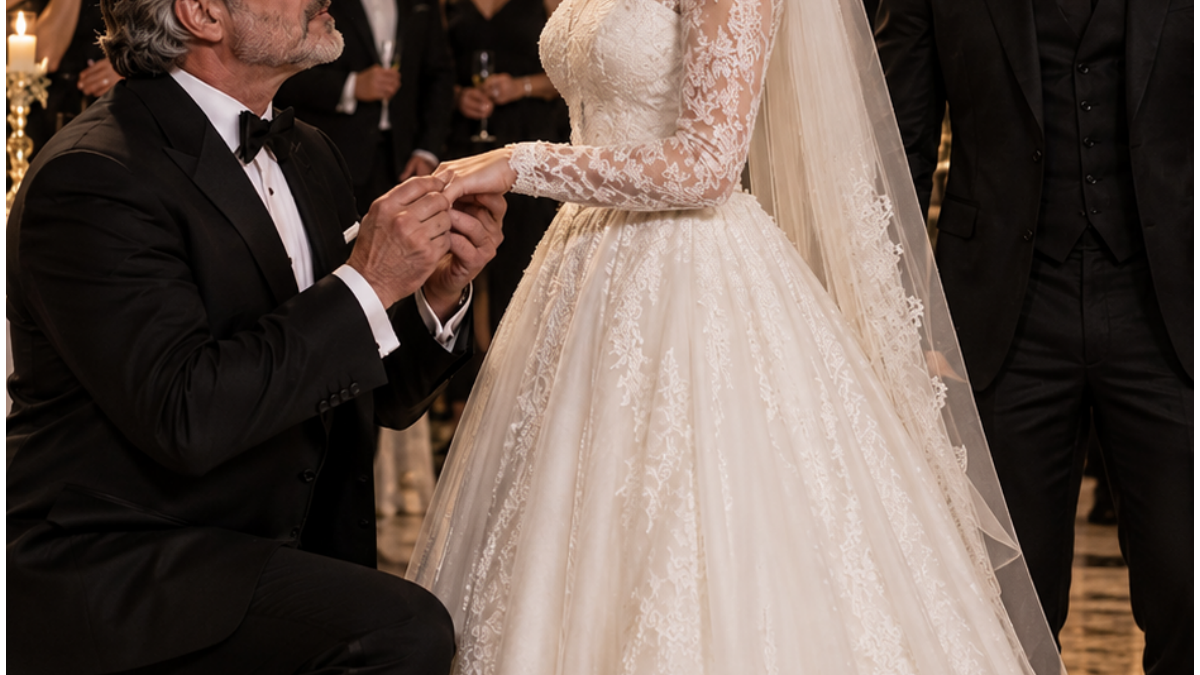
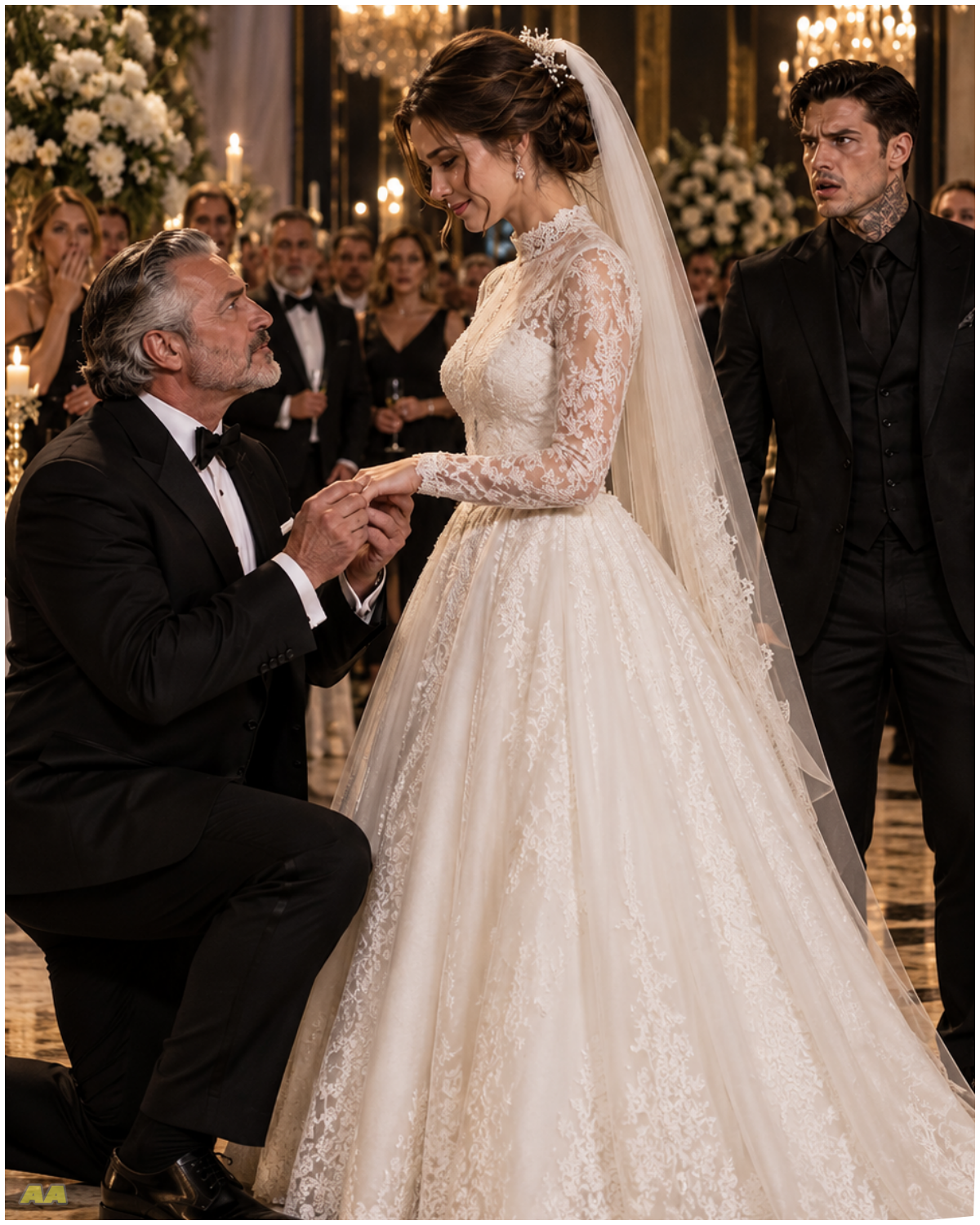
Luca Moretti stood in the center of his own engagement party champagne in hand, Bianca Caruso on his arm, and 40 of the most powerful people in the city, watching him take his rightful place as the future of the Moretti organization.
He had planned this night for months, every detail calculated, every guest chosen.
He had even, with the particular cruelty of a man who believes his charm excuses everything, personally ensured Clare Bennett would never receive an invitation.
Then his father walked through the door and Clare was on his arm.
Not as a guest, not as a former employee who had wandered in uninvited.
Victoria Moretti, 62 years old, the most feared man in any room he entered, rested one steady hand at the small of Clare’s back, and introduced her to the silent, stunned gathering with two words that turned Luca’s careful future to Ash, his wife.
Luca’s champagne glass stopped halfway to his mouth.
Clare’s eyes found his across the room.
She didn’t smile. She didn’t flinch.
She simply stood beside the man Luca had spent his entire life trying to toss us, wearing a wedding ring that should have been impossible and waited for him to process what 7 years of her loyalty had finally become.
6 months before that engagement party, Clare Bennett was running late.
Not dramatically late. Not the kind of late that announces itself and demands sympathy.
She was 11 minutes late to a meeting she had organized in a building she had quietly helped keep out of the tabloids twice in the last year because the cross town traffic had been worse than her phone predicted and she had refused to leave the apartment until she finished rereading the preliminary assessment she’d spent Sunday preparing.
That was Clare’s particular way of being.
She did not cut corners on work even when the work was complicated.
Even when the client was complicated, even when the client was Luca Moretti, she found a parking spot two blocks from the Moretti Group’s administrative offices, a legitimate suite of rooms above a restaurant that Luca used for the kind of meetings that needed to look ordinary, and walked quickly without quite running, her folder tucked under one arm, and her coffee already cold in her other hand.
At 34, Clare had the composed efficiency of someone who had spent years making herself necessary.
She was not flashy. Her suits were good, but not expensive enough to make anyone nervous.
Her hair was dark and usually pulled back when she was working.
She laughed easily when she trusted someone and had learned to keep that laugh carefully controlled in rooms where trust was a liability.
7 years with Luca had taught her that.
She had not known when they first met that she was falling in love with the heir to a criminal organization.
She had suspected that Luca’s family money came from sources that didn’t bear examination.
She had eventually understood it, but Luca had always maintained a careful wall between Clare and the parts of his life that crossed legal lines.
And Clare had built her career on the legitimate side of that wall crisis management, public relations consulting, the invisible machinery of keeping a businessman’s reputation intact when something went wrong.
What she hadn’t understood, not for years, and maybe not until the end, was that Luca’s wall wasn’t protection.
It was management. She pushed into the building and took the stairs, nodded at the assistant, who waved her through, and turned the handle to the meeting room without knocking, the way she always did, the way Luca expected her to, and stopped.
Bianca Caruso was sitting at the conference table.
Clare had seen Bianca before.
Anyone who paid attention to the social circuits that connected old money families in the city had seen Bianca Caruso, 31 years old, daughter of Salvatore Caruso, photographed at Charity Gallas with the practiced ease of someone raised to be seen.
She was beautiful in the deliberate way of women who have been trained since childhood to think of their appearance as a professional asset.
She was sitting in the chair Clare usually sat in.
Luca was standing. He turned when Clare came in, and something flickered across his face, not guilt exactly, but the particular expression of a man who had rehearsed this moment, and was slightly annoyed that the set dressing had shifted.
He was 36 and still wore his looks with the casual confidence of someone who had never been told no by anyone he actually wanted something from.
“Close the door,” he said.
Clare closed the door. She set her folder on the credenza near the window because the table suddenly felt like the wrong geography and her instincts were already telling her that taking a seat would be a mistake.
I should have called ahead, Luca said.
I know that. You should have, Clare agreed.
Her voice was level. She had not yet figured out what she was looking at, only that it was something she was going to need her full composure to handle.
Luca glanced at Bianca, not for permission, but with the brief acknowledgement of someone confirming that a rehearsed sequence was beginning.
And then he looked back at Clare.
Bianca and I are engaged, he said.
The announcement goes out Thursday.
The room did not spin.
Clare’s vision did not blur.
She had a sudden, almost clinical awareness of the texture of the carpet, the faint sound of the ventilation system, the particular quality of afternoon light through the window.
Her body was doing the thing it did in crisis.
Cataloging sensory information while her mind caught up with what she’d been told.
She looked at Bianca, who had the grace to look slightly uncomfortable and the discipline not to show it completely.
She looked at Luca how long?
She asked. He knew what she meant.
It wasn’t he started. How long, Luca?
Pause. Not a long one.
7 months. Something settled in Clare’s cheSt. Not anger.
Not yet. Something quieter and more permanent, like a door closing at the far end of a hall.
7 months while she had been managing his restaurant’s health code crisis in March.
While she had been talking him out of a lawsuit in April that would have been catastrophic, while she’d been sitting across dinner tables from him in May and June and July, listening to him describes his father’s failing health and the pressure of succession and how she was the one person he could be honest with while she had been being managed.
The Carusos control the northeastern relationships we need.
Luca said he had switched to his explanatory voice, the tone he used in boardrooms when he was walking stakeholders through an uncomfortable necessity.
This consolidates two families that have been parallel for 20 years.
It creates stability. It’s the right move.
Clare watched him deliver this.
She thought about all the times she had watched him explain difficult truths to difficult people and thought, “He’s good at this.” She had admired that.
She had mistaken it for honesty.
Do you love her? Clare asked.
Luca’s pause was a fraction too long.
That’s not It’s a yes or no question.
Another pause. Bianca looked out the window.
It’s complicated, Luca said. But we have something.
Yes, there it was. The honest answer he’d been hoping to avoid by surrounding it with justification.
Something over the past 7 months had become something.
And Clare had been kept around because she was useful.
And perhaps because Luca was the kind of man who genuinely did not understand that keeping someone useful is not the same as keeping someone.
You always told me family came firSt. Clare said, “You always knew that about me.
I know.” She said, “I’m just realizing what family meant in that sentence.” She crossed to the credenza, picked up her folder, and tucked it back under her arm.
Then she reached into her bag for the apartment key, the one Luca had given her 3 years ago with a ceremony that at the time had felt like a milestone, and set it on the table between them.
Not in front of Bianca, not dropped dramatically, just placed like a receipt being returned.
“You’ll need someone for the announcement roll out,” she said.
“You should use the Harrove firm.
They’ve handled family consolidation narratives before, and they won’t ask questions you don’t want to answer.” Lucas stared at the key.
“Claire, I’ll send you a referral contact by end of week,” she said.
“Good luck Thursday.” She left without closing the door behind her.
The first two weeks were the ones she’d been braced for the difficult weeks, the ones where she would lie awake reconstructing conversations, looking for the moment she should have recognized.
She found plenty of them.
That was the particular cruelty of hindsight with Luca.
Once she began looking, the evidence was everywhere.
The way he had always described their relationship to other people as complicated.
The way he had introduced her at family events as his associate even after two years.
The way he sometimes looked at her across a room with genuine warmth.
And she had learned to treasure that warmth because it arrived unpredictably.
Which meant she had trained herself to be grateful for something that should have been ordinary.
She had she understood now spent seven years auditioning for a role that had already been caSt. She took the grief when it came and it came and she did not apologize for it.
She had been in something real, even if it had not been reciprocal in the way she’d believed.
You could not spend 7 years building your interior life around another person and feel nothing when that architecture collapsed.
Feeling nothing would not have been strength.
It would have been delusion.
But she also did not let the grief run the apartment.
She gave it mornings, allowed it coffee in the first hour before work.
Then she put it away and went about the business of reconstructing a professional life that she had she now acknowledged allowed to become dangerously interwoven with Lucas.
The first problem was the client overlap.
She had three active clients whose introductions had come through Moretti connections.
Nothing criminal. She had always been careful about that.
But the business had come because Luca had mentioned her name in rooms where her name would be useful to him.
When she ended the relationship, she contacted each client directly, explained that her professional focus was shifting, and offered to transition them to other consultants.
Two of them asked whether they could stay with her regardless.
She said yes, and recognized that as the first concrete evidence of something she had almost forgotten, she was genuinely good at her work, and her reputation had not entirely lived in Luca’s shadow.
She moved apartments, not running.
She had lived in the old place 2 years before Luca and felt no particular need to surrender it to the memory.
But she had wanted a different morning light, and the building had been going condo, and it was simply time.
The new apartment was small, smaller, and had better windows and a kitchen where she could actually cook without feeling like she was doing someone else’s impression of a person who cooked.
She built. That was what she did in the first months.
She did not reach out to mutual friends to position her version of events.
She did not accept the lunch invitation from one of Luca’s cousins, who called, probably as reconnaissance, probably at someone’s requeSt. She did not, despite one genuinely terrible Sunday night, compose the email she had partially drafted about everything she knew, about everything that Luca had always needed her discretion to protect.
She deleted the draft, not because of Luca, because of herself.
She was not going to become the thing that had been done to her.
What she didn’t anticipate was the absence starting to cost him.
She wasn’t watching for it.
She had deliberately not installed herself in any information stream that would deliver regular updates on Luca Moretti’s professional difficulties.
And she had specifically not told herself that she was waiting to hear about professional difficulties.
But her industry was not large and her work was specialized and word traveled.
A restaurant chain in the Moretti portfolio had a staff scheduling dispute in October that became a wage theft complaint and then a news item because nobody caught it at the quiet stage.
Clare had caught things at the quiet stage for 3 years.
The person Luca brought in to replace her was competent apparently, but operated reactively rather than prophylactically.
By the time they were involved, the news item existed.
In November, Luca lost a supplier negotiation that turned adversarial.
The supplier’s representative later mentioned at an industry event not unkindly just as a matter of professional observation that Luca Moretti had seemed unprepared for the counterarguments that had been she gathered and anticipated in prior years.
They had been anticipated because Clare had anticipated them.
She had not sabotaged him.
She had not whispered his weaknesses into the right ears or found creative ways to ensure his failures.
She had simply stopped doing the invisible work that made his successes possible, and the absence of invisible work had become visibly expensive.
Clare found this out slowly and did not allow herself to feel satisfaction about it.
She was not being the bigger person, she had contempt for that particular piece of motivational language, the way it congratulated people for performing virtue rather than achieving it.
She simply understood, having worked in crisis management long enough to develop something close to a philosophy about it, that deliberate sabotage required maintaining an emotional investment in someone’s failure.
She couldn’t afford that investment anymore.
She was too busy building.
By December, she had six independent clients.
A law firm had referred her to a real estate developer with a legitimately complicated zoning dispute and a tendency to say inflammatory things to journalists.
She handled it in 3 weeks and received a referral that led to two more.
Her income for the year was lower than when she’d been working adjacently to Luca’s operations, but it was entirely her own.
And that distinction, she discovered, was worth considerably more to her than she had expected.
She started running in the mornings, which she had always meant to do and never had.
She called her college roommate, who lived across the country, and had a 3-hour phone call for the first time in years.
She began attending a community planning meeting in her new neighborhood, not because she had any particular agenda, but because she had spent a decade in rooms where every person present had an agenda, and she was tired of it.
She was rebuilding herself from scratch, and doing it in a way that Luca would not have recognized smaller, quieter, more genuinely hers, and most days she could look at that construction without resentment.
Some nights she couldn’t. Some nights she allowed herself to sit in the dark with the exact quality of her own particular grief and just feel it.
The years, the specific texture of believing she had been chosen when she had been used.
The way she had trained herself over 7 years to read Luca’s moods and adjust accordingly, and how deeply that training had run, and how long it was going to take to stop doing it for everyone.
She did not share these nights with anyone.
She had learned was still learning that privacy was not the same as loneliness.
The Moretti building she walked past in January was not where Victoriao Moretti lived.
It was a commercial property, a block of mixeduse real estate that included a struggling restaurant on the ground floor and several office tenants above and Clare passed it because one of those tenants had hired her to advise on what they described as an increasingly hostile property management situation.
Her client was a small accounting firm, three partners, 12 employees, a lease that had 2 years remaining.
They had received three notices in as many months about building code compliance issues that they were legally required to address repairs to the HVAC, lighting upgrades in the common areas, accessibility modifications, and the notices all cited standards that seemed to have shifted since the prior lease cycle.
It was on the surface a pressure campaign.
The kind of thing that happened when a building owner wanted tenants out before a lease expired and couldn’t use the lease directly to accomplish it.
Clare investigated the building ownership and found a corporate structure that took four layers to resolve, but eventually produced the Moretti group as the underlying owner.
She sat with that information for 2 days.
Then she called her client and explained that the property had Moretti connections and asked whether they wanted to continue with her given that she had a prior professional relationship with a Moretti family member.
They said yes. They specifically said that prior professional relationship probably meant she understood how to navigate it.
She was not sure that was true, but she agreed to try.
She requested a meeting with the building’s property management.
The property manager, a nervous man who clearly did not have authority for the conversation he was being asked to have, said he would need to escalate.
The escalation led to a brief and professionally uncomfortable phone call with someone named Marco Duca, who identified himself as an adviser to the building’s ownership and was polite in the way that careful men are polite surface, courtesy over bedrock weariness.
Marco told her the compliance notices were routine and that her clients were welcome to submit the required documentation.
Clare told him the compliance standards in the notices differed from those in the original lease.
A pause. I’ll look into it.
Marco said 3 days later she received a different phone call.
The voice was unhurried. Not warm exactly, but not the performance of authority that she had learned to recognize in men who needed people to feel their power.
Just level. Considered. Miss Bennett, the voice said.
My name is Victoria Moretti.
I understand there’s a discrepancy in the compliance notices your client received.
Clare set up slightly. There is, she said.
The standards cited in the notices are from a different regulatory period than the original lease terMs. Your client is being asked to meet a higher standard than they contractually agreed to.
That shouldn’t be happening, Vtorio said.
A short pause. I instructed property management to begin transitioning several holdings toward better operating standards, he continued.
It appears someone interpreted that instruction as an opportunity to pressure tenants ahead of lease renewals.
That was not my instruction.
Clare had handled enough of these conversations to know what they usually sounded like.
Usually, someone in Vtorio’s position called to explain why the pressure campaign was actually reasonable and to find out how much the other party wanted to go away.
This was not that conversation.
I’ll have the notices withdrawn and reissued with the correct standards.
Vtorio said, “Your clients won’t be penalized for the delay,” she said.
“Thank you.” Then, before she could think better of it, can I ask why the correct transition process wasn’t flagged before the notices went out.
“Another pause longer.” “Because the person who approved the notices assumed I wouldn’t check,” Vtorio said.
He said it plainly without drama.
Like a man who had lived long enough with the particular problem of people misinterpreting his intentions that it no longer surprised him.
Only continued to require management.
I’ll address that, he said.
I appreciate it, Clare said.
And for what it’s worth, your property manager seemed genuinely uncomfortable with the situation.
He may not have had much choice about approving the notices.
I know, Vtorio said. I’m not interested in holding the wrong person accountable.
Clare spent a moment after she hung up trying to put her finger on what had been strange about that conversation.
It took her several minutes.
What had been strange was that Victoria Moretti had solved a problem rather than defended one.
She had spent 7 years adjacent to his world.
She had watched Luca navigate dozens of situations where the correct move, the move she invariably suggested, was to simply acknowledge the mistake and fix it cleanly.
Luca almost never took that move on the first offer.
He would adjust and reframe and find a version of the situation in which he was not quite at fault and then he would fix it and the fix would take twice as long.
His father had taken 12 minutes to solve it completely.
She filed the observation away and did not think about Victoriao Moretti again for 3 weeks.
He called her, which she had not expected.
He said there was a community redevelopment project connected to a former Moretti property, a warehouse block that had been converted partially into light commercial space and was now embroiled in a zoning dispute with a neighboring residential association.
His organization had legitimate interest in seeing the project succeed because they owned a portion of the commercial units.
He had heard she was effective.
Clare asked who he had heard that from.
A pause. Marco found your name when he was reviewing the tenant situation.
He pulled your professional background.
It’s extensive. She noted that he did not say, “I know who you are,” from Luca.
She noted the omission carefully.
“What kind of dispute?” she asked,” he explained.
She asked three questions. His answers were precise and included acknowledgement of where the Moretti position was weak.
Something she had never once heard Luca do voluntarily.
“I have a few existing commitments,” she said.
I can look at this in about 10 days.
That works, Victoriao said. I’ll need full documentation of the property transfer history, she said, including the periods before the current commercial conversion.
A shorter pause this time.
He understood what she was saying.
She needed to know whether there was anything in the property’s history that could become a liability in a public zoning process.
You’ll have it, he said.
She agreed to take the consultation.
She told herself it was a professional decision.
The project was legitimate. The client was paying a fair rate.
The work was interesting. She told herself she was not curious about Victoriao Moretti.
She was, of course, intensely curious about Victoriao Moretti.
Not romantically, that was not what she would have called it in those early weeks.
She was curious about the contradiction of him.
Luca had described his father as a man of the old school, brutal when necessary, implacable, and as someone who had built the Moretti position through a combination of ruthlessness and patience that Luca simultaneously resented and emulated.
That man did not call to personally apologize for misbehaving property managers.
That man did not acknowledge the weak points in his own position during an initial consultation call.
Clare was a professional who had built her career on understanding what people were actually communicating versus what they said they were communicating and something about Victoriao Moretti did not match the biography she’d been given.
She wanted to understand the discrepancy.
She was also, though she would not have admitted it at the time, tired.
Tired in the specific way of a person who had been performing competence and self-sufficiency for months and doing it well, but who had not in doing so been allowed to simply exist in the presence of someone who knew what she was and didn’t require her to be otherwise.
She met Vtorio in person for the first time at a planning commission preliminary meeting for the zoning project.
He arrived 5 minutes early, which she respected.
He wore a dark coat and moved through the civic building with the practiced invisibility of a man who had spent decades learning to read rooms rather than dominate them.
He was older than she had pictured from the phone which was irrational.
She had known his age and something in his face suggested a long history of having made decisions and carried them and not been permitted by the nature of who he was to talk about the weight.
He looked at her across the lobby and something passed through his expression that she did not immediately have a name for.
“Miss Bennett,” he said. “Mr.
Moretti,” she said. “The commission chair arrives early.
We should position on the left side of the room.
He reads petitioners from left to right and attends better to those he sees firSt.” “Vtorio looked at her for one additional second.” “All right,” he said.
They walked in together. The meeting took 2 hours.
Clareire managed the Moretti presentation with the efficiency she brought to everything, and the commission chair asked four questions, two of which she had predicted.
Ptorio answered one of the unpredicted questions himself cleanly and without defensiveness, and Clare watched the chair’s body body language shift incrementally toward receptive.
After the meeting, on the steps outside, Victoriao said, “You knew he was going to ask about the 2018 transfer.” I suspected, Clare said.
It was the only period in the documentation where the record was thin.
Marco called it a non-issue.
Marco was looking at it legally, she said.
The commission chair isn’t a lawyer.
He reads thin documentation as evasion regardless of the legal standing.
Better to volunteer the explanation than wait for him to pull at it.
Vtorio looked at the street for a moment.
You’re very good at this, he said.
It was not flattery. It was an observation being recorded.
I know, she said. He almost smiled at that.
They shook hands on the steps.
She walked to her car.
She drove four blocks before she pulled over and sat for a moment with both hands on the wheel.
Not because anything had happened that required processing, but because something had shifted in a direction she hadn’t expected, and she wanted to acknowledge it privately before she drove herself back into traffic.
And the rest of the day.
She had for the first time in months been completely herself in a professional situation with someone from Luca’s world.
Not careful, not managed, not performing, just herself.
She didn’t know what to do with that.
She put the car back in gear and drove home and did not call anyone and did not think about Victoriao Moretti.
She thought about him for the rest of the week.
Two more meetings followed over the next month.
Professional, efficient. Clare made progress on the zoning situation, and Vtorio was a client who prepared and listened and implemented suggestions without needing them repeated.
He also gradually began extending their meetings, not romantically, professionally, but with the particular quality of professional extension that had a separate and unspoken agenda.
He would ask questions that weren’t strictly necessary, would pause at natural ending points as though deciding whether to continue, would occasionally shift into territory that was adjacent to the work rather than central to it.
He asked her after their third meeting, what had brought her into crisis management.
She told him the short version.
She was good at reading situations.
She was good at keeping people calm.
And she had discovered early in her career that organizations in difficulty needed both qualities more than they realized.
He listened in the way she was coming to understand was specifically his entirely still, eyes directly on her.
No part of him performing attention.
You didn’t want to be at the center of it.
He said, not a question.
She thought about that. I wanted to be useful.
She said, “There’s a difference, is there?
Being at the center is about presence.” She said, “Being useful is about outcome.
I care about outcomes.” Ptorio sat with that for a moment.
“My son cares about presence,” he said.
And then, as though aware of what he had just done, he looked briefly away.
“That’s not I shouldn’t have said that.” “Why did you?” she asked.
“He was quiet for long enough that she thought he might not answer.” because you understand him in a way I’ve spent 30 years failing to,” he said.
“And I was curious whether you’d tell me something I could use.” The honesty of that was remarkable enough to stop her.
“I won’t do that,” she said.
“I know,” he said. “I was testing my own impulse.” “Not yours.” She looked at him across the table.
“What did your impulse tell you?” she asked.
“That I was about to make the same mistake in a different direction,” he said.
“Finding someone useful and calling it something else.” The silence that followed was the first silence between them that was not professional.
Clare picked up her folder.
“I’ll have the updated impact assessment ready Thursday,” she said.
“Thank you,” Vtorio said. She left and understood walking to her car in the February cold, that something had begun that she could not yet name and was not ready to examine directly, but it was there.
She could feel it the way you feel weather changing.
Not the storm yet, just the shift in pressure.
The air before something arrives.
She had spent seven years giving everything she had to a man who had never once tested his own impulses on her behalf.
She had no idea what to do with a man who did.
The zoning case resolved in March.
Not cleanly, nothing involving a planning commission and competing neighborhood associations ever resolved cleanly, but it resolved favorably, which was what Vtorio had hired her to accomplish.
The residential association withdrew their formal objection after CLA facilitated three rounds of negotiation that produced a noise mitigation agreement and a revised loading schedule for the commercial tenants.
The commission approved the project with conditions that were manageable.
Clare wrote the final summary report on a Wednesday afternoon and sent it to Vtorio’s administrative contact at 4:15.
She expected a brief acknowledgement email and a final invoice payment.
What she received was a phone call at 4:40.
The commission chair called Marco this morning.
Vtorio said he said the presentation was the most professionally prepared he’d seen from a private petitioner in 3 years.
That’s good to hear. Clare said he asked for your contact information.
She paused. Did you give it to him?
I asked him to reach out to you directly.
I assumed you’d want to make that decision yourself.
She had assumed he would give out her number without asking.
That was what clients did and she was generally fine with it because referrals were how her practice grew.
The fact that he hadn’t, that he had stopped to consider whether she might want the choice was small enough to seem insignificant.
It wasn’t insignificant. Thank you, she said.
A beat of quiet. I have another property situation, Victoriao said.
Less urgent than this one, but genuinely complicated.
If you’re interested in continuing, I’d like to discuss it.
If you’d rather not, I understand.
Clare looked at the summary report still open on her screen.
She thought about the thing she had recognized, walking to her car in February, that shift in the air before something arrives.
She had spent 6 weeks since then working beside Vtorio Moretti in the careful register of professional contact, and she had not managed to stop noticing him.
That was the problem. She was noticing him, not in the abstract way that you notice a difficult client is also unexpectedly decent.
She was noticing the specific geography of his attention.
The way he moved through rooms like someone perpetually calculating the exits, not out of anxiety, but out of discipline.
The way he asked questions that arrived slightly sideways of where you expected them.
She was a crisis management consultant who had built her career on reading people accurately.
She had read Luca inaccurately for 7 years.
She did not trust her own reading right now.
Send me the file, she said.
I’ll look at it over the weekend and let you know Monday.
All right, Victoriao said the file arrived at 7 that evening.
She told herself she would look at it Sunday.
She opened it Friday night and stayed up until midnight going through the property history.
She called Monday morning and said she’d take it.
The second project was a former industrial building on the south side of the city, a large block that Victoriao had purchased four years earlier with the stated intention of converting it into mixed income housing.
The conversion had stalled because the original developer had overbid the construction contract and then disappeared into a bankruptcy proceeding, leaving the property in legal limbo between Vtorio’s ownership, a construction lean from an unpaid subcontractor and a city housing authority partnership agreement that had technically expired.
It was genuinely complicated. It was also Clare discovered over the first two weeks of working on it, a project that Vtorio had been attempting to advance without the kind of support that would have made it visible to people in his organization who didn’t want it to succeed.
She discovered this because the subcontractor’s lean was filed through a holding company that when she traced the ownership connected back to a family that had relationships with several Moretti adjacent business interests.
It was not proof of sabotage.
It was the kind of circumstantial arrangement that could have been coincidence or could have been intentional pressure and the distinction mattered enormously.
She brought it to Vtorio at their next meeting.
He did not look surprised.
He looked tired. I know about the Renick Holding Company, he said.
I’ve known for 2 months.
Then why hasn’t it been addressed?
Because addressing it directly creates a different problem.
He said, “The Renick family is connected to three other business arrangements that are currently stable.
If I move on the lean aggressively, those arrangements become unstable.
If they become unstable, the people inside them start looking for ways to protect themselves.” Clare sat with the shape of that.
“You’re managing the fallout before it happens,” she said.
“I’m trying to. That’s why the housing project has taken 4 years.” “Yes.” She looked at him across the conference table.
He had removed his coat.
They were using a small room in a law firm.
She had suggested as neutral ground.
And in the overhead light, he looked older than he had in the winter.
Not diminished. Just carrying more of what he actually was.
Can I ask you something that’s outside the scope of what you hired me for?
She said, “Ask. Why does this project matter enough to absorb this kind of friction?” He was quiet for a moment.
My wife grew up four blocks from that building, he said.
In a neighborhood that had no investment for 30 years and then was demolished for something that also had no investment, just differently distributed.
She used to say that the people who made decisions about neighborhoods like like that had never needed a neighborhood to make a decision for them.
Clare said nothing. She died 6 years ago.
Vtorio said the building has been in limbo for four.
I am aware of the arithmetic, the directness of that, the absence of anything decorative around it was not something Clare had prepared for.
She had spent years in professional spaces where loss was acknowledged only in the careful contained language of condolences exchanged at appropriate intervals.
Vtorio had simply stated a fact and its weight and left it in the air between them.
She said, “I can approach the lean through the housing authority rather than through your position directly.
If we reframe it as a city housing timeline dispute rather than a private ownership issue, the Renick connection becomes less strategically valuable.
They’d be fighting a public process rather than your organization.
Victoria looked at her. That would work.
He said it will take longer.
I’ve been doing this for 4 years.
He said longer is fine.
April arrived and the meetings continued.
They had settled into a rhythm that Clare recognized was something other than purely professional and had made a decision, deliberate and daily, to not examine it too directly.
She was good at her work.
The work was real. The rest was contextual noise that she could manage.
Then Luca walked into the law firm.
She didn’t know he had an appointment in the building that day.
She understood later that he almost certainly didn’t know she was there either.
The law firm handled several different client families across its various practice groups and the conference rooms were distributed through two floors with separate reception areas.
But she turned a corner on her way to the elevator and Luca was standing 12 ft away talking to a man in a gray suit and for exactly 2 seconds neither of them moved.
His face went through something complicated.
Hers she suspected did not.
She had had enough warning Moretti properties Moretti connections.
Vtorio as a client to have prepared for this possibility at some abstract level.
Clare Suka said, “Luca,” she said.
The man in the gray suit became very interested in his phone.
Luca crossed toward her. He had the careful composure of a man whose composure was a professional asset and who was currently spending it at an expensive rate.
“I didn’t know you were working with the firm,” he said.
“I’m not. I’m using a conference room for a client.” “Yes,” he nodded.
His jaw was doing the thing it did when he was deciding which version of a conversation to have.
“Are you doing all right?” he asked.
“I’m doing well,” she said.
“Thank you.” The formality of it landed on him.
She watched it land. “I’ve heard good things,” he said professionally.
“Good. He was waiting for more.
For some signal that the months had been as difficult for her, as he apparently needed them to have been.
She understood the need. It was human.
She had felt the same thing herself briefly.
That desire for your own loss to be reflected back to you by the person you’d loSt. But she had moved through that feeling and come out the other side and she was not going to perform it for Luca Moretti’s benefit.
How’s the housing project on Delmare?
He asked. She went very still.
Delmare was the southside building.
She had not discussed that project anywhere that connected to Luca.
Her client engagement was with Victoriao’s administrative contact documented through her own firm with a law firm as the neutral ground.
“How do you know about Delmare?” she asked.
“Something shifted in Luca’s expression.” A recalibration.
“My father mentioned it,” he said.
“We talk. It was possible.
It was entirely possible that Vtorio had mentioned an ongoing property matter to his son in passing.
It was the kind of information that would be unremarkable in a family that shared business interests.
It’s going well, she said.
My father doesn’t usually share work with outside consultants, Luca said.
He has Marco for everything.
Marco does different things than I do.
Luca looked at her. What is it that you do for him exactly?
The question was not about professional services.
They both understood that. I’ll let him explain the scope, she said.
I need to get to a call.
She stepped past him. He didn’t stop her physically, but she felt the weight of his chin on her back for the full length of the corridor.
She got into the elevator and stood in the quiet of it for 15 floors and told herself the encounter had been manageable.
It had been manageable, but something about as question, “What is it that you do for him?” exactly had carried a particular quality of suspicion that was not about professional scope.
She had heard that quality before.
She had heard it from Luca when he suspected someone was gaining access to something he considered his.
He had never spoken about his father’s professional life with that particular suspicion before.
She filed the observation with the others and did not yet understand what they were accumulating toward.
Vtorio called the following morning.
I spoke with Luca, he said.
He mentioned running into you.
He asked how I knew about the Delmare project.
Clare said he said you’d mentioned it to him.
A silence that was one beat longer than it needed to be.
“I haven’t discussed Delmare with Luca,” Vtorio said.
Clare sat down. “He knew the address,” she said.
“The specific street address.” “Yes,” Vtorio said.
“He sounded like a man who had just confirmed something he had hoped would remain unconfirmed.” “I’ll look into how he has it.
Someone inside your property management is talking to him.” Possibly.
Is that something you already suspected?
A longer pause. I’ve been noticing certain responses to project decisions that move faster than they should, Victoriao said carefully.
As though the information has arrived somewhere before, I’ve had time to act on it.
Is this related to the Renick lean?
I don’t know yet. Clare stared at the wall across her office.
She was thinking about a particular kind of professional problem, the kind where the surface issue is solvable, Sicus.
But the surface issue turns out to be sitting on top of something much larger and much more structurally significant.
Like pulling a loose tile in a bathroom and discovering the subfloor is wet.
You should be careful about what information goes through standard channels on Delmare, she said.
I know, Victoriao said, “And you should probably know the way Luca phrased his question about my work for you.” It wasn’t about the project.
A quiet she could not see his face.
She could only track the quality of his silence.
“What was it about?” he asked.
He’s trying to determine the nature of our professional relationship, she said.
Whether it’s just work. The words were in the room before she had fully decided to say them.
Boro said, “Is it just work?” She had prepared for this question.
She had prepared for this question the way she prepared for difficult questions in commission hearings by knowing what answer she was going to give and why before the room required it.
She gave the prepared answer.
For the purposes of this engagement, it’s professional.
That’s not quite what I asked, he said.
I know, she said. But it’s the answer that protects the work.
Another beat of silence. She thought he might push.
He didn’t. All right, he said.
Thank you for the discretion.
Thank you for the call.
She put the phone down and sat for a long moment doing nothing at all.
She was 34 years old.
She had spent 7 years beside a man who had never once called to tell her something that prioritized her information over his convenience.
Vtorio had called the morning after Luca mentioned their encounter to make sure she had accurate information.
She sat with that and tried to make it mean less than it meant.
Marco Duca showed up at her office unannounced on a Thursday.
She had heard his name several times by then and knew his general function, Vtorio’s long-erving adviser, the man who managed the operational details that Vtorio directed but did not personally execute.
She had spoken to him on the phone twice and found him precisely careful in the way that men who have survived long by watching everything tend to be.
What what she had not expected was him in in her actual waiting room at 2:00 in the afternoon without an appointment.
Her assistant sent her a text.
Marco Duca says it’s personal, not client business.
Considered that for 10 seconds and told her assistant to show him in.
He was 55 and built with the durability of someone who had started life physical and then graduated to a different kind of discipline.
He shook her hand with professional courtesy and sat in the chair across her desk with the posture of a man who did not slouch regardless of what he was feeling.
I’ll be direct with you, he said, because I don’t think you’d respond well to the other approach.
I wouldn’t, Clare agreed. You’re spending a significant amount of time with Vtorio Moretti.
Marco said more than the projects require.
The projects require what they require.
Clare said I don’t have excess meetings.
I’m not questioning your billing.
He said I’m questioning the pattern.
She looked at him. Why?
Because Vtorio is not a man who extends professional engagements past their necessity.
He hasn’t with you. And the things he mentions about your work conversations are increasingly personal.
He talks to you about our conversations.
He always has. Fewer details than usual recently.
That landed somewhere in Clare’s chest with more significance than she was prepared for.
She set it aside and kept her face neutral.
I’m not sure what you’re concerned about, mister Duca, she said.
I’m concerned, Marco said carefully, that someone in a complicated position is developing an attachment to a woman whose former relationship with his son creates political problems I can barely begin to map.
That’s a very considerate concern, Clare said.
For Vtorio? Yes. And for you personally?
Marco looked at her steadily.
I’ve worked with Vtorio for 23 years.
I know what it looks like when he decides something matters.
He’s decided you matter. The cander was almost aggressive in its precision.
And you’re here because you want me to what?
Clare asked. Finish the projects and remove myself professionally.
I’m here, Marco said. Because I want to know whether you came into his orbit deliberately.
The room went quiet. Clare felt the question arrange itself in her body the way serious accusations do not as an insult exactly but as a physical weight.
Something that needed to be addressed not just verbally but from a place of internal steadiness.
Deliberately. As in what, she said.
As in I set up the tenant situation to get access to Victoria Moretti.
As in I engineered a zoning dispute that connected to his portfolio.
Those were legitimate. Then what are you suggesting?
Marco held her gaze. I’m suggesting that you are Luca Moretti’s former companion of seven years.
I’m suggesting that you have detailed knowledge of the Moredi family’s legitimate business operations.
I’m suggesting that your reappearance in Vtorio’s professional orbit several months after Luca publicly replaced you creates a pattern that some some people are going to interpret as strategic.
Which people? Luca, Marco said, and the Carusos.
Clare stared at him. The Carusos are watching Vtorio’s advisers.
The Carusos are watching everything, Marco said.
That’s what an engagement between their daughter and the Moretti heir looks like from the inside.
It looks like intelligence gathering on every level of the Moretti organization.
She sat back. She had understood the Luca Bianca engagement as a romantic betrayal layered over a political calculation.
She had not fully understood that the political calculation had an active operational component that Salvato took Russo’s investment in the alliance came with its own intelligence apparatus monitoring the organization Luca was about to marry into.
You think someone is feeding information about Vtorio’s projects to the Carusos?
She said, I think someone may already have, Marco said.
And I think you in your current proximity to Vtorio are either a risk or an asset and I haven’t yet determined which the honesty was remarkable enough that she almost respected it.
I appreciate you coming directly, she said.
I’ll tell you what I told Vtorio.
I am not in communication with Luke Moretti.
I have no interest in the Caruso family or their alliances and I do not have a strategic objective inside this organization.
I do good work and I get paid for it.
That’s the entirety of my engagement.
Marco looked at her for a long moment.
And the rest, he said.
The part that isn’t professional, she held his gaze.
Is mine? She said. He stood straight in his jacket and picked up the briefcase he’d set beside the chair.
I’ll find my own way out, he said.
After he left, she sat very still for a full minute.
Then she picked up her phone and called Vtorio.
He answered on the second ring.
Marco just left my office, she said.
A brief silence. I see.
He thinks someone inside your organization may be supplying the Carus with information.
He also thinks I might be a risk.
I need you to know he came to see me, so you’re not getting a managed version of this conversation.
I know Marco went to see you, Vtorio said.
I didn’t send him. He went because he makes his own decisions about what to investigate.
Are you going to tell me he was wrong to come?
No, Vtorio said his concern is legitimate.
His approach was more direct than I would have chosen.
His approach was fine, Clare said.
I’d rather know what people think of me than not know.
Yes, Victoria said. I imagine you would.
She exhaled once quietly. I need to ask you something, she said.
And I need you to answer it without managing the answer.
Ask. Does Marco know something about Luca’s access to the Delmare address that he didn’t tell me?
A longer pause. The kind that meant yes.
He has a theory, Victoriao said about how the address was passed.
He’s not certain enough to share it yet.
Is it a theory about who inside your operation is talking to Luca?
Yes, and when he’s certain, will you tell me?
Yes, Vtorio said, and then quieter, Clare.
I should have been more transparent about what I’ve been noticings before now.
Marco’s visit was partly because I’ve been deliberately slower to share information than I should have been.
I was protecting something that I don’t have the right to protect at the cost of your clarity.
She closed her eyes briefly.
Opened them. What were you protecting?
She asked. The feeling he said simply that this was just work for a little while longer.
She’d not say anything for a moment.
It hasn’t been just work for a while, she said.
I know, he said. That’s a problem.
I know that, too. She stood up and moved to the window of her office.
The street below was doing what streets did in mid-after afternoon movement without drama.
The ordinary commerce of a city going about itself.
You need to know, she said, that if whatever this is goes somewhere, if it moves past professional, I need it to have nothing to do with Luca.
Not as origin, not as subtext, not as the explanation anyone uses.
Not revenge, not proximity, not your guilt about what your son did to me.
I understand that. Do you?
She said. Because from where I’m standing, the argument for staying away from you is very simple.
Luca will call this revenge.
Your people will call me a liability, and I will never fully know whether you let this happen because you felt something or because I was useful.
Ptorio was quiet long enough that she thought she might have gone too far.
That last part, he said, “That’s the part I can’t immediately answer.
Not because I don’t know what I feel.
Because knowing what I feel doesn’t prove to you that it isn’t contaminated by what you know about Luca.
I can’t separate the evidence and I won’t pretend I can.
She stood at the window for a long moment.
That’s the most honest thing anyone has said to me in about 8 months, she said.
I’m aware that’s a low bar, he said.
It is, she agreed. But you cleared it.
She pressed her hand flat against the cool glass.
I need time, she said.
Not from the work, from this.
I need the rest of April to do the Delmare Housing Authority filing without this sitting in the middle of it.
All right, he said and Vtorio tell Marco that if he has information about Luca’s source inside your operation, I need to know because I’m going to do anything with it cuz I can’t be in this position professionally or otherwise without understanding what I’m actually standing in the middle of.
A pause. I’ll tell him, Vtorio said.
She ended the call. She stood at the window for another minute.
Below, a delivery van was attempting a parallel park that was going to require at least three attempts.
She watched it and felt the particular quality of a moment where a decision has not yet been made, but the making of it is now inevitable.
She had spent seven years with a man who had made her feel like the most important person in the room at irregular intervals.
And she had learned to organize her life around those intervals, the way you organize your sleep around an unpredictable alarm.
She had told herself that was love.
She had told herself that the difficulty was the depth.
It hadn’t been depth. It had been instability dressed in the language of passion.
What Victoriao Moretti offered was not passion.
It was something quieter and more structurally sound, and that was precisely what made it frightening because she had been trained by her own history to distrust steadiness.
Steadiness had always felt like the thing before someone left.
She went back to her desk.
She opened the Delmare file.
She pulled up the housing authority correspondence log and in the third to last entry, a routine acknowledgement email from the city housing partnership desk, she found something that had not been there when she reviewed the file 2 days before.
A notation in the metadata.
The email had been forwarded, not replied to forwarded internally to a second recipient address that was not in the standard Moretti administrative system.
The forwarding address was a domain she didn’t immediately recognize.
She wrote it down. She ran it through the business registration search she kept open as a browser tab.
The domain resolved to a holding company.
The holding company’s registered agent was a name she didn’t recognize.
She cross- referenced against the Renick lean documentation from earlier in the project.
The registered agent was a cousin of the Renick family’s principal.
She sat very still. The mole inside Victoriao’s operation wasn’t just feeding Luca street addresses.
They were forwarding housing authority communications to a Renick connected entity.
And the Renick family, she now understood, was connected to something much larger than a construction lean on a southside building.
She closed the file, picked up her phone, and called Marco.
He answered in two rings.
I know who’s passing information, she said.
And it’s not going to Luca.
Marco picked up on the second ring and said nothing.
That was how she knew he had been waiting for exactly this kind of call.
The forwarding address on the housing authority email traces to a Renick connected holding company.
Clare said whoever is passing information inside your operation isn’t routing it to Luca.
They’re routing it to the Renick family’s network.
A silence that sitted long enough for her to hear him move the sound of a door closing the shift of a chair.
How did you access the email metadata?
Marco asked. I was reviewing the correspondence log for the Delmare filing.
The forward notation was visible in the document properties.
It wasn’t hidden. Whoever did it either didn’t know how to hide it or didn’t think anyone would look or wanted it to be found eventually.
Marco said she hadn’t considered that.
You think it’s deliberate? She asked.
I think it’s possible. He said a trail that leads to the Renick family is a trail that doesn’t lead somewhere else.
Clare sat with that for a moment.
She was good at this, at holding multiple interpretations of the same set of facts, and not collapsing them prematurely into the most convenient explanation.
It was the skill she used most in her work, and the one she had most conspicuously failed to apply to her own life for 7 years.
“Who else would it lead to?” she asked.
Marco didn’t answer immediately. “Send me the document,” he said.
“Don’t discuss this with Victoriao until I’ve had time to look at it.” “Why not?” because if I’m right about what this is, how he finds out matters as much as what he finds out.
She sent the document. She did not call Vtorio.
She went home that evening and cooked the kind of dinner that required attention, not because she was hungry, but because she needed her hands occupied and her mind partially disengaged from the thing she was trying not to think about too directly.
She had learned this trick from her mother, which was an uncomfortable thing to acknowledge given what she thought about her mother’s relationship with deliberate distraction.
Her mother had spent 20 years cooking elaborate meals in a kitchen that her father occasionally returned to between disappearances.
The meals were always good.
The kitchen was always clean.
Her mother had understood in some wordless way that the maintenance of ordinary domestic competence was a form of control over the things she couldn’t control.
Clare had inherited the instinct without inheriting the context.
She was not waiting for a man to come back.
She was waiting for Marco to tell her something.
She suspected was going to change the shape of what she was standing in the middle of.
He called at 9:30. The holding company is real, he said.
3 years old, small enough to be beneath notice, large enough to receive and redistribute property related communications.
It’s been used before twice to delay legitimate use proceedings on properties.
The Renick network wanted access to.
They’re trying to stall the housing project.
Clare said they’ve been stalling it for 4 years.
Marco said the original developer who went bankrupt, the one who created the construction lean, his primary lender, was a Renick adjacent entity.
She set down her fork.
The bankruptcy wasn’t a failure.
She said it was engineered.
That’s my current theory. Yes, someone inside the Moretti operation helped engineer it.
Someone has been helping the Renick family block this project since before it began.
Marco said the question is whether that person is acting independently or acting under instruction.
Under whose instruction? Another pause that Marco said is the part I haven’t told Vtorio yet.
She met Marco in person 2 days later at a coffee shop on the east side neutral ground.
His suggestion, which she respected because it meant he understood the significance of the conversation they were about to have and didn’t want it in a room associated with anyone’s power.
He arrived before her and had already ordered.
He looked like a man who had slept less than usual, which on him translated as slightly more controlled than normal, the extra discipline of someone compensating for reduced resources.
She sat across from him and didn’t take off her coat immediately.
The coffee shop was warm, but she wasn’t ready.
Tell me, she said. Marco wrapped both hands around his cup.
18 months ago, he said.
Vtorio began a quiet process of restructuring the Moretti organization’s legitimate holdings, not publicly, not through any channel that would have been visible to the broader organization.
He worked with two lawyers and one financial adviser.
And the objective was to legally separate the legitimate business assets from the criminal operational structure.
He mentioned this. Clare said the intention to dismantle.
He mentioned the intention. Marco said he didn’t tell you how far along the process was.
By the time you started working with him, the Delmare housing project was one of the last major legitimate assets still operationally connected to the Moretti command structure.
Once it converted successfully and was transferred to an independent nonprofit housing authority partnership, it would be outside the organization’s control entirely, which means someone who wanted to prevent the transfer had to prevent the project.
Clare said, “Yes, and the Renick family has enough operational connection to the Moretti organization to place someone inside it.” They did, Marco said.
Past tense, I identified the source yesterday.
She waited. Gino Ferrante. Marco said he’s been a property manager in Vtorio’s legitimate business operations for 11 years.
His wife’s family has Renick connections through a business partnership that predates his employment.
Does Vtorio know? Not yet.
Why not yet? Marco looked at her steadily.
Because Gino Ferrante didn’t start passing information to the Renick Network on his own initiative.
He was approached and the approach came through Luca.
The coffee shop continued around them.
The ordinary percussion of cups and conversation and the espresso machine cycling.
Clare was aware of all of it and none of it.
Luca knew about the Delmare address because Ferrante told him, she said slowly.
And Ferrante told Luca because Luca asked him to.
And Luca asked him to because because Luca has been aware of his father’s restructuring plan for at least 6 months, Marco said, and has been actively working to slow it down.
She stared at him. Luca isn’t just trying to inherit the organization.
She said he’s trying to inherit it before Vtorio can dismantle it.
Yes. And the Renick connection, the lean, the stalled project.
Luca doesn’t fully control the Renick family.
Marco said he activated a relationship that already existed in the organization without understanding what the Renick family’s own objectives were.
He gave them access and expected they’d support his succession.
What they’re actually doing is using his impatience to position themselves inside an organization that will soon have a leadership vacuum.
The shape of it settled in.
Luca had not simply betrayed Clare.
He had not simply replaced her with a strategic marriage.
He had spent at least 6 months quietly sabotaging his father’s most significant project using a man inside the organization to slow the work while simultaneously building an engagement alliance with the Carusos and in doing so had accidentally opened a door for the Renick family to walk through.
He was not executing a sophisticated coup.
He was executing an impatient one.
An impatient coups created opportunities for people with more patience.
Ptorio needs to know this, she said.
Yes, Marco said. But there’s a complication, she almost laughed.
One complication. The evidence connecting Luca to Ferrante is currently circumstantial.
Ferrante received communications through a channel Luca has plausible deniability over.
To make it concrete, I need either Ferrante’s direct testimony or a secondary document trail.
And Ferrante is not going to volunteer testimony against Luca Moretti without significant incentive, Marco said.
And the incentive I could offer him immunity from consequences for the interference is not mine to offer.
It’s Vtorio’s which means Vtorio has to know in order to make the offer but knowing changes how he handles Luca before the evidence is concrete.
Exactly. Marco said if Vtorio confronts Luca now Luca destroys the secondary trail.
If Vtorio waits, the Renick family continues to benefit from the stall.
Clare looked at her coffee cup.
It had gone cold while she wasn’t paying attention.
Why are you telling me this?
She asked, not accusatorilially, genuinely.
Marco considered that. Because you are currently the person closest to Vtorio who has no organizational stake in the outcome, he said.
Every other person I could consult has a position inside the structure that shapes their advice.
You don’t. I have a personal stake.
Yes, he said. But personal stakes and organizational stakes produce different kinds of advice.
She sat back. You want me to decide how to tell him?
I want you to understand the full picture before it changes.
Marco said, “What you do with it is your choice.” She sat on it for 3 days, not because she didn’t know what needed to happen.
She knew. Vtorio needed the information.
The longer the Renick family continued benefiting from the project’s delay, the more embedded they became in the organizational structure that was supposed to be dismantling.
Every week that passed was a week of positioning.
She sat on it because telling Vtorio meant stepping fully into something she had been carefully managing the edges of.
She had told herself she was a professional consultant.
She had told herself the personal element was something she was keeping separate, telling Victoria what she now knew collapsed that separation permanently.
She would not be able to tell him this as a consultant.
She would only be able to tell him as someone who had chosen his side.
She understood this and sat with it.
And on the third evening, she called him.
“I need to see you,” she said.
“Not for the project.” “Personally, a brief quiet when?” he asked.
“Tomorrow even somewhere you’re comfortable.” He gave her an address, a restaurant on the north side that she had driven past but never entered, the kind of place with no visible signage that existed through reputation alone.
She arrived at 7, and the host took her coat without asking her name, which meant he already knew it.
Victoria was at a corner table.
He stood when she came in.
Not performatively, just automatically. The habit of a man raised in a different era when standing meant something.
She sat down. She told him everything.
All of it. Marco’s investigation.
Ferrante, the Renick Holding Company, the engineered bankruptcy, the 6 months of deliberate interference, and what it meant about Luca’s intentions toward the restructuring plan.
She delivered it factually without editorializing in approximately the same register she used to deliver difficult findings to clients.
Not because she didn’t feel it.
She felt it sitting in the room with them like a third presence, but because Victoriao needed the information clearly, and she was not going to let her feelings make it murky.
He listened without interrupting. When she finished, he was quiet for long enough that the waiter came, looked at their untouched water glasses, and quietly retreated.
You’ve known for 3 days, he said.
Yes. Why did you wait?
Because telling you changes things between us, she said.
And I needed to be clear about whether I was willing to let them change.
He looked at her. And I’m here, she said.
The simplicity of that seemed to land on him physically.
Something in his face that had been held in careful stillness shifted not dramatically, not in the way of someone who has stopped performing, more like a wall that has been loadbearing for a very long time.
And finally being told it can reSt. My son, he said, not a question, not outrage.
Just the two words with everything they contained.
I know, she said. He’s been doing this for 6 months at minimum.
Victoria looked at his hands on the table.
He watched me work on this project.
He sat across from me at dinner and listened to me talk about the transfer timeline and the housing authority partnership.
He looked at me. Yes.
And none of that stopped him.
No. She watched him process it, not with the cold efficiency of a man recalibrating strategy, with the genuine human pain of a father understanding that his son had looked at him and seen an obstacle.
This was, she thought, the thing Luca had never understood about his father.
He had seen power and wanted it.
He had seen the organization and wanted to inherit it.
He had seen a man aging and calculated what that meant for succession.
But he had not seen the actual person sitting inside.
All of that. The man who had built an empire he was now ashamed of, who was trying to dismantle it quietly enough that the people depending on it would land somewhere safe, who funded an anonymous housing project on the south side because a woman he had loved for 30 years had grown up in a neighborhood that nobody had bothered to invest in.
“Luca had not seen any of that.
He had seen a throne going to waste.” “What do you want to do?” Clare asked.
“I want to give Ferrante the immunity offer,” Vtorio said quietly.
Through Marco. I want the secondary documentation secured before I have any conversation with Luca.
That’s the right sequence. And then he stopped.
Then you have to decide what to do with Luca, she said.
Yes, she did not tell him what that decision should be.
It was not hers to make.
She had spent years being the person who solved other people’s problems and in doing so had trained herself to reach for solutions before the problem had been fully felt.
She was trying to stop that.
Vtorio needed to feel this before he decided what to do about it.
They stayed at the table for another hour and talked not about Luca, not about the organization, but about other things.
His wife briefly, the neighborhood where she’d grown up, which Clare had now driven through three times in the course of the Delmare work, and which was exactly, as Vtorio had described, a block of working streets that had been defined for 30 years by what was missing from it.
He asked about her family and she told him about her mother’s kitchen and the elaborate meals and the father who text disappeared on irregular schedules and she watched him listen to that with the specific attention of someone hearing a history that explained something he’d been trying to understand.
You learned to be useful very early.
He said I learned it was safer.
She said what than being present?
She said if you’re useful people keep you around.
If you’re just present, it depends on whether they feel like keeping you.
He looked at her for a moment.
That’s not a lesson someone should learn at a young age, he said.
No, she agreed. But it kept me employed.
Something warm moved through his expression.
Not quite a smile he didn’t smile easily.
She had learned but the thing that lived in the same neighborhood.
I want to say something, he said, “And I want you to tell me if I’m wrong to say it.” She waited.
I’ve spent 23 years making decisions about this organization, he said.
Some of them were brutal.
I’m not going to pretend they weren’t, and I’m not asking you to pretend either.
But I have not in those years or in the years before them felt about a person what I feel when you’re in a room.
She held very still. I am 62 years old.
He said, “I understand the arithmetic of that.
I understand what it means for you in the long term in ways that are not simple.
I’m not asking you to ignore any of it.
What are you asking? She said.
I’m asking whether I have the right to ask anything at all, he said.
It was the most precisely self-aware thing a man had ever said to her about wanting her.
She had heard declarations before.
Luca had been extravagant in the early years with language about what she meant to him.
But she had never heard a man stop at the question of whether he was entitled to pursue what he wanted and genuinely wait for the answer.
You have the right to ask, she said.
That’s different from me knowing the answer yet.
I know that. He said, I need the Delmare work to finish firSt. She said, I need whatever is happening with Luca to not be the context in which I make a decision about you.
That’s fair. And I need She stopped.
What? I need you to understand that what I just told you tonight, everything about Luca and Ferrante and the Renick connection, I told you because it was right to tell you, not because I was choosing a side.
He looked at her carefully.
Is there a difference? He asked.
She thought about it honestly.
I don’t know yet, she said, but I need there to be.
Marco moved on fore the following week.
He did it with the quiet efficiency that Clare had come to recognize as his primary mode not intimidation, not theater, just the calm arrival of an informed man carrying a set of facts that made the alternative to cooperi significantly less appealing than cooperation itself.
Fonte took 48 hours. On the third day, he provided documentation, a set of text communications between himself and a contact number that Marco traced to a burner registered in the name of an LLC that one layer in connected to Luca Moretti’s personal assistant.
The link was not Luca’s name on anything.
It never would be. That was how these things worked when they were done by people smart enough to know how these things worked, but it was close enough.
Marco sent the documentation package to Clare because she had been the one to find the original thread and because Vtorio had asked him to keep her informed.
She went through it on a Saturday morning with a second cup of coffee and a pen she kept clicking open and closed without noticing.
The communications covered 8 months in them.
Ferrante’s contact Luca’s assistant, the LLC.
Whoever was actually on the other end had received project updates, timeline changes, regulatory communication copies, and on two separate occasions, the names of city officials who were sympathetic to the housing authority partnership.
The names. She stared at that.
The names of the officials who supported the project had been passed to a Renick connected entity, which meant the Renick family had known for months exactly which civic relationships to pressure in order to create delays inside the approval process.
The project hadn’t stalled because of bureaucratic slowness.
It had been slowed by targeted interference with the specific relationships holding it up.
She called Marco. The officials, she said, I know he said.
One of them withdrew from the partnership committee in February.
She said, “I assumed it was a scheduling conflict.
It wasn’t.” Marco said his brother-in-law owns two properties in a Renick connected portfolio.
Someone made the relationship uncomfortable.
She pressed her hand to her forehead.
“How much of the project delay is manufactured?” she asked.
“More than half,” Marco said.
“Maybe more. This means the Delmare project can actually move,” she said.
If the interference is removed, if the pressured official is approached through a channel that neutralizes the leverage, the housing authority timeline could accelerate significantly.
Yes, Marco said. That’s correct.
Then why does it feel like a problem?
Marco was quiet for a moment.
Because removing the interference requires Vtorio to take action that publicly identifies the source of it, he said.
And identifying the source means identifying Luca.
And identifying Luca changes what the engagement means.
She said it changes everything.
Marco said if Vtorio acts on this, Luca’s alliance with the Carusos immediately becomes a liability for Salvatore Caruso.
Caruso will accelerate whatever his own timeline is.
Luca will be forced to choose between his father and his fiance’s family, and the Moretti organization will have an internal conflict on record.
What do you mean on record?
I mean, Marco said carefully that the documentation we now hold is significant enough that if it entered the wrong hands, it would be damaging to more than Luca.
She understood. It’s damaging to Vtorio, too, she said.
Because it proves he knew about active interference in legitimate business operations and didn’t immediately involve law enforcement.
He has reasons for that, Marco said.
His reasons don’t change the exposure.
She said, “If this gets out sideways, if Luca or Caruso gets ahead of it, Vtorio isn’t just dealing with a family conflict.
He’s dealing with a documented intelligence operations inside his own organization that he was informed about and chose to handle privately.” “Yes,” Marco said.
“He needs to know that,” she said.
“He does know,” Marco said.
“He’s known since I briefed him yesterday.” She went, “Still.” “Then what is he doing?” she said.
Marco’s answer arrived slowly with the weight of a man delivering information he is not entirely certain will be received well he’s called a meeting Marco said a full leadership meeting inside the family the old private club on Cavalo Street when 3 weeks that’s he’s moving very fast he’s done waiting Marco said he said and I’m quoting him that he has spent 2 years trying to move slowly enough that no one would feel the ground shifting and the ground shifted anyway and Now someone is using the shift against him.
She sat with that. Who’s invited to the meeting?
She asked. Everyone, Marco said.
Every senior figure in the organization.
And Luca. She understood what that meant.
The meeting Victoria was calling was not a private family confrontation.
It was an organizational reckoning.
He was bringing the documentation, the evidence, and his decision about succession into the same room as every person whose future depended on what came next.
It was a point of no return.
Is there anything I can do between now and then?
She asked. Yes, Marco said.
There’s an official on the housing authority committee, the one who withdrew in February.
His name is David Weller.
He needs someone to approach him before the meeting.
Someone who isn’t connected to the Mori organization visibly who can make the case that the leverage being used against him is about to become irrelevant.
You want me to tell him the Renick family’s position inside this situation is going to collapse?
I want you to give him a reason to come back to the committee, Marco said, without telling him how you know what you know.
That’s asking me to work a situation with incomplete information shared.
Yes, it’s asking me to step further into this than I agreed to.
Yes, Marco said, “I know.” She looked out the window of her apartment.
The morning was overcast and the light had the flat quality of a day that hadn’t decided what it wanted to be.
She thought about Weller withdrawing from the committee in February because someone had made a relationship uncomfortable.
She thought about the families on the south side who were supposed to be housed in a building that had now been stalled for 4 years because a man’s impatience about his inheritance had collided with another family’s slowmoving appetite for power.
She thought about Vtorio’s wife growing up four blocks from that building.
She thought about the fact that the only reason she was sitting here with this information having this conversation was that she had taken a consultation call in March from a man she had expected to be intimidating and had found instead to be something she had no clean category for.
She had not planned any of this, but she was in it.
Give me Weller’s contact information, she said.
Claire, I know what I’m doing, she said.
Give me the contact. Marco gave it to her.
She wrote it down, set the pen on the table, and looked at it for a long moment.
3 weeks until the meeting.
3 weeks in which everything that had been building slowly through property management disputes and housing authority filings and coffee shops on neutral ground was going to arrive at a room on Cavalo Street and demand resolution.
She had told Vtorio she needed to not be choosing sides when she chose him.
She looked at the contact information for David Weller.
She understood with the particular clarity of a person who has stopped lying to themselves about what they want that she had already chosen.
The only question now was what that choice was going to coSt. David Weller agreed to meet on a Tuesday.
He had sounded cautious on the phone the particular caution of a man who had been made to understand that his professional relationships were not as private as he had believed.
But he had agreed, which told Clare that whatever leverage had been used against him had not yet fully worked.
There was still some part of him that wanted a different outcome.
She met him at a coffee shop downtown, not the east side place she’d used with Marco.
Somewhere public and unremarkable where two people meeting for a professional conversation would be invisible.
Weller was 51 with the slightly compressed posture of a man who spent too many hours at a desk and knew it.
He had been on the housing authority partnership committee for 6 years before February.
By all accounts, he had been its most consistent advocate for the Delmare project.
He ordered water. She ordered coffee.
He watched her the way people watch someone they don’t yet know whether to truSt. You said you had information about the withdrawal pressure, he said.
I do, Clare said. I can’t tell you exactly how I have it.
What I can tell you is that the entity that made your brother-in-law’s portfolio relationship uncomfortable is going to lose its operational leverage within the next 3 weeks.
Weller looked at her carefully.
That’s a specific timeline. Yes.
Why 3 weeks? Because the people who are going to remove the leverage are moving on a specific schedule.
She said, “I can’t tell you more than that without telling you things I’m not authorized to share.” “Then why should I believe you?” “Because I’m not asking you to do anything yet,” she said.
“I’m asking you to wait.
If I’m wrong, if nothing changes in 3 weeks, you’ve lost nothing by waiting.
The committee can continue without your participation.
And if you’re right, then the project can move again.” she said.
And approximately 200 families on the south side can stop being collateral damage in a dispute that has nothing to do with them.
Weller looked at his water glass.
You know what the project is?
He said it wasn’t quite a question.
I’ve been working on it.
She said professionally. For who?
She held his gaze. For the ownership side.
He went quiet. She watched him do the arithmetic.
Who owned the Delmare building?
What that meant about who she was?
What it meant about what she was asking.
“The ownership side,” he said, “is the Moretti organization.
The legitimate arm of it,” she said, “which is the only part I’ve ever worked for.” He studied her for a long moment.
“The pressure on my brother-in-law’s portfolio came from a family called Renick,” he said, not asking confirming.
“Yes, and the Renick family is connected to the Moretti organization.” peripherally, she said, through channels that the Moretti organization’s principal is not aware of and does not sanction.
You’re asking me to take your word for that.
I’m asking you to give it 3 weeks, she said.
That’s a significantly smaller ask than taking my word for anything.
Weller looked at the table for a moment.
When he looked back up, something in his posture had shifted, not resolved exactly, but less compressed.
If I come back to the committee, he said, and nothing changes.
If the pressure on my brother-in-law’s situation continues or escalates, then you pull back again and you haven’t lost anything, she said.
And you can tell the committee chair whatever you need to tell him, including that someone with Moretti connections approached me.
If that’s what you need to tell him, yes, he nodded slowly.
The nod of a man who has decided something and is not entirely comfortable with it.
3 weeks, he said. 3 weeks, she confirmed.
She paid for her coffee and walked out into a morning that had finally decided to be sunny and felt the particular quality of a bridge being crossed the kind where the crossing is irreversible, not because anything dramatic has happened, but because you have simply moved far enough forward that returning would take longer than continuing.
She called Marco from the car.
Weller’s back on the committee, she said provisionally.
Good, Marco said. Victoria will want to know.
Tell him yourself, she said.
I’ll see him Friday. She had not planned to tell Vtorio about the Weller meeting before Friday.
She had wanted to keep the threads separate in her mind, the professional task, the personal weight of what had shifted between them.
The meeting on Cavalo Street still 2 weeks away.
But Luca called her Wednesday morning.
She saw his name on her phone and stared at it for three full rings before answering because she needed the three rings to decide who she was going to be in this conversation.
Luca, she said, I need to talk to you, he said in person.
Not about the family, about you and my father.
There’s nothing to discuss, Clare.
His voice had the particular quality, she remembered from the end of arguments, not quite pleading, too controlled for that, but with the pressure of someone who knows they are running out of moves.
I know he’s working with you.
I know it’s more than work.
I need you to understand what you’re walking into.
I understand my professional engagement, she said.
That’s not what I’m talking about.
I know, she said. I’m choosing not to have the other conversation.
He’s investigating me, Luca said.
Did he tell you that?
Did he tell you he’s been building a case against his own son while getting close to my ex-girlfriend?
She kept her voice level.
He told me he was aware of some irregularities in property management, she said, which was true and insufficient, and she was not going to give Luca more than that.
Irregularities, Luca repeated. The word came out with a hollow quality, like a man realizing the frame he built around something is being gently shown to be the wrong size.
“Is that what he called it?” “What would you call it?” she asked.
A silence. “I’ve been trying to protect something,” Luca said.
“My father doesn’t see what he’s doing.
He thinks he’s dismantling the organization to protect people, but what he’s actually doing is leaving everyone who depends on it exposed.
The restructuring plan, the way he’s moving assets out, it creates gaps.
And gaps in this world don’t stay empty.
That sounds like a conversation to have with your father, she said.
I’ve tried to have that conversation.
Have you? She kept her tone neutral.
Not cruel. She was not interested in being cruel, but clear.
Another silence. She could hear him thinking.
Why are you with him?
Luca asked. And the control in his voice had frayed slightly at that edge.
The question underneath the question surfacing despite everything because he asked me to coffee and treated me like a person, she said and kept doing it.
The silence that followed was long enough that she thought he might hang up.
I’m going to be at the leadership meeting, he said.
Whatever my father has put together, I’m going to be there.
I know, she said. I need you to know that whatever happens there isn’t about you.
I didn’t think it was, she said.
Clare Luca. She he said his name quietly without edge.
I’m not your enemy. I’m also not your audience.
Whatever you need to resolve with your father, resolve it with your father.
She ended the call. She sat for a moment with her hand still on the phone and felt the residue of the conversation, not anger, not grief.
Something more like the particular tiredness of a person who has finally finished a very long book and is not yet sure how to spend the time they have been given back.
Then she picked up the phone and called Vtorio.
Luca called me, she said when he answered.
When just now he knows about the investigation.
He didn’t say how much he knows, but he knows enough to be uncomfortable.
A beat. Did he threaten you?
Vtorio asked. His voice had not changed in pitch or volume, but something in it had gone very still.
“No,” she said. “He asked me why I was with you.
What did you tell him?” “The truth,” she said.
Victoria was quiet for a moment.
He’ll be at the meeting, he said.
I assumed he would be.
It doesn’t change the sequence.
He’ll come in expecting to make his case, she said.
He thinks this is still a succession conversation.
I know. Does he know about Ferrante?
I don’t think so. Vtorio said, “Not yet.
If he finds out before the meeting, he won’t.” Vtorio said, “Marco has Ferrante somewhere secure.” She absorbed that.
“I want to be there,” she said at the meeting.
A pause. Not as part of the proceedings, she said.
Not as a participant, but I want to be somewhere in that building.
I don’t want to be waiting for a phone call.
Why? She thought about how to answer that, honestly.
Because I’m tired of being in the ant room of things, she said.
I’ve spent enough of my life in rooms adjacent to the decisions that actually mattered.
He was quiet for a moment.
All right, he said. There’s a reading room on the second floor.
Marco will show you. The two weeks passed with the particular compressed quality of time that is moving towards something.
Clare finished the Delmare Housing Authority filing all of it.
The complete submission package, the revised partnership timeline, the documentation bundle that Marco had helped her build into something that withtood scrutiny and submitted it 4 days before the meeting.
She did not hear from Luca again.
She heard from Bianca Caruso, which she had not expected.
The call came on a Thursday afternoon from a number she didn’t recognize.
When she answered, the voice was composed in the way of women who have spent years in rooms where composure was currency, but with something underneath it that composure was currently working to contain.
This is Bianca Caruso, she said.
You don’t know me. I know who you are, Clare said.
Then you know why I’m calling is complicated.
Tell me why you’re calling.
A brief silence. My father had a meeting last week.
Bianca said with people I haven’t been introduced to.
He thought I was in the other wing of the house.
I wasn’t. Clare waited. He talked about what happens after the Moretti meeting.
Bianca said after Luca takes the chair.
He used a word I didn’t expect him to use about my own fiance.
What word? Clare asked. Manageable.
Bianca said. He said Luca was manageable.
He said once the transition was complete, the Moretti operation would effectively be running under Caruso guidance within 18 months.
The room was very quiet.
He talked about Luca like he was a placeholder, Bianca said.
Her voice had thinned slightly, like I was like the engagement was a mechanism.
What do you want me to do with this?
Clare asked. I don’t know, Bianca said.
And for the first time, the composure slipped not dramatically, just fractionally, the way ice sounds when it shifts.
I know who you are to Luca.
I know what my father’s alliance with him cost you.
I’m not calling to apologize for my family.
I’m calling because she stopped.
Cuz you need someone outside it to tell.
Clare said a silence. Yes.
Bianca said that. Clare looked at the far wall of her office.
The meeting at Cavalo Street, she said.
Do you know your father’s timeline around it?
He’s planning to have support in position before it begins.
Bianca said people who can.
I don’t know the exact term.
Control the exit if the vote doesn’t go the way he needs.
Physical support. Yes. Clare closed her eyes for a second.
Is there anything you can give me that documents?
What your father discussed? She asked.
I took notes, Bianca said quietly.
On my phone. I don’t know if they’re useful.
I don’t know anything about how these things work.
Send them to this number.
Clare said encrypted if you can.
Don’t tell Luca you called me.
He wouldn’t believe me anyway.
Bianca said he doesn’t think my father is capable of using him.
After the call ended, Clare sat for exactly 2 minutes doing nothing.
Then she called Marco. Kuso is positioning physical support around the meeting location.
She said to control the outcome if the internal vote doesn’t go his way.
Marco said a word that was not repeatable in polite.
Bianca Caruso called me. Clare said she overheard her father when an hour ago.
She’s sending notes, Clare. Marco’s voice had a quality she hadn’t heard from him before.
Not quite urgency. Something more controlled than urgency, but moving in its direction.
If Caruso has people in position around Cavalo Street, Vtorio needs to know tonight.
I know, she said. I’m calling him next.
Vtorio listened to all of it without speaking.
When she finished, he said, Bianca came to you.
Yes. Not to Luca. Luca wouldn’t have believed her.
Clare said that’s what she said.
A long silence. He trusted Salvator Caruso more than he trusts the people who have known him his whole life.
Ptorio said flatness in his voice was not anger.
It was something older and quieter than anger.
He trusted the version of Caruso that supported what he already wanted.
Clare said that’s different from trust, is it?
She didn’t answer that. Marco needs to adjust the meeting security.
She said Cavalo Street needs to be evaluated for external positioning and the vote sequence.
I’ve already accounted for the vote, Vtorio said.
Have you accounted for Caruso having men outside the building?
A pause. Not specifically, he said.
Marco will handle it. Marco needs Bianca’s notes first, she said.
I’m forwarding them when they arrive.
All right, Victoriao. She said his name with the particular weight of something that needs to be said clearly.
Whatever happens in that room, you understand it may not go cleanly.
It won’t go cleanly, he said.
I’ve never believed it would.
I need you to promise me something, ask.
Don’t protect Luca from the consequences of what he’s done, she said.
Not out of love and not out of guilt.
He made these choices as an adult who understood exactly what he was doing.
If you absorb the consequences for him, you teach him that consequences are something other people experience.
A long silence. My wife used to say something similar, he said quietly.
She said, I was very good at building things and very bad at letting them fall when they needed to fall.
She was right, Clare said.
Yes, he said she usually was.
The morning of the meeting was overcaSt. Clare arrived at the Cavalo Street Club an hour before the scheduled start.
Marco met her at the side entrance, a door off the alley that regular members wouldn’t use and took her up a back staircase to the reading room on the second floor.
It was a small room lined with shelves that held the kind of books that exist to fill shelves rather than be read.
A single window faced the interior courtyard.
A chair had been placed near it, positioned, so she could hear the low register of voices from the meeting room below without making out words.
Marco handed her a phone, “Text only,” he said.
“If you need me, I’ll feel the vibration.” “Where will you be?” “In the room,” he said.
In Victoria’s adjusted security in place as of this morning, Marco said, “We had two Caruso connected vehicles on the street.
They’ve been encouraged to relocate.” She looked at him.
“Encouraged,” she said. Professionally,” he said.
He left. She sat in the chair near the window and listened to the building fill footsteps on the hardwood below, voices arriving and finding their register, the particular acoustic of a room where serious men are attempting to conceal their tension from each other and mostly failing.
She heard Luca’s voice at one point moving through the entry hall below her, talking to someone she didn’t recognize, his tone carrying the easy confidence of a man who believes the day is going in his direction.
He didn’t know about Ferrante yet.
He didn’t know that Bianca had called her.
He didn’t know that Salvatore Caruso’s men had been removed from the street 40 minutes ago, and that the leverage Caruso believed he had over this room’s exit had quietly evaporated.
He was walking into a meeting he had spent months engineering, and every assumption he had built it on was wrong.
She heard the meeting room door close below.
The voices became indistinct tonal shapes without words.
She could track the rhythm of it, the formal opening, the procedural settling, the space before someone speaks firSt. Ptorio spoke firSt. She couldn’t hear the words.
She could hear the quality of them deliberate, measured, without the escalating energy of a man defending a position.
He sounded like someone who had already made his decision and was now simply reporting it.
The room below responded with the particular silence of people recalibrating.
Then Luca’s voice sharp, the control fractured at the first word.
She knew that fracture. She had heard it the morning she had left the restaurant key on the table.
She pressed her hand flat on the arm of the chair and waited.
The exchange below lasted approximately 4 minutes.
She tracked a tone and rhythm, Luca’s voice climbing.
Vtorio’s staying level, a third voice she identified as Marcos entering once to deliver something in a register that produced absolute quiet in the room.
That would be the documentation.
The silence that followed lasted long enough that she stood and moved closer to the window as though proximity would give her the words she couldn’t hear.
Then a single voice she didn’t recognize said something brief.
A second voice agreed, a third.
Luca’s voice came back not loud this time, but stripped.
The sound of a man whose prepared argument has just been rendered irrelevant.
She sat back down. Below she heard the meeting room door open.
One set of footsteps in the hall.
Then the front entrance of the club and outside on the street, nothing.
Whatever Luca had gone out to find was no longer there.
The footsteps came back. The meeting room door closed again.
She was still sitting in the chair when the reading room door opened.
15 minutes later, and Vtorio came in.
He looked like a man who had put down something very heavy.
He sat in the other chair.
There were two facing the window and didn’t speak immediately.
She didn’t prompt him. She had learned that Vtorio processed in the silence before the words, and interrupting the silence was the fastest way to get the managed version instead of the real one.
He didn’t fight it the way I expected, Vtorio said finally.
When Marco put the documentation in front of the room when they saw the Ferrante communications, the Cruso meeting notes, Luca stopped arguing about succession.
He started arguing that he’d been trying to protect the organization from my plan.
Did anyone in the room believe him?
She asked. Three did, Vtorio said.
The three who had already aligned with him.
Everyone else understood what the documentation meant.
What did you do? I gave the room the choice I had already decided on, he said.
I told them there would be no succession.
That I was withdrawing from the operational leadership and dissolving the command structure as I had planned.
That the legitimate assets were already legally separated.
That whatever anyone in that room wanted to do with what remained was their own decision made without me.
How did that land? Badly for some, he said.
Well, enough for moSt. The ones who have spent years wanting a way out now have one.
And Luca, Victoria looked at the window for a moment.
He told the room I had chosen a woman over my son, he said.
He said, “You had manipulated me into dismantling his inheritance.” She absorbed that.
What did you say? I said that the inheritance he was describing didn’t belong to him and never had.
Vtorio said that I had built something I was ashamed of and had spent 3 years trying to dismantle it and that no one in that room had a right to what I was ashamed of.
She looked at him. Then Luca said something else, Vtorio said.
He said, “And this is close to exact that you had come into this organization knowing what it was and that you had positioned yourself beside me for your own purposes.” “Do you believe that?” she asked.
He looked at her directly.
“No,” he said. “I believe you came into a professional engagement and found yourself in the middle of something you hadn’t chosen and handled it with more integrity than most people in that room have managed in 20 years.” She let that sit.
Luca left the meeting before it formally closed,” Victoriao continued.
“He went to the front door.
His contact on the street, the people Caruso had positioned, they were gone.
He he came back inside and I watched him understand for the first time that the situation had already been handled.
“How did he look?” she asked.
Vtorio considered like a man realizing the match he struck burned the wrong thing, he said.
“Uh,” she nodded slowly. “Where is he now?” “I don’t know,” Vtorio said.
He left. I didn’t stop him.
She thought about Luca walking out of the club into a street that had been cleared.
The Caruso vehicles gone, the physical leverage removed, the room behind him having already absorbed the documentation and made its collective calculation.
She thought about what that walk must have felt like.
She did not feel satisfaction about it.
She had told herself she wouldn’t, and she found that it was true that the victory had the particular texture of things that cost too much to feel clean.
It had cost Vtorio a version of his son.
He had probably still been half hoping to recover.
It had cost Bianca Caruso her engagement and her father’s political plan in a single afternoon.
It had cost Marco 23 years of careful organizational management and produced a result he had known intellectually was necessary and had probably found emotionally brutal.
Anyway, it had cost Clare the last version of herself that could have claimed she was simply a professional consultant on the periphery of the Moretti family.
She was not on the periphery anymore.
She was not sure exactly where she was, but periphery was no longer available as a description.
“What happens now?” she asked.
“Marco handles the formal dissolution process,” Vtorio said.
“The legitimate business assets continue transferring to independent management.
The people who want it out have a structure for doing it.
The ones who want to reconstitute something on their own.” He paused.
“That’s their choice to make.” and Caruso.
Salvatore Caruso lost his mechanism today.
Vtorio said Luca was the door.
The door is no longer operable.
Whatever Caruso does next, he does without a Moretti ally.
He’ll be angry. He will, Victoriao said, angry and without leverage.
That’s a combination that produces a lot of noise and not much action generally.
She looked at him. There was something she had not yet asked.
She had been not asking it since the meeting below.
Holding it in the way you hold something fragile while everything around it is moving.
When Luca said I had positioned myself, she said, “When he made that accusation in front of the room, did you feel it?” Ptorio looked at her steadily.
“I felt it,” he said.
“I felt the 3 seconds it took me to know it wasn’t true.” “And then I felt something else.” “What?” “I felt that I had spent 40 years in rooms where accusations served as substitutes for evidence,” he said.
And I had spent enough time with you to know the difference.
The room was quiet. She had a sudden, almost involuntary awareness of the particular quality of the afternoon light through the window, the way it had gone from flat and gray in the morning to something warmer and lower.
The way light does in the late afternoon of a day that is contained too much.
I need to tell you something, she said.
Tell me. I don’t want to be the story everyone tells about what happened today, she said.
I don’t want to be the woman who came in and restructured the Moretti family and ended up with the patriarch.
I don’t want that to be what I am.
What do you want to be?
He asked. She thought about it.
I want to be a person who made a choice for her own reasons, she said.
And I want the people around me to understand that the choice isn’t part of the political history of what happened today.
It’s separate. It will be difficult to separate, he said.
People will connect them. I know, she said.
But knowing they’re wrong matters to me, even if I can’t stop them,” he nodded.
“Then let them be wrong,” he said.
“Well know the sequence.” Below them, she could hear the last of the meeting, formally dispersing footsteps, voices at lower register, the sounds of a gathering that had concluded, and was releasing into whatever came next.
She had been in this building for 3 hours, and the organization that had brought her here had in that time been formally unmade by the man who’ built it.
The man was sitting in a chair across from her, looking more tired than she had ever seen him look and more present than he had looked since she’d known him.
She said, “There’s something else I know.” He said, “You know, I know there’s something else.” He said, “There’s been something else since February.
I’ve been waiting for you to be ready.” She looked at him.
She had been managing the distance between them for months, professionally, then emotionally, then practically, telling herself she needed more time, needed clear circumstances, needed the professional engagement to be finished, needed Luca to no longer be the ambient context of every conversation.
Luca was no longer the ambient context.
The professional engagement was finished.
The circumstances were, if not clear, then at least honeSt. I don’t want to be careful anymore, she said.
Not with this. All right, he said said that means I’m going to seize mistake, she said.
I’m not I don’t know how to do this in a way that doesn’t have my history in it.
I know, he said. Mine either.
She looked at the window.
Outside the courtyard was empty, and the afternoon was doing what afternoons do.
In the middle of significant days, continuing without particular acknowledgement, the light moving the way.
Light moves regardless of what is happening underneath it.
I need you to not make any large decisions tonight, she said.
About us, about what this is.
He almost smiled. I wasn’t planning to, he said.
Good, she said. Because I need tonight to just be.
She stopped. What? Whatever it is, she said without it being a decision.
He nodded. They sat in the reading room as the building emptied around them, and the light continued its unhurried movement, and the day that had contained the formal dissolution of a criminal dynasty, and the formal beginning of something she didn’t have, a name for yet continued forward into the evening.
Neither of them moved firSt. For the first time in longer than she could accurately locate, that was enough.
Luca called on a Sunday morning, 6 weeks after the Cavalo Street meeting.
Not Marco, not a lawyer.
Luca himself, from his own number, at 8:40 in the morning, when the city was still in its slow sunset register, and Victoria was sitting at Clare’s kitchen table with coffee, and the kind of comfortable silence that had become over the preceding weeks, one of the things she valued most about his presence.
Vtorio looked at the phone when it buzzed on the counter.
He looked at it for two full rings.
“You should answer it,” Clare said.
“I know,” he said. He picked it up and walked to the living room window and she heard his voice drop into the register she had come to recognize as his Luca register careful slightly lower than usual.
The voice of a man who has spent 36 years loving someone while also being consistently surprised by them.
She washed the breakfast dishes and did not listen to the words.
He came back after 15 minutes and stood in the kitchen doorway.
He wants to meet, Victoriao said.
Here no, somewhere neutral. He suggested the park on Ashmore Street.
A pause. He used to play there when he was a child.
I took him on Sunday mornings sometimes when Elena was working.
She dried her hands on the dish towel.
When? This afternoon, Vtorio said, “If I’m willing, are you?” He looked at the window for a moment.
“I’m terrified,” he said. That surprised her not because she doubted it, but because he said it plainly, without managing it into something more controlled.
He was getting better at that.
She had watched him get better at it over the past weeks.
The gradual loosening of a discipline that had been loadbearing for so long it had become indistinguishable from personality.
That’s the right way to feel about it, she said.
Is it? It means it matters, she said.
The conversations that don’t terrify you are the ones you’re having on autopilot.
He looked at her with the expression that meant he was filing something.
Go, she said. I’ll be here when you get back.
He left at 2:00 and returned at 5:00.
She had spent the intervening hours doing the kind of work that required enough attention to prevent active worrying, but not so much that she couldn’t drop it immediately.
She reorganized her client files, updated three project timelines, wrote a preliminary assessment for a new consultation inquiry that had arrived midweek.
Ordinary professional work, the kind she had always been good at, and had spent years performing in the orbit of people who absorbed its output without always acknowledging its source.
She heard his key in the door and looked up.
He came in and sat in the chair across from her desk and for a moment said nothing.
She waited. He looks like he hasn’t slept well in a long time, Vtorio said.
That’s probably true. He told me about the financial exposure, the full amount, more than what the lawyer communicated through Marco.
There are personal guarantees attached to some of the Renick connected transactions that weren’t in the formal documentation.
He paused. He told me himself without me asking.
What did you say? I said I knew some of it and hadn’t known the reSt. He looked at his hands.
I said I wasn’t going to help him navigate it, but I was willing to hear it.
How did he take that?
He said that was fair.
A pause that contained something complicated.
He said it was more than he expected.
She sat with that. What else?
Victoriao was quiet for a moment.
He asked whether I’d chosen you over him.
He said the same question he asked at the meeting.
I think he needed to ask it again somewhere private.
What did you tell him?
I told him the same thing I told him at the meeting.
Vtorio said that he was arguing with the wrong premise.
That Clare was never the competition.
He paused. This time he heard it differently.
Why? Because this time, Salvatore Caruso had already issued his statement.
Vtorio said, “Luca has spent six weeks watching the man he trusted over everyone else over me, over his own judgment, publicly exit the situation with the minimum possible responsibility.
He understands now what kind of trust that was.” Clare thought about what that recalibration must feel like.
She had her own version of it seven years compressed into a moment in a restaurant, a key left on a table, the walk to a car in the evening air.
Luca’s version had arrived with considerably more collateral damage.
But the essential experience, the discovery that you had organized your confidence around someone who was organizing their confidence around their own outcomes was the same.
Did he ask about me?
She asked. Vtorio paused, choosing words.
He said that he understood now why you hadn’t warned him about Caruso before the meeting.
He said he would have used the information to try to save the alliance instead of questioning it.
A pause. He said that was probably the right call.
That that landed somewhere in Clare’s chest with more weight than she expected.
That took something, she said.
Yes, Vtorio said it did.
How did it end? He stood up to leave, Vtorio said.
And then he stopped. He said, and I’m trying to remember the exact words, he said.
I know you think I only ever saw the throne.
I need you to know I also saw you.
I just didn’t know how to want both.
The room was quiet. What did you say?
Clare asked. I told him I believed him, Vtorio said.
And that believing him and holding him accountable for what he did weren’t contradictory.
How did he respond? He nodded, Vtorio said.
And then he walked away.
He didn’t look back. A pause.
He’s always done that. Walked away without looking back.
When he was a child, I thought it was confidence.
Now I’m not sure what it was.
Maybe both, Clare said. People aren’t usually just one thing.
Vtorio looked at her. No, he said they’re not.
The conversation between Vtorio and Luca did not resolve everything.
Clare had not expected it to.
Resolution of that particular kind.
A father and son disentangling 30 years of accumulated expectation and disappointment and genuine love was not the work of a Sunday afternoon in a park on Ashmore Street.
It was the work of years if it happened at all, and it would happen imperfectly with relapses and silences and the occasional conversation that reopened things that had seemed closed.
What the meeting had done was establish a floor.
Luca knew where his father stood.
He knew the limits of what would be offered and the fact that something was still being offered.
He knew that Clare was part of his father’s life and that his father had made that choice with full awareness of every complication it carried.
And Vtorio knew that Luca had looked across a park bench at him and chosen honesty over management.
At least once, at least about the things that cost him the most to admit.
It was a floor. It was not a ceiling.
Clare thought that was probably the best available outcome and said so to Marco when he called the following week to close the final documentation threads.
A floor is more than I expected 3 months ago.
Marco said, “What did you expect 3 months ago?” “I expected the meeting to destroy the family entirely and Vtorio to spend his remaining years with a polite professional relationship with his son and nothing else.” He paused.
“I also expected you to finish the Delmare work and exit the situation.
You thought I’d leave. I thought you’d decide the complications outweighed the whatever word you’d use for what you and Vtorio are.
What word would you use?
She asked. A brief silence.
Marco selecting language with his characteristic precision.
Genuine, he said. I’d use genuine.
It’s specific enough to mean something and broad enough to not presume.
That’s a good word, she said.
I have my moments, Marco said.
She smiled. The final asset transfer is complete, he said, returning to business.
The last operational connection to the Moretti command structure was severed yesterday.
What exists now is a set of independent, legitimate businesses, a nonprofit housing authority partnership, and a set of individuals who are free to make their own decisions about what they do next.
How many of them are going to do something stupid with that freedom?
She asked. Some, Marco said.
Probably. The ones who wanted out were never the dangerous ones.
The dangerous ones were always the ones who wanted in.
And most of those have found other arrangements.
Caruso adjacent some. He said again, “It’s not my problem anymore.” She heard something in that a particular quality of release, the sound of a man setting down a weight he had carried for a very long time.
“What are you going to do?” she asked.
“Consult,” he said legitimately. I have 23 years of organizational management experience and a very particular skill set for navigating complex family business structures.
A pause. There are a surprisingly large number of legitimate family businesses that need exactly that.
Yes, she said there are.
I may have a referral or two for you, he said.
If you’re interested, send them through.
She said the Delmare groundbreaking happened on a Tuesday in early November.
It was not a large event.
The housing authority had organized a modest ceremony, a few officials, the project architects, representatives from the community organizations that had been involved in the process, and a small crowd of residents from the surrounding blocks who had watched the building sit empty for years and had come to see what happened next.
Clare stood at the back of the small crowd.
Victoriao stood beside her. He had not been announced as present.
His name was not in the program.
The housing authorities remarks described the project’s history in terms that were accurate and incomplete in the way of official remarks acknowledging the previous ownership restructuring without specifying what it had meant or what it had coSt. The people on that block didn’t need to know what it had coSt. They needed the building.
A city official said the expected things about community investment and long-term development.
The project architect described the design with the particular enthusiasm of someone who had been waiting a long time to talk about something they’d built for an audience that needed it.
A woman from the comm community housing board said that her organization had been advocating for this building for 4 years and thanked everyone who had helped move it forward.
She did not know Clare’s name.
She did not know Vtorio’s.
Clare watched Vtorio listen to the remarks.
He stood very still, the way he stood, when something was affecting him more than he intended to show, not rigid, just gathered into himself, a man holding the weight of a moment that he had waited a long time to arrive.
She reached over and put her hand on his arm.
He looked down at her hand and then at her.
“She would have liked this,” he said quietly.
“I know,” Clare said. “She would have stood exactly here,” he said back of the crowd.
She hated when things became about the people who funded them rather than the people who needed them.
She sounds like someone I would have liked.
Claire’s said, “You would have.” He said, “She would have liked you too.
Even she started especially,” he said.
“She had no patience for women who made themselves small for the men they loved.
She would have taken one look at you and known exactly what you were.” “What am I?” Clare asked.
He looked at the groundbreaking ceremony in front of them, the official with the ceremonial shovel, the small crowd, the building behind them with its weathered brick and its original window frames and its long history of being almost what it was supposed to be.
Someone who showed up and stayed on her own terMs. He said that’s rarer than it should be.
They had the conversation about marriage in December.
Not romantically, not on a special occasion.
Clare raised it at her kitchen table on a Wednesday evening over leftover Chinese food because she had been thinking about it for 2 weeks and had decided that continuing to think about it without saying anything was the old version of herself.
The one who managed the interior experience until the right moment rather than speaking it when it arrived.
I’ve been thinking about whether we should get married, she said.
Victoria looked up from his container of soup.
All right, he said. I’m not proposing, she said.
I’m opening the subject. I know the difference, he said.
He set the soup down.
What have you been thinking?
I’ve been thinking about what it would mean practically, she said.
The legal structure, the financial arrangement, whether doing it changes anything that’s currently working.
Does it? I don’t think so.
She said, if we’re careful about how it’s structured, I want to maintain my own financial independence.
I’m not interested in being economically tied to you in a way that makes leaving feel expensive.
Leaving, he said. Not because I’m planning to, she said.
Because the possibility needs to be real or staying doesn’t mean anything.
He looked at her for a moment.
You’ve thought about this a lot.
He said, “I’m a crisis management consultant,” she said.
“I think about structural integrity before events rather than after.” Something in his expression moved warm and specific.
The structure works, he said.
“Whatever you need it to look like.
I also don’t want it to be interpreted as part of the Moretti narrative.
She said there are going to be people who see it as the patriarch marrying the former girlfriend to complete the humiliation of his son.
I can’t control that. But I want us to be clear between us about what it actually is.
What is it? He asked.
She looked at him. A decision I’m making because I want to, she said.
Because I’ve had enough time to know the difference between what I want and what I’ve been told I should want.
Because your she stopped started again because you make me feel like a person rather than a function and because I know that’s not everything a marriage needs but it’s the part I spent the longest time without and I’m not willing to be without it again.
Victoria was quiet for a moment.
I want to say something.
He said it. I’m 62 years old.
He said I have a complicated history.
I have a son who is still in the process of understanding what his own choices cost him.
I have an organization that has been dismantled but whose shadow will follow my name for the rest of my life.
He paused. I am not an easy person to love.
I am not a simple person to be attached to.
The arithmetic of our ages means that at some point the weight of this will fall more heavily on you than on me.
I know, she said. You’ve thought about that.
I’ve thought about it every week since February.
She said, I’ve thought about what it means to choose someone knowing the terms are uneven.
And I’ve thought about the alternative, which is not choosing because the terms are uneven, which means spending the rest of my life making the safe choice instead of the true one.
She paused. I spent 7 years making the manageable choice.
I know what that costs.
He looked at her for a long time.
Yes, he said. Yes. Yes to the conversation, he said.
Yes to figuring out the structure.
Yes to whatever it needs to look like so that it’s yours as much as it’s mine.
He paused. And yes to what you actually asked when you’re ready to ask it directly.
She looked at him. I’m ready now, she said.
Then yes, he said. Yes.
They married in February privately.
Judge Marco as witness a second witness from Clare’s law firm who had become something approaching a friend over the months of Delmare documentation.
Her college roommate, who flew in two days before and spent most of the time asking questions that Clare answered with more honesty than she had managed in years, which her roommate received with the particular warmth of someone who had been waiting a long time to see her friend tell the full truth about her own life.
They did not announce it.
The announcement was, in a sense, the engagement party the night Victoria walked into Luca’s celebration with Clare on his arm and introduced her with two words that stopped every conversation in the room.
That night had been planned in the way that honest things are planned, not for effect, but because the effect was unavoidable, and managing it in advance was better than being managed by it.
Victoriao had decided that allowing the public reveal to happen through rumor or gradual discovery would give other people’s narratives more time to take hold.
Better to arrive in the room and let the fact speak before anyone could construct a story around it.
Clare had agreed. She had also understood walking into that engagement celebration with Vtorio’s hand steady at her back that the moment she had spent months building toward was finally irreversibly here.
There was no managed version of this.
There was no professional register to retreat to.
She was his wife. She was Luca’s stepmother.
She was standing in a room full of people who were calculating what that meant and coming up with a story that was wrong in almost every particular.
She had let them calculate.
6 months after the wedding, Luca came to dinner.
Not their apartment, a restaurant that belonged to neither family in the north part of the city, neutral ground by now familiar in its purpose.
Clare had suggested it. Victoriao had told Luca.
Luca had said yes after a pause long enough to indicate that yes was not the automatic answer, but was the chosen one.
He was thinner than she remembered from the engagement party.
The particular compression of a person who had been through something and was still on the other side of it rather than past it.
He shook her hand at the door with the formality of someone who had rehearsed the greeting and the warmth of someone who underneath the rehearsal had meant to make it.
Clary said, “Luca,” she said.
They sat down. The first 20 minutes were professional in the way of people who are using professional conversation to calibrate something more significant.
Luca had, in the intervening months, restructured his legitimate business interests under a management structure that was independent of both the Moretti name and the Renick connected debt.
His lawyer had negotiated the financial exposure into a structured settlement.
He was operational again, reduced, different in shape, but running on his own.
He talked about it without defensiveness, which was new, or not new.
Clare thought it was probably there before, underneath the performance of certainty, but visible now in a way it hadn’t been.
Victoria listened and asked questions, and the quality of the listening was different from the reading room on Cavalo Street, from the park on Ashmore Street.
It was closer to ordinary, the particular ordinary of two people who have survived a significant rupture and are discovering whether what remains constitutes a relationship.
It did. Imperfect, asymmetric, still carrying scar tissue.
But present. Partway through the main course, Luca looked at Clare.
I owe you something, he said.
She waited. At the meeting.
He said, “I said in front of everyone that you had poisoned my father against me, that you had positioned yourself for your own purposes.” “I know,” she said.
“I knew it wasn’t true when I said it,” he said.
“I said it anyway because I needed someone to blame that wasn’t me.” He held her gaze.
That was that was a bad thing to do to you specifically.
In a room full of people who were going to carry it, she looked at him.
The apology was real. She could tell the difference.
She had spent seven years in close proximity to Luca Moretti’s various modes of managing difficult information.
And this was not a management technique.
It was a person trying to set something right, that he understood he had done wrong.
Thank you, she said. You don’t have to.
I’m not forgiving you, she said.
I’m acknowledging that you said something true and that it takes something to say it, she paused.
Thank you for that. He nodded.
It landed on him the way accurate things land on people who have stopped preferring flattery.
The dinner continued. Vtorio told a story about the Delmare groundbreaking that made Luca ask questions and then made Luca quiet in the way of someone processing the distance between what his interference had been trying to protect to protect and what it had actually been delaying.
200 families 8 to 12 months to groundbreaking from the cleared timeline.
An ugly brick building four streets from where his mother had grown up.
He didn’t say anything about that, but he heard it.
The last conversation Clare had alone with Luca happened after dinner while Victoria was speaking with someone he recognized at the restaurant’s bar, and she and Luca stood in the brief space between the table and the exit.
Can I ask you something?
Luca said. Ask, “Was there ever a version of it, you and me, where it would have worked?” She looked at him.
She had thought about this.
She had thought about it more carefully than she would have admitted even to Vtorio, because it was the kind of question that required honesty that went below the level of narrative and into the actual texture of the years.
There was a version of you that could have made it work, she said.
I don’t know if you ever had access to that version.
What do you mean? The version of you that called me this morning from his own phone.
She said that came to dinner tonight and apologized for something you did in public 6 months ago without being asked.
That person that person could have made it work.
She paused. But that person didn’t exist while I was with you.
Maybe it takes losing something to find it.
I don’t know. Luca was quiet for a moment.
You didn’t know it was possible, he said.
With my father. No, she said.
I didn’t know what was possible until I encountered it.
How did you know it was real?
She thought about that. He tested his own impulses, she said before he acted on them.
He stopped himself and asked whether he had the right to pursue what he wanted.
She looked at Luca. You never did that.
You always assumed the right.
He accepted that without arguing.
Is he good to you?
He asked the same question he’d asked on the phone months earlier.
This time in person across the actual geography of their history.
Yes, she said he’s very good to me.
Good. Luca said it was simple.
It cost him something. He said it anyway.
Vtorio came back from the bar and they said their goodbyes in the restaurant entrance handshakes and the brief formal warmth of people who are learning a new register for each other.
And Luca walked out into the night without looking back the way he always did.
And Clare watched him go and felt the last of something she’d been carrying release.
Not forgiveness exactly, not resolution, something quieter and more durable than both.
The understanding that they had both eventually become the people they had been trying to become, just not together.
The restaurant on the south side opened on a Thursday in March.
A former Moretti commercial property transferred during the restructuring to an independent operator, a woman named Rosa Tan, who had spent 12 years managing other people’s restaurants, and had been looking for the right space.
She had renovated it herself over 8 months, kept the brick walls, replaced the windows, put a small garden in the courtyard that had previously been used for storage.
Vtorio had helped facilitate the transfer at below market rate as part of the legitimate asset restructuring.
He had not told Rosaton who he was.
She had found out anyway these things always came out and had called him to say that she intended to run it on its own merits and didn’t want it to carry his name.
He had told her that was exactly right.
She opened on a Thursday because she said Thursdays were underrated and she wanted the neighborhood to have a place to eat before the weekend.
She did not have a soft opening.
She opened and she served and people came.
Clare and Vtorio arrived in the late afternoon before the dinner service at Rosatan’s invitation.
She had asked that the people connected to the building’s history see it before the crowds did.
The restaurant had two entrances facing the street.
Clare had not known that until she saw it.
The building’s original layout. She understood two storefronts that had been combined and open to each other internally.
Both both facads retained, both doors operational.
Vtorio reached into his coat automatically, the motion of a man who has been reaching for keys and coats for 40 years.
Then he stopped. Clare lifted hers.
They looked at each other.
She saw it register on his face, the keys motif, the thing he had designed without knowing it.
The apartment he had eventually put in both their names, not because it was a gesture, but because it was the accurate legal description of what the place was.
He almost smiled. They walked toward different doors.
She put her key in the left entrance and he put his in the right.
Ready says, “Yes,” she said.
They turned together. The doors opened.
Inside, Rosa Tan was directing the placement of tables with the focused energy of someone who has waited a long time to be in exactly this position.
The kitchen was running. The lights were the warm kind that make rooms feel inhabited rather than staged.
The herb smell from the courtyard garden came through the open passage between the two sides of the space.
Neither of them waited for the other.
They walked in from opposite sides and met in the middle of the room.
And Rosatan looked up from the table configuration and said, “You’re early.” And Vtorio said, “We are.” And Clare said, “You’ve done something remarkable with this space.” And Rosatan smiled with the particular satisfaction of someone who has built something real and knows it.
The woman Luca had once traded for a political alliance had not conquered the Moretti family.
She had not accumulated its power or its name or its history.
She walked into the edge of it and walked out the other side, carrying nothing that wasn’t already hers.
Her judgment, her work, her capacity to recognize the difference between being useful and being present.
She had found a man who was learning the same thing from the other direction.
She had helped move a project forward.
She had helped 200 family on a street where a woman had once told her husband the monol two men simped that the people who made decisions about neighborhoods had never needed a neighborhood to make a decision for them.
She had left a key on a restaurant table 14 months ago and gotten a different kind of key back.
Not permission, not access, but the kind that meant she was already home before she turned it.
Vtorio caught her eye across the room.
She held it. Outside the Southside neighborhood continued its Thursday evening ordinary traffic, ordinary light, the ordinary persistence of a place that had been waiting a long time for someone to invest in it and was now beginning to understand that someone finally had.
Inside the restaurant, the lights were on, the doors were open, people were starting to come








