Her Groom Never Came – So She Married the Apache Everyone Called Poor, Then Learned His Secret
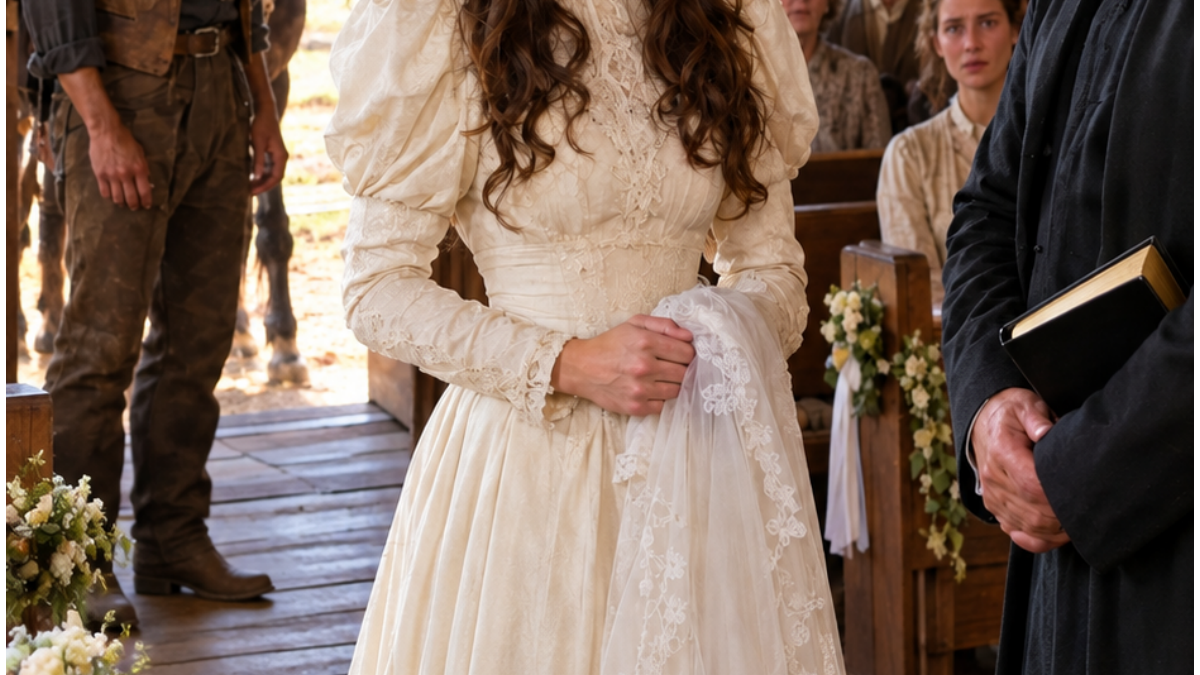
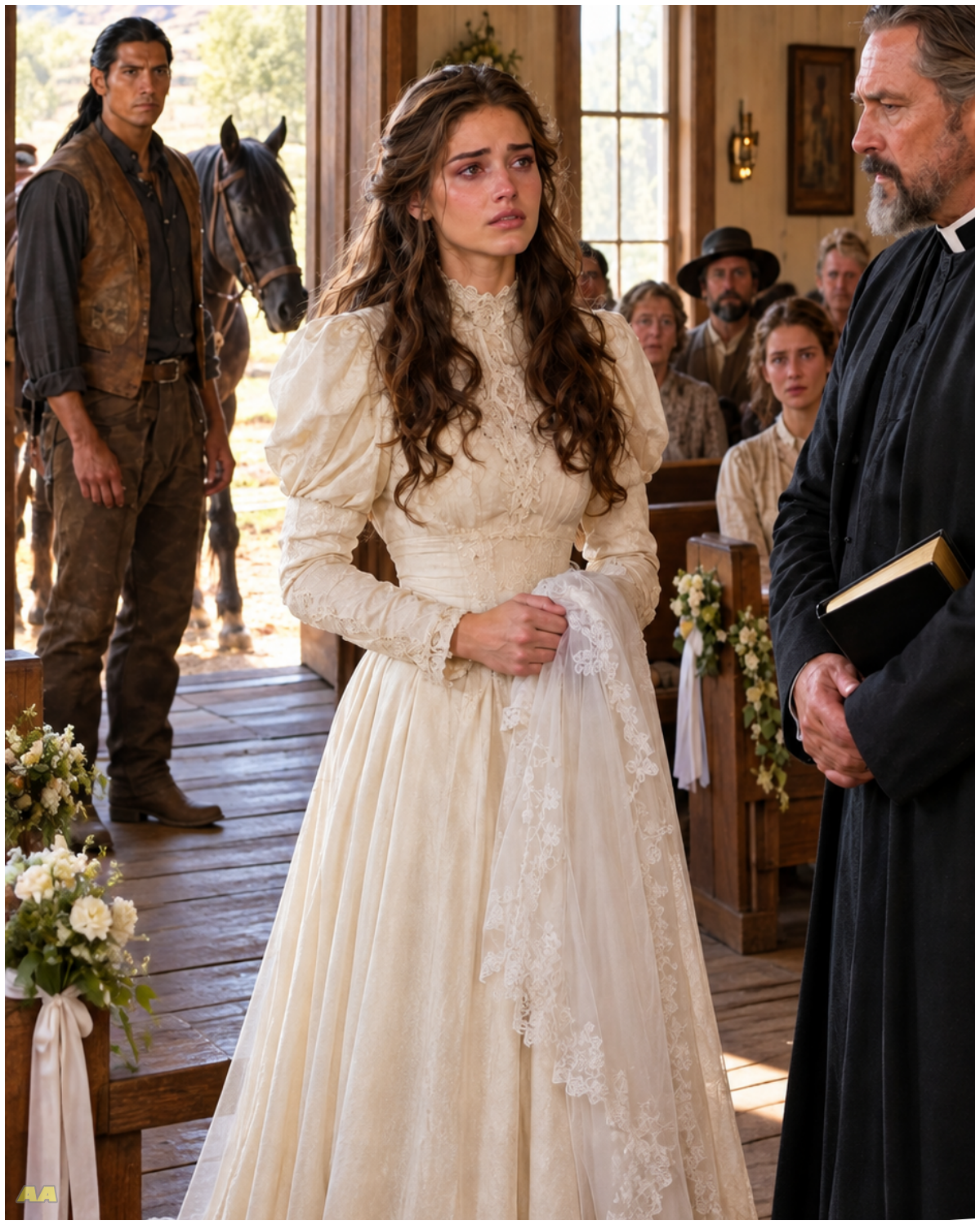
The morning Clara Bennett was supposed to become Mrs. Samuel Whitmore began with a sky so clear and blue that she believed it had to be a good sign.
For 22 years, Clara had imagined what her wedding day would feel like.
She had pictured flowers along the church windows, soft music, smiling faces, and the moment her father would place her hand into Samuels.
She had never imagined standing alone at the altar.
The little church in the Arizona territory was crowded that morning.
Ranchers, shopkeepers, farmers, and families from neighboring settlements had come because Samuel Whitmore was considered one of the most desirable young men in the region.
His family owned one of the largest ranches near town, and everyone expected Clara to be grateful for the opportunity to marry into such a respected family.
Clara wore a cream colored wedding dress that her mother had spent months sewing.
Her long brown hair was carefully arranged and a simple veil rested behind her shoulders.
She stood beside the preacher and tried to hide her nervousness.
But Samuel did not come.
At first, nobody seemed worried.
Someone suggested that his horse might have thrown a shoe.
Another person said perhaps there had been trouble at the ranch.
Clara kept looking toward the church doors.
Every time they opened, her heart lifted.
Every time someone else walked through, it sank again.
After nearly an hour, the whispers became impossible to ignore.
Then the church doors opened once more.
“A young stable boy entered, breathing heavily. He looked toward Samuels father.”
“Mr. Whitmore,” he said quietly.
Samuel left before sunrise.
The room became silent. Samuel’s father demanded to know where his son had gone.
The boy lowered his head.
He rode west with Miss Eleanor.
Everyone understood immediately. Eleanor was the daughter of a wealthy merchant from another town.
For months, rumors had circulated that Samuel had been spending time with her.
Clara had never wanted to believe them.
Now she knew Samuel had not simply missed his wedding.
He had chosen another woman.
The humiliation was crushing. Clara stood perfectly still while the people around her began whispering.
Some looked at her with pity.
Others looked embarrassed for her.
A few quietly left the church.
Clara’s mother rushed toward her, but instead of offering comfort, she whispered angrily that Clara should have seen the warning signs.
Her father avoided her eyes.
The Witmores were furious, not because Samuel had broken Clara’s heart, but because his actions had damaged the family’s reputation.
Clara suddenly realized something painful.
Nobody was asking whether she was all right.
Everyone was asking what would happen next.
She slowly removed her veil.
Her hands trembled, but she refused to cry.
Then she walked out of the church.
Outside, the entire town seemed to be watching.
Clara walked past them without saying a word.
She reached the edge of the street before stopping beneath a wooden awning.
That was when she noticed the Apache man standing beside a dark horse.
His name was Taza.
Most people in town knew him only as the quiet Apache who occasionally came to purchase supplies.
They called him poor because he wore old clothes and carried a worn saddle.
They joked that his cabin was barely worth calling a home.
Taza never argued with them.
He simply kept to himself.
But Clara noticed something that day that nobody else seemed to see.
He was watching her without amusement.
There was no judgment in his expression.
He looked at her as though he understood exactly how much she was hurting.
After several moments, he approached.
“Do you have somewhere safe to go?” he asked, swallowed.
“My father’s house.” Taza waited.
Claraara looked back toward the church.
I don’t think it’s my home anymore.
Taza studied her quietly.
Then he said something she never expected.
Come with me.
Claraara looked at him in confusion.
Where? My home. She almost laughed because the whole situation seemed impossible.
I don’t even know you.
I know. Taza looked toward the church before returning his attention to her.
Then marry me. Claraara stared at him.
The words were so unexpected that she wondered if she had heard correctly.
Marry you? Yes. You barely know my name.
I know enough. Claraara shook her head.
You don’t know anything about me.
Taza’s expression remained calm. I know they left you standing alone.
His words touched something inside her.
He continued, “I am not asking because I feel sorry for you. If you come with me, you will be treated with respect. If you say no, I will still help you find a safe place.”
That difference mattered. He was giving her a choice.
Nobody else had given her one that morning.
Her family wanted her to disappear.
The town’s people wanted something to gossip about.
Samuel had made his choice without thinking about her feelings.
But this strange Apache man was the first person who had asked what she wanted.
Clara looked down at her wedding dress.
She had spent years believing marriage meant belonging to someone else.
Now standing beside Taza, she wondered whether marriage could instead mean choosing someone who respected her.
I don’t want to go back, she whispered.
Then don’t. Clara took a slow breath.
Would you really marry me if you choose it?
She looked at him today if that is what you want.
The preacher was still inside the church.
Clara walked back through the doors.
The room fell silent. Everyone expected her to beg Samuel to return.
Instead, she walked toward the preacher and said she had made another decision.
Within the hour, Clara Bennett married Taza.
There was no celebration, no flowers, no musicians, no smiling Whitmore family, only a few stunned witnesses.
When Clara walked out of the church beside her new husband, the town erupted in whispers.
Some laughed, some called her foolish, others said she had thrown away the chance to marry into a wealthy family.
Nobody knew what Taza was thinking.
He simply helped Clara onto his horse and mounted behind her.
They rode away from town.
The journey toward the mountains was quiet.
Clara expected Taza to ask questions about Samuel.
He never did. She expected him to tell her what a wife was supposed to do.
He never did. Instead, he stopped beside a clear stream and gave her water.
You must be tired. Clara looked at him.
Why are you being kind to me?
Taza considered the question. Because you need kindness.
That simple answer nearly brought tears to her eyes.
By late afternoon, they reached his property.
Clara expected a tiny cabin surrounded by dry ground.
Instead, she saw something completely different.
A large stretch of green land opened before them.
There were horses grazing near a wooden fence, healthy cattle in the distance, and tall trees surrounding a comfortable ranch house.
Clara stared. “This is your home?” Taza nodded.
“It is?” She looked around.
But everyone said you were poor.
Taza gave a faint smile.
People believe what they see.
Clara did not understand. Not yet.
Inside the house, everything was simple but clean.
A fire had already been prepared.
There was food waiting. And down the hallway was a small bedroom with fresh blankets and a wooden cheSt. Clara stopped.
When did you prepare this?
Taza stood behind her. Yesterday.
Yesterday. I thought you might need somewhere to sleep.
Clara turned toward him. But you didn’t know I would come.
No. Then why prepare a room?
Taza looked at her calmly.
Because sometimes people need a place before they know they need it.
Clara did not know what to say.
That night, she explored the house while Taza remained outside with the horses.
She noticed something unusual. Near the back of the house was a locked office.
The door was made from thick wood inside.
Through a small opening, Clara could see an old desk, several rolled maps, and a large iron cheSt. Before she could examine it further, Taza returned.
He closed the door gently.
Clara looked at him. “What is in there?” she asked.
“Things that must remain protected,” he replied.
“From whom?” “People who think everything has a price.” Taza looked toward the distant mountains.
Clara felt a strange chill.
For the first time, she wondered whether the man everyone in town called the poorest Apache might not be poor at all.
She did not know that the quiet man she had married was hiding a secret that would eventually change everything she believed about him.
But that night, Clara knew only one thing.
She had walked into the mountains believing her life had ended at an empty altar.
Instead, she had unknowingly stepped into the beginning of a completely different life.
For the first few days after her unexpected marriage to Taza, Clara Bennett kept waiting for the moment when she would discover that she had made a terrible mistake.
She had left everything familiar behind.
Her wedding had ended in humiliation.
Her former fianceé, Samuel Whitmore, had abandoned her before the ceremony and ridden away with another woman.
Then, in the middle of her darkest moment, a quiet Apache man named Taza had offered her something nobody else had offered her, a choice.
She had accepted his proposal.
Now she was living in his remote mountain home, surrounded by land she barely understood and a husband she barely knew.
Yet something strange happened. Clara felt safe.
Taza never demanded anything from her.
He never reminded her that she had married him.
He never treated her as though she owed him obedience because he had rescued her from embarrassment.
Instead, he gave her room to breathe.
Every morning, he rose before sunrise and cared for the horses.
Every evening, he returned quietly and asked whether she needed anything.
When Clara tried to take over the household chores, Taza stopped her.
You don’t have to prove that you deserve to stay.
Clara looked at him in surprise.
No one has ever said that to me.
Then they should have. Those words stayed with her.
Before her marriage, Clara had spent most of her life trying to prove herself.
She had tried to please her mother.
She had tried to become the kind of woman Samuel would be proud to marry.
She had tried to behave exactly as everyone expected.
But Taza seemed interested in none of that.
He cared about whether she was comfortable, whether she was safe, whether she was happy.
Slowly, Clara began discovering the rhythms of the ranch.
She learned how to collect eggs, tend the garden, and help prepare meals.
She discovered that Taza had a remarkable knowledge of the land.
He could identify trails from almost invisible marks.
He knew where water could be found even during dry months.
He understood the behavior of horses better than any rancher Clara had ever met.
One morning, Clara watched him calm a frightened horse that had been injured by a piece of loose fencing.
The animal was nervous and restless.
Taza approached slowly. He spoke softly.
Within moments, the horse stopped pulling away.
Clara stared. “You said you were poor,” she remarked.
Taza glanced at her. “I never said that.
The town did. The town talks.” Clara smiled slightly.
“That is true.” But the comments stayed in her mind.
The more she observed Taza, the less his supposed poverty made sense.
His clothes were old, but they were always clean.
His saddle was worn, but the leather was expensive.
His horse was not merely healthy.
It was exceptionally well-trained. The ranch itself was isolated, yet everything necessary seemed to be available.
There were sacks of supplies stored in the barn.
Tools of excellent quality hung inside the workshop.
Even the wooden fencing around the property was stronger than anything Clara had seen at the Whitmore Ranch.
One afternoon, while organizing a storage room, Clara found several boxes containing documents.
She carefully opened one. Inside were land records.
She recognized the official seal immediately.
Her eyes moved across the page.
The property was registered to Taza.
She opened another document, then another.
There were multiple parcels. Some were close to the ranch, others stretched toward the mountains.
Clara’s heart began beating faster.
She found a map showing an enormous section of territory surrounding the ranch.
It was far larger than she had imagined.
Documents to the kitchen. When Taza returned that evening, she placed them on the table.
Can you explain this? He looked at the papers.
For several seconds, he said nothing.
Finally, he sat down. What do you want to know?
How much land do you own?
Taza looked toward the window.
Enough. Clara frowned. That’s not an answer.
No. He looked back at her.
But it is the truth.
Clara sat across from him.
Why does everyone in town think you’re poor?
Taza’s expression became serious. Because I wanted them to.
Clara stared at him. You wanted them to think you were poor?
Yes. Why? Ta did not answer immediately.
Instead, he walked to the window and looked toward the mountains.
A man with nothing is ignored.
A man with land is watched.
A man with valuable land becomes a target.
Clara listened carefully. Taza explained that years earlier his father had discovered that the valley contained a reliable underground water source.
In the Arizona territory, water could mean more than money.
It could determine which ranches survived, which towns grew, which families gained power.
Several wealthy men had tried to purchase the property from Ta’s family.
His father refused. After his death, Taza inherited the land.
But instead of announcing his wealth, he continued living simply.
He wore ordinary clothing. He rode an oldlook horse.
He rarely visited town. He avoided discussing business.
He quietly maintained ownership while allowing people to believe the property was worthless.
Clara slowly understood. You hid everything.
Not everything. You hid enough.
Taza nodded. And now I’m married to you.
He looked at her. Yes.
Clara suddenly wondered whether she had become a weakness.
If people discover the truth because of me.
They won’t. You can’t know that.
I can protect what matters.
The way he said it made Clara’s heartbeat faster.
She looked away. Taza noticed.
He immediately stepped back. I am not asking you to stay because of my land.
I know. If you want to leave, you can.
Clara looked at him. You would let me go.
Yes. There was no hesitation.
Clara realized that his wealth had not changed him.
He could have used his power to control her.
Instead, he was giving her the same freedom he had offered her outside the church.
She smiled faintly. “I don’t want to leave.” Taza’s expression softened.
Neither said anything else, but something between them had changed.
Clara no longer saw him as the stranger who had married her out of compassion.
She was beginning to see the man beneath the silence.
Meanwhile, back in town, Samuel Whitmore had returned.
He had expected everyone to welcome him.
Instead, the first thing he heard was that Clara had married Taza.
Samuel laughed. He could not believe it.
The poor Apache. That became the joke of the town.
Samuel told everyone Clara must have married Taza simply because she had been desperate.
He claimed the marriage would not laSt. But Samuel’s father did not laugh.
He had recently heard rumors about Taza’s property.
A surveyor had discovered that the land around Taza’s ranch contained a valuable water source.
The Witmores immediately became interested.
Their own ranch had been suffering through several dry seasons.
If they controlled the water beneath Taza’s land, they could expand their cattle operation dramatically.
Samuel’s father decided that Taza needed to be forced into selling.
At first, they tried politeness.
A representative visited Taza’s ranch and offered him money.
Taza refused. Another offer followed.
He refused again. The third offer was accompanied by a warning.
Taza simply told the man, “You should leave before you make your mistake worse.” The news infuriated the Witmores.
Soon, rumors spread throughout town.
People began saying Taza had stolen the land.
Others claimed the property belonged to someone else.
Samuel joined the gossip, but Clara heard about it when she visited town for supplies.
Several women whispered as she passed.
She doesn’t even know what she married.
Another woman laughed. Maybe she married him for whatever little land he has.
Clara stopped walking. For the first time, she felt anger instead of shame.
She turned toward them. You know nothing about my husband.
The women became quiet. One asked sarcastically.
And what exactly does he have?
Clara could have revealed everything.
Instead, she simply said, “He has more character than the people laughing at him.” Then she walked away.
That evening, she told Taza what had happened.
He listened. You defended me.
They were wrong. You didn’t have to.
I wanted to. He looked at her for a long moment.
That was the first time Clara saw something different in his expression.
Pride. Not pride because she belonged to him.
Pride because she had chosen to stand beside him.
But the mystery deepened further.
That night, Clara woke to the sound of horses.
She looked outside and saw Taza preparing to ride.
He noticed her at the doorway.
Sleep. Where are you going?
I need to check something.
At this hour, Taza hesitated.
Then he said, “Stay here.” But Clara had begun trusting him.
She also knew there were secrets he still hadn’t explained.
After he rode away, curiosity overcame her.
She saddled another horse and followed from a distance.
The trail climbed into the mountains.
Eventually, Taza disappeared into a narrow canyon.
Clara stopped her horse and watched.
Then she heard voices. Several Apache men and women were gathered around a fire.
When Taza approached, everyone stood.
Not because they feared him, because they respected him.
An elderly Apache elder greeted him warmly.
Your people have been waiting.
Clara’s heart raced. Taza was not merely an isolated rancher.
He was connected to a community that trusted him.
Then she heard the elder say something that changed everything.
The valley remained safe because you protected it.
Clara finally understood. Taza’s secret was much larger than money.
He had spent years using his hidden wealth and land to protect families who had nowhere else to go.
He had purchased supplies, protected water sources, helped struggling ranchers, and quietly prevented powerful men from taking land from people who could not defend themselves.
The man everyone called poor had been using his wealth without seeking recognition.
But then Taza turned, his eyes found Clara.
She realized she had been discovered.
He walked toward her for several seconds.
Neither spoke. Finally, Taza asked, “Why did you follow me?” Clara lowered her eyes.
“I wanted to know who you really were around him.” “I don’t know yet.” Taza nodded.
“Then come with me.” He led her farther into the canyon.
There, hidden behind the cliffs, was a broad green valley.
Water flowed through the center.
Horses grazed nearby. Small homes stood among the trees.
Clara stared in disbelief. This belongs to you?
Taza shook his head. No.
He looked at the families living there.
It belongs to the people who depend on it.
Clara finally understood why he had hidden everything.
His wealth was not simply a secret.
It was a responsibility. She turned toward him.
Why did you marry me?
Taza was silent for a moment.
Because when everyone else looked at you and saw a woman who had been rejected, I saw someone who still had enough strength to stand.
Clara’s eyes filled with tears.
I thought you married me because you felt sorry for me.
I never pity strong people.
She smiled through her tears.
For the first time since the altar, Clara felt completely certain she had made the right choice.
She reached for his hand.
Taza allowed her fingers to close around his.
Neither of them knew what the Witors would do next.
But Clara now understood that her husband was not powerless.
And the people who believed they could take his land were about to discover how badly they had underestimated the man they called the poorest Apache in town.
By the time Clara returned to the ranch with Taza, the sun was beginning to rise above the mountains.
She had spent the night discovering a side of her husband that she never knew existed.
The man the town called poor was not poor.
He owned enormous stretches of land.
He controlled valuable water rights.
He had spent years protecting his property by allowing people to underestimate him.
But what affected Clara most was not the wealth.
It was what Taza did with it.
He had used his resources to help families who were struggling.
He had protected land from people who wanted to take advantage of those who could not defend themselves.
He had quietly supported an Apache community without demanding praise.
Clara looked at him differently now.
Taza noticed. You are thinking too much.
She said, she smiled. I just discovered that my husband is not who everyone says he is.
Taza looked toward the mountains.
People rarely are. Clara remembered the day at the church.
She had thought Taza was a poor stranger who had offered her a way out of humiliation.
Now she understood that he could have chosen almost anyone.
Yet he had chosen her.
They returned to the ranch before breakfaSt. For several days, Clara kept the secret to herself.
She did not tell anyone about the hidden valley.
She did not reveal the truth about Ta’s wealth.
But secrets rarely remain hidden forever.
One afternoon, a rider arrived at the ranch.
He carried a formal letter.
Taza opened it and read silently.
Clara watched his expression change.
“What is it?” she asked.
“The Witors,” he said. “What do they want?” Clara asked.
“They want my land.” “Because of the water,” Clara whispered.
Taza nodded. The Witmores had learned enough to understand that the land was valuable.
Samuel’s father had sent surveyors into the region.
They believed Taza could be pressured into selling because he had no powerful family connections.
They were wrong. Two days later, Samuel Whitmore arrived at the ranch with his father and several men from town.
Clara saw them approaching from the porch.
Her first reaction was fear.
Her second was anger. Samuel dismounted and looked at the ranch.
His expression showed contempt. “So this is where you ran off to,” he said.
Claraara stepped onto the porch.
“I didn’t run anywhere,” she said.
Looked at her wedding ring.
“You actually married him?” “Yes,” he laughed.
“You went from nearly becoming a Whitmore to living out here with a man who owns almost nothing.” Taza stood beside Clara.
He said nothing. Samuel continued.
You could still come back.
Clara stared at him. Why would I?
Because you made a mistake.
No. Clara’s voice was calm.
You made a mistake when you left me at the altar.
Samuel’s face hardened. His father stepped forward.
Enough. We came to discuss business.
Taza looked at him. What business?
The land. It isn’t for sale.
We are prepared to make a generous offer.
No. Samuel’s father frowned. You haven’t even heard the amount.
I don’t need to. The older man became irritated.
You cannot keep that entire valley for yourself.
Taza remained calm. I am not.
That answer confused everyone. The Witmores did not understand that Taza’s property was tied to the well-being of many people.
Samuel stepped forward. You think you are better than us?
Taza looked at him. No.
Then why refuse? Because money does not replace what the land provides.
Samuel laughed. Land is land.
Taza shook his head. Not when people depend on it.
Clara felt something inside her settle.
This was the man she had married.
Quiet, patient, but impossible to intimidate.
The Whit Moors left after receiving nothing, but they did not give up.
Within the week, rumors spread across town.
People claimed Taza had obtained the land illegally.
Others said the water rights belonged to the county.
A few even suggested that Clara had married him only because she believed he was secretly wealthy.
The gossip reached Clara. This time, she did not remain silent.
She went into town. The same people who had watched her walk out of the church in shame now watched her enter with confidence.
One woman whispered that Clara had married Taza for money.
Clara stopped, “I married him when everyone believed he had nothing.” The woman became silent.
Clara continued, “Land? I did not know about his wealth.
I did not even know what kind of man he was.” She looked around the room.
But I knew one thing.
Everyone waited. He treated me with more kindness in one afternoon than Samuel did during our entire engagement.
Nobody laughed. Clara walked away.
Meanwhile, Taza was working quietly with his legal representatives.
He had kept records for years.
Every parcel of land had been properly registered.
Every water agreement had been documented.
Every transaction had been preserved.
The Whitesors had assumed that a quiet man must also be an unprepared man.
They were wrong. Several days later, the county officials arrived.
They gathered in the town hall.
Taza appeared carrying a leather folder.
Clara stood beside him. The Wit Moors sat across the room.
An official announced that the land records would be reviewed.
Taza calmly presented document after document.
The original property agreements, the water rights, the purchase records, the tax receipts, the legal maps.
One by one, the accusations collapsed.
The land belonged to Taza.
The water rights were legally protected, and the hidden valley was part of his private property.
A murmur moved through the room.
The town’s people finally understood.
The Apache they had mocked as poor had been one of the largest land owners in the region.
Samuel stared at Taza. You knew all along.
Taza nodded. Samuel looked at Clara.
You knew? Not when I married him.
That answer hurt Samuel more than anything else.
He had always believed Clara’s worth was connected to the wealth of the man she married.
Now she had married someone who already possessed more wealth than he did, and she had not even known it.
Samuel’s father finally stood. This isn’t over.
Taza looked at him. I believe it is.
The official agreed. The Whitors had no legal claim.
They left the town hall defeated.
But Taza did not celebrate.
He simply gathered his documents and walked outside.
Clara followed. You’re not happy.
Taza looked at her. Why should I be?
You prove them wrong. I didn’t need to prove anything.
Clara smiled. Perhaps not. They returned to the ranch.
That evening, Taza took Clara toward a part of the property she had never visited.
They followed a narrow trail through tall trees.
Eventually, they reached a clearing overlooking the valley.
Clara stopped. In front of her stood the beginning of a beautiful new house.
The foundation was already complete.
Several workers were constructing wooden walls.
Clara turned toward Taza. What is this?
Our home? But I thought this was our home.
It is. He looked at the small ranch house in the distance.
But this is the house I wanted to build.
When? Before I knew you.
Clara looked confused. Taza explained that he had always planned to build a larger home someday, but he had never found a reason to finish it.
He had lived simply because he had become accustomed to being alone.
Then Clara arrived. He had started construction quietly because he wanted to give her a choice.
“If you decide you don’t want this life,” he said, “the house will still be here.” Clara’s eyes filled with tears.
“You still think I might leave?” “I think you should always be free to choose after everything.” Taza nodded.
Clara looked at the unfinished house.
Then she looked at the man beside her.
She remembered standing alone in the church.
She remembered believing that her future had disappeared.
She remembered how the entire town had watched her humiliation.
And then she remembered Taza’s first question.
Do you have somewhere safe to go?
He had not asked whether she was beautiful enough.
He had not asked what her family owned.
He had not asked whether she could help his reputation.
He had simply cared whether she was safe.
Clara reached for his hand.
I don’t want to leave.
Taza looked at her. You are certain?
Yes. Even now that you know everything.
Clara smiled. I married you before I knew anything.
Taza’s expression softened. Then you know the truth.
Clara shook her head. No.
She looked into his eyes.
I know the important truth.
What is that? You were never poor.
Taza smiled slightly and Clara squeezed his hand.
You were rich in the things that mattered before I ever knew about your money.
For once, Taza had no answer.
Several months passed. The new house was completed.
It stood above the valley with wide wooden porches and large windows overlooking the water.
Clara filled the rooms with warmth.
She planted flowers near the porch.
She helped organize the household.
But she never became the servant Samuel had once expected her to be.
Taza treated her as his equal.
They worked together. They made decisions together.
And slowly their marriage became something neither had expected.
Love. The town also changed.
People who had once laughed at Taza began treating him with respect.
Some apologized, others remained embarrassed.
Taza accepted the apologies without boasting.
He never used his wealth to make others feel small.
Clara admired that most of all.
One evening they stood together on the porch watching the sunset.
Clara rested her hands on the railing.
Do you ever think about that day?
She asked. The wedding. Taza looked toward her.
Sometimes I thought it was the worst day of my life.
And now Clara smiled. Now I think it was the day my life finally changed.
Taza reached for her hand.
Clara looked toward the mountains.
She had arrived at his ranch believing she was an abandoned woman with nowhere to belong.
Now she stood beside a man who had never judged her by what happened at the altar.
She had not married Taza because he secretly owned land.
She had married him because he gave her dignity when she had none left.
His wealth had been a secret.
His kindness had never been.








