Her Ex Fiancé Broke Her Heart – Then the Mafia Boss Placed His Family Ring on Her Hand

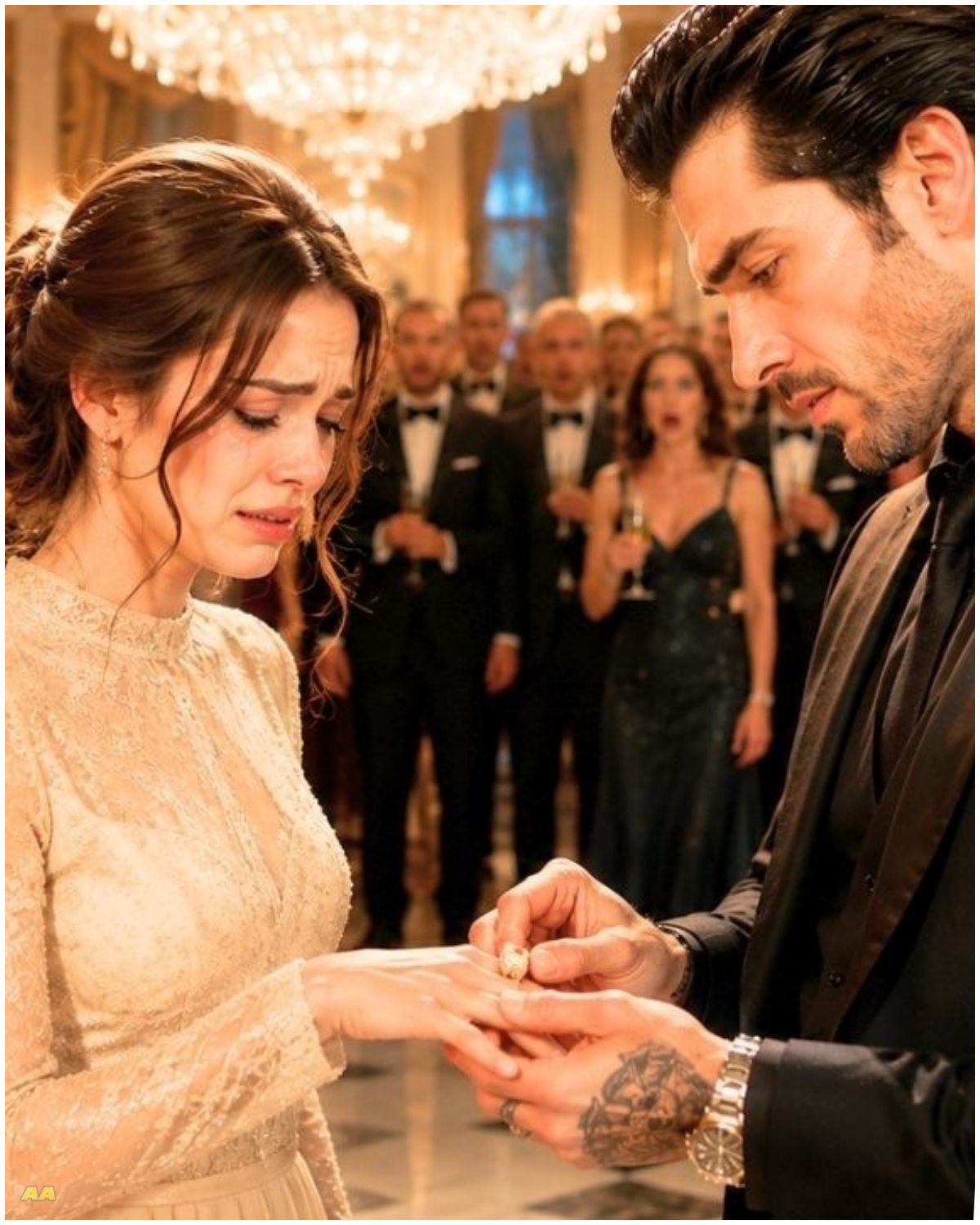
Derek Halbrook reached across the table, took Camille’s hand in both of his, and smiled at her, the way a man smiles when he has already decided something.
Then he slid the engagement ring off her finger.
Not privately, not gently.
He did it in the middle of the Ashborne Crown Hotel ballroom in front of 400 people in evening wear beneath chandeliers that cost more than most people’s homes with a string quartet still playing in the corner as if nothing in the world was wrong.
The diamond struck the marble floor.
The sound was small, barely a tick, but every conversation in that room stopped.
Camille Prescott did not scream. She did not reach for the ring.
She stood exactly where she was and looked at the man she had planned to spend her life with.
And she felt something shift inside her, chest not breaking exactly, more like something locking into place that had been loose for a long time.
Derek straightened his jacket and turned toward the woman standing 15 ft away.
Blair Kensington, diamonds, red dress, a smile that had been waiting all evening to be permitted.
I’m sorry, Derek said, and he was speaking to the room, not to Camille.
But I owe everyone here the truth.
The evening had not started badly.
That was the part Camille would turn over and over in the weeks that followed not the humiliation itself but the ordinary hours before it.
She had done her hair at the bathroom mirror in the apartment she shared with Derek, pressing a small section flat with the iron while he stood in the doorway asking whether his cuff links were in the top drawer or the second one.
She had told him the second.
He had said thank you. She had finished her hair and thought, “This is what a life together looks like. Two people in a bathroom before a party talking about cufflinks.”
She had worn the navy dress.
Derek had suggested the black one twice, but the Navy was the one that made her feel like herself, the one she’d bought during a layover in New York two years ago before she resigned from Blackthornne Maritime during the period of her life when she still made most of her own decisions without worrying whether they’d inconvenience somebody else’s vision of how things should look.
In the car, Derek had held her hand across the center console.
His thumb moved in a slow circle against her knuckles.
She had looked out the window at Chicago moving past in the dark and thought she was happy.
She had been trying to confirm that feeling for several months by then quietly testing it, checking for it the way you check a lock before you leave the house.
Was it there? She thought so.
She thought she was. The ashbor crown was dressed for an occasion.
The lobby staff were in full uniform.
The flower arrangements on every surface were fresh and extravagant, and the ballroom had been set with round tables covered in white linen and heavy silverware.
The engagement party was Dererick’s idea.
He had insisted the announcement deserved a proper setting, and he had had organized everything himself, the guest list, the catering, the entertainment, the venue.
Camille had offered to help, and Derek had told her it was taken care of.
She had found that suite at the time.
They were received at the entrance.
A woman in a headset checked their names and smiled and gestured them inside.
The room was already half full investment consultants, Chicago financial community people, sess several names Camille vaguely recognized from Dererick’s professional world.
She did not know many of them well.
Derek had his world, and she had spent a year trying to find her place inside it, attending the events he brought her to, learning the names of people he valued, understanding that his career moved at a pace that didn’t leave much room for the kind of slow evenings she had once preferred.
She had given up some things.
That was what relationships required. Camille had understood that.
She found a seat at the table nearest the dance floor while Derek moved through the room, working the space with a politician’s ease, shaking hands and leaning in close for private exchanges and laughing at things people said.
Camille watched him and thought, “He is good at this.”
He moved through a room like he had already memorized everyone’s value to him and was simply confirming his calculations.
That thought had arrived and departed quickly.
She had not examined it. Patricia, something the wife of someone Derek had worked with, sat beside Camille and talked at some length about a charity auction she was organizing.
Camille listened and responded and asked questions.
Patricia mentioned Blair Kensington once briefly.
In passing some context, Camille couldn’t quite trace.
She had heard the name before, socialite, Chicago society fixture.
She had the impression of someone frequently photographed at events like this one.
Derek gave a small speech around 9:00.
He thanked everyone for coming.
Talk about the future he was building, the partnership he was cultivating, the city he intended to become a serious force within.
He was good at speeches. He had a way of making ambition sound like generosity, like his success would benefit everyone in the room rather than just himself.
Then he had looked at Camille.
She had felt her chest warm.
She had straightened in her chair.
She had thought, “Here it is.”
The moment Derek sat down his champagne glass and then everything went wrong.
He did not walk to her.
He stayed exactly where he was, behind the small podium, someone position at the head of the room.
And he looked at Camille with an expression she had never seen on his face before, measured, resolved.
Something underneath it that wasn’t quite guilt and wasn’t quite satisfaction, but lived somewhere between them.
There’s something else I need to say tonight, he said.
Something I should have handled privately.
I didn’t, and I’m going to own that.
The room quieted. The string quartet finished their phrase and stopped.
Camille’s hands were in her lap.
She felt them pressed together. Camille and I have been together for a year, Derk continued.
She is a remarkable woman. But I would be doing both of us a disservice if I continued this when I know when I’ve known for some time that we are not each other’s future.
The room was absolutely still. Camille’s hearing went strange.
She heard the word future and then there was a quality of silence that felt almost physical, as if the the room had drawn a breath and was holding it.
Derek crossed the room. He did not go to Camille.
He went to Blair Kenzend who had been seated three tables away and who now rose from her chair with the deliberate composure of someone who had been waiting for a cue.
She wore red. Her hair was perfect.
She extended one hand toward Derek and he took it.
Then he turned back toward Camille.
He reached into his jacket pocket.
He produced a small velvet box, and Camille’s mind lurched, trying to make sense of what she was seeing, thinking for one disoriented second that she had misread the entire thing, that this was some elaborate piece of theater with a different ending.
But Derek opened the box to show it was empty.
He set it on the table in front of Camille.
“I’m going to ask her,” he said.
“I want you to hear it from me before the room figures it out.” Then he took Camille’s left hand.
She let him because her body hadn’t caught up to what was happening yet.
He slid the engagement ring off her finger.
The diamond hit the marble floor with that small precise tick and the ballroom 400 people, champagne glasses half-raised, expressions uh caught somewhere between horror and the irresistible pull of witnessing something they would retell.
For months, went completely silent. Camille looked at the ring on the floor.
She looked at Derek. He had the decency to look away.
She stood up from the table.
Her legs worked. She was grateful for that.
She picked up her clutch bag and she walked toward the exit and the crowd parted for her.
The way crowds part for something they don’t want to obstruct.
Not out of respect. Exactly. But out of the particular discomfort of being too close to someone else’s pain.
She did not cry. She wanted that established clearly in her own mind.
Even then. She did not cry in the ballroom.
Her eyes were dry and her back was straight.
And she walked with the same stride she had used for 3 years moving through the halls of Blackthornne Maritime Holdings, the stride of a woman who had learned early that a professional environment does.
Not stop for your feelings. So you learn to carry them somewhere they can’t be seen.
She was 12 ft from the door.
The door opened. Two men entered firSt. Dark suits, quiet eyes, the specific quality of stillness that comes from professional training.
They moved to either side of the entrance without being asked and stood there, which was not a thing that men at engagement parties typically did.
Then the sound of movement outside several pairs of feet, another door, the unmistakable acoustic shift of a corridor being cleared, and Roman Blackthornne walked into the Ashborne Crown Hotel ballroom.
He was not dressed for an engagement party.
He never dressed for anyone else’s occasion.
He wore a dark suit that had been made for his specific body by someone who understood that precision was was as its own form of authority.
His hair was silver at the temples now more than she remembered.
He was 41, and he carried his age the way certain men do, not fighting it, not performing around it, simply wearing it as evidence.
He saw the room, he saw Camille, his eyes moved to the ring on the floor.
Something happened in his face that Camille could not name.
It was not an anger exactly.
It was something older and more settled than anger.
The look of a man who had already decided something and was now simply confirming that his decision was correct.
Close the doors, Roman said. He said it quietly.
He didn’t raise his voice. He never raised his voice.
The men in dark suits closed the doors.
Derek Halbrook turned from Blair Kensington and looked at the man who had just entered his engagement party, and for the first time all evening, the composure he had maintained so carefully began to show its seaMs. This is a private event, Derek said.
Roman looked at him the way you look at a sentence that has already been completed and doesn’t require a response.
Then he looked at Camille. I heard what happened, he said.
I came. Camille’s voice when she found it was steadier than she expected.
You didn’t need to. I know there were 400 people in that ballroom, and the silence was so complete that these words, I know, carried to every corner of the room.
Camille held his gaze for a long moment.
Three years of working beside this man.
Three years of learning to read the particular quality of his silences, the weight of what he didn’t say, the way he communicated more with stillness than most people managed with a full sentence.
She had left his world because she had believed honestly and completely that Dererick represented a different kind of life easier, safer, a life where she didn’t have to navigate what it meant to be close to a man with Roman Blackthornne’s reputation and Roman Blackthornne’s other responsibilities.
She had chosen Derek. She had been wrong.
Standing there in the navy dress she had chosen for herself, empty-handed, with her former engagement ring still on the marble floor between them, Camille realized that being wrong was something she could survive.
She had not yet decided how, but she was still standing, and that was enough to begin with.
Derek tried again. He straightened his jacket, the same gesture he’d made earlier, after placing the ring on the podium, and Camille registered now that it was a nervous habit he had never let her see before.
“Mr. Blackthornne,” he said, deploying the name with careful formality.
“With respect, this doesn’t concern your organization.
This is a personal matter between.
Personal matters stay personal,” Roman said when they stay private.
You invited an audience. You made your choice in front of 400 people.
He paused, which means 400 people get to watch what comes next.
Something in that sentence rearranged the atmosphere in the room.
Derek heard it. Blair heard it.
The investors and consultants and society fixtures heard it.
Roman did not reach for anything.
He did not move aggressively toward anyone.
He simply stood in the entrance of the ballroom with the stillness of someone who understood that power is most effective when it doesn’t have to announce itself.
He turned back to Camille. You worked beside me for 3 years, he said.
His voice was conversational, clear, loud enough for the room without being directed at the room.
You managed every sensitive meeting I had.
You handled communications I couldn’t trust to anyone else.
You solved problems before I knew they existed.
There were documents on your desk on any given Tuesday that would have made men in this room very uncomfortable if they’d ended up in the wrong hands.
He let that settle. Not one of them did.
Camille felt something shift in the room’s attention.
The crowd had been watching a public rejection, the familiar consumable drama of a man leaving a woman for another woman at a party.
Now they were watching something else, and they weren’t quite sure what to call it.
She was your secretary, Derek said.
The word landed with a dismissiveness he had probably practiced.
That’s admirable, but it’s not. She was never a secretary, Roman said.
He said it simply without heat, but the sentence cut through the room like something bladed.
The title was a formality. What Camille Prescott actually did for 3 years was managed the operational continuity of a billion dollar enterprise across its legitimate and private interests simultaneously.
She sat in rooms with people I cannot name publicly and maintained absolute discretion.
She made decisions under pressure that most men with decades more experience would have mishandled.
He looked at the ring on the floor.
“I want to understand something,” Roman said, and now his voice changed.
Still quiet, still controlled, but with something underneath it that made several people near the front of the crowd take a small step backward without appearing to.
A woman like that, three years of documented professional integrity, and you put her engagement ring on a marble floor in front of 400 people.
Derek’s jaw tightened. What I do with my personal relationship is I’m not asking for your reasoning, Roman said.
I’m telling you what I observed.
He reached inside his jacket. Not a weapon, not a phone, an envelope.
He extended it toward his attorney, a small, precisel-looking man who had, Camille realized, been standing near the edge of the room for the past several minutes without drawing attention to himself.
About 8 months ago, and addressing the room now with the same measured tone he’d used one-on-one, became aware of an external attempt to gain access to certain business relationships within the Blackthorn Thorn network.
The method was not direct. It was social.
He paused. Someone was trying to use proximity to my company as a key.
Camille went still. She felt that the back of her neck changed temperature.
The attorney opened the envelope. Documents, photographs, several pages of what appeared to be financial records.
Roman turned toward Derek Halbrook. We investigated, Roman said simply.
It took time to complete. Tonight seemed like an appropriate occasion to share what we found.
Dererick’s face had gone through several changes in the past 2 minutes.
The confidence was gone. The prepared composure was gone.
What was underneath it was rawer than Camille expected.
Not guilt exactly, but the look of a man who has been running a calculation and has just discovered that someone else completed it firSt. Clark Kensington had stopped smiling.
Camille stood in the middle of the ballroom in this navy dress between the ring on the floor and the man who had just walked through the door and she understood with the particular clarity that comes when something you refused to see finally refuses to stay hidden that the year she had spent trying to build a life with Derek Halbrook was not what she had believed it was not all of it maybe not any of it she had spent three years at Blackthornne Maritime learning to read situations before they named themselves She had learned to track small inconsistencies, to notice when information was being sought rather than shared, to understand the difference between someone who was curious and someone who was extracting.
She thought about Derek’s questions, the careful casual questions that had arrived at months of evenings and dinners, dinners and mornings, when she was tired and her guard was lower than usual.
Questions about Roman’s travel schedule, about which meetings were handled by internal council and which involved outside parties, about the names of certain Blackthornne associates she had mentioned in passing, and then watched Derek file away with the particular attention of someone memorizing something they expect to use later.
She had thought he was interested in her work.
She had thought he was trying to understand her world.
She looked at the documents the attorney was now presenting to several people near the front of the room, men whose faces she recognized, whose reactions were telling.
The calculation landed with cold, complete weight.
Derek had not been interested in her world.
He had been interested in the door she represented, and she had never opened it.
Not once. Not a name she shouldn’t have shared, not a document she shouldn’t have let him see, not a single piece of information from her three years at Blackthornne Maritime that had moved from her hands into his.
She hadn’t done it because she was protecting Roman.
She had done it because it was the right thing to do because she had always understood without needing to articulate it that the work she did and the people who depended on that work were not hers to leverage for personal benefit.
Derek had built a year-long plan around the belief that she could be maneuvered.
He had been wrong. A sounding and the engagement ring was still on the marble floor, and the man who had put it there was standing in his own ballroom while Roman Blackthornne’s attorney passed documents to the people whose respect Derek had been trying to purchase.
And Camille watched the room shift slowly, not dramatically, the way tides actually move rather than the way they’re described away from Derek Halbrook.
One executive excused himself, then another, a woman whose investment firm Derek had been courting for 6 months, picked up her bag.
Camille walked to the center of the room.
The ring was still where it had fallen, small, precise, expensive.
She reached down and picked it up.
Derek was watching. His face was doing something complicated, the mathematics of a man trying to calculate whether there was still a version of this evening he could recover.
There wasn’t. Camille held the ring for a moment.
Then she walked toward him and took his hand and turned it palm up.
She placed the ring in his palm.
“You didn’t leave me tonight,” she said.
Her voice was level, not cold, not trembling, just honeSt. “You just finally showed me who I was engaged to.” She closed his fingers around the diamond.
She let go. She turned and walked away from Derek Halbrook.
And this time the crowd did not part out of discomfort.
They moved because she was moving.
And there was something in the line of her shoulders and the steadiness of her step that made moving out of her way feel like the correct response.
Behind her, she heard Derek say something.
She didn’t catch all of it.
Something about lawyers. Something about reputation.
Something about none of this being legal.
Roman’s voice answered him, quiet and complete.
I agree. None of this is illegal.
You’re free to go. A pause.
Your reputation is another matter. But that belongs to the 400 people in this room, not to me.
Camille had almost reached the doors when she heard Roman’s voice again directed at her this time.
Camille. She stopped. She didn’t turn around immediately.
She heard him cross the room, not rushing.
His particular walk measured unhurried the walks of someone who had decided a long time ago that he did not need to chase anything.
He stopped beside her. She looked at him.
Roman Blackthornne reached into his coat pocket and removed a black velvet box.
Small bearing the Blackthorn family crest on its lid in silver.
Camille’s jaw tightened. “Rome, open it,” he said.
She held his gaze for a long moment.
Then she took the box. She opened it.
Inside was her old executive access card.
A sound like green wood splitting the physical key to her former office on the 32nd floor of the Blackthorn Maritime Building.
The one that connected through the corridor to Roman’s own office, the one she had walked out of for the last time 6 months ago, with a box of her personal items and the careful composure of someone who had made a decision she was going to stick to.
Beneath the key, folded twice, was a note, handwritten.
Roman’s handwriting, the same cramped, deliberate script she had learned to read on marginalia and meeting notes, and the occasional instruction left on her desk when he arrived earlier than everyone else.
“Your office was never given away.” Camille read it twice.
She looked up at him. “You kept it,” she said.
“It was not a question.” Roman said nothing.
He didn’t need to. There was a second box in his other hand, smaller.
She noticed now. He had not opened it.
He was not offering it. He was simply holding it.
Camille looked at the access card in her palm, the key, the folded note.
She thought about the 6 months she had spent building a life that had just collapsed in an evening.
She thought about Dererick’s careful questions and the calls, the calls she had not answered, and the information she had not given.
She thought about what Roman had said to the room.
She was never a secretary and felt something in her chest go quiet in a way it hadn’t been quiet for a very long time.
She closed the velvet box. She held it around them.
The ballroom was beginning to move again.
Voices, the scrape of chairs, the specific sound of an event disbanding before its scheduled end.
Dererick was speaking to someone near the far wall.
Blair Kensington was nowhere Camille could see.
Roman was watching her with the patience of someone who had spent years learning not to push.
You have a lot to explain, Camille said quietly.
I know. Not tonight. No, he agreed.
Not tonight. She slid the velvet box into her clutch bag.
She looked at the ballroom one more time, the chandeliers, the marble floor, the place where the ring had fallen and where she had picked it up and returned it to the man who had used it as a prop in a scheme she had never understood she was standing inside.
Then Camille Prescott walked out of the Ashborne Crown Hotel.
The night air hit her face.
She stopped on the front steps and breathed.
A sound like green behind her through the closed doors.
She could hear the muffled sound of Rome’s attorney speaking and the controlled collapse of an evening that had never been what it appeared to be.
In her bag, the velvet box pressed against her palm.
She did not know what came next.
She knew that was all right.
She had stood on that marble bull floor.
Someone tried to tell her she was worth less than he’d decided, and she was still standing.
And the man who had walked through the door behind her had told 400 people, without being asked, without being owed anything, exactly what he believed she was worth.
She wasn’t sure what to do with that yet, but she was going to figure it out.
She stepped off the curb and into the night air of Chicago, and the doors of the Ashborne crown closed behind her with a sound like something finally ending.
Camille did not go home. She stood on the front steps of the Ashborne Crown for approximately 40 seconds, long enough to establish that she was not going to fall apart on a public sidewalk.
And then she she walked three blocks north and sat down at the bar inside a hotel she did not recognize.
Ordered a glass of water and stared at the the shelving behind the counter without seeing any of it.
The bartender asked if she wanted anything else.
She said no. She sat there for 20 minutes.
The velvet box was in her clutch bag.
She could feel its weight against her hip, disproportionate for its size.
The way certain small objects carry more gravity than they have any physical right to.
She did not open the bag.
She did not take the box out and look at it again.
She had read the note twice already, and reading it a third time would not change what it said.
Your office was never given away.
6 months. She had been gone 6 months and Roman Blackthornne had not reassigned her office.
In a building where square footage on the 32nd floor represented actual money in an organization where resources were allocated with the precision of a man who counted costs categories.
Most people never thought about Roman had kept a room empty.
She thought about why that might be.
She told herself not to. Her phone had 17 notifications.
She knew without looking that most of them were from people who had been at the ballroom.
The the the ones with good intentions who would say the wrong things.
The ones with no particular feelings about her who were simply circulating information.
A sound like green wood splitting and possibly one or two from people she actually wanted to hear from, though she couldn’t currently think of who those would be.
She turned the phone face down on the bar.
She thought about Dererick’s hands. Not sentimentally, analytically.
She thought about the specific way he had taken her left hand when he slid the ring off the pract of someone who had rehearsed the motion.
He had rehearsed it. She understood that now.
He had stood in some private space and run through the logistics of the gesture, decided on the particular choreography of it, determined that taking her hand first and then removing the ring would read as less aggressive than reaching cinching for her finger directly.
He had thought about how it would look.
He had not thought about how it would feel.
Not for her. Or he had thought about it and decided her feelings were an acceptable coSt. Camille picked up the glass of water and drank half of it.
Her hand was steady. She noted that with something close to gratitude.
She had spent a year loving a man who had been auditing her the entire time.
That was the sentence that kept arriving, arriving, arriving not with the raw burn of immediate betrayal, but with something slower and more corrosive, the small erosions.
Every evening she had come home tired from her new job, and Derek had poured her a glass of wine, and asked conversationally about her day, not because he wanted to know about her day, but because he was checking the perimeter, seeing if anything useful had surfaced.
She had read his interest as affection.
She had mistaken extraction for intimacy.
She was 31 years old, split, and she had been a professional for nine of those years, and [clears throat] she had had spent 12 months being outmaneuvered by a man who was ultimately not even good at what he was trying to do.
That was the part she couldn’t quite metabolize yet.
Not the betrayal, the waste. She paid for the water, left a tip that was larger than the situation required, and walked out.
The night was cold for the time of year.
She had left her coat at the ballroom at the coat check with a ticket she no longer had.
She decided to leave it there.
It was a good coat and losing it was a concrete inconvenience, but she could not make herself go back for it.
And sometimes the cost of returning somewhere is higher than the cost of whatever you left behind.
She flagged a car and gave her home address.
The apartment she had shared with Derek for 8 months.
She sat in the sex back seat and watched Chicago move past and thought with a practicality she recognized as the coping mechanism it was.
I need to find somewhere else to live.
The apartment was quiet. Dererick’s things were everywhere in the way of someone who had never learned to contain himself within a shared space.
His shoes beside the door, both pairs.
His reading glasses on the kitchen counter.
A coffee mug he’d left that morning before the party, unwashed, sitting at a slight angle as if sat down in a hurry.
Camille stood in the entrance and looked at the mug.
She thought he drank his coffee this morning, and he already knew what he was going to do tonight.
She went into the bedroom and changed out of the navy dress and hung [snorts] it carefully in the closet because ruining a good dress on top of everything else seemed excessive.
She put on jeans and a sweater and went back to the kitchen and washed Dererick’s coffee mug by hand because it was in her way and leaving dishes in the sink had always bothered her more than it bothered him.
And some things about a person do not change cuz their evening went badly.
She was drying the mug when her phone rang.
Not a notification. A call. She looked at the screen.
Marcus Webb. She hesitated. Then she answered.
Marcus had been her closest colleague during her years at Blackthornne Maritime.
Technically Roman’s head of internal security, practically the person who functioned as the connective tissue between Roman’s legitimate business operations and and everything that existed alongside them.
He was 53, built like a question mark physically, but with the kind of mental sharpness that made you for forget his size within about 30 seconds of conversation.
He and Camille had shared a particular professional shortorthhand, the kind that develops between two people who have managed crises together at 2:00 in the morning and learned each other’s instincts in the process.
She had not spoken to him since she left.
Marcus, she said, “You left your coat.” He said, “The black one with the mind the navy one.” Navy, right?
A brief pause. You all right?
I’m functional. That’s not what I asked.
She set the mug down on the dish rack.
I know what you asked, Camille.
I’m fine, Marcus. I’m at the apartment.
I’m She stopped. I’m figuring out what comes next.
Don’t stay at that apartment. She looked at Dererick’s reading glasses on the counter.
I’m aware. There’s a car outside if you need it.
Roman standing order anyone from the inner team who needs a safe exit from anywhere, anytime.
That includes you, even postresignation. I’m not in any danger, Marcus.
That’s one kind of safe. He paused again.
There’s also the kind where you don’t have to sit in a dead man’s apartment waiting for him to come home and make it worse.
Camille’s grip on the phone shifted slightly.
He’s not going to make it worse.
He doesn’t know that yet. She heard something in Marcus’s voice, not just the general concern of a former colleague.
Something more specific. Something that knew more than it was currently saying.
Marcus, what aren’t you telling me?
Silence. What happened after I left the ballroom?
Roman spoke with several people, Marcus said carefully.
Attorney presented additional documentation. Derek Halbrook made some statements that are going to be difficult for him to walk back in the morning.
That’s not what I’m asking. Another pause.
Longer. Derek left the ballroom about 40 minutes after you did.
He wasn’t alone, Blair. And two men we don’t recognize.
Not from his usual circle. They drove separately from Blair, which is interesting, and they left separately from her, which is more interesting.
Camille leaned against the kitchen counter.
The mug sat clean and upside down on the dish rack, and she stared at it while her mind ran through the implications at the speed it had always operated when she was in problem-solving mode.
Not panicked, not urgent, just very faSt. You think Derek still has angles in play?
She said, “I think tonight went badly for him, and badly gun evenings make people make moves they haven’t fully thought through yet.” And Roman’s concerned.
Roman sent a car. You can decide what that means.
She didn’t respond immediately. She was looking at the apartment, Dererick’s shoes, his glasses, the specific arrangement of a shared life that had been built on a framework she had not known was fraudulent.
Every object in the room had a different weight now.
Not heavier exactly, just different. Like picking up something in the dark and then a light comes on and you see what you’re actually holding.
Tell Roman I appreciate the car, she said.
And tell him I’ll call him in the morning.
Camille, I know, Marcus. I’m not going to do anything reckless.
I just need one night to be angry in private before I start making decisions.
A short pause. She heard Marcus exhale.
Not quite a sigh. Something between resignation and respect.
I’ll tell him, he said. Lock the door.
I always lock the door. He hung up.
She stood in the kitchen for a moment.
Then she went to the front door and at check the lock, not because she was afraid, but because Marcus had said to, and some instructions from certain people, you follow on reflex regardless of whether you technically need to.
She went to the couch. She sat down.
She finally opened the clutch bag and took out the velvet box and opened it again and looked [clears throat] at the access card and the key and the note in Roman’s handwriting.
She thought about 6 months ago.
The morning she had walked into Roman’s office, not his outer office, his actual office, the one no one entered without being told they could, and sat across from him at the table he used for private meetings and told him she was leaving.
She had prepared that conversation carefully.
She had anticipated his arguments and pre-addressed them, had laid out her reasoning with the same methodical clarity she brought to everything she did in that building.
Roman had listened to all of it without interrupting.
When she finished, he had been quiet for a moment.
Just a moment. Then he had said, “Is this what you want or is this what he wants?” She had told him it was what she wanted.
He had nodded once. He had not argued.
He had not made it difficult.
He had said he would instruct HR to process her exit with a full severance package, that her non-disclosure agreements remained in effect, but that she had his personal asurances that if she ever needed anything within his ability to provide, she should not hesitate, professional, complete, clean.
He had stood when she stood, which was not something Roman did for most people in most contexts.
And he had shaken her hand not warmly, not coldly, just with the particular firmness of a man who was doing the exact right formal thing because the informal thing is not available to him.
She had walked out. She had not looked back because she had made a decision and she was going to honor it and looking back would have made that harder.
She understood now that Roman had known or suspected even then.
He had investigated Derek for eight months.
The investigation had begun almost a year ago, Marcus had said, which meant it had started while she and Derek were still together, while she was still working at Blackthornne Maritime, while she was still present in the building everyday and could have been told and hadn’t been.
Roman had known something was wrong with Derek, and he had [clears throat] not told her.
The flash of anger arrived quickly and was real.
She let it be there. She did not try to reason around it or contextualize it away.
Roman Blackthornne had possessed information relevant to her life and her choices, and he had withheld it, and the fact that she could construct probable explanations for why he had withheld it did not make the withholding less significant.
She was still holding the note.
Your office was never given away.
“You couldn’t tell me,” she said aloud.
To the empty room, to herself, to the note.
“But you kept the room. The anger and the something else entirely sat side by side in her chest, and she let them both be there, because forcing either of them to resolve before it was ready would be dishoneSt. And Camille Prescott was many things, but she was not dishonest with herself.
She fell asleep on the couch around 1:00 in the morning with the velvet box on the cushion beside her, and did not hear Dererick come home.
He came in at 2:47 a.m.
She registered the sound of his key in the lock before she was fully awake.
The particular scrape of it, the click, the way he always pushed the door with slightly more force than necessary, as if expecting resistance.
She lay still for a moment in the dark of the living room, facing the back of the couch, not moving.
Dererick stopped when he saw her.
She heard it in the quality of his silence, the specific pause of someone recalculating.
You’re here,” he said. She sat up.
He was still in his suit jacket, but had loosened his tie.
His face had the tight, careful quality of someone who had spent several hours managing other people’s reactions to a situation and was now arriving home to find one more person he had to manage.
Camille looked at him. “I’m here,” she said.
“I needed to get some things.” “I thought you’d already,” He stopped.
Started again. “I wasn’t expecting you tonight.
I know.” He set his keys on the counter, the same counter where his reading glasses still sat, where she had washed his coffee mug two hours ago.
He looked at the couch, at the velvet box on the cushion beside her.
At the access card she had not put away, his expression shifted.
He gave you your job back, Derek said.
Not a question. He offered me my position back, Camille said.
Those aren’t the same thing. They are from where I’m standing.
Then you should move. Derek crossed his arMs. He leaned against the kitchen counter and looked at her.
The way he had looked at things he was assessing, not with genuine feeling, with that particular evaluative attention, she understood now was his natural mode with everything and everyone.
She had mistaken it for focus.
She had thought he was simply an engaged, attentive person.
You’re going back to him, Derek said.
I’m going back to my career.
That’s different from what you’re implying with Roman Blackthornne at Blackthorn Maritime.
Yes. Same thing. Camille stood up.
She was not going to have this conversation sitting down.
Derek, what happened tonight? The documents, the photographs, what the attorney presented to those people.
Were any of them wrong? Was any of it factually incorrect?
He said nothing. The meetings with Blair, the payments, the Camille, were they wrong?
The silence was its own answer.
Something in his face changed. Not softening, Derek did not soften.
She understood that now as a basic fact about his architecture.
But the calculation shifted. She could see him running through which version of this conversation gave him the best exit.
You don’t understand the full context, he said finally.
Then help me understand it. It’s complicated.
I managed a billion-dollar criminal enterprises legitimate operation simultaneously for 3 years.
She said, “I can handle complicated.” He looked at her.
His jaw was working slightly. You make it sound like what you did for him was something to be proud of.
It was something to be proud of.
He’s a mob boss, Camille. And you’re a man who spent a year trying to use me to get access to him.
I’m having trouble deciding which of you I should be more troubled by right now.
That landed. She saw it land.
Derek pushed off from the counter.
He moved toward the couch and she held her position and he stopped 2 ft away from her.
Close enough to be deliberate, not close enough to be threatening.
He was good at that calibration.
He had always been good at knowing exactly where his edges were.
What I was trying to do, he said, lowering his voice, was build something, a network, relationships with people who have real reach in this city.
That is not a crime, Camille.
That is how business is done at a certain level.
You know that you watched it happen every day for 3 years.
I watched legitimate business relationships being built, she said.
What you’re describing is different. The line is thinner than you.
Don’t, she said it flat and clean.
Don’t explain the line to me.
I spent 3 years working exactly on that line.
I know precisely where it is.
He was quiet. You know what I keep coming back to?
She said, “You could have just met me.
You could have just been a person who met me at a party and liked me and asked me to dinner and none of the rest of it had to exiSt. But you needed something from Roman’s world and I was the shortest path and you built a year of my life around that.
That’s not all it was. Then what was the rest of it?
He didn’t answer. Camille picked up the velvet box.
She picked up her clutch bag.
She went to the bedroom and she packed a single bag efficiently because she had learned efficiency as a survival skill because in Roman’s world you learned to move quickly when movement was required and to know before if you started exactly what you actually needed and what you could leave behind.
She took her professional documents, her laptop, the dress she had been wearing when she and Derek first met, not sentimentally, but because it was an expensive dress and she had bought it herself.
A week’s worth of practical clothing, the book she was currently reading, her backup passport from the fireproof lock box in the closet that Derek had probably noticed and never mentioned.
She did not take the framed photograph of the two of them from Venice.
She did not take the small jade figurine he had given her for her birthday in March.
She zipped the bag. Derek was in the doorway.
Where are you going? He said somewhere that isn’t here.
Camille, this is we should talk about this properly.
Not at 3:00 in the morning.
Not when everything is still. Derek, she faced him.
We’re done. That happened in the ballroom in front of 400 people, which was your choice, not mine.
The conversation that would have changed at end before I packed this bag.
I still have things. I’ll arrange for my remaining items to be collected this week.
You can stay in the apartment through the end of the lease.
I’ll have my attorney contact yours about the logistics.
He blinked. The attorney comment surprised him.
He hadn’t expected her to already be thinking in those terMs. She walked past him through the doorway, down the hall, through the living room where the couch cushion still held the impression of where she’d slept.
Camille. She stopped at the door.
She did not turn around. He’s going to use you.
Dererick’s voice had a particular quality now, something she hadn’t heard from him before.
Not quite desperation, something more careful than desperation.
That’s what men like Blackthornne do.
Everyone in his orbit is a resource.
You were a resource to him.
You were good at your job, so you were a valuable resource.
But don’t mistake that for for what, she said.
For anything personal, she turned. Then she looked at him standing in the hallway in his loosened tie with his reading glasses still on the kitchen counter and the entire architecture of his performed affection finally fully visible.
I spent 3 years as Roman Blackthornne’s closest professional associate.
She said he never once pretended to feel something he didn’t.
He never built a relationship with me on a false foundation so he could get something from it later.
He kept his world completely separate from mine.
She paused. The man who used me, Derek, was you.
She opened the door. Outside at the curb, a black car was idling.
She stared at it. She had not called for a car.
She had told Marcus she didn’t need one.
But Marcus had been doing this for 20 years, anticipating where people would be before they knew they were going to be there.
And apparently her conversation with Derek had been factored into his calculations.
She walked toward it. The driver was someone she recognized from the Blackthornne Maritime Security Pool, a man named Garrett, who had driven her exactly twice during an operational emergency 3 years ago, and who had the particular quality of people in that.
Work of making you feel neither watched nor abandoned.
He got out and took her bag without being asked.
She got in. The interior was warm.
There was a bottle of water in the cup holder and a phone charger coiled neatly in the seat pocket because Marcus Webb thought of things like phone chargers because he was very good at his job.
She looked out the window as the car pulled away.
Derek was standing in the apartment window three floors up.
She could see him only as a shape, the suggestion of a man watching something leave.
She did not know what he was feeling, and she found with a clarity that surprised her that she did not need to know.
She opened the water. She drank.
The car moved through the dark streets of Chicago, and Camille let her head rest against the window and felt the cold of the glass against her temple, and thought about nothing in particular for several blocks.
P, which was a luxury she had not permitted herself all evening.
Then her phone rang. She expected Marcus.
The screen said R. Blackthornne. She held the phone.
It rang twice more. She answered, “Where are you sending me?” she said without preamble.
The cartwright, a pause. It’s not a company property.
It’s mine personally. No Blackthorn Maritime connection.
No flags. No one who would have reason to know you’re there.
You think someone’s watching? I think Derek Halbrook had people at the ballroom I didn’t recognize.
And they they left after he did.
And until I know who they belong to, I’d rather you weren’t somewhere predictable.
Camille pressed her fingers against the bridge of her nose.
Roman, I know I’m not a target.
I don’t have anything anyone needs anymore.
Silence, Roman. You were the most informed person in my organization for 3 years, he said quietly.
You resigned 6 months ago. If someone was using Derek to get access to information you might have, and they’ve now had 6 months to confirm you don’t have it, and he doesn’t have it, their options narrow.
She understood what he was saying.
They might try directly. She said, “It’s a possibility.
I’m not willing to dismiss. She looked out the window.
The city was dark and specific and real.
The street lights, the occasional cab, the architecture of Chicago doing what Chicago always did, which was persist at every hour in the particular way of a city that has never decided to be small.
All right, she said the cartwright.
Thank you. Don’t thank me. This is terrifying, and I need you to be honest with me about all of it starting tomorrow morning.
Starting tomorrow morning. He said, “Yes, m Roman.” “Yes, why didn’t you tell me?
When you started investigating, Derek, why didn’t you tell me?” A long pause.
When he answered, his voice had the quality of someone saying a thing they have thought about for a long time and are saying for the first time.
“Because if I if I had told you,” he said, “and I had been wrong, even partially wrong, you would have lost something you chose.
I didn’t have the right to take that from you based on a suspicion.
And when it stopped being a suspicion, then you were already gone and the choice was still yours.
Camille closed her eyes. The car was pulling up to the cartright, a quiet dark stoned building set back from the street with a low awning and no signage visible from the road.
Garrett had the door open before she processed that they’d stopped.
“I’ll be there at 8,” Roman said, “if that’s acceptable.” She opened her eyes.
Outside, the night was still and the hotel entrance was lit.
And somewhere inside that building was a room that nobody knew she was in.
And that felt for the first time in a long time like exactly the right kind of safety.
Aid is fine, she said. She hung up.
She got out of the car.
She had taken six steps toward the entrance when her phone buzzed.
Not a call. A message. Unknown number.
The text was five words. He showed them your personnel file.
Camille stopped. She read it again.
Her Blackthornne maritime personnel file, the one that contained not just her employment records, but the internal security assessments, the meeting logs, the access history, 3 years of documented proximity to Roman Blackthornne’s most sensitive operational decisions.
If Dererick had obtained that file, if he had shown it to the men she didn’t know, the ones who had arrived at the ballroom separately and left separately, then whoever was behind Dererick’s original plan now had something far more specific than they’d had before.
They had a map. A map of everything Camille had touched, every room she’d entered, every person she’d sat across from in 3 years of work that was never supposed to exist on paper.
Her hands were completely still. She looked back at the car, but Garrett had already pulled away.
She looked at the message again.
Unknown number, no way to verify.
Could be real, could be designed to create exactly the fear response she was currently experiencing.
She knew both of those things.
She also knew that whether the message was true or not, someone had sent it.
Someone who knew her number. Someone who knew what had happened tonight.
Someone who wanted her afraid enough to act before she thought clearly.
She walked through the entrance of the Cartwright Hotel and straight to the front desk, and she did not act on the message, and she did not call Roman back, and she did not allow the cold that had settled in her chest to reach her face or her hands or her voice when she gave the name the reservation was under.
She went upstairs. She sat on the edge of the bed in the dark room.
She thought about the personnel file.
She thought about the unknown number.
She thought about Derek standing in the apartment window as the car pulled away, watching her go with the expression of a man who had not yet played everything in his hand.
And she understood with the slow, cold certainty of someone who had spent 3 years learning to recognize when a situation had just become categorically more dangerous than it appeared.
That tonight had not been the end of something.
It had been the beginning. Camille did not sleep.
She sat on the edge of the bed in the dark room at the cartrite and held her phone and looked at the five words on the screen until they stopped being words and became a pattern.
And then she read them again until they became words again.
And then she sat the phone face down on the bedside table and sat very still for a while.
He showed them your personnel file.
Unknown number. No follow-up message. No explanation of who them was or when or what showed meant in practical terms photographed, transmitted, handed over physically, described from memory.
The message was designed to be just specific enough to be credible and just vague enough to prevent her from verifying it independently at 3:00 in the morning in a hotel room in the dark.
She knew that. She also knew that knowledge of a manipulation tactic does not neutralize the tactic.
Her hands were still, her breathing was controlled, and her mind was running through possibilities at a speed she recognized as the particular gear that engaged when something real was happening.
Not the anxious, fast thinking, of panic, but the cold, efficient processing of someone who has learned that first 60 seconds after receiving VAD information are the most dangerous 60 seconds because that’s when people make the moves they spend the rest of the situation trying to recover from.
She did not call Roman. She did not call Marcus.
She put the phone in the nightstand drawer, which was not a perfect solution, but created a physical distance between herself and the message that was enough to let her think without it pulling at her attention.
She thought about her personnel file.
The Blackthorn maritime internal files were kept on a closed system, not connected to any external network, accessible only from within the building through a secondary server that required dual authentication.
She had helped design the protocol 3 years ago during a security overhaul that Roman had requested after a competitor’s data breach.
She had sat in a conference room with Marcus and a technology consultant whose name she had never been told and spent two days building a system specifically designed to ensure that information about the people and decisions inside Blackthorns.
Operation could not walk out the door accidentally.
It could not be accessed remotely, which meant that if Dererick had obtained her personnel file, someone inside the building had given it to him.
She sat with that for a long time.
Someone inside, someone with access, someone who had been inside long enough and trusted enough to reach a file that existed on a closed system behind dual authentication in a building with biometric entry controls and a security team that Marcus had personally assembled over a decade.
The cold in her chest changed quality.
It became something more specific. She opened the nightstand drawer.
She picked up the phone. She did not call Roman.
She opened the message and looked at it again.
And then she went to the settings menu and forwarded it to Marcus with a single SID line, unknown sender.
Received 11:47 p.m. Do not tell Roman tonight.
Then she put the phone back in the drawer.
She lay down on top of the covers in her clothes and closed her eyes and thought about the people who had been inside Blackthornne Maritime during her three years there.
And she ran the list with the same methodical attention she had always brought to complex probleMs. And when she finally arrived at a name that fit all the available parameters, she felt not surprised, but something worse than surprise.
She felt certain. She was still awake when the room began to lighten around the edges of the curtains.
Roman arrived at 8, not with a team, not with his attorney or his security detail waiting in the corridor.
He knocked on the door of the Cartwright room by himself, which was not something Roman Blackthornne typically did.
And when Camille opened the door, he looked at her face and then looked at the room behind her and then back at her face.
And he said, “You didn’t sleep.
I need to show you something,” she said.
She stepped back. He came in.
He did not sit down. He stood in the center of the room with his jacket still on and looked at the phone she was extending toward him.
He read the message. She watched his face.
Roman Blackthornne had one of the most controlled faces she had ever been in proximity to.
In 3 years she had learned to read the small movements, the particular set of his jaw, when something required his immediate attention, the quality of his stillness when he was genuinely concerned.
Versus when he was performing patients for someone else’s benefit.
He had a tell, a single tell that she had identified in her first 6 months and never told anyone about when something hit him harder than he wanted to show.
His left hand closed slightly as if it were reaching for something that wasn’t there.
His left hand closed now. When did this arrive?
He said 11:47. After I got here, after Marcus’ car had already left.
You didn’t call me. I needed to think before I talked to you.
He handed the phone back. He turned away from her, not dismissively, but the way a person turns when they need a moment that isn’t available.
He walked to the window and looked at the street below.
Who has access to internal personnel files?
Camille said closed system, dual authentication.
Give me the liSt. Roman shoulders were very still.
Roman myself, he said. Marcus, the head of internal HR that’s apprentice.
She’s been with us 9 years.
And the system administrator who maintains the server access name?
Roman turned. He looked at her for a moment.
Darien Cole, he said, and there it was.
The name she had arrived at in the dark at 4 in the morning running parameters.
Darien Cole had joined Blackthornne Maritimes technology infrastructure team 7 years ago.
He was quiet, technically brilliant, completely unremarkable in every interaction she had ever had with him, which was itself.
She understood now a kind of performance.
People who are naturally unremarkable exist, but people who are consistently uniformly unremarkable in every context across 7 years of proximity to a high pressure organization are usually working at it.
She noticed him. She had noticed him and filed the noticing away and never returned to it because there was always something more urgent requiring her attention.
“You already suspected him,” she said.
“It was not a question.” Roman’s jaw shifted.
We had questions. The investigation into Derek identified several points where information had moved through a channel we couldn’t fully map.
The channel was inside the building, but we couldn’t confirm the source.
And you didn’t tell me. The investigation was ongoing.
Roman, her voice was flat. You are standing in a hotel room you put me in for my safety and telling me that you had an active internal investigation into a possible information breach inside your organization and you didn’t tell me while I was still working there.
The investigation started 3 months before you resigned.
The timeline landed. She stared at him.
I didn’t know the scope. He said.
I didn’t know if it was a single incident or a pattern.
I didn’t know if it involved Derek directly or if Derek was a downstream effect of something larger.
And I didn’t know he stopped.
Say it. I didn’t know if you were the source.
The room was very quiet. Camille heard her own breathing.
She heard the street sounds below a car.
Distant someone’s voice. A sound like green wood splitting.
She heard the ordinary working of a morning happening outside while she stood in a hotel room and understood that Roman Blackthornne had at some point during the last year of her employment considered the possibility that she was the one leaking information.
You investigated me, she said. I ruled you out.
You investigated me firSt. Yes. No hesitation, no softening.
You were his girlfriend. You had comprehensive access.
The protocol required that I consider the closest possibility before the more complicated ones.
I did. The evidence was unambiguous.
You were cleared within 6 weeks.
6 weeks? Yes. She turned away from him.
She went to the window on the other side of the room.
They stood at separate windows, the room between them, and she looked at the street and felt some something that was not quite anger and not quite grief.
And was, she thought, probably what it felt like to have the last comfortable illusion about a situation removed.
She had believed during her three years at Blackthornne Maritime that the particular trust between herself and Roman was mutual and complete.
She had operated in his world at a level that required absolute discretion, and she had given it absolutely, and she had believed, had known.
She’d thought that he understood this about her without requiring proof.
He had required proof. He had run an investigation and cleared her in six weeks and never told her.
And she had continued working beside him for three more months before she resigned.
And the entire time, the only thing she had thought was that she was choosing between two kinds of lives.
She had not known there was a third thing happening in the background.
I need you to understand something, Roman said.
She didn’t turn around. In the kind of organization I run, the protocol exists because I cannot afford sentiment.
I cannot afford to exempt anyone from verification because I believe I know them.
I have seen people I trusted absolutely do things I could not have predicted.
The investigation was not about what I believed about you.
It was about what the position required.
I know, she said. Camille, I know, Roman.
I understand the logic. I understand the necessity.
She paused. That doesn’t mean it doesn’t matter that you looked.
Silence. She turned back around. Tell me about Darien Cole, she said.
Everything. Marcus arrived 20 minutes later with a laptop and two other people whose names Camille was not given and who sat quietly at the room’s small table and worked without looking up.
Marcus himself sat across from Camille and Roman and spoke for 40 minutes in the careful specific specific language of someone who has assembled a picture from many small pieces and is now presenting it to people who need to understand the whole image quickly.
Darien Cole had been inside Blackthorn Maritime for 7 years.
His technical role gave him administrative access to the closed server necessary for maintenance, system updates, the routine management of a system that had to function reliably in a context where failures were not acceptable.
He had used that access to pull personnel files 11 times over the past 14 months.
The poles had been disguised within routine maintenance cycles, timed to coincide with system updates that generated large volumes of log data buried in the noise.
Marcus had found them during the Derek investigation.
Not immediately, it had taken 4 months of forensic work by someone Marcus described only as a specialist working backwards through archived log files that Darien had believed were effectively inaccessible.
Was good,” Marcus said, which from Marcus was a significant statement.
“How does he connect to Derek?” Camille asked.
Marcus opened the laptop and turned it to face her.
The photograph was timestamped 14 months ago.
A restaurant Camille recognized a mid-priced Italian place in Lincoln Park that she and Derek had eaten at twice unremarkably, the kind of place that doesn’t registers as significant until it does.
The photograph showed Derek at a corner table with a man Camille had seen in hallways.
Darien Cole, average height, late30s, with the specific appearance of someone who had cultivate averageness the way other people cultivate presence.
They knew each other before Derek approached you.
Marcus said, “Based on the financial records we’ve assembled, and I want to be clear that some of this is inference, not confirmation.
Cole was the original point of contact.
Someone retained Cole to identify a pathway into the Blackthornne organization’s internal network.
Cole de that a social approach through a key employee would be faster and less traceable than a direct technical breach.
Derek was the implementation. Camille looked at the photograph.
Who retained Cole? Roman said his voice was very quiet.
Marcus turned the laptop back toward himself.
That’s what we don’t have confirmed yet.
The financial trail runs through three shell companies before it reaches a source we can’t currently identify.
Guess Roman said, I don’t guess, Marcus.
A pause. Marcus looked at the two people at the table, neither of whom looked up.
He looked at Roman. The business interests attempting to gain access to Blackthornne’s network, he said carefully.
Based on the structure of the approach, the patience of it, the indirectness, the use of multiple layers.
This is not someone who operates domestically, the methodology matches several cases I’ve seen associated with a specific type of Eastern European acquisition strategy.
They wanted the client list, Roman said.
They wanted the client list, the operational contact map, and the access architecture, not to use directly to sell.
Camille understood the full scope of it.
Then this had never been about Derek wanting a seat at Roman’s table.
Derek was not the ambition. Derek was the tool.
Someone patient enough to build a 14-month approach through a technology insider and a manufactured romantic relationship was not looking for introductions to Roman Blackthornne.
They were building a product, a comprehensive map of Blackthornne Maritime’s genuine operational structure compiled from personnel files and meeting logs and access histories that they intended to sell to whoever would pay for the advantage it represented.
And the product had never materialized because Camille had spent a year being asked questions and answering none of them.
They didn’t get what they needed, she said.
Not from you, Marcus confirmed. But they got my personnel file called it 8 days ago.
Marcus’ voice was careful, which means someone made the decision approximately 8 days ago to change their approach.
The room was quiet. Roman looked at her.
If they can’t get operational intelligence through relationship access, Camille said slowly.
They look for leverage. My personnel file documents every room I entered, every meeting I attended, every person I interacted with at Blackthornne over three years.
That information in the right hands could be used as pressure, Roman said.
Against the people in those rooms, against the people in those meetings.
She stopped against me. The two people at the table had both stopped working.
The room had the particular quality of a space where everyone has just arrived at the same understandings simultaneously.
They’re going to come to me, Camille said.
They’re going to show me what they have and tell me to provide what Derek couldn’t get.
Roman’s left hand closed. And if I don’t, she continued, they use the personnel file to connect me publicly to events and meetings.
I have no way to explain without confirming the very things it would be catastrophic to confirm.
It was a clean trap, elegant in the ugly way of things that have been constructed by patient, intelligent people who are comfortable with the damage they cause.
She had no way out of it that didn’t cost something significant.
Marcus’s phone buzzed. He looked at it.
His face did not change in any way she could read, which was itself information.
What? Roman said. Derek Halbrook was at the state attorney’s office this morning.
Marcus said 45 minutes ago. The sentence hit the room differently than she expected, not with the weight of a direct threat, but with a particular disorienting quality of a move that doesn’t make immediate sense.
Derek, who had spent a year trying to facilitate access to a criminal organization for an unknown foreign buyer, had voluntarily walked into a government office.
He’s cooperating, Camille said. He’s preempting, Roman corrected.
He had shifted something about his posture had changed.
The way a person changes when a [clears throat] situation has just moved from concerning to operationally serious.
He’s not cooperating with an investigation.
There isn’t one. He’s creating a conversation with the state before we can.
About what? About us. Roman’s voice was flat.
He presents himself as someone who discovered irregularities in Blackthornne Maritimes operations through his relationship with a key employee.
He presents you as the source.
He frames his involvement as investigative rather than predatory.
He gives the state attorney enough to open a preliminary inquiry.
And then any move you make against him becomes obstruction.
Camille finished. Or retaliation against a potential witness.
She stood up. She needed to stand up.
She needed the physical fact of being vertical in a room where things were moving fast and getting smaller.
He doesn’t have enough to support a real inquiry, she said.
The attorney’s office will see that immediately.
The inquiry doesn’t have to be real.
Marcus said it has to exiSt. A preliminary inquiry, even one that closes in 60 days, gives him 60 days of protection and gives anyone looking at Roman’s organization from the outside 60 days of publicly justifiable scrutiny, which is what the people who retained Cole actually need,” Camille said.
Marcus nodded once. She pressed her fingers against her mouth briefly, a gesture she made when she was thinking and did not want words to get ahead of the thought.
She turned to Roman. You cannot make a move against Cole right now, she said.
If Dererick has established himself as a potential cooperating source with the state attorney, anyone in your organization who gets removed or detained in the next 30 days looks like a reaction.
I know and you cannot start it again.
Roman, what are you planning to do?
He looked at her steadily. What I always do, he said.
What’s necessary? That is not an answer.
Camille, do not. She said it with a sharpness that surprised her slightly, not in its feeling, but in its volume.
Do not tell me you have it handled.
I am in this situation because decisions were made around me without my knowledge.
I am potentially about to be approached by people who want to use me as leverage against you and I will not.
I will not be managed through this.
Something moved in Roman’s expression. She pushed forward before it could resolve into whatever he was going to say.
I need full access to everything Marcus has compiled on Cole and on the financial trail.
I need to understand the exposure completely, not the summary, the full picture.
And I need to know who at the state attorney’s office Derek spoke to this morning and what specifically was said.
Some of that information Roman. Her voice had dropped.
It was quieter now and somehow more present for being quiet.
I kept your secrets for 3 years.
I kept them when it would have cost me nothing to let ones slip when I was tired.
When I was with someone I believed loved me.
When keeping them felt like carrying weight that belonged to someone else.
I kept them because they were mine to keep and I understood that.
She held his gaze. I need you to trust me the same way.
The two people at the table had gone very still again.
Marcus was looking at Roman. Roman was looking at Camille.
The silence lasted long enough to be uncomfortable and then crossed into something else.
Give her everything, Roman said. Marcus opened the laptop.
She spent 4 hours with the files.
The room’s small table became her workspace.
The two specialists, she eventually understood them to be Marcus’ forensic finance.
People walked her through the documents with the specific patients of people who have explained complex things to smart non-speists before, and know that the best approach is to present clearly and answer questions rather than simplify prematurely.
The picture that emerged was larger and colder than she had understood it to be.
The shell company trail that Marcus had identified traced through Cyprus, then through a private equity structure registered in Luxembourg, then into a domestic holding company that had no public-f facing business, but held interests in three Chicago commercial real estate properties.
The real estate properties were legitimate, actually purchased, actually generating rental income, but they functioned as a financial membrane, a way of creating apparent legitimacy for money that arrived from the criate company, and it’s needed somewhere domestically credible to surface.
The name attached to the Luxembourg structure was a registered agent, meaningless.
But the domestic holding company had a managing director listed in its original incorporation filing.
A man named Victor Saul. Camille did not know the name.
She said so. One of the specialists, a woman with reading glasses and an expression of permanent neutrality, pulled up a secondary file.
Victor Saul had entered the United States on a business visa 8 years ago from the Czech Republic.
He had established himself in Chicago’s commercial real estate sector over 5 years with moderate success.
He had, as far as public records indicated, no connection to Roman Blackthornne or to Blackthornne Maritime, but he had attended four of the same industry events as Derek Hullbrook over the past 18 months.
And his managing director, filing for the Luxembourg Connected Holding Company, predated Derek’s first contact with Darien Cole by exactly 3 months.
He built the structure first, Camille said, and then went looking for the access.
That’s our reading, Marcus said from the corner where he had been standing for the past hour, which means he was patient enough to register a domestic entity and let it sit for 3 months before initiating the operational phase.
She looked at the filing date.
He wasn’t improvising. He had a specific target and he took his time.
The Blackthornne client list represents a significant asset, Marcus said.
To the right buyer. Documentation of which businesses in four Midwest cities maintain financial relationships m relationships with the Blackthornne Organization would be worth considerably more than the investment required to acquire it.
Extortion, Camille said, or competitive intelligence, depending on who’s buying.
She sat back in the chair.
She thought about Dererick’s hands on hers in the car on the way to the ballroom.
The small circles his thumb had made on her knuckles.
The practiced ease of it. She thought about all the evenings she had come home tired and been careful, even tired, even with someone she had believed was safe.
All the questions she had deflected with practiced vagueness.
All the times she had changed the subject and felt slightly guilty about it as if she were being closed off rather than appropriate.
She had spent a year being careful and had believed the care was excessive.
It had not been excessive. Her phone buzzed.
Unknown number. Not a text this time.
A call. She looked at Marcus.
He moved immediately to one of the specialists and they were both working before she picked up.
She answered, “Silence on the other end, not empty the particular quality of a line that has someone on it who is deciding something.” Then a voice, “Male accented Eastern European,” she thought, though she couldn’t place it more precisely than that.
Clear and measured with the specific cadence of someone speaking a language they are completely proficient in but did not grow up with “Miss Prescott,” the voice said.
“I’m sorry about the difficult evening you had yesterday.” Her hand on the phone was completely still.
“I’d like to meet.” The voice said somewhere comfortable for you.
“I think we can help each other significantly.” “I don’t know who you are,” she said.
“You’ve been looking at files for 4 hours,” the voice said.
I think you have some idea.
The room’s temperature seemed to drop by several degrees.
Marcus was writing on a notepad.
He turned it toward her. Keep him talking.
What do you want to discuss?
She said, “Your future,” the voice said.
“Specifically, the fact that you are in a very uncomfortable position that I am able to make considerably more comfortable.
And in exchange, you simply provide me with information you already possess.
I don’t possess the information you’re looking for.
That’s what Dererick told me you’d say.
A pause. He also told me you were the most disciplined person he had ever tried to work with.
I consider that a recommendation. Camille’s eyes went to Roman, who had come to stand near the table in silence at some point during the past few minutes.
He was reading Marcus’ notepad. And if I decline, she said, then your personnel file and the conclusions a thoughtful person could draw from its contents becomes available to the state attorney who has been speaking with Derek Hullbrook this morning.
Along with certain meeting records that, I’ll be honest with you may be difficult to explain without confirming things that would be deeply inconvenient for Roman Blackthornne.
You’re threatening me. I’m describing a situation, the voice said pleasantly.
You have 48 hours to decide which version of your future you prefer.
I’ll call again. The line went dead.
She set the phone on the table.
The room was silent. Roman was looking at her with an expression she had seen twice before in 3 years.
Only twice the expression of a man who has arrived at a situation that requires him to recalculate from a position he did not expect to be in.
The personnel file, she said. What specifically is in it that would damage you if it surfaced publicly?
Roman said nothing. The meetings, she said.
Which meetings? His jaw moved once.
Roman, which meetings am I documented as attending that you cannot explain without confirming the non-legitimate side of your operation?
The silence stretched. Four. He said meetings where the parties present were a mix of legitimate business contacts and an organizational leadership.
Yes. And I was in the room.
You were always in the room.
He said you ran the room.
You kept the records. She understood the full weight of it.
Then the personnel file didn’t implicate her.
It implicated her as a witness.
A documented, credentialed, unimpeachable professional witness whose presence at those four meetings was logged with timestamps and agenda items and her own handwritten notes.
Notes that in the wrong context, with the right questions asked around them, could be presented as evidence of things that Roman had spent years carefully preventing from being provable.
She was not the leverage. She was the evidence.
And Victor Saul was offering her 48 hours to decide whether to protect it or let it surface.
She looked at Roman. He looked at her.
And Camille Prescott understood with the complete and terrible clarity of someone standing at the precise point where their life becomes unrecognizable.
That the decision in front of her was not about protecting Roman Blackthornne.
It was about who she was willing to become in order to survive the next 48 hours.
The woman who had walked out of a ballroom with her back, straight and her eyes dry, was standing in a hotel room with a phone on the table in front of her, and the path that had seemed like solid ground 6 months ago had just ended.
The sound something, and the thing on the other side of where she was standing required something from that she had never been asked to give.
Not loyalty, not discretion, not the practiced principled restraint of someone who understood the line between appropriate and catastrophic.
Something harder than any of those.
The willingness to step into the dark deliberately and navigate it without a map with full understanding of what lived there and come out the other side with the person she had always still intact.
She picked up the phone. She looked at the unknown number that had just called her.
Then she looked at Roman and said the thing she had not planned to say, the thing that arrived, not from strategy, but from the deepest, most accurate part of her professional instinct.
I need everything. Every file, every meeting record, every name, not to hand over.
She held his gaze to use.
Roman’s answer was not immediate. That was how Camille knew she had said the right thing.
If he had agreed quickly, it would have meant he was managing her, giving her the feeling of involvement to keep her cooperative.
The pause meant he was actually considering it, which meant he was taking her seriously, which was the only basis on which any of what came next could work.
Everything, he said finally. Everything. He looked at Marcus.
Marcus looked at the two specialists at the table who were already closing certain files and opening up the specific choreography of people who have been waiting for a decision to be made so they could execute.
She gets full read access, Roman said, and she’s in the room for everything from this point forward.
Marcus nodded once, no argument, no qualification.
Camille pulled the laptop toward her.
She had 48 hours. She started working.
The first 6 hours were documentation.
She read everything Marcus had compiled on Victor Saul, every public filing, every real estate transaction, every event attendance record that placed him in proximity to Derek or to anyone connected to the Blackthornne network.
She read the forensic finance analysis of the Shell Company structure twice, the second time with a notepad, marking the points where the trail was solid and the points where it relied on inference.
She read Darien Cole’s employment history and his access logs and the specific pattern of his file polls.
And she read them with the attention of someone who understands that the difference between a case that holds and a case that doesn’t of is often a single documentation gap that the other side finds before you do.
She found two gaps. She brought them to Marcus.
He looked at what she was pointing to.
He was quiet for a moment.
Then he said Cole’s third poll.
The timestamp shows a 7-minute window that doesn’t map to any scheduled maintenance cycle, which means he logged it as maintenance, but it wasn’t maintenance, Camille said.
Which means the maintenance log is falsified.
Which means there’s a second falsified log entry we haven’t found yet because we were looking at the polls themselves and not at what the logs claim was happening during each poll.
Marcus picked up his phone. The specialists were re-examining log files within 4 minutes.
She found the second gap an hour later, a financial transfer in the Luxembourg structure that had been recorded in two separate ledgers with a 2-day discrepancy between the dates.
Small enough to appear like a timing difference between banking systems, large enough to indicate that someone had adjusted one entry after the fact.
She marked it. She kept reading.
Roman came and went from the room.
He made calls. She wasn’t present, for she heard his voice sometimes through the walls, the measured cadence of someone conveying information rather than discussing it.
He brought her coffee at some point, which he sat on the table beside her without comment.
She drank it without looking up.
Around hour 7, Marcus sat down across from her and said, “Saul is going to want a meeting location he controls.
When he calls back, he’ll suggest somewhere.
I know. We need to be in the room before he is.
I know. And Camille Marcus waited until she looked up from the laptop.
What you’re describing using what we have to move against Saul before the 48 hours expire.
That is not a conversation or a negotiation.
That is an offensive action. You understand what that means in the context of how Roman operates.
She held his gaze. I understand exactly what it means.
And you’re still asking for it.
I’m not asking for it, she said.
I’m building it. There’s a difference.
Marcus was quiet for a moment.
Something in his expression shifted. Not quite respect, but the near neighbor of it.
The look of someone recalibrating. He went back to work.
Victor Saul called at 11 p.m.
47 hours remaining on his self-imposed deadline.
He was testing her calling earlier than she’d expected to see if the compressed timeline created pressure.
She’d act on impulsively. She let it ring four times, answered on the fifth.
Miss Prescott, the accented voice, pleasant patient.
The voice of a man who was comfortable in the space between threat and offer.
I’ve been thinking about what you said, Camille said.
I hoped you would be. I have questions about the arrangement you’re proposing.
Of course, that’s why I suggested we meet.
I’d like to do that, she said.
Tomorrow, somewhere neutral. A brief pause.
I have a preference if you don’t mind.
There’s a private dining room at the Meridian Club on Wacker.
It’s discreet. The staff are accustomed to confidential conversations.
The Meridian Club. Private controlled environment.
His choice of territory, his staff relationships, his comfort.
Exactly what she had expected him to suggeSt. Noon, she said.
Noon works well. He said, “Come alone, of course,” she said.
She hung up. She looked at Marcus across the room.
“Meridian Club,” she said. “Private dining, noon tomorrow.” Marcus was already on his phone.
“I need two people at the Meridian Club by 6:00 a.m.
Full sweep of the private dining wing.” Roman had come back into the room at some point during the call.
He was standing near the door, jacket off, the first time she had seen him without his jacket in the entire course of the day.
He looked tired in the specific way of someone who has been managing at full capacity for many consecutive hours not diminished.
But the edges of him were less precise than usual.
He’ll have people there already, Roman said.
I know your people will be there first, Camille.
Roman crossed to the table. He put both hands flat on the surface and looked at her with the directness he used when he needed to say something and needed her to hear it exactly as said.
Saul is not Derek. He is not a businessman who got greedy and made bad choices.
The structure he built, the patience it required, the way he’s running this, he has done this before.
He is professional in a way that Derek was not.
I know if the meeting goes wrong, it won’t go wrong if it does.
Roman, she looked up at him.
I spent 3 years in rooms with people who were trying to take things from you.
I watched you handle it. I watched Marcus handle it.
I took notes and I filed them and I knew in every one of those rooms exactly how much of what was being said was real and how much was position.
She paused. I can do this.
He looked at her for a long moment.
I’ll be in the building, he said.
I know you will. He straightened.
She went back to the files.
She slept 4 hours. She was up at 5, showered, dressed in the clothes Marcus had arranged professional, precise, nothing that read as dressed for a confrontation.
The gray suit she would have worn to a board meeting.
The shoes she always wore when she needed to feel grounded.
She drank coffee and ate half a piece of toast and reviewed her notes one more time, not to bor information, but to confirm that what she carried into the room was solid.
The plan was not complicated. The best plans never were.
She had the documentation gaps, the falsified maintenance log, the adjusted ledger entry, two pieces of evidence that individually were suggestive.
Together, they were enough to demonstrate that Saul’s operation had left traceable marks that the careful architecture of deniability he had spent 14 months building had cracks in it that she had found, and that she could hand to people who would use them.
She was not going to the Meridian Club to negotiate.
She was going to de demonstrate to Victor Saul that the leverage he believed he held was not as clean as he thought it was.
And then she was going to offer him the only exit that didn’t end with his entire structure being handed to federal investigators.
Walking away clean immediately, everything stopped.
The offer would be presented once.
She arrived at the Meridian Club at 11:48.
The lobby was the kind of quiet that costs money to maintain thick carpet, dark wood, the specific acoustics of a building designed to prevent voices from carrying.
A staff member met her at the entrance and walked her through a corridor she had not been in before, past two closed dining rooms to a third at the end of the hall.
The door was already open. Victor Saul was already there.
He was not what she had built in her mind from the voice and the files.
He was in his mid-50s, broad through the shoulders, with the deliberate appearance of a man who dressed to be forgettable.
Good clothes, nothing distinctive. His hair was gray at the temples, and he wore no jewelry except a watch that was expensive enough to be noticed, but not expensive enough to be remarked upon.
He had the face of someone who had spent a long time watching other people make mistakes and drawing careful conclusions.
He stood when she entered. Miss Prescott, he said, thank you for coming.
There were two other people in the room.
One near the window male, late30s, with the particular physical quality of a person whose job descriptions included things that didn’t appear on official records.
One near the side door, similar quality, different build.
Camille registered them. She did not look at them directly.
She sat down across from Saul and set her bag on the table and folded her hands.
Mr. Saul, she said. He smiled.
It reached the right parts of his face.
He was practiced at this. I hope the morning wasn’t too difficult.
I understand you’ve had an eventful few days.
I’ve had worse, she said. He sat down.
He poured water from a carffe into two glasses and slid one toward her.
Hospitality as controlled the gesture of someone establishing that this was his environment.
He was the hoSt. She was the gueSt. and everything that followed would occur within that frame.
She didn’t touch the water. Let’s not spend too much time on preamble, she said.
You told me you could help me.
I’d like to understand specifically what that means.
Of course. He settled back in his chair with the ease of someone entirely comfortable in high pressure environments.
You are in possession of knowledge, not documents, not recordings, but retained memory and professional understanding of the full operational structure of Roman Blackthornne’s organization across its legitimate and non-legitimate interests.
That knowledge organized and presented appropriately represents significant value to whom?
To people who are prepared to compensate you very well for it and to ensure that your personnel cell file and the meeting records it references become permanently unavailable to any prosecutorial authority.
You’re offering me money and protection in exchange for everything I know about Roman’s operation.
Concisely put. And if I decline, he picked up his water glass.
He took a measured sip. He set it down.
Then the information we have makes its way to the state attorney’s office, augmented by what Derek Hullbrook has already provided, and you spend the next 18 months as a person of interest in a federal inquiry into organized crime.
Not as a target necessarily, but as someone whose professional history places them uncomfortably close to decisions they will be required to explain.
She nodded. She let a small silence establish.
Can I show you something? She said.
He gestured, “Go ahead.” She opened her bag.
She removed two documents printed, not originals, and placed them on the table facing him.
He looked at them. His [clears throat] expression did not change, but his right hand, which had been resting on the table, moved slightly.
A small involuntary contraction of the fingers.
The maintenance log, she said, shows a 7-minute window during Darien Cole’s third file access that doesn’t correspond to any scheduled maintenance cycle.
The log entry claiming routine update activity during that window is falsified.
She placed one finger on the second document.
And this ledger entry in your Luxembourg structure shows a 2-day date discrepancy between its two recorded instances indicating a post hawk adjustment to one entry.
Saul was looking at the documents individually.
Camille continued, “These are gaps. Together they are the beginning of a forensic trail that connects Cole’s access activity to a financial structure that connects to you.
She paused. We found them in 4 hours.
A federal forensic accounting team would find them in 48.
He looked up from the documents.
His eyes were the specific gray blue of someone who has spent a long time deciding things and has become very good at not letting those decisions show in his face.
But she had spent three years reading people in highstakes rooms and she saw what was underneath the control.
A man recalculating. “Where did you get these?” he said.
“I built the access security system that was breached.” She said, “I know what the logs are supposed to look like.
I know what falsified looks like by contraSt.” She held his gaze.
I’m not here because I’m afraid of you, Mr.
Saul. I’m here because I want to give you the opportunity to end this before it becomes something that can’t be ended.
That sounds like a threat. It’s a description of your situation.
She folded her hands again. You [clears throat] built a 14-month operation to access intelligence that would have significant resale value.
The operation failed because the person you were using as your access point couldn’t get what you needed from me.
You’ve now exposed your financial structure to forensic discovery, your technology asset to termination, and your domestic holding company to a chain of evidence that runs directly to you.” She paused.
“The operation is over. What you’re deciding right now is whether it ends cleanly or extensively.” “The man near the window had shifted his weight.” Saul noticed.
He raised one hand a small gesture, not directed at Camille, directed at the room.
The man near the window settled.
Saul looked at the documents again.
He was thinking. She could see the machinery of it, not the content, but the quality of his attention.
The particular focus of a man running through probabilities.
What does Roman Blackthornne want? He said, Roman Blackthornne wants you out of Chicago, she said.
Every structure, every asset, every relationship, 60 days.
Nothing that touches his network, his people, or his city after that.
And in exchange, the forensic evidence stays internal.
The state attorney receives nothing beyond what Derek Hullbrook has already provided, which is insufficient to sustain an inquiry without corroboration.
Your operation collapses quietly. She paused.
You take your money and you go.
Saul was quiet for a long moment.
Then something shifted in his face.
Not concession, not quite, but the specific micro expression of a man who has decided that the cost of pushing further has exceeded the value of what he was pushing toward.
60 days, he said. And Halbrook, Derek Halbrook is your problem, she said.
He walked into the state attorney’s office voluntarily.
Whatever he said when he got there is between him and the consequences of his own decisions.
Saul picked up the documents. He looked at them once more.
He set them back on the table.
He stood. I’ll be in contact through the appropriate channels, he said.
The language of someone who has other layers, other intermediaries, other ways of confirming agreements that don’t require signatures.
60 days, Camille said again. He left.
The two men left with him.
She sat alone in the private dining room of the Meridian Club and listened to the sound of footsteps receding down the corridor and felt her heart rate splitting, which had been elevated for the past 18 minutes in a way she had not permitted to show anywhere on her body begin to descend toward something that resembled normal.
Her hands were shaking slightly. She put them flat on the table.
She breathed. Her phone buzzed. Marcus, he’s outside.
Clean exit. Two vehicles both heading north.
She typed back understood. Then, “Roman, are you all right?” She looked at the question for a moment.
She typed, “I need 5 minutes.” She sat in the room and gave herself exactly that.
5 minutes of being a person who had just done something very difficult and was not yet required to be anything else.
She looked at the table at the water glass Saul had left at the document she had placed in front of him copies.
The originals safely filed with Marcus and she let the room be quiet around her and did not try to interpret what she was feeling or decide what came next.
5 minutes. Then she picked up her bag.
Then she stood. She was halfway down the corridor when the side door opened.
Not Saul’s people. She could tell immediately by the quality of the movement faster, less controlled, the specific urgency of someone who had been waiting and could no longer wait.
Derek, he looked like he had not slept.
His suit was the same one from the ballroom.
She registered that with a specific clarity, and his tie was gone, and there was something in his face she had not seen before.
Something stripped of all the careful calibration she had come to understand as his default mode.
He looked afraid, Camille. He grabbed her arm.
She looked at his hand on her arm.
He let go. Saul’s people came to my apartment last night.
He said his voice was low and fast and unsteady in a way she had never heard from him.
After the meeting with the state attorney, they made it very clear that if the state attorney’s inquiry goes anywhere, if it creates problems for Saul’s structure, they made it clear what would happen.
She looked at him. He threatened you, she said.
He doesn’t need me anymore, Derek said.
I was useful when the access was possible.
Now that it’s not, he stopped.
His jaw worked. I’m a liability.
If the inquiry goes anywhere, I’m the visible piece.
I’m the name. You put yourself there, Camille said.
I know. Something in his face collapsed slightly.
Not with remorse. Exactly. But with the particular desperation of a man who has made several consecutive bad decisions and has arrived at the end of the road they lead to.
Need to know if there’s a way out of this.
You walked into the state attorney’s office.
I can walk back out. I can tell them I had incomplete information.
That I was that Derek Hullbrook made a mistake and wants to stop.
She said it quietly. Derek, stop.
He stopped. She looked at him for a moment.
The man who had put her engagement ring on the floor in front of 400 people.
The man who had spent a year building a fraudulent intimacy around a strategic objective.
The man who was now standing in a meridian club corridor in yesterday’s suit because the thing he had constructed had turned on him.
She felt no satisfaction about this.
She noted that with some surprise.
She had expected something anger or vindication or the cold comfort of watching consequences arrive.
Instead, she felt a tired kind of clarity.
The clarity of someone who has been through in the past attempt 36 hours that they have burned through everything except the essential.
Go back to the state attorney, she said.
Tell them everything. Not a corrected version, not a strategic partial disclosure.
Everything. Saul’s name, the shell companies, Cole’s access to the Blackthornne system, the full scope of what you were part of.
She held his gaze. The only version of this that ends with you having any kind of functional life is the one where you give them something real.
Not Roman. They won’t get Roman, but structure that’s prosecutable.
That’s something they can use. Derek stared at her.
If I do that, you’ll be a cooperating witness with documentation of a foreign national operated information theft operation.
That is a different conversation with the state attorney than the one you had this morning.
And Saul’s people will be occupied, she said, for the next 60 days and after that in ways I’m not going to explain to you.
He was quiet. He was looking at her with an expression that she couldn’t quite classify, not gratitude, because gratitude required a relationship with the person you were grateful to, and whatever had existed between them had dissolved too completely for that.
Something more basic. The look of of a person recognizing that the individual in front of them is more substantial than the role he had assigned them.
Why are you telling me this?
He said, “Because I spent a year with you, and I don’t want you dead,” she said.
“That’s the extent of it. Don’t mistake it for something it isn’t.” She moved past him.
She walked to the end of the corridor.
The lobby door was in front of her, and beyond it was the street.
And beyond that was whatever came next in a situation that was not over, but had just changed shape significantly, not resolved, not clean, but shifted in a direction she had helped determine, which was categorically different from being moved by forces she didn’t control.
She pushed through the door. Outside, the Chicago afternoon was cold and specific and bright.
The particular quality of fall light in this city, low and angled, turning everything slightly golden at the edges in a way that was unremarkable and all and beautiful if you if you let yourself see it.
Roman’s car was at the curb.
Roman was standing beside it. Uh uh sound like green wood splitting.
Not inside the car, not waiting with his phone, not managing something standing on the sidewalk in the afternoon light with his hands in his pockets and his jacket collar turned up slightly against the cold, looking at her with an expression she had never seen on his face in 3 years of proximity.
She crossed the sidewalk. She stopped three feet from him.
Saul took the offer. She said, “I know.” Marcus confirmed.
Derek is in the building. He’s going to I heard.
Roman’s eyes hadn’t moved from her face.
Garrett monitored the corridor. Of course he did.
A beat of silence. The street moved around the macab.
Two people walking. The ordinary choreography of a city that does not pause for anything.
You’re angry, Roman said. I’m exhausted.
Those aren’t mutually exclusive. No, she said.
They’re not. She looked at him.
The silver at his temples, the tiredness around his eyes that it matched not her own.
The particular quality of his stillness that she had spent 3 years learning and had not forgotten in 6 months.
“I need to know something,” she said.
“Ask when you came to the ballroom.
When you walked through those doors and you saw the ring on the floor and you decided to stay,” she held his gaze.
“Was any part of that a calculation?
Was any part of it about the investigation, about Derek, about Saul?
About any of the operational reasons you might have had to be there?” Roman looked at her for a long moment.
No, he said. Roman, I came, he said.
The woman I have spent 6 months trying not to think about was in that room, and someone had put her ring on the floor.
His voice was level, but something under it was not.
That is the only reason I walked through the door.
The street noise continued, “A cab horn somewhere.” She held his gaze.
She believed him. That was the thing she hadn’t expected, not the answer.
But the fact that she believed it immediately and without qualification in the way she had always believed things Roman told her because in 3 years he had never said something to her that wasn’t exactly what he meant.
The second box, she said. He reached into his jacket.
The small velvet case, his mother’s ring.
He had been carrying it. She understood now since the ballroom, since the night before, through the entire 36 hours of this.
He held it in his palm, but he did not open it.
I told you I wouldn’t offer it until you wanted the man, he said.
Not the rescue, not the power of the man.
She looked at the closed box.
She looked at him. I know what I want, she said.
And then her phone rang. Marcus.
She felt the vibration before she heard the sound.
She looked at the screen. Cole is running.
He just left the building with two external drives.
Her head came up. Roman had read it over her shoulder.
She saw the change in his face.
The immediate complete return of the operational focus she knew as his most fundamental mode.
If Cole gets those drives out of the city, she started.
He won’t, Roman said. He was already on his phone.
She stood on the sidewalk outside the Meridian Club and watched Roman Blackthornne shift from the man who had been holding his mother’s ring 30 seconds ago into the man who had spent 20 years running an organization that did not permit loose ends.
And the transition was so complete and so fast that it would have frightened her once.
It did not frighten her now.
What she felt instead, watching him work the phone with the controlled urgency of someone, directing people who knew exactly what to do, was something she recognized from her 3 years inside his world, the particular steadiness of being inside the operation rather than outside it, of being a participant in decisions rather than a subject of them.
She pulled out her own phone.
She called Marcus directly. Which exit?
She said. Loading dock on the south side.
Marcus said. He has a vehicle waiting.
How long? 4 minutes, maybe 5.
She looked at Roman who was already moving toward the car.
He looked back at her. Come on, he said.
She came. The car was moving before the door was fully closed.
Garrett taking the turn onto Whacker with a precision that suggested this was not the first time this particular vehicle had needed to move quickly through Chicago’s downtown streets.
Camille had her phone in one hand and was scrolling through the access log documentation with the other, looking for the specific file designations would tell her what was on those drives, what Cole had pulled in the final hours before he decided the situation was no longer tenable and the time had come to take whatever he’d collected and run.
The drives, she said. The files he pulled eight days ago, my personnel file.
And what else? 12 files total, Marcus said through the phone.
Personnel records for six current senior staff, meeting logs from four restricted sessions, and the organizational chart update from March.
The organizational chart. She closed her eyes briefly.
The March organizational chart was the one that had been updated to reflect changes in the offshore holding structure.
Legitimate changes legally defensible on their own, but presented on a single document alongside names and relationships that created a map, not of criminal activity, of connections.
And connections in Roman’s world were often more dangerous than evidence.
If those drives reach whoever Cole was working for, she said, “I know,” Roman said beside her.
The car made another turn. She recognized the street.
They were heading south toward the river.
Toward the river. There, Marcus said through the phone.
She looked out the window, the loading dock of a commercial building, a nondescript sedan idling at the curb.
A man moving toward it quickly average height, late30s, carrying a messenger bag that sat heavy on his shoulder.
Darien Cole Garrett stopped the car.
Roman was out before she processed that they had stopped.
She was 3 seconds behind him.
Cole saw Roman. He stopped. The messenger bag strap was in both his hands, and his face went through several things in rapid succession recognition calculation, a brief moment of something that might have been the consideration of running, and then he stood very still on the sidewalk beside the loading dock with the bag against his chest, and looked at the man walking toward him with the specific expression of someone who has just understood that the variable they failed to account for has arrived.
Darien, Roman said. His voice was very calm.
Cole’s mouth opened. Closed. Give Marcus the bag, Roman said.
Cole’s hands tightened on the strap.
Darien. Roman stopped 6 ft away.
He did not raise his voice.
He did not move aggressively. He simply stood there with the specific quality of someone who has never needed to perform authority because it has never been in question.
7 years I trusted you with access to the most sensitive systems in my organization.
You used it, he paused. I’m not going to ask you why.
I understand why. Someone offered you something and you decided it was worth more than what you had.
Another pause. It wasn’t. Give Marcus the bag.
Cole’s hands were shaking. He looked at Camille, who was standing 10 ft to Roman’s left.
Something moved in his face when he saw her.
Not guilt. Exactly. Something older than guilt.
The particular quality of someone who has been caught by the specific person they were stealing from and cannot pretend even to themselves that they didn’t know exactly what they were doing.
He took the bag off his shoulder.
He held it out. Marcus took it.
Cole sat down on the loading dock steps.
Not dramatically. His legs simply stopped cooperating with the business of standing.
He put his elbows on his knees and his face in his hands, and the bag was gone.
And whatever he had built around his decision to do this was gone, too.
And what was left was a man sitting on concrete steps in the afternoon light with nothing to show for 14 months of careful, patient betrayal, except the specific exhaustion of someone who ran a long race in the wrong direction.
Camille looked at him. She looked at the bag in Marcus’s hands.
She looked at Roman. The drive, she said quietly.
Roman nodded at Marcus. Marcus opened the bag.
He removed two external hard drives and handed them to Camille.
She held them. They were small and dense and unremarkable in the specific way of objects that contain enormous potential damage, no different in weight or appearance, from a thousand benign objects of similar size, carrying nothing on their surfaces to indicate what they represented.
She thought about the March organizational chart, her personnel file, the meeting logs, three years of her professional life, documented and compiled and almost gone.
She looked at Cole. Was it worth it?
She said. He didn’t answer. He didn’t look up.
She hadn’t expected him to. She turned back toward the car.
She heard Roman speaking to Marcus the procedural language of what came next for Cole, which was a separate conversation that she was not part of and did not need to be part of.
She understood that there were consequences in Roman’s world that did not pass through her hands and were not her responsibility to determine, and she had made her peace with that distinction.
3 years ago, she got into the car.
She sat with the drives in her lap and her hands flat on top of them, and she breathed.
Garrett was in the front seat, patient and unhurried as if stopping by a loading dock to intercept a fleeing information thief.
Was was an entirely ordinary component of a Tuesday afternoon in Chicago.
She looked out the window. Cole was still on the steps.
Marcus was speaking to two other men she recognized from the security pool.
Roman was standing slightly apart from all of them, phone to his ear, the operational center of something moving simultaneously in several directions.
She watched him. She thought about the ballroom, the ring on the floor, the way he had said close the doors, and the doors had closed.
She thought about the velvet box still in his jacket pocket.
Spine. She thought about what she had said on the sidewalk outside the Meridian Club, I know what I want, and the phone ringing before anything else could happen.
And the way the moment had simply been consumed by what came next, as moments in Roman Blackthornne’s world always were.
Roman ended his call. He looked at her through the car window.
She looked back at him. He walked toward the car.
He opened the door and got in.
And Garrett pulled smoothly away from the loading dock.
And the drives were still in her lap.
And the city was was moving past the windows.
And Cole was behind them now.
And Saul was presumably in transit, and Derek was presumably in the state attorney’s office telling the truth or something close enough to it to matter.
And the specific breathless grinding tension of the past 36 hours was still present in every muscle of her body.
But it had changed quality, the way pressure changes when the structural failure it was building toward has been deflected.
Not resolved, not clean, but deflected.
Roman was looking straight ahead. She looked at his profile, the jawline, the silver, at his temple, the particular expression of a man who has just completed something difficult and has not yet decided what to do with the quiet that that follows.
It’s not over, she said. No, he agreed.
Saul has 60 days. Cole has to be processed.
Dererick’s cooperation. I know there are going to be inquiries.
Even without Dererick’s cooperation becoming a formal investigation, the fact that it was initiated.
Camille. He turned to look at her.
I know. She stopped. He held her gaze.
None of that changes what I said on the sidewalk, he said.
She looked at him. The drives were in her lap.
The city was outside. Garrett was in front, professionally and completely deaf to whatever was happening in the back seat.
No, she said quietly. It doesn’t.
Roman reached into his jacket. He removed the small velvet box.
He placed it on the seat between them.
He did not open it. He did not speak.
He looked forward again, and they drove through Chicago in the afternoon light, and the box sat between them on the seat.
And Camille Prescott looked at it and felt the specific weight of a moment that has not yet decided what it is that exists in the space between what has just ended and what is about to begin.
With all the uncertainty and all the possibility that space contains, her hand moved.
She placed it over the box, not opening it.
Just resting there, Roman’s hand moved.
It covered hers. A sound like drove on through the city, carrying everything that had not yet been said toward the only place where it could finally be said.
The other side of all of this, where the noise stopped, and the decisions were only about what they actually wanted, and nothing else remained to get in the way.
The drives sat on the table in Roman’s private office on the 32nd floor for 6 days before anyone touched them.
Not because there was no urgency.
There was the forensic forensic team Marcus retained needed to verify the complete contents, confirm that no copies had been transmitted before Cole was intercepted and document everything in a form that could be used if any part of the Saul situation required legal backing.
Those were real needs with real timelines.
But Roman had asked them to wait 6 days, and Marcus had not questioned him about it.
And the drives had sat there on the corner of the table like an object lesson in the difference between a crisis that is over and a crisis that has simply stopped moving.
Camille was not in the office during those six days.
She was in her own apartment, not the one she had shared with Derek, which she had not returned to, but the sublet she had arranged within 48 hours of leaving the Cartwright Hotel.
A two-bedroom in Wicker Park, third floor, with old wood floors and radiator heat that made a sounds like someone knocking on pipes at irregular intervals throughout the night.
She had lived alone for 6 years before Derek, and the rhythm of solitude came back to her quickly, the way learned things do when the interference is removed.
She slept. She ate properly. She walked in the mornings along the river path with her coat buttoned to the collar and her hands in her pockets and let the cold work on her in the way that cold is honeSt. It doesn’t care what you’ve been through.
It’s just cold and getting through it requires only that you keep moving.
She did not call Roman. He did not call her.
This was she thought deliberate on both sides.
That was a a quality of understanding between them that had always operated without requiring explicit negotiation, the understanding that certain things needed time before they could be handled correctly and that handling them incorrectly because you were impatient was a worse outcome than waiting.
Marcus called twice, once to update her on Cole’s situation.
He had been remanded into a cooperation agreement with a federal contact that Marcus maintained on a basis.
She had never asked him to elaborate on and in exchange for a complete account of the 14-month operation, Cole would face consequences that were serious but not terminal.
The second call was to tell her that Saul’s domestic holding company had begun the process of transferring its Chicago real estate assets to an unconnected buyer, which was the first concrete signal that Saul intended to honor the 60-day exit.
And Derek, she asked his cooperation with the state attorney has been formalized.
Marcus said, he provided enough on Saul’s operational structure to support a federal inquiry.
He’s been told to make himself available and not leave the country.
Is he in danger? A pause less than he was 3 days ago.
Saul’s focus is on the exit, not on the loose ends.
That may change, but we’re watching.
She accepted that. She sat at the window of her Wicker Park apartment in the evenings, and drank tea and read actual books, the kind she had stopped making time for during the Derek year, when evenings had been reorganized around his social calendar, and felt the specific quiet process of a person reconstituting themselves after a sustained period of operating under pressure.
She thought about the decisions she had made, not the tactical ones, the Meridian Club, the documentation gaps, the 60-day offer.
Those had been correct, and she knew they had been correct because the situation had confirmed them.
She thought about the deeper decisions.
The ones 6 months ago when she had chosen Derek’s version of a life over what she had built at Blackthornne Maritime.
The one 3 years before that when she had walked into Roman’s building as a newly hired executive secretary and had known within approximately 6 weeks that the job was going to require her to be something more demanding than the title suggested and had decided to be it.
She thought about the decision she had made in the car when she put her hand over the velvet box.
She had not opened it. He had not asked her to, but her hand had moved and his hand had covered hers.
And nothing else had needed to happen in that moment because the moment already contained everything necessary.
On the seventh day, she called Roman.
He answered on the second ring.
I’m ready to talk about the position, she said.
A brief pause. When? Tomorrow morning.
8 8 she said. She went to bed at 10:00 and slept with that eruption until 6:00, which was the first time that had happened since the night of the ballroom, and she took it as information about where she was.
The 32nd floor of the Blackthorn Maritime Building smelled the same.
She had not expected that to register, but it did the specific combination of good car carpet and recycled office air, and something she had never been able to identify more precisely than this building.
The way certain environments embed themselves so thoroughly during formative professional years that returning to them is almost physical, a full body recognition that precedes thought.
Roman’s outer office was occupied by a woman she didn’t recognize late 40s, precise with the look of someone who had been doing this kind of work long enough to have opinions about how it should be done.
She looked up when Camille entered.
Miss Prescott, she said, he’s expecting you.
The inner office was the same.
Roman was at the table, the private meeting table, not the desk, which she recognized as a deliberate choice about what kind of conversation this was going to be.
He stood when she entered. He did not pretend that was routine.
She did not pretend not to notice.
She sat down. He sat across from her.
On the table between them was a folder, clean, unmbbossed.
No Blackthorn maritime letter head. Before we talk about the position, Camille said, “I need to know about the four meetings.” Roman’s expression did not shift.
He had known this was coming.
Which specific aspect? The people who were present alongside the legitimate business contacts.
I need to know who they were and what their relationship to your organization is currently.
She held his gaze. Not historically.
Currently. Roman looked at the folder on the table for a moment.
Two of the four individuals from those meetings are no longer connected to the organization in any operational capacity.
He said one retired three years ago, one died 18 months ago, natural causes.
He paused. The remaining two two maintain limited advisory relationships.
No active operations and the organization itself, she said.
Where is it? This was the question that sitting in the room since she arrived.
Both of them knew it. Roman placed his hands flat on the table.
When my father built what he built, it was the only way he understood how to generate the kind of capital that created legitimate power.
He was not wrong about the necessity given his time and his options.
Was wrong about the sustainability. A pause.
I have spent 8 years moving assets, relationships, and revenue streams into structures that exist entirely within legal frameworks.
The process is not complete. How far along?
Approximately 70% of what remained when I took over has been converted.
The remaining 30%. He stopped. The remaining 30% is complicated.
Relationships that have existed for decades.
Partners who are not simply financial arrangements but people with their own histories and dependencies.
You cannot end those things on a spreadsheet.
Timeline. She said 18 months to complete the primary transition, possibly 24.
She nodded. She absorbed this. And after 24 months, she said, “What does Blackthornne Maritime look like?
A legitimate multinational logistics and investment holding company with significant assets in maritime transport, commercial real estate, and private equity.
No other dimensions. That’s what you want to look like or that’s what it will be.
Both, he said. That’s what I’m building it to be.
Permanently, she looked at him. This was the thing she had needed to hear, stated directly, not implied, not handled around, not left in the space between what was said and what was understood.
Roman Blackthornne was capable of extraordinary indirection when it suited him, and she had always respected that capacity, but she was not going to rebuild her professional life on a foundation whose full nature she was required to infer.
I want to be part of the transition, she said, not just the legitimate side, the whole picture.
I want to understand what is being moved, how, and into what.
I want to be in the rooms where those decisions are made.
She paused, not to manage the criminal side.
To help architect the end of it.
Roman was very still. What you’re describing, he said carefully, carries exposure.
If the transition is incomplete when a legal inquiry reaches certain, I know what exposure it carries, she said.
I’m a person who spent a year being used as a mechanism for accessing exactly this kind of information.
I understand the risk profile better than most people you could put in that room.
She held his gaze. I’m telling you what I want.
You can tell me whether it’s possible.
Silence. Roman opened the folder. Inside was a single document, not an employment contract, a structural outline, director of strategic transition and corporate compliance.
Independent executive authority, direct report to Roman with oversight responsibilities across both the legitimate operations and what the document described in careful language as legacy relationship management through the transitional period.
She read it twice, she looked up.
You drafted this before today, she said.
Yes. How long before? A slight pause.
3 weeks. Three weeks ago, she had still been living in Derek’s apartment.
Three weeks ago, the ballroom had not yet happened.
Three weeks ago, Roman had drafted a position that assumed she would eventually come back and assumed she would want more more than what she had left behind.
She thought about the room that had never been given away.
Satis she thought about a man who understood the difference between claiming something and waiting for it.
There are conditions, she said. I expected there would be.
First, any decision that affects my personal safety or my legal exposure has to come to me before it’s made.
No post hawk explanations, no managed briefings before.
Agreed. Second, the transition timeline is real, not aspirational, not contingent on condition improving it is a commitment with accountable benchmarks and person whoifies the benchmarks.
Agreed. Third, she paused. This stays professional until I say otherwise.
Whatever is in that box in your jacket, and I know it’s still there, stays there until I make a separate decision about it on my own timeline with no connection to this conversation or to this building.” Roman looked at her.
Something moved across his face. It was not hurt because Roman was not the kind of man who wore hurt on his face, but it was something adjacent.
The look of a man who is being asked to separate two things he has already connected in every way that matters and who understands the request completely and is going to honor it regardless.
Understood, he said. She nodded. She slid the folder back across the table.
I’ll need to review the full transitional asset documentation before I sign anything, she said.
Give me the week. You’ll have whatever you need.
She stood. He stood sass where so many ths had been decided over so many years.
The table she had sat at a hundred times as his secretary as the person who kept the records and managed the room and made the machinery run and would now sit at again in a different capacity with a different authority and a clearer understanding of everything the table represented.
Roman, she said yes. Thank you for keeping the room.
He looked at her for a moment, just a moment.
Then he nodded once with the particular economy of a man who has learned that some things said simply are said beSt. She walked out.
The week was dense. Marcus gave her access to the full transitional documentation, not a summary, the actual files, which ran to several thousand pages across multiple systems and required her to rebuild her understanding of the Blackthornne organization’s true architecture from the ground up.
She worked 10-hour days at her Wicker Park apartment with the files open on two laptops and her notepad filling with questions organized by category and priority.
What she found was more complicated than she had expected and less troubling than she had feared.
Roman had not been exaggerating about the 70%.
The legitimate side of Blackthorn Maritime was genuinely substantial.
Not a shell over criminal enterprise, but a real operational company that had grown significantly under Roman stewardship with actual infrastructure, actual clients, actual employees who did actual work and had no knowledge of anything beyond their job descriptions.
The remaining 30% was older, slower, more embedded in relationship histories than in active operations, the kind of thing that persisted not because it was profitable, but because certain obligations had been accumulated over decades and could not simply be declared over.
She identified six specific relationship situations that would require individual unwinding strategies.
She drafted preliminary frameworks for each.
She identified two legal structures that needed to be replaced entirely with cleaner arrangements.
She found one situation that had the potential to complicate the transition significantly if it wasn’t addressed in the first 6 months.
And she flagged it with a detailed memo that she sent to Marcus and copied to Roman.
Roman responded to the memo in 4 hours.
One sentence, exactly the issue I could not resolve alone.
In the room tomorrow. She typed back 700 a.m.
She went to the office at 7.
They worked until 1:00 in the afternoon on the single flagged situation, a long-standing financial relationship with a Portland-based entity that had legitimate surface characteristics, but whose actual function in the Blackthorn network was as a conduit for a category of transaction that needed to end.
The conversation was direct and specific and covered things that would have been 18 months ago outside the scope of any role she occupied in this building was not not outside the scope of the role she occupied now.
When they resolved the preliminary framework and Roman’s attorney was brought in to begin the legal architecture.
Camille sat back in her chair and looked at the ceiling for a moment with the specific weariness of someone who has been doing difficult concentrated work and has reached a natural stopping point.
Roman was reviewing something on his own notepad.
We should eat, he said without looking up.
I know a place, she said.
He looked up. She had not planned to say that.
It had arrived the way honest things do without preparation because honesty that requires preparation usually isn’t quite honeSt. Not here, she said.
Not the Ashborne crown. Not anywhere that belongs to this building.
Somewhere I choose. He set down the notepad.
When? Saturday, she said. 7. He held her gaze for a moment.
I’ll be there. She chose a restaurant on the north side that she had been to twice alone in the months after she left Blackthornne, a small Italian place with 20 tables and no valet and a wine list that had been assembled by someone who understood that people drinking good wine are often having conversations that matter, and the wine should support that without announcing itself.
She arrived firSt. She sat at the table she had requested corner not visible from the street and ordered water and looked at the room and felt with some surprise that she was not nervous.
She was something else attentive the quality of attention you bring to things you have decided to take seriously.
Roman arrived at 7 exactly. He was not in a suit.
She registered that immediately and then registered that she had never seen him in anything else in 3 years of daily proximity and felt briefly disoriented by how ordinary he looked in dark jeans and a charcoal sweater not diminished exactly the opposite like a version of him that had not been dressed for an occasion and was therefore more exactly himself.
He sat down. He looked at her.
You look different, she said. Good different or just different?
She considered like a person. He looked at the table briefly and something crossed his face that she realized with a slight internal adjustment was the beginning of a genuine smile, not the controlled professional expression she had seen him deploy in a hundred meetings.
But the real thing, which was smaller and less symmetrical and considerably more affecting.
That’s a low bar, he said.
You’d be surprised. The waiter came, they ordered.
The conversation moved with the particular ease of two people who have been through something together that reorganized their understanding of each other.
Not comfortable exactly because there was still too much that had not been said for comfort, but real the ease of real.
She told him about the six relationship situations she had identified.
He told her three things about each of them that complicated her preliminary frameworks and she told him how she would adjust splitting and they worked through it the way she imagined people who were genuinely building something together.
Worked through things not performing collaboration but doing it disagreeing at two specific points and finding different positions at both of them that were neither of their original ones.
The food arrived. They ate. I need to tell you something, Roman said.
She set down her fork. During the investigation, the initial phase, when we were still trying to map the source of the breach, there was a period of approximately 2 weeks where Marcus considered the possibility that you had not been compromised, but had actively cooperated.
She was still not as a conclusion, he said, as a hypothesis that required investigation before elimination.
Marcus raised it with me as protocol required.
And you? I told him to run the investigation, but you didn’t believe it.
He was quiet for a moment.
I told him to run it because the protocol required it and because if I had refused and been wrong, the consequences would have been irreversible.
He held her gaze and because what I believed about you personally was not information.
I was permitted to let influence the process.
She picked up her fork. She cut a piece of food and put it in her mouth and chewed and swallowed and did not look at him while she did it.
Because she needed a moment to process what he had just said, and she was not going to process it in front of him in a way that looked like processing.
That was the right call, she said finally.
I know. I don’t love that it happened, but it was right.
Yes. She looked at him. What did Marcus find?
What I believed he would find.
He picked up his wine glass.
Nothing, she held his gaze. Then the 6 weeks were just 6 weeks, she said.
They were 6 weeks I spent watching you come to work every day and do your job and knowing what was happening in the background and not being able to tell you.
He set the glass down. Those were not comfortable weeks.
No, she said. I imagine they weren’t.
The restaurant moved around them, the quiet sounds of other tables, someone laughing across the room, the waiter passing with the tray.
The ordinary music of a place where people were having their own evenings, their own conversations, their own versions of this.
I want to ask you something, she said.
Ask. If the investigation had found something, if the hypothesis had turned out to be correct, she met his eyes, what would you have done?
Roman looked at her for a long moment.
What the situation required, he said.
That’s not an answer. It’s the only honest one.
His voice was level. I would have done what the situation required and I would have hated it and I would have done it anyway.
She absorbed that. She thought about what it meant not in the abstract but specifically in the context of the man sitting across from her who said spent 20 years making decisions that most people never had to make in a world where the price of sentiment was often measured in things you couldn’t recover.
A man who had kept her office empty for 6 months because he was honest enough not to pretend she was replaceable and honest enough not to interfere with choices that were not his to make.
A man who would have done what the situation required and hated it and done it anyway.
She respected that. She would not have respected anything else.
Okay, she said. He looked at her.
Okay. I needed to know who you actually are, she said.
Not the version that makes the right gestures and says the things that are easiest to hear.
The actual version, she held his gaze.
Now I know something settled in his expression.
Not relief exactly. Something more fundamental than relief.
The quality of a person who has been holding something carefully for a very long time and has been given permission finally to set it down.
Camille, he said, not tonight, she said.
He stopped. I know what you’re going to say and I know that you mean it and I’m telling you not tonight.
We’re going to finish this meal and you’re going to walk me to my car and we’re going to do this the way people do it when they’re not trying to outrun something.
He looked at her for a moment.
All right, he said. They finished the meal.
They talked about things that were not the organization she told him about the books she had been reading during the 6-day pause.
And he told her, with the specific reluctance of a man sharing something he doesn’t share easily, that he had not slept more than four consecutive hours for most of the past 3 weeks, and that the quiet of the past 6 days had been the most useful thing that had happened to him since the ballroom.
“You needed the pause, too,” she said.
“Yes, but you would never have asked for it.” “No.” She looked at him.
“That’s something we’re going to have to work on.” The words we sat in the space between them, and neither of them addressed it directly, which was, she thought, exactly correct.
Some things deserve to be said once indirectly, and then become part of the structure of how two people uncerted each other without requiring ceremony.
He paid. She did not argue about it, which surprised her slightly.
She had planned to argue about it, but when the moment came, it seemed beside the point, and she let it go.
They walked out. The street was cold and clear, the kind of Chicago night that is uncomfortable and al also beautiful in its specific sharpness.
She could see her breath. He walked beside her to the car.
She unlocked it. She turned. He was standing 2 ft away, hands in his pockets, looking at her with the particular quality of attention.
She had never seen him give to anything that wasn’t either important or worth waiting for.
Saturday was good, she said. Yes, he said it was.
Next Saturday, he nodded. Next Saturday, she got in the car.
She drove home. Three months moved through in the way of months that are full of real work.
Not quickly and not slowly, but with a particular texture of time that is being used rather than spent.
Camille rebuilt the professional identity she had walked away from.
And the rebuilding was different from the original construction because she understood now what she was building toward and why.
And understanding a thing changes how you build it.
The transition work was hard. Several of the relationship situations proved more complicated than her initial frameworks had accounted for.
Sound where the legal architecture required creativity that pushed against the edges of what she was comfortable with and she pushed back on both of them and on both of them Roman and his attorney found a cleaner path after she refused the first one.
She was in meetings she had never been in.
She sat across from people whose names she recognized from documents she had managed for 3 years without ever understanding their full significance.
And she understood their significance now, and she managed those conversations with the specific combination of warmth and precision she had always brought to the rooms that required it moSt. Marcus told her once in the corridor outside a particularly difficult meeting that she was better at this than he had expected.
She had told him she had been preparing for it for 3 years without knowing she was preparing for it.
He had thought about that for a moment and then said he knew.
He always knew what you were.
She hadn’t asked Marcus to elaborate.
She had thought about it later in the car on the way home.
And she had felt something that was not quite satisfaction and sought quite grief but lived between them.
The feeling of understanding seemed that certain things are true without knowing exactly when they became true.
Cole’s cooperation had produced a federal inquiry into Saul’s network that had by the end of the second month resulted in three indictments of the Shell Company’s principles on charges relating to economic espionage and unauthorized access to proprietary systeMs. Saul himself had left the country before the indictments landed.
His Chicago real estate assets were in the pro in the process of legal forfeite.
Derek Halbrook had been formally designated a cooperating witness.
His name appeared in the federal filing in a capacity that was accurate and damaging, not criminally, but professionally and socially in the precise ways that mattered to him moSt. He had lost three professional relationships she knew of, and presumably others she didn’t.
She did not track his situation.
She wished him when she thought of him at all the specific thing she had told him in the Meridian Club corridor a version of his life that was functional earned honestly this time lived without the particular exhaustion of someone maintaining a constructed identity whether he would find it was not her question to answer the Saturdays accumulated seven of them each one chosen by Camille the restaurant the time the terms Roman arrived on time to all of them and was exly ly who he had been at the first one.
Honest, direct, willing to disagree, capable of being wrong, without requiring that someone not notice he had been wrong.
He told her across the seven Saturdays more about himself than she had learned in 3 years of daily proximity, which told her something about what daily professional proximity actually is and is not.
She told him things too about her family, her mother in Indianapolis, the relationship that had been warm and somewhat distant for most of her adult life, and that she was she told Roman one evening trying to do something about.
Her mother had called after the ballroom story spread through Chicago’s social networks, which it had quickly.
The conversation had been careful and somewhat stiff and had ended with her mother saying, “I just want to know you’re all right.” Camille had said she was.
She had called again two weeks later without waiting to be called.
That was new about the year with Derek.
Not the betrayal of it, which was documented and processed, but the smaller truth of it, which was that she had been lonely and had confused Dererick’s organizational intelligence for genuine interest, and had wanted so much to believe that the life he was offering was real that she had stopped checking.
She said this plainly, without softening it into something more flattering.
Romans listened without offering absolution which was what she needed from him about what she wanted.
She said this on the sixth Saturday near the end of the evening while they were waiting for the check.
She said it without preamble. I want to stay, she said.
He looked at her at Blackthornne in the position in the transition.
I want to see it through to the end, the actual end, not the point where it becomes comfortable.
She paused. And I want to know the man on the other side of it, not the one who runs this organization.
The one who’s deciding what to do with himself when the organization becomes something different.
Roman was quiet for a moment.
I don’t know who that is yet, he said.
I know, she said. That’s why I said I want to know him.
Not that I already do. He looked at her across the restaurant table with an expression she had seen only in pieces before only in glimpses in the fraction of a second before he reassembled the professional face.
But here it was present and complete.
A man man who had been running towards something for a long time and had finally arrived at a place where the running could stop and the arriving could begin.
Okay, he said. Okay, she said.
The Ashborne Crown Hotel was closed for a private event on a Thursday evening in early March.
Not a party, not a function.
The event was a single booking the main ballroom for 4 hours by a corporate entity whose connection to Roman Blackthornne was not visible on its face.
There were no guests. Camille walked in from the lobby entrance, and the ballroom was exactly as she remembered it.
Chandeliers, marble floor, the same arrangement of architectural space that had contained the worst public moment of her life.
Approximately 5 months earlier, the tables were gone.
The chairs were gone. The string quartet setup was gone.
It was just the room, the light coming in, low and ambient from the chandeliers, and the marble floor where a diamond ring had once made a sound she could still recall exactly.
Roman was already there. He was standing near the center of the room, not beside the spot where the ring had fallen, but near enough that she knew he had looked at it.
He was in the same clothes he’d had on at their Saturday dinner.
4 days earlier, she had asked him to meet her here at 9:00 without explanation, and he had come.
She walked toward him. She stopped 2 ft away.
I’ve been thinking about something, she said.
He waited. When you came through those doors in October, she said, I told you that you didn’t need to.
I know. You said you knew.
She looked at him. And you came anyway.
Yes. I’ve been thinking about the difference between coming because you decided someone needed you to and coming because you couldn’t not.
She held his gaze. Which one was it?
Roman was quiet for a long moment.
The second, he said. She looked at his face, the face of a man who had spent most of his adult life making every significant decision through calculation, through the measured application of will to outcome, and who was telling her that for this single thing, in this specific moment, the calculation had not been available.
She believed him. She reached into her bag.
She took out the velvet box.
His expression changed. She had taken it from the table in his office two weeks earlier.
He had not mentioned it. She had not explained.
She had simply put it in her bag and taken it home and put it on her nightstand and looked at it for 14 nights with the specific attention of someone giving themselves time to be completely certain.
She held it out. He looked at it then at her.
Open it, she said. He took the box.
He opened it. His mother’s ring.
Platinum understated the kind of piece that has been worn and is therefore real in a way that new jewelry is not.
I’ve been carrying that for 5 months, he said.
I know. I didn’t plan to open it tonight.
I know. She met his eyes.
I planned it. He looked at her.
This is not because you came through those doors, she said.
It’s not because you kept the room.
It’s not because of the 60 days or the drives or any of the things that happened that I’m grateful for.
She kept her voice level and clear.
This is because I have spent 5 months learning who you actually are.
Not the version that runs the organization.
The version that tells the truth even when it cost him and waits even when he could push and keeps his word on things nobody would know if he broke them.
She paused. That is who I want.
That is who I’m choosing. Roman’s left hand closed.
Then it opened again. He lifted the ring from the box.
He looked at her hand. She extended it.
He did not ask. She had already answered.
He put the ring on her finger with the specific care of someone doing a thing they understand.
The full weight of not rushing it, not making it into a performance, just doing it with the steadiness of a man who has finally arrived somewhere he intended to be.
It fit. She looked at it on her hand.
She looked at him. He was looking at her with the expression she had only seen completely fully without any layer of professional composure over it twice before and both times in the last 5 months which told her something about the 5 months.
I’m not finished being difficult, she said.
I know the transition benchmarks are non-negotiable.
I know. And I’m going to be wrong about things.
I’ve been wrong before. I’ll be wrong about things inside that building.
And I need you to tell me when I am.
I will, he said, and I need the same.
You’ll [clears throat] have it. The room was quiet around them.
The chandelier light was low in amber, and the marble floor reflected it in the specific way of a surface that has been there long enough to have absorbed what happens above it.
All the evenings, all the conversations, all the decisions and betrayals and arrivals and exits that have occurred in this particular piece of the world.
She thought about October, the tick of the diamond on this floor, the way she had stood and and made the choice to stay standing, which was not a small choice, even when it looked like just a person not falling.
She thought about the office that had been kept empty.
She thought about 6 months of living inside a mistake and 5 months of building something that had no precedent to fall back on.
She thought about a drive-thru Chicago with a velvet box between them and a hand resting on top of it and the particular quality of a moment that contains more than it can say.
Roman looked at her hand. He looked at her.
He said, “Tomorrow. Your choice.” She almost laughed.
The almost was enough arrived in her face, which was better than a full laugh because it was the kind of thing you only do around a person when you are genuinely at ease.
My choice, she agreed. They left the Ashborne crown the way.
You leave a place that has been returned to you after belonging to something difficult to get through the main entrance into the March night air that was still cold but smelled faintly of something shifting in the direction of spring.
The marble floor was behind them.
The first ring had belonged to a man who saw the floor as a place to establish what she was worth by taking something from her.
The second was on her finger, placed there by a man who had spent 5 months demonstrating without once once requiring her gratitude.
That her worth had never been a question he felt entitled to answer.
She understood the difference, the way you understand things that have cost you enough to teach them cleanly.
She walked beside him into the city, and the night was cold, and they were neither of them finished being complicated or difficult, or occasionally wrong about things that mattered.
And the work ahead was real and long and would require from both of them the kind of sustained unglamorous commitment that does not make for good stories but makes for actual lives.
She was ready for that. She had, she thought, always been ready for exactly that.
She just hadn’t known until recently who she was ready to do it








