Her Billionaire Husband Gave Her Necklace to His Mistress – She Called the Original Jeweler
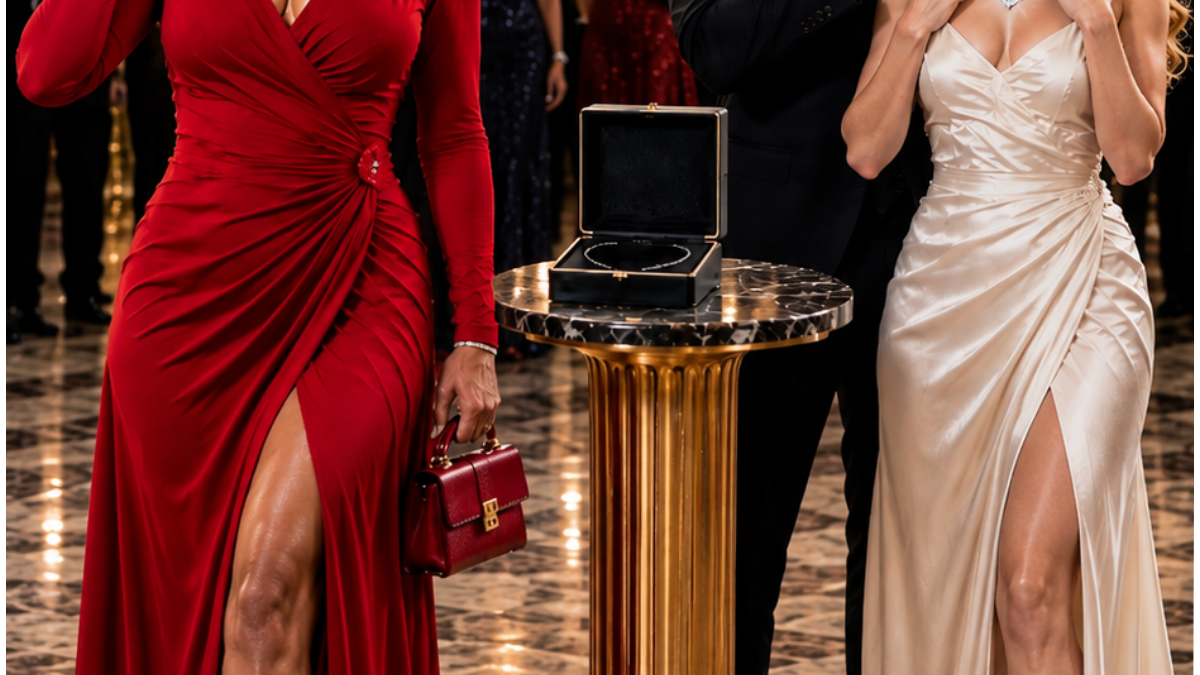
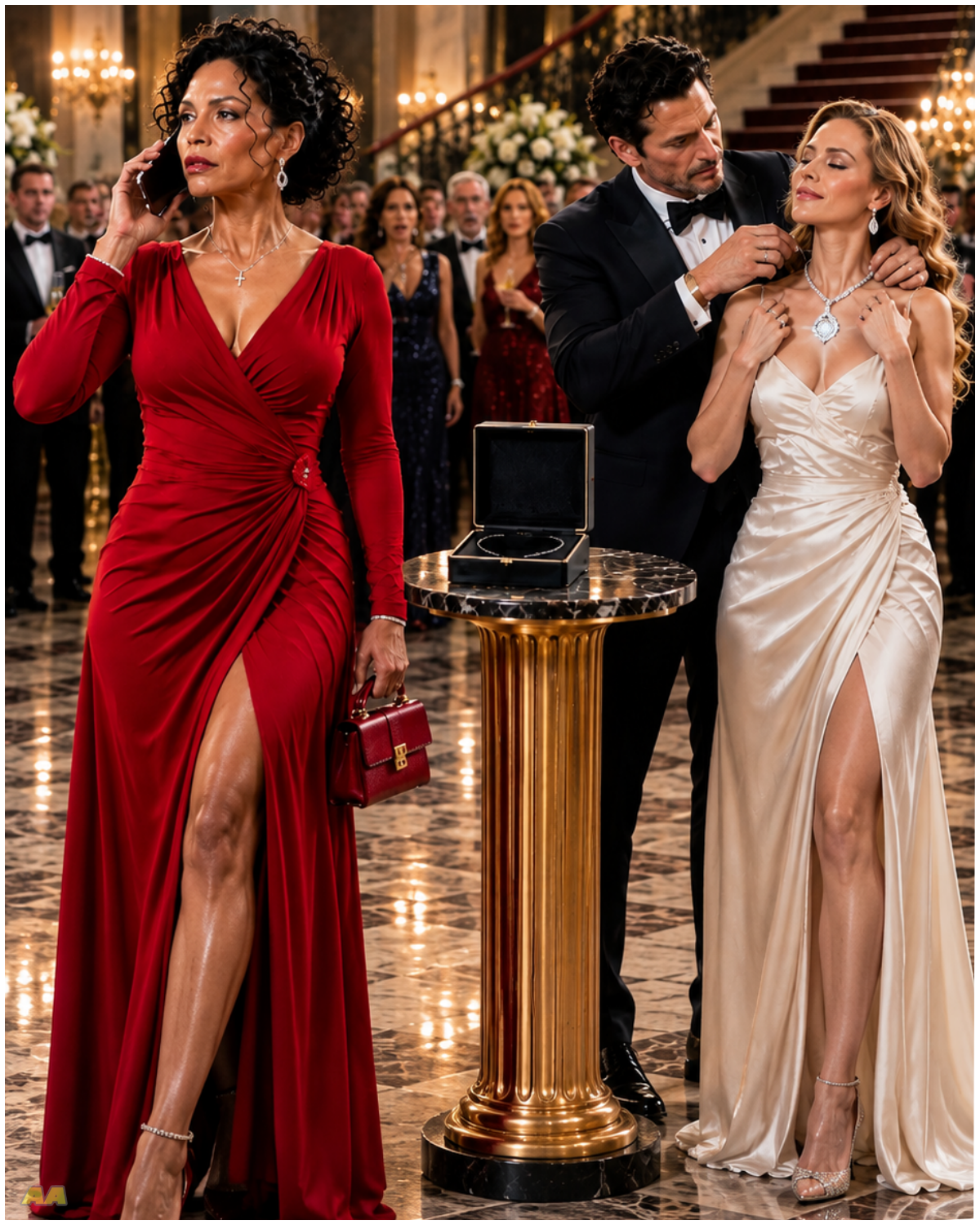
That is my necklace. Adrienne Brooks said it so quietly that the woman beside her leaned closer, unsure she had heard correctly.
Across the ballroom of the Holston Grand, Clare Bennett was coming down the staircase in a white evening dress, smiling at photographers.
Seven blue sapphires rested at her throat.
Adrienne knew every one of them.
That morning, the necklace had been inside the safe in the Whitmore penthouse, a safe both she and Grant could access.
She had not worn it in years.
She had certainly not offered it to Clare.
Adrien Grant’s voice came from behind her.
She turned. Her husband looked exactly as he always did at foundation events.
Black tuxedo, white shirt, calm expression, one hand already reaching to greet someone more important than the last person he had spoken to.
Adrienne looked back at Clare.
Why is she wearing my necklace?
Grant followed her eyes. For a moment, he seemed annoyed that she had noticed so quickly.
She needed something for tonight.
So, you gave her mine?
I let her wear it without asking me.
Grant lowered his voice. Can we not do this here?
Adrienne almost smiled at the choice of words.
She had asked one question.
Somehow, she was already the one creating a problem.
Around them, the winter gala moved on without pause.
Champagne glasses passed on silver trays.
A string quartet played near the marble staircase.
Nearly 500 guests filled the room.
Many of them donors Adrienne had known longer than Grant had known their last names.
Clare reached the bottom of the stairs and joined a group of photographers beside the foundation display.
She touched the necklace lightly when someone complimented it.
Grant glanced toward the cameras.
Clare is handling press tonight.
The necklace photographs well with the dress.
Adrienne looked at him. That is your explanation.
It is jewelry, Adrien. His phone vibrated.
He checked it before adding, “We can talk about this at home.” Then he walked away to greet a trustee.
Adrien remained beside the champagne table, surprised not by what he had done, but by how ordinary he believed it was.
A few minutes later, Clare approached her.
Up close, the sapphires looked darker beneath the chandeliers.
“Adrien.” Clare gave her a careful smile.
You look beautiful. Thank you.
Clare touched the necklace again.
Grant said you would not mind.
Did he? The smile on Clare’s face shifted.
He said, “You never wear it anymore.”
Adrien could have corrected her.
She could have asked Clare to remove it in front of everyone.
Instead, she looked more closely.
Something about the necklace was wrong.
Would you turn around for a second?
Clare blinked. Why? The clasp.
Clare hesitated, then turned slightly.
Adrienne had only needed a second.
The original clasp had been narrow platinum, almost invisible beneath the chain.
This one was wider and brighter.
No. Adrienne remembered the tiny groove beneath the old hinge because her mother had asked Thomas Caldwell to put it there 17 years ago.
It was gone. Is something wrong?
Clare asked. Adrienne stepped back.
Where did Grant have it altered?
Altered? The clasp is different.
Clare touched the back of her neck.
I do not know. Grant gave it to me already fitted.
Already fitted. Adrienne looked across the ballroom.
Grant was laughing with two board members completely at ease.
Suddenly, the problem was no longer that he had opened their safe and taken something that belonged to her.
A class did not change itself between breakfast and dinner.
Someone had measured the necklace.
Someone had worked on it.
And Grant had arranged all of that before tonight.
Clare followed Adrienne’s gaze.
I really thought you knew.
For the first time, she sounded less confident.
Adrienne picked up her red clutch from the table.
I did not. Do you want me to take it off?
Adrienne considered the question, then shook her head.
Not yet. Clare stared at her.
Why not? Adrienne looked once more at the altered clasp.
Because now I want to know who changed it.
She walked toward the ballroom doors.
Grant noticed and started after her.
Adrien, where are you going?
She stopped just long enough to look at him.
I need to make a phone call to who?
Adrien opened the door. Someone who remembers where that necklace actually came from.
Outside the ballroom, the hotel corridor felt almost too quiet.
Adrienne walked past a row of gold framed mirrors and pressed the elevator button.
Her phone vibrated before the doors opened.
Grant. She let it ring.
A second call followed before she reached the lobby.
Then came a message. Where are you going?
Adrienne read it and put the phone back into her clutch.
The doorman opened the glass doors and cold December air met her at the curb.
Her driver, Marcus, stepped from the black town car.
Home, Mrs. Whitmore. Adrienne paused.
Home suddenly felt like a complicated word.
Just drive for a few minutes.
Marcus nodded without asking anything else.
The car moved north along Fifth Avenue, leaving the Holston Grand behind.
Adrienne sat back and searched her phone for Caldwell and Finch.
She had not spoken to Thomas Caldwell in at least 12 years, but she remembered his shop clearly.
Walnut counters, brass lamps, no loud music, no salespeople trying to impress anyone.
Her mother had trusted him.
That mattered more tonight than any online review.
She found the number and called.
A man answered after three rings.
Caldwell and Finch. The voice was older, but she recognized it immediately.
Mr. Caldwell. Yes. This is Adrien Brooks.
There was a short silence.
Adrien Brooks, Thomas repeated. Well, I was wondering when I might hear from you.
Adrienne sat forward. Why would you wonder that?
Because your husband called me almost 2 weeks ago.
The city moved past the window, but Adrien stopped noticing it.
Grant called you. Yes. About the sapphire necklace.
Thomas did not answer right away.
Where is it now? Around another woman’s neck.
Another silence. Longer this time.
I see. Adrienne looked down at her hands.
No, I do not think you do.
I saw the class tonight.
It has been replaced. Then he found someone willing to do the work.
You refused. I did. Adrienne glanced toward the driver, then lowered her voice.
What exactly did he ask you to do?
Paper moved on Thomas’s end of the line.
He sent photographs first, then measurements.
He wanted the chain shortened by 3/4 of an inch and a clasp replaced.
Claire’s words returned to Adrien.
Already fitted. Anything else? She asked.
Thomas hesitated. Yes. What? There was an identifying mark under the original hinge.
Your mother asked for it when we made the piece.
Grant wanted it removed. Adrien looked out at Central Park, dark beyond the trees.
Did he say why? He said it was unnecessary.
And you told him. I told him I would need permission from the original client.
Adrien already knew the next part would matter.
What did Grant say? Thomas gave a tired little laugh.
He said he was the original client.
Adrienne closed her eyes for a moment, not because the answer shocked her.
Because it fit too easily.
You corrected him. I did.
How did he take that?
He told me I was being technical.
Despite herself, Adrienne let out a quiet breath that almost became a laugh.
That sounded exactly like Grant.
If a fact stood between him and what he wanted, the fact became a technicality.
Mr. Caldwell. Do you still have the original records?
I keep everything. The commission?
Yes. The stone records? Yes.
My mother’s instructions? Thomas paused.
Those two. Adrienne looked at the time.
It was a little after 10:00.
Can I come tonight? I am not at the shop anymore.
Tomorrow morning, then 9:00. I will be there.
She was about to end the call when Thomas said her name.
Adrien. Yes. There is something you should know before tomorrow.
His tone had changed. What is it?
When Grant called, I asked him one question.
I asked whether you had agreed to any of these changes.
Adrienne waited. What did he say?
He said, “It did not matter because the necklace belonged to him.” Adrien looked at her reflection in the dark window.
It does not. I know.
Thomas’s answer came without hesitation.
That is why I refused the work.
Grant called again. His name appeared across her screen while Thomas was still on the line.
Adrienne declined it. There is more, is there not?
She asked. There is. Thomas sounded careful now.
Your mother was very particular about documenting the origin of those stones.
She left paperwork with a commission file.
What kind of paperwork? I would rather show you in person.
Adrien was quiet for a beat.
All right. Thomas started to say goodbye, then stopped.
One more thing. Do not tell Grant you are coming.
Adrienne frowned. Why? Because after I refused him, he asked whether the original file could be destroyed.
At 9 the next morning, Adrienne stood outside Caldwell and Finch in a Redwool coat, watching Thomas unlock the narrow brass framed door.
Madison Avenue was already busy behind her.
But inside the shop, the city seemed to disappear.
The same walnut cases lined the walls.
The same old clock hung above the private consultation room.
Thomas had changed more than the place had.
His hair was silver now, and he moved a little more slowly, but his eyes were as sharp as Adrien remembered.
“You came alone,” he said.
“You told me not to tell Grant.
I was hoping you would listen.” Thomas locked the door and turned the sign to private appointment.
Adrienne removed her gloves. “Why did he ask you to destroy the file?
That is what I hoped you could tell me.” He led her to the back counter where a burgundy ledger and a cream folder were waiting.
Before we start, I want to be clear.
Grant never asked me to do anything illegal.
He asked whether old commission records were routinely discarded.
When I said ours were not, he asked whether this particular file could be, and you said no.
I said your name was on it, not his.
Adrienne nodded. That distinction made the conversation feel more real and somehow worse.
Thomas opened the ledger. January 17th, 17 years ago.
Adrienne recognized her own signature immediately.
Above it, Thomas had written the details in dark ink.
Seven family sapphires supplied by client.
14 diamonds, platinum setting, custom clasp.
Grant’s name appeared nowhere. I remember this, Adrienne said.
Your mother brought the stones in herself.
She did. Grant came to the final fitting, but he did not commission the necklace.
Adrienne ran one finger along the edge of the page.
Over the years, he started telling people he bought it for me.
After his first major deal, Thomas gave her a look.
Did you correct him? At first and later, Adrien looked at the ledger.
Later, it seemed easier not to.
Thomas closed it gently. Stories become facts when nobody in the room remembers the first version.
He opened the cream folder and removed copies of Grant’s recent email.
There were photographs of the necklace laid across the desk in Grant’s study, followed by measurements and a short list of requested changes.
Adrienne read them slowly. 3/4 of an inch shorter.
Yes. Clare is shorter than I am.
Thomas said nothing. He did not need to.
Adrien continued. Replace clasp. Remove identifying groove if possible.
He planned this before the gala.
It appears so. This was not him opening the safe yesterday because Clare needed jewelry.
No, Adrienne set the page down.
He had it measured for her.
Saying it aloud stripped away the last convenient explanation.
Grant had not made a careless decision at a crowded event.
He had thought about Clare wearing the necklace days before Adrienne saw it.
Thomas reached for another envelope.
There is something else, but I want to correct what I told you last night.
Your mother did not leave private trust documents with me.
She was far too careful for that.
Adrienne looked up. Then what did she leave?
Thomas handed her a single yellowed page.
It was a providence statement for the Sapphires signed by Eleanor Brooks.
It documented the stones as Brooks family property transferred to Adrienne personally.
Near the bottom was a reference to the Brooks family trust and the law firm that had handled Eleanor’s estate planning.
Ellis Mercer and Lane. Adrienne recognized the name immediately.
Margaret Ellis, her mother’s attorney.
Why reference the trust here?
Adrienne asked, “I do not know.
I am a jeweler, not a lawyer.” Thomas gave a small shrug.
But your mother told me once that she liked important things to leave a trail.
Adrienne almost smiled that sounded like Eleanor.
Her phone buzzed. Granted sent a message.
We need to talk before the donor lunchon.
Adrienne ignored it. Thomas watched her place the providence statement back on the counter.
What are you thinking? That my husband wanted to remove the only mark on the necklace that could lead someone back to its original record?
You think that was deliberate?
Adrien considered the question. I do not know yet.
That answer mattered. She was done turning suspicion into certainty just because it hurt.
She needed facts. Can I have copies of everything Grant sent?
They are already prepared. Thomas slid the cream folder toward her.
Adrienne took it, then photographed the reference to Margaret Ellis.
Thank you. What will you do about the necklace?
Adrienne put on her gloves.
Nothing yet. Thomas looked surprised.
Nothing. The necklace is not going anywhere.
I need to find out what else Grant has decided belongs to him because I stopped asking questions.
She stepped toward the door, then paused.
Thomas, when Grant said the necklace was his, did he sound angry?
Thomas thought for a moment.
No. What did he sound like?
Certain? Adrienne nodded slowly. That was the word she had been looking for.
Not cruel, not reckless. Certain?
She left the shop and called Margaret Ellis before she reached the sidewalk.
Margaret answered on the second ring.
Adrien, it has been years.
I know. I found something with my mother’s name on it.
What kind of something? Adrienne looked back through the window at the burgundy ledger.
A trail. Margaret became quiet.
Where does it led? Adrienne glanced at the cream folder beneath her arm.
I was hoping you could tell me.
Margaret Ellis asked Adrienne to come to her office before the donor lunchon.
40 minutes later, Adrienne was sitting across from her mother’s former attorney on the 9inth floor of a quiet Park Avenue building.
The cream folder from Caldwell and Finch opened between them.
Margaret had changed little in Adrienne’s memory.
Her hair was shorter and almost entirely silver, but she still wore a navy suit, pearl earrings, and the same expression that had made careless people choose their words more carefully around her.
She read Eleanor’s provident statement twice before looking up.
Your mother never did paperwork by accident.
Thomas said something similar. Thomas knew Elanor well enough to know that.
Margaret turned to her computer.
What exactly are you looking for?
Adrienne thought about Grant’s certainty.
I am not sure yet.
That is an expensive answer in this office.
Adrienne smiled for the first time that morning.
Then start with the Brooks family truSt. Margaret studied her.
Why now? Adrienne slid Grant’s alteration request across the desk.
Because my husband took a necklace made from my family’s stones, had it resized for another woman, and tried to remove the identifying mark.
Margaret read the page. Did he know what the mark meant?
I do not know. Good.
Adrienne frowned. Good. You said you do not know.
Keep doing that until the documents tell us otherwise.
It was exactly the kind of correction Eleanor would have appreciated.
Margaret entered a password and opened an archive client directory.
You remember the emergency investment your mother arranged when Grant’s first company was running out of cash.
I arranged most of it.
She insisted on the structure.
Do you remember why? Adrienne leaned back.
17 years earlier, Grant had been weeks away from missing payroll.
Banks had declined him. Two investors had walked away.
Adrienne had spent nights rebuilding his projections at their small Brooklyn kitchen table, while Grant called anyone who might take another meeting.
Eleanor had watched all of it with the patience of a woman who trusted her daughter but did not trust desperation.
She told me love was not a substitute for paperwork, Adrienne said.
Margaret smiled faintly. That sounds like her.
She opened an old scan file.
The Brooks Trust invested in the company.
You did not hand Grant a personal check.
I know. Do you remember what happened when Whitmore Capital was reorganized 6 years later?
Most of the early interests were converted.
I signed several documents. Several is not all.
Margaret printed a page and placed it in front of Adrienne.
The language was dense, but Adrienne still knew how to read it.
She had spent too many years doing exactly that for Grant.
Retained beneficial intereSt. She said, “Yes, I thought this was deluded.
The economic interest was.” Margaret tapped the next paragraph.
The protected voting provision was not.
Adrienne looked up. There is still a vote attached to the truSt. There appears to be.
I need current corporate records before I tell you how much it matters.
Grant has been voting it.
Has he? Margaret asked. Or have you been authorizing him to vote it?
That stopped her. Adrienne remembered annual packets arriving at the penthouse.
Grant’s assistant would place tabs besides signature lines.
Sometimes Grant would say, “Same as last year.” And Adrienne would sign between calls, dinners, and foundation meetings.
There was a proxy, she said.
A standing proxy. I think so.
Then we find it. Margaret made a note.
And before you panic, a proxy can have limits.
We need the actual document.
Adrienne looked toward the window.
She was beginning to see how easily convenience had become habit.
Grant had not stolen every decision from her.
In some cases, she had stopped insisting on making them.
That truth was harder to face, but it was hers.
Margaret closed the file. Do not sign anything Grant puts in front of you until I finish reviewing this.
He wants me at the donor lunchon in less than an hour.
Then eat lunch. Adrienne laughed softly.
That is your legal advice.
My legal advice is do not sign anything.
My personal advice is do not let Grant know what we are checking until we know what we have.
Adrienne stood and buttoned her red coat.
He will know something is wrong.
Let him. Margaret handed back the cream folder.
Just do not confuse his discomfort with your emergency.
At the door, Adrienne stopped.
Margaret, if the voting provision is still active, when is the next board vote?
Margaret checked her screen. Her expression changed.
Monday morning on what? The Northstar acquisition.
Adrienne knew the deal. Granite spent 8 months building it.
How close is the board?
Margaret looked at her carefully.
Close enough that I am going to make another call before I answer that.
Adrienne’s phone rang before she reached the elevator.
Grant this time she answered.
“Where are you?” he asked.
“On my way back to the hotel.” “Good.
We need to talk about last night.” “We do.” Grant paused, apparently surprised by her agreement.
“Can we handle this like adults?” Adrienne watched the elevator numbers descend.
That depends on what? The doors opened.
On whether you finally tell me what you already decided without me.
Grant said, “Nothing.” Adrienne stepped inside for the first time since the gala.
His silence told her more than his words.
Adrienne returned to the Holston Grand at 11:40, 10 minutes before the donor lunchon was scheduled to begin.
The ballroom looked different in daylight.
The chandeliers were still lit, but winter sun filled the tall windows, exposing every detail.
The evening had softened. Grant was waiting near the entrance in a black suit, his phone in one hand.
We need 5 minutes, he said.
Then take five. He let her into a small private lounge off the ballroom and closed the door.
What happened last night? You gave Clare my necklace.
I know what I did.
Then why are you asking?
Grant exhaled. I am asking why you walked out without saying anything.
Adrienne looked at him. Would you have listened?
Of course. You did not ask before taking it.
Grant rubbed a hand across his jaw.
For the first time, he looked tired rather than polished.
Clare needed something for the gala.
I made a judgment call 13 days before the gala.
His hand stopped. Adrien washed his face carefully.
Thomas Caldwell keeps excellent records.
Grant looked away. So that is where you went.
No, I went there this morning.
Adrien, I was going to tell you when he did not answer before or after you had the identifying mark removed.
That mark meant nothing. It meant something to my mother.
I did not know that.
You did not ask. Grant’s voice dropped.
What do you want me to say?
Adrienne considered him. This was the first question he had asked that sounded real.
I want you to stop telling me this happened because Clare needed jewelry.
Grant walked toward the window.
The press team wanted a cleaner look for her.
I thought the necklace suited the campaign.
So, you planned it? Yes.
The admission came reluctantly. I planned for her to wear it.
And the resizing Clare is smaller than you.
Hearing him say it made the room very quiet.
Grant turned back. I understand how that sounds.
Do you? I should have asked.
Yes. He nodded once. I should have asked.
Adrienne had expected excuses. The simple admission unsettled her more.
Why did Clare tell me everything had already been decided?
Grant frowned. What exactly did she say?
Those words. She was talking about the foundation campaign.
What campaign? Grant hesitated. There it was again.
Grant, we are changing the public-f facing team.
Next quarter player will handle more donor media and press appearances.
The work I have been doing some of it was I going to be told after the board approved the new structure.
Adrienne stared at him. The necklace suddenly made perfect sense.
It was not the plan.
It was a symptom of the plan.
Grant had begun moving Clare into rooms Adrienne had occupied for years and had assumed Adrienne would adapt after the decisions were made.
You decided to reduce my role at the foundation without speaking to me.
I was trying to take pressure off you.
Did I tell you I was under pressure?
No, but you have been pulling back.
Maybe I was tired of doing work nobody remembered I was doing.
Grant opened his mouth and stopped.
A knock came at the door.
Mr. Whitmore. The Mercer family has arrived.
Grant looked toward the hallway.
We have to go. Adrienne picked up her clutch.
Of course we do. Can we finish this tonight?
Maybe. They entered the ballroom together.
Clare stood near the foundation display in an ivory suit speaking with two photographers.
She was not wearing the necklace.
When she saw Adrien, she excused herself and approached.
“Can I talk to you?” Clare asked.
Grant started to answer for her, but Adrien looked at him.
He stopped. “Go ahead,” Adrienne said.
Clare lowered her voice. “I gave the necklace back to Grant this morning.” Adrienne had not expected that.
“Why? Because I found out it was yours before it was his.” Clare glanced toward Grant.
He told me it was a Whitmore family piece.
Grant’s expression tightened. Clare, you did.
She looked back at Adrien.
I knew you were stepping away from some foundation events.
Grant said the board wanted me to take a larger role.
I did not know he had not discussed it with you.
Adrienne believed part of that.
She was not ready to decide which part.
Thank you for telling me.
Clare nodded and walked away.
Grant waited until she was gone.
She is making this sound worse than it is.
You keep saying that because it is true.
Adrienne’s phone vibrated inside her clutch.
A message from Margaret appeared on the screen.
I found the proxy. Call me when you are alone.
Adrienne locked the phone without replying.
Grant watched her. Who is that?
Someone checking an old document for me.
What document? A photographer called their names from across the ballroom.
Adrienne looked at Grant then tooured the waiting cameras.
You wanted me here for the donors.
Let us not keep them waiting.
For the next hour, she stood beside him, spoke with family she had known for years, and watched Grant relax because she had stayed.
He thought presence meant agreement.
He thought calm meant the problem was passing.
At 12:57, Adrien stepped away from the lunchon and called Margaret from an empty corridor.
Tell me, Margaret did not waste time.
The proxy is revokable. And Adrien, Grant needs that vote on Monday.
Adrienne stayed in the empty corridor with the phone against her ear while voices from the donor lunchon drifted through the closed ballroom doors.
Revocable how? She asked. Margaret answered immediately.
By written notice, you signed the proxy 6 years ago during the corporate reorganization.
It allows Grant to vote the Brooks Trust interest on routine matters unless you withdraw that authority.
Adrien leaned against the window ledge and I never withdrew it.
No, you renewed it twice.
That mattered. Grant had not forged her name or secretly taken control.
She had signed the documents.
She had trusted him enough to stop reading every page as if her own interests might someday diverge from his.
So I gave him the authority.
You gave him limited authority.
Margaret said, “Do not turn a legal document into a confession.” Adrienne smiled faintly.
You still sound like my mother.
Your mother paid me to sound like this.
How much does the vote matter?
Monday. Papers shifted on Margaret’s end.
The Northstar acquisition needs a supermajority under the current agreement.
Grant has been counting the Brooks block as committed.
Without it, he does not have enough votes today.
Adrien looked through the glass doors toward the ballroom.
Grant was standing with the Mercer family, smiling for a photographer.
If I revoke the proxy, does the deal fail?
No. It means Grant has to find another vote, renegotiate, or delay.
You are not destroying anything.
You are simply deciding your own position.
Good. Do you want me to revoke it?
Adrienne did not answer immediately.
Not yet. Send me everything firSt. I already did.
Her phone chimed with the email.
There is more. Margaret continued.
I checked the trust’s charitable records, too.
Adrienne straightened. Why? Because you mentioned the foundation restructuring.
Several annual commitments people casually call Whitmore donations are actually made through the Brooks family truSt. How many enough that you should review them before anyone announces a new foundation structure on your behalf?
Adrien felt irritation rise but this time it had somewhere useful to go.
Can Grant redirect those commitments?
No. The trustees can approve changes and you are the controlling beneficiary with appointment rights.
Again. I need to review each agreement before giving you a final answer.
Do that. Adrien, what are you planning?
I am trying to find out what I still control before someone tells me it has already been decided.
Margaret was quiet for a second.
That is a much better question.
Adrien ended the call and opened the documents on her phone.
The proxy was only four pages long.
Her signature appeared at the bottom beside a date she remembered for an entirely different reason.
Grant had been preparing for a major acquisition that week.
Adrienne had been organizing a hospital fundraiser and caring for Eleanor during one of her final illnesses.
Grant had placed the papers on the kitchen counter and said, “Same voting arrangement as last year.” She had read enough to understand the basics, then signed.
There had been no deception in that moment.
Just truSt. The realization hurt more cleanly than anger would have.
A door opened behind her.
Grant stepped into the corridor.
There you are. Adrienne locked her phone.
Here I am. The Mercers asked for you.
I spoke with them. Grant came closer.
What old document are you checking?
A proxy. His expression changed before he could hide it.
Which proxy? The Brooks truSt. Why are you looking at that now?
Why does that worry you?
It does not worry me.
Then answer the question. Grant lowered his voice.
Because Monday is important, Adrien for Northstar.
He stared at her. Margaret told you.
She told me you have been counting my vote.
Our vote. Adrienne held his gaze.
No, that is exactly the problem.
Grant looked toward the ballroom doors to make sure nobody was close enough to hear.
We have voted together for years.
Because I authorized you and you trusted my judgment.
I did. The past tense landed between them.
Grant heard it. Are you going to pull the proxy because you are angry about Clare?
I am reviewing it because you made decisions about my role, my property, and my vote as if asking me were optional.
Those are not the same thing.
They became the same thing when you stopped noticing the word mine.
Grant took a breath. If you withdraw that vote now, you put 8 months of work at risk.
Then maybe you should have spoken to the person whose vote you needed.
For once, Grant had no quick answer.
Adrienne walked past him and returned to the ballroom.
She did not leave immediately.
She finished two conversations with donors, thanked the lunch and staff, and said goodbye to people she genuinely cared about.
At 2:15, she stepped into the Black Town car and opened Margaret’s email.
Attached were the proxy, the original trust investment records, and a preliminary list of charitable commitments.
Adrienne read every page on the drive downtown.
By the time the car stopped outside Margaret’s office, she knew what she wanted.
Prepare the revocation,” she said when Margaret met her in the conference room.
“Effective today.” “Yes,” Margaret picked up her pen and the charitable commitments.
“Freeze any new changes until I review them.
Existing obligations get honored.” Margaret nodded.
“That is sensible.” Adrienne looked at the old Brooks trust documents spread across the table.
“I am not trying to take Grant’s company away from him.
I know. I am taking my signature back.” Margaret slid a clean sheet of paper across the table.
Then this is where you start.
Adrienne signed her own name carefully.
Adrienne Brooks Whitmore. She looked at it for a moment, then handed the page back.
Margaret checked the time. Corporate council will receive this before 3.
Adrienne stood. How long before Grant knows?
Margaret glanced toward the clock.
If his lawyers are good, she reached for the phone.
About 5 minutes. Grant called before Adrienne’s car had gone six blocks.
She watched his name appear on the screen, disappear, then return less than a minute later.
On the third call, she answered, “Did you revoke the proxy?” There was no greeting.
“Yes, without talking to me first,” Adrienne looked out at the traffic moving down Park Avenue.
“You mean the way you change my role at the foundation?” Grant was quiet.
“That is different. It always is when you make the decision.” Northstar has nothing to do with Clare.
Neither does my vote. He exhaled.
“Come home. We can talk there.
Adrienne looked at the red folder Margaret had given her.
I will be there in 20 minutes.
The penthouse was silent when she arrived.
Grant had not made it back yet.
For years, Adrienne had loved the quiet of those rooMs. Tonight, it felt borrowed.
She walked into the bedroom, opened the closet, and took down one black suitcase.
She did not pack for a dramatic departure.
She packed for tomorrow. Two suits, three blouses, a red sweater, flat shoes, toiletries, her passport, her laptop.
She added the Caldwell folder, Margaret’s copies of the trust records, and the red notebook she had kept since before Whitmore Capital had a boardroom.
From a drawer in her study, she took a photograph of Eleanor standing beneath a red umbrella outside the Brooklyn Brownstone, where Adrienne had grown up.
She left the expensive things where they were.
They were not the reason she had stayed and they would not be the reason she left.
The front door opened while she was closing the suitcase.
Adrien Grant found her in the bedroom.
He had removed his tie and for once he looked less like the man from magazine covers and more like the man who used to come home worried about payroll.
His eyes went to the suitcase.
What are you doing? Packing.
I can see that. He stood in the doorway.
Where are you going? The Carile tonight.
After that, I will decide.
You are moving into a hotel over a necklace.
Adrienne stopped folding a blouse.
Do you really still think this is about the necklace?
Then tell me what it is about.
She looked at him. You planned for Clare to wear something that belonged to me.
You resized it for her.
You tried to remove my mother’s mark.
Then I found out you were moving Clare into my foundation role without telling me.
And today I learned you were counting my trust vote as yours before you had even asked how I wanted to vote.
Grant stepped into the room.
We have shared everything for 17 years.
Shared is not the same as yours.
I never said everything was mine.
You did not have to.
You started acting like it.
He sat on the edge of the chair near the window.
I made mistakes. Adrienne waited.
Grant looked at the suitcase again.
I should have asked about the necklace.
I should have talked to you about the foundation changes.
Yes, but leaving. He shook his head.
We can fix this. Adrienne studied him.
There had been a time when those words would have been enough to keep her in the room for hours, explaining herself until both of them were exhausted.
What exactly do you want to fix, Grant?
He opened his mouth, then paused.
Us? That is not an answer.
What do you want me to say?
Something you have actually thought about.
The silence that followed was not angry.
It was worse. Grant did not know.
Adrienne closed the suitcase. That is why I am leaving tonight.
So you can punish me.
No, she shook her head.
So I can hear myself think without you telling me what everything means.
Grant stood and Monday. What about it?
The vote. Adrien almost laughed, but there was nothing funny in it.
You waited less than 5 minutes.
That deal affects thousands of people.
Then go earn another vote.
Adrien, I am not voting against you tonight.
I am not voting for you either.
I am taking back the right to decide.
Grant looked away. That seemed to be the first sentence he truly understood.
Adrienne rolled the suitcase into the foyer.
She placed her penthouse keys on the console table.
Then she removed her wedding ring.
Her hand felt strangely light without it.
Grant watched from several feet away.
You do not have to do that.
I know. She set the ring beside the keys.
From her handbag, she took Thomas Caldwell’s business card and placed it underneath.
Grant picked it up. On the back, Adrienne had written one sentence.
Asked him whose necklace it was.
Grant read it, then looked at her.
Why does this matter so much to you?
Adrienne put on her red coat.
Because you remembered the necklace the same way you remembered our marriage.
You remembered yourself at the center of it.
The elevator chimed. Adrienne stepped inside with her suitcase.
Grant remained in the foyer.
Adrien. She held the door for a moment.
What? His voice was quieter now.
I did not know you felt erased.
Adrienne looked at him and for the first time that evening, sadness reached her face.
That is the problem, Grant.
You never noticed enough to know.
The doors closed. Grant stood alone with the keys, the ring, and Thomas Caldwell’s card in his hand.
A minute later, he called the number.
Thomas answered. Caldwell and Finch.
Grant stared at Adrienne’s handwriting.
This is Grant Whitmore. Thomas was silent.
Grant swallowed. I need you to tell me something.
All right. Whose necklace was it?
Thomas did not hesitate. Adrienne’s.
It was always Adrienne’s. Grant arrived at Whitmore Capital before 8 on Monday morning.
By 8:30, he had already called two directors personally.
One agreed to hear him out.
The other said he wanted to see the revised Northstar numbers before committing.
Neither conversation ended the way Grant expected.
At 8:45, he entered the boardroom in a black suit and found Margaret Ellis seated beside Whitmore Capital’s general counsel.
A burgundy folder rested in front of her.
Adrienne’s chair was empty. Grant stopped for half a second.
Margaret, good morning, Grant. I assume you are here for the Brooks TruSt. I am.
The directors took their seats.
Grant opened the meeting without mentioning Adrien, but everyone in the room knew something had changed.
For years, the Brooks voting interest had arrived through Grant’s proxy.
This morning, it had its own council.
When the Northstar acquisition came up, Grant presented the deal as he always did, controlled, detailed, confident.
He explained the projected growth, the new markets, and the revised financing.
Then one director asked the question he had been hoping to avoid.
Do you have the Brooks vote?
Grant glanced toward Margaret. Not at this time.
Is the trust opposing the acquisition.
Margaret answered before Grant could.
No position has been taken.
Mrs. Whitmore revoked a standing proxy.
She intends to review the proposal independently.
Grant disliked hearing it said that plainly because there was nothing unreasonable to argue with.
Another director closed his briefing book.
Then we do not have the supermajority today.
I can secure another vote, Grant said.
Perhaps, the chairman replied, but not in this meeting.
The vote was postponed for one week.
Nothing collapsed. No one raised a voice.
The company did not suddenly lose value because Adrienne had walked out of a penthouse.
Grant simply lost something he had stopped realizing was valuable.
Certainty. After the meeting, the chairman remained behind.
You should have told us the proxy was in question.
I did not know it was until Friday.
That is not what I mean.
Grant looked at him. The older man closed his folder.
You have been presenting the Brooks interest as if it were part of your personal voting block.
Apparently, it never was. Grant said nothing.
By 10:30, another problem reached his desk.
The foundation’s legal team wanted clarification before announcing the new public-f facing structure.
Several programs were funded partly through Brooks family trust commitments, and Adrienne had instructed Margaret to honor existing obligations, but approved no new changes until the review was complete.
Grant read the email twice.
Clare knocked on his open door.
She wore a white coat and carried a small velvet case.
Do you have a minute?
Not really. I think you should make one.
She placed the case on his desk.
Inside was the sapphire necklace.
Grant stared at it. Why do you have this?
You gave it back to me after the lunchon for the next reception and and I do not want it.
Grant leaned back. Claire, nobody is asking you to wear it again.
That is not the point.
She sat across from him.
You told me it was a Whitmore family necklace.
I was wrong. You were not confused about where you got it.
Grant looked at her. Clare continued before he could answer.
I called Caldwell and Finch this morning because the replacement clasp keeps catching.
Thomas Caldwell would not discuss Adrienne’s records with me, but he did tell me the necklace was commissioned in her name.
Grant’s expression tightened. You called him?
Yes, because I wanted to know what I had been wearing.
She pushed the case closer to him.
I thought Adrienne knew about the foundation changes.
I thought she knew about the necklace.
You made it sound like everything had been discussed.
I was going to discuss it with her after you decided it.
Grant looked toward the windows.
He had heard nearly the same sentence from Adrien.
Clare stood. I am stepping back from the new foundation role until the board decides what it actually wants.
You do not need to do that.
I do. Her voice was calm.
I took a job, Grant.
I did not agree to become proof that your wife was replaceable.
After she left, Grant remained at his desk with the velvet case open in front of him.
His general counsel arrived 20 minutes later carrying a file.
You asked me to trace the Brook’s interests.
Grant nodded. Tell me what Adrien controls.
The attorney sat down. That is the wrong way to look at it.
Grant gave him a tired glance.
Everyone keeps telling me I am asking the wrong question.
Then maybe listen. Grant almost objected but did not.
The attorney opened the file.
Whitmore Capital is yours in every meaningful operating sense.
Adrien cannot take your company from you.
But the Brooks Trust was part of the early financing.
Its voting rights are independent and several foundation relationships originated through Adrien and her mother.
You have been treating cooperation as ownership.
Grant looked down at the necklace.
17 years earlier, he remembered standing in Thomas Caldwell’s shop while Adrienne tried it on for the first time.
In his memory, he had always been the man giving her something beautiful.
Now he forced himself to stay with the details.
Eleanor had brought the stones.
Adrienne had signed the commission.
Adrienne had paid Thomas. Grant had simply stood beside her.
He closed the velvet case.
How much of what I call the Whitmore legacy started with her.
The attorney did not answer immediately, more than the corporate history usually acknowledges.
Grant looked at the empty chair across from his desk.
For the first time, the question was no longer what Adrienne owned.
It was how much of her contribution he had stopped seeing because she had always been there.
3 months later, Adrienne stood beneath warm gallery lights while a young jewelry designer tried to explain why she was nervous.
There are people here who actually know what they are doing, the woman said.
Adrienne smiled. That feeling never completely goes away.
Seriously, seriously, you just learn not to let it make decisions for you.
The woman laughed, thanked her, and disappeared into the crowd.
Adrienne watched her go. The Eleanor Brooks Fellowship had taken 12 weeks to organize, though the idea had lived quietly in Adrien for years.
It supported women building careers in design, finance, architecture, and the arts, especially women whose work had too often been credited to someone with a louder name.
Several longtime donors had joined the program.
Others remained with the Whitmore Foundation.
Adrienne had not asked anyone to choose sides.
She had only stopped pretending every relationship she built automatically belonged to Grant.
Across the gallery, beneath a simple glass case, rested the sapphire necklace.
Thomas Caldwell had restored the original design after Adrien recovered it from Grant.
The replacement clasp was gone.
The narrow platinum clasp had been recreated from Thomas’s original drawings, including the small identifying groove Eleanor had requested.
Adrienne could have worn the necklace tonight.
She preferred seeing it where the whole story could be read.
The card beside it was brief.
Seven Brooks family sapphires. Commissioned by Adrien Brooks.
Original design by Caldwell and Finch.
Nothing about Grant. Nothing about betrayal.
The truth did not need commentary.
You did not wear it.
Thomas had appeared beside her in a dark gray suit.
Adrienne glanced at him. Are you disappointed?
I am a jeweler. I prefer jewelry on people.
She laughed. My mother would have agreed with you.
Thomas looked at the display.
She would have liked this room.
Adrienne’s smile softened. I hope so.
A small shift near the entrance caught her attention.
Grant had arrived alone. He wore a black suit without the polished entourage that usually followed him to public events.
He greeted two donors, spoke briefly with Margaret Ellis, then stopped when he saw the necklace.
Adrienne watched him read the card.
He stayed there longer than she expected.
“Do you want me to rescue you?” Thomas asked.
From what? The conversation coming this way.
Adrienne looked at Grant approaching.
No, I think I can survive a conversation.
Thomas smiled and moved toward another gueSt. Grant stopped a few feet away.
Hello, Adrien. Hello, Grant. He glanced around the gallery.
This is impressive. Thank you.
Margaret told me the first fellowship class is fully funded.
It is. Your mother would be proud.
Adrienne studied him for a second.
Months earlier, hearing him invoke Eleanor might have irritated her.
Tonight, it did not. She would have asked to see the budget firSt. Grant laughed quietly.
That sounds right. The ease lasted only a moment.
His eyes returned to the necklace.
Thomas did good work. He always does.
I brought it back to him myself.
I know. Grant slipped his hands into his pockets.
I owed him an apology.
How did that go? He made me wait 40 minutes before he would see me.
Adrien smiled. Then he accepted it.
Grant nodded. Eventually, a server passed with champagne.
Neither of them reached for a glass.
Northstar closed last week, Grant said.
I heard different terms, better ones, actually.
Good. You were right to review the vote.
Adrienne raised an eyebrow. That must have hurt a little.
They both smiled, and then the silence returned.
This one did not feel hostile.
Grant looked toward the people filling the gallery.
I read the early financing files.
Adrienne waited. All of them, he continued.
The first models, your notes, the introductions you made, the trust investment.
He shook his head slightly.
There were things I remembered as mine because I had been telling the story that way for so long.
Adrien looked at him. Why are you telling me this?
Because I should have said it when it mattered.
Yes. Grant accepted that without defending himself.
Their separation agreement was nearly complete.
There had been no public battle, only lawyers, schedules, financial statements, and difficult conversations neither of them could avoid anymore.
Grant remained wealthy. Whitmore Capital remained his company.
Adrienne had no interest in taking either from him.
She had wanted something simpler and in the end harder, a life in which her name did not disappear inside his.
Can I ask you something?
Grant said, “You can ask.
Was there a moment when I could have fixed this?” Adrienne took her time.
Probably. Grant looked at her when before you needed to ask that question.
He lowered his eyes and nodded.
There was nothing cruel in her answer.
That was why it landed.
Someone called Adrienne’s name from near the front of the room.
The fellowship presentation was about to begin.
Grant stepped aside. You should go.
Adrienne started toward the stage, then turned back.
Grant. Yes. When people ask how Witmore Capital began, tell them the whole story.
He met her eyes. I will.
Adrienne nodded once and walked away.
A moment later, the host introduced her.
Not as Grant Whitmore’s wife.
Not as the woman who had left him.
Not as the owner of a famous necklace.
Please welcome the founder of the Eleanor Brooks Fellowship, Adrienne Brooks.
Applause filled the room. Adrienne stepped beneath the lights and looked out at the women whose names were printed clearly across the evening program.
Near the back, Grant applauded with everyone else.
She did not need him to regret losing her.
She did not need Clare to lose anything.
She did not even need the necklace around her neck.
For years, Adrienne had believed leaving would mean abandoning the life she helped build.
Standing there, she finally understood the difference.
She had not abandoned her life.
She had simply stopped allowing someone else to tell her which parts of it were hers.








