He Trusted No One for 17 Years – Then the Maid’s Little Girl Gave the Mafia Boss Her Only Coat

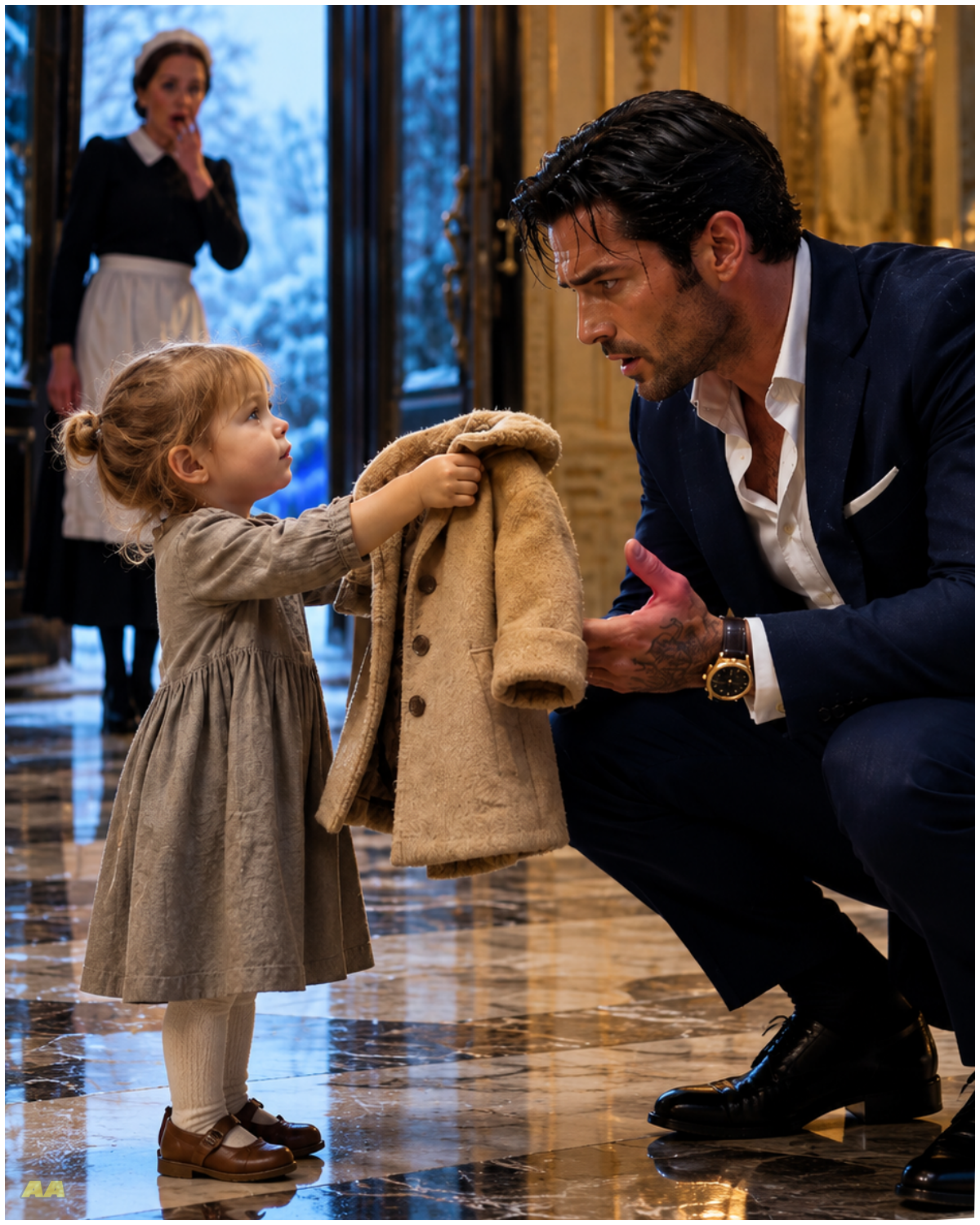
$10,000 sat less than 12 in from a seven-year-old girl’s hand, and Dante Bellini was waiting for her to steal it.
His eyes were closed, his head tilted against the black leather wing back chair, his breathing deep and slow beneath the soft crackle of the library fireplace.
Anyone standing in the doorway would have seen a tired man asleep after lunch, one hand hanging loose beside the armrest, the other resting against his dark suit jacket.
But Dante had not been asleep for a single second.
Behind his eyelids, he was counting every sound in the room.
The small hiss of burning oak, the faint tap of sleep against the tall windows, the old clock above the shelves marking each second with a dry mechanical click.
And somewhere near the far wall, the almost silent breathing of a child who had been told not to move.
On the walnut table beside Dante lay an open cream colored envelope stuffed with $100 bills.
He had arranged it carefully before anyone entered.
Several notes protruded far enough to be seen from across the room.
One had been placed dangerously close to the edge, as though a careless hand might have brushed it there before its owner drifted off.
It was not carelessness.
Dante Bellini had built too much of his life on expecting the worst from people to leave $10,000 anywhere by accident.
He had used this same test on drivers, accountants, household employees, associates, even men who had called him brother.
Some took a single bill and convinced themselves it would never be noticed.
Some took more.
A few stared at the money for several minutes before greed finally defeated fear.
Dante had learned something from every one of them.
Or at least he believed he had.
When no one was watching, people showed you what they were.
And when people showed you, you remembered.
That afternoon he had not planned to test a child.
He had planned to test Mara Ellis, the newest housekeeper in the Bellini estate, a widow who had worked there for less than a month, and whose background had been checked so thoroughly Dante knew the name of the elementary school her daughter attended, the balance remaining on her hospital debt, and the apartment building where the heat failed every winter.
Mara had entered the library 20 minutes earlier, with an apology already trembling in her voice.
School had closed because of the freezing rain.
Her neighbor, who sometimes watched Lily, had been taken to urgent care that morning.
Mara had no family nearby and no money for emergency child care.
She had asked the house manager whether her daughter could sit quietly in an unused room until her shift ended.
The answer should have been no.
Children did not wander through Dante Bellini’s home.
Nobody wandered anywhere in Dante Bellini’s home without permission, but the storm was worsening.
The roads were turning to glass.
And Mara had stood in the hall holding her daughter’s hand with the exhausted dignity of someone determined not to beg until begging became the only remaining option.
The house manager had finally agreed on one condition.
Lily stayed out of sight.
Then a plumbing leak forced two employees into the unused sitting room, and the library became the nearest place where the child could wait.
Mara had crouched in front of her daughter before leaving.
Stay right here.
Don’t touch anything.
Don’t open anything.
Don’t wake Mr. Bellini. I’ll be back as soon as I finish downstairs.
Lily had nodded with grave concentration.
What if he wakes up by himself?
Then you say hello.
You say you’re sorry for being here and you come get me.
What if he asks why I’m in his library?
Tell him the truth. What if the truth gets you fired?
Mara had gone still for half a second.
Dante had heard it in the silence between them.
Then she kissed her daughter’s forehead.
You tell the truth anyway. The door closed behind her and Dante began to wait.
For the first several minutes, Lily did absolutely nothing.
That was unusual. Adults surrounded by expensive things almost always betrayed themselves somehow.
Their attention moved. Their breathing changed.
They investigated. A child should have been worse.
Dante expected cabinet doors, curious footsteps, fingers tracing polished objects that cost more than Mara earned in a year.
Instead, Lily remained on the rug near the bookshelf where her mother had left her.
Dante could hear the soft scrape of a pencil.
Apparently, she had brought homework. 5 minutes passed, then ate.
His neck began to ache from holding the same position.
He ignored it. At 11 minutes, the pencil stopped.
Silence. Then came the faint rustle of clothing.
Lily stood. Dante’s breathing remained even, but every part of him sharpened.
Small footsteps crossed the rug. Slow, careful.
1 2 3. They stopped beside the walnut table.
The money was close enough now that the girl could reach it without stretching.
Dante pictured her torn winter boots.
He had noticed them when she entered.
Cheap brown things with salt stains around the seaMs. Her coat was too thin for a Chicago winter, and one sleeve had been stitched near the cuff with thread that did not quite match.
$10,000 could pay Mara’s overdue bills.
Replace every piece of clothing Lily owned.
Keep the heat running, fill their refrigerator, perhaps buy enough time for a frightened mother to sleep without calculating which payment could be late.
Dante knew exactly how much temptation he had placed in front of them.
That was the point. His father had once told him that loyalty revealed itself under pressure.
Dante had eventually learned the opposite lesson.
Pressure did not reveal loyalty. It revealed price.
Everyone had one. Lily took another step.
Paper whispered against wood. There it was.
Dante felt the familiar cold satisfaction before he even knew what she had done.
People always disappointed you eventually. The only difference was how long you wasted before discovering it.
But the sound came again, slower this time, and something about it was wrong.
She was not pulling money from the envelope.
She was pushing the envelope away from the edge of the table.
Dante understood because he had placed that one loose bill deliberately near the corner.
And now he heard the faint slide as Lily tucked it back with the others and moved the envelope several inches inward until it rested safely beside the lamp.
There she whispered, not triumphant, not afraid, just satisfied that something had been put where it would not fall.
Dante’s brow nearly moved, he stopped it.
The girl remained beside the table.
A second later, her footsteps came closer.
Not toward the money, toward him.
He felt her presence beside the chair.
Then something touched the back of his hand.
Two small fingers barely there. Dante’s first instinct was violent and automatic.
His body wanted to seize the wriSt. His mind stopped it before a muscle moved.
Lily held her fingers against his skin for a moment, then withdrew them.
“Oh,” she whispered. Dante heard the concern in that single syllable.
“A zipper opened. Fabric rustled. Something light settled across his chest and knees.
The child’s coat, her only winter coat.
She tugged one side higher over his shoulder, apparently unhappy with the coverage, then carefully tucked the other side between his arm and the chair so it would not slide away.
Dante lay beneath a faded blue coat that smelled faintly of laundry soap and cold air, utterly unable to understand what had just happened.
He had spent years arranging situations in which people could reveal selfishness.
He knew every version of hesitation, excuse, entitlement, and theft.
He had never designed a response for this.
Lily touched his hand again, almost as if confirming the problem.
“Still cold,” she murmured. Then she returned to the rug.
Dante opened one eye, no wider than a slit.
Lily sat cross-legged beside the bookshelf in a sweater that looked too thin even indoors, her shoulders drawn slightly inward now that she had given away her coat.
She had resumed her homework, though every so often she glanced toward the chair to make sure the strange sleeping man remained covered.
Outside, Sleet streaked the windows in silver lines.
Dante should have closed his eye and continued the experiment.
Instead, a memory he had kept buried for nearly 17 years opened without permission.
A loading yard near the river, midnight, snow turning gray beneath truck tires.
His older brother, Anthony, walking ahead of him toward a meeting that was supposed to end a feud before it became a war.
Their childhood friend, Michael Leon, had arranged it.
Michael had eaten at the Bellini family table since he was 14.
Their mother had washed his clothes when his own father disappeared for weeks.
Anthony had once taken a beating meant for him.
Michael knew which entrance they would use, how many men would come, and exactly when the Bellini cars would arrive.
The first shot hit Anthony before anyone understood that the lights along the loading dock had been turned off on purpose.
Dante remembered dragging his brother behind a concrete barrier.
He remembered blood on his gloves.
He remembered Michael standing across the yard beside men who had paid him for the schedule, unable to meet Dante’s eyes.
What Dante remembered most clearly was Anthony gripping his sleeve and trying to say something while blood filled his mouth.
Dante had leaned close. His brother had managed only three words.
Don’t become this. Dante had spent 17 years pretending he did not know what Anthony meant.
He became harder, more careful, more feared.
He stopped trusting affection that had not been proven and started distrusting affection that had.
He built systems, checks, watchers, traps.
People called that intelligence because the alternative was admitting it might be fear.
And whenever someone failed one of Dante’s tests, he felt relief.
Failure meant the world was still exactly as he believed it to be.
A dishonest employee did not hurt him.
An honest one might. Honesty forced open questions he had already buried.
On the rug, Lily shivered once and pulled her sweater sleeves over her hands.
The sight irritated him in a way he could not explain.
She had done something foolish. A coat was useful.
Dante had heat. The fireplace was 6 ft away.
The girl needed that coat more than he did.
Any sensible person could see it.
Yet, she had touched his hand, felt cold skin, and responded to the fact in front of her instead of the larger calculation.
No advantage, no audience, no reward.
Dante suddenly wanted her to take one of the bills.
The thought came so sharply it almost shocked him.
Take something, he thought. Give me a reason.
Prove there is a transaction hidden somewhere in this.
Lily only bent over her worksheet.
Another five minutes passed before running footsteps sounded in the hall.
The library door opened hard. Mara entered breathless, cheeks flushed from hurrying up the stairs.
Her eyes went first to Lily.
Relief appeared for barely a second.
Then she saw the empty coat hook beside her daughter’s backpack.
Her gaze snapped toward Dante. The blue coat lay across him.
Mara’s face drained of color. Lily.
The whisper was more frightened than a shout.
The girl looked up. Hi, Mom.
Why is your coat over there?
His hand was cold. You touched him.
Mara crossed the room in three fast steps, snatched up Lily’s backpack, then stopped herself from reaching for the coat because retrieving it meant approaching Dante.
Her eyes landed on the envelope.
She froze again. Did you touch that money?
Only the paper. Mara closed her eyes.
Oh god, it was going to fall.
Lily, get your coat. We’re leaving, but he’s still cold.
Mara stared at her daughter with an expression caught between panic and disbelief.
Sweetheart, Mr. Bellini owns this house.
I promise you, he owns another blanket.
I didn’t see one. For one dangerous instant, even Dante almost smiled.
Mara did not. She hurried toward the chair, reaching carefully for the coat as though removing a bomb from a sleeping man’s cheSt. Dante chose that moment to move.
He inhaled sharply and shifted one shoulder.
Mara went rigid. Lily’s eyes widened.
Dante slowly opened his eyes. He looked at the coat, then at the envelope, then at Mara, allowing silence to stretch until the frightened woman had nowhere to hide from it.
“Mr. Bellini,” she began. “I can explain.” Dante raised one hand and she stopped.
His attention moved to Lily. The girl stood beside her mother, frightened now, but not hiding.
Dante studied her for a long moment.
Then he pointed toward the space directly in front of his chair.
“Come here.” Mara immediately stepped between them.
Sir, she didn’t take anything. I swear to you.
If she disturbed you, it was my fault.
I brought her here. You can dismiss me, but please don’t frighten her.
Dante looked at Mara, then back at Lily.
I’m not speaking to you. Mara stiffened.
Lily reached up and squeezed her mother’s hand before gently stepping around her.
She crossed the last few feet and stopped in front of Dante’s chair.
He leaned forward. Up close, he could see a faint scratch on her cheek.
Pencil graphite on the side of one finger and the determined effort she was making not to look scared.
Dante lifted the envelope from the table and placed it between them.
You saw this? Lily nodded. Yes, sir.
You know what’s inside? Money. A great deal of money.
Another nod. Dante watched her eyes.
Your mother needs money. Mara drew in a sharp breath behind her.
Lily glanced back at her, then faced Dante again.
Yes, sir. Dante lowered his voice.
You were alone. You thought I was asleep.
You could have taken some, and I might never have known.
Lily frowned, not because she had been caught, but because she seemed confused by the question itself.
Dante felt an unfamiliar pressure building somewhere behind his ribs.
He pushed anyway. He had spent too many years trusting tests to abandon one before he understood the result.
“So tell me something, Lily Ellis.” He held the envelope where she could see every thick stack inside.
“Why didn’t you take it?” Lily looked at the envelope in Dante Bellini’s hand, then back at his face.
For several seconds, she said nothing, and Dante found himself studying the silence more carefully than he had studied answers from men twice her age.
Adults rushed to defend themselves. They filled empty space with explanations, excuses, promises, outrage.
A guilty man often talked too much.
A frightened innocent one sometimes did the same.
Lily only seemed to be thinking about the question.
Finally, she shrugged one shoulder. Because it isn’t mine.
Dante’s expression did not change. That’s all.
I think so. Your mother needs money.
Yes, sir. You need money? Lily glanced down at her boots.
One soul had begun separating near the toe, and the salt dried into the seam, made the damage impossible to miss.
Probably. Mara shut her eyes briefly behind her.
Dante almost admired the answer. Probably.
Mom says children don’t need to know every bill.
Lily looked back at Mara, but I know when she puts the envelopes in different piles.
Mara’s face tightened, not with anger at Lily, but with the embarrassment of having private hardship spoken aloud in a room built to display someone else’s wealth.
Sweetheart, that’s enough. Dante lifted one finger, stopping her.
His gaze remained on the child.
If you knew your mother needed it, why not take one bill?
One. I wouldn’t miss it. Lily frowned again.
But you would still own it.
Even if I didn’t know it was gone, I’d know.
The answer landed without force, which somehow made it harder to dismiss.
Dante leaned back slightly. So this is about feeling guilty.
I don’t know. Lily considered that maybe.
But mostly if someone loses something, they look for it.
I moved the envelope because the paper was going to fall.
If you woke up and thought somebody took it, you might think my mom did.
Mara’s breath caught. Dante’s eyes shifted toward her for the first time.
She had gone very still. There was the real calculation then, but it was not the one he had expected.
Lily had not simply resisted temptation.
She had understood in the clumsy but accurate way children sometimes understood dangerous things.
That suspicion did not fall equally on everyone.
If money disappeared from Dante Bellini’s library while a wealthy guest was nearby, there would be questions.
If it disappeared while a new housekeeper and her daughter were nearby, there would be conclusions.
Dante had built an entire life on understanding conclusions before they were spoken, and a seven-year-old had just described one without knowing the vocabulary for it.
He set the envelope on the table, opened it, and removed five bills.
He held them out. Take these.
Mara stepped forward immediately. Mr. Bellini, please.
Dante ignored her. $500. Lily did not reach for the money.
Why? Because you didn’t steal$ 10,000.
But that’s what I was supposed to do.
You were supposed to steal it?
For the first time, something almost like amusement touched Dante’s voice.
Lily shook her head quickly. No, I mean I was supposed to not steal it.
And you did not. Right. So, I’m rewarding you.
Lily stared at the bills with the concentration of someone confronting a math problem that had been written incorrectly.
That seems weird. Mara whispered her name in warning.
Dante’s eyebrow lifted. Explain. Lily shifted her weight.
If you wanted to see if I would take money that wasn’t mine and then you give me money because I didn’t take money.
It feels like I still get money for the same thing.
For honesty, aren’t you supposed to be honest even if nobody gives you $500?
The room became so quiet that the fire sounded suddenly loud.
Mara looked horrified. Dante looked at Lily for several seconds, then slowly lowered the bills.
Something about the child’s reasoning bothered him because it removed the escape route he had unconsciously offered himself.
Rewarding Lily would have converted what she had done into a transaction.
He understood transactions. They made sense.
People performed. He paid. People remained loyal.
They benefited. People betrayed him. They lost everything.
Money could turn almost any human behavior into something measurable.
And measurable things were safe. Lily had just refused the measurement.
Everyone wants something, Dante said. Maybe you don’t.
I want things. Good. Now we’re getting somewhere.
He placed the bills beside the envelope.
What do you want? Lily immediately looked at her mother.
Mara’s face changed. Lily, don’t. Mr.
Bellini asked. And you don’t have to answer.
Dante folded his hands. Let her.
Mara’s eyes hardened now. Fear beginning to mix with something stronger.
She had entered this room expecting punishment.
She had not expected interrogation disguised as generosity.
She’s a child, sir. I’m aware.
Then stopped looking at her like she’s applying for a position in your company.
The words escaped before Mara could stop them.
Her mouth closed. She knew instantly what she had done.
Dante’s staff did not speak to him that way.
Most men in his organization did not speak to him that way.
Lily looked between them. Dante felt the old instinct arrive.
Sharp and familiar. The demand that disrespect be corrected before it spread.
Then another thought followed it. Mara had stepped between him and her daughter twice in less than 10 minutes.
Once when she thought he might punish Lily for the coat.
And now when she thought he might turn kindness into a bargain.
She was afraid of him and still willing to risk the job she desperately needed if she believed he was pushing her child too far.
Dante looked at the woman differently.
Fair enough. Mara blinked. He turned back to Lily, but his voice softened.
You don’t have to answer. Lily thought for a moment anyway.
I want mom to keep her job.
Dante’s attention shifted to Mara. That’s what you want?
Yes. Nothing for yourself? Mom, having a job is for me, too.
Dante almost asked again, almost pushed because he was accustomed to discovering the hidden layer underneath the first answer.
But he stopped. Tests could reveal things.
They could also create the thing being tested.
Push a person hard enough, corner them long enough, and eventually even honesty could begin sounding like a confession.
He put the $500 back into the envelope.
Your mother still has her job.
Lily nodded. Okay, that’s it. Thank you.
You’re welcome, she hesitated. Can I have my coat back now?
Dante looked down at the faded blue fabric still draped over his knees.
For the first time since waking or pretending to wake, he seemed to remember it was there.
He handed it to her. Lily pulled it on immediately and struggled with the zipper until Mara crouched to help.
Dante watched the mother smooth the collar, check the child’s sleeves, then quietly inspect Lily’s hands to make sure they were warm.
No speech, no dramatic gratitude, just maintenance.
Care performed so often it had become invisible to everyone except the person who depended on it.
Mara sent Lily back to the rug with her homework, then faced Dante with the posture of someone preparing to say something that might cost her.
I appreciate you not firing me.
That sounds like there’s a second half.
There is. Dante waited. Mara lowered her voice so Lily would not hear.
Please don’t give her money. She refused it.
I know. I mean later. Gifts, clothes, things like that.
Dante glanced at Lily’s boots. Mara followed his eyes and knew exactly what he had noticed.
We’ll handle it. Those boots are coming apart.
I’m aware. It’s freezing outside. I’m aware of that, too.
Dante’s jaw shifted slightly. He was unus to being denied permission to solve a problem that could be solved in under 5 minutes.
You’re making this harder than it needs to be.
No, I’m making sure my daughter doesn’t learn that getting noticed by a rich man is a plan.
Dante said nothing. Mara continued more carefully now.
She was kind to you. I’m glad she was.
I’m proud of her. But kindness shouldn’t turn into a lottery ticket.
If you start buying her things because she put a code on you, she’ll learn the wrong lesson.
And what lesson would that be?
That goodness is valuable because powerful people reward it.
Mara glanced at Lily. I want her to be good when nobody rewards her.
The sentence irritated Dante because it sounded too close to what Lily herself had said.
He looked toward the envelope, suddenly aware that his test had become something else entirely.
He had thought the question was whether Mara or Lily would take money when nobody watched.
Now the question seemed to be why he needed money involved at all.
You’re underpaid, he said. Mara looked back at him.
Excuse me. Your salary. What does that have to do with this?
Possibly nothing. Dante stood crossed to the desk and pressed a button on the phone.
Send me the current household payroll.
Mara’s face tightened. Mr. Bellini, I didn’t ask for a raise.
I know. Then please don’t. I’m not giving you one.
She stopped. Dante looked at her.
I’m checking whether you should already have one.
10 minutes later, after Mara and Lily had been escorted to the staff kitchen for hot chocolate while the storm worsened, Dante sat alone with a printed payroll report in front of him.
He read numbers faster than most people read sentences.
The problem appeared within minutes. Three years earlier, the estate had increased wages for kitchen staff, drivers, and maintenance workers after an insurance restructuring, but housekeeping rates had remained tied to an older schedule.
The difference was not enormous by Dante’s standards.
It was enormous by Mara’s. More importantly, it affected six employees, not one.
Dante called the estate administrator. The man arrived carrying a notebook, already nervous because people did not get summoned to the library during a storm for pleasant reasons.
Dante tapped the page. Why is housekeeping on the old rate?
The administrator glanced down. That schedule predates me.
That wasn’t the question. The man swallowed.
I don’t know. Find out. Yes, sir.
And correct it. For Mara Ellis.
Dante looked up slowly. For housekeeping.
The administrator nodded. Of course. Retroactive to the start of the current quarter.
Yes, sir. And check every department against the present wage schedule before tomorrow.
Dante closed the file. If one group was missed, I assume another may have been.
The administrator hesitated. Should I tell Mrs. Ellis you authorized the adjustment?
No. Then what should I say?
Say payroll was wrong. Dante’s eyes cooled.
Because payroll was wrong. After the man left, Niko Raldi appeared in the doorway.
He had been waiting farther down the hall and had likely heard enough to understand what had happened.
Nico was 53, broad-shouldered, gray, beginning at the temples, and had worked beside Dante long enough to know the difference between a decision and a mood.
You changing compensation now? Correcting it.
Because of the new housekeeper? Dante gave him a flat look.
Six people are underpaid. That’s not a housekeeper problem.
That’s a management problem. Nico nodded, but the corner of his mouth moved slightly.
Of course, say whatever you’re thinking.
I was thinking the storm is doing strange things to the house.
Dante leaned back in the chair.
You’ve survived a long time by knowing when to stop talking.
That’s why I’m stopping now. Nico left.
Dante looked toward the coat rack where Lily’s blue coat had hung briefly before she and Mara went downstairs.
He found himself replaying Mara’s warning.
I don’t want my daughter learning that getting noticed by a rich man is a plan.
She had not asked to be rescued.
She had not leveraged Lily’s kindness into an opportunity.
In fact, she had actively refused the easiest version of help because she cared about the lesson underneath it.
Dante understood pride. He had built half his life out of it.
But this was not quite pride.
It was structure. Mara was building something inside her daughter and protecting it carefully, even from generosity.
Near the end of the afternoon, the freezing rain turned to snow.
Roads improved enough for staff to begin leaving in small groups.
Dante was standing at the library window when Mara appeared at the door with Lily bundled beside her.
“We’re heading home,” Mara said. Her tone had returned to professional distance.
“The driver will take you. We can take the bus.” “No, Mr.
Bellini.” “The sidewalks are ice. The buses are delayed.
I have four cars sitting outside.
I can pay for it. It’s a company vehicle going in your direction whether you sit in it or not.” This was not entirely true, but it was close enough that Mara could accept without feeling purchased.
She studied him, recognized the compromise, and nodded.
“All right, thank you.” Lily waved.
“Bye, Mr. Bellini.” Dante inclined his head.
“Goodbye, Lily.” She took two steps, then turned back.
“Your hand warmer now?” Mara closed her eyes.
Dante looked at the child. “Yes, good.” She disappeared into the hallway.
Dante waited until their footsteps faded, then returned to the chair.
Something small on the rug caught the light.
He bent down and found a round blue button no larger than a coin with a short piece of mismatched thread still hanging from two holes.
It had come from Lily’s coat, probably when she pulled it around him.
Dunie held it in his palm.
The sensible thing was to call after them.
The car had not left yet.
Someone could take it downstairs. Instead, for reasons he could not have explained without sounding foolish, he carried the button to his desk, opened the top drawer, and placed it beside a silver letter opener and a stack of keys.
Then he closed the drawer. On the walnut table, the $10,000 remained untouched.
Dante stared at it for a long time.
For years, that envelope had given him answers.
That afternoon, for the first time, it had left him with questions.
Three afternoons later, Lily Ellis returned to Dante Bellini’s library carrying a purple backpack, two sharpened pencils, and the solemn understanding that she was there only because the alternative was Mara losing half a day’s wages.
A pipe had burst at the after school program across from Lily’s elementary school, closing the building until repairs were finished.
Mara had spent her lunch break calling everyone she knew before finally approaching the estate manager.
This time, the answer came faster.
Lily could sit in the library until Mara finished her shift, provided she stayed quiet and did her homework.
Mara suspected Dante had something to do with the permission.
She did not ask. Dante suspected Mara knew.
He did not mention it. At 3:20 that afternoon, Lily appeared in the doorway while Dante reviewed freight contracts at his desk.
She stood there until he looked up.
Am I allowed in? You’re already halfway through the doorway.
Lily looked down at her shoes.
Her old boots had been repaired rather than replaced.
The loose soul now neatly sealed.
That isn’t the same as being allowed.
Dante set down his pen. You’re allowed in.
She entered, chose the same section of rug where she had sat during the storm, and emptied her backpack.
For almost 20 minutes, neither spoke.
Dante read numbers. Lily worked through spelling exercises.
Then she began making a soft clicking sound with her pencil.
Dante ignored the first 12 clicks.
On the 13th, he looked up.
Lily stopped. He returned to his paperwork.
The clicking resumed. Is something wrong with the pencil?
He asked. No. Click. Then why are you doing that?
Lily stared at the worksheet as if it had personally offended her.
Because I don’t know number seven.
Dante held out his hand. Bring it here.
She walked over and placed the paper on his desk.
The assignment asked her to use the word reluctant in a sentence.
Dante read it, then looked at her.
You don’t know what reluctant means?
I know what the teacher said it means, but I can’t think of a sentence.
It means you don’t want to do something.
Then why not just say you don’t want to do it?
Dante stared at her. Because the English language enjoys making simple things expensive.
Lily considered that and nodded as if it explained a great deal.
Can I write? Mr. Bellini was reluctant to let a kid sit in his library.
That is unfortunately correct. She returned to the rug and wrote it down.
10 minutes later, another question arrived.
Then another. By the fourth afternoon, Lily no longer waited for Dante to look up before asking.
By the second week, her school books had migrated from the rug to a small table near the windows that had previously held nothing but an antique chess set nobody touched.
Dante never announced that the table belonged to her.
He simply had the chesset moved.
A reading lamp appeared the next day.
Then a cup containing pencils. Mara noticed each addition and said nothing.
She also noticed something else. The heavy velvet curtains that had stayed half closed for years began opening before Lily arrived.
The first time it happened, Lily had stood in the center of the room looking around with her hands on her hips.
Why is it so dark in here?
Dante, seated behind his desk, did not look up.
It isn’t dark. It looks like nighttime.
It’s cloudy. Lily walked to the nearest curtain and struggled with the thick fabric.
May I? Dante finally lifted his eyes.
May you what? Make it daytime.
He almost told her to leave the curtains alone.
They had been drawn that way for so long that the room itself seemed built around the shadows.
Instead, he gave a small gesture with one hand.
Lily pulled the first curtain open.
Gray winter light flooded across the floorboards.
Dust became visible in the air.
She opened the second, then the third, until the windows stretched bright and cold along the wall.
Dante squinted at the sudden glare.
“Better,” Lily announced. “Deatbatable.” She returned to her homework.
The curtains stayed open after that.
Dante had expected the novelty of the child’s presence to become irritating.
Instead, it became routine with dangerous speed.
Lily arrived, put her backpack on the same chair, completed whatever work she disliked least, complained quietly about whatever remained, then chose a book from the lower shelves.
She had discovered that Dante owned more books than anyone she had ever met, and had apparently read almost none of the ones she considered important.
You have Charlotte’s Web, so I’ve been told.
Have you read it? No, Matilda.
No, The Secret Garden. No. Lily looked at him with growing concern.
What do you read? Contracts for fun?
No one reads contracts for fun.
Then what do you read for fun?
Dante paused. I don’t. Lily absorbed this answer with the somnity of a physician receiving bad test results.
Two days later, she left a children’s adventure novel on the corner of his desk.
Dante moved it aside. The next afternoon, she put it back.
He moved it again. On the third day, he discovered a note stuck to the cover in uneven handwriting.
You have to start somewhere. Dante read the first chapter that night, mostly so he could tell her the following afternoon that he had tried and found it ridiculous.
He read four chapters instead. He told no one.
The next day, Lily asked what he thought.
“The adults in this book are incompetent.
You kept reading to confirm it.” She smiled and returned to her math.
The change was small enough that Dante could pretend it was nothing.
Other changes were harder to dismiss.
He began timing meetings, so they ended before Lily arrived because he disliked having men from certain parts of his business near her.
He moved conversations about collections and old debts out of the library entirely.
He stopped leaving a pistol in the desk drawer where Lily could theoretically discover it, despite knowing she would never open a drawer without permission.
Most strangely, he began noticing who entered the room.
The young maid who replaced the water pitcher had a brace around one wriSt. The gardener limped in cold weather.
One of the kitchen assistants always collected untouched rolls from dinner instead of throwing them away.
These people had worked in his house for years.
Dante knew their names because personnel files required names.
He had never wondered what hurt, who had children, who rode two buses to work, or why someone might take bread home at night.
The realization annoyed him more than ignorance would have.
Ignorance could be blamed on not knowing.
This had been a choice not to look.
That choice was tested on a Monday morning when Nico Raldi entered Dante’s office carrying a ledger and the expression he reserved for unpleasant facts.
We have a problem at the South Pilaski warehouse.
Dante motioned for him to continue.
Caleb Morris, night inventory supervisor. He’s been shaving cash reimbursements from vendor accounts.
How much? Just under 9,000 over 6 months.
Dante’s face went still. Proof. Nico placed photocopies on the desk.
False receipts, altered totals, withdrawals routed through petty cash.
It was unsophisticated theft, the kind Dante normally found insulting because the thief had apparently assumed nobody important would look closely enough to notice.
Bring him in. Caleb arrived 40 minutes later.
He was 36, thin, married, and had worked for Bellini Freight for nearly 5 years.
He entered expecting to lose his job.
By the time he saw Nico standing near the door, he understood the consequences might once have been worse than unemployment.
Dante placed the ledger between them.
Tell me why. Caleb stared at the pages.
There’s nothing I can say. That isn’t what I asked.
I took it. I know. Then why does the reason matter?
Dante nearly answered that it did not.
For most of his adult life, motive had been decoration.
Theft was theft. Betrayal was betrayal.
A man who crossed a line did not uncross it because he had a sad story.
Dante’s eyes moved to the framed window beside his desk.
Through the glass, he could see the edge of the library door farther down the hall.
Lily would arrive in 2 hours.
He disliked that the thought entered his mind at all.
Why? He repeated. Caleb swallowed. My mother has kidney disease.
Insurance covers most of the treatment, not everything.
She lost the apartment after she stopped working.
My wife and I took her in.
Then the bills started stacking up.
So you stole from me? Yes.
Why not ask for an advance?
Caleb gave a tired laugh with no humor in it.
From Bellini? Nico’s eyes narrowed, but Dante stopped him with a glance.
Explain. Caleb looked frightened now, but there was resignation underneath it.
Everyone knows what happens when you owe this company something you can’t repay.
The sentence sat in the room longer than Dante expected.
Bellini Freight was legitimate on paper.
Most of it genuinely was legitimate, but reputation moved more slowly than paperwork.
Caleb had not stolen because he believed there were no options.
He had stolen because one of the options had Dante’s name on it and seemed worse.
That did not excuse the theft.
Dante had no intention of pretending otherwise.
How much remains of what? Your mother’s medical debt.
Caleb hesitated. About 11,000. And you have documentation?
Yes. You’ll give it to accounting.
Hope flickered across Caleb’s face. Dante extinguished it immediately.
Do not misunderstand me. You stole.
You falsified company records. You’re finished with inventory effective today.
Caleb lowered his eyes. I understand.
You will repay every dollar. I can’t do that all at once.
I didn’t say all at once.
Payroll will deduct an agreed amount until it’s repaid.
You’ll move to dispatch scheduling. No access to cash, reimbursements, vendor payments, or purchasing for one year.
If you steal again, you’re gone permanently.
Caleb looked up, confused. I still have a job.
I just described it in detail.
Why? There it was again. Why?
Dante had begun to hate that question.
He closed the ledger. Because desperation and betrayal are not the same thing.
Nico’s gaze shifted toward him. Dante continued before either man could react.
But desperation doesn’t make the money yours.
You repay it. You rebuild trust from zero.
Those are the terMs. Caleb’s eyes reened.
Yes, sir. And accounting will review your mother’s hospital charges to see whether the company health fund should have covered anything it missed.
If the fund was administered incorrectly, that gets corrected for everyone, not just you.
Caleb opened his mouth. Dante pointed at the door.
Before you make this embarrassing, leave.
Caleb left. Nico waited until the footsteps disappeared.
One year ago, that meeting ends differently.
One year ago, we didn’t have a health fund.
That isn’t what I meant. Dante leaned back.
He stole $9,000. He lost his position, his access, and a year of truSt. What would you prefer?
I’m not criticizing it. You have the face you use when you’re criticizing something politely.
Nico looked toward the open curtains in the library.
I’m just trying to understand the new rules.
Dante followed his gaze. Maybe the old ones were too simple.
Nico was quiet for a moment.
Simple rules keep men alive. They also make it easy not to think.
Nico nodded once. He had known Dante too long to mistake that sentence for a casual observation.
Across the city, Victor Solerno was also noticing the new rules.
Two Bellini controlled freight routes had recently been converted to transparent contracts.
A cashonly storage agreement along the river had been terminated.
Three smaller operators who once paid protection to both sides now dealt exclusively through Bellini Freight’s legitimate brokerage arm where Solerno could not squeeze them without attracting auditors, insurers, and lawyers.
None of it looked dramatic on its own.
Together, it looked like territory disappearing without a shot being fired.
Victor sat in the back room of a private social club with photographs and reports spread across a greenfelt table.
He was 60, silver-haired, impeccably dressed, and patient in the way only men who had survived many impatient rivals learned to be.
One photograph showed trucks entering a warehouse.
Another showed Nico leaving a lawyer’s office downtown.
A third had been taken from across the street from the Bellini estate.
Victor picked that one up. Through the tall library windows, Dante stood near a child’s table holding a sheet of paper while a little girl beside him pointed at something with great urgency.
The photograph had captured Dante laughing, not smiling for a camera, not offering the thin diplomatic expression he used at weddings and funerals.
Laughing. Victor studied the image. When was this taken?
Yesterday afternoon, his lieutenant said, “The girl’s been there regularly.” Victor turned the photograph over, then back again.
Family, not his. Daughter of a housekeeper.
Name? We’re checking. Victor’s thumb rested over the image of Lily.
He did not yet know what she meant to Dante.
He only knew that for nearly two decades, Dante Bellini had arranged his life so carefully that affection left no visible fingerprints.
No wife, no children, no public lover, no routine that could not be changed, no person whose safety could reliably alter his decisions.
Yet men did not open curtains for nothing.
They did not rearrange schedules for nothing.
They did not laugh like that around nothing.
Victor placed the photograph on top of the others and looked at his lieutenant.
Who is the child? By the middle of February, nobody in the Bellini estate could say exactly when Lily Ellis stopped feeling like a visitor.
There had been no announcement, no conversation, no moment when Dante declared that the library belonged partly to a 7-year-old girl who still left eraser shavings on the rug and occasionally forgot that priceless first editions were not appropriate surfaces for juice boxes.
It happened through accumulation. A purple backpack began appearing beside the same chair every afternoon.
A drawing of a lopsided snowman remained taped to the lower corner of one bookshelf because Lily said the wall looked lonely there.
The reading lamp Dante had ordered for her became permanently angled toward the small table near the windows.
Mara began bringing tea to the library and no longer retreated immediately after setting down the tray.
Sometimes she stayed long enough to ask Lily about school.
Sometimes Dante joined the conversation. Once without anyone planning it, the three of them finished dinner together at the kitchen island because a snowstorm delayed Mara’s bus and Lily insisted that eating alone in the staff room while Dante sat by himself in a dining room built for 30 people was a ridiculous use of chairs.
Dante had informed her that chairs did not care whether they were being used efficiently.
Lily had answered that maybe this was why his house looked so serious.
Nothing about the exchange had been important.
Yet the next evening, Dante found himself taking dinner in the kitchen again.
The household noticed people who had worked there for years began noticing a great many things.
Dante now knew the names of two gardener’s children.
He asked a driver whether his wife’s surgery had gone well and remembered the answer a week later.
When the estate administrator proposed cutting weekend staffing to save money, Dante asked what the reduction would do to the employees who depended on those hours before asking what it would do to the budget.
None of these decisions made him gentle.
Men who arrived late to meetings still wish they had not.
Suppliers who tried to cheat Bellini freight still discovered that Dante could read a contract like a prosecutor and negotiate like a man holding the last chair on a sinking ship.
But the distinction Nico had been trying to understand was becoming clearer.
Dante had not become less exacting.
He had simply begun asking what a person had done before deciding what kind of person they were.
For someone who had spent 17 years doing the reverse, the difference was enormous.
The most visible evidence of the change appeared on a Sunday morning when Dante attempted to make pancakes.
The disaster began because Mara had been called to the estate unexpectedly after a heater failed in one of the guest wings and Lily had come with her carrying a school project and an appetite.
Dante discovered them in the kitchen shortly after 8.
Mara was trying to contact the maintenance company while Lily sat at the table staring mournfully at an empty cereal box.
I can make breakfast, Dante said.
Mara lowered the phone slowly. Can you?
I own restaurants. That is not the question I asked.
Dante ignored her, opened a cabinet, and found flour.
15 minutes later, the first pancake was black on one side and liquid on the other.
The second folded in half while he attempted to flip it and landed partly on the stove.
The third never reached the plate because Dante became distracted by a phone call and produced enough smoke to activate the alarm over the kitchen door.
Lily watched him wave a dish towel beneath the sensor while Mara opened a window.
When the alarm finally stopped, Lily stared at the pan, then at Dante in his white shirt with one sleeve dusted in flour.
“Is that breakfast?” she asked solemnly.
Or evidence. Mara made a sound Dante had never heard from her before.
It was not the polite laugh she sometimes offered employees, or the restrained smile she gave Lily when she was tired.
It came out suddenly and uncontrollably.
She turned away, one hand over her mouth, but the laughter only grew.
Lily joined her. Dante stood in the middle of the kitchen holding the spatula and looked between them with the wounded dignity of a man who had survived federal investigations, gang wars, hostile takeovers, and now found himself defeated by batter.
I’m glad my suffering has brought the household together.
Mara wiped at her eyes. You could surrender.
Bellinis do not surrender to breakfaSt. That pancake already has.
Lily pointed at the one folded on the stove.
Dante looked at it. That pancake betrayed me.
Mara laughed again, and something in the room changed so quietly that none of them named it.
Dante did not remember the last time laughter had filled his kitchen without being provided by guests trying to impress him.
For years, the estate had been maintained perfectly, staffed efficiently, guarded constantly, and lived in almost not at all.
Now there were flower marks on the counter, a child’s homework beside the fruit bowl, Mara barefoot because melted snow had soaked through one shoe, and a ruined pancake cooling like a small black monument to incompetence.
Dante looked at the mess and to his own surprise, had no desire to make it disappear quickly.
Mara saw the change, too, though she was more cautious about what it meant.
Gratitude could be mistaken for affection.
Safety could be mistaken for permanence.
She had lived long enough to know that temporary kindness from a powerful person could become dangerous if the weaker person began building a future around it.
So, when Dante asked casually one evening whether the heating in her apartment had improved, Mara answered honestly, “It hasn’t.” Lily was reading near the window.
Dante glanced toward her before lowering his voice.
How bad? Two radiators work when they feel like it.
The bedroom one stopped again. And the landlord says the building is old.
That is not an explanation. To him it is.
Dante leaned back in his chair.
Move. Mara stared at him. No, I didn’t finish.
You were going to tell me to move somewhere you own.
I was going to say there are better apartments which you would somehow arrange possibly.
Then no. Dante’s patience thinned. You have a child sleeping in a building without reliable heat.
Mara’s voice remained calm. And I am dealing with it poorly.
The word landed harder than he intended.
Mara’s expression changed. Be careful. Dante went still.
She stepped closer so Lily would not hear.
You can disagree with me. You can think I’m stubborn.
You can think I make terrible decisions, but don’t confuse not having your money with not taking care of my daughter.
Dante felt shame arrive before pride could block it.
He looked down at the desk.
You’re right. Mara had clearly prepared for an argument and was briefly disarmed by the apology.
Dante continued, “I’m sorry.” She studied him for several seconds.
“Thank you.” He let the matter drop or appeared to.
The next morning, Bellini Property Services, a fully legitimate maintenance company that managed several commercial buildings, sent an inspector to Mara’s apartment block after discovering that its owner had repeatedly ignored repair notices affecting multiple tenants.
Dante did not buy the building.
He did not pay Mara’s rent.
He did not send a personal contractor to fix only her radiator.
Instead, his company documented the heating failures, leaking pipes, exposed electrical panels, and two broken fire doors, then forwarded the inspection to the city and the building’s insurer.
Within 48 hours, the landlord faced penalties substantial enough to make delayed repairs suddenly seem expensive.
Crews arrived the following week and repaired heating throughout the building.
Mara learned what Dante had done because she recognized the Bellini company name on the inspector’s jacket.
She confronted him in the library.
You went around me. I went around your landlord.
You promised nothing. Correct. That is an irritatingly precise answer.
I’ve been told precision is one of my better qualities.
Mara tried not to smile and failed.
Dante looked toward Lily, who was absorbed in a book.
I didn’t fix your apartment. I noticed.
I fixed a business problem affecting 32 units.
Mara followed his gaze. Why? Dante considered several clever answers and rejected them.
Because once I knew children were sleeping in apartments without heat while the owner collected full rent, doing nothing became a decision.
Mara said nothing. Neither did Dante.
Sometimes the distance between two people shortened, not because one crossed it dramatically, but because both stopped pretending they could not see the space.
Those small changes were becoming visible outside the estate as well.
Bellini Freight had quietly terminated another cashonly arrangement that month.
Two warehouse contracts were rewritten through legitimate brokers.
Lawyers began appearing more often than men with guns.
Nico approved of the direction, but distrusted the speed.
One evening, he found Dante in the library after Lily and Mara had left, reviewing a stack of corporate restructuring papers while a children’s novel sat open beside them.
Nico glanced at the book. I’m not asking.
Good. Serno lost two accounts this week.
Dante turned a page. They chose better terMs. Victor doesn’t believe in customers choosing things.
That sounds like his problem. Nico remained standing.
Dante looked up. What? He’s getting squeezed quietly, but he knows it.
Your legitimate side keeps growing. His money keeps depending on businesses people don’t want to be tied to anymore.
That makes him dangerous. He was dangerous before.
Before he understood you. Dante’s expression cooled.
Explain that sentence. Nico nodded toward the child’s table, the drawings, the open curtains.
For 17 years, every man in this city knew what Dante Bellini cared about.
The answer was control, territory, reputation, predictability.
Now you leave meetings early because a second grader has a school concert.
A winter recital. The distinction will comfort me greatly when somebody uses it against you.
Dante closed the folder. She asked me to go.
I know. Then you know why I’m going.
Nico exhaled slowly. I know why you want to go.
I’m telling you, Victor Solerno is looking for something that makes you move differently.
Dante’s eyes hardened. He goes near Mara or Lily.
The consequences won’t require interpretation. That Nico said quietly is exactly what I mean.
The room fell silent. A year earlier, Dante would have treated attachment as a flaw to eliminate.
17 years earlier, after Anthony died, he had done precisely that.
Remove what enemies could reach. Remove habits.
Remove softness. Eventually remove people before losing them became possible.
The strategy had worked. He had survived.
He had also spent most evenings eating alone in a house where no one laughed.
Dante looked toward the small table.
Lily had left a construction paper invitation beneath the lamp.
Winter wrestle written in glittering blue letters with the date underneath and a stick figure that was apparently meant to represent him.
The drawing had broad shoulders, black hair, and an expression resembling a furious rectangle.
Dante picked it up. Do you know?
He said, “She drew me without a mouth the first time.” Nico waited.
Now I have one. I’m happy for you.
You sound devastated. I’m thinking about security.
Dante studied the paper. Handle it.
I will. But understand something. You don’t get to become more human without becoming easier to hurt.
Dante’s gaze remained on the drawing.
Then maybe being impossible to hurt was never the victory I thought it was.
The recital was 3 days away.
Lily talked about it every afternoon, alternating between excitement and terror.
She had one line in a winter play and was convinced she would forget it, despite having repeated it so often that Dante knew it, too.
Mara tried to lower expectations. Mr.
Bellini is busy. Lily looked at Dante.
Are you? Dante knew what Mara was doing.
She was giving him an exit before Lily could be disappointed.
The old version of him would have taken it.
There were meetings that evening, a negotiation with a freight union representative, a legal review, security concerns Nico had already listed twice.
Instead, Dante said, “I’ll be there.” Lily’s entire face changed.
“Really?” “Unless the theater collapses.” Mara gave him a look.
“Don’t give her new things to worry about.” “The theater will not collapse.” Lily narrowed her eyes.
“How do you know? Because now I’m apparently responsible for that, too.” She accepted this.
Later, after Lily had returned to her homework, Dante stood alone by the window while snow began drifting over the garden.
He thought about how strange it was that the most frightening commitments in his life had once involved guns, territory, money, and men whose loyalty was never guaranteed.
Now, one of the commitments making him uneasy was showing up at 7:00 so a child could find his face in an audience.
If someone listening to this has ever had one small act of kindness change the way they saw another person, they probably already understand why Dante knew missing that seat would matter more than Lily would ever say.
He turned from the window and found Mara watching him from the doorway.
Neither mentioned the recital. Neither mentioned the way their eyes held a fraction longer than necessary.
Some things were safer before they had names.
On the night before the performance, Dante stood in his dressing room while two suits lay across the bed.
One was the dark tailored uniform.
The city recognized instantly. The other was simpler, charcoal instead of black, with a wool coat that made him look less like a man arriving to negotiate a surrender and slightly more like someone who might belong in a school auditorium.
He chose the second. Nico, waiting in the doorway, stared at him.
You’re changing clothes for this? I change clothes every day.
You know what I mean? Dante fastened a cuff.
There will be children. Are they offended by Italian tailoring?
Apparently, I have a reputation. Nico almost smiled.
You are the reputation. Dante picked up the coat and stopped before the mirror.
For a moment, he saw the man the city had seen for years.
Controlled, guarded, difficult to surprise. Then he remembered a child standing in his library with a coat too thin for winter.
Touching his hand and deciding that cold was a problem worth solving.
Dante slipped on the simpler coat.
Tomorrow night, he said, I’m going to sit in a chair, watch a seven-year-old say one sentence, applaud at the correct time, and come home.
Nico’s expression remained uneasy. For your sake, I hope the world allows something to be that simple.
Several miles away. In the back room of Victor Serno’s club, a fresh surveillance report was placed on a green felt table.
Victor read the address of Lily school, the time of the winter recital, and the note beneath it stating that Dante Bellini was expected to attend personally.
He tapped the paper once with his finger, then looked at the man standing across from him.
“Don’t touch the woman or the child,” he said.
“Not yet,” he leaned back, considering the opportunity with the patience of a man who understood that a weakness became valuable only when used at exactly the right moment.
“First,” Victor said. “I want to know whether Bellini has finally learned how to be careless.” The school auditorium smelled faintly of dust, floor wax, wet wool, and the sugary frosting from cupcakes being sold near the entrance by a parent committee that had somehow convinced itself seven-year-olds needed additional energy before performing under stage lights.
Dante Bellini arrived 9 minutes early and immediately regretted, allowing Nico to choose the security detail.
Two men waited outside near the street.
One remained in the lobby pretending to study a bulletin board, and another sat three rows behind Dante, wearing a sweater so ordinary that it made him look far more suspicious than his usual suit would have.
He looks like a detective in a commercial about cereal.
Mara whispered after taking the seat beside Dante.
Dante glanced back. The bodyguard immediately looked away.
He’s trying to blend in with what parents.
Mara studied the man again. He looks like he’s about to arrest a bake sale.
Dante almost answered, but the house lights dimmed and a hundred conversations dropped into whispers.
Lily’s class entered from the side curtain, wearing handmade paper snowflakes pinned to blue sweaters.
Dante found her instantly. He had spent years training himself to scan rooms for threats, exits, weapons, hands inside coats, faces that appeared where they did not belong.
That night, his eyes went to one child standing near the back of a crooked line.
Searching the audience with more urgency than any assassin had ever searched for him.
Lily looked toward the center aisle, missed them, then checked the left side.
Her shoulders tightened. Mara lifted one hand.
Lily still did not see. Dante leaned forward into the aisle, violating every instinct that told him never to make himself more visible than necessary.
Lily spotted him. The change in her face was immediate.
Her shoulders dropped. A grin flashed across her features before she remembered she was supposed to look serious and faced the stage again.
Dante sat back. Something warm and uncomfortable moved through his cheSt. Mara saw it.
“You made it,” she said quietly.
“I said I would. People say a lot of things to children.” Dante turned toward her.
Mara kept her eyes on the stage.
“Shell remember that you showed up.” The curtain opened wider.
A teacher whispered frantic instructions from the wings.
The first child stepped forward and forgot every word he had apparently rehearsed for weeks.
No one died. The audience smiled.
The child eventually remembered enough to continue.
Dante found this strangely reassuring. Lily single line came near the middle of the performance.
She walked to the tape mark on the floor, looked directly toward Dante and Mara instead of at the audience, and said clearly, “Even the longest winter ends when someone keeps the light on.
It was not Shakespeare.” Dante had heard criminals produce more convincing dialogue while bargaining for their lives.
None of that mattered. He applauded first and harder than anyone in his row.
Lily returned to her place, trying not to smile.
Mara gave him a sidelong look.
Subtle. She delivered the line correctly.
So did 12 other children. I don’t know them.
Mara’s expression softened. Dante pulled his phone from his coat and quietly began recording the rest of the performance.
After nearly a minute, Mara noticed the screen.
You’re filming the curtain. Dante looked down.
The image showed nothing but red fabric and the edge of the stage.
I’m filming the performance. Your camera is facing the wrong direction.
He rotated the phone without comment.
Mara smiled into her hand. Dante ignored her and continued recording.
This time successfully. For almost 40 minutes, he forgot to look at the rear exits.
He forgot to count unfamiliar faces.
He forgot that Victor Serno existed.
It was not recklessness in the way Nico feared.
It was something more unfamiliar. Attention.
Dante was simply where he was.
Afterward, the school corridors flooded with children carrying paper decorations and parents trying to fit winter coats over costumes.
Lily appeared between two classmates and ran toward them, her cardboard snowflake bouncing against her cheSt. Mara caught her firSt. Dante stood slightly behind, hands in his coat pockets.
Uncertain whether joining an embrace belonged within the rules of whatever they had become.
Lily solved the problem by reaching one arm around Mara and extending the other toward him.
Come on. Dante looked at the small hand.
What? It’s a group hug. I understand the concept.
Then why are you standing there?
Mara laughed softly. Dante stepped closer with all the grace of a man entering a hostage negotiation.
Lily wrapped an arm around his waiSt. Mara’s shoulder brushed his cheSt. For several seconds, Dante stood completely rigid, then slowly placed one hand against Lily’s back.
The moment lasted no longer than it needed to.
Lily pulled away first and began describing in enormous detail how one of the paper snowflakes had torn backstage and nearly caused what she considered a theatrical catastrophe.
Dante listened while they collected her backpack and coat.
Nico approached near the exit. His face carried the neutral expression that meant he had noticed something Dante had not.
Cars around the side. He said main lot is blocked.
Dante’s attention sharpened. Why? Parents, delivery van.
Nothing unusual. Dante studied him. But Nico glanced toward Mara and Lily.
I’d rather use the north lot.
That was enough. Dante nodded. They left through a side corridor with two other families, crossed the rear lobby, and stepped outside into fresh snow.
The night had turned colder. Street lights threw pale circles across the parking area.
Lily walked between Mara and Dante, talking about hot chocolate.
Dante’s security car waited across the lane.
Another sedan sat farther down near the staff entrance with its engine running.
Dante noticed it. So did Mara.
She had no training in surveillance.
But poverty had given her a different kind of attention.
Women who walked home after dark learned to remember cars.
Mothers who could not afford mistakes learned to recognize what appeared twice.
“That car was near the front earlier,” she said quietly.
Dante stopped. “Which one?” Mara tilted her head toward the dark sedan.
Gray, maybe black under the lights.
It was parked across from the bakery when Lily and I arrived.
Nico’s hand moved beneath his coat.
Dante looked toward the sedan. Nothing happened.
No doors opened. No window moved.
The engine simply idled. “Get them in the car,” Dante said.
His voice changed so completely that Lily stopped talking.
Nico signaled the men behind them.
Dante took Lily’s hand. We’re leaving.
Did I do something? No. Then why are you using the scary voice?
Because apparently I have one. He kept moving.
Mara caught Lily’s other hand. They crossed 20 ft of open pavement.
The gray sedan remained still. Dante began to think Mara might have seen a different car.
Then the rear window dropped. The first shot shattered the driver side window of the Bellini security car before anyone could shout.
The second struck the brick wall behind Dante hard enough to spray chips across his shoulder.
Nico yelled, “Down!” and drew his weapon.
Parents screamed near the side entrance.
A teacher dragged two children behind a concrete planter.
Dante pulled Lily toward him, but Mara moved firSt. She shoved Lily down behind a low parking barrier and threw her weight into Dante’s cheSt. The third shot cracked through the night.
Mara jerked. Dante felt the impact through her body before he understood she had been hit.
Mara. Another shot. She moved again, somehow pushing him farther behind the barrier while turning her back toward the sedan.
Her body convulsed a second time.
Dante caught her before she reached the ground.
Nico and the security detail returned fire.
The sedan lurched backward, tires spinning over slush, then slammed into a parked car and tore toward the exit.
One of Dante’s men fired twice at the rear tires.
The sedan fishtailed, corrected, and disappeared around the corner.
Everything after that seemed both instantaneous and impossibly slow.
Lily was screaming. Dante lowered Mara into the snow.
Blood darkened her coat along the shoulder and spread beneath her ribs.
Look at me. He pressed one hand against the wound in her side.
Blood pushed between his fingers. Mara, look at me.
Her eyes opened. She seemed confused by his face as if she had expected someone else to be there.
Lily, she’s safe. Where? Behind me.
She’s safe. Mara tried to turn her head.
Pain stopped her. Dante looked back.
Nico had Lily against the concrete barrier, one arm around her, shielding her body with his own while she struggled to reach her mother.
Mom. Dante faced Mara again. Stay with me.
His voice was steady. His hands were not.
He had watched men bleed in alleys, warehouses, restaurants, cars.
He had held his brother while blood soaked through winter gloves.
He knew exactly how much red could leave a human body before terror became mathematics.
Mara’s blood spread across the snow beneath them in a shape his mind refused to measure.
“Ambulance is coming!” Nico shouted. Dante pressed harder.
Mara gasped. Sorry, don’t be. Her words barely carried.
You’re hurt. I noticed. Even then, some stubborn piece of her remained.
Dante bent lower. Save your strength.
Listen, you can tell me later.
Dante. It was the first time she had ever said his name like that.
Stripped of distance, stripped of the careful boundary between employer and employee.
He stopped talking. Mara found his eyes.
Whatever you do next, she swallowed, fighting for breath.
Don’t make Lily believe her kindness started a war.
Dante went completely stiff. Mara’s fingers closed weakly around his sleeve.
She thinks helping you was good.
Her voice cracked. Don’t turn it into something she has to regret.
The sirens were close now. Dante wanted to tell her not to speak as if this were the last thing she might ever say.
He wanted to promise revenge because revenge was a language he understood.
Instead, he nodded once. You tell her yourself.
Mara’s eyes closed. Mara. No answer, Mara.
The ambulance swung into the lot.
Paramedics ran toward them with equipment.
Dante did not move until someone physically placed a hand on his shoulder and told him they needed room.
The hospital waiting area was too bright, too clean, and too quiet for the amount of fear inside it.
Mara went directly into surgery. Lily sat curled in a chair wearing Dante’s wool coat because hers had been left somewhere in the chaos at the school.
Her face was white with exhaustion.
Blood stained one sleeve where she had touched her mother before the paramedics separated them.
Dante stood at the window at the end of the corridor with Mara’s blood dried across his hands and shirt.
Nico approached after speaking to the men downstairs.
Car was stolen 2 days ago.
Plates were switched. We recovered six blocks away.
Dante did not turn. People gone.
Weapons. One rifle left in the trunk.
Filed cereal. Solerno looks like him.
Dante finally looked over. Nico continued.
Same type of crew he’s used before.
We have two possible shooters from street cameras.
One has a cousin tied to Victor’s Southside operation.
Possible. Give me an hour. You don’t need an hour.
Nico was silent. He knew what Dante meant.
In the old days, certainty had been useful, but not necessary.
Suspicion plus motive plus opportunity had ended more lives than evidence ever did.
Dante looked through the glass at the city below.
He could make three calls. One warehouse would burn before midnight.
Two men would disappear before sunrise.
Victor’s clubs could be raided by crews who knew exactly which doors were never locked.
His drivers could be dragged from cars.
His money could be frozen, stolen, destroyed.
Dante had spent 17 years building a machine designed for retaliation.
The remarkable thing about such a machine was how little thought it required once someone turned it on.
Nico stepped closer. Say the word.
Dante’s right hand tightened. He imagined Victor hearing the first report.
Fire then another. Bodies then another.
Fear moving through his organization until every man understood that touching Mara Ellis had cost them more than territory.
The vision felt good. That frightened him.
Revenge had always felt cleanest in the first few minutes before the names of everyone else entered the story.
A nurse opened the surgery doors at the far end of the corridor, spoke briefly to another family, then disappeared again.
Lily stirred in the chair, her eyes opened.
Dante? He crossed to her immediately.
I’m here. Is mom okay? They’re working on her.
That means you don’t know. He sat beside her.
No, I don’t know yet. Lily looked down at the dried blood on her sleeve.
She pushed you. Dante said nothing.
I saw her. Lily’s voice became smaller.
She got hurt because she pushed you.
Dante felt something inside him twiSt. She got hurt because someone chose to shoot at us.
But if we didn’t go, “No.” The word came harder than he intended.
Lily flinched. Dante softened his voice.
“No. Listen to me. You wanted me at your recital.
I chose to go. Your mother chose to go.
The people who fired those shots made their choice.
You do not carry theirs.” Lily’s eyes filled with tears.
“Did they shoot because of you?” Dante could have lied.
He nearly did. Then he remembered Mara kneeling in the library weeks earlier, telling Lily that the truth remained the truth even when it was dangerous.
Probably. Lily looked away. Dante waited for fear, anger, maybe even the first crack in the trust she had offered him so freely.
Instead, she whispered, “Are you going to hurt them?” The question reached the exact place Mara’s words had been waiting.
Dante looked across the corridor at Nico.
Nico understood without hearing. He stood very still.
Dante could feel the old machinery inside him demanding motion.
A man attacked you. You attack harder.
A man touches someone you love.
You teach the city what that costs.
He had lived by that arithmetic for nearly half his life.
It had kept him powerful. It had kept him feared.
It had also brought armed men to a school parking lot.
Dante looked at Lily, swallowed, and said, “Not tonight.” She searched his face.
“Why not?” because your mother asked me not to make you sorry.
You were kind to me. Lily began crying, then silently at first, shoulders shaking beneath Dante’s coat.
He opened one arm. She moved into him without hesitation.
Dante held her while staring at the blood dried across his own knuckles.
Nico waited another minute, then approached.
Dante, it was not a request for revenge now.
It was a request for an instruction.
Dante looked at him. 17 years of habit stood behind the next two words.
Every dead friend, every insult, every rule men like Victor believed governed their world.
Dante broke the rule anyway. No retaliation.
Nico’s expression changed. For how long?
Until we know exactly what happened.
Victor will read hesitation as weakness.
Let him. And if he hits again, Dante’s eyes became cold, but not wild.
Then we stop him. We don’t burn half the city, proving I’m angry.
Nico stared at the man he had served for most of his adult life.
You sure? Dante looked down at Lily asleep against his chest, then toward the operating room where Mara was fighting for her life because she had moved toward danger before anyone could tell her not to.
“No,” he said. “I’m choosing.” Mara survived the night.
Though for several hours, survival remained a word no one at the hospital was willing to promise.
One bullet had passed through the back of her shoulder without striking bone.
The second had entered beneath her ribs, torn through muscle, and stopped close enough to her liver that the surgeon used the phrase a matter of inches twice while explaining how much worse it could have been.
Dante listened without interrupting. Lily stood beside him, holding two fingers of his left hand, because his right was still stained faintly pink around the nails, no matter how many times he had washed it.
When the doctor finally said Mara was stable, Lily closed her eyes and leaned against Dante’s side as if someone had cut a rope holding her upright.
Dante did not remember sitting down, but a moment later he was in a plastic chair with Lily against his chest, one arm around her shoulders, listening to her breathe.
He canceled every meeting for the next day.
Then the next. Nobody argued. The men who worked for Dante Bellini understood emergencies involving money, police, rivals, shipments, and blood.
What they did not understand was the sight of their employer standing in a hospital gift shop at 7:00 in the morning trying to determine whether a seven-year-old would eat turkey or peanut butter in a school lunch.
Lily answered that question by informing him she hated mustard, liked apples only if they were sliced, and would not eat anything that had touched a pickle.
Dante stared at the lunch container as though someone had handed him an explosive device with instructions missing.
Your mother does this every morning usually.
And then goes to work. Yes, voluntarily.
Lily looked at him. She’s my mom.
Dante found the permission slip for an upcoming museum visit folded into the bottom of her backpack beneath three worksheets.
A broken crayon and a note from the teacher asking parents to send reusable water bottles.
He read the permission slip twice.
It says parent or guardian signature.
Lily shrugged. Mom can sign when she wakes up.
Dante looked through the glass wall toward Mara’s room.
She had not yet regained consciousness after surgery.
The deadline is today. Then I can’t go.
Dante disliked the ease with which Lily accepted disappointment.
He called the school, spent 9 minutes being transferred between administrators who had no idea who Dante Bellini was, and therefore treated him with a refreshing lack of fear, and eventually arranged for the form to wait.
He packed her lunch incorrectly, forgot the spoon for her yogurt, and sent the driver back to the estate because Lily realized halfway to school that her reading folder was still in the library.
By the second morning, Dante had a liSt. Lunch folder, water bottle, gloves, homework, hair.
Hair was the item that defeated him.
Mara had normally tied Lily’s hair back before school.
Dante made one attempt, produced something visibly uneven, and abandoned the effort before either of them suffered permanent damage.
Lily examined herself in the hospital bathroom mirror.
I look like I lost a fight with a vacuum cleaner.
Your hair is functional. That is not a hair word.
It is today. She laughed despite herself and Dante decided the result was acceptable.
Mara woke late that afternoon. Her first word was Lily’s name.
Dante was beside the bed before the nurse could answer.
She’s fine. She’s at school. Mara blinked slowly, disoriented by medication.
School? She insisted. Did she eat?
Dante’s expression tightened. Eventually. Mara looked at him more carefully.
What did you pack? Food. That answer worries me.
She had a sandwich. What kind?
Turkey? Mustard? Dante said nothing. Mara closed her eyes.
Even pale, exhausted, and attached to more machines than he wanted to count.
She managed to look amused. She hates mustard.
I am aware now. Her smile lasted only a second before pain pulled at her face.
Dante reached toward the call button, but she stopped him.
I’m all right. You were shot twice yesterday.
Your definition of all right has lost credibility.
Mara let her head sink deeper into the pillow.
Silence settled between them. The humor drained away, leaving everything they had not said waiting in its place.
Why are you still here? She asked.
Dante looked toward the window. Where else would I be running your company?
Finding whoever did this. Doing the hundred things men like you do when someone shoots at them.
I’m doing some of those things from a hospital chair.
It has surprisingly good phone reception.
Mara watched him. That isn’t an answer.
Dante rubbed one hand across his jaw.
He could command rooms full of armed men without hesitation.
This conversation seemed considerably more dangerous.
When they took you into surgery, Lily asked whether you were hurt because we went to her recital.
Mara’s eyes closed briefly. I was afraid of that.
I told her no. I told her the men who fired chose what they did.
Good. Then she asked if I was going to hurt them.
Mara looked at him again. What did you say?
Not that night. And after that night, Dante leaned forward, elbows against his knees.
I haven’t ordered retaliation. A small tension left Mara’s face.
Dante noticed and hated that he noticed.
I’m investigating. I will stop whoever did this, but I’m not going to turn neighborhoods into battlefields to prove I can.
Because I asked you not to.
He hesitated. At first, Mara was quiet.
That’s not enough. The words surprised him.
You nearly died asking me. I know what I asked.
Her voice remained weak, but the thought behind it was not.
And if you change your whole life because Lily and I are standing beside you.
What happens the first day we disappoint you?
What happens if we leave? What happens if you lose us anyway?
Dante’s jaw tightened. Mara continued before he could retreat behind anger.
You can’t make us responsible for the man you choose to be.
That’s too much weight to put on anyone, especially a child.
I’m not asking Lily to carry anything.
Then don’t build your conscience around whether she’s watching.
Dante looked down at his hands.
He thought of the school parking lot.
He had imagined Victor burning because Lily was watching him and stopped only because he could see her face.
Mara was right, which made hearing it worse.
“You want to know why I’m here?” he said after a long silence.
“Yes.” Dante looked toward the chair where he had slept badly for the past two nights.
Because if you hadn’t survived, I would have gone home to that house and every room would have sounded the way it used to.” Mara’s expression softened, but he kept going.
Quiet, efficient, empty. I spent years thinking that was peace.
Then you and Lily arrived and started leaving cups in the wrong places and books open on tables and flour on my kitchen floor.
A faint smile touched Mara’s mouth.
You put the flower there. That is beside the point.
He looked at her. I don’t want to go back.
Not because I owe you. Not because Lily thinks I’m better than I am.
I don’t want to be that man again.
Because I finally understand how little he had.
Mara’s eyes glistened. But she did not look away.
Then change because you understand it.
Dante nodded once. I will. Neither called what passed between them love.
Neither needed to. Dante placed his hand over hers on the blanket gently enough that she could move away without effort.
Mara did not. The investigation moved while Mara recovered.
Dante’s order against retaliation had not made him passive.
If anything, it made the search colder and more precise.
Every traffic camera between the school and the abandoned sedan was reviewed.
Every outgoing call from known Solerno associates during the previous week was mapped.
Vehicle thefts were compared against storage lots, repair garages, and street crews.
Dante wanted evidence, not instinct. That requirement irritated several men in his organization who had spent years learning that instinct from Dante himself.
Nico did not complain. He understood that this was the real test now.
Not whether Dante could resist revenge for one night, but whether he could continue resisting it when evidence began pointing towards someone close.
The first troubling detail was the route change.
Dante’s security team had decided to use the north parking lot less than 15 minutes before the shooting.
Only seven people knew. Victor’s men had repositioned quickly enough to cover it.
The second detail was worse. The gray sedan had appeared near the school before Dante arrived, which meant the attackers knew he would attend the recital despite the event never being listed on a public calendar under his name.
Nico laid the access list on Dante’s desk.
Six names were crossed out after phone records, locations, and communications eliminated them.
The seventh remained untouched. Eli Russo, security captain, 21 years with the Bellini family.
He had driven Anthony home from college once when Dante was still a teenager.
He had stood outside the church at Anony’s funeral in freezing rain for 5 hours.
He knew every security procedure at the estate because he had helped design half of them.
Dante stared at the name until the letters seemed disconnected from the man.
Bring him in. Eli entered the library at midnight.
He saw Nico near the door, the access sheet on the desk, and understood immediately.
He did not run. He did not lie.
My son, he said before Dante asked a question.
Dante’s face hardened. What about him?
Eli swallowed. He owes Solerno how much?
It started at 20,000. Sports betting, then intereSt. Then they moved the number whenever he tried to pay.
And you thought giving Victor my movements would make the debt disappear.
They showed me pictures of Michael leaving his apartment, his job, his girlfriend.
They told me next time the pictures would be taken from inside.
Dante rose slowly. Eli’s eyes filled with shame.
I gave them small things at firSt. deliveries, meetings that didn’t matter.
Nothing that could hurt you. You don’t get to decide what can hurt me.
I know. Did you give them the recital?
Eli looked at the floor. Yes.
Dante crossed the distance between them.
Nico shifted slightly, but did not interfere.
Eli’s breathing quickened. He knew the old rules.
Everyone in the room did. A man who gave an enemy Dante Bellini’s location had chosen his ending.
Dante stopped inches away. Mara almost died.
I know. A child was standing in gunfire.
Eli’s voice broke. I know. Dante wanted to hit him.
More than that, he wanted the simple certainty of the old answer.
Betrayal equal death. No context. No complication.
No sleepless nights wondering whether mercy had been foolish.
He looked at Eli and suddenly saw Caleb Morris across another desk saying, “Everyone knew what happened when you owed Bellini something you could not repay.” He saw Mara telling him not to confuse poverty with failure.
He saw Lily pushing an envelope away from the edge because she knew suspicion would fall on her mother firSt. None of those memories made Eli innocent.
That mattered. Dante was beginning to understand that seeing Complexity did not require pretending guilt away.
You’re finished as security captain, he said.
Eli blinked. Nico’s eyes narrowed, but he remained silent.
You lose access to routes, schedules, vehicles, codes, and armed teams effective now.
You’ll be watched. Every call, every meeting, every dollar.
If you lie to me again, there will not be another conversation.
Eli stared at him. You’re not going to kill me.
Dante’s voice turned quiet. Do not mistake restraint for forgiveness.
Eli lowered his head. I won’t.
Good, because you haven’t earned forgiveness.
Dante stepped back. But you are going to keep speaking to Victor.
Eli looked up. What? Exactly as before.
Same calls, same fear, same amount of information.
Understanding began to form in Nico’s expression, Dante continued.
From tonight on, the information comes from me.
Eli swallowed. If he finds out, then make sure he doesn’t.
What do you want him to know?
Dante looked toward the open curtains beyond them to the dark garden.
Tell him Mara survived. Tell him I refused retaliation because she asked me to.
Tell him Bellini Freight is accelerating the transition out of every remaining cash operation.
Tell him my lawyers think we can finish in weeks.
Nico understood the danger firSt. That’ll force him to move.
Yes. Toward what? Dante’s eyes went cold.
Toward whatever he was always planning to do once shooting me stopped working.
Victor Serno received Eli’s message the next afternoon.
He read it alone in the back room of his club, then read it again.
Bellini was not striking back. Mara Ellis had survived.
Legal restructuring was accelerating. Within weeks, the remaining old routes Victor hoped to seize would disappear behind corporations, audited contracts, and institutions far harder to threaten than men.
Victor folded the paper carefully. His lieutenant waited across the table.
“Do we try again?” he asked.
Victor looked toward the window where winter light spread weakly over the alley.
“Shoot, Bellini.” “Yes.” Victor shook his head.
We already learned something more useful than whether a bullet can reach him.
He tapped Mara’s name on the report, then Lily’s.
For 17 years, Bellini survived because pain only made him dangerous.
Now pain makes him hesitate. The lieutenant said nothing.
Victor leaned back. Stop shooting at Dante Bellini.
His voice was almost gentle. Take the reason he stopped shooting back.
Mara returned to work slowly against the advice of nearly everyone except the one person whose opinion mattered most to her herself.
She refused to spend another month sitting in the Bellini estate being treated like glass.
So she came back first for half days then full ones though she no longer carried laundry baskets up the main staircase and she still pressed a hand beneath her ribs when she thought nobody was looking.
Dante noticed every time. He also noticed when she caught him noticing and deliberately straightened.
They developed an unspoken agreement around it.
He would not order her to reSt. She would not pretend healing meant nothing hurt.
Lily returned to school with a new habit of checking the street before getting into a car.
And that change bothered Dante more than he allowed anyone to see.
The girl who once crossed his library without understanding why a man would pretend to sleep beside money had learned something about danger.
Now he could not give that innocence back.
What he could do was make sure fear did not become the architecture of her life the way it had become his.
Security around Mara and Lily increased without becoming a prison.
Roots changed. Drivers rotated. School pickup moved between two vehicles.
Nico reviewed every schedule personally. Eli Russo, stripped of his former authority, worked from an office without access to operational systems, and continued feeding Victor Solerno carefully measured pieces of information.
Each message suggested the same thing.
Dante was pulling farther away from the old world, consolidating legitimate freight contracts, closing cash channels, moving lawyers through every remaining corner of the Bellini structure.
Victor would have to move soon or lose whatever he still hoped to take.
For nearly 2 weeks, nothing happened.
That was what made Thursday dangerous.
It looked ordinary. Lily finished school at 3.
Mara had spent the afternoon at a physical therapy appointment and asked to ride along for pickup because she wanted ice cream with her daughter before returning to the estate.
The escort consisted of one armored sedan and a trailing security vehicle.
The route changed that morning. The driver received it less than an hour before departure.
Nobody stopped at the same intersection twice.
Nobody used the old apartment street.
Nobody improvised. At 3:27, Lily climbed into the back seat, dropped her backpack on the floor, and announced that her class had begun a science project involving bean plants, dirt, and what she described as a very serious responsibility not to kill anything.
Mara smiled. How long before yours dies?
Mom, I’m asking scientifically. Lily crossed her arMs. Mine is going to live.
The driver glanced into the mirror.
Should I alert Mr. Bellini that we may need greenhouse space?
Lily brightened. Yes, Mara pointed at him.
Do not encourage her. They turned onto Ashland Avenue.
Traffic was moderate. Snow from the previous week had retreated into gray ridges along the curbs.
The trailing security vehicle remained three car lengths back.
Two blocks later, a delivery truck pulled out from an alley too quickly.
The security driver breakd. The truck clipped the front corner of his vehicle and stopped sideways across both lanes.
Horns erupted. The sedan carrying Mara and Lily continued forward as protocol required.
Nobody inside it saw the second vehicle until it was already moving.
A white utility van rolled from a parking entrance and struck the sedan behind the rear wheel.
The impact spun the car half around and drove it onto the curb.
Airbags exploded. Lily screamed. Mara’s shoulder slammed into the door, pain flashing through the healing wound.
The driver reached beneath his jacket, but the side window shattered inward before his hand found the weapon.
Three masked men appeared almost simultaneously.
One yanked the driver’s door open.
Another struck him with the butt of a pistol.
Mara pulled Lily toward the opposite side, but that door opened, too.
Mom. Mara kicked at the first man reaching inside.
Her heel caught him in the face.
He cursed and grabbed her ankle.
She twisted, found the seat belt still locked across Lily’s lap and clawed at the release.
Look at me, she told her daughter.
Lily, look at me. The child’s eyes were enormous.
When this opened, stay with me.
Mara freed the belt. A hand closed around her hair and dragged her backward.
She screamed, not from fear, but rage.
Lily bit the wrist of the man reaching for her.
He jerked away. For one second, the child was free.
Then another man seized the back of her coat and pulled her from the car.
Mara saw Lily’s mitten come off in the struggle.
She saw it land near the curb.
She saw her daughter look at it, not cry over it.
Look at it. Remember it. Then Lily kicked the mitten beneath the rear tire just before she was dragged toward the van.
Mara understood what the child had done.
Even as someone forced her arms behind her, she had left something that belonged to her.
Something Dante would recognize, a marker.
Proof. The entire attack lasted less than 90 seconds.
By the time the damaged security vehicle forced itself around the delivery truck, the white van had disappeared into afternoon traffic.
Dante was in a conference room downtown when Nico entered without knocking.
That alone was enough. Dante stopped speaking in the middle of a sentence.
Three attorneys and two freight executives looked toward the door.
Nico did not acknowledge them. We need to go.
Dante stood. Who? Nico’s silence answered before his words did.
Mara and Lily. The room seemed to narrow around Dante.
Alive. We don’t know. Dante picked up his coat.
He did not ask permission to end the meeting.
He did not explain. 23 minutes later, he stood beside the damaged sedan while police cruisers blocked part of the street and Bellini security men moved through the area with the strained efficiency of people who knew failure had names now.
The driver was alive, concussed, bleeding from the scalp, furious at himself.
Dante ignored the blood on the seat, the shattered glass, the bent door frame.
His eyes went to the back, empty.
Lily’s backpack lay open on the floor, one notebook half outside it.
Mara’s scarf was caught beneath the seat.
The absence of their bodies did not feel like relief.
It felt worse. Nico approached holding a phone.
Traffic cameras lost the van six blocks weSt. Plates were false.
Dante stared at the back seat.
The trailing car. The truck that hit them was stolen this morning.
Driver abandoned it before our men cleared the lane.
Coordinated. Dante’s gaze moved over the street.
Eli knew this route. No. Route was issued after his last contact with Victor.
Then we have another leak or they were watching the school.
Dante looked toward the curb. Something dark red lay partly crushed beneath the sedan’s rear tire.
He crouched. A child’s mitten, one of Lily’s, the left one.
Dante picked it up. Salt and road dirt stained the wool.
He knew immediately it had not simply fallen.
The car door had opened on the opposite side.
Lily would have had to deliberately move it beneath the tire.
Nico understood a second later. She left it.
Dante closed his fist around the mitten.
Yes. He pictured Lily in the middle of the attack, terrified, dragged from a car, still thinking far enough ahead to leave a sign.
Pride and horror arrived together. The phone in Nikico’s hand rang.
Unknown number. Both men looked at it.
Nico handed it to Dante. He answered without speaking.
Victor Serno’s voice came through calm and conversational.
I was beginning to wonder whether your people would find the little glove.
Dante’s face changed, but his voice did not.
Let them go. That was faSt. No threats.
You already know what happens if you hurt them, do I?
Victor sounded almost amused. The interesting thing about you lately, Dante, is that no one seems to know what happens anymore.
Dante’s hand tightened around Lily’s mitten.
What do you want? Everything you’ve been trying to move beyond my reach.
The waterfront freight holdings that still sit under Bellini control.
The old cash roots, the encrypted ledgers, the collection books, the private warehouse deeds, every remaining asset that keeps your name dangerous after the lawyers finish making it respectable.
Dante said nothing. Victor continued, “You have 36 hours.
Real signatures, real transfers, no shell companies, no delays.
You bring them yourself.” “Where?” A pause.
The old refrigeration plant on the river.
Dante looked up. The name did not need to be spoken.
He knew the place. Bellini cold storage number four, abandoned for nearly a decade.
In another life, before freight contracts and payroll corrections and children’s books on library tables, Dante had used those rooms for meetings men did not discuss afterward.
Alone, of course. And if I do exactly what you ask, Mara Ellis and her daughter walk out breathing.
Dante’s expression remains still. Put them on the phone.
No. Then I have no proof they’re alive.
Victor waited just long enough to make the neck sound deliberate.
A child’s voice came through, frightened and distant.
Dante. Every muscle in his body locked.
Lily, we’re okay. Is your mother with you?
Yes. A sharp sound cut through the line.
Perhaps someone taking the phone away.
Mara’s voice followed for half a second.
Don’t. The line shifted back to Victor.
Satisfied? Dante stared across the street at the empty back seat.
36 hours. One more thing. If I see Nico, police, federal agents, security teams, or one man I recognize within half a mile of that building, you lose the woman first, then the child.
I know that order matters to you.
Dante’s voice dropped. Victor. Yes. You spent years trying to make me angry enough to make a mistake.
Don’t confuse silence with weakness now.
Victor chuckled softly. And don’t confuse love with strength.
The line went dead. The family council assembled before sunset in a conference room beneath the estate.
Maps covered one wall. Corporate documents covered another table.
Men who had survived violence with Dante argued over one another for the first time in years.
You cannot go alone. The transfer means nothing.
If he kills you afterward, we hit every Serno property at once and force him to move them.
He’ll hear about mobilization before the first car leaves, then use police and explain what exactly that Solerno kidnapped the people closest to a man whose private ledgers he is demanding.
Dante listened until the noise became useless.
Then he raised one hand. The room stopped.
We give him what he wants.
Several men reacted at once. Nico did not.
He had expected the answer. One older lieutenant leaned forward.
Dante, those assets are the last leverage keeping Serno from swallowing half the river.
Then he can choke on them.
Your father built those routes. Dante looked at him.
My father is dead. The man went quiet.
Mara and Lily are not. Dante turned toward the attorneys.
Prepare every document necessary to transfer the holdings Victor named.
One lawyer hesitated. We can create instruments that look enforceable long enough to buy time.
No. Dante’s answer came immediately. Real documents.
Nico finally spoke. That wasn’t the plan.
It is now. If extraction fails, you lose the entire old structure.
Dante looked at him. If extraction fails, the old structure becomes irrelevant.
The room remained silent. An empire is replaceable.
Dante continued. People are not. He looked toward Eli Russo, who stood near the back wall under guard.
When is your next contact? Tonight, tell Victor Nico is assembling men at the Western Freight Depot.
Make it sound like I’m planning a counter strike after the exchange.
Eli nodded slowly. Hell expect something.
Good. Give him what he expects.
Nico understood. Pull his people away from the plant.
Exactly. He’ll still keep a core team with the hostages.
Then we deal with the core team.
One of the attorneys cleared his throat.
You just agreed to go alone.
Dante looked at him. I agreed that Victor would not see anyone arrive with me.
Nico leaned over the old building plans spread across the table.
Bellini cold storage number four had been constructed in the 1960s, renovated twice, then abandoned when refrigeration systems became too expensive to modernize.
Public records showed three entrances. Dante remembered a fourth.
A maintenance tunnel once used to service ammonia lines ran beneath the east processing floor toward a drainage access near the river wall.
It had been sealed from the inside after the facility closed.
If the blueprints were accurate, the concrete barrier could be breached quietly from the drainage side.
Small team, Nico said. Very small, Dante answered.
No convoy, no visible staging. They enter before I do and hold until they know where Mara and Lily are.
And if Victor moved the hostages somewhere else, then I sign everything.
Nico looked at him for a long moment.
You mean that? Dante’s face showed no hesitation.
Yes. Hours later, alone in the library, he signed the first transfer, then another.
Warehouse interests, legacy routes, dormant companies, cash reserves no auditor had ever seen.
Each signature removed another piece of the world he had spent 17 years defending.
He felt less than he expected.
The papers were heavy only because of what men had died convincing themselves they meant.
When the final stack was complete, Dante placed it in a black leather case and closed the clasps.
He opened the top drawer of his desk, looking for a key.
Instead, he saw the blue button from Lily’s old coat resting beside the silver letter opener.
He had forgotten it was there.
Dante picked it up and held it between his fingers.
A useless little piece of plastic, worthless to everyone except the man who remembered where it came from.
He set it back carefully. Then he looked around the library.
Open curtains, children’s books, pencil marks on the small table, a crooked drawing taped to the shelf.
Months ago, he had sat in this room with $10,000 exposed because he believed the safest way to know people was to tempt them into disappointing him.
Now he was preparing to surrender everything men had spent decades killing for because two people had taught him that trust could not exist without risk.
Nico appeared in the doorway. Cars ready.
Dante lifted the leather case. Team moving separately.
No contact once they’re near the river.
Dante nodded. If this goes wrong, don’t.
Nico’s voice was sharper than usual.
Dante looked at him. Nico stepped into the room.
You’ve spent years preparing instructions for what happens after you die.
Just this once, prepare for coming back.
Dante held his gaze, then gave the smallest nod.
He walked past the child’s table, past the chair where Lily had once found his hand cold and toward the hallway.
At the front doors, he stopped long enough to look back into the house.
Nothing dramatic happened. No memory spoke to him.
No voice promised that good choices were rewarded.
He simply understood the terMs. He could lose the money.
He could lose the routes. He could lose the name people feared.
He could rebuild none of it and still remain a man.
But if Mea and Lily died because he valued those things more than them, there would be nothing left worth rebuilding.
Dante stepped outside carrying the leather case.
The doors closed behind him. 31 hours remained.
The old refrigeration plant stood beside the river like a building Winter had forgotten to release.
Its brick walls were blackened by decades of exhauSt. Half the windows boarded, the rest opaque with grime.
The Bellini name had once been painted across the loading tower in white letters large enough to be read from the opposite bank.
Time had stripped away most of them.
Only Belle and part of the final I remained, ghostly shapes above rusted doors.
Dante arrived alone in a dark sedan shortly before midnight.
He parked exactly where Victor had instructed, shut off the engine, and sat for several seconds with both hands on the steering wheel.
No escort vehicle followed. No headlights waited at the end of the street.
Nico and the small entry team had gone underground more than an hour earlier through the drainage access beneath the east wall.
Dante had no confirmation that they were inside.
That was intentional. A radio signal could be intercepted.
A phone vibration could be noticed.
Once he stepped through the main doors, he would be exactly what Victor wanted him to appear to be.
One man carrying a leather case.
Dante looked at the case on the passenger seat.
Inside were real signatures capable of dismantling what remained of the Bellini underworld in an afternoon.
He felt no attachment to the pages.
His fear lived elsewhere. He saw Lily’s mitten beneath the tire again.
Mara’s scarf trapped under the seat.
He heard Lily’s voice over the phone saying they were okay because someone had ordered her to sound okay.
Then he opened the car door and stepped into the cold.
Two armed men emerged from the shadow of the loading bay before he had taken 10 steps.
One searched him. Another opened the leather case, examined the documents without understanding them, then closed it again.
Phone. Dante handed it over. Watch.
He removed it. Wallet. Dante gave him that too.
The man found no weapon. You really came alone.
Dante looked toward the building. Take me to them.
The man smiled. Mister decides when you see anyone.
Dante did not respond. They walked him through a corridor whose concrete walls were stained by old condensation.
The building smelled of dust, metal, stagnant water, and the faint chemical memory of industrial refrigeration.
Dante knew every turn. Years earlier, trucks carrying frozen meat had moved through these halls during daylight.
While entirely different business took place after midnight, he had stood in one of the processing rooms and made decisions he no longer wanted Lily ever to know about.
Now, Victor had placed Mara and Lily inside the physical remains of the man Dante used to be.
The choice was deliberate. Victor understood symbolism when cruelty benefited from it.
Far beneath the east processing floor, Nico and three men moved through darkness on their hands and knees.
The old maintenance tunnel was tighter than the plan suggested.
Sections had partially collapsed. Twice they stopped while a guard crossed above them, boots scraping over metal grading.
The concrete barrier sealing the tunnel had been thinner near an obsolete pipe channel.
Exactly where Dante remembered. They breached it with hand tools wrapped in cloth, removing pieces slowly enough that no sharp sound traveled through the structure.
Nico checked his watch. Dante should be inside.
They still did not know where the hostages were.
Mara knew. She had spent the previous hours memorizing the shape of their prison.
The cold room was rectangular, perhaps 20 ft long, with insulated walls covered in dull metal panels and an old refrigeration door at one end.
The compressor no longer chilled the room properly, but enough of the system still functioned to keep the temperature brutally low.
Victor wanted discomfort, not frozen corpses.
Mara understood that distinction and hated him for the calculation behind it.
Her shoulder achd constantly. The healing wound beneath her ribs felt tight each time she breathed deeply.
Lily sat beside her on the floor, wrapped in a gray industrial blanket one of the guards had thrown inside.
At first, the child had cried.
Not loudly. That had frightened Mara more than screaming would have.
Lily had pressed her face into her mother’s coat and tried to disappear.
Mara had not told her to be brave.
She had learned there were moments when telling a terrified child to be brave only gave them one more way to feel they were failing.
Instead, she gave Lily jobs. Count how many times the guard opens the viewing slot in 10 minutes.
Tell me which one drags his right foot.
Look at the emergency release on the door and tell me whether the screws are flat or crossed.
Breathe with me. Four counts in.
Four counts out again. Lily did all of it because tasks were smaller than fear.
Mara had noticed the emergency handle during the first hour.
It was an old mechanical release designed to prevent workers from being trapped if the refrigeration door locked accidentally.
Someone had disabled it with a metal retaining plate screwed across the mechanism, but one corner of the plate was loose.
Mara had begun working at it whenever the compressor started.
The machine came alive every seven or eight minutes with a deep mechanical roar that vibrated through the floor and covered small sounds.
She used the edge of a broken plastic vent cover as a lever, twisting the loose corner a fraction at a time.
Her fingers were raw. Progress was almost invisible.
It was still progress. Lily watched the viewing slot.
The limping one, she whispered. He checks more.
How often? Six times since the last loud noise.
Good. Lily hugged the blanket tighter.
Mom. Yes. Is Dante really coming alone?
Mara did not lie. I think he will, but Victor said he’ll hurt him.
Victor says many things because he wants people afraid before he does anything.
I’m afraid. I know. Mara touched her forehead to Lily’s.
Being afraid doesn’t mean you’re doing anything wrong.
The compressor shut off. They stopped working immediately.
Footsteps passed outside. A key turned.
Mara moved the broken plastic under her leg and pulled Lily closer.
Victor Serno entered carrying no coat despite the cold.
Two guards remained outside. He closed the door behind him and stood watching them.
He looked older up close than Mara expected.
Not weak, just worn in places expensive suits could not hide.
His hands trembled faintly when he removed one glove.
Lily noticed. Mara saw her notice and silently begged her daughter not to speak.
Lily lasted perhaps 3 seconds. Your hands are cold.
Victor’s eyes shifted toward her. Mara tightened her arm around Lily.
Don’t. Victor raised one hand slightly.
Let her talk. Lily looked at his bare fingers.
You should wear both gloves. Victor stared at her as if she had addressed him in a language he had forgotten.
You’re concerned about me. I’m cold, too.
That wasn’t my question. Lily lowered her eyes, then lifted them again.
You can be mean and still be cold.
Mara closed her eyes for half a second.
Victor’s mouth twitched, not quite a smile.
Your friend Dante has taught you very little about survival.
He says, “I taught him things.” Victor looked at Mara.
Does he? Mara said, “Nothing.” Victor turned back to Lily.
Do you know why he is coming for us?
Do you know what he’s bringing?
Lily shook her head. Everything men like him spend their lives trying to keep.
Victor’s voice remained calm. Money, property, power, the things people say they would sacrifice for someone they love until the sacrifice becomes real.
He crouched, not close enough to touch her.
Your Dante believes he can become someone else because a child put a coat over him once.
People love stories like that. They make the world feel softer than it is.
Mara watched him carefully. You sound like you need him to prove you right.
Victor looked toward her. About what?
That people don’t change. Something hardened behind his eyes.
People adapt. They negotiate. They become more careful.
They do not change. Then why bring us here?
Mara asked. If you already know what Dante will do, there is nothing to teSt. Victor stood.
The tremor in his hand returned.
Lily slowly unwound the scarf from her neck.
Mara realized what she was doing and reached for it, but the child had already extended it.
You can borrow this. Victor looked at the scarf.
Why? Lily’s voice was small now because your hand keeps shaking.
One of the guards outside laughed under his breath.
Victor’s face changed instantly. The guard went silent.
Victor looked at Lily again. For one brief moment, something unreadable passed across his expression.
Something too old and too damaged to call tenderness.
He did not take the scarf.
Keep it, he said. You’ll need it more.
Then he turned and left. The door locked behind him.
Mara exhaled slowly. Lily, I know.
No, you don’t know. That man is dangerous.
I know that, too. Then why would you give him your scarf?
Lily looked toward the door. Because he was cold.
Mara almost laughed and almost cried.
Instead, she kissed the top of her daughter’s head.
Your timing is terrible. The compressor started again.
Mara immediately slid the plastic beneath the metal plate and twisted.
This time, one screw tore free.
Dante saw Victor in what had once been the plant manager’s office.
A portable heater glowed beside the wall.
Maps, ledgers, and a bottle of whiskey sat on the desk.
Victor stood behind it while four armed men occupied the room.
He looked at Dante’s empty hands, then at the leather case.
I expected more theater. Dante set the case on the desk.
You asked for documents. Victor opened it and removed the first packet.
A lawyer waited in the adjoining room with a laptop and a portable scanner, apparently there to confirm signatures and filing language.
Victor passed him the papers one group at a time.
Minutes dragged. Dante stood still. Let me see them.
Soon now. Victor looked up, still giving orders in a building I own.
You don’t own this building. Not yet.
Victor smiled and tapped the documents.
But perhaps you brought me enough to buy it.
The lawyer returned with the first confirmation.
They’re valid. Victor’s smile faded slightly.
All of them? The signatures are authentic.
Transfer authority appears complete. Some filings would require processing, but yes.
Victor looked at Dante with genuine surprise.
You signed them for real. You asked me to.
I expected traps. I expect Mara and Lily.
Victor studied him. You spent 17 years defending these holdings.
Their paper. Men died for that paper.
That did not make it sacred.
Victor leaned back, disturbed now in a way no counterfeit document could have achieved.
You really would hand me all of it.
Dante’s voice was flat. Open the door and find out.
Victor was quiet. Then he laughed once without amusement.
You think this proves something noble.
I don’t care what it proves.
That is new. Victor closed the case.
Bring them. One guard left. Dante’s pulse changed.
Somewhere beneath the floor, Nico heard two sets of footsteps above the tunnel and signaled his men to hold.
The guard crossed the east passage toward the cold room.
Inside, Mara heard keys. She had one screw left.
Now, she whispered. Lily moved to the far side of the door as they had planned.
Mara waited for the compressor to reach its loudest point and jammed the broken plastic under the retaining plate with both hands.
Pain ripped through her healing ribs.
The plate bent. The final screw pulled halfway out.
The key entered the lock from outside.
Mara twisted again. Metal snapped. The internal emergency release dropped free.
The door opened inward just as the guard pushed from the other side.
Mara drove her shoulder into it.
The man stumbled backward. Lily ran low, exactly as Mara had told her, toward the side corridor instead of the main hall.
Mara grabbed the guard’s wrist as he reached for her and slammed it against the door frame.
His pistol fell. She kicked it away.
Another guard shouted. Gunfire cracked somewhere deeper in the building.
Nico’s team had heard the struggle and moved.
Everything fractured at once. Dante heard the first shots and knew the plan had ended.
He overturned the desk as Victor’s men reached for weapons.
The lawyer dropped to the floor.
Dante drove his shoulder into one gunman, seized the man’s wrist, and slammed it against the edge of the desk until the pistol came loose.
Victor backed toward the rear door.
Dante fired once into the ceiling above a second guard, forcing him down, then moved toward the hallway.
“Mara,” her voice answered somewhere to the eaSt. “Dante,” he ran.
Nico emerged from a maintenance corridor ahead, exchanging fire with a guard near the cold room.
Lily appeared from behind a steel support column.
Dante saw her before she saw him.
Lily. She turned. Relief broke across her face.
Then a gunman stepped from a side doorway and raised his weapon.
Dante moved without thinking. He crossed the space between them and pulled Lily behind him.
The shot hit high in his left shoulder.
Impact spun him into the wall.
Lily screamed. Dante nearly dropped the pistol, but kept hold of it.
Nico fired. The gunman fell backward.
Mara reached them seconds later. You’re hit.
Later, Dante shoved the pistol into Nico’s hand and wrapped his good arm around Lily long enough to feel that she was real, alive, shaking.
Can you walk? She nodded against him.
Stay with your mother. Mara grabbed Dante’s coat.
Don’t go after him. Dante looked toward the rear corridor.
Victor was gone. If he gets out, he does this again.
Then let Nico get them outside, Dante ordered.
Mara’s expression hardened at the tone.
Dante softened it. Please, Nico looked between them.
West exit is clear. Two men are waiting beyond the drainage wall.
He handed Dante the pistol back.
Victor took the processing floor stairs.
Dante nodded. Get them out. Nico hesitated only once before leading Mara and Lily toward safety.
Dante pressed one hand against his bleeding shoulder and followed the old corridor alone.
The processing floor was enormous and nearly dark, filled with rusted conveyor frames and hanging chains that moved slightly in the cold draft.
Victor stood near the far wall beside a broken loading platform, pistol in hand.
He was breathing hard. Dante entered through the opposite door.
Drop it. Victor laughed weakly, still giving orders.
It’s over. No. Victor raised the weapon.
Dante fired first, striking the concrete inches from Victor’s hand.
Victor flinched and dropped the pistol.
It skidded beneath a conveyor. Dante crossed the distance slowly, his own weapon level.
You kidnapped a woman and a child because you were losing freight contracts.
I kidnapped leverage. You almost killed them.
You almost killed hundreds of people over less.
Dante stopped. Victor’s eyes glittered. That is the part nobody wants to say around the child, isn’t it?
Dante Bellini discovered kindness and suddenly the past becomes an unfortunate chapter.
I know what I’ve done. Do you?
Victor pressed his back against the wall.
Do you remember Anthony? Dante’s grip tightened.
Don’t. Michael Leon remembered him. The name struck harder than the bullet in Dante’s shoulder.
Victor saw it. There it is.
Dante stepped closer. What did you say?
Victor smiled. Your childhood friend. The one who gave us the loading yard schedule.
You always wondered why. Money, of course, but money is rarely enough by itself.
Michael wanted out. Anthony would never have allowed it.
I offered him a door. Dante’s breathing slowed.
You bought him. I recruited him.
You ordered the shooting. I ordered Anthony removed.
Victor’s voice became almost conversational. You were not supposed to survive either.
That was the mistake. Dante stared at him.
17 years collapsed into one freezing night.
Anthony bleeding behind concrete. Michael across the yard.
Three words whispered through blood. Don’t become this.
The pistol in Dante’s hand felt suddenly weightless.
Victor saw murder arrive in his face and relaxed, almost relieved.
This was the Dante he understood.
There you are, he whispered. I knew the child hadn’t killed you completely.
Dante raised the gun. Footsteps sounded behind him.
Dante. Mara’s voice. He did not turn.
I told Nico to get you outside.
He tried. Lily appeared beside her, wrapped in the gray blanket from the cold room, her face pale.
She saw Dante’s gun, saw Victor against the wall, saw the blood running down Dante’s sleeve.
Dante kept the weapon aimed at the man who had ordered his brother’s death, attacked Mara, kidnapped Lily, and spent years proving every terrible belief Dante had once held about the world.
Victor looked past him toward the child, and smiled faintly.
“Go ahead,” he said. “Show her who you are.” Dante kept the pistol aimed at Victor Serno, and for several seconds, nobody moved.
The old processing floor seemed to hold its breath around them.
Somewhere below, alarms had begun to sound as Nico’s men secured the building.
Cold air moved through broken windows high above the conveyor frames.
Blood slid beneath Dante’s shirt from the wound in his shoulder and ran slowly down his arm, but he barely felt it.
All he could see was Victor’s face and behind it, another face, 17 years younger, standing beneath the dead lights of a loading yard, while Anthony Bellini bled out on frozen concrete.
Michael Leone, his childhood friend, the boy who had eaten at their table and borrowed Dante’s clothes and slept on their couch when his own home became unbearable.
Dante had spent 17 years believing Michael’s betrayal was the wound that explained everything.
Now the man standing in front of him had just admitted that he had created the opportunity, bought the information, ordered Anthony removed, and intended Dante to die beside him.
The answer Dante had wanted for nearly half his life had finally arrived.
And instead of bringing relief, it brought a frightening kind of simplicity.
Pull the trigger. Victor had earned it a dozen times over.
Nobody in the room would stop him.
Mara had survived because of luck and stubbornness.
Lily had been dragged from a car and locked in a freezing room because Victor decided love was leverage.
Anthony had been dead for 17 years because Victor had treated friendship as something that could be purchased and a human life as something that could be cleared from a schedule.
Dante’s finger rested against the trigger.
Victor saw it and smiled because he knew this language.
You can dress it up however you want.
Victor said, “Legitate companies, better wages, children’s books in the library, a woman sitting at your table.
But the man who survived that loading yard is still standing there.
You know what men like us do when someone takes blood from us?
Dante’s voice was almost inaudible. Men like us.
Yes. Victor glanced toward Lily. She thinks you’re different because she met you after the worst of the work was already done.
She doesn’t know how many men learned to fear your name before she learned to spell it.
Lily stood close to Mara. The gray blanket wrapped around her shoulders.
She looked frightened, but not of Victor now.
She was watching Dante. That should have made the decision easier.
For an instant, Dante thought it did.
He could lower the gun because Lily was watching.
He could become the man she believed he was for as long as her eyes remained on him.
Then Mara’s words in the hospital returned with uncomfortable precision.
Don’t build your conscience around whether she’s watching.
Dante had promised he would not.
And suddenly, he understood that this was the moment in which that promise either became real or turned into another performance.
He did not need to ask what Lily would think.
He did not need to imagine how Mara would look at him afterward.
He forced himself to consider a harder question.
If the processing floor were empty, if Mara and Lily had already escaped, if Nico never learned what happened here, if no witness on earth could judge him, would killing Victor make Dante Bolini the man he wanted to be.
The answer did not arrive as mercy.
He felt none. He did not forgive Victor.
He did not feel compassion for him.
He wanted him punished. He wanted him to wake every morning knowing Anony’s death had finally caught up with him.
What changed was that Dante no longer believed punishment had to pass through his own hand to count.
17 years earlier, Anthony had used the last of his strength to tell him not to become something.
Dante had spent nearly all the years afterward doing exactly that, then calling it survival.
The gun trembled slightly. Victor’s smile widened.
Do it. Dante looked at him for a long time.
No. Victor’s expression changed. What? Dante lowered the pistol by several inches.
I said, “No, because the child is watching.” Dante looked past him toward the broken window, then back.
No. He lowered the weapon completely because she doesn’t have to be.
Victor stared at him, genuinely confused.
Dante had once believed that confusion was weakness.
Now he understood Victor simply could not recognize a choice that did not fit the world he needed to be true.
You think this makes you better than me?
Victor asked. No. Dante’s voice remained flat.
It means I’m done letting men like you decide what I become.
Victor’s hand moved suddenly toward his coat.
Mara shouted. Dante raised the gun again, but a second voice cut across the room.
Don’t. Nico emerged from the side corridor with two armed men behind him.
Victor froze. Nico’s pistol was trained on his cheSt. Hands where I can see them.
Victor looked around and seemed to understand finally how completely the night had shifted.
You brought an army after all.
Four men, Nico said. You sent most of yours west, chasing one that didn’t exiSt. Victor’s eyes flicked toward Dante.
Dante said nothing. Nico stepped forward.
And before you start congratulating yourself on how little evidence you leave behind.
The records from the office downstairs are already being copied.
Weapons, accounts, transfer instructions, names, photographs, enough material to keep several agencies interested for a very long time.
Victor laughed once. You called the police.
Dante finally looked at him. Not when you took them before I came in.
Victor’s face tightened. Dante continued. Nico’s contingency package was scheduled to release unless I canceled it.
I didn’t. For years, Dante would have considered bringing law enforcement into any Bellini conflict humiliation.
Tonight, it felt like removing one final chain.
Victor’s empire would not end in an alley where another man could take his place and turn the corpse into legend.
It would end under lights, records, charges, witnesses, frozen accounts, and years of questions he could not shoot his way out of.
Sirens became audible beyond the river wall.
Victor looked toward Lily one last time, perhaps searching for proof that his understanding of the world had survived somewhere.
Lily only pulled the blanket tighter.
Nico took Victor’s weapon from the floor and pushed him toward the stairs.
Victor stopped beside Dante. You’ll regret leaving me alive.
Dante met his gaze. Maybe. Then, after a pause, I’m learning to live without guarantees.
Nico led Victor away. The first thing Dante remembered after that was Lily reaching for him.
The room had filled with movement, but the child crossed it as if no one else existed.
She stopped just before touching his injured shoulder.
Does it hurt? Dante looked at the blood staining his sleeve.
Yes. Lily nodded seriously. Good. Dante stared at her.
Mara almost smiled despite everything. Lily clarified.
Not good that it hurts. Good that you said it hurts.
You usually say you’re fine when you’re obviously not.
Dante looked at Mara. I wonder where she learned that criticism.
Couldn’t imagine. The adrenaline began leaving his body and pain took its place with remarkable efficiency.
Nico insisted on an ambulance. Dante argued for approximately 30 seconds before Mara pointed out that she had already been shot twice because of him and did not intend to spend the night watching him bleed into another expensive coat.
He stopped arguing. On the ride to the hospital, Lily sat beside him, holding Mara’s hand with one of hers and the edge of Dante’s uninjured sleeve with the other.
No one said the word family.
It would have felt too small for what they had survived, and too large for something that had not yet been formally decided.
Dante did not need the word.
He had spent most of his life thinking belonging was proved through vows, loyalty tests, debts, and shared danger.
Now he understood that sometimes it was simply three exhausted people sitting in the back of an ambulance, refusing to let go of one another.
The bullet had passed through Dante’s shoulder without striking anything vital.
He required stitches, a sling, antibiotics, and several instructions from the doctor that he ignored until Mara repeated them with a look that made resistance unwise.
By dawn, federal agents and city investigators had begun moving through the refrigeration plant.
Victor’s people were arrested in waves over the following days.
Some charges came from the kidnapping and attempted murder.
Others came from documents Nico’s team had copied before authorities entered.
Dante’s own name appeared in enough old records to make several lawyers very busy.
He did not pretend surprise. The transition out of the old world had never guaranteed immunity from the consequences of what came before.
For the first time, he allowed his attorneys to solve legal problems without ordering anyone to solve human beings.
Some cases went nowhere. Some resulted in fines, seizures, and negotiated settlements involving companies he no longer cared to protect.
Dante surrendered several remaining assets voluntarily.
Men who had expected Bellini to fight every loss called it weakness.
Dante discovered he was becoming increasingly indifferent to the opinion of men whose only definition of strength was keeping what fear had purchased.
Bellini freight changed over the next year in ways that looked less dramatic from the outside than the violence required to make them possible.
The old collection routes disappeared. Cash businesses were sold or closed.
Warehouses that had once served two purposes were reduced to one.
Nico stayed, though his job became increasingly boring by his standards.
Yesterday, he complained one afternoon, dropping a compliance folder onto Dante’s desk.
I spent 4 hours discussing insurance deductibles.
Dante looked up from a contract.
Tragic. I used to be feared.
Now you’re insured. Nico stared at him.
This is your revenge for all the years I annoyed you.
Possibly Eli Russo remained with the company too, but not as security captain.
Dante kept the promise he had made in the library.
Trust went back to zero. Eli worked logistics under supervision, surrendered access to sensitive operations, attended every meeting required of him, and slowly repaid the damage he had helped create.
Dante never told him the betrayal no longer mattered.
It mattered. Mercy did not erase memory.
It simply refused to make destruction the only available answer.
Months passed before Dante allowed Eli inside the estate again.
When he finally did, Eli stood at the library door, unable to look directly at Mara.
She did not absolve him. She also did not ask Dante to send him away.
That was enough for one afternoon.
Mara’s own position changed more gradually.
She stopped working as a housekeeper after Dante offered her a role with the charitable housing division Bellini Property Services had created from the same inspections that repaired her apartment building.
She accepted only after reading the salary twice, confirming it matched comparable positions and forcing Dante to promise he had not invented the job for her.
The job existed, he said the division didn’t.
Mara folded her arMs. Dante 32 apartments had broken heating because nobody with leverage bothered to care.
I assumed other buildings might have the same problem.
And you want me involved because?
Because you know what it feels like when paperwork says a problem is small and living inside it says otherwise.
She considered that then accepted. Dante discovered he enjoyed watching her argue with landlords almost as much as Lily enjoyed watching him lose at board games.
The library changed last not because Dante resisted it, but because change there happened by accumulation just as Lily’s presence had.
The heavy curtains remained open. The small homework table stayed near the windows even after Lily grew tall enough to complain that her knees struck its underside.
More drawings appeared. Some disappeared. Books Dante would once have considered absurd found their way onto his desk.
The old wing back chair remained where it had always been.
So did the faint worn patch in the leather where Lily’s first coat had rested.
Dante never had it refinished. One autumn afternoon, almost 18 months after the night at the refrigeration plant, rain tapped softly against the library windows while Lily worked through a school report at the larger desk.
Mara sat on the sofa reading documents from the housing division.
Dante had returned from a freight meeting shortly before 3, loosened his tie, sat in the wing back chair, and announced that he intended to close his eyes for 5 minutes.
“Are you sleeping or doing the creepy money test again?” Lily asked without looking up.
Dante opened one eye. “I stopped doing that before you learned long division.” “That was last year.
Then my record remains excellent.” He closed his eye again.
There was no envelope on the table, no exposed cash, no unlocked drawer arranged to tempt anyone.
His phone lay face down beside a novel he had nearly finished.
Within minutes, his breathing deepened for real.
Lily looked up from her report.
Is he actually asleep? Mara watched him for a moment.
I think so. Lily stood quietly.
The room had grown cooler as the rain intensified.
An old blue coat hung on the rack near the door.
The original one, repaired twice and now far too small for Lily to wear, had somehow survived every attempt Mara made to throw it away.
Lily took it down, walked across the rug, and draped it over Dante’s knees.
The coat barely covered them now.
She adjusted it anyway. Mara watched from the sofa.
You know he has a blanket.
Lily glanced toward the folded wool throw less than 6 ft away.
I know. Then why that? Lily shrugged.
Tradition. Mara smiled. Lily returned to her homework.
Dante had heard every word. For several seconds, the old instinct suggested opening his eyes, making a joke, proving he had been aware of the room all along.
He let the instinct pass. That was the difference nobody outside the library would ever understand.
Years ago, Dante Bellini had closed his eyes because he wanted to catch someone betraying him.
Now he kept them closed because he trusted the people beside him enough not to watch.
The rain continued against the windows.
Papers turned softly at Mara’s end of the room.
Lily’s pencil moved across the page.
Dante’s hand rested beneath the sleeve of a child’s old coat, warm and completely still.
And for the first time in longer than he could remember, there was nothing in the room he needed to teSt. What makes a story like this remain in the mind is not the gunfire, the money, or even the criminal world surrounding the characters.
Those elements create scale, but scale is rarely what follows us home.
What stays is something much smaller.
The uncomfortable possibility that a person can spend years protecting themselves from betrayal so successfully that protection becomes another kind of loss.
The danger is not merely being hurt.
It is becoming organized around never being hurt again.
That fear is more ordinary than the world of powerful men and guarded estates suggests.
Most people will never command an organization or sit across from an enemy with a weapon between them.
But almost everyone understands what it means to remember the moment trust became expensive.
A friendship ends badly. A partner lies.
A relative uses something private against you.
Afterward, caution can feel indistinguishable from wisdom because the lesson seems simple.
Never give anyone that much access again.
The problem is that distrust rarely announces itself as distruSt. It often arrives disguised as experience.
A person says they are simply being realistic.
They are careful now. They read people better.
They do not get fooled twice.
None of those statements sounds unreasonable.
And sometimes they are true. Yet somewhere along the way, vigilance can stop protecting a life and begin determining its shape.
The walls built to keep betrayal outside also decide how much closeness can enter.
That is why the idea of testing people is so unsettling.
A test promises certainty. Create the right temptation.
Apply enough pressure. Watch what happens.
And supposedly the truth reveals itself.
But human beings are not laboratory conditions.
Tests are designed by people who already carry expectations into them.
Someone convinced that everyone has a price can keep increasing the pressure until somebody finally breaks.
Then call the result proof that the belief was correct all along.
There is a psychological comfort in that kind of confirmation.
If everyone is eventually selfish, disappointment becomes predictable.
If betrayal is inevitable, intimacy no longer requires courage because intimacy itself can be dismissed as naive.
Cynicism has a strange advantage over hope.
It is difficult to embarrass. Expect the worst and almost any outcome can be absorbed without admitting that you misjudge the world.
The cost is that goodness when it appears may be treated as suspicious simply because it contradicts the theory.
The unresolved question underneath this story is not whether people can change.
Stories can make change look cleaner than life usually allows.
The harder question is how anyone knows when it is safe to stop defending themselves against an injury that already happened.
There is no clock for that decision.
No certificate arrives declaring that the next person is trustworthy.
The past gives evidence about what someone once experienced, but it cannot reliably tell them who is standing in front of them now.
That uncertainty is where trust actually lives.
Trust is often described as confidence in another person.
But in practice, it contains an acceptance of incomplete knowledge.
You never possess every motive. You cannot guarantee future behavior.
You do not know what fear, money, pressure, or time will eventually do to someone.
To trust anyway is not to deny those facts.
It is to decide that a life built entirely around eliminating uncertainty may cost more than uncertainty itself.
This is also why small acts matter so much in stories about hardened people.
Grand gestures are easy to interpret because they announce their importance.
Quiet behavior is more difficult to explain away.
Someone remembers a detail nobody required them to remember.
They move something out of harm’s way.
They notice discomfort without being asked.
They help when there is no audience and no obvious reward.
These moments become powerful precisely because they do not seem designed to prove anything.
The ordinary object at the center of this story is therefore more disturbing than the weapons surrounding it.
A worn coat is not dramatic.
It is useful, cheap, replaceable in the economic sense and deeply personal in another.
Almost everyone has owned something like it.
A jacket, sweater, blanket, pair of gloves, anything carried through ordinary days until it becomes part of the background of life.
That familiarity brings the story closer than mansions or criminal empires ever could.
A coat also creates a very simple moral problem.
Someone appears cold. Another person has something that can provide warmth.
There is no complicated ideology in that exchange.
No argument about what kind of person deserves help.
No investigation into history. The response comes before judgment.
That simplicity can make adult reasoning look strangely elaborate because adults often accumulate reasons to delay compassion until they have decided whether the recipient has earned it.
Yet unconditional kindness should not be confused with unlimited truSt. That distinction matters.
A humane person can still set boundaries.
Forgiveness does not require restored access.
Understanding someone’s fear does not erase the damage caused by their choices.
Mercy is not the same as pretending betrayal never occurred.
Mature trust is rarely a return to innocence.
It is more often an attempt to remain open without abandoning discernment, which is far more difficult than either blind faith or permanent suspicion.
That complexity is what prevents the story’s central idea from becoming simply sentimental.
It would be comforting to believe that one kind person can repair everything another person has endured.
Real lives do not usually work that way.
Affection cannot erase trauma by force.
A child cannot become responsible for an adults conscience.
A partner cannot guarantee that someone will never relapse into old defenses.
Change that depends entirely on being watched by a good person remains another form of dependence.
The more durable transformation begins when a person behaves differently even without an audience.
That is an important threshold because much of morality is performative without people realizing it.
We imagine what someone we respect would think.
We anticipate shame, praise, disappointment, approval.
Those influences can be useful, but they are not the final teSt. Eventually, there must be a moment when nobody else’s eyes can carry the decision, and a person has to choose which principles remain when external judgment disappears.
That may be the deepest fear activated here.
Not that we will discover evil hiding inside someone else, but that pain could quietly reshape us into someone we would once have feared becoming.
Dramatic corruption is easy to recognize.
Slow adaptation is harder. A little more suspicion, a little less patience.
One relationship avoided, one apology withheld, one assumption made before a question is asked.
Years later, the defensive habits can feel so natural that their origin is almost forgotten.
People rarely wake up and decide to become emotionally unreachable.
They become unreachable through repetition. Each disappointment appears to justify the next precaution.
Each precaution reduces the possibility of corrective experience.
Eventually, the person has built a system in which very little contradictory evidence can enter.
This is one reason loneliness can coexist with enormous competence.
Someone may be exceptionally good at managing risk while becoming increasingly incapable of receiving the forms of connection that cannot be controlled.
There is no simple answer to how far anyone should lower those defenses.
Some suspicions are justified. Some people really are dangerous.
Some betrayals should permanently change a relationship.
A story that pretends otherwise offers comfort at the expense of truth.
The challenge is not learning to trust everyone.
It is refusing to let one person’s betrayal become permanent evidence against every person who arrives afterward.
That requires judgment rather than innocence.
And judgment is slower than fear.
It also requires accepting that a meaningful life contains exposure.
Caring creates leverage. Loving someone gives the world another place to hurt you.
Parents know this. Partners know it.
Friends know it. Anyone who has waited for medical news, an overdue phone call, or a loved one to come home knows it.
Attachment does not make a person safer.
In many ways, it does the opposite.
Its value comes from the fact that safety was never the only measure of being alive.
That is why the absence of a final guarantee matters.
There is no point at which trust becomes risk-free because someone has made enough good decisions.
Human beings remain capable of failure.
Relationships remain vulnerable to misunderstanding, pressure, selfishness, and loss.
The mature alternative to cynicism is not certainty.
It is the willingness to live without certainty while still deciding that closeness, responsibility, and care are worth the exposure they create.
And perhaps that is why the quietest image carries the greatest weight.
A person able to close their eyes without secretly monitoring the room.
Sleep is one of the most ordinary acts imaginable.
Yet it requires a small surrender of control.
You stop watching. You stop measuring.
You accept temporarily that the world will continue while you are not supervising it.
For someone organized around vigilance, that ordinary surrender can represent more change than any public declaration ever could.
The story remains because most listeners know some version of that room.
Not the furniture, the wealth, or the danger, but the invisible question underneath it.
What would it take for you to stop testing the people around you?
What evidence would ever be enough?
And if no amount could guarantee that you would never be betrayed again, would you still choose to trust someone?
There is no comforting answer that applies to everyone, which is precisely why the question lingers long after the larger conflicts fade.
The smallest detail remains. Someone was cold, and another person noticed.
That is almost embarrassingly ordinary. It happens every day in forms too small to become stories.
A chair pulled closer, a coat offered, a meal saved, a message sent because someone sounded wrong.
Most such gestures never transform a life dramatically, but they interrupt isolation for a moment.
And sometimes that interruption is enough to remind a person that the world they fear is not the only world that exists.








