He Took His Housekeeper to a Business Dinner – Then She Said One Thing That Changed Everything

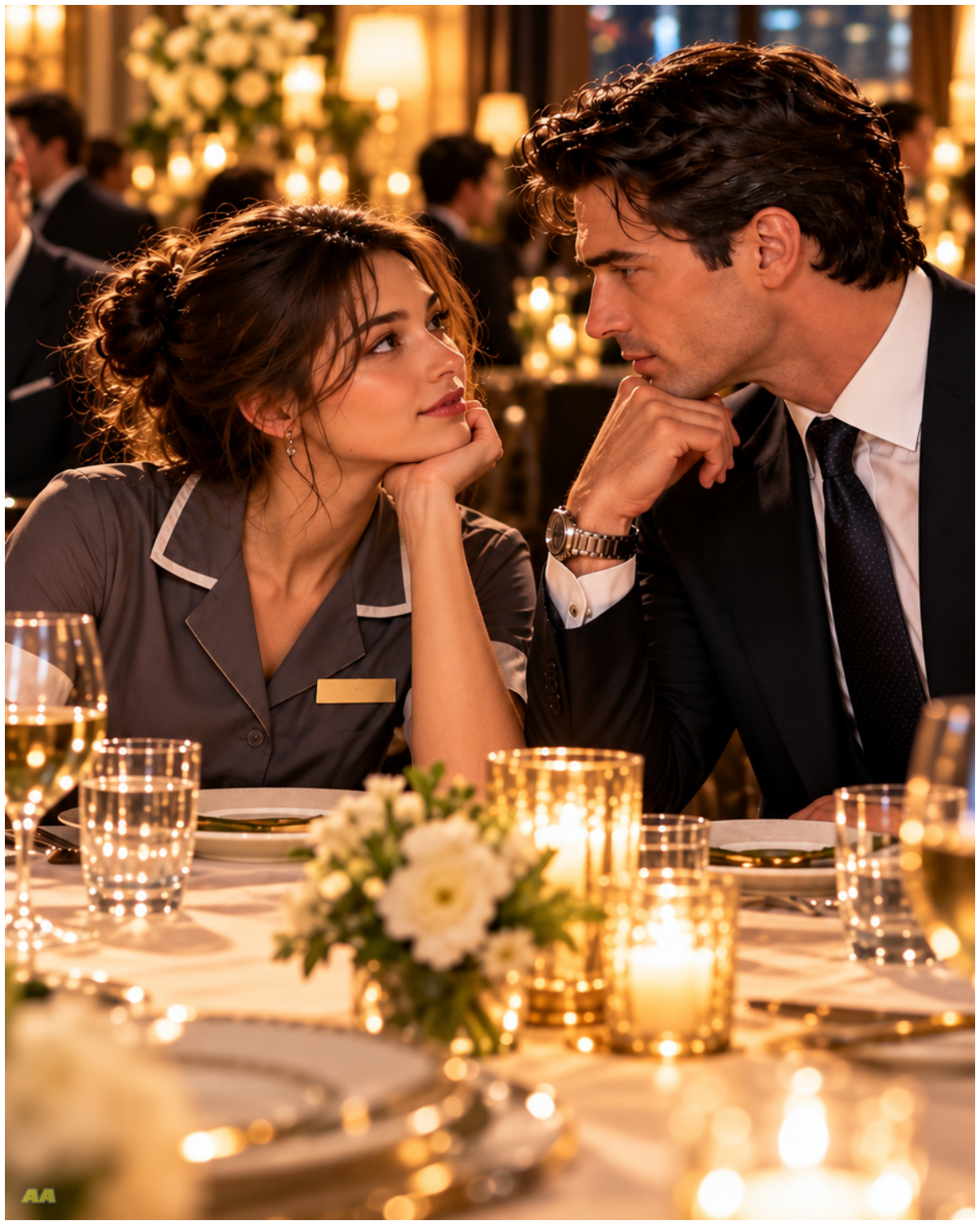
Grant Whitmore hated three things. Meetings with no conclusions, cold coffee, and people who were late.
That Thursday night, all three seemed determined to gang up on him.
Vanessa, tell me you’re on your way to the restaurant.
Grant stood in the lobby of the bell weather, one hand on his phone, the other checking his watch.
Outside the glass doors, a November rain whipped down Beacon Street, car lights dragging red streaks across the wet pavement.
There was a two-c silence on the line.
I’m in Chicago. Grant closed his eyes.
You were supposed to land in Boston 2 hours ago.
If I could control the weather, I wouldn’t be working for you.
Vanessa, the flight’s delayed. Could be another 3 hours.
7:20. Dinner started at 8.
Richard Cwell was already at the restaurant.
He ran Caldwell Premier Travel, a company that catered to high-end travelers.
The contract Grant was chasing could bring thousands of bookings a year to the Whitmore system.
And tonight, Caldwell wanted to talk about the guest experience.
That was Vanessa’s department. Send someone else.
Martin’s at the hospital with his wife.
Rachel’s in New York. Daniel, I fired him last month.
Grant went quiet. I’m glad you’re keeping up with personnel matters.
The call ended. Grant had 39 minutes.
He was about to call Cwell and ask for a postponement when a woman’s voice behind him cut through.
Are you sure it was the green scarf?
Emerald? An elderly woman corrected with little flowers on the edge.
Harold gave it to me in Florence.
Her husband sighed. 42 years ago.
43. I knew you’d correct me.
Grant turned. A housekeeping attendant stood beside the older couple.
Her hair was in a low bun.
A few dark brown tendrils had escaped after a long day.
A small name tag was pinned to her gray uniform.
Anna. Grant had seen her before.
Maybe. The bellweather employed more than a hundred people.
I remember now. Anna said you two had tea this afternoon by the east window, right?
The woman nodded. You put the scarf on the back of the chair because you said the lobby was warm.
Her husband looked at his wife.
I told you to put it on the chair.
You told me to put it in the taxi.
I remember you put it on the chair, Anna said, rescuing the husband from an argument he clearly couldn’t win.
Just wait here a moment. She walked toward the lounge.
A minute later, Anna returned with the emerald scarf.
The woman squealled. That’s it. Anna draped the scarf over her shoulders.
Next time, give him Harold to hold.
Harold shook his head. Don’t get me involved.
Anna laughed. The couple thanked her and headed for the elevator.
Grant watched them go. An idea occurred to him.
He checked his watch. 36 minutes.
Anna. She took two more steps before turning back, then glanced around as if to make sure there wasn’t a second Anna.
Yes. Come here a sec. She stepped closer.
Up close, Grant noticed her eyes were a bright brown.
Strangely, she didn’t look flustered at being called over by her boss.
You know my name? Grant hesitated.
His gaze had unconsciously dropped to the name tag on her cheSt. Anna followed his eyes.
“Oh.” The corner of her mouth lifted.
“I overrated you.” Grant ignored her.
“Do you have plans tonight?”
“Yes.”
“Can you cancel?”
“It depends on what you need me to do.”
Grant checked his watch.
“Tonight you’re having dinner with me.” Anna blinked.
She looked at her uniform, then at him.
Is this how Witmore Hotels reward staff for overtime?
I’m serious. That’s a little scary.
The person who was supposed to come with me is stuck in Chicago.
I have a very important meeting in 35 minutes.
Anna waited. An and Caldwell wants to hear about guests real experiences at the Bellweather.
I need someone who actually knows the hotel.
Anna pointed at herself. Housekeeping. You work directly with guests.
You know what they need. And you just remembered exactly where a guest left her scarf a few hours ago.
Anna looked at him. How long have you been watching the staff like this?
The question annoyed Grant. Can you do it or not?
Anna glanced at the clock on the wall.
In this change. Do you usually order women to change that fast?
Grant inhaled slowly. Anna bit her lip to keep from laughing.
I only need you to sit at the table.
If Caldwell asks about hotel operations, you answer briefly.
You’ve worked here more than 3 years, right?
3 years, 2 months, then you understand the bell weather.
For dinner, to answer questions, Anna was silent for a few seconds.
So, I’m allowed to speak. Of course, she arched an eyebrow.
Grant added when asked, a pause.
Generous. Grant looked at her for the first time.
He wondered if this was a terribly bad idea, but he didn’t have time for better ideas.
You have 10 minutes. Anna headed for the staff elevator.
A few steps out, she turned back.
Mr. Whitmore, what? Is there real food at this dinner?
Of course. Good. She smiled. At least I get something out of tonight.
The elevator doors closed. Grant stood in the lobby, watching the numbers on the panel climb floor by floor.
He didn’t yet know that in less than an hour, the woman he just asked to speak only when spoken to would become the only person at the table Richard Caldwell actually wanted to listen to.
12 minutes later, Anna stepped out of the elevator.
It took Grant a second to recognize her, not because she’d become someone else.
The dark green dress was simple, kneelength.
Her hair was still tied low, just neater.
No flashy jewelry, no transformation that would make heads turn.
She was still Anna. Only now, for the first time, Grant saw her without the housekeeping uniform.
And for the first time, he very clearly registered that Anna Mercer was a young woman.
“Is something wrong?” she asked. “No, you were staring.” “The dress looks good.” Anna nodded.
“A compliment that lasts a lifetime.” Grant turned away.
The car is waiting. 15 minutes later, they entered a private dining room at a restaurant near the public garden.
Richard Caldwell was there with two executives.
Grant introduced Anna as support for customer operations at the bellweather.
Anna gave him a look a Broadway describe someone who an hour earlier had been checking towels on the sixth floor.
She didn’t correct him. Dinner started well.
Grant talked about Whitmore Heritage Hotel’s expansion plans, occupancy rates, the new booking system, and a strategy to personalize experiences based on stay history.
This was his strength. Numbers, strategy, forecasts.
Everything could go on a spreadsheet.
Caldwell listened attentively, asking the occasional question.
His two directors took notes until the main course arrived.
Caldwell set down his knife. If I send 8,000 guests a year into your system, why will they come back?
Grant barely needed to think. Because we don’t just sell rooMs. Your guests will get a convenient location, high standard design, consistent service, and technology that lets us personalize each day.
He added a note about the new app that lets guests order breakfast, request services, and adjust certain amenities before arrival.
Caldwell didn’t argue, but he didn’t look convinced either.
Then he turned to Anna. You work at the Bellweather.
Anna set her water glass down.
Yes. Do guests return because of the things Mr.
Whitmore just mentioned. Grant looked at Anna.
She could have answered yes. One word.
Safe, simple, and exactly the answer Grant wanted to hear.
Not really. Grant put his fork down.
Caldwell smiled. So, what do you think it is?
Anna thought for a few seconds.
We have a guest named Mrs. Delaney.
She stayed at the Bellweather 11 times.
Grant had never heard the name.
She doesn’t care what kind of sheets we use.
She doesn’t use the app. Last time she tried to open the menu’s QR code by taking a picture of it.
One of the directors chuckled. But she likes to walk at 6 in the morning.
Anna continued. Eddie at the door knows that if there’s a chance of rain, he always has a small umbrella ready.
Does the hotel require him to do that?
Caldwell asked. No. Is it noted in her guest profile?
No. Then why does he remember?
Anna shrugged. Because she comes back enough to stop being a room number.
There was a few seconds silence at the table.
Grant looked at Anna. What bothered him was that she didn’t look like she was trying to impress anyone.
Caldwell leaned forward. What position do you hold at Bellweather housekeeping?
One of the directors sounded a little surprised.
Caldwell wasn’t, he asked. So tell me what my guests hate the moSt. Grant cut in.
If you want, Richard, I have survey data.
I want to hear her. Grant fell silent.
Anna considered being treated like they’re old.
Caldwell laughed. I like that. It’s not that they don’t need help, Anna explained.
But there’s a difference between helping someone and deciding for them.
For example, seeing an older guest and automatically speaking slower, louder, carrying their bags when they’ve said they don’t need it, seating them near the door because you think they don’t want to walk far, or assuming they can’t use technology.
The smile on Caldwell’s face faded.
Not because he was offended, but because he was actually listening.
That’s exactly one of the biggest complaints we get, he said.
Grant turned to him. That detail hadn’t appeared in any of the materials Caldwell had sent before the meeting.
Anna nodded. Guests don’t want things to be harder, but they also don’t want their age to be the first thing people see.
So, what would you do? Ask.
Caldwell raised an eyebrow. That’s it.
Would you like me to help with your luggage?
Would you prefer a room near the elevator?
Would you like a paper menu or to use your phone?
Anna smiled. Give people the choice before deciding for them.
Caldwell nodded slowly, and from that moment, the dinner no longer followed Grant’s plan.
Caldwell asked Anna why some guests skipped breakfaSt. What complaints staff heard, but managers didn’t know about.
What made a guest remember an employees name?
Anna didn’t have charts. She had stories.
Mrs. Delaney liked to walk in the morning.
Mr. Peters always requested quiet rooms but didn’t like high floors.
The Collins sisters asked for an extra chair so they could sit by the window with their coffee.
The couple who lost a towel tonight had stayed at the bellweather six times.
Grant knew the hotel’s return rate.
Anna knew who came back. And that difference bothered him more than he wanted to admit.
He also began to see Anna differently.
3 years. She’d worked at his hotel for over 3 years.
And until tonight, the only thing Grant knew about her was the name on her name tag.
When dessert arrived, Caldwell leaned back in his chair.
“I think tonight I understand the bell weather a lot better,” he said.
Grant smiled. “I’m glad to hear that.” But Caldwell looked at Anna.
“Me, too.” Anna smiled back. Grant kept his polite smile.
He should be satisfied. The meeting was going better than he’d expected.
Caldwell was interested. His two directors had filled nearly two pages of notes, but Grant felt a low heat of unease in his cheSt. He had brought Anna because he needed someone to fill the empty seat.
He told her to only speak when asked, and now Richard Caldwell had almost no more questions for him.
Grant looked at the woman beside him.
Part of him was impressed. The rest just wanted the dinner to end because for the first time in many years, Grant Whitmore was sitting in a meeting of his own and was no longer the most interesting person at the table.
Dinner ended close to 10:00. Richard Caldwell stood, but instead of shaking Grant’s hand first, he turned to Anna.
“You do housekeeping?” he asked. Anna smiled.
“Yes.” Caldwell kept looking at her as if trying to find the missing piece of the answer.
Anna added, “And I’m pretty good at it.” He laughed.
I believe that. Then he turned to Grant.
We’ll continue this tomorrow. That was the line Grant had been waiting 3 weeks to hear.
Caldwell didn’t say no. He didn’t ask for more time.
He wanted to continue negotiating. Grant should have been pleased.
But stepping out of the restaurant, the thing he remembered most was that Caldwell had shaken Anna’s hand firSt. The rain had eased.
In the car, Anna sat by the window, watching wet buildings slide paSt. Mr.
Caldwell was interesting,” she said. Grant didn’t answer.
Anna turned to him. “Don’t you think so?
Why did you tell him about the hotel’s weaknesses?” Her smile disappeared.
“What weaknesses?” “The guest complaints, staff making decisions for guests.
Things were not doing well.” He asked, “You didn’t have to answer everything literally.” Anna looked at him for a moment.
“So, how should I have said it?” more diplomatically.
“Oh,” a very small sound. Grant knew it wasn’t agreement.
“What do you mean?” “Nothing, Anna.” She exhaled.
“Do you mean I should tell him what he wants to hear?
I mean, you need to understand who you’re representing.” Anna turned fully to him.
“I thought I was representing the hotel tonight.” Grant should have stopped.
He didn’t. You’re representing me. Silence arrived instantly.
Grant knew he’d said the wrong thing.
Not organizationally wrong. He was the one leading the meeting.
He was responsible for the negotiation.
[snorts] But that’s not how the line landed.
It sounded as if Anna had been brought to the dinner as a talking accessory.
He could fix it. He could say, “That’s not what I meant.” But Pride held the words back.
Anna looked out the window. I get it.
Those two words made Grant more uncomfortable than an argument would have.
The car stopped in front of the bellweather.
Anna opened the door. Grant called Anna.
She turned back. You have no idea what you just did.
He wanted to tell her she didn’t understand how important Caldwell was, how a wrong answer could affect how many deals, how many employees, but Anna just looked at him.
I think I do. She stepped out.
The next morning, Anna had just pushed a card out of the 10th floor elevator when housekeeping manager called her into the office.
The conversation lasted less than 5 minutes.
When she walked out, Anna held a sheet of paper.
Starting Monday, she would no longer be in charge of floors 9 through 12, the area for most VIPs and long-term guests.
She was being moved down to floors 4 through six.
The reason on the paper read, “Staffing adjustments to ensure scopes of responsibility and guest communication procedures.” Anna read it twice and then she laughed.
Not because it [clears throat] was funny, because she knew exactly who had written it.
10 minutes later, she stood outside Grant’s office.
His assistant looked up. Do you have an appointment?
No. Mr. Whitmore is The Office door opened.
Grant appeared with his phone in hand.
He looked at Anna, then at the paper she was holding.
“Come in.” Anna entered, the door closed.
She set the paper down on his desk.
“Are you punishing me?” she asked.
Grant didn’t look down. This is an operational decision.
Really? The VIP floors need staff who understand limits in guest communication.
Anna nodded slowly. Because I talked because you didn’t understand the limits.
What limits? Grant lost patience. Anna, last night you were invited to a business meeting not to evaluate how I run the hotel.
I’m not evaluating you. You told a potential client about things we’re not doing well and he wanted to meet you today.
Grant was silent. Anna looked at him.
So, where did I ruin the meeting?
The question was too simple. Grant had no good answer.
He turned to the window. This isn’t about outcomes.
Then what is it about? Grant turned back.
You were asked to answer questions about guest experience.
You went beyond that. Anna stared at him for a few seconds.
Then something seemed to click. No.
Grant frowned. No. What? You’re not mad because I said the wrong thing.
She said it very calmly. You’re mad because Mr.
Caldwell wanted to hear me say it.
Grant’s jaw tightened. You’re going too far.
Maybe. Anna looked down at the name tag on her cheSt. 3 years and 2 months.
She’d worn it almost every day.
She remembered guests who wanted extra pillows, those afraid of elevators, those who always forgot chargers.
She’d stayed late because an old woman lost her wedding ring.
She’d run three flights just to find the exact tea a sick guest wanted.
Not big things, but she did them well.
Anna took off her name tag, set it on Grant’s desk.
He looked down. What are you doing?
Helping you solve the problem. Anna, you need someone who understands limits.
She pushed the name tag toward him.
So find someone who understands limits better.
Grant looked at her and for the first time the cold in his face cracked.
Are you quitting over one reassignment?
Anna shook her head. I’m quitting because after 3 years here, last night was the first time you asked what I knew.
The room went still. And this morning, she added, “You decided the best fix was to make sure I had no chance to speak again.” “That’s not good luck with Mr.
Caldwell.” Anna turned away. “Ana?” Her hand was on the door knob.
Grant could apologize, could resend the decision, could say one sentence that would keep her, but he stayed silent.
Anna waited one beat, then she opened the door and walked out.
On Grant’s desk, the small name tag lay beside a multi-million dollar financial report.
Anna Mercer. For the first time, Grant truly remembered the name.
Too bad the woman who wore it no longer worked for him.
Three weeks after Anna quit, Grant still kept her name tag in his desk drawer.
He didn’t know why. It should have been sent down to HR with the rest of her things.
Twice Grant had picked it up.
Twice he’d put it back down.
The third time, he closed the drawer and decided he had more important things to think about.
Richard Caldwell had agreed to sign a six-month pilot contract with Whitmore Heritage Hotels.
That should have been a win, but Caldwell attached a condition.
He wanted the Bellweather to be the pilot hotel for a guest experience improvement program.
A special team would be formed made up of managers, front desk, door staff, housekeeping, anyone who actually dealt with guests every day.
Caldwell called it a guest experience task force.
Grant called it another weekly meeting.
Vanessa Cole finally returned to Boston and was put in charge of the team.
On Monday morning, Grant arrived 3 minutes late to the first meeting because of a call from New York.
He stepped into the conference room and said, “Sorry, shall we?” Grant stopped.
Anna Mercer was sitting at the far end of the table.
She wore black pants, a cream sweater, and was reading a stack of papers.
A cup of coffee sat beside her.
Anna looked up, their eyes met.
“Good morning, Mr. Whitmore. Grant stood still for a second.
What are you doing here? The room fell silent.
Vanessa at the head of the table closed her laptop with deliberate calm.
Good morning to you too, Grant.
He didn’t look at her. Anna, I think the question’s pretty clear, Anna said.
But I’m not sure which answer you want.
Vanessa sighed. Sit down, Grant. Vanessa, sit.
There were six other people in the room.
Grant pulled a chair. He didn’t like being ordered around in his own hotel.
Anna seemed to notice that. The corner of her mouth lifted slightly.
Grant saw it. He got more annoyed.
Vanessa opened the packet of files in front of her.
As you all know, Caldwell wants us to trial a number of changes during the first 3 months before he evaluates the results.
I’ve chosen eight people for the team.
She introduced them one by one.
A front desk manager, a Bellman, someone from reservations, two operations managers, then Anna.
Anna Mercer, guest experience consultant. Grant turned to Vanessa.
Consultant? Yes. You hired her? Yes.
When? Last week. Anna calmly sipped her coffee.
Grant looked at her. You came back?
No. You’re sitting in my hotel.
Anna took a sheet from the packet and pushed it toward him.
This is a three-month consulting contract.
Grant didn’t touch it. I work for Vanessa.
Vanessa added evenly. And Vanessa works for the company.
Someone at the far end of the table bent over to pretend to read the papers.
Grant knew if he kept arguing, he’d turn the first meeting into a scene.
He picked the contract up. Anna’s name was at the top.
3 months. Her task was to observe operations, gather feedback from staff and guests, and then suggest trials of small changes.
“Is she qualified?” Grant asked. Anna didn’t react.
Vanessa did. “Have you read her personnel file?” Grant was silent.
Of course, he hadn’t. Anna studied hospitality management at Nor Eastern for nearly 2 years.
Grant turned to her. “You studied hotel management?
Used to? Then why were you in housekeeping?” Anna looked at him.
That’s a long story. You didn’t finish the program?
No. Vanessa cut in before Grant could ask more.
And I didn’t hire Anna because of two years of college.
I hired her because of three years working at the Bellweather.
She looked around the table. Caldwell doesn’t want another group of managers sitting in a room guessing what guests need.
He wants people who understand what happens outside the meeting room.
Grant couldn’t argue without directly opposing Caldwell’s condition.
He hated that. Vanessa carried on with the meeting.
For 40 minutes after, Anna hardly said a word.
She took notes. She listened. Only when an operations manager suggested sending out a longer survey after each holiday did Anna look up.
Our current guests filling out the old survey.
About 14%. So why do we think making it longer will make them want to answer more?
The room was silent. The manager looked down at his papers.
We need more detailed data. Anna nodded.
Or we need to ask fewer questions, but ask at the right times.
Vanessa looked at her. For example, ask one question when a guest first gets to their room.
Ask one after breakfaSt. Ask one at checkout.
Three surveys? No. Three opportunities for staff to talk to guests.
Anna set her pen down. Guests tell us things all day.
We just don’t record it. Grant looked at her.
There it was again. No slides, no jargon.
Just a simple idea that made their complicated procedures suddenly feel a little foolish.
Vanessa wrote something down. Try it for 2 weeks.
Anna nodded. No celebration. No look at Grant.
It annoyed him for reasons he couldn’t fully explain.
The meeting ended close to 11:00.
People filed out. Anna gathered her materials.
Grant remained standing. Anna. She looked up.
Vanessa was still in the room.
Do you have a problem with her contract?
Vanessa asked. Grant looked at Anna.
3 weeks earlier, she’d been standing in his office in a gray uniform with her name tag in her hand.
Now she stood a few steps away.
No longer an employee. He could move around with an email.
No, Grant said. Anna raised an eyebrow.
Really, as long as you understand your role.
The moment the words left his mouth, Grant knew he’d picked the wrong phrasing again.
Anna looked at him for a few seconds.
Then she smiled. Don’t worry. She hugged the packet to her cheSt. This time I have a contract that says exactly what I can do.
Vanessa turned her face away, but Grant could see she was trying not to laugh.
Anna walked out of the room.
Grant watched her go. Vanessa waited until the door closed before speaking.
“You’re very good with women,” she said.
Grant turned back. You hired her to get under my skin?
No. Vanessa shoved her laptop into her bag.
I hired her because that night Caldwell told me over dinner that in 2 hours the only person who made him want to ask more questions was a housekeeping staff member.
Grant was silent. Vanessa slung her bag over her shoulder.
You should think about that. She moved toward the door, then stopped.
Oh, Grant. What? Anna doesn’t need to prove you wrong.
Vanessa looked down the hallway where Anna had disappeared.
She just needs to prove that I was right.
The door shut. Grant stood alone in the conference room.
He had thought Anna Mercer leaving the bellweather 3 weeks earlier was the end of a mistake.
Turns out she had come back.
And this time Grant was no longer the one deciding when she could speak.
Over the next two weeks, Anna did nothing Grant could call groundbreaking.
She didn’t propose replacing the system.
She didn’t ask for extra budget.
She didn’t stride into the meeting room with a 50-page presentation.
She just walked around the hotel and asked.
Housekeeping said guests often complained about room temperature, noise, and items they’d forgotten to bring.
Bell staff knew which guests needed help with luggage, who liked to do everything themselves, who always asked where the nearest pharmacy was.
But almost none of that information made it to the managers.
Grant looked at the note Anna had placed in front of him.
We have a system to store guest preferences.
We do. So, what’s the problem?
Anna turned her laptop so he could see.
Mrs. Delaney. Grant looked at the screen.
The one who likes to walk at 6:30 in the morning.
Anna was a little surprised. You remember you told me about her in front of a guest worth a few million dollars.
Hard to forget. Anna tried to hide a smile.
Her file notes, soft pillow, earl gay tea, anything below the eighth floor and no mention of morning walks because she didn’t request it.
Exactly. Anna closed the laptop. The system only knows what guests say when they book.
Staff know what happens after they arrive.
Grant leaned back in his chair.
You want every staff member to enter notes?
I want them to have a place to surface the memorable things.
How many staff? You’re thinking numbers again.
That’s usually how people run businesses.
And this is usually where I remind you that customers are people.
Grant looked at her. Anna waited for him to object, but he only said, “Continue.” That was the first time she realized Grant Whitmore could actually listen.
The second problem showed up one morning.
In Caldwell’s list of metrics, breakfast utilization was lower than expected.
Grant assumed guests didn’t like the menu.
Anna didn’t believe it. She stood near the first floor elevator from 7 to 9 in the morning.
17 people asked for directions to the dining room.
Three headed the wrong way toward the ballroom.
A couple gave up and went outside.
The signage is too small, Anna said.
Grant looked at the brass sign at the end of the hallway.
It fits the decor. Very pretty, but no one sees it.
Three days later, the hotel put up two more directional signs.
No new strategy required, no big budget, just someone willing to stand in the hallway for 2 hours.
What annoyed Grant most was that Anna was usually right.
What annoyed him even more was that he was starting to like it.
On Friday afternoon, Anna asked him to come down to the basement with her.
Grant glanced at his calendar. I have a call at 4.
It’s 3:20. What are you planning to do for 40 minutes?
Break your world view. Grant stood up.
Sounds humble. Anna led him down the staff corridor down another level and opened a large door.
Heat hit them immediately. The wor of industrial washers, metal carts, and hundreds of white towels created a whole different world beneath the quiet hotel lobby.
Grant stopped. Anna turned to him.
You’ve never been down here? I own the hotel.
That’s not the answer. Grant fell silent.
Anna narrowed her eyes. You really haven’t been down here?
No. Three years. Three years. Anna shook her head.
Amazing. What’s amazing? That the hotel’s still running.
Grant laughed. Really laughed. Anna froze.
You just laughed? No, I heard it.
The dryers. Dryers have a pretty compelling voice.
Grant looked at her. Anna was smiling and he suddenly realized he liked seeing her smile more than he should.
That thought made Grant look away.
Anna led him to the linen sorting area.
A staff member explained that housekeeping often spotted recurring problems in rooms, but had to pass notes through many levels.
By the time the information reached the right person, sometimes a week had passed.
Grant asked question after question. How many reports per day?
How long did it take? Which shifts had the most issues?
Anna stood by watching. He remembered the answers the moment he heard them.
No logs and no follow-ups. When the employee mentioned the number of towels that had to be replaced last month, Grant immediately compared it to the figure for the same period last year.
Anna began to understand why this man could run a hotel chain at 37.
He was arrogant, irritable, sometimes unlikable, but not lazy.
That evening, Anna went back to the conference room for the phone she’d left behind.
Grant’s office lights were still on.
Almost 10:00. She knocked. Grant sat among a pile of reports, tie off, sleeves rolled up.
You still here? You, too. I forgot my phone.
You forget home? Grant looked at her, then back at the screen.
I’m used to it. Anna was about to leave when she noticed an old photo on a shelf.
Two men standing in front of the bellweather.
One younger was Grant. The other had the same eyes as him.
Your father. Grant followed her gaze.
Yeah. He built the bellweather. He bought it when he was nearly bankrupt.
Grant’s voice shifted softer. He spent 14 years saving it.
Anna leaned against the doorframe. So you didn’t sell.
Grant looked up. How did you know someone tried to buy it?
The staff talk more than you think.
A quiet beat. Grant stared at the photo.
After he died, this was the last thing we actually did together.
For the first time, Anna didn’t see the CEO of Whitmore Hotels.
She saw a son trying to hold on to something that had belonged to his father.
She said softly, “He would be proud.” Grant looked at her, “You didn’t know him?” “No.” Anna smiled.
“But I know the hotel.” Then she turned away.
Get home before midnight, Mr. Whitmore.
Is that an order? Anna looked back.
A piece of advice. What’s the difference?
You’re allowed to ignore advice. Grant smiled slightly.
Then I’ll probably do that. Anna shook her head and walked down the hall.
Grant watched until she rounded the corner.
In 3 years, Anna Mercer had worked under this roof, and he hardly ever saw her.
Now, after only a few weeks, Grant was beginning to notice a completely different problem.
He was looking at her too much.
Anna found the box on a Tuesday afternoon.
She went down to the archive to look for guest feedback files from the Bellweather’s early days.
Most of it was old bills, registers, and dust covered folders.
In the far corner, Anna found a cardboard box labeled in black ink.
E. Witmore Bellweather. She opened it.
Inside were notebooks, blueprints, and dozens of handwritten pages.
Anna recognized the name immediately. Edward Whitmore, Grant’s father.
She sat on the floor. A thin packet had a title.
The bellweather promise. The first page had only one sentence.
Underline twice. Know the guest before knowing the room number.
Anna read it again, then again.
She started flipping quickly through the following pages.
Edward had wanted every department to share small pieces of information about guests, not financial data or spending levels, who liked to read by the window, who walked every morning, who needed a quiet room, who always called for tea before bed.
Anna sat stunned in the archive.
This was almost exactly what she had been proposing for weeks.
Grant found her there 20 minutes later.
Vanessa said, “You went down here.” Anna looked up.
“You should see this.” Grant looked at the box.
His expression changed immediately. Where’d you find it?
Right here. Anna handed him the packet.
Grant didn’t take it. She opened it to the first page instead.
Do you know this program? He looked at the words.
For a long moment, Grant said nothing.
I do, Grant. This is almost I know.
The tone in his voice made Anna stop.
Then why did it disappear? Grant finally took the packet.
It wasn’t relevant anymore. Why not?
The hotel grew. Guests grew up, too.
Grant looked at her. Anna realized she jabbed at the wrong moment.
She softened. I mean, these principles still matter.
But the way we operate didn’t.
He closed the packet. When my father wrote these, Belle was an independent hotel.
Then we had three hotels, then five.
A system can’t run on Eddie remembering Mrs. Delaney like to walk.
So, you dropped it. We standardized procedures and cut staff.
Grant looked at her. Anna already knew the answer.
Did your father agree? That’s not the point.
Was he still running things when the program was dropped?
Anna, just a question. Grant was silent for a few seconds.
He was being treated for cancer.
Anna immediately stopped asking. Grant stared down at the papers in his hands.
I took over most of it.
The company was short of cash.
Bellweather was doing okay, but the other two hotels were losing money, so you had to cut.
Yes, and it worked. We survived.
Grant put the packet back in the box.
Then we expanded. Anna looked at him.
Now she understood why he hadn’t been happy to find these things.
The Bellweather Promise wasn’t just an old program.
It was a reminder of a choice Grant had made while his father was dying.
That night, Anna found Grant in the ballroom.
The hotel was preparing for a weekend event, so the room was empty.
Grant stood alone by the window, looking down at the wet street.
Anna came in, hiding out here, thinking, “Does it hurt?” Grant turned.
Do you always talk to your boss like that?
Only the ones who took me out of the VIP floor.
You don’t work for me anymore.
Even better. A flicker of a smile crossed Gran’s face and vanished.
Anna stepped closer. I read all the papers.
I guessed. Your father came up with almost everything we’re trying to teSt. I know.
So that’s good news. Grant laughed, but it wasn’t a happy laugh.
Good news? It means Bellweather used to do it.
It means I spent years undoing what my father built only to hire you to bring it back.
Anna was silent. Finally, she said, “You saved the company and turned it into something he wouldn’t have wanted.” “You don’t know that.” I do.
The answer made Anna flinch. Grant turned back to the window.
“My father thought we were expanding too faSt. He wanted Bellweather smaller, more personal.
I thought he was sentimental. Maybe you were both right.” Grant shook his head.
“You don’t need to comfort me.
I’m not comforting you.” Anna moved closer.
I think you’re looking at it the wrong way.
What do you think I’m doing?
Anna hesitated, but she spoke. You’re trying to build your hotel.
She looked at him. Or trying to prove you’re better than your father.
Grant’s face went cold. The air between them shifted instantly.
Don’t talk about things you don’t understand.
Anna stood very still, just one line, but they both recognized it.
Almost exactly what he had said to her after dinner with Caldwell.
Anna nodded slightly. Yes. She turned away.
Grant watched her back. 3 weeks earlier, he’d let her walk out of his office because he’d been too proud to admit he was wrong.
He knew exactly what would happen if he stayed silent now.
Anna. She didn’t stop. Grant hurried after her.
Anna. She’d reached the door. Anna, I was wrong.
She stopped. So did he. The words were simple in a way he couldn’t understand had been so hard before.
Anna turned back. What did you say?
You heard me. I want to be sure.
Maybe I only get to hear it once in my life.
Grant exhaled, almost smiling. I was wrong.
Anna crossed her arMs. About what?
Don’t ruin this moment. The corner of her mouth tilted up.
Grant looked at her. Then his expression turned serious.
You don’t know my father, but you didn’t deserve me speaking to you that way just because you touched the one spot I didn’t want to look at.
Anna didn’t answer immediately. Thank you, she said at laSt. That’s it.
Do you want a certificate? Grant laughed this time.
Anna laughed too. The distance between them suddenly felt very small.
No one stepped forward, but no one stepped back either.
Anna broke eye contact firSt. Tomorrow we start at 8.
Grant glanced at his watch. You forgive me and immediately hand out assignments.
I didn’t say I forgave you.
She opened the door. Good night, Grant.
The door shut. Grant stood in the empty ballroom, and it took him a few seconds to notice something else.
It was the first time Anna had called him Grant.
And strangely, that stayed in his head longer than the apology had.
After that night in the ballroom, something strange happened.
Grant and Anna stopped arguing about everything.
Not entirely. Anna still said the new signage system made the hotel look too pretty to be useful.
Grant still insisted she couldn’t solve every problem by asking a few people.
But their arguments lost their edge.
Sometimes Grant would deliberately disagree just to see what Anna would say.
And sometimes Anna knew he was doing it.
Are you teasing me? No, you’re smiling.
I’m not smiling. You’re a bad liar.
No one could say when the gap between them disappeared.
One late December evening, they returned to the bell weather after touring two hotels in the chain.
Boston was raining again. When [clears throat] the car pulled up to the hotel, it was nearly 10:00.
The events team had just finished a party in the ballroom.
Staff were clearing the last tables.
Anna looked at Grant. I’m hungry.
You just ate in the car.
That was a bag of almonds.
There’s protein. Anna looked at him as if she’d heard something pathetic.
10 minutes later, they were sitting at the lasted table, two sandwiches from the kitchen in front of them.
Grant took off his tie. Anna nabbed his bag of chips.
“I didn’t say you could have those.
You eat dinner at 10:00 a.m.
With a turkey sandwich. You’ve already lost control of your life.” Grant watched her take another chip.
Do you always steal other people’s food?
Only from the rich. So, that’s an ethical [clears throat] issue.
Redistribution of wealth. Grant laughed. Outside rain tapped the windows.
The great ballroom glowed only from a few wall sconces.
No staff, no guests, no meeting.
Just them. Anna looked around. Would your father have liked this room?
Grant was silent for a moment.
He would have loved it. Was he as difficult as you?
Worse. Anna smiled. Grant told her his father used to stand at the ballroom doors before every major event to see how guests were greeted.
Edward might forget a meeting with the bank, but remember a couple who’d held their wedding here 10 years before.
He sounds more like you than you think.
Grant shook his head. I’m like him in the parts that aren’t good.
Did he not know how to apologize either?
Grant looked at her. How long are you planning to keep bringing that up?
Maybe for years. I shouldn’t have apologized.
It’s too late. Grant smiled. Then the smile faded.
He told her about the final months of his father’s illness.
Grant was running the company while trying to prove he could save everything.
He told me I was moving too faSt. Did you listen?
No. Because you thought he was wrong.
Grant looked down at the table.
Because if I stopped, I’d have to admit he was dying.
Anna said nothing. It was the first time Grant had told her that.
Maybe the first time he’d said it to anyone.
He looked up. And you? You mean me?
Nor Eastern. Anna understood. She turned the paper cup between her hands.
My mother got sick in my sophomore year.
I took a term off to take care of her.
And then she died. Grant was quiet.
Then there were the bills. Rent.
I needed a job. Anna shrugged.
A term turned into a year.
A year turned into three. Do you regret it?
Anna didn’t answer right away. Yes.
Then why not go back? She looked at the empty ballroom.
There are times you survive so long you forget what you wanted in the first place.
Grant didn’t say anything because that line wasn’t just about Anna.
He’d spent years saving the company, expanding it, keeping the bell, running from one goal to the next.
So sometimes he couldn’t remember what he’d wanted before everything turned into duty.
Anna turned toward him. Grant was looking at her.
Not the way he looked in the meeting room.
That look stayed too long. Anna noticed firSt. Don’t.
Grant stopped immediately. He took a small step back.
Okay. Anna watched him. How easily he stopped made her fidget.
At least, she said more slowly.
Don’t kiss me because you’re sad.
Grant frowned. I’m not sad. You just talked about your father for 20 minutes.
True. In a dark ballroom. Also true.
In the rain. Grant looked at her.
And the other 19 minutes I was looking at your mouth.
Anna was silent. So was he.
Then she let out a very soft laugh.
Is that the worst pickup line you’ve ever used on a woman?
I’m not trying to pick you up.
Good. Anna, what? This time she was the one looking down at his lips for a moment, but Grant saw it.
You can kiss me, she said.
Grant didn’t ask a second time.
He leaned down. The first kiss was lighter than Anna had expected.
Not hurried, not possessive. Grant paused for a beat, giving her room to pull away.
Anna didn’t pull away. She grabbed the collar of his shirt and pulled him back.
The second kiss wasn’t as tentative.
When they finally broke apart, Anna’s forehead was still close to his.
She breathed softly. This is a very bad idea.
Grant looked at her. At least we agree on something.
The next morning, Anna knocked on Grant’s office door at 8:10.
We need to talk. Grant put his coffee down.
Four words never lead to anything good.
Anna sat across from him. Last night can’t happen again.
Grant was silent for a second.
Okay. Anna was a little surprised.
Just that you want me to argue?
No. Good. Anna looked at him.
I’m serious. I don’t want to be the employee my boss is sleeping with.
You’re not my employee. Don’t split hairs.
Grant nodded. Okay. For these three months we work together.
No dating. No rainy nights in the ballroom.
Very specific rules. Grant. Okay. Anna.
This time he was serious. I won’t cross the boundaries you said.
Anna studied him a moment longer, then stood.
Thank you. She headed for the door.
Anna. She turned. Grant leaned back in his chair.
Just to keep the record straight.
What? You kissed me last night.
Anna looked at him. Have a terrible day, Grant.
The door closed. Grant laughed. And for the first time in his life, three months suddenly felt like a very long time.
The 3-month trial was ending with numbers better than anyone had predicted.
Return guest rates were up. Complaints were down.
Breakfast crowds were bigger after the signage system was changed.
More importantly, staff started leaving little notes on the shared system.
Not big things. Mrs. Delaney liked to walk at 6:30.
Mr. Peters didn’t like the top floors.
The Collins sisters always wanted an extra chair by the window.
Things that had lived only in staff memory no longer disappeared at the end of a shift.
Richard Caldwell was pleased enough he wanted to turn the trial contract into a long-term one.
On Thursday afternoon, Vanessa called Anna into her office.
I want you to stay. Anna looked at her.
I have 4 days left on my contract.
I know. Vanessa pushed a stack of papers across the desk.
On the top page was the title Director of Guest Experience.
Anna stared at it for quite a while.
Director. Don’t get too excited. The salary won’t buy you a yacht.
Anna laughed. Good. I’m seasick. Vanessa smiled.
You did well, Anna. This position isn’t a reward.
I think we need it. Anna smoothed the edge of the paper.
3 months earlier, she’d left the bellweather with her name tag still on Grant’s desk.
Now, the hotel was offering her a role she hadn’t even dared imagine a few years ago.
Can I start tomorrow? Of course.
Anna took the folder out. She had thought she’d feel happier.
Maybe because the first person she wanted to tell was the one person she shouldn’t tell.
Grant. After the kiss in the ballroom, they had kept the agreement.
No dating, no more kisses. But that didn’t make things easier.
Grant still brought her coffee during early meetings.
Anna still stole his chips. And sometimes when a room was crowded, she could still tell exactly where he was without looking.
4 days left. Anna didn’t know what would happen after that.
Maybe that’s why she began to hope.
That afternoon, Vanessa asked Anna to fetch a file from the meeting room before a presentation to Caldwell.
There were several stacks on the table.
Anna found what Vanessa needed. Then a name on the file below made her stop.
The Bellweather asset transfer. She didn’t open it right away.
Maybe it was just routine legal paperwork, but right underneath was the name of an investment fund.
Anna felt her stomach tighten. She opened the first page, read it, then read it again.
Whitmore Heritage Hotels was negotiating the sale of the Bellweather.
Not just last week, not after the pilot program started.
The date on the first proposal was more than 3 months ago, before even the dinner with Caldwell.
Anna flipped quickly through the following pages.
The plan was to use the proceeds to fund the opening of six new hotels.
The buyer would have the right to restructure operations after the transfer.
No commitment to keep the guest experience program.
No commitment to keep the current staff.
No Bellweather promise. Anna closed the file.
She sat very still for a long time.
Then she stood up. Grant was in his office when she walked in.
He looked up. The moment he saw the file in her hands, his expression changed.
Just for a moment, but enough.
Anna set it down on his desk.
When were you going to tell me?
Grant stood up. Anna, when? The deal isn’t complete.
That’s not the question. Grant was silent.
Anna looked him straight in the eye.
How long have you known about this?
The negotiation started a few months ago.
Before the dinner with Caldwell. Yes.
The answer hurt [clears throat] more than she had thought.
So for 3 months, you’ve watched me build a program for a hotel you were planning to sell.
It’s not that simple. Then make it simple for me.
Grant walked around the desk. Bellweather is worth a lot.
If we sell, we’d have enough capital to open six hotels without borrowing much more.
What about this place? The buyer would still operate it as a hotel.
That’s not what I’m asking. Anna, what about the changes we’ve just made?
What about the staff? What about your father’s program?
No final decision has been made.
Anna gave a small bitter laugh.
Now she understood. You still haven’t answered me.
What? When were you going to tell me?
Grant looked at her. After I was certain.
Certain of what? He didn’t answer.
That the deal would go through?
Anna asked. Or that you’d made up your mind about everything before anyone else was allowed an opinion.
That’s not fair. No. There is information in the negotiations I couldn’t share.
I’m not asking you to hand me the financials.
Anna’s voice remained calm. That calm made Grant more uncomfortable than if she’d yelled.
I just thought that in 3 months of working together, there would be a moment when you’d say, Anna, don’t build your future around the bellweather because there’s a chance it won’t be ours anymore.
Grant said nothing. Anna looked at the file on the desk.
Vanessa just offered me to stay.
Grant froze. What position? Director of guest experience.
Grant looked at her. You should take it.
Anna could hardly believe it. Did you really just say that?
The company needs you. Where? At your six new hotels.
Anywhere you want. That’s exactly the problem.
Grant still thought he could fix this by offering an alternative.
A title, a position, another door.
Do you know what the worst part is?
Grant was silent. I thought you had changed.
Anna, I have changed. You learned how to apologize.
She looked at him. You learned to stop when I said no.
You learned to listen to me in meetings.
Grant clenched his jaw. But but you still think you have the right to decide what others need to know.
The words hit him. Anna continued.
You learned to listen to me, Grant, her voice lowered.
But you still haven’t learned to trust me.
Grant had no rebuttal left because this time she was right.
Not about the deal. He could still come up with a dozen sensible reasons to sell the bellweather.
But she was right about him.
[clears throat] He had known. And he decided Anna didn’t need to know.
The next morning, Anna put Vanessa’s file back on the desk.
I’m very grateful. Vanessa looked at her, but I’m not accepting.
Vanessa didn’t try to persuade her because of Grant.
Anna thought for a moment. No.
She shook her head. Because I don’t know where I want to go next.
And this time I want to decide for myself before someone decides for me.
Vanessa nodded. There are 4 days left on your contract.
I know you could end it early.
No. Anna smiled. I signed for 3 months.
I’ll do the full 3 months.
And she did for the next four days.
Anna still arrived on time. Still attended meetings.
Still finished the final report for Caldwell.
Still answered Grant when work required it.
She didn’t run away. Didn’t cry in the hallway.
Didn’t hand the contract back in the middle of an argument.
She simply removed from between them everything that was no longer part of the job.
No coffee, no teasing, no lingering looks, no Grant and Anna, only Mr.
Whitmore and Ms. Mercer. Grant found that coldness hurt more than when she left the first time.
On the last day, Anna put the completed report on his desk.
It’s done. Grant looked at her.
Anna. She waited. He had dozens of things he wanted to say.
That the deal could still change.
That he didn’t want her to leave.
That the past 3 months had brought the bellweather back to the place his father once loved.
That she had done something similar to him.
But this time, Grant understood one thing.
“Not every mistake is fixed by an apology.” “Thank you,” he said.
Anna looked at him for a moment.
“It’s nothing.” She turned away. Grant didn’t stop her because for the first time, he began to understand that loving someone doesn’t mean trying to make them stay.
Sometimes it starts with accepting that you gave them a reason to leave.
It took Grant exactly two days to come up with six ways to fix everything.
Option one, offer Anna a higher salary.
Option two, give her the position Vanessa had offered.
Option three, create a separate department for Anna to run with full authority.
By the sixth option, Grant was preparing to call the lawyers to stop the sale of the bellweather.
No. Grant looked up. Margaret Whitmore sat opposite him in the sitting room, a cup of tea in her hand.
You’re not finished speaking. I’ve heard enough.
You could cancel the deal. You could keep the bellweather.
Keep the program. Anna could. No.
Grant frowned. Are you going to let me finish a sentence?
Not if it’s a stupid one.
Margaret took a sip of tea.
At 72, she was one of the very few who could speak to Grant like that without making him walk away.
You want her to come back?
She said. Grant didn’t answer. That’s not a question.
Okay, I do. So, what are you going to do?
I just said raise the salary, the title, the authority, cancel a multi-million dollar deal.
Margaret put her cup down. Grant, you’re still trying to buy a different outcome with a big decision?
He was silent. You think if the decision is big enough, expensive enough, impressive enough, Anna will look at it and see that you’ve changed?
I don’t think so. Margaret raised an eyebrow.
Grant sighed. Maybe a little. A little?
Okay. Quite a bit. She smiled.
At least you’re making progress. Grant stood, walked to the window.
So, what should I do? Margaret looked at her nephew.
For the first time in your life, don’t make the decision alone.
3 days later, the Witmore Heritage Hotel’s board met in Boston.
Grant stood in front of the screen.
On it were two options. Option A, sell the bellweather.
The proceeds would be enough to support the plan to open six new hotels.
Grant presented the benefits first, then the risks, losing control of a historic asset, the possibility of staff restructuring.
No guarantee the guest experience program would be maintained.
Then he moved to the next slide.
Option B, keep the Bellweather. Don’t open the six new hotels, and at least not now.
Instead, Bellweather would become a pilot model for the entire Whitmore system.
Grant displayed the results from the past three months, return guest rates, satisfaction levels, a number of complaints, revenue from repeat guests, implementation costs.
A board member asked, “Are you proposing we cancel the deal?” Grant looked at him.
“No.” There was a murmur in the room.
I’m asking the board to consider both options.
What is your opinion? 3 months ago, Grant could have answered immediately.
This was his family’s company. The Bellweather was his father’s hotel.
He knew what was right. At least he had thought so.
Today, Grant said, “My opinion is just an opinion.” Vanessa looked at him.
Grant continued, “You have all the data I have.
Neither option is without risk.” Another member asked, “If we keep the bell weather, who will be in charge of the new program?” “Vanessa.” Vanessa looked up.
Grant looked at her. If she agrees.
Not that she will. I mean, only if she agrees.
Vanessa recognized the difference. What about Anna Mercer?
Someone asked. I saw her name in the report.
Grant was silent for a beat.
She has completed her contract. We could invite her back.
Maybe. Do you want that? Grant looked down at the report.
What I want shouldn’t decide what she wants.
Vanessa said nothing, but for the first time in weeks, she smiled at him.
The meeting ran more than 3 hours.
Grant hadn’t called any board members privately beforehand.
He didn’t ask Vanessa to back the plan to keep the hotel.
He didn’t hide the numbers that favored selling.
And when the meeting ended with no final decision, he didn’t push them to vote right then.
He returned to his office just before 7.
Opened the drawer. The old name plate was still there.
Anna Mercer. Grant picked up his phone.
Anna’s name was still in his contacts.
He could call. He could tell her he had just done the very thing she once wanted.
Listen to others before deciding. His finger hovered over the screen.
Then he set the phone down.
If he called Anna to tell her he’d change, maybe he was still doing all of this to get something from her.
Forgiveness, a second chance, a compliment, or simply a reason for her to come back.
Grant closed the drawer. No call, no text, no flowers.
Tomorrow, he still had to run the company.
And if he truly wanted to be a different man, he had to do it even when Anna Mercer wasn’t there to see it.
For the first time, Grant changed something in his life without knowing whether it would bring her back.
Maybe that was the real change.
3 months later, Anna returned to the restaurant where everything began.
She recognized the room the moment the host opened the door.
The same glass panes looking out over the public garden.
The same warm yellow lights. Even the long table was almost exactly where it had been.
Only this time, no one led her to fill an empty chair.
Her name was on the card at the place setting.
Anna Mercer, guest experience consultant. [clears throat] Anna looked at it for a few seconds and sat down.
Are you planning to take that home as a keepsake?
The voice across from her made her look up.
Grant. Three months without seeing him.
He was the same. Dark suit, simple tie, that calm expression that made it hard to know what he was thinking.
“No,” Anna replied. “I’ve had enough experience with company name plates.” Grant chuckled.
“Fair, that was it. No explanation, no attempt to pull her aside to talk.” And strangely, Anna found that pleasant.
Richard Caldwell arrived a few minutes later.
This dinner wasn’t to persuade him.
The long-term deal had been agreed.
The Bellweather would remain part of Whitmore Heritage Hotels.
The board decided to postpone expansion plans and keep the hotel as a pilot model for the whole system.
Anna already knew that from Vanessa, but she also knew another thing.
Grant wasn’t the one deciding alone.
He had put both options before the board.
He hadn’t called Anna. He hadn’t used the bellweather as a reason to ask her to come back.
She didn’t know why that mattered so much to her.
Maybe because for the first time, Grant’s change happened when she wasn’t there to see it.
After the main course, Caldwell set his glass down.
I have a question. Grant smiled.
You always do. The pilot program performed better than I expected.
Caldwell looked at him. Why? Three months earlier, this would have been Grant’s favorite moment, a question he could answer with numbers, charts, and a perfectly prepared presentation.
Anna waited to hear him speak.
Grant didn’t open the folder in front of him.
He just looked at Caldwell. You’re asking the wrong person.
Caldwell raised an eyebrow. Grant turned to Anna.
She can answer that better than I can.
The table turned to her. Anna looked at Grant.
He said nothing more. Didn’t introduce her as his discovery, didn’t explain that he had given her the opportunity, simply handed the question over.
Three months earlier, Grant had said, “You represent me.” Tonight, for the first time, Anna understood that he no longer needed her to represent anyone.
She could represent herself. Anna set her napkin down.
The program succeeded because we weren’t inventing anything new.
Caldwell smiled. That doesn’t sound like an opening line that sells a service.
Lucky for you, the contract’s already signed.
Everyone laughed. Anna went on. She talked about housekeeping, bell staff, the front desk, people who heard hundreds of small things every day, but previously had no way to get them to the right place.
We just made the hotel better at listening to the people who already knew the answers.
Caldwell nodded. And the most important thing, Anna thought for a moment, then she looked at Grant.
Don’t assume a title decides who’s worth listening to.
Grant held her gaze. This time he smiled, not defensive, not annoyed.
Hard-earned lesson, he said. Anna raised an eyebrow.
But you finally learned it. After dinner, Anna stood outside the restaurant waiting for her car.
Grant stepped out behind her. A light rain was falling.
Vanessa told me you declined the director position.
Anna turned. It was the first time he’d called her you in that way, using the informal pronoun in Vietnamese in the original.
Here it reads as a more personal address.
Strange. She didn’t want to correct him.
I declined. Why? I enrolled to study again.
Grant stopped. Northeastern. Anna nodded. Next semester.
A slow smile spread across his face.
Congratulations. I won’t be full-time. Vanessa offered me part-time consulting.
Sensible. Anna looked at him almost expectant.
Grant understood. What? No. You don’t need the degree?
No. No. I can give you a better position.
No. No planning to fix your life for you.
Grant shoved both hands into his jacket pockets.
I’m trying to break that habit.
Anna laughed. Progress. Grant looked at her.
What do you want me to do?
The question left Anna silent. Not what can you do for me, not what will you do, but what do you want?
Anna looked at the man who once escorted her to this very restaurant and told her to speak only when spoken to.
Good luck. Grant smiled. I will do it.
Anna’s car pulled to the curb.
She opened the door and turned back.
Grant. Yeah. This time you hosted a pretty decent dinner.
Pretty decent. Don’t be greedy. Anna got in.
Grant stood under the awning and watched the car drive away.
He didn’t stop her. Anna didn’t promise to return.
But for the first time, between them, there wasn’t a boss and an employee.
No one allowed to speak and someone deciding when she could.
Just Grant and Anna. And maybe that was where their story could really begin.
Anna went back to school in January.
On the first day, she sat in a lecture hall between students nearly 10 years younger and wondered if she had made a terrible mistake.
By the end of class, she had six pages of notes, two assignments, and a feeling she hadn’t felt in a very long time.
Eager, she still did part-time consulting for Vanessa, but most of the work could be done remotely.
That meant she still saw Grant, just not often.
A meeting, an email, occasionally a few minutes in the Bellweather hallway.
No one mentioned the kiss in the ballroom.
No one asked what their relationship was.
Grant didn’t press. And Anna needed that because a man can change in 3 months.
But she wanted to know how long he could keep that change.
One afternoon in February, Grant went down to the staff cafeteria.
He carried a tray and sat in the empty chair between Eddie and two housekeeping employees.
Everyone fell silent for about 5 seconds.
Grant looked around. Is something wrong?
Eddie chewed his potatoes. We’re trying to remember the last time the CEO ate here.
Is the food that bad? No, it’s just the chairs aren’t Italian leather.
Grant looked at the plastic chair beneath him.
I’ll survive. Laughter spread around the table.
A housekeeping worker named Maria took the chance to talk about the new room inspection procedure.
We have to enter too many things twice.
Grant asked, “How long does it take?” “About 10 minutes per floor.” “Then why didn’t anyone say anything?
Maria looked at him. We did say.
Grant paused. To whom? She told him.
Grant didn’t make excuses. Didn’t say the new system was designed by experts.
He pulled out his phone and noted the name of the procedure.
I’ll look into it tomorrow. 2 days later, part of the duplicated procedure was removed.
Anna learned about it a few weeks after.
She stopped by the bell weather to give Vanessa the report.
On the way to the elevator, she saw a large new board hung near the staff area.
You said we did. Below were the suggestions.
Room inspection process duplicated. Fixed. Night shift staff had trouble sending feedback to managers.
Added a direct form. Linen carts were too wide for the fifth floor corridor.
Testing a smaller size. Anna stood reading.
Do you need any help? A passing staff member asked.
Anna shook her head. No, I’m just looking.
Mr. Whitmore made managers bring these up at the weekly meeting.
When did he start? A few months ago.
Anna looked back at the board.
Grant didn’t know she was coming today.
He wasn’t even at the hotel.
There was no one for him to impress.
No Anna to prove he’d change.
Yet the things she tried to make him understand were still happening.
Anna smiled. Maybe this was the best apology Grant had ever given her.
An apology he hadn’t even said.
In early March, Anna stepped out of class just before 9 at night.
Boston was so cold, she immediately pulled up her collar.
Then she saw Grant. He was standing by an ordinary car across the street.
No driver, no flowers. Two cups of coffee in his hands.
Anna walked over. What are you doing here?
Grant handed her a cup. Coffee?
I see. Vanessa said you’d be studying late tonight.
Anna took it warm. Exactly the kind she liked.
Is this your campaign to win me back?
No. Then what? Bribery with caffeine.
Anna looked at the cup. That’s cheap.
Grant opened the car door for her.
I’m learning not to solve everything with money.
Anna laughed. How’s that class going?
Pretty hard. I’m a slow learner.
I’ve noticed. Grant didn’t argue. Anna looked at him for a moment.
Snap. Did you know I went to the bellweather the other day?
No. I saw this suggestion board.
Grant nodded. Oh, that was it.
No asking if she was impressed.
No taking credit. Anna took a sip of coffee.
Did you actually read them? Not all of them.
Oh, Vanessa made me divide the work.
Anna smiled. That’s the real progress.
Grant smiled, too. A cold wind blew.
He didn’t touch her. He didn’t ask if she’d forgiven him.
He didn’t ask if they could go back.
Finally, Anna spoke. “Have you had dinner?” Grant looked at her.
“No, me neither.” A small silence.
“There’s a diner two blocks down,” Anna said.
“Is this a date?” “Don’t be greedy.” Grant smiled.
“Okay.” They walked. “Not boss and housekeeper, not CEO and consultant, [clears throat] just a man carrying two cups of coffee waiting for a woman after class.
And a woman finally willing to see what might happen if this time they both started over.
Two years later, the Bellweather had the highest guest return rate in the entire Whitmore Heritage Hotel system.
Grant liked that number a lot.
Anna liked another number even more.
Staff turnover dropped by nearly a third.
See, she said, “Treating staff well makes money, too.” Grant looked at her.
I never said it didn’t. You used to think it did.
I don’t remember you being able to prove my thoughts.
I dated you for almost two years.
I have a lot of evidence.
Grant decided not to argue. He’d gotten better at that, too.
Anna graduated that spring. She didn’t become a direct report under Grant.
Instead, she and Vanessa built an independent department dedicated to studying guest experience across the system.
They worked with each hotel, tested small changes, and brought staff feedback up to the executive team.
Anna had her own office. Her name was on the door, not on a little plate stitched to a uniform.
And Grant didn’t have the right to walk in without knocking.
Anna especially liked that last part.
On the Bellweather’s anniversary night, the ballroom was packed.
Former staff, longtime guests, partners. Caldwell came too and was immediately held by Mrs. Delaney, who insisted on telling him about her most recent trip.
Anna found her name at the head table right next to Grant.
She looked at Margaret Whitmore sitting across from her.
Did you do this? Margaret took a sip of champagne.
I’m old. I don’t remember. Grant pulled out a chair for Anna.
She remembers every room number from 1998.
Margaret considered. Then maybe she did it on purpose.
Anna laughed. At least she’s honeSt. At her age, you could call being nosy wisdom.
Grant sat down. No one calls it that.
Margaret kicked him under the table.
Dinner stretched on for nearly three hours.
There were speeches, old photographs, and on the big screen at the front of the ballroom, a photo of Edward Whitmore standing in front of the hotel more than 20 years ago appeared.
Under it, the line read, “Know the guest before knowing the room number.” Anna turned to Grant.
He kept looking at the screen, but his hand under the table found hers.
Anna laced her fingers through his.
No one said anything. No [clears throat] one needed to.
Around midnight, guests began to leave.
Anna slipped off her heels and carried them as she walked across the ballroom.
Grant followed. Very professional. My feet hurt.
Director Mercer walking barefoot in a five-star hotel.
Are you going to kick me out?
I don’t have the right. Anna turned and smiled.
You’re learning faSt. Grant stopped in the middle of the room.
Anna took a few more steps before she realized he wasn’t following.
What’s wrong? Grant put a hand in his coat pocket.
He took out a small box.
Anna froze. Grant, what? She pointed at him.
If you kneel down in the middle of the ballroom, I’m leaving.
Grant looked at the box, then at her.
I was just going to ask if you wanted some cake.
Anna narrowed her eyes. You have a box.
Cake usually comes in boxes. Grant Whitmore.
He opened it. Inside was in fact a piece of chocolate cake.
Anna looked at the cake, then at him.
Grant was completely serious. She burst out laughing.
You’re such a bastard. I’ve made a lot of progress.
I almost ran away. I knew that.
Do you find that funny? Pretty funny.
Anna took the tiny fork from the box and cut a piece of cake.
I hate you. Not true. Right now, it’s pretty close.
She was chewing when Grant put his hand into his other coat pocket.
This time he pulled out a ring.
Anna stopped chewing. Are you kidding me?
The cake was the joke. Grant didn’t kneel.
He just stood in front of her.
No audience, no speech, no applause.
Just the ballroom where two years earlier they’d shared a sandwich and a kiss they both thought shouldn’t have happened.
Grant looked at her. I know how to decide my own life.
Anna was silent. It took me a long time to learn how to build a life with someone else.
He opened his hand. The ring lay in his palm.
Do you want to build it with me?
Anna looked at him for a long time.
Then she said, “This is better than your first dinner invitation.” Grant laughed.
The bar was very low. Then, extremely low.
So, Anna set the cake box down on the nearest table.
She stepped forward, looped her arms around his neck, and kissed him.
Grant wrapped his arms around her waiSt. When they pulled apart, he still waited.
Anna, she smiled. So, yes. Grant finally slipped the ring onto her finger.
Anna looked down at her hand, then at the cake.
Can I still eat the rest?
You just said yes to my proposal.
And nothing. Grant handed her the cake box.
I’m learning not to decide for other people.
Anna took another bite. Finally trained.
Grant laughed and pulled her close.
Outside the ballroom, the bell weather was nearly quiet.
Two years earlier, Anna Mercer had been just the woman sitting at the end of the table at a dinner Grant thought she should be silent at.
Now, he didn’t need her standing behind him.
Anna didn’t need him to lift her to the front.
They just needed to stand beside each other.
And this time both of them had the right to choose to








