He Told Her She Was Replaceable Over Breakfast – By Lunch She Had Packed. By Dinner He Was at Her Door
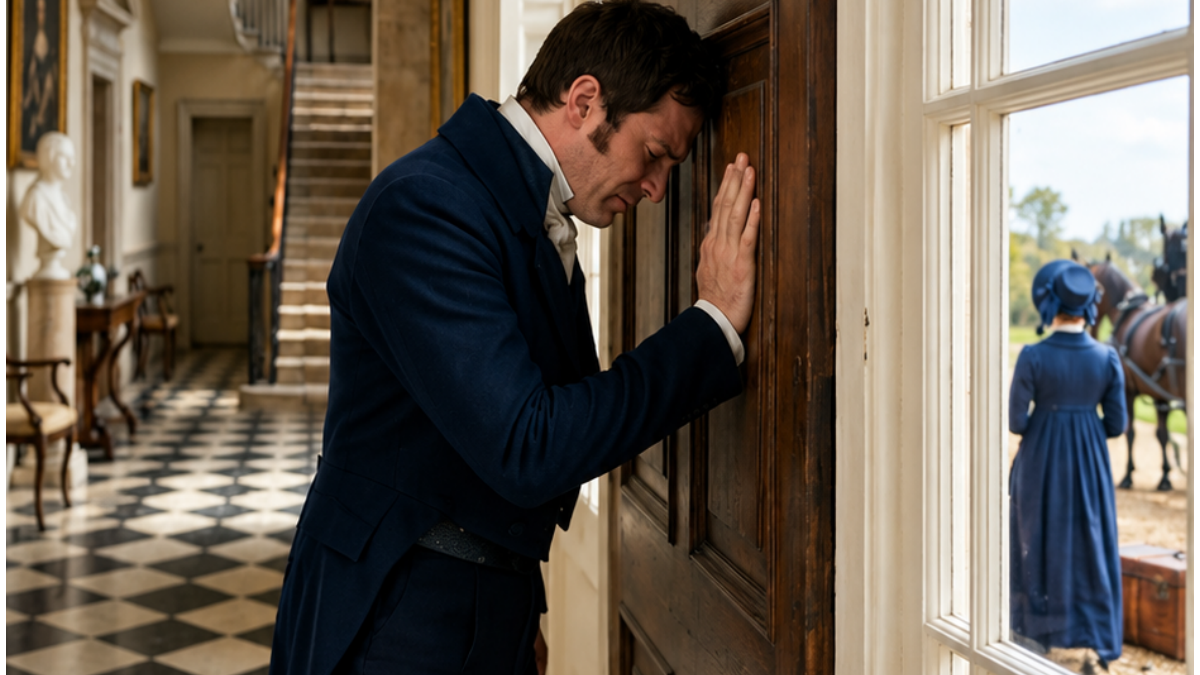
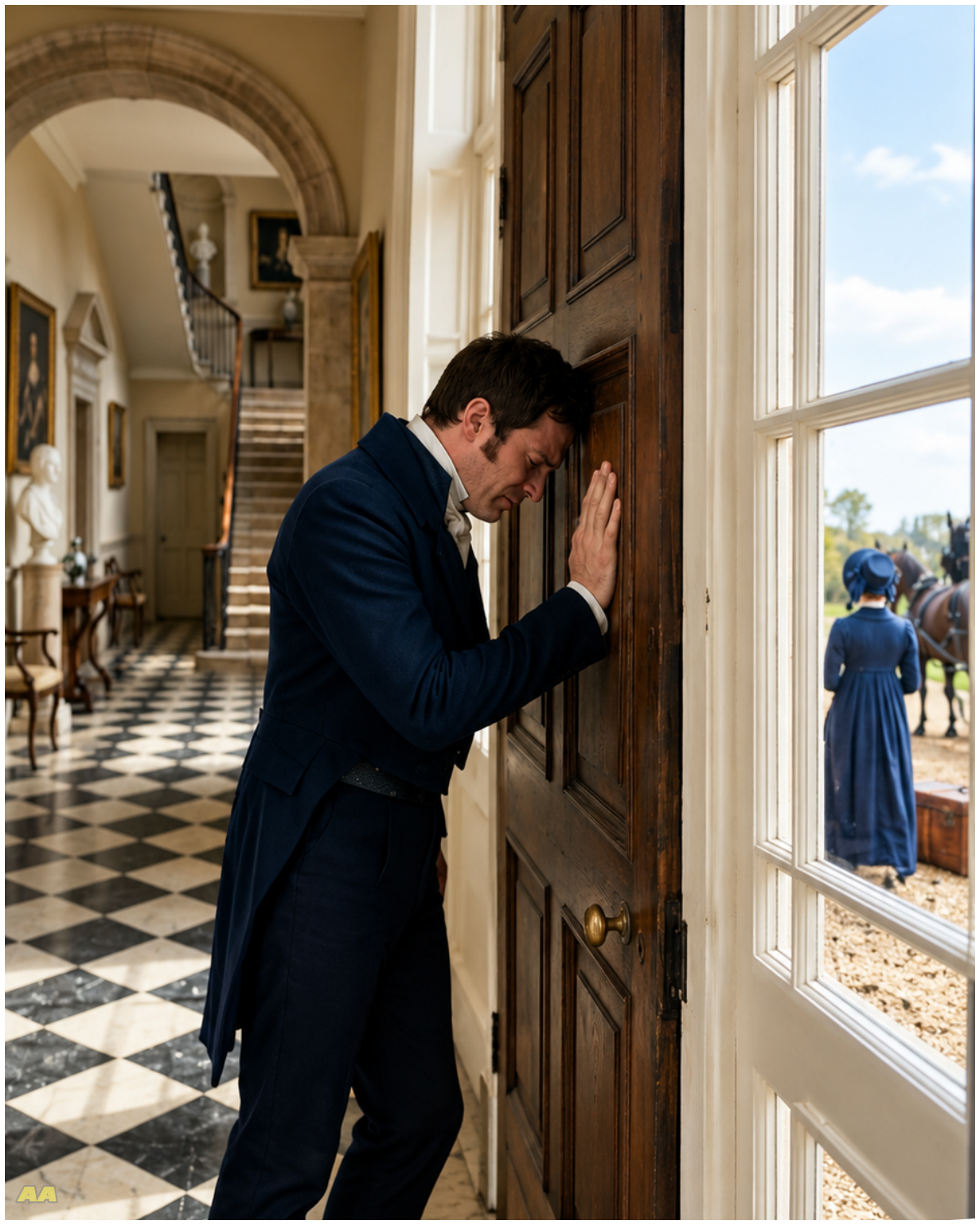
The word landed in the room the way a coin dropped onto polished wood lands.
Not loud, not violent, but with a small bright sound that nothing afterward could pretend not to have heard.
Replaceable. Lavinia had been lifting her teacup.
She set it down again with a steadiness that was not steadiness, but the absence of permission to be anything else.
And she looked at her husband across the breakfast table at Wexford House.
And Hadrian Strafford, sixth Duke of Wexford, did not look back at her.
He was reading. He had been reading the whole time he had been speaking.
And the casualness of it, the way one might mention that the Morning Post had brought a notice from the bank, or that the weather looked uncertain, was the particular wound she would carry with her into the carriage and across two counties and through the door of her sister’s house in Kent before she allowed it to be named for what it was.
She’d said something perfectly ordinary, a remark about the Pemberton ball, whether they ought to accept.
And he had said, without raising his eyes from the paper, that she might do as she liked.
That the matter was hardly significant.
That the world contained a great many women who could go to balls and any of them were replaceable by any other.
And she included. She had not been listening for cruelty.
She’d been speaking to him the way she spoke to him every morning.
Quietly, easily, as one speaks to a person whose presence is part of the architecture of one’s life.
And the words had arrived not as a blow, but as a stone dropped from a great height onto the surface of a still pond with that strange interval between the falling and the registering of the impact.
He turned the page of his paper.
He had not noticed.
That was the second wound.
And it arrived more cleanly than the first.
That having dropped a thing of that weight into the morning between them, he’d gone back to the news from the city as though he had said nothing at all.
The saying had cost him nothing because the thinking had cost him nothing because she had cost him, finally, nothing of consequence at all.
Lavinia lifted her cup again.
She drank the tea. It was lukewarm.
She placed her napkin beside her plate with the precise care she’d been taught as a girl at Linley Park, where her mother had told her, the year she came out, that a lady’s hands at the table told the world everything the world needed to know about the quality of her composure.
Her mother had been dead nine years.
The lesson had outlived her.
“I find I have a slight headache,” she said.
Adrian looked up. There was, in his face, the faint puzzled courtesy of a man pulled from his reading by a small domestic announcement.
He said something. That she ought to lie down.
That she ought to send for Dr. Beckett if it worsened.
And she nodded. And she rose.
And she walked from the breakfast room with the deliberate ordinary pace of a woman going to fetch a shawl.
And only when the door had closed behind her, did she allow herself to stand still in the corridor for the half breath it took to know what she was going to do.
By the clock in the hall, it was 28 minutes past nine.
She went up the great stairs.
She did not hurry. She entered her own apartments and rang for Hetty.
And when Hetty came, she said, in the same level voice she had used in the breakfast room, “I shall be traveling today. To my sister’s. We must pack.”
Hetty had been with Lavinia for six years, having come from Linley Park as a girl of 18, and she did not ask questions.
She looked at her mistress’s face once, briefly, and saw something there that decided her, and went to the dressing room and began.
It was extraordinary, Lavinia would think afterwards, how quickly a life could be reduced to its constituent parts.
Two traveling trunks came up from the box room within 20 minutes.
The morning dresses, folded between layers of paper.
Three evening gowns only, the others left behind.
Her writing case. Her mother’s pearls.
Five books chosen quickly. She did not pack the things he had given her.
That was a decision she made halfway through, looking at the rosewood box where the diamond combs lay, and the necklace of garnets he had presented to her on their first anniversary, and the bracelet of seed pearls he had brought her from Bath last autumn.
She closed the box and left it on the dressing table.
They were not hers in any sense that mattered now.
She wrote two letters at the small escritoire by the window.
The first was to her sister Cordelia, Lady Marbury, at Hadley Court in Kent, a short note saying that she would arrive that evening, that she would explain when she came, that Cordelia must not be alarmed, but that she required a roof that was not her own.
The second was to Hadrian.
It was four sentences. I have gone to Cordelia.
I shall not return until you send for me, and you must understand before you do that the woman you send for will not be the one who left.
Do not follow before you have considered what it is you wish to say.
I will not be told twice that I am replaceable.
She sealed it and set it on the writing slope where Hadrian would find it when he came up to dress for dinner, propped against the silver candlestick that had belonged to his grandmother, and that he sometimes touched absently when he was thinking.
By the time she was ready, it was past 11.
The trunks were corded, and the carriage had been ordered, not the duke’s town carriage, but the older traveling chariot from the coach house, which the head coachman Trelawney knew without being told that she preferred.
She had asked Mrs. Netherwood to send Marsh on an errand to the wine merchant in St. James’s, which would occupy him for an hour.
Mrs. Netherwood, who had been housekeeper at Wexford House for 29 years, had not asked why.
She had read the morning the moment Hettie had come down for the trunks.
It was Mrs. Netherwood who stood in the hall when Lavinia came down in her traveling police, the deep blue one with the dark fur at the collar and cuffs, and her plain bonnet, and her face composed entirely of the things she was not saying.
She held out a small parcel wrapped in linen, which Lavinia took without looking inside, knowing already that it was the cold collation Mrs. Netherwood would have prepared without being asked.
“Will your grace send word when you have arrived?” Mrs. Netherwood said.
“I shall send word to you,” Lavinia said, “not to him, not yet.”
Mrs. Netherwood inclined her head a second time.
She did not say anything else because the things she might have said belonged to a different relationship than the one in which she found herself.
And Mrs. Netherwood had a precise sense of what belonged where.
The traveling chariot left Wexford House at 14 minutes past noon and was gone from London by half past one.
Hadrian was, at that hour, halfway across the park on his bay mare, riding in the long meadow beyond the lake with the easy attention of a man whose only concern was whether the new shoes the smith had set last week were holding.
He had not thought of Lavinia at all.
That was the simple, unornamented fact of it, and it was the fact that would come back to him later in the long hours of the afternoon with a clarity that scoured.
He returned to the stables at a little before two.
He came up to the house through the garden door, removed his boots in the boot room, and asked Marsh, who had returned from his errand and was setting out the cold meats in the small dining room, whether her grace was already at table.
Marsh hesitated. “Her grace is not at home, your grace.” “Out?” “Where?” “I could not say, your grace.
Perhaps Mrs. Netherwood would know.” There was, in Marsh’s tone, a delicate emphasis on Mrs. Netherwood that Hadrian did not catch.
He ate cold ham and bread and pickled walnuts.
He read three letters that had arrived in the second poSt. He noticed vaguely that the room was very quiet, but luncheon was always quiet when and was not present, and he had not yet allowed himself to wonder how often, lately, Lavinia had not been present.
It was when he went up to his dressing room at half past three to change before he rode out to Westminster.
There was a matter before the Lords that afternoon concerning the corn laws, that he saw the letter against the candlestick.
He picked it up. He recognized the hand at once.
He broke the seal. He read it standing in his dressing room with the light from the window falling across the paper, and when he had finished, he read it again.
And then he sat down in the wing chair by the fire, which had not been lit because the day was warm, and he held the four sentences in front of him and did not move for a long time.
Replaceable. He had said it.
He could not remember saying it, but he believed her.
He did not need to remember in order to believe her, because she did not invent things.
She had never in seven years of marriage invented a single thing.
And he sat in the cold gray of his afternoon and understood with an exactness that was not at first painful, but only thorough, that he had said it.
He rang for Pallister. Pallister, who had been steward for 16 years, came up from the estate office with the unhurried gravity that was his only mode of arrival.
Hadrian was standing by the window.
He did not turn. “Her Grace has gone to Lady Marbury’s,” Hadrian said.
“I should like to know what time she left and what she took.” “At 12 and 14 minutes past, your Grace.
The old chariot, two trunks, her writing things, her maid, and the small dressing case.
Trelawney drove.” “Did she leave instructions for her correspondence?” “To be forwarded to Hadley Court, your Grace.” “Did she speak with Mrs. Netherwood before she left?” “Briefly, your Grace, in the hall.” “And what did Mrs. Netherwood say?” Pallister considered the question with the dignity of a man being asked very gently to step across a line he did not ordinarily cross.
“I believe her Grace asked Mrs. Netherwood to keep her informed of the household in her absence.
In her absence? Yes, your grace.
Hadrian was silent. He looked out at the garden where the gardeners were tying back the last of the roses against the south wall, and he understood that he had, in the simple economy of his morning, given his wife a reason to construct an absence around herself, and that she had constructed it with the efficiency and dignity that she brought to everything.
“Send to the stables,” he said.
“I shall want the shaes as soon as may be.” “Tonight, your grace?
It is 2 hours past noon, and the roads “Tonight.” “Very good, your grace.” Pallister withdrew.
Hadrian remained at the window, and he noticed then what he had not noticed before.
The vase on the writing desk had no flowers in it, and there had been flowers in it for as long as he could remember.
Lavinia put them there herself on Sunday afternoons.
The book that had sat by her chair in the morning room for a fortnight was gone.
Her shawl, which he habitually left over the back of the small sofa, was not there.
The morning room, when he walked into it 10 minutes later, held nothing of her at all.
He went into the breakfast room, where the table had been cleared, and he sat down in the chair he had occupied that morning, and he tried to reconstruct what he had said.
He could not. The shape of the sentence was gone from him entirely.
He remembered the paper. He remembered the coffee.
He remembered her asking him about the Pemberton ball, and even that he remembered only because she had asked it, not because he had attended to the asking.
And beyond that, there was nothing, and the nothing was worse than any recollection could have been, because it told him in unmistakable terms what manner of attention he’d been paying to her for 7 years.
He went back through them now with the thoroughness of a man taking the measure of his own failure.
Her arrival at Wexford House, when she had asked him whether she might make any alterations to the morning room, and he had said she might do whatever she liked, and then for 3 days had failed to ask her what she had done.
Her first season as his Duchess, when she had moved through the assemblies with a composure that had drawn comment, and he had registered the comments as one registers the weather, and had not understood that her composure was costing her something.
Her father’s death 3 years ago, which she had borne with the same dignity, and which he had marked by writing her a letter from his study to her morning room, three rooms away.
He stood up. He walked into the hall.
Mrs. Netherwood was descending the great stair with a basket of household linen, and she stopped when she saw him, and she set the basket on the second step.
“Mrs. Netherwood,” he said, “Your Grace.” “I should like to know whether Her Grace seemed well.” Mrs. Netherwood looked at him for a moment longer than was strictly necessary, and then she said with the precision she brought to all such questions, “Her Grace was very composed, Your Grace.” It was, he understood, an answer and not an answer.
It told him that Lavinia had not wept in the hall, that she had not raised her voice, and it told him, by what it did not say, that the composure had been the surface of something else, and that Mrs. Netherwood was not going to discuss it with him.
“Thank you,” he said. He sent word to Marbury, and the irony of that was not lost on him even in the moment that he was sending word to Lavinia’s sister’s husband to apologize for missing a sitting at the House of Lords because he was writing to that sister’s house to find his wife, and he climbed into the chaise, and Trellani’s son drove, and they were on the Kent Road by 5:00.
In the second hour, he understood the magnitude of what he had said.
He had used the word casually because the matter, the Pemberton ball, had been beneath the level at which he engaged his attention.
The casualness was the trespass.
He had answered a question about a ball with a word that addressed the fundamental status of the woman who had asked it, and the disproportion was such that no woman of intelligence, and Lavinia possessed it in measures he had only intermittently allowed himself to consider, could have [clears throat] failed to register exactly what the answer told her.
Past Sevenoaks in the failing light, he understood it had not been one morning.
That was the worst comprehension.
He had not been cruel that morning.
He had been ordinary. He had spoken to her in the manner he ordinarily spoke to her, and the only thing distinctive about the morning was that ordinary speech had finally produced an ordinary sentence whose meaning could not be ignored.
The damage was not in the sentence.
The damage was in everything that had made the sentence possible.
The chaise pulled into the courtyard at Hadley Court at 20 minutes past 9:00 in the evening.
The windows of the great house were lit.
The front door opened before he had stepped down, and Cordelia herself was standing in it.
Cordelia, Lady Marbury, Lavinia’s elder sister by two years, who in family resemblance might have been mistaken for her twin, and who in temperament was as different from her as iron is from water.
Cordelia did not move out of the doorway.
“Wexford,” she said. “Lady Marbury.” “My sister is here.
She is well. She’s not coming down.
I’ve not asked her to.” “What have you come for then?” He had thought somewhere in the long hours between London and that he had assembled a sentence sufficient to the occasion, and now standing in the courtyard with his hat in his hand, and his sister-in-law in the doorway, he understood that he had no sentence at all.
He looked at her. “I have come to wait,” he said.
Cordelia regarded him. She had the same gray eyes Lavinia had, the same straight brow, the same particular stillness when she was thinking, and she used all of them now.
After a moment, she stepped aside.
“You may wait in the library,” she said.
“You may not go upstairs.
You will be brought a tray.
Sir Edwin is in town until Friday.
I tell you this because you should understand that there is no one in this house who is obliged to be civil to you, including me.
And I am being civil only because Lavinia asked me to be.
She asked it in so many words.
She said you would come.
She said I was not to send you away.
She said I was to put you in the library and tell her when you arrived.” “And then?” “And then nothing.
You will wait. She will come down or she will not, and that is for her to decide and not for either of us.” He inclined his head.
He followed Cordelia across the hall and into the library, which lay at the back of the house and faced the lawn.
A fire had been laid.
Two candles burned on the chimney piece.
A tray was already on the small table, bread, cold meat, a glass, and a decanter, which told him Cordelia had ordered it the moment word came that he was on the road.
She left him. The door closed.
He did not eat. He drank one glass of the wine.
He sat in one of the two wing chairs by the fire and listened to the sounds of the house above him, the soft footsteps of a maid, the closing of a door, once the unmistakable cadence of his wife’s voice speaking briefly at a distance he could not measure.
The voice was steady. The voice was not weeping.
The voice was that of a woman who had made a decision and was being, for the first time in some considerable while, exactly the person she chose to be.
He waited. Upstairs in the small sitting room that adjoined the dead chamber Cordelia had given her, Lavinia was sitting by the fire with her hands folded in her lap.
She had changed into a plain gray wool gown, comfortable, unfashionable, the one she put on when she was reading in the evening at Wexford House.
Cordelia sat opposite her in the second chair, and the two sisters had been sitting in silence for nearly half an hour because the things Lavinia had told Cordelia on her arrival had been enough.
When the sound of the chaise had come into the courtyard, Lavinia had not moved.
She had counted the hours since she left London and known he would come tonight if he was going to come at all.
“He is in the library,” Cordelia said now.
“He has not eaten. He has not spoken since I left him.” “How does he look?” “Bad.
Tired.” “I’ve never seen him look tired before.” Lavinia considered this.
She had been married to him for 7 years and had not, until this afternoon, considered the possibility that he might be tired because she had never been permitted by his ordinary self-possession to imagine that anything in his life cost him effort.
She thought now, looking into the fire, that perhaps it had cost him a great deal, and she had simply been outside the room where the effort happened.
“I shall come down in an hour,” she said.
“An hour?” “It will do him good to wait.” Cordelia smiled very slightly for the first time since her sister’s arrival and reached across and took Lavinia’s hand and held it for a moment without speaking.
The hour passed. It was a quarter to 11:00 when Lavinia came down.
She had not changed out of the gray wool gown.
She had brushed her hair and pinned it up again, and she carried no shawl, and her hands were empty.
She walked down the great stair of Hadley Court without hurry and crossed the hall and opened the library door herself because she had asked Cordelia’s butler to leave her to it.
Hadrian was on his feet before she had crossed the threshold.
She closed the door behind her.
She did not come further into the room.
She stood with her back against the door and looked at him across the carpet, and she let the looking last as long as it needed to last, and he did not speak because he understood with the unfailing precision of a man who has finally begun to pay attention that he was not the one whose turn it was to speak.
“I shall say it once,” she said.
“I shall not say it a second time.
You should listen carefully.” “I am listening.” “You used a word this morning.
I do not require you to recall it.
I require you to know that I will not live in a house where such a word can be used about me in any tone on any subject by you or by anyone in your hearing whom you do not correct.
That is the first thing.” He inclined his head.
“I shall return to Wexted House,” she said.
“But not yet. I shall remain here a fortnight.
During that fortnight you will not write to me.
You will not call. You will not send for me.
When I return, certain matters will be different.
You will hear me when I speak.
You will look at me when I am in a room.
You will know what flowers stand on the writing desk in the morning room because you will have noticed them, not because Mrs. Netherwood has told you.
You will give me my full attention when I speak to you in the same measure that you give it to Paliser when he addresses you on the matter of drainage.
That is what I ask.
I do not ask for love.
I am not certain whether you have it to give and I am not certain whether I would accept it from you in its current form if you did.
I ask for attention. I ask to be seen by my husband as a woman to whom he is married and not as a piece of furniture about which he might form in passing an opinion that the world contains a great many like it.” She paused.
He did not move. “If you agree,” she said, “you will write to me at the end of the fortnight in your own hand and you will say so.
You will not promise. You will say what you have done in those 14 days to begin and then I shall come home and we shall see whether the home is one I can live in.
If you do not agree, if the fortnight passes and you have not written or if you write in the letter contains promises rather than evidence, I shall remain at Hadley Court and after that I shall go to my father’s house in Northamptonshire, which is mine now.
I shall not divorce you.
I shall not embarrass you.
I shall simply live elsewhere.
She stopped. The fire shifted in the grate.
He had not moved during the whole of her speech, and now he took a single step toward her, and he stopped, and he said very quietly, “Yes.” “Yes to which part?” “To all of it.
To the fortnight, to the terms, to everything you have said.” “I do not want yes.” “I want the 14 days.” “You shall have them.” She nodded.
She did not smile. She opened the door behind her, and she said without turning, “Cordelia has had a room prepared for you at the King’s Arms in the village.
The chaise will take you.
You will go there now.” “Lavinia.” “Now.” “Hadrian.” It was the first time she had used his Christian name in the conversation, and the using of it was not a softening, but the opposite.
It was the marking of a line.
He crossed the room, and at the door he paused, because she was still standing there, and the door was open behind her, and the lamp in the hall threw a long shape of light into the library that fell between them.
“I am sorry,” he said.
“I know you are.” “That is not the same as the thing I’ve asked you for.” “I understand that.” “Then go.” He went.
The fortnight at Wexford House was the longest of his life, and it was not the loneliness that taxed him.
He had been alone in that house for most of 7 years and had not noticed, but the necessity of being someone other than the man he had been alone with.
He began by writing nothing.
He had wanted to write at once, but he stopped himself because he understood she had not asked for letters.
She had asked for evidence.
He set a sheet of paper on his desk and looked at it and put it away, and he went down to the morning room instead, and stood in the doorway, and looked at what was in the room.
He sent for Mrs. Netherwood.
She came up. He asked her with a particular humility of a man who had finally understood what humility was for, whether she would tell him what his wife liked, not what she required.
He could discover what she required from observation, but what she liked.
What pleased her. Mrs. Netherwood looked at him for a long moment, then she sat down at his invitation in the chair opposite his desk, and she spoke for 40 minutes.
He took notes. He learned that Lavinia preferred her tea brought up at 7:00 because she liked an hour to read before she dressed, that she kept a small notebook in the morning room in which she wrote down the names of the tenants’ children and their birthdays, and that it was running short of pages, that she had been quietly funding the schooling of two girls from the village, the matter arranged through Pallister, and that Hadrian had never been told because she had not wished to be thanked for it, that she preferred snowdrops in February and violets in March and sweet peas in June, and that in winter she put in a single sprig of rosemary because she liked the smell, that she rose at 6:00 on most mornings and walked in the garden alone for half an hour, and that he had not known this because he had never been awake.
He began the next morning to rise at 6:00.
He walked the garden himself.
He could not yet walk it with her because she was not there, but he walked it because he wanted to know what it was she went out to see, and over the course of the fortnight he came to understand the small distinct pleasures she had been finding without him.
The particular angle at which the early light struck the stone of the south wall, the magnolia by the lake that flowered in succession for 3 weeks because she had asked the gardeners to plant two varieties, the bench where she sat to watch the rooks come into the elms in the evening.
He spoke to Pallister about the schooling of the village girls and increased the sum by half.
He renewed the flowers in the vase on the writing desk himself on the Sunday in the middle of the fortnight, and he did it badly because he had never arranged flowers in his life, but he did it, and he left them there.
He did not write the letter until the 13th day.
He wrote it in the morning room.
He sat at her escritoire in her chair with her ink and her paper and he wrote without stopping for 2 hours.
He did not tell her that he loved her because she had not asked for that and he did not yet trust himself to know what the word meant in the way she would mean it.
He told her what he had done.
He told her what he had learned.
He told her the names of the two village girls and what they were studying and the names of the tenants whose birthdays were in the coming month and the new variety of magnolia that the gardener had recommended and that he had ordered for the south side of the lake.
He told her he had risen at 6:00 every morning for 14 days and walked her garden and that he had begun to see what she had been seeing and that he understood now in a manner he could not have understood by being told what it was she had been doing in the margins of his life for 7 years.
He signed the letter Hadrian.
Not your husband. Not yours always.
Hadrian because she had used the name in the library and had used it to draw a line and he wanted her to know that he had heard the line.
He sent the letter by the morning post on the 13th day.
It reached Hadley Court before noon on the 14th.
Lavinia read it twice. The second time she read it standing at the window of Cordelia’s sitting room with the late morning light on the paper and when she had finished she folded it and held it for a moment in both hands and then she said to her sister who was sitting in the second chair, “I shall go home tomorrow.” Cordelia did not ask to see the letter.
“Oh, shh. Are you certain?” she said.
“Yes, I’ve been waiting 14 days to be certain and the letter has told me what I needed to know.” “Which is?” Lavinia looked out at the Kent lawn at the long shadows of the elms moving across it in the spring light and she said, “He has noticed.” She returned to Wexford House on 15th day.
He met her at the carriage himself in the courtyard with the same gravity with which he had greeted her on the day she had first come there as his bride 7 years before, and he handed her down, and he did not kiss her because she had not asked to be kissed, and he was not yet in possession of permission.
He carried in her dressing case.
He showed her, when she went up to her apartments, the small alterations he had made to her morning room.
A new lamp she had once admired in a shop in Bond Street set on the table by her chair.
The bookshelf moved closer to the light from the window.
A fresh notebook bound in dark green Morocco laid on the writing desk where the old one had grown short.
It was the notebook that decided her.
She picked it up and looked at it and looked at him.
“Mrs. Netherwood told you,” she said.
“She told me a great deal.
I have been a poor pupil, but I have been trying.” “Yes,” Lavinia said.
“I can see that you have.” The marriage that resumed at Wexford House on that May morning was not the marriage they had had before, and they both understood this, and the difference was the thing that allowed it to laSt. He did not pretend that he had always been attentive.
He made mistakes in the first months.
He forgot sometimes to look up when she came into a room and corrected himself a moment afterward, and the correction itself became over time the proof that he was trying.
She did not raise the breakfast room again because she had said in the library that she would not say it twice, but she did not pretend it had not happened.
They built instead something cleaner.
He began to come into the morning room in the afternoons to read in the second chair while she answered her correspondence, and they did not always speak, but the not speaking was a chosen quiet rather than an absent one.
He asked her in the autumn what she thought about the corn laws, and she told him, and he listened to her answer the way he had once listened to Palliser, and he changed his vote.
Their first child was born the spring after the next, and they called her Mary after Lavinia’s mother.
Their second child, 2 years later, was a boy, and he was christened Edmund Hadrian after his grandfather and his father in that order because Lavinia had asked it, and Hadrian had understood at once that the ordering was the point.
It was at breakfast, 11 years after the morning of the word, that the small thing happened which had not been planned and which neither of them mentioned afterward, though both of them remembered it for the rest of their lives.
They were sitting at the same table in the same room.
Mary, who was 10, was reading a book of her grandmother’s letters beside her mother.
Edmund, who was eight, was eating his toast with the methodical concentration of a child who has been told it is impolite to read at the table.
Hadrian was reading a dispatch.
He had been reading it for some moments when Lavinia, lifting her teacup, said something, something perfectly ordinary, a remark about whether they ought to accept an invitation from the Pembertons for the following week.
He set down the paper.
He looked up at her.
He looked at her with the whole of his attention, the way he had been looking at her with small lapses and steady corrections for 11 years.
“Whatever you would prefer, my love,” he said.
“I have no opinion that you do not have first.” Lavinia inclined her head.
She did not smile.
She lifted her cup and drank her tea, which was the precise temperature she preferred because Marsh had been instructed long ago by Mrs. Netherwood, and Mrs. Netherwood had been instructed long ago by the duke himself, and the chain of instruction held.
She had never mentioned the word.
She had never needed to.
He had been careful ever since with every word.
They arrive here like an answer given at last with the whole of one’s attention whenever they are ready.








