He Put Diamonds on His Mistress in Front of His Wife – Then Lost His Entire Billion-Dollar Empire.
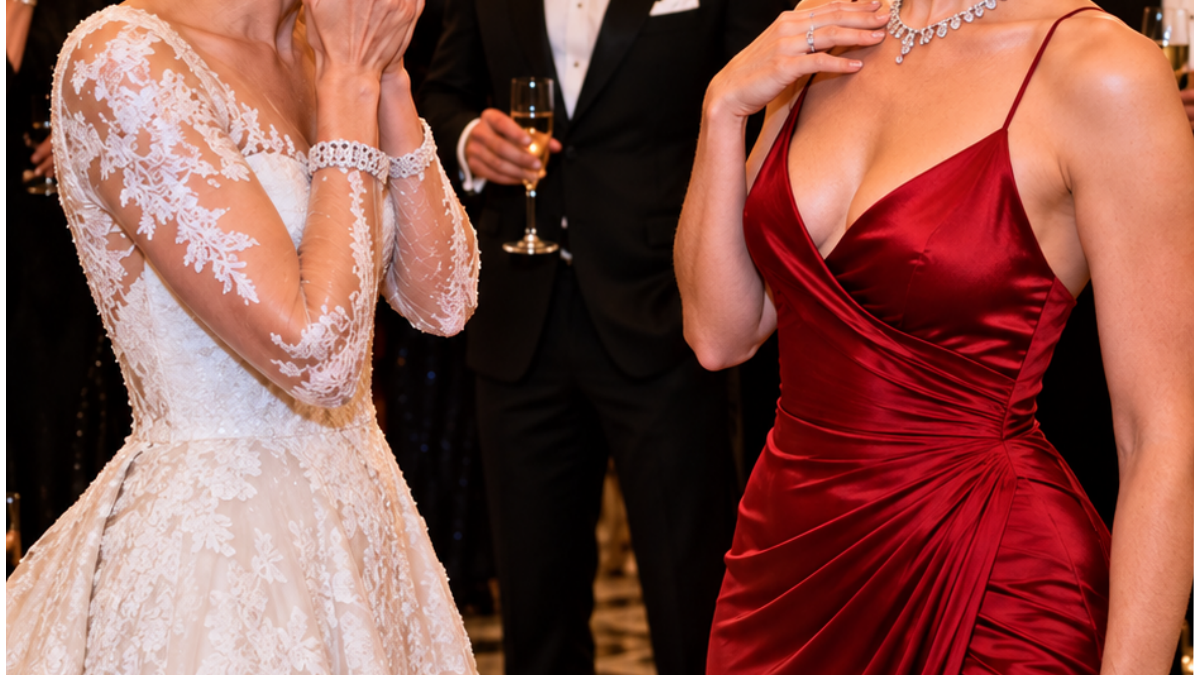
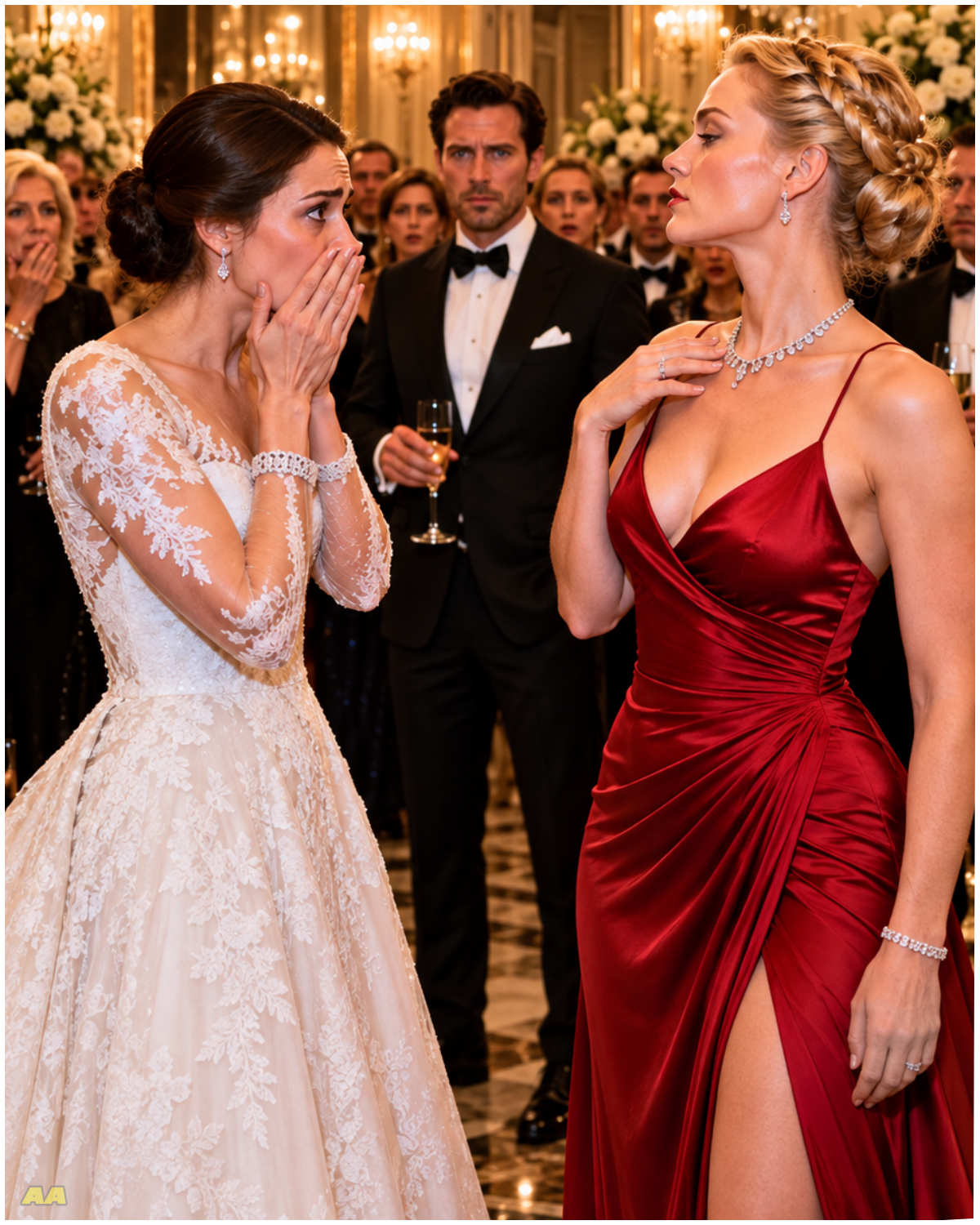
He grabbed her wrist hard and pulled her forward like she was furniture he was rearranging.
Then Adrienne Vale unclasped a $12 million diamond necklace and fastened it slowly, deliberately around another woman’s throat.
His wife was standing 8 ft away.
1,200 people watched. Nobody moved.
Nobody breathed. Evelyn Vale did not cry, did not speak, did not look away.
She simply watched the man she had once pulled back from the edge of ruin with her own hands, her own money, her own silence, use diamonds to tell her she was nothing.
He was wrong. And that mistake would cost him everything he had ever owned.
The night of the Metropolitan Charity Gala began the way all dangerous nights do beautifully.
The Asheford Grand Hotel in Manhattan had been transformed into something that looked less like a fundraiser and more like a statement.
Crystal chandeliers threw fractured light across 1,200 guests.
Waiters moved through the crowd like ghosts carrying champagne flutes that cost more per bottle than most families spent on groceries in a month.
The air smelled of gardinas and old money, and the particular cologne that powerful men wore when they wanted to remind the room exactly who they were.
Adrien Vale was the kind of man who never walked into a room.
He arrived in one. There was a difference, and he understood it completely.
At 52, he had the jaw of someone who had never been told no, and the eyes of someone who had stopped listening to anything that sounded like caution.
He wore his tuxedo, the way generals wore medals, not for warmth, but for effect.
Evelyn Vale arrived beside him, which is to say she arrived in his shadow, which is exactly where Adrienne had preferred her for the last several years.
She wore a gown the color of deep water, her dark hair pulled back with the kind of effortless precision that required either great talent or great pain, and possibly both.
She was 50 years old and looked 40 and felt on this particular evening about 90 years older than the room deserved.
She had known something was wrong before they even left the car.
It was the way Adrienne had checked his phone three times during the 15-minute drive from their penthouse.
It was the way he straightened his cuff links in the elevator, a nervous habit he had developed years ago and never managed to shake.
It was the small secret smile that crossed his face when he thought she was looking elsewhere.
Evelyn had learned long ago that secrets have a smell.
She could not name it, not exactly, but she had been breathing it for months.
“You look distracted,” she said quietly as they entered the lobby.
“I’m focused,” he said without looking at her.
“Those are different things.” He did not answer.
He had stopped answering her the way he used to with something that resembled honesty.
These days, his responses came clipped efficient, designed to close conversations rather than open them.
She had noticed this, too.
She had noticed everything. That was her particular burden.
And as it would turn out, her particular power.
The gala was already in full motion when they entered the main ballroom.
Names she recognized moved through the crowd.
Senator Howell, who owed Adrienne three unreturned favors.
Margaret Kesler from the Global Infrastructure Council.
Philip Donovan, who had once tried to acquire Veil International through what he’d called a friendly offer and what everyone else had called a hostile takeover.
Adrienne had defeated him. Evelyn had helped structure the defense.
Philip Donovan still looked at her with the specific respect a general gives to an opposing general after the war is over.
She nodded at him across the room.
He nodded back.
Adrienne was already moving toward the far side of the ballroom, greeting people with the particular energy of a man who was not nervous, but was performing not nervous, which is a completely different thing.
Evelyn accepted a glass of champagne from a passing waiter, took one small sip, and began watching her husband with the precise, unhurried attention of someone who had been watching him for 23 years, and had only recently begun to understand what she was actually seeing.
She saw Camille Lauron before Adrien reached her.
Camille was 34, French by birth and Manhattan by reinvention, and she stood near the far end of the ballroom in a red gown that required absolute confidence to wear in public.
She had the particular beauty that comes from knowing exactly how beautiful you are and deploying it with strategic precision.
She was not hiding in the room.
She was using it. Evelyn had known about Camille for 4 months.
She had known in the way that wives know things, not from evidence at first, but from the architecture of absence.
Adrienne coming home later. Adrienne laughing at his phone in other rooMs. Adrienne losing the particular carelessness around her that is the invisible proof of genuine intimacy, the small touches, the half-finished sentences.
The way a person who truly loves you sometimes forgets to perform loving you because they just do it without thinking.
He had stopped forgetting to perform.
He had started performing deliberately.
That was the tell.
She had confirmed it six weeks after the first suspicion through channels she would not have been able to explain to anyone who did not understand how financial architecture worked.
But Evelyn understood.
She had always understood how threads connected, how structures revealed their builders, how a person’s choices always left fingerprints if you knew where to look.
What she had not anticipated, what she genuinely had not foreseen, despite 23 years of knowing this man was what he was planning to do tonight.
She saw it begin from 40 ft away.
Adrienne crossed the ballroom with the posture of a man exercising a right.
He reached Camille Lauron and greeted her with a kiss on the cheek.
Not discreet, not covert, performed at full volume for anyone who cared to look.
Several people looked. Several people stopped mid-con conversation to look.
The particular silence that precedes something scandalous began to creep through the crowd from that corner of the room, outward like ripples from a stone.
Evelyn did not move. A woman named Patricia Hol, who served on the board of the city’s largest children’s hospital and who had known Evelyn for 11 years, appeared at her elbow.
Evelyn, Patricia said, and her voice contained about 15 emotions compressed into two syllables.
Patricia, Evelyn’s voice was steady.
How is the new pediatric wing coming along?
Patricia stared at her. I We broke ground last month.
Evelyn, are you seeing? I see everything.
Evelyn said and took another sip of champagne.
Tell me about the wing.
But Patricia could not tell her about the wing because the ballroom had just shifted in the particular way that a room shifts when everyone simultaneously decides to look at the same thing.
Adrienne had reached into his jacket pocket.
He produced a velvet box with the deliberate slowness of someone who wanted the gesture scene, not the box what was inside it.
He wanted the anticipation scene.
He wanted the choosing of this moment scene.
He opened it and the light from the chandeliers found the diamonds inside.
Before anyone in the room could properly process what was happening, the necklace was extraordinary.
Even from 40 ft away, Evelyn could see that 12 stones principle among them, a center diamond that caught and shattered light into every direction.
It was the kind of jewelry that did not decorate a woman.
It declared an ownership. It announced a position.
It said, “This person is mine, and I am advertising that fact.” Adrienne lifted the necklace from the box with both hands, and he fastened it around Camille Lauron’s throat.
In a room of,200 people, you could have heard a single champagne bubble break the surface of a glass.
The silence was not the silence of respect.
It was the silence of 1,200 people collectively holding their breath because they understood that they were witnessing something that should not be happening and could not be stopped and would be talked about for years.
It was the silence of scandal in real time.
It was the silence of a man who had just made a choice so public and so deliberate that there was no universe in which it could be called an accident.
Camille smiled. She reached up and touched the diamonds at her throat.
Adrienne turned and his eyes found Evelyn across the ballroom with the precision of someone who had rehearsed this moment.
He had meant to look at her.
He had planned it. He wanted her to see his face when he did this.
She gave him nothing. That was the thing about Evelyn Vale that Adrienne had never truly understood.
Even after 23 years, he expected tears.
He expected the public crack, the trembling lip, the glass set down too hard, the dignified exit that would confirm his narrative that she was emotional, that she was dependent, that she was the kind of woman who could be replaced and would crumble when it happened.
He had built his entire self- mythology around the idea that the things he touched either obeyed him or broke.
Evelyn did neither. She looked at him across that room with the specific calm of someone who had already done the math, and the math had already come out in her favor, and she was simply waiting for him to catch up to numbers he did not yet know existed.
She set her champagne glass down on a passing tray.
She turned to Patricia Hol.
We should discuss the naming rights for the new wing, she said.
“There’s a structure I’ve been thinking about.
Do you have 10 minutes?” Patricia blinked.
I yes, of course. But good, Evelyn said, and walked with her toward a quieter corner of the room, and she did not look back.
Philip Donovan watched her go.
He was one of perhaps six people in that ballroom who understood what the expression on Evelyn Vale’s face actually meant.
He had seen a version of it once before across a boardroom table 3 years ago during the failed acquisition.
He had watched her lay out a counter structure so elegant, so thoroughly engineered that his entire legal team had needed 48 hours just to understand why they had loSt. She had worn the same expression then, not anger, not fear, the particular focused stillness of someone who has already decided what happens next and is simply allowing the current moment to finish being necessary.
He reached for his own glass and made a quiet private decision to check on his own corporate governance documents first thing in the morning.
Adrien Vale, for his part, stood across the ballroom with Camille on his arm, receiving congratulations from men who were congratulating him the way men congratulate other men for things they privately believe are disasters with enthusiasm and no eye contact.
He had expected Evelyn to leave.
She had not left. She was in the corner of the room talking to Patricia Hol with complete composure and the fact that she was not crying, was not reacting, was not performing the devastation he had required her to perform.
This Adrienne realized with the first small needle of discomfort had not been part of his plan.
She didn’t even flinch, said a voice beside him.
Marcus Webb, his chief of staff, speaking quietly into the side of his face.
Marcus was 38 efficient loyal in the way that people are loyal to power rather than to persons and he was currently looking at Evelyn Vale with the particular expression of someone updating a calculation.
She’s holding it together for public consumption.
Adrienne said and he said it smoothly the way he said everything.
She’ll fall apart later. Maybe Marcus said he watched Evelyn laugh at something Patricia said genuinely laugh not the performance of laughter.
Or maybe not. Don’t do that.
I’m not doing anything. You’re doing that thing where you imply something without saying it.
Marcus looked at him. I’m not implying anything, Adrien.
I’m just watching your wife laugh at a charity gala approximately 4 minutes after you fastened $12 million around another woman’s neck in front of 800 witnesses.
And it occurs to me that a woman who can do that might be a woman who expected this.
Of course, she didn’t expect this.
How do you know? Adrienne opened his mouth, closed it because she doesn’t know anything.
Marcus said nothing. He took a sip of his drink and said nothing, which was a more eloquent response than anything he could have said aloud.
Evelyn across the room was pulling out her phone.
She typed a message with the focused brevity of someone who had been waiting to send it.
The message was four words long.
It went to a man named Rowan Pierce, who was not at the gala, who was in fact sitting in an office in Midtown Manhattan, where he had been waiting with particular patients for exactly this moment.
The four words were, “Begin the review now.” Rowan Pierce read the message.
He sat down his coffee.
He opened three laptops, each running separate secured connections to financial networks that the world did not know were connected to Evelyn Vale.
He typed a single acknowledgement.
Understood. Moving tonight. He had been ready for this for 6 months.
They both had. The gala was not a surprise to either of them.
The timing had been a question, not a certainty.
But Evelyn had told him months ago when they were working through the contingency structure together, “When it happens, it will happen publicly.
He needs an audience. He always needs an audience.” She had been right.
She was almost always right.
That was something people who underestimated Evelyn Vale discovered too late.
That the stillness they mistook for passivity was actually the stillness of total preparation of a person who had already gone to every place this road could lead and made arrangements accordingly.
In the car afterward on the drive home, Adrienne did not speak to her for the first 12 minutes.
He sat against the far door of the car phone in hand, a small private satisfaction around the set of his mouth that he made very little effort to conceal.
Evelyn looked out the window at the passing lights of the city.
Finally, he spoke. “I think it’s time we talked about the arrangement,” he said.
“All right,” she said. He seemed slightly surprised that she hadn’t made him work harder for her attention.
“I’ve spoken with the lawyers.
There’s a very reasonable package.
You’d be well taken care of.
I’m sure the penthouse obviously would need to be Adrien.
He stopped. She turned from the window and looked at him and the look was not cruel, not wounded, not the look of a woman gathering herself to deliver a speech she had rehearsed a hundred times.
It was simply direct. Not tonight, she said.
We are not doing this tonight.
I think tonight is exactly tonight.
You made a choice in front of 800 people.
You planned that. You dressed it up and performed it and you wore it like a costume.
Fine. She returned her gaze to the window.
What comes next takes time and I have time.
He stared at her for a moment.
You’re not going to fight this.
I didn’t say that. Then what are you saying?
She was quiet for a moment.
The city moved past the windows.
I’m saying that everything you did tonight was theater Adrien.
And I think it is important for you to understand that what I do next is not.
He laughed a small defensive laugh, the kind that emerges when a person is less certain than they want to appear.
What does that mean? But she had returned to looking out the window, and she did not answer, and the silence that settled between them was not the silence of a woman with nothing to say.
It was the silence of a woman who had already said the only thing that mattered.
The penthouse was large and very quiet when they returned.
Adrienne poured himself a drink and took it to his study and closed the door.
He spent 40 minutes on his phone.
Evelyn was aware of this the way she was aware of most things, not because she was watching, but because his absence was a form of information.
She went to her own study, a room he rarely entered and almost never thought about.
She sat at her desk, opened her personal laptop, and entered three levels of security authentication that connected her to a system Adrienne did not know existed.
She pulled up a file labeled NMC- structural review dated 6 months prior.
She scrolled to the section marked trigger conditions and added a single date stamp to the activation log.
Then she opened a second document, one that was much older, dating back 12 years to the period she thought of privately as the dark years.
Not her dark years, but Adrian’s.
The years when Veil International had stood on the edge of genuine collapse, when the debt structure had been so catastrophically misaligned that multiple board members had quietly begun making calls to competitors when Adrienne Vale, for the only time she had ever seen, had looked genuinely frightened.
She had fixed it. Not obviously not with her name on anything visible.
She had fixed it through Larks Holdings, a company she had established three years before their marriage, through a trust arrangement so layered that even most financial attorneys would have needed significant time to trace the connections.
She had fixed it by engineering a rescue structure through a consortium called Northstar Meridian, which had provided critical liquidity to Veale International in exchange for a series of governance provisions that Adrienne had agreed to with the enthusiasm of a man who does not read the fine print because he has decided the fine print does not apply to him.
It always applies to someone.
She had known when she built those structures that she was building a cage, not because she had planned to use it.
She had not planned anything that specific.
Not then. She had built it because she was the kind of person who understood that power exercised without accountability was not power at all.
It was just damage waiting for an occasion.
She had hoped, genuinely hoped, that the occasion would never come.
That he would be different.
That the man she had married, the one who used to look at her like she was the most extraordinary thing he had ever encountered, who had once spent an entire transatlantic flight just talking to her, who had sat beside her in that terrible boardroom 12 years ago and taken her hand and said, “I wouldn’t have survived this without you.” That that man was real and permanent and not simply a version Adrienne had worn until he got what he needed.
She had been wrong. That was grief, she supposed, not the theatrical kind, the quiet kind that doesn’t announce itself, that simply sits in the body like a stone you’ve carried so long you’ve stopped noticing the weight.
She closed the file. She looked at the window for a moment.
Then she opened a new document and began to write.
At the top of the page, she typed phase 1 full activation.
Across the city, Rowan Pierce was on his third call of the night.
His voice was quiet and precise and carried the particular authority of someone who had spent 30 years in financial law and had long ago stopped being impressed by the things that impressed most people.
The trigger was logged at 11:47, he said.
Yes, we move to phase 1 tonight.
Have the review notices prepared by morning.
A pause. No, not tomorrow morning.
This morning. We have a 12-hour window before the markets open, and I want everything in position before trading begins.
Another pause. Because she said so, Rowan said, “And in my experience, that’s sufficient reason.” He ended the call, made two more, and then sat back in his chair, and looked at the city through his office window with the expression of a man who has just watched a very complicated clock begin its final sequence.
He had known Evelyn Vale for 9 years.
He had worked with her, argued with her, been astonished by her on multiple occasions.
He had once asked her during one of their earlier meetings why she kept so much of her structural work invisible.
She had thought about it for a moment, which was the way she answered all genuine questions with actual consideration rather than the first available response.
Because visible power, she had said, is power someone else can plan againSt. He had never forgotten it.
Adrien Vale had planned nothing against her because he had not known there was anything to plan againSt. He had looked at his wife for 23 years and seen a woman who was elegant, intelligent, supportive, occasionally inconvenient in her opinions, and fundamentally dependent on the life he provided.
He had seen a woman who had helped him through difficulty.
He had not seen the architect of the structure that had made his survival possible.
He had not seen the person who held quietly and patiently and without display the specific levers that could determine the future of his entire company.
He had looked at her and seen the surface.
He had never once considered the depth that in the end was not simply a personal failure.
It was a strategic one.
And in the world that Evelyn Vale occupied, the world of governance structures and financial architecture, and the careful, invisible engineering of consequence, strategic failures had very specific costs.
She finished writing at 2:00 in the morning.
The penthouse was silent. She could see through the window that the light in Adrienne’s study had gone out an hour ago.
He was asleep, she assumed, with the particular ease of a person who does not yet understand the severity of the morning approaching them.
She closed her laptop. She stood at the window for a moment and looked out at the city.
All those lights, all those lives, all that invisible machinery turning beneath the surface of things.
She was not angry. She had expected this from him if she was honest with herself for longer than she had admitted.
Anger requires surprise, and she had not been truly surprised in a long time.
What she felt was clearer than anger and more permanent.
She felt decided. She turned off the study light and walked through the quiet penthouse to her room.
And across the city in three separate offices, people who had been waiting for months received the same encrypted notification.
A single green indicator on a secured screen confirming that phase one of the Northstar Meridian Strategic Review had been formally initiated.
By morning, Adrien Vale would sit down to his usual coffee, his usual headlines, his usual certainty that the world was arranged to his specifications.
He would not yet know that the specifications had changed.
He would not yet know that 12 years of careful, patient, invisible architecture had just been activated by the woman he had humiliated in front of 800 people.
He would not yet know any of this, but he would.
Very soon, he would know everything.
And by then knowing would not be enough to save him.
The morning after the gala, Adrien Vale woke up at 6:45 the way he always did.
Coffee, headlines, phone, the ritual of a man who believed the world reordered itself overnight to accommodate his preferences.
He did not yet know that this morning was different.
His phone showed 47 notifications.
That was unusual. He scrolled through them with the lazy confidence of someone who expected admiration and occasionally received criticism, but had learned to treat both as evidence of relevance.
There were texts from colleagues, from friends, from people whose names he recognized, and people whose names he did not.
A few were about the gala.
Most contained some variation of the same question, dressed in different clothes.
What exactly were you thinking last night?
He set the phone face down on the kitchen counter and finished his coffee.
He was thinking, as he often did in the mornings, about Camille, about the way she had looked wearing those diamonds, about the expression on the faces of the men around him when he had fastened them that particular mixture of envy and awe that he had spent his entire adult life engineering and never quite stopped needing.
He was not thinking about Evelyn.
He should have been thinking about Evelyn.
She was already gone when he came out of the bedroom.
Her coat was missing from the entrance hall.
Her keys were gone. There was a single cup on the kitchen counter, not his.
Hers rinsed and placed upside down on the drying rack with the precise considered neatness that characterized everything she did.
He stood there for a moment looking at that cup, and then he poured himself more coffee and did not think about it further.
Marcus Webb called at 7:15.
We have a situation, Marcus said without preamble, which was the way Marcus communicated things he considered genuinely serious rather than merely inconvenient.
The gayla, Adrienne kept his voice flat controlled.
I know it’ll blow over.
It’s not the gala. A pause.
Then what is it? I’m sending you something, Marcus said.
Read it before you do anything else today.
Before you call anyone, before you make any decisions, the document came through 30 seconds later.
Adrienne opened it at the kitchen counter, still in his robe, coffee in one hand.
It was 11 pages. His eyes went immediately to the header.
Northstar Meridian Consortium notice of strategic review activation.
He read the first paragraph.
Then he read it again.
Then he set the coffee cup down very carefully and read the entire document, standing completely still with the expression of a man who has just discovered that the ground beneath him is not what he thought it was.
Marcus, he said when he called back, what is this?
That is what I’m trying to figure out.
This is a 12-year-old agreement.
This consortium, I thought they were a passive equity holder.
Apparently not. What do you mean apparently not?
I signed those agreements. I know what they He stopped.
He was remembering with uncomfortable clarity the period 12 years ago when he had signed approximately 47 different documents during a 6-w week crisis and had trusted his legal team to review each one and had not, if he was being completely honest with himself, read all of them with the attention they deserved.
Get me the original agreements.
Already requested, Adrien. Marcus paused.
The review notice was filed at 6 this morning.
That’s before the markets opened.
Whoever activated this knew exactly what they were doing and exactly when to do it.
Adrienne’s jaw tightened. Who filed it?
The authorized representative of Northstar Meridian Consortium.
Who is the authorized representative?
Another pause. Longer this time.
We’re still working on that, Marcus said carefully.
Work faster, Adrienne said and ended the call.
He stood in his kitchen for a long moment.
Then he picked up his phone and called Evelyn.
It rang four times, then her voicemail, calm and clear.
You’ve reached Evelyn Vale. Please leave a message.
He did not leave a message.
He called again. Voicemail. He put the phone in his pocket and went to get dressed.
And the feeling that moved through him as he did, the feeling he would not name, not yet, not even to himself, was something very close to the first cold edge of fear.
Evelyn was at that moment sitting in a conference room on the 34th floor of a building in Midtown Manhattan that bore no connection to anything Adrien Vale owned, controlled, or had ever thought to investigate.
Rowan Pierce sat across from her.
He was 61, silverhaired, and possessed of the specific kind of calm that belongs to people who have spent decades in rooms where enormous things are decided, and have learned that panic is simply a choice and not a useful one.
Beside him sat two attorneys from a firm Adrienne had never heard of and a financial analyst named Sujin Kang who had spent the last six months doing nothing but mapping the complete structural relationship between Northstar Meridian Consortium and Veil International.
Sujin’s mapping had been thorough.
The review notice has been acknowledged by three of the five board members, Rowan said, sliding a document across the table.
The other two are traveling.
Their offices confirm they received it.
Evelyn looked at the document timeline for formal response.
They have 72 hours under the governance charter and the covenant breach.
Sujin Kong leaned forward. She was 33 precise in speech and had the habit of looking directly at whoever she was addressing with the focused intensity of someone for whom imprecision was a personal offense.
The necklace purchase was processed through Veil International’s restricted acquisition reserve.
The reserve has very specific permitted uses under the original rescue agreements.
Personal gifts to non-corporate parties are explicitly excluded.
Explicitly, Evelyn repeated. The word they used in the original agreement was unambiguously, as in the restriction on personal expenditures from the reserve is unambiguous.
Sujin allowed herself the smallest possible smile.
Someone very careful drafted that language.
Evelyn did not respond to this.
What’s the exposure on the necklace alone?
It triggers a review clause.
But our analysis of the reserve transactions over the past 3 years.
Sugjan pulled up a document that ran to 41 pages suggests the necklace is not the only issue.
It is simply the most recent and the most visible.
Evelyn turned several pages. Her expression did not change, but her eyes moved with a specific focused speed of someone who reads financial documents.
The way other people read novels, not for information, but for story.
For the narrative that the numbers were trying to tell.
What she was reading told a very clear story.
31 million, she said. 31.4.
Sujin confirmed. Over 38 months, classified across 17 different line iteMs. The accounting is actually quite creative, but the underlying pattern is unmistakable once you map it.
Rowan Pierce was watching Evelyn with the patient attention of someone who had known her for 9 years and still found occasionally that she surprised him.
How do you want to proceed?
Evelyn closed the document. She sat back.
She looked at the window for a moment, not at what was outside it, but at the glass itself, the way a person looks when they are thinking something through to its complete conclusion before they speak.
The board, she said finally, needs to see this before Adrien does.
That can be arranged. And Philip Donovan, Rowan raised one eyebrow.
Donovan, you want to bring in the man who tried to acquire Vale 3 years ago.
I want to bring in the man who has spent 3 years studying Vale’s structural weaknesses, Evelyn said through Hawthorne Global Infrastructure.
He knows the company better than most of the people currently sitting on its board.
He’ll want something in return.
Of course, he will. That’s what makes him useful.
She paused. He also respects capability.
He always has. Call him today.
Rowan nodded slowly. And Adrien.
She picked up her bag from the chair beside her.
Adrien will call me approximately six more times before noon, she said.
When I’m ready to speak to him, I will.
She was right. He called seven more times.
The last call came at 11:58.
She let it ring. At 12:15, she was at a small table at a restaurant near the park, having lunch with a woman named Grace Holloway, who had been her closest friend for 19 years and who was currently sitting across from her with the expression of someone trying to calibrate precisely how concerned to be.
“You’re eating,” Grace said. “I’m hungry.” “You’re eating?” Grace repeated as if this were either miraculous or suspicious.
Your husband publicly humiliated you in front of 800 people last night and you are calmly eating a salad.
It’s a very good salad.
Evelyn. Evelyn looked up. Grace’s face was open and worried and full of the kind of genuine love that doesn’t know what to do with itself when the person it loves refuses to perform distress on schedule.
I’m all right, Evelyn said.
And then because it was grace and because Grace had earned the truth many times over, I have been all right for longer than last night.
That’s what I need you to understand.
What does that mean? It means that what happened last night was not a surprise.
She set her fork down.
It means I have been preparing for this for a long time.
It means she paused, searching for the right words, the ones that were true without being more than she wanted to say in a restaurant in the middle of the day.
It means that I am not the person Adrienne thinks he’s dealing with.
Grace stared at her. Who does he think he’s dealing with?
His wife, Evelyn said simply.
He has always only ever seen his wife.
A moment of silence stretched between them.
Grace reached across the table and put her hand over Evelyn’s.
“Tell me what you need,” she said.
“I need you to be normal around him,” Evelyn said.
If he calls you, if he reaches out looking for information about where I am or what I’m doing or what I’m feeling, be his friend.
Don’t lie to him. Just don’t tell him anything useful.
That I can do, Grace said.
Lord knows I’ve been doing that for years anyway.
Evelyn picked up her fork again.
And Grace, whatever you see happen in the next few weeks, don’t be frightened for me.
Be frightened for him if you need to be frightened for someone, but not for me.
Grace looked at her for a long time.
“You really did plan this.” “I planned the contingency,” Evelyn said.
“He chose to make it necessary.” Adrienne was in his office by 1:00, which was where Marcus found him surrounded by the original Northstar Meridian agreements, 12 years old, 43 pages printed on paper that had yellowed slightly at the edges.
He had clearly been through them multiple times.
There were notes in the margins in his handwriting, several pages marked with colored tabs, and the expression on his face was the particular expression of someone who has read something with great care and still cannot locate the exit.
I need a name, Adrienne said without looking up.
The authorized representative of Northstar Meridian.
I need it today. We’ve been digging since this morning, Marcus said.
The consortium structure is layered.
Multiple holding entities each nested inside the next.
It’s going to take how long?
Days, possibly longer. Adrien pushed the documents aside.
Someone designed this specifically so it couldn’t be traced quickly.
He said it as a statement, not a question.
That’s what it looks like.
This is not a random institutional investor who got nervous.
He stood up, moved to the window, and stood there with his back to the room, a posture Marcus recognized as Adrien thinking hard.
Someone built this structure with a specific purpose.
The activation timing, the covenant breach angle, the review notice filed before the markets opened.
He turned around. Someone has been waiting for me to give them a trigger.
Marcus was quiet. The necklace, Adrienne said.
It would appear so. The necklace was purchased through the acquisition reserve.
It was. Who approved that transaction?
Your CFO processed it. He says it was authorized through your office.
I authorized it, but I didn’t know about the covenant restriction.
No, Marcus said carefully. You didn’t.
The silence between them had weight.
Adrienne sat back down. He put both hands flat on the desk and looked at them.
Camille, he said. Does anyone know?
It’s already in the financial press, Marcus said.
Not everything, but enough. The necklace, the reserve breach, the consortium review.
Someone is feeding this to journalists carefully, strategically.
Adrienne’s head came up slowly.
Strategically, one outlet at a time, measured.
Nothing that’s legally actionable, nothing inflammatory, just enough to raise questions, enough to make board members nervous.
Who would do that? He said it as if he already suspected the answer and was hoping very much to be contradicted.
Marcus did not contradict him.
He simply said, “Adrien, has Evelyn called you today?” And the silence that followed that question was its own kind of answer.
At 3:00 in the afternoon, two of Veil International’s board members, Caroline Marsh and David Ing, received identical packages at their respective offices.
The packages contained a 12-page executive summary of the Northstar Meridian Strategic Review, a preliminary analysis of the acquisition reserve transactions, and a brief cover letter written in the precise measured language of someone who understood that the most devastating documents are the ones that make no emotional argument at all.
Just facts arranged in sequence, each one more damaging than the laSt. Caroline Marsh read hers in 17 minutes.
Then she called her attorney.
David Ing read his in 23 minutes.
Then he called Caroline Marsh.
Have you spoken to Adrien?
He asked. Not yet, Caroline said.
Are you going to A pause?
I don’t know what I would say.
I think we need to call an emergency board session, David said.
Further. David. Caroline’s voice was careful.
Who sent this? The cover letter is from Rowan Pierce.
I know who signed it.
Who is driving this? Another pause.
I think David said slowly that we may have made a significant error in how we have understood the governance structure of this company.
How so? Specifically, he said in terms of who actually has authority within it.
The emergency board session was called for Thursday.
That gave Adrien 3 days.
He used those three days with the frantic undirected energy of a man who finally understands that he is in danger but has not yet located the source.
He called attorneys. He met with his CFO, a man named Robert Chung, who had spent the previous 24 hours reviewing transaction records with the haunted expression of someone who has realized that a series of decisions that seemed small in isolation constitutes something very serious in aggregate.
He made calls to board members who did not return them or return them with the particular careful brevity of people who have been advised by council to say as little as possible.
He called Evelyn on Tuesday evening.
She answered on the second ring.
Where are you? He said not warmly.
Not the voice of a husband, the voice of a man seeking information.
I’m at the house in Connecticut, she said, catching up on reading.
We need to talk. We’re talking now in person.
This is He stopped himself recalibrated.
Evelyn, there’s something happening with the company.
Something involving an old agreement that Northstar meridian, she said.
Complete silence on his end.
I’m familiar with the structure, she said, and her voice was so even, so completely ordinary that it was more disturbing than any version of anger could have been.
How are you familiar with it?
He said it slowly. Because I’ve been familiar with most of the structures underlying your company for a very long time.
A pause. Adrien, how much of the rescue agreements from 12 years ago do you actually remember?
He said nothing. You were under enormous stress.
She said there were a lot of documents.
I understand. Evelyn, his voice had shifted.
Something in it had changed the authority draining out of it in real time, replaced by something more careful, more watchful.
What do you know about the Northstar Meridian Consortium?
I know quite a lot about it, she said.
How? Because, she said, and she said it gently, almost kindly, with the specific tone of someone delivering news they have been holding for a very long time.
I am the authorized representative.
The silence lasted 11 seconds.
She counted them. You, he said, me.
You are. He stopped, started again.
For 12 years. Yes, you have been.
Another stop. She could hear him breathing.
She could hear the particular quality of his breathing change as the architecture of 12 years rearranged itself in his understanding.
You saved my company. Yes.
And then you He was working through it out loud.
She could tell which was unusual.
Adrienne was not a man who worked through things out loud.
He was a man who processed privately and presented conclusions.
The fact that he was thinking aloud told her more about his current state than anything else could have.
The governance provisions, the reserve restrictions, you wrote those.
The attorneys drafted them. But you designed them.
She didn’t answer, which was itself an answer.
Why? He said, and then with more force.
Why would you? Because I am very good at seeing how things fail, she said quietly.
And I built the survival structure accordingly.
That is not an answer.
It’s the most honest one I have.
She paused. Adrien, go to the board meeting on Thursday.
Be truthful. Don’t make this worse than it has to be.
Don’t make this His voice cracked on the word and reassembled itself with visible effort.
Evelyn, you are my wife.
You are sitting in Connecticut telling me that you hold the governance structure of my company, that you have held it for 12 years, and you want me to walk into a board meeting and I want you to stop, she said.
And for the first time, her voice had something in it that was not quite neutral, something that had weight, making it worse.
Every day you spend trying to fight this structure rather than understand it is a day, the board becomes less sympathetic.
You know this. You’ve been on the other side of this table before.
He was quiet. Thursday, she said, “Be honeSt. That’s all I’m asking.” She ended the call.
She sat for a while after that.
Outside the Connecticut house, the evening was very still.
She could hear faintly the sound of wind in the trees, and it struck her suddenly with the specific completeness of truths that have been circling for a long time before landing that she had lived in this house for 18 years, had come here to think, to recover, to be alone with herself.
And Adrienne had been here perhaps a dozen times, a dozen times in 18 years.
He had always been going somewhere else, doing something else, existing in a version of their life that was louder and larger and required an audience.
She had always preferred the quiet.
She stood up, walked to the window, looked out at the trees.
Somewhere in the city, she knew Adrienne was sitting with the truth she had just handed him, turning it over in his mind, trying to find the angle that returned him to control.
That was who he was.
She did not hate him for it.
She had stopped expending energy on hate months ago.
It was expensive and imprecise, and she had better uses for both.
What she felt standing at that window was something she had not expected.
A particular hollow kind of sorrow that had nothing to do with him and everything to do with her.
With the version of herself who had believed at 30 years old that love was something you built through sacrifice and patience and the willingness to make yourself smaller so that someone else could feel larger.
She had believed this with great sincerity.
She had acted on it for over two decades.
She was finished acting on it now.
She went to bed early.
She slept well. She had learned over the years that peace is not the absence of conflict.
It is the presence of clarity.
And she had never been more clear in her life than she was in this moment.
Thursday arrived with the particular gray efficiency of a day that does not care about the weight of what it carries.
The board of Veale International convened at 9 in the morning.
Seven members, four of whom had reviewed the preliminary findings.
Two legal teams, a financial analyst brought in by the consortium.
Robert Chung, the CFO, who arrived looking as though he had not slept since Tuesday and had possibly not eaten since Monday.
Adrien arrived last, which was his habit because arriving last was a form of authority, or had always felt like one.
He sat at the head of the table and looked around the room at faces he had known for years, faces he had managed and cultivated and occasionally manipulated.
And he understood within the first 90 seconds that the room had already turned.
Not dramatically, not with anger or accusation.
It had turned in the way that rooms turn when people have read documents and spoken to attorneys and done the math themselves and arrived at conclusions they would rather not have arrived at but cannot in good conscience ignore.
Caroline Marsh was the one who spoke firSt. “We’ve reviewed the preliminary findings,” she said.
“We have significant concerns.” “I’m aware of the concerns,” Adrienne said.
“I want to address them directly.” “Good.” She slid a document toward him.
Then let’s start with the acquisition reserve.
He looked at the document.
He had seen it. He looked at it anyway because looking at something gives you a moment and he needed moments.
The necklace purchase was an error.
He said I did not adequately review the reserve restrictions.
That’s on me. The necklace is one transaction.
David Ing said we are looking at 38 months of transactions.
Adrien, $31 million classified across 17 line items in ways that our auditors describe as he looked at his own document structured to avoid detection.
The room was very quiet.
I need time to review those findings.
You’ve had 3 days, Caroline said.
The scope of what is being alleged requires more than 3 days.
The scope of what is documented, David said with precise emphasis on the last word, is what concerns us.
And then the door opened.
Everyone at the table looked up.
Rowan Pierce walked in with two attorneys and a woman named Su Jin Kang who carried a laptop and a folder and the expression of someone who has been waiting a long time to be in this room.
And behind them, calm and composed and dressed in the kind of quiet professionalism that announces itself without effort, walked Evelyn Vale.
Adrienne’s hands went flat on the table.
She did not look at him immediately.
She greeted Caroline Marsh, shook Daviding’s hand, nodded to the room with the ease of someone who belongs somewhere completely.
Then, and only then, did she look at her husband.
She held his gaze for exactly one moment.
“Thank you for having us,” she said to the room, to no one in particular, to everyone.
She sat down, opened her folder, and began.
The boardroom had a particular kind of silence that Adrien Vale had experienced before.
The silence of a room that has already made a decision and is waiting for the person most affected by it to catch up.
He had been on the delivering end of that silence many times.
He had used it as a tool, weaponized it, let it do the work that words were too blunt to accomplish.
He had never been on the receiving end until now.
Evelyn opened her folder and did not look at him again.
That somehow was worse than anything she could have said.
She looked at the board members at Rowan Pierce at Sujin Kang who was already pulling up documents on her laptop with the focused efficiency of someone running a process rather than attending a confrontation.
I want to be clear about the purpose of today’s meeting.
Evelyn said her voice was level professional and carried across the room without effort.
The Northstar Meridian Consortium is not here to destabilize Veil International.
We are here because the governance provisions that were agreed upon 12 years ago as conditions of the rescue financing have been materially violated.
Our obligation under those same agreements is to respond.
That is what we are doing.
Caroline Marsh leaned forward. Mrs. Vale, can you clarify your exact authority within the consortium structure?
I am the authorized representative and principal decisionmaker of Northstar Meridian Consortium which holds a 31% governance stake in Vale International through the original rescue agreements.
She said it the way she said everything without decoration without apology.
I have held this position since the consortium’s formation 12 years ago.
The room absorbed this. Robert Chung, the CFO, who was seated three chairs down from Adrien, made a sound that was not quite a word.
More like the sound a person makes when something they suspected but hoped was wrong, turns out to be exactly as wrong as they feared.
Adrienne’s attorney, a man named Gerald Foster, who had been with him for 8 years and who prided himself on never being surprised in a boardroom, was surprised.
He leaned toward Adrien and said very quietly, “Did you know this?” Adrienne said nothing.
Adrien. Gerald’s voice dropped lower.
I need to know what you knew.
And when not now, Adrienne said.
His jaw was tight. His hands were still flat on the table, and Evelyn could see from where she sat that the knuckles were pale.
Sujin Kong stood up. She connected her laptop to the room’s display and brought up a financial summary that occupied the full width of the screen.
It was clean, clear, and organized with the specific merciless clarity of someone who understands that the most damaging evidence is the evidence that requires no interpretation.
What you are looking at, Sujin said, is a 38-month summary of transactions processed through Veil International’s restricted acquisition reserve.
The reserve was established as part of the original rescue structure and carries explicit restrictions on use.
Those restrictions are detailed in schedule 7 of the governance charter.
She advanced to the next slide.
Over this period, $31.4 million was processed through the reserve in transactions that do not qualify under schedule 7’s permitted uses.
These transactions were classified across 17 different line items in the company’s internal accounting.
The classification methodology appears to have been designed to prevent straightforward identification of the underlying nature of the expenditures.
David Ing looked at Robert Chung.
Robert, were you aware of this methodology?
Chung’s face had gone the particular color of someone who has been dreading this question for 3 days.
Some of the line item classifications were flagged internally.
He said, “I raised questions.
I was told the expenditures had been reviewed and approved at the CEO level.
By whom were you told this?
By Mr. Vale’s office. Every head in the room turned toward Adrien.
He did not look at Chung.
He was looking at the screen at the numbers at 38 months of decisions he had made in the comfortable certainty that the structure he operated within was his to define.
I want to understand, said a board member named Franklin Oay, who had been quiet until now, and whose quietness, when it broke, always carried particular weight.
Franklin was 67, had served on four major corporate boards, and possessed the specific authority of someone who has outlasted several generations of confident men.
When these transactions were authorized, the personal expenditures, the gifts, the benefits classified as corporate expenses, did anyone in this room believe those authorizations were consistent with the governance charter?
No one spoke. Because I have read the charter, Franklin continued.
I have now read it three times since Tuesday, and I find it very difficult to understand how a man of Mr.
Prevails intelligence and experience could have authorized $31 million in expenditures without at some point becoming aware that the reserve restrictions existed.
Gerald Foster started to speak.
Adrienne put a hand on his arm.
I’ll answer, Adrien said. The room waited.
He looked at Franklin Oay directly.
That was something about Adrien Vale that even his adversaries acknowledged he could look a person in the eye under almost any circumstances.
It was a skill he had refined over 30 years and he used it now knowing it was one of the few tools left available to him.
The restrictions in schedule 7 were not front of mind when those transactions were authorized.
He said that is a failure of process and I take responsibility for it.
A failure of process. Franklin repeated without inflection.
Yes. $31 million 38 months 17 line iteMs. A failure of process.
The silence that followed was the loudest thing in the room.
Adrien Caroline Marsha’s voice had changed.
It was not unkind, but it had lost whatever professional warmth it had carried at the start of the meeting.
She sounded like someone who has stopped hoping for an alternative explanation.
The board is going to need to take a position.
You understand that? I understand.
The consortium has review rights under the governance charter.
Those review rights include the authority to recommend operational restructuring, possibly including changes to executive leadership.
She paused. We need to know if you intend to cooperate with the review process or contest it.
Adrienne looked at Evelyn then.
It was the first time since she sat down that he looked at her directly, not as a board member, not as a legal party, but as herself, as the woman he had stood beside for 23 years, as the person who had known him when he was still capable of being frightened and had helped him survive that fear.
She met his gaze. She did not look away.
She did not look victorious.
She did not look like someone settling a score.
She looked, he thought, with a clarity that hit him like cold water, like someone doing a job, a hard job done carefully done right.
He recognized the expression because he had worn it himself in other rooms, at other tables, when he had made decisions that cost people things they valued, and had made those decisions anyway, because they were the correct decisions, and correct decisions do not wait for comfortable timing.
He looked away firSt. I will cooperate with the review, he said.
The meeting recessed at 11:40.
People moved to the perimeter of the room, made calls, spoke quietly to their attorneys.
Evelyn was speaking with Franklin Oay near the window.
She had a pen in her hand and was writing something on a notepad, an old habit physical notes in a digital world, as if she didn’t entirely trust information that couldn’t be held.
Adrienne crossed the room toward her.
Franklin Oay looked at him, looked at Evelyn and said, “I’ll give you a moment with the tactful efficiency of a man who has navigated several decades of difficult rooMs.” Adrienne stood in front of his wife.
She finished her sentence on the notepad.
Then she looked up. “23 years,” he said.
His voice was low. They were not alone.
Not exactly, but no one was within comfortable hearing distance.
“Yes,” she said. “You never told me.” “No.” Why?
He was not asking it as an accusation.
He seemed to genuinely want to know in the way a person wants to understand a thing that has altered the entire shape of what they thought they knew.
Why hold it for 12 years and never say a word?
She considered the question the way she always considered genuine questions fully without using the time to construct a defense.
Because for most of those 12 years, she said, “I hoped I would never need to use it because I built it as a protection, not a weapon, and because she stopped, looked at him with something that was not quite sorrow and not quite anger, but contained elements of both distilled into something more permanent.” “Because I loved you, Adrien, and for a long time loving you meant protecting you from consequences you hadn’t earned yet.” He was quiet for a moment.
“And now, now,” she said.
“You’ve earned them.” She picked up her notepad.
She walked back toward Rowan Pierce and the waiting attorneys.
Adrienne stood where she had left him for a few seconds longer than he intended.
Then Gerald Foster appeared at his shoulder.
“We need to talk about your options,” Gerald said.
“What options?” “There may still be room to negotiate the terms of the restructuring.
If you cooperate fully, if the financial restitution is handled privately before Gerald, Adrien turned to look at him.
Read the governance charter, specifically schedule 7, then read the activation provisions for the consortium review.
Then come back and tell me what options I have.
Gerald Foster, who had spent 32 years practicing corporate law and who prided himself on always having options, went very quiet.
That’s what I thought, Adrienne said.
He walked out of the boardroom alone and stood in the corridor outside it.
Through the glass wall he could see Evelyn seated at the table again speaking with Sujin Kang pointing at something on a document.
She had a coffee cup in front of her.
Now someone had brought coffee during the recess and she picked it up and took a sip without breaking the conversation.
She looked, he thought completely at ease.
She had always been like that.
He had noticed it when they met had been drawn to it.
Her quality of stillness of being exactly as present in a room as the situation required and no more.
He had thought of it for years as a kind of grace, a social gift, an attribute that complemented his own energy, his forward momentum, the constant motion that kept his world functional.
He understood now standing in that corridor that he had fundamentally misread what he was looking at.
The stillness was not grace in the decorative sense.
It was the stillness of deep water, the stillness of something with enormous mass that does not need to move to have force.
He had spent 23 years standing at the edge of that water, certain he understood its depth because he could see the surface clearly.
He had never once looked down.
Marcus Webb found him in the corridor at 11:55.
“The story is moving,” Marcus said, meaning the financial press.
“Three outlets now, still measured, but the scope is widening.
They have the 31 million figure.
How? The same way they’ve had everything else.
Marcus looked at him with the specific expression of a man delivering a truth he knows will not be welcome.
Whoever is managing this communication knows exactly what to release and exactly when.
It’s not a leak. It’s a strategy.
Adrien thought of Rowan Pierce of the attorneys of Sujin Kang’s precise and devastating presentation.
He thought of Evelyn writing in her notepad with the unhurried focus of someone working a plan she understood completely.
“It’s her,” he said. “The communication is coming through a PR firm with no obvious connection to “It’s her,” he said again.
“I know how she works.
This is how she works.
Measured, sequenced, nothing inflammatory, nothing that creates sympathy for me by seeming excessive.” He leaned against the wall.
She’s not trying to destroy me publicly.
She’s managing the public narrative the same way she managed everything else, carefully, precisely, so that by the time it’s over, the outcome looks inevitable rather than engineered.
Marcus was quiet for a moment.
That’s a remarkably cleareyed assessment.
It’s easy to see clearly when you’ve lost the ability to lie to yourself, Adrienne said.
At 1:00 in the afternoon, the board reconvened.
The meeting ran for three more hours.
By the end of it, several things had been formally established.
The first was that an independent audit of the acquisition reserve transactions would be commissioned immediately.
The second was that Northstar Meridian Consortium’s review rights would be formally activated, triggering a 90-day operational oversight period during which major decisions required consortium approval.
The third, and the one that Adrien felt most viscerally, was that his operational authority was being restricted pending the outcome of the audit.
Not removed, not yet, but restricted in ways that rendered it largely theoretical.
He signed the acknowledgement form at 417.
He signed it in the same room where he had signed the original rescue agreements 12 years ago, a fact he became aware of halfway through the signing and could not shake afterward.
Caroline Marsh shook his hand when it was over.
It was a strange gesture, not warm, not cold, the specific handshake of someone fulfilling a professional courtesy in difficult circumstances.
The board will be in touch, she said.
He nodded. He gathered his things.
He did not look for Evelyn.
She found him instead in the elevator lobby.
They were alone for the first time since Tuesday night’s phone call, and the elevator lobby was not a place designed for significant conversations.
All flat surfaces and corporate lighting and the distant sound of elevator machinery doing its reliable indifferent work.
“Adrien,” she said. He turned.
She was holding her coat over one arm, her bag, her notepad, everything she had brought in organized and ready to leave.
She looked at him with the full undefended attention she had always given him in private, and which he now realized with a clarity that felt like a kind of punishment he had stopped giving her years before she had stopped giving it to him.
I need you to hear something, she said.
Not as a board party, not as a legal matter, just as something true.
He waited. I did not build the Northstar Meridian structure to use against you, she said.
I built it to protect you from the people who would have taken the company completely if the rescue had been structured differently from governance failures that could have surfaced on someone else’s timeline in someone else’s hands.
I built it because I was the only person in your life at that point who understood the full scope of what saving you required.
She paused. I activated it because you gave me no alternative.
Not because of Camille. Not because of the necklace.
Because of what came before it, the years of it, the accumulated weight of being made invisible in a life I helped build.
The necklace was the last thing, not the only thing.
He looked at her for a long moment.
I know, he said, and then after another pause.
I think I’ve known for a long time.
I know you have, she said quietly.
The elevator arrived, its doors opened.
Neither of them moved for a moment.
What happens to the company?
He said it was not entirely a financial question.
The company survives, she said.
That was always the point.
The company was never the problem.
She stepped into the elevator.
You were. The doors closed.
Adrienne stood in the lobby alone.
Above him, the building systems hummed with steady mechanical purpose climate control, lighting the invisible infrastructure that keeps large things functional regardless of what the people inside them are doing.
He thought about the rescue agreements, about the 47 documents he had signed in 6 weeks 12 years ago.
He had trusted the people around him to read them.
He had trusted the general shape of things without attending to the specific weight of the fine print.
He had trusted that the structures his survival required would always serve him because structures in his experience served whoever was most confident in the room.
He had not understood that the most confident person in the room in that particular season of his life had been the woman sitting beside him.
The woman he had thanked at the time genuinely with the specific gratitude of someone pulled back from an edge they had not fully understood.
The woman he had over the years that followed quietly reclassified from indispensable to decorative, from architect to ornament.
As his confidence returned, and his memory of exactly how it had returned, began to simplify itself into a story in which he was the primary actor.
That story was gone now.
What remained was the accurate one, and it was considerably more complicated.
He took the next elevator down alone.
Camille called him at 5:30.
He let it ring. She called again at 5:42.
He turned the phone face down on the seat beside him in the car and looked out the window at the city moving paSt. He had not thought until this moment about what Camille’s position in all of this actually was.
She had known broadly that he was wealthy and married, and that the marriage was in a state he had described to her as irreparable.
She had not known, could not have known the specific architecture of what she had stepped into.
The necklace to her had been a declaration, a romantic gesture from a powerful man who wanted to show the world where his priorities lay.
She had not known the necklace was purchased with restricted funds.
She had not known that the gesture would activate a 12-year-old governance mechanism.
She had not known that the woman standing 40 ft away in a deep blue gown was not a victim, but a strategist, and that the stillness she displayed was not dignity under pressure, but something far more purposeful.
He wondered briefly whether knowing would have changed anything.
He thought probably not. He had been very determined to do what he had done.
That was the thing about his worst decisions.
He always made them with great conviction.
His phone lit up. Not Camille this time, a number he didn’t immediately recognize.
He almost didn’t answer. He answered, “Mr.
Vale.” The voice was measured unhurried and carried the particular calm of someone who spends a great deal of time delivering information that other people find unpleasant.
My name is Daniel FroSt. I’m a journalist with the Financial Chronicle.
I’m writing a piece about the Northstar Meridian Strategic Review and I wanted to give you an opportunity to comment before we publish tomorrow morning.
Adrienne’s hand tightened on the phone.
What is the piece? We have documentation relating to the acquisition reserve transactions, the governance review, and the consortium’s authority structure.
We’re also, and I want to be straightforward with you, Mr.
Veil in possession of information relating to the personal nature of some of the expenditures in question, including the beneficiary.
The beneficiary, Adrienne repeated. We have Camille Lauron’s name, Frost said.
We also have a fairly detailed breakdown of the benefits, travel accommodation gifts that were processed through corporate channels over a 38-month period.
The car moved through traffic.
The city outside was indifferent and enormous and fully occupied with its own business.
What is your deadline? Adrienne said, “We go to print at 9 tomorrow morning.” He thought for a moment, thought about Camille, about the necklace, about the boardroom, about the elevator lobby, and what Evelyn had said before the doors closed.
“Print what you have,” he said.
A pause. “You’re declining to comment.
I’m telling you to print what you have,” he said.
“Because what you have is accurate, and I am no longer interested in contesting accurate things.” He ended the call.
He put the phone back in his pocket.
He looked out the window.
He was not a man who cried.
He had not cried since his mother’s funeral 20 years ago.
And even then, he had managed it in private in a bathroom stall with the door locked for approximately 3 minutes before reassembling himself and returning to the reception with the face he showed the world.
He did not cry now, but something in him shifted, sitting in the back of that car with the city sliding past and the phone quiet in his pocket and the full weight of the day settling into every part of him.
Something moved, and what it left behind when it moved was not emptiness, but a strange, disorienting sensation of honest exposure of being seen finally without the architecture of control he had spent 30 years building around himself.
It was terrible. It was also in a way he could not yet fully articulate a relief.
He thought of something Evelyn had said on the phone Tuesday night.
How much of the rescue agreements from 12 years ago do you actually remember?
He had not answered. But the honest answer, the answer he was sitting with now was this.
He remembered the feeling, the fear, the relief, the gratitude.
He remembered how it had felt to be saved.
He had simply over time stopped asking himself who had done the saving because the answer complicated a story he preferred to tell more simply.
The car pulled up to the penthouse.
He sat in it for a moment before getting out.
Tomorrow the story would be in print.
The day after that, the audit would begin.
The 90-day oversight period would reshape every operational decision he had been accustomed to making alone.
The board would reconvene. The process would run its course.
And Evelyn. Evelyn would be wherever she had decided to be doing what she had always done, exactly what she had planned in exactly the sequence she had designed with a particular calm of someone who has long since made peace with the outcome, because she did the work to understand it before anyone else had even begun to ask the questions.
He got out of the car.
The evening air was cool.
The penthouse lights were on.
Someone on staff had come to prepare the apartment as they always did, as if the ordinary routines of an ordinary life were still in operation, and the world above him had not fundamentally changed shape in the course of a single day.
He went inside, poured a glass of water, stood at the kitchen counter, the same counter where he had read the review notice three mornings ago, with the confidence of a man who expects documentation to resolve in his favor.
He was not that man anymore.
He was not sure standing there if that was entirely a loss.
The Financial Chronicle ran the story at 9:00 Friday morning exactly as Daniel Frost had said it would.
The headline was not dramatic.
It did not need to be.
It read, “Veil International CEO under governance review following reserve misuse allegations.
31 million in question transactions.
Board activates emergency oversight.” Beneath that in the third paragraph was Camille Lauron’s name.
By 9:15 the story had been picked up by four other financial outlets.
By 9:40 it had crossed into general news.
By 10:00 Vale International stock had dropped 7% and was still moving.
Marcus Webb called Adrien at 9:18.
“It’s out,” Marcus said. “I know the stock I know, Marcus.
Your phone is going to be I know.” Adrien was already at his desk.
He had been there since 7, which was something he rarely did arrive before he had to sit with the stillness of a space before it filled with the noise of the day.
He had been sitting with his coffee and the particular quiet of a man who has stopped pretending to himself that the morning will be manageable.
Who has called so far?
Franklin Oay, Caroline Marsh, three shareholders I’d classify as concerned, one I’d classify as panicked, and Gerald Foster, who says he needs 30 minutes with you before 10.
Tell Gerald I’ll call him after 11.
He said it’s urgent. Everything is urgent today.
That doesn’t change the order.
Adrien set the coffee down.
What about Philip Donovan? A pause.
Donovan hasn’t called. He will.
How do you know? Because Donovan has been waiting for this for 3 years and he is too disciplined to call before the story has fully landed.
Adrien looked at the window.
He’ll call when the stock hits 10% down.
That’s when he’ll know the board is genuinely movable.
Marcus was quiet for a moment.
Do you want me to do anything about that?
No, Adrien said. Let it happen.
You’re going to let Donovan.
I said, “Let it happen, Marcus.” His voice had no heat in it, no anger, just the flat clarity of someone who has accepted the direction things are moving and stopped expending energy on resistance that won’t change the destination.
I need you to do something else.
Get me a full accounting of the personal transactions.
Everything in those 17 line items, every amount, every date, what it was for, and who it benefited.
I want it on paper, organized chronologically with nothing softened.
You want to see the full picture?
I want to see the accurate picture, Adrienne said.
There’s a difference. Bring it to me by noon.
He ended the call and sat back.
His office had the quality of a space in which many decisions had been made with great confidence over many years.
The furniture, the placement of things, the particular heaviness of the desk, all of it had been chosen to communicate something about the man who occupied the room.
Authority, permanence, a certain version of himself that he had maintained for so long, it had stopped feeling like a performance and started feeling like fact.
It was remarkable, he thought, how quickly the fact could start to look like a performance again when the right information arrived in the right sequence.
Philip Donovan called at 10:23.
The stock was down 9.8%.
Adrien Donovan said his voice was warm, which was more unsettling than coldness would have been.
Philip Donovan’s warmth was always purposeful.
I’ve been reading the morning papers.
I assumed you had. How are you holding up?
Philip, why are you calling?
A slight pause. The pause of a man who appreciates directness because he practices it himself.
I’m calling because I’ve been in conversations with some of your board members.
And I’m calling because Hawthorne Global Infrastructure has a genuine interest in Veil’s long-term structural health.
And I’m calling another pause shorter because Evelyn asked me to.
Adrienne went very still. She called you?
He said she called me six months ago.
Donovan said, “We’ve been in conversation since.” 6 months.
Yes. Adrienne absorbed this. 6 months ago, he had been at a conference in Dubai with Camille, believing completely that the world was arranged to his preferences, and that the woman he had left at home was living quietly inside the life he had provided for her.
“What does she want from Hawthorne?” He said, “A clean acquisition structure,” Donovan said.
Not a hostile takeover, not an asset strip, a genuine operational transition that preserves the company’s core function and protects the employees and clients who had nothing to do with the governance failures.
She wants to sell to you.
She wants to create a structure in which Hawthorne assumes operational governance during a transition period with the option to formalize the acquisition at fair market value adjusted for the current circumstances.
The current circumstances being that the stock is down 9.8%.
8%. 10.1 now. Donovan said with the gentle precision of someone consulting a live screen.
Adrienne was quiet. This is not a bad outcome for you.
Donovan said, I want you to hear that clearly.
The alternative, a prolonged audit, extended board conflict, continued press coverage.
That outcome is worse for the company and for you personally.
Why are you telling me this before the board votes?
Because Evelyn asked me to give you the courtesy, Donovan said.
And because frankly, I’ve always respected you more than our prior history might suggeSt. You built something real.
The mistakes at the end don’t erase the 20 years before them.
Adrien looked at the door of his office.
Through the glass, he could see Marcus at his desk on the phone, managing the morning with the efficient urgency of someone keeping a ship functional, while the captain stands at the bow working out what to do next.
If I cooperate with the acquisition structure, Adrienne said, what happens to my position?
You retain an advisory role for a transition period of 12 months, non-executive, non-operational.
After 12 months, your relationship with the company formally concludes and the governance violations.
The audit proceeds regardless, but a cooperative posture significantly affects how the board and the regulators characterize your culpability.
The difference between a man who made governance errors and refused accountability and a man who made governance errors and cooperated fully is Donovan paused a significant legal and reputational difference.
She thought of that too, Adrienne said not bitterly, more like a man noting the distance between where he stands in a horizon he can finally see clearly.
She thinks of most things, Donovan said simply.
They talked for 20 more minutes.
When Adrienne hung up, he sat for a long time without moving.
Then he opened his desk drawer and took out a legal pad, an old habit from before the tablets and the screens from the years when he still worked through problems by writing them down, and he wrote in his own handwriting a single question at the top of the page.
What did I actually build and who helped me build it?
He looked at the question for a while, then he started to write.
He was still writing when Marcus knocked at 11:30.
Gerald is here, Marcus said.
Send him in. Gerald Foster came in with the face of a man who has spent the morning revising his assessment of a situation and has not enjoyed the revision process.
He sat down, put his briefcase on the floor, and looked at Adrian with the professional cander of someone who has decided that this particular client requires honesty more than comfort.
I read schedule 7, Gerald said.
And and the activation provisions and the Hawthorne preliminary term sheet that arrived in my office 20 minutes ago.
Adrienne raised an eyebrow. Donovan moves faSt. Evelyn moves fast, Gerald said.
Donovan is the vehicle. He opened his briefcase and produced a document.
Adrienne, I have to advise you in the clearest possible terMs. Contesting this structure is not viable.
The consortium’s governance stake is valid, properly documented, and the activation was triggered by a verifiable covenant breach.
Your signature on the original rescue agreements is unambiguous.
I know the personal transaction exposure is significant.
If this goes to full regulatory review rather than internal resolution, I know, Gerald, then what do you want me to do?
Adrien picked up the legal pad.
He looked at what he’d written.
I want you to call Hawthorne’s attorneys and tell them I’m prepared to discuss the transition structure.
I want you to prepare a full cooperation letter for the audit.
And I want you to draft a personal statement, not corporate communications, not PR managed a personal statement acknowledging the governance failures.
Full accountability, no qualifications. Gerald stared at him.
A full accountability statement is going to be used.
I know how it’s going to be used.
Adrienne said, “I’ve spent 30 years being strategic about everything I’ve ever said publicly.
I am tired of the strategy.
Write the statement.” Gerald Foster was quiet for a moment.
Then he picked up his pen.
“All right,” he said. “All right.” Evelyn was in Connecticut when Rowan called to tell her about Adrienne’s call with Donovan.
“He’s cooperating,” Rowan said. “Yes,” she said.
“You sound unsurprised. I told you he would.” She was standing at the window again.
She had spent a great deal of time at this window in recent weeks.
She realized it had become a place for thinking.
He’s not a coward, Rowan.
He never was. He’s a man who needed to be cornered before he would stop moving long enough to tell the truth.
He’s been cornered. The board session is Monday.
I know Donovan will present the Hawthorne structure formally.
The vote is expected to pass.
Franklin Osai is already confirmed.
Caroline Marsh and David Ing are aligned.
The two remaining votes ill will follow Franklin, she said.
They always do. Rowan was quiet for a moment.
Then, Evelyn, how are you?
She did not answer immediately.
It was the question she had not given much room to in the past 3 weeks, the personal question underneath the structural one, the human question, that the legal process and the financial architecture, and the careful sequencing of consequence had given her very good reasons not to sit with too directly.
I’m tired, she said. Not exhausted, just tired.
In the way you get tired when something that has required enormous sustained effort is almost over.
Are you prepared for Monday?
Yes. And after Monday, she looked out the window.
There’s a proposal I’ve been developing.
The philanthropic conversion structure, the luxury assets that Veil will devest during the transition.
There are three properties that could be converted for medical use.
One in particular, the research facility in New Haven has real potential as a cancer research wing.
That’s quite a pivot from corporate governance.
It’s where the work leads, she said.
The company needed saving. Now it’s saved.
What it does next should mean something.
Does it need to mean something to you personally?
She thought about that, about the woman she had been at 30, at 40, at the various iterations of herself that had moved through the years of this marriage and this work and this particular kind of invisible labor about the question she had stopped asking herself somewhere in the middle decade, what do I actually want?
Because wanting things for herself had started to feel like a complication in a life where the primary function had been to manage other people’s structures.
Yes, she said. I think it does.
I think that’s what comes next.
She ended the call and stood at the window a while longer.
Then she went to her desk and opened the proposal document she’d been building in quiet hours over the past 2 months.
She read through it with the focused attention she gave everything, not skimming, not rushing, reading it the way it would need to hold up to the scrutiny of people who would challenge every assumption and question every number.
It was good. She knew it was good.
She had not let herself feel that clearly until now.
She picked up her pen and began to annotate.
The emergency board session on Monday ran from 9:00 in the morning until 4:40 in the afternoon.
It was by any measure a long day.
Adrien arrived on time. He was dressed quietly.
No theater in his clothing.
No performance in his posture.
He sat in the same chair he had occupied on Thursday, and he looked older than he had looked a week ago.
Not in the physical sense, but in the specific sense of a man who has done some genuinely difficult internal work in a short period and shows it.
Donovan presented the Hawthorne structure for 40 minutes.
It was thorough, fair, and had been clearly designed with input from people who understood both the financial and the human dimensions of what was being proposed.
The employees of Veil International were protected.
The clients were protected. The company’s core function was preserved.
And in certain respects strengthened.
When Donovan finished, Franklin Oay asked three questions, all of which Donovan answered directly.
Then Franklin looked at Adrien.
Mr. Vale, do you have anything to say to the board before we vote?
Adrien had prepared something. He had written it on the legal pad Thursday afternoon and rewritten it twice and given it to Gerald on Friday and Gerald had suggested softening certain passages and Adrienne had declined and what remained was a statement that said exactly what he meant without adornment or strategic framing.
He looked at the board members around the table.
He looked at Evelyn seated to one side as the consortium representative, her notepad in front of her, her pen in her hand.
“I built this company over 20 years,” he said.
And for most of those years I built it with genuine commitment and genuine belief in what it could be.
I also in the later years made choices that were inconsistent with the governance responsibilities I had accepted.
I misused resources that were not mine to misuse.
I prioritized personal interests over corporate obligations in ways that were not isolated lapses but sustained patterns.
I did not tell the truth about this to the people who deserved the truth.
And I allowed the people closest to me to operate in a version of reality that served my preferences rather than the facts.
He paused. The board should approve the Hawthorne transition structure.
It is the right outcome for the company, for the employees, and for the people whose work over many years deserves better stewardship than I have recently provided.
Another pause. I am sorry for the damage I caused.
I am not going to qualify that or contextualize it.
I caused damage. I am sorry.
He sat back. The room was very quiet.
Evelyn was looking at him.
He did not look at her.
[snorts] He looked at the table in front of him at the surface of it, at the particular grain of the wood he had sat across from for years, making decisions with the certainty of a man who does not examine his own foundations because he has decided the foundations are solid.
Franklin Oay called for the vote.
It passed 6 to1. The one dissenting vote was cast by a board member named Thomas Riley who was 70 years old and had known Adrien for 15 years and who voted no with the expression of someone honoring a loyalty rather than making a strategic judgment.
No one held it against him.
Adrienne heard the result and nodded once.
He signed the documents that were placed in front of him.
He signed them without reviewing each one, which was the habit that had contributed to this moment in the first place.
And he recognized the irony of it as it happened, but signed them anyway because he trusted Gerald’s review and because some habits are too old to break on the first occasion you try.
When the signing was complete, people began to gather their things.
The particular kinetic energy of a room.
After a significant vote, people relieved people processing people already thinking about what they need to do next.
Conversations started. Phones came out.
The business of aftermath which is its own kind of work.
Camille called him at 452.
He stepped into the corridor to answer the same corridor where he had stood two weeks ago watching Evelyn through the glass and understanding for the first time the depth of the water he had never looked at.
I’ve been reading everything. Camille said her voice was careful in the way that voices are careful when a person is simultaneously managing their own reaction and trying to read the room they’re calling into.
Adrien, I need to understand what this means for Camille, he said.
I need to know, Camille.
His voice was not unkind.
It was the voice of a person who has arrived at a truth slowly and now inhabits it completely.
What we had was real to me.
I want you to know that.
But I used resources that were not mine to use.
And I performed a gesture in public that was designed to humiliate someone who did not deserve to be humiliated.
And I did all of it with the confidence of a man who had stopped understanding the actual structure of his own life.
He paused. I can’t ask you to absorb the consequences of my failures.
That’s not fair to you.
Um a silence. Are you ending this?
She said, “I’m being honest with you.” He said, “Which is something I should have been doing with a number of people for a number of years.
I apologize that you are on this liSt.” She ended the call.
He did not know what she felt about it.
He suspected it was a complicated mixture of things that would take her time to work through, and he hoped she would work through it and be all right.
He genuinely hoped that. Whatever his failings, cruelty had not been among them, he had simply been so entirely occupied with himself that the impact of his choices on other people had registered only abstractly.
The way distant traffic registers as sound rather than as individual people going to individual places for individual reasons.
He put the phone in his pocket and turned to find Evelyn standing 3 ft behind him.
She had her coat on, her bag, the notepad, ready to leave.
I heard what you said in there, she said.
I know you did. The apology, you meant it.
It was not a question, but he answered it anyway.
Every word. She looked at him and for a moment, just a moment, the formal structure of the day fell away.
And they were simply two people who had spent 23 years in each other’s lives, who had shaped each other and failed each other and known each other in the specific, unglamorous, irreplaceable way that only people who have lived together through genuine difficulty can know each other.
“I know,” she said quietly.
“Evelyn.” He said her name with something he hadn’t been able to locate in a long time.
Not the tone of a managing a situation, but the plain, tired voice of someone speaking without armor.
Was there a version of this?
Any version where it didn’t end here?
She was quiet for a moment.
There was a version, she said finally, where you saw me clearly 10 years ago, where you remembered every day what the rescue cost and who paid it.
Where you didn’t need an audience to feel real.
She met his eyes. That version existed.
I waited for it for a long time.
I know. He said, I know you know, she said.
That’s what makes this what it is.
She walked to the elevator.
She pressed the button. The doors opened.
She did not say goodbye.
She did not look back.
He stood in the corridor and watched the doors close and thought about the word architect, what it actually meant, the kind of knowledge it required, the patience it demanded, the willingness to design for futures that were not yet visible and would not be visible for a very long time.
He had always thought of himself as a builder.
He understood now that he had been a resident.
He had lived inside structures he did not fully understand, maintained by a person he had not fully seen for longer than he wanted to count.
The audit formally began the following week.
The results, when they were published 6 weeks later, confirmed the 31.4 million in misused reserve transactions.
They also revealed three additional governance violations that the preliminary review had flagged, but not fully quantified.
The total exposure was significant.
Gerald Foster spent the following three months negotiating a settlement structure that while painful kept the matter out of criminal prosecution territory and resolved in a financial penalty and mandatory governance reform requirements.
Adrien accepted the terMs. He signed the settlement in a small conference room with two attorneys and a regulatory representative.
No audience, no theater, no diamonds.
He thought about that as he signed about the gala, about the necklace, about the 1,200 people who had watched him make the single most consequential mistake of his professional and personal life with the full confidence of a man who has never been accountable to anyone who could actually hold him to account.
He had been accountable to someone.
He simply hadn’t known it or had known it somewhere beneath knowing and had chosen the performance over the truth the way certain men always choose the performance over the truth until the cost becomes impossible to defer.
He signed the last page.
The pen went down. It was over.
He was required as part of the settlement terms to complete a governance reform program in London.
Three months of structured compliance training, board ethics coursework, executive accountability frameworks.
He had been told it was largely procedural.
He suspected it would not feel largely procedural.
He was right. He left for London on a Tuesday.
Marcus drove him to the airport.
They did not talk much.
At the departure gate, Marcus shook his hand with the grip of someone saying goodbye to a version of a relationship that is not quite over, but will not be what it was.
Will you come back? Marcus asked.
Eventually, Adrienne said. To the company.
No, Adrienne said. To the city.
He boarded the plane. He found his seat.
He did not check his phone for the first hour.
He sat with the specific stillness of a man who is learning late the difference between being in motion and going somewhere.
Somewhere below him, the city moved on without him, the way cities always do.
And on the 34th floor of a building in Midtown Manhattan, Evelyn Vale sat at a conference table with three architects, a hospital administrator, and Rowan Pierce reviewing the conversion plans for a research facility in New Haven that was about to stop being a luxury asset and start being something that actually mattered.
She had a coffee cup in front of her, a notepad, a pen.
She was working. The New Haven Research Facility had been in its previous life a corporate retreat.
The kind of place that cost $40,000 a week to rent and housed 12 executives in temperature controlled comfort while they made decisions that affected thousands of people who would never see the inside of a room that nice.
It had a wine seller, a private chef, a helipad.
Evelyn had visited it once eight years ago for a Veale International Leadership Offsite that she had attended as Adrienne’s wife, meaning she had been present, had been introduced, had contributed to three conversations that mattered, and been talked over in seven others, and had driven back to the city on Sunday evening with the particular quiet of someone who has spent a weekend being visible without being seen.
She had not thought about the facility again until 6 months ago when the divevestature list crossed her desk and she saw the address and sat with it for a long moment and then wrote in the margin of the document in her own handwriting the word hospital followed by a question mark.
The question mark was gone now.
The architects had answered it, the hospital administrator had answered it.
The funding structure had answered it and what remained was the work itself.
The specific, unglamorous, deeply satisfying work of converting a space that had served luxury into a space that would serve survival.
The cancer research wing would be named at Evelyn’s specific instruction for no one.
No donor name above the door, no memorial to a family fortune, just the work and the people doing it and the patients for whom it was done.
The architects had found this unusual.
Most philanthropic conversions of this scale involve naming rights negotiations that could take longer than the actual construction.
There must be someone you want to honor, the lead architect said during one of their early planning sessions.
His name was George Tanaka, and he had been doing this work for 30 years and had genuinely never encountered a donor who didn’t want something named.
The work honors itself, Evelyn said.
That’s enough. George Tanaka wrote something in his notes and did not ask again.
Rowan Pierce, sitting beside her in that meeting, had caught her eye briefly with the particular look of a man who has known someone long enough to understand that certain decisions are not about what they appear to be about.
She had given him nothing back, which was its own kind of answer, and he had returned to his own notes, and the meeting had continued.
It was she would think later the first decision in a very long time that she had made entirely for herself.
Not to protect something, not to correct something, not to prevent something, simply because it was right and she wanted to.
And those two things were finally sufficient reason.
One year had passed since the gala.
One year since Adrienne had fastened those diamonds around Camille Lauron’s throat with 1,200 people watching and the particular confidence of a man who has confused power with permanence.
One year is not a long time in most measures but it is a very long time when you are living through a fundamental shift in the structure of your own life.
It is long enough to understand which losses you mourn and which you simply acknowledge.
Long enough to discover with some surprise that the life you are building in the aftermath of a collapse has more room in it than the life that collapsed.
“Evelyn was thinking about this on a Tuesday morning in October when Grace called.” “The Chronicle wants to do a profile,” Grace said without preamble because Grace had stopped easing into things after 30 years of friendship, which Evelyn considered one of the great gifts of long relationships.
The journalist, a woman named Anna Reyes, she’s been following the New Haven project.
She wants to talk about the conversion, the funding structure, what comes next.
What does she know about the rest of it?
Everything, Grace said. She’s thorough.
She covered the governance review.
She covered the settlement. She covered the Hawthorne acquisition.
A pause. She wants your side, Evelyn.
Not the corporate side. Yours.
Evelyn was quiet for a moment.
She had not spoken publicly about any of it.
She had given no interviews, made no statements, participated in no narrative management beyond what the legal process required.
The story had told itself through documents and board records and the financial press, and she had let it tell itself, which was both a legal strategy and a personal preference.
She had never been comfortable with the idea of her pain as content.
What did you tell her?
I told her I’d passed along the requeSt. Another pause, this one carrying more weight.
I also told her that if she was going to write about you, she should understand that the most important thing about you is not what happened to you.
It’s what you did afterward.
Grace, I’m not wrong. No, Evelyn said, “You’re not wrong.” She looked at the New Haven plans spread across her desk, the floor layouts, the equipment specifications, the projected timeline for the first research cohort.
Tell Anna Reyes I’ll give her an hour.
One conversation. No follow-ups. She’ll take it, Grace said immediately.
I know she will, Evelyn picked up her pen.
And Grace, thank you for the past year.
For all of it. A silence, brief and warm.
That’s what I’m for, Grace said, and ended the call with the efficiency of someone who knows that sentiment once expressed doesn’t need elaboration.
Anna Reyes was 38, direct in speech, and had the specific quality of a journalist who listens more than she talks, which is rarer than people think and more valuable than almost any other professional skill.
She arrived at Evelyn’s office on a Thursday afternoon with a small recorder, a notebook, and the kind of quiet confidence that tells you immediately that she already knows more than she’s going to let on at the start.
They sat across from each other at the small table by the window, coffee between them.
The afternoon moving through its ordinary business outside.
I want to start with New Haven, Anna said.
Not with the gala, not with the governance case.
New Haven. Evelyn found she liked her immediately for this.
They talked about the facility for 20 minutes.
The conversion structure, the research priorities, the funding model, which was unusual, a hybrid of philanthropic capital, and a public health partnership with two university hospitals.
Anna asked smart questions. Evelyn gave complete answers.
It felt Evelyn thought like talking with someone who respected the work on its own terms rather than as a backdrop to a more dramatic story.
Then Anna set her pen down and said, “Can I ask you something more personal?” “You can ask,” Evelyn said.
“I’ll tell you if I won’t answer.” Fair enough.
Anna looked at her directly.
A lot of people, women in particular, have followed this story very closely.
And the question I hear most often is not about the governance structure or the financial architecture.
It’s about you. Specifically, when did you know, not about the affair, about the larger picture.
When did you know who you actually were in that marriage?
The question landed in the room and stayed there.
Evelyn looked at her coffee cup for a moment.
Then she looked up. I knew the whole time, she said.
That’s the honest answer. I knew I was capable of more than the role I occupied.
I knew the structures I had built were more significant than Adrienne understood.
I knew the shape of things.
She paused. What I didn’t know for a long time was that knowing those things was sufficient reason to act on them.
I was waiting for permission I was never going to get.
Permission from Adrien, permission from myself, she said.
That’s the part that took the longeSt. Anna wrote something in her notebook.
When did it come? Evelyn thought about the gala, about standing 40 feet away watching her husband fasten diamonds around another woman’s throat with the full deliberate theater of a man sending a message.
About the feeling she’d had in that moment, not devastation, not rage, but a strange complete clarity, like a frequency finally locking in after years of static.
It came, she said, when I realized I had been protecting him at the expense of myself for so long that I had stopped noticing the coSt. And then I noticed it all at once.
That’s how those things work, I think.
Not gradually, all at once.
Was there grief? Yes, she said simply.
Not for him. For the version of me that had believed love required that kind of sacrifice.
That was the loss worth grieving.
She looked at Anna steadily.
I don’t regret the work I did for that company.
I was good at it, and it mattered.
I regret believing the work was invisible because I was.
Anna looked at her for a moment.
Then what would you say to women who are in the version of that situation before the clarity comes who know but haven’t allowed themselves to act on it yet?
Evelyn was quiet for a long time long enough that Anna didn’t fill the silence which was another thing Evelyn liked about her.
I would say, Evelyn said finally, that the structures you build to protect other people don’t disappear when you stop protecting them.
They become available for other purposes.
She paused. And I would say that the permission you’re waiting for is a door that only opens from your side.
Anna closed her notebook. She reached over and stopped the recorder.
Off the record, she said, “Are you happy?” Evelyn looked at her.
A small genuine smile crossed her face.
Not the smile she wore at events, the composed professional warmth of a woman managing public presentation, but the other kind, the kind that arrives without being managed.
I’m working on something that matters, she said.
I wake up knowing what I’m doing and why.
I go to bed having done it.
She picked up her coffee cup.
I don’t know if that’s happiness exactly, but it’s mine, and that’s more than I had before.
Two weeks after the interview was published, Evelyn received a letter, not an email, a physical letter, handwritten, postmarked London.
She recognized the handwriting before she turned the envelope over.
She stood at her desk for a moment holding it.
Then she sat down and opened it.
It was three pages in Adrienne’s careful, slightly formal script.
He had always written by hand when he wanted to say something.
He didn’t trust himself to say any other way.
She had not known he still did this.
She had not known he had retained that much of the man he had been before the company became larger than his conscience.
She read it slowly. He wrote about London, about the compliance program, which was not, as it turned out, entirely procedural.
It had required him to examine decisions he had made over a decade through frameworks that did not allow for the strategic rationalizations he had always applied so fluently.
He wrote that this had been uncomfortable in ways he had not anticipated and useful in ways he had not expected.
He wrote about the company, about what it had meant to him, about the specific grief of losing something you built, even when the losing is earned.
He did not qualify this grief or ask her to feel sorry for it.
He simply named it which she respected.
He wrote about her, not about the consortium or the governance structure or the legal process.
About her, about specific memories at dinner in Barcelona 15 years ago where she had spent an hour explaining to a skeptical investor why Veil’s long-term structure was sound in ways the quarterly numbers didn’t reflect.
And the investor had believed her and Adrienne had watched from across the table, thinking that she was the most capable person in the room and had somehow failed to tell her so.
About a morning in their first year in the Connecticut house when she had walked in while he was on a call and handed him a cup of coffee without interrupting and the ease of that small gesture, the complete intimacy of it had struck him as something extraordinary that he had also somehow failed to name.
He was naming it now, 12, 15 years late.
He was naming it in a letter from London because he could not name it to her face and he knew she would understand this because she had always understood him more accurately than he had understood himself.
He ended the letter by saying, “I don’t expect anything from this.
I only wanted you to know that I see it now.
Everything I didn’t see before, I see it.” She read the letter twice.
Then she folded it carefully and placed it in the bottom drawer of her desk where she kept things she wanted to keep without needing them to be visible.
She did not write back.
There was nothing to write back that would be more honest than her silence.
And she had learned over the course of this year that honest silence was one of the most precise forms of communication available to her.
But she sat for a while after reading it with her hands flat on the desk, and something in her chest that was not quite pain and not quite relief, but contained the residue of both the specific emotional texture of a door that has been closed cleanly, finally, with full acknowledgement of everything that was once on the other side of it.
She sat with it for as long as it needed.
Then she picked up her pen.
She went back to work.
The New Haven groundbreaking happened on a Thursday in November under a gray sky that had threatened rain all morning and then decided against it.
There were perhaps 40 people present.
The hospital administrators, the architects, the university partners, three members of the research team who would occupy the wing when it opened and a handful of people Evelyn had worked with over the years whom she had wanted to be there.
Rowan Pierce stood beside her.
Grace Holloway was 3 ft to her left.
Franklin Oay had come which surprised her and moved her in a way she didn’t fully expect he had driven up from the city on a Thursday morning which was a significant gesture from a man whose time was comprehensively committed and he shook her hand when he arrived with the specific warmth of someone honoring something they considered genuinely worth honoring.
There were no cameras. She had specified this.
The facility’s communications team had issued a press release and that was sufficient.
This moment was not for documentation.
It was for the work.
A woman named Dr. Patricia So who would lead the first research cohort spoke briefly.
She was 44 had spent 15 years in oncology research and had the particular quiet intensity of someone who has spent a decade and a half with life and death as the daily context of their work and is no longer impressed by anything less serious.
She spoke about the research priorities.
She spoke about the patients who would benefit.
She used the word hope without embarrassment, which Evelyn found she appreciated more than she expected.
When Dr. Co finished, the small ceremony concluded and people began moving toward the light lunch that had been arranged inside.
Rowan appeared at her elbow.
How does it feel? Correct, she said.
That’s a very Evelyn Veil answer.
It’s the accurate one. She looked at the building.
It feels correct, like something that should exist existing.
He nodded. The board at Vale has formally approved the second phase asset devestature.
The proceeds will fully fund the endowment structure.
I know. I approved it Tuesday.
Of course you did. He smiled a rare genuine smile, not the professional courtesy version.
What’s next? She thought about the question.
It was the same question Grace had asked at lunch last week and Anna Reyes had implied in her interview and that Evelyn had been asking herself in the quiet hours of early mornings when the city was still dark and the day was still unscheduled and the question had room to breathe.
There’s a hospital in Baltimore that reached out last month.
She said pediatric wing entirely unfunded.
The local funding structure collapsed when their primary donor pulled out.
The building is there. The staff are there.
The money is not. And you’re thinking, I’m thinking a similar conversion model could work.
The funding structure would need to be different.
The governance would need to be built from the ground up.
She paused. I think it’s the right kind of problem.
Rowan looked at her for a moment.
You’re not going to stop.
No, she said without apology and without drama.
I don’t think I am.
He laughed a short genuine sound.
Good, he said. The stopping was never the interesting part.
Grace appeared and took her arms, steering her gently toward the lunch, talking about something light and irrelevant, which was its own form of love, the kind that knows when to be substantial and when to simply be present.
Evelyn let herself be steered.
She looked at the building one more time as they walked.
She thought about the facility as it had been 8 years ago.
The wine seller, the private chef, the helellipad, the 20 executives making decisions in temperature controlled comfort.
She thought about the woman who had sat at that table contributing when she was allowed to being talked over when she was not driving home Sunday evening in the particular quiet of someone who has been visible without being seen.
She was not that woman anymore.
She was not entirely sure when the change had happened.
Not at the gala, not at the board meeting, not in any single moment she could point to with the convenience of a clean narrative.
It had happened the way most real changes happen incrementally, invisibly, in the accumulated weight of small decisions to tell the truth rather than accept the convenient version to act rather than wait to build something real rather than maintain something comfortable.
It had taken everything she had.
It had given her everything that mattered.
The lunch was warm and simple and full of the particular ease of people who are working on something they believe in.
Dr. Seio told a story about her first day in oncology, which was both terrible and funny in the specific way that stories are funny when they are told by someone who has survived the worst version of what they describe.
George Tanaka showed her a rendering of the research wing’s interior that made her breath catch, not because it was beautiful, though it was, but because she could see in the layout the exact shape of the function it would serve the movement of researchers from station to station, the particular logic of a space designed for discovery rather than impression.
She stayed for 2 hours.
Then she said goodbye to the people she needed to say goodbye to and thanked the people she needed to thank and got into the car that was waiting.
She sat in the back of the car with her notepad in her lap and looked out the window as the New Haven streets moved paSt. She thought about what she would write on the Baltimore proposal tonight.
She thought about the funding gap and how it might be structured.
She thought about Dr. Seio’s face when she talked about her patients.
She did not think about Adrien not because she had forced herself not to.
She had stopped forcing herself in either direction, but because the space he had occupied in her daily thinking had gradually, organically been filled by other things, better things, things that required her full attention and rewarded it.
That was how you rebuilt a life she had discovered.
Not by demolishing the previous one with deliberate force.
Not by replacing one structure with a mirror image of itself, but by finding work that required everything you had and doing it until the doing became the center of gravity around which everything else arranged itself.
She opened her notepad. She wrote, “Baltimore pediatric structural model different from NHV.
Consider phased endowment approach. Identify anchor institutional partner firSt. She kept writing for the rest of the drive.
3 months later, a journalist asking about the New Haven facility made the mistake of framing his question in terms of what Evelyn Vale had survived the humiliation, the betrayal, the public collapse of her marriage.
She let him finish. Then she said, “I want to gently correct the frame.
I didn’t survive something. I built something.
There’s a meaningful difference and I think it matters which one we name.
The journalist wrote that down.
He also wrote down what she said next which he quoted in full because there was no paraphrase that would have been adequate.
I don’t miss the empire, she said.
I miss the version of me that thought love required sacrifice.
She was sincere and she worked very hard and she deserved better than she allowed herself to ask for.
I think about her sometimes.
I’m grateful she finally stopped waiting.
She looked out the window of that interview room just for a moment, the way she sometimes did when she was completing a thought that was more true than she had expected, and then she turned back to the journalist and asked him what his next question was.
She had a call with the Baltimore Hospital director at 4:00.
She did not intend to be late because Evelyn Vale had never needed the diamonds.
She had always been the one who decided what things were worth.
And now finally she had decided what she was worth.
And the answer was larger and more permanent and more real than anything Adrienne Vale had ever put around anyone’s throat.
That was not the end of her story.
It was at last the beginning of it.








