He Hired a Ranch Cook – Then Whispered, “Don’t Leave”… And Lost His Heart Forever

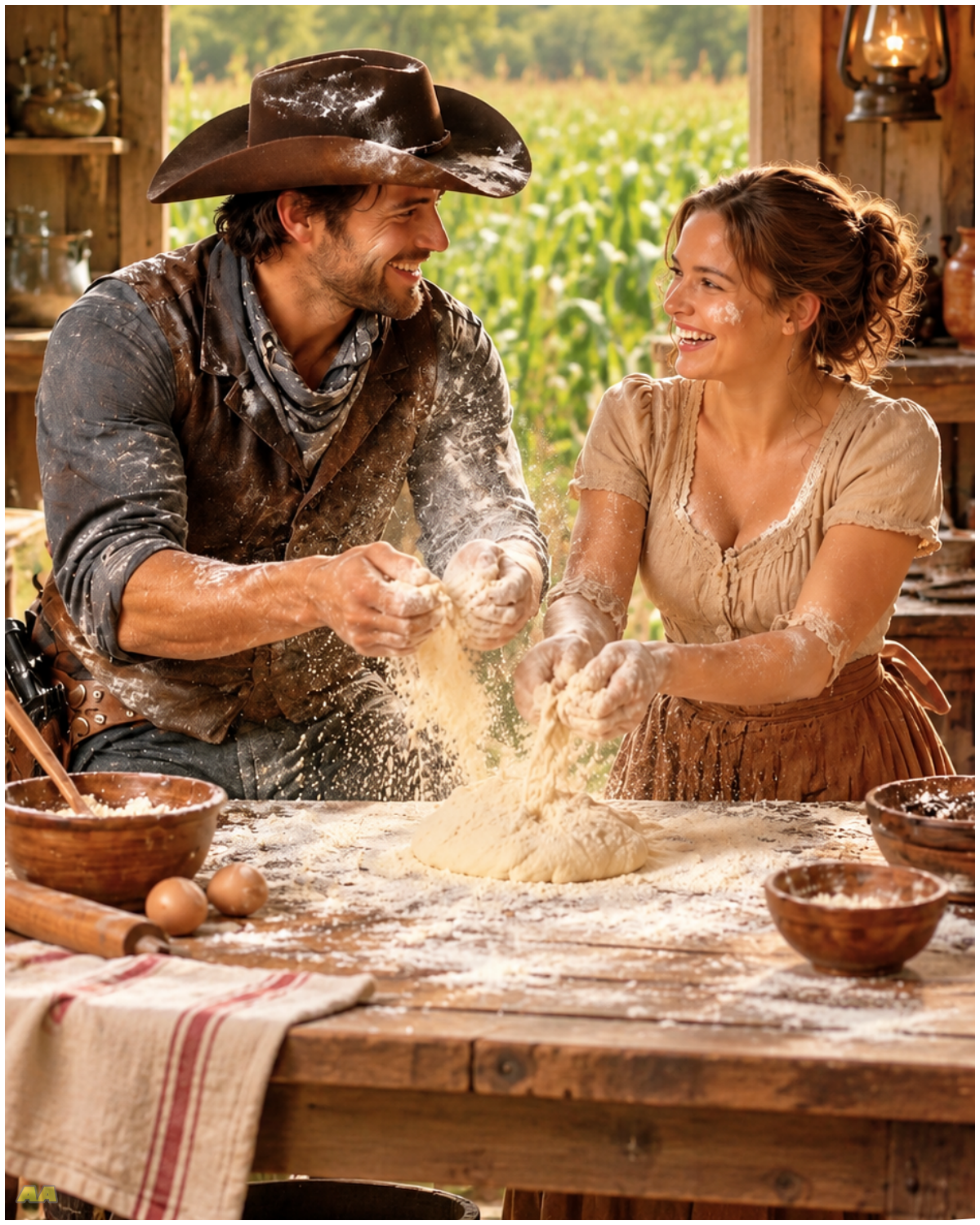
Anime Collins did not knock.
She pushed open the gate with her shoulder, set her suitcase in the dust, and looked the cowboy straight in the eye.
The same eyes that had already decided she wasn’t worth his trouble.
Her dress was faded. Her boots were cracked.
Her hands had worked longer and harder than his pride ever had.
“You posted for a cook,” she said.
“I came to cook.”
He raised the rifle higher.
She did not move one inch.
The summer of 1884 hit Abalene, Kansas like a punishment.
The kind of heat that didn’t just sit on your skin.
It pressed down into your bones, into your lungs, into the back of your throat until every breath felt like swallowing sand.
The grass along Dry Creek Road had gone to yellow straw weeks ago.
The creek itself had pulled back to a thin brown ribbon running between cracked mudbanks.
Out past the eastern fence line, three of Caleb Whitaker’s remaining cattle stood with their heads low, their ribs showing through their hides like ridges pressed up from underneath.
Caleb stood on the porch of the main house with his rifle cradled in the crook of his elbow and sweat cutting clean lines through the dust on his jaw.
He had been out since before sunrise, checking fence posts along the southern pasture, and he had come back to find a woman standing at his front gate like she’d grown there overnight.
She was not what he expected.
Not that he’d been expecting anyone.
She was maybe 5’4, slim, but not delicate.
Blonde hair pinned back hard under a worn calico bonnet the color of old cream.
A plain blue cotton dress faded and mended at the collar.
A practical canvas apron folded over one arm.
One leather suitcase cracked along the seam sitting upright in the dust beside her feet and a small brown satchel pressed tight against her ribs with her left hand not swinging free.
The way a woman carries a bag but held close.
The way a person holds something they are not willing to lose.
She was looking directly at him.
Not the way most women looked at Caleb Whitaker, which was either sideways with pity or straight on with want.
She looked at him the way a woman looks at a problem she has already decided to solve.
“Turn around,” he said. His voice was flat.
Final, the voice of a man who’d had to say hard things so many times, it had stopped costing him anything.
“This ranch has no place for trouble. You posted for a cook, Mr. Whitaker,” she said.
“I came to cook.”
Her voice was steady, not loud, not defiant in the showy way, just planted like a fence post that’s been driven deep and isn’t going anywhere.
He came down the porch steps slowly, rifle still easy in his arm.
He stopped at the bottom step.
Who told you about the posting?
Mrs. Hail at the dry good store.
She said you’d had three men quit the kitchen in the last 2 months and that your ranch hands were eating salt jerky and cold biscuits for supper most nights.
She paused. I also heard you’ve got 30 days before the bank sends someone out here with paperwork that’ll make this conversation feel like the easy part of your summer.
Caleb’s jaw tightened. That’s my business.
I’m not here for your business, she said.
I’m here for the job.
He looked her over once, slow, taking inventory the way a rancher looks at a horse he’s not sure he can afford.
You got references? I’ve got references, she said.
And I’ve got references who’d lie for me.
I’ll let you decide which kind matter more.
She reached into the satchel and produced a folded paper, one letter creased and soft from being handled.
She held it out toward the gate but didn’t come through.
Waiting for him to come to her.
He didn’t move for five full seconds.
Then he walked to the gate, took the letter, unfolded it, read it twice.
It was from the kitchen manager at the Dvers Rest Hotel in Witchah.
A large operation, cattle buyers and landmen passing through every week.
The letter was short but clean.
It said she could manage a kitchen of 12 keep accounts, stretch provisions, and that she was worth every cent of whatever she asked.
He folded it and handed it back without looking at her face.
Wage is $2 a week and meals.
250, she said. This ain’t a negotiation.
Everything’s a negotiation, Mr. Whitaker.
You just haven’t decided how badly you need this one to go your way.
He stood there in the full press of the Kansas sun and something moved behind his eyes that he shut down before it could get comfortable.
He stepped back from the gate.
Kitchens through the main house left off the hall.
“Don’t touch my study. Don’t ask questions about the books. Don’t wake me before 5. I’m up before 4,” she said and picked up her suitcase and walked through the gate past him like she’d already known how it would end.
Her name was Anna May Collins, or so she said.
She had been a lot of things in the last four years.
A hotel kitchen manager, a woman traveling alone on a westbound stage with one suitcase and a borrowed name.
A border in three different towns who always paid her rent early and never stayed past 2 months.
She had been once a woman with a different name entirely.
But that name belonged to a life she’d left in a burning hotel kitchen outside of Dodge City.
And she had no intention of carrying it into this one.
The kitchen at Dry Creek Ranch was a disaster.
She stood in the doorway and took stock quietly the way she always did.
The flower bin had been left open, and the weevils had found it.
Two of the four burner eyes on the iron stove had grease packed so thick in the grates, they’d stopped drawing heat properly.
The supply ledger on the side shelf was 3 months behind on entries.
There were eight empty molasses tins stacked in the corner, not for use, just stacked there like nobody had decided what to do with them, and so nobody had done anything at all.
There were also three supply notes pinned to the wall above the shelf.
She pulled the first one down and read it, then the second, then the third.
She read all three twice, set them back down on the shelf in a straight line, said nothing.
Then she rolled up her sleeves tied on her apron, and got to work.
By the time the sun had cleared the eastern ridge, she had the stove cleaned and drawing right the flour bin emptied and scrubbed the good flour that remained sifted and stored in a sealed tin and a pot of pinto beans soaking over low heat for supper.
She found a side of salt pork in the lard, not fresh but not gone either, and set it to render in the skillet for drippings.
She found cornmeal in the back of the lower shelf behind a busted lantern nobody had bothered to remove.
Enough for three pans of cornbread.
She found four eggs in a basket hanging by the back door, swaying slightly in the hot morning breeze.
She found wild onion bunched with twine on a hook by the window dry, but still good.
And she found a half croc of preserved tomatoes that someone had put up the previous fall and then forgotten entirely.
By noon, she had stretched what she’d found into a full supper.
Beans with pork fried potatoes from the root seller cornbread and the tomatoes stewed down with onion and a pinch of the dried pepper she’d brought in her own bag.
She set it out on the long table in the cook shack at 6:00 exactly.
Seven ranch hands came in.
She’d counted six when she’d arrived, so one had come in from somewhere.
They were the kind of men who had stopped expecting things.
Their faces had that flat going through the motions look that happens when people have been disappointed so many times in a row that they’ve just decided in advance that the next thing will also be a disappointment.
They sat down. She poured the coffee.
The first man to take a bite of the beans stopped chewing for a second.
He didn’t say anything. He just looked down at the bowl and then looked up at her with an expression she knew well.
The expression of a man who had just remembered what it felt like to be cared for and wasn’t sure how to handle that information.
Nobody spoke through the first 10 minutes of supper.
Then an older hand named Wick, gray-bearded and sundried to leather, looked up from his cornbread and said simply, “Lord Almighty.” A few of the younger hands laughed.
Not the mean kind of laugh, the relieved kind.
The laughter of people who just set something heavy down.
Caleb ate at the far end of the table.
He was the only one who didn’t say anything or look up at her, but she noticed that he cleaned his bowl completely, and held his coffee cup out for a second pour without being asked.
That was enough. After supper, she washed the dishes, restacked the supply shelf in proper order, updated the first entry in the supply ledger in 3 months, and then sat down at the side table with the three supply notes she’d pulled off the wall.
She spread them flat, went through the numbers line by line.
The first note was from Hadley’s provisions in Abalene.
$112 of supplies delivered in April.
She pulled the ledger and found April’s entries, or rather found the absence of them because April had no entries.
She found March went backward to February, found the last recorded delivery.
The quantities in the March delivery didn’t match the note amount.
She checked the unit prices.
The unit prices in the note were higher than the standard market price she knew from her time in Witchah.
Not by a lot, by just enough that if you weren’t looking, you’d miss it.
She said a small pen mark beside that line.
The second note showed the same pattern.
Different amounts, different month, same small upward drift in unit prices.
The third note had something worse.
A charge for 40 pounds of cornmeal at a price that would only make sense if the cornmeal had been shipped from somewhere far east, not sourced locally.
But the note listed the supplier as Hadley’s provisions, which was 6 mi up the Abalene Road.
She sat back and looked at the three notes lined up in front of her.
Somebody had been skimming off the Dry Creek supply account for at least 3 months, not enough to notice at a glance, exactly enough to add up.
She folded all three notes and put them in the front pocket of her apron.
She would need to see the full account books before she knew how deep this went.
But she already had a suspicion, a cold, familiar sinking suspicion that this was not the work of a lazy supplier padding his prices for convenience.
This was the work of someone who knew exactly what they were doing.
She locked her door that night with the bolt and then dragged the lad back chair from the corner and wedged it under the handle.
It was habit by now.
She didn’t think about it consciously anymore.
It was just the last thing she did before she allowed herself to sleep.
She sat on the edge of the narrow cot and held the brown satchel in her lap in the dark.
Inside the satchel, wrapped in oil skin and tied with cord, was a ledger.
Not her ledger, not originally.
It had belonged to a man named Harlon Beckett, who had been the chief accounts manager for Silus Vehain’s cattle brokerage and land office out of Dodge City.
Harlon Beckett had been a frightened man who kept precise records because he was the kind of frightened man who believed that if everything was written down, it couldn’t be used against him.
He had been wrong about that, but the ledger had survived him.
Anna had taken it the night the hotel caught fire.
She hadn’t planned to. She’d been working the kitchen when the fire started in the east wing.
And when she’d run through Beckett’s office on the way to the back exit, she’d seen it on his desk open to the most recent pages.
And she’d grabbed it because she’d known in the fast certain way, you know, things in a crisis that it mattered.
She’d been right about that.
Inside that ledger were four years of records.
False debt notices sent to ranchers across three counties.
Altered land records filed with the county recorder’s office.
Cattle contracts designed to appear favorable on the surface while hiding clauses that transferred ownership rights in the event of payment default defaults that Silus Bain’s operation manufactured on purpose by manipulating the original loan terMs. At least 11 ranches had already been absorbed into Silus Vain’s growing land holdings.
All of them documented, all of them recorded in Harlon Beckett’s careful, frightened hand.
Anna pressed the satchel against her chest in the dark, and listened to the night sounds of the Kansas summer, the cicas going in waves, the distant loing of cattle, the creek of the ranch house settling against the heat.
She had been running for 8 months.
She was tired of running, but she had not yet found a lawman she trusted with the ledger, and trust in her experience was a thing that had to be earned in pieces over time by watching what a person did when they thought no one was keeping score.
She had been watching Caleb Whitaker for exactly one day.
Hi had fed his men before he fed himself.
He had repaired the water trough on the east side of the yard after supper with no one asking him to.
He had spoken to his oldest ranch hand, the one everyone called Wick with a specific gentleness that he did not use with anyone else.
The kind of gentleness reserved for people who have been through the same thing together.
She filed all of it away, said nothing.
She would watch longer. She was up at a quarter to 4 the next morning.
She had coffee on before the horizon had gone from black to gray, biscuit dough cut and resting in the pan and a pot of oatmeal going with dried apple and a scrape of the last good cinnamon from the jar at the back of the spice shelf.
Caleb came into the kitchen at 10 4.
He stopped in the doorway when he smelled the coffee.
He looked at the stove.
He looked at the biscuit pan.
He looked at her standing at the counter with her sleeves already rolled and her hair already pinned.
“You said before 4:00,” he said.
“I said I’m up before 4:00,” she replied.
“I didn’t say I’d be quiet about it.” She poured a mug of coffee and set it on the counter.
There are three supply notes on the front shelf.
I need to ask you about them.
He crossed the kitchen and took the mug.
He didn’t sit. What about them?
The unit prices are inflated.
Not by much, by enough.
2 to four cents per pound above the standard Abalene market rate, depending on the item.
The cornmeal charge on the March note doesn’t match local supplier costs at all.
He was quiet for a moment.
Hadley’s been supplying this ranch for 6 years.
I know. She turned back to the stove, adjusted the oatmeal.
That’s the part that worries me.
He set the mug down on the counter.
How much are we talking from the 3 months?
I have notes for about $31 overcharged.
She let that sit. But the ledger entries stop in February, which means either the February delivery forward hasn’t been entered or those records are somewhere else.
They’re in my study, he said.
Then they need to be looked at.
I was quiet again for longer this time.
She could feel him working through something.
Not the numbers. Those were just numbers.
Something harder. The thing men work through when someone else has seen the inside of their trouble and they don’t know yet whether to feel relieved or exposed.
“I don’t invite people into my study,” he said.
“Mr. Whitaker,” she said, setting down the spoon and turning to face him directly.
“The bank has given you 30 days.
Someone has been patting your supply costs for at least a quarter year, and I’ll wager longer.” Either those account books get looked at or you’re handing your 30 days to people who are already planning to use them against you.
He picked up his coffee mug again.
He looked at the back wall of the kitchen.
Some decision was happening behind his eyes that she could not see.
After breakfast, he said finally.
Come to the study after breakfaSt. She turned back to the biscuits.
Thank you, she said quietly.
He didn’t answer, but he didn’t leave either.
He stood in the kitchen doorway with his coffee and watched the sky go from gray to pink through the window over the sink.
And for a long moment neither of them said a word.
It was just past 7 when she heard the horse.
Not the loose, easy sound of one of the ranch hands going out on morning rounds.
A single horse coming in fast from the north road, pulling up hard at the front gate with the particular abruptness of someone who hadn’t planned to ride that far and has decided they’ve ridden far enough.
She came out of the kitchen onto the side porch and shaded her eyes with her hand.
The rider was a man she didn’t recognize.
Town clothes, good ones, too good for the road he’d come in on.
A dark coat despite the heat.
A bay horse that cost more than most of the men she’d cooked for.
Made in a year. He sat at the and looked at the house.
Then he looked at her, and something in the way he looked at her, something precise and deliberate, like a man confirming an address, sent a slow, cold current straight through the July heat and down the back of her neck.
She did not move. She did not change her expression.
She reached back through the kitchen doorway with one hand and closed her fingers around the brown satchel hanging on the hook by the door.
Caleb came around the corner of the porch from the far end, still carrying his coffee.
He looked at the rider.
He looked at Anna. He looked at her hand on the satchel.
“You know that man?” he asked low, not taking his eyes off the gate.
“She didn’t answer right away.” The writer called out across the yard.
“I’m looking for a woman goes by the name Annabelle Hartley.” His voice was pleasant, the kind of pleasant that cost something.
I was told she might have come this way.
The summer heat pressed down across the yard.
A cicada screamed from the far fence post and went silent.
Caleb took one step forward.
His coffee cup was still in his hand.
This is private land, he said.
And there’s nobody here by that name, he said it steady.
Certain like a fact about the earth itself.
Anna stood behind him and held the satchel against her ribs and felt for the first time in 8 months the strange unfamiliar sensation of not standing alone.
The rider looked at Caleb for a long moment, looked at Anna once more.
Then he touched the brim of his hat with two fingers and pulled his horse around slowly back toward the north road.
He did not hurry. That was the part that scared her moSt. Caleb did not turn around right away.
He watched the rider until the dust from the north road settled back down to nothing.
Then he turned. He looked at her, not at the satchel at her face.
His eyes were dark and still and asking a question he hadn’t decided how to put into words yet.
You want to tell me?
He said, “What just happened?” She looked back at him across the hot stillard.
The answer to that question was long and complicated and would require her to trust a man she had known for less than 24 hours with the thing she had been running with for 8 months.
She looked at the north road one more time.
Then she looked at him.
Yes, she said. I do.
Caleb waited until the dust from the north road was completely gone before he spoke again.
Inside, he said, not a requeSt. Anna followed him through the front door, through the narrow hallway, and into the study.
He closed the door behind them.
The room smelled like old paper and tobacco and something underneath both of those things.
The particular smell of a man who had been carrying too much alone for too long.
He set his coffee mug on the desk, turned to face her.
“Talk,” he said. She set the satchel on the chair beside the door and untied the cord with steady hands, peeled back the oil skin, lifted out the ledger, and held it out toward him.
He didn’t take it right away.
He looked at it, then at her.
What is that? Four years of records, she said.
False debt notices, altered land records, cattle contracts that looked like a fair deal on the surface and were designed to steal everything a man owned once he signed his name.
She paused. 11 ranches that I’ve counted.
Probably more. He took the ledger, opened it to the middle, read two pages.
His jaw tightened by degrees the way metal tightens when the temperature drops.
Whose records are these? A man named Harlon Beckett.
He was the accounts manager for Silus Vehain’s brokerage office out of Dodge City.
She watched his face when she said the name.
You know that name? It wasn’t a question.
Caleb closed the ledger and set it on the desk and put both hands flat on the surface and stood there for a moment with his head down.
Silus Vain offered to buy this ranch 8 months ago.
He said, “I told him it wasn’t for sale.” And after that, the bank found problems with my father’s original loan notes.
Problems they hadn’t found in 12 years.
He looked up. They gave me 90 days, then 60, now 30.
Anna felt the cold current again, the same one from the porch.
Mr. Whitaker, what bank holds your loan?
First Territorial Bank of Abolene.
He said it flatly, already knowing what was coming.
Turned to page 47, she said.
He opened the ledger, found the page.
She watched his eyes move across the entries, watched the moment they stopped moving, and went very still.
Gerald Marsh, he said first territorial.
Vain’s man inside the bank, she said, listed by name with dates with the specific loan accounts they discussed modifying.
She stepped forward and pointed to the third entry on the page without touching it.
That account number, I need you to tell me if that’s yours.
He looked at the number for a long time.
Yeah, he said quietly. That’s mine.
The room was very still.
Outside, someone was working in the yard.
She could hear the rhythmic sound of a hammer against a poSt. The way work sounds when it’s keeping its own time, indifferent to everything happening inside four walls.
They’ve been after your ranch specifically, she said.
Not just because you have land, because of the creek.
He looked up. Dry Creek runs underground for half a mile before it surfaces on your eastern property line, she said.
I looked at the territory maps at the Witchita land office before I left.
Vain has been buying up land on either side of that underground run for 2 years.
Your piece is the middle section.
Without it, he can’t control the water rights on either of his adjacent holdings.
She let that land. He doesn’t want to buy this ranch from you, Mr.
Whitaker. He wants to take it.
He’s been building the mechanism to do exactly that for 2 years.
The false debt acceleration from the bank is the last step.
Caleb picked up his coffee mug and then set it back down without drinking from it.
A man doing something with his hands because his mind needed a moment to catch up.
You figured all this out from territory maps and a ledger.
I figured it out from a ledger and four years of watching what men like Silus Vain do when they want something.
She said the maps just confirmed the reason.
He looked at her. Really looked at her the way he hadn’t since she’d come through the gate.
Who are you? I told you who I am.
You told me a name.
That’s not the same thing.
She was quiet for a moment.
Then she pulled out the chair across from the desk and sat down, which was a thing she’d learned that some conversations needed to happen sitting down because the weight of them was too much to hold standing up.
“My name was Annabelle Hartley before I left Dodge City,” she said.
I worked kitchen management at the Dver’s Rest for 2 years.
Vehain’s buyers used that hotel.
Becket used it. I heard things.
I saw supply ledgers that matched Beckett’s numbers.
I started keeping my own records.
She folded her hands on her knees.
When the hotel caught fire in November, Beckett’s office was in the east wing.
I went through it on the way out.
I took the ledger. She paused.
Beckett didn’t make it out.
Caleb was quiet. Vhains men were in Dodge City inside of three days.
She said, “I was already gone.
I’ve been moving west since then, looking for a federal land officer I could trust with this.” She looked at the ledger on the desk.
“Every law man I’ve approached has either been already bought or scared enough of Vain’s reach to pretend to be.” “And you came here.
I needed work,” she said simply.
“I needed a roof and a kitchen and enough distance from the main roads to think.” She met his eyes.
I did not plan for your ranch to be in that ledger, Mr.
Whitaker. I’m sorry it is.
He was quiet for a long time after that.
The hammer in the yard kept its steady rhythm.
Somewhere in the distance, a horse snorted and stamped.
“The man at the gate this morning,” he said.
“Veans?” “Yes, he’ll report back that he found you.
He already knows he found me,” she said.
The question is what he reports about what he saw.
What did he see? He saw a ranch hand.
She said he saw you at the gate.
He saw a woman who didn’t run.
Something moved in Caleb’s expression, brief like a shift in the light.
You weren’t going to run.
I’m tired of running, she said.
And she meant it completely and without drama.
The way a person states a fact about themselves that they’ve had to arrive at the hard way.
Caleb picked up the ledger again, turned to the front pages, started reading from the beginning.
She let him read. He read for 40 minutes straight.
She went back to the kitchen and refilled his coffee and brought it back and set it beside him, and he didn’t look up.
She checked the biscuits. They were done.
Took the pan off the heat and started cracking eggs for the morning hands.
When he finally came into the kitchen, she was plating eggs for Wick and two of the younger hands who were already at the table.
He stood in the doorway with the ledger under his arm and looked at the table and then looked at her.
After breakfast, he said, “I’m going to show you the full account books.” Wick looked up from his eggs.
He was 62, maybe 65, and he had the specific quality of a man who had seen enough of the world to understand more than he ever said.
He looked at the ledger under Caleb’s arm.
He looked at Anna. He looked back at his eggs and said nothing.
But she caught the small exhale, the quiet release of a man who had been holding something tight for a long time and had just felt the first possibility of being able to let go.
The account books were worse than the supply notes.
She sat at Caleb’s desk with the books spread open and went through them systematically while he stood by the window.
She didn’t narrate as she worked.
She took a clean sheet of paper from the desk drawer and wrote figures as she found them, building a column that grew longer with every page she turned.
By the time she set the pen down, the column was 14 lines.
The overcharges in the supply accounts go back 16 months, she said.
Not three. Hadley’s has been padding your orders since March of last year, which lines up with when Vain would have started applying pressure to the bank simultaneously.
She tapped the column. Total overcharged across 16 months, roughly $218.
Caleb didn’t react visibly. She’d learned already that he processed hard things inward and then came out the other side with a decision rather than responding in the moment.
She waited. That’s not the bank amount, he said.
No, she said the bank amount is separate.
The bank acceleration is based on a default clause in your father’s original note from 1871.
But the clauses written in the bank’s version doesn’t match the copy your father kept.
She held up two documents.
The one from Caleb’s files and a photographed copy from the ledger.
See the difference in paragraph 3.
He came to the desk and leaned over to read.
She pointed to the line.
His breath changed. That clause wasn’t in my father’s copy.
He said it was added afterward.
She said dated to the original, but the ink age is wrong.
Beckett noted it himself. He had a conscience at the end.
He flagged it in the ledger margin.
She pointed to the small notation in the ledger.
He knew what Marsh was doing and he wrote it down.
Probably thinking that if it all came apart, the record would protect him.
It didn’t protect him. No, she said it didn’t protect him, but it’s going to protect you.
He stood up straight. He He looked at the two documents side by side on the desk.
The fraudulent bank copy, the photographed ledger record with Beckett’s notation.
His face had the particular quality of a man who has just understood the full shape of something that has been pressing on him from the dark for years without him being able to see what it was.
My father died believing he’d failed this ranch, he said.
Very quiet. The kind of quiet that costs a man a lot to break.
She didn’t fill the silence.
She let it stand. He worked this land for 30 years, Caleb said.
And at the end, he thought he’d lost it through bad management, bad decisions.
He stopped. He apologized to me.
2 days before he died, he sat in this chair and told me he was sorry for leaving me a sinking ship.
The hammer in the yard had gone quiet.
The cicas carried the silence in waves.
“He didn’t lose it,” Anna said.
It was taken from him while he was still trying to hold it together, and he never knew.
Caleb put one hand on the desk surface and stood there head down, and she looked away and gave him the only privacy she could, which was the privacy of not watching.
After a moment, he straightened up.
His voice came back level.
“What do we need to do?
We need a federal land officer who hasn’t been bought,” she said.
Someone with the authority to subpoena the bank’s original records and compare them to Beckett’s documentation.
And we need to move before Vain knows exactly what we have.
There’s a man, Caleb said slowly.
Marshall Thomas Greer, he’s out of the Abolene Federal Office.
He and my father, they came up together.
Greer was a land surveyor before he took the badge.
He knows territory records. He paused.
I haven’t spoken to him in 4 years.
Why not? Because I’ve been too proud to ask anyone for help.
She looked at him steadily.
That’s the one thing you’re going to have to set down, she said.
He looked back at her.
Something moved between them in that moment.
Not romantic, not yet nothing so named as that.
Just the specific recognition of two people who have each been carrying something too heavy for too long.
Suddenly standing in the same room with the same weight.
I’ll ride to Abalene tomorrow, he said.
We’ll ride to Abalene,” she said.
“Greer needs to hear from me directly.
The ledger is my testimony.
You can’t carry it in without me.” He nodded once, accepting it without argument, which told her more about him than anything he’d said all morning.
That afternoon, she found the second problem.
She had gone back to the supply shelf to finish updating the ledger entries and found the August provisions note, the current month’s delivery made 3 days before her arrival.
She almost missed it because it was tucked under the stack of empty tins she’d moved to the back corner.
She unfolded it and felt the cold current before she’d finished reading the first line.
The note was from Hadley’s provisions.
Standard header, standard format, but the delivery listed in the note was 40% larger than what was actually in the larder.
She walked the full kitchen inventory twice, checking against the liSt. flour, salt, pork, cornmeal, beans, dried fruit, coffee, molasses.
The quantities on the note were 40% higher across every single line.
She sat down on the kitchen stool.
This wasn’t padding. This was a ghost delivery, a full fictional shipment charged to the Dry Creek account for goods that had never arrived.
She pulled the supply ledger and found where the entry would be recorded.
Found the entry. Found Caleb’s signature dated 4 days ago.
Confirming receipt. She looked at the signature for a long time.
Then she looked at the back of the provisions note at the bottom in small print she’d have missed if she weren’t looking for exactly this kind of thing was a reference number.
She pulled Beckett’s ledger and found the matching reference format.
The same coding system used in the fraudulent cattle contracts.
This wasn’t Hadley acting alone.
Hadley was working directly inside the vein system.
She found Caleb at the water trough on the east side of the yard.
He was checking the fittings on the pump coupling with Wick standing beside him.
And both of them looked up when she came across the yard with the provisions note in her hand and the expression on her face that apparently needed no explanation.
Because Wick took one look at her and said, “I’ll go check the South Fence line.” And walked away with the specific tact of a man who knows when he’s not needed.
She handed Caleb the note without speaking and let him read it.
She watched his expression go from reading comprehension to recognition to something harder and colder underneath.
I signed this. He said, “I know.” Hadley brought it out himself, said the delivery boy had quit.
I was between the barn and the north pasture, and I signed without looking at the full inventory.
He stopped. “I’ve done that before.
He knew I’d do that.
He counted on it.” She said, “This is a current record, Mr.
Whitaker. Dated 4 days ago.
This isn’t history. This is live.
Vain’s men are still actively running accounts against this ranch, which means which means someone reported back to Hadley that the ranch still has a working kitchen,” he said.
The cold in his voice was something new.
Which means someone on this property told someone in town about you.
They looked at each other.
“How many of your hands have been here less than 4 months?” she asked.
He didn’t answer immediately, which was itself an answer.
His name was Pete Dallow, and he’d come on in late April, recommended by the feed store owner in Abalene, as a solid hand who’d worked three ranches in the previous year and knew cattle.
Caleb found him at the east fence line after supper, and walked him back to the barn without telling him why.
And Anna stayed in the kitchen doorway where she could see the yard but not be seen the satchel over her shoulder and her hand steady.
Caleb was not a man who raised his voice.
She’d learned that already. When he was most ser his voice went quieter, not louder, and she could see from the way Pete Dallows posture changed when Caleb spoke to him that this was something the younger man had not been prepared for.
She couldn’t hear the words.
She watched the bodies. Pete’s shoulders went from loose to stiff inside 30 seconds.
He said something. Caleb said something back.
Pete reached into his vest pocket and produced a folded piece of paper which he held out.
And even from the kitchen doorway, she could see that his hand was shaking.
Caleb took the paper, read it, folded it, and put it in his own pocket.
He said one more thing to Pete very quietly.
Pete nodded. Then Pete walked to the bunk house, came out 10 minutes later with his bed roll and saddle bag, saddled his own horse at the hitching poSt. Not the ranch horses, his own horse, the brown mare he’d come in on, and rode north without looking back.
Caleb came back across the yard and stepped up onto the porch.
He handed her the folded paper.
She opened it. It was a note written in a plain hand addressed to Hadley, itemizing what had been delivered to Dry Creek Ranch and what was still lacking.
Listing the name of the new cook.
Including her description, blonde small blue dress, brown bag she keeps close.
At the bottom of the note, in a different hand was a single added line.
Tell V she’s here. Same bag.
She folded the note back up.
He was writing them reports.
Caleb said once a week.
Since April, she said. It wasn’t a question.
Since April, he confirmed. She stood there on the porch in the last of the summer evening light and understood the full shape of her situation with the particular clarity that comes when all the pieces finally stop pretending they aren’t connected to each other.
Vain had known where she was within days of her taking the position.
Maybe sooner. The writer that morning hadn’t been searching.
He’d been confirming. He’s not going to wait long, she said.
No. Caleb agreed. We can’t wait until tomorrow to ride to Abalene.
Caleb was quiet for a moment.
Then he turned toward the barn.
I’ll have the horses ready in 20 minutes, he said.
Pack what you can’t afford to lose.
Leave the reSt. She went back into the kitchen.
She took the ledger from the satchel and wrapped it back in the oil skin.
Double tied the cord. She put the three supply notes and the ghost delivery note and Beckett’s annotated ledger copies all together in the inside pocket of her travel coat.
She took the clean sheet with her column of figures.
She took the jar of coffee from the shelf because she’d learned that the things which sustain you on hard roads are worth more than their weight.
Then she stood in the kitchen doorway and looked back at the room one time at the scrubbed, the properly ordered shelf, the updated ledger with her handwriting in the entry columns, the biscuit tin still half full.
She had been here less than 2 days.
She had the strange disorienting sensation of leaving something.
She turned and went out into the yard where Caleb had both horses ready, and Wick was standing by the barn with his arms crossed and his expression fixed in the specific configuration of a man who has decided to pretend he isn’t worried.
I’ll keep the fire in the stove, Wick said.
And I’ll keep the rest of the hands on the property.
Don’t let anyone ride north, Caleb said.
Wasn’t planning to. Wick looked at Anna.
He tilted his chin in something that wasn’t quite a nod, but meant the same thing.
She mounted without assistance, which she could tell surprised Caleb slightly, though he didn’t comment.
They rode out of the yard side by side, taking the south road instead of the north, the longer route to Abalene, the one that added 40 minutes, but kept them off the main road where Vain’s rider would expect traffic.
The heat had not broken with the sun going down.
It had just changed quality drier deeper, the kind that lives in the ground and radiates back up after dark.
The cicas were deafening on either side of the road.
Stars were thick overhead. They rode without speaking for the first 10 minutes.
Side by side, a measured distance between them.
She could feel Caleb’s awareness of her.
Not romantic, not yet, but present.
The specific awareness of a man who has decided to trust someone and is now accounting for them in every calculation.
She kept the satchel pressed against her hip with her elbow.
I need to ask you something, she said at the 11 minute mark.
Ask if Greer says no, if he’s been bought or he’s scared or he turns us away, what do you do?
Caleb was quiet for a long moment.
The road bent around a low hill and opened out again flat and pale under the stars.
I find the next man, he said.
And if there isn’t one, there’s always one, he said, not with optimism, with something harder and quieter than that.
My father believed that. I spent four years being too proud to test whether he was right.
I’m done being proud. She rode beside him and thought about that, about the specific bravery of a man who has decided to stop hiding his wounds, about how rare that was, about how long she had been looking for solid ground.
She did not say any of that.
What she said was, “Good, because I need you to believe that, too.
When we’re in that office, if Greer hesitates, I need you to not let him hesitate twice.” “I won’t,” he said.
The road opened out before them, long and straight and pale, running toward the lights of Abalene, still 20 mi distant, glowing faint and low on the horizon, like something just beginning to burn.
She kept her hand on the satchel.
She kept her eyes on the road ahead, and for the first time in 8 months, she felt underneath the fear and the urgency and the exhaustion something small and unfamiliar that she was not ready to name yet.
Just a faint warmth like a coal that hasn’t gone completely cold.
She did not trust it, but she didn’t extinguish it either.
She let it ride. They rode into Abalene at half 10.
The town was not asleep, but it was quieting saloon noise from the far end of the main street.
A few horses at hitching posts, lamp light in the upper windows of the hotel, the kind of town that never fully stopped, but learned to lower its voice after dark.
Caleb knew where Greer lived.
Not the federal office, the house.
A small woodframe place on the south end of Elm Street set back from the road with a light still burning in the front window.
He dismounted at the gate and handed his reigns to Anna without asking and went to the door and knocked three times.
Hard the knock of a man who has made a decision and is not going to soften it at the last moment.
There was a pause, then the sound of movement inside.
Then the door opened and Thomas Greer stood in the frame with a lantern in his hand and the specific expression of a man who has learned to be alert at unexpected hours.
I was 60 maybe a few years passed.
Square built gray at the temples with the kind of face that had been weathered by both weather and judgment in roughly equal measure.
He looked at Caleb for a long moment without speaking.
Then he said, “Caleb Whitaker, you look like you’ve been riding hard 20 m.” Caleb said, “I need an hour of your time.” Greer looked past him at Anna, still mounted at the gate, the satchel against her hip.
“Who’s she?” “The reason I’m here,” Caleb said.
“And the reason you’re going to want to hear this before morning.” Greer stepped back from the door.
They sat at Greer’s kitchen table, the three of them.
The ledger opened between them, the supply notes and the ghost delivery record, and Beckett’s annotated copies spread in a careful row.
Anna had arranged them in chronological order on the ride over, organizing the evidence in her head so that she could present it clean and fast, no hesitation, no gaps for doubt to find purchase in.
She talked for 20 minutes straight.
Greer listened with his hands flat on the table and his eyes moving between her face and the documents.
He did not interrupt. He did not write anything down.
He read the pages she pointed to and he read Beckett’s margin notations and he looked at the two versions of the default clause side by side for a long time.
When she finished, he leaned back in his chair.
“You’re Annabelle Hartley,” he said.
“I was,” she said. “I’m Anna Collins now.” Vain’s people have been asking about you in three counties for 8 months.
I know that means they know you have this.
He touched the ledger without picking it up.
They’ve known since November, she said.
The question isn’t what they know.
The question is whether what’s in this ledger is enough to file a warrant before Vain can move on the ranch.
Greer looked at Caleb. You’ve verified the account discrepancy yourself.
I’ve seen both copies of my father’s note.
Caleb said, “The clause in the bank’s version was not in my father’s original.
I’d stake everything I own on that, and I am by being in this room.” Greer was quiet.
He turned back to the ledger and turned to page 47.
Marsh’s page, the bank entries, and read it again.
Anna watched his face and waited.
“Gerald Marsh,” Greer said. “I’ve had questions about Marsh for 2 years.
Never had enough to move on him.” He tapped the page.
This is enough. Anna felt the first genuine release of breath she’d had in 8 months.
But Greer wasn’t finished. He closed the ledger and looked at her with the direct assessing look of a man who has spent 30 years measuring risk.
If I file this warrant tonight, Vain will know by morning.
He has people watching the federal office.
I know, she said. Which means before the warrant is executed, he’s going to move against whatever he thinks he can still take.
He looked at Caleb. That means the ranch.
Caleb nodded once. I know you rode away from it tonight.
Wick’s there and five hands.
Wick Farley is 62 years old and loyal as the day is long.
Greer said not unkindly. He’s not a match for whatever Vain decides to send.
The kitchen went quiet. The lamp on the table burned steady.
Outside, a dog somewhere on Elm Street barked twice and went quiet.
File the warrant,” Anna said.
Both men looked at her.
“File it tonight, right now.
We ride back to the ranch before the sun comes up.
If Vain moves before the warrant is executed, we have witnesses and we have the ledger and we have your authority behind us.” She looked at Greer.
“If we wait until morning, we lose the ranch and the warrant both.” Vain moves fast when he’s scared.
He’s already scared that rider this morning wasn’t routine.
He was checking position before he acts.
Greer looked at her for a long moment.
“You’ve been thinking like an investigator for 8 months,” he said.
“I’ve been thinking like a woman who can’t afford to be wrong,” she said.
Greer pushed back from the table and stood up.
He crossed the kitchen to the small writing desk against the far wall and pulled out the federal warrant forMs. He sat down and began to write without another word.
Caleb looked at Anna across the table.
She looked back at him.
He said nothing, but something in his expression had shifted.
Not opened, not yet, but the door had moved an inch, and the light from somewhere was starting to come through.
They were back on the road south by 11:30.
Greer rode with them. He had two deputies he’d pulled from the night office, both young and solid, riding at the rear.
He had the signed warrant in his breast pocket.
He had the ledger which Anna had handed over at the table with both hands.
The weight of it leaving her arms feeling strange and light.
She rode without the satchel pressing against her ribs for the first time in 8 months.
She didn’t know what to do with that sensation.
So she focused on the road and kept her horse at a steady caner and matched Caleb’s pace beside her.
“You did well in there,” he said at the 5m mark.
“He was ready to be convinced,” she said.
He’d been looking for a reason for 2 years.
You gave it to him in 20 minutes.
The ledger gave it to him.
I just organized it. He was quiet for a moment.
Don’t do that. She looked over at him.
Don’t do what? Make yourself smaller than what you did.
His voice was quiet and direct, and she felt it land somewhere in her chest that she hadn’t been expecting.
You carried that ledger 8 months across three counties alone.
You walked into a stranger’s gate with a suitcase and found the fraud in his own supply notes inside a day.
Don’t credit the ledger. She didn’t have an answer for that.
She rode beside him and said nothing and let the night be what it was.
They were four miles from Dry Creek when they smelled the smoke.
Not campfire smoke, not cooking smoke, the thick rolling hay and timber kind that hits the back of the throat like a warning before the eyes have found the source.
Anna’s horse felt it before she processed it fully and tossed its head and tried to slow and she pressed her heels in and kept the pace because stopping was the one thing she could not afford.
That’s from the ranch, Caleb said.
His voice was flat and stripped down to nothing.
The voice of man operating past the point where emotion has any function.
He pressed his horse forward and she followed and behind them she heard Greer say something sharp to his deputies and the sound of four horses accelerating.
They came over the lowrise that looked down on the dry creek yard at a full gallop.
The hay shed was burning.
Not the house, not the barn, the hay shed on the north side of the yard.
But the shed was close enough to the barn that the heat had already reached the barn sighting, and she could see the dark shapes of men running with buckets, and the horses in the barn were screaming, and Wick’s voice carrying over all of it, steady, hard, coordinating, and the fire was bright and furious against the black sky.
Caleb was off his horse before it had fully stopped running.
Anna dismounted hard and fast, and did not hesitate.
She tied both horses to the fence post and ran for the kitchen because the kitchen was where the water buckets were stored in bulk, six of them on the sidewall.
And she knew that because she’d put them there herself two mornings ago.
She came through the kitchen door and grabbed the first two buckets and ran back out and passed them to the nearest hand without stopping and went back for two more.
The next 20 minutes were heat and smoke and the smell of burning straw and the specific bodily panic of working near fire.
The way your lungs tighten and your eyes stream and every instinct tells you to move away while your choices keep you moving toward.
She organized the bucket line, not because anyone asked her to, but because the line they had was inefficient.
Three men crossing each other’s paths in the dark, and she saw it and fixed it, positioning herself at the pump, and the three younger hands in a relay and Wick at the front calling water timing.
The fire came down in 40 minutes.
Not out the shed was a total loss.
The frame already collapsed in on itself, orange and crumbling, but down contained.
The barn sighting was scorched but holding.
The horses had been brought out to the paddic on the far side and were settling.
Anna stood at the pump with her hands on the handle and her lungs full of smoke and her dress gray with ash and let herself breathe for a moment.
Caleb appeared beside her. His face was black on one side from smoke and his shirt had a burned hole above the left cuff where a spark had caught.
“You all right?” he said.
“Yes,” she said. The barn held.
He looked at the collapsed shed.
They hit the water trough first, poured something in it before they lit the shed.
Wick found the smell before anyone tried to use it.
He stopped. “If Wick hadn’t caught that, he did catch it,” she said.
He nodded. Greer was in the yard with both deputies.
He had already separated out the ranch hands and was speaking to them one at a time, writing in his notebook.
Two of Vain’s men had been caught, not the riders who’d set the fire who’d come and gone in the dark, but two men on foot at the east fence line who’d been cutting wire when the deputies ran them down.
They were sitting in the dust near the barn with their hands bound and the specific expressions of men who had just discovered that the situation had changed in ways they hadn’t been briefed on.
Anna walked to where Greer was standing and said the water trough was poisoned.
Greer looked up from his notebook.
Confirmed. Wick Farley smelled it before it was used.
Strong chemical smell, he said.
I’d check for arsenic based compound.
It’s used in cattle dipping and it’s easy to obtain.
Greer wrote it down. That’s destruction of property and attempted livestock poisoning on top of arson.
He looked at the two bound men across the yard.
On top of what I have on those two for fence cutting and trespass.
Is that enough to hold vain directly?
She asked. Not yet, he said.
Those men will say they were hired for labor.
Don’t know who fired the shed.
The usual story. But it builds.
He looked at her. Between the warrant I filed tonight and these two, I can bring Vain in for questioning before the week is out.
The warrant ties his bankman to the fraud.
The arson ties his hired men to criminal action on the ranch.
And your testimony? He paused.
Your testimony is the centerpin.
You understand what that means?
It means I stop running, she said.
It means you stand up in front of a federal judge and say your name and tell what you know.
I know, she said. I’ll be there.
He held her gaze for a moment, measuring.
Then he nodded once like a man confirming something he already suspected.
By 3:00 in the morning, the yard had settled into exhausted smoke smelling quiet.
The two bound men had been taken into Greer’s custody and were on their way to the Abalene jail.
The deputies had ridden the perimeter and found no one else.
The horses were calm. The burn shed was cold ash and collapsed timber.
Wick had made coffee, a vast pot of it, the kind you make when people need something hot, in their hands more than they need sleep.
The ranch hands sat on the porch steps and the paddic fence and drank it without talking much.
The particular silence of people who have been through something hard together and don’t need to describe it to each other.
Anna stood at the kitchen counter and cleaned the ash from her hands and face with the basin water and looked at the burned hole in her sleeve where a spark had got her near the wrist, and she’d ignored it until now.
It wasn’t bad. A small bright mark already cooling to a dull ache.
Caleb came into the kitchen.
He stopped when he saw the mark on her wriSt. He crossed the kitchen without asking permission and took her hand, not tenderly, not dramatically, the way a man takes hold of something he needs to assess and turned her wrist toward the lamp.
That needs salve, he said.
It’s fine. It needs salve, he repeated, and did not let go of her hand, and went to the cabinet above the dry sink, where she had on her second morning reorganized the medical supplies into the upper left shelf, because that was the logical place for them, and the previous arrangement made no sense.
He found the tin immediately, which meant he’d noticed where she’d put it.
He applied the salve without speaking his thumb, careful around the burn sight, his grip on her hand steady.
She watched his face because she had learned to read him in the profile in the set of his jaw and the small movements around his eyes.
And what she read right now was something she had to be careful about, something concentrated, something that had moved closer to the surface than he was accustomed to letting things come.
“You organized the bucket line,” he said without looking up from her wriSt. “The relay they had was inefficient.
You came out of that kitchen with two buckets in each hand in the dark.
Someone needed to. He put the lid back back on the salv tin and set it on the counter and still held her wrist for one moment longer than the task required.
Then he let go, stepped back.
My father would have liked you, he said.
She looked at him. He had no patience for people who stood back and watched things burn, he said.
He always said the most important thing about a person is what they do when it costs them something.
She felt the warmth again, the same small coal from the ride over and again.
She chose not to name it and not to extinguish it.
“Your father was robbed of the chance to save this place,” she said.
“What we’re doing now, it’s finishing what he started.” Caleb looked at the kitchen around them.
The scrubbed stove, the organized shelf, the updated ledger on the side table, the half- full biscuit tin, the window with the smoke gray sky just beginning to shift beyond it.
Before you came,” he said slowly.
“I was keeping this ranch standing.
That’s all I was doing, just standing.” She understood what he meant.
She understood it exactly and completely because she had been doing the same thing for 8 months, just staying upright, just moving forward, just not stopping.
And she knew the difference between survival and actually living.
And she knew how long you could confuse one for the other before the weight of it finally told you the truth.
I know, she said. He looked at her, just looked at her for a moment in the lamplight with ash on both their faces and coffee going cold on the counter and the sky outside, beginning its slow move from black to the deep blue of pre-dawn.
Then Wick’s voice came from the porch.
Boss, Greer’s asking for you before he rides.
Caleb held her gaze one moment more.
Then he turned and went out.
Greer left at 4:00 in the morning with the warrant, the two prisoners, and a timeline.
He would serve the warrant on Gerald Marsh at First Territorial Bank when it opened at 9:00.
He would send word to the territorial land office in Topeka by telegraph before noon.
He would have a federal hearing date scheduled within the week, and he would send two deputies back to Dry Creek Ranch by midday to remain on the property as federal witnesses until the hearing.
Keep the ledger copies here,” he told Anna at the gate.
“The originals are safe with me.
But if anything happens between now and the hearing, nothing is going to happen,” she said.
He looked at her with the expression of a man who respects confidence, but has been in this work long enough not to share it automatically.
“You’ve been running for 8 months,” he said.
“What’s different about today?” She thought about Caleb applying salve to her wrist in the lamplight.
About Wick making coffee at 3:00 in the morning for exhausted men who needed something warm.
About seven ranch hands who’d stayed on a failing spread because something about it still felt worth staying for.
I’m not running, she said.
That’s what’s different. Greer held her gaze.
Then he touched the brim of his hat and turned his horse toward the north road.
She watched him until the dust settled.
The sun came up slow and hot and merciless, the way Kansas summer suns did, as though the night hadn’t been full of fire and smoke and fear, as though the world intended to simply continue on the way it always had.
Anna went back into the kitchen and built up the fire in the stove and put water on for oatmeal.
Her hands moved through the motions of morning work, and she let them the familiar rhythm of the kitchen, settling something in her chest that she hadn’t been aware was still unsettled.
Wick came to the kitchen doorway at 5 and leaned against the frame with his coffee cup and looked at her for a moment.
You’re still here, he said.
I told you I was up before 4:00.
That’s not what I mean.
She glanced at him. I’ve seen three cooks come and go in 2 years, he said.
None of them stayed a week.
One of them left in the middle of the night without collecting her wage.
He turned the coffee cup in both hands.
I mean, you’re still here.
After last night, she cracked four eggs into the skillet.
Where would I go? Most people would have a list of answers to that question.
I’m not most people, she said.
Wick nodded slowly like a man confirming something he’d suspected from the start.
No, ma’am, he said. You surely are not.
She set the eggs and turned back to the oatmeal and didn’t say anything else.
But she was aware in a way that was new and slightly alarming that the word home had appeared somewhere in her mind.
Just then, quiet and unbidden, the way the most important words always arrived without announcement, without permission, settling in as though they had every right to be there.
She didn’t reach for it.
She just let it sit and she kept cooking.
At 7 that morning, a second rider appeared at the front gate.
Not one of Greer’s deputies.
It was too early for that.
A different man, older, well-dressed.
He rode alone, and he sat his horse with the particular ease of a man who has never once in his life been uncertain of his own welcome.
Caleb was at the gate before Anna could come off the porch.
She stopped at the top step and watched.
The man said something. Caleb’s back was to her, but she saw the shift.
The way his shoulders went from steady to rigid.
A different kind of rigid than anger, the kind that comes from impact.
The writer reached into his coat and produced an envelope.
Held it out. Caleb took it.
The writer said something else short and from the deliberate way he said it, not spontaneous.
A prepared message delivered as intended with the flat precision of a man who delivers prepared messages for a living.
Then he turned and rode away.
Caleb stood at the gate for a moment without moving.
Then he opened the envelope.
She watched him read it.
She watched his hands and his back and the specific quality of his stillness.
And she knew before he turned around that whatever was in that envelope was not about last night’s fire.
He turned and came back to the porch and handed it to her.
She read it. It was from Silus Vain.
Not threatening, not angry, elegant, even the kind of letter written by a man who understands that the most dangerous weapon in any negotiation is the appearance of reasonleness.
I was aware, the letter said, of certain documents that had come into Mr.
Whitaker’s possession. He was prepared to make a generous offer, the immediate suspension of all outstanding loan acceleration, full restoration of the account to standard terms, and a cash payment of $3,000 in exchange for the return of those documents, and the departure of the woman currently residing at Dry Creek Ranch.
He wished Mr. Whitaker well.
He hoped Mr. Whitaker would make the wise choice he had until noon.
Anna folded the letter. She looked up at Caleb.
He was watching her face.
“$3,000 would save this ranch outright.” She said, “It was the honest thing to say, and she said it without flinching.
I need you to know I understand what I’m asking you to walk away from.” He took the letter back from her.
He turned and walked to the fire pit at the side of the yard where they’d burned the trash two days ago, and there were still coals from the morning.
He held the letter over the coals.
It caught on one corner, then spread, and in 9 seconds it was ash.
He came back to the porch.
He looked at her. “She is not for sale,” he said.
“Quiet, absolute.” The kind of thing a man says when he has finished deciding and moved into the place deciding, she stood on the top step and looked at him on the step below her, which put them at almost equal height.
And the July sun was already pressing down on the yard.
And somewhere behind the barn, a meadowark was going with complete indifference to everything that had just happened.
And she felt the coal in her chest open into something she could no longer pretend was merely warmth.
Caleb, she said his given name for the first time.
He looked at her. Whatever comes next, she said.
I need you to know that I did not plan for this to be anything other than a job.
I know, he said. I’m telling you that because I need you to understand that everything I feel right now is real.
It isn’t gratitude. It isn’t circumstance.
She held his gaze. I’ve been keeping my own account on you since the first morning.
The way you feed your men firSt. The way you talk to Wick.
The way you fixed the water trough after supper on my first night here when nobody asked you to and nobody was watching.
She stopped. I see you, Caleb Whitaker.
I’ve been seeing you and what I see is worth more to me than any amount of money I’ve ever run from or toward.
He stood on the step below her and looked at her for a long moment.
Then he said simply, “Don’t leave.” Not a command, not a plea.
The two words of a man who has stripped everything back to the thing that is actually true.
“I’m not leaving,” she said.
The meark went on behind the barn.
The sun pressed down, and in the yard of a half-burned ranch, in the full heat of a Kansas summer, something that had been broken for a long time in both of them, in the land, in the specific silence of people who have learned not to want too much, began quietly and without ceremony to mend.
Greer’s two deputies arrived at Dry Creek Ranch at 11, riding in from the north road with their badges visible and their posture carrying the specific authority of men who have been given a clear assignment and intend to see it through.
Anna watched them come in from the kitchen window.
She had biscuits in the oven and a pot of beef broth going on the back burner.
The last of the salt beef stretched with dried onion and the garden herbs she’d transplanted into the window box 3 days ago.
Small roots barely established but already holding.
She set two extra plates on the table without being asked.
Caleb met the deputies at the gate.
She watched him listen, nod, shake hands.
He had the quality she’d noticed of a man who treated every person on his land ranch hand deputy, traveling stranger with the same level directness.
No performance, no hierarchy in his posture.
He just spoke to people like they were worth speaking to.
She had been keeping her account on that too.
He came in with the deputies behind him and introduced them.
Reigns, the taller one, maybe 28, with a careful, watchful quality, and Doyle stockier, quieter, who looked at the kitchen and then at the set table and said, “Ma’am, with the sincere gratitude of a man who has been eating trail food for too many consecutive days.” “Sit down,” she said.
“Both of you, there’s food.” They sat.
Caleb looked at her from the doorway with an expression.
She was starting to know the one that happened when she did something that surprised him.
Even though by now she would have thought he’d stopped being surprised.
She handed him a bowl without looking directly at him and said, “Greer moved this morning, served the warrant on Marsh at 9:15,” Re said, accepting his bowl with both hands.
Marsh didn’t resiSt. His lawyer was there inside the hour, which means Vain had advanced notice and was already running legal interference.
He paused. But the warrants filed.
The documents are federal evidence.
Vain can’t touch them now.
And Vain himself, Caleb asked, brought in for questioning at 11:00.
Released pending the hearing. His lawyers are good and the direct connection to the arson hasn’t been formalized yet, but he’s not going anywhere.
Greer has a travel restriction filed.
Anna set her own bowl on the counter and did not sit.
She stood at the window and thought about Silus Vain being questioned in a federal office that morning while she was transplanting herb cutings into a window box on his target property.
The particular satisfaction of that was something she chose not to examine too closely.
When’s the hearing? She asked.
Greer’s requesting end of the week said Thursday or Friday.
The territorial judge is in Abalene through Sunday.
4 days. Caleb said 4 days.
Reigns confirmed. We’re here until then.
After the hearing, depending on the ruling, the foreclosure acceleration gets suspended formally and the ranch account goes under federal review.
Doyle looked up from his bowl.
“This broth is extraordinary, ma’am.
It’s salt beef and dried onion,” she said.
“Yes, ma’am,” he said entirely.
Seriously. Extraordinary. She almost smiled.
She turned back to the window so she didn’t have to account for it.
The four days did not pass quietly.
The first morning after the deputies arrived, Caleb found the east fence cut in three places.
Not the section Vain’s men had been working the night of the fire, a different section farther south.
Clean cuts deliberate. No cattle had gotten through yet, but another night, and the herd would have drifted.
Reigns rode the perimeter with Caleb and filed a report.
Evidence of continued harassment. Another thread in the federal record.
Anna documented it. She had started keeping her own log, dates, times, incidents, witnesses in the back of the supply ledger.
She’d been a kitchen manager long enough to know that the records you keep when nothing seems to be happening are the ones that save you when everything is.
The second day, Hadley from the provision store in Abalene sent a message.
Not a note, a message verbal delivered by his supply boy, a 14-year-old who arrived looking like he wished he were somewhere else.
Mr. Hadley says the accounts been settled in full, the boy said standing in the kitchen doorway.
Says there was a bookkeeping error on the recent delivery notes and it’s been corrected.
Anna looked at the boy.
He’s returning the overcharges. He’s returning all charges from the last 16 months.
Ma’am said it was an accounting error.
She looked at Caleb, who was leaning against the kitchen doorway with his arms crossed.
“That’s $218 in overcharges he just admitted to,” she said.
“By returning them voluntarily, he’s acknowledging they existed.” Caleb looked at the boy.
“You tell Mr. Hadley that Dry Creek Ranch accepts the corrected accounting and tell him I’ve got a federal deputy on my property who’ll be very interested in that bookkeeping error.” The boy went pale.
Yes, sir, he said and left at a pace just short of running.
Caleb watched him go. Hadley’s cutting loose from Vain, he said.
Hadley’s a man who knows which direction the wind is turning, she said.
He overcharged us because Vain’s system made it profitable and low risk.
Now it’s neither. She went back to the stove.
He’ll testify if Greer calls him.
He’ll remember everything very clearly.
Convenient conscience, the most common kind, she said.
The third day was the hardeSt. Not because of anything external.
The fence stayed whole. No writers came.
The deputies rode the perimeter twice and found nothing.
Greer sent word that the hearing was confirmed for Friday at 10:00 in the morning and that Anna’s testimony would be the first called.
It was hard because the waiting had its own weight.
She knew this particular weight.
She’d been carrying it for 8 months in the moving active form.
Always another road, another town, another set of strangers to read before she could sleep safely.
Now it had converted into the stationary form, which was in some ways harder.
When you were moving, you didn’t have time to feel the full cost of what you were doing.
When you stopped, it arrived.
She felt it late on the third afternoon, standing at the kitchen sink with her hands in the washwater and the familiar sounds of the ranch around her.
The horses, the men, the particular creek of the porchstep that she had already learned to anticipate, and the understanding came over her, quiet and complete, that she had been alone for a very long time, not just 8 months longer.
The years before Dodge City, the hotel kitchen, where she’d been competent and invisible, and had poured her entire capacity for caring into feeding people, who never once thought to ask if she was all right.
The slow erosion of herself into pure function, pure usefulness, until she’d forgotten that a person was supposed to want things for themselves and not just for the people they were feeding.
She stood at the sink and felt the full length of it.
The porch step creaked. She didn’t turn around.
Caleb came into the kitchen and stopped.
She heard him register her.
The way a man who pays attention registers when the quality of a room has changed.
Anna. She turned the water off, dried her hands on the dish towel.
I’m fine, she said. I didn’t ask if you were fine, she turned around.
He was standing in the middle of the kitchen with his hat in his hand, which he always removed when he came inside, and his face had the open, careful quality it got when he was setting his defenses down on purpose.
“What do you want to ask?” she said.
He thought about it for a moment.
He had the quality rare she’d found in anyone of actually thinking before he spoke.
Not performing thought actually doing it.
You’ve been in this kitchen for 3 days running supplies, feeding the hands, keeping the log, preparing for Friday, he said.
And I have not once asked you how you are.
She looked at him. So I’m asking, he said, “How are you?” She was quiet for a moment.
She looked at the window box with its small herb cutings, the thyme and the flat leaf parsley barely rooted new green at the tips.
“I’m frightened,” she said. She said it the way she’d learned to say true things straight.
No decoration because decorating the truth was just another form of running of the hearing of after the hearing.
She looked at him. I’ve spent 8 months knowing exactly what I had to do.
Get to a federal officer, deliver the ledger, testify.
I knew the mission and I moved toward it.
She stopped. After Friday, the mission is done and I don’t know what I am when I don’t have somewhere to run to.
I was quiet for long enough that she wondered if she’d said too much.
Then he set his hat on this kitchen table and said, “After my father died, I spent 2 years just running the ranch on instinct, getting up, working, sleeping, getting up again.
I wasn’t living the ranch.
I was just servicing it.
Keeping the machinery going because stopping felt like failing him.
What changed? She asked. Nothing changed, he said.
Nothing changed until you came through that gate and looked at my supply notes before you’d been here 12 hours and made the first meal that tasted like someone gave a damn.
He met her eyes. And then I remembered what it felt like when this place was alive.
When my father was in it.
When the table was full and the kitchen smelled like something and people laughed, he stopped.
I’d forgotten what I was supposed to be working toward.
She felt the warmth move through her chest, not the tentative coal from before, something fuller, something that had been building for days, and was no longer willing to pretend it was small.
“Caleb,” she said. “Don’t tell me it’s too soon,” he said.
“I wasn’t going to.” He looked at her waiting.
I was going to tell you that I haven’t wanted a place to stay in a very long time.
She said that every town I’ve been through in 8 months, I’ve been looking at the road out before I finished looking at the road in counting exits.
That’s how I’ve lived. She looked at the kitchen around her, the organized shelf, the herb cutings, the updated ledger, the biscuit tin she’d refilled twice.
This is the first place I’ve started looking at the road in and thought about what it would be like to stay.
I took one step toward her.
She held his gaze and did not step back.
He reached out and took her hand the same way he’d held it for the salve two nights ago with both his hands careful and certain, and she felt the calluses on his palms from 20 years of rope and fence post and hard work.
And she thought that this was what a person felt like when they had built something real with their hands.
Stay,” he said. “Not as a cook, not as a witness, as the woman who made this ranch remember what it was supposed to be.” She turned her hand in his and held it properly.
“You’re not going to be easy,” she said.
“No, you’re going to be stubborn about the account books and closed about your feelings, and I’m going to have to excavate every important thing you think.” probably,” he said, and the edge of his mouth moved, which was as close to a smile as she’d yet seen from him, and it undid something in her chest that she hadn’t realized was still nodded.
“All right,” she said. Outside, Doyle’s voice came across the yard, asking Rain something about the south fence timing, and a horse shifted in the barn, and the ranch went on around them with its ordinary sounds, and neither of them moved for a long moment.
Friday morning came in on a flat- hot Kansas dawn, and Anna was dressed before the light had fully arrived.
She wore the best of what she had, a dark blue calico dress, clean, and pressed her hair pinned properly under her good bonnet.
She looked in the small mirror in her room, and saw a woman who had run 8 months and was done running, and she thought that was the truest thing she could bring into a federal courtroom.
Caleb was at the kitchen table when she came down.
He had on his good shirt.
She knew it was his good shirt because it was the only one without a mended cuff and his hair was damp from washing and his boots were cleaned.
He looked at her when she came in.
“Ready?” he said. “Yes,” she said.
Wick was on the porch.
He handed her a cloth wrapped bundle without speaking.
She opened it, biscuits still warm.
He had gotten up before her to make them, which was information about Wick Farley that she filed away in the part of herself that kept track of people worth knowing.
For the road. He said, “Thank you, Wick.
You tell the truth in there, Miss Collins,” he said.
“The way you always do.
That’s all it needs.” She looked at him for a moment.
This weathered, quiet, loyal man who had kept a dying ranch alive through sheer stubbornness and love for a family he’d attached himself to 30 years ago.
“I will,” she said. The federal courthouse in Abalene was a wood-frame building on the east end of the main street that smelled like fresh lumber and old paper.
The combination of a new institution trying to establish itself as permanent.
Judge Harold Whitfield was a 60 lean with the particular economy of movement that comes from years on a bench.
No wasted gesture, no wasted word.
Greer was already inside with his file.
He met them in the hall and looked at Anna with the measuring expression she’d come to expect from him.
“You all right?” he said.
“I’ve been asked that question twice in 3 days,” she said.
“I’m beginning to think it’s the most important question a person can ask.” Greer almost smiled.
“You’re firSt. Marsh is second.
I’ll call Caleb third for the property documentation.” She nodded.
She turned to Caleb. He was standing close closer than the hallway required, and she felt the specific comfort of that nearness in a way she no longer tried to categorize or contain.
It’ll be fine, she said.
I He said, “I know because you’re the one doing it.” She went into the courtroom.
She testified for 41 minutes.
She stated her name, her full name, both names, Annabelle Hartley Collins, and she watched the judge write them both down without comment.
She stated her position at the Dver’s ReSt. She described the records she’d seen, the conversations she’d overheard the night of the fire, the ledger, the 8 months since.
She spoke clearly. She did not rush, and she did not pause for effect.
She presented the facts in the order they had happened because the order they had happened was its own argument.
Each event following from the last with the implacable logic of a system that had been designed to work exactly the way it had worked on exactly the people it had targeted.
When Vain’s lawyer cross-examined her, she answered every question directly and without emotion because she had learned that the most devastating thing you could do to a man who expected you to be frightened was to simply not be frightened.
When he suggested that her testimony was the account of a woman who had stolen property, the ledger from a deceased employee of his client, she said without hesitation, “I carried out of a burning building the records of a man who died in that fire.
The records document crimes against 11 families.
I carried them because I understood their value.
I’d do it again.” The courtroom was very quiet after that.
Then Marsh testified. His lawyer had negotiated partial immunity in exchange for cooperation.
And Marsh, a small careful man who had apparently been waiting for permission to stop lying, confirmed the altered loan documents, the coordinated debt acceleration, the communication with Silus Vain’s office.
He read three entries from the bank’s internal correspondence verbatim.
He looked at the floor the whole time.
Caleb testified last on the property side.
He was straightforward and brief and absolutely certain.
And when he produced the original copy of his father’s loan note, the one without the fraudulent clause which he’d found folded inside his father’s Bible and which he’d apparently been looking at in private for the last 3 days without telling anyone, the judge took it and compared it to the bank’s version for a full 2 minutes in silence.
Those two minutes were the longest 2 minutes Anna had ever sat through.
Then the judge set both documents down and looked at Gerald Marsh over the top of his glasses and said with the flat precision of a man who has seen enough in 30 years to be neither surprised nor patient.
Mr. Marsh, this is not a bookkeeping error.
Marsh said nothing. The judge looked at Greer.
I’m issuing a formal suspension of all loan acceleration proceedings against Dry Creek Ranch effective immediately pending full federal review of the account.
I’m also issuing a subpoena for complete financial records from First Territorial Bank going back to 1878.
He paused. And I want Silus Vain in this courtroom Monday morning.
Greer said, “Yes, your honor.” Anna sat in the gallery and put her hands in her lap and pressed them together and let the relief move through her.
Not the explosive kind. Not the kind you see in stories.
The real kind. The quiet, deep settling kind that feels like setting down something you’ve been carrying so long you’d forgotten what your arms felt like.
Empty. Vain’s lawyer found Caleb in the courthouse hallway afterward.
He was young, the lawyer.
Expensive suit, careful hair, the confident posture of a man accustomed to winning on paper.
He spoke to Caleb in a low voice that was designed to sound reasonable and was in fact a final attempt to negotiate.
He said that his client remained open to a settlement, that the formal proceedings could be lengthy, that a financial arrangement could be reached that would restore the ranch account without the inconvenience of extended litigation.
Caleb listened to every word.
Then he said, “Tell your client that Dry Creek Ranch is not for sale, not for settlement, and not for negotiation.
Tell him the next time he wants to communicate with me, he can do it in front of Judge Whitfield.” The lawyer opened his mouth.
“We’re done,” Caleb said. “Quiet, final.” The same voice he’d used at the gate on Anna’s first morning.
The voice of a man who has said all the words that need saying.
He turned and walked back to where Anna was standing at the end of the hall.
She had heard every word.
He looked at her, ready to go home.
She looked at him at the man who had burned a $3,000 offer in a trash pit because it required handing over someone.
He’d decided was worth more.
At the man who had ridden 20 mi in the dark to a federal marshall’s house because she’d said it needed to be done.
At the man who had stood at a gate in the Kansas sun with a rifle in his arm and had in his own specific way not moved an inch either.
Yes, she said, I am.
They walked out of the courthouse and into the full press of a Kansas July afternoon, and the heat was enormous and indifferent, and the street was loud with ordinary town life, and none of it mattered at all.
Caleb walked beside her, and their hands were close at their sides, and then, without announcement, his fingers found hers and held on.
She held back. They walked to the horses.
The road home was 20 mi of hot afternoon, and she did not once think about the road out.
The ride back from Abalene took longer than the ride in.
Not because the horses were tired, though they were, because neither of them was in a hurry, which was itself a new thing the first time, and as long as either of them could remember that there was no urgency, pulling at the back of the day, no calculation running underneath every decision, no listening for hoof beatats that didn’t belong.
They rode side by side on the south road, and the afternoon heat pressed down, and neither of them minded it.
Caleb spoke firSt. Greer said the federal review of the bank accounts could take 6 to 8 weeks.
I know, she said. During that time, the ranch account is frozen at current terMs. No acceleration, no foreclosure action, he paused.
Which means we have time to work.
There’s a lot to work on, she said.
The hay shed needs to be rebuilt before September, he said.
The burned fencing on the north side, the water trough on the east, has to be cleaned out and refilled from the secondary source.
I won’t use the main trough until I’ve had it tested.
He was quiet for a moment, and the cattle need to be recounted, and the pasture rotation adjusted before the summer heat breaks.
She listened to him talk about the ranch, the way she’d learned to listen to him, not just for the words, but for what was underneath them.
What was underneath the list of tasks was a man who had stopped talking about his ranch in terms of survival and started talking about it in terms of future planning forward instead of holding position.
That was not a small thing.
I’ll need to get the supply account set up with a different provision source.
She said not Hadley. There’s a dry goods cooperative out of Selena that I know from my witchah time honest weights honest prices.
You know the owner? I know his wife.
She said. She runs the accounts.
He runs the supply floor and pretends he’s in charge.
She paused. We’ll deal with her.
Caleb made a sound beside her that was not quite a laugh, but was the thing that lived next door to a laugh in a man who had spent too many years not using the real one.
She filed it away in her account of him, which was getting long and full.
They came over the rise above Dry Creek Ranch in the last hour of afternoon, and she saw it the way she hadn’t been able to see it on the way out the previous night.
The full shape of the place in the light, the house and the barn, and the rebuilt paddic and the kitchen garden.
She’d started along the south wall and the long table under the cottonwood, where Wick had set the men up for supper on warm evenings.
She saw the burned footprint of the hayshed, black and square against the dry ground, and she saw the men already working around it, clearing the collapsed timber, stacking what was salvageable.
Wick directing from the near end with his coffee cup in one hand, and his voice carrying its usual steady authority.
She saw the ranch as what it was damaged, working, refusing to stop.
Caleb pulled his horse up at the top of the rise for a moment, and she pulled up beside him.
He looked at the yard below.
She looked at his face looking at it.
My father built that barn in 1869.
He said took him and two hired men 6 weeks.
He said it was the best 6 weeks of work he’d ever done.
He was quiet. I’ve been in that barn 10,000 times.
I never once told him that.
She looked at the barn.
He knew, she said. How do you know that?
Because a man who kept the original copy of his loan note folded inside his Bible was a man who paid attention to what mattered.
She said he knew what he built.
He knew you knew it.
Caleb was quiet for a long time after that.
Then he pressed his horse forward and they rode down into the yard.
Wick looked up when they came in and read the two of them the way he always did comprehensively and without comment.
He looked at their faces and their posture and the fact that they were riding close and he reached some private conclusion and returned to directing the shed cleanup with precisely no change in expression.
She loved him for that.
Doyle and Reigns came out of the bunk house when they heard the horses and Reigns said, “How’d it go?” And Caleb said, “Wrarants executed, hearings Monday for vain.
Foreclosure suspended.” And Re said, “Good.” in the tone of a man who had hoped for exactly that outcome and is professionally satisfied.
Doyle said, “Is there supper?” “There will be,” Anna said and handed her reigns to the nearest hand and went to the kitchen.
She stood in the kitchen doorway for one moment before going in.
She stood there and felt the the scrubbed stove, the organized shelf, the herb cutings in the window box with new growth at the tips, the biscuit tin, the ledger on the side table with her handwriting in the columns.
And she understood that she had been building something in this kitchen, one meal at a time, one updated entry at a time, one decision to stay at a time.
She had been building a home.
She went in and lit the stove.
Supper that night was the fullest the ranch table had been since she’d arrived.
Reigns and Doyle stayed. Wick brought all five remaining hands in from the shed cleanup.
Caleb sat at the head of the table for the first time.
She’d noticed he’d been sitting at the side before leaving the head position, empty in the specific way of a man who doesn’t quite believe he has the right to claim the place his father used to occupy.
Tonight he sat at the head.
She brought out the beef stew and the biscuits and the stewed tomatoes and the last of the dried apple cobbler she’d put together from the root seller stores and she filled every bowl and every cup and then she sat down at the opposite end of the table because that was the right place to sit and she knew it.
Wick looked at the two of them, Caleb at one end, Anna at the other, the full table between, and he picked up his coffee cup and said without preamble, “To Dry Creek Ranch.” The men raised their cups to Dry Creek Ranch, Caleb said.
Anna raised her cup, looked down the length of the table at Caleb.
He looked back at her.
Something passed between them. In that look, the whole of the last week compressed into a single point of recognition.
All of it. The gate, the ledger, the night ride, the fire, the courthouse hall, the road home.
With his hand holding hers, she drank.
The next morning brought the first surprise.
She was at the stove at quarter to 4, the way she always was, and she heard a wagon on the north road, not riding through, slowing at the gate.
She went to the kitchen window and looked out.
It was the Fenner family from the neighboring spread 3 mi eaSt. Tom Fenner and his wife, Clara, and their two hired men with a wagon loaded with lumber, fresh cut pine boards, two dozen of them stacked flat and tied down.
She went to the porch.
Tom Fenner climbed down from the wagon seat and took off his hat and said, “Heard you lost your hay shed.
We had cut timber waiting for the new stable that can wait another season.” He looked at the burned footprint of the shed.
“Figured you could use it more right now.” His wife Clara was already climbing down with a covered pot in both hands.
She walked straight to the kitchen door and looked at Anna and said, “I brought salt pork and dried beans.
I figured whoever’s cooking here has had a hard week.
She paused. You’re the cook.
I am, Anna said. Clara looked at her for a moment.
She was 50 or so weathered and direct with the kind of eyes that had decided something about you before you finished your first sentence.
What they decided about Anna appeared to be favorable because she held out the covered pot and said, “Well, let’s feed some people.” By 8:00 in the morning, there were 11 people in the dry creek yard.
By 9, there were 14.
Word had traveled the way.
Word travels in cattle country, not by posting or announcement, but by the invisible network of neighboring spreads and shared roads, and the fundamental human instinct to show up when someone nearby has had something burned.
The Kellermans came from the south with fresh eggs and a roll of fence wire.
Old Mr. Dy from down the creek road arrived alone on a mule with two good fence post diggers across the saddle and took a position at the south fence line without asking where he was needed.
A woman named Ruth Phelps whom Anna had never met arrived with her teenage daughter and went directly to the kitchen and stood at the second burner and began making corn porridge for the workers without being asked or introduced as though she had been expected.
Anna stood in the kitchen with Ruth Phelps and Clara Fenner and cooked for 14 people through the morning.
And the kitchen was full of voices and steam and the smell of coffee and something she recognized but hadn’t felt in years.
The specific warmth of a room where women are working together for the sake of people they’ve decided to care about.
I heard what you did, Clara said at one point, passing Anna a handful of the dried sage she’d brought in her apron pocket.
With the ledger, with the banker.
I didn’t do anything remarkable, Anna said.
You carried proof of a crime through three counties for eight months alone, Clara said in the tone of a woman who finds understatement irritating.
That’s remarkable. Don’t reduce it.
Anna looked at her. We’ve all got neighbors who’ve lost land to that system, Clara said.
The Hartley’s over in Pawne County, the Greer family, not the Marshall, different Greers, lost their entire eastern pasture to a false debt claim two years ago.
We all knew something was wrong, and none of us had a name for it.
She pressed the sage into Anna’s hand.
You gave it a name, and you showed up and stood in front of a judge and said it out loud.
She looked back at her own work.
Don’t you dare call that unremarkable.
Anna put the sage in the pot and said nothing.
But she was aware that something was shifting in how she understood her own story.
She had been thinking of it as a story of running eight months of motion and fear and survival ending in a courthouse and a verdict still to come.
Clara Fenner was telling her it was a different story.
A woman who had refused to let the truth die and in refusing had done something for people she’d never met and would never fully know.
That was the kind of weight that felt good to carry.
The new twist came at noon.
Greer rode in from the north road with his deputies behind him and the expression on his face that she’d learned meant news, not emergency, but news with consequence.
He found Caleb at the lumber pile with Tom Fenner and said, “Can I have 5 minutes?” Caleb told Tom he’d be back and walked with Greer to the far side of the yard out of earshot of the workers.
Anna came to the porch and waited because Greer had looked at her when he said 5 minutes in the way that meant she was included.
Greer said Vain’s lawyer filed a motion this morning to have the ledger declared improperly obtained evidence.
The argument is that Beckett had a reasonable expectation of privacy in his personal records and that Miss Collins had no legal right to remove them from his office.
Caleb went very still. Can he win that motion?
He can make the argument.
Greer said, “Whether it holds depends on the judge’s interpretation of exigent circumstances.
The fire qualifies as an emergency, and Anna wasn’t a stranger to Beckett.
She worked in the same building.” He paused.
But it introduces uncertainty. “If Witfield rules the ledger inadmissible, the core of the federal fraud case gets significantly harder to prove.” “What do we need?” Anna asked from the porch.
Both men looked at her.
She came down the steps.
What does the case need that it doesn’t currently have?
Greer looked at her steadily.
Corroboration. A second source that confirms the fraudulent default clause independent of the ledger.
Something that can stand alone if the ledger is excluded.
She thought. She thought fast the way she thought when something important was happening and she needed the answer before the question finished forming.
The original land filing, she said.
Greer looked at her. Say that again.
When Caleb’s father filed the original loan in 1871, the land title would have been recorded with the county recorder’s office.
The recorder’s copy would carry the original terms, including the paragraph 3 default clause as it was originally written.
She looked at Caleb. If the recorder’s copy doesn’t have the fraudulent clause, that’s independent proof of alteration, that doesn’t require the ledger at all.
Caleb said the county recorder’s office is in Junction City, Greer said.
He was already reaching into his coat for his notebook.
The 1871 filings would be in the original county records.
He looked up. If those records haven’t been altered, they’d have to have gotten to the county recorder, too, Anna said.
That’s a different office than the bank, different jurisdiction, harder to access without detection.
She paused. Vain’s system was careful in Abalene because he controlled Abene.
Junction City is outside his established reach.
Greer looked at her for a long moment.
The way he’d been looking at her in stages since that first night at his kitchen table.
Each look a little more adjusted, a little more recalibrated to account for what she actually was.
“I’ll ride to Junction City this afternoon,” he said.
“Take Reigns,” she said. “He’s good with records.” “I was going to,” Greer said.
And the edge of his expression moved in the way that meant he was acknowledging something he didn’t need to say out loud.
He rode out within the hour.
The afternoon was full of work and waiting.
The lumber went up faSt. Tom Fenner’s men knew what they were doing and the frame of the new hayshed was standing by 4:00, rough but solid.
The bones of the building clear against the hot sky.
Anna brought water and coffee to the work crew in rotation and Clara Fenner carried biscuits.
And between the two of them, they kept 12 working people fed and hydrated through the full heat of the afternoon.
At one point, Anna was at the well with the water bucket, and Caleb appeared beside her sleeves, rolled sawdust on his forearms, and took the bucket handle from her hand without asking, and filled it himself.
She let him. “Greer will find it,” he said, not asking, stating.
Hell find it, she agreed.
The question is whether Bhain’s lawyer gets the motion ruled on before Monday.
Whitfield doesn’t move fast on motions.
Caleb said he’s a man who likes to read everything twice.
He handed the bucket back.
By the time he rules, Greer will have been to Junction City and back.
She looked at him. You know Whitfield, I’ve been in front of him twice.
Once for a cattle dispute with the Kellermans, which we settled before it became his problem.
Once when my father was contesting a water rights boundary, he paused.
My father said Whitfield was the most honest man he’d ever seen in a position that gave him reason not to be.
“High praise,” she said. “Highest my father gave,” he said.
She picked up the water bucket.
He walked beside her back toward the work crew, and their shoulders were close, and the afternoon was enormous and hot and full of the sounds of people building something together.
And she thought that this was what it was supposed to feel like.
This specific combination of work and trust and shared purpose and the person beside you who had decided without negotiation to be on your side.
Greer came back at 8 that night.
The work crew had gone the Fenners, the Kellerman’s, Ruth Phelps, and her daughter, old Mr.
Doerty, who’d repaired the south fence line entirely alone, and left before supper without being thanked because he hadn’t come for thanks.
The yard was quiet. The new shed frame stood solid in the evening light smelling of fresh pine.
Caleb and Anna were on the porch when Greer rode in.
She knew from the quality of his posture before he dismounted.
The way a person’s body carries news before their mouth does.
He came up the porch steps and reached into his coat and produced a folded document.
The 1871 county recorder’s copy of the Whitaker land title.
He said he held it out to Caleb.
Paragraph 3. Original default clause, no acceleration provision, no modification of any kind.
Caleb took the document. He unfolded it.
He read paragraph 3. He read it twice.
Then he folded it very carefully and held it in both hands for a moment looking at it.
And Anna understood what was happening.
That he was holding something his father had touched, filed, signed in good faith in 1871, and that the document was in some way his father speaking from 15 years back saying, “I did not fail.
I was betrayed.” But the record is clean.
The record always was. His jaw worked once.
Then he looked at Greer.
This is enough. This and the ledger together is airtight.
Greer said. This alone without the ledger is still strong.
Vain’s motion is paper. Whitfield will see through it by the time he reads the county recorder copy.
He paused. Monday’s hearing Caleb.
It’s going to go right.
Caleb nodded. Greer looked at Anna.
You should know while I was in Junction City, I spoke to the territorial land commissioner’s office by telegraph.
They’ve opened a formal investigation into 11 land transfers connected to Bain’s operation.
Not just this ranch, all 11.
He let that land. The families who lost property, they may have a path to recovery.
The cases will take time, but the door is open.
Anna sat with that for a moment.
The 11 families in Beckett’s ledger, the name she’d read so many times in 8 months that she knew them without looking.
Real families, real ranches, real lives that had been systematically dismantled by a man who had looked at other people’s work and seen only what it was worth to him.
That’s why you carried it, Caleb said.
Not to Greer, to her.
She looked at him. That’s why you ran, he said.
Not just to survive because you knew what was in it and you knew what it could do if it got to the right place.
He looked at her steadily.
You carried 11 families for 8 months.
She looked at this porch boards.
You don’t have to minimize that, he said the same words she’d said to him in the kitchen about his account books, returning them to her now with complete understanding of what they meant.
She looked up. I know, she said.
Monday’s hearing lasted two hours.
Vayhain’s motion was heard firSt. Judge Whitfield read the county recorder document.
He read paragraph 3. He looked at Vain’s lawyer over his glasses with the expression of a man who has been presented with an argument that does not hold and has decided to be professionally brief about dismissing it.
Motion denied. He said the ledger is admitted.
The county recorder copy is admitted.
We’ll proceed. Vain sat at the defendant’s table in a good suit and said nothing, which was the first time in this entire proceeding that Anna had seen him without something to say.
She watched him from the gallery and understood that she was watching the moment when a man who has built his entire world on other people’s inability to prove what he’d done was finally confronted with proof.
He looked smaller than she’d expected.
That was always the way she’d found.
The things that had been enormous in the dark were always smaller when you dragged them into the light.
Marsh testified again under the county records evidence and added four additional instances of coordinated debt manipulation he’d previously withheld.
The immunity deal had apparently clarified his memory considerably.
Anna testified a second time briefly on the chain of custody of the ledger.
She stated her name clearly.
She described the night of the fire.
She described 8 months of movement and the decision to stop.
The judge asked her one direct question.
Miss Collins, in your assessment, was the information in that ledger accurate?
She looked at him. Every entry I could verify through independent sources matched exactly.
She said Harlon Beckett was a frightened man, but he was a precise one.
He wrote down what happened because he believed the record would protect him.
She paused. It didn’t protect him, but it protected 11 families and it protected Dry Creek Ranch.
I believe that’s what records are for.
Whitfield looked at her for a moment.
Then he wrote something in his notes and moved on.
The ruling came at half noon.
Formal suspension of all foreclosure proceedings against Dry Creek Ranch pending completion of federal review.
Gerald Marsh remanded for sentencing under the terms of his immunity agreement.
Silus Vain held on charges of land fraud, conspiracy, and criminal destruction of property.
The arson charge from the hayshed connected to his hired men through testimony from both bound men who had decided faced with federal charges that Silas Vain’s loyalty did not run in both directions.
Vain was taken out of the courtroom with his lawyer talking in his ear and his suit still perfect and his face carrying the expression of a man processing the unfamiliar sensation of consequence.
Anna watched him go. She did not feel triumph.
She felt the specific quiet that comes after a long effort has finally reached its end.
Not emptiness, not deflation, but the honest settling of something that has been in motion for too long and has finally found its place to reSt. Caleb found her in the courthouse hall.
He stood in front of her and looked at her face and said, “It’s done.
It’s done,” she said. He reached out and took her face in both his hands.
The same careful certain hands that had held her burned wrist that had pressed the salvin closed that had held hers on the road home 4 days ago.
And she put her hands over his and held them there.
“Come home,” he said. “I’m already there,” she said.
6 weeks later, the federal review concluded.
The Dry Creek Ranch account was formally restored to its original 1871 terMs. The fraudulent clause was stricken from the bank’s records.
The $218 in supply overcharges was returned, confirmed by Hadley’s written admission.
The ranch’s water rights to the underground creek were formally documented and protected.
Of the 11 families in Beckett’s Ledger 4 had already filed recovery claims through the territorial commissioner’s office.
The process was slow and would be slow.
That was the nature of legal remedy, Anna had learned.
It moved at the pace of institutions, not the pace of need.
But it was moving. The hay shed was finished by the second week of AuguSt. Solid pine frame, good roof, smelling like new wood, and honest work.
The men who’ built it had come back to finish it on three separate Saturdays.
The Fenners and the Kellermans, and old Mr.
Dogardy, who still did not require thanks, and still did not stay for supper.
The kitchen garden along the south wall had gone from cutings to a real producing stand, flat leaf, parsley, thyme, a row of peppers, the tomatoes she’d stake to the south wall.
Every morning she cut what she needed for the day’s cooking, and she thought briefly and without forcing it into words that this was what it meant to plant something you intended to be here to harveSt. On the last Friday of August, Caleb came into the kitchen in the early evening, not at supper between tasks.
The middle hour of the day, when the heat was beginning to release its grip, and the yard sounds changed quality, he stood in the kitchen doorway, the way he had that first morning coffee in hand.
But nothing about it was the same as that morning.
Everything in the room was different.
Everything in him was different.
Everything between them had been built since that morning, one day at a time, one decision at a time, by two people who had each learned the hard way that the things worth having required you to stay.
I need to ask you something, he said.
She was at the counter and she turned to face him.
He said, I have my father’s ring.
It was my mother’s before that.
It’s been in the desk drawer for 6 years because I didn’t think there was going to be anyone to give it to.
He stopped. He was not a man who made speeches, and this was as close to one as he was capable of, and she could see what it was costing him, and she loved him for paying it.
Anna May Collins, will you stay on this ranch as my wife?
She looked at him. She looked at the kitchen behind him, the organized shelf, the scrubbed stove, the herb cutings that had become a full garden, the supply ledger with entries in her handwriting, running unbroken from her first day to today.
She She looked at this window box.
She looked at the biscuit tin.
She looked at the man in the doorway who had stepped between her and danger on her second morning and burned a $3,000 offer in a trash pit and ridden 20 m in the dark on her word and stood at the head of his own table for the first time in years because she had made the table worth sitting at.
“Yes,” she said. No hesitation, no qualification, the single word of a woman who has spent long enough running from things to know what it feels like to run toward one.
He crossed the kitchen and took her hands and held them, and she held back, and neither of them said anything else, because everything that needed saying had already been said over the course of a week and a summer, and two lifetimes of learning the hard way.
That home was not a place you found.
It was a place you chose and kept choosing every single day with the people who had decided to stand beside you and refused to stop.
Outside the Kansas evening was cooling towards something bearable.
The cicas were going in the cottonwood.
The men were at the long table under the tree wicks voice carrying its steady rhythm.
The hayshed stood solid and new.
The garden was green against the south wall.
Dry Creek Ranch was alive.
Not because the debt was cleared.
Not because the villain had been brought to court.
Not because a federal judge had signed the right documents in the right order.
Because one woman had told the truth and one man had decided it was worth protecting.
And a broken community had remembered in the way communities remember when someone gives them the chance that they were stronger standing together than they had ever been standing apart.
That was the thing no land fraud could steal and no false debt could foreclose on.
That was the thing that lasted.








