He Asked for a Wife Who Wanted No Love – Then the Beautiful Woman Saved the Ranch He Thought He’d Lose

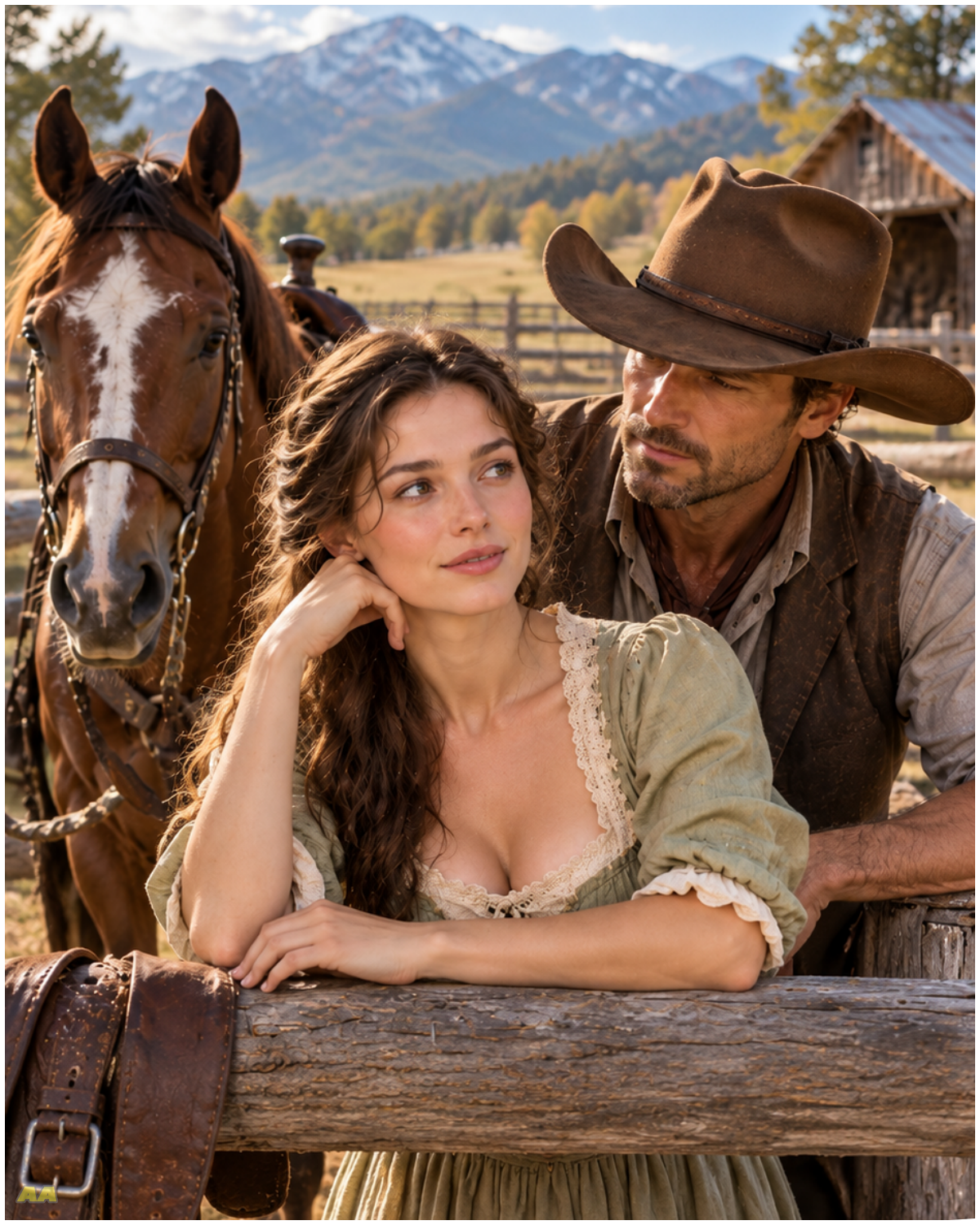
Augustus Crowley didn’t try to be subtle about it.
He was standing outside the Cedar Falls trading post when the stage coach arrived, boot propped on the hitching rail, arms folded, wearing the expression of a man who believed he owned everything within eyeshot.
When Vivian Hartwell stepped down, beautiful, composed, carrying herself with a steadiness that four hard days of road travel hadn’t touched.
Augustus looked her over once slowly.
The way a man appraises livestock he has no intention of buying.
Then said it loud enough for half the street to hear.
Well, looks like Callahan finally ordered himself a wife.
Several men laughed. Vivien didn’t look at him.
Didn’t flinch. Gave him exactly nothing.
She walked straight to Travis Callahan.
Mr. Callahan, I was told you wanted competence, not affection.
If that has changed, tell me now.
Travis looked at her steadily.
It hasn’t. Augustus smiled. He had just made the worst mistake of his life, and he had no idea yet.
Subscribe right now. Drop a like and tell me in the comments what city or country you’re watching from.
I want to see how far this story travels.
Stay with me from beginning to end.
You won’t want to miss what this woman does next.
The stage coach pulled into Cedar Falls 40 minutes late, and Travis Callahan had already decided he wasn’t going to be disappointed by anything that came off it.
Disappointment required expectation. He had been standing beside his feed wagon for the better part of an hour, watching the road, turning the brim of his hat in his hands the way he did when he was impatient, but didn’t want anyone to know it.
The sun was at midm morning.
The street was busy enough, and several people he recognized had glanced his way with the particular quality of curiosity that told him the news of the arrangement had already moved through the settlement faster than he’d hoped.
Cedar Falls was not a large town.
He had made a practical decision.
He knew that going in.
The ranch needed managing. Travis was good at cattle and horses and knowing when a fence section was about to fail and when a herd needed rotation.
He was considerably less good at correspondence, at supplier accounts, at the dozen small administrative decisions that kept a working operation from quietly losing money it didn’t know it was losing.
His foreman, Hyram Cole, had said it plainly the previous winter, sitting at the kitchen table with Travis’s account books spread between them and the expression of a man who had been wanting to say something for a year.
You’re bleeding 23,000 annually from disorganization alone.
Travis, that ain’t a cattle problem.
That’s a household problem. So Travis had written to the matrimonial agency in Saint Louie.
He’d written the letter the same way he made every other business decision, without sentiment, without performance.
He had listed what he needed, capability, education, willingness to live in Montana, realistic expectations about ranch life, and then on a separate line, something the agency had probably never received before, not expecting declarations of love or romantic courtship, not offering any either.
The reply had arrived 3 weeks later.
Vivien Hartwell, 28, former bookkeeper in Cincinnati.
References attached, education documented, available, practical, clean, exactly what he had asked for.
Then the stage coach came around the bend, and Vivien Hartwell stepped down from it, and Travis had the brief, disconnected thought that something had gone wrong with his order.
The woman standing on the Cedar Falls dirt did not look like someone who had spent 4 days on a road that broke most people’s composure by the first afternoon.
She looked like she had decided that 4 days of difficult travel was simply a condition of the situation rather than something that had any reasonable right to affect her.
Dark hair pulled back. Amber eyes that moved across the street, the trading post, the small crowd of late morning observers, and Travis himself in a single systematic sweep that lasted about 2 seconds and appeared to have gathered everything she needed.
A dress that was practical, cut for work rather than display, and fit her well enough that the men loitering near the trading post stopped their conversation without appearing to notice they had.
Augustus Crowley’s voice came before Travis could say anything.
He hadn’t noticed Augustus standing there, but he was boot on the hitching rail, watching the stage coach arrival with the patient, proprietary calm of a man who had decided in advance that everything in Cedar Falls was ultimately connected to him.
Well, looks like Callahan finally ordered himself a wife.
Laughter from the men near the trading poSt. Easy, careless.
The kind of laugh that doesn’t commit to anything, but makes clear which side of the joke it’s on.
Viven did not look at Augustus Crowley.
Did not slow her step, did not give him the flicker of one single eyelid in acknowledgement.
She walked directly to Travis.
Mr. Callahan. Yes. I want to make something clear before you take my luggage.
Travis waited. I was told you wanted a capable wife who would manage a household and expect no romance.
That’s accurate. Good. She handed him her bag, then looked past him, toward the feed wagon parked at the edge of the road.
What are you paying for winterfeed per hundred weight?
Travis blinked.
For feed. Yes, he told her the number.
Viven’s expression shifted. Not dramatically.
The way a person’s face changes when they hear something that confirms what they already suspected.
And the confirmation is not welcome news.
Mr. Callahan, what? You are being robbed.
She said it the way another person might point out that his boot was untied.
No pleasure in it. No apology either.
Just fact delivered to the person who needed it.
Travis stood on the Cedar Falls main street with this woman’s traveling bag in his hand, and he had the unsettling clear-edged awareness that he had written to Saint Louie, for someone who could manage his house, and the woman who’d arrived, had already identified a larger problem in the time it took most people to say good morning.
From the hitching rail, Augustus Crowley watched them both.
His smile had not changed, but his eyes had gone quiet in a way that had nothing to do with amusement.
The ride to Callahan Ranch took 40 minutes.
Travis set an easy pace.
He was not yet sure what to make of her, and the wagon seat was close enough that he had the steady awareness of someone sitting beside him who was paying attention to everything.
She was. Within the first 10 minutes, she asked four questions about ranch operations that his last two hired hands hadn’t thought to ask in their combined 14 months of work.
Headcount, current hay supply against projected winter need, number of horses in the breeding program, who managed the supplier accounts.
Travis answered each one straight.
You said I was being robbed, he said after a while on the feed.
Yes. What are you basing that on?
St. Louis commercial price for winter grade hay adjusted for Montana transport was running 14 to 17 cents per 100 weight last season.
You told me you’re paying 22 over your volume.
That’s $300 to $400 annually, assuming your supplier hasn’t reached the margin since last winter.
Travis looked at the road ahead for a long moment.
I’ve used the same supplier 6 years.
That’s useful to a supplier, Vivien said.
Not necessarily to you. He didn’t answer.
She didn’t push. After a mile, he said, are you sure about the rate?
Almost certainly. I’d want to see the actual invoices before giving you an exact figure.
But I’ve been reviewing commodity pricing for 12 years, Mister Callahan.
I’m not guessing. Travis turned to look at her once.
She was watching the road with the same composed systematic attention she’d given everything since stepping off the coach.
The invoices are in the office, he said.
I know, she said. That’s where I’ll start.
Hyram Cole was waiting at the gate, arms folded, hat pushed back, wearing the expression of a man who had formed a complete opinion before the wagon stopped.
12 years Travis had known him.
Hyram was excellent with cattle, sound in a crisis, and incapable of hiding what he thought about any situation in which he found himself, what he thought was visible from 30 yards.
The wagon stopped. Hyram looked at Viven with the expression of a man who had expected a sensible eastern woman and received something he was not equipped to classify.
Miss Hartwell polite tight Mr.
Cole. She met his eyes without blinking.
Travis tells me you’ve been managing feed procurement.
Hyram glanced at Travis. Travis said nothing.
I handle the orders. Hyram said carefully.
Yes. Who negotiated the current rate with Benson’s?
A pause. That arrangement would have been in place before my time.
I’ve just renewed the same contract.
Viven nodded. I want to review the terms this week.
I’m not suggesting you’ve done anything wrong, she added, and she said it simply without reassurance creeping into her voice, which somehow made it more convincing than any amount of warmth would have.
I’m trying to understand where the numbers come from before I recommend changes.
Hyram looked at Travis again.
Travis picked up her bag.
Agnes will show you the house.
Agnes Pike ran the Callahan Ranch kitchen.
The way experienced people run things they genuinely care about completely and without unnecessary commentary about it.
She was 61 years old, wide-shouldered, with hands that looked like they had been solving physical problems since before Travis was born.
She met Viven with the specific reserve of someone who was going to form her own opinion on her own schedule, and no amount of first impression pleasantness was going to shorten that timeline.
Travis watched from the doorway as Agnes showed Vivien through the house.
What he noticed was that Vivien asked questions, not observations, not suggestions.
Where were the household accounts kept?
How was the supply calendar managed?
Who handled correspondence when Travis was in the field?
Agnes answered each question. The answers got longer as they moved from room to room.
By the kitchen, Agnes was volunteering information rather than waiting to be asked, which with Agnes was the practical equivalent of a standing ovation.
Travis went back to the barn.
He had a horse that needed attending, and thoughts that needed settling, and the clearer thought, the one he kept pushing sideways, was about the way Augustus Crowley had watched Viven at the trading poSt. Not the way Augustus watched most things, something else, something that had gone still.
And calculating the moment. Viven refused to give him a reaction.
Travis had known Augustus Crowley a long time.
He knew what that stillness meant.
The first week was instructive in ways Travis had not anticipated.
Viven established a working pattern within 48 hours, up before him most mornings.
Methodical, she did not ask him to explain decisions she could reconstruct from the records, and she did not ask for help finding things she could find herself.
What she found in the records was not good.
Wednesday morning, she placed three invoices on the kitchen table while Travis was still on his first cup of coffee.
Duplicate charges, she said. The same September delivery build twice under different invoice numbers.
The handwriting is identical on both.
Someone assumed you wouldn’t compare them side by side.
Travis picked up the invoices.
He looked at them for a long time.
The anger that came was the cold kind, the kind that doesn’t show on a face, but settles somewhere behind the sternum and stays.
He had trusted this supplier for 6 years.
How much? $76 on this pair.
I believe there are two other similar pairs.
I want to verify before I give you a complete number, but I think you’re looking at somewhere between $2 and $300 in double billing over 18 months.
Travis set the invoices down.
I’ll go to Benson’s today.
Wait, her voice wasn’t sharp, just direct.
I want us to have every piece confirmed firSt. If you confront them with incomplete documentation, they’ll dispute the one invoice we missed and use it to muddy the reSt. We need every pair identified, every number documented before you do anything.
He looked at her. She was already thinking past the discovery, already thinking about the confrontation after the discovery and the confrontation after that.
He recognized the approach because it was how he handled everything involving land and cattle, thinking three steps ahead of the current problem.
Fine, he said. Finish the review.
She finished by Thursday evening.
Total $284 in duplicate or inflated billing across 14 months.
Travis wrote to his attorney in Helena that night.
He did not contact Benson’s directly.
He thought about what she had said about incomplete documentation and muddied disputes.
He thought about it more carefully than he would have thought about his own first instinct.
That bothered him slightly, that he was already adjusting to her thinking.
By the end of the first week, Hyram Cole had updated his assessment twice.
The first update came when Viven quietly handed him a single page outlining a transportation routing adjustment that had been costing the ranch unnecessary mileage charges on cattle drives.
A problem Hyram had noticed two years ago, but never been able to translate into a clear enough argument to bring to Travis.
Vivien’s page had the numbers laid out in three columns.
Clean, simple. The solution was obvious the moment you saw it.
Hyram read it twice. I tried to get Travis to look at this route 2 years ago.
He said he probably didn’t have the figures in front of him.
Viven said, probably not. He folded the paper.
I’ll bring it up in Monday’s meeting.
You should bring it as your recommendation, she said.
You found the problem. I just wrote down the numbers.
Hyram looked at her. You don’t want credit for it?
I want the route changed.
Whether or not I’m credited for it doesn’t affect the savings.
He folded the paper into his shirt pocket and walked back toward the barn.
He didn’t say anything else.
With Hyram, that was the equivalent of a lengthy speech.
The question of the marriage arrangement came up on the eighth day.
They had planned to formalize it quickly.
The agency had understood a short arrangement period, and Travis had agreed to the timeline without particular feeling about it.
He needed a capable wife.
Viven needed a stable position.
The sooner the arrangement was official, the sooner both of them could stop occupying the uncertain territory of their current status.
That had been the logic.
On the eighth evening, Viven came into the main room where Travis was working through a stack of buyer correspondents.
She stood in the doorway for a moment.
The way she did when she was deciding exactly how to frame something.
I want to ask you something.
Travis set down the letter.
Go ahead. I’d like 30 days before we marry.
He looked at her. The arrangement was I know what the arrangement was.
Not defensive, just clear. I’m asking you to adjust it.
She wasn’t nervous. She also wasn’t performing composure.
She was just waiting with the particular patience of someone who had learned that pressing too hard often produced worse results than holding still.
Travis said, “Why? Because I want to know whether this ranch is somewhere I can stay.
Not just practically.” She paused.
And for one brief moment, the composure had something behind it.
Not weakness, but weight. I’ve made arrangements before that looked sensible at the beginning.
He understood somewhere beneath the practical language what she was telling him.
>> >> Not that she doubted his intentions, that she had been wrong before about situations that appeared safe.
30 days, he said. Yes, separate rooms until then.
That’s what I’m asking. Fine, she said.
Thank you. It was the first time she had said thank you directly to him in 8 days.
He’d noticed. He noticed now that it surprised him not her restraint, but how much the two words landed when she finally said them.
After she left the room, he sat for a while with the letter in his hand and the quiet conviction, uncomfortable and clear, that the 30 days request was exactly the kind of careful deliberate thinking he’d come to associate with everything she did.
He went back to his correspondence.
He could not concentrate on it.
Cedar Falls found out about the 30 days by the second week.
It always did with these things.
The settlement had 300 permanent residents and approximately 600 opinions about how other people conducted their personal arrangements.
And a rancher and his mail order wife occupying separate rooms without completing the marriage was not the kind of information that stayed private.
The word was not generous.
Some of it was ordinary speculation.
Some of it was the particular variety of commentary tree certain women applied to any unfamiliar female who arrived in town without an established history.
Not quite accusation, just a steady sideways pressure that accumulated in the mind of anyone who heard enough of it.
Travis heard two versions of it from separate people within the same week.
He mentioned it to Viven on a Thursday morning, standing outside the barn.
She listened, said nothing until he was done.
“Does it bother you?” she asked.
Does it bother you? He asked back.
Not the way they’d hope it would.
She turned to look at the north fence line.
I’m not going to change the arrangement because people are speculating about it.
Travis turned back to the horse he’d been checking.
It bothers me, he said.
I know. A pause. Let them talk.
We’re not doing anything wrong.
He looked at her. She was watching the horse now, following his attention the way she had started doing without demanding he redirect it.
Agnes said the Pendleton woman asked about you after church.
Sarah Pendleton, you know her by reputation.
Her husband is the county assessor.
She has standing in this community.
A beat. What did Agnes tell her?
That you’d reorganized half the supply accounts in your first week.
Viven almost smiled. With Agnes, that was a public endorsement.
Good, she said quietly. Augustus Crowley heard about it through different channels.
What reached him wasn’t just that the mail order woman had arrived.
It was that she had already found the duplicate invoices and that letters had been sent to a Helena attorney within the first week of her arrival on the property.
His source didn’t know what the letters were about.
He only knew that Travis Callahan’s new woman had gone through 6 months of supply records in her first 7 days.
Augustus heard this at his own kitchen table over a breakfast he did not finish.
He sat with it for a while, then said quietly, “To no one in particular, what kind of woman did he send away for?” His ranch manager said, “Pretty, from what I hear.” Augustus looked out the window toward the North Ridge.
Beyond that ridge lay 300 acres of prime creek access grazing that Travis Callahan had been running cattle on since he’d settled settled the property 8 years ago.
Augustus had been quietly building a boundary dispute for 2 years.
A patient, careful legal argument that depended on a survey question and the assumption that no one at Callahan Ranch was paying detailed attention to their historical documentation.
He had assumed a working ranch run by one man who spent most of his daylight hours outdoors, an operation managed by routine rather than scrutiny.
He had not accounted for someone going through six months of records in a week.
Augustus pushed back from the table.
He had made a mistake by not moving sooner.
He was not going to make a second mistake by underestimating what this development meant.
On the 21st day, something happened that hadn’t been part of anyone’s arrangement.
Travis came in from the northern pasture at dusk, later than he’d planned.
A fence section near the creek had come down, and he and Hyram had spent 2 hours in fading light getting it back up.
He was tired in the way that compound frustration produces physical labor, plus the mental irritation of time lost, and he came through the kitchen door expecting silence and cold food.
The kitchen was warm. Agnes was at her sisters for the evening.
Vivien was at the table with a ledger open, and there was food on the stove, and the kitchen smelled like someone had been cooking from for the better part of an hour.
Travis stopped in the doorway.
Vivien looked up. Agnes left instructions.
I followed them. You cook?
I follow instructions adequately. Sit down.
He sat. They ate mostly in silence.
Not the uncomfortable kind. The kind that arrives when two people are each engaged in something, and neither feels the need to fill the quiet to prove their present.
Halfway through supper, Travis said.
The fence on the north side came down.
Cattle pressure? I don’t think so.
The post was cut. Not rotted.
Cut. Vivien set down her fork.
She looked at him directly.
Travis held her gaze. Could have been a passer by, he said.
Someone moving through. Could have been, Vivien said.
Neither of them believed that.
She picked up her fork again.
After a moment, she said, “What does Augustus Crowley want with the northern pasture?” Travis was quiet for a beat.
Creek access winter grazing. The land holds water longer than most ground up here in spring.
He paused. He’s been raising boundary questions with the county for 2 years.
Nothing formal. Nothing formal, Vivien said yet.
She turned a page in the ledger.
You’ve been thinking about this already, Travis said.
It wasn’t a question. Since the invoices, she didn’t look up.
Double billing doesn’t come from nothing.
Someone assumed you weren’t paying attention.
You’ve had the same supplier for 6 years.
Someone has been watching your operation for a long time.
You think Augustus is connected to Benson’s.
I think it’s worth finding out who owns Benson’s feed or who has a financial interest in it.
Travis sat across from her in the kitchen lamplight, looking at a woman who had arrived on his property 21 days ago as a practical solution to a household management problem, and who had, without drawing any particular attention to the process, begun thinking about the security of his entire operation, as though it were already her own.
He didn’t say what he was thinking.
He said, “Thank you for supper.” Vivian glanced up briefly.
Agnes did the hard part.
You didn’t have to. You came in late.
The food was there. It made sense.
Travis looked back at his plate.
Outside the ranch settled into its evening quiet.
Horses in the barn. Cattle on the south pasture.
The creek running somewhere beyond the fence line.
It was the right kind of quiet.
Not the empty quiet of a man living alone, which Travis had spent 3 years learning to ignore.
Something else entirely, something that did not have a practical name.
Nine days remained in the 30, and in a county seat two days ride away, Augustus Crowley had already begun composing a letter to a county land registry clerk specific questions about boundary markers, historical survey discrepancies, and the exact legal definition of adverse possession on a particular 300 acre pasture in the northern valley.
The practical arrangement had not yet become a marriage, but somewhere in the space between ledgers and fence lines, and late suppers in a quiet kitchen, it had already become something considerably harder to walk away from.
The 30th day arrived the way Travis had expected it to without ceremony, without the weight either of them had been quietly carrying for the past week, managing to announce itself through ordinary morning routine.
He was at the water trough checking the fitting on the pump mechanism when Viven came across the yard in her work dress, ledger under one arm, the same practical efficiency she carried everywhere.
She stopped a few feet from him.
He straightened. Neither of them spoke for a moment.
Still 30 days, she said.
I know what day it is.
She looked at him. He looked at her.
Out in the south pasture, the cattle moved in the gray early light with no opinion about any of it.
I’d like to go to Cedar Falls tomorrow, she said.
There are supplier accounts I need to review in person.
The transportation routing change Hyram presented.
I need figures from the freight office directly.
I’ll go with you, Travis said.
You don’t have to. I know I don’t, he said.
He turned back to the pump fitting.
I need to check on a feed payment dispute anyway.
Viven nodded once. She opened her ledger as she walked back toward the house, already focused on the next thing, the way she always was.
Travis watched her go without meaning to.
He turned back to the pump.
The fitting was fine. It had been fine the whole time.
He hadn’t actually needed to check it.
They married that afternoon. Not with a ceremony.
Not with witnesses beyond Hyram, who stood in the front room with his hat in both hands, looking profoundly uncomfortable.
And Agnes who stood with her arms folded and the expression of a woman who had seen enough of life to understand that the paperwork mattered less than what came after it.
Judge Hollister from the county office wrote out.
He had written out 3 weeks ago and been told politely to come back.
He wrote out again now with the resigned flexibility of a man who had witnessed stranger domestic arrangements than this in Montana territory.
Travis signed, Vivien signed, the judge witnessed.
Hyram witnessed. Agnes stood in the corner and didn’t say anything during the brief proceedings, which told Travis more about what Agnes thought than any amount of commentary would have.
After Hollister left, Hyram shook Travis’s hand and nodded to Viven with the brief respect of a man who had quietly updated his assessment of a person without feeling any need to announce the revision.
Agnes made supper. They ate at the same table they had eaten at every night for 30 days.
The food was the same.
The kitchen was the same.
Outside the window, the ranch was the same.
Nothing was the same. Travis poured coffee for both of them afterward, and they sat across from each other in the lamplight with the account ledgers between and the particular silence of two people who have just made an irreversible decision and are each separately deciding how to carry it going forward.
Vivian said, “I’ve been thinking about the Benson account.” Travis almost laughed.
He caught it before it became a sound.
But she must have seen something in his face because she looked up from the ledger questioning.
“You’re thinking about accounts,” he said.
“I’m always thinking about accounts.
It’s our wedding evening, Vivien.” She was quiet for a moment.
Something moved briefly across her expression that wasn’t the ledger and invoice composure she wore through everything else.
Then she said very quietly, “I know what day it is.” She was giving his own words back to him.
He recognized them. He folded his hands around his coffee cup.
“Tell me about the Benson account,” he said.
And because she understood that he was choosing to let it be what it was, not insisting on a wedding night that neither of them had agreed to or apparently expected, she opened the ledger and began explaining what she’d found.
Travis listened. He also watched her hands on the pages, the way she moved through numbers with the same calm efficiency she brought to everything.
And he thought about the particular quality of a woman who could sit at a table on her wedding evening and the work through facials with with complete composure, not because she was cold, but because the work was what she trusted, and trust was something she gave very slowly in accumulated degrees to things that had earned it.
He thought he understood that better than she would have guessed.
The trip to Cedar Falls the following day started well.
Clear sky. The road was firm from a dry stretch and the horses moved easily.
Viven had a liSt. Three supplier offices, the freight station, the county registar to verify a survey document.
Travis hadn’t thought to pull in 2 years.
The county registar. Travis had asked casually what she needed from the registar.
Original boundary documentation on the northern pasture.
She said the survey from 1,879.
I want to see it myself.
You think there’s a problem with it.
I think Augustus Crowley has been asking boundary questions with the county for 2 years.
And I’d rather understand what he’s looking at than find out after he files something.
Travis had thought about that during the first mile of road.
She had been on his property 30 days, and she was already thinking like someone who intended to be there when the land was still his in 30 years.
That thought arrived quietly and settled somewhere it didn’t have room for.
They reached Cedar Falls late morning.
The street was busy. A livestock sale at the east end of town had pulled in ranchers and buyers from a 3count radius, which meant the trading post, the freight office, and the feed warehouse were all running at three times normal volume.
Travis tied the horses, and Viven organized her papers, and they separated with a practical agreement to meet at the freight station at noon.
Travis went to the freight office.
Viven went to Mercer’s supply house to review the transportation records she’d been corresponding with over the previous two weeks.
She was there perhaps 20 minutes.
She came out carrying her ledger and three pages of notes and nearly walked directly into Augustus Crowley.
He was standing with two other men, one of whom Travis would have recognized as the owner of the Cedar Falls hardware operation and the other a cattle buyer from Billings on the Trading Post steps.
Not blocking her path, but close enough.
Viven did not break stride.
Mrs. Callahan. She stopped, looked at him.
Augustus smiled the way certain men smile when they are about to say something they have thought about in advance, but intend to deliver as casual observation.
I heard the arrangement went forward.
Congratulations are probably in order.
They’re always in order when appropriate, Vivien said.
Was there something specific you wanted to say, Mister Crowley?
The two men with him had gone quiet.
Along the trading post porch, two women who had been in conversation paused without appearing to.
Augustus tilted his head slightly.
I was just telling Henry here about the interesting practice of sending east for a bride.
Must be something to it if a man like Travis Callahan is willing to pay for the company.
The hardware man made a sound somewhere between a laugh and a cough.
The cattle buyer from Billings didn’t react at all.
He was watching Viven with the attention of someone who had walked into a situation without a clear read on what it was.
Viven set her ledger under her arm.
She looked at Augustus Crowley with the steady, unhurried attention she brought to invoice discrepancies and fence post cuts and anything else that required understanding before it required responding to.
Mr. Crowley, she said, you seem unusually interested in what Travis pays for.
I’m curious. Is that a general habit or are you specifically concerned that someone is reviewing accounts you expected to remain unexamined?
The hardware man stopped making sounds.
The cattle buyer from Billings looked at Augustus with faint new intereSt. Augustus’s smile stayed exactly where it was, but something behind it had gone very still.
That’s quite an implication, he said.
It’s a question, Vivienne said.
You’re welcome to answer it or not.
Either answer tells me something useful.
She didn’t wait for a response.
She nodded once to the cattle buyer, the impersonal courtesy one gives to a bystander in someone else’s conversation, and walked toward the freight station.
Behind her, the porch of the trading post was silent for a few seconds.
Then, from somewhere down the street came a short, sudden laugh from an older man who had been sitting on a barrel outside the barber shop and had apparently heard the whole thing.
The sound had the quality of someone who had spent years watching Augustus Crowley embarrass other people and had had found the reversal genuinely entertaining.
Vivien heard it. She kept walking.
Travis was coming out of the freight office when he saw her face.
Not distressed, not angry. The specific quality of composed attention she wore when something had just happened that she was still processing and filing.
What? He said. Augustus was at the trading poSt. Travis went still.
Did he? It’s handled. What did he Travis?
She looked at him. I said, “It’s handled.” He looked at her for a long moment.
She returned his gaze with the patient evenness of someone who does not require being managed through an experience that is already finished.
What did you say to him?
A brief pause. Then she told him, “Exactly as it had happened, without editorial.” When she finished, Travis was quiet for a moment.
Then the cattle buyer from Billings, would that be Thomas Hewitt?
I didn’t get his name.
Broadman, red beard. Yes, he moves about 40 head a season through this county, Travis said.
And he doesn’t respect Augustus Crowley.
Has something to do with a grazing rights dispute 2 years back.
Viven looked at him. So having him hear Augustus imply that your operation’s finances might be worth scrutinizings in a public setting at a livestock sale.
Is not good for Augustus, Travis said.
They stood on the Cedar Falls Street in the midm morning sunlight.
I didn’t plan that, Vivian said.
I know you didn’t. But it’s useful.
It is. He picked up the handles of the small hand cart he’d been using to move the freight documents.
Come on. We’ve got the registars’s office yet.
The county registars’s office was a single room in a building that smelled like old paper and lamp oil and the particular mustiness that comes from filing cabinets that hold documents which most people only urgently need once in a crisis.
Martin Shaw had been county registar for 11 years.
He was compact, methodical, and wore the mild permanent expression of a man who has processed enough human disaster through paperwork to have developed a philosophical equinimity about most of what walked through his door.
He pulled the 1,879 survey on the Callahan Northern Pasture within 10 minutes, set it on the reading table.
Viven studied it. Travis stood beside her and watched her read.
He knew what the survey said.
He had read it when he bought the property 8 years ago.
He hadn’t read it since.
Viven’s finger moved along the eastern boundary line.
Stopped, moved back. Her expression shifted, not alarm, but a very specific attention that he recognized now as what she looked like when she found something she had suspected but needed to see confirmed.
The creek bend, she said.
It moved. She looked at Shaw.
Mr. Shaw, is there a survey from before 1,879?
A territorial survey? 1,873,874 Shaw looked at her.
There might be. I’d like to see it if you have it.
Shaw disappeared into the back.
They waited. 6 minutes. He came back with a rolled document that was not in good condition, the edges brown, the paper brittle.
He spread it carefully. Viven compared the two surveys side by side for two full minutes without speaking.
Travis looked at them both.
He could see it. The creek, the eastern fork of the boundary marker.
In the 1,874 territorial survey, the boundary ran along the creek’s northern edge.
In the 1,879 registered survey, the reference point was the same creek, but the bend had shifted eight maybe 10 years of spring flooding and sediment working on the stream bank.
A creek that moved, a boundary defined by a creek that had moved.
That’s what he’s using, Viven said quietly.
Travis felt the cold, steady drop of understanding.
He’s going to argue the boundary should follow the creek’s current course, he said, not the 1,879 registered line, which would move his eastern edge approximately 90 to 100 yards west into your pasture.
Shaw had been listening, he said carefully, “No formal adverse possession filing has come through this office yet.” Viven said, “She looked at Travis.
He looked at her.” “Mr.
Shaw. She said, “I’d like certified copies of both surveys and any county commission minutes related to boundary questions on this parcel since 1,883.” Shaw wrote down the request without expression.
That’ll take until end of day.
We’ll wait. They ate midday at the Cedar Falls eating house, a counter establishment that served stew and bread with the democratic indifference of a place that fed everyone and had opinions about none of them.
Travis sat across from Vivien.
She had her notes out.
He had stopped being surprised by that.
He’s been patient, she said.
Two years of questions. Nothing filed.
He’s waiting for the right moment.
What’s the right moment? When the evidence is strongest or when your operation is weakest, she added something to her notes.
A contested boundary is easier to win if the other party is distracted.
Dealing with other problems, less likely to respond effectively.
Travis thought about the cut fence post, the duplicate invoices, the connection he hadn’t been willing to make completely until this moment.
How long do you think he’s been watching the operation?
He said, Vivien looked up.
Long enough to know your supplier relationships.
Long enough to know your documentation habits?
She paused. Long enough to think he understood your weaknesses.
She did not add the obvious end of that sentence.
That whatever Augustus had understood about Travis Callahan’s weaknesses, those weaknesses no longer existed in the same form they had 31 days ago.
Travis looked at his stew.
I should have paid more attention to the records.
Yes. He looked at her.
You’re not going to tell me it’s not my fault, he said.
It is partly your fault.
You’re also not the first rancher to spend his daylight hours outdoors and trust the paperwork to take care of itself.
She picked up her spoon.
The difference is now you have someone who reads the paperwork.
He was quiet. I appreciate that you said partly, he said finally.
The corner of her mouth moved.
Don’t make me regret the precision.
That was when Travis began telling her about Jonas Reed.
He hadn’t planned to. It came the way certain things come when you’ve been carrying them for years and a particular combination of circumstances.
A table, a direct person who listens without filling silences.
A morning spent looking at an old survey for a piece of land you built, partly as a monument creates an opening you didn’t see coming.
Jonas had been his business partner when he first acquired the property 12 years ago.
They had come out from Missouri together, two men in their mid20s with not enough capital and enough stubbornness to more than compensate.
Jonas had handled the financial side in those early years, a natural instinct for numbers that Travis had always envied without saying so.
Jonas had died of fever the winter after they finished the first structure on the northern pasture.
27 years old, 3 weeks from the first cattle purchase they’d been planning for 2 years.
Travis had gone ahead with the purchase alone.
He had built everything that came after it alone.
The northern pasture, he said, “We built the first fence line there together.
Jonas wanted to put the summer grazing operation on that ground specifically because of the creek access.” He had a whole argument about it.
Water costs, summer weight gain, the numbers.
Travis was quiet for a moment.
I’ve never put anyone else’s cattle on that ground.
My own herd only. I don’t entirely know why.
Viven had set down her spoon.
She was listening. I think I do, she said carefully.
You don’t have to. Something built with someone matters differently than something built alone.
Even if the person is gone.
A pause. That pasture isn’t just grazing land to you.
Travis looked at the table.
No, he said. It isn’t.
He hadn’t said that aloud to anyone in 12 years.
He wasn’t entirely sure why he had said it now in a Cedar Falls eating house to a woman he had been married to for one day.
He looked at her. She was still watching him with the kind of attention that did not ask for more than he’d given, but made it clear she understood the full weight of what it had cost him to give it.
“I’m sorry. I’m sorry about your friend,” she said.
It was a long time ago.
“People say that like time change is what it meant.” Travis looked at her for a moment.
What do you mean? I mean, time passes and the loss gets quieter.
That’s different from it mattering less.
He had no response to that.
None that would have been honest and also shorter than the kind of conversation he wasn’t prepared to have in a Cedar Falls eating establishment in the middle of the day.
So he said, “What happened in Cincinnati?” It wasn’t a question.
He’d been carrying it since she’d told him part of the Ohio story on day 15.
He’d known there was more.
He’d also known she would tell him the rest when she chose to and not before, and that asking directly was the right approach, rather than waiting for the peace she held back to keep sitting between them.
Viven was quiet for a long time.
Then she told him, “The merchant’s name, the son, the specific mechanism of what had happened, not the worst version of what could have happened, but bad enough, the refusal, the retaliation, the months of professional collapse that followed.
The particular experience of watching the truth move slower than a lie, and being unable to speed it up, no matter how carefully she documented and argued.
Travis listened. He did not look away.
He did not move to interrupt.
When she finished, there was a long quiet.
He said, “The man who did it.
He’s still in Cincinnati.” “Does he know where you are?” “No.” She looked at him steadily, “And it wouldn’t matter if he did.
He has nothing left to take from me.” Travis thought about that, about what it meant to arrive at the place where someone who had systematically dismantled your professional reputation no longer had the power to do anything to you.
Not because the damage was repaired, because you had built something new enough and solid enough that the old damage couldn’t reach the foundations.
That’s why the records, he said, partly you document everything because you know what happens when there’s no documentation.
I document everything, she said, because I learned that the only defense against someone else’s word is having better evidence than their word.
A pause. I also document everything because I’m good at it and it’s useful and someone has to.
He almost smiled again. Practical, he said.
Always. The certified copies were ready at 4:00.
Viven paid for them, noted the exact figure in her ledger, and thanked Shaw with the brief and genuine courtesy she extended to anyone who did their work competently.
On the way out of the registars’s office, they passed Sarah Pendleton on the street.
Travis knew Sarah by reputation and the occasional county function.
He had the particular male ranchers relationship to important community women aware of their standing, uncertain about how to translate that standing into ordinary conversation.
He lifted his hat, said her name, but Sarah Pendleton was looking at Viven.
Mrs. Callahan. She smiled, not the formal social smile.
The other kind, the one that meant she had heard something and found it worth acting on.
I heard about this morning at the trading poSt. Viven waited.
Augustus Crowley has been needing someone to say exactly that to him for approximately 4 years, Sarah said.
I’m glad it finally happened in a public setting.
I was only asking a question, Vivien said.
Of course you were. Sarah’s smile didn’t move.
I hope you’ll consider coming to the Thursday gathering at the Pendleton House.
It’s informal. Several ranchwives and a few women from town.
I’d very much like to introduce you properly.
Travis was watching Viven. There was a brief moment where she processed what was being offered.
Not just an invitation, but something more specific, a social introduction managed by a woman whose standing in Cedar Falls was the kind that could turn the needle on how the settlement received an outsider, especially one who had arrived under circumstances that gave the gossip infrastructure a full week’s running material.
I’d like that, Vivian said.
Thank you. Sarah nodded once.
Looked at Travis. You’ve been busy lately, Travis.
I hope things are settling.
Getting there, Travis said. Sarah walked on.
Travis and Vivien stood on the Cedar Falls street with the afternoon light going amber and the livestock sail still running its noise at the east end of town.
That was important, Travis said.
I know. She doesn’t extend that to I know, Travis.
He stopped talking. She had understood it faster than he had.
They walked back to the horses.
Viven folded the certified copies carefully into the leather document document case she’d brought from the ranch and settled it under the wagon seat with the precision of someone who understood exactly how important a piece of paper could become under the wrong circumstances.
Travis untied the horses. I want to write to a Helena attorney, she said about the survey question.
I want to know what a boundary dispute based on creek movement would look like legally.
What’s defensible? What isn’t? I know a man in Helena, Nathaniel Price.
Is he good? He’s expensive and he’s thorough.
Same thing in my experience.
Write to him tonight, she said.
Travis looked at her. We don’t know that Augustus is going to file anything.
We know he’s been preparing to for 2 years, she said.
And we know this morning didn’t improve his feelings toward this ranch.
She climbed up onto the wagon seat without any wasted motion.
I’d rather have Price familiar with the documentation before we need him than scramble after something is filed.
Travis climbed up beside her, picked up the res.
The horses moved. Cedar Falls fell behind them with the long gold light of late afternoon across the valley, and the Callahan Ranch rode ahead, and the sense clear and undeniable by now, 9 miles from home, that Travis had gone to a matrimonial agency, looking for someone to manage his household, and had acquired instead something considerably more dangerous to a man who had spent 3 years telling himself he no longer needed to trust anyone.
He needed to trust her.
He already did. That was the problem.
The ride home took on something different from every ride before it.
Not different in the external sense.
The road was the same.
The horses maintained the same steady pace.
Vivien sat beside him on the wagon seat with her notes on her lap the way she’d sat on the trip out.
But they had told each other things at the Cedar Falls eating house that didn’t go back into the places they’d been kept.
Jonas, the merchant’s son in Cincinnati.
The particular ways each of them had learned that trust was a specific kind of vulnerability that certain people had no hesitation exploiting.
Travis didn’t know what to do with that exactly.
He wasn’t built for processing that kind of thing in real time.
He filed it the way he filed fence repairs noted important requiring attention returned to when conditions allowed for it properly.
Dove Vivien said about 4 miles from the ranch.
Travis looked sideways. What about her?
You said you’d show me the north fence on horseback.
You haven’t yet. You’re still not comfortable riding.
I’m getting more comfortable. A pause.
Agnes says Dove is steady with uncertain riders.
Dove is steady with everyone.
Travis said she doesn’t care what kind of rider you are.
Then this weekend, Vivien said, “If the weather holds, she nodded and went back to her notes.” Travis watched the road.
Somewhere ahead, the ranch lights would be coming on Hyram doing the last check.
Agnes, with supper nearly done, the barn quiet except for the horses settling for the night.
He had bought this land and built this operation on the idea that having something large enough and permanent enough would be sufficient, that a man who owned nearly a thousand acres and a growing breeding program and a solid cattle herd had built himself something that couldn’t leave.
Charlotte had left anyway, not the land.
Charlotte was never going to leave land.
She had left him the man and had done it with the cleareyed pragmatism of someone who had always wanted something he couldn’t give and had waited politely until a better offer arrived.
He had spent 3 years deciding that the fault was in the expectation that if you expected nothing from another person, nothing could be taken from you.
Vivien Hartwell had arrived on his property 31 days ago with a traveling bag and a question about feed prices and without doing anything dramatic or deliberate had managed to occupy the exact space in his operation and his thinking that he had spent 3 years convincing himself he didn’t need filled.
He said nothing. The road ran ahead of them in the amber evening light.
The horses moved steadily beside him.
Vivien made a small notation in her ledger, frowned at something, and made a second notation.
Travis drove them home in the comfortable quiet of two people who had already said the important things and were not yet ready to call them what they were.
But the space between ledgers and Jonas Reed’s old fence post and a survey with a wandering creek and a woman who documented everything because she’d learned what happened when there was nothing written down.
That space was considerably smaller than it had been 31 days ago.
Augustus Crowley’s letter to the county land office arrived in Helena 12 days later.
Neither Travis nor Viven knew that yet.
What they knew, pulling into Callahan Ranch as the last light left the sky, was that they had left Cedar Falls with certified copies of two surveys, a future appointment with Sarah Pendleton.
And something that hadn’t yet been named, but that both of them were aware of with the clear, unhurrieded certainty of people who had learned to recognize important things before they announced themselves.
Hyram was at the gate.
He looked at both of them, said nothing, took the horses.
Agnes called from the kitchen that supper was on, and if they took more than 5 minutes to wash up, it would be cold, and that was their problem, not hers.
Viven climbed down from the wagon, walked toward the house.
At the porch step, she turned once briefly and looked back at Travis with the survey case tucked under her arm and the last gold light on her face.
She didn’t say anything. She went inside.
Travis stood by the wagon in the growing dark for a moment longer.
Then he followed her in.
The letter from Nathaniel Price arrived on a Thursday, 11 days after Travis had written to Helena.
Vivien read it twice at the kitchen table before Travis came in from the morning check.
She had it folded and set beside his coffee cup when he sat down.
He looked at it, looked at her.
Read it, she said. He read it.
Price was careful in the way that good attorneys are careful.
He did not make promises, did not speculate about outcomes, and used language that a judge would find unimpeachable, but the substance was clear enough.
A boundary dispute based on creek movement in Montana territory was not straightforward.
Courts had gone both directions on the question of whether a natural boundary marker, specifically a waterway, carried a fixed legal meaning at the time of survey registration, or whether it moved with the physical reality of the creek’s current course.
Augustus had a viable argument, not a certain one, but viable.
Price’s recommendation, compile every operational record demonstrating continuous exclusive use of the northern pasture going back as far as documentation existed.
Grazing logs, cattle counts, infrastructure investment, tax assessments, boundary maintenance, and he added one line at the bottom that Travis read twice.
If recent documentation of physical interference with the property exists, fence damage, trespass, deliberate destruction, that material may be relevant to the question of whether adverse activity has occurred and by whom.
Travis set the letter down.
He’s already thought about the fence, he said.
He’s a thorough man, Vivien said.
That’s what thorough men do.
He wants to meet. Yes, Helena is two days ride.
I know where Helena is, Travis.
He folded the letter and looked at her.
She was already opening the operational record files she had reorganized in week two, the grazing logs, the seasonal cattle counts, everything documented by year, going back to the original purchase.
We’ll go next month, he said after the fall rotation.
She nodded. She already had 1,880 open.
Travis finished his coffee and went back outside.
He stood in the yard for a moment before walking to the barn.
The sky was changing, not immediately, but with the particular quality of Montana sky in late autumn that told anyone who paid attention that the weather was building towards something.
The kind of slow committed buildup that could mean 2 days or 2 weeks, but was always moving in one direction.
He thought about the northern pasture.
He thought about Jonas. He thought about a court in Helena, trying to decide whether 12 years of working that ground counted for more or less than a creek that had moved 90 yards over 50 years of spring flood.
He thought about Viven at the kitchen table.
Already 3 years into the documentation by the time he got his boots on.
He went to check on the horses.
The Thursday gathering at the Pendleton house happened the following week.
Travis drove Vivien in, waited outside with Martin Shaw’s barn hand, and three other ranching husbands, who had performed the same calculus of quiet company versus the inside of a wellorganized parlor, and had all reached the same conclusion about where to stand.
Inside, Viven was on her own.
She came back out an hour and 40 minutes later, said nothing until they were on the ranch road.
“Sarah Pendleton is intelligent,” she said.
“I know. She knows about the boundary questions, not the specifics, but she knows Augustus has been circling this property for 2 years.
Travis looked at the road.
How much does she know?
Enough to be interested in the outcome.
Her husband is the county assessor.
She understands what a disputed land claim does to property values in the valley.
A pause. She’s not on our side because she likes me.
She’s on our side because a stable land registry benefits everyone who owns property in this county.
Does it matter why she’s on our side?
Viven considered that. No, she said.
I suppose it doesn’t. They rode for a mile.
Were the other women hostile?
He said, “Two were uncertain.
Two were curious. One was very kind in the way certain women are kind when they feel slightly sorry for you.
How did you handle the uncertainty?” I didn’t.
I answered questions about the ranch accounts when they came up, and I listened to everyone’s news about their own families, and I ate the food and thanked Sarah when I left.
She looked straight ahead. I can’t make people like me faster than they’re ready to, but I can be exactly what I am consistently until they make up their own minds.
Travis thought about that. That’s worked before, he said slowly, she said.
But yes, Hyram brought a new problem the following Monday.
He appeared at the kitchen door at 7:00 in the morning with a specific expression of a man who had been deciding whether to say something for approximately 12 hours and had landed reluctantly on the side of saying it.
Travis was at the table.
Viven was already in the office.
We’ve got cattle on the north fence.
Hyram said Crowley’s mark. Travis was still how many?
Eight head. Maybe nine. They came through on the east side.
The wires been cut again.
Again. Travis stood up. Don’t, Vivien said from the office doorway.
Both men looked at her.
Don’t ride over there today, she said.
She was carrying the survey copies.
Let me document it firSt. Where they came through, what the wire looks like, which cattle, how far onto our pasture they came.
His cattle are on my I know where they are.
She walked to the table and set the surveys down.
If this is deliberate, and it is then, the documentation of it is more valuable than getting the cattle off the property quickly.
We need witnesses. We need to record the position of the cut, the cattle marks, the distance they traveled.
Travis looked at Hyram. Hyram had the expression of a man watching two opposing types of response to a problem and trying to determine which one was going to serve him better in 10 years.
I’ll ride with Mrs. Callahan, Hyram said.
Travis looked at him. You’ll ride with to document, Hyram said.
He was already reaching for his hat.
You can come too. But nobody does anything until she’s finished.
Travis put on his hat.
The cutwire was clean, not rusted through, not broken under pressure sheared.
A man with a good pair of cutters in 5 minutes.
The cattle had been through the gap at some point in the night drifted south to the creek access.
Exactly as you’d expect Crowley’s herd to know how to find water and were standing there in the early morning with complete bovine indifference to the situation they represented.
Viven crouched beside the post, looked at both ends of the cut wire, stowed and moved 12 ft east along the fence line, crouched again.
Travis watched her. Two cuts, she said.
Not one. Someone made a gap wide enough to move cattle through without having to force them.
That’s deliberate stock movement, Hyram said.
Yes. She stood. I want to measure the distance from this post to the corner stake.
And I need a witness beside me when I record the cattle marks.
It took 40 minutes. She wrote down everything.
Time of discovery, who found it, weather conditions, wind direction, position of both cuts on the fence line, distance measurements.
Each of the eight cattle with their brand markings described, and their position on the Callahan property recorded in feet from the original boundary line.
Travis moved Crowley’s cattle back through the gap while Hyram watched.
Vivien watched the cattle. Not the cattle, their hoof prints.
The track of their movement from the cut gap to the creek.
“They came through here before,” she said.
Travis looked at her. “The hoof prints are layered.
This isn’t the first time these animals have used this crossing.” She looked up.
They know how to get here.
That means the fence has been cut before, or the cattle were brought through another way, and this has been happening longer than we thought.
The three of them stood in the early morning on the north fence line.
Travis looked at the pasture Jonas had wanted for the water access.
He’s been building the adverse possession argument physically, he said.
Not just on paper. Yes, Vivien said quietly.
I think so. She wrote that down, too.
The fence repairs took the afternoon.
Travis worked alongside Hyram with the methodical physical focus that fencing required no room for anything else when you were stretching wire, which was part of why Travis had always found it clarifying.
Hyram was quiet beside him in the way Hyram was always quiet when there was real work to do.
About halfway through the second section, Hyram said, “She’s good.” Travis didn’t look up from the wire.
“Yes, smarter than I expected.” “Smarter than I expected, too.” Hyram worked for a while.
“Then you’re not going to tell me that the way a man who’s just realized something is obvious.” “No,” Travis said.
“I’m not going to do that.” Hyram made a sound that was not quite a laugh.
“She fits the place,” Hyram said.
That’s all I’ll say. That’s enough, Travis said.
They finished the fence at dusk.
The fire started on a Tuesday night, 19 days later.
Travis was asleep. He could not say what woke him.
Not the smell, not a sound, but some combination of them that worked its way through sleep before he could identify it.
He sat up in the dark.
The room was dark, but the window was not.
Orange light, wrong color, wrong direction.
He was out of bed and moving before thought caught up to action.
Viven. He was in the hallway.
Her door opened before he reached it.
She was already up, already dressed.
She had been awake. He realized later because she slept lightly in a way that had never come up in conversation, but was apparently part of how she was built.
She saw the light through the window.
Storage building, she said. They were both moving.
The fire had taken hold in the east wall of the storage building.
Not the main barn, not the house, but the separate structure where Travis kept the iron document box, the winter equipment, the surplus tools, and the older machinery he hadn’t sold.
It was burning with the organized intensity of something that had started small and been left to find its own pace.
Viven ran toward it. Travis caught her arm.
I’ll go. She was already calculating.
The east wall is gone.
The roof hasn’t caught yet.
How long before it does?
10 minutes, maybe less. The iron box is on the west interior wall.
Viven, I’m going in, she said.
You’re not. Then come with me.
She pulled her arm free and went.
Travis followed her through the door on the west side, the far side from the fire, the smoke already layering low and thick against the ceiling.
He couldn’t see the box.
She could. She went straight to it with the certainty of someone who had spent 2 weeks reorganizing the storage building’s layout and knew exactly where every item stood.
The box was iron, heavy, full of 12 years of paper.
Travis got to it firSt. Vivien was beside him.
Together they got it off the shelf, and moving it was unwieldy, not merely heavy.
And the smoke was dropping, and the orange glow on the east wall was getting brighter with the specific quality of fire that has found something it likes and is about to make up its mind about the roof.
They came out through the west door, staggered 20 yard from the building, set the box down hard in the dirt.
Travis turned back. The equipment.
Leave it. The machinery is worth.
Travis. Her voice cut through.
Leave it. He turned to look at her.
Her face was lit by the fire’s glow.
Smoke streaked. She had something in her expression he hadn’t seen before, not fear.
Nothing like fear. The absolute contained focus of a person who had processed the risk and made the decision and was not interested in having it second-guessed.
Equipment can be replaced, she said.
The documents cannot. Hyram arrived from the bunk house at a run with three other hands.
They formed a water line from the well.
They couldn’t save the building.
It was too far gone on the east side, but they kept the fire from the barn, kept it from the house, kept it from taking anything else.
It burned for an hour.
When it was down to char and collapsing timber, Travis stood beside the iron box and watched the last of it go.
The box was intact. Viven was not watching the fire.
She was crouched in the dirt on the east side of the burned structure, 10 ft from where the fire had started, holding a lantern and looking at the ground.
Travis walked over. She looked up.
The fire started here, she said.
You can’t know that yet.
Look at the burn pattern on the wall.
She moved the lantern. The wood at the base of the east wall was burned deepest, not from falling debris, but from the ground up.
The origin was low, ground level.
She stood. There’s no equipment stored on this side.
Nothing that could have caused an accidental ignition.
The nearest lantern was 15 ft weSt. Travis looked at the burn pattern.
Wind from the east tonight, he said.
Yes, which means an accidental fire starting on the west side would have been drawn eaSt. A fire starting on the east side would have been pushed west toward the barn and the house, Travis said.
He said it quietly. Someone knew the wind direction.
Viven was already riding. She had pulled the small notebook she carried in her pocket, the one she kept for field observations, and she was writing by lantern light in the burned smell of 2 in the morning, recording the time, the weather conditions, the wind direction, the burn origin point, the elevation of the char pattern, the materials stored versus not stored on the east wall, the distance to the nearest legitimate ignition source.
Travis watched her work. Hyram appeared beside him, said nothing.
Watched her too. She spent 40 minutes documenting the scene.
When she was done, the notebook held six pages of tight, precise notation.
She stood, closed the notebook, and looked at Travis.
“I want to talk to Martin Shaw at the registars’s office tomorrow,” she said.
“And I want to send a second letter to Price in Helena.” “Ason, as part of a pattern of property interference, changes the nature of what we’re dealing with.” Travis looked at what was left of the storage building.
That box was what he was after, he said.
Probably without the original deeds and surveys, a boundary dispute becomes considerably harder to defend.
She tucked the notebook away.
He didn’t know I’d moved the survey copies to the house office last week.
Travis turned to look at her.
You moved them, he said.
I moved the most critical documents periodically.
I don’t keep everything in one location.
He was quiet for a long moment.
Outside the barn, one of the horses made a restless sound and settled.
When did you start doing that?
He said after the fence was cut the second time.
He had not known about a second fence cut.
He looked at her. You didn’t tell me, he said.
I documented it. I was going to include it in the full report to Price.
A pause. I didn’t want to tell you before I had all the evidence assembled.
You have a tendency to act quickly when you’re angry, Travis.
He would have disputed that, except that he was currently standing in front of a burned building, wanting very badly to ride to Augustus Crowley’s property right now at 2:00 in the morning.
And the only thing preventing him was the woman in front of him, who had already thought past that impulse to its consequences.
“I’m glad you came,” he said.
“It came out without architecture, without the considered delivery, he would have given to anything important.
Just the plain fact of it.
Standing in front of a ruined building with the smoke still in the air, Viven looked at him.
In the lantern light and the fading fire glow, something moved in her expression that she didn’t immediately contain.
Not the quick processing composure she wore as default, but something quieter underneath it.
Something that didn’t have a ledger column.
“So am I,” she said.
They stood in the yard of Callahan Ranch at 2:00 in the morning with the fire going cold behind them.
Then Vivien picked up the lantern and walked back toward the house to write a clean copy of her documentation notes before the details could soften in memory.
Travis watched her go. Hyram was still beside him.
Travis, Hyram said, “Don’t.” Travis said, “I wasn’t going to say anything.
You were going to say something.” Hyram was quiet for a moment.
“Get some sleep,” he said.
He walked back to the bunk house.
Travis picked up the iron box and carried it to the house.
The next three weeks moved with a particular quality of time that has a current in it each day connected to the next not just by routine but by the escalating pressure of a situation that both of them could feel moving towards something without being able to name the exact shape of what was coming.
Viven wrote to Price. Price replied within a week.
He had now advised on three separate categories of interference boundary questions, deliberate livestock trespass, and suspected arson targeting property documentation.
And his letter was not longer than the previous ones, but it was more direct.
Come to Helena, both of you.
Bring everything. Travis showed it to Viven.
She was already calculating the travel schedule against the operational calendar.
After the fall rotation. She said, “That’s what I said two months ago, and now it’s two months later and the rotation is almost done.” She looked up 10 days.
He folded the letter. 10 days.
In those 10 days, the romance advanced the way it had advanced since the beginning, not dramatically, not with declarations, but through the accumulated weight of small things that individually meant little, and collectively meant everything.
They rode the north fence together the Saturday after the fire.
Vivien on Dove, who received her with the patient, steady calm that the mayor brought to everything.
Travis on his gilding, keeping an easy pace beside her.
Vivien rode the way she did most unfamiliar things without grace initially, but with a willingness to adjuSt. That meant she improved faster than a natural rider who didn’t think about it.
She asked questions. He answered them.
She tried what he suggested.
Dove made it easier. By the second mile, she had stopped gripping with her knees, and the tension in her shoulders had dropped, and she was looking at the land rather than at the horse’s neck.
“The pasture is different from here,” she said.
“Different? How? Bigger. The distances don’t read the same on foot.” She looked north toward the creek line.
“You can see the water from here when the light is right.
In spring, it’s it’s higher.” Jonas used to say, “You could tell from the house when the creek was running well.” Vivien looked at the creek.
“What was he like?” she said.
Travis didn’t answer immediately. He thought about Jonas the way he usually thought about him, the quick, impatient way Jonas had with numbers, running figures in his head during conversations, as though the accounting of things was a continuous background process he couldn’t switch off.
The particular laugh he had when he found something genuinely funny, sudden, and unguarded.
The way he’d argued for this specific parcel of land for 2 hours over a campfire in July of 1,875 using a piece of paper and a stub of pencil that kept breaking.
Stubborn, Travis said when he was right about something which was more often than was comfortable and generous in a way that didn’t announce itself.
Viven nodded. I think you’re like that, she said.
Travis looked at her like what?
Generous in ways that don’t announce themselves.
He didn’t know how to respond to that.
She wasn’t looking at him.
She was looking at the creek.
And her tone had been the same.
Even observational tone she used when she was telling him the cost of winter feed or the current position of a boundary stake as though it were simply a fact she had noticed and was noting aloud.
You authorized every correction I recommended in the first week, she said without telling me to soften anything, without making me argue for it.
A pause. Do you know how rare that is?
I hired you to find corrections.
It would have been pointless to I know why you did it.
I’m telling you that the doing of it was generous in a way you didn’t announce.
Travis looked at the land ahead of them.
Jonas’s creek running low in the fall light.
You’re not what I expected, he said.
You’ve said that before. Not in those words.
I mean it differently now.
She looked at him then.
The amber eyes, direct and steady, with something in them, that she wasn’t performing composure about just looking at him with the full weight of what she was thinking, which was unusual enough that he felt it differently than her ordinary attention.
I know, she said quietly.
Dove moved forward on her own toward the creek, and Vivien let her go, and Travis followed on the geling, and they rode the fence line together in the late autumn light, with the whole length of the northern pasture spread out beside them.
He thought about Charlotte. He thought about Charlotte the way he allowed himself to think about her these days, not with bitterness, not with the old dull anger, but with the clear, slightly surprised understanding of a man who has realized in retrospect that what he lost and what he grieved were not the same thing.
He had grieved the future he had imagined.
He had not, if he was honest, grieved Charlotte herself the actual specific person, which was its own admission about what they had actually been to each other.
He had never imagined a future that included someone going through 6 months of records in a week.
Someone who documented arson scenes at 2:00 in the morning by lantern light.
Someone who could sit in a Cedar Falls eating house and tell him about a merchant son in Cincinnati the same afternoon he told her about Jonas and say time passes and the loss gets quieter that’s different from it mattering less and mean it without making it either poetry or philosophy just truth he had not imagined that he was fairly sure that was because nothing in his experience had given him the raw material to imagine it on the fifth day before the Helena tripen came to find him in the barn it was evening Travis was finishing the last of the day’s horse work, the quiet, methodical tusk of settling the animals for the night that he had never delegated, because it was one of the handful of things he did that emptied his mind completely.
Dove was in the third stall.
She turned her head when Viven came through the door, the way she always turned when Viven appeared, now recognizing her, attentive without urgency.
Viven stood at the stall door and let Dove take her hand.
“I received a letter today,” she said.
Travis kept working. From a woman named Ruth Alderly, the wife of the hardware merchant son in Cincinnati.
He stopped. “I don’t know how she found me,” Vivian said.
The matrimonial agency might have forwarded the letter.
She may have known someone who knew someone.
I don’t know. She was stroking Dove’s nose with the automatic unhurried motion of someone whose hands needed to be doing something while they thought.
She wrote to say she knows what her husband did.
She’s known for some time.
He did it to another woman after me, a woman in the same building who worked for a different merchant.
She saw that one happened with her own eyes.
Travis was very still. She’s willing to write a formal statement, Vivien said, attesting to what she knows.
If I want it, do you want it?
I don’t know yet. She looked at Dove for a moment.
I haven’t needed it. My professional reputation here doesn’t depits on Cincinnati anymore.
Sarah Pendleton doesn’t know Cincinnati.
You don’t care about Cincinnati.
A pause. Part of me wants to use it to clear my name completely.
To have the documented truth in my possession and make sure the people in Ohio who believed him know they were wrong.
And the other part the other part knows that using it as a weapon hurts Ruth, too.
She didn’t do it. She’s married to a man who did, which is its own kind of sentence.
Her voice was steady, but there was something under the steadiness that Travis recognized as the controlled equivalent of old and genuine pain.
I know what it means to have your reputation attached to someone else’s behavior.
Travis came out of the stall, stood beside her.
She didn’t look at him.
She was still looking at Dove.
What do you want to do?
He said, “I want to write back to Ruth.
Ask for the statement. Use it to formally clear my professional record in Ohio.” A long pause.
And then I want to put it away and not use it to destroy her publicly.
She offered it. Travis said, “That’s not nothing.
No, it isn’t.” Vivien finally looked at him.
She must have been carrying that knowledge for years.
Deciding to write was not a small thing.
Travis looked at her. She had come west because she had run out of places that would give her a fair chance.
Had arrived on his property with a traveling bag and a question about feed prices and 3 years of accumulated professional damage that had never been her fault.
And she had not spent one day of the 6 weeks since trying to get anyone’s sympathy for it.
She had just worked. Write back to Ruth, he said.
Get the statement. Clear your record.
He held her gaze. And then decide what to do with it when you have it, not before.
That’s what I was thinking, she said quietly.
I know. Dove pushed her nose against Viven’s shoulder.
Viven put her hand on the mayor’s neck.
I’ll write tonight, she said.
She stayed in the barn another 10 minutes, just standing beside the horse in the quiet.
Travis stayed, too. Neither of them said anything else.
There wasn’t anything else that needed saying.
4 days before Helena, Hyram caught Travis alone by the equipment shed.
I heard something in town, he said.
One of the hands mentioned it when he came back from the supply run.
Travis waited. Talk about Viven.
About her time in Cincinnati.
Hyram’s face was set in the particular expression he wore when he was delivering information he found personally distasteful.
Someone’s been saying she was dismissed from her position for stealing.
That she came west because no respectable man in Ohio would have her.
Travis was quiet. The cold, low anger came.
He recognized it now, the same one he’d felt looking at the duplicate invoices, looking at the cut fence post, standing in front of the burned storage building.
The anger of a man confronted with something deliberate, dressed up as something accidental.
“Who’s talking?” he said. Hyram said, “I can’t prove where it started, but it’s moving from people who have some connection to Augustus’ social circle toward people who don’t.” Travis pulled his hat off, put it back on, pulled the brim level in the way he did when he was deciding something.
“Don’t do anything yet,” Hyram said.
“I wasn’t Travis.” “They looked at each other.” “She doesn’t know yet,” Travis said.
“I don’t know what she knows.” Travis turned toward the house.
“Let me talk to her first,” Hyram said.
“She might already. I’m going to talk to her,” Travis said.
He walked to the house.
Viven was in the office.
She looked up when he came in.
Read his face in the way she read everything.
Quick, accurate, with the filing happening faster than most people could process what they were seeing.
You know, he said, “Agnes told me this morning.” He closed the office door.
“How long has it been moving?” “At least a week from what Agnes heard.” She set down her pen.
The version is specific enough to have come from someone who actually knows the Cincinnati history.
Augustus had time to find it if he was looking after I embarrassed him at the trading poSt. He’s attacking your credibility before the Helena trip, Travis said.
If people question your competence and your honesty, the documentation you’ve built for Price becomes easier to dismiss.
Yes, I’m going to Crowley’s ranch, Travis said.
Viven stood up. No, she said he’s spreading deliberate.
Travis. Her voice was sharp, not loud, but with a precision that cut through.
Sit down. He stopped. She waited.
He sat. She looked at him across the desk, the desk that had been Travis’s office desk for 8 years, and now also held her ledgers and her correspondence and 6 weeks of accumulated documentation that had already made Callahan Ranch approximately 8, $100 less expensive to operate annually.
If you ride to Augustus’s ranch today angry, she said, you will accomplish exactly what he wants.
You’ll give him a scene.
You’ll give him a version of events in which Travis Callahan is a hotheaded rancher who attacks his neighbors when his mail order wife is gossiped about, and everything Augustus told the county about about your temperament, and your operation becomes easier to believe.
Travis looked at her. His jaw was tight.
“He’s destroying your reputation,” he said.
“He’s attempting to,” she said.
He’s been attempting to for 6 weeks.
He’s also attempted to burn our documentation, trespass his cattle onto our pasture, and cut our fence wire twice.
She held his gaze. He hasn’t succeeded at any of it.
I don’t want him to succeed at this by making you the means.
I was protecting you, Travis said.
I know he cannot. Travis.
She came around the desk, stood in front of him, not close, not touching, just standing where he had to look at her directly instead of past her at the door.
You made my reputation your battle without asking me how I intended to fight it.
He was quiet. I have been dealing with damage to my reputation since I was 24 years old, she said.
I know how this works.
I know how it doesn’t work.
Confronting Augustus today doesn’t help me.
It helps him. The anger was still there.
He was not a man who resolved anger quickly, but under the anger was the clearer, colder understanding of someone who had watched her handle Augustus at the trading post with precision that he had not matched in 12 years of running into the man at county meetings.
Then how do we fight it?
He said, “Not how do I fight it?” The shift was small.
She heard it. Something changed very slightly in her expression, not softening something more specific.
The quality of a person who has just heard confirmation of something they hoped was true but hadn’t been certain of.
We go to Helena, she said.
We give Price everything. We build the strongest legal case available.
She looked at him steadily.
And we make sure that when people in this county have to decide what to believe about this ranch and this operation, they have enough direct knowledge of us to make that decision themselves.
Not based on Augustus’ version, on ours.
Travis looked at her. You’ve been thinking about this since the trading post, he said.
I’ve been thinking about this since before the trading poSt. The dinner, he said.
He’d heard her mention it in passing twice and hadn’t asked what she meant.
You want to do a dinner here?
A large one. Community officials, Sarah Pendleton, the cattle buyers, the church families, the neighboring ranchers.
She paused. Augustus works through isolation and rumor.
People who’ve seen this ranch and eaten at this table and met both of us directly are considerably harder to influence with third-party gossip.
Travis sat in his office chair and looked at the woman across from him who had arrived as a practical solution to a household management problem and had become in 6 weeks and 4 days the person on this property who understood the entire threat against it more completely than he did.
He thought about what he’d been about to do.
He thought about Augusta’s ranch and the scene it would have made and exactly how Augustus’ attorney would have used it in Helena.
I would have made it worse, he said.
Vivien didn’t argue with that.
You apologized once, she said.
I’m not asking for another one.
I’m not apologizing, he said.
I’m telling you I understand what I was about to do.
That’s different. She looked at him for a long moment.
Yes, she said quietly. It is.
She went back to her desk and picked up her pen.
How many people for the dinner?
Travis said. 40. She said maybe 45.
He closed his eyes briefly.
Agnes is going to have opinions about this.
Agnes already knows. Viven said, she started the menu list this morning.
Travis stood up, looked at the ceiling for a moment, walked to the door.
Travis, Vivien said. He turned.
She was looking at him with the pen in her hand and the account ledger open in front of her and the six weeks of evidence they had built together filed in the cabinet behind her shoulder all the documentation of everything attempted against them and repelled.
Ask me how, she said.
Not how you fight it, how we fight it.
He held her gaze. How do we fight it?
He said. The corner of her mouth moved.
I’ll show you, she said.
And outside the window across the valley, somewhere on the far side of a creek that had moved 90 yards in 50 years of spring floods, Augustus Crowley’s letter to the county land commission was being read by a clerk in Helena, who would pass it to a hearing officer who would set a date.
Neither of them knew that yet.
What Travis knew walking out of that office was that somewhere between the ledgers and the burned building and the fence lines and a woman who had told him the truth about Cincinnati in a Cedar Falls eating house, the question he had been asking himself since the matrimonial agency letter arrived had stopped being whether he could trust her.
It had become something considerably harder, whether when all of this was over he was going to be capable of saying so.
The dinner took 3 weeks to organize.
Viven approached it the way she approached everything methodically, without visible anxiety about the scale of what she was managing.
Travis watched her work the invitation list, the same way she had worked the supplier accounts, identifying who mattered, understanding why they mattered, and making sure the ones who needed to understand what Callahan Ranch was saw it directly rather than through anyone else’s interpretation.
Agnes had opinions, as predicted.
She expressed them at breakfast on the first day of planning in a single continuous statement that lasted four minutes and covered her views on the kitchen capacity, the dining room furniture, the quality of the last supply order, and the general category of people who believed that organizing a large dinner was a simple matter.
Then she picked up her apron and went to work because Agnes’ opinions and Agnes’ behavior were two separate things that had learned to coexiSt. Travis signed 38 invitations.
He found the process deeply uncomfortable and said so once.
Viven acknowledged it and handed him the next one to sign.
He signed all 38. The dinner happened on a Friday in late November.
41 people came. Not all of them were friendly.
Several of the cattlemen had a long familiarity with Augustus Crowley that made them cautious.
And two of the women who had attended Sarah Pendleton’s Thursday gathering had brought their husbands with the careful neutrality of people who intended to form an opinion rather than arrive with one.
That was all Viven had asked for, not affection, just the opportunity.
Travis stood at the head of his own table in the house that had been quiet for three years and watched it fill with sound and movement and had the strange vertigenous experience of recognizing that the life he had built alone was not large enough for what was currently happening inside it.
County assessor Robert Pendleton arrived with Sarah and shook Travis’s hand with the specific warmth of a man whose wife had been saying things at home that had adjusted his predispositions.
Martin Shaw came with his wife, who was quiet and observant, and said very little during the meal, but watched Viven with the interested attention of someone taking careful notes.
Nathaniel Price had sent his regrets.
Helena was too far for a social dinner, but had sent instead a brief formal letter of introduction to Judge Elias Morland, the chairman of the county land commission, who had come with the dry procedural composure of a man who attended dinners not for the food, but because certain invitations communicated information about situations he was professionally responsible for understanding.
Travis had not expected Morland.
Viven had. He found that out later.
The meal was Agnes’ work, which meant it was better than the house had ever produced, and Agnes accepted no how acknowledgement of this beyond a brief nod when Travis said so.
Vivien sat at the far end of the table from Travis and managed the social dynamics of 11 simultaneous conversations with the quiet, precise efficiency of a woman who understood that the most important thing she could do tonight was make people feel heard rather than managed.
Travis watched her talk to Morland for 20 minutes after supper.
He couldn’t hear the conversation from where he stood with the cattleman.
He didn’t need to. He could read the quality of Morland’s attention.
The way the procedural dryness shifted into something more engaged, the way he asked a second question after the first answer, which was was Morland’s equivalent of leaning forward.
She was telling him about the surveys, about the creek, about the documentation, not as an argument, as information offered without pressure to a man whose job is to understand land records.
Your wife, Robert Pendleton said beside Travis quietly, watching the same conversation.
Yes, Travis said. She’s extraordinary.
Travis looked at Pendleton. I know, he said.
Pendleton nodded once with the expression of a man confirming something he’d already reported at his own kitchen table.
The land commission hearing if it comes to that Morland respects documentation.
He’s been on the commission 11 years, and he’s thrown out three adverse possession claiMs. He’s not sympathetic to weak arguments dressed up in legal language.
She’ll have the documentation right, Travis said.
I assumed that. Pendleton said, “I’m telling you because I thought you’d want to know what kind of judge you’re dealing with.” He moved off to find his wife.
Travis looked across the room at Viven.
She was listening to Morland now, head slightly tilted.
The specific quality of attention she gave to things that required understanding before responding.
Morseland was saying something that clearly related to a procedural point Travis could tell from the way the judge’s hands moved.
The small, precise gestures of a man comfortable with legal structure.
She nodded once, said something brief.
Morland looked at her, then looked down at what appeared to be a mental calculation, then looked back and said something longer.
Travis looked away. Sarah Pendleton appeared at his elbow with the social grace of someone who had been navigating rooms like this for 20 years.
She’s going to be fine, Sarah said.
I know. Not about the hearing, Sarah said.
About Cedar Falls, about this valley.
She looked at him. She belongs here.
People can see that. It takes time, but they can see it.
Travis looked at his own dining room full of sound for the first time in 3 years.
Warm in a way it hadn’t been warm.
With 41 people who had come because Vivien had understood which 41 people needed to see this place firsthand.
Thank you, he said to Sarah, for what you’ve done.
I haven’t done anything, Sarah said.
I came to dinner. Everything else she’s done herself.
Martin Shaw found Travis near the end of the evening.
He waited until most people had begun putting on coats the way a man with something specific to say waits for the noise to thin to the point where he won’t have to repeat himself.
I want you to know, Shaw said quietly, that I have reviewed the Callahan parcel documentation fully, both surveys.
The commission minutes going back to 1,881.
He paused. There is no legal pathway to adverse possession on the northern section that I can see as consistent with the registered boundary.
The 1,879 survey is the controlling document.
The Creek movement is a geographic fact.
It is not a legal one.
Travis was still “You’re saying the claim won’t hold,” he said.
“I’m saying I cannot see how it holds under current territorial law.” Shaw looked directly at him.
“I’m also saying that a man determined to file can file anything, regardless of merit, and the hearing process takes time, regardless of outcome.” “Crowley’s going to file,” Travis said.
Shaw adjusted his coat. “I don’t have information about what Mr.
Crowley intends to do.” A pause.
I do know that the documentation your wife has assembled and shared with the commission clerk is among the most thorough I’ve seen on a property dispute.
If a claim is filed, you are in a strong position.” He nodded once, put on his hat, and went to find his wife.
Travis stood for a moment in the thinning crowd.
A strong position. He thought about the cut fence wire, the burned storage building, the crowley cattle in his creek pasture, 8 weeks of escalating pressure from a man who had been patient for 2 years, and had now concluded that patience was no longer producing results.
He looked for Viven. She was at the front door saying good night to the last guests with Agnes beside her Agnes who had started the evening with opinions about the scale of the undertaking and ended it with the particular contained satisfaction of someone whose work had been equal to the occasion.
Vivien turned when the last guest was through the door, looked at Travis across the now empty room.
Shaw said something, she said, not a question.
He said the documentation is strong.
It is. He also said Crowley can file regardless.
He will. She began gathering napkins from the table with the automatic efficiency of someone who had been managing the evening for 4 hours and was not going to stop at the threshold of cleanup.
He has to now. We’ve spent 8 weeks neutralizing every other pressure he’s applied.
A formal claim is the only instrument he has left that we can’t simply document and absorb.
Travis moved to help with the table.
When within the month she stopped, looked at him directly.
I think he’s waiting to see what we do after the dinner.
Whether our position in the community looks as strong the week after as it did tonight.
Does it? She looked around the room at the evidence of 41 people who had been in this house at this table been fed and spoken to and listened to by the Callahanss of Callahan Ranch.
Yes, she said quietly. I think it does.
Augustus filed 12 days later.
The letter from the county land commission arrived on a Wednesday morning.
Viven read it first, set it beside Travis’s coffee cup the way she had set Price’s first letter, and waited.
Travis read it. Adverse possession claim filed by Augustus Crowley on behalf of Crowley Ranch, seeking formal recognition of continuous historical use of the northern parcel adjacent to the Callahan boundary.
Formal hearing scheduled in Helena before the county land commission in 6 weeks.
Travis set the letter down.
Viven was already at the desk.
She had the operational records open, the grazing logs, the cattle counts, the fence maintenance logs she had rebuilt from invoices, and Hyram’s memory over the past 2 months, filling in every year going back to the original purchase.
She had been waiting for this letter.
She had been preparing for it before it arrived.
Price, Travis said, I wrote to him yesterday, she said.
I told him we expected a filing within the month.
He’ll have a response waiting when we arrive.
We leave Monday, Travis said.
Monday, she agreed and went back to the records.
They left Monday. The Helena Road in late November was cold and unreliable in the specific Montana way, not catastrophic, but requiring attention.
Travis drove the first section.
Viven read through documents beside him.
They changed to horses at the relay station because the road into the mountain section was better managed on horseback and Viven rode with the confidence she had been building since the first fence line ride on Dove.
Not Dove this time. Dove was staying at the ranch.
But she rode with the same settled attention she brought to everything.
And Travis was aware at some point on the second day that he had stopped being concerned about her on horseback the way he’d been concerned about her.
The first times she’d sat on a horse at the home pasture.
She had become competent quietly, methodically by paying attention and adjusting and not pretending to be more comfortable than she was until she actually was.
He thought about that. He thought about a lot of things on the Helena road with Viven riding beside him and the cold mountain air and 6 weeks of accumulated understanding of what had been happening between them.
He was not going to say it on the road to Helena.
He was not going to say it on the road back either.
He decided he was going to wait until this was finished.
He didn’t entirely know why that felt right, only that it did.
Nathaniel Price had a corner office in a Helena building that smelled like pipe tobacco and old legal volumes and the particular dustiness of a practice that had been operating long enough to have accumulated genuine authority.
He was 60 years old, wide-faced, reading glasses that he removed and replaced with the frequency of a man who’d given up being self-conscious about them.
He had been handling land disputes in Montana territory for 22 years and had the calm, specific intelligence of a person who had seen enough variations of bad situations to recognize their distinguishing features quickly.
He greeted Travis with the handshake of a familiar correspondent.
He greeted Viven with genuine attention, the kind that comes from having read someone’s work, and formed an opinion before meeting the person.
“Mrs. Callahan,” he said, and gestured them both to chairs.
He had Viven’s documentation spread across his desk.
Travis had not entirely anticipated the next 90 minutes.
He had expected a meeting with an attorney.
Information exchange, legal strategy, the careful positioning of arguments.
He had been to legal meetings before.
They had the quality of preparation for a contest useful, necessary, somewhat adversarial in their architecture.
This was different. Price and Viven talked, not around Travis, he was included, consulted, addressed directly when questions pertained to operational decisions he controlled.
But the center of gravity in the room was the documentation, and Viven was the one who had built it, and Price was asking questions with the focused specificity of a man’s stress, testing an argument he needed to depend on.
The Creek position in the 1,874 survey, Price said, versus the 1,879 registered line.
Yes, Viven had the certified copies out.
The discrepancy is between 9 and 11 yards, depending on the measurement point.
Shaw’s office confirmed both documents.
Crowley’s argument will be that the legal boundary should follow the creek’s current course.
Yes. His position is that the 1,879 survey established the creek as the boundary marker and the creek is a living boundary rather than a fixed one.
And your answer to that?
The 1,879 survey establishly the boundary at the creek’s 1879 position.
The survey is registered. The registered document is controlling.
Natural movement of a boundary marker after registration doesn’t retroactively move the legal boundary.
A pause. If it did, every property in Montana territory with a creek line would face the same instability.
Price looked at her over his glasses.
You’ve read the relevant commission precedents, he said.
Two of them. The decisions from 1,881 and 1,883.
The third case from 1,877 went the other direction, but the factual record there was substantially different.
The survey in that case was disputed as inaccurate at the time of registration, which ours is not.
Price set down the document he was holding.
This is Callahan, he said, with the measured quality of someone choosing words carefully.
Did you study law? No, Vivien said, you understand evidence better than half the men who claim they did.
Travis watched her receive that.
She did not perform modesty about it.
Did not look away or deflect.
She received it the way she received accurate information directly, acknowledging it, filing it.
I’ve spent 12 years in situations where bad documentation cost people things they shouldn’t have lost, she said.
You learn what matters. Price nodded slowly.
Tell me about the fire, he said.
She told him. Six pages of field notes condensed and delivered with the same clinical precision she had used the night she’d written them by lantern light in front of a burned building.
Burn origin, wind direction, absence of legitimate ignition source.
The pattern of char consistent with deliberate accelerant placement at the base of the east wall.
The cattle tracks showing prior unauthorized accesses through a fence cut that had been repaired at least twice.
Price listened without interrupting. When she was done, he was quiet for a long moment.
You documented all of this the same night, he said.
Within 2 hours of the fire going cold enough to approach safely.
Where’s the original notebook? Here.
She produced it from the leather case.
I’ve kept it in a separate location from the other documents since the fire.
I made two copies, both of which are at the ranch in different rooMs. Price took the notebook, looked at the handwriting, the dates, the detail of the field notation.
He turned to the last page.
“Read the final entry.” “This notebook is more useful than the arson itself,” he said.
“Yes,” Vivien said. “That’s why I wrote it.” Travis had been watching this exchange with the specific quality of attention he gave to things he needed to understand completely.
He had known Viven was capable since the first week.
He had known she was exceptional since the fire.
He had known since Cedar Falls that she understood this situation more completely than he did.
What he was seeing now in Price’s Helena office was something slightly different.
He was seeing how other people saw her.
Price, who had been handling land disputes for 22 years and had seen enough documentation of every quality to calibrate it precisely, was looking at Viven’s work with the particular respect of a professional encountering.
Another professional operating at genuine competence, not tolerating her, not being polite, actually calibrating to her.
Travis thought about the trading post, about Augustus’s voice.
Callahan finally ordered himself a wife, and the easy, careless laughter of men who had looked at the situation and decided they understood it.
He thought about every version of that assumption.
He he had watched other people make over the past two months.
The uncertain women at Sarah’s gathering, the cattlemen who had come to the dinner, and spent the first hour deciding whether the mail order arrangement reflected poorly on Travis, or just interestingly, he thought about the merchant’s son in Cincinnati.
He thought about what it had cost her to keep building quietly and without announcement in the face of every version of that assumption for 12 years.
And he thought about the fact that he had himself written to a matrimonial agency for a capable woman and been surprised when a capable woman arrived.
He was aware of that.
He was sitting with that in a way he hadn’t entirely sat with it before.
The legal strategy took shape over the rest of the morning and into the afternoon.
6 years of grazing logs demonstrating continuous exclusive use of the northern parcel.
Hyram’s sworn testimony on operations.
The county survey records from both 1,874 and 1,879 with Shaw’s certification.
The three witness statements Viven had collected from neighboring ranchers who had observed Callahan cattle on the northern pasture consistently over the past decade and had never observed Crowley cattle there except through the cut fence and the arson documentation.
Price was careful about the arson.
I cannot introduce it as proof that Crowley ordered it.
He said, “The chain of evidence doesn’t support direct attribution.
What I can use it for is to establish a pattern of interference that the Callahan property has been subjected to deliberate acts of sabotage in the months preceding the formal claim filing, which is relevant to the question of who has been acting in bad faith in this dispute.” “That’s enough,” Vivian said.
“That’s exactly enough,” Price agreed.
They ate at a Helena restaurant that evening, the three of them, which Travis had not entirely anticipated, but which Price appeared to find natural, because by that point, the dynamic of the meeting had settled into something more like a a work partnership than an attorney client consultation.
Near the end of the meal, Price said, “Augustus will attack the documentation.
He has to. His legal case is weak on the merits, which means his strategy will be to undermine the credibility of the evidence rather than engage with it directly.
He’ll attack my credibility specifically, Vivien said.
Not distressed. Just clear. Yes, the Cincinnati history.
I have a formal statement from a witness in Ohio attesting to the circumstances of my dismissal and the deliberate nature of the reputational damage.
It arrived 3 weeks ago.
She looked at Price. Is that admissible in a land commission hearing?
Price considered. Not in a formal evidentiary sense.
But if Augustus introduces your personal character as a basis for dismissing the documentation, I can introduce the statement as responsive.
A rebuttal to his characterization.
Then I want you to have it, she said.
Yes, Price said. I want it, too.
They left Helena the following morning.
The first day of writing back was mostly operational, reviewing what Price needed before the hearing, confirming the communication schedule, the final document preparation.
Vivian had her notebook out for the first hour.
Travis answered questions. They worked through the operational checklist with the comfortable efficiency of two people who had been doing that for 2 months and no longer needed to translate for each other.
Around midday, the work ran out and the roads stretched ahead in the cold mountain light and they rode in silence for a while.
He liked you, Travis said eventually.
He liked the documentation. Same thing, she was quiet.
It’s not the same thing, she said.
It is in his case, Travis said.
Price respects what a person actually does.
He doesn’t have a lot of interest in the other parts.
She absorbed that. He’s right about Augustus attacking the Cincinnati evidence.
She said he’ll try to do it in front of the commission.
Use the rumors as a reason to dismiss my documentation.
He won’t succeed. Travis said you don’t know that.
I know that Ruth Alderly’s statement is going to be sitting in Price’s file.
Travis said, I know that Morland has already reviewed the documentation directly.
And I know that Sarah Pendleton and 40 people who ate at our table 3 weeks ago are not going to believe Augustus Crowley’s version of who you are.
Viven wrote in silence for a moment.
You trust the community now.
She said, “You didn’t 3 months ago.” “I trust specific people in the community,” Travis said.
“I’ve learned which ones.” That was the point of the dinner.
“I know it was,” he said.
“I trusted you enough to believe it would work.
That’s different from trusting the strategy itself.” She looked at him.
He was watching the road.
“You trusted me?” she said.
“Yes.” The road ran between walls of mountain pine, cold and quiet in the November afternoon.
When did that start? She said.
Travis considered the invoices, he said.
First week. You had the Benson documents on the table before I finished my coffee, and you didn’t tell me to be careful about my feelings.
You told me the number and waited to see what I’d do.
He paused. I’d never had anyone do that before.
Treat me like I could handle a straight answer.
Charlotte, she said, not a question.
Charlotte was careful with me, he said.
She decided in advance what I could hear and gave me the edited version.
I didn’t know that until afterward when I started comparing what she’d told me with what I found out later.
He paused. I thought at the time that’s how women were careful.
I thought it was kindness.
It wasn’t kindness, Vivien said.
No, it was management. They rode.
The evening of the fire, Vivien said.
You said you were glad I came.
I was. You sounded surprised by it.
I was that too. She was quiet for a long time.
Not uncomfortable quiet the other kind.
The kind she allowed when she was thinking about something she wasn’t yet ready to give words to.
Then she said, “What did you expect when you wrote to the agency?” A capable woman, Travis said.
Specifically, he thought about it honestly rather than quickly.
Someone who would manage the accounts competently and not require much from me.
He said someone I could appreciate practically without it costing me anything I wasn’t prepared to give.
That’s what you asked for.
Yes, and what you got was more complicated than that, he said.
The mountain light was going gold in the afternoon, working its way through the pine stands in long, low bands.
Viven’s horse moved steadily beside his on the frozen road.
When I wrote to the agency, Travis said, “I told them I wasn’t expecting love and wasn’t offering it.
He was quiet for a moment.
I wrote that because I thought I meant it.
Vivien looked at the road ahead.
Do you still mean it?
She said. Travis looked at her.
She was looking straight ahead, profile lit by the gold light.
The same composed, direct attention she brought to ledgers and boundary surveys and burned buildings in the dark.
The same woman who had stepped off a stage coach in Cedar Falls 2 months ago and told him what he was paying for Winterfeed there before he managed to welcome her.
He said, “When I wrote to the agency, I thought I needed someone to run a house.” She turned to look at him.
He held her gaze. “I was wrong,” he said.
“A pause. What did you need?” she said.
Her voice was steady. But it was the steadiness of someone who is very still because the answer matters.
“Someone I could trust beside me,” he said.
Vivien looked at him for a long moment in the afternoon mountain light.
He thought about Charlotte. He thought about Jonas.
He thought about 3 years in a house that had been the right size for a man alone because he’d made it that way on purpose and how that quiet had felt like safety and been loneliness the entire time.
“I love you,” he said.
“I’m not asking you anything yet.
I’m not going to until this is done.” Her expression shifted.
Not the composure under it, the actual thing which she did not always let him see clearly.
Something that was not the ledger and not the documentation and not the woman who handled arson scenes at 2 in the morning.
Something that had been waiting inside all of that, patient, protected, waiting for something specific before it allowed itself forward.
Ask me, she said after this is over, he understood.
She was not saying no.
She was saying the way she said everything important that she was not going to let the answer get tangled up in the pressure of the hearing and what came before it.
That when she answered, she wanted it to mean exactly what it meant, uncontaminated by circumstance.
After this is over, he said, she nodded once.
Turned back to the road.
They rode without speaking for another mile.
The gold light thinned. The road began its descent toward the lower valley.
After a while, Vivien said quietly, “Travis,” “Yes, I don’t want you to think I’m not I don’t think that,” he said.
She was quiet. “I know you don’t rush things,” he said.
“I know why.” He looked at the road.
I’ll wait. She didn’t say anything else, but she moved her horse half a step closer to his on the road, and they rode the rest of the day’s distance, like that side by side in the fading light, with the land hearing 6 weeks ahead, and whatever came after it beyond that, and the particular complicated dignity of two people who have told each other the truth, and are choosing to carry it carefully.
They arrived back at the ranch on a Friday evening.
Hyram was at the gate.
He looked at both of them, took the horses without asking how Helena had gone, because he could read the quality of Travis’s posture and Vivien’s attention well enough to know it had gone the way it needed to.
Letter arrived, he said. From the commission, hearing date is set.
6 weeks from Thursday. Travis took the letter.
Read it. Price will be ready, Vivien said beside him.
I know, Hyram, she said.
I need you to write down everything you remember about the cattle counts on the northern pasture going back to 1,882.
Every season, every head. If you’re not certain about a number, write the range.
Write it as if you’re going to read it aloud to a judge, and he’s going to ask you how you know.
Hyram looked at her. Written testimony.
Yes. Give me two days, he said.
You have a week. Hyram nodded.
Took the horses toward the barn.
Travis and Vivien stood at the gate in the cold evening with the hearing date in his hand, and the entire weight of the past two months, every fence cut, every duplicate invoice, every piece of documentation assembled in the lamplight settled around them like a landscape.
Six weeks, Travis said, “Enough time,” Vivian said.
She walked toward the house Agnes had supper on.
The kitchen smell reached them at the door, warm, deliberate, the particular richness of someone who had known they were coming home and had timed it accordingly.
Travis followed her inside. The iron document box was on the office shelf recovered from the burned building, intact.
Every deed and survey and tax record inside it, exactly as it had been the night Viven had dragged it out of the fire.
6 weeks. Price would prepare the legal argument.
Viven would finish the documentation.
Hyram would write his testimony.
The community that had sat at this table 3 weeks ago would remember what they’d seen.
And Augustus Crowley somewhere across the valley was going to walk into that hearing room with a legal argument that depended on the court not knowing what Travis and Vivien had been building for 2 months.
He was going to find out differently.
The 6 weeks passed the way the months before them had passed not quickly, but with purpose.
Vivien finished the documentation on a Sunday night three weeks before the hearing, sat back from the desk, and told Travis it was done.
He looked at the stack of organized files, grazing logs going back six years, cattle counts by season and by pasture, infrastructure investment records, tax assessments, survey certifications, fence maintenance logs, three witness statements from neighboring ranchers, Hyram’s written testimony, which had taken four drafts and considerable discussion before it reached the quality Viven considered usable.
The arsonfield notes. Ruth Alderly’s formal statement from Cincinnati.
Travis looked at all of it.
Is there anything missing? He said, “No,” she said.
“You’re certain. I’m certain.” He looked at her.
She looked back at him with the steady, unperformed confidence of a person who has checked her own work thoroughly enough to stand behind it.
“Then we’re ready,” he said.
She closed the ledger. “We’ve been ready for 2 weeks,” she said.
“I just wanted to be sure.” They rode to Helena on a Tuesday, arriving the day before the hearing to meet with Price and review the final strategy.
Price had prepared the legal argument with the meticulous thorowness of a man who had been handling land disputes long enough to know which details commissioners retained and which they forgot.
He spread the case architecture across his desk.
Augustus’s argument has three components, Price said.
Creek movement as boundary redefinition historical use claim based on cattle grazing and the suggestion that Callahan Ranch’s documentation cannot be fully trusted because of questions about Mrs. Callahan’s background in that order.
Travis said not necessarily. His attorney Reeves from Billings he’s capable will likely lead with the Creek argument because it’s the strongest on paper.
Then pivot to the use claim.
The character attack will come if he feels the legal case slipping.
Which it will, Vivien said.
Which it will, Price agreed.
Our answer is simple. The registered survey controls, 12 years of exclusive documented use, and a pattern of deliberate interference by the claimant that establishes who has actually been acting in bad faith.
He looked at Viven. The Cincinnati material, I’ll keep it until it’s needed.
I won’t introduce it preemptively.
No, she said, “Wait until he uses it against us.
Then it’s a rebuttal, not a defense.” Price nodded.
That’s the right instinct. A defense suggests the accusation has merit.
A rebuttal destroys the accusation after it’s been made publicly.
Travis looked at the files on Price’s desk.
How long will the hearing take?
He said most of the day.
Possibly into a second morning if Reeves decides to be thorough.
Price took off his glasses and replace them.
Morland runs a tight hearing.
He doesn’t allow repetition and he stops testimony that isn’t bearing on the record.
That favors us. Our documentation speaks for itself.
It doesn’t need explaining. Augustus will try to make it take longer.
Vivienne said deliberate delays benefit him.
They create the appearance of a genuinely contested case even if the evidence is one-sided.
Morland won’t let it go past 2 days.
Price said, “I’ve been in his hearings before.
He’s not interested in theater.” They finished the preparation in 2 hours.
Walking back to the boarding house in the Helena evening, Travis said, “How are you?” Viven looked at the street ahead of them.
“Ask me tomorrow,” she said.
The hearing room was larger than Travis had expected.
Not formally large, a county commission room with a raised table for the five commissioners, two attorney tables, and a gallery of wooden chairs along the back wall.
But the gallery was full.
Not because the commission had announced a public hearing on a specific disputed property, but because enough people in the valley knew what was at stake, and enough of those people had been at the Callahan dinner 6 weeks ago, and enough of them had their own opinions about Augustus Crowley’s operations, that the word had moved without assistance.
Travis and Vivien came in together.
Sarah Pendleton was in the gallery third row.
She nodded at Viven the way a woman nods when she wants someone to know they are not alone without making a production of it.
Her husband Robert sat beside her with the neutral professional composure of a county assessor whose wife had opinions that he had no intention of contradicting.
Travis saw three of the cattlemen from the dinner.
The freight operator from Cedar Falls, two of the women who had attended Sarah’s gathering.
Martin Shaw was present in his official capacity as county registar.
Augustus Crowley arrived with his attorney, Reeves, and two ranch hands who took gallery seats with the deliberate positioning of men who had been told to be visible.
Augustus did not look at Travis.
He looked at Viven for exactly 2 seconds when they entered.
Then he looked forward. Judge Elias Morland took his seat at the commission table, and the room went quiet.
Reeves was good. Price had been right about that.
He constructed the Creek argument with technical precision, surveying terminology, historical cgraphy, the specific legal language of boundary markers in territorial code.
He built it carefully. The way a man builds something he believes is the strongest part of his case and procedural weights, giving it that would make the commission feel the dismissal of it required serious consideration.
Morland listened without expression. Price’s response was clean and direct.
The 1,879 survey was registered.
Registration constituted legal establishment. Creek movement after registration was a geographic fact with no legal consequence for a registered boundary.
He cited the commission’s own precedents from 1,881 and 1,883.
He cited territorial code. Morland asked four questions.
All four were directed at the language of the registered document, not the creek’s physical position.
Travis watched Morland’s face. The judge had already decided on this component before the hearing started.
Travis could see it. The registered survey was the wall.
Price had said it was, and Reeves had known it was a wall and had argued against it anyway because he needed the commission to feel that something had been genuinely contested before the rest of the argument.
Reeves moved to the use claim.
This was the longer section.
He had documents, land records, tax assessments, a statement from one of Augustus’ ranch hands about cattle movement on the northern boundary going back 4 years.
It was thinner than it sounded.
The hands statement covered a period during which the fence had been cut.
The cattle on the Callahan pasture during that time were the cattle Viven had f photographed and recorded with their Crowley brand markings.
Price presented Hyram’s testimony. Hyram had been brought in as a live witness.
He sat in the witness chair with his hat in his hands and answered Price’s questions with the flat direct precision of a man who has spent 12 years managing cattle operations and knows exactly what he has and hasn’t observed 12 years of Callahan cattle exclusively on the northern pasture.
Specific seasons, specific headcounts, specific rotation patterns.
Reeves cross-examined him. Hyram was not rattled.
He corrected one number Reeves misqued, confirmed three others accurately, and responded to two questions about Crowley cattle with a simplicity that carried its own weight.
I saw Crowley’s cattle on the north pasture twice.
Both times the fence had been cut.
We repaired it both times.
How do you know the fence was cut, Reeves said, and not failed naturally.
I’ve been fixing fence for 30 years, Hyram said.
I know the difference between a post that’s been cut and one that’s rotted.
Morland made a note. The arson documentation came in during Price’s presentation of the interference pattern.
He introduced Viven’s field notebook.
He did not introduce it as proof of Augustus’ personal involvement.
He introduced it as documentation of a pattern.
Three distinct acts of physical interference with Callahan Ranch property in the months immediately preceding the formal claim filing.
Two fence cuts, one fire targeting the building where the property documentation was stored.
Morland read the field notebook.
He read it slowly, which told Travis something.
When Morland finished, he set the notebook down and looked at the room for a moment without expression.
Then he asked Reeves whether Crowley Ranch wished to respond to the physical interference documentation.
Reeves said, “The documentation is the unverified account of one woman’s personal observations made at night during an emotionally charged situation.
We have no obligation to respond to speculation about its origin.
Morland said the documentations includes compass measurements, timestamps, material observations, and contemporaneous photographs of char patterns.
That is a specific standard of field documentation.
Mr. Reeves, if you’re characterizing it as speculation, I’d like to know your specific objection to the methodology.
Reeves did not have a specific objection to the methodology.
Morland moved on. The legal case had been going 2 hours when Reeves shifted.
It happened after the third major evidence presentation.
The gallery had been watching the evidence with the attention of people who had come expecting a contested case and found themselves watching one side methodically document the other side’s weakness.
The murmur quality in the room had changed.
Reeves stood and said, “Commissioner Morland, I’d like to address the question of the documentation’s reliability directly.” Morland looked at him.
You’ve had two opportunities to address the documentation’s reliability.
Both times you declined to challenge the methodology specifically.
I’m addressing a different dimension of reliability, Reeves said.
Specifically, the question of who assembled this documentation and whether her professional history warrants the weight the commission is giving her work.
Travis went still. Beside him, Vivien did not move, did not change her expression.
The primary documentation in this case, Reeves continued, was assembled by Mrs. Vivien Callahan, formerly Vivien Hartwell of Cincinnati, Ohio.
Commission members should be aware that Mrs. Callahan was dismissed from her previous position Cincinnati under allegations of financial dishonesty.
She came to Montana territory through a matrimonial agency after being unable to maintain respectable employment in Ohio.
The commission should consider whether records assembled by a person with this background merit the credibility.
Travis stood up. Viven’s hand came down on his arm.
She didn’t grip. Just placed her hand there with the specific even pressure of someone who has anticipated this moment and prepared for it.
He sat. Her hand stayed on his arm for exactly two more seconds.
Then it returned to the table.
In the gallery, something had changed.
Not noise the opposite. The particular silence of a room that has just heard something it is collectively deciding how to receive.
Price was already on his feet.
Commissioner Mland, I’d like to introduce a responsive document.
Morland looked at him. Responsive to what specifically?
To the claim that Mrs. Callahan’s professional background raises questions about her credibility.
I have a formal written statement from Ruth Alderly of Cincinnati, Ohio, attesting to the following.
That the merchant’s son in question did approach Mrs. Callahan’s former employer and make deliberate false statements about her professional conduct in retaliation for Mrs. Callahan’s refusal of unwanted personal attention.
Mrs. Alderly witnessed a substantially identical act committed by the same person against another woman at the same address and states this in her formal declaration.
He handed the document to the commission clerk.
The room was very quiet.
But before Morland could receive the document and before Price had returned to his seat, something else happened.
Sarah Pendleton stood up. She stood in the gallery with the contained authority of a woman who had been a fixture in Cedar Falls for 20 years and knew exactly what that standing was worth and had decided to spend some of it now.
Commissioner Morland, she said, if I may.
Morland looked at her. You’re not a presenting party, Mrs. Pendleton.
I’m aware of that, she said.
I’m making a personal observation which I believe falls within the gallery’s prerogative.
A moment briefly, Morland said.
Sarah looked at Augustus Crowley, not at Reeves, at Augustus.
If your land claim depends on humiliating a woman in a public commission hearing rather than proving the facts of your case, she said, then you’ve already told everyone in this room what your evidence is worth.
The room did not erupt.
It did something quieter and more permanent.
It shifted. The quality of attention in the gallery changed the way a herd changes direction, not because of noise or force, but because something moved at the front, and the rest followed with the particular certainty of a judgment being reached.
Augustus Crowley was looking at Sarah Pendleton.
His face was controlled, but Travis had watched that face across county meetings for 8 years, and he could see what was underneath the control.
The calculation had stopped. A man who had built an entire strategy on patience and methodical pressure and the assumption that he understood his opponents better than they understood themselves and who had just watched two months of that strategy collapse in a Helena commission room because he had underestimated the wrong person.
Morland said, “The gallery will remain silent unless directly addressed.” He looked at Reeves.
Do you have substantive responses to the operational documentation, Mister Reeves?
I’m not interested in continuing if the remaining argument is character-based.
Reeves said something about procedural considerations.
Morland said that is not a substantive response.
He looked at his fellow commissioners.
Brief quiet exchange, the kind of exchange that happens between people who have been reading the same room for 2 hours and have arrived at the same place.
Morland looked at the hearing room.
The commission finds the registered 1,879 survey controlling.
We find the operational documentation demonstrating continuous exclusive use by Callahan Ranch to be thorough and credible.
We find no evidence establishing adverse possession under territorial standards.
A pause. The claim is dismissed.
The room emptied slowly the way rooms empty after something that people want to carry with them correctly rather than rush out of.
Travis and Viven remained at their table.
Price was exchanging brief professional courtesies with Morland’s clerk.
Hyram, who had come to Helena specifically for his testimony, and had sat through the whole hearing in the gallery with his hat in his hands, stood near the door with the expression of a man who had watched something go exactly the way it needed to, and was processing what that meant.
Augustus Crowley left without looking at anyone.
Reeves followed him. The two ranch hands, who had been positioned in the gallery for visibility, left with less certainty in their posture than they’d arrived with.
Sarah Pendleton stopped at their table on the way out.
She put her hand briefly over Viven’s and said nothing at all.
Then she walked out with Robert.
Travis looked at Viven. She was sitting with her hands folded on the table, looking at the front of the room where Morland had been.
Her face had the quality it sometimes had.
After something long and difficult, had concluded not happiness exactly, but the release of sustained tension, which was something different and in some ways deeper.
“You said you were going to ask me something,” she said.
Her voice was quiet. Travis looked at her, the hearing room was emptying, the gallery chairs scraping back.
Price still at the far end with the clerk.
Hyram at the door, looking elsewhere with the deliberate tact of a man who understood his situation.
Travis looked at Viven. Stay, he said.
She turned to him. Not because you have nowhere else to go, he said.
He held her gaze. Not because the arrangement requires it.
Not because the ranch needs you.
He looked at her the way he’d been looking at her for 2 months.
The way a man looks at something he has been carefully not looking at directly for a long time and has finally decided to stop protecting himself from.
“Stay because this is where you want to be,” he said.
Vivien was quiet for a moment.
The remaining people in the room were background.
The long six weeks were background.
The creek and the surveys and the burned building and the Cedar Falls trading post and the dinner and everything they had built and defended together.
All of it background present but not pressing.
It is, she said. They sat in the half empty commission room for a moment longer.
Then she said, Travis, yes.
The Ohio Statement, Ruth’s letter.
What about it? I’m going to use it to clear my name on the professional record in Cincinnati formally.
Whatever registry that matters to, she paused.
I’m not going to use it to destroy the family publicly.
I know, he said. You know, I knew that 2 weeks after the letter arrived, he said, “You’re not that kind of person.” She looked at him.
How did you know? She said, “Because you had the evidence to destroy Augustus today,” he said.
“The arson documentation alone could have made this hearing about criminal activity rather than a land claim.
You chose not to do that.
You chose to win on the merits.” Viven was quiet.
The merits were sufficient, she said.
They were, he said. That was your choice.
She looked down at the table for a moment.
Then back at him. Ruth didn’t have to write, she said.
She’s going to have to live with the consequences of what she said in her own home.
She did it anyway. A pause.
I’m not going to make that harder than it already is.
Travis nodded. Price came back to the table with his files.
He looked at both of them with the contained satisfaction of a man who had done his job well and had the professional discipline to receive the outcome with measured pleasure rather than celebration.
Straightforward outcome once it was in the room, he said the documentation gave Morland everything he needed.
Thank you, Vivien said. You did the work, Price said simply.
He picked up his file case.
Send me a note when you’re back at the ranch.
I’ll want to formally close the record.
He looked at Travis. Good luck.
He walked out. Hyram appeared at the table.
He looked at Travis, then Viven, then back at Travis with the expression of a man who has worked beside someone for 12 years and knows when something significant has just concluded and knows better than to treat it like an ordinary Tuesday.
Ready, he said. Give us a minute, Travis said.
Hyram went back to the door.
The room was empty except for the two of them and one commission clerk at the far end arranging files.
Travis looked at Viven. She looked at him.
One year from today, he said, “You stepped off a stage coach in Cedar Falls and told me I was being robbed before I finished saying hello.” “It was relevant,” she said.
“It was.” He said, “So was everything after it.” She stood.
He stood. She picked up the leather document case that held two months of careful work, the surveys, the logs, the field notes, the testimony, all of it, and tucked it under her arm with the same composed efficiency she’d carried into every situation since the first day.
They walked out of the commission room together.
Spring came early to the northern pasture.
The creek ran higher than usual that year.
Hyram said it always ran high after a late snow melt, and Travis agreed.
And Vivien stood at the fence line and watched the water move with the focused, satisfied attention of someone looking at something that belongs to her, not because a commission had said so, because she had helped defend it.
Inside the house, the accounts were balanced, as they were every week.
The iron document box sat on its shelf in the office, intact, with every deed and survey and certificate in order.
Beside it on the desk was a small frame document that Viven had decided did not belong in any box kept out in the open where it could be seen.
Agnes still ruled the kitchen.
Hyram still ran the cattle operation with the efficient brevity of a man who had never needed more than three words to communicate anything important.
The dining room that had sat empty for 3 years held regular company now the Pendletons.
Neighboring ranchers, the occasional traveler passing through on the valley road who Vivien or Travis had met in Cedar Falls.
On Thursday mornings, four young women from ranch families came to the house.
They sat at the dining room table with slates and ledger paper.
And Vivien taught them what she knew.
Not just arithmetic, but what arithmetic was for.
How a number connected to a decision.
How a record connected to a protection.
How documentation was not bureaucracy, but the specific skill of making sure the truth could prove itself when it needed to.
Agnes brought coffee, stayed longer than necessary each time, which was Agnes’ way of saying she approved.
Travis expanded the horse program in the spring.
Two new mayors, one from a Nebraska breeder Price had meant Oceaned over dinner in Helena.
Viven reviewed the purchase contract before he signed it not because he couldn’t, but because she caught a mileage clause in the transport terms that would have cost them $40 he hadn’t noticed.
He handed her the pen after she caught it.
She made the correction, handed it back.
They stood at the barn in the spring morning.
How much would that have cost?
He said, ” $40 over the life of the agreement.” $40.
It was a one-time transport clause.
Still, still she agreed and went back to the house.
One evening in late spring, Travis came in from the north fence to find Viven on the porch, not working, just sitting, which was rare enough that he stopped at the steps for a moment, and looked at her with the attention he brought to unfamiliar things.
She was looking at the land.
At the pasture running west toward the creek, the horses grazing beyond the fence.
The long gold light of a Montana spring evening, doing what Montana spring evenings always did, arriving too briefly and too beautifully for anyone to take for granted.
Travis sat beside her. Augustus sold, she said.
I heard. Martin Shaw told Sarah.
New family from Wyoming. Came with good references and fair intentions apparently.
Good. Travis said yes. They sat.
The horses moved slowly in the evening light.
Dove at the fence line, close enough that her gray coat caught the gold in a way that made the old mayor look younger than her years.
Travis watched her. “I told Jonas about the hearing,” Travis said.
Vivian looked at him. At the north pasture, he said, “A few days ago, I go there sometimes.
I talk.” He said it without apology.
She received it without surprise, which was one of the things he had come to trust about her, that she did not require him to perform anything, including the way he held his grief.
What did you tell him?
She said that the was still ours.
A pause and that I’d found someone better at paperwork than him.
She looked at him. He looked back.
The corner of her mouth moved in the way it moved when she was deciding whether to let herself smile or keep it contained.
And she let it go this time full and unguarded and warm.
In a way Travis had seen often enough now to know it was one of the few things she gave without her usual careful measure.
He took her hand. She looked at their hands and then at the land and then she leaned her shoulder against his in the easy unremarked way of two people who have stopped needing to announce what they are to each other.
The ranch was quiet, not the empty quiet of a man who had built something large enough to fill the silence and found it wasn’t large enough.
The other kind, the kind that comes when the day is done and the work was good and the person beside you is exactly the person you would choose if you were starting from nothing and building everything over again.
Viven had come west because she had run out of places willing to believe her worth.
She had stayed because one man did, and Travis had gone looking for a woman who would ask nothing from his heart.
Instead, he had found the first woman in years he wanted to give it to.
He looked at the land.
The creek ran somewhere beyond the fence line in the direction of the northern pasture, the same creek it had always been moving slowly, season by season, following its own logic.
The boundary held. One year after Vivien stepped off the stage coach in Cedar Falls, she and Travis sat together on the ranch porch as the last light left the valley.
Dove and Travis’s geling grazed beyond the fence.
Inside the house, the account ledgers were balanced.
On the dining room wall hung a small slate that Viven used on Thursday mornings when the ranch daughters came to learn what numbers were actually for.
The iron document box sat secure on its shelf.
The marriage certificate did not Viven had taken it out of the box 3 months ago and put it on the desk where it could be seen and Travis had not argued with that.
Travis looked across the land for a long moment.
I was wrong about something, he said.
Vivien looked at him. Only one thing he ignored that.
I thought I needed a practical wife, he said.
She waited. What did you need?
Travis looked at her, the amber eyes, the composed face.
The woman who had dragged a document box out of a burning building and documented the scene by lantern light and won a land hearing without raising her voice once and said what had been true since approximately the third week and taken him considerably longer to say.
You, he said. Viven leaned against his shoulder.
The ranch settled around them in its evening quiet.
Not the empty quiet Travis had endured alone for 3 years, mistaking solitude for safety and silence for strength.
The comfortable quiet of two people who no longer need to fill every silence to know they are understood.
Sometimes people call love impractical because they only remember the ways it failed them.
They forget that the right person doesn’t make you smaller.
They make room for everything you were already capable of becoming.








