Forced To Wed The Cruel Duke By Her Stepmother — His First Words Changed Everything
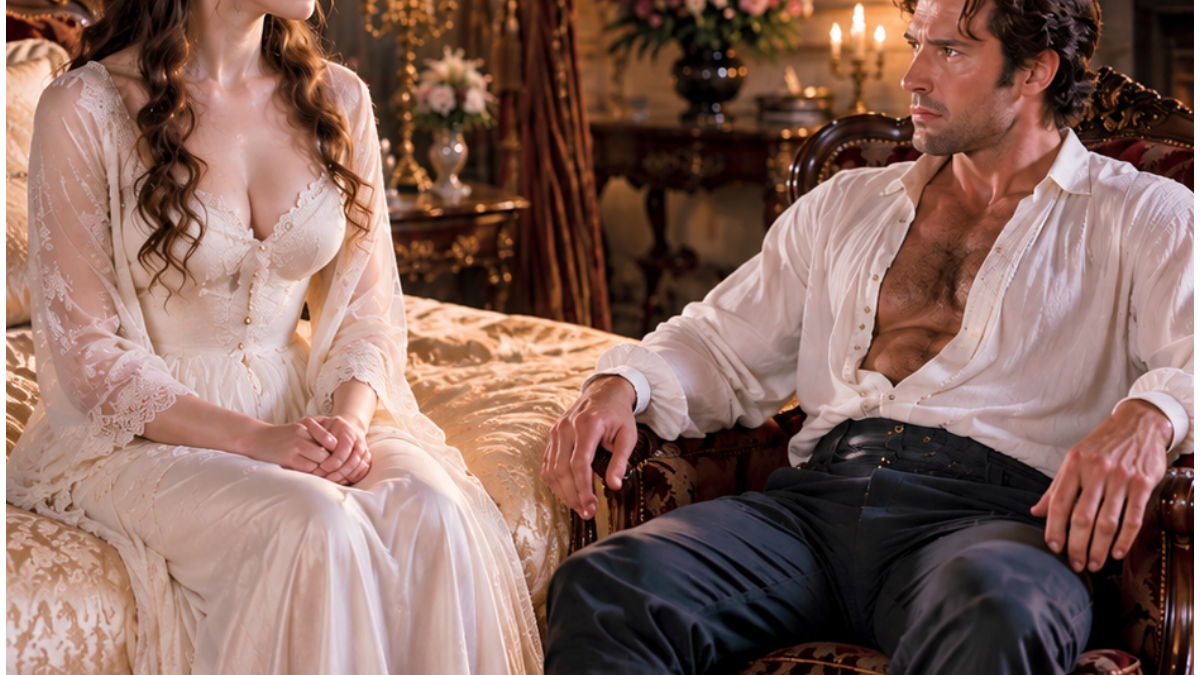
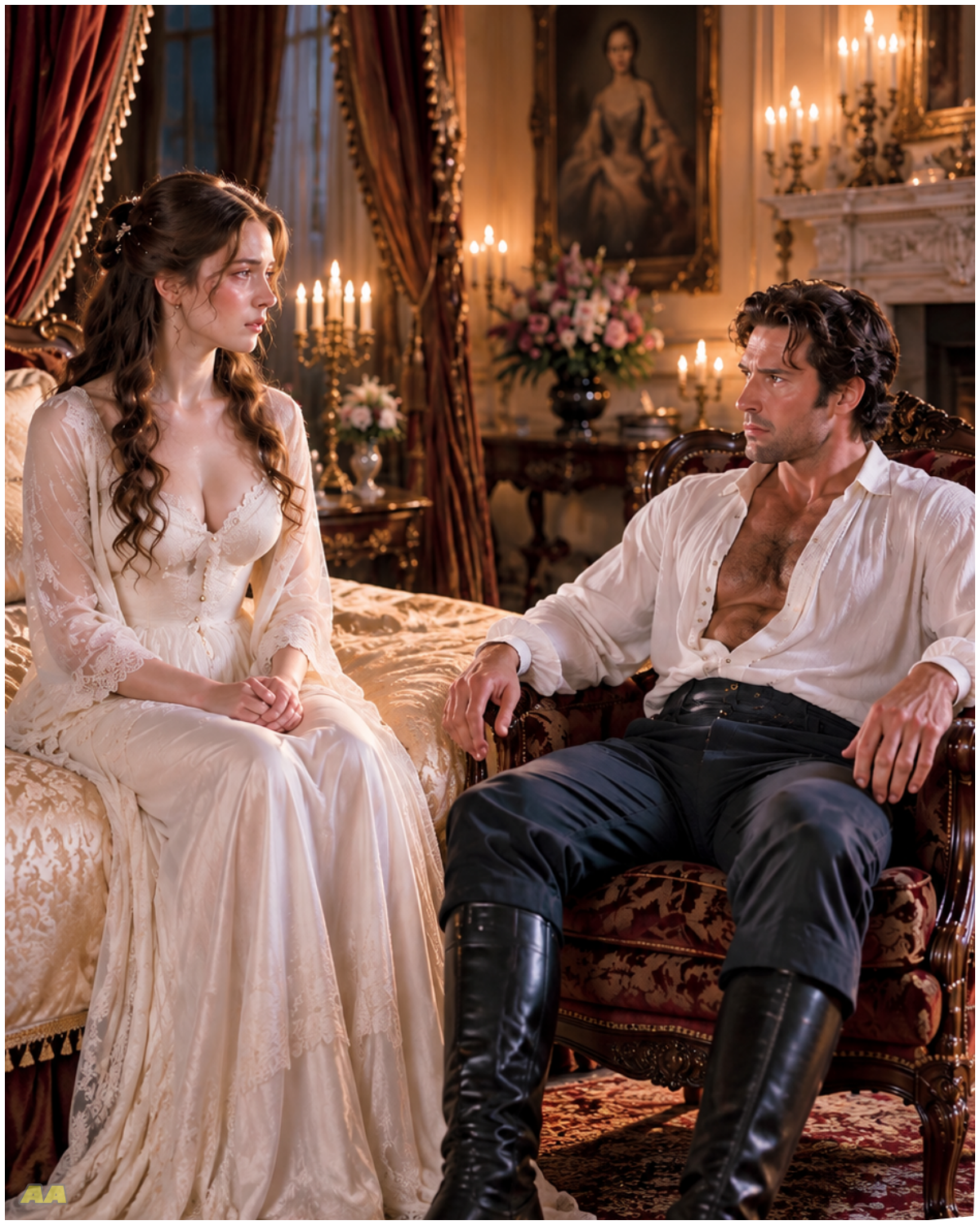
The wedding dress didn’t belong to her.
Neither did the man waiting at the altar.
But Eleanor Whitmore walked toward both of them with her spine straight and her jaw set because she had learned long ago that dignity was the one thing her stepmother could not take from her no matter how many other things she took.
Margaret stood in the third row wearing silk and satisfaction.
Eleanor kept walking. She did not look at the guests.
She did not look at the flowers.
She looked directly at the Duke.
The man London called heartless, dangerous, cruel, and she made herself a silent promise.
Whatever this is, I will not break.
The dress was two sizes too large.
Eleanor discovered this at 6:00 in the morning when Agnes helped her into it.
The ivory gown her stepmother had pulled from some cousin’s trunk, unwashed, unaltered, still carrying the faint smell of cedar and someone else’s old life.
The fabric pulled at Eleanor’s shoulders.
The bodice gaped. Agnes grabbed pins from her apron pocket without a word and started working.
And Eleanor stood very still and let her because Agnes crying quietly while she pinned was still kinder than anything Margaret had said to her in 4 years.
There, Agnes finally whispered, stepping back.
You look beautiful, miss. Eleanor looked at herself in the mirror.
She looked like a woman wearing a dress that was never meant for her, which was, she supposed, exactly accurate.
Agnes. Eleanor turned. Whatever happens today, thank you for everything.
Agnes grabbed her hands. You’ll be all right.
You’re the cleverest person in any room you walk into.
You always have been. Eleanor squeezed back.
She didn’t answer because Agnes believed that and Eleanor loved her for it and she didn’t want to say what she was actually thinking that cleverness had not saved her from this.
That cleverness had in fact made her useful to her stepmother which was an entirely different thing from being valued and that there was a version of this morning where being less intelligent might have meant being less expendable.
She let Agnes believe the comforting thing.
She put on her coat.
She walked downstairs. Margaret was already in the hall, dressed magnificently in deep green, every detail considered, every button perfect.
She looked Eleanor up and over with the brisk efficiency of a woman, checking that a piece of freight was acceptably packaged.
That will do, Margaret said.
That will do. Not you look lovely.
Not I’m sorry it came to this.
Not even the minimal human acknowledgement of what was about to happen to the young woman she had raised for 4 years.
That will do. Eleanor held her stepmother’s gaze for one long deliberate moment.
“Yes,” she said quietly.
“I suppose it will.”
She walked past her to the carriage.
The church was half empty.
Eleanor counted 17 guests as she walked down the aisle, which told her everything she needed to know about what society thought of this wedding.
The people who came were not there to celebrate.
They were there to witness the way people slow down to observe an accident.
Not because they want to help, but because something in them needs to confirm that it’s real.
She heard the whispers. She felt them more than heard them.
Actually, the shift in posture, the angle of heads, the particular quality of silence that surrounds a woman.
Everyone has already decided to pity.
Eleanor kept walking. And then the church doors at the front opened and the Duke of Raverish walked in and the entire room changed.
He was not what she expected.
She had built a mental image from the rumors, something hunched, some harsh, something that matched the word cruel in the way it was whispered.
What she got was a man who was tall and lean and carried himself like someone who had made peace with the fact that rooms went quiet when he entered and had decided he simply didn’t care.
The limp was visible. His right leg moved carefully, deliberately, but it didn’t diminish him.
If anything, it made him look like a man who had been through something real and come out the other side still standing.
He wore black, no flower, no decoration, no performant.
His eyes swept the room once, not nervously, the way people scan a room when they’re uncertain.
Efficiently, the way soldiers check terrain.
Then they landed on Elellanor.
She did not look away.
Neither did he. He walked to the altar and something happened in Eleanor’s cheSt. Not the thing she expected.
Not dread, not the cold hollow she had been bracing for all morning.
Something more complicated, something she didn’t have a clean word for.
He stopped beside her. Up close, his face was harder than she’d expected, and younger, too, not old enough to have earned the reputation he carried.
There were lines around his eyes that came from something other than age.
From weather, maybe from loss.
Miss Whitmore, he said. Lo, direct your grace, she said.
The vicer began. The ring was too large.
Eleanor felt it sliding toward her knuckle as the Duke slid it onto her finger, and she curled her hand instinctively to catch it.
And something odd happened. The Duke noticed.
His thumb pressed lightly over her knuckles just for a second, steadying the ring, steadying her hand.
And then he released her, and the moment was gone so fast she almost believed she’d invented it.
She hadn’t. She’d felt it.
And from the way his jaw moved, the slight tightening, like a man who had done something he hadn’t planned and was recalibrating, she thought maybe he’d felt it, too.
Sign the register, she signed.
He signed beside her. Done.
They walked back up the aisle as husband and wife, and Eleanor kept her eyes forward, and from the third row, she heard Cesily release a breath small, quiet, unmistakably relieved, the sound of a girl who had just watched someone else take the fall she’d been afraid of.
Eleanor said nothing. She walked outside into the gray morning air and the cold hit her face and she breathed it in.
She was married. She was free of Margaret’s house.
Both of those things were true at the same time.
She was still deciding which one mattered more when the Duke appeared beside her.
“The carriage is ready,” he said.
“Yes,” she said.
“Let’s go.”
She did not look back at the church.
She did not look back at Margaret.
She climbed into the carriage and the door closed and the horses moved and Eleanor Whitmore.
Eleanor Ravenshire now left the only life she had ever known without allowing herself a single backward glance.
The Duke sat across from her.
He said nothing for the first 10 minutes.
Eleanor watched him the way she always watched people she needed to understand quickly.
Not staring but present cataloging the way he held his injured leg slightly extended.
The way his hands rested still on his knee, not restless, not nervous.
The way he looked out the window with an expression that wasn’t blank exactly, more like carefully closed.
The expression of someone who had decided a long time ago to keep the interior private.
She found herself curious about what was behind it.
That surprised her. She hadn’t expected curiosity.
She had expected endurance. “You’re watching me,” he said without turning from the window.
“Ellanor didn’t flinch.” “Yes, now he turned.” “Why?” “Because I’m going to spend the rest of my life in your house,” she said.
I’d like to understand what I’m dealing with.
Something crossed his face. Not offense, something closer to respect.
Unexpected, brief, quickly contained. And what conclusions have you drawn?
He asked. Too early to draw conclusions, she said.
I’m still gathering data. Data.
He repeated the word like he was testing it.
You’re not sleeping well, she said.
Your eyes and you favor your leg more than you need to.
It’s habit now more than pain, I think.
But it started as pain.
You’re used to being the most guarded person in the room, and you’re mildly unsettled that I haven’t tried to fill the silence with nervous conversation.
The Duke stared at her.
And you, he said slowly, are nothing like what I was led to believe.
What were you led to believe?
Your stepmother described you as quiet, biddable, manageable.
Elellanar felt something cold move through her not surprise.
Just the familiar shape of being erased by someone who needed you small.
And what do you think now?” she asked.
He held her gaze for a long moment.
“I think he said carefully that your stepmother is either very foolish or very frightened of you.” Eleanor looked at him.
In 4 years under Margaret’s roof, no one had said that to her.
“Not once. Not in those words.” “How long is the journey?” she asked.
“Because she needed to move the conversation before something cracked open in her face.” “4 hours,” he paused.
There are things I should tell you about the estate before we arrive.
Tell me. So he did the housekeeper the accounts in poor condition, his suspicions about two of the groundskeepers.
He spoke in plain direct sentences without softening anything, and Eleanor listened and asked precise questions, and by the time he finished, they had covered more practical ground in 40 minutes than most newly married couples covered in a month.
When they finished, a silence settled between them, but it was a different silence than the one at the start.
Not the silence of strangers, something that had been broken in and was slightly more comfortable now, Elellanor, he said.
It was the first time he used her name.
Yes, I want to be direct with you about something.
Please, he looked at her steadily.
This marriage was arranged to solve a problem for your family.
And if I am honest for me as well, I am not going to pretend it was anything else.
I wouldn’t want you to, she said.
But I want you to understand something.
He paused as if choosing the words carefully.
I have been lied to by a great many people in my life.
People I trusted. People I gave things to that I cannot get back.
His voice didn’t change. It stayed level controlled.
But something underneath it was not controlled at all.
I am not easy to be around.
I know that. But I am not cruel to people who don’t deserve it.
Eleanor looked at him for a moment.
And what was your first wife like?” she asked quietly.
The carriage went very still.
She watched his face change.
Not break, not flinch, but close.
The way a door closes when there’s wind.
Fast and without drama. I don’t have a first wife, he said.
I heard. You heard wrong.
Short, flat, final. Eleanor filed that away.
Every closed door is a door.
Closed doors open. All right, she said.
All right, he repeated. The horses kept moving.
The moment they arrived at Ravenshshire Castle, she understood two things simultaneously.
First, this place had been beautiful once, really genuinely beautiful.
The bones of it were extraordinary.
The proportions right, the stonework still proud even under the weathering.
Someone had loved this house once, built it with intention, cared for it with attention.
Second, whoever that person was, they were gone.
And in their absence, the house was slowly coming apart.
The staff stood in the entrance hall.
Eleanor counted and categorized quickly the way she always did.
11 people. Mrs. Pelum at the front with the posture of a woman who considered herself the true authority regardless of who walked through the door.
The two groundsmen at the back who found three different places to look that weren’t Eleanor’s face.
A young girl near the kitchen corridor who looked absolutely terrified.
Four others she hadn’t classified yet.
Mrs. Pelum, the Duke said.
Your grace. The housekeeper’s eyes moved to Eleanor with the particular assessment of a woman measuring a threat and deciding it’s manageable and the new Duchess.
The pause before Duchess was exactly long enough to be a message.
Eleanor stepped forward before anyone expected her to.
Mrs. Pelum, I’m Eleanor. She smiled warm direct, giving nothing away.
I’ll need to review the household accounts this week.
All of them. Beginning with the supply inventories for the past 6 months.
Mrs. Pelum blinked. The accounts your grace?
Yes. And the receipts? If they’re organized, I’m sure they are.
Still smiling. I’d like to sit down with you tomorrow morning.
Shall we say nine? Mrs. Pelum looked at the Duke.
The Duke said nothing. Of course, your grace, Mrs. Pelum said.
Eleanor turned to the rest of the staff and spent the next 12 minutes doing something that apparently nobody had done in a very long time.
She learned their names. Asked how long they’d been there, asked what they were responsible for, asked what they found most difficult about their work.
Small questions, specific questions delivered with genuine attention.
The terrified young girl near the kitchen corridor, her name was Rose.
She was 15. She’d been at Ravenshshire 8 months and had never been spoken to directly by anyone above the level of housekeeper.
Looked like she might cry when Eleanor asked her name and repeated it back and said, “Rose.
Good. I’ll remember.” When Eleanor finally turned back, the Duke was watching her from across the hall.
She had learned in 40 minutes of marriage what his assessing look meant.
This was not his assessing look.
This was something else, something she didn’t have a word for yet.
She filed it away. She was building a vocabulary for him.
Piece by piece. Her room was at the end of the east-wing corridor, clean, sparse.
A window overlooking the kitchen garden, which had gone completely wild weeds shoulder high, paths invisible, whatever order had once existed entirely reclaimed by neglect.
Eleanor stood at the window and looked at it for a long time.
She was looking at the garden because if she stopped looking at the garden, she would have to acknowledge that she completely alone in a house of strangers in a county she’d never visited, married to a man she’d known for 6 hours, and that the sum total of everything she’d brought with her fit in two trunks and a small leather case.
She was very good at finding things to look at.
A knock at the door.
She expected Agnes. Agnes was somewhere below getting settled, probably chatting up the kitchen staff already because Agnes could befriend anyone in under 10 minutes and considered it a moral obligation.
It wasn’t Agnes. The Duke stood in the doorway.
He had taken off his coat.
Without it, he looked different, less formal, the lines of him more visible.
He was leaning slightly on the door frame, redistributing his weight.
And she noticed he did that in private spaces, in a way he didn’t do in public.
Allowed the accommodation that the leg needed instead of forcing it into concealment.
She noticed because she noticed everything.
I need to tell you something, he said.
Come in, she said. He shook his head slightly.
Stayed in the doorway, keeping a boundary she hadn’t asked for, maintaining a distance that told her something important about him, that he understood what she was in this house right now, and he was not going to crowd her.
That that small thing cracked something open in her chest that she immediately pressed back down.
Your mother’s estate, he said.
Eleanor went still. Your father separated a portion of your mother’s inheritance before his death.
It was held in a protected trust separate from your stepmother’s management outside the scope of the family accounts.
Your stepmother either didn’t know it existed or knew and chose not to tell you.
Eleanor stared at him. My solicitor discovered it during the marriage arrangements.
He continued. I had it transferred into your direct name this morning.
It belongs to you. It has always belonged to you.
The silence stretched wide and strange.
How much? She asked because she was Eleanor and she always asked the practical question first and felt things second.
He told her. It wasn’t a fortune, but it was real, solid enough that she had not entered this marriage with absolutely nothing as she had believed.
Enough that the ground felt different beneath her feet.
Why are you telling me?
She asked, her voice very careful.
You didn’t have to. No, he said I didn’t.
Then why? He looked at her with those dark gray eyes.
And for the first time since the church, she felt like she was singing something he didn’t usually let people see.
Because I wanted you to know, he said quietly, that whatever happens between us, whatever this becomes or doesn’t become, you are not here because you had no other choice.
You were brought here by people who didn’t ask you.
That is different. You deserve to know the difference.
Eleanor held his gaze. She thought about four years of being managed, arranged, packaged, handed off.
She thought about 6 hours of this man, the hand over hers at the altar, the careful distance in the doorway, the direct honesty in the carriage.
Your grace, she said. Adrien, he said, you can call me Adrien.
I think if we’re going to be honest with each other, titles are a waste of effort.
Eleanor looked at him for a long moment.
Adrien, she said something happened to his face when she said his name.
Something small and real and quickly contained the way a candle moves when a window opens.
Just a flicker, just enough to prove there’s a flame.
There is something you should know about me, she said.
I don’t I don’t do this easily.
Any of this I’ve spent four years being useful and being overlooked, and I have learned to function very well in both states.
So, if I am sometimes, she searched for the right word, more business-like than the situation perhaps requires, it’s not coldness.
I know, he said. You’ve known me 6 hours.
I know, he repeated. I recognize it.
She understood what he meant.
She understood immediately, precisely, completely, because what he was describing was the same armor in a different material.
They looked at each other in the doorway of her room in his house.
These two strangers who were not quite strangers anymore, and the thing that passed between them was complicated and fragile, and neither of them was ready to name it.
“Good night, Elellanar,” he said.
“Good night, Adrien.” He turned to go, “Adrien,” he stopped.
“The kitchen garden,” she said.
“Below this window.” “Who planted it originally?” A pause that lasted a beat too long.
“My mother,” he said without turning around.
She died 11 years ago.
Eleanor looked at the back of him, the straight set of his shoulders, the careful hold of his injured leg, the controlled stillness of a man absorbing something he had decided long ago not to bleed in front of people.
I’ll restore it, she said.
If that’s all right. Another pause.
Yes, he said very quietly.
I’d like that. He left.
Eleanor turned back to the window and pressed her fingers lightly against the glass and looked at the garden below, overgrown, neglected, full of life underneath that no one had bothered to tend in 11 years.
She thought about a woman she’d never met who planted this.
She thought about the son who’d been carrying that loss in his face since before she arrived.
She thought about her own father.
She thought about what it meant that two people who had each lost the only parent who truly loved them had ended up in the same house on the same night for all the wrong reasons.
Maybe, she thought. Just maybe, she did not finish the thought.
She wasn’t ready. 3 days into her life at Ravenshshire, the housekeeper made her move.
It was elegant. As sabotage goes, the supply receipts arrived incomplete.
3 months of records instead of six.
The inventory columns had gaps that looked accidental, looked clerical, looked exactly like the kind of thing a woman new to an estate might accept without question.
Eleanor was not that woman.
She spent the evening cross-referencing the incomplete receipts as against the estate’s outgoing payment ledger, which she had quietly requested separately the day before without explaining why to anyone.
By midnight, she had the picture.
Systematic inflation, 7% on average, small enough to feel trivial in each individual instance, large enough to matter enormously in aggregate, 18 months of it.
She sat with the total in front of her.
Then she pulled out a fresh sheet of paper and started writing.
She found Adrien in the estate office before dawn.
He was at his desk with maps spread across the surface, land surveys, and he had the look of a man who had been there for hours and intended to be there for several more.
He looked up when she walked in, and something in his expression shifted, not surprise, exactly.
Something that looked almost like relief, like he’d half expected something unwelcome, and gotten something else instead.
“You’re up early,” he said.
“I haven’t been to sleep,” she said, and placed her compiled pages on the edge of his desk.
He looked at her face before he looked at the pages.
“What is it?” he asked.
“Direct. Sit with me,” she said.
“I’ll show you.” So he did.
She walked him through it.
The inflation method, the ledger discrepancy, the pattern across 18 months.
He asked precise questions. She had precise answers.
He did not dismiss anything.
Did not suggest she might be mistaken.
Did not soften his reactions for her benefit.
He simply listened and understood and built his picture.
When she finished, he was very still.
“How much?” he said. “Not a question.
He’d already seen the total.” “Enough,” she said.
He pushed back from the desk and stood moved to the window.
His back to her and she watched the set of his shoulders change.
The controlled stillness she’d come to recognize as his default, it shifted.
Just slightly, just enough. 11 years, he said.
Not to her. To the window, Pelum has been here 11 years.
I know, Elellanor said. I trusted her completely.
I know, Eleanor said again.
He turned. His face was she’d seen him controlled and she’d seen him carefully warm and she’d seen him closed.
She had not seen this.
This was something rawer. A man who has just discovered that the foundation he built on was quietly hollow and is doing the work of not letting that knock him over.
How did you find it in 3 days?
He said when I he stopped.
You weren’t looking, Elanor said.
Not unkindly. You had too many other things to manage and too few people to trust with this level of scrutiny.
She knew your schedule. She knew where your attention was.
She planned around you. A pause.
She did not plan around me.
He looked at her. Something was moving behind his eyes.
Something complicated and compound. Too many things happening at once for any one of them to surface cleanly.
What do you recommend? He asked.
And there it was again.
What do you recommend? Direct and clean and real.
Dismiss her quietly. Severance fair amount.
No public dispute. Have heartly audit everything.
Not just the household accounts.
Everything. All of it. I want to see the full picture before we address anything else.
She paused. “And then I’ll hire a new housekeeper.” He held her gaze.
“Someone you can trust,” he said.
“Yes, you don’t have anyone here you trust,” he said.
It was not an accusation.
It was an acknowledgement. “I have Agnes,” Eleanor said.
“And I am,” she paused, chose the word carefully, beginning to trust you.
The silence that followed was not comfortable exactly.
It was significant. Adrienne Ravenshshire stood at the window of his estate office in the early morning light and looked at his wife.
This woman who had been in his house for 72 hours and had already found what 11 years of household management had hidden from him and his face did the thing she was beginning to watch for that flicker that almost warmth.
I’ll send for Heartley today, he said.
Good. She gathered her pages.
Eleanor. She looked up. He crossed the room toward her.
Not quickly, not impulsively. With the same deliberateness that characterized everything he did physically.
That careful management of the leg and he stopped close enough that she had to look up slightly.
“Thank you,” he said. “Not formally, not with ceremony, just directly.
The way people say things, they mean.
You don’t need to thank me,” she said.
“This is my house too now.” Something in him shifted.
She felt it more than saw it.
A change in the quality of the air between them.
“Yes,” he said. It is.
She held his gaze for one beat longer than was strictly necessary.
Then she stepped back, tucked her papers under her arm, turned toward the door.
“Breakfast in an hour?” she asked.
“Yes,” he said. And then quietly behind her, she heard him say, “I’ll wait for you.” She did not slow her step.
She did not turn around, but her hand, as she pushed the door open, was not quite steady.
Mrs. Pelum left on a Thursday.
Eleanor handled it with the precision of a surge in private, direct, no drama, enough dignity extended to the woman that she had no justification to make a scene.
Eleanor told her exactly what she knew, told her she was not going to destroy her.
Told her what the severance would be.
Mrs. Pelum stood very straight throughout.
At the end, she said, “You’re not what I expected.” “No,” Eleanor agreed.
“He’s different when you’re around,” the housekeeper said.
The bitterness in her voice was faint.
Not toward Eleanor. She realized something older than that.
He used to eat alone every meal for 2 years.
Eleanor looked at her. “Goodbye, Mrs. Pelum,” she said quietly.
The door closed. Eleanor stood alone in the empty parlor for 30 seconds and did not let herself think about a man eating alone in a too large dining room for 2 years.
She could not afford to feel that right now.
She had work to do.
She opened the door and went back.
She walked the tenant farms the next morning.
No invitation, no announcement. Practical boots, Agnes beside her, and the list of questions she’d compiled from Hartley’s records that she needed real answers to the kind that only come from standing on the land itself and talking to the people living on it.
The families told her things they had clearly given up on anyone from the castle ever asking about.
The feed shortages, the two farm houses needing repair since winter, the widow in the northern corner, a Mrs. Huitt, 71, who had not received her monthly provision in 4 months and had been selling chickens to survive.
Eleanor wrote every word down.
She did not make promises she wasn’t sure she could keep.
But she told each person she would come back with answers.
She meant it. When she returned to the castle, Adrienne was waiting in the entrance hall, not pacing, not stern, just standing there.
And when she walked through the door, something moved across his face that she was beginning to recognize.
It was what happened to him when he saw her and felt something he hadn’t budgeted for.
“You went to the farms,” he said.
“Yes, alone.” Agnes was with me.
“Elanor, the north pasture is I know.
The fencing is badly maintained and the path is not fit.
I’ve added it to the repair liSt.” She looked at him.
“Do you want to tell me I shouldn’t have gone or do you want to hear what I found?” A long pause.
“What did you find?” he said.
She told him everything and she watched his face change as she spoke.
That particular change she’d first seen in the office, the one that looked like shame, quiet and self-directed, a man understanding the gap between what was happening on his land and what he had believed was happening on his land.
Mrs. Huitt, he said when she finished 4 months.
Yes. Send her provision today, he said immediately.
Double the amount and have Heartley already written up, Eleanor said and handed him the liSt. He took it, looked at it, looked at her.
You were gone four hours, he said.
I know you did 4 hours of work and came back with.
He looked at the list again.
Adrien, she stepped closer. Not much, but closer.
Close enough that his gaze came up from the paper and landed on her.
These people depend on this estate.
They have been depending on it and being failed by it and they have not complained loudly because they’re afraid of the consequences.
They should not have to be afraid.
A pause. They won’t be.
Not anymore. He was very still.
No, he said they won’t.
They stood in the entrance hall close and not quite touching and something building between them that neither of them had named yet.
And both of them could feel.
And then Adrien did something unexpected.
He reached out. His hand covered hers.
The hand holding the list just for a moment.
Just a second. Warm and deliberate and then gone.
“Don’t scare me like that again,” he said quietly.
“Tell me when you’re going to the far north pasture.
That’s all I’m asking.” Eleanor looked at his face.
He was not asking as her husband, not invoking authority or ownership.
He was asking as a man who had realized somewhere in the 4 hours she was gone, that he had been waiting for her to come back, and that the waiting had not been comfortable.
All right, she said very quietly.
Thank you, he said. They were standing very close.
Close enough that she could see the line of his jaw, the faint silver at his temple she hadn’t noticed before, the particular way he was looking at her that had nothing controlled about it.
Nothing managed. And then Rose appeared at the corridor entrance, the young scullery girl, and said in a small panicked voice, “Your grace cook is asking about supper.
She needs They both stepped back at the same moment.
Tell her an hour,” Eleanor said without turning around and her voice came out steadier than it had any right to.
“Yes, your grace,” Rose said, and disappeared.
The entrance hall was quiet again.
Adrienne turned slightly toward the corridor.
“An hour,” he said. “An hour,” she agreed.
He walked toward his office.
He was halfway down the corridor when he stopped.
Didn’t turn around. Elellanor, yes.
Would you? A pause brief.
The pause of a man who has to decide to something and is negotiating with himself about the exact form of it.
Would you take supper with me in the main dining room rather than separately?
She looked at his back.
She thought about what misses Pelum had said.
He used to eat alone every meal for 2 years.
Yes, she said. Good. He said and kept walking.
Eleanor stood in the entrance hall and did not move for a full 10 seconds.
Something was happening. Something she had not planned for, had not included in any of her careful mental lists, had not allocated space for in the practical architecture of how she had intended to survive this marriage.
Something that felt dangerously close to hope.
She pressed it down. She was not ready.
But as she walked toward the stairs, she was already thinking about tomorrow, about what she would tell him at breakfast, about the restored garden and the repair list and the tenant farms and the long work of making this broken place whole again.
About how she wanted to tell him those things.
About how she wanted to be the person sitting across from him when she did.
She climbed the stairs. She did not press it down quite all the way.
The first supper together was almost a disaster.
Not because of anything dramatic, not because of a fight or a misunderstanding or a revelation that upended everything.
It was almost a disaster because of something smaller and more honest than any of that.
Because Eleanor sat down at the far end of a dining table built for 20 people, and Adrienne sat at the other end, and the distance between them was so absurd that they had to almost raise their voices to pass the salt.
And at some point, Eleanor looked down the length of polished mahogany at the man she had married 11 hours ago and said completely straight-faced, “This is ridiculous.” Adrienne looked at her.
Then he picked up his plate and his glass and moved to the chair immediately to her left.
“Better,” Eleanor said. Considerably, he said.
The cook had prepared a roast with root vegetables and a bread that was still warm from the oven.
And they ate in a silence that was not uncomfortable, the silence of two people who had already said enough real things to each other that quiet didn’t feel like a threat.
Eleanor ate with appetite. She had not eaten properly since the day before the wedding, and her body had decided that regardless of the circumstances, it was done being polite about it.
Adrienne noticed. When did you last eat a full meal?
He asked. Yesterday morning, she said without embarrassment.
Margaret considered food economy one of the households many opportunities for savings.
Something moved across his face.
Tight, controlled, but present. That won’t happen here, he said.
I know, she said. I already spoke to the cook this afternoon.
He looked at her sideways.
You spoke to the cook.
I speak to everyone. It’s how I learn things.
She reached for the bread.
I learned, for instance, that your cook, Mrs. Pharaoh has been requesting a new kitchen range for 8 months and keeps being told the budget doesn’t allow it.
I also learned that the current range burns unevenly and she’s been compensating for it for over a year, which explains why the roast is slightly overdone on the left side.
Adrienne was quiet for a moment.
I’ll have a new range ordered this week, he said.
I already told her you would, Eleanor said.
Another pause. Then something happened at the corner of his mouth.
Not a smile exactly, but the ghost of one.
Something that had almost forgotten how to complete the motion.
You told her I would before you asked me, he said.
I was confident you would, she said.
I’m learning to read you.
The almost smile stayed. And what have you learned?
He asked. Eleanor considered him.
The way he held his fork.
The way he’d moved his plate without being asked.
The way heed said that won’t happen here with a flatness that meant he was angry on her behalf but had decided not to perform it.
You’re fair, she said. When you understand a situation, you respond to it fairly.
Your difficulty is not fairness, it’s access.
People haven’t been telling you the truth about what’s happening in your own house.
So, you’ve been making decisions without the information you needed.
She paused. That ends now.
He looked at her for a long moment.
You’ve been here one day, he said.
Yes, she said. And you’ve already decided how things are going to go, haven’t you?
The silence stretched between them, warm and slightly charged.
Yes, he said quietly. I have.
They ate the rest of the meal close together at the end of a table built for 20, and neither of them moved back.
The audit began on Thursday.
Hartley arrived with two assistants and a look of professional alarm that he was working very hard to keep professional.
Eleanor sat across from him in the estate office with her own notes and her own compiled discrepancies and proceeded to make it very clear within the first 20 minutes that she had already done a significant portion of his job.
“Hartley adjusted his spectacles twice.” “Your grace,” he said carefully.
“Where did you obtain these figures?” “From the ledgers,” Eleanor said.
Cross-referenced against the payment records and the inventory receipts.
The methodology is outlined on the third page.
Hartley looked at the third page.
He adjusted his spectacles again.
This is, he stopped. Started again.
This is extremely thorough. Thank you, Eleanor said pleasantly.
Shall we begin with the agricultural accounts or the household?
By midday, the picture that emerged was worse than Eleanor had estimated, and better than it could have been worse, because the diversion ran deeper than Mrs. Pelum alone.
Better because the estate’s underlying land value was sound.
The problem was not the foundation.
The problem was that everything built on top of it had been quietly rotting for two years while nobody with the authority to fix it had been paying the right kind of attention.
Adrien joined them at 2:00 in the afternoon.
He stood at the doorway of the office for a moment reading the room Elellanor at the table with papers spread across her side across from her looking simultaneously impressed and mortified.
Two assistants writing furiously. How bad?
He asked,”Ellanor looked up. Sit down, she said.
I’ll show you. So he sat and she showed him.
And this time, knowing his face better than she had on Tuesday morning, she watched each piece of information land, watched him absorb it with the controlled stillness of a man who had trained himself not to react, and watched underneath that stillness, the actual impact, the actual weight of understanding what had been taken from him, what had been allowed to happen while he was managing his grief and his injury and his reputation and every other thing that had accumulated in the years since he came back from the Crimea changed.
When she finished, he said, “Nothing for a moment.” Then he looked at Hartley.
“Full restitution,” he said. “Whatever legal recourse is available.
I want it pursued.” “Yes, your grace,” Hartley said.
“And the tenant farMs.” Mrs. Huitt firSt. “This afternoon, not tomorrow.” “I’ve already sent someone,” Eleanor said.
Adrienne turned to look at her.
“I sent in someone this morning,” she said.
“Before the audit. I didn’t want to wait.” He held her gaze.
You sent the provision before the audit confirmed the funds, he said.
Yes, without asking me. Yes, a pause.
Good, he said simply, directly.
And turned back to Hartley.
Eleanor looked back at her papers.
She did not let him see that the single word had done something entirely disproportionate to her composure.
The letter arrived on Saturday morning.
Eleanor was in the kitchen garden.
She had started clearing the outer beds, the ones that had only gone to weed rather than the deeper structural damage.
When Agnes appeared at the garden gate with a sealed envelope and a face that said something was wrong before she’d opened her mouth.
From London, Miss Agnes said, “Your stepmother’s hand.” Eleanor stripped her gloves, took the envelope, opened it.
Margaret’s handwriting was beautiful. She had always had beautiful handwriting, the kind learned in a school room, where appearance was the primary lesson.
The content of the letter had the same quality, elegant on the surface, something uglier underneath.
My dear Elellanar, I write to inform you that Cesaly has received an offer of courtship from Lord Ashworth’s son, which I expect you will agree is a most favorable development for the family.
Given the financial arrangements recently concluded between our estate and the Duke, I am certain you will be willing to speak to your husband on the matter of an additional settlement.
A modest contribution to Cesal’s upcoming season would be most appropriate given all that has been done for you.
Do let me know your thoughts at your earliest convenience.
Your loving stepmother M. Whitmore Elellanor read it twice.
Then she folded it very carefully along its original creases as though she were handling something fragile and handed it back to Agnes.
Burn it, she said. Agnes took it.
Yes, Miss and Agnes. Elellanor pulled her gloves back on.
If any further correspondence arrives from that address, bring it directly to me.
Don’t leave it with the hall table.
Of course, Miss Agnes left.
Eleanor stood in the garden and looked at the work in front of her, the overgrown beds, the buried paths, the life underneath all that neglect that was still there, still trying, and she breathed through the specific fury of being asked by the woman who had sold her for a favor, for money.
She breathed through it. She picked up her tel.
She went back to work.
She didn’t tell Adrienne about the letter.
Not immediately. She held it through Saturday and into Sunday, not because she was uncertain what to do.
She knew exactly what she was going to do, which was nothing.
Because Margaret had no claim on her and less on Adrien, but because something about telling him felt intimate in a way she wasn’t ready for.
Telling him meant showing him exactly how she’d been treated.
It meant letting him see the mechanism of the cruelty clearly rather than inferring it from evidence.
She wasn’t sure why that felt harder than showing him the embezzlement.
She told him Sunday evening they had developed in the space of 5 days a habit of sitting after supper not in the formal drawing room which neither of them seemed to have any instinct toward but in the smaller room off the library where there were two chairs near the fire and enough light to read by.
Eleanor had brought her account books the first evening Adrienne had brought maps.
They worked in a companionable parallel silence that had become, without either of them naming it, the part of the day Eleanor looked forward to moSt. She told him about the letter while she was looking at her account books, and he was looking at a land survey because somehow it was easier to say it without eye contact, without making it into more than it was.
“My stepmother wrote me,” she said.
The sound of Adrien setting down his pen.
“She wants money,” Eleanor continued.
“For Cesalie’s season. She framed it as though I owed it to them.
As a courtesy, she paused.
I burned the letter. Silence, Eleanor.
His voice was very quiet.
I don’t want anything done about it, she said quickly.
I want to be clear.
I’m not telling you, so you’ll intervene.
I’m telling you because you asked me to tell you things about the estate, about anything that matters.
She finally looked up and apparently this is the kind of thing you should know.
He was looking at her with an expression she had not seen before.
It was not anger, though there was anger in it.
It was not pity, and she was grateful for that because pity would have been wrong.
It was something more complicated, something that looked like a man putting pieces together that he had already half assembled and didn’t like the picture of how long, he said.
4 years. How long has she been treating you as Adrienne?
Eleanor held his gaze. It’s over.
I’m here. That’s what matters.
It’s not over if she’s writing to you.
He said she won’t do it twice.
Eleanor said. She knows I burned it.
The silence will communicate everything I would have said.
He looked at her for a long moment if she contacts you again.
He said, “Tell me. I just told you.” She pointed out.
“Tell me before you burn the next one,” he said.
Elellanor considered that. “All right,” she said.
He didn’t immediately go back to his map.
He sat looking at her with that unresolved expression.
All those pieces still assembling.
And then he said something she wasn’t prepared for.
I should have asked more questions, he said before the arrangement was finalized.
My solicitor handled the majority of the negotiations and I left it to him because I didn’t.
He stopped. Chose his words.
I didn’t think it mattered at the time what her situation was in the household.
I thought I was solving a financial problem and the human element would another stop.
I was wrong about that.
Eleanor looked at him. You didn’t know me, she said.
No, he said, but I should have asked.
The fire moved between them.
Adrien, she said, you’re not responsible for what my stepmother did.
I know he said, but I brought you here without understanding what I was bringing you from.
That he held her gaze that matters to me now.
Now the word landed precisely.
Not it always mattered. Not the comfortable dishonesty of retroactive care.
Now meaning since I met you, since I started learning what you are, since that became something it hadn’t been before.
Eleanor found she had nothing to say, which almost never happened.
I’ll be all right, she finally managed.
I know you will, he said.
That’s not actually what concerns me.
She waited. What concerns me, he said carefully, as though navigating unfamiliar terrain, is whether you will let yourself be all right here in this house.
With the slightest pause with me.
Eleanor looked at him across the small space between two chairs.
She thought about the first supper, about him moving his plate without being asked, about the morning in the office, his hand covering hers for one second and then gone, about I’ll wait for you, about the garden below her window, and what he’d said about his mother with his back turned.
I’m already letting myself, she said quietly.
You should know that. The fire moved.
Adrienne looked at her and something in him, that careful managed, long practiced interior shifted in a way she felt more than saw.
“Good,” he said. He picked up his map.
She picked up her ledger.
They sat in the small room off the library while the fire burned down, and neither of them went to bed for another 2 hours, and neither of them mentioned it.
The letter from London arrived on Monday, not from Margaret.
This one was different. Heavier paper, formal seal, addressed to the Duke, and delivered with the morning poSt. Eleanor was at breakfast when Adrienne opened it.
She watched his face as he read, watched the careful stillness sharpen into something colder, and she set down her tea.
“What is it?” she asked.
He read it through twice before he answered.
“An invitation,” he said. “The Hartley Fords are hosting the first significant ball of the season.
We’re expected to attend.” When?
3 weeks. Eleanor absorbed this.
And this is the first event I would have attended in 4 years.
He said flat matter of fact giving her the information without dressing it up.
The first event we would attend together as he set the letter down.
London will want to see you.
London will want to see whether I’m a victim or a social climber.
Eleanor said. Yes. And you London has already decided what I am.
He said I’m not particularly concerned with revising their opinion, but you’re concerned with mine.
She said. He looked at her sharply.
What you experienced there? He said, “Yes, that concerns me.” Eleanor picked up her tea.
She thought about society balls, about being the girl who stood at edges, manage coats, and refilled punch glasses, and watched her stepsister dance.
About being invisible by design, because visibility meant comparison.
I’ll need a gown, she said.
Of course, a proper one.
Not she didn’t finish the sentence.
Didn’t need to. Whatever you need, he said immediately.
Hartley will arrange an account at I’ll manage the arrangements myself, she said.
But thank you. He nodded a pause.
Eleanor, he said, I want to ask you something and I want you to answer me honestly.
She met his eyes always.
Are you afraid of it?
The ball? The people? She considered this with the seriousness it deserved.
No, she said, I spent 4 years being afraid of smaller things.
A ballroom full of people with opinions I didn’t ask for doesn’t particularly frighten me.
She paused. What I dislike is being looked at as though I’m a problem someone else created and you’re the solution to as though I have no existence independent of what you chose to do about me.
Adrienne was quiet for a moment.
Then we’ll make sure he said slowly.
That isn’t the impression anyone leaves with.
How? She asked. He looked at her and for the first time she saw something in his face that was deliberate and unguarded at the same time.
Not the flicker she’d been cataloging, something more committed than a flicker.
By being accurate, he said about what you actually are, she held his gaze.
And what am I? She asked quietly.
Not performing, actually asking. He held her gaze for a long moment.
The person who is fixing my estate, he said.
The person my tenants are already talking about.
The person who burned my kitchen garden back to the ground to let it start again properly.
A pause. The person who told me the truth in a house where nobody had been telling the truth for years.
Eleanor’s hands were very still around her teacup.
Adrien, she said, “Yes, that was.” She stopped.
“That was a great deal to say at breakfaSt. Something happened at the corner of his mouth.
Not the ghost this time.
Closer to the real thing.” “Yes,” he said.
“I suppose it was.” The second week passed in a rhythm that Eleanor had not expected and did not know how to name.
Each morning brought new probleMs. The tenant farm repairs were underway, but supplies were running behind schedule and two of the workers had to be redirected.
The kitten range arrived on Wednesday and Mrs. Pharaoh cried, which Eleanor dealt with by pretending not to notice until Mrs. Pharaoh had composed herself.
The new housekeeper a Mrs. Collins, recommended by Hartley, whom Eleanor had interviewed for an hour and found cautiously promising, arrived on Thursday and had to be oriented to a household in the middle of significant reorganization, which she took with admirable equinimity, and every evening they sat in the small room off the library.
It was not a scheduled thing.
There was no agreement. Eleanor simply found herself there after supper each night, and Adrienne simply found himself there, too.
And the parallel work shifted gradually into conversation about the estate, about the repairs, about the tenants, and then slowly incrementally about other things.
He told her about the Crimea obliquely, the way veterans talk about it, not the things that happened, but the shape left by them.
He mentioned a man named Carver, who had been his who hadn’t come back.
He mentioned that the leg had been a musket wound that the field surgeons had told him he might lose and that he had spent three months in a hospital in Malta arguing with doctors who kept telling him to be grateful he was alive.
“Were you?” Eleanor asked. Grateful.
A pause. Eventually, he said, “Not immediately.
She didn’t push. She understood that some things needed the exact amount of space they needed and no more.
In return, she didn’t plan it.
It simply came out one evening.” She told him about her father, about the library he’d built with her, about the way he used to argue with her about history, the two of them across a table with books spread between them, her father insisting she was wrong about something, and Eleanor being right about it, and both of them knowing it, but her father making her prove it anyway, because he said the proving was the important part.
He sounds remarkable, Adrienne said.
He was, Eleanor said. He was the only person in my life who treated my intelligence as a feature rather than a problem.
A pause until now, Adrienne said.
Eleanor looked up from her book.
He was looking at her with that direct quality.
He had the thing that looked like assessment at first and turned out to be something much closer to attention.
Real sustained considered attention until now.
She agreed quietly. It was Friday evening when things shifted.
Eleanor had been working through the estate correspondents a backlog of unanswered letters that had accumulated for months, many of them from tenants, some from local trades people, two from neighboring landowners who had apparently given up expecting responses.
She was writing replies at the desk in the library when Adrienne came in from outside and she could tell before he reached the doorway that something was wrong.
Not dramatically wrong, quietly wrong.
The particular set of his shoulders when he was carrying something.
“Sit down,” she said before he spoke.
He stopped. “I haven’t told you what it is.
I know. Sit down anyway.” He sat in the chair across from her desk, set his hands on his knees, looked at them briefly, then looked up.
“I received word today,” he said, about the land on the eastern boundary.
“The parcels I’ve been trying to consolidate for the last year and a half.
Lord Fenwick has decided to sell to an outside party rather than agree to my offer.
Eleanor set her pen down.
Who is the outside party?
A development group, Manchesterbased. They want to convert the land to industrial use.
Eleanor looked at him. That land borders three of your tenant farMs. Yes.
If an industrial operation goes in there, the farming becomes non-viable.
The noise, the pollution to the water table.
Yes, he said again. I know.
What recourse do you have?
Limited. The land is Fenwicks to sell.
My offer was fair better than fair.
He took the other party.
Why? He paused. Because the other party is better connected.
Because I have spent four years making myself deliberately unavailable to polite society.
And the consequence of that is that when someone needs to choose between the reclusive Duke and a Manchester industrialist with the right friends in the right clubs, they choose the industrialiSt. Eleanor absorbed this.
That’s what the ball is really about, she said.
Not a question. He held her gaze partly.
You need to be visible again.
Not for vanity, for leverage.
Yes, she picked her pen back up.
Can Fenwick sale be delayed?
She asked legally. Is there a survey required?
A process? Hartley says 6 to 8 weeks potentially, depending on the land registry process.
6 to 8 weeks is enough time, Eleanor said.
For what? She looked up at him.
For us to be at every significant event in London society for a month, for you to remind everyone who you are and what you represent, and for me to have conversations with the right people about what industrial development does to agricultural land.
She paused. I spent four years managing a household in London society’s lower atmosphere.
I know which wives have their husband’s ears.
I know which women actually run the decisions that their husbands are credited for.
Adrienne looked at her. You would do that.
He said, “Walk back into that world.” I told you.
She said, “I’m not afraid of ballrooms, Eleanor.
I am going to be honest with you.” She said, “I care about those farMs. I have been on that land and I have met those people and I care about what happens to them.
I will walk into every overcrowded drawing room in London to protect that.
And I will smile and make conversation and be whatever version of the Duchess of Raven is most useful, and I will not find it particularly difficult.” She met his eyes because now I know what I’m walking in for.
That changes everything. Adrien Ravenshshire sat across from her and looked at his wife in the lamplight of the library and something happened to his face that she had not seen there before.
Not the ghost of a smile, not the flicker, something that had actual weight behind it.
He reached across the desk.
His hand covered hers, the one holding the pen.
And this time he didn’t pull back after a second.
You are? He started and stopped.
Finish the sentence,” she said.
He looked at her hand under his.
“You are not what I expected,” he said.
When I agreed to this arrangement, I thought, he paused.
I thought I was solving a practical problem.
I thought I would have someone competent and the house would function and we would manage each other without another pause.
Without any of this, Eleanor turned her hand over under his.
And now, she asked, he looked up.
Now, he said, “I am fairly certain that whatever happens next, I don’t want it to happen without you.” The library was very quiet.
Eleanor held his gaze. Her heart was doing something completely inconvenient, and she had absolutely no intention of letting it show onto her face, except that it already was, and he was already seeing it, and they were past the point where pretending otherwise was going to accomplish anything useful.
Adrien, she said, “Yes, I’m going to need a very good gown for this ball.” He laughed.
It was a short sound, slightly surprised, like a man who had genuinely forgotten he knew how to make it.
It changed his whole face.
Made him look younger, lighter, like whoever he was before the Crimea had briefly surfaced for air.
You’ll have the best one in the room, he said.
I’m not interested in the best one in the room, she said.
I’m interested in the right one.
There’s a difference. Yes, he said.
His hand was still over hers.
There is. They sat there in the library, hands linked across the desk covered in estate correspondence.
And outside the windows, the evening had turned to full dark.
And inside this house, things were different than they had been a week ago.
Different in ways that neither of them had planned, different in ways that both of them were beginning to understand were permanent.
On Saturday morning, Eleanor went back to the kitchen garden.
She had been working on it in pieces, an hour here, an afternoon there, working from the edges inward, clearing before planting, making space before making anything new.
She was on her knees in the east bed when she heard him.
“You’re doing it wrong,” Adrienne said from behind her.
She looked up. He was standing at the garden gate in his working clothes, a spade in his hand, looking at the bed she was working on with the expression of someone who had specific opinions about it.
I’m clearing the weeds, she said.
You’re cutting the roots at the surface.
They’ll be back in 2 weeks.
I’m aware. I was planning to come back in 2 weeks.
Or he said, opening the gate and coming in.
You could do it properly the first time.
He knelt beside her. The movement was careful, managed.
But he did it without ceremony and showed her where Droosum ran underground, how deep to go, what to pull, and what to leave.
And they worked together in the garden that his mother had planted.
In the morning light and talked about nothing consequential about the soil composition and the season and what had been growing here before and what could grow here again.
And Eleanor was aware the entire time of how close his shoulder was to hers and she thought he was aware of it too from the way he occasionally went very still for no obvious reason.
She planted three things that morning.
When they were finished, he sat back on his heels and looked at the cleared bed and she watched his face and she saw what happened to him when he looked at it.
Something returned. Something that had been gone a long time.
Adrien, she said. Hm. Thank you for showing me.
He looked at her sideways.
My mother would have liked you, he said.
It was the most personal thing he had said to her.
Eleanor held it very carefully.
Tell me about her, she said.
And he did. He talked for an hour there in the garden, and Eleanor listened to every word, and the estate was coming back to life around them.
And something else was too something harder to name, and more important, something that had started with a dress that didn’t fit, and a marriage neither of them had chosen, and had become in one week’s time, the best thing in both of their lives.
Neither of them was quite ready to say that yet.
But both of them knew it, and that for now was everything.
The gown arrived on a Tuesday.
Eleanor had not expected it to be beautiful.
She had given precise instructions, practical color, structured cut, nothing that would make her look like she was trying.
And she had expected those instructions to produce something respectable and forgettable, which was exactly what she wanted, something that would let her move through the room without the gown becoming the subject.
What arrived was not forgettable.
It was deep blue, almost midnight, with a structure that was simple enough to be elegant and fitted well enough to look like it had been made specifically for her body rather than adjusted from someone else’s life, which it had been.
Adrienne had, without telling her, sent her measurements to a London dress maker the same day she’d told him she would manage her own arrangements.
She found this out from Agnes, who found out from Mrs. Collins, who had received the dress maker’s delivery note.
Eleanor stood in her room holding the gown and felt something she was not entirely prepared for the specific emotion of being considered, not managed, not packaged, actually considered by someone who had listened to what she said and then done something more than she asked for without making a performance of it.
She went to find him.
He was in the estate office where he usually was at that hour and he looked up when she came in with the expression of a man who already knew what she was going to say.
You sent my measurements to London, she said.
Yes, he said. I told you I would manage my own arrangements.
You did, he said. You managed the style and the instructions.
I managed the execution. Those are different things.
Eleanor looked at him. You’re going to be very difficult to argue with, she said.
I’ve been told that, he said, and there was something in his voice that was almost almost playful.
Is it wrong, the gown?
No, she said. It’s exactly right.
Good,” he said, and looked back at his papers, and the corner of his mouth did the thing she had come to look for.
Eleanor stood in the doorway for one moment longer than was necessary.
Then she went back upstairs and hung the gown where she could see it from her desk and tried very hard to concentrate on the tenant repair schedules and mostly failed.
They left for London on a Friday morning.
The journey was 4 hours in the opposite direction, and this time the carriage felt different.
Not the silence of strangers negotiating their first hours together, but the easier silence of two people who had run out of topics that needed careful handling and moved into the territory of simply being in the same space without it requiring management.
Adrienne read for the first hour.
Eleanor reviewed her notes on the Fenwick land situation, which she had been building quietly into something she intended to deploy at exactly the right moment, at exactly the right conversation.
At some point, the carriage hit a rough stretch of road, and her papers slid off her lap, and Adrienne caught two of them before they hit the floor and handed them back, and their hands met in the middle, and neither of them moved away particularly quickly.
“What are these?” he asked, looking at the pages in his hand before returning them.
Correspondence records. She said between Fenwick and the Manchester group, Hartley obtained copies through the land registry process.
He looked at her. You’ve been building a case.
I’ve been building several conversations, she said.
Different conversations for different people.
Lady Ashworth is on the land use committee’s charitable board.
She has influence with two of the members.
Lord Carrington’s wife is a close friend of Fenwick’s sister and the Hartley Fords themselves, the people hosting this ball, have a tenant dispute of their own with the same Manchester group from 2 years ago.
That was resolved badly. Adrienne was quiet for a moment.
You researched the hosts, he said.
I researched everyone who will be in that room, she said.
He looked at her with an expression.
She couldn’t quite read something between admiration and something that might have been the early stages of being slightly in awe of her, which she found simultaneously gratifying and embarrassing.
Elellanor, he said, “Yes, you’re remarkable.” She felt her face do something.
She pressed it back down.
“I’m practical,” she said. “Those aren’t mutually exclusive,” he said and went back to his book.
Eleanor looked out the window at the moving countryside and thought about the fact that in three weeks the man across from her had gone from a stranger to the person whose opinion of her she cared about moSt. She thought about how unprepared she had been for that.
She thought about how she was even now still slightly unprepared for it and that the gap between what she’d expected from this marriage and what it was turning out to be was wide enough to be disorienting if she looked at it directly.
She looked at it directly.
She let herself. She was falling in love with her husband.
She did not say this out loud.
She was not ready for out loud, but she let herself know it privately in the moving carriage with the countryside going paSt. And Adrienne, 3 ft away, absorbed in his book, and she held the knowledge carefully, like something new that needed to be handled before it could be trusted.
Then she went back to her notes.
The house they stayed at in London belonged to Adrienne’s late uncle, maintained by a small staff used rarely, carrying the particular quality of places that wait between occupants without quite belonging to anyone current.
They arrived in the early evening.
Adrienne gave her the better bedroom without discussion, and she didn’t argue because she was tired and because it was the kind of thing he did the quiet, practical consideration that he never announced and never seemed to expect credit for.
That night they ate supper in the small dining room and Eleanor told him what she intended to do at the ball and he listened the way he always did completely without interrupting asking one or two questions that were so precise.
They told her he had understood not just what she was saying but what she was building toward.
When she finished he said what do you need from me?
I need you to be yourself.
She said but the version of yourself that people see not the closed off version.
Those are the same version.
He said dryly. Adrien, she met his eyes.
I have seen what you’re like when you’re not performing the Duke, when you’re in the estate office or the garden or here.
That person is more persuasive than the closed off Duke.
And people will respond to him.
A pause. You want me to let people see?
I want you to let people see what I see, she said simply.
The silence that followed was not the comfortable working silence of the library.
This one had more weight.
What do you see? He asked.
Eleanor held his gaze across the supper table.
A man who cares deeply about the people on his land and has had no reliable way of acting on that care, she said.
A man who was honest with me from the first day when he had no obligation to be a man who she stopped gathered herself.
A man who is worth knowing.
That’s what I see. Adrienne looked at her for a long time.
Elellanor, he said. Yes. When this is over the ball, the Fenwick situation, all of it.
He paused. I’d like to talk to you about something that isn’t the estate.
Her heart did the inconvenient thing again.
All right, she said. All right, he said.
They finished supper. Neither of them mentioned what they were actually thinking about.
The heartly Ford ball was everything Elellanor expected and nothing she had feared.
She had feared walking in as an object of pity, the girl who was sacrificed to the frightening Duke, to be examined and clucked over and discussed in terms of her survival.
What happened instead was this.
She walked in on Adrienne’s arm in the midnight blue gown with her spine straight and her chin level and the specific composure of a woman who has survived real difficulty and found it gave her a tolerance for nonsense that most people in this room had never needed to develop and the room felt it not immediately gradually.
The way rooms shift when someone enters who is not performing.
Adrienne drew attention the moment they arrived, which she had expected four years of deliberate absence made his reappearance significant, and people who hadn’t seen him since before the Crimea were visibly recalibrating the version they’d been maintaining in his absence.
She felt his arm under her hand go slightly rigid in the first minutes, and she pressed his forearm lightly once, and he glanced at her, and she gave him the smallest nod.
He released the tension. They moved through the room.
Eleanor executed the first hour exactly as she’d planned.
She let Adrienne navigate the political conversations, the territory he knew from before, while she found the women.
Lady Ashworth was precisely where Eleanor had expected her to be, in the northeast corner with two other women her age, and the watchful quality of someone assessing the room for anything worth paying attention to.
Eleanor gave her something worth paying attention to.
She approached directly, introduced herself without ceremony, and within 4 minutes of conversation had found the topic that mattered, Lady Ashworth’s granddaughter, who was apparently being considered for a position at the new Agricultural Reform Committee, and whose prospects had been quietly complicated by the Manchester group’s political connections.
Eleanor had not known this specifically, but she had known Lady Ashworth cared about something more than social positioning, and she had trusted that the right conversation would find it.
The Fenwick land, Elellanor said, at exactly the right moment, and watched Lady Ashworth’s expression sharpen.
20 minutes later, Lady Ashworth had introduced her to two other women who mattered, and Elellanor had a meeting arranged for the following Tuesday that had nothing to do with the ball and everything to do with the farMs. She found Adrienne in a conversation with Lord Carrington that appeared to have moved well past Pleasantries from the set of both their faces.
She positioned herself close enough to be visible without interrupting.
And when Carrington glanced at her, something shifted in his face reassessment.
She recognized it and he said to Adrien, “Your Duchess has the look of a woman who knows something useful.” “She usually does,” Adrienne said.
He extended his arm slightly, drawing her into the conversation.
And Eleanor joined it and within 3 minutes had given Carrington the information about the Manchester group’s previous land dispute, the one that touched Carrington’s own interests, and she watched it land exactly where she’d calculated.
Carrington left 20 minutes later to find his solicitor.
“That was remarkable,” Adrienne said quietly when they were briefly alone near the edge of the room.
“It was practical,” she said.
You keep saying that because it’s true, Eleanor.
He turned slightly toward her.
In the middle of the crowded room, he lowered his voice so it was for her alone.
You just changed the political calculus of the Fenwick situation in 40 minutes at a party.
Do not tell me that’s merely practical.
She looked up at him.
They were close. The room was loud and crowded around them, and they were in a small pocket of quiet.
And his eyes in this light were not gray.
They were something warmer, something she didn’t have a clean word for.
You’re doing it again, she said.
What? Saying things at inappropriate moments.
She said in the middle of a ballroom.
I have spent 4 years being very appropriate, he said.
I find I’m losing my patience with it.
Eleanor held his gaze. Something was building between them that had been building for 3 weeks and had simply been waiting for a moment that was both public enough to feel significant and private enough to feel real.
Dance with me, he said.
She blinked. Your leg is mine to manage, he said.
Dance with me. She looked at him for one moment.
Yes, she said. He led her onto the floor, and what followed was not a perfect dance.
His leg meant accommodations, a slightly different rhythm, a closeness that was partly practical and partly not.
And Eleanor didn’t care about any of that because she was aware of his hand at her waist and his hand holding hers and the fact that he was watching her face the entire time with an expression that had stopped being managed at some point and was now simply present.
You’re staring. She said yes.
He said it’s noticeable. I know people will talk.
Let them. He said they were going to talk anyway.
Eleanor looked at him. Adrien, she said yes.
After the ball, she said, “The conversation you mentioned about something that isn’t the estate.” His hand at her waist, pressed slightly closer, just slightly.
“Yes,” he said. “I’d like to have it tonight,” she said.
“When we get home,” something moved across his face, warm and certain and already decided.
“Yes,” he said. “So would I.” They finished the dance.
The room watched, and Eleanor Ravenshere, who had walked into this marriage as something to be discarded, stood in the middle of a significant ballroom of the London season, beside the man society called Heartless, and she was not invisible, and she was not a footnote, and she was not an object of pity.
She was exactly where she had chosen to be.
It was Margaret who ruined it.
Of course, it was Margaret.
Eleanor saw her stepmother 20 minutes after the dance across the room in a green dress that matched the one from the wedding and the expression that went with it, that particular satisfied assessment of a woman who has spotted an opportunity.
Eleanor’s first instinct was containment.
She turned slightly, intending to redirect her attention to manage the encounter on her own terMs. But the room was crowded and Margaret was already moving.
And within two minutes, she was standing three feet away with Cesily beside her and a smile on her face that did not reach anything above her cheekbones.
“Elanor,” she said. “What a surprise, Margaret.” Eleanor said, keeping her voice exactly level.
“You look well.” The inventory in those three words was remarkable.
The gown, the posture, the company, the position in the room, all assessed and cataloged in under a second.
And the Duke is he nearby.
My husband is speaking with Lord Carrington, Eleanor said.
Can I help you with something?
Something flickered in Margaret’s eyes.
The word husband delivered without heat, without self-consciousness, without any of the uncertainty Margaret had banked on, landed differently than she’d expected.
“I’ve been hoping to speak with you,” Margaret said, lowering her voice to something that was designed to sound intimate.
“My letter, I wasn’t sure if you received it.” “I received it,” Eleanor said.
A pause. And I have nothing to add to my response,” Eleanor said, which if you’ll recall, I communicated by not responding.
Margaret’s expression shifted the smile, staying in place while something underneath it recalculated.
“Elanor,” she said. “Surely you understand that family.
I understand exactly what family means to you,” Eleanor said quietly.
“I spent 4 years learning it very thoroughly.” Cesily, who had been silent beside her mother, looked at Elellanor with an expression that was almost not quite but almost ashamed.
Eleanor noted it and moved past it.
Cesily was not the problem she needed to manage right now.
I think you should know, Margaret said, and her voice had shifted now, the intimacy gone.
Something cooler underneath that people are talking about this marriage.
About you. There are those who are saying that you’ve positioned yourself very cleverly, Eleanor.
That a girl with your background managing an estate.
Margaret Eleanor stepped slightly forward, not aggressively, just closing the space enough that this conversation was fully private.
I want to be very precise with you about something, and I want you to hear it clearly.
Margaret waited. You made a business arrangement, Eleanor said.
You sold my future to solve a debt problem and you did it without asking me and you did it believing it would diminish me.
I am standing here to tell you that it didn’t.
What you arranged as a disposal became something entirely different and that has nothing to do with you and everything to do with what two people built when you weren’t watching.
She held Margaret’s gaze. If you speak about my marriage to anyone in this room tonight, I will make sure Lord Ashworth’s land committee is aware of the financial irregularities in the Whitmore estate accounts, the ones I identified 2 years ago and never reported because I was trying to protect a family that wasn’t protecting me.
I am done protecting it.
The silence between them was absolute.
Margaret had gone very still.
That’s all, Elellanor said pleasantly.
Enjoy the ball. She turned and walked away.
Her hands were shaking. She reached the side of the room and stood for exactly 10 seconds, letting the adrenaline pass through her.
And then she heard footsteps, and Adrienne was there.
He had clearly been watching from across the room, had clocked the conversation’s trajectory, had moved as soon as she walked away.
“Are you all right?” he said.
“Yes,” she said. And then, because he was looking at her with that complete attention.
“No, a little.” His hand came to her back, solid, present, steady.
“What did she say?” he asked.
Eleanor told him. All of it, including the threat she’d made, including the part where her hands were still not entirely steady.
Adrienne listened without interrupting. When she finished, he said, “Did you mean it about the financial irregularities?” “Yes,” Eleanor said.
Every word. “I do have the records.” A pause.
“And will you report them?” he asked.
Eleanor considered. “No,” she said.
“Not unless she makes it necessary.
I don’t want her destruction.
I just want her to leave me alone.
He looked at her for a long moment.
The Witmore accounts, he said, you knew about them while you were still living there.
Yes. And you said nothing because because they were my family, she said, even when they weren’t acting like it.
Another pause. Eleanor, he said very quietly.
Yes. When we get home tonight, he said, I need to tell you something about the original arrangement, about why I agreed to it.
She looked up at him.
Something in his voice had shifted.
Something that wasn’t the warm assurance of the past 3 weeks.
Something more complicated, slightly more uncertain.
All right, she said. It’s not, he stopped.
It’s not something that changes anything.
I want to say that firSt. Then tell me now, she said.
Not here, he said. Not with all these people.
She held his gaze. Adrien, you’re frightening me a little.
Don’t be frightened, he said.
It’s not. It’s nothing you won’t understand.
I simply want to say it properly.
Without an audience, she nodded.
She trusted him. That was the thing.
She trusted him. And 3 weeks ago, that sentence would have been incomprehensible.
And now it was simply true.
And the fact that something in his voice had shifted did not shake that trust, but sat inside it complicated and present.
All right, she said. Tonight.
Tonight, he said. He kept his hand at her back for the rest of the evening.
They were in the carriage home when Eleanor said, “Tell me now.” Adrienne looked at her.
“We’re still moving,” he said.
“I know,” she said. “Tell me now.” He was quiet for a moment.
The carriage moved through the London streets and the light came in through the windows in moving panels and Eleanor held his gaze and waited.
The arrangement, he said, the dead assumption.
The reason I agreed to it specifically, he paused.
It wasn’t purely practical. There was your stepmother told my solicitor certain things about you about your situation in the household.
Eleanor went still. What things?
She said that you were unhappy.
He said that the household was restrictive.
That you had no prospects, no independence, and no likelihood of either under her management.
A pause. My solicitor told me that he believed the girl in question deserved better than what she was getting and that the Duke might consider whether the arrangement could accomplish more than simply solving a staffing problem.
Eleanor stared at him. Hartley, she saidly, he confirmed.
He is not as purely transactional as he appears.
He told you I deserved better, she said.
He said it in rather more formal language, Adrienne said.
But yes, the carriage moved, so you agreed, Eleanor said slowly.
Not just because you needed a practical wife, but because because Hartley told me there was a young woman being wasted, Adrienne said.
And because I know what it is to be somewhere you’re not seen properly and to have no way out of it.
He held her gaze. I didn’t tell you because I didn’t want you to feel managed.
Arranged again. I wanted you to build your understanding of this marriage without knowing that I had gone into it with the intention of it being he stopped being what she said.
Good. He said, “For you.
I wanted it to be good for you.
Even before I knew you, even when you were just a situation that Hartley described to me.” The carriage hit a smooth stretch of road and the movement steadied.
Elellaner looked at her husband.
She thought about a man she’d never met agreeing to a marriage because his solicitor told him there was someone worth rescuing and doing it without fanfare, without telling her, without using it as a point of moral credit.
She thought about the trunks of financial records he’d had delivered to her the first morning.
The provision sent to Mrs. Hwitt without hesitation, the kitchen range, the gown he’d ordered without announcing it.
The garden, the handover hers in the carriage on the way to London.
You have been taking care of me, she said.
From before you met me.
I tried, he said. I was limited in what I understood then, and now, she said.
He looked at her across the carriage.
Now I understand considerably more,” he said.
“And I find I want to do considerably more.” Eleanor held his gaze.
The thing she had been carrying quietly for 3 weeks, the thing she had named herself in the carriage on the way to London and had been managing carefully ever since rose up and refused to be managed any further.
Adrien, she said, “Yes, I am.” She stopped, started again.
I am not good at saying things I’m not sure of.
I am very good at saying things I’ve verified.
But I am going to say something that I have not fully verified yet because I think you deserve to hear it while it’s still new rather than waiting until I’m certain, which might take me longer than is.
She stopped again. He waited.
I think I am falling in love with you, she said.
I want to be clear that this was not part of my plan.
It is inconveniently early and based on a relatively short sample size and I cannot yet confirm the long-term trajectory, but the current data is Elellanor.
He said, “Yes, stop analyzing it.” She closed her mouth.
He moved across the carriage and sat beside her, not across from her.
Beside her, his shoulder against hers, his hand finding hers in the dark.
And he said very quietly into the small space between them, “I stopped calculating about a week ago.
I’ve simply been waiting for you to catch up.
Eleanor looked at him. That’s smug.
Yes, he said. Probably. And then he kissed her.
It was not a dramatic kiss.
It was not a performance.
It was exactly what it was, a man kissing a woman he had been trying not to fall in love with for 3 weeks and had failed entirely.
In a moving carriage in the dark, with London going past the windows and the rest of their lives still ahead.
Eleanor kissed him back. When they stopped, she kept her eyes closed for one moment.
Then she opened them and he was looking at her and his face was completely open.
All the management gone, all the careful containment.
Just him there, he said quietly.
Yes, she said. There she leaned her head against his shoulder.
His arm came around her.
Outside the windows London moved past and fell away behind them.
And ahead was Ravenure and the garden and the tenant farms and the restored house and a life that was nothing like what either of them had been handed.
It was what they were building and it was for the first time in longer than either of them could precisely measure enough.
It was more than enough.
It was exactly right. The morning after the ball, Eleanor woke up early.
Not because she had to, not because there was a list waiting, though there was always a list waiting, but because something in her had shifted the night before, and she hadn’t fully processed it yet, and she was the kind of person who needed to process things before she could carry them comfortably.
She sat at the desk in the London house in the early quiet before the household stirred and she thought about a carriage moving through dark streets and a man’s arm around her shoulders and the particular quality of a silence that comes after something true has been said.
She was in love with her husband.
She had told him so.
He had kissed her. These were facts.
She arranged them in order and looked at them the way she looked at accountbooks clearly without flinching, allowing the numbers to mean what they meant.
The facts meant that she was no longer simply managing a situation.
She was inside it fully, irreversibly inside it.
And the part of her that had spent 4 years keeping herself slightly apart from everything as a matter of survival was going to have to learn a different way of operating.
She was still thinking about this when the door opened.
Adrienne came in carrying two cups of tea.
He sat one in front of her without a word, sat in the chair across the desk, the same configuration as the library at Ravenshire, she noticed the same instinctive positioning, and looked at her over the rim of his own cup.
You’re thinking very loudly, he said.
I’m always thinking, she said.
This is louder than usual, she looked at him in the morning light, without the managed formality of public settings.
He looked like himself. The version she had been assembling piece by piece since the carriage on their wedding day.
The version she had decided definitively last night was the one she wanted.
I’m recalibrating. She said to what?
To the fact that I told you something significant last night and you told me something significant and now I have to figure out how to carry those things without either making too much of them or not enough.
He was quiet for a moment.
Eleanor, he said. Yes. We kissed in a carriage.
We are not required to immediately determine the full structural caance.
She looked at him. I like structural implications, she said.
I know you do, he said, something warm in his voice.
Something she was going to have to get used to the warmth aimed at her, steady and consistent, and not going anywhere.
But they’ll still be there after breakfaSt. Come eat something.
She looked at her tea at the desk she hadn’t actually done any work at.
At her husband sitting across from her in the early morning carrying tea he’d made himself because he’d known she’d be up.
All right, she said. She stood.
He stood. They walked to the dining room side by side close enough that their arms brushed at the corridor turn and neither of them moved apart.
It was Elellanor thought a very small thing.
It was not small at all.
Hartley arrived at 10:00 with news about the Fenwick situation and it was not the news Eleanor had been hoping for.
The Manchester group had accelerated their timeline.
The land registry process, which Hartley had estimated at 6 to 8 weeks, had been compressed.
Someone had applied pressure called in a connection, moved something that was supposed to move slowly into a faster channel.
They now had 3 weeks, possibly less.
Hartley delivered this information in his precise, apologetic way, while Eleanor sat very still across the table and calculated.
Who applied the pressure? She asked.
Heartly hesitated. The initial indication is Lord Fenwick himself.
He appears to want the transaction completed before another hesitation.
Before what? Adrienne said before the political climate shifts, Hartley said carefully.
There is a land use reform bill moving through Parliament.
If it passes, industrial conversion of agricultural land becomes significantly more regulated.
Fenwick wants the sale finalized firSt. Eleanor looked at Adrien.
Adrienne looked at Eleanor the bill, she said.
How close is it to a reading?
6 weeks potentially, perhaps eight.
So if the Fenwick sale is delayed to that timeline, the regulatory burden on the Manchester group increases substantially.
Hartley confirmed enough that their offer becomes economically unviable.
Then we don’t need to block the sale.
Eleanor said we need to delay it long enough for the bill to move.
The legal mechanisms available are not the only mechanisMs. Eleanor said.
She looked at Hartley. You told the Duke about me before the wedding.
You told him I deserved better.
Hartley went perfectly still. Adrienne said nothing.
Hartley adjusted his spectacles. Your grace.
I’m not angry. Eleanor said.
I want you to understand that.
What I want to know is whether you have the same instinct for the Fenwick situation.
Whether you see the same thing I see.
A pause. What do you see?
Hartley asked carefully. I see three tenant families whose livelihoods depend on that eastern land boundary remaining agricultural.
She said, I see a land use reform bill that is 6 to 8 weeks from providing permanent protection.
And I see a window that needs to be held open by whatever means are available.
She held his gaze. What means are available that we haven’t discussed?
Hartley was quiet for a long moment.
Then he said, “There is a boundary survey dispute from 1,887, unresolved, minor, but if formally contested, it would require a full reservey before any sale could be legally completed.
How long does a reservey take?” Adrienne asked.
“6 to 10 weeks,” Hartley said.
“Minimum.” The room was silent.
Eleanor looked at Adrien. “It’s legitimate,” she said.
“The dispute exists. We’re not inventing it.” “No,” he said.
“We’re not.” He turned to Hartley.
File the contest today. Yes, your grace and heartley.
Adrienne paused. Thank for what you said to me before the wedding.
Hartley looked at him for a moment, then at Eleanor, then back at his papers.
I have always tried, he said quietly, to serve the Duke’s best interests in the broadest sense of the term.
He left. Eleanor looked at Adrienne across the table.
He is a remarkable man, she said.
He has terrible taste in dramatic timing, Adrienne said.
But yes, Eleanor almost smiled.
Then her expression shifted because something had arrived in her mind that she hadn’t had room for until now, until the Heartley situation was processed and filed.
“Adrien,” she said. “Yes, Margaret is going to do something.” He looked at her sharply.
“What makes you say that?” “Because I threatened her last night,” Eleanor said.
And Margaret doesn’t absorb threats quietly.
“She reccalibrates and counterattacks. She always has.” Eleanor turned her teacup in her hands, a small motion, thinking.
I don’t know what form it takes.
But it’s coming, he held her gaze.
Then we’ll manage it together, she said.
Together, he said, as though it were already settled, as though it had been settled for some time, and she was only just now saying it out loud.
They returned to Ravenshar on Sunday.
The estate received them differently than it had 3 weeks ago.
Or perhaps Eleanor simply received the estate differently.
She noticed the small changes the repaired fencing along the north approach.
The new kitchen garden beds visible from the upper windows the way Mrs. Collins stood in the entrance hall with the organized calm of a household being run properly rather than managed around.
She noticed Rose, the young kitchen girl who met Eleanor’s eyes when she came in and gave a small quick smile.
The smile of someone who had been seen and remembered it.
Welcome home your grace, Mrs. Collins said.
Home. Eleanor let the word sit.
She had not had a home in four years.
She had had a house she managed for people who considered her a resource.
Home was different. Home was what happened when a place started to feel like it was keeping something of yours while you were away.
Ravenshere had kept something of hers.
She unpacked that evening while Adrienne reviewed the Fenwick correspondence that had arrived in their absence, and she could hear him moving in the office two doors down the creek of his chair, the occasional sound of him setting down a pen, the silence that meant he was reading carefully.
She had learned his sounds the way she learned everything by paying attention until they became familiar.
She found herself listening for them.
That was new. That was, she thought, what love sounded like in practice.
Not the dramatic declarations, not the carriage kisses, but this standing in a room two doors from someone and listening for the sounds they make and finding that those sounds are quietly one of the things you look forward to moSt. She finished unpacking.
She knocked on the office door.
Come in, he said. She came in and sat in the chair across from his desk and said, Tell me what you’re looking at.
So he told her and she listened and asked questions and they worked through the Fenwick correspondence together until the candles were low.
And at some point she moved her chair around to his side of the desk so she could see the papers directly rather than reading them upside down.
And at some point after that his hand moved to her knee.
Not suggestively, not dramatically, just present.
Warm there she put her hand over his.
They kept working. The first sign that Margaret had recalibrated came on a Wednesday, 10 days after the ball.
It came not through the post, but through a visitor, Lady Fenwick of all people, who arrived at Ravenshshire without an appointment in the midafter afternoon, and was shown into the sitting room by Mrs. Collins with an expression that clearly communicated that Mrs. Collins had opinions about unannounced callers.
Eleanor had been in the kitchen garden.
She came inside still wearing her working gloves which she pulled off as she walked and handed to Agnes and she went into the sitting room and met Lady Fenwick without apology for her appearance.
Lady Fenwick was a thin woman in her 60s with a particular posture of someone who had been told she had good posture so many times that it had become a form of armor.
She looked at Eleanor with an assessment that was trying to look like graciousness and not quite succeeding.
Duchess, she said. I hope I’m not disturbing you.
Not at all, Eleanor said.
Please sit. Can I offer you tea?
Thank you. Lady Fenwick sat.
Eleanor sat across from her and waited because she had learned long ago ago that the person who speaks first in an ambiguous meeting gives away more than they gain.
Lady Fenwick lasted 30 seconds.
I’ll be direct, she said.
My husband is aware of the boundary survey challenge your solicitor has filed.
I would expect so, Eleanor said pleasantly.
He is not pleased. Boundary disputes are rarely pleasant.
Eleanor agreed. The Duchess Lady Fenwick paused, recalibrated.
Eleanor, may I call you Eleanor if you’d like.
I want to understand what you want, Lady Fenwick said.
The challenge can be withdrawn.
If there were something, some arrangement, Lady Fenwick.
Elellanor kept her voice warm.
I want those three tenant families to still have viable farms in 5 years.
That’s what I want. It’s quite simple.
Lady Fenwick looked at her.
The sale is already agreed, she said.
The price, the price is not my concern, Elellanor said.
The land use is, she paused.
If your husband is willing to attach agricultural preservation conditions to any industrial sale, I would be very interested in discussing the withdrawal of the survey challenge.
If he isn’t, I’m afraid we’ll simply have to wait the 6 to 10 weeks together.
Silence. There is also the matter,” Eleanor continued, her voice still pleasant, her eyes steady, of a letter sent to me at Ravenshshire approximately two weeks before the ball from a mutual acquaintance.
She watched Lady Fenwick’s face.
I mention it only because I believe you should know that the source of certain stories currently circulating in London about my marriage can be traced, and the tracing is not particularly difficult for someone with the right records.
Lady Fenwick had gone quite still.
Stories, she said carefully. That I manipulated the Duke.
Eleanor said that my management of the estate is an overreach, that the marriage itself is irregular in some suggested way.
She held the other woman’s gaze.
Your husband has been in communication with my stepmother.
She wrote to me requesting money shortly before the ball.
She left the ball in some agitation after speaking with me, and within the week, these stories began circulating.
A pause. I don’t believe in coincidence, Lady Fenwick.
Do you? The silence stretched.
My husband, Lady Fenwick said slowly.
Does not always exercise the best judgment about whom he allies himself with.
No, Eleanor said. I suspected as much.
Another silence. Then Enquick said, “The agricultural preservation conditions.
What specifically would you require?” Eleanor told her she had written the requirements out 3 days ago in the precise expectation that this conversation would happen because she knew how people like Fenwick operated.
They pressed until they found the actual terMs. This because the actual terms were always more manageable than the worst case scenario they’d imagined.
Lady Fenwick listened, nodded twice, once in what looked like genuine respect.
I’ll speak to my husband, she said.
Thank you, Eleanor said. More tea.
Adrienne found her in the garden an hour after Lady Fenwick left.
She heard him coming the particular cadence of his step on the garden path and she didn’t look up from what she was doing which was replanting the center bed that she had been working on in pieces for 2 weeks.
She was covered in soil and fully aware of it.
Mrs. Collins told me he said I know you didn’t send for me.
You were busy. She said and I was handling it.
He crouched beside her in the garden.
Careful, deliberate, the accommodation his leg required.
Close enough that she had to turn to look at him.
Eleanor, he said, “Yes, you just negotiated a land preservation agreement with Fenwick’s wife.” Preliminary, she said.
Conditional. Well see if he actually agrees.
And you exposed Margaret’s involvement partially.
Enough. He was looking at her with that expression again, the open one, the one that had stopped being managed.
It was becoming her favorite expression in the world, which was information she was still getting used to holding.
You could have told me, he said, before she arrived.
I would have been there.
I know, she said. But she came to measure me, Adrien, to see if I was what the rumors said.
A woman playing at authority.
A girl in a position she doesn’t belong in.
If you had been there, she would have measured you instead.
She needed to see me.
He held her gaze. And what did she see?
He asked. Eleanor considered. I think she said she saw someone she wasn’t expecting.
That seems to happen frequently with you, he said.
I’ve noticed, she said. He reached out and brushed a streak of soil from her cheek, his thumb, careful and warm, and she went very still under the touch.
He didn’t pull back immediately.
He held his hand against her face for a moment, looking at her with a particular expression that meant he was feeling something he hadn’t yet translated into language.
“What?” she said quietly. Nothing, he said.
He stopped. You make me want to be worth what you see when you look at me.
Eleanor looked at him. You already are, she said.
You have been from the beginning.
You simply couldn’t see it yet.
He kissed her there in the garden his mother had planted in the afternoon light, and it was different from the carriage, slower, more certain.
The kind of kiss that comes from people who have stopped, pretending they don’t need each other.
When they stopped, Eleanor rested her forehead against his.
“The bed isn’t going to plant itself,” she said.
He laughed that short, surprised sound she loved.
“The one that changed his whole face.” “No,” he said.
“I suppose it isn’t. Help me,” she said.
So, he did. Fenwick’s response came 4 days later.
He agreed to three of Elanor’s five conditions and proposed modifications to the remaining two.
His solicitor sent the counter through Hartley, who brought it to Eleanor and Adrienne in the estate office with the expression of a man watching something he had set in motion arrive at a destination he had hoped for.
Eleanor read the counter proposals.
She looked at Adrien. The water table preservation clause is non-negotiable, she said.
And the minimum agricultural buffer.
I’ll tell Hartley. The other three modifications are acceptable.
Adrienne relayed this. Hartley wrote, “The letters went back.
By Thursday, it was done.
The Fenwick land sale would proceed, but with conditions attached that permanently protected the agricultural character of the buffer land.
The three tenant farms were safe.
The Manchester group’s industrial conversion plan was for practical purposes dead.” Hartley brought them the signed copies in the early afternoon.
Adrienne looked at them for a moment.
Then he looked at Elellanor.
“You did this,” he said.
“We did this,” she said.
Hartley filed the challenge. You backed every decision without hesitation.
I had conversations. She paused.
It was a team. Eleanor.
Yes. Stop deflecting compliments. She opened her mouth.
I mean it. He said, “Let me say it plainly.
You came into this house 4 weeks ago with nothing but two trunks and an intelligence that needed desperately.
And in four weeks, you have restored financial order, protected three families, navigated a London ballroom, outmaneuvered my housekeeper, your stepmother, and Lord Fenwick’s land deal, and found time to replant my mother’s garden.
He held her gaze. Let me say that is remarkable without you correcting it.
Eleanor held his gaze. All right, she said quietly.
Say it. You are remarkable, he said.
And I am I am so glad Hartley told me about you.
She laughed. A real one, slightly surprised.
The kind she didn’t perform.
I’m going to tell Hartley you said that.
She said he already knows.
Adrienne said he’s insufferably perceptive.
They were still smiling when Mrs. Collins knocked.
Your grace, Mrs. Collins said, looking at Eleanor.
A letter has arrived from London.
Eleanor took it. The handwriting on the envelope was not Margaret’s.
It was Cesal. Eleanor opened it in the corridor alone while Adrienne watched from the doorway of the office.
Cesal’s handwriting was less practiced than her mother’s real, slightly uneven, the handwriting of someone writing quickly or nervously or both.
Eleanor, I am writing without mother’s knowledge.
I have wanted to write for 3 weeks but kept telling myself it wasn’t necessary.
I’ve decided it is. I want to tell you I am sorry.
Not for the wedding. I know you know.
I was relieved not to be sent in your place and I cannot pretend otherwise but I have thought about it every day since and I am sorry for being relieved when I should have been.
I don’t know what I should have been braver perhaps.
Mother has been speaking to Lord Fenwick about you.
I don’t know exactly what she has said but I know she is angry in the way she gets when something hasn’t worked the way she planned.
I thought you should know in case you didn’t.
I also want you to know because I am not sure anyone else has said this to you.
I think you are doing something extraordinary at Ravenshare.
The people who have seen it are talking not the way mother talks about you the other way.
I don’t expect you to write back but I wanted to say it.
Cesily Elellanor read it twice.
Then she folded it carefully and held it for a moment.
Adrienne said nothing. He waited.
Cesily, she finally said, “My stepsister is she’s apologizing.” Eleanor said and warning me.
She looked at the letter.
She’s warning me about Margaret, which means whatever Margaret is planning, it’s enough that even Cesily is uncomfortable.
What are you thinking? He asked.
Eleanor folded the letter and looked at her husband.
I’m thinking, she said slowly, that Margaret is not done.
That the Fenwick defeat is going to make her angrier and less careful.
And that the next thing she does is going to be less subtle than starting rumors.
She paused. I think she is going to come here.
Adrienne went very still to Ravenshire, he said.
Yes, Eleanor met his eyes.
And I think we need to decide before she does exactly what kind of people we are going to be when she arrives.
Because the way we handle it will define everything.
How the staff sees us, how the tenants see us, how society sees this marriage.
She paused. How see ourselves?
The corridor was quiet. What do you want to do?
He asked. Eleanor looked at the letter in her hand at Cesal’s slightly uneven handwriting, at the apology that was imperfect and late and real.
I want to be ready, she said.
And I want to be better than she expects.
Not weak. Better. She looked at Adrien.
I don’t want to destroy her.
I want to make her irrelevant.
He crossed the corridor toward her.
He took the letter from her hand, set it on the hall table, and took both her hands in his.
Then that is what we’ll do, he said.
Together. She looked at him, this man she had married for the wrong reasons that had somehow become the most right thing in her life.
And she felt the particular solidity of standing next to someone who is genuinely beside you.
Not behind you managing you, not in front protecting you from truth, but beside you at the same height, facing the same direction.
Adrien, she said, “Yes, I love you.” Not, “I think I am falling.” Not the careful qualified version from the carriage.
The finished thing, clear and solid and without the safety net of uncertainty.
He looked at her, his hands tightened over hers.
“I know,” he said. “I love you, too.” as though it were the simplest fact in the world, as though it had been true for some time, and he had simply been waiting for the right moment to say it in the version that matched its actual weight.
Eleanor looked at their joined hands.
Outside, somewhere on the estate, a bird called once and was quiet.
Inside the house, something settled.
Something that had been slightly provisional, slightly held in reserve, lowered itself to the ground, and became permanent.
“Right,” Eleanor said. “Right,” he said.
“Then let’s go write a response to Cesily,” she said.
“And after that, we should talk to Hartley about whatever Margaret is likely to try next.” “And after that,” he asked.
After that, she said, “I want to show you what I’ve done with the East Garden bed.
I think you’ll be pleased.” He smiled.
The full version, the one that reached his eyes and changed the whole architecture of his face.
“I’m already pleased,” he said.
She squeezed his hands once.
Then she picked up Cesal’s letter from the hall table, and they walked toward the library together, and the house that had been cold and silent and slowly falling apart was neither of those things anymore, and hadn’t been for some time now.
And whatever was coming next and something was coming, they both knew it, could feel it, gathering in the direction of London, they would meet it the same way they had met everything else together fully without flinching.
Margaret arrived on a Tuesday.
No warning, no letter, no courtesy of announcement.
Eleanor was in the estate office reviewing the quarterly accounts when Mrs. Collins appeared in the doorway with the particular expression of a woman delivering information she wishes she didn’t have.
Mrs. Whitmore is here your grace.
Mrs. Collins said she arrived with luggage.
Eleanor set her pen down.
Luggage not a day call, not a social visit.
Luggage, which meant Margaret had decided that arriving as a guest was harder to refuse than arriving as a visitor, and had calculated that Eleanor would not make a scene in front of the staff by turning her stepmother away at the door.
Margaret had always been good at calculation.
She had simply, as she always had, underestimated Eleanor.
Where is she? Eleanor asked.
The front sitting room. Your grace.
I didn’t show her to a guest room.
I thought you were right.
Eleanor said. Thank you, Mrs. Collins.
I’ll be there in 5 minutes.
She found Adrien firSt. He was in the stables, which he visited every morning to check on the repair work they’d been doing to the structure.
She walked in and he looked up from the conversation.
He was having with the headgroom and read her face in under a second.
She’s here, he said, not a question.
With luggage, Elellanor said, something hardened in his expression.
Not anger, something quieter and more dangerous than anger.
Resolved together, he said. Together, she said.
They walked back to the house side by side.
Margaret was standing when they came in, not sitting, standing, positioned near the window with the deliberate composure of a woman who had rehearsed this entrance and wanted to control the visual.
She was dressed impeccably. She looked like authority.
She looked like someone who had not yet understood that the room she had walked into was not the room she had imagined.
“Elellanor,” she said, and then with a slight adjustment of tone that was meant to communicate both difference and calculation.
Your grace, Margaret,” Eleanor said.
She did not offer an embrace.
She did not offer tea.
She stood exactly where she was with Adrienne beside her, and she waited.
Margaret looked between them. Something flickered in her expression, the first indication that the reception was different from what she’d planned.
“I hope I haven’t come at an inconvenient time,” Margaret said.
“You’ve come without notice,” Eleanor said, which is always inconvenient.
“But you’re here now. What is it you want?” The pleasant social phrasing stripped away down to the actual question.
Margaret absorbed the directness with a small smile that was made of pure reflex.
“I’ve been concerned about you,” Margaret said.
“A mother’s worry. You are not my mother,” Eleanor said quietly.
Without heat, simply accurate. The smile stayed on Margaret’s face, but stopped moving.
“The rumors in London,” Margaret said, pivoting immediately, the way she always pivoted when one line didn’t work.
I’ve been hearing things about the estate, about difficulties, about financial trouble, and I thought the appropriate thing was to come and see for myself to offer.
Margaret Adrienne spoke for the first time.
Margaret looked at him. Adrienne had a particular quality when he was being completely still and completely serious simultaneously.
It was the quality Eleanor had first noticed at the altar.
The economy of a man who did not waste motion or word.
He used it. Now, I’m going to ask you something directly, he said, and I’d like a direct answer.
Did you in the past month have conversations with Lord Fenwick about my wife in this estate that were designed to damage her reputation?
The sitting room was absolutely silent.
Margaret’s expression went through three things very quickly.
Surprise, calculation, and then the smooth social recovery she had spent a lifetime perfecting.
I have spoken to many people about many things, she said carefully.
That’s not a direct answer, Adrienne said.
I’m not certain what you’re implying.
I’m not implying anything, he said.
I’m asking directly. Yes or no?
Margaret looked at Eleanor and Eleanor saw at the thing that happened when Margaret realized the ground had shifted in a way she hadn’t anticipated.
The micro adjustment behind the eyes, the rapid recalculation of what was available and what wasn’t.
I may have expressed some concerns, Margaret said carefully to some parties about the unusual speed of certain decisions being made at this estate by someone with limited.
Stop, Elellanor said. Margaret stopped.
I am going to tell you what is going to happen now, Elellanor said.
Not what I want to happen.
What is going to happen?
You are not going to stay here tonight.
Mrs. Collins will arrange for your luggage to be returned to your carriage.
You will go back to London and you will not speak about me or this estate or my husband to anyone in London society again.
Not because I am threatening you.
I am done with threats, but because I am telling you clearly that the leverage you believe you have does not exiSt. Margaret’s chin came up.
I have you have the Whitmore estate accounts, Eleanor said, which I have copies of.
You have social connections who are less reliable than you think because three of them spoke to me at the Heartley Ford Ball before they spoke to you.
And you have Cesily who wrote to me 10 days ago to warn me you were coming.
Eleanor let that land. Your own daughter Margaret.
Think about what that means.
The silence that followed was the loudest silence Eleanor had ever stood inside.
Margaret’s face did something Eleanor had never seen it do.
It cracked just slightly. Just the edges.
The composure held its overall shape, but something underneath it, the absolute certainty that she was the one who controlled the room, that she was always the one who controlled the room that cracked.
“You were supposed to be grateful,” Margaret said.
“And for the first time, the voice under the social polish was audible, raw, and strange, and genuine.
“I gave you a way out.
I gave you a position.
I gave you, you gave me away,” Eleanor said.
“Because I was useful to give.
That is not generosity. I had no choice.
You had choices. Eleanor said.
You made them and I have made mine.
She held her stepmother’s gaze.
I don’t hate you, Margaret.
I want to be clear about that.
I am not standing here in hatred.
I am standing here in clarity.
And in clarity, I am telling you that whatever you came here to achieve, you will not achieve it.
Not because I will stop you, but because there is nothing here for you to take.
Margaret looked at her. For a long moment, something real crossed her face.
Something that had nothing to do with calculation, nothing to do with leverage, nothing to do with the machinery of social maneuvering she had operated for 30 years.
Something that looked almost almost like the recognition of a truth she had been avoiding.
She looked at Adrien. He met her eyes steadily.
She looked back at Eleanor.
And then she did something Eleanor had not expected.
She sat down, not gracefully, not with performance.
She simply sat as though something had gone out of her legs and she sat in the chair nearest her and she looked at her hands in her lap and she said nothing for a long moment.
Cesily wrote to you. She said finally not to argue just to confirm.
Yes, Eleanor said. What did she say?
Eleanor considered. She apologized. She said she should have been braver.
Margaret closed her eyes briefly.
When she opened them, something had changed.
The calculation was still there.
It was too deep in her to be entirely gone.
But underneath it was something tired.
Something that had been tired for a long time and had only now stopped hiding it.
“She’s right,” Margaret said very quietly.
“She should have been. I should have been.” Eleanor held very still.
“This was not what she had prepared for.
She had prepared for escalation, for deflection, for the smooth social combat Margaret had always been expert at.
She had not prepared for this for the machinery stopping and something real underneath it.
“What do you want?” Eleanor asked not sharply.
“Now, genuinely,” Margaret looked up at her.
“I wanted security,” she said.
“I wanted Cesily to be safe.
I wanted the estate not to fail.
I made decisions that I told myself were practical.
I am very good at telling myself things are practical.” Eleanor recognized that.
She recognized it in a way that sat uncomfortably in her chest because she recognized it from her own habit of pressing things down by calling them practical by converting feeling into function as a way of surviving it.
Margaret she said quietly yes the witmore accounts the actual debts how much remains.
Margaret looked at her sharply.
That isn’t your concern. How much?
Eleanor said a long pause.
Margaret told her it was not as large as Elellanor had feared and not as small as she’d hoped.
But it was manageable if managed properly.
Eleanor looked at Adrien. He gave her the smallest nod.
Not agreement to a specific plan.
He didn’t know what she was going to say.
An agreement to trust her.
An agreement to follow her lead.
That was what the nod meant.
She felt it lands somewhere permanent.
I will speak to Hartley, Eleanor said, looking back at Margaret, about a structured arrangement, not a gift, not charity, a loan documented properly with terms that allows you to clear the remaining debt over time.” She paused.
Cesaly deserves to have her season without this hanging over her.
She deserves a chance. And you, Eleanor, looked at her stepmother clearly.
You are going to give me your word, Margaret, that you will not speak against this marriage again.
Not to Fenwick. Not to anyone, Eleanor.
Your word, Elellanor said. That is the exchange.
That is all. Margaret sat for a long moment.
Then she said, you would do that after everything.
Not for you, Elellanor said honestly.
For Cesily, and because I am choosing to be the kind of person who doesn’t use power the way power was used on me.
That is a choice I am making.
It doesn’t require you to deserve it.
Something happened on Margaret’s face that Eleanor had never seen there in 4 years.
It took her a moment to identify it.
It was shame. Real unguarded, unmanaged shame.
You have your word, Margaret said.
Her voice was different now.
Smaller. The voice of a woman who had spent so long being larger than she felt that she’d forgotten this register existed.
For whatever it’s worth, it will have to be worth something, Eleanor said simply.
For both our sakes, Margaret stood.
She did not embrace Eleanor on her way out.
She did not try. But at the doorway, she stopped and she turned back and she looked at Eleanor with the expression of someone finally looking at something directly that they had spent years looking paSt. “You look like your father,” she said.
“I never told you that.
You have his way of standing.” Eleanor said nothing.
Margaret left. Mrs. Collins appeared to manage the luggage.
The carriage rolled away down the raven share drive and Eleanor stood at the window and watched until it disappeared and Adrienne stood beside her without touching her, without speaking.
Just beside her, “Present, steady.” When the carriage was gone, she turned the loan, she said.
“I should have asked you firSt.” “No,” he said.
“You shouldn’t have. That was yours to offer.” She looked at him.
“Is that all right?” she said.
Elellanor. He took her face in both hands, careful and warm and completely certain.
You just chose grace over revenge in a room with the woman who sold you.
“That is more than all right,” he held her gaze.
“That is who you are.” She covered his hands with hers.
“It’s who I want to be,” she said.
“I know,” he said. “That’s what I said.” She leaned into him.
He held her. Outside the window, the Ravenshere estate spread out out around them.
The repaired fences, the tenant farms with their protected land, the kitchen garden that was coming back season by season, the house that had stopped slowly dying and started slowly living.
Neither of them moved for a long time.
3 months later, London was talking about the Duchess of Ravenhshire.
Not the way London had talked about her at the beginning, not as a curiosity, not as a sacrifice, not as the girl who was handed to the frightening Duke and was to be pied or examined or discussed in terms of survival.
They were talking about the Ravener Agricultural Preservation Trust, which Eleanor had established in partnership with Lady Ashworth’s committee, and which had already protected four tenant estates across three counties from industrial conversion.
They were talking about the tenant school she had founded on the eastern edge of the Ravenshshire land where 12 children were receiving an education that had not existed for them 6 months ago.
They were talking about the duchess who had walked into a decaying estate and in the space of one season turned it into something that produced not just income but stability, not just order but life.
They were talking about her as though she had always been remarkable.
She had always been remarkable.
It had simply taken a situation that couldn’t contain her for the fact to become visible.
Hartley told her about the conversations one morning in the estate office with the particular satisfaction of a man whose investments had performed significantly above his projections.
Lord Carrington mentioned you specifically at the parliamentary committee meeting.
Hartley said as an example of what informed estate management can accomplish.
Lord Carrington Eleanor said who 3 months ago didn’t know my name.
People update their assessments when the evidence warrants, Hartley said with perfect blandness.
It is one of the more admirable qualities of the reasonable.
Elellanor looked at him. Hartley, she said, when you told the Duke about me before the wedding, what exactly did you say?
Hartley adjusted his spectacles. I said that I believed the young woman in question to be exceptional and that the Duke might find the arrangement more productive than anticipated.
Productive? Eleanor said. I had limited language available to me at the time, he said with the faintest suggestion of amusement.
I have since expanded my vocabulary.
Eleanor shook her head slowly.
Thank you, she said. Sincerely, your grace, he said.
Thank you for proving me right.
It is one of my favorite experiences.
He left. Eleanor sat alone in the office for a moment and looked at the accounts in front of her, the Ravenshshire accounts, which were no longer a picture of hidden rot and systematic theft, but a picture of real grounded growing health.
Numbers that meant something. Numbers that represented people misses.
Huitt, who had her provision and had stopped selling chickens.
The three families on the eastern boundary who had learned the land survey had been filed and had come to the house in a group to say thank you, which had been one of the most important moments of Eleanor’s life.
Rose, the young kitchen girl, who was now attending the tenant school two mornings a week, and had recently told Agnes she wanted to learn to read properly.
Numbers that meant something. Eleanor closed the ledger.
She went to find her husband.
He was in the garden.
This had become a habit on the afternoons when the estate work released them both.
They ended up in the kitchen garden together.
Sometimes working, sometimes simply being in it.
The garden had come back substantially by now.
Not fully. It would take another full season to reach what it must have been, but substantially.
The east beds were replanted.
The center paths were clear.
The herb section along the south wall was producing.
The roses that had gone completely wild were brought back to shape.
Adrienne was doing something to the rose wall when she came in the careful focused work he did with his hands when his mind needed something physical to settle againSt. He heard the gate and didn’t look up.
How was Hartley? He said insufferable, she said.
Perfectly right about everything as usual.
His two defining qualities, Adrienne said.
She came and stood beside him, looked at what he was doing, training a new cane up the wall support, the slow, deliberate work of directing something living.
Carrington mentioned me at Parliament, she said.
He looked up. Did he the truSt. The school?
She paused. Hartley seemed rather pleased.
Hartley engineered it, Adrienne said.
He’s allowed to be pleased.
Eleanor looked at the rose wall at the new cane under Adrienne’s hands being guided upward into the shape it needed to grow.
I’ve been thinking, she said.
You’re always thinking, Adrien. Sorry.
What have you been thinking?
She turned to face him fully.
He turned two, setting down the work, giving her his attention the way he always did completely without dividing it.
I’ve been thinking about what this started as, she said.
A practical arrangement, a solution to a financial problem.
Two people who were useful to each other.
Yes, he said carefully. And I’ve been thinking about what it is now, she said, which is, she paused.
Everything really, it’s become everything.
And I want you to know that I am fully aware of that.
And I am not frightened by it anymore.
Adrienne looked at her. You were frightened.
He said before. Of course I was.
She said, “I had spent four years learning that the people who were supposed to love you were the ones most likely to use you.
Learning to care deeply about someone was.” She paused.
It felt like handing someone a mechanism for damage.
And now he said, “Now she said, I know you.
And knowing you makes it not frightening.
It makes it.” She searched for the right word.
Found it. Safe. Adrienne was very still.
Eleanor, he said. I’m not finished.
She said, “All right, I want to tell you something I haven’t said yet because I wasn’t ready.
And now I am.” She held his gaze.
You have made me feel for the first time since my father died that being exactly who I am is enough.
Not too much, not a problem, not something to be managed into a smaller size.
She paused. You have given me a home.
Not this house. I mean a home in the actual sense, a place where I can be fully myself.
And I did not know I was still looking for that until I found it.
He reached out and took her hand.
His grip was firm, warm, the hand that had covered hers at the altar that had steadied the ring that had covered her hand in the office at the exact moment she needed to know someone was beside her.
“I want to tell you something, too,” he said.
She waited before Hartley told me about you.
He said I had decided that the rest of my life was going to be managed functional that I had used up whatever capacity for real feeling I had in the Crimea and what remained was duty running the estate doing what was required.
He looked at her hand in his.
I was not unhappy exactly.
I was a pause. I was absent from my own life going through it without being in it.
I know that feeling, she said quietly.
I know you do, he said.
And I know now that you were the reason it stopped.
Not the estate accounts, not the tenant farms, not anything practical.
He looked up. You You walking into this house and being so completely irreducibly yourself that I didn’t have a way to stay absent anymore.
You made presence unavoidable. Eleanor’s throat did something.
She pressed it back down and then she stopped pressing it back down because she was in the garden that his mother had planted with her husband on a warm afternoon and she was allowed to feel things without immediately converting them to function.
She let herself feel it.
Adrien, she said, “Yes, I would like to grow old with you.” He looked at her in this house.
She said, “With this garden, with these people, I want all of it.” She held his gaze.
I want the complicated mornings and the account books and the arguments we haven’t had yet about things that matter and the ones we will have that don’t.
I want the tenant school to grow until we need a building twice the size.
I want to fix every last thing that was broken here and then watch it become something better than it was before.
She paused. I want that with you.
Specifically with you. Adrien Ravenshir looked at his wife in the garden his mother had planted and done the thing Eleanor had loved from almost the beginning.
The thing where all the management fell away and what remained was simply him real and present and completely available.
Yes, he said to all of it, every last thing.
He kissed her there in the garden in the afternoon surrounded by the roses coming back to life.
And it was the kind of kiss that is not a beginning and not a question and not an answer to anything that needed answering.
It was a confirmation of something that had been true for a while now, of something that was going to keep being true.
A year after the wedding, the Ravenshire Tenant School opened its permanent building.
12 children on the first day became 24 by the second month.
The teacher Eleanor had hired a young woman named Clara, rigorously educated and practically minded, whom Eleanor had found through Lady Ashworth’s network wrote her a letter after the first week that Eleanor kept in the estate desk drawer and reread occasionally when she needed to remember why the work mattered.
The children here have been waiting for this.
Clara wrote, “They simply didn’t know it was something they were allowed to wait for.
You gave them permission to expect more.
That is not a small thing.” The Ravenshere Agricultural Preservation Trust had by then protected seven estates across four counties.
Hartley managed its operations with the suppressed satisfaction of a man watching a 40-year investment mature.
Margaret had not returned. She had, true to her word, stopped speaking against the marriage.
Cesal’s letter had been followed by two more tentative, brief, carefully worded, and Eleanor had replied to each one, briefly, honestly, without warmth she didn’t yet have, and without coldness she didn’t need.
Something was being built there, slowly, in the space between what had been and what might still be.
Eleanor didn’t know yet what it would become.
She was willing to find out.
The kitchen garden produced a full harvest that autumn.
Ellaner gave threequarters of it to the tenant families and kept one quarter for the house and Mrs. Pharaoh on the new range, which she had stopped crying about and started evangelizing about made preserves that lasted through the winter and were declared by every member of the household to be the finest they’d ever had.
Adrienne ate dinner with Eleanor every night.
He had in the year since the wedding recovered something that Eleanor thought of privately as his laugh.
Not the surprised short sound of the early weeks, but a fuller version, easier to reach, readier.
It emerged most often when Eleanor said something that was simultaneously completely practical and completely unexpected, which happened frequently, and it was still every time her favorite thing.
One evening in late autumn, sitting in the small room off the library, their room, the one that had become theirs by habit and had never needed to be claimed by announcement, Adrienne set down his papers and looked at her.
She looked up from her accounts.
What? She said nothing, he said.
I was just, he paused.
Do you know what I thought about you in those first hours on the carriage from the church?
You thought I was nothing like what you expected, she said.
Yes, he said. And I thought I thought that whatever this was going to be, it was not going to be what I planned.
And I was another pause.
I was terrified of that and grateful for it.
Both at once, Eleanor looked at him across the small, warm room.
I thought you were lonely, she said.
On the carriage, ought you were the loneliest person I had ever seen who was not crying.
He was quiet for a moment.
I was, he said. I know, she said.
I was too. The fire moved between them and now he said.
Elellanor looked at her husband.
This man she had not chosen and had come to need in the deepest way she had ever needed anything.
This man who had given her a home, a purpose, a partnership, and the specific freedom that comes from being entirely seen by someone and entirely accepted.
This man who ate dinner with her every night and helped her in the garden and asked, “What do you recommend with the genuine directness of someone who had decided her judgment was worth trusting and had not once not once given her reason to doubt his?” Now she said, “I am the least lonely I have ever been in my life.” He smiled.
“The full version, the one that reached everywhere.” “Good,” he said.
“So am I.” She picked up her pen.
He picked up his papers.
The fire burned. Outside the Ravenshere estate settled into the autumn night.
The repaired fences, the protected farmland, the school that was going to need a larger building, the garden that came back season by season, the house that had stopped dying and started thriving.
And inside it, two people who had been brought together by debt and desperation, and one solicitor’s quietly heroic instinct for recognizing what mattered, sat together in the warm light, and were simply home.
The girl they had tried to throw away had become the woman who rebuilt everything.
The man they had called Heartless had simply been waiting for someone who knew how to look past the locked door.
And the marriage that was never supposed to be anything, the transaction, the arrangement, the sacrifice had become the truest thing either of them had ever known.
Not because they were rescued, because they chose each other every single day.
That was the whole of it.
That was enough.








