Every Friday, the Old Rancher Went to Town – Then One Day He Came Home With a Woman
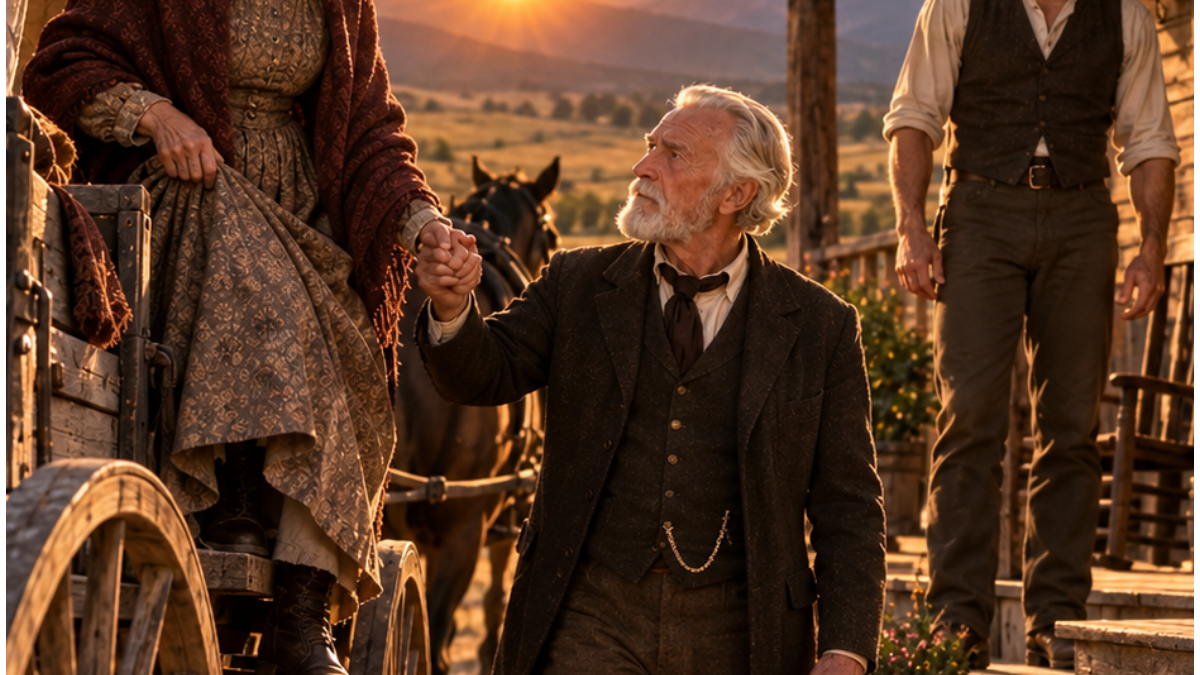
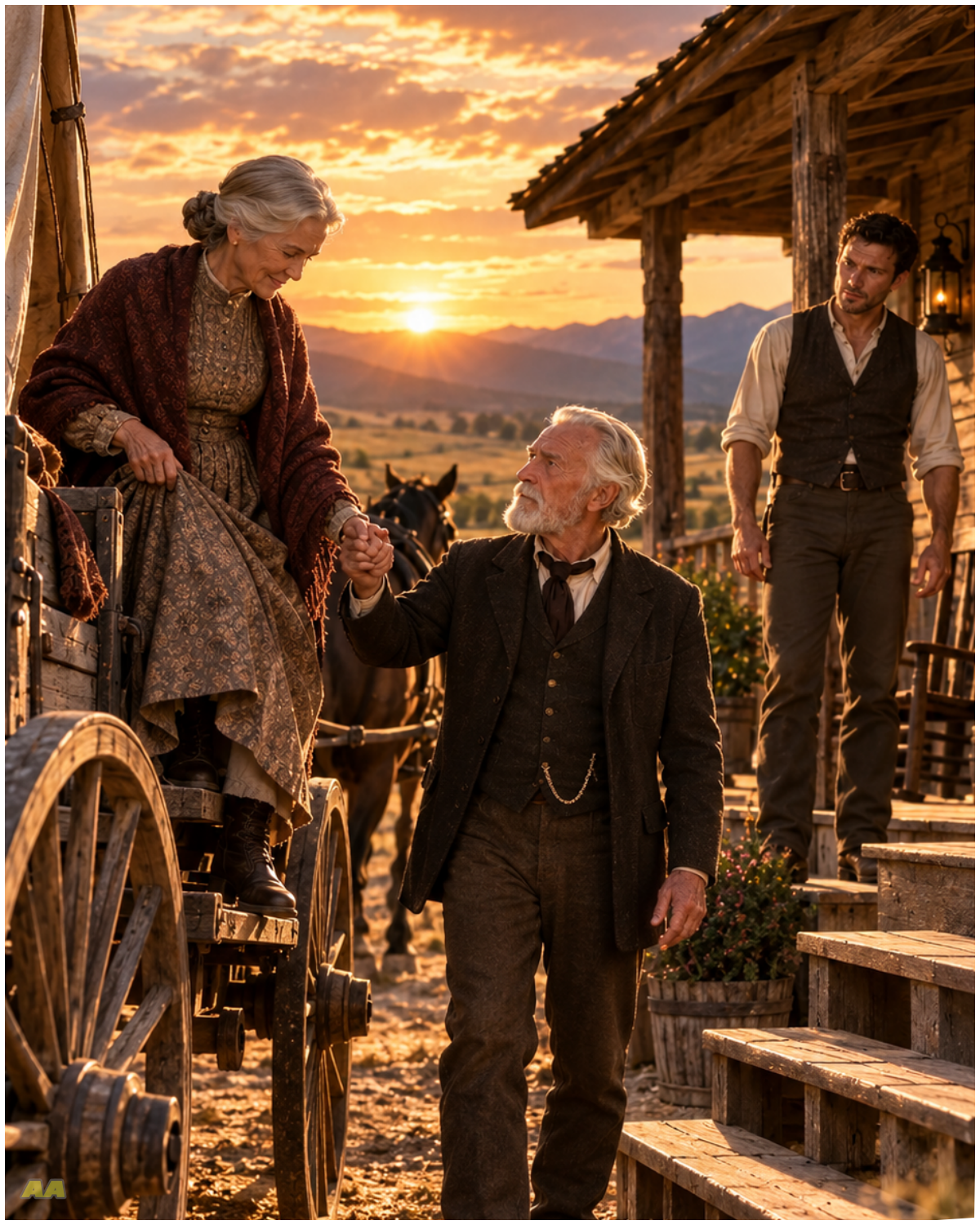
For four months, every Friday had begun with the same small mystery.
72-year-old Arthur Whitmore dressed more carefully than he had in years, and refused to say why.
Late in the morning, Arthur would appear from his bedroom wearing a clean white shirt and his dark wool vest with the brass buttons, the one he usually saved for church or town meetings when someone important was expected to speak.
His boots would be brushed.
His beard would be trimmed closer than on any other day of the week.
And just before he stepped onto the porch, he would pause at the small mirror near the front door, smooth down what was left of his hair, and touch a little cologne from a dusty glass bottle that had sat untouched on the shelf for years.
His grandson, Dean, had watched the ritual often enough to mark the time by it.
A little after 9, Arthur would ask whether the wagon was ready.
He never explained why he needed to go to town.
He only said that he had matters to attend to, that he would be back by late afternoon, and that Dean did not need to wait for him near the livery.
He always returned on the main road at almost exactly 4:00, stepping down from the wagon a little slower than he had climbed up in the morning, but with something different in his face.
He was calmer, lighter. Sometimes a faint smile stayed with him through supper, even when he tried to hide it.
Sometimes he hummed under his breath while washing his hands, something Dean had not heard him do since before his grandmother died.
Dean loved his grandfather and respected his privacy.
He had lived with Arthur on that ranch outside of town for more than 10 years, through the long illness of his grandmother, and through the quiet years that followed.
He knew the old man to be steady and predictable, a person who fixed what was broken and finished what he started and rarely surprised anyone.
So the Fridays began to feel strange.
Not alarming, but strange in a way that made Dean pay attention to small things.
The way Arthur checked his pocket watch twice before they left.
The way he carried a little more money than a man would need for feed or nails.
The way he always asked Dean to let him off near the center of town instead of by the supply store.
And the way he always seemed to know exactly where he was going once his feet hit the boardwalk.
Dean never asked directly. He told himself that a man of 72 had earned the right to keep a few errands to himself.
But as spring settled over the ranch, the questions grew harder to ignore.
And then one Friday in late May, everything changed.
Dean had come to town a little earlier than usual to pick up Arthur.
The air was warm and the streets were busy with wagons and horses and people finishing their business before the weekend.
Dean pulled the team to a stop near the small hotel where Arthur usually asked to be left, expecting to see his grandfather waiting alone on the bench by the entrance as he always did, perhaps looking at his watch.
Arthur was there, but he was not alone.
Beside him on the bench sat a woman.
She looked to be about his age, perhaps 69 or 70, with silver hair pinned neatly back, a plain dark blue traveling dress, and a small brown leather satchel at her feet.
Dean had never seen her before.
Her hands were folded in her lap, and though she was clearly nervous, she did not look frightened or misplaced.
Arthur was standing beside her instead of sitting, as if he had been making sure she was comfortable while they waited.
When he saw the wagon, he lifted a hand.
The gesture was not his usual nod.
It was deliberate, almost formal.
Dean drove closer and brought the horses to a halt.
Arthur stepped forward and rested a hand on the sideboard of the wagon.
He explained calmly and without any great drama that today they would not be riding home alone.
He asked if Dean would help with the small satchel.
He introduced the woman as Beatatrice Langley and said that she had agreed to come and see the ranch for a few days.
The words were simple, but the moment was not.
For the first time, Dean understood that the Friday trips had never been about errands at all.
He looked at his grandfather at the careful vest and the freshly trimmed beard and the quiet steadiness in his eyes that was mixed with something else that Dean could only describe as hopeful embarrassment.
And then he looked at Beatatrice who offered a small polite nod and seemed to be studying his face to see what kind of welcome she might receive.
In that instant, Dean realized that he knew almost everything about his grandfather as a rancher, as a widowerower, as the man who had raised him, and almost nothing about his grandfather as a man who might still want something more from life than work and memory.
Beatatrice climbed carefully into the back of the wagon with Arthur close beside her, and Dean turned the team toward the road that led out of town.
No one spoke much on the way home, but the silence was not empty.
It was full of all the things that had not yet been said.
To understand that ride home, one had to go back several months to a winter that had been long and quiet, even by the standards of that part of the country.
After his wife died, Arthur had told himself a story that many men of his age told themselves.
He had been fortunate. He had married a good woman when he was young.
He had loved her fully, and they had built a life together that had lasted more than four decades.
When she was gone, he grieved the way a man grieavves when the house suddenly has too many empty rooMs. He kept her photographs on the mantle and on the small table by his bed.
He kept her sewing basket where she had left it.
He went on working because the ranch required it and because work was the only thing that made the days pass at a reasonable speed.
He did not expect anything else.
He assumed that the part of his life that had to do with romance, with anticipation, with the particular nervousness that comes from wanting to impress someone was simply finished.
Beatatrice had told herself a similar story.
She had been married for 36 years to a kind and hard-working man who had given her a stable home and two grown children who now lived in different towns.
When he died after a short illness, she had mourned him deeply.
And then she had learned how to live alone.
She kept a small house at the edge of town with a neat garden and a kitchen that she kept orderly and a bedroom where a framed portrait of her husband hung on the wall.
She was not lonely in the desperate way that people imagine.
She had neighbors she liked and a routine she trusted.
She did not imagine that she would ever again feel the kind of attention that makes a person check the mirror before leaving the house.
Their meeting was not dramatic. There was no single moment that could honestly be called fate.
It happened the way many important things happen in a small western town.
Slowly through repetition until two ordinary routines began to bend toward each other.
On a cold Friday in February, Arthur had gone to town to order seed and to see whether a delayed letter had finally arrived.
The eating house he sometimes used was crowded, so he stepped into the dining room of the small hotel because it was warm and quiet.
Beatatrice was there as well, having come in for tea while the general store filled an order for flour and sugar.
They sat at separate tables. They did not speak beyond a brief polite acknowledgement when Arthur held the door for her as she left.
The following Friday, Arthur had again found himself in town.
He had not planned to go to the hotel dining room, but his feet took him there.
Beatatrice was there again. This time they sat a little closer.
The proprietor, who knew them both by sight, made a small comment about the weather that included them both, and they exchanged a few ordinary words about the late snow and the condition of the roads.
Arthur noticed that she had a calm voice, and that she listened when he spoke.
Not the way people listen when they are waiting for their turn, but the way people listen when they are actually interested.
By the third Friday, they both knew without discussing it that they would be there at the same time.
By the fourth Friday, they were arriving a little earlier than necessary and staying a little longer than needed, and the conversation had grown beyond the weather to include small, real pieces of their lives.
Arthur learned that Beatatrice had been a school teacher for a short time before she married.
Beatatrice learned that Arthur had built a good part of his ranch house with his own hands, and that he still rose before dawn every day because his body did not know how to do otherwise.
They discovered that they both preferred plain food, well-cooked, that they both liked to read, but did not make a great show of it, and that they both had grown children who worried about them in the loving and slightly irritating way that grown children do.
No one had declared anything. No one had needed to.
The Fridays had simply become a day that both of them waited for during the rest of the week.
Arthur found himself thinking on Tuesdays about what he might say on Friday.
Beatatrice found herself choosing her dress on Thursday evening with more care than she had taken in years.
For two people who had thought their lives were settled, the feeling was both delightful and deeply unsettling.
Arthur did not tell Dean about Beatatrice because there was anything scandalous to hide.
He simply did not know how to speak about it without feeling foolish.
He was 72 years old. He had grandchildren.
He had buried the woman with whom he had shared nearly four decades, and he had never doubted the truth of that marriage.
Yet now he was checking the time on Fridays, and noticing whether another woman smiled when he entered a room.
What unsettled him was not gossip so much as the private fear that wanting something new might somehow make what came before seem smaller.
He knew that was not reasonable.
Knowing it and feeling it were different matters, so he kept the Fridays to himself, partly from uncertainty, and partly from a shyness he had not expected to feel again.
Beatatrice had hesitations of her own.
She liked Arthur’s steadiness, his dry humor, and the fact that he never tried to impress her with large stories about himself.
But at 69, she valued the life she had built alone.
She had her own house, her own habits, her own place at the table, and no desire to be taken care of, as if age had made her helpless.
More than that, she did not want to step into a house that had been shaped for decades by another woman’s hands, and slowly disappear inside someone else’s memories.
When Arthur invited her to see the ranch, he did so hesitantly, almost as if he were asking for a favor he was not sure he deserved.
He explained that he would like her to see where he lived, that Dean shared the house with him, and that she would have her own room and complete freedom to leave whenever she wished.
Beatatrice accepted after thinking for a full week, not because she was being koi, but because she needed to be sure that she was going for the right reasons, and not simply because she was flattered to be asked.
That was how she came to be sitting on the bench with her small satchel on that Friday in May.
With Dean under the same roof and a separate room prepared for her, the first visit lasted 4 days.
Dean had prepared the small spare room at the back of the house, the one that had once been used for storage and later for seasonal help.
He put clean sheets on the bed and made sure there was fresh water in the basin and enough oil in the lamp.
He did it without being asked and without making a display of his welcome.
When they arrived, Arthur carried Beatatric’s satchel to the room himself, despite Dean’s quiet offer to do it, and Beatatrice thanked them both with a composure that made it clear she understood the care that had gone into making a place for her.
The first evening was the most awkward.
They ate supper together at the long kitchen table, the three of them.
The food was simple, beef and potatoes and bread and canned peaches.
But Beatatrice praised it with such genuine warmth that Dean felt himself relax a little.
After supper, Arthur showed her the house.
He did not make a tour of it.
He simply walked with her from room to room as if they were two people looking at the same place together.
In the parlor, Beatatrice paused before the large framed wedding photograph that hung above the fireplace.
It showed Arthur as a young man standing beside his bride, both of them serious and hopeful in the way people were in photographs.
Then Beatatric looked at it for a long moment and then moved on without comment, but Arthur noticed the way she had looked and remembered it.
Later that evening, Dean stepped outside to give them privacy.
Through the kitchen window, he could see his grandfather and Beatatrice sitting at the table with cups of tea between them.
They were not touching and did not seem to need to.
They were simply talking in the unhurrieded way of people who had discovered that neither wanted the evening to end yet.
Dean felt a strange tenderness he had not expected.
He had not seen his grandfather look so fully present with another person in years.
Over the next few days, a gentle pattern developed.
In the mornings, Beatatrice would help in the kitchen, not by taking over, but by doing small things alongside whoever was cooking, peeling potatoes or slicing bread.
In the afternoons, Arthur would show her the ranch, not all of it at once, but in small, manageable pieces.
He took her to see the creek where the cottonwoods grew, and he showed her the barn that he had repaired after the bad storm 3 years earlier.
He was proud of the place without being boastful.
And Beatatrice asked questions that showed she was actually seeing it, not just being polite.
She asked how many head they were running that year and whether the well had ever gone dry, and what the soil was like on the far pasture.
Arthur answered each question carefully, pleased to be asked by someone who understood what the answers meant.
There were small, almost invisible moments that marked the growing closeness.
One morning, Arthur, who had not planted flowers since his wife died because he saw no point in it, asked Beatatrice whether she thought Maragolds would do well by the porch steps.
Another afternoon, Beatatrice, who usually wore her hair pulled back severely, appeared at supper with it a little softer around her face.
These were not grand gestures. They were the kind of quiet choices that people make when they start to imagine a future that includes someone else.
Dean watched all of this with a growing understanding.
At first, he had been merely surprised.
Then he had been curious. By the third day, he was something more.
He saw that his grandfather slept better.
He saw that he laughed more easily, that his shoulders were less tight, that he had started to talk again about plans that went beyond the next season.
Arthur spoke about fixing the fence line on the north side before winter, and about perhaps ordering a new cook stove, things he had put off indefinitely before.
It was as if the presence of another person who looked at him with interest had reminded him that time was still passing, and that there was still something to do with it.
Dean also saw how Beatatrice moved through the house.
She was careful. She never moved anything without asking.
She never acted as if she owned any part of the place.
At the same time, she was not timid.
When she saw something that could be done better, she said so kindly.
And when she disagreed with Arthur about whether the old rug in the parlor should be beaten or replaced, she said that plainly and with a small smile that made Arthur smile back even as he argued.
On the fourth day, Beatatrice said it was time for her to return to town.
Arthur did not argue. He and Dean hitched the wagon and drove her back.
When they reached her small house, Arthur carried her satchel to the door, and Beatatrice thanked them both for the visit.
That evening, Arthur sat on the porch longer than usual, watching the light fade from the fields.
Dean had seen him miss his wife for years.
This was different. For the first time, he understood that grief and loneliness were not the same thing.
After that first visit, the pattern changed.
Beatatrice did not come every week.
Sometimes Arthur went to town alone on Fridays and returned with the same quiet lightness Dean had learned to recognize.
Sometimes Beatatrice came for 2 days, sometimes three.
They made no formal arrangement. They simply kept choosing each other’s company.
And with every visit, the awkwardness thinned a little more.
Then one Wednesday in June, Arthur asked Dean to hitch the wagon, even though it was not Friday.
A hinge on Beatatric’s garden gate had sagged badly enough that she could no longer close it, and Arthur had promised to look at it.
The request was so ordinary that Dean nearly smiled.
For months his grandfather had guarded Fridays like a private appointment.
Now he was going to town in the middle of the week because a gate needed fixing.
Somewhere along the way, Beatatrice had stopped belonging to a single afternoon.
Dean helped with the repair and saw Beatatric’s home properly for the first time.
It was small but unmistakably hers.
Rows of herbs near the backstep, school books from her brief years as a teacher tucked into a cabinet, a worn chair positioned to catch the best afternoon light, and the portrait of her late husband displayed in the sitting room.
Arthur noticed all of it, too.
He saw that her independence was not stubbornness and that her house was not merely a place she occupied while waiting for something better.
It was a life she had built and protected.
Before they left, he repaired a loose porch board she had not mentioned, and Beatatrice sent them home with a jar of preserves from her pantry.
The visit changed something small but important.
Arthur had spent weeks inviting Beatatrice into his world.
That Wednesday, he finally stepped fully into hers.
Then, after several good weeks, something shifted.
It was early July. Beatatrice had been at the ranch for 5 days, the longest she had stayed so far.
They had fallen into a rhythm that almost felt like a household.
She had brought a small basket of sewing and had mended a torn shirt for Dean without being asked.
Arthur had taken to setting a place for her at the table without thinking about it.
One evening after supper, Beatatrice had been looking at the books on the small shelf in the parlor and had laughed softly at a note Arthur had written in the margin of an old almanac years earlier.
The next morning at breakfast, Beatatrice was quiet.
She ate very little. When Arthur asked if she was feeling well, she explained gently that she thought she should go home that afternoon earlier than they had planned.
Arthur first assumed that something was wrong with Beatatric’s house or her health because practical problems were the kind he knew how to solve.
Beatatrice hesitated before explaining that the trouble was harder to fix.
The longer she stayed, the more she felt surrounded by another woman’s life.
The photographs were part of it, but not all of it.
There were curtains chosen years before, drawers arranged by hands she had never known, kitchen habits formed long before Beatatrice crossed the threshold.
That morning she had reached to move a blue croc beside the stove and stopped herself, suddenly unsure whether it had stood in that exact place for 30 years.
No one had made her feel unwelcome.
That was almost what made the feeling harder to explain.
She feared that if she stayed long enough, she would either remain a permanent guest or begin changing things simply to prove that she belonged.
Neither choice felt right. Arthur listened without interrupting.
He did not try to argue her out of what she felt.
He agreed to take her home whenever she was ready.
His manner remained steady, but on the drive into town, Dean noticed how still his grandfather sat and how firmly he held the res, even though the horses were walking at an easy pace.
After Beatatrice left, the house felt larger than before.
Arthur did not complain. He went about his work as he always had.
He repaired a broken hinge on the barn door, and he checked the cattle, and he sat on the porch in the evening.
But the change was unmistakable to anyone who knew him.
The humming stopped. The extra care with his appearance faded.
He went to town on Friday and came back early and said very little about it.
He slept poorly again. He left the fence line on the north side unmended.
During the next two weeks, Dean stopped thinking of the problem as something that could be solved by arranging another visit.
He had seen Arthur lonely before Beatatrice arrived, but now he had also seen what companionship restored in him.
Appetite, humor, plans, even irritation about things that mattered beyond the day’s chores.
The contrast made Dean realize that his grandfather did not need rescuing from old age.
He needed the freedom to decide whether he was willing to risk being disappointed again.
One evening, Dean found Arthur alone in the parlor looking at the old wedding photograph above the fireplace.
Dean sat nearby. They spoke first about cattle and the weather because those subjects were easier.
Eventually, he let Arthur know that he had noticed the difference Beatatric’s presence had made and the emptiness that followed her departure.
Arthur did not become defensive. After a long silence, he admitted that he felt foolish.
He had assumed this part of life was finished, and he was embarrassed by how much it mattered whether Beatatrice chose to spend time with him.
He spoke about his late wife with the ease of someone remembering a real marriage rather than polishing a monument.
He remembered her saving him the last piece of pie after insisting she wanted it herself, and the way she could tell from the sound of his boots whether a day had gone badly.
Those memories had not dimmed. That was exactly why the new feeling frightened him.
He did not want happiness with Beatatrice to become evidence that the first happiness had meant less.
Dean did not try to give him a speech.
He only reminded Arthur of what was already true.
The photograph had not moved. The sewing basket was still where his grandmother had left it.
Nothing Beatatrice had done required those things to disappear.
Dean had watched his grandfather become more himself, not less, during the weeks she was there.
Arthur listened, but Dean could not tell whether any of it had settled the argument the old man was still having with himself.
Arthur did not answer right away.
He looked again at the photograph and then out the window at the dark yard.
Dean could not tell if his words had helped.
The next day, something small but important happened.
Beatatrice had left a small pair of sewing scissors on the kitchen table, and Dean set them aside to return to her.
Arthur saw them and picked them up and held them for a moment before putting them carefully in a drawer where they would be safe.
A few days later, Beatatrice sent a short note with a neighbor who was coming out to the ranch for feed.
In the note, she thanked them for their hospitality and said that she hoped they were well.
There was nothing more in it, no invitation and no apology.
But Dean saw his grandfather read it twice and fold it with care.
Arthur did not go to town the following Friday.
He sent Dean with a list of supplies and a separate, smaller piece of paper that he asked Dean to deliver to Beatatric’s house.
Dean did not read it. He handed it to Beatatrice at her door.
She took it with a slight tremor in her hands that she tried to hide and thanked him quietly.
Arthur’s letter contained no grand declaration.
In his plain practical hand, he wrote that he missed Beatatrice and that he had been thinking about what she had said.
He also wrote that the Wednesday at her house had taught him something he should have understood sooner.
Asking her to spend time at the ranch did not mean she had to surrender the life she already had.
Her garden, her rooms, her neighbors, and the memories inside her own house mattered just as much as his did.
He had no wish to replace his past and no right to ask her to abandon hers.
He only knew that he wanted her company, whether that meant days at the ranch, afternoons in town, or some arrangement neither of them had yet imagined.
At 72, certainty about the future was a luxury he did not possess.
Wanting to share whatever good time remained with her was simpler.
Beatatrice read the letter more than once at her kitchen table.
Her husband’s portrait hung on the wall nearby, and for once she did not feel that one part of her life was accusing another.
What moved her most was not Arthur’s admission that he missed her.
It was that he had noticed what her house meant to her.
She had been afraid that caring for him would eventually require choosing between independence and companionship.
His letter offered a third possibility.
They could make room without asking either person to disappear.
She waited two days before answering.
Then she bought a good sheet of writing paper from the general store and wrote that she had missed the ranch more than she expected, especially the evenings at the kitchen table.
She was willing to return, but only if they could continue speaking honestly whenever either of them began to feel crowded by the others past or habits.
It was not the language of a young courtship.
It was better suited to two people who had already lived long enough to know that affection without honesty eventually becomes another kind of loneliness.
Arthur received her reply on a Tuesday.
Dean watched the tension leave his shoulders as he read.
That Friday, Arthur did not ask for a ride to town.
Instead, he asked Dean to help move a small chest from the back room and build a simple shelf near the window where Beatatrice liked to sew in the afternoon light.
He did not move his late wife’s things or clear the room as though erasing someone.
He only made enough space for another person’s belongings to exist beside what was already there.
The following week, Beatatrice returned. This time she brought more than the little satchel.
Her own pillow, a few kitchen tools she preferred, a small rug she had made herself, and a tin containing the tea she drank at home.
Dean helped carry everything inside. Beatatrice placed the rug beside the bed and set her tea in the kitchen cupboard herself.
On the high shelf in her room, the old sewing basket that had belonged to Arthur’s wife remained undisturbed.
Nothing about the room suggested that one woman had defeated another.
It simply looked more lived in than it had before.
That evening, Beatatrice paused again before Arthur’s wedding photograph.
She did not ask whether it should be moved.
Instead, after dusting the mantle, she set a small vase of garden flowers beneath it and left the photograph exactly where it was.
Arthur noticed the gesture and said nothing.
The silence between them felt different now.
It was not avoidance. It was understanding that did not need to be explained twice.
After supper, they did not need to manufacture things to do.
Beatatrice mended while Arthur whittleled at a piece of wood he had been shaping into a simple handle, and Dean read a newspaper that was already a week old.
The quiet was comfortable. It was the quiet of people who are where they want to be.
In the weeks that followed, they found a rhythm that belonged to neither of their old lives exactly.
Beatatrice kept her house in town and returned to it whenever she wanted to tend her garden, see neighbors, or simply sleep in her own room.
Sometimes Arthur went with her and spent an afternoon repairing something, or reading on her porch.
Sometimes he stayed at the ranch and waited without anxiety.
When Beatatrice was at the ranch, she no longer behaved like a gueSt. She cooked when she wanted to and left the cooking to Dean or Arthur when she did not.
She moved the blue croc beside the stove one morning because the new place suited her better.
No one moved it back. Closeness still came with awkward moments.
Two people who had lived alone for years did not suddenly become effortless with each other.
Once while they sat on the porch, Arthur started to reach for Beatatric’s hand and then pulled back, unsure whether the gesture was welcome.
Beatatrice noticed and took his hand herself a moment later.
Another morning she was unusually quiet and later worried that he might have taken offense.
Arthur had not. They were learning each other’s silences as carefully as they had once learned each other’s stories.
People in town noticed, of course.
In a small place, people noticed almost everything.
Some smiled, some raised their eyebrows.
A few offered the sort of well-meaning jokes older people often endure when affection makes them visible again.
Arthur and Beatatrice neither hid nor performed for anyone.
When they happened to be in town on a Friday, they still ate at the hotel dining room where they had first begun talking.
After a while, the proprietor simply stopped giving their usual table to anyone else.
One late afternoon in August, Dean came in from the barn and found Arthur and Beatatrice standing together in the parlor.
Arthur’s wedding picture remained in its old place above the fireplace.
Beside it now hung a small framed portrait of Beatatric’s late husband, a plain, kind-faced man in a stiff collar.
Arthur had offered the space, and Beatatrice had accepted it.
The frames were different. The photographs came from different lives, and neither had been moved aside to make the other easier to look at.
Dean stood in the doorway longer than he meant to.
Months earlier, he might have found the arrangement strange.
Now it seemed almost obvious. Autumn came slowly that year, with long, warm afternoons and cool nights.
Ranch work continued as it always had, cattle and fences and the endless small repairs that make up a life on the land.
What changed was the distance Arthur allowed himself to look ahead.
He talked about spring planting as something he expected to see.
Beatatrice began considering where her rose cutings might survive best near the ranch house, while still keeping several plants in her own garden in town.
Neither of them spoke as if one home had to swallow the other.
They never staged a formal proposal, and neither seemed to need one.
Their commitment emerged through smaller, more practical decisions.
Beatatrice left more clothes in the spare room.
Arthur began calling it Beatatric’s room without noticing when the change happened.
They discussed what it would mean for her to spend most of the winter at the ranch when the roads became difficult, how often they would check on her house in town, how expenses would be handled, and which possessions mattered enough to keep close.
None of it sounded romantic in the usual sense.
Yet, the seriousness with which they made room for each other’s lives carried more weight than ceremony would have.
Dean’s view of his grandfather changed during those months.
He stopped seeing Arthur mainly as an aging man who needed watching over and began seeing him again as someone still capable of making difficult choices.
Arthur knew exactly what loss could coSt. Beatatrice knew it, too.
Their willingness to care anyway was not youthful recklessness.
It was a quieter kind of courage, and Dean respected them for it.
Several months after Beatatrice first drove home in the wagon with its small brown satchel, a Friday came that would have once been unremarkable.
Dean rose early, as he always did.
He fed the horses and checked the sky, which was clear and pale, and then he went to the barn to prepare the wagon out of habit.
It was Friday, and for months Friday had meant hitching the team and driving his grandfather to town and waiting to see what the day would bring.
When he came back to the house, the kitchen was already warm.
Arthur was sitting at the table in his ordinary work shirt, not his vest, reading a folded seed catalog.
Beatatrice was at the stove, pouring hot water for tea, wearing a plain house dress, and her own apron, which now hung on a peg beside the kitchen door when she was not using it.
There were three places set at the table.
There was bread sliced, and butter within reach.
Outside the window, the ranch lay quiet in the early light with no wagon waiting and no journey required.
Dean stopped in the doorway for a moment.
Arthur looked up and asked whether the horses had been fed, in the same even tone he used every morning.
Beatatrice glanced over and asked whether Dean took sugar in his tea, as naturally as if the question belonged to the house now.
Only then did Dean remember that it was Friday.
For months, Friday had been the day Arthur waited for, the single opening in the week through which Beatatrice entered his life.
Now Arthur wore his ordinary work shirt.
Beatatrice was already at the stove.
No one was watching the clock.
Dean unfassened his coat and sat down.
Arthur reached for the bread while Beatatrice slid the butter dish toward him without looking, a small movement made easy by repetition.
Outside the road to town lay pale and empty in the morning light.
The wagon remained unharnessed in the barn.
For the first time in months, Friday was only a day of the week.
Historical romance stories for more emotional stories from the American frontier.








