Every Day She Stared at the Piano She Couldn’t Afford — Unaware the Duke Was Watching Her
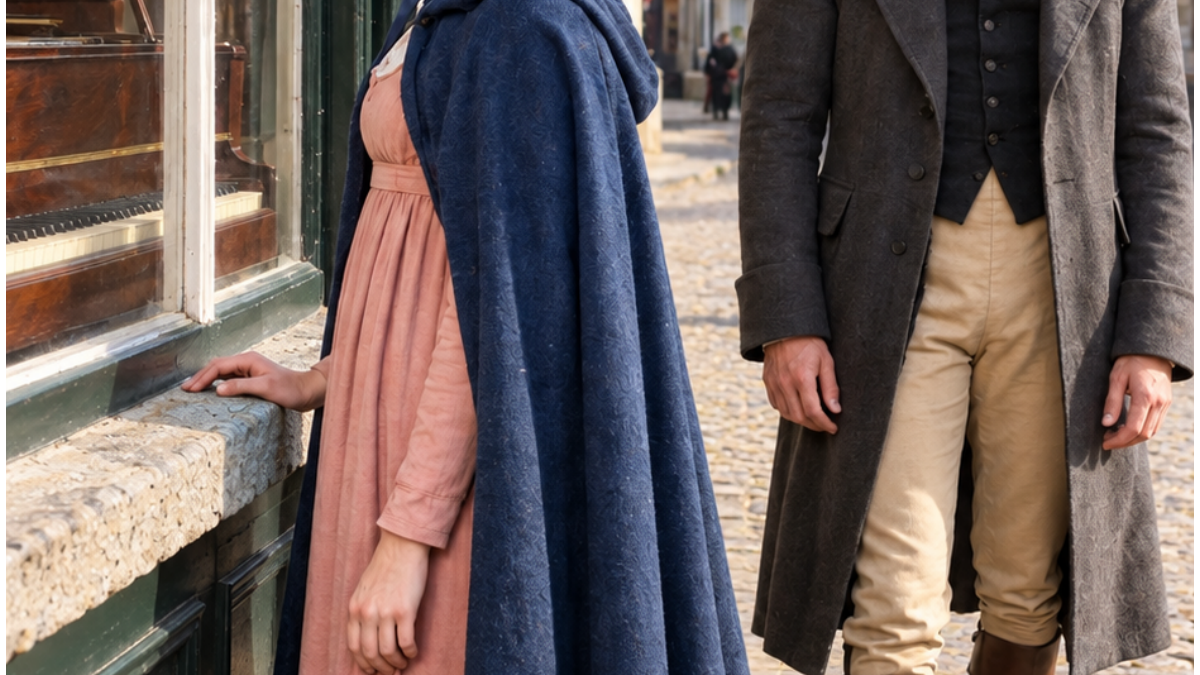
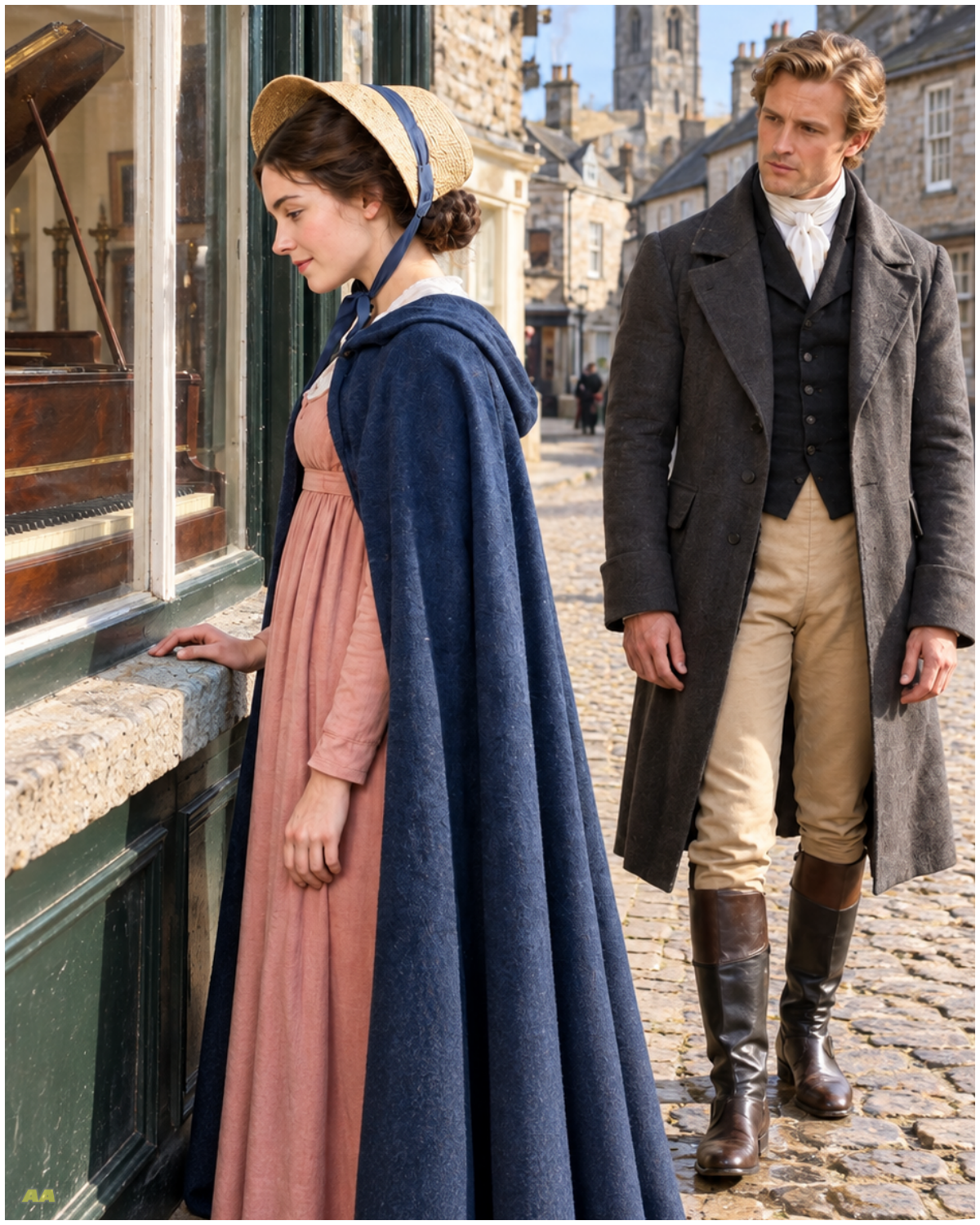
Nobody at the Tavveristock Assembly looked at Roosevelt Witbridge.
She had made sure of it.
She wore the gray wool that had been her morning gown the winter before, let out at the seams and brushed until it shone at the elbows.
She sat on the bench by the cloak room door with her cousin’s shawl folded across her knees and her aunt’s fan and her aunt’s reticule and a spare pair of gloves in case just split a seam dancing.
The long room over the market house was hot with candles and cold at the windows.
Outside the first hard frosts of November had come down on the town that week, and every breath at the door turned white.
Inside, 40 people were pretending they had not come to see the same man.
He had not arrived yet. That was the whole of the evening’s conversation.
The new Duke of Hulkcom was Jerome by name, the younger son, who had never been meant to inherit.
He had come down from London a month ago to look at Falcon Ridge, the great gray house on the edge of the moore that his father had let fall to pieces.
He had taken rooms at the inn on the square while the roof was mended.
He had been seen riding out to the house in the rain and riding back in the dark and speaking to nobody.
He was said to be cold.
He was said to be very rich.
He was said to have refused three invitations in a single week, which in a town the size of Tavvertock was very nearly a scandal.
And tonight, because the steward of the assembly had written to him himself, he was said to be coming.
Aunt Teresa had talked of nothing else since breakfaSt. She stood now at the top of the room in her purple silk, the one she had bought on credit in exat and never quite paid for, with one gloved hand on her daughter’s elbow.
Just was 19, fair and soft, dressed in white muslin that Roosevelt had sat up half the week to trim.
She looked lovely. She also looked as if she would rather be anywhere else in Devon.
Roosevelt knew that face. She had seen it every morning for a year across the breakfast table.
Whenever her aunt began a sentence with the words, “When you are married, my love, Rosabel.”
Her aunt did not turn her head.
She only lifted two fingers of the hand that was not holding Jasa, and Rosabel rose and crossed the floor with the shawl.
Her hem,” Aunt Teresa said, still smiling at the room.
“At the back, it has dropped a quarter of an inch, and I will not have her seen with it.”
“So Rosebel knelt on the boards with a needle she kept threaded inside her sleeve for exactly this.”
She mended her cousin’s hem in six quick stitches, while the whole room talked over her head.
Nobody noticed. That was the point of her.
She was the needle in the sleeve.
It was while she was kneeling that she heard the piano.
There was an old square pianoforte in the corner by the musician’s gallery.
A heavy mahogany thing that the assembly had owned since before she was born.
Somebody’s daughter had been asked to play before the dancing began.
The girl was nervous and she played too fast and none of that was her fault.
But the instrument had not been tuned since the summer.
The damp off the moore had got into it the way it got into everything in Tavveristock, and one note in the middle of the keyboard had slipped flat.
Every time the girl’s right hand came down on it, Roosevel felt it in her teeth.
Her fingers moved against her skirt without her leave.
They found the note and pressed it up a hair.
The way you would turn a tuning pin a quarter turn.
It did no good at all.
The note went on being wrong.
She finished the hem and bit the thread and stood up.
And that was when the room went quiet.
It did not happen all at once.
It went quiet the way a field goes still when a hawk comes over it from one end to the other.
The talk thinned and stopped.
The girl at the piano lost her place and did not find it again.
And in the doorway, at the head of the stairs, with a cold still on his coat, stood a tall man in black, who had plainly never wanted to come.
He was younger than Roosevelt had pictured, perhaps 30.
His hair was a sandy fair, cut short, and it had been rained on.
His face was lean and very still.
He did not look at the room the way men usually looked at a room full of people who wanted something from them.
He did not look at it at all.
He looked once around the whole of it quickly as if he were counting the doors.
The steward of the assembly hurried forward and bowed so low that his wig slipped.
The Duke said something short. Then Aunt Teresa was moving and Jasyntha was moving with her because Aunt Teresa had hold of her elbow and did not let go.
Rosabel went back to her bench.
She folded the shawl again, although it did not need it.
She had no wish to see her cousin paraded like a heer at Tavistock Goosefair, and no wish either to see the man turn away from her, which he surely would.
She watched the dancing begin instead.
She watched the candles gutter in the draft from the stairs.
She watched the girl at the piano give up and let the fiddles carry the tune.
And she thought, as she had thought every hour of every day for a year, about another piano, a rosewood one, with a thin line of brass let into the lid, and a small dent near the lock, where a child of seven had once dropped a silver thimble on it.
It stood in a shop window two streets away.
It had stood there since the spring.
She could have walked to it in the dark with her eyes shut.
Your niece, Mrs. Mallet. The voice was low and came from behind her aunt’s shoulder, and it was the Dukes.
Roosevelt heard the question, and did not look up.
She did not know that. While Aunt Teresa was presenting Jasyntha with a speech she had plainly rehearsed in the carriage, the Duke of Hulkcom had been looking past both of them at the bench by the cloak room door.
She only heard her aunt laugh, a small silver laugh like a spoon on a saucer.
Oh, that is only Roosevel, my poor brother’s girl.
She sees to things for us, you know.
She’s a great help. The Duke said nothing to that.
He danced once with Jasyntha because it would have been cruel not to, and he danced with nobody else.
He left before supper. Only much later, when she had taken the shawl and the fan, and the reticule, and her aunt’s temper home through the frozen square, did Roseel think about him at all.
She thought that he had looked tired.
She thought that he had looked like a man who did not sleep.
And then she put him out of her mind because men like that did not come into the lives of women like her, and she had to be up before light.
She did not know that he had seen her kneel with the needle.
She did not know that he had seen her fingers move against her skirt when the note went flat.
She did not know that he had seen her before.
Many times from a window on the square.
She would not know it for a little while yet.
The house on the square was narrow and tall.
Three rooms stacked on top of one another like books on a shelf with a kitchen dug down below the street.
Aunt Teresa had taken it the spring before when she came from Exat to settle her brother’s affairs.
She had kept it because it looked out on the square, and because a widow with a daughter to marry needed a good address more than she needed a warm one.
It was not warm. By 6:00 in the morning, the rhyme had grown on the inside of the kitchen window in white feathers.
Roosevelt went down in the dark in her shawl, knelt at the range, and rad out the ashes before the girl who came in daily had even knocked.
She had done it every morning since her father died.
Her aunt called it helping. The maid called it a shame.
Roosevelt did not call it anything.
It was simply how the day began.
She liked the kitchen, if she was honeSt. It was the only room in the house where nobody watched her.
The maid was a broad, cheerful girl from one of the Moore farMs. She arrived blowing on her fingers and talked all through the kettle and the porridge about the bonfires they had lit in the fields to burn off the bracken.
Roosevelt let the torque wash over her and toasted the bread and carried the trays up two flights.
Just still half asleep, squeezed her hand when she set the chocolate down and whispered, “Was it very dreadful for you last night?” “It was dreadful for me.” Aunt Teresa, sitting up against her pillows in a lace cap, did not look up from her letters.
You will take the brown bread back, she said.
I asked for white, and you will be home by 4:00.
We are calling on the kellos.
At 7, Roseel put on her bonnet and her old cloak and took down the long roll of paper from the top of the kitchen dresser, where she kept it out of the reach of the steam.
It was tied with tape and wrapped in oil cloth against the weather.
Inside were three sheets of drawings she had finished by candle light in the attic the night before, her breath smoking over the paper while the house slept.
A laborer’s cottage of four rooms with a chimney that would draw and a floor that would not flood.
The same cottage in section cut through from roof to footings as if with a knife and a drain running from the back of the cottage down the slope to a ditch with every fall of the ground marked in her small square hand.
She tucked the roll under her arm and went out into the frozen town.
Tavistock at that hour was blue and white and silent.
Smoke stood straight up from the chimneys.
The granite of the church tower had a bloom on it like the skin of a plum.
A Carter was leading two more ponies up from the river, their breath rising in clouds, their shaggy coats furred with horroSt. Roosevelt went the long way, as she always did, down past the abbey gate, across the corner of the square, below the windows of the inn, and into the short, steep street, where the iron monger was just taking down his shutters, and three doors along from him, the bow window of Luscom’s music shop threw back the early light.
She did not decide to stop.
She never decided it. Her feet simply stopped, the way a horse stops at its own gate.
The piano stood where it always stood, just inside the glass, angled so that the light fell across the lid.
Rosewood, dark as strong tea, with the fine brass line along the edge and the little brass handles at the sides.
The lid was closed over the keys.
Beside it, on a card propped against a music stand, somebody had written in a clear hand, a square piano forte by Broadwood of London.
Fine tone. 40 guineies. 40 guineies.
She earned four shillings for a set of drawings when she was paid at all.
She had worked it out once on the back of a spoiled sheet, and then she had torn the sheet up because the answer frightened her.
If she saved every penny and ate nothing, and never bought another candle, she could have that piano in something over 5 years.
By then it would be gone.
It would be gone long before then.
Every morning she came round the corner, braced for an empty window.
Every morning it was still there, and she let out a breath she had not known she was holding.
She put her gloved hand on the cold stone of the sill.
Then, because the street was empty and nobody was watching, she let her fingers move.
Not much, a small movement, like someone tapping out the time of a song.
She was not tapping the time.
She was playing. In her head, she lifted the lid and found the keys, the ivory worn to a soft yellow by her mother’s hands, and then her own.
She played the first page of the little rondo her mother had taught her the winter she turned 8.
She played it through once. She did not let herself play the second page.
The second page was the one her mother had loved, and it was not something she could bear to hear in her head in an empty street at a/4 to 8 in the morning.
The door of the shop opened with a jangle of the bell.
“You’ll freeze standing there,” said Mrs. Luskcomm.
She was a small square widow of 60 with spectacles pushed up into her gray curls and a shawl crossed over her chest and tied at the back like a fishwife’s.
She had kept the music shop since her husband died, tuning the pianos of half the parish, and selling ballads and fiddle strings to the other half.
She had a tongue on her like a bread knife.
She was also, as far as Roosevelt knew, the only person in Tavveristo who had ever said a kind word about her father since the funeral.
Come in and play it, Mrs. Luscom said.
I’ve told you. I’ve told you every morning since Lady Day.
The shop’s empty. There’s nobody to hear but me, and I’m deaf in one ear.
Thank you, Roosevelt said. But no, she said it every morning.
Mrs. Luskam asked every morning. It had become a kind of greeting between them, like two people remarking on the weather.
This morning, though, Mrs. Luskam did not simply sigh and go back in.
She stood in the doorway with her arms folded against the cold and looked at Roosevelt over the top of her spectacles, and her face was not quite the usual face.
“Why not?” she said. Tell me honestly and I’ll stop asking.
Rosabelle looked at the window at the dent near the lock which she could not see from here but knew to the hair.
Because if I sit down at it, she said, I shall not be able to get up again and walk away, and I have to walk away.
So it is better not to begin.
Mrs. Luskam was quiet for a moment.
Then she said in a voice with no bread knife in it at all.
Your mother used to say the same about sugared almonds.
Roosevelt laughed because it was true and because it was that or cry.
And Mrs. Luskam went back inside and shut the door.
The bell jangled. The street was empty again.
Roosevelt tucked the roll of drawings more firmly under her arm and walked on down to the builder’s yard and did not look back because she never looked back.
She had been a clever child.
That was what everybody said in the voice people use for things that are a pity.
Her father had been a surveyor and builder in Tavistock for 30 years.
A big, slow, careful man who had built half the new cottages on the great estates round the town and mended the other half.
He had never had a son, so he had taught his daughter instead, at first as a game, and then when he saw what she could do in earneSt. She had learned to hold a pencil the right way before she learned her letters.
She had learned the rule and the compass and the set square.
She had learned to draw a line so fine you could split it with a hair and to make the flat paper stand up in the mind as a house with a roof on it.
By the time she was 15, he let her draw the plans he was too busy to draw.
By the time she was 18, he had stopped checking them.
And in the other room at the Rosewood piano, her mother had taught her the reSt. Her mother had been a clergyman’s daughter from the other side of the Moore, with a small, sweet voice and hands that could span an octave and a half.
She had brought three things to her marriage.
A little money of her own, a trunk of music, and the Broadwood piano.
It had been a wedding present from her godmother in London, and it had come across the moore on a farm wagon wrapped in 11 blankets.
Roosevelt had grown up between the two rooms, mornings at the drawing table, afternoons at the keys.
Her father used to stand in the doorway in the evenings with his pipe unlit in his hand, listening.
That’s a house, he said once of a sonata.
That’s a well-built house, that is.
Every stone where it ought to be.
Her mother had laughed at him and gone on playing.
Her mother died of a fever when Roosevelt was 17.
Her father lasted four more years, slower and quieter every winter.
And then one March he took a chill surveying a bridge in the rain and did not get up again.
That was the winter before this one.
The last weeks of it were broken in her memory like a window with half its pains out.
She herself had caught the same fever nursing him.
She remembered the doctor. She remembered the snow.
She remembered her father’s hand, huge and hot, closing on her wrist, and his voice saying something urgent that she could not hold on to.
And then she remembered waking in her aunt’s house in a narrow bed that was not hers.
3 weeks after the funeral, with the spring rain on the window, Aunt Teresa had come from Exat the moment she heard.
Everyone said how good of her it was.
She had nursed her brother’s girl through the worst of it, and she had taken charge of everything else because there was nobody else to take charge.
She had sat on the edge of Roosevel’s bed with a cup of broth and told her gently what there was to know.
There were debts. Her father had been owed a great deal of money that would never now be paid, and he had owed a great deal that must be.
The house had been rented and must be given up.
The yard and the business had been sold to one of his own men to settle what was owing and the piano.
Aunt Teresa had taken Roosevel’s hand and pressed it.
I know, my love. I know.
But there was nothing else of any value.
It had to go. You will understand when you are stronger that I had no choice.
Roosevelt had understood. She had been too ill to do anything else.
When she was well enough to walk as far as the square, she had gone out alone and found it standing in Mrs. Luskam’s window with a card beside it.
She had stood in front of it for a long time.
And she had gone back the next morning and the next.
That was 8 months ago now.
She had not missed a morning since.
At the builder’s yard behind the tannery, the man who had bought her father’s business was waiting for her in the little office with the stove, drinking tea out of a saucer.
He was not a bad man.
He was a good mason and a poor draftsman, and he knew both of those things about himself, and he had been glad enough when Mr.
Wit Bridg’s girl came to him the summer before, and offered to draw his plans for a few shillings a set.
He was a little less glad now.
He took the roll without a word, unrolled it on the bench, and weighted the corners with a brick, a mug, a chisel, and his own flat hand, and bent over it, breathing through his nose.
Duke’s cottages, he said at laSt. “They’ll do.” He gave her four shillings.
Then he said, as he always said, “Out by the back gate, miss.
I don’t want folk to see you coming and going.” The bridge, Roosevel said.
She did not move toward the back gate.
The bridge over the stream below Falcon Ridge.
You have drawn it with the pillars standing in the water.
They will not stand. That stream comes down off the moore in a flood every spring with half the hillside in it.
You need one span, bank to bank, and the footings sunk into the rock.
I have drawn it for you if you want it.
She held out another sheet folded small that she had taken from inside her cloak.
The builder looked at it. He did not take it.
I’ve built bridges since before you were breached, miss, he said, and then went red.
Because that was not a thing you said to a young woman.
Begging your pardon. But I’ll build it my way, and his grace will pay for it my way.
Back gate. Roosevelt folded the sheet away again and went out by the back gate into the cold.
We’ll take a very short break.
If you don’t want to miss new stories, please subscribe to the channel.
And while we rest here for a moment, there is something I have wanted to tell you about.
For years you have asked me for a longer story.
So I wrote one. Three complete novels.
One family 26 years. One promise.
The Duke’s Promise Trilogy by Gary Peton.
And because so many of you listen instead of reading, the complete audio books come included.
More than 24 hours in this same voice.
You are listening to right now.
You can get it exclusively at timelesslobooks.com.
And if you’re watching on your TV, just point your phone camera at the code.
You will also find the link at the top of the description and in the pinned comment.
Now, settle back in. Our story is waiting.
Across the square in the upper front room of the inn, the Duke of Hulcom was standing at the window with a cup of coffee going cold in his hand.
He had been standing there since before 7.
He stood there every morning. His valet had stopped remarking on it after the first week.
It was a plain enough room with a turkey carpet and a sagging sofa and a writing table covered with papers he did not wish to read.
The papers were all about Falcon Ridge.
The house had been built for his greatgrandfather by a man who admired Italian palaces and knew nothing whatever about Devon reign.
His father had spent the last 20 years of his life in London and let it go.
The roof let in water in 11 places.
The cottages on the home farm let it in in more.
A bridge over the stream below the house had cracked in the spring floods and would not survive another.
He had inherited all of it at midsummer, along with a title he had never wanted and a child he did not know how to speak to.
She’s there, said the child. Posie was nine.
She was sitting on the floor under the window with her knees drawn up inside her night gown.
She had sat there every morning since they came to Tavveristock, watching the square through the gap between the curtain and the frame.
She did not say much. She had said less than a hundred words to him since the spring, and most of them had been yes and no.
But she said this every morning.
She’s there, Uncle Jerome. She’s playing.
He looked down. The young woman in the brown cloak had stopped in front of the music shop as she stopped every morning.
From up here he could see only the top of her bonnet and the long roll of paper under her arm and one gloved hand resting on the stone sill and the fingers of that hand moving small light patient movements too even to be a nervous habit.
The first time he had seen it 3 weeks ago, he had not understood.
It was Posie who had understood.
Posie had been born in rooms over a music master’s house in Bath.
Her mother had given lessons to the daughters of the gentry, and Posie had fallen asleep as a baby under a piano, while the scales went up and down above her.
Posie had watched the fingers on the sill for perhaps a minute.
Then she had said, “She’s playing.
Look, that’s a rondo. She’s in the part that goes round again.” It was the longest speech she had made to him in her life.
After that, he had watched, too.
He told himself it was because it was the only thing that made the child talk.
That was true. It was not the whole truth.
The whole truth was that he had not slept properly since the summer.
And at a/4 to 8 each day, there was a young woman who stood in front of something she wanted with her whole heart and did not reach for it.
He knew a great deal about that.
He had once stood for years in front of a door he wanted to knock on.
>> >> He had not knocked, and then it had been too late.
Last night he had learned her name.
Roosevel Witbridge. Only my poor brother’s girl.
She seized to things for us.
He had watched her kneel on the floor of the assembly room with a needle among 40 people who stepped around her as if she were a chair.
He had watched her fingers move against her skirt, pressing a flat note that nobody else in the room could hear, was flat, and he had felt something he had not felt in a very long time.
Not pity. He had no use for pity, and he did not think she had either.
It was nearer to anger. It was the particular anger of a man who sees a fine instrument used to prop open a door.
He knew her father’s name, too, as it happened.
It was written on the best of the old plans in the steward’s room at Falconidge, and he had begun to suspect something else.
The drawings the Tavveristock builder brought him every week were very good.
But when Jerome asked the man why the drain from the end cottage ran round the back instead of straight down the slope, the builder had looked at the paper as if it belonged to somebody else.
He had said something about custom.
Whoever had drawn that plan knew the ground.
The builder did not. And every morning at a/4 to 8, a young woman went past the music shop with a long roll of paper under her arm down toward the builder’s yard and came back without it.
Posie, he said, “Put your stockings on.
We are going out.” Mrs. Luskam did not curtsy when the Duke of Hulkcom came into her shop.
She was up a ladder with a tuning hammer in her hand and a fiddle string in her teeth, and she looked down at him over her spectacles as if he had come to be measured for boots.
Then she looked at the child holding his hand, and her face changed.
Posie had let go of him the moment the bell rang.
She crossed the shop without a word, as if she had been there all her life and stood in front of the rosewood piano in the window.
She lifted the lid. She put out one finger and pressed a single key very softly and listened to it fade.
Then she pressed the one beside it.
It’s in tune, she said. Somebody keeps it in tune.
Somebody does, said Mrs. Luskam and came down the ladder.
She looked hard at the Duke and at the square outside and at the upper windows of the inn across it, and he saw her work it out.
She was a sharp old woman.
You’ll be the one at the window, she said.
Every morning. I wondered who it was.
He did not deny it. He said he had come to ask about the piano.
It isn’t for sale,” said Mrs. Luskam at once.
And then, because he only looked at her, she sighed and sat down heavily on the piano stool beside the child.
“That’s a lie. Everything’s for sale.” But I’ve asked 40 guineies for it because nobody in this town has 40 guineies for a piano, and I have been glad of it every day since the spring.” She told him the rest, while Posie played scales with one hand, up and down, up and down, the way a child worries at a loose tooth.
The aunt had brought the piano in the week after the funeral, while the girl lay sick upstairs.
She had wanted it sold quickly and had not haggled.
She had said there were debts.
“Maybe there were,” said Mrs. Luskam.
“Old Witbridge never had much put by, but I knew her mother.
I tuned that piano for her 20 years, and I knew that if I sold it to some farmer’s wife for her daughters to bang on, that girl would never see it again.
So I put it in the window at a price nobody would pay and I waited though I couldn’t have told you what for.
She took off her spectacles and rubbed them on her shawl only now there’s a dealer coming from Plymouth at the end of the month buying up instruments for the London trade.
And I’m a widow with a shop your grace not an arms house.
I can’t keep it forever. I will buy it, Jerome said.
Today at the price on the card.
Mrs. Luskam put her spectacles back on and looked at him through them without a word.
And then what? She said, “Carry it across the square and hand it to her.” A young woman in her position taking a piano from a duke she has never been introduced to.
Her aunt would have that turned into something ugly before the dinner was on the table.
Every tongue in Tavistock would have it by morning.
You would ruin her, and you would do it meaning well, and she would still be ruined.
He had not thought of that.
He was, he realized, a man who had spent too long in rooms where money settled things.
Then it goes to Falcon Ridge, he said slowly, until there is a way that does her no harm.
It will be dry there. It is the only room in the house with a sound roof.
Mrs. Luskam nodded. And she is not to know it was you, she said.
Not yet. Give me your word on it.
He gave it. Then at the door, with Posy’s cold hand back in his, he turned.
The plans her father drew, he said.
“The last two years of them.” “Who drew those?” Mrs. Luskam did not answer at once.
She looked out of her window at the empty place on the pavement, where every morning a young woman stopped and played a piano she could not touch.
“Who do you think?” she said.
The window was empty the next morning.
Roosevelt came round the corner by the iron mongers with the roll of drawings under her arm, braced as she was always braced, and there was nothing there.
The card was gone. The music stand was gone.
Where the piano had stood, there was a square of bare boards, paler than the boards around it, and a little dust along one edge that Mrs. Luskam’s broom had missed.
She stood on the pavement and looked at it.
She did not cry out. She did not go in.
After a while, she took off her right glove slowly, a finger at a time, and laid her bare palm flat against the glass.
It was so cold it burned.
She kept it there until she could not feel it anymore.
Then she put the glove back on and walked on down the hill to the builder’s yard.
Mrs. Luscom was standing just inside the shop door.
She had been standing there since 7.
She did not open the door, and she did not ask Rosabel in.
When Rosabel came back up the hill an hour later, the old woman was waiting on the step.
“It’s sold,” she said before Rosabelle could open her mouth.
“Yesterday, it’s gone to a good house where it’ll be kept dry and kept tuned.
That’s all I can tell you, and I’m sorry for it.” Roosevelt said that she was glad.
She said it quite steadily. Then she said, “Good morning,” and went home.
She rad out the kitchen fire, although it was already lit, and burned her wrist on the grate, and did not notice until the maid cried out.
Upstairs in the front room over the square, Teresa Mallet sat at her writing table with the morning’s letters in a neat pile at her elbow and did not open them.
She could tell them by the hands.
The exit linen draper, the man who had let her the house, the wine merchant, who had been polite in October and would not be polite in December.
She was 50 and a widow these six years.
She had been a pretty girl once, prettier than juSt. She had married a handsome man who spent everything he had and a good deal he did not.
Then he died of it and left her to find out how much.
Nobody had come to settle her affairs.
Nobody had taken her in. She was not a wicked woman.
She would have been astonished to hear anyone say so.
She had sat up three nights with her brother’s girl in the fever, bathing her face when the doctor said she might die.
That was true. And afterward she had gone through her brother’s desk and found a folded sheet in his heavy, careful hand.
She had read it twice. She had put it in her own writing box and turned the little key.
She had told herself it was for the girl’s good.
A plain young woman with a little money and a piano would grow proud and odd and alone, whereas Jasyntha, properly brought out in a good gown on a good square, might have anything, might have a duke.
The writing box sat on the corner of the table, walnut with a brass plate.
She had not opened it since the spring.
She sat looking at it now with the letters under her hand.
Then the maid knocked to say that the builder from behind the tannery was below, very red in the face, with a letter from Falcon Ridge.
It was short and signed Hulkcom.
His grace wished to see the builder on Thursday morning together with whoever had drawn the plans for the home farm cottages.
The builder stood in the hall turning his hat round in his hands.
I’d not have come, Mom, he said miserably.
Only it says whoever drew them, and it wasn’t me.
Terresa Mallet was a woman who thought quickly.
She thought now of the Duke of Hulkcom dancing once with Jasyntha because it would have been cruel not to.
She thought of Falcon Ridge, the great gray house with its broken roof and its empty rooms, and of the young man who would one day need a duchess to fill them.
And she thought very briefly of the walnut box with the brass plate and put the thought away.
Of course she will go,” she said and smiled.
“It is her duty to be useful, and her cousin will go with her.
It would not be proper otherwise.” So on Thursday morning, Roosevelt rode out to Falcon Ridge in the builder’s gig, wrapped to the eyes in her old cloak, with Jasyntha pressed warm against her side under a rug.
The lane went down between banks higher than the gig, so deep and narrow that the hedges met overhead in places, and the light came green and dim through the bare branches, even in November.
Then it climbed. The banks fell away, and all at once there was the Moore, rolling up and away to the east in long brown shoulders, with the granite toss standing on the ridges like broken chimneys against a white sky.
Ponies grazed among the rocks, with their coats grown shaggy for winter.
The air smelled of pete smoke and cold stone.
Roosevelt had been born within sight of it.
She had not been up on it since her father died.
Falcon Ridge stood on a shelf of the hillside above the stream, gray and square and far too large, with a row of stone urns along the roof.
Half of them had fallen. The windows of the east wing were boarded.
Water stood in long, dark stains below every gutter, and Roosevelt could hear it running somewhere inside the walls.
A hollow patient trickle like a clock.
She looked at the house the way her father had taught her from the footings up, and she thought, before she could stop herself, that she could save it.
They were shown into a long room that had once been a library, and was now plainly the only dry room in the house.
There were buckets in two corners.
A fire was burning, and a long table under the window was covered edge to edge with plans.
The Duke stood at the end of it in his shirt sleeves, with his hair everywhere at once.
He looked up when they came in.
His eyes went first to the builder, then to Jasa, then to Roosevelt, and there they stayed.
They were green. She noticed a clear cold green like the water in a moore pool when the sun is on it.
He did not waste time. He laid a sheet on the table between them and Roosevelt saw with a small cold shock that it was her own drawing of the drain from the end cottage.
He put his finger on the bend in it.
Why does this go round? He asked the builder.
Why not straight down the slope?
It would be shorter and cheaper.
The builder looked at the paper.
He cleared his throat. He said that it was the custom in these parts.
Your grace. The Duke waited. The builder said that the ground was better around the back.
The Duke went on waiting. The fire hissed.
In the corner, water dripped into a bucket.
One drop, then another, then another.
And Roosevelt, who had promised herself in the gig that she would not say a word, heard her own voice say quite clearly.
Because of the old leit, the Duke turned to her.
He did not look surprised. That was what she noticed most sharply, and would think about for days afterward.
He looked like a man who had been waiting for a door to open.
Go on, he said. So she went on.
She told him about the leit, the water channel cut along the hillside long ago to carry the stream to the old mill.
It was silted up now and grown over with bracken, so that you would never know it was there.
A straight drain would cross it.
In a wet winter, the leit would fill and the water would come down the drain backward into the cottage and the family in it would wake with the floor underwater.
She had found the leit on one of her father’s old surveys.
She had walked it herself the summer before to be sure.
She said all this without stopping, and then she stopped and felt the heat come up her neck.
And the bridge, the Duke said.
He pulled another sheet out from under the pile.
It was the builder’s bridge, the one with the pillars standing in the stream.
Will this stand? Roosevelt looked at the builder.
The builder looked at the floor.
“Know your grace,” she said. “Not through a spring flood.
It will stand for a year, perhaps two.
Then the water will take the pillars out the way it took the last ones.
The Duke nodded slowly. He did not say anything for a moment.
Then he said to the builder quite pleasantly, “You will lay the cottage foundations as drawn, and I will pay you for the work as agreed, and I am obliged to you.
You may wait in the hall.” And when the builder had gone out with his hat going round and round in his hands, the Duke turned back to Roosevelt and said, “I want the bridge drawn properly and the rest of the cottages and then, if you are willing, the roof of this house, your grace,” Roosevelt said, “I am not a builder.
I am not anything. I am a young woman who draws a little.
You are the person who drew these, he said.
I have had plans from three men in London this summer, and not one of them walked the ground.
You walked it. He named a fee for the work.
It was not a great sum for a duke.
It was more money than Roosevelt had held in her hands since her father died.
Paid to you, he said, in your own name.
With your own name on the plans.
That is the only way I will have it.” Beside her, Jasyntha drew in a quick breath.
Rosabel could feel her aunt’s whole will pressing on her from across the moore.
A young woman who drew plans for money in her own name where anyone could see.
Aunt Teresa would call it a disgrace.
And yet her aunt had sent her here, and the drawings were hers.
They had always been hers. “Yes,” she said.
“I will do it.” The steward’s room at Falconidge was down a flight of stone steps next to the servants’s hall with a long deal table scarred by a hundred years of use.
The Duke had offered her the library.
She asked for this instead. A young woman drawing plans in a Duke’s library would be talked about, and a young woman drawing plans below stairs would not.
Within a week, the whole of the lower house had taken her in as one of its own.
The housekeeper brought her tea at 11:00.
The cook, a vast redarmed woman from Ochre Hampton, fed her seed cake and told her about every leak in the house by name, as if they were relations.
She came out 3 days a week with Justintha or the maid for company, in the gig that the Duke now sent for her.
She measured every room in the east wing with a knotted cord.
She lay on her stomach on the joists of the roof with a lantern, looking at the rot.
She sat at the deal table with her father’s rule and compass, which until now she had only dared take out at night in the attic, and drew until the light went.
She saw very little of the Duke.
He came down once or twice to look at the drawings over her shoulder and went away again without saying much.
She did not know what to say to him either.
It was on the ninth day that she heard the piano.
She had gone up the back stairs to measure a window in the old music room, the one room the housekeeper had told her never to trouble about.
She heard it from the passage.
Somebody was playing. One note at a time, a tune she did not at first recognize.
Then she did. It was the first page of a little rondo, her mother’s rondo.
She stood with her hand on the door, and she knew before she opened it.
She knew by the voice of it, the particular clean, thin voice that no other piano in the world had, the one she had fallen asleep to as a child.
She opened the door. It stood between the two tall windows, with the pale winter light falling across the lid, exactly as it had stood in Mrs. Luskam’s window, as if it had simply walked up the hill in the night.
Rosewood, dark as strong tea, a brass line along the edge, and at the keys sat a thin little girl with a brown platt, her feet a long way from the floor.
She was picking out the rondo with one finger and getting the fourth bar wrong.
The child looked round at the sound of the door.
She did not seem surprised to see Roosevel.
She studied her with serious brown eyes.
You’re the lady from the window.
She said, “You play this one, the part that goes round again.
I can’t do the left hand.” Roosevelt did not remember crossing the room.
She remembered only that she was sitting on the stool and that the child had shifted along to make room for her, and that her hands were on the keys.
The ivory was worn soft and yellow in the middle where her mother’s hands had pressed it first and then her own.
She did not decide to play.
She simply began the left hand under the child’s one finger, the right hand coming in above it, and the rondo went round and round again.
And it was the most beautiful sound she had ever heard in her life.
The child laughed out loud. It was the first time Posie had laughed since the spring, though Roosevelt could not have known it.
Behind her, the housekeeper, coming up with a message, had stopped dead on the landing and put her apron to her face.
Down in the hall, the Duke of Hulcom had heard it too, and come running.
He was standing in the passage outside the halfopen door and he did not come in.
He stood there with his hand against the wall and listened.
He listened to the rondo and then to something slower that she played afterward alone while Posie leaned against her arm.
He did not know what it was.
He only knew that it was the sound of a house being lived in.
And when it was finished and he heard her say in a low voice, “Where did it come from?
Do you know who brought it here?” And heard Posie answer with a child’s perfect honesty.
Uncle Jerome bought it because you looked at it every day.
He turned and went quietly back down the stairs.
He had given his word to an old woman in a music shop, and he did not know what he would see in Roosevel Witbridge’s face.
He found that he was afraid to look.
She did not speak of it for 4 days.
She came out to Falcon as usual, and went down to the steward’s room, as usual, and drew.
She did not go up to the music room again.
When the Duke came down and stood behind her chair to look at the cottage plans, she answered his questions about chimney flu in a perfectly level voice and did not turn round.
He did not speak of it either, but she felt him there behind her, the way you feel a fire at your back, and her hand was not quite steady on the rule.
It was just of all people who noticed.
He watches you, she said in the gig going home very low under the rug.
Did you know when you are bent over the table?
He stands in the passage and watches you and then he goes away.
On the fifth day, the bridge could not wait any longer.
The builder had the stone cut and the carts ready, and Roosevelt needed to see the rock on both sides of the stream with her own eyes before she drew the footings.
The Duke said he would take her down himself.
They left Jasa in the gig on the lane above with the groom and a hot brick and went down on foot through the hanging wood toward the noise of the water.
It was a still pale afternoon.
The oaks were bare and the ground under them was brown with fallen leaves and white at the edges with the morning’s horrost which had never quite melted.
Somewhere across the valley a farmer was burning hedge trimmings and a thread of blue smoke stood up above the trees without a breath of wind to bend it.
The stream came off the moore in a long run of white water between boulders the size of cottages.
The broken bridge lay across it like a dropped plank.
One pillar leaning, the stonework of the other scoured out at the foot as if something had gnawed it.
Roosevelt forgot everything else. She scrambled down to the water’s edge with her skirts in one hand and her measuring cord in the other and knelt on the wet granite and put her bare hand on the rock where the new footings would go.
It was sound. It was the gray living rock of the moore, the stuff the toss were made of, and it would hold a span till the end of the world.
She said so out loud and laughed.
When she looked round, the Duke was sitting on a boulder above her with his elbows on his knees watching her.
He did not look away. Neither this time did she.
“Why did you buy it?” she said.
He took a long moment to answer.
The water went on roaring between them.
“Because a man was coming from Plymouth to take it to London.” he said.
And because you looked at it every morning as if it were the last warm thing in the world, and I could not bear to see the window empty, and you standing in front of it.
Roosevelt stood up slowly. Her hands were wet and red with cold.
Every morning, she said, “You watched me every morning.” He did not pretend otherwise.
Since the first frosts. He said from the window of the inn.
Posie saw you firSt. She said you were playing.
I did not believe her and then I watched your hands and I did.
He looked down at his own hands.
I am sorry. I had no right.
I know that. She should have been angry.
A strange man had watched her morning after morning when she thought herself alone and had seen the one thing she let nobody see.
She waited for the anger to come.
It did not come. What came instead was the memory of all those mornings, the empty street, the cold sill under her glove.
She had thought that nobody in the world knew or cared what she wanted.
And all that while somebody had known.
You should have told me,” she said.
“And then, because it was true, I do not know what I would have done if you had.” That was when the mist came.
It came the way it comes on Dartmore, all at once, and from nowhere, rolling down off the high ground behind the toss, like milk poured over the lip of a jug.
One moment she could see the far side of the valley and the thread of bonfire smoke.
The next there was nothing but white, soft, and thick and wet.
There was the roar of the water somewhere at her feet, and the Duke’s voice close beside her, saying, “Don’t move.” She did not move.
She heard him come down off the boulder.
Then his hand found hers in the whiteness and held it hard, his fingers warm and certain round her cold ones, and he said, “I know this ground.
I have known it since I was a boy.
Stay close and walk where I walk.” She would think later that she could not have done it alone.
She had been born under the moore, and she knew how people walked into bogs in the mist within sight of their own doors.
She had walked this stream by daylight, but she did not know it blind.
He did. He led her along the stream by the sound of it, and then up over the loose, tumbled granite the moore people called clitter, feeling for each step before he let her take it.
Twice she slipped and twice he caught her.
Then a dark shape rose out of the white in front of them.
It was a little ruined hut of granite blocks with half a turf roof still on it.
The old shepherd’s hut, he said.
My brother and I used to hide here when we were boys.
We will wait until it lifts.
They sat on the stone bench inside with the mist moving past the doorway like breath.
It was very quiet. The roar of the stream came from far away.
And because it was so quiet, and because she could not see his face properly, she asked him the thing she had been wanting to ask for 9 days.
There is a portrait in the long gallery, she said.
At the end by the window I measured.
It has been turned to face the wall.
The housekeeper would not tell me who it was.
He did not answer for so long that she thought he would not.
Then he said, “My brother.” He told her the rest, looking out at the miSt. His brother had been the elder, the heir, the one who was meant to have all of it.
He had been kind and quick and funny.
He had fallen in love with a music master’s daughter in Bath and married her against their father’s word.
Their father had turned his portrait to the wall that same day and forbidden his name to be spoken.
And Jerome, who was barely 20 and had never in his life stood up to his father, had obeyed.
He wrote to me, Jerome said, “For years, every Christmas, I kept the letters.
I never answered one. I told myself there would be time, that our father would soften or die, and then I would go to Bath and knock on the door, and it would all be mended.” His voice did not change at all.
Last spring there was a fever in Bath.
He was dead and his wife with him before the letter reached me.
I got to the house in time for the funeral.
There was a child sitting on the stairs who did not know who I was.
Our father died at midsummer without once saying his name again.
And so it all came to me.
Roosevelt did not say anything. There was nothing to say that would not have been smaller than what he had said.
So she did the only thing she could think of.
She reached across in the white dimness of the hut and took his hand again as he had taken hers by the water and held it.
He looked down at their hands.
Then he turned his face away toward the doorway and she saw his shoulders move once and then again the Duke of Hulcom was weeping without a sound.
Perhaps for the first time in his life, he wept in a ruined hut on the side of a moore with a builder’s daughter holding his hand.
She did not look at him.
She looked at the mist and held on and let him.
It seemed to her the most private thing that had ever been given into her keeping.
The mist lifted as suddenly as it had come.
One moment there was whiteness. The next the valley was there again, washed and clear with a low red sun lying along the ridge and every bare branch picked out in fire.
Jerome stood up. He did not let go of her hand.
He would have liked you, he said.
My brother, he would have liked you very much.
They went back up through the wood together without speaking.
Only when they came out onto the lane and saw Jasa standing up in the gig with her hand at her mouth did Roseel realize they were still walking hand in hand.
That night in the attic with a candle and a blanket round her shoulders.
Roosevelt sat at the wash stand she used for a desk and began to draw the bridge.
One span bank to bank. The footings sunk in the living rock.
She drew the curve of the arch with her father’s compass, and her hand was steady now, steadier than it had been for a year.
She drew the arch springing from the rock where she had knelt that afternoon.
And she thought of her father kneeling on the same kind of rock in the rain that last March, measuring the bridge that had killed him.
And as she thought it quite suddenly, the broken window in her memory put back one of its pains.
She was in her father’s room.
It was dark and the fire was low.
She was sitting on the edge of the bed because she could no longer stand with the fever beginning in her own head like a bell.
Her father’s hand came out of the blankets and closed round her wrist huge and hot and his voice urgent very clear.
Rosa, listen. The piano is yours.
Your mother’s money, too. I wrote it down and it’s signed and the solicitor in the close at exit has it.
Teresa knows. Do you hear me?
It’s written. Nobody can take it.
She had heard him. She had said, “Yes, papa.” And then the fever had come up over her like the mist over the tour and taken that away with everything else.
And she had woken 3 weeks later in her aunt’s house to be told there was nothing.
She sat very still in the attic with the compass in her hand.
The candle burned down. Somewhere below her in the dark house, a clock struck one.
Aunt Teresa knew by the next evening that the Duke of Hulkcom had walked up out of his own wood, holding her niece by the hand.
Jasyntha had not meant to tell.
Jasyntha never meant anything. She had only said at supper that Rosabel and the Duke had been lost in the mist for an hour.
Then she had gone pink and said no more.
And Teresa, who had been married to a man who lied, knew what it meant when a person went pink and said no more.
She put down her fork. She thought of the walnut box.
She thought of her brother’s big, careful hand on the folded sheet inside it.
And under all her smiling, for the first time in 8 months, she was afraid.
She was very kind to Roosevel.
Next morning she came up to the attic herself, which she had never done, and sat on the end of the narrow bed with her hands folded, and said that she had wonderful news.
An old friend in Bath, a lady of great refinement and very poor eyesight, was in want of a companion.
The lady would take Roosevelt at once, with a small wage, and her keep, and every comfort.
She would go on Monday. It was all arranged.
“You will like bath,” said Aunt Teresa.
“It is so very gental. And you will not have to go out to that damp old house and draw drains like a laborer’s boy, which I have never liked for you, my love.
People have begun to talk.” Roosevelt stood by the wash stand with the plan of the bridge under her hand.
Aunt,” she said. Did my father leave a will?
Something went across her aunt’s face and was gone again.
“It was very quick.” “If Roosevelt had not been watching for it, she would never have seen it.” “Your father left debts,” said Aunt Teresa gently.
“I told you, my dear, you were very ill.
You do not remember.” Roosevelt said that she remembered a great deal more than she had, and that she remembered her father telling her there was a will and where it was, and that Teresa knew.
Her aunt stood up. She smoothed her skirts.
When she spoke again, her voice was just as soft as before, but there was nothing underneath it.
“Your father was raving,” she said.
He was dying and he did not know what he said.
And you were raving too. I sat up with you three nights.
I held the basin. I will not be spoken to like this in my own house by the girl I nursed.
You will go to Bath on Monday, and you will not go back to Falcon.
She went out and shut the door and Roosevelt heard the key turn in the lock.
It was Jasa who came after dark and let her out.
She came up the attic stairs in her night gown with a candle shaking and turned the key back and stood in the doorway not knowing what to do with her hands.
She has a paper, she whispered in her writing box, the walnut one.
I have seen her take it out at night and look at it and put it away again.
She swallowed. I will not steal it for you, Roosevelt.
I cannot. She is my mother.
But I will not lock you in either.
I never wanted any of it.
I never wanted the Duke. He never once looked at me, not even when we danced.
He was looking at you. Roosevelt put her arms around her cousin and felt how thin she was and how frightened.
She thought that she had not been the only one in that house who was never seen.
She did not open the writing box.
She could have. The key hung on her aunt’s chatalin by day and lay on her aunt’s night table by night, and there were a dozen ways to get at it.
She did not. It was not dignity exactly.
It was that she had spent a year being made small in that house, and she would not make herself smaller by creeping about it in the dark with a candle like a thief.
If there was a will, then the solicitor in the close had a copy of it.
And if the solicitor in the clothes had a copy of it, then she would go to exit and look him in the face.
On Saturday morning, she put on her bonnet and her old cloak, walked out of the front door without asking anybody’s leave, and went across the square to the music shop.
Mrs. Luskam heard her out without a word.
Then she took off her apron, put on a bonnet like a coal scuttle, and turned the sign on the shop door.
“You’ll want a woman with you,” she said.
And you’ll want more than a woman.
The carrier won’t get you to exit before Monday.
And that man in the close won’t open his books to a girl in a brown cloak if she stands on his step till Easter.
I know him. He tuned his own daughter’s piano sooner than pay me.
She looked across the square at the windows of the inn.
There’s one person in this town.
He’ll open his door to,” she said.
“You know who. The question is whether you’ll ask him.” Roosevelt stood on the step in the cold and did not move.
She had never in her life asked anybody for anything.
Then she crossed the square and went into the inn by the front door.
She asked for the Duke of Hulkcom by name in a clear voice in front of the landlord and two farmers.
He came down the stairs in his shirt sleeves with a pen still in his hand.
She told him standing in the passage in six sentences.
He did not ask a single question.
He turned to the landlord and said, “My carriage now four horses.” And an hour later they were on the exit road.
Roosevelt and Mrs. Luskam on one seat and the Duke on the other climbing up onto the high moore under a sky the color of puter.
It was a long day. The road went up across the whole wide back of Dartmore and down at last through deep red lanes into the soft country beyond.
Mrs. Luskam fell asleep before two bridges and snored gently the rest of the way.
Somewhere on the high ground with the light going and the wind moaning round the windows, Roosevel said without looking at him.
I could not have done this.
I could have walked to exit and back and that man would never have seen me.
You have opened a door I could not open.
I want you to know that I know it.
He looked at her across the dim carriage.
You would have found a way, he said.
No, said Roosevelt. Not this time.
Thank you, Jerome. It was the first time she had said his name.
She heard it go into the quiet of the carriage and stay there.
He did not answer. He only leaned across in the swaying dark and took her hand in his very gently as if it were something that might break and held it on his knee the rest of the way down off the moore.
Mrs. Luskam went on snoring. It is possible she was not asleep.
The solicitor’s office was in a tall red house in the close under the towers of the cathedral.
He was a dry, careful man in a black coat, who had plainly been about to go home to his dinner.
He looked at Mrs. Luscom and at the young woman in the old brown cloak, and began to say that he could discuss the late Mr.
Whit’s affairs only with the executive.
Then the Duke of Hulkcom gave his name.
The solicitor stopped in the middle of the sentence.
After that, things went very quickly.
A cler was sent running up the stairs.
A tin box came down, and a little later Roosevelt sat at the table with her father’s will in front of her in his own heavy, careful hand.
She read it while the cathedral bells rang for even song across the close.
It was very short. He had left his instruments and his drawings to his daughter because she was the only one who would know what to do with them.
He had left to her absolutely and for her own use her mother’s rosewood piano forte, and he had left to her the little money her mother had brought to their marriage, which he had never touched, and which he had set aside for her all those years.
His sister Teresa was named to see it done.
At the bottom, below his signature, he had written one more line, which was not the kind of thing solicitors put in wills, and which the solicitor, clearing his throat, said he had advised againSt. It said, “My girl is to go on drawing.” Roosevelt read it three times.
Then she put her hand flat on the paper, the way she had put it on the glass of the empty window and held it there.
The money had been paid in the spring, the solicitor said, to Mrs. Mallet as executive, on her word that she would hold it for her niece.
He looked very uncomfortable. The Duke said nothing at all.
He stood at the window with his back to the room and Roosevelt understood that he was waiting for her.
This was hers and he would not take it out of her hands.
She asked for a copy of the will and folded it and put it inside her cloak against her heart.
The next day they drove home across the moore under a sky that was hard and blue from one end to the other.
Aunt Teresa was sitting in the front parlor when they came in.
She had been sitting there, the maid said later, since the morning before.
She had not eaten. She had not gone to church.
She rose when Roosevelt came through the door with the Duke behind her and Mrs. Luskam behind him.
And she looked at the three of them and at the folded paper in Roosevel’s hand and her face did not change, but her hand went to the chatain at her waist to the little key and closed on it.
Just stood by the fire, very white.
Nobody said anything. The clock on the mantle ticked.
The fire settled. Outside, somebody’s cart went slowly round the frozen square.
Aunt said Roosevelt, I have been to Exod.
Terresa Mallet sat down. She did it slowly like a woman much older than she was, and she put her hands together in her lap and looked at them.
When she spoke, it was not the silver voice.
It was a voice Roosevel had never heard before, flat and tired and very low.
“I meant to give it back,” she said.
At first, I truly did. And then the letters came.
Every week the letters, my husband’s debts, and then my own.
Because a widow cannot live on nothing in a good house, and a girl cannot be married out of a bad one.
She looked up. Do you know what it is to be 50 and have nothing at all?
To lie awake and counted? I thought if Jasyntha married well, I could put it all back.
Every penny with interest, and you would never need to know.
I thought you would marry, and it would not matter.
Her mouth shook. I sold your mother’s piano with my own hands.
I watched them carry it out, and I told myself it was for your good.
It is spent, said Roosevel. It was not a question.
Her aunt bowed her head. Almost all, she said.
I have a little. I will give you what there is, and then you may do as you like with me.
Go to law if you wish it.
I will not deny anything. She did not weep.
That was somehow worse. She sat with her hands in her lap and waited like somebody waiting at the foot of a scaffold.
And Jessa made a small sound by the fire and put her hand over her mouth.
Roosevelt looked at her aunt for a long time.
She thought of the year in the kitchen, the ashes before light, the needle in the sleeve.
She thought of three nights of fever and a cup of broth and a hand pressing hers.
Both had been true. Both had been her aunt.
I will not go to law, she said.
Keep what is left. Just will need it more than I shall.
Her aunt looked up and Roosevelt saw that she did not understand.
I do not want your money, Rosabelle said.
I never did. I wanted what he left me.
I wanted to be told the truth, and I wanted to go on drawing, and I wanted my mother’s piano.
I have the truth now. I will have the drawing because I will earn it and I will not go to Bath on Monday, aunt.
I will not go anywhere I do not choose.
She laid the copy of the will on the table between them.
That is all except one thing.
Open the box. Her aunt’s fingers fumbled at the shuttle.
The walnut box stood on the writing table by the window where it had always stood.
Teresa unlocked it with hands that would not keep still and lifted the lid and took out a folded sheet worn soft at the creases from being unfolded and folded again in the night.
She held it out. Roosevelt took it.
It was the same will in the same heavy hand with the same last line.
My girl is to go on drawing.
She did not read it again.
She put it into the fire.
She did it gently without any anger, and they all watched it catch and curl and go.
When it was ashes, Roosevel said, “There.” Now nobody has to look at it at night.
And her aunt, who had not wept in the whole of that terrible year, put her face in her hands at last, and wept like a child.
It was Jasa who went to her.
Roosevelt was glad of that. She turned and found the Duke still in the doorway where he had stood the whole time without a word.
He had not said a single thing that was hers to say.
He looked at her now with something in his face.
She had never seen there, and she thought it might be pride.
“Well, Miss Witbridge,” he said quietly.
“What now?” And Roosevelt found that she did not know.
“I think I should like to go home,” she said.
“Then she remembered she had no home and laughed a little unsteadily.” He did not laugh at all.
She slept that night in the attic because it was the only bed she had.
She woke before light as she always did and went down and rad out the kitchen fire because it needed doing and she did not mind it.
And at a/4 to 8, out of long habit, she put on her bonnet and her old cloak, and went out across the frozen square toward the music shop with nothing under her arm at all.
She came round the corner by the iron mongers, and she stopped.
It was back. The rosewood piano stood in Mrs. Luccom’s window, just where it had always stood, with the light falling across the lid.
Somebody had carried it down from Falcon Ridge in the night.
Beside it, propped against the music stand, there was a card in her hand she knew now from a 100 notes on a 100 plans.
It said, “Not for sale. The property of Miss Roosevel Witbridge.” The shop door stood open.
Mrs. Luscam stood inside it with her hands clasped at her waist and she did not say a word.
She only stood back to let her pass.
Rosabel went in. She sat down on the stool.
She lifted the lid and put her hands on the worn ivory.
And then with the shop door open to the square and the cold coming in where every early carter and shop boy in Tavveristock could hear her, she played.
She played the rondo, the whole of it, both pages.
She played the second page, the one her mother had loved, the one she had not let herself hear for a year.
She played it in the open mourning for anyone who cared to stop and people stopped.
The iron monger came out of his shop with a shutter in his hands.
A carter stood at his pony’s head.
A girl with a basket of eggs put the basket down.
When she finished and looked up, there was a little crowd on the pavement outside the window.
And standing among them in his great coat, bareheaded, with his hair every way at once, was the Duke of Hulkcom.
He was watching her. He had always been watching her.
But this time she knew it, and this time she looked back.
She got up from the stool and went out through the open door into the cold.
The little crowd moved back to let her through, and she stood in front of him on the pavement where she had stood so many mornings alone.
“You should not have carried it down in the night,” she said.
“People will talk,” he said. “Let them.” And then in front of the iron monger and the carter and very probably half the windows on the square, he said, “I have watched you every morning since the first frosts.
I should like to watch you every morning for the rest of my life from rather closer if you will allow it.
I love you, Rosabel. Will you marry me?” It was her choice.
She knew that he had made very sure of it.
He had put the piano back where she could reach it herself, with her own name on it, so that she would never have to wonder whether she had married a man to get it back.
She looked at him for a long moment in the cold.
She looked at the green eyes and the rainedon hair and the face that had wept in a shepherd’s hut and let nobody see it but her.
Yes, she said not at Easter, not when the roof is mended before Christmas.
He laughed then out loud in the middle of Tavveristock and drew her close and kissed her.
The girl with the eggs cheered.
Mrs. Luscam in the doorway took off her spectacles and rubbed them hard on her shawl and said to nobody in particular that it was about time.
They were married in the parish church at Tavveristock a week before Christmas on a morning so cold that the bells rang clear as glass across the town.
Just stood up with her cousin.
Mrs. Luskcom played the organ badly and said so.
Aunt Teresa sat at the back in her purple silk and slipped away before the breakfaSt. She went back to exit in the new year to two rooms in a quiet street with Jasa.
Every quarter after that, a small sum reached her from Falconidge without any letter.
She never wrote to say she had received it, but she never sent it back.
The bridge went up in the spring, one span, bank to bank.
The floods came down off the moore in March, brown and roaring, with half the hillside in them.
The bridge stood. Roosevelt went down to see it the morning after, with her husband’s arm around her waist, and put her bare hand on the stone of the arch.
Her name was on the plans.
It was on the cottages, too, and on the new roof of Falcon Ridge, which did not leak in a single place.
A year after the Tavistock assembly, when the first frosts came down again on the moore, the music room at Falcon Ridge had a fire in it every day.
The portrait from the long gallery had been turned back round and hung beside the window where a laughing young man in a blue coat looked down on the rosewood piano.
Posie could play the left hand now.
She talked a good deal and sometimes about her father.
And beside the piano, where the fire’s warmth reached it, stood a cradle with a small son of six weeks asleep in it, entirely untroubled by his cousin’s scales.
His mother played to him every morning at a/4 to 8.
It was an old habit, and she saw no reason to break it.
And every morning at a/4 to 8, the Duke of Hulkcom came quietly along the passage and stood in the doorway of the music room to listen, as he had once stood at a window on the square.
He thought she did not know.
She always knew. At the Tavveristock assembly.
She had made sure that nobody looked at Roosevelt Witbridge, but somebody had been looking all along.
And now every single morning she looked back.








