“Don’t Eat That! It’s Poisoned!” the Maid’s Toddler Warned – The Mafia Boss Didn’t Believe Her

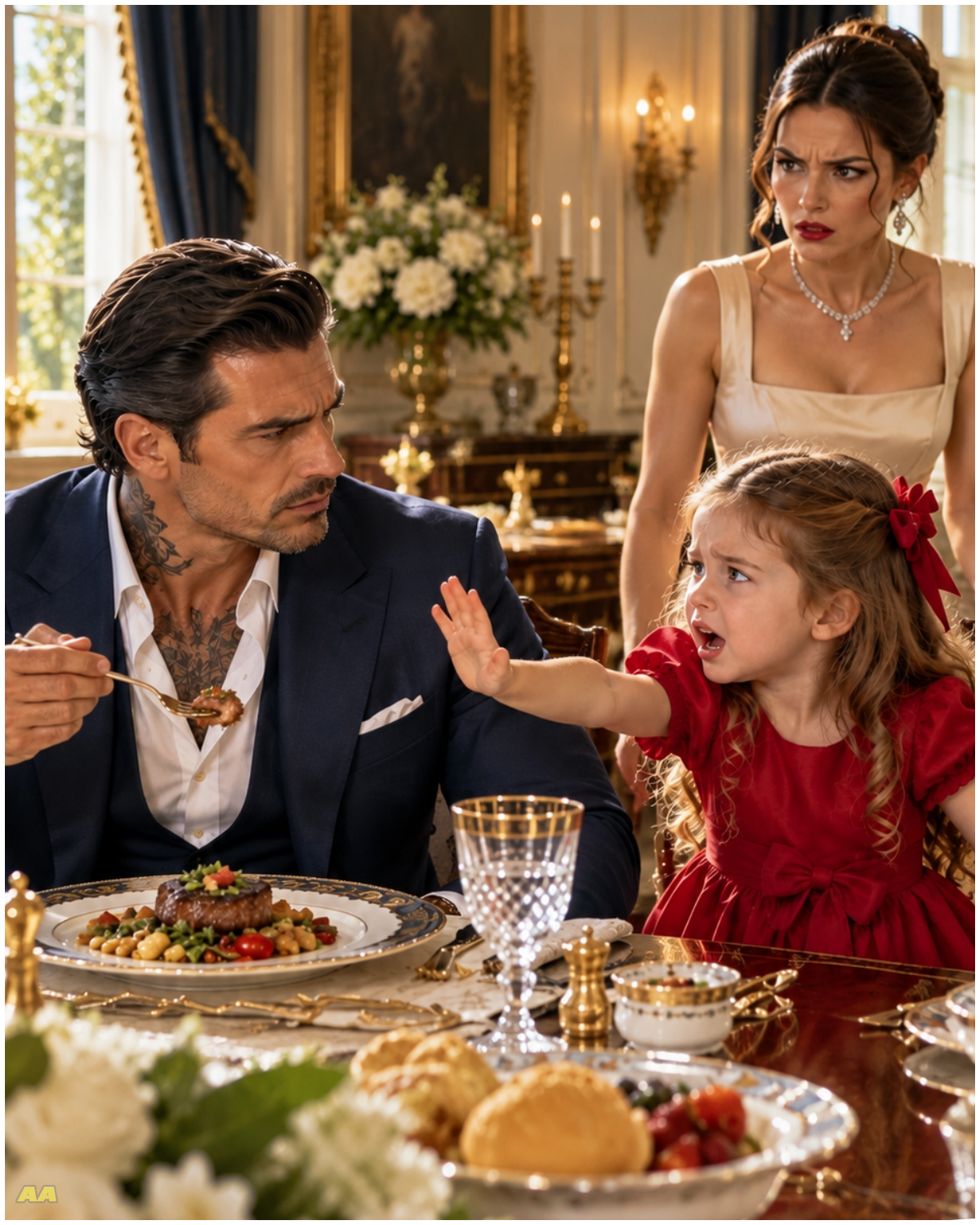
“Don’t eat it. It’s poisoned.”
The 8-year-old girl’s scream brought the entire Mafia gathering to a standstill.
Sophia insisted she had just seen someone tampering with Xavier Marchetti’s food.
No one believed her. Neither did Xavier, until he took the first bite and collapsed.
The chandeliers above the Marchetti estate burned like a private constellation, throwing soft gold across 40 guests dressed in silk, cashmere, and quiet money.
A jazz quartet played in the corner of the great hall.
The saxophonist leaning into warm tune that wrapped around the polished marble floor.
Crystal kissed crystal as toasts began to ripple from table to table.
Outside, the Long Island night pressed against tall windows, dark and unbothered, while inside, the most powerful family on the East Coast prepared to celebrate a wedding that had not yet happened.
Capos sat shoulder to shoulder with senators.
Two judges sipped Barolo near the fireplace.
A shipping magnate from Boston laughed too loudly at a joke nobody had told.
Every face in this room belonged to someone who could change a verdict, a vote, or a life with a single phone call.
At the head of the long table sat Xavier “Xav” Marchetti.
He wore black on black, the way his father once had.
The faint scar along his jaw caught the candlelight whenever he turned his head.
Beside him sat Elena Voss, draped in ivory silk.
The 5-carat diamond on her left hand throwing tiny, deliberate sparks every time she lifted her glass.
She had chosen tonight’s menu personally.
She had chosen the flowers.
She had chosen the music.
She had even chosen the plate sitting now in front of her future husband.
A delicate cut of seared salmon under a pale lemon butter sauce, the thin gold rim of the porcelain catching the light like a halo.
Xavier lifted his fork. Across the room, the kitchen door swung open with a sharp, child-sized push.
A small figure burst out before anyone could stop her.
Red patent shoes skidded across the marble.
A pink cardigan, slightly too big.
A worn cloth bear clutched against her chest with both arms, Sofia Romano was 8 years old and she was running as if the floor were on fire.
“Don’t eat that, Mr. Marchetti.”
Her voice cracked the music in half.
The saxophonist note died in his horn.
Forks paused in midair. Glasses froze on their way to lips.
40 pairs of trained, dangerous eyes turned at once toward the child sliding to a stop beside the head of the table.
“There’s poison in the fish. Please, sir, don’t eat it.”
For one impossible second, no one breathed.
Xavier’s fork stayed lifted, the salmon trembling slightly on its silver tines.
He did not move. Elena rose from her chair with the practiced grace of a woman who had spent a lifetime being watched.
Her eyes widened. Her free hand drifted to her chest.
The diamond flashed.
“Sofia.”
She breathed. The word coated in pity.
“Sweetheart.”
The kitchen door burst open a second time.
Maria Romano came running, apron still dusted with flour, dark hair coming loose from its pins.
She reached for her daughter, voice breaking.
“Sofia, no. My god, no. Come here. Come to mama, please.”
But Sofia did not move.
Her small finger lifted, steady as a needle, and pointed straight across the table.
She poured white powder from her purse into the sauce.
“I saw her. She used a spoon. She hid the spoon under a towel.”
A murmur slid through the room like wind through dry leaves.
“The cook’s daughter.”
“Poor thing, jealous, maybe. Children invent things at parties. Embarrassing, really.”
A silver-haired senator chuckled At the far end of the table, Donna Lucia Marchetti did not laugh.
She did not whisper. She sat with her rosary coiled around her fingers, dark eyes fixed on the trembling little girl, then on the ivory bride, then on the plate in front of her son.
She said nothing, but the air around her cooled by 10°.
Xavier finally lowered his fork.
He set it down beside the plate, slowly, as if it it a loaded weapon.
He did not look at Elena.
He did not look at the guests.
He looked only at Sofia.
His voice came out softer than anyone in the room had ever heard it.
“Little girl,” he said, “are you sure?”
Sofia did not lower her arm.
Her fingers still pointed across the table, and the bear pressed against her ribs like a small armored shield.
Her chest rose and fell in quick, shallow breaths, but her eyes never left Elena’s face.
Elena moved first.
She slipped around the corner of the table with the slow elegance of a woman who knew every eye in the room was measuring her.
She lowered herself onto one knee in front of the child, ivory silk pooling on the marble.
Her smile arrived gentle, polished, and full of motherly sorrow.
“Sweetheart,” she said, “maybe you saw the chef adding seasoning. Salt looks like that sometimes. Sugar, too. The kitchen is a busy place, and you’re so little.”
“It wasn’t seasoning.” Sofia’s voice did not shake the way her hands did.
“You took it from your silver purse, the little one with the clasp. You looked behind you first, then you opened the paper, then you stirred it in with a spoon, then you put the spoon under the folded towel by the bread basket.”
A faint twitch ran along Elena’s jaw before her smile widened again.
Behind Xavier, a shadow leaned in close.
Marco Bellini, consigliere of the family for 31 years, his silver hair combed back, his voice no louder than a confession.
“Boss,” he murmured in Xavier’s ear, “every house in this room is watching.
The Genovese, the Russo, the two seats from Albany.
If you push the plate away tonight, by morning the whole coast says the Don of the Marchese got scared by a child in a cardigan.” Xavier’s jaw tightened a fraction.
He understood. Tonight was not a dinner.
Tonight was a throne, and thrones were not allowed to flinch.
Sofia took her chance. In one sudden, desperate movement, she lunged forward, seized the rim of Xavier’s plate, and yanked it against her cheSt. Sauce sloshed onto the tablecloth.
“Mr.” Beans pressed against the gold rim, his stitched face squashed against the porcelain.
“You can’t have it.” A sharp, scandalized gasp rolled through the hall.
Somewhere near the second chandelier, a capo with a thick neck and a thicker cigar let out a startled chuckle.
A judge’s wife pressed a napkin to her mouth, more amused than horrified.
Xavier rose from his chair.
He did it slowly, the way a man rises in a church.
Every guest felt the temperature shift.
His voice, when it came, was almost tender.
“Sofia, look at me. Give it back.
Now.” The little girl’s lower lip trembled.
The bear slipped half an inch in her grip.
She stared up at him.
And for a moment, she looked so small that Maria, frozen near the kitchen doorway, made a sound like a wounded animal.
Xavier reached out. His hand closed gently around the edge of the plate.
He did not pull. He waited.
And when Sofia’s small fingers finally loosened, he eased the plate from her grasp, the way a surgeon takes a scalpel from a child who should not be holding one.
From the far end of the table, Donna Lucia spoke for the first time.
“Xavier,” she said, low and clear.
“Listen to the child. Listen to the child.” Xavier did not turn his head.
He did not look at his mother.
He set the plate back in front of his chair, lifted the silver fork, and addressed the room in the calm, measured voice of a man closing a deal.
To prove there is nothing wrong with the food, he took the bite.
He chewed. He swallowed. He smiled.
5 seconds, 10, 20, 30.
Nothing. A wave of relief swept the hall.
A senator laughed, too loud.
A capo lifted his glass.
The saxophonist breathed in, ready to start the song over.
Xavier turned to Elena, lifted her hand to his lips, and pressed a slow, deliberate kiss to her knuckles.
“Forgive the disruption, my love.” Elena’s smile arrived bright and dazzling.
The wine glass slipped from Xavier’s fingers.
It struck the marble and burst like a frozen flower.
He swayed. His knees folded a fraction.
One hand went to the edge of the table, white-knuckled, his face drained of color in 3 seconds flat.
A thin, dark thread of blood crawled from the corner of his mouth and ran down his chin.
Somewhere in the hall, a woman screamed.
The scream tore the room open.
Tony Hawk Russo was already moving before the wine glass finished shattering.
40 years old, 200 lb of Brooklyn muscle in a tailored jacket.
He crossed the hall in three strides and caught Xavier under the arms a half second before the Don’s knees folded the rest of the way.
Two of Hawk’s men had pistols out before their boss hit the floor, the metal flashing under the chandeliers.
A third was already at the door, broad back blocking the only exit a guest might dare to use.
Doctor. Hawk did not need to shout it twice.
Doctor. Salvatore Greco was on his feet from the third table.
Medical bag in hand the way a priest carries a Bible.
He had been the family physician for 19 years.
And he had attended every Marchetti event since the day Donna Lucia decided that no son of hers would die waiting for an ambulance.
He dropped to one knee beside Xavier, fingers pressing into the throat, eyes flicking to the dilating pupils, pulses racing, skin’s cold.
He’s been hit with something faSt. Xavier.
Elena’s wail rose above the chaos like a soprano hitting her cue.
She fell beside her fiance, ivory silk crumpling onto the bloodied marble, hands fluttering across his chest, tears spilled down her cheeks in clean, even lines.
Not one strand of her pale gold hair came loose.
Not one shudder cracked her voice.
Dear God, somebody help him.
Help him, please. Near the kitchen wall, Sophia stood perfectly still.
She did not cry. She did not run to her mother.
She watched. She watched the way Elena’s tears chose their path.
She watched the way Elena’s chest rose and fell with theatrical precision.
She watched Elena’s eyes while everyone else watched Elena’s mouth.
At the far end of the table, Donna Lucia rose to her full height.
65 years old, 100 lb of black silk and quiet violence.
The rosary dripping from her fingers like a length of dark water.
No one leaves this house.
Her voice did not lift, and yet every person in the hall heard it.
No one leaves this house.
Lock the gates. Lock the doors.
Anyone who tries the windows, break their fingers.
Hawk dipped his head once.
On it, senora. Within seconds, his men had sealed the four exits, checking pockets and purses with the polite efficiency of professionals who had done this before.
A senator started to protest, thought better of it, and sat back down.
Dr. Greco did not look up from Xavier.
Nobody touches that plate. The glass, either.
The napkin, the fork, the bread on his bread plate.
Bag everything. I want it sealed before the ambulance gets here.
Mrs. Constance Hale, the family’s housekeeper for 38 years, was already moving.
She lifted a clean linen square from a side cabinet, stepped behind the head chair, and noted, without speaking, the small gold flower pressed into the rim of Xavier’s porcelain, the plate that had been served only to him.
Her eyes tightened. Elena bent over Xavier’s body, her lips pressed against his forehead.
Quick, dry, almost clinical. Then her gaze flicked, fast as a lizard’s tongue, toward the rear service door at the far end of the hall.
Sofia saw it. She remembered, with the sudden clarity that fear gives children, an envelope changing hands at that same back door not 2 hours earlier, Elena passing a thick paper square to a man in a black jacket, and the man saying, “Low, tonight has to work.” Maria’s hands closed around Sofia’s shoulders and pulled her hard against the wall.
Tesoro, “Hush. Don’t say one more word.
Not one.” “Mama.” Sofia whispered, lips barely moving, eyes still on the bride.
She looked at the back door.
The sirens arrived 3 minutes later, distant and climbing.
Donna Lucia turned toward Hawk without taking her eyes off her son.
Street Vincent, the private wing.
Dr. Greco rides in the ambulance.
No press, no police. Anyone in this house who calls anyone, I will know by sunrise.
See, signora. The medics swept in.
Xavier was lifted onto the stretcher, oxygen mask fitted over his colorless face.
As the wheels began to roll across the marble, his eyes opened a slit.
They searched the room, slow and burning, until they found a pink cardigan and a battered cloth bear pressed against the wall.
He looked at Sophia, and weakly he nodded.
The private wing of St. Vincent’s smelled of antiseptic and old money.
Two black SUVs and a sleek Mercedes were parked at the rear ambulance bay, ignoring the painted lines.
Inside, a corridor that normally served senators and heart surgery billionaires had been quietly cleared by a single phone call from Donna Lucia.
Hospital staff moved with the careful, downcast eyes of people who had been told, very politely, to forget faces.
Marchetti soldiers lined the hallway in dark suits, hands folded in front of them like ushers at a funeral that had not yet begun.
No one spoke. The only sound was the distant beep of a heart monitor through a closed door, and the small click of rosary beads in a private waiting room.
Donna Lucia sat alone in that room, on a leather chair that did not deserve her.
The black silk of her cloak pooled around her ankles.
Her lipstick was unsmudged. The crucifix at the end of her rosary swung in slow, hypnotic arcs between her fingers, while her eyes remained fixed on a single point on the wall, as if seeing through it.
Out in the corridor, Maria Romano stood with her daughter pressed against her side.
A guard wider than the doorway lifted one gloved hand without looking at her.
Family only. Yes, sir. I understand.
I just family only. Maria stepped back, swallowing.
Sophia, still clutching Mr. Beans, did not lift her face from her mother’s hip.
A door opened behind them.
The rosary stopped. Lascia she and trino.
Let them through. Donna Lucia stepped into the corridor herself.
The guard moved aside before her shoes had crossed the threshold.
Both of you, she said, eyes settling on Maria.
Sit beside me. Maria’s hands trembled against her apron, still flower dusted.
Signora, please, we don’t belong here, the man.
Your daughter tried to save my son tonight.
Donna Lucia’s voice did not rise.
It did not need to.
That makes your family my family until the sun comes up.
Sit. Maria sank onto the edge of a leather chair as if it might bite her.
Sofia climbed up beside her, feet not touching the floor.
The bear settled in her lap.
Marco Bellini stepped in a moment later.
His phone still warm in his palm.
Greco’s running labs in the basement.
Says the agent is fast acting, not a household poison.
He’ll know more within the hour.
Donna Lucia did not answer.
She was watching Sofia. A second figure slipped through the doorway behind Marco.
Slim, dark haired, eyes red rimmed but dry.
Isabella Marchetti, 28, Xavier’s only sister, still in her travel coat from the Boston shuttle.
She crossed the room without ceremony, lowered herself onto the carpet in front of Sofia’s chair, and brought their faces level.
Hi sweetheart, I’m Isabella. I’m Xavier’s sister.
Sofia studied her, careful as a small judge.
Can you tell me, Isabella said softly, everything you saw?
Take your time. Nobody here is going to be angry with you.
Sofia’s fingers tightened around Mr.
Beanz. She drew a slow breath.
Miss Elena came into the kitchen at 7:42.
The clock above the spice shelf is the round one with the rooster.
I was sitting on the stepstool by the pantry because mama told me to stay out of the way.
Miss Elena didn’t see me.
She looked behind her two times.
Then she opened her silver purse, the small one with the clasp shaped like a leaf.
She took out a little white paper packet.
She tore the corner. She poured powder into the sauce on the plate with the gold flower.
She stirred it with the small silver spoon.
Then she folded the spoon inside a napkin and pushed it under the basket where the rolls were.
She paused. Her voice dropped by half.
After that, a man came to the back door, black jacket.
He didn’t come inside. Miss Elena gave him an envelope.
He said, “Tonight has to work.” And he left.
Marco’s eyes flicked to Donna Lucia.
Hers were already on his.
The phrase sat between them like a small lit match.
The waiting room door opened.
Dr. Greco entered, sleeves rolled to his elbows, latex gloves balled in one hand.
The fluorescent light caught the gray in his beard and made him look older than he had an hour ago.
“He’s stable. He took only a single bite, and that single bite saved his life.
By tomorrow morning, he’ll be sitting up and demanding coffee.” Donna Lucia’s shoulders did not loosen.
“But?” Greco hesitated. “But the blood work is wrong, Signora.
There are markers that don’t match a one-time exposure.
Liver enzymes, kidney function, certain metabolites.
These build up over time.” “Time?” she repeated.
“Weeks.” The rosary went still in Donna Lucia’s hand.
“Weeks?” Greco nodded once, slowly.
“Whoever did this tonight,” he said, “has been doing it for a long while.” Xavier woke at 3:47 in the morning to the soft, even click of a heart monitor and the smell of bleach.
The private suite was dim, lit only by a single floor lamp in the corner and the steady amber glow of an IV pump beside his left hand.
A clear line ran into the back of his wriSt. His chest felt as if a small horse had stepped on it and forgotten to step off.
His mouth tasted of metal and chemical sweetness, but his mind, when it came online, came online sharp.
He turned his head, and his mother was already watching him.
Donna Lucia had not changed her clothes.
The rosary was still woven through her fingers.
The black silk of her cloak was creased in the same place it had creased when she had stood up at the long table 6 hours earlier.
She had not slept. She had not eaten.
She had simply waited. “My son,” she said quietly.
“What did your mother say to you in Italian?” Xavier closed his eyes for a long moment.
“Listen to the child.” “And what did you do?” “I didn’t listen.” “The next time I switch to Italian at a dinner table,” she said, voice dry as paper, “you will listen.
Even if your fiance is sitting on your lap and the Pope is pouring the wine.” He let out something that might have been a laugh if a laugh did not hurt his ribs so much.
The door opened. Marco Bellini stepped in, tablet under one arm.
The lines of his face deeper than they had been at sundown.
He set the tablet on the rolling bed table and did not bother with greetings.
“I had the houseman pull 6 weeks of your calendar, cross-referenced with what the staff remembers.
Six Tuesdays in a row you canceled your morning runs and said it was the shoulder.
Four times you fell asleep at your desk before 9.
Three migraines in 1 week.
You stopped finishing your espresso twice.
You said it was stress.
Boss, we all said it was stress.” Xavier stared at the ceiling.
“It wasn’t stress. No, sir, it wasn’t.” There was a small silence.
“Bring her in,” Xavier said.
Marco glanced at Donna Lucia, then stepped back into the corridor.
A moment later the door eased open again.
Sofia walked in barefoot. Someone had taken her red shoes off at some point and never given them back with Mr.
Beans tucked under her arm and Maria’s hand on her shoulder for the first three steps.
After that, the child went forward alone.
She stopped exactly three paces from the bed, the way one might stop in front of a saint or a sleeping dog.
Xavier pushed himself up onto his elbows.
“Mr. Marchetti.” “No,” Dr. Greco snapped from the doorway.
“I told you not to.
Sit down, Salvatore. Xavier kept rising until his back was against the pillow and his eyes were level with the 8-year-old’s.
He looked at her for a long moment.
Whatever he saw there cost him something to look at.
Sofia. Yes, sir. I didn’t listen to you.
No, sir. I took the plate out of your hands.
I made you watch me eat it.
That was my mistake, not yours.
I am sorry. In the corner, Marco’s eyebrows lifted by a millimeter.
Donna Lucia’s chin rose. The Marchetti family had not heard the Don of the Marchettis say, “I am sorry” to anyone in any language in something close to 9 years.
Sofia studied his face the way she had studied Elena’s.
Then her small voice came out flat and practical.
Does it hurt where it went in inside you?
Yes. A lot? A lot.
But because of you, I am still here to feel it.
That is a fair trade.
Her chin dipped. Acceptable. Then her free hand went into the front pocket of her cardigan and she drew out something small and crumpled and faintly stained.
A folded square of white paper.
The corner had been torn.
A faint dust still clung to the inside crease.
I picked it up from the kitchen trash after Miss Elena went back to the dining room.
I hid it inside the dry pasta tin behind the flour.
I thought maybe somebody would want it later.
The room stopped breathing. Doctor Greco crossed the floor in three strides, pulled a fresh latex glove from his coat, and lifted the packet from Sofia’s palm with the reverence of a man receiving communion.
He slid it into a sterile bag, sealed it, and dated it.
I will analyze this myself, Signora, by morning.
Donna Lucia did not look at the doctor.
She bent down, cupped Sofia’s small chin in her hand, and brushed the pad of her thumb across the child’s cheek.
Little girl coraggiosa, she whispered.
Brave little girl. The packet had not been in the doctor’s bag for 2 minutes when the corridor outside erupted.
Heels, quick, sharp, expensive. A guard’s voice attempting proteSt. A woman’s voice cutting through it like a violin string snapping.
Move. Move. That is my fiance in there.
The door swung open and Elena Vass made her entrance the way she made every entrance as if a camera were already filming her.
She had changed clothes. The ivory silk was gone replaced by a long black velvet coat over a cream blouse.
The diamond on her left hand catching the corridor light as she rushed across the threshold.
Her cheeks bore two glittering tracks of mascara.
Smudged just enough to look authentic.
Smudged not enough to actually ruin her face.
“Xavier.” She flung herself across the last three feet of polished floor and dropped against his cheSt. Arms wrapping around the dawn’s shoulders.
The IV line shifting under her sleeve.
Xavier did not raise his arMs. He did not move at all.
The hand resting on the bedsheet curled just once into a loose fist and then relaxed.
His eyes when they met hers over her shoulder were the gray of a sea before a storm.
Cold. Very cold. Elena pulled back searching his face.
Whatever she did not find there she covered cool make.
“I have been losing my mind.
They wouldn’t let me in.
They told me you were unconscious.
Hawk would not answer his phone.
Marco would not answer his phone.” Her hand fluttered to her throat.
Her gaze slid sideways toward the small figure in the corner of the room.
“And why is that child still here?
Why is she anywhere near you?” From the chair by the window Donna Lucia answered without rising.
“Because she belongs in this room Elena.
You I am not yet certain about.” Elena’s lips parted.
The wounded look she summoned was almost beautiful in its precision.
“Donna Lucia.” “Mama. You cannot possibly think I am still your future husband’s mother.” Donna Lucia said.
“I am not yet your mama.
Choose your next sentence carefully.” Xavier raised a hand a fraction off the sheet.
The room obeyed it. Elena.
His voice was the calm, level voice he used in negotiations where men sometimes did not walk back out.
Marco is having the kitchen footage pulled tonight.
Every camera, front entrance, service hall, prep counter, back door.
The hard drives are with my technician now.
We will have everything within the hour.
For half a second, Elena’s face did exactly what an innocent woman’s face does not do.
She blinked. Once. Slow. Mechanical.
The corner of her mouth twitched as if a small invisible thread had been tugged.
Her shoulders stiffened by perhaps a quarter inch.
The breath she had been holding to produce the next sob caught somewhere between her lungs and her throat.
Then the mask slid back into place.
“Good.” She said brightly. The tears continuing their elegant descent.
“Good. Then the cameras will show what really happened.
And that little girl can go home with her mother and apologize to me in front of everyone.” In the corner, Sophia did not blink.
Her dark eyes had stayed on Elena’s face from the moment the door opened.
And they had captured the half second flicker of fear with the steady precision of a small, patient camera of their own.
Elena bent forward, pressed dry lips quickly to Xavier’s forehead, declared that she could not bear to be in a hospital one more minute, and swept out in a swirl of black velvet and well-rehearsed weeping.
The door clicked shut. Silence settled over the room like fresh snow.
Sophia’s small voice arrived at exactly the right moment.
“She wasn’t scared when you were sick.” Three sets of adult eyes turned to her.
She was loud. “She wasn’t scared.
She got scared when you said cameras.” Xavier looked at this child for a long, long time.
“How old are you, Sophia?” “Eight.” “Sir, you are smarter than half the men who work for me.” The door opened again.
Marco stepped in. He did not need to speak.
Xavier read his face in one glance and felt his stomach drop a second time that night.
“Tell me.” “Boss.” Marco swallowed.
“There is a problem with the kitchen footage.” “What problem?” “From 7:30 to 7:50, the file is gone.
Not corrupted, not damaged, erased.
The offsite backup is also blank for the same window.
Time-stamped log says no one accessed either system tonight.” He paused.
“It is as if those 20 minutes never existed.” Xavier exhaled, long and slow.
Someone inside the family had helped her.
The next morning Elena beat them to it.
By 11:00, she had requested a private gathering inside the Marchetti library.
Not the dining hall, not the great room, but the smaller leather-walled chamber where the family handled matters of internal discipline.
Six capos, Marco, Donna Lucia, Hawk standing against the window, Xavier in a high-backed chair near the fireplace, still pale, still on antibiotics, still very much the Don.
Elena entered without theatrics this time.
No tears, no velvet, a simple navy dress, hair pulled back, a slim leather folio under one arm, and a small black laptop in the other.
She set both on the long oak table the way a lawyer sets down a brief.
“Before any of you say something we cannot take back, I want to clear my name.” She opened the laptop.
She turned the screen toward the room.
“My personal technician spent the night on this.
He recovered a portion of the kitchen footage from the secondary server, the one routed through my own security firm during the engagement preparations.
The Marchetti backup was wiped.
Mine was not.” A faint, controlled video began to play.
Time-stamped in the lower right.
7:38 in the evening. Kitchen prep counter.
Elena entering through the side hall, pausing, smiling at the chef de cuisine, leaning over the gold-rimmed plate to admire it, lifting a single sprig of dill, setting it back down.
No purse, no paper packet, no spoon hidden under any towel.
Then, 10 seconds later, a smaller figure entered the frame from the pantry side.
Pink leggings, yellow cardigan, a cloth bear, Sophia, standing beside Xavier’s plate, one hand reaching toward the edge of it.
The video froze on that exact frame.
Elena did not gloat. She let the room do that work for her.
“I do not want to think this about a child.” she said softly.
“I really do not.” “But perhaps Sophia saw me near the plate and assembled the rest in her head.
Perhaps she is frightened. Perhaps somebody told her what to say.
I would never accuse a little girl, Xavier.
But I refuse to be accused either.” A silence.
A capo near the back, gray mustached and Sicilian-born, cleared his throat.
“Boss, forgive me. Children at parties, sometimes they get used by somebody else.
Maybe somebody coached the little one.” Two other capos shifted in their seats.
The room’s center of gravity began, very quietly, to move.
By 2:00 in the afternoon, Maria Romano had been taken into the staff office and asked the same questions in 12 different ways.
She was a widow. She was an immigrant.
She was an employee. By 3:00, she had been told, with great regret, that she and her daughter would need to vacate the kitchen apartments by sundown for everyone’s protection.
Sophia sat alone on a small stool in a small windowless room near the pantry, Mr.
Beans on her lap. She did not cry.
She did not argue. She studied the floorboards.
At 4:00, Hawk came for her.
Xavier was waiting in his study, the curtains drawn.
He looked thinner than he had the day before.
He gestured to the leather chair across from him.
Sophia climbed up. Her feet did not reach the floor.
“Sophia, I am going to ask you one question, and I need the truth, no matter what it is.
Did you, at any point, touch the plate that was meant for me before it left the kitchen?” “No, sir.” “The video shows you next to it.” “That video is fake.” “How do you know?” Sophia did not hesitate.
“Because in that video, I am wearing a yellow cardigan.
Last night, I was wearing a pink one.
Mama dyed it pink in March because I poured grape juice on it and she could not get the stain out.
I never had a yellow one.
The video lies. Xavier stared at her.
He picked up the desk phone.
Marco, pull every photograph taken at last night’s party.
Guest cell phones, the official photographer, the kitchen staff intake camera, everything.
I want a full visual record of what that child was wearing, down to the buttons.
And I want the comparison on my desk in 20 minutes.
It took 18. Marco set a folder in front of him without speaking and opened it to a clear, well-lit shot from a guest phone.
Sofia in the corridor, an hour before the dinner, in an unmistakably soft pink cardigan with a small embroidered strawberry on the pocket.
Then a second photograph from the photographer’s drone.
Pink. Pink. Pink. 12 images, all pink.
Marco’s voice was flat. Boss, the girl is right.
The cardigan in the recovered video is yellow.
Donna Lucia, standing by the bookshelf, drew in a slow breath through her nose.
Then Elena did not improvise that footage last night, Xavier.
She made it days ago, maybe weeks.
She prepared the lie before she ever needed it.
Xavier closed the folder. His fiance had not panicked her way into a fake video.
She had walked into this house with one already pre-edited, sitting on a private server, waiting for the night it would be needed.
That meant a technician, a server farm, a chain of payments, a timeline.
Elena Voss was not working alone.
By 6:00 that evening, Xavier was home.
He refused the wheelchair the hospital wanted to load him into.
He refused Hawk’s offered arm at the front steps.
He walked into the marble foyer of the Marchetti estate on his own two feet.
Jacket buttoned over the IV bandage, jaw set, and the moment the heavy front door closed behind him, he turned to Marco and said one word, “Sweep.” Hawk had already begun.
Three of his men in shirtsleeves were going through the great house with handheld counter-surveillance scanners that hummed like irritated wasps.
Drawers were emptied, lampshades lifted, bookshelves tilted forward, air vents unscrewed.
The pace was quiet, methodical, professional, and it had the air of a wake.
22 minutes later, one of the wasps screamed.
Hawk himself was the one who knelt under the great walnut desk in Xavier’s study and slid out a small black square, no larger than a child’s thumbnail, taped to the underside of a drawer rail.
Battery still warm, boss. He turned it in the light.
This model has a 3-week lifespan.
From the heat fatigue on the casing, I’d say it’s been listening to you for about that long, maybe a little longer.
Xavier did not speak. He sat down in the chair behind the desk and laid his palm flat on the wood his grandfather had cut from a tree on Cape Cod in 1947.
Marco placed his tablet beside that palm.
Access logs from the household system, boss.
Last 6 weeks. Elena’s biometric tag entered this study four separate times when you were not in the country.
Once for 41 minutes. The note she left desk each time was the same, picking up the seating chart for the wedding planner.
The seating chart has never been kept in this room.
Donna Lucia, who had followed her son home and who had not spoken since the hospital, walked slowly to the wall of bookshelves at the far end of the study.
She reached behind the third shelf, pressed a hidden catch, and the panel swung open to reveal a small wall safe set into the brick.
The dial was Marchetti family, three numbers each of them knew.
Three numbers no outsider had ever been given.
The door of the safe was already closed, but it was not locked.
Donna Lucia opened it. She looked inside for a long moment.
Her shoulders did not move.
Her voice, when it arrived, was almost soft.
A file is missing, Xavier.
He came to stand beside her.
The interior of the safe held five flat manila folders.
There should have been six.
The narrow gap between the third and fourth folder was the kind of gap a person notices only if they have placed each folder there themselves.
Xavier had. Which one? He asked, although his stomach already knew.
The shipping ledger. The transshipment points along the Brooklyn waterfront.
Pier numbers, schedule windows, customs contacts, names.
Marco swore very quietly in Italian under his breath.
Boss, if that document leaves this house, he said, the federal task force can map our entire import chain in an afternoon.
Or God forbid a competitor walks into our piers and takes them while our own men are still parking their cars.
Xavier’s jaw worked once. Who would pay the most for it, Marco?
The consigliere did not answer right away.
He looked first at Donna Lucia.
The two of them held each other’s eyes the way people do when an old heavy name is about to be lifted off a shelf where everyone has agreed not to set it.
Only one man would pay any price you named, Marco said.
Victor Cain, the don of the Canes.
The man who, 15 years earlier, had arranged a single vehicle accident on the Belt Parkway that had folded a black Lincoln around a guardrail with Xavier’s father inside it.
The man who had stood at the funeral with a hand on Xavier’s 22-year-old shoulder and said, Such a tragedy.
Drive carefully, son. The man Donna Lucia had never once allowed inside her house since.
Xavier sat down again. He pressed his thumb against the scar along his jaw, an old habit dating from the same season as that funeral.
So, Elena is working for Cain?
Possibly, Donna Lucia said, but it may be larger than that.
Elena is Senator Voss’s daughter.
The Voss family and the Cain family have shared lawyers, holdings, and quiet political favors since before you could shave.
A small, polite knock came at the open study door.
Mrs. Constance Hale stood in the threshold, hands folded in front of her starched apron the way they had been folded for 38 years.
Forgive me, signor, signora. I have been turning something over in my head since last night, and I cannot let it sit any longer.
Speak. A week before the engagement dinner, a delivery van I did not recognize brought a bouquet of long-stemmed wine-colored roses.
The card said only for E.
I assumed it was a gift to Miss Voss from her mother.
When I cut the stems to put them in the foyer vase, she paused, the color leaving her face by slow degrees as she spoke.
I saw a fine white powder caught at the base of one stem.
I thought it was floral preservative.
I rinsed it. I forgot.
Xavier and his mother looked at each other across the desk.
This had not been their dinner.
This had been the dress rehearsal.
By nightfall, orders had gone out.
Donna Lucia had not asked permission, and she had not asked Xavier.
She had simply stood in the kitchen apartments above the garage and told Maria Romano that two suitcases were enough.
The rest of their things would be moved in the morning, and that the guest wing of the main house had been opened and aired.
Maria’s hands twisted around her dishtowel.
Signora, please. I cannot. We are bringing trouble into your home.
We are staff. We sleep over the garage.
That is the way it should be.
We go to my sister in Queens.
Two weeks, maybe three. Then we come back when this is over.
You will not go to Queens.
The older woman’s voice was not unkind.
It was simply final. You have no choice in this, Maria.
Somebody wants your daughter dead.
They tried to use a video to throw her out of this house.
When that did not work, they will try something quieter.
In Queens, you would be alone with a child in a window.
Here, you have walls, men, dogs, and me.
You do not get to argue with that arithmetic.
Maria pressed her hand against her mouth and did not argue with it.
By 8:00, the guest wing had a new tenant.
The room they gave Sophia was three times the size of the bedroom she had grown up in.
A four-poster bed stood in the center.
White linen draped from a canopy carved with grapes and small leaves.
A bay window looked out over a stone terrace and an old manicured garden.
In the corner, on a black lacquered stand, sat an ancient juniper bonsai.
Its branches twisted by 60 years of patient hands.
Sophia had never seen a tree that lived inside a bowl.
She climbed onto the window seat with Mr.
Beans and watched the moon move across the bonsai’s leaves.
A soft, uneven step came up the corridor.
The door eased open. Xavier stood in the doorway, leaning lightly on a black walnut cane he was clearly embarrassed to be using.
He had changed out of the suit, a dark sweater, house slippers.
He looked younger than he had at the engagement table and at the same time considerably older.
May I come in? Yes, sir.
He crossed slowly and lowered himself into the small upholstered chair beside the window.
The cane he laid across his knees.
Are you frightened? A little, but I’m holding Mr.
Beans, so it is less.
Mr. Beans, he repeated. Tell me about Mr.
Beans. He is my bear.
My papa gave him to me before he died.
Xavier’s jaw shifted very slightly.
How long ago? I was four.
Mama says there was a wall on a building site that was not built right.
The wall came down on him.
I don’t remember a lot.
I remember he smelled like cinnamon.
Xavier did not answer for a moment.
He had ordered the deaths of grown men without losing his appetite.
He had not, in his 37 years, ever held a conversation with a child whose father was dead.
Something in his chest moved in a direction it had not moved before and he did not entirely know the name of it.
Sophia tilted her head. Her dark eyes studied his.
Are you a bad man, sir?
He took the question seriously.
He owed her that much.
I do things that are not always good.
I will not pretend with you, but I have rules.
The rules matter. What rules?
Three. He held up one finger.
I do not hurt children, ever.
A second finger. I do not betray the family that broke bread with me.
A third. I do not lie to anyone who has eaten at my table.
Sophia thought about this with the gravity of an 8-year-old judge.
Miss Elena broke the third one.
Xavier’s mouth lifted at one corner, a small, true smile, the first one in days.
Yes, little girl, she did, and she is going to pay for it.
In the hallway, half shadowed in the doorway, Donna Lucia stood and watched her son speak to the child as if he were neither a don nor a patient nor a wounded man, but only a tired uncle telling the truth in a soft voice.
The corner of her own mouth lifted.
Something in this house was changing.
She did not yet know how far that change would go, but she had already decided not to stand in its way.
Xavier reached for his cane and rose to leave.
Mr. Marchetti, he turned at the door.
Miss Elena had help. The man from the back door, I think I saw him before, last week after school.
He was sitting in a black car on the corner across from the bus stop drinking coffee.
I noticed because the windows had curtains.
Cars don’t have curtains. Xavier went very still.
When last week? Sophia? Wednesday, maybe Tuesday.
He was reading a folded paper.
He looked at me twice.
The don of the Marchettis stood in the doorway of a child’s bedroom and felt the cold, clean clarity of a man who has just realized that the hunters had been watching the small one in the pink cardigan long before they ever poured powder into a sauce.
Doctor Greco arrived at the Marchetti estate at 6:00 the next morning with a thin cardboard folder under his arm and the pale, sleepless eyes of a man who had spent the night in a basement laboratory.
He laid the folder on the desk in Xavier’s study and opened it without preamble.
The packet your little witness pulled out of the trash.
Aconitine, signore. Distilled from the root of monkshood wolfsbane, the old country called it a garden flower, if you can believe it.
Pretty purple thing, grows in any cool climate.
He tapped the report with one finger.
At a single high dose, it stops the heart inside the hour.
Nothing fancy, nothing detectable on a casual screen by the time the medical examiner thinks to look for it.
The body is already cold.
But the more interesting use, señor, is the one I think we are dealing with.
Microdosed, spread across days, across weeks.
The victim does not die.
He simply softens. Headaches, insomnia, loss of appetite, slow reflexes, cloudy judgment.
The kind of fog a man blames on workload.
Marco crossed his arms over his chest and looked at the floor.
“So, for weeks,” he said quietly.
“The boss has been getting hit with a low dose, and we all stood around and called it stress.” Xavier did not move from his chair.
His left hand rested flat on the desk.
His right thumb rubbed the scar along his jaw.
“Walk me through what was in front of me every day,” he said out loud, slow.
Marco started a liSt. Espresso.
Every morning, she brought it to your bedside personally.
Always insisted, said she liked watching you wake up.
Wednesday night chicken brodo, said her grandmother taught her.
Saturday, tiramisu, she sent the cook out of the kitchen for it, said she wanted to make it for you with her own hands.
Donna Lucia, by the window, brought a hand to her throat.
The color left her face.
“I ate that broth, Xavier, twice.
I ate the espresso once when she insisted I taste it.” Greco shook his head, gentle and certain.
“Signora, you are well because she did not poison the pot.
She poisoned the cup, the bowl, the portion.
It is the oldest trick in the book, and the most quiet one.
You serve from a clean dish.
You stand at the table.
You place the fork in the right hand.
Only the chosen plate is touched.” Marco was already moving to a second folder.
“Boss, finance side, I have something you need to see.” He laid out the printouts.
“Over the past 14 days, $3.2 million has moved out of your discretionary investment account, authorized by your signature, authentic ink, the bank confirMs. Routed in seven transfers to four shell companies registered in Delaware and the Cayman Islands.
Each transfer just under the bank’s automatic flag threshold.
Each timed to a Tuesday or a Friday evening, the same evenings, signor, that you came home complaining of a migraine and went to bed by 9:00.
Xavier closed his eyes. She brought me documents on those nights.
She brought you a folder.
You told me yourself on a Wednesday in this very room that you signed three things you could not remember.
You laughed it off. You said, “Marco, getting old.” And then there is this one.
Marco set a single sheet on top of the stack.
The header was the cream-colored letterhead of the Marchetti Family Foundation.
The title was Temporary Oversight Authorization Beneficiary Operations.
The signatory line bore Xavier’s name in his own loose, slightly slanted hand.
The body of the document granted Elena Voss full executive control over foundation disbursement in the event of the principal’s temporary medical incapacity.
Below the signature, the seal of the notary.
The name beneath the seal was Sebastian Voss, Esquire, counselor at law, Elena’s older brother.
Marco’s voice flattened. “That foundation, boss, the orphanages, the Marchetti Family Foundation held $40 million in endowment.
Every cent of it had been earmarked in writing by Xavier’s father in the last year of his life for the Catholic orphanages in Brooklyn and the Bronx children whose own families had been swallowed by the same streets that had built the Marchetti name.” Xavier’s hand on the desk closed slowly into a fiSt. “She used the children’s fund.” A soft, uneven step in the doorway.
The smell of incense and old wool.
Father Antonio stood at the threshold, an elderly priest in a black cassock, a silver cross resting on his cheSt. He had baptized Xavier, buried Xavier’s father, and refused, twice, to baptize Elena Voss because his old soul had not liked her eyes.
“Xavier.” His voice was hoarse with sleep and disbelief.
That cannot have happened. Your father will rise out of his grave.
Xavier rose to his feet, the cane forgotten beside him.
Marco, freeze every account, every authorization, every line of credit she has ever touched.
Audit the foundation back to the day my father signed the deed.
I want the names behind every shell.
I want them by tonight.
See, boss. It took Marco 4 hours instead of the rest of the day.
He came back into the study with his tablet and a face that had aged another year.
Boss, one of the shell companies, the second largest of the four, has its registered agent listed at a Park Avenue address.
The address belongs to a private law office.
The senior partner of that office is the personal attorney of the Cain family.
By the time the sun set on the second day, Hawk had already been parked across from Elena’s TriBeCa apartment for 16 hours.
She had moved out of the Marchetti estate the morning after the engagement, citing the air of suspicion that broke my heart.
The doorman of her building had seen her come and go four times in 2 days, always with sunglasses, always with one bodyguard.
What the doorman had not noticed, because doormen are not paid to notice such things, was the matte black Lincoln Town Car that had begun rotating its parking spot every 40 minutes along three different cross streets, never staying in any one of them long enough for traffic enforcement to take an intereSt. Hawk noticed.
He pulled the plate at 3:00 in the afternoon.
By 3:15, the name on the registration came back through a cousin in the city DMV, Daniel Cross.
Hawk recognized the name before the photograph finished loading on his phone.
Cross was a face from the federal task force pin boards, a facilitator, the polite bureau word for a courier of cash, contraband, and quiet messages.
Twice arrested, twice released. He had spent the better part of a decade moving envelopes between Atlantic City and Long Island for a single client liSt. And the top name on that list, in red marker, had always been Cain.
At 7:00 that evening, Cross left his post and drove to Brooklyn.
Hawk followed in a delivery van with a hand-painted plumber’s logo on the side.
The destination was a corner cafe on Court Street that catered to lawyers and a certain class of off-duty courthouse clerk.
Cross took a booth at the rear, ordered nothing, and waited.
11 minutes later, a second man came in, shook the rain off a cashmere overcoat, and slid into the seat across from him.
Mid-50s, slate gray suit, silver-rimmed glasses, the profile of a man who had been photographed for a association brochure.
Hawk lifted his phone. He clicked the long lens up against the window glass and squeezed off six frames in 3 seconds.
Sebastian Voss, Elena’s older brother, the notary whose seal sat at the bottom of the Marquette family foundation authorization, the lawyer whose name had been quietly attached 3 years earlier to a Senate ethics inquiry that had been just as quietly buried.
The two men spoke for 19 minutes.
Cross slid an envelope under the napkin dispenser.
Sebastian slid it into his coat.
They left through different doors.
Hawk drove back to Long Island with both men’s faces, two license plates, and a sequence of time-stamped photographs uploaded to a secure cloud he had built himself.
Marco laid the printouts across the desk in the study.
Boss, this is not a girlfriend with a grudge.
This is not a cousin who was paid to wipe a video.
This is a network. The Voss siblings on one side, Cain money behind them, Cross as the runner between.
They have been assembling this for months.
Xavier said nothing for a long time.
He was sitting behind his father’s desk in his father’s chair, slowly turning his father’s signet ring around his right ring finger.
The crest on the ring was a small lion holding a key.
The ring had not been off Xavier’s hands since the funeral 15 years ago.
Tonight, he kept turning it, the way a priest turns a rosary when the words have run out.
This was no longer business.
This was a personal insult in the deepest kind because it had walked into his house wearing his ring.
The study door opened without a knock.
Dona Lucia did not knock in this house.
She set a small cup of black coffee on the desk in front of him and stood with one hand resting on the back of his chair.
“What are you thinking, my son?” “I am thinking,” Xavier said quietly, “that Victor Cain tried to turn my wedding into his cemetery.” “And what will you do about it?” He looked past the lamplight, through the tall window, across the dark lawn toward the guest wing, where a small gold light still burned in the upstairs bay window, Sophia’s window.
“I will do what my father would never have done, which is wait.” Dona Lucia raised an eyebrow.
“I will let them keep believing I am weak,” Xavier went on.
“I will let them keep moving.
I will give them rope and lawyers and confidence.
And then when I am sure of every name, I will close the whole thing in a single night.” The older woman’s mouth pressed into a thin, grim, satisfied line.
“That is your father’s son talking.” “No,” Xavier said, “that is mine.” In the guest wing, Sophia could not sleep.
She had crawled to the bay window with Mr.
Beans and pressed her cheek to the cool glass, looking out at the moonlit garden the way she had looked the night before.
The juniper bonsai stood like a tiny watchman in the corner of the room behind her.
Something near the south hedge moved that should not have moved.
A man stood beyond the wrought iron fence, hands deep in the pockets of a long coat, head tilted up toward her window.
He was not staff. He was not security.
He was perfectly still in the way that watchers are still.
Sophia did not gasp. She did not move.
She held Mr. Beans tighter against her chest and let her breath fog a small soft circle on the glass.
“I see you,” she whispered to the bear, very quietly.
“I see you back.” Elena called 11 times in two days.
The first call was a sob into Xavier’s voicemail about being misunderstood.
The second was a tightly worded message from Sebastian’s office, lawyer to lawyer, requesting a private audience to clear up procedural questions.
By the seventh call, she had stopped sobbing.
By the ninth, she had stopped pretending to.
Xavier let every call ring through.
On the morning of the third day, he sent her a one-line text from a clean phone.
Tonight, 8:00, the estate. Come alone.
She arrived at 7:58. The driver who dropped her at the gate was not Daniel Cross.
Hawk noted the substitution and said nothing.
She came up the front steps without an umbrella, although a thin sleet had started, and the security men opened the door for her in the way they open doors for guests they would have preferred to throw out.
She had dressed for this meeting.
No ivory, no velvet, no diamonds.
Even the engagement ring had been left somewhere out of sight.
A soft gray wool sweater, charcoal trousers, hair swept back into a low knot, no mascara.
A faint pink at the rims of her eyes that she had clearly stayed up to perfect.
The whole effect was that of a woman exhausted by the cruelty of suspicion.
She was led into the formal sitting room rather than the study.
Donna Lucchese sat in a high-backed chair near the fireplace.
Marco stood behind Xavier’s left shoulder, tablet at his side.
Hawk stood by the door, hands folded, eyes flat.
Xavier sat on the long sofa across from her, sleeves rolled, no jacket.
Elena did not embrace him.
She had the wisdom, finally, to read the room.
“I know how this looks,” she began.
“I know the video has been called into question.
I do not understand what happened with it.
My technician swore on his children that the footage was genuine.
Perhaps he was paid by someone.
Perhaps the file was tampered with after he handed it to me.
I am as confused by this as you are.
But I am not your enemy, Xavier.
I am the woman who was going to take your name.” Xavier set his coffee on the table between them.
“Sebastian,” he said. Elena tilted her head.
“Sebastian what?” “Sebastian notarized the temporary oversight authorization on the Marchetti Family Foundation.
He notarized two of the seven shell company transfers as well.
His seal is on documents that moved over $3 million out of accounts I do not remember authorizing.
Her eyes flickered. The flicker lasted a beat longer than the one in the hospital room.
She covered it with a slow blink.
My brother notarizes hundreds of documents a month, Xavier.
It is his job. He stamps things people put in front of him.
He does not read every page, Daniel Cross.
She drew a breath. I do not know that name.
That is interesting, Xavier said softly, because Daniel Cross has been parked across the street from your apartment building every night this week.
She stiffened. The recovery took longer this time.
She tried a small, brittle smile.
Then perhaps he is following me for someone.
And I have been the prey.
Not the hunter. Have you considered that?
I have considered everything, Elena.
He stood up. The cane was gone now.
He stood without it. He looked thinner than he had at the engagement table, but the temperature in the room had become his again.
The engagement is over. There will be no joint property, no joint anything.
There will be no announcement.
There will be no scandal in the papers, because the papers in this town belong to friends of my mother.
You have two choices, which are: one, you leave the United States within 48 hours.
You may take what is in your name and what is in your suitcase.
You do not contact anyone in this house, any of my associates, or the Voss family lawyers, ever again.
Two, I hand you, your brother, your courier, and every document we have collected over to a federal task force I happen to have a friendly line to.
He waited. Elena rose to her feet, smooth and unhurried.
For one fraction of a second, her shoulders softened, as if a small pressure had been lifted off them.
Her eyes, and this was the thing Donna Lucia would think about for the rest of the night, were not afraid.
They were almost relieved. You really believe you have won this, she said.
You have lost it. She walked toward the door.
At the threshold, she paused.
She did not turn her head fully back.
She let only her profile catch the firelight, the long line of her throat, the careful curve of her smile.
Xavier, there’s one thing you have not figured out yet.
What? On the night of the dinner, my love, there was more than one poisoner in your kitchen.
She walked out. Hawk closed the door behind her.
Marco’s eyebrows pulled together. What in God’s name was that?
Dona Lucia’s rosary stopped moving.
That was a woman telling us, she said slowly, that someone else was in our kitchen.
Xavier did not sit back down.
He stood very still in the center of the rug, and a cold thought began to grow under his ribs, branch by branch.
If Elena had been microdosing him with aconitine for weeks, the blood work made sense.
The slow fog made sense.
The headaches made sense. But the convulsion at the table, the wine glass, the blood from the corner of his mouth 30 seconds after one bite, that had been faSt. That had been violent.
That had not looked like aconitine at all.
Which meant the poison that had nearly killed him in front of 40 witnesses had not, in fact, been the poison Elena Voss had spent 6 weeks preparing.
Which meant somebody else had also dosed his plate.
Xavier was on the phone before Elena’s car cleared the front gate.
Salvatore, the blood you drew on me the night of the engagement.
The samples are still in your lab?
A pause on the line.
The full panel is on ice, senor.
Of course it is. Run it again.
Look for a second compound.
I do not care what it costs.
I do not care who you have to wake up.
I want it before sunrise.
He hung up before the doctor could answer.
3 hours and 17 minutes later, Dr. Greco walked into the study without knocking.
His face was the color of old parchment.
He set a single sheet of paper on the desk and pointed one finger at the middle of the page.
Aconitine, as we already knew, slow build, 6 weeks, give or take.
His finger slid down two lines.
And this, tetrodotoxin. Marco, leaning against the bookcase, straightened.
What in God’s name is that?
Pufferfish, primarily. The toxin Japanese chefs almost kill people with on purpose.
There is no antidote. The lethal dose for a man your size is roughly the volume of a grain of rice.
Once it is in the bloodstream, it shuts down the diaphragm in 20 to 30 minutes.
The victim is wide awake for the entire ride.
They feel themselves stop breathing.
Xavier was very still. Then why am I sitting in this room?
Greco looked at him with a strange, almost tender expression doctors sometimes get when delivering a piece of impossible luck.
Two reasons, senor. First, you took only one bite.
The dose that reached your bloodstream was a fraction of what was on that plate.
Second, and this is the part I have spent the last hour trying to believe your liver has been training, in a way, for weeks.
Aconitine forces the liver into a defensive metabolic state.
That state, by accident, makes it more efficient at clearing certain other neurotoxins, including the one we just found, including tetrodotoxin.
He paused. Elena’s poison saved your life from someone else’s poison.
For a long moment, Xavier did not move.
Then he sat down very slowly behind the desk, lowered his face into his hands, and let out one short, almost soundless laugh that was not laughter at all.
Marco’s voice came out flat.
So, who put the tetrodotoxin on the plate?
Xavier’s head came up. Elena entered the kitchen at 7:42.
The plate was already plated by then.
The sauce was already on the fish.
Who was the last person to touch that plate before it left the line?
Marco was already moving to his tablet.
The garde manger and the sous chef both prepped the dish.
The sous chef gave it the final lemon butter pass.
His name is Vincent Pellegrini.
Bring him. Hawk relayed the order into his earpiece, listened for 30 seconds, and lifted his head with a slow, dark expression.
Boss, Vincent did not show up to work this evening.
His apartment in Astoria is empty.
Toothbrush gone, passport gone, closet emptied.
Doorman says he left in a hurry around 2:00 this afternoon, 6 hours ago, with a single duffel bag.
Run his employment history. It took Marco 11 minutes, boss.
Before he came to us, Vincent worked 3 years at a steakhouse in Atlantic City called Bellanovas.
The corporate ownership is buried under four LLCs, but the top of the chain is a holding company that the Cain family has used to launder restaurant cash since the late ’90s.
Xavier rose to his feet.
He walked once around the desk, slowly.
The signet ring of his father catching the lamplight as he turned it on his finger.
Two poisons, he said, more to himself than to the room.
Two plans, two enemies who think they are the same enemy.
Donna Lucia, who had been silent in her chair by the window, lifted her chin.
Tell me what you see, my son.
Elena and Sebastian wanted me alive.
They wanted me clouded. They wanted me to keep signing things until the foundation, the shipping ledger, and the family money walked into Voss-friendly hands.
Their plan was patience. Their plan was a fog so thick I would marry into it without knowing.
And Victor Cain? Cain wanted me dead.
On the night of my engagement, with the poison hidden inside Elena’s poisoning, once I was on the floor of that dining room, every guest in that hall would have sworn to a federal grand jury that the bride had done it.
Sebastian’s documents would have been waved as motive.
Elena would have been arrested, possibly killed in custody, and Cain would have walked into our peers with his lawyers waving the same shipping ledger Elena stole for him.
He would have eaten this family in a single week.
Donna Lucia’s hand tightened around her crucifix.
He was using her as bait, as a fall woman.
She does not know it yet, Xavier said quietly.
She thinks she is leaving the country tomorrow morning a free woman.
The moment her feet touch a foreign airport, she is dead.
Cain is cleaning up his witnesses.
Marco let out a long breath.
It is a three-sided table, boss, and Cain was playing both other sides.
The study door slammed open.
Hawk filled the frame. He did not bother with sir or senior.
His voice was hoarse. Boss, the guest wing, the little girl is gone.
Xavier moved before the sentence finished landing.
He went out of the study at a run that should not have been possible for a man 4 days off an IV drip.
Down the long marble corridor through the hinged door that connected the main wing to the guest wing and into the bay windowed room where a four-poster bed stood with its sheets pushed sideways and one pink cardigan abandoned on the floor.
The window was open. Not lifted, cut.
A neat palm-size circle had been removed from the lower pane.
The edges still showing the slow burn of an industrial glass cutter.
The sash latch had been turned through that hole with a hooked tool.
Whoever had done it had practiced.
Whoever had done it had done it before.
On the bed, Maria Romano lay sprawled half across the pillows.
Breath shallow. A small bruise blooming high on her neck where a pressure injection had gone in.
Dr. Greco, two steps behind Xavier, dropped his bag and went straight to her wriSt. She is alive, sedated, heavy.
She will sleep 4 hours, maybe 5.
Whoever dosed her knew exactly what to use.
Xavier was already at the window.
Below, on the wetstone of the terrace just inside the iron fence, a small lump of cinnamon-colored cloth lay face down in the grass.
A single black button glittered.
Mr. Beanz. The bear had been dropped or thrown or pulled from a small clutching pair of hands.
Beyond him, on the far side of the fence, two faint parallel grooves cut into the soft earth, the marks of a child’s heels being dragged backward.
Hawk came up behind him, voice low.
Camera six, camera seven, camera nine.
All three lost picture for 8 minutes, boss.
Timestamped white snow. The motion sensors logged nothing during the blackout.
Whoever did this had the codes for our own system.
Xavier pulled open the bottom drawer of the side table and took out a small black holster.
He did not normally wear a sidearm inside the house.
He clipped it under his jacket without looking at it.
There is a man inside this perimeter, he said quietly.
Find him. Now. Hawk was already gone.
It took 28 minutes. The man they brought into the wine cellar at 1:00 in the morning was Bruno Carelli, 34 years old, a night shift gate guard for a year and a half.
Two sisters in Naples, a wife he had not yet told about a gambling debt that had quietly metastasized into seven figures over six months at a private card room in BensonhurSt. They sat him in a hardwood chair under one bare bulb.
Hawk did not raise his hand.
He did not need to.
Xavier walked into that cellar with his jacket off and his sleeves rolled, and Bruno started crying before the door was fully closed.
Boss. Boss. Please. Please. They came to me.
Cain’s people. 200,000. They said it was just a walk away from a camera switch.
They said nobody would get hurt.
I have a baby on the way, boss.
I swear on my mother.
Xavier closed his fingers around Bruno’s collar and lifted him 3 inches off the chair without raising his voice.
Where is the child? I don’t know.
I don’t know. All I did was kill the cameras and unlock the side gate.
I never saw her. I swear on ChriSt. I did what they said and I went back to my poSt. Marco was already on Bruno’s phone, thumbs flying through the message log.
Boss. He turned the screen.
The last text in the burner thread read, “Package to Pier 17, warehouse B.
Backup crew on standby. Confirm drop-off by 01:30.
Pier 17, Brooklyn.” A long shuttered freight terminal off Red Hook that had not legally moved a container in 6 years.
The deed was held by a corporation that, two layers deeper, belonged to the Cain family.
It was, very precisely, the address every Marchetti capo had spent a decade learning never to drive past after dark.
Donna Lucia walked into the cellar with a black cashmere shawl pulled tight around her shoulders.
She did not look at Bruno.
He was already finished in every sense she cared about.
It is a trap, Xavier.
Victor wants you to come.
I know. Then why? Xavier let go of Bruno’s collar.
He turned to face his mother.
Because she came running across that dining room with a bear in her arms to save my life, he said.
Now it is my turn to save hers.
Marco was already laying out the floor.
Three layers. Layer one you go in the front.
Six men. Loud. Visible. The face Cane is expecting.
Layer two Hawk and 12 of ours come up through the old stormwater outflow under the south wall of the warehouse.
Quiet. Behind them. Layer three.
And this one we keep off every radio.
He looked at Donna Lucia.
She lifted her phone. Father Antonio still hears confessions from two captains in the 123rd precinct, she said.
I will ask him to share with them in confidence that there may be human trafficking in progress at a certain Cane property tonight.
NYPD will arrive at Mr.
Cane’s private residence by accident and at the warehouse by coincidence 15 minutes after Xavier walks through the front door.
Marco gave her a small, almost reverent bow.
Signora. At 1:58, Xavier knelt in the foyer, took his mother’s hand, and pressed his forehead to her knuckles.
Mama, if I do not come back, you will come back, my son.
Her hand cupped his cheek.
The crucifix swung between them.
Because tonight, for the first time in your life, you are fighting for the right thing.
He stood. He checked the slide of the pistol under his jacket.
The first cold rain of the season had begun against the windows.
New York was the color of gunmetal beyond the gates.
The last war of his father’s house was about to begin.
Sophia woke to the smell of damp concrete and old cigar smoke.
The room around her was small and windowless, lit only by a single yellow bulb hanging from a frayed cord.
The walls were bare brick painted over so many times the paint had begun to peel in long curls.
A wooden chair, a small wooden table, a folded gray blanket, the kind of room that had been used for many quiet conversations and never once for a child.
Her wrists were bound in front of her, not behind, with a thick plastic zip cuff that bit into the soft place above her thumb.
Pressed against her chest, beneath her bound arms, was a teddy bear.
It was not Mr. Beans.
This bear was new, stiff, smelled of plastic packaging and machine seaMs. Brown fur, glass eyes, a red ribbon tied around its neck.
Somebody had placed it in her arms while she was still unconscious, the way one places a flower on a coffin.
Sophia stared at it for a long moment.
Then she tightened her bound hands around it anyway.
A bear was still a bear, even if it was the wrong one.
The door opened. A man stepped through it the way men step into church, slowly, with practice.
He was perhaps 50, perhaps a little older.
Silver hair combed neatly back from a high forehead, a black cashmere overcoat, soft as smoke.
On the smallest finger of his right hand, a heavy gold signet ring caught the light.
The crest on the ring was the letter K, carved deep.
Victor Cain closed the door behind himself with a small, civilized click.
“Sophia, isn’t it?” His voice was very quiet, very kind.
“What a small little girl to ruin such a large plan.” She did not answer.
Her lips pressed into a tight line.
He pulled the wooden chair away from the table, set it carefully in front of her, and sat down.
He did not lean forward.
He did not raise his voice.
He folded his hands across his knee like a man at a christening.
“Do you know who I am?” “A bad man.” Cain laughed.
It was a soft laugh, almost charmed.
“Every person in this world is a bad man inside someone else’s story, little one.
Xavier Marchetti is the bad man in mine.
Did you know that? You killed his father.
For one heartbeat, Victor Cain’s face did not move.
Then his head tilted by perhaps 2 degrees, and the kindness in his eyes thinned to glass.
And who told you that, sweetheart?
I heard it. She had not heard it.
Not really. She had pieced together two whispers between Donna Lucia and Marco the night before.
Plus the way Xavier had touched the scar on his jaw when he said the name Cain.
But her face did not move when she lied.
And Cain’s small polished over 30 years of reading liars, registered her as truthful.
You are clever, he murmured.
Truly clever. What a waste.
The door opened again. A woman entered, mid-40s.
A long camel skirt. A white silk blouse buttoned to the throat.
Her hair was steel gray at the temples and very short.
She carried a small glass of warm milk on a saucer.
Camilla Cain did not greet her husband.
She did not look at him.
She set the saucer on the wooden table in front of Sophia and stepped back to the wall.
Hands folded. Drink it, child.
You will need your strength.
Sophia looked at the glass.
The milk had a tiny film on top, the way warm milk does.
It looked perfectly ordinary. Her throat was dry.
Her stomach was hollow. She was 8 years old, and she had been awake for she did not know how long.
She heard Xavier’s voice as clearly as if he had been standing behind her.
Never eat or drink anything an enemy puts in front of you.
She lifted her bound hands and pushed the glass 2 inches away from herself across the table.
Slow and deliberate. Victor Cain smiled, and the smile was almost proud.
Marchetti has been teaching you, has he?
I taught myself. He nodded slowly, as if a deal had been settled between them.
Listen carefully, Sophia. Xavier will come for you.
He always was sentimental about small things.
When he comes, I need you to do exactly one thing.
I need you to tell him that you have remembered the story differently.
That what you saw in the kitchen was Miss Elena and only Miss Elena putting the powder in the sauce.
No other person, no back door, no man in a black jacket.
You understand? Do this for me and I will let you go home.
I am not going to lie.
He blinked. The kindness slid completely off his face.
You will lie, child, or your mother will not wake up tomorrow.
For the first time, Sofia’s eyes shone.
A single hot tear gathered at the inner corner of one eye, hung there, and was swallowed back before it could fall.
Her chin lifted. I am still not going to lie.
Victor Cain rose from the chair.
He looked at her for one long, calculating moment, then turned and walked out of the room with the contained anger of a man unused to being told no by anyone, let alone someone whose feet could not yet touch the floor.
The door clicked shut behind him.
Camilla Cain did not follow her husband.
She stood against the brick wall for almost a minute, watching the small bound figure clutching the wrong bear at the wooden table.
Her face was unreadable. Then, very quietly, she stepped forward and bent close so that only the child could hear her words.
You remind me of myself, sweetheart.
When I was small. I am sorry for what is going to happen to you.
She straightened, walked to the door, and left.
Sofia listened to the heavy lock turn.
Then her dark eyes lifted slowly and began to map the room, the bulb, the cord, the saucer, the chair legs, the gap beneath the door, the angle of the table, the thin glass of warm milk that no one had thought to take away.
At 11:00 the rain had thickened into a slow, hammering wall, and Pier 17 rose out of the dark Brooklyn waterfront like the carcass of a forgotten beaSt. Three black SUVs killed their headlights two blocks out and rolled the rest of the way in silence.
Xavier stepped out of the lead vehicle in a dark vest pulled tight under a longer black overcoat.
The pistol from his study now joined by a compact submachine gun on a single point sling.
Six of his most trusted men spread behind him in a loose wedge, breath fogging in the cold salt air.
The roll-up door of warehouse B stood half open.
Marco’s voice came through the earpiece, dry as old paper.
Front door is gift-wrapped, boss.
Smile for the camera. Xavier did not smile.
He went in. The interior was lit by only a few hanging work lamps that threw long, sickly cones of yellow across a concrete floor stained with 60 years of forgotten oil.
The space was the size of a cathedral.
Empty steel shelves rose three stories on either side.
The far wall held a row of shipping containers that had been stripped to their skeletons.
In the exact geometric center of the floor sat a single red velvet chair.
In the chair sat Elena Vass.
Her ankles had been zip-tied to the front legs.
Her wrists had been zip-tied behind the seatback.
A strip of silver tape sealed her mouth.
Her cream sweater was streaked with dirt.
Her hair, so carefully pulled back hours earlier, hung loose over one eye.
Above the tape, those eyes were enormous and very, very awake.
Xavier stopped 20 ft short of her.
He did not need a second look to read the picture.
Cain had not waited even a single sunrise after Elena walked out of the Marchetti estate.
He had pulled her off whatever flight she had booked, dragged her out of whatever apartment she had run to, and set her here as a piece of bait.
A loudspeaker crackled to life somewhere in the rafters.
Xavier. The voice was warm, almost paternal.
Xavier knew it without having heard it in 15 years.
Welcome home, son. Above the steel catwalk on the south wall, a second tier of work lamps snapped on.
Victor Cain stood at the railing in his black overcoat, hands in his pockets, calm as a man at a christening.
To his left and right, eight men with rifles.
The barrels did not yet point down.
They did not need to.
The little girl is somewhere safe, Xavier.
Lay down your weapons. Send your men out the way they came.
Walk up these stairs. I think you and I are long overdue for a conversation about your father.
Xavier lifted his chin to speak across the open air.
Give me Sophia, take Elena.
We walk. Cain laughed, and the laugh echoed in the steel.
No, son. Tonight you do not walk anywhere at all.
Tonight is the last night a Marchetti stands on a Brooklyn dock.
Your father started this house.
You will be the punctuation.
Xavier raised one hand. Three fingers.
He brought them down. His men opened fire.
The cathedral exploded into noise.
Muzzle flashes carved the dark and white spasMs. Two of Cain’s riflemen pitched off the catwalk before they fully registered that the target had moved firSt. A third dropped his weapon and clutched his shoulder.
Bullets shrieked off shelving and bit chunks out of the concrete.
One of Xavier’s own men spun and went down on his face.
Another took a round through the thigh and kept firing one-handed from his knees.
Xavier dove behind a steel support column, shouldered the submachine gun, and put a tight burst into the catwalk railing.
Sparks, a scream. Cain was already pulling back into shadow.
In Xavier’s earpiece, Hawk’s voice cut through the gunfire, calm and almost cheerful.
South wall, boss. Coming up under their feet.
10 seconds. He had been counting.
Hawk and the 12 men he had taken through the old stormwater outflow under the seawall hit the rear of the warehouse exactly when he had said they would.
They came through a corroded service door behind the stripped containers.
MP5s up. And they walked into the back of Cain’s gunmen the way a hammer walks into glass.
Five of Cain’s shooters were on the floor inside 15 seconds.
The remaining three threw down their weapons and lifted their hands.
Above, Cain swore in the kind of Italian his grandmother would have washed his mouth for.
Falling back, everyone, B7, B7.
Xavier’s head snapped up. Marco, B7, smuggler’s tunnel, boss.
Marco was already on it.
Old prohibition route. Comes out under the pier at a private launch.
He has a boat. He has a boat.
Xavier rose from cover. Hawke’s men were already sweeping forward, taking the catwalk stairs two at a time.
He crossed the cathedral floor at a run, paused only at the red velvet chair, drew a small folding knife, and sliced Elena’s wrists free.
She tore the tape off her own mouth, gasping, “Xavier.
Xavier. Listen to me. Make it short.
I did not know about the dinner, about killing you.
The fund, the ledger. Yes, that was me.
That was Sebastian. I wanted the money.
I wanted out of my father’s house.
I never Cain was supposed to help me.
Not I am sorry. I am so sorry.
Hawke arrived at his shoulder.
Without looking, Xavier handed him the knife.
Cut her ankles. Take her to the van.
She talks to the federal agents who will be at the front door in 10 minutes, and she keeps talking until the sun comes up.
Elena nodded, sagging against the back of the chair, finally finished.
Across the warehouse floor, a heavy steel hatch in the far wall slammed shut and locked from the other side.
Xavier lifted his phone, switched on the flashlight, and ran toward it.
Alone, two floors above the warehouse fight, in the small windowless room with the yellow bulb, Sophia heard the gunfire begin like distant fireworks.
She did not flinch. She had been waiting.
The first thing she did was test the zip cuff.
She bent her wrists outward, the way she had once seen a stage magician do at a school assembly.
The plastic bit deeper into her thumbs.
It did not give. It would never give.
Eight-year-old strength was not the answer to industrial nylon.
Her dark eyes moved to the table.
The glass of warm milk still sat there, untouched, on its small white saucer.
Camilla Cain had carried in many things over the years, and Sophia, who had been raised in a kitchen, knew what a serving choice meant.
Plastic cups for rough nights, paper cups for prisoners, glass for guests.
Camilla had brought a child to a bare brick room and given her milk and glass.
That choice had not been ordered by Victor.
That choice had been left, like a small folded note, in a place only the child would think to look.
Sophia stood up from the chair.
She walked carefully around the table to the far side, where the floor was concrete and bare.
She gripped the back of the wooden chair with both bound hands, dragged it the few feet she needed, and then, with as much weight as a 40-lb girl could manage, threw herself sideways against the table edge.
The saucer slid, the glass tipped.
It struck the concrete and burst into a small, beautiful starburst of clear shards.
She knelt beside the largest piece, a curved sliver about the length of her thumb, sharp on one edge, smooth on the other.
She pinched it carefully between her fingers and began to saw.
Plastic cuffs do not yield to glass quickly.
They yield in slow, fibrous millimeters, one tiny strand at a time.
Her hands cramped, her thumbs bled where the plastic dug in.
Sweat ran into her eyes.
She kept counting under her breath, 50 strokes, a rest, 50 more strokes, another rest the way her mother counted out kneading the bread dough on Sunday mornings.
It took her something close to 15 minutes.
The cuff parted with a tiny, satisfying snap.
She rubbed the deep red grooves on her wrists for two full breaths.
Then she stood, picked up the brown-furred wrong bear from the floor where he had fallen, tucked him under her arm, and walked to the door.
The handle turned in her hand without resistance.
The lock had not been thrown.
Sophia paused for the smallest moment, understanding without entirely understanding.
Then she eased the door open 3 in and put one eye to the gap.
A long, narrow service corridor, concrete floor, pipes overhead, two yellow bulbs spaced far apart.
From somewhere below and to the left, the muffled, cracking music of an indoor gunfight.
From somewhere above, a man shouting something in Italian.
Xavier’s voice came back to her, calm and quiet, the way he had spoken to her in the bedroom of the four-poster bed.
“When you are frightened, count the doors.
Remember the way back.” She slipped out and started counting.
Three doors on the left, one stairwell at the end.
A narrow concrete climb up.
The first door rattled as she passed it.
A man’s voice on the other side, in a heated phone call.
She pressed against the wall and kept moving.
She climbed the stairs on her toes, each step careful, each step silent.
At the top, a slightly wider hallway, a small dust-veiled window.
Through the window she saw, far below, the wet black water of the harbor, and the long dark spine of a freight pier.
Behind her, a man’s voice exploded.
“Where is the girl? Where is the god damn girl?” Sophia threw herself sideways behind a tall ceramic urn full of dead decorative reeds.
A man in a leather jacket, rifle in hand, jogged past her hiding place and disappeared down the stairwell she had just come up.
He did not look behind him.
She breathed once, twice, stepped back into the hall.
At the next corner, she nearly walked into Camilla Caine.
The older woman was waiting against the corner wall, arms folded across her white silk blouse, calm as if she had simply been there all along.
Her eyes did not widen at the sight of the child.
“I made a promise to my mother once,” Camilla said, very quietly, “that I would never harm a child.
Tonight is the first night in many years I have been able to keep it.
Go straight, sweetheart. The next door is heavy steel.
Push hard. Do not stop.
Do not look back.” Sophia looked up at her.
There was no time, and yet she found two words.
“Thank you.” Camilla’s mouth lifted, briefly, in something that was not a smile.
“Run.” Sophia ran. The corridor opened into a service vestibule.
The steel door sat at the end of it, painted black, the handle set heavy.
She braced both small hands against the bar and threw her weight into it.
Cold harbor air hit her face.
She was on the pier itself in fog so thick she could see only a few yards ahead.
Saltwater below, wet timbers underfoot.
A volley of gunfire cracked from somewhere behind the warehouse close enough to feel in her ribs.
Sofia slipped sideways and sprinted into the maze of empty shipping containers stacked along the dock.
She ducked into a narrow gap between two of them and pressed her back against the cold ribbed steel panting, heart slamming the bear against her cheSt. Footsteps, quick, heavy, coming straight toward her hiding place.
A man stepped into the gap blocking the moonlight at the far end.
His silhouette was wide. Sofia opened her mouth to scream.
“Little girl.” The voice was a whisper, familiar, old.
Marco Bellini. He went down on one knee on the wet pier and opened his arMs. Sofia threw herself into them without thinking.
The consigliere of the Marchettis closed his coat around her like a wing.
“You are safe, cara mia.
You are safe.” “You are safe.” She pressed her face against his shoulder for exactly 3 seconds, then she pulled back.
“Where is Mr. Marchetti? Where is Xavier?” Marco looked toward the far end of the dock where a low steel hatch in the seawall stood open to a darker dark.
He raised the radio to his lips, eyes never leaving the tunnel.
“Boss, the little one is safe.
Repeat, the little one is safe.” Marco’s voice came through Xavier’s earpiece 3 seconds after he had ducked into the smugglers’ tunnel.
“The little one is safe.
Repeat, the little one is safe.” Something inside Xavier’s chest, a thing that had been wound tight as steel cable since the moment he had seen the cut window, finally unhooked.
It did not relax. It became something else, cleaner, sharper.
He pressed forward at a flat-out run.
The tunnel had been built sometime in the Prohibition years.
A rough rectangle of concrete and brick worn smooth by decades of seeping harbor.
The walls glistened with damp.
The smell was salt and rot and old kerosene.
Two surviving bulbs hung from a frayed cord at the ceiling, blinking on and off in a slow, uneven heartbeat.
His footsteps echoed back at him from the far end like the footsteps of a second man following him.
The tunnel ran perhaps 400 ft.
He covered it in less than 2 minutes.
At the far end, a heavy steel door stood ajar.
Beyond it, a narrow private launch dock cut into the seawall, hidden from the main pier by a stack of derelict crates.
A small white runabout was tied to the cleat.
Its engine was already coughing to life, a thin cone of white water churning at the stern.
Victor Cain stood between Xavier and the boat.
He had not made it aboard.
His silver hair was wet with rain and salt spray.
The black overcoat hung open.
The signet ring on his right hand caught the unsteady light.
In his other hand, lifted with the casual familiarity of a man who had grown old around guns, was a short black pistol pointed steadily at Xavier’s cheSt. “15 years,” Cain said softly.
Xavier stepped through the doorway and stopped.
The submachine gun stayed at his sling.
His own pistol was already in his right hand, low along his thigh, aimed at the boards between their feet.
“15 years I have waited,” Cain went on, “to put you on your knees the way I put your father on his.” “My father did not kneel.” Cain’s eyebrow lifted by a fraction.
“I have read the real autopsy report,” Xavier said, “not the one your friend at the medical examiner’s office signed.
The one the on-scene technician wrote at 3:00 in the morning before your people got to him.” “My father was on his feet when the second car hit him.
He returned fire, two rounds.
Both struck the windshield. The man you sent was dead before my father stopped moving.” Cain’s mouth tightened.
“Details.” “It mattered to him, so it matters to me.” They began to circle, slow steps along the slick boards.
The runabout’s engine throbbed behind Cain’s shoulder.
The harbor slapped against the pilings beneath them.
Somewhere, very far above, the rain was thinning.
Kane fired firSt. Xavier was already moving.
The bullet wind off the brick wall behind where his head had been a fraction of a second earlier.
He twisted left, came up on one knee, and squeezed the trigger of the pistol once.
The round took Kane high in the left shoulder.
The older man grunted, staggered, slammed back against a wooden crate, and slid halfway down it.
The pistol stayed in his right hand.
He was bleeding fast, but he was still smiling.
Xavier rose and crossed the dock in four strides.
His own muzzle leveled at the center of Kane’s forehead.
“Drop the gun, Victor.” Kane laughed.
It came out wet. “You won’t pull that trigger, Xavier.” “Watch me.” “You will not, son.
You need me. You need me alive.
You need me on a witness stand.
You need me telling the federal task force exactly which of my people drove the second car the night your father died.
Otherwise, otherwise, the file in my private safe walks itself to the United States attorney by morning.
The file with the photographs.
The file with the call records.
The file that says Xavier Marchetti, age 22, ordered a hit on his own father to take the throne early.” Xavier went still.
“None of which is true.” “Of course it isn’t true.” Kane’s smile widened, blood threading through his teeth.
“I built it anyway. Beautifully.
You have spent 15 years not knowing it existed.
If I die here tonight, that file moves on a timer.
By breakfast, every news network in Manhattan owns a copy.
Your mother lives the rest of her life listening to people whisper that her son murdered her husband.” Xavier’s jaw worked once.
The trap was not one trap.
It had never been one trap.
Kane had built layers, the way an old craftsman builds a clock, gears within gears, a death sentence rigged behind the death sentence.
He had come into this tunnel knowing he might die.
He had simply ensured that dying would cost the Marchettis more than living would.
“Lower the pistol, son.” Kane murmured.
“Walk me to a hospital.
I will sign the file out of existence.
In exchange, you sign over the foundation, the ledger, and the Brooklyn Piers.
Everybody goes home.” Xavier looked at him for a long, cold moment.
Then he smiled very slightly.
“My father taught me one thing about snakes, Victor.
Do not negotiate with them.
They only know how to bite.” And from above, faint but rising, came the sound that nobody at this dock had been expecting, sirens.
Many sirens. Layered, the deep undertone of a helicopter rotor cutting through the wet air.
The blue and red wash of approaching cruiser lights began to flicker on the surface of the harbor, distorted into long ribbons by the small waves.
The NYPD raid Donna Lucia and Father Antonio had quietly arranged was arriving 12 minutes ahead of schedule.
Kane’s eyes flicked toward the sound.
It was a fraction of a second, a tiny lapse of attention, but it was the moment his hand twitched up, a final desperate effort to lift the pistol back into firing line.
His face suddenly, finally, afraid.
Xavier fired once, a single round, dead center between the eyes.
Victor Kane’s head snapped back.
The pistol fell from his hand and clattered onto the wet planks.
The Don of the Kane family slumped sideways against the crate, the gold signet ring catching the lights of approaching squad cars one last time before the body went still.
Xavier knelt beside him. He did not pray.
He did not curse. He reached inside the wet collar of the overcoat and lifted out a thin silver chain.
At the bottom of the chain hung a single small brass key, the key to the safe with the file.
Xavier closed his fingers around it.
He stood, slipped the key into his inside pocket, and walked back into the tunnel toward the lights of New York City as the first NYPD spotlight finally found the mouth of the smugglers’ run.
The first NYPD cruiser came over the seawall ramp at a full 30 miles an hour, blue strobe spinning across wet steel.
Behind it, three more. Behind those, two unmarked sedans of the federal task force.
Behind those, the helicopter, its searchlight finally settling like a hard white finger on the roll-up door of warehouse B.
By the time the first uniform sergeant crossed the threshold, Xavier was already standing with empty hands raised at shoulder height.
His pistol on the concrete 6 ft away, his submachine gun on the floor at his feet.
Hawk and the rest of the Marchetti soldiers had done the same, in unison, the way they had been told to do, the way only men rehearsed surrender for years can do without flinching.
The story had been arranged before the police arrived.
Father Antonio’s two captains in the 123rd had been briefed in confession, gently, an hour before.
By the time the federal agents joined them on the dock, the official narrative was already breathing on its own.
Victor Cain had abducted an 8-year-old child from the home of the Marchetti family to extort access to a private foundation.
Xavier Marchetti, alerted by his security detail, had pursued the kidnappers to a Cain-owned warehouse and affected a rescue.
There had been a violent exchange.
Several Cain gunmen had been killed by Cain gunmen in the confusion, the way these things tended to happen.
Mr. Cain himself had been found in the smuggler’s tunnel beneath his own warehouse, killed by a single round consistent with one of his own associates’ weapons.
The little girl was alive.
The girl’s mother was alive.
Xavier was unhurt. By dawn, no charges had been filed against any member of the Marchetti family.
Elena Voss did not even attempt a story.
Two FBI agents in identical gray walked her out of a Marchetti van and into a federal vehicle as the sun came up over the harbor.
By 6:00 in the morning, she was in an interview room at Federal Plaza.
Sweater still streaked with warehouse dirt.
Hair still loose on one side.
By 7:00, she had requested the deal her own attorney had quietly prearranged in case the night went the way it went.
By 8:00, she was naming Sebastian Voss, Daniel Cross, and three foreign accounts the federal task force had not previously known existed.
Sebastian was lifted out of the first-class cabin of a Lufthansa flight bound for Frankfurt at 12:08 having paid for his ticket 40 minutes after his sister walked out of the Marchetti estate two nights earlier.
Daniel Cross fought. He drew on the agents who came through his door at 6:15, fired one round into a kitchen wall, and was put down on his own linoleum.
The official report would describe it as suicide by cop.
Marco read the wire 10 minutes after it crossed and did not bother to comment.
Camilla Cain walked into the Marchetti estate alone at 11:00 in the morning.
No driver, no lawyer, a small leather handbag, and a Manila envelope.
The guards at the front gate did not raise their guns.
They had been told who was coming.
Donna Lucia received her in the small private chapel at the rear of the house.
The only room in the estate where neither family had ever permitted business to be discussed.
And that was this morning exactly the point.
Camilla sat on a wooden pew across from the older woman and opened her handbag.
I am tired, Donna Lucia.
I have been tired for a long time.
I would like to disappear.
Where to? Somewhere with sun.
I have not asked for much in this marriage.
I would like the rest of my life now.
Donna Lucia inclined her head.
And in exchange? Camilla drew out the Manila envelope and set it on the pew between them.
It contained a small leather notebook, a bank routing number, and a single brass key.
Everything Victor kept. The accounts, the properties, the men he owned in Albany, and the men he owned in Trenton.
The whole thing. Signora, the whole house.
I have no children. I have no patience left.
Take it. Donna Lucia laid one thin ringed hand on the envelope.
It will be done. By noon, the entire Cain financial spine had quietly come under Marchetti administration without a single press release.
Back at the Marchetti estate, the long dining hall, the one where 40 guests had once watched a child run barefoot across marble was empty except for the morning sun pouring in through the tall windows.
Sofia sat at the head of the table, exactly where Xavier had been sitting four nights earlier.
A small porcelain cup of cocoa steamed in front of her.
A piece of toasted bread, cut into four neat triangles, sat on the gold-rimmed plate.
Donna Lucia herself had buttered it.
Donna Lucia had not buttered another human being’s bread in something close to 30 years.
Maria stood beside her daughter’s chair, both arms wrapped around the small shoulders, weeping into the pink cardigan that had been washed and folded and laid out clean that morning.
I thought I lost you.
I thought I lost you, my love mio.
I thought I lost you.
The doorway darkened. Xavier walked in with a butterfly bandage along his jaw, his right hand wrapped from knuckle to wrist, and a small purple bruise blooming under his left eye.
His suit was clean. The submachine gun was gone.
The submachine gun would not be coming back.
Sofia slid off the chair before anyone could say a word.
She crossed the marble floor at a small, fast walk, the way she had crossed it the first night, and threw both arms around Xavier’s waist, the side of her face pressed flat against his stomach.
Xavier did not move. The don of the Marchetti family had not, in his 37 years on this earth, been hugged by a child.
His hands hung in the air over her shoulders for the better part of 3 seconds.
Then, slowly, awkwardly, like a man trying to remember a word in a language he had not spoken since he himself had been small, he lowered them.
One palm settled lightly on the back of her head.
The other curled around her shoulder blade.
Donna Lucia, in the doorway, lifted one hand to her mouth.
Marco came in a moment later, tablet under his arm, and waited until the embrace ended before he spoke.
Boss, the orphanage foundation is whole again.
The 3.2 has been clawed back through the federal seizure on the Voss accounts, and Senora has authorized an additional $5 million from the Cane assets to be added as a permanent scholarship endowment.
Xavier looked down at the small head still tucked against his side.
Father would be proud. Then he tilted Sophia’s chin up with one finger, the way an uncle does, and looked into the dark, serious eyes that had been the first thing he had truly seen in years.
You have changed quite a few things in this family, little girl.
Six months passed. Autumn arrived at the Marchetti estate the way autumn always arrives in Long Island, slowly, then all at once.
The maples along the front drive turned a deep, burning red.
The garden hedges were trimmed back for the cold.
The fountain at the front of the house had been drained for the season, and the bonsai in the upstairs guest room had been moved indoors to a sunlit alcove, where it was watered every other morning by a small, careful hand.
Maria Romano was no longer the night cook above the garage.
Mrs. Constance Hale had retired in May after 38 years with a modest pension, a gold pin, and a sealed letter from Donna Lucia that she did not open until she was already in the cab.
Maria had been promoted to head of the kitchen the following Monday.
She now had two women working under her, a uniform with her name embroidered above the heart, and the keys to the wine pantry on a brass ring at her hip.
She still cried sometimes, in the small office off the kitchen where no one could see her.
The crying was a different kind now.
Sophia had started third grade at St. Catherine’s Academy, the most respected Catholic school in Brooklyn.
Her tuition, books, uniforms, and lunches were paid for through a private scholarship line tucked discreetly inside the Marchetti Family Foundation.
She walked into her classroom each morning carrying a leather satchel and a battered cloth bear with three new patches of mismatched fabric across his belly, where Donna Lucia had stitched him back together with her own hands one rainy afternoon.
Xavier had changed. The orphanage endowment had been doubled, then doubled again.
He attended Sunday mass at Father Antonio’s parish for the first time since his father’s funeral, and he kept attending.
He began the slow, deliberate work of pulling the family name out of the kinds of business that did not photograph well and into real estate, lawful construction, and union-friendly development along the East River.
The old men of the family grumbled.
The younger men noticed that the books were cleaner, the federal phones quieter, and the pay envelopes thicker.
On a Thursday evening in late October, Xavier sat in the library with Sophia curled into the corner of a leather armchair beside him.
A small lamp burned on the side table.
A volume of Saint Exupéry’s The Little Prince lay open on his knee.
He was reading the passage about the fox.
Sophia listened with her cheek pressed against the bear’s ear.
When he reached the end of the page, she spoke very quietly.
“Mr. Xavier, if you had listened to me right at the start at the dinner, would all of the bad things never have happened?” Xavier closed the book on one finger to hold his place.
He thought about it the way she deserved him to think about it.
“Maybe, little girl. Maybe most of them.
But if I had listened right away, I would not have learned the most important thing.” “What is the most important thing?” He was quiet for a long moment.
“That the smallest person in the room is sometimes the strongest one.
That listening is harder and more useful than giving orders.” And he paused, looking down at her, the lamplight catching the silver beginning at his temples that had not been there last winter.
“That family is not always the people whose blood you share.
Sometimes family is the person who steps between you and the bullet.” Sophia nodded gravely.
The bear nodded with her.
“I learned an important thing, too.” “Tell me.” “Even when nobody believes you, the truth is still the truth.
And the good people will believe it in the end.” In the open doorway, just out of the lamplight, Dona Lucia stood with one hand pressed to the corner of her own eye.
She did not let either of them see her there.
She turned and walked silently back down the corridor, the rosary swinging gently at her wriSt. Later, Xavier stood at the tall window of the library and watched the yard.
Outside on the lawn, beneath a sky going purple at the edges, Sophia was racing Maria through a pile of red leaves the gardener had not yet had time to bag.
Maria was laughing. The kind of laugh that came from a place that had been locked for years.
Sophia’s laughter joined it and rose higher, brighter.
Eight years old and free of every shadow.
It was, Xavier realized as he listened, a sound this house had not held inside its walls for 30 years.
Not since his sister Isabella had been small.
Not since his father had been alive.
Marco stepped quietly into the library behind him with a folder.
Xavier looked at the folder.
He looked at the window.
Tomorrow. Marco. Boss. Leave it on my desk.
Tomorrow I will be the Don.
Tonight I would like to just be Xavier.
Marco set the folder on the table, bowed his head once, and left without another word.
And so, dear listener, this is where our story ends, but the meaning of it is meant to stay with you a while longer.
The truth does not depend on who is brave enough to speak it.
An 8-year-old girl in a pink cardigan, holding a worn cloth bear, can see what an entire room of powerful adults has chosen to overlook.
And sometimes the person who changes our life the most is not the one we promised to love at a candlelit table, but the one who runs into our world unasked, willing to face death itself, just to keep us alive long enough to become someone better.
So, listen. Listen to the small voices.
Listen to the quiet ones.
Listen before it is too late.
If this story moved you tonight, please take a moment to like this video and share it with someone who needs to hear it.
And subscribe to our channel so you never miss another story like this one.
Tell us in the comments, has there been a moment in your own life when no one believed you, and the truth came out anyway?
Has there been someone, perhaps unexpected, who stood between you and harm?
We read every comment, and we would love to hear your heart.
Wishing each of you watching tonight good health, peaceful days, and a home full of laughter, the kind of laughter Sophia brought back to a house that had forgotten how to make it.
Until our next story. Take care of yourself.
Take care of the people you love, and goodbye for now.








