Diana Was Making Tea When She Heard Charles’s Voice on the Radio — Talking to Camilla
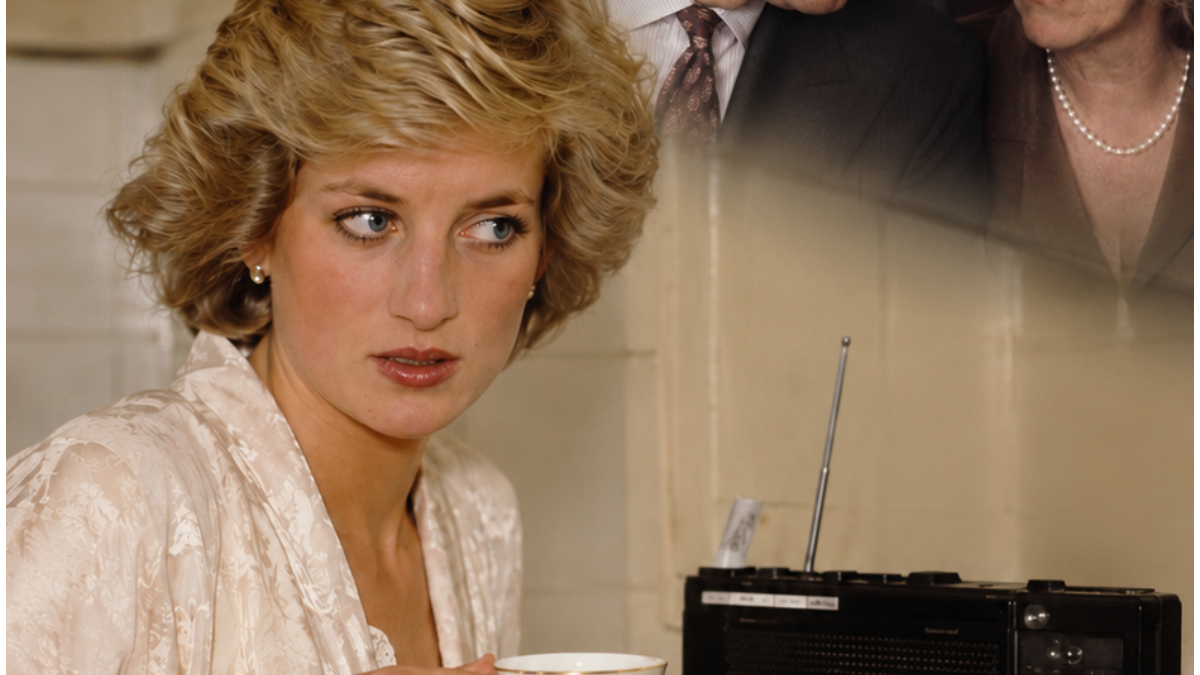
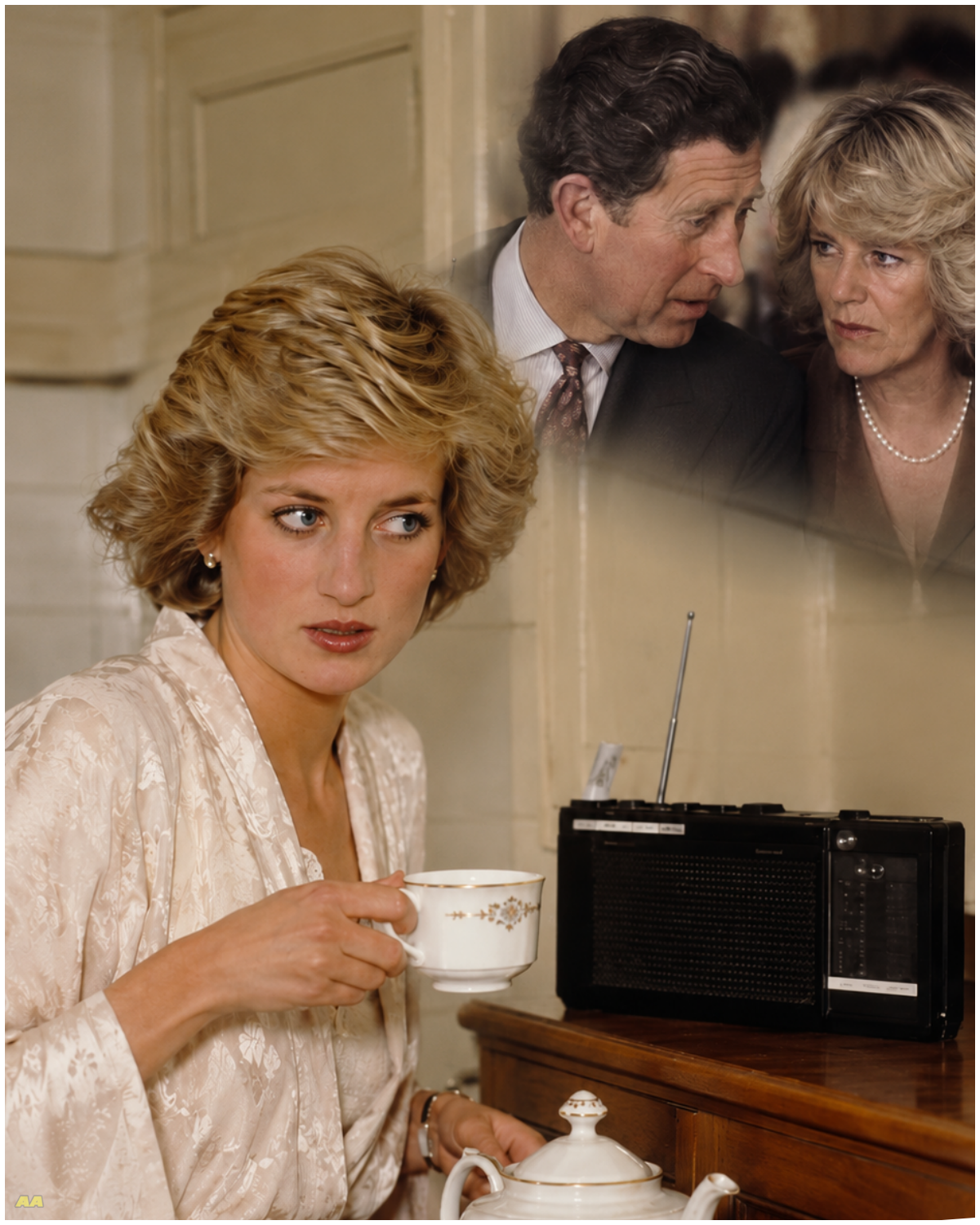
Game, set, and match.
Ken Warf remembered Diana saying those words in her sitting room at Kensington Palace.
She held the Daily Mirror close to her.
Across its pages was a private conversation between her husband and Camila Parker BS recorded more than 3 years earlier and now exposed before the country.
At first, Diana felt vindicated.
The public was finally seeing what she’d faced behind closed doors.
Then she read further, and the relief gave way to disgust.
The newspaper hadn’t introduced Diana to Camila’s place in her marriage.
She’d already confronted Camila herself.
What arrived that morning was something different.
The private truth Diana had carried alone was suddenly sitting on breakfast tables across Britain, and the palace could no longer keep it there.
If you value Diana’s stories told through her own words, named witnesses, and historical records, please subscribe.
This is a place where we remember her with care, question old headlines, and leave gossip where it belongs.
In the next few minutes, we’re going to answer four questions that were almost buried beneath the most notorious line in that transcript.
What did the complete conversation reveal about Charles and Camila’s relationship when the crude headlines are stripped away?
How did an unnamed listener capture a future king’s private call?
And why did the recorder’s identity remain hidden?
Why did British newspapers know about the tape but wait until the Wales marriage had already broken apart before printing the full exchange?
And what did Diana really say and do when the words reached Kensington Palace?
This isn’t about replaying an intimate conversation for entertainment.
Diana, Charles, Camila, and their children had already paid the price for that.
It’s about understanding why publication changed the way millions of people judge Diana’s account of her marriage.
To see how that happened, we have to return to a December night in 1989.
The evidence comes from several records that fit together.
There’s the surviving published transcript and the newspaper reports written as the story broke in January 1993.
There’s John Major’s separation announcement in the House of Commons, followed by Parliament’s debate over privacy and electronic interception.
There’s Ken Warf, Diana’s Metropolitan Police Protection Officer, describing what he saw inside Kensington Palace.
There are Diana’s recorded answers for Andrew Morton, Charles’s interview with Jonathan Dimbleby, and testimony heard years later at Diana’s inqueSt. Each source gives us a different part of the picture.
The transcript shows the words.
Hansard fixes the public chronology.
Diana’s recordings tell us what she knew before the tape surfaced.
Warf preserves her immediate reaction and the later interviews show what happened once silence was no longer possible.
Read together. They lead away from the lurid joke that consumed the front pages.
They lead toward a more revealing detail.
The relationship heard on that call seemed to depend on a network of sympathetic friends, borrowed rooms, careful timing, and social protection.
The call involved two people.
The life around it involved many more.
By late 1989, the Prince and Princess of Wales could still perform unity in public.
They attended engagements, appeared in formal photographs, and carried the expectations attached to the future king and queen.
Behind that public picture, the marriage had become deeply divided.
Jonathan Dimblebe’s authorized biography of Charles later placed the renewal of Charles’s physical relationship with Camila in 1986.
Diana didn’t need a newspaper to tell her that Camila remained emotionally present.
She noticed the calls, the absences, the shared friends, and the ease with which Charles and Camila could remain connected inside a close social circle.
That circle mattered. Charles and Camila weren’t meeting as strangers, taking a single reckless chance.
They moved among people who had known them for years.
Country houses offered privacy. Loyal friends understood which questions not to ask.
Social familiarity could make an extraordinary arrangement feel almost routine to those inside it.
Diana stood outside much of that understanding.
She was the Princess of Wales, photographed wherever she went.
Yet within her own marriage, she often felt like the person who knew least and was expected to say nothing.
In 1989, she stopped saying nothing.
At a birthday gathering for Camila’s sister, Diana found Charles and Camila together with another gueSt. She asked the two men to leave so she could speak to Camila directly.
Diana later recorded her account for Andrew Morton.
She remembered being frightened, but she confronted the woman whose place in Charles’s life had become impossible for her to ignore.
That encounter came before the country knew about any recorded call.
Diana had already taken her question to the person at the center of it.
Only a short time later, somewhere beyond that room, another person began recording what Charles and Camila said when they believed nobody else was listening.
I can’t bear a Sunday night without you.
That short line from the transcript tells us more than the phrase that later swallowed the entire story.
It isn’t a burst of surprise.
It’s the language of expectation.
Sunday nights had a pattern.
Separation had a familiar ache.
The speaker wasn’t describing a feeling that had appeared that evening.
She was describing something already woven into the week.
The call was captured on the evening of 18th of December 1989.
Camila was at home. Charles was reportedly staying at a friend’s country house.
Charles was married to Diana.
Camila was married to Andrew Parker BS.
Their families, public roles, and social lives continued around a relationship that the conversation treated as established.
The opening was almost ordinary.
They discussed acquaintances, a speech, other people’s reactions, domestic plans, and the small irritations that fill a familiar conversation.
There was teasing. There were unfinished thoughts that the other person seemed to understand without explanation.
Their voices moved easily from the daily world into affection.
One subject was a speech Charles had recently given at Oxford.
He worried that he might have gone too far.
Camila reassured him, teased him, and followed the turns in his thinking without needing the background filled in.
That part of the call showed why he depended on her.
She wasn’t only a secret romantic attachment.
She was a familiar listener who understood his anxieties, his public work, and the people around him.
The emotional reliance was visible before the conversation became physical.
That gradual change is important.
The exchange wasn’t only an isolated piece of sexual banter.
Most of it had the rhythm of two people accustomed to checking in with each other.
They talked about coping, missing one another, calling again, and finding time together.
They sounded less like two people crossing a line for the first time than two people maintaining a private life that already had routines.
Then came the practical details.
Charles and Camila discussed where they might see each other.
Friends homes appeared as possibilities.
One place might work, another could become difficult depending on who was there and when somebody returned.
The talk wasn’t romantic in the storybook sense.
It was logistical, and logistics reveals structure.
A spontaneous lapse doesn’t usually require a map of sympathetic households.
An ongoing relationship does. It needs safe moments, trusted people, and places where the public version of life can be set aside.
The transcript suggested that Charles and Camila had learned how to work within those conditions.
That doesn’t transfer their responsibility to the friends around them.
Charles and Camila were two married adults making their own choices.
But it does explain why Diana’s position was so isolating.
She wasn’t simply confronting a husband and another woman.
She was confronting an arrangement that could move through a world of old friendships and private houses.
While she remained under constant public observation, the conversation also carried a weight that an ordinary marital betrayal wouldn’t have carried.
Charles was heir to the throne.
His private conduct was tied fairly or unfairly to public questions about judgment, duty, and the future of the monarchy.
The same man speaking intimately on the telephone was expected one day to become supreme governor of the Church of England.
That constitutional role didn’t cancel his right to privacy, but once the call was published, it guaranteed that the story wouldn’t remain a private argument between two couples.
Every personal sentence would be examined as evidence about a future king.
The most infamous joke made the biggest headline because it was easy to repeat and hard to forget.
Yet, the rest of the exchange carried the deeper consequence.
It showed affection, dependence, familiarity, and planning.
It suggested continuity. For Diana, that was the part that reached beyond embarrassment.
These weren’t rumors spoken by unnamed courtiers.
They were reported words that matched the reality she’d been trying to describe.
Midway through the recording, another voice appeared.
It didn’t belong to Charles or Camila.
The speaker quietly marked the date, December 18th.
For one brief moment, the person outside the conversation entered the historical record.
Then the voice disappeared again.
In 1989, Britain’s analog mobile telephone system offered convenience.
Without the protection modern callers expect, mobile calls traveled by radio.
With scanning equipment tuned to the right frequencies, a nearby listener could sometimes pick up a transmission that had never been meant for them.
The technology turned the air between a handset and a mast into a weak point.
That weakness is easy to underestimate now.
A scanner didn’t need to break into a smartphone, guess a password, or place a device inside a palace.
Early cellular traffic could pass through open radio frequencies.
A hobbyist moving across the band might hear taxi firms, business calls, emergency chatter, or private conversations.
Recognition could transform a few accidental seconds into a recording somebody knew a newspaper would value.
The account later given by former Daily Mirror editor Richard Sto was strikingly ordinary.
He said the recording came from an unnamed man in Murzyside who had been trying electronic equipment.
In Sto’s version, the man had been out for laga and a curry, then tested a device capable of picking up cellnet signals.
A royal voice came through.
That story explains the scanner.
It doesn’t identify the scanner’s owner.
The man wasn’t publicly established through a name, sworn evidence, or a transparent chain showing exactly how the original recording moved from his equipment to Fleet Street.
Sto called the source an ordinary member of the public.
The source stayed out of sight.
This is where two royal recordings are often mixed together.
Sirill Renan, the retired bank manager whose name appeared in the press, was connected to the intercepted conversation between Diana and James Gilby.
He wasn’t identified as the person who captured the Charles and Camila call.
The source of this tape remained unnamed.
The distinction matters because several private royal conversations from roughly the same period reached newspapers.
Diana and Gilby’s call was one.
Charles and Camila’s was another.
Recordings involving other members of the royal family added to the sense that something larger might be happening.
To the public, coincidence began to look uncomfortable.
Questions soon reached the security services.
Newspapers raised MI5 and GCHQ.
Politicians asked how private conversations involving senior royals could be taken from the air and carried into newsrooMs. Some former intelligence figures and technical specialists offered competing theories.
The result was more heat than clarity.
Home Secretary Kenneth Clark’s public position was blunt.
He said there was nothing to investigate and rejected claims that the security services or GCHQ were responsible.
For people already uneasy about the number of royal calls appearing in print, that answer closed the subject far too quickly.
Years later, Diana’s inquest opened a window onto what had happened inside government.
The court heard that the publication of the recordings led to highlevel meetings and correspondence in January 1993.
It also heard that a proposed security service investigation had been blocked by Clark, who feared that news of the inquiry itself would become public.
That evidence didn’t produce the missing name.
It revealed something more frustrating.
Senior officials had recognized the security implications, discussed them, and still allowed the central question to remain unanswered.
The mystery survived because every path stopped just before certainty.
A newspaper editor supplied a story but protected the source.
Government officials discussed an inquiry but didn’t carry it through.
The press circulated theories while competing papers fought to obtain the material and the person whose voice marked the date stayed beyond public view.
By then the tape was already more than 3 years old.
That delay raised another question.
If a stranger had captured the future king’s conversation in December 1989, why didn’t Britain read it then?
The answer begins with what Diana was doing during those same weeks.
I know what’s going on between you and Charles, and I just want you to know that.
Diana’s voice on the Morton recordings is steady enough to make the scene feel close.
She said she had been terrified of Camila.
Even so, she went into that room at the party and asked to speak with her.
Charles and another man left, and Diana finally put into words what had been shaping her marriage.
Camila answered by pointing to everything Diana appeared to possess.
Public admiration, two sons, and the attention of men around the world.
Diana’s reply was only four words.
I want my husband. That answer removes the glamour people later attached to the confrontation.
Diana wasn’t fighting for a headline or trying to defeat a rival in public.
She was asking for the central promise of her marriage.
She ended by making her position unmistakable.
Don’t treat me like an idiot.
The conversation didn’t repair anything.
Diana later described the drive home as grim.
Yet the act of speaking mattered.
She had moved from private suspicion to a direct statement made in front of Camila herself.
Whatever came later, Diana knew she had named the problem before the recorded call entered public life.
For nearly 3 years, the public still saw only fragments.
Royal appearances carried on. Photographs preserved the shape of a marriage, even as the people inside it moved further apart.
Then 1992 stripped away that protective distance.
In June, Andrew Morton published Diana, her true story.
The book described her unhappiness, her struggles with bulimia and self harm, and Charles’s relationship with Camila.
At the time, Diana’s role was concealed behind friends who appeared to be speaking on her behalf.
After her death, Morton released the fuller history.
Diana had been the principal source.
She had recorded answers to his questions, passed through their mutual friend, Dr. James ColdurSt. That changed how the book had to be read.
It wasn’t simply a journalist arranging palace gossip into a dramatic story.
It carried Diana’s own testimony recorded while she was still living inside the marriage, but the press didn’t grant her control over what private material became public.
In August 1992, The Sun published details from Diana’s intercepted telephone conversation with James Gilby.
A paid telephone line allowed thousands of people to listen.
The nickname used during that call became a label repeated across front pages.
A private exchange was cut into salailable pieces and Diana became an object of national embarrassment.
According to the account later given in Tina Brown’s biography of Diana, the Charles and Camila recorder had kept his tape for years.
The frenzy surrounding Diana’s call showed that an old recording could command attention and money.
The unnamed man then approached the mirror, and Brown reported that he received £30,000.
A forgotten tape had become valuable because the royal marriage was now the biggest story in Britain.
That episode matters because it came before the full Charles and Camila transcript.
Diana had already learned what it felt like to have a telephone conversation detached from its private setting, promoted with a mocking name and offered to strangers as entertainment.
She knew the peculiar violence of hearing personal pain converted into circulation.
The public collapse continued in South Korea that November.
Charles and Diana traveled together on a tour presented as evidence that they could still work side by side.
The photographs told another story.
Their expressions looked strained. Their distance was difficult to disguise.
The press called them the Glums, a cruel shortorthhand for a marriage failing in full view.
At almost the same time, British newspapers began circling the Charles and Camila recording.
The Daily Mirror reported in November that a tape of an intimate call had been played to the paper, but it stopped short of printing the complete contents.
Editors faced legal danger, doubts over authentication, and the political force of publishing a future king’s private words while his marriage remained formally intact.
There was also a question of timing inside the newsroom.
Richard Sto later wrote that the recording reached the paper while Charles and Diana were preparing for the South Korea tour, which officials hoped might steady the marriage in public.
Printing the most intimate material at that moment could be blamed for destroying any remaining chance of reconciliation.
The Mirror hinted at the call instead.
It told readers that the tape existed, held back the language that would dominate January, and waited while events overtook the decision.
Then the formal position changed.
On 9th December 1992, Prime Minister John Major stood in the House of Commons and read Buckingham Palace’s announcement that the Prince and Princess of Wales had decided to separate.
There were no plans for divorce.
Their constitutional positions would remain untouched.
Both would continue their public duties and share in raising William and Harry.
The statement also asked for an end to intrusions into their privacy.
Parliament echoed that requeSt. The country was told that space and understanding were needed so two parents could give their children security.
Within weeks, the private call moved overseas.
New Idea, an Australian magazine, printed a detailed transcript in January 1993.
Reports spread through Germany, Ireland, the United States, and other markets.
British editors could now argue that readers at home were being denied material already available abroad.
On 17th January, the Sunday Mirror and the People published the conversation extensively.
A telephone hotline let members of the public hear the voices.
The story was no longer a guarded rumor in a newsroom.
It could be bought with a newspaper, discussed over breakfast, replayed through a telephone receiver, and carried into every serious debate about the monarchy.
Contemporary reports recorded the immediate reaction.
The timing breaks one of the longest running myths around the scandal.
The British publication didn’t end Charles and Diana’s marriage.
The separation had already been announced in Parliament more than a month earlier.
The transcript entered a marriage that had publicly broken apart and changed how people assigned responsibility for that collapse.
For Diana, the three-year silence ended not with a private warning from the palace, but with a newspaper brought into her home.
Game, set, and match. Ken Warf was there.
As Diana’s protection officer, he had stood close to her through public engagements, family movements, press pursuit, and moments that never appeared in the court circular.
In January 1993, he spoke with her in the sitting room at Kensington Palace while she held the Daily Mirror containing the transcript.
Her first reaction was relief.
For months, Diana had been criticized over Morton’s book.
Some accused her of manipulating public sympathy.
Others treated her account of Charles and Camila as the grievance of an unstable wife.
The transcript altered that balance.
The focus moved toward Charles’s conduct and toward the people who had dismissed Diana’s version of her own marriage.
Her phrase came from tennis.
A match ends when the final point is beyond argument.
In that sitting room, game, set, and match meant that Diana believed the public argument had shifted decisively.
She didn’t have to persuade the country that an intimate attachment existed.
The reported voices had done that themselves.
Warf remembered her taking pleasure in the sudden reversal.
Cartoonists seized on Charles’s known habit of speaking to plants.
One drawing showed him addressing them intimately, and Diana collapsed into laughter when she saw it.
After years of being treated as the source of the royal crisis, she watched the pressure turned toward the person whose position had once seemed protected.
But the laughter wasn’t the whole reaction.
As Diana absorbed the baser parts of the exchange, Warf said her mood changed.
“It’s just sick,” she told him.
The words had confirmed what she knew, but the manner of confirmation was humiliating.
A marital betrayal had become public comedy.
The man was still her husband.
The woman was still a presence in the world surrounding her family, and millions of strangers had been invited into language, never meant for any of them.
Diana’s reaction held two emotions that don’t cancel each other.
She could feel vindicated because the transcript supported her account.
She could also feel wounded by what it contained and by the way it had been sold.
Treating her response as simple triumph turns a complicated human moment into another tabloid cartoon.
There were also two boys inside that story.
William was 10, Harry was 8.
Every headline about their parents would remain available long after the newspapers were thrown away.
Diana’s victory in the public argument couldn’t protect them from classmates, television jokes, or the knowledge that adults across the country were discussing their parents’ private lives.
That is why Warf’s memory carries such weight.
He didn’t describe a princess issuing a polished statement through officials.
He described a woman in her own sitting room reacting in real time.
First came the sense that she had finally been believed.
Then came the cost of being believed in this particular way.
The scale of the public reaction showed why she felt the ground move.
A poll later cited by royal biographer Sally Bedell Smith found that 68% believe Charles had damaged his reputation.
42% thought 10-year-old William should succeed the queen instead of his father.
As a snapshot of public anger, the figures were extraordinary.
William was still a school boy, yet more than four in 10 respondents were ready to place his name ahead of the air, who had spent his adult life preparing to reign.
The reaction showed how quickly one private conversation could overwhelm decades of official speeches, overseas tours, charity work, and careful preparation for kingship.
For Charles, the damage went beyond embarrassment.
Commentators questioned his judgment and his suitability to reign.
For Camila, the response became especially personal.
Her appearance, character, and sexuality were attacked in language far harsher than that directed at the man on the same call.
For Diana, public sympathy grew, but it came through an industry that had also invaded her life.
The transcript gave Diana validation.
It also proved that validation could arrive as another form of injury.
Only 39 days before the full British publication, Parliament had carried the palace’s request that the intrusions into the privacy of the prince and princess may now cease.
Instead, the most private words in the royal story became a commercial event.
That contradiction divided public opinion.
One argument was that the conversation mattered because Charles wasn’t an anonymous husband.
He was the heir to the throne and his conduct could affect confidence in the monarchy.
The other was that public position didn’t turn every private sentence into public property, especially when the words had been obtained through electronic interception.
Both concerns could exist at once.
The transcript contained information relevant to how people understood the whales marriage and the future king.
The method of obtaining and distributing it still crossed a boundary.
Public interest explained why editors wanted the story.
It didn’t erase the human damage caused by placing the entire exchange in millions of hands.
The Press Complaints Commission moved quickly to condemn publication.
That mattered because the commission often waited for a direct complaint from the person involved.
Here, the intrusion was so visible that it spoke out without requiring Charles or Camila to extend the story by filing one.
Its condemnation arrived during a wider reckoning over press self-regulation.
Sir David Kolkat’s review published that January concluded that the existing system wasn’t working properly and recommended stronger action.
The government accepted the case for new offenses involving unwarranted intrusion while remaining wary of a stateappointed press tribunal.
Camille therefore landed at the exact moment Britain was asking whether newspapers could police themselves or whether Parliament would eventually have to step in.
The argument reached Parliament on the 10th of June 1993.
Members debated press freedom, personal privacy, electronic surveillance, and the sale of material obtained through bugging or interception.
One proposal would have placed responsibility not only on the newspaper buying such material, but also on the person who recorded and sold it.
The Charles and Camila tape, along with Diana’s intercepted call, had become evidence in a national dispute over how far technology had outrun the law.
The debate exposed an uncomfortable gap.
Britain valued a press strong enough to investigate powerful people.
It also had scanners, long lens cameras, aggressive competition, and paid tip lines capable of turning private life into raw material.
Parliament could describe the harm in detail.
Agreeing on a remedy without creating state control of the press was far harder.
And while lawmakers discussed principles, real people were being assigned roles.
Charles became the heir whose judgment was under examination.
Diana became the wronged wife whose warnings had been validated.
Camila became the target onto whom anger was often dumped in its ugliest form.
That simple arrangement sold papers, but it flattened the truth.
Charles and Camila had both participated in the relationship.
Diana had suffered inside the marriage.
The interception had violated Charles and Camila’s privacy.
Those facts didn’t need one person to be turned into a monster for another to be understood.
The constitutional question made restraint even more difficult.
Charles’s future position wasn’t ceremonial alone.
At the time, Parliament still spoke openly of his eventual role as head of the Church of England.
The vows inside his marriage were therefore treated by some commentators as evidence about the moral authority expected of a king.
The monarchy tried to preserve distance.
No long public explanation followed the transcript.
Charles continued his work. Diana developed a more independent public role.
Camila withdrew further from view.
Yet the silence that once protected the relationship had lost its force.
The country had read too much and the most important question had moved from gossip columns to the future king himself.
One year later, Jonathan Dimblebeby asked it on television.
The program aired on 29 June 1994.
It was called Charles the private man, the public role, and it formed part of a wider effort to present the Prince of Wales in his own words.
Dimblebeby had been given unusual access while preparing Charles’s authorized biography.
The interview was meant to show the person behind the institution.
Then Dimbleby asked whether Charles had tried to be faithful and honorable to his wife.
Charles answered yes. Pressed on whether he had been faithful, he added until it became irretrievably broken down, us both having tried.
That sentence did what palace distance had avoided.
Charles acknowledged adultery while placing it after the point at which he believed the marriage had collapsed beyond repair.
The following day, his office confirmed that the woman concerned was Camila Parker BS.
Contemporary coverage recorded the admission.
The admission didn’t settle every disagreement about timing.
It changed who carried the duty to explain.
Diana’s account no longer stood alone against anonymous denials and friendly briefings.
Charles had publicly accepted the central fact of another relationship even as he offered his own account of when it began.
[snorts] In November 1995, Diana gave her own public answer.
Speaking about the marriage, she said, “There were three of us in this marriage, so it was a bit crowded.
The line endured because it reduced years of confusion to one clear picture.” Diana wasn’t describing a strange sentence on a tape.
She was describing the structure of her married life.
The recording’s real effect can be seen between those two interviews.
It shifted the burden of explanation.
Before publication, Diana’s story could be dismissed as the account of a wounded spouse.
After publication, the public had encountered the intimacy of Charles and Camila in their reported words.
Charles’s 1994 answer then gave official weight to what Diana had been saying.
That is the deeper meaning of game, set, and match.
Diana wasn’t celebrating the destruction of every person involved.
She was recognizing that she no longer stood alone at the witness box of public opinion.
The country had finally heard enough to ask its questions elsewhere.
Yet Warf’s account won’t let the story end in victory.
As a metropolitan police officer assigned to protect Diana, Warf occupied a rare position.
He wasn’t a distant biographer reconstructing her feelings years later.
He was beside her while the newspaper was in her hands.
He saw the immediate release of pressure.
He also heard the revulsion that followed.
If we keep only her laughter, Diana becomes vindictive.
If we keep only her disgust, we erase the relief of finally being believed.
The order matters. She responded first to the public meaning of the transcript, then to its intimate content.
One reaction belonged to the long argument over her credibility.
The other belonged to the woman, wife, and mother forced to absorb what strangers were absorbing at the same time.
That complexity is the closest thing this story offers to a fair ending.
Charles and Camila’s attachment was real.
Diana’s pain was real. The intrusion was real.
So was the public interest in the conduct of a future king.
History doesn’t become more honest when one truth is used to cancel another.
And Diana didn’t remain in that sitting room, frozen beside the newspaper.
Less than 2 months after the transcript dominated British headlines, she boarded a plane for Nepal.
It was March 1993, and this was her first solo overseas tour following the separation.
The woman arriving in Catmandeue was still being described through a broken marriage, but the work before her had nothing to do with royal telephone calls.
At Anandaban Leprosy Hospital, Diana sat close to patients.
She rested on their beds, held their hands, and touched them without fear.
At a time when leprosy still carried deep stigma, that physical closeness sent a message no formal speech could match.
She was there through her work, connected with the leprosy mission and the British Red Cross.
The timing creates its own contrast.
Newspapers had spent January exposing the private language inside Diana’s marriage.
In March, the same cameras recorded her using public attention to challenge fear surrounding disease.
One image consumed privacy.
The other offered dignity.
So, let the final picture be Diana at an underban, not standing between Charles and Camila, not trapped beneath a headline, not reduced to the wounded wife.
She’s sitting beside a patient, listening closely with her hand resting gently on another human being’s arm.








