Cast Out With One Horse, the Woman Reached the Eighth Ranch – Then Its Cowboy Changed Everything
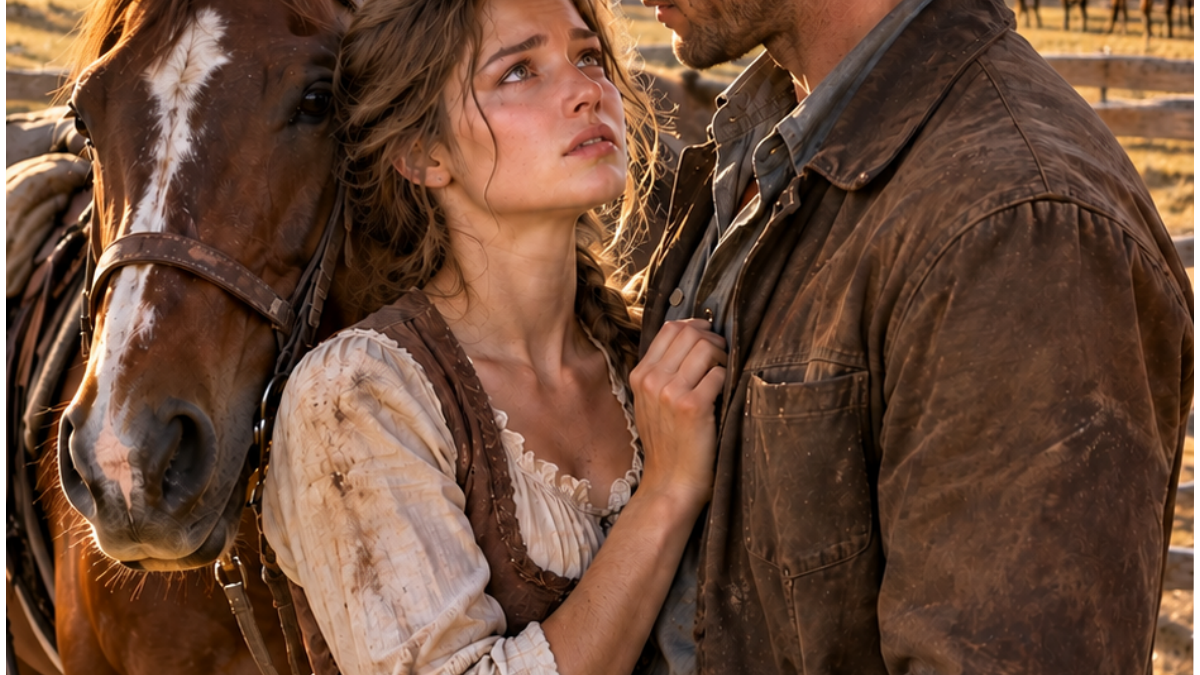
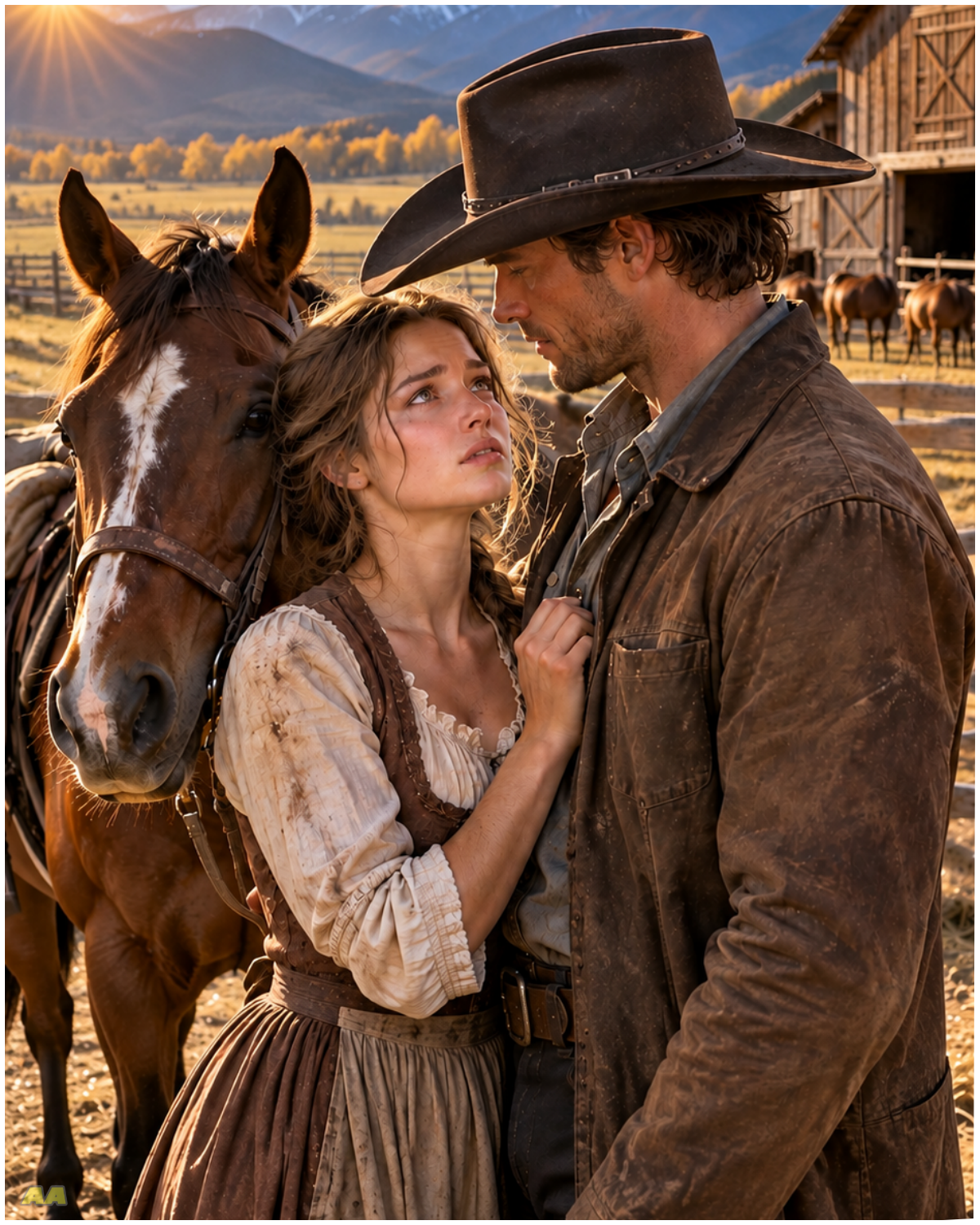
Virgil Langley walked into Mason Hail’s yard like a man who had already decided the outcome of every conversation he would ever have for the rest of his life.
He did not knock. He did not call out.
He simply arrived with three men behind him and went directly to the barn.
And when Eda heard the creek of the main door from 60 yards away, she knew the way you know a storm before the sky changes color that her father had not come to talk.
He had come to collect.
She was at the water pump when she heard birdies winnie.
Not the easy sound the mayor made when she recognized Eda’s footsteps.
This was shorter, tighter, the sound a horse makes when something is wrong with the air around her.
Eda dropped the bucket and ran.
Not asking, not negotiating, holding it like it had always been his.
And perhaps before you keep watching, you might ask yourself, what would you have done if everything you had walked away from, every safe, comfortable thing you had surrendered on purpose suddenly came to take the one thing you had kept?
The morning Langley left her father’s property, she did not slam the door.
She closed it carefully behind her, the way her mother had taught her, because her mother believed that how you left a room said more about you than how you entered it.
The latch clicked softly in the frame.
Eta stood on the porch for 3 seconds and listened to the silence of Langley Ranch in early autumn, the horses moving in the far paddock, the windmill turning slow over the eastern field, the particular quality of light that she had looked at every morning since she was born, and would likely never stop being able to picture.
No, no matter how many years she put between herself and it then she walked to the barn, saddled Birdie, tied her valise behind the canel, and rode out through the gate before anyone came to try and make the moment more dramatic than she could bear.
She had $38. She had her mother’s horse.
She had a set of breeding records she had kept herself for the past 3 years in a narrow leather notebook that her father did not know existed because he had never thought to look for it.
She did not have a plan exactly.
She had a direction. West, then north, then wherever work was.
The offer had been Arthur win.
Eda wanted to be fair about that, even in the privacy of her own thoughts, because fairness mattered to her, and because Arthur had not deserved the particular shape of the conversation that had ended with her refusing him in front of both families.
Arthur Wyn was 28. He was responsible with money, patient with animals, and genuinely kind to people he considered beneath him in social standing, which was not a small thing in her experience.
He had good hands. He listened when you talked.
He did not drink beyond two glasses at any occasion she had witnessed.
There was nothing wrong with Arthur Win.
That was precisely and completely the problem because what her father had said at the dinner table the night before the proposal was, “This is a good match, Eda. Good family, good land, and he’ll let you keep that horse if you ask nicely. He’ll let you.”
She had looked at her father across the table, at this man she loved, who had held her when she was 11 years old, and her mother’s coffin was being lowered into a September cold earth, who had worked himself to exhaustion building a horse operation that was genuinely respected in three counties, and she had understood something she had probably known for years without being willing to name it.
He saw her as a thing that needed placing, not cruy, not out of malice.
He saw her the way he saw a good broodmare, something with real value that ought to be in the right hands before anything could go wrong with it.
The proposal the following afternoon had been polite and sincere.
Arthur had genuine feeling in his voice when he asked.
Eda had genuine feeling in her voice when she said no.
The conversation that followed with her father had lasted 40 minutes and had destroyed nothing that had not already been quietly breaking for years.
Virgil Langley was not a man who threatened.
He was not a man who threw OB objects or raised his voice to a pitch that frightened livestock.
He simply sat across from her at the kitchen table and told her in a voice that was tired and certain and utterly without cruelty that if she refused the future the family had arranged, she would need to fund the future she had chosen instead.
I won’t have you growing old in my house, resenting everything I did for you, he said.
That’s not what your mother would have wanted.
Eda had almost said.
You have no idea what she would have wanted.
She didn’t because it was possible she was wrong and because she had already said enough true things for one evening.
She left the following morning.
The first ranch she stopped at was the Callaway property 12 mi north.
Mrs. Callaway came to the porch and looked at Eta for a long moment at the Vise, at the mayor, at the quality of Eta’s coat, which was not poor but was not what you wore when you had somewhere comfortable to go back to.
Whose girl are you? She asked.
Virgil Langley’s. Mrs. Calsaway’s expression shifted in a way that was not unkind.
Exactly, but was final. I’m sure your father will come around in a week or two.
I’m looking for work, ma’am.
Not a mediator. Well, Mrs. Callaway adjusted her apron.
We don’t have anything right now.
It was September. Every ranch within 40 mi of them had more work than hands.
Knew this because she had spent 3 years keeping the breeding records for a property that employed 11 seasonal workers every fall.
She thanked Mrs. Callaway and wrote on.
The second and third ranches were shorter conversations.
By the fourth, she stopped offering her name first and simply asked about the work.
When they pressed for her family, she gave it and watched the calculation happen behind their eyes.
Langley girl left home. What kind of young woman leaves home?
The fifth ranch. The Pierce operation, which she had always heard, was respectably run.
The foreman looked her up and down in a way that had nothing to do with her qualifications and then said they didn’t hire women for barn work.
She had been keeping her father’s breeding records since she was 19.
She had assisted with four difficult foings.
She had identified a respiratory illness in a yearling colt 3 days before the hired veterinarian confirmed it.
The foreman at the Pierce operation was picking his teeth when she rode away.
The sixth and seventh were variations on the same conversation.
By the end of the seventh, Eda had covered 60 mi and was allowing herself for the first time to sit with the possibility that she had miscalculated.
Not about Arthur, not about leaving, about the distance between I will not live a life I did not choose and I have somewhere to go.
She made camp that night beside a creek she did not know the name of.
Birdie grazed on the bank.
The fire was small because she was careful about wood, and the night came in cold off the mountains, in a way that reminded her she was in Colorado in September, and winter was a real place that would arrive on schedule, regardless of her personal situation.
She sat with her knees pulled up and looked at the fire and thought about her mother’s face, which she had not been able to recall clearly since she was about 15.
She could remember the shape of it, the patience in it.
She could not always remember the details.
She did not cry. She was not generally a person who cried [clears throat] easily, and she was suspicious of people who found that admirable rather than recognizing it for what it often was, a person who had learned early that crying didn’t change outcomes.
She ate the last of the bread she’d brought from home, made sure Birdie was secured, and slept.
Hail Horse Ranch was not from the road a property that inspired confidence.
The fence line on the east pasture needed two new posts at minimum.
The water trough near the gate was lifting slightly, which meant the ground beneath it had softened and would get worse before it got better.
The main barn needed paint that it was not going to get before winter.
The house beyond it was solid enough good log construction, nothing fancy, but the front porch had a step that had been repaired with lumber that didn’t quite match.
And the whole property had the look of a place that was being kept alive through effort rather than ease.
Edinus noticed all of this and filed it the way she filed everything, not as criticism, but as information.
She also noticed 12 mares in the far pasture, which was more horses than a failing ranch usually kept, and three gelings in a near paddic that were moving with the slightly distracted energy of animals partway through training that had been interrupted.
Someone had started good work here.
The work had slowed down.
A man came out of the barn as she rode in.
He was 30 or so, tall, lean in the way of someone who worked physically everyday and ate whatever was available rather than whatever was enough.
Dark hair that needed cutting, a face that had spent real time in weather.
He moved with the particular economy of someone who had long since stopped making unnecessary motions because unnecessary motions cost time, and he did not have any to spare.
He looked at Birdie first, then at Eta.
Help you, he said. Not unfriendly, not especially open either.
I’m looking for work, Eta said.
Horse work. I’ve got 3 years of breeding records, foing experience, and I can identify a respiratory infection before a veterinarian can.
She’d learned by the seventh rejection, to lead with credentials.
The man, Mason Hail, though she didn’t know his name, yet looked at her for a moment with an expression she couldn’t read.
Then he looked at Birdie again.
“You’re Virgil Langley’s daughter,” he said.
Eta kept her face even.
“I’m a horsewoman looking for legitimate work.
Those aren’t mutually exclusive. Apparently, most people in this county think they are.” Something shifted in his expression.
“Not warmth,” exactly. More like a reappraisal.
“I don’t have room,” he said.
“I don’t take much room.
I don’t have work to pay for.
You have a water trough that’s going to be frozen sideways by November.
Your east fence needs two posts now and two more before spring.
You’ve got three gelings half-trained in that paddic that are going to lose what progress they’ve made if [clears throat] nobody works them consistently.
She paused. And you’ve got 12 mayors whose breeding records I’d like to see because I count too who are moving differently than the others.
And I’m curious whether you’ve noticed.
A beat of silence. Mason Hail looked at the paddic, then at the mayors, then finally back at her.
Which too? He said. Eda pointed without hesitation.
He was quiet for another moment.
She could not tell if he was about to send send her away or ask her something else.
And she had run out of ranches and she was not going to let him see that.
I can’t pay you what work is worth, he said.
Then pay me what you can.
Food and shelter for 30 days.
I’ll prove value in 30 days or I’ll move on.
I don’t have a room.
Eda looked toward the barn.
Is that loft clean? Mason Hail looked at her with an expression that was not quite disbelief and not quite respect and might have been the closest he came to both simultaneously.
“It’s clean,” he said grudgingly.
“Then I don’t need a room.” She looked him in the eye.
“Just don’t send my horse away.” The loft was cold that first night.
It would get colder. Aa had known this when she agreed to it, and she arranged her blankets with the methodical attention of someone solving a practical problem rather than someone thinking about what she had given up to get here.
Birdie was in the stall below.
Eta could hear her breathing in the quiet.
That was enough. She lay on her back in the dark and made a list of everything she had observed about Hail Horse Ranch in the 3 hours since arriving.
The feed calculations on the barn wall were wrong.
Not dramatically wrong. Whoever had done them wasn’t careless, just imprecise, but wrong enough that the mayors were eating 8 to 12% more than the numbers suggested.
On a tight budget, that was the difference between getting through February and not.
She would mention it in the morning carefully.
She was not here to tell Mason Hail how to run his property.
She was here to make herself indispensable before he remembered he hadn’t wanted to hire her.
There was a difference, and it mattered.
She mentioned the feed calculations.
The next morning, Mason came into the barn at first light and found her already there.
Birdie groomed and the nearest stalls cleaned.
A cup of coffee extended toward him before he had fully registered that she had beaten him to work by at least 40 minutes.
He looked at the coffee, looked at the stalls, didn’t say anything about either.
“Your feed numbers are off,” Eda said.
She had her notebook open.
She had already been through his barn ledger, which he had left in plain sight on a nail post and which she had read in its entirety.
You’re calculating by estimated weight and rounding down.
When you round down on 12 mares across 6 months, you lose about 200 lb of feed in your projections.
You’ve been compensating without realizing it.
That’s why you’re coming up short before you think you should.
Mason looked at her notebook, then at his ledger.
I know you can see I already went through it, Eda said.
I figured you’d rather I told you what I found than not.
A long pause. You calculated all that before 6:00 in the morning, he said.
I woke up early. You slept in a barn loft and woke up early to do my feed math.
I wasn’t going to waste the time.
He drank the coffee. He did not thank her for it, but he did not put it down either.
How would you correct it?
Weigh a sample of five mares individually and recalculate from actual rather than estimated weights.
It takes half a day.
You get accurate numbers for the whole winter.
Another pause. He handed her back the coffee cup when he finished.
There’s a scale in the back shed, he said.
That was how it started.
She stayed 30 days, then 60.
The 30-day trial was never formally extended.
It simply stopped being mentioned.
The way arrangements stopped being questioned when they work.
She reorganized the tack room in the second week.
Not because Mason asked, because a misorganized tack room meant time lost every morning, and time was the one thing Hail Ranch could least afford to spend carelessly.
Mason came in on the fourth day after she finished, and stood in the doorway for a moment looking at it.
He said nothing. 2 days later, her saddle appeared with a repaired cinch strap.
She had not mentioned the strap was wearing thin.
She was fairly certain she had not even touched the saddle near Mason.
He noticed things. He simply did not announce that he had noticed them.
She began to understand that about him.
He spoke when speech accomplished something.
Otherwise, he worked. It was, she thought, an extremely efficient way to live, and it created around him qualium silence that was not unfriendly, but that most people probably misread as cold.
Eda did not find it cold.
She found it restful in a way she hadn’t expected.
She had spent 23 years in an environment where her appearance created noise.
Men talked too much when she was in a room.
Women became cautious. Conversation bent itself around her in ways that had nothing to do with what she was actually saying, and she had long since learned to navigate it, to be composed and careful, and to say very little about what she actually thought.
Because the moment she said something that surprised people, the surprise was always about her face as much as her words.
You’re too pretty to know that much about horses.
She had heard some version of that sentence more times than she could count.
Mason Hail, in 8 weeks, had never once mentioned what she looked like.
He talked to her about horses, about the geling’s training progress, about which broodmares he was considering selling, and which he intended to breed in spring, and whether the east fence repair had stabilized.
He agrees with her about two things, the feed rationing on the older mayors, and whether the broken gate on the south paddic was urgent, and said so directly both times without apology or softening.
She disagreed back directly, and he listened without performing patience.
It was, “A realized somewhere around week six, the most honest she had felt in recent memory.
The morning he found Birdie, everything changed.
It had been 8 weeks.
Eda was in the near paddic working the middle geling a bay who was coming along better than either of them had hoped when she heard Mason call her name from the barn not loudly but with a quality that made her stop.
She left the geling and went inside.
Mason was standing beside Birdie’s stall.
The mayors was calm. Birdie was nearly always calm but Mason was looking at her with the particular attention he used when he was examining an animal and filing information he wasn’t ready to share yet.
How long have you owned this mare?” he asked without looking up.
“Since I was 16,” Eda said.
“My mother gave her to me.” “When was she last near a stallion?” Eda opened her mouth, then closed it.
She went back through the summer in her memory quickly and carefully.
Birdie had been in the Langley barn paddic from March through early September.
The stallions were kept her father’s stallions were kept in the north pasture.
The north pasture that shared a fence line with Birdie’s paddock.
A fence line that had needed repair.
The previous spring and had taken 6 weeks longer than planned to fix.
Eda looked at Mason. His expression told her that her face had just confirmed what he suspected.
“She’s pregnant,” he said. The words landed with a strange double weight, practical and enormous at the same time, the way certain true statements do.
“Eta stood very still. She had been with Birdie every day.
She had groomed her, ridden her, checked her feet, watched her move.
She had not seen it.
The mayor was 12 years old and had never fold and was not built heavily and he eda had not seen it because she had not been looking for it because the idea of it had not been available to her.
“How far along?” she said.
Her voice came out steady.
She was proud of that.
“Far enough,” Mason said. “Four months, maybe five.” “Hard to say exactly without the vet.” He paused.
“You’ll want to stop riding her.” “I know,” Eda said.
A silence. “Does your father have stallions?” Mason asked.
“Two,” Eda said carefully. One older one, an Atlas.
She watched Mason’s expression. You know Atlas?
I’ve seen him at a show.
Mason said 3 years ago.
Exceptional animal. Another pause. What bloodline?
Eda told him. Mason was quiet for a moment.
That felt longer than it was.
Atlas died last winter. He said it wasn’t a question.
January. Eta confirmed. Collic faSt. Mason looked at Birdie again.
Your father, he said slowly.
Had that stallion in breeding condition last spring.
Yes. And Birdie had access to the north pasture.
Eda’s chest tightened in a way she did not immediately have words for.
The fence was down for 6 weeks.
Mason turned and looked at her directly for the first time in the conversation.
If this fo carries Atlas’s markings, he said, it will be the only Atlas fo in existence.
The barn was quiet. Outside, one of the gelings moved in the paddic.
Wind came through the south-facing gap in the sighting that Mason had been meaning to repair since AuguSt. Aa looked at Birdie.
Birdie looked back at her with the large, steady eyes of an animal that did not know what she was carrying and did not need to, and was perfectly content to be standing in a barn that smelled like hay and old wood, and the particular mineral quality of Colorado air coming cold off the mountains.
Eda thought about her father.
She thought about $38 and seven ranches and a loft above this stall.
She thought about how long it would take on word got out if it got out for Virgil Langley to hear that his daughter’s mayor was was carrying the last offspring of his finest breeding stallion.
She already knew the answer.
Not long. We should get the vet out, she said quietly.
Yes, Mason said. Neither of them said anything else for a moment.
Then Mason reached up and adjusted Birdie’s water bucket, which was perfectly fine and did not need adjusting.
Eda recognized the gesture. It was what he did when he was thinking and did not want to show it.
She was learning to recognize most of his habits by now.
She turned and walked back out to the paddic and the bay geling, who was waiting impatiently at the fence, and she picked up the lead rope and went back to work, because work was what she had and what she understood, and because sometimes the only way to hold something enormous steady was to keep your hands occupied.
Behind her in the barn, Birdie breathed slowly in the stall.
The cult, if it was a cult moved or didn’t move, was too early to know, but it was there.
And Eda’s father, 60 mi to the south, did not know it yet.
That would not last long.
And when it ended, everything else would change.
The veterinarian’s name was Dr. Purcell, and he was 62 years old and had been working horses in this part of Colorado since before Mason Hail was born.
He arrived on a Tuesday morning, examined Birdie with the slow, careful attention of someone who had long since stopped needing to perform competence, and then straightened up and looked at Mason and said, “4 and 1/2 months, give or take 2 weeks.
Mar’s healthy, older, but healthy.
You’ll want to watch her close in the last month.” Mason nodded.
Dr. Purcell looked at Eta, who was standing on the other side of the stall with her hand on Birdie’s neck.
First fo for her? Yes, Eta said.
First fos and older mayors can go fine or they can go sideways faSt. No predicting it.
He closed his bag. Keep her off hard ground.
No riding obviously. And feed her better than you think you need to.
We know, Mason said. Dr. Purcell gave him a look that said he had heard that sentence from many people who subsequently did not know.
But he didn’t press it.
He accepted payment. Mason counted out the bills without expression.
And Eta did not watch to see how much was left after and drove his wagon back down the road.
When the sound of the wheels faded, the yard was very quiet.
“Better than you think you need to,” Eda said.
I heard him. “She’s going to need more oats and more hay starting now.
The protein matters more than the quantity in the early months, but by February, minus Eda.” She stopped.
Mason was looking at her with an expression that was patient and slightly tired.
I know how to feed a pregnant mare.
I know you do. Then let me do it.
She nodded once. She was aware that she had been talking faster than usual since doctor.
Purcell confirmed it filling the air with practical information because practical information was something she could control and the rest of this situation was not.
She made herself stop. Mason went to the feed room.
She heard him measuring, adjusting.
She stayed with Birdie and pressed uh briefly against the mayor’s neck and allowed herself in private one moment of something that was not quite fear and not quite grief, but lived in the neighborhood of both 4 and 1/2 months, which meant Birdie had been pregnant when Eta saddled her and rode away from Langley Ranch.
Had been pregnant during the seven rejections, had been carrying this unknown weight through September and into October, while Eta slept in a loft above her and checked her feet and thought she was just a horse.
Just her horse, just the one thing she’d kept.
I didn’t know, Eda said quietly to the mayor.
Birdie flicked one ear and went back to her hay.
That was, Eda thought about as much absolution as she was going to get.
The question of who sired the fo could not stay private for long, and both of them knew it.
Mason brought it up 3 days after Dr. Purcell’s visit in the practical way he brought up most things that mattered directly without ceremony at the kitchen table over coffee before the morning work started.
If the fo carries Atlas’s markings, he said, someone will notice.
Doc Purcell has already seen the mayor.
He knows her breeding age.
He’ll do the arithmetic eventually.
He might not know about Atlas.
He knew your father sold Atlas’s stud service at $50 a cover.
Mason said, “Everybody in three counties knew.” A stallion at that price makes an impression.
Eda looked at her coffee.
Atlas is dead, which makes this f worth considerably more than it would have been otherwise.
She knew he was right.
She had been avoiding the the full shape of it for 3 days, thinking around the edges of it.
The way you think around a fire getting close enough to understand the heat without letting yourself be burned by the understanding.
Atlas had been Langley Ranch’s breeding centerpiece.
Her father had paid $1,100 for him at auction, which was not the kind of number Virgil Langley spent casually.
He had bred him for three seasons before the collect took him.
42 recorded offspring, none of which had yet gone through the sales ring as mature animals, because the oldest was only three.
Bird’s fo, if it was Atlas’s, would be the first Atlas offspring to come of age on a ranch that was not Langley.
Her father’s reaction to that information would not be simple.
He’ll come, Eda said. Yes, Mason said.
So, the question is what you want to do before he does.
She looked up. You could write to him, Mason said.
Tell him yourself before he hears it from someone else.
Control the information. Or, or we say nothing and deal with it when it happens.
Eta considered both options with the honest attention they deserved.
Writing to her father had an appeal that was not entirely strategic.
She was not underneath everything a person who enjoyed estrangement.
She missed her sister. She missed the kitchen in the morning.
She missed the particular smell of Langley horses which was different from hail horses in a way she couldn’t explain but recognized in the back of her chest every time she walked past the far paddock.
She did not miss the weight of her father’s expectations.
That was the distinction she had to keep clear.
If I write to him, she said slowly, I’m asking for his response.
And his response will be that Birdie belongs at Langley Ranch.
Probably. And if I don’t write to him when he finds out and he [clears throat] will find out, he’ll say I was hiding it.
Also, probably. She sat with both options for a moment.
Outside, one of the geldings kicked at the fence in the rhythmic bored way that meant it needed more work and less standing around.
She had been making progress with the two younger ones.
The middle geling was nearly ready to move to longer training sessions.
“That was something real, something she had built, and it was the kind of thought that steadied her.
We say nothing for now,” she said.
“And we prepare.” Mason nodded like that was the answer he’d expected.
Whether he agreed with it or was simply willing to accept it, she couldn’t tell.
She appreciated, not for the first time, that he did not tell her what he thought she should do.
November arrived and the work changed.
Fall work on a horse ranch in Colorado was not romantic.
It was a specific kind of grinding the race to get everything ready before the ground froze, and the days shortened to the point where you couldn’t see what you were doing by the time you had done half of it.
Mason and Eta worked from first light to the edge of dark every day, and the conversation between them became functional and quick.
Shorthand developed over weeks of working the same space.
East gate done. Bird’s water was low.
I fixed it an hour ago.
The gray mare is favoring her left.
I saw it. Had her out this morning.
Stone brew is not deep.
She’ll be fine in a week.
They didn’t waste words. They didn’t need to.
There was a particular efficiency in working alongside someone who paid attention.
And Eta had not experienced it often, not because the people in her life had been inattentive, but because they had mostly paid attention to the wrong things.
One evening in the second week of November, Mason came back from town with the feed supplies and set a paper parcel on the kitchen table next to the ledger she was working in.
She looked up. He was already heading back outside.
“What’s this?” she said. “Wool liner for your coat,” he said without stopping.
“It’s going to get colder than that thing handles.” He was gone before she could respond.
She sat for a moment looking at the parcel.
Then she opened it because it was a practical object and there was no useful response to a practical object except to use it.
She noted privately that he had gotten Sai right without asking, which meant he had looked at her coat more carefully than she’d realized.
She did not think about that too long.
She went back to the ledger.
The third week of November, Arthur Wyn wrote in.
Aa [clears throat] saw him from the paddock and felt the specific quality of stillness that comes before something changes.
She had not spoken to Arthur since the day she left.
She had thought about what she might say if she did in the unfocused way you think about things you’re not certain will happen.
And none of those imagined conversations had prepared her for the fact that Arthur Wyn on a gray horse she didn’t recognize looked tired and a little uncertain and entirely [clears throat] like a person who had not come to cause trouble.
Mason came out of the barn and looked at the rider and then at EA.
She gave him the smallest shake of her head.
Not yet. Arthur dismounted. He looked at EA for a moment.
Then he took off his hat.
That was, she thought, a good sign, not performing formality, just giving her the room to set the terMs. Ea, he said, Arthur a pause.
You look well. I am well, she waited.
He turned the hat in his hands.
I’m not here for your father.
I want to say that firSt. All right.
He doesn’t know I came.
Arthur glanced toward the barn where Mason had resumed visible work with the kind of deliberate invisibility that fooled no one but was decent of him to attempt.
I came because he paused.
I’ve been sitting with the way things ended for 2 months and I didn’t like it.
Not how it happened. Eda studied him.
Arr if you’ve come to try again.
I haven’t, he said quickly and with enough conviction that she believed him.
I haven’t. That’s that’s actually what I wanted to say.
I wanted to tell you that you were right to say no.
He looked uncomfortable and she appreciated that he didn’t try to hide the discomfort.
My family and yours spent about 3 years deciding we were suited before either of us had much say in it.
I think I I went along with it because it seemed like a sensible thing to want.
Your father’s property, your family’s horses, and your He stopped himself.
And you seemed like someone worth building a life with.
Eda waited. But that’s not the same as you wanting to build it, he said.
I know that now better than I did in September.
She was quiet for a moment.
There was something in the sentence that she had needed without knowing she needed it.
And she recognized that fact with a kind of tired relief.
Did you come all this way to tell me that?
She asked. Partly, he put his hat back on.
And partly because I wanted you to know.
In case it matters that whatever your father tells people about why you left, I’m not saying anything that makes you wrong.
You weren’t wrong, Eda. You were just the only one willing to say it out loud.
She looked at him for a long moment.
Arthur Wyn was a decent man.
She had always known that.
She just hadn’t wanted the life that came packaged with his decency.
Thank you, she said, and she meant it simply without subtext.
He nodded, looked toward the barn.
You’re working here? Yes. Good.
He said it like he meant that, too.
I’ll let you get back to it.
He rode out. Eda watched him go and then stood in the cold for a moment with her hands in her pockets.
Mason appeared at the barn door.
Everything all right? Yes, she said.
And then, because it seemed important to be precise, he came to say the refusal was reasonable, not to argue it.
Mason looked at her with an expression.
She was learning to read that particular quality of attention.
That meant he had processed something and was deciding whether to say it.
“Was he what you expected?” Mason asked.
“No,” she said. “He was better.” Something shifted in Mason’s expression that she didn’t fully catch, and he went back inside.
She stood another moment thinking about the fact that Arthur’s visit had removed the easiest version of her own story.
There was no villain. There was no terrible marriage she had narrowly escaped.
There was simply a woman who had declined a life that did not fit, and all the difficulty that came after was the result of that one honest choice.
She went back to the paddock and the gray geling, who had been standing with impeccable patience at the fence for the better part of 20 minutes.
“Good boy,” she said, and got back to work.
The news about Birdie reached Virgil Langley on a Thursday, which was how Eta knew it came from someone who’d been in town.
Thursday was market day when ranchers gathered at the feed store and trade goods moved and information moved faster.
She knew because Mason came in from town that same Thursday with a look on his face that was controlled in the specific way.
He controlled his face when something had happened that he had not yet decided how to handle.
He set the receipts on the table.
He looked at her. Pierce’s foreman was at the feed store, he said.
He was asking about a buckskin mare at Hail Ranch.
Who owned her? How long she’d been here?
The cold feeling had been waiting for since October settled in her cheSt. Who told him?
She asked. Don’t know. Could have been Purcell.
Could have been someone who saw her in the paddic from the road.
He sat down across from her.
He knew she was pregnant.
The Pierces know my father.
Yes. She stood up, sat back down.
The urge to do something immediate and useful was very strong, but there was nothing immediate or useful to be done, and she knew that, and she made herself sit still with the knowledge.
How long? She asked. Your father hears.
If Pierce’s man was asking Thursday morning, Mason considered.
Could be tonight. Could be tomorrow.
It was later that night, lying in the loft, with Birdie breathing steadily below, that Eta allowed herself to think through the full shape of what was coming.
Virgil Langley would not arrive angry.
That was not his way.
He would arrive decided. He would have spent however many hours it took to drive 60 miles constructing an argument that he had already in his own mind resolved.
He would come with the certainty of a man who believes that love and control are the same gesture made with different hands.
He would want Birdie. He might also, secondary to the horse, but not entirely separate from it, want his daughter back.
Eta was not sure, lying in the dark, which of those things frightened her more.
Virgil Langley arrived on a Saturday, which gave Eda 36 hours to get ready, which was not enough time, but was more than nothing.
She spent Friday doing the work she always did, because the work needed doing, and because she was not going to let her father’s approaching arrival hollow out two days of the ranch’s life before he even got here, she worked the gelings.
She checked Birdie twice. She updated the breeding ledger and corrected two entries Mason had made in the wrong column and left the corrected version on the table without comment because by now they had an arrangement about the ledger that did not require explanation.
Friday evening, Mason came in from the east fence and found her at the table with the breeding records spread out.
Not the ranch’s records, her own notebook, the one she’d carried from Langley Ranch.
The one with Birdie’s history.
You’re building a case, he said.
I’m documenting a history, she said.
Same thing. She looked up.
My mother gave me Birdie.
That’s in this notebook. The date, the occasion, the specific language my mother used.
The mayor was a gift, not a loan, and not property subject to a state division because my father said so himself at the time in front of witnesses.
Mason sat down. He looked at the notebook.
Witnesses still around? Two of them, she said.
Our former foreman who retired to his sisters in Pueblo and Mrs. Alice Henshaw who was my mother’s closest friend and attended the occasion.
“You’ve been thinking about this for a while.” “I’ve been thinking about this since October,” she said.
“When you told me what Birdie was carrying, he was quiet a moment.
Your father’s going to argue the fo is a different matter than the mayor.” “He might be right,” she said.
She said it honestly because it was true.
The fo’s connection to Atlas creates a separate claim.
He can argue that Atlas was Langley property and therefore the bloodline is Langley property.
Can he win that argument?
Not in a court, she said.
But we’re not going to court.
We’re going to be standing in a yard having a conversation.
And [clears throat] what matters in that conversation is what’s true and whether I can hold my ground long enough for him to hear it.
Mason looked at her for a long moment.
“Eta,” he said. She looked up.
“I’ll back you,” he said.
“Whatever you need. Whatever form that takes.” She held his gaze.
You might need to back up considerably and let me handle it.
I know that he’ll read your involvement as a claim on me.
It’ll make things worse. I know that, too.
He didn’t look away. I’m still saying it.
If you need me, I’m there.
She looked at him at this man who had given her a loft and then a shelf and then a desk, and never once made her feel that any of it was conditional on something she hadn’t agreed to give.
And she felt something move in her chest that she was not ready to name.
She looked back at her notebook.
“Get some sleep,” she said.
“He’ll be here by midday tomorrow.
He arrived at 11:00. Three men with him, not ranchhand,” [clears throat] she noted.
Neighbors, people who knew both families, that was a choice, bringing witnesses.
Her father understood theater even when he would not have called it that.
Eda was in the yard when the wagon came through the gate.
She watched her father climb down.
He was 52 and had the body of a man who had worked outdoors his whole adult life.
And intended to continue indefinitely.
He looked the same as he always looked.
That was its own kind of disorienting.
She had expected him to look different because the distance between them felt so large and he looked exactly like her father, like every morning of her childhood, and that made her throat tighten in a way she refused to show.
He went directly to the barn, not to her, to the barn.
She was moving before she’d consciously decided to move, and she came through the barn door to find him already there.
Bird’s lid rope in his hand, speaking quietly to one of the men he’d brought about the wagon positioning.
“Put my horse back,” Eda said.
Her father didn’t turn. She’s carrying Atlas’s last fo, she comes home.
Birdie shifted. Her ears went back.
Not aggressively, just alert to the tension in the space, the way horses read a room better than most people.
Eta walked to the stall.
She positioned herself between her father and the mayor, which put her six feet from Virgil Langley for the first time in two months, close enough to see the gray that had spread at his temples since summer.
Mason appeared in the barn doorway.
Eta raised one hand, not to her father, to Mason.
He stopped. Virgil finally turned and looked at his daughter.
In his eyes was something complicated.
Danger. Yes. And pride, which she had always found the more difficult of the two, because his pride in her was always entangled with his plans for her, and she could never get to one without fighting through the other.
Four months, her father said, “I gave you four months to discover what independence costs.” “You gave me nothing,” Eta said quietly.
I left. “Those are different things.” “Eta, don’t.” She kept her voice even.
She had rehearsed this moment.
Not the specific words, but the register calm, clear, immovable.
You came for Birdie. I understand why.
I’m going to tell you what I know, and then you’re going to listen.
Virgil looked at the men behind him.
Then at Mason, still in the doorway, then at his daughter.
All right, he said in a tone that indicated he was granting her this latitude rather than acknowledging she had a right to it, but she would take what she could get.
Birdie was given to me by my mother, Eda said, in front of witnesses.
One of whom is currently living in Pueblo and will confirm the conversation if asked.
The mayor is mine. The mayor is yours, her father said with the patience of someone waiting for the sentence he actually disagreed with.
The fo is a Langly bloodline animal.
The fo hasn’t been born yet.
Atlas Atlas is dead. She said whatever breeding legacy he was going to leave, he left.
Birdie’s pregnancy wasn’t planned by you or by me.
It happened because a fence was down for 6 weeks that should have been repaired in March.
Her father’s jaw tightened. That landed.
The fence repair had been delayed because he’d prioritized other work.
And he knew she she knew it.
And the fact that she wasn’t saying it as an accusation made it worse somehow.
That fo carries the last of his blood, Virgil said.
And for the first time, the control in his voice showed its edge.
I know that, Eda said.
I’ve thought about nothing else for 6 weeks.
A silence behind her. Birdie stamped once and went still.
“Then you understand why it needs to come home,” her father said.
“No,” Eda said. “I understand why you feel that way.
That’s not the same as it being true.” Virgil looked at her for a long moment.
The men he’d brought were very quiet.
Mason in the doorway had not moved.
“Your mother,” Virgil said, and his voice was different, now stripped of strategy.
Something older underneath it would have wanted you safe.
“I know she would have,” Eda said.
And then, because she had been waiting two months to say it, and because the moment was finally right, but she gave me Birdie, not a husband, not a guaranteed future, she gave me a horse and trusted me to figure out the reSt. The barn was very quiet.
Virgil Langley looked at his daughter in a way she had not seen him look at her before, like she had said something that reached past his arguments into something he hadn’t prepared a response to.
He let go of the lead rope.
Not all the way. He said it over the stall door, not in her hand.
It was a partial retreat, and they both knew it.
“You think you’ve built something here?” he said.
It was not quite a question.
“I have built something here,” she said.
“It’s not finished, but it’s mine.” Her father looked around the barn at the organized tack room, the clean stalls, the feed room with its corrected calculations written in Eda’s hand on the wall beside the door.
He looked at Mason Hail, who was watching him with the patient expression of someone who has decided not to participate in a conversation that isn’t his.
Virgil looked back at Eda.
Winter will decide whether pride can feed horses, he said.
It was the last word he was going to give her today, and they both knew it.
He turned and walked out.
The three men followed him.
Eda heard the wagon pull out of the yard and stood in the barn until the sound of it faded.
Then her legs did something inconvenient and she sat down on the nearest hay bale and put her hands on her knees and breathed.
Mason came in. He looked at her.
He didn’t say anything which was correct.
After a moment, he went to the feed room and came back with two cups of coffee and set one next to her and sat on the other hay bale with his own, and they drank in the quiet of the barn while Birdie investigated her hay with the relaxed certainty of an animal who had never once doubted that everything would work out.
You handled that well, Mason said finally.
I handled it, Eda said.
Well, is still undecided. He made a sound that was the closest thing to a laugh she’d heard from him in 8 weeks.
She drank her coffee. Outside the wind had picked up, and the temperature was dropping, and somewhere on the road south, a wagon was carrying her father back toward Langley Ranch with an answer he hadn’t expected, and a daughter who had not come home.
But she was thinking now about what he’d said.
Winter will decide whether pride can feed horses.
He wasn’t wrong. He was often not wrong about practical things.
That was always the most difficult part of him.
He was frequently right about the wrong things.
And the correctness made everything harder.
Hail Ranch had enough feed for the mayors if nothing went badly.
The gelings were coming along.
The breeding ledger for spring was taking shape.
But the barn still needed repairs, and the east fence had a section that worried her.
And Birdie’s pregnancy was going to require more resources than a straightforward foing, and Mason had not told her what the financial picture looked like for February.
She thought about asking him directly.
She had in 2 months earned the right to ask directly.
She set down the cup.
“What does February look like?” she said.
Mason looked at her. A pause.
“Tightight,” he said. “How tight?” Another pause.
“Longer. I’m working on it.” She recognized for the first time the shape of something he was not telling her.
It was different from his usual silences.
Those were the silences of a man who said things when saying them served a purpose.
This was the silence of a man holding information he has decided unilaterally to hold.
She looked at him. He looked back at her.
Mason, she said, what does February look like?
He set down his own cup.
Outside the wind moved through the gap in the siding.
I might sell two of the mares, he said before the end of the year.
Ed went still. Which two?
He named them. They were the two best mares in the breeding string.
The two she had identified in October as the most likely to produce valuable fos in spring.
She had been managing their health records personally for 6 weeks.
She had built an entire spring breeding plan around them.
That’s the future of the spring program, she said.
I know. If you sell those two, Bird’s FO becomes the only valuable animal we have going into next year.
I know that, too. She looked at him.
Why didn’t you tell me you were considering this?
Something moved across his expression.
Not guilt exactly. Something more complicated than guilt.
I didn’t want you to worry about it if I could solve it another way.
He said the sentence was meant to be kind.
She knew that. She could hear the care in it, and it was also structurally exactly what her father had done.
Mason,” she said, and she kept her voice careful because she did not want to be unfair, but she also was not going to let this pass.
I managed the breeding records on this ranch.
I built the spring program.
I have a material interest in what animals were selling and why.
She paused. If you make that decision without me, you’re not protecting me.
You’re just deciding for me.
He was quiet. She let the quiet sit.
That’s what he does, she said.
Not as an accusation, as information.
My father. He makes decisions about my life and tells himself it’s because he’s protecting me.
Mason looked at the barn floor, then up at her.
You’re right, he said. She had expected him to defend himself or to qualify it or to explain the difference between his situation and her father’s in the specific way that would make his version seem justified.
He didn’t. He just said she was right.
She sat with that for a moment.
Tell me the actual number, she said.
February. What does it actually cost to get the ranch through February?
In a shape worth continuing, he told her.
She looked at the number in her head, then at the breeding ledger, then at her own notebook.
If we sell the gray geling now rather than in spring, she said slowly.
He’s been trained enough that we’ll get a reasonable price.
That covers, she calculated. Not all of it, but enough that we don’t have to sell the mares.
Mason was quiet. And I’ll write to three breeding operations before December,” she continued.
“Two we’ve already talked to, one I know from my father’s network, who won’t hold my name against me if I approach him as a horsewoman rather than a Langley.
If one of them commits to a full reservation for spring, we have collateral for a short credit extension from the feed supplier.” Mason was looking at her.
“What?” she said. “Nothing,” he said.
“Go on. That’s it.” She said, “That’s the start of it.
There are other pieces, but that’s what I’d do firSt. He was quiet for a long moment.
The Greygeling, he said. You want to sell him yourself?
He’ll get a better price if I take him to the Harland auction in Glenwood.
I know two buyers there who look for that type.
She paused. I need you to tell me these things, Mason.
I can’t help with problems I don’t know exiSt. He nodded slowly.
I know, good. She picked up her coffee cup, empty.
She set it down. Then we’re agreed.
He looked at her with that complicated expression that was not quite readable and was starting to become familiar.
Agreed, he said. Outside the wind was colder now, the kind of cold that meant the season was making up its mind.
Inside the barn, Birdie pulled hay from the rack with the unhurried dedication of a horse who was eating for more than herself and had made peace with it.
Eda sat in the quiet and thought about her father’s wagon moving south and the number Mason had given her for February and the gray geling who was going to earn his place on this ranch one final time by leaving it.
She thought about the breeding ledger and the spring program and Birdiey’s fo who was somewhere between existing and becoming growing in the dark like most important things do.
She thought about Mason Hail, who had spent two months making space for her without once asking her to fill it, and who had just when she pointed out his mistake, said simply, “You’re right.” She did not think about what that meant.
Not tonight. Tonight she needed to calculate feed costs and write three letters and check the gray geling soundness before she could consider taking him to auction.
But she filed it the same way she filed everything else about this place carefully in a notebook only she could read in a language that was not quite words yet.
The gray geling sold on a Wednesday in late November at the Harland auction in Glenwood for $63.
Eta had estimated 55. The extra eight came because a buyer from Rifle had been looked specifically for a horse with that combination of training and temperament.
And Eta had positioned the geling in the auction order carefully.
Not first when buyers were still warming up and not last when their money was spent.
She knew the rhythm of these things from watching her father work sales for years, absorbing the mechanics even when she hadn’t been permitted to participate directly.
She rode back to Hail Ranch with $63 in her coat pocket and a feeling that was not quite pride but lived adjacent to it.
The specific satisfaction of a thing done well because you understood it, not because you were lucky.
Mason was at the fence when she came in.
He looked at her face before she said anything.
“More than you expected,” he said.
“$8 more.” He nodded once.
Went back to the fence post he was setting.
She unsaddled her horse and put him up and came back out and stood beside Mason in the cold.
That covers February, she said.
If nothing breaks, something always breaks.
I know. She watched him work the post, which is why I also sent the letters.
Three breeding inquiries. One of them, the Delaney Operation Outside Aspen, wrote back already.
They want to discuss a full reservation contingent on confirmation of Atlas Bloodline.
After the birth, Mason stopped working.
He turned and looked at her.
When did you send those letters?
2 weeks ago, she said.
The day after we talked about the mayors.
He was quiet for a moment with the expression of a man recalibrating something.
You didn’t tell me, he said.
You didn’t tell me about the mayors, she said.
I told you about the letters as soon as there was something concrete to tell.
She paused. That’s how this works, Mason.
We [clears throat] tell each other the things that affect the ranch when we have something worth saying.
Not every thought in the process.
He looked at her for another moment.
Fair enough, he said. She went inside to start the evening feed calculations.
The letters had been harder to write than she’d admitted.
The Delaney inquiry in particular.
The Delaney family had done business with her father for 11 years, and approaching them independently meant stepping out of her father’s shadow in a way that could not be undone.
She was no longer Virgil Langley’s daughter, reaching out on behalf of a family connection.
She was Eta Langley representing Hail Ranch, asking to be evaluated on the merits of what she was offering.
Delaney had written back in 4 days.
She was choosing not to think about how much that response meant to her because thinking about it meant feeling it and she still had a full evening of work ahead.
December arrived the way December always arrived in Colorado, not gradually but as a decision.
One morning you woke up and the quality of the cold was different, heavier, permanent rather than visiting.
The mountains that had been brown through November went white in a single night.
Birdie’s belly had become unmistakable.
She moved more slowly now with the careful deliberation of an animal who understands her own changed gravity.
Eda had switched her entirely to the sheltered paddic near the barn, which meant she could be checked without going far, and she had started keeping a log time in temperature and birdies eating and movement and the subtle changes in her sides that indicated progress without emergency.
Mason watched her do this one morning without comment.
Then you learned that from your father’s operation.
I learned it from watching my father’s operation, Eda said.
He didn’t teach me. I taught myself and then corrected the gaps with books.
What books? She listed three.
He had heard of one.
You were keeping breeding records from the time you were 19.
He said, “He never formalized that.
He never formalized me.” She said, “There’s a difference.” Mason looked at the log she was keeping at the neat entries, the specific language she used.
Not the approximations that ended up in most barn records, but precise measurements and observations that would mean something to a veterinarian or another [clears throat] breeder.
Can I read it? He asked.
She handed it to him.
He read the last two weeks of entries.
She went on working. When he handed it back, he said, you should keep this separate from the ranch ledger.
It’s not the same category of document.
I know. I have been.
I mean, permanently separate, he said.
Your name on the cover.
Your work. She looked at him.
He had already moved on to the next thing, the way he always did when he said something that mattered and didn’t want to make a ceremony of it.
She stood with her log in the morning cold and the sound of birdie pulling hay and thought about a man who made space without announcing it.
Then she put the log in her coat pocket and got back to work.
The third week of December, Mason came home from town with something wrong in his face.
Not the controlled something happened expression she had learned in in November.
This was different queer, more interior, the look of a person who has received information and hasn’t yet finished deciding what it means.
He set the mail on the table, one envelope.
He had already opened it.
Eda looked at him. Legal notice, he said, from a creditor in Denver.
The feed supplier my brother set up before he died.
He sat down. The note comes due in February.
The full balance. She sat down across from him.
How much? He told her.
The 63 from the geling sale.
The Delaney reservation if it came through and it was still conditional was a promise against future income, not cash.
Now the mayors, they hadn’t sold.
The small amount she knew he had in the operating account because she’d seen the ledger.
The numbers did not add up.
She was quiet for a long moment.
The note was your brothers, she said.
Samuel’s name is on it.
Mine is co-signed. He set his hands flat on the table.
I consigned it two years ago when he needed the line of credit for the barn materials.
The barn that still isn’t fully repaired, the incomplete barn, the east section with the roof that had been patched rather than fixed.
She had noted it in October, and it had been on her her running mental list of things that needed addressing before winter, but had not risen to the top because there were always 12 things ahead of it.
The creditor won’t extend, she said.
Not without collateral I don’t have.
She looked at the letter, then at the ceiling, then at the specific middle distance where she did the arithmetic she did not want to do.
If you sold the two mayors, she said, her voice was even.
Yes, and the Delaney reservation converts.
Maybe if the fo carries the markings, if they still want it after the birth, he paused.
There are too many ifs between here and that money.
The bank in Glenwood, she said, would they extend on the value of the fo as an anticipated asset?
Anticipated asset, he said, with the flat tone of a man who has spent time in banks, not generally how they calculate risk.
She sat with the numbers.
They were not impossible numbers.
They were very tight boundary condition numbers, the kind where one bad event removed all the margin.
One sick mayor, one hard foing, one month of lost income.
What did Samuel’s barn materials cost?
She said. He told her.
She looked around the kitchen at the solid log walls, the stove, the table where they sat every morning, the shelf that had appeared in November with space for her books without anyone saying anything about it.
The barn isn’t finished, she said.
No. If you hadn’t used the credit for this property, the house, the pasture fencing, the water system, you wouldn’t have anything worth keeping.
I know that. And you co-signed because he was your brother.
A pause. Yes. She looked at him.
The word yes had come out with a weight behind it.
That was the first time she had heard the brother mentioned with that particular quality.
Tell me about Samuel, she said.
Mason looked at her. It was the most direct personal question she had asked him in 3 months.
He was older, Mason said finally.
Better with people than I am.
Better at the business side.
A pause. He wanted me to come back here and run this place with him.
I kept saying yes and then not coming.
I had plans to go weSt. I kept he stopped, started again.
He died before I made up my mind.
The barn was very quiet, except for the stove.
The note was his way of building the thing without waiting for me to decide.
Mason said he needed the credit, and I co-signed because it was easier than admitting I still hadn’t committed.
He looked at his hands on the table.
I came back after the accident, but I came back to a finished decision rather than making it.
There’s a difference. Eda thought about her father’s wagon rolling south, about all the times Virgil Langley had made decisions that were meant to be kindnesses.
“You’ve been running this ranch on someone else’s commitment,” she said.
“Not a criticism. An observation,” he said.
“And now the note is due.” “Yes.” She picked up the letter.
“Read it herself.” Set it back down.
Give me 2 days, she said.
He looked at her. 2 days, she said again.
Don’t do anything. Don’t sell the mayors.
Don’t write to any creditor.
Don’t make any decisions. Give me two D days to look at all the numbers together.
At two days, Mason, he was quiet for a moment, then.
All right. She spent those two days at the table with every ledger, every receipt, every letter, and her own notebook spread across the surface in the floor beside her.
She slept 4 hours one night and six the next, and drank too much coffee, and had a headache by the end of the first day that she ignored.
Mason worked the ranch and brought her meals without comment and did not ask what she was finding.
On the second evening, she put her pen down and looked at what she had built.
It was not a perfect solution.
There was no perfect solution, but it was a workable one with margins that were small but real, and it depended on three things going correctly that had a reasonable probability of going correctly.
She called Mason in. She walked him through it.
The gray geling money applied to the most urgent portion of the note which bought 30 days.
The Delaney reservation, if confirmed in writing before January, could serve as a goodfaith demonstration to the Denver creditor that the ranch had real anticipated income.
Not collateral in the legal sense, but enough to open a conversation about restructuring the payment schedule.
The two mayors stayed, the spring breeding program stayed, and there was a fourth option she had not mentioned yet because she had spent the better part of the second day deciding whether to offer it.
There’s one more piece, she said.
Masons was looking at her work spread across the table.
I have $32 of my own, she said.
Left from what I started with and what you’ve paid me.
I’ll put it toward the note.
He looked up. No, he said it’s my money, she said.
I’m choosing to invest it in the ranch I’m working on.
That’s [clears throat] a decision I’m allowed to make.
You’ll have nothing left. I’ll have what I came here with.
She said, “Birdie and my work.
That’s what I started with, Eda.” His voice was different.
Lower. I’m not taking your last $30.
You’re not taking it. I’m offering it as a partner’s contribution to a shared problem.
She held his gaze. Or are we not partners?
A silence. It was the first time she had used that word.
She had thought it, but not said it.
And now that it was in the air between them, it [clears throat] seemed to change the temperature of the room in a way that was not entirely about the weather outside.
“We’re partners,” he said, and the words came out like something that had been true for a while and was only now being acknowledged out loud.
“Then this is how partners work,” she said.
“You don’t protect me from the problem.
We solve it together.” He sat down.
She went through the rest of the numbers.
He asked two questions. She answered both.
By the end of the hour, they had a plan that was not comfortable, but was executable.
And the most important thing about it was that they had built it in the same room together.
The Delaney letter arrived December 28th.
Conditional reservation confirmed pending bloodline verification at Foing.
Payment in advance of $30 against a final price to be negotiated.
$30 from Delaney, 32 from Eta, 63 from the Geling, plus [clears throat] a conversation with the Denver creditor that Mason handled himself by mail with the Delaney letter attached.
That resulted in a restructured schedule, pushing the largest payment to April after foing after verification, after there would be something real to point to.
It was not solved, but it was manageable.
And then January started and the weather changed its mind about being reasonable.
The cold that January brought was not ordinary Colorado winter.
It was the kind of cold that makes experienced ranchers quiet because experience is exactly what tells you this is different.
The temperature dropped 12° below anything they’d seen since November and stayed there.
Water froze in places it had not frozen before.
The horses burned more energy staying warm than Eda’s feed calculations had accounted for, which meant the feed went faster, which meant another calculation, another adjustment.
Birdie was 38 weeks along.
The vets’s estimate had been early February for the foing, but doctor Purcell had been careful to say estimate.
First time older mayors, he’d told them had their own schedule.
You watched for the signs and you didn’t assume.
Eta was watching. She had moved her blankets from the loft to the lower level of the barn in the second week of January against Mason’s specific objection because she needed to be close enough to Birdie at night to hear any change in her breathing.
The lower level was warmer anyway.
Mason had not argued past the first objection, which meant he’d thought about it and decided her reasoning was sound, which she appreciated more than his immediate agreement would have felt.
She slept in 4-hour intervals.
Mason started checking on her before dawn each morning, not saying anything, just appearing with coffee and sometimes with the observation that the temperature had dropped another 2° or that the south wind had shifted, which was information she needed.
She began to understand these appearances for what they were.
He was also sleeping in shorter intervals.
She could see it in his face.
Neither of them mentioned it.
The night of January 14th started normal.
Eda had checked Birdie at 9:00 and noted the change in her flanks, the slight tightening, the restlessness in her hind feet that the books described as a possible early indicator.
She made a note in the log and went back to her blankets and did not sleep.
At 11, she heard it, not a distress sound, something subtler, a change in the rhythm of Birdie’s breathing, the specific quality of unease that was different from cold discomfort or hunger.
Eta was up and at the stall in 30 seconds.
Birdie was standing, turning her head to look at her flank, then away.
The restlessness was real now, not possible real in building.
She went to the barn door and opened it.
The cold that came in was extraordinary.
She could hear the wind before she saw what it was doing doing to the sky, and then she stepped out out and looked north and understood immediately why the horses in the pasture had been moving nervously all evening.
The clouds coming down from the mountains were not winter clouds.
They were the dense, low, fast-moving kind that meant serious weather, and they were moving faster than anything she’d seen since she was a girl, and her father had pulled everyone into the main barn for 3 days.
She went back inside and climbed to the loft and knocked on the boards.
“Mason, he was awake.” She could tell from the speed of his response.
“What is it? Birdie’s starting,” she said.
“And there’s a storm coming down from the north that you need to look at.” He came down in 2 minutes.
He stepped outside, looked north, came back in.
His [clears throat] expression confirmed what she’d already decided.
The east section of the roof, he said.
“I know. The east section was the unrepaired section, the one that had been patched rather than fixed.
The one that had been on every list since October.
In normal winter weather, it held.
Under the weight of a serious storm, under the kind of snow load the sky to the north was promising.” “How far along is she?” Mason said early.
“But she started. She’s not going to stop.
He looked at the roof.
She looked at it with him.
The eastern quarter of the barn, where three of the stalls were, where the tack room was, where a section of the wall had been patched with lumber that was not the same quality as the original construction.
Birdie’s stall was in the western half.
For now, if the snow comes heavy enough fast enough, Mason said, “I know,” Eda said.
They stood in the barn doorway, looking at Birdie, who had begun to pace in the short, unhappy way of a horse in early labor, and at the roof above the eastern stalls, and at the sky to the north that was making promises neither of them wanted to hear.
We move her now, Mason said, to the south shed, before the contractions intensify.
Eda looked at Birdie. She won’t want to move.
She won’t want to move more later.
The south shed isn’t set up for foing, no, he said, but it has a complete roof.
She looked at him. The problem with the south shed was real.
It was a working storage shed.
Lower ceiling, no folding stall, the kind of space you could make functional, but not easily and not quickly when a storm was coming.
And the mayor was already showing signs.
Give me 30 minutes, she said.
I can set up the southshed enough to work.
While you while I try to brace the east section before the snow hits, he said.
Mason, I know. He said it came out clipped.
He was already moving. She went to the south shed.
The next 20 minutes were the kind of work that doesn’t feel like work because there’s no space in your head for it to feel like anything.
It’s just a series of urgent physical problems that need solving in the right sequence.
She moved the hay, laid fresh straw, checked the ventilation gaps, brought the lanterns from the main barn, and found two extras in the storage corner that still had oil in them.
The space was small, but it would do.
It would have to do.
She went back for Birdie.
Birdie did not want to move.
Eda had expected this. A horse in early labor develops an opinion about location that is not rational and cannot be reasoned with.
You could not explain to a mayor that the roof above her was uncertain.
You could only give her something more important to follow.
Eda put her hand flat on Birdie’s nose.
Come on, she said quietly.
Come on, old girl. Just this once.
Birdie turned her head and looked at EA with the large dark eyes that Eta had looked into since she was 16 years old.
Since the day her mother had pressed the lead rope into her hand and said, “She’ll know you better than you know yourself in a few years.” Eta stepped back.
She didn’t pull the lead rope.
She just stepped back, maintaining the connection, giving the mayor a direction to follow rather than a command to obey.
Birdie took one step, then another.
They moved through the barn slowly.
Birdie, stopping twice. Eda waiting both times, not rushing, not forcing, just present and patient, and absolutely committed to getting the mayor out of that east roof zone before the sky delivered on its promises.
The north wind hit as they reached the barn door.
It was a wall of cold that took Eda’s breath, not a gust, but a sustained force, and she felt the temperature drop in the space of 30 seconds in a way that was almost disorienting.
She got her arm around Birdie’s neck and kept moving and the mayor moved with her and they made it across the yard to the south shed with the first snow starting to fall sideways.
She got Birdie inside, closed the shed door.
She stood in the relative quiet of the shed and breathed.
Then she heard it. Not a collapse, not a full sound, more like a shift, a deep structural groan from the direction of the main barn, the specific sound of weight accumulating faster than old material could accommodate.
She went to the shed door and looked out.
The snow was falling hard now.
Not the light Colorado snow she knew, but the dense, wet, heavy kind from the north, that was more like weather from further east, and it was accumulating on the barn roof at a rate she could almost watch.
“Mason was up there.” She had told him to brace the east section.
“Mason!” she shouted into the wind.
No ants answer. She looked at Birdie in the corner of the shed, now settling into the straw, contractions coming in the regular rhythm of established labor.
She looked at the barn.
She went to the barn.
She found him inside on a ladder in the east section with a length of timber angled against the roof’s supporting beam.
He had done what she would have done, not a full repair, which was impossible in this weather, but a temporary brace at the point of most likely failure to redirect the load.
He looked down when she came in.
It’s holding,” he said. “For now.” She looked at the roof, at the brace, at the snow already beginning to push through the old patched sections in thin trickles.
“Birdies in the shed,” she said.
“Contractions are regular. We need to get back to her.” He came down.
His coat was covered in old wood dust, and his hands were red from the cold.
They went back out together into the storm.
Birdie fold at 3:00 in the morning.
It took 4 hours from when they got her settled in the shed, which was not fast and not slow.
It was the pace of a firsttime older mayor who was doing this without a manual, and had decided to take it at her own speed.
Eta was at her head the whole time.
Mason was at the other end, ready, watching, not speaking unless something required speech.
There were two moments when Eda thought something might be going wrong.
The first was when the contraction spaced out in a way that worried her, and she looked at Mason, and Mason said quietly, “Give her time.” And he was right.
The second was near the end when Birdie made a sound that was not distress exactly, but was the raw edge of effort and pain.
And Eta put her forehead against the mayor’s neck and said, “You’re all right.
You’re all right.” And meant it as information rather than comfort because Birdie did not need comfort.
She needed facts. The fo came.
It was a cult. He arrived with a particular ungainainely insistence of something that has been waiting long enough and has decided it is done waiting.
He was dark bay or would be ba when he dried with his mother’s good solid bone and something in the shape of his head and neck that was different.
That was not Bird’s build at all.
That was the influence of a sire that none of them had ever planned on.
And on his left rear coronet, a white marking, a distinctive white band, clean-edged, exactly where Atlas’s markings had always shown on every animal he’d sired.
Mason saw it at the same time edited.
They looked at each other across the cult’s back.
Neither of them said anything.
The cult blinked in the lantern light and considered the legistics of his legs, which were immediately more complicated than he’d anticipated.
Eda laughed. It came out unexpected, not polished.
The kind of laugh that surprises you because you hadn’t known you were carrying enough relief to need that release.
She covered her mouth with the back of her hand.
Mason looked at her with something in his face that she had not seen before.
Something warm and unguarded that he didn’t immediately put away.
“He’s alive,” she said. “He’s alive,” Mason confirmed.
“He’s going to be enormous,” she said, watching the colt attempt his first stand.
“Look at the legs on him.
Going to be a handful when he’s three.
He’s already a handful and he’s 40 minutes old.
The shed was cold, but not the brutal cold of outside.
The storm was working on the barn and the world beyond this small space.
But in here there were two lanterns and a mayor and a new colt and two people who had spent 4 hours doing something difficult together without one of them making a decision the other one needed to make.
It was at a thought not the worst way to spend a January night.
The east section of the barn roof gave way at 4:30 in the morning.
They heard it from the shed, a sharp crack, and then the longer grinding sound of structural failure, followed by the soft collapse of accumulated snow finding its way through where roof had been.
No horses were in that section.
Nothing was lost except lumber and the patches that had never been adequate.
Anyway, when the snow stopped and dawn came gray and exhausted looking, Mason went to look at the damage.
Eda stayed with Birdie and the colt and let herself sit on the straw and be still for 20 minutes, which was the longest she had been still in roughly 8 hours.
When Mason came back, he stood in the shed doorway and looked at the colt, who was nursing with the focused determination of someone who has finally figured out where food comes from and intends to make the most of it.
East section is gone, Mason said.
The rest of the barn is sound.
We knew the east section was going eventually.
Yes. He looked at the colt.
Delaney is going to confirm when he sees those markings.
Yes, and your father. Yes, she said.
Him, too. A pause. She looked up at Mason.
He was leaning in the doorway, coat still on.
The kind of tired that lives in your bones rather than your eyes.
You stopped yourself last night, she said.
He looked at her. You were going to tell me to get out of the barn, she said.
When I said I was going to get Birdie, and you stopped.
You were going to get Birdie regardless of what I said.
That’s not why you stopped.
He was quiet. You stopped because you decided to tell me how dangerous it was and let me make the choice, she said.
Instead of making it for me.
The shed was quiet except for the colt nursing and the distant sound of the poststorm wind settling.
Yes, he said. She held his gaze.
Thank you, she said. He looked away firSt. Don’t thank me for treating you like a person who can make decisions.
I’m not, she said. I’m thanking you for noticing the difference between that and letting fear make the decision for you.
He didn’t respond to that.
He came inside and crouched down beside the colt with the particular careful attention he gave to every young horse.
Not sentimentality, just assessment, the steady inventory of an animal person cataloging what he was looking at.
“What are you going to call him?” he said.
She had been thinking about this for hours.
She had been thinking about it in the back part of her mind since October, since she understood what Birdie was carrying.
Copper, she said. Mason looked at the colt’s coat, the bay coloring coming through as he dried, the red brown warmth of it in the lantern light.
Good name, he said. Virgil Langley came back in February.
He came alone this time, which was different.
And he came in the morning instead of midday, which suggested he had ridden through early cold to get here instead of taking the wagon, which suggested he had not been entirely certain about his reception and had wanted to be able to leave quickly if necessary.
Eta saw him ride in and stood at the shed door for a moment.
Then she went inside and picked up Copper’s halter from the hook and put it on the colt with the ease of someone who has been doing this every morning for 3 weeks, and she led him out into the winter sunlight.
Her father stopped his horse.
He looked at the colt.
He got down slowly, which was not his usual way, and walked toward them.
Copper regarded him with the bold curiosity of a 3-week old who has not yet learned that some things require caution.
Virgil reached out and ran his hand along the cult’s neck.
His expression was complicated in a way that she did not have a category for.
It was grief and recognition and something stubborn and something that might have been underneath everything else wonder.
His hand found the left rear coronet, the white band.
He stood there for a moment with his hand on Atlas’s only living descendant.
“His name is Copper,” Eda said.
Her father did not look up.
“He’s everything I hoped the line would produce,” he said.
His voice was quiet. Atlas threw good bone, good heart.
The best of them were like this.
I know, Eda said. I kept his breeding records.
Virgil looked at her then.
Your records, he said. Yes, mine from the time I was 19.
He was quiet. I have an offer, Eda said.
She had prepared this the way she prepared anything that mattered.
Not scripted, but structured. She knew the points she needed to make and the order that would give them the best chance of landing.
Copper stays here. When he’s mature, Langley Ranch may purchase breeding rights at a fair price negotiated between us as two horse operations, not as father and daughter, as ranchers.
At I’m not finished, she said.
Not sharply, just clearly. He stopped.
You will correspond with me about breeding matters, and I will correspond with you, she said.
If you want to know how copper is developing, you ask me.
If I need information about Atlas’s recorded traits, I ask you.
We work together the way people who know horses work together because that’s what we both are.
She paused. And you stopped telling people I left home because of a mistake.
I left because I made a choice.
That’s different. Her father looked at her for a long time.
Copper got bored with the conversation and tried to investigate Virgil’s coat pocket because Copper had already decided that coat pockets were a category of thing worth investigating and no one had successfully argued him out of it.
Despite himself, Virgil’s expression shifted.
He put one hand on the colt’s nose.
You have your mother’s stubbornness, he said.
Not as a complaint. Something else I know, Eda said.
I learned it from her.
Virgil looked at the ranch around them, the repaired [clears throat] sections, the clean paddics, the breeding records.
Eta had tacked to the board beside the shed door where the morning sun hit them dated in her handwriting.
“You built something here,” he said.
“It came out differently than it had in November.
Not a challenge. I’m still building it, she said.
He was quiet for another moment.
The terms, he said. Yes.
Breeding rights at a fair price.
Negotiated between two operations, she said.
Yes. And correspondence about the cult’s development.
Yes. He looked at copper one more time at the bone, the marking, the easy confidence of a young animal who had come into a cold world and decided it suited him.
He hates that I’m saying this, Virgil said.
No one’s asking you to like it, Eda said.
Only to deal. He put out his hand.
She shook it. It was not reconciliation.
It was not the scene where a father suddenly understands his daughter and the years of control controlled decision-making dissolve in a moment of clarity.
That was not how Virgil Langley worked, and she had known that going in.
But it was a transaction between two people who respected each other’s property rights and knowledge.
For now that was enough.
He rode out before noon.
He did not stay for coffee.
She had not offered it.
She stood in the yard and watched him go, and Copper stood beside her, investigating the hem of her coat, and the winter light came at its low February angle across the patched and partially rebuilt ranch and made everything look cleaner than it was.
Mason came out of the barn.
He had stayed inside during the whole conversation.
She had not asked him to.
He had simply read the situation and made the right call, which she was starting to expect from him.
In the way you start to expect the dependable things.
How did it go? He said, “He accepted,” she said.
“All of it? All of it?” She paused.
“He hates it.” “Good,” Mason said.
She looked at him. He was watching her father’s disappearing figure with the particular quality of attention he used when he was actually thinking about something else.
When what was in front of him was an occasion for the real thought, not the subject of it.
“What?” she said. Nothing, he said.
Then you negotiated that alone?
Yes, without my help. Yes, he nodded slowly.
That bother you? She said.
He looked at her directly.
No, he said. It doesn’t.
She believed him. She went back to the shed to check on Birdie, who was eating with the uncomplicated appetite of a horse who has done a hard thing and come through it and sees no reason to be dramatic about the fact.
Copper followed her. He had decided 3 weeks ago that following Eta was the correct policy, and [clears throat] nothing had happened since to make him revise that opinion.
She put her hand on his neck and stood in the shed while the February light moved slowly across the floor.
The note to Denver had been restructured.
The Delaney letter was confirmed.
The mayors were intact. The barn was partially open to the sky on one end, but sound everywhere else.
And her father was riding south, carrying an agreement he hadn’t planned on, and a daughter who had handed it to him as a business position rather than a plea.
It was not everything she had wanted when she left Langley Ranch with $38 and a pregnant mayor she hadn’t known was [clears throat] pregnant, but it was real.
It was hers, and it was not finished yet.
March arrived without ceremony. No dramatic thaw, no single morning where the world announced itself changed.
Just a gradual loosening the ice at the edge of the water trough thinning, then gone.
The mud that came after, which was its own problem, the kind of problem that required planks laid ac across the worst sections of the yard, and a specific patience with boots that never came fully clean.
The horses in the far pasture started moving differently with the slightly distracted energy of animals who can smell something changing in the air and haven’t decided yet what to do about it.
Eda noticed all of it.
She noticed the way Copper noticed it, too.
The cult at 6 weeks was already too curious for his own good, pressing his nose against every new smell the warming air delivered, startling himself with his own reactions, and then pretending he hadn’t.
She had taken to giving him his morning check before she did anything else.
Not because it was strictly necessary.
Birdie was attentive and the cult was healthy and growing at a rate that satisfied even doctor.
Purcell, who came back in late February and made sounds of cautious approval that she had learned to read as genuine enthusiasm filtered through professional restraint.
She did it because she wanted to.
Because the specific weight of a 6-week old colt pressing his forehead against her shoulder while she ran her hands down his legs was something she had not planned on having in her life and had discovered she did not want to be without.
That was a thing worth noting.
Not all the important things in a life were the ones you chose consciously.
Some of them arrived the way Copper had arrived unexpected, in a storm, in the dark, and entirely unwilling to be sent back.
The east section of the barn took 3 weeks to rebuild.
Mason started the first week of March when the ground was still cold but workable, and Eta helped when she could spare the time from the horses and the ledgers and the ongoing correspondence that had become its own category of work.
The Delaney conversation had opened two others, a breeding operation outside Carbondale and a rancher in the valley who had heard about the Atlas bloodline through the particular grapevine of people who pay attention to horses.
She handled the correspondence herself.
Mason read the letters before she sent them and made occasional suggestions which she sometimes incorporated and sometimes didn’t.
And he had stopped expecting her to explain the one she didn’t.
The barn rebuild was not quick and it was not graceful.
They made mistakes a measurement error in the second week that cost them a half day of lumber work.
A section of siding that didn’t sit flush and required redoing.
Mason was not the kind of man who swore elaborately, but he had a specific silence that functioned like profanity, and she heard it twice during the lumber error and once during the siding.
She had her own version of that silence.
He had learned to recognize it.
One afternoon in the middle of the rebuild, they were working on opposite sides of a new beam.
She holding it in position while he secured the joint above and the angle was awkward and the beam was heavier than it looked.
>> And she was running out of the arm strength she needed to hold it steady.
I’ve got it, she said through her teeth.
You don’t have it, Mason said from above.
Two more seconds, Eta. Two.
The beam shifted. She adjusted.
He came down the ladder faster than she expected and caught the other end.
And between them they got it level and held it while he made the correction one-handed.
When it was done they both stood there for a moment breathing.
You could have asked, he said.
So could you, she said when you were going to sell the mares?
A pause. That’s not the same thing, he said.
It’s exactly the same thing, she said.
We’re both bad at asking.
He looked at her for a moment.
Yes, he said just that.
She picked up her end of the next board and they went back to work.
The letter from her sister came on a Tuesday.
Clara Langley was 20 years old and the closest thing to a confidant Eta had left in her family, which was not precisely the same as a confidant because Clara was young enough to still believe that most problems resolved themselves if everyone involved simply tried harder to be reasonable.
She wrote in a round, optimistic hand on paper that smelled faintly of the lavender sachets their mother had kept in the letter drawer.
The letter said, “Father seems different since he came back from seeing you.
I don’t know what you said to him, but he told the Carver family at dinner last week that you were running a breeding operation, which is the first time he said anything about where you are without making it sound like you’d fallen off a cliff.
I think that means something.
I hope you’re warm. I hope the horse had her baby safely.” Father won’t say much about it, but he does ask about the mayor sometimes when he thinks I’m not paying attention.
Eda read it twice. Then she folded it and put it in the inside pocket of her coat next to the breeding notebook where she kept the things that mattered in a portable way.
She did not write back immediately.
She thought about what to say for 3 days, which was longer than she usually took with correspondence, and then wrote a letter that was factual and warm, and did not mention Mason once, because Clara was 20 years old and optimistic, and would make something of it that Eta was not ready to have made of it yet.
She mentioned copper in considerable detail.
She mentioned the Delaney reservation and the Carbondale inquiry and the rebuilt east section.
She mentioned that she was sleeping in the house now instead of the loft, which had happened in February without formal announcement.
She had simply moved her blankets one evening when the loft temperature dropped to something unreasonable, and Mason had not commented, and the room she had refused for months had turned out to be neither a concession nor a surrender, but simply a room with a window that faced east and got the morning light.
She did not tell Clara she had written her name on the breeding notebook in ink that was different from the ink she used for records permanent not not practical that she had started keeping two logs one for copper and one for birdie with the kind of detail you keep when you intend the record to mean something later.
She did not tell Clara that she had stopped thinking of the ranch as a place she was working and had started thinking of it as a place she was building and that the difference between those two things was the difference between being present and being home.
She sealed the letter and sent it.
The Delaney visit happened in April.
James Delaney was 60 years old and had been in the horse business for 40 of them.
And he arrived with the specific weariness of a man who has learned through experience that a good letter does not always predict a good animal.
He came to look at copper, not to be social, and Eta appreciated that because it was how she would have approached it, too.
She brought copper out into the morning light.
Delaney walked around the cult with his hands behind his back and his eyes doing the actual work.
And he said nothing for 5 minutes, which Eda let him have because the people who talked while they were looking were usually filling the silence with performance.
And the people who went quiet were usually actually seeing something.
He crouched and looked at the left rear coronet.
He straightened. Atlas, he said.
Yes, Eta said. The only one as far as we know.
Yes. He looked at Copper’s head.
The line of his neck, the proportion of bone to body that suggested what the cult would become.
He’s going to be more than the bloodline, Lacy [clears throat] said, and it sounded like the most honest thing he’d said all morning, because he hadn’t intended to say it out loud.
I know, Eta said. He looked at her then directly, the way he’d been looking at Copper.
You’ve been managing this animal since birth.
Since before birth, she said, I managed his dam through the pregnancy.
And the records are mine, she said.
I’ll show you the breeding log if you want to see it.
The pregnancy documentation and the foing notes and the 6 weeks of development record since Delaney looked at Mason who was leaning against the fence at a respectful distance.
Her operation or yours, Delaney said.
Mason said ours. Delaney looked back at Eda.
The letter said hail and Langley, he said.
It does, Eda said. Unusual arrangement.
Effective arrangement, she said. Not defensively, just as a fact.
Delaney almost smiled. I can see that.
He looked at copper one more time.
The cult had developed in his 6 weeks of existence a strong opinion about being looked at.
He bore it for a reasonable period and then made his displeasure known by attempting to involve himself in the observer’s pockets.
He had done this to Dr. Pcel and to her father, and now he did it to James Delaney with the same confident assumption that pockets were communal property.
Delaney put his hand on the cult’s nose.
He has a personality, he said.
He has too much personality, Eda said.
He’ll need work. The good ones always do.
Delaney straightened. I’ll confirm the reservation.
Full amount. They shook hands.
After he left, Mason came off the fence and walked over to where she was putting copper back with Birdie.
“Well,” he said. “Well,” she said.
“That covers the April installment and leaves margin for May.” She latched the shed gate.
“If the Carbondale inquiry converts, we’re through to autumn without selling anything.” He was quiet for a moment.
You knew that before Delaney came, he said.
I knew the math, she said.
I needed to know if the math was going to hold.
He nodded. He looked at the cult who was already pressing against Birdie with the cheerful neediness of a young animal who has decided that mothers are the most reliable feature of existence.
He’s going to be something, Mason said.
He already is something, she said.
The question is, what kind of something?
The question of Mason happened in May.
Not in a single moment.
That was not how either of them worked, but as an accumulation of small things that eventually reached a weight that required addressing, the coffee that appeared before she asked for it.
The way he had learned which problems she wanted to think through out loud, and which ones she needed silence for.
The particular quality of his attention when she talked about the horses.
Not the polite attention of someone performing interest, but the actual kind where the person is filing what you say and connecting it to what they already know and building something from it.
The evening in late April, when she came in from a long day, and found that he had, without saying anything, laid out the breeding ledger on the table, open to the page she’d been working on before supper, with the lamp positioned correctly for the light she needed.
She stood in the doorway and looked at the table.
He was at the stove.
He turned and saw her standing there and looked at the table and then back at her.
And for a moment, neither of them said anything.
“Thank you,” she said. “It was in my way,” he said.
“They both knew that was not true.” The table was large enough that the [clears throat] ledger was not in anyone’s way.
She sat down and opened it and went back to work, and Mason went back to the stove, and nothing was said, and the lamp light was exactly right for what she needed to see.
She thought about that moment for the next 3 weeks.
The thing she kept returning to was not the gesture itself.
She had cataloged a long list of similar gestures stretching back to October.
Each one small enough to be deniable and collectively forming something that was unmistakably clear.
What she kept returning to was the fact that he did these things without requiring her to acknowledge them, without building a case, without accumulating evidence of his own consideration in a way that could later be presented as debt.
She had spent 23 years being aware that beauty created a specific kind of attention, the kind that wanted something back eventually, whether or not it said so upfront.
She had become very good at reading the terms embedded in kindness.
She could not find any terms in Mason’s.
That was she recognized the most frightening thing about him.
She was in the far paddock with the two remaining gelings.
There were two now. Mason having bought a young one in March at an auction price that reflected his reading of potential more than current value.
When she heard Mason’s boots on the fence rail, she finished what she was doing before she looked up.
“Arthur married someone,” he said.
She blinked. “What?” your father’s neighbor’s daughter.
Heard it from Pierce’s man in town.
He was looking at the geling, not at her.
Thought you’d want to know.
She processed this when April small wedding.
He paused. Apparently, it was quiet.
She nodded slowly. She waited to see what she felt about it.
What she felt was nothing much.
A kind of distant relief that had no personal suffering attached to it, which told her something about where she had been when she left and where she was now.
She had not been in love with Arthur Wyn.
She had known that. But there is a difference between knowing a thing and having the knowledge confirmed by the discovery that news of his happiness produces only goodwill.
I hope he’s happy, she said.
I expect he will be, Mason said.
She grew up on horses.
They’ll have things to talk about.
That matters, Eda said. Yes, Mason said it does.
She looked up then because there was something in the way he said it.
He was looking at her now.
The thing she had been thinking about for 3 weeks was in the air between them in a way that was no longer avoidable.
She knew this and she could tell he knew it too.
And for a moment they were both on the near edge of it and the question was who was going to say something real.
Mason looked away firSt. She felt a very specific frustration.
Mason, she said, I know, he said.
What do you know? He turned back.
He had the look of a man who has been building up to something for a long time and is not entirely certain the structure will hold once he tries to put his weight on it.
I know that I have been He stopped.
Try it again. I’ve been giving you room because I thought that was what you needed and because I didn’t want to be the next person who assumed that what I wanted had anything to do with what you owed me.
She looked at him and she said, “And I may have overcorrected.” he said into a kind of silence that is its own version of making the decision for you.
He said it with the uncomfortable directness of someone who has thought about a thing long enough that avoiding it is more exhausting than saying it.
By not saying what I wanted, I was still making a choice about your options.
She said nothing. That’s what you told me, he said in the barn in January.
That my silence was still a decision.
I said it about the mayors, she said.
Yes, he said, but it was true about more than the mayors.
She crossed her arMs. Not defensively, she was cold.
And also, it was a way to organize her body while she thought about what to say next.
“All right,” she said. “Say it then.” He looked at her for a moment.
“I want you to stay,” he said.
“Not because of copper or the ranch or the breeding program.
I want you to stay because when I wake up before dawn, and you’re already in the barn, I feel I feel like the day has a shape it didn’t have before you.” He paused.
And when I think about the barn without you in it, I don’t think about the horses firSt. That tells me something.
She looked at him. I want your arguments, he said.
I want to correct your math when you round, and I want you to correct mine.
I want to rebuild the east section every year if it keeps falling down because rebuilding it with you is more useful than anything I’d be doing otherwise.
He stopped. I want your horse in my barn and your boots beside my door and your name on the breeding ledger.
Not because you earned it, because you built it.
Because this place is different, because you’re in it, and I am not the same man I was in September, and I don’t want to go back to being him.” He stopped.
She looked at him for a long time.
A horse moved in the far paddic.
The spring air was cool and smelled like mud and new grass, and somewhere the wet wood of the repaired east section drying in the sun.
“You could have said some of that in October,” she said.
“I know. You could have said it in December.
I know. You’ve known this since.
She thought about it. Since when?
He looked slightly pained. November, he said.
The wool liner. She stared at him.
I bought the wool liner in November, and I knew when I bought it, he said with the expression of a man confessing something only moderately embarrassing, but embarrassing enough.
I told myself it was practical.
A wool liner is practical.
The way I thought about buying it was not practical, he said.
She looked at him for another moment.
Then she said, “I’ve been thinking about the lamp in April for 3 weeks.” He was quiet.
“The way you positioned it,” she said.
“I stood in the doorway for 30 seconds before I said anything because I was it made me.” She stopped.
“I don’t have a clean word for it.” “What’s the approximate word?” he said.
She thought about it. “Seen,” she said.
“Not looked at.” “Seen.” He held her gaze.
“There’s a difference,” she said.
“I know there is,” he said.
She unccrossed her arMs. The frustration she’d felt 30 seconds ago had changed into something else not gone, but transformed into the particular quality of release that comes when two people finally say the thing that has been making the air between them dense for months.
I want to stay, she said.
I want to stay because I chose this place and I am still choosing it every morning and that doesn’t stop feeling like a choice, which means it doesn’t stop feeling like mine.
She paused. And because you make space without filling it.
Because you notice things without announcing that you noticed them.
Cuz when I told you that you were repeating my father’s mistake, you said you’re right without making me feel guilty for saying it.
He looked at her and because she said, “I have been sleeping 6 ft below a loft.
I haven’t used in 3 months and I would like to stop having conversations in paddics and have them at a table like two people who live in the same place and intend to continue doing so.” Mason looked at the house, then at her.
You’re already living there, he said.
I know, she said. That was my point.
He almost smiled. It was not, she had learned.
A large expression when it happened, just a shift at the corner of his mouth and something different in his eyes, the specific quality of a person whose humor runs deep rather than wide.
She felt something settle in her chest that had been slightly unsettled since September.
“All right,” she said. “We’re agreed.” “Agreed,” he said.
They stood in the paddic for another moment in the spring air.
Then she said, “The Carbondale letter needs an answer by Friday.” “I know,” he said.
“I read it.” “You have thoughts about their terms?” “One,” he said.
The transportation clause. “What about it?
They’re asking us to absorb the cost if the cult can’t travel on the date they specify.” “I saw that.” She said, “I was going to counter.” Counter with a shared cost clause above a certain threshold.
He said, “They’ll accept it.
They want the access badly enough.
She considered it. Yes, she said.
That’s better than what I had.
He raised an eyebrow. What did you have?
I was going to decline the clause entirely and see if they held the reservation.
They would have held it, he said.
But this way, you don’t start a long relationship by finding out how much pressure they can take.
She thought about it. You’re right, she said.
I know, he said. She looked at him.
Don’t get comfortable with that, she said.
Not a chance, he said.
Summer at Hail Ranch was different from any summer that had preceded it on that property, and both of them knew it, though they would not have described it the same way.
For Mason, the difference was structural.
The ranch was viable now, in a way it had not been since before Samuel died.
Not prosperous, not finished, but viable, which was the word that mattered.
The note in Denver had been restructured and was being paid.
The Delaney reservation had converted to a formal agreement.
Two additional breeding inqueries had come in on the strength of Delane’s word, which carried weight in the regional horse community, and both were serious conversations.
The east section of the barn was repaired, properly repaired, with matching lumber and adequate bracing, and a roof that Mason checked three times before he called it done, which pointed out, and he did not deny.
Copper was four months old and had decided that he was in charge of the general direction of all activities at Hail Ranch.
A decision that no one had sanctioned and that was proving difficult to argue with because the cult had an absolute conviction that produced a kind of ambient authority.
He was going to be a challenging horse to train.
He was also going to be remarkable and both things were equally true.
Birdie had recovered from the pregnancy and falling with the characteristic equinimity of a horse who has always understood herself better than the humans around her.
She was grazing in the east pasture in the long summer evenings with the particular satisfaction of an animal who has nothing left to prove and knows it.
For Eta the difference was harder to name.
She had tried in the private way she tried things to describe what had changed.
The breeding program was real now, not a plan or a hope, but an actual operation with actual agreements and actual money moving through it in both directions.
Her name was on the ledger.
She had written it herself in the same ink she used for everything that was permanent, and Mason had seen her do it and said nothing, and she had understood his silence for once as a specific kind of approval.
She was sleeping in a room with east-facing windows.
She had unpacked her mother’s things, not all of them, but the ones that had been in the bottom of the vise since September, wrapped in the same cloth they’d been wrapped in when she packed them.
A small silver brush, a letter from her mother’s own mother, a photograph where her mother was 22 and laughing at something the camera had missed.
She had set them on the windowsill.
That was not nothing. Her father came in July.
He had written ahead, which was itself a change.
The letter was short and business-like and asked if a visit on the 14th would be convenient for a review of Coppers development and a preliminary discussion of breeding terMs. She wrote back, “The 14th works.” He arrived midm morning alone on a horse she didn’t recognize a new bay good bone.
And he looked at the yard with the careful attention of a man who is revising an impression he formed on his last visit.
The east section was visibly repaired.
The fencing was sound. The breeding ledger board beside the barn door had been updated that morning with Copper’s current measurements and the notation of the Delaney agreement.
Her father read the board.
He did not comment. They brought Copper out.
Virgil Langley was not the kind of man who showed emotion in obvious ways.
He had strong feelings, but they moved through him in a direction that was mostly internal, surfacing only at the edges in his voice when he named Atlas in the particular care with which he had touched the Colts Coronet Band in February.
He walked around Copper twice.
Copper cooperated for approximately 45 seconds and then decided that cooperating was not the best use of his morning and began investigating whether Virgil Langley had anything interesting in his coat.
He does that, Eda said.
I see that,” her father said.
He allowed the investigation, which surprised her.
She had expected him to redirect it.
Instead, he stood still and let the cult do what he wanted, which was, she thought, watching the most relaxed she had seen him around an animal in a long time.
“He is Atlas’s front end,” Virgil said.
“Yes, and his dam’s feet.” The vet said the same thing.
“Good feet matter more than people remember.” He watched Copper abandon the coat investigation and begin circling him with the specific energy of a young horse deciding whether a person is worth continued attention.
He’s confident too confident. Eda said no such thing at 4 months.
Virgil said it becomes a problem later.
At 4 months it means he’s healthy.
He looked at her. You’ve been managing him well.
She held the compliment carefully.
The way you hold something that’s both what you wanted and slightly complicated by the wanting.
We’ve been managing him well, she said.
Her father looked toward the barn where Mason was visible through the open door, then back at her.
I want to say something, he said.
She waited. He had the look of a man building up to a sentence he has assembled and dismantled several times before settling on this version.
When your mother was sick, he said, “In the last few months, she told me she was worried about you.” He paused.
Not about your sister, about you.
She said you were going to spend your whole life being seen for the wrong for the wrong things by the wrong people and that I needed to make sure you knew how to take care of yourself.
He stopped. I thought I was doing that.
I thought arranging a good marriage was the same as making sure you could take care of yourself.
Eta said nothing. I was wrong about that.
He said it came out without qualifier or elaboration.
Just the sentence. She wasn’t asking me to find you a husband.
She was asking me to make sure you had enough of what she tried to give you.
He stopped. The space to become what you were going to become.
Eda looked at her father.
She had not expected this.
She had expected the business-like visit, the pragmatic review, the Virgil Langley who operated in terms and agreements, and the management of risk.
She had not expected this.
She gave me Birdie, Eda said, when she could speak without the sentence coming out differently than she intended.
Yes, Virgil said. That was her being precise about it so you’d understand.
He cleared his throat. I understand better now than I did in September.
It was not an apology in the formal sense.
It was something different, an acknowledgement, which from Virgil Langley was perhaps harder to produce than an apology and closer to what she had actually needed.
She said, “Thank you for coming.” He said, “Your mother would have liked what you’ve built here.” She did not answer immediately.
She looked at the rebuilt barn and the clean paddics and copper investigating the fence post with his usual conviction that all things yielded to sufficient investigation.
I think she would have been difficult about some of it.
Eta said her father looked at her.
>> She would have wanted to know why I was sleeping in the main house, >> Eda said, and she would have had opinions about Mason that she’d have kept to herself very loudly.
Something happened in Virgil Langley’s face that she had not seen in years.
His mouth moved, his eyes changed.
He laughed. It was a short sound, surprised out of him, not performed.
She had forgotten the quality of it.
Her father’s real laugh was not the social version.
It was this one, the one that came before he could organize it.
It lasted 3 seconds, and then he controlled it and straightened.
But it had happened. She held on to it.
Mason came to dinner. The three of them sat at the kitchen table and talked about horses for 2 hours, which was the safest territory and also the most genuine one because all three of them were actually interested in the subject and the interest overrode the various complicated feelings that existed alongside it.
Virgil had thoughts about Copper’s training timeline.
Mason had different thoughts. Eda had a third set of thoughts and said so.
They argued about it in the specific way that people who know their subject argue not politely, not brutally, but with the particular energy of people who care about getting it right more than they care about winning.
At some point, Eta looked across the table and saw her father and Mason Hail both looking at the breeding log she’d set out, heads inclined at the same angle, making the same small sound of consideration, and thought, “This is not a thing I planned.
Very few of the good things were.” Virgil left before dark.
He shook Mason’s hand at the door, which was its own statement, and told Eta he would send the Atlas records she’d requested the complete breeding documentation, every recorded mating and result, which was a significant concession, and they both knew it.
She walked into his horse.
He mounted, looked down at her.
“You’ll be here in the fall,” he said.
“Not a question.” “Yes,” she said.
He nodded. He started to turn the horse.
“Ph,” she said. He looked back.
She had not called him that since September.
The word had been unavailable, stored somewhere she hadn’t been able to reach.
She did not say anything else.
She just let him see her standing in front of the ranch she had built in the summer evening light without apology for any of it.
He looked at her for a long moment.
“Good,” he said, and rode south.
The barn was finished fully, properly finished in AuguSt. Mason spent 3 days on the final details, the kind of work that was not dramatic but mattered.
The last boards in the east section, the new hardware on the main door, the stall Eta had watched him build in the spare hour before and after the day’s primary work over the course of two weeks.
The new stall was at the western end of the barn beside Birdies.
She noticed he was building it in March and had not asked about it, which he had also not offered, and they had existed in a tacit agreement that the stall was being built, and the subject of whose it was would be addressed when it was done.
When it was done, Mason came and found her in the breeding records room, a small room that had been storage in September, and was now something close to an office, with her notebooks on the shelves and the correspondence files organized in the system she had built, and a chair that fit the desk correctly because she had traded the wrong chair for the right one in April without making an event of it.
“Come look at something,” he said.
She followed him to the barn.
He opened the main door.
The new stall was finished.
Good construction. He built things correctly when he had the time and materials to do it right, and this one he had given both.
The stall saw was solid.
The floor was clean. The light came through the barn windows at an angle that hit it directly in the morning, which meant a horse in this stall would have warmth in the early hours.
Above the stall door, in letters he had carved himself, not with great artistry, but with great care, each letter deliberate and clean.
Copper, she stood and looked at it.
He doesn’t have his own stall yet, she said.
He will, Mason said. 6 months, maybe eight.
She looked at the letters, at the careful way they had been made.
She thought about a man who builds a stall before he knows whether the horse who needs it will stay.
She thought about all the things he had built, a shelf for her books, a desk for her records, a chair for her side of the table, a room he left empty for 4 months because she had not been ready to move into it, a wool liner in November that was not entirely about the weather.
She thought about space maid without demanding it be filled.
Mason, she said. Yes, come here.
He came to stand beside her.
She turned and looked at him at this man who was not what she had planned on and had become inpensible in a way she had once feared and now simply understood.
And she put her hand against the side of his face.
He went very still, not pulling back, not performing the stillness, just receiving it the way he received everything she gave him without requirement and without pretending he didn’t want it.
She kissed him. It was not the first time she had considered it, and it was the first time she had done it, and the difference between considering and doing was larger than she had anticipated, or perhaps smaller, or perhaps the word she wanted was not about size, but about arrival, the specific quality of something that has been possible for a long time, finally becoming actual.
When she stepped back, he looked at her.
September, he said, “What? I first thought about it in September,” he said.
“When you told me the feed calculations were wrong.” She stared at him.
The feed calculations. You had the numbers right, he said.
And you told me without making me feel like I should have caught it myself.
A pause. I wasn’t used to that.
She looked at him for a moment.
That’s an extremely unglamorous origin story, she said.
Yes, he said. That sounds about right for us.
She laughed. It came out the way good laughter does, unexpected and real and not particularly controlled.
He looked at her laughing with an expression she had never seen on him before and recognized immediately the particular look of someone watching something they have been wanting for a long time and have finally [clears throat] stopped having to only want.
In late August, Eta walked into the rebuilt barn in the early morning before Mason was up.
The light was the specific quality of late summer at altitude clear and slightly gold at the edges.
Honest in a way that winter light was not.
It came through the new east section boards at angles that mapped the floor in long thin lines.
Birdie was in her stall.
Copper was in his, freshly moved from the shed, still adjusting to the larger space with the mixture of excitement and indignation of someone who has been given a room and immediately finds it insufficient in some way he can’t fully articulate.
Eta stood in the aisle.
She looked at the breeding ledger, which lived on its hook beside the main door, because that was where she had put it in October, and no one had suggested moving it.
She had added a cover in June good leather, the kind that would laSt. On the cover, in the same permanent ink she used for things that were not going to change, Hail and Langley horses, she ran her thumb across the letters.
Then she went to the stall where Copper was Copper was conducting his morning assessment of everything within reach and put her hand on his neck and stood with him in the early light.
She thought about September about $38 and one mayor and seven closed doors and a loft she had accepted because she had run out of options.
She thought about the people who had looked at her all her life and seen the wrong things and about a man in a barn doorway who had looked at her mayor firSt. She thought about her mother who had given her a horse and trusted her to understand what it meant.
She thought about what it meant to build something, not to be given it, not to inherit it, not to earn it through the compliance of becoming what someone else needed you to be, but to build it with your own hands and your own records and your own $32 in a crisis and your own name on the cover.
She thought about the difference between somewhere to go and somewhere you choose.
Copper put his nose against her shoulder.
She heard Mason’s boots on the porch.
The familiar sound of his morning, the specific weight of it, the particular rhythm she had learned.
The way you learned the sounds of a place that has become yours.
The barn door opened. He looked in.
Found her at Copper stall.
Coffeey’s on. He said, I know, she said.
I made it before I came out.
A pause. How early were you up before you?
She said, that’s not an answer.
5, she said. I wanted to be here when the light came in the east section.
He looked at the morning light on the barn floor, at the angles it made through the boards he had cut and fitted himself.
“How does it look?” he said.
She looked around the barn at Birdie in her stall, at copper already growing into the space he’d been given, at the ledger cover on its hook, at the stall cards in her handwriting, at the tack room that was organized in the system she had built, and the feed room with the corrected calculations on the wall, and the breeding records file in the small room that was now an office.
She looked at Mason in the doorway with morning light behind him and coffee already made in the house.
Like something worth staying for, she said.
She walked to the barn door.
He moved to let her through, and she went past him into the morning, and he fell in step beside her, not behind, not ahead.
And they walked toward the house together in the August light.
And the barn behind them held two horses, and that record of everything it had taken to get here.
And none of it was smooth and all of it was real and it was theirs.
There is a thing that happens when a person stops looking for the place they are supposed to be and starts building the place they intend to remain.
It is not dramatic usually.
It is a correction on a barn wall and a wool liner purchased without asking and a name carved above a stall door before anyone confirmed the horse would stay.
It is $32 offered in a crisis and the word partner said out loud for the first time.
It [clears throat] is a room with east-facing windows finally unpacked.
It is not the absence of difficulty or the guarantee of what comes next.
It is the decision to stay inside the space you have built.
Not because leaving has become impossible, but because you have finally understood that this, specifically, this is the life you are going to choose if someone ever gave you the chance.
Ed Langley gave herself the chance.
Copper was a year old when the first serious offer came in.
It arrived by letter in October from a breeding operation in New Mexico that Eta had never heard of.
But Mason had a well- reggarded family outfit that had been producing working ranch horses for three generations and had heard about the Atlas bloodline through a chain of conversations that traced back eventually to James Delaney.
The offer was serious money.
Not enough to change everything, but enough to change the winter, enough to clear the remainder of the restructured note in Denver, and leave a margin that would let them approach spring without the specific anxiety that had colored every decision since November of last year.
Eda read the letter twice and set it on the table.
Mason read it once. They looked at each other.
“No,” said. “No,” Mason said at the same moment, a pause.
“Not yet,” she added. “Not yet,” he agreed.
“Copper was not ready for sale.
He was not ready in the practical sense.
A year old was too young, and they both knew it.
But he was also not ready in the sense that mattered more, which was that the cult was still becoming what he was going to be, and selling him now would mean selling a promise rather than a thing, and Eta had decided months ago that she was not in the business of selling promises.
She wrote back to New Mexico with the measured language she had developed for these conversations, respectful, specific, and entirely clear.
Copper was not available at present.
When he was, Hail and Langley horses would be in contact.
She appreciated their interest and the quality of their inquiry.
Mason read the reply before she sent it.
“You left the door open,” he said.
“It’s a good operation,” she said.
“No reason to close it.” He nodded.
“Set the letter down. You’ve gotten better at that.” “At what?
Knowing which doors to leave open,” he said.
“And which ones to close all the way.” She looked at him.
You’re thinking about my father, she said.
I’m thinking about the letter to New Mexico, he said.
But yes, Virgil Langley visited twice more before the year ended.
The first visit was in September, business-like, to review Copper’s development, and deliver the Atlas records he had promised in July.
He brought three leatherbound volumes, meticulous, detailed, the product of years of careful documentation, and set them on the table in the records room without ceremony.
Eta looked at the volumes.
She understood what it had cost him to bring them, not money.
The other kind of cost the acknowledgement implicit in every page, that the information belonged with the horse, and the horse was here, and therefore here was where it needed to be.
These are complete, she said.
Every recorded mating, he said, “Every fo, every note I kept on his movement and temperament.” He paused.
There are entries from the last breeding season in the third volume.
Things I observed that I never had occasion to use.
She opened the third volume, his handwriting, careful, the same hand she had grown up reading on barn walls and feed orders and the occasional letter.
The entries were precise and unscentimental and full of the specific love that some people express only through documentation, through the act of recording, of saying, “This matters enough to write down.” She thought about her own notebooks, the breeding log she had started in October, the pregnancy record, the folding notes, the 12 months of Copper’s development in her handwriting in her system.
Filling shelves in a room that had been a storage space when she arrived, like father, like daughter.
She had his handwriting more than she’d realized.
“Thank you,” she said, and meant it with more layers than she could explain.
He stayed for dinner. He and Mason argued about Copper’s training timeline again, which had become a recurring feature of his visits.
They disagreed about the pacing, and both of them were partially right, and Eta had developed the practice of listening to both arguments and then making her own decision and informing them afterward.
This was, she had concluded, probably the most efficient system available.
The second visit was in November.
He came alone on a cold Tuesday morning, and he did not come with agenda or ledger or business purpose.
He came, she understood, when she saw his face, simply because he had decided to.
He brought a package wrapped in brown paper and set it on the kitchen table.
“Your sister sent this,” he said.
“She asked me to deliver it personally because she didn’t trust the mail.” Eda unwrapped it.
Inside was a photograph, a studio photograph, formal, the kind that required sitting still for longer than most people found comfortable.
Her sister Clara, at 20 years old, in her good dress, and beside her in the photograph, a space that Clara had left deliberately empty.
On the back, in Clara’s round, optimistic hand for the wall in your kitchen.
I left room. Fill it when you’re ready.
Stood in the kitchen with the photograph and felt something move through her that was too complicated to name and too real to ignore.
She put it on the wall beside the window.
Her father watched her do it.
Neither of them said anything.
After a moment, Virgil Langley sat down at the kitchen table, not at the head of it, not in the position of a man making himself at home in someone else’s house, but in the chair that was simply available and accepted the coffee mason set in front of him without comment.
The three of them sat at the table, and the morning light came through the east window and fell on the photograph of Clara and the empty space beside her, and nobody made it into a speech.
The following spring, Eda added to the photograph, not with a studio portrait.
She was not particularly a studio portrait person.
She found a photographer in Glenwood who worked outdoors and understood horses, and she had him come to the ranch on a morning in April when the light was correct, and Copper was in a mood she could work with, which was not always a given.
The resulting photograph showed Eta standing beside Copper at the fence, her hand on his neck, looking not at the camera, but at the cult, with the expression of a woman who is thinking about something specific and does not know she is being watched.
Behind her, slightly out of focus in the way that background figures sometimes are.
Mason Hail leaning against the barn door with his arms crossed, looking at the same thing she was looking at.
It was not technically a portrait of the two of them, but it was.
She put it on the kitchen wall beside Clara’s photograph.
Clara, when she came to visit in summer, a visit Eta had been cautiously hoping for, and not allowed herself to expect, stood in front of the wall and looked at both photographs for a long moment.
That’s a good picture, Clara said.
It’s a reasonable picture, Eda said.
You look happy in it, Clara said.
She said it simply as an observation without the weight of someone who has been waiting to confirm something, not performing happy.
Actually happy. Eda looked at the photograph.
She was looking at copper in it, and she remembered what she had been thinking about at that exact moment.
She had been calculating whether his left hind was tracking correctly, which was a concern she had had since March.
And she had not known she looked happy because she had been focused on the horse.
Maybe that was what happy looked like when it was real, not performing, just present, just thinking about what was in front of you without a layer of dread beneath it.
I am, she said. Clara stayed a week.
She helped with the horses in the way of someone who has grown up around them and retains the knowledge even when she doesn’t use it daily.
She argued with Mason about exactly nothing, which surprised Eda until she realized that Clara had been watching the dynamic between them for approximately 6 hours and had understood it completely and decided that Mason Hail was not a person who required management.
Clara was, Eda thought, smarter than people gave her credit for.
On her last evening, Clara sat with Eda on the porch in the late light, and they talked about their mother in the easy way you can only talk about someone.
After enough time has passed, not painlessly, but without the pain being the whole of it.
She would have loved copper.
Clara said she would have been insufferable about him.
Eta said she would have had opinions about his feed schedule.
She had opinions about everything.
Yes. Eta looked at the paddic where Copper was conducting his end of day patrol of the fence line.
I got that from her.
Clara smiled among other things.
They sat in the quiet for a while.
Eta Clara said, “Yes, you did a hard thing,” Clara said, leaving.
“I know it looked like I know from the outside it looked like you were being stubborn, and I think I said that to you, and I was wrong.” Eda looked at her sister.
“You were 20 when I left,” she said.
“You allowed to not understand it yet.” “I understand it now,” Clara said.
“I see what you built.” “A pause.
I see how you built it.
Nobody handed it to you.” Eda looked at the ranch in the evening light, the rebuilt barn, the sound fencing, the paddic where a cult who had come into the world in a storm in the dark was currently informing the fence post of his opinions about the sunset.
Someone handed me a loft, she said.
Clara laughed. And a wool liner, Eda added.
What? Nothing, Eda said. Inside story.
Two years after Eda Langley rode into Hail Ranch with $38 and a pregnant mayor she didn’t know was pregnant, Copper sold at auction in Denver for a price that made the room pay attention.
Not to Hail and Langley horses, to Copper himself.
He went into the ring with the particular authority of an animal who has always understood that the world was approximately his size and could be managed accordingly.
And the two buyers who had come specifically for him bid against each other for 9 minutes while the room watched.
And the final price was three times what the New Mexico operation had offered 14 months earlier.
Eta had been right to wait.
She was not generally someone who said, “I told you so out loud, but she had a version of that feeling that she allowed herself for approximately 30 seconds in the auction auction yard privately before getting back to the business of what came next.
What came next was two new broodmares, both with strong bloodlines and reasonable temperaments and prices that were fair, because Eta knew what fair looked like, and had long since stopped accepting anything else.
A repaired water system on the east pasture, a full winter’s feed calculated correctly, and purchased in September when the price was better.
In a conversation on the drive back from Denver about the empty stall at the western end of the barn.
We should think about what goes in it, Mason said.
I’ve been thinking about it since March, Eda said.
And there’s a mayor in the valley outside Glenwood, she said.
Strong [clears throat] Morgan blood, good feet, mild temperament.
She’d compliment what Birdie gave us in terms of disposition.
You’ve already looked at her.
I looked at her in April, Eda said.
I wanted to see if she was still available before I brought it up.
Is she? She is. Mason drove for a moment.
You could have mentioned her in April, he said.
I could have, she said.
I wanted to be sure firSt. He glanced at her.
We’re still both bad at it, he said.
We’re getting better, she said.
He almost smiled. The Colorado Road ran ahead of them in the late afternoon light, and behind them, Denver was already just a smudge against the mountains.
And ahead of them was a ranch with a rebuilt barn and two names on the ledger and a wall in the kitchen with two photographs on it.
And enough space left for whatever came next.
They had not had a wedding.
They had talked about it twice practically, the way they talked about most things and arrived both times at the same conclusion, which was that the paperwork could happen when it happened, and the life had already started.
The life had already started in a loft in September when a woman put her hand on her horse’s neck and told a tired cowboy she didn’t take up much space.
She had been wrong about that.
As it turned out, she took up exactly the right amount, and the space she had built was large enough for both of them, and for the horses, and for whatever came next, the next cult, the next hard winter, the next argument about feed calculations or training timelines, or which door to leave open, and which one to close all the way.
None of it was going to be smooth.
All of it was going to be theirs.
That was enough. That had always been enough.








