Camilla Gradually Erased Everything That Remained of Diana – But The Queen Had Already Signed Something First | Best Royal Story
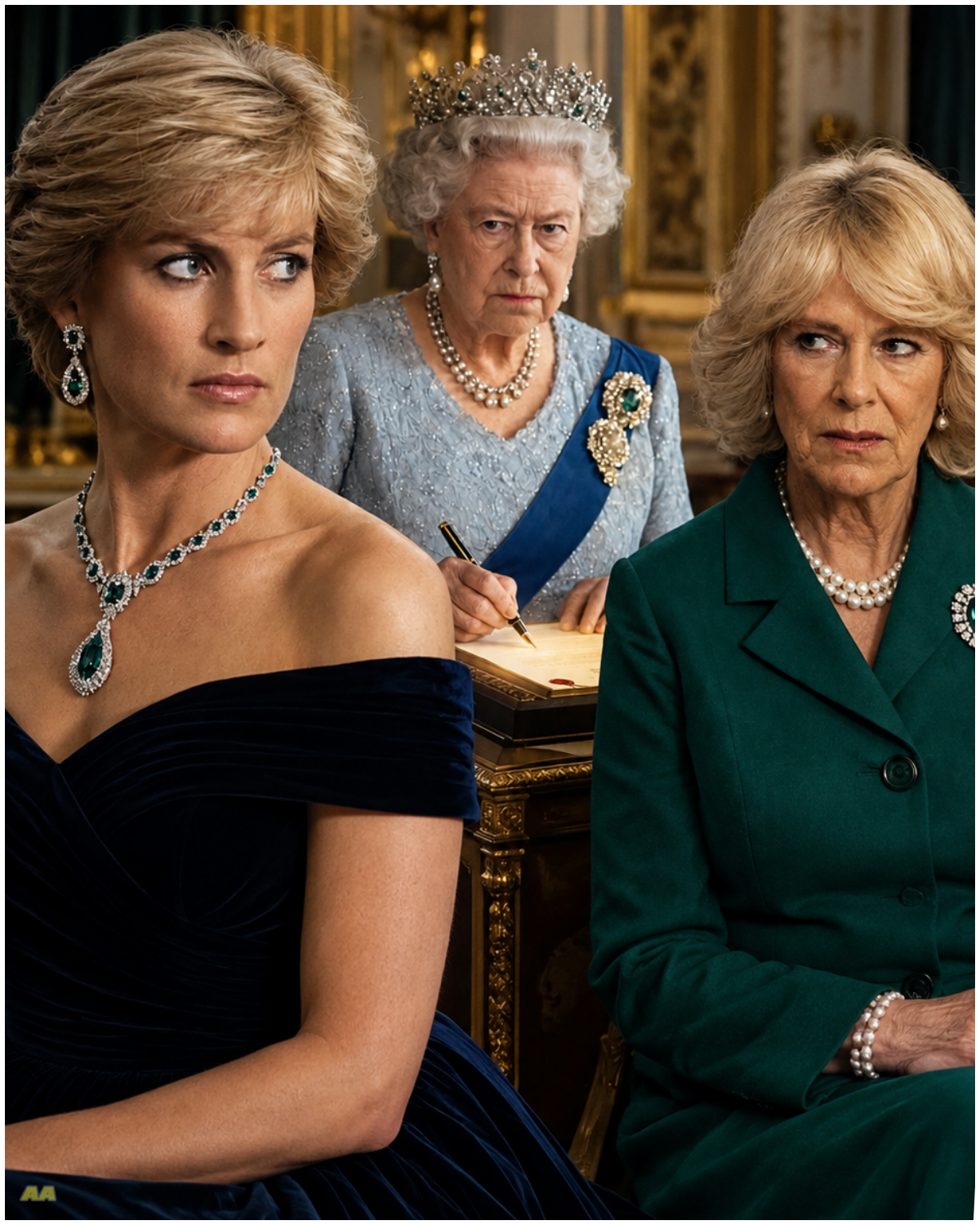
In a photograph from 1986, Diana stands at the Burgtheater in Vienna with a diamond and emerald necklace resting on her collarbone.
Three diamond-encrusted ostrich feathers shine in the center of the piece.
The emblem of the Prince of Wales.
The Queen Mother gave it to her on her wedding day.
In another photograph, taken 33 years later, Camilla Parker Bowles stands at Buckingham Palace with something pinned to her lapel.
It is the same emerald, the same diamonds, the same three feathers, but it is no longer a necklace.
Someone cut it and turned it into a brooch.
And the night she chose to show it for the first time was no ordinary night; it was the celebration of the man who connects both women.
In 2005, the Queen signed a document that most people have never heard of.
It was called the Precedence of the Royal Family to be Observed at Court.
That document did something very specific to Camilla’s rank within the family.
The question is, why? What was the Queen protecting when she picked up that pen?
You saw Diana wearing that necklace.
Do you remember the dress? The theater, the photograph, what happened to that jewel after she died and what someone did with it 22 years later is connected to that document in a way no one has correctly explained until now.
And what you are going to hear tonight goes much further than a necklace.
That necklace has a history that begins more than a century before Diana touched it for the first time.
It originally belonged to Queen Alexandra in 1863, when she married Edward, the Prince of Wales, who would later become Edward VII, 18 white diamonds, a three-carat cabochon emerald hanging in the center and three diamond-cut ostrich feathers.
The heraldic emblem of the Prince of Wales.
The same title that Charles held when Diana wore it around her neck.
The Queen Mother gave it to Diana as a wedding gift in 1981.
A 20-year-old girl receiving a piece that had been in the royal family for over a century.
Diana kept it, she didn’t wear it in public for 5 years.
When she finally brought it out, she chose Vienna.
She chose a dress the same color as the emerald and chose to wear her husband’s symbol against her skin on a night when the whole world was watching.
Diana told Andrew Morton in the tapes they recorded together in the early 90s something very few people understood at the time.
She said that dressing for a public event was like putting on armor.
Every piece of clothing, every jewel, every detail was a conscious decision.
She didn’t dress to look good; she dressed to protect herself.
That extended to everything she wore.
Mary Greenwell, her makeup artist for years, once said something that says more than it seeMs. Diana always, always, always wore perfume.
It was a huge part of her life; it wasn’t vanity.
It was identity . The fragrance she wore was as much a part of who she was on a given day as her dress or shoes.
She had several.
For day-to-day, she wore Bluebell by Penhaligon’s, an English perfume with notes of wild hyacinth, discreet, almost intimate.
For formal events, she preferred 24 Faubourg by Hermès, a perfume with jasmine, orange blossom, and a soft vanilla base.
Paul Burrell, her butler, confirmed this in his book.
For her wedding on July 29, 1981, she chose Quelque Fleurs by Houbigant, one of the oldest floral perfumes in the world.
That morning, as she was getting ready, she spilled a little on her dress.
Barbara Daly, the makeup artist who was with her that day, remembered it later, and at other times she would return again and again to Diorissimo by Dior, a lily-of-the-valley perfume that had been one of her favorites in her youth.
Each perfume was a choice. Each bottle said something about the moment she was living.
Camilla, by the way, wore something completely different.
Her perfume was Bandit by Robert Piguet .
A fragrance built on oakmoss, leather , and patchouli; dark, dry, almost masculine.
The two women didn’t even share a single olfactory chord.
If someone had put them in the same room with their eyes closed, the perfume alone would have been enough to know who was who.
But Diana’s relationship with her objects wasn’t just about attachment; she also knew how to let go .
In June 1997, two months before her death, Diana put 79 of her most well-known dresses up for auction at Christie’s in New York.
The idea wasn’t hers, it was William’s.
Her eldest son, who was just 14 at the time, suggested she sell the dresses and donate the money to charity.
Diana agreed. Meredith Etherington-Smith, the creative director at Christie’s at the time, visited Kensington Palace to see the collection.
When she entered the room where Diana kept her dresses, she found a huge salon packed with garments from end to end.
Diana looked at her and said, “You can see my problem now.” Etherington-Smith replied, “I certainly can.” The auction raised 3,250,000 for charitable organizations, including funds for AIDS and cancer.
Diana wasn’t in New York that night.
She stayed in London and asked for the results to be faxed so she could read them with her breakfast tray the next morning.
Those 79 dresses were gone because Diana decided they should go.
She chose which ones. She controlled the process.
She decided what stayed and what left her life.
It was, in her own words, according to Vanity Fair, a new beginning after the divorce, a way to leave her royal past behind.
But something is lost when only that part of the story is told.
Because Diana chose to let go of 79 dresses.
She didn’t choose to let go of the Queen Mother’s necklace.
She didn’t choose to let go of her engagement ring.
She didn’t choose to let go of the Cartier Tank watch her father gave her.
She didn’t choose to let go of the aquamarine ring her friend Lucia gave her.
Those things stayed because Diana wanted them to stay.
And what happened with them after her death, with those she had decided to keep, is a story she could never control.
And that is where the Queen comes in.
Because the relationship between Diana and Queen Elizabeth was never what most people think it was.
It wasn’t a relationship of pure coldness.
She wasn’t a distant mother-in-law who never cared about what happened to her daughter-in-law.
There were documented moments where the Queen did exactly the opposite of what the public expected of her.
In December 1992, just days after the separation became official, Diana requested a private audience with the Queen at Buckingham Palace.
She entered that room crying, convinced that the whole family was against her.
And the Queen, in the midst of what she herself had called, weeks earlier, her*annus horribilis*—the worst year of her reign—gave Diana the only guarantee she needed to hear: that no one would take her children away from her, that her place as the mother of William and Harry was not up for debate.
Years later, when the time came to decide whether Diana would keep or lose the style of Royal Highness, the Queen, according to biographer Christopher Andersen, was willing to let her keep it.
Charles insisted on taking it away.
The Queen’s advisors told her there was no other option.
The Queen gave in, but not without being annoyed by an outcome she herself had not sought.
Diana gave away 79 dresses because she wanted to.
What happened with everything else, the jewelry, the title, the place she held within that family, that was not her decision.
And what came next, when she was no longer there to decide anything, is exactly where this story begins to shift.
The summer of 1997 was hot in London.
British television was full of programs that almost nobody remembers today.
Diana was tanned, thinner than ever, traveling between London and the Mediterranean.
Magazines photographed her on yachts, on beaches, with a new man.
The whole country looked at her with a mix of fascination and affection , which had not been felt like this since the early years of her marriage.
Nobody knew she had less than two months left to live.
On August 31, 1997 , at 4:15 in the morning, the news reached Balmoral.
Diana had died in a car accident in Paris.
William was 15 years old. Harry was 12.
The two of them were sleeping.
The Queen gave an immediate order that is rarely mentioned: that no television or radio be turned on in the house and that all newspapers be hidden.
She did not want her grandsons to find out about their mother’s death from a screen or by accident.
Charles was the one who woke them up after 7:00 a.m.
To tell them himself. What followed was, for the Queen, the most difficult week of her entire public life to judge from the outside.
She stayed at Balmoral with William and Harry for five days, far from London, far from the cameras, while the entire country demanded to see and hear her.
The newspapers published furious headlines asking where their Queen was, why she wasn’t speaking, why the flag at Buckingham Palace remained at full mast until September 5, a day before the funeral, when the Queen finally appeared before the cameras and said a phrase that millions of people remember to this day .
What I say to you now as your Queen and as a grandmother, I say from my heart.
She called Diana an exceptional human being.
She said she admired and respected her, especially for her devotion to her two sons.
And the next day, during the funeral procession, she did something that broke more than 70 years of protocol.
As the carriage carrying the coffin passed by her, the Queen bowed her head—a slow, sustained bow from a woman who, her entire life, had been the one receiving bows from others, never the one giving them.
The public saw a Queen who arrived late, who took five days to speak, and who seemed more concerned with protocol than with mourning.
That was the narrative of the newspapers.
But the private record tells a different story.
A 71-year-old grandmother who chose to stay with two devastated boys, shielding them from the noise, while the world demanded she come out and mourn before the cameras.
Months later, the time came to open the will and decide what would happen with Diana’s things.
Her estate was valued at 21 million pounds.
After taxes, approximately 17 million remained.
Her will, signed in June 1993 and modified in February 1996, named her mother, Frances Shand Kydd, and her sister as executors.
Lady Sarah McCorquodale. The majority of her assets went directly to William and Harry.
Paul Burrell, who had been her butler for years, later recounted in an Amazon Prime documentary what it was like when the two boys were able to choose a personal item of their mother’s.
As a keepsake, it wasn’t a formal ceremony; it was something intimate and private between two teenagers and the belongings of the woman who was no longer there.
William chose the Cartier Tank watch that Diana wore daily.
It wasn’t the most valuable object in the collection, but it was the most familiar, a gift her own father, Earl Spencer, had given her when she turned 21.
William explained it with a short phrase.
I remember Mom wearing that watch, checking the time.
Harry chose the engagement ring. The 12 -carat oval sapphire, surrounded by 14 diamonds, designed by Garrard—the same one Charles had placed on Diana’s finger in 1981.
Harry said, “That is the ring I remember from my childhood.” Years later, the press told a romantic version of what happened with that ring .
They said Harry gave it to William in an emotional gesture so he could propose to Kate Middleton.
In his book, Harry corrected that story.
There was no emotional gift. William had already asked for it.
Harry simply let it go. When Harry proposed to Meghan Markle in 2017, he didn’t use the sapphire; he used something more personal.
He took two diamonds from Diana’s private collection and designed a new ring with them, crafted by the jewelers Cleave and Company.
The stones were from his mother, the design was his own.
There was also the aquamarine ring.
Lucia Flecha de Lima, the wife of the Brazilian ambassador in London and one of Diana’s closest friends, had given it to her after the divorce to replace the engagement ring she no longer wanted to wear.
The stone came from a Brazilian mine that had also provided aquamarines for the Queen herself.
That ring went to Harry, and Meghan wore it at their wedding evening reception in May 2018.
Everything I have just mentioned was Diana’s personal property ; it belonged to her in life and belonged to her sons after her death.
But not everything Diana wore was hers.
And that is where this story takes a turn that most people do not know.
The emerald and diamond choker, the one the Queen Mother gave her on her wedding day.
The one Diana wore in Vienna and in Toronto.
It was not personal property; it was a piece from the Royal Collection.
An institutional loan. Diana wore it for years, but legally it was never hers.
When she died, that necklace did not go to William or Harry .
It went back to the royal vault and stayed there for 22 years.
That necklace remained stored in its case within the Royal Collection, without anyone asking for it, without anyone taking it out, without anyone touching it.
In a collection that contains thousands of pieces available to the women of the royal family at any time.
That one in particular stayed where it was, as if there were something about it that no one wanted to touch.
And there is a detail about the original design that is worth mentioning now, because it has not been said up to this point.
The three ostrich feathers in the center of the piece were not simply engraved or painted; they were three-dimensional, individually carved from diamond, mounted on a gold frame that allowed them to move slightly with the wearer.
When Diana walked with that necklace in Vienna, the feathers moved with her.
It was a jewel designed to be alive on the skin.
That jewel was going to appear again, but when it did, it was no longer going to move with anyone , because it was no longer going to hang around anyone’s neck.
After Diana died, the Queen did something no one expected of her.
She did not cry in public, she did not speak about Camilla , she did something more effective than either of those things.
She refused to acknowledge that Camilla existed.
According to Katie Nicholl, a royal correspondent with direct access to palace sources, and Robert Jobson, a royal biographer with decades of coverage.
The name Camilla Parker Bowles could not be mentioned in the Queen’s presence.
It wasn’t a tacit agreement or a subtle preference.
It was a rule. No one spoke it, no one dared.
In the summer of 1998, less than a year after Diana’s death, Charles traveled to Balmoral to ask his mother to soften her stance.
He wanted to live openly with Camilla.
He wanted the family to accept her.
He asked her, according to biographer Tom Bower, to at least consider the possibility of meeting her formally.
The Queen, according to Bower, had had a few martinis that night and told Charles exactly what she thought.
She called her “that wicked woman.” She told him she would not tolerate his adultery.
She told him she would not forgive Camilla for not leaving Charles alone so his marriage could have a chance to recover.
And she ended with a phrase that left no room for interpretation.
I want nothing to do with her.
Bower documented that exchange in his book Rebel Prince, based on more than 120 interviews with people inside and around the palace.
Charles left the room and called Camilla on the phone.
He was crying. Three months later, in November 1998, Charles celebrated his 50th birthday.
Camilla was going to be present at the party.
The Queen refused to attend. Her own son was turning half a century old, and she preferred not to go rather than sit in the same room as Camilla.
The BBC reported it. Charles was, according to multiple sources, deeply affected.
But the Queen was not alone in this.
There was another woman in the family who felt exactly the same way and felt it with even greater intensity.
The Queen Mother, Charles’s grandmother, the same woman who had gifted the emerald necklace to Diana on her wedding day, detested Camilla with a firmness that even the Queen did not match.
Robert Jobson wrote it clearly in his book William’s Princess.
Camilla’s name could not be spoken in the presence of the Queen Mother.
It wasn’t just the Queen who refused to hear it.
It was both of them, mother and daughter, a double wall.
Tom Quinn, the Queen Mother’s biographer, was even more direct.
Charles would never have married Camilla if his grandmother had still been alive.
The Queen Mother died on March 30, 2002.
She was 101 years old, and with her death, the last remaining personal barrier between Camilla and the royal family fell.
But before that barrier fell, before everything changed, Diana had already said aloud what no one else dared to say, and she had done it in front of 200 million people.
On November 20, 1995, sitting in her own living room at Kensington Palace, in front of BBC cameras, Diana said the words that defined the rest of her public life.
There were three of us in this marriage , so it was a bit crowded.
That phrase became the most quoted of her entire life.
But it wasn’t the only thing she said that night.
She also said something that is almost never repeated with the same weight.
I’d like to be a queen of people’s hearts, in the hearts of the people, but I don’t see myself being queen of this country.
And then, with a calm that surprised even those who knew her well, every strong woman in history has had to walk a similar path.
And I think it is the strength that causes the confusion and the fear.
Those three phrases spoken on the same night in front of 23 million viewers in the UK alone were the most dangerous moment of her entire relationship with the institution.
Not because they were false, but because they were true, and because by saying them aloud, Diana took away the royal family’s control over the narrative of her own marriage.
The Queen understood it perfectly. Weeks after that interview, she sent letters to Charles and Diana, asking them to finalize the divorce as soon as possible.
But what the Queen did after Diana’s death, what she did for the next eight years, was much more than refusing to say a name or missing a birthday.
It was a silent, methodical campaign, built with the only tools she knew how to use: protocol, silence, and absence—8 years of a wall.
And at the end of those 8 years, when Charles finally married Camilla in April 2005, the Queen did something no one saw coming.
She didn’t shout, she didn’t protest in public; she picked up a pen and signed a document.
And what that document said is exactly what we are going to see now.
In the spring of 2005 , Great Britain was changing in ways that still felt uncomfortable for a good part of its population.
Tony Blair had been in power for 8 years.
The Iraq War divided the country, and in April, the heir to the throne married the woman who had been “the other one” throughout his entire first marriage.
The newspapers didn’t know whether to celebrate it or criticize it.
Most did both things at the same time.
1,035 words. Write on target. Here’s the complete chapter 4 and relationship deepening.
On April 9, 2005, Charles and Camilla got married.
A civil ceremony. Windsor Guildhall, 28 guests.
The Queen and the Duke of Edinburgh did not attend the ceremony.
The official reason was that as head of the Church of England, the Queen could not be present at a civil ceremony between two divorced people.
Yes. They did attend the religious blessing at St. George’s Chapel and they did host the reception at Windsor Castle, but they were not there when Charles and Camilla signed the register.
The moment that register was signed, Camilla automatically became, by protocol, the second highest-ranking woman in the entire United Kingdom.
Only the Queen was above her.
That was how the monarchy worked.
The heir’s wife occupied the second place, without exceptions, without nuances, without needing anyone to approve it.
The Queen did not accept that.
In the same year as the wedding, she signed a document that almost no one outside the palace’s innermost circles knew about at the time.
It was called “Precedence of the Royal Family to be Observed in Court.” And what it did was simple.
Surgical and devastating for Camilla’s position.
On private occasions, Camilla was not going to be second; she was going to be fourth.
Behind the Queen, behind Princess Anne, behind Princess Alexandra.
Women who had been born into the royal family outranked her.
The wife of the heir to the throne, the woman who had just married the future King of England, was placed below princesses who had not married any heir .
Blood over marriage. That was what the Queen put in writing, and she did not stop there.
Camilla could not use the title of Princess of Wales.
That title belonged to her automatically as the wife of the Prince of Wales, but using it would have been, in practice, putting on the name that the whole world associated with Diana.
The solution was to give her a different title: Duchess of Cornwall.
A technically lesser title, without the emotional burden of the one Diana had held.
Christopher Andersen, a royal biographer, went further.
He documented that Charles had promised his own mother that Camilla would never be queen, that when he reached the throne, Camilla would hold the title of Princess Consort, a title invented for the occasion.
Without precedent in the history of the British monarchy.
It was the promise the Queen needed to hear to give her consent to the marriage.
Charles did not keep that promise.
When he became king in September 2022, Camilla became queen just like that.
But that was later. In 2005, the Queen was still alive and still controlled the rules of the game.
At the wedding reception, according to Tom Bower, the Queen gave a speech.
It was a public speech, warm on the surface, where she compared Charles and Camilla’s story to the Grand National, the famous horse race.
She said they had cleared Becher’s Brook and The Chair and all sorts of terrible obstacles.
The guests laughed. Jilly Cooper, a friend of Charles, said afterward that everyone was in stitches at the Queen’s speech .
But Bower added a detail that almost no media outlet repeated.
Throughout the entire speech, the Queen did not address Camilla by her name, not even once.
She spoke of the marriage, she spoke of the obstacles, she spoke of horse racing, but the name of the woman who had just married her son did not cross her lips.
Now think about what you just heard.
The Queen did not go to the ceremony.
She signed a document that moved Camilla from second to fourth place.
She took away her practical right to use the title of Princess of Wales.
She accepted a promise that she would never be queen.
And at the reception, she did not call her by her name.
This was not a social snub; it was an architecture.
Each piece was carefully placed, and behind each piece was the same intention: that Camilla would not occupy the place Diana had left empty.
But the question we still haven’t answered is this: did she do it because she wanted to protect Diana’s memory, or did she do it because she hadn’t been able to protect her in life?
And this was the only thing she had left.
Months after Diana’s death, Paul Burrell sat across from the Queen in a private meeting.
There were no cameras, no aides present , just the two of them in a room in the palace talking about the woman they had both known in very different ways.
And at some point in that conversation, the Queen told him something he didn’t expect to hear.
She told him she had tried to reach Diana many times, that she had written her letters, many letters, for years trying to build a bridge between them, that she had tried so hard that the words were heavy even for him.
A man accustomed to hearing difficult things within those walls.
Burrell did not contradict her, but he told her the truth.
He responded with the honesty that only someone who knew both women could afford in front of the Queen of England.
The problem, Your Majesty, is that you spoke in black and white.
The princess spoke in colors. The queen did not respond to that.
Burrell never said if there was silence afterward, or if she changed the subject or simply nodded.
What he did say is that those words stayed between the two of them in that room, and he never told anyone else until he decided to make them public years later.
Two women who never learned to speak the same language: one who wrote formal letters in tight script, and another who needed to be told things with heart in hand, with open arms, and with a trembling voice if necessary.
And yet, the queen signed that document—not out of sentiment, not out of guilt, but for something colder and more enduring than either—because she understood, better than anyone, that positions within the monarchy are not protected by emotions, they are protected by paper.
At some point before March 2019, someone took the necklace out of the royal vault and, instead of leaving it as it was—in the form it had existed for over a century and a half—had it redesigned.
The chain was cut, the setting was dismantled, and the feathers, diamonds, and emerald were rearranged onto a new, smaller base designed to be pinned to a jacket lapel .
What once hung from a woman’s neck now fit in the palm of a hand.
The necklace ceased to be a necklace.
On March 5, 2019, Camilla entered a reception at Buckingham Palace.
The event celebrated Charles’s fiftieth anniversary as Prince of Wales.
She wore a green jacket, a pearl necklace, and pinned to her left lapel was the brooch: the three-carat emerald, the 18 diamonds, the three feathers.
Maxwell Stone, a jewelry expert at the British firm Steven Stone, described the piece this way: This extraordinary brooch contains approximately 4 carats of white diamonds distributed across 18 individual stones, topped by a stunning three-carat cabochon emerald.
Once worn as a necklace by Princess Diana.
This piece not only has aesthetic brilliance but also deep royal significance.
Its estimated value is around 133,000.
What Stone did not mention, and what almost no media outlet highlighted at the time , was the choice of the event.
The three feathers in the center of that jewel are the emblem of the Prince of Wales.
Diana had worn them around her neck as a symbol of her husband’s title .
Camilla wore them on her lapel on a night dedicated exclusively to celebrating that same title.
It was not just any jewel on just any night.
It was that jewel on that night.
The reaction was immediate. On social media , in opinion columns, and in forums where those who remember Diana gather to talk about her.
The words were repeated: “Awful taste, she has no shame.” A source cited by Woman’s Day magazine was more direct.
It feels as if she has desecrated her.
How far can this lack of consideration go?
Another source from the same outlet said something that landed with even more weight.
It was an important piece that no longer looks anything like what it once was.
Just because Camilla decided to change something that wasn’t hers to begin with.
And the necklace wasn’t the only thing.
In July 2024, Camilla appeared at Wimbledon with a bag on her arm that made people stop and look twice.
It was a Lady Dior. The next day , she wore it again at an event in Wales.
In June 2025, she appeared with a white one at Royal Ascot, and in May 2026, she carried it again in BelfaSt. That bag has a history that starts long before Camilla ever touched it.
It was designed by Gianfranco Ferré for Dior in 1994 and was originally called the Chouchou.
In 1995, Bernadette Chirac, the First Lady of France, gifted one to Diana during an official visit.
Diana made it her own. She took it everywhere : to official events, to private dinners, to her first and only appearance at the Met Gala in New York in 1996.
Dior renamed it that same year .
They named it the Lady Dior in honor of Lady Diana Spencer.
The bag literally carries her name.
Maricl magazine wrote that for many, seeing Camilla with that bag was crossing a line that shouldn’t be crossed.
The necklace, the bag, the Princess of Wales title that Camilla avoided using publicly, but which technically belonged to her.
Her place next to Charles at every official event.
Each of these things, individually, had a reasonable explanation.
The necklace was property of the Crown, not Diana.
The bag is a commercial product that anyone can buy.
The title is a matter of protocol.
The spot next to the heir belongs to his wife, but placed side by side, in sequence, over the years they told a different story.
It wasn’t an accident, it wasn’t a coincidence; it was a visual replacement, piece by piece, of the space Diana had occupied.
And after Camilla, the jewel kept moving.
Kate Middleton wore it in November 2022, pinned to a wine-colored dress, to welcome the President of South Africa, and wore it again in September 2025 at Windsor Castle to welcome the President of the United States.
The wife of William, Diana’s son, using the same jewel that her mother-in-law wore in Vienna in a way her mother-in-law never knew.
If you have made it this far, if you have spent 35 minutes listening to this story, it is because you know that what comes next is the part that everything you have heard has been building up to.
And what comes next has to do with what happened when the only person who had been holding all of this back was no longer there.
Diana in Vienna. April 1986. The sequined dress, the emerald against her skin, the feathers moving with her as she walked.
That image will return one more time before we finish, but this time you will see it differently.
On September 8, 2022, Queen Elizabeth died at Balmoral.
She was 96 years old. She had reigned for 70 years.
Charles became king that very same afternoon.
14 months later, Camilla was crowned by his side at Westminster Abbey.
She was no longer the Duchess of Cornwall, she was no longer Princess Consort.
The title that Charles had promised his mother would be the only one she would hold.
She was Queen. Queen Camilla. Patrick Jephson, the man who was Diana’s private secretary for 8 years, wrote something in 2023 that sums up what many felt while watching that coronation.
He said that Charles’s main goal had always been the transformation of Camilla Parker Bowles and that this transformation had been carried out behind a long succession of creative palace communiqués, and added that for many loyal monarchists, this whole celebration, with its touch of triumphalism, may still feel a bit unsettling.
He didn’t say it was wrong, he said unsettling.
A man who loved Diana, who served her, who saw everything from the inside, and that was the word he chose.
The promise was not kept. And the document that Queen Elizabeth had signed in 2005, the one that lowered Camilla to fourth place for private occasions, the one that put the blood princesses above her, that document still existed, but it no longer had the strength of the woman who wrote it behind it.
A paper signed by a dead queen does not have the same weight as a paper signed by a living queen.
Everything the Queen had built over 17 years, stone by stone, with silence, with absence, with documents, and with protocol, began to unravel.
Harry described it in his book in detail that has nothing to do with jewels or titles, but says more than both of those combined.
When he moved out of Clarence House at 28, his room, the one he’d had since he was a teenager, was turned into Camilla’s personal dressing room—not an office, not a meeting room, her dressing room.
The space where Diana’s son used to sleep was replaced by the place where Camilla kept her clothes.
Harry wrote that he had complex feelings about his stepmother.
He said he saw her as someone who had sacrificed him on her PR altar, and added a phrase that, coming from him, sounds almost resigned in a strange way.
He even wanted Camilla to be happy.
Maybe she would be less dangerous if she were happy.
That line is not from an angry man; it’s from someone who has spent his entire adult life watching his mother’s things disappear one by one, and who no longer has the energy to fight for each one, because that is what happened: not all at once, not in a single act, but piece by piece, year after year.
The necklace turned into a brooch, the bag named after Diana on another woman’s arm, the room that became a dressing room, the Princess of Wales title now held by Kate (not Camilla), which stopped belonging to Diana the day the divorce was signed, the rank the Queen tried to protect with a document that Charles undid with a coronation.
Each thing individually has an explanation.
Together they tell a story that no one needs to have explained to them.
And now we can answer the question I posed at the beginning of this video.
Why did the Queen sign that document in 2005?
What was she protecting? She wasn’t protecting an abstract memory.
She wasn’t protecting the idea of Diana.
She was protecting something much more concrete: the position, the rank, the exact place Diana had occupied within the most formal structure in the world.
She knew, because she understood that institution better than any living person, that without a written barrier, everything Diana had represented within the monarchy would be reclaimed—not necessarily out of malice, but by inertia, by protocol, by the same institutional logic that has functioned the same way for centuries.
The King’s wife occupies the place of the King’s wife, regardless of who was there before.
The Queen couldn’t stop it forever.
She never intended to, but she could slow it down.
She could place a paper barrier between Camilla and Diana’s place, and keep that barrier standing as long as she herself was alive.
She did it for 17 years, and when she died, the paper remained.
But the strength behind the paper left with her.
Total verified word count. W 746 words.
6780 written in tool verified sections plus 0 in the opening sequence delivered conversation.
That’s comfortably inside target. Here’s the complete final section.
Let’s return to the necklace one last time.
It was not just a piece of jewelry.
It was a form, a specific way in which Diana existed before the world.
The necklace resting on her collarbone, the Prince of Wales feathers gleaming against her skin, the emerald moving with her breath.
That form, that silhouette, that image existed for more than a century.
It passed from Queen Alexandra to the Queen Mother, from the Queen Mother to Diana.
Every woman who wore it used it the same way, around the neck, close to the throat, like something alive.
That form was erased. The chain was cut, the stones were rearranged, what hung was flattened, what moved with the body was fixed to a pin.
And the woman who wore it for the first time in its new form chose, out of all possible nights, the night that celebrated the man who linked them both.
The original necklace , the one Diana knew, the one the world saw in Vienna and Toronto, no longer exists.
It was not destroyed; it was transformed into something that no longer resembles what it was.
The emerald is still there, the diamonds are still there, the feathers are still there, but the way Diana wore them, that is no longer anywhere.
Paul Burrell knew Diana better than almost anyone outside her family.
He was her butler, her confidant, the person who was at Kensington Palace when she dressed to go out, when she chose what to wear, when she decided what to keep and what to give away.
He saw up close how Diana lived surrounded by objects that, for her, were not decoration; they were memory, they were identity, they were the physical proof that she had been in a place, that she had known someone.
That something had mattered enough to her to preserve it.
Burrell said that Diana did not accumulate things just to accumulate.
Every object she kept had a reason.
Her father’s watch, the photograph of her children in school uniforms, the letters she didn’t send, the perfume she chose for her wedding day.
Nothing was accidental , everything had a story behind it, and she remembered every one.
When Burrell sat before the Queen months after Diana’s death, what he heard was a woman who also burdened objects with meaning.
The letters the Queen had written to Diana for years, those no one saw, were her own version of the same, attempts at connection kept in silence that didn’t arrive in time.
The difference between the two women was never one of intent, it was one of language.
One wrote with black ink on white paper, in short, formal, measured sentences.
The other needed color, she needed warmth, she needed someone to tell her things with their body, not just with words.
And now, years after both have passed, the objects that connected them remain here transformed, reassigned, placed in hands that neither of them chose.
It is not biographers or jewelry experts who best expressed what many people felt seeing what happened to Diana’s necklace.
It was ordinary people, people who remember her, people who saw her on television and never met her in person, but feel they did.
One of them said it with the exact words many of you probably thought.
She had no right to change something that wasn’t hers to begin with.
Another went further. It feels as if she had desecrated it.
Those are not the words of a journalist , they are the words of someone who remembers Diana the same way you do and they carry the same weight.








