“Ask My Wife,” the Duke Said — The Butler Replied, “She Left Last Tuesday”

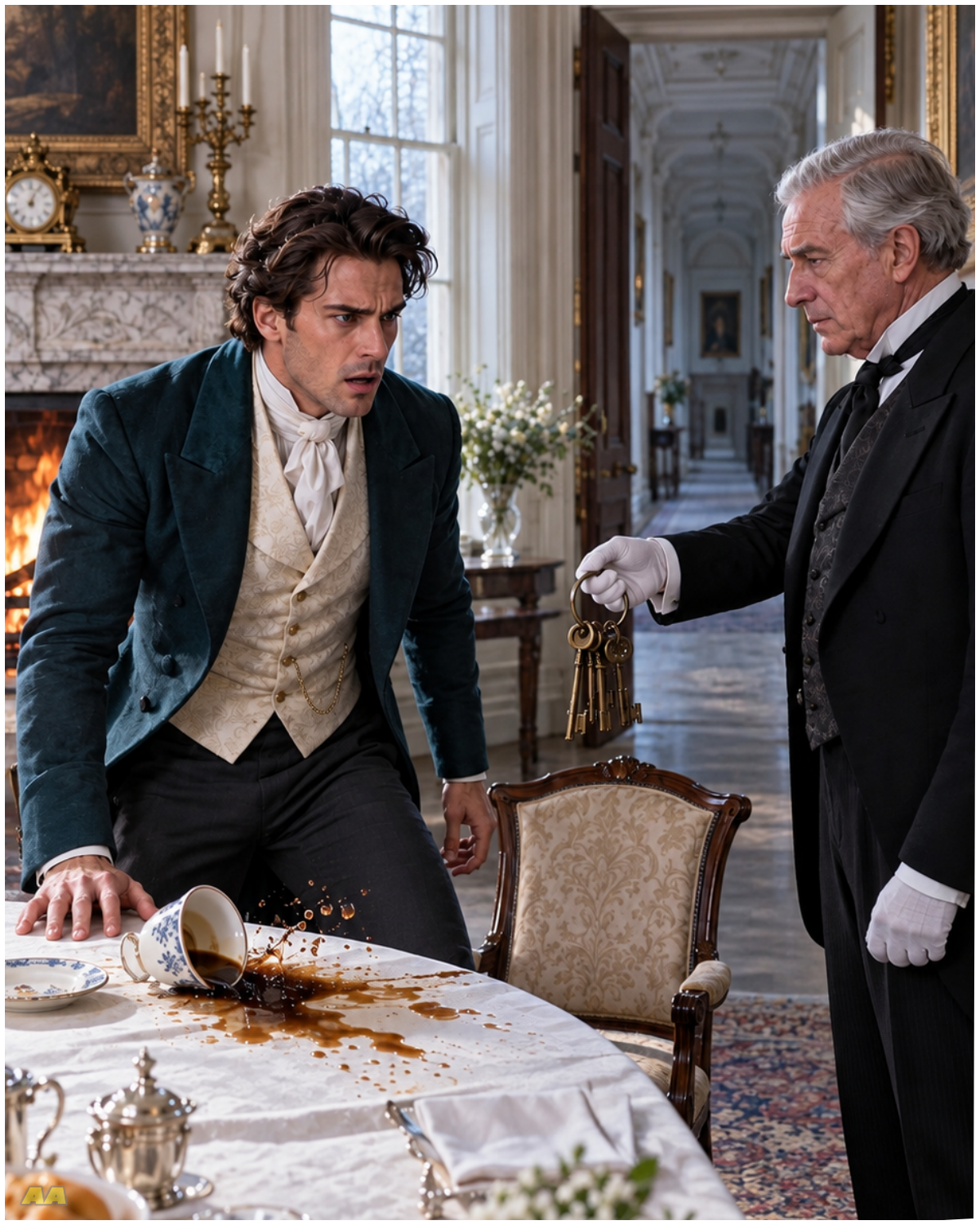
“Ask my wife,” the Duke said, setting down his coffee with the particular quiet of a man who did not expect to be denied a small thing.
He had asked it a hundred times in 3 years, always in that same flat, certain tone, the tone of a man who has built one dependable pillar into the architecture of his life, and leans on it without thinking.
The question that morning was nothing at all.
Whether the east tenants’s roof had been mended before the rains, whether his daughter’s gray mare had been reshaw, some domestic thread too small for a duke to hold in his own hands and too important to be forgotten.
He did not look up from his letters when he said it.
He did not need to.
For 3 years, the answer had always come the same way, in the same unhurrieded voice, correct down to the last shilling and the last nail.
Nash, who had stood at that sideboard for 11 years, and had never once in that time delivered news that made his master’s face go the color of old paper, cleared his throat, and did not answer at once.
That silence was its own kind of sentence.
Nash, your grace. The butler’s hands folded before him did not tremble, though something in his voice had gone thin.
Her grace is not at her court to ask.
She left last Tuesday. The room did not move.
A log settled in the great, and somewhere beyond the tall windows, a rook called twice and was answered.
Gideon Lockheart, ninth Duke of Netherfold, set his cup down a second time, though it was already down, and the small clink of porcelain against saucer was the loudest sound any servant in that room would remember for a long while afterward.
Left, he repeated. Not a question, a word turned over, examined, found not to fit.
Yes, your grace. For where Nash’s gaze did not waver, though it cost him something to hold it steady.
She did not say your grace.
She left a letter. I placed it in your study on the desk beneath the ledger she was keeping.
I did not read it.
Gideon Rose. He was not a large man in the way that fills a doorway, but he had a stillness that made rooms feel smaller around him, and every soul at that table, his daughter’s governness, two footmen, the aunt who had run his household since before his own mother’s death, watched him cross to the door without a word, and understood, each of them, that something in the ordinary machinery of the house had come loose in the night, and none of them yet knew how far the wreckage would spread.
To understand why a duke could stand in his own breakfast room and feel the floor tilt beneath him over the absence of a wife he had married without love, it is necessary to go back 3 years to a cold house and a colder arrangement, and to a young woman who had spent the whole of her life being useful to people who did not think to thank her for it.
Marian Trent had grown up in the kind of gentile poverty that leaves no visible bruises and does all its damage from the inside.
Her father had been a country solicitor with a talent for other people’s affairs and none whatsoever for his own.
And when he died, he left behind a modest house, mortgaged twice over, a younger daughter of delicate health, and a debt to a man he had once done a great service for, and never dared ask to be repaid.
That man was Everett Lockheart, the eighth Duke of Netherfold, Gideon’s father.
And it was to settle that old and awkward debt of gratitude that Marian at 19 first came to Heron Court.
Not as a bride, not yet, but as a companion and unofficial tutor to a motherless child of six, who did not speak above a whisper, and flinched at raised voices.
She arrived in a hired gig with one trunk and a black dress that had been dyed twice to hide the wear.
And she was met at the door not by the Duke who was then still deep in the numb silent grief of a man newly widowed but by his aunt.
Lady Prudence Dracott had married into wealth and buried it twice over.
First a husband who left her comfortable rather than rich and later in effect her own ambitions when her brother’s family took the dukedom and left her the management of its house rather than the ownership of anything in it.
She was a handsome woman still, precise in her dress, economical with her warmth, and she had run her court for 11 years with the quiet, absolute authority of a woman who intends to be indispensable, because she cannot afford to be loved.
She looked at Marian’s dyed dress and her single trunk, and drew in an instant all the conclusions she required.
You will not trouble his grace, she said by way of greeting.
He is not to be troubled.
You are here for the child.
Marian had learned long before that morning the particular art of making herself small enough not to be a burden and useful enough not to be sent away.
She curtsied, said that she understood perfectly, and went upstairs to meet Phoebe Lockhart, who was sitting very straight on the edge of her bed with her hands folded in her lap, in a way no six-year-old arrives at naturally, and who looked at Marion with the flat, assessing eyes of a child who has learned that adults leave.
“You won’t stay,” Phoebe said.
“Not a question, either. Children learn that trick from the houses that raise them.
I might, Marian said. I should like to see the garden first, if I may.
Every house is better once you know its garden.
It was the first true thing anyone had said to that child in some months.
And it worked exactly as true things do, quietly, and for longer than anyone expects.
The room they gave her at the far end of the nursery corridor was small and cold and had clearly not been aired in some time.
And Marion, setting down her single trunk upon its narrow bed, found she did not mind the cold half so much as she minded the silence beneath it.
A silence that seemed to belong to the whole house rather than merely this one forgotten room.
The silence of a place holding its breath against some old grief it had never been permitted to finish grieving.
She had grown up in rooms very like it.
Her father’s house in the last years before his death had shrunk around her and her sister by careful degrees.
One room shut up after another to save on Cole until the two of them lived in effect in a single chamber and pretended for the sake of visitors that the rest of the house still belonged to them.
She knew the particular economy of gentile poverty, the way other women knew the economy of a kitchen, which corners could be allowed to go bare, which could not, which small comforts could be surrendered without anyone noticing, and which surrendered would break something that could not afterward be mended.
She had learned in that shrinking house to want very little, and to be grateful visibly and often for whatever small kindness came her way, because a woman with nothing has only her gratitude to trade, and Marian had traded in it dutifully for the whole of her 19 years.
She unpacked her single trunk with the brisk economical movements of a woman who had done it many times in many houses not her own, and did not allow herself to wonder that first night how long this particular arrangement might last, because wondering cost more than it ever returned.
She lay awake instead, listening to the house settle around her, old timbers ticking as they cooled, a door somewhere shutting, with the particular finality of a servant retiring for the night, and beneath it all, very faint, the sound of a child crying in a room two doors down, quickly and carefully muffled, as though even grief in that house had learned to apologize for the noise it made.
Marian did not go to her that first night.
She had not yet earned the right to comfort a child who did not know her.
And she understood, with the same cleareyed practicality that governed everything she did, that trust built too quickly in a frightened house, was trust that could be withdrawn just as quickly, the moment it proved inconvenient.
The garden, when Marian finally saw it that same afternoon, explained a great deal about the house it belonged to.
It had once been laid out with obvious love.
Box hedges shaped into a modest knot, a stone bench beneath an old quint, a wall for a spall pairs that had clearly at some point been trained with real patience.
All of it was going to seed.
Weeds stood knee high between the roses.
The pears had reverted to wild growth, throwing long, unproductive whips in every direction.
It was not a garden that had never been tended.
It was a garden that had been abandoned mids sentence, and something about that distinction caught at Marion in a way she could not immediately name.
She began, without asking anyone’s leave, to clear a single bed near the bench each evening after Phoebe was asleep.
It was not her place.
She did it anyway, in the deepening dusk, on her knees in a dress already too worn to ruin further.
And if anyone had asked her why, she could not have given an answer more honest than that idle hands frightened her, and that neglect, wherever she found it, felt like something owed a remedy.
It was in that garden, on a July evening, some 6 weeks into her residence, that the Duke first truly saw her.
He had taken to walking the grounds alone after dinner in the flat gray hour when grief sits heaviest, and he came upon her by accident, on her knees in the dirt, with her sleeves pushed to the elbow, working a stubborn root free of the soil with more determination than grace.
She did not hear him approach.
He watched her for a long moment, long enough that later, in memory, he would be faintly ashamed of it.
And what struck him was not her face, though it was a fine face, nor her figure, though she was slight and quick in her movements.
What struck him was that she was doing careful, unglamorous work that no one had asked of her and no one would ever see, purely because the work wanted doing.
“You need not do this,” he said at laSt. She startled, sat back on her heels, and looked up at him with dirt on her hands, and no apology in her expression at all, which was itself unusual.
Every other person in his household apologized to him reflexively for existing for occupying air.
No, your grace, I need not.
Then why? She considered the question as though it deserved a real answer rather than a polite one.
Because it was dying by inches, and no one else appeared to have noticed, and I could not walk past it every day and pretend I hadn’t.
He looked past her at the cleared bed and the still ragged wilderness beyond it.
And something in his chest, long sealed, shifted very slightly, the way old ice shifts before it cracks.
With no sound at all, but with the promise of sound to come.
My wife loved this garden, he said, and it was the first time he had spoken of his late wife to anyone in the household without his voice going hard as stone.
I have not been able to look at it since.
Then perhaps, Marian said carefully, “It does not need you to look at it, only to let it live.” He did not answer that.
He turned and walked back toward the house, and she thought she had overstepped badly and lay awake that night rehearsing apologies she never had occasion to give.
Because two mornings later, a note came to her room in his own hand, asking whether she might take charge of the household accounts, as his aunt’s arithmetic, though well-intentioned, no longer answered to the ledger.
It was not romance. It was not even particularly warm.
It was simply the first time anyone in that house had noticed what Mary and Trent was actually capable of and asked for more of it.
We’ll take a very short break.
If you don’t want to miss new stories, please subscribe to the channel.
She said yes, of course.
She had never once in her whole quiet life been asked to be more than she already was.
And the invitation, however plainly delivered, undid something in her that three years of poverty and obligation had not managed to touch.
The accounts, once she took them in hand, told her a great deal about Heron Court that no one had troubled to say aloud.
Rents were collected and recorded, but the sums that reached the estate’s own coffers did not always match the sums the tenants swore they had paid.
Small discrepancies easily explained by a careless hand, except that the hand in question, Lady Prudences, was never careless about anything else.
Marian noted the differences in a private book of her own, said nothing, and went on with her work, because a suspicion without proof was only gossip, and she had spent her whole life despising the damage gossip did to women with no one to speak for them.
For 2 years the household went on in that careful unspoken rhythm.
Marian ran the domestic machinery of Heron Court with a precision the place had not known in a decade.
Phoebe, given a steady hand to hold, began to speak above a whisper, then to laugh, then astonishingly to argue.
The healthiest sign a child of that history could show.
Gideon, without ever quite naming the change, came to rely on Marian’s judgment the way a man leans without noticing on a wall that has always held his weight.
He asked her opinion before he asked his solicitors.
He read her a difficult letter before he answered it, to hear how the words sounded aloud.
He did not court her.
He simply by slow degrees came to need her in the room.
The garden in those two years became the clearest measure of everything else that was changing, though neither of them ever spoke of it in those terMs. The single cleared bed near the stone bench grew by slow accretion into a cleared border, and then a cleared quarter of the whole neglected acre until by the second spring the box hedges had been coaxed back into something resembling their old modest knot.
And the pears along the wall had been cut back hard and trained flat again, throwing out that first summer of proper pruning, a harvest so much larger than the estate had seen in a decade, that the housekeeper had to send twice to Kingsbrook for extra preserving jars.
Gideon took to walking the grounds each evening still, as he had the night he first found her there.
But the walks changed their character by degrees, where once he had walked alone, in the flat gray hour when grief sat heavieSt. He began, without either of them remarking on it, to walk at the hour Marian was likeliest to be found on her knees in the dirt, and to find some pretext, a letter to discuss, a question about the tenants, a matter requiring no particular urgency at all, that brought him to the garden rather than kept him from it.
Phoebe noticed, before either adult did, in the frank and unembarrassed way of children, and asked Marion once, with no malice at all, why papa always seemed to remember his most pressing business at exactly the hour she was weeding the roses, and Marion had told her, with perfect composure, that she was sure she could not say, and had felt the color rise in her own face regardless.
It was in the second autumn of her residence that Marian first heard Gideon laugh.
Not the small controlled exhalation he sometimes permitted at a dry remark of his aunts, but a real laugh startled out of him by some small absurdity of Phoebe at the dinner table.
A laugh that transformed his whole guarded face for the several seconds it lasted, and then just as quickly retreated behind his usual composure, as though he had surprised himself, and did not entirely trust the sensation.
Marian said nothing of it at the time.
She only noted it privately in the same careful ledger of small observations she kept of everything that mattered in that house and thought that a man who had forgotten how to laugh without meaning to might, given enough patient seasons, remember how to do it on purpose.
It was Lady Prudence who first said the word marriage aloud, and she said it as a solution to a problem rather than a romance.
The world had begun to talk unkindly about a widowed duke and an unmarried companion sharing so much of his confidence, and a scandal, however unfounded, would fall entirely and permanently on Marion, never on him.
Gideon proposed it to her plainly in his study across the very ledger she had learned to keep for him.
It would be a marriage of practical terms, he said.
You would have my name, my protection, and the security of my household for the rest of your life.
Your sister’s situation would be settled beyond any further worry.
In exchange, I would ask that you continue precisely what you already do.
Keep this house, keep Phoebe safe and well, and keep me honest in my own affairs, which you already do better than any man I employ.
I do not offer you love.
I do not know that I have it left to offer anyone.
I offer you honesty instead, which I think you have had too little of in your life to refuse.
It was the least romantic proposal ever delivered in the history of that county, and it was also, Marian thought afterward, the first entirely honest thing anyone with power over her fate had ever said to her, without an ulterior motive folded inside it.
She said yes for her sister’s sake and told herself that was the whole of her reason and was only partly lying.
They married in October quietly with Lady Prudence standing witness with a smile so correctly arranged it might have been painted on.
And Octavia Pharaoh, Prudence’s niece, newly arrived from Bath with the kind of beauty that photographs well and forgives nothing, watching from the second pew, with an expression Marian was too occupied to read that day, and would have cause to remember with great clarity later.
Octavia had come to Herren Court that autumn at her aunt’s quiet engineering, ostensibly for a long visit, in truth as the opening move in a plan 2 years in the careful making.
Prudence had watched her nephew grieve himself into usefulness for a household companion instead of a woman of standing, and had resolved long before Marian’s name was ever spoken as a bride, that if Gideon must marry again, it would be to a woman whose fortune and family repaired Prudence’s own increasingly precarious situation rather than one who threatened to expose it.
Octavia, pretty, well-b bred, and entirely willing to be steered, was to have been that woman.
Marian’s quiet elevation from companion to duchess had not merely wounded Octavia’s pride.
It had ruined in one plain ceremony the whole architecture of Prudence’s future security.
And a woman who has spent her life making herself indispensable, does not surrender that position without a fight.
She simply learns to fight in ways that never show her hand.
The first sign of it was small enough to be nothing at all.
A missing garnet brooch discovered gone from Prudence’s own dressing table, discovered again some days later, tucked with theatrical carelessness into the hem of a gown belonging to Marian, and discovered by Octavia, who made great and tearful show of not wishing to think ill of the new duchess, while ensuring three separate servants heard her say so.
Marion denied it plainly, without raising her voice, and Gideon, when the matter reached him, believed her without hesitation, which surprised no one more than Prudence, who had counted on a husband’s habitual doubt of a bride he barely knew, and had not accounted for a man who had spent 2 years learning that this particular woman did not lie.
The brooch was returned, the matter smoothed over as a servant’s careless mistake, and Marion thought wrongly that the danger had passed with it.
It had not passed. It had only been noted, filed away, and refined.
Prudence in the weeks that followed the affair of the brooch changed nothing in her manner toward the new duchess.
And it was precisely that lack of change which ought to have warned Marion more than any open hostility could have done.
A woman who has been caught even lightly, even without consequence, ordinarily softens or hardens visibly.
Prudence did neither. She continued to preside over the household’s small daily rituals, the ordering of menus, the calling of the linen inventory, the correction of a footman’s posture at the sideboard, with exactly the same brisk correct affection she had always shown.
And it was only in the smallest of moments, a beat held half a second too long before she answered a direct question, a glance that measured rather than simply looked, that Marian caught any hint of the recalculation going on beneath that composed gray exterior.
Marian did not mistake stillness for peace.
She had spent too many years reading the true temperature of a room beneath its polite surface to make that error twice.
And so she went on quietly doubling the care with which she copied each figure into her private book and telling no one, not even Gideon, of the small, cold feeling that had settled beneath her ribs, and did not go away.
There was in that same season a second small incident that Marian would only later understand to have been a rehearsal rather than an accident.
A misdirected letter addressed in Marian’s own hand to a linen draper in Kingsbrook, which somehow found its way not to the draper at all, but into a stack of correspondence Gideon happened to be reviewing, containing, folded inside it, a note in a hand not Marian’s own, suggesting, in vague and deniable language that the new duchess had been overheard speaking discourteously of her husband to a housekeeper.
Gideon had shown Marion the note directly without ceremony, and asked in his flat, unhurried way whether there was any truth in it.
And Marion, meeting his eyes without flinching, had said simply that there was not, and that she did not know how such a note had come to be folded inside her own correspondence.
And Gideon had believed her at once and burned the note in the study great without another word spoken on the matter.
It was a small thing.
It was also, Marian understood afterward, a test, a testing of exactly how much doubt could be planted in a husband’s mind before it took root.
And the fact that it had failed so completely that first time had not discouraged its author in the leaSt. It had only told her that a crudder approach would be needed, and that time, rather than subtlety, would have to do the work subtlety had failed to accomplish.
That winter, going through the estate’s oldest ledgers to reconcile a query from the family solicitor, Marian found, tucked between two pages of accounts 11 years old, a letter in a hand she did not recognize, folded small and pressed flat, as though it had been read many times, and hidden many more.
It was addressed to no one, signed only with an initial, and it spoke in careful, frightened language, of money taken that ought not to have been taken, of a woman too afraid of her position to speak plainly, and of a debt of silence that had been extracted rather than freely given.
At the bottom in a different ink.
Someone had written a single line.
Forgive me, Flora, for what I let them believe of you.
Marian sat very still for a long time with that letter in her lap.
Flora Lockheart had been Gideon’s first wife.
She had died 4 years before Marian ever arrived at Heron Court.
In circumstances the household spoke of only in careful half sentences.
A fall on the back stairs in the small hours alone.
Marian had never once heard anyone suggest it had been anything but an accident.
She had also never once heard anyone explain why Lady Prudence, of all people, flinched whenever the back stairs were mentioned at all.
She did not show the letter to Gideon that night.
She told herself she was waiting for more certain proof, and that was true, but it was not the whole truth.
The whole truth was that some old careful instinct in her, the instinct of a woman who had survived on invisibility for most of her life, warned her that a secret of that size, handled clumsily, could cost more than it uncovered, and she was not yet certain enough of her own footing in that house to risk the fall.
She was not careful enough, however, in where she kept it.
A week later, the letter was gone from the small locked box where she had placed it, and in its place, folded with the same deliberate neatness, was a note in Prudence’s unmistakable hand, addressed directly to her for the first time in 3 years of careful mutual avoidance.
You have found something you do not understand, it read.
Understand this instead. Your sister’s debts were not, in fact, so quietly settled as you believe.
I have friends who know precisely how much is owed and to whom, and how easily a widow with a sick daughter can be ruined by a call at the wrong hour.
You will say nothing of what you found.
You will, in fact, be gone from this house within the fortnight, quietly, without scandal, on whatever pretext you find convenient.
And you will leave your husband and his child to a piece they have not truly known since I began arranging it.
Or you will watch your sister’s small remaining comfort taken from her one debt at a time in public until nothing is left of her name but ruin.
I do not make this offer twice.
Marian read it three times before her hands stopped shaking.
And then she did what she had always done in the face of cruelty too large to fight head on.
She made herself very still and very calm, and she began quietly to plan.
She could not go to Gideon, not because she doubted he would believe her.
She no longer doubted that, and the knowledge of it was its own strange, aching comfort.
But because Prudence’s threat was not against Marian’s word, which Gideon trusted, but against her sister’s welfare, which Marion could not risk on the strength of a fight that might take weeks to win.
A public confrontation now with only a stolen letter’s memory and no proof left to show for it could ruin her sister long before it ever touched Prudence.
She needed time. She needed evidence that could not be argued away, and she needed to be somewhere Prudence could not reach her while she gathered it.
So she began with the same precise, unglamorous competence she had brought to every task in that house, to build her own quiet case.
She copied out from memory every irregular figure she had noted in 3 years of keeping the estate books.
She had always had a memory like a ledger itself, exact and unforgiving, and she trusted it now more than any document Prudence might still be able to reach and destroy.
She wrote to her old nurse, Mrs. Adelaide Trent’s own former housekeeper, now retired to a cottage in the small market town of Dunmre, and asked in careful, unremarkable language, whether a distant cousin might trespass on her hospitality for a few weeks on a private family matter she would rather not commit further to paper.
And she began in small ways no one else would notice to say the private ordinary goodbyes of a woman preparing to disappear without appearing to prepare at all.
An extra half hour with Phoebe over her lessons, a longer look than usual at the garden she had spent 3 years reviving.
A single evening spent simply watching Gideon read by the fire, memorizing the particular way lamp light sat in his hair in case she never had the chance to watch it again.
The letter she left in the end was almost entirely true, which was its cruelty.
Prudence had dictated the bones of it, and Marion had closed them in her own honest voice, because she would not put words in her own hand that were wholly a lie, even under threat.
She wrote of family matters requiring her urgent and private attention, of a debt of gratitude that could not wait, of her deep and unshaken affection for Phoebe, and her sincere hope that the household would go on well in her absence.
She did not write that she loved her husband because prudence had struck the sentence through twice and Marion in a small private act of defiance had left the space where it should have been conspicuously deliberately blank.
Trusting that a man as careful a reader as Gideon would one day notice exactly what was missing.
She left on a Tuesday before dawn in a hired gig arranged and paid for through Bess the cook, the one servant in that house whose loyalty ran to Marion rather than to the woman who signed her wages, and who asked no questions beyond a single fierce, “You’ll send word when you’re safe,” which Marion promised and meant to keep.
She looked back once from the end of the drive at the dark bulk of Heron Court against a paling sky, and thought of the garden she would not be there to see through another winter, and did not cry, because she had learned long ago that tears changed nothing, and she had a very long, very careful fight still ahead of her.
Gideon did not learn any of this.
He learned only what Nash could tell him and what the letter said, and neither of those things explained the blank space where a sentence should have been, nor the fact that his wife, his careful, honest, unglamorous wife, who had never once in three years left a task half finished, or a person she loved without a proper word, had apparently walked out of his house and his marriage without saying goodbye to his daughter at all.
It was that single detail more than any other that told him within the hour that whatever Nash’s letter said, it was not the truth.
He went first to Phoebe’s schoolroom, where the governness reported in some bewilderment that her grace had, in fact come in the previous evening, and sat with Phoebe far longer than usual over her sums, and had kissed her good night with unusual tenderness, and had said quite plainly, “Whatever happens, remember that I love you, and that leaving does not mean forgetting.” A child of nine does not think such a farewell strange until asked to recall it precisely.
A father, hearing it repeated back to him word for word, understood at once that his wife had known the night before she vanished exactly what was coming, and had chosen her final words to their daughter with the deliberate care of a woman saying a true goodbye rather than an impulsive one, abandoning her poSt. A woman fleeing a marriage she wished to escape does not weep over sums with the child she is leaving behind.
A woman fleeing something else entirely does exactly that.
He went next to the letter itself and read it not for its content which he had already committed to memory in his first devastated pass through it but for its silences.
He noticed this second time the space where a sentence had plainly been struck and left empty rather than filled with something safer.
He noticed that the hand, though undeniably hers, grew tighter and more careful in the final paragraph, the way a hand grows when its owner is copying rather than composing.
He had watched Marian write hundreds of letters in three years of marriage.
He knew the particular unhurrieded looseness of her private correspondence, and this was not it.
This was a hand under instruction.
He said nothing of his suspicions at breakfast the second morning, nor the third.
He had learned from Marion herself the value of gathering quiet evidence before making any accusation aloud, and he intended, however it cost him, to extend her the same discipline she had always shown the household’s affairs.
But he began without announcement to watch his own house more closely than he had watched anything in years.
To notice which servants would meet his eye and which would not.
To notice how carefully his aunt avoided any mention of the missing brooch that winter.
To notice above all how very quickly and how very completely Octavia Pharaoh had begun in his wife’s absence to arrange herself in rooms he was likely to enter wearing an expression of gentle patient sympathy that felt the longer he studied it less like grief on his behalf and more like rehearsal.
There was a night in that long and comfortless week before Hanora’s arrival, when Gideon sat alone in his study, long past the hour any sensible man would have gone to bed, the letter spread flat beneath the lamp, and allowed himself, for the first time since Flora’s death, to examine the precise shape of his own fear.
He had built his whole adult life since that first grief around a single quiet principle, that he would never again permit himself to depend on something he could not verify.
He had married Marian on those very terms, honesty rather than love, evidence rather than sentiment, and had told himself in 3 years of careful, contented marriage, that he had found in it something better than the aching, uncontrolled thing he had felt for Flora, something steadier, something that could not be taken from him, the way Flora had been taken, in a single terrible fall he had never fully allowed himself to examine.
He understood now, sitting alone with that letter, that he had been wrong about the steadiness.
He had simply transferred the same unexamined trust onto a woman who had never once given him cause to withdraw it.
And the moment that trust was tested, he found that what he felt was not the calm, evidence-weighing composure he had cultivated for 3 years, but something far closer to the raw, helpless terror of the night Flora had not come down to breakfaSt. He did not examine why a companion he had married, for practical terms alone, should provoke that particular species of fear.
He was not yet ready to give the feeling its true name.
He only knew, with the same flat certainty that had once told him a column of figures did not balance, that whatever Marian had done, she had not done it willingly, and that he would tear the county apart by hand before he accepted any account of her departure that failed to explain the blank space where a single sentence should have been.
He wrote that same week a short and carefully worded letter to his godmother, the daagger Lady Anora Vaughn, a woman whose late husband had sat 20 years on the county bench and who had inherited along with his fine house at Silverbeck his talent for smelling a lie at 40 paces.
He asked her, without explaining why, to come to Heron Court as soon as she was able on a matter he would rather discuss in person than commit further to paper.
She arrived 4 days later in a traveling coach entirely too grand for the short distance she had come, took one look at her godson’s face across the drawing room, and said before he had managed a single word of greeting.
Now tell me exactly what that woman has done, and do not waste my time pretending you do not already suspect her.” Anora Vaughn had disliked Prudence Stray quietly and thoroughly for the better part of two decades on grounds she had never been able to prove, and had therefore never been able to voice beyond her own private ledger of suspicion.
A ledger, as it happened, remarkably similar in spirit to the one Marion herself had kept.
She listened to Gideon’s account of the letter, the blank sentence, the child’s farewell, the missing brooch two winter’s past, and the strange sudden warmth Octavia had developed toward a household she had, by all previous accounts, found rather beneath her notice, and when he had finished, she sat back, folded her hands, and said, with the flat certainty of a woman who has waited 20 years for precisely this opening, “Your wife has not left you, Gideon.
Your wife has been driven out, and driven out cleverly by someone who has done this sort of thing before and grown confident in never being caught at it.
The question is not whether prudence is capable of it.
The question is what proof she has left behind, because a woman that careful does not act without insurance, and insurance, unlike accusations, can be found.
They began together and quietly to pull at the threads Marian had already begun pulling before her departure.
Anora using her old connections among the county’s solicitors and magistrates to make gentle deniable inquiries about the Dracott finances.
Gideon using his own household to trace servant by servant exactly who had arranged the hired gig that left before dawn on a Tuesday and where precisely it had been instructed to go.
It was Nash in the end who broke first, and broke because his conscience, not his loyalty, finally gave way.
He came to Gideon late one evening, some 10 days after Marian’s departure, and confessed with the particular misery of an honest man who has been made complicit in a lie by a mission rather than choice, that Lady Prudence had come to him the morning of the Duchess’s departure, with the letter already written, and the story already fixed, and had told him, in language he had not dared to question at the time, that her grace wished the household to be told simply that she had left with no further detail as a mercy to his grace’s feelings.
“I did not think to doubt her, your grace,” Nash said, his hands for the first time in 11 years of service, visibly unsteady.
“I had no cause then to think her capable of arranging what I now believe she arranged, but I have thought of little else since, and I can no longer in conscience hold my tongue.” Bess the cook arranged the gig herself at her grace’s own private request, not Lady Prudenc’s.
I overheard as much by accident three nights past, and said nothing, because I did not know what to do with what I’d heard.
I believe your grace that her grace did not leave you.
I believe she was made to leave, and made to believe it was the only way to protect someone she loved.
Bess, questioned directly and gently by Gideon himself rather than by any intermediary, wept with relief at finally being asked, and told him everything.
The note Marion had received, the fortnight’s ultimatum, the destination in Dunmir, and the fierce, quiet promise Marion had made to send word once she was safe.
A promise Bess herself had been terrified to break by speaking of it for fear of what Lady Prudence might do to a cook with no protection but her own two hands.
Gideon left for Dunmir within the hour with Anora’s blessing and a single hard-edged instruction ringing in his ears.
Bring her home, Gideon, and bring proof with you when you come.
Because a wronged woman’s word, however true, will not be enough to unseat a woman as careful as prudence.
You will need the ledgers.
You will need the letter if it can be found again.
And you will need to ask your wife plainly everything you are afraid to ask her.
Because I suspect she has been carrying a great deal more than a fortnight’s ultimatum and has been carrying it entirely alone.
He found her in a cottage on the edge of Dunmere, sleeves rolled to the elbow, teaching Mrs. Adelaide’s small granddaughter her letters at a kitchen table, precisely as unglamorously useful in a stranger’s house as she had ever been in his own.
And when she looked up and saw him standing in the low doorway with rain still on his shoulders, she did not run to him, and she did not weep, because she had spent a fortnight teaching herself not to hope for exactly this moment, in case hoping for it made its absence unbearable.
She only went very still, the way she always went still, before something important, and said, “You came?” Of course I came, he said.
Did you think I would not?
I did not know what you would think once you had the letter to judge me by.
The letter told me almost nothing, he said, crossing the small room to stand before her, close enough now that she had to tilt her face up to hold his eyes.
It was the space in it that told me everything.
You left a sentence out, Marion.
I have read that letter 40 times and every time the space where you should have said you loved me sits there exactly as loud as if you had shouted it.
A woman leaving a marriage she does not want does not leave that particular silence so carefully placed.
I knew within the hour that you had been made to write it, not chosen to.
I only did not know why or by whom until Nash found his conscience and Bess found her courage.
She told him then plainly everything.
The letter she had found and loSt. Flora’s initial and the debt of silence extracted from someone who had feared her position too much to speak.
Prudence’s threat against her sister, the fortnight’s ultimatum, and the careful case she had been quietly building from memory and copied figures ever since, in case the day ever came, when someone was ready to hear it.
She told it without embellishment and without asking for pity, in the same precise, unhurrieded voice she had always used to report an estate’s accounts, because that she had learned long ago, was the only voice powerful people reliably believed.
“I did not leave you,” she said at the end of it.
I want you to understand that plainly because I have had a fortnight now to imagine you believing otherwise and it has been harder to bear than the leaving itself.
I was taken from you.
There is a difference and it matters to me that you know it.
I know it. He said I have known it since the moment Nash told me you’d gone.
And something in me refused to accept the shape of the story I was given.
Come home, Marion. Not to hide again and not to run a second time when the next threat comes.
Come home to end this properly in front of everyone who needs to see it ended, so that no one in that house ever again mistakes your silence for consent or your absence for choice.
She looked at him for a long moment.
One second. Two three weighing as she weighed everything the cost and the worth of the thing being asked of her.
And then she nodded once and began without another word to pack the single small bag she had carried out of her court a fortnight before because plain speech between the two of them had always done the work that grander declarations could not.
They returned to Herren Court together six days later on a bright, hard-edged morning that Anora Vaughn had chosen with the same care she had once given to the arrangement of evidence before a difficult bench.
Because Anora had spent those six days assembling quietly and thoroughly, precisely the kind of proof that could not be argued away by a woman as clever with words as Prudence Stray.
She had found through a discrete solicitor in Kingsbrook, the original ledger pages Marion had once flagged as irregular, still held in the estate’s own archive, despite Prudence’s evident hope that no one would ever think to look for them twice.
She had found, through a frightened, but ultimately cooperative bank cler a pattern of withdrawals over 11 years that matched Marian’s copied figures almost to the shilling.
And she had found, most damning of all, through a housemaid too long resentful of Lady Prudence’s temper to hold her tongue any further, the second copy of Flora Lockheart’s letter.
The very one stolen from Marian’s locked box, hidden among Prudence’s own private correspondents, apparently kept as a kind of trophy of a threat successfully deployed once before and never expected to surface again.
The reckoning, when it came, came at a dinner Anora insisted upon holding at Herren Court itself, ostensibly to celebrate the Duchess’s safe return from a family emergency.
In truth to gather under one roof and in full view of the county every witness whose testimony would matter.
The family solicitor, the visiting magistrate from Kingsbrook, whom Manora had known 30 years, and enough of the neighboring gentry to ensure that whatever happened that evening could never afterward be quietly unsaid.
Prudence arrived at that dinner in her finest gray silk, composed and gracious as she had been for 11 years, and Octavia at her side in pale blue, practicing, Marian suspected, the particular softeyed sympathy she intended to offer once the duchess’s unexplained absence became, as she plainly still believed it would, a permanent and convenient vacancy.
Neither of them yet understood that the ground beneath their feet had already been thoroughly excavated.
It was Gideon who opened it, standing at the head of his own table with a stillness that had over 3 years learned to carry real authority rather than mere rank.
Before the second course, he said, “There is a matter of household accounts I should like resolved this evening in front of witnesses, so that it need never trouble this family again.” He nodded to the solicitor who produced the recovered ledger pages, to the magistrate, who confirmed, in the flat, unornamented language of a man who has spent a career weighing evidence rather than sympathy, that the withdrawal pattern matched precisely what had been laid before him that afternoon, and finally to Marian herself, who rose, and in a voice that did not rise or waver, laid out from memory, without a single note in her hand.
Three years of discrepancies she had watched and recorded and finally understood.
“I found a letter last winter,” she said, when the figures had been laid bare and Prudence’s carefully arranged composure had begun for the first time in 11 years visibly to crack.
Written by a frightened woman, who believed she had no one left to tell.
I did not understand it fully, then.
I understand it now. Flora Lockheart did not simply fall on the back stairs alone in the dark, as this household has quietly told itself for 8 years.
She discovered exactly what I discovered, that money was disappearing from an estate she loved, and she was made to feel, as I was made to feel, that speaking of it would cost more than her silence ever could.
I do not know and this evening cannot prove whether that silence was extracted from her the same way it was extracted from me.
But I know the second letter exists because I held it in my own hands.
And I know it disappeared from a locked box the very week I began asking questions no one wished answered.
I would ask Lady Prudence in front of this table where that letter is now.
The room did not move.
A log settled in the great.
One second. Two. Three. And Prudent Stracott, who had spent a lifetime being indispensable precisely because she never allowed herself to be surprised, sat with her hands folded in her lap, and said nothing at all.
Which before a magistrate and a table full of witnesses was itself the loudest answer the room would need.
It was the solicitor who broke the silence at last, clearing his throat with the particular discomfort of a man who has spent a career avoiding exactly this kind of confrontation and finds himself unable to avoid it any longer.
Lady Prudence, he said, the Duchess has asked you a direct question in front of witnesses competent to record the answer.
I would ask you, for the sake of your own position, to answer it plainly, still prudent said nothing.
And it was in that lengthening silence that the neighboring gentry, who had come expecting nothing more taxing than a well-laid dinner and a pleasant evening’s gossip, began to understand that they had been made without their knowledge or consent into witnesses to something considerably graver, and a low murmur passed down the table.
The particular murmur of a county recalibrating in real time everything it had believed true of a woman it had trusted with its confidences for over a decade.
The housemaid’s testimony given quietly and separately to the magistrate before dinner and read aloud now at Anora’s insistence closed the matter beyond any further pretense.
The letter was produced. Its hand was compared without dispute to correspondence long known to be Prudence’s own.
And Octavia, who had sat through the whole unraveling, with her pale blue composure fraying visibly at every seam, finally broke first among the two of them, pushing back her chair, and saying in a voice gone high and childish with panic, “I knew nothing of any letter.
I swear it. I only ever wanted.” and then stopping because there was no honest end to that sentence that did not implicate her further.
And because watching her aunts stone silence beside her, she understood for the first time in her sheltered life that loyalty offered upward to someone who has never truly valued you is rarely returned in the moment it is needed.
It was Anora, not Gideon, who pronounced the evening’s true verdict in the flat, unscentimental tone of a magistrate’s widow, who had waited 20 years to say it.
Lady Prudence Dracott has managed this household’s finances and this family’s silence for 11 years through fear rather than affection, and has done it, we now find, at the cost of one woman’s life, and very nearly a second woman’s marriage.
I do not believe the law can reach backward far enough to answer fully for Flora Lockheart.
I believe it can certainly reach forward from this evening to ensure Lady Prudence never again holds keys, ledgers, or influence over anyone in this house.
The magistrate, for his part, confirmed there was more than sufficient cause for a formal inquiry into both the embezzlement and the circumstances of the first duchess’s death.
And it was in the white sudden silence that followed that phrase, the circumstances of the first duchess’s death, that Prudence Dracott finally rose from her chair without a word, and left the room, and did not return.
Gideon did not go after her.
He turned instead to Marion in front of every witness the evening had gathered, and did the one thing his careful, guarded nature had never once permitted him to do in 3 years of quiet, practical marriage.
He knelt briefly before his own assembled table, and took her hand in both of his.
I married you for practical terms, he said, and told you honestly at the time that I did not know if I had love left to offer.
I was wrong. I have watched you these three years hold this house together with nothing but competence and patience, while I gave you neither romance nor gratitude in return.
And I have watched you this fortnight past choose to protect a sister and a stranger’s granddaughter and my own daughter’s peace before you ever once thought to protect yourself.
I am not asking you to forgive a marriage that began as an arrangement.
I am asking you plainly in front of everyone who needs to hear it to let it become something else.
I love you, Marian. Not as a comfort and not as a rescue, as a choice made with my eyes entirely open by a man who has finally learned to see what was in front of him the whole time.
Plainly, she said, and it was the word they had built their whole marriage on, turned now into something warmer than either of them had thought it could hold.
Then say it plainly once more so I never have cause to doubt it again.
I love you. He said plainly and for the rest of my life together then she said and it was the second word of their private language and it landed in that silent dining room like a bell.
Octavia Pharaoh was not in the end destroyed.
Anora argued, and Gideon reluctantly agreed, that a shallow young woman led by a scheming aunt deserved a reckoning proportionate to her own smaller sins rather than her aunts larger ones.
She was sent within the month to distant relations in Broom Haven with a diminished allowance and a diminished reputation.
And word reached her court some years later that she had married a modest clergyman and grown by slow and humbling degrees into a woman rather less concerned with other people’s inheritances than she had once been.
Lady Prudence Dracott left her court that same week and never returned to it.
The formal inquiry confirmed the pattern of theft beyond dispute, though the truth of Flora Lockheart’s death remained in the end a matter of strong suspicion rather than final proof, a wound the household chose to honor with quiet remembrance rather than further public exposure at Gideon’s own requeSt. Prudence lived out her remaining years on a small annuity in a rented set of rooms in Netherold Town, dependent at last on the charity of relations who had once depended on her.
And if there was any justice sharper than that quiet diminishment, Marian never asked to see it applied.
The garden at Heron Court by the following summer had come entirely back to itself.
The box hedges had been reshaped along their old lines.
The pairs trained flat and productive along their wall once more, and the bed nearest the stone bench, the very one Marian had cleared alone on her knees 3 years before, was given over that spring to roses of a deep old fashioned red that Gideon had chosen himself, without telling her why, until she found, tucked among the thorns one morning, a small brass plate reading simply, “For flora!
And beneath it in smaller letters.
And for Marian, who taught this garden how to live again.
Phoebe, 11 now and entirely unafraid of raised voices, spent her afternoons there with a battered copy of Latin verbs and an increasingly confident opinion of everyone who visited and would tell anyone who asked that her mother, for so she called Marian now without hesitation, and had for 2 years, had once told her that every house is better once you know its garden, and that she had found this to be entirely true of people as well.
She had grown in those two years into a girl who argued cheerfully with the vicar about points of scripture, who kept a small managerie of injured birds in a shed behind the stables against the housekeeper’s mild and perpetual objection, and who had once informed a visiting Martioness with perfect composure that she did not see why a woman could not run an estate every bit as well as a man, provided she kept her ledgers honestly, which was, Phoebe added, rather rather the whole of the difficulty in most cases she had observed.
Marian, overhearing this from the next room, had pressed a hand briefly to her mouth, and said nothing, because there were some prides too large and too private to be spoken aloud, even to the person who has earned them.
Bess had stayed on at Herren Court, promoted at Marian’s own insistence from cook to housekeeper once the position fell vacant, and ran the household now with a warmth the place had not known under Prudence’s cooler stewardship, though she never quite lost the habit of watching the drive a little too closely whenever a hired gig passed the gates, as though some part of her still expected on any given morning to be asked to arrange another quiet departure.
Nash remained at his sideboard, grayer now, and Gideon had told him once plainly over a glass of the good cherry usually reserved for Christmas, that a man who finds his conscience even 10 days late has found it a great deal sooner than most, and that heron court would not soon forget which of its servants had chosen honesty over comfort when it mattered.
Nash had said nothing in reply, but had polished the good decanter rather longer than strictly necessary, which everyone in that household had long since learned to recognize as his own particular way of weeping.
On a warm evening some 3 years after the letter that began this story, Gideon found his wife exactly where he had first truly seen her, on her knees in the dirt near the old quint, and he sat down beside her on the grass without a word, in a coat far too fine for gardening, and handed her a small mended cloth to wipe her hands, the same worn square of linen she had carried, patched and repatched through every hard year of her knife before this one and had never once thrown away.
“I kept it,” she said, surprised.
“I thought I had lost it in the move to Dunmere.”
Bess found it, packing your things to bring home.
I asked her to save it for you.
He watched her turn the small mended cloth over in her hands, the stitches uneven and much repaired, and said quietly, “It seemed to me a fitting thing to keep, mended rather than replaced. I have come to think that is the better kind of ending.”
She looked at him for a long moment, and then at the garden around them, whole and green and entirely alive, and thought of the girl who had arrived at this house with one trunk and a dyed black dress, believing herself useful only for as long as she made herself invisible.
And she did not cry, because she had learned long ago that tears changed nothing.
But she smiled, which changed a great deal more, and took his hand and said the one word that had by slow and honest degrees become the truest word either of them owned.








