Abandoned Chinese Girl with Broken Leg Until a Lone Cowboy Refused to Leave Her
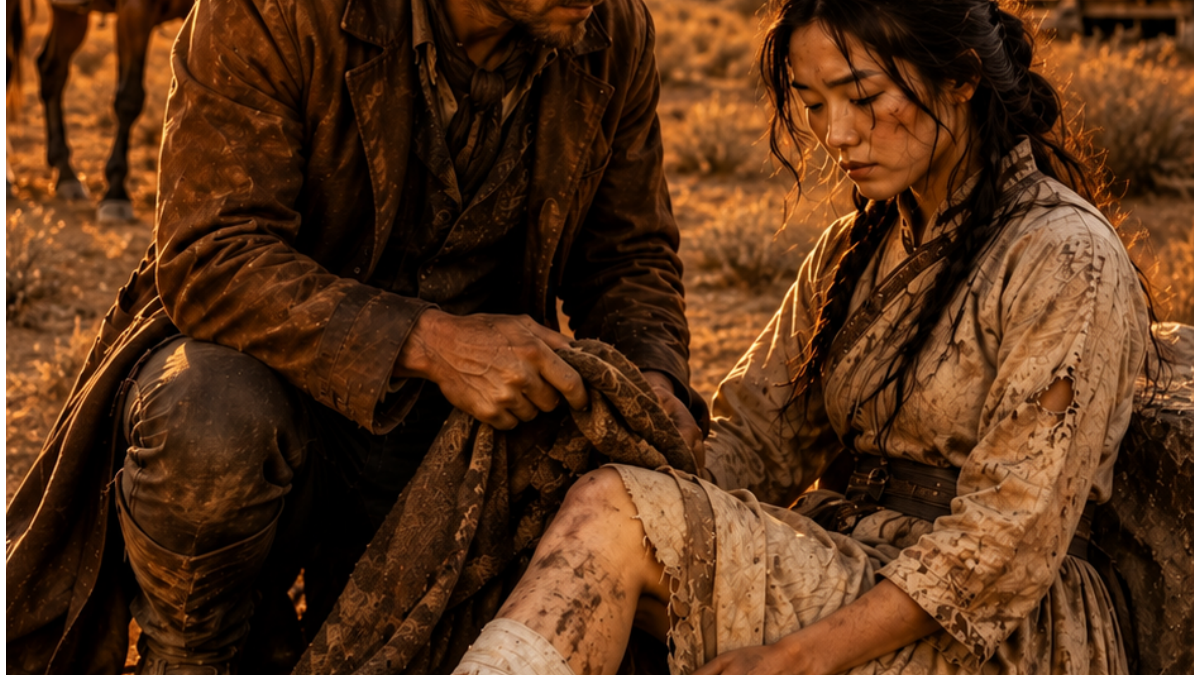
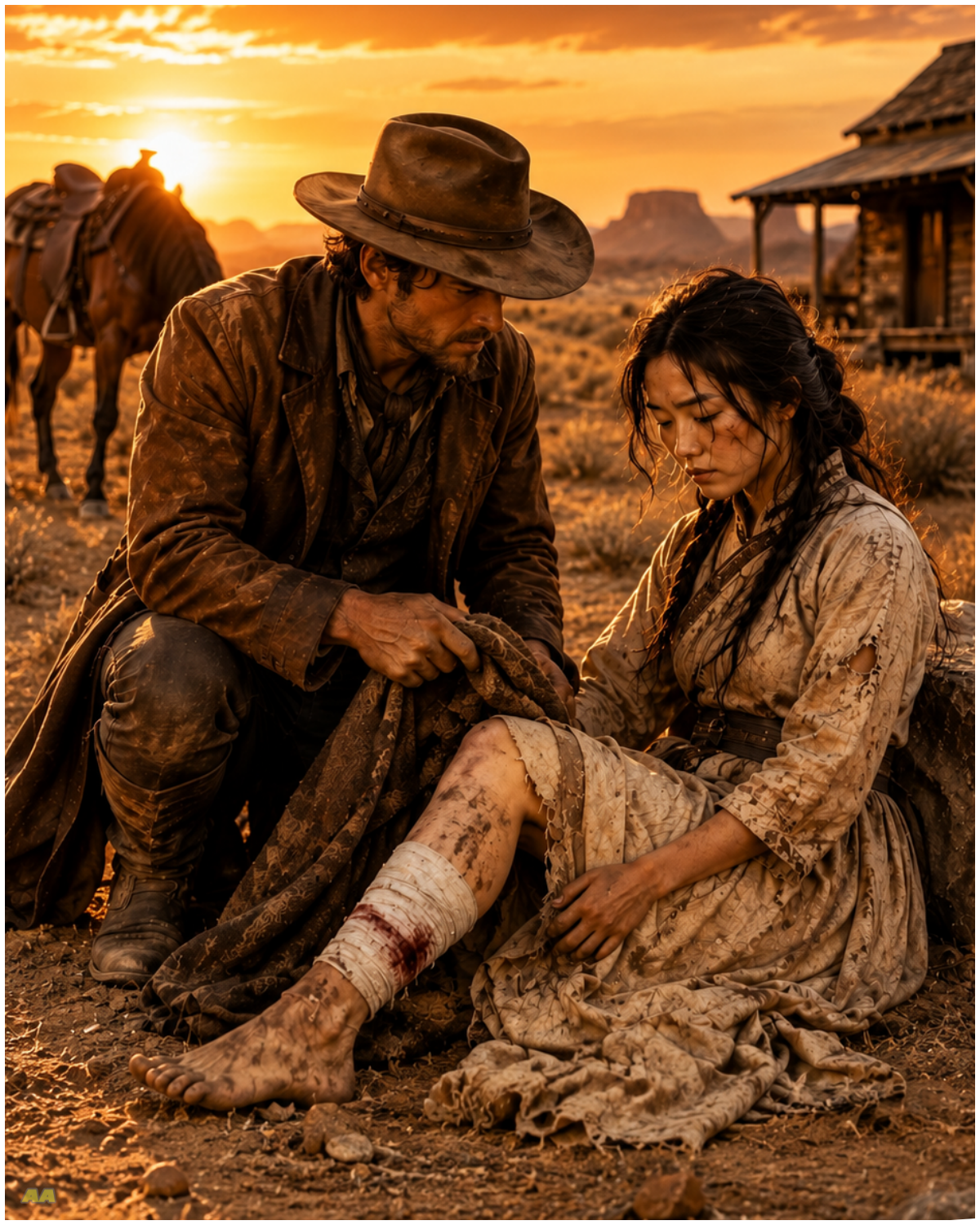
Left to die in the snow.
The foreign girl no one would save.
Min lay dying in the frozen wasteland.
Her legs shattered, her body failing.
The men she paid to guide her west had taken everything.
Her money, her hope, her chance at survival.
They left her like garbage in the snow.
Certain no one would find her before the cold claimed what was left.
But they were wrong.
A lone cowboy saw what others ignored.
A life worth saving.
The wind screamed across the Montana territory like a living thing, clawing at everything it touched.
Snow fell in thick, relentless curtains, erasing the world beneath a blanket of white that stretched endlessly in every direction.
The kind of cold that didn’t just bite, it hunted.
It waited. It killed. Me felt it winning.
She lay crumpled against a snow-covered boulder, her leg bent at an angle that made her stomach turn.
The pain had stopped being sharp an hour ago.
Now it was a dull, throbbing weight that pulsed in rhythm with her slowing heartbeat.
Her fingers wrapped in torn cloth that had long since soaked through had gone numb.
She couldn’t feel her toes anymore.
Couldn’t feel much of anything except the terrible creeping heaviness that pulled at her eyelids.
“Just sleep,” her body whispered.
“Just close your eyes.” She wanted to.
Every part of her wanted to surrender to the exhaustion that pressed down like a physical weight.
But somewhere in the back of her mind, beneath the fog of pain and cold, a stubborn ember still burned.
“You didn’t come this far to die in the snow.”
Her breath came in shallow, ragged gasps that formed small clouds in the frigid air.
Each inhale felt like swallowing ice.
The men who brought her here, Garrett and his partner, whose name she’d never bothered to learn, had promised safe passage weSt. She’d paid them everything she had.
Three months of brutal work in a San Francisco laundry, scalding her hands raw, breathing steam until her lungs achd, all to scrape together enough money to leave the chaos of the coast behind.
They’d smiled when they took her coins, told her the route through the mountains was faster, safer, liars.
When her mule stumbled in a hidden ravine yesterday morning, throwing her heart against the rocks, they’d barely slowed their horses.
Garrett had dismounted long enough to kick through her belongings, pocketing the small jade pendant her mother had given her, the last thing she had from home.
Then he’d looked down at her crumpled form, at the leg twisted beneath her, and shrugged.
“Ain’t worth the trouble,” he’d said to his partner.
“She’ll slow us down.”
“What about?” The other man had started.
“What about nothing? She’s used up.”
Leave her. And they had. Min had screamed after them, her voice breaking against the wind.
She’d cursed them in Cantonese in the broken English she’d learned from other immigrants in every word she knew for betrayal and coward and monster.
But they never looked back. Within minutes, the storm had swallowed them whole, and she was alone.
That was yesterday. Or maybe the day before.
Time had stopped meaning much. She’d tried to move, tried to drag herself somewhere, anywhere, but her shattered leg made even breathing agony.
The best she could manage was to pull herself behind this boulder out of the worst of the wind.
She’d used her traveling cloak to create a small shelter, wedging it between rocks.
It wouldn’t save her, but it might buy her a few more hours.
For what? She didn’t know. No one was coming.
The nearest town was 40 mi south, and she had no way to reach it.
No one even knew she was here.
She was just another nameless Chinese girl who’d gambled everything on the promise of something better and loSt. The wind shifted and fresh snow began to pile against her makeshift shelter.
Meyn closed her eyes. I’m sorry, mama, she thought.
I tried. The sound of hoof beatats didn’t register at firSt. Her mind slipping between consciousness and something darker dismissed it as wind or imagination.
The desperate hallucination of a dying brain trying to manufacture hope where none existed.
But the sound didn’t fade. It grew closer.
Mein’s eyes cracked open. Through the gap in her cloak shelter, she could make out a shape moving through the white.
A horse. A rider. Real or ghost, she couldn’t tell.
Didn’t matter. Even if it was real, whoever it was wouldn’t stop.
Why would they? The horse pulled up short.
A man’s voice, rough and low, cut through the wind.
ChriSt. Footsteps crunched through snow. Heavy boots getting closer.
Meyn tried to speak, but her throat was too dry, her lips too cracked.
All that came out was a thin broken rasp.
The cloak was pulled aside in sudden daylight, gray and dim as it was, made her wse.
She squinted up at the figure standing over her, a cowboy, tall, broad- shouldered, with a worn canvas coat crusted in snow.
His face was weathered, stubbled with several days growth of dark beard.
Eyes the color of storm clouds studied her with an intensity that made her instinctively shrink back.
He didn’t smile, didn’t speak, just dropped to one knee beside her and began checking her over with rough, efficient movements, pressing fingers against her wrist, her neck, tilting her face toward what little light there was.
Can you hear me? His voice was grally like it didn’t get used much.
Me managed a tiny nod. Your legs busted bad.
How long you been out here?
She tried to answer, but only a whisper emerged.
Day, maybe two. His jaw tightened.
He looked around, scanning the empty landscape, then back at her.
For a moment, something flickered across his face.
Calculation, maybe, or doubt. She’d seen that look before.
The look of someone weighing whether she was worth the trouble.
She waited for him to stand, to mount his horse, and leave her, just like the others.
Instead, he shrugged off his coat.
This is going to hurt,” he said and wrapped it around her.
The warmth was shocking. Meyn gasped as feeling began creeping back into her limbs and with it pain.
Fresh searing pain that made her vision blur.
“Stay with me.” The cowboy’s hand gripped her shoulder firm and steady.
“Don’t pass out. I need you conscious for this.” For what?
He was already moving, pulling rope from his saddle, scanning the nearby terrain for something.
He found a pair of broken branches buried in the snow and brushed them clean.
Splint, he said. Can’t move you without one.
This leg shifts wrong. You’ll bleed out before we make it anywhere.
Min’s breath came faster. You’re helping me.
He glanced at her. Something unreadable in his expression.
Looks that way. Why? Because you’re dying.
It wasn’t an answer. Not really.
But he didn’t offer anything else.
Just positioned the branches on either side of her broken leg and began wrapping them with methodical precision.
His hands moved with the confidence of someone who’d done this before.
Maybe on himself, maybe on others.
The kind of practical, unflinching competence born from necessity.
When he tightened the first wrap, Mlin screamed.
I know, he said, not stopping.
Breathe through it. She tried tried to focus on anything other than the white hot agony radiating from her leg.
The sound of his breathing, steady, controlled, the smell of leather and horse and wood smoke clinging to his coat, the way his jaw was set, not in cruelty, but in concentration.
Who are you? She managed. Caleb Ror.
I’m don’t care. He finished the splint and sat back surveying his work.
Names don’t matter right now. Staying alive does.
He stood and moved into his horse, a sturdy buckskinned mare with intelligent eyes, and began rearranging his gear.
Blankets, supplies, making room. Mean watched through a haze of pain and confusion.
Where? Where are you taking me?
My place. 2 hours north if the weather holds.
Four if it doesn’t. He turned back to her.
Can you sit a horse? She almost laughed.
I can’t even stand. That’s what I figured.
He crouched beside her again. This part’s going to be worse than the splint.
I’m sorry. Before she could ask what he meant, he slid one arm under her knees, the other around her back, and lifted.
The world exploded into pain. Min scream tore through the storm, raw and anim animalistic.
Her vision went white, then black, then white again.
She felt herself being positioned across the saddle, felt the horse shift beneath the added weight, felt Caleb’s hand steadying her.
“Breathe,” he said again, his voice close to her ear.
“In and out. You can pass out after we start moving.
Not before.” “I can’t.” “You can.
You already did. You survived 2 days in a blizzard with a shattered leg.
You can survive this.” His certainty was maddening.
She didn’t feel strong. She felt like a broken thing held together by spite and fading stubbornness, but she breathed in and out like he said.
Caleb mounted behind her, one arm wrapping around her waist to keep her upright.
Hold on to the saddle horn.
Don’t let go. Her fingers, clumsy and numb, found the worn leather.
Good. He clicked his tongue, and the mayor started forward.
The journey was a nightmare. Every step the horse took sent fresh waves of agony through Mlin’s shattered leg.
She bit down on the inside of her cheek until she tasted blood, trying not to scream, trying not to be more of a burden than she already was.
But eventually, small sounds escaped. Whimpers, gasps, broken cries she couldn’t suppress.
Caleb never told her to be quiet, never showed impatience or frustration.
He just adjusted his hold when she sagged, murmured low, steady words she couldn’t quite make out over the wind, and kept the mayor moving at a pace that balanced speed with her ability to endure.
Time stopped meaning anything again. There was only pain and cold, and the relentless rhythm of hoof beatats beneath her.
Once she felt herself starting to slide, felt her grip loosening, felt the darkness pulling her down.
Caleb’s arm tightened. “Not yet,” he said.
We’re close. She didn’t believe him, but she held on anyway.
When the cabin finally appeared through the snow, Meyn thought she was hallucinating.
A small solid structure of rough huneed logs and a stone chimney tucked against the base of a pinecoed ridge.
Smoke curled from the chimney, a thin gray thread against the white sky.
Real. It was real. Caleb dismounted and carefully lifted her down.
Her legs screamed in protest, but she was too exhausted to make a sound.
He carried her to the door, kicked it open with his boot, and stepped inside.
Warmth hit her like a physical force.
A fire crackled in the hearth, casting flickering orange light across simple furnishings, a table, two chairs, a narrow bed against the far wall, shelves lined with supplies, a rifle mounted above the door.
Everything spare, functional, built for survival rather than comfort.
Caleb laid her on the bed with surprising gentleness.
Meen’s body sank into the rough wool blanket, every muscle going limp with relief.
The pain was still there, enormous and overwhelming, but the warmth dulled its edges just enough to let her breathe.
“Stay awake a little longer,” Caleb said.
He was already moving, stoking the fire higher, filling a battered kettle with water from a barrel in the corner.
Need to check that leg. Make sure the bone didn’t shift.
Min watched him through half-closed eyes.
He moved with economical precision. No wasted motion.
A man used to doing everything himself.
Why? She whispered. He glanced at her.
Why? What? Why did you help me?
Caleb was silent for a long moment.
He hung the kettle over the fire, then stood with his back to her, staring into the flames.
My wife died in the snow, he said finally.
His voice was flat, emptied of emotion.
5 years ago, pneumonia took her faSt. I was 20 m away checking trap lines.
By the time I got back, she was already gone.
He turned to face her. I found her outside.
She tried to get to town for help.
Made it maybe a quarter mile before she collapsed.
Min’s chest tightened. I told myself a lot of things after, Caleb continued.
That it wasn’t my fault. That I couldn’t have known.
That the weather would have killed me too if I’d been here.
His jaw worked. None of it helped.
So, I made a promise. If I ever found someone dying in the snow again, I wouldn’t leave them.
Wouldn’t matter who they were. Wouldn’t matter if it was smart or safe or convenient.
His eyes met hers. That’s why.
The silence that followed was heavy, filled with ghosts Meyn couldn’t see, but could feel pressing against the walls.
“I’m sorry,” she said softly. Don’t be.
It’s not your burden. He moved to the bed, pulled up a chair.
Now, let me see that leg.
She nodded, too tired to argue, too tired to do anything but trust this stranger who’d saved her life for reasons that had nothing to do with her.
Caleb worked with the same careful efficiency he’d shown earlier, unwrapping the makeshift splint, examining the swelling, the discoloration.
His face remained impassive, but she saw his mouth tighten when he reached a particularly ugly section.
How bad? She asked. Bad enough.
Femurs fractured, maybe compound. Won’t know for sure without proper doctoring.
And the nearest doctor’s 40 mi south in Helena.
He rewrapped the splint tighter this time.
Storm like this, that road will be impassible for at least a week.
So, what do we do? We wait.
Keep it immobile. Keep you warm.
Keep infection away if we can.
He met her eyes. You’re lucky the cold slowed the swelling.
Might have saved the leg. And if it gets infected anyway, his expression didn’t change.
Then we deal with it. It wasn’t reassurance, but it was honeSt. Min found herself oddly grateful for that.
Caleb stood and moved back to the fire, ladling hot water into a tin cup.
He added something from a small pouch, herbs maybe, and brought it to her.
Drink. It’ll help with the pain.
She took the cup with shaking hands and sipped.
The liquid was bitter, earthy, but warmth spread through her chest almost immediately.
She drank deeper. “Thank you,” she said.
Caleb just nodded. He turned away, busying himself with evening tasks, checking the door latch, adding wood to the fire, pulling down supplies from the shelves.
Min watched him, this quiet, haunted man who’ pulled her back from death’s edge for the sake of a promise made to a ghoSt. Outside, the wind howled.
Snow battered the cabin walls. But inside the fire burned steady, and for the first time in 2 days, Min believed she might survive.
She woke sometime later to find the cabin darker.
The fire burned down to glowing embers.
Pain throbbed in her leg, duller now, but persistent.
She tried to shift and gasped at the spike of agony that shot through her.
“Don’t move!” Caleb’s voice came from the shadows.
She turned her head and found him sitting in one of the chairs near the fire, his coat off, shirt sleeves rolled to his elbows.
He wasn’t sleeping, just sitting, watching the embers, his face unreadable in the dim light.
“How long was I asleep?” she asked.
“Few hours. You need more.” He stood and moved to the fire, adding a log.
Flames licked at the new wood, casting fresh light.
“But you should eat something firSt. Can’t heal on an empty stomach.” He ladled something from a pot hanging over the fire.
Soup by the smell and brought her a bowl.
Venison, potatoes, wild onions. Simple, but the scent made her stomach clench with sudden, desperate hunger.
Caleb helped her sit up enough to eat, propping her with rolled blankets.
Every movement sent fresh pain through her leg, but she gritted her teeth and bore it.
When she tried to hold the bowl herself, her hand shook so badly she nearly spilled it.
Here, Caleb took the bowl and spoon, his expression impassive.
Open. Min’s pride flared. I can You can barely lift your arMs. Stop being stubborn and eat.
She wanted to argue, wanted to insist she could manage, but exhaustion and pain had worn her defenses to nothing.
She opened her mouth. He fed her with the same methodical care he had shown setting her leg.
Efficient, impersonal, focused entirely on the task.
No judgment in his face, no pity, just quiet competence.
When the bowl was empty, he set it aside and helped her lie back down.
More tomorrow. Sleep now. Min closed her eyes, but sleep didn’t come immediately.
Her mind turned over the stranges of the situation.
Alone in a cabin with a man she didn’t know, completely helpless, entirely at his mercy.
Everything she’d learned on the streets of San Francisco, every warning she’d received from other immigrant women screamed that this was dangerous.
That kindness from men always came with a price.
But Caleb had already gone back to his chair by the fire.
He didn’t hover, didn’t watch her with eyes that lingered too long, just sat quiet and distant, keeping vigil like it was the most natural thing in the world.
“Caleb,” she said softly. “Yeah, where will you sleep?” he gestured to the chair.
“Here’s fine. That’s not I’ve slept in worse places.
Don’t worry about it. He paused.
You need something? No, I just She struggled to find words.
I don’t understand why you’re doing this.
I told you why. A promise to someone who’s gone.
That’s not You don’t owe me anything.
Caleb was quiet for a long moment.
When he spoke, his voice was low, almost too soft to hear.
Maybe I don’t. But I owe her and I can’t bring her back.
Can’t fix what I failed to do.
But I can do this. So I am.
Min didn’t know what to say to that.
The weight of his grief sat heavy in the air between them.
A presence as real as the fire’s warmth.
She was lucky, Mlin said finally, to have someone love her that much.
Caleb’s hands tightened on the chair’s armrests, knuckles going white.
For a moment, she thought she’d said something wrong.
But then his grip loosened. “Get some rest,” he said, his voice rougher than before.
“Long days ahead.” She did, and this time sleep came easier.
The days that followed blurred together in a haze of pain, fever, and slow, grudging recovery.
Caleb tended to her with the same quiet efficiency.
He changed her bandages twice a day, checking for signs of infection with a grim focus that told her how serious the risk was.
He brought her food, water, the bitter herbal tea that dulled the worst of the pain.
He helped her with tasks that would have humiliated her under other circumstances, things she couldn’t manage alone with her leg immobilized.
Through it all, he never crossed a line, never touched her beyond what was necessary, never made her feel like his help came with unspoken expectations.
It was unsettling. Min had learned to read men by their eyes, their gestures, the way they looked at her when they thought she wouldn’t notice.
Caleb looked at her the way he looked at everything else, with steady, practical assessment, like she was a problem to solve, a task to complete.
She should have been grateful. She was grateful.
But some small, stubborn part of her wondered if he even saw her as a person or just another broken thing to fix because he’d promised himself he would.
On the fourth day, she woke to find him standing at the window, staring out at the snow-covered landscape with an expression she couldn’t read.
“Is it still snowing?” she asked.
He turned. “Stop this morning, but there’s 3 ft on the ground now.
Roads won’t be clear for days.
So, we’re stuck for now.” He moved to the fire, stirred the embers.
How’s the pain? Better a little.
It was a lie. The pain was still there, constant and grinding, but she’d learned to hide it.
Caleb gave her a look that suggested he knew she was lying, but wasn’t going to push.
Try to move your toes. She did.
They wiggled slightly, sending sharp tingles up her leg.
Good. Means the break didn’t damage the nerves too bad.
He paused. You’re healing slower than I’d like, but you’re healing.
Because of you, he shrugged. Because you’re stubborn.
Maybe. She studied him. Why do you live out here alone?
I like the quiet. No one likes it this much.
Caleb’s jaw tightened. For a moment, she thought he wouldn’t answer.
Then he sighed. After Sarah died, I couldn’t stay in town.
Too many people asking questions I didn’t have answers for.
Too many sympathetic looks that made me want to hit something.
He stared into the fire. Out here, nobody bothers me.
I trap, hunt, trade furs when I need supplies.
It’s simple, clean, lonely. Yeah, but I earned lonely.
That’s not Leave it. His voice was sharp.
Final. It’s not your problem. Min fell silent.
She’d pushed too far. Crossed some invisible boundary she hadn’t known was there.
Caleb stood abruptly. Need to check the trap lines.
Should be back before dark. Don’t try to get up while I’m gone.
He pulled on his coat, grabbed his rifle, and left without another word.
Min lay in the quiet cabin, listening to the wind whistle through cracks in the walls, and wondered if she just made a terrible mistake.
He didn’t return before dark. Meyn watched the light fade from the window, watched the sky turn from gray to deep purple to black, and felt anxiety coil tight in her cheSt. The fire had burned low.
She tried to add wood herself, dragging herself to the edge of the bed with gritted teeth, but the pain had been too much.
Now the cabin was growing cold and shadows crept across the walls like living things.
She told herself he was fine, that he knew these mountains, that men like Caleb Ror didn’t get lost in their own backyard.
But Sarah had died 20 m from home.
The thought made her stomach clench.
She pulled the blankets tighter and stared at the door, willing it to open.
It didn’t. Hours crawled paSt. The fire died to embers, then ash.
Cold seeped through the walls, stealing the warmth from her skin.
Meyn’s teeth began to chatter. She tried to stay awake, tried to keep watch, but exhaustion and pain dragged her down into restless, fractured sleep.
She dreamed of snow, of Garrett’s face, laughing as he rode away, of freezing to death alone while the world moved on without her.
The slam of the door jolted her awake.
Caleb stumbled inside, snowcrusted on his coat and hat, his face tight with cold.
He kicked the door shut and immediately moved to the fireplace, his movement sharp and urgent.
Within minutes, he had a fresh fire blazing.
Only then did he turn to look at her.
You’re awake. Min’s relief was so sharp it hurt.
You were gone. Longer than I meant to be.
One of the traps had caught a wolf.
Took time to deal with it.
He shrugged off his coat and she saw blood on his sleeve.
You all right? I’m fine. Are you hurt?
He glanced at his arm like he’d forgotten it was there.
Scratch. Wolf didn’t want to let go of the deer it found.
He moved to the water barrel, wet a cloth, and wiped the blood away with methodical efficiency.
The cut underneath was shallow but long.
Min watched him bandage it himself with one hand and his teeth, her earlier words echoing in her mind.
She’d pushed him, asked questions he didn’t want to answer, and he’d left angry.
“I’m sorry,” she said quietly. Caleb paused, glancing at her.
For what? This morning? I shouldn’t have.
Forget it. He finished tying off the bandage and moved to the fire, ladling soup into a bowl.
You were curious. Can’t blame you for that.
You were upset. I’m always upset.
He brought her the bowl. Doesn’t mean you did anything wrong.
She took the soup, her hands steadier than they’d been days ago.
Then why did you leave like that?
Caleb sat in his chair, silent for a long moment.
When he spoke, his voice was quieter.
Because you were right. It is lonely, and I don’t like being reminded.
He met her eyes. Out here, I can pretend it’s a choice.
That I’m staying because I want to, not because I can’t face what’s waiting in town, but when someone says it out loud, he trailed off.
Min sipped the soup, choosing her words carefully.
“What’s in town that you can’t face?
Memories. People who knew Sarah knew us.
Every street corner has a ghoSt. His jaw tightened.
And I’m tired of people telling me it’s time to move on.
Time to let go. Like grief has a schedule.
Does it get easier? No, you just get better at carrying it.
The honesty in his voice made something ache in Mlin’s cheSt. She’d lost people, too.
Her mother, her brother, friends who’d vanished into the chaos of immigration and never resurfaced.
But she’d never had the luxury of staying still long enough to grieve properly.
Survival demanded forward motion. “I understand,” she said softly.
Caleb studied her. “Yeah, I think you do.” They sat in silence after that, the only sound the crackle of the fire and the wind outside.
But it wasn’t uncomfortable. It was the kind of quiet that came when two people recognized something familiar in each other’s damage.
Eventually, Caleb stood. Get some reSt. I’ll keep the fire going tonight.
You need sleep, too. I’ll manage.
He settled into his chair, pulling a worn blanket over his shoulders.
Go on. Close your eyes. Min did, and for the first time since arriving at the cabin, she slept without nightmares.
The days began to settle into a rhythm.
Caleb rose before dawn, stoked the fire, and made coffee so strong it could strip paint.
He checked Min’s leg first thing every morning, unwrapping the splint to examine the swelling, the color, any signs of infection.
His hands were always gentle despite their roughness, his focus absolute.
“Looks better,” he said on the seventh day.
Bruising starting to fade. “It still hurts.
It’ll hurt for weeks, but you’re healing.” He rewrapped the splint with practice deficiency.
Another week, maybe two, you’ll be able to put a little weight on it, and then then we figure out what comes next.
He never pushed her to talk about where she’d come from or where she’d been going.
Never asked about the men who’d abandoned her or what she’d been running from.
The lack of questions should have been a relief.
But instead, it felt like distance, like he was keeping her at arms length on purpose.
Maybe he was. Meyn spent her days watching him work.
He moved through the cabin with quiet purpose, mending gear, cleaning his rifle, preparing meals from supplies that seemed impossibly limited but somehow stretched.
Everything he did was efficient, economical, born from years of self-sufficiency.
“Where did you learn all this?” she asked one afternoon as he sat by the fire, stitching a torn piece of leather with neat, tight stitches.
“My father, he was a trapper.
Worked these mountains for 30 years before his heart gave out.
Caleb didn’t look up from his work.
Taught me everything he knew. How to read weather, track game, survive winters that would kill most men.
Is that why you stayed? Part of it.
The other part is I’m not good at much else.
He tied off the thread and bit it clean.
Tried working in town for a while after Sarah and I married.
Lumberm mill lasted 3 months before the foreman told me I was more trouble than I was worth.
Why? Because I sure don’t take orders well.
Don’t like being told when to eat, when to work, when to think.
He held up the leather, examining the repair.
Out here, I answered to nobody but myself.
And the wilderness. A ghost of a smile touched his mouth.
Yeah, and the wilderness. Mean watched him set the leather aside and reach for another piece of gear.
Do you ever miss it being around people?
Sometimes then I go to town for supplies and remember why I don’t.
He glanced at her. People talk too much.
Ask too many questions, expect things.
What kind of things? Friendliness. Small talk.
Pretending everything’s fine when it’s not.
His voice hardened slightly. I’m not good at pretending.
I noticed that earned her a sharp look, but no real heat behind it.
You got a problem with honesty?
No, it’s just different. She shifted, wincing as her leg protested.
Most people lie about who they are, what they want.
Makes it hard to know what’s real, and you prefer real.
I prefer knowing where I stand.
Caleb nodded slowly. Yeah, I can respect that.
The conversation lapsed back into silence, but Mlin found herself thinking about his words long after.
There was something almost comforting in his bluntness.
No hidden agendas, no false kindness masking ulterior motives, just a man too damaged to bother with pretense.
She understood that, maybe better than she wanted to admit.
On the ninth day, fever came.
Min woke drenched in sweat, her skin burning, her head pounding like a drum.
The room spun when she tried to sit up and nausea clawed at her throat.
“Caleb,” she tried to call, but her voice came out as a croak.
He was there instantly, his hand on her forehead.
His expression went grim. “Damn it!” He moved with sudden urgency, pulling back the blankets, unwrapping the splint.
When he exposed her leg, Min heard him curse under his breath.
Red streaks radiated from the brake site like lightning, spreading up her thigh.
The skin around the injury was hot to the touch, swollen tight.
Infection. How bad? She managed. Bad enough.
Caleb was already moving, grabbing supplies from the shelves.
Should have seen this coming. Bone probably had debris in it when it broke.
Been festering this whole time. What do we do?
Clean it. Keep you cool. Pray it doesn’t spread to your blood.
He set a pot of water over the fire to boil.
This is going to hurt worse than anything I’ve done yet.
Min’s stomach clenched. How much worse?
You’ll find out. He wasn’t exaggerating.
When Caleb cleaned the wound, Mlin screamed.
The pain was white hot, all-consuming, beyond anything she’d ever experienced.
She felt him working. Felt the pressure of cloth against infected flesh.
Felt something thick and foul being pressed out.
Her vision went dark at the edges.
Stay with me. Caleb’s voice cut through the haze.
Don’t pass out. I need you to tell me if anything feels wrong.
It all feels wrong. She gasped.
Different wrong. Numbness. Tingling that spreads.
She tried to focus, tried to catalog the sensations beyond the agony.
Just pain. Everything’s pain. Good. That’s good.
He applied something to the wound that burned like fire.
And Mlin’s back arched off the bed.
Almost done. Hold on. When he finally finished and rewrapped her leg, Min was shaking, tears streaming down her face.
Caleb’s expression was carved from stone, but his hands were gentle as he pulled the blankets back over her.
Get some water in you. He held a cup to her lips.
Small sips. Don’t gulp. She drank, the cool liquid, soothing her raw throat.
When the cup was empty, she collapsed back against the pillow, exhausted.
“Will I lose the leg?” she whispered.
Caleb was quiet for a long moment.
Don’t know yet. Next 24 hours will tell.
He met her eyes. But I’m not letting that infection take you without a fight.
The determination in his voice was fierce, almost angry, like he was making a promise not to her, but to someone who couldn’t hear him anymore.
Sarah. Mlin’s chest tightened. I don’t want to be your second chance at saving someone.
His jaw clenched. Too bad. That’s what you are.
That’s not fair to either of us.
Life’s not fair. You should know that better than anyone.
He stood, moved to wet a cloth in cool water.
Now, stop talking and [clears throat] let me work.
She wanted to argue, wanted to tell him that she wasn’t Sarah, that saving her wouldn’t absolve him of whatever guilt he carried.
But the fever was rising again, pulling her thoughts apart like cotton.
Caleb pressed the cool cloth to her forehead, and Mlin closed her eyes.
The fever raged for 3 days.
Min drifted in and out of consciousness, lost in a haze of heat and delirium.
Sometimes she knew where she was in Caleb’s cabin, fighting for her life.
Other times she was back in San Francisco, bent over scalding laundry while overseers screamed.
Or further back on the ship from Canton, packed in the hold with dozens of other desperate souls.
The smell of sickness and despair thick in the air.
Once she woke to find Caleb beside her, pressing a cool cloth to her neck, her wrists, anywhere the fever burned hotteSt. “Am I dying?” she whispered.
“Not if I can help it.” “Why do you care?” His hand stilled.
I told you why. That’s not enough.
A promise to a ghoSt. That’s not She broke off, coughing.
Caleb held water to her lips.
“Drink.” She did, then tried again.
You don’t even know me. Don’t need to.
He set the cup aside. You’re a person.
You’re suffering. That’s enough for you.
Maybe. Most people would have left me.
I’m not most people. No. She studied his face.
The hard lines worn by grief and isolation.
You’re not. He didn’t respond. Just continued his work with quiet, relentless focus, cooling her skin, forcing water and broth past her lips, cleaning and rebandaging the wound every few hours, checking for signs the infection was spreading.
Min watched him through fevered eyes, and wondered what it cost him to care this much, to fight this hard for someone he had no reason to save.
The effort he poured into keeping her alive seemed almost desperate, like he was trying to outrun something that would catch him the moment he stopped moving.
Caleb, she said during one lucid moment.
Yeah, if I don’t make it, you’re making it.
If I don’t, she pressed on.
It’s not your fault. You did everything you could.
His hands clenched into fists. It’ll be my fault if you give up.
I’m not giving up. I’m just tired.
Then reSt. But don’t you dare quit on me.
His voice roughened. You survived two days in a blizzard with a shattered leg.
You survived those bastards leaving you to die.
You survived a week in this cabin barely hanging on.
You don’t get to quit now.
The intensity in his words cut through the fog.
Mlin found herself nodding. Okay. Okay.
I’ll keep fighting. Something in Caleb’s expression shifted.
Relief maybe or exhaustion. He sat back in his chair and rubbed a hand over his face.
Good, because I’m too tired to carry you through this alone.
You’ve been doing it the whole time.
That’s different. You were unconscious. Now you’re awake, which means you get to shoulder some of the weight.
He looked at her, and for the first time since she’d met him, she saw genuine vulnerability in his eyes.
Don’t make me bury another person I tried to save.
I can’t I can’t do that again.
Min’s throat tightened. I’ll try. That’s all I’m asking.
He stood and moved back to the fire, but the admission hung in the air between them, a crack in the armor he’d built around himself.
A glimpse of the man beneath the stone.
Min closed her eyes and focused on breathing in and out, one breath at a time.
She would live, not for herself, not yet, but for the broken man who refused to let her die.
On the morning of the fourth day, the fever broke.
Min woke clear-headed for the first time in what felt like weeks.
The pain in her leg was still there, still significant, but the burning heat had faded.
When she touched her forehead, her skin felt cool.
Caleb was asleep in his chair, slumped forward with his head resting on his arms at the edge of the bed.
Dark circles shadowed his eyes. His face was gaunt, his clothes rumpled.
He looked like he hadn’t slept properly in days because he hadn’t.
Min’s chest achd. She reached out, hesitated, then gently touched his shoulder.
He jerked awake, instantly alert. “What’s wrong?” “Nothing.
The fever’s gone.” Caleb blinked, then pressed his hand to her forehead.
Relief flooded his features. “Christ, you’re right.
How long was I out?” “3 days, give or take.” He stood, moving to check her leg with hands that shook slightly from exhaustion.
When he unwrapped his bandage, his expression shifted from wary to cautiously hopeful.
Swelling’s down, streaks are fading, infections retreating.
We won. Looks that way. He rewraped the leg with care.
You’re not out of danger yet.
Still need to watch for complications.
But the worst is passed. Min let her head fall back against the pillow, sudden tears stinging her eyes.
I thought I was going to die.
So did I. Caleb’s voice was rough.
For a while there, I wasn’t sure even stubbornness would be enough.
But it was. Yeah, it was.
He met her eyes. You’re tougher than you look.
I’ve had practice. I noticed. He moved to the fire, poured coffee with movements that were almost mechanical.
You should eat real food this time, not just broth.
I don’t think I can keep anything down yet.
Try anyway. Body needs fuel to finish healing.
He brought her bread and dried venison, simple but substantial.
Meen ate slowly, and to her surprise, her stomach accepted it.
The food settled warm and solid, chasing away the hollow weakness that had lived in her bones for days.
Caleb watched her eat with an expression she couldn’t quite read.
When she finished, he took the plate and set it aside.
“Thank you,” she said quietly. “For what?” “Not letting me die.” That’s a low bar.
Not in my experience. Something flickered across his face.
Anger maybe directed at the world that had taught her to expect so little.
Well, you’re alive. That’s what matters.
Is it? Isn’t it? Min considered that.
A week ago, she would have said no.
Would have said survival without purpose was just prolonged dying.
But now, lying in this cabin with this strange, damaged man who’d fought so hard to keep her breathing, she wasn’t sure.
“I don’t know what comes next,” she admitted.
“Neither do I.” Caleb settled back into his chair.
“But we’ve got time to figure it out.
Storm’s passed, but the roads are still bad.
Another week at least before anyone can travel.” “And then?” And then you decide.
You want to keep heading west, I’ll take you to Helena.
You want to go back to California?
I’ll point you toward the stage line.
Your choice. What if I don’t want either?
He raised an eyebrow. Then what do you want?
Meen didn’t have an answer. For so long, her only goal had been escape.
Get away from San Francisco, from the crushing poverty and endless labor.
Find somewhere better, somewhere she could breathe.
But she’d never thought past the journey.
Never imagined what might come after.
“I don’t know,” she said finally.
Caleb nodded. Fair enough. [snorts] Figure it out while you heal.
No rush. He stood and moved to tend the fire, giving her space to think.
Min watched him work. This man who’d saved her life without asking for anything in return.
Who’d fought infection and fever with the same grim determination he probably applied to everything else.
Who carried enough guilt and grief to drown in but kept moving forward anyway.
Caleb. Yeah. Why don’t you ever sleep in the bed?
He paused. Because you’re in it.
There’s room for both of us, and that chair can’t be comfortable.
I’m fine. You’re exhausted. She met his eyes.
I’m not I’m not afraid of you if that’s what you’re worried about.
His jaw tightened. You should be.
You don’t know me. I know you’ve had a dozen chances to hurt me and haven’t.
That’s more than most men can say.
That’s not He broke off, frustration clear in his voice.
I’m not sharing a bed with you.
End of discussion. Why not? Because it’s not proper.
Min almost laughed. Proper? We’re alone in a cabin in the middle of nowhere.
I can’t walk. You’ve seen me at my absolute worSt. What about any of this is proper?
That’s different. How? Because medical necessity is one thing.
Sleeping next to you is another.
He turned away, his shoulders tense.
I’m not that kind of man.
The vehements in his voice made something click in Min’s mind.
This wasn’t about propriety. It was about boundaries, about drawing lines he wouldn’t let himself cross because once they blurred, he didn’t trust where they’d end up.
Okay, she said softly. I understand.
Caleb glanced back at her, surprise flickering across his face.
You do? Yes. You’re trying to do the right thing, even when it’s hard.
She pulled the blankets tighter. I respect that.
He studied her for a long moment, then nodded.
Get some reSt. I’ll wake you when dinner’s ready.
Caleb, what? When this is over, but when I can walk again, will you teach me?
Teach you what? How to survive out here?
How to trap, hunt, read the weather?
Everything your father taught you. She met his eyes.
I don’t want to be helpless again.
Something shifted in his expression. Not quite approval, but close.
Yeah, I can do that. Thank you.
He just nodded and turned back to the fire.
But Mlin saw the tension ease from his shoulders.
Saw something almost like purpose settle into his movements.
Maybe saving her life had given him a reason to keep going.
And maybe learning to survive would give her one, too.
2 weeks after the fever broke, Mlin took her first steps.
They were terrible steps, halting, painful, supported almost entirely by Caleb’s arm around her waist and a makeshift crutch he’d carved from pine.
But they were steps. Her legs screamed in protest, the muscles weak and atrophied from weeks of immobility, but she gritted her teeth and pushed forward.
“That’s enough,” Caleb said after she’d managed to cross half the cabin.
“Don’t push it. I can go further.
You can also rebreak that leg if you’re stupid about it.
He guided her back to the bed.
Healing takes time. You can’t force it.
Min sank onto the mattress, frustrated tears burning behind her eyes.
I hate being useless. You’re not useless.
You’re recovering. He propped the crutch against the wall.
Besides, you’ve been helping. Sitting here mending your shirts isn’t helping.
It is if I don’t have to do it myself.
He gestured to the neat stack of repaired clothing on the table.
You’ve got steady hands, better at stitching than I’ll ever be.
It was a small kindness, probably meant to ease her frustration, but Mlin found herself oddly warmed by it.
Over the past weeks, as her strength returned, she’d insisted on contributing something.
Caleb had resisted at first, saying her only job was to heal, but she’d worn him down.
Now she mended his clothes, prepared vegetables for stew when he brought them from the root cellar, even helped clean and oil his traps.
Small tasks, simple tasks, but they made her feel less like a burden and more like a participant in the strange partnership that had formed between them.
“Tell me about the trap lines,” she said, settling back against the pillows.
“What you check for?” Caleb glanced at her, surprise flickering across his face.
You really want to know? I asked you to teach me, didn’t I?
Most people don’t actually mean it when they say things like that.
I’m not most people. A ghost of a smile touched his mouth.
No, you’re not. He pulled up his chair and sat.
All right. First thing you need to understand is that trapping isn’t about luck.
It’s about reading the land, knowing where animals move and why.
For the next hour, he talked about game trails and water sources, about how to identify tracks in snow, how to set traps that killed quickly instead of letting animals suffer.
His voice, usually sparse and economical, took on a different quality when he spoke about the wilderness.
Not warmth exactly, but something close to it.
Respect. Understanding. Min listened, absorbing every word.
She asked questions. Where to place traps in different weather, how to avoid catching scavengers instead of prime pelts, what to do if a trap was stolen by other trappers.
Caleb answered each one with patience she hadn’t expected from him.
You’re a good teacher, she said when he finally paused.
My father was better. I’m just repeating what he taught me.
Then he was a good teacher, too.
Caleb was quiet for a moment.
Yeah, he was. He stood moved to the window.
Storm’s coming. Can feel it in the air.
Min followed his gaze. The sky had turned the peculiar gray yellow that preceded heavy snow, and the wind had picked up, rattling the shutters.
How bad? Bad enough. We’ll be stuck inside for a few days.
He turned back to her, which means now is a good time to work on your aim.
My what? He crossed to the corner and returned with a small revolver.
Min tensed. Relax, Caleb said, reading her reaction.
I’m not giving you a loaded gun.
Not yet, anyway. But you said you wanted to learn to survive out here.
That means knowing how to shoot.
I’ve never held a gun before.
Then it’s time you learned. He sat beside her and placed the revolver in her hands.
It was heavier than she’d expected.
Cold and solid. First rule, never point it at anything you’re not willing to kill, even if you think it’s not loaded.
Me adjusted her grip, feeling the weight settle into her palm.
What’s the second rule? Respect what it can do.
This isn’t a toy. It’s a tool.
A dangerous one. He guided her hands, showing her the proper way to hold it, how to align the sights.
In town, guns are for show.
Men wave them around, make noise, prove how tough they are.
Out here, it’s different. You draw a gun, you better be ready to use it.
Have you ever shot someone? His expression went carefully blank.
Once man tried to rob me on the trail to Helena.
Pulled a knife, demanded my pelts and horse.
Caleb’s jaw tightened. I gave him a choice.
Walk away or bleed. He chose wrong.
Did you kill him? No. Put a bullet in his shoulder.
Left him alive to think about his decisions.
He met her eyes. But I would have if it came to it.
Meen studied him, trying to reconcile the man who’d fought so desperately to save her life with one capable of shooting another human being.
But maybe they weren’t different men at all.
Maybe survival meant being willing to do both.
“Show me,” she said. They spent the rest of the afternoon practicing.
Caleb taught her how to load and unload the revolver, how to clean it, how to squeeze the trigger instead of jerking it.
He set up targets, empty tin cans balanced on the window sill, and had her practice dryfiring until her hand cramped.
“You’re flinching,” he said, watching her, anticipating the recoil before it happens.
Stop thinking about what the gun’s going to do, and focus on what you want it to do.
That doesn’t make sense. It will when you actually fire it.
He took the revolver, demonstrated the smooth, steady trigger pull he was talking about.
See? No hesitation, no tension, just intent.
Meen tried again. This time her hand stayed steady.
Better, Caleb said. Keep practicing. When the storm passes and your legs stronger, we’ll try live rounds.
You think I can actually learn this?
You learn everything else fast enough.
Don’t see why this would be different.
He took the revolver back, locked it in a wooden box.
Besides, if you’re serious about staying in this territory, you’ll need to know how to protect yourself.
Something in his tone made her pause.
You think I should stay? Caleb shrugged.
Didn’t say that. But heading back to California doesn’t seem like much of a plan either.
What makes you think I don’t have a plan?
Because if you did, you wouldn’t have ended up half dead in the snow with men who left you behind.
He crossed his arMs. So, either you’re running from something or you’re running towards something you haven’t found yet.
Min’s defenses rose. That’s none of your business.
You’re right. It’s not. He moved to the fire, added wood with sharp, precise movements.
But you’re living in my cabin, eating my food, asking me to teach you skills that take years to master.
So maybe it’s a little bit my business.
I didn’t ask to be saved.
No, but you asked to be taught, which means you’re planning to stick around long enough to use what you learn.
He turned to face her. So, I’ll ask again.
What’s your plan? Min felt anger flare in her chest, hot and familiar.
How dare he push her like this?
What gave him the right to demand answers she didn’t have?
But beneath the anger was something else.
Fear. Because he was right. She had no plan, no idea what came next.
She’d been surviving daytoday for so long that thinking beyond the next meal, the next night’s shelter felt impossible.
I don’t know, she said finally, hating how small her voice sounded.
I just I couldn’t stay in San Francisco.
Couldn’t keep working myself to death for pennies while men like the laundry owner got rich off our backs.
So, I saved everything I could and paid Garrett to take me weSt. Thought maybe in the smaller towns it would be different, easier.
It’s not. I’m starting to figure that out.
Caleb was quiet for a long moment.
When he spoke, his voice had lost its edge.
What did you do in San Francisco before the laundry?
Worked in a boarding house, cleaned rooms, cooked meals.
The owner was She paused, old memories surfacing.
He had expectations about what Chinese girls were willing to do for extra money.
And you weren’t. No. Min, so he fired me.
Told everyone I was a thief to make sure no one else would hire me.
The laundry was the only place that would take me after that.
Understanding flickered across Caleb’s face. That why you were so wary when I first brought you here?
Thought I’d have expectations, too. Every man has expectations.
Not every man. Enough of them.
She looked away. But you didn’t.
You just took care of me.
Didn’t ask for anything. Didn’t even want my name at firSt. Names don’t matter when someone’s dying.
They do after. Min turned back to him.
You could have put me on a horse the moment I could sit up and sent me on my way.
Instead, you let me stay, taught me things.
Why? Caleb’s expression went distant. Because sending you off half healed would have been the same as killing you, just slower.
He paused. And because maybe I got used to having someone around who doesn’t expect me to be something I’m not.
The admission hung in the air between them, raw and unexpected.
Mlin realized with sudden clarity that she wasn’t the only one who’d been alone for too long.
Caleb had built his isolation deliberately, brick by brick, until it became a wall too high to climb.
But walls kept things out and things in.
“What were you?” she asked softly before Sarah died.
His hands clenched. For a moment she thought he wouldn’t answer.
Then he sighed. Happier, stupider. I thought if I loved her hard enough, worked hard enough, it would be enough to keep her safe.
His voice roughened. Turns out love doesn’t stop pneumonia.
Doesn’t stop the cold. Doesn’t stop death from taking what it wants.
So you stopped loving anything. Seems safer.
Is it? Caleb met her eyes, and what she saw there made her chest ache.
Loneliness. Deep and bone tired and so familiar it hurt to recognize.
No, he said finally. But it’s easier.
The wind howled outside and the first snow began to fall.
They sat in silence. Two damaged people sheltering from different storMs. And Min wondered if maybe that was enough for now.
The blizzard lasted 3 days. Snow piled against the cabin walls, sealing them inside a world of white silence.
Caleb kept the fire burning and the coffee hot, moving through the small space with practiced efficiency.
Min practiced with the unloaded revolver until her hands knew the weight and balance by instinct.
They spoke in fragments about trapping, about weather patterns, about small, practical things that didn’t require vulnerability, but the silences between words grew comfortable instead of tense.
Meyn found herself watching Caleb work, noticing small things.
The way he automatically poured her coffee first before filling his own cup.
How he carved portions of meat that were larger than his, making sure she ate enough to rebuild her strength.
The careful distance he maintained, never crowding her, never making her feel trapped despite the cabin’s close quarters.
He was taking care of her, not because he had to.
Not because he expected anything in return, but because somewhere beneath the grief and isolation, Caleb Ror was still a decent man trying to do right by someone who’d had precious little right done to them.
On the third night, Mlin woke to find him standing at the window, staring out at the snow-covered darkness.
“Can’t sleep?” she asked quietly. He didn’t turn.
Never sleep well during storMs. Because of Sarah?
Yeah. His breath fogged the glass.
She died during a blizzard. Every time the wind sounds like that night, I’m back there finding her in the snow, carrying her inside, knowing I was too late.
Min sat up carefully, her leg protesting the movement.
You couldn’t have known. That’s what everyone said.
The doctor, the neighbors, even Sarah’s mother.
His voice went flat. Doesn’t change the fact that she died alone because I wasn’t here.
Where were you supposed to be?
You were working. I was avoiding her.
The admission came out harsh, self- lacerating.
We’d fought that morning. Stupid argument about whether to move to town, get a real house instead of living in this cabin.
She wanted civilization, neighbors, a place where we could raise children someday.
I wanted He trailed off. This me finished the quiet, the wilderness.
Yeah. So, I left angry. Stayed out an extra day checking traps I’d already checked just to prove a point.
His fist clenched against the windowsill.
She got sick while I was gone.
By the time I came back, she was already burning with fever.
Tried to get to town for the doctor, but the storm was too bad.
She collapsed before she made it a/4 mile.
That’s not your fault, isn’t it?
If I’d been here, I could have gone for help before the storm hit.
Could have carried her to town myself.
Could have done something other than find her frozen in the snow because I was too stubborn to come home.
Min heard the guilt in his voice, the self-hatred that had calcified over 5 years of isolation.
She understood it, understood how easy it was to turn every bad outcome into personal failure, every loss into proof of unworthiness.
You can’t carry that forever, she said.
It’ll kill you. Maybe I deserve that.
No one deserves that. She pushed herself up, reaching for the crutch.
Caleb turned, concerned crossing his face.
What are you doing? Coming over there?
She leveraged herself upright, ignoring the spike of pain.
Because you look like you need someone to tell you the truth, and I’m tired of watching you torture yourself.
Min Sarah died. That’s terrible. That’s unfair.
But it wasn’t your fault. She hobbled toward him, each step deliberate.
You think if you’d been here everything would have been different?
Maybe. Or maybe you both would have died trying to get to town in a blizzard.
Or maybe the doctor couldn’t have saved her anyway.
You don’t know. You can’t know.
All you can do is survive what actually happened.
Caleb’s jaw was tight. You don’t understand.
I understand better than you think.
She reached him, leaning heavily on the crutch.
My brother died on the ship from Canton.
Got sick two weeks into the voyage.
I watched him waste away in that hold.
Watched him beg for water we didn’t have.
Watched him die because I couldn’t save him.
Her voice cracked. I was 12 years old and for years I told myself it was my fault.
That I should have done more, been smarter, stronger, something.
That’s different. You were a child and you were a man who made a mistake.
We’re both human. We both lost people we loved.
The only difference is I eventually figured out that blaming myself wouldn’t bring him back.
She met his eyes. When are you going to figure that out?
Caleb stared at her, something raw and wounded in his expression.
For a moment, she thought he might argue.
Might retreat back into the cold distance he used as armor.
Instead, his shoulders sagged. “I don’t know how to stop,” he said quietly.
“Then start small. Stop for an hour, then a day, then maybe a week.” She shifted her weight, and Caleb’s hand shot out to steady her, instinctive and gentle.
And stop acting like caring about whether I live or die makes you weak.
It doesn’t. It makes you human.
His hand remained on her arm, warm and solid.
They stood there in the fire light, snow falling silent outside, and something shifted between them.
Not quite trust, not yet, but the beginning of it.
A crack in the walls they’d both built.
“You should sit down before you fall down,” Caleb said finally.
Probably. But neither of them moved.
Min was acutely aware of how close they were standing, of the calluses on his palm where it touched her sleeve, of the way his eyes held hers like he was trying to figure out a puzzle he couldn’t solve.
“Mailin,” he said, his voice rough.
“Yeah, thank you for what?” “For not letting me wallow.” A small smile tugged at her mouth.
“Someone had to. You’re terrible at asking for help.
So are you. Then we’re well matched.
Something that might have been humor flickered across his face.
Then he helped her back to the bed.
His movements careful and deliberate. When she was settled, he returned to his chair, but the distance between them felt different now, less like a barrier and more like breathing room.
The storm raged outside, but inside the cabin, something warmer than fire had taken root.
When the storm finally broke, the world outside was transformed.
Snow lay three feet deep in every direction, turning the landscape into a frozen sea of white.
Caleb spent the morning digging out the door and clearing a path to the wood pile.
Min watched from the window, marveling at the sheer amount of snow that had fallen.
“How do you stand it?” she asked when he came back inside, his coat crusted with ice.
“Being trapped like this for months at a time.
You get used to it. He shook the snow off and hung his coat by the fire to dry.
Besides, winter’s not all bad. Game’s easier to track, less competition from other trappers, and the quiet.
He paused. The quiet’s not as heavy when the whole world silent.
Anyway, Mlin understood what he meant.
There was something almost peaceful about the snow’s totality, like the whole territory was holding its breath.
“When can we go outside?” she asked.
When your leg can handle it.
Maybe another week. He glanced at her.
Why? Getting cabin fever a little.
I want to see what you do out there, not just hear about it.
It’s cold, dirty work, not romantic.
I never thought it was. She turned from the window.
But if I’m going to survive here, I need to know.
Really know, not just theory. Caleb studied her and she saw the assessment in his eyes, weighing her determination against the reality of what she was asking.
Finally, he nodded. All right. When you can walk a mile without that crutch, I’ll take you to the trap lines.
A mile? That’s the closest one.
The others are further. If you can’t make it that far, you’ll be more liability than help.
The challenge in his voice sparked something competitive in Mlin’s cheSt. How long do I have?
As long as it takes. But the season’s moving.
We’re already into late February. Come April, the snow will start melting and trapping gets harder.
Then I better heal faSt. That earned her a look that might have been approval.
Yeah, you better. He spent the afternoon showing her how to skin and butcher a rabbit he trapped before the storm.
Min watched, then tried herself, her hands clumsy at first, but growing more confident as Caleb corrected her technique.
The work was messy and harder than it looked, but there was satisfaction in learning something useful, something that meant the difference between eating and going hungry.
You’re not squeamish, Caleb observed. Can’t afford to be.
She separated meat from bone with growing efficiency.
I gutted fish in San Francisco.
This isn’t that different. Most women would faint.
I’m not most women. Keep proving that.
He took the cleaned meat and set it in a pot for stew.
You’ve got good hands. Steady. That’ll serve you well if you stick with this.
You think I will stick with it?
Caleb was quiet for a moment.
I think you’re stubborn enough to try.
Whether you last, he shrugged. That depends on how much you’re willing to sacrifice.
I’ve already sacrificed everything. Not everything.
Not yet. He met her eyes.
Out here, you sacrifice comfort, ease, the illusion of safety.
You sacrifice being around people who understand you.
Having a future that looks like anything other than survival.
You sacrifice the person you were and become someone harder, colder.
His voice dropped. Is that what you want?
Me thought about the woman she’d been in San Francisco.
Scared, desperate, powerless against men who saw her as nothing more than cheap labor or available flesh.
That woman had been ground down day by day until she was barely recognizable even to herself.
The person I was in San Francisco was already dead, she said.
I’m just deciding who I become next.
Caleb held her gaze and she saw understanding in his eyes.
He knew about becoming someone else.
About killing old versions of yourself to survive the new reality.
Then you might make it after all, he said.
Over the following days, Meyn pushed herself relentlessly.
She walked circles around the cabin until her leg burned, used the crutch less and less, forced her atrophied muscles to remember their purpose.
Caleb watched with a critical eye, occasionally telling her to rest, but more often letting her drive herself as hard as she needed to.
On the 10th day after the storm, she walked a full mile.
Caleb marked the distance in the snow, a line from the cabin to a distinctive boulder and back.
Meyn made it there and back without the crutch, without stopping, her legs screaming but holding.
When she reached the cabin door, she was shaking, sweating despite the cold, but she’d done it.
Good, Caleb said, and the single word of approval felt like victory.
The next morning, he woke her before dawn.
Get dressed, warm clothes. We’re going to the trap lines.
Min’s heart leapt. She pulled on the extra layers Caleb had provided.
Wool pants that had belonged to Sarah, a thick sweater, a canvas coat.
They were too big, but they were warm, and that was what mattered.
Outside, the world was still dark, the sky just beginning to lighten at the edges.
Their breath formed clouds in the frigid air.
Caleb handed her a pair of snowshoes.
You know how to use these?
No. Then watch. He demonstrated the awkward wide-legged walk required to keep from sinking into the deep snow.
Min copied him, stumbling at first, but finding the rhythm after a few tries.
They set out into the wilderness, following a trail only Caleb could see.
The snow crunched beneath their feet.
Dawn broke slowly, painting the sky in shades of pink and gold.
And Min felt something she hadn’t felt in years.
Hope. The first trap was empty, its jaws clean and undisturbed beneath a dusting of fresh snow.
Caleb examined it with practiced efficiency.
Check the bait. Reset the trigger mechanism.
Sometimes you come out here and find nothing, he said.
That’s the reality. You can do everything right and still go home empty-handed.
How often does that happen? Often enough that you learn not to count on anything.
He straightened, scanning the surrounding foreSt. Game moves with the weather.
The moon, their own rhythms we can only guess at.
Best you can do is read the signs and make educated guesses.
They moved to the second trap, their snowshoes leaving twin trails through the pristine white.
The sun was higher now, casting long shadows through the pine trees.
Min’s leg achd from the unfamiliar gate, but she refused to show it.
This was what she’d asked for, what she needed to learn.
The second trap held a fox, its red fur stark against the snow.
Dead, frozen in mid struggle. Caleb knelt beside it, his expression unreadable.
“Good pelt,” he said. “Thick winter coat.
This will bring decent money in town.” He worked quickly, removing the fox from the trap with movements that were efficient, but not cruel.
Min watched him handle the animal with a respect that surprised her.
There was no triumph in his face, no satisfaction, just quiet acknowledgement of what the trap had provided.
“Does it bother you?” she asked.
Killing them. Caleb glanced up. Every time.
But being bothered doesn’t change what needs doing.
He reset the trap. Out here.
Death feeds life. The fox dies so I can buy flour and coffee.
The deer dies so we have meat.
That’s the trade. Only disrespect is waste.
He secured the fox to his pack and moved on.
They checked four more traps. One with a martin, two empty, one that had been scavenged by wolves.
By the time they started back toward the cabin, the sun was high and Mlin’s leg was trembling with exhaustion.
Caleb noticed. He always noticed. We can rest if you need to.
I’m fine. You’re limping. I said I’m fine.
He didn’t argue, just slowed his pace slightly, making it easier for her to keep up without making it obvious that was what he was doing.
Min felt a wash of gratitude mixed with frustration.
She didn’t want accommodation, didn’t want to be treated like something fragile.
But her body had limits whether she acknowledged them or not.
They were halfway back when Caleb stopped abruptly, his hands shooting up in warning.
Meyn froze. “What tracks?” He pointed to a line of impressions in the snow, large and deep.
Fresh? Maybe an hour old. “What kind of tracks?” Horse unshaw.
His jaw tightened. Someone’s been near the cabin.
Fear spiked through Min’s cheSt. Who would come out here?
Could be another trapper. Could be someone loSt. Caleb’s hand moved to the rifle slung across his back.
Could be trouble. Stay behind me.
They approached the cabin with careful silence.
The track circled the structure, paused at the door, then led away toward the south.
Whoever it was hadn’t broken in, hadn’t taken anything, just looked and left.
But they knew someone was living here now.
Caleb’s expression was grim as he unlocked the cabin door and swept inside, rifle ready.
The space was exactly as they’d left it.
Nothing disturbed, nothing taken. But the violation of having someone prowl around his home sat heavy in the air.
Could have been innocent, Mlin offered.
Maybe. Caleb set the pelts on the table and moved to the window, studying the tracks.
Or maybe words spreading that there’s a Chinese woman living out here with a hermit.
People talk, especially in winter when there’s nothing else to do.
You think it was someone from town?
Don’t know, but I’m going to find out.
He turned to her. I need to go to Helena, sell these pelts, get supplies, and see what people are saying.
Min’s stomach clenched. When? Tomorrow. Road should be clear enough.
He paused. You’ll stay here. Keep the door locked.
Don’t open it for anyone but me.
How long will you be gone?
Two days, maybe three if the weather turns.
He moved to the rifle rack, pulled down a second gun, a shotgun, older but well-maintained.
You know how to use this?
You never taught me to shoot a real gun yet.
Then now’s the time. He checked the chamber, made sure it was unloaded, and handed it to her.
Shotgun simpler than a revolver. Point and pull.
Doesn’t require much aim at close range.
Min took the weapon, feeling its weight settle into her hands.
Heavier than the revolver, more brutal.
“If someone tries to come through that door,” Caleb said, his voice hard.
“You don’t ask questions. You don’t hesitate.
You shoot first and figure out who they were after.” “What if it’s you?” “I’ll call out before I open the door.
Anyone else you treat as a threat?” He met her eyes.
“I mean it, Mlin. Out here, hesitation gets you killed.” She nodded, her throat tight.
The reality of her situation was crystallizing in sharp, uncomfortable focus.
She wasn’t just learning to trap and hunt for sport.
This was survival. Real survival with real consequences if she failed.
Caleb spent the rest of the day teaching her to load, aim, and fire the shotgun.
They went outside, set up targets at varying distances.
The first time Mlin pulled the trigger, the recoil nearly knocked her over.
The boom echoed across the frozen landscape, startling birds from nearby trees.
“Brace better,” Caleb said. “Shotgun kicks hard.
If you’re not ready for it, it’ll put you on your back.” She tried again, this time planting her feet and leaning into the shot.
The recoil still jarred her, but she stayed upright.
The target, a rotting stump 20 ft away, exploded in a spray of wood and snow.
“Better,” Caleb said again. They practiced until her shoulder was bruised and her ears were ringing.
By the time the sun began to set, Mailyn could load and fire with something approaching competence.
Not mastery, but enough to defend herself if she had to.
That night, Caleb was quieter than usual.
He sat by the fire, methodically cleaning his rifle, his movements automatic.
Min watched him from the bed, sensing the tension in his shoulders.
“You’re worried,” she said. “Always worried.” He didn’t look up, but yeah, more than usual.
Because of the tracks? Because I’m leaving you alone in a place where someone knows you’re here?
He set the rifle aside. I don’t like it.
Then don’t go. Have to. We’re low on supplies and those pelts won’t sell themselves.
He finally met her eyes. But if anything happens while I’m gone, nothing’s going to happen.
If it does, he continued, overriding her.
You take the mayor and ride south.
Follow the creek until you hit the main road, then head east to Fort Benton.
There’s a marshall there named Tom Whitfield.
Tell him Caleb Ror sent you.
He’ll help. You’re scaring me. Good.
You should be scared. Fear keeps you alert.
He stood, moved to the table, and pulled out a small leather pouch.
There’s money in here. Not much, but enough to get you on a stage if you need it.
And this he placed a folded piece of paper beside it is a letter says you’re under my protection and anyone who harms you answers to me.
Min stared at the iteMs. You think it’ll come to that?
I think I’d rather be prepared and wrong than unprepared and sorry.
He pushed the pouch and letter toward her.
Keep them somewhere safe. Hope you never need them.
She picked up the letter, unfolded it.
The handwriting was rough but clear.
The word simple and direct. It named her as Minn, a woman in his employee, deserving of the same respect and protection as any citizen.
It was signed with his full name and dated.
This won’t mean anything if people don’t respect you, she said quietly.
Tom Whitfield will respect it. That’s enough, Caleb returned to his chair.
Now get some sleep. I’m leaving at first light.
But Min didn’t sleep. She lay awake long into the night, listening to the fire crackle and Caleb’s steady breathing from his chair, and wondered what kind of trouble was waiting in Helena.
What kind of rumors might already be spreading about the Chinese woman living in the mountains with a man who’d withdrawn from the world?
She’d faced prejudice before. In San Francisco, she’d been invisible at best, openly despised at worSt. But there had been safety in numbers, other Chinese immigrants to blend in with, communities that offered protection, even if they couldn’t offer prosperity.
Here, she was alone, and alone made her vulnerable in ways she’d never been before.
When dawn came, Caleb was already moving.
He packed supplies with practice efficiency, loaded the pelts onto the mayor, checked his rifle twice.
Min stood in the doorway, the shotgun in her hands, and watched him prepare to leave.
“Remember what I taught you,” he said, tightening the mayor’s saddle straps.
“Door stays locked. Shotgun stays loaded.
Anyone comes around who’s not me.
You make noise. Fire a warning shot if you have to.” “I remember.” He swung up into the saddle, then paused, looking down at her.
Something flickered in his expression. Concern maybe, or reluctance.
I’ll be back as quick as I can.
I know, Mlin. He stopped, seeming to struggle with words.
Just be careful. You, too. He nodded and turned the mayor south.
Min watched him ride away until he was just a dark speck against the white landscape, then nothing at all.
The silence that descended felt heavier than usual, more oppressive.
She was alone. For the first time since Caleb had pulled her from the snow, she was completely alone.
Mail stepped back into the cabin and locked the door.
The first day passed slowly. Me kept herself busy with small tasks, mending clothes, organizing supplies, practicing with the shotgun’s weight and balance without firing it.
She moved from window to window, watching the treeine, looking for movement that never came.
Every sound made her tense, every creek of wood settling, every gust of wind rattling the shutters.
By nightfall, her nerves were stretched thin.
She built up the fire and sat with the shotgun across her lap, watching shadows dance on the walls.
Sleep seemed impossible. Every time she closed her eyes, she imagined the door bursting open, strangers flooding in.
Men like Garrett, who saw her as disposable, or worse, men who saw her as something to take.
The night crawled paSt. Mlin dozed fitfully in the chair, startling awake at every noise.
When dawn finally came, she was exhausted, her body aching from tension.
The second day was worse. Isolation pressed in from all sides.
The cabin felt smaller, the walls closer.
Mlin found herself talking aloud just to hear a human voice, even if it was her own.
She made coffee, drank it, made more, cleaned the already clean rifle, reorganized supplies that didn’t need reorganizing, anything to keep her mind occupied.
By afternoon, cabin fever was crawling under her skin.
She needed air, needed space, needed something other than these four walls.
Against Caleb’s instructions, she stepped outside.
The cold hit her like a fist, but it was clean and sharp and real.
Meyn breathed deeply, feeling her lungs expand, her head clear.
She walked a slow circle around the cabin, her leg protesting, but holding.
The snow was undisturbed. No tracks, no signs of anyone approaching.
She was being paranoid. Caleb had probably been too cautious.
The tracks from before could have been anyone.
Another trapper, a hunter, someone genuinely lost who’d moved on after seeing the cabin was occupied.
Min was turning back toward the door when she heard it.
A horse’s winnie, distant but distinct.
She froze. The sound came again, closer this time.
Then voices, men’s voices, rough and carrying through the still air.
Swear the tracks led this way.
Waste of time. Probably just another trapper.
Garrett said she was Chinese. How many Chinese girls you see out here?
Min’s blood turned to ice. Garrett.
She ran for the cabin, her legs screaming, her heart hammering.
Got inside and slammed the door, threw the bolt, grabbed the shotgun with shaking hands.
Through the window, she could see them now.
Three riders emerging from the treeine.
One of them was Garrett, his face hard and familiar, even at a distance.
They’d come back for her. No, not for her.
They’d come to make sure she stayed dead.
A witness to their crime left alive was a liability, especially if she’d somehow survived and found help.
Cabin’s locked, one of the men was saying.
“So, kick it in.” Garrett’s voice closer now.
“If she’s in there, we finish what we started.
If she’s not, we make sure nobody else uses this place to hide her.” Min’s hands tightened on the shotgun.
Her breathing came fast and shallow.
Three of them. Three armed men who’d already tried to kill her once, and she was alone.
“You in there, girl?” Garrett called out.
“Chinese girl with a busted leg.
We know you’re in there. Saw the smoke from the chimney.
Saw tracks in the snow.” Min didn’t answer.
Couldn’t answer. Her throat was locked tight with fear.
“We just want to talk,” Garrett continued, his voice taking on a false friendliness that made her skin crawl.
“Make sure there’s no hard feelings about what happened.
We were wrong to leave you.
Want to make it right. Lies.
Every word was a lie. She could hear it in his tone, see it in the way the other men spread out, flanking the cabin.
Last chance, Garrett said. Open the door or we open it for you.
Min backed away from the window.
The shotgun raised. Her whole body trembled.
Caleb had told her what to do.
Don’t hesitate. Don’t ask questions. Shoot firSt. But could she?
Could she actually pull the trigger on another human being?
The door shuttered under a heavy kick, then another.
Wood splintered. The bolt held, but barely.
Min raised the shotgun, aimed at the door, and forced her breathing to steady.
She thought of Caleb’s words. Out here, hesitation gets you killed.
She thought of Garrett’s face as he kicked through her belongings and left her to freeze.
The door burst open. Garrett stepped through, his hand on his pistol, his eyes scanning the cabin.
They landed on May Lynn. For a moment, surprise flickered across his face.
Then something uglier. Calculation. He saw the shotgun, saw her shaking hands, and smiled.
Well, look at that. You did survive.
He took a step forward. Tough little thing, aren’t you?
Stay back. Her voice came out stronger than she felt.
Or what? You going to shoot me?
He laughed. You ever killed anyone, girl?
Takes a certain kind of person.
And you? He took another step.
You’re not that kind. I said, “Stay back.
Make me.” He reached for his pistol.
Min pulled the trigger. The shotgun’s roar filled the cabin.
The recoil slammed into her shoulder, staggering her.
Through the ringing in her ears, she heard Garrett scream.
He went down hard, clutching his leg, blood spreading dark across the floorboards.
The other two men appeared in the doorway, guns drawn.
Min pumped the shotgun just like Caleb taught her and aimed at them.
“Get out,” she said, her voice shaking but clear.
“Take him and get out or the next shot goes higher.” The men looked at Garrett writhing on the floor, then at Mlin, then at each other.
Whatever they’d expected, it wasn’t this.
Wasn’t a Chinese girl half their size holding a shotgun like she knew how to use it.
“You’re going to regret this,” one of them said.
Maybe, but you’ll regret staying more.
She kept the shotgun level. Now get him out of here before I change my mind about where I aim.
They grabbed Garrett under the arms and dragged him out, his screams echoing across the snow.
Min followed to the doorway, the shotgun never wavering, and watched them load him onto his horse.
Blood dripped from his legs, staining the white ground red.
Garrett’s face was twisted with pain and rage.
This isn’t over, he spat. We’ll be back.
And next time, next time I won’t aim for the leg.
Min’s voice was ice. Now ride.
They did. She watched them disappear into the trees.
Listened until the sound of hoof beatats faded to nothing.
Only then did she lower the shotgun.
Only then did her hands start shaking so badly she nearly dropped it.
She’d done it. She’d actually done it.
Shot a man, defended herself, survived.
Meyn stumbled back inside, slammed what was left of the door shut, and collapsed against the wall.
The shotgun clattered to the floor, her whole body trembled, adrenaline draining away and leaving her hollow.
She’d survived, but Garrett’s words echoed in her mind.
“This isn’t over.” When Caleb returned the next afternoon, he found the door hanging crooked on its hinges, blood on the floor, and Mlin sitting in the chair with the shotgun across her lap, and eyes that had seen too much.
He was off the horse before it fully stopped, his rifle in hand, his face carved from stone.
“What happened?” They came back. Her voice was flat.
Garrett and two others looking for me.
Caleb’s jaw clenched so hard she heard his teeth grind.
Are you hurt? No. Did they?
I shot one of them. Garrett, in the leg.
She met his eyes. Then I told them to leave.
And they did. For a long moment, Caleb just stared at her.
Then he crossed the room in three strides, knelt in front of her, and gripped [clears throat] her shoulders.
You sure you’re not hurt? I’m sure.
Show me. She did, standing and turning so he could see for himself.
No injuries, no signs of violence except the damage to the cabin.
Caleb’s relief was visible, but it lasted only seconds before Fury replaced it.
“How many shots did you fire?” “One?
Just one?” Her voice cracked. “I didn’t want to kill him.
Just stop him. You should have killed him.” Caleb stood, his whole body rigid with anger.
Now he knows where you are.
Knows you’re here alone. Knows he stopped, running a hand through his hair.
Damn it, I shouldn’t have left you.
You had to go. I should have taken you with me.
He paced the cabin like a caged animal.
I should have known they’d come looking.
Should have stop. Min’s voice cut through his spiraling.
You taught me how to defend myself, and I did.
I’m alive because you prepared me for this.
Caleb stopped pacing. You’re alive because you were strong enough to pull that trigger.
A lot of people freeze. You didn’t.
I was terrified. Being terrified and pulling the trigger anyway is called courage.
He looked at the broken door, the blood, and something dark settled over his expression.
They’ll be back. Garrett’s not the type to let this go.
He’ll bring more men, better armed, and he won’t make the same mistake twice.
Then what do we do? We leave.
The decision in Caleb’s voice was absolute.
Tonight, pack everything essential. We head to Helena, get you somewhere safe, and I deal with this.
Deal with it. How? However, I have to.
His eyes were cold. No one threatens you and walks away.
Not anymore. Mlin should have been frightened by the violence in his tone.
Instead, she felt something else. Something she hadn’t felt in longer than she could remember.
Protected. For the first time in her life, someone was willing to fight for her.
Not because they wanted something in return.
Not because they pied her, but because she mattered.
“We do this together,” she said.
Min, “No, I’m not hiding while you clean up my mess.
These are my demons, my fight.” She stood, her legs steady, despite everything.
“You taught me to survive. Now teach me to fight back.” Caleb studied her, and she saw the war in his expression, the instinct to protect her waring with the understanding that she was right, that running would only delay the inevitable, that Garrett and men like him would keep coming until they were stopped.
“All right,” he said finally. “We do it together, but we do it smart.
No heroics, no unnecessary risks.” Agreed.
He moved to the weapons rack, began pulling down rifles, checking ammunition.
First thing, we need leverage. Garrett’s a coward.
Cowards respond to bigger threats. And he glanced at her.
You said there were three of them.
Garrett and two others. I didn’t recognize the other men.
Doesn’t matter. What matters is what they’re afraid of.
He loaded a rifle with methodical precision.
In town, I heard rumors. Seems Garrett’s been running a scheme.
Taking money from Chinese workers trying to get west, then abandoning them in the mountains.
You’re not the first, just the first to survive.
Min’s stomach turned. How many? At least a dozen over the past 2 years, maybe more.
Caleb’s voice was grim. Marshall’s been investigating, but no evidence, no witnesses until now.
I’m the witness. You’re the proof, and that makes you dangerous to him.
He set the rifle aside. Which is why we’re going to make sure the marshall knows everything.
Put it on record. Make it so public that if anything happens to you, Garrett hangs.
You think that’ll stop him? No, but it’ll make him desperate.
And desperate men make mistakes. Caleb crossed to her.
Pack your things. We ride at dusk.
By tomorrow, this stops being about survival and starts being about justice.
Min nodded and began gathering her few belongings.
As she worked, she felt Caleb watching her.
Felt the weight of everything unspoken between them.
He’d come back just like he said he would.
And now he was preparing to walk into danger beside her instead of pushing her away to safety.
She didn’t understand it. Didn’t understand what she’d done to earn this kind of loyalty.
But she wasn’t going to question it.
Not when it was the only thing standing between her and men who wanted her dead.
“Caleb,” she said as she folded Sarah’s borrowed clothes.
Yeah, thank you for coming back.
His expression softened slightly. Where else would I go?
Anywhere? Anywhere safer than this? Safety’s overrated.
He moved to the window, scanning the darkening foreSt. Besides, I made a promise to myself, to Sarah’s memory, that I wouldn’t let anyone die alone in the cold again.
He glanced back at her. Turns out that includes making sure you don’t die warm either.
Despite everything, Min almost smiled. That’s a terrible promise.
Yeah, well, I’m a terrible man.
But there was no conviction in the words, just weary acceptance of who he’d become.
They finished packing as the sun set.
Caleb barricaded the broken door and loaded their supplies onto the mayor.
Before they left, he took one last look around the cabin, his face unreadable.
“You’re coming back, aren’t you?” Meyn asked.
Maybe someday. He turned away. But first we finish this.
They rode through the gathering darkness, the snow-covered wilderness spreading endlessly around them.
And Mlin realized that at some point during the past weeks, her life had become tangled with Caleb’s in ways she couldn’t untangle, even if she wanted to.
He’d saved her. She’d challenged him.
He’d taught her to fight. She’d reminded him how to care.
And now they were riding toward a confrontation that would either free them both or destroy everything they’d started to build.
The mountains loomed ahead, dark against the star-l sky.
And somewhere in those shadows, Garrett was waiting.
Helena appeared through the pre-dawn mist like a promise half-kept.
Wood and brick buildings lined muddy streets, smoke rising from chimneys, the sound of human activity breaking the wilderness silence that had surrounded them for hours.
Min had expected to feel relief at seeing civilization again.
Instead, she felt exposed. Caleb felt it, too.
His hand never strayed far from his rifle as they rode down the main street, his eyes scanning every face, every shadow, every doorway.
The few people already awake stared as they passed.
A Chinese woman and a mountain hermit made for an unusual sight.
And in a town this size, unusual meant memorable.
Marshall’s office is two streets over, Caleb said quietly.
We go there firSt. Get your statement on record before Garrett knows we’re in town.
What if he’s already here? Then we deal with it.
His jaw was set, his voice hard.
But we do this right, legal.
So when it’s over, there’s no question about who was in the right.
They tied the mayor outside a squat building with barred windows and a faded sign reading Marshall Lewis County.
Caleb helped Mlin down, his hand steadying her when her leg protested the hours of riding.
The touch was brief, practical, but it steadied more than just her balance.
Inside, a man sat behind a scarred wooden desk, his feet propped up, his hat pulled low over his eyes.
He looked up as the door opened, and Mlin saw his gaze sharpen as he took them in.
“Caleb, Roors,” the marshall’s voice held equal parts surprise and weariness.
Didn’t expect to see you in town.
Thought you’d sworn off civilization. Had to make an exception.
Caleb gestured to Min. This is Min.
She needs to file a formal complaint.
Multiple counts of theft, abandonment, and attempted murder.
The marshall’s feet came off the desk.
He was older than Caleb, maybe 50, with gray threading through his dark hair and eyes that had seen enough to be skeptical of everything.
That’s serious accusations. Who’s she accusing?
Garrett Mills and two associates. Something changed in the marshall’s expression.
Interest sharp and sudden. Mills the guide the same.
Well, now the marshall stood, pulled out a chair.
Ma’am, why don’t you sit down and tell me everything?
Start from the beginning. Me sat and she told him about paying Garrett to guide her weSt. about the fall that shattered her leg, about Garrett and his partner robbing her and leaving her to freeze, about Caleb finding her, about the infection, the recovery, and finally about Garrett returning to the cabin to finish what he’d started.
The marshall listened without interrupting, his expression growing darker with each detail.
When she finished, he leaned back in his chair and exhaled slowly.
“Miss, do you know how many complaints I’ve had about Garrett Mills in the past year?” No.
Seven. All from Chinese workers, all claiming he took their money and abandoned them.
The marshall’s voice was tight. But none of them could prove it.
Mills always had an alibi. Always had witnesses saying the workers just wandered off on their own and without bodies, without evidence.
He shook his head. I couldn’t touch him.
Now you have a witness, Caleb said.
An evidence. She survived. That changes things.
It does. If she’s willing to testify, Mlin met his eyes.
I am. Even knowing Mills will come after you.
That testifying makes you a target.
I’m already a target. At least this way I fight back.
The marshall studied her, and she saw approval flicker across his face.
All right, then. I’ll drop the formal complaint, but I need you to understand something.
This is a small town. Mills has friends, people who owe him favors.
Getting a conviction won’t be easy.
I don’t need easy, Min said.
I need justice. We’ll see what we can do.
The marshall pulled out paper and began writing.
Ror, where are you two staying?
Haven’t figured that out yet. Mrs. Chen runs a boarding house on Fourth Street.
Takes in Chinese workers sometimes. She’ll give you a fair price and keep her mouth shut.
He glanced up. Might want to get settled before word spreads you’re in town.
Caleb nodded. Appreciate it, Tom. Don’t thank me yet.
This is going to get ugly before it gets better.
The marshall dipped his pen in ink.
But at least now we’ve got a chance at stopping Mills before he kills again.
They left the marshall’s office with a copy of the complaint and a promise that warrants would be issued by noon.
Outside, the town was waking up fully now.
Shops opening, people moving through the streets.
Mlin felt their eyes on her, felt the weight of being seen, being known, being vulnerable.
Caleb must have felt it, too, because he stayed close as they walked.
His presence a solid wall between her and the world’s casual cruelties.
Mrs. Chen’s boarding house was a narrow two-story building wedged between a dry goods store and a saloon.
The proprietor herself answered their knock, a woman in her 60s with iron gray hair and eyes that missed nothing.
Your Ror, she said, looking Caleb up and down.
Heard about you. The hermit who lost his wife.
Yes, ma’am. And you? Her gaze shifted to Mlin.
You’re the girl everyone’s talking about.
The one who shot Garrett Mills.
Mlin’s stomach dropped. How do you already know about that?
Mills rode into town last night with a bullet in his leg, screaming about the Chinese who tried to kill him.
Mrs. Chen’s expression didn’t change. Of course, most folks know Mills as a liar and a cheat, so they didn’t pay him much mind, but the story is spreading.
“We need a room,” Caleb said.
“Two rooms, if you have them, separate.” Mrs. Chen raised an eyebrow.
“Two rooms cost more.” “That’s fine.
Suit yourself, but if you’re trying to preserve her reputation, you’re about 10 years too late.
This town sees a Chinese girl.
They don’t see virtue. They see what they want to see.” She stepped aside.
Come on, I’ll show you what’s available.
The rooms were small but clean with narrow beds and simple furnishings.
Caleb paid for a week in advance, despite Min’s protest that she had money now, the small pouch he’d given her before leaving for town.
Save it, he said. You’ll need it later.
For what? Whatever comes next. The words hung heavy between them.
Whatever comes next. Like this was temporary.
Like they were already preparing to go their separate ways once the business with Garrett was finished.
The thought made something twist in Min’s chest, but she pushed it aside.
There were more immediate concerns. They spent the morning preparing.
Caleb cleaned weapons and checked ammunition while Mlin went over her statement again and again, memorizing every detail.
The marshall had warned them that Mills would have a lawyer, that they’d try to discredit her testimony, paint her as a liar or opportuniSt. She needed to be ready.
Around noon, there was a knock at Caleb’s door.
The marshall stood in the hallway, his face grim.
We have a problem. Caleb tensed.
What kind of problem? Mills is claiming self-defense.
Says you. He nodded at Min.
Tried to rob him at the cabin.
That you were squatting on his land and attacked him when he came to investigate.
That’s a lie. Min said the cabin is Caleb’s.
I know that. You know that.
But Mills filed a counter complaint before I could serve the warrant.
Now it’s your word against his.
The marshall rubbed his face. Judge Hawkins wants to hear both sides before deciding whether to issue an arrest warrant.
Hearing set for tomorrow morning. A hearing?
Caleb said flatly. Instead of an arrest, Hawkins is cautious.
Wants to make sure we’re not rushing to judgment.
The marshall’s tone suggested what he thought of that caution.
But it also means Mills walks free until then, and he knows you’re in town.
Let him know, Mlin said, anger rising in her cheSt. I’m not hiding.
Maybe you should be. The marshall looked at Caleb.
Mills has been drinking since last night, telling anyone who listen how he’s going to make that Chinese girl pay for shooting him.
His friends are getting riled up.
Could turn ugly. Then we stay inside until the hearing.
Caleb said, “That might be smart.” But it didn’t matter how smart it was because that afternoon Garrett came to them.
Meyn heard the commotion first, raised voices from the street, the sound of boots on the boarding house stairs.
She grabbed the shotgun Caleb had insisted she keep close, her her heart hammering.
Caleb was already at the door, rifle in hand.
Stay back. The door shook under a heavy fiSt. I know you’re in there, Ror.
You and that Chinese who shot me.
Garrett’s voice slurred with drink and rage.
Get off the property, Mills, Caleb called back.
This is a legal dispute now.
You want to settle it, do it in court.
Court? Garrett laughed, ugly and sharp.
Court’s for people who matter. She’s just a Chinese No court’s going to take her side over mine.
Then you’ve got nothing to worry about.
Walk away. Not until she pays for what she did.
Something slammed against the door. You hear me in there, girl?
You’re going to pay. Maybe not today, maybe not tomorrow, but you’ll pay.
Min’s hands tightened on the shotgun.
Fear and fury wared in her cheSt. She’d shot this man, defended herself, and still he came back.
Still he threatened. Still he acted like he had the right to punish her for surviving.
“Leave,” she called out, her voice shaking, but loud.
“Leave or I’ll shoot you again.
And this time, I won’t aim for your leg.” “Silence, then Garrett’s laugh, lower and more dangerous.
You think you’re tough now? Think hiding behind Ror makes you safe?
The door rattled again. I killed a dozen of your kind.
Left them in the snow just like I left you.
And nobody cared. Nobody even looked for them.
What makes you think you’re different?
She’s different because I found her, Caleb said, his voice deadly quiet.
And because I’m not letting you touch her ever.
So walk away, Mills, while you still can.
Big words from a man who couldn’t even save his own wife.
The change in Caleb was instantaneous.
Min saw his whole body go rigid, saw his knuckles go white on the rifle.
For a moment, she thought he might actually open the door and shoot Garrett where he stood.
Instead, he took a slow breath and stepped back.
He’s trying to provoke us. Don’t give him what he wants.
What I want, Garrett shouted, is to watch her bleed.
Same as all the others. Should have finished you in the snow when I had the chance.
Footsteps on the stairs. Mrs. Chen’s voice, sharp and commanding.
You get out of my house, Garrett Mills, or I’ll shoot you myself.
And unlike that girl, I won’t miss the important parts.
You threatening me, old woman? I’m promising you now.
Get. More footsteps. The sound of a scuffle.
Then Garrett cursing as he was apparently forced down the stairs.
Min and Caleb waited, weapons ready, until Mrs. uh Chen knocked.
He’s gone for now, she paused.
But he’ll be back. Men like that always come back.
Caleb opened the door. Thank you.
Don’t thank me yet. Half the town’s on his side.
They see a Chinese girl shooting a white man.
They don’t care about the circumstances.
Mrs. Chen looked at me. You better pray Judge Hawkins is a fair man because if he’s not, this hearing tomorrow could go very wrong.
After she left, Min sank onto the bed, the shotgun across her lap.
Her hands were shaking. Not from fear this time, from rage.
He admitted it, she said. You heard him.
He admitted killing people, leaving them in the snow.
I heard. So why doesn’t that matter?
Why isn’t that enough? Caleb set his rifle aside and sat beside her.
Because the people he killed were Chinese and in this territory that means they don’t count as much as white folks.
It’s wrong. It’s ugly. But it’s the truth.
Then what’s the point of the hearing?
What’s the point of testifying if they’ve already decided I don’t matter?
Because you do matter. He turned to Facer, to me, to Tom Whitfield, to Mrs. Chen, to anyone with a conscience.
And maybe that’s not enough to guarantee you win, but it’s enough to fight.
I’m tired of fighting. I know, his voice softened.
But you’re good at it, and you don’t quit.
I’ve seen that. Looked at him.
This hard, damaged man who’ pulled her from death and taught her to survive, who was willing to stand beside her against a town that saw her as less than human, who’d come back when he could have ridden away and never looked back.
“Why are you doing this?” she asked.
“Really? Not the promise to Sarah, not guilt.” “What’s the real reason you’re still here?” Caleb was quiet for a long moment.
When he spoke, his voice was rough with something that sounded like honesty pulled from deep places.
Because somewhere along the way, keeping you alive stopped being about making up for the paSt. Started being about, he paused, searching for words, about having a future that looks like something other than survival, about caring whether tomorrow comes, about remembering what it feels like to want someone to stay.
The confession hung in the air between them, raw and vulnerable.
Min felt her chest tighten. “I want to stay,” she said quietly.
Even after all this, after everything that’s happened, especially after she met his eyes, you taught me I could be more than what people decided I was, that I could fight back, survive on my own terMs. Why would I walk away from that?
Because staying means more fights, more garretts, more people who’ll see you as a target.
Then I’ll keep fighting. She set the shotgun aside with you if you’ll have me.
Something shifted in Caleb’s expression. Not quite hope, but close.
You sure? Because I’m not easy to live with.
I’m [clears throat] stubborn and hard, and I don’t know how to be any different.
Good. Because I’m not looking for easy.
I’m looking for real. She reached out, took his hand.
His skin was rough, calloused, warm, and you’re the most real thing I found in this whole territory.
Caleb stared at their joined hands like he couldn’t quite believe they were real.
Then slowly, carefully, his fingers tightened around hers.
“All right then,” he said. “We do this together.
Tomorrow at the hearing, and whatever comes after,” Mlin agreed.
They sat like that as the sun set, hands joined, two broken people who’d found something worth fighting for in each other.
Outside, the town settled into evening.
Somewhere out there, Garrett was planning his next move.
The hearing loomed like a storm on the horizon.
But for the first time since Meyn had been left to die in the snow, she wasn’t afraid because she wasn’t alone anymore.
The hearing room was packed. Me hadn’t expected the crowd.
She thought it would be a small formal proceeding.
The judge, a clerk, maybe a few witnesses.
Instead, it seemed like half of Helena had shown up, cramming into the narrow space, standing shoulderto-shoulder against the walls.
Faces she didn’t recognize stared at her with expressions ranging from curiosity to hostility to something that might have been pity.
Garrett sat at the front with his lawyer, his leg bandaged, his face arranged in an expression of wounded innocence.
When Meyn entered with Caleb, Garrett’s eyes locked onto hers, and he smiled, cold, predatory.
She didn’t look away. Judge Hawkins was a thin man with spectacles and the kind of face that gave nothing away.
He studied the packed room with disapproval, then wrapped his gavvel.
This is a preliminary hearing, not a circus.
Anyone who can’t remain silent and respectful will be removed.
He adjusted his spectacles. Now then, we’re here to determine whether there’s sufficient cause to issue a warrant for the arrest of Garrett Mills on charges of theft, abandonment, and attempted murder.
Mr. Mills has filed a counter complaint alleging assault and trespassing.
We’ll hear both sides and make a determination.
He looked at the marshall. Tom, present your case.
The marshall stood and laid out the facts as Min had reported them.
The payment to Garrett, the fall, the abandonment, Caleb finding her, the infection, and finally Garrett’s return to the cabin with violent intent.
Garrett’s lawyer, a sleek man named Winters, countered immediately.
Your honor, this is a fabricated story designed to cover up my client’s legitimate claim.
The woman in question was trespassing on land my client legally scouts for mining interests.
When he came to investigate, she attacked him without provocation.
The cabin belongs to Caleb Ror, the marshall interjected.
Has for 6 years. There’s no mining claim on that land.
My client was unaware of that.
He saw smoke, investigated, and was shot for his trouble.
After he kicked in the door, Mlin said unable to stay silent.
Winters turned to her, his smile sharp.
And you expect this court to take your word for that?
A Chinese woman of questionable background, living alone with a man to whom she’s not married?
Murmurss rippled through the crowd. Meyn felt heat rise in her face, felt the old shame trying to claw its way up her throat.
But then Caleb’s hand found hers under the table, solid and steady.
“My background doesn’t change the truth,” she said clearly.
Garrett Mills took my money, abandoned me to die, and came back to finish the job when I survived.
Those are the facts. The facts, Winter said smoothly, are that you shot my client, that you’re living with a man in questionable circumstances, that you have every reason to lie to protect yourself from criminal charges.
“And your client has every reason to lie to avoid murder charges,” Caleb said, his voice cutting through the room.
“Tom, tell them about the other complaints.” Well, the marshall nodded.
In the past 18 months, seven Chinese workers have filed complaints against Garrett Mills for similar actions.
All claimed he took their money and abandoned them in the wilderness.
None of those workers were ever seen again.
The room went quiet. Garrett’s face darkened.
Complaints aren’t evidence, Winter said. Correlation isn’t causation.
My client is a guide. Sometimes people get loSt. That’s the nature of the wilderness.
Seven people. Caleb stood, his chair scraping against the floor.
Seven people who all happened to get lost after hiring the same guide, and now an eighth who survived to tell what really happened.
“Mr. Ror, sit down,” the judge said.
“Not until someone acknowledges what’s obvious to everyone in this room.” Caleb’s voice was hard.
“Garrett Mills is a murderer. He’s been killing Chinese workers because he knows nobody will look for them.
Nobody will care. And he’s standing here lying because he thinks he can get away with it one more time.
That’s defamation, Winters sputtered. It’s the truth, Caleb pointed at Garrett.
And everyone here knows it. The only question is whether this court has the spine to do something about it.
Judge Hawkins slammed his gavvel. Mr.
Ror, you will sit down and control yourself or I will hold you in contempt.
Caleb sat, but his eyes never left Garrett.
The judge turned to Mlin. Miss, I’m going to ask you directly.
Did Garrett Mills abandon you to die in the wilderness?
Yes. And did he return to your residence with intent to harm you?
Yes, he kicked down the door.
He was reaching for his gun when I shot him.
She’s lying, Garrett said, standing. I never You’ll have your turn, Mr.
Mills. The judge looked at Mlin again.
Can you prove any of this?
I can prove I had a broken leg.
I can prove Caleb found me half frozen in the snow.
I can prove Garrett showed up at the cabin.
She paused. What I can’t prove is what he was thinking when he left me.
But you heard what he said yesterday at the boarding house.
He admitted it. He said he’d killed a dozen people just like me.
Hearsay, Winter said immediately. I heard it, too.
Mrs. Chen’s voice came from the back of the room.
Standing right there on my stairs.
He said he’d killed a dozen of her kind and nobody cared.
As did I. The marshall added.
I was outside when Mills made those statements.
Judge Hawkins removed his spectacles and cleaned them slowly.
The room held its breath. Mr.
Mills, he said finally. Stand up.
Garrett stood, his face carefully neutral.
Did you make those statements yesterday?
I was drunk, angry. I said things I didn’t mean.
That’s not what I asked. Did you make those statements?
Garrett’s jaw tightened. I might have said something like that, but it was just talk.
Blowing off steam. Blowing off steam.
The judge repeated. By claiming you’ve killed a dozen people.
I didn’t mean it literally. Then what did you mean?
Garrett didn’t answer. The silence stretched taught.
Here’s what I think. Judge Hawkins said, putting his spectacles back on.
I think the marshall’s investigation into those missing workers warrants serious attention.
I think Miss Lynn’s testimony is credible and consistent, and I think your counter complaint, Mr.
Mills is an obvious attempt to muddy the waters.
He picked up his gavvel. Warrant is issued for your arrest on charges of theft, criminal abandonment, and attempted murder.
Marshall Whitfield, take him into custody.
The room erupted. Garrett lunged toward the judge, but two deputies grabbed him.
His lawyer was shouting about appeals and due process.
The crowd pressed forward, some cheering, others jeering.
Through it all, Min sat frozen, unable to quite believe what she’d just heard.
They’d won. Not completely. There would still be a trial.
But the warrant was issued. Garrett would be held.
She’d been believed. Caleb’s hand tightened on hers.
“Come on, let’s get out of here before this turns into a riot.” They pushed through the crowd, Caleb’s body shielding hers from the press of bodies.
Outside, the cold air hit like a slap, clearing the fog for Min’s mind.
She turned to Caleb, words failing.
“You did it,” he said quietly.
“You stood up there and told the truth, and it mattered.” “We did it.” Min’s voice shook.
“You stood with me. That’s what mattered.” Something passed between them then.
Relief and exhaustion [snorts] and the beginning of something that looked almost like peace.
For weeks, they’d been running from crisis to crisis, survival to survival.
Now, finally, there was space to breathe.
What happens now? Mean asked. Now we wait for the trial.
Could be weeks, maybe months. Caleb glanced back at the courthouse.
But you’re safe. That’s what matters.
Am I? Garrett has friends. You said so yourself.
Had friends. Past tense. Caleb started walking toward the boarding house.
Most of them scatter when the law gets involved and the ones who don’t.
He touched the rifle slung across his back.
Well, that’s why we stay alert.
They walked in silence for a while.
The town moved around them. People going about their business, life continuing like nothing monumental had just happened.
Meyn suppose that was how it worked.
Your whole world could shift on its axis and the rest of the world just kept spinning.
I’ve been thinking,” Caleb said as they reached the boarding house.
About what comes after after the trial, after everything.
He stopped at the bottom of the stairs, turning to face her.
You said you wanted to stay.
Learned to trap, hunt, survive in the territory.
I did. I do. The cabin’s going to need repairs.
Doors broken. Might be other damage when the snow melts.
He paused. Could use help with that.
If you’re interested. Min heard what he wasn’t saying.
Not just help with repairs, but partnership.
A future being built together instead of side by side.
I’m interested, she said. Relief flickered across his face.
Good, because I’m not, he struggled with the words.
I’m not good at asking people to stay.
Usually, I’m pushing them away, but you, he met her eyes.
I don’t want you to go.
I’m not going anywhere. You sure?
Because this life it’s not easy.
You’ve seen that. Long winters, hard work, isolation, no guarantees.
I don’t need guarantees. Min stepped closer.
I need something real, and you’re the realest thing I found.
Caleb’s hand came up, hesitated, then gently touched her face.
The gesture was so careful, so uncertain that it made her chest ache, like he couldn’t quite believe he was allowed this.
We’ll figure it out, he said quietly.
How this works, what we are to each other.
We don’t have to figure it out all at once.
No, no, we just She covered his hand with hers.
We just keep doing what we’ve been doing, taking care of each other, building something that lasts.
Something in his expression broke open then.
Years of grief and loneliness cracking to let in light.
He pulled her into his arMs. the embrace fierce and careful all at once.
And Mlin leaned into it, into him, into the impossible reality that she’d survived everything meant to kill her and found something worth living for on the other side.
They stood like that for a long time.
Two people who’d been alone too long, learning what it meant to let someone in.
Eventually, they went inside. Mrs. Chen had coffee waiting, strong and bitter and perfect.
They sat at the worn kitchen table and Mlin listened while Caleb talked about the cabin repairs they’d need to make come spring.
About expanding the trap lines, about maybe building a small addition for storage plans.
Real plans that stretched into a future they’d build together.
Outside the Montana winter was slowly loosening its grip.
Snow still covered the ground, but there was a softness to the air now, the promise of thaw, of renewal.
Min thought about the woman she’d been when Garrett left her in the snow.
Broken, terrified, convinced she’d die alone and forgotten.
She thought about everything that had happened since.
The pain and fear and slow hard one healing.
Learning to shoot, learning to fight, learning to trust someone who’d proven himself worthy of it.
“What are you thinking about?” Caleb asked.
“How far I’ve come.” “You have.
From dying in the snow to standing up in court.
That’s no small thing. I didn’t do it alone.
No, but you did the hard parts yourself.
You reached across the table, took her hand.
I just made sure you survived long enough to become who you were meant to be.
And who’s that? Someone strong. Someone who doesn’t quit.
He smiled, small and genuine. Someone who shoots first and asks questions later when men try to kick down her door.
Min laughed despite herself. That’s your influence.
Good. Means I taught you something useful.
They sat there as the afternoon light faded, hands joined across the table, making plans for a future neither of them had thought they’d have.
The trial still loomed. There would be more fights ahead, more challenges to face, but they’d face them together.
And that made all the difference.
3 months later, the snow had melted, leaving the mountains green and alive with spring.
The trial had come and gone.
Garrett convicted on all charges, sentenced to 20 years hard labor.
His accompllices had scattered to the wind, and the investigation into the missing workers continued, bringing closure to families who thought their loved ones simply vanished.
Min stood outside the cabin, rebuilt now, stronger than before, and watched Caleb work on the new storage edition.
He moved with purpose, every nail driven true, every board measured twice, building something to laSt. She’d helped with the construction, her leg fully healed now, her hands calloused from work.
The wilderness that had nearly killed her had become home.
She knew the trap lines by heart, could read weather in the clouds, could shoot straight enough to bring down a deer at 50 yards.
But more than that, she’d built a life, not the one she’d imagined when she left San Francisco.
Something different, something harder, but infinitely more real.
Caleb looked up, caught her watching, and smiled.
That smile still came rarely, but when it did, it was genuine.
The grief that had haunted him hadn’t disappeared.
Might never fully disappear, but it shared space now with something lighter.
“You going to help or just supervise?” he called.
“I’m supervising, making sure you do it right.” “Is that so?” “Someone has to.” She walked over, picked up a hammer.
“But I suppose I could help, too.” They worked side by side as the sun moved across the sky.
The rhythm of construction familiar and comfortable.
When they finished for the day, they sat on the cabin steps, watching the forest settle into evening.
“You ever regret it?” Caleb asked.
“Staying here instead of going west like you planned?” Min considered the question.
She thought about the woman she’d been desperate to escape, convinced happiness lay somewhere else, always running toward an imagined future.
That woman had died in the snow.
The one who’d survived was stronger, wiser, more certain about what mattered.
No, she said, “This is where I was meant to be.” Even with everything that happened, especially because of everything that happened.
She leaned against him, felt his arm come around her shoulders.
I spent years running from things, trying to find somewhere I belonged.
Turns out belonging isn’t about place, it’s about people.
Philosophical tonight. Mrs. Chen’s been lending me books.
I’m learning. Caleb’s chest rumbled with quiet laughter.
You’re full of surprises. So are you.
When I first met you, I thought you were just a hard man who’d forgotten how to feel anything.
That’s what I was trying to be.
But it wasn’t who you are.
She turned to look at him.
You’re the man who pulled a stranger from the snow because you made a promise.
Who fought infection for 3 days without sleep.
Who stood beside me in court when it would have been easier to walk away.
Easier, Caleb agreed. But I’ve learned easy isn’t always better.
No, it’s not. They sat in comfortable silence as stars began appearing in the darkening sky.
The wilderness stretched out around them, vast and wild and beautiful.
Once it had seemed like an enemy, now it felt like home.
Caleb. Yeah. Thank you for not leaving me in the snow.
His arm tightened around her. Thank you for not giving up, for fighting back, for reminding me what it feels like to have something worth protecting.
We protected each other. Yeah, we did.
He pressed a kiss to the top of her head, the gesture so natural now that neither of them thought about it.
And we’ll keep doing that. Whatever comes next.
Whatever comes next. The phrase that used to fill me with anxiety now felt like a promise.
An adventure waiting to unfold. A life being built brick by brick, day by day, with someone who’d proven himself steady in the storMs. Inside the cabin, a fire crackled in the hearth.
Caleb had been teaching her to cook.
Frontier cooking, simple but sustaining. Tonight they’d make stew from the deer they’d brought down yesterday.
Bread from flour they’d bought in town last week.
Small, ordinary things that added up to a life worth living.
They went inside as full darkness fell and Mlin lit the lamps while Caleb stoked the fire.
The cabin glowed warm against the night, a haven they’d built together.
On the shelf above the bed sat a jade pendant, the one Garrett had stolen, returned to her after his conviction.
She’d thought about selling it, but Caleb had suggested she keep it, a reminder of where she’d come from, what she’d survived.
Min looked at it now and felt not pain, but pride.
She’d survived. More than that, she’d thrived.
Turned trauma into strength. Found family in the last place she’d expected.
Caleb came up behind her, his arms wrapping around her waist, his chin resting on her shoulder.
What are you thinking about? How different my life looks from what I imagined.
Better or worse? Different isn’t about better or worse.
It’s just true. She turned in his arMs. But if I had to choose, I’d choose this every time.
Even knowing what you had to go through to get here.
Even then, she reached up, touched his face, because the going through it led to you.
And you’re worth every scar. Caleb’s eyes held hers, and she saw everything he rarely put into words.
Gratitude, affection, the quiet, steady love of someone who’d thought himself incapable of feeling it again.
I don’t deserve you, he said softly.
Probably not, she smiled. But you’re stuck with me anyway.
Good. He pulled her closer because I’m not letting you go.
They stood like that as the fire crackled and wind whispered through the pines outside.
Two broken people who’d found healing in the last place anyone would look for it, who’d built something real from the wreckage of their separate pasts.
Tomorrow they’d check the trap lines, tend the garden Min was starting behind the cabin, maybe ride into town for supplies, the ordinary work of living a life that was theirs.
But tonight, they were simply here together, alive.
And for Min, who’d once believed she’d die alone in the endless white, that was everything.
The mountains stood silent around them, keeping watch.
The wilderness that had tested them now sheltered them.
And in the warm glow of lamplight, two people who’d survived the worst the territory could offer began building the best it had to give.
Not a fairy tale ending, not perfection, but something better.








