Abandoned at the Altar, She Married the Poorest Cowboy – Never Knowing What He Owned
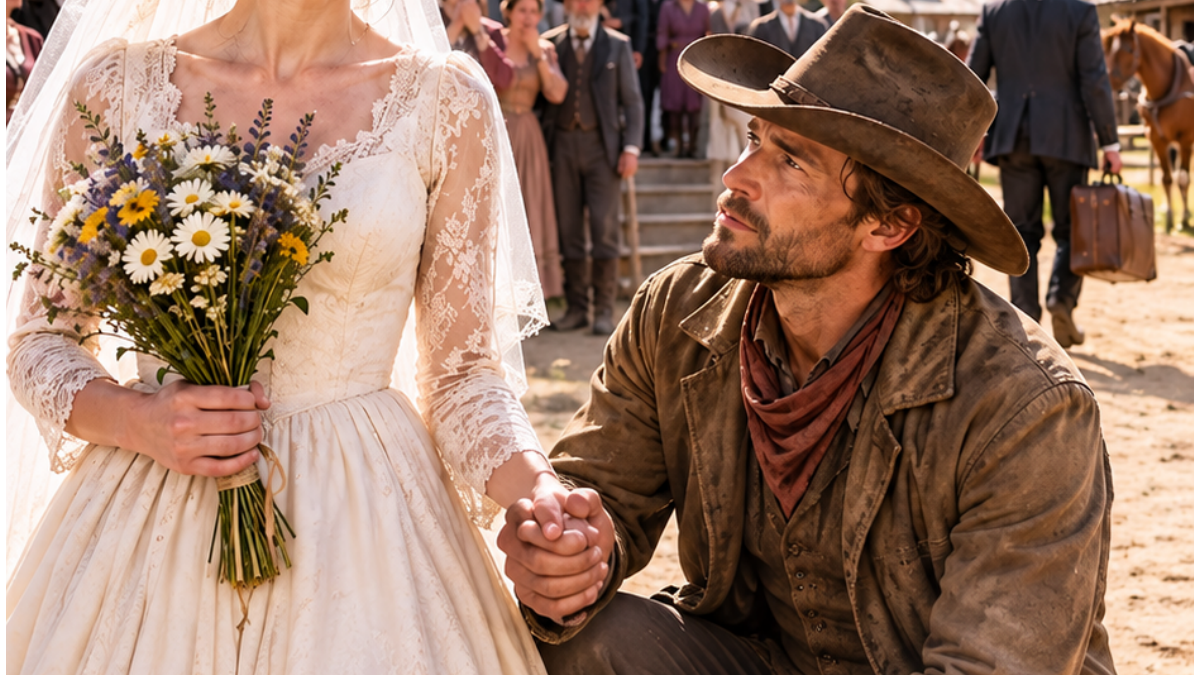
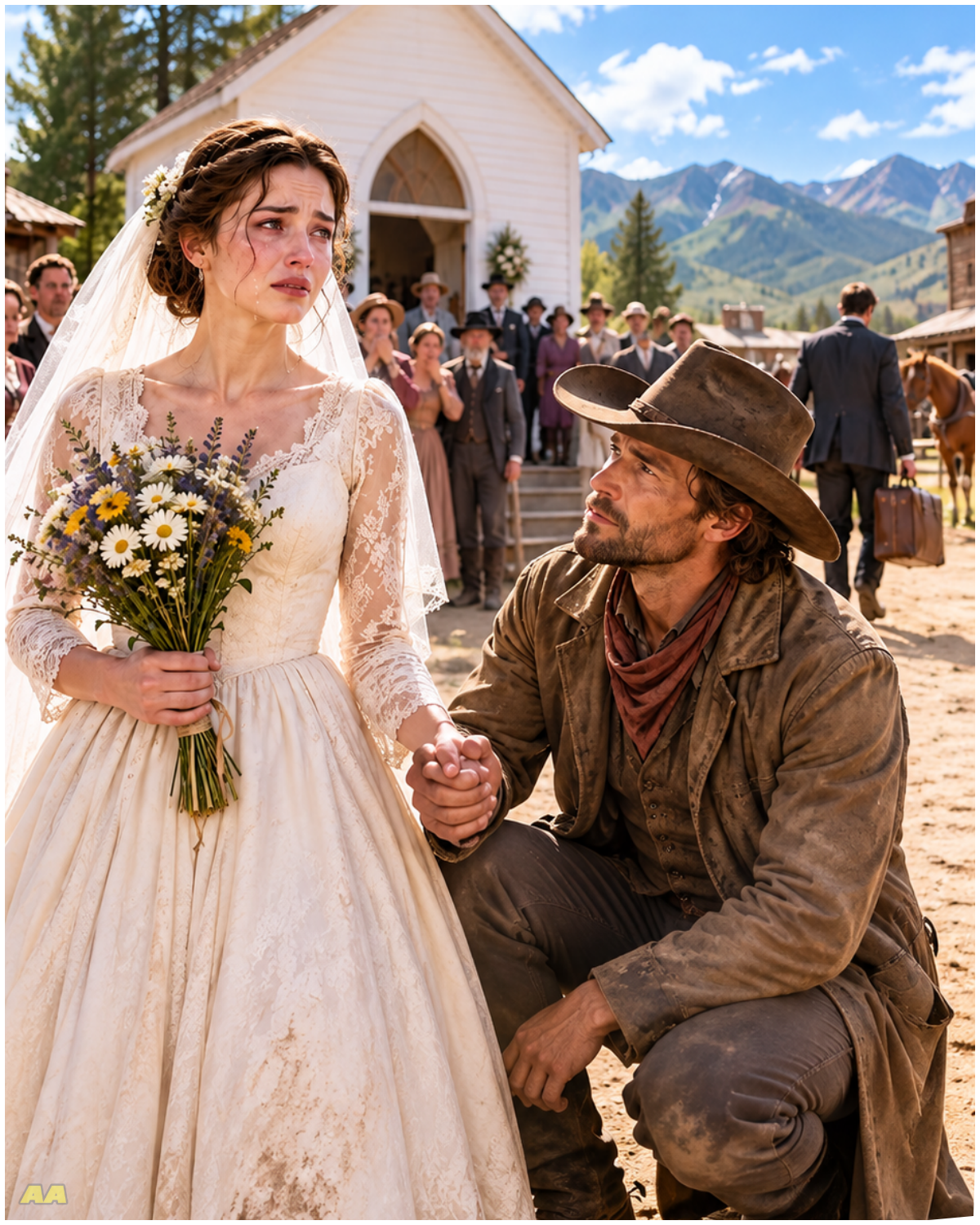
Luther Price didn’t wait until the body was cold before he made his move.
He waited until the wedding dress was still on.
When Matilda Voss stood on the church steps of Dry Creek, Colorado, holding her bouquet with both hands because there was nothing else to hold, Luther was already across the street watching from under the awning of his freight office.
He had the look of a man who had calculated something correctly.
Not smug just settled.
The way a person looks when a long bet finally lands.
Graham Lyle was gone.
The preacher had come outside to say so quietly, and now the whole town knew, and some of them were already starting to laugh.
Mattie heard it, every single note of it, and Luther Price watched her hear it, and he did not look away.
The ring arrived before anyone said a word.
That was the part Mattie remembered afterward.
Not the gasps, not the whispers, not the sound of 30 pairs of good shoes shifting on pine boards.
She remembered Reverend Alcott walking out the front door of First Methodist with Graham’s ring and his closed fist, and the way he looked at her, the way people look at someone who has just been injured in front of them, and they don’t quite know where to touch firSt. He opened his hand.
The ring sat in the center of his palm, a gold band with a small inset ruby.
Graham had special ordered it from a jeweler in Denver.
He’d shown it to Mattiey’s mother 3 months ago, and her mother had cried.
And Mattie had laughed and told Graham he was ridiculous for spending so much on something she’d wear every single day and ruin with flour and livestock feed and ink from the store ledgers.
Graham had said, “That’s exactly why it should be nice. Now it was back in someone else’s hand. He asked me to return this to you directly,” Alcott said very quietly.
He said he was Mattie didn’t move.
She was still holding the bouquet wild coline from the hillside tied with a strip of her mother’s tablecloth because a proper florist in Dry Creek was not something Dry Creek had yet managed to produce.
Her veil was pinned slightly crooked because she’d done it herself in the mirror that morning, laughing at her own reflection for caring so much about a crooked veil.
She looked at the ring for a long moment.
Then she took it and put it in the small pocket sewn into her dress for exactly this kind of occasion.
Because Mattie Voss had grown up the daughter of a general store keeper in a frontier town.
And frontier women knew you always had a pocket.
You never knew what you’d need to carry home.
She heard the first laugh from somewhere in the middle of the crowd.
She didn’t try to identify who it was.
It didn’t matter. One laugh in a crowd is a permission slip.
And within 15 seconds there were three more, low and half swallowed but unmistakably there.
Alcott was still standing in front of her.
He looked stricken in a soft useless way.
“Matilda, I hear them,” she said.
He closed his mouth. The crowd had arranged itself the way crowds do at accidents.
The compassionate ones nearest the front, the ones who had always found her a little too self-sufficient, pressed back toward the edges, but craning their necks.
The Delra sisters were gripping each other’s arms with the barely contained energy of people who would be talking about this for the next decade.
Harold Beichchum from the Cattleman’s Association was shaking his head in what appeared to be genuine sympathy, but could have been disapproval.
Harold was built for disapproval and had trouble distinguishing between the two.
And then Jeremiah Cole, who held the mortgage on her father’s general store, stepped forward from the second row.
He was a compact man with a flat, careful face and the habit of touching his collar when he was making a business point.
He touched his collar now.
“Miss Voss,” he said, and the miss landed with its full weight.
I’m sorry for your difficulty, but I want you to know the bank’s position hasn’t changed.
Monday’s payment remains due, and I’d encourage you to consider that in whatever decisions you’re making this afternoon.
If there had been any remaining sound in the crowd, that killed it.
Someone near the back said very quietly, “For heaven’s sake, Jerry.”
Cole looked unmoved.
I’m being practical. The marriage was intended to provide financial stability for the store.
Without it, I understand what without it means said.
She set it flat and clean.
The way she balanced the store ledgers with no extra weight anywhere.
You’ve made your position very clear.
She did not look at him again.
She looked out over the assembled faces of people she’d known her entire life and tried to find something in them that didn’t make her feel like a horse at an auction that hadn’t met its reserve price.
She did not find it.
Her mother was standing near the door of the church, one hand pressed against her mouth, not crying yet, but close.
Mattie made brief eye contact with her and tried to transmit something steady and calm, but her mother turned away because she could not hold it.
And Mattie was left looking at the back of her mother’s head, which was somehow worse than crying would have been.
That was when Bennett Shaw pushed through the crowd.
Not dramatically, not the way she’d remember it later, and make it into something bigger than it was.
He came through the space between Harold Beichchum and two men from the grain mill, and people moved for him mostly because he moved with quiet certainty.
The way men move when they’re used to being in places where things need doing and sentiment is a resource you can’t afford to waste.
She knew him the way anyone knew Bennett Shaw distantly practically as a fixed feature of Dry Creek’s working population.
He was 37. He’d been in town about 4 years.
He hired out for cattle work when it was available, fence work when it wasn’t, and showed up when there was weather damage and someone needed extra hands.
He wore a coat that had been repaired so many times the stitching had become structural.
He had a face that had spent a great deal of time in the wind.
He was not the sort of man who attended weddings.
He stopped in front of her.
He took his hat off, not in a theatrical gesture, but the way you take a hat off indoors out of habit and respect and nothing more.
Miss Voss, he said, Mr. Shaw, he didn’t look at the crowd.
He didn’t look at Cole.
He looked at her with the same direct attention he gave everything.
And she had the disorienting sense that in this particular moment, he was the only person within 50 ft who was actually seeing her as opposed to the event she’d become.
I can’t give you back the wedding you were promised, he said.
She waited. But I can give you a choice before these people finish deciding your whole life for you.
He paused. Not for effect.
Just to be certain about what he was saying, if you want it.
The crowd went absolutely still.
Mattie heard her own breathing.
She heard the wind off the high grass beyond the church fence.
She heard someone’s horse shift its weight on the packed dirt of the street.
She looked at Bennett Shaw his repaired coat, his plain face, his hat held at his side, and she thought with tremendous clarity he means it.
She had known a great many men who made offers with strings attached to every finger.
Graham had offered her her security while needing her father’s property as collateral.
Cole was offering her grace while holding her father’s debt as leverage.
Even the sympathetic ones in the crowd were offering her their pity, which was its own kind of transaction.
Bennett was standing there holding absolutely nothing.
She could not entirely explain what she felt in that moment.
It wasn’t love. She was honest enough with herself to know that it wasn’t even trust exactly.
It was closer to recognition, the feeling of seeing a level surface when you’ve been standing on a slope so long you’ve stopped noticing the angle.
Let everyone else go home first, she said.
He nodded once. The crowd dissolved slowly, the way crowds do when they realize they aren’t going to get the thing they came for.
The Delichy sisters left last, turning back twice.
Cole departed without ceremony, touching his collar one final time.
Alcott squeezed Mattiey’s hand briefly and went inside.
Her mother came down the steps.
“Mattie, mama, go home. I’ll be there before dark.
You can’t seriously go home,” Mattie said.
Not harshly, but with the specific firmness she’d learned over years of keeping the store in order when her father was ill, and two part-time employees needed direction simultaneously.
Please. Her mother looked at Bennett with an expression that contained several opinions she was exercising considerable restraint in not voicing.
Then she looked at her daughter, and whatever she saw in Mattiey’s face convinced her, and she left.
And then it was just the two of them, and and the empty street and the distant sound of the high grass.
Mattie looked at Bennett Shaw.
“What does a choice mean?” she said.
“Exactly. He didn’t rush it.
She noticed that.” He seemed entirely comfortable being asked to be specific, which was its own small relief.
“I have a place out on the South Range,” he said.
“It’s old. It needs work.
There are two separate rooMs. You’d have your own.
No requirements attached to it.” He paused.
“You could keep managing the store.
I wouldn’t interfere with that.
The arrangement would be whatever you need it to be.
And if you decide after some time that it doesn’t suit you, that’s a conversation we can have.
And what do you get out of it?
She said he thought about this more than she expected.
Nothing particular, he said finally.
I don’t like what happened here this morning.
She looked at him for a long moment.
That’s the reason. That’s most of it.
She reached into her pocket and closed her fingers around Graham’s ring.
Felt its weight, its useless precision.
All that careful craftsmanship for nothing.
I want it in writing, she said the arrangement.
Separate rooms I keep the store.
That’s fair, he said. And I want to know the honest state of your finances before I make any decisions because I’ve had enough surprises for one day.
Something shifted in his face at that.
Something quick and hard to name.
He looked out toward the far end of the street for a moment before he answered.
I rent a bunk house from a man named Caswell for $2 a month.
He said, “I have the ranch, which I caretake for an owner who doesn’t spend time here.
I earn wages and a small percentage of cattle sales.
I don’t have savings worth mentioning.
I can offer you a roof, food, and the practical fact of being legally married to someone who is not at this particular moment a source of humiliation.” He said it without apology, but also without self-pity, which Maddie respected more than she would have expected.
“All right,” she said. He looked at her.
Let’s go find Alcott before he puts his vestments away, she said.
They were married before supper in the empty church, which still had wildflower arrangements in the window boxes that Mattie had spent two evenings preparing.
Alcott was flustered and moved through through the ceremony with the brisk efficiency of a man who had performed enough of them to hold the structure in his sleep.
There were no guests. There was no music.
When it came to the ring exchange, Bennett said quietly, “I don’t have one.” And Mattie said, “Neither do I.” and they both looked at Alcott, who looked at his notes as if they might provide guidance on this situation.
And then they all simply moved forward.
When it was done, Alcott shook Bennett’s hand and kissed Mattiey’s cheek and told her he was sorry for her day and hoped things would be different tomorrow.
Mattie thanked him with the brief, practical warmth she gave to honest kindness, which was different from the warmth she gave to performed kindness.
And then she and Bennett Shaw walked out of First Methodist Church into the late afternoon light as a married couple.
Dry Creek was waiting, not literally, but the story had spread the way.
Stories spread in small frontier towns fast and complete and with editorial additions neither of its subjects had made.
By the time Mattie and Bennett came out of the church, the general interpretation being offered was that Mattavas, publicly humiliated in the morning, had taken the most impractical possible revenge by marrying the one man in Dry Creek who couldn’t improve her situation and might worsen it.
The word desperate was being used, so was the word foolish.
The word brave was also in circulation, but from a significantly smaller sample of the population.
Maddie heard none of this directly.
She learned it the way she learned most of Dry Creek’s opinions, through inference and the specific quality of the silence that fell when she entered spaces.
Bennett drove her to the ranch in a wagon that needed new boards in two places, but was structurally sound.
He drove the way he did everything without unnecessary commentary, paying attention to the road.
She sat beside him with her veil still pinned slightly crooked and her bouquet of coline slowly wilting in her lap and thought about what came next with the same sequential practical attention she gave to inventory probleMs. The ranch was farther from town than she’d expected.
The land opened up past the treeine and the road became a track and the track climbed a long gradual slope before the buildings came into view.
She had been expecting something rough.
She had not been expecting it to be this large.
The main house was old.
Genuinely old, the kind that had been built in stages over decades, all of it in need of paint, and several things in need of structural attention.
One section of roof had been recently patched.
The porch had a step that had been replaced with raw board that hadn’t yet weathered to match.
These were honest repairs made by someone who was keeping something functional rather than impressive.
But the corral held eight horses, and they were not working horses in the usual sense.
They were bred animals, the kind with straight legs and steady eyes, and the unambiguous quality that comes from careful selection over multiple generations.
The barn was clean and organized in a way that spoke of consistent, deliberate maintenance.
The cattle in the far pasture were too distant to count, but there were a great many of them.
None of this was what she would have expected from a man who earned wages and rented a bunk house for $2 a month.
She didn’t say anything about it.
Not then. Bennett showed her the house from the inside with the same brevity with which he’d shown her everything else.
Kitchen, main room, two separate bedrooms, a back store room that connected to the root cellar, everything clean, everything worn.
A set of curtains in the kitchen that had once been a good fabric and were now faded to a uniform pale.
She couldn’t tell what color they’d originally been.
I’ll get your things from town tomorrow if you have something you want from the house, he said.
She had been staying with her mother since the end of last month when she’d quietly moved back to prepare for the wedding.
Most of her working life was at the store.
I’ll come with you, she said.
He seemed to accept that without particular opinion.
He moved toward the door, stopped.
The bunk house is about 300 yd north, he said.
I’ll stay there. If anything with the house needs attention, he seemed to search for the right phrasing.
I’m near enough. She understood.
He was removing himself from the house to make it genuinely hers without having been asked.
She looked at the kitchen, the faded curtains, the worn table with its four mismatched chairs, a cast iron stove that had been blacked recently.
“Mr. Shaw,” she said. He paused.
“Thank you,” she said. “For this morning.” He looked at her steadily for a moment.
There was something working in his face that she couldn’t identify.
Not discomfort. Exactly. More like a man holding something carefully and making certain he doesn’t spill it.
You didn’t need to thank me, he said.
You had the difficult part.
He put his hat on and went out.
She listened to his footsteps on the porch, then the squeak of the second step, the raw board one, then silence.
She sat down in one of the mismatched chairs and put her hands flat on the table and breathed.
Outside, a mocking bird ran through its entire repertoire without stopping once.
The next morning arrived with a particular sharps that only Colorado altitude produces cold light, thin air, the smell of woodsm smoke from somewhere on the south slope.
Mattie was already up. She had always been an early riser, trained by years of opening the stores before the town woke, because there was always something to do before the day formally began.
She was standing in the kitchen considering the stove when Bennett knocked on the door frame.
“You didn’t have to knock,” she said.
“It’s your house,” he said.
She turned that over briefly.
It’s both of ours, apparently.
>> Right. >> He paused.
I have to ride out to the east pasture.
There’s a section of fence that needs checking.
I’ll be back by midday.
I need to get to the store, she said.
I have accounts to run and I expect Cole will have some kind of letter waiting for me.
He nodded. I’ll hitch the wagon for you.
I I know you can, he said.
I’ll do it anyway. She watched him go.
Then she went to see what was in the root seller because a practical inspection of her situation seemed more useful than anything else at the moment.
What she found in the root cellar was unexpected.
The shelves were fully stocked dried goods, canned goods, smoked meat, root vegetables from the previous fall, two separate crocs of preserved fruit.
This wasn’t the store of a man who lived on wages and did not know where next month’s provisions would come from.
This was a larder maintained by someone who expected to feed multiple people across multiple seasons.
She looked at it for a long moment.
Then she went upstairs and got ready to go to town.
At the store, Cole’s letter was waiting as predicted.
Polite in tone, precise in content, the mortgage payment was due Monday.
The amount was not stated because she already knew it, and the bank’s willingness to consider a brief extension would be contingent on a formal meeting.
He used the phrase given the unusual change in your domestic circumstances with the careful neutrality of a man who knows he is being recorded by history.
Mattie read it twice, folded it, put it in the store ledger, and started on the accounts.
She was 3 hours into this when Norah Caswell came in.
Norah was 53 and had the unmbellished manner of a woman who had long since decided that life was too short for decorative words.
She was married to the man who owned the bunk house Bennett rented or had rented.
Mattie supposed the situation had presumably changed.
“Well,” said Norah. “Good morning, Norah,” said Maddie.
“People are saying things.” “I would expect them to be,” said Maddie, without looking up from the ledger.
Norah set her basket on the counter and began examining a bolt of cotton broadcloth with the focused attention of someone who had no interest in the fabric whatsoever.
Some are saying you’ve gotten yourself into a worse situation, Norah said.
Some might be right, said Maddie.
Others are saying it took more backbone than anything they’d seen in a while.
Mattie finally looked up. And what do you say?
Norah put the fabric down.
She had a direct gaze that had always reminded Maddie of looking into a level.
I say Bennett Shaw has kept that ranch in order for 4 years and never once asked for anything from anyone in this town.
And most people have no idea who he actually is.
And I don’t either, and neither do you.
She paused. Which could be a problem or could be an advantage depending on what kind of woman you are.
Maddie considered this. What kind of woman do you think I am?
Norah picked up the bolt of broadcloth.
Three yards, she said. Mattie cut the fabric and made change and watched Norah leave with the specific attentiveness she gave to things that were worth thinking about later.
She had Cole’s letter in the ledger.
She had a root seller that made no sense.
She had a husband she had known for fewer than 24 hours.
She had a store that had been her father’s life and was now apparently her problem and a banker who operated on Monday mornings with the precision of a man who believed that sympathy and business were different columns in separate books.
She put the ledger away and started preparing the store for the midday customers.
Two days passed, then three.
The rhythm of the thing ranch and store and the daily back and forth established itself with less difficulty than Maddie would have predicted.
She and Bennett were rarely in the house at the same time.
When they were, the conversation was functional, which she preferred to performed warmth.
He asked her once how the store was doing.
She told him honestly the accounts were manageable, but the coal situation was a problem she was working through.
He listened without offering to solve it, which was the response she needed, and did not say so.
On the fourth morning, she found him in the kitchen before dawn, sitting at the table with a cup of coffee and a piece of paper covered in numbers.
He folded the paper when she came in, not quickly, just the normal motion of a man putting something away when company arrives.
She made note of it.
That afternoon, while Bennett was out checking fence, she noticed that one of his horses, the gray with the particular confirmation, had a brand she didn’t recognize.
She mentioned it that evening.
Denver breeder, he said. He said it smoothly.
Too smoothly, she thought later.
Like a man who had that answer already formed.
That’s expensive stock to keep as a working animal, she said.
She earns her keep. Mattie looked at him across the supper table.
He met her eyes without flinching.
He was a composed man genuinely, not performatively.
She had spent enough years reading people across a store counter to know the difference between calm and controlled.
Bennett was generally calm, but sometimes on certain questions, what she saw was controlled.
She did not push it.
She noted it. On the sixth day, a letter arrived from Denver addressed to the ranch, not to Bennett Shaw, addressed to Be Shaw, Shaw Crossing Properties.
Mattie had collected the mail from town herself that morning.
She’d held the envelope in her hand all the way back, looking at the return address, a law office on Lammer Street.
She’d put it on the kitchen table where Bennett would find it.
She didn’t ask about it.
She waited to see if he’d bring it up.
He didn’t. He took it to the bunk house that evening, and she did not see it again.
A weekend she repaired his coat.
This was not a calculated kindness.
She had found it draped over the porch rail two mornings running.
And the third morning she simply picked it up and took it inside and spread it on the table and looked at the accumulated repair work on the left sleeve and thought, “That’s done wrong.
It’s going to split again in a month.” She had better thread.
She sat down and fixed it properly.
When Bennett saw it, he stopped very still in the kitchen doorway.
“You didn’t have to do that,” he said.
“I know,” she said. But you’d done it wrong on the sleeve and it was going to split again.
He looked at the coat, then at her.
Then he reached into his shirt pocket and held out some coins.
What’s that for? She said, “For the work.” She stared at him.
“Put that away. You shouldn’t be doing work for me without Bennett,” she said.
And it was the first time she’d used his given name.
And they both noticed. I live in this house.
I use thread that was already in this house.
You hitch my wagon every morning without charging me.
Put the money away. He put the money away.
Something shifted in his face.
Not quite a smile, not exactly, but the faint structural precursor to one.
She noticed it because she had been paying attention.
“Thank you,” he said quietly.
“Meaning it.” “Don’t make a thing of it,” she said.
“But she was already looking back at her accounts, so he couldn’t see that she was quietly, privately, in spite of everything, beginning to feel something in this place that was closer to home than she’d expected to feel this soon.” That evening, one of the ranch hands, a young man named Pettit, who had apparently been with the operation for two years, came to the back door looking for Bennett and couldn’t find him.
Mr. Shaw said there might be a delivery from Petit started, then stopped.
He had used the name before he thought about it.
Stopped with the word still warm in his mouth.
Mr. Shaw, Mattie said. Pettit’s face rearranged itself.
Yeah, Ben. He said there’d be a delivery order from He’s out east, Mattie said.
She let the Mr. Shaw sit there unremarked on but un retracted.
I’ll tell him when he’s back.
Pettit nodded and left quickly and she watched him go with a still face and a head that was suddenly running numbers on a completely different set of accounts.
Mr. Shaw a hired hand did not call a fellow hired hand Mr.
Shaw. She stood in the kitchen with the late light coming through the faded curtains and looked at the root seller stairs and the Denver letter she hadn’t seen again and the exceptional horses in the excellent corral and the cattle that were too numerous for a caretaker’s operation and the paper covered in numbers that Bennett had folded away without urgency but without letting her see it either.
She thought about Norah Caswell.
Most people have no idea who he actually is.
She thought about the way Bennett had said, “The owner doesn’t spend time here smooth, formed, already ready.” She thought about what it felt like to be the last person in the room to understand the true shape of what was happening.
She knew that feeling. She’d learned it yesterday in a wedding dress on a church step in front of everyone she’d ever known.
She was not interested in learning it again.
Outside, Bennett’s wagon was coming back up the track.
She could hear the horses on the slope, the familiar squeak of the harness when he crested the grade.
She went to the stove and put more wood on the fire and started supper.
And she did not say anything that evening, and she did not let him see that she was watching him with the careful, patient attention of a woman who had learned at considerable cost to trust what she observed over what she was told.
The mocking bird was at it again somewhere in the darkness beyond the window, running through everything it knew over and over until it ran out of other birds to become.
The suspicious thoughts didn’t leave her when she went to bed that night.
They didn’t leave her the next morning either.
Maddie had always been the kind of person who filed things that didn’t add up into a separate column and returned to them later.
The way you set aside a receipt that doesn’t match the inventory and trust that the discrepancy will eventually explain itself.
She was patient about it.
She had learned patience from her father, who used to say that most answers arrive on their own schedule, and the only thing rushing ever accomplished was making you feel better while you waited.
She watched Bennett Shaw with her father’s kind of patience.
She watched the way the men on the ranch spoke to him, not simply to him, but toward him, with a particular attentiveness that workers give to the person whose opinion of their work actually matters.
Pettit was the youngest and the least practiced at concealing it.
He had that Mr. Shaw slip already.
There was also Cutter, who was older and more deliberate, and who would occasionally stop mid-sentence when answering a question and redirect it to Bennett the way you redirect a message when you realize you’ve handed it to the wrong person.
None of this was proof of anything.
A good foreman earned that kind of regard, a trusted long-term hand.
There were explanations that required nothing unusual.
She filed it and kept watching.
What she noticed over the next several days was harder to explain away.
Bennett did not behave like a man who rented a bunk house.
He behaved like a man who had lived with responsibility for a long time and had learned to carry it quietly.
He knew the ranch the way you know a place that belongs to you.
Not like a caretaker who has memorized the procedures, but like someone who knows exactly what it cost to put things where they are and exactly what would be lost if they failed.
When a section of the east fence came down in the night, and three head of cattle wandered toward the creek draw, he was up before Pettit came to the bunk house door and had already identified in his head which cattle were likely to have gone which direction.
He didn’t consult anyone. He just moved.
She watched that from the kitchen window, wrapped in a blanket with her morning coffee, and thought about it longer than was strictly necessary.
The sewing cabinet situation started practically and ended somewhere she hadn’t expected.
Her cabinet, the small oak one her father had built for her mother when they were first married, which had traveled with Maddie from house to store to mothers.
House to this place had a hinge front panel that had been loose since before the wedding.
She’d been meaning to fix it for months and hadn’t.
The way you don’t fix small things when larger things are demanding your attention.
She came home from the store on a Tuesday to find it spread out on the kitchen table.
Not taken apart, that was the thing.
Just the hinge itself removed, cleaned the stripped thread that had been making it wobble, replaced with something that would actually hold, and all of it waiting for her to put back.
Not done for her, done toward her.
She stood in the kitchen looking at it for a moment.
He came in from outside a few minutes later and saw her looking.
“I wasn’t sure you’d want me touching it,” he said, which was not an apology, but contained the architecture of one.
“It was my mother,” she said.
“I know.” A pause. Amos Tierney mentioned it.
He knew your father. Amos Tierney was the oldest man on the property, gay-bearded with a careful face and the long economy of words that came from decades of working with men who respected silence.
He’d given Maddie a brief nod when she arrived and hadn’t said much beyond practical exchanges since.
That he had mentioned her mother’s cabinet to Bennett was its own small puzzle.
“The hinge will hold now,” Bennett said.
She reassembled the cabinet. The panel closed and latched the way it was supposed to.
She sat back and looked at it and felt without being entirely prepared for it, a wave of something that had nothing to do with the cabinet itself, something closer to grief that she’d been keeping at the back of her chest where she thought it couldn’t reach her and had apparently been wrong about that.
She didn’t cry. She wasn’t going to cry in the kitchen over a cabinet hinge with her husband of 11 days standing 3 ft away.
But she was quiet for longer than the moment warranted.
And when she finally looked up, Bennett had set a cup of coffee beside her account books and moved to the far end of the table with his own and was looking at something outside the window, giving her the space to have whatever she was having without making it into an occasion.
She drank her coffee. He looked out the window.
Neither of them said anything about it.
But later doing the store accounts by lamplight, she found herself thinking about the fact that he had done that made space without being asked for it, without turning her quiet moment into something about him.
Graham had been warm in a performed way, the kind of warmth that required an audience that wanted to be acknowledged as warm.
Bennett’s consideration operated differently. It happened and then it was done.
And he went back to whatever he’d been doing before.
She didn’t know what to do with that yet.
She put it in the column with the other things she hadn’t worked out and kept going.
The store was the center of what her days actually meant, and she refused to let the current circumstances pull her away from it.
Cole’s letter had been replaced by a meeting brief and precisely unpleasant in which he had outlined the bank’s willingness to restructure the payment schedule, provided Mattie could demonstrate solvency for the coming two quarters.
He had used the word demonstrate in a way that made it clear he was not prepared to take her word for anything.
She had sat across his desk in the same calm, flat manner she’d used on the church steps and had walked him through the accounts in the same clear, sequential way she’d been walking through accounts since she was 14 years old.
And her father first put the ledger in her hands.
Cole had not enjoyed being walked through his own logic by a woman who knew more about commercial accounts than he had apparently expected.
She had left with a 60-day extension and a very precise internal sense of the work that needed doing.
What she needed was better supply terms and a second merchant account with the territorial grain cooperative, which would give her a price buffer when individual crop yields varied.
Her father had meant to establish a fears and hadn’t quite gotten to it.
Maddie had meant to push it before the wedding and let the wedding distract her.
She mentioned it to Bennett one evening in passing, not asking for help, just thinking out loud in the way you do when you’ve been working through something all day.
He was quiet for a moment.
I know the representative for the territorial cooperative, he said.
Caswell introduced me a while back.
I could send a letter if you want to arrange a meeting.
She looked at him. How does a ranchand know the territorial grain cooperative representative?
There was that small pause again, the one she was beginning to recognize.
Regional cattle work,” he said.
“Grain and cattle supply terms overlap more than you’d expect.
It was a reasonable answer.
She had no reason to disbelieve it.
She noted it. I’d appreciate the introduction,” she said.
“But I’ll do the meeting myself.” “I wasn’t suggesting otherwise,” he said.
“I know,” she said. “I’m just saying it out loud so we’re both clear.” He held her gaze for a moment.
“Understood,” he said. And there was something in the way he said it, not just compliance, but actual recognition of something that she didn’t have language for yet.
Bronce, the ranch supply orders were the thing that finally gave her something concrete.
She had started reorganizing them the second week because the filing system was impossible orders categorized by vendor name rather than by material type or date, which meant finding the history of any specific supply involved going through six separate folders instead of one.
It was the kind of system that had grown organically without plan, the way bad systems always do, and it drove her to distraction.
She built a new system over three evenings, and in doing so, she read through approximately 2 years of supply orders.
The volume was wrong. Not wrong in the sense of being falsified.
Everything was properly documented. Every figure balanced against a corresponding payment.
Wrong in the sense of scale.
You did not order this quantity of winterfeed, this quality of water pipe, this amount of fencing material for a caretaker’s operation running on wages and a percentage.
This was the ordering pattern of a large-scale operation with a clear sense of its own capital position.
She sat with the last folder open on the kitchen table and looked at it for a long time.
Then she heard boots on the porch.
Bennett came in, stopped when he saw her face.
I reorganized the supply files, she said.
I saw, he said. He was very still.
The ordering volume is significant, she said.
He said nothing for a caretaker, she said.
He set his hat on the counter.
He picked it up again.
He turned it once in his hands, not nervously, but with the particular displaced motion of a man who is deciding something.
The owner increased the operation in the last few years, he said.
The orders reflect that. Mattie looked at him.
He looked back. She thought he’s not lying.
He’s not telling the truth either.
He’s doing something between. She closed the folder.
The new system is in the main drawer, she said.
Organized by material type and then by date within each category.
Thank you, he said. You’re welcome, she said.
And that was the end of that, and neither of them slept well that night, though neither knew that about the other.
The laugh came from somewhere she didn’t expect.
It was 17 days in.
She came back from the store to find Bennett in the kitchen, attempting to repair a gap in the bottom of the back door, where cold air had been coming through since the first real chill of fall.
He was crouched on the floor with a strip of felt and a handful of tacks and a look on his face that suggested the felt was winning.
She watched from the doorway for a moment.
“You’ve put the tax in sideways,” she said.
He looked at what he’d done.
He had in fact put the ts in sideways, which meant they were sitting proud of the felt and would work loose in a week.
“I can see that now,” he said.
“Hand me the hammer.” He handed it up to her.
She crouched beside him, removed his sideways tax, reset the felt evenly, and put the tax in properly with three efficient strikes each.
The whole correction took four minutes.
When she stood up, he was looking at the door with the expression of a man revising his estimate of how long this had been going wrong.
I’ve been doing that wrong for 2 years, he said.
I know, she said. You can tell because of the wear on the floor where the draft came in.
He looked at the floor.
He looked at the door.
He looked at her with something that was somewhere between mortified and grateful.
“I’ll pay you for the work,” he said, and reached into his shirt pocket, and she laughed.
“Not the polite kind, the real kind, the kind that arrives before you’re ready for it, that starts somewhere low in your chest and comes out with more velocity than you intended.” She heard herself laugh and registered with mild surprise that it was the first time she’d laughed since the wedding.
Since before the wedding, maybe.
She couldn’t immediately remember the last time.
She put one hand on the kitchen table to steady herself.
“Put your money away,” she said when she could.
“You keep saying that. You keep trying to pay me for things.” He was quiet.
Something had happened in his face while she was laughing.
She caught the tail end of it, not quite in time to identify it before he turned away toward the window.
Something that had opened and then very carefully been put back the way it was.
It’s a habit, he said, of paying people.
Of he stopped, of being clear about what’s owed.
She looked at his back.
He was watching something outside the window with the focused stillness of a man who is not particularly watching anything.
Nothing’s owed between us for fixing a door, she said.
That’s not what this is.
He turned around. What is it?
He said. She thought about that not defensively, genuinely.
What was it? This thing that had started as a transaction on the steps of a church and had become something she didn’t have clean words for.
A household, an arrangement, two people who moved around each other with increasing ease and increasing attention and the careful mutual consideration of people who are beginning to recognize in each other something they hadn’t expected to find.
Two people making a life work, she said, which means we fix each other’s doors and mend each other coats and don’t keep running a tab.
He looked at her for a long moment.
She held it. “All right,” he said.
That was the whole exchange.
He went back outside. She turned to the stove, the door no longer let in cold air.
She thought about the look she’d seen on his face when she was laughing the brief, unguarded opening before he turned it back.
She thought about it for the rest of the afternoon and couldn’t decide whether it made her feel better or more afraid because it had looked like the face of a man who had something he wanted to say and had spent a great deal of time learning not to say it.
She began to notice the breakfasts.
It started the third week without announcement.
She had a habit of skipping breakfast when something was weighing on her.
Not a deliberate choice. The way you don’t feel hungry when your mind is working hard on something that has teeth in it.
She’d done it since she was young, and it drove her mother to distraction, and she’d never particularly tried to change it.
The morning after a late night with the store accounts, she came into the kitchen late and heading straight for her books, and there was a plate with biscuits and a portion of the smoked ham from the seller, and a small jar of preserve sitting precisely next to the account ledger, where she would encounter it the moment she sat down.
She looked at it. She looked at the porch door, which had just closed behind Bennett on his way out.
She ate the biscuits. The next time she skipped breakfast, there was bread and butter.
The time after that, cold cornbread and two hard-cooked eggs.
No commentary, no note, no mention of it in any subsequent conversation.
Just the food reliably beside her books whenever she’d forgotten to feed herself.
She she asked him about it once.
He was bringing the wagon around and she was on the porch putting on her boots.
The food in the morning, she said.
He kept adjusting the harness.
What about it? You don’t have to do that.
I know, he said. I’m not helpless.
I know that, too, he said.
He glanced at her briefly.
You don’t eat when you’re worried.
It’s not a criticism. It’s just a fact.
She pulled her second boot on and you decided to address it.
I decided to put food where you’d find it.
He went back to the harness.
Seemed simpler than having an argument about it.
She stood on the porch and looked at the back of his head and felt something shift inside her chest that she was not prepared to examine in the open air of a Colorado morning with the wagon waiting and the store needing her attention.
It’s good cornbread, she said.
Amos makes it, he said.
She got in the wagon.
Dry Creek remained a problem even when she wasn’t in it.
The town had settled on its interpretation of the situation and seemed in no hurry to revise it.
Mattie heard the versions when they came through the store.
She heard them the way she always heard things in the gaps and edges and avoidances in the things people didn’t say directly but said in the vocabulary of pauses.
Some people were kind in a way that required her to perform gratitude for the kindness which she found exhausting.
Others were simply uncomfortable as if her presence reminded them of something they hadn’t handled well on the church steps which she found more honest if not more comfortable.
Graham Lyle had quietly left Dry Creek for somewhere south.
Luther Price was stills on the town council, still moving through the commercial life of of the valley with the easy assurance of a man who owned enough of it to feel proprietary.
He had not come into the store since the wedding.
She noticed that she did not know what to do with it.
Norah Caswell came in for thread one Friday and stayed for 40 minutes, which was unusually long for Norah, but not Maddie was beginning to understand.
Unusually long for a woman who had something she was working up to saying eventually.
How’s it going out there?
Adequately, Mattie said. People are wondering.
People were wondering before I gave them anything to wonder about, Mattie said.
Norah examined a spool of brown thread.
My husband says Bennett has been at the ranch later than usual recently.
Not going back to the bunk house till nearly dark.
Mattie considered what this meant carefully before she answered.
We eat supper together, she said.
It seemed practical. Norah set down the thread.
You eating supper together. Is that unusual for a man who has always eaten alone for 4 years?
Norah picked the thread back up.
Fairly unusual, yes. Mattie didn’t say anything.
He’s a private man, Norah said.
The way you’d say it if you meant to a degree that has always been strange to me.
My husband has known him since he came to Dry Creek and still couldn’t tell you much that’s personal about him.
Maybe there isn’t much personal, Mattie said.
Norah looked at her with the level gaze.
Or maybe there’s a great deal, she said.
And he keeps it somewhere the rest of us can’t reach it.
She paid for her thread and left.
Mattie stood at the counter for a moment after she left and thought about that somewhere the rest of us can’t reach it and thought about the Denver letter and the supply orders and the horses and the way Petit had caught himself mid-sentence.
Then a customer came in and she went back to work.
The territorial cattle inspector arrived on a Wednesday, rode up to the ranch while Maddie was inside going over the winter preparation liSt. She heard the horses and looked out to see Bennett already out of the barn and walking toward the gate and the inspector already dismounted and shaking his hand with the easy warmth of men who have known each other across multiple seasons.
She watched from inside. The two of them walked the south pasture together for close to an hour.
The inspector taking notes, Bennett pointing at things, their body language, the flat professional comfort of two people who are talking about specific concrete things they both understand and are not performing anything for anyone’s benefit.
When the inspector came in for water before leaving, he said to Maddie conversationally, “Your husband knows this land better than any operator in the South Valley.” “Ooperator,” she said.
He blinked. He was a careful man.
She saw him replay what he’d said.
“Land man,” he said. “Men who worked the land.” He left relatively quickly after that.
Bennett came in and poured himself water and stood at the counter and drank it.
And Mattie watched him from the table and said, “He called you an operator.” “He misspoke,” Bennett said.
He said, “Land man afterward.
He was correcting himself. He said it before he corrected himself.” Mattie said, and he corrected himself because he saw my face.
Bennett set the cup down.
He looked at her with a composed stillness that was either patience or preparations.
She still couldn’t always tell the difference.
Maddie, he said, “I’m not asking you a question,” she said.
“I’m telling you what I heard.” He was quiet for a long time.
“All right,” he said. “That’s all you’re going to say right now?” He said, “Yes.” She looked at him.
He looked at her. Something was running between them in that silence that had weight and voltage and no clean name.
She turned back to the winter liSt. He went back outside.
She added firewood southside to the list and thought he’s not ready.
And then ready for what?
And then whichever truth he’s holding, it’s not a small one, and he knows it’s not small, and he knows I know there’s something, and he still isn’t ready.
She didn’t know whether that made her more patient or less.
The evening it broke open slightly.
Just enough came 3 and 1/2 weeks in.
On a night when the temperature had dropped hard, and the first real suggestion of winter had arrived in the form of a northwest wind that found every gap in the house with the thorowness of something with a personal grievance.
She was at the table with the store accounts, and he was on the other side with something he’d been reading letters she’d noticed that arrived in that particular thick cream envelope from the Denver Law Office and were never left out after he’d read them.
He put the letter down.
He looked at the lamp for a moment.
I want to say something, he said.
She waited. This house, he said.
It’s not what Graham was promising you.
I know that. She looked up.
He had something else in his head.
Something with more to it.
He wasn’t looking at her.
He was looking at the wall behind her.
Careful and a little stiff.
The way a man looks when he’s made himself say a thing before he was sure about saying it.
I want you to know I’m not unaware of the difference.
The lamp threw long light across the table.
The wind moved through the northwest corner of the porch.
Mattie set her pen down.
“Graham promised me everything,” she said.
Bennett looked at her and gave me nothing, she said.
“You promised me almost nothing.” She looked around the kitchen, the faded curtains, the mismatched chairs, the cast iron stove that had been blacked last Tuesday, the door that no longer let in cold air.
“And you keep giving me more than that,” she said.
Something happened in Bennett Shaw’s face that she had not seen before.
Not the controlled stillness, not the composed patience.
Something that came from underneath, all of it quick and real, and then immediately, carefully contained.
He looked down at the table.
He looked at his hands.
He said very quietly, “I’m glad you’re here.” The wind moved the northwest corner again.
The lamp held steady. She thought about what she knew and what she didn’t know, and the supply orders and the Denver letters, and the Mr.
Shaw that Petit couldn’t quite call back.
She thought about the breakfast cornbread and the cabinet hinge and the space he’d given her in the kitchen when she’d needed it.
She thought about a man who knew exactly what it cost to keep a place going and had never once suggested she didn’t need her own work.
She thought about how much she didn’t know about who he was.
And she thought sitting across from him from in the lamp in him in the lamplight with the wind at the corner and the accounts open between them that she was in real trouble.
Not the financial kind which she could manage.
But the other kind, the kind that arrives without asking permission when you have been paying close attention attention to a person for long enough to see the shape of what they’re made of.
I’m going to finish these accounts, she said.
Right, he said. He picked the letter back up.
She picked her pen up.
She did not let herself look at his face again, but she heard him refold the letter very quietly, and she heard him set it aside, not in the pile he usually put them in, but down near the far edge of the table, closer to her side, as if the careful inches between what he was keeping from her and what she’d eventually reach, had gotten briefly, incrementally smaller.
She kept her eyes on the accounts.
The lamp burned. The wind worked at the house from the outside, the way cold things do, patient, thorough, testing every place that wasn’t sealed tight enough to hold.
Inside, for the first time since the day preacher had walked out of a church carrying someone else’s ring, Matilda Voss did not feel like a woman who had ended up somewhere.
She felt like a woman who was somewhere she had chosen, which was a different thing entirely, and she was not sure yet what it meant, and she was not sure yet whether to be glad about it or afraid.
She suspected quietly that it might be both.
The letter stayed on his side of the table after that, but Mattie noticed he stopped carrying the envelope to the bunk house when he was done reading it.
He left it in the kitchen instead in the stack with the ranch correspondence near the window as if moving it 2 ft from the lamp had been a decision, and leaving it out entirely was a different later one.
She didn’t touch it. She didn’t want to touch it.
What she wanted was for him to explain it himself, which she understood was not something she could want him into doing, and so she exercised the patience her father had taught her, and let it sit there and went about her days.
The days by the fourth and fifth week, had taken on a shape.
She was at the store three mornings a week, sometimes four, when the account work required it.
The territorial grain cooperative meeting had been arranged not through Bennett’s introduction in the end, but through her own letter to the regional office, which she’d sent the same day she’d told him she’d handle it herself.
The representative was a thin man named Voit, who wore his hat indoors and spoke very quickly, but he knew his product figures, and she knew hers, and they arrived at terms within 40 minutes that were better than what her father had been paying for 3 years.
She came home from that meeting and told Bennett over supper and he’d looked at her with the particular focused attention she was beginning to recognize as his version of impressed.
40 minutes. He said he was prepared.
It went faSt. Most people come out of that office in 2 hours and feel like they loSt. Most people let him talk firSt. She said I didn’t.
Bennett was quiet for a moment.
No, he said. I don’t imagine you did.
She ate her supper. He ate his.
Outside the first hard stars of autumn were coming out and the night had that particular clarity that arrived when the temperature dropped and there was no weather coming.
Bennett, she said. H what does the Denver office handle?
The quiet that followed was the specific kind she’d gotten very good at measuring, not the casual quiet of a man thinking through something ordinary.
The careful quiet of a man deciding how much of the true answer to give.
Administrative matters, he said, for the ranch’s legal structure.
Legal structure, she said. Land holdings, contracts, that sort of thing.
What sort of contracts, cattle access, freight agreements?
He paused. Water rights. She looked at him across the table.
He was looking at his plate.
That’s a significant amount of administrative work for a caretaker arrangement, she said.
The owner’s a thorough man, he said.
She looked at him for another moment.
Then she went back to her supper.
I’m sure he is, she said.
She heard something in his exhale, not quite relief, but the faint deflation of a man who had been holding something and had set it down without dropping it.
She found, sitting across from him in the lamplight, with the stars coming out and the supper getting cold, that she was angrier about that than she’d expected to be.
Not at the lie specifically, at the relief, at the fact that he had set it down and felt relieved and she was the one who had let him.
She did not let that show, but it sat in her chest for the rest of the evening like a coal that hadn’t gone out.
She began paying different attention to the ranch itself.
She’d been observant before in the way of someone cataloging stranges for later reference.
Now she started looking with the deliberate eye of someone building a case.
She walked the property on the morning she wasn’t in town.
She knew the south pasture and the east fence line already.
She walked north toward the treeine one morning and discovered that the property continued further than she’d estimated that what she’d been thinking of as the edge of the Shaw operation was in fact the the edge of one section of it and the land beyond the tree line was also managed and also fenced and also carrying stock.
She climbed to the high point on the north side and looked south.
The valley spread below her.
Shaw crossing occupied a position she hadn’t fully understood until this moment.
Not a corner, not a peripheral operation, but the center.
The streams that fed the South Valley’s grazing land all ran through or along the edges of this property.
The wagon road to the Dry Creek freight depot ran directly adjacent to it for nearly 2 mi.
Whoever held this land held the practical arteries of everything that moved through the valley on four legs.
She stood on the high point and looked at it for a long time.
Then she went back down and made breakfast and did not say anything.
The relationship moved through November in the way that close proximity moves things with neither person entirely in charge of the direction.
They ate together every evening.
She had stopped keeping formal track of whose turn it was to do what in the kitchen, and he had stopped trying to pay her for things, and the arrangement between them had become something that resembled.
From the outside, an ordinary married life, which was strange, because from the inside, it felt less ordinary and more fragile, like a thing that was growing in the right direction, but was not yet rooted deep enough to truSt. He was funny in a way she hadn’t anticipated.
Not performatively funny, he didn’t tell jokes or aim for effect, but occasionally he would say something with such flat precision about a situation that she’d catch herself laughing before she’d noticed it coming.
He had a particular deadpan response to the ranch’s supply vendor, a man named Hol, who added a 6% markup to everything and presented this as a personal favor.
Bennett’s imitations of Holt’s justifications for the markup were delivered in a voice of such serene confidence that Mattie had once laughed until she had to put her coffee down.
She had not expected to like him.
She had not, to be exact, expected very much at all from a marriage arranged on a church step in 30 seconds.
She had expected to endure it.
She had expected to be practical about it.
She had not expected to sit across a kitchen table on a Thursday evening listening to a man imitate a supply vendor and feel with complete clarity that she was happy in this moment that this significant moment was good and that she was in it and that it was not something she needed to qualify or frame against everything else.
She sat with that for a while.
She didn’t tell him. She wasn’t sure yet what to do with it.
He nearly told her twice.
She knew this in retrospect.
The first time was a Sunday morning when they were both out at the South Corral looking at a mayor that had been favoring her left foreg.
And Maddie was running her hand down the legs length and feeling where the sensitivity was.
And Bennett was watching her do it with the same focused attention he gave things he was genuinely curious about curious about.
And she looked up and caught his face mid expression open, unsettled, the look of a man who is about to say something important.
She waited. He said she probably strained it on the rocks east of the creek.
I’ll have cutter keep her off that ground.
She looked at the horse.
That’s not what you were going to say.
A pause. No, he said.
But you’re not going to say it.
Not yet, he said. She looked back at the leg.
All right, she said. The second time was the night he got a letter that was different from the others, thicker, sealed differently with a handwriting she hadn’t seen before.
He read it at the table and then sat very still for longer than usual.
And when she asked if something was wrong, he said nothing new and then looked at her with the particular expression that she’d learned was the face of a man holding something carefully and checking the weight of it.
Maddie, he said. She waited again.
His jaw moved slightly, the way it did when he was adjusting what he was going to say from one version to another.
That meeting with Voit, he said the grain cooperative.
Were the terms good enough to cover the winter?
Yes, she said easily good, he said.
He looked at the letter.
That’s good. She waited. He folded the letter.
She turned back to her account books and sat there with the coal still burning at the back of her cheSt. And she thought, “He knows he should tell me and he’s not ready.
And every day he isn’t ready is another day I’m standing in a room without knowing the shape of it.” She had been in that room before.
She had stood in it wearing a wedding dress with a crooked veil and looked at the preacher’s closed fist and understood a half second before the fist opened that the room was a completely different shape than she thought it was.
She was not going to stand in that particular shape of room again if she could help it.
But she didn’t know yet what she was going to do about it.
So she finished her account and went to bed and listened to the northwest wind working at the corner of the house and told herself that she would know when the time came and tried to believe it.
M the fire came on a Thursday in late November.
It started to the southwest where the dry grass ran long against the base of the ridge and by the time Pettit came to the back door, it had already crossed the drainage and was moving with the wind the toward the east pasture.
The sky had turned the particular flat orange that Mattie had heard about, but never seen that bad orange, the cattleman’s orange, the color that means move now and don’t think about it.
Bennett was already organizing at the barn when she came out.
He had the deliberate speed of a man who had made these decisions before, who knew exactly what order things needed to happen in.
He told Pettit to take two men and soak the east fence line.
He told Cutter to move the horses north past the creek.
He turned to Maddie. “The house isn’t in the path yet,” he said.
“But if the wind changes, I know what to do,” she said.
“The animals in the south pen.” I said, “I know what to do.” He held her gaze for exactly one second.
She held it back. He turned and ran toward the fire line, and she turned toward the house, and for the next two hours they didn’t cease each other at all.
She moved the two horses in the near pen north.
She soaked the porch boards with the barrel water.
She carried the food stores from the root seller to the far side of the property and came back and looked at the sky and the wind direction and made the calculation that the house had a reasonable chance.
Then she went to the ranch office.
It was a separate structure connected to the main house by a covered walkway older than the house.
Built with the kind of deliberate solidity that suggested it had been important to whoever built it.
The smoke had found the gap under the door.
She could smell it inside before she opened it.
She was not a woman who panicked.
She had too much experience with crises that required sequencing over feeling.
She looked at the room, assessed what needed moving, and started with the most fragile.
The Dbox was in the top of the cabinet.
Heavy brass latch, the kind used for documents that needed to survive things.
She got that first, then the bound ledgers from the bottom shelf, three of them, thick with years of records.
Then the flat portfolio on the center shelf that she hadn’t paid particular attention to before because it wasn’t labeled.
She was carrying the portfolio toward the door when the wind pushed the smoke under the door gap in a denser wave and she started coughing and she bent down to get under it and the portfolio’s ties came loose and the contents fanned across the floor.
She swore she gathered them coughing.
She stopped. She was looking at territorial land plats, official survey documents stamped by the Colorado territorial land office and counter signed by a Denver notary.
The handwriting on the first one was precise and governmental and the name written across the header was complete and unambiguous.
Shaw crossing properties Bennett Aldis Shaw soulholder below it the acreage the section numbers the water rights registry.
She looked at the next sheet more acreage adjacent parcels a grazing lease addendum covering additional sections on the northern ridge running all the way to the county line.
The next sheet was a freight access contract between Shaw Crossing Properties and the Territorial Cattleman’s Cooperative signed by Bennett Shaw in the same hand that filled out the weekly supply orders and occasionally left notes on the kitchen table about fence conditions.
She sat on the floor of the smoke filled office with the plat spread around her and read them twice.
Then she picked them up, put them back in the portfolio, closed the portfolio under her arm with the deed the ledgers, walked out, closed the door behind her, and kept walking until she was clear of the smoke.
She set everything down in the field.
She sat on the deed box.
The fire had turned. She could see it in the sky.
The orange had shifted direction, tracking south and east now, away from the main structures.
The voices of the men carrying the faint sound of a fight that was going in the right direction.
She sat on the deed box and looked at the portfolio in her lap for a long time.
Bennett Aldis Shaw, soulholder. Thousands of acres of the most strategically positioned land in the South Valley.
Water rights covering the three main creek tributaries.
A freight contract worth more annually than her father’s store had generated in its last 5 years combined.
The owner doesn’t spend time here.
She thought about Petit. Mr.
Shaw, she thought about the cattle inspector.
Your husband knows this land better than any operator in the South Valley.
She thought about the supply volumes and the Denver letters and the exceptional horses in the root seller stocked for a dozen people and Norah Caswell saying most people have no idea who he actually is.
She thought about the night at the lamp when she’d told him she’d found the supply orders confusing and he’d said the owner increased the operation in the voice of a man who had that answer already formed.
She thought about the two times he had nearly told her and hadn’t.
She sat with all of it in a field in the smoke- tinged afternoon, with the fire turning away, and the valley spread around her.
And she felt the coal in her chest that had been burning since the night he’d felt relieved, felt it expand, not into anger exactly, but into something more thorough, something that went into all the corners.
He had married her, presenting himself as a man with nothing to offer.
That was the whole shape of it.
That was what she had accepted and built herself inside of.
He had been the one who wasn’t judging her by wealth or social standing and she had trusted that specifically because it was the thing the rest of the town had done and it was the thing Graham had done in the other direction and Bennett was the one who hadn’t.
Except he had. He had just been doing it from the other side.
Could she be trusted with poverty?
That was the teSt. That was the thing he’d wanted to know.
And every morning she woke up in that house and didn’t ask about the inconsistencies and kept her store accounts and mended his coat and ate the breakfast cornbread and held her side of the kitchen table conversations.
Every one of those mornings she had been performing for an audience she didn’t know she had.
The thing that sat worst in her chest was not the deception itself.
It was that she had begun to trust him.
She had begun to believe that this particular man of all the people in her life saw her correctly.
And it turned out that seeing her correctly had been for him a project, a thing to be verified.
She heard footsteps. Bennett came through the field with smoke on his coat and on his face and the specific controlled exhaustion of a man who had just spent 2 hours doing hard physical work and won.
He saw he saw the portfolio on her lap.
He saw the deed box.
He stopped. The afternoon was very quiet.
She looked up at him.
You got the office records out, he said.
I did, she said. He looked at the portfolio.
She let him look at it.
Maddie, how poor, she said.
Did I have to prove myself willing to be before you decided I was honest?
He was still. The question sat in the field between them with all the weight she had carried to it.
She had not planned the exact words.
They had simply been the true ones.
She watched his face. She watched him take it.
He didn’t try to minimize it or redirect it, which was the only grace in the moment he accepted the shape of what she’d said without trying to make it smaller.
That’s not He started. That’s what it is, she said.
Tell me I’m wrong. He couldn’t.
She stood up. She picked up the deed box and the ledgers and she held the portfolio out to him.
He took it. She walked back toward the house without hurrying because she was not going to run from this and she was not going to perform collapse and she was not going to give anyone the satisfaction of watching her fall apart in a field for the second two months.
She set the records down inside.
She went to the bedroom.
She sat on the edge of the bed and put her hands in her lap and breathed.
He knocked on the door 20 minutes later.
“Come in,” she said. He came in.
He had washed some of the smoke off his face, but not all of it.
He stood a few feet inside the door with the portfolio under his arm, and he looked at her with the specific expression of a man who knows there is no version of the next several minutes that doesn’t hurt.
“Tell me,” she said. “All of it,” he told her.
His father had built Shaw Crossing from 300 original acres into the most valuable land holding in the valley.
He had died when Bennett was 26 in a dispute with a neighboring land syndicate that had been trying to acquire the creek access rights.
The dispute had turned violent.
The details were brief and delivered with the compressed economy of someone who has summarized a devastating thing so many times that the emotional weight of it has been separated from the factual report of it, which is its own kind of damage.
After that, Bennett had run the operation through a Denver holding company.
He’d let Dry Creek build its own story about him poor ranchhand, wages, bunk house.
It had started as protection against the land syndicates that were still circling the South Valley.
It had stayed because he was good at it and because it turned out that being a man without apparent means made other people reveal themselves with remarkable clarity.
And then a woman in the valley, a rancher’s daughter named Clara Beiels, had found out about the Shaw Holdings and her family had tried to engineer a marriage settlement that would have given them control over the critical freight access route as part of a dowry arrangement.
And he had ended the engagement, and the experience had confirmed everything he already believed about money and the things it did to people.
Maddie listened to all of this without interrupting.
And then I was there, she said.
Yes. On the church steps.
Yes. And you offered me a roof in a practical arrangement which was truthful as far as it went.
Yes. And you watched to see whether I could she stopped, started again, whether I would stay when there was nothing to gain.
He was quiet. Bennett. Yes, he said.
That’s what I did. She looked at him for a long time.
He held it. He did not look away, and he did not apologize in the easy, the reflexive way, the way that asks to be forgiven before the other person has even finished being hurt.
I understand why you did it, she said.
I understand about Clara Beiels and your father in the syndicates.
I understand that you were protecting something that cost you enormously and that you were afraid.
He said nothing. That doesn’t change what it is.
She said, “You know exactly what it feels like to be valued according to what you own.
You know what it does to a person and you still secretly tested me.” She paused.
You know who has also been judged by everyone around her based on what she did or didn’t stand to gain from a marriage.
He closed his eyes briefly.
I’m not going to leave, she said.
I’m not doing that to myself again, and I’m not giving this town one more piece of theater.
But I’m not going to pretend this hasn’t happened either.
She stood up. I need another room, she said.
There’sn’t. Then I’ll take the main room and you can have this one.
He looked at her. I need you not to be in the same room as me when I sleep, she said.
That’s what I need right now.
I need some time to decide what I can do with this.
All right, he said. It came out rough, not smoothly, not with the composed steadiness she’d gotten used to.
He was not composed right now, and she noticed that, and she did not let it change anything.
I’ll also need full access to all of the accounts, she said.
Every ledger, the Denver correspondence, all of it.
If we are actually married, if this is an actual arrangement between two actual people, then I am not living in the dark in my own house.
You can have everything, he said immediately.
Every document I have. I don’t want you to give it to me, she said.
I want it to never have been hidden in the first place.
That landed exactly where she meant it to land.
He left the room. She heard him in the kitchen.
She heard the porch door.
She heard the squeak of the second step, the raw board one, and then the silence of the yard.
She sat back down on the edge of the bed.
She had told the truth.
She understood why he’d done it.
She understood it the way you understand a wound that someone received before you knew them with clarity and without excuse.
His fear was real. The thing that had happened with Clarabil was real.
The risk of being loved for wealth and having that love turn instrumental was a real risk that had already proved itself once.
But his fear had been his to carry.
It had not been hers to carry without knowing she was carrying it.
She reached into the pocket of her dress.
Graham’s ring was still there.
She had carried it everyday since the wedding because she had not known where to put it, and because putting it away somewhere felt like a decision she hadn’t made yet.
She held it in her palm.
The ruby caught the last of the afternoon light.
She thought about the day Graham had shown it to her.
The way he’d said that’s exactly why it should be nice.
All that careful promised permanence bought on someone else’s terms returned in someone else’s hand.
She closed her fingers around it.
She thought about Bennett at the kitchen table, moving the Denver letter 2 in closer to her side.
She thought about cornbread and cabinet hinges and the way he’d stood in the field and taken the weight of her question without trying to make it lighter.
She thought about how much none of that was enough, and also how much none of it was nothing.
Outside, the last of the smoke smell drifted south, following the fire that had already turned away.
The ranch was intact. The house was intact.
The horses were north of the creek.
Mattivos sat in the dim room and held the ring in her closed fist and thought about what it meant to be the last person in a room to understand its shape.
She had survived it once.
She was surviving it again.
The difference was that this time the room was still standing.
She didn’t know yet whether that made it better or harder.
She suspected it was both.
She had been learning in these weeks on this land that most true things were both at once, and that the people who told you otherwise hadn’t been paying close enough attention.
She put Graham’s ring in the very back of the small drawer in the night table, not throwing it away, not keeping it close, setting it somewhere specific so that it stopped being a weight she carried by accident, and became a thing with a location, which was its own small kind of control.
Then she went to the kitchen and put wood on the fire and made supper for one.
When she heard the second step squeak later that evening, and Bennett came in, she put a second plate down without saying anything.
He sat across from her.
They in silence that was not the comfortable silence of four weeks ago but a different kind.
The silence of two people who are still in the same room because they have both decided to be for complicated and not entirely identical reasons and who know that talking right now would either be too much or not enough and have agreed by some wordless negotiation to simply wait.
She washed the plates. He dried them.
The lamp burned. The fire and the stove settled.
When she went to the main room, her room now with the better chair and the table she’d cleared space on for her account books, he went to the back room.
She heard the door close quietly.
She lay on the narrow cot she’d moved in from the storoom and looked at the ceiling and listened to the ranch settle into the night around her.
The mocking bird was out there somewhere in the dark, still going, still running through everything it knew, caught to cover, as if it hadn’t decided yet which song belonged to it, and was keeping them all in case.
She understood that. She closed her eyes and did not sleep for a long time.
And when she finally did, she dreamed of nothing particular, just the land, just the valley, just the long grass moving in a wind that was cold and clean and coming from somewhere she hadn’t been yet.
The days after the fire had a different texture.
Before, the household had run on a kind of mutual courtesy that had gradually warmed into something more than that.
Now it ran on the same routines and almost none of the warmth.
And the difference was the kind you felt without being able to point at exactly where it lived.
They still ate together most evenings.
He still hitched the wagon when she had the store.
She still found food near her account books on mornings when she was deep in something.
But there were no more lamplit conversations that ran past 9.
No more moments where she caught his face moving before he had time to close it down.
He was careful with her now in the way that people are careful with things they know they’ve damaged attentive without presuming present without pressing.
It was considerate and it was correct and it sat in her chest at the same temperature as the coal that had been there before which had not, as it turned out, gone out.
She had given him all the accounts as she’d asked.
He had set every ledger on the table one morning before she came down the Denver correspondence.
The land records, the freight contracts, the Shaw crossing financial history going back to his father’s time.
He hadn’t said anything about it.
He’d just left them there in a stack and gone out to work.
She had sat with them for three full days.
What she found was not a man who had been quietly dishonest in his management of things.
The opposite, in fact. Shaw crossing was meticulously administered in a way that had clearly been deliberate.
Not for show, because no one had been meant to see it, but because it was how he operated.
The land had been built carefully over years.
The cattle operation was more profitable than she’d have guessed from the outside.
There was nothing hidden in the numbers beyond the numbers themselves, which were simply much larger than the fiction he’d been maintaining required.
She found one other thing.
In the back of the oldest Denver correspondence file, a thick envelope sealed with the initials B as in faded ink.
She found her name, not hers specifically, a draft letter never sent, addressed to Jeremiah Cole at the bank.
It was dated 3 days after the wedding.
Dear Mr. Cole, I am writing on behalf of Matilda Shaw Nay Voss regarding the mortgage held on the Voss General Store.
I would like to discuss the terms of a full settlement at your earliest convenience.
Please consider the attached. It stopped there, unfinished, never sent.
She stared at it for a long time.
He had been going to pay off the store mortgage.
In the first 3 days, before she’d said a single thing worth trusting, before they’d eaten one supper together, or she’d mended one coat before any of it, he had already been preparing to remove the most immediate threat to her livelihood without telling her, without asking permission, or requiring gratitude or attaching it to any condition she could see.
She put the letter back in the envelope.
She didn’t know what to do with that.
It was not exoneration. It was not a trade against what he’d withheld, but it was something, and she filed it with the other things she hadn’t worked out yet, and let it sit.
December arrived with its particular cold, not the gradual declining temperatures of fall, but a line, an actual line you crossed somewhere in the first week, where the air stopped being chilly and started being serious.
The work on the ranch shifted its nature.
Winter preparation was physical and constant and required everyone who could manage it.
And Mattie found that she was useful in ways she hadn’t expected to be not in the barn exactly, but in the organization of it.
She knew supply logistics. She knew how to calculate whether the winter stores were going to carry the operation through March or fall short in the sixth week.
And she had a way of laying that out on paper that let the men see it at a glance rather than holding it in their heads.
Amos Tierney watched her do this one afternoon and said, “Your father ran a good store.” She looked at him.
Amos was not a man who gave compliments by accident.
“He did,” she said. “Taught you right,” he said.
He went back to the harnesses he was checking.
She turned back to her supply table and thought about that the way he’d said it, not as flattery, but as the plain acknowledgement of a fact he’d been holding for a while.
Amos had known her father.
He had known Bennett since Bennett was young.
He had been maintaining Bennett’s secret with the practiced ease of a man for whom the secret had been part of his job description long before she arrived.
She did not blame Amos for that.
He had been loyal to the person who had claim on his loyalty.
She understood loyalty. She also understood that Amos being here now watching her work and offering his opinion was its own small act of placement.
He was telling her something about what he thought she was worth to this place.
She filed that too. Luther Price sent a letter to Shaw Crossing on the second Thursday of December.
She saw it arrive a writer from town, not the regular mail, a man she didn’t recognize, who handed an envelope to Petit, and didn’t wait for a response.
She was on the porch when it happened.
Pettit brought it inside and left it on the kitchen table.
Bennett came in an hour later and picked it up and read it, and she watched his face from across the room and saw something she hadn’t seen on him before.
It wasn’t anger. It was older than anger.
It was the expression of a man who has been expecting a particular blow and is now measuring whether he estimated its direction correctly.
What is it? She said.
He set the letter down.
He looked at it. Luther Price, he said.
He’s acquired a set of parcels along the wagon road between here and the freight depot.
She waited. He’s filing to establish a private toll access on the primary cattle route.
Bennett said effective January. The fee structure makes commercial operation out of this ranch unprofitable.
She looked at the letter from across the table.
He acquired them while I was already here.
Some of them. Others he’s been acquiring quietly for two years.
While you were already while I was already what I was, Bennett said, a man nobody in Dry Creek thought owned anything worth acquiring next to.
She understood the geometry of it immediately.
Luther Price had spent two years buying parcels because the land records listed Shaw Crossing under a Denver Holding Company, and the man who appeared to run the operation had no apparent financial weight.
If you didn’t know what Bennett was, the South Valley’s cattle access looked like an oversight waiting to be monetized.
Luther had been patient and careful and had done it completely within the legal structure of territorial land acquisition.
“He knows now,” she said.
“About you. He’s known since the fire.” Bennett said the smoke damaged to the office.
He would have had someone watching.
He moved faSt. He’s been ready to move for a while.
Bennett said he was waiting to know if I was worth the trouble.
She looked at the letter.
She thought about the territorial freight contracts she’d read in the ranch records.
The language about access rights and commercial viability.
She thought about the section numbers on Luther’s purported parcels and the layout of the road she drove to town three times a week.
She thought about something her father had to told her once about commercial agreements that the fastest way to break one was to find the condition it was built on and remove it.
And the fastest way to find that condition was to read the original document, not the summary of it.
Can I see the freight access contract?
She said the one in the Denver files.
Something moved in his face.
Matt, not for you, she said, and she meant it.
I’m thinking about something. He went to the file and brought the contract back.
She spread it on the table and read it from the beginning.
“Go do whatever you were going to do,” she said without looking up.
“I’ll find you when I have something.” She heard him stand there for a moment.
She heard him leave. She read the contract twice.
She looked at the territorial terms for the dry creek freight access the public freight agreement that governed commercial cattle movement in the valley.
She thought about the structure of what Luther had done and what it required in order to stand.
She thought about 2 years of supply orders and the commercial accounts she’d been reconciling for 3 months and the specific history of transaction of transactions she knew from her father’s store.
She had something. She didn’t know yet if it was enough.
She folded the contract and put it in her account folio and went to find Bennett.
He was in the barn with Amos.
She could hear them talking before she reached the door.
The low specific conversation of men working through a tactical problem.
And she stopped outside for a moment because what she heard told her something she needed to know.
I’ll go to Denver. Bennett was saying, “Get an injunction through the territorial court.
It’ll take 8 weeks minimum, but it stops the January filing from taking effect.” Luther knows that.
Amos said he filed early enough to make January your problem, not his.
I know he knows it.
And the coal situation Amos paused.
If the route closes, even temporarily, the cattle can’t move to market.
You lose two quarters of cash revenue.
And if the Voss mortgage, I’m handling the Cole situation.
Bennett said, and he said it the way you say something that’s already been decided, not something still under consideration.
Bennett. Amos’ voice was careful.
You can’t handle the Cole situation and the Denver injunction and Luther’s filing all at once and keep it from.
I’ll tell her, Bennett said, when I have a solution.
Mattie stood outside the barn door and felt a very specific thing that was not quite anger and not quite exhaustion, but lived in the territory between them.
When I have a solution, she pushed the barn door open.
Both men looked at her, Amos, with the careful assessment of someone recalibrating.
Bennett, with the specific stillness of a man who knows exactly how much of what he just said, she heard.
You’re going to tell me when you have a solution, she said.
He didn’t deny it. You were going to manage this.
She said the whole thing.
Figure it out and then bring me the finished version.
I was going to That’s not different from what you did before.
She said, “It’s the same exact thing.
You’re deciding what information I can handle and in what order.
I’m trying to protect. I know what you’re trying to do.” She said, “That is the problem, Bennett.
You think protecting me and trusting me are the same thing.
They are not the same thing.” Amos was looking at the harness he’d been holding with extraordinary focus, which was the correct response to the situation, and she noted it.
Bennett looked at her. He looked at Amos.
He looked back at her.
“All right,” he says. “All right, what?” “All right, tell me what you found.” She crossed the barn.
She opened the account folio and put the freight contract on the workt between them.
The territorial freight access agreement has a collusion clause in section 4.
She said the public access road is designated under a cooperative charter that prohibits coordinated acquisition by related parties.
If Luther’s parcels were purchased through entities with any commercial relationship to each other, the acquisitions are in violation of the charter and the toll filing doesn’t stand.
Bennett looked at the contract.
He looked at her. Do you know if they were related?
He said, I know where to look, she said.
The cattle company that holds the largest parcel is called Ry Valley Grazing.
I’ve seen that name in my father’s store records.
They were a vendor account two years ago for grain supply.
The payment routing on that account ran through a Denver freight intermediary called Continental Passage.
She paused. Continental Passage is listed in your freight contract as a former bid competitor on the Dry Creek Depot agreement and their operating address is the same street as Luther Price’s freight office.
Amos set the harness down.
Bennett was very still. That’s a chain, he said.
Not proof. It’s the beginning of a change.
She said, “I need access to the original transaction records from my father’s store, the ledgers from 1,886 and 1,887.
They’re in the back room of the store.” If the Ry Valley account payments show the same routing signatures as Luther’s operating account, we have a documented commercial relationship between the purchasing entities, which means Luther violated the charter clause.
She paused, which means his January filing is worth nothing.
The barn was very quiet.
“Your father’s store records,” Bennett said slowly.
“You kept them.” “My father kept everything,” she said.
“And I kept what my father kept.” “That’s who we were.” He looked at her for a long moment.
She held it without leaning into it.
“I need you to come with me to the store,” she said, “because some of those ledgers are in the high shelves, and I need someone taller.” Something happened in Bennett Shaw’s face that she saw and did not entirely know what to do with a cracking open swift and genuine of something that had been held under pressure for too long.
He covered it quickly with his usual composure, but not quickly enough, and she had seen it, and she thought, “Good.
Let him feel what it is to be seen before he’s ready.” “I can do that,” he said.
“I know you can,” she said, and picked up her folio and walked out of the barn.
They drove to town together.
The road was cold, and the sky was the flat white of a Colorado winter afternoon, with no weather coming, just cold without decoration.
The way December settled itself into the South Valley like a permanent gueSt. She held her folio on her lap and thought through the chain of accounts, and he drove and didn’t say anything for the first mile.
And then, Maddie, I’m thinking, I know.
I wanted to say something before we got to town.
She waited. What you just did in the barn, he said.
That wasn’t He stopped. Try it again.
I have been doing this wrong, not just with you in general.
I learned very early that the safest thing was to have the solution before you showed anyone the problem.
It felt like protection. I understand now that it’s also control.
He paused. I’m not sure I can change that in 3 days.
I can tell you I see it.
She looked at the road ahead.
I don’t need you to change in 3 days, she said.
I need you to stop deciding for me.
Every time you decide for me what I can handle, what I should know, and I should know it, you are doing the same thing to me that Dry Creek did on those church steps.
You are deciding what my life looks like based on what you’re comfortable with.
She looked at him. I am not a person that happens to.
I am a person who decides.
He was quiet for a long time.
Yes, he said. I know.
Do you? I’m starting to, he said.
Which is different. I won’t pretend it’s the same thing.
She turned back to the road.
That’s honest, she said. I’m trying.
I know. She said, and she did.
She knew it in the way she knew the supply volumes and the freight contract and the coal in her chest as a fact, not a reassurance, and facts were something she knew how to work with.
The store was cold, the way buildings that have been closed for a few days go cold thoroughly into the walls.
She lit a lamp and went to the back ledger shelves and pointed at the high row.
And Bennett reached them without difficulty and brought them down one by one.
And she set each one on the counter and opened it to the vendor accounts section.
The 1,886 ledger firSt. She found the Ry Valley grazing entry in March of that year.
The payment routing was there in her father’s careful notation DP via Continental Denver freight intermediary.
Same as the address, same intermediary.
There, she said. Bennett leaned over the ledger.
He looked at the notation.
His jaw shifted slightly. She pulled the 1,887 ledger.
Another Ry Valley entry, different quarter, same routing, two separate transaction periods, she said.
Same chain. If Luther claims the Ry Valley purchases were made by an independent party with no relationship to his freight operation, we have 2 years of documented commercial routing that says otherwise.
Bennett straightened. He looked at the ledgers on the counter and then at her.
Your father’s store saved Shaw Crossing, he said.
My father’s store, she said, was not his to save things.
It was mine. She paused.
And it is doing what I chose to do with it.
He held her gaze. We need the territorial cooperative representative, she said.
Voit, and the cattle inspector.
We need everyone who has any standing in the freight agreement to be at that depot meeting in January.
She closed the ledger. We also need someone to tell us who else Luther’s has done this to because I doubt we’re the only account in that valley that ran through continental passage.
I can make the Denver inquiries, Bennett said.
Do it through the law office, not through your own name yet, she said.
If Luther knows you’re building a case, he moves the January date up.
He looked at her with an expression that was passed impressed and into something quieter and more specific.
She recognized it from the barn, but this time she let herself see it clearly.
It was a man looking at someone he had underestimated and knowing precisely what that coSt. You’ve been thinking about this for a while.
He said, “I’ve been thinking about the freight contract since I read it in November.” She said, “I didn’t know then what I was looking for.
I know now. She picked up both ledgers.
I’m taking these home. I know cease.” He said he made no move to carry them to suggest she let him to perform any of the dozen small assistances that would have been his prior instinct.
He held the door. She walked through it.
On the way out of town, she passed Luther Price’s freight office.
The lights were on inside.
Through the glass, she could see two men at a table over documents.
She did not look long enough to identify them.
She turned her eyes back to the road and noted the mile marker at the edge of Luther’s claimed parcel and held it in her headside the section numbers in the freight contract and kept going.
The next two weeks were work.
Bennett sent three letters to Denver.
She corresponded with Voit at the territorial cooperative and with the cattle inspector and with a territorial land attorney whose name Bennett’s Denver law office had recommended.
She built the chain of commercial relationships methodically, starting with the Ry Valley routing and tracing it through every transaction record she could access her father’s ledgers, the ranch’s supply records, the freight contracts historical agenda.
The pattern held. Continental passage appeared as an intermediary or guarantor on every parcel Luther had purchased.
The relationship was documented, consistent, and would have been invisible to anyone who didn’t have 2 years of commercial transaction records and knew how to read them.
It was not invisible to her.
The days inside this work had a different quality than the days before it.
They were working towards something specific, and having a specific target changed the temperature of the household, not restored it to what it had been before.
For the fire. Exactly. But the separation between them had shifted from cold to something more like a temporary holding pattern.
Two people who had agreed without saying so directly to set certain things aside until the more immediate problem was handled and to see what they found on the other side of it.
Bennett did not go back to pretending.
She noticed that clearly. When the Denver attorney responded with questions about the land plat, he answered them at the kitchen table with the documents out without moving them to another room, without summarizing their contents rather than not showing her the thing itself.
When Amos came in with questions about the January cattle movement, whether to hold the herd back or risk the alternate route through the north draw, Bennett said, “Let’s ask Maddie what the numbers say.” And then listened when she told them.
She told them the alternate route would work in fair weather and was a gamble in January.
Bennett chose to hold the herd and trust the case.
Amos watched this exchange and then looked at the ceiling in a way that might have been him reviewing something he’d thought about before and revising his conclusion.
One evening, close to Christmas, she came in late from the store and not just food near her books, but an actual prepared meal, keeping warm, the kind you make when you know someone is going to be cold and tired when they arrive.
She stood in the kitchen looking at it.
He was at the table.
He didn’t say anything about the food.
He was reading and he looked up when she came in and then went back to reading while she took off her coat.
And and the normaly of it, the simple ordinary fact of a person reading in a room where food had been prepared because someone was expected reached her somewhere under the place where she was keeping the coal and the anger and the careful reserve.
She sat down and ate, he read.
The stove crackled. Bennett, she said.
He looked up. Thank you for the supper.
You were going to skip it, he said.
I know. She looked at her plate.
Thank you anyway. He looked at her for a moment.
Then he went back to his reading, which was the exact right response.
No making it into an occasion.
No working the moment for more than it was.
She ate her supper and thought about the draft letter she’d found in the Denver file addressed to Cole.
Never sent. She thought about it with the same methodical tension she gave to every piece of evidence she was building into a case, trying to understand what it actually proved and what it didn’t.
What it proved was that he had been moving to protect her before she gave him any reason to, not after he’d tested her before.
What it didn’t prove was that the testing had been acceptable.
Both things were true simultaneously, and she was old enough to know that that two true things don’t cancel each other out.
You just had to hold them both.
She was still working on that.
3 days before the January freight hearing, a second letter arrived from Luther Price.
This one was different from the first, less formal, more direct in its particular way.
The directness of a man who has looked at the situation and made a calculation and wants the other party to know the calculation has been made.
He was aware, the letter said, that inquiries had been made with the territorial cooperative and the Denver land office.
He was also aware that the Voss family commercial records were being used in some capacity related to the Shaw crossing situation.
He wanted to suggest before a public hearing complicated things for all parties that there might be a p private resolution available.
Specifically, a purchase offer for the eastern section of Shaw crossing at Luther described as generous which would include a separately structured freight access arrangement that would incidentally allow the January toll filing to be withdrawn.
The price was stated. It was not ungenerous in the abstract.
In the context of what those eastern acres represented to the valley’s water rights and commercial access, approximately 30 cents on the dollar.
Mattie read it and set it down.
Bennett read it and set it down.
He knows we’re building a case.
She said he doesn’t know how much of one.
He knows enough to offer a settlement before a public hearing.
She said that means he thinks we have something.
Bennett looked at the letter.
The offer is no, she said.
He looked at her. The eastern section controls the creek access to three downstream operations.
She said, “If Luther has it, he has 2/3 of the valley’s water supply adjacent to the freight route.” “No,” she said again.
“We are not selling him the thing he actually wants and calling it a resolution.” She said it’s with the same flat clarity she’d used on Cole in his office in November.
No heat in it, no performance of conviction, just the clean line of a decision that had already been made.
Bennett held her gaze for a long moment.
“No,” he agreed. She picked up the letter.
I’m going to use this, she said.
How? At the hearing. If he sends a private settlement offer 3 days before a public proceeding, that is its own evidence of awareness.
A man who is confident in the independence of his parcel acquisitions doesn’t settle in advance.
Bennett was quiet. What? She said, “You think like a land attorney,” he said.
“I think like a woman who has been doing commercial accounts since she was 14,” she said, which is different and in some ways better.
Something moved in his face that quick opening again, not quite containable.
This time she didn’t look away from it.
She let herself see it, the whole shape of it, and what she saw was not just gratitude or admiration, but something that had been sitting behind those things for weeks, and was too large for either word.
She was not ready for it yet.
But she let herself see it, and then she picked up her folio, and she went to work.
The night before the hearing, she couldn’t sleep.
She lay in the main room and listened to the ranch and went through the chain of evidence for the last time.
And then because the chain was solid and she had been over it enough, she set it aside and let herself think about the other thing, about the hearing itself and what it meant to stand in front of the commercial apparatus of Dry Creek and present evidence.
About what it meant that the evidence was in her father’s handwriting, about what it meant to have carried those ledgers home from that store and known what they contained while her father’s name was on the mortgage notice, still sitting in the side drawer of Cole’s desk.
She thought about her father’s face when he’d first put the ledger in her hands.
The particular seriousness with which he’d done it, not formal, but real.
The way he’d said, “This is how you know what’s true in a business.
And knowing what’s true is how you laSt.” She had been 14.
She had been deeply uninterested in accounting.
She had paid attention anyway because her father’s particular seriousness about things was the kind that meant this matters, and he knew it, and she had known it, too.
Even then, the ledgers were going to matter.
He had been right. She heard the second step squeak the raw board, the one she’d stopped thinking of as a repair and started thinking of as just the sound of the house and then nothing else.
And she knew Bennett was on the porch.
She lay still and let him be on the porch.
After a while, she heard him come back in.
She heard him go to the back room.
She heard the door close quietly.
She stared at the ceiling.
She thought about the question she’d asked in the field on the day of the fire.
How poor did I have to prove myself willing to be before you decided I was honest?
She thought about his face when she’d asked it the way he’d taken it, absorbed it, let it land without trying to redirect it.
She thought about the draft letter to Cole, unfinished, never sent but prepared.
She thought about 3 and 1/2 weeks of breakfasts.
She thought about what it meant to be tested and what it meant to pass a test you didn’t know you were taking, and whether passing it meant anything in a world where you hadn’t consented to the exam.
She thought, “I know he understands what he did, and I know he understands what it cost, and I know it came from somewhere real and broken, the thing that made him do it.” She thought,”None of that means I’m finished being angry.” She thought, “I am going to go into that depot tomorrow, and I am going to lay every piece of evidence on that table, and I am going to do it clearly and without performance, and the people who laughed at me on those church steps are going to have to sit in a room and listen.” That particular thought arrived without fire, just the flat level fact of it.
She let settle. Outside the window, the cold Colorado stars were out in their full winter number.
The mocking bird was silent for once.
The ranch was still. Matilda Shaw Navos closed her eyes and sorted through everything she knew and found it in order, and eventually she slept.
The Dry Creek Freight Depot sat at the end of the commercial district on the eastern edge of town, a long timber building with a covered platform running its full length and a meeting room at the north end where the territorial cooperative held its quarterly sessions.
Mattie had spin inside it twice in her life.
Once as a child with her father.
Once two years ago when she’d tried to renegotiate the store’s freight terms and been directed to a clerk who had no authority to do anything and was very polite about it.
She walked in behind Bennett and Amos and did not look at the people on the platform steps.
The room held perhaps 30 people.
Ranchers from the South Valley, two men she recognized from the territorial land office vo from the cooperative in his indoor hat.
The cattle inspector whose name she had learned was Hargrove and a territorial official named Bowmont who had the careful neutrality of a man whose job required him to have no opinions in public.
Luther Price sat at the East table with two men she didn’t know and a lawyer whose suit was considerably better than anything else in the room.
Jeremiah Cole was present, seated in the second row with his collar already touched.
And Graham Lyle was standing near the back wall.
She saw him before he saw her.
He looked diminished from the last time, thinner in the face, wearing a coat that hadn’t been brushed recently.
When he registered her, he went very still and she held his gaze for exactly as long as it took to establish that she had seen him and was not going to do anything about it.
And then she looked at the front of the room.
Bumont called the session to order.
The matter before them, he said, was the territorial cooperative review of the toll access filing on the primary commercial route between Shaw Crossing and the Dry Creek Freight Depot submitted by Luther Price on behalf of Ry Valley Grazing and affiliated parcel holders.
Luther’s attorney spoke firSt. He was precise and confident and laid out the filing with the clean narrative of a man who has prepared for every objection except the right one.
The parcels had been acquired through independent commercial channels over a multi-year period.
The access fees were within territorial guidelines.
The cooperative charter’s collusion clause was not applicable because the purchasing entities had no common financial relationship.
He said that last part with particular firmness.
Bumont looked at the Shaw crossing side of the room.
Response. Mattie stood up. She heard the room shift, not loudly.
The way rooms shift when something unexpected happens and everyone makes the adjustment at once.
Luther’s attorney looked at Bennett, then at Maddie.
Is she she’s presenting? Bennett said.
He said it with the flat finality of a man reading from a document that has already been established.
Luther leaned toward his attorney and said something low.
The attorney straightened with the expression of a man recalibrating.
Mattie set her account folio on the table and opened it.
The cooperative charter’s collusion clause, she said, prohibits coordinated acquisition by parties in a commercial relationship.
The filing claims the purchasing entities are independent.
I have documentation showing they are not.
She looked at Bumont. Starting with the transaction record, the Voss General Store 1,886.
Vendor account, Ry Valley Grazing.
Payment routing, Continental Passage, Denver Freight Intermediary, Street address, 440 Lmer.
She laid the first ledger page on the table and turned it to face him.
Continental Passes operating address is shared with Luther Price’s freight office at 440 Lammer, Denver.
The same address appears on the bid competitor record in Shaw Crossing’s original freight access contract with this cooperative.
She laid that beside it.
Same entity, documented commercial relationship across two separate transaction periods.
The room was very quiet.
She kept going. She did not rush.
She put each piece of evidence on the table in the order she had assembled it, named its source, named what it demonstrated, and did not editorialize.
She had been building this chain for 3 weeks, and she knew every link of it, and she presented it the way her father had taught her to do accounts, cleanly, sequentially, without decoration, because the truth of a thing doesn’t need to be made more true by the way you tell it.
Voit was leaning forward. Hargrove had his notebook out.
When she reached the settlement letter, Luther’s private offer sent 3 days before the hearing, she held it up.
A party confident in the independence of its acquisitions, she said, does not offer a private settlement before a public proceeding.
This letter dated January 9th proposes exactly that.
She set it down. If the purchasing entities are unrelated, there is nothing to settle.
Luther’s attorney said, “This is a commercial letter between private parties and has no bearing.
It has bearing on the question of whether Mr.
Price understood his filings vulnerability, Mattie said, which bears directly on the question of good faith in the cooperative charter process.
Bumont picked up the settlement letter.
He read it. He set it down.
Luther looked at Maddie for the first time with the specific focused attention he had not given her before the look of a man who had been managing a situation and has just understood that he was not managing the correct situation.
He had been managing Bennett.
He had never been managing her.
The woman is presenting a commercial chain built on a general store’s vendor records.
He said he addressed the room rather than the table.
And there was something in the way he said the woman woman that was designed to do work to reduce the thing she’d put on the table to something smaller than it was.
The vendor records are legally valid commercial documents, Bowmont said without looking up from the ledger page.
It’s a speculative connection at beSt. It’s two transaction periods.
Same routing, same address, same entity, Mattie said.
She said it without heat.
If you’d like to argue that Continental Passage operated two separate business identities from the same address on LMR Street, I’d be interested in the supporting documentation.
Luther’s attorney put his hand on Luther’s arm.
The room was making that adjustment again, and this time it was not subtle.
Bumont conferred briefly with Voit and then with the land office men.
Hargrove passed him something from his notebook.
The conference lasted 4 minutes.
Bumont looked up. The cooperative will suspend the January toll access filing pending a full review of the parcel acquisition chain.
He said if the commercial relationship between the purchasing entities is confirmed, the filing will be voided as a charter violation.
The access route remains unimpeded in the interim.
He looked at Luther’s table.
The cooperative will also be referring the acquisition pattern to the territorial land office for independent review.
Luther sat very still. His attorney was already packing his folio.
Mattie closed her own folio and stood back.
Bennett was beside her, and he did not say anything, which was correct, and he did not touch her arm or put his hand at her back, which was also correct, and she was aware of him the way she was always aware of him now, as a presence that had weight and position, and was oriented toward her without claiming anything from her.
Hargrove came forward and shook her hand.
“That was thorough work,” he said.
“My father kept good record,” she said.
“So do you,” he said.
Cole, passing on his way out, looked at her with an expression that contained several revisions and said, “I’ll have the extension paperwork ready Monday and touched his collar and left.” She was folding the ledger pages back into the folio when she heard Graham’s voice behind her.
“Maddie,” she straightened. She turned around.
He looked worse close up.
Not ill, just the specific worn quality of a man who had made a poor decision and had been living its aftermath for 2 months without finding a way to feel good about it.
I wanted you to know, he said.
Luther came to me in October.
He told me the Vostore debt was going to take you both down and that I’d be doing you a kindness by not going forward.
He had a business arrangement waiting.
He stopped. I knew it wasn’t right.
I went anyway. She looked at him.
He held it for about 3 seconds and then looked at the floor.
Maddie, I’m sorry. She thought about what she’d expected to feel in this moment if it ever came.
She had imagined various versions of the satisfaction of it, the anger, the grief of the original day arriving fresh.
What she actually felt was simpler and much quieter.
She felt the particular lightness of something that had been sitting on a shelf at the back of her mind for a long time and could now be put somewhere else.
I know you are, she said.
I believe you, he looked up.
It doesn’t change much, she said.
But I believe it. She picked up her folio.
I hope you find somewhere that suits you, Graham.
I mean that. She walked past him toward the door.
Outside, the January air was sharp and exact.
The platform was emptying. She went down the steps and stood in the cold and breathed it in the clean cold, the high alitude cold that came from somewhere above the treeine and arrived without apology.
Bennett came out behind her.
He stopped on the platform, not beside her, giving her the space to be in the moment she was in.
She looked up at him.
He apologized. She said, “I s I didn’t need it,” she said.
“But I’m glad I have it.” He came down the steps and stood beside her.
The depot platform was nearly empty now.
The wagon was at the rail across the road, the horses patient in the cold.
Maddie, he said. She waited.
I have a letter from the Denver attorney, he said.
I’ve been holding it for a week.
I didn’t know when to give it to you.
She looked at him. He reached into his coat and produced an envelope.
She took it. She opened it.
It was a legal summary of what the attorney had prepared at Bennett’s direction.
In a property deed transfer notorized and contingent only on her acceptance conveying to Matilda Shaw a clear legal stake in Shaw crossing equal to Bennett’s own and below that a second document a full settlement of the Voss general store mortgage paid in the amount she recognized from the coal ledger dated 2 weeks prior she stood in the January cold and looked at the documents the store mortgage she said it’s paid he said you paid it I should have done it in October he said I drafted the letter and didn’t send it because I was afraid it would feel like buying something.
Then I was afraid of everything else and then we were in the middle of the other thing and I kept waiting for the right moment.
He paused. There is no right moment for fixing something you should have fixed earlier.
You just fix it. She looked at the deed transfer.
Her name beside is equal and unconditional.
The property stake. She said is yours?
He said not because you saved it because you live here.
She held the documents for a long moment.
The cold worked at the edges of her coat.
Down the street, the commercial life of Dry Creek was reassembling itself after the morning’s hearing, and several people were looking in their direction without quite looking at them.
This which was the Dry Creek way of watching something while maintaining the fiction of not watching.
I need to say something, she said.
All right. I am not ready to pretend everything is repaired.
She said, “What you did is not something I can finish being angry about in 2 months, and I’m not going to perform a recovery I haven’t had in order to make either of us more comfortable.” “I know,” she said.
“But I am also.” She stopped.
She looked at the documents in her hand and then at the wagon across the road and then at him.
“I am not where I was in November.
I want you to know that.” He held very still.
“You have been trying,” she said.
“I see it. The kitchen table every morning.
The contracts you stop moving to another room.
The way you stood there today and let me do what needed doing without putting yourself in front of it.
She folded the documents carefully.
I see it. I should have been doing all of it from the beginning, he said.
Yes, she said. But you’re doing it now.
She put the documents in her folio.
She looked at him directly.
I’m not finished deciding what I can do with it, she said.
I want to be honest about that.
But I’m also not finished with this marriage.
I want to be honest about that, too.
Something moved through Bennett Shaw’s face.
Not relief. Not happiness. Exactly.
Something older and more careful.
The expression of a man who has been carrying a weight and has not been told he can set it down, but has been told maybe that the ground beneath him is solid enough to keep standing on.
“That’s enough,” he said quietly.
“That’s more than enough.” She looked at him for one more moment.
Then she started toward the wagon.
He walked beside her. They drove back along the primary route, the route that was still open, that would stay open, that ran along the land her father storefrs had helped protect.
The valley spread on both sides in its winter version.
Pale grass and dark fence line and the far smudge of the treeine against a sky that was thinking about snow, but hadn’t decided yet.
She opened her folio across her knees and looked at the deed transfer one more time.
Her name in the attorney’s formal hand, Matilda Shaw.
Both names finally carrying the same weight.
She folded it and put it away.
They passed the church. She did not look at the steps.
She had not planned to not look.
It was simply where her eyes were forward and west toward the road home.
And it occurred to her a quarter mile later that she had gone by without the pull she’d been expecting.
She noted it, not with ceremony, just noted it.
The way you note a wound that has stopped requiring your constant attention.
Bennett, she said. Hm. The account books, she said.
All of them. Denver, ranch, everything.
I want them in the same room.
They are already, he said.
I know. She said, I want them to stay that way.
He looked at the road.
They will. She looked at the road, too.
The wagon moved. The horses were steady.
The valley was cold and clear and wide in every direction, and the land she passing through was land where her name now appeared on a territorial deed, which her father would have found extraordinary, and which she found, sitting in a wagon on a January afternoon, with her folio in her lap, and her husband at the reigns, simply true, simply the accurate account of where she was.
She took the res from his right hand, not all of them, just the right side.
He let her have it.
They drove that way, each holding one side, neither holding everything.
The horses, finding the road between them without difficulty, because horses, unlike people, didn’t need to negotiate the question of who was in charge.
They just went where the pressure guided them.
The ranch came into view over the grade.
Old house, good horses, the barn Amos kept with his particular brand of quiet devotion.
The second step that still needed replacing and probably would for another season because there was always something more urgent.
The faded curtains in the kitchen that were just curtains now, not a symbol of anything, just cloth that had been there for a long time.
Home. She had not been rescued into it.
She had not been bought into it.
She had not arrived there by anyone’s design but her own.
On a day when she’d looked at a man holding nothing and decided that nothing was the thing she could truSt. She had been right about that.
As it turned out, she had been right about the shape of the thing she could truSt. She had been wrong about the size of it.
She was still working through that.
She suspected she would be for a while yet.
Some accounts took longer than others to reconcile.
And the ones that mattered always did not because the numbers were complicated, but because you you had to get them exactly right.
And getting things exactly right required patience and time, and a willingness to keep sitting with the books until the columns balanced.
She had patience. She had time.
She had a husband she was still angry with and still choosing simultaneously in the complicated way that real things required.
She had a store with a paid mortgage.
She had her father’s ledgers.
She had her name on a deed.
The second step creaked under the wagon wheel as they turned into the yard, which it always did when the ground was cold.
And she made a mental note to see about it in spring.
The opposite of humiliation, she thought, was not admiration.
Sometimes it was simply v one person beside whom there was nothing left to prove an understanding.
When you found them that the finding was yours to keep.
She set the break. They went inside.
The territorial land offices investigation took 6 weeks.
The finding came in a letter addressed to the cooperative in February and Voit sent a copy to Shaw crossing with a brief note.
The acquisition chain had been confirmed as a charter violation.
The toll filing had been permanently voided and Luther Price’s freight operating license was under separate review pending the full scope of the investigation.
The letter used measured bureaucratic language that nonetheless contained in its careful subordinate clauses the portrait of a man who had spent 2 years moving money through entities with similar addresses and different names and had eventually moved it past someone who knew how to read the pattern.
Mattie read the letter at the kitchen table.
She set it down. She looked out the window at the south pasture where the February light was doing something clean and pale across the snowcrusted grass.
She did not feel triumphant.
She felt the particular quietness that came after a long effort reaches its end, and the body hasn’t caught up to the fact that it can stop yet.
She sat with it for a while.
Bennett came in from outside and read the letter over her shoulder.
He stood there for a moment after he finished.
Then he went to the stove and put water on and she understood that this was his version of the same quietness and that they were both sitting in it in their separate ways and that was all right.
Amos came by that afternoon and she told him.
He nodded once slowly in the way of a man who had been waiting for a specific thing for longer than anyone else in the room knew.
He looked at Bennett. He looked at Maddie.
He said, “Your father would have liked you.” And went back to the barn.
And Maddie sat very still for a minute because the particular form of that compliment, not he would have been proud of you, but he would have liked you as one person to another, landed somewhere she hadn’t been expecting.
The weeks following the hearing and the investigation had been their own kind of work, not external work that had resolved.
Internal work, the slower kind that couldn’t be rushed because the material it involved was not something you could file and close.
Bennett had stopped the pretense completely.
Not with ceremony. There was no announcement, no conversation where he declared that things were different now.
It had happened the way honest things happen when they’re long overdue gradually and then all at once and then it was just the normal condition of things.
He had met with the Denver attorneys directly with his name and his letter head.
He had introduced himself to the territorial cooperative representative as the owner of Shaw Crossing.
He had let the South Valley revise its understanding of who he was, which it did with the usual mixture of embarrassment and readjustment that communities undergo when they realize they’ve had the shape of something wrong for years.
Dry Creek’s primary reaction was that it felt obscurely cheated.
It had built a comfortable story about the poor cowboy and the abandoned woman making a desperate marriage.
And now the story had turned out to have completely different dementions, and the town was not sure how to refile it.
Some people managed the transition with grace, others did not.
Harold Beichchum spent two weeks behaving as though he had known all along, which nobody believed, but which nobody challenged.
Because Harold’s dignity was a resource, the town maintained at collective coSt. Cole sent a letter offering additional financial services, which she and Bennett both read and set aside without comment.
Luther Price had quietly closed his Dry Creek freight off since the last week of January.
She heard he had relocated to somewhere in New Mexico territory, which was far enough away that the information arrived as secondhand news rather than a sighting, and she accepted it as closure without needing to verify it further.
What remained between her and Bennett was what had always been there, the central thing, the one that the external events had been circling for 3 months without resolving.
She knew it. He knew it.
They had not had the direct conversation since the day after the hearing when she had told him she was not finished deciding.
He had accepted that and had not pushed, which was its own form of change from the man he’d been before.
A man who was used to managing situations from a safe remove was now living in the uncertainty of something he couldn’t manage at all.
And he was doing it without retreating.
She watched him do it.
She thought about it. In the third week of February, she made a decision.
She drove herself to town on a Wednesday morning, which was not unusual.
She went to the store and did the accounts, which was not unusual.
She sat at her father’s desk for a long time afterward, which was slightly unusual because she didn’t normally stay past the work.
The store smelled the way it had always smelled wood and dry goods, and the particular dusty warmth of a building that had been heated by the same stove for 30 years.
Her father’s handwriting was on the shelf labels.
His system was in the ledger drawers.
His name was still on the door sign, though she’d been meaning for 2 months to add her own.
She was going to add it.
She had decided that clearly.
Voss and Shaw General Store, or simply Fem Shaw, proprietor.
She hadn’t settled the exact form, but the fact of it was settled.
This place was hers’s. It had always been hers in the way that things you grow up alongside become yours, and it was now also hers in the legal and practical sense, with no mortgage remaining against it.
And she was not going to let anyone else’s judgment about what a woman in her particular circumstances should do alter that.
She locked the store and walked up the street.
First Methodist sat at the end of the main road with its modest front and its hitching rail and the same pine steps where she had stood in September in a slightly crooked veil and learned that the room she was standing in had a completely different shape than she’d thought.
Bennett was at the hitching rail.
She stopped when she saw him.
He was on one knee in the cold with a hammer and a set of replacement posts, working on the far end of the rail where two posts had begun to lean.
He hadn’t seen her yet.
He was doing the thing he always did, working with the specific focused attention of a man who has located a problem and is correcting it.
Nothing extra, nothing performed. She stood on the sidewalk and watched him for a moment.
Then she reached into her coat pocket.
Graham’s ring was there. She had carried it since the hearing, transferring it from coat to coat without examining the habit.
And now she looked at it in her palm in the February light, the gold band, the small ruby, all that careful Denver craftsmanship that had traveled in a pocket through the worst months of her life and meant nothing except as weight.
She walked to the hitching rail.
He heard her and looked up.
She held the ring out.
He looked at it. He looked at her.
Sell it, she said. And give the money to the widow’s relief fund.
Mrs. Alcott runs it. She’ll know what to do with it.
He stood up slowly. He looked at the ring in her extended palm and he understood what she was doing.
She could see him understand it.
The full weight of what it meant that she was done carrying this particular thing around.
All right. He said, “I’ve been carrying it too long.” She said, “I kept it because it was the day everyone decided my worth for me, and I didn’t want to lose track of that.
But I don’t need to carry it anymore.” He reached out and took the ring from her palm.
For a moment, neither of them said anything.
The street was quiet. A wagon went by on the far end.
The cold sat in the air with the clear, specific quality of a February afternoon that has no weather in it, just cold and sky.
Bennett reached into the front pocket of his coat.
He brought out a small silver band.
She looked at it. It was plain and not new.
The silver had the specific patina of something that had once been something else.
She could see where it had been worked, reshaped, sized, finished to a smooth circle from a curved piece of something larger.
It was a saddle concho, he said.
My father’s. It’s been in the ranch office since I was a boy.
She looked at the band in his palm.
I had it made when we got back from the hearing, he said.
I didn’t know if you’d want it, but I wanted to have something that was honestly from this place instead of something bought to look like something.
She looked at his face.
He did not put it on her finger.
He held it out. He held it the same way he had held out his hand on the church steps in September.
Not claiming anything, not assuming anything, not managing the moment toward an outcome, just holding something out and letting her decide.
She picked it up. She turned it once in her fingers.
The silver was warm from his pocket.
She could feel where it had been finished by hand, the slight texture of worked metal.
She put it on it fit.
She looked at it on her hand for a moment.
Then she looked at him.
Our first marriage started because you offered me dignity when I had nowhere to turn, she said.
I know that. I have never not known that.
He was listening. This one starts because I know exactly who you are, she said, which took significantly longer for reasons we are both responsible for.
Something broke open in his face, not dramatically.
Not with the clean release of a thing finally snapping.
More like a seam giving.
Slow and thorough. Something that had been held under pressure long enough that when it finally went, it didn’t make a sound.
Maddie, he said, don’t make it into a speech, she said.
I’ll tell you when I need a speech.
He let out a breath that was almost a laugh.
She had never heard anything quite like it from him.
Before the involuntary kind, the kind that arrives before the composure gets there.
All right, he said. She looked at the hitching rail.
You set those posts crooked.
He turned and looked. He had in fact set the far post slightly out of plum.
I was distracted, he said.
She picked up the level from the ground beside his tools and handed it to him.
Fix it before Alcott notices.
She went to the church steps and sat on the top one and watched him fix it, and he fixed it correct correctly this time, and neither of them said anything else for a while.
And the February afternoon was cold and clear, and the street was alive with its ordinary commerce.
And above the treeine to the west, the mountains were doing what Colorado mountains do in winter, sitting there with the absolute patience of things that are not going anywhere and have never had to prove it.
They drove back to Shaw Crossing in the late afternoon.
She sat with the account folio in her lap because she had brought the weekly accounts to review on the drive, which was how she used travel time, which he had stopped commenting on after the third week.
The silver band caught the light when she turned a page.
They passed the freight depot.
It was operating in its ordinary Thursday capacity.
Cattle wagons on the platform, men loading.
The route open and unimpeded the way it had been before Luther Price had started buying adjacent parcels.
The way it would stay.
They passed the section line where the first of Luther’s parcels had begun.
She looked at the marker.
She looked ahead. I’m adding my name to the store sign.
She said, “I know.” He said, “You knew.
You’ve been meaning to for 2 months.” He said, “You mentioned it in December.
She had mentioned it once in passing while looking at the supply terMs. She looked at him.
I pay attention, he said.
He was looking at the road.
She looked at the road, too.
The ranch came over the grade, the house, the barn, the south pasture stretching wide in the last of the afternoon light.
She had a moment of the thing she’d been having more frequently in recent weeks.
The simple accurate recognition that this was her life arrived at through the strangest possible route and that it was in its imperfect and working and unfinished way genuinely hers.
She closed the account folio.
Bennett pulled the wagon to a stop in the yard.
The horses stood patient. Amos was coming out of the barn and gave them the brief nod of a man who has seen them come back and registered that something has shifted and will not be making an occasion of it, which was the correct response, and she appreciated it.
She started to get down from the wagon.
Bennett was already on the ground on his side, and he handed up the account folio for her to carry while she climbed down.
Then he lifted down the small crotor supplies she’d brought back.
He set it on the porch.
He opened the door for her.
He went back for the horses.
She put the account folio on the kitchen table, their table, the one they’d eaten at together for 4 months with varying degrees of difficulty and warmth.
She put her coat on the hook.
She looked at the faded curtains and thought briefly that she was going to replace them in spring and that she would pick the color herself and that this was a fine and ordinary thing to be thinking about.
She started the stove. He came in 20 minutes later and washed his hands and set his hat on the counter.
He looked at her across the kitchen.
“What are we having?” he said.
“Whatever’s in the cellar,” she said.
“Go look.” He went down to the cellar.
She heard him moving things around, heard the particular sound of the smoked meat being shifted, heard him say something to himself that she didn’t catch.
He came back up with his arms full and set everything on the counter.
“You do the meat,” she said.
“I’ll do the reSt.” He picked up the knife.
They made supper in the same kitchen they had been making supper in for 4 months.
And it was ordinary and it was good and it tasted like nothing in particular except the specific flavor of a Wednesday in February in a house where the work was shared and the accounts were open and no one was testing anything or hiding anything or deciding what the other person could handle.
Later after the dishes she was at the table with the folio and he was on his side with the Denver correspondence and the lamp was burning the same as it always had and the stove was settling into its evening rhythm.
He reached across the table and set the Shaw Crossing account book beside her folio.
She looked up. “You keep finding things I miss,” he said.
She looked at the account book.
She opened it to the current month.
She ran her eye down the figures.
“Your winter feed calculation is off by a factor of the North herd,” she said.
“You’re going to come up short in March.” “I know,” he said.
“I couldn’t make the number work.
I can make it work,” she said.
“I know,” he said. She pulled both books toward her and started working.
He went back to his correspondence.
The lamp held steady. Outside the February dark was complete and cold and full of stars, and somewhere in the direction of the treeine, the mockingb bird, which had no business being out in this weather, was going anyway, running through everything it knew, one song after another, as if it had finally decided that the point was not to pick the right one, but simply to keep going until morning.
Some marriages are built on love that arrives first and has to be tested later.
Some are built on circumstances that test everything first and leave love to come second, if it comes at all, in the quieter space left behind when the harder work is done.
Neither kind is a guarantee.
Both kinds require the same thing in the end.
Two people who decide every ordinary day to stay in the room and tell the truth about what’s in it.
The books balance by 9:00, she told him.
He marked it in his own hand, which was right, because it was his ranch, too, and he needed to know the numbers.
And she went to the room that was hers, which was also partly his now in the way that rooms become shared without anyone officially declaring it.
And she lay in the dark and listen to the house settle around her and thought about none of it specifically and all of it generally in the way you think about your life when you are for the first time in a long time.
Not afraid of what the morning will ask of you.
The silver band was warm against her hand.
She closed her eyes. She slept.








