Abandoned at the Altar, She Married a Poor Cowboy — His Secret Changed Everything
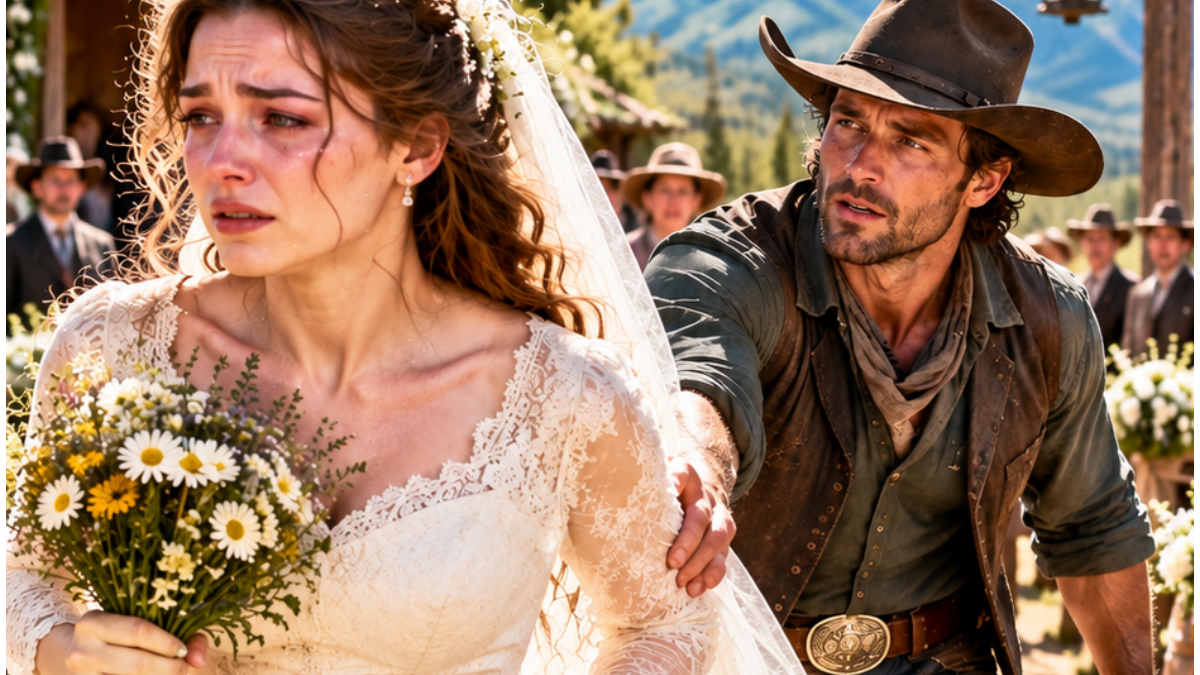
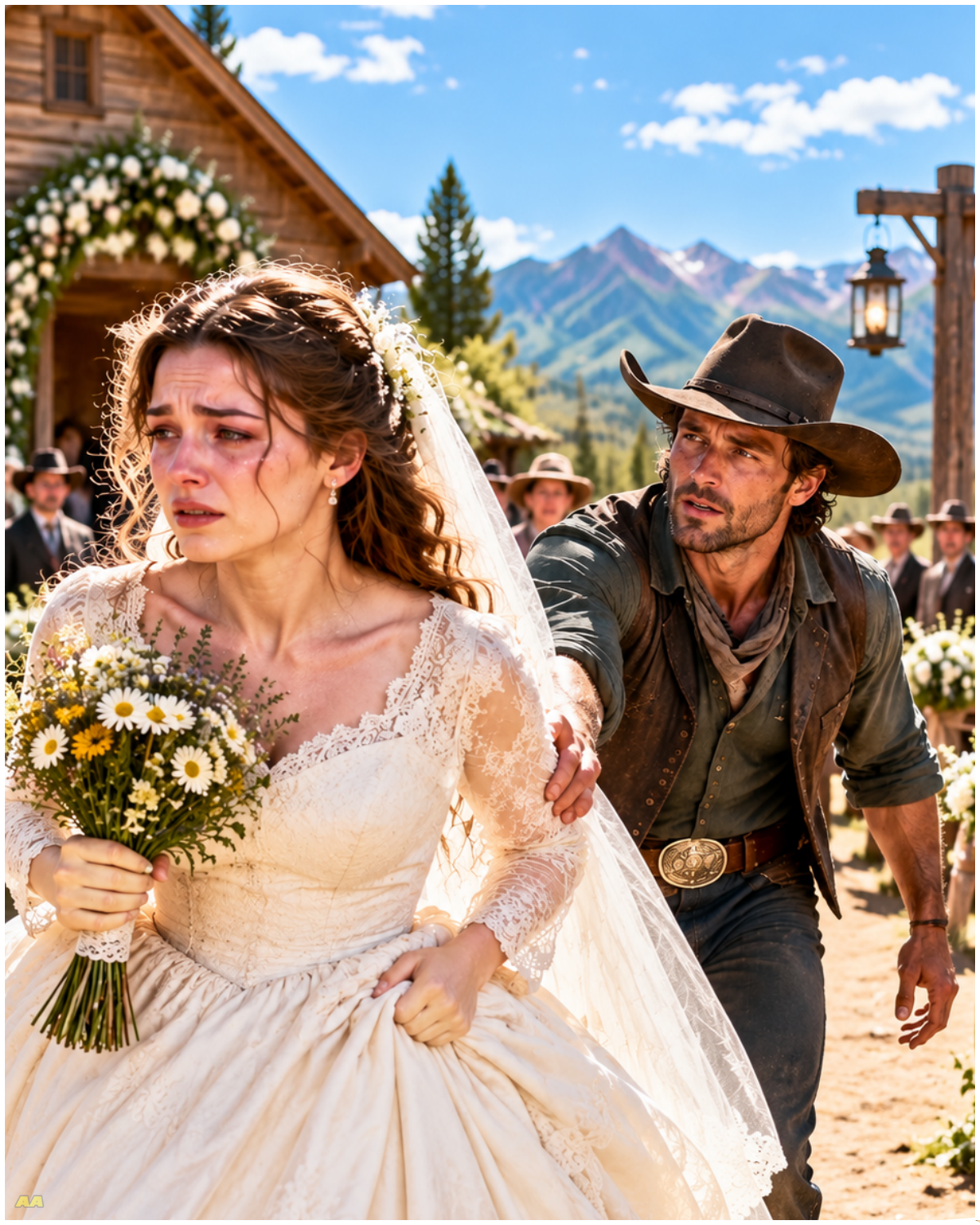
Clara Whitfield ripped the lace veil from her hair and let it fall on the church steps while the whole town of Red Willow watched.
Her groom was gone.
He’d left a letter, a ring, and a debt that would take her father’s store by Friday.
Then the poorest cowboy in Wyoming stepped out of the crowd, took off his hat, and asked her to marry him.
Everybody laughed. Nobody knew what that man was hiding or what it would cost the people laughing loudest.
Clara Whitfield counted the chimes of the church bell for the third time and knew something was wrong.
11:00 had come and gone.
Then quarter passed. Then half passed.
Behind her, 200 people shifted in the pews of Red Willow Community Church.
And every creek of the wood sounded like a question nobody was brave enough to ask out loud.
“He’s just running late,” her father whispered.
“Walter Whitfield had his good suit on.”
“The one he’d worn to her mother’s funeral, and his hand was shaking where it held her arm.”
“Edward’s a marshall. Marshalls don’t get up early for anything. It’s past 11:30. Papa, then he’ll be here at 11:35.”
Clara wanted to believe him.
She had sewn this dress herself over four months of late nights after the store closed.
Stitch by stitch under a kerosene lamp, telling herself that every hour she spent on it was an hour closer to the end of their troubles.
She was 26 years old.
She had waited a long time for this morning.
The side door opened. Every head in the church turned at once.
But it wasn’t Edward Marshall.
It was Reverend Amos Hail and he was holding something in one hand and a folded paper in the other and he would not look at her.
Clara felt it in her stomach before she understood it in her head.
Reverend Miss Whitfield. The old man cleared his throat.
Perhaps we should speak in private.
No. Her voice came out steadier than she expected.
Whatever it is, everyone here is going to know it by supper.
They might as well hear it from you.
The reverend opened his hand.
In his palm sat the gold ring Edward had shown her a month ago.
The one he’d said belonged to his grandmother.
A woman in the third pew gasped.
This was left at the parsonage this morning.
Reverend Hail said quietly. With this letter addressed to you.
Clara took the paper. Her fingers didn’t feel like her own.
She unfolded it and read the first line and then the second and then she read them again because the words wouldn’t stay still.
Clara, her father said, “What does it say?” She looked up at the crowd.
Mrs. Deline Crane was already leaning toward her sister.
The Puit boys were grinning in the back row.
Somebody near the window had started to laugh and was trying to turn it into a cough.
Clara lifted her chin and read aloud.
Clara, by the time you read this, I will be on the morning train to Cheyenne.
I have come to an understanding with Miss Lorraine Pembbrook, whose family is better suited to the Marshall name.
I trust you will be sensible about this.
You always were a practical girl, Edward.
The church went dead silent.
Then it exploded. The Pemrook girl, the railroad money, left her at the altar for a bank account.
Well, what did she expect?
A shopkeeper’s daughter marrying into the marshalss.
That last one came from Delphine Crane.
And she didn’t bother to lower her voice.
Clara folded the letter along its creases.
Slowly, the way she folded receipts at the end of the day.
Then she turned and looked straight at the woman.
I expected him to keep his word.
Mrs. Crane, that’s generally what people expect when a man gives it.
Deline’s mouth opened and closed.
Clara reached up, pulled the pins from her hair, and dragged the veil off her head.
It caught for a second on the comb, and she yanked it free, and a few people flinched at the sound of the lace tearing.
She walked down the aisle with it in her fist, past every pew and every face.
And when she reached the church steps, she let it drop.
She didn’t cry, not yet.
She had decided somewhere between the second and third reading of that letter that nobody in Red willow was going to see her cry today.
Clara, her father, was coming down the steps behind her.
Too fast. Clara, wait. Wait for me.
She turned around just in time to see his face go gray.
Walter Whitfield grabbed at his chest with one hand and at the railing with the other and missed the railing.
Papa, he pitched forward. Clara lunged, but she was too far away.
Her skirts too heavy. And she knew in that half second that he was going to hit the stone steps head firSt. He didn’t.
A man caught him. Just caught him under both arms like he’d been standing there waiting for it.
Worn brown coat patched at the elbow.
Boots that had been resold more than once.
A hat pushed back on his head and a face Clara had seen a hundred times around town without ever really looking at it.
Nathan Cole, the ranch hand from out past Coyote Creek, the one people called the poorest cowboy in Red Willow.
Usually with a laugh. I’ve got him, Nathan said.
Somebody get Doc Ror now.
Nobody moved. Nathan looked up at the crowd pouring out of the church and his voice didn’t get louder, but it got harder.
I said now. One of the puit boys took off running.
Clara dropped to her knees beside her father on the steps.
Papa, look at me. I’m all right.
Walter gasped. I’m all right.
It’s just my heart being foolish.
Your heart’s always foolish. That’s the problem.
He tried to laugh and coughed instead.
Nathan shifted him so his head rested on his own knee and loosened the collar of that good black suit with two quick fingers.
“Breathe slow, Mr. Whitfield,” Nathan said slow.
“Doc’s coming.” Walter’s eyes found Clara’s.
I’m sorry, he whispered. “I’m so sorry, Clara.
I should have told you.” “Told me what?” But Doc Roar came puffing up the street with his bag before her father could answer.
And after that, there was too much noise, too many hands, and nobody said anything that made sense until the doctor had Walter laid out on the cot in the back room of Whitfield’s general store an hour later.
Weak heart and a hard shock, Docor said, snapping his bag shut.
He needs reSt. No ledgers, no lifting, no worrying, no worrying, Clara repeated.
Doc, have you met my father?
The doctor gave her a tired look.
I’ve met the whole town, Clara.
Keep him in that bed.
When he was gone, Clara stood in the doorway of the back room with her hands pressed flat against the ruined front of her wedding dress, and for the first time that day, she let herself breathe.
It lasted about 4 seconds.
The bell over the front door jangled.
“Miss Whitfield.” The voice was smooth and thin, like oil poured over a cold skillet.
A moment of your time.
Harlon Pike, president of the Red Willow Savings and Trust,” took off his hat as he came in, which was the only polite thing he did for the rest of the conversation.
“Mr. Pike, my father just collapsed.
This isn’t the time, I’m afraid, Miss Whitfield, that time is precisely what we need to discuss.” He laid a paper on the counter and smoothed it flat with one gloved finger.
“Your father’s note. What note?” Pike raised one eyebrow.
He looked almost pleased. He didn’t tell you.
From the back room. Walter’s voice came weak and ragged.
Clara, come here. She went.
Her father had pushed himself up on one elbow and his face was wet.
Papa, what note? Last winter, he said.
When the freight costs doubled and the Hendersons never paid their account, I borrowed against the store.
$1,850. Clara sat down hard on the edge of the cot.
1800 Josiah Marshall co-signed it as a wedding courtesy.
He called it family helping family.
Walter squeezed his eyes shut.
The notes only good as long as he stands behind it.
Clara understood it all at once.
The way you understand ice cracking under your feet.
And now there’s no wedding.
And now there’s no wedding.
From the front of the store.
Harlon Pike called out cheerfully.
Mr. Marshall withdrew his signature at 9:00 this morning.
Miss Whitfield, two full hours before the ceremony.
Clara stood up so fast the cot rocked.
She walked back out to the counter.
Pike was tapping the paper.
9:00, she said. 9:00 sharp.
I have his signature on the withdrawal.
The full balance is now due.
By law, I can call it within 7 days.
Which brings us to Saturday.
You’re telling me Josiah Marshall knew his son was leaving before I ever put on this dress?
Pike smiled. I’m telling you the bank needs $1,850 by Saturday noon.
Or the bank takes the store, the stock, and the lot it stands on.
You can’t collect on a sick man the same day.
I can collect on anyone any day.
Miss Whitfield. That’s what a bank is.
He put his hat back on.
Good afternoon. The bell jangled as he left.
Clara stood alone in the store with the price tags and the sacks of flour and the jars of peppermint sticks she’d lined up herself that morning.
And she thought about Edward’s letter.
I trust you will be sensible about this.
He had known. They had all known.
Edward is his father. The banker.
They had let her walk into that church in a dress she’d sewn with her own two hands while the door was already locked behind her.
She went to the back room, took her father’s hand, and said, “I’m going to see Josiah Marshall.” Clara, “No, you don’t know what that man is.” Then it’s time I found out, she didn’t change out of the wedding dress.
She thought about it, and then she decided that if Josiah Marshall was going to look her in the eye, he was going to have to look at exactly what his family had done.
The Marshall Place sat 3 mi north of town, and Clara drove the store wagon there herself with her jaw set so tight her teeth achd.
A hired man at the gate tried to stop her.
She kept driving. Another tried at the porch.
She stepped around him. Josiah Marshall was in his study with a glass of whiskey at 2:00 in the afternoon, and when she came through the door, he didn’t even stand.
Miss Whitfield, I thought you might come.
He looked her up and down.
Still in the dress. That’s a bit theatrical, don’t you think?
You pulled your name off my father’s note at 9 this morning.
I did. You knew Edward was leaving.
Of course I knew. I bought his ticket.
He swirled the whiskey. Sit down.
Miss Whitfield. I’ll stand. Suit yourself.
He leaned back. Let me save us both some time.
You’re a smart girl. Smarter than Edward, honestly.
Which is part of why this never would have worked.
You want to know why?
I want to know how a man’s sleep at night.
Very well. Thank you. He almost smiled.
Here’s why. The Union Pacific is running a spur line through Red Willow next spring.
The depot has to sit on flat ground within a quarter mile of the main road.
There are exactly three lots that qualify.
I own two of them.
Clara felt the floor tilt.
The third, she said slowly, is my father’s store.
Your father’s store, which your father would never sell.
Not to me, not to anybody.
Stubborn old fool loved that building more than his own health.
Josiah set down his glass.
So I thought, why buy the lot when my son can marry it?
Everything a wife owns becomes her husband’s.
Tidy, legal, quiet. And then the Pembrook girl came along.
The Pemroke girl came along with $40,000 and a father on the railroad board.
Why settle for one lot when you can have the whole line?
He shrugged. Plans change, but the lot still matters.
So, I made sure the note would come due.
Clara’s hands were shaking now.
She pressed them against her skirt.
You planned this both ways.
If he married me, you’d get the store.
If he didn’t, you’d still get the store.
Now you’re thinking like a marshall.
He opened a drawer and slid out a paper.
Here’s my offer and it’s a generous one.
You signed this statement saying you broke off the engagement.
Your decision, your change of heart that keeps the Pembuks happy and keeps my son’s name clean and you sign over the lot.
In exchange, I pay off the note and your father keeps his stock and with $200, more than he’d get at auction.
Clara stared at the paper.
You want me to tell the whole territory I left him?
I want you to be sensible.
That word again. She picked up the paper, read every line of it carefully, the way her father had taught her to read any contract.
And then she tore it in half and in half again, and set the pieces down on his desk next to his whiskey.
I was sensible for 6 years, Mr.
Marshall. I was sensible when my mother died, and I took over the books.
I was sensible when your son said he’d wait for the right time to meet my father.
I was sensible in that church this morning when 200 people laughed at me.
She leaned over the desk.
I’m done being sensible. Josiah Marshall’s face didn’t change at all.
That frightened her more than if he’d shouted.
Saturday noon. Miss Whitfield, he said quietly.
And I’ll tell you something for free.
Nobody in Red Willow is going to lend you a dime.
I’ll see to it personally.
She was halfway back to town, going too fast on the rudded road when the rear wheel of the wagon hit a stone and cracked clean through the rim.
The wagon lurched. Clara grabbed the seat.
The horse spooked sideways and for one awful second she thought the whole thing was going over into the ditch.
Then it slammed down on the broken wheel and stopped dead.
Listening to one side, she sat there with the rains in her fists and her heart hammering.
And then finally, all alone on an empty road in a torn wedding dress, Clara Whitfield put her face in her hands and cried.
She didn’t hear the horse until it was almost beside her.
“Ma’am.” She jerked her head up and scrubbed at her face with the back of her wriSt. Nathan Cole was sitting on an old sorrel geling, looking not at her, but very carefully at the wheel.
I’m fine, she said. Wheels?
Not, I noticed. He swung down, crouched beside the wagon, and ran his hand along the cracked rim.
I can get you to town on it.
Won’t be pretty, Mr. Cole.
You don’t have to. I know I don’t.
He was already pulling a coil of rope off his saddle.
Hold the horse steady, would you?
She held the horse. He worked without talking, lashing the broken rim, wedging a length of wood he pulled from somewhere, testing it with his whole weight.
It took maybe 15 minutes.
He never once looked at her face, and she understood after a while that he was doing it on purpose, giving her the time to put herself back together.
When he stood up and wiped his hands on his trousers, she said, “You were at the church this morning?” Yes, ma’am.
I didn’t know you went to church.
I don’t much. He coiled the rope.
I heard about the wedding.
Thought I’d come to watch.
He looked at her then directly for the first time.
He had gray eyes, steady as flat water.
No, ma’am, not to watch.
She didn’t know what to say to that.
You went to see Josiah Marshall.
He said it wasn’t a question.
How do you know that?
This road only goes to one place.
He tied the rope to his saddle.
What did he offer you?
Clara hesitated then because she was too tired to be careful.
She told him the lot.
The railroad spur. The statement she was supposed to sign the note due Saturday.
Nathan listened to all of it without interrupting.
When she was done, he was quiet so long she thought he wasn’t going to answer.
Josiah Marshall doesn’t make offers, Miss Whitfield, he finally said.
He sets traps and calls them offers.
You sound like you know him.
Something moved behind his eyes.
There and gone. Everybody in this valley knows him, he said.
He climbed back into the saddle.
I’ll ride behind you to town.
In case the wheel doesn’t hold, it held.
He rode behind her the whole three miles and never said another word.
And when she pulled up in front of the store, he tipped his hat and turned the sorrel around and left before she could thank him.
That night, the window broke.
Clara was sitting up with her father’s ledgers at the kitchen table, trying to make $1,850 appear out of columns that barely added up to 400.
When the glass in the front of the store shattered with a sound like a gunshot.
She was on her feet with her father’s shotgun before she’d finished thinking.
In the back room, Walter was calling her name.
Stay in bed, Papa. She went through the dark store with the shotgun up.
Glass crunched under her shoes.
In the middle of the floor, among the shards lay a rock the size of a man’s fist, with a paper tied around it with twine.
She untied it with trembling fingers.
One word in block letters.
Clara didn’t sleep. She sat in a chair behind the counter with a shotgun across her knees and every lamp in the store turned down, watching the dark hole where the window had been, listening to every horse that passed.
At some point, near dawn, she must have dozed because the next thing she knew, gray light was coming through the broken window, and her neck achd.
She stood up stiffly and looked out into the street.
Across the way, sitting on the steps of the closed up feed store with his hat tipped low and a rifle leaning against his knee, was Nathan Cole.
Clara stared at him. He must have felt it because he lifted his head.
They looked at each other across the empty street for a long moment.
Then he stood up, picked up the rifle, nodded to her once, and walked off toward the livery.
He’d been there all night.
She was sure of it.
She didn’t know what to do with that.
So, she did what she always did.
She went to work. By 7, she’d swept up the glass and nailed a board over the window.
By 8, she had her plan.
If the bank wouldn’t wait, and Marshall wouldn’t bargain, then she’d sell everything that wasn’t nailed down.
Flour, coffee, cloth, tools, the good lamps, the canned peaches.
At cost if she had to, below cost if she had to.
$1,800 was impossible. But impossible was just a number that hadn’t been worked hard enough yet.
She handlettered a sign and hung it on the door.
Everything must sell. Prices cut in half.
By noon, not one customer had come through the door.
By two, Clara went out onto the sidewalk and saw why.
Half the town was on the street and every single one of them was walking on the far side.
Mrs. Puit, she called, you were asking about Blue Calico last week.
I’ve got 12 yards half price.
Mrs. Puit looked at her, looked quickly up the street, and hurried on without a word.
Mr. Tate, your boy needs boots, doesn’t he?
I’ll give you the pair at cost, mister.
Tate actually stopped. He looked miserable.
Clara, he said, “Low, Marshall’s foreman came by every house last night.
Anybody who trades with Whitfields, they lose their credit at the Marshall Mill.
I’ve got a winter’s wheat to grind.” He shook his head.
“I’m sorry. I truly am,” he walked on.
Clara stood on the sidewalk with the sun beating down on her.
And Delphine Crane passed by on the other side with her sister and Clara heard every word because Delphine made sure she did.
Shouldn’t have reached so high.
That’s all. Some people forget where they come from.
Clara went back inside and shut the door and stood with her back against it.
At 4:00, the bell jangled.
It was Hattie Bloom who took in laundry down by the creek and was probably the poorest woman in Red Willow and who walked straight to the counter with her head up like she’d been invited to tea.
“I need a sack of flour,” Hattie said.
“2 lb of coffee and that blue calico if it’s still going.” Clara’s throat went tight.
Hattie, Marshall’s people don’t do one lick of business with me anyhow.
I wash their shirts and they pay me late.
Hattie counted coins onto the counter.
Your mama sat with me three nights when my Ruthie had the fever.
You think I forgot that?
It came to $410. Clara wrapped everything up with shaking hands.
When Hattie was gone, she put the coins in the cash drawer and did the arithmetic in her head.
$410 toward $1,850. She laughed once.
It didn’t sound like laughing.
On Thursday morning, Harlon Pike came back.
He didn’t bother taking his hat off this time.
He came in with two men from the bank and a hammer.
Change in circumstances, Miss Whitfield.
You said Saturday. I did.
However, as of yesterday afternoon, the Red Willow Savings and Trust sold your father’s note.
Pike held up a paper to a private party.
The new holder has elected to exercise the early call provision.
Clara’s blood went cold. What private party?
Pike didn’t even pretend to hesitate.
Mr. Josiah Marshall in the back room.
Something fell and broke. Clara.
Walter’s voice cracked. Clara. The early call.
I didn’t I didn’t think anybody would ever use it.
What does it mean, Mr.
Pike? It means the balance is due tomorrow.
Friday noon. Pike nodded to his men.
One of them went outside and a second later, Clara heard the hammer.
Bang, bang, bang. And it means there’ll be a public auction of the property directly afterward.
Right here on the front step.
Mr. Marshall has already let it be known he’ll be bidding.
Clara went outside. The notice was nailed to her own front door, right beside her handlettered sign.
Foreclosure public auction Friday. People were already gathering to read it.
She looked at the notice for a long time and then she turned back to Pike and her voice was very quiet.
Is there any provision in that note?
Anything at all that lets us keep this building past tomorrow?
Pike looked honestly surprised to be asked.
He flipped a page with obvious boredom.
There’s a substitution clause. Standard language.
If a family member holding clear title to land of reasonable value co-signs in the original signer’s place, the note may be extended one year.
He snapped the paper shut.
Your father has no brothers.
Your mother’s people are in Ohio.
And you, Miss Whitfield, as the whole town knows, have no husband.
He smiled. I’d say that’s the end of it.
Clara went back inside and closed the door on him.
She sat up that last night at her father’s bedside.
He was worse. His breathing had a sound in it she didn’t like.
I did this. Walter kept saying, “I did this to you.
Josiah Marshall did this. Papa, I signed his paper.
I let him play family with me.
I was so proud, Clara.
So proud that my girl was going to be a Marshall.” His hand tightened on hers.
“Your mother would have seen through him in a minute.
Mama would have hit him with a skillet.” He laughed weakly and it turned into a cough and she held him until it passed.
“Whatever happens tomorrow,” he whispered.
“You don’t sign anything for that man.
You hear me? Let him take the building.
Don’t let him take you.
I won’t. Papa, I promise.” Friday came up clear and hot.
By a/4 to 12, there were more people in front of Whitfield’s general store than there had been in the church.
Clara stood on the porch in her plain gray work dress with her hands folded.
Because she had decided that if she was going to lose everything, she was going to stand there and watch it happen with her back straight.
Josiah Marshall arrived at 10 minutes to 12 in a black buggy and people moved out of his way.
He climbed the steps and stood next to her like they were old friends.
“Last chance, Miss Whitfield,” he murmured.
My offer still stands. The statement and the lot and your father walks away with $200.
At auction, he gets nothing.
You heard my answer on Monday.
I heard a girl who’d had a bad morning.
I’m giving the woman a chance to reconsider.
The woman’s answer is the same.
Josiah sighed like a disappointed school teacher.
Then we’ll do it the hard way.
Harlon Pike checked his pocket watch, climbed onto the step, and raised his voice.
Ladies and gentlemen, it is now 12:00 noon.
The balance of $1,850 on the note held against this property has not been paid.
By the terms of, is the substitution clause still open?
The voice came from the back of the crowd.
Not loud, it didn’t have to be.
Every head turned. Nathan Cole was standing at the edge of the street with his hat in his hand.
Same patched coat, same resold boots.
The crowd opened up in front of him the way it had for Marshall’s buggy.
Except that this time people were staring and a few of them were already starting to snicker.
Pike squinted. What did you say?
The substitution clause, Nathan said.
Walking forward, a family member holding clear title to land co-signs.
And the note extends a year.
Is it still open? It is, Pike said slowly.
Until the hammer falls. Why on earth would you?
Because I hold clear title to 320 acres out past Coyote Creek.
Somebody in the crowd laughed out loud.
That dust patch, coal, that ground won’t grow weeds.
Doesn’t have to grow anything, Nathan said without taking his eyes off Pike.
Claus says, “Land of reasonable value.
It’s surveyed. It’s registered. It’s paid for.
You can check the territorial office.” Pike’s face had changed.
Clara saw it. Just for a second, the banker looked at Nathan Cole like he was trying to remember where he’d seen him before.
Josiah Marshall stepped forward. This is absurd.
The clause requires family. Cole’s no more related to the Whitfields than my horse is.
Not yet, Nathan said. And then he turned and looked up at Clara on the porch.
The whole street went so quiet she could hear the flag rope slapping against the pole in front of the bank.
Nathan came to the foot of the steps.
He held his hat against his chest with both hands.
The way a man does in church, Miss Whitfield, he said, I cannot give you the wedding you loSt. I haven’t got a church full of people who’d come for me or a ring that belonged to anybody’s grandmother.
But I can give you a home where no one will ever make your decisions for you.
Not Marshall, not the bank, not me.
A woman somewhere gasped. Delphine Crane said, “Well, I never loud enough for three streets to hear.
Is this a joke?” Someone called the poorest cowboy in the county proposing to the girl nobody wanted.
Laughter rolled through the crowd, ugly and loud.
Nathan didn’t even turn his head.
He kept his eyes on Clara.
You don’t have to answer me in front of all these people, he said.
Softer now just for her.
But the hammer’s about to fall.
And I’d rather you had the choice than didn’t.
Josiah Marshall laughed. Oh, this is rich.
Go ahead, Miss Whitfield. Marry the man with the dirt ranch.
Save your precious store. See how long you last out there before you come crawling to me.
Clara looked down at Nathan Cole.
She thought about the stone steps of of the church and how he’d caught her father before she could.
She thought about the broken wheel and how he’d never once looked at her face while she cried.
She thought about the gray light of morning and a man sitting on the feed store steps with a rifle across his knee who had never said a word about it.
4 days ago, she had walked into a church, ready to marry a man who’d already bought his ticket out of town.
This man was standing in the open in front of the whole town with his hat in his hands, getting laughed at for her.
“Why?” she asked him. Her voice broke on it just a little.
“Everyone here thinks I’m worth nothing.
Why would you do this?” Nathan was quiet for a second.
Because on Monday when that letter was read, 200 people looked at you, he said.
And you were the only one in that whole church who didn’t look away.
Clara pressed her hand against her mouth.
Harlon Pike cleared his throat.
His voice wasn’t quite as smooth as it had been.
Miss Whitfield, I need an answer.
The clock is running. Josiah Marshall leaned in close to her ear.
Think very carefully. That man has nothing.
You’ll lose the store in a year instead of today and you’ll be stuck with him for the rest of your life.
Clara straightened her back. She stepped away from Josiah Marshall, walked down the porch steps one at a time, and stopped in front of Nathan Cole, close enough to see that his hands were holding that hat a little too tight.
“Mr. Cole,” she said loud enough for every person on that street to hear.
Before I give you my answer.
You’re going to hear my conditions.
Nathan didn’t blink. Yes, ma’am.
First, Clara held up one finger and she was surprised to see it wasn’t shaking.
Honesty, whatever this is, whatever it turns into.
You never lie to me.
Not once. I’ve had enough of men who smile at me and lie.
Agreed. Second, separate rooMs. Someone in the crowd whooped.
Nathan didn’t even glance that way.
Agreed. Third, no pretending. I’m not going to act like some blushing bride for the benefit of this town.
They watched me get thrown away on Monday.
They can watch me make a business arrangement on Friday.
Agreed. Fourth. Her voice dropped.
No control. The store stays in my name and my father’s.
My money stays my money.
My decisions stay mine. The day you try to tell me what I can and can’t do, I walk out and I don’t care what the law says a husband is owed.
Nathan turned his hat once in his hands.
Then he said, “Miss Whitfield, I already told you that part.
I meant it.” Clara stared at him.
She had braced herself for bargaining, for a smirk, for a we’ll see about that, for the little flicker in a man’s eyes that meant he was agreeing now and planning to collect later.
Edward had had that flicker every times she’d asked him for anything.
Nathan Cole just looked tired and patient and completely serious.
Then yes, she said. The street went wild.
Half of Red Willow was laughing and the other half was shouting over them.
And through all of it, Clara heard Josiah Marshall’s voice cut in like a whip.
Pike, this is a sham, and you know it.
Harlon Pike had gone a strange color.
Sham or not, Mr. Marshall.
The clause only requires a lawful marriage and clear title.
If the reverend performs the ceremony, and Mr.
Cole’s deed is in order.
Reverend Hails standing right there.
Somebody yelled, “Do it now.” The old preacher pushed through the crowd read in the face.
“I will not rush a sacred Reverend.” Clara turned to him.
“On Monday, you held a ring in your hand and told me a man had left me.
Today, a man’s asking to stay.
Please. Reverend Hail looked at her for a long moment.
Then he took off his spectacles, wiped them on his sleeve, and said, “Walter should be here.
He can’t walk that far.
Then we’ll go to him.” So Clara Whitfield was married for the second time that week in the back room of her father’s store, standing beside a cot with Hattie Bloom as witness, and half the town jammed into the front room, trying to see through the door.
Walter Whitfield held her hand the whole time and cried without making a sound.
Nathan didn’t have a ring when the reverend asked for one.
There was an awful pause.
Then Nathan reached into his vest pocket and took out a plain band of hammered silver old worn thin at one side.
“It was my mother’s,” he said quietly.
“It’s not much,” Clara looked at it.
Then she held out her hand and he slid it on and it fit like it had been waiting for her.
By the authority vested in me by the territory of Wyoming, Reverend Hail said, “I now pronounce you man and wife.” Nobody said, “Kiss the bride.” Nathan didn’t try.
He just nodded to her once like they’d shaken hands on a horse trade.
And Clara felt something in her chest she didn’t have a name for yet.
In the front room, Harlon Pike had Nathan’s deed spread out on the counter.
The whole crowd watched him read it.
He read it once. Then he read it again.
Then he turned it over and read the back and his thin mouth tightened.
“Well,” Josiah demanded. “It’s in order,” Pike said.
“That dirt patch, it surveyed, registered, and paid in full.” Pike wasn’t looking at Marshall.
He was looking at Nathan and there was something careful in his face now.
Almost wary. Assessed at considerably more than the note.
Assessed by who? That land hasn’t grown a blade of grass since.
By the territorial assessor’s office in Cheyenne.
Mr. Marshall Pike dipped his pen.
Mr. Cole sign here. Nathan signed.
Pike blotted it, stamped it, and said in a voice that made the whole room go silent.
The note is extended one year.
The auction is cancelled. Clara didn’t hear what the crowd did after that.
She only saw Josiah Marshall walk up to Nathan very slowly until they were face to face.
I don’t know what game you think you’re playing.
Cole, Marshall said, “Lo, but I’ve buried men with more land than you.” Nathan looked at him the way he’d looked at the broken wagon wheel.
Like a problem to be sorted out.
I know, Josiah. He said, “I was there for one of them.” Marshall’s face went white just for a heartbeat.
Then he turned and shoved his way out the door, and the bell jangled so hard it nearly came off its hook.
Clara grabbed Nathan’s sleeve. “What did you mean by that?” He looked down at her hand on his arm, then at her face.
“That’s a long story,” he said.
“And you’ve had a long week.
You promised me honesty.” I did and I’ll keep it.
He met her eyes. I’m not lying to you.
Clara, I’m asking you to let me tell it at the right time.
It was the first time he’d said her name.
She let go of his sleeve.
That evening, after Hattie promised to sit with Walter, and after Clara packed one carpet bag with everything she owned that mattered, Nathan drove her out past Coyote Creek in a buck board that rattled so badly she had to hold on with both hands.
People said it’s a dust patch, she said after two miles of silence.
People say a lot of things, is it?
He thought about it. Depends what you’re looking for.
When they pulled up, she saw what everybody in town had seen for years.
A plain house, a roof that needed shingles, a porch step that sagged.
She had braced for worse, and she felt oddly relieved.
At least this finally was exactly what it looked like.
Then she walked into the barn.
It was cleaner than her father’s store.
Every harness hung on its own peg oiled.
Every stall mucked out. And the horses.
Clara had grown up selling feed to every rancher in the county.
And she knew horse flesh.
These were not a poor man’s horses.
There was a gray mayor in the end stall that would have fetched $300 in Denver without anybody haggling.
Mr. Cole, Nathan. She turned around.
Whose horses are these? Mine?
All of them? All of them?
That mayor’s worth more than your house?
He glanced at the mayor and something almost like a smile crossed his face.
She’d agree with you. Before Clara could answer, a boot scraped behind her.
A big gray bearded man stood in the barn door with a lantern and behind him a lanky boy of maybe 17.
Evening, boss. The older man said.
Then he saw Clara and snatched off his hat so fast he almost dropped the lantern.
Ma’am, evening ma’am. You’d be that is congratulations ma’am.
This is Gus Harlo. Nathan said and that’s Tommy Reyes.
Gus Tommy. This is Mrs. Cole.
Clara felt the name land on her like a hand on her shoulder.
Pleasure. Mrs. Cole, Tommy said bright red to the ears.
We fixed up the east room for you like the boss said.
Gus put a lock on the inside of the door.
Tommy Gus growled. What? He said to Clara looked at Nathan.
He was studying the barn rafters very hard.
You put a lock on my door.
She said slowly before I even said yes.
I figured if you did say yes, Nathan said you’d want one.
She didn’t know what to do with that either.
So she said good night and went into the east room and turned the lock and sat down on a bed with clean sheets that smelled like sun and stayed awake a long time.
Listen to a man walk quietly through a house that wasn’t hers yet and pull the door of his own room shut without once stopping at hers.
In the morning, the ledgers were waiting.
She’d brought her father’s store books in the carpet bag, and she’d meant to work on them before breakfaSt. When she came out to the kitchen, they were already on the table stacked neatly, and beside them was a plate of eggs and biscuits and a cup of coffee going cold, and nobody in the house.
She found Nathan in the corral, working a young horse on a lead line.
You made breakfaSt. You’d have forgotten to eat.
You don’t know that. He didn’t look away from the horse.
You were up till 2 with a lamp on.
Nobody who works till two remembers breakfaSt. You were awake till tutu didn’t say that.
Clara crossed her arMs. Nathan the horse circled.
He let out more line.
House is quiet. Light comes under the door.
She went back inside and ate every bite of those eggs.
And then she opened her father’s ledger to figure out how they were going to pay off $1850 inside of a year.
And for 3 days, she barely looked up.
On the fourth day, she found it.
She had asked Pike’s clerk for a copy of the full note, and she was going through the interest calculations line by line, the way her mother had taught her when the numbers stopped adding up.
She did them again and again.
Then she went out to the corral with the paper in her fiSt. Nathan, look at this.
He came over pulling off his gloves.
She pointed. The note says 8% a year.
Simple interest, but Pike’s been compounding it monthly since the day papa signed.
Look, every month the interest goes on top of the intereSt. Her finger was shaking with anger.
Now, not fear. And there’s a fee here.
Guarantor’s service fee. $40 a quarter.
Paid to the bank, then paid out again.
Paid out to who? It doesn’t say.
But I’ll bet you this whole ranch, it went into Josiah Marshall’s pocket.
She looked up at him.
Papa didn’t owe $1,850. He owed $1638.
They patted it by $212.
Nathan looked at the paper for a long time.
Then he looked at her in a way no man had ever looked at her.
Not like she was pretty, not like she was useful, like she’d surprised him.
You found that in three days, he said.
For Clara men have signed notes with Haron Pike for 11 years.
Nobody ever found that. Nobody ever sat down and did the arithmetic.
No, he said slowly. Nobody ever did.
She rode to town that afternoon in the buck board with the paper in her lap.
Went straight into the red Willow Savings and Trust and set it on Harland Pike’s desk in front of two customers and his clerk.
You overcharged my father $212, she said.
Illegal compounding and a guarantor’s fee that went to a guarantor who had already withdrawn.
I want it corrected in writing today or I take this to the territorial bank examiner in Cheyenne.
And I tell him to go through every note you’ve written since 1,875.
Pike’s clerk dropped his pen.
Pike looked at the paper.
His face didn’t move, but his hand went flat on the desk.
This is a misunderstanding, he said.
Then understand it. He stared at her.
She stared back. The two customers had stopped pretending not to listen.
I’ll have a corrected note drawn up by Monday, Pike said finally.
By 4:00, a long cold pause.
By 4:00, Pike said. When she walked out, Hattie Bloom was on the sidewalk with a basket of wash on her hip, and she’d heard every word through the open door.
She grinned so wide her face nearly split.
“Well, look at you, Mrs. Cole.” By supper time, it was all over Red Willow.
The girl who’d been left at the altar had walked into the bank and made Harland Pike back down.
That was when Josiah Marshall stopped being polite about it.
On Monday, the freight wagon from Cheyenne didn’t come.
Clara had ordered her fall stock the week before the wedding.
Flour, sugar, coffee, kerosene, nails, wool.
Without it, the store would be empty by the first snow.
And an empty store in winter was a dead store.
She walked down to the freight office.
Cancelled, the agent said, not meeting her eyes.
I didn’t cancel it. Supplier canled.
Said Whitfield’s credit wasn’t good no more.
Our credit’s been good for 19 years.
Not since, Mr. Marshall wrote to him.
It ain’t. The agent winced.
Sorry, Mrs. Cole. He’s their biggest account in the territory.
They ain’t going to cross him over one little store.
Clara walked back to the store and sat down on a flower barrel that was nearly empty.
And for the first time since the church steps, she didn’t have a plan.
Nathan found her there an hour later.
He driven in for nails.
What happened? She told him.
He listened the way he always did, without interrupting, his thumb running slowly along the brim of his hat.
“How much was the order?” he asked.
“$460.” “It doesn’t matter. There’s no other supplier west of Omaha that’ll ship to Red Willow on account.
Can I see the list?” She handed it to him without thinking.
He read it, folded it, and put it his coat.
Nathan, what are you doing?
Going to the telegraph office to send what?
Who are you going to wire?
A man I used to work for.
He put his hat on.
Don’t count on it. But don’t sell the empty barrels yet either.
9 days later, the freight wagon came.
Not the Cheyenne wagon. A bigger one from Denver with a six mule team and a driver who climbed down in front of Whitfield’s general store and asked for Mrs. Clericole.
That’s me. Freight for you, ma’am.
Paid through. Paid by who?
The driver checked his bill of lighting.
Account holders just initials. NCW Denver office.
He handed her the paper.
Where do you want the flower?
Clara looked at the bill.
Flour, sugar, coffee, kerosene, nails, wool, everything on her liSt. Down to the last spool of thread.
And at the bottom, a notation she read twice.
Standing order monthly until further notice.
NCW, she turned around. Nathan was on the sidewalk helping Tommy unhitch the buckboard and he did not look up that night at the supper table.
She set the bill of lighting in front of his plate.
Who is N? CW Nathan looked at it.
Then he picked up his fork.
The man I used to work for, you wired him once and he sent $460 of freight.
Paid through standing order. He owes me a favor.
That’s a big favor. I did him a big one.
What kind of favor? He took a bite of potatoes and chewed a long time.
Across the table, Gus had suddenly gotten very interested in his coffee.
And Tommy was looking back and forth between the two of them like he was watching a horse race.
“You said,”Lara said, that you would never lie to me.” “And I haven’t.
You haven’t told me the truth either.” Nathan set his fork down.
He looked right at her.
Clara, did I say anything tonight that wasn’t true?
She thought back. Every word.
The man he worked for the favor.
The Denver office. No, she admitted.
Then give me some time on the reSt. It’s not what you think.
You don’t know what I think.
I know you think I’m hiding something, are you?
The science went on long enough that Tommy finally pushed back his chair and said, “I’m going to go check the uh the thing in the barn.” And Gus said, “I’ll help.” And they were both out the door in about 3 seconds.
Nathan didn’t look away. “Yes,” he said.
It was the plainest answer anyone had ever given her.
“And somehow it scared her more than any lie.
Is it going to hurt me?” she asked quietly.
I hope not. He stood, picked up his plate.
I’ve been trying pretty hard to make sure it doesn’t.
He washed his plate and went out to the barn.
And Clara sat alone at the table with the bill of lighting and her mother’s silver ring on her finger, trying to decide whether she was angry or afraid or something else altogether.
She decided finally that she’d watch.
She’d been fooled once by a man who talked.
This one hardly talked at all, so she would watch what he did.
And over the next weeks, what he did was show up.
He came into town on the days she ran the store alone and fixed the shelves that had sagged since before her mother died.
He rehung the door that stuck.
He replaced the window Marshall’s men had broken and put a bar she could drop across it at night.
He never mentioned it afterward.
She’d just come in one morning and something would be fixed.
When Walter got strong enough to sit in a chair, Nathan drove him out to the ranch on Sundays and let him sit on the porch and complain about the price of beef and listened to every word like it was news.
I like him, Walter told her on the third Sunday.
Lo, while Nathan was at the pump, you liked Edward.
I like the Marshall name.
That’s not the same thing.
Her father watched Nathan fill the water bucket.
That one doesn’t say much.
But he’s never once made you smaller to make himself look bigger.
You notice that? She had noticed.
She noticed other things, too.
She noticed that the grocery money in the kitchen tin never ran out, no matter how much she took.
She noticed that Gus and Tommy were paid every Saturday in silver, never late, never short, which was more than half the ranch hands in the county could say.
She noticed that when Nathan gave an order, Gus didn’t argue.
And Gus argued with everybody.
She noticed that the pantry held enough flour and salt pork and canned goods to feed a family of six through the worst winter Wyoming ever had.
And when she asked about it, Nathan said, “Winters get long and nothing else.” And she noticed one Tuesday evening that she’d started waiting for the sound of his horse coming up the road.
She didn’t like noticing that.
It was on a Thursday in late October when Edward Marshall walked into her store.
Clara was on a ladder stocking the top shelf with canned peaches.
She heard the bell jangle, turned around and nearly dropped the can in her hand.
Same fine coat, same golden hair, same easy smile he used to give her across this very counter back when she thought it meant something.
Hello Clara. She came down the ladder very slowly.
The train to Cheyenne must run both ways.
It does. He took off his hat and turned it in his fingers.
And for a second, she saw something almost uncertain in his face.
Can we talk? You can talk.
I’m working. Clara, please. I owe you an apology.
You owe my father a heart.
Start there. He flinched. I heard he was ill.
I’m sorry. Are you? I am.
He set his hat on the counter.
Things with Lorraine didn’t. Her family and mine had different ideas about who was marrying whom.
Let’s leave it at that.
I came back to Red Willow on Tuesday and it took you until Thursday to remember where I work.
I came to tell you I made a mistake.
He leaned on the counter, lowered his voice.
Clara, I know about the arrangement with Cole.
Everybody knows separate rooms, a business contract, not a real marriage.
Her whole body went cold.
Who told you that? It doesn’t matter.
It matters to me. Edward smiled gently the way you’d smile at a child.
A marriage that isn’t a marriage can be enulled.
Clara quietly. My father’s lawyer says it’s simple.
And once it’s enulled, he reached across the counter and touched her hand.
We can start again. The way it was supposed to be.
She pulled her hand back like his fingers were hot iron.
The way it was supposed to be, she repeated.
You mean the way your father planned it.
You marry me, he gets the lot.
Edward’s smile slipped. Oh, I know about that, Edward.
Your father told me himself.
Sitting behind his whiskey at 2:00 in the afternoon.
While I stood in front of him in a wedding dress I’d sewn with my own hands, she came around the counter.
Did you know that morning when you bought your ticket?
Did you know he was pulling his name off Papa’s note 2 hours before the ceremony?
Clara, did you know he didn’t answer?
He didn’t have to. Get out of my store.
Edward’s face hardened. And for the first time, she saw his father in it.
You’re making a mistake. My father’s lawyer is filing the petition with the territorial court on Monday.
No consummation. No marriage. No marriage.
No family co-signer. No cosigner.
No extension. You’ll lose this store in a week.
Clara. And you’ll lose that cowboy with it.
And then where will you be?
The bell jangled. Nathan was standing in the doorway.
Clara didn’t know how long he’d been there.
From the look on his face long enough.
Edward straightened up. He was a head taller than Nathan, and he knew it.
And he looked him over from his patched coat to his rizled boots and let a slow smile spread across his face.
Cole, I was just telling my your wife about the court petition.
I heard Nathan walked in and said a sack of nails on the counter like Edward wasn’t there.
Clara Gus wants to know if you need anything from the merkantile.
Did you hear me? Cole, your little arrangement is finished.
Separate rooms don’t make a marriage.
Nathan turned around slowly, Edward.
He said, “You stood this woman up in front of 200 people and didn’t have the nerve to say it to her face.” “You wrote a letter.
You left it with a preacher.
He took one step closer.
He didn’t raise his voice.
What happens in my house is between me and my wife.” “Not you, not your father, not his lawyer.
The court will. The court will do whatever the court does.
And whatever it does, I’ll still be standing here.
He tipped his head toward the door.
You’ll want to go now.” Edward looked at Clara.
Whatever he was looking for in her face, he didn’t find it.
He picked up his hat and walked out without another word.
And this time, the bell barely made a sound.
The store was very quiet.
Clara’s hands were trembling. She pressed them together.
“Somebody told them,” she whispered.
“About the rooMs. about the lock.
Nobody knows that but us and she stopped.
Gus and Tommy Nathan finished.
I don’t believe it. Neither do I.
His jaw was tight. But somebody talked.
If Marshall’s lawyer gets that petition in front of a judge I know we’ll lose the store, Nathan.
And you’ll have put your land on the line for nothing.
He turned and looked at her and his voice went softer than she’d ever heard it.
It wasn’t for nothing, Clara.
Whatever happens Monday, it was never for nothing.
She wanted to ask him what he meant.
She wanted to ask him a dozen things, but he picked up the sack of nails, said he’d see her at supper, and went out, and she stood there with her heart pounding.
That night, she didn’t sleep.
She lay in the east room with the lock turned and listened to the house.
Close to midnight, she heard horses, not one, two, coming up the ranch road, slow and careful, the way people ride when they don’t want to be heard.
Clara got up, pulled her shawl around her shoulders, and went to the window.
In the dark yard, Nathan was already outside, a lantern in his hand.
He hadn’t gone to bed either.
Two men on good horses rained in in front of him.
One of them swung down.
Even in the weak light, she could see his clothes were expensive.
His boots polished, the kind of city coat nobody in Red Willow owned.
The stranger’s voice carried in the cold air, clear as a bell.
Forgive the hour, sir. I came as soon as the wire reached Denver.
He took off his hat.
The Marshall petition is worse than we thought.
Mister Whitaker, we need to talk about what you’re prepared to reveal.
Clara’s hand froze on the window glass.
Nathan turned his head slowly and looked straight up at her window.
Clara didn’t wait for him to come to her.
She was down the stairs and out the kitchen door before she decided to move.
Her shaw shaw slipping off one shoulder, her bare feet on the cold boards of the porch.
Clara Nathan’s voice was low.
Go back inside. Who is this man?
Stranger in the city coat looked from her to Tathan and back again.
And whatever he saw made him take a careful half step backward.
Ma’am, he said Lawrence Avery.
I apologize for the hour.
He called you mister Whitaker.
Clara said, looking only at her husband.
I know what he called me.
Then tell me why. The second rider hadn’t dismounted.
He sat his horse in the dark and said nothing at all.
Like a man who’d been told to keep his mouth shut and was glad of the instruction.
Nathan set the lantern on the porch rail.
For a long moment, he didn’t speak, and in that silence, Clara heard her own heart louder than the horses.
“Lawrence is the attorney for the man I used to work for,” Nathan said finally.
“He came because of Marshall’s petition.
That isn’t an answer. It’s part of one.
You promised me honesty, and I’m giving it to you.
Every word I’ve said tonight is true.” He took a breath.
Clara, I’m asking you for 5 days until the hearing’s done.
Then I’ll sit down at that kitchen table and tell you everything start to finish and I won’t leave anything out.
Why 5 days? Why not now?
Because if I tell you now, you’ll have to decide what you think of me in the middle of a fight.
And I’d rather you decide it when nobody’s trying to take anything from you.
She stared at him. Lawrence Avery was studying his own boots.
You’ve been deciding a lot of things for me, she said quietly.
For somebody who promised he never would, that hit him.
She saw it land. His jaw tightened and he looked away toward the dark barn.
And for the first time since she’d known him.
Nathan Cole looked like a man who didn’t know what to say.
5 days, she said, not six, she went back inside.
She turned the lock on the east room and she lay on the bed with her eyes open until the sky went gray, listening to two men talk in low voices at her kitchen table and never once catching a word.
In the morning, Tommy Reyes was waiting for her at the foot of the stairs.
His face was blotchy like he’d been crying and scrubbing at it.
Gus stood behind him with his arms folded and a look on his face Clara had never seen there.
Nathan was at the stove with his back to all of them.
Mrs. Cole, Tommy said, his voice cracked.
It was me, Clara stopped on the last step.
The rooms, the lock. What I said that first night?
I told Marshall’s foreman he was shaking.
Mr. Dade came by the creek 3 weeks ago.
He said he’d heard things and he just wanted to know if they was true.
And he said he’d pay Doc Ror’s bill for my mama if I told him.
$40. She’s been coughing since August and I didn’t.
He swallowed hard. I didn’t know it was going to be a court thing.
I swear to God, I didn’t know.
Gus made a sound in his throat like a bull getting ready to charge.
19 years I’ve worked this ranch.
19 years and nobody ever sold out this outfit.
Gus. Nathan didn’t turn around.
Bossy, I said. Gus. The old man shut his mouth.
Nathan set the coffee pot down, turned, and walked over to Tommy.
The boy flinched like he expected to be hit.
“Why didn’t you tell me about your mother?” Nathan asked.
Tommy blinked. “What? She’s been sick since AuguSt.” “You’ve been working for me everyday since AuguSt.” “Why didn’t you tell me?
I didn’t want charity.” Sir, it’s not charity when it’s your own outfit.
Nathan put a hand on the boy’s shoulder.
Doc works bill gets paid today by me and whatever Dade gave you.
You give it back to him to his face.
Tommy stared at him. You ain’t firing me.
You made a mistake. You told the truth about it.
You don’t fire a man for that.
Nathan glanced at Clara. Just for a second, you fire a man for lying about it.
He went back to the stove.
Clara stood on the bottom step with her hand on the rail.
She had watched a lot of men handle a lot of problems in her author’s store, and she had never seen one handle a thing like that, and she thought he’d forgive a boy who sold him out.
So why won’t he trust me with his own name?
The next four days came at her like a flood.
On Tuesday, a cattle buyer rode in from Omaha and spent an hour in Nathan’s office with the door shut.
When he came out, he shook Nathan’s hand with both of his own and called him sir three times on the way to his horse.
On Wednesday, two letters came with the mail.
Clara brought them in. Both were thick and heavy and sealed in red wax and both had the same printed return.
Avery Collins and Hart, attorneys at Law, Denver, Colorado, both were addressed to NC Whitakeresque.
She put them on the kitchen table.
Nathan came in, saw them, saw her face, and slid them into his coat without opening them.
Four days left, she said.
I know. On Thursday, she drove into town alone to open the store.
And Harlon Pike was waiting on her front step.
Harlon Pike on her step with his hat in his hand.
Mrs. Cole, good morning. He cleared his throat.
I wanted you to know the corrected note is filed and that the bank would be very pleased to extend any additional credit your husband might require for the ranch or for the store at a preferred rate.
Clara looked at him for a long moment.
Two weeks ago, you nailed a foreclosure notice to that door.
Circumstances change. Mrs. Cole, what circumstances, Mr.
Pike? He opened his mouth.
Shut it. Put his hat on.
Good day, Mrs. Cole. By noon, she had heard the rumor three times.
Delphine Crane was telling everybody who’d listened that Nathan Cole had robbed a train in Colorado back in 78 and was hiding the money out on that dust patch.
And that Clara Whitfield had married a road agent to save her daddy’s store.
“And wasn’t that just like a shopkeeper’s daughter?” “She’s a vicious old hen,” Hattie Bloom said, folding towels on the store counter.
Don’t you pay her one bit of mind, Hattie?
Clara was staring at the ledger without seeing it.
Do you think my husband’s a thief?
Hattie stopped folding. Honey, I think your husband’s the only man in this town who ever paid me for laundry the same day I brought it.
She came around the counter.
Whatever that man’s hiding, it ain’t meanness.
I’ve washed enough shirts to know what a mean man’s collars look like.
Clara laughed. It came out wet.
Three more days. She said she never got them.
It came on Friday afternoon, 2 days before the hearing.
On a hot, dry wind out of the southweSt. Clara was in the kitchen when Tommy came tearing across the yard, hollering so loud she dropped the pan in her hands.
Fire boss, fire in the south pasture.
She ran to the porch.
Nathan was already coming out of the barn at a dead run.
Gus behind him. Both men grabbing wet burlap sacks off the rail.
How big? Nathan shouted. Big and it ain’t no light.
Boss, there ain’t a cloud in the sky.
I seen two riders headed for the Marshall line.
Nathan went very still just for one heartbeat.
Then he was moving again.
Gus, get the horses out of the south barn and run them to the creek.
Tommy the plow team cut a fire break along the ridge.
Now go, Nathan. Clara was down the steps.
What do I do? He grabbed her by both arMs. His face was close to hers and she saw something in his eyes she had never seen there.
Fear. Real fear. And not for the ranch.
You take the buck board and you go to the creek and you stay there.
I can help, Clara. Go to the creek, please.
His voice broke on the last word.
I can’t do this and worry about you too.
Then he let go and ran toward the smoke.
She got as far as the buckboard.
She had her hand on the seat when she remembered the deed.
The one Pike had read, the one Nathan had signed against her father’s note.
It was in his office in the tin box on the shelf.
If that deed burned 2 days before a court hearing, Marshall’s lawyer wouldn’t even need the petition.
There’d be no proof of clear title.
No title, no co-signer. The store would be gone by Monday and the land along with it.
Clara turned around and ran into the house.
The smoke was already coming in through the windows on the south side.
Thick and stinging. She pulled her apron up over her mouth and nose and pushed through Nathan’s office door.
The tin box was right where she’d seen it.
She grabbed it and it was heavier than she expected.
And she turned and her elbow caught the shelf.
The whole shelf came down.
Ledgers, account books, a second box, a big iron one she’d never noticed behind.
And the tin with a lock that had been left hanging open.
It hit the floor and burSt. And paper went everywhere.
No, no, no. She dropped to her knees and started scooping.
She didn’t know what was important and what wasn’t.
She just grabbed shoving papers into her apron, into the tin box, into her arMs. Her eyes were streaming.
She couldn’t breathe. The window glass on the south wall cracked from the heat.
She heard someone screaming her name.
Then Nathan was in the doorway, black with smoke, and he didn’t say a word.
He just scooped her up, papers and box and all, and ran.
They came out onto the porch coughing and he carried her all the way across the yard before he put her down.
And then he held on to her shoulders so hard it almost hurt.
I told you to go to the creek.
The deed. She was coughing so hard she could barely talk.
The deed was in there, Nathan, for the hearing.
Without it, I don’t care about the deed.
You have to care. It’s the only thing standing between my father and Clara.
He was shaking. His whole body was shaking.
I have copies of that deed in Cheyenne and Denver and a vault in Omaha.
I don’t have a copy of you.
She stared up at him.
Behind them, Gus was yelling.
The wind had shifted. Tommy’s fire break had held along the ridge, and the fire was turning back on itself, starving on the plowed dirt.
Somewhere over by the creek, the horses were screaming, but they were alive.
Nathan let go of her shoulders slowly.
He looked down at the papers spilling out of her apron at the iron box in the dirt, lid hanging open, and his face went completely empty.
Clara looked down too. The top sheet was a survey map not of 320 acres of something so large it took up the whole page and ran off both edges.
Township numbers. She recognized sections along the Laram, along Coyote Creek, along the ridge where the railroad surveyors had been working all summer.
Stamped across the top in red ink, Whitetaker Land and Cattle Company.
Under it, in a clerk’s neat hand, sole proprietor, Nathaniel Cole Whitaker, Clara’s fingers went numb.
She picked up the next paper, a contract with the Union Pacific Railroad.
Right of way. Signed and dated a year ago.
The next one, a deed, then another, then a other, then a bank statement from the First National Bank of Denver with a balance she had to read three times because she’d never seen a number that long written down in her life.
Clara Nathan said she held up one hand without looking at him.
He stopped. She kept going.
She couldn’t stop. It was like reading Edward’s letter all over again.
The words sliding around on the page refusing to hold still.
Stock certificates. A standing freight order signed N.
CW property along the Plat property in Denver.
Thousands and thousands of acres all under one name.
And then at the very bottom, a yellowed newspaper clipping folded small and soft from being handled too many times.
Cheyenne Leader, June 1,869. Rancher found dead Samuel Whitaker, formerly of Red Willow, was discovered in his barn Tuesday morning, two weeks after losing his claim on Coyote Creek to his former partner, Josiah Marshall, in a disputed debt judgment.
He leaves a son. Age 18, Clara lowered the paper.
It was quiet now. The fire was nearly out.
Gus and Tommy had come back up from the creek and were standing 20 ft away, soot, black and silent, and they both knew.
She could see it in their faces.
They had always known. Your father, she said.
Nathan didn’t move. Yes, Josiah Marshall took his land.
He forged my father’s signature on a loan my father never took.
Then he called the loan.
Same as he did to yours.
Nathan’s voice was very flat.
Very quiet. My father was a good man and he trusted the wrong partner and he couldn’t live with it.
I found him. Clara put her hand to her mouth.
I’ve buried men with more land than you.
She whispered. That’s what Marshall said.
And you said, “I said I was there for one of them.” She stood up.
Papers slid off her lap into the dirt.
Her legs didn’t feel steady, but she made them hold.
Nathaniel Cole Whitaker. Yes. How much of it is true?
The poor cowboy. The dust patch.
The patched coat. The coat’s true.
I patched it myself. He almost smiled.
And then he didn’t. The dust patch is the old Whitaker claim.
My father’s land. I bought it back from Marshall’s Bank 8 years ago through a Denver company he’d never heard of.
It’s the only piece of ground in this valley the railroad can’t route around.
So, Marshall’s depot needs my land to get to his land.
He doesn’t know that yet.
And Pike. Pike found out the day he read my deed.
That’s why he went white.
Clara laughed. She didn’t mean to.
It came out of her high and cracked and awful, and she pressed both hands over her face until it stopped.
The freight wagon, the grocery tin that never ran dry.
The horses Gus and Tommy paid in silver every Saturday.
Every single thing I couldn’t understand.
You were never poor. Not one day.
No. And you let me think you were?
Yes. She took her hands away from her face and looked at him.
And she asked the question that had been sitting in her chest since the night Lawrence Avery said the name.
Did you marry me because you wanted to know whether I could love a poor man?
Nathan flinched like she’d hit him.
Don’t, she said before he could speak.
Don’t you dare give me some half answer.
That’s technically true. You promised me that first day.
Honesty, tell me. For a long time, he said nothing.
Gus shifted his feet. Tommy looked at the ground.
When I was 26, Nathan said slowly.
I was engaged to a woman in Denver.
Evelyn Caro. Pretty clever. Laughed at everything I said.
I thought I was the luckiest man in Colorado.
He looked at the smoke still curling off the south pasture.
Two weeks before the wedding, I came to her father’s house early and I heard her through the parlor door telling her sister she could put up with a dull cattleman for the rest of her life as long as he stayed rich.
Clara didn’t say anything. After that, there were others not engaged, just women, their mothers, their fathers.
Every one of them looking at me like I was a bank with a hat on.
His voice got rougher. So I came home.
I put on the old coat and I let Red Willow think I was the Whitaker boy’s hired hand.
Some drifter named Cole who’d bought a dead man’s ranch cheap.
I figured I’d watch Marshall wait for him to overreach.
And I figured if anybody ever looked at me twice, at least I’d know it was me they were looking at.
And then I got left at the altar.
And then you got left at the altar.
He finally looked at her and you stood on that church step and read that letter out loud to the whole town and you didn’t cry and I thought there’s a woman who doesn’t pretend.
So it was a teSt. It wasn’t Clara.
I didn’t go to that church planning to, but when you stood in front of my store and asked me to marry you with your hat in your hands with the whole town laughing, some part of you was thinking, let’s see if she’ll take the poor man.
Wasn’t it? He opened his mouth.
The truth, Nathan. Yes, he said.
The word just sat there between them.
Some part of me, he said very quietly.
Yes, I’m not proud of it.
Clara nodded slowly. She felt strange, light and far away and cold all over.
The way she’d felt on the church step with the veil in her fiSt. You could have stopped Marshall months ago, she said, couldn’t you?
Before the wedding, before papa’s note, you knew what he was doing to people.
You’d been watching him for 8 years.
Nathan closed his eyes, couldn’t you?
I could have warned your father, he said.
I didn’t know about the note until the morning of the wedding.
But I knew about Marshall.
I knew what kind of man was courting you through his son.
And I told myself it wasn’t my business that it would tip my hand.
That I’d waited too long to throw it away over one shopkeeper’s family.
Clara stared at him. One shopkeeper’s family.
She repeated. That’s what I told myself before.
My father almost died on those church steps.
I know. You caught him.
You caught him, Nathan. And I have thought about that every day since.
The man who caught my father when I couldn’t, her voice was starting to shake and she couldn’t stop it anymore.
And you could have kept him from falling in the first place.
He didn’t try to defend it.
That was the worst part.
He just stood there in the dirt with smoke on his face and took it.
Four weeks, she said. Four weeks I’ve lived in your house.
I cooked in your kitchen.
I sat at your table.
I talked to you about my mother, Nathan.
I told you things I never told Edward in two years.
Her eyes were burning and not from smoke.
And every night I locked that door and you walked past it and I thought, “Here is a man who doesn’t want anything from me.
Here is a man I don’t have to watch.
You don’t have to watch me.” I didn’t know I had to.
That’s the point. She was shouting now.
She didn’t care that Gus and Tommy were right there.
Edward lied to me with his mouth.
At least I could hear it.
You lied to me with your whole life.
Your coat, your boots, your horse, every patch.
Every time you let me worry about money you were sitting on.
She kicked the bank statement in the dirt on that.
And you watched me worry.
You watched me count out eggs.
I never wanted you to worry.
That’s why the tin never.
So you were taking care of me in secret.
Like I was a child, like I couldn’t be trusted to know what I had.
She pressed her hand against her cheSt. I married you on four conditions.
Nathaniel Whitaker. Honesty was the first one.
You agreed to it before I finished the sentence.
I haven’t told you a single lie.
You didn’t have to. You let the whole town tell them for you.
That stopped him. For a moment, neither of them said anything at all.
The wind blew a scrap of burned grass across the yard.
“You tested me,” Clara said, and her voice had gone very quiet.
And somehow that was worse than the shouting.
And you never told me there was a teSt. Do you know what that feels like to find out after that somebody was grading you?
Clara, did I pass? He looked at her like she’d put a knife in him.
Did I pass, Nathan? Did the shopkeeper’s daughter love you enough while you were poor?
Is that what you were waiting to find out?
Were you ever going to tell me the results?
You were never a test to me after the first day.
His voice broke completely. Not after you came out to the corral with that interest calculation in your fiSt. Not after you walked into Pike’s bank.
I stopped thinking about any of it.
I just wanted to come home and find you at the table.
Then why didn’t you tell me?
Because I was scared. The word came out of him raw, like it had been pulled.
Scared of what? That you’d look at me like they all did.
He swallowed. That the second you knew, I’d see the numbers in your eyes, and I’d lose the only person in 30 years who ever looked at me and just saw me.
Clara stood there shaking. She looked down at her left hand at the thin silver band, worn smooth on one side, his mother’s ring.
She thought about his father found in a barn at 18 about Evelyn Caro laughing behind a parlor door.
She understood it. God help her.
She understood every bit of it and it didn’t change what he’d done.
She twisted the ring slowly off her finger.
Clara, don’t. Nathan said, “Please.” She walked up the porch steps.
She set the ring down on the rail beside the lantern he’d left there that first strange midnight.
Then she picked up her father’s store ledger from the kitchen table where she’d left it that morning, and she walked back down the steps and across the yard to the buckboard.
“Where are you going?” His voice was barely there.
“To my father’s.” She climbed up onto the seat.
Her hands were shaking so badly she could barely gather the rains.
You needed 8 years to find out who you could to truSt. Nathan, you can give me one night to find out who I married.
The hearing’s Monday. Marshall’s lawyer.
I know when the hearing is.
She slapped the reinss. The horse started forward.
She didn’t look back. She didn’t let herself.
She drove all the way down the ranch road with her jaw locked and her eyes straight ahead.
And she didn’t cry until she was past the gate.
And then she cried so hard she had to pull over and let the horse stand.
Back in the yard, Nathan Whitaker didn’t move for a long time.
Gus finally came up beside him slow like a man approaching a hurt animal.
Tommy hung back. Boss Tommy said quietly.
She left the ring. Nathan walked up the porch steps.
He picked up the thin silver band and held it in his palm and looked at it for a long moment.
I know, he said. Walter Whitfield was sitting up in bed with a cup of weak tea when his daughter came through the back door of the store at 9:00 at night with her face streak and her eyes swollen half shut.
He set the cup down so fast it spilled.
Clara, dear God, what happened?
Is he hurt? Did he hurt you?
No. Papa, nobody’s hurt. She sat down on the edge of the cot like her legs had given out.
There was a fire. Marshall’s men.
The ranch is all right.
Then why do you look like somebody died?
She almost laughed. She didn’t.
She put her father’s ledger on the blanket.
And then she told him all of it.
The papers in the dirt, the survey map, the railroad contract, the bank statement with the number too long to read.
Walter listened without a word until she said the name.
Whitaker, he repeated, and every bit of color left his face.
Nathaniel Cole Whitaker. His father was Samuel.
Her father’s voice came out in a whisper.
Samuel Whitaker from out on Coyote Creek.
Clara stared at him. You knew him?
Walter didn’t answer. His hand was shaking on the blanket.
Papa, you knew him? He bought his seed from me.
Every spring paid cash. Never once ran an account.
Walter’s eyes had gone wet.
He had a boy. Tall, quiet boy.
Used to sit on the flower barrels and read the labels on the cans while his daddy talked to me.
Never said 10 words. He pressed his hand over his mouth.
That was him. That was Nathan.
Lord Clara, I didn’t know.
I swear I didn’t know.
Papa, you’re scaring me. What’s wrong?
Her father closed his eyes.
In the spring of 69, he said slowly.
Josiah Marshall came into this store with a paper.
A loan agreement between him and Samuel Whitaker.
$1,200 against the Coyote Creek claim.
Samuel’s name was already signed at the bottom.
Marshall needed a witness. Clara’s stomach dropped.
I didn’t see Samuel sign it, Walter whispered.
He wasn’t there. Marshall said Samuel had signed it that morning at the ranch, and he just needed a respectable merchant to put his name down so the county clerk would take it.
He said it was a formality and he said her father’s voice cracked.
He said my freight account at the Marshall Mill would come due that month if I didn’t feel like being helpful.
Papa, I signed it. Clara, I put my name on that line.
I witnessed a signature I never saw.
Tears were running down his face now.
3 weeks later, Marshall called the loan and took the claim.
And 2 weeks after that, Samuel Whitaker was dead in his barn.
Clara couldn’t breathe. I told myself Samuel must have signed it that he’d just gone broke like everybody goes broke.
I told myself for 17 years her father grabbed her wriSt. That’s why Marshall came courting for Edward.
I understand it now. He always had that paper.
He always had me. Family helping family.
He laughed. A horrible broken sound.
He owned me from the day I picked up that pen.
Nathan knows. Clara said she didn’t know how she knew it, but she knew.
He found that newspaper clipping in his father’s things.
Papa, he’s been buying back the land for 8 years.
He’s got a lawyer in Denver.
He’s got copies of everything in three different cities.
Her voice was was shaking.
He knows whose name is on that witness line.
As too, Walter stared at her.
Then why? He said. Would he catch me on those church steps?
Clara didn’t have an answer.
Why would he put his own land on the line to save my store?
Why would he drive me out to his ranch every Sunday and let me sit on his porch and complain about beef prices?
Her father’s hand tightened on her wriSt. Clara, if I were that boy, I’d have watched me hit those stairs.
I’d have stood there and watched.
The bell over the front door jangled.
Clara jumped. It was nearly 10 at night.
She went out into the dark store with her heart hammering.
Half expecting Nathan, half hoping.
It wasn’t Nathan. It was a thin man in a gray suit with a leather case under his arm and a smile like a paper cut.
Mrs. Cole, forgive the late hour.
Horus Krenshaw, attorney for Mr.
Josiah Marshall. He looked around the empty store.
I understand you’ve left your husband’s residence this evening.
Mr. Dade saw your buckboard on the road.
Get out of my store in a moment.
He set the case on the counter and opened it.
The hearing’s Monday morning. Judge Harmon.
Mr. Marshall has asked me to present you with a very simple choice.
He slid a paper across the counter.
Clara didn’t touch it. This is a sworn statement, Krenshaw said pleasantly.
It says, “Your marriage to Nathan Cole was an arrangement of convenience.
Never consummated. Entered into solely to satisfy a banking clause.
You sign it. You testify to it on Monday and the marriage is enulled.
The note reverts. Mr. Marshall has generously agreed to buy the store lot at a fair price.
And your father walks away with $500, more than twice the original offer.
And if I don’t? Crenshaw reached into the case again and took out a second paper.
Old yellowed. He held it up so she could see the bottom line.
Her father’s signature. Witness W.
Whitfield. April 1,869. If you don’t, Krenshaw said, then on Monday morning, I present this to Judge Harmon along with an affidavit from Mr.
Marshall, stating that Walter Whitfield knowingly witnessed a forged signature, which is a felony in the territory of Wyoming.
No statute of limitations. He smiled.
Your father’s heart, I understand, is not strong.
I doubt it would survive Laram prison behind her.
In the back room, Clara heard her father make a sound like a wounded animal.
She stood there with both hands flat on the counter and for one terrible moment, she actually looked at the pen.
“You have until the hearing,” Krenshaw said.
He tucked the old paper back into his case.
“Good night, Mrs. Cole.” The bell jangled.
He was gone. Clara didn’t move for a long time.
Sign it, her father said from the doorway.
He was holding on to the frame with both hands, grayfaced, barely standing.
Clara, sign it. Let them have it.
Let them have the store.
Let them have all of it.
I’m not letting you lose that man because of what I did.
She turned around slowly. What did you just say?
I said sign it. No, the other part.
Lose that man. Walter looked at her.
Sweetheart, I’ve seen you with Edward.
And I’ve seen you these last four weeks.
You never once lit up for Edward the way you light up when that boy walks in with a sack of nails.
Clara put her hand over her heart like she could hold it still.
He lied to me, Papa.
Did he? He hid everything from you and from me.
Walter’s voice was shaking. And from Josiah Marshall.
And the only thing I can figure is if Nathan Whitaker had walked into this town as himself.
The first thing he’d have done is drag Marshall into court.
And the first thing Marshall would have done is pull out that paper, Clara whispered.
Is pull out that paper with my name on it.
They looked at each other across the dark store.
He didn’t hide who he was just to test you, honey.
Her father said. He’s been hiding it to protect me.
Clara didn’t sleep that night either.
At 4 in the morning, she was hitching the buckboard in the dark.
At a quarter to 6, she drove through the ranch gate, and the first thing she saw in the gray light was Nathan sitting on the porch steps exactly where she’d left him.
He hadn’t changed his clothes.
There was still soot on his face.
He was holding something small in his closed fiSt. He stood up when he saw the buckboard.
He didn’t come down the steps.
He just stood there like a man who wasn’t sure whether he was allowed to hope.
Clara climbed down. She walked across the yard.
She stopped at the bottom of the steps and looked up at him.
Did you know? She said about my father.
About the witness line. He was quiet for a moment.
Yes. How long? Since I was 18.
It was in the court papers.
His voice was horsearo. I knew the name Walter Whitfield before I knew yours.
And you still caught him on those steps.
He was falling. He helped kill your father.
No, Nathan came down one step.
Josiah Marshall killed my father.
Your father was a scared shopkeeper with a freight bill.
And Marshall used him the same way he used everybody.
I spent a lot of years figuring out the difference.
He came down another step.
It took me until I was about 30, but I figured it out.
Why didn’t you tell me?
Because you’d have had to choose between me and him and I wasn’t going to make you do that.
You don’t get to decide that for me.
I know you keep saying that because it keeps being true and I keep doing it anyway.
He let out a long breath.
I’m not good at this, Clara.
I’ve had nobody to answer to for 16 years.
I’ve got lawyers and bankers and cattle buyers, and every one of them does what I say.
I forgot what it’s like to have somebody who’s supposed to know.
Clara climbed the steps until they were level.
Marshall’s lawyer came to the store last night, she said.
Nathan went very still. She told him the sworn statement.
The old paper with her father’s name, Laram Prison, $500.
When she finished, his face had gone hard and cold in a way she’d never seen before.
Not the quiet cowboy. Something else.
The man the cattle buyer from Omaha had called sir three times.
He threatened Walter. Nathan said he did to your face.
To my face. Nathan turned and walked straight to the barn without a word.
Nathan, where are you going?
Into town to do what?
To finish something I should have finished 8 years ago.
He was pulling a saddle off the rack.
Crenshaw’s staying at the Laram house.
Marshall will be at his ranch.
I can be at both before stop.
He kept moving. Nathaniel Whitaker, you stop right there or I am getting back on that buckboard and I am not coming back.
He stopped. Clara walked into the barn.
She was shaking but her voice wasn’t.
This is exactly what I’m talking about.
You hear something and you decide and you go and I find out afterward.
Every single time she stepped in close.
I know you’ve been hurt.
I know about Evelyn. I know about your father in that barn.
I know what it is to have the whole world look at you and see a price tag.
I understand why you hid.
He was staring at her.
But a person who’s been hurt doesn’t get to use that hurt as permission to hurt somebody else.
She said, “That’s what you did to me, Nathan.
You were so scared I’d look at you the way Evelyn did.
That you never gave me the chance to look at you the way I actually do.
You decided what I’d see before I ever saw it.
He set saddled down very slowly.
You tested me without telling me there was a teSt. Clara went on and her voice cracked.
And the worst part is I would have passed.
I would have passed it with my eyes open.
You never had to trick me into it for a long moment.
The only sound was a horse shifting in its stall.
Then Nathan Whitaker, who owned more land than anyone in the territory of Wyoming, did something Clara had never seen a man do.
He took off his hat and he looked at the ground and he said, “I’m sorry.” Not, “I’m sorry.” But not, “I’m sorry you feel that way.” Just those two words and his voice breaking in the middle of them.
I’m sorry, Clara, for all of it.
For letting you worry, for letting you count out eggs, for standing on your step with my hat in my hand when part of me was keeping score.
You deserved a man who’d tell you the truth the first day.
I’m asking you to let me be that man now.
Late if you’ll let me, Clara stood very still.
Show me, she said. Show you what?
Everything? He looked up. Every account, every paper, every deed, every letter from Denver you slid in your coat without opening.
Every secret in that iron box.
I want to see all of it.
Nathan, not because I care about the money.
Because I’m never going to be the last one to find out about my own life again.
He didn’t hesitate. Not for a second.
He took her hand and led her into the house, into the office that still stank of smoke.
And he sat her down in his chair behind his desk and he opened the iron box.
Then he went to the loose board under the window and pried it up and took out a second box she’d never seen.
Then he went to the kitchen and came back with a third from behind the flower bin.
Then he emptied his coat pockets onto the desk.
The two sealed letters from Avery Collins and Hart, a ring of keys, a bank passbook.
That’s all of it, he said.
Every key to every lock, every name I’ve ever signed.
You can read every word.
I’ll answer anything you ask.
They sat at that desk for four hours.
He walked her through every page, the Denver properties, the Plat Riverland, the railroad contract, and exactly where the spur line would run, and exactly why it could never touch a single acre of Marshall’s ground without crossing Whitaker land firSt. the standing freight order.
Every dollar he’d spent on her store and her father without telling her.
He didn’t skip anything. When she asked about Evelyn Caro, he told her that, too.
All of it. And she watched a 35-year-old man blush like a school boy.
At the bottom of the last box was a thick folder with her name on it.
Clara looked up. What’s this?
Nathan cleared his throat. Lawrence drew it up.
After the auction, I told him I wanted it ready in case.
She opened it. It was a deed of gift.
Half the Whitaker Land and Cattle Company.
Signed, dated witnessed, waiting for one more signature.
Hers, Clara, closed the folder very gently.
She pushed it back across the desk.
No, Clara, it’s yours. Legally, as my wife, some of it’s already.
She put her hand flat on the folder.
I didn’t come back for this.
If I sign that, then every person in Red Willow is going to say Clero Whitfield got left at the altar by one rich man and went and found herself a richer one and they’d be half right.
I won’t give them that.
Then what do you want?
She reached into her pocket and she held out her open hand.
He looked at it and then slowly he understood.
He opened his own fist, the one he’d been holding closed since dawn, and the thin silver ring was lying in his palm.
“Not yet,” Clara said when he reached for her hand.
“Keep it until tomorrow. We have a hearing.” The circuit courtroom in Red willow was really the upstairs of the Graange Hall.
And on Monday morning, it was so full people were standing on the stairs.
Judge Elias Harmon had come in from Laram on the Sunday train and looked like he’d rather be anywhere else.
Horus Krenshaw sat at one table with Josiah Marshall.
Edward sat behind them very pale.
Clara sat at the other table beside Lawrence Avery.
Nathan sat on her other side in the same patched coat and she noticed every single person in that room was staring at it.
Mr. Krenshaw, the judge said, your petition.
Krenshaw stood. Your honor, this is a simple matter.
The marriage of Clara Whitfield and Nathan Cole was a sham arranged in the street in front of a foreclosure notice to satisfy a banking clause.
The parties have lived in separate rooMs. The bride demanded a lock on her door.
We have testimony to that effect.
Tommy Reyes in the back row went red to the collar.
And furthermore, Krenshaw went on.
Mrs. Cole left her husband’s residence on Friday evening.
We contend the marriage was never consummated and should be enulled.
The substitution clause voided and the original note restored.
Mrs. Cole Judge Harmon said, “Do you dispute this?” Clara stood up.
Krenshaw was looking at her.
Josiah Marshall was looking at her.
Somewhere in that room, she knew sat the old yellow paper with her father’s name on it.
I dispute every word of it, your honor.
A murmur went through the room.
Mr. Krenshaw says I live in a separate room.
That’s true. Mr. Krenshaw says I asked for a lock.
That’s true, too. Mr. Trenshaw says I left my husband’s house on Friday night.
She took a breath. That’s also true.
The murmur got louder. Krenshaw smiled.
And on Sunday morning, I went back, Clara said.
Because a marriage isn’t a bedroom, your honor.
A marriage is who catches your father when he falls on the church steps.
A marriage is who sits outside your broken window all night with a rifle and never says a word about it.
A marriage is who stands in the street with his hat in his hands and gets laughed at by an entire town so you don’t have to stand there alone.
Her voice shook. I’ve been engaged to a man who took me to every dance in the county.
He left me at the altar with a letter.
This man never once took me dancing.
He’s never left. The room had gone absolutely silent.
Crenshaw was no longer smiling.
He stood up faSt. Your honor.
Mrs. Cole’s sentiment is touching, but I have a document that bears directly on the credibility of this family.
He reached into his case.
17 years ago, her father, Walter Whitfield, knowingly witnessed a forged I did.
Every head in the room turned toward the stairs.
Walter Whitfield was standing at the top of them, holding on to Hattie Bloom’s arm with one hand and the rail with the other, gray-faced and sweating, and standing up straight.
“Papa,” Clara whispered. “I witnessed it, judge,” Walter said.
His voice carried all the way across the room.
April 1,869. Josiah Marshall brought me a loan paper with Samuel Whitaker’s name already on it and told me to sign as witness or lose my freight account.
I never saw Samuel sign it.
I knew I hadn’t. I signed anyway.
He looked straight at Josiah Marshall.
And I’ve been ashamed of it every single day since.
But I’m done being ashamed in private.
Josiah, you’ve owned that shame for 17 years.
You don’t own it anymore.
Josiah Marshall had gone rigid in his chair.
Your honor, Lawrence Avery said, rising smoothly.
If I may, Mr. Whitfield’s confession brings us to the reason I’ve come from Denver.
He set a folder on the judge’s bench.
The original 1,869 loan paper from the county records.
The Samuel Whitaker signature alongside six verified samples of Samuel Whitaker’s actual hand from bank records in Cheyenne.
And beside them this, he laid down another sheet.
The withdrawal of guarantee Mr.
Marshall filed with Red Willow savings and trust on the morning of Miss Whitfield’s first wedding.
Signed by Josiah Marshall. Avery tapped the two pages.
Your honor will note the looped capital S, the broken crossbar on the lowercase T.
The same hand, your honor, 17 years apart.
The room exploded. Judge Harmon pounded his gavvel.
Order. I’ll have order in this court.
This is a fabrication, Krenshaw shouted.
Who is this man? On whose authority is he on mine?
Nathan said. He stood up.
The whole room turned. Nathan walked to the bench in his patched coat and his reold boots and set a single sheet of paper in front of the judge.
Your honor, my name is Nathaniel Cole Whitaker.
Samuel Whitaker was my father.
I own the Whitaker Land and Cattle Company and I hold the Union Pacific right ofway through this valley, including every route the Spur Line can take into Red Willow.
He turned and looked at Josiah Marshall across the room.
Your depot lots are landlocked, Josiah.
They have been for a year.
You just didn’t know it.
Josiah Marshall stood up so fast his chair fell over.
You? His face had gone purple.
You’re Samuel’s boy. I’m Samuel’s boy.
I’ll see you. You’ll see me in Laramie.
Nathan said quietly at your trial.
And then from the third row, someone else stood up.
Haron Pike. He was sweating.
His hands were trembling around his hat.
He did not look at Josiah Marshall.
Your honor, Pike said, his thin voice cracking.
I have information about certain fees.
Guarantor’s fees paid through the Red Willow Savings and Trust which I would like to give voluntarily before anybody else gives it for me.
Josiah Marshall looked at his banker like he’d been shot.
Harlon, he said. I’m sorry, Josiah Pike said, not sounding sorry at all.
But Mrs. Cole can do arithmetic.
Judge Harmon took off his spectacles and pinched the bridge of his nose.
It was a long moment before he spoke.
The petition for enulment is dismissed with prejudice.
It is the finding of this court that the marriage of Clara and Nathaniel Whitaker is valid and binding.
He put his spectacles back on and looked at Marshall.
Mr. Marshall, you will not leave this county.
I’m referring this matter to the territorial prosecutor in Cheyenne.
Mr. Krenshaw, I’d advise your client to find himself a better lawyer.
Mr. Pike, you’ll come see me in chambers right now.
The gavvel came down. It took a long time for the graange hall to empty.
People kept stopping at Clara’s table.
Mrs. Puit, who couldn’t meet her eyes, Matister Tate, who shook Nathan’s hand and wouldn’t let go.
Delphine Crane, who walked past very fast with her face red and didn’t say a word, which Hattie Bloom said later, was the finest sermon ever preached in red willow.
Edward was the laSt. He stopped at the end of the table.
He looked at Nathan, then at Clara.
I didn’t know about the forgery, he said.
About your father, Whitaker. I swear to you, I didn’t know.
I believe you, Nathan said.
Edward blinked. He’d clearly expected something else.
“But you knew about Walter’s note,” Clara said.
“On the morning of our wedding, and you got on the train anyway.” Edward opened his mouth.
Then he closed it. Then he nodded once slowly and walked out.
And Clara realized she didn’t feel anything at all.
Not anger, not sorrow. It was like watching a stranger leave a store without buying.
When the room was finally empty, except for the two of them and her father, asleep in a chair by the window, Clara turned to her husband.
“You could have told them all who you were on the first day,” she said.
“Walked into that bank as Nathaniel Whitaker.
The whole town would have fallen over itself.” “I know.
You’d have been the most important man in Red Willow.
That’s exactly why, and I didn’t.” He looked at the floor.
I’d have been a bank with a hat on again.
Clara stepped close to him.
Close enough that he had to look up now that everyone knows.
She said, “There’s something I need you to hear just once.
And I need you to believe it.
All right. I did not choose you because you were poor, Nathan.” Her voice was very steady, and I will not stay because you are rich.
He didn’t move. I chose the man who stood beside me when everyone else walked away.
She put her hand flat on his patched coat.
Right over his heart. That’s who I married.
I don’t care what’s in the bank in Denver.
I care who’s standing here.” Nathan Whitaker looked at her for a long time.
Then he reached into his vest pocket and brought out the thin silver ring and held it out on his open palm without saying a word.
Clara looked at it. She didn’t let him put it on.
She picked it up herself and slid it onto her own finger, and it fit exactly the way it had the first time.
Then she reached into her pocket and pulled out a small iron key and put it in his hand where the ring had been.
He looked down at it.
What’s this? The lock on the east room door.
Her cheeks had gone warm.
But her eyes never left his.
I don’t need it anymore.
Nathan closed his hand around the key slowly like it was worth more than every acre he owned.
And standing in that empty graange hall in his old patched coat, the richest man in the territory of Wyoming finally understood the thing no fortune had ever taught him.
The greatest treasure he had was not the land along the plat or the railroad rightway or the long number in the bank in Denver.
It was the woman who had seen him before anyone knew his name.
The first snow came to Red Willow 3 weeks after the hearing, and by then, nobody in town was whispering about Clara Whitaker anymore.
They were lining up at her counter.
Mrs. Whitaker, you got any more of that lamp oil?
Two gallons left. Mr. Tate, I’ve got 40 more coming Thursday.
Mrs. Whitaker, my wife wants to know if you’ll carry that blue calico again.
Tell her I’ve got a bolt set aside with her name on it.
Mrs. Whitaker. Clara, she said for what felt like the hundth time that week.
It’s still just Clara. Nobody listened.
They’d called her that Whitfield girl for 26 years and poor Clara for one terrible week.
And now they couldn’t seem to get Mrs. Whitaker out of their mouths fast enough.
She’d changed the sign over the door, but not the way anybody expected.
It didn’t say Whitaker. It said Whitfield Trading Company.
In fresh black paint. And when Hattie Bloom asked her why, Clara said, “Because I built it, and because my father’s name deserves to be up there with nothing to be ashamed of.” Walter had cried when he saw it.
Then he’d complained that the paint was a shade too glossy.
Hadtie worked the counter with her now.
Real wages paid every Saturday, same as Gus and Tommy.
The first week, Hattie had stood staring at the three silver dollars in her palm like somebody had handed her a live bird.
I never been paid for staying still before.
She’d said, “You’re not standing still.
You’re running the dry goods.
Honey, I don’t know how to run nothing.
You kept five children fed on laundry money for 11 years.
You know more about running things than Haron Pike ever did.” By December, the Whitfield Trading Company was supplying three ranches, two mining camps, and a freight line to Laram.
Clara kept every book herself.
She still did her arithmetic at the kitchen table at midnight, and every morning there were still eggs and biscuits beside the ledgers, and every morning she still pretended to be annoyed about it.
It was a Tuesday afternoon, two weeks before Christmas when Delphine Crane came in.
The whole store went quiet.
Delphine walked to the counter with her chin up and her face stiff as a board.
She’d lost weight. Her coat was the same one she’d worn last winter.
“I need flour,” she said, “and coffee and kerosene.” Clara reached for the scale.
“How much?” Delphine hesitated, her hands tightened on her purse.
I’ll need to put it on account, she said very low.
Mr. Crane’s wages at the Marshall Mill stopped when the county seized it.
We’ve been It’s been a hard month.
Every person in that store knew what Delphine Crane had said about Clara on the church steps.
Every one of them was waiting.
Hadtie leaned over. Want me to handle this one?
No. Clara pulled out the ledger.
She opened it to a fresh page and wrote crane at the top.
And she weighed out the flour and the coffee and she filled the kerosene can herself and she slid it all across the counter.
Pay when you can. Mrs. Crane no intereSt. Delphine stared at her.
Her mouth worked for a second.
Clara thought she was going to say something sharp.
Instead, Delphine Crane’s eyes filled up and she whispered.
“Why? Because somebody did it for me once,” Clara said.
“When nobody else would.” Hattie Bloom looked at the ceiling and pretended she wasn’t crying.
Delphine gathered up her things with shaking hands and left without another word.
But the next Sunday at church, she sat two pews behind Clara instead of across the aisle.
And the Sunday after that, she said good morning.
It was on the Friday before Christmas that Edward came back.
He didn’t come into the store.
He was waiting at the ranch gate when Clara drove home.
Sitting a borrowed horse in the cold, holding a leather satchel against his chest like it was the only thing keeping him warm.
Clara pulled up. She didn’t get down.
Edward Clara, I’m not here to make trouble.
He looked worse than Delphine had.
Thinner, older. I need to see your husband, both of you.
Nathan was already coming down from the house.
He stopped beside the buckboard and put his hand on the seat rail next to hers.
He didn’t say anything. He didn’t have to.
Edward held out the satchel.
My father’s private ledgers, he said.
The real ones, not the ones his lawyer gave the county.
I found them behind the wall in his study after they took him to Cheyenne.
Nathan didn’t reach for it.
Why bring them to me?
Because I read them. Edward’s voice was unsteady.
Every page, every family in this valley that ever lost a claim to my father.
Every forged name, every padded note he swallowed.
The Tates, the Puits, the Hendersons, whose account broke your father’s store.
Clara, my father bought their debt and called it the same month.
There are 11 families in there.
11. Clara felt the cold go all the way through her coat.
The Hendersons, she whispered. That’s why they never paid Papa.
Your father ruined them firSt. He ruined everybody firSt. That’s how he did it.
Edward was still holding out the satchel.
His arms were shaking. I’m testifying at his trial.
The prosecutors agreed. But these families, somebody should make it right.
And I haven’t got anything left to make it right with.
For a long moment, nobody said anything.
Then Nathan reached up and took the satchel.
He opened it right there at the gate.
He paged through the first ledger and his jaw got tighter with every page.
“This is enough to hang him,” he said quietly.
“I know he’s your father.
I know that, too.” Edward looked at Clara.
“I left you on the altar because he told me to.
Because I’d never once in my life told him no.
I’m trying to learn how.” He turned his horse.
“I’m sorry, Clara, for all of it.
I don’t expect you to forgive me, Edward.” He stopped.
“You got on the train that morning,” Clara said, “and you came back today.” “That’s more than your father ever did.” He looked at her for a long moment.
Then he nodded once and rode off toward town, and that was the last time Clara Whitaker ever saw Edward Marshall.
That night, Nathan and Clara sat at the kitchen table with the ledgers spread out between them until nearly 2:00 in the morning.
11 families. Clara said the county is going to seize every acre Marshall owns and sell it at auction and the Denver speculators will buy it up for pennies and the families will get nothing unless somebody outbids them.
Nathan looked up at her.
I can buy it all tomorrow.
I know you can. She set down her pencil.
But then it’s Whitaker land and they’re Whitaker tenants.
And in 20 years, somebody’s grandson is going to say, “The Whitaker owned this valley just like the Marshalss did.
So, what do you want to do?
I want to buy it at auction, and then I want to deed every claim back to the family it was stolen from with the paper they should have had in the first place.” Nathan leaned back in his chair.
He was quiet for a very long time.
“That’s going to cost about $40,000,” he said.
I know and we’ll never see a penny of it back.
I know that, too. She met his eyes.
It’s your money, Nathan. You get to say no.
He studied her face in the lamplight.
Then, slowly he started to smile.
It was the first real smile she’d ever seen on him.
The kind that went all the way up into his eyes and stayed there.
“No,” he said. “It’s our money.
You’re just the first person who ever told me what it was for.” The auction was held on the courthouse steps in Laramie on the 2nd of January.
Four Denver land companies sent men in fur coats.
They bid against each other for about 15 minutes before they realized who was bidding against all of them.
And after that, the room got very quiet.
Clara signed the last deed transfer on the 14th of January.
Mr. Tate took his claim back in his own two hands and couldn’t say one word.
Mrs. Puit threw her arms around Clara in the middle of the street and sobbed and word spread faster than any freight line in the territory.
That was how Evelyn Caro found out.
She came to Red Willow on the February train with her father and a trunk the size of a buggy and she walked into the Whitfield Trading Company on a Wednesday morning like she owned it.
Clara knew who she was before she said a word.
Nathan had described her once sitting at the smoky desk.
Pretty, clever, laughed at everything.
“You must be Mrs. Whitaker,” Evelyn said.
She smiled. It didn’t reach anywhere.
Evelyn Caro of Carol Merkantile in Denver.
I believe you and I are bidding on the same contract.
Clara set down the jar she was holding the depot supply contract.
The Union Pacific needs one merchant to supply the new Red Willow Depot for 5 years.
Every car that stops on the line.
Evelyn looked around the store at the flower barrels at Hattie behind the counter.
My father’s firm supplies nine depots from Omaha to Salt Lake.
I’m sure you understand. I understand you came a long way.
I came to see Nathan.
Frankly, Evelyn’s smile got sharper.
We were engaged, you know.
Once. Did he ever tell you?
He told me. Clara said that caught Evelyn offg guard just for a blink.
Then you know he’s a very private man.
Dull to be honeSt. Loves his cows.
Evelyn leaned on the counter.
I’ll be candid, Mrs. Whitaker, since we’re both women of the world.
Whatever arrangement brought you two together, it’s gotten you a great deal.
Nobody would blame you for being satisfied with that.
But a railroad contract is serious business.
It shouldn’t go to a shopkeeper just because she married well.
Hadtie made a sound behind the counter like a tea kettle about to go off.
Clara didn’t move. Miss Carol, she said Nathan isn’t on the depot board.
He recused himself from the vote the day the bids were announced.
In writing, my bid goes in under my father’s company with my father’s name on it and my arithmetic behind it.
If the railroad takes yours, they’ll take yours because it’s better.
You’re very confident. No, I’m very prepared.
Clara picked the jar back up.
And one more thing. My husband isn’t dull.
You just never sat still long enough to hear him talk.
Evelyn Carroll’s smile finally cracked.
The depot board met in Cheyenne on the 1st of March.
Clara went alone. Nathan drove her to the train and put her bag on the seat and kissed her forehead and said I’m not coming in there with you.
I know if I’m there, they’ll look at me.
I know, Nathan. You’re going to win.
You don’t know that. I watched you find $212 in 4 days that nobody else found in 11 years.
He tipped his hat. I know.
She stood in front of seven men at a long table with her ledger open.
Carol Merkantile had bid 18 cents on the dollar over coSt. Clara had bid 11.
Carol Merkantile shipped from Denver 400 miles.
Clara shipped from Laram 60.
Carol Merkantile had nine depots and no one who’d ever set foot in Red willow.
Clara had 11 families on the Coyote Creek claims who’d already agreed to supply her with beef, hay, and grain.
How did you get 11 ranches to commit to a supplier that doesn’t have the contract yet?
The chairman asked. Clara closed her ledger.
I gave them their land back.
Sir, she said, they trust me.
The Whitfield Trading Company was awarded the Red Willow Depot contract by a vote of 6 to1.
Evelyn Caro took the evening train back to Denver.
She did not say goodbye.
Clara came home 3 days later and Nathan was on the porch waiting.
She came up the steps with the signed contract in her hand.
He took one look at her face and started laughing.
And then she was laughing too, and he picked her up right off her feet and spun her in a circle porch porch while Gus and Tommy whooped from the barn like a pair of fools.
Clara thought holding on to his shoulders.
This I will remember this for the rest of my life.
9 days later, Josiah Marshall escaped.
The news came by telegraph on a Sunday evening.
Marshall was being moved from the Cheyenne jail to the territorial prison in Laram for his April trial.
The prison wagon had broken an axle in a spring storm.
Somewhere in the confusion, a guard had been knocked cold and Josiah Marshall had walked off into the rain.
Nathan read the wire twice and handed it to Clara without a word.
He’ll run, she said to Montanada.
He’s got money hidden somewhere.
He always does. No. Nathan was already reaching for his rifle.
He’s lost everything. His land, his bank, his son.
A man like that doesn’t run.
Clara, he comes back for whoever took it.
She felt her blood go cold.
Papa. They were in the buckboard in under 2 minutes.
They drove into Red Willow in the dark with the rain coming down so hard Clara couldn’t see the horse’s ears.
The store was dark. The door was standing open.
Stay here, Nathan said. No, Clara.
He’s my father, Nathan. He looked at her one second longer.
Then he handed her the res, took the rifle, and went through the door.
She was two steps behind him.
The backroom lamp was lit.
Walter was sitting on the edge of his cot in his night shirt with his hands on his knees.
And Josiah Marshall was standing over him with a revolver.
He looked nothing like the man behind the whiskey glass.
His beard had grown out wild.
His prison coat was soaked through, but his eyes were exactly the same.
Whitaker, he said. I figured you’d come put the rifle down.
Nathan didn’t move. Marshall thumbmed back the hammer.
The click was very loud.
I said, put it down or I’ll finish what I should have finished 17 years ago and put this witness in the ground.
Nathan, Walter said quietly. Don’t you do it.
Nathan bent slowly and set the rifle on the floor.
Josiah Clara’s voice came out steadier than she felt.
It’s over. You know it’s over.
Edward’s testifying. The ledgers are with the prosecutor.
The judge has everything. Hurting Papa won’t change any of it.
It’ll change how I feel about it.
Marshall’s mouth twisted. You You little shopkeeper.
You did this your arithmetic.
Your bank examiner. Your auction.
I had this valley in my hand for 20 years.
You took it apart in 5 months.
You took it apart yourself, Clara said.
One forged name at a time.
I just added it up.
Marshall swung the revolver toward her.
Nathan moved. He stepped in front of her so fast she never saw it.
And the gun went off and the sound in that small room was like the sky splitting open.
Clara screamed. Nathan staggered. His left arm jerked back.
Then Walter Whitfield, 61 years old, with a bad heart, came up off that cot and grabbed Josiah Marshall’s gunarm with both hands and hung on it with every ounce of weight he had.
The second shot went into the ceiling.
Then Gus was in the doorway where he’d come in soaking wet from the rain after following the buckboard on horseback and he hit Josiah Marshall in the side of the head with the stock of his shotgun and Marshall went down like a sack of feed.
The whole thing had taken maybe 4 seconds.
Nathan Clara was on her knees beside him.
There was blood on his sleeve.
Nathan, look at me. Look at me.
I’m all right. He was gritting his teeth.
It’s the arm. Just the arm.
Clara, I’m all right. You stepped in front of a gun.
He was aiming at you.
You stepped in front of a gun.
I heard you the first time.
Sweetheart. He almost laughed. Then he winced.
Is your father? I’m fine.
Walter wheezed from the floor where he’d ended up on his back with his night shirt over his knees.
I’m fine. I’m better than fine.
I’ve wanted to do that for 17 years.
Clara started laughing and crying at the same time and couldn’t stop.
Gus was standing over Marshall with the shotgun.
Josiah was groaning, trying to push himself up, blood running from his temple.
Nathan got to his feet.
Clara tried to hold him back.
He gently moved her hand away.
He picked up Marshall’s revolver from where it had fallen.
He looked at it for a long moment.
Then he crouched down beside Josiah Marshall, the man who had forged his father’s name and taken his land and left him to find his father in a barn at 18 years old.
And he held the revolver out, handle first to Gus.
Unload it, he said, and go get the sheriff.
Marshall stared up at him.
You’re not going to shoot me?
No, I killed your father.
I know what you did.
Nathan’s voice was very quiet.
I’ve had 16 years to think about what I’d do if I ever had you on the floor in front of me.
I had a lot of ideas.
He looked at Clara, then back at Marshall.
But my father would have been ashamed of every one of them.
And my wife would have to live with the man who did it.
You’re a fool, Marshall rasped.
Maybe, Nathan stood. But I’m not you.
That’s the only thing I ever really needed to prove.
Josiah Marshall was convicted in Laramie on April the 9th on 11 counts of forgery and fraud and one count of attempted murder.
Edward testified for two full days, Haron Pike testified for three.
Walter Whitfield testified for 20 minutes and when he finished, the entire courtroom stood up.
Josiah Marshall was sentenced to 25 years in the territorial prison.
He never came back to Red Willow.
And on the first Saturday in May, Nathan Whitaker asked his wife to marry him again.
He did it at breakfaSt. Of course, he did.
Clara came down to the kitchen and there were her ledgers and there were her eggs and biscuits.
And there, sitting on top of the ledgers, was a small folded piece of paper.
She opened it. It said in his square, careful handwriting, “You never got your wedding.
Let me give it to you.
She looked up. He was standing at the stove with his back to her.
The same way he’d stood the morning, Tommy confessed.
His ears were red. Nathan, you don’t have to.
We’re already married. I know.
In your father’s back room with the whole town watching through the door and me with a hat in my hands and nothing to offer.
He turned around. I want to stand up in that church, Clara.
In front of all of them.
The same people who laughed at you on those steps.
I want every single one of them to watch me choose you on purpose with nothing hidden.
Clara put the note down very carefully.
The church, she said, if you want, she thought about the stone steps, the veil in her fist, the sound of Delphine Crane’s voice.
200 people looking. Yes, she said, I want.
She wore the same dress.
Hattie had found it folded at the bottom of a trunk.
The front still stained from the church steps, the seams pulled where Clara had torn off the veil.
Clara had taken it to the kitchen table and spent four nights mending it.
Stitch by stitch under the lamp the way she’d made it the first time.
Nathan never said a word about it.
But every morning there was coffee beside her needle.
On the day Red Willow Community Church was so full they left the doors open and people stood on the steps.
The Tates were there, the Puits, all 11 Coyote Creek families.
Tommy Reyes and his mother, pink cheicked and healthy for the first time in a year.
Gus Harlo in a borrowed suit, looking like he was about to be hanged.
Hatty Bloom in the front pew.
Delphine Crane three rows back dabbing her eyes.
Walter Whitfield walked his daughter down the aisle without once kneading the rail.
At the altar, Reverend Amos Hail looked at Clara over his spectacles, and his old eyes were wet.
“Well, Clara,” he whispered. “This time, I don’t have to read you a letter.” She laughed out loud in the middle of her own wedding, and the whole church laughed with her, and it was nothing like the laughing she remembered.
It was warm. It was the sound of a town that had finally caught up with who she’d always been.
Nathan was waiting for her.
No patched coat today, just a plain black suit and a clean shave and a look on his face like a man who’d been handed something he never thought he’d hold.
When Reverend Hail asked for the ring, Nathan took Clara’s hand.
He slid the thin silver band off her finger and then back on again slowly like he wanted to make sure it stayed.
I’ll say it where everybody can hear it, he said loud enough for the people on the steps.
I was the richest man in this valley before I met her.
And I was the poorest man in it, too.
I just didn’t know which one mattered.
When the reverend said he could kiss the bride, the church came apart.
Gus Harlo let out a whoop so loud the reverend dropped his prayer book.
And that night in the Graange Hall for the first time since she’d known him, Nathan Whitaker took his wife dancing.
He was terrible at it.
He stepped on her feet twice in the first song and apologized both times and she laughed so hard she had to hold on to his shoulders.
“You told the judge, I never took you dancing,” he said in her ear.
“You never did. I’m doing it now.
You’re doing something, Nathan. I’m not sure it’s dancing.” He laughed and pulled her closer and they kept going long after the fiddler got tired.
Summer came, the railroad came with it.
The Red Willow Depot opened in July.
Supplied by the Whitfield Trading Company and the first train through carried beef from the Coyote Creek claims all the way to Chicago.
By autumn, the Whitaker Ranch was the strongest cattle operation in the territory of Wyoming.
And the woman who’d been left at the altar was the most respected merchant between Laramie and Cheyenne.
But inside their home, nothing changed.
They still repaired fences together on Saturday mornings.
Clara holding the post while Nathan swung the mall.
Both of them arguing over whether it was straight.
It’s leaning. It’s not leaning.
Nathan, it’s leaning a full inch to the left.
I can see it from here.
Then stand somewhere else. They still ate supper at the same kitchen table with Walter complaining about beef prices on Sundays and Gus and Tommy stealing biscuits off each other’s plates.
They still argued about the freight schedules and the price of salt and whether a 4-year-old geling was worth what the Omaha buyer was asking.
They still laughed over nothing, over everything.
Over the time Nathan tried to bake a pie and set the kitchen curtain on fire.
And every morning, no matter how early she came down, there were eggs and biscuits waiting beside her ledgers.
You don’t have to do that anymore, Clara told him once.
A year later, Nathan poured her coffee and set it down next to the plate.
I know I don’t, he said.
That’s why I do. The people of Red Willow once called Nathan Cole the poorest cowboy in Wyoming.
They’d said it with a laugh, the way you’d talk about a broken fence or a dry creek.
Some of them still told the story at the feed store about the day the poorest man in the valley took off his hat in front of the whole town and asked the girl nobody wanted to be his wife.
They always laughed at that part.
But Clara knew the truth.
Her husband was never poor.
Not one single day. Because the richest man in the valley had found the one thing no fortune in the world could ever buy.
A woman who loved him before she knew what he owned.








