A Rich Rancher Bought a Plain Bride Sight Unseen – Her First Supper Won Over Every Cowboy on the Ranch
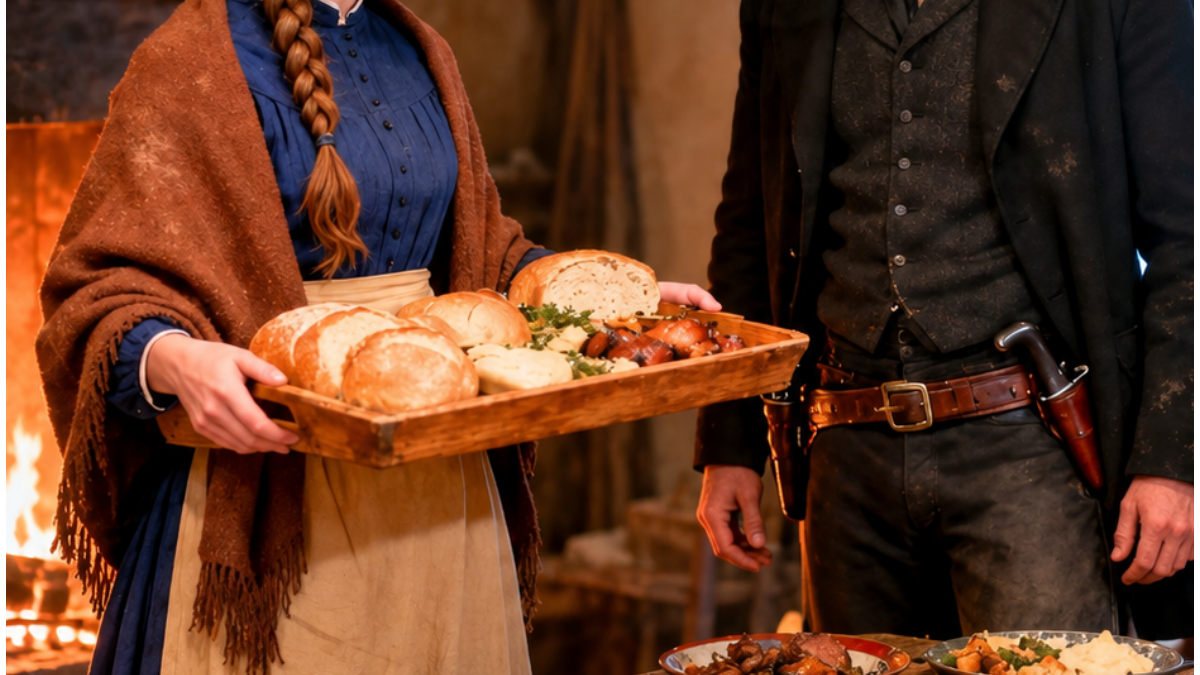
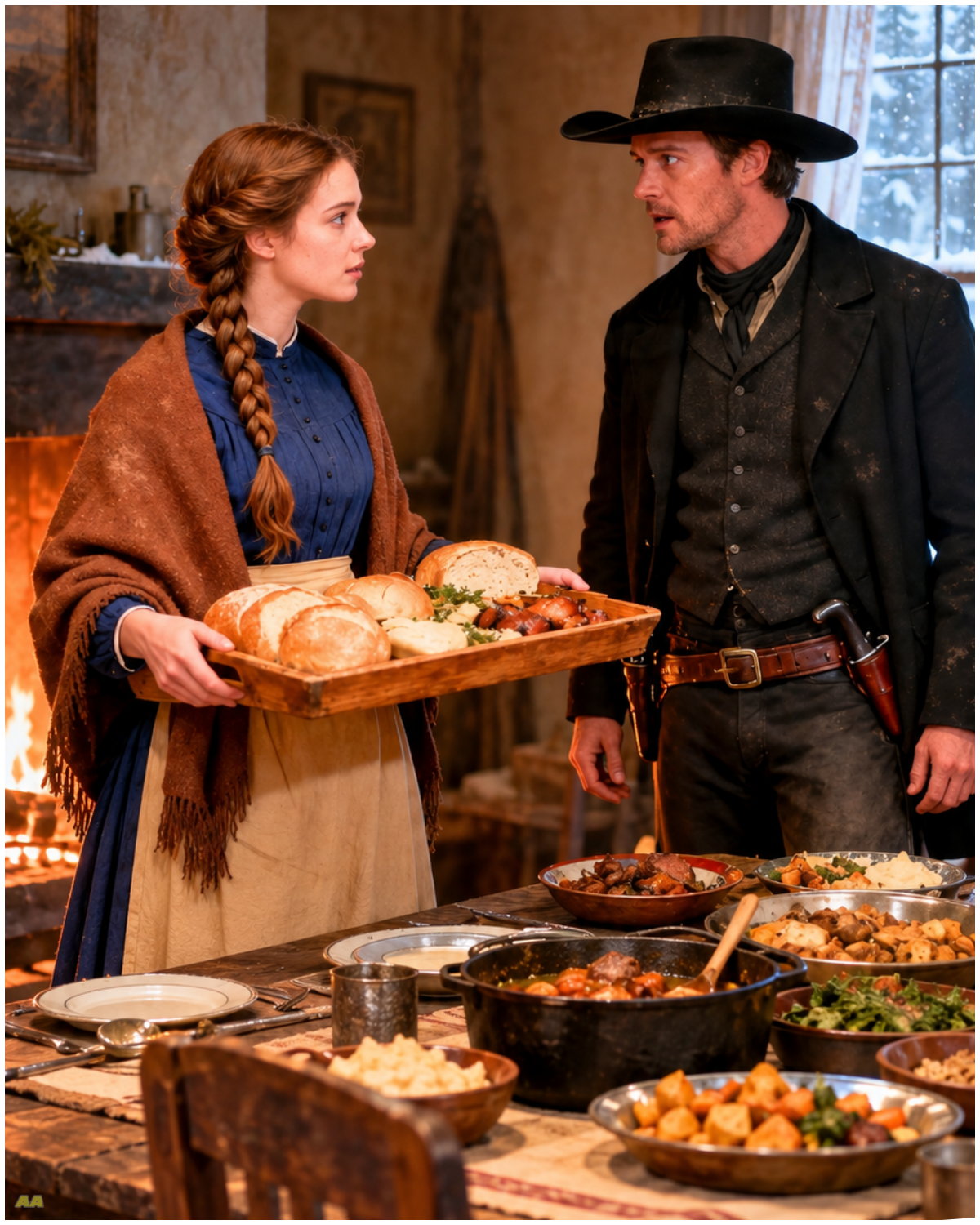
The man didn’t even look at her when he said it.
That was the part Evelyn Carter would remember longest.
Not the words themselves, not the laughter that rippled through the crowded platform, not the heat crawling up her neck, but the way Weston Blackwood kept his eyes on the middle distance while he spoke, as though she were a piece of luggage someone had left on the wrong step.
“Send her back,” he said.
Loud enough.
Loud enough that the station master heard and the women near the dry goods wagon heard and the three ranch hands standing behind him heard and looked at their boots because even they understood it was a cruel thing to say about a woman who had just stepped off a two-day train with dust on her coat and nowhere else to go.
Tell the agency they sent the wrong kind.
The wrong kind. Evelyn stood on the platform of Dry Creek single track station with her small leather suitcase at her feet and her letter of introduction folded in her left hand and she did not cry.
She had not come 1400 m to cry on a train platform in front of strangers, but her jaw tightened in a way that the women near the wagon noticed, and one of them, a heavy set woman with red hands and kind eyes, made a small sound under her breath that wasn’t quite sympathy and wasn’t quite warning, but was somewhere between the two.
If you were watching from the edge of that platform, you might have expected Evelyn to apologize, to shrink, to ask what she’d done wrong before she’d done anything at all.
She didn’t. She picked up her suitcase, looked at Weston Blackwood for the first time, and said quietly and without performance, “I didn’t come here to be the right kind. I came here to work.”
Nobody laughed after that.
One, the train that brought Evelyn Carter to Dry Creek had originated in Philadelphia, passed through Cincinnati and St. Louis, and crossed two river bridges that groaned under the weight of the cars in a way that made passengers grip their armrests and pray privately to whatever they believed in.
Evelyn had not prayed. She had sat with her hands flat on her knees, watching the landscape outside the window change from brick and cobblestone to open grass, from orderly tree lines to sky so wide it seemed slightly threatening.
And she had thought about the letter.
The letter from the Witmore Marriage Agency had been careful and professional and almost completely dishonest in the way that careful, professional letters often are.
It described Weston Blackwood as a man of substantial means and steady character, a widowerower of four years who sought a practical companion and capable household manager for his ranch property in the Western Territories.
38 years old, no children.
The agency noted that he was not a man of many words, but was known to be fair in his dealings and reliable in his commitments.
What the letter did not say, that Weston Blackwood had refused the first two women the agency sent before they even arrived simply by writing back with a single line that the arrangement no longer suited him.
That the third woman had arrived, stayed 4 days, and left without explanation on a Tuesday morning, taking nothing but her travel bag, and not speaking to anyone at the station.
That Dry Creek had been watching the Blackwood arrangement with the particular fascination small towns reserve for spectacles that involve money and human failure in equal measure.
Evelyn had not known any of this when she boarded the train.
She had known that she was 25 years old and that her position as a school teacher in Philadelphia paid $42 a month, and that her landlady had raised the rent for the third time in 2 years, and that the man she had almost married 3 years ago had chosen someone else, and that none of these facts individually would have moved her.
But together, in the aggregate, they had added up to something that felt less like desperation and more like the quiet recognition that the life she was living had reached its natural limits.
She was not running away.
That mattered to her, though she couldn’t always explain why.
She was moving towards something, even if she wasn’t entirely sure what.
The agency had shown her a photograph.
Weston Blackwood, standing in front of what she now understood was the main house of Blackwood Ranch, wearing a hat that shadowed half his face, broad shoulders, a stillness in his posture that could have been confidence or coldness.
In a photograph, you couldn’t tell.
She had studied it for a long time before writing back to say she was interested.
She had not brought the photograph with her.
She hadn’t wanted to arrive carrying an image of the man she was supposed to meet.
It had seemed like the kind of thing that would put her at a disadvantage, and Evelyn Carter had learned early that arriving anywhere with a disadvantage you’d given yourself was the worst kind.
She stepped off the train at 11:00 in the morning on a Thursday in late September.
And the first thing she noticed about Dry Creek was that it smelled like animals and sawdust and something burning far off.
And the second thing she noticed was that there were more people at this station than she would have expected for a town this size.
And then she understood that many of them had come to look at her.
The man at the front of the small crowd was not hard to identify.
Not because of the quality of his coat or the way the others gave him a foot of space in every direction, though both were true.
It was something in the way he stood.
Like a man who had not been surprised by anything in a long time and had stopped [clears throat] expecting to be.
He was taller than the photograph had suggested.
His face was harder. He looked at her the way you look at a horse someone has brought for you to evaluate.
Not unkindly, not kindly either, just assessing.
Evelyn walked toward him. She had rehearsed nothing.
She had decided somewhere in Kansas that rehearsing was the wrong approach, that arriving with prepared words would make her sound like what she was trying not to be, which was someone performing competence rather than possessing it.
She extended her hand. Mr.
Blackwood, I’m Evelyn Carter. He looked at her hand for a moment before he shook it.
His grip was brief and impersonal.
You’re younger than they said.
I’m 25. The agency listed age correctly.
Younger than I expected, he said, which was a different thing.
He glanced at her suitcase.
Just the one. That’s all you brought.
I travel light. Something shifted in his expression, not warmly, but with a flicker of something she couldn’t name.
Then he turned to one of the men behind him and said it.
Send her back. Tell the agency they sent the wrong kind.
The words landed in the air and stayed there.
Evelyn heard the woman near the wagon make that small sound.
She felt the station master’s secondhand embarrassment from 12 ft away.
She felt her own pulse move into her throat and had to make a deliberate decision about what to do with it.
She picked up her suitcase.
She looked at Weston Blackwood.
I didn’t come here to be the right kind, she said.
I came here to work.
He turned back to look at her then.
Really look at her for the first time.
Work, he repeated, not mocking, testing the word.
The agency described a ranch that needed managing.
I’ve read everything they sent about your operation.
You’re underst staffed in the house.
Your supply ordering is inconsistent according to the intake logs they shared, and based on what I can see of this town, you’re having trouble retaining workers because there’s no real reason for them to stay beyond the wages.
She paused. Those are problems I can help with.
Whether or not I’m the right kind.
The silence that followed was not comfortable, but it was interested.
Weston Blackwood looked at her for a long moment.
Then he said to no one in particular, “Put her bags in the wagon.” The ride to Blackwood Ranch took 40 minutes on a road that hadn’t decided whether it was a road or just a habit formed by repeated wagon wheels.
Evelyn sat in the back of the wagon because the bench beside the driver, one of the ranch hands, a quiet man named Dolan, who kept his hat low and his thoughts to himself, had a broken board, and Weston Blackwood rode alongside on a gray horse that moved like it was bored.
He didn’t speak to her during the ride.
She didn’t try to speak to him.
She watched the land instead.
It was enormous in a way that she had not been prepared for, even after the train.
In Philadelphia, there were always walls, buildings, fences, hedros.
The close comfort of things built by people to mark the edges of where people were.
Out here, the land just continued.
It rolled and expanded and offered no reassurance that it had any intention of stopping.
The grass was yellow brown in the late September light.
The sky was a color she didn’t have a word for, too pale to be blue, too blue to be gray.
She thought, “I’m going to have to learn to be comfortable in open space.” And then she thought, “I’ll learn.” The ranch house appeared f first as a shape on a slight rise, then slowly resolved into a structure that was larger than she’d expected.
Two stories, a long covered porch running the full front width.
Outbuildings scattered around it in a pattern that said the operation had grown without being planned.
One thing added after another as necessity demanded without anyone stepping back to look at the hole, which told her something.
There were men working in a corral near the largest barn.
They stopped when the wagon came through the gate.
Evelyn counted eight of them, all watching her with the same evaluating look Weston had worn at the station, except less composed, more openly curious some of them, and one or two with expressions that she recognized from Philadelphia, from every room she’d ever walked into as the wrong person, the preemptive skepticism of men who had already decided what she was.
She climbed down from the wagon without help, not to make a point, because it would have been awkward to wait for help that wasn’t being offered.
A woman appeared on the porch, 60s, gay-haired, wearing an apron that had been white once, and a look on her face that combined exhaustion and weariness in roughly equal parts.
“You’re the new one,” she said to Evelyn.
Not unkindly, just factually. “Evelyn Carter, Martha Gil, I run the house.” She looked at Weston, who had dismounted and handed his horse off to a boy without speaking.
“She’s staying then?” “Then for now,” Weston said.
Martha looked at Evelyn the way women of a certain age look at young women who have arrived in complicated situations, searching for the thing that will tell her whether this person is going to make her life harder or easier.
Evelyn met her eyes steadily and didn’t perform anything.
Come inside, Martha said. I’ll show you the kitchen before anything else since that’s where the trouble is.
The kitchen was in fact where the trouble was.
Evelyn stood in it for 10 minutes while Martha explained the situation in the flat, resigned tone of someone who had been explaining the same situation to a succession of people who hadn’t fixed it.
The supply deliveries came from Harlland’s store in town on an irregular schedule because no one had set up a proper ordering system, which meant the cook, a man named Reeves, who came in three mornings a week and otherwise left things to whoever happened to be there, was constantly working around shortages by substituting ingredients that didn’t belong together, which was why the ranch hands ate without pleasure and complained about it in ways that affected their morale, even if they couldn’t have named that as the reason.
How many men are we feeding?
14 full-time, more during roundup, and Reeves comes three days a week.
Tuesdays, Thursdays, Saturdays. Evelyn opened the pantry door.
She stood in front of it for a moment, reading the shelves the way you read a sentence, getting the grammar of it.
What was there? What was missing?
What was in the wrong place?
Then she closed it. Can I have paper and a pen?
Martha looked at her. What for?
I want to write down what’s missing before I forget the sequence.
Martha’s expression shifted fractionally in a direction that wasn’t yet trust, but was adjacent to something more open than what had been there before.
She found paper. Evelyn wrote for several minutes, standing at the kitchen table.
Not a list, a system, supply schedule, rotation, minimum stock levels, the kinds of substitutions that were acceptable and the ones that weren’t worth making.
She wrote quickly, and her handwriting was clear.
You done this before? Martha asked.
Not a ranch kitchen, but I ran the household for my father’s house for 3 years after my mother passed, and he had six borders.
The principal is the same.
She looked up. The problem isn’t the cook.
The problem is that the ordering has no structure, so the cook is improvising in ways he shouldn’t have to.
Martha looked at the paper.
Weston’s not going to want to hear about supply schedules.
He doesn’t have to. I just need his authorization to work with Harlland’s directly.
She paused. Does he have someone handling the household accounts?
He does it himself. Or he forgets to.
Evelyn nodded once. The way you nod when something confirms a suspicion you’d rather hadn’t been confirmed.
All right. She went to find Weston Blackwood.
She found him in the room he used as an office, a space that occupied the eastern corner of the ground floor, and contained a desk buried under papers, two chairs, a map of the territory tacked to the wall, with several areas marked in pencil, and the specific kind of disorder that belongs to a man who is genuinely capable, but manages everything in his head, because the alternative would require sitting still long enough to organize it.
I was looking at the map when she knocked on the open door.
He didn’t turn around immediately.
You have a question, he said.
I need authorization to work with Harlland store directly for household supplies and I need access to the household accounts so I understand the current situation before I make any changes.
He turned then you’ve been here 3 hours 2 and 1/2 and the kitchen is the most immediate problem so it made sense to start there.
He studied her. What’s wrong with the kitchen?
No system for ordering. The cook is talented enough, but he’s working around shortages every week, which means the food is inconsistent, which means the men eat without satisfaction, which affects how they work, which affects everything else.
She paused. It’s not a complicated fix.
Nothing’s complicated when you’ve been here 2 hours.
2 and 1/2, she said again.
Not combatively, just precisely. Something happened in his expression.
She wouldn’t have been able to name it.
A compression, maybe the kind of look that meant a person had been prepared to dismiss you and found the ground slightly different than expected.
The accounts are in the ledger on the left side of the desk, he said.
Don’t move anything else. She didn’t thank him profusely.
She said thank you once normally and went to find the ledger.
The ledger told her three things.
First, Blackwood Ranch was profitable.
Very profitable. The numbers over the past four years showed consistent income from cattle sales, land leasing to two neighboring operations, and what appeared to be a timber agreement with a company she didn’t recognize.
Weston Blackwood was not a man in financial trouble.
Second, the household spending was a mess.
Like, not dramatically, not in a way that would bankrupt anyone, but in the way of a system that had no one attending to it carefully.
Irregular payments, duplicate orders, gaps where money had clearly been spent on things not recorded, which meant either poor recordkeeping or something more uncomfortable that she wasn’t going to assume yet.
Third, nobody had looked at the household accounts seriously in at least 2 years.
The last careful notation she could find was in a different handwriting, neater, more deliberate, that stopped abruptly in the middle of a page in November of 1883, the year Weston’s wife had died.
She recognized that without being told.
It was the handwriting of someone who had cared about the details.
She closed the ledger and sat with that for a moment.
Then she got to work.
By evening, she had a complete inventory of the kitchen stores, a draft ordering schedule for the next 6 weeks, and a list of 12 items that needed to be sent to Harlland’s within the next 2 days to avoid another week of improvised meals.
She had also, without particularly meaning to, introduced herself to seven of the 14 ranch hands, not formally, but through proximity, through being in places where work was happening and not pretending to be somewhere else.
The first one who spoke to her voluntarily was a man named Collier.
He was in his 40s, had been with the ranch for 9 years, and had the particular watchfulness of someone who had seen things come and go, and was waiting to determine which category she fell into.
He found her in the yard near the equipment shed where she was trying to understand why there were two damaged saddle racks leaning against the wall.
Nobody fixed those because nobody wanted to tell Mr.
Blackwood they got broke, Collier said from behind her.
She turned. He was leaning against the door frame with his arms crossed.
Not hostily, but not invitingly either.
How’d they get broke? Horse got spooked during a storm back in June.
Kicked through the wall. Rack was attached to the wall.
He shrugged. Things happen and Mr.
Blackwood doesn’t know. Mr. Blackwood knows most things eventually.
People just don’t rush to tell him the ones that involve admitting they were careless.
Evelyn looked at the racks, looked at Collier.
Is he a man you can tell things to?
Honestly. The question seemed to catch him off guard.
He took a moment. He’s fair, he said finally.
That’s not the same thing.
No, she agreed. It’s not.
She didn’t push further. She marked the saddle racks in her notes and moved on.
And Collier watched her go with an expression that wasn’t quite respect yet, but was considering the possibility.
Dinner that night was the kind of meal that confirmed everything she’d already understood about the kitchen situation.
The beef was edible, but oversalted because Reeves hadn’t been there, and someone, probably Dolan, who she was learning took initiative in areas where no one had officially assigned him authority, had done his best with what was available.
The bread was 2 days old.
The coffee was strong enough to clean a boot.
Weston ate without complaint, which told her either that he didn’t notice or that he had stopped expecting anything better, and she suspected it was the latter, and for reasons she couldn’t entirely account for that bothered her more than the food itself.
At the end of the meal, when most of the hands had gone back to the bunk house and Martha was washing up and Evelyn was moving between tasks in the kitchen, Weston appeared in the doorway.
“You’ve been here since 6:00 this morning,” he said.
“I got a late start.
It’s 9:00. I know. She didn’t look up from what she was doing.
I wanted to finish the inventory before I lost the threat of it.
He was quiet for a moment.
She could feel him in the doorway, which was its own strange sensation.
Not threatening, not intrusive, but present in a way she was conscious of.
The room at the top of the stairs on the right is yours, he said.
Martha aired it out this afternoon.
Thank you. There’s a board loose on the second step.
Don’t catch your heel on it.
She looked up then. He was already turning away.
Mr. Blackwood. He paused. The saddle racks in the equipment shed need to be repaired.
Two of them. They were damaged in June.
He turned back enough to look at her.
A pause. Who told you?
Collier. He mentioned it when I was walking the yard.
She held his gaze. I thought you’d want to know.
She could see him processing several things at once.
The information itself, the fact that Collier had told her, the fact that nobody had told him.
His jaw moved slightly. I’ll look at them in the morning, he said.
She nodded. He left. She stood in the kitchen for a moment with her hands still and thought, “This is going to be harder than I thought.” And then she thought, “Good.
Easy things didn’t build anything worth having.” The room at the top of the stairs on the right was small and clean and smelled like the cedar chips Martha had put in the wardrobe to keep the moths out.
There was a window that faced west and a rug on the floor that had been good once years ago and a lamp on the nightstand that had been recently filled because the wick was fresh.
Evelyn sat on the edge of the bed and unpacked her small suitcase.
There wasn’t much. Two changes of clothes, both practical.
A set of reference books she’d found useful.
A household management manual that she’d marked heavily in the margins.
A medical reference because there were no doctors within 40 mi in any direction from what she’d gathered.
A slim volume of poems she read when her own thoughts were too loud.
A photograph face down at the bottom of the case.
Her mother, her father, herself at about 12, standing in front of the house she’d grown up in.
She set it on the nightstand face up without looking at it too long.
A journal. She wrote in it rarely, only when something was happening that she thought she’d need to remember the particular shape of later.
She wrote in it that night.
Arrived dry creek. Ranch is large, disorganized, full of people managing around each other.
Kitchen needs immediate work. Accounts are a disaster.
The hands are capable but unmed.
Weston Blackwood is She stopped, tapped the pen against the paper.
Harder to read than I expected.
Not unkind. Not unkind. Exactly.
He told me about the loose board on the stairs without being asked.
She closed the journal. She was tired in the thorough way of a day that had used every part of her.
She lay down in the unfamiliar bed in the unfamiliar room in the house on the largest ranch in the territory.
And she listened to the wind move across the open land outside, which made a sound she had never heard before.
Not haunting, not particularly beautiful, just present and continuous, like something that had been here long before she arrived and intended to continue long after she understood it.
And she thought, “This is where I am now.” And then she slept.
In the morning, before the hands had finished breakfast, she found the problem she hadn’t been looking for.
It started with the supply ledger, not the household accounts she’d looked at the night before, but a separate record she found in the kitchen itself, a battered notebook that Reeves used to track what he’d used and what he’d requested and what had never arrived.
She was cross-referencing it against her own inventory notes when a pattern emerged that made her go still.
The orders Reeves had written down didn’t match what had been delivered.
Not in the way of honest mistakes, a wrong number, a missed item, in the way of a consistent difference between what was being paid for and what was arriving, always in the same direction, always an amount small enough to go unnoticed on any individual occasion, but meaningful in aggregate.
She sat with the notebook for a long time.
She was not a woman who accused people quickly.
She had grown up in a house where her father had been accused of something he hadn’t done, a business matter, a misunderstood transaction, and the accusation had cost him 2 years and most of what they had before it was resolved.
And she had learned from that experience the difference between noticing something and knowing something, and the importance of not collapsing that distance carelessly.
So, she made no accusation.
She simply went to find who handled the deliveries.
The deliveries from Harlland were managed by a man named Puit.
He wasn’t a full ranch employee.
He drove the wagon from town twice a week, offloaded the goods, got a signature from whoever was available, and drove back.
He was in his 30s, pleasant-faced, the kind of man whose pleasantness you trusted without examining, because the pleasantness itself gave you no reason to examine it.
She found him finishing the Tuesday delivery at the kitchen door.
“Mr. Puit,” she said, “I’m Evelyn Carter.
I’ll be handling the household accounts going forward.” He looked at her with the same pleasant expression.
Heard you’d arrived. Welcome to Dry Creek.
Thank you. She held the receipt he’d handed to the boy assisting him.
I have a question about the flower delivery.
The receipt shows 300, but the cook’s record from the last 3 months shows orders of 300 that arrived as 250.
The pleasantness in Puit’s face didn’t disappear.
That was the thing. It held exactly, which was its own kind of answer.
Could be a mistake in Reeves’ records.
He’s not always Reeves’ records are consistent, she said.
The pattern is also consistent.
That’s what I’m interested in.
A moment of silence that wasn’t comfortable for anyone except possibly Evelyn, who had decided before she walked up to him that she was not going to be maneuvered by discomfort.
I’ll look into it, Puit said.
I’d appreciate that. I’ll also be checking the delivery personally going forward.
She handed back the receipt with a small smile that communicated nothing except that she intended to do exactly what she’d said.
“Thank you, Mr. Puit.” She walked back inside.
Martha was at the kitchen table and had heard everything.
She looked at Evelyn with an expression that had moved entirely past weariness into something that was beginning cautiously to resemble respect.
“That’s been going on since before I can remember,” Martha said quietly.
“I know Weston doesn’t. He will soon.” She sat down at the table and pulled the notebook toward her.
Can you tell me who else signs off on deliveries when Reeves isn’t here?
And they got to work.
By the end of her first week at Blackwood Ranch, Evelyn Carter had reorganized the kitchen supply system, identified what appeared to be a long-running supply theft that had been bleeding the household accounts for at minimum 2 years.
Introduced herself to every one of the 14 ranch hands by name, learned the names of eight of the horses, repaired a disagreement between two of the hands, Collier and a younger man named Tate, by the straightforward method of getting them to articulate the actual problem instead of the one they were performing, and fixed the board on the second stair because she’d been waiting for Weston to do it, and he hadn’t, and she’d found a hammer in the equipment shed.
She had not made anything look easy.
She had not pretended to know things she didn’t know.
She had asked questions that occasionally revealed the limits of her experience, and she had not apologized for those limits, only noted them, and moved to address them.
She had also had exactly four conversations with Weston Blackwood that lasted longer than 2 minutes, and every one of them had ended with the same quality of silence, like a door that was neither open nor closed, but stood in the uncertain position of a door whose hinge had loosened.
On Sunday evening, after the week’s work had settled and the yard had gone quiet, and the hands were in the bunk house, and Martha had retired, she was sitting on the porch steps with the household account ledger across her knees when Weston came out through the front door and stopped when he saw her there.
“Thought everyone was inside,” he said.
“I needed the light.” She moved slightly to one side, though there was room enough.
The lamp in my room makes the columns blur.
He stood for a moment, which was something she had noticed about him, that he stood in places while he decided about them, rather than committing to movement and reconsidering.
Then he sat on the top step, one foot on the lower one, his arms resting on his knees, looking out at the yard.
They sat in something that wasn’t quite silence, because the ranch made its own sounds at night.
The distant sound of cattle, a horse moving in its stall, wind through the grass.
“The Puit situation,” he said finally.
What about it? Martha told me what you found.
She had expected this, just not the particular tone of it, which was not anger, or not only anger.
There was something else in it.
I was going to bring it to you when I’d finished documenting the full scope.
I didn’t want to bring you a suspicion.
I wanted to bring you evidence.
How long has it been going on?
Based on the records I found, at least since early 1882, possibly before, she paused.
The amounts per delivery are small enough that no one would catch it without looking across the hole.
And nobody was looking across the hole.
He was quiet. I don’t say that as a criticism, she said carefully.
The ranch is large. Your attention is spread across many things.
The household accounts weren’t. She stopped, chose a different path.
Nobody had the specific job of watching this particular thing.
Now someone does. He turned his head to look at her.
In the evening light, his face was difficult to read, but she had been practicing.
“You’ve been here 8 days,” he said.
“Nine.” Another silence, then with something that might have been the beginning of rye.
“You count days.” “I count most things,” she said.
“It’s useful,” he looked back at the yard.
After a moment, he said without looking at her, the handwriting in the ledger, the careful part before it stops.
She waited. That was my wife, he said.
Clara, she kept everything in order.
He said it without additional weight, which was its own kind of weight.
When she died, nobody took it up again.
I thought he stopped. He didn’t finish the sentence.
She didn’t push. The night settled around them wide and quiet, and the wind moved through the grass the way it had moved through the grass before either of them arrived, and would continue to move after they were gone.
And Evelyn sat with the ledger in her lap, and Weston sat with whatever he carried, and neither of them said anything else for a long time.
But she stayed, and he didn’t go inside.
And that, she thought, that particular stain was was the beginning of something, though she couldn’t have named it yet, and wouldn’t have tried.
The Puit matter did not resolve itself cleanly, because nothing at Blackwood Ranch resolved itself cleanly, and Evelyn had stopped expecting otherwise by the end of her second week.
What happened was this. Weston confronted Puit on a Monday morning, not with anger.
She had expected anger and been wrong, but with the particular coldness of a man who had decided something before he walked into the room and was not going to be argued out of it.
He laid her documentation on the desk between them.
He named the amounts, the dates, the pattern.
Puit denied it for approximately 4 minutes, during which time Weston sat in his chair and let him deny it.
And then Puit stopped denying it and sat down himself and looked at the floor.
The number came to just over $300 across two and a half years.
Not a fortune, not to Blackwood Ranch, but it was the principle of the thing, which is always what it is when the amount isn’t quite the point.
Weston didn’t involve the law.
He told Puit he had one week to make arrangements to pay it back, and that if he did, Weston would not go to the sheriff, and that if he didn’t, he would.
Puit left without saying much else.
The delivery arrangement with Harlland’s was renegotiated the following Thursday.
This time with a signed record that Evelyn held a copy of and the store held a copy of and Weston held a copy of because three copies made certain kinds of problems structurally impossible.
The hands heard about it the way the hands heard about everything through the particular osmosis of men who work closely together in a contained space and pay more attention to the people above them than those people generally realize.
Collier found Evelyn near the equipment shed 2 days after Puit left and said without preamble.
Heard about the delivery situation.
Did you? She said. She was checking the saddle racks which had been repaired by then.
Not by Weston as it turned out, but by a hand named Breck, who had the skills for it and had been waiting for someone to make it officially someone’s problem.
Most people would have let it go.
Collier said small enough amounts.
The amounts weren’t the problem.
No, he agreed. I suppose not.
He watched her run her hand along the repaired joint, testing it.
You’re checking his work. I’m checking whether the repair will hold.
That’s different. Collier was quiet for a moment.
Then Breck’s good with wood, better than moSt. I can tell.
She stepped back from the rack.
Can I ask you something?
Depends. How long has the ranch been operating like this with things noticed but not addressed?
He thought about it seriously, which she appreciated.
He was not a man who answered quickly just to be answering since Mrs. Blackwood died more or less.
Before that, things got dealt with.
She had a way of she kept things from accumulating.
He paused. Not because she was managing all of it herself.
She was just she paid attention and people knew she was paying attention, so they did too.
Evelyn didn’t say anything for a moment.
What was she like? Clara.
He said the name with the ease of someone who had known her long enough that she was simply a fact of the landscape.
Serious, funny sometimes, but you had to earn it.
Knew what she thought about most things and would tell you if you asked.
Didn’t suffer fools. He looked at Evelyn with something that was not quite a smile, but was adjacent to one.
You remind me of her some, not the same, but some.
She didn’t know what to do with that, so she simply nodded and moved on to the next task.
And Collier went back to work.
And neither of them remarked on the weight of what he’d said, or the way it had settled between them, like a stone dropped in quiet water.
The kitchen transformation happened faster than anyone expected, and more slowly than Evelyn would have liked, which meant it happened at roughly the right pace.
Reeves was, as Martha had said, genuinely talented.
What he lacked was not skill, but material.
He had been improvising around shortages for so long that he’d developed habits of substitution that weren’t always necessary, but had become reflexive, like a man who flinches at sounds that used to be threats, and have since stopped being threats, but which his body hasn’t received the message about yet.
The first time a full order arrived according to the new schedule, a Tuesday in mid-occtober, with all items verified against the list by Evelyn herself and logged in the new ledger.
Reeves stood in the kitchen doorway looking at the organized shelves for a long moment without speaking.
“Something wrong?” she asked. “No,” he said.
“It’s no.” He put his coat on the hook by the door and rolled up his sleeves and got to work without another word.
Dinner that night was the best meal the ranch had produced in at least 2 years according to Martha who made the observation quietly to Evelyn while they were washing up and had the manner of someone making a much larger statement than the words themselves carried.
The hands noticed. They didn’t say anything about it directly, not at first, but the quality of noise at the dinner table changed.
Men who ate in silence or with the prefuncter conversation of people going through a routine began talking, not loudly, not with any particular excitement, but in the way that people begin to talk when they are somewhere comfortable, which is a small thing and a significant one.
Weston noticed, too. She knew this not because he said anything, but because one evening, about a week after the new supply system began running, he sat at the dinner table for 15 minutes after the meal ended rather than leaving immediately, as had been his habit.
He was reading something, a letter, she thought, but still he stayed.
She didn’t remark on it.
The complication arrived on a Wednesday morning in the form of a man named Gerald Fitch.
Fitch owned the second largest ranch in the valley, which was still considerably smaller than Blackwood Ranch, but was operated with the particular aggressive efficiency of a man who believed his position in the hierarchy was temporary and resented it.
He arrived without being invited, which Evelyn understood was not unusual.
Men of a certain standing in the valley moved through each other’s properties with a freedom that came from long habit and the implicit agreement that everyone was bound by the same informal rules.
She was in the yard when his wagon came through the gate.
He was a broad man somewhere in his mid-50s with the reddish face of someone who spent considerable time outdoors and considerable energy being displeased.
He had another man with him, younger, quieter, with the look of someone who was there to take note of things.
Fitch looked at her with the immediate assessing qualities she had by now cataloged as a specific type.
The look of a man who processes women rapidly into one of two categories and is mildly annoyed when the categories don’t hold.
You’d be the eastern woman, he said.
Not unpleasantly, almost pleasantly, which was worse.
Evelyn Carter, I’ll let Mr.
Blackwood know you’re here. I know where to find him.
He was already moving toward the main house, and I’ll find him myself.
She watched him go. Then she went to find Weston first, which she managed by moving faster and through the kitchen entrance, and she was in the hallway outside the office door when Fitch appeared at the front.
Weston was already standing in the office doorway, which meant he’d heard the wagon.
He had the stillness of a man who had been dealing with Gerald Fitch for long enough that he did not feel the need to arrange his face in any particular way.
Gerald, he said, Weston. Fitch came into the house without being asked, the same long habit, and looked briefly at Evelyn, who was standing to one side.
Didn’t realize you needed a doorman.
Mrs. Carter manages the household, Weston said.
The formality of it, the way he attached the title without hesitation, registered in the room is a small thing and was not a small thing.
Fitch made a sound that was not quite a laugh.
So, the agency arrangement’s still on.
It is. Heard some talk in town.
Thought I’d come by and see for myself.
He moved into the office without being invited into the office, which was specifically the kind of boundary that Fitch navigated with the ease of a man who had never had someone enforce it.
Here, you had some trouble with your delivery arrangement.
That’s resolved. Also, here the new woman was the one who found it.
He sat down in one of the chairs without being asked to sit.
The younger man with him stood near the door.
“Interesting, is it?” Weston said.
Fitch looked at him with the expression of a man making a conversational offer.
Just saying that it’s an unusual arrangement.
Woman comes from back east, starts making changes to how the ranch is run.
People are curious, Weston. You know how people are.
I do, Weston said. What people are curious about is generally their own business.
Fitch smiled in the way of someone absorbing a minor setback and moving around it.
Of course, just checking in on a neighbor, that’s all.
He stood up with the ease of someone who chooses when to sit and when to stand without reference to anyone else’s preference.
You’ll come to the Valley meeting next month.
I’ll be there. Good. Good.
Fitch moved toward the door, paused near Evelyn, and looked at her with the specific attention of someone deciding whether to acknowledge a person directly or treat them as furniture.
He decided this time to acknowledge.
Miss Carter, you settling in all right?
Very well, thank you, she said.
Good. His smile was the generic kind, applied without content.
The West takes some adjusting to for people who aren’t from here.
I imagine it does, she said pleasantly.
As does anywhere for anyone new.
I’m finding it manageable. A pause.
He’d expected something else, deference or defensiveness, and gotten neither.
The pause was brief and then the smile returned and he moved toward the door and the younger man followed and they left.
Weston stood in the doorway of the office looking at the space Fitch had occupied.
He’ll be back, he said.
I expect so. She was already moving toward the kitchen.
He’ll want to watch what happens.
Does that bother you? She considered the question honestly, which was the only way she considered questions.
It would bother me more if he didn’t.
Weston made a sound that was not quite anything recognizable and went back into his office.
And she heard the papers on his desk shift as he picked something up, and she went to deal with the afternoon.
October deepened, and the grass went from yellow to the color of old straw, and the mornings turned cold in the particular way of frontier mornings, which gave no warning and offered no apology.
Evelyn added a second layer to her daily wardrobe and found a pair of practical boots in town, not through Harlland’s, but through a woman named Agatha Drummond, who ran a dry goods operation out of a room attached to her house, and who looked at Evelyn’s feet and her coat and her manor and decided within about 4 minutes that she approved of her.
“You’re Weston Blackwood’s bride,” Agatha said, fitting the boots with the efficient hands of someone who had done it 10,000 times.
I’m his wife,” Evelyn said, which was technically accurate.
The paperwork had been completed by proxy through the agency before she’d arrived, though the marriage itself felt less like a settled fact than an ongoing negotiation, which she supposed was true of most marriages, and was honest about.
“Same thing, depending on how you say it,” Agatha said, not unkindly.
“How are you finding the ranch?” “Substantial,” Evelyn said.
And underneath the substance a little loSt. Agatha looked up at her with sharp eyes.
That’s a careful way of putting it.
It’s an honest one. Weston’s a good man, Agatha said.
The way she said it had the quality of a woman who had known someone long enough to have arrived at a conclusion that was both generous and qualified.
He’s also been running that ranch like a machine for 4 years, and forgetting that machines don’t know what they’re missing.
Evelyn said nothing. She flexed her foot in the boot and found it fit well.
The valley’s watching you, Agatha continued, returning to her work.
You know that. I assumed.
Fitch especially. He’s been waiting for Weston to make a mistake for years.
Getting a wife from back eaSt. Sight unseen.
That’s the kind of thing Fitch would call a mistake.
Would he be wrong? Agatha looked at her again.
Then she laughed. A short genuine sound.
I don’t think so, but you’ll have to prove it.
And proving things here takes longer than most places.
She handed Evelyn the second boot.
Try this one. The thing that Evelyn had not anticipated, that no amount of preparation would have prepared her for, because it was the kind of thing that only reveals itself through living, was the loneliness.
Not the ordinary loneliness of being in an unfamiliar place, though there was that.
Not the loneliness of being among people who didn’t yet know her, though there was that, too.
It was something more particular.
The loneliness of being the person who noticed things in a place where noticing had stopped being anyone’s job.
At Blackwood Ranch, everyone managed their own portion.
Weston managed the land and the cattle and the business.
Collier managed the hands. Martha managed the house as best she could without the authority to make changes.
Reeves managed the kitchen on the days he was there.
And the spaces between these managed portions, the gaps where things fell and accumulated and went unadressed, those belong to no one.
Evelyn moved through those spaces, which meant she was frequently working in the territory of things that mattered to everyone, and had been officially claimed by no one, which was its own kind of loneliness.
You cannot share the satisfaction of solving a problem with people who didn’t acknowledge the problem existed.
She wrote about it in her journal, not in complaint, but in the careful way she had of documenting things.
She was still working to understand the workers are not indifferent.
They are careful. There is a difference.
Indifference has no energy. Carefulness takes work.
It’s the act of managing your expectations down to what you know you can truSt. They have been disappointed enough times that trust is now something they extend incrementally in small amounts, watching to see if it’s returned before they offer more.
Collier is the key. When Collier decides something, the others follow.
Not because he tells them to.
He doesn’t seem to be that kind of man, but because he’s been here longest and his judgment has proven itself and the others know it, I should be patient.
She underlined should and went to sleep.
The first time Weston asked her opinion on something outside the household, she almost missed it.
They were at the dinner table, the two of them, since Martha had gone to bed early with a headache and the hands ate in the bunk house except on Sundays.
The papers Weston had been working on were beside his plate, which was something she’d learned meant he was thinking about something, but hadn’t resolved it, and wanted the physical presence of the documents as an anchor.
She was eating and not looking at the papers because they weren’t her papers.
And then he turned one of them toward her without ceremony, and said, “What do you see?” She looked at it.
It was a land survey document, the kind that established boundaries and water access rights.
She had not studied land law formally, but she had a reading mind and a mathematical one, and the survey had a logic to it if you followed it carefully.
There’s a discrepancy, she said after a moment.
Between this boundary marker here and the notation on the eastern edge.
If the notation is correct, this corner of the property is about 60 ft short of where this survey says it is.
Weston was quiet. Is that the right question?
She asked. That’s exactly the right question, he said.
Henderson owns the eastern property has been insisting the boundary sits where the notation says.
My survey says otherwise. Which one’s recorded with the territory?
Mine. He took the paper back.
But Henderson’s got a county official claiming the notation supersedes the territory recording.
Does he? No. But if Henderson files a complaint before I respond formally, I lose the timing advantage.
He folded the paper with the careful precision of someone who uses physical actions to slow his thinking down.
I have a meeting with a land attorney in Dalton next week.
She nodded then carefully. Can I read the full survey documentation before you go?
Not to advise, just I have questions about the notation system they used in this region, and I’d like to understand it.
He looked at her for a moment.
You’d want to read a land survey for intereSt. I’d want to read it to understand the situation better, she said.
That’s different. Another of his pauses.
Then he left the papers on the table when he went to his office, which was not an instruction or a permission, but was, she had learned, the closest Weston Blackwood came to both.
So she read the survey that night.
She read it again the next morning.
By the second reading, she had found two more discrepancies, smaller than the first, but consistent in a way that suggested either an error in the original notation or something more deliberate.
She wrote her observations in her careful handwriting on a separate sheet of paper, dated it, and left it on the desk with the survey documents.
He didn’t mention it for 2 days.
On the third day, he appeared in the kitchen in the midm morning when she was working through the account books.
He stood in the doorway for a moment and then said, “The two additional discrepancies you noted.” She put down her pen.
Yes. The attorney confirmed them yesterday when I wrote to him.
He said, he stopped, started again.
He said, “Whoever prepared these notes was thorough.
I just followed the pattern.
Most people looking at that survey wouldn’t see a pattern.” He wasn’t looking at her directly.
He had a way of delivering certain things to a point slightly to the side of her face, which she had come to understand was not evasion, but something closer to the opposite.
A way of being honest without the direct confrontation of eye contact, which for Weston carried more weight than it did for most people.
I’ll take your notes to the attorney next week.
All right. He started to turn, then stopped.
Why didn’t you ask me about the survey, about whether it was appropriate for you to read it?
She thought about her answer.
Because you left it on the table.
He stood with that for a moment.
Fair enough, he said, and left.
She sat in the kitchen for a moment after he was gone with the quiet feeling of something that had shifted between them.
Not dramatically, not in any way that could be named yet, like ground that has been frozen for a long time, and has begun in the deepest layer to soften.
The trouble with Collier happened on a Friday.
It was not Collier’s fault, or not primarily.
A hand named Garrett, one of the newer ones hired in the summer with the chip shouldered energy of a young man who has been underestimated and has decided to preempt it by being difficult, had taken issue with something Collier said about the way he’d handled a section of fencing.
And the issue had grown through the afternoon until it arrived at dinner as a silence between the two of them, so weighted it was affecting every other man at the table.
Evelyn saw it immediately. She had the attention for that kind of thing.
The interpersonal weather of groups, the way unspoken conflicts pressurized the air around them.
She said nothing during the meal.
Afterward, when Garrett was the first one out the door and Collier was slower than usual clearing his plate, she stopped Collier in the hallway.
What happened with Garrett? Collier looked at her with the expression of a man deciding whether to bother.
Ranch business. It’s affecting the table which makes it house business.
A pause. He doesn’t like being corrected.
Few people do. He doesn’t like being corrected by me.
He said it plainly without drama.
The plainness made it more specific and Evelyn understood what he meant.
That there was a particular kind of man who had a particular relationship with authority that depended on where that authority was coming from and whether it matched his expectations of where authority was supposed to live.
Is he going to be a problem?
He’s young, Collier said, which wasn’t an answer and was an answer.
Do you want me to speak with him?
Collier looked at her. Something moved in his expression, not quite surprised, but not nothing either.
That’s not your usual territory.
My territory is whatever affects the ranch running smoothly, she said.
I’m not protective of boundaries that don’t serve the work.
He considered it. Let me handle it firSt. If it doesn’t settle in a week, then he paused.
Then maybe yes. She nodded.
She turned to go and he said, “Miss Evelyn.” She stopped.
“When you first got here,” he said, “I thought you’d last 2 weeks, maybe three.” He said it with the straightforwardness of a man who doesn’t see the value of softening the past once the present has made it irrelevant.
I was wrong about that.
You were working from the available evidence.
She said it was a reasonable conclusion.
He made a small sound, not quite a laugh.
You’re a strange woman. I’ve been told.
She went back to the account books and behind her she heard Collier go out through the back door toward the bunk house and through the window she could see the lamplight there and the shapes of men moving behind it.
And she thought, “Something is building here.” Slowly, unevenly with setbacks ahead that she couldn’t yet see, but building.
The evening that changed the ground between her and Weston.
Not dramatically, not with any announcement, but in the way things change when neither person has decided to change them was an ordinary Tuesday in the last week of October.
The temperature had dropped sharply by sundown.
A wind came off the open plane that carried the first real cold of the coming winter, and the house held the warmth of the kitchen fire in a way that drew people to the ground floor without their having to consciously decide to be drawn.
Evelyn was at the kitchen table with the survey notes and the account ledger, working on both in parallel because she had learned to maintain two threads of thought simultaneously.
Martha had gone to bed.
The hands were in the bunk house.
The house had the kind of quiet that is actually a sound, the sound of a large structure settling against the weather outside.
Weston came through from the hallway carrying a lamp and stopped when he saw her.
He had clearly expected the kitchen to be empty.
He stood in the doorway for a moment with the lamp in his hand and the particular expression of a man who has walked into a situation he didn’t plan for and is evaluating it.
She looked up. There’s coffee on the stove, she said.
It’s been there about an hour.
It’s probably not good anymore.
It never is after an hour, he said, which was the closest thing to domestic familiarity she had heard from him, and he poured it anyway, and sat down at the other end of the table without being invited or uninvited, and looked at the papers in front of her.
You’re working on both at once, he said.
The survey and the accounts are related, she said.
The Henderson boundary question affects three sections of grazing land.
The grazing revenue from those sections is in the accounts.
If you lose the boundary dispute, the The income projections for next spring are wrong.
He was looking at her with a different quality of attention, not the evaluating look of the first days.
Something more settled. You connected those.
They’re connected. I just followed the line.
He drank the coffee without remarking on its condition.
Outside the wind moved against the house with the low sound of something large and persistent.
Can I ask you something?
He said. She waited. Why did you come here?
Actually, he wasn’t looking for the agency answer.
She could tell. Not what you told the agency.
The actual reason. She sat with the question for a moment.
She had not been asked it honestly before.
She gave it an honest answer.
The life I was living had reached the edge of what it was going to be.
She said, “I could see all of it from where I was standing.
Every part of it all the way to the end, and I didn’t want to be able to see all of it.” He was quiet for a moment.
You wanted something bigger. I wanted something I couldn’t already see the shape of.
She looked at the papers in front of her.
I didn’t know what that was.
I’m still not sure, but I knew I needed to be somewhere that could still surprise me.
The wind moved outside. The lamp between them made the kitchen close and warm and very different from the open dark beyond the walls.
“Has it?” he asked. “Surprised you?” she looked at him.
“Yes,” she said. “Regularly.” Something moved in his face, a movement she was learning to read, the kind that in most people would be a fuller expression, but in Weston Blackwood lived at a scale so reduced you could miss it if you weren’t paying attention.
She was paying attention. Good, he said, and went back to his coffee.
And outside the wind moved against the house, and the lamp held its light, and Evelyn Carter sat across from Weston Blackwood in the kitchen of his enormous ranch at the edge of the frontier, working on his accounts and his survey notes.
And neither of them went anywhere for a long time.
The Henderson boundary dispute was resolved in Weston’s favor on a Thursday morning in early November by a letter from the territory land office that arrived with the same Tuesday mail delivery that brought a seed catalog nobody had ordered and a bill from the Dalton attorney that was less than Weston had expected and more than he’d hoped.
Evelyn read the letter over his shoulder, not deliberately, but because she was standing at the desk returning the survey documents when he opened it, and he angled it slightly toward her without thinking, which was the kind of thing that had begun happening between them without either of them noting it as a development.
A naturalness arriving in increments, the way warmth returns to a room that has been cold for a long time.
You don’t notice the exact moment it changes, only that at some point you stopped being cold.
The notation is declared non-binding, he said.
Henderson will contest it. He’ll try, he folded the letter.
He doesn’t have the documentation to succeed because of the two additional discrepancies.
He put the letter in the desk drawer and looked at her.
Yes, he said. Because of those.
He didn’t say thank you.
That was not the language Weston Blackwood spoke naturally.
But something in the directness of his look carried the same content, and she received it as such and moved on, because making a moment of things that didn’t require ceremony was not her style either.
What she did not know then was that Gerald Fitch had been following the Henderson dispute from a distance with the specific attention of a man cataloging weaknesses.
Henderson and Fitch were not friends.
They were too competitive for friendship, but they moved in the same circles and shared certain attitudes about the valley’s proper order, and Fitch had been hoping the boundary matter would create a difficulty for Weston that he could then observe and measure.
When it didn’t, he recalibrated.
And his recalibration, she would come to understand, was always toward the same objective, finding the place where a thing could be pried open.
He found it, as such men usually do, by going after the person who couldn’t defend herself in the room where the decision was being made.
The Valley meeting took place on the 3rd Saturday of November in the large back room of Callaway’s feed and supply, which was the only building in Dry Creek with enough floor space to hold the ranchers and their foremen and the occasional wife who came either because she was directly involved in the operation or because her husband’s decisions were sufficiently consequential that she needed to be present to understand what she’d have to manage afterward.
Evelyn had not been told she was attending.
Weston had mentioned the meeting in passing twice in context that made it clear he was going and that the ranch’s position on several matters.
The water access agreement that served three properties including Blackwood Ranch, a proposed road grading project, the annual arrangement with the cattle drive operation that passed through the valley each spring would be discussed and settled.
She had read everything relevant she could find in the ranch’s records and had two pages of notes that she considered her own business and had not mentioned to him.
She was in the yard when the wagon was being readied Saturday morning, and she put on her coat and her good boots and walked to the wagon and climbed onto the seat.
Dolan, who was driving, looked at her without expression.
This was Dolan’s standard response to most things, and she had learned to find it restful.
Weston came out of the house and stopped when he saw her her.
You’re coming. The water access agreement affects the household supply well, she said.
The well feeds the kitchen, the laundry, and the stock troughs on the east side.
If the agreement changes, I need to know how.
A pause that she she had learned to read as him weighing things.
You’ve read the agreement. I have questions about it.
Yes. He looked at her for another moment, then got on his horse without further comment, and Dolan drove, and they went.
Callaway’s backroom held approximately 30 people by the time the meeting started, the air already thick with the smell of wool coats and pipe tobacco, and the specific human warmth of a crowd in a confined space in cold weather.
Evelyn knew perhaps a third of the people by sight and fewer by name.
She stood with Weston near the east wall, which gave her a clear view of the room and its arrangements, and she spent the first 20 minutes listening to the shape of the thing, who deferred to whom, who spoke first, who waited, what the alliances were.
Fitch was in the center of it.
He was the kind of man who occupied the center of a room, not through forcefulness, but through the patient accumulation of small positions.
A comment here, a nod there, the particular skill of making his preferences sound like the common sense of people who hadn’t thought of it yet.
He had two ranchers flanking him who Evelyn had identified from Weston’s records as men whose water leases ran through Fitch’s property, which gave him a leverage over them that didn’t need to be stated.
The water access agreement came up 40 minutes in.
A rancher named Prudam raised the issue.
He was east of Blackwood Ranch, older with the careful speech of a man who chose every word, and what he described was a proposed change to the shared use timing that would move Blackwood Ranch’s primary draw window from morning to midday.
Evelyn recognized this immediately. Morning draw was more efficient for stock operations because it aligned with feeding schedules.
Midday draw in summer created heat stress risks for cattle waiting on water.
Switching the window would cost the ranch real money in a hot year.
Not in a catastrophic way, but in the compounding way of small inefficiencies that add up over seasons.
Fitch spoke before Weston had a chance to respond to Prudom.
It’s a fair proposal, he said, with the tone of a man being magnanimous about something that didn’t affect him.
The timing pressure on the creek in August has been a problem for 3 years.
Moving the largest draw to midday distributes the pressure better.
The largest draw, Weston said flatly, is Fitch’s eastern pasture operation, not mine.
Your morning volume has increased since last year, Fitch said.
He looked around the room with the easy manner of a man making an observation that everyone present could verify.
New household management, new systeMs. The slight pause before the word systems carried something in it, a weight that the room received and that Evelyn felt land precisely as it was intended.
Changes to operations sometimes create unintended effects on shared resources.
The room was quiet for a moment, and in that quiet, Fitch turned his head and looked at Evelyn with the specific pleasantness he had shown her in Weston’s hallway.
The pleasantness that was a form of pressure applied with enough control to be deniable.
“The new Mrs. Blackwood is here,” he said, with the tone of a man making a gracious observation.
“Perhaps she can speak to the household adjustments since she’s managing them.” It was precisely the kind of invitation that isn’t an invitation.
A trap made of courtesy designed so that anything she said would confirm the framing he’d already laid.
That she was an outside agent who had altered a functioning system and created problems for the community.
She had 3 seconds to decide how to answer.
She used them. The morning draw volume at Blackwood Ranch has not increased, she said.
Her voice was clear and carried without being raised.
I have the monthly measurement logs from the past 18 months if anyone would like to review them.
The actual increase in creek draw pressure has been on the northern tributary which serves the Fitch eastern pasture exclusively.
She paused. I noticed that when I was reviewing the water access records, it seemed like a discrepancy worth understanding.
The room shifted, not dramatically.
Nobody gasped or made announcement of the shift, but the quality of attention changed.
People who had been receiving Fitch’s framing began reccalibrating it.
Fitch’s pleasant expression held for a moment, and then something behind it made a small adjustment, like a clock correcting itself.
“You’ve been reviewing the valley water records,” he said.
“I’ve been reviewing everything relevant to the ranch’s operating agreements,” she said.
“It seemed like the appropriate thing to do.” Weston said nothing.
He was standing slightly behind her and to the right, and she could not see his face.
She was aware of him with the same awareness she’d developed over the past weeks.
The way his presence occupied space, the way his silence had different textures depending on what he was thinking.
Prudome spoke then with the careful neutrality of an older man who had watched people maneuver each other for decades and preferred to navigate around rather than through.
If the measurements support a different conclusion about the source of the pressure, perhaps the proposal should be tabled until the records can be properly reviewed.
Several people around the room agreed.
Fitch did not disagree. To disagree would have been to reveal something he preferred to keep covered.
He moved the conversation on with the practiced ease of a man who knows when a position can no longer be held and retreats to the next one without showing the retreat.
But she felt his attention on her for the rest of the meeting, even when he wasn’t looking at her.
The kind of attention that has stopped being curiosity and has become something more calculated.
On the ride back to the ranch, Weston rode alongside the wagon rather than ahead of it, which was different from the ride in.
For the first several minutes, he said nothing.
Dolan drove with his eyes on the road and his thoughts wherever Dolan’s thoughts lived, which was their own country.
Where did you get the northern tributary measurements?
Weston asked finally. They were in the water access files with the main records.
I assumed you had them.
I had them. I hadn’t looked at them in 2 years.
She said nothing. You’d looked at them last week when I was trying to understand the draw window proposal.
She watched the road ahead.
I wasn’t planning to say anything in the meeting, but when he framed it the way he did, you said something.
I said what the record showed.
He was quiet for a moment.
Fitch doesn’t like being corrected in public.
I know he’s going to be a problem now.
He wasn’t before. He was already going to be a problem, she said.
He just would have chosen a different moment.
Weston looked at her. She felt it without turning her head.
You’re not worried about it.
I’m not worried about things I can’t prevent.
I’m thinking about how to prepare.
She paused. Those are different.
He made a sound that she had cataloged by now as his equivalent of acknowledging something without committing to a full response and rode on, and the wagon made its way back to Blackwood Ranch in the late afternoon light that turned the grass a color between gold and rust that she still didn’t have a name for and had stopped trying to name.
The talk started the following week.
She had expected it, had told herself she expected it, but the reality of it was different from the expectation, as it always is with things that are unpleasant in a personal way.
In Philadelphia, she had dealt with gossip as a social phenomenon, the kind that moved through boarding house parlors and church halls and school staff rooms, diffused and uncomfortable, but ultimately bounded.
Here, the valley was smaller, and the talk had no buffer.
It arrived directly. Martha brought it to her on a Wednesday, not because she wanted to cause trouble, but because she had the specific loyalty of a woman who had been at the ranch long enough to believe that information delivered by someone who cared was better than discovery by surprise.
People are saying, Martha said carefully at the kitchen table with both hands around her coffee cup, that you manipulated the water record presentation to make Fitch look bad for your own advantage.
Evelyn looked at her. Did Fitch say that directly or did it arrive through other people?
Through other people, but the shape of it is his.
What else are they saying?
Martha was quiet for a moment.
That you came here because you needed Weston’s money.
That you’ve been making yourself useful to secure the arrangement before he could change his mind.
She looked at Evelyn with a kind of honest discomfort that Evelyn respected precisely because it was honeSt. I’m not saying I believe it.
I know you’re not. Evelyn picked up her own coffee.
What do people think of Weston?
For his part in the arrangement.
They think he was unwise to be moved by a woman he didn’t know.
They think I have more influence than I do.
They think you have more than a woman should,” Martha said, and the flatness of the statement was not agreement with the sentiment, but a precise delivery of the fact.
Evelyn sat with that. It was not new information.
She had understood since before she arrived that competence in a woman read as threat in a way it didn’t in a man and that the West was not different from Philadelphia in this respect, only more direct about it.
But understanding something in principle and sitting with its specific application were two different experiences.
What does Weston know? She asked.
He’s heard some of it.
I don’t know how much.
Has he said anything? No.
Martha paused. But he’s heard it.
She found out what he had heard that evening when he came into the office where she was working and closed the door behind him, which was unusual since the door was generally open between rooms when other people were in the house.
She looked up. “Hargrove stopped me in town today,” he said.
Hargrove was a rancher on the south edge of the valley, someone Weston described with the damning neutrality he used for people he neither liked nor trusted, but with whom he had necessary dealings.
He told me people were saying you’d come to Dry Creek because you were in debt back east, that the marriage was financial rescue.
It wasn’t, she said simply.
I know. He said it without pause, without the quality of someone offering generous benefit of the doubt, just factually, the way he stated most things he’d arrived at with certainty.
I’ve also heard you manipulated the water presentation for your own benefit.
My benefit is the ranch’s benefit.
I don’t have separate interests.
That’s not how they’re framing it.
I know how they’re framing it.
She put down her pen.
Fitch is framing it to suggest that you’ve given decision-making authority to someone whose judgment you have no basis to trust, which is an attack on your judgment, not mine.
I’m just the mechanism. He was quiet, looking at her with the full attention he reserved for problems that didn’t have easy solutions.
You understand it that way.
He’s not interested in me.
He’s interested in making you look like a man who is foolish enough to let a stranger from the east rearrange things he should have been managing himself.
She paused, which only works if you start second-guessing what’s been done.
I’m not second guessing it.
I know, she held his gaze, but some of the other ranchers in the valley are wondering if you should be.
That’s the damage he’s trying to do.
Weston moved to the window and stood looking out at the dark yard with his hands in his pockets and the specific quality of stillness that meant he was thinking hard enough that external movement was a distraction.
She let him think. Harrove also said something else.
He said without turning around.
She waited. He said that you’d apparently told Agatha Drummond that the ranch was in a state of being lost under the surface.
He paused. Something like that.
She remembered the conversation. The words had been hers and they had been honest and she stood by them.
But she also understood how they had traveled and what they had picked up along the way.
I said the ranch was substantial and underneath the substance a little lost, she said.
I meant that the systems and the people needed reconnecting.
That was an accurate observation at the time.
And now she considered the question.
Better than it was not finished.
He turned around. He was looking at her with an expression she hadn’t seen before.
Not harder than usual, but more exposed in some way, like a door that had been pushed slightly beyond its usual angle.
“When you said that to Agatha,” he said.
“Did you mean the ranch or did you mean me?” The question was quiet and direct and had no safe answer, only true ones.
“Both,” she said. “I meant both.” The silence that followed was long enough to matter.
He stood on his side of the room, and she sat on hers, and neither of them moved.
And outside the wind had picked up again with the particular persistence of a late November wind in open country, and the lamp made its small, steady claim against the dark.
“All right,” he said finally.
He moved toward the door, stopped with his hand on the frame.
“The Garrett situation.” She’d almost forgotten Collier’s report that the young Han’s attitude had not improved and was affecting the bunk house dynamic in ways that were starting to show up in the quality of work on the fence line.
“Has Collier spoken to him again?” she asked.
“Three times, same result.” He looked at her.
“You offered to try.” “I did.” “Then try,” he paused.
“But don’t tell him I sent you.” She nodded.
He left. She found Garrett the next morning near the east pasture fence, doing the kind of work that requires just enough concentration to use as an excuse not to talk.
He was 23, lean, with the quick hands of someone who’d learned to work early and the proud jaw of someone who’d decided at some point that his competence was not being adequately recognized.
She stood near him long enough to make her presence a fact he couldn’t ignore, and then said, “The post spacing on this section is inconsistent.
Did you notice?” He looked up and the look on his face was the one she’d expected.
The combined expression of someone who resents being corrected by anyone and has an additional specific resentment toward her.
It’s within standard range, he said.
For ranch fencing, it is.
But Mr. Blackwood is planning to use this section for the spring cving pasture.
Calves are smaller and more persistent than adults.
Inconsistent spacing gives them gaps.
He stared at her for a moment.
He said that about the cving pasture.
It’s in the spring planning notes, which she had read, and he either had not or had not paid enough attention to.
I thought you’d want to know.
The rest of the line looks solid.
A pause, she let it sit.
What’s the target spacing? He asked finally, not warmly.
But he asked. She told him.
He looked at the fence line and did the calculation in his head.
She could see him doing it and understood how much work it added to what he’d already done.
And she watched him make the decision about how to receive that.
“I’ll fix it this afternoon,” he said.
“Thank you.” She didn’t add anything.
She turned and walked back toward the house.
Behind her, she heard him start pulling the inconsistent posts, which meant he’d already moved from resenting her to solving the problem, which was all she’d been aiming for.
The story of what had happened at the Valley Meeting traveled further than the Valley Meeting itself.
Stories always do in places where there isn’t much else traveling.
By the first week of December, Evelyn understood from Agatha, who had become without formal declaration, something close to a friend, the kind who delivers information as a service and doesn’t expect sentiment in return, that three other ranchers in the extended area had requested copies of the water access records, the said over the counter of her dry goods room.
Because of what you raised, Fitch has been pushing that midday draw proposal for 2 years, and nobody had looked at it closely enough to question why.
They’re looking at it now.
They’re looking at it now.
Agatha studied her. How are you managing the talk?
Which talk specifically? Agatha waved a hand.
The talk about why you’re really here.
What you’re getting out of it?
Evelyn looked at a spool of thread she had no need for.
I’m trying to decide whether managing it is the right approach.
As opposed to what? As opposed to just continuing to do the work and letting the work be its own argument.
Agatha was quiet for a moment.
That’s a longer game. I’m aware.
Fitch won’t play it that way.
He’s going to do something more direct.
Evelyn looked up at her.
Do you know that or do you suspect it?
I suspect Ectit Agatha said with the tone of a woman whose suspicions had been accurate long enough to function as knowledge.
He was at the Massie dinner last week.
He asked about you specifically, how long you’d been managing the accounts, whether Weston had given you formal authority over contracts.
Massiey’s wife told me. That’s preparation, Evelyn said.
He’s building something. Yes. Agatha looked at her steadily.
What are you going to do?
Finish what I’m doing, she said.
And be ready. December came in with cold that had no ambiguity in it.
The kind of cold that made the morning air sharp and still that turned the mud in the yard to something close to iron by 6:00 in the morning and didn’t release it until nearly noon.
The hands moved differently in it, not slower, but more conserved, the particular efficiency of people working in conditions that punished waste.
Evelyn had learned to build the kitchen fire by 5:30, so that the heat was established by the time anyone else was moving, a routine that had developed without her consciously deciding to make it one.
She had also developed the habit of checking the supply stores every Sunday evening to confirm the week’s deliveries against what was actually needed.
A habit that had already caught two ordering errors, both honest ones, unlike the Puit situation, before they became probleMs. She was doing the Sunday check the first week of December when Martha appeared in the kitchen doorway with the specific expression she wore when she was delivering news she’d been carrying for a while.
There was a man in town yesterday, Martha said, asking about you.
Not from here. Evelyn turned from the shelves.
What kind of man? Lawyer type.
From the way he dressed, and the way he asked.
Martha paused. He was asking at Harlland’s about the marriage arrangement, whether it was legally recorded, when it happened, whether it was, his word, properly executed.
The room was quiet. Outside the cold pressed against the walls.
Did anyone know who sent him?
Evelyn asked. Not that they said.
Martha looked at her with the directness of a woman who has been watching carefully and has reached her conclusions.
But Harlland’s nephew heard him talking before he realized anyone was listening.
He said something about checking whether the arrangement was entered under duress or misrepresentation.
Evelyn stood very still. Misrepresentation.
It was a word with legal weight.
If someone could argue that the marriage had been entered under false pretenses, that Evelyn had misrepresented herself or her circumstances to the agency or to Weston, the arrangement could be challenged.
The property implications of such a challenge for a woman with no independent standing in the territory were not small.
She put down the inventory sheet.
She walked to the window and looked out at the yard where the cold had made everything precise and still.
And she thought about Gerald Fitch building something, and about Agatha’s suspicion that had the weight of knowledge, and about the lawyer type from somewhere else, who had been asking specific questions about the word misrepresentation.
And she understood then that this was not going to stay in the territory of talk.
She told Weston that evening.
She told him everything she knew in the order she knew it without editorializing and without softening because she had observed that Weston Blackwood handled direct information better than managed information and that the instinct to protect him from difficulty was both understandable and wrong.
He listened without interrupting. He stood near the fireplace in the front room.
They had migrated there on cold evenings without discussing it because the fire was larger.
And his face through the telling was the particular blankness of a man receiving something that is confirming something he already suspected.
When she finished, he said, “How long do you think he’s been planning this?” Since the Valley meeting at minimum, possibly before.
She paused. The question is what he’s trying to achieve.
If he wanted to simply challenge the marriage, a lawyer asking preliminary questions is early preparation.
If he’s using the threat of a challenge to achieve something else, to move you on the water agreement or the road project or the Henderson situation, then the lawyer is leverage.
You think it’s leverage? I think if he wanted to actually challenge the marriage, he would have been quieter about it.
She looked at him. Someone made sure Harlland’s nephew could hear that conversation.
That’s not accidental. Weston looked at the fire.
His jaw was set in the way it set when he was containing something that wanted to move differently.
He wants me to come to him, offer something.
I think so. And if I don’t, then he escalates.
Or he doesn’t. If the leverage was never real.
She paused. The way to find out which it is is to not respond.
To do nothing he can read as either concession or alarm.
He looked at her. You’re telling me to hold still.
I’m telling you that responding to a threat that might be a performance confirms the performance as a real threat.
She held his gaze. But you know this territory and these people better than I do.
You know what Fitch is willing to do.
He was quiet for a long moment.
The fire moved outside. The cold was absolute and the house held its warmth like something earned.
What I know about Fitch, Weston said finally, is that he has never done anything in his life that wasn’t about making himself larger at someone else’s expense.
He looked at the fire.
And what I know about what you’ve done here, what I should have said before now is that it was right.
The Puit thing, the Henderson thing, the kitchen, the accounts, the way the men have been working since you got here.
He stopped. Started again with the deliberateness of a man choosing words that don’t come naturally.
I should have said something before Fitch made it something I had to say in response to him.
That’s on me. She sat with that for a moment.
It was not a small thing.
Not from him. She received it as what it was.
We have documentation, she said, for everything I’ve done and why.
Every decision recorded with the reason and the outcome.
If someone challenges the arrangement on grounds of misrepresentation, the record shows the work.
Yes. He said, the records also show whose decision it was to accept the recommendations.
Yours, which means the judgment being questioned is yours, not mine.
And you have the standing in this valley to answer that question.
He looked at her then directly, the full attention look that he reserved for things that mattered.
And she looked back at him, and in the fire lit room at the end of a long December day, something settled between them that had been settling for weeks, the way a building settles into its foundation.
Slowly with weight and with the intention of staying.
In the morning, he said, “I’m going to write to the territory land office and request a formal review of the northern tributary water measurements, public record.
That takes the water agreement off the table as leverage.” “Yes, and the marriage challenge.” He looked at her steadily.
“Let him try,” he said.
It was not bluster. It was the specific flatness of a man who has decided something and doesn’t need to raise his voice about it.
She nodded. She stood up from the chair and gathered the papers she’d brought to the room.
“Evelyn,” he said. She stopped.
“He was looking at her with the expression she’d been learning, the one that lived at a scale most people would miss.” “You were right,” he said, “About what I was when you got here.” She waited.
“Lost,” he said. “Underneath the surface.” She stood with that.
Outside the wind moved across the open country with the sound that had been strange to her once and was now simply the sound of where she lived.
She didn’t offer him a reassurance.
She didn’t perform comfort. She just nodded once in the way of one honest person acknowledging another and went up the stairs to her room, careful of the second step.
Weston’s letter to the territory land office went out on a Monday morning, carried by Dolan on the supply run to town, and by Wednesday, the fact of it had moved through Dry Creek the way facts moved through Dry Creek, faster than the mail, and with more editorial content attached.
Evelyn knew this because Agatha told her on Thursday when she came into town for a fitting on a wool coat she’d ordered in October, and that had finally arrived from the supplier in Dalton.
Agatha had the coat ready and the information readier.
People are talking about the water request, Agatha said, pinning the hem with the efficient movements of a woman whose hands knew their work well enough that her attention could be entirely elsewhere.
Most of them think it’s Weston pushing back on Fitch.
They’re not wrong, but they’re not entirely right either.
It’s a factual request, Evelyn said.
The measurements support it. Facts don’t always drive decisions in the valley.
Agatha removed two pins from between her lips.
But this one is going to because Prudom sent a letter of support to the land office the same day Westons went out and two other ranchers are considering it.
Evelyn kept still for the pinning.
How do you know about Prudam’s letter?
His wife mentioned it at the Wednesday sewing circle which I don’t attend but hear about reliably.
Agatha looked up at her with the direct expression she used when she was delivering something important enough to make eye contact for.
Fitch has been running that water arrangement in his favor for 3 years.
People have suspected it. Nobody had the documentation to say so clearly.
A pause. Until now. The coat fit well when Agatha stepped back to look at it.
It was a practical garment, good wool, dark enough not to show the ranch dirt that was simply a fact of daily existence.
Evelyn looked at herself in the small mirror Agatha kept propped against the wall.
Not from vanity, but from the habit of assessing things accurately, including herself.
“The lawyer,” she said. “Has anyone seen him again?” “No.” Agatha began unpinning, “Which means either the threat was leverage, and Fitch pulled it back when he saw the land office letter, or he’s moved it somewhere less visible.” She said it with the calm of someone identifying a possibility without pretending to know which it was.
Evelyn considered both. The silence of the lawyer felt more like retreat than repositioning.
But she had learned enough about Gerald Fitch in 3 months to know that his retreats were never final, only tactical.
What she had not anticipated was Garrett.
The young hand had been different since the fence line conversation, not transformed.
She had no illusions about the pace at which a 23-year-old man with a proud jaw and a chip on his shoulder could change, but different in the specific way of someone who has been given accurate information, and found that it was more useful than the attitude he’d been carrying.
He did the cving pasture fence properly.
He stopped being the source of the bunk house tension that had been affecting the table at dinner.
He still did not speak to Evelyn directly with any warmth, but he had begun doing something more practically significant, which was listening when she spoke in context where he happened to be present.
The development she hadn’t anticipated was that Garrett had a younger brother.
She learned about him on a Wednesday evening in the second week of December when Garrett appeared at the kitchen door, which was unusual.
The hands came to the kitchen at meal times and not otherwise and stood in the frame with his hat in his hands and the particular discomfort of a man who needs something he doesn’t know how to ask for.
Mrs. Carter, he said her name with the careful deliberateness of someone who had practiced it.
I need to talk to someone about something.
It’s not it’s not ranch business.
She put down what she was working on.
Come in. He came in and stayed near the door and turned his hat in his hands twice before starting.
His brother, whose name was Miles, was 17 and had been working on a ranch near a town called Heler, 40 mi eaSt. Miles had sent a letter 3 weeks ago saying the ranch owner there had fired six hands without pay, claiming they damaged equipment, and that Miles was owed 7 weeks of wages he wasn’t going to get.
“Is there anything that can be done?” Garrett said.
“Not with the entitlement she might have expected from him earlier.
With the specific helplessness of someone who has run out of the things he knows how to do.
Miles doesn’t have he can’t afford a lawyer and the owner there, Renfield, he’s got connections.
Evelyn looked at him for a moment.
He was trying not to look like he needed help in failing, which was the most human she had seen him.
What does Miles’s letter say exactly?
Does he describe the equipment damage claim?
He says it never happened.
That Renfield made it up after a disagreement over how a section of land was being grazed.
Does Miles have anything in writing?
His hiring terms, any record of what he was owed?
Garrett hesitated. He kept the original letter the hiring agent sent.
And he’s got his own notes of the days he worked.
He wrote it down every week because he stopped because I told him to.
When I came here, I told him to write everything down.
Evelyn was quiet for a moment.
Then tell him to write out a clear account of the termination, exactly what was said, by whom, on what date, in front of whom, and to make two copies, one to keep, one to send.
She thought there’s a territory labor office in the county seat.
It doesn’t have much authority, but it can receive formal complaints, and those complaints become public record.
A formal complaint with documentation is different from a complaint without it, legally and practically.
Garrett stared at her. He can just do that, file something.
He can. Whether it results in the wages being returned depends on how much Renfield values his standing with the land office and whether the documentation is solid enough to make a challenge more trouble than paying what’s owed.
She paused. It’s not a guarantee, but it changes his position from no leverage to some.
He held his hat and looked at her with the expression of someone recalculating a person they’d already sorted.
You know a lot about this kind of thing.
I know what documentation is worth, she said.
I’ve seen it matter. He nodded slowly, then with the stiffness of someone delivering something they’ve decided to deliver, despite every instinct suggesting they keep it.
I was wrong about you when you first came.
He said it to a point near her left shoulder rather than directly at her, but he said it.
I gave you a hard time that I shouldn’t have.
She didn’t make it a bigger moment than it was.
You were working from what you knew, she said.
Same as everyone else. He looked at her then fully.
Something in him relaxed that she hadn’t known was holding.
“I’ll write to Miles tonight,” he said.
“Good.” She picked up what she’d been working on.
“Leave the door open on your way out.
It gets warm in here with the stove.” He left.
She heard him cross the yard toward the bunk house, and through the window, she could see the lamp there and the shapes of the men, and she thought, “Things are not the same as they were in September.
Not finished, but not the same.” what the formal response from the territory land office arrived on a Friday afternoon in the 3rd week of December.
It was addressed to Weston Blackwood and he read it in the hallway without going to the office first, which told her it mattered enough that he hadn’t wanted to wait.
She was coming down the stairs when he looked up from it.
The northern tributary measurements are confirmed, he said.
The land office is opening a formal review of the water access agreement for all parties in the valley.
She stopped on the third step.
All parties means Fitch. All parties means everyone, including me.
He looked at the letter again.
But the review is based on the documentation I submitted, which was based on the records you found.
The records were always there.
Somebody had to look at them.
He folded the letter. The review is scheduled for February.
There will be a formal hearing with all the valley ranchers present.
She understood what that meant.
February gave Fitch two months to prepare his response, to consolidate his alliances, to find angles she hadn’t anticipated.
It also gave Blackwood Ranch 2 months to ensure its documentation was complete, organized, and unassailable.
I’ll need to go through the full water access history again, she said.
Not just the past 3 years, further back.
How far? As far as the records go.
If Fitch has been adjusting the arrangement gradually, the pattern will show earlier than the point where it became obvious.
She paused. Do you have the original agreement?
The one filed when the access was first established.
My father filed it. It’ll be in the back of the deed records.
He looked at her for a moment.
I’ll find it tonight. She nodded and continued down the stairs.
And he went to his office, and they both went to work in the particular parallel way they developed, not side by side, not coordinated in any formal sense, but moving toward the same thing from their own angles, and finding that the angles more often than not fit together.
The deed records were in a wooden box at the back of the storage room behind the office, beneath two other boxes that contained things which had belonged to Clara Blackwood, and had not been moved in 4 years.
Evelyn knew this because Weston brought the deed box to the office that evening, and when he set it on the desk, she noticed dust on his coat sleeve and a particular quality in his face that had nothing to do with the water records.
She didn’t say anything about it.
She opened the deed box and began going through it, and he sat on the other side of the desk and did the same with a separate set of documents, and the lamp held its ground against the December dark outside.
After perhaps 20 minutes, he said without looking up, “The storage room needs to be organized.” I know.
I was going to ask you about it.
A pause. There are things in there that need to be decided about.
He said it with the flatness of someone delivering a fact they’ve been sitting with for a long time.
I haven’t. I’ve left it.
You don’t have to do that now.
No. He turned to Paige.
But it should be done.
She found the original water access agreement at the bottom of the deed box.
It was dated 1871. Weston would have been a young man, his father still running the ranch.
The terms were clear and simple in the way that original documents often are before subsequent modifications accumulate around them.
Morning draw rights for Blackwood Ranch priority status established by the founding claim date.
The modifications started in 1879.
There were four of them, each documented as addenda to the original, each small enough to seem reasonable individually.
Together, reading them in sequence, they described a steady erosion of Blackwood Ranch’s morning priority in favor of a shared access arrangement that looked like fairness, but functioned in practice as a transfer of advantage.
He’s been doing this for 12 years, she said.
Weston looked up. She turned the documents toward him, laid out in order, and walked him through the sequence.
He read each one, and she watched his jaw work through the reading.
The particular tightening that she’d learned meant he was controlled something that wanted to be less controlled.
My father signed the third addendum.
He said he may not have understood the cumulative effect.
Each one by itself looks like a reasonable accommodation.
He trusted Fitch’s father. He said it quietly.
They’d been neighbors for 30 years.
She let that sit. There was nothing to say about it that would make it less true or less painful.
And she had learned that the instinct to cushion painful truths was sometimes a form of disrespect.
The original terms are still in the recorded agreement.
She said the add agenda were never formally filed with the territory.
They were side agreements between the Valley Ranchers, which means legally the original terms may supersede them.
Weston looked at her. You’re certain?
I’m not a lawyer, but the attorney and Dalton should look at this before February.
She stacked the documents carefully.
If I’m right, you don’t need to argue about the water measurements at the hearing.
You present the original agreement and the absence of territory filing and the agenda don’t hold.
He sat very still for a moment.
Fitch knows this. He’s known it the whole time.
She paused. The question is whether he believes you know it.
Christmas at Blackwood Ranch was not a production.
Evelyn had not expected it to be and had not tried to make it one, which turned out to be the right instinct.
What it was instead was a day that felt different from other days in the particular way of days that a household has agreed without formal announcement to treat as significant.
Martha made a proper dinner, a real one with effort that showed in every dish.
The hands who had nowhere else to go ate at the main table rather than the bunk house, which meant 11 people around a table built for eight, with two extra chairs brought from the sitting room and a bench from the hallway that Collier had identified and carried in without being asked.
Evelyn had made a decision in the week before to do one thing beyond the ordinary for the day.
Not dramatic, just the acknowledgement that a day like this deserved more than efficiency.
She had spent an evening writing a short letter to each of the hands who had no family in the territory.
Seven of them, including Collier and Dolan and Garrett, not sentimental, not performative, but specific.
Something she had noticed about each of them.
Some competence or particular qualities she’d observed, recorded in her own words, and folded and left near their plates that morning.
She hadn’t been sure about it.
It had felt risky in the way that honest gestures feel risky when you don’t know how they’ll land.
Collier found her in the kitchen after the meal while she was helping Martha with the clearing.
He had the letter in his hand and he looked at her for a moment without speaking and then said, “9 years I’ve been here.
Nobody’s written anything down about me before.” She looked at him.
It seemed like something worth doing.
He folded the letter again carefully and put it in his shirt pocket.
“Thank you,” he said simply, and went back to the sitting room.
Later, Dolan stopped in the doorway with his coat already on, heading back to the bunk house, and said without preamble, the letter, a pause.
It was good, and left.
She stood in the kitchen after they’d all gone, and understood that something had changed at the table tonight.
Not because she’d planned it, or because any single gesture had caused it, but because enough small things had accumulated to alter the composition of the place, like ground that has been worked season after season until it finally holds what you plant in it.
Weston found her on the porch afterward.
She had gone outside for the cold air, which she developed a taste for, the way you develop a taste for things that were initially uncomfortable, but prove over time to be clarifying.
He came out without his coat, which meant he hadn’t planned to stay.
He stood near the railing and looked out at the yard, dark and cold and still.
Collier showed me the letter, he said.
She hadn’t expected that. He didn’t have to do that.
He wanted to. He was quiet for a moment.
He said it was the kind of thing Clara used to do.
Pay attention to people specifically.
She didn’t say anything. He didn’t mean it as a comparison.
Weston said he meant it as he stopped.
I don’t know what he meant it as exactly, but he wasn’t wrong.
She looked at the dark yard and the cold stars and let the silence be what it was.
He put his hands on the railing and was quiet for long enough that she thought he was done talking.
Then, I owe you an honest accounting.
She turned to look at him.
When you first arrived, he said, I looked at you on that platform and I decided what you were before you’d opened your mouth.
A woman from the east who had no idea what this place was and who would be gone inside a month.
He looked at the yard.
I was wrong about that in every particular and the way I said it in front of everyone that was.
He stopped again. He was not a man for whom apology came easily and she could see him working with it the way you work with an unfamiliar tool.
That was wrong and I knew it was wrong while I was saying it.
She stood with that for a moment.
Why did you say it then?
He looked at her. Because I was afraid of what it would mean if you stayed.
The words landed in the cold air and remained there exact and irreversible, and she understood them fully.
Not just their surface meaning, but the weight of the whole year leading to them.
The four years before she arrived, the empty house and the managed operations and the life that had been stripped of anything that could surprise or require or reach him.
She said, “And now,” he looked at her directly.
“Now I’m afraid of what it would mean if you didn’t.” She held his gaze.
The cold was real, and the stars were real, and the house behind them with its lamplight, and its changed atmosphere was real, and she stood in all of it without looking away.
I’m not going anywhere, she said.
Not as reassurance, as information.
He nodded once. He didn’t reach for her.
That was not who he was.
Not yet. Not without more ground between them.
But something in him settled in a way she could see, the way you can see a tightly held thing when it finally releases.
They stood on the porch for another few minutes in the cold, and then he went inside, and she stayed a little longer, and above her the sky was the enormous western sky that she had found threatening once, and now found simply enormous, which was a different thing entirely.
January arrived, and the real work of the water hearing preparation began.
Evelyn wrote to the Dalton attorney, not Weston, her.
She drafted the letter. He read it.
He signed it, which had become their working method, arrived at without discussion, and laid out the question of the unfiled agenda and whether the original 1871 agreement held priority.
The attorney’s response came back in 10 days and confirmed what she had suspected.
The agenda, never formally recorded with the territory, were likely uninforceable against the original terMs. Fitch, she assumed, understood this risk, which meant his behavior in January would tell her something about whether he knew she had found it.
His behavior in January was a specific kind of busy.
He called two informal meetings among the valley ranchers.
Not official gatherings, just the social kind at his property, the kind where agenda is never written down, but everybody understands why they’re there.
Weston was not invited to either, which was its own information.
Prudam attended the first and sent Weston a brief note afterward that said only Fitch is concerned about the February hearing.
Prudam was not a man who wrote more words than necessary.
The second meeting Evelyn learned about through a different channel.
Garrett’s friend, a hand on the Massie property named Elwood, mentioned to Garrett that Fitch had spent an hour at the second gathering talking about the marriage arrangement at Blackwood Ranch.
Specifically, whether the arrangement was sound, whether Evelyn had authority she hadn’t been properly given, and what the valley’s position should be if it turned out things had been decided at Blackwood Ranch without proper authorization, Garrett told Evelyn.
He told her directly, which itself was something she noted.
He’s back to that, she said.
Elwood said he had papers, some kind of documentation he was showing people.
She looked at Garrett. What kind of papers?
Elwood didn’t know. Fitch didn’t pass them around.
Just showed them and put them away.
He paused. I thought you should know.
Thank you. She meant it plainly.
You were right to tell me.
After he left, she she sat at the kitchen table and thought about Fitch with papers he was showing but not sharing.
The lawyer who had appeared in December and then disappeared.
The specific framing of whether authority had been properly given.
She went to find Weston.
Yeah. I was in the equipment barn, which was where he went when he was thinking through something and needed his hands occupied.
He was checking a wagon harness with the methodical attention of a man not really looking at the harness.
She told him what Garrett had told her.
He listened with the harness in his hands and his eyes on the middle distance.
“Papers,” he said. “That’s all Elwood could say.
Fitch doesn’t show things unless he believes they’ll have an effect.” He set the harness down.
“What could he have that would support a challenge to the household authority arrangement?” “The arrangement was never formally documented,” she said.
“We’ve operated on mutual understanding.
That’s the exposure.” She paused.
If someone argues that I’ve been making decisions on contracts, on accounts, on operations without formal written authority from you, everything I’ve done can be characterized as unauthorized.
He looked at her. Can it be challenged legally?
I don’t know. But legally isn’t the only arena he’s operating in.
If he creates enough doubt about the legitimacy of the household decisions, the water hearing becomes about us instead of about the water.
Weston was quiet. Then what do we need?
A formal document, she said, signed, dated, and filed, establishing explicitly that I have authority to manage the household accounts, the supply contracts, and the operational decisions within my area.
She paused. It should have been done from the beginning.
I should have asked for it.
I should have offered it, he said.
I knew you were doing the work.
I should have made it official.
We can do it now before the hearing today.
He said it was not a question.
They went to the office and Evelyn drafted the document in her clear handwriting and Weston read it and added two lines that extended her formal authority further than she’d drafted.
Deliberately, she understood, not carelessly, and he signed it and she signed it and they sent Dolan to town that afternoon to have it notorized at the county clerk’s office and to file a copy with the territory record.
When Dolan came back with the filed copy and set it on the desk, Weston looked at it for a moment and then looked at her.
If he had this 3 months ago, he said, half the trouble wouldn’t have been possible.
You didn’t know me 3 months ago, she said.
You couldn’t have known it was necessary.
I should have made it standard practice.
He picked up the document.
From now on, everything is documented before it becomes a problem.
She almost smiled at that.
That was the principal I arrived with.
I know. You set the document in the proper section of the record sheet organized.
I’m a slow study. You’re a thorough one, she said.
That’s better. No. The week before the February hearing, three things happened in sequence that each carried their own weight and together shifted the shape of what was coming.
The first was Prudom. He came to the ranch on a Tuesday, came out, which was significant rather than writing, and sat in the front room with Weston and Evelyn both present, which she’d offered to leave, and Weston had said to stay, and Prudam laid out what he knew about Fitch’s position.
Fitch intended to argue at the hearing that the water access review had been initiated by a party, meaning Evelyn, who lacked the authority to act on Blackwood Ranch’s behalf, and that therefore the review itself was procedurally invalid.
He had a lawyer coming from the county seat to make this argument formally.
Prudam looked at both of them steadily.
I’m telling you this because I think the man has pushed things past what’s reasonable, and because I’ve been allowing it longer than I should have.
He said it with the plain self-accounting of a man who has arrived at a conclusion he’s not entirely comfortable with.
“What do you need from me?” Evelyn spoke before Weston could.
“Your water measurements for the past 5 years, the original records, not summaries, an assigned statement that you submitted them voluntarily to the land office review, not at Blackwood Ranch’s requeSt.” Prudam looked at her, then at Weston, then back at her.
You’re building a record that shows the review came from multiple parties, not just you.
The authority argument only works if I’m the sole source, she said.
If the review was initiated by multiple valley ranchers acting independently, the question of my authority is irrelevant to whether the review proceeds.
The second thing was Collier.
He came to her, not to Weston.
She noted that and said nothing about it on a Thursday evening with two of the other senior hands behind him and told her that the full group of Blackwood Ranch employees was prepared to submit a collective statement if it would help, attesting to the work she’d done and the conditions under which it had been done and the improvements that had resulted.
Not testimony in any legal sense, just a record.
She sat with that for a moment.
14 men, most of whom had spent the first weeks of her time here waiting for her to fail, now offering to stand up in writing.
It might not be needed, she said.
It might be, Collier said.
We’d rather have it ready.
She thanked them. She meant it more than she’d meant most things.
The third thing was a letter.
It arrived Friday morning, addressed to Weston, with the return address of a law office in the county seat.
Inside was a single page informing Weston Blackwood that Gerald Fitch intended to file a formal challenge to the territory land office review on procedural grounds and that this challenge would be heard concurrently with the water access review on the scheduled February date.
Weston read the letter at the breakfast table and passed it to Evelyn without comment.
She read it. He committed to paper.
She said, “Yes, that’s a mistake.” She put the letter down.
A verbal challenge at the hearing can be managed in the room.
A filed challenge becomes a legal document, which means it can be answered with legal documents, which means everything we have goes into the record against it.
He looked at her across the table.
You’re glad he filed it.
I’m glad we have the authority document filed before he did.
She picked up her coffee.
Now the sequence matters. He sat back in his chair with the expression she’d learned to read as something close to satisfaction, though it lived, as everything with him did, at a scale most people would miss.
You think about this like a problem that has a structure.
It does have a structure.
Most people think about Fitch as a person they have to fight.
Fighting him gives him the kind of hearing he wants.
She said, “The structure is more reliable than the fight.” He was quiet for a moment, then the hands offer, the collective statement.
If it’s needed, we use it.
If it’s not, we thank them, and they know we would have.
He nodded. They finished breakfast in the working silence that had become their natural register.
The silence of two people who have enough to do that they can be together without filling the air.
And outside the January morning was cold and clear, and the ranch moved through its rhythms, and Evelyn thought about February.
She thought about the room full of ranchers and Fitch’s lawyer and the papers that would be laid on the table and what the record they had built document by document over 4 months would look like against what Fitch had built over 12 years.
And she was not certain of the outcome.
She had learned enough to know that certainty was the wrong relationship to have with events you hadn’t lived yet.
But she was certain of the preparation.
And she was certain of Weston, which was a different kind of certainty, the kind that doesn’t rest on evidence in the ordinary sense, but on something accumulated through daily proximity, through the quality of a person’s choices observed over time, through the way someone behaves in the moments when behavior is the only thing that can be seen.
She was certain of him the way she had come to be certain of the house.
Not because it was perfect, which it was not, but because it was solid where it counted, and hers, which it was, in the way that a place becomes yours, not through any document, but through the work you have done inside it, and the person you have become while doing it.
The morning of the February hearing arrived the way important days often do, without ceremony, without any atmospheric signal that this particular Tuesday was different from the ones before it.
The cold was the same cold.
The kitchen fire needed the same building.
Evelyn was up at 5:30, same as any morning, and by the time the house was moving, she had already been through her documents twice.
Not because she didn’t know them, but because the act of going through them a final time was its own form of steadiness.
Weston came down at 6 and poured his coffee and stood at the kitchen window looking at the dark yard, and neither of them said much, which was right.
There was nothing useful left to say.
The preparation was done. What remained was the room and the people in it and the record they had built laid against the record Fitch had built and whatever the territory land office made of the difference.
Collier had the wagon ready by 7:30.
Evelyn had decided the night before not to bring the full collection of documents, only the organized summary ledger, the original 1871 agreement, the formal authority document filed in January, and the Dalton attorney’s written opinion on the agenda.
Four iteMs. Everything else existed in the filed record and could be referenced.
Arriving with too much paper looked like anxiety.
Arriving with the right paper looked like certainty, which was what she intended to project regardless of what she felt underneath it.
What she felt underneath it was something she didn’t have a clean word for.
Not fear exactly, more like the particular alertness of a person who has done everything they can think to do and now has to stand in front of the outcome and accept that outcomes are not fully owned by the people who prepared for them.
Weston rode alongside the wagon.
He had not told her what he planned to say, and she had not asked.
She trusted his judgment in that room more than she trusted her ability to predict it, which was itself a form of trust she hadn’t arrived in Dry Creek possessing, and had built the same way she’d built everything else here.
Slowly, through evidence accumulated over time, Callaway’s backroom held more people than the November meeting.
Word of the dual proceeding, the water review and Fitch’s procedural challenge heard together, had drawn ranchers from further out, men who had a stake in how the territory land office handled contested valley agreements and wanted to understand the precedent.
Evelyn counted 38 people before she stopped counting.
Was already there when they arrived, positioned near the front with his lawyer, a man named Carver from the county seat with the expensive coat and the practiced neutral expression of someone paid to be effective rather than right.
Prudam was there. He caught Evelyn’s eye when she came in and gave a single nod, which she returned.
Two other ranchers who had submitted water measurements independently, men named Aldis and Crane, whom she knew only from correspondence, were seated together on the left side.
The territory land office representative was a man named Ozgood, 50s, with the unhurried manner of a bureaucrat who had learned that patience was his primary professional asset.
The hearing began with Ozgood establishing the procedural order, the challenge to the review’s validity would be heard first, then the water access matter itself.
This was Fitch’s doing. His lawyer had requested the sequencing, believing that if the procedural challenge succeeded, the water matter became moot.
Carver stood and presented Fitch’s argument with the smooth efficiency of a prepared man.
The territory review, he said, had been initiated based on documentation submitted by a party, specifically Evelyn Carter Blackwood, whose authority to act on behalf of Blackwood Ranch had not been formally established at the time of submission.
Therefore, the submission was irregular.
The review had been opened on a defective basis, and it should be closed without action.
The room was quiet while he spoke.
Evelyn sat beside Weston and kept her hands still in her lap and her face composed, which cost her something, and she paid it.
When Carver finished, Osgood looked at Weston.
Mr. Blackwood, your response. Weston stood.
He was not a man who performed in rooMs. He lacked the particular gregariousness of men who enjoy being watched, but he had a quality of physical steadiness that commanded attention without asking for it.
The procedural challenge rests on a single claim, he said, that Mrs. Carter Blackwood lacked formal authority.
I’d like to address that directly.
He opened the folder he’d carried in and removed the January authority document.
This is the formal authority instrument signed and witnessed on January 14th, filed with the territory record on the same date.
He passed it to Ozgood.
The water access measurements were submitted to the land office on November 30th.
The authority document postdates the submission.
Mr. Fitch’s lawyer is correct about that sequence.
Carver’s expression registered something, a small adjustment, the kind that means a man is recalculating.
However, Weston continued, “The water access review was not initiated solely by Blackwood Ranch.” He nodded toward the left side of the room.
Mr. Prudam submitted independent measurements on November 30th.
Mr. Aldis submitted on December 3rd.
Mr. Crane submitted on December 9th, all independently, all requesting the same review.
He looked at Ozgood. Mr. Fitch’s challenge addresses the Blackwood submissions authority.
It doesn’t address three independent submissions from other valley ranchers, none of whom required Mrs. Carter Blackwood’s authority to submit their own records.
The room shifted, not dramatically, but Evelyn felt it, the quality of attention changing, people reassembling the shape of what they’d been listening to.
Osgood looked at the documents Weston had referenced, which had been filed in advance precisely for this moment.
Carver leaned toward Fitch and said something quiet.
Fitch’s jaw moved. “Mr. Carver,” Osgood said.
“Does the challenge extend to the independent submissions?” Carver stood again, and she could see him working.
“The challenge concerns the basis on which the review was opened.
If the review was opened on the Blackwood submission, “The review was opened on all submitted materials collectively,” Osgood said, with the patience of a man clarifying something that should have been understood before someone paid for a lawyer to travel from the county seat.
The Blackwood submission was one of four.
The procedural challenge as filed addresses one of four.
He looked at the paper in front of him.
On the basis of the three independent submissions, the review was properly initiated regardless of the Blackwood submission status.
He set the paper down.
The procedural challenge is denied.
The silence that followed had a texture to it.
Not triumph. The room was too mixed for triumph.
Too many people who had been watching from the middle and weren’t ready to choose a side.
But something had been decided, and the room understood it.
Pitch’s face was controlled. It was the control of a man who has spent decades in rooms where things didn’t go the way he wanted and has learned to manage the display of it.
He said nothing. The water access matter took 2 hours.
Evelyn had expected it to be longer and was glad it wasn’t.
Osgood moved through the evidence with the methodical attention of someone who had reviewed his materials in advance and was using the hearing to confirm rather than discover.
The northern tributary measurements were entered into the record.
The pattern of draw volume was documented.
The original 1871 agreement was presented and when Osgood examined the agenda, the foresight agreements that had modified the original terms over 12 years, he asked the specific question she had been waiting for.
Were these agenda filed with the territory record?
Carver, who had been quiet since the procedural challenge was denied, spoke carefully.
The Valley ranchers operated on a good faith understanding that the agenda represented a mutual modification of the original agreement.
That may be, Ozgood said.
Were they filed? The answer, which everyone in the room already knew by this point, was no.
The Dalton attorney’s written opinion went into the record.
Prudam’s testimony, given quietly with the careful precision of an old man who chose every word, confirmed that the northern tributary increase predated any other changes in valley operations and was consistent over the measurement period.
Spoke once during the water portion through Carver, arguing that the good faith operation of the agenda over 12 years constituted a form of accepted practice that should be recognized regardless of the filing status.
It was not an unreasonable argument.
Ozgood noted it in the record.
He also noted that the legal weight of an unfiled modification against a filed original agreement was a question for the territory court, not the land office, and that pending that determination, the land office would operate on the basis of the filed document, which was the 1871 original.
The morning draw priority for Blackwood Ranch was confirmed effective immediately.
The northern tributary usage would be subject to a formal measurement and cap within 60 days.
The full water access agreement for all valley parties would be reopened for renegotiation under territory oversight with all agenda subject to formal review.
Fitch left before the final documentation was signed.
He left without speaking to Weston, without speaking to Evelyn, and without the particular deliberateness of a man making a choice to leave, more like a man who needed the open air before he said something he would need to manage afterward.
Carver gathered his papers with the professional efficiency of a man who is paid regardless of outcome and departed shortly after.
Prudam shook Weston’s hand. Aldis and Crane introduced themselves to Evelyn formally for the first time, and Aldis said that he’d heard about the work she’d done on the ranch accounts, and that if she was ever willing to look at his supply records, he’d be grateful.
She said she would. Crane said nothing particular, but looked at her with the specific expression of a man revising a conclusion, which was enough.
The ride back to the ranch was quieter than the ride in, but differently quiet.
The morning had been tense in the specific way of things that matter.
The afternoon was something else.
Not relief exactly, because there was still the territory court question and the renegotiation process and the 60-day measurement period, all of which would require attention and documentation and the continued daily work of building a record that could stand.
But the immediate shape of the threat had been answered, and the answer had held.
Weston rode alongside the wagon for the first mile, and then pulled ahead briefly, and then came back alongside, which was unusual.
He was generally either ahead or parallel, not variable.
She watched him do it without commenting.
After a while, he said, “Carver’s argument about good faith practice.”
“It had some merit,” she said.
“I know it did. He was looking at the road. If we’d come in without the original agreement, without the unfiled status of the agenda, that argument might have moved Ozgood. That’s why the preparation mattered. The preparation was yours. We both prepared,” she said, which was true.
He had found the deed box.
He had written the territory letter.
He had stood up in that room and delivered the argument cleanly enough that Carver had lost his footing before he’d finished his first point.
Evelyn, he said her name with the particular directness he used when he wanted to make sure what followed wasn’t received as incidental.
I said something to you in December about being afraid of what it would mean if you didn’t stay.
She waited. I want to be clearer than that, he said.
She looked at him. I was looking at this road ahead, which was his way of saying difficult things.
The road is a place to put his eyes when the words needed more than his usual allowance.
I don’t want a household manager, he said.
I don’t want someone who runs the accounts and handles the supply orders and knows how to deal with Fitch’s lawyers.
He paused.
I want what we’ve been building since September, whatever that is.
I want that to be what it’s becoming.
The wagon moved over a section of road that wasn’t quite road, and Dolan navigated it with his usual silent competence, and the cold afternoon light lay flat across the grass.
She said, “It’s becoming a marriage.” He looked at her then.
“Yes,” he said. “That’s what I mean. That’s what I want, too,” she said.
Without performance, without the emotional inflation that the moment might have invited from someone with different instincts, just the plain statement of a true thing offered to the plain statement of another true thing, which was the only register either of them had ever really operated in, and the reason she thought that they’d arrived here at all.
He nodded. He wrote on.
She sat in the wagon with Dolan and the cold air and the enormous sky, and felt something settle in her that had been in motion since the September morning.
She’d stepped off the train into this strange and demanding place with her small suitcase and her letter of introduction, and nobody yet prepared to tell her whether it would work.
March came, and the ground began its slow thaw, and the ranch moved into the preparations for spring that occupied everyone from the hands to the kitchen to the account books.
The water renegotiation process had begun under territory oversight, and it was slow and occasionally contentious in the way of processes involving multiple parties with conflicting histories.
But it was moving. Fitch participated through his lawyer and said little directly, which was its own form of concession from a man who had previously operated as though his voice in any room was the natural center of the conversation.
Miles Garrett’s situation with the Renfield ranch was resolved in February.
Not through a dramatic legal victory, but through the simpler mechanics of what happened when a formal complaint with solid documentation was filed against a man who had other business dealings that made scrutiny inconvenient.
Renfield paid the seven weeks of back wages to Miles and two other hands he’d shorted, and Garrett told Evelyn about it on a Tuesday morning in the yard with the contained satisfaction of a man reporting something he’d stopped expecting and can now afford to believe.
Miles is coming here, he said.
Mr. Blackwood offered him a position.
She looked at him.
Did Weston do that on his own?
Garrett almost smiled. He said you’d ask that.
A pause.
He said to tell you that he did it because the ranch needs the help and because anybody who kept his own records the way Miles did deserves a place that’ll use that.
She thought about that for a moment about a ranch owner she’d met in September who sent away mail order brides on first impression and ran his operation through instinct and habit and the deep grooves worn by years of managing alone.
And the same man in March making room for a 17-year-old who wrote down his hours because his older brother had told him to.
“Tell Miles he’s welcome,” she said.
The storage room behind the office was organized in the first week of April.
It was Weston who suggested it on a Sunday morning, which was the day the ranch ran at a slower pace, and people used as they needed to.
He came to find her in the kitchen after breakfast, and said, “Today, if you’re willing.”
She was willing.
She had been waiting for him to be ready, and had not mentioned it since December, which had been the right approach, and she’d known it.
They worked through the morning.
Most of what was in the room was ranch records and tools and the accumulated materials of a working operation, and those were sorted and organized with the efficient practicality that came naturally to both of them.
What was not those things, the boxes that had belonged to Clara.
Weston handled himself, and Evelyn worked nearby and said nothing, and handed him things when he needed a second set of hands, and did not watch him with any particular attention.
He didn’t talk much during it.
He wasn’t closed. It was different from his earlier silences, the ones that had been a form of distance.
This was simply the quiet of a man doing something that costs him.
Doing it because it’s time, and he has decided it’s time, and the decision being made is not about the boxes, but about what comes after them.
At one point, he held a small framed photograph.
She didn’t look directly at it, only enough to understand what it was, and was still for a long moment, and then set it aside in the box he was keeping rather than the one he was sorting away, and kept working.
By early afternoon, the room was organized.
What was being kept had been marked and stored properly.
What was being released had been decided on his terms and his timeline, which was how it should have been.
He stood in the doorway of the finished room and looked at it.
Then he looked at her.
“Thank you. Thank you,” he said.
You did the work. I needed someone in the house while I did it.
He said it simply that mattered.
She understood what he meant.
Not management, not assistance, presence.
The specific quality of not being alone in the middle of something difficult, which is different from being helped through it and is often more important.
The Valley meeting in April was different from the November one.
Not dramatically different. The same room, many of the same people, the same agenda without written agenda quality of gatherings that pretend to be social and are in fact operational.
But the composition of the room had shifted in the particular way of social landscapes that have absorbed a new fact and are still arranging themselves around it.
Evelyn was not the subject of the meeting’s attention in the way she had been in November.
She was present in the room in the way that someone is present when they’ve been present enough times that their presence is no longer the notable thing.
Several ranchers spoke to her directly, not with the testing quality of men assessing an unfamiliar element, but with the ordinary ease of people engaging a known quantity.
Aldis asked her about the supply contract system she’d described in February.
A woman named Pearson, married to a rancher from the north edge of the valley, found her near the refreshment table and introduced herself and asked about the account ledger system Prudom had mentioned.
And they talked for 20 minutes about double entry accounting and its application to ranch operations, which was possibly the most comfortable conversation Evelyn had had at a valley gathering in which she did not analyze too closely for fear of ruining it.
Fitch was present. He spoke on two items on the informal agenda and was courteous and heard and responded to like a man who still had standing in the valley but was operating in a changed landscape.
He did not address Evelyn or Weston except by brief acknowledgement.
The minimal civility of a man who has been in rooms with people he’s lost to before and knows how to manage the surface of it.
She did not try to read beneath the surface.
His interior life was not her business.
On the ride home, Weston was in a mood she hadn’t seen before.
Not light exactly because lightness wasn’t his natural register, but something adjacent to it.
Easier, like a man moving through familiar country rather than navigating.
Pearson wants to hire you, he said.
She looked at him. What?
I heard part of your conversation.
He pulled me aside after and asked whether you ever did consulting work for other properties.
He was watching the road, but she could see the edge of something in his expression.
I told him that wasn’t my decision to make.
She sat with that, with the fact that he’d said it, that he’d answered that question in that specific way, not with the dismissiveness of a man who considers his wife’s professional activity an extension of his own decisions, but with the simple accuracy of a man who understood that it wasn’t.
What do you think? She asked.
I think you should do what’s useful to you, he said.
The ranch won’t suffer for it.
We have good systems now.
A pause. And I think watching you explain ledger accounting to Pearson was he stopped.
Was what? I was going to say something that would come out sounding different than I mean it.
Try anyway. He glanced at her.
It reminded me of what this place looked like before you came.
Not the ranch, the people in it.
He looked back at the road.
There’s a difference between a ranch that functions and a ranch that has people in it.
Actually in it. I’d forgotten there was a difference.
She thought about that for the rest of the ride, about what it means to run a thing so long in isolation that efficiency becomes its own kind of armor, a system so complete it no longer requires the presence of actual human life to sustain itself.
About how easy it is to look at a well-managed operation and not see the emptiness inside it because the surface is full.
She had not come to Dry Creek to fix that.
She had come because her own life had reached its edges and she needed room.
But the fixing had happened anyway, the way most important things happen, not through the execution of a plan, but through the accumulation of daily choices made by imperfect people who were trying, each in their own register, to do something worthwhile.
By the time the first anniversary of her arrival approached, Blackwood Ranch was genuinely different from the place she’d stepped into on that September Thursday.
And the difference was not dramatic in the way of stories that announced their own transformations.
It was different in the way of things that changed through daily practice.
The kitchen ran on a system that was now simply habit.
Nobody thought of it as a system anymore, only as the way things were done.
The accounts were current and clean and reviewed monthly by both her and Weston, which had become their Tuesday evening practice.
Papers at the kitchen table, coffee that was hot rather than an hour old.
The hands were she wouldn’t say family because that word was too easy and too imprecise and precision mattered to her.
They were people who trusted each other in the specific limited practical ways that men who work hard together come to trust each other and that was real and it was enough.
Collier had taken on a formal senior role that matched the authority he’d held informally for years.
Garrett was steady and competent and had the specific usefulness of someone who had corrected a wrong early enough that it hadn’t hardened into character.
Miles arrived in March and turned out to be quieter than his brother and better with animals and adapted to the ranch with the unhurried ease of someone who had learned to read situations accurately because getting them wrong had cost him something.
Martha’s health had been uneven through the winter, and by spring she was doing less of the heavy work, which she managed with better grace than Evelyn would have expected from a woman whose identity had been built around her usefulness.
What helped was that the reduced role didn’t make her less present.
She was still in the kitchen, still in the house, still the person who knew where things had always been and why, which was its own contribution and one Evelyn told her so directly.
The water renegotiation concluded in June under territory oversight with terms that restored Blackwood Ranch’s morning draw priority and established measurement caps for all properties on the northern tributary.
Fitch accepted the terms through his lawyer.
The valley moved on as valleys do to the next season, the next disagreement, the next matter that required navigation.
And Evelyn Carter Blackwood. She had not changed her name on the day they were officially married, but she had chosen to take it eventually, not because anyone required it, but because she had become part of this place, and it felt like the accurate statement of that fact, went on being the person she had brought with her from Philadelphia and had continued to be without performance through everything that had tried to define her as something less.
That was the thing she had learned, or rather confirmed, about herself in this year.
She had not arrived with illusions about the frontier or about what a practical marriage would be.
She had not expected the wide openen west to be kinder to her than the narrow east.
She had expected difficulty, and difficulty had arrived reliably, and she had met it with the only tools she’d ever trusted: attention, documentation, patience, and the particular stubbornness of a person who has decided that being underestimated is information about other people’s vision and not about her own worth.
What she had not expected, what no amount of preparation or self-nowledge would have prepared her for was Weston.
Not the version of him she’d read about in the agency letter, or the version she’d seen on the platform in September, but the version that existed in the evening hours at the kitchen table, in the doorway of the storage room on a Sunday morning in April, in the small calibrations of a man slowly learning how to have someone in his life again, without treating that presence as a threat to the systems he’d built to survive without it.
Love was not the word she would have chosen firSt. It was too general for what this was.
What she had with Weston was specific.
The love of two people who see each other clearly and without the distortion of need or illusion.
Who have chosen each other not in the easy moments but in the documented evidenced daily reality of a life that contain difficulty and routine and the occasional Gerald Fitch and who have found that the choosing repeated often enough becomes something you can build on.
She stood on the porch on a September evening.
One year to the week from the day she’d arrived and looked out at the yard and the barn and the grass beyond it going gold in the late light.
Behind her in the house she could hear Weston moving through the office, the familiar pattern of his evenings.
Through the kitchen window she could see the lamp in the shape of Martha setting something on the stove.
The land was large. It was still large, still open in the way that had felt threatening once and was simply space now.
The space in which her daily life occurred, in which she was known and needed, and where her presence was not something she had to justify.
She was not the person who had stepped off that train with a suitcase and a letter and nothing [clears throat] else guaranteed.
She was also, in all the ways that mattered, exactly that person.
The place [snorts] had not changed her.
She had changed the place and been changed by it, and the difference between those two things was smaller than she’d once believed.
The door opened behind her and Weston came out with two cups of coffee and stood beside her and handed her one without asking whether she wanted it because he knew she did, which was one of the small specific things that constituted a life together and that nobody writes about because nobody knows how to describe the weight they carry.
They stood in the cooling air and looked at the ranch and didn’t say anything for a while because they were people who had learned that silence between them was not absence but presence, not distance, but the particular closeness of two people who have stopped needing to fill the air between them to confirm it exists.
After a while, he said, “Pearson sent a letter. He still wants to talk to you about the consulting arrangement.”
I know.
I’ve been thinking about it.
And she drank her coffee.
I think I’ll go talk to him.
He nodded. Good.
The sun dropped behind the western edge of the land, and the sky went through its colors, and the ranch settled into its evening sounds.
And Evelyn stood on the porch of the house that had become hers through work and time, and the daily accumulation of a thousand small decisions made honestly, and she thought, “This is what belonging feels like. Not the arrival, not the moment anyone decided to accept you, but the ordinary evening, the cup of coffee, the man beside you who knows without asking, the work waiting for tomorrow that you are genuinely capable of doing.”
She had come west with a small suitcase and nothing guaranteed.
She had found something better than what she’d come looking for, which was not luck, but the result of refusing, through every difficulty, to be anything less than exactly who she was, that she thought was worth the 1400 m, worth every bit of it.








