A Poor Woman Refused a Rich Cowboy’s Money for Her Injured Mare – Months Later, He Returned
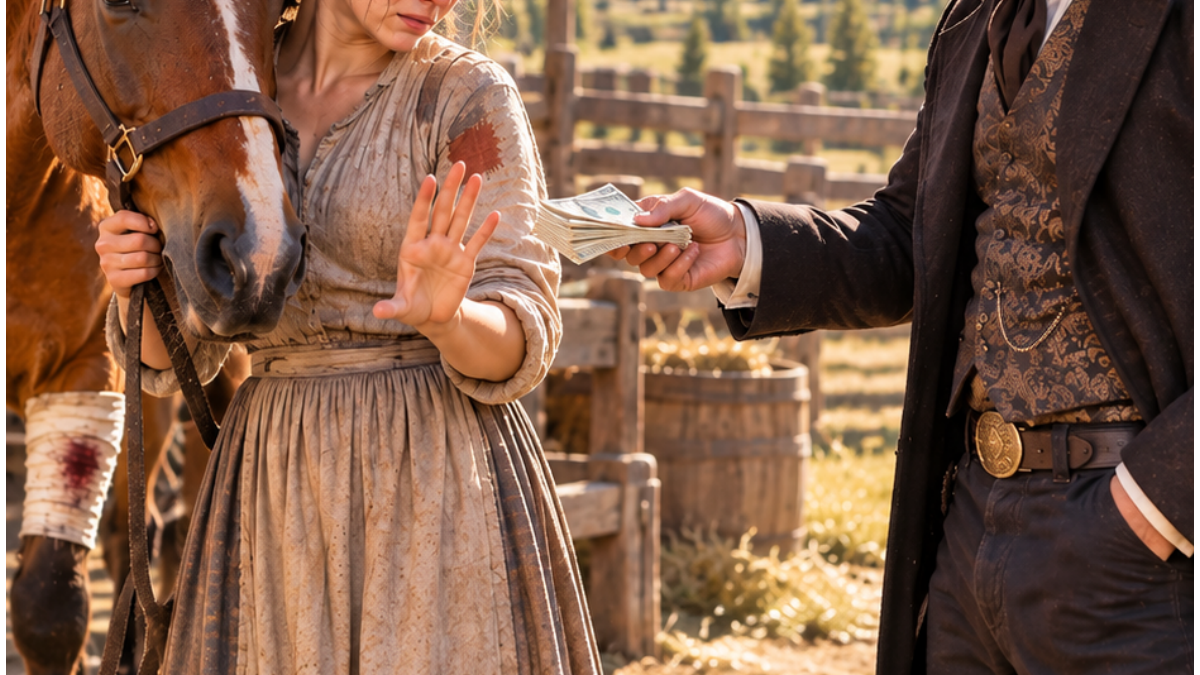
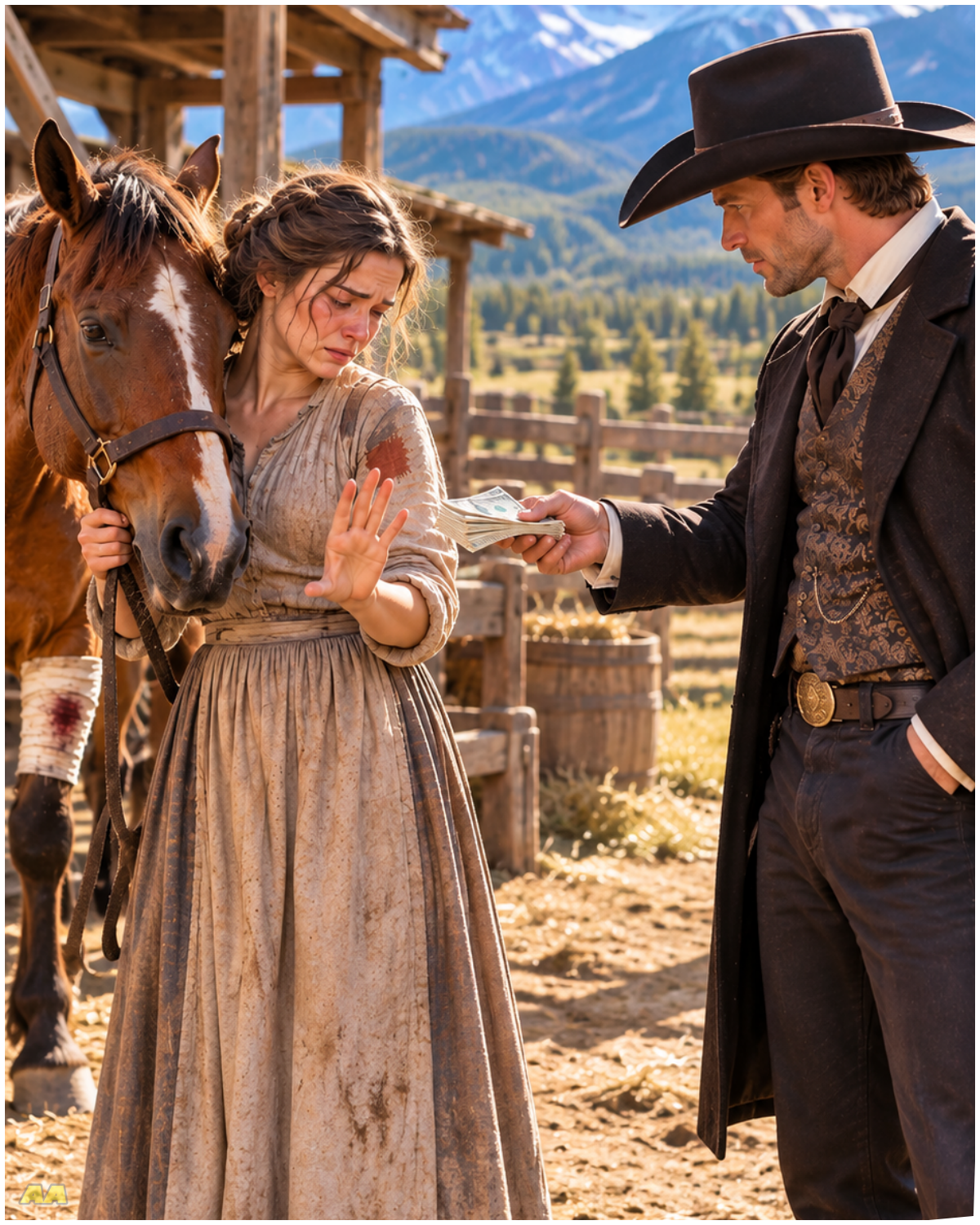
Declan Reeves grabbed the mayor’s halter and yanked her head sideways so hard she stumbled on her bad leg.
$20, the slaughter buyer said.
Final offer. Tessa Marlo stepped between them before she finished thinking about it.
Get your hand off her.
Declan laughed. Not the kind of laugh that meant something was funny.
The kind that meant he had already decided she didn’t matter.
Lady, that horse is done.
You’re just too sentimental to admit it.
300 people at the Aoyo Verde livestock auction watched a laress stand between a dying mayor and the man who wanted to turn her into soap.
Most of them figured she’d back down.
She was wearing a patch dress and broken boots.
He was wearing a Callahan Ranch badge.
Tessa didn’t move.
And somewhere in the crowd, a wealthy rancher named Hugh Callahan saw something he hadn’t seen in a very long time.
Someone who couldn’t be bought.
The auction had been running since 7:00 in the morning, and Tessa had been standing in the same spot for 3 hours.
She hadn’t planned to stay this long.
She’d come to sell Juniper, get the money, and leave a royo verde before the first froSt. That had been the plan for 6 weeks.
A clean departure. No debts, no goodbyes, no explanations owed to anyone.
But Juniper had pulled up lame four days before the auction.
And now the mayor stood in the holding pen with one forleg cocked and her head low, and the plan had quietly fallen apart.
The slaughter buyer’s name was Croft.
He had a wagon already half-filled with animals that would never see another spring, and he moved through the pens the way a man moves when he has done something, so many times it stopped, requiring thought.
He looked at Juniper for about 4 seconds.
Injured tendon. He said she won’t pull a load again.
$20. She’s not for slaughter.
Tessa said. What’s she for then?
Tessa didn’t answer because she didn’t have an answer.
She’d been trying to find one for 4 days and she still hadn’t gotten there.
Croft shrugged and moved on.
He came back an hour later and offered 18, which was apparently how his negotiating worked.
Tessa refused that too. He came back a third time with 15 and a look on his face that said he found her attachment mildly irritating.
That was when Declan Reeves walked over.
She recognized the Callahan brand on his jacket before she recognized his face.
Everyone in the county recognized that brand.
Callahan Ranch ran 3,000 acres of cattle and horse country north of town, and it employed half the men at this auction, including two of the judges.
Declan had the build of a man who had handled horses for 20 years wide shoulders, thick forearms, a way of standing that took up slightly more space than was necessary.
He looked at Juniper the way Croft had, except faster because he knew what he was looking for.
Recovery potential. She injured a tendon 3 weeks ago, Tessa said.
Possibly four. I missed the early signs.
That admission cost her something.
She said it anyway because lying about a horse’s condition was the kind of habit she refused to start.
Declan tilted his head. How old?
13. He made a sound that wasn’t quite dismissive and wasn’t quite sympathetic.
It was the sound of a man doing arithmetic.
Then he grabbed the halter and turned Juniper’s head to get a better look at her eyes.
And he did it fast, the way people do when they’re used to animals cooperating because the alternative isn’t offered.
Juniper flinched and shifted her weight off the bad leg and made a small desperate sound.
Tessa moved without thinking. Get your hand off her.
Declan looked at her like she’d said something in a language he didn’t speak.
Then he looked at the mayor, then back at Tessa, and he let go of the halter, not because she’d asked him to, but because he’d gotten what he came for, and the mayor wasn’t worth arguing over anyway.
25, he said. Mr. Callahan will give her a pasture retirement better than you’ll find anywhere else today.
She’s not for sale to Callahan Ranch.
She’s not for sale to anyone,” Declan said.
His voice had changed. Still calm, still almost polite, but with something underneath it now, which means she’s going to stand in that pen until the auction ends, and then you’re going to be standing there with an injured horse and no buyer and fewer options than you have right now.
Every word of that was true.
Tessa knew it. She hated knowing it.
Then that’s what happens, she said.
Declan studied her for a moment.
The way people study something they can’t quite categorize.
Then he walked away back toward the covered section where the Callahan group was gathered.
And Tessa Tessa turned back to Juniper and pressed her forehead against the mayor’s neck and breathed.
“I know,” she said quietly.
“I know. I’m sorry.”
Juniper didn’t do anything except stand there being patient, which was what Juniper did.
Even in pain, even in a strange pen surrounded by noise and strange animals and the smell of fear that livestock auctions carried like weather.
The mayor had always been patient.
That was the thing about Juniper.
She trusted Tessa even when Tessa didn’t deserve it.
Hugh Callahan had been watching from the rail of the adjacent pen for approximately 6 minutes before Declan came back to report.
He was not the kind of man who made himself obvious at auctions.
He’d learned at 17 from his father that the moment you show interest, the price adjusts.
So he watched pens from angles.
He listened more than he spoke.
He let Declan do the initial conversations and came in only when it mattered.
It mattered now, not because of the mayor, because of the woman.
He’d seen the moment with Croft from 30 ft away.
He’d seen Declan try to handle the situation with the calm authority of someone who expected compliance.
And he’d seen a woman in a patch dress stand in place like she’d been anchored there.
What interested Hugh wasn’t the drama.
He’d seen plenty of people dig into a position at auction out of stubbornness or pride or plain poor judgment.
What interested him was that she’d told Declan she missed the early signs.
People didn’t say that at livestock auctions.
People at livestock auctions explained why the animals condition wasn’t their fault or they didn’t mention it at all.
This woman had offered it upfront, unprompted, to a stranger she was trying to negotiate with, which was either very honest or very stupid or both.
Hugh walked over. He didn’t signal Declan.
He didn’t bring anyone.
He crossed the packed dirt between the pens alone and stopped at the rail where the woman was standing with her forehead against the mayor’s neck, and he waited until she registered that someone was there before he spoke.
She a good horse when she was sound.
Tessa straightened up. She looked at him the way people look at someone they’re trying to place what he wanted.
Whether he was connected to Declan, whether this was the same offer arriving in a different suit.
Yes, she said. What’d you use her for?
Nothing useful. She belonged to my father’s breeding operation.
After it closed, I kept her.
Hugh looked at the mayor.
She was a gray darker than dappel, lighter than steel, with a clean head and good bone structure under the condition probleMs. Whatever she’d been before the injury and before the weeks of uncertainty, she’d been a quality animal.
That much he could still see.
She’s worth saving. He said, “I know that.
I’ll give you $60 and she spends the rest of her life on Callahan pasture.
She won’t be worked. She won’t be sold.
I’ll have doctor Crane looked at the tendon.” He watched her face.
He was used to reading negotiation, the small calculations people made when an offer came in higher than expected.
The slight softening around the eyes, the unconscious exhale.
She didn’t do any of that.
No thank you, she said.
Hugh stood there a moment.
60 is more than she’d bring sound.
I understand that. Then I’m missing something.
You’re not missing anything, Tessa said.
I just don’t want to sell her to you.
That was unusual enough that Hugh didn’t respond immediately.
He was a man who had spent his adult life in a county where his family name did the first half of every conversation for him, and he was aware of it, and occasionally it bothered him more than he let on.
But he’d never had someone refuse $60 for a lame 13-year-old mayor and say the reason had nothing to do with price.
“Is it the ranch?” “It’s not the ranch, is it Declan?” She looked at him with an expression he couldn’t read cleanly.
“Why would your trainer’s behavior reflect on your offer?
I’m asking if it does.
He grabbed her halter and turned her head hard enough to make her put weight on the injured leg, Tessa said.
But no, that’s not the reason.
What’s the reason? She was quiet for a moment.
Juniper shifted beside her, weight coming off the bad leg, and without breaking eye contact with Hugh, Tessa’s hand moved to the mayor’s shoulder in the automatic way of someone who has touched this particular animal 10,000 times.
“My father taught me something,” she said.
He taught me that when a man offers more than a thing is worth, he’s not buying the thing.
Hugh let that sit. So what’s he buying?
He thinks he’s just being generous.
She said they always think that.
She wasn’t hostile. That was the part that stuck with him.
She said it the same way.
She’d said she missed the early signs like a statement of observed fact that happened to be inconvenient.
Hugh looked at the mayor one more time.
Then at Tessa. I hope she recovers, he said, and he meant it.
And he walked back toward the Callahan section without raising his offer.
Declan was waiting. She won’t take it.
No, she’ll be stuck with that animal by end of day.
Probably, Hugh said. Then why did you even write down what the Callahan pasture offer stands at?
Hugh said, in case she changes her mind.
He didn’t think she would.
He left the note anyway.
She didn’t change her mind.
At 5:00 in the afternoon, the auction ended, and Tessa was standing in the pen with a lame mayor and $43 in her coat pocket, which was nearly everything she had.
The plan to leave a Royo Verde before the frost was officially dead.
She’d been building toward that departure for 8 months.
After her father’s breeding operation folded, and her mother left to live with a sister in Colorado, and there was nothing left in a Royo Verde, except a rented room above a laundry and a horse she couldn’t afford to board.
Tessa had made a decision.
She would work until she had enough to lease a small stable somewhere reasonable, not grand, not profitable, just a place where she could take in injured or overworked horses and give them somewhere to recover that wasn’t a slaughter pen.
It wasn’t a complicated dream.
It was barely a dream at all.
It was just a purpose, and she was tired of living without one.
Now she had juniper to feed for however many months the tendon needed, and no way to add to her savings while she did it.
The math was clean and it was ugly.
She wrapped Juniper’s leg with the strips of cotton she kept in her bag, checked the wrapping twice, and led the mayor toward the livery where she’d arranged temporary stabling.
The mayor walked slowly and carefully.
The way animals walk when they’ve learned that moving wrong hurts.
I know, Tessa said again.
She didn’t know who she was apologizing to anymore.
Juniper, her father, herself. She saw Hugh Callahan for the second time 3 days later behind the Continental Hotel.
She was there because Mondays and Thursdays she collected linens from the Continental’s kitchen staff and Saturdays she returned them, which was part of how she made the money that was supposed to be going into the stable fund and was now going to Juniper’s Feed and boarding costs.
The kitchen backed onto a narrow service alley that also served the small freight yard behind the general store.
And there was a mule tied to the post outside the freightyard that Tessa had noticed on her way in.
On her way out, she noticed the mule again.
He was favoring his left foreg, not dramatically, just enough that a person who knew what to look for would see it in the way he shifted when he breathed.
Tessa stood there long enough to confirm it wasn’t her imagination.
The freight handler was inside the store.
The mule had been standing on a hard surface for at least 2 hours based on his general expression.
Tessa sat down her linen bundle and crouched beside the leg and ran her hand down the cannon bone until she found the heat.
That’s a good way to lose your hand, a voice said.
Hugh Callahan was standing at the entrance to the alley with two men she didn’t recognize, apparently returning from wherever wealthy ranchers went on Tuesday mornings.
He doesn’t bite, she said without looking up.
He’s sore, not angry. Do you know whose animal that is?
I know he’s been standing on packed dirt for 2 hours with swelling in his foreg and nobody’s noticed.
She straightened up. If it’s the freight handlers, he should come out here.
I’ll get him, one of the men with Hugh said and went into the store.
Hugh walked closer. He looked at the mule with the same focused attention he’d given Juniper.
Not the attention of someone learning, but the attention of someone comparing what they’re seeing to what they already know.
Same kind of heat as the mayor, he said.
Yes, same cause. Probably similar.
Hard work on hard ground without enough reSt. She looked at him.
You can feel it just above the fetlock if you go slowly.
He looked at her for a moment.
Then he crouched beside the mule and ran his hand down the leg the way she’d shown, not the quick take charge grip that Declan had used on Juniper, but careful, two fingers, the way you’d check a sleeping child for fever.
There he said. Yes. The freight handler came out.
He was annoyed at first, the way people are annoyed when someone interrupts their day with information about their property.
Then Tessa explained what she’d found and what it meant and what would happen to the mule if it went ignored for another 2 weeks, and the annoyance turned into something more useful.
Hugh watched the whole conversation without speaking.
Afterward, when the freight handler had taken the mule inside to rest it, Hugh said, “Where did you learn to read lameness like that?
My father raised horses.” She picked up her linen bundle.
He was a bad businessman, but he was an excellent horseman.
Was. He died 3 years ago.
I’m sorry. She looked at him with that same expression she’d used at the auction, the one that was measuring without being unfriendly.
Is there something you want to ask me, Mr.
Callahan? Yes, he said. I want to offer you work.
She was quiet. Recovery and rehabilitation at the ranch.
I have a barn specifically for animals that need rest from the main operation.
Declan manages the training program.
This would be separate. 3 months wages to be agreed and you’d be permitted to bring the mayor for treatment on the property.
On the property, she said, not a gift.
I’m not offering to treat her for free.
She’d be in your care on our land and using our resources.
I’d be paying for that with my work.
Yes. Tessa thought for a moment.
Not long. She was already doing the math.
She’d been doing since the auction the months required.
The money needed, the gap between the two.
What are the wages? He named a number.
It was fair. It was maybe slightly better than fair, which she noticed, but it wasn’t so far above market rate that it crossed the line her father had taught her to watch for.
I have conditions, she said.
All right. I make the decisions in that barn.
If one of your men disagrees with my methods, we discuss it.
But while I’m working, I work without being overridden, within reason, within my professional judgment.
If that’s not acceptable, the wages aren’t relevant.
He considered that she could see him considering it not performing consideration.
Actually doing it. Agreed. He said with one exception.
If Dr. Crane and you reach opposite conclusions, I’ll listen to both before I decide.
That was fair. She respected it for being fair.
Agreed. She said, “Start Monday.
I’ll need 2 days to arrange my laundry routes to continue on reduced hours.
I’m not giving those up entirely.
That’s your choice to make.
Yes, she said. It is.
She picked up her bundle and left.
Hugh Callahan stood in the alley and watched her go and thought about the fact that in the span of 5 minutes she had negotiated her own terms, kept her existing income, and thanked him for exactly nothing.
It was, he thought, the most refreshing professional conversation he’d had in years.
The recovery barn at Callahan Ranch sat on the eastern edge of the main operation, separated from the training facilities by a stand of cottonwoods that had been there longer than the ranch.
It held six stalls, a small tack room, and a narrow corral built specifically for controlled movement, short walks, measured distances, the careful coaxing of healing legs.
Tessa arrived Monday before 7 with Juniper in tow, and spent the first hour learning the space before she let anyone tell her what it was for.
The second hour was when she met Finn Walker.
He was 20 years old, thin in the way of young men who work hard and don’t think about eating, with red hair that needed cutting and a way of standing near horses that showed he liked them without revealing that he was still learning to read them.
He’d been assigned to help in the recovery barn while his regular duties were light, which was the kind of assignment that told Tessa he was either being punished or hadn’t yet proven himself somewhere else.
He introduced himself by saying, “Mr.
Reeves said to tell you the chestnut geling in stall 4 has been resting for 6 days and should probably be moving more.” “Good morning,” Tessa said.
“Yeah,” Finn said. “Good morning.” “What’s your name?” “Finn Walker.
Have you worked with recovering horses before, Finn?” “I work with all kinds of horses.” That wasn’t an answer.
She let it pass. Does the chestnut have a name?
They call him Brick. Who’s been treating him?
Nobody. He’s just been resting.
Tessa went to stall 4 and looked at brick for a long time without opening the gate.
He was a working horse, not a breeding animal, not flashy with the kind of muscled hind quartarters that came from cattle work and a long scar on his left hip that had healed badly years ago.
He was watching her with both ears forward, which meant he was curious, not afraid.
That was good. Horses that came out of pain scared were harder to rebuild.
She opened the gate and went in alone.
Don’t you want me to?
Finn started. Wait outside, please.
He didn’t like that. She could hear it in the brief silence before he complied.
He was used to being useful in horse spaces, which meant he wasn’t used to being told to step back, which meant nobody had taught him yet that there were moments when a second person in a stall doubled the variables without adding anything valuable.
She spent 15 minutes with brick, just standing, then’s slow movement.
Then her hands on the injury site a shoulder strain from what she could find and careful pressure applied in sequence while she watched his reactions the way her father had taught her which was not to watch the injury but to watch the whole animal.
When she came out Finn was leaning against the wall with his arms folded.
Well, he said he needs walking.
She said short distances four times a day.
I’ll show you the pattern.
And he needs the shoulder work before each walk or he’ll compensate and strain something else.
I know how to walk a horse.
I know you do. I’m telling you the specific method for this horse at this stage of healing.
Those are two different things.
Finn unfolded his arMs. He didn’t say anything.
Are you going to give me trouble?
She asked. No. All right.
She turned toward Juniper’s stall to finish settling the mayor.
I’ll show you the walking pattern after I get her sorted.
She heard him exhale behind her.
Not a sigh. Uh, exactly.
More the sound a person makes when they’re deciding to comply with something they haven’t yet decided to believe in.
She’d heard that sound before.
Her father’s stable hands had made it regularly when she was 12 and started telling them things they didn’t want to hear from a 12-year-old.
She’d learned early that the sound didn’t matter.
The work was the argument.
The first week at Callahan Ranch was harder than she’d expected, and not for the reasons she’d anticipated.
She’d expected push back from Finn.
She got it, but it was manageable.
He argued twice about methods, listened when she explained herself without performing patience, and by Thursday was doing the walking pattern with brick without needing to be watched.
She’d expected Declan to ignore her.
He mostly did, which was its own problem.
When the head trainer ignores the recovery barn, the recovery barn doesn’t get the information it needs about which animals are coming in and why and how hard they’ve been pushed before they arrive.
She had to get that information from the stable hands, who got it secondhand, which meant it arrived late and sometimes wrong.
She didn’t expect Margaret Callahan.
She didn’t meet her that first week.
She didn’t meet her for 2 weeks, but she felt the shape of her presence in the ranch.
The way you feel weather before it arrives, in the way certain hands watch to see if Tessa was watching them, in the small, careful way Hugh spoke about the main house, in the fact that she had been given good wages in a clear professional role, and had not once been invited to supper, or introduced to a single person who wasn’t a stable worker.
She told herself it didn’t matter.
She was here for the work.
She was here for Juniper.
She was here for the money that was going to become the stable that was going to become the future she’d been building toward for 8 months.
She told herself that every evening when she walked back through the cottonwoods to the small room she’d been given above the tax storage, and most evenings she believed it.
On the ninth day she found a nervous young mayor striking at her stall wall.
The mayor had been tying up after heavy work a metabolic problem that left her muscles locked and painful.
And the standard treatment she’d been receiving wasn’t accounting for the fact that she was also anxious.
A horse in pain that is also anxious does not reSt. A horse that does not rest does not recover.
The mayor had been tied facing into the stall corner, which was standard practice for horses that struck.
Standard practice was wrong for this horse.
Tessa could see it in the way she held her neck.
The anxiety wasn’t about being contained.
It was about not being able to see what was approaching her.
Tessa moved the tie to the opposite poSt. The mayor stopped striking within 10 minutes.
Two of the hands watched this happen and said nothing.
Finn watched it happen and said, “That’s it.
Just moved where she was tied.
That’s it. How did you know?” She was anxious about what she couldn’t see.
Once she could see the door, she could see there was nothing coming.
Finn was quiet for a moment.
I’ve been tying nervous ones the other way my whole time here.
Declan probably taught you. He did.
It works for some horses.
Not for this kind. How do you know which kind?
She looked at him. He was asking genuinely, not trying to catch her in a contradiction, not performing interest to avoid being corrected again.
He actually wanted to know.
Watch the neck, she said.
A horse that’s afraid of pain holds the neck differently than a horse that’s afraid of what it can’t see.
Pain makes them drop it.
Fear of the unknown makes them carry it high and stiff.
Finn nodded slowly. Okay, does that make sense?
Yeah, he said. Actually, yeah.
He stayed after his shift ended that evening to finish checking the horses in the recovery barn.
She didn’t ask him to.
He just stayed. Hugh stopped by the recovery barn on the 11th day.
He came alone at a time that wasn’t a formal inspection midm morning after the day’s main work had been distributed when the barn was quiet and Tessa was working through Juniper’s daily leg treatment.
He came through the side entrance rather than the main door which she noted because people who came through the main door were usually making an official visit.
How is she? He asked.
He meant Juniper. She appreciated that he meant Juniper.
Better than I expected. Tessa said the tendon is responding.
She’s not sound yet, but she’s bearing weight evenly, and the swelling is down by half.
Hugh leaned on the stall rail.
He watched the way Tessa’s hands moved on the mayor’s leg, the slow pressure, the intervals, the pauses when she waited to see what Juniper did before continuing.
Declan does that differently, he said.
I know. Not saying it’s wrong, just noting.
Declan has a method that works well for horses with a certain kind of temperament.
Tessa said, “Juniper’s temperament requires a different approach.
Can you tell the difference?
She looked up at him.
Yes. From watching them or touching them?
Both. Watching firSt. The touch confirMs. He nodded.
He seemed to be thinking about something beyond the horse.
She’d noticed that about him.
He asked questions about horses, but was sometimes using the answers to think about something adjacent to them.
The chestnut is moving better.
He said he’ll be ready for light work in 2 weeks.
I’d suggest starting him on flat ground only.
No cattle for the first month back.
I’ll tell Declan he won’t like it.
Hugh smiled just slightly. He won’t like it, he agreed.
They were quiet for a moment.
Juniper’s breathing filled the stall, steady, calm, the sound of a horse that was not in active pain for the first time in weeks.
You said your father was an excellent horseman, you said.
Yes. But a bad businessman.
Yes. What happened to the operation?
She kept her hands moving on Juniper’s leg.
He borrowed money from a man named Puit, larger sum than he needed because Puit offered it.
Puit’s money came with Puit’s opinions about how the horses should be bred and marketed.
My father disagreed. The disagreement became an argument.
The argument became a lawsuit.
Puit sued him. Puit argued my father had mismanaged his investment.
She paused. He was technically correct.
My father had made decisions Puit didn’t approve of.
And since Puit’s money was involved, the court treated it like partnership fraud.
Was it? She was quiet for a moment.
My father was honeSt. He was not careful about what honesty costs.
Hugh was quiet, too, for longer than felt like just processing the information.
Is that why you refused the $60 at the auction?
He said finally. Yes. You think I’d have done what Puit did?
I don’t know what you’d have done, she said.
I know what accepting the money would have done to me.
She looked up at him.
I would have been grateful and then I would have been afraid of losing the thing I was grateful for and then I would have started making decisions based on that fear instead of on what was right.
She looked back at Juniper.
I’ve seen what that does to a person.
Hugh didn’t say anything for a long moment.
Then he said, “The note I left at the auction with the pasture offer, do you still have it?” “No, I threw it away.” “Good,” he said, which was not what she’d expected him to say.
She looked at him. “I shouldn’t have left it,” he said.
I think I left it because not leaving it felt too much like admitting you were right.
He straightened from the rail and walked back toward the side entrance and Tessa watched him go and Juniper turned her head and pressed her nose against Tessa’s shoulder, which was something the mayor only did when she wanted attention.
I know, Tessa said. She didn’t say what she knew, but she stayed in that stall for another 20 minutes after she’d finished the treatment because leaving felt like moving too faSt. And for the first time in 8 months, Aoyo Verde felt less like a place she was waiting to leave.
She hadn’t decided what that meant yet.
She told herself she didn’t need to decide today.
Juniper knickered softly and rested her weight on all four legs, even the bad one, just for a moment.
It was a small thing.
It was also the first time in weeks she’d done it.
Tessa pressed her forehead against the mayor’s neck and stayed there.
And outside the cottonwoods moved in the autumn wind and the ranch went on around her the way life does when it has not yet revealed what it intends to become.
The agreement Hugh had offered was 3 months.
3 months became four before either of them said it out loud.
Tessa didn’t notice the shift until she was already inside it.
She’d been counting weeks the way she’d counted everything since her father died by what they cost and what they produced.
By the math of survival.
6 weeks of wages equaled the lease deposit on a small property.
8 weeks meant she could afford to repair a roof.
12 weeks and she could start with three stalls and grow from there.
But somewhere in the fifth week, she stopped counting in terms of leaving.
She wasn’t sure when it happened.
Maybe when Brick came back from his first day of light pasture work, moving moving clean and easy, and Finn walked him in, grinning like he’d personally rebuilt the geling from the ground up.
Maybe when Juniper started meeting her at the stall door in the mornings instead of standing at the back.
Maybe when Hugh started stopping by the recovery barn on days when there was no formal reason for him to be there.
She didn’t examine it. She just noticed that Aoyo Verde had stopped feeling like a waiting room.
Declan noticed the change in the barn before Tessa was fully aware of it herself.
He didn’t say anything directly.
He wasn’t built for directness about things he couldn’t quantify.
But he started sending animals to the recovery barn with more detailed notes about their histories, which was his version of acknowledging that the information Tessa sent back was useful.
For Declan Reeves, that was practically a standing ovation.
It was Finn who said it plainly one morning while they were working through the walking routine with a gray mare that had come in with a bowed tendon.
You’re not leaving at the end of the month, are you?
I haven’t decided, Tessa said.
That’s not the same as yes.
No, it isn’t. Finn was quiet for a moment, leading the mayor in slow circles while Tessa watched the movement from the gate.
He’d gotten good at this.
Not just competent good. He understood now that the circles weren’t exercise, but information.
That the way an animal moved through a curve told you more than any amount of standing observation.
What would it take? He asked.
For what? For you to stay?
She looked at him. He meant it practically, not romantically.
He had the straightforward curiosity of someone who had learned to think in terms of problems and solutions, which was what good horsework did to a person eventually.
A reason that has nothing to do with the ranch, she said.
He nodded like that made sense, though she suspected he understood it only partly.
She understood it only partly herself.
Hugh asked her to stay on through the autumn breeding season on a Thursday afternoon, 2 days after she’d been here 5 weeks.
He did it in the recovery barn, standing on the outside of Juniper’s stall, which was where most of their real conversations happened.
She’d realized by then that the mayor had become a kind of neutral ground for them, a reason for proximity that required no explanation.
The breeding season runs through December, he said.
The demands on the main operation increased significantly.
I’d rather have the recovery barn fully staffed than pulling men from other areas.
Fully staffed currently means me and Finn on alternating days.
I know. I’d like it to mean you and Finn every day.
She looked at him. You’re asking me to take on more work.
Yes. For more wages, Finn should be compensated separately for the added hours.
Hugh paused. All right. And if the recovery barn is going to function as a full operation during breeding season, I need Declan to start including me in the preliminary assessment of animals before they’re brought in, not after.
I’ve been working with incomplete histories and I’ve been getting by on it, but for high pressure animals, I need the full picture.
Hugh was quiet for a moment.
She could see the calculation happening Declan’s Declan’s position, his pride, the practical difficulty of requiring his head trainer to loop in a woman from the recovery barn before the animals reached her.
I’ll speak with him, Hugh said.
He’ll push back. I imagine he will.
What will you say? Hugh looked at her steadily.
I’ll tell him the recovery barn’s outcomes over the past 5 weeks have been better than the previous 6 months combined and that improving the information flow isn’t a negotiation.
It’s a management decision. She said nothing for a moment.
All right, she said. I’ll stay through December.
Hugh nodded. He started to leave then stopped.
There’s one other thing. She waited.
There’s a young stallion in the main training facility, 3 years old.
Purchased last spring for the breeding program.
His name is Copper King.
She’d heard the name. The hands talked about him the way people talk about a family member who is brilliant and exhausting in equal measure.
Beautiful animal, difficult temperament, enormous expectations riding on his performance.
What about him? Declan is beginning an intensive training program to prepare him for the territorial exhibition in Santa Fe.
The exhibition is in 12 weeks.
And he’s been difficult from the start.
Not dangerous, just resistant. Declan’s approach hasn’t been producing the results we’d hoped.
Hugh looked at her carefully.
I’m not asking you to take over his training.
That’s Declan’s operation. But I want you to observe.
Be available if questions come up.
Declan will hate that. Yes.
Does he know you’re asking me?
Not yet. Tell him before you tell anyone else.
She said if he hears it sideways, it’ll make everything harder.
Hugh considered this. That’s good advice.
It’s practical advice. There’s a difference.
Something shifted in his expression.
Then not quite a smile, something quieter, like a person recalibrating an expectation without making a production of it.
I’ll tell him tomorrow, he said directly.
She nodded. He left. She stood with Juniper and thought about Copper King and about the fact that she’d just agreed to stay through December, and about the math of that, which was no longer purely financial.
She didn’t examine that last part too closely.
Declan took the news about as well as expected, which was to say he spent two days pretending to be fine with it before reverting to his natural state, which was to act as though the recovery barn existed on a separate continent.
Tessa wasn’t surprised. She’d worked with men like Declan before, men who were genuinely skilled at their craft and had built their authority on that skill over decades and who understood without being able to admit it consciously that any acknowledgement of another person’s expertise was a subtraction from their own.
It wasn’t malice, it was arithmetic.
She gave him space. She didn’t push for the preliminary assessments in the first week.
She didn’t ask to observe the training sessions with Copper King.
She waited. What she got instead was a Tuesday afternoon when Finn came to find her with that particular expression he’d developed somewhere between troubled and trying not to show it.
Copper King threw a stable hand this morning, he said.
Was anyone hurt? Not badly.
Kid landed soft, but Declan’s been pushing him harder since then, like the throwing was the horse’s fault.
Was it? The hand cut a corner going into the turn.
Copper King didn’t have time to adjuSt. Tessa took off her work gloves and set them on the fence rail.
What’s his schedule this afternoon?
Long golf work in the east ring until 3.
Then Declan wants to do a full training run.
She walked to the east ring.
She didn’t go in. She stood at the fence like someone who happened to be passing, which fooled nobody but created the necessary fiction that she wasn’t there to evaluate anything.
Copper King was extraordinary. That was the first thing, and she gave it its proper weight before she let herself look for probleMs. He moved with the loose, powerful stride of a horse that was bred for exactly what was being asked of him, high action, clean collection, the kind of presence that made other horses in a pen look like furniture.
He was bay red with a blaze that ran slightly crooked, and even at the end of a hard, long session, he was still moving forward with energy he’d chosen to direct rather than suppress.
He was also tired. She could see it in the third circuit of the long line.
Not dramatically tired, not the kind of tired that anyone watching for the first time would call tired.
The subtle version, a fractional shortening of the stride on the right for leg, a barely perceptible delay in his pickup out of the turns.
She watched for 15 minutes and said nothing.
Then Declan called the long session and prepared to move into the training run, and she walked over.
“His right forle is showing something,” she said.
Declan looked at her. The way a man looks at weather he has already decided is not his problem.
He’s sound. He’s moving shorter on the right.
It’s not significant yet, but it’s there.
He threw a man this morning.
He’s adjusting to the work after an irregular morning.
That’s possible, she said. Or the irregular morning revealed something that was developing before it.
Declan turned to look at her fully.
He wasn’t hostile. He was something more careful than hostile, which was a man with expertise choosing to evaluate whether the challenge in front of him was worth engaging with.
“Can you show me specifically what you’re seeing?” he said.
That surprised her. She kept her face neutral.
In the turns, coming out of them on the right, there’s a delay in the pickup about half a stride.
It’s in his weight placement before the turn, too, if you watch the approach.
Declan was quiet. He turned back to Copper King, who was standing with his head up, watching both of them with the alert, slightly arrogant attention of a horse that knows he is the most important thing in any room he occupies.
“One more launch circuit,” Declan said to the hand holding the line.
“Slow! Let him choose his pace.” They watched.
The half-stride delay was there on the second right turn, small enough that Tessa nearly second-guessed herself, but it was there.
Declan said nothing for a moment.
Then he said, “Rest day tomorrow.
No training run today.” It wasn’t an acknowledgement that she’d been right.
It wasn’t a thank you.
It was a decision presented as his decision, which it was because she had presented the information and stepped back and let him make the call.
She had learned that from her father too, not the words, the behavior.
You cannot move a proud person’s position by trying to occupy it.
You can only give them a clear view and wait.
She walked back to the recovery barn.
Finn was waiting. “Well, rest day tomorrow,” she said.
Finn looked like he wanted to ask more.
She picked up her work gloves and went back to the gr the grey marare’s evening walking routine.
And Finn, who had learned when questions were going to be answered and when they weren’t, went to fill the water buckets.
The first kiss that almost happened occurred on a Friday evening in the third week of October.
They’d been walking back from the stable together after a long day, which had become something that occurred naturally enough that that neither of them had discussed it or named it.
The cotton woods between the recovery barn and the main house complex were yellow and drop dropping leaves, and the air had the particular quality of late October in the high desert, cold enough to feel like winter was a serious intention, warm enough to still be surprised by it.
They’d been talking about a quarter horse that had arrived that week with a chronic back problem her owner had been managing badly.
She’s been compensating for months.
Tessa said the soreness isn’t where the original problem is.
The original problem is what she learned to protect.
That’s fixable slowly. She has to unlearn the compensation before the original injury has room to heal.
Hugh was quiet for a few steps.
That seems backwards. It is backwards.
Injury usually works backwards. You have to treat what the animal learned to do instead of what hurt at firSt. Yes, he thought about that in a way that she recognized as him not only thinking about horses.
Is that true for people?
She looked sideways at him.
Sometimes I’ve been managing horses since I was 15.
He said, “I managed them the way my father managed them, the way the men before him managed them.
I’m not sure I ever thought seriously about whether the habits I inherited deserve to be kept.
You told me that once before about experience not being proof.
You said it about me.
I said it about habits.
You said it to me.
She smiled just slightly because he was right and because he’d remembered and because that was the thing about Hugh Callahan that she hadn’t expected and still wasn’t sure what to do with.
He listened and he kept what he heard.
They stopped at the point where the path split.
One branch toward the main house, one toward the tax storage and her room above it.
They stopped there the way they’d been stopping there for weeks, which was a few seconds longer than geography required.
I owe you something, he said.
You pay my wages. Not that.
He looked at her in the way he had of looking at things he was about to say clearly.
I owe you an acknowledgement that you were right at the auction about what too much money from a stranger implies.
She didn’t say anything. I thought I was being generous, he said.
I think I was. But you were also right that I didn’t know what I was offering beyond the money and I didn’t spend much time asking.
You were trying to help.
Yes. And it didn’t occur to me that help could be complicated.
The honesty in that was the kind she’d stopped expecting from men who had money and power enough to avoid honest self-examination.
She didn’t know what to do with it, which was itself a kind of answer.
The distance between them was about 2 ft.
She was aware of it in the way you are aware of a distance that has become a question.
And then Copper King screamed.
It was the sound of a horse in serious trouble.
Not pain exactly, but the high-pitched urgent alarm of an animal that had startled itself badly.
Both of them turned toward the sound before either of them finished reacting, and by the time Tessa’s brain caught up to her feet, she was already moving toward the training barn, and Hugh was half a step behind her.
The hand on Nightw Watch had been checking the far end of the barn when something spooked Copper King in his stall.
A cat probably or a noise from outside the mundane causes of undignified events.
The stallion had thrown himself against the back wall, not hard enough to injure himself, but hard enough to make enough noise to wake three other horses and knock over the water bucket, and generally established that the evening was not going to end quietly.
It took 20 minutes to settle the barn.
Copper King stood at the front of his stall afterward, ears still forward, still charged with the leftover electricity of having been frightened, which had converted itself into a fronted dignity.
He was looking at Tessa as if she might have an explanation.
“You’re fine,” she told him.
“He didn’t look convinced.” Hugh leaned on the stall rail beside her, close enough that their shoulders nearly touched.
“He’s going to be impossible tomorrow,” Hugh said.
“He’ll be fine if you give him the morning.
Declan won’t want to give him the morning.
Tell Declan the morning is mine.
I’ll have him calm by noon.
Hugh looked at her, and the awareness of the two feet that had existed between them on the path was still there, translated now into 6 in of shoulder distance in a barn full of quietly breathing horses.
“All right,” he said. They stayed there another few minutes, not because Copper King needed them, but because leaving required a decision that neither of them was quite making yet.
The barn settled into its night rhythMs. The other horses went back to sleep.
Copper King lowered his head eventually, reluctantly in the manner of a horse that wasn’t going to admit the crisis was over, but was willing to stop announcing it.
When they did leave, they walked back to the path together.
And at the split, they both stopped again.
“Tomorrow,” he said. “Tomorrow,” she agreed.
She went to her room, and Hugh went to the main house, and neither of them said anything else.
And the almost kiss remained where it was.
Somewhere between the cotton woods and the moment when Copper King had decided a cat was grounds for destroying the evening, she lay awake for a while, which she hadn’t done in weeks.
She worked with Copper King the next morning before anyone else was in the training barn.
He was still charged from the night before, not wild, just coiled, the kind of energy that needed direction badly, or it would find its own direction, which would not be useful.
She brought him into the small round pen off the main barn, the one used for starting young horses, and she did nothing for the first 10 minutes except stand in the center and let him move.
He wanted her to do something.
He kept looking at her.
She kept not doing anything.
This was the argument she’d been having with Declan’s methods since she arrived, the one she’d been making in practice without stating it directly, that a horse who was always told what to do never learned how to choose to pay attention.
And a horse that hadn’t learned to choose it couldn’t give it reliably when it mattered.
At 12 minutes, Copper King stopped moving and looked at her from across the pen.
She turned slightly sideways. The non-confrontational angle.
He took three steps toward her.
She waited. Four more steps.
She let him reach her.
He put his nose on her shoulder and blew out a long breath that felt like something releasing.
“There you are,” she said.
Hugh was watching from the fence.
She didn’t know how long he’d been there.
When she walked Copper King back to his stall 40 minutes later, Hugh fell into step beside her.
How did you know he’d come to you?
I didn’t, she said. I knew he wanted something to pay attention to.
I was just something better than his own anxiety.
Declan would have worked him through it.
Working through it and releasing it are different.
Working through it uses the energy.
Releasing it removes the source.
Hugh was quiet for a moment.
He respects Declan. The horse, I mean.
Yes. And Declan is excellent at what he does.
I’m not arguing against him.
You argued against him on Tuesday.
I presented an observation on Tuesday.
He made the call. Hugh stopped walking.
She stopped too and turned.
You’re very careful about that.
He said about how you frame it.
It matters. Why? If you’re right, why does it matter how you say it?
She looked at him. Because being right and being heard are different, and one of them produces results.
He considered that for a moment.
The morning light was flat and cold and made everything look a little more honest than it might have otherwise.
You’ve had to do that your whole life, he said.
Frame things so that the person with authority can arrive at the right answer without feeling like you put them there.
She didn’t answer. That must get exhausting.
He said it was such a direct observation offered without apology or performance that she didn’t have a prepared response for it.
She’d had people be sympathetic about her position before, which always meant they’d understood the surface of it.
Hugh had understood the mechanism, which was different.
Yes, she said sometimes. He nodded slowly.
He wasn’t going to fix it, which was correct, because it wasn’t his to fix, and he seemed to understand that, too.
They walked the rest of the way to the stall in quiet.
The afternoon Declan grudgingly asked for her assessment on a difficult case was the same afternoon she first noticed something in Copper King’s movement that made her stop.
She’d been watching the stallion’s training session from the fence, not officially observing, just present in the vicinity the way she’d learned to be present without constituting a challenge.
Copper King was performing a collected trot, working through a pattern Declan had developed over the past 3 weeks, and he was doing it beautifully.
Anyone watching would have seen a magnificent young stallion fully engaged with his work.
Tessa saw the approach to the right turn.
He was placing his right forle differently.
Not dramatically differently. The kind of different that you could explain away as fatigue or mood or the thousand ordinary variations that horses produce in a training session.
The kind of different you would not note unless you’d seen it before.
She’d seen it before. Not in Copper King.
In Juniper. Months before the tendon injury became visible, before the swelling, before the lameness, before the things she had missed, until it was already past missing and fully arrived, the memory arrived in her chest before it arrived in her head.
That particular compression that comes with recognizing something you were hoping you were wrong about.
She watched the pattern run twice more.
The third time she was certain.
She did not go to Declan that afternoon, not because she was afraid to, but because she was not yet sure whether what she was seeing was the beginning of the problem or a version of the problem that was already in a later stage.
She needed to watch him on a different day in a different session under different under different conditions before she was confident enough thought she was saying.
She went back to the recovery barn and spent the rest of the afternoon with the gray mare and did not tell anyone what she’d seen.
She told Juniper, not in words exactly.
She sat in the stall with the mayor’s head in her lap, the way she’d been sitting with Juniper since the mayor was 5 years old and Tessa was 12, and she thought about what she was going to do.
The exhibition was 11 weeks away.
The preparations were intensifying. Margaret Callahan had arrived home three days ago from a stay with relatives, and the temperature of the entire ranch had shifted into a way that Tessa hadn’t fully understood yet, but could feel the way you feel a change in barometric pressure.
And Tessa had watched Copper King move through a right turn and had seen Juniper’s ghost in his stride.
She pressed her face against the mayor’s neck.
“I should have caught it earlier,” she said the first time.
Juniper breathed slowly and steadily and did not offer an opinion.
I’m not going to miss it again.
The mayor shifted under her hands, weight moving in the careful, considered way of a horse that was healing, not perfectly, not quickly, but genuinely, one tendant at a time.
Tessa stayed there until the light changed.
Then she got up, latched the stall, washed her hands, and began writing down exactly what she had seen.
Margaret Callahan did not make a dramatic entrance.
That was the first thing Tessa noticed about her.
She’d been prepared, in the vague way you prepare for something you’ve been warned about without specifics, for a woman who announced herself.
What arrived instead was someone who moved through the ranchard on a Tuesday morning like she had never left at Quiet Authority, straight spine, a gray traveling coat that had seen better decades, and wore it elegantly.
Hugh introduced them near the main house steps.
Margaret shook Tessa’s hand with a firm dry grip and looked at her with eyes that were the same dark color as Hughes and considerably more practiced at revealing nothing.
“I’ve heard good things about the recovery barn,” Margaret said.
“Thank you,” Tessa said. Hugh tells me the chestnut geling is back in rotation 3 weeks ago.
“He’s holding up well.” Margaret nodded once, the nod of a woman filing information rather than responding to it.
She moved on to greet the other hands.
She did not look back.
That was the second thing Tessa noticed.
The dismissal was so smooth, it almost felt like courtesy.
She went back to work and told herself she was reading into it.
The first week of Margaret’s return changed the atmosphere at Callahan Ranch in ways that were mostly invisible and completely undeniable.
Meals at the main house became more formal.
The hands straightened up when they passed the yard.
Declan’s reports to Hugh grew more detailed and more polished, the language of a man adjusting to an audience.
Tessa noticed all of this from the recovery barn, which remained its own small weather system regardless.
She’d been watching Copper King for 10 days now, noting the gate irregularity each time without saying anything to anyone except the pages in her small notebook, which were filling up with observations she was still verifying.
The evidence was there. It was consistent, but it was also subtle enough that she understood how anyone watching for a champion would explain it away as something smaller.
She needed more time. She didn’t have more time, which she also understood.
On the 12th day, Hugh came to the recovery barn in the early evening with an expression she hadn’t seen before.
Not troubled exactly. The look of a man who has been thinking about something he hasn’t brought up yet because he hadn’t decided how.
“My mother would like you to join supper on Friday,” he said.
“There are two breeders from Colorado coming to discuss breeding contracts.
She’d like you to speak to Copper King’s rehabilitation progress.
Tessa set down the wrapping she’d been preparing for the Grey Mar’s leg.
Rehabilitation implies there’s a known injury, his conditioning process.
Whatever is appropriate to say.
Why does your mother want me there?
Hugh seemed to choose his words carefully.
Because I spoke highly of your work to her, and she wants to see it acknowledged in a context that matters.
She looked at him. There was something he wasn’t saying, but she couldn’t tell if it was because he was withholding it or because he hadn’t found it yet himself.
“All right,” she said. “Friday at 7:00, the main house.” She nodded.
He left. She stood for a moment with a bandage in her hands, thinking about two Colorado breeders and a supper table and Margaret Callahan’s filing cabinet eyes.
And then she went back to the mayor’s leg, because the mayor’s leg was the problem she actually knew how to solve.
She wore the best dress she owned, which was not very good, but was clean and pressed and belonged to her in the uncomplicated way that things belong to people who own almost nothing else.
Norah Mayfield met her at the door.
Hugh had mentioned his cousin in passing the ranch bookkeeper, married, lived in the eastern wing, but Tessa hadn’t had a real conversation with her yet.
Norah was compact and quick-l lookinging with auburn hair going gray at the temples and the kind of attentiveness that suggested she noticed things and considered carefully whether to say them.
I’m glad you came, Norah said and meant it.
Tessa could tell the difference.
The dining room was formal in the way of old family homes, not decorated to impress, but worn into elegance.
The table and sideboard and curtains all quietly indicating that the money behind them had existed long enough to stop trying to prove itself.
Two men in traveling clothes were already seated when Tessa arrived.
The Carver brothers from Denver, who ran a breeding operation that supplied stallion lines to half the territory.
Margaret was at the head of the table.
Hugh was on her right.
Margaret directed Tessa to a seat at Hughes, left with a gesture that was hospitable and also arranged things such that Tessa was visible from every seat at the table.
The first part of supper was easy enough.
The Carver brothers asked about Callahan’s breeding program, which Declan had come prepared to discuss.
Tessa listened and ate and answered a question about the recovery barns methods when Hugh directed one her way.
The conversation was professional and pleasant, and Tessa was beginning to think she’d misread the invitation.
Then the older Carver brother asked about Copper King.
“We’ve heard a great deal about him,” he said.
“He’s the one you’re bringing to Santa Fe.” “That’s the plan,” Hugh said.
We’d like to see him before the exhibition if possible.
His bloodlines are interesting to us.
We can arrange that. The younger carver looked down the table at Tessa.
And this is the woman handling his conditioning.
There was a pause. Short, the kind that people who aren’t paying attention don’t notice.
Tessa manages our recovery barn, Hugh said.
She’s been observing his training as well.
Declan added in the tone of a man making a correction that was technically accurate.
The younger Carver nodded, interest satisfied.
He turned back to his brother.
“How long has she been with the operation?” he asked Hugh.
Before Hugh could answer, Margaret said pleasantly.
“Not long. She came to us through an arrangement at the Aoyo Verde auction.
Hugh found her with a lame mayor.
The words were accurate. Every word was accurate.
They were arranged in a sequence that meant something different from the individual facts.
The Carver brothers absorbed this.
The lame mayor, the auction, the vague arrangement, and their attention moved on the way.
Attention moves when it has received a classification.
Tessa felt it happen. The reclassification.
She watched it occur across two strangers faces in the space of 3 seconds, and she sat with her fork in her hand and breathed evenly and did not look at Hugh.
The conversation moved on. Nora from her end of the table said something to the older Carver brother about breeding lines in the territory that redirected the discussion entirely.
Tessa didn’t know whether it was deliberate.
She had the sense Norah was the kind of person who noticed when a conversation on conversation needed redirecting and had the skill to do it without announcing that she was doing it.
Supper lasted another hour. Tessa answered three more questions, all professional, all competently.
She smiled when appropriate. She thanked Margaret for the invitation.
She walked back to the tack room through the cottonwoods in the dark and sat on the edge of her narrow bed and looked at the wall and waited for the feeling to arrive and name itself.
It wasn’t surprise. That was the honest part.
She hadn’t been surprised. What it was was the particular exhaustion of having hoped for something she’d told herself she wasn’t hoping for.
She’d thought, not thought. She’d felt, which was different, and worse, that the invitation meant something.
That being included at the table with visiting breeders meant her position had shifted from tolerated to acknowledged.
Margaret had let her sit at the table.
She had not let her belong there.
She pulled off her good dress and hung it carefully on the hook behind the door.
Then she opened her notebook and wrote down what she’d seen in Copper King’s movement that morning, because that was the work, and the work was what she could control.
She told Hugh 3 days later, but she told him about the wrong thing firSt. It had been building since supper, and she hadn’t been able to release it, which was unusual for her.
She was generally good at processing things alone and moving forward.
She’d had a lot of practice, but this one had gotten somewhere past the processing layer and into something older.
And on Monday morning, when Hugh came to the recovery barn and said, “Good morning,” as if Friday had been a normal evening, she heard herself say, “Can I ask you something?” Of course.
Did you know she was going to do that?
He looked at her. He didn’t pretend not to know what she meant, which she noticed.
Not specifically, he said, but not not.
He was quiet for a moment.
I knew she had certain concerns.
What concerns about the situation?
What situation? Hugh put his hands on the fence rail.
He wasn’t avoiding the conversation.
He was the kind of man who looked for the accurate sentence before he used it, which she respected even right now.
“My mother has spent 30 years building what Callahan Ranch is.” He said, “Everything she’s done has been in service of that.
When she sees something that could threaten it, she responds.
She sees me as a threat.
She sees the possibility of me making a decision based on something other than the ranch’s interests as a threat.” Tessa looked at him.
“Are you going to make that decision?” He looked back at her, and the question sat between them with more weight than either of them had quite intended to give it.
“I don’t know yet,” he said.
It was honeSt. She knew it was honeSt. It was also the wrong answer for a different reason.
Not because she needed him to declare something, but because not knowing meant he hadn’t considered it seriously enough to know.
And not considering it seriously meant he’d been allowing proximity and warmth and Friday supper invitations to build something without asking himself where it was headed or what it required of him.
She introduced me as the woman you found with a lame mayor, Tessa said.
In front of two breeders whose opinion of your operation matters.
I heard her. Did you say anything after?
He paused. I spoke with her later.
What did she say that she was being accurate?
She was accurate, Tessa said.
That’s the problem. She found the arrangement of facts that made the most accurate possible statement mean exactly what she wanted it to mean.
Hugh said nothing. And the Carver brothers heard and auction and lame mayor and made a decision about who I am in this operation, she continued.
And you didn’t correct it.
It was supper, not a formal introduction.
It was the moment it was going to happen, she said.
And you knew that, and you let it.
She wasn’t raising her voice.
She’d learned a long time ago that raised voices were for situations where being heard was the problem.
Her voice was steady, and she was looking directly at him, and she wasn’t going to look away.
Hugh held her gaze. He didn’t flinch.
She’d give him that. You’re right, he said.
She let that sit. I let it because I didn’t know how to correct it without making the thing she was implying more explicit than it already was, which was a coward’s calculation.
I [clears throat] know why you let it, she said.
I’m not asking you to explain it.
I’m telling you that I know.
He exhaled. What do you need from me?
Nothing right now, she said.
I need you to understand that the next time something like that happens, it won’t be a supper I’m leaving.
It’ll be the ranch. He looked at her for a long moment.
All right, he said quietly.
She nodded. Then she said, “And there’s something else I need to tell you about Copper King.” The shift was deliberate, not away from what they just said, but forward into the part that mattered beyond the two of them.
She opened her notebook. She showed him the entries from the past 2 weeks.
Every session, every observation, the specific turns, and the specific fractional changes she’d been tracking, she explained it the way she’d explained it to someone who needed to understand why it mattered, not just that it did.
It’s the same pattern I saw in Juniper, she said.
Earlier than what I caught in Juniper, but the same sequence.
Hugh looked at the notebook.
He was good at reading evidence.
She’d noticed this about him early.
He was an actual rancher, not a man who owned a ranch, and there was a difference.
He could look at an animal and draw reasonable conclusions.
He understood what she was showing him.
“You’re saying it’s a tendon?” he said.
“I’m saying it looks like the beginning of tendon stress.” I can’t diagnose it.
That’s Dr. Crane’s work, but I’ve been watching it for 12 days and it’s not resolving.
It’s consistent. Has Declan seen this?
I don’t know what Declan has seen.
I know he hasn’t mentioned it.
Why haven’t you told him?
She [clears throat] looked at Hugh steadily cuz the last time I raised a concern about Copper King’s movement, it was received as an absision and acted on as Declan’s decision, which was appropriate.
This is different. This is a recommendation that the horse should be examined before his training continues.
Declan will disagree. I know the exhibition is 9 weeks away.
If we pull him from training for an examination and it comes back as nothing, we’ve lost 2 weeks at minimum.
Yes. And if it comes back as something, then we’ve stopped it before it became irreversible.
Hugh set the notebook on the fence rail between them.
He was looking at Copper King’s stall across the yard.
The stallion was visible through the open top door, head up, alert, living entirely in his own magnificent present.
I want Declan in this conversation, Hugh said.
Of course, today. All right.
And if Declan disagrees after seeing the notebook, she thought about that for a moment.
Then you have two opinions and one horse, and that’s your decision to make.
He picked up the notebook and handed it back to her.
This afternoon, he said, “The three of us.” Declan listened.
That was more than she’d fully expected, and she gave it its due.
He sat across from them in the small office the main barn, and he listened to the full two weeks of entries, and when she was done, he asked three specific questions about the turn observations, and she answered all three.
Then he said, “I’ve seen the stride variance.” The room was quiet.
I attributed it to the increased collection demands, he continued.
Collection work puts different pressures on the four-legg musculature.
It’s normal to see stride adjustments in the first months of intensive training.
It would be, Tessa said, if the variance were inconsistent.
It’s not. It’s subtle. Consistent, subtle variance is different from random adjustment.
Consistently subtle could also mean he’s adapting to a new movement pattern.
Or it could mean the structure is under stress it isn’t recovering from between sessions.
They looked at each other, not with hostility, with the particular tension of two people who both genuinely believe what they’re saying and understand that one of them is wrong.
Hugh said, “I want Dr. Crane to examine him.” Declan turned to Hugh.
“He’s in Los Cruus’s for 3 weeks.
Can we get word to him?” “We can try.
He may not come early for what is currently an observational concern.
Then we reduce the training load while we wait,” Hugh said.
Declan’s expression shifted. Not anger, something more controlled.
The exhibition is nine weeks away.
Reducing load now affects his readiness.
Attendant injury during exhibition affects his future, Tessa said.
We don’t know there’s a tendon injury.
We don’t know there isn’t.
Declan looked at Hugh. This was the language they both understood.
Not Tessa’s direct exchange, but the older language of a longtime employee looking to the man who employed him for a resolution that kept the operation intact.
Hugh, Declan said, and put the weight of 20 years into the single word.
Hugh was quiet for a long moment.
He looked at Tessa’s notebook, then at Declan, then at some middle distance that wasn’t either of them.
Reduced load, he said. Not stopped.
We send for Doctor Crane and we wait for his assessment.
In the meantime, Declan, I’d like you to adjust the session structure to allow recovery days after each hard work.
Can that be done without compromising the exhibition preparation significantly?
Declan thought. If we adjust the timeline for the collected caner work, yes, it pushes some of the final polish to the last 2 weeks.
That’s acceptable. Declan nodded once.
He rose, picked up his hat, and paused at the door.
I’ve been working horses for 22 years, he said.
It wasn’t addressed to either of them specifically.
I know, Hugh said. Declan left.
The room settled into the sound of the barn around them.
Horses moving, autumn wind finding the gaps in the walls.
He’s not wrong to want to be heard, Tessa said.
No. Hugh rubbed the back of his neck.
But he’s going to go directly to my mother.
She looked at him before or after supper.
The corner of his mouth moved not quite a smile, more the acknowledgement that she had the right to make the observation.
Both, he said. Margaret came to the recovery barn the following morning, not to cause a scene.
Margaret Callahan was not a scene-causing woman, which was part of what made her formidable.
She came with the specific intentionality of someone deci who had decided that a direct conversation would be more efficient than the alternatives.
She stood outside Juniper’s stall while Tessa worked and she said Declan tells me you’ve recommended reducing Copper King’s training.
I recommended requesting a veterinary assessment.
Tessa said you made the decision to reduce the load in the interim.
Based on your recommendation, based on two weeks of documented observations.
Yes. Margaret looked at Juniper.
The mayor was bearing weight fully on all four legs now, moving easily in the small space, and she was not the same animal she’d been at the auction.
That much was visible to anyone.
You’ve done good work here, Margaret said.
I want you to understand that I’ve seen it.
Thank you. And I want to be honest with you about something.
Tessa stopped working and gave Margaret her full attention because the woman had earned that by being direct.
My son is a good man, Margaret said.
He is also a man who has the particular vulnerability of good men.
He believes that what he admires deserves to be rewarded.
He has always been this way.
He rewarded his best horses with the best pasture.
He rewarded his best hands with the best wages.
He rewards the things and people he respects by folding them into his life.
She paused. And the difficulty, she continued, is that Callahan Ranch is not just Hugh’s life.
It is mine. It was his father’s.
It is the accumulation of decisions made by people who are not here anymore and choices that cannot be undone.
When I see Hugh directing decisions, significant decisions based on admiration rather than experience, I respond.
You risen, Tessa said by introducing me to visiting breeders as the woman he found with a lame mayor.
Margaret didn’t look away. I was accurate.
You were designed. A pause.
Yes, Margaret said, I was.
The honesty of it was almost more difficult than a denial would have been.
Tessa stood with her hands on Juniper’s neck and looked at a woman who had built something real and was protecting it in a way that was doing damage in a place she couldn’t see.
What is it you actually think I’m going to do to this ranch?
Tessa asked. I think you’re going to make my son believe that the most important thing he can do is prove his respect for you.
And I think that when Copper King is the vehicle for proving it, the ranch will pay the cost of what he decides.
It was not an unfair summary of the risk.
Tessa knew it wasn’t unfair.
What I am doing, Tessa said carefully, is telling Hugh what I see.
What he does with it is his decision, not mine.
He’s already reduced the training load.
He’d already decided to do it before I finished showing him the notebook.
Margaret looked at her for a long moment.
The morning light was cold and even and showed everything.
“You’re not unintelligent,” Margaret said finally.
“Thank you. I’m not paying you a compliment.
I’m noting that you understand the position you’re in.
She picked up her gloves from the fence rail where she’d set them.
The horse is your professional concern.
I understand that. And if Dr. Crane confirms what you believe, I will be the first person to acknowledge that you were right.
And if he doesn’t, then I hope you understand why I am what I am.” She put on her gloves and walked back toward the main house.
Tessa stood with Juniper until the sound of her footsteps faded.
And then she pressed her palm flat against the mayor’s shoulder and felt the warmth of her, and thought about her father, who had trusted a man with good intentions, and lost everything that came after.
She thought about Hugh, who had reduced a stallion’s training load based on the judgment of a woman most of his operation, had not yet decided to fully credit.
She thought about her notebook, which was full of evidence she was still not completely certain about.
And she thought about that evening on the path between the cottonwoods, the two feet of distance, the almoSt. She picked up her tools and went back to work.
Copper King took a bad step on a Thursday, not a dramatic bad step, the kind that looks like a stumble, a momentary thing, the kind that a busy trainer could process as footing and move on from.
He was coming out of a collected trot turning right and his fore leg went slightly wrong beneath him and he caught himself in less than a stride and continued.
Declan stopped the session. He stood in the middle of the ring for a moment.
Then he walked to the fence where Tessa was standing.
Neither of them said anything.
Declan looked at the stallion who was standing beautifully at the far end of the ring, looking at them both with calm attention.
No indication of distress, no lameness visible in stillness.
That was the right four-legg, Declan said.
Yes, another pause. I’ll send word to Dr. Crane today, Declan said.
All right. He didn’t say anything else.
He walked back into the ring and took Copper King by the lead and walked him slowly, slow, watching every step, and Tessa watched from the fence, and neither of them spoke because there was nothing that needed to be said.
That evening, she found Norah Mayfield waiting outside the tack room.
Norah had a habit of arriving at things sideways.
She didn’t knock on doors so much as appear near them and let you make the decision.
She had a small parcel under her arm that turned out to be a jar of honey and a wrapped piece of shortbread from the main house kitchen.
Thought you might want something, Norah said.
Tessa looked at her. I was there at supper, Norah said.
I heard what my aunt said.
She was accurate. She was unkind.
Norah held out the parcel.
There’s a difference between the two, and she knows it, and I’ve told her that before.
For what it’s worth. Tessa took the parcel.
It was a small thing.
It was also the first time since she’d come to Callahan Ranch that someone from the main house had come to her with something that had no transaction attached.
“Thank you,” she said. “Hugh is trying to figure out what he believes,” Norah said.
“In case you’re wondering. I wasn’t asking.
I know. I’m telling you anyway, because you should have the complete picture.” She looked toward the Cottonwoods.
“He’s not a man who does things carelessly.
He’s a man who does things slowly.
There’s a difference in that, too.” Tessa looked at her.
You’re very careful about the things you say directly.
Norah smiled, and it changed her whole face.
I’ve been keeping the books for this ranch for 11 years.
I know which numbers to put where.
She said good night and walked back toward the main house.
Tessa’s stood with the honey and the shortbread and the cool October air and the sound of Copper King in his stall across the yard, moving gently in the dark.
The step had been wrong.
She had seen it coming for 2 weeks.
She had not missed it this time.
It didn’t feel like a victory.
She hadn’t wanted to be right about this particular thing, but she had written it down, and she had said it clearly, and she had stood in the space where her own judgment lived without apologizing for being in it.
Whatever came next, that part had been hers.
She opened the honey and ate the shortbread, standing up in the October dark, and let that be enough for tonight.
Dr. Crane arrived on a Wednesday, 11 days after Declan sent word.
He was a compact man in his late 40s who moved with the unhurried efficiency of someone who had seen enough animal emergencies to understand that speed and haste were different things.
He examined Copper King for 40 minutes while Tessa, Declan, and Hugh stood at the fence and said almost nothing to each other.
Tessa watched Crane’s hands the way she’d been watching Declan’s for weeks.
Not what they found, but how they moved, where they slowed down, where they paused and returned.
He paused twice over the right foreg.
When he came out of the ring, he washed his hands in the bucket the stable hand brought and dried them carefully before he spoke.
Early stage tendon stress, he said.
Right for leg just above the fetlock.
It hasn’t progressed to a full strain, which is the good news.
The bad news is it would have inside 4 to 6 weeks at the current training intensity.
Nobody said anything for a moment.
Can he compete in Santa Fe?
Hugh asked. Crane looked at him.
In six weeks. No, not without significant risk of converting a manageable stress injury into something that ends his breeding career.
Declan had his hat in his hands.
He was looking at the ground about 2 ft in front of his boots.
“What does recovery look like?” Tessa asked.
“8 to 12 weeks of reduced work, controlled movement only, no collected work, no exhibition preparation.” After that, a slow return to training.
Crane looked at her. You’re the one who flagged this.
I documented it. Declan made the call to send for you.
Crane nodded. The documentation was accurate.
If you’d waited another month, it would have been a different conversation.
He gave Hugh a written treatment protocol, shook hands, and left to see the three other animals on Callahan’s ranch he’d been asked to check while he was there.
The four of them, Hugh, Declan, Tessa, and the silence that had taken up residence among them, stood in the ringard for a moment.
Then Declan put his hat back on.
I’ll adjust the schedule, he said.
He said it to Hugh, not to Tessa, but he said it without hostility, which was the closest thing to acknowledgement she was likely to receive from him.
He walked back toward the training barn.
Hugh stood beside Tessa and looked at Copper King, who was watching them from his stall with serene incomprehension of the conversation that had just determined his next 3 months.
“9 weeks ago,” Hugh said quietly, “I wasn’t certain enough at 9 weeks.
How certain were you?” She thought about that honestly.
Certain enough to worry. Not certain enough to say what I just heard.
Doctor Crane say nodded. He was quiet for a moment.
If we hadn’t reduced the load when we did.
Don’t, she said. He looked at her.
Don’t spend time in a version of events that didn’t happen.
It didn’t happen because you made the right call when you had incomplete information.
That’s what good decisions look like most of the time.
He held her gaze. She could see him accepting that, filing it somewhere real.
The exhibition, he said. You’ll have to withdraw him.
Yes, Margaret is going to I know what Margaret is going to do, he said.
Not harshly, just flatly. The way people speak about weather, they can already see coming.
He was quiet for another moment, looking at the stallion.
Thank you, he said. It’s what you hired me for.
No, he said it’s more than that, and you know it.
She didn’t argue. She picked up her bag from the fence post and walked back to the recovery barn because what came next between Hugh and his mother was not something she could be present for, and she understood that without needing to be told.
The conversation with Margaret happened that evening.
Tessa didn’t hear it. She heard the shape of it the following morning from Nora, who offered information the way she offered everything with care and without being asked.
She wasn’t angry, Norah said.
They were in the small room the ranch used for records, where Nora did the books, and where Tessa had started stopping by in the mornings when she needed information about incoming animals.
She was what my aunt gets when she’s past anger.
Quiet. Did she blame the decision on me?
Norah looked at her. She said Hugh had made decisions about Copper King based on influence rather than experience.
Yes. Tessa absorbed this. Hugh disagreed.
Hugh said that documented observation over two weeks from a person who identified a correct injury in advance of veterinary confirmation was experience, not influence.
Norah paused. He said it quietly, which is when Hugh means it moSt. Tessa thought about that.
How did it end? My aunt said she hoped he understood the consequences for the exhibition season.
He said he understood them.
And then they had dinner.
Norah turned back to her ledger.
This family has been having disagreements at dinner for 30 years.
They don’t stop eating. Hugh came to the recovery barn 2 days after doctor Crane’s visit.
Not in the evening, not in the way that suggested he wanted to talk in the middle of the working day while Tessa was running the gray mare through her final evaluation before clearing her for return to work.
He watched without speaking until she finished.
Then he said, “I want to offer you a permanent position.” She kept her hands moving over the mayor’s shoulder.
You’ve offered me an extended position twice.
This is different. A permanent salaried role, head of the recovery and rehabilitation operation.
You’d have authority to hire an additional hand, set your own protocols, and structure the program as you see fit.
He paused, “And there’s a cottage on the eastern edge of the property.
Small but sound. It would be yours to use for as long as you’re here.” She stopped what she was doing.
She stood up and looked at him, and she understood every piece of what he was offering.
Money, stability, authority, and a place that would be hers inside his world.
She understood something else, too, which was that it was the most generous thing he knew how to do.
“What happens to the position if we stop caring about each other?” she asked.
The question had been in the room since she’d arrived at Callahan Ranch.
She’d asked it before, obliquely in early conversations.
This time she was asking it directly in daylight with the full weight of what had built between them in the past months behind it.
Hugh looked at her. I’d like to believe that would never That’s not an answer.
He stopped. She waited. I don’t know, he said finally.
That’s honeSt. She turned back to the mayor.
It’s also the reason I can’t accept.
He was quiet. She could feel him working through it.
I’m not using the position as leverage, he said.
I know you’re not then.
What’s the problem? She turned to face him again because this was the conversation she’d been building toward since the auction, since her father, since the word arrangement, and she was not going to have it with her back turned.
The problem, she said, is that if I take a cottage on your property and a permanent wage from your operation, my ability to say no to you changes.
Not because you’d take it away, because I’d know it could be taken away.
And that knowledge would work on me the way it worked on my father.
And I’d start making decisions from the fear of losing what I’d come to depend on rather than from what’s actually right.
You’d give up the cottage before you gave up your judgment,” he said.
“I know that. You know it now.
I know it now.” She looked at him steadily.
“But the structure you’re offering doesn’t account for the version of me that might be tested by it.
And I can’t put myself in a structure that I know from experience is capable of changing what I think I’m allowed to say.” Hugh was quiet for a longer moment this time.
She watched him understand it, not defensively, genuinely follow the logic to its end.
“I built this offer the way I built everything,” he said slowly.
“I saw a problem, your financial uncertainty, your future, and I tried to use what I have to solve it.” “Yes, and the solution is the problem.
The solution makes me dependent on the source of the uncertainty,” she said, “which is you, and what you might decide later.” He put his hands on the fence rail and looked out at the yard.
His jaw was tight, not with anger she knew, but with the effort of sitting with something that didn’t resolve cleanly.
What if I said the position exists regardless of anything between us, he said in writing, legal contract.
Then in 6 months, when something happens and one of us is hurt and the other doesn’t want to continue, we spend months working in the same barn, bound by a contract neither of us is comfortable with.
She shook her head. The paper doesn’t change what it does to a person.
He turned to look at her.
Is there anything I can offer you that you’d accept?
He said, not bitterly, almost like he was genuinely asking for the map.
Yes, she said. A customer.
He looked at her. When I open my own stable, bring me a horse that needs care and pay me my rate and be a customer.
That’s a transaction, I understand.
That’s one where both of us can say no.
He held her gaze for a long moment.
I’m not talking about a transaction, he said quietly.
I think you know that.
I know that. She looked back at him.
And the transaction isn’t what I want either, but it has to come after.
Do you understand that? Whatever this is between us, it has to come after I have something that’s mine, not built on yours.
The yard was quiet. A horse moved somewhere in the barn.
The cottonwoods dropped a few more leaves.
“When would you leave?” he said.
The question cost him. She could hear it.
“After the exhibition,” she said.
“I’d stay through it however it goes.” He nodded slowly.
I’m going to use my savings to lease a property near town.
There’s a livery yard on the south end that’s been vacant since spring.
It needs work, but the bones are solid.
She paused. I’ve been looking at it since AuguSt. August, he said.
Something moved in his expression, not quite hurt.
More the recognition of having been unaware of something important.
You’ve been planning this since AuguSt. I’ve been planning something like it since before I came here.
She met his eyes. The work here has been real.
What I feel when I’m here has been real.
But a plan that depends on staying in someone else’s structure was never going to be the plan.
He was quiet for a moment.
Does it help? He said to know that I’m not going to tell you this is wrong.
Yes, she said. It does.
He straightened from the fence.
He looked at her the way he’d been looking at her in those last few seconds on the path weeks ago, standing in the space between what he wanted to do and what he understood was right.
“All right,” he said. He walked back toward the main house.
She stood in the recovery barn with the gray mare and listened to his footsteps, and she didn’t cry, but she understood very clearly why a person would.
Juniper slipped on a wet stone in her paddic on a Friday morning.
She caught herself before she fell.
The incident lasted perhaps 2 seconds.
But when Tessa watched her walk afterward, she saw it immediately.
The slight hitch, the careful placement, the animal expression of a horse that has just reminded itself that something still requires attention.
She got the mayor into the stall and began the examination with steady hands and a very specific kind of dread.
It wasn’t a reinjury. The tendon held.
What the slip had done was aggravate the surrounding tissue and set back the loading protocol by perhaps 2 weeks, which was significant, but not catastrophic.
Tessa knew all of this within 20 minutes.
What took longer was what came after she finished the examination.
She sat on the stall floor with Juniper’s nose resting on her shoulder, and she let herself fully arrive at something she’d been approaching for weeks.
The first time Juniper had gone lame, Tessa had explained it to herself as bad luck, a wet autumn, difficult terrain, an unlucky step on an unlucky morning.
She’d believed that version because she’d needed to believe it.
She’d needed to believe it because the alternative that she had seen early signs and not followed them because the mayor was the last asset she had and she couldn’t afford to rest her was harder to carry.
But sitting on the floor of the stall with the smell of clean hay and horse and autumn coming through the gaps in the boards, she let herself look at it clearly.
She had seen the signs.
She had seen shortened movement in the early autumn of the previous year.
She had seen Juniper placing her for leg a half inch farther forward than usual in the turns of the paddic.
She had filed these things in the category of old horse, hard season, probably nothing, because probably nothing was what she needed it to be.
She had missed it because she’d needed the mayor to stay useful.
And now she was watching Copper King show her the same sequence.
And she knew she knew with the certainty of having done the math she’d been avoiding that she’d been so deliberate about documenting the stallion’s movement.
Partly because she was trying to do it right this time, trying to be the horsewoman who caught it instead of the person who looked away.
She had been punishing herself slowly in the currency of meticulous attention for something she’d done to an animal that trusted her.
That realization came up through her chest and behind her eyes, and she sat with it in the stall and didn’t try to move it along quickly.
Juniper breathed slowly, warm and present, and not asking anything.
“I know,” Tessa said. “I know.” The mayor pressed her nose more firmly against Tessa’s shoulder.
After a while, Tessa wiped her face with the back of her hand and stood up.
She left the stall, crossed the yard in the cold morning air, knocked on the office door off the main barn.
Hugh was there. He looked up from whatever he’d been reading.
She said Copper King should not compete in Santa Fe.
He set the paper down.
I know Dr. Crane said 8 to 12 weeks with reduced work.
I know the timeline means he could theoretically be ready for the exhibition at the low end of that estimate.
She stood in the doorway.
He won’t be. The injury isn’t fully developed yet, which means the healing hasn’t fully mapped to what the structure actually needs.
8 weeks is a minimum, not a clearance.
If he competes at 8 weeks, the probability of converting the stress to a full strain during a highintensity performance is significant.
Hugh said nothing. I know what this costs.
I know what the exhibition means for the breeding contracts.
She looked at him. I’m telling you what I see.
He was very still for a moment.
Is there any version of this where he could compete safely?
Not at the exhibition. Not in 6 weeks.
She paused. I’m sorry. He exhaled slowly through his nose.
He looked down at the paper he’d been reading, then back up at her.
Does Declan know this is your position?
Not yet. I’m telling you firSt. Why?
She looked at him for a moment.
Because the decision is yours.
Everything I say goes into your decision.
I wanted you to have the information before it becomes a conversation with three people in it.
He nodded. We need to go to Santa Fe, she said.
We’ve already committed. There are people traveling to see him.
I think we should go and make the withdrawal there in person rather than send word.
She paused. If there is still any question in anyone’s mind about whether this is the right call, having doctor Crane do a final examination the morning of the event would resolve it publicly.
But I don’t think there will be a question.
Hugh looked at her. You think he’s going to fail during the exhibition?
He said, “I think if he runs, he will injure himself in front of everyone who came to be impressed by him.
And that will cost more than the contracts.” The office was very quiet.
“I’ll tell Declan today,” Hugh said.
“He’ll fight it.” “Yes, and Margaret.” “Yes,” he looked at her.
“I know.” She nodded and turned to leave.
“Tessa,” she stopped. “The thing you said about coming after about having something of your own first?” He was looking at her steadily.
I’ve been thinking about it.
She waited. I think you’re right, he said.
And I think I’ve been understanding it as a delay, like something to get through before I can.
He stopped. That’s wrong. It’s not a delay.
It’s the condition. And if I can’t understand it as the condition rather than the obstacle, then I’m still thinking about this the wrong way.
She stood in the doorway with the cold air behind her and the warm office in front of her and looked at him.
That’s the first time you’ve said something I didn’t have to explain twice, she said.
He almost smiled. The real one.
The one that happened before he decided whether to show it.
“Go see to your mayor,” he said.
She went. The preparation for Santa Fe took 4 days and changed the temperature of the entire ranch.
Declan argued twice. The first time was with Hugh in the office and Tessa wasn’t there.
The second time was in the training yard when he and Tessa were both present and Declan made the argument she’d expected that doctor.
Crane had said 8 weeks, that they were at 8 weeks, that the horse was moving well in controlled work, that pulling him now was surrendering to excessive caution.
Tessa let him make the full argument.
Then she said, “Show me the right turn.” Declan looked at her.
“Have someone launch him. Show me the right turn.” The launch session lasted 12 minutes.
At the fourth right turn, the quarter stride delay appeared.
Small, consistent, real. Declan watched it.
He watched it again. He didn’t say anything for a long moment.
It’s minor, he said finally.
Today, Tessa said after controlled walking for 8 weeks.
Ask yourself what it looks like after 45 minutes of highintensity exhibition work in front of 200 people.
Declan handed the launch line back to the stable hand.
If he’s wrong, Declan said to Hugh, “And the horse could have competed we’ve given away the whole exhibition season.” “Yes,” Hugh said.
“The Carver brothers specifically said.
I know what the Carver brothers said.
The loss in contracts alone.
I know the loss, Declan.
Declan looked between them. At Hugh, who was calm and still and not moving at Tessa, who was not performing anything.
At the stallion in the ring, who was standing quietly, head up, alive in his own particular confidence, completely unaware of the argument his right for leg was causing.
“All right,” Declan said. He put his hat back on.
He walked away. It was not a defeat.
It was a man who understood the decision had been made, deciding not to spend energy fighting what had already been decided.
She respected it for that.
Margaret came to the recovery barn that afternoon.
Tessa had been expecting her since morning.
She came in through the main door, which she hadn’t done before.
She stood inside the barn with her hands folded in front of her, and she looked at the stalls and the notes on the board and the small neat organization that Tessa had built in this space over the past several months.
Hugh is withdrawing Copper King from the exhibition, she said.
Yes. Based on your recommendation, based on my documentation, doctor Crane’s diagnosis and Hugh’s decision.
Don’t do that, Margaret said.
Don’t reduce your role in this.
Tessa looked at her with mild surprise.
You recommended it, Margaret said.
You’ve been the one saying it.
Own what you did. She paused.
I’m not here to argue the decision.
It’s made. I know when decisions are made.
Then why are you here?
Margaret looked at her for a long moment, straightspined, composed, with those dark eyes that had been measuring Tessa since October.
Because I am going to stand in a pavilion in Santa Fe, and watch my son withdraw the finest horse this family has produced in a decade in front of breeders and buyers and everyone who matters in this territory.
And everyone in that pavilion is going to draw the same conclusion.
What conclusion? That Hugh Callahan chose a woman over his family’s reputation.
She paused. And I want you to understand, not as a threat, as a fact what that costs him.
What it costs the ranch.
What it costs the people who have worked here for 20 years.
Tessa held her gaze. I understand the coSt. Do you understand that some of those people will blame you?
Yes. And that you’ll be leaving after the exhibition regardless.
Yes. So the cost stays here, Margaret said, after you go.
It was precise and it was true.
And Tessa sat with it the way she’d been learning to sit with true things that were also uncomfortable.
The alternative, Tessa said, is that Copper King runs in six weeks and injures himself in front of those same breeders and buyers, and Hugh’s reputation becomes the rancher who pushed a stallion into a career-ending injury to protect a social appearance.
She paused. That cost also stays here.
After I go, Margaret was quiet for a moment.
You really do believe the horse would fail, she said.
I believe it the same way I believe the sun is going to rise tomorrow.
I can’t prove it in advance.
But I’ve watched enough horses and I’ve made this mistake once before and I know exactly what I’m looking at.
Something shifted in Margaret’s face.
Barely perceptible. The kind of shift that happens when a person recalibrates a position they’ve held for a long time without looking like they’re doing it.
Tell me about the mistake.
Margaret said it took Tessa a moment to understand what she was asking.
Juniper, she said. Yes, I saw the early signs.
I didn’t act on them because I needed the mayor to stay useful and the mayor was injured.
Yes, and you’ve spent the past several months trying not to repeat it with a horse that isn’t even yours.
The words were quiet and direct and they landed somewhere specific.
Yes, Tessa said. Margaret looked at her for another long moment.
My husband used to say that the difference between a good horseman and a great one was that a great one could afford to be wrong.
She said he meant financially.
He meant you could absorb the cost of the conservative call and the wealthy operation could survive being cautious.
She paused. He was right about that.
But I think there’s another part he didn’t say.
Tessa waited. A great horseman can afford to be right, even when it costs them something they wanted to keep.
She put on her gloves.
I’ll see you in Santa Fe, she said, and walked out through the main door.
Tessa stood in the barn and listened [clears throat] to the horses breathing and to the cottonwoods in the wind and to the particular sound of something that had been tightly wound for a long time beginning very slowly to ease.
Then she went to Juniper’s stall and sat on the floor and let the mayor rest her nose on her shoulder, and she thought about what it would mean to open a gate, and what it would mean to wait outside one, and whether she had been wrong to confuse caution for wisdom and wisdom for fear.
She didn’t have all the answers, but she had Santa Fe.
And whatever came after Santa Fe, it was going to be on ground she’d chosen.
Santa Fe was louder than Tessa had expected.
She’d been to town auctions and county fairs, and the kind of territorial events that drew a few hundred people on a good day.
The exhibition grounds outside Santa Fe drew nearly a thousand breeders, buyers, ranch owners, their families, journalists from two territorial papers, and a general category of person who came.
Cuz something important was happening and they wanted to be near it.
The Callahan pavilion was well positioned which told her the family’s reputation had preceded them.
Good canvas, wellst with the ranch brand on a clean banner above the entrance.
Copper King’s number was already posted on the entry board when they arrived.
Hugh removed it himself before anyone asked him to.
He walked to the entry table, gave his name, and said quietly that Copper King would not be competing.
The official wrote it down.
Hugh thanked him and walked back to the pavilion.
It was the most controlled thing Tessa had watched him do.
The whispers started within 20 minutes.
She could track them moving through the neighboring pavilions, the way you track a fire moving through dry grass.
First just smoke, then the visible lean of people toward each other, then the open looking.
Declan stood near the pavilion entrance with his arms folded and his face arranged in the expression of a man enduring something.
He wasn’t going to leave.
She’d give him that much.
He disagreed. He’d argued. He’d lost the argument.
And now he was standing in the pavilion with his hat on straight because he was a Callahan man, and that meant something to him regardless of how he felt about the morning.
Margaret stood beside Hugh. Tessa noticed that Margaret had positioned herself at her son’s left shoulder, not behind him and not in front beside, which was a different statement than either.
Whatever she felt about the decision, she had apparently decided that the thing she felt more strongly about was her family not standing alone in a crowd that was starting to talk.
The first person to say something directly was a rancher named Aldis Cray, who ran a breeding operation two counties over and had the kind of loud confidence that comes from never having been wrong in front of enough people to remember it.
He stopped at the pavilion entrance and looked at Hugh.
Heard you’re pulling the king.
That’s right, Hugh said. Tendon trouble, early stress.
We caught it in time.
Cray looked at him for a moment.
Shame. He’s a fine animal.
He is. We’ll bring him next year.
Cray nodded and moved on.
It wasn’t friendly exactly, but it wasn’t the contempt Tessa had braced for.
She understood then that the response was going to be more complicated than simple humiliation.
Some people would see the withdrawal as weakness and some would see it as exactly what it was, which was a man protecting a valuable animal at personal coSt. What came next arrived in the form of a young man in a tan coat who stopped at the entrance and asked to speak to whoever was managing Copper King’s entry.
Hugh said that was him.
The young man said he was a journalist from the Santa Fe Chronicle and he’d like to know whether the withdrawal was related to the the rumors he’d heard about the horse’s soundness.
“The horse has early tendon stress,” Hugh said.
“We identified it 6 weeks ago.
We’ve been treating it conservatively.
I made the decision to withdraw because I won’t run a horse that isn’t sound regardless of what the exhibition represents for us.” The journalist wrote something down.
Who identified it? Hugh looked at Tessa, our rehabilitation specialist, he said.
Tessa Marlo. She documented it over two weeks and brought it to my attention.
The journalist turned and looked at Tessa with the quick evaluating attention of someone deciding whether this was the more interesting part of the story.
You’re the head of the rehabilitation operation.
I managed the recovery barn, she said.
How long have you been with Callahan Ranch?
Several months. He wrote something else down.
She couldn’t tell from his expression whether it was going to be generous or not and she stopped trying to determine it.
He thanked Hugh and left.
Declan waited until the journalist was out of earshot, then said to no one in particular.
Well, now everyone will know.
Everyone already knows, Hugh said.
I’d rather they have the accurate version.
Dr. Crane arrived at midm morning.
He’d come to the exhibition independently to see several animals being shown by other operations and had stopped at the Callahan Pavilion out of professional courtesy.
When Hugh told him the withdrawal was complete, Crane nodded.
“Good,” he said simply. “Can you examine him here?” Hugh asked.
“I’d like the documentation,” Crane looked at him.
“You want it on record?” “I want it on record.” They brought Copper King out into the open space beside the pavilion.
He was extraordinary, even standing still.
The morning light caught his coat and he held himself with the easy arrogance of a horse that understood he was the best looking animal in any space he occupied.
Crane examined him for 25 minutes.
Several people drifted over to watch, which was what happened when an animal that good was being examined publicly.
By the end, there were perhaps 40 observers, including two of the breeders who had been scheduled to evaluate Copper King for potential contracts.
When Crane straightened up, he said clearly enough for the nearest observers to hear.
Early tendon stress, right for leg conservative treatment for 8 to 10 more weeks should produce a full recovery.
This animal should not compete today.
One of the breeders, an older woman named Vera Hollis, who ran the largest breeding program in the territory, said to Hugh, “Who caught it?
My rehabilitation specialiSt.” Tessa Marlo.
Vera Hollis looked at Tessa.
“How long ago?” “6 weeks,” Tessa said.
Hollis was quiet for a moment before the stress progressed to the step failure stage.
Yes, there was a single bad step in training at week 8 of observation.
Before that, gate irregularity only.
Hollis turned back to Hugh.
You pulled him at 6 weeks on gate irregularity alone?
Yes. Hollis looked at him for a long moment with the unhurried appraisal of someone who has made enough decisions to recognize the quality of other people’s decisions.
Bring him next year, she said.
We’ll talk. She walked back toward the exhibition floor.
The 40 observers dispersed. Copper King was walked back to his temporary stall.
Declan stood beside the pavilion entrance for a moment after it was all over.
And then he said quietly to a space that included both Hugh and Tessa.
She was right. It was four words.
They cost him something. Neither Hugh nor Tessa made anything of them, which was the correct response.
And Declan walked away still carrying his dignity.
That evening, Margaret found Tessa at the edge of the exhibition grounds, where the day’s energy had settled into the particular exhaustion of a large event winding down.
Tessa had gone there to be alone for 20 minutes, which Margaret apparently sensed and decided to interrupt anyway.
She sat beside her on the fence rail and looked out at the grounds where the last animals were being loaded and the last conversations were winding up.
“Vera Hollis remembered your father,” Margaret said.
Tessa looked at her. She mentioned it to me this afternoon.
She said Thomas Marlo had the finest eye for tendon structure she’d ever seen in a working horseman.
She said he could catch an injury two weeks before any veterinarian she’d hired.
The name in Margaret’s mouth was strange and precise and real.
She knew him. Tessa said she bought two mayors from him in the early years before the partnership with Puit.
Margaret paused. She said it was a waste.
Tessa looked back at the grounds.
She said the same thing about you, that you had the same eye and that it would be a waste if you stayed in a recovery barn on someone else’s ranch.
I’m not staying, Tessa said.
I know. Margaret was quiet for a moment.
I’m not here to argue the decision.
I came to say, and I will only say this once, that what happened today was the right outcome, even from where I stand.
Tessa held that for a moment.
The right outcome for the horse, the right outcome for all of it.
Margaret looked at her directly.
What I said to those breeders in October, how I introduced you was unkind.
I was accurate and I was unkind, and there is a difference, as I believe you’ve said yourself.
I didn’t say it that way.
You implied it. Margaret’s mouth moved slightly.
I understood the implication. Tessa looked at her.
I was protecting what I built, Margaret said.
I am not apologizing for the impulse.
I am acknowledging that the method was wrong.
It wasn’t a full apology.
It wasn’t designed to be.
It was a woman built from decades of hard decisions, offering the most honest acknowledgement she was capable of, which was more than Tessa had expected and more than she’d known she needed.
Vera Hollis also said, Margaret continued, that anyone who opens a boarding and recovery operation within a 100 miles of this territory, and has your eye for lameness will not lack for customers.
That’s her opinion. It was not offered as an opinion.
It was offered as a fact.
Margaret stood from the fence rail.
Hugh will not ask you again what he already knows the answer to, but he is going to want to know you’re all right.
I am. I know you are.
Margaret looked at her one final time, the filing cabinet appraisal that had cataloged Tessa since October.
You’ve been all right since the auction.
That’s part of what has made this so difficult.
She walked back toward the pavilion.
Tessa sat on the fence rail as the exhibition grounds emptied around her and thought about her father’s name in a stranger’s mouth and about the eye she’d inherited and failed to trust and was only now beginning to use the way it was meant to be used.
Hugh found her an hour later.
He came across the empty ground with his hat in his hand, which was the only sign she’d learned to read, as meaning he was about to say something that cost him.
He stopped beside the fence and didn’t climb up.
“Declan is resigning,” he said.
She looked at him. When did he say that?
An hour ago. Hugh looked out at the grounds.
He said he couldn’t work in an operation where his professional judgment was secondary to someone with less experience.
He’s not wrong that I have less experience in training.
He’s not wrong, Hugh agreed.
He’s also not wrong that today produced the right outcome.
He knows both things. He’s choosing which one to carry.
He paused. I didn’t try to stop him.
Was that the right call?
I think so. He needed his authority to be unquestioned, and that’s no longer what the ranch is.
It’s not anybody’s fault. It’s just not the right fit anymore.
Tessa was quiet for a moment.
Finn could learn from someone good.
I’ll find someone good. He turned to look at her.
I accepted your conditions. I’m going to manage the consequences.
I know. He was quiet for a moment.
I spoke to Vera Hollis before she left, he said.
So did Margaret. He looked at her.
Margaret spoke to you. She did.
Something moved in his face, not quite surprise, more the recognition of something he hadn’t expected from a person he thought he knew completely.
What did she say? That today was the right outcome.
Tessa paused and that she was unkind in October.
Hugh was quiet for a long moment.
That’s more than I managed to get out of her, he said.
She said she’d only say it once.
That sounds right. The grounds were nearly empty now.
A few lanterns burning at the remaining pavilions.
The sound of horses being settled for the night.
The cold of a New Mexico November settling into the air with the seriousness of a season that had decided to arrive.
When are you going to look at the livery yard?
He said, “Next week.” If the lease terms are what I expect, I can take possession before the end of the month.
Is there anything you need that isn’t money?
She looked at him. I’m asking practically, he said.
Finn has asked to come on his days off.
I wanted to tell you before he told you, so you know it’s his own idea.
I know it’s his own idea.
I assumed you did. He paused.
He’s good now. You made him good.
He made himself good. I just stopped letting him be otherwise.
Hugh smiled. The real one, the one that happened before he decided.
That’s the same thing. She looked at him standing there with his hat in his hand in the cold exhibition grounds, and she thought about 2 feet of distance on a path between cottonwood trees, and about an almost that had remained an almost for months, and about what it meant that he had stood in a public pavilion in front of breeders and buyers and his family’s reputation, and removed a number from a bridal because she had told him to, not because she had argued it perfectly, not because the proof had been ironclad, because he had looked at the accumulated evidence of who she was over 4 months and decided it was worth more than what he stood to lose.
She didn’t have a word for what that was worth.
She just knew it was worth something.
I’m going to need about 3 months, she said.
He looked at her. To get the stable open and running, and to know it can run without me watching every hour.
She held his gaze. After that, I’d like you to come and see it.
As a customer, he said to start, he was quiet for a moment.
Then he said, “3 months, give or take.” He put his hat back on.
He looked at her one more time with that steady, particular attention of a man who had learned to offer rather than seize.
“Take what you need,” he said.
He walked back toward the pavilion.
Tessa sat on the fence rail in the cold Santa Fe evening, and watched him go, and she thought about gates and open hands, and at what it meant when a person waited outside your boundary until you opened it yourself.
She thought it might mean exactly what she’d stopped believing it could mean.
She stayed there until the last lantern in the neighboring pavilion went out, and the grounds were quiet, and the stars were very clear above the New Mexico territory.
And somewhere, in a temporary stall nearby, a bay stallion with a crooked blaze, stood in the dark, injured and healing, and entirely unaware of what his right forle had caused, and saved and rearranged.
She climbed down from the fence.
She had a stable to open.
The livery yard on the south end of a Royo Verde had been empty since April, and it showed.
Two of the stallboards needed replacing.
The water trough had a crack that had been poorly patched and would need to be done correctly before winter made it worse.
The hoft had a section of roof that let in light in a way that was charming in summer and catastrophic in rain.
The small front office smelled like old leather and something that had died under the floorboards and hadn’t been found yet.
Tessa walked through it on a Tuesday morning with the property agent and said she’d take it.
The agent looked mildly surprised.
The way agents look when they’ve been showing a difficult property for 7 months and someone wants it without negotiating.
She negotiated anyway. Not out of habit, out of the honest arithmetic of what she had and what the repairs would cost and what the lease needed to be for the first year to be survivable.
The agent made a counter.
She made another. They settled somewhere in the middle that left her enough margin to fix the roof before the first snow.
She signed the papers on a Thursday and stood in the empty yard in the November cold and looked at what she had.
Six stalls, a small corral, a tack room that needed cleaning but had good bones.
A hoff that needed one section of roof replaced but could hold enough feed for a modest operation through winter.
A front office with a dead something under the floorboards.
It was not impressive. It was hers.
She spent the first week cleaning, not hiring cleaning, doing it herself, on her hands and knees with a bucket and a brush because she needed to know every board and every corner and every problem before she spent money on any of them.
Finn came on his day off and didn’t ask what needed doing, just looked at what she was doing and started doing the same thing in the adjacent stall.
She didn’t thank him because he hadn’t done it to be thanked.
They worked in the comfortable silence of people who have learned each other’s rhythMs. He found the dead thing under the floorboards.
It was a raccoon. “Poor planning on his part,” Finn said.
“Seal the gap before you close it back up,” Tessa said.
He did. Juniper arrived on a Saturday.
Tessa led her the three miles from the livery where she’d been temporarily boarded, through the main street of Aoyo Verde, past the Continental Hotel and the General Store and the livestock auction yard where this had all begun, and Juniper walked the whole way with the steady, careful gate of a horse that was sound and knew it.
The mayor walked through the gate of Marlo rest stable and put her nose immediately to the corner of the stall as though she were verifying the quality of it.
Apparently, it passed. The first paying customer arrived 10 days after Tessa opened.
A freight operator named Aldridge, whose lead mule had been working on a straining shoulder for three weeks.
Aldridge had heard about the Continental’s mule from the previous year, Word, had moved the way Word moves in small towns, which was slowly and completely.
He pulled up outside the gate with the mule and a skeptical expression and said he’d heard she could help.
She looked at the mule.
She told Aldridge what she saw and what it would need and how long and what it would coSt. He left the mule and paid half the fee upfront, which was the arrangement she’d established for new customers.
She worked on the mule every morning before she did anything else, because a paying customers animal was the first obligation, and she’d learned from watching good horsemen that the way you treated the ordinary work was the way you treated all of it.
The mule improved steadily. Aldridge came back at the end of two weeks looking for reasons to be dissatisfied and couldn’t find any.
He paid the second half, took the mule, and said he’d be back in the spring when the freight roots picked back up.
She wrote his name in her ledger under the column she’d labeled returning.
It was the first entry in that column.
Norah visited in December with a bottle of something warm, and the kind of deliberate social call that meant she’d decided friendship was worth the minor awkwardness of establishing it.
They sat in the small office which no longer smelled like anything except sawdust and oil soap and Norah asked how the operation was going and Tessa told her honestly slowly steadily not yet profitable but not losing ground.
Vera Halis sent a letter Norah said.
Tessa looked at her to the ranch.
She asked after you specifically whether you were still in the area.
Norah sipped from her cup.
Hugh wrote back and told her you’d opened Marlo reSt. He included the address.
He didn’t tell me that.
I imagine he didn’t want to make it seem like a favor.
Norah looked at her with calm attention.
It wasn’t a favor. It was accurate information given to a person who asked for it.
Tessa looked at her cup.
He’s doing all right, Norah said.
In case you wanted to know without asking.
How is the breeding program?
He found a new trainer.
Younger than Declan, much more willing to be wrong occasionally.
Norah paused. Copper King is recovering well.
Dr. Crane cleared him for light collected work 3 weeks ago.
He thinks full soundness by February.
That’s faster than I expected.
Hugh did everything you said.
Exactly as you said it.
Norah tilted her head slightly.
He’s been fairly precise about that.
Doing what was asked without adding to it.
Tessa said nothing. I’m not delivering a message.
Norah said, I’m just telling you what I see.
You can do whatever you like with it.
You’re a very careful person.
Tessa said I keep books.
Norah said everything has to balance.
She stayed another hour and left with the easy naturalness of someone who intended to come back which she did twice in January and by February they had settled into the kind of friendship that doesn’t require justification.
Viralis sent two horses in January.
Not together first a young mayor that had been pushed too hard too early and was displaying the muscle tension and behavioral resistance of an animal that had learned pain was the context for work.
Then 3 weeks later, an older geling with a chronic fetlock problem that two other operations had treated and failed to resolve.
Both animals arrived with detailed notes in Vera Hollis’s handwriting, which was precise and clear and revealed a mind that thought in the same organizational language as Tessa’s own.
The mayor took 6 weeks, the geling took eight.
Both left sound. Hollis paid promptly and wrote a brief note with each payment.
That was essential professional correspondence, but read, “If you were looking for it, like the beginning of a working relationship between two people who respected each other’s methods.” After the geling left, Tessa wrote back a professional letter, brief, noting the treatment approach and outcomes and what she’d recommend for the geling’s ongoing maintenance.
She signed it t Marlo Marlo restable, a royo verde, New Mexico territory.
She looked at the signature for a moment before she sealed the envelope, her father’s name, her own initial.
She sealed it and sent it.
Margaret Callahan came to Marlo rest on a Wednesday in late February.
She came alone without announcement, riding a small gray that wasn’t one of the Callahan horses, a personal animal well-kept, clearly her own.
She tied the horse outside the gate and stood there.
Tessa saw her from the corral where she was working with a new arrival, a farm horse from 40 mi north, whose owner had brought him in with a bowed tendant and visible anxiety.
She finished what she was doing because the horse didn’t need the interruption, and then she walked to the gate.
Mrs. Callahan, Miss Marlo. Margaret looked at the yard, the stalls, the repaired roof, the clean corral, Juniper visible in her stall with her head over the door.
She looked at it the way she looked at everything, filing it, assessing it, arriving at a conclusion she would not offer unless asked.
Copper King is cleared for full work, she said.
Norah told me he’s been moving beautifully.
The new trainer has been careful.
Exactly the protocol you outlined.
She paused. I thought you should know it worked.
I’m glad. Margaret looked at her directly.
I came to tell you in person because I told you in person that you would cost us something.
It seemed right to tell you in person that you didn’t.
Tessa held her gaze. It cost Declan his position.
Declan leftover pride. Margaret said that was his choice and it was a long time coming in other ways.
I won’t lay that at your door.
Tessa said nothing. We’re bringing him to the exhibition in September.
Margaret said Santa Fe again.
She paused. He’ll be ready.
He will. Tessa said he was always good.
He just needed time. Something moved in Margaret’s face.
The slight reccalibration she’d shown at the exhibition.
Larger now, more settled. “Yes,” she said.
“That’s often how it is,” she untied her gray.
She looked at Marlo rest one more time.
“Your father would have been pleased,” she said, and mounted, and rode back toward the Callahan Road without looking back.
Tessa stood at the gate for a moment.
Then she went back to the farm, who had watched the entire exchange from the corral with mild suspicion, and resumed the work.
Hugh came on a cold morning in early March.
She heard him before she saw him the particular sound of a horse coming up the road at a walk unhurried and the gate latch being tested from outside rather than opened.
She came out of the tack room.
He was outside the gate.
He had a Callahan geling on a lead one she recognized a working horse bay with three white socks who had done cattle work since he was four years old and wore the evidence of it in his legs.
The geling had his head low and was favoring the right hind, not dramatically, but clearly.
Hugh didn’t open the gate.
He waited. She walked across the yard and looked at the geling first, which was the correct order of things.
Problem, she said. He pulled up after a cattle run 2 days ago.
I’ve been icing it. Was there a specific incident?
Rough ground. He came down wrong on a slope.
She looked at Hugh. He looked back at her the way he’d been looking at her since October steady particular without trying to make the look mean, something she hadn’t agreed to yet.
“Do you have room?” he said.
“What is it with you in that question?” she said.
He smiled the real one before the decision.
“One stall,” she said. “Let me look at him firSt.” She opened the gate.
Hugh led the geling through and she walked alongside, watching the movement, already reading the placement of the affected leg.
The geling was sore, but not in crisis soft tissue.
Probably two weeks of careful rest and gradual loading and he’d be fine.
She said as much while she examined him in the corral.
Two weeks, Hugh said, maybe three.
I’ll know better in a few days.
You need me to come back or I’ll send word when he’s ready.
He nodded. He stood with his hands in his coat pockets and looked at the stable, the repaired roof, the clean stalls, Juniper watching them from the corner of her paddic.
It looks good, he said.
It looks like 3 months of work.
Same thing. She looked at him.
The morning was cold and clear, and the kind of quiet that only existed in the early hours before the town had fully decided to be a town again.
Juniper knickered softly from her paddic, which she did sometimes when she approved of the general situation.
“You’ve been patient,” Tessa said.
“You asked me to be.
I know. I’m noting that you were.” He looked at her.
“Did I pass some kind of test?” “No,” she said.
“There wasn’t a teSt. That’s the point.
She met his eyes. If there had been a test, the whole thing would have been wrong from the start.
You either are who you are or you’re not.
And 3 months doesn’t change that.
It just makes it visible.
And he said, “And you’re who you are,” she said.
The yard was quiet. The geling was already exploring the corral with the cautious curiosity of an animal, checking whether a new place was trustworthy.
“I’d like to take you to supper,” Hugh said in town.
No pavilion, no visiting breeders, no family occasion, just supper.
You mean a date? I mean a date.
She looked at him for a moment, and she thought about the auction and the $60 she’d refused, and the note he’d left that she’d thrown away, and about October and supper, and the word arrangement, and about a path between cottonwoods and 2 ft of distance, and a horse who had screamed at a cat, and rearranged the whole evening.
She thought about what it had cost to build something she didn’t have to protect from him.
She thought it had been worth exactly what it coSt. “Saturday,” she said.
“Saturday,” he agreed. He left the geling in her care.
He walked back through the gate and latched it behind him, and he didn’t look back because he was the kind of man who had finally learned that looking back was a way of checking whether your departure would be called after, and he no longer needed to check.
Tessa stood in the yard of Marlo rest stable and listened to his horse move down the road until the sound faded into the ordinary sounds of the morning.
The geling had found the water trough and was drinking with the focus satisfaction of a horse that had decided a place was acceptable.
Juniper came to the paddock rail and put her nose over it, watching Tessa the way she’d been watching her, since Tessa was 12 years old and didn’t yet know what she was building toward.
The morning light reached the yard.
Six stalls, a repaired roof, a ledger with returning at the top of one column, a mayor who had walked three miles through the middle of town and arrived sound, a gate that Tessa opened herself.
Nothing in the stable belonged to Hugh Callahan.
She had never been more certain she wanted him to come back to








