A Cowboy Stopped Only for Coffee… Then He Heard Her Pray, “Lord, Send Me a Godly Man”

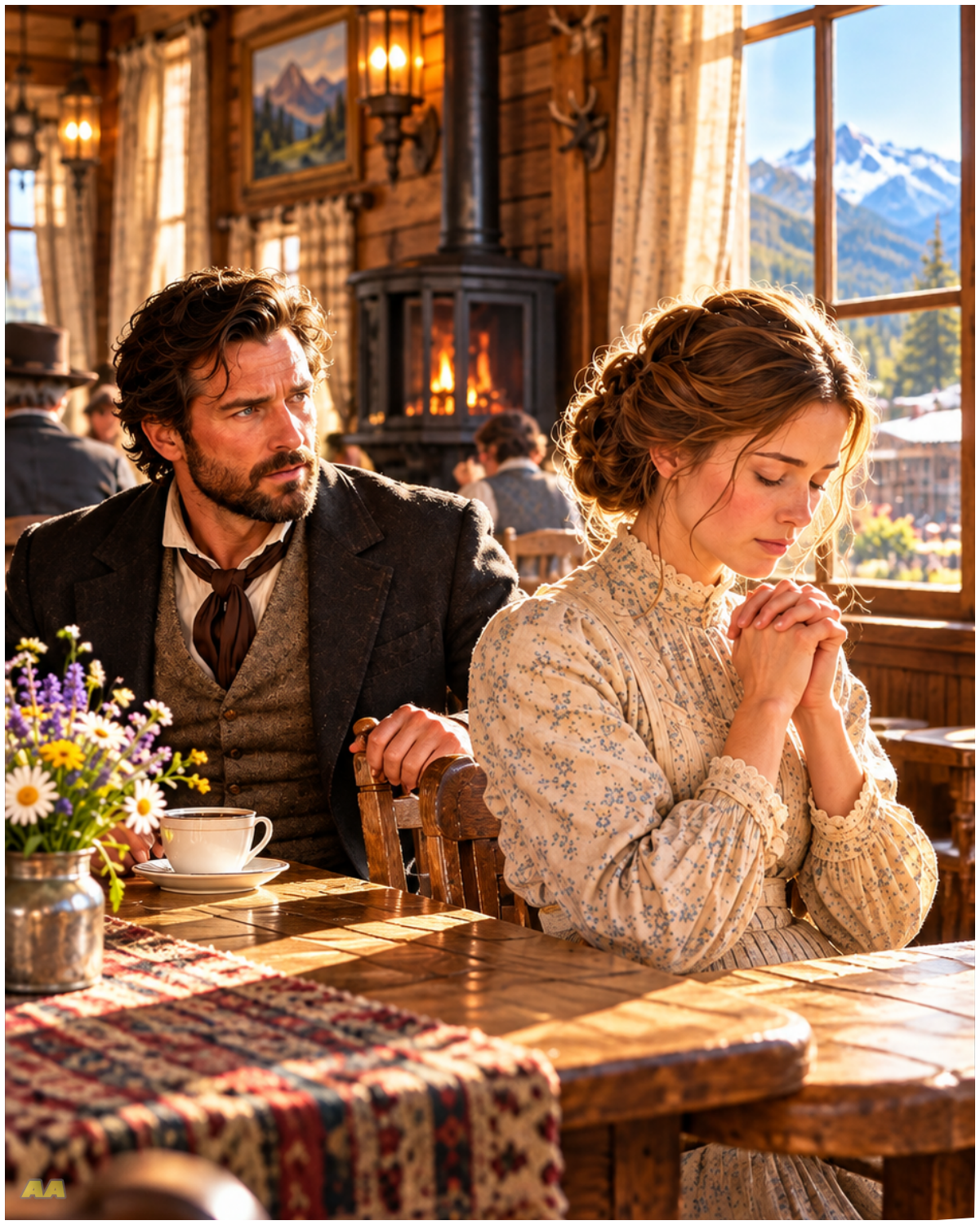
Idaho territory, 1889. Ilia’s Witcom stopped in the town of Mercy Ridge for no better reason than a cup of coffee.
He was not lost.
The road ahead lay plain beneath a clean blue sky, running along the shoulder of the mountains like a brown ribbon stitched through pine and stone.
His horse, Gideon, still had strength in his stride, and the sun had several hours yet before it would sink behind the western ridge.
Elas could have written another 20 m before supper if he had wished.
He nearly did.
He had business waiting at Witcom Valley Ranch, a stack of buyer letters on his desk, a foreman expecting his word on two new pasture fences, and a house standing broad and empty under the mountains.
It was the sort of house men spoke of with admiration.
Two stories, fine windows, a porch long enough to host a whole church gathering.
But no one gathered there.
Ilas touched his heel lightly to Gideon’s side, ready to pass the small inn at the edge of town.
Then he saw the handpainted sign swaying from a post near the porch.
Meals and coffee.
The letters were uneven, painted by someone with more hope than skill.
Elas told himself his horse deserved a rest.
He told himself a man of 40 years with dust on his coat and weight on his mind had earned one quiet cup before taking the mountain road home.
He told himself many things.
He did not know that if he rode on he would miss the voice God had placed in that little room.
He tied Gideon at the rail, brushed road dust from his sleeve, and stepped inside.
The in smelled of coffee, warm bread, and sunlit pine boards.
Light poured through tall front windows, laying bright squares across the plank floor.
A few ranch hands sat near the stove, speaking low over plates of beans.
An old man in a faded coat slept with his chin on his chest near the corner.
Behind the counter, a woman with flour on her apron poured coffee into tin cups.
Ilas removed his hat and asked for coffee.
Fresh enough to forgive the bitterness, the woman said.
That will do. He carried his cup to a table near the window.
He had just taken off his gloves when he heard the voice.
It was soft, humble, and low, not meant for the whole room.
Yet it reached him more surely than if someone had called his name.
“Lord,” the woman prayed, if it be your will, send me a godly man, not a rich man, not a proud man, not a man with fine promises and empty hands.
Send me one who fears you, one who will speak truth, one who will not run when hardship comes.
Elilas froze.
The cup remained untouched before him.
He had heard that voice once in another life.
He had heard it singing hymns beside a small creek.
He had heard it laughing on a church step after Sunday service.
He had heard it tremble the night he placed his mother’s Bible in her hands and told her it was the only fine thing he owned.
12 years had passed since then.
Still, he knew the voice.
Slowly he turned.
At a table near the far wall sat a woman in a plain gray dress, her head bowed.
Her brown hair was pinned neatly beneath a modest bonnet, though a few strands had slipped free near her cheek.
Across from her sat an elderly widow in black, twisting a handkerchief between her fingers.
The younger woman held the widow’s hand as if grief were a weight one person should not carry alone.
On the table between them lay an old leather Bible.
Its corners were worn smooth. Its cover was dark with age and handling.
A small brass cross had been fastened to the front, dulled by years, but still catching a narrow strip of sunlight.
Elas breath left him. He knew that Bible.
It had belonged to his mother.
He had given it to Miriam Vale the week before he left poor, young, and certain that love could survive a short separation.
He had left with one horse, one used saddle, and a promise in his heart that he would earn enough to marry her.
He had written to her. She had never come.
For 12 years, Elas had believed her silence was an answer.
He had believed she looked at his poverty, his rough hands, his uncertain future, and chose a safer path.
So he had built safety until safety became a wall around him.
Land, cattle, a large ranch house, money enough that no man could call him poor again.
But he had never built a home.
The woman lifted her head. Their eyes met across the room.
For a moment, the years vanished.
Then they returned all at once.
Miriam’s face changed, but only slightly.
A breath caught in her throat.
Her hand tightened around the widow’s fingers before she seemed to remember herself.
She looked older than the girl Elas had known.
Of course, there were fine lines near her eyes, and sorrow had placed a quiet dignity over her features, but hardship had not hardened her.
That was what struck him first.
She still looked as though she would stop for anyone hurting.
“Miriam,” he said.
The room seemed to grow still around the name.
The widow glanced between them, then gently withdrew her hand.
“I will fetch more coffee,” she whispered, though her cup was still half full.
“Miriam did not rise.” One hand rested on the Bible as if it steadied her.
“Eliliously,” she answered.
“Only two names, only two breaths, only 12 years standing between them.”
He crossed the room slowly, hat held in both hands.
Every step felt too heavy and too light at once.
He stopped beside her table, close enough to see the brass cross on the Bible.
Close enough to see that her sleeves were neatly mendied at the cuffs.
“You kept it,” he said. Her gaze dropped to the Bible.
“It belonged to your mother,” she replied.
“I could not throw away something that had once been loved.” The words struck him harder than accusation would have.
He looked at the widow, now standing near the counter, pretending not to listen.
He looked at the opened Bible at the folded newspaper beside it, at the small column of job notices circled in pencil.
“You are passing through,” he asked.
“I am looking for work as a teacher.
If a school will have me,” she folded the newspaper once, careful and proper.
Or as a clerk or keeping accounts, honest work is enough.
Elas heard the pride beneath the weariness.
He knew better than to offer pity.
Miriam Vale had never asked to be rescued, not when she was 19, and not now.
Before he could answer, the widow returned, her eyes damp again.
“My daughter was to meet me Tuesday,” the old woman said to Miriam.
“This is Thursday.” Miriams face softened at once.
Then we will write to her before sundown.
And until she comes, you will not wait alone.
Elas watched as Miriam tore her bread in half and placed the larger piece on the widow’s plate.
A little boy near the stove struggled over a torn newspaper, and Miriam paused to show him a word with patient care.
When the old man at the corner came up short for his coffee, she slid a coin across the counter without letting him see.
Elas saw all of it. He saw the menied sleeves, the job notices, the tiredness she hid, and the kindness she did not hide at all.
Then Miriam looked back at him.
What brings you to Mercy Ridge Elas?
He almost said business. He almost said coffee.
He almost said nothing that mattered.
Instead, his eyes fell again to his mother’s Bible.
“I thought I stopped for coffee,” he said quietly.
Miriam did not smile, but something in her face trembled.
Outside the mountain road waited beneath the open sky.
His horse stood rested. His ranch waited.
His quiet house waited. But Ilia’s witcom did not reach for his hat.
Not yet. This completes part one only.
Based on the requested setup and the part one structure from your source prompt, the hero stops for coffee, hears the heroine’s faith-filled words, sees the old Bible, and they recognize each other after 12 years.
Part two. Elas did not sit at once.
He stood beside Miriam’s table with his hat in his hands, feeling the weight of every word he had not spoken in 12 years.
Around them, the little inn went on living.
Cups touched saucers, boots scraped softly against the floor.
The widow in black murmured thanks over the bread Miriam had given her.
Outside a wagon rolled past the window, its wheels knocking against loose stones in the road.
Yet for Elas, the room had narrowed to one table, one worn Bible, and one woman he had once thought he would marry before the world changed its mind.
“May I sit?” he asked. Miriam looked at him for a long moment.
Then she moved the folded newspaper a little closer to herself and nodded.
He sat across from her. For a while neither spoke.
Elas had faced winter storms in the high country, angry buyers, sick cattle, and men with harder eyes than wisdom.
He had learned how to hold silence until another man filled it.
But this silence was different. It was not a tool.
It was a grave. Miriam was the first to break it.
I heard you bought land north of the valley.
I did. And cattle enough that folks speak your name as if it belongs on a bank sign.
He glanced down at his hat.
Folks speak too much. Do they speak falsely?
No. She accepted that with a small nod.
There was no bitterness in her expression, but there was caution.
It stood between them like a fence.
Neither wished to climb too quickly.
“I am glad you prospered,” she said.
“The words were proper, kind, even, but Elas heard what they did not say.
He had prospered without her. I heard you taught school in Ash Creek,” he said.
“3 years there, then Willow Bend for two.
Then I cared for my aunt until she passed.
After that, I taught wherever there were enough children and enough coins to keep a roof overhead.” You are always good with children.
A faint smile touched her mouth and disappeared.
Childhren usually say what they mean.
It makes them easier than grown people.
He could not argue with that.
His eyes drifted to the Bible again.
He remembered his mother reading from it in a lampit room while wind pressed against the cabin walls.
He remembered Miriam holding it for the first time, both hands careful around the cover.
I wondered where it went, he said.
Her fingers rested near the brass cross.
You gave it to me. I know.
Then it did not go anywhere.
The quiet answer settled deep in him.
The widow in black returned to the table with fresh coffee she did not need.
Miriam shifted her attention to the older woman at once.
“Mrs. Calder, this is Mr. Elia’s witcom,” she said with gentle courtesy.
He owns a ranch west of here.
Mrs. Calder gave Elas a tired nod.
Then perhaps you know the stage road.
Some of it. My daughter was to meet me here.
Her letter said Tuesday. Her mouth trembled.
I fear something has happened. Miriam touched her arm.
We do not know that roads run slow in mountain country.
A loose wheel can steal a day.
A tired team can steal another.
We will write to the next station and ask after her.
Elas heard the steadiness in Miriam’s voice and something in him achd.
She comforted as if she knew waiting from the inside.
Mrs. Calder excused herself again, this time to speak with the inkeeper about paper and ink.
Miriam watched her go. “You still gather strays,” Elia said softly.
She looked back at him. “People are not strays.” “No, I did not mean it that way.
I know, her voice softened a little, but words matter.
They do. So does silence. The sentence came gently, but it struck the table between them.
Elas drew a slow breath. There were a hundred things he could have said.
He could have asked why she never answered.
He could have told her how long he waited in Montana, how many evenings he looked down the road expecting her stage to arrive, how many times Hope made a fool of him.
He could have told her that silence had not begun with him.
But he saw her face, the caution, the tiredness, the dignity she used like a shawl against cold weather.
“Not here,” he thought. “Not in this little inn with strangers listening and grief sitting one table away.” “You are right,” he said.
Miriam blinked as if she had expected defense, he continued.
“Some silences cost more than men know at the time.” Her gaze dropped.
Women, too. The answer was quiet enough that he almost missed it.
For the first time since he sat down, Elas understood that her hurt might be shaped differently than his, but it was no smaller.
He had spent 12 years believing himself the one left behind.
Looking at her now, he wondered whether she had spent those same years believing the same.
The thought unsettled him. Mrs. Calder returned with paper and Miriam helped her write a letter in a neat hand.
Elia stayed silent while they worked.
He watched Miriam ask careful questions, choose simple words, and leave room for hope without making promises she could not keep.
When the letter was folded, Elia stood.
I can have one of my men carry it to the North Road Station by morning, he said.
Miriam looked up. That is kind, but not necessary.
It is necessary if it helps.
Mrs. Calder pressed both hands to her heart.
God bless you, sir. Elas nodded once, uncomfortable beneath gratitude.
Miriam studied him as though she had seen something she had not expected.
When the widow stepped away to rest, the table grew quiet again.
“You said you needed work,” Ilia said.
“I do. There is work at my ranch.” Her expression closed at once.
Elas. Hear me firSt. I am not asking for charity.
I would not insult you by offering it.
She sat still. He chose his words with more care than he had used in any cattle bargain of his life.
My bookkeeper, Mr. Gideon Shaw, has served me faithfully for years, but his eyes are failing.
My accounts are behind and there are buyer letters I have not answered because I have no patience for ink when cattle need tending.
That is my fault, not his.
Miriam listened without speaking. There are families on my ranch, he continued.
Good workers, good children, 11 of them now, maybe 12 before winter if Mrs. Bell’s daughter brings her little ones back.
The nearest school is too far for daily riding, especially once snow comes.
Those children need a teacher. Something changed in her eyes at the mention of children, but she held herself firm.
You want me to keep your books and teach your ranch hands, children?
I want to hire someone who can do both.
You said you can manage accounts and write letters.
I know you can teach. You knew a girl who could teach.
I am speaking to the woman in front of me.
That quieted them both. Miriam looked away toward the window.
Sunlight lay across the road outside.
A dog slept beneath the hitching rail.
Beyond the town, mountains rose blue and solemn.
After a moment, she said, “Working under your roof would invite talk.
Then the workroom can be near the kitchen, and Mrs. Larkin, my cook, runs that part of the house like a church elder.
No one will question propriety with her nearby.
That is not the only danger.
I know. Her eyes returned to his.
Do you? Yes. I will not be looked at with pity.
You will not be. I will not accept gifts hidden as wages.
You will be paid what the work is worth.
I will not have old memories mistaken for present promises.
Elas lowered his gaze to his hat.
Her words were plain, and he respected her for them.
There had been a time when he might have answered with wounded pride.
Now he only felt the truth of what she asked.
“I am not asking you to become the girl you were,” he said.
“And I do not know how to become the young man I was.
I would not trust him with much looking back.” Miriams face softened, though pain remained there.
He went on, “I am asking whether two people, as they are now, can do honest work that needs doing.” She searched his face as if looking for pressure or pride or some hidden bargain.
He offered none. At last she looked down at the old Bible.
Her thumb brushed the brass cross once lightly.
Work only, she said. Elas nodded.
Work only. I will keep my own room.
There is a spare room near Mrs. Larkin’s quarters.
You may have a lock and a key.
I will answer to the work, not to old history.
That is fair. And if either of us forgets what this is, I will leave.
The words stung, but he did not flinch from them.
Then I will make sure your wages are paid before you go.
For the first time, Miriam almost smiled.
It was small, careful, gone quickly.
But Ilas saw it, and the sight moved through him like light entering a closed room.
Mrs. Calder’s letter lay folded on the table.
Miriam placed it beside the Bible, then gathered both into her worn satchel.
Elas noticed how gently she handled the old book.
“When would you need me to begin?” she asked.
“As soon as you are willing.
I have one small trunk at the boarding house.
I can send a wagon. I can carry it myself.” I did not mean.
I know what you meant. This time her smile stayed a breath longer.
But I have carried it this far.
He nodded. Then I will walk beside you and carry nothing unless you ask.
Miriam rose from the table. The widow thanked her again and the little boy near the stove waved the torn newspaper as though she had given him a treasure.
Miriam waved back. Elas opened the indoor and afternoon light spilled over the threshold.
The mountain air smelled of dust, pine, and distant snow.
His horse waited by the rail.
The road west waited, too. This time, Elas did not ride it alone.
He walked beside Miriam Veil through the small town of Mercy Ridge, careful to keep a respectful distance, careful not to reach for what had not been offered.
Between them hung questions neither was ready to ask.
Behind them, the insign creaked in the breeze.
Meals and coffee. He had stopped for one cup.
He was leaving with his past walking beside him, and a work agreement so fragile it felt like a prayer neither of them yet knew how to say.
Part three. Witcom Valley Ranch sat in a green sweep of mountain land, where the pines climbed high on the ridges, and the creek cut silver through the pasture.
Miriam saw the house before she saw the cattle.
It stood on a rise above the valley, broad and handsome, built of pale stone and dark timber with a long porch facing the mountains.
Tall windows caught the late afternoon light.
A weather vein turned slowly above the roof.
Smoke rose in a thin line from the kitchen chimney straight into the clear sky.
It was the kind of house a man built when he meant to fill it.
Yet, as the wagon rolled closer, Miriam felt the silence of it.
There were no children racing across the porch.
No woman’s shawl hung by the door.
No song came from an open window.
Even the curtains looked too still.
The house seemed less like a home than a promise waiting so long it had forgotten who made it.
Elas walked beside the wagon rather than ride ahead.
He had offered twice to place her trunk in the back, and twice she had said she could manage it.
At last, when the road grew steep, she allowed one of his ranch hands to lift it beside the flower sacks, but only because Mrs. Calder’s letter had also been placed there for delivery, and the man was already going.
Elas did not smile at her stubbornness.
He simply respected it. That made the day harder in a way Miriam had not expected.
A woman with strong shoulders and kind eyes came out onto the porch as they arrived.
Her gray hair was pinned tight and her apron was spotless except for one thumbrint of flower near the waiSt. “That will be Mrs. Larkin,” Ilia said.
“She has ruled my kitchen longer than some sheriff’s hold office.” “I heard that Mrs. Larkin called and I will rule it longer still if the Lord allows.” Elia’s mouth curved slightly.
Mrs. Larkin, this is Miss Miriam Vale.
She will be helping with the accounts and teaching the children.
Mrs. Larkin studied Miriam with open practical intereSt. She did not stare at Miriams menied sleeves.
She did not look from Miriam to Ilia’s with curiosity sharpened into gossip.
She only stepped down from the porch and took Miriams hand.
Then you are welcome. Any woman willing to face Mr.
Witcom’s ledgers and 11 ranch children deserves supper before questions.
Miriam liked her at once. Thank you, she said.
Your room is near mine, Mrs. Larkin continued.
There is a lock, a wash stand, and a window that looks eaSt. Morning light comes early, but it is cheerful.
If you prefer quiet, this house has more than enough of it.
Something in the woman’s voice told Miriam that Mrs. Larkin understood more than she said.
Inside, the house was even larger than it had looked from the yard.
The front hall held a polished staircase and a clock that ticked with solemn importance.
A sitting room opened to the left, furnished with a fine rug, stiff chairs, and a fireplace swept two clean.
On the right stood a dining room with a table long enough for 12, though only one place showed signs of regular use.
Miriam paused at the doorway. One chair had been pulled out near the end.
One plate, one cup, one life measured at a table built for many.
Ilia saw where she looked. His expression did not change, but his voice lowered.
I had it made in Boise.
The table, the house, he glanced down the hall.
Most of it. Miriam did not ask for whom.
She knew enough not to step on a bruise simply because she could see it.
It is well built, she said.
Yes. His answer was quiet. It is that.
Mrs. Larkin led Miriam to the small room near the kitchen that would serve as her workroom.
It had a plain desk, two shelves, a chair with a rush seat, and an east-facing window that looked toward the creek.
Dust floated in the last of the daylight.
On the desk sat three ledgers stacked unevenly, tied buyer letters, a tin of pencils, and an ink bottle with a crusted rim.
[clears throat] Miriam removed her gloves.
Elia stood in the doorway. It is worse than it looks.
That is what every man says when he fears a woman will discover it is exactly as bad as it looks.
Mrs. Lurin laughed from the hall.
Elas gave a short surprised breath that might have become laughter if he remembered how.
Miriam set her satchel on the desk.
From it she took the old leather Bible and placed it on the windowsill where the morning sun would find it.
The brass cross caught the fading light.
Elas looked at the Bible for a long moment.
Miriam noticed but said nothing. The next morning she began.
She rose before breakfast, washed, pinned her hair, and opened the Bible to the Psalms while the sky blushed pale above the hills.
She did not read loudly. The words were for her own heart.
Then she closed the cover gently and turned to the ledgers.
By noon, she understood why Elilas had looked so weary when he mentioned them.
Mr. Gideon Shaw had done his best, but failing eyesight had turned numbers into enemies.
Several columns had been added twice.
A feed purchase had been entered under equipment.
Two buyer payments were marked unpaid, though receipts proved otherwise.
Three letters from cattle buyers in Boise waited unanswered beneath a stack of old invoices.
Miriam sharpened a pencil, tied back her sleeves, and began setting order where disorder had settled.
By the end of the first week, the desk no longer looked like a storm had crossed it.
Buyer letters were sorted by date.
Receipts were matched to entries. Fresh pages were ruled cleanly.
Miriam wrote replies in a clear, firm hand, asking for confirmations, correcting terms, and reminding one buyer with polite sharpness that agreed prices did not change simply because a man hoped a rancher had forgotten them.
Ilas came to the doorway one evening, had in hand, dust on his boots.
“You found the Miller contract,” he said.
“I did, and Mr. Miller owes you $14.60.
Elas leaned one shoulder against the door frame.
He claimed I owed him nine.
He was mistaken. Was he? Miriam looked up.
That is the charitable word. This time Elas truly smiled.
It changed his face so suddenly that Miriam looked back down at the ledger.
The school began on Monday. Mrs. Larkin had helped clear the old bunk room near the sideyard.
Two ranch hands carried in benches made from spare planks.
Elas found a slate board in a storage shed, dusty but usable.
Miriam washed it herself and hung a small cloth beside it.
The children arrived shily in patched shirts and brushed hair smelling of soap, hay, and nervousness.
There were 11 of them. The youngest was barely six and held his older sister’s hand as if school were a doctor’s office.
The oldest, Daniel Ruiz, was 12, long-limmed and serious, with eyes that suggested he expected to fail before he began.
Miriam stood before them with chalk in hand.
“My name is Miss Veil,” she said.
“This is not a fancy school, but it will be an honest one.
If you come willing to learn, I will come willing to teach.
If you make mistakes, we will correct them.
If you laugh at another child’s mistake, you will sweep this room until your arms remember kindness.
The children stared. Then the youngest giggled.
By the end of the morning, they had written their letters, stumbled through a reading lesson, and learned that numbers behaved better when lined up properly.
Daniel Ruiz stayed after the others ran out.
“I can’t read fast,” he muttered.
“Good,” Miriam said. He blinked. Good.
If you read slowly, you will notice things fast readers miss.
We will begin there. He looked at her as if she had handed him a key.
That evening, Elia stood outside the bunk room and listened to children laughing over a spelling game.
He did not interrupt. Miriam saw him through the open door, one hand resting against the frame, his face turned slightly away.
For a moment, he looked less like the powerful rancher everyone spoke of and more like a man hearing music through a wall.
Later, when the children had gone and the room was swept, Miriam carried her books back toward the house.
Elas fell into step beside her, keeping that careful distance between them.
“They sounded happy,” he said. “They worked hard.
I did not know learning could be so loud.
It often is when fear leaves the room.
He thought on that. At supper, the long table still had only one end set for use, but Mrs. Larkin placed Miriam’s plate across from Elia’s s without asking either of them.
Neither objected. The clock ticked in the hall.
Wind moved softly along the eaves.
Somewhere outside, a child called to another child, and an answering laugh rose in the dusk.
The house did not feel warm yet, but it no longer felt untouched.
That night, Miriam returned to her small room, lit the lamp, and opened the old Bible on the windowsill.
Her hands rested on either side of it.
“Lord,” she whispered, “keep my heart honeSt.” She did not ask him to take away memory.
She knew better. Memory was not always an enemy.
Sometimes it was a room that needed light.
Outside her window, the ranch settled under the stars.
In the distance, a horse stamped.
The creek kept speaking over stone, and in the large, quiet house on the hill, one woman’s Bible, 11 children’s voices and a few straightened columns in a ledger had begun to loosen the silence.
If you believe God can still work through broken years, stay with this story.
Part four. By the second week at Witcom Valley Ranch, Miriam knew the shape of Ilia’s days.
He rose before the sun, took coffee standing in the kitchen, and listened more than he spoke, while the foreman gave the morning report.
He rode out after breakfast to check fences, water troughs, grazing lines, or any calf that looked weak.
He returned near noon only if business required it, and when he came back at dusk, dust clung to him like a second coat.
He was respected by his men.
That was easy to see. They did not flatter him.
Ranch hands were not made for flattery, but they straightened when he spoke, answered honestly, and trusted his word without writing it down.
If Elia said offense would be mendied, it was mendied.
If he said wages would be paid Saturday, no man worried on Friday night.
Miriam noticed such things. She also noticed what the ledgers tried to hide.
At first, she thought the strange entries were mistakes.
There were too many neat sums placed under ordinary headings where they did not belong.
Flower marked as wagon repair. Seed listed beneath winter tac.
A doctor’s bill folded between cattle receipts.
A payment to a widow called roof timber.
Though no ranch building had been repaired that month.
She made a separate list believing she had found disorder.
Then she asked Mrs. Larkin. The cook was rolling biscuit dough when Miriam came into the kitchen with a ledger against her cheSt. Mrs. Larkin, do you know why a payment to Mrs. Abel Grant would be written under bridge supplies?
Mrs. Larkin did not look up because Mr.
Grant died three winters ago and their bridge washed out the spring after.
She had no sons old enough to mend it.
Miriam looked down at the page.
Then it was for her bridge.
It was for her bridge, her wood pile, and two sacks of flour.
But if you ask Mr. Witcom, he will say it was for bridge supplies.
Miriam turned another page and this doctor’s bill for the Lawson child paid before the family knew there was a bill.
This seed order for the marsh place.
Their crop froze. Elia sent seed and told Mr.
Marsh it had been overordered by mistake.
Miriam went still. Mrs. Larkin pressed the dough with firm hands.
There are more. I have found seven.
There are more than seven. Miriam sat at the kitchen table.
The ledger opened before her. Sunlight lay warm on the yellowed pages.
She saw the numbers differently now.
They were not disorder. They were mercy wearing a work coat so no one would recognize it.
I thought, she began then stopped.
Mrs. Larkin glanced at her. You thought what most people think when a man gets rich that he must have hardened somewhere along the way.
Miriam did not answer. It was too close to the truth.
For 12 years, she had carried an image of Elia’s witcom in her mind.
A man who left because he wanted more.
A man who found money and discovered he did not need the girl with ink on her fingers and simple dresses.
She had forgiven that man in prayer because bitterness was a poor companion, but forgiveness had not made the image kind.
Now the ledger sat open like witnesses.
Fence repair for a widow. Coal for a family with a sick baby.
A hired man’s debt quietly settled after his wife died.
School slates purchased years before there had been a school.
Miriam touched the page with two fingers.
He never told anyone. Mrs. Larkin snorted softly.
He would sooner dance in church.
Despite herself, Miriam smiled. That afternoon, Elas returned early to find Miriam in the workroom with four ledgers open and a list beside them.
He stopped in the doorway. That looks dangerous.
It may be. To whom? To your pride, perhaps.
His brows lifted. She turned the list around.
These payments were not ranch expenses.
Ilia’s face changed only a little, but she saw it.
A shudder dropped behind his eyes.
They were necessary, he said. I did not say they were not.
They are not to be discussed.
I am the one keeping the accounts and I am the one asking that they remain quiet.
Miriam studied him. Why? He looked almost irritated by the question because a man needing help should not have to pay for it with his dignity.
The answer came so quickly, so plainly that Miriam felt her own rebuke fade before it fully formed.
Elia stepped into the room, then stopped beside the desk.
If families know I paid, they will feel beholden.
If other men know, they may think I am buying praise.
If the church ladies know, they will turn mercy into conversation before Sunday supper.
That is not unfair, Miriam said.
His expression eased slightly. But hiding kindness in crooked ledgers makes honest accounting difficult.
For one surprise second, he stared at her.
Then he laughed. It was not loud, but it was real.
It entered the room awkwardly, like a guest unaccustomed to being invited.
Miriam felt the sound before she understood her own response to it.
It made the house seem less polished and more alive.
I suppose it does, he said.
I can create a private column, she said.
No names if you prefer, only initials.
The accounts can remain true without making charity into a trumpet.
Elas looked at her for a long moment.
You would do that? I would rather truth have a proper place than be forced to hide under wagon grease.
His mouth curved again. You have become severe with ledgers, and you have become careless with them.
I hired you for that very reason.
She looked back down before her face could warm.
After that, the ledgers changed. Not only on paper.
Miriam began to see the ranch itself as a kind of account book.
Every fence rail, every winter coat on a child, every sack of flower delivered quietly to a family down the road carried an entry no banker would understand.
Elas had not become the man she feared.
He had become lonely, yes, guarded, proud in places where sorrow had built walls, but not hard.
Never hard. Elas, for his part, began to relearn Miriam in small portions, as a man might relearn a hymn he had once known by heart, but had not sung in years.
He learned that she still hummed while she worked, usually old hymns.
Sometimes the tune was so soft he only caught it when passing the workroom door.
Come thou f one morning, abide with me another.
Once while marking school slates, she sang a line under her breath, then stopped when she saw him.
I did not mean to interrupt, he said.
You were standing in the hall.
That is not always interruption. It is if you are listening.
He had no defense, so he offered none.
She shook her head, but a smile tugged at her mouth.
He learned that her gentleness had acquired iron beneath it.
When Mr. Miller, the cattle buyer, sent a letter claiming whether delays entitled him to a lower price.
Elas found Miriam already drafting a reply.
“May I read it?” he asked.
“If you wish,” he took the paper.
The letter was courteous enough for a church bulletin and sharp enough to cut harness leather.
It reminded Mr. Miller of his signed agreement, the date of delivery, the condition of the cattle, and the commandment against false weights and measures.
Elas looked up. You quoted scripture at him.
I referenced principle. You frightened him with Leviticus.
He frightened himself by being dishoneSt. Ilas laughed again, and this time he did not seem surprised by it.
The porch evenings began without either of them naming them.
One evening, Miriam stepped outside after supper to shake chalk dust from her skirt.
Elas was there with coffee, seated near the rail, looking out over the valley.
She meant only to wish him good evening.
Instead, he asked whether Daniel Ruiz had read any faster that day.
A little, she said, but more importantly, he read without apologizing firSt. Elas nodded as though that mattered greatly.
It did. The next evening she came out to watch the sunset.
He was there again. They spoke of the youngest child who kept writing his letters backward and of a cult that refused every halter as if freedom were a commandment.
The evening after that, Elas brought an extra cup of coffee and set it on the small table between the chairs without comment.
Miriam looked at it. Work only, she reminded him.
Coffee is not a proposal. No, but it can be a habit.
Then I will not be offended if you refuse it, she said.
She drank the coffee. They spoke of rain.
As days passed, the porch became a place where words could come without being forced.
They did not speak of the old wound.
Not yet. Instead, they spoke of children, hay, buyers, winter stores, and whether the bunk room would need a proper stove before snow.
Sometimes long silences rested between them, but they were different from the silences at the inn.
These did not accuse. They simply made room.
One evening, Daniel Ruiz came running from the schoolroom, waving a slate over his head.
Miss Vale, Mr. Witcom, I wrote it all.
He skitted to a stop before the porch and held up the slate.
His full name was written across it in large, uneven letters.
Daniel Mateo Ruiz. Miriam stepped down from the porch and took the slate as if it were a legal document of great importance.
Well done, she said. Every letter in its proper place, Daniel beamed.
Elas leaned forward. That is a strong hand.
My paw says my hand is better with rope than chalk.
A man can learn both. Daniel looked pleased enough to burSt. He took back the slate and ran toward the worker’s cabins, shouting for his mother.
Elas watched him go. Then he laughed.
Not a polite sound, not a brief breath.
A true laugh, full and unguarded, rising from somewhere he had kept locked too long.
Miriam turned toward him. The sound faded slowly.
Elia seemed almost embarrassed by it.
“This house does not hear much of that,” she said gently.
He looked out over the yard where the last light rested on the dust Daniel had kicked up.
“No,” he said. “It does not.” The honesty in his voice stilled her.
He turned the coffee cup between his hands.
“I built this place large enough for a family, large enough for children to run through it, large enough for Sunday dinners and muddy boots, and someone complaining that I left my hat where it did not belong.” Miriam said nothing.
He looked at the wide porch, the tall windows, the valley below.
I built safety, he said. Every board of it, every acre, every fence.
I told myself safety was enough.
The wind moved softly through the porch posts.
It is a good thing, Miriam said.
Yes. His eyes remained on the valley, but it is not the same as belonging.
The words settled between them with the evening shadows.
Miriam could have comforted him. She could have reached for his hand.
She could have said that no man was beyond belonging while God still gave him breath.
But something in her knew the moment needed quiet more than answer.
So she stayed. The sun slipped behind the ridge.
The windows of the great house caught fire for a few minutes, then dimmed.
From the bunk room came the faint echo of children gathering their books.
From the kitchen came Mrs. Larkin’s voice scolding someone for tracking dirt over a clean floor.
Elas listened. Miriam listened too. And for the first time since she arrived, the house on the hill did not feel quite so empty.
Part five. The invitation came on a Thursday evening.
Though Elia’s did not make it sound like one.
Miriam had spent most of the day with figures.
A shipment of winter feed had been counted wrong, and two columns in the supply ledger refused to agree until she found a missing receipt tucked inside an envelope meant for a buyer in Boise.
By the time Lamplight touched the workroom wall, her fingers were stained with ink, and her eyes achd from small numbers.
The children had been lively that afternoon.
Rain had kept them inside, and Rain made children feel trapped in their own skin.
Little Ruth Bell had cried because her slate pencil broke.
Daniel Ruiz had helped the youngest boy shape his letters.
Two brothers had argued over whether a mule could be considered wiser than a horse.
Miriam had settled the matter by saying wisdom was not measured by stubbornness, though some men seemed determined to prove otherwise.
Mrs. Larkin laughed when she heard that.
Elas had been away since dawn, riding the north pasture with his foremen.
He came in just as Miriam was closing the ledger.
His coat was damp from rain and his hat brim dripped onto the back step before he removed it.
“You have worked late,” he said from the doorway.
“So have you.” The cattle did not ask my permission before breaking through the upper fence.
Ledgers show similar disrespect. He looked at the books spread across her desk.
“Have you eaten?” “Not yet, Mrs. Larkin left supper warming.
I will take a plate in the kitchen.
He hesitated. Miriam noticed the pause and lifted her eyes.
Elas turned his hat in his hands once, then stilled it as though annoyed with himself for the habit.
“The dining room is already set,” he said.
“Mrs. Larkin made enough for two.” Miriam understood what he was asking and what he was not allowing himself to ask.
For several weeks they had shared suppers only when the household made it ordinary.
A ranch hand at the far end.
Mrs. Larkin moving in and out.
Children sometimes at the kitchen table, but the dining room with its long polished table and one lonely chair pulled out near the end had remained Ilas country.
To sit there across from him felt different.
Not improper, Mrs. Larkin would be nearby, and the house was full of working people, but it carried meaning, the kind that did not need words to become dangerous.
Work only, Miriam said softly. Elas nodded.
Supper only. She studied him for pride, pressure, or hidden pleading.
She found weariness, caution, and something humbler than she expected.
So she closed the ledger, then supper.
The dining room glowed with lamplight.
Rain tapped gently at the windows.
Mrs. Larkin had set roast beef, potatoes, green beans, and biscuits on the sideboard.
Two places had been laid, not close together, but not so far apart as strangers might choose.
Miriam sat to Ilia’s right, leaving the head of the table to him.
He remained standing until she was seated, then took his place.
For a moment neither moved. Miriam folded her hands in her lap by old habit.
At every table where she had stayed, whether poor or plain, someone had prayed.
Sometimes it had been a child stumbling through thanks.
Sometimes a widow with a trembling voice.
Sometimes Miriam herself when grief sat down with them and no one else knew what to say.
She looked across at Elas. Will you say grace?
The question changed him. Not outwardly in any great way.
He did not startle. He did not refuse at once.
But his eyes dropped to the table and the hand resting near his fork curled slowly.
The rain filled the silence. At last, he said, “I do not know how anymore.” Miriam’s heart softened, but she kept her voice steady.
“You once did a long time ago.” Prayer does not spoil with age.
His mouth moved as if he might smile, but he did not.
A man can get out of practice.
“Yes, I never hated God,” he said.
The words came quietly, as though he had not meant to speak them, and yet could not call them back.
Miriam waited. Elas looked toward the window.
The lamplight reflected faintly in the glass, showing his face overlaid with rain and darkness.
“I know men who turned bitter,” he said.
Men who shouted at heaven as if God had cheated them in a bargain.
I never did that. No, I just stopped talking to him.
His voice grew rougher. At first, I thought it was for a little while.
There were long drives, hard seasons, work enough to fill a man from before dawn to after dark.
Then there was money to earn, land to buy, men depending on me.
I told myself God knew what I needed without me saying it.
Miriam did not interrupt. And after enough years, Elilas said, “Silence became easier than prayer.
Then one day, I realized I no longer knew what to say.” The clock in the hall ticked steadily.
Miriam thought of the young man.
He had been, poor and hopeful, pressing his mother’s Bible into her hands as if it were a promise.
She thought of the man before her now, wealthy and lonely, sitting at a table meant for 12.
Then tell him the truth, she said.
Elas looked at her. That is all prayer is when every fine word is gone, she said.
Tell him the truth. His eyes searched hers perhaps for judgment.
She hoped he found none. Slowly, Ilas bowed his head.
Miriam bowed hers, too. For a long moment, nothing happened.
Then, in a voice low and unsteady, Ilia said, “Thank you, Lord.” He stopped.
The room held its breath. For food, he added, almost as if each word had to be lifted by hand.
For shelter, for work worth doing.
Another silence, then softer, and for mercy I do not always recognize.
Miriam’s throat tightened. “Amen,” she whispered.
“Amen,” he said. They ate quietly after that, not because there was nothing to say, but because some moments should not be covered too quickly.
The roast was tender, the biscuits were warm.
Rain softened the world beyond the windows.
From the kitchen came the faint sound of Mrs. Larkin humming while she washed dishes.
Elia seemed changed in no visible way.
Yet Miriam sensed that something had shifted.
Not repaired, not completed, but opened.
After supper, the rain eased to a mist, and they stepped onto the porch with coffee.
The boards were damp near the rail, and the valley lay dark beneath low clouds.
Lantern light from the bunk house glowed across the yard.
For a while, they stood rather than sat.
Elas held his cup with both hands.
At the inn, he said, “You were praying.” Miriam felt warmth rise in her face.
I did not know anyone was listening.
I was not trying to. I know.
He looked out toward the pasture.
You asked God to send you a godly man.
The words repeated in his voice felt more vulnerable than when she had prayed them.
Miriam rested her cup on the porch rail.
I have asked for that more than once, she said.
His jaw tightened slightly. And what does that mean to you?
The question had no pride in it, only honest uncertainty.
Miriam considered her answer with care.
It does not mean a perfect man, she said.
There are none of those, and a woman who waits for one will grow old waiting.
Elas gave a faint breath. It does not mean a man who can quote the most scripture at supper either, she continued.
Or one who speaks loudly of faith where others can admire him.
What then? A man who tells the truth.
A man who repents when he has been wrong.
A man who does not use strength to crush what is weaker.
A man who keeps his word when keeping it costs him.
A man who remembers that God sees the hidden things.
Elas was silent. Miriam glanced at him.
Why do you ask? Because I wondered whether I had become the kind of man you prayed not to receive.
The confession struck her deeply. She could have answered too quickly.
Kindness sometimes rushes to cover pain.
But Miriam had learned that covered pain often remains unhealed.
So she took her time. I do not know everything you have become.
She said, I am still learning.
He nodded once, accepting the fairness of it.
But I have seen enough to know you are not empty.
Lonely perhaps guarded, too willing to hide good deeds under bad bookkeeping.
His mouth curved a little, but not empty.
He looked at her then, and the lamp light from the window touched his face.
That is more grace than I deserve.
Grace usually is. The mist deepened.
Somewhere in the dark, a horse nickered low.
Elas leaned one shoulder against the porch poSt. Do you believe what you read to Mrs. Calder?
Truly, Miriam knew the verse before he spoke it.
Romans 8:28. She looked toward the black outline of the mountains.
The words had comforted her and troubled her through many years.
People used them too easily sometimes, like a cloth thrown over a wound that still needed washing.
Yes, she said, but not the way some people mean it.
Elas waited. I do not believe every sorrow is good, she said.
Some things are broken because this world is broken.
Some losses were not gifts. Some doors closed because people are proud or frightened or careless.
Some years hurt because silence was allowed to grow where truth should have been spoken.
She felt him grow still beside her.
I do not believe God asks us to call pain good just to prove we trust him.
She continued, that would be a cruel thing and God is not cruel.
Then what does the verse mean?
It means he is not defeated by what wounded us.
The words came quietly but with the strength of years behind them.
It means he can work through what was broken.
He can bring mercy into places where sin, fear, death or foolishness tried to write the ending.
It does not make the wound good.
It makes God faithful. Elas looked down into his coffee.
Miriam knew both of them were thinking of the same 12 years, though neither said so.
At times, she added, I have had to believe that without feeling it.
He nodded slowly. That sounds like faith.
Most days, yes. Some days it only sounds like obedience.
He absorbed that. The porch boards creaked as Mrs. Larkin moved inside the house, closing a window against the damp air.
The sound reminded Miriam of where she was, of the hour, of the care they had promised to keep.
I should go in, she said.
Elia straightened. Of course. She lifted her cup, then paused at the door.
Elas? Yes. You prayed tonight. His expression turned uncertain, almost shy.
It was not much, he said.
It was true. She left him with that and went inside.
Elas remained on the porch after the door closed.
The rain had stopped completely and a few stars showed between torn clouds.
He stood in the cool, damp air, listening to the house behind him.
For years, silence had been his easiest companion.
But now, for the first time in a long while, he wondered whether silence had been answering questions he had never dared ask aloud.
He bowed his head. No proper words came, no long prayer.
Only one honest whisper, “Lord, teach me again.” The words disappeared into the mountain night, but Elas did not feel they had been loSt. Part six.
The old road north of Witcom Valley had not carried a regular stage in more than 10 years.
Grass had grown through the ruts.
Sage brush leaned into the path as if trying to take back what wheels had once claimed.
In places spring wash outs had bitten deep into the roaded, leaving stones scattered like bones.
Few men used it now except hunters, stray riders, and ranch hands cutting across the high country when weather allowed.
Elas had bought the strip of land in late summer, not because it was fine pasture, but because it joined two pieces of his range and gave his cattle a better way to reach water.
On that land stood the remains of Brier Pass station, an old stage stop with a sagging roof, a broken corral, and one wall leaning so badly that Mrs. Larkin declared it would fall if a sparrow landed wrong.
By October, Elia sent three men to pull it down for salvage wood.
Miriam heard about it at breakfaSt. “Brier pass?” she asked, looking up from her coffee.
Elas nodded. What is left of it?
I passed there once as a girl.
I remember the station keeper had a red beard.
That would have been Mr. Abel Crowe, Mrs. Larkin said from the stove.
Poor man took fever one winter, died before spring, as I recall.
Then the stage company shifted the route east when the bridge washed out.
Miriam stirred her coffee, though she had taken no sugar, so the building has stood empty since then.
Boarded and forgotten, Ilia said. Forgotten.
The word stayed with her longer than it should have.
That afternoon, while Miriam was helping Daniel Ruiz sound through a reading passage, two ranch hands rode in pulling a small wagon.
The children heard the wheels first and rushed to the bunk room window.
Miriam called them back, but even she glanced out.
The wagon carried split boards, a rusted lantern frame, a cracked trunk with no lid, and something bulky wrapped in old canvas.
One of the men, a young hand named Peter Low, jumped down and came to the schoolroom door with his hat in his hands.
Beg pardon, Miss Vale, Mr. Witcom around.
He is at the south pasture, Miriam said.
Is something wrong? No, ma’am. Only we found a mailbag.
A what? A mailbag behind the storage wall.
Looks like it slipped down between the boards years ago.
Full of old letters. The room grew quiet.
Even the children seemed to understand that a mailbag was not just an object.
It was voices that had never arrived.
Miriam stepped outside. The canvas bundle lay in the wagon bed, stained brown with age and duSt. Faded letters marked the side, though time had chewed away part of the wording.
A brittle leather strap hung loose where a buckle had broken.
When Peter lifted it, dust rose and made him cough.
Careful, Miriam said. Yes, ma’am. Bring it to the workroom, not the barn.
The damp will ruin whatever paper is left.
Peter obeyed at once. By the time Elia’s returned near sundown, the old mailbag sat on Miriam’s workt beneath the east-facing window.
She had not opened it fully yet.
She had only unfassened the strap and seen the corner of one yellowed envelope within.
Something about it made her hands go still.
Elas entered the workroom with dust on his coat and concern in his eyes.
Peter said they found old mail.
Miriam nodded at Brier Pass station.
He removed his hat slowly. Have you looked through it?
Not yet. Why? She did not know how to explain the feeling that had come over her.
Not fear exactly. Not sorrow yet.
More like standing before a closed door and hearing someone breathe on the other side.
It seemed proper to wait, she said.
Elas looked at the bag for me.
For someone who owned the land.
Or for someone brave enough to disturb old things.
His gaze moved to her, then softened.
“We can do it together.” They carried the mailbag to the small table in the corner of the workroom.
Miriam lit the lamp, though there was still a little daylight left.
Elas closed the door halfway, leaving it open enough for propriety and closed enough for quiet.
The first letters were brittle with age.
Miriam handled each one carefully, reading names aloud when she could.
Mrs. Tessa Ward, care of Fair Hollow Merkantiel.
No one by that name here now, Elas said.
Mr. Joseph Bell, High Road camp, gone years ago, I expect.
There were advertisements, two invoices, a small packet tied with faded thread, and a letter whose ink had blurred beyond reading.
Each piece carried its own small ache.
Someone had waited for these. Someone had wondered.
Someone had perhaps grown angry or afraid or resigned, never knowing their answer lay in darkness behind a broken wall.
Miriam’s throat tightened. Then her hands stopped.
Near the bottom of the bag lay an envelope addressed in a handwriting she knew as surely as her own reflection.
Miss Miriam Veil, Red Lantern boarding house, Mercy Ridge Road.
The ink had browned, the edges were worn, but the hand was Elia’s s.
She did not move. Elas noticed.
Miriam. She lifted the envelope with both hands.
His face lost color. That is my writing, he said.
Yes, I wrote that before I left.
The room seemed to tilt slightly, though nothing moved.
Miriam could not open it. Not yet.
She looked back into the bag because some instinct stronger than thought told her to keep searching.
Beneath an old shipping paper was another envelope, thinner, folded hard at one corner.
This one bore her own careful hand.
Mr. Ilia’s Witcom, care of northbound Harland cattle outfit, Montana Road.
Elas reached for the edge of the table as if to steady himself.
Miriam laid the two envelopes side by side.
For 12 years she had believed there had been no letter from him.
For 12 years Elas had believed there had been no answer from her.
Yet here they were, not destroyed, not burned, not cast aside, but lying together in the same forgotten mailbag as if time itself had kept them for this hour.
Neither spoke. The old Bible rested on the windowsill behind them.
The brass cross caught the lamp light.
At last, Elilia said, “We do not have to open them tonight.” Miriam looked at him.
His voice was strained, but there was no command in it, no demand, no hunger to prove himself right.
That gave her courage. “Yes,” she said.
“We do.” He nodded once. They moved to the bench outside the back door where the air was cooler and the last orange light of evening spread across the yard.
The ranch was settling into supper sounds.
A child laughed near the cabins.
Somewhere a bucket clanged. Smoke rose from the bunk house chimney.
Miriam held the letter addressed to her.
Elas held the letter addressed to him.
For a moment, both simply looked at the names.
Then Miriam broke the seal. The paper unfolded with a faint crackle.
Miriam, I must leave at dawn with Mr.
Harlland’s cattle outfit. I hate that I must go while you are away caring for your aunt, but they will not wait.
And this is the chance I prayed for.
They have promised wages and a small share if the drive succeeds.
It may be enough for land or at least a beginning.
I am not leaving. You hear that?
If you hear nothing else, I am going because I want to come back with more than empty pockets and promises.
I want to give you a roof that does not leak, a stove that burns steady in winter, and a table where we can thank God together.
When I have a place ready, I will send for you.
Come to me if you still will.
I will marry you the day your stage arrives with my whole heart and all the days the Lord gives me.
Keep my mother’s Bible until I can hear you read from it in our own home.
Elilia’s Miriam covered her mouth. The words blurred.
She tried to blink the tears away, but they came too quickly.
He had not left without goodbye.
He had not cast her aside.
He had written. He had asked her to come.
Beside her, Ilas opened her letter with shaking hands.
He read silently at firSt. Then his breath caught and Miriam looked at him.
“Read it,” she whispered. His voice was rough when he obeyed.
“Elilas, I came home and found you gone.
Mr. Crow at Brier Pass said you left with the Harland outfit before dawn.
I will not pretend it did not hurt to hear it from another man’s mouth.” It did hurt more than I can write.
But I know your heart, or I believe I do.
If you left for work, then work.
If you left to build something, then build it.
I will not shame honest labor because loneliness came with it.
If you still want me beside you, send for me.
I will come where God leads us.
I do not need a fine house.
I do not need rich things.
I need truth, faith, and a man who keeps his word.
I will wait, Miriam. Elas lowered the page.
For a long moment, he did not seem able to breathe.
You would have come, he said.
Yes. I waited in Montana. His voice nearly broke.
Every stage that came through, I watched.
I thought perhaps you had read my letter and chosen otherwise.
I thought you had gone without writing because you chose ambition over me.
No, I know that now. He closed his eyes.
When he opened them, they shone with grief.
I wrote again after I reached the north camp twice, maybe three times.
When no answer came, I told myself I had my answer.
My aunt died that winter. Miriam said, “I left the boarding house.
I went south for work. I suppose your letters never found me.
And I was too proud to ride back and ask.
I was too hurt to search for you.” The truth sat between them, heavy and plain.
There had been no betrayal, no cruel decision, no secret bride, no wealth chosen over love, only a sick station keeper, a forgotten mailbag, a changed route, two wounded hearts, and 12 years of silence where one conversation might have healed everything.
Miriam looked down at the two letters lying side by side on the bench.
“All that sorrow,” she said, and they were inches apart.
Ilia’s hand trembled as he touched the edge of his letter.
So were we, perhaps in ways we did not know.
She turned toward him. Then the last light rested across his face, showing not the rich rancher or the young man she had lost, but someone more fragile and more honest than either.
He looked like a man standing before the ruins of an old belief, unsure whether to mourn or give thanks.
Miriam reached across the small space between them.
For the first time in 12 years, she took his hand.
Ilas held it gently, as if afraid sudden strength might frighten the moment away.
Neither spoke. They sat there until the sun dropped behind the ridge, and the yard lanterns began to glow.
Inside the workroom, the old Bible waited on the windowsill.
On the bench between them, two lost letters told the truth at laSt. And though the truth did not give back 12 years, it opened a door neither of them had expected to find.
If Elas and Miriam’s lost letters have already touched your heart, like the story and stay for the next part, part seven.
The letters did not leave the bench for a long while.
Even after the sun went down and the first coolness of night crept up from the valley, Elas and Miriam sat with the yellowed pages between them.
The ranch moved on around them in quiet evening sounds.
Men crossed the yard towards supper.
A lantern was lit in the bunk house.
Somewhere near the kitchen, Mrs. Larkin called for someone to wash before touching one of her biscuits.
Life had the strange habit of continuing even when a heart had stopped to look backward.
Miriam’s hand still rested in Ilia’s s.
Neither of them held tightly. It was not a claim.
It was not a promise made too quickly beneath the weight of sorrow.
It was only the simplest human mercy, two people touching the proof that neither had been unloved.
At last, Elas drew a breath that shook.
I spent 12 years being angry at a girl who never existed, he said.
Miriam looked at him. The girl I imagined, he continued.
The one who read my letter and turned away because I was poor.
The one who chose comfort over waiting.
I buried her in my mind so many times I thought grief had made her real.
Miriam’s eyes lowered to her own letter in his lap.
I did the same, she said.
I made a man out of hurt.
A man who left without a word because opportunity mattered more than love.
A man who found success and never looked back.
Elly’s mouth tightened. I am sorry.
So am I. The words were small, but they were not weak.
Miriam had heard apologies tossed like scraps spoken only to end discomfort.
This was not that. Elia’s sorrow did not ask to be excused.
It only stood there bare-headed and honeSt. He looked toward the dark outline of Brier Ridge.
There is no one to blame.
There is much to blame, Miriam said gently, but perhaps no person to hate.
He turned back to her. The fever that took Mr.
Crow, she said, “The route that changed, the mailbag, no one found, your pride, my hurt, the distance between towns, the way silence teaches the heart to imagine the worSt.” He nodded slowly.
I could have come back. I could have sent word through someone else.
I thought if you wish to answer, you would.
I thought if you wish to find me, you would.
They sat with that. No thunder rolled.
No great sign split the sky.
The truth came without drama. And perhaps that made it harder.
There had been no villain hiding in the shadows, no cruel hands stealing their future with wicked delight.
Just ordinary broken things, illness, weather, bad roads, misdirected letters, young pride, quiet assumptions.
It seemed impossible that such small things could steal 12 years.
Yet they had. Elas released her hand slowly, not because he wished to, but because he seemed to understand the danger of holding it too long.
Miriam felt both the loss and the respect in that motion.
He folded her letter with care.
May I keep this? He asked.
It was written to you. And you may keep mine.
She touched the worn crease in his letter.
I think I need to read it again when my heart is steadier.
So do I. They returned to the workroom together.
The lamp still burned low. The old mailbag slumped on the table like a tired witness.
The remaining letters lay in a careful stack, each one belonging to some other life interrupted by the same forgotten place.
Miriam placed Elia’s letter beside the Bible on the windowsill.
Elilas placed hers next to it.
For a moment, both stood looking at the three objects.
The old leather Bible, his letter, her letter.
Faith question answer. All of them worn.
All of them preserved. I prayed for that chance.
Ilia said quietly. What chance? To earn enough to build something to be worthy of asking you to share my life.
Miriam closed her eyes briefly. I would have shared less.
I know that now. You did not know it then.
No. He looked at the Bible.
I thought love needed a roof firSt. It needs truth firSt. The words were not harsh, but they were firm.
Elas accepted them with a bowed head.
Mrs. Larkin appeared in the hall, then stopped when she saw their faces.
Her gaze moved to the old mailbag, then to the letters, and understanding came slowly.
“Supper can wait,” she said. “No,” Miriam replied, wiping beneath her eyes.
“The children will be hungry.” Mrs. Larkin’s expression softened.
Children are always hungry. That does not make grief keep office hours.
But Miriam shook her head. Work helps.
Elas looked at her with concern.
You need not teach tomorrow. I know.
Then reSt. I said work helps.
She picked up the stack of undelivered letters and these should be sorted.
Some may still find families. That was Miriam’s way.
Elas had seen it at the inn.
Grief did not turn her inward for long.
It made her look for someone else who might still be waiting, so they ate supper quietly.
Mrs. Larkin must have told the household enough to keep questions away, for no one stared, and no one asked why Miriam’s eyes were red, or why Elia spoke even less than usual.
Daniel Ruiz came to the kitchen door after the meal to show Miriam a page he had read on his own, then stopped when he saw her face.
Miss Vale? He asked. I am all right, Daniel.
You sure? She smiled at him.
I am sure enough. He held out the page.
I read it twice. Then tomorrow you shall read it once to me and once to the class.
His shoulders straightened. Yes, ma’am. After he left, Elia stood near the doorway with his coffee untouched.
He worries for you, he said.
He has a tender heart. He hides it under solemn eyebrows.
Miriam’s smile was faint but real.
Later, she returned to her small room with the old Bible and Elas letter.
She lit the lamp, sat at the little desk, and opened the letter again.
I am not leaving you. Those five words broke her more gently the second time.
For 12 years, she had believed the opposite.
She had carried a door inside her heart marked abandoned and she had learned to walk past it without stopping.
Now the door stood open, but behind it was not the life she might have had.
That life was gone. No letter could call it back.
She was not 19. Elas was not the poor cowboy with one saddle.
Her aunt was buried. The school she had taught in had closed or changed.
Children she once guided had grown and married.
Winters had come and gone without asking permission.
The truth healed something, but it did not return everything.
Miriam bowed her head over the Bible.
“Lord,” she whispered, “help me not to make an idol of what might have been.” Across the hall and through the large, quiet house, Elas sat alone in the dining room.
He had Miriam’s letter open before him.
“I will wait.” He read those words until they seemed carved into him.
She had waited, not forever, because life does not allow a heart to stand still without cost, but she had waited long enough for hope to become pain, long enough to believe he had chosen not to send for her.
He pressed his hand over his eyes.
“I am sorry,” he whispered. There was no one in the room to hear it.
Then he remembered what Miriam had told him at supper days before.
Tell him the truth. So Elas bowed his head at the long table built for a family that had never come.
Lord, he said, the word still unfamiliar but less distant than before.
I do not know what to do with 12 lost years.
The clock ticked in the hall.
I cannot fix them. The admission hurt.
I cannot give them back to her.
I cannot give them back to myself.
His hand rested near Miriam’s letter.
Keep me from trying to pay for them with things that cannot heal.
Money, land, promises made too quickly.
He drew a slow breath. And if you are opening a door, teach me to walk through it without dragging the past behind me.
The prayer ended there. It was not polished.
It was not long, but it left the room less empty.
The next days were tender and strange.
Miriam continued teaching. The children sensed something had changed, though children often understand more by tone than by fact.
They were gentler with her. Daniel read his page with great seriousness.
Little Ruth Bell brought Miriam a wild flower and said it was because teachers needed pretty things when numbers were mean.
Miriam placed the flower beside the Bible in the workroom.
Elas did not hover. That was his gift to her.
He did not follow her with apologies.
He did not press the old letter into conversation every time they were alone.
He let her work, let her pray, let her sit on the porch when she wished, and remain in her room when she did not.
But when porch evenings came, they were different.
The coffee still appeared on the small table between the chairs.
The mountains still darkened under sunset, but now the silence held truth instead of guesses.
One evening, Miriam said, “I do not want us to pretend the letters fix everything.” Elilas looked at her.
“They do not. They answer one question.” “Yes, they do not answer what comes next.” “No,” he said.
“They do not.” She folded her hands in her lap.
“I am afraid of being grateful for truth and mistaking that gratitude for love.” Ilia’s eyes softened with pain, but he did not turn away.
I am afraid of wanting back what we cannot have, she continued.
The young years, the simple certainty, the life we imagined before we knew how easily roads can divide.
I have thought the same. That surprised her.
He set his cup down. When I read your letter, part of me wanted to saddle a horse and ride straight into the past like a fool.
I wanted to find the day before I left and refused to go.
I wanted to stand at Brier Pass station until someone found that bag.
His voice roughened. But wanting that will not make it so.
No. And if I look at you only as the girl who wrote that letter, I will dishonor the woman who survived after it was loSt. Miriam’s eyes filled, but she held his gaze.
Elas continued, “I do not want to love a memory and call it faithfulness.
I do not want to use sorrow to hurry you.
If there is anything ahead for us, it must be chosen honestly as we are now.” The words settled into her heart with quiet weight.
“Thank you,” she said. “For what?” “For not making grief into a proposal.” For a moment, his mouth almost smiled.
“That would be a poor proposal.” “Yes,” she said.
It would. The soft humor passed, leaving something peaceful behind.
Below the porch, the valley darkened.
A lantern swung near the barn.
The smell of hay drifted on the cool air.
The house behind them held its usual sounds.
Mrs. Larkin moving in the kitchen, the clock in the hall, a murmur of ranch hands outside.
Miriam looked toward the workroom window where the Bible and two letters rested together.
Maybe Romans 8:28 is not a promise that every broken road leads back, she said.
Elilas listened. Maybe it is a promise that God can still meet us on the road where we are.
Elas nodded slowly. I would like to believe that.
I think I am learning too.
They sat there until the stars appeared.
Their hands did not touch that night.
Neither tried to make them. But when Miriam rose to go inside, Elia stood too, as he always did.
And when he said, “Good night, Miriam,” her name no longer sounded like an old wound.
“It sounded like a beginning spoken carefully.” “Good night, Ilas,” she replied.
Then she went in, carrying with her not certainty, not yet, but a small and growing piece.
Behind her, Elas remained on the porch, watching the lamplight move through the windows of the house he had built for safety.
For the first time, he wondered if belonging might come, not all at once, like a door flung open, but slowly, like a lamp lit room by room.
Part eight. The letter from Fair Haven arrived on a clear morning with frost silvering the fence rails.
Miriam was in the schoolroom when Peter Lo brought it to her.
The children were bent over their copy books, tongues caught between teeth, pencils scratching with great effort.
Daniel Ruiz sat near the window, helping little Ruth Bell remember the difference between a lowercase B and D by making bed with his hands.
Peter knocked softly on the bunk room door.
Letter for you, Miss Vale. Miriam looked up.
For me? Yes, ma’am. Came with the south rider.
He held out the envelope. It was clean, firm paper, sealed properly and addressed in a careful hand to Miss Miriam Vale, Witcom Valley Ranch.
In the corner was written Fair Haven School Board.
Miriam knew the name at once.
Months earlier, before she came to Mercy Ridge, she had written to several towns asking whether they needed a teacher.
Fair Haven lay a day and a half east near a growing settlement with a church, a merkantiel, and enough families to support a proper school.
She set the letter on her desk without opening it.
Thank you, Peter. Yes, ma’am. After he left, Daniel looked at the envelope, then at her face.
Is it bad news? I do not know yet.
Then why don’t you open it?
Because some doors make noise before they swing, Miriam thought.
Aloud, she said, because class is not finished.
The children accepted that, though not without curiosity.
Miriam continued the lesson on sums, corrected three spelling mistakes, praised Ruth for finally conquering her letters, and listened while Daniel read a full paragraph with only two pauses.
She gave them their afternoon copy work, dismissed them, and remained seated while their footsteps scattered into the yard.
Only then did she open the letter.
Dear Miss Vale, the Fair Haven School Board has reviewed your references and is pleased to offer you the position of headteer for the winter and spring terms with possibility of permanent appointment.
Wages will be $26 per month with lodging provided in the small teacher’s house beside the school.
Duties will include instruction of all grades, keeping attendance records, and organizing Sunday reading lessons if desired.
We would be grateful for your answer within 2 weeks.
Respectfully, Mr. Nathaniel Briggs, chairman, Fair Haven School Board.
Miriam read it twice. Then a third time, $26 per month, a teacher’s house, a proper school, real independence, no careful steps around old sorrow, no porch evenings that warmed her heart and frightened her in equal measure, no yellowed letters resting beside a Bible like a question waiting for an answer.
It was a good offer. That was what made it difficult.
If it had been poor wages, she could refuse it.
If the town had seemed careless, she could set it aside.
If the position had been beneath her skill, she could thank them and remain where she was needed.
But fair haven was honest work, respectable work, work she had once prayed to find.
Miriam folded the letter and placed it inside her Bible.
For the rest of the day, she moved through her duties with steady hands and an unsettled spirit.
She balanced two accounts, wrote a reply to a buyer, and helped Mrs. Larkin sort fabric scraps for the children’s winter mending.
She did not tell Elas at noon when he came in to ask whether the new feed figures were ready.
She did not tell him when he paused at the schoolroom door and listened to Ruth read three words in a row.
But that evening, when the sun lowered behind the ridge and the porch took on its familiar quiet, Miriam carried the letter outside.
Elas was already there. He had placed two cups of coffee on the small table as he often did now.
He never handed hers to her.
He only left it there, free to be taken or ignored.
Miriam had come to understand that small courtesy.
It was his way of offering without holding.
She sat in the chair beside the rail but did not reach for the cup.
Elilas noticed. Hard day? He asked.
Not with the children ledgers. No, he waited.
Miriam drew the letter from her Bible and held it out.
This came today. Elas took it, unfolded it, and read.
His face did not change quickly.
He had learned control through years of business and loneliness, but Miriam had been watching him long enough now to see the pain move quietly through his eyes.
He folded the letter with care and gave it back.
It is a good offer, he said.
Yes, Fair Haven is a fine town.
I have heard so. The wages are fair.
They are more than fair. He looked toward the valley, his hands resting on his knees.
You would have your own house.
Yes. And a school already built.
Yes. The word felt heavier each time she spoke it.
Elas did not ask whether she intended to accept.
Perhaps he already knew she was considering it.
Perhaps he feared asking would sound like a plea.
Miriam held the letter in both hands.
I am thinking of going, she said.
The porch seemed to grow quieter.
Elas looked at her then. Whatever pain he felt, he did not turn it into accusation.
May I ask why? The gentleness almost undid her.
She looked down at the folded page.
Because I am afraid of Fair Haven.
No. Of staying. Yes. A faint wind moved along the porch, carrying the smell of cold pine.
Miriam forced herself to speak plainly.
When the letters were found, something in me wanted to believe the question had been answered.
That all we had to do was grieve what was lost, forgive what was misunderstood, and take up where we left off.
Elia said nothing. But we cannot take up where we left off.
That place is gone. I know.
Do you? Her voice trembled despite her effort to steady it.
Because sometimes when you look at me, I fear you are seeing the girl who wrote that letter.
The girl who said she would come, the girl who waited.
His gaze held hers. Sometimes I remember her.
So do I. Miriams eyes stung.
And I loved her hopes. I loved how certain she was.
But I am not only her now.
I have buried family. I have sat with dying women.
I have taught hungry children. I have packed trunks more times than I can count because schools closed and wages ended.
I have learned how to be alone without letting loneliness make all my choices.
Ilas bowed his head slightly, as if receiving each word.
I cannot stay here because 12 years ago I would have come.
She said, I cannot marry a memory.
I cannot let gratitude for the truth become the foundation for a future.
That would not be fair to either of us.
No, he said quietly. It would not.
And I fear pity. The word came out small.
I fear yours and I fear my own.
I fear you will spend your life trying to repay me for years you did not steal.
I fear I will stay because I cannot bear to wound you again.
Ilia’s face tightened. “You did not wound me the first time,” he said.
“Neither did you wound me as I believed, yet we were wounded.” He accepted that with a slow nod.
Miriam looked toward the school room where a faint chalk mark still showed on the board through the window.
Fair Haven would be clean work.
I understand a house that is mine because the position requires it, not because someone’s past has room for me.
Elas did not speak for a long time.
The old Ilas, the one Miriam had imagined for years, might have reached for money.
He might have offered higher wages, a finer room, a promise too large for the moment.
He might have tried to make staying easier than leaving.
This Elas did none of those things.
At last he turned toward her fully.
“Miriam, I will not pretend I want you to go.” The honesty hurt and comforted at once.
“But I will not purchase your staying with wages,” he continued.
“I will not hold up this house as if it were an answer to every fear.
I will not ask those children to become chains around your conscience, though they love you.” Miriams tears slipped before she could stop them.
Elas kept his hands still, though she saw what it cost him not to reach toward her.
“I do not want the girl I lost,” he said.
“I mourned her for years, though I did not know I was mourning someone who had never rejected me.
But she is part of the past now, same as the young fool who thought he had to become rich before he could be loved.” His voice lowered.
“I want the woman sitting beside me now.
The woman who made Daniel Ruiz believe slow reading was not shameful.
The woman who found mercy hidden in ledgers and gave it honest columns.
The woman who told me prayer could begin with truth.
The woman who can look at a good offer and consider it because she knows her worth.
Miriam pressed the letter against her lap.
I fell in love with you once when I was young, Ilia said.
But what is happening now is not that same thing waking from sleep.
It is new. It has roots in work days and schoolroom noise and porch coffee and hard truth spoken without cruelty.
He looked toward the mountains, then back at her.
Maybe God did not bring those letters to light so we could spend the rest of our days trying to recover what was loSt. Maybe he brought them so we would stop letting a lie decide what we do with the years still before us.
The words entered her like warmth and sorrow together.
But the years before you are yours, he said, not mine to claim because I suffered.
Not mine to buy because I have means, not mine to receive because of what should have happened long ago.
His jaw worked once. If you choose Fair Haven, I will send a wagon with you.
I will write to Mr. Briggs myself if a reference from this ranch would help.
I will make certain your wages here are paid in full, and I will help you pack if you wish it.
Miriam covered her mouth with one hand.
That was when she understood the difference between pressure and love.
Pressure says stay so I will not hurt.
Love says choose truth even if it costs me.
Elas rose slowly. I should check the barn before night settles.
It was an excuse and a merciful one.
He was giving her room to breathe.
At the porch steps, he stopped but did not turn around.
Miriam. Yes, I meant what I said.
I know. His shoulders lifted with a quiet breath.
Good night. Good night, Ilas. He walked down into the yard, away from the lamplight, away from the conversation he had not tried to win.
Miriam sat alone on the porch with the Fair Haven letter in her lap and untouched coffee cooling beside her.
From the schoolroom came the memory of children’s voices.
From the workroom window came the faint glow of the lamp near the Bible.
Beyond the yard, Elilia’s cross toward the barn, his figure dark against the silvering dusk.
Miriam looked down at the letter again.
A good job, a small house, a clean road forward.
Then she looked at the ranch house behind her.
Still too quiet in places, still carrying echoes, still uncertain, but no longer empty.
She closed her eyes. “Lord,” she whispered, “do not let me choose from fear, and do not let me stay from sorrow.” The wind moved softly through the porch posts.
No answer came in words, only the steady ache of a heart being asked to tell the truth.
Part N. Miriam did not sleep much that night.
The Fair Haven letter lay on the small desk in her room, folded neatly beside the old Bible, and the two letters that had waited 12 years to speak.
Her lamp burned low, throwing a circle of gold over the wood.
Outside her window, the ranch had gone quiet, except for the small night sounds of horses shifting, wind brushing the eaves, and somewhere far off, a coyote calling from the ridge.
She sat with her hands folded in her lap and looked at the three letters.
One was clean and new, full of good sense.
Fair wages, a teacher’s house, a proper school, a respectable future that asked nothing from her heart but diligence.
Two were yellowed and worn full of the paSt. A young man asking her to come, a young woman promising she would wait.
They did not ask for an answer now, yet somehow they had changed every question.
Miriam opened Elia’s old letter firSt. I am not leaving you.
She read the words slowly, not because she did not know them, but because her heart still needed to believe them without letting them rule her.
Then she opened her own old letter, the one Elas had returned to her earlier that evening because he said it belonged near the Bible until she knew where she wished to keep it.
I will come where God leads us.
She pressed her fingers over the faded ink.
“Where you lead,” she whispered. “Not where grief pushes, not where fear hides, not where memory shines brighter than truth.” Her eyes moved to the fair haven letter.
She could see the little house in her mind, though she had never laid eyes on it, a narrow bed, a stove, a desk by a window, children arriving each morning with slates and books, a town where no one knew her history with Elia’s witcom, a place where she could be useful without wondering whether every kindness between them grew from love or regret.
There was peace in that thought.
There was also loneliness. Miriam stood and lifted the old Bible from the desk.
Its leather had softened with years, and the brass cross on the cover was warm from the lamplight.
She carried it to the small chair near the window and opened to Romans chapter 8.
The page fell open easily now.
She had turned there so many times that the paper seemed to remember her hands.
And we know that all things work together for good to them that love God.
Miriam looked at the verse until the words blurred.
She thought of the inn in Mercy Ridge, of Mrs. Calder’s trembling hands, of the prayer she had spoken without knowing Elia sat close enough to hear.
She thought of his face when he saw the Bible.
She thought of the first supper at the long table, his rough whisper of thanks to God, his honesty on the porch, his restraint when she showed him the fair haven offer.
He had not tried to keep her.
That mattered. A selfish man could speak tenderly when he expected to receive something.
A lonely man could mistake need for love.
But Elas had stood before the thing he feared and given her freedom to choose it.
Miriam closed her eyes. Lord, she said, I do not want to go backward.
The room remained still. I do not want to become the girl I was even if she was dear to me.
I do not want Elas to become the boy he was, even if I loved him.
Those years are gone. They are yours now because I cannot hold them without hurting myself.
Her voice trembled. I do not ask you to tell me the lost years were good.
They were not. Silence was not good.
Pride was not good. Waiting with a broken heart was not good.
But if you have worked through them, if you have made us kinder, truer, humbler than we were, then help me see the door before me.
She opened her eyes and looked at the letters.
Show me if staying is fear or if leaving is fear.
Show me if this house is a memory or if it is a place to serve.
Show me if I loves who I am now and if I love the man he has become.
Her tears slipped quietly, but she did not wipe them away.
I want to move forward. The prayer ended there, not because she had nothing more to say, but because she had finally said the truth.
For a long time, Miriam sat in silence.
She did not hear a voice.
No sudden warmth filled the room.
No answer appeared written in the margins of the Bible.
But slowly beneath the ache, something settled.
She thought of the children not as chains.
Ilas had been right not to use them that way, but as souls.
Daniel Ruiz reading without apology. Little Ruth conquering her letters.
The youngest boy laughing when he finally wrote his name without turning half of it backward.
Children who needed teaching. Yes, but also needed someone to believe patience was not wasted on them.
She thought of the accounts not as numbers only, but as a way to make hidden kindness honest, a way to protect families from careless contracts and keep mercy from being lost in confusion.
She thought of the house, the long table no longer set for one.
Mrs. Larkin humming in the kitchen, coffee on the porch, a Bible on the windowsill, laughter startling the walls, a man learning to pray in plain words.
Then she thought of Elia standing at the porch steps, saying he would help her pack.
That was when Miriam knew staying would not be going backward.
Not if she chose it freely.
She rose before dawn. By first light she had washed, dressed, and written two letters.
The first was to Mr. Nathaniel Briggs of the Fair Haven School Board.
She thanked him for the honor of the offer.
She praised the work and prayed the town would find a faithful teacher.
Then, with a steady hand, she declined.
The second letter was shorter. She folded it, but did not seal it.
When the sun touched the eastern window, she placed both old letters back beside the Bible.
Then, she carried the Fair Haven reply downstairs.
Mrs. Larkin was kneading dough when Miriam entered the kitchen.
The cook looked once at the envelope in Miriam’s hand and said, “You have decided.” I have.
Are you at peace? Miriam considered that.
I am not without fear. That was not my question.
A small smile touched Miriam’s mouth.
Then yes, I am at peace.
Mrs. Larkin nodded, satisfied. Coffee is hot.
Thank you. Mr. Witcom is at the barn.
Been there since before daylight, pretending horses need his attention more than they do.
Miriam almost laughed. She found Elas near the open barn doors, brushing a bay mare that looked already well tended.
The morning was pale and cold.
Frost still clung to the shadowed grass, and his breath showed faintly in the air.
He turned when he heard her step.
For a moment, neither spoke. Miriam held the Fair Haven letter between her gloved fingers.
“I wrote to Mr. Briggs,” she said.
Elilia’s handstilled on the mayor’s neck.
I thanked him for the offer.
His face was careful, too careful.
And I declined. The brush lowered slowly.
Elas did not move toward her.
He only stood there as if he did not trust Joy to be safe.
Miriam stepped closer, stopping where morning light fell across the barn floor.
I did not decline because of 12 years ago, she said.
He listened, his eyes fixed on hers.
I did not decline because I felt sorry for you.
His throat moved. I did not decline because the children need me, though they do.
I did not decline because this house is large or because the wages are good or because the past was finally explained.
She drew a breath. I decline because staying is not going backward.
Ilia’s eyes shown but he remained still.
It is choosing, she said. And I choose to stay.
The mayor shifted softly beside him.
Miriam’s voice gentled. I choose the work here.
I choose the children. I choose the house that is learning to become a home.
She looked at him with all the courage the long night had given her.
And Elilas, I choose you. Not the boy who wrote that letter, though I bless him for loving me.
I choose the man who tells the truth now.
The man who prays even when the words come hard.
The man who gives in secret and lets others keep their dignity.
The man who was willing to let me leave rather than hold me with regret.
Ilas closed his eyes briefly. When he opened them, there was something in his face Miriam had not seen before.
Not relief only, not triumph, reverence.
“Miriam,” he said, and her name sounded like a prayer.
He took one step, then stopped.
“May I take your hand?” Tears filled her eyes, but she smiled.
“Yes.” He reached for her carefully as though even now he would not assume more than she offered.
His hand closed around hers, warm and were cruffed.
I love you, he said, as you are.
I know. I will spend the rest of my life learning what that means.
If God allows it. Her fingers tightened around his.
Then learn beside me. A laugh broke from him, quiet and full of wonder.
He bowed his head over their joined hands, not kissing them, not claiming more, only holding them as if gratitude had wait.
Then he whispered, “Thank you, Lord.” This time the prayer came more easily.
Miriam bowed her head too. Amen, she said.
Later that morning, Peter Lo carried the Fair Haven reply toward the south road.
Miriam watched him ride away from the porch, the letter tucked safely in his coat.
She felt no door slam shut.
She felt one close gently because another had opened.
In the schoolroom, Daniel Ruiz was the first to notice her smile.
Miss Vale,” he said, squinting at her.
“Did something good happen?” Miriam looked at the chalkboard, at the rows of children, at the morning light falling across their slates.
“Yes,” she said. “Something honest happened?” Little Ruth Bell raised her hand.
“Is honest better than good?” Miriam thought of Romans 8:28.
She thought of broken things and God working through them.
She thought of letters lying in darkness until the appointed hour.
Sometimes, she said softly, “Honest is where good begins.” That afternoon, she placed a fresh wild flower beside the old Bible in the workroom.
The two lost letters lay there as well.
No longer accusations, no longer wounds, but witnesses.
On the porch that evening, Elia set out two cups of coffee.
This time, Miriam reached for hers before sitting down.
He noticed. So did she. Neither said anything for a while.
The valley glowed with late light.
Children’s voices drifted from the yard.
Mrs. Larkin sang in the kitchen with no concern for whether she was on key.
Ilas looked toward Miriam. Are you afraid?
Yes, she said. So am I.
She smiled faintly. Then we will have to be brave.
With God’s help. With God’s help, she agreed.
The sun lowered behind the ridge.
The house behind them held its breath, not in loneliness now, but in expectation.
And for the first time, Miriam allowed herself to imagine a future there.
Not as a girl returning to an old dream, but as a woman stepping forward into a new mercy.
Tell me in the comments, have you ever found hope in a door you thought was closed?
Part 10. Winter came gently at first with frost on the porch rails and a white edge along the creek each morning.
Then it came in earneSt. Snow gathered on the roof of Witcom Valley Ranch and softened the hard lines of the fences.
The mountains turned blue and white beneath low clouds.
Wagon wheels left deep tracks in the yard, and every door seemed to bring in cold no matter how quickly it was shut.
Yet the house felt warmer than it ever had.
Not because of the stoves, though Mrs. Larkin kept them fed with fierce devotion.
Not because the windows had been sealed against drafts, though Elia saw to that after Miriam mentioned the school room chill.
It was warmer because life had begun to move through it in steady, ordinary ways.
The dining table no longer held one place.
At first, it was only Elas and Miriam, with Mrs. Larkin carrying dishes in and pretending not to notice the difference.
Then Mr. Gideon Shaw began joining them twice a week because Miriam insisted that a man who had kept books for years should not be left to eat alone by the kitchen stove.
Then Daniel Ruiz came one evening to return a slate and was pulled into supper by Mrs. Larkin before he could escape.
By Christmas, the long table had learned the weight of many elbows.
Elas watched it happen as if he feared looking too directly might make it vanish.
Miriam noticed. She noticed everything. You look at that table like it might run away.
She told him one evening after the others had gone.
Elas rested one hand on the back of a chair.
For years I thought it accused me.
A table. A foolish thing I know.
Not foolish. He looked down the length of it.
I had it made before the house was finished.
I told the carpenter to build it long.
He asked how many I planned to seat, and I said 12 because it sounded like faith.
Miriam’s expression softened. For a long while, Elas continued, “It sounded like mockery instead.” She laid a folded napkin beside a plate.
And now he listened to Mrs. Larkin scolding Daniel in the kitchen for stealing a biscuit.
Now, he said, “It sounds like someone may ask for more potatoes.” Miriam laughed and Elia smiled at the sound.
The school grew as the cold deepened.
Two families from a neighboring ranch asked whether their children might ride over twice a week when weather allowed.
Miriam agreed only after Elas arranged for a safe team and sleigh with warm blankets and a hired hand to drive.
Soon the old bunkram could barely hold them.
The smaller children sat close to the stove, cheeks red from cold.
The older ones took turns carrying wood and cleaning slates.
Miriam taught reading in the mornings, numbers before dinner, and scripture verses on Fridays for those whose parents wished it.
She taught them to write letters properly, to measure feed, to count change, and to read contracts well enough not to be cheated by fast-talking men in town.
Education should have boots on. She told Elas when he asked why she made the older children copy supply lists.
He leaned against the schoolroom door.
I have never heard it said that way.
Then remember it. I expect I will.
Daniel Ruiz changed most of all.
By January, he could read a full page without lowering his head in shame.
One afternoon, he stayed behind after class and asked Miriam if a boy who read slowly could one day keep ranch accounts.
Miriam looked at him over the top of the ledger she had brought for practice.
A boy who reads carefully may keep better accounts than one who reads fast and sees nothing.
Daniel stood straighter. Could Mr. Witcom teach me ranch figures?
You may ask him. I did.
He said to ask you firSt. Miriam smiled.
Then we shall both teach you.
That evening, Daniel sat with Elas at the workroom desk while Miriam corrected copy books nearby.
Elas showed him columns, receipts, weights, and prices.
He did not rush the boy.
When Daniel made a mistake, Elas waited until he found it himself.
Miriam listened, her heart full. There were many kinds of fathering, she thought.
Some began before a child was born.
Some began when a man chose patience at a desk.
Ilia’s prayers changed too. They remained simple.
He never became a man who used long phrases to impress heaven or anyone listening.
But grace at supper grew from three words into honest thanks.
He thanked God for food, for safe riders, for a calf born strong in hard weather, for children learning, for wisdom when decisions were heavy.
Once after a ranch Han’s wife took ill, Elas prayed for her by name.
Miriam saw Mrs. Larkin wipe her eyes with the corner of her apron.
Later that night, Elia stood with Miriam on the porch while Snow fell in silence beyond the lantern light.
“I still feel clumsy,” he said.
“With prayer.” “Yes, clumsy truth is better than polished pretending.” He looked at her.
You always answer as if you have been waiting years for my questions.
Perhaps I have been learning the answers the hard way.
He nodded, accepting that. Their courtship, if anyone wished to call it that, remained quiet and careful.
There were no grand declarations in front of the household, no sudden kiss in a doorway, no rushing to prove that the past had been redeemed by speed.
Elas walked beside Miriam to the schoolroom when snow was deep.
Miriam mendied a tear in his coat sleeve and told him not to read meaning into it because a torn sleeve was simply poor stewardship.
He asked whether he might drive her to Sunday service and she said yes, provided Mrs. Larkin came too.
Mrs. Larkin said she had never been so useful to propriety in all her life.
By late February, the whole valley seemed to understand what was happening and politely pretended not to.
At church, Mrs. called her. The widow Miriam had comforted at the inn, pressed Miriams hands after service.
Her daughter had finally been found safe weeks before, delayed by illness, but recovered now.
Mrs. Calder had chosen to remain near Mercy Ridge for the winter.
“You waited with me when you had troubles of your own,” the widow said.
Miriam smiled. “Trouble does not excuse us from kindness.” “No,” Mrs. Calder said, “But kindness in trouble shines brighter.” Elilas heard this from a few steps away and carried it with him all day.
In March, when snow began to loosen its grip and water ran in silver lines from the roofs, Elas asked Miriam to walk with him to the creek after Sunday dinner.
Mrs. Larkin watched them from the kitchen window and pretended she was checking whether the bread was cooling properly.
The path to the creek was muddy in places, and Elas offered his arm where the ground dipped.
Miriam took it. That small acceptance still moved him more than he expected.
They stopped beneath a cottonwood, just beginning to bud.
The creek ran cold and quick over stones.
Beyond it, the valley opened toward the mountains, still snowcapped, but shining under a clear sky.
Elas removed his hat. Miriam looked at him then, and her heart knew before he spoke.
“I have been trying to decide whether to ask you here or on the porch,” he said.
“The porch has heard enough from us.” “That was my thought.” She smiled, but her hands trembled slightly.
Ilia saw and did not pretend not to.
“Miriam,” he said, “I loved you when I was young, but I did not understand enough then.
I thought provision was the same as faithfulness.
I thought leaving to build a future mattered more than speaking plainly before I went.
I cannot change that. No, I love you now with a heart that has been humbled by what silence coSt. I love your courage, your kindness, your sharp eye for dishonest contracts, your patience with children, and the way you tell the truth about God without making him smaller than our pain.
Tears gathered in her eyes. I do not ask you to help me recover lost years, he said.
I ask whether you will walk with me in the years still open.
He reached into his coat and drew out a small ring.
It was simple, a narrow band of gold, not showy, with a tiny engraved leaf on either side.
It was my mother s, he said, not her wedding ring that went with her when she was buried.
This was one my father gave her after their first harvest on land of their own.
She called it her mercy ring because they had survived a hard year and found grace waiting after it.
Miriam pressed one hand to her mouth.
I would be honored, Elia said, voice low, if you would wear it.
Not because the past demands it, because the present has chosen it.
Miriam looked at the ring, then at the creek, then at the man before her.
She thought of the fair haven letter writing away.
She thought of the old Bible on the windowsill.
She thought of two lost letters no longer lying in darkness but resting together in light.
She thought of Ilia’s offering freedom when he most wanted to ask for love.
“Yes,” she said. Elilas closed his eyes for one brief moment.
“Yes,” he whispered. “Yes, Ilas, I will marry you.” He slipped the ring onto her finger with hands that were not entirely steady.
For a moment they stood beneath the budding cottonwood, smiling through tears like two people who had traveled a long road, and found that mercy had not erased the miles, but had met them at the bend.
He did not kiss her quickly.
He asked with his eyes first, and Miriam, understanding, stepped closer.
Their first kiss was gentle, brief, and reverent, less like claiming and more like Thanksgiving.
When they returned to the house, Mrs. Larkin opened the kitchen door before they reached it.
“Well,” she demanded, wiping her hands on her apron.
Miriam held up her hand. Mrs. Larkin burst into tears and blamed the onions, though no onions were in sight.
By supper, the news had traveled through the ranch faster than spring water.
Daniel Ruiz stared at the ring with solemn approval.
“Does this mean Miss Vale will stay always?” Little Ruth asked.
Miriam glanced at Ilia’s “As long as the Lord allows,” she said.
Elilas reached beneath the table and took her hand for one brief moment, hidden from most eyes, but not from Mrs. Larkin.
S the wedding would be in spring after the worst mud and before the first heavy work of summer.
They chose the small wooden church in Mercy Ridge.
Miriam asked that it be simple.
Elas agreed before she finished saying it.
There is one thing I want at the front, she said later in the workroom.
The Bible, he answered. And the letters.
He looked at the window sill where the three objects rested.
Yes, he said. They belong there.
The weeks that followed filled with preparations, but gentle ones.
Mrs. Larkin planned food enough for twice the number invited.
The ranch women helped alter Miriam’s best blue dress with careful hands.
Elas ordered new benches for the schoolroom instead of buying anything grand for himself.
And Miriam accused him of turning wedding joy into lumber.
It is useful lumber, he said.
That is not a defense. It is the only one I have.
She forgave him because the children needed the benches.
As spring moved over the valley, the house changed in visible ways.
Books appeared in the sitting room.
A vase of early wild flowers stood on the dining table.
Daniel’s practice ledger sat stacked near the workroom door.
A second chair remained near Elas by the porch rail, not brought out each evening as an offer now, but kept there because it belonged.
One night, shortly before the wedding, Elas paused in the hall and listened.
From the kitchen came Miriam’s voice, singing softly with Mrs. Larkin while they folded linens.
From the schoolroom came Daniel helping Ruth with her reading.
From somewhere upstairs came Mr. Shaw muttering about spectacles he had misplaced on his own head.
Elia stood still, one hand on the stair rail.
Miriam came into the hall and saw him.
“What is it?” she asked. He looked around the house at the lamplight, the movement, the gentle disorder of lives touching.
“I think,” he said slowly. It is beginning to sound like home.
Miriam took his hand. No, she said softly.
It has already begun. Part 11.
Spring came to Mercy Ridge with open windows, thawed roads, and the smell of new grass rising from the valley.
On the morning of the wedding, sunlight rested softly on the small wooden church as if it too had been waiting through winter.
The building stood near the edge of town, plain and whitewashed, with a bell that rang a little unevenly, and steps worn smooth by many years of boots, Sunday shoes, and children who had been told not to run, but ran anyway.
Miriam arrived early with Mrs. Larkin and Mrs. Calder.
She wore her blue dress, the one the ranch women had altered, with careful stitches and quiet smiles.
It was not fine silk. Miriam had refused anything grand, but the color suited her, gentle as morning sky, and a narrow bit of lace at the collar made Mrs. Larkin say she looked like a woman who knew the difference between simple and plain.
Her hair was pinned neatly, though one loose curl had already escaped near her temple.
Mrs. Larkin tried to tuck it back.
Miriam caught her hand. Leave it.
Mrs. Larkin blinked. Miriam smiled. Some things do not need to be forced into order.
The older woman’s eyes filled at once.
If you make me cry before the vows, I will never forgive you.
You have already cried twice. That was from the cold.
It is May. Then from the duSt. Mrs. Calder laughed softly from the corner where she was arranging wild flowers in two small jars.
She had insisted on helping, saying Miriam had once waited with her when she feared she had been forgotten, and now she wished to stand near joy when it came.
At the front of the church stood a small table.
Miriam crossed to it with the old leather Bible held in both hands.
The brass cross on its cover had been polished lightly, not enough to hide its age, only enough to let it catch the light.
She placed it in the center of the table.
Then she laid Elious yellowed letter on one side and her own on the other.
Three small things, a Bible, a question, an answer.
Together, they told more of the story than any preacher could.
Miriam rested her fingers on the Bible for a moment.
“Thank you,” she whispered. She did not thank God for the lost years as if loss itself had been good.
She could not. She would not lie, not even in prayer.
She thanked him because he had not abandoned them inside those years.
She thanked him because mercy had come late, but not too late.
Outside, wagon wheels sounded on the road.
Guests began to arrive. Ranch workers came in clean shirts, smelling faintly of soap, leather, and horses.
No amount of washing could fully hide.
Their wives wore best dresses, some faded at the seams, some freshly pressed.
Mr. Gideon Shaw came with his spectacles polished and his old account book tucked under one arm until Mrs. Larkin took it from him and told him no man needed ledgers at a wedding.
“I may think of something important,” he protested.
“You may think of cake,” she replied.
“That is all.” The 11 ranch children arrived together like a flock of restless birds.
Daniel Ruiz wore a coat a little too short at the wrists and boots polished so fiercely they looked startled.
He carried a small wooden sign wrapped in cloth, refusing to let anyone see it until the proper time.
Little Ruth Bell held a bunch of wild flowers tied with string and looked solemn enough for a funeral until Miriam winked at her.
Then Ruth grinned. The church filled with the kind of murmuring that belongs to happy gatherings.
Benches creaked. Babies fussed. Women whispered.
Men cleared their throats as if emotion were something stuck there by accident.
Miriam waited in the small side room, hands folded, listening.
For one brief moment, fear brushed her heart.
Not doubt, not regret, only the awareness that vows were doors, and she was about to walk through one with her whole life in her hands.
Mrs. Larkin seemed to sense it.
“You are not trapped, child,” she said.
Miriam looked at her. The older woman adjusted the lace at Miriam’s collar.
A vow made freely is not a trap.
It is a road chosen. Miriam breath out slowly.
“Yes,” she said. “That is what it is.” The bell rang.
Ilia stood at the front of the church beside the preacher, hatless, dressed in a dark suit that made him look both respectable and uncomfortable.
His hair had been combed back, though the wind had already undone some of the work.
He held himself steady, but when Miriam stepped into the aisle, his face changed in a way that made the room fall away.
He did not look at her like a man receiving what he was owed.
He looked at her like a man witnessing grace.
Miriam walked toward him on Mrs. Calder’s arm.
She had no father to give her away, and she had not wished to pretend otherwise.
Mrs. Calder had wept when asked.
Halfway down the aisle, Miriam saw Daniel in the front row.
He held his small sign against his cheSt. The letters were large, dark, and carefully spaced.
“Welcome home, Miss Miriam.” Only one word leaned a little crooked.
Miriam nearly laughed and cried at the same time.
When she reached the front, Mrs. Calder placed Miriam’s hand in Ilia’s s, then stepped back.
Ilia’s hand was warm. “You came,” he whispered.
“Too low for anyone else.” Miriams eyes shone.
This time, yes. The preacher cleared his throat gently, though even he smiled.
They turned to face him. The service was simple.
A hymn first sung by voices strong and uncertain all at once.
Miriam heard Elia sing beside her, low and rough, and the sound nearly undid her.
Months ago he had not known how to pray.
Now his voice joined a church full of people and did not hide.
The preacher read from Romans. Miriam listened carefully.
She knew the verse. She knew how easily people could smooth it into something too small.
But that morning it did not sound like a command to call sorrow sweet.
It sounded like testimony. God had worked through what was broken.
Not by making the wound good, but by refusing to let the wound have the final word.
Then came the vows. Elilas turned toward her.
“Miriam,” he said, his voice steady but full.
“I cannot promise you a life without sorrow.
We have both lived long enough to know better than that.
I cannot give back what was lost, and I will not pretend the years behind us were anything less than costly.” The church grew very still.
But I can promise truth. I can promise that I will speak when silence would be easier.
I can promise that my strength, such as it is, will be used to shelter and not to rule.
I can promise to pray with you even when my words are plain.
I can promise to love the woman before me, not a memory behind me.
And with God’s help, I will spend the years still given to us making this life a home.
Miriam held his hands tightly. When it was her turn, she drew one careful breath.
“Elilas,” she said, “I cannot promise never to fear.
I have learned that a heart can be brave and trembling at the same time.
I cannot promise to forget the years that hurt us because forgetting is not the same as healing.” Elilas eyes glistened.
“But I can promise not to build our marriage on regret.
I can promise to choose you as you are.
The man who tells the truth, the man who gives quietly, the man who is learning to pray again.
I can promise to walk beside you in honest work, in mercy, in service, and in faith.
I can promise that when the past speaks loudly, I will turn with you toward the future God still gives.
Mrs. Larkin pressed a handkerchief to her eyes and stopped pretending.
The rings were exchanged. Ilia’s mother’s mercy ring rested on Miriam’s hand, and a plain gold band now circled Elia’s finger.
His hand trembled slightly when he looked at it.
The preacher smiled. “What God hath joined together, let not man put a sununder.” The church exhaled.
Elas and Miriam faced the people as husband and wife.
For a moment, no one moved.
Then Daniel Ruiz forgot all church manners and clapped.
Little Ruth joined him. Within seconds, the whole church was laughing and applauding, and the bell began ringing outside, though no one admitted who had run to pull the rope.
Afterward, they gathered in the churchyard beneath a bright May sky.
There was no grand feast hall, but tables had been set under the trees.
Mrs. Larkin had made enough food to feed a cattle drive.
There were biscuits, ham, pies, beans, pickles, coffee, and a wedding cake that leaned slightly to one side, but tasted so fine, no one dared mention its posture.
Mr. Shaw gave a speech that began with accounts and ended with tears.
Mrs. Calder kissed Miriam’s cheek and told Elas that if he ever made her wait alone, he would answer to an old widow with strong opinions.
Elas bowed solemnly. I will remember, ma’am.
You had better. The children presented their sign after dinner.
Daniel explained that every child had helped with one letter which accounted for the uneven spacing.
Elia studied it as if it were a deed to land.
“We will hang it in the schoolroom,” he said.
“Not the house,” little Ruth asked.
Miriam knelt to her. “The school room is part of the house.” Ruth accepted this.
Late in the afternoon, when the laughter had softened and the shadows grew longer, Miriam returned alone to the front of the church.
The table still held the Bible and the two letters.
Elas found her there. For a while, they stood together in the quiet.
“Do you wish to keep them out?” he asked.
“Yes,” she said. “Not always in front of everyone, but today, yes.” He nodded.
They remind me,” she continued. That truth matters, and that mailbag should be checked.
She laughed softly, and the sound filled the empty church.
Then her expression grew tender. “They remind me that God can work even when we do not know he is working.” Elas looked at the letters.
“I used to think the door had closed because you chose to close it.” I thought the same of you.
And now Miriam slipped her hand into his.
Now I think some doors close because life is broken.
But a closed door is not always the end of the road.
He bowed his head and together they prayed.
There were no grand words, only thanks for truth, for mercy, for the years that remained, for a home still being made, for the courage not to live backward.
When they stepped out of the church, the sun was lowering beyond Mercy Ridge.
The wagon waited to take them home to Witcom Valley Ranch.
Someone had tied wild flowers to the side rails.
Daniel had fixed his sign to the back with string.
Welcome home, Miss Miriam. Below it in smaller letters added later and squeezed close.
Someone had written and Mr. Elis too.
Elia stared at it. Miriam covered her smile.
It seems you have been welcomed home as well.
His eyes grew bright, so it seeMs. He helped her into the wagon, then climbed beside her.
As the horses started forward, the people waved from the churchyard.
Mrs. Larkin cried openly. Mrs. Calder lifted both hands.
The children ran alongside until the road turned.
Miriam looked back once at the little church, its open windows glowing in the evening light.
Then she looked at Ilia’s. He held the reigns in one hand and her hand in the other.
The old Bible and both lost letters rested safely in a small wooden box at their feet.
The road home stretched ahead, not into the past they could not recover, but into the mercy still waiting for them in the years to come.
Part 12. The road from Mercy Ridge to Witcom Valley Ranch looked different after the wedding.
It was the same road, of course.
The same ruts curved past the same cottonwoods.
The same mountains lifted their blue shoulders in the distance.
The same creek flashed between stones where the land dipped low.
But Miriam saw it with new eyes from the wagon seat beside Elia’s, her gloved hand resting near his on the bench.
At their feet sat a small wooden box.
Inside lay the old leather Bible with the brass cross, Elas lost letter, and Miriam’s lost answer.
Three things carried home at laSt. The sun was lowering when the wagon climbed the final rise.
Witcom Valley opened below them, green with spring and bright with evening light.
Cattle moved like dark spots along the far pasture.
Smoke rose from the kitchen chimney in a soft gray line.
The long porch faced the mountains as it always had.
But the house was not waiting in silence.
Children stood in the yard with wild flowers in their hands.
Ranch hands gathered near the barn in clean shirts now a little wrinkled from the day.
Mrs. Larkin waited on the porch with her apron pressed, her eyes already wet.
Mr. Shaw stood beside her, holding his hat against his chest as if he were attending church all over again.
Daniel Ruiz ran forward before the wagon stopped.
They are here,” he shouted, though everyone could plainly see it.
Little Ruth Bell scattered wild flowers across the front path with great seriousness.
Half of them landed in the duSt. The other half blew back against her shoes.
She looked disappointed until Miriam stepped down and gathered one from the ground.
“This one is perfect,” Miriam said.
Ruth’s face shone. Elas came around the wagon and offered his hand.
Miriam took it not because she could not step down alone, but because she chose the hand offered.
When her boots touched the earth, the children cheered as if a queen had arrived.
“Mrs. Larkin came down the porch steps and embraced Miriam tightly.
“You are home now,” she whispered.
Miriam closed her eyes for a moment.
“Home?” The word did not fall on her like a chain.
It settled like warmth. Yes, she said softly.
I am. Then Mrs. Larkin turned to Elas and surprised him by embracing him too.
You as well, she said in a voice that allowed no argument.
Elia stood stiff for half a breath.
Then his face softened. He patted her shoulder awkwardly and with great care.
“I suppose I am,” he replied.
That made Mrs. Larkin cry harder.
They entered the house together just as the last sunlight filled the front hall.
Miriam stopped inside the doorway. The house she had first entered months before had been grand, orderly, and lonely.
The clock had ticked too loudly because nothing else dared speak.
The sitting room had looked untouched.
The dining table had seemed to ask why 12 chairs existed for one man.
Now the hall smelled of bread, coffee, pine soap, and flowers.
Books lined the shelves in the sitting room, some upright, some leaning, because children had used them and returned them imperfectly.
A vase of wild flowers stood on the dining table.
Two chairs sat near the hearth, angled toward one another.
Daniel’s practice ledger rested on a side table with a pencil marking his place.
A small slate lay forgotten on the bottom stair.
From the kitchen came singing. Mrs. Larkin’s voice led boldly, whether or not it found the proper notes.
One of the ranch wives joined her.
Then a child’s voice lifted in the wrong place and turned the hymn crooked but joyful.
Ilia stood beside Miriam in the hall and listened.
For years he had built fences to protect what he owned.
He had built barns to shelter cattle, accounts to guard money, contracts to secure trade, and a house large enough to prove that poverty no longer ruled him.
He had built safety, but safety had never answered back when he spoke.
It had never laughed in the kitchen.
It had never left chalk dust on a sleeve, flowers on a table, or a second chair waiting near the hearth.
Miriam looked at him. “What is it?” she asked.
He swallowed. “I used to think quiet meant peace.
And now, now I think peace can be very loud.” She smiled.
The wedding supper was simple and overflowing.
Mrs. Larkin had prepared enough food to feed twice the ranch, and no one had the heart to tell her so.
The long dining table was filled from end to end.
Men passed plates. Children whispered until they forgot to whisper.
Mr. Shaw tried to make another speech and was stopped gently by Mrs. Larkin, who placed pie before him and said his mouth had better work on that instead.
Elas sat at the head of the table.
Miriam sat beside him. Not across the room, not as a guest, not as a memory returned.
Beside him. Before they ate, Ilia stood.
The room quieted. Even the children seemed to sense that something important was coming.
Ilas looked down the long table at the faces turned toward him.
His workers, their families, the children Miriam had taught, the widow who had once waited alone in the inn, the old bookkeeper whose failing eyes had made room for new beginnings, Mrs. Larkin, who had kept warmth in the house even when loneliness ruled most of it.
Then he looked at Miriam. She gave him the smallest nod.
Elas bowed his head. “Lord,” he said, “thank you for this table being full.” A few breaths caught around the room.
Thank you for truth that came late but still came.
Thank you for work, for children, for friends, for mercy hidden in hard years.
Teach us not to waste what remains.
Make this house useful. Make it kind.
Make it yours. His voice trembled slightly.
Amen. Amen. Miriam whispered. Around the table, others answered the same.
After supper, the children begged to show Miriam what they had prepared in the school room.
She looked to Elia’s and he looked as curious as she felt.
They followed the children down the hall to the room that had once been only a spare space and then a school room, but now seemed something more.
On the wall hung Daniel’s sign from the wagon, corrected with careful additions.
Welcome home, Mrs. Miriam Whitumb and Mr.
Elis too. Miriam laughed through tears.
Elia stared at the sign for a long moment.
I am grateful to be included.
Daniel stood proudly beside it. We thought since you already lived here, you might still need welcoming.
Elas rested a hand on the boy’s shoulder.
You thought rightly. On the teacher’s desk lay small gifts from the children.
A braided bookmark, a smooth creek stone, a little bundle of wild flowers tied with thread, a copy book page where every child had written one sentence.
Miriam read them slowly. I am glad you stayed.
I can read better now. Thank you for not letting me quit.
God bless your wedding. Please still have school Monday.
That last one made Ias laugh aloud.
Miriam looked around the room at the benches, the slates, the chalkboard, the crooked letters, the children waiting for her approval.
She had once feared that staying at the ranch might mean surrendering herself to someone else’s paSt. Instead, she had found work that asked her to bring her whole heart forward.
I will still have school Monday, she said.
The children cheered. Later, when the guests had gone to their cabins or started home under the stars, the house settled into a quieter gladness.
Mrs. Larkin banked the kitchen fire.
Mr. Shaw retired after misplacing his spectacles twice.
The last child was carried sleeping from the sitting room by his father.
Miriam and Elas stood alone in the workroom.
The old Bible rested on the east-facing window sill again, exactly where Miriam had placed it on her first day at the ranch.
Beside it lay the two lost letters, no longer hidden, no longer carrying the power of unanswered pain.
Miriam touched the Bible cover. It belongs here, Elia said.
Yes. And the letters for now.
He looked at her. Do they hurt you?
She considered the question. Yes, she answered honestly, but not only.
He waited. They remind me that love can be true and still interrupted.
They remind me not to trust silence when truth can be spoken.
They remind me that God was not absent simply because we did not understand.
Elia stepped closer, stopping beside her.
I spent many years thinking God had closed a door, he said.
Perhaps he did not close it.
No, perhaps the world broke it and we walked away before asking whether it could be mendied.
Elas thought about that. Then Miriam continued, “But not every broken door opens again.” “No, some people do not return.
Some letters are never found. Some years remain loSt.” Her voice was gentle but firm.
She would not soften the truth into something false.
Not even on her wedding night.
Elas took her hand. But a lost chapter does not mean God is finished writing,” he said.
Miriam smiled. “No, it does not.”
They carried the Bible and letters to the sitting room and placed them on a small table near the hearth.
The fire glowed low.
Two chairs stood side by side, close enough for quiet conversation.
Elas sat in one and Miriam sat in the other.
For a while neither spoke.
They listened.
The house was no longer quiet as a church after everyone had gone.
It had small sounds now, a log settling in the fire, a dish placed away in the kitchen, wind touching the windows.
Somewhere in the distance, a child laughing in sleep as his parents carried him home.
Miriam leaned back and closed her eyes.
Tired. Elas asked.
Very happy.
She opened her eyes and looked at him.
Yes. He looked at the room then at her.
I am afraid I will make mistakes.
You will. That startled a laugh from him.
So will I? She added. That is why we must speak and pray and forgive and check old mailbags.
She smiled. Especially that the fire light moved over the walls.
Ilas reached for her hand and she gave it freely.
They could not recover the 12 years lost to silence, pride, distance, and a forgotten mailbag.
They could not become the young people who had written those letters with hearts full of certainty.
They could not call the wound good without betraying the truth.
But they could choose the years before them.
They could choose morning prayers and honest words.
They could choose children’s lessons and shared work.
They could choose a table with many places, a porch with two cups of coffee, a Bible opened in lamplight, and mercy practiced quietly enough to protect dignity, but clearly enough to keep accounts true.
They could choose not to let the past steal what remained.
And by God’s grace, they did.








