A Beautiful Woman Was Sent West to Marry a Cowboy – But He Refused to Take Her
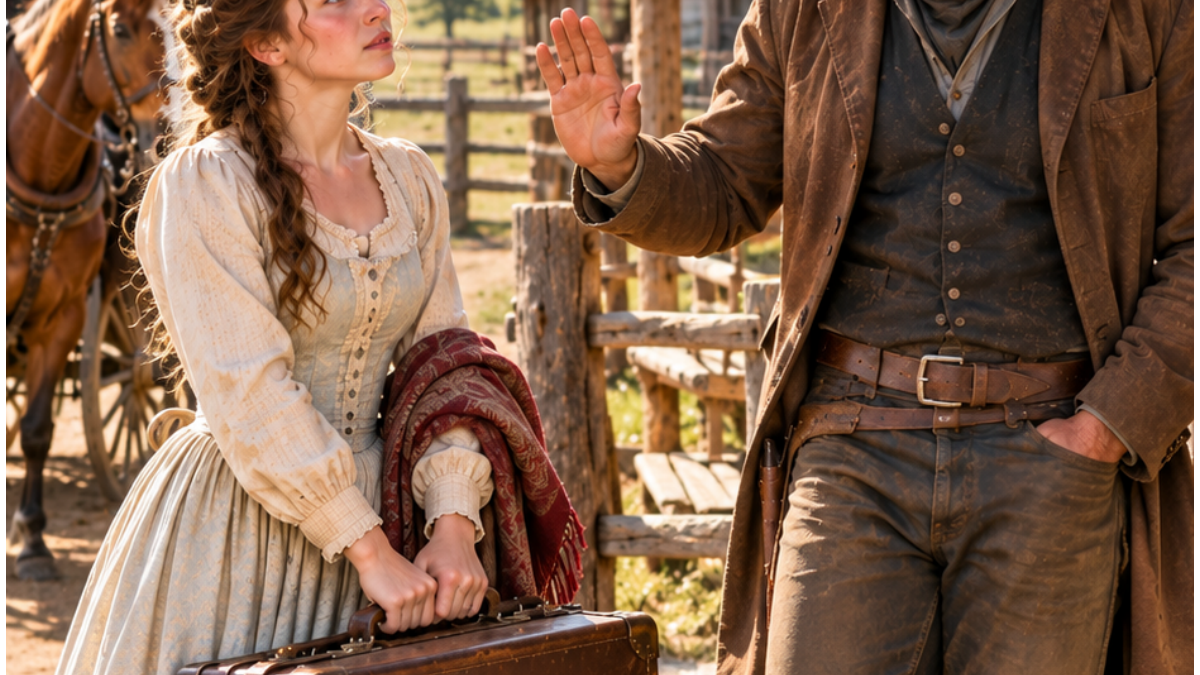
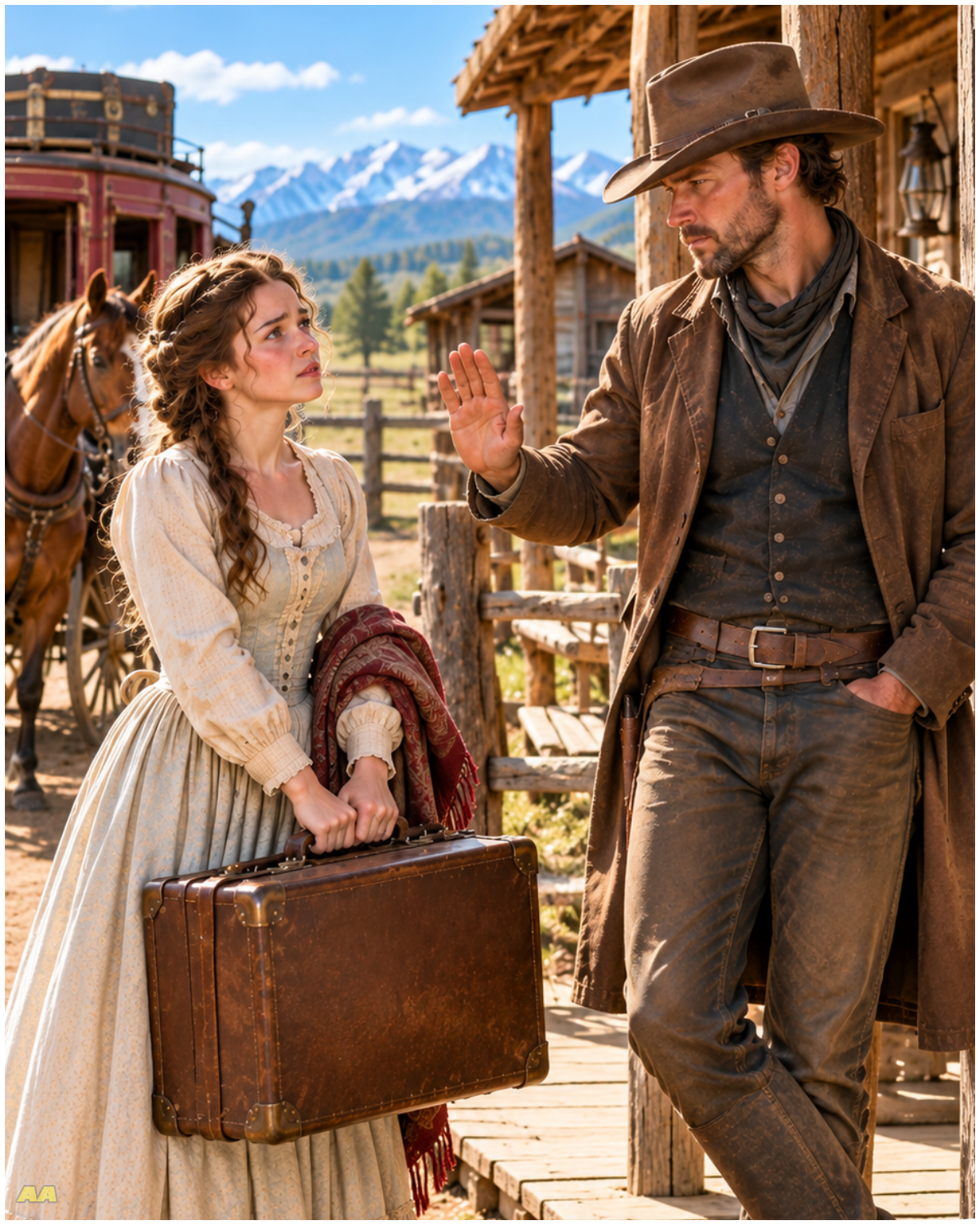
Edgar Bellamy did not ask his daughter’s opinion.
He never had. He simply sent for her on a Tuesday morning, set a letter on the desk between them, and told her she was leaving for Wyoming in 4 days.
Margaret stood in the doorway of his office in their family’s mercantile building in Saint Louis, still holding the freight ledger she had been updating.
When his clerk came to find her, she looked at the letter.
She looked at her father’s face, composed, satisfied, the expression of a man who had already made a decision and was now performing the courtesy of announcing it.
I’ve corresponded with a rancher in Wyoming territory, Edgar said.
A man named Wyatt Calder.
He has a working cattle operation outside a settlement called Willow Creek.
He is 34 years old, respectable, financially stable.
He is looking for a wife willing to adapt to frontier life.
Margaret didn’t move. And you told him I was?
I told him my daughter was a sensible, capable woman who understood the value of a practical arrangement.
Edgar laced his fingers together on the desk, which is more than most men in this city are willing to offer you.
There it was, the sentence underneath the sentence.
The one that had been waiting since Margaret turned down Harrison Cole 3 months earlier.
Harrison Cole, whose father supplied half the dry goods coming through Bellamy Merkantile, who had shaken Edgar’s hand at the dinner table and smiled at Margaret as though she were a piece of furniture he was deciding whether to purchase.
Papa, she set the ledger down on the edge of the desk.
Carefully, I run your accounts.
I manage supplier correspondence. When you traveled to Cincinnati last autumn, I handled every purchasing decision for 6 weeks without a single error.
I know this business better than Arthur does.
Arthur will inherit this business.
I know that, too. Her voice didn’t shake.
It never did, and she had trained it not to because she had learned long ago that shaking voices gave men reasons to stop listening.
I’m asking you to consider what I actually contribute here before you decide my future based on what’s convenient for your supplier relationships.
Edgar looked at her with the particular patience of a man who believed he was being generous.
Margaret, I am not punishing you.
I am finding you a real future, a home of your own.
Security, this arrangement allows you to start fresh, somewhere you won’t be compared to what you could have had here.
She understood then that the conversation was over.
Had been over before she walked in.
What if I refused to go?
Edgar picked up a pen.
Then I will find someone else to manage correspondence and accounts, and you will have neither a position here nor a path to one.
You are 26 years old.
I am not going to argue with you about your future indefinitely.
He went back to writing.
Margaret picked up the ledger, walked out of the office, and for 4 days she made every account entry correctly, handled every supplier letter, organized every freight manifest because she did not yet know what she was going to do.
But she was not going to give him the satisfaction of watching her fail at the work she’d already mastered.
On the morning of the fifth day, she got on the stage coach.
The ride took 3 days with two overnight stops, and Margaret spent most of it looking at the country, changing outside the coach window the flat Missouri farmland, giving way to rougher terrain, drier, and more open, the sky growing larger the further west they traveled, until it seemed to take up more space than the ground beneath it.
She had brought two books she didn’t read.
A small bundle of correspondence paper she used once to write a letter to her brother Arthur that she didn’t finish.
A ridicule with the exact amount of money her father had provided for the journey, which she had counted twice in the privacy of her room the night before she left.
There was not enough to get back.
She had not asked whether that was intentional.
The other passengers were a merchant traveling to purchase horses, a woman returning to her family after visiting a sister in Kansas City, and a young man who slept through most of the journey with his hat over his face.
Nobody spoke much after the first hour.
That suited Margaret. She did not want to explain herself.
She did not want someone to ask why she was traveling alone or where she was headed or whether she was excited.
She was not excited. She was doing what she had always done when the situation left her no other options.
Going through the necessary steps with complete precision >> and hoping that precision would eventually give her something her father’s >> decisions had not.
Willow Creek was smaller than she expected.
The stage coach rolled past a trading poSt. a blacksmith, a general store, two saloons side by side, and what appeared to be the beginning of a church that hadn’t been finished yet.
A handful of people moved along the wooden walkways.
A pair of boys chased a dog between a wagon and a water trough.
Margaret looked at all of it through the coach window and thought, “This is the place my father traded me to.” Then she stopped thinking that, because thinking that would not help her.
The coach stopped at the trading poSt. The driver handed down luggage.
Margaret’s trunk came off last one trunk because she had been practical about what she brought, and also because a single trunk had felt like the right amount of luggage for a situation she had not agreed to.
She stepped down into the dust and the afternoon heat and looked around for the man whose name she knew from her father’s description, a rancher, 34, stable.
She found him almost immediately because he was the only man standing still.
Everyone else was moving, unloading, arguing, walking somewhere with purpose.
Wyatt Calder stood beside a wagon and watched her step off the coach with an expression she couldn’t quite read.
He was taller than she’d imagined.
Lean in the way that came from actual work rather than fashion.
Hat that had seen weather.
He held it in one hand and looked at her across the distance with something that might have been relief and might have been apprehension.
He walked over. Miss Bellamy.
Yes, I’m Wyatt called her.
I know. She offered her hand.
He shook it once formally and went to retrieve her trunk from the pile by the coach without asking permission or making a production of it.
Margaret watched him loaded into the wagon bed with efficient practiced movement.
She climbed up onto the wagon seat before he could offer to help her.
Something about that seemed to surprise him slightly.
He came around, took the reinss, and they started moving.
For the first 15 minutes, neither of them said much.
Wyatt pointed out the general direction of the ranch several miles past the tree line, past a creek crossing, up a gradual rise in the tone of someone narrating a route rather than making conversation.
Margaret listened and looked at the landscape and tried to calibrate what her situation actually was.
She knew almost nothing concrete.
Her father had provided Wyatt Calder’s name, a general description of the ranch, and a departure date.
That was it. She had not seen the letter her father sent to Wyoming on her behalf.
She had not been shown whatever Wyatt called her had written in response.
She had been handed a stage coach ticket and told this was her future.
Wyatt glanced at her once, then looked back at the road.
Your father mentioned you’d want things settled quickly.
I arranged for the minister to come out at the end of the week.
Margaret went absolutely still. The minister for the wedding.
She turned and looked at him fully for the first time since they left town.
He was watching the horses, hands easy on the reinss, the same neutral expression he’d worn since they met.
My father told you I wanted the wedding this week.
He said, “You prefer to have arrangements finalized without a long waiting period.” Margaret was quiet for a moment.
She was doing arithmetic in her head, not the arithmetic of account books, but the arithmetic of what had just been confirmed about her situation, about what her father had told this man, about what this man currently believed to be true.
Mr. Calder. Her voice was level.
What exactly did my father’s letters say about me?
Wyatt glanced at her. Something shifted in his expression.
Not alarm exactly, but a kind of careful attention.
That you were 36 years old and had agreed to the arrangement.
He paused. And that you were ready to begin ranch life immediately.
I’m 26. He absorbed that.
All right. And I need to ask you something directly.
All right. Did you ever receive a letter that you were told came from me personally?
Wyatt’s hands tightened slightly on the reinss.
Not much, enough that Margaret noticed.
He was quiet for 3 or 4 seconds that felt longer than they were.
There were two letters your father said you had written yourself, he said, agreeing to the arrangement and expressing your willingness to make the journey.
Margaret looked forward at the road.
I didn’t write those letters.
The wagon stopped, not gradually.
Wyatt pulled up the horses with one controlled movement, and they stood on a stretch of open road between the treeine and a gentle slope.
Nothing moving except the wind across the grass and the faint sound of the horses blowing air through their noses.
Wyatt set the break. He didn’t look at her immediately.
He sat with his arms resting on his knees and looked at the horses and was quiet long enough that Margaret began to wonder if she had made a mistake by being honeSt. Then he said, “Did you choose to come here?” “No.” Did your father give you a real alternative?
She thought about the freight ledger, the office, the pen scratching against paper.
You will have neither a position here nor a path to one.
No. Wyatt removed his hat.
He held it in both hands and looked at the brim with the expression of someone working through something that required care.
“Then there won’t be a wedding,” he said.
Margaret turned and stared at him.
He said it again, as if she needed to hear it more than once.
I’m not going to hold you to an arrangement you were sent into against your will.
That’s not He stopped. Started again.
I wrote east because I wanted a wife who actually wanted this life.
Not a woman delivered to me because her father wanted her gone.
Margaret opened her mouth and then closed it again.
She had prepared for anger.
She had prepared for the possibility that he would feel entitled, or that he would try to persuade her, or that he would try to persuade her, or that the situation would immediately become one where she would need to defend herself against expectations she’d never agreed to.
She had not prepared for a man who looked genuinely troubled by the idea that she hadn’t chosen him.
“What does that mean for me?” she asked.
Her voice was practical. She was already running numbers, money, time, options.
“It means you’re a guest at the ranch tonight,” Wyatt said.
And tomorrow we figure out what you actually want to do.
Calder Ranch was not what she had pictured.
She hadn’t pictured much. Honestly, her imagination had been occupied with survival planning rather than interior decoration.
But the house was solidly built, larger than she’d expected, with a covered porch and a good well and a barn that had clearly been extended at some point and never quite finished on the eastern side.
There were two ranch hands she met briefly, a younger man named Dell, who touched his hat and went back to his work without ceremony, and an older man named Earl, who looked at Margaret with the exhausted assessment of someone, who had seen a number of things go wrong at this ranch, and was trying to determine whether she was the next one.
He nodded at her once and disappeared into the barn.
The room Wyatt showed her was off the main hall, ground floor, with its own door to the porch.
He set her trunk inside, pointed out the lamp, and told her supper was at 6:00.
Mister called her. She stopped him in the doorway.
I want to be clear about something.
Go ahead. I’m not in the habit of accepting charity.
I can work. I know accounts, correspondence, purchasing, freight negotiation.
I can make myself useful while I determine what my next step is, but I need to know this is, she paused, picked a word, an arrangement, not an obligation.
Wyatt looked at her for a moment.
I wasn’t planning to make it an obligation.
Good. She held his gaze.
Then we understand each other.
He started to go, then paused with one hand on the door frame.
My accounts are a disaster.
I’ll be honest about that.
I’ve got 2 years of receipts that don’t match the ledger.
At least three supplier relationships that are probably costing me money I’m not not tracking.
And correspondence I haven’t answered in six weeks.
He said it without embarrassment, just as a fact.
I’ll look at them tomorrow, Margaret said.
Supper was quiet. Wyatt made a beef stew that was better than she’d expected from a man living alone on a ranch, and they ate at a wooden table in the kitchen without much ceremony.
He didn’t try to make conversation for its own sake, which Margaret appreciated more than she would have been able to explain.
At one point, he said, “Where did you learn accounts?” My father’s business.
Since I was 17. He ran you through it properly?
He ran himself through it.
I taught myself the reSt. She paused.
He found it useful until it became inconvenient.
Wyatt said nothing. He picked up his fork and kept eating, and somehow that felt more respectful than anything he could have said.
After supper, Margaret sat at the table with a cup of coffee and thought about her situation with the cold clarity she had been practicing, since she was old enough to understand that nobody else was going to do it for her.
She had no money beyond what remained from the travel funds, a small amount.
She had no way back east that she could afford without help she hadn’t earned yet.
She had a father who had arranged her removal from the family business and forged letters to do it, and a brother who would be kind to her and entirely useless in any situation requiring him to disagree with their father.
She had a guest room in a stranger’s ranch house, and the possibility of work she already knew how to do.
She had been in worse positions.
She was not sure when exactly, but she felt certain it was true.
The accounts were worse than Wyatt had suggested.
Margaret spent the better part of the next morning at the kitchen table with his ledger books, his receipts, and a collection of supplier invoices that had been organized by the system of being shoved into a wooden box and periodically shaken.
She made a pot of coffee, found paper and a pen, and started from the oldest receipt she could identify.
By noon, she had found three duplicate charges from a freight company in Denver.
Not large amounts individually, $2 here, three there, but consistent going back 18 months, adding up to what she estimated at somewhere between 30 and $40.
She took the receipts out to the barn where Wyatt was working on a piece of tac that had broken.
Who’s your freight supplier in Denver?
She asked. He looked up.
Hendricks and Sons used them for feed shipments mostly.
Margaret set the receipts on the workbench beside him.
They’ve charged you twice for 11 different shipments.
Look at the dates. Wyatt straightened up and looked at the papers.
His jaw tightened slightly as he went through them.
I need to write them a letter, Margaret said.
Today, if possible. The longer this goes without challenge, the more they’ll assume you didn’t notice.
He looked at her. Something in his expression was shifting, not dramatically, not with any sort of announcement, but incrementally.
The way a person’s assessment of something changes when the evidence keeps landing in the same direction.
Write it, he said. I’d like you to review it before it goes.
I trust your letter. I know.
She gathered the receipts. I’d still like you to review it.
He nodded and she went back to the kitchen table.
The letter went out that afternoon.
6 days later, a reply came from Hendricks and Sons acknowledging the billing errors and issuing a credit of $31 toward future orders.
Wyatt held the letter for a moment, then looked at Margaret across the kitchen table where she was now working through his buyer correspondence.
I owe you $31, he said.
You owe me nothing. I used your time and your paper.
You found me $31. I found a billing error.
Any competent bookkeeper would have.
I didn’t have a competent bookkeeper.
He set the letter down.
I’m increasing your wages. Margaret looked up.
We didn’t negotiate wages. We’re negotiating now.
She held his gaze. I told you I can work.
I didn’t agree to take money I haven’t earned.
You found $31 in a week.
Wyatt said. I’m paying you for it.
This isn’t kindness. This is what the work is worth.
That sentence landed differently than she expected.
She was used to her value being acknowledged in the abstract capable, useful, sensible, and ignored in the specific in the places where value translated to wages or ownership or say indecisions.
She was not used to someone putting a number on the work and calling it accurate.
Fine, she said, and went back to the correspondence.
Town gossip reached her on her third trip to Willow Creek 2 weeks after her arrival.
She had ridden in on the chestnut.
Mayor Wyatt called Penny a calm horse, patient, the kind that didn’t argue with an inexperienced rider, but also didn’t condescend to one to pick up supplies from the general store and mail a letter to a feed supplier in Cheyenne that Margaret suspected was overcharging Wyatt by 40 cents per hundred weight.
This owners of the store, a woman named Mrs. Halverson, handed over the wrapped parcel of Lraga Goods with an expression that was trying too hard to be neutral.
I heard you arrived a few weeks back, she said.
I thought maybe we’d be hearing wedding news.
Not at present, Margaret said.
Wyatt Calder is a decent man.
Most women would count themselves fortunate.
I have no complaints about mister.
Calder, Margaret said pleasantly. She picked up the parcel.
It’s unusual as all, Mrs. Halverson said.
A woman traveling alone all the way from Missouri, staying at a ranch.
People talk. People do, Margaret agreed.
She walked out. She heard the story a different way from Eliza Pratt, a widowed rancher whose land ran along the eastern edge of Wyatt’s property.
Eliza came to introduce herself on a Thursday afternoon with a jar of preserved observes and the particular directness of a woman who had spent 20 years in Wyoming and no longer had patience for indirection.
I heard Wyatt canceled a wedding, Eliza said, sitting across from Margaret at the kitchen table while Wyatt was out with the cattle.
Want to tell me what actually happened?
Margaret looked at her. Why?
Because Wyatt called her as a man who does nothing without a reason.
And if he canled a wedding arrangement, it was a good one.
Eliza paused. And because you look like a woman who could use somebody on her side who isn’t reporting back to anyone.
It was so precisely accurate that Margaret felt something shift in her cheSt. Not dramatically, just a small internal movement, like a door she’d been leaning against for a long time, not having to hold it closed for a single second.
She told Eliza the outline.
Not everything enough. Eliza listened without interrupting.
When Margaret finished, she said, “Your father sent forged letters to arrange your marriage to a man you’d never met.” “Yes.” “And Wyatt found out during the wagon ride from town and cancelled the arrangement on the spot.” “Yes.” Eliza picked up her coffee.
“Well,” she said. Wyoming has surprised me before.
The question that Margaret could not stop turning over was one she’d put aside deliberately because she didn’t have an answer.
What happened when she had enough money to leave?
She was saving carefully, methodically, the way she did everything.
Wyatt paid her honestly more than honestly.
Once she had corrected enough of his accounts that he started treating her wages as a line item, in a real budget rather than a generosity, she kept every coin in a small tin she’d bought in Willow Creek, and noted every amount in the back of one of the blank ledger books.
It wasn’t enough yet to buy Passage Back East or anywhere else.
It would be in time.
She told herself she was simply waiting until it was.
She told herself the fact that she was also beginning to know the shape of the ranch where the creek ran.
What Penny did when she was nervous, which suppliers freight bills needed the most scrutiny, which of Earl’s complaints about the Eastern Barn were legitimate, and which were just Earl was simply professional familiarity.
She was building knowledge that would make her better at the next position, wherever it was.
She was not, she told herself, learning the sound of Wyatt’s boots on the porch steps, and knowing from the pace whether it had been a good day or a bad one.
The hardest day came at the end of the fourth week.
She had been going through a crate of correspondence that Wyatt had not opened letters accumulated over several months that he had set aside because he didn’t have time and nobody was managing them.
Most were routine. One was not.
It was a letter from her father, not to her, to Wyatt.
She saw her own name in the second paragraph and stopped.
Her hands were steady. They were always steady, even when they shouldn’t have been.
She read it twice. Edgar Bellamy had written to Wyatt 2 weeks before Margaret’s departure.
In the letter, he referred to Margaret’s letters of agreement, two letters he claimed she had written personally, expressing her willingness and enthusiasm for the arrangement.
He had described her as eager to begin a new chapter, and fully persuaded of the practical benefits.
Neither letter had been written by Margaret.
She had not written a single word to Wyatt Calder before she arrived.
Not one. Her father had fabricated her consent, put her words in her mouth, her name on paper she had never touched, her agreement to a future she had never been asked about.
And he had sent those letters to a man who was 3 days ride away, assuming the distance would make the deception impossible to discover until it was too late.
Margaret sat with the letter in her hands for a long time.
She was not crying. She had gotten through almost everything in her life >> without crying.
>> Not because she was strong in the way people meant >> when they called her sensible, but because there had never been a witness she trusted enough to do it in front of, >> and she had never developed the habit of doing it alone.
When Wyatt came in for supper, she was at the table with the letter in front of her and a cup of cold coffee she had forgotten to drink.
He looked at her, then at the letter, he sat down without being asked.
I found your correspondence from my father, Margaret said.
He was quiet. He wrote the letters of agreement himself.
She kept her voice flat, professional, the voice that got her through things.
I never wrote to you.
He fabricated my consent and sent it to you as though it came from me.
Wyatt put both hands on the table.
He looked at the letter, then at her.
I know, he said. She stopped.
You know, I suspected it before you got off the stage.
The way you moved, the way you answered questions.
He kept his voice even.
A woman who has spent weeks anticipating arriving somewhere doesn’t act like she’s never thought about it before.
I suspected your father had arranged things without your real input.
He paused. What I didn’t know until you told me was the degree of it.
Margaret looked at him for a long moment.
Why didn’t you say so?
Because it wasn’t mine to push.
He picked up the letter, looked at it once, set it back down.
You were already here. You already knew what he’d done.
Confronting you with my suspicions the first day felt like adding to a situation that was already bad enough.
There was a long silence.
He manipulated both of us.
Margaret said yes. He forged my words and used them to arrange a transaction involving two people who had nothing to do with his business convenience.
Yes. Wyatt’s voice was quiet.
I’m sorry about that. She looked at him across the table.
Why are you apologizing? You didn’t do it.
Because you got on a stage coach alone in a situation you hadn’t agreed to and I was the destination.
He held her gaze. That’s worth an apology even if I didn’t cause it.
Margaret did not know what to do with that.
She had received apologies before from suppliers who had overcharged from Arthur when he’d said something careless from the young man who had once knocked her ledger off a counter and scattered pages across the merkantile floor.
None of them had felt like this, like the apology was for the right thing.
Aimed at the right place.
She picked up her cold coffee and drank it anyway.
The freight supplier in Cheyenne, she said, “I’ve been running the numbers.
They’re charging 42 cents per 100 weight, above the standard rate.
I want to write them this week.” Wyatt looked at her for just a moment longer than necessary.
Then he nodded. “Write it,” he said.
And they ate supper in the same quiet that had been building between them, the kind of quiet that wasn’t empty, but was instead full of things that neither of them had found language for yet, and neither of them was in a hurry to name.
The letter from Hrix and Sons was framed in the only way Margaret knew how to frame things, as a business matter resolved.
She sent a follow-up 2 days later confirming receipt of the credit and establishing the correct per shipment rate going forward.
She wrote it in the voice she had developed over years of managing her father’s correspondence formal without being cold, precise without being aggressive, the kind of tone that left a supplier no room to argue without seeming unreasonable.
Wyatt read it before she sealed it, which was her standing practice, and handed it back without edits.
You don’t change anything, she said.
Not a complaint, an observation.
You don’t give me anything to change.
You should still read them.
It’s your business. He looked at her over the rim of his coffee cup.
I am reading them. You’re approving them without engagement.
That’s different. She folded the letter precisely.
You should understand the substance of every piece of correspondence that goes out under your name.
Not because you don’t trust me, but because I won’t always be here, and you’ll need to be able to do it yourself.
Something passed across his expression.
Quick, unidentifiable. There and then not.
He looked down at his coffee.
All right, he said. Explained the Hendricks letter.
She did all of it.
The duplicate billing pattern, the way freight companies sometimes exploited ranchers who couldn’t track shipments individually, the specific language she’d used to close the loophole without accusing them of deliberate fraud, which would have required proof she didn’t have, and would have damaged a supplier relationship Wyatt still needed.
By the time she finished, Wyatt had set down his cup and was looking at her with the full attention of a man recalibrating something.
How long did you work in your father’s business?
He asked. 9 years, and he never gave you a title.
Daughters don’t get titles. Came out more flatly than she intended.
She picked up the sealed letter.
I’ll get this on the afternoon poSt. The routine built itself the way routines do not through planning but through repetition repeated often enough to become expected.
Wyatt was usually out of the house before light, dealing with cattle and horses, and the thousand practical demands of running a working ranch with two hands and not enough daylight.
Margaret was up not long after, coffee made, accounts open before most of Willow Creek had finished their breakfaSt. They ate supper together every night at the kitchen table.
Not because either of them had discussed it, not because anyone had proposed it as a rule, just because supper at 6 was the natural end of the day’s work, and there was one table and two people, and neither of them was the type to make a ceremony out of eating alone to prove a point.
The conversations were mostly practical in the beginning.
Feed costs, supplier terms, a fence section on the north pasture that Earl had been threatening to repair for 3 weeks without doing it.
Margaret asked questions that were actually questions, not the rhetorical kind, she’d learned to use with her father, where phrasing a statement as a question made it easier for him to hear, but direct ones because she needed the information to do her job correctly.
What’s the price difference between the two hay suppliers you’ve used?
When did you last audit the cattle count against the purchase records?
Is there a reason you’re using a freight agent in Denver instead of buying direct from the feed mill in Cheyenne?
Wyatt answered all of them without making her feel like the questions were an imposition.
He was not, she discovered, a man who performed patience while privately resenting intrusion.
He was genuinely patient in the way that came from having spent years alone on land that required long-term thinking rather than short-term reaction.
He listened to full sentences before responding.
He said, “I don’t know when he didn’t know,” which was more than most men she’d worked with managed.
Within the second week, he started asking her opinion before making purchases.
The first time, he brought a feed supplers’s quote to the kitchen table and set it in front of her while she was still working on the buyer correspondence.
Elks Creek Mill is offering 10 cents per 100 weight less than our current Denver contract for the same grade of hay.
What do you think? Margaret looked at the quote.
Where is Elks Creek Mill?
40 m north. Shorter freight distance.
What’s their delivery reliability? I don’t know yet.
Find out before you switch.
A 10-cent savings means nothing if they miss deliveries during a hard winter.
She looked up. Ask Eliza Pratt.
She’s close enough to that area to know the operation.
He wrote Eliza a letter that afternoon.
The reply came back in 5 days.
Elks Creek Mill was reliable, had never failed a delivery in two winters, and the owner was a straight dealer.
Wyatt switched contracts the following week and put the savings in a separate column Margaret had created specifically for cost reductions she identified.
She did not tell him she’d created the column, partly because she wanted a concrete record of what the work was worth.
She told herself it was for his accounting clarity.
Penny was the horse that had come with the eastern pasture when Wyatt bought an adjacent property 3 years earlier.
She was chestnut, dark-mained, somewhere around 12 years old calm in the way that experienced horses are calm, which is to say she wasn’t placid.
She was simply unimpressed by most things.
She was responsive without being flighty, and she had the kind of muscle memory from years of work that meant she knew her job better than her rider on difficult terrain.
Margaret had ridden horses as a girl, but not well, and not recently.
Her first ride to Willow Creek on Penny had been accomplished mostly through careful stillness and the mayor’s own good judgment.
The second trip, Margaret was better.
By the fourth, she had started to understand the particular language between a horse and a rider.
Not verbal, not exactly physical, more a matter of attention being given and attention being received.
Wyatt came with her to town on the fifth trip, riding a greygeling named Reev, who was faster and more restless than Penny, and required more management.
They rode most of the way in the same companionable quiet that had become their default, which was not silence exactly, but a shared lack of need to fill space with noise.
On the way back, they were cutting across the open stretch of road past the tree line when a freight wagon came rattling around the bend at speed, driver shouting at his mules, the whole thing loud and sudden in a way that gave no warning.
Penny shied hard to the left.
Margaret felt it before she fully processed it.
The sudden lateral motion, her weight shifting wrong, one hand losing the rain.
For a half second, she was simply managing the physics of staying mounted, which she did by instinct and some luck.
And then Penny had stopped shying and was standing on the verge of the road, sides moving, ears sharp and forward.
Wyatt was beside her immediately, not in front of her, not grabbing for the rains beside her, close enough to help if needed, far enough away that Penny and Margaret could handle it themselves.
Margaret got her breath back, got her seat back, took the rain properly.
Penny blew out through her nose once and then settled because the situation had resolved itself and she was a practical animal.
You all right? Wyatt asked.
Yes. She stroked the mayor’s neck once quickly because it helped them both.
She shies to the left.
Usually you stayed on. I nearly didn’t.
Nearly isn’t the same thing.
They resumed the ride without further discussion.
But Margaret noticed and kept noticing that he had not reached for the reinss.
He had not placed himself between her and the road to intercept the problem.
He had come alongside her and waited while she resolved it herself.
It was a small thing.
She told herself it was a small thing.
The gossip in Willow Creek had not died down.
If anything, it had organized itself into two main theories which misses.
Halverson’s store served as an informal exchange for.
The first theory held that Margaret had rejected Wyatt and was staying at the ranch out of some complicated pride.
The second theory was more interesting and more uncharitable and involved speculation about what exactly was happening at Calder Ranch that made a proper wedding unnecessary.
Margaret heard both versions through Eliza, who had made herself a reliable channel for information that Margaret needed but would not otherwise receive in exchange for Margaret’s frank opinion on a purchase contract for cattle Eliza was considering.
People have a lot of time to speculate, Margaret said when Eliza delivered the latest version of theory, too.
People in small settlements have nothing but time in other people’s business.
Eliza sat back in her chair.
Does it bother you? Margaret considered, “The second version implies something disreputable is happening, which is false.
That’s worth noting.” She paused.
The first version implies I rejected him, which is also not accurate.
He canled the arrangement when he found out I hadn’t freely agreed to it.
I know that. You know that.
Eliza looked at her. Does Wyatt know people are saying these things?
Someone would have told him.
This is a small town.
Has he said anything to you about it?
No. She found out what he had said, but not from Wyatt.
She found out 3 days later from Dell, the younger ranch hand, who mentioned it while they were both walking toward the barn for different reasons in the off-hand way that young men sometimes deliver significant information because they haven’t yet learned to gauge its weight.
Mr. Calder told Pete Halverson last week that you were his employee and his gueSt. Dell said a wedding requires two people who want one.
He glanced at her sideways.
Pete Halverson was asking on behalf of his wife.
I think she’s been saying I know what she’s been saying.
Margaret said, “Thank you, Dell.” She walked back to the kitchen table and sat down with the account she’d been working on and and did not look at them for several minutes.
A wedding requires two people who want one.
He had said it publicly, plainly, without blaming her for the absence of a wedding, without phrasing it as a rejection or a failure of the arrangement.
He had stated it as a fact about mutual agreement, which made her the equal party in a decision rather than the woman who had failed to deliver on an expectation.
She had never had a man do that for her before.
Publicly reframe a story that could have embarrassed her as something neutral and factual instead.
She picked up her pen and went back to the accounts.
It was Eliza who told her about the letter, not the one from Edgar that Margaret had already found, but a second one later addressed not to Wyatt, but to the land office in Willow Creek, where it had been filed as a matter of record before anyone thought to mention it to anyone involved.
Edgar Bellamy, it turned out, had written to the Willow Creek land office in the same week he sent the forged letters of agreement to Wyatt.
The letter established that he, Edgar Bellamy of Saint Louie, had arranged a marriage between his daughter and Wyatt Calder of Calder Ranch and requested that the land office note the arrangement in their records as background for any future transactions involving Calder Ranch property.
The land office had done nothing with it.
There was no reason to.
But the letter sat in their records, and when Eliza had occasion to visit the office about her own property line dispute, she happened to mention Margaret’s name in passing, and the clerk, Young, not always thoughtful, had asked whether she was the woman from the Bellamy arrangement.
Eliza came directly to the ranch.
Margaret read the letter in the land office.
The next morning, Eliza had arranged for a copy and stood at the counter, looking at her father’s handwriting with a feeling she couldn’t immediately name.
It wasn’t surprise. Surprise would have required her to have underestimated him, and she had not.
But something about seeing the letter in an official record, seeing her name filed in an office in Wyoming as a property transaction between men, with no indication that she had ever been consulted about any part of it, made the thing concrete in a way that the forged correspondence hadn’t fully achieved.
It was not a small deception.
It was a comprehensive one, laid down in multiple locations by a man who had spent 20 years ensuring that anything involving his business interests was properly documented and carefully controlled.
She brought the copy back to the ranch.
She set it on the kitchen table that evening after supper with the other letter, the one already in her possession.
She laid them side by side.
Wyatt came to the table and looked at both of them.
He filed it with the land office, Margaret said, before I left Missouri.
As a matter of record, Wyatt was quiet.
He sat down. He did not rush to say something.
He planned for every contingency, she said.
If I’d arrived and refused to participate, there would have been a letter on file in this town, suggesting a legitimate arrangement had already been made, which would have put the social and reputational weight on me to either cooperate or explain why I was refusing something I had apparently agreed to.
She paused. He thought of everything except for the possibility that you’d ask me whether I actually agreed.
Wyatt put both elbows on the table.
He was looking at the letters.
His expression was not angry in the way she would have expected anger to look red-faced, raised voice, the performance of outrage.
He was still, which she was beginning to understand was how he processed things that mattered.
He manipulated me for a full year.
He said 12 months of correspondence.
I told that man things about this ranch, about what I wanted, about why I was looking.
He stopped. I know. He used what I told him.
Wyatt turned one of the letters over with one finger just to move it.
He knew I wanted a real marriage.
He knew I’d written east because I hadn’t found the right person here.
He used all of that to construct an arrangement that looked legitimate from every angle.
He looked at her. He knew I wouldn’t question it if I thought the woman had freely agreed.
The air in the kitchen was very still.
He counted on your decency, Margaret said quietly.
He knew a decent man would trust the letters at face value.
He spent 30 years doing business with decent men, and he knows exactly how to use their decency against them.
Wyatt picked up his coffee cup, found it empty, and set it back down.
Does your brother know what he did?
Margaret thought about Arthur, about the way Arthur moved through their father’s house, like a man who had never had cause to question the floor plan.
Not cruel, not calculating, just entirely unbothered by a structure that consistently worked in his favor.
Arthur knows my father made an arrangement, she said.
I doubt he knows the degree of it.
He wouldn’t have asked. She paused.
Arthur is the type of man who doesn’t examine benefits he’s already receiving.
There was a long quiet outside.
The wind moved through the gap around the doorframe in the small persistent way it had most evenings.
The sound of a working ranch at reSt. I’m sorry, Wyatt said for the second time for the same general reason.
You don’t need to keep apologizing.
You didn’t. I know I didn’t cause it.
He met her eyes. I’m still sorry it happened to you.
Apologies don’t require being responsible for the thing.
Margaret held his gaze for a moment.
Then she looked down at the letters.
We should probably keep both of these, she said.
In case the land office record ever becomes relevant to your property documentation.
Good thought. He stood and opened the small wooden cabinet beside the door where he kept important papers.
I’ll put them with the ranch deed.
She watched him file them with the precise care of a man who understood that paper mattered.
Wyatt, he looked back. He wrote to you for 12 months, she said.
You must have told him a great deal.
I did. Why were you looking for a wife through correspondence instead of through someone here?
He was quiet for a beat.
14 years of building this ranch didn’t leave much time for anything else.
The women in Willow Creek mostly wanted men who were already settled, and by the time I was settled, everyone had already formed their understanding of what I was.
He paused. I also I wanted someone who was choosing to be here, not someone who was here because it was the only option within a day’s ride.
She looked at him. Ironic, she said, his mouth moved.
It wasn’t quite a smile, but it was adjacent to one.
Yes. 3 days later, Eliza rode over in the mid-after afternoon with a purpose that was visible before she dismounted.
Margaret met her on the porch.
I need a second opinion on a purchase contract, Eliza said.
But that’s not the main reason I came.
Margaret waited. Dorothy Crest, she’s the postm’s wife.
Her husband handles the mail.
She told me, “Your father sent a letter addressed to you two weeks ago.
It arrived in Willow Creek, but nobody was sure whether to deliver it out here given the situation.
Eliza looked at her directly.
I told her to send it.
I hope that was the right call.
It was. Margaret stepped off the porch.
I’ll ride in for it this afternoon.
She took Penny. She didn’t tell Wyatt where she was going, just that she was going to town and would be back before supper.
He nodded from the far side of the yard where he was replacing a fence post and didn’t ask further, which she appreciated.
The letter was waiting at the post office.
She took it outside and stood in the afternoon dust of Willow Creek’s main road and opened it.
Her father’s handwriting was as controlled as ever, every letter precisely formed.
Edgar Bellamy did not write careless letters.
The letter was four paragraphs.
She read it twice. The first paragraph expressed his expectation that she had by now settled into her new situation.
The second paragraph noted that whatever had gone wrong with the wedding arrangement could likely be resolved if she applied proper effort.
The third paragraph was the relevant one.
Edgar offered her a path home.
She could return to St. Louie resume a role in the family business not her previous one, something more limited, and allow him to arrange a more suitable introduction than the Wyoming situation had proved to be.
The conditions of this arrangement were simple.
She would not bring the matter of the Calder correspondence into any legal context.
She would resume the family routines without complaint, and she would understand that any future decisions about her situation would be made with the family’s collective interest in mind.
The fourth paragraph noted that Arthur sent his regards.
Margaret folded the letter. She stood in the afternoon sun for a long moment with the letter in her hand, and Penny’s reigns looped over her wrist, and she thought about her mother’s face.
The particular expression her mother had worn when she called herself fortunate, the practice brightness of a woman who had decided gratitude, was the safest possible emotion.
Fine house, financial security, respectability, ask permission for nearly everything.
She put the letter in her coat pocket and rode back to the ranch.
She didn’t tell Wyatt about the letter that evening.
She told him the next morning at the kitchen table because she had decided overnight that not telling him was the kind of thing she would have done in her father’s house withheld information because sharing it felt like vulnerability and vulnerability felt dangerous.
She was trying to stop doing things for those reasons.
She put the letter on the table.
He read it. He put it down.
What are you going to do?
He asked. I’m going to refuse, she said.
I want to put that in writing this week.
Clearly enough that there’s no room for a future letter to reinterpret my answer.
All right, but I need a plan that doesn’t depend on him.
She looked at her coffee.
I have savings from what you’ve paid me.
Not enough to travel independently yet.
I have your reference and Eliza’s reference for bookkeeping work, but I haven’t pursued other clients yet.
She looked up. I’d like to I’d like to take on work from other ranchers in the area.
Additional accounts, correspondence, whatever needs doing.
Wyatt was quiet for a moment.
You’d be building toward leaving, he said.
Not an accusation, just a naming of the thing.
I’d be building toward being able to make a choice, she said.
Those aren’t the same thing.
He nodded once slowly. I can introduce you to Harlon Voss.
He runs cattle to the east twice the operation I have and probably twice the mess in his accounts.
I’ve heard him complain about it at the stock exchange for 2 years.
He paused. And Tom Reedi at the general store has been managing his own freight billing by hand.
He’d probably pay someone competent to take it over.
I want to make the introductions myself once you’ve opened the door.
Of course. She wrote her father’s letter that evening.
It took three drafts. The first was too long.
The second had a sentence in it that she recognized as her mother’s voice, careful hedged, designed to soften the no into something that would cause less friction.
She cut it. The third version was two paragraphs.
It said what she meant without apology, and without invitation for continued negotiation.
She read it once, sealed it, and put it with the stack for morning poSt. Then she sat for a while at the kitchen table in the good quiet of the ranch house, listening to the wind and the distant movement of horses in the barn, and recognized cautiously with the weariness of a woman who had learned not to trust eyes comfortable feelings that this was the first time she had refused her father without immediately calculating the coSt. There was still a coSt. She knew that his offer would not come again in this form, and he was not a man who accepted refusals without consequence.
But the consequences were no longer hers to absorb alone on his terMs. Harlland Voss was a large man with a red face and a deep distrust of paperwork, which made him easy to work with because he genuinely wanted someone to handle it and had no ego invested in the outcome.
Margaret rode to his ranch on a Tuesday, took one look at the wooden crate in the corner of his office that served as his filing system, and quoted him a rate for three months of work.
He agreed without much negotiation, which told her she had probably underqued.
She raised her rate for Tom Reedi, who was a a better negotiator, but also more obviously desperate, and they settled on a figure that was fair to both of them.
She told Wyatt about both arrangements over supper because she had started telling him about things that mattered to her professionally, not asking permission, just reporting the way she had once reported to her father, but differently.
Because Wyatt listened without turning the information into a decision he was going to make for her.
Harlon Voss is going to trust you completely once he finds out you can make the accounts make sense.
Wyatt said he’ll probably try to give you more work than you want.
I’ll manage that. He’s not subtle.
I’ve handled worse. She paused.
He reminds me of a supplier in Cincinnati.
My father used to deal with big, impatient, genuinely good at his actual work, and genuinely useless at everything adjacent to it.
She looked at her plate.
My father always made me handle that supplier’s letters because he didn’t have the patience for him.
But your father didn’t pay you what the work was worth.
No, it was quiet for a moment.
Harlon Vosill, he said. If he doesn’t, come back and tell me, and I’ll explain the terms to him.” Margaret looked up.
I’ll explain the terms myself.
I know, but the offer stands.
She looked at him for a moment.
He was watching his plate with the ordinary attention of someone finishing supper, not angled for reaction, not performing generosity.
He had said the thing because he meant it, and then he’d moved on, which was the most useful kind of support she knew how to receive.
“Thank you,” she said. She wasn’t sure what exactly she was thanking him for.
All of it, maybe. The offer, the fact that it didn’t require anything back, the way this kitchen had slowly, without anyone planning it, become a place where she could say what she actually thought and not calculate the consequences firSt. She did not examine that feeling closely.
Not yet. Outside, Penny moved in the paddic with the soft sound of hooves on dry ground, and the evening settled over Calder Ranch in the way evenings did out here slowly, completely without apology for how much space they took up.
The reply from her father arrived on a Wednesday’s day, which Margaret noted because Wednesdays had become the day she rode to Tom Reed’s store to collect freight invoices and deliver completed account summaries.
And having the letter handed to her mid-rand meant she read it standing in the street in full afternoon light with no privacy and no preparation.
It was two sentences. Your refusal has been noted.
The offer will not be repeated.
That was it. No anger she could see on the surface, which was worse than anger would have been because her father’s surface control was the thing that had always told her how seriously he meant something.
Emotional men raised their voices.
Edgar Bellamy got quiet and precise and removed options.
She folded the letter and put it in her coat pocket and went into Rei’s store and finished her errand with complete professionalism because there was nothing else to do with the information right now and she had work that needed doing.
She did not tell Wyatt about it until that evening.
When she did, she put the letter on the table the way she had started putting things on the table as facts to be examined, not confessions to be managed.
He read it. Read it again.
All right, he said. All right, she agreed.
Neither of them said anything further about it for the rest of the evening, but Margaret noticed that Wyatt refilled her coffee without being asked, which he had never done before, and which she suspected was the closest he knew how to get to.
I’m sorry on a night when he’d already used that sentence twice.
She accepted the coffee. That felt like enough.
The weeks that followed had a shape to them that Margaret recognized as forward motion, which was the only kind of motion she had ever trusted.
Her account work at Harlland Voss’s ranch revealed what she’d suspected from the first look at his filing crate, not fraud.
Just 14 years of willful organizational neglect from a man who was genuinely brilliant with cattle and genuinely uninterested in everything that happened after the cattle were sold.
She found an uncollected payment from a buyer in Denver that was 18 months old, $412, and and sent a letter that produced a bank draft within 3 weeks.
Harlon Voss showed up at Calder Ranch on a Saturday morning with the bank draft in one hand and a look on his face that suggested he was recalculating something fundamental.
“I’ve been carrying that debt on my books as a loss,” he said to Margaret on the porch, hat turning in his hands for a year and a half.
It wasn’t a loss, she said.
The buyer was slow and you weren’t following up.
Those are different probleMs. How’d you get him to pay?
I documented the delivery records, attached the original contract terms, and informed him that I would be filing a formal complaint with the territorial trade office if the balance wasn’t settled within 30 days.
She paused. I don’t know whether the territorial trade office has any real enforcement mechanism for this type of dispute, but he didn’t know that either.
Harlon stared at her for a moment.
I’d like to extend the arrangement, he said, through the end of the year.
We’ll renegotiate the rate. I thought we’d agreed.
We agreed on a rate for 3 months of basic account organization.
You’re now asking me to manage active debt collection and buyer correspondence.
That’s a different service. She looked at him steadily.
I’ll write the new terms this week.
You can review them. He left having agreed to terms that were 30% higher than the original arrangement.
And Margaret went back inside, feeling the particular quiet satisfaction of a number that was correct.
She added the new income to the column at the back of the ledger.
The tin was getting heavier.
She had been at Calder Ranch for 6 weeks when she understood clearly for the first time that she was in trouble.
Not in trouble with her situation.
Her situation was by every practical measure improving.
The trouble was different. It was the kind of trouble that didn’t show up in account books and couldn’t be resolved by correctly phrased letters, and she had been managing it by simply not looking directly at it.
The way you could ignore a roof problem in dry weather, by reasoning that it hadn’t rained yet.
It had started, if she was being precise about it, on the evening they found the duplicate land office letter, not because of what he said, though.
He had said said things that mattered, but because of how he had sat with her at the table and been still and thought carefully before speaking, which was a quality she had not known she was missing in the people she spent time with until she had seen it repeatedly in the same person.
It had gotten worse on the day Penny shied at the freight wagon.
The way he had come alongside her and not grabbed the reinss.
It had gotten worse still on the morning she told him about Harlon Voss’s $412 and he had said he’ll probably try to give you more work than you want.
Not that’s very impressive or I knew you could do it just the next practical reality.
Spoken in the tone of someone who had already factored her competence into his understanding of how things worked without needing to announce the fact.
She sat with all of this on a Tuesday evening while Wyatt was out checking the fence line on the north pasture and she was alone at the kitchen table with the accounts and the lamp and the tin she was saving into.
She sat with it honestly, which was something she had been practicing the same discipline she applied to freight invoices and billing errors applied to herself.
She had feelings for Wyatt called her that were not professional and were not gratitude and were not the complicated contractual emotions of a woman in a difficult situation finding comfort in a capable neighbor.
They were the kind that made her track the sound of his boots on the porch and notice when he’d been out in the cold too long and feel when he was sitting across the table from her that the table was exactly the right size.
She identified this the way she identified a billing error, carefully, precisely, without drama.
And then she made a note to herself with the same discipline.
This information changed nothing. She was still in a situation where her financial independence was incomplete.
She was still living and working in a man’s house on wages he paid her.
Whatever she felt, she was not going to become a woman who let her feelings make the decision for her.
Because that was exactly what her father had counted on the idea that a woman placed near the right kind of man made sufficiently dependent would eventually stop asking questions about whether she had a choice.
She closed the ledger. She added up the tin.
Not yet, but closer. The trouble with building independence as a plan was that it required her to be honest Wyatt about what she was doing.
And being honest with Wyatt about it made him help her, and his helping her was she could not find a better word for it painful.
Not because help was unwelcome, because the specific way he gave it told her something about him that made the whole project feel lonelier than it should have.
When she told him she was thinking about whether to contact a freight operation in Cheyenne, about the possibility of more consistent work, he had not paused, not recalibrated, not looked at her with anything that could be described as resistance.
He had said, “Henderson Freight runs the main Cheyenne Denver corridor.
I know their manager by name.
I’ll write you a reference.
You don’t have to. You’ve recovered $43 from HRIS, $412 from Voss’s buyer, and identified a $60 overcharge in my hay contracts.
Those are real numbers I can put in a letter.
He was already reaching for paper.
A reference without specific figures is just someone being polite.
This one will mean something.
She had watched him write the letter.
He wrote it the way he did everything, without performance, without side glances at her to check his reception, just steadily.
And then it was done.
He handed it to her.
She read it. Every number was accurate.
The framing was professional and specific.
The kind of reference that made the recipient feel they were getting useful information rather than a favor.
This is good, she said.
I know. She folded it.
Thank you. He picked up his hat from the table.
Earl’s having trouble with the eastern gate again.
I’ll be out till dark.
He walked out. She sat with the reference letter in her hands and thought about all the ways a man could show you something about himself without saying it.
The letter from the freight firm in Cheyenne arrived on a Thursday afternoon in the last week of Margaret’s sixth week at the ranch.
She recognized the letterhead from her own research Henderson freight established 1,881 main operations on the Cheyenne Denver corridor expanding into Wyoming territory settlement routes.
She had written them 3 weeks earlier with her credentials, her references, and a precise summary of the work she’d completed.
The letter responding to Wyatt’s reference had come first, which told her he had written without informing her, and which she had filed away as another fact about him.
She was not examining closely.
The job offer was clear.
A permanent bookkeeping and correspondence position at their Cheyenne office.
Starting wage $40 per month, more than she was earning from her combined accounts at the ranch and Harland Voss and Reedis combined.
Private room and a boarding house two streets from the office, the cost of which was partially subsidized by the firm.
Opportunity for advancement to a supervisory role within 2 years if performance warranted.
It was everything she had said she wanted when she was still in Missouri trying to articulate what a real future looked like.
She sat at the kitchen table and read it three times.
She should have felt relief.
She recognized the shape relief was supposed to have, and she waited for it.
What she felt instead was complicated in a way that made her grip the letter tighter than necessary.
She put it down. She picked up her pen.
She did the arithmetic she always did wages, travel cost, establishment cost in a new city.
How long before she’d be genuinely self- sustaining without any external dependency?
The numbers were good. They were better than good.
They were the numbers of of a woman who would be within 6 months of accepting this position completely beyond her father’s reach by any practical measure.
She was still sitting with the letter when Wyatt came in at the end of the day.
She didn’t try to put it away or redirect the conversation.
She said it in the middle of the table.
He came to the table, read enough to understand what it was, and sat down.
They were quiet for a moment.
Henderson freight, he said. Yes.
40 a month. Yes. He turned the letter over in his hands once, then set it flat on the table.
She watched his face because she had become good at reading it.
In the way you became good at reading anything you paid sustained attention to.
He was working through something.
She could not tell what exactly because this was one of the things Wyatt did not show the interior process only the result of it.
You should take it, he said.
She looked at him. The numbers are good.
The firm is solid. Cheyenne has real infrastructure, medical care, other employment options if this one doesn’t work out.
He kept his voice even informational.
The voice of someone giving a considered opinion rather than a reaction.
You’d be independent inside of a year.
Wyatt, he looked up. Do you want me to take it?
Wrong question. She knew it was wrong before she finished saying it.
Knew it the way she knew the Hendrick’s billing error before she’d fully confirmed the numbers by the specific quality of the wrongness.
The way it hit the wrong register.
She wasn’t asking what he thought.
She was asking what he wanted.
And those were different questions.
And she had asked the second one because some part of her needed to hear an answer that she knew he wasn’t going to give her.
He held her gaze. I want you to know you can, he said, not what she’d asked.
Precisely what he meant. Margaret looked at the letter.
She had asked a woman’s question, the kind that was really asking, “Does this matter to you?
Do I matter to you?
Give me a reason to stay.” And he had answered it the only way he was going to answer it.
The only way that was consistent with the thing he had been doing for 6 weeks, making sure she could leave.
She understood him. She had understood him for weeks.
She understood that his refusal to answer was not indifference was, in fact, almost the opposite of indifference, and that understanding it did not make it easier.
I’ll need to write them this week, she said.
I can help with the freight logistics, stage coach schedule, which route to Cheyenne.
I know the route, right?
He picked up his hat.
Supper will be late tonight.
Earl’s got something going on with the barn drainage, and I told him I’d take a look.
He walked out. Margaret sat at the table for a long time with the letter and the lamp and the sound of the evening coming on outside, and she did not cry because she had not yet cried in front of anyone at this ranch, and she was not going to start over a decision she was going to make correctly.
She wrote Henderson Freight the next morning, accepted the position, requested a start date of 3 weeks hence.
Then she rode to Willow Creek and bought a stage coach ticket with money from the tin.
She did not tell Wyatt she had bought the ticket until the evening she bought it.
And when she told him, she set it on the table the way she said everything as information, not performance.
He looked at it. 3 weeks.
I want to finish the quarterly account cycle for Voss and make sure Reedi has someone to take over his freight billing before I go.
I’ll write him a recommendation for a woman in town.
Mrs. Carver’s daughter has been looking for work and she seems capable.
You’ve already been thinking about the transition.
I think about transitions when they’re coming.
She paused. I’d like to finish the Calder Ranch accounts through the end of the month and leave you a system that’s straightforward enough to follow.
I’ll write out the supplier contacts, the billing calendar, the correspondence templates.
He was looking at the ticket.
You don’t need to do all that, he said.
I know I don’t need to.
I want to leave it in order.
She folded her hands on the table.
You’ve been fair with me.
More than fair. I’m going to do the work properly until the last day.
That’s not what I He stopped.
Started again. I wasn’t questioning your work.
I know. They sat with that for a moment.
Eliza will want to say goodbye, he said finally.
I’ll ride over there tomorrow.
Eliza took the news with the particular directness Margaret had come to expect from her.
None of the performative sadness that would have felt like pressure, just a long look and then a practical response.
Cheyenne’s a real city, Eliza said.
Good for you. I think so.
You’ll be completely independent inside a year by the sound of it.
That’s my plan. Eliza was quiet for a moment.
She was looking at something past Margaret’s shoulder in the middle distance direction of her own ranch.
Wyatt know you’ve got the ticket.
Yes. How’d he take it?
Margaret looked at her coffee.
The way he takes most things.
Still. Still. Eliza set her cup down.
You know what’s the most frustrating kind of man to be loved by?
Margaret looked up. The kind who loves you by respecting every choice you make.
Eliza’s voice was dry but not unkind.
It’s infuriating because you can’t argue with it.
You can’t ask him to be worse at it.
Margaret said nothing. I’m not telling you what to decide.
Liza said, “You’re going to Cheyenne and you’re going to do well there because you do everything well once you understand it.
I’m just naming the thing that’s in the room.
I know what’s in the room.
I know you know.” Margaret picked up her coffee.
He’s not going to ask me to stay.
No, he’s not. Because asking me to stay while I’m still living in his house, still dependent on his wages, he’d consider that using the situation.
That’s exactly what he’d consider it.
Which is the right call, Margaret said.
He’s right. He is. Eliza looked at her.
And you’re still going to get on that stage coach wanting him to ask.
The sentence landed with the accuracy of something aimed carefully.
Margaret held her coffee cup for a moment.
Yes, she said. Eliza nodded once, no further commentary.
She topped up Margaret’s coffee from the pot without being asked, and they sat a while longer in the afternoon light, and Margaret was grateful for the company of a woman who said difficult things plainly, and then let them be.
The last 3 weeks had a texture that Margaret filed in the same category as the letter she had written, things you did correctly, even when correctly felt insufficient.
She finished the Calder accounts through the end of the month and produced what she had promised, a clear system labeled supplier files.
A correspondence calendar, templates for the four most common letter types.
She spent an afternoon walking Wyatt through all of it at the kitchen table with the kind of patient specificity she’d used when she explained the Hendrick’s letter to him in the second week.
He asked good questions. He always asked good questions.
That had stopped being a surprise to her somewhere around week three.
The Voss accounts were closed and balanced.
She wrote a transition letter to Mrs. Carver’s daughter on Reed’s behalf outlining the freight billing system and the key contact at the Denver warehouse and delivered it in person along with a personal recommendation that she stood behind without qualification.
She began packing one trunk, the same one she had arrived with, because she had been practical about accumulating things she would have to carry, and also because something in her had resisted the accumulation that came with permanence the small household belonging.
The claimed space, the this is mindness of objects that had no other home.
She had kept herself traveling light on purpose.
Looking at the packed trunk, didn’t feel as clean as she’d expected.
The night before she left, Eliza came to the ranch for supper.
She brought a jar of preserves for the road, a practical gesture that was also, Margaret understood, a way of making sure the evening wasn’t just two people, and a silence that had become too familiar to manage.
They ate well. Eliza talked about her cattle operation and a neighboring property dispute and a church.
So she used to say she had attended the previous week with a frank skepticism of a woman who had attended church socials for 20 years and still hoped they would improve.
Wyatt was quiet but present in the way he was always present.
And Margaret was grateful for Eliza’s voice carrying the table.
After Liza left, they washed the dishes without discussion of who was doing it.
Margaret washed why it dried.
She had noticed early in her time at the ranch that he didn’t stand back and watch women work.
He just worked to be besided them.
And somehow that had been one of the first things that mattered to her before she’d known it was going to matter.
Do you need anything for the road tomorrow?
He asked. No, I’ll bring the wagon around at 7:00.
Stage leaves at 9:00. I know.
He put the last dish away, folded the dishcloth over the rod beside the stove, stood for a moment with his back to her, then turned.
You’ve made this ranch work better than it was working before.
He said that’s not a sentiment.
Those are accurate numbers. I know.
Harlon Voss told me last week he was going to try to find someone to replace you and already regrets the comparison he’ll be making.
She smiled slightly. He’ll find someone.
Not easily. She looked at him.
He was leaning against the counter with his arms crossed.
Not closed off exactly, but contained the way he got when he was managing something he wasn’t going to say.
I need to ask you something, she said.
All right. When I’m gone, will you manage the accounts yourself or find someone new?
He looked at her. That’s what you want to ask.
Yes. He was quiet for a moment.
I’ll manage until I find someone I truSt. Probably 3 to 4 months.
The Cheyenne Haye contract expires in November.
Don’t let them autorenew at the same terMs. I put a note in the file.
I saw it. And the Hendrickx freight watched their December billing.
They tried the duplicate charge pattern again in October 2 years, running according to their own invoice history.
I think it’s systematic. Margaret, she stopped.
I read the notes, he said.
All of them. You wrote everything I need.
She looked at the table, then at him.
I know. I just You’re good at leaving things in order.
I’ve always been good at that.
He nodded once. I know you have.
The kitchen was very quiet.
Outside, the wind was moving through the grass the way it always did.
The sound she had cataloged without meaning to the specific acoustic of this valley at this elevation, which was different from Missouri, in a way she hadn’t thought she’d notice, and had noticed completely.
I should get some sleep, she said.
Good night, he said. She walked down the hall.
She did not look back.
The morning was gray and cool and smelled like rain that hadn’t arrived yet.
Wyatt had the wagon ready at 10 7.
Her trunk was in the back before she got there, which meant he had lifted it himself without Earl’s help, which she noted and said nothing about.
She had said goodbye to Penny that morning.
Not ceremonially, she had gone to the paddic with a piece of carrot she had been saving for no reason she could justify, and stood with the mayor for a few minutes, while Penny investigated her pockets and blew warm air into her sleeve.
It was not a sentimental goodbye, because Margaret did not do sentimental goodbyes.
It was just a few minutes with a horse she had come to understand in a paddic that had been hers to ride out of for 6 weeks.
The drive to Willow Creek took the same amount of time it always had.
Wyatt kept the pace steady.
He pointed out the section of fence Earl had finally repaired on the north side, which made her say good.
He should have done it 3 weeks ago, which made Wyatt make a sound that was almost a laugh.
They didn’t talk much. That was all right.
They had never needed to fill their silences with noise.
At the trading post, he pulled up the wagon and climbed down and took her trunk off the back with the same efficient movement she had watched on the day she arrived.
Going in the opposite direction, he carried it to the collection point without ceremony.
The stage wasn’t in yet.
They stood on the wooden walkway in front of the trading post, the same spot where she had stepped off a coach 6 weeks earlier with one trunk and no real options.
She had two references now.
A letter from Henderson Freight.
She had already answered. Savings in a tin she had transferred to a small leather purse this morning.
Options. A few people moved past them on the walkway.
Margaret noticed but didn’t track them.
She was watching the road where the stage would come from the Cheyenne boarding house.
Wyatt said if there are any problems with the room or the arrangement, right, Eliza she has people in Cheyenne she can contact if you need someone local.
I know. She told me.
I know she told you.
He paused. I just wanted to say it myself.
She turned and looked at him.
He was looking at the road, too.
Hat on, jacket. The steady undemonstrative presence that had become.
She recognized this now, naming it with the same precision she gave to everything.
One of the most reliable things in her adult life.
Wyatt. He looked at her.
Thank you. She meant it without qualification.
Without the careful hedging. She usually appi applied to gratitude that might be mistaken for something larger for all of it, the employment and the references.
And she stopped for asking me the question on the wagon road the first day.
That one question. It was the right thing to ask.
I know. Thank you for asking it anyway.
He nodded. He was looking at her with the expression she had learned to read as the specific one he wore when he had more to say than he was going to say.
She looked away firSt. The stage rolled in on schedule, which was more than it usually managed, the horses blowing and the driver tired looking and the wheels raising a small cloud from the dry road.
The driver climbed down and began the exchange of luggage with the mechanical competence of a man who had done the same thing 400 times.
Wyatt picked up her trunk and handed it to the driver.
Margaret put her boot on the step.
She wanted him to say something.
She knew he wasn’t going to say something.
She knew why I wasn’t going to say something and she knew he was right not to.
All of that was true simultaneously, which was the particular cruelty of being in a situation where the person doing the right thing and the person not doing what you wanted were the same person.
She climbed into the coach.
She looked out the window.
He was standing beside the wagon, hat in his hands, watching the coach, not with the look of a man trying to make an impression.
With the look of a man who needed to see her leave and was making himself watch it through.
The driver called to the horses.
The stage moved. Margaret looked forward.
The road opened up ahead of her, rudded and pale in the gray morning light leading east toward Cheyenne and a freight office and a private room and everything she had told herself she needed to be free.
She did not look back.
But for a long time after Willow Creek disappeared behind her, she kept her hands folded in her lap and her breathing steady and her face forward and thought about specific sound of a wagon road and a question and the weight of a name that now meant something different to her than any name had before.
Cheyenne was louder than she expected.
Not the noise of a frontier settlement, the random thin noise of people spread across open space, but real city noise, compressed and layered.
The sound of a place that had decided it was going to become something and was actively in the process of doing it.
Freight wagons on cobbled sections of street, telegraph wires running overhead, a train schedule audible from three blocks away.
Margaret stood outside the stage depot with her single trunk and her leather purse and looked at it all with the particular alertness she applied to new information.
She had $42.70, a letter of employment from Henderson Freight, a reference from Wyatt Calder that she had read four times on the coach and folded back into her purse.
A reference from Harlland Voss that was shorter but equally specific, the kind of letter a man wrote when he had recently understood he had been undercharging a service he relied on.
She asked a porter for directions to the boarding house.
He pointed east on a street she didn’t know yet.
She picked up her trunk and walked.
The boarding house was run by a woman named Mrs. Aldrich, who was 60 years old, had read hands from years of work, and assessed Margaret in the doorway with the efficiency of someone who had seen every type of woman arrive at her door and had specific opinions about each of them.
“Henderson freight,” she said, reading the letter Margaret had handed her.
“Yes, good, firm. Pay on time.” She handed the letter back.
Rooms on the second floor.
Shared privy private wash stand.
Breakfast at 7:00. Supper at 6:00.
If you miss supper, the kitchen is locked.
Understood. No male visitors pass the ground floor.
That won’t be an issue.
Mrs. Aldrich looked at her with one more pass of assessment, then apparently decides something satisfactory.
Your room is at the end of the hall.
Keys on the hook inside.
The room was small and clean and had a window that looked out onto the back of a hardware store.
Margaret stood in the middle of it for a moment with her trunk at her feet and listened to Cheyenne doing its business outside the window and felt the particular emptiness of a room that had no history in it.
No meaning yet, just walls in a narrow bed and a wash stand and the space to become whatever it was going to become.
She unpacked methodically, hung her two dresses, set her papers on the small writing table, put her money tin on the shelf, and immediately moved it to the bottom of her trunk under her her extra blanket because city habits were different from ranch habits, and she was going to have to learn the difference.
Then she sat on the edge of the bed, which was harder than Wyatt’s guest room, and thought about nothing for exactly 3 minutes, which was the amount of time she allowed herself between arriving somewhere difficult and deciding what to do next.
Then she stood up, straightened her dress, and went to find the Henderson Freight office.
The manager was a man named Clifford Marsh, 48, with the specific organizational style of someone who was genuinely good at logistics and genuinely uninterested in anything that didn’t involve moving freight from one place to another efficiently.
He reviewed her references with the same reading pace she used on account statements, quick but not careless, and looked up.
Calder ranch, he said. Wyoming territory, yes.
Voss cattle. Yes. The accounts you reorganized at Voss, what was the main structural problem?
No standardized filing system and no consistent follow-up cycle.
Invoices went into a box in the order they arrived rather than by supplier or date.
Outstanding receivables were not being tracked separately from current billing.
She paused. The underlying business was sound.
The records around it were not.
What did you do first?
Separated current from outstanding. Built a simple ledger structure that matched the way the business actually operated rather than imposing an external system that wouldn’t hold once I left.
She looked at him steadily.
Systems that require the person who built them to maintain them aren’t actually solutions.
Marsh looked at her for a moment.
Then he closed the folder.
You can start Monday, he said.
The first week is orientation.
Second week you’ll take over the freight billing correspondence for the Wyoming and Northern Colorado routes.
I’ll warn you in advance.
The system you’re inheriting is functional but not efficient.
Previous person who held the position was better at volume than precision.
I can work with that.
He stood. Mrs. Bellamy, he paused.
Is that correct, Miss Bellamy?
Miss Bellamy, she said. He nodded.
I reviewed your letter twice before responding.
I want you to know it was the most clearly structured employment inquiry I have received in this office in 4 years.
She had not expected that.
She received it without changing expression.
Thank you. Don’t thank me.
I’m telling you because it informs what I expect.
She walked out of the Henderson Freight Office in the afternoon sun of a Cheyenne street, and for one moment, standing on the wooden walkway, with wagon traffic moving past, and the mountains visible in the distant west, she felt something very close to the thing she’d been working toward.
Not triumph exactly, more like the specific quiet of a door that had been locked for years, opening.
She bought herself a cup of coffee at the nearest establishment and sat with it long enough to drink it slowly, which she almost never did.
Then she went back to the boarding house and began organizing her writing materials because she had a letter to write.
She had told herself on the coach ride from Willow Creek that she would write Wyatt once she arrived.
As a matter of professional courtesy, he a brief note confirming she had reached Cheyenne safely and the employment was as represented.
That was the appropriate correspondence.
Informational, finite. She sat at the small writing table in her room and wrote four words and stopped.
The problem was that she could not write to Wyatt in the professional voice.
She had tried twice already in her head on the coach.
The professional voice was not what came out when she thought of what to say to him.
What came out was everything else.
The specific content of the ranch kitchen at supper, the way the wind moved through the valley, the sound of penny in the paddic in the early morning, things that were not professional courtesy, that were not brief, and that she had no particular justification for sending to a man who had simply been her employer for 6 weeks.
She wrote the note anyway, formal, correct, informational, arrived safely, position confirmed.
Thank you for the reference.
She sealed it before she could add anything.
His first letter came 8 days later.
She recognized his handwriting on the envelope before she read the return address she had looked at enough of of his correspondence to know how he formed letters.
The particular nononsense upright style of a man who wrote to convey information and didn’t spend time on presentation.
She sat on the edge of her bed and opened it the way she opened everything carefully with her full attention.
He wrote about the ranch, the November hay contract renewal.
He had followed her note and renegotiated, saved $12 on the winter supply.
The Hendrick’s December billing had arrived with a duplicate charge on one shipment, which he had caught and disputed.
Earl had finally finished the Eastern Barn drainage issue after Wyatt had told him the problem had been noted in writing, which apparently had more motivational effect than 4 months of verbal reminders.
Then, near the end, the kitchen is quieter than it was.
Penny has taken to standing at the paddic gate in the mornings.
I don’t know what she’s expecting.
Probably nothing. Horses don’t plan ahead.
Margaret read that paragraph three times.
She turned the letter over to see if there was anything on the back.
There wasn’t. She put the letter on the writing table and looked out the window at the back of the hardware store for a while.
Then she pulled out paper and wrote back.
Her letter was longer than his.
She hadn’t planned for it to be.
She wrote about the first week at Henderson Freight Clifford Marsh’s organizational style, the freight billing system she was inheriting, the specific inefficiency in the Wyoming route correspondence that she had already begun addressing.
She wrote about the boarding house and Mrs. Aldrich’s cooking, which was reliable, if not interesting.
She wrote about the noise of Cheyenne, which she was getting used to, and the way the mountain sat at the edge of the sky to the west in the late afternoon, which was different from looking at open country, but not without its own quality.
She wrote, “Tell Penny the gate will still be there tomorrow.
Tell her from a practical standpoint, that’s a reliable outcome.” She sealed it before she could read it back and decide it was too much.
The work at Henderson Freight was real work, which was what she needed it to be.
The Wyoming route billing correspondence was, as Marsh had indicated, functional, but imprecise an accumulation of individual solutions to individual problems that had never been unified into a system.
Margaret spent the first two weeks building a map of it.
The way she had built a map of Wyatt’s accounts before touching a single entry, understanding what existed before deciding what to change.
By the fourth week, she had restructured the filing into three clear categories, established a standard 30-day follow-up cycle for outstanding invoices, and identified two freight clients on the Wyoming route who had been receiving a discount that no longer applied to their contract here because the original negotiating manager had left the firm 2 years ago, and nobody had updated the billing.
She brought this to Marsh with documentation.
He looked at the numbers, then at her.
How did you find this?
I was building the billing map.
The contract tiers didn’t match the applied rates for those two clients.
The difference has been accumulating since early $1,887.
That’s 2 years of underbilling.
Yes. The total gap across both clients is approximately $230.
Marsh was quiet for a moment.
Can we recover it? We can write to both clients with documentation of the error and the correct contract terms going forward.
Whether we pursue recovery of the historical gap depends on how much you value those client relationships relative to the $230.
She paused. My recommendation is to adjust rates going forward without pursuing the historical gap.
Document the correction in our records and absorb the loss as an administrative error.
Demanding back payment for an internal billing mistake damages goodwill disproportionately.
Marsh looked at her for another moment.
Write the letters, he said.
Your way,” she wrote them.
Both clients responded within two weeks, one immediately agreeable, one with mild complaint that she handled with a second letter that acknowledged the administrative error without conceding the firm’s right to correct it.
“Both were billing at the correct rate by the end of the month.
Marsh mentioned it to her on a Friday afternoon.” “You’ve been here 6 weeks,” he said.
“I want to discuss extending your contract to permanent with a rate adjustment.
I’d like to discuss that,” she said.
What rate are you thinking?
They discussed it. He opened at 45.
She said 50 was appropriate given the billing corrections alone, not counting the systemic improvements to the Wyoming route correspondence.
He said 47 was his final number.
She said 49 was hers.
They settled on 48, which she had known before they started was probably the number, and shook hands.
She walked back to the boarding house in the early evening with $48 a month in a private room in the knowledge that she was as of this conversation fully self- sustaining by any practical measure she knew how to apply.
She sat at the small writing table and looked at her account notebook for a long time.
She had done it. Everything she had told herself she needed work she was good at compensation that reflected it.
No dependency on anyone not her father not Wyatt not anyone.
It should have felt complete.
It felt like the ending of the wrong story.
Wyatt’s letters came every 10 to 14 days, which was not a coincidence.
She had worked out the rough calendar of it.
His patterns were always deliberate, not compulsive.
He was not the type of man who wrote because he needed to.
He wrote because he had decided to, and that decision had apparently been made sometime around the day she left Willow Creek and had not been revisited.
The letters were not love letters.
She needed to be clear about that because she caught herself categorizing them incorrectly more than once.
They were the letters of a man who was talking to a person he respected in the specific way two people talk when they have established a shared understanding of something and want to maintain the connection.
He wrote about the ranch as though she had opinions about it that were worth consulting.
He asked her questions. What do you think about switching the eastern pasture from cattle to hay production next season?
Eliza thinks it’s too risky, but the soil out there has been better this year.
He mentioned things she would find interesting.
The freight company that replaced Hrix on our Denver route has already underdelled twice in 8 weeks.
You were right to be skeptical of the savings.
He wrote about Penny with the same neutral tone he used for everything, which was how she knew the Penny references were intentional.
Penny has started shying at the laundry line Earl strung up near the fence.
She was fine with it all summer.
Now it offends her and Penny went through the creek crossing faster than I’d like this morning.
I think she just wanted to be done with it.
Margaret wrote back every time.
She matched his tone, practical, specific, occasionally dry, and sent him information he could use.
A note about a Cheyenne feed broker who offered better terms than the Denver suppliers.
Wyatt was currently using a contact at the territorial land office who had helped a Henderson freight client navigate a property boundary dispute, a recommendation for a bookkeeper in Willow Creek who might be looking for part-time work.
She also, without entirely planning to, told him things about Cheyenne that were not useful at all.
The train schedule that woke her at quart 4 every Thursday morning.
A woman at the boarding house who argued about the salt at every supper.
The specific quality of a mountain sunset seen from a city street which was impressive but had something impersonal about it like looking at a painting of something rather than the thing itself.
She understood what the letters were.
She was not going to pretend otherwise because she had spent enough time in her life pretending otherwise about things that were perfectly visible.
The letters were the shape of something that couldn’t say its own name yet.
Written by two people who had decided not to name it before all the conditions were right for naming.
She found to her own careful surprise that she didn’t mind waiting.
The permanent contract letter arrived on a Tuesday in Margaret’s 8th week at Henderson Freight.
Marsh handed it to her himself at the end of the workday, a formal document properly drawn with a start date two weeks from the letters issue and a signed copy for her records, $48 per month.
The possibility of advancement to supervisory level within 2 years, depending on performance and business conditions, the boarding house subsidy at its current rate for the first year.
She took it home, laid it on the writing table, sat across from it with a cup of coffee, and looked at it in the way she’d been looking at important documents since she was 17, like they were saying something specific, and it was her job to hear it clearly.
The document said, “You are done.” Not done in a bad sense.
Done in the sense of complete.
The thing she had set out to build, the independent position, the wages, the sustainable situation was built, signed, official.
She could accept this contract and be by every practical standard she knew how to apply.
A free woman. Nobody could compel her to anything.
Not her father, not circumstances, not need.
She put Wyatt’s most recent letter beside the contract.
He had written about the first snow of the season, which had come early, about Earl slipping on the US Nether barn, and being generally difficult about acknowledging that he’d hurt his knee.
About the silence in the house during a snowstorm, which had a specific quality he found he noticed differently now than he used to.
“The accounts are in order,” he had written.
“I followed your billing calendar through October.
November was harder than I expected.” She had read that sentence four times when the letter arrived.
She had not responded to it directly in her reply because she wasn’t sure what to say that was both honest and appropriate, and she had learned from Wyatt that the most precise communication was sometimes silence around the things you couldn’t say yet.
She sat at the table for a long time.
Then she picked up her pen and wrote a letter, not to Wyatt, to Marsh.
She thanked him for the contract, expressed her genuine appreciation for the professional respect she had been shown at Henderson Freight, and explained that she would not be accepting the permanent position.
She cited personal circumstances requiring her to return to Wyoming territory.
She offered to complete a thorough transition of the Wyoming route, billing to a replacement of his choosing, and enclosed a summary of all current accounts and outstanding matters, formatted so clearly that whoever took it over would be able to follow it without difficulty.
She sealed the letter. Then she pulled out the count notebook and did the arithmetic one final time.
Travel cost Cheyenne to Willow Creek.
Buffer for any unexpected needs.
What remained? She had enough.
More than enough. She had been enough for 3 weeks.
She realized enough since the day Marsh offered her the permanent rate adjustment and she had negotiated to 48 instead of accepting 47.
She had been enough and she had stayed anyway without fully admitting to herself why.
She understood why now. She had needed to be offered the thing.
Not just the possibility of it, but the documented thing, the signed and dated proof that she could stay and it would work and she would be fine.
She had needed to hold it in her hands and know she was refusing it from a position of complete freedom, not from a position of not being able to get it.
That was different from running, from escaping one dependency into another.
She had come to Cheyenne to prove she could be independent.
She had proved it. Now she wanted to decide what to do with the independence.
She told Mrs. Aldrich 2 days before she left because Mrs. Aldrich deserved proper notice and also because Margaret had come to respect her in the particular way you came to respect people who ran their corner of the world with complete competence and no interest in your approval.
Mrs. Aldrich looked at her over the breakfast table.
Wyoming territory. Yes. The ranch where you worked before?
Yes. Mrs. Aldrich picked up her coffee.
Permanent position waiting. Margaret considered the question.
Not exactly. She said. Nothing is waiting in the way you mean.
I’m returning because I’ve decided I want to.
Mrs. Aldrich looked at her for a moment with the expression of a woman who had managed a boarding house for 20 years and had heard the reason and the real reason many times.
All right, she said. I’ll keep your room through the end of the month in case you change your mind.
That’s kind. But I won’t.
Nobody ever thinks they will.
Mrs. Aldrich refilled her own coffee, but the offer stands.
Margaret finished her breakfast and thanked her and went upstairs to finish packing.
She did not write to Wyatt to tell him she was coming.
She had considered it, then decided against it, not out of drama or strategic surprise, but because she needed the trip itself to be hers, made under her own decision without anyone waiting on the other end of it.
The moment she sent a letter saying, “I’m returning,” his knowing would change the quality of the return would make it feel like a response to his letters rather than a conclusion.
She had reached independently. It was and it wasn’t.
The distinction mattered to her.
She wrote to Uza instead.
A short letter sent the day before the stage with no embellishment.
I’m coming back on Friday.
No need to say anything to anyone.
I wanted you to know because you deserve to.
Eliza’s letter, which arrived the morning she was already packing, said, “Good.
Come for supper Saturday. I’ll make the preserves laSt.” The stage ride from Cheyenne to Willow Creek was one day and a night and most of the following morning, depending on the weather and the road conditions and the drivers relationship with the schedule.
Margaret had done it once before in the other direction, and the landscape had looked different than unfamiliar, daunting, the kind of country that reminded you of how small you were relative to it.
Going back, it looked like a direction she knew.
She watched the mountains give way to the rolling dryness of the Wyoming high plane and then gradually the landmarks she had cataloged without meaning to.
A particular bend in a creek that ran alongside the road for half a mile.
The way the treeine thickened to the north as you got closer to Willow Creek’s watershed.
The quality of the light changing as the elevation changed.
The sky opening up until it was everywhere.
She had her single trunk, her leather purse, heavier than when she’d arrived in Cheyenne 8 weeks ago, a small package she’d bought for Eliza at a Cheyenne bookstore, a practical farming almanac, because Eliza was a practical woman.
A carrot saved from breakfast wrapped in paper in her coat pocket.
She sat with her hands folded in her lap and watched Wyoming come back around her and thought about nothing useful.
Just let the landscape do its work, which it did without asking her opinion.
The stage rolled into Willow Creek on a Friday morning, 10 weeks after it had rolled out.
The trading post looked the same.
The unfinished church looked marginally more finished.
Someone had put a door on it since September.
A dog crossed the road ahead of the stage without urgency.
Two men argued outside the blacksmith about something involving a wheel rim.
Ordinary, unremarkable, the particular visual texture of a small settlement going about its business.
Margaret stepped off the coach into the dry morning air and the familiar smell of the place, which she had not consciously memorized, but apparently had retained woodsm smoke and horses and the cold, clean Wyoming fall.
She turned to find the luggage handler for her trunk, and stopped.
Wyatt was 20 ft away.
He was standing beside his wagon with a bag of supplies at his feet, which meant he had been in town on an errand, and was not there because anyone had told him she was coming.
He was looking at the stage with the blank expression of a man who hadn’t expected what he was seeing.
He looked at her. She looked at him.
His expression went through three things in quick succession recognition.
Confusion and then something she had no word for.
Something that settled into the particular stillness she associated with him when something mattered enough to be careful with.
He walked over. What happened?
He said, she almost laughed.
She didn’t. Nothing happened. He looked at her face.
Did you lose the position?
No. Are you in trouble?
No. She held his gaze.
I’m here because I wanted to come back.
He was quiet. He was standing close enough that she could see exactly what was happening in his expression, the careful management of it, the thing he’d been doing since the first week she was at the ranch, the particular discipline of a man who had decided not to let himself go somewhere before it was right to go there.
You had the permanent contract, he said.
They offered it. I declined.
Why? She looked at him for a moment.
The trading post, the wagon, the ordinary Friday morning of Willow Creek doing its business around them.
Because I could, she said, “Because I had enough to stay, and I chose not to, and that’s a different kind of answer than anything I’ve given anyone in my life,” she paused.
I needed to be able to leave before I could decide whether I wanted to stay.
You understood that better than I did for a while.
He was still very still.
I have my own money, she said.
My own references. Harlon Voss will take me back tomorrow if I write him.
I can build a full client list in this county inside of 6 months.
I know that now because I did it in Cheyenne in 8 weeks.
She held his eyes. I’m not here because I have nowhere else to go.
I’m here because I had somewhere else to go and I’m here anyway.
A wagon went past them on the road.
A door opened and closed somewhere down the walkway.
Ordinary Friday morning sounds going on around a moment that was not ordinary at all.
You rode all the way back from Cheyenne, Wyatt said to tell me you didn’t have to.
Yes, he looked at her.
She looked back. The morning light was flat and clean and cold, and neither of them moved.
Penny’s been at the gate every morning, he said.
His voice had changed. Not by much, but she heard it.
I know you wrote me.
I wrote it because it was true.
I know that, too. She reached into her coat pocket and produced the carrot wrapped in paper slightly worse for the journey and held it out.
He looked at it for Penny, she said obviously.
He took it. His fingers closed around it and around her hand at the same time briefly and then let go.
And she felt that half second like a sentence that had been started and not finished.
And she understood it would be finished later when the situation was right and that this was how things worked between two people who had decided to do everything correctly.
“I’ll get your trunk,” he said.
“It’s not going anywhere.” “No.” He looked at her once more, the way he had on the wagon road the first day, fully without the protection of neutral expression.
“It’s not.” He walked to the luggage pile and lifted her trunk into the wagon, with the same efficient movement she had watched in both directions now, arrival and departure.
And she stood in the Willow Creek street with the cold morning air on her face and her savings in her purse and no obligation to anyone, and felt the particular quality of a life that was actually hers.
The ride back to Calder Ranch took the same amount of time it always had.
Wyatt drove, same hands on the res, same unhurried pace, and Margaret sat beside him on the wagon seat, and looked at the country opening up past the treeine in a way she had not looked at it the last time she made this drive, which was the difference between leaving a place and arriving at one.
They didn’t talk much. That had always been all right between them, which was one of the things she had thought about in Cheyenne on the nights when the train woke her at quarter 4, and she lay in the narrow boarding house bed, listening to a city that never fully stopped making noise.
She had thought about specific things, not general ones.
The particular quality of the quiet, the way a table could feel the right size.
Harlon Voss is going to hear your back within 24 hours, Wyatt said.
I know he’ll probably ride over.
Let him. I’ll have terms ready.
He glanced at her sideways.
Something in his expression briefly that she recognized as the adjacent to a smile thing he did.
Then he looked back at the road.
Penny was at the paddic gate.
Margaret saw her from the wagon before they’d fully stopped, standing at the fence with her ears forward in the alert, but not alarmed manner of a horse that had heard a familiar sound and was calibrating whether to trust it.
When Margaret climbed down from the wagon and walked to the paddic, Penny stretched her neck over the gate and investigated her coat pockets with the frank pra pragmatism of an animal that had learned there were sometimes carrots in them.
Margaret had given the carrot to Wyatt in Willow Creek.
She opened her empty hands.
Penny regarded this for a moment, then turned and walked back toward the water trough with the dignity of an animal that had already adjusted her expectations.
She’ll forgive you by supper,” Wyatt said, coming up behind her with her trunk.
“I’ll get her an apple.
That’ll do it.” He carried the trunk inside, put it in the guest room, and left her to it without a word, the way he had the first time, because some habits between them had apparently survived the 8 weeks without maintenance.
She stood in the guest room with her trunk at her feet, and looked at the room with the window and the lamp and the door to the porch.
Same room, the same iron frame on the narrow bed, the same clean plainness of a space that had been prepared for someone without assumptions about how long they’d stay.
She unpacked differently this time, hung her dresses, set her papers on the shelf, put her money purse in the drawer, which was where she’d kept it before, and recognized the muscle memory of it the way her hand knew where the drawer was without her having to look.
She was aware that nothing had been formally decided.
Her return was a fact, not a contract.
She hadn’t asked about wages, about arrangements, about what came next.
She had arrived with enough money that she didn’t have to ask about wages today.
And she had learned in the past 3 months that the best way to handle uncertainty was to address the immediate practical situation and let the larger questions develop on their own time.
She went to the kitchen, made coffee, and started reviewing the account system she had left in order 2 months ago.
It took her 4 days to understand fully what Wyatt had done with the accounts while she was gone.
He had followed her system.
Every piece of it, the billing calendar, the supplier files, the follow-up cycle, the format for correspondence.
The entries were not written the way she would have written them, not with her eye for efficient notation, but they were correct and they were consistent, and there was not a single gamut record from the day she left to the day she returned.
He had maintained it for eight weeks on his own during Calving season and the first snows in the busiest stretch of the ranching year without letting it slide.
She brought this to his attention on the fifth morning when he came in for breakfast and found her at the kitchen table with the ledger open.
You kept the accounts current, she said.
He poured his coffee. You told me to.
I told you the system.
I didn’t tell you to maintain it through October Calving.
He sat down, looked at the ledger briefly.
You’d have known if I didn’t.
You didn’t know I was coming back.
He held his coffee cup and looked at her with the directness he used when he was saying something straight.
I kept them because they needed keeping, not because you were going to check.
She held his gaze for a moment.
Then she looked back at the ledger.
The November hay contract, she said.
You negotiated it yourself. Use the terms you laid out.
You got them. Yes. She turned a page.
And the Hrix duplicate in December.
Caught it because you told me to watch December billing.
Wrote them the same way you wrote them the first time.
He paused. Shorter, but the point got across.
Margaret made a note in the ledger margin.
A small correction to the notation on one of his entries, just a formatting matter that would make the following year’s review easier.
She was aware as she made it that she was not correcting it for herself.
She was correcting it because this was her work and she wanted it right, which meant she was already thinking of the ranch accounts as hers in the forward-looking sense.
The same way she thought of the Voss accounts as hers or the Henderson freight routing correspondence as hers work she owned and was responsible for.
That was new. The first time she had arrived here, she had been doing good work in exchange for wages.
Now she was doing good work because it was hers which were different things.
And the difference mattered in a way she was still measuring.
Harlon Voss rode over on the sixth day exactly as Wyatt had predicted and dismounted with the expression of a man who had prepared his opening position.
Margaret met him on the porch.
I heard you were back, he said.
I am. You turned down a permanent position in Cheyenne.
I did. He turned his hat in his hands.
Well, I’ve had three people look at my account since you left.
First one gave up after a week.
Second one did more harm than good.
Third one I paid for 6 weeks and my correspondence is worse than it was before you organized it.
I know what my work is worth, Harlon.
I’m not arguing the rate.
I haven’t named one yet.
He looked at her. Name it.
She had thought about it the previous evening.
She gave him the number.
It was higher than what she’d charged before, and she told him plainly why she had a permanent offer in Cheyenne she had declined, which established market value.
And the work she’d be doing was not remedial organization anymore, but ongoing management of an account system she’d already built.
He thought about it for approximately 20 seconds, which was the same amount of time it usually took him to decide something when he’d already mostly decided.
All right, he said. When can you start?
I’m at Calder Ranch 3 days a week.
I can give you two.
He nodded, replaced his hat, and rode off, apparently satisfied, which meant he was getting what he needed at a price he’d already calculated he could justify.
She went back inside and wrote the arrangement in her account notebook.
The following week, she wrote Tom Reedi and asked whether he was happy with Mrs. Carver’s daughter, which was the polite way of asking whether she had room to take back his freight billing.
Mrs. Carver’s daughter had, it turned out, taken a position at the dry good store, and Reedi was managing his own own billing again with the resigned expression of a man who’d tasted better and was eating worse.
He wrote back within 3 days.
By the end of her third week back, Margaret had three accounts, a defined schedule, and a monthly income that was less than Henderson freight, but more than she needed and entirely her own.
She added the numbers to the notebook and closed it.
The courtship, if it could be called that, and she was privately uncertain about the word began without ceremony, which was the only way she could imagine it beginning between them.
It started with a Tuesday evening ride.
Wyatt had mentioned in the morning that he was going to check the boundary fence on the eastern side before dark and asked without any particular weight in the asking whether she wanted to ride out.
Not in the way he’d asked work-related questions before with the specific purpose of her professional involvement stated, just an invitation to ride, as if that were a thing people did with each other.
She said yes. They rode Penny and Reeve out to the eastern boundary in the late afternoon light, which was the low amber color Wyoming did in the fall, the shadows long, and the air carrying the cold that would be real winter within the month.
Wyatt checked the fence posts the way he checked everything methodically without hurrying, taking note of what needed work and what didn’t.
Margaret rode beside him because that was where she was, and because riding beside him had never required a reason.
On the way back, the horses walked without being directed, and the conversation found its own level without either of them doing much to guide it.
He told her about a land dispute between two neighboring ranchers that had been going on for three seasons.
She told him about a billing method she’d seen at Henderson Freight for handling multi-stop freight routes that she thought could apply to his cattle transport contracts.
He asked her a specific question about it that showed he’d understood immediately what she was describing.
Then after a stretch of quiet, did you like Cheyenne?
She thought about it honestly.
Parts of it. The scale of the work was interesting.
The infrastructure, the sense that the city is still deciding what it’s going to be.
She paused. I didn’t like the noise at 4 in the morning.
The train every Thursday without fail.
No trains here. No. She looked out at the open country around them, the grass pale and dry in the late light.
The sky going orange above the western ridge.
There are other things here.
He didn’t press her on what she meant, which was the right call, because she had meant it as a complete statement and not an invitation to itemize.
When they got back to the ranch and put the horses away, Wyatt stayed to give Penny her evening feed, and Margaret went inside to start supper, and the whole thing had the quality of something that had been happening for a long time, and was simply continuing, which was the truest thing she could say about how the evening felt.
He asked her to the church social 3 weeks after she came back.
They had finished apparently the unspoken church, and the social in question was the last one before winter set in properly, and Willow Creek settled into its indoor season.
She wore the better of her two dresses.
He wore a clean shirt and his leastwn hat, and had clearly made some effort with his hair, which she noticed and said nothing about.
The social was held in the trading post after hours with the merchandise shoved to the walls and lanterns hung from the ceiling and Mrs. Halverson organizing food on a long table with the efficiency of a woman who had done the same thing 12 times and would do it 12 more.
About 30 people were there which was most of Willow Creek and several of the surrounding ranches and the noise of 30 people in a cleared trading post was considerable.
Margaret was aware of being looked at.
This did not particularly disturb her.
She had been looked at her whole life, and she had learned the difference between the kinds, the ones that were assessing, and the ones that were simply curious.
Most of the looks tonight were curious, the mild interested curiosity of a small community, registering a development they’d been speculating about for 3 months.
Eliza found her within 5 minutes, and stood beside her with the proprietatorial ease of a woman who had claimed her friend, and was done with subtlety.
You look well, Eliza said.
So do you. How was the ride over?
Fine. Margaret glanced at her.
You know I don’t do small talk.
I know. I’m warming up.
Eliza looked across the room where Wyatt was talking to Harlon Voss with the resigned expression of a man who had not come to a social to discuss cattle contracts.
He’s been different since you came back.
Different how? Like he stopped waiting for something.
Margaret looked at Harlen Voss, who was gesturing about something with a piece of pie in one hand.
She considered Eliza’s sentence. He knew I was coming back before I did, she said.
I think not the fact of it, the possibility.
He always knew it was possible, Eliza said.
He helped you leave, didn’t he?
You don’t help someone leave if you’re not willing to live with them not coming back.
Margaret thought about the reference letter.
The stage coach wrote, “You should take it.
All of it methodically and correctly done.” “No,” she said.
“You don’t.” Wyatt appeared at her elbow at some point in the evening and asked with the same neutral delivery he used for everything whether she wanted to dance.
There was a fiddle player doing his best at one end of the room and a few couples moving around the cleared space with varying degrees of coordination.
She said yes. He was a better dancer than she’d expected, which she told him, and he said he’d had occasion to learn it years ago and hadn’t found much use for it since, which she found funny in the specific dry way.
Things struck her as funny when she wasn’t expecting them to.
They danced twice. During the second dance, they were close enough that she could see the exact color of his eyes in the lantern light, which was a gray green she had cataloged without meaning to at some point in the first few weeks, and had never quite let go of.
She was aware that this was what courtship felt like when it happened between people who had already established everything else firSt. It was not the breathless unfamiliarity of two strangers finding each other interesting.
It was something denser and more deliberate the choice made consciously to move toward someone you already knew which required a different kind of courage than the kind that came from not yet knowing better.
She thought about her mother briefly, about the practiced brightness of fortunate, about the fine house and the financial security and the asking permission for nearly everything.
This felt nothing like that.
This felt like being entirely herself in a room of people who mostly knew her at this point, next to a man who had never once tried to reduce her to something smaller than what she was.
She was not going to confuse that with perfection.
He was not perfect and she was not perfect and the ranch needed a new water pump and Earl was still difficult about his knee and the eastern barn had a drainage problem that would recur every spring regardless of what anyone did about it.
None of that had changed.
But standing here in the honest light of what was actually real.
This was what she wanted.
She had always known what she wanted.
She had simply needed enough room to say so.
The letter from her father arrived on a Wednesday in December, six weeks after Margaret returned to Wyoming.
She recognized the handwriting before she turned it over.
She had been half expecting a letter because Edgar Bellamy was not a man who left a situation unresolved.
Two sentences in September, “Your refusal has been noted.” The offer will not be repeated, had been his immediate response.
But that was the response of a man who was managing his composure and would reccalibrate when he was ready.
He had rec-calibrated. The letter was four pages, which was longer than anything her father had written her before.
She took it to the kitchen table and read all of it carefully, the way she read everything without letting her reaction get ahead of the information.
He wrote about the business firSt. The merkantile was doing well.
A new freight contract with a Kansas City supplier had expanded their range.
Arthur had taken on more responsibility in the past year and was developing well.
These were the facts he led with because Edgar Bellamy always established financial stability before anything else.
It was how he understood security and how he had always understood it.
Then he got to the point.
He acknowledged that the arrangement with Wyatt Calder had not proceeded as intended.
He used the word unfortunately which was doing significant work in the sentence and they both knew it.
He acknowledged in language that was careful enough that she had to read it twice to find the admission in it that the letters he had sent on her behalf may not have fully conveyed her position with the same accuracy that direct correspondence would have provided.
He did not use the word forged.
He did not use the word deceived.
He used conveyed and accuracy and her position which were the words of a man who was finding as much distance as possible from the actual facts while still technically addressing them.
Then the offer. He wanted her to come home.
Not under the previous conditions, he acknowledged those would be difficult to return to without certain adjustments.
He had spoken with the business attorney in Arthur, and he was prepared to offer her a formal management position in the merkantile, accounts, supplier correspondence, purchasing decisions, real authority, real wages, her own office.
The business would remain under Arthur’s eventual ownership because family structure must be respected.
But her role would be recognized and compensated formally, and her input on major purchasing decisions would be genuinely considered.
He hoped she would understand this as the gesture it was.
Margaret put the letter down.
She sat with it for a long time, not because she was uncertain.
She had known what she was going to do with this letter before she finished the second page.
But she wanted to sit with it properly, because it deserved that.
Because even when someone had done what her father had done, the offer they were making now could still contain something real.
And she wanted to be honest about what it was.
It was real in its way.
He was offering her more than he had ever offered before.
More recognition, more formal authority, more of the professional acknowledgement she had wanted since she was 17.
He was offering it imperfectly with conditions that still protected the structure he’d always protected in language that still wouldn’t fully say what he’d done.
But the offer was more than she had thought he was capable of making, and she was not going to pretend otherwise.
She picked up her pen.
She wrote him back that evening, three paragraphs.
Not cold. She had never been cold to her father, even at her most furious with him, because coldness required a certain kind of distance she hadn’t built and didn’t particularly want.
She was direct. She told him she appreciated the offer and understood it represented a real change from what had been available to her before she left Missouri.
She told him she was not going to return.
She told him she had built an independent working life in Wyoming territory that was her own in every sense, and that returning to a position under his business and his household, even an improved one, would mean exchanging the independence she’d built for a better version of the same arrangement she’d always had.
She wrote, “I don’t believe you acted with malicious intent.
I believe you acted with complete certainty, that you knew better than I did what my life should look like, and that you were willing to use any available means to ensure I arrived at the destination you had chosen.
I cannot return to a situation built on that foundation, regardless of how it is reconfigured.
Then, because she was her mother’s daughter, in at least this one way, the way that knew how to leave a door jar, even when you were walking away from it, she wrote, “I hope the business continues well.
I hope Arthur is happy.
I would be glad to hear from you if the correspondence proceeds on honest terMs. She sealed it, put it in the morning post stack, went to the kitchen, and made tea, and stood at the window for a while, watching the dark yard and the paddic, where Penny was a dark shape against the fence, and thought about her mother’s face.
Her mother had called herself fortunate, had meant it, probably in the same way people mean things that are also defenses, had spent a marriage asking permission for nearly everything and calling the security of it something to be grateful for.
Margaret had been afraid of that, had been afraid of it for years, the way a comfortable life could still become a cage, the specific horror of calling yourself fortunate while the walls closed in.
She understood now that the fear had not been wrong.
It had just been aimed at the wrong thing.
The danger was never a comfortable life.
The danger was a life entered without consent, maintained by dependency, accepted because refusal seemed impossible.
The danger was the locked door, not the room behind it.
She had opened the door herself, had stood outside it long enough to know the cold, had chosen to come back through it.
That was the difference. It was the only difference, and it was everything.
Wyatt proposed in the third week of December during an evening ride to the eastern boundary that Margaret had started to recognize as the place where things that mattered got said between them.
Something about the open distance of it, the removal from the daily routines of kitchen and accounts and ranch work that allowed a different kind of conversation.
They had ridden out in the early dark of a winter evening, penny blowing cold air, the stars starting to come out over the ridge.
The grass was frost white and crackling.
Reev was restless with the cold, but Wyatt managed him without drama, the way he managed most things.
They stopped at the boundary fence, which was also where the land fell away slightly, and gave a long view north toward the mountains and west toward the darkening sky.
Penny stood without being told to, comfortable with the stop, and blew a long breath into the cold air.
Wyatt dismounted. Margaret sat on Penny for a moment, then dismounted too, because standing seemed like the right thing.
He was quiet for a beat.
She waited because she had learned that his quiet was never empty.
It was the space before something that needed to be said carefully.
The first time you came here, he said, everyone had already decided what you were supposed to say.
He was looking at the far ridge, not at her.
Your father had decided. The land office record had decided.
I had decided, or believed I had.
He paused. You had no room to be yourself.
She said nothing. He reached into his coat pocket and produced a ring small, plain silver, not new by the look of it, the kind of ring that had history before it had a future.
He held it for a moment.
Then, deliberately he lowered his hand so the ring rested in his open palm rather than extended toward her.
I want to say something before I ask anything.
She watched his face. You came back here with your own money, your own work, your own references.
You turned down a permanent position to make this choice from a place of real freedom.
He met her eyes. I need you to know that nothing I’m about to ask changes any of that.
You keep your accounts. You keep your wages.
You keep every client you’ve built and every choice you’ve earned.
The ranch is a partnership between us or it isn’t anything.
He paused. I’ve thought about this for a long time, long enough to know I mean it precisely.
He turned his hand over.
Margaret Bellamy. Will you marry me?
She looked at the ring.
At his face the steady, patient face of a man who had waited for this question to be answerable and was now asking it with his whole position clear and nothing held back.
She had thought about what she would feel if this moment came.
She had thought about it in Cheyenne at quarter 4 on Thursday mornings when the train came through and she was lying in the narrow bed with Wyatt’s last letter on the table beside hers.
She had thought about what it would mean to say yes to something she wanted freely with both hands open.
It turned out it did not feel like relief.
It did not feel like triumph or completion or the resolution of a long difficulty.
It felt like a door opening into a room that was already familiar and stepping through because she had been standing outside long enough and the room was where she wanted to be.
“Yes,” she said. He put the ring on her finger.
His hands were cold and so were hers and neither of them cared.
She looked at the ring on her hand in the winter starlight and then looked at him.
And he was looking at her with the open expression he reserved for things he couldn’t keep back anymore.
And she closed the distance between them because she had learned to do that too to move toward what she wanted without waiting for permission.
He put one hand along the side of her face, and the cold didn’t matter, and the ridge didn’t matter, and the evening star coming out above the mountains didn’t matter, because the only thing that was real right now was this, the specific weight of a choice, made entirely her own.
They were married in February.
In the finished church, someone had completed the interior over the winter, put in proper pews, and a wood stove that worked more often than not with Eliza standing next to Margaret and Dell next to Wyatt.
And most of Willow Creek in attendance, because most of Willow Creek had strong opinions about this wedding and was not going to miss it.
Mrs. Halverson cried, which surprised everyone, including Mrs. Halverson.
Margaret wore her better dress with a ribbon.
Eliza had brought from her own supply and stood in the winter light of the small church and said what she meant with the same precision she gave to everything she meant.
And Wyatt said the same.
And it was not elaborate and it was not perfect because the wood stove sent a draft of smoke through the building at exactly the wrong moment and Earl sneezed at the critical part and Dell dropped the ring briefly before recovering it.
None of it mattered. All of it was right.
The spring came late. The way Wyoming springs often did.
And when it came, it arrived decisively, the ground softening, the creek running loud with snow melt, Penny shedding her winter coat in patches that made her look, as Wyatt put it, like a horse that had lost an argument with a fence.
Margaret had three accounts by spring and was considering a fourth.
Harlon Voss had, as predicted, tried to give her more work than she wanted.
And she had managed him with the same methodology she had always used on difficult suppliers clear terms, consistent follow-through, patient management of expectations, until the expectations aligned with reality.
He had mostly complied. She and Wyatt had worked out the daily rhythms of the ranch the way you work out anything that involves two people with different skills and matching commitments imperfectly with several conversations that required the kind of honesty that was uncomfortable before it was useful.
He had opinions about the account filing system that turned out to be wrong.
She had opinions about the hay storage rotation that turned out to be right.
There was a week in March when they disagreed about a cattle purchase, in terms that neither of them handled with particular grace, and then they resolved it in the kitchen after supper in terms that were also imperfect, but were honest, which was more than grace anyway.
The eastern barn drainage was still a problem.
It always would be. Earl’s knee was better officially, and he was not going to admit it to anyone.
Eliza came for supper every 2 weeks with practical intelligence and the kind of friendship that didn’t require maintenance because it was built on something real.
She and Margaret had started a loose arrangement of mutual professional support that had no formal name and no pay paperwork and had already resulted in Eliza recovering a $60 billing dispute with a Cheyenne buyer using a letter Margaret wrote and Eliza signed in April.
A letter arrived from Arthur, not from their father, from Arthur in his own handwriting, which she recognized immediately and which had not been in her life for 10 months.
It was not a long letter.
Arthur had never been a long letter writer.
He said the merkantile was well.
He said their father was well.
He said he had heard from a business contact who traveled through Wyoming that Margaret was married now and apparently running a bookkeeping operation alongside the ranch, and he hoped she was happy.
I should have said something, he wrote.
I’m not sure what. I don’t know if knowing the whole of it would have changed what I did.
I want to think it would have.
I think you probably don’t believe that, and I think you’re probably right to.
He paused in the writing there.
She could see it in the ink.
The slight change in pressure that meant someone had stopped.
You were always better at the work than anyone gave you credit for.
I think I knew that, and found it easier not to say so.
She read it twice. Then she put it in the drawer where she kept important papers, which was the drawer that also had the Hendricks correspondence and the original Henderson freight offer and the contract she’d signed with Wyatt for her wages in the first week she’d worked here, which she had kept for reasons she’d never fully articulated to herself.
She would write Arthur back, not immediately, when she had the right words, which was a thing she had learned to wait for rather than manufacture.
On an afternoon in late spring, Margaret stood on the porch of Calder Ranch and watched penny graze near the paddic fence in the low golden light of a Wyoming May.
The ranch was doing well by the numbers she maintained with consistent accuracy.
The hay contract was solid through the following year.
The Hendricks account had not attempted a duplicate charge since she’d started monitoring December billing.
Harland Voss’ quarterly accounts were 2 weeks ahead of schedule.
Tom Reedi had offered a small bonus at the end of the previous quarter, which she had accepted because it was accurate and not because she’d asked for it.
A stage coach moved along the distant road a mile out, raising a small dust in the dry spring air.
She watched it without any particular feeling, or rather with a feeling she could name now, which was the kind she associated with things that had become past rather than present, contained, finished, real in the way that only things that actually happened could be real.
Three tickets, one her father had purchased that sent her somewhere she hadn’t chosen toward a life she had never agreed to.
One she had purchased herself with wages she had earned that took her away from Calder Ranch and into the open country of a life nobody had arranged for her.
One she had purchased with her own money after sitting in a Cheyenne boarding house with a signed permanent contract on the table in front of her.
Having proved to herself that she could stay and choosing to come back.
The stage coach diminished on the road and then disappeared behind the treeine.
She heard the screen door behind her.
Wyatt came onto the porch and stood beside her, coffee cup in hand, looking at the same empty stretch of road with the comfortable attention of a man who had been looking at this particular view for 14 years and found something new to notice in it regularly.
At the afternoon coach, he said, “Probably.” He looked out a moment longer.
Then he reached over and put his hand in hers, which was something he did now with the easy frequency of a habit formed by daily practice.
And she let her hands settle into his because she had stopped needing to think about whether to let things be what they were.
They stood there a while.
Penny grazed. The light moved.
The ranch made its ordinary sounds wood settling.
Wind in the pasture grass, the distant complaint of a fence wire.
Margaret thought about the woman who had stepped off a stage coach on a September morning with one trunk and no real options and a face that Wyatt had later described as someone reporting for duty.
That woman was not gone.
She was right here. Same hands, same ledger, same precision with numbers and correspondence, and the honest accounting of difficult things.
But the version of her that believed a life had to be earned through compliance with someone else’s plan, that freedom meant the absence of attachment, that a yes given under dependency was the same thing as a real yes, that version had been wrong.
And she knew it now the way she knew a billing error by looking directly at the numbers until they told the truth.
The greatest thing Wyatt Calder had ever done for her was not giving her employment or references or the route to Cheyenne or even the question on the wagon road that first day.
Though all of those things mattered, and she would not pretend they didn’t.
The greatest thing was the specific discipline of a man who believed genuinely and at cost to himself that love offered under dependency was not love at all and who had held to that belief on the day she left Willow Creek on a coach he had helped her board watching her go saying nothing.
She had needed someone to open the door before she could decide whether she wanted the room.
She had come back through that door herself on a Friday morning with $42 and her own name and a choice that was entirely and irrevocably hers.
She leaned against him slightly, just her shoulder against his arm.
>> The small adjustment of two people who have learned the geography of each other.
The road was empty. The ranch was quiet.
Penny lifted her head once toward the horizon decided there was nothing requiring her attention and went back to grazing.
A choice given freely looks different from a life assigned.
They carry the same word sometimes home.
Belonging, yes, but the weight of them is not the same, and the difference is not subtle once you know what to listen for.
Margaret Bellamy had arrived in Wyoming territory as someone else’s arrangement.
She had stayed as no one’s obligation, and the life she was living now, with its imperfect mournings and honest disagreements, and the accounts always in order, and the man beside her on the porch, whose patience had cost him something real, was the only kind of life that had ever been worth building, one where she had seen every door, and walked through the one she chose.








