A Beautiful Woman Came for a Cowboy Who Feared Love – Then Exposed the Secret Threatening His Ranch

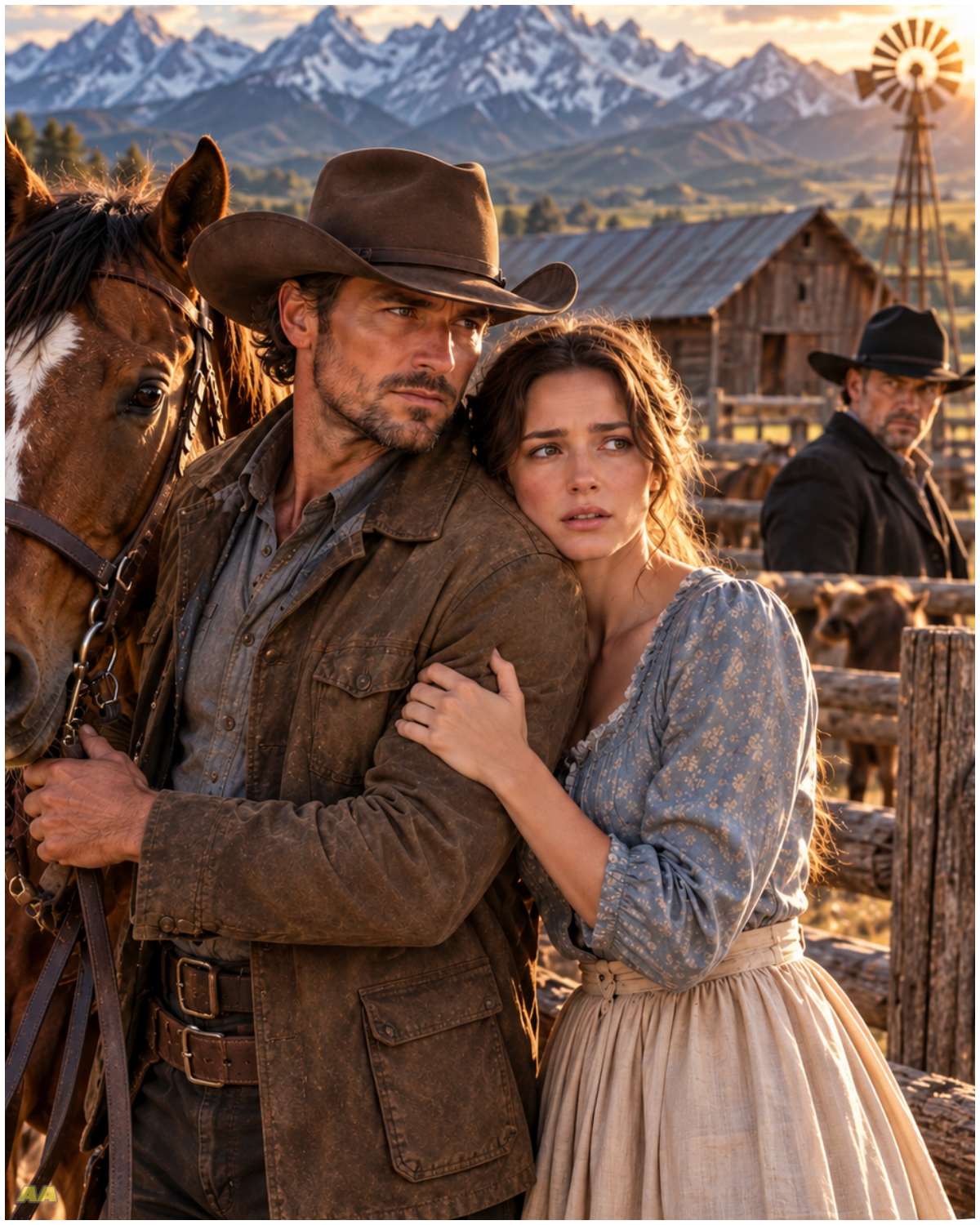
Roland Pike said it loud enough for everyone on the Red Willow platform to hear.
She’s not coming, Maddox. He didn’t say it with any particular cruelty.
That was almost worse. He said it the way a man announces rainflat, certain comfortable.
Roland was standing near the water pump with two of his hands, arms folded like a man patient enough to wait for a fact to prove itself.
Beautiful woman from Missouri reads a stranger’s advertisement, writes some nice letters, and you all think she’s going to board a train and show show up here?”
He shook his head, slow and reasonable.
She came to her senses. They always do.
Three ranchers near the depot wall went quiet.
Every set of eyes on that platform turned toward Everett Maddox.
Everett said nothing. He stood at the edge of the platform with his hat in both hands.
He did not look at Roland once.
Six years ago, a woman had left him at that same station.
He had survived it.
He was not sure he could survive it a second time in front of the same witnesses.
The train wasn’t even in sight yet, but the story had already started.
Everett Maddox had arrived at the Red Willow station 40 minutes before the train was due.
He’d told himself it was because the road south had ruts from last week’s rain and he’d built in travel time.
That was the explanation he rehearsed during the drive.
What had actually happened was that he’d woken at 4:00 in the morning, stared at the ceiling until 5, gotten up, fed the horses, eaten half a plate of eggs standing at the stove, and driven to town at a pace that did not match the pace of a man running an ordinary errand.
He was 40 minutes early, and Roland Pike had apparently also kept track of the train schedule.
Everett had heard him before he’d seen him that particular carrying tone Roland used when he wanted a crowd to register how reasonable he was being.
Roland was near the water pump with two of his hands, talking to a cluster that included two merchants and a man who ran cattle north of Broken Ridge.
None of them had any real business at the station this afternoon.
They were here the same way people gathered near the edge of a frozen pond once someone had already fallen through, not to help exactly, but to witness.
She’s not coming, Maddox.
Ever kept his eyes at the far end of the track.
He was already well acquainted with this particular wound.
Six years back, a woman named Clara Puit had come out from Denver.
She’d stayed 4 days. She’d walked through the barn, eaten at his table, stood on the porch with an expression Everett had mistaken for appreciation, and that he’d later understood was arithmic the kind a person does when they are comparing two different lives and trying to work out which one costs less.
On the morning of the fifth day, she’d handed him a letter asked if he could drive her to the station.
And he had. He hadn’t asked her to reconsider.
He wasn’t sure how to ask for something like that.
And honestly, he’d seen it in her face the first evening when she realized how far the nearest town actually was.
The whole county had known within a week.
Red Willow was not a complicated place.
Roland had never mentioned it directly. He was too smart for that.
He simply became the kind of neighbor who occasionally wondered aloud in the hearing of others whether Everett was going to be able to keep a property of that size running long-term alone.
Whether the isolated location was practical without a functioning household behind it.
Whether a single man, no matter how capable, could get through a hard Wyoming winter without eventually needing help he couldn’t afford.
Business questions, practical concerns. Roland said them with genuine seeming thoughtfulness, and Everett had spent 6 years not answering them.
Three ranchers near the depot wall had gone quiet now, watching to see what Everett’s face would do.
He kept it still. He had written the advertisement the previous November, sitting at his kitchen table at 10:00 at night with one lamp going and the wind against the window frames.
He had drafted it three times. The first two versions had tried to explain too much his situation, his character, things he’d convinced himself a woman would need to know.
He’d burned both of them. The final version had taken 40 minutes to strip down to something honeSt. I am a rancher in Wyoming territory, 36 years old, in good health and sound financial standing.
I require a wife who is willing to work hard, endure difficult conditions, and build a life in an isolated place.
I am not looking for a woman who expects an easy life.
I am looking for one who will not leave when the life becomes difficult.
Nothing about love, nothing about loneliness, which was the actual engine underneath the whole thing, the thing he’d spent 14 years growing proficient at disguising, even from himself.
Josephine Aldridge had written back in December.
One page, direct, no flattery. She gave him her age, her situation, what she knew how to do.
She’d spent three years caring for a dying aunt after years managing the household for her widowed father.
She said she understood difficult work and was not frightened by it.
Then she asked one question that had stopped him cold when his advertisement said will not leave when the life becomes difficult.
Was he asking for obedience or was he asking for a woman with actual endurance?
He’d read that line four times. He wrote back and told her he was asking for endurance.
They had written each other for 6 months after that.
His letters about the ranch, hers about Missouri.
Both of them circling something they’d each wordlessly agreed not to address directly yet.
He had never described her in romantic terms, and she had never described herself that way either.
They were two people trying to arrange the terms of a new situation, and Everett had respected her intelligence more than he was entirely comfortable admitting.
He had not expected her to be beautiful.
That information was not in her letters, and it had simply not occurred to him to wonder about it.
And now the train had materialized on the horizon.
A dark shape pushing itself out of the flat afternoon.
And Everett felt the muscles across his shoulders go tight because whatever happened in the next 10 minutes.
Every person on this platform was going to watch it happen.
The locomotive came in slow. Steam, the long squeal of brakes.
The cars bumped into alignment. The conductor stepped down.
Passengers emerged. A family with two children.
An older man in a city suit who squinted at Red Willow’s main street like a man who’d been misdirected.
Three ranch hands returning from somewhere they probably didn’t want to explain.
A woman in a gray traveling coat who turned out to be meeting her son-in-law and walked straight past without glancing at ever at once.
He watched every face. The platform thinned.
The porter moved the luggage cart. A few people dispersed toward town.
No woman traveling alone. The conductor took his position back at the train’s lowest step.
Across the platform, Roland had stopped talking.
A certain quality of silence had settled around him, the silence of a man watching something he’d already decided the ending of.
Everett reached into his coat pocket. He had one glove on and was pulling on the second when a voice came from behind him, clear and unhurried.
Mr. Maddox. He stopped. He turned. She was standing on the final step of the last car, one hand on the railing and the other gripping the handle of a worn brown suitcase.
Her dark hair had come partly loose from travel.
There was road grime on the sleeve of her coat.
She had the particular look of a woman who had been sitting in a train for 2 days and had not slept well, and none of it touched the directness in her pale green eyes when they found his face across the platform.
She was not what he’d pictured. Everett Maddox was a man who prided himself on being prepared for situations, on thinking things through in advance, and arriving with a plan.
He had no plan for this. She was striking in a way that came at you quietly and then was simply there.
Dark chestnut hair, features composed and unhurried.
The kind of face that made you look a second time, not because it demanded your attention, but because it had already earned it deep before you’d thought to give it.
He became aware that his mouth had not produced any words yet.
I hope, Josie Aldridge said, “You haven’t decided I quit already.
It was the wrong thing to say to him, and simultaneously the only right thing.” He became aware of the entire remaining population of the platform in his peripheral vision.
He became aware of Roland Pike’s silence, which now had a different texture than before, Denser, somehow less certain of itself.
He became aware that the conductor had not yet signaled the engineer, and was watching this the way experienced men watch things they’ve seen variations of before.
I didn’t think you’d come, Everett said.
He had not intended to say it.
It was simply the truest thing available, and it came out before he could replace it with something more composed.
Josie stepped down from the train. She took one step toward him across the platform and stopped.
“Neither did I,” she said for a while.
She was looking at him the way she might look at a fence that needed evaluating present, steady, not unkind about it.
He took the suitcase from her hand, not gallantly, just because it looked heavy, and he was right there.
She let him take it without making any particular event of it.
The train pulled away. Roland Pike had turned toward the street.
Everett noticed that the road south was quiet and the afternoon had started going orange at its edges.
Josie had not said anything since they cleared the station.
She sat beside him on the wagon bench with her hands folded in her lap, looking at the country with the same level attention she’d given everything else so far.
You didn’t write much about the town, she said.
Didn’t occur to me. Is it always that small?
Some days it’s smaller. She considered this without visible distress.
The general store looks decent. Lenora Finch runs it.
She’s sharp. Good for provisions. Do you have an account there?
I do. She nodded once. I’ll want to know your inventory.
What you’re short on going into winter?
What you’ve got covered. I’d like to have that picture before I start making decisions.
Everett looked at her sideways. We’re not married yet.
You should see the ranch firSt. decide afterward.
She looked back at him with the patient expression of a woman who had already heard this particular kind of protective offer before.
I know I should see it firSt. I’m saying that when I do, I’m going to want the inventory.
All right. Is that a problem? No.
They drove without speaking for a while.
The road curved between low ridges. Wind moved through the grass in long, slow waves.
You said neither did you, Everett said.
She looked at him about coming. You said neither did you for a while.
Josie was quiet for a moment. Then the train stopped outside Cheyenne for about 3 hours.
Some mechanical trouble. We just sat there on the tracks with the heat and the dust and people getting louder about it.
A pause. I had a long time to think about turning back about whether I was doing something sensible or something I’d agreed to because I was exhausted of where I already was.
She said it plainly, no drama attached to it.
I thought about my letters and whether what I’d written was still true, whether the practical arguments I’d made to myself still held once I was actually on the train rather than just deciding to board it.
Everett kept his eyes on the road.
And I decided it was probably some of both.
She turned to look at him. Does that concern you?
He thought about it honestly. No. I wrote that advertisement for similar reasons.
Something moved across her face. Not quite amusement, but in that neighborhood.
You put I don’t need love in a published notice.
She said I did. That’s a specific thing to tell a stranger.
It was an honest thing. Most men would have left it out.
Made the whole picture more appealing. I wasn’t looking for someone appealed to by a picture that wasn’t true.
He paused. I thought I was being efficient.
You were being afraid, Josie said. She said it without edge.
Just the observation sat down between them like something she’d already decided to say and had been waiting for the right moment.
Everett didn’t answer. After a mile, she said, “I’m not saying it as a criticism.
I understood it when I read it.
The women who’d be frightened off by that sentence.
You didn’t want them. And the women who’d stay after reading it would at least know exactly what they were accepting.” That was the idea.
It was a good idea. She looked down at her hands.
I just want you to know I read it for what it was, not the version you were pretending it was.
He didn’t know what to do with that, so he said nothing and drove.
The Maddox ranch came into view on a long rise.
House, barn, outbuildings against the ridge in the amber light.
The whole property sitting in the way a working place sits not handsome exactly, but solid, the kind of solid that comes from decisions made one at a time across many years.
He watched her face. He had become in six years very good at watching for a particular expression in the face of women, seeing his ranch for the first time.
A brief controlled flicker of reassessment. Clara had worn it the first evening, looking out toward the grassland.
He had not recognized it then for what it was.
Josie was not wearing it. She was frowning.
But it was a different kind of frown, the concentrated kind that comes from actually looking at something rather than confirming something you already expected.
The porch rail on the left is sagging, she said.
Southside. Yes, the barn latch looks loose from here.
He glanced at her. How can you tell from this distance?
The way it’s catching the afternoon light.
She tilted her head slightly. Am I wrong?
No. Hinge pins bent, she nodded like she was filing this.
What happened to the kitchen garden? I don’t have one.
She turned to look at him with an expression that was not quite disbelief and not quite exasperation.
You should. I know. Before winter. There’s not enough time before first froSt. There is if we start immediately.
Parsnips and turnipss can still go in.
Late carrots if the ground holds. I’ll need seeds from the store.
Everett thought about the fact that this woman had been in Wyoming for less than 4 hours and was already planting the kitchen garden in the failing light of a September afternoon.
Lenora should have them, he said. I’ll go tomorrow morning.
We, he said. I can drive you if you’re going to the store.
She looked at him. Something in her expression settled slightly.
Not a smile. Exactly. But a quiet easing.
All right, she said. Amos Reed was crossing the yard when the wagon came down the last stretch of road, and he stopped in exactly the way a man stops when he sees something he had imagined, but not quite prepared himself to see.
Lean unhurried, 8 years on this ranch.
He watched the wagon approach with careful attention.
That’s Amos, Everett said. The one who’s been with you since near the beginning, 8 years now.
Is he going to stand exactly like that the whole time?
Very possibly. Amos waited until the wagon stopped, then stepped forward and took hold of the horse’s head.
He looked at Josie with the honest expression of a man who had been forming an idea of someone through secondhand information and was now confronted with the actual person.
“Miss Aldridge,” he said. “Mr. Reed.” She held out her suitcase before Everett could reach for it.
Where’s the well? Amos blinked. Around the east side of the house, ma’am.
Thank you. She climbed down without waiting for a hand and walked toward the house with the particular stride of someone who had been sitting still for 2 days and needed to be moving.
Amos watched her go. Then he looked at Everett with an expression that said several things without using any of them as words.
Everett stepped down and began unhitching the horse.
That wasn’t what you expected, Amos said.
It went differently than I expected, Everett said.
Amos worked the traces on his side.
You didn’t mention what she looked like in any of your letters.
I didn’t know. A pause. That must have been a moment on that platform.
Unhitched the horse, Amos. I am unhitching it.
He worked quietly for a few seconds.
She staying? She’s going to see the ranch.
Then decide. She just asked me where the well was and walked toward your house like she’s lived here.
Amos said. That doesn’t mean she’s staying.
I know. Amos said. He said it in the tone of a man who had already arrived somewhere else entirely.
Everett gave her 20 minutes before he went in.
She’d found the lamp. She’d lit it.
She was in the pantry doorway with her arms folded, running her eyes across the shelves with the focused expression of a woman taking stock of what she’d walked into.
He had cleaned the house before coming to town.
He’d swept, wiped the table, stacked things in some order.
He was fully aware that his definition of clean and her definition of clean were two separate countries.
Your flower is going to turn before December, she said.
It’s not stored right. I know you have good salt.
That’s something. She shifted a jar, looked behind it.
You’re short on dried beans. I buy through the winter.
She turned from the pantry. Do you want to depend on that road every time you need beans?
How often does it close in winter?
Four or five times. More in a bad year.
She looked at him steadily. Then you should have 6 months of staples put up before October.
That’s significant provisioning. It’s basic sense. She went back to the shelf.
I’m not criticizing what you’ve done. I’m telling you what I’m going to do if I stay.
I want to know if that’s going to be a problem before I start.
Everett studied her. She moved through his kitchen the way a woman moves through a space she intends to understand.
Not performing comfort, not being politely careful about someone else’s belongings, just actually looking.
The women he’d known socially had moved through his house the way visitors do.
Josie Aldridge was in his pantry taking inventory.
“It’s not a problem,” he said. She pulled the pantry door most of the way closed, turned, looked at the kitchen, the table, the chair, one chair.
Everett watched her see it. She looked at it for a count of three, maybe four, with an expression that was unreadable in the way that a person’s face becomes unreadable when they are deciding not to say something they’ve just understood.
She moved to the stove instead. Checked the firebox.
Opened the grate. This draws well, she said.
It does. Is there woodcut? Amos cut last week.
Piles on the west side of the barn.
Good. She straightened. I need to wash properly and change clothes.
Is there a room ready? Bedroom off the hallway.
It’s clean. Blankets in the cheSt. All right.
She picked up her suitcase from where she’d set it by the door.
Stopped with her hand on the hallway doorframe.
Looked back at him. Everett. He registered the name his own name from her.
The first time she’d used it with a particular awareness he couldn’t quite account for.
The western pasture, she said. The one your neighbor keeps trying to buy.
Is that situation going to be a problem this winter?
Financially. He hadn’t expected that. Not tonight.
Not within the first hour. It’s been a pressure, he said.
I’m asking if it’s going to be a problem.
Not what it’s been. What it is.
He looked at her. She was watching him with that level expression, not unkind, not impatient, just present, and waiting for an answer that matched the actual situation rather than the managed version of it.
He said, “We’ll talk at dinner.” She held his eyes for a moment.
Then she nodded once and went down the hallway and he heard the bedroom door close.
Everett stood in the kitchen. The lamp was burning on the table.
The pantry was closed. The stove had been checked by someone who knew what she was checking for.
He looked at the table. One chair.
He thought about the spare bedroom. The broken chair he’d put in there three winters ago, meaning to fix the leg and hadn’t.
He went and got it. He found the dowel stock in the barn.
He fixed the leg. It took less than an hour.
When she came back down the hallway, she was in clean clothes, her hair put up, and she stopped briefly in the kitchen doorway and looked at the table.
Two chairs. She didn’t say anything about it.
Neither did he. She made supper from what the kitchen offered.
Scrambled eggs, the last of the salt pork, biscuits from the flour she’d already declared was going to turn before December, and those biscuits came out better than anything Everett had produced from that same flower in recent memory, which was not something he intended to say aloud, but thought clearly.
They ate with the lamp between them, and the wind starting to come down from the north the way it did in September, when it was reminding everyone what was coming.
He told her about the western pasture.
He told her about Roland’s three years of offers and why he kept refusing and what losing that grazing ground would mean for his cattle in a bad winter.
He told her about the financial strain in the way he’d never told anyone who wasn’t directly involved in the ranch accounts.
Not out of trust he’d consciously decided to extend, but because she’d asked a direct question, and the plain answer was simply less work than the managed version.
Josie ate and listened without interrupting. When he finished, she said, “Has any other rancher sold land to Roland in the last few years?
Haskkins near the Eastern Ridge sold a creekide strip two years back.
And how’s Haskins doing now?” Everett was still.
“He’s been buying his feed from a supplier about 30 m further out,” he said slowly.
“The one he’d been using for years apparently changed their terMs.” “Did Haskins sell before or after the feed terms changed?” The question sat between them like something that had been waiting to be asked before Everett said.
Josie picked up the last of her biscuit.
Ate it. I wonder, she said if it would be worth finding out whether any of that is connected.
Everett looked at her across the table.
The lamp threw warm light between them.
Outside the wind pressed at the windows.
You’ve been carrying this by yourself for two years, she said.
It wasn’t an accusation. It was just the shape of the fact.
Sat down plainly. I have, he said.
She looked at him. Two chairs at the table.
Two people in a kitchen that had not held two people at once in a very long time.
“You don’t have to,” she said. Everett Maddox sat across from Josephine Aldridge in the lamplight on her first night in Wyoming, and understood something he had not been ready to understand when he wrote that advertism.
Maybe not even when he’d driven to the station that afternoon, still half expecting to turn around alone.
She had not come here to be useful to him the way she’d been useful to her father or to her aunt or to other people’s lives.
She had come here to be useful to something she could also call hers.
Those were entirely different things. Somewhere in 6 months of letters, he had not fully distinguished them.
He didn’t say any of that. He didn’t have the words shaped yet.
He said, “It’s it’s late. You’ve traveled 2 days.” She stood and gathered the plates.
I’ll wash in the morning when the water’s warm.
Leave them. She left them. She was already at the hallway door when he said her name.
She turned. I’m glad you stayed on the train, he said.
She looked at him for a moment in the lamp light.
That same level look, but with something quieter running underneath it now.
Something that hadn’t been there on the platform.
So am I, she said. Then she went down the hallway and the door closed, and Everett sat alone at a kitchen table with two chairs.
He sat there for a while. He had spent 14 years coming back to a dark house.
Tonight there had been a lamp already burning when he walked in.
He wasn’t ready yet to say what that meant.
He blew out the lamp and went to bed.
Outside the Wyoming wind kept its own calendar indifferent, enormous, entirely unconcerned with what two people had just quietly decided to risk inside a small wooden house at the edge of a long September dark.
She was already in the kitchen when he came downstairs.
Everett had no particular reason to be surprised by this.
He’d known from her letters that she was someone who moved early.
But knowing a fact about a person and walking into your own kitchen at 5:30 in the morning to find it occupied are two different experiences.
And he stood in the doorway for a moment, adjusting to the second one.
The stove was burning. The coffee pot was on.
She had the window above the dry sink pushed open 2 in and the cold morning air was coming through it, which was not how he kept it.
But the kitchen smelled different than it usually did, less like stale smoke and more like the outdoors meeting something warm, and he couldn’t honestly say it was worse.
Josie had her back to him. She was at the pantry shelf with a small notebook open on the counter beside her, writing as she went through things.
“You’re doing it now,” he said. “I told you I was going to.” She didn’t turn.
Coffee is ready. Cups are to your left, he found them.
He poured. He sat at the table.
The table with two chairs, which still had a slightly unfamiliar quality about it, like a word you’ve been mispronouncing for years, and have only recently corrected and drank his coffee and watched her work the pantry.
She wrote everything in columns. What there was, how much, what condition it was in.
She had her own pencil. She turned pages.
You have two tins of something in the back that I can’t identify, she said.
Beeswax and a pine tar mixture for the barnwood.
They need to be labeled. I know what they are.
You do? I didn’t. She made a note.
If something happened to you out on that range, someone else would need to be able to work this household.
Labels aren’t for you. Everett drank his coffee and said nothing.
She pulled out a jar of something brown and held it toward the window light.
This has turned. I thought it might have.
Then why was it still on the shelf?
He didn’t have a satisfying answer for that, which was the sort of thing she had apparently anticipated because she set the jar on the counter and continued moving through the pantry without requiring him to explain.
The flour I’m going to repack into the dryer tins, she said.
The ones you’re using for grain storage in the barn.
I need those for grain. Not all of them.
How many do you have? Six. Then I need two.
You keep four for grain, two for the flour, and by next week, I’ll have more proper containers coming from Lenora’s store.
She finally turned around and looked at him.
You’re going to argue with everything, aren’t you?
I’m going to question things that affect how the ranch runs.
That’s reasonable. She tilted her head. But you should know the difference between questioning and defending the way things have always been done just because it’s familiar.
He looked at her over his cup.
That’s a direct thing to say to someone you’ve known for less than a day,” he said.
“I know.” She returned to her notebook.
“I’m saying it anyway.” Everett sat with that for a moment.
Then he said, “The second shelf on the left behind the cornmeal.
There’s a burlap packet of dried sage and rosemary I forgot to mention from last summer.
She found it, checked it, wrote it down.
That’s actually useful,” she said. “I’m occasionally useful,” Everett said.
Something in her face shifted just briefly.
The way light shifts on water. Not quite amusement, but close enough to its family that he registered it.
He got up and poured more coffee.
The first real friction came on the third day, and it was about chickens.
He didn’t keep them. He’d had chickens 6 years ago, and after 2 years of them, and no one else to share the management.
The nuisance had stopped being worth the eggs.
He’d gotten rid of them and bought eggs from a neighbor family instead.
Josie had been walking the fence line, something she did in the mornings while the dew was still on, examining the perimeter with the deliberate attention of a woman who needed to understand the physical shape of a property before she could properly think about it.
She had found the old chicken shed half collapsed on its east wall and come back to the kitchen with a very particular expression.
The lumber in that shed is still good, she said.
I know you could repair it in a day.
I know that, too. She stood in the doorway and looked at him steadily.
Chickens would change your winter food situation considerably.
I had chickens and and I stopped having chickens.
She waited, which was her technique for getting more information than people intended to give.
Their management, he said, every morning, every evening, I’m out on range.
Amos is out on range by the time we come in.
I’m here now, she said. He stopped.
She looked at him with the expression of a woman who had just pointed out something obvious and was waiting to see whether he was going to fight it on principle.
I don’t need you to take on.
He started. I’m not taking something on, she said.
I’m asking you to repair a shed.
I’ll manage the birds. A pause. Unless there’s another reason you don’t want chickens.
There wasn’t. He had run out of practical argument somewhere in the middle of her first sentence and had been stalling since then, which was not a position he was accustomed to occupying.
I’ll repair it this week, he said.
Thank you. She turned toward the pantry.
He watched her go with the specific expression of a man who has just been neatly outmaneuvered by someone who didn’t have to raise their voice to do it.
Amos was in the barn doorway that afternoon when Everett came out for the lumber assessment.
He had the look he often had the expression of a man with more to say than he was currently saying.
She’s been up and down that fence line twice this morning.
Amos said she’s learning the property. She found the old corner marker post we lost track of last spring.
Everett looked at him. The one we couldn’t relocate in the tall grass.
Apparently, she walked right to it. How?
I asked her that. She said the grass was bent wrong around it.
Amos moved a piece of harness from one peg to another.
That’s not something you learn in Missouri caring for a sick ant.
No, Everett said. It isn’t. He thought about that while he looked over the shed lumber.
About what kind of life produces a person who notices the way grass bends about six months of letters and how much they’d told him and how much they hadn’t.
She found the greens on the fifth day.
Along the north side of the fence, where the postgrass thinned, there was a low-rowing cluster of plants she’d been eyeing since her second morning.
She came in from her morning walk, carrying a gathered bunch of them in her apron, like a woman who’d gone out to confirm something she already suspected.
These are lamb’s quarters, she said, putting them in the dry sink.
Weeds, she looked at him. They’re edible.
They taste like spinach when you cook them down.
There’s a good 3-w week harvest left before the frost takes them.
She turned the cold water on them.
I’m going to put up as much as I can in the time we have.
Everett watched her. You learned that from your father.
I learned it from necessity, same as anything useful.
My father couldn’t afford to waste what the ground offered.
She shook the water from the greens.
What do you throw away on this ranch that you shouldn’t?
He thought about it. Probably some of what the barn cats hunt.
She tilted her head. Cats hunt rabbits and mice.
Are you suggesting the rabbits? He said some of the hands eat them.
I stopped bothering. Because you were cooking alone.
Because cooking for one isn’t worth he stopped himself.
He’d said it before he’d thought it through.
Josie didn’t look away from the sink.
Go on. It isn’t worth the trouble, he said for one person.
The kitchen was quiet for a moment.
Just the water running and the sound of the wind outside.
Well, she said, there are two of us now.
She said it with no particular weight on it.
No performance, no pointed pause. Just the fact.
Set down like a dish on the table.
Everett moved toward the door. I’ll tell Amos to bring some in if they’re running.
Thank you, she said, and went back to her greens.
He was three steps out the door before he realized he was standing in the yard, not going anywhere in particular, just standing with the morning air on his face and the specific disorienting sensation of a man whose house has started behaving differently than it has for 14 years.
He went to find Amos and tell him about the rabbits.
By the end of the first week, they had something that resembled a rhythm.
Not a comfortable one, it had too many unexplored edges for that, but a functional one.
Josie was up before him and the coffee was always ready and they ate breakfast with the lamp still going and spoke about the day’s practical work.
In the evenings she cooked and he ate and sometimes he helped with the washing up without it being discussed and they talked about the ranch.
She was relentless about the ranch. She wanted to understand how everything worked and why and she asked the questions directly and expected direct answers.
And whenever he gave her the managed version of something instead of the actual version, she had a way of going quiet that communicated without any drama that she was waiting.
He found himself giving her the actual version more often than not.
It was not comfortable. It was something more useful than comfortable.
She mended the curtains on the second day, not with new fabric.
She’d used the worn side panels from a pair she’d found in a chest in the spare bedroom.
Had cut them apart and worked what was still good into what was still useful.
He’d come in late afternoon and found the windows changed, and it had taken him longer than he liked to identify what was different.
She’d noticed him looking. “You had curtains,” she said.
“I noticed.” “You didn’t know?” “I knew there were curtains.” He looked at the windows.
I stopped seeing them. She looked at him for a moment, the particular look she had when she was deciding whether a thing was sad or simply true.
People do that, she said with things they’ve given up on without admitting it.
He’d thought about that for 2 days.
On the eighth morning, she went into Red Willow.
She needed seeds, the dry goods list she’d been assembling, and thread for the mending box.
He’d offered to take her, and she’d said she was capable of driving the wagon, and he’d said he hadn’t doubted that, and she’d taken the wagon and gone.
He had not expected the quiet to feel as different as as it did.
The house was quiet before she came.
It had been quiet for years. He’d been comfortable with that quiet, had made a kind of peace with it that he’d told himself was reasonable for a man in his situation.
One morning, 2 weeks in, the quiet felt like a wrong note.
He went and fixed the porch rail instead of thinking about it.
Lenorfinch had watched the door since 8:00 in the morning.
She’d seen the Maddox wagon coming from a/4 mile off familiar horse, but the figure holding the res was not Everett.
She was behind her counter reorganizing thread when the door came open and she looked up and looked at the woman who walked in and spent about 3 seconds forming an opinion.
The opinion was competent, not in the decorative sense that the word sometimes got applied to women who managed households neatly in the actual sense.
The way she looked around the store had the quality of a person already making decisions, and Lenora liked that.
You’re Miss Aldridge, Lenora said. Mrs. Maddox, possibly.
We haven’t gotten to the formal part yet.
Josie set her list on the counter.
Lenorphic. That’s right. Lenora took the liSt. Read it.
Looked up. This is a serious provisions order.
It needs to be. Josie looked at the dry good shelves.
Do you have parsnip seed left? Last packet.
I was about to tell people they’d missed it.
I’ll take it. And the late carrot variety if you have it.
Lenora found both and added them to the counter.
She’d heard about Everett’s mail order arrangement.
Everyone in Red Willow had heard about it.
Most had an opinion about it, and a fair number had expected the outcome.
Roland Pike had been quietly predicting since winter.
She appraised the woman across her counter and found herself discarding most of what she’d heard in favor of what she was currently observing.
“You’re not what people were expecting,” Lenora said.
Josie looked up from the dry goods.
“What were they expecting?” “Depends on who you ask.
Roland Pike was expecting you’d take one look at that ranch and be on the next train eaSt. Something changed in Jos’s face.
A small tightening barely visible. Roland Pike, she said.
The neighbor neighbor, that’s one word for it.
Lenora began tallying the liSt. He has the next spread eaSt. Solid operation.
He and Everett have a long-standing disagreement about a strip of Everett’s western pasture that Roland’s been trying to acquire for 3 years.
I know about the pasture. Lenora looked up.
Everett told you. First night, a pause.
He told me Roland’s offered repeatedly and he’s refused repeatedly.
He told me why the land matters in winter.
Lenora set down her pencil. He told you that the first night we ate dinner?
I asked. Josie looked at her evenly.
He was going to give me a managed version of it, and I waited him out.
Lenora Finch had been running this store for 11 years.
She had served four territorial governors, six different sheriffs, and more ranchers than she could count.
She could read a person through a conversation the way some people read a landscape by what was visible and what wasn’t.
What she saw in Josie Aldridge was not a woman settling.
Was not a woman making the best of a difficult situation.
Was a woman who had made a choice with her eyes open and was now doing exactly what she’d planned to do.
“Sit down,” Lenora said. Josie sat. There’s something you should know about Roland Pike.
Lenora said that Everett probably hasn’t told you because Everett doesn’t talk about things that make him look vulnerable.
She was back before midday. Everett heard the wagon coming down the road and came out of the barn without fully deciding to.
He took the horse’s head out of something that had been a habit since childhood and had nothing to do with whether the driver required assistance.
Josie climbed down. She had a crate of dry goods, two paper packets of seed, and the expression of a woman who had returned from an errand with considerably more than she’d gone to purchase.
He took the crate. She stood in the yard and looked at him.
“I met Lenora Finch,” she said. “I expected you would.” We talked.
He looked at her. The expression she was wearing now was different from the pantry inventory look or the fence line look.
This one was measured in a way that meant she was deciding how to say something, not whether to say it.
What did Lenora tell you? He asked.
Josie folded her arms against the September chill.
She told me that Roland Pike has been telling people in town since spring that you’re financially overextended, that you won’t make it through a hard winter without selling part of the operation, that your situation is going to force your hand before the snow melts.
The yard was very quiet. She told me, Josie continued, “He’s been saying this to merchants, to the men who supply your feed and your fencing wire, to the people whose trust affects your credit terMs.” She paused.
She said, “Two families she knows of have quietly changed how they’re extending accounts to you.
Not because of anything you’ve done, because of what Roland’s been telling them.” Everett put the crate down.
He stood there with his hands at his sides and looked at a spot just past her left shoulder, which was what he did when he was processing something he didn’t yet have language for.
She’d learned that in the first week without being told.
He’s telling them you won’t make it, she said.
So that when you do come to him to sell, when the pressure makes it feel like the only option, they’ll all believe it was inevitable.
They’ll believe they saw it coming. Everett said nothing.
Were you going to tell me this?
She asked. I didn’t know the scope of it.
He looked at her. I knew he wanted the land.
I knew he’d made it difficult. I didn’t know he was working the town the way Lenora’s describing.
Lenora says it’s been steady for months.
Then I’ve been behind on it. He said it flatly the way he said things that cost him.
Jose Tim for a moment. Then she picked up the crate herself.
He’d set it down. And she picked it up and walked toward the house.
Come inside, she said. They sat at the kitchen table.
Same two chairs. Same lamp between them, but the quality of the conversation was different from the first night.
Then she hadn’t known enough to push hard.
Now she did. “Tell me exactly what the pasture situation is,” she said.
“Not the managed version, the actual one,” he told her.
He laid it out fully the geography of it, the protected valley, the western strip, accessed in January and February, when the main grazing ground froze hard.
The way a bad winter without that access could cost him a significant portion of his cattle, the economics of it, what he’d invested in the land over 14 years, what he stood to lose, and what that loss would mean for the rest of the operation.
She listened without touching her coffee. When he finished, she said, “And Roland has made three offers, three formal ones, a handful of informal ones, and he keeps offering despite knowing you understand the land’s value.” He does.
She was quiet for a moment. Why does he believe you’ll eventually say yes?
The question was direct and cut to something he hadn’t quite articulated even to himself.
Because everybody has a price, Everett said.
She looked at him with that measuring look, unhurried, present, going somewhere.
Or, she said, because he thinks you’re alone.
The words landed with a particular weight.
Everett looked at her. A man alone can be worn down.
Josie said, “You can tighten his credit, slow his suppliers, spread a story about him in town until the people he depends on start to wonder.
You can make the ordinary difficulties of a hard ranch season feel like confirmation of a narrative he didn’t write.” She turned her cup in her hands.
If he’s alone when the pressure lands, all of it accumulates in one place.
There’s no one to help him carry it.
No one to say, “Wait, look at this from another angle.
No one to help him see what he’s actually looking at.” Everett was very still.
He thought you’d be alone this winter, she said.
He made his calculations based on that.
I was going to be alone this winter.
She met his eyes. But you aren’t.
The kitchen was quiet. Outside the window, the wind was coming down off the ridge in that afternoon way.
It had, steady and cold, carrying the smell of the high country.
Somewhere in the barn, Amos was doing something that involved a hammer at irregular intervals.
Everett looked at Josephine Aldridge sitting at his kitchen table with her hands around a coffee cup she hadn’t drunk from and understood that whatever else was happening, whatever commercial pressure Roland had been carefully building for months, whatever Lenora Finch had said in that store, whatever the winter was going to bring this woman was sitting across from him because she had made a choice.
And the choice had come with her full intelligence.
And Roland’s entire strategy had failed to account for what that meant.
The feed supplier, he said slowly. Last month, he wanted partial payment before he’d ship.
I paid it. I thought it was a policy change.
Was it or just for you? He hadn’t checked.
He’d paid because it was manageable and he hadn’t wanted to make the relationship difficult.
I’ll find out, he said. And the fencing wire that was late, 2 weeks behind the order.
They said they were backed up. Were they backed up on everyone’s order?
She looked at him. When’s the last time they were late on yours?
He thought back. Couldn’t place another time.
Josie stood up and went to the dry sink.
She started washing her morning cup. Over her shoulder, she said, “We should start writing things down.
Dates, costs, changes to terMs. What changed?
When, from whom? Not for now. For the pattern.
You think there’s a pattern.” She turned around.
I think Roland has been very careful not to do anything that looks like an attack.
Each thing by itself looks like ordinary difficulty.
A supplier’s terMs. a late delivery, a story someone heard and repeated.
She dried the cup, but if you write it all down, the timing and the source, I think something is going to line up.
Everett sat back. He had been carrying this ranch alone for 14 years.
He had handled every drought, every difficult cattle season, every negotiation and dispute and lean winter by himself, without asking anyone to hold any part of the weight.
Because asking felt like showing someone exactly where you could be broken.
He hadn’t put it in those terms before, but that was the shape of it.
Josie hung the dish towel over the rack and looked at him with the expression she had when she was choosing words carefully.
“You’re not used to this,” she said.
“To what?” “Someone in the room,” she paused.
“Not just in the house.” “In the actual room where the problem is.” He didn’t answer.
“It’s going to take some getting used to,” she said.
“For both of us.” She moved toward the hallway.
“I’m going to plant the seeds this afternoon before the light goes.
The ground by the east fence is still warm enough.
She was at the doorway when he said Josie.
She stopped. I should have told you about the town situation before you heard it from Lenora.
She turned partway around. Didn’t dispute it and didn’t let him off of it.
Yes, she said. You should have. I didn’t know the full shape of it.
The shape you knew was still worth sharing.
She held his eyes for a moment.
I’m not asking you to be without defenses.
I’m asking you to know the difference between protecting yourself and keeping me outside a problem I’m standing in the middle of.
Then she went down the hall and he heard the back door and a minute later through the east window he could see her crossing the yard toward the fence line with a packet of parsnip seed and a short-handled spade she’d found in the outuilding.
He sat at the table with the two chairs.
14 years of managing everything alone had produced a certain efficiency in him.
He knew where things were. He knew what needed doing and when.
He had systems and the systems worked and he’d been proud of that in a quiet unannounced way proud of the man who had taken a piece of marginal Wyoming ground and made it produce.
What he had not considered, what Josie Aldridge had just made plainly visible was that the same management discipline that made the ranch functional had also made him impossible to help.
He had kept every problem close because he was afraid of anyone knowing exactly how much was on him.
And Roland Pike had seen that, had counted on it.
Everett got up from the table. He went to the desk in the small room off the parlor where he kept his accounts and his correspondence.
He pulled out a blank ledger page.
He wrote the date at the top.
Then he began writing down every disruption in his commercial relationships that he could remember going back to the previous fall.
The feed suppliers changed terms, the fencing wire delay.
A cattle buyer whose settlement had come late in a way that had felt like an oversight at the time.
He wrote for an hour. By the time he finished, the pattern Josie had predicted was sitting there on the paper with the patient obviousness of a thing that had always been true, but required someone to look directly at it to become visible.
She was right. He went to find her at the fence line.
She was on her knees in the east border of the yard, working the ground with the spade in the low afternoon light.
Ren had wandered close from the pasture gate and was standing a few feet away with the gentle uncritical attention horses sometimes give to people doing something near the ground.
Everett crouched down beside Josie and looked at the work.
The pattern is there, he said. She pressed a seed into the soil without stopping.
I know. I wrote it out. 12 months back it lines up.
She sat back on her heels and looked at the turned earth for a moment, then at him.
The late sun was behind her, and it was warm on her face, and she looked less like the composed woman from the platform, and more like herself, a little tired from planting, a little dirty from the ground, entirely present.
“We’ll need to keep documenting it,” she said.
“Starting from today,” she nodded. “Lenora might know things, too.
She hears more than people realize. She always has.” Josie pulled her gloves off and looked at her hands.
There was a small blister forming on her right palm from the spade.
She examined it without commentary. Your neighbor, Everett said, back in Missouri.
Did they ever try anything like this with your father?
She considered the question. Different scale, but yes.
There was a man who wanted the Creekide half of our property for 10 years.
He was patient. He would offer every two years, and each time he’d say something in town that left a small impression, that my father was getting too old to manage, that the place was starting to go to seed, that a younger man in good health would make better use of it.
She tucked her gloves into her apron.
He was trying to make people think of my father as a man already in decline, so that when my father finally did have difficulty, because everyone does the story would already be in place.
What happened? My father held the property until he died.
A pause. But I watched that man work for 10 years, and I know exactly how it’s done.
Everett looked at her. She looked back.
Ren shifted her weight beside them. The afternoon was going gold and cold.
You came to Wyoming from that, he said.
I came to Wyoming because one day I realized I had been useful to every person around me for 8 years and could not name a single thing in my life that was mine.
She said it without bitterness and without performance.
Your advertisement asked for someone with endurance.
What it didn’t say, but what I heard was that it came with something to endure for, not just someone else’s life.
A share in a thing being built.
Everett was quiet. Is that what you’re offering?
She asked. He thought about it honestly, which was the only kind of thinking that seemed to work with her.
I wasn’t sure what I was offering when I wrote it, he said.
I was sure what I needed. And now he looked at the turned earth, the small seeds she’d pressed in, the fence line stretching away toward the ridge in the failing light.
“Now I think they might be the same thing,” he said.
Josie stood up, brushed the soil from her knees, picked up the spade.
“Don’t get ahead of yourself, Everett,” she said, but the corners of her mouth had moved in that way they sometimes moved.
He stood too. “I’ll start that chicken shed repair this week.
I’ll hold you to it.” They walked back toward the house in the early evening, not touching and not particularly far apart, with Ren following at a loose and unhurried distance behind them.
The kitchen lamp was burning when they came in.
She had left it on before going out.
He noticed that he had started noticing these things, the small evidence that the house was inhabited now in a way it hadn’t been, the unconscious gestures of a person who was beginning, however carefully, to act as though she lived here.
She hung the spade and went to the stove to start the evening.
He sat at the table and opened the ledger page and read through it again, and the pattern was still there, steady, intentional.
Everything just subtle enough to look like bad luck, until he saw it all at once, and he thought about what Josie had said on the platform when she’d stepped off that train.
I hope you haven’t decided I quit already.
He had been so sure she wasn’t coming.
He was beginning to understand that shurnness about certain things had been costing him more than he’d accounted for.
The fencing wire arrived on a Tuesday, 14 days past the order date, and the driver who brought it offered no explanation beyond a shrug and a slip of paper with a new payment notation on it.
Everett read the notation twice, looked at the driver.
This says partial advance on the next order.
New policy, the driver said, already turning the wagon around.
Hartwell’s never had an advance policy. They do now.
The wagon was moving on some accounts.
Everett stood in the ranchard holding the delivery slip with the particular stillness of a man who has just been handed a fact that doesn’t belong in the category of forex packs he’s used to receiving.
He’d been ordering from Hartwells since his third year on the property.
He’d never missed a payment and never been late.
He brought it inside. Josie was at the table with the ledger page they’d started.
She’d been adding to it in the evenings, small notations in her tight, clear handwriting, dates and names and amounts, the pattern growing more visible with every entry.
She looked up and read his face before he said anything.
He put the slip on the table.
She read it. Then she sat back.
Advance payment on some accounts. Did he say which accounts?
He was already leaving when I thought to ask.
She pulled the ledger closer. Turned back three pages.
Found something. The feed supplier changed your payment terms 6 weeks ago.
You said partial advance 20%. And now the fencing wire, she wrote it in.
Set the pencil down. Everett, how many of your suppliers have changed terms in the last 3 months?
He thought about it seriously. Really went through it.
Three, maybe four. And in the 3 years before that, he looked at her.
None, he said. She nodded slowly. The expression on her face was not surprise.
It was the expression of a person who has been building toward a conclusion for some time and has just been handed the last piece.
I want to talk to the Lynen family, she said.
The ranch north of Broken Ridge. Lenora mentioned them.
She said they sold land to Roland 2 years back and things changed after.
Martha Lindon, her husband passed last spring.
Would she talk to me? He thought about Martha Lyndon, a direct woman, practical, had run that ranch essentially alone for the last year of her husband’s life.
She’d talk to you, he said. Then I want to go this week.
She went on Thursday, and Amos drove her.
Everett had offered to come, but she’d looked at him the way she sometimes did when he was about to do something that would close a door rather than open one.
Martha Lyndon is going to talk more freely to another woman, she said, especially about what happened to her family’s operation.
He couldn’t argue with that, so he didn’t.
She was back by midafternoon. She came in, poured herself coffee, sats at the table, and organized her thoughts for about 30 seconds before she said anything.
He’d learned to recognize that interval, the short pause when she was deciding what to lead with.
Harry Lyndon sold a creek strip to Roland 18 months ago, she said.
Before he did, he’d been having trouble with two suppliers.
Credit terms tightened. One of them stopped extending at all and asked for cash on delivery.
She looked at Everett after he sold the strip to Roland.
Both suppliers went back to normal terms within 6 weeks.
Everett was quiet. Martha didn’t connect them until I asked her directly.
Josie said she thought of them as separate probleMs. The land sale was about Harry’s health.
He was already sick. They needed the money.
And Roland’s offer was reasonable. The supplier problems she’d thought of as bad luck.
She paused. But the timing is exact.
You’re saying Roland created the pressure and then waited.
I’m saying Roland created the conditions and then arrived with a solution.
The distinction was precise and Everett felt it.
Martha doesn’t want any part of it, Josie continued.
She’s not angry or she is, but she’s exhausted and she has enough trouble holding her own operation together.
But she told me there’s a family called the Porter East of the Ridge who had a similar situation 3 years back, sold a pasture access right to Roland.
Before they sold, their cattle buyer delayed a payment by almost two months.
Everett stood up from the table. He went to the window and looked out at the yard where the chicken shed repair was half finished.
He’d started it Monday. Would finish it this week.
The afternoon light was going flat and gray the way October afternoons did when they were considering something.
He’s been doing this for years, Everett said systematically.
Jos’s voice was even. And he’s patient.
He doesn’t do it all at once.
He tightens. One thing waits, tightens another, waits, and at some point the ranch owner looks at the total weight of it and the offer on the table and does the arithmetic.
She paused. Most people sell. I haven’t.
No. And that’s why he’s still at it after 3 years.
She looked at him steadily. You’re more stubborn than is usual.
Is that a compliment? It’s an observation.
A pause. It’s possibly also a compliment.
Everett turned from the window. There’s something else.
She waited. The cattle buyer who delayed my settlement.
Morrison, I’ve done business with him for 7 years.
He’s never run more than two weeks late.
He moved to the desk in the corner and pulled out the account books, the real ones, the full ones he’d never shown anyone but his bank.
He opened to October of the previous year.
He was late 53 days on my September payment.
I absorbed it. I thought it was a cash flow problem on his end.
Was it? I don’t know. I didn’t ask.
I didn’t want the relationship to become difficult.
Josie looked at the account book. Then she looked at Everett.
That’s how he does it, she said quietly.
He picks people in situations where you’re more likely to absorb the difficulty than confront it because confronting it might damage a relationship you need.
She closed the account book gently. He knows you, Everett.
He knows how you operate. That landed somewhere uncomfortable.
He’d lived next to Roland Pike for 12 years.
They’d never been friendly too different for that.
And too aware of what each other wanted, but they’d maintained the civil distance that neighboring ranches required.
They’d helped each other pull cattle from mud twice.
They’d lent equipment. They’d spoken at enough meetings and sales that Everett knew Roland’s habits and speech and the particular patience of him.
He’d thought that meant he understood Roland.
He was beginning to understand it had meant Roland understood him.
“We need to document all of this,” Josie said.
We’ve been documenting more the Lynden situation.
Supporters if I can talk to them.
Any connection between Roland and the suppliers who changed your terMs. She looked at the ledger page.
If there’s a person coordinating this, someone Roland is working with who has the reach to affect multiple suppliers at once.
We need to find the thread. Someone with money and commercial connections.
Everett said. Roland has the motive but not the reach.
Who does Roland owe money to? Everett thought.
He expanded the operation 3 years back, bought adjacent land.
He wouldn’t have done that on his own capital.
Then someone financed him. She looked at him and that person has an interest in Roland succeeding, which means they have an interest in you failing.
They looked at each other across the table.
The chicken shed was finished on Saturday.
Amos had helped with the last of the framing, and Josie had whitewashed the interior with lime she’d gotten from Lenora’s store.
She bought 12 hens and a rooster from a family 3 mi north who’d been reducing their flock for winter.
She drove out to get them herself, came back with the birds in slatted crates, and spent the afternoon installing them in the shed with a calm efficiency that Everett watched from the barn doorway, and found himself unable to stop watching.
The hens were immediately loudly opinionated about their new environment.
Ren had come to the fence to investigate and stood with her ears forward and her expression one of philosophical intereSt. Josie came out of the shed, latched the door, dusted her hands on her apron, and looked at the horse.
“Stop judging,” she said to Ren. The mayor flicked one ear.
Josie turned and saw Everett in the barn doorway.
“They’re settling,” she said. “They’re loud. They’ll quiet down by evening.” She walked toward him.
Ren likes them. Ren is politely curious.
That’s different from liking. That’s how Ren shows she likes things.
She stopped a few feet away, tilted her head slightly.
You fixed the hinge pin. He looked at the barn door last week.
I know. I noticed. She looked at him.
You’ve been fixing things. Things needed fixing.
Lots of things needed fixing for a long time before I got here.
Her voice was neutral, not accusing. I was getting to them.
She smiled. Actually smiled properly, which she did rarely enough that it still registered with a particular clarity when it happened.
All right, Everett. She went past him into the barn, and he stood there for a moment, with the afternoon light on his face, feeling something he didn’t have good language for, which was becoming a more frequent experience than it had been in the previous 14 years.
October came in on a cold, clear, and with it the ordinary acceleration of ranch life before winter.
They cut and stacked more wood. Jos’s kitchen garden had taken the parsnips were visible, and the late carrots were coming.
She’d put up the last of the lamb’s quarters, and started a second round of preserved vegetables from what she’d been collecting steadily since September.
The pantry that had looked thin when she arrived, had begun to take on a different character, organized, labeled, accounted for.
Everett noticed things without remarking on them.
The curtains that no longer sagged. The order in the kitchen tools, where there had been a system, only he understood, or had thought he understood, until she pointed out twice that his system had several internal contradictions.
The way the house smelled in the evenings when she was cooking, which was different from how it had smelled for 14 years, in a way that was not a small thing, and that he was not ready to name.
The work was good. That was what he told Amos when Amos, in his indirect way, asked about it.
Work’s going well, Everett said. Amos had a horse’s front left hoof cradled between his knees and was examining the frog.
He did not look up, just the work.
The work is what I said. I know what you said.
Amos set the hoof down carefully. She’s been going through your accounts.
I asked her to when I didn’t ask her directly.
I left them accessible. Everett moved a saddle blanket from one hook to another.
Same thing. Amos looked at him then with the expression of a man who had known Everett Maddox for 8 years and had no intention of letting that particular piece of reasoning pass unchallenged.
But he was also the kind of man who picked his moments.
And apparently this was not one of them because he went back to the horse’s hoof and said, “She’s smart.
She is smarter about people than you.
Most people are smarter about people than I am.” That’s fair.
Amos said. The letter from the Eastern supplier came on a Wednesday.
It was addressed to Everett, brief and business-like, due to a restructuring of credit terMs. His account would require full payment on delivery, beginning with the November order.
No partial advance arrangement. Full payment or no delivery.
That was the feed supplier, his primary feed supplier, the one he’d used for 6 years.
Full payment on delivery in November, when cash was typically the tightest it ever got on a ranch before spring cattle sales.
He read it at the desk. Then he went to the kitchen.
Josie was mending one of his barn jackets.
She looked at the letter when he put it on the table.
Read it twice. That’s the one that changed to partial advance 6 weeks ago, she said.
Now it’s full payment. They’re escalating. She sat down the jacket.
Whoever is behind this is getting impatient.
I’ve been more stubborn than expected, he said, and something darkged into his will that wasn’t usually there.
She looked at him. Are you all right?
I’m managing. That’s not what I asked.
He looked back at her. She was wearing the expression she had when she was done being patient with his managed versions.
Steady, direct, not unkind, but not accommodating either.
It’s a significant cash demand at the wrong time of year, he said.
If the cattle buyer delays settlement again the way he did last fall, even by 3 weeks, I’m going to be short.
How short enough to matter. She folded her hands on the table.
Can you borrow against the property shortterm from the bank in Cheyenne?
I could. He sat down. But that’s exactly what Roland wants.
The moment I go to the bank with a short-term problem, the story he’s been telling town about my finances becomes something a banker has looked at.
She understood that immediately. It confirms the narrative.
It also gives Roland something he can reference.
Even Maddox had to go to the bank.
That’s a sentence he’ll use for the next 3 years.
Josie was quiet for a moment. Then what about the cattle payment you’re still owed from last fall?
Morrison’s delayed settlement. He paid eventually, but he was 53 days late.
Do you have a written agreement on settlement timing?
He frowned. A standard buyer’s agreement. Why?
Because if there’s a clause about late payment interest, fees, anything you may be owed more than the original amount.
She looked at him. Not a lot, but money you’re already owed that you haven’t collected.
He hadn’t thought about it from that angle.
I’ll look at the agreement, he said.
We’ll look at it,” she said, and pulled the barn jacket back toward her and went back to the mending.
They found the thread 3 weeks later.
Or Josie did, which was not a distinction she made, but that Everett noticed.
She had been talking with Lenora steadily through October, not just shopping, but sitting at the back of the store in the afternoon when the foot traffic thinned, and the two women talked in the direct, abbreviated way of people who have established that they don’t need to perform sociability with each other.
Lenora knew things. Lenora had been watching Red Willow’s commercial relationships for 11 years and had a particular memory for who owed what to whom and who had started doing business with whom and when.
In the third week of October, Lenora mentioned a name.
She mentioned it in the context of something else, something about a Cheyenne investor who’d been buying positions in several Wyoming ranch supply operations over the past 2 years.
She mentioned it because she’d seen a letter on the counter of Hartwell’s supply yard the previous summer delivered to the manager there from a Cheyenne address and the name on the return was Conrad Vain.
Josie came back and said the name to Everett the same way she’d said everything significant that without drama just the information exactly as dense as required.
He knew it. Conrad Vain was at the Cheyenne cattle auction 2 years ago.
He said he was introduced around as a livestock investor.
He and Roland spoke for a long time.
Did Roland mention him to you? Roland doesn’t tell me anything he doesn’t have to.
But you saw them together. I noted it.
He looked at her and then forgot about it.
She had the ledger page in front of her.
She was writing the name in. A Cheyenne financier with positions in Wyoming supply businesses who was seen having a long conversation with Roland Pike 2 years ago.
Right around the time the supplier problem started for the Lynen Ranch.
She wrote it down. And who has a connection to at least one of the suppliers who changed your terMs. That’s three data points.
That’s three data points we can document.
She looked up. There are probably more.
If he holds positions in the businesses he’s using as pressure, even quiet ones, not public, that’s not legitimate commercial behavior anymore.
Everett sat with that. It’s still not illegal.
A man can invest where he chooses.
A man can. But if he’s coordinating those investments to create artificial financial pressure on specific land owners in order to to manufacture a forced sale and if that can be demonstrated through a pattern rather than a single act than the people being used to apply the pressure have a reason to be very unhappy.
She looked at him merchants don’t want to be instruments especially when they find out they were being misled about the targets actual financial condition.
You want to take this to the suppliers eventually when we have enough to show a pattern they can’t dismiss.
She closed the ledger. We need one more thing.
Something that connects Vain to Roland’s offers on your land specifically.
Not just general investment, direct coordination. They didn’t have that yet, but they were close enough that Everett could feel the weight of it shifting the balance of information tends tilting slowly toward them and away from the people who’d been working against him.
He wasn’t sure yet what to do with that shift.
He wasn’t sure what the right thing to do was when you got there.
He thought about that at night. The first serious fight happened on a Tuesday.
It was small in origin. He said something about the spring cattle order, a decision about numbers, how many head to add, what the grazing would support, and he said it in the particular way.
He said things sometimes that assumed a conclusion without discussion.
That assumed underneath the words that he was the one who would be making the decision.
Josie was quiet for a moment. Then she said, “You’re talking about spring as though I won’t be here.” He looked at her.
He hadn’t meant to do it. He genuinely hadn’t noticed it in the moment, but she’d caught the shape of it and named it, and now it was sitting in the kitchen between them and couldn’t be put back.
“I was discussing the cattle,” he said.
You were discussing the cattle without including me in the decision as though you were going to be making it alone.
She looked at him steadily. We’ve been doing this work together for 6 weeks.
You know I understand the past your capacity.
You know I’ve been through the account books and you’re still making the calculation by yourself and telling me the outcome.
I wasn’t telling you the outcome. I was thinking aloud.
You were thinking aloud the way a man thinks aloud when he’s alone.
Her voice was careful but direct. You’ve been doing it more the last 2 weeks.
Pulling back into your own head on the decisions that matter.
He didn’t answer. Why? She asked. He looked at the table.
I’ve been making these decisions for 14 years.
I know. Changing the way I think through them isn’t.
He stopped. That wasn’t actually why, and he knew it, and she likely knew it.
Everett, she said quietly. Why do you keep speaking as though spring is something you’ll be navigating alone?
The kitchen was very still. He stood up, went to the window, stood there with his hands in his pockets and the glass cold against the night outside and the lamp’s reflection looking back at him.
He hadn’t told her about Clara, not fully.
He’d mentioned the engagement in passing early on in the context of the town’s awareness of his history.
He’d given her the outline. He hadn’t given her the shape of what it had left.
He turned around. There was a woman, he said, six years ago.
I was engaged. Josie sat very still.
She came out from Denver to see the property.
Clara Puit. She was educated, practical, sensible.
We had corresponded the same way you and I did.
I thought I knew what she was walking into.
He moved back to the table but didn’t sit.
She stayed 4 days. She was polite the entire time.
On the morning of the fifth day, she handed me a letter.
What did it say? That she respected me?
That she thought I was a good man?
That she couldn’t imagine living this far from everything she knew.
He said it without bitterness, which was the most honest version of it.
She asked if I could drive her to the station.
And you did. I did. He looked at her.
I didn’t ask her to reconsider. I didn’t argue.
I just drove her there and put her trunk on the train and drove back.
Josie was watching him. With the careful attention she gave things that required it.
I don’t blame her. He said she saw what the life actually was.
She chose another one. I understood that.
I didn’t like it, but I understood it.
He paused. What I did afterward, what I decided afterward was to stop expecting anything else.
You decided she was a lesson. I decided she was accurate.
That her assessment of this place, of what it costs, and what it lacks was correct, and that any woman who saw it clearly enough, would make the same decision.
Josie said, “So, you wrote an advertisement that asked for someone who would stay because I thought if the expectation was low enough, honest enough, the ending would be different.
She was quiet for a moment. Her hands were flat on the table.
And you’ve been waiting for me to leave since I arrived.” He didn’t say yes.
He also didn’t say no. “Every time you talk about spring by yourself,” she said, “Every time you make a decision without bringing me into it, you’re not being independent.
You’re practicing for when I’m gone. She said it without anger, which was harder to hear than anger would have been.
You’re preparing the habits of solitude so it doesn’t hit you as hard when you go back to them.
He sat down. And you’ve been punishing every woman who might choose you ever since, she said.
Not as an accusation, as a fact recognized and named.
The way she named everything directly and without the luxury of pretense.
That’s not what I’m doing, he said.
Isn’t it? She looked at him. Clara left.
And rather than deciding that Clara left, which is a specific thing that happened between two specific people, you decided that what Clara did was evidence about all women and every future version of this relationship.
You made her leaving a universal law.
She held his eyes. And then you structured everything around that law, the advertisement, the terms, the way you talk about the future.
He was silent. You wanted someone who wouldn’t quit, she said.
But you won’t let yourself believe I haven’t.
The lamp was burning between them. Outside the wind had come up from the north the way it had been coming for days, building towards something.
The cold pressed against the windows. She saw the life clearly, he said finally.
And then she chose another one. I can’t argue with that.
No, but you’ve been using her clarity to dim your own.
Josie leaned forward slightly. What I see when I look at this ranch is not what Clara Puit saw.
I see a property that’s viable and intelligent and worth the difficulty.
I see a man who has been capable and stubborn and effective and completely alone in ways that have cost him more than he admits.
She paused. I see something worth staying for.
He looked at her. I’m not Clara, she said.
I need you to stop treating me like someone who is about to make her decision.
I you are. Her voice was even.
Not consciously. But you are. And I need it to stop.
He sat with that for a long time.
Outside the wind pressed harder. The barn door, the one he’d fixed the hinge on, was holding, but something else out there, a shutter maybe on the storage shed, had started banging with a dull rhythmic persistence.
I don’t know how to stop, he said.
It caused him to say it. I don’t know what it looks like to he stopped.
To believe someone is going to stay, she said.
Yes. The word was quiet and accurate and clearly not easy.
Josie looked at him for a moment with an expression he couldn’t fully read.
Not pity, not frustration, something more complex than either.
Then she said, “I know.” That was all, just I know.
He looked at his hands on the table.
She looked at the lamp. After a moment, she said, “The shutter on the shed needs a new bolt.
Amos has been meaning to do it.
I’ll do it in the morning,” Everett said.
“All right.” They sat without speaking for another minute.
Not a comfortable silence. There was too much in the room for comfortable, but a real one.
The kind that comes after something true has been said, and neither person is running from it.
Then the wind changed. Not in the way wind usually changes in the evenings in Wyoming, shifting its angle slightly, backing or veering with the temperature.
It changed the way weather changes when it means it a pressure drop you could feel in your ears and then a sound from the north that was not the ordinary sound of October wind against the ridge.
Everett was at the door in three steps.
He opened it. The air hit him like something thrown.
He could see the sky to the north, and the sky to the north was wrong, heavy, and dark in a specific way that had nothing to do with ordinary night.
A solid gray white wall was moving down the ridge.
Fast, Josie, he said it sharply. She was already behind him.
Early storm, he said. Big one. She looked at the sky for 2 seconds.
Amos is in the bunk house. Should be.
Where are you and Amos going to be tomorrow morning?
We’re scheduled to check the north cattle 3 m out.
He was already calculating. I need to go tonight instead of waiting.
She looked at the wall of weather.
You won’t make it back before that hits.
I know. Then you need to leave now.
She turned from the door, already moving.
Go. I’ll manage the homestead. >> Jose barn.
She was pulling on her coat. The horses will need to be secured in the protected section when visibility drops.
I’ll move the equipment away from the main roof if snow gets inside the west overhang.
I know which lanterns are full. She looked at him.
Go get Amos and check the cattle and come back before the worst of it.
I will be here. He looked at her for a moment.
She was wearing her barn coat over her house clothes and her dark hair was loose because it was late and her come expression was pre the expression of a person who had already identified the problem and was working through the solution and did not require anything from him except for him to trust her and go.
He went to get Amos. The storm arrived at midnight.
It came in from the north with the particular seriousness of early Wyoming winter.
Not the first polite warning storms of September, but something in earnest with real snow and real wind and the kind of cold that settles in your joints if you’re not moving.
Josie had the horses secured in the protected north section of the barn by 10:00.
All of them. She’d moved methodically, talking to each animal the way she’d been talking to Ren since her first week.
Not the theatrical softalking of someone performing gentleness, but the practical, steady address of a person who needed the horse to cooperate and was being clear about it.
Ren had come in without trouble. The two working horses had been more anxious, but she’d managed them.
The storage shed shutter had finally torn loose in the first heavy guSt. She’d left it.
It wasn’t worth being outside for. She’d moved the equipment in the barn away from the section of roof where she had noticed a soft spot two weeks ago and mentioned to Everett and that Amos had been going to look at and hadn’t yet.
When the snow started coming through the seam in the west overhang, she had a bucket under it within 4 minutes.
She kept the stove burning and the kettle on, and then she did the thing she’d done all her adult life.
When there was nothing more practical to do, she waited.
She was not frightened. That surprised her slightly.
She’d thought she might be this far out in a storm this size, in a house that was not yet entirely home.
But the house held, the stove held, the barn held.
She’d done what she could do, and she knew the difference between a manageable situation and an unmanageable one, and this was the first kind.
What she did not enjoy was not knowing where Everett was.
She found that out about herself at 2:00 in the morning, sitting at the kitchen table with the lamp turned low to save the oil, listening to the storm work on the house, and becoming aware that the thing sitting heaviest on her was not the storm itself, but the absence of a specific person from a place where she had started without fully deciding to to expect him.
That was new. She’d been useful to people all her adult life.
She’d managed situations for people, cared for people, carried weight for people.
She’d never particularly noticed when those people weren’t in the room because her relationship to them had always primarily functional.
She was there for what she could do for them, not for the simple fact of their presence.
This was different. She sat with that in the 2:00 in the morning quiet while the storm worked on the windows.
At 10 4, she heard the barn door.
She had the lamp turned up before she heard boots in the porch.
She had the kettle moved to the heat before the door opened.
She was standing at the stove whenever it came through it, half frozen, snow on his hat and his coat and a specific quality of tired that came from being cold for 6 hours in the dark and Amos behind him in the same condition.
She looked at them both. Cattle, she said moved to the south side of the ridge, Everett said, already pulling off his coat.
They’re sheltered. Any losses? Not yet. We’ll check again at first light.
Amos, she said. He looked at her.
Bunk house stove is loaded. I banked it before the storm hit.
He nodded, something in his face, doing something brief and grateful.
Thank you, Miss Josie. He went back out.
Everett was standing in the kitchen warming his hands over the stove.
She handed him the coffee. He took it without saying anything, and she stood 2 ft away while he drank, and after a moment, he lowered the cup and looked at her in the lamplight with an expression she hadn’t seen before.
Not exactly gratitude, not exactly something she could name easily, something that went deeper than the moment and was connected to more than the storm.
“You’re late,” she said. The words came out almost exactly as she’d meant them, dry, level.
The smallest possible edge of humor in them, and something in his face shifted.
Something wound up and cold came out of it, and what was underneath was raw and tired and real, and for just a moment entirely unguarded.
He nearly laughed. It came out as a breath, then a short sound, then something that was actually quiet relief.
She was still there. The lamp was on.
The kettle was hot. She had moved the equipment under the leaking roof and secured every horse and kept the stove burning and was standing in his kitchen at 4:00 in the morning in her house clothes looking at him like someone who had managed a situation and was now done managing it and would like him to drink his coffee.
He drank his coffee. She did not say anything else about the argument they’d had before the storm.
Neither did he. It was still in the room.
Those things don’t leave, but it was in the room differently now.
Sitting beside something else, something the night had added.
He finished the coffee, she refilled it.
They stood at the stove for a while, not talking, with the storm still working on the windows and the lamp between them and the two chairs at the kitchen table, and the house holding solid and unglamorous and real against everything the Wyoming knight was throwing at it.
Everett Maddox stood in his kitchen at 4 in the morning and understood something he had been refusing to understand since September.
He was not waiting for her to leave.
He was terrified that she would. Those were entirely different things.
The first one he could manage. The second one meant she had already mattered beyond the point of management and there was no prepared response for that and no advertisement he could have written that would have told him how to be the kind of man who let that be true.
He looked at her standing at his stove in the lamplight.
She was looking at the kettle. He said nothing, but something in him, some longheld bracing against a blow he’d been expecting for years, came quietly and unannounced, undone.
Conrad Vain arrived on a Thursday morning in November with no warning and a very good horse.
Everett was in the yard when the rider came down the road from the north, not from Red Willow’s direction, but from the Cheyenne road, which meant this was not someone paying a casual visit.
The horse was a dark bay, well-fed, and the man sitting it had the particular posture of someone accustomed to being the most financially significant person in a room.
He stopped at the yard gate and looked at the ranch with the unhurried attention of a man appraising an asset.
Maddox, he said it was not a question.
That’s right. Everett did not move from where he was standing.
Conrad Vain stepped down from the horse.
He was a large man, not fat, but solid, well into his 40s, wearing a coat that had been made for him rather than bought off a rack.
He had a wide, pleasant face and the kind of steady eye contact that people practiced until it became automatic.
My name is Conrad Vain. I’m out of Cheyenne.
I have some interests in this part of the territory, and I was hoping we could speak about what the western pasture primarily.
He smiled, which was smooth and entirely unconvincing.
I understand there’s been an ongoing conversation between you and my associate Roland Pike about that strip of land.
I thought it might be useful to have someone with a broader view of the situation come and speak directly.
Everett looked at him for a long moment.
Your associate, we have some common investments.
Come inside, Everett said. He said it without inflection, not hospitality instruction.
He did not look toward the house, but Josie, who had been at the kitchen window for approximately 40 seconds already, would have seen the visitor arrive.
She would be deciding whether to stay in the kitchen or make herself absent.
He was genuinely uncertain which she would choose, and he respected that uncertainty.
She was at the table when they came in.
He had the account books open and the ledger page.
Their ledger page turned to a blank section, so it showed nothing.
Her coffee cup was in front of her.
She looked up with the mild expression of a woman interrupted during ordinary household bookkeeping.
Vain noticed her the way men noticed Josie with a half second reccalibration that she’d stopped registering as remarkable and then dismissed her in the way that men like Vain dismissed women who were sitting quietly at kitchen tables.
That was a miscalculation. Everett knew it already.
My wife, Everett said. Josie looked at Vain with polite attention.
Can I offer you coffee, Mr. Vain?
Conrad Vain. He sat down in the chair.
Everett indicated the one across from Josie, which was also the one with its back to the window, so Vain would be looking into the room’s interior, while Everett and Josie could see the yard.
Coffee would be fine, thank you. She got up to pour it.
Vain spread his hands on the table in the gesture of a man about to be reasonable.
Mr. Maddox, I’ll be playing with you.
Roland Pike has been trying to acquire that Western strip for 3 years and hasn’t gotten anywhere.
And I think the reason he hasn’t gotten anywhere is that his approach has been too transactional.
He’s been making you offers. He hasn’t been making the situation clear.
He’s made the situation very clear. Everett said partially.
Vain accepted the coffee from Josie without looking at her.
What Roland hasn’t communicated or hasn’t communicated effectively is that the commercial environment around your operation is going to become considerably more difficult over the next several months.
The suppliers you depend on, your credit terms, your ability to move cattle to the buyers who’ve historically served you, those things are not as stable as they may appear.
The room was very quiet. Everett said, “Are you telling me that or warning me?” Vain looked at him.
I’m telling you what I know. I have relationships with a number of commercial operations in this territory.
The picture I’m getting is that your situation is financially precarious enough that your normal support network is going to start protecting itself by changing my credit terms by managing their risk.
At your suggestion, Bane’s expression didn’t change.
I’m not suggesting anything to anyone, Mr.
Maddox. I’m describing what I understand the commercial landscape to be.
Everett looked at him. He thought about the ledger page on the table with its carefully documented pattern.
He thought about the names and dates and amounts.
He thought about what Josie had said in October.
He does it just subtle enough to look like bad luck until you see it all at once.
He was looking at the man who designed the pattern.
The man was sitting at his kitchen table drinking his coffee and telling him the sky was about to fall in a tone that suggested this was unfortunate but impersonal the way weather was unfortunate but impersonal.
What are you offering? Everett said. Roland is prepared to pay fair market value for the Western Pasture Strip.
Given the current difficulty, I think the number he has in mind would actually put you in a strong position.
Clear your outstanding credit obligations, give you reserve heading into spring.
He picked up the coffee cup. It’s a practical solution to a situation that’s going to become more difficult before it becomes less so.
And if I sell, the credit situations improve.
I would expect the commercial environment to stabilize.
Yes. Because you’d stop destabilizing it. A beat, just a short one, but visible.
I’ve told you what I know, Vain said.
The decision is yours. Everett was aware of Josie at the stove, not moving, facing away from them.
The particular quality of stillness that meant she was attending to every word.
I’ll need time to think it over, Everett said.
Vain nodded. Of course, he stood. I’m at the Red Willow Hotel through Saturday.
I’d appreciate a conversation before I leave.
He drank the last of his coffee, set the cup on the table, and nodded to Jos’s back.
“Thank you for the coffee, Mrs. Maddox.” She turned.
Of course, he left. They heard the horse moving out of the yard.
Josie turned around fully. Her expression had changed from the polite blankness she’d worn through the whole conversation into something precise and unsettled.
“He told you directly,” she said. “He sat at your table and described the pressure campaign to your face as a weather report.
Because he thinks you have no recourse.
She moved to the table. He’s certain enough of his position that he doesn’t need to pretend anymore.
He just walks in, names it, and waits for you to fold.
Everett sat down heavily. He’s been doing this for 2 years, he said to multiple properties.
And every time the rancher sold, the problem went away, and there was no record of anything because each piece of pressure looked independent.
He’s never had to sit across from someone who could see the whole shape of it.
Josie was looking at the ledger page.
He made a mistake coming here, she said.
What do you mean? She looked up.
He came here because he’s impatient. He’s been at this for 3 years with you and you haven’t moved.
He came because he thought meeting you face to face, making it explicit, would do what the indirect pressure hasn’t.
She paused. He’s running out of options and he knows it.
Or he’s adding options. Everett said. He said the credit situation is going to become more difficult.
That’s not a description. That’s a timeline.
Then we need to move faster than his timeline.
She pulled the ledger page toward her.
We have the pattern documented. We have the Lynden situation.
The porters. The timing of your supplier changes.
We have his name connected to at least one of the supply businesses through Lenora’s letter.
She looked at him. What we don’t have is direct evidence tying him to your situation specifically.
Something that shows this wasn’t general investment activity.
He just sat at my table and told me without a witness who will put it in writing.
That’s your word against a Cheyenne financier who’ll say he was describing market conditions.
She sat down. We need something documented.
Something in his own correspondence or Roland’s.
Everett looked at her. I’m not going to break into anyone’s.
No, that’s not what I mean. She shook her head.
We need something that comes to us.
Something in the ordinary commercial flow. She was thinking.
He could see it in her face.
That particular inward focus she had when she was working through a problem.
The freight office in Red Willow processes all the commercial deliveries for ranches in this area.
Every order, every delivery receipt, every attached correspondence.
The clerk is a young man named Denny Albbright, Everett said slowly.
He’s been there 2 years. Has he ever made an error on a delivery?
What kind of error? Given the wrong paperwork with the right goods, mixed up receipts between two orders.
Everett looked at her. It happens. Then we go into Red Willow, she said.
We pay for everything we have outstanding in cash.
We pick up any pending orders in person.
We give Denny Albbright a reason to handle our paperwork directly.
She paused. And we see what the ordinary flow of commerce might accidentally put in front of us.
It was not a plan exactly. It was more like a posture positioning them to receive something they could not manufacture, but might encounter if they were standing in the right place.
Everett had done enough cattle work to recognize that approach.
You didn’t always drive the cattle. Sometimes you set yourself in the path they were already moving.
Tomorrow, he said, “Tomorrow,” she agreed. They went in the next morning.
Josie wore her good coat. This was a deliberate choice Everett had learned to read her deliberate choices because she was going into town as a woman withstanding in the community rather than a ranchand’s wife running errands.
She sat straight on the wagon bench and they drove the 20-minute road in the November cold, and she went over in her head what they were looking for, which he knew because she occasionally said pieces of it aloud and then stopped working it through.
He left her at Lenora’s store and drove to the freight office.
Denny Albbright was behind the counter sorting manifests.
He was 23 or so, careful, meticulous in the way of young men who’d been given responsibility early and treated it seriously.
He greeted Everett with the slight weariness that had been there since the summer when the credit conversations had started a weariness.
Everett now understood was not Albbright’s own opinion, but the general atmosphere Conrad Vain had been cultivating.
Morning, Denny, Mr. Maddox, he straightened. I’ve got a wire from Hartwells about the November order.
They’re requiring full payment. I know, Everett.
Pulled out the money. Set it on the counter.
I’m paying it now. All outstanding accounts.
Albright looked at the money, then at Everett.
All of them, Everett said. He watched Albbright calculate that.
Watched the weariness shift into something more complicated.
Not quite surprise, but a reassessment happening in real time.
The story Vain had been telling was that Everett was financially stretched.
A man who walked in and paid every outstanding commercial account in cash did not fit that story.
I’ll need to write receipts for each one, Albbright said.
I’ll wait, he waited, Albbright wrote while he wrote, two freight hands moved crates from the back, and there was the ordinary noise of the office in morning wagons outside paper, the cold air coming through the gap under the loading dock door.
It was in the third receipt that it happened.
Albbright was writing out the Hartwell’s receipt when he reached under the counter for a reference copy of the order terms and came up with two pieces of paper instead of one.
He looked at them, set one aside, wrote the receipt.
Then he looked at the piece of paper he’d set aside.
Everett saw his face change. It was subtle, just a small shift, a tightening around the eyes, and then Albbright looked up at Everett with an expression that was trying to be neutral and not entirely succeeding.
“This isn’t yours,” Albbright said. He was looking at an attached piece of correspondence that had come in with the wrong delivery.
Everett could see it was a letter folded once with the letter head visible at the top.
He could read the first line from where he was standing.
Roland Pike forwarded in care of. Looks like it went in with the wrong order.
Albbright said. He folded it closed. Started to put it under the counter.
Denny, Everett said. Albbright stopped. That came in with my freight.
It was filed in your stack by mistake.
It’s addressed, too. I know whose it is.
Everett held the young man’s eyes. I’m not asking you to give it to me.
I’m asking you to look at it carefully before you send it on.
Albbright looked at the folded letter in his hand.
He was young and meticulous and had been watching the commercial atmosphere around Everett Maddox change over the past 8 months in ways he had not entirely understood.
He was also, Everett realized, the kind of man who had an instinct for when something was wrong and had been ignoring that instinct because it wasn’t his place.
It took him a long moment. Then he opened the letter.
He read it. His expression went through several changes.
He looked up at Everett. I need to think about this, he said.
Take the time you need, Everett said.
I’ll take my receipts. He walked out with the receipts in his hand, and Josie was already waiting beside the wagon, which meant Lenora had seen him leave the freight office and sent her out.
Josie looked at his face. Something happened, she said.
Not to us. To Albbright, he kept his voice.
He found a piece of Roland’s correspondence in my freight pile.
She went very still. What kind of correspondence?
I didn’t read it. He wouldn’t let me.
He paused, but it had a letterhead.
I recognized Vain’s company. And Albright’s face when he read it was the face of a man who has just been handed an answer to a question that’s been been bothering him.
She looked toward the freight office. Will he do anything with it?
I don’t know. He looked at her, but he’s 23 years old and he’s been used.
He just found out he was used.
What someone does with that depends on the person.
They drove back to the ranch. Denny Albbright came to them.
He wrote out 3 days later on a Sunday when the freight office was closed and there was no one to notice.
He knocked on the door at 10:00 in the morning with his hat in his hands and the letter in a folded packet inside his coat.
Josie answered the door. She called for Everett.
They sat the young man at the kitchen table, the twochair table with Everett’s account chair brought from the desk corner, and Albright put the packet on the table and looked at his hands.
“I shouldn’t have read it,” he said.
“You didn’t have a choice once it was open,” Josie said.
“I mean, I should have looked more carefully a long time ago.” He rubbed his jaw.
“There’s been the terms for this ranch have been changed multiple times this year.
I processed those notifications. I never thought about who was behind them.” He looked at Everett.
Merchants don’t normally change terms without a reason.
I knew that. I just didn’t. He stopped.
I filed the paperwork and I didn’t ask.
You had no reason to ask, Everett said.
I had a reason. I just wasn’t paying attention.
Albbright slid the packet across the table.
That letter is from Vain’s company to Roland.
It references a payment that Vain is committed to making Roland upon successful transfer of.
He stopped. Let the letter speak. You should read it.
Ever opened it. Josie was beside him.
The letter was on vain Continental Investment letterhead dated the previous March.
It was addressed to Roland Pike and it contained in the business-like language of commercial correspondence a detailed commitment upon the completion of the acquisition of the Western Pasture Strip from the Maddox property.
Vain Continental would release a substantial payment to Roland’s operation structured as relief against Roland’s existing debt obligations to Vain.
It was not a payment for services.
It was debt relief relief that Roland had apparently been promised for delivering a land acquisition he had not yet made, which meant Conrad Vain had offered Roland incentive to push Everett out before any negotiation had properly begun, which meant the pressure campaign had not been Roland’s initiative.
It had been Baines with Roland as the instrument, and Roland’s own debt to Vain was the mechanism of control.
The letter predated every supplier change, every credit adjustment, every delivery delay.
Everett read it twice. Josie read it over his shoulder.
When he set it down, she said quietly, he used Roland, too.
Everett looked up. Roland has been pushing your suppliers and damaging his own community relationships and standing here for 3 years, she said.
On the promise of debt relief he hasn’t received because you haven’t sold.
She was very still. Vain’s been pulling Roland’s strings the same way he’s been pulling everyone else’s.
Everett looked at the letter again. Then at Albbright.
Did you make a copy of this?
No. I know. I don’t have the authority to copy commercial correspondence.
Denny. Everett looked at him. I need you to copy this letter before you return it to Roland’s file.
Albbright looked at his hands. What Vain has been doing is not legal, Josie said.
Not in the way that a merchant changing his terms is legal.
Coordinating false financial pressure against a specific landowner to manufacture a forced sale that’s actionable.
And the people whose businesses he used to do it, including yours, are potentially liable if they can be shown to have participated.
She paused. Or they can be witnesses.
Those are the two categories available. Albbright looked up.
I didn’t know what I was participating in.
That’s why you’re witness, she said. But only if there’s documentation.
He thought about it. He was very young.
He was also not a fool, and Everett could see him working through the logic the way a careful man works through something that has more at stake than ordinary decisions.
“I’ll copy it,” Albbright said. The copy was in their possession by Tuesday.
Josie spread it on the table next to the ledger page, and they looked at the whole picture together for the first time 6 months of documentation, a pattern that was no longer a pattern, but a demonstrable scheme.
And at the center of it a letter that connected vain to the specific property, specific dates, specific terms that preceded any legitimate negotiation.
Take it to the merchants first, Josie said.
Not Roland, not Vain, the merchants. Everett looked at her.
Why them first? Because they were used.
And when they understand that, they’re going to be angry.
A man like Vain maintains his power through relationships he can control.
If the merchants know what he did, if they know their own credit decisions were being manipulated on his behalf, those relationships become liabilities instead of assets.
She looked at the letter. He loses his commercial leverage the moment the people providing it know the truth.
And Roland, she was quiet for a moment.
What do you want to do about Roland?
He thought about it honestly. He looked at the letter, at the debt relief clause, at the three years of methodical pressure that had come from a man who’d been doing it under instruction for the promise of getting out from under a Cheyenne financier’s thumb.
He chose to do it, Everett said.
Nobody made him come to my suppliers.
No, he chose it. She didn’t dispute that.
What I’m asking is what you want is the outcome.
He stood up, went to the window.
The November light was flat and gray and the yard was empty except for Ren standing at the fence with her quiet horse patience.
I know what I could do, he said.
Tell me Roland’s debt to Vain is significant.
If I take this letter to certain people the bank in Cheyenne, some of the other investors Vain has been working with and I time it correctly, Roland’s position becomes very difficult.
He turned his debt to Vain is callable.
If Vain’s reputation collapses in his operations contract, he may call in what Roland owes.
Roland can’t cover it. He could lose the ranch, Josie said.
He could lose everything. The kitchen was very quiet.
Is that what you want? She said.
He stood at the window and looked at the yard and thought about 3 years.
3 years of careful pressure, of manipulated credit terms, of a story being told in town about his finances.
He thought about standing on the red willow platform with Roland’s voice behind him saying she’s not coming.
He thought about the feed supplier’s letter and the fencing wire and the February pasture that was the heart of whether his cattle made it through a hard winter.
He thought about every isolated grinding difficulty that had been designed specifically for him.
He was tempted. That was the truth of it.
The temptation was clean and clear and had a specific shape, the shape of a man who had been defending for 3 years.
Finally able to move forward with the weapon pointed in the right direction.
You wanted to keep your ground, Everett.
He turned. Josie was looking at him from the table.
Her voice was even. She wasn’t pleading and she wasn’t lecturing.
She was just saying the true thing.
That’s what this was always about, she said.
Keeping your ground. Not because Roland didn’t deserve consequences.
He did. He does. But because your ranch, your pasture, your 14 years of work, that’s what you were defending.
She looked at the letter. If you use this to take his ranch, you’re not defending anything anymore.
You’re attacking. You become the man doing exactly what was being done to you, except you’re doing it deliberately.
He looked at her. And you’ll know that, she said.
You’ll know it every time you ride past what used to be his land.
That’s not nothing. A pause. It’s also not you.
He stood with that. I need Roland to withdraw every claim, he said.
In writing, and vain needs to be known in this valley for what he is.
Yes, that’s what I need. Not his rant.
She looked at him for a moment.
Something in her face settled. Not relief exactly, but a kind of recognition, like she’d been watching a question answer itself.
Then that’s what we go after, she said.
The letter from Missouri came on a Friday.
It came in with a regular post from Red Willow in a bundle Amos brought out from town along with the salt order and a patent medicine catalog nobody had requested.
Josie sorted the post on the kitchen table while Everett was in the barn and she opened the Missouri letter and read it standing at the table with the afternoon light behind her and then she stood very still for a while.
Her aunt was dead. Margaret Aldridge, 61 years old, had died of heart failure the previous week.
The letter was from a cousin named Ruth who had been handling the arrangements.
Ruth wrote that the property had been left in shared ownership between herself and Josie, the small house, the outbuildings, a modest piece of land that had been in the Aldridge family for 30 years.
Josie read it twice. She sat down.
She’d expected the news eventually her aunt’s health had been declining for 2 years.
And the 3 years of care Josie had given had been the kind of care you give when you’re watching something end.
But the expected thing still arrived like a weight set down on a table.
Not grief exactly, or not only grief, something more complicated.
Margaret had been the last person Josie had been indispensable to, and she had left her a share of a house in Missouri, the house she’d grown up near, the county she’d left in September, because she’d needed something to be hers.
She sat at the kitchen table with the letter in her hands.
Everett came in from the barn at 5:00 and stopped when he saw her face.
What happened?” he said. She put the letter on the table.
He came over and she watched him read it.
She watched his face as he read it the way she’d learned to watch his face, not openly, just with the peripheral attention of two people who had been sharing a kitchen and a problem and a table with two chairs for 2 and 1/2 months.
She saw what she’d expected to see.
His face did the thing it did.
Not dramatically. There was no drama in Everett.
Everything happened at one level down from where most people kept it.
But she saw the withdrawal beginning, the slight adjustment of posture, the way his eyes moved from the letter to the middle distance, and stayed there.
He put the letter down carefully. I’m sorry about your aunt, he said.
Thank you. He moved toward the stove, picked up the poker, put it down, stood with his back to her for a moment.
She watched him and said nothing. He turned around.
You have property now, he said. A share of it in Missouri.
Yes. He stood in the kitchen with his arms at his sides, and the particular expression of a man having a conversation with himself that he hadn’t intended to have in front of anyone.
The evening light was low, and the lamp wasn’t lit yet, and the kitchen had the quality of dusk, not quite either thing, suspended.
She had expected him to go quiet, to manage the moment at arms length, to say something practical about the inheritance, and let the space between the words do the thing he’d always let it do.
Communicate his expectation that situations resolved themselves toward his confirmed belief.
He didn’t. He stood there for a moment longer and then he said, “I want you here.” She looked at him.
The words were plain. They were not decorated and they were not hedged and they cost him something.
She could see that they cost him something, but he said them directly, meeting her eyes without the managed distance.
She’d been watching him, put between himself and things that mattered.
The kitchen was very quiet. I want you here, he said again.
That’s what I know. That’s what’s true.
He looked at her steadily. I’m not going to pretend I’m not afraid of what that letter means.
I’m not going to pretend I haven’t been waiting for a thing like this since September.
He stopped, worked on the next part, but I don’t want another stop.
He looked at the table, then back at her.
I don’t want staying to be the price you pay for wanting me.
She had not expected that sentence. She sat with it for a moment.
What does that mean? She said it means he looked like a man doing something physically difficult that requires deliberate careful motion.
It means I want you to choose this not because you came here and now it’s complicated to leave.
Not because we’re already half married and it would cost you to undo it cuz you actually want to be here.
He stopped. And if the house in Missouri changes what you want, if having it means you want something different now, I need you to be able to tell me that.
She looked at him across the kitchen.
You’re not pulling away, she said. I’m trying not to.
Everett, you’re not withdrawing. She stopped. You’re asking me to stay.
I am. You’re afraid to ask and you’re asking anyway.
He didn’t answer, which was its own kind of answer.
Josie sat at the table with her aunt’s letter in front of her and looked at Everett Maddox standing in his own kitchen, asking her for something he’d spent most of his adult life, believing it was safer not to ask for.
The man who had written, “I don’t need love,” in a public notice.
Because he’d needed to protect something. The man who’d fixed his barn hinge and his porch rail and found a second chair in the first two weeks of her arrival without once explaining why.
The man who’d ridden into a pre-dawn blizzard and come home half frozen to a lamp already burning and nearly laughed from relief.
She thought about the house in Missouri.
Ruth would be there, the familiar county, the particular quality of Missouri light in October, which was different from Wyoming light, softer.
She would have property, security, people who knew who she’d been before she became someone’s correspondent and then someone’s wife in progress.
She could go back. For the first time in her adult life, she had somewhere to go back to.
She was aware of that. She held it clearly in her mind the way she’d been taught to hold complicated things straight on without softening it.
And she was aware that she was sitting in Wyoming in November with an account book full of documented evidence and a pattern she’d helped unravel.
And a kitchen garden that had taken and a chicken shed that had been rebuilt on her instructions and a table with two chairs that she’d made permanent on her second morning without quite deciding to.
I’m not going to make a decision tonight, she said.
He didn’t flinch. That was important. He stood there and didn’t flinch.
All right, he said the Missouri situation is real and I need to think about it clearly.
I know that means I’m not telling you yes or no tonight.
She looked at him. But I’m telling you that what you just said the way you said it matters.
He was watching her. The man who wrote that advertisement, she said, would have gone quiet.
Would have started making the practical calculations.
Would have given me every reason I needed to leave but by treating me like someone already leaving.
She paused. You didn’t do that. I wanted to, he said.
I know. She allowed herself a small version of the thing her face did when she was close to a smile.
I could see you thinking about it.
Something in him relaxed barely perceptibly. “I’ve been learning,” he said.
“You have.” She folded the letter and set it aside.
“Sit down. I’ll start supper.” He sat.
She stood at the stove and let the silence in the kitchen be the kind of silence that held something rather than concealed it.
The lamp needed lighting. She reached for the matches and lit it, and the kitchen came up warm, and the two chairs sat at the table, and the letter from Missouri was on the corner of the counter, present, but not urgent.
She had somewhere to go and she was still here.
Those two things could both be true at once.
She was beginning to understand that this was exactly what needed to be true.
Not permanence by default. Not staying because there was nothing else, but staying while something else existed.
That was the only kind of staying that was worth anything.
She hadn’t made her decision yet. But she knew one thing clearly.
Standing at the stove in Everett Maddox’s kitchen in November, with the Wyoming cold against the windows and the lamp making its ordinary warmth.
The man at the table behind her had just asked her to stay without making the asking into a requirement.
That was not nothing. That was in fact almost everything.
They went to the merchants firSt. Everett and Josie drove into Red Willow on a Monday morning with the copied letter and the ledger page 6 months of documented pattern.
And they started with Harlon Briggs at the feed supply depot because Harlon was the oldest merchant in Red Willow and the one whose changed terms had been the first to hit.
Haron was a spare weathered man in his 60s who’d been supplying the valley’s ranches since before Everett had arrived.
He listened without interrupting. He looked at the ledger page.
He looked at the copy of Vain’s letter to Roland.
He was quiet for a long moment.
Who told you to advance payment requirements on the Maddox account?
Josie asked. Letter from a commercial adviser, Harlon said slowly.
Said Maddox was overextended. That tightening terms on risk accounts was standard practice.
Did that adviser have a name? Haron went to the back and came out with a folder.
Found the letter. The letter head was Vain Continental Investment.
He read it again, looked at the copy of the Vain to Roland letter.
Sat both down on the counter with the careful, deliberateness of a man who has just understood something he does not like understanding.
He told me it was a riskmanagement recommendation, Harland said.
I thought it was legitimate commercial advice.
It was pressure, Everett said, designed to make it hard for me to operate until I sold the Western Pasture to Roland.
Harlland looked at the letters for a long moment.
I’ve been running this depot for 22 years.
Never had anyone use my accounts as a lever against a neighbor.
He looked at Everett directly. That’s not what I’m here for.
I know it isn’t. What do you need from me?
Tell the truth about where the recommendation came from, Josie said.
When the time comes to the people who need to hear it, he nodded once.
All right. They went to two more merchants that morning.
The pattern was identical. At each stop, a letter from Vain Continental framed as commercial risk management recommending Titan terms on the Maddox account.
Each merchant had believed they were making independent, responsible business decisions.
None of them had known anyone else had received the same letter.
None of them had known that the man sending the letters had a direct financial interest in manufacturing the financial distress he was warning them about.
The anger, when it arrived, was quiet and Wyomingish, not loud, not theatrical, just real and durable.
By Tuesday afternoon, three of Red Willow’s principal merchants had spoken to each other independently.
By Wednesday, they’d asked Everett to sit down with them at Lenora’s store.
Lenora had set up the back room with chairs and a long table, which she did when something warranted being taken seriously.
The five of them sat Everett Josie, Harland Briggs, a dry goods merchant named Callaway, and the man who ran the general freight account for the valley.
And Lenora stood at the end of the table because she was Lenora and she was not going to sit on the outside of this conversation.
We want to send a letter to Vain’s investors, Harlon said.
Collectively, describing what happened and what we found.
That’s your decision to make, Everett said.
I know it is. I’m telling you, we’ve already made it.
Haron looked at the copied letter on the table.
A Cheyenne investor who uses Valley merchants to run pressure campaigns against land owners who won’t sell.
That’s not someone any of us wants operating in this territory.
It doesn’t stop with you. Roland Pike was also used, Josie said.
The room was briefly quiet. I know Roland’s been applying the pressure, Everett said.
But the pressure was designed and funded by vain.
Roland was operating on the promise of debt relief he never received because I never sold.
Callaway, a broad, practical man who’d been operating his dry goods business for 15 years, said that doesn’t make what Roland did acceptable.
No, it doesn’t. But it does make him a different kind of problem than Vain.
Josie said Roland has to live here.
He has neighbors. He’s going to have to look at all of you after this.
She looked around the table. That’s not nothing.
The collective letter went to Cheyenne by the end of the week.
It was signed by four merchants and included copies of the Vain Continental Correspondence they’d each received.
It went to two of Bhain’s known investment partners and to the territorial commercial registry.
Lenora had suggested the registry, which was her particular genius, a private letter could be dismissed, but a filing with a commercial authority created a record that didn’t disappear.
Denny Albbright had written a separate, careful account of the misdelivered letter and what it contained.
He’d had it witnessed and signed. He’d done this on his own without being asked twice with the specific determination of a young man who decided what kind of person he was going to be in his professional life and was applying that decision retroactively to correct a mistake he hadn’t known he was making.
Everett had thanked him briefly and meant it.
The effect was not immediate and it was not dramatic.
There was no single day when everything reversed.
But the week after the letters went out, the feed supplier sent a correction to the November payment terMs. Full advance was no longer required.
Standard terms were restored. The letter explaining the change described it as a clerical error.
Callaway’s freight terms went back to net30 the following week with a note about an administrative revision to risk classifications.
The cattle buyer Morrison sent word that the delayed settlement from the previous fall, the 53-day delay that Josie had looked at in the account books had been the result of a miscommunication on his end, and he was releasing a partial payment immediately as a goodwill correction.
None of them, said Vain’s name in writing, none of them needed to.
The corrections were the admission. Roland came to the ranch on a gray Thursday.
He came alone without his hands, and he came to the front door instead of calling from the yard, which was how you came when you were not there to negotiate.
Everett answered the door. Josie was in the kitchen and stayed there.
Roland looked older than he had in September.
Not dramatically, just the specific aging that comes from a season of things not working out the way you’d planned them.
I expect you know why I’m here, Roland said.
I have an idea. Roland held out an envelope written withdrawal.
Every claim against your property. Every conversation we’ve had about the western pasture, I’m withdrawing from it completely in writing.
Witnessed by Lenora Finch this morning. Everett took the envelope, did not open it.
Roland stood on the porch with his hat in his hands.
He was a patient man, had always been a patient man, but the patience had changed quality.
It was not the patience of a man waiting for a result.
It was the patience of a man who had nothing left to wait for.
I owe you more than a letter, Roland said.
Everett looked at him. I knew what I was doing, Roland said.
I told myself it was ordinary business pressure.
That everyone did it. That you could afford to take it.
And if you couldn’t, then the land was always going to end up somewhere.
He paused. That was wrong. I knew it was wrong.
Why’d you keep going? Because Vain owned my debt, and he made it very clear that the debt would be called if I stopped.
A pause. I was afraid of losing the ranch.
So, I was willing to try to take yours.
Everett looked at the envelope. Did Vain call the debt?
Not yet, but he’s going to. Roland’s jaw was set.
I’m arranging other financing from who? Bank and Cheyenne.
They’re they’re willing. Give it. He stopped.
Given that the commercial situation here has changed somewhat, meaning Vain was no longer the most attractive financial partner in the territory.
Meaning the letter and the registry filing had started making noise in Cheyenne.
Meaning Conrad Vain was discovering that the relationships he’d built as instruments were not in fact loyal to him.
Everett stood with the envelope for a moment.
“I’m not going to take your ranch, Roland,” he said.
“That’s not what this was about.” Roland looked at him.
“But we’re not going to be neighbors the same way we were,” Everett said.
“You understand that?” “Yes.” Roland put his hat on, looked at the yard.
“For what it’s worth, the woman you brought out here.” He stopped.
Vain didn’t account for her. That’s why none of it worked the way he planned.
He thought you’d keep absorbing difficulties alone until it broke you.
He looked back at Everett. He didn’t know there was going to be someone in that house who could see the shape of what he was building.
Everett said nothing. Roland stepped off the porch and walked to his horse.
Everett watched him ride out of the yard.
He stood on the porch for a moment in the November cold with the envelope in his hand and the flat winter sky overhead, and then he went back inside.
Josie made her decision on a Sunday.
She’d been quiet for 5 days, not the withdrawal kind of quiet, the thinking kind, which Everett had learned to read accurately.
She’d done the ordinary work of the ranch without comment.
She’d written the letter to her cousin Ruth.
She’d written Ren into Red willow one morning and come back 2 hours later with the particular settled expression of a woman who has completed something she needed to complete.
On Sunday morning, she came downstairs and sat at the table and waited for him to sit across from her.
He sat. I’m going to sell my share of the Missouri property to Ruth, she said.
She’s already there. She knows the land.
It makes more sense for her to have it than for me to hold a share in something I’m not living near.
He listened. I’m keeping the money, she said, in my own name, my own account at the Cheyenne Bank.
She looked at him directly. I want that understood.
It’s understood. It’s not a condition. It’s just what I’m doing because it’s mine and I earned it and I’m not giving it up as part of a transaction.
She kept his eyes. The property can go.
The money stays with me. Yes, he said.
She looked at the table for a moment, then at him.
I didn’t stay because I had nowhere else to go, she said.
I want you to know that clearly.
Ruth’s letter made the situation real. I had a house.
I had an alternative. I had a life that was possible somewhere I already knew.
She paused. I thought about it. Seriously, for 5 days, I thought about what it would look like to go back.
He was very still. I made certain I had somewhere else to go, she said.
I made certain the decision wasn’t being made for me by circumstance.
She looked at him, and then I chose this.
The kitchen was quiet. She was sitting at the table in the morning light with her hands folded and her pale green eyes steady on him.
And she had just told him something that no version of himself from September or from 5 years ago or from the morning he stood on that platform waiting for a woman who wasn’t going to come could have believed was available to him.
She had somewhere else. She chose this.
He got up from the table. He came around to her side and she turned in the chair to look up at him.
And he took both of her hands and and held them, which was not a thing he did naturally or gracefully, but he did it.
Josie, he said, “Yes, I want to marry you.
Not because of the correspondence. Not because you traveled here and it’s complicated to undo.” He held her eyes.
Because I love you. Because the 14 years I spent in this house before you got here were a kind of life, and the two months since are a different kind entirely.
And I know which one I want.” She looked at him for a long moment.
She turned his hands over in hers and looked at them the way she looked at things she was taking seriously.
Ranch hands worn capable, not asking for anything theatrical.
“All right, Everett,” she said. She stood up.
She was standing very close to him, and she put one hand flat against his chest and looked up at him, and the lamp was burning between where they’d been sitting, and the kitchen was warm from the stove sheet, already loaded at 5:00 in the morning.
And he kissed her. It was not graceful either.
It was real hesitant for the first half second and then not hesitant at all, and she had her hand in his coat lapel before either of them had made a decision about it, and it lasted long enough to be something rather than a gesture.
And when it was done, she stood with her forehead briefly against his jaw, and neither of them said anything.
Outside, Ren moved somewhere in the pasture.
One of the new hens said something with the indignant authority of a hen who has an opinion.
Josie made a sound that was finally unmistakably a laugh.
He held on to that sound for a long time afterward.
They married in Red Willow 3 weeks before Christmas.
Lenora Finch helped Josie with her dress and her hair and said exactly what needed to be said and nothing that didn’t, which was why Josie had asked her.
Amos stood beside Everett in the only good coat Amos owned and took the duty seriously in the quiet present way he took everything.
Harlenbriggs attended. The Callaway family attended. Denny Albbright attended which nobody had expected and which somehow felt right.
The ceremony was plain and short. Josie wore her dark hair up and a dress she’d made herself from fabric Lenora had ordered from Denver dark green, practical enough to keep, good enough for a winter wedding.
She did not carry flowers. She carried her own hands, folded at her waist, and looked at Everett the whole time with the expression she had when she had made a decision, and was at peace with it.
He looked back. Whatever the reverend said, neither of them remembered precisely.
The words that mattered were the ones they’d already said in a kitchen on a Sunday morning, with their hands held over a table set with two chairs.
The party afterward was at Lenora’s store, moved back to make room with food from six different households because that was how things were done in Red Willow and Josie had already in 3 months become someone people wanted to feed.
There was music from a fiddle player nobody had hired but who showed up anyway, which was also how things were done.
Amos danced with Martha Lyndon, which surprised everyone, including Amos.
Everett stood at the edge of it all and watched his wife talk to Lenora with the ease of two women who had decided to be friends early and had been right about it, and he held a cup of something warm and felt for the first time in a very long time, like a man standing inside his life rather than next to it.
Conrad Vain withdrew from the valley quietly in January, which was neither dramatic nor sudden.
It was the way a man leaves a situation that has stopped being profitable.
His name stopped appearing on commercial correspondents.
His investment positions were transferred or dissolved.
The merchants who’d received his letters had no more contact from him.
He did not explain himself, and no one expected him to.
His defeat was practical. The instruments he’d relied on no longer worked.
The commercial relationships he’d cultivated had been exposed and turned against him, and the landowner he’d spent 3 years targeting had not only kept his ground, but had, against every calculation, stopped being alone.
The valley did not miss him. Roland sold the southern section of his operation in February, not to Everett, not under pressure, but to a family from Nebraska who’d been looking for land in the territory.
He kept his core property and moved closer to family he had elsewhere in Wyoming, which was more than anyone had expected him to manage, and probably less than he’d once hoped for.
He was not forgiven. He was not condemned.
He existed in that particular middle space of a man who had done a wrong thing for a comprehensible reason and had to live afterward in the community where people knew it.
Everett did not pursue it further. He’d made that decision in October, standing at the kitchen window, and it had not changed.
The western pasture stayed intact. The cattle went into February on the protected valley grazing without a single significant loss.
The ranch survived winter. By spring, Everett had stopped noticing the two chairs.
That was how he knew something had changed.
Not by any single moment, but by the absence of noticing.
The second chair was simply part of the table.
Now the table was simply part of the kitchen.
The kitchen was simply home. The way things become home when you stop measuring the distance between what you have and what you thought you’d loSt. He found the third chair against the wall on a Tuesday morning in April.
He stood there looking at it for a moment.
Your mother, wrote, Josie said from the stove, not turning around.
She may come in summer. People should have somewhere to sit.
He looked at the table, then at the chair against the wall, then at the woman at his stove, who had arrived in September with a battered suitcase and a direct question, and had quietly, without announcement, turned a house that had been a place to survive into a place that made room for people before they even arrived.
“She’ll like you,” he said. “I know,” Josie said.
He nearly laughed. Then he did. That evening, he rode the far fence line alone, the way he still did sometimes, and came home at dusk to find the kitchen lamp already burning through the window, the same as it had burned every night since October.
Josie was at the table writing something in her neat columns.
She looked up when he came in.
She did not need to ask if he was all right.
He was. He had once advertised for a woman who wouldn’t leave.
What he’d found was the only thing harder to earn a woman who could leave whenever she wished and kept choosing to come








